<?xml version="1.0" encoding="ISO-8859-1"?><article xmlns:mml="http://www.w3.org/1998/Math/MathML" xmlns:xlink="http://www.w3.org/1999/xlink" xmlns:xsi="http://www.w3.org/2001/XMLSchema-instance">
<front>
<journal-meta>
<journal-id>0016-7169</journal-id>
<journal-title><![CDATA[Geofísica internacional]]></journal-title>
<abbrev-journal-title><![CDATA[Geofís. Intl]]></abbrev-journal-title>
<issn>0016-7169</issn>
<publisher>
<publisher-name><![CDATA[Universidad Nacional Autónoma de México, Instituto de Geofísica]]></publisher-name>
</publisher>
</journal-meta>
<article-meta>
<article-id>S0016-71692008000200001</article-id>
<title-group>
<article-title xml:lang="en"><![CDATA[GIS based Hydrogeological Vulnerability Mapping of Groundwater Resources in Jerash Area - Jordan]]></article-title>
</title-group>
<contrib-group>
<contrib contrib-type="author">
<name>
<surname><![CDATA[Hammouri]]></surname>
<given-names><![CDATA[N.]]></given-names>
</name>
<xref ref-type="aff" rid="A01"/>
</contrib>
<contrib contrib-type="author">
<name>
<surname><![CDATA[El-Naqa]]></surname>
<given-names><![CDATA[A.]]></given-names>
</name>
<xref ref-type="aff" rid="A02"/>
</contrib>
</contrib-group>
<aff id="A01">
<institution><![CDATA[,Hashemite University Faculty of Natural Resources and Environment Department of Earth and Environmental Sciences]]></institution>
<addr-line><![CDATA[Zarqa ]]></addr-line>
<country>Jordan</country>
</aff>
<aff id="A02">
<institution><![CDATA[,Hashemite University Faculty of Natural Resources and Environment Department of Water Management and Environment]]></institution>
<addr-line><![CDATA[Zarqa ]]></addr-line>
<country>Jordan</country>
</aff>
<pub-date pub-type="pub">
<day>00</day>
<month>06</month>
<year>2008</year>
</pub-date>
<pub-date pub-type="epub">
<day>00</day>
<month>06</month>
<year>2008</year>
</pub-date>
<volume>47</volume>
<numero>2</numero>
<fpage>85</fpage>
<lpage>97</lpage>
<copyright-statement/>
<copyright-year/>
<self-uri xlink:href="http://www.scielo.org.mx/scielo.php?script=sci_arttext&amp;pid=S0016-71692008000200001&amp;lng=en&amp;nrm=iso"></self-uri><self-uri xlink:href="http://www.scielo.org.mx/scielo.php?script=sci_abstract&amp;pid=S0016-71692008000200001&amp;lng=en&amp;nrm=iso"></self-uri><self-uri xlink:href="http://www.scielo.org.mx/scielo.php?script=sci_pdf&amp;pid=S0016-71692008000200001&amp;lng=en&amp;nrm=iso"></self-uri><abstract abstract-type="short" xml:lang="es"><p><![CDATA[El estudio de vulnerabilidad de aguas subterráneas en la región de Yerash, Jordania fue obtenido mediante las metodologías de EPIK y DRASTIC. Se usó GIS para mapear las zonas protegidas y para sugerir un plan de protección para mejorar la calidad del agua subterránea en los principales manantiales y pozos. Los niveles de contaminación bacteriana y de nitratos son elevados. El efluente doméstico es la fuente más importante de contaminación; vienen en segundo lugar la precipitación en zonas urbanas, los fertilizantes agrícolas y los desechos sólidos. En el mapa de EPIK, la vulnerabilidad extrema abarca hasta 41% del área total; en cambio, en el mapa de DRASTIC las áreas de alta vulnerabilidad ocupan solo un 23% del área. La correlación de los datos de contaminación microbiana y química con ambos mapas der vulnerabilidad es buena. Asimismo se observa que concuerdan las áreas señaladas como "altamente vulnerables" con las de alto nivel de contaminación.]]></p></abstract>
<abstract abstract-type="short" xml:lang="en"><p><![CDATA[This paper presents groundwater vulnerability mapping for Jerash area, north Jordan generated using EPIK and DRASTIC models. These models have been implemented using GIS to delineate groundwater protection zones and to suggest a protection plan to improve groundwater quality of the major springs and wells. Most of the groundwater resources in the study area are polluted and bacteria and nitrate levels are high. Different sources of groundwater pollution have been identified. Domestic wastewater is considered as a major source of pollution. Urban runoff, fertilizers from agricultural return flows and solid waste disposal appear to be secondary sources. The most relevant vulnerability class of EPIK map is very high which accounts for about 41 % of the total area. While in the DRASTIC vulnerability map, areas with high vulnerability were only about 23 % of the total area. There is a good correlation between vulnerability maps obtained from both models with microbiological and chemical pollution evidences. There is also a good agreement between the areas classified as "highly vulnerable" and those that have high levels of pollution.]]></p></abstract>
<kwd-group>
<kwd lng="es"><![CDATA[Aguas subterráneas]]></kwd>
<kwd lng="es"><![CDATA[vulnerabilidad]]></kwd>
<kwd lng="es"><![CDATA[DRASTIC]]></kwd>
<kwd lng="es"><![CDATA[EPIK]]></kwd>
<kwd lng="es"><![CDATA[karst]]></kwd>
<kwd lng="es"><![CDATA[Jordania]]></kwd>
<kwd lng="es"><![CDATA[GIS]]></kwd>
<kwd lng="en"><![CDATA[Groundwater]]></kwd>
<kwd lng="en"><![CDATA[vulnerability]]></kwd>
<kwd lng="en"><![CDATA[DRASTIC]]></kwd>
<kwd lng="en"><![CDATA[EPIK]]></kwd>
<kwd lng="en"><![CDATA[karst]]></kwd>
<kwd lng="en"><![CDATA[Jordan]]></kwd>
<kwd lng="en"><![CDATA[GIS]]></kwd>
</kwd-group>
</article-meta>
</front><body><![CDATA[ <p align="justify"><font face="verdana" size="4">Article</font></p>     <p align="justify"><font face="verdana" size="2">&nbsp;</font></p>     <p align="center"><font face="verdana" size="4"><b>GIS based Hydrogeological Vulnerability Mapping of Groundwater Resources in Jerash Area &#150; Jordan</b></font></p>     <p align="center"><font face="verdana" size="2">&nbsp;</font></p>     <p align="center"><font face="verdana" size="2"><b>N. Hammouri<sup>1</sup>* and A. El&#150;Naqa<sup>2</sup></b></font></p>     <p align="justify"><font face="verdana" size="2">&nbsp;</font></p>     <p align="justify"><font face="verdana" size="2"><i><sup>1</sup> Department of Earth and Environmental Sciences, Faculty of Natural Resources and Environment, Hashemite University, Zarqa, Jordan</i> <i>, P.O.Box 150459 Fax No. +962&#150;5&#150;3826823.</i><i><sup>*</sup>Corresponding author: <a href="mailto:nezar@hu.edu.jo">nezar@hu.edu.jo</a></i></font></p>     <p align="justify"><font face="verdana" size="2"><i><sup>2</sup> Department of Water Management and Environment, Faculty of Natural Resources and Environment, Hashemite University, Zarqa, Jordan</i><i> P.O.Box 150459 Fax No. +962&#150;5&#150;3826823. E&#150;mail: <a href="mailto:elnaqa@hu.edu.jo">elnaqa@hu.edu.jo</a></i>  <i><sup>    <br> </sup></i></font></p>     <p align="justify"><font face="verdana" size="2">&nbsp;</font></p>     ]]></body>
<body><![CDATA[<p align="justify"><font face="verdana" size="2">Received: December 4, 2006     <br> Accepted: September 11, 2007 </font></p>     <p align="justify"><font face="verdana" size="2">&nbsp;</font></p>     <p align="justify"><font face="verdana" size="2"><b>Resumen</b></font></p>     <p align="justify"><font face="verdana" size="2">El estudio de vulnerabilidad de aguas subterr&aacute;neas en la regi&oacute;n de Yerash, Jordania fue obtenido mediante las metodolog&iacute;as de EPIK y DRASTIC. Se us&oacute; GIS para mapear las zonas protegidas y para sugerir un plan de protecci&oacute;n para mejorar la calidad del agua subterr&aacute;nea en los principales manantiales y pozos. Los niveles de contaminaci&oacute;n bacteriana y de nitratos son elevados.</font></p>     <p align="justify"><font face="verdana" size="2">El efluente dom&eacute;stico es la fuente m&aacute;s importante de contaminaci&oacute;n; vienen en segundo lugar la precipitaci&oacute;n en zonas urbanas, los fertilizantes agr&iacute;colas y los desechos s&oacute;lidos.</font></p>     <p align="justify"><font face="verdana" size="2">En el mapa de EPIK, la vulnerabilidad extrema abarca hasta 41% del &aacute;rea total; en cambio, en el mapa de DRASTIC las &aacute;reas de alta vulnerabilidad ocupan solo un 23% del &aacute;rea. La correlaci&oacute;n de los datos de contaminaci&oacute;n microbiana y qu&iacute;mica con ambos mapas der vulnerabilidad es buena. Asimismo se observa que concuerdan las &aacute;reas se&ntilde;aladas como "altamente vulnerables" con las de alto nivel de contaminaci&oacute;n.</font></p>     <p align="justify"><font face="verdana" size="2"><b>Palabras clave: </b>Aguas subterr&aacute;neas, vulnerabilidad, DRASTIC, EPIK, karst, Jordania, GIS.</font></p>     <p align="justify"><font face="verdana" size="2">&nbsp;</font></p>     <p align="justify"><font face="verdana" size="2"><b>Abstract</b></font></p>     ]]></body>
<body><![CDATA[<p align="justify"><font face="verdana" size="2">This paper presents groundwater vulnerability mapping for Jerash area, north Jordan generated using EPIK and DRASTIC models. These models have been implemented using GIS to delineate groundwater protection zones and to suggest a protection plan to improve groundwater quality of the major springs and wells. Most of the groundwater resources in the study area are polluted and bacteria and nitrate levels are high.</font></p>     <p align="justify"><font face="verdana" size="2">Different sources of groundwater pollution have been identified. Domestic wastewater is considered as a major source of pollution. Urban runoff, fertilizers from agricultural return flows and solid waste disposal appear to be secondary sources.</font></p>     <p align="justify"><font face="verdana" size="2">The most relevant vulnerability class of EPIK map is very high which accounts for about 41 % of the total area. While in the DRASTIC vulnerability map, areas with high vulnerability were only about 23 % of the total area. There is a good correlation between vulnerability maps obtained from both models with microbiological and chemical pollution evidences. There is also a good agreement between the areas classified as "highly vulnerable" and those that have high levels of pollution.</font></p>     <p align="justify"><font face="verdana" size="2"><b>Key words: </b>Groundwater, vulnerability, DRASTIC, EPIK, karst, Jordan, GIS.</font></p>     <p align="justify"><font face="verdana" size="2">&nbsp;</font></p>     <p align="justify"><font face="verdana" size="2"><b>Introduction</b></font></p>     <p align="justify"><font face="verdana" size="2">Jordan is an arid to semi&#150;arid country, with a land area of approximately 90,000 km<sup>2</sup>. The mean annual rainfall in Jordan ranges between 50 mm in the desert region to about 600 mm in the eastern mountains adjacent to the Jordan valley. As a result of increasing population pressure in recent years, Jordan has needed to increment exploitation of natural resources as well as protect.</font></p>     <p align="justify"><font face="verdana" size="2">Therefore, the demand of high&#150;quality drinking water is increasing, while the average domestic water consumption is less than 100 liters/capita/day which is one of the lowest rates in the world (Water Authority of Jordan &#150;WAJ&#150;, 2002).</font></p>     <p align="justify"><font face="verdana" size="2">In Jordan, stress on groundwater resources is related to two factors: 1) Water has traditionally been scarce due to climatic conditions i.e., low rainfall and high evaporation. 2) Excessive groundwater withdrawal has caused severe lowering of groundwater table by more than 2 m/year in some fields in central and northern Jordan (Margane, 1995).</font></p>     <p align="justify"><font face="verdana" size="2">The intensive utilization of aquifers has changed the groundwater chemical quality. The study of these changes requires the design of monitoring networks. One of the most successful tools for monitoring system has been the use of vulnerability maps. Vulnerability maps have become an ever more essential tool for groundwater protection and environmental management (Vias <i>et al., </i>2005). Several methods have been proposed for vulnerability assessment of aquifers. The assessment systems used in this study are derived from DRASTIC (Aller <i>et al., </i>1985) and EPIK (SAEFL, 1998).</font></p>     ]]></body>
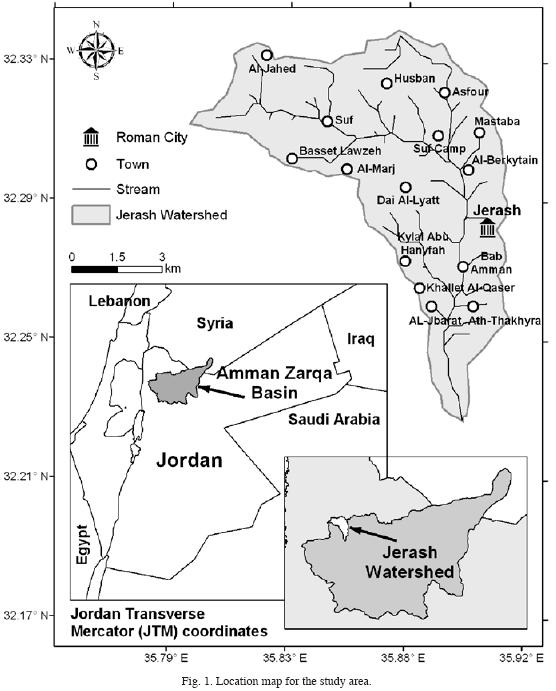
<body><![CDATA[<p align="justify"><font face="verdana" size="2">DRASTIC was the earliest method applied to evaluate vulnerability to contamination based on point count system (Cucchi, <i>et al., </i>2004). According to Foster and Hirata (1998), DRASTIC method is suitable for areas with low data availability and known hydrogeological setup. This method is a popular approach in groundwater vulnerability because it is relatively inexpensive and straightforward, and uses data that are commonly available or could be estimated to produce a vulnerability maps that can be easily interpreted (Margane, 2003).</font></p>     <p align="justify"><font face="verdana" size="2">EPIK is a parameter weighting and rating method especially developed for karst aquifers to protect water supply sources (springs and wells) (Doerfligereia/., 1999). It is recommended for areas with karst features; however, it requires a detailed evaluation of these features, which is often difficult, costly and time consuming as it involves field work, geophysical, isotopic, andhydrological studies, analysis of the hydraulic character, etc. (Margane, 2003).</font></p>     <p align="justify"><font face="verdana" size="2">DRASTIC and EPIK methods were applied to delineate groundwater vulnerability zones in the Jerash watershed which is located in the karst highlands of north Jordan (<a href="#f1">Fig. 1</a>). Furthermore, the vulnerability maps were used to define groundwater protection zones to implement protection programs for these groundwater sources. The earlier studies have been carried out by Camp Dresser &amp; McKee International Inc. (CDM 1999; 2001; 2002).</font></p>     <p align="center"><font face="verdana" size="2"><a name="f1"></a></font></p>     <p align="center"><font face="verdana" size="2"><img src="/img/revistas/geoint/v47n2/a1f1.jpg"></font></p>     <p align="justify"><font face="verdana" size="2">&nbsp;</font></p>     <p align="justify"><font face="verdana" size="2"><b>Description of Jerash Watershed</b></font></p>     <p align="justify"><font face="verdana" size="2">The Jerash watershed comprises an area of 39 km<sup>2 </sup>located in the northwestern part of the highlands of Amman&#150;Zarqa basin (<a href="#f1">Fig. 1</a>). There are three main settlements in the watershed. Among these, Jerash city is one of the best preserved Roman cities in the Middle East. There are 61,500 inhabitants in the watershed; it has been growing rapidly, placing additional constrains on the stressed water supply (Department of Statistics &#150;DOS&#150;, 2007). The groundwater resources in the Jerash watershed are provided from different aquifers, comprising Kurnub sandstone aquifer (K), Hummar dolomitic limestone aquifer (A4), and Nau'r limestone aquifer (A 1/2).</font></p>     <p align="justify"><font face="verdana" size="2">Thirteen major springs are located in the study area, of which five emerge from the A4 aquifer, six springs from A1/2 aquifer and two springs from K aquifer (Alawneh, 1998).</font></p>     <p align="justify"><font face="verdana" size="2">The major springs and wells in the study area are summarized in <a href="/img/revistas/geoint/v47n2/a1t1.jpg" target="_blank">Table 1</a>. El&#150;Qairawan spring (elevation 570 m above sea level) is one of the major springs located immediately northeast of the Jerash archaeological site. The discharged water from this spring is pumped directly to the distribution network of Al Saru area near Jerash.</font></p>     ]]></body>
<body><![CDATA[<p align="justify"><font face="verdana" size="2">The discharge of the springs has decreased dramatically from an average of about 170 m<sup>3</sup>/hr in 1980 to about 75 m3/hr in 2002 (WAJ, 2002). The drop in discharge is likely due to an increase in pumping from the Shawahed wells located upgradient from the El&#150;Qairawan spring. The other small springs (&lt;10 m<sup>3</sup>/hr) can be locally important, both for domestic and agricultural purposes. During winter months, rooftop runoff and cisterns supplement individual household supplies.</font></p>     <p align="justify"><font face="verdana" size="2">&nbsp;</font></p>     <p align="justify"><font face="verdana" size="2"><b>Hydrogeological Characterization</b></font></p>     <p align="justify"><font face="verdana" size="2">The geologic column of the watershed area comprises a cover of sedimentary rocks of Lower and Upper Cretaceous age. These rocks include sandstones, limestones, dolomitic limestones, marly limestones and shales (Bender, 1974). The geological formations outcropping in the area are shown in the geologic map (<a href="#f2">Fig. 2</a>). <a href="/img/revistas/geoint/v47n2/a1t2.jpg" target="_blank">Table 2</a> shows the geological column and hydrogeological rock classification in the area. Limestone rocks are predominantly characterized by karstification phenomena, where the watershed boundary was defined by using topographic high points, coincident with surface water drainages. Two main wadis (streams) traverse the valley floor (Wadi Suf and Wadi Dayr). In most of the year, these wadies have intermittent base flow, except the lower reaches of Wadi Dayr, which has perennial flow. There are numerous outcrops in portions of the watershed, such as limestone and chalky limestone formations. As a result, many epi&#150;karst features (e.g., sinkholes) can be noticed (Kolb <i>et al., </i>2004).</font></p>     <p align="center"><font face="verdana" size="2"><a name="f2"></a></font></p>     <p align="center"><font face="verdana" size="2"><img src="/img/revistas/geoint/v47n2/a1f2.jpg"></font></p>     <p align="justify"><font face="verdana" size="2">Major springs in the watershed are found in close proximity to one another, but at different elevations and outcrops, indicating the presence of localized, perched flow systems. Along Wadi Dayr, several small springs emerge on the flanks of the wadi, and some of this water naturally re&#150;infiltrates, while the remainder of the water is either used locally or piped along canals and aqueducts for irrigation purposes. Some of the irrigation water re&#150;infiltrates and recharges the alluvial sediments of Wadi Dayr, then flows towards the El&#150;Qairawan spring in Jerash (CDM, 2001).</font></p>     <p align="justify"><font face="verdana" size="2">&nbsp;</font></p>     <p align="justify"><font face="verdana" size="2"><b>Aquifer Characteristics</b></font></p>     <p align="justify"><font face="verdana" size="2">The main aquifers in Jerash watershed area include Kurnub sandstone aquifer (K), Nau'r aquifer (A1/2) and Hummar aquifer (A4). The Kurnub aquifer consists of massive, white and varicolored sandstones with a thickness of 300 m (Bender, 1974). This formation has a good potential of groundwater in Jordan (<a href="/img/revistas/geoint/v47n2/a1t2.jpg" target="_blank">Table 2</a>); however, in the study area, this aquifer does not produce economic groundwater supply and has poor chemical quality. The recharge to this aquifer is limited to small outcropping areas and to leakage from overlying carbonate aquifers. Along Jerash watershed, there are only two springs emerging from this aquifer: Ain Jebarat and Bisas El&#150;Neil springs and there is only one well named "Al Maleh 2" penetrating this aquifer. The Na'ur aquifer (A1/2) consists of limestones interbedded by a thick sequences of marl and overlies the Kurnub sandstone aquifer. Along Jerash watershed, there are 7 wells and 6 springs issued from this aquifer. The total recharge to this aquifer is about 4.5 million cubic meters (Alawneh, 1998). The specific capacity of the aquifer ranges from 0.01 to 12 m<sup>3</sup>/hr with a transmissivity ranging between 0.3 and 100 m<sup>2</sup>/d and the hydraulic conductivity varying from 0.003 to 2.7 m/d (Salemeh and Bannayan, 1993).</font></p>     ]]></body>
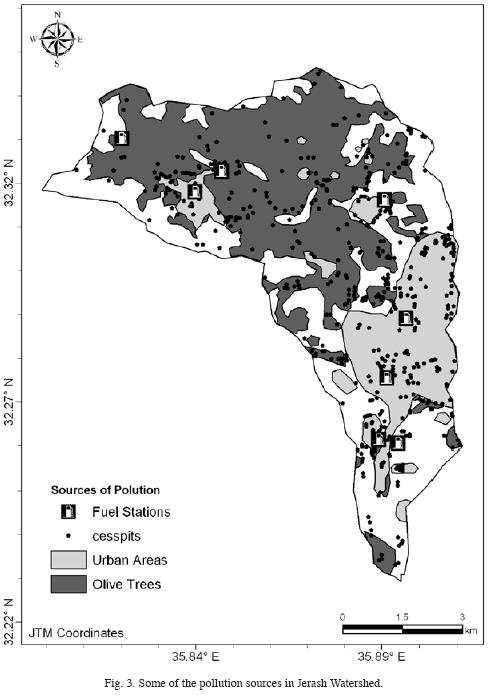
<body><![CDATA[<p align="justify"><font face="verdana" size="2">The Hummar aquifer (A4) comprises a karstified dolomitic limestone, light to dark grey in color, hard, crystalline, coarse grained and highly fractured. The transmissivity of this aquifer ranges between 32 to 300 m<sup>2</sup>/d. The permeability of this aquifer ranges from 8.1 x 10<sup>-7</sup> m/s to 7.6 x 10<sup>-4</sup> m/s (Rimawi, 1985). The recharge rate was estimated to be 5 to 6 MCM/year (Alawneh, 1998).</font></p>     <p align="justify"><font face="verdana" size="2">&nbsp;</font></p>     <p align="justify"><font face="verdana" size="2"><b>Sources of groundwater contamination</b></font></p>     <p align="justify"><font face="verdana" size="2">Wastewater and agricultural practices are the dominant source of contamination in the watershed. The major sources of pollution were identified to be cesspits, sewer overflows from urban areas, illegal dumping of fluid wastes; and intensive cultivation (olive trees) in the watershed area (CDM, 2002). The sewer outflows are the second source of contamination. There is misuse of the sewer system where solid waste, slaughterhouse by&#150;products are disposed. Furthermore, several vehicle maintenance stations also misuse the sewer system by disposing used motor oil and other wastes.</font></p>     <p align="justify"><font face="verdana" size="2">The third source of contamination is illegal dumping of fluid wastes including domestic and commercial sewage, olive oil press waste, liquids from the municipal slaughterhouse, chicken farm cleaning water.</font></p>     <p align="justify"><font face="verdana" size="2">The fourth source of contamination is agriculture and livestock which represent the major income sources for residents within the watershed. There are excess amounts of nitrogen applied in chemical fertilization during winter and summer seasons and leached from the soil as nitrate (CDM, 2002). Of particular concern are the nitrate levels as well as the risk of pesticides and herbicides reaching the groundwater. <a href="#f3">Fig. 3</a> shows some of the pollution sources in the study area.</font></p>     <p align="center"><font face="verdana" size="2"><a name="f3"></a></font></p>     <p align="center"><font face="verdana" size="2"><img src="/img/revistas/geoint/v47n2/a1f3.jpg"></font></p>     <p align="justify"><font face="verdana" size="2">&nbsp;</font></p>     <p align="justify"><font face="verdana" size="2"><b>Groundwater vulnerability and protection zones</b></font></p>     ]]></body>
<body><![CDATA[<p align="justify"><font face="verdana" size="2">The Jerash watershed source water protection approach aims to developing a comprehensive understanding of the practices in the watershed that could contribute to groundwater quality degradation, developing groundwater vulnerability maps and concurrently groundwater protection zones.</font></p>     <p align="justify"><font face="verdana" size="2">In this study two different methods were used for the assessment of groundwater vulnerability and consequently establishing groundwater protection zones. EPIK method (SAEFL, 1998) and DRASTIC method (Aller <i>et al., </i>1987) used in this study. These methods will be briefly described.</font></p>     <p align="justify"><font face="verdana" size="2">&nbsp;</font></p>     <p align="justify"><font face="verdana" size="2"><b>EPIK method</b></font></p>     <p align="justify"><font face="verdana" size="2">The EPIK method is a general multi&#150;attribute method used for karst aquifer vulnerability mapping, providing a basis for establishing groundwater protection zones in the karst environment (Doerfliger and Zwhalen, 1995, 1997). This model was developed with the support of the Swiss Federal Office for Environment, Forest and Landscape (SAFEL, 1998). The objective of this method is to produce vulnerability maps for karst spring water catchments. According to the selected attributes, the assigned vulnerability zones can be the basis for delineating groundwater protection zones.</font></p>     <p align="justify"><font face="verdana" size="2">The acronym EPIK refers to the following four attributes:</font></p>     <p align="justify"><font face="verdana" size="2">E &#150; Development of the <b>E</b>pikarst</font></p>     <p align="justify"><font face="verdana" size="2">P &#150; Effectiveness of the <b>P</b>rotective cover</font></p>     <p align="justify"><font face="verdana" size="2">I &#150; <b>I</b>nfiltration condition</font></p>     <p align="justify"><font face="verdana" size="2">K &#150; Development of the <b>K</b>arst network.</font></p>     ]]></body>
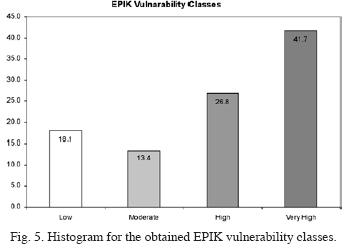
<body><![CDATA[<p align="justify"><font face="verdana" size="2">The overall protection index F is calculated based on the following equation:</font></p>     <p align="center"><font face="verdana" size="2"><img src="/img/revistas/geoint/v47n2/a1s1.jpg"></font></p>     <p align="justify"><font face="verdana" size="2">where &alpha;, &beta;, &gamma; and <img src="/img/revistas/geoint/v47n2/a1s2.jpg"> are weighting coefficients</font></p>     <p align="justify"><font face="verdana" size="2">The available geological and morphological information about the study area was used to determine E and K parameters. Soil and landuse maps that have been generated by the Ministry of Agriculture in 1995 at a scale of 1:50,000 as a part of the national soil and land use mapping were used to generate the P and I parameter thematic layer.</font></p>     <p align="justify"><font face="verdana" size="2">These four thematic layers were generated using ArcMAP 9.0 and Spatial Analyst to integrate all different geospatial data from these layers into EPIK vulnerability map. This map has been classified into four vulnerability classes (<a href="#f4">Fig. 4</a>) that range from low to very high according to Doerfliger and Zwahlen (1997) vulnerability classification. <a href="#f5">Fig. 5</a> shows a histogram for the obtained classes. Accordingly, about 68% of the total land area within the watershed has a vulnerability rating equal to or greater than "high." This is significant and expected as a result of karstic character of the aquifers and the existence of different sources of groundwater pollution on the watershed.</font></p>     <p align="center"><font face="verdana" size="2"><a name="f4"></a></font></p>     <p align="center"><font face="verdana" size="2"><img src="/img/revistas/geoint/v47n2/a1f4.jpg"></font></p>     <p align="center"><font face="verdana" size="2"><a name="f5"></a></font></p>     <p align="center"><font face="verdana" size="2"><img src="/img/revistas/geoint/v47n2/a1f5.jpg"></font></p>     <p align="justify"><font face="verdana" size="2"><b>DRASTIC method</b></font></p>     ]]></body>

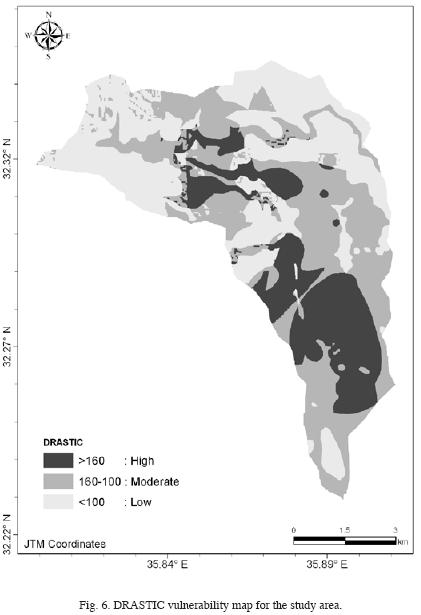
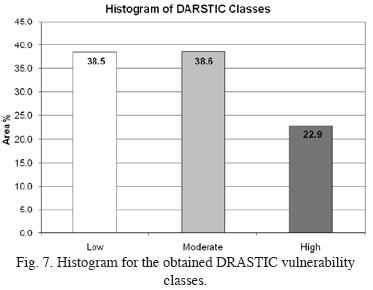
<body><![CDATA[<p align="justify"><font face="verdana" size="2">DRASTIC is an acronym representing seven hydrogeologic parameters or factors used for the assessment of pollution potential: Depth to water; net Recharge, Aquifer media, Soil media, Topography (slope), Impact of the vadose zone media, and hydraulic Conductivity of the aquifer. It employs a numerical ranking system that assigns relative weights to each parameter to help in the evaluation of relative groundwater vulnerability to contamination. Each parameter comprises a range of categories that are scored on a scale from 1 to 10. The variable rating allows the user to select either a typical value or to adjust the value based on more specific knowledge of the area under consideration (Aller <i>et al., </i>1987). Determination of the DRASTIC index number (pollution potential) for a given area involves multiplying each factor rating by its weight and adding together the resulting values. Higher sum values represent a greater potential for pollution or a greater vulnerability of the aquifer to contamination. Finally, the total impact factor score, the DRASTIC index number, can be calculated as: DRASTIC Index = D<sub>r</sub>D<sub>w</sub>  + R<sub>r</sub>R<sub>w</sub>+ A<sub>r</sub>A<sub>w</sub>+ S<sub>r</sub>S<sub>w</sub>   + T<sub>r</sub>T<sub>w</sub> + I<sub>r</sub>I<sub>w</sub> + C<sub>r</sub>C<sub>w</sub></font></p>     <p align="justify"><font face="verdana" size="2">where:</font></p>     <p align="justify"><font face="verdana" size="2">r   =  Rating for area being evaluated (1&#150;10) </font></p>     <p align="justify"><font face="verdana" size="2">w =  Importance weight for the factor (1&#150;5)</font></p>     <p align="justify"><font face="verdana" size="2">The vulnerability map using DRASTIC procedure a&#150;dopted with the aid of GIS is shown in <a href="#f6">Fig. 6.</a> As the histogram for the obtained DRASTIC classes (<a href="#f7">Fig. 7</a>) shows, about 22% of the watershed is ranked as highly vulnerable, while the rest of the watershed is ranked as moderate and low vulnerability.</font></p>     <p align="center"><font face="verdana" size="2"><a name="f6"></a></font></p>     <p align="center"><font face="verdana" size="2"><img src="/img/revistas/geoint/v47n2/a1f6.jpg"></font></p>     <p align="justify"><font face="verdana" size="2">&nbsp;</font></p>     <p align="center"><font face="verdana" size="2"><a name="f7"></a></font></p>     <p align="center"><font face="verdana" size="2"><img src="/img/revistas/geoint/v47n2/a1f7.jpg"></font></p>     ]]></body>
<body><![CDATA[<p align="justify"><font face="verdana" size="2">&nbsp;</font></p>     <p align="justify"><font face="verdana" size="2"><b>Comparing DRASTIC and EPIK vulnerability map</b></font></p>     <p align="justify"><font face="verdana" size="2">As <a href="#f3">Figs. 3</a> and <a href="#f5">5</a> illustrate, EPIK and DRASTIC method may agree on some degree of vulnerability about a specific area; however, some disagreement can be noticed in both maps. This fact would be expected as the assumptions behind each method are different. DRASTIC method is based on seven hydrological parameters that combine together to assess pollution potential. These factors have different weights that represent the participation of a specific parameter in stimulating groundwater pollution process. On the other hand EPIK is based of four parameters; where two of them are used to describe karstic morphology and karst network (E and K). Therefore, a major difference between EPIK and DRASTIC is the ability of the former method to describe epikarstic feature. This becomes an important fact when knowing that the study area have a lot of epikarstic features (e.g., holes, caves, sinkholes).</font></p>     <p align="justify"><font face="verdana" size="2">These maps were matched with microbiological contamination (fecal and total coliform bacteria) and with nitrate concentration measured in the springs within the study area. <a href="#f8">Fig. 8</a> shows the spatial distribution of fecal coliform bacteria levels, and <a href="#f9">Fig. 9</a> shows the fecal coliform (MPN/100 ml) in the raw water of El&#150;Qairawan Spring during the period February 1999 until January 2004. This spring was shutdown intermittently from 2001 to 2003 due to microbiological pollution. In addition, some groundwater wells located between Jerash and Suf camp shows the same signs of pollution and were shutdown. Upon completion of treatment, the wells were reactivated Kolb <i>et al., </i>2004). <a href="#f10">Figure 10</a> shows the distribution of the nitrate concentration in the study area. Recent monitoring in several springs in the watershed indicates that nitrates levels exceeded the permissible limit of the Jordanian Standard JS286 norm (45 mg/l) (Kolb <i>et al., </i>2004). By comparing nitrate distribution map with both EPIK and DRASTIC maps, it is also found that areas with high nitrate concentration are correlated with high vulnerability areas in both models.</font></p>     <p align="center"><font face="verdana" size="2"><a name="f8"></a></font></p>     <p align="center"><font face="verdana" size="2"><img src="/img/revistas/geoint/v47n2/a1f8.jpg"></font></p>     <p align="center"><font face="verdana" size="2"><a name="f9"></a></font></p>     <p align="center"><font face="verdana" size="2"><img src="/img/revistas/geoint/v47n2/a1f9.jpg"></font></p>     <p align="center"><font face="verdana" size="2"><a name="f10"></a></font></p>     <p align="center"><font face="verdana" size="2"><img src="/img/revistas/geoint/v47n2/a1f10.jpg"></font></p>     ]]></body>
<body><![CDATA[<p align="justify"><font face="verdana" size="2"><b>Conclusions</b></font></p>     <p align="justify"><font face="verdana" size="2">This study focuses on the assessment of aquifer vulnerability at Jerash area, northern Jordan. On the basis of the existing data, it was possible to derive an overall generalized assessment of groundwater vulnerability in Jerash. Since the vulnerability maps show also the location of the main water supply in the watershed such as springs and production wells, the combination of the two maps provides an indication of potential sources of pollution in the areas around major wells and springs and allows an initial assessment of the risk of groundwater contamination in the area.</font></p>     <p align="justify"><font face="verdana" size="2">Comparison of vulnerability maps obtained from both models indicates that there is a high degree of agreement of the areas with high vulnerability in DRASTIC and EPIK models in some areas.</font></p>     <p align="justify"><font face="verdana" size="2">The obtained vulnerability maps were compared with microbiological contamination (fecal coliform bacteria) and with nitrate levels. There is a good correlation between the areas with high microbiological and chemical pollution evidences and the areas which have shown high vulnerability from both EPIK and DRASTIC methods.</font></p>     <p align="justify"><font face="verdana" size="2">&nbsp;</font></p>     <p align="justify"><font face="verdana" size="2"><b>Bibliography</b></font></p>     <!-- ref --><p align="justify"><font face="verdana" size="2">Alawneh, M., 1998. Hydrology and hydrochemistry of Wadi Jerash catchment area. Unpublised MSc. Thesis, University of Baghdad, 180pp.</font>&nbsp;&nbsp;&nbsp;&nbsp;&nbsp;&nbsp;&nbsp;&nbsp;[&#160;<a href="javascript:void(0);" onclick="javascript: window.open('/scielo.php?script=sci_nlinks&ref=3898857&pid=S0016-7169200800020000100001&lng=','','width=640,height=500,resizable=yes,scrollbars=1,menubar=yes,');">Links</a>&#160;]<!-- end-ref --><!-- ref --><p align="justify"><font face="verdana" size="2">Aller, L., T. Bennett, J. H. Lehr and R. J. Petty, 1985. 'DRASTIC: A standardized system for evaluating groundwater pollution potential using hydrogeologic settings'. U.S. EPA, Robert S. Kerr Environmental Research Laboratory, Ada, OK, EPA/600/2&#150;85/0108, 163 pp.</font>&nbsp;&nbsp;&nbsp;&nbsp;&nbsp;&nbsp;&nbsp;&nbsp;[&#160;<a href="javascript:void(0);" onclick="javascript: window.open('/scielo.php?script=sci_nlinks&ref=3898858&pid=S0016-7169200800020000100002&lng=','','width=640,height=500,resizable=yes,scrollbars=1,menubar=yes,');">Links</a>&#160;]<!-- end-ref --><!-- ref --><p align="justify"><font face="verdana" size="2">Aller, L., T. Bennet, J. H. Lehr, R. J. Petty and G. Hackett, 1987. 'DRASTIC: A standardized system for evaluating groundwater pollution potential using hydrogeologic settings'. EPA&#150;600/2&#150;87&#150;035.</font>&nbsp;&nbsp;&nbsp;&nbsp;&nbsp;&nbsp;&nbsp;&nbsp;[&#160;<a href="javascript:void(0);" onclick="javascript: window.open('/scielo.php?script=sci_nlinks&ref=3898859&pid=S0016-7169200800020000100003&lng=','','width=640,height=500,resizable=yes,scrollbars=1,menubar=yes,');">Links</a>&#160;]<!-- end-ref --><!-- ref --><p align="justify"><font face="verdana" size="2">Bender, F., 1974. The geology of Jordan, contribution to the regional geology of the earth, supplementary edition of volume 7. Gebrueder Borntraeger, Berlin.</font>&nbsp;&nbsp;&nbsp;&nbsp;&nbsp;&nbsp;&nbsp;&nbsp;[&#160;<a href="javascript:void(0);" onclick="javascript: window.open('/scielo.php?script=sci_nlinks&ref=3898860&pid=S0016-7169200800020000100004&lng=','','width=640,height=500,resizable=yes,scrollbars=1,menubar=yes,');">Links</a>&#160;]<!-- end-ref --><!-- ref --><p align="justify"><font face="verdana" size="2">Camp Dresser &amp; McKee International Inc. (CDM), 1999. Rehabilitation of Selected Springs and Wells in Jordan. <i>In: </i>Assessment Report &amp; Technical Feasibility Study for Rehabilitation of Springs at Salt, Jordan. Prepared for USAID, Amman &#150;Jordan.</font>&nbsp;&nbsp;&nbsp;&nbsp;&nbsp;&nbsp;&nbsp;&nbsp;[&#160;<a href="javascript:void(0);" onclick="javascript: window.open('/scielo.php?script=sci_nlinks&ref=3898861&pid=S0016-7169200800020000100005&lng=','','width=640,height=500,resizable=yes,scrollbars=1,menubar=yes,');">Links</a>&#160;]<!-- end-ref --><!-- ref --><p align="justify"><font face="verdana" size="2">Camp Dresser &amp; McKee International Inc. (CDM), 2001. "History, Water Quality and Regulatory Review of Emergency Wells and Springs Assistance Project", USAID Report, May 2001.</font>&nbsp;&nbsp;&nbsp;&nbsp;&nbsp;&nbsp;&nbsp;&nbsp;[&#160;<a href="javascript:void(0);" onclick="javascript: window.open('/scielo.php?script=sci_nlinks&ref=3898862&pid=S0016-7169200800020000100006&lng=','','width=640,height=500,resizable=yes,scrollbars=1,menubar=yes,');">Links</a>&#160;]<!-- end-ref --><!-- ref --><p align="justify"><font face="verdana" size="2">Camp Dresser &amp; McKee International Inc. (CDM), 2002. "Jordan Water Quality Management Program: Compilation of technical Memoranda", USAID Report, December 2002.</font>&nbsp;&nbsp;&nbsp;&nbsp;&nbsp;&nbsp;&nbsp;&nbsp;[&#160;<a href="javascript:void(0);" onclick="javascript: window.open('/scielo.php?script=sci_nlinks&ref=3898863&pid=S0016-7169200800020000100007&lng=','','width=640,height=500,resizable=yes,scrollbars=1,menubar=yes,');">Links</a>&#160;]<!-- end-ref --><!-- ref --><p align="justify"><font face="verdana" size="2">Cucchi, F., P. Forti and L. Zini, 2004. The vulnerability of complex karst hydrostructures: Problems and perspectives. <i>Geof&iacute;sica Internacional, 43, 4, </i>533&#150;540.</font>&nbsp;&nbsp;&nbsp;&nbsp;&nbsp;&nbsp;&nbsp;&nbsp;[&#160;<a href="javascript:void(0);" onclick="javascript: window.open('/scielo.php?script=sci_nlinks&ref=3898864&pid=S0016-7169200800020000100008&lng=','','width=640,height=500,resizable=yes,scrollbars=1,menubar=yes,');">Links</a>&#160;]<!-- end-ref --><!-- ref --><p align="justify"><font face="verdana" size="2">Department of Statistics (DOS), 2007. Annual Handbook of Statistics, Amman&#150;Jordan.</font>&nbsp;&nbsp;&nbsp;&nbsp;&nbsp;&nbsp;&nbsp;&nbsp;[&#160;<a href="javascript:void(0);" onclick="javascript: window.open('/scielo.php?script=sci_nlinks&ref=3898865&pid=S0016-7169200800020000100009&lng=','','width=640,height=500,resizable=yes,scrollbars=1,menubar=yes,');">Links</a>&#160;]<!-- end-ref --><!-- ref --><p align="justify"><font face="verdana" size="2">Doerfliger, N. and F. Zwahlen, 1995. EPIK: a new method for outlining of protection areas in karst environment. <i>In: </i>G&uuml;nay G., Johnson I. (eds.) Proceedings 5th International symposium and field seminar on karst waters and environmental impacts. Antalya, Sep. 1995, Balkema, Rotterdam, pp. 117&#150;123.</font>&nbsp;&nbsp;&nbsp;&nbsp;&nbsp;&nbsp;&nbsp;&nbsp;[&#160;<a href="javascript:void(0);" onclick="javascript: window.open('/scielo.php?script=sci_nlinks&ref=3898866&pid=S0016-7169200800020000100010&lng=','','width=640,height=500,resizable=yes,scrollbars=1,menubar=yes,');">Links</a>&#160;]<!-- end-ref --><!-- ref --><p align="justify"><font face="verdana" size="2">Doerfliger, N. and F. Zwahlen, 1997. EPIK: Cartographic Method for Assessing the Vulnerability of Karst Aquifers for the purpose of Delineating Protection Zones. Proceedings of the 1997 Karst and Cave Management Symposium 13th National Cave Management Symposium, Bellingham, Washington and Chilliwack and Vancouver Island, BC, Canada October 7&#150;10, 1997 karstic environment. International Symposium on Karst Waters and Environmental impacts, Antalya, 10&#150;20 September 1995. Balkema, Netherland.</font>&nbsp;&nbsp;&nbsp;&nbsp;&nbsp;&nbsp;&nbsp;&nbsp;[&#160;<a href="javascript:void(0);" onclick="javascript: window.open('/scielo.php?script=sci_nlinks&ref=3898867&pid=S0016-7169200800020000100011&lng=','','width=640,height=500,resizable=yes,scrollbars=1,menubar=yes,');">Links</a>&#160;]<!-- end-ref --><!-- ref --><p align="justify"><font face="verdana" size="2">Doerfliger, N, PY Jeannin and F. Zwahlen, 1999. Water vulnerability assessment in karst environments: a new method of defining protection areas using a multiat&#150;tribute approach and GIS tools (EPIK method). Environmental Geology, Volume 39, Number 2 p. 165&#150;176.</font>&nbsp;&nbsp;&nbsp;&nbsp;&nbsp;&nbsp;&nbsp;&nbsp;[&#160;<a href="javascript:void(0);" onclick="javascript: window.open('/scielo.php?script=sci_nlinks&ref=3898868&pid=S0016-7169200800020000100012&lng=','','width=640,height=500,resizable=yes,scrollbars=1,menubar=yes,');">Links</a>&#160;]<!-- end-ref --><!-- ref --><p align="justify"><font face="verdana" size="2">Foster, S. and R. Hirata, 1988. Groundwater Pollution Risk Assessment &#150; A Methodology Using Available Data. Pan American Center for Sanitary Engineering and Environmnetal Science (CEPIS), 73p.: Lima/ Peru.</font>&nbsp;&nbsp;&nbsp;&nbsp;&nbsp;&nbsp;&nbsp;&nbsp;[&#160;<a href="javascript:void(0);" onclick="javascript: window.open('/scielo.php?script=sci_nlinks&ref=3898869&pid=S0016-7169200800020000100013&lng=','','width=640,height=500,resizable=yes,scrollbars=1,menubar=yes,');">Links</a>&#160;]<!-- end-ref --><!-- ref --><p align="justify"><font face="verdana" size="2">Kolb, B. H., A. Abu Hijleh, C. Parameswar, N. Sunna and A. Hijazi, 2004. "Implementing Jordan's First Source Water Protection Program", Water Environment Federation Watershed 2004 Conference, July 2004.</font>&nbsp;&nbsp;&nbsp;&nbsp;&nbsp;&nbsp;&nbsp;&nbsp;[&#160;<a href="javascript:void(0);" onclick="javascript: window.open('/scielo.php?script=sci_nlinks&ref=3898870&pid=S0016-7169200800020000100014&lng=','','width=640,height=500,resizable=yes,scrollbars=1,menubar=yes,');">Links</a>&#160;]<!-- end-ref --><!-- ref --><p align="justify"><font face="verdana" size="2">Margane, A., 1995. Groundwater resources of northern Jordan&#150; Vol. 2, Part 2: Monitoring of groundwater levels in Jordan. Report prepared by Technical Cooperation Project BMZ No. 89.2105.8, BGR&#150;Archive No. 118702; Hannover and Amman (Unpubl.).</font>&nbsp;&nbsp;&nbsp;&nbsp;&nbsp;&nbsp;&nbsp;&nbsp;[&#160;<a href="javascript:void(0);" onclick="javascript: window.open('/scielo.php?script=sci_nlinks&ref=3898871&pid=S0016-7169200800020000100015&lng=','','width=640,height=500,resizable=yes,scrollbars=1,menubar=yes,');">Links</a>&#160;]<!-- end-ref --><!-- ref --><p align="justify"><font face="verdana" size="2">Margane, A., 2003. Guideline for Groundwater Vulnerability Mapping and Risk Assessment for the Susceptibility of Ground Water Resources to Contamination, Technical Cooperation, Project 1996.2189.7, 4, April 2003, 53 p., Damascus.</font>&nbsp;&nbsp;&nbsp;&nbsp;&nbsp;&nbsp;&nbsp;&nbsp;[&#160;<a href="javascript:void(0);" onclick="javascript: window.open('/scielo.php?script=sci_nlinks&ref=3898872&pid=S0016-7169200800020000100016&lng=','','width=640,height=500,resizable=yes,scrollbars=1,menubar=yes,');">Links</a>&#160;]<!-- end-ref --><!-- ref --><p align="justify"><font face="verdana" size="2">Rimawi, O., 1985. Hydrochemistry and isotope hydrology of groundwater and surface water in the north&#150;east of Mafraq, Dhuleil, Hallabat, Azraq basin, PhD. Thesis. Tech. University, Muenchen, 240 pp.</font>&nbsp;&nbsp;&nbsp;&nbsp;&nbsp;&nbsp;&nbsp;&nbsp;[&#160;<a href="javascript:void(0);" onclick="javascript: window.open('/scielo.php?script=sci_nlinks&ref=3898873&pid=S0016-7169200800020000100017&lng=','','width=640,height=500,resizable=yes,scrollbars=1,menubar=yes,');">Links</a>&#160;]<!-- end-ref --><!-- ref --><p align="justify"><font face="verdana" size="2">Salameh, E. and H. Bannayan, 1993. Water Resources of Jordan: Future and Future Potentials. Friedrich Ebert Stiftung, Amman, Jordan.</font>&nbsp;&nbsp;&nbsp;&nbsp;&nbsp;&nbsp;&nbsp;&nbsp;[&#160;<a href="javascript:void(0);" onclick="javascript: window.open('/scielo.php?script=sci_nlinks&ref=3898874&pid=S0016-7169200800020000100018&lng=','','width=640,height=500,resizable=yes,scrollbars=1,menubar=yes,');">Links</a>&#160;]<!-- end-ref --><!-- ref --><p align="justify"><font face="verdana" size="2">SAEFL (Swiss Agency for Environment, Forests and Landscape), 1998. Practical Guide: Groundwater Vulnerability Mapping in Karstic Regions (EPIK); Application to Groundwater Protection Zones.</font>&nbsp;&nbsp;&nbsp;&nbsp;&nbsp;&nbsp;&nbsp;&nbsp;[&#160;<a href="javascript:void(0);" onclick="javascript: window.open('/scielo.php?script=sci_nlinks&ref=3898875&pid=S0016-7169200800020000100019&lng=','','width=640,height=500,resizable=yes,scrollbars=1,menubar=yes,');">Links</a>&#160;]<!-- end-ref --><!-- ref --><p align="justify"><font face="verdana" size="2">Vias, J., B. Andreo, M. Perles and F. Carrasco, 2005. A compartive study of four schemes for groundwater vulnerability mapping in a diffuse flow carbonate aquifer under Mediterranean climatic condition. <i>Environ. Geol., 47, </i>586&#150;595.</font>&nbsp;&nbsp;&nbsp;&nbsp;&nbsp;&nbsp;&nbsp;&nbsp;[&#160;<a href="javascript:void(0);" onclick="javascript: window.open('/scielo.php?script=sci_nlinks&ref=3898876&pid=S0016-7169200800020000100020&lng=','','width=640,height=500,resizable=yes,scrollbars=1,menubar=yes,');">Links</a>&#160;]<!-- end-ref --><!-- ref --><p align="justify"><font face="verdana" size="2">Water Authority of Jordan (WAJ), 2002. Water Information System, Ministry of Water and Irrigation, Amman.</font>&nbsp;&nbsp;&nbsp;&nbsp;&nbsp;&nbsp;&nbsp;&nbsp;[&#160;<a href="javascript:void(0);" onclick="javascript: window.open('/scielo.php?script=sci_nlinks&ref=3898877&pid=S0016-7169200800020000100021&lng=','','width=640,height=500,resizable=yes,scrollbars=1,menubar=yes,');">Links</a>&#160;]<!-- end-ref --> ]]></body><back>
<ref-list>
<ref id="B1">
<nlm-citation citation-type="">
<person-group person-group-type="author">
<name>
<surname><![CDATA[Alawneh]]></surname>
<given-names><![CDATA[M.]]></given-names>
</name>
</person-group>
<source><![CDATA[Hydrology and hydrochemistry of Wadi Jerash catchment area]]></source>
<year>1998</year>
</nlm-citation>
</ref>
<ref id="B2">
<nlm-citation citation-type="book">
<person-group person-group-type="author">
<name>
<surname><![CDATA[Aller]]></surname>
<given-names><![CDATA[L.]]></given-names>
</name>
<name>
<surname><![CDATA[Bennett]]></surname>
<given-names><![CDATA[T.]]></given-names>
</name>
<name>
<surname><![CDATA[Lehr]]></surname>
<given-names><![CDATA[J. H.]]></given-names>
</name>
<name>
<surname><![CDATA[Petty]]></surname>
<given-names><![CDATA[R. J.]]></given-names>
</name>
</person-group>
<source><![CDATA[DRASTIC: A standardized system for evaluating groundwater pollution potential using hydrogeologic settings]]></source>
<year>1985</year>
<page-range>163</page-range><publisher-name><![CDATA[U.S.EPARobert S. Kerr Environmental Research Laboratory]]></publisher-name>
</nlm-citation>
</ref>
<ref id="B3">
<nlm-citation citation-type="">
<person-group person-group-type="author">
<name>
<surname><![CDATA[Aller]]></surname>
<given-names><![CDATA[L.]]></given-names>
</name>
<name>
<surname><![CDATA[Bennet]]></surname>
<given-names><![CDATA[T.]]></given-names>
</name>
<name>
<surname><![CDATA[Lehr]]></surname>
<given-names><![CDATA[J. H.]]></given-names>
</name>
<name>
<surname><![CDATA[Petty]]></surname>
<given-names><![CDATA[R. J.]]></given-names>
</name>
<name>
<surname><![CDATA[Hackett]]></surname>
<given-names><![CDATA[G.]]></given-names>
</name>
</person-group>
<source><![CDATA[DRASTIC: A standardized system for evaluating groundwater pollution potential using hydrogeologic settings]]></source>
<year>1987</year>
</nlm-citation>
</ref>
<ref id="B4">
<nlm-citation citation-type="book">
<person-group person-group-type="author">
<name>
<surname><![CDATA[Bender]]></surname>
<given-names><![CDATA[F.]]></given-names>
</name>
</person-group>
<source><![CDATA[The geology of Jordan: contribution to the regional geology of the earth]]></source>
<year>1974</year>
<publisher-loc><![CDATA[Berlin ]]></publisher-loc>
<publisher-name><![CDATA[Gebrueder Borntraeger]]></publisher-name>
</nlm-citation>
</ref>
<ref id="B5">
<nlm-citation citation-type="">
<collab>Camp Dresser & McKee International Inc. (CDM)</collab>
<article-title xml:lang="en"><![CDATA[Rehabilitation of Selected Springs and Wells in Jordan]]></article-title>
<source><![CDATA[Assessment Report & Technical Feasibility Study for Rehabilitation of Springs at Salt]]></source>
<year>1999</year>
<publisher-loc><![CDATA[JordanAmman ]]></publisher-loc>
</nlm-citation>
</ref>
<ref id="B6">
<nlm-citation citation-type="book">
<collab>Camp Dresser & McKee International Inc. (CDM)</collab>
<source><![CDATA[History, Water Quality and Regulatory Review of Emergency Wells and Springs Assistance Project]]></source>
<year>2001</year>
<publisher-name><![CDATA[USAID Report]]></publisher-name>
</nlm-citation>
</ref>
<ref id="B7">
<nlm-citation citation-type="book">
<collab>Camp Dresser & McKee International Inc. (CDM)</collab>
<source><![CDATA[Jordan Water Quality Management Program: Compilation of technical Memoranda]]></source>
<year>2002</year>
<publisher-name><![CDATA[USAID Report]]></publisher-name>
</nlm-citation>
</ref>
<ref id="B8">
<nlm-citation citation-type="journal">
<person-group person-group-type="author">
<name>
<surname><![CDATA[Cucchi]]></surname>
<given-names><![CDATA[F.]]></given-names>
</name>
<name>
<surname><![CDATA[Forti]]></surname>
<given-names><![CDATA[P.]]></given-names>
</name>
<name>
<surname><![CDATA[Zini]]></surname>
<given-names><![CDATA[L.]]></given-names>
</name>
</person-group>
<article-title xml:lang="en"><![CDATA[The vulnerability of complex karst hydrostructures: Problems and perspectives]]></article-title>
<source><![CDATA[Geofísica Internacional]]></source>
<year>2004</year>
<volume>43</volume>
<numero>4</numero>
<issue>4</issue>
<page-range>533-540</page-range></nlm-citation>
</ref>
<ref id="B9">
<nlm-citation citation-type="">
<collab>Department of Statistics (DOS)</collab>
<source><![CDATA[Annual Handbook of Statistics]]></source>
<year>2007</year>
<publisher-loc><![CDATA[Amman ]]></publisher-loc>
</nlm-citation>
</ref>
<ref id="B10">
<nlm-citation citation-type="">
<person-group person-group-type="author">
<name>
<surname><![CDATA[Doerfliger]]></surname>
<given-names><![CDATA[N.]]></given-names>
</name>
<name>
<surname><![CDATA[Zwahlen]]></surname>
<given-names><![CDATA[F.]]></given-names>
</name>
</person-group>
<article-title xml:lang="en"><![CDATA[EPIK: a new method for outlining of protection areas in karst environment]]></article-title>
<person-group person-group-type="editor">
<name>
<surname><![CDATA[Günay]]></surname>
<given-names><![CDATA[G.]]></given-names>
</name>
<name>
<surname><![CDATA[Johnson]]></surname>
<given-names><![CDATA[I.]]></given-names>
</name>
</person-group>
<source><![CDATA[Proceedings 5th International symposium and field seminar on karst waters and environmental impacts]]></source>
<year>1995</year>
<month>Se</month>
<day>p.</day>
<page-range>117-123</page-range><publisher-loc><![CDATA[AntalyaBalkemaRotterdam ]]></publisher-loc>
</nlm-citation>
</ref>
<ref id="B11">
<nlm-citation citation-type="confpro">
<person-group person-group-type="author">
<name>
<surname><![CDATA[Doerfliger]]></surname>
<given-names><![CDATA[N.]]></given-names>
</name>
<name>
<surname><![CDATA[Zwahlen]]></surname>
<given-names><![CDATA[F.]]></given-names>
</name>
</person-group>
<article-title xml:lang="en"><![CDATA[EPIK: Cartographic Method for Assessing the Vulnerability of Karst Aquifers for the purpose of Delineating Protection Zones]]></article-title>
<source><![CDATA[Proceedings of the 1997 Karst and Cave Management Symposium 13th National Cave Management Symposium, Bellingham, Washington and Chilliwack and Vancouver Island, BC, Canada October 7-10, 1997 karstic environment]]></source>
<year>1997</year>
<conf-name><![CDATA[ International Symposium on Karst Waters and Environmental impacts]]></conf-name>
<conf-date>10-20 September 1995</conf-date>
<conf-loc>AntalyaBalkema </conf-loc>
</nlm-citation>
</ref>
<ref id="B12">
<nlm-citation citation-type="journal">
<person-group person-group-type="author">
<name>
<surname><![CDATA[Doerfliger]]></surname>
<given-names><![CDATA[N]]></given-names>
</name>
<name>
<surname><![CDATA[Jeannin]]></surname>
<given-names><![CDATA[PY]]></given-names>
</name>
<name>
<surname><![CDATA[Zwahlen]]></surname>
<given-names><![CDATA[F.]]></given-names>
</name>
</person-group>
<article-title xml:lang="en"><![CDATA[Water vulnerability assessment in karst environments: a new method of defining protection areas using a multiat-tribute approach and GIS tools (EPIK method)]]></article-title>
<source><![CDATA[Environmental Geology]]></source>
<year>1999</year>
<volume>39</volume>
<numero>2</numero>
<issue>2</issue>
<page-range>165-176</page-range></nlm-citation>
</ref>
<ref id="B13">
<nlm-citation citation-type="book">
<person-group person-group-type="author">
<name>
<surname><![CDATA[Foster]]></surname>
<given-names><![CDATA[S.]]></given-names>
</name>
<name>
<surname><![CDATA[Hirata]]></surname>
<given-names><![CDATA[R.]]></given-names>
</name>
</person-group>
<source><![CDATA[Groundwater Pollution Risk Assessment: A Methodology Using Available Data]]></source>
<year>1988</year>
<page-range>73</page-range><publisher-loc><![CDATA[Lima ]]></publisher-loc>
<publisher-name><![CDATA[Pan American Center for Sanitary Engineering and Environmnetal Science (CEPIS)]]></publisher-name>
</nlm-citation>
</ref>
<ref id="B14">
<nlm-citation citation-type="confpro">
<person-group person-group-type="author">
<name>
<surname><![CDATA[Kolb]]></surname>
<given-names><![CDATA[B. H.]]></given-names>
</name>
<name>
<surname><![CDATA[Abu Hijleh]]></surname>
<given-names><![CDATA[A.]]></given-names>
</name>
<name>
<surname><![CDATA[Parameswar]]></surname>
<given-names><![CDATA[C.]]></given-names>
</name>
<name>
<surname><![CDATA[Sunna]]></surname>
<given-names><![CDATA[N.]]></given-names>
</name>
<name>
<surname><![CDATA[Hijazi]]></surname>
<given-names><![CDATA[A.]]></given-names>
</name>
</person-group>
<article-title xml:lang="en"><![CDATA[Implementing Jordan's First Source Water Protection Program]]></article-title>
<source><![CDATA[]]></source>
<year>2004</year>
<conf-name><![CDATA[ Water Environment Federation Watershed 2004 Conference]]></conf-name>
<conf-date>July 200</conf-date>
<conf-loc> </conf-loc>
</nlm-citation>
</ref>
<ref id="B15">
<nlm-citation citation-type="">
<person-group person-group-type="author">
<name>
<surname><![CDATA[Margane]]></surname>
<given-names><![CDATA[A.]]></given-names>
</name>
</person-group>
<source><![CDATA[Groundwater resources of northern Jordan: Vol. 2, Part 2: Monitoring of groundwater levels in Jordan]]></source>
<year>1995</year>
<publisher-loc><![CDATA[HannoverAmman ]]></publisher-loc>
</nlm-citation>
</ref>
<ref id="B16">
<nlm-citation citation-type="">
<person-group person-group-type="author">
<name>
<surname><![CDATA[Margane]]></surname>
<given-names><![CDATA[A.]]></given-names>
</name>
</person-group>
<source><![CDATA[Guideline for Groundwater Vulnerability Mapping and Risk Assessment for the Susceptibility of Ground Water Resources to Contamination]]></source>
<year>2003</year>
<volume>4</volume>
<publisher-loc><![CDATA[Damascus ]]></publisher-loc>
</nlm-citation>
</ref>
<ref id="B17">
<nlm-citation citation-type="">
<person-group person-group-type="author">
<name>
<surname><![CDATA[Rimawi]]></surname>
<given-names><![CDATA[O.]]></given-names>
</name>
</person-group>
<source><![CDATA[Hydrochemistry and isotope hydrology of groundwater and surface water in the north-east of Mafraq, Dhuleil, Hallabat, Azraq basin]]></source>
<year>1985</year>
</nlm-citation>
</ref>
<ref id="B18">
<nlm-citation citation-type="book">
<person-group person-group-type="author">
<name>
<surname><![CDATA[Salameh]]></surname>
<given-names><![CDATA[E.]]></given-names>
</name>
<name>
<surname><![CDATA[Bannayan]]></surname>
<given-names><![CDATA[H.]]></given-names>
</name>
</person-group>
<source><![CDATA[Water Resources of Jordan: Future and Future Potentials]]></source>
<year>1993</year>
<publisher-loc><![CDATA[Amman ]]></publisher-loc>
<publisher-name><![CDATA[Friedrich Ebert Stiftung]]></publisher-name>
</nlm-citation>
</ref>
<ref id="B19">
<nlm-citation citation-type="">
<collab>SAEFL (Swiss Agency for Environment, Forests and Landscape)</collab>
<source><![CDATA[Practical Guide: Groundwater Vulnerability Mapping in Karstic Regions (EPIK): Application to Groundwater Protection Zones]]></source>
<year>1998</year>
</nlm-citation>
</ref>
<ref id="B20">
<nlm-citation citation-type="journal">
<person-group person-group-type="author">
<name>
<surname><![CDATA[Vias]]></surname>
<given-names><![CDATA[J.]]></given-names>
</name>
<name>
<surname><![CDATA[Andreo]]></surname>
<given-names><![CDATA[B.]]></given-names>
</name>
<name>
<surname><![CDATA[Perles]]></surname>
<given-names><![CDATA[M.]]></given-names>
</name>
<name>
<surname><![CDATA[Carrasco]]></surname>
<given-names><![CDATA[F.]]></given-names>
</name>
</person-group>
<article-title xml:lang="en"><![CDATA[A compartive study of four schemes for groundwater vulnerability mapping in a diffuse flow carbonate aquifer under Mediterranean climatic condition]]></article-title>
<source><![CDATA[Environ. Geol.]]></source>
<year>2005</year>
<numero>47</numero>
<issue>47</issue>
<page-range>586-595</page-range></nlm-citation>
</ref>
<ref id="B21">
<nlm-citation citation-type="book">
<collab>Water Authority of Jordan (WAJ)</collab>
<source><![CDATA[Water Information System]]></source>
<year>2002</year>
<publisher-loc><![CDATA[Amman ]]></publisher-loc>
<publisher-name><![CDATA[Ministry of Water and Irrigation]]></publisher-name>
</nlm-citation>
</ref>
</ref-list>
</back>
</article>