<?xml version="1.0" encoding="ISO-8859-1"?><article xmlns:mml="http://www.w3.org/1998/Math/MathML" xmlns:xlink="http://www.w3.org/1999/xlink" xmlns:xsi="http://www.w3.org/2001/XMLSchema-instance">
<front>
<journal-meta>
<journal-id>0016-7169</journal-id>
<journal-title><![CDATA[Geofísica internacional]]></journal-title>
<abbrev-journal-title><![CDATA[Geofís. Intl]]></abbrev-journal-title>
<issn>0016-7169</issn>
<publisher>
<publisher-name><![CDATA[Universidad Nacional Autónoma de México, Instituto de Geofísica]]></publisher-name>
</publisher>
</journal-meta>
<article-meta>
<article-id>S0016-71692008000100006</article-id>
<title-group>
<article-title xml:lang="en"><![CDATA[The ellipticity of Rayleigh waves at infinite depth]]></article-title>
</title-group>
<contrib-group>
<contrib contrib-type="author">
<name>
<surname><![CDATA[Malischewsky Auning]]></surname>
<given-names><![CDATA[P]]></given-names>
</name>
<xref ref-type="aff" rid="A01"/>
</contrib>
</contrib-group>
<aff id="A01">
<institution><![CDATA[,Friedrich-Schiller- Universität Jena Institut für Geowissenschaften ]]></institution>
<addr-line><![CDATA[Jena ]]></addr-line>
<country>Germany</country>
</aff>
<pub-date pub-type="pub">
<day>00</day>
<month>03</month>
<year>2008</year>
</pub-date>
<pub-date pub-type="epub">
<day>00</day>
<month>03</month>
<year>2008</year>
</pub-date>
<volume>47</volume>
<numero>1</numero>
<fpage>77</fpage>
<lpage>79</lpage>
<copyright-statement/>
<copyright-year/>
<self-uri xlink:href="http://www.scielo.org.mx/scielo.php?script=sci_arttext&amp;pid=S0016-71692008000100006&amp;lng=en&amp;nrm=iso"></self-uri><self-uri xlink:href="http://www.scielo.org.mx/scielo.php?script=sci_abstract&amp;pid=S0016-71692008000100006&amp;lng=en&amp;nrm=iso"></self-uri><self-uri xlink:href="http://www.scielo.org.mx/scielo.php?script=sci_pdf&amp;pid=S0016-71692008000100006&amp;lng=en&amp;nrm=iso"></self-uri><abstract abstract-type="short" xml:lang="es"><p><![CDATA[Se presenta una fórmula analítica y una aproximación para calcular la elipticidad de las ondas de Rayleigh en un semi-espacio homogéneo a profundidad infinita, en función del módulo de Poisson. Se compara el resultado con las fórmulas correspondientes para elipticidad en la superficie.]]></p></abstract>
<abstract abstract-type="short" xml:lang="en"><p><![CDATA[I present an analytical formula and an approximation for the ellipticity of Rayleigh waves in a homogeneous half-space at infinite depth in terms of Poisson's ratio. The result is compared with the corresponding formulas for surface ellipticity.]]></p></abstract>
<kwd-group>
<kwd lng="es"><![CDATA[Ondas de Rayleigh]]></kwd>
<kwd lng="es"><![CDATA[elipticidad]]></kwd>
<kwd lng="en"><![CDATA[Rayleigh waves]]></kwd>
<kwd lng="en"><![CDATA[ellipticity]]></kwd>
</kwd-group>
</article-meta>
</front><body><![CDATA[ <p align="justify"><font face="verdana" size="4">Short notes</font></p>     <p align="justify"><font face="verdana" size="2">&nbsp;</font></p>     <p align="center"><font face="verdana" size="4"><b>The ellipticity of Rayleigh waves at infinite depth</b></font></p>     <p align="center"><font face="verdana" size="2">&nbsp;</font></p>     <p align="center"><font face="verdana" size="2"><b>P. Malischewsky Auning</b></font></p>     <p align="justify"><font face="verdana" size="2">&nbsp;</font></p>     <p align="justify"><font face="verdana" size="2"><i>Friedrich&#150;Schiller&#150; Universit&auml;t Jena, Institut f&uuml;r Geowissenschaften, Burgweg 11, 07749 Jena, Germany E&#150;mail: <a href="mailto:p.mali@uni-jena.de">p.mali@uni-jena.de</a></i></font></p>     <p align="justify"><font face="verdana" size="2">&nbsp;</font></p>     <p align="justify"><font face="verdana" size="2">Received: October 18, 2007    <br> Accepted: November 9, 2007</font></p>     ]]></body>
<body><![CDATA[<p align="justify"><font face="verdana" size="2">&nbsp;</font></p>     <p align="justify"><font face="verdana" size="2"><b>Resumen</b></font></p>     <p align="justify"><font face="verdana" size="2">Se presenta una f&oacute;rmula anal&iacute;tica y una aproximaci&oacute;n para calcular la elipticidad de las ondas de Rayleigh en un semi&#150;espacio homog&eacute;neo a profundidad infinita, en funci&oacute;n del m&oacute;dulo de Poisson. Se compara el resultado con las f&oacute;rmulas correspondientes para elipticidad en la superficie.</font></p>     <p align="justify"><font face="verdana" size="2"><b>Palabras clave: </b>Ondas de Rayleigh, elipticidad.</font></p>     <p align="justify"><font face="verdana" size="2">&nbsp;</font></p>     <p align="justify"><font face="verdana" size="2"><b>Abstract</b></font></p>     <p align="justify"><font face="verdana" size="2">I present an analytical formula and an approximation for the ellipticity of Rayleigh waves in a homogeneous half&#150;space at infinite depth in terms of Poisson's ratio. The result is compared with the corresponding formulas for surface ellipticity.</font></p>     <p align="justify"><font face="verdana" size="2"><b>Key words: </b>Rayleigh waves, ellipticity.</font></p>     <p align="justify"><font face="verdana" size="2">&nbsp;</font></p>     <p align="justify"><font face="verdana" size="2"><b>Introduction</b></font></p>     ]]></body>
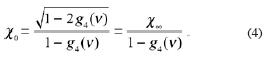
<body><![CDATA[<p align="justify"><font face="verdana" size="2">The ellipticity or H/V ratio <i>&chi;</i><sub>0</sub> of seismic Rayleigh waves propagating on the surface of the Earth has attracted the attention of experimental seismologists (see, e. g., Lermo and Ch&aacute;vez&#150;Garc&iacute;a, 1994; Bard, 1998); Flores&#150;Estrella, 2004) as well as theoreticians (see, e. g., Malischewsky and Scherbaum, 2004). The ellipticity of Rayleigh waves at infinite depth <i>&chi;</i><sub>&infin;</sub> is a significant parameter that belongs to a complete theoretical description of the wave field. Weichert (2007) pointed out that the ellipticity adopts a constant value at infinite depth. This is indeed the case: its value may be simply determined as a function of Poisson's ratio <i>v. </i>It should be noted, however, that the meaning of "infinite depth" is frequency&#150;dependent. It can extend over an interval of many kilometers for long&#150;period Rayleigh waves, or of a few meters for very high&#150;frequency waves. This feature can be significant in some geophysical situations, e. g. for borehole measurements.</font></p>     <p align="justify"><font face="verdana" size="2">&nbsp;</font></p>     <p align="justify"><font face="verdana" size="2"><b>An analytical formula for <i><i>&chi;</i><sub>&infin;</sub></i></b></font></p>     <p align="justify"><font face="verdana" size="2">Representations of the Rayleigh eigenfunctions for a homogeneous half&#150;space lead to the simple formula</font></p>     <p align="center"><font face="verdana" size="2"><img src="/img/revistas/geoint/v47n1/a6s1.jpg"></font></p>     <p align="justify"><font face="verdana" size="2">where <i>c</i> is the phase velocity and <i>&beta; </i>is the shear&#150;wave velocity. By using Malischewsky's formula for the Rayleigh&#150;wave velocity in a half&#150;space (see Malischewsky, 2004), the ellipticity at infinite depth may be expressed analytically as a function of Poisson's ratio as</font></p>     <p align="center"><font face="verdana" size="2"><img src="/img/revistas/geoint/v47n1/a6s2.jpg"></font></p>     <p align="justify"><font face="verdana" size="2">where the following abbreviations are used:</font></p>     <p align="center"><font face="verdana" size="2"><img src="/img/revistas/geoint/v47n1/a6s3.jpg"></font></p>     <p align="justify"><font face="verdana" size="2">and the main values of the cubic roots are used throughout. For the reader's convenience we recall the formula for <i><i>&chi;</i></i><sub>0</sub> (see Malischewsky <i>et al., </i>2007):</font></p>     ]]></body>
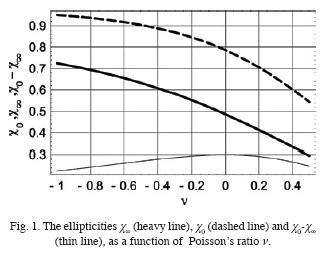
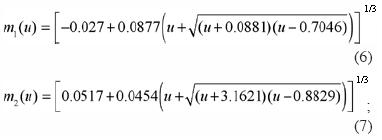
<body><![CDATA[<p align="center"><font face="verdana" size="2"><img src="/img/revistas/geoint/v47n1/a6s4.jpg"></font></p>     <p align="justify"><font face="verdana" size="2">The ellipticities <i><i>&chi;</i></i><sub>0</sub> and <i>&chi;</i><sub>&infin;</sub><i> </i>in terms of Poisson's ratio are shown in <a href="#f1">Fig. 1</a> together with the difference between both values. Negative Poisson's ratios do not arise in seismology, except in some particular crystallization phases of ice (Bormann, 2002). However, they do have some importance in material science, and they are included here for completeness. At infinite depth, the ellipse described by particle motion is always flatter than it is on the surface. In <a href="#f1">Fig. 1</a>, the difference between the ellipticities has a maximum at <i>v = </i>0 (<i><i><i>&chi;</i></i></i><sub>0</sub><i> &#150; <i>&chi;</i><sub>&infin;</sub> = </i>0.3), and the relative deviation (<i><i><i>&chi;</i></i></i><sub>0</sub><i> &#150; <i>&chi;</i><sub>&infin; </sub> </i>)<i>/<i><i>&chi;</i></i></i><sub>0</sub> is maximum at <i>v = </i>0.5. In the valley of Mexico, Poisson's ratio is as high as 0.499 and the ellipti city at infinite depth reaches 54.4% of the surface ellipticity.</font></p>     <p align="center"><font face="verdana" size="2"><a name="f1"></a></font></p>     <p align="center"><font face="verdana" size="2"><img src="/img/revistas/geoint/v47n1/a6f1.jpg"></font></p>     <p align="justify"><font face="verdana" size="2">Finally, we may make use of a method proposed by Pham Chi Vinh and Malischewsky (2006) which involves carrying out a Taylor expansion of Equations (2) and (4) in the interval <img src="/img/revistas/geoint/v47n1/a6s10.jpg">. The approximation is very accurate, with a relative error of less than 0.1 % in the whole interval:</font></p>     <p align="center"><img src="/img/revistas/geoint/v47n1/a6s5.jpg"></p>     <p align="justify"><font face="verdana" size="2">These formulas may be easily inverted to obtain Poisson's ratio. Let</font></p>     <p align="center">&nbsp;</p>     <p align="center"><img src="/img/revistas/geoint/v47n1/a6s6.jpg"></p>     <p align="justify"><font face="verdana" size="2"> then the equations for the corresponding ellipticities are</font></p>     ]]></body>
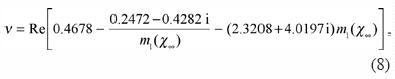
<body><![CDATA[<p align="center"><img src="/img/revistas/geoint/v47n1/a6s8.jpg"></p>     <p align="center"><img src="/img/revistas/geoint/v47n1/a6s9.jpg"></p>     <p align="justify"><font face="verdana" size="2">where <i>i </i>denotes the imaginary unit and the main values of the cubic roots should be used. These formulas may also be useful in possible new applications of the <i>H/V&#150;</i>method for non&#150;destructive testing (see Malischewsky <i>et al., </i>2006, and Weichert, 2007).</font></p>     <p align="justify"><font face="verdana" size="2">&nbsp;</font></p>     <p align="justify"><font face="verdana" size="2"><b>Acknowledgements</b></font></p>     <p align="justify"><font face="verdana" size="2">The support of the Bundesministerium f&uuml;r Bildung und Forschung (BMBF) in the framework of the joint project "WTZ Germany&#150;Israel: System Earth" under Grant No. 03F0448A is gratefully acknowledged.</font></p>     <p align="justify"><font face="verdana" size="2">&nbsp;</font></p>     <p align="justify"><font face="verdana" size="2"><b>Bibliography</b></font></p>     <!-- ref --><p align="justify"><font face="verdana" size="2">Bard, P.&#150;Y., 1998. Microtremor measurements: A tool for site effect estimation. Proc. Second International Symposium on the Effect of Surface Geology on Seismic Motion, Yokohama, Japan, 1&#150;3 December 1998, pp. 25&#150;33.</font>&nbsp;&nbsp;&nbsp;&nbsp;&nbsp;&nbsp;&nbsp;&nbsp;[&#160;<a href="javascript:void(0);" onclick="javascript: window.open('/scielo.php?script=sci_nlinks&ref=3898671&pid=S0016-7169200800010000600001&lng=','','width=640,height=500,resizable=yes,scrollbars=1,menubar=yes,');">Links</a>&#160;]<!-- end-ref --><!-- ref --><p align="justify"><font face="verdana" size="2">Bormann, P. (Ed.), 2002. IASPEI New Manual of Seismological Observatory Practice, GeoForschungsZentrum, Potsdam.</font>&nbsp;&nbsp;&nbsp;&nbsp;&nbsp;&nbsp;&nbsp;&nbsp;[&#160;<a href="javascript:void(0);" onclick="javascript: window.open('/scielo.php?script=sci_nlinks&ref=3898672&pid=S0016-7169200800010000600002&lng=','','width=640,height=500,resizable=yes,scrollbars=1,menubar=yes,');">Links</a>&#160;]<!-- end-ref --><!-- ref --><p align="justify"><font face="verdana" size="2">Flores&#150;Estrella, H., 2004. The SPAC method: An alternative for the estimation of model velocities in the valley of Mexico (in Spanish), MSc thesis, UNAM, Mexico.</font>&nbsp;&nbsp;&nbsp;&nbsp;&nbsp;&nbsp;&nbsp;&nbsp;[&#160;<a href="javascript:void(0);" onclick="javascript: window.open('/scielo.php?script=sci_nlinks&ref=3898673&pid=S0016-7169200800010000600003&lng=','','width=640,height=500,resizable=yes,scrollbars=1,menubar=yes,');">Links</a>&#160;]<!-- end-ref --><!-- ref --><p align="justify"><font face="verdana" size="2">Lermo, J. and F. J. Ch&aacute;vez&#150;Garc&iacute;a, 1994. Are microtremors useful in site response evaluation? <i>Bull. Seismol. </i><i>Soc. Am., 84, </i>1350&#150;1364.</font>&nbsp;&nbsp;&nbsp;&nbsp;&nbsp;&nbsp;&nbsp;&nbsp;[&#160;<a href="javascript:void(0);" onclick="javascript: window.open('/scielo.php?script=sci_nlinks&ref=3898674&pid=S0016-7169200800010000600004&lng=','','width=640,height=500,resizable=yes,scrollbars=1,menubar=yes,');">Links</a>&#160;]<!-- end-ref --><!-- ref --><p align="justify"><font face="verdana" size="2">Malischewsky, P. G. and F. Scherbaum, 2004. Love's formula and H/V&#150;ratio (ellipticity) of Rayleigh waves. <i>Wave Motion, 40, </i>57&#150;67.</font>&nbsp;&nbsp;&nbsp;&nbsp;&nbsp;&nbsp;&nbsp;&nbsp;[&#160;<a href="javascript:void(0);" onclick="javascript: window.open('/scielo.php?script=sci_nlinks&ref=3898675&pid=S0016-7169200800010000600005&lng=','','width=640,height=500,resizable=yes,scrollbars=1,menubar=yes,');">Links</a>&#160;]<!-- end-ref --><!-- ref --><p align="justify"><font face="verdana" size="2">Malischewsky Auning, P. G., 2004. A note on Rayleigh&#150;wave velocities as a function of the material parameters. <i>Geof&iacute;sica Internacional, 43, </i>507&#150;509.</font>&nbsp;&nbsp;&nbsp;&nbsp;&nbsp;&nbsp;&nbsp;&nbsp;[&#160;<a href="javascript:void(0);" onclick="javascript: window.open('/scielo.php?script=sci_nlinks&ref=3898676&pid=S0016-7169200800010000600006&lng=','','width=640,height=500,resizable=yes,scrollbars=1,menubar=yes,');">Links</a>&#160;]<!-- end-ref --><!-- ref --><p align="justify"><font face="verdana" size="2">Malischewsky, P. G., J. D. Schnapp and A. Ziegert, 2006. The ellipticity of Rayleigh waves and non&#150;destructive testing. Abstracts, 9th European Conference on NDT (ECNDT), Berlin, Germany, September 25&#150;29, 2006, We. 2. 4. 3.</font>&nbsp;&nbsp;&nbsp;&nbsp;&nbsp;&nbsp;&nbsp;&nbsp;[&#160;<a href="javascript:void(0);" onclick="javascript: window.open('/scielo.php?script=sci_nlinks&ref=3898677&pid=S0016-7169200800010000600007&lng=','','width=640,height=500,resizable=yes,scrollbars=1,menubar=yes,');">Links</a>&#160;]<!-- end-ref --><!-- ref --><p align="justify"><font face="verdana" size="2">Malischewsky, P. G., F. Scherbaum, C. Lomnitz, Tran Thanh Tuan, F. Wuttke and G. Shamir, 2007. The domain of existence of prograde Rayleigh&#150;wave motion for simple models, submitted to <i>Wave Motion.</i></font>&nbsp;&nbsp;&nbsp;&nbsp;&nbsp;&nbsp;&nbsp;&nbsp;[&#160;<a href="javascript:void(0);" onclick="javascript: window.open('/scielo.php?script=sci_nlinks&ref=3898678&pid=S0016-7169200800010000600008&lng=','','width=640,height=500,resizable=yes,scrollbars=1,menubar=yes,');">Links</a>&#160;]<!-- end-ref --><!-- ref --><p align="justify"><font face="verdana" size="2">Pham Chi Vinh and P. G. Malischewsky, 2006. Explanation for Malischewsky's approximate expression for the Rayleigh wave velocity. <i>Ultrasonics, 45, </i>77&#150;81.</font>&nbsp;&nbsp;&nbsp;&nbsp;&nbsp;&nbsp;&nbsp;&nbsp;[&#160;<a href="javascript:void(0);" onclick="javascript: window.open('/scielo.php?script=sci_nlinks&ref=3898679&pid=S0016-7169200800010000600009&lng=','','width=640,height=500,resizable=yes,scrollbars=1,menubar=yes,');">Links</a>&#160;]<!-- end-ref --><!-- ref --><p align="justify"><font face="verdana" size="2">Weichert, CH, 2007. Investigation of material properties by using the ellipticity of Rayleigh waves, Ph. D. thesis, Friedrich&#150;Schiller University, Jena, Germany, 226 pp.</font>&nbsp;&nbsp;&nbsp;&nbsp;&nbsp;&nbsp;&nbsp;&nbsp;[&#160;<a href="javascript:void(0);" onclick="javascript: window.open('/scielo.php?script=sci_nlinks&ref=3898680&pid=S0016-7169200800010000600010&lng=','','width=640,height=500,resizable=yes,scrollbars=1,menubar=yes,');">Links</a>&#160;]<!-- end-ref --> ]]></body><back>
<ref-list>
<ref id="B1">
<nlm-citation citation-type="confpro">
<person-group person-group-type="author">
<name>
<surname><![CDATA[Bard]]></surname>
<given-names><![CDATA[P.-Y.]]></given-names>
</name>
</person-group>
<source><![CDATA[Microtremor measurements: A tool for site effect estimation]]></source>
<year>1998</year>
<conf-name><![CDATA[ Proc. Second International Symposium on the Effect of Surface Geology on Seismic Motion]]></conf-name>
<conf-date>1998</conf-date>
<conf-loc>Yokohama </conf-loc>
<page-range>25-33</page-range></nlm-citation>
</ref>
<ref id="B2">
<nlm-citation citation-type="book">
<person-group person-group-type="author">
<name>
<surname><![CDATA[Bormann]]></surname>
<given-names><![CDATA[P]]></given-names>
</name>
</person-group>
<source><![CDATA[IASPEI New Manual of Seismological Observatory Practice]]></source>
<year>2002</year>
<publisher-loc><![CDATA[Potsdam ]]></publisher-loc>
<publisher-name><![CDATA[GeoForschungsZentrum]]></publisher-name>
</nlm-citation>
</ref>
<ref id="B3">
<nlm-citation citation-type="">
<person-group person-group-type="author">
<name>
<surname><![CDATA[Flores-Estrella]]></surname>
<given-names><![CDATA[H]]></given-names>
</name>
</person-group>
<source><![CDATA[The SPAC method: An alternative for the estimation of model velocities in the valley of Mexico (in Spanish)]]></source>
<year>2004</year>
</nlm-citation>
</ref>
<ref id="B4">
<nlm-citation citation-type="journal">
<person-group person-group-type="author">
<name>
<surname><![CDATA[Lermo]]></surname>
<given-names><![CDATA[J]]></given-names>
</name>
<name>
<surname><![CDATA[Chávez-García]]></surname>
<given-names><![CDATA[F. J.]]></given-names>
</name>
</person-group>
<article-title xml:lang="en"><![CDATA[Are microtremors useful in site response evaluation?]]></article-title>
<source><![CDATA[Bull. Seismol. Soc. Am.]]></source>
<year>1994</year>
<numero>84</numero>
<issue>84</issue>
<page-range>1350-1364</page-range></nlm-citation>
</ref>
<ref id="B5">
<nlm-citation citation-type="journal">
<person-group person-group-type="author">
<name>
<surname><![CDATA[Malischewsky]]></surname>
<given-names><![CDATA[P. G.]]></given-names>
</name>
<name>
<surname><![CDATA[Scherbaum]]></surname>
<given-names><![CDATA[F]]></given-names>
</name>
</person-group>
<article-title xml:lang="en"><![CDATA[Love's formula and H/V-ratio (ellipticity) of Rayleigh waves]]></article-title>
<source><![CDATA[Wave Motion]]></source>
<year>2004</year>
<numero>40</numero>
<issue>40</issue>
<page-range>57-67</page-range></nlm-citation>
</ref>
<ref id="B6">
<nlm-citation citation-type="journal">
<person-group person-group-type="author">
<name>
<surname><![CDATA[Malischewsky Auning]]></surname>
<given-names><![CDATA[P. G.]]></given-names>
</name>
</person-group>
<article-title xml:lang="en"><![CDATA[A note on Rayleigh-wave velocities as a function of the material parameters]]></article-title>
<source><![CDATA[Geofísica Internacional]]></source>
<year>2004</year>
<numero>43</numero>
<issue>43</issue>
<page-range>507-509</page-range></nlm-citation>
</ref>
<ref id="B7">
<nlm-citation citation-type="confpro">
<person-group person-group-type="author">
<name>
<surname><![CDATA[Malischewsky]]></surname>
<given-names><![CDATA[P. G.]]></given-names>
</name>
<name>
<surname><![CDATA[Schnapp]]></surname>
<given-names><![CDATA[J. D.]]></given-names>
</name>
<name>
<surname><![CDATA[Ziegert]]></surname>
<given-names><![CDATA[A]]></given-names>
</name>
</person-group>
<source><![CDATA[The ellipticity of Rayleigh waves and non-destructive testing]]></source>
<year>2006</year>
<conf-name><![CDATA[ Abstracts, 9th European Conference on NDT (ECNDT)]]></conf-name>
<conf-date>2006</conf-date>
<conf-loc>Berlin </conf-loc>
</nlm-citation>
</ref>
<ref id="B8">
<nlm-citation citation-type="">
<person-group person-group-type="author">
<name>
<surname><![CDATA[Malischewsky]]></surname>
<given-names><![CDATA[P. G.]]></given-names>
</name>
<name>
<surname><![CDATA[Scherbaum]]></surname>
<given-names><![CDATA[F]]></given-names>
</name>
<name>
<surname><![CDATA[Lomnitz]]></surname>
<given-names><![CDATA[C]]></given-names>
</name>
<name>
<surname><![CDATA[Tran Thanh]]></surname>
<given-names><![CDATA[Tuan]]></given-names>
</name>
<name>
<surname><![CDATA[Wuttke]]></surname>
<given-names><![CDATA[F]]></given-names>
</name>
<name>
<surname><![CDATA[Shamir]]></surname>
<given-names><![CDATA[G]]></given-names>
</name>
</person-group>
<source><![CDATA[The domain of existence of prograde Rayleigh-wave motion for simple models, submitted to Wave Motion]]></source>
<year>2007</year>
</nlm-citation>
</ref>
<ref id="B9">
<nlm-citation citation-type="journal">
<person-group person-group-type="author">
<name>
<surname><![CDATA[Chi Vinh]]></surname>
<given-names><![CDATA[Pham]]></given-names>
</name>
<name>
<surname><![CDATA[Malischewsky]]></surname>
<given-names><![CDATA[P. G.]]></given-names>
</name>
</person-group>
<article-title xml:lang="en"><![CDATA[Explanation for Malischewsky's approximate expression for the Rayleigh wave velocity]]></article-title>
<source><![CDATA[Ultrasonics]]></source>
<year>2006</year>
<numero>45</numero>
<issue>45</issue>
<page-range>77-81</page-range></nlm-citation>
</ref>
<ref id="B10">
<nlm-citation citation-type="">
<person-group person-group-type="author">
<name>
<surname><![CDATA[Weichert]]></surname>
<given-names><![CDATA[CH]]></given-names>
</name>
</person-group>
<source><![CDATA[Investigation of material properties by using the ellipticity of Rayleigh waves]]></source>
<year>2007</year>
<page-range>226</page-range></nlm-citation>
</ref>
</ref-list>
</back>
</article>