<?xml version="1.0" encoding="ISO-8859-1"?><article xmlns:mml="http://www.w3.org/1998/Math/MathML" xmlns:xlink="http://www.w3.org/1999/xlink" xmlns:xsi="http://www.w3.org/2001/XMLSchema-instance">
<front>
<journal-meta>
<journal-id>0016-7169</journal-id>
<journal-title><![CDATA[Geofísica internacional]]></journal-title>
<abbrev-journal-title><![CDATA[Geofís. Intl]]></abbrev-journal-title>
<issn>0016-7169</issn>
<publisher>
<publisher-name><![CDATA[Universidad Nacional Autónoma de México, Instituto de Geofísica]]></publisher-name>
</publisher>
</journal-meta>
<article-meta>
<article-id>S0016-71692007000400003</article-id>
<title-group>
<article-title xml:lang="en"><![CDATA[Scattering of Rayleigh-waves by surface-breaking cracks: an integral formulation]]></article-title>
</title-group>
<contrib-group>
<contrib contrib-type="author">
<name>
<surname><![CDATA[Rodríguez-Castellanos]]></surname>
<given-names><![CDATA[A]]></given-names>
</name>
<xref ref-type="aff" rid="A01"/>
</contrib>
<contrib contrib-type="author">
<name>
<surname><![CDATA[Ávila-Carrera]]></surname>
<given-names><![CDATA[R]]></given-names>
</name>
<xref ref-type="aff" rid="A01"/>
</contrib>
<contrib contrib-type="author">
<name>
<surname><![CDATA[Sánchez-Sesma]]></surname>
<given-names><![CDATA[F. J.]]></given-names>
</name>
<xref ref-type="aff" rid="A02"/>
</contrib>
</contrib-group>
<aff id="A01">
<institution><![CDATA[,Instituto Mexicano del Petróleo (IMP)  ]]></institution>
<addr-line><![CDATA[México City ]]></addr-line>
<country>México</country>
</aff>
<aff id="A02">
<institution><![CDATA[,Universidad Nacional Autónoma de México Instituto de Ingeniería ]]></institution>
<addr-line><![CDATA[México City ]]></addr-line>
<country>México</country>
</aff>
<pub-date pub-type="pub">
<day>00</day>
<month>12</month>
<year>2007</year>
</pub-date>
<pub-date pub-type="epub">
<day>00</day>
<month>12</month>
<year>2007</year>
</pub-date>
<volume>46</volume>
<numero>4</numero>
<fpage>241</fpage>
<lpage>248</lpage>
<copyright-statement/>
<copyright-year/>
<self-uri xlink:href="http://www.scielo.org.mx/scielo.php?script=sci_arttext&amp;pid=S0016-71692007000400003&amp;lng=en&amp;nrm=iso"></self-uri><self-uri xlink:href="http://www.scielo.org.mx/scielo.php?script=sci_abstract&amp;pid=S0016-71692007000400003&amp;lng=en&amp;nrm=iso"></self-uri><self-uri xlink:href="http://www.scielo.org.mx/scielo.php?script=sci_pdf&amp;pid=S0016-71692007000400003&amp;lng=en&amp;nrm=iso"></self-uri><abstract abstract-type="short" xml:lang="es"><p><![CDATA[Se estudia la difracción de ondas de Rayleigh debida a grietas rompientes en superficie. Se consideran varias configuraciones y profundidades para mostrar la importancia de la geometría de las grietas en la propagación de las ondas de Rayleigh. Para este fin, empleamos el Método Indirecto de Elementos Frontera. Esta técnica numérica se basa en una representación integral del campo difractado, el cual se deduce de la identidad de Somigliana. Este método permite evaluar el campo total de desplazamientos mediante la superposición de un campo libre y un campo difractado. Para el caso que nos ocupa en este trabajo, el campo libre se encuentra descrito por ondas de Rayleigh en un medio hipotético (sin la presencia de grietas) y el campo difractado se obtiene a partir de la solución integral tomando en cuenta la presencia de las grietas. Nuestros resultados se comparan con estudios previos. Enfatizamos las reducciones y amplificaciones que sufren las ondas de Rayleigh al interactuar con las grietas. Consideramos que esta información puede ser de gran utilidad a la comunidad científica, pues se busca describir la importancia de los parámetros como la profundidad y orientación de las grietas. El estudio aquí presentado permite caracterizar un grupo de grietas rompientes a partir del análisis del campo difractado.]]></p></abstract>
<abstract abstract-type="short" xml:lang="en"><p><![CDATA[Several crack configurations are considered in order to show the importance of the cracks' geometry on the Rayleigh-wave propagation. We use the Indirect Boundary Element Method, this numerical technique is based on an integral representation of the diffracted wave field, which has been reduced from Somigliana's identity. The method allows us to evaluate the complete displacement field by the superposition of the free field and the diffracted field. It is remarkable that the free field is specified as incident Rayleigh- waves, making the assumption of absence of cracks. The diffracted field is obtained from the integral representation by means of the presence of cracks. Our results are compared with those previously published. We emphasize the amplitude reduction of Rayleigh- waves while the interaction with the cracks take place. Conspicuous wave amplification at the crack neighborhood is observed immediately after such interaction. This information may give us a way to characterize crack's depth and orientations from the analysis of the diffracted field.]]></p></abstract>
<kwd-group>
<kwd lng="es"><![CDATA[Ondas de Rayleigh]]></kwd>
<kwd lng="es"><![CDATA[propagación de ondas]]></kwd>
<kwd lng="es"><![CDATA[grietas rompientes]]></kwd>
<kwd lng="es"><![CDATA[difracción]]></kwd>
<kwd lng="en"><![CDATA[Rayleigh waves]]></kwd>
<kwd lng="en"><![CDATA[wave propagation]]></kwd>
<kwd lng="en"><![CDATA[surface-breaking cracks]]></kwd>
<kwd lng="en"><![CDATA[diffraction]]></kwd>
</kwd-group>
</article-meta>
</front><body><![CDATA[ <p align="justify"><font face="verdana" size="4">Article</font></p>     <p align="justify"><font face="verdana" size="2">&nbsp;</font></p>     <p align="center"><font face="verdana" size="4"><b>Scattering of Rayleigh&#150;waves by surface&#150;breaking cracks: an integral formulation</b></font></p> 				    <p align="justify"><font face="verdana" size="2">&nbsp;</font></p> 				    <p align="center"><font face="verdana" size="2"><b>A. Rodr&iacute;guez&#150;Castellanos<sup>1</sup>, R. &Aacute;vila&#150;Carrera<sup>1</sup> and F. J. S&aacute;nchez&#150;Sesma<sup>2</sup></b></font></p> 				    <p align="justify"><font face="verdana" size="2">&nbsp;</font></p> 				    <p align="justify"><font face="verdana" size="2"><sup>1</sup> <i>Instituto Mexicano del Petr&oacute;leo (IMP), Eje Central L. C&aacute;rdenas 152, Ed. 27. Ofna. NJ3C; Tel. 01(55)9175&#150;7015, Fax. 01(55)9175&#150;8295, Del. Gustavo A. Madero, 07730 M&eacute;xico City, M&eacute;xico.</i> Email: <a href="mailto:arcastel@imp.mx">arcastel@imp.mx</a> *Corresponding author: <a href="mailto:rcarrer@imp.mx">rcarrer@imp.mx</a></font></p> 				    <p align="justify"><font face="verdana" size="2"><sup>2 </sup><i>Instituto de Ingenier&iacute;a, Universidad Nacional Aut&oacute;noma de M&eacute;xico, Del. Coyoac&aacute;n, 04510 M&eacute;xico City, M&eacute;xico. </i>Email: <a href="mailto:sesma@servidor.unam.mx">sesma@servidor.unam.mx</a></font></p> 				    <p align="justify"><font face="verdana" size="2">&nbsp;</font></p> 				    <p align="justify"><font face="verdana" size="2">Received: January 22, 2007    ]]></body>
<body><![CDATA[<br> 			    Accepted: June 22, 2007</font></p> 				    <p align="justify"><font face="verdana" size="2">&nbsp;</font></p> 				    <p align="justify"><font face="verdana" size="2"><b>Resumen</b></font></p> 				    <p align="justify"><font face="verdana" size="2">Se estudia la difracci&oacute;n de ondas de Rayleigh debida a grietas rompientes en superficie. Se consideran varias configuraciones y profundidades para mostrar la importancia de la geometr&iacute;a de las grietas en la propagaci&oacute;n de las ondas de Rayleigh. Para este fin, empleamos el M&eacute;todo Indirecto de Elementos Frontera. Esta t&eacute;cnica num&eacute;rica se basa en una representaci&oacute;n integral del campo difractado, el cual se deduce de la identidad de Somigliana. Este m&eacute;todo permite evaluar el campo total de desplazamientos mediante la superposici&oacute;n de un campo libre y un campo difractado. Para el caso que nos ocupa en este trabajo, el campo libre se encuentra descrito por ondas de Rayleigh en un medio hipot&eacute;tico (sin la presencia de grietas) y el campo difractado se obtiene a partir de la soluci&oacute;n integral tomando en cuenta la presencia de las grietas. Nuestros resultados se comparan con estudios previos. Enfatizamos las reducciones y amplificaciones que sufren las ondas de Rayleigh al interactuar con las grietas. Consideramos que esta informaci&oacute;n puede ser de gran utilidad a la comunidad cient&iacute;fica, pues se busca describir la importancia de los par&aacute;metros como la profundidad y orientaci&oacute;n de las grietas. El estudio aqu&iacute; presentado permite caracterizar un grupo de grietas rompientes a partir del an&aacute;lisis del campo difractado.</font></p> 				    <p align="justify"><font face="verdana" size="2"><b>Palabras clave:</b> Ondas de Rayleigh, propagaci&oacute;n de ondas, grietas rompientes, difracci&oacute;n.</font></p> 				    <p align="justify"><font face="verdana" size="2">&nbsp;</font></p> 				    <p align="justify"><font face="verdana" size="2"><b>Abstract</b></font></p> 				    <p align="justify"><font face="verdana" size="2">Several crack configurations are considered in order to show the importance of the cracks' geometry on the Rayleigh&#150;wave propagation. We use the Indirect Boundary Element Method, this numerical technique is based on an integral representation of the diffracted wave field, which has been reduced from Somigliana's identity. The method allows us to evaluate the complete displacement field by the superposition of the free field and the diffracted field. It is remarkable that the free field is specified as incident Rayleigh&#150; waves, making the assumption of absence of cracks. The diffracted field is obtained from the integral representation by means of the presence of cracks. Our results are compared with those previously published. We emphasize the amplitude reduction of Rayleigh&#150; waves while the interaction with the cracks take place. Conspicuous wave amplification at the crack neighborhood is observed immediately after such interaction. This information may give us a way to characterize crack's depth and orientations from the analysis of the diffracted field.</font></p> 				    <p align="justify"><font face="verdana" size="2"><b>Key words: </b>Rayleigh waves, wave propagation, surface&#150;breaking cracks, diffraction.</font></p> 				    <p align="justify"><font face="verdana" size="2">&nbsp;</font></p> 				    ]]></body>
<body><![CDATA[<p align="justify"><font face="verdana" size="2"><b>Introduction</b></font></p> 				    <p align="justify"><font face="verdana" size="2">Elastic surface waves, also called surface acoustic waves, were discovered in 1885 by Lord Rayleigh (1885). In infinite elastic medium, the longitudinal and transverse waves (P&#150; and S&#150; waves, respectively) are independent and propagate with different velocities, but in surface waves the longitudinal and transverse waves are coupled. Surface waves also differ from P&#150; and S&#150;waves in their propagation velocity. The Rayleigh&#150;wave velocity is about 5 to 13% smaller than S&#150;wave velocity and mainly depends on the Poisson's ratio (Hess, 2002). In a two&#150;dimensional propagation problem that contains a free surface, Rayleigh&#150;waves are more dominant than P&#150; or S&#150;waves (Wong, 1982). This is due to the retrograde nature of motion of Rayleigh&#150;waves. Such type of motion has been considered to be the main cause for many damages (e.g. seismic problems). It is well known that an important feature of Rayleigh&#150;waves is that most of the energy is localized near the free surface within a depth of about one wavelength.</font></p> 				    <p align="justify"><font face="verdana" size="2">Several studies have been carried out to analyze the effect of grooves, trenches, sub&#150;surface and surface cracks on the incidence of Rayleigh&#150;waves. Diffraction of Rayleigh&#150;waves by surface&#150;breaking cracks has been considered as an important area in geophysics and seismology. These cracks affect the travel of waves generating scattered wave fields. Therefore, it may be expected that scattered fields carry substantial amount of information on the crack's geometry (Mendelsohn <i>et al.</i>, 1980). In this sense, near surface and surface&#150;breaking cracks under surface and bulk wave incidences have been widely studied in frequency domain. Scattering by a single surface&#150;breaking crack in a half&#150;space was studied by Mendelsohn <i>et al.</i> (1980) where the formulation of the boundary&#150;value problem was reduced to a singular integral equation, which was solved numerically.</font></p> 				    <p align="justify"><font face="verdana" size="2">In Stone (1980), diffraction of time harmonic antiplane shear waves by an edge crack normal to the free surface of a homogeneous half space was studied. The problem was formulated in terms of a singular integral equation with the unknown crack opening displacement as the density function. A ray theory approach was presented in Achenbach <i>et al.</i> (1980) to analyze scattering of Rayleigh&#150;waves by a surface&#150;breaking crack. The stress intensity factors were found over reflection, transmission and diffraction coefficients. Excellent results were reported for ratios of crack depth <i>versus</i> wavelength greater than one. In Kundu and Mal (1981) the interaction of time harmonic elastic waves with an edge crack in a plate under P&#150;, SV&#150; and Rayleigh&#150;waves was studied. For each incident wave type the complete high frequency diffracted field on the plate surface was calculated. By the application of an asymptotic theory of diffraction, they found that for short waves compared to plate thickness, the crack is an efficient reflector and poor transmitter of Rayleigh&#150;waves.</font></p> 				    <p align="justify"><font face="verdana" size="2">Diffraction of time harmonic plane SH&#150;waves by a crack of finite length within homogeneous isotropic elastic half space was studied in Mal (1980). The crack was arbitrarily oriented to the medium and may or may not intersect the surface. The crack opening displacement was calculated numerically by a singular integral equation formulation and by approximate solution with the aid of the solution of the Sommerfeld diffraction problem. It was suggested the location of the crack tip and crack orientation could be determined by examining the spectral characteristics of diffracted pulses recorded on the free surface of the medium.</font></p> 				    <p align="justify"><font face="verdana" size="2">Rayleigh&#150;wave diffraction from surface&#150;braking discontinuities was also studied by Tittmann (1986). Theoretical and experimental results for cracks and grooves, in the regime where crack depth is large compared to the Rayleigh wavelength were considered. They concluded the generation of shear waves polarized perpendicular to the crack face was particularly efficient in experimental tests, which agree well with theory. Changes of Rayleigh&#150;wave velocity caused by distribution of one&#150;dimensional surface&#150;breaking cracks were studied in Pecorari (1996). A real cracked surface was modeled by a homogeneous, anisotropic layer on the top of an isotropic substrate. The substrate elastic properties were those of the original isotropic half&#150;space, whereas those of the layer were modified due to the presence of the crack distribution. Several crack configurations were considered, concluding that surface acoustic wave velocity is shown to be most sensitive to changes in crack density and crack depth.</font></p> 				    <p align="justify"><font face="verdana" size="2">Recently, a technique for detection and sizing of small cracks in studs and bolts by using Rayleigh&#150;waves has been used (Suh, 1996). It was found that a small delayed pulse due to the Rayleigh&#150; wave was detected between large regularly spaced pulses. The time delay was associated to size of the crack. In Scales and Wijk (1999) attenuation of ultrasonic surface waves by strong&#150;scattering medium, consisting of a grooved surface of aluminum, was studied. They found that grooves placed normal to wave propagation generate dispersed and exponentially attenuated waves. In Ruiz and Nagy (2002) dispersion of surface waves by surface roughness was studied. Using state&#150;of&#150;the&#150;art laser&#150;ultrasonic scanning and sophisticated digital signal processing method, it was recognized that there is a perceivable dispersive effect on untreated smooth surfaces.</font></p> 				    <p align="justify"><font face="verdana" size="2">In recent works (Rodr&iacute;guez&#150;Castellanos <i>et al.</i>, 2005 and 2006) diffraction of elastic waves by subsurface cracks and cavities were studied. We showed important aspects, in frequency domain, that can be useful to detect and characterize subsurface discontinuities. Synthetic seismograms for several cases were included and diffraction patterns of elastic waves also discussed.</font></p> 				    <p align="justify"><font face="verdana" size="2">In this paper we explore the use of the Indirect Boundary Element Method (IBEM) to study scattering of Rayleigh&#150;waves in a surface&#150;breaking cracked medium (<a href="/img/revistas/geoint/v46n4/a3f1.jpg" target="_blank">Figure 1</a>). The method is based on the integral representation for scattered (diffracted and reflected) elastic waves using a single layer boundary sources, which has been reduced from Somigliana's identity. This approach is usually called indirect BEM as the sources' strengths are obtained as an intermediate step. The complete displacement field is written as a superposition of diffracted wave field, using the integral representation, and free field (Rayleigh&#150;wave in an elastic half&#150;space). The motivation of this study is to show how wave amplification in the vicinity of cracks are and give to the analyst results to infer the presence and orientation of surface breaking cracks.</font></p> 				    <p align="justify">&nbsp;</p> 				    ]]></body>
<body><![CDATA[<p align="justify"><font face="verdana" size="2"><b>Integral representation</b></font></p> 				    <p align="justify"><font face="verdana" size="2">Consider a domain <i>V</i>, delimited by its boundary <i>S</i>. If this domain is formed by an elastic material, the displacement field under harmonic excitation can be written, neglecting body forces, by means of the simple&#150;layer boundary integral equation</font></p> 				    <p align="center"><font face="verdana" size="2"><img src="/img/revistas/geoint/v46n4/a3s1.jpg"></font></p> 				    <p align="justify"><font face="verdana" size="2">where <i>u<sub>i</sub></i>(<b>x</b>) is the ith component of the displacement at point x, G<i><sub>ij</sub></i>(<b>x</b>;&xi;) is the Green's function, which represents the displacement produced in the direction i at <b>x</b> due to the application of an unit force in direction j at point &xi;, &oslash;<i><sub>j</sub></i>(&xi;), is the force density in the direction j at point &xi;. The product &oslash;<i><sub>j</sub></i>(&xi;)<i>dS</i><sub>&xi;</sub> in the integral represents the distribution of forces at the surface S. The suffix in the differential operator shows the variable on which the integration is carried out. This integral representation for displacements can be obtained from Somigliana's identity (S&aacute;nchez&#150;Sesma and Campillo, 1991). It was proved that if &oslash;<i><sub>j</sub></i>(&xi;) is continuous along S, then the displacement field is continuous across S (Kupradze, 1963).</font></p> 				    <p align="justify"><font face="verdana" size="2">This integral representation allows the calculation of stresses and tractions by means of the direct application of Hooke's law and Cauchy's equation, except at boundary singularities, this is when x is equal to &xi; on surface S. From a limiting process based on equilibrium considerations around an internal neighborhood of the boundary, it is possible to write, for <b>x</b> on <i>S</i>,</font></p> 				    <p align="center"><font face="verdana" size="2"><img src="/img/revistas/geoint/v46n4/a3s2.jpg"></font></p> 				    <p align="justify"><font face="verdana" size="2">where t<i><sub>i</sub></i>(<b>x</b>) is the ith component of the traction associated to a direction <i>n</i>(<b>x</b>) in a smooth boundary <i>S, c</i> = 0.5 if <b>x</b> tends to the smooth boundary from inside the region. c=&#150;0.5 if <b>x</b> tends to S from outside of the region, c=0 if <b>x</b> is not at S. T<i><sub>ij</sub></i>(<b>x</b>;&xi;) is the traction Green's function, that is to say, the traction in the direction i at a point x with associated direction n(x) due to the application of an unit force in the direction j at &xi; on S. The first term of the right&#150;hand side of eq. (2) must be equal to zero if x is not on the surface <i>S</i>. Green's functions for traction and displacements can be found in Rodr&iacute;guez&#150;Castellanos <i>et al.</i> (2005) and (2006).</font></p> 				    <p align="justify"><font face="verdana" size="2"><i>Boundary Conditions</i></font></p> 				    <p align="justify"><font face="verdana" size="2">Traction&#150;free boundary condition is reached at the free surface (&part;<i>R</i>), including crack faces, and this can be written as:</font></p> 				    <p align="center"><font face="verdana" size="2"><img src="/img/revistas/geoint/v46n4/a3s3.jpg"></font></p> 				    ]]></body>
<body><![CDATA[<p align="justify"><font face="verdana" size="2">Developing the boundary conditions and considering the incident and diffracted field, eq. (3) can be expressed as</font></p> 				    <p align="center"><font face="verdana" size="2"><img src="/img/revistas/geoint/v46n4/a3s4.jpg"></font></p> 				    <p align="justify"><font face="verdana" size="2">where,  <i>t<sub>i</sub><sup>oR</sup></i> <b>(x)</b>= free&#150;field traction in the Region R, as if the crack did not exist,  <i>t<sub>i</sub><sup>dR </sup></i><b>(x)</b>= diffracted&#150;field traction due to the presence of the crack. Then, eq. (4) can be written as</font></p> 				    <p align="center"><font face="verdana" size="2"><img src="/img/revistas/geoint/v46n4/a3s5.jpg"></font></p> 				    <p align="justify"><font face="verdana" size="2">This equation represents a system of integral equations for boundary sources, <i>i.e.</i> those producing the diffracted field.</font></p> 				    <p align="justify"><font face="verdana" size="2">To solve the above integral equation system, we have to discretize them along a finite portion of the boundary that contains the crack or cracks. The cracks are considered as mathematical ones and then cero crack thickness is taken into account. Let us suppose that the force densities &oslash;<i><sub>j</sub></i>(&xi;) are constant over each of the boundary elements with equal length &Delta;<i>S</i> along the boundary. If we assume that N is the number of elements along the discretized part (free surface of the <a href="/img/revistas/geoint/v46n4/a3f1.jpg" target="_blank">Figure 1</a>), we can obtain</font></p> 				    <p align="center"><font face="verdana" size="2"><img src="/img/revistas/geoint/v46n4/a3s6.jpg"></font></p> 				    <p align="justify"><font face="verdana" size="2">where,</font></p> 				    <p align="center"><font face="verdana" size="2"><img src="/img/revistas/geoint/v46n4/a3s7.jpg"></font></p> 				    <p align="justify"><font face="verdana" size="2">these integrals are calculated numerically, except when <i>x</i>= &xi;. In such case, the right side term has to be dropped out, therefore we have</font></p> 				    ]]></body>
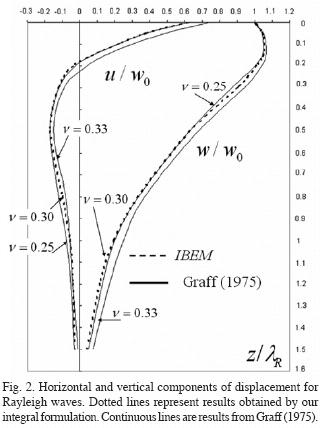
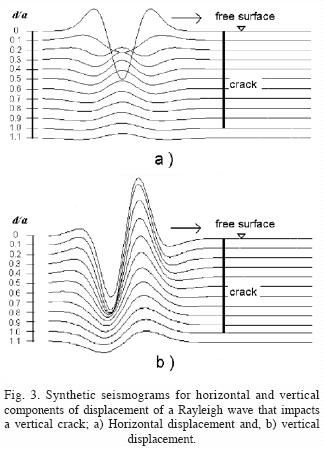
<body><![CDATA[<p align="center"><font face="verdana" size="2"><img src="/img/revistas/geoint/v46n4/a3s8.jpg"></font></p> 				    <p align="justify"><font face="verdana" size="2">This discretization leads to a linear system of 2N equation with the same number of unknowns. The system is solved using Gauss method. Once the values of &oslash;<i><sub>j</sub></i>(&xi;) are known the diffracted field is computed by means of the appropriate discretization of equation (1). In the following section we apply our integral formulation to solve Rayleigh&#150; wave propagation in a surface&#150;breaking cracked medium.</font></p> 				    <p align="justify">&nbsp;</p> 				    <p align="justify"><font face="verdana" size="2"><b>Numerical examples</b></font></p> 				    <p align="justify"><font face="verdana" size="2">First, we validate our method, in frequency domain, applying it to an uncracked medium. In <a href="#f2">Figure 2</a>, components of the Rayleigh wave motion, obtained by our integral formulation, are plotted. Normalized horizontal (<i>u/w<sub>0</sub></i>) and vertical (<i>w/w<sub>0</sub></i>) displacements against normalized depth (<i>z/&lambda;<sub>R</sub></i>), for several Poisson's ratios ( 0.25, 0.30 and 0.33), are compared. The components u and w represent the displacements in the directions x and z, respectively. lR means one Rayleigh wavelength and w0 is the vertical displacement measured at the free surface. For this simulation, we take the following elastic properties: n=0.3 and b=1.0, as taken by Graff (1975). Good agreement can be observed between our results and those of Graff (1975). Moreover, the validation and application of the IBEM to subsurface crack problems can be seen in Rodr&iacute;guez&#150;Castellanos <i>et al.</i> (2005, 2006). The specified free field (Rayleigh&#150;wave field as shown in <a href="#f2">Figure 2</a>) has been implemented in several cases (see, S&aacute;nchez&#150;Sesma and Campillo (1991) for 2D problems and S&aacute;nchez&#150;Sesma and Luzon (1995) and Luz&oacute;n <i>et al.</i> (1997) for 3D ones). In this figure one can appreciate that the major part of energy is concentrated near the free surface and that, for both components of displacement, the influence of the Rayleigh&#150; wave disappears near , which is in agreement with theory. One can also notice that horizontal displacement changes of sign near , which is a notable indication of the retrograde motion of Rayleigh&#150;waves.</font></p> 				    <p align="center"><font face="verdana" size="2"><a name="f2"></a></font></p> 				    <p align="center"><font face="verdana" size="2"><img src="/img/revistas/geoint/v46n4/a3f2.jpg"></font></p> 				    <p align="justify"><font face="verdana" size="2">To show the application of our integral formulation to a cracked medium, we have applied it to various cases, where the number and orientation of surface&#150;breaking cracks vary. Initially, a vertical surface&#150;breaking crack is considered with five crack depth ratios, which are <i>d/a</i>=0.1, 0.2, 0.4, 0.6 and 1.0 (a is taken as a reference parameter). We selected these simple crack configurations in order to validate our results with those obtained by other authors, as shown below. The properties of the medium are: <i>t<sub>p</sub>&beta;/a</i>=1 (<i>&beta;</i> and t are the shear wave velocity and time, respectively) and (Poisson's ratio). We compute, in the frequency domain, the displacement field for 64 frequencies up to 3.848 Hz at various surface receivers. In order to simulate motion along time we used the FFT algorithm (Fast Fourier Transform) to calculate synthetic seismograms using a Ricker wavelet with characteristic period of <i>t<sub>p </sub>&beta;/a</i>=1.</font></p> 				    <p align="justify"><font face="verdana" size="2">In <a href="#f3">Figure 3</a>, temporal representation of the Rayleigh&#150;wave pulse is shown. Horizontal and vertical displacements (<a href="#f3">Figure 3a and 3b</a>, respectively) are depicted in order to show their amplitude with respect to depth and crack length. The wavelength selected to interact with the crack was <i>&lambda;<sub>R</sub></i>/<i>a</i>=1, this is equivalent to <i>d/a</i>=1. Thus, the deepest crack considered here corresponds to <i>d/a</i>=1.0. Easily appreciated is the fact that in <a href="#f3">Figure 3</a> an accumulation of energy is concentrated at a distance shorter than one wavelength (Rayleigh, 1885; Hess, 2002; Wong, 1982; Graff, 1975). This important feature can be observed again on the horizontal component, where a simultaneous change on the particle motion is also identified at 0.2&lambda;<sub>R</sub>.</font></p> 				    <p align="center"><font face="verdana" size="2"><a name="f3"></a></font></p> 				    ]]></body>
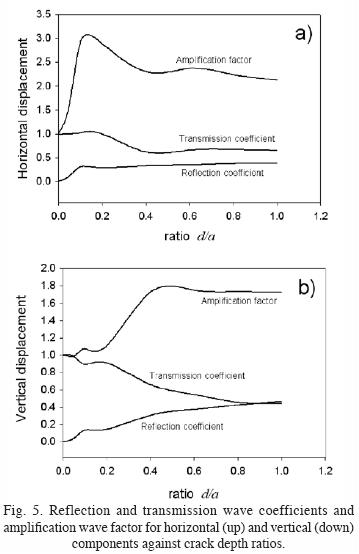
<body><![CDATA[<p align="center"><font face="verdana" size="2"><img src="/img/revistas/geoint/v46n4/a3f3.jpg"></font></p> 				    <p align="justify"><font face="verdana" size="2">In <a href="/img/revistas/geoint/v46n4/a3f4.jpg" target="_blank">Figure 4</a>, horizontal (left) and vertical (right) displacements represented as synthetic seismograms for crack depth ratios of <i>d/a</i>=0.1, 0.4 and 1.0 (upper, middle and lower, respectively) have been plotted for this one vertical crack model (in all cases, the 26th&#150;receiver is placed just at the crack and plotted with an horizontal line). In all cases wave amplifications can be observed for the nearest receiver placed at the left side of the crack, where the surface wave impacts. For the deepest crack model (<i>d/a</i>=1) the reflected and transmitted waves for the two components of displacement are clearly defined. However, when the crack becomes shallower, the diffracted wave field for horizontal component shows more complicated patterns for the receivers behind the crack. In the case of vertical components, when the crack depth ratio is <i>d/a</i>=0.1 , the transmitted amplitude of the wave is almost equal to those of the incident wave and the wave amplification at the crack is almost negligible. For the other cases, <i>d/a</i>=0.4 and <i>d/a</i>=1.0, the amplitude of transmitted waves are reduced while those of reflected ones increases.</font></p> 				    <p align="justify"><font face="verdana" size="2">In <a href="#f5">Figure 5</a>, transmitted and reflected wave coefficients and amplification wave factor are plotted, using the same one vertical crack model with the crack depth ratios mentioned above. Here, we define such coefficients and factors as the ratio between the transmitted, reflected wave amplitude and the incident wave amplitude. For the case of horizontal component (<a href="#f5">Figure 5a</a>), amplifications of almost 3 times for the ratio <i>d/a</i>=0.1 are seen and for the ratio <i>d/a</i>=1 that value grows twice. For the case of <i>d/a</i>=1.0 the reflection coefficient corresponds to 0.35 (as obtained in Bray and Stanley, 1997), which was found for the case of a Rayleigh&#150;wave that impacts on a corner). For lower ratios of <i>d/a</i>, transmitted wave coefficients tend to 1.0 and reflected ones to 0.0. Similarly, for vertical component (<a href="#f5">Figure 5b</a>) wave amplifications reach almost 1.8 times for ratios <i>d/a</i>&gt;0.4 and transmitted and reflected wave coefficients reach almost a factor of 0.45 times (these amplifications can also be seen in Kromine, 2000).</font></p> 				    <p align="center"><font face="verdana" size="2"><a name="f5"></a></font></p> 				    <p align="center"><font face="verdana" size="2"><img src="/img/revistas/geoint/v46n4/a3f5.jpg"></font></p> 				    <p align="justify"><font face="verdana" size="2">To study scattering of surface waves by multiple surface&#150;breaking cracks we have analyzed three cases with five cracks each. The first one corresponds to cracks with ratio <i>d/a</i>=0.1, <i>b/a</i>=1.0 and <i>&theta;</i>=90&deg;, the second to <i>&theta;</i>=135&deg; and the last one to <i>&theta;</i>=45&deg; (see <a href="/img/revistas/geoint/v46n4/a3f1.jpg" target="_blank">Figure 1</a>). It is important to mention that these models were selected in order to show the use of our integral formulation dealing with strong&#150;scattering media. Many other crack configurations could be of interest. However, we do believe that these simple models allow us to perceive important features about the diffraction of Rayleigh waves by surface&#150;breaking cracks. In <a href="/img/revistas/geoint/v46n4/a3f6.jpg" target="_blank">Figure 6</a> synthetic seismograms for the studied cases are shown (upper, middle and lower, respectively). In <a href="/img/revistas/geoint/v46n4/a3f6.jpg" target="_blank">Figure 6a</a> the horizontal component of displacement is strongly influenced by cracks, showing amplifications of almost 3 times with respect to the incident wave (as mentioned in <a href="#f5">Figure 5a</a>). However, finally slight wave attenuation at the last receiver can be seen. The vertical component shows similar behavior, because the incident wave is affected at cracked zone, but finally slight attenuation at the last receiver is again obtained.</font></p> 				    <p align="justify"><font face="verdana" size="2">In the case of vertical and horizontal displacements for <i>&theta;</i>=135&deg; insignificant attenuations and amplifications are observed (<a href="/img/revistas/geoint/v46n4/a3f6.jpg" target="_blank">Figure 6b</a>). As well, for the case of <i>&theta;</i>=45&deg; (<a href="/img/revistas/geoint/v46n4/a3f6.jpg" target="_blank">Figure 6c</a>) only small amplification and attenuation are seen for both components of displacement. We believe that for these two last cases the crack orientation does not affect the Rayleigh&#150; wave propagation. This can be attributed to the small distance between the crack tip and the free surface and their orientation. From these analyses we can say that the crack depth and orientation are crucial to identify a medium with several cracks. A damaged surface could not be recognized if the incident pulse is not applied at the right direction or with the proper wave amplitude.</font></p> 				    <p align="justify"><font face="verdana" size="2">&nbsp;</font></p> 				    <p align="justify"><font face="verdana" size="2"><b>Conclusions</b></font></p> 				    <p align="justify"><font face="verdana" size="2">In the present paper we have analyzed the effect that one or several surface&#150;breaking cracks have on the propagation of Rayleigh&#150;waves. We have briefly shown the formulation of the Indirect Boundary Element Method applied to the propagation of surface waves in a halfspace containing surface&#150;breaking cracks. Attenuation, reflection and amplification of Rayleigh&#150;waves by several crack depths have been studied with good detail. We have concluded that the horizontal component of displacement of Rayleigh&#150;waves is more affected by shallow cracks, where strong amplification can be seen (almost 3 times of the incident wave). However, for the case of vertical component the amplification reaches 1.8 times the incident wave for ratios <i>d/a</i>&gt;0.4. From the multiple diffraction results (<a href="/img/revistas/geoint/v46n4/a3f6.jpg" target="_blank">Figure 6</a>), we have found that surface&#150;breaking cracks influence strongly the propagation on surface waves. In fact, it is well known that the major amount of energy of the Rayleighwaves is located around the free surface. In that sense, surface&#150;breaking cracks may produce different attenuation depending upon depth and inclination. Given surface wave polarization, has been pointed out that the vertical component appears to be slightly affected by the presence of cracks. A damaged surface could not be recognized if the incident pulse is not applied at the right direction or with the proper wave amplitude. We believe that the results presented in this paper are of interest to the scientific community given their usefulness as benchmark solutions to calibrate other numerical techniques. The information reported here may provide to the field engineers a way to recognize patterns and behavior of surface&#150;breaking cracks from the analysis of the diffracted field.</font></p> 				    ]]></body>
<body><![CDATA[<p align="justify"><font face="verdana" size="2">&nbsp;</font></p> 				    <p align="justify"><font face="verdana" size="2"><b>Acknowledgements</b></font></p> 				    <p align="justify"><font face="verdana" size="2">We thank to two anonymous reviewers for their useful comments to improve and clarify this manuscript. This work was supported by Instituto Mexicano del Petr&oacute;leo, under Petroleum Exploration Research Program, Project D.00393; by Petr&oacute;leos Mexicanos (PEMEX), Mexico, under grant 410305846 and from DGAPA&#150;UNAM, Mexico, under grant IN114706.</font></p> 				    <p align="justify"><font face="verdana" size="2">&nbsp;</font></p> 				    <p align="justify"><font face="verdana" size="2"><b>Bibliography</b></font></p> 				    <!-- ref --><p align="justify"><font face="verdana" size="2">Achenbach, J. D., A. K. Gautesen and D. A. Mendelshn, 1980. Ray analysis of surface&#150;wave interaction with an edge crack. <i>IEEE Trans. on Sonics and Ultrasonics, 27</i>, 124&#150;129.</font>&nbsp;&nbsp;&nbsp;&nbsp;&nbsp;&nbsp;&nbsp;&nbsp;[&#160;<a href="javascript:void(0);" onclick="javascript: window.open('/scielo.php?script=sci_nlinks&ref=3922955&pid=S0016-7169200700040000300001&lng=','','width=640,height=500,resizable=yes,scrollbars=1,menubar=yes,');">Links</a>&#160;]<!-- end-ref --> 				    <!-- ref --><p align="justify"><font face="verdana" size="2">Bray, D. E. and R. K. Stanley, 1997. Nondestructive evaluation, a tool in design, manufacturing and service. CRC pres, 82.</font>&nbsp;&nbsp;&nbsp;&nbsp;&nbsp;&nbsp;&nbsp;&nbsp;[&#160;<a href="javascript:void(0);" onclick="javascript: window.open('/scielo.php?script=sci_nlinks&ref=3922957&pid=S0016-7169200700040000300002&lng=','','width=640,height=500,resizable=yes,scrollbars=1,menubar=yes,');">Links</a>&#160;]<!-- end-ref --> 				    <!-- ref --><p align="justify"><font face="verdana" size="2">Graff, K. F., 1975. Wave motion in elastic solids. Ohio State University Press. 327.</font>&nbsp;&nbsp;&nbsp;&nbsp;&nbsp;&nbsp;&nbsp;&nbsp;[&#160;<a href="javascript:void(0);" onclick="javascript: window.open('/scielo.php?script=sci_nlinks&ref=3922959&pid=S0016-7169200700040000300003&lng=','','width=640,height=500,resizable=yes,scrollbars=1,menubar=yes,');">Links</a>&#160;]<!-- end-ref --> 				    <!-- ref --><p align="justify"><font face="verdana" size="2">Hess, P., 2002. Surface acoustic waves in materials science. <i>Physics Today</i>, 42&#150;47.</font>&nbsp;&nbsp;&nbsp;&nbsp;&nbsp;&nbsp;&nbsp;&nbsp;[&#160;<a href="javascript:void(0);" onclick="javascript: window.open('/scielo.php?script=sci_nlinks&ref=3922961&pid=S0016-7169200700040000300004&lng=','','width=640,height=500,resizable=yes,scrollbars=1,menubar=yes,');">Links</a>&#160;]<!-- end-ref --> 				    <!-- ref --><p align="justify"><font face="verdana" size="2">Kromine, Fomitchov, Achenbach, Krishnaswamy, 2000. Scanning laser source technique for crack detection. Materials Eval. 58.</font>&nbsp;&nbsp;&nbsp;&nbsp;&nbsp;&nbsp;&nbsp;&nbsp;[&#160;<a href="javascript:void(0);" onclick="javascript: window.open('/scielo.php?script=sci_nlinks&ref=3922963&pid=S0016-7169200700040000300005&lng=','','width=640,height=500,resizable=yes,scrollbars=1,menubar=yes,');">Links</a>&#160;]<!-- end-ref --> 				    <!-- ref --><p align="justify"><font face="verdana" size="2">Kundu, T. and A. K. Mal, 1981. Diffraction of Elastic Waves by a surface Crack on a Plate. <i>Trans. of the ASME. 48</i>, 570&#150;576.</font>&nbsp;&nbsp;&nbsp;&nbsp;&nbsp;&nbsp;&nbsp;&nbsp;[&#160;<a href="javascript:void(0);" onclick="javascript: window.open('/scielo.php?script=sci_nlinks&ref=3922965&pid=S0016-7169200700040000300006&lng=','','width=640,height=500,resizable=yes,scrollbars=1,menubar=yes,');">Links</a>&#160;]<!-- end-ref --> 				    <!-- ref --><p align="justify"><font face="verdana" size="2">Kupradze, V. D., 1963. Dynamical problems in elasticity, In Progress in Solid Mechanics. I. N. Sneddon and R. Hill (eds), North&#150;Holland, Amsterdam, vol. III.</font>&nbsp;&nbsp;&nbsp;&nbsp;&nbsp;&nbsp;&nbsp;&nbsp;[&#160;<a href="javascript:void(0);" onclick="javascript: window.open('/scielo.php?script=sci_nlinks&ref=3922967&pid=S0016-7169200700040000300007&lng=','','width=640,height=500,resizable=yes,scrollbars=1,menubar=yes,');">Links</a>&#160;]<!-- end-ref --> 				    <!-- ref --><p align="justify"><font face="verdana" size="2">Luz&oacute;n, F., F. J. S&aacute;nchez&#150;Sesma, J. L. Rodr&iacute;guez&#150;Zu&ntilde;iga, A. M. Posadas, J. M. Garc&iacute;a, J. Mart&iacute;n, M. D. Romacho and M. Navarro, 1997. Diffraction of P, SV and Rayleigh waves by three&#150;dimensional topographies. <i>Geophys. Int. Journal. 129</i>, 571&#150;578.</font>&nbsp;&nbsp;&nbsp;&nbsp;&nbsp;&nbsp;&nbsp;&nbsp;[&#160;<a href="javascript:void(0);" onclick="javascript: window.open('/scielo.php?script=sci_nlinks&ref=3922969&pid=S0016-7169200700040000300008&lng=','','width=640,height=500,resizable=yes,scrollbars=1,menubar=yes,');">Links</a>&#160;]<!-- end-ref --> 				    <!-- ref --><p align="justify"><font face="verdana" size="2">Mal, A. K., 1980. Diffraction of SH waves by a near surface crack. Review of Progress in Quantitative Nondestructive Evaluation. Vol. 1, Plenum Press, New York, 499&#150;503.</font>&nbsp;&nbsp;&nbsp;&nbsp;&nbsp;&nbsp;&nbsp;&nbsp;[&#160;<a href="javascript:void(0);" onclick="javascript: window.open('/scielo.php?script=sci_nlinks&ref=3922971&pid=S0016-7169200700040000300009&lng=','','width=640,height=500,resizable=yes,scrollbars=1,menubar=yes,');">Links</a>&#160;]<!-- end-ref --> 				    <!-- ref --><p align="justify"><font face="verdana" size="2">Mendelsohn, D. A., J. D. Achenbach, and L. M. Keer, 1980. Scattering of elastic waves by a surface&#150;breaking crack. <i>Wave motion. 2</i>, 277&#150;292.</font>&nbsp;&nbsp;&nbsp;&nbsp;&nbsp;&nbsp;&nbsp;&nbsp;[&#160;<a href="javascript:void(0);" onclick="javascript: window.open('/scielo.php?script=sci_nlinks&ref=3922973&pid=S0016-7169200700040000300010&lng=','','width=640,height=500,resizable=yes,scrollbars=1,menubar=yes,');">Links</a>&#160;]<!-- end-ref --> 				    <!-- ref --><p align="justify"><font face="verdana" size="2">Pecorari, C., 1996. Modeling variations of Rayleigh wave velocity due to distributions of one&#150;dimensional surface&#150;breaking cracks. <i>J. Acoust. Soc. Amer. 100</i>, 1542&#150;1550.</font>&nbsp;&nbsp;&nbsp;&nbsp;&nbsp;&nbsp;&nbsp;&nbsp;[&#160;<a href="javascript:void(0);" onclick="javascript: window.open('/scielo.php?script=sci_nlinks&ref=3922975&pid=S0016-7169200700040000300011&lng=','','width=640,height=500,resizable=yes,scrollbars=1,menubar=yes,');">Links</a>&#160;]<!-- end-ref --> 				    <!-- ref --><p align="justify"><font face="verdana" size="2">Rayleigh, J. W. S., 1885. <i>Proc. London Math. Soc. 17</i>.</font>&nbsp;&nbsp;&nbsp;&nbsp;&nbsp;&nbsp;&nbsp;&nbsp;[&#160;<a href="javascript:void(0);" onclick="javascript: window.open('/scielo.php?script=sci_nlinks&ref=3922977&pid=S0016-7169200700040000300012&lng=','','width=640,height=500,resizable=yes,scrollbars=1,menubar=yes,');">Links</a>&#160;]<!-- end-ref --> 				    <!-- ref --><p align="justify"><font face="verdana" size="2">Rodr&iacute;guez&#150;Castellanos, A., F. Luz&oacute;n and F. J. S&aacute;nchez&#150;Sesma, 2005. Diffraction of seismic waves in an elastic cracked half&#150;plane using a Boundary Integral Formulation. <i>Soil Dynam. and Earthq. Enging. 25</i>, 827&#150;837.</font>&nbsp;&nbsp;&nbsp;&nbsp;&nbsp;&nbsp;&nbsp;&nbsp;[&#160;<a href="javascript:void(0);" onclick="javascript: window.open('/scielo.php?script=sci_nlinks&ref=3922979&pid=S0016-7169200700040000300013&lng=','','width=640,height=500,resizable=yes,scrollbars=1,menubar=yes,');">Links</a>&#160;]<!-- end-ref --> 				    <!-- ref --><p align="justify"><font face="verdana" size="2">Rodr&iacute;guez&#150;Castellanos A., F. J. S&aacute;nchez&#150;Sesma, F. Luz&oacute;n and R. Martin, 2006. Multiple scattering of elastic waves by subsurface fractures and cavities. <i>Bull. Seis. Soc. of Am., 96</i>, 1359&#150;1374.</font>&nbsp;&nbsp;&nbsp;&nbsp;&nbsp;&nbsp;&nbsp;&nbsp;[&#160;<a href="javascript:void(0);" onclick="javascript: window.open('/scielo.php?script=sci_nlinks&ref=3922981&pid=S0016-7169200700040000300014&lng=','','width=640,height=500,resizable=yes,scrollbars=1,menubar=yes,');">Links</a>&#160;]<!-- end-ref --> 				    <!-- ref --><p align="justify"><font face="verdana" size="2">Ruiz, L. A. and P. B. Nagy, 2002. Diffraction correction for precision surface acoustic wave velocity measurements. <i>J. Acoust. Soc. Am., 112</i>, 835&#150;342.</font>&nbsp;&nbsp;&nbsp;&nbsp;&nbsp;&nbsp;&nbsp;&nbsp;[&#160;<a href="javascript:void(0);" onclick="javascript: window.open('/scielo.php?script=sci_nlinks&ref=3922983&pid=S0016-7169200700040000300015&lng=','','width=640,height=500,resizable=yes,scrollbars=1,menubar=yes,');">Links</a>&#160;]<!-- end-ref --> 				    <!-- ref --><p align="justify"><font face="verdana" size="2">S&aacute;nchez&#150;Sesma F. J. and M. Campillo, 1991. Diffraction of P, SV and Rayleigh waves by topographic features; a boundary integral formulation. <i>Bull. Seism. Soc. Am., 81</i>, 1&#150;20.</font>&nbsp;&nbsp;&nbsp;&nbsp;&nbsp;&nbsp;&nbsp;&nbsp;[&#160;<a href="javascript:void(0);" onclick="javascript: window.open('/scielo.php?script=sci_nlinks&ref=3922985&pid=S0016-7169200700040000300016&lng=','','width=640,height=500,resizable=yes,scrollbars=1,menubar=yes,');">Links</a>&#160;]<!-- end-ref --> 				    <!-- ref --><p align="justify"><font face="verdana" size="2">S&aacute;nchez&#150;Sesma, F. J. and F. Luz&oacute;n, 1995. Seismic response of three&#150;dimensional alluvial valleys for incident P, SV and Rayleigh waves. <i>Bull. Seism. Soc. Am., 85</i>, 269&#150;284.</font>&nbsp;&nbsp;&nbsp;&nbsp;&nbsp;&nbsp;&nbsp;&nbsp;[&#160;<a href="javascript:void(0);" onclick="javascript: window.open('/scielo.php?script=sci_nlinks&ref=3922987&pid=S0016-7169200700040000300017&lng=','','width=640,height=500,resizable=yes,scrollbars=1,menubar=yes,');">Links</a>&#160;]<!-- end-ref --> 				    <!-- ref --><p align="justify"><font face="verdana" size="2">Scales, J. A. and K. V. Wijk, 1999. Multiple scattering attenuation and anisotropy of ultrasonic surface waves. <i>Applied Phys. Letts., 74</i>, 3899&#150;3901.</font>&nbsp;&nbsp;&nbsp;&nbsp;&nbsp;&nbsp;&nbsp;&nbsp;[&#160;<a href="javascript:void(0);" onclick="javascript: window.open('/scielo.php?script=sci_nlinks&ref=3922989&pid=S0016-7169200700040000300018&lng=','','width=640,height=500,resizable=yes,scrollbars=1,menubar=yes,');">Links</a>&#160;]<!-- end-ref --> 				    <!-- ref --><p align="justify"><font face="verdana" size="2">Stone, S. F., M. L. Ghosh and A. K. Mal, 1980. Diffraction of Antiplane shear waves by an Edge Crack. <i>J. Appl. Mech., 47</i>, 359&#150;362.</font>&nbsp;&nbsp;&nbsp;&nbsp;&nbsp;&nbsp;&nbsp;&nbsp;[&#160;<a href="javascript:void(0);" onclick="javascript: window.open('/scielo.php?script=sci_nlinks&ref=3922991&pid=S0016-7169200700040000300019&lng=','','width=640,height=500,resizable=yes,scrollbars=1,menubar=yes,');">Links</a>&#160;]<!-- end-ref --> 				    <!-- ref --><p align="justify"><font face="verdana" size="2">Suh, D. M., W. W. Kim and J. G. Chung, 1996. A Rayleigh wave technique for detection and sizing of small cracks in studs and bolts. <i>IEEE ultrasonics symposium</i>. 673&#150;676.</font>&nbsp;&nbsp;&nbsp;&nbsp;&nbsp;&nbsp;&nbsp;&nbsp;[&#160;<a href="javascript:void(0);" onclick="javascript: window.open('/scielo.php?script=sci_nlinks&ref=3922993&pid=S0016-7169200700040000300020&lng=','','width=640,height=500,resizable=yes,scrollbars=1,menubar=yes,');">Links</a>&#160;]<!-- end-ref --> 				    <!-- ref --><p align="justify"><font face="verdana" size="2">Tittmann, B. R. and L. A. Ahlberg, 1986. Rayleigh wave diffraction from surface&#150;breaking discontinuities. <i>Appl. Phys. Lett., 49</i>, 1333&#150;1335.</font>&nbsp;&nbsp;&nbsp;&nbsp;&nbsp;&nbsp;&nbsp;&nbsp;[&#160;<a href="javascript:void(0);" onclick="javascript: window.open('/scielo.php?script=sci_nlinks&ref=3922995&pid=S0016-7169200700040000300021&lng=','','width=640,height=500,resizable=yes,scrollbars=1,menubar=yes,');">Links</a>&#160;]<!-- end-ref --> 				    <!-- ref --><p align="justify"><font face="verdana" size="2">Wong, H. L., 1982. Effect of surface topography on the diffraction of P, SV and Rayleigh waves. <i>Bull. Seism. Soc. Am., 72</i>, 1167&#150;1183.</font>&nbsp;&nbsp;&nbsp;&nbsp;&nbsp;&nbsp;&nbsp;&nbsp;[&#160;<a href="javascript:void(0);" onclick="javascript: window.open('/scielo.php?script=sci_nlinks&ref=3922997&pid=S0016-7169200700040000300022&lng=','','width=640,height=500,resizable=yes,scrollbars=1,menubar=yes,');">Links</a>&#160;]<!-- end-ref --> ]]></body><back>
<ref-list>
<ref id="B1">
<nlm-citation citation-type="journal">
<person-group person-group-type="author">
<name>
<surname><![CDATA[Achenbach]]></surname>
<given-names><![CDATA[J. D.]]></given-names>
</name>
<name>
<surname><![CDATA[Gautesen]]></surname>
<given-names><![CDATA[A. K.]]></given-names>
</name>
<name>
<surname><![CDATA[Mendelshn]]></surname>
<given-names><![CDATA[D. A.]]></given-names>
</name>
</person-group>
<article-title xml:lang="en"><![CDATA[Ray analysis of surface-wave interaction with an edge crack]]></article-title>
<source><![CDATA[IEEE Trans. on Sonics and Ultrasonics]]></source>
<year>1980</year>
<numero>27</numero>
<issue>27</issue>
<page-range>124-129</page-range></nlm-citation>
</ref>
<ref id="B2">
<nlm-citation citation-type="book">
<person-group person-group-type="author">
<name>
<surname><![CDATA[Bray]]></surname>
<given-names><![CDATA[D. E.]]></given-names>
</name>
<name>
<surname><![CDATA[Stanley]]></surname>
<given-names><![CDATA[R. K.]]></given-names>
</name>
</person-group>
<source><![CDATA[Nondestructive evaluation, a tool in design, manufacturing and service]]></source>
<year>1997</year>
<page-range>82</page-range><publisher-name><![CDATA[CRC pres]]></publisher-name>
</nlm-citation>
</ref>
<ref id="B3">
<nlm-citation citation-type="book">
<person-group person-group-type="author">
<name>
<surname><![CDATA[Graff]]></surname>
<given-names><![CDATA[K. F.]]></given-names>
</name>
</person-group>
<source><![CDATA[Wave motion in elastic solids]]></source>
<year>1975</year>
<page-range>327</page-range><publisher-name><![CDATA[Ohio State University Press]]></publisher-name>
</nlm-citation>
</ref>
<ref id="B4">
<nlm-citation citation-type="journal">
<person-group person-group-type="author">
<name>
<surname><![CDATA[Hess]]></surname>
<given-names><![CDATA[P]]></given-names>
</name>
</person-group>
<article-title xml:lang="en"><![CDATA[Surface acoustic waves in materials science]]></article-title>
<source><![CDATA[Physics Today]]></source>
<year>2002</year>
<page-range>42-47</page-range></nlm-citation>
</ref>
<ref id="B5">
<nlm-citation citation-type="book">
<person-group person-group-type="author">
<name>
<surname><![CDATA[Kromine]]></surname>
<given-names><![CDATA[Fomitchov]]></given-names>
</name>
<name>
<surname><![CDATA[Achenbach]]></surname>
<given-names><![CDATA[Krishnaswamy]]></given-names>
</name>
</person-group>
<source><![CDATA[Scanning laser source technique for crack detection]]></source>
<year>2000</year>
<page-range>58</page-range><publisher-name><![CDATA[Materials Eval]]></publisher-name>
</nlm-citation>
</ref>
<ref id="B6">
<nlm-citation citation-type="journal">
<person-group person-group-type="author">
<name>
<surname><![CDATA[Kundu]]></surname>
<given-names><![CDATA[T]]></given-names>
</name>
<name>
<surname><![CDATA[Mal]]></surname>
<given-names><![CDATA[A. K.]]></given-names>
</name>
</person-group>
<article-title xml:lang="en"><![CDATA[Diffraction of Elastic Waves by a surface Crack on a Plate]]></article-title>
<source><![CDATA[Trans. of the ASME.]]></source>
<year>1981</year>
<numero>48</numero>
<issue>48</issue>
<page-range>570-576</page-range></nlm-citation>
</ref>
<ref id="B7">
<nlm-citation citation-type="">
<person-group person-group-type="author">
<name>
<surname><![CDATA[Kupradze]]></surname>
<given-names><![CDATA[V. D.]]></given-names>
</name>
</person-group>
<article-title xml:lang="en"><![CDATA[Dynamical problems in elasticity]]></article-title>
<person-group person-group-type="editor">
<name>
<surname><![CDATA[Sneddon]]></surname>
<given-names><![CDATA[I. N.]]></given-names>
</name>
<name>
<surname><![CDATA[Hill]]></surname>
<given-names><![CDATA[R]]></given-names>
</name>
</person-group>
<source><![CDATA[Progress in Solid Mechanics]]></source>
<year>1963</year>
<volume>III</volume>
<publisher-loc><![CDATA[North-Holland ]]></publisher-loc>
</nlm-citation>
</ref>
<ref id="B8">
<nlm-citation citation-type="journal">
<person-group person-group-type="author">
<name>
<surname><![CDATA[Luzón]]></surname>
<given-names><![CDATA[F]]></given-names>
</name>
<name>
<surname><![CDATA[Sánchez-Sesma]]></surname>
<given-names><![CDATA[F. J.]]></given-names>
</name>
<name>
<surname><![CDATA[Rodríguez-Zuñiga]]></surname>
<given-names><![CDATA[J. L.]]></given-names>
</name>
<name>
<surname><![CDATA[Posadas]]></surname>
<given-names><![CDATA[A. M.]]></given-names>
</name>
<name>
<surname><![CDATA[García]]></surname>
<given-names><![CDATA[J. M.]]></given-names>
</name>
<name>
<surname><![CDATA[Martín]]></surname>
<given-names><![CDATA[J]]></given-names>
</name>
<name>
<surname><![CDATA[Romacho]]></surname>
<given-names><![CDATA[M. D.]]></given-names>
</name>
<name>
<surname><![CDATA[Navarro]]></surname>
<given-names><![CDATA[M]]></given-names>
</name>
</person-group>
<article-title xml:lang="en"><![CDATA[Diffraction of P, SV and Rayleigh waves by three-dimensional topographies]]></article-title>
<source><![CDATA[Geophys. Int. Journal.]]></source>
<year>1997</year>
<numero>129</numero>
<issue>129</issue>
<page-range>571-578</page-range></nlm-citation>
</ref>
<ref id="B9">
<nlm-citation citation-type="book">
<person-group person-group-type="author">
<name>
<surname><![CDATA[Mal]]></surname>
<given-names><![CDATA[A. K.]]></given-names>
</name>
</person-group>
<source><![CDATA[Diffraction of SH waves by a near surface crack: Review of Progress in Quantitative Nondestructive Evaluation]]></source>
<year>1980</year>
<volume>1</volume>
<page-range>499-503</page-range><publisher-loc><![CDATA[New York ]]></publisher-loc>
<publisher-name><![CDATA[Plenum Press]]></publisher-name>
</nlm-citation>
</ref>
<ref id="B10">
<nlm-citation citation-type="journal">
<person-group person-group-type="author">
<name>
<surname><![CDATA[Mendelsohn]]></surname>
<given-names><![CDATA[D. A.]]></given-names>
</name>
<name>
<surname><![CDATA[Achenbach]]></surname>
<given-names><![CDATA[J. D.]]></given-names>
</name>
<name>
<surname><![CDATA[Keer]]></surname>
<given-names><![CDATA[L. M.]]></given-names>
</name>
</person-group>
<article-title xml:lang="en"><![CDATA[Scattering of elastic waves by a surface-breaking crack]]></article-title>
<source><![CDATA[Wave motion]]></source>
<year>1980</year>
<numero>2</numero>
<issue>2</issue>
<page-range>277-292</page-range></nlm-citation>
</ref>
<ref id="B11">
<nlm-citation citation-type="journal">
<person-group person-group-type="author">
<name>
<surname><![CDATA[Pecorari]]></surname>
<given-names><![CDATA[C]]></given-names>
</name>
</person-group>
<article-title xml:lang="en"><![CDATA[Modeling variations of Rayleigh wave velocity due to distributions of one-dimensional surface-breaking cracks]]></article-title>
<source><![CDATA[J. Acoust. Soc. Amer.]]></source>
<year>1996</year>
<numero>100</numero>
<issue>100</issue>
<page-range>1542-1550</page-range></nlm-citation>
</ref>
<ref id="B12">
<nlm-citation citation-type="journal">
<person-group person-group-type="author">
<name>
<surname><![CDATA[Rayleigh]]></surname>
<given-names><![CDATA[J. W. S.]]></given-names>
</name>
</person-group>
<source><![CDATA[Proc. London Math. Soc.]]></source>
<year>1885</year>
<numero>17</numero>
<issue>17</issue>
</nlm-citation>
</ref>
<ref id="B13">
<nlm-citation citation-type="journal">
<person-group person-group-type="author">
<name>
<surname><![CDATA[Rodríguez-Castellanos]]></surname>
<given-names><![CDATA[A]]></given-names>
</name>
<name>
<surname><![CDATA[Luzón]]></surname>
<given-names><![CDATA[F]]></given-names>
</name>
<name>
<surname><![CDATA[Sánchez-Sesma]]></surname>
<given-names><![CDATA[F. J.]]></given-names>
</name>
</person-group>
<article-title xml:lang="en"><![CDATA[Diffraction of seismic waves in an elastic cracked half-plane using a Boundary Integral Formulation]]></article-title>
<source><![CDATA[Soil Dynam. and Earthq. Enging.]]></source>
<year>2005</year>
<numero>25</numero>
<issue>25</issue>
<page-range>827-837</page-range></nlm-citation>
</ref>
<ref id="B14">
<nlm-citation citation-type="journal">
<person-group person-group-type="author">
<name>
<surname><![CDATA[Rodríguez-Castellanos]]></surname>
<given-names><![CDATA[A]]></given-names>
</name>
<name>
<surname><![CDATA[Sánchez-Sesma]]></surname>
<given-names><![CDATA[F. J.]]></given-names>
</name>
<name>
<surname><![CDATA[Luzón]]></surname>
<given-names><![CDATA[F]]></given-names>
</name>
<name>
<surname><![CDATA[Martin]]></surname>
<given-names><![CDATA[R]]></given-names>
</name>
</person-group>
<article-title xml:lang="en"><![CDATA[Multiple scattering of elastic waves by subsurface fractures and cavities]]></article-title>
<source><![CDATA[Bull. Seis. Soc. of Am.]]></source>
<year>2006</year>
<numero>96</numero>
<issue>96</issue>
<page-range>1359-1374</page-range></nlm-citation>
</ref>
<ref id="B15">
<nlm-citation citation-type="journal">
<person-group person-group-type="author">
<name>
<surname><![CDATA[Ruiz]]></surname>
<given-names><![CDATA[L. A.]]></given-names>
</name>
<name>
<surname><![CDATA[Nagy]]></surname>
<given-names><![CDATA[P. B.]]></given-names>
</name>
</person-group>
<article-title xml:lang="en"><![CDATA[Diffraction correction for precision surface acoustic wave velocity measurements]]></article-title>
<source><![CDATA[J. Acoust. Soc. Am.]]></source>
<year>2002</year>
<numero>112</numero>
<issue>112</issue>
<page-range>835-342</page-range></nlm-citation>
</ref>
<ref id="B16">
<nlm-citation citation-type="journal">
<person-group person-group-type="author">
<name>
<surname><![CDATA[Sánchez-Sesma]]></surname>
<given-names><![CDATA[F. J.]]></given-names>
</name>
<name>
<surname><![CDATA[Campillo]]></surname>
<given-names><![CDATA[M]]></given-names>
</name>
</person-group>
<article-title xml:lang="en"><![CDATA[Diffraction of P, SV and Rayleigh waves by topographic features; a boundary integral formulation]]></article-title>
<source><![CDATA[Bull. Seism. Soc. Am.]]></source>
<year>1991</year>
<numero>81</numero>
<issue>81</issue>
<page-range>1-20</page-range></nlm-citation>
</ref>
<ref id="B17">
<nlm-citation citation-type="journal">
<person-group person-group-type="author">
<name>
<surname><![CDATA[Sánchez-Sesma]]></surname>
<given-names><![CDATA[F. J.]]></given-names>
</name>
<name>
<surname><![CDATA[Luzón]]></surname>
<given-names><![CDATA[F]]></given-names>
</name>
</person-group>
<article-title xml:lang="en"><![CDATA[Seismic response of three-dimensional alluvial valleys for incident P, SV and Rayleigh waves]]></article-title>
<source><![CDATA[Bull. Seism. Soc. Am.]]></source>
<year>1995</year>
<numero>85</numero>
<issue>85</issue>
<page-range>269-284</page-range></nlm-citation>
</ref>
<ref id="B18">
<nlm-citation citation-type="journal">
<person-group person-group-type="author">
<name>
<surname><![CDATA[Scales]]></surname>
<given-names><![CDATA[J. A.]]></given-names>
</name>
<name>
<surname><![CDATA[Wijk]]></surname>
<given-names><![CDATA[K. V.]]></given-names>
</name>
</person-group>
<article-title xml:lang="en"><![CDATA[Multiple scattering attenuation and anisotropy of ultrasonic surface waves]]></article-title>
<source><![CDATA[Applied Phys. Letts.]]></source>
<year>1999</year>
<numero>74</numero>
<issue>74</issue>
<page-range>3899-3901</page-range></nlm-citation>
</ref>
<ref id="B19">
<nlm-citation citation-type="journal">
<person-group person-group-type="author">
<name>
<surname><![CDATA[Stone]]></surname>
<given-names><![CDATA[S. F.]]></given-names>
</name>
<name>
<surname><![CDATA[Ghosh]]></surname>
<given-names><![CDATA[M. L.]]></given-names>
</name>
<name>
<surname><![CDATA[Mal]]></surname>
<given-names><![CDATA[A. K.]]></given-names>
</name>
</person-group>
<article-title xml:lang="en"><![CDATA[Diffraction of Antiplane shear waves by an Edge Crack]]></article-title>
<source><![CDATA[J. Appl. Mech.]]></source>
<year>1980</year>
<numero>47</numero>
<issue>47</issue>
<page-range>359-362</page-range></nlm-citation>
</ref>
<ref id="B20">
<nlm-citation citation-type="confpro">
<person-group person-group-type="author">
<name>
<surname><![CDATA[Suh]]></surname>
<given-names><![CDATA[D. M.]]></given-names>
</name>
<name>
<surname><![CDATA[Kim]]></surname>
<given-names><![CDATA[W. W.]]></given-names>
</name>
<name>
<surname><![CDATA[Chung]]></surname>
<given-names><![CDATA[J. G.]]></given-names>
</name>
</person-group>
<source><![CDATA[A Rayleigh wave technique for detection and sizing of small cracks in studs and bolts]]></source>
<year>1996</year>
<conf-name><![CDATA[ IEEE ultrasonics symposium]]></conf-name>
<conf-loc> </conf-loc>
<page-range>673-676</page-range></nlm-citation>
</ref>
<ref id="B21">
<nlm-citation citation-type="journal">
<person-group person-group-type="author">
<name>
<surname><![CDATA[Tittmann]]></surname>
<given-names><![CDATA[B. R.]]></given-names>
</name>
<name>
<surname><![CDATA[Ahlberg]]></surname>
<given-names><![CDATA[L. A.]]></given-names>
</name>
</person-group>
<article-title xml:lang="en"><![CDATA[Rayleigh wave diffraction from surface-breaking discontinuities]]></article-title>
<source><![CDATA[Appl. Phys. Lett.]]></source>
<year>1986</year>
<numero>49</numero>
<issue>49</issue>
<page-range>1333-1335</page-range></nlm-citation>
</ref>
<ref id="B22">
<nlm-citation citation-type="journal">
<person-group person-group-type="author">
<name>
<surname><![CDATA[Wong]]></surname>
<given-names><![CDATA[H. L.]]></given-names>
</name>
</person-group>
<article-title xml:lang="en"><![CDATA[Effect of surface topography on the diffraction of P, SV and Rayleigh waves]]></article-title>
<source><![CDATA[Bull. Seism. Soc. Am.]]></source>
<year>1982</year>
<numero>72</numero>
<issue>72</issue>
<page-range>1167-1183</page-range></nlm-citation>
</ref>
</ref-list>
</back>
</article>