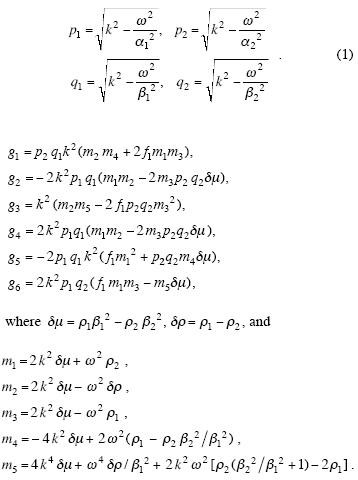
<?xml version="1.0" encoding="ISO-8859-1"?><article xmlns:mml="http://www.w3.org/1998/Math/MathML" xmlns:xlink="http://www.w3.org/1999/xlink" xmlns:xsi="http://www.w3.org/2001/XMLSchema-instance">
<front>
<journal-meta>
<journal-id>0016-7169</journal-id>
<journal-title><![CDATA[Geofísica internacional]]></journal-title>
<abbrev-journal-title><![CDATA[Geofís. Intl]]></abbrev-journal-title>
<issn>0016-7169</issn>
<publisher>
<publisher-name><![CDATA[Universidad Nacional Autónoma de México, Instituto de Geofísica]]></publisher-name>
</publisher>
</journal-meta>
<article-meta>
<article-id>S0016-71692006000300001</article-id>
<title-group>
<article-title xml:lang="en"><![CDATA[Prograde Rayleigh-wave motion in the valley of Mexico]]></article-title>
</title-group>
<contrib-group>
<contrib contrib-type="author">
<name>
<surname><![CDATA[Malischewsky Auning]]></surname>
<given-names><![CDATA[Peter G.]]></given-names>
</name>
<xref ref-type="aff" rid="A01"/>
</contrib>
<contrib contrib-type="author">
<name>
<surname><![CDATA[Lomnitz]]></surname>
<given-names><![CDATA[Cinna]]></given-names>
</name>
<xref ref-type="aff" rid="A02"/>
</contrib>
<contrib contrib-type="author">
<name>
<surname><![CDATA[Wuttke]]></surname>
<given-names><![CDATA[Frank]]></given-names>
</name>
<xref ref-type="aff" rid="A03"/>
</contrib>
<contrib contrib-type="author">
<name>
<surname><![CDATA[Saragoni]]></surname>
<given-names><![CDATA[Rodolfo]]></given-names>
</name>
<xref ref-type="aff" rid="A04"/>
</contrib>
</contrib-group>
<aff id="A01">
<institution><![CDATA[,Friedrich-Schiller-Universität Jena Institut für Geowissenschaften ]]></institution>
<addr-line><![CDATA[Jena ]]></addr-line>
<country>Germany</country>
</aff>
<aff id="A02">
<institution><![CDATA[,Universidad Nacional Autónoma de México Instituto de Geofísica ]]></institution>
<addr-line><![CDATA[ ]]></addr-line>
<country>México</country>
</aff>
<aff id="A03">
<institution><![CDATA[,Bauhaus-Universität Weimar Bodenmechanik ]]></institution>
<addr-line><![CDATA[Weimar ]]></addr-line>
<country>Germany</country>
</aff>
<aff id="A04">
<institution><![CDATA[,Universidad de Chile Departamento de Ingeniería Civil ]]></institution>
<addr-line><![CDATA[Santiago ]]></addr-line>
<country>Chile</country>
</aff>
<pub-date pub-type="pub">
<day>00</day>
<month>09</month>
<year>2006</year>
</pub-date>
<pub-date pub-type="epub">
<day>00</day>
<month>09</month>
<year>2006</year>
</pub-date>
<volume>45</volume>
<numero>3</numero>
<fpage>149</fpage>
<lpage>162</lpage>
<copyright-statement/>
<copyright-year/>
<self-uri xlink:href="http://www.scielo.org.mx/scielo.php?script=sci_arttext&amp;pid=S0016-71692006000300001&amp;lng=en&amp;nrm=iso"></self-uri><self-uri xlink:href="http://www.scielo.org.mx/scielo.php?script=sci_abstract&amp;pid=S0016-71692006000300001&amp;lng=en&amp;nrm=iso"></self-uri><self-uri xlink:href="http://www.scielo.org.mx/scielo.php?script=sci_pdf&amp;pid=S0016-71692006000300001&amp;lng=en&amp;nrm=iso"></self-uri><abstract abstract-type="short" xml:lang="es"><p><![CDATA[El movimiento prógrado de la partícula para ondas Rayleigh en un modelo simple de una capa sobre un semiespacio se estudia teórica y experimentalmente para el caso general y para las condiciones específicas en el valle de México, D. F. Se calculan sismogramas teóricos para un modelo simplificado de la red de Texcoco. Para el sismograma de las estaciónes TACY, CU01 y SXVI del 19 septiembre de 1985 se obtiene movimiento prógrado de Rayleigh dentro de un rango de frecuencias. Los parámetros críticos para la existencia de movimiento progrado son el módulo de Poisson en la capa superficial y el contraste de velocidades de ondas S entre la capa y el semi-espacio. Para valores altos de estos parámetros el rango de movimiento progrado se encuentra aproximadamente entre la frecuencia del sitio y el doble de la misma. Adicionalmente, la zona de movimiento progrado también se presenta en dependencia en estos parámetros críticos. El estudio del movimiento de la partícula rinde constreñimiento adicional invirtiendo parámetros de modelo de las observaciones de las ondas superficiales en general y H/V estudios en especial.]]></p></abstract>
<abstract abstract-type="short" xml:lang="en"><p><![CDATA[A theory of prograde particle motion of Rayleigh waves for a layer over a half-space is derived and compared with observations in the valley of Mexico. We compute synthetic seismograms for a simplified model of the Texcoco site. The earthquake of 19 September 1985, M 8.1, featured prograde motion of Rayleigh waves within a specific frequency band. The critical parameters for the existence of prograde motion are Poisson's ratio in the layer and the shear-wave contrast between the layer and the half-space. For high values of these parameters the range of frequencies featuring prograde motion falls approximately between the site frequency and twice the site frequency. Particle motion can provide additional constraints for the inversion of surf ace-wave observations and H/V studies.]]></p></abstract>
<kwd-group>
<kwd lng="es"><![CDATA[Ondas de Rayleigh]]></kwd>
<kwd lng="es"><![CDATA[movimiento prógrado de la partícula]]></kwd>
<kwd lng="es"><![CDATA[valle de México]]></kwd>
<kwd lng="en"><![CDATA[Rayleigh waves]]></kwd>
<kwd lng="en"><![CDATA[prograde particle motion]]></kwd>
<kwd lng="en"><![CDATA[valley of Mexico]]></kwd>
</kwd-group>
</article-meta>
</front><body><![CDATA[ <p align="center"><font face="verdana" size="4"> <b>Prograde Rayleigh&#150;wave motion in the valley of Mexico</b></font></p>      <p align="justify"><font face="verdana" size="2">&nbsp;</font></p>      <p align="center"><font face="verdana" size="2"> <b> Peter G. Malischewsky Auning<sup>1</sup>, Cinna Lomnitz<sup>2</sup>, Frank Wuttke<sup>3</sup> and Rodolfo Saragoni<sup>4</sup></b> </font></p>      <p align="justify"><font face="verdana" size="2">&nbsp;</font></p>      <p align="justify"><font face="verdana" size="2"><i><sup>1</sup> Friedrich&#150;Schiller&#150;Universit&auml;t Jena, Institut f&uuml;r Geowissenschaften, Jena, Germany</i> <i>Email: <a href="mailto:p.mali@uni&#150;jena.de">p.mali@uni-jena.de</a></i></font></p>      <p align="justify"><font face="verdana" size="2"><i><sup>2</sup> Instituto de Geof&iacute;sica, UNAM, M&eacute;xico</i> <i>Email: <a href="mailto:cinna@prodigy.net.mx">cinna@prodigy.net.mx</a></i></font></p>      <p align="justify"><font face="verdana" size="2"><i><sup>3</sup> Bauhaus&#150;Universit&auml;t Weimar, Bodenmechanik, Weimar, Germany</i> <i>Email: <a href="mailto:frank.wuttke@bauing.uni&#150;weimar.de">frank.wuttke@bauing.uni-weimar.de</a></i></font></p>      <p align="justify"><font face="verdana" size="2"><i><sup>4 </sup> Departamento de Ingenier&iacute;a Civil, Universidad de Chile, Santiago, Chile</i> <i>Email: <a href="mailto:rsaragon@ing.uchile.cl">rsaragon@ing.uchile.cl</a></i></font></p>      <p align="justify"><font face="verdana" size="2">&nbsp;</font></p>      <p align="justify"><font face="verdana" size="2">Received: March 2, 2006    ]]></body>
<body><![CDATA[<br> Accepted: June 18, 2006</font></p>      <p align="justify"><font face="verdana" size="2">&nbsp;</font></p>      <p align="justify"><font face="verdana" size="2"><b>Resumen</b></font></p>      <p align="justify"><font face="verdana" size="2">El movimiento pr&oacute;grado de la part&iacute;cula para ondas Rayleigh en un modelo simple de una capa sobre un semiespacio se estudia te&oacute;rica y experimentalmente para el caso general y para las condiciones espec&iacute;ficas en el valle de M&eacute;xico, D. F. Se calculan sismogramas te&oacute;ricos para un modelo simplificado de la red de Texcoco. Para el sismograma de las estaci&oacute;nes TACY, CU01 y SXVI del 19 septiembre de 1985 se obtiene movimiento pr&oacute;grado de Rayleigh dentro de un rango de frecuencias. Los par&aacute;metros cr&iacute;ticos para la existencia de movimiento progrado son el m&oacute;dulo de Poisson en la capa superficial y el contraste de velocidades de ondas S entre la capa y el semi&#150;espacio. Para valores altos de estos par&aacute;metros el rango de movimiento progrado se encuentra aproximadamente entre la frecuencia del sitio y el doble de la misma. Adicionalmente, la zona de movimiento progrado tambi&eacute;n se presenta en dependencia en estos par&aacute;metros cr&iacute;ticos. El estudio del movimiento de la part&iacute;cula rinde constre&ntilde;imiento adicional invirtiendo par&aacute;metros de modelo de las observaciones de las ondas superficiales en general y <i>H/V </i>estudios en especial.</font></p>      <p align="justify"><font face="verdana" size="2"><b>Palabras clave: </b>Ondas de Rayleigh, movimiento pr&oacute;grado de la part&iacute;cula, valle de M&eacute;xico.</font></p>      <p align="justify"><font face="verdana" size="2">&nbsp;</font></p>      <p align="justify"><font face="verdana" size="2"><b>Abstract</b></font></p>      <p align="justify"><font face="verdana" size="2">A theory of prograde particle motion of Rayleigh waves for a layer over a half&#150;space is derived and compared with observations in the valley of Mexico. We compute synthetic seismograms for a simplified model of the Texcoco site. The earthquake of 19 September 1985, M 8.1, featured prograde motion of Rayleigh waves within a specific frequency band. The critical parameters for the existence of prograde motion are Poisson's ratio in the layer and the shear&#150;wave contrast between the layer and the half&#150;space. For high values of these parameters the range of frequencies featuring prograde motion falls approximately between the site frequency and twice the site frequency. Particle motion can provide additional constraints for the inversion of surf ace&#150;wave observations and <i>H/V </i>studies.</font></p>      <p align="justify"><font face="verdana" size="2"><b>Key words: </b>Rayleigh waves, prograde particle motion, valley of Mexico.</font></p>      <p align="justify"><font face="verdana" size="2">&nbsp;</font></p>      ]]></body>
<body><![CDATA[<p align="right"><font face="verdana" size="2"> <i>Lo menos que podemos hacer, en servicio de algo, es <b>comprenderlo.    <br> </b></i>Jos&eacute; Ortega y Gasset</font></p>      <p align="justify"><font face="verdana" size="2">&nbsp;</font></p>      <p align="justify"><font face="verdana" size="2"><b>INTRODUCTION</b></font></p>      <p align="justify"><font face="verdana" size="2">Rayleigh waves are vector waves with vertical and horizontal components that feature elliptical particle motion. Retrograde particle motion is well&#150;established for propagation of the fundamental mode over a homogeneous half&#150;space (Aki and Richards, 2000). In the case of an inhomogeneous half&#150;space retrograde or prograde motion is possible, depending on the frequency range. Early papers dealing with this subject include Giese (1957) and Kisslinger (1959). Both found evidence of prograde Rayleigh motion in soils. Giese considered prograde and retrograde wave groups for a model consisting of a layer on a rigid half&#150;space and obtained Poisson's ratio in the layer from the frequency where particle motion changes from prograde to retrograde. A recent treatment can be found in Tanimoto and Rivera (2005), who provide the eigenfunctions of Rayleigh waves and their ratios numerically for a layer over a half&#150;space. They found that Rayleigh&#150;wave particle motion can become prograde near the surface when the geological section contains a sedimentary layer with extremely slow seismic velocities. Prograde Rayleigh&#150;wave motion in a layered half&#150;space was also obtained in theory by Wuttke (2005).</font></p>      <p align="justify"><font face="verdana" size="2">Observations of prograde Rayleigh waves in the valley of Mexico were reported by G&oacute;mez&#150;Bernal (2002) and Lomnitz and Meas (2004). Malischewsky and Scherbaum (2004) presented exact expressions for the <i>H/V </i>ratio in increasingly complex structures. Malischewsky <i>et al. </i>(2005) showed that prograde Rayleigh motion is not necessarily limited to models containing low&#150;velocity sedimentary layers. A structural model consisting of a layer over a half&#150;space is a convenient starting&#150;point for developing a theory on prograde Rayleigh&#150;wave motion. In this paper we discuss the case of the valley of Mexico, and we leave a more general rigorous analysis for a forthcoming paper.</font></p>      <p align="justify"><font face="verdana" size="2">&nbsp;</font></p>      <p align="justify"><font face="verdana" size="2"><b> THE<i> H/V</i>  RATIO</b></font></p>      <p align="justify"><font face="verdana" size="2">There is a close connection between particle motion and <i>H/V </i>ellipticity of Rayleigh waves. Polarization is strongly frequency dependent for Rayleigh propagation in heterogeneous media. In terms of seismic hazard assessment the characterization of this frequency dependence can have important practical implications. <i>H/V </i>spectral ratios of ambient vibrations are increasingly used in investigations of local site amplification during strong earthquakes, as ambient noise is dominated by Rayleigh waves (Scherbaum <i>et al., </i>2003; Bard, 1998). Earthquake signals can also be analyzed with the <i>H/V </i>method (Zschau and Parolai, 2004; Munirova and Yanovskaya, 2001). Polarization of seismic waves was analyzed by using continuous wavelet transforms (Diallo <i>et al., </i>2006). These authors describe a method for detecting the switching frequency between prograde and retrograde motion. However, we show that connecting this frequency only with the peak in the <i>H/V </i>spectral curve is an oversimplification.</font></p>      <p align="justify"><font face="verdana" size="2">&nbsp;</font></p>      ]]></body>
<body><![CDATA[<p align="justify"><font face="verdana" size="2"><b>AN EXACT EXPRESSION FOR <i> H/V</i>  AND PROGRADE MOTION </b></font></p>      <p align="justify"><font face="verdana" size="2">In order to obtain an exact expression for the ratio <i>H/V </i>in Rayleigh waves for a layer over a half&#150;space we must first solve the corresponding eigenvalue problem, so that the phase velocity <i>c </i>or the wave number <i>k </i>can be known for a given angular frequency &omega;. The expression holds for all modes but we discuss the fundamental mode only. Let <i>&alpha;</i><sub>1</sub> and <i>&beta;</i><sub>1</sub> be the <i>P&#150; </i>and S&#150;wave velocities in the layer,<i>&alpha;</i><sub>2</sub> and <i>&beta;</i><sub>2</sub> the corresponding velocities in the half&#150;space, <i>&rho;</i><sub>1</sub> and <i>&rho;</i><sub> 2 </sub>the densities, <i>v</i><sub>l</sub> and <i> v</i> <sub>2</sub> Poisson's ratios, and <i>d </i>the thickness of layer 1. We adopt the following definitions (Malischewsky and Scherbaum, 2004):</font></p>      <p align="center"><font face="verdana" size="2"> <img src="/img/revistas/geoint/v45n3/a1s1.jpg"></font></p>      <p align="justify"><font face="verdana" size="2">We define a quanity <i> y</i>  as follows: </font></p>      <p align="center"><font face="verdana" size="2"> <img src="/img/revistas/geoint/v45n3/a1s2.jpg"> </font></p>      <p align="justify"><font face="verdana" size="2">We the radio <i>&chi;</i> = <i>H/V</i> may be written as:</font></p>      <p align="center"><font face="verdana" size="2"> <img src="/img/revistas/geoint/v45n3/a1s3.jpg"></font></p>      <p align="justify"><font face="verdana" size="2">The derivation of this formula is algebraically cumbersome and lengthy. It may be found in Malischewsky and Scherbaum (2004). A famous paper by Love (1911) had treated this problem for incompressible media. A shortened explanation follows. We represent the solution of the equation of motion in terms of plane waves for the layer and the half&#150;space, respectively. The general solution for the layer contains four integration constants, but for the half&#150;space it has only two constants. These six constants are obtained from a system of equations, whose determinant yields the secular equation for the phase velocity of Rayleigh waves, which is assumed to be solved. Love's artifice for obtaining a reasonable analytical expression for the ellipticity was expressing the four layer constants in terms of the two half&#150;space constants, using the continuity relations between the layer and the half&#150;space. In this manner we obtain four equations which express the four layer constants in terms of the two half&#150;space constants. These four equations are introduced into the two stress&#150;free equations of the surface of the layer, which now contain only the two half&#150;space constants. As the <i>H/V </i>ratio depends also on these two constants, one of the stress&#150;free conditions can be used to eliminate one of the remaining constants and eq. (3) follows.</font></p>      <p align="justify"><font face="verdana" size="2">This expression enables us to obtain the particle motion. Let the eigenfunctions be defined as in Malischewsky and Scherbaum (2004), so that the horizontal component <i>U<sub>z</sub> </i>is real and the vertical component <i>U </i>is imaginary. Omitting the imaginary unit and assuming harmonic motion, it follows from geometry (see <a href="/img/revistas/geoint/v45n3/a1f1.jpg" target="_blank">Figure 1</a>) that the motion is prograde for negative values of <i>H/V</i> :</font></p>      <p align="center"><font face="verdana" size="2"> <img src="/img/revistas/geoint/v45n3/a1s4.jpg"></font></p>      ]]></body>
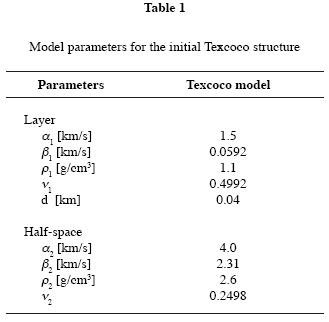
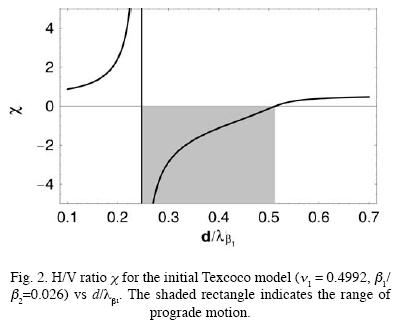
<body><![CDATA[<p align="justify"><font face="verdana" size="2">Note that the theoretical expressions for the <i>H/V </i>spectrum of surface waves (Arai and Tokimatsu, 2004) are valid for any number of layers over the half&#150;space. However, the critical dependence on the elastic parameters is hidden in an expression which follows from a computer program based on Haskell's method. It is not simply applicable in our analytical considerations. A dissertation by Bonnefoy&#150;Claudet (2004) contains a discussion on the sense of elliptical Rayleigh motion as a function of the shear&#150;wave contrast between layer and half&#150;space. Wathelet (2005) discusses the numerical difficulties which are inherent in any representation of the ratio <i>H/V.</i></font></p>      <p align="justify"><font face="verdana" size="2">&nbsp;</font></p>      <p align="justify"><font face="verdana" size="2"><i><strong>H/V </strong></i><strong>FOR A SIMPLIFIED TEXCOCO STRATIGRAPHY</strong></font></p>      <p align="justify"><font face="verdana" size="2">The Texcoco array (Flores&#150;Estrella, 2004; Stephenson and Lomnitz, 2005) is an example of a site on soft ground within the valley of Mexico. We assume a one&#150;layer structure (<a href="#t1">Table 1</a>), which will be later modified to bring out the essential features in our calculation.</font></p>      <p align="center"><font face="verdana" size="2"> <a name="t1"></a></font></p>      <p align="center"><font face="verdana" size="2"> <img src="/img/revistas/geoint/v45n3/a1t1.jpg"></font></p>      <p align="justify"><font face="verdana" size="2">Note the extremely high Poisson's ratio <i>v</i><sub>l</sub><i> = </i>0.4992 for the layer. This value is typical for the lake&#150;bed zone of the valley of Mexico (Stephenson and Lomnitz, 2005). It causes the range of possible prograde motion to become very significant. However, as we will see in <a href="/img/revistas/geoint/v45n3/a1f3.jpg" target="_blank">Figure 3</a>, such high values of Poisson's ratio are not necessary for producing prograde motion. Prograde motion may not be as rare as is often assumed.</font></p>      <p align="justify"><font face="verdana" size="2">The behaviour of the function <i>&chi; </i>is tricky, and determining some ranges of prograde motion may be a numerical challenge (<a href="#f2">Figure 2</a>). The range of prograde motion may be bounded by two zeroes in <i>&chi; ,</i>two poles, or more commonly a pole and a zero. The latter case is displayed in <a href="#f2">Figure 2</a>, where the range of prograde motion is indicated by a shaded rectangle.</font></p>      <p align="center"><font face="verdana" size="2"> <a name="f2"></a></font></p>      <p align="center"><font face="verdana" size="2"> <img src="/img/revistas/geoint/v45n3/a1f2.jpg"></font></p>      ]]></body>
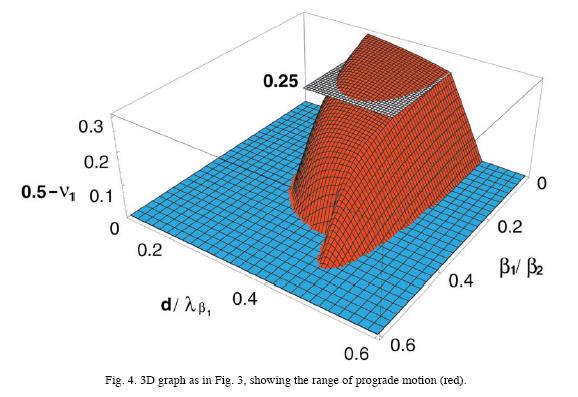
<body><![CDATA[<p align="justify"><font face="verdana" size="2">We may now derive the behaviour of <i>&chi; = H/V </i>from Eq. (3). The 2D graph (<a href="/img/revistas/geoint/v45n3/a1f3.jpg" target="_blank">Figure 3</a>) shows the region of negative <i>&chi;</i>&#150;values, or prograde motion, in red, and the region of positive <i>&chi;</i>&#150;values or retrograde motion in blue. The abscissa is the normalized frequency <img src="/img/revistas/geoint/v45n3/a1s5.jpg">where <img src="/img/revistas/geoint/v45n3/a1s6.jpg"> is the wavelength of shear waves in the layer. The ordinate is the ratio between the shear&#150;wave velocities in the layer and the half&#150;space. The calculation was carried out by using a MATHEMATICA&reg; program.</font></p>      <p align="justify"><font face="verdana" size="2">In constructing <a href="/img/revistas/geoint/v45n3/a1f3.jpg" target="_blank">Figure 3</a> we have gone beyond the initial Texcoco model in order to demonstrate the existence conditions for prograde motion. The calculation was carried out with values of <i>v</i><sub>1</sub>=0.4992, 0.4, 0.3, 0.25, 0.24, 0.23, 0.22 and 0.21. The shear&#150;wave velocity of the layer was held constant at<i> &beta;</i><sub>1</sub><i> = </i>0.0592 km/s and Poisson's ratio in the half&#150;space was assumed to be <i> v</i><sub>2</sub> = 0.2498. The ratio of shear&#150;wave velocities <i>r<sub>s</sub> = &beta;<sub>1 </sub> / &beta;<sub>2</sub> </i>was made to vary from 0.01 to 0.9. The value <i>r<sub>s</sub> = </i>0.026 corresponds to the initial Texcoco model (yellow horizontal line near the bottom). Malischewsky <i>et al. </i>(2005) showed numerically that a domain of prograde motion is also obtained for higher values of the shear&#150;wave velocity in the layer. Thus the shear&#150;wave velocity in the layer is not the only leading parameter for the occurrence of prograde Rayleigh motion. It must be considered in combination with Poisson' s ratio and the shear impedance contrast. The corresponding theoretical results haven been presented elsewhere but have not yet been proved analytically.</font></p>      <p align="justify"><font face="verdana" size="2">The red area in <a href="/img/revistas/geoint/v45n3/a1f3.jpg" target="_blank">Figure 3</a> represents the region of prograde motion for our initial Texcoco model, as well as for the lower Poisson's ratios in the layer. The figure was calculated with the ContourPlot command of MATHEMATICA&reg; and it may contain some random numerical noise.</font></p>      <p align="justify"><font face="verdana" size="2">Each contour required about 10 hours of computer time on a Personal Computer with 1.8 GHz timing frequency.</font></p>      <p align="justify"><font face="verdana" size="2">Other programming languages may be better suited for numerical calculations and may be more efficient.</font></p>      <p align="justify"><font face="verdana" size="2">A better insight into the structure of prograde ground motion as a function of Poisson's ratio may be obtained from a 3D perspective graph (<a href="#f4">Figure 4</a>). The contours for different values of <i>v</i><sub>1</sub> are shown and the vertical z&#150;coordinate is 0.5 &#150;<i> v</i><sub>1</sub>. The red surface of this relief structure is the boundary between prograde and retrograde motion and the contours are the same as in <a href="/img/revistas/geoint/v45n3/a1f3.jpg" target="_blank">Figure 3</a>. The gray plane denotes <i>v</i><sub>1</sub><i> = </i>0.25.</font></p>      <p align="center"><font face="verdana" size="2"> <a name="f4"></a></font></p>      <p align="center"><font face="verdana" size="2"> <img src="/img/revistas/geoint/v45n3/a1f4.jpg"></font></p>      <p align="justify"><font face="verdana" size="2">&nbsp;</font></p>      <p align="justify"><font face="verdana" size="2"><b>SYNTHETIC SEISMOGRAMS</b></font></p>      ]]></body>
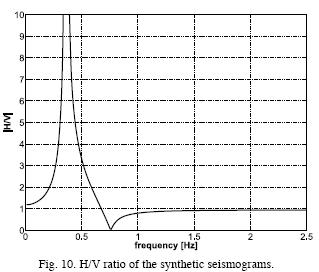
<body><![CDATA[<p align="justify"><font face="verdana" size="2">Prograde particle motion is reflected in the synthetic seismograms of surface waves. For harmonic excitation the frequency range of prograde particle motion can be exactly determined (see Malischewsky <i>et al. </i>2005). In the case of measured earthquake or arbitrary impulse signals it will be complicate to show the prograde particle motion. The reason is that the prograde particle motion exists only in a very short frequency range between ranges of retrograde particle motion. However the determination of this prograde particle motion in measured seismograms can be very important because the presence of prograde ground motion is related to the dominant site frequency. This raises important questions in earthquake engineering, e.g. tuning of the natural frequency of the structure by structural components far of the site frequencies.</font></p>      <p align="justify"><font face="verdana" size="2">The synthetic theoretical seismograms in this paper are computed for a single force, excited by a Ricker impulse of first order, applied to the surface of the half&#150;space. It is useful to consider the eigenfunctions of the Texcoco site as defined in <a href="#t1">Table 1</a>. We plot some eigenfunctions in the relevant frequency range (<a href="/img/revistas/geoint/v45n3/a1f5.jpg" target="_blank">Figure 5</a>). For different frequencies the horizontal (solid) and vertical (dotted) eigenfunctions are presented. Note that for frequencies higher than the site frequency <i> &beta;</i><sub>1</sub>/4<i>d</i> <i>  </i> the top layer is a waveguide.</font></p>      <p align="justify"><font face="verdana" size="2">In the range between the site frequency<i>  &beta;</i><sub>1</sub>/4<i>d</i>  and the double site frequency<i>  <i> &beta;</i><sub>1</sub>/</i>2<i><i>d</i> </i>  there are changes of sign in the eigenfunctions at the top (at point <i> &beta;</i><sub>1</sub>/4<i>d</i>  &#150; the horizontal eigenfunction and at point <i><i> &beta;</i><sub>1</sub>/</i>2<i><i>d</i>  &#150;</i>the vertical eigenfunction). This is the reason for the occurrence of prograde motion in the following investigation. It must appear and ought to be observed in the calculated time histories. The calculation assumes that the wave field consists of a single mode, the fundamental mode of the site (see <a href="/img/revistas/geoint/v45n3/a1f7.jpg" target="_blank">Figure 7b</a>).</font></p>      <p align="justify"><font face="verdana" size="2">When the fundamental mode is used in calculations, the specific behaviour of the site in the relevant frequency range must also be reflected in the Green's functions (<a href="/img/revistas/geoint/v45n3/a1f6.jpg" target="_blank">Figure 6</a>) as well as in the seismograms (<a href="/img/revistas/geoint/v45n3/a1f7.jpg" target="_blank">Figure 7</a>). Actually the complex and the absolute values of the vertical and horizontal displacements in this frequency range are very different. This behaviour will be important for the <i>H/V </i>investigation of time histories.</font></p>      <p align="justify"><font face="verdana" size="2">Several techniques were used in order to check the synthetic seismograms. <a href="/img/revistas/geoint/v45n3/a1f7.jpg" target="_blank">Figure 7b</a> shows the results of wave field transformation, to extract the dispersion from the computed wave field in <a href="/img/revistas/geoint/v45n3/a1f7.jpg" target="_blank">Figure 7a</a>. For comparison, both the synthetic (dashed) and the extracted dispersion curves are plotted in <a href="/img/revistas/geoint/v45n3/a1f7.jpg" target="_blank">Figure 7b</a>.</font></p>      <p align="justify"><font face="verdana" size="2">There are different methods for detecting prograde ground motion in measured or calculated seismograms. Time windows may be used in the interpretation of ground motion, but often these methods are not satisfactory. Information on the polarization of the wave field is obtained in this paper by using a moving window with an appropriate window length. In <a href="/img/revistas/geoint/v45n3/a1f8.jpg" target="_blank">Figure 8</a> and <a href="/img/revistas/geoint/v45n3/a1f9.jpg" target="_blank">9</a> consecutive snapshots are imaged.</font></p>      <p align="justify"><font face="verdana" size="2">The images show the expected frequency range and the corresponding prograde particle motion. The frequency content of the time window is also imaged. In <a href="/img/revistas/geoint/v45n3/a1f8.jpg" target="_blank">Figure 8</a> the snapshot is early in the seismograms (t = 1.025 ... 2.825 s). Prograde ground motion only is seen in the upper window. The frequency content in this figure is in the range of 0.2 to 0.7 Hz. With increasing time <a href="/img/revistas/geoint/v45n3/a1f9.jpg" target="_blank">Figure 9</a> (t = 3.85...5.65 s) shows the crossover from prograde to retrograde ground motion.</font></p>      <p align="justify"><font face="verdana" size="2">Finally we consider the <i>H/V </i>ratio extracted from the synthetic seismograms. The ratio is plotted in <a href="#f10">Figure 10</a>. The ratio shows exactly the peak point at the beginning of the range of prograde particle motion at 0.37 Hz (this point is conform with the change in sign of the horizontal displacement in <a href="/img/revistas/geoint/v45n3/a1f5.jpg" target="_blank">Figure 5</a> and the point<i> &beta;</i><sub>1</sub>/4<i>d</i> )<i>. </i>The root of the ratio function appears at the frequency 0.74 Hz (point <i> &beta;</i><sub>1</sub>/2<i>d</i>) and is conform to the end of the frequency range of prograde particle motion. The end of the frequency range of the prograde particle motion is caused by the change in sign of the vertical particle motion at the top of the half&#150;space.</font></p>      <p align="center"><font face="verdana" size="2"> <a name="f10"></a></font></p>      <p align="center"><font face="verdana" size="2"> <img src="/img/revistas/geoint/v45n3/a1f10.jpg"></font></p>      ]]></body>
<body><![CDATA[<p align="justify"><font face="verdana" size="2">This case shows that the peak of the <i>H/V </i>ratio can be associated with prograde particle motion when using the Texcoco site profile. However, the occurrence of prograde particle motion depends also on the impedance ratio between the layers.</font></p>      <p align="justify"><font face="verdana" size="2">&nbsp;</font></p>      <p align="justify"><font face="verdana" size="2"><b>SOME OBSERVATIONS OF PROGRADE PARTICLE MOTION </b></font></p>      <p align="justify"><font face="verdana" size="2">Earthquake observations in the valley of Mexico go back to the Aztecs (Garc&iacute;a Acosta and Su&aacute;rez Reynoso, 1996). Here we discuss some modern observations of Rayleigh waves, especially those with prograde ground motion. Engineering seismologists still disagree on whether Rayleigh waves or shear waves are mainly responsible for the severe damage, especially in the disastrous earthquake of 19 September 1985 in Mexico City. There are suggestions that prograde Rayleigh motion may be especially hazardous for buildings (Lomnitz and Meas, 2004). The literature about destructive seismic motion in the valley of Mexico is very substantial. Some recent references include Ch&aacute;vez&#150;Garc&iacute;a and Bard (1994), C&aacute;rdenas&#150;Soto and Ch&aacute;vez&#150;Garc&iacute;a (2006), Lomnitz and Casta&ntilde;os (2006), and Flores&#150;Estrella <i>et al. </i>(2006). G&oacute;mez&#150;Bernal and Saragoni (1998) observed Rayleigh waves with retrograde motion in different period ranges in the valley, and the dissertation by G&oacute;mez&#150;Bernal (2002) contains specific evidence on the 1985 event which we present here in support of our new theoretical findings. This study is not very well&#150;known and it attempts to investigate different directions of particle motion in different period ranges in the valley. Unfortunately, G&oacute;mez&#150;Bernal (2002) shows no example of particle motion within the lake&#150;bed zone (Z&#150;III). The locations of stations are shown on <a href="/img/revistas/geoint/v45n3/a1f11.jpg" target="_blank">Figure 11</a>. Station TEAC (18.618 N, &#150;99.453 W) falls outside the valley in a southwesterly direction. <a href="/img/revistas/geoint/v45n3/a1f11.jpg" target="_blank">Figure 11</a> shows the horizontal accelerograms and the zoning according to the Mexico City building code: Z&#150;I (rock zone), Z&#150;II (transition zone), and Z&#150;III (lake&#150;bed zone).</font></p>      <p align="justify"><font face="verdana" size="2"><a href="/img/revistas/geoint/v45n3/a1f12.jpg" target="_blank">Figure 12</a> shows the vertical and radial displacement seismograms in the time window AB in order to obtain the particle motion. The top of <a href="/img/revistas/geoint/v45n3/a1f12.jpg" target="_blank">Figure 12</a> shows some seismograms after bandpass filtering between 0.065 Hz and 0.15 Hz together with the extracted particle motion (retrograde). The lower section of the figure shows the same data after bandpass filtering between 0.2 Hz and 0.5 Hz plus the extracted particle motion (prograde). There is some indication that the extracted particle motion belongs to Rayleigh waves in both cases. This may agree with a model consisting of at least one layer over a half&#150;space. Note that the retrograde motion for low&#150;frequency waves is influenced by the half&#150;space and   the prograde motion for higher frequencies is influenced by the layer as well as the half&#150;space.</font></p>      <p align="justify"><font face="verdana" size="2">Station SXVI shows, in the higher frequency range, prograde motion with an extremely flat ellipse, as expected from theory, which predicts this behaviour near the edges of the range of prograde motion. As station SXVI is in the transition zone (<a href="/img/revistas/geoint/v45n3/a1f11.jpg" target="_blank">Figure 11</a>), we assume a layer thickness of 20 m instead of the value from the Texcoco model (<a href="#t1">Table 1</a>), and we increase the shear&#150;wave velocity to 110 m/s, which yields a site frequency of 1.37 Hz. Twice the site frequency is about 2.75 Hz which is close to one corner frequency of the bandpass.</font></p>      <p align="justify"><font face="verdana" size="2">The high&#150;frequency prograde motion at CU01 and TACY is more difficult to explain. For these two stations the presence of a layer is mandatory despite the accepted geological model for zone Z&#150;I (rock site). A 25 m deep well on the UNAM campus not far from station CU01 encountered a soft layer with high water content under the hard lava flow. In the Lomas area near station TACY we find tuff with sporadic lake sediments. The influence of a hard surface layer on top of a soft layer has not been investigated. Station TEAC is outside the valley on hard volcanic rock so that the retrograde particle motion (see <a href="/img/revistas/geoint/v45n3/a1f12.jpg" target="_blank">Figure 12</a>) is in agreement with theory.</font></p>      <p align="justify"><font face="verdana" size="2">&nbsp;</font></p>      <p align="justify"><font face="verdana" size="2"><b>DISCUSSION</b></font></p>      <p align="justify"><font face="verdana" size="2">Because of the skin effect of surface waves (i. e. high&#150;frequency waves are concentrated within a thin layer near the surface) and by considering that the Rayleigh motion is retrograde in the homogeneous half&#150;space, prograde motion can be expected only in a certain range situated between high and low frequencies <i> f</i>. This frequency range is shown in <a href="#f2">Figure 2</a>. For the Texcoco model it is approximately situated between the dominant site frequency (<i> <img src="/img/revistas/geoint/v45n3/a1s5.jpg"></i> =0.25)and its double value, i. e. in this case 0.37 Hz &lt; <i> f</i>  &lt;0.74 Hz. For higher and lower frequencies we have retrograde motion. This range becomes smaller when Poisson's ratio <i>v</i><sub>1 </sub>decreases. The influence on the lower frequency limit is smaller than on the upper one (note the lines within the red region which are very dense nearby). Prograde motion ceases to exist for Poisson's ratios less than about 0.21.</font></p>      ]]></body>
<body><![CDATA[<p align="justify"><font face="verdana" size="2">For <i>v</i><sub>1</sub>= 0.4992 the shear velocity contrast <i>r<sub>s</sub> </i>between the layer and the halfspace must be lower than 0.5 for prograde motion to exist. In the Texcoco model the shear&#150;wave ratio is <i>r<sub>s</sub> = </i>0.026. It should be also noted that the frequency range under consideration is maximal for <i>r<sub>s</sub> </i>= 0.15 (see <a href="/img/revistas/geoint/v45n3/a1f3.jpg" target="_blank">Figure 3</a>).</font></p>      <p align="justify"><font face="verdana" size="2">The influence of the half&#150;space Poisson ratio was not studied here and also not the influence of the densities. </font><font face="verdana" size="2">Probably, the latter ones do not play a great role. Nevertheless it has to be studied in future. Observe also that the character of the contour lines changes on the right side between <i>v<sub>1</sub> = </i>0.25 and 0.3 (see <a href="/img/revistas/geoint/v45n3/a1f3.jpg" target="_blank">Figure 3</a>). It is unknown whether this behaviour is eventually connected with the occurrence of the critical Poisson ratio <i>v<sub>Q</sub> = </i>0.263, which was presented analytically by Malischewsky (2000a and 2000b). Below this critical value there are no complex roots of the polynomial form of Rayleigh's equation. Further it is noticeable (see <a href="#f4">Figure 4</a>) that there are sharp corners right and left from the centre on top of the mountain for rs&#150;values lower than about 0.2, which become smoother for higher <i>r<sub>s</sub>. </i>These sharp corners indicate discontinuous first derivatives of the tangents along the corresponding profiles. Another feature which seems to be typical for the region of prograde Rayleigh&#150;wave motion is the occurrence of a "tail" for <i>v</i><sub>1</sub><i>&#150; </i>values higher than about 0.4 in the range 0.43 &lt;<i>r<sub>s</sub>&lt;</i>0.51 (see <a href="/img/revistas/geoint/v45n3/a1f3.jpg" target="_blank">Figure 3</a> and <a href="#f4">4</a>). All these peculiarities are described heuristically and are believed to be due to the complexity of the domain of prograde motion. The corresponding mathematical explanations remain to be found though they must somehow be concealed in Equation (3).</font></p>      <p align="justify"><font face="verdana" size="2">Thus the theory of synthetic seismograms in the homogeneous layered half&#150;space shows clear evidence of prograde Rayleigh motion in the frequency range discussed above. Such wave groups must certainly exist in the valley of Mexico, but a more exhaustive investigation of the peculiar geological conditions remains to be carried out. The interpretation of <a href="/img/revistas/geoint/v45n3/a1f12.jpg" target="_blank">Figure 12</a> involves the silent assumption that the corresponding wave group originates from a source in Michoac&aacute;n or at the very least from a Western direction. According to G&oacute;mez&#150;Bernal (2002) the Ometepec earthquake of September 14, 1995 yields evidence that a wave group in the frequency interval of 0.25&#150; 0.37 Hz with similar character as in the Michoac&aacute;n earthquake comes from the South, i.e., from the source. On the other hand, several authors assume secondary sources for high&#150;frequency Rayleigh waves near the edge of the valley. For a discussion, see e. g. C&aacute;rdenas&#150;Soto and Ch&aacute;vez&#150;Garc&iacute;a (2005). This is a complication for the interpretation of the particle motion. It can be only overcome by application of array techniques together with the Gabor&#150;matrix method in order to isolate the wave groups with different directions and time delays in the future.</font></p>     <p align="justify"><font face="verdana" size="2">Finally, prograde Rayleigh particle motion may also be generated by higher modes.</font></p>     <p align="justify"><font face="verdana" size="2">&nbsp;</font></p>     <p align="justify"><font face="verdana" size="2"><b>CONCLUSIONS</b></font></p>     <p align="justify"><font face="verdana" size="2">Soil conditions within the valley of Mexico cause the appearance of prograde Rayleigh ground motion under certain coditions discussed in this paper. Similar conditions may occur in other sedimentary basins such as Los Angeles (Tanimoto and Rivera, 2005) and others. The critical parameters include Poisson's ratio of the top sedimentary layer and the contrast of shear&#150;wave velocities between the layer and the half&#150;space. The absolute value of the shear&#150;wave velocity in the layer is less important. This behaviour was obtained by numerical simulations but could not yet be proved analytically. The prograde or retrograde character of Rayleigh particle motion may yield useful additional constraints for uniqueness of the inversion of dispersion and H/V&#150;measurements. Such considerations can be important for seismic hazard assessment.</font></p>      <p align="justify"><font face="verdana" size="2">&nbsp;</font></p>      <p align="justify"><font face="verdana" size="2"><b>ACKNOWLEDGEMENTS</b></font></p>      <p align="justify"><font face="verdana" size="2">PGM acknowledges the assistance received during several stays at UNAM in Mexico, including friendships and working conditions. PGM and FW thank Prof. Theodoros Triantafyllidis, University of Bochum, Germany for his encouragement. The authors thank Hortencia Flores Estrella for useful information on the geology of the valley of Mexico.</font></p>      ]]></body>
<body><![CDATA[<p align="justify"><font face="verdana" size="2">&nbsp;</font></p>      <p align="justify"><font face="verdana" size="2"><b>BIBLIOGRAPHY</b></font></p>      <!-- ref --><p align="justify"><font face="verdana" size="2">AKI, K. and P. G. RICHARDS, 2002. Quantitative Seismology, University Science Books.</font>&nbsp;&nbsp;&nbsp;&nbsp;&nbsp;&nbsp;&nbsp;&nbsp;[&#160;<a href="javascript:void(0);" onclick="javascript: window.open('/scielo.php?script=sci_nlinks&ref=3893168&pid=S0016-7169200600030000100001&lng=','','width=640,height=500,resizable=yes,scrollbars=1,menubar=yes,');">Links</a>&#160;]<!-- end-ref --><!-- ref --><p align="justify"><font face="verdana" size="2">ARAI, H. and K. TOKIMATSU, 2004. S&#150;wave velocity profiling by inversion of microtremor H/V spectrum. <i>Bull. Seismol. Soc. Am. 94, </i>53&#150;63.</font>&nbsp;&nbsp;&nbsp;&nbsp;&nbsp;&nbsp;&nbsp;&nbsp;[&#160;<a href="javascript:void(0);" onclick="javascript: window.open('/scielo.php?script=sci_nlinks&ref=3893169&pid=S0016-7169200600030000100002&lng=','','width=640,height=500,resizable=yes,scrollbars=1,menubar=yes,');">Links</a>&#160;]<!-- end-ref --><!-- ref --><p align="justify"><font face="verdana" size="2">BARD, P. Y., 1998. Microtremor measurements: A tool for site effect estimation. Proc. of the second International Symposium on the Effect of Surface Geology on Seismic Motion, Yokohama, Japan, 1&#150;3 Dec, 1998, pp. 25&#150;33.</font>&nbsp;&nbsp;&nbsp;&nbsp;&nbsp;&nbsp;&nbsp;&nbsp;[&#160;<a href="javascript:void(0);" onclick="javascript: window.open('/scielo.php?script=sci_nlinks&ref=3893170&pid=S0016-7169200600030000100003&lng=','','width=640,height=500,resizable=yes,scrollbars=1,menubar=yes,');">Links</a>&#160;]<!-- end-ref --><!-- ref --><p align="justify"><font face="verdana" size="2">BONNEFOY&#150;CLAUDET, S., 2004. Nature of the seismic ground noise: implications for studies of site effects (in French). PhD thesis, University Joseph Fourier, Grenoble I.</font>&nbsp;&nbsp;&nbsp;&nbsp;&nbsp;&nbsp;&nbsp;&nbsp;[&#160;<a href="javascript:void(0);" onclick="javascript: window.open('/scielo.php?script=sci_nlinks&ref=3893171&pid=S0016-7169200600030000100004&lng=','','width=640,height=500,resizable=yes,scrollbars=1,menubar=yes,');">Links</a>&#160;]<!-- end-ref --><!-- ref --><p align="justify"><font face="verdana" size="2">C&Aacute;RDENAS&#150;SOTO, M. and F. J. CH&Aacute;VEZ&#150;GARC&Iacute;A, 2005. Earthquake ground motion in Mexico City. An analysis of data recorded at Roma array. <i>Soil Dynam. Earth. Eng. </i>(in press).</font>&nbsp;&nbsp;&nbsp;&nbsp;&nbsp;&nbsp;&nbsp;&nbsp;[&#160;<a href="javascript:void(0);" onclick="javascript: window.open('/scielo.php?script=sci_nlinks&ref=3893172&pid=S0016-7169200600030000100005&lng=','','width=640,height=500,resizable=yes,scrollbars=1,menubar=yes,');">Links</a>&#160;]<!-- end-ref --><!-- ref --><p align="justify"><font face="verdana" size="2">CH&Aacute;VEZ&#150;GARC&Iacute;A, F. J. and P.&#150;Y. BARD, 1994. Site effects in Mexico City eight years after the September 1985 Michoacan earthquakes. <i>Oil Dynam. Earth. Eng., 13, </i>229&#150;247.</font>&nbsp;&nbsp;&nbsp;&nbsp;&nbsp;&nbsp;&nbsp;&nbsp;[&#160;<a href="javascript:void(0);" onclick="javascript: window.open('/scielo.php?script=sci_nlinks&ref=3893173&pid=S0016-7169200600030000100006&lng=','','width=640,height=500,resizable=yes,scrollbars=1,menubar=yes,');">Links</a>&#160;]<!-- end-ref --><!-- ref --><p align="justify"><font face="verdana" size="2">DIALLO, M. S., M. KULESH, M. HOLSCHNEIDER, F. SCHERBAUM and F. ADLER, 2006. Characterization of polarization attributes of seismic waves using continuous wavelet transforms. <i>Geophys., 71, </i>V67&#150;V77.</font>&nbsp;&nbsp;&nbsp;&nbsp;&nbsp;&nbsp;&nbsp;&nbsp;[&#160;<a href="javascript:void(0);" onclick="javascript: window.open('/scielo.php?script=sci_nlinks&ref=3893174&pid=S0016-7169200600030000100007&lng=','','width=640,height=500,resizable=yes,scrollbars=1,menubar=yes,');">Links</a>&#160;]<!-- end-ref --><!-- ref --><p align="justify"><font face="verdana" size="2">FLORES&#150;ESTRELLA, H., 2004. The SPAC method: An alternative for the estimation of model velocities in the valley of Mexico (in Spanish), <i>MSc thesis, </i>UNAM.</font>&nbsp;&nbsp;&nbsp;&nbsp;&nbsp;&nbsp;&nbsp;&nbsp;[&#160;<a href="javascript:void(0);" onclick="javascript: window.open('/scielo.php?script=sci_nlinks&ref=3893175&pid=S0016-7169200600030000100008&lng=','','width=640,height=500,resizable=yes,scrollbars=1,menubar=yes,');">Links</a>&#160;]<!-- end-ref --><!-- ref --><p align="justify"><font face="verdana" size="2">FLORES&#150;ESTRELLA, H., C. LOMNITZ and S. YUSSIM&#150;GUARNEROS, 2006. Twenty Years of Research on the Seismic Response of Mexico Basin: A Review. <i>Natural Hazards, in press.</i></font>&nbsp;&nbsp;&nbsp;&nbsp;&nbsp;&nbsp;&nbsp;&nbsp;[&#160;<a href="javascript:void(0);" onclick="javascript: window.open('/scielo.php?script=sci_nlinks&ref=3893176&pid=S0016-7169200600030000100009&lng=','','width=640,height=500,resizable=yes,scrollbars=1,menubar=yes,');">Links</a>&#160;]<!-- end-ref --><!-- ref --><p align="justify"><font face="verdana" size="2">GARC&Iacute;A ACOSTA, V. and G. SU&Aacute;REZ REYNOSO. 1996. Los sismos en la historia de M&eacute;xico, Vol. 1 (Fondo de Cultura Econ&oacute;mica, M&eacute;xico, 718 pp., 1996).</font>&nbsp;&nbsp;&nbsp;&nbsp;&nbsp;&nbsp;&nbsp;&nbsp;[&#160;<a href="javascript:void(0);" onclick="javascript: window.open('/scielo.php?script=sci_nlinks&ref=3893177&pid=S0016-7169200600030000100010&lng=','','width=640,height=500,resizable=yes,scrollbars=1,menubar=yes,');">Links</a>&#160;]<!-- end-ref --><!-- ref --><p align="justify"><font face="verdana" size="2">GIESE, P., 1957. Determination of elastic properties and thickness of friable soils by using special Rayleigh waves (in German). <i>Gerl. Beitr. Geophysik, 66, </i>274&#150;312.</font>&nbsp;&nbsp;&nbsp;&nbsp;&nbsp;&nbsp;&nbsp;&nbsp;[&#160;<a href="javascript:void(0);" onclick="javascript: window.open('/scielo.php?script=sci_nlinks&ref=3893178&pid=S0016-7169200600030000100011&lng=','','width=640,height=500,resizable=yes,scrollbars=1,menubar=yes,');">Links</a>&#160;]<!-- end-ref --><!-- ref --><p align="justify"><font face="verdana" size="2">G&Oacute;MEZ&#150;BERNAL, A. and R. SARAGONI, 1998. Rayleigh waves and site amplification in M&eacute;xico City valley, Universidad de Chile (unpublished manuscript).</font>&nbsp;&nbsp;&nbsp;&nbsp;&nbsp;&nbsp;&nbsp;&nbsp;[&#160;<a href="javascript:void(0);" onclick="javascript: window.open('/scielo.php?script=sci_nlinks&ref=3893179&pid=S0016-7169200600030000100012&lng=','','width=640,height=500,resizable=yes,scrollbars=1,menubar=yes,');">Links</a>&#160;]<!-- end-ref --><!-- ref --><p align="justify"><font face="verdana" size="2">G&Oacute;MEZ&#150;BERNAL, A., 2002. Interpretation of soil effect in the Mexico valley using high density arrays of accelerographs. <i>PhD thesis, </i>UNAM.</font>&nbsp;&nbsp;&nbsp;&nbsp;&nbsp;&nbsp;&nbsp;&nbsp;[&#160;<a href="javascript:void(0);" onclick="javascript: window.open('/scielo.php?script=sci_nlinks&ref=3893180&pid=S0016-7169200600030000100013&lng=','','width=640,height=500,resizable=yes,scrollbars=1,menubar=yes,');">Links</a>&#160;]<!-- end-ref --><!-- ref --><p align="justify"><font face="verdana" size="2">KISSLINGER, C., 1959. Observations of the development of Rayleigh&#150;type waves in the vicinity of small explosions. <i>J. Geophys. Res., 64, </i>429&#150;436.</font>&nbsp;&nbsp;&nbsp;&nbsp;&nbsp;&nbsp;&nbsp;&nbsp;[&#160;<a href="javascript:void(0);" onclick="javascript: window.open('/scielo.php?script=sci_nlinks&ref=3893181&pid=S0016-7169200600030000100014&lng=','','width=640,height=500,resizable=yes,scrollbars=1,menubar=yes,');">Links</a>&#160;]<!-- end-ref --><!-- ref --><p align="justify"><font face="verdana" size="2">LOVE, A. E. H., 1911. Some Problems of Geodynamics, Cambridge University Press, Cambridge (republished by Dover, New York, 1967).</font>&nbsp;&nbsp;&nbsp;&nbsp;&nbsp;&nbsp;&nbsp;&nbsp;[&#160;<a href="javascript:void(0);" onclick="javascript: window.open('/scielo.php?script=sci_nlinks&ref=3893182&pid=S0016-7169200600030000100015&lng=','','width=640,height=500,resizable=yes,scrollbars=1,menubar=yes,');">Links</a>&#160;]<!-- end-ref --><!-- ref --><p align="justify"><font face="verdana" size="2">LOMNITZ, C. and Y. MEAS, 2004. Huygens' Principle. The capture of seismic energy by a soft soil layer. <i>Geophys. Res. Letters, 31, </i>L13613, 10.1029/2004GL019910.</font>&nbsp;&nbsp;&nbsp;&nbsp;&nbsp;&nbsp;&nbsp;&nbsp;[&#160;<a href="javascript:void(0);" onclick="javascript: window.open('/scielo.php?script=sci_nlinks&ref=3893183&pid=S0016-7169200600030000100016&lng=','','width=640,height=500,resizable=yes,scrollbars=1,menubar=yes,');">Links</a>&#160;]<!-- end-ref --><!-- ref --><p align="justify"><font face="verdana" size="2">LOMNITZ, C. and H. CASTA&Ntilde;OS, 2006. Earthquake hazard in the valley of Mexico: entropy, structure, complexity. <i>In: </i>Teisseyre, R., H. Takeo, and E. Majewski (Eds.): Earthquake Source Asymmetry, Structural Media and Rotation Effects, Springer, Berlin.</font>&nbsp;&nbsp;&nbsp;&nbsp;&nbsp;&nbsp;&nbsp;&nbsp;[&#160;<a href="javascript:void(0);" onclick="javascript: window.open('/scielo.php?script=sci_nlinks&ref=3893184&pid=S0016-7169200600030000100017&lng=','','width=640,height=500,resizable=yes,scrollbars=1,menubar=yes,');">Links</a>&#160;]<!-- end-ref --><!-- ref --><p align="justify"><font face="verdana" size="2">MALISCHEWSKY, P. G., 2000a. Comment to "A new formula for the velocity of Rayleigh waves" by D. Nkemzi. <i>Wave Motion, 31, </i>93&#150;96.</font>&nbsp;&nbsp;&nbsp;&nbsp;&nbsp;&nbsp;&nbsp;&nbsp;[&#160;<a href="javascript:void(0);" onclick="javascript: window.open('/scielo.php?script=sci_nlinks&ref=3893185&pid=S0016-7169200600030000100018&lng=','','width=640,height=500,resizable=yes,scrollbars=1,menubar=yes,');">Links</a>&#160;]<!-- end-ref --><!-- ref --><p align="justify"><font face="verdana" size="2">MALISCHEWSKY, P. G., 2000b. Some special solutions of Rayleigh's equation and the reflections of body waves at a free surface. <i>Geof&iacute;s. Int., 39, </i>155&#150;160.</font>&nbsp;&nbsp;&nbsp;&nbsp;&nbsp;&nbsp;&nbsp;&nbsp;[&#160;<a href="javascript:void(0);" onclick="javascript: window.open('/scielo.php?script=sci_nlinks&ref=3893186&pid=S0016-7169200600030000100019&lng=','','width=640,height=500,resizable=yes,scrollbars=1,menubar=yes,');">Links</a>&#160;]<!-- end-ref --><!-- ref --><p align="justify"><font face="verdana" size="2">MALISCHEWSKY, P. G. and F. SCHERBAUM, 2004. Love's formula and <i>H/V&#150;ratio </i>(ellipticity) of Rayleigh waves. <i>Wave Motion, 40, </i>57&#150;67.</font>&nbsp;&nbsp;&nbsp;&nbsp;&nbsp;&nbsp;&nbsp;&nbsp;[&#160;<a href="javascript:void(0);" onclick="javascript: window.open('/scielo.php?script=sci_nlinks&ref=3893187&pid=S0016-7169200600030000100020&lng=','','width=640,height=500,resizable=yes,scrollbars=1,menubar=yes,');">Links</a>&#160;]<!-- end-ref --><!-- ref --><p align="justify"><font face="verdana" size="2">MALISCHEWSKY, P. G. , G. JENTZSCH, C. LOMNITZ and F. WUTTKE, 2005. New considerations about Rayleigh waves in the light of seismic risk in the valley of Mexico, D. F. IASPEI General Assembly 2005, 2&#150;8 October, Santiago de Chile, SS03, No. 616.</font>&nbsp;&nbsp;&nbsp;&nbsp;&nbsp;&nbsp;&nbsp;&nbsp;[&#160;<a href="javascript:void(0);" onclick="javascript: window.open('/scielo.php?script=sci_nlinks&ref=3893188&pid=S0016-7169200600030000100021&lng=','','width=640,height=500,resizable=yes,scrollbars=1,menubar=yes,');">Links</a>&#160;]<!-- end-ref --><!-- ref --><p align="justify"><font face="verdana" size="2">MUNIROVA, L. M. and T. B. YANOVSKAYA., 2001. Spectral ratio of the horizontal and vertical Rayleigh wave components and ist application to some problems of seismology, <i>Izvestiya Physics of the Solid Earth 37, </i>709&#150;716.</font>&nbsp;&nbsp;&nbsp;&nbsp;&nbsp;&nbsp;&nbsp;&nbsp;[&#160;<a href="javascript:void(0);" onclick="javascript: window.open('/scielo.php?script=sci_nlinks&ref=3893189&pid=S0016-7169200600030000100022&lng=','','width=640,height=500,resizable=yes,scrollbars=1,menubar=yes,');">Links</a>&#160;]<!-- end-ref --><!-- ref --><p align="justify"><font face="verdana" size="2">SCHERBAUM, F., K. G. HINZEN and M. OHRNBERGER, 2003. Determination of shallow shear wave velocity profiles in the Cologne Germany area using ambient vibrations. <i>Geophys. J. Int. 152, </i>597&#150;612.</font>&nbsp;&nbsp;&nbsp;&nbsp;&nbsp;&nbsp;&nbsp;&nbsp;[&#160;<a href="javascript:void(0);" onclick="javascript: window.open('/scielo.php?script=sci_nlinks&ref=3893190&pid=S0016-7169200600030000100023&lng=','','width=640,height=500,resizable=yes,scrollbars=1,menubar=yes,');">Links</a>&#160;]<!-- end-ref --><!-- ref --><p align="justify"><font face="verdana" size="2">STEPHENSON, W. P. and C. LOMNITZ, 2005. Shear&#150;wave velocity profile at the Texcoco strong&#150;motion array site. <i>Geof&iacute;s. Int., 44, </i>3&#150;10.</font>&nbsp;&nbsp;&nbsp;&nbsp;&nbsp;&nbsp;&nbsp;&nbsp;[&#160;<a href="javascript:void(0);" onclick="javascript: window.open('/scielo.php?script=sci_nlinks&ref=3893191&pid=S0016-7169200600030000100024&lng=','','width=640,height=500,resizable=yes,scrollbars=1,menubar=yes,');">Links</a>&#160;]<!-- end-ref --><!-- ref --><p align="justify"><font face="verdana" size="2">TANIMOTO, T. and L. RIVERA, 2005. Prograde Rayleigh wave motion. <i>Geophys. J. Int., 162, </i>399&#150;405.</font>&nbsp;&nbsp;&nbsp;&nbsp;&nbsp;&nbsp;&nbsp;&nbsp;[&#160;<a href="javascript:void(0);" onclick="javascript: window.open('/scielo.php?script=sci_nlinks&ref=3893192&pid=S0016-7169200600030000100025&lng=','','width=640,height=500,resizable=yes,scrollbars=1,menubar=yes,');">Links</a>&#160;]<!-- end-ref --><!-- ref --><p align="justify"><font face="verdana" size="2">WATHELET, M., 2005. Array recordings of ambient vibrations: surface wave inversion. <i>PhD thesis, </i>University of Li&egrave;ge.</font>&nbsp;&nbsp;&nbsp;&nbsp;&nbsp;&nbsp;&nbsp;&nbsp;[&#160;<a href="javascript:void(0);" onclick="javascript: window.open('/scielo.php?script=sci_nlinks&ref=3893193&pid=S0016-7169200600030000100026&lng=','','width=640,height=500,resizable=yes,scrollbars=1,menubar=yes,');">Links</a>&#160;]<!-- end-ref --><!-- ref --><p align="justify"><font face="verdana" size="2">WUTTKE, F., 2005. Contribution to site identification using surface waves (in German). <i>PhD thesis, </i>Bauhaus University Weimar.</font>&nbsp;&nbsp;&nbsp;&nbsp;&nbsp;&nbsp;&nbsp;&nbsp;[&#160;<a href="javascript:void(0);" onclick="javascript: window.open('/scielo.php?script=sci_nlinks&ref=3893194&pid=S0016-7169200600030000100027&lng=','','width=640,height=500,resizable=yes,scrollbars=1,menubar=yes,');">Links</a>&#160;]<!-- end-ref --><!-- ref --><p align="justify"><font face="verdana" size="2">ZSCHAU, J. and S. PAROLAI, 2004. Studying earthquake site effects in urban areas: the example of Cologne (Germany). Taller Humboldt para la Cooperaci&oacute;n M&eacute;xico&#150;Alemania (Humboldt&#150;Workshop), Juriquilla, Qro., Mexico 2004.</font>&nbsp;&nbsp;&nbsp;&nbsp;&nbsp;&nbsp;&nbsp;&nbsp;[&#160;<a href="javascript:void(0);" onclick="javascript: window.open('/scielo.php?script=sci_nlinks&ref=3893195&pid=S0016-7169200600030000100028&lng=','','width=640,height=500,resizable=yes,scrollbars=1,menubar=yes,');">Links</a>&#160;]<!-- end-ref --> ]]></body><back>
<ref-list>
<ref id="B1">
<nlm-citation citation-type="book">
<person-group person-group-type="author">
<name>
<surname><![CDATA[AKI]]></surname>
<given-names><![CDATA[K.]]></given-names>
</name>
<name>
<surname><![CDATA[RICHARDS]]></surname>
<given-names><![CDATA[P. G.]]></given-names>
</name>
</person-group>
<source><![CDATA[Quantitative Seismology]]></source>
<year>2002</year>
<publisher-name><![CDATA[University Science Books]]></publisher-name>
</nlm-citation>
</ref>
<ref id="B2">
<nlm-citation citation-type="journal">
<person-group person-group-type="author">
<name>
<surname><![CDATA[ARAI]]></surname>
<given-names><![CDATA[H.]]></given-names>
</name>
<name>
<surname><![CDATA[TOKIMATSU]]></surname>
<given-names><![CDATA[K.]]></given-names>
</name>
</person-group>
<article-title xml:lang="en"><![CDATA[S-wave velocity profiling by inversion of microtremor H/V spectrum]]></article-title>
<source><![CDATA[Bull. Seismol. Soc. Am.]]></source>
<year>2004</year>
<volume>94</volume>
<page-range>53-63</page-range></nlm-citation>
</ref>
<ref id="B3">
<nlm-citation citation-type="">
<person-group person-group-type="author">
<name>
<surname><![CDATA[BARD]]></surname>
<given-names><![CDATA[P. Y.]]></given-names>
</name>
</person-group>
<article-title xml:lang="en"><![CDATA[Microtremor measurements: A tool for site effect estimation]]></article-title>
<source><![CDATA[Proc. of the second International Symposium on the Effect of Surface Geology on Seismic Motion]]></source>
<year>1998</year>
<month>1-</month>
<day>3 </day>
<page-range>25-33</page-range><publisher-loc><![CDATA[Yokohama ]]></publisher-loc>
</nlm-citation>
</ref>
<ref id="B4">
<nlm-citation citation-type="">
<person-group person-group-type="author">
<name>
<surname><![CDATA[BONNEFOY-CLAUDET]]></surname>
<given-names><![CDATA[S.]]></given-names>
</name>
</person-group>
<source><![CDATA[Nature of the seismic ground noise: implications for studies of site effects (in French)]]></source>
<year>2004</year>
</nlm-citation>
</ref>
<ref id="B5">
<nlm-citation citation-type="journal">
<person-group person-group-type="author">
<name>
<surname><![CDATA[CÁRDENAS-SOTO]]></surname>
<given-names><![CDATA[M.]]></given-names>
</name>
<name>
<surname><![CDATA[CHÁVEZ-GARCÍA]]></surname>
<given-names><![CDATA[F. J.]]></given-names>
</name>
</person-group>
<article-title xml:lang="en"><![CDATA[Earthquake ground motion in Mexico City: An analysis of data recorded at Roma array]]></article-title>
<source><![CDATA[Soil Dynam. Earth. Eng.]]></source>
<year>2005</year>
</nlm-citation>
</ref>
<ref id="B6">
<nlm-citation citation-type="journal">
<person-group person-group-type="author">
<name>
<surname><![CDATA[CHÁVEZ-GARCÍA]]></surname>
<given-names><![CDATA[F. J.]]></given-names>
</name>
<name>
<surname><![CDATA[BARD]]></surname>
<given-names><![CDATA[P.-Y.]]></given-names>
</name>
</person-group>
<article-title xml:lang="en"><![CDATA[Site effects in Mexico City eight years after the September 1985 Michoacan earthquakes]]></article-title>
<source><![CDATA[Oil Dynam. Earth. Eng.]]></source>
<year>1994</year>
<volume>13</volume>
<page-range>229-247</page-range></nlm-citation>
</ref>
<ref id="B7">
<nlm-citation citation-type="journal">
<person-group person-group-type="author">
<name>
<surname><![CDATA[DIALLO]]></surname>
<given-names><![CDATA[M. S.]]></given-names>
</name>
<name>
<surname><![CDATA[KULESH]]></surname>
<given-names><![CDATA[M.]]></given-names>
</name>
<name>
<surname><![CDATA[HOLSCHNEIDER]]></surname>
<given-names><![CDATA[M.]]></given-names>
</name>
<name>
<surname><![CDATA[SCHERBAUM]]></surname>
<given-names><![CDATA[F.]]></given-names>
</name>
<name>
<surname><![CDATA[ADLER]]></surname>
<given-names><![CDATA[F.]]></given-names>
</name>
</person-group>
<article-title xml:lang="en"><![CDATA[Characterization of polarization attributes of seismic waves using continuous wavelet transforms]]></article-title>
<source><![CDATA[Geophys.]]></source>
<year>2006</year>
<volume>71</volume>
<page-range>V67-V77</page-range></nlm-citation>
</ref>
<ref id="B8">
<nlm-citation citation-type="">
<person-group person-group-type="author">
<name>
<surname><![CDATA[FLORES-ESTRELLA]]></surname>
<given-names><![CDATA[H.]]></given-names>
</name>
</person-group>
<source><![CDATA[The SPAC method: An alternative for the estimation of model velocities in the valley of Mexico (in Spanish)]]></source>
<year>2004</year>
</nlm-citation>
</ref>
<ref id="B9">
<nlm-citation citation-type="journal">
<person-group person-group-type="author">
<name>
<surname><![CDATA[FLORES-ESTRELLA]]></surname>
<given-names><![CDATA[H.]]></given-names>
</name>
<name>
<surname><![CDATA[LOMNITZ]]></surname>
<given-names><![CDATA[C.]]></given-names>
</name>
<name>
<surname><![CDATA[YUSSIM-GUARNEROS]]></surname>
<given-names><![CDATA[S.]]></given-names>
</name>
</person-group>
<article-title xml:lang="en"><![CDATA[Twenty Years of Research on the Seismic Response of Mexico Basin: A Review]]></article-title>
<source><![CDATA[Natural Hazards]]></source>
<year>2006</year>
</nlm-citation>
</ref>
<ref id="B10">
<nlm-citation citation-type="book">
<person-group person-group-type="author">
<name>
<surname><![CDATA[GARCÍA ACOSTA]]></surname>
<given-names><![CDATA[V.]]></given-names>
</name>
<name>
<surname><![CDATA[SUÁREZ REYNOSO]]></surname>
<given-names><![CDATA[G.]]></given-names>
</name>
</person-group>
<source><![CDATA[Los sismos en la historia de México]]></source>
<year>1996</year>
<volume>1</volume>
<page-range>718</page-range><publisher-loc><![CDATA[México ]]></publisher-loc>
<publisher-name><![CDATA[Fondo de Cultura Económica]]></publisher-name>
</nlm-citation>
</ref>
<ref id="B11">
<nlm-citation citation-type="journal">
<person-group person-group-type="author">
<name>
<surname><![CDATA[GIESE]]></surname>
<given-names><![CDATA[P.]]></given-names>
</name>
</person-group>
<article-title xml:lang="en"><![CDATA[Determination of elastic properties and thickness of friable soils by using special Rayleigh waves (in German)]]></article-title>
<source><![CDATA[Gerl. Beitr. Geophysik]]></source>
<year>1957</year>
<volume>66</volume>
<page-range>274-312</page-range></nlm-citation>
</ref>
<ref id="B12">
<nlm-citation citation-type="book">
<person-group person-group-type="author">
<name>
<surname><![CDATA[GÓMEZ-BERNAL]]></surname>
<given-names><![CDATA[A.]]></given-names>
</name>
<name>
<surname><![CDATA[SARAGONI]]></surname>
<given-names><![CDATA[R.]]></given-names>
</name>
</person-group>
<source><![CDATA[Rayleigh waves and site amplification in México City valley]]></source>
<year>1998</year>
<publisher-name><![CDATA[Universidad de Chile]]></publisher-name>
</nlm-citation>
</ref>
<ref id="B13">
<nlm-citation citation-type="">
<person-group person-group-type="author">
<name>
<surname><![CDATA[GÓMEZ-BERNAL]]></surname>
<given-names><![CDATA[A.]]></given-names>
</name>
</person-group>
<source><![CDATA[Interpretation of soil effect in the Mexico valley using high density arrays of accelerographs]]></source>
<year>2002</year>
</nlm-citation>
</ref>
<ref id="B14">
<nlm-citation citation-type="journal">
<person-group person-group-type="author">
<name>
<surname><![CDATA[KISSLINGER]]></surname>
<given-names><![CDATA[C.]]></given-names>
</name>
</person-group>
<article-title xml:lang="en"><![CDATA[Observations of the development of Rayleigh-type waves in the vicinity of small explosions]]></article-title>
<source><![CDATA[J. Geophys. Res.]]></source>
<year>1959</year>
<volume>64</volume>
<page-range>429-436</page-range></nlm-citation>
</ref>
<ref id="B15">
<nlm-citation citation-type="book">
<person-group person-group-type="author">
<name>
<surname><![CDATA[LOVE]]></surname>
<given-names><![CDATA[A. E. H.]]></given-names>
</name>
</person-group>
<source><![CDATA[Some Problems of Geodynamics]]></source>
<year>1911</year>
<publisher-loc><![CDATA[Cambridge ]]></publisher-loc>
<publisher-name><![CDATA[Cambridge University Press]]></publisher-name>
</nlm-citation>
</ref>
<ref id="B16">
<nlm-citation citation-type="journal">
<person-group person-group-type="author">
<name>
<surname><![CDATA[LOMNITZ]]></surname>
<given-names><![CDATA[C.]]></given-names>
</name>
<name>
<surname><![CDATA[MEAS]]></surname>
<given-names><![CDATA[Y.]]></given-names>
</name>
</person-group>
<article-title xml:lang="en"><![CDATA[Huygens' Principle: The capture of seismic energy by a soft soil layer]]></article-title>
<source><![CDATA[Geophys. Res. Letters]]></source>
<year>2004</year>
<volume>31</volume>
</nlm-citation>
</ref>
<ref id="B17">
<nlm-citation citation-type="book">
<person-group person-group-type="author">
<name>
<surname><![CDATA[LOMNITZ]]></surname>
<given-names><![CDATA[C.]]></given-names>
</name>
<name>
<surname><![CDATA[CASTAÑOS]]></surname>
<given-names><![CDATA[H.]]></given-names>
</name>
</person-group>
<article-title xml:lang="en"><![CDATA[Earthquake hazard in the valley of Mexico: entropy, structure, complexity]]></article-title>
<person-group person-group-type="editor">
<name>
<surname><![CDATA[Teisseyre]]></surname>
<given-names><![CDATA[R.]]></given-names>
</name>
<name>
<surname><![CDATA[Takeo]]></surname>
<given-names><![CDATA[H.]]></given-names>
</name>
<name>
<surname><![CDATA[Majewski]]></surname>
<given-names><![CDATA[E.]]></given-names>
</name>
</person-group>
<source><![CDATA[Earthquake Source Asymmetry, Structural Media and Rotation Effects]]></source>
<year>2006</year>
<publisher-loc><![CDATA[Berlin ]]></publisher-loc>
<publisher-name><![CDATA[Springer]]></publisher-name>
</nlm-citation>
</ref>
<ref id="B18">
<nlm-citation citation-type="journal">
<person-group person-group-type="author">
<name>
<surname><![CDATA[MALISCHEWSKY]]></surname>
<given-names><![CDATA[P. G.]]></given-names>
</name>
</person-group>
<article-title xml:lang="en"><![CDATA[Comment to "A new formula for the velocity of Rayleigh waves"]]></article-title>
<source><![CDATA[Wave Motion]]></source>
<year>2000</year>
<volume>31</volume>
<page-range>93-96</page-range></nlm-citation>
</ref>
<ref id="B19">
<nlm-citation citation-type="journal">
<person-group person-group-type="author">
<name>
<surname><![CDATA[MALISCHEWSKY]]></surname>
<given-names><![CDATA[P. G.]]></given-names>
</name>
</person-group>
<article-title xml:lang="en"><![CDATA[Some special solutions of Rayleigh's equation and the reflections of body waves at a free surface]]></article-title>
<source><![CDATA[Geofís. Int.]]></source>
<year>2000</year>
<volume>39</volume>
<page-range>155-160</page-range></nlm-citation>
</ref>
<ref id="B20">
<nlm-citation citation-type="journal">
<person-group person-group-type="author">
<name>
<surname><![CDATA[MALISCHEWSKY]]></surname>
<given-names><![CDATA[P. G.]]></given-names>
</name>
<name>
<surname><![CDATA[SCHERBAUM]]></surname>
<given-names><![CDATA[F.]]></given-names>
</name>
</person-group>
<article-title xml:lang="en"><![CDATA[Love's formula and H/V-ratio (ellipticity) of Rayleigh waves]]></article-title>
<source><![CDATA[Wave Motion]]></source>
<year>2004</year>
<volume>40</volume>
<page-range>57-67</page-range></nlm-citation>
</ref>
<ref id="B21">
<nlm-citation citation-type="confpro">
<person-group person-group-type="author">
<name>
<surname><![CDATA[MALISCHEWSKY]]></surname>
<given-names><![CDATA[P. G.]]></given-names>
</name>
<name>
<surname><![CDATA[JENTZSCH]]></surname>
<given-names><![CDATA[G.]]></given-names>
</name>
<name>
<surname><![CDATA[LOMNITZ]]></surname>
<given-names><![CDATA[C.]]></given-names>
</name>
<name>
<surname><![CDATA[WUTTKE]]></surname>
<given-names><![CDATA[F.]]></given-names>
</name>
</person-group>
<article-title xml:lang="en"><![CDATA[New considerations about Rayleigh waves in the light of seismic risk in the valley of Mexico, D. F.]]></article-title>
<source><![CDATA[]]></source>
<year>2005</year>
<conf-name><![CDATA[ IASPEI General Assembly]]></conf-name>
<conf-date>2005, 2-8 October</conf-date>
<conf-loc>Santiago de Chile </conf-loc>
</nlm-citation>
</ref>
<ref id="B22">
<nlm-citation citation-type="journal">
<person-group person-group-type="author">
<name>
<surname><![CDATA[MUNIROVA]]></surname>
<given-names><![CDATA[L. M.]]></given-names>
</name>
<name>
<surname><![CDATA[YANOVSKAYA]]></surname>
<given-names><![CDATA[T. B.]]></given-names>
</name>
</person-group>
<article-title xml:lang="en"><![CDATA[Spectral ratio of the horizontal and vertical Rayleigh wave components and ist application to some problems of seismology]]></article-title>
<source><![CDATA[Izvestiya Physics of the Solid Earth]]></source>
<year>2001</year>
<volume>37</volume>
<page-range>709-716</page-range></nlm-citation>
</ref>
<ref id="B23">
<nlm-citation citation-type="journal">
<person-group person-group-type="author">
<name>
<surname><![CDATA[SCHERBAUM]]></surname>
<given-names><![CDATA[F.]]></given-names>
</name>
<name>
<surname><![CDATA[HINZEN]]></surname>
<given-names><![CDATA[K. G.]]></given-names>
</name>
<name>
<surname><![CDATA[OHRNBERGER]]></surname>
<given-names><![CDATA[M.]]></given-names>
</name>
</person-group>
<article-title xml:lang="en"><![CDATA[Determination of shallow shear wave velocity profiles in the Cologne Germany area using ambient vibrations]]></article-title>
<source><![CDATA[Geophys. J. Int.]]></source>
<year>2003</year>
<volume>152</volume>
<page-range>597-612</page-range></nlm-citation>
</ref>
<ref id="B24">
<nlm-citation citation-type="journal">
<person-group person-group-type="author">
<name>
<surname><![CDATA[STEPHENSON]]></surname>
<given-names><![CDATA[W. P.]]></given-names>
</name>
<name>
<surname><![CDATA[LOMNITZ]]></surname>
<given-names><![CDATA[C.]]></given-names>
</name>
</person-group>
<article-title xml:lang="en"><![CDATA[Shear-wave velocity profile at the Texcoco strong-motion array site]]></article-title>
<source><![CDATA[Geofís. Int.]]></source>
<year>2005</year>
<volume>44</volume>
<page-range>3-10</page-range></nlm-citation>
</ref>
<ref id="B25">
<nlm-citation citation-type="journal">
<person-group person-group-type="author">
<name>
<surname><![CDATA[TANIMOTO]]></surname>
<given-names><![CDATA[T.]]></given-names>
</name>
<name>
<surname><![CDATA[RIVERA]]></surname>
<given-names><![CDATA[L.]]></given-names>
</name>
</person-group>
<article-title xml:lang="en"><![CDATA[Prograde Rayleigh wave motion]]></article-title>
<source><![CDATA[Geophys. J. Int.]]></source>
<year>2005</year>
<volume>162</volume>
<page-range>399-405</page-range></nlm-citation>
</ref>
<ref id="B26">
<nlm-citation citation-type="">
<person-group person-group-type="author">
<name>
<surname><![CDATA[WATHELET]]></surname>
<given-names><![CDATA[M.]]></given-names>
</name>
</person-group>
<source><![CDATA[Array recordings of ambient vibrations: surface wave inversion]]></source>
<year>2005</year>
</nlm-citation>
</ref>
<ref id="B27">
<nlm-citation citation-type="">
<person-group person-group-type="author">
<name>
<surname><![CDATA[WUTTKE]]></surname>
<given-names><![CDATA[F.]]></given-names>
</name>
</person-group>
<source><![CDATA[Contribution to site identification using surface waves (in German)]]></source>
<year>2005</year>
</nlm-citation>
</ref>
<ref id="B28">
<nlm-citation citation-type="confpro">
<person-group person-group-type="author">
<name>
<surname><![CDATA[ZSCHAU]]></surname>
<given-names><![CDATA[J.]]></given-names>
</name>
<name>
<surname><![CDATA[PAROLAI]]></surname>
<given-names><![CDATA[S.]]></given-names>
</name>
</person-group>
<article-title xml:lang="en"><![CDATA[Studying earthquake site effects in urban areas: the example of Cologne (Germany)]]></article-title>
<source><![CDATA[]]></source>
<year>2004</year>
<conf-name><![CDATA[ Taller Humboldt para la Cooperación México-Alemania (Humboldt-Workshop)]]></conf-name>
<conf-date>2004</conf-date>
<conf-loc>Juriquilla </conf-loc>
</nlm-citation>
</ref>
</ref-list>
</back>
</article>