<?xml version="1.0" encoding="ISO-8859-1"?><article xmlns:mml="http://www.w3.org/1998/Math/MathML" xmlns:xlink="http://www.w3.org/1999/xlink" xmlns:xsi="http://www.w3.org/2001/XMLSchema-instance">
<front>
<journal-meta>
<journal-id>0016-7169</journal-id>
<journal-title><![CDATA[Geofísica internacional]]></journal-title>
<abbrev-journal-title><![CDATA[Geofís. Intl]]></abbrev-journal-title>
<issn>0016-7169</issn>
<publisher>
<publisher-name><![CDATA[Universidad Nacional Autónoma de México, Instituto de Geofísica]]></publisher-name>
</publisher>
</journal-meta>
<article-meta>
<article-id>S0016-71692006000100004</article-id>
<title-group>
<article-title xml:lang="en"><![CDATA[Geoelectrical characterization of a site with hydrocarbon contamination caused by pipeline leakage]]></article-title>
</title-group>
<contrib-group>
<contrib contrib-type="author">
<name>
<surname><![CDATA[Delgado-Rodríguez]]></surname>
<given-names><![CDATA[Omar]]></given-names>
</name>
<xref ref-type="aff" rid="A01"/>
</contrib>
<contrib contrib-type="author">
<name>
<surname><![CDATA[Shevnin]]></surname>
<given-names><![CDATA[Vladimir]]></given-names>
</name>
<xref ref-type="aff" rid="A01"/>
</contrib>
<contrib contrib-type="author">
<name>
<surname><![CDATA[Ochoa-Valdés]]></surname>
<given-names><![CDATA[Jesús]]></given-names>
</name>
<xref ref-type="aff" rid="A01"/>
</contrib>
<contrib contrib-type="author">
<name>
<surname><![CDATA[Ryjov]]></surname>
<given-names><![CDATA[Albert]]></given-names>
</name>
<xref ref-type="aff" rid="A02"/>
</contrib>
</contrib-group>
<aff id="A01">
<institution><![CDATA[,Instituto Mexicano del Petróleo  ]]></institution>
<addr-line><![CDATA[México D. F.]]></addr-line>
<country>México</country>
</aff>
<aff id="A02">
<institution><![CDATA[,State Geological Prospecting Academy  ]]></institution>
<addr-line><![CDATA[Moscow ]]></addr-line>
<country>Russia</country>
</aff>
<pub-date pub-type="pub">
<day>00</day>
<month>03</month>
<year>2006</year>
</pub-date>
<pub-date pub-type="epub">
<day>00</day>
<month>03</month>
<year>2006</year>
</pub-date>
<volume>45</volume>
<numero>1</numero>
<fpage>63</fpage>
<lpage>72</lpage>
<copyright-statement/>
<copyright-year/>
<self-uri xlink:href="http://www.scielo.org.mx/scielo.php?script=sci_arttext&amp;pid=S0016-71692006000100004&amp;lng=en&amp;nrm=iso"></self-uri><self-uri xlink:href="http://www.scielo.org.mx/scielo.php?script=sci_abstract&amp;pid=S0016-71692006000100004&amp;lng=en&amp;nrm=iso"></self-uri><self-uri xlink:href="http://www.scielo.org.mx/scielo.php?script=sci_pdf&amp;pid=S0016-71692006000100004&amp;lng=en&amp;nrm=iso"></self-uri><abstract abstract-type="short" xml:lang="es"><p><![CDATA[El método Sondeo Eléctrico Vertical (SEV) es ampliamente utilizado en estudios de impacto ambiental incluyendo el caso de contaminación por hidrocarburos. En este trabajo se presentan los resultados de la caracterización geoeléctrica de un sitio contaminado por hidrocarburos relacionado con una fuga en línea de ducto. El estudio geoeléctrico fue realizado utilizando el método SEV en la variante de tomografía, realizándose una interpretación 2D de los datos observados. Seis perfiles paralelos de SEV fueron medidos y presentados sus resultados en secciones y mapas. Se determinó un modelo estratificado que incluye acuitardo y acuífero. Aunque el grado de contaminación en este sitio es bajo fue posible localizar dos zonas contaminadas dentro del acuífero. El acuífero y el acuitardo fueron caracterizados con base en su resistividad, contenido de arcilla, porosidad y capacidad de intercambio catiónico. Los valores de resistividad fueron recalculados a valores de parámetros petrofísicos utilizando un algoritmo de inversión que toma en cuenta la salinidad del agua de poro. En zonas no contaminadas los parámetros petrofísicos estimados a partir de datos de resistividad presentan valores cercanos a los reales, mientras que en zonas contaminadas se obtienen valores anómalos. Efectos similares de la influencia contaminación sobre los parámetros petrofísicos fueron encontrados en laboratorio realizando mediciones de resistividad en muestras de arena limpia y contaminada.]]></p></abstract>
<abstract abstract-type="short" xml:lang="en"><p><![CDATA[Vertical Electrical Sounding (VES) method is used extensively in environmental impact studies including hydrocarbon contamination. In this work, the results of the geoelectrical characterization of a contaminated site caused by pipeline leakage are presented. Geoelectrical study was performed with multi-electrode technology and 2D profile data interpretation. VES results from six parallel profiles were presented in resistivity sections and maps. Layered model of the site was found including aquifer and aquitard layers. Although the contamination grade of the site is low, we found two contaminated zones into sandy aquifer. Aquifer and aquitard were characterized by its resistivity, clay content, porosity and cation exchange capacity values. Recalculation of resistivity data into petrophysical sections and maps was performed by an inversion algorithm taking into account pore water salinity. Petrophysical parameters for uncontaminated areas estimated from resistivity are close to real values; meanwhile, in contaminated zones petrophysical parameters have anomalous values. Similar effects of contamination influence on petrophysical parameters were found in laboratory by resistivity measurements made at clean and contaminated sand samples.]]></p></abstract>
<kwd-group>
<kwd lng="es"><![CDATA[Sondeo Eléctrico Vertical]]></kwd>
<kwd lng="es"><![CDATA[contaminación por hidrocarburos]]></kwd>
<kwd lng="es"><![CDATA[caracterización geoeléctrica]]></kwd>
<kwd lng="es"><![CDATA[parámetros petrofísicos]]></kwd>
<kwd lng="en"><![CDATA[Vertical Electrical Sounding]]></kwd>
<kwd lng="en"><![CDATA[hydrocarbon contamination]]></kwd>
<kwd lng="en"><![CDATA[geoelectrical characterization]]></kwd>
<kwd lng="en"><![CDATA[petrophysical parameters]]></kwd>
</kwd-group>
</article-meta>
</front><body><![CDATA[ <p align="center"><font face="verdana" size="4"><b>Geoelectrical characterization of a site with hydrocarbon contamination caused by pipeline leakage</b></font></p>     <p align="center"><font face="verdana" size="2">&nbsp;</font></p>     <p align="center"><font face="verdana" size="2"><b>Omar Delgado&#150;Rodr&iacute;guez<sup>1</sup>, Vladimir Shevnin<sup>1</sup>, Jes&uacute;s Ochoa&#150;Vald&eacute;s<sup>1</sup> and Albert Ryjov<sup>2</sup></b></font></p>     <p align="justify"><font face="verdana" size="2">&nbsp;</font></p>     <p align="justify"><font face="verdana" size="2"><i><sup>1</sup> Instituto Mexicano del Petr&oacute;leo, L&aacute;zaro C&aacute;rdenas 152, San Bartolo Atepehuacan, 07730 M&eacute;xico, D. F., M&eacute;xico Email: <a href="mailto:odelgado@ imp.mx">odelgado@ imp.mx</a></i></font></p>     <p align="justify"><font face="verdana" size="2"><i><sup>2 </sup>Moscow State Geological Prospecting Academy, Moscow, </i><i>Russia</i></font></p>     <p align="justify"><font face="verdana" size="2">&nbsp;</font></p>     <p align="justify"><font face="verdana" size="2">Received: October 19, 2004    <br>   Accepted: September 20, 2005</font></p>     <p align="justify"><font face="verdana" size="2">&nbsp;</font></p>     ]]></body>
<body><![CDATA[<p align="justify"><font face="verdana" size="2"><b>Resumen</b></font></p>     <p align="justify"><font face="verdana" size="2">El m&eacute;todo Sondeo El&eacute;ctrico Vertical (SEV) es ampliamente utilizado en estudios de impacto ambiental incluyendo el caso de contaminaci&oacute;n por hidrocarburos. En este trabajo se presentan los resultados de la caracterizaci&oacute;n geoel&eacute;ctrica de un sitio contaminado por hidrocarburos relacionado con una fuga en l&iacute;nea de ducto. El estudio geoel&eacute;ctrico fue realizado utilizando el m&eacute;todo SEV en la variante de tomograf&iacute;a, realiz&aacute;ndose una interpretaci&oacute;n 2D de los datos observados. Seis perfiles paralelos de SEV fueron medidos y presentados sus resultados en secciones y mapas. Se determin&oacute; un modelo estratificado que incluye acuitardo y acu&iacute;fero. Aunque el grado de contaminaci&oacute;n en este sitio es bajo fue posible localizar dos zonas contaminadas dentro del acu&iacute;fero. El acu&iacute;fero y el acuitardo fueron caracterizados con base en su resistividad, contenido de arcilla, porosidad y capacidad de intercambio cati&oacute;nico. Los valores de resistividad fueron recalculados a valores de par&aacute;metros petrof&iacute;sicos utilizando un algoritmo de inversi&oacute;n que toma en cuenta la salinidad del agua de poro. En zonas no contaminadas los par&aacute;metros petrof&iacute;sicos estimados a partir de datos de resistividad presentan valores cercanos a los reales, mientras que en zonas contaminadas se obtienen valores an&oacute;malos. Efectos similares de la influencia contaminaci&oacute;n sobre los par&aacute;metros petrof&iacute;sicos fueron encontrados en laboratorio realizando mediciones de resistividad en muestras de arena limpia y contaminada.</font></p>     <p align="justify"><font face="verdana" size="2"><b>Palabras clave: </b>Sondeo El&eacute;ctrico Vertical, contaminaci&oacute;n por hidrocarburos, caracterizaci&oacute;n geoel&eacute;ctrica, par&aacute;metros petrof&iacute;sicos.</font></p>     <p align="justify"><font face="verdana" size="2">&nbsp;</font></p>     <p align="justify"><font face="verdana" size="2"><b>Abstract</b></font></p>     <p align="justify"><font face="verdana" size="2">Vertical Electrical Sounding (VES) method is used extensively in environmental impact studies including hydrocarbon contamination. In this work, the results of the geoelectrical characterization of a contaminated site caused by pipeline leakage are presented. Geoelectrical study was performed with multi&#150;electrode technology and 2D profile data interpretation. VES results from six parallel profiles were presented in resistivity sections and maps. Layered model of the site was found including aquifer and aquitard layers. Although the contamination grade of the site is low, we found two contaminated zones into sandy aquifer. Aquifer and aquitard were characterized by its resistivity, clay content, porosity and cation exchange capacity values. Recalculation of resistivity data into petrophysical sections and maps was performed by an inversion algorithm taking into account pore water salinity. Petrophysical parameters for uncontaminated areas estimated from resistivity are close to real values; meanwhile, in contaminated zones petrophysical parameters have anomalous values. Similar effects of contamination influence on petrophysical parameters were found in laboratory by resistivity measurements made at clean and contaminated sand samples.</font></p>     <p align="justify"><font face="verdana" size="2"><b>Key words: </b>Vertical Electrical Sounding, hydrocarbon contamination, geoelectrical characterization, petrophysical parameters.</font></p>     <p align="justify"><font face="verdana" size="2">&nbsp;</font></p>     <p align="justify"><font face="verdana" size="2"><b>INTRODUCTION</b></font></p>     <p align="justify"><font face="verdana" size="2">Vertical Resistivity Sounding (VES) method has proven to be useful for the characterization of oil contaminated soils (Modin <i>et al., </i>1997; Sauck, 1998, 2000; Shevnin <i>et al., </i>2003; 2005). During the last two decades the VES method, known from 1912, has been changed greatly by application of new field technology called Resistivity Imaging (RI) or Electrical Resistivity Tomography (ERT) and 2D data interpretation (Loke and Barker, 1996).</font></p>     ]]></body>
<body><![CDATA[<p align="justify"><font face="verdana" size="2">Information about changes of physical and chemical soil properties due to oil biodegradation in near&#150;surface conditions was published in Bayley <i>et al., </i>1973 and then in papers of geophysicists (Modin <i>et al., </i>1997, Sauck, 1998). Recent hydrocarbon contamination results in high resistivity anomalies, while mature oil contamination produces low resistivity anomalies (Sauck, 1998). Several months after the spill has occurred, oil contamination creates a low resistivity zone (Atekwana et<i>al., </i>2001; Sauck, 1998; 2000). Shevnin <i>et al. </i>(2003) applied ERT technology in a site contaminated by oil for more than 30 years. In this site the contaminated zones (TPH &gt; 2000 ppm) were correlated with low resistivity anomalies.</font></p>     <p align="justify"><font face="verdana" size="2">The formation process of a hydrocarbon contaminated area is linked to chemical reactions and variations in physical characteristics of the affected medium (Sauck, 1998; 2000; Atekwana <i>et al., </i>2001). According to Sauck (1998), the low resistivity anomaly is due to an increase of Total Dissolved Solids (TDS) in the acid environment created by the bacterial action in the inferior part of the vadose zone or below groundwater table (GWT). Atekwana <i>et al. </i>(2003) have found that contaminated soil resistivity has poor correlation with pore water resistivity. This fact was explained later with the help of Induced Polarization (IP) measurements in laboratory where the changes of soil resistivity resulted in an increase of superficial resistivity rather than in electrolytic resistivity (Abdel Aal <i>et al., </i>2004).</font></p>     <p align="justify"><font face="verdana" size="2">Ryjov (1987) and Ryjov and Sudoplatov (1990) developed an algorithm of sand&#150;clay soil resistivity modeling. Based on this approach we began estimating clay content, porosity and Cation Exchange Capacity (CEC) first from resistivity versus pore water salinity measurements in laboratory and then by recalculating of field resistivity data taking into account groundwater salinity (Shevnin <i>et al., </i>2004). Joint analysis of resistivity and petrophysical cross&#150;sections and maps allowed improving data interpretation at contaminated sites. In uncontaminated zones petrophysical parameters are close to real values, estimated by traditional geological and chemical methods, but in contaminated zones these parameters have anomalous values. Nevertheless these anomalous or apparent values are useful for localization and characterization of oil contamination. The cause of these anomalous parameters is in increase of superficial conductivity in soil (Abdel Aal <i>et al., </i>2004).</font></p>     <p align="justify"><font face="verdana" size="2">ERT technology was used to study a site contaminated with crude oil as a result of exploitation of a well drilled 17 years ago (Shevnin <i>et al., </i>2005). Petrophysical maps were recalculated from resistivity maps and groundwater salinity values, correlating the oil contaminate zones with petrohysical anomalies.</font></p>     <p align="justify"><font face="verdana" size="2">In the present work, VES method (ERT technology) was applied to a contaminated site 9 months after a presumably small volume of gasoline was spilled from a pipeline.</font></p>     <p align="justify"><font face="verdana" size="2">&nbsp;</font></p>     <p align="justify"><font face="verdana" size="2"><b>The site</b></font></p>     <p align="justify"><font face="verdana" size="2">The study was conducted in an area of approximately 9100 m<sup>2</sup> near C&aacute;rdenas City, Tabasco, Mexico. Four pipelines cross the site (<a href="/img/revistas/geoint/v45n1/a4f1.jpg" target="_blank">Figure 1</a>).</font></p>     <p align="justify"><font face="verdana" size="2">In March 2002, a hydrocarbon spill from a pipeline was occurred. After carrying out an excavation around the spill point to recover a great part of the hydrocarbons, a soil gas survey was performed and then a geoelectrical characterization to assess the soil environmental impact.</font></p>     <p align="justify"><font face="verdana" size="2">&nbsp;</font></p>     ]]></body>
<body><![CDATA[<p align="justify"><font face="verdana" size="2"><b>Soil gas survey</b></font></p>     <p align="justify"><font face="verdana" size="2">The soil gas survey consists of extracting gas from soil samples to detect volatile organic compounds (VOC &#150;including hydrocarbon) and their concentrations. The results were displayed as maps for a preliminary assessment of the coverage and distribution of the hydrocarbon plume.</font></p>     <p align="justify"><font face="verdana" size="2">In November 2002, VOC measurements were carried out <i>in situ </i>using a photo ionization meter. Results were used as a direct indicator of hydrocarbon contamination. Thirty&#150;three sampling points were symmetrically distributed around the spill point (<a href="/img/revistas/geoint/v45n1/a4f2.jpg" target="_blank">Figure 2</a>).</font></p>     <p align="justify"><font face="verdana" size="2">VOC values higher than 2 ppm indicate the existence of volatile compounds associated with hydrocarbon contamination. <a href="/img/revistas/geoint/v45n1/a4f2.jpg" target="_blank">Figure 2</a> shows an anomalous zone with values of more than 20 ppm, indicating migration of contaminants from the spill point 20 meters to East (point CDS&#150;18). A smaller anomaly is detected at point CDS&#150;21, 50 meters from the spill point. In general, these data indicate that the contamination level is low with a small horizontal distribution.</font></p>     <p align="justify"><font face="verdana" size="2">&nbsp;</font></p>     <p align="justify"><font face="verdana" size="2"><b>Geoelectrical survey</b></font></p>     <p align="justify"><font face="verdana" size="2">Using a Fisher TW&#150;6 pipeline locator it was possible to locate four pipelines. Six parallel VES profiles (<a href="/img/revistas/geoint/v45n1/a4f1.jpg" target="_blank">Figure 1</a>) were made with a minimal distance of 2.5 m from pipelines. VES profiles 1 and 2 are 128 m long and profiles 3 to 6 are 104 m long. The spacing between VES was 4 m.</font></p>     <p align="justify"><font face="verdana" size="2">One hundred seventy&#150;four VES points were distributed in six profiles (<a href="/img/revistas/geoint/v45n1/a4f1.jpg" target="_blank">Figure 1</a>). A Schlumberger array with 2D Resistivity Imaging technology and with AB/2 spacing from 2 to 20 m was used.</font></p>     <p align="justify"><font face="verdana" size="2">For VES survey we used equipment ERA made in Russia that includes a 4.88 Hz generator with stabilized current (10 to 100 mA) and a measuring instrument with sensitivity of 0.3 &mu;V.</font></p>     <p align="justify"><font face="verdana" size="2">&nbsp;</font></p>     ]]></body>
<body><![CDATA[<p align="justify"><font face="verdana" size="2"><u>Statistical analysis of apparent resistivity data.</u></font></p>     <p align="justify"><font face="verdana" size="2">A statistical analysis of the apparent resistivity data was done in order to calculate the statistical distribution of &rho;<sub>a</sub> for different AB/2 values. Statistical images of &rho;<sub>a</sub> data were made from the calculation of &rho;<sub>a</sub> statistical distribution for each AB/2 spacing.</font></p>     <p align="justify"><font face="verdana" size="2"><a href="/img/revistas/geoint/v45n1/a4f3.jpg" target="_blank">Figure 3</a> shows results for Hermosillo&#150;Sonora (HMO), Poza Rica&#150;Veracruz (POR) and Paredon 31&#150;Tabasco (PRD) sites. Low resistivity anomalies due to biodegradation processes are framed with thick dashed black line. This low resistivity anomaly is separated statistically from the mean curve for uncontaminated zones (dashed white line, <a href="/img/revistas/geoint/v45n1/a4f3.jpg" target="_blank">Figure 3</a>). The typical curve reflects the basic geoelectrical model for the studied site. At our site (CRD, <a href="/img/revistas/geoint/v45n1/a4f3.jpg" target="_blank">Figure 3</a>) no additional low resistivity anomaly was observed, which is evidence of low contamination.</font></p>     <p align="justify"><font face="verdana" size="2">At the PRD site, the contamination level was more than 8000 ppm and a low resistivity anomaly was evident (<a href="/img/revistas/geoint/v45n1/a4f3.jpg" target="_blank">Figure 3</a>). In our case the contamination level was below the norm for farmed soil (1000 ppm). Nevertheless, the sensitivity of our procedure allowed mapping a zone with low hydrocarbon concentration.</font></p>     <p align="justify"><font face="verdana" size="2">&nbsp;</font></p>     <p align="justify"><font face="verdana" size="2"><u>Apparent resistivity sections</u></font></p>     <p align="justify"><font face="verdana" size="2">Apparent resistivity section for profile 1 is shown in <a href="/img/revistas/geoint/v45n1/a4f4.jpg" target="_blank">Figure 4 </a>corresponding to a near&#150;surface geology constituted by horizontal layers. All VES curves have the same K type. Resistive layer is a sandy aquifer, which is visible in <a href="/img/revistas/geoint/v45n1/a4f4.jpg" target="_blank">Figure 4</a> at AB/2 spacing of 6 &#150; 18 m. Inside the aquifer, at intervals X of &#150;8 to &#150;34 m, a more conductive zone is visible. Later we found that it is the contaminated zone. This low resistivity area is associated with the spill from a pipeline next to point 0 m.</font></p>     <p align="justify"><font face="verdana" size="2">&nbsp;</font></p>     <p align="justify"><font face="verdana" size="2"><b>4.&#150; </b><b>Quantitative interpretation</b></font></p>     <p align="justify"><font face="verdana" size="2">&nbsp;</font></p>     ]]></body>
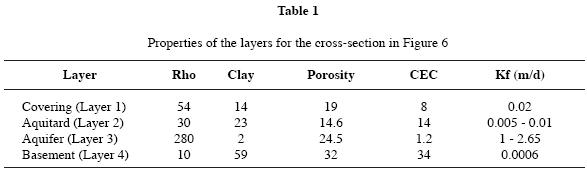
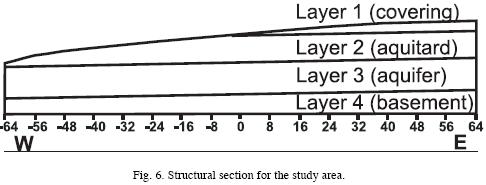
<body><![CDATA[<p align="justify"><font face="verdana" size="2"><u>Interpreted resistivity section</u></font></p>     <p align="justify"><font face="verdana" size="2">A two&#150;dimensional interpretation using software RES2DINV (Loke and Barker, 1996) was applied to six geoelectrical profiles. In <a href="/img/revistas/geoint/v45n1/a4f5.jpg" target="_blank">Figure 5 </a>the interpreted section for profile 1 is presented. Similar results are obtained for all profiles: the first half of each profile is represented by three layers (superficial sandy&#150;clay soil, sand and clay basement), while in the second half, a covering (55 ohm.m) more resistive than sandy&#150;clay sediments (30 ohm.m), is added (<a href="/img/revistas/geoint/v45n1/a4f5.jpg" target="_blank">Figure 5</a>).</font></p>     <p align="justify"><font face="verdana" size="2">A structural section is displayed in <a href="#f6">Figure 6</a>. Resistive covering (layer 1) correlates with the higher terrain in the eastern portion of site (<a href="#f6">Figure 6</a>). Mean layer properties are presented in <a href="#t1">Table 1</a>. Filtration coefficient was estimated from clay content (Shevnin <i>et al., </i>2005).</font></p>     <p align="center"><font face="verdana" size="2"><a name="f6"></a></font></p>     <p align="center"><font face="verdana" size="2"><img src="/img/revistas/geoint/v45n1/a4f6.jpg"></font></p>     <p align="justify"><font face="verdana" size="2">&nbsp;</font></p>     <p align="center"><font face="verdana" size="2"><a name="t1"></a></font></p>     <p align="center"><font face="verdana" size="2"><img src="/img/revistas/geoint/v45n1/a4t1.jpg"></font></p>     <p align="justify"><font face="verdana" size="2"><u>Layer 2: aquitard</u></font></p>     <p align="justify"><font face="verdana" size="2">From six interpreted resistivity sections it was possible to make a resistivity map for layer 2 (aquitard, <a href="#f7">Figure 7A</a>) to observe the horizontal resistivity variations in the aquitard layer.</font></p>     ]]></body>
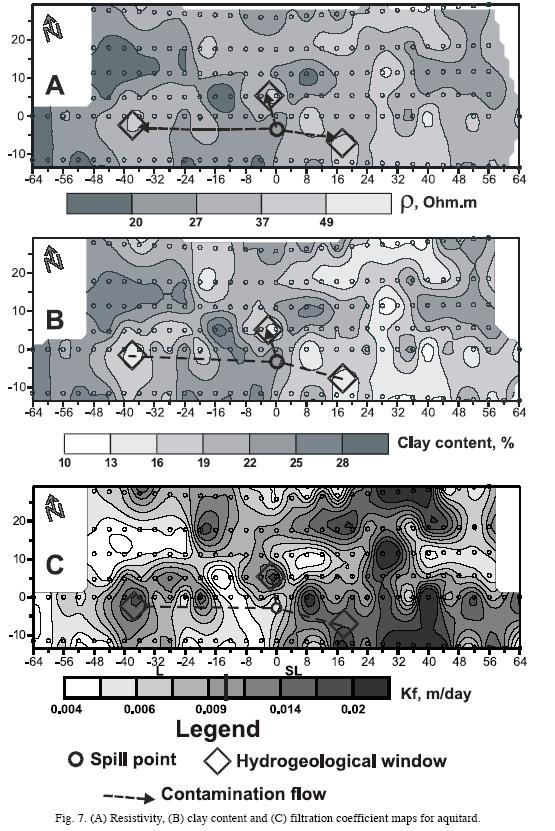
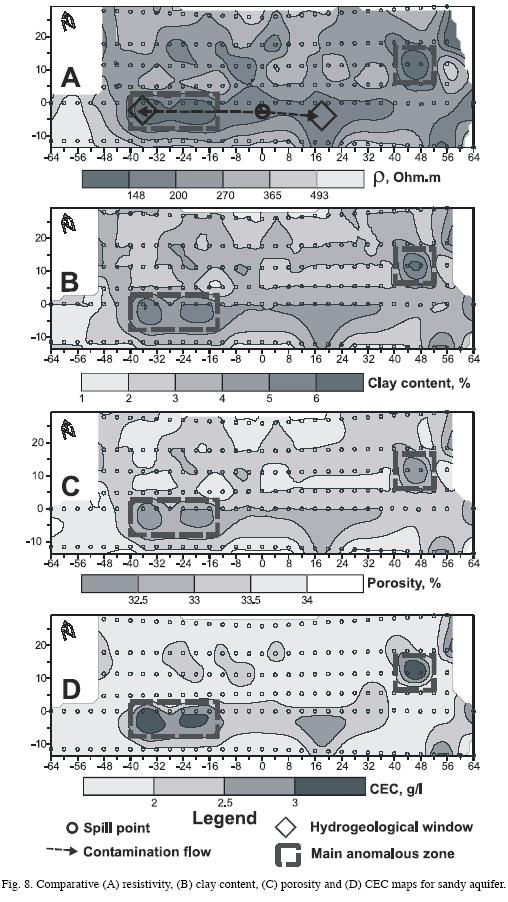
<body><![CDATA[<p align="center"><font face="verdana" size="2"><a name="f7"></a></font></p>     <p align="center"><font face="verdana" size="2"><img src="/img/revistas/geoint/v45n1/a4f7.jpg"></font></p>     <p align="justify"><font face="verdana" size="2">In <a href="#f7">Figure 7A</a> it is possible to distinguish some low resistivity anomalies near the spill point (black circle) and in the northern and western parts of the study area. These anomalies may indicate an increase of clay content or the presence of contaminants in the aquitard. In addition, the prevalence of high resistivity anomalies is evident in the eastern part of the working site (<a href="#f7">Figure 7A</a>). Small permeable zones (marked with rhombuses) located around the spill point can be considered as hydrogeological windows that facilitate the infiltration of contaminants to the sandy aquifer.</font></p>     <p align="justify"><font face="verdana" size="2">The modeling algorithm allows recalculating ground resistivity and water salinity into clay content, porosity and CEC (Shevnin <i>et al., </i>2004).</font></p>     <p align="justify"><font face="verdana" size="2">In <a href="#f7">Figure 7B</a> the clay content map for the aquitard is shown. The minimal clay content zones correspond to permeable windows. These hydrogeological windows are also observed in the filtration coefficient map (<a href="#f7">Figure 7C</a>). The filtration coefficient varies by an order of magnitude. Thickness of aquitard layer is 2.5 m and contaminants can cross it during 2.5/0.004 = 625 days or 2.5/0.03 = 83 days. As the pipeline was in a trench with a depth of 0.8 m., the aquitard thickness diminishes to 1.7 m and the infiltration time to cross this layer is 426 days or 57 days, respectively. It is quite probable that during 10 months the contaminants infiltrated the aquifer through hydrogeological windows.</font></p>     <p align="justify"><font face="verdana" size="2">&nbsp;</font></p>     <p align="justify"><font face="verdana" size="2"><u>Layer 3: aquifer</u></font></p>     <p align="justify"><font face="verdana" size="2">A similar analysis was made for the sandy aquifer. In <a href="#f8">Figure 8A</a> the resistivity map is shown. Two main anomalous zones are observed: one zone goes from the spill point (X = 0 m, Y = &#150;2 m) until X = &#150;40 m, the other zone is located to east with coordinate X = 40 &#150; 50 m and y = 8 &#150; 15 m. The origin of the second anomaly is not clear. It may be due to migration and accumulation of contaminants from the spill point or from a second spill from another pipeline belonging to the site.</font></p>     <p align="center"><font face="verdana" size="2"><a name="f8"></a></font></p>     <p align="center"><font face="verdana" size="2"><img src="/img/revistas/geoint/v45n1/a4f8.jpg"></font></p>     ]]></body>
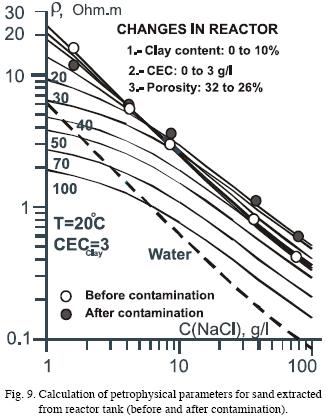
<body><![CDATA[<p align="justify"><font face="verdana" size="2">Clay content (<a href="#f8">Figure 8B</a>), porosity (<a href="#f8">Figure 8C</a>) and CEC (<a href="#f8">Figure 8D</a>) maps match the resistivity map (<a href="#f8">Figure 8A</a>). In our experience, in uncontaminated zones the petrophysical parameters have true values. In contaminated zones they have anomalous values. For example, from the geological information, clay content in the aquifer is 2%, but the clay content map (<a href="#f8">Figure 8B</a>) shows values up to 6% in anomalous zones. These values do not reflect actual changes in clay content, but in geoelectrical properties due to contamination.</font></p>     <p align="justify"><font face="verdana" size="2">&nbsp;</font></p>     <p align="justify"><font face="verdana" size="2"><u>Petrophysical analysis of contaminated and uncontaminated sand samples from reactor.</u></font></p>     <p align="justify"><font face="verdana" size="2"><a href="#f9">Figure 9 </a>shows two experimental curves of &rho;(C) with petrophysical modeling results which correspond to uncontaminated (white circles) and contaminated (gray circles) sands. For all sand samples we measured resistivity versus pore water salinity in the laboratory and we determined their petrophysical parameters. The petrophysical results obtained for clean sand were: Clay content: 0 %, Porosity: 32 % and CEC: 0 g/l.</font></p>     <p align="center"><font face="verdana" size="2"><a name="f9"></a></font></p>     <p align="center"><font face="verdana" size="2"><img src="/img/revistas/geoint/v45n1/a4f9.jpg"></font></p>     <p align="justify"><font face="verdana" size="2">Now, a sand sample was placed in a reactor (<a href="#f9">Figure 9</a>) with nutrients, bacteria and petroleum. After several months of biodegradation the contaminated sand sample gave the following parameter: Clay content: 10 %, Porosity: 26 % and CEC: 3 g/l. Amplitude changes of each parameter is similar to that found in sandy aquifer (Clay content 2 to 6%, Porosity 34 to 32% and CEC 1.5 to 3.5 g/l), suggesting that the anomalous values of clay, porosity and CEC in <a href="#f8">Figure 8</a> correspond to hydrocarbon contamination. This finding is for locating contaminated zones.</font></p>     <p align="justify"><font face="verdana" size="2">&nbsp;</font></p>     <p align="justify"><font face="verdana" size="2"><b>CONCLUSIONS</b></font></p>     <p align="justify"><font face="verdana" size="2">The VES method is effective for geoelectrical characterization of contaminated zones, allowing future geochemical study with an optimized well location and drilling depths.</font></p>     ]]></body>
<body><![CDATA[<p align="justify"><font face="verdana" size="2">The contamination of the study area is low. Only two zones have noticeable anomalies: the first one is associated with spill point and the second is located in the eastern portion of the study area.</font></p>     <p align="justify"><font face="verdana" size="2">The local aquifer (sandy layer) is protected from contamination by a superficial clay layer. However, where the clay content decreases or trenches related with pipelines are present, the vulnerability is increased facilitating the infiltration of contaminants into the aquifer, as in the interval X = &#150;36 to &#150;8 m of profile 1.</font></p>     <p align="justify"><font face="verdana" size="2">Changes of soil properties in the sandy aquifer and in the reactor were very similar.</font></p>     <p align="justify"><font face="verdana" size="2">Recalculation of petrophysical parameters from VES resistivity and groundwater salinity helps characterizing uncontaminated and contaminated zones.</font></p>     <p align="justify"><font face="verdana" size="2">&nbsp;</font></p>     <p align="justify"><font face="verdana" size="2"><b>ACKNOWLEDGEMENTS</b></font></p>     <p align="justify"><font face="verdana" size="2">This work was funded by the Instituto Mexicano del Petr&oacute;leo. The authors are grateful to Dr. Cinna Lomnitz for the revisions and corrections carried out to the manuscript. We acknowledge comments from three anonymous reviewers.</font></p>     <p align="justify"><font face="verdana" size="2">&nbsp;</font></p>     <p align="justify"><font face="verdana" size="2"><b>BIBLIOGRAPHY</b></font></p>     <!-- ref --><p align="justify"><font face="verdana" size="2">ABDEL AAL, G. Z., E. A. ATEKWANA, L. D. SLATER and E. A. ATEKWANA, 2004. Effects of microbial processes on electrolytic and interfacial electrical properties of unconsolidated sediments. <i>Geophys. Res. Lett., 31, 12, </i>L12505, 1&#150;4.</font>&nbsp;&nbsp;&nbsp;&nbsp;&nbsp;&nbsp;&nbsp;&nbsp;[&#160;<a href="javascript:void(0);" onclick="javascript: window.open('/scielo.php?script=sci_nlinks&ref=3892063&pid=S0016-7169200600010000400001&lng=','','width=640,height=500,resizable=yes,scrollbars=1,menubar=yes,');">Links</a>&#160;]<!-- end-ref --><!-- ref --><p align="justify"><font face="verdana" size="2">ATEKWANA, E. A., D. P. CASSIDY, C. MAGNUSON, A. L. ENDRES, D. D. WERKEMA JR. and W. A. SAUCK, 2001. Changes in geoelectrical properties accompanying microbial degradation of LNAPL. Proceedings of SAGEEP, OCS_1.</font>&nbsp;&nbsp;&nbsp;&nbsp;&nbsp;&nbsp;&nbsp;&nbsp;[&#160;<a href="javascript:void(0);" onclick="javascript: window.open('/scielo.php?script=sci_nlinks&ref=3892064&pid=S0016-7169200600010000400002&lng=','','width=640,height=500,resizable=yes,scrollbars=1,menubar=yes,');">Links</a>&#160;]<!-- end-ref --><!-- ref --><p align="justify"><font face="verdana" size="2">ATEKWANA, E. A., E. A. ATEKWANA and R. S. ROWE, 2003. Relationship between total dissolved solids and bulk conductivity at a hydrocarbon contaminated aquifer. Proceedings of SAGEEP, 228&#150;237.</font>&nbsp;&nbsp;&nbsp;&nbsp;&nbsp;&nbsp;&nbsp;&nbsp;[&#160;<a href="javascript:void(0);" onclick="javascript: window.open('/scielo.php?script=sci_nlinks&ref=3892065&pid=S0016-7169200600010000400003&lng=','','width=640,height=500,resizable=yes,scrollbars=1,menubar=yes,');">Links</a>&#160;]<!-- end-ref --><!-- ref --><p align="justify"><font face="verdana" size="2">BAILEY, N. J. L., A. M. JOBSON and M. A. ROGERS, 1973. Bacterial degradation of crude oil: comparison of field and experimental data. <i>Chemical geology, 11.</i></font>&nbsp;&nbsp;&nbsp;&nbsp;&nbsp;&nbsp;&nbsp;&nbsp;[&#160;<a href="javascript:void(0);" onclick="javascript: window.open('/scielo.php?script=sci_nlinks&ref=3892066&pid=S0016-7169200600010000400004&lng=','','width=640,height=500,resizable=yes,scrollbars=1,menubar=yes,');">Links</a>&#160;]<!-- end-ref --><!-- ref --><p align="justify"><font face="verdana" size="2">LOKE, M. H. and R. D. BARKER, 1996. Rapid least&#150;squares inversion of apparent resistivity pseudosections by a quasi&#150;Newton method. <i>Geophys. Prospect., 44, </i>131&#150;152.</font>&nbsp;&nbsp;&nbsp;&nbsp;&nbsp;&nbsp;&nbsp;&nbsp;[&#160;<a href="javascript:void(0);" onclick="javascript: window.open('/scielo.php?script=sci_nlinks&ref=3892067&pid=S0016-7169200600010000400005&lng=','','width=640,height=500,resizable=yes,scrollbars=1,menubar=yes,');">Links</a>&#160;]<!-- end-ref --><!-- ref --><p align="justify"><font face="verdana" size="2">MODIN, I. N., V. A. SHEVNIN, A. A. BOBATCHEV, D. K. BOLSHAKOV, D. A. LEONOV and M. L. VLADOV, 1997. Investigations of oil pollution with electrical prospecting methods. <i>In: </i>Proceedings of the 3rd EEGS&#150;ES Meeting, Aarhus, Denmark, 267&#150;270.</font>&nbsp;&nbsp;&nbsp;&nbsp;&nbsp;&nbsp;&nbsp;&nbsp;[&#160;<a href="javascript:void(0);" onclick="javascript: window.open('/scielo.php?script=sci_nlinks&ref=3892068&pid=S0016-7169200600010000400006&lng=','','width=640,height=500,resizable=yes,scrollbars=1,menubar=yes,');">Links</a>&#160;]<!-- end-ref --><!-- ref --><p align="justify"><font face="verdana" size="2">RYJOV, A., 1987. The main IP peculiarities of rocks. <i>In: </i>"Application of IP method for mineral deposits' research". Moscow, 5&#150;23, <i>(In Russian).</i></font>&nbsp;&nbsp;&nbsp;&nbsp;&nbsp;&nbsp;&nbsp;&nbsp;[&#160;<a href="javascript:void(0);" onclick="javascript: window.open('/scielo.php?script=sci_nlinks&ref=3892069&pid=S0016-7169200600010000400007&lng=','','width=640,height=500,resizable=yes,scrollbars=1,menubar=yes,');">Links</a>&#160;]<!-- end-ref --><!-- ref --><p align="justify"><font face="verdana" size="2">RYJOV, A. A. and A. D. SUDOPLATOV, 1990. The calculation of specific electrical conductivity for sandy&#150;clayed rocks and the usage of functional cross&#150;plots for the decision of hydrogeological problems. <i>In: </i>"Scientific and technical achievements and advanced experience in the field of geology and mineral deposits research. Moscow, 27&#150;41, <i>(In Russian).</i></font>&nbsp;&nbsp;&nbsp;&nbsp;&nbsp;&nbsp;&nbsp;&nbsp;[&#160;<a href="javascript:void(0);" onclick="javascript: window.open('/scielo.php?script=sci_nlinks&ref=3892070&pid=S0016-7169200600010000400008&lng=','','width=640,height=500,resizable=yes,scrollbars=1,menubar=yes,');">Links</a>&#160;]<!-- end-ref --><!-- ref --><p align="justify"><font face="verdana" size="2">SAUCK W. A., 1998. A conceptual model for the geoelectrical response of LNAPL plumes in granular sediments. Proceedings of SAGEEP, 805&#150;817.</font>&nbsp;&nbsp;&nbsp;&nbsp;&nbsp;&nbsp;&nbsp;&nbsp;[&#160;<a href="javascript:void(0);" onclick="javascript: window.open('/scielo.php?script=sci_nlinks&ref=3892071&pid=S0016-7169200600010000400009&lng=','','width=640,height=500,resizable=yes,scrollbars=1,menubar=yes,');">Links</a>&#160;]<!-- end-ref --><!-- ref --><p align="justify"><font face="verdana" size="2">SAUCK, W. A., 2000. A model for the resistivity structure of LNAPL plumes and their environs in sandy sediments. <i>J. App. Geophys., 44, </i>151&#150;165.</font>&nbsp;&nbsp;&nbsp;&nbsp;&nbsp;&nbsp;&nbsp;&nbsp;[&#160;<a href="javascript:void(0);" onclick="javascript: window.open('/scielo.php?script=sci_nlinks&ref=3892072&pid=S0016-7169200600010000400010&lng=','','width=640,height=500,resizable=yes,scrollbars=1,menubar=yes,');">Links</a>&#160;]<!-- end-ref --><!-- ref --><p align="justify"><font face="verdana" size="2">SHEVNIN, V., O. DELGADO&#150;RODR&Iacute;GUEZ, A. MOUSATOV, E. NAKAMURA&#150;LABASTIDA and A. MEJ&Iacute;A&#150;AGUILAR, 2003. Oil pollution detection using resistivity sounding. <i>Geof&iacute;s. Int., 42, </i>613&#150;622.</font>&nbsp;&nbsp;&nbsp;&nbsp;&nbsp;&nbsp;&nbsp;&nbsp;[&#160;<a href="javascript:void(0);" onclick="javascript: window.open('/scielo.php?script=sci_nlinks&ref=3892073&pid=S0016-7169200600010000400011&lng=','','width=640,height=500,resizable=yes,scrollbars=1,menubar=yes,');">Links</a>&#160;]<!-- end-ref --><!-- ref --><p align="justify"><font face="verdana" size="2">SHEVNIN, V., O. DELGADO&#150;RODR&Iacute;GUEZ, L. FERN&Aacute;NDEZ&#150;LINARES, H. ZEGARRA MART&Iacute;NEZ, A. MOUSATOV and A. RYJOV, 2005. Geoelectrical characterization of an oil contaminated site in Tabasco, Mexico. <i>Geof&iacute;s. Int., 44, </i>251&#150;263.</font>&nbsp;&nbsp;&nbsp;&nbsp;&nbsp;&nbsp;&nbsp;&nbsp;[&#160;<a href="javascript:void(0);" onclick="javascript: window.open('/scielo.php?script=sci_nlinks&ref=3892074&pid=S0016-7169200600010000400012&lng=','','width=640,height=500,resizable=yes,scrollbars=1,menubar=yes,');">Links</a>&#160;]<!-- end-ref --><!-- ref --><p align="justify"><font face="verdana" size="2">SHEVNIN, V., O. DELGADO&#150;RODR&Iacute;GUEZ, A. MOUSATOV and A. RYJOV, 2004. Soil resistivity measurements for clay content estimation and its application for petroleum contamination study. Proceedings of SAGEEP, Colorado Springs, 396&#150;408.</font>&nbsp;&nbsp;&nbsp;&nbsp;&nbsp;&nbsp;&nbsp;&nbsp;[&#160;<a href="javascript:void(0);" onclick="javascript: window.open('/scielo.php?script=sci_nlinks&ref=3892075&pid=S0016-7169200600010000400013&lng=','','width=640,height=500,resizable=yes,scrollbars=1,menubar=yes,');">Links</a>&#160;]<!-- end-ref --><!-- ref --><p align="justify"><font face="verdana" size="2">SHEVNIN, V., O. DELGADO&#150;RODR&Iacute;GUEZ, A. MOUSATOV and A. RYJOV, 2005. Estimation of hydraulic conductivity on clay content in soil determined from resistivity data. <i>Geof&iacute;s. Int., In Press</i></font>&nbsp;&nbsp;&nbsp;&nbsp;&nbsp;&nbsp;&nbsp;&nbsp;[&#160;<a href="javascript:void(0);" onclick="javascript: window.open('/scielo.php?script=sci_nlinks&ref=3892076&pid=S0016-7169200600010000400014&lng=','','width=640,height=500,resizable=yes,scrollbars=1,menubar=yes,');">Links</a>&#160;]<!-- end-ref --><!-- ref --><p align="justify"><font face="verdana" size="2">WERKEMA, D. D. JR., E. A. ATEKWANA, A. ENDRES and W. A. SAUCK, 2002. Temporal and spatial variability of high resolution <i>in situ </i>vertical apparent resistivity measurements at a LNAPL impacted site. SAGEEP 2002. 13WSC4.</font>&nbsp;&nbsp;&nbsp;&nbsp;&nbsp;&nbsp;&nbsp;&nbsp;[&#160;<a href="javascript:void(0);" onclick="javascript: window.open('/scielo.php?script=sci_nlinks&ref=3892077&pid=S0016-7169200600010000400015&lng=','','width=640,height=500,resizable=yes,scrollbars=1,menubar=yes,');">Links</a>&#160;]<!-- end-ref --> ]]></body><back>
<ref-list>
<ref id="B1">
<nlm-citation citation-type="journal">
<person-group person-group-type="author">
<name>
<surname><![CDATA[ABDEL AAL]]></surname>
<given-names><![CDATA[G. Z]]></given-names>
</name>
<name>
<surname><![CDATA[ATEKWANA]]></surname>
<given-names><![CDATA[E. A]]></given-names>
</name>
<name>
<surname><![CDATA[SLATER]]></surname>
<given-names><![CDATA[L. D]]></given-names>
</name>
<name>
<surname><![CDATA[ATEKWANA]]></surname>
<given-names><![CDATA[E. A]]></given-names>
</name>
</person-group>
<article-title xml:lang="en"><![CDATA[Effects of microbial processes on electrolytic and interfacial electrical properties of unconsolidated sediments]]></article-title>
<source><![CDATA[Geophys. Res. Lett]]></source>
<year>2004</year>
<volume>31</volume>
<numero>12</numero>
<issue>12</issue>
<page-range>L12505</page-range><page-range>1-4</page-range></nlm-citation>
</ref>
<ref id="B2">
<nlm-citation citation-type="">
<person-group person-group-type="author">
<name>
<surname><![CDATA[ATEKWANA]]></surname>
<given-names><![CDATA[E. A]]></given-names>
</name>
<name>
<surname><![CDATA[CASSIDY]]></surname>
<given-names><![CDATA[D. P]]></given-names>
</name>
<name>
<surname><![CDATA[MAGNUSON]]></surname>
<given-names><![CDATA[C]]></given-names>
</name>
<name>
<surname><![CDATA[ENDRES]]></surname>
<given-names><![CDATA[A. L]]></given-names>
</name>
<name>
<surname><![CDATA[WERKEMA]]></surname>
<given-names><![CDATA[D. D]]></given-names>
</name>
<name>
<surname><![CDATA[SAUCK]]></surname>
<given-names><![CDATA[W. A]]></given-names>
</name>
</person-group>
<source><![CDATA[Changes in geoelectrical properties accompanying microbial degradation of LNAPL: Proceedings of SAGEEP, OCS_1]]></source>
<year>2001</year>
</nlm-citation>
</ref>
<ref id="B3">
<nlm-citation citation-type="">
<person-group person-group-type="author">
<name>
<surname><![CDATA[ATEKWANA]]></surname>
<given-names><![CDATA[E. A]]></given-names>
</name>
<name>
<surname><![CDATA[ATEKWANA]]></surname>
<given-names><![CDATA[E. A]]></given-names>
</name>
<name>
<surname><![CDATA[ROWE]]></surname>
<given-names><![CDATA[R. S]]></given-names>
</name>
</person-group>
<source><![CDATA[Relationship between total dissolved solids and bulk conductivity at a hydrocarbon contaminated aquifer: Proceedings of SAGEEP]]></source>
<year>2003</year>
<page-range>228-237</page-range></nlm-citation>
</ref>
<ref id="B4">
<nlm-citation citation-type="journal">
<person-group person-group-type="author">
<name>
<surname><![CDATA[BAILEY]]></surname>
<given-names><![CDATA[N. J. L]]></given-names>
</name>
<name>
<surname><![CDATA[JOBSON]]></surname>
<given-names><![CDATA[A. M]]></given-names>
</name>
<name>
<surname><![CDATA[ROGERS]]></surname>
<given-names><![CDATA[M. A]]></given-names>
</name>
</person-group>
<article-title xml:lang="en"><![CDATA[Bacterial degradation of crude oil: comparison of field and experimental data]]></article-title>
<source><![CDATA[Chemical geology]]></source>
<year>1973</year>
<page-range>11</page-range></nlm-citation>
</ref>
<ref id="B5">
<nlm-citation citation-type="journal">
<person-group person-group-type="author">
<name>
<surname><![CDATA[LOKE]]></surname>
<given-names><![CDATA[M. H]]></given-names>
</name>
<name>
<surname><![CDATA[BARKER]]></surname>
<given-names><![CDATA[R. D]]></given-names>
</name>
</person-group>
<source><![CDATA[Geophys. Prospect]]></source>
<year>1996</year>
<numero>44</numero>
<issue>44</issue>
<page-range>131-152</page-range></nlm-citation>
</ref>
<ref id="B6">
<nlm-citation citation-type="">
<person-group person-group-type="author">
<name>
<surname><![CDATA[MODIN]]></surname>
<given-names><![CDATA[I. N]]></given-names>
</name>
<name>
<surname><![CDATA[SHEVNIN]]></surname>
<given-names><![CDATA[V. A]]></given-names>
</name>
<name>
<surname><![CDATA[BOBATCHEV]]></surname>
<given-names><![CDATA[A. A]]></given-names>
</name>
<name>
<surname><![CDATA[BOLSHAKOV]]></surname>
<given-names><![CDATA[D. K]]></given-names>
</name>
<name>
<surname><![CDATA[LEONOV]]></surname>
<given-names><![CDATA[D. A]]></given-names>
</name>
<name>
<surname><![CDATA[VLADOV]]></surname>
<given-names><![CDATA[M. L]]></given-names>
</name>
</person-group>
<source><![CDATA[Proceedings of the 3rd EEGS-ES Meeting]]></source>
<year>1997</year>
<page-range>267-270</page-range><publisher-loc><![CDATA[Aarhus ]]></publisher-loc>
</nlm-citation>
</ref>
<ref id="B7">
<nlm-citation citation-type="">
<person-group person-group-type="author">
<name>
<surname><![CDATA[RYJOV]]></surname>
<given-names><![CDATA[A]]></given-names>
</name>
</person-group>
<article-title xml:lang="en"><![CDATA[The main IP peculiarities of rocks]]></article-title>
<source><![CDATA["Application of IP method for mineral deposits' research"]]></source>
<year>1987</year>
<page-range>5-23</page-range><publisher-loc><![CDATA[Moscow ]]></publisher-loc>
</nlm-citation>
</ref>
<ref id="B8">
<nlm-citation citation-type="">
<person-group person-group-type="author">
<name>
<surname><![CDATA[RYJOV]]></surname>
<given-names><![CDATA[A. A]]></given-names>
</name>
<name>
<surname><![CDATA[SUDOPLATOV]]></surname>
<given-names><![CDATA[A. D]]></given-names>
</name>
</person-group>
<article-title xml:lang="en"><![CDATA[The calculation of specific electrical conductivity for sandy-clayed rocks and the usage of functional cross-plots for the decision of hydrogeological problems]]></article-title>
<source><![CDATA[Scientific and technical achievements and advanced experience in the field of geology and mineral deposits research]]></source>
<year>1990</year>
<page-range>27-41</page-range><publisher-loc><![CDATA[Moscow ]]></publisher-loc>
</nlm-citation>
</ref>
<ref id="B9">
<nlm-citation citation-type="">
<person-group person-group-type="author">
<name>
<surname><![CDATA[SAUCK]]></surname>
<given-names><![CDATA[W. A]]></given-names>
</name>
</person-group>
<source><![CDATA[A conceptual model for the geoelectrical response of LNAPL plumes in granular sediments: Proceedings of SAGEEP]]></source>
<year>1998</year>
<page-range>805-817</page-range></nlm-citation>
</ref>
<ref id="B10">
<nlm-citation citation-type="journal">
<person-group person-group-type="author">
<name>
<surname><![CDATA[SAUCK]]></surname>
<given-names><![CDATA[W. A]]></given-names>
</name>
</person-group>
<article-title xml:lang="en"><![CDATA[A model for the resistivity structure of LNAPL plumes and their environs in sandy sediments]]></article-title>
<source><![CDATA[J. App. Geophys]]></source>
<year>2000</year>
<numero>44</numero>
<issue>44</issue>
<page-range>151-165</page-range></nlm-citation>
</ref>
<ref id="B11">
<nlm-citation citation-type="journal">
<person-group person-group-type="author">
<name>
<surname><![CDATA[SHEVNIN]]></surname>
<given-names><![CDATA[V]]></given-names>
</name>
<name>
<surname><![CDATA[DELGADO-RODRÍGUEZ]]></surname>
<given-names><![CDATA[O]]></given-names>
</name>
<name>
<surname><![CDATA[MOUSATOV]]></surname>
<given-names><![CDATA[A]]></given-names>
</name>
<name>
<surname><![CDATA[NAKAMURA-LABASTIDA]]></surname>
<given-names><![CDATA[E]]></given-names>
</name>
<name>
<surname><![CDATA[MEJÍA-AGUILAR]]></surname>
<given-names><![CDATA[A]]></given-names>
</name>
</person-group>
<article-title xml:lang="en"><![CDATA[Oil pollution detection using resistivity sounding]]></article-title>
<source><![CDATA[Geofís. Int]]></source>
<year>2003</year>
<numero>42</numero>
<issue>42</issue>
<page-range>613-622</page-range></nlm-citation>
</ref>
<ref id="B12">
<nlm-citation citation-type="journal">
<person-group person-group-type="author">
<name>
<surname><![CDATA[SHEVNIN]]></surname>
<given-names><![CDATA[V]]></given-names>
</name>
<name>
<surname><![CDATA[DELGADO-RODRÍGUEZ]]></surname>
<given-names><![CDATA[O]]></given-names>
</name>
<name>
<surname><![CDATA[FERNÁNDEZ-LINARES]]></surname>
<given-names><![CDATA[L]]></given-names>
</name>
<name>
<surname><![CDATA[ZEGARRA MARTÍNEZ]]></surname>
<given-names><![CDATA[H]]></given-names>
</name>
<name>
<surname><![CDATA[MOUSATOV]]></surname>
<given-names><![CDATA[A]]></given-names>
</name>
<name>
<surname><![CDATA[RYJOV]]></surname>
<given-names><![CDATA[A]]></given-names>
</name>
</person-group>
<article-title xml:lang="en"><![CDATA[Geoelectrical characterization of an oil contaminated site in Tabasco, Mexico]]></article-title>
<source><![CDATA[Geofís. Int]]></source>
<year>2005</year>
<numero>44</numero>
<issue>44</issue>
<page-range>251-263</page-range></nlm-citation>
</ref>
<ref id="B13">
<nlm-citation citation-type="book">
<person-group person-group-type="author">
<name>
<surname><![CDATA[SHEVNIN]]></surname>
<given-names><![CDATA[V]]></given-names>
</name>
<name>
<surname><![CDATA[DELGADO-RODRÍGUEZ]]></surname>
<given-names><![CDATA[O]]></given-names>
</name>
<name>
<surname><![CDATA[MOUSATOV]]></surname>
<given-names><![CDATA[A]]></given-names>
</name>
<name>
<surname><![CDATA[RYJOV]]></surname>
<given-names><![CDATA[A]]></given-names>
</name>
</person-group>
<source><![CDATA[Soil resistivity measurements for clay content estimation and its application for petroleum contamination study: Proceedings of SAGEEP]]></source>
<year>2004</year>
<page-range>396-408</page-range><publisher-name><![CDATA[Colorado Springs]]></publisher-name>
</nlm-citation>
</ref>
<ref id="B14">
<nlm-citation citation-type="journal">
<person-group person-group-type="author">
<name>
<surname><![CDATA[SHEVNIN]]></surname>
<given-names><![CDATA[V]]></given-names>
</name>
<name>
<surname><![CDATA[DELGADO-RODRÍGUEZ]]></surname>
<given-names><![CDATA[O]]></given-names>
</name>
<name>
<surname><![CDATA[MOUSATOV]]></surname>
<given-names><![CDATA[A]]></given-names>
</name>
<name>
<surname><![CDATA[RYJOV]]></surname>
<given-names><![CDATA[A]]></given-names>
</name>
</person-group>
<article-title xml:lang="en"><![CDATA[Estimation of hydraulic conductivity on clay content in soil determined from resistivity data]]></article-title>
<source><![CDATA[Geofís. Int]]></source>
<year>2005</year>
</nlm-citation>
</ref>
<ref id="B15">
<nlm-citation citation-type="book">
<person-group person-group-type="author">
<name>
<surname><![CDATA[WERKEMA]]></surname>
<given-names><![CDATA[D. D]]></given-names>
</name>
<name>
<surname><![CDATA[ATEKWANA]]></surname>
<given-names><![CDATA[E. A.]]></given-names>
</name>
<name>
<surname><![CDATA[ENDRES]]></surname>
<given-names><![CDATA[A]]></given-names>
</name>
<name>
<surname><![CDATA[SAUCK]]></surname>
<given-names><![CDATA[W. A]]></given-names>
</name>
</person-group>
<source><![CDATA[Temporal and spatial variability of high resolution in situ vertical apparent resistivity measurements at a LNAPL impacted site]]></source>
<year>2002</year>
<publisher-name><![CDATA[SAGEEP]]></publisher-name>
</nlm-citation>
</ref>
</ref-list>
</back>
</article>