<?xml version="1.0" encoding="ISO-8859-1"?><article xmlns:mml="http://www.w3.org/1998/Math/MathML" xmlns:xlink="http://www.w3.org/1999/xlink" xmlns:xsi="http://www.w3.org/2001/XMLSchema-instance">
<front>
<journal-meta>
<journal-id>0016-3813</journal-id>
<journal-title><![CDATA[Gaceta médica de México]]></journal-title>
<abbrev-journal-title><![CDATA[Gac. Méd. Méx]]></abbrev-journal-title>
<issn>0016-3813</issn>
<publisher>
<publisher-name><![CDATA[Academia Nacional de Medicina de México A.C.]]></publisher-name>
</publisher>
</journal-meta>
<article-meta>
<article-id>S0016-38132005000200002</article-id>
<title-group>
<article-title xml:lang="es"><![CDATA[Conceptos actuales sobre la muerte súbita]]></article-title>
<article-title xml:lang="en"><![CDATA[Current concepts on sudden death]]></article-title>
</title-group>
<contrib-group>
<contrib contrib-type="author">
<name>
<surname><![CDATA[Asensio]]></surname>
<given-names><![CDATA[Enrique]]></given-names>
</name>
<xref ref-type="aff" rid="A01"/>
</contrib>
<contrib contrib-type="author">
<name>
<surname><![CDATA[Narváez]]></surname>
<given-names><![CDATA[René]]></given-names>
</name>
<xref ref-type="aff" rid="A01"/>
</contrib>
<contrib contrib-type="author">
<name>
<surname><![CDATA[Dorantes]]></surname>
<given-names><![CDATA[Joel]]></given-names>
</name>
<xref ref-type="aff" rid="A01"/>
</contrib>
<contrib contrib-type="author">
<name>
<surname><![CDATA[Oseguera]]></surname>
<given-names><![CDATA[Jorge]]></given-names>
</name>
<xref ref-type="aff" rid="A01"/>
</contrib>
<contrib contrib-type="author">
<name>
<surname><![CDATA[Orea T]]></surname>
<given-names><![CDATA[Arturo]]></given-names>
</name>
<xref ref-type="aff" rid="A01"/>
</contrib>
<contrib contrib-type="author">
<name>
<surname><![CDATA[Hernández R]]></surname>
<given-names><![CDATA[Pablo]]></given-names>
</name>
<xref ref-type="aff" rid="A01"/>
</contrib>
<contrib contrib-type="author">
<name>
<surname><![CDATA[Rebollar G]]></surname>
<given-names><![CDATA[Verónica]]></given-names>
</name>
<xref ref-type="aff" rid="A01"/>
</contrib>
<contrib contrib-type="author">
<name>
<surname><![CDATA[Mont]]></surname>
<given-names><![CDATA[Lluís]]></given-names>
</name>
<xref ref-type="aff" rid="A02"/>
</contrib>
<contrib contrib-type="author">
<name>
<surname><![CDATA[Brugada]]></surname>
<given-names><![CDATA[Josep]]></given-names>
</name>
<xref ref-type="aff" rid="A02"/>
</contrib>
</contrib-group>
<aff id="A02">
<institution><![CDATA[,Universidad de Barcelona Hospital Clínic Servei D'Arítmies]]></institution>
<addr-line><![CDATA[ ]]></addr-line>
</aff>
<aff id="A01">
<institution><![CDATA[,Instituto Nacional de Ciencias Médicas y Nutrición Salvador Zubirán Departamento de Cardiología Cínica de Arritmias y Marcapasos]]></institution>
<addr-line><![CDATA[D.F. ]]></addr-line>
<country>México</country>
</aff>
<pub-date pub-type="pub">
<day>00</day>
<month>04</month>
<year>2005</year>
</pub-date>
<pub-date pub-type="epub">
<day>00</day>
<month>04</month>
<year>2005</year>
</pub-date>
<volume>141</volume>
<numero>2</numero>
<fpage>89</fpage>
<lpage>98</lpage>
<copyright-statement/>
<copyright-year/>
<self-uri xlink:href="http://www.scielo.org.mx/scielo.php?script=sci_arttext&amp;pid=S0016-38132005000200002&amp;lng=en&amp;nrm=iso"></self-uri><self-uri xlink:href="http://www.scielo.org.mx/scielo.php?script=sci_abstract&amp;pid=S0016-38132005000200002&amp;lng=en&amp;nrm=iso"></self-uri><self-uri xlink:href="http://www.scielo.org.mx/scielo.php?script=sci_pdf&amp;pid=S0016-38132005000200002&amp;lng=en&amp;nrm=iso"></self-uri><abstract abstract-type="short" xml:lang="es"><p><![CDATA[La muerte súbita se define como aquella que ocurre antes de una hora de la aparición de los síntomas. Es una condición grave que en diversos países supone un problema de salud pública y que en México implica entre 33 y 53 mil muertes anuales, en su mayoría ligadas a enfermedad isquémica del corazón. La causa primordial de la muerte súbita son las arritmias ventriculares graves, sin embargo determinar qué sujetos son susceptibles de tener un episodio arrítmico es complejo y por ello la relación costo efectividad de las medidas de estratificación de riesgo suele ser mala. En el presente trabajo se revisan las diferentes estrategias para determinar el riesgo de muerte súbita. Las estrategias para el tratamiento oportuno de la muerte súbita relativas a la población general utilizadas en diversos países tienen impactos variables en la supervivencia, sin embargo, en las poblaciones seleccionadas con alto riesgo de padecer un evento arrítmico ventricular, la mejor terapia disponible actualmente es el desfibrilador automático implantable, aunque en el trabajo se discuten otras opciones de tratamiento. En nuestro país es necesario hacer un importante esfuerzo de detección prevención y tratamiento oportuno para limitar las consecuencia de este problema.]]></p></abstract>
<abstract abstract-type="short" xml:lang="en"><p><![CDATA[Sudden death is defined as the death occurring less than one hour before the onset of the patient's symptoms. It is a severe condition considered a public health issue in several countries and in ours, it accounts for 33 000 to 53 000 annual deaths mainly related to ischemic heart disease. The main cause of sudden death are severe ventricular arrhythmias, but determining what patients are at risk for such an episode is complex, that is why risk stratification is usually a low cost-effective intervention. In the present study, we describe different sudden death risk stratification strategies. Different sudden death treatment strategies regarding general population have different success rates in different countries, nevertheless, among select high risk populations; the best therapy currently available is the automatic implantable cardioverter defibrillator. We also discuss other treatment options. In Mexico it is deemed necessary to do an important effort for the early detection, prevention and treatment of sudden death in order to limit the consequences of this problem.]]></p></abstract>
<kwd-group>
<kwd lng="es"><![CDATA[Muerte súbita]]></kwd>
<kwd lng="es"><![CDATA[arritmias ventriculares]]></kwd>
<kwd lng="es"><![CDATA[estratificación de riesgo]]></kwd>
<kwd lng="es"><![CDATA[variabilidad de la frecuencia cardiaca]]></kwd>
<kwd lng="es"><![CDATA[desfibrilador automático externo]]></kwd>
<kwd lng="es"><![CDATA[desfibrilador automático implantable]]></kwd>
<kwd lng="en"><![CDATA[Sudden death]]></kwd>
<kwd lng="en"><![CDATA[ventricular arrhythmia]]></kwd>
<kwd lng="en"><![CDATA[risk stratification]]></kwd>
<kwd lng="en"><![CDATA[heart rate variability]]></kwd>
<kwd lng="en"><![CDATA[external automated defibrillator]]></kwd>
<kwd lng="en"><![CDATA[automatic implantable cardioverter-defibrillator]]></kwd>
</kwd-group>
</article-meta>
</front><body><![CDATA[ <p align="justify"><font face="verdana" size="4">Art&iacute;culos originales</font></p>     <p align="justify"><font face="verdana" size="2">&nbsp;</font></p>     <p align="center"><font face="verdana" size="4"><b>Conceptos actuales sobre la muerte s&uacute;bita</b></font></p>     <p align="center"><font face="verdana" size="2">&nbsp;</font></p>     <p align="center"><font face="verdana" size="3"><b>Current concepts on sudden death</b></font></p>     <p align="center"><font face="verdana" size="2">&nbsp;</font></p>     <p align="center"><font face="verdana" size="2"><b>Enrique Asensio,* Ren&eacute; Narv&aacute;ez,* Joel Dorantes,* Jorge Oseguera,* Arturo Orea T,* Pablo Hern&aacute;ndez R,* Ver&oacute;nica Rebollar G,* Llu&iacute;s Mont,** Josep Brugada**</b></font></p>     <p align="center"><font face="verdana" size="2">&nbsp;</font></p>     <p align="justify"><font face="verdana" size="2"><i>* Cl&iacute;nica de Arritmias y Marcapasos, Departamento de Cardiolog&iacute;a. </i><i>Instituto Nacional de Ciencias M&eacute;dicas y Nutrici&oacute;n Salvador Zubir&aacute;n.</i></font></p>     <p align="justify"><font face="verdana" size="2"><i>** Servei D'Ar&iacute;tmies, Hospital Cl&iacute;nic, Universidad de Barcelona, Espa&ntilde;a.</i></font></p>     ]]></body>
<body><![CDATA[<p align="justify"><font face="verdana" size="2">&nbsp;</font></p>     <p align="justify"><font face="verdana" size="2"><b>Crespondencia y solicitud de sobretiros:    <br> </b><i>Dr. Enrique Asensio Lafuente    <br> C&iacute;nica de Arritmias y Marcapasos, Departamento de Cardiolog&iacute;a    <br> Instituto Nacional de Ciencias M&eacute;dicas y Nutrici&oacute;n Salvador Zubir&aacute;n    <br> Vasco de Quiroga 15, Col. Secci&oacute;n XVI, Tlalpan, M&eacute;xico 14000 D.F.    <br> Tel/fax: 56553306    <br> Correo electr&oacute;nico: <a href="mailto:easensio@avantel.net">easensio@avantel.net</a></i></font></p>     <p align="justify">&nbsp;</p>     <p align="justify"><font face="verdana" size="2">Recibido en su versi&oacute;n modificada: 14 de agosto de 2004    ]]></body>
<body><![CDATA[<br>   Aceptaci&oacute;n: 2 de octubre de 2004</font></p>     <p align="justify"><font face="verdana" size="2">&nbsp;</font></p>     <p align="justify"><font face="verdana" size="2"><b>Resumen</b></font></p>     <p align="justify"><font face="verdana" size="2">La muerte s&uacute;bita se define como aquella que ocurre antes de una hora de la aparici&oacute;n de los s&iacute;ntomas. Es una condici&oacute;n grave que en diversos pa&iacute;ses supone un problema de salud p&uacute;blica y que en M&eacute;xico implica entre 33 y 53 mil muertes anuales, en su mayor&iacute;a ligadas a enfermedad isqu&eacute;mica del coraz&oacute;n.</font></p>     <p align="justify"><font face="verdana" size="2">La causa primordial de la muerte s&uacute;bita son las arritmias ventriculares graves, sin embargo determinar qu&eacute; sujetos son susceptibles de tener un episodio arr&iacute;tmico es complejo y por ello la relaci&oacute;n costo efectividad de las medidas de estratificaci&oacute;n de riesgo suele ser mala. En el presente trabajo se revisan las diferentes estrategias para determinar el riesgo de muerte s&uacute;bita.</font></p>     <p align="justify"><font face="verdana" size="2">Las estrategias para el tratamiento oportuno de la muerte s&uacute;bita relativas a la poblaci&oacute;n general utilizadas en diversos pa&iacute;ses tienen impactos variables en la supervivencia, sin embargo, en las poblaciones seleccionadas con alto riesgo de padecer un evento arr&iacute;tmico ventricular, la mejor terapia disponible actualmente es el desfibrilador autom&aacute;tico implantable, aunque en el trabajo se discuten otras opciones de tratamiento. En nuestro pa&iacute;s es necesario hacer un importante esfuerzo de detecci&oacute;n prevenci&oacute;n y tratamiento oportuno para limitar las consecuencia de este problema.</font></p>     <p align="justify"><font face="verdana" size="2"><b>Palabras clave: </b>Muerte s&uacute;bita, arritmias ventriculares, estratificaci&oacute;n de riesgo, variabilidad de la frecuencia cardiaca, desfibrilador autom&aacute;tico externo, desfibrilador autom&aacute;tico implantable</font></p>     <p align="justify"><font face="verdana" size="2">&nbsp;</font></p>     <p align="justify"><font face="verdana" size="2"><b><i>Summary</i></b></font></p>     <p align="justify"><font face="verdana" size="2"><i>Sudden death is defined as the death occurring less than one hour before the onset of the patient's symptoms. It is a severe condition considered a public health issue in several countries and in ours, it accounts for 33 000 to 53 000 annual deaths mainly related to ischemic heart disease. The main cause of sudden death are severe ventricular arrhythmias, but determining what patients are at risk for such an episode is complex, that is why risk stratification is usually a low cost&#150;effective intervention. In the present study, we describe different sudden death risk stratification strategies.</i></font></p>     ]]></body>
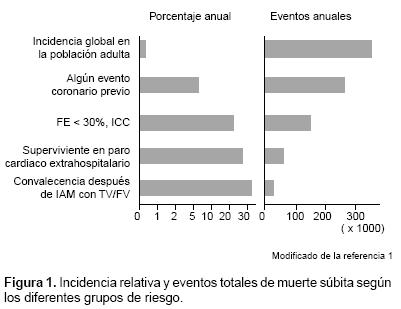
<body><![CDATA[<p align="justify"><font face="verdana" size="2"><i>Different sudden death treatment strategies regarding general population have different success rates in different countries, nevertheless, among select high risk populations; the best therapy currently available is the automatic implantable cardioverter defibrillator. We also discuss other treatment options. In Mexico it is deemed necessary to do an important effort for the early detection, prevention and treatment of sudden death in order to limit the consequences of this problem.</i></font></p>     <p align="justify"><font face="verdana" size="2"><i><b>Key words: </b>Sudden death, ventricular arrhythmia, risk stratification, heart rate variability, external automated defibrillator, automatic implantable cardioverter&#150;defibrillator</i></font></p>     <p align="justify"><font face="verdana" size="2">&nbsp;</font></p>     <p align="justify"><font face="verdana" size="2"><b>Introducci&oacute;n</b></font></p>     <p align="justify"><font face="verdana" size="2">La muerte s&uacute;bita cardiaca es un problema de salud p&uacute;blica que en los Estados Unidos de Norteam&eacute;rica supone alrededor de 300 mil muertes al a&ntilde;o<sup>1</sup> y en la Comunidad Econ&oacute;mica Europea cerca de 400 mil.<sup>2</sup> Hasta hace algunos a&ntilde;os se trataba de un problema de dif&iacute;cil soluci&oacute;n, en vista de que se desconoc&iacute;an muchos de sus aspectos fisiopatol&oacute;gicos. Los avances en el estudio de las arritmias, la cardiopat&iacute;a isqu&eacute;mica y la insuficiencia cardiaca han permitido establecer estrategias de prevenci&oacute;n, estratificaci&oacute;n de riesgo y finalmente, tratamiento, que dan una perspectiva m&aacute;s amplia de este complejo problema, aunque sin resolver a satisfacci&oacute;n muchas de sus interrogantes. Nuestro pa&iacute;s a&uacute;n tiene limitaciones importantes, desde el conocimiento de la incidencia real del problema, hasta las diversas estrategias de tratamiento temprano y tard&iacute;o que suponen costos importantes.</font></p>     <p align="justify"><font face="verdana" size="2"><i>Definici&oacute;n del problema y epidemiolog&iacute;a</i></font></p>     <p align="justify"><font face="verdana" size="2">La definici&oacute;n de muerte s&uacute;bita m&aacute;s aceptada la describe como aquella que ocurre antes de una hora de aparici&oacute;n de los s&iacute;ntomas.<sup>1</sup> Con esta definici&oacute;n, imperfecta, se ponen de manifiesto al menos dos aspectos relevantes: el primero es que se trata en la mayor parte de los casos, de una enfermedad cuyas manifestaciones son de inicio brusco (aunque pueda ser la agudizaci&oacute;n de un problema cr&oacute;nico) y muchas de las veces desconocida por el enfermo. El otro aspecto que queda patente es la necesidad de actuar con r&aacute;pidez para realizar cualquier tipo de maniobra de reanimaci&oacute;n o de rescate de estos enfermos, porque la muerte es inminente. Se pueden discutir otras definiciones considerando la temporalidad y la ausencia de enfermedad aparente, sin embargo la que se usa simplifica la comprensi&oacute;n de un problema de por s&iacute; complejo en el que el evento final es un fen&oacute;meno de inestabilidad el&eacute;ctrica cardiaca que lleva a la aparici&oacute;n de una arritmia letal.</font></p>     <p align="justify"><font face="verdana" size="2">Los 300 mil casos de muerte s&uacute;bita al a&ntilde;o en los EEUU suponen una incidencia cercana a 12% como causa de muerte en una poblaci&oacute;n general. De ellos, 88% son de origen cardiaco.<sup>3 </sup>Por otro lado, aproximadamente la mitad de los enfermos con insuficiencia cardiaca fallece por muerte s&uacute;bita cardiaca (MSC),<sup>4</sup><sup>&#150;6</sup> y de acuerdo a diversas series, la MSC ocurre entre 34 y 75% de todas las muertes coronarias.<sup>7</sup><sup>,8</sup></font></p>     <p align="justify"><font face="verdana" size="2">En la Rep&uacute;blica Mexicana s&oacute;lo se cuenta con informaci&oacute;n indirecta sobre la incidencia de muerte s&uacute;bita. En 1999, entre 443,950 defunciones, la primera causa de muerte fue la cardiopat&iacute;a, responsable de 69,278 fallecimientos. La cardiopat&iacute;a isqu&eacute;mica caus&oacute; 44,070 de ellos y se registraron 998 causas de muerte como "paros cardiacos".<sup>9</sup> Si se hace una extrapolaci&oacute;n de las cifras obtenidas en otros pa&iacute;ses, se podr&iacute;a hablar de alrededor de 53,000 muertes s&uacute;bitas anuales en el nuestro, que corresponden 76% de las muertes cardiacas. Si se considera 75% de las muertes por cardiopat&iacute;a isqu&eacute;mica, entonces se habla de aproximadamente 33 mil muertes s&uacute;bitas anuales. Por otro lado, vale la pena mencionar que 997 de los 998 "paros cardiacos" ocurrieron en el grupo de edad entre 15 y 24 a&ntilde;os. Esta informaci&oacute;n es poco precisa debido a que carece de un enfoque dirigido a detectar espec&iacute;ficamente las muertes s&uacute;bitas. Se puede asumir que el n&uacute;mero de casos no es desde&ntilde;able y se debe tomar en cuenta al revisar los aspectos que se mencionar&aacute;n m&aacute;s adelante.<sup>10</sup><sup>&#150;12</sup></font></p>     <p align="justify"><font face="verdana" size="2">En la <a href="#f1">figura 1</a> se pone de manifiesto que proporcionalmente, la incidencia de MSC aumenta cuando se agregan factores de riesgo como infartos previos, fracciones de expulsi&oacute;n bajas y arritmias inducibles en un estudio electrofisiol&oacute;gico (EEF).<sup>13</sup> Sin embargo, en una poblaci&oacute;n general, identificar, y tal vez tratar, a los enfermos en riesgo de muerte s&uacute;bita supondr&iacute;a costos enormes.<sup>14</sup><sup>,15</sup> Esta es una de las limitaciones m&aacute;s importantes dentro del estudio y prevenci&oacute;n de este problema. De ah&iacute; la necesidad de buscar estrategias que permitan identificar a los sujetos de alto riesgo de una manera m&aacute;s precoz. Por esta raz&oacute;n tambi&eacute;n se intenta incidir sobre la poblaci&oacute;n de alto riesgo que es m&aacute;s f&aacute;cilmente identificable, como los supervivientes de un infarto de miocardio o los pacientes que se encuentren en una cl&iacute;nica de insuficiencia cardiaca.<sup>16</sup></font></p>     ]]></body>
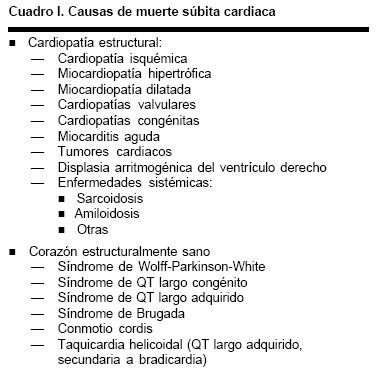
<body><![CDATA[<p align="center"><font face="verdana" size="2"><a name="f1"></a></font></p>     <p align="center"><font face="verdana" size="2"><img src="/img/revistas/gmm/v141n2/a2f1.jpg"></font></p>     <p align="justify"><font face="verdana" size="2"><i>Aspectos generales</i></font></p>     <p align="justify"><font face="verdana" size="2">La muerte s&uacute;bita puede ocurrir en el contexto de un individuo aparentemente sano o sin cardiopat&iacute;a estructural, como se menciona m&aacute;s adelante. Puede presentarse tambi&eacute;n en el paciente que tiene una enfermedad cardiaca o puede ser el evento terminal de la enfermedad en otros sujetos. En estos &uacute;ltimos, la intervenci&oacute;n para revertir el paro cardiaco debe ser evitada. Sin embargo, la necesidad de tratar a los enfermos que presenten el paro cardiaco como primera manifestaci&oacute;n de una enfermedad arterial coronaria en su domicilio o en el sitio en el que presenten MSC es manifiesta. De acuerdo al estudio de Maastrich, s&oacute;lo en 60% de las ocasiones<sup>17</sup> los paros cardiacos son presenciados. Tambi&eacute;n se demostr&oacute; que la mortalidad de los pacientes que tienen un episodio de MSC en su domicilio es mayor que la de aquellos que lo tienen en la v&iacute;a p&uacute;blica. S&oacute;lo 8% de los primeros es dado de alta de un hospital, mientras que el 18% de los segundos alcanza ese punto. Esto aparentemente tiene que ver con las condiciones favorables para alcanzar un equipo de desfibrilaci&oacute;n m&aacute;s tempranamente.</font></p>     <p align="justify"><font face="verdana" size="2">De acuerdo al estudio de Bay&eacute;s de Luna,<sup>18</sup> aproximadamente 80% de las muertes s&uacute;bitas son producto de taquiarritmia, ya sea taquicardia o fibrilaci&oacute;n ventricular, y solamente 20% lo son de una bradiarritmia como ritmos idioventriculares, bloqueos auriculo&#150;ventriculares o asistolia. Ese estudio establece la importancia de tratar a las taquiarritmias antes de que evolucionen hacia un ritmo "intratable" como la asistolia. Las mejores tasas de supervivencia se encuentran con las taquicardias ventriculares monom&oacute;rficas (TVM), seguidas de la fibrilaci&oacute;n ventricular (FV) y finalmente la asistolia. De estos hallazgos se deriva la importancia de la desfibrilaci&oacute;n temprana, ya sea por personal m&eacute;dico o no.<sup>19</sup> En el &uacute;ltimo caso, los esfuerzos se han dirigido a proveer con aparatos autom&aacute;ticos de desfibrilaci&oacute;n externa a los llamados "primeros respondientes" como polic&iacute;as, bomberos, vigilantes u otras personas con un entrenamiento m&iacute;nimo para su uso. Estos equipos, disponibles en lugares p&uacute;blicos, permiten un acceso casi inmediato a la terapia adecuada.<sup>20</sup><sup>,21</sup> En nuestro pa&iacute;s no se han implementado estrategias de este tipo y ser&iacute;a importante que las sociedades acad&eacute;micas influyesen en ello. Uno de los aspectos importantes que ha sido tradicionalmente despreciado por los m&eacute;dicos, es el de la atenci&oacute;n prehospitalaria. Se deben dar las condiciones para permitir que los tiempos de respuesta de las ambulancias con personal t&eacute;cnico entrenado y equipo de soporte vital avanzado se reduzcan dr&aacute;sticamente, porque actualmente rondan los 40 minutos (datos no publicados). Por otro lado, el personal t&eacute;cnico en urgencias m&eacute;dicas debe tener un entrenamiento espec&iacute;fico y estandarizado sobre el que no hay legislaci&oacute;n ni medios de certificaci&oacute;n por la secretar&iacute;a de salud, mucho menos planes de educaci&oacute;n m&eacute;dica continua.</font></p>     <p align="justify"><font face="verdana" size="2"><i>Causas de muerte s&uacute;bita</i></font></p>     <p align="justify"><font face="verdana" size="2">Las causas de MSC son variadas. Ya se ha mencionado con insistencia a la cardiopat&iacute;a isqu&eacute;mica, sin embargo hay otras causas mioc&aacute;rdicas conocidas como las cardiomiopat&iacute;as hipertr&oacute;ficas, dilatadas, y las otras mencionadas en el <a href="#c1">cuadro I</a>.</font></p>     <p align="center"><font face="verdana" size="2"><a name="c1"></a></font></p>     <p align="center"><font face="verdana" size="2"><img src="/img/revistas/gmm/v141n2/a2c1.jpg"></font></p>     <p align="justify"><font face="verdana" size="2">La cardiopat&iacute;a isqu&eacute;mica tiene un papel relevante por su frecuencia. En este caso, las arritmias ventriculares letales sobrevienen como consecuencia de reentradas alrededor de cicatrices de infarto o en zonas de tejido isqu&eacute;mico. Estudios de autopsia muestran que s&oacute;lo en 19% de los pacientes hay trombosis coronaria aguda, aunque de 40 a 75% tiene un infarto antiguo.<sup>8</sup><sup>,22</sup><sup>&#150;24</sup> Esto resalta la posibilidad de que haya un sustrato arr&iacute;tmico primario relacionado con la cicatriz pero no necesariamente con isquemia activa. La presencia de fluctuaciones en el tono auton&oacute;mico,<sup>25</sup><sup>&#150;27</sup> alteraciones electrol&iacute;ticas, tratamiento con f&aacute;rmacos antiarr&iacute;tmicos, los intervalos de acoplamiento de las extras&iacute;stoles ventriculares y las presiones de llenado ventricular son elementos todos que pueden favorecer la aparici&oacute;n de arritmias ventriculares letales.<sup>28&#150;31</sup></font></p>     ]]></body>
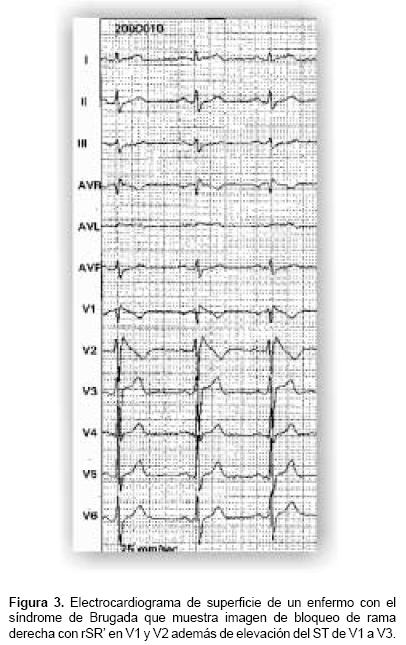
<body><![CDATA[<p align="justify"><font face="verdana" size="2">Los pacientes con miocardiopat&iacute;a hipertr&oacute;fica deben ser clasificados como de origen idiop&aacute;tico o hipertensivo, y el pron&oacute;stico en uno y otro es diferente.<sup>32</sup> En la segunda, la hipertrofia ventricular con sobrecarga sist&oacute;lica y diast&oacute;lica, re&uacute;ne las condiciones necesarias para inducir desequilibrio de aporte&#150;demanda de ox&iacute;geno en el miocardio, lo que se traduce en isquemia, que puede ser el sustrato final de las arritmias.<sup>33</sup><sup>,34 </sup>La cardiomiopat&iacute;a hipertr&oacute;fica familiar o cong&eacute;nita, de la que hay varias formas y que por s&iacute; misma puede ser motivo de una revisi&oacute;n,<sup>35</sup> tiene un origen diferente de las arritmias: el desarreglo de las fibras mioc&aacute;rdicas es el responsable de que se generen zonas de conducci&oacute;n lenta que favorecen la reentrada que origina la taquicardia. En esta poblaci&oacute;n, el riesgo de tener un episodio de MSC es de entre 2 y 3% anual.<sup>36&#150;</sup><sup>38</sup></font></p>     <p align="justify"><font face="verdana" size="2">La cardiomiopat&iacute;a dilatada idiop&aacute;tica tiene una mortalidad que va de 25 a 45% anual, y de esta cifra, 30% son muertes s&uacute;bitas.<sup>39</sup><sup>,40</sup> El &uacute;nico elemento que permite identificar pacientes de alto riesgo en este tipo de enfermos es la historia de s&iacute;ncope y la documentaci&oacute;n de taquicardias ventriculares (TV). Si estas taquicardias se inducen durante un EEF en individuos con extras&iacute;stoles ventriculares y funci&oacute;n ventricular deprimida, el riesgo de muerte s&uacute;bita es elevado.<sup>8</sup> Este tipo de enfermos presentan con mayor frecuencia una taquicardia ventricular por reentrada de rama a rama <a href="/img/revistas/gmm/v141n2/a2f2.jpg" target="_blank">(Figura 2)</a> que es susceptible de ablaci&oacute;n por radiofrecuencia como tratamiento de elecci&oacute;n.</font></p>     <p align="justify"><font face="verdana" size="2">Los enfermos con disfunci&oacute;n ventricular grave, independientemente de su origen, y en clase funcional IV de la NYHA tienen mortalidad superior a 50% anual.<sup>6</sup><sup>,41</sup> Como en los dem&aacute;s grupos, la influencia auton&oacute;mica, los cambios electrol&iacute;ticos y los propios f&aacute;rmacos antiarr&iacute;tmicos pueden ser factores desencadenantes de arritmias ventriculares graves. Aqu&iacute; ser&iacute;a importante enfatizar la diferencia entre un evento terminal de la enfermedad y un paciente con posibilidades de recuperaci&oacute;n. Los enfermos que tienen TV inducible tienen un riesgo de recurrencia de 15 a 50%, aun con terapia antiarr&iacute;tmica que elimine incluso la arritmia inducible. Nuevamente el s&iacute;ncope es un elemento que se asocia con incidencia de MSC de 45% anual.<sup>42&#150;</sup><sup>45</sup></font></p>     <p align="justify"><font face="verdana" size="2">El s&iacute;ndrome de Wolf&#150;Parkinson&#150;White (WPW) es una causa frecuente de arritmias en el joven y tiene una incidencia baja de MSC: De acuerdo a algunas series es del 1 al 4% anual, incluso un estudio reciente en una poblaci&oacute;n de militares mostr&oacute; una incidencia del 0.02% anual en el seguimiento de 22 a&ntilde;os de una poblaci&oacute;n de 228 sujetos.<sup>46</sup> El principal problema es la aparici&oacute;n de fibrilaci&oacute;n atrial, que en caso de ser conducida hacia el ventr&iacute;culo, puede provocar una fibrilaci&oacute;n ventricular (FV). Esta eventualidad se asocia m&aacute;s frecuentemente con v&iacute;as accesorias postero&#150;septales, v&iacute;as m&uacute;ltiples y un intervalo RR preexcitado menor a 250 ms.<sup>8,</sup><sup>47</sup></font></p>     <p align="justify"><font face="verdana" size="2">El s&iacute;ndrome de QT largo cong&eacute;nito, por una mutaci&oacute;n en el gen SCN5A, induce un incremento en la funci&oacute;n de los canales de sodio y por ello prolonga la despolarizaci&oacute;n y repolarizaci&oacute;n, adem&aacute;s de disminuir el umbral de despolarizaci&oacute;n. Rara vez la MSC es la primera manifestaci&oacute;n de este problema, pero es una eventualidad que puede ocurrir espont&aacute;neamente o como consecuencia del tratamiento antiarr&iacute;tmico. Los individuos con historia de s&iacute;ncope, episodios previos de muerte s&uacute;bita o historia familiar de muerte s&uacute;bita tienen un riesgo mayor. Los individuos mayores de 30 a&ntilde;os asintom&aacute;ticos, sin historia de s&iacute;ncope, tienen un riesgo menor. Cl&iacute;nicamente se han descrito dos tipos de s&iacute;ndrome de QT largo, el asociado a sordera (Lange Jervell Nielsen), que tiene peor pron&oacute;stico, y el que no se asocia a sordera (Romano&#150;Ward). Aun as&iacute;, se han identificado al menos 7 mutaciones diferentes que lo provocan.<sup>8,48</sup><sup>&#150;51</sup></font></p>     <p align="justify"><font face="verdana" size="2">Una rara entidad es la displasia arritmog&eacute;nica del ventr&iacute;culo derecho. Esta alteraci&oacute;n muscular del ventr&iacute;culo derecho se caracteriza por infiltraci&oacute;n grasa y fibrosa del mismo. La extensi&oacute;n de la displasia determinar&aacute; en buena medida la gravedad de los s&iacute;ntomas. Hay formas localizadas al tracto de salida del ventr&iacute;culo y formas generalizadas. Su presentaci&oacute;n va desde la extrasistolia ventricular frecuente, la TV sostenida o no sostenida hasta la FV. El pron&oacute;stico depender&aacute; de la presentaci&oacute;n cl&iacute;nica. Nuevamente, si se trata de s&iacute;ncope o muerte s&uacute;bita, el riesgo de recurrencia de MSC es elevado. El compromiso del ventr&iacute;culo izquierdo tambi&eacute;n implica un peor pron&oacute;stico.<sup>53</sup><sup>,54</sup></font></p>     <p align="justify"><font face="verdana" size="2">El s&iacute;ndrome de Brugada (<a href="#f3">Figura 3)</a> es una entidad recientemente descrita, caracterizada por la presencia de imagen de bloqueo de rama derecha, elevaci&oacute;n del ST de V1 a V3 y muerte s&uacute;bita. Se sabe actualmente que es la primera causa de muerte s&uacute;bita en hombres asi&aacute;ticos j&oacute;venes con coraz&oacute;n estructuralmente normal. La alteraci&oacute;n primaria es disfunci&oacute;n de los canales de sodio, como en el s&iacute;ndrome de QT largo, pero aqu&iacute;, a la inversa, hay disminuci&oacute;n de la funci&oacute;n de dichos canales. Esto hace m&aacute;s evidente el efecto de las corrientes repolarizadoras de potasio, con lo que se presenta disminuci&oacute;n, aparentemente selectiva, en la duraci&oacute;n del potencial de acci&oacute;n epic&aacute;rdico del ventr&iacute;culo derecho. Esto genera un gradiente epicardio/endocardio que favorece la dispersi&oacute;n de los periodos refractarios. Una caracter&iacute;stica de esta entidad es que as&iacute; genera su propio sustrato y disparador, con lo que la aparici&oacute;n de TV o FV depender&aacute; de la modulaci&oacute;n auton&oacute;mica. En nuestro pa&iacute;s se han descrito ya algunos casos, aunque como ya se mencion&oacute;, su incidencia es de hasta 0.6% en Asia y en Europa se calcula que &eacute;sta se encuentra alrededor de 1:100,000 habitantes.<sup>54</sup><sup>,55</sup></font></p>     <p align="center"><font face="verdana" size="2"><a name="f3"></a></font></p>     <p align="center"><font face="verdana" size="2"><img src="/img/revistas/gmm/v141n2/a2f3.jpg"></font></p>     <p align="justify"><font face="verdana" size="2"><i>Estratificaci&oacute;n de riesgo</i></font></p>     ]]></body>
<body><![CDATA[<p align="justify"><font face="verdana" size="2">La estratificaci&oacute;n de riesgo para la muerte s&uacute;bita se ha convertido en una necesidad en muchos &aacute;mbitos que se ha ido haciendo cada vez m&aacute;s compleja. Como se mencion&oacute; al inicio, la necesidad de determinar qui&eacute;n puede tener un episodio de muerte s&uacute;bita implica el estudio de una poblaci&oacute;n que puede ser tan abierta o tan cerrada como se desee establecer.<sup>56</sup><sup>,57 </sup>Por otro lado, a mayor riesgo, mayor beneficio potencial del tratamiento adecuado. Actualmente, las herramientas m&aacute;s potentes se centran en el estudio de riesgo en sujetos postinfarto y con insuficiencia cardiaca.<sup>58</sup><sup>&#150;64</sup></font></p>     <p align="justify"><font face="verdana" size="2">La "dependencia temporal de riesgo" es un concepto relevante. Estudios como el CAST<sup>65</sup> demostraron que en poblaciones postinfarto, las mayores tasas de muerte secundaria al evento "&iacute;ndice" se producen entre los 6 y 18 meses despu&eacute;s del mismo. Despu&eacute;s de ese lapso, la pendiente de las curvas de supervivencia es similar a las de los individuos que no han tenido enfermedades cardiovasculares.<sup>66</sup> Esto puede relacionarse con la repercusi&oacute;n que los diferentes tratamientos pueden tener, o la correcci&oacute;n de factores de riesgo para cardiopat&iacute;a isqu&eacute;mica o insuficiencia cardiaca, adem&aacute;s de la presencia de factores neurohumorales a&uacute;n no completamente caracterizados, que pueden explicar esta disminuci&oacute;n de la mortalidad. Se sale de los objetivos de este trabajo abundar en esta tem&aacute;tica, que sin duda genera una serie importante de investigaciones.<sup>67</sup><sup>&#150;73</sup></font></p>     <p align="justify"><font face="verdana" size="2">Un elemento imprescindible para determinar el riesgo de MSC es conocer el sustrato de la probable arritmia responsable. Esto implica el estudio de las causas estructurales, las celulares y las bioqu&iacute;micas para establecer un plan de acuerdo a los datos epidemiol&oacute;gicos conocidos.</font></p>     <p align="justify"><font face="verdana" size="2">No todas las herramientas para estratificaci&oacute;n tienen las mismas cualidades en todas las enfermedades. Por ejemplo, la variabilidad del RR es &uacute;til en pacientes con cardiopat&iacute;a isqu&eacute;mica, pero a&uacute;n queda por determinar su importancia y confiabilidad real en casos de cardiomiopat&iacute;a dilatada. La combinaci&oacute;n de elementos puede ser &uacute;til para establecer un riesgo lo m&aacute;s pr&oacute;ximo posible al real.<sup>74</sup></font></p>     <p align="justify"><font face="verdana" size="2">La medici&oacute;n m&aacute;s fiable hasta el momento y con sus limitaciones, es la fracci&oacute;n de expulsi&oacute;n ventricular (FEV).<sup>75</sup> La correlaci&oacute;n que existe entre el grado de disfunci&oacute;n ventricular y la supervivencia es bastante precisa, y se sabe que los pacientes con FEV inferior 35% tienen tasas de mortalidad que van de 9 a 18% anual de acuerdo a varias series.<sup>76</sup><sup>&#150;80</sup> Lo que la fracci&oacute;n de expulsi&oacute;n no permite discriminar es la modalidad de muerte. Aproximadamente la mitad de los enfermos con FEV baja fallece por falla de bomba y la otra mitad lo hace por muerte s&uacute;bita arr&iacute;tmica.<sup>81</sup> De esta observaci&oacute;n se deriva la necesidad de complementar este par&aacute;metro con otras herramientas. Se supone que los par&aacute;metros de funci&oacute;n auton&oacute;mica pueden ser la mejor opci&oacute;n, sin embargo los datos son contradictorios y hay estudios que muestran una utilidad marginal de la medici&oacute;n de la variabilidad del RR, por ejemplo.<sup>82</sup></font></p>     <p align="justify"><font face="verdana" size="2">La prueba de esfuerzo (PE) es una herramienta que ha mostrado cierta utilidad.<sup>83,</sup><sup>84</sup> El ejercicio eleva las catecolaminas circulantes y con ello la frecuencia cardiaca, la presi&oacute;n arterial, la demanda mioc&aacute;rdica de ox&iacute;geno y puede inducir isquemia. Esta &uacute;ltima a su vez puede asociarse a la p&eacute;rdida del potencial de reposo de membrana, heterogeneidad de los periodos refractarios, incremento del automatismo y reducci&oacute;n de los periodos refractarios. El potencial arritmog&eacute;nico de estos cambios es elevado. En una serie de pacientes postinfarto, la mortalidad a tres a&ntilde;os iba de 10% en los que ten&iacute;an una PE sin extras&iacute;stoles, a 25% de los que ten&iacute;an extrasistolia ventricular compleja. Sin embargo, los estudios cl&iacute;nicos han mostrado gran heterogeneidad de resultados, por lo que en general, la prueba de esfuerzo tiene utilidad limitada para predecir eventos de muerte s&uacute;bita.<sup>8</sup><sup>,83</sup></font></p>     <p align="justify"><font face="verdana" size="2">La variabilidad del RR (de la frecuencia cardiaca) ha suscitado recientemente gran inter&eacute;s debido a que se trata de una herramienta no invasora que permite evaluar el estado del equilibrio simp&aacute;tico&#150;parasimp&aacute;tico y su influencia en la modulaci&oacute;n de la frecuencia cardiaca: la disminuci&oacute;n del tono vagal se asocia con una disminuci&oacute;n de la variabilidad y aumento de la frecuencia cardiaca. Los par&aacute;metros para la medici&oacute;n de la variabilidad son en el dominio del tiempo y en el dominio de las frecuencias. En la cl&iacute;nica posiblemente sean los par&aacute;metros en el dominio del tiempo los m&aacute;s &uacute;tiles, y en particular el SDNN (La desviaci&oacute;n est&aacute;ndar del intervalo entre cada latido normal a normal).<sup>84</sup><sup>&#150;92</sup> Un valor de SDNN inferior a 50 ms se asocia con incremento de 5.3 veces del riesgo relativo de desarrollar arritmias ventriculares malignas en presencia de cardiopat&iacute;a estructural. Un valor de SDNN superior a 100 ms se asocia con un valor predictivo negativo muy elevado. La disminuci&oacute;n en la variabilidad del RR predice la muerte cardiaca pero con mayor potencia, la muerte de origen arr&iacute;tmico.<sup>86</sup> En la cl&iacute;nica de insuficiencia cardiaca del INCMNSZ se ha encontrado que la disminuci&oacute;n de la variabilidad se correlaciona con la clase funcional de los enfermos. Por otro lado, los controles durante el seguimiento de los pacientes han mostrado una tendencia a la disminuci&oacute;n de la variabilidad, lo que deber&iacute;a suponer un incremento en el riesgo de arritmias graves secundario a la progresi&oacute;n de la enfermedad aun en sujetos controlados y con mejor&iacute;a cl&iacute;nica en la clase funcional (resultados a&uacute;n no publicados).</font></p>     <p align="justify"><font face="verdana" size="2">El ECG de se&ntilde;al promediada tiene utilidad particular en los enfermos con cardiopat&iacute;a isqu&eacute;mica.<sup>93</sup> Esto se debe a que las &aacute;reas perinecr&oacute;ticas muestran retrasos en la conducci&oacute;n el&eacute;ctrica ventricular que es posible detectar a trav&eacute;s de electrocardiogramas con capacidad de amplificaci&oacute;n, filtrado y promediado de las se&ntilde;ales como postpotenciales tard&iacute;os o tempranos.<sup>93</sup><sup>&#150;95</sup> En otros contextos patol&oacute;gicos su utilidad es m&aacute;s limitada, y de hecho, su primordial valor es como elemento con un buen valor predictivo negativo.<sup>93</sup></font></p>     <p align="justify"><font face="verdana" size="2">La dispersi&oacute;n del QT gener&oacute; gran inter&eacute;s inicial que no ha sido respaldado por los hallazgos posteriores.<sup>96</sup><sup>&#150;98</sup> La diferencia entre el QT medido m&aacute;s largo y el m&aacute;s corto en las 12 derivaciones de un electro de superficie sugiere heterogeneidad en la repolarizaci&oacute;n y con ello en los periodos refractarios. Se hab&iacute;a observado que a mayor dispersi&oacute;n, mayor riesgo de arritmias ventriculares, con sensibilidad de 67%, especificidad de 75%, valor predictivo positivo de 41% y valor predictivo negativo de 90%. Sin embargo, aun la medici&oacute;n automatizada del intervalo representa problemas t&eacute;cnicos importantes derivados de la dificultad para delimitar el final de la onda T, con lo que solamente las alteraciones importantes del valor de dispersi&oacute;n, superiores a 100 ms, pueden ser de utilidad.<sup>99</sup><sup>&#150;101</sup></font></p>     <p align="justify"><font face="verdana" size="2">La alternancia de la onda T (AOT) es un marcador efectivo del riesgo de muerte s&uacute;bita cardiaca.<sup>102</sup> Este par&aacute;metro se describe como la variaci&oacute;n de morfolog&iacute;a y voltaje de la onda T de latido a latido. Se hab&iacute;a observado de manera gruesa en pacientes con s&iacute;ndrome de QT largo cong&eacute;nito, sin embargo los cambios en el microvoltaje han mostrado utilidad: 28% de los pacientes con AOT positiva tienen arritmias ventriculares, mientras que 98% de los que no la tienen, no las presentan. Otro estudio encontr&oacute; un riesgo relativo de 16.8 con sensibilidad de 93%. Para que la prueba sea positiva debe haber AOT sostenida de al menos 1.9 microvoltios, con una relaci&oacute;n de alternancia (k) de 3. Este par&aacute;metro corresponde a la amplitud del pico de alternancia por encima del ruido de fondo medido en unidades de la desviaci&oacute;n est&aacute;ndar del ruido. Estos criterios deben reunirse al menos durante un minuto en una derivaci&oacute;n bipolar o en dos precordiales. Mediciones de dos a cinco minutos son suficientes.<sup>103&#150;109</sup></font></p>     ]]></body>
<body><![CDATA[<p align="justify"><font face="verdana" size="2">Se investigan otras herramientas no invasoras para intentar establecer el riesgo de arritmias ventriculares letales, sin embargo, algunas tienen una utilidad cl&iacute;nica limitada, otras no han sido evaluadas con un n&uacute;mero suficiente de enfermos, y otras son experimentalmente atractivas, pero no han demostrado utilidad cl&iacute;nica.</font></p>     <p align="justify"><font face="verdana" size="2">El estudio electrofisiol&oacute;gico (EEF) tiene la desventaja de ser un procedimiento invasor, que debe ser limitado a poblaciones consideradas de alto riesgo.<sup>110</sup> La estimulaci&oacute;n el&eacute;ctrica cardiaca para inducir arritmias debe ser llevada a cabo de manera cuidadosa para intentar reproducir la arritmia cl&iacute;nica y no provocar arritmias ventriculares que el paciente no presenta en otras condiciones.<sup>111</sup><sup>&#150;113</sup> Un grupo en el que el EEF tiene particular utilidad es en los pacientes con cardiopat&iacute;a isqu&eacute;mica, ya sea con fracciones de expulsi&oacute;n normales o deprimidas.<sup>112,114,</sup><sup>115</sup> En las cardiomiopat&iacute;as no ha demostrado tanta reproducibilidad de los resultados.<sup>116</sup><sup>&#150;118</sup> Sin embargo en trastornos como el s&iacute;ndrome de QT largo o el s&iacute;ndrome de Brugada, es imprescindible llevar a cabo el estudio como herramienta &uacute;til para hacer el diagn&oacute;stico y determinar la mejor modalidad de tratamiento.<sup>119&#150;121</sup></font></p>     <p align="justify"><font face="verdana" size="2">Actualmente ha quedado demostrado que el uso de antiarr&iacute;tmicos no mejora la supervivencia,<sup>122</sup><sup>,123</sup> por lo que la utilidad del EEF como gu&iacute;a de la efectividad del tratamiento farmacol&oacute;gico es limitada, adem&aacute;s, las herramientas de medici&oacute;n no invasoras tienen una sensibilidad y especificidad similares. Posiblemente la utilidad principal del estudio electrofisiol&oacute;gico en este momento sea la de conocer las caracter&iacute;sticas de las arritmias ventriculares inducidas, para hacer una programaci&oacute;n eficiente de los dispositivos implantables de desfibrilaci&oacute;n (Desfibrilador Autom&aacute;tico Implantable: DAI).<sup>124&#150;128</sup></font></p>     <p align="justify"><font face="verdana" size="2"><i>Terapias disponibles</i></font></p>     <p align="justify"><font face="verdana" size="2">El tratamiento del paro cardiaco es posiblemente uno de los renglones m&aacute;s frustrantes en la electrofisiolog&iacute;a actual. Pese al advenimiento del DAI, que ha supuesto un gran avance en la prevenci&oacute;n de la MSC, a&uacute;n quedan muchas preguntas por responder.</font></p>     <p align="justify"><font face="verdana" size="2">Lo m&aacute;s relevante desde cualquier punto de vista es conseguir un adecuado nivel de prevenci&oacute;n primaria para evitar las cardiopat&iacute;as estructurales, como la isqu&eacute;mica, que son los principales responsables de la MSC. Aqu&iacute; las campa&ntilde;as de salud cardiovascular tienen un papel primordial.</font></p>     <p align="justify"><font face="verdana" size="2">El siguiente aspecto de gran importancia, como qued&oacute; patente m&aacute;s arriba, es ense&ntilde;ar a la poblaci&oacute;n general a administrar reanimaci&oacute;n cardiopulmonar y a recurrir a desfibriladores autom&aacute;ticos externos que deben estar disponibles en cualquier lugar p&uacute;blico.<sup>19</sup><sup>&#150;21,129</sup> La optimizaci&oacute;n de los servicios de emergencia es tambi&eacute;n un eslab&oacute;n fundamental.</font></p>     <p align="justify"><font face="verdana" size="2">Los f&aacute;rmacos antiarr&iacute;tmicos, en particular los de clase I han mostrado desde el estudio CAST que no tienen utilidad en pacientes con cardiopat&iacute;a estructural. La amiodarona no aumenta la mortalidad pero tampoco la sobrevivencia, como demuestran el EMIAT, el CAM I AT y recientemente el MUSTT.<sup>122,123</sup><sup>,126</sup> De cualquier manera, estos medicamentos no resuelven la prevenci&oacute;n de la MSC en una poblaci&oacute;n general. Las poblaciones seleccionadas, principalmente postinfarto parecen tener beneficios cuando se combina el antiarr&iacute;tmico con un DAI, pero el &eacute;xito de la terapia recae fundamentalmente sobre el DAI.<sup>127</sup> Los betabloqueadores tienen una clara utilidad en poblaciones de riesgo como isqu&eacute;micos y pacientes en insuficiencia cardiaca, sin embargo son infrautilizados por razones que no son del todo claras.<sup>130</sup><sup>,131</sup></font></p>     <p align="justify"><font face="verdana" size="2">Actualmente se est&aacute; intentando buscar un papel para los marcapasos y en particular para la resincronizaci&oacute;n biventricular, sin embargo este tipo de tratamiento, que amerita una revisi&oacute;n por s&iacute; solo, es de utilidad en pacientes muy espec&iacute;ficos que deben ser seleccionados entre esas poblaciones de alto riesgo. La sobreestimulaci&oacute;n ventricular homogeniza los potenciales de acci&oacute;n ventriculares y te&oacute;ricamente disminuye el n&uacute;mero de extras&iacute;stoles ventriculares y con ello el riesgo de taquiarritmias ventriculares. La resincronizaci&oacute;n ventricular en pacientes con cardiomiopat&iacute;a dilatada (habitualmente isqu&eacute;mica), fracci&oacute;n de expulsi&oacute;n menor 35% y bloqueo de rama izquierda con QRS superior a 130 ms mejora la fracci&oacute;n de expulsi&oacute;n, disminuye la insuficiencia valvular mitral, y consigue incluso cierta regresi&oacute;n de los di&aacute;metros ventriculares en estos pacientes. Si se agrega un intervalo AV corto que disminuya la presi&oacute;n telediast&oacute;lica ventricular, incluso con marcapasos bicamerales, la mejor&iacute;a sintom&aacute;tica puede ser importante. Sin embargo es un recurso costoso y limitado a pacientes muy seleccionados, con un potencial de prevenci&oacute;n para muerte s&uacute;bita a&uacute;n no establecido.<sup>132</sup><sup>&#150;135</sup></font></p>     <p align="justify"><font face="verdana" size="2">La &uacute;nica estrategia que ha mostrado efectividad tanto en prevenci&oacute;n primaria (MUSTT, MADIT<sup>136</sup><sup>,137</sup>) como secundaria (AVID)<sup>138</sup><sup>,139</sup> es el DAI. Nuevamente se trata de poblaciones seleccionadas por un alto riesgo de taquiarritmias ventriculares, postinfarto en su mayor&iacute;a,<sup>140</sup> aunque hay series de pacientes con el s&iacute;ndrome de Brugada u otras alteraciones en los que el dispositivo modifica de manera importante la sobrevivencia.<sup>141</sup><sup>,142</sup></font></p>     ]]></body>
<body><![CDATA[<p align="justify"><font face="verdana" size="2">Las t&eacute;cnicas de ablaci&oacute;n por radiofrecuencia han avanzado en cuanto al mapeo de los sitios de origen de las taquicardias, sin embargo este tipo de tratamiento requiere de varios aspectos. Tal vez el m&aacute;s importante es que la arritmia sostenida sea tolerada hemodin&aacute;micamente, porque no todos los centros cuentan con sistemas de mapeo que permitan rapidez y precisi&oacute;n. Otra limitante es que a veces las extras&iacute;stoles ventriculares que pueden mapearse no se originan exactamente en el mismo sitio que la taquicardia. Finalmente, para que la ablaci&oacute;n sea efectiva se requiere de un istmo por el que la reentrada que origina la taquicardia tenga que pasar forzosamente. Si el circuito no es estable o tiene varias "salidas", la ablaci&oacute;n es muy compleja o con una relaci&oacute;n riesgo/beneficio muy desfavorable.<sup>143</sup><sup>&#150;145</sup></font></p>     <p align="justify"><font face="verdana" size="2">Pese a la aparente carencia de utilidad de los f&aacute;rmacos, las combinaciones de &eacute;stos con alg&uacute;n dispositivo o terapia de ablaci&oacute;n pueden ser de utilidad. Aunque los estudios como el MUSTT han mostrado que los beneficios en la supervivencia dependen esencialmente de los desfibriladores, la recurrencia de episodios arr&iacute;tmicos es menor y de menor intensidad cuando se usa Amiodarona, con lo que se pueden evitar "tormentas el&eacute;ctricas", es decir, arritmias incesantes que llevan a descargas repetidas del DAI.<sup>146</sup></font></p>     <p align="justify"><font face="verdana" size="2">&nbsp;</font></p>     <p align="justify"><font face="verdana" size="2"><b>El futuro</b></font></p>     <p align="justify"><font face="verdana" size="2">El futuro debe traer avances significativos en la estratificaci&oacute;n de riesgo con el hallazgo de nuevos m&eacute;todos y la optimizaci&oacute;n de combinaciones de estudios para definir con precisi&oacute;n el riesgo relativo de cada enfermo en un grupo determinado de cardiopat&iacute;a. En gran medida los avances terap&eacute;uticos depender&aacute;n de esta detecci&oacute;n temprana, aunque en nuestro pa&iacute;s a&uacute;n hay mucho trabajo de educaci&oacute;n por hacer.</font></p>     <p align="justify"><font face="verdana" size="2">La tecnolog&iacute;a permite suponer que aparecer&aacute;n dispositivos (DAI), combinados de terapia el&eacute;ctrica que sean capaces de administrar una cierta dosis de medicamento antiarr&iacute;tmico a nivel local, que tengan una mayor longevidad y sean cada vez m&aacute;s sencillos de implantar, sin embargo, el &eacute;nfasis debe ponerse en la prevenci&oacute;n de las cardiopat&iacute;as que llevan a un coraz&oacute;n previamente sano a un extremo cr&iacute;tico en que un desequilibrio electrol&iacute;tico o auton&oacute;mico le imponga un reto que no ser&aacute; capaz de superar.</font></p>     <p align="justify"><font face="verdana" size="2">&nbsp;</font></p>     <p align="justify"><font face="verdana" size="2"><b>Referencias</b></font></p>     <!-- ref --><p align="justify"><font face="verdana" size="2">1.<b> Myerburg R, Castellanos A. </b>Cardiac arrest and sudden cardiac death. En Braunwald E. ed. Heart disease: A textbook of cardiovascular medicine 4&deg; ed. Philadelphia, Saunders Co.1992:756&#150;89.</font>&nbsp;&nbsp;&nbsp;&nbsp;&nbsp;&nbsp;&nbsp;&nbsp;[&#160;<a href="javascript:void(0);" onclick="javascript: window.open('/scielo.php?script=sci_nlinks&ref=3857176&pid=S0016-3813200500020000200001&lng=','','width=640,height=500,resizable=yes,scrollbars=1,menubar=yes,');">Links</a>&#160;]<!-- end-ref --><!-- ref --><p align="justify"><font face="verdana" size="2">2. <b>Mont L. </b>Muerte s&uacute;bita. Conferencia magistral, V curso de Cardiolog&iacute;a para M&eacute;dicos Internistas: Una visi&oacute;n dual. Septiembre 20 al 22, 2001, Instituto Nacional de Ciencias M&eacute;dicas y Nutrici&oacute;n &lt;&lt;Salvador Zubir&aacute;n&gt;&gt;.</font>&nbsp;&nbsp;&nbsp;&nbsp;&nbsp;&nbsp;&nbsp;&nbsp;[&#160;<a href="javascript:void(0);" onclick="javascript: window.open('/scielo.php?script=sci_nlinks&ref=3857177&pid=S0016-3813200500020000200002&lng=','','width=640,height=500,resizable=yes,scrollbars=1,menubar=yes,');">Links</a>&#160;]<!-- end-ref --><!-- ref --><p align="justify"><font face="verdana" size="2">3. <b>Schatzkin A. Cupples L, Heeren T. </b>Sudden death in the Framingham Heart Study: Differences in the incidence and risk factors by sex and coronary disease status. Am J Epidemiol 1984;46:341.</font>&nbsp;&nbsp;&nbsp;&nbsp;&nbsp;&nbsp;&nbsp;&nbsp;[&#160;<a href="javascript:void(0);" onclick="javascript: window.open('/scielo.php?script=sci_nlinks&ref=3857178&pid=S0016-3813200500020000200003&lng=','','width=640,height=500,resizable=yes,scrollbars=1,menubar=yes,');">Links</a>&#160;]<!-- end-ref --><!-- ref --><p align="justify"><font face="verdana" size="2">4. DEFIBRILAT Study group. Actuarial risk of sudden death while awaiting cardiac transplantation in patients with atherosclerotic heart disease. Am J Cardiol 1991;68:545&#150;6.</font>&nbsp;&nbsp;&nbsp;&nbsp;&nbsp;&nbsp;&nbsp;&nbsp;[&#160;<a href="javascript:void(0);" onclick="javascript: window.open('/scielo.php?script=sci_nlinks&ref=3857179&pid=S0016-3813200500020000200004&lng=','','width=640,height=500,resizable=yes,scrollbars=1,menubar=yes,');">Links</a>&#160;]<!-- end-ref --><!-- ref --><p align="justify"><font face="verdana" size="2">5. <b>Nagele H, Rodiger W. </b>Sudden death and tailored medical therapy in elective candidates for heart transplantation. J Heart Lung Transplant 1999;18(9):869&#150;76.</font>&nbsp;&nbsp;&nbsp;&nbsp;&nbsp;&nbsp;&nbsp;&nbsp;[&#160;<a href="javascript:void(0);" onclick="javascript: window.open('/scielo.php?script=sci_nlinks&ref=3857180&pid=S0016-3813200500020000200005&lng=','','width=640,height=500,resizable=yes,scrollbars=1,menubar=yes,');">Links</a>&#160;]<!-- end-ref --><!-- ref --><p align="justify"><font face="verdana" size="2">6. <b>Deedwania </b>P. Ventricular arrhythmias and sudden death in Heart Failure: Evaluation and management. 20th annual scientific sessions of the NASPE, Mayo 14 1999, <a href="http://www.medscape.com/medscape/cho/1999/NASPE/%20story.cfm?story_id&#8211;585" target="_blank">http://www.medscape.com/medscape/cho/1999/NASPE/story.cfm?story_id&#150;585</a></font>&nbsp;&nbsp;&nbsp;&nbsp;&nbsp;&nbsp;&nbsp;&nbsp;[&#160;<a href="javascript:void(0);" onclick="javascript: window.open('/scielo.php?script=sci_nlinks&ref=3857181&pid=S0016-3813200500020000200006&lng=','','width=640,height=500,resizable=yes,scrollbars=1,menubar=yes,');">Links</a>&#160;]<!-- end-ref --><!-- ref --><p align="justify"><font face="verdana" size="2">7. <b>Demirovic J. </b>Risk factors in the incidence of sudden cardiac death and possibilities for its prevention. University of Belgrade Press, thesis 1985.</font>&nbsp;&nbsp;&nbsp;&nbsp;&nbsp;&nbsp;&nbsp;&nbsp;[&#160;<a href="javascript:void(0);" onclick="javascript: window.open('/scielo.php?script=sci_nlinks&ref=3857182&pid=S0016-3813200500020000200007&lng=','','width=640,height=500,resizable=yes,scrollbars=1,menubar=yes,');">Links</a>&#160;]<!-- end-ref --><!-- ref --><p align="justify"><font face="verdana" size="2">8. <b>Deshpande S, Akhtar M. </b>Muerte s&uacute;bita cardiaca: La magnitud del problema. En Dunbar S, Ellenbogen K, Epstein A (eds.) Muerte s&uacute;bita cardiaca, pasado presente y futuro. Medical trends (Espa&ntilde;a) 1998, Futura Publishing co. 1997;pp 1&#150;18.</font>&nbsp;&nbsp;&nbsp;&nbsp;&nbsp;&nbsp;&nbsp;&nbsp;[&#160;<a href="javascript:void(0);" onclick="javascript: window.open('/scielo.php?script=sci_nlinks&ref=3857183&pid=S0016-3813200500020000200008&lng=','','width=640,height=500,resizable=yes,scrollbars=1,menubar=yes,');">Links</a>&#160;]<!-- end-ref --><!-- ref --><p align="justify"><font face="verdana" size="2">9. Principales causas de mortalidad general, Estados Unidos Mexicanos 1999. Estad&iacute;sticas vitales, cap&iacute;tulo de mortalidad: <a href="http://www.ssa.org.mx/" target="_blank">http://www.ssa.org.mx/</a> 11 de Nov 2001.</font>&nbsp;&nbsp;&nbsp;&nbsp;&nbsp;&nbsp;&nbsp;&nbsp;[&#160;<a href="javascript:void(0);" onclick="javascript: window.open('/scielo.php?script=sci_nlinks&ref=3857184&pid=S0016-3813200500020000200009&lng=','','width=640,height=500,resizable=yes,scrollbars=1,menubar=yes,');">Links</a>&#160;]<!-- end-ref --><!-- ref --><p align="justify"><font face="verdana" size="2">10. <b>De Micheli A. </b>El problema de la muerte s&uacute;bita cardiaca. Parte I. Arch Inst cardiol ex 1999;69(4):367&#150;70.</font>&nbsp;&nbsp;&nbsp;&nbsp;&nbsp;&nbsp;&nbsp;&nbsp;[&#160;<a href="javascript:void(0);" onclick="javascript: window.open('/scielo.php?script=sci_nlinks&ref=3857185&pid=S0016-3813200500020000200010&lng=','','width=640,height=500,resizable=yes,scrollbars=1,menubar=yes,');">Links</a>&#160;]<!-- end-ref --><!-- ref --><p align="justify"><font face="verdana" size="2">11. Iturralde P. El problema de la muerte s&uacute;bita cardiaca. Parte II Enfoque actual del problema. Arch Inst Cardiol Mex 1999;69(4):371&#150;4.</font>&nbsp;&nbsp;&nbsp;&nbsp;&nbsp;&nbsp;&nbsp;&nbsp;[&#160;<a href="javascript:void(0);" onclick="javascript: window.open('/scielo.php?script=sci_nlinks&ref=3857186&pid=S0016-3813200500020000200011&lng=','','width=640,height=500,resizable=yes,scrollbars=1,menubar=yes,');">Links</a>&#160;]<!-- end-ref --><!-- ref --><p align="justify"><font face="verdana" size="2">12. <b>Zghaib A, F&eacute;rez S. </b>Isquemia asintom&aacute;tica y muerte s&uacute;bita. Arch Inst Cardiol Mex, 1992;62(6):487&#150;9.</font>&nbsp;&nbsp;&nbsp;&nbsp;&nbsp;&nbsp;&nbsp;&nbsp;[&#160;<a href="javascript:void(0);" onclick="javascript: window.open('/scielo.php?script=sci_nlinks&ref=3857187&pid=S0016-3813200500020000200012&lng=','','width=640,height=500,resizable=yes,scrollbars=1,menubar=yes,');">Links</a>&#160;]<!-- end-ref --><!-- ref --><p align="justify"><font face="verdana" size="2">13. <b>Furukawa T, Rozanski J, Nogami A, Moroe K, Gosselin A, Lister J. </b>Time dependent risk of and predictors for cardiac arrest recurrence in survivors of out&#150;of&#150;hospital cardiac arrest with chronic coronary artery disease. Circulation 1989;80:599&#150;608.</font>&nbsp;&nbsp;&nbsp;&nbsp;&nbsp;&nbsp;&nbsp;&nbsp;[&#160;<a href="javascript:void(0);" onclick="javascript: window.open('/scielo.php?script=sci_nlinks&ref=3857188&pid=S0016-3813200500020000200013&lng=','','width=640,height=500,resizable=yes,scrollbars=1,menubar=yes,');">Links</a>&#160;]<!-- end-ref --><!-- ref --><p align="justify"><font face="verdana" size="2">14. <b>Elos&uacute;a R, Guindo J, Vi&ntilde;olas X, Mart&iacute;nez Rubio A, Bay&eacute;s Genis T, Bay&eacute;s de Luna A. </b>Clinical goals of risk stratification. En Malik M. (Ed) Risk of arrhythmia and sudden death. BMJ Books 2001, pp 3&#150;10.</font>&nbsp;&nbsp;&nbsp;&nbsp;&nbsp;&nbsp;&nbsp;&nbsp;[&#160;<a href="javascript:void(0);" onclick="javascript: window.open('/scielo.php?script=sci_nlinks&ref=3857189&pid=S0016-3813200500020000200014&lng=','','width=640,height=500,resizable=yes,scrollbars=1,menubar=yes,');">Links</a>&#160;]<!-- end-ref --><!-- ref --><p align="justify"><font face="verdana" size="2">15. <b>Mont L. </b>Muerte s&uacute;bita cardiaca: Causas y prevenci&oacute;n. Medicine, En prensa.</font>&nbsp;&nbsp;&nbsp;&nbsp;&nbsp;&nbsp;&nbsp;&nbsp;[&#160;<a href="javascript:void(0);" onclick="javascript: window.open('/scielo.php?script=sci_nlinks&ref=3857190&pid=S0016-3813200500020000200015&lng=','','width=640,height=500,resizable=yes,scrollbars=1,menubar=yes,');">Links</a>&#160;]<!-- end-ref --><!-- ref --><p align="justify"><font face="verdana" size="2">16. <b>Araya V, Gonz&aacute;lez A, Casanova J, Col&iacute;n L, Kershenovich S, Iturralde P. </b>Identificaci&oacute;n de los pacientes con riesgo de arritmias malignas en el primer a&ntilde;o postinfarto de miocardio. Arch Inst Cardiol Mex 1994;64(2):145&#150;59.</font>&nbsp;&nbsp;&nbsp;&nbsp;&nbsp;&nbsp;&nbsp;&nbsp;[&#160;<a href="javascript:void(0);" onclick="javascript: window.open('/scielo.php?script=sci_nlinks&ref=3857191&pid=S0016-3813200500020000200016&lng=','','width=640,height=500,resizable=yes,scrollbars=1,menubar=yes,');">Links</a>&#160;]<!-- end-ref --><!-- ref --><p align="justify"><font face="verdana" size="2">17. <b>De Vreede&#150;Swagemakers J, Gorgels A, Dubois W. </b>Out&#150;of&#150;hospital cardiac arrest in the 1990's: A population based study in the Maastricht area on incidence, characteristics and survival. J Am Coll Cardiol 1997;30:1500&#150;8.</font>&nbsp;&nbsp;&nbsp;&nbsp;&nbsp;&nbsp;&nbsp;&nbsp;[&#160;<a href="javascript:void(0);" onclick="javascript: window.open('/scielo.php?script=sci_nlinks&ref=3857192&pid=S0016-3813200500020000200017&lng=','','width=640,height=500,resizable=yes,scrollbars=1,menubar=yes,');">Links</a>&#160;]<!-- end-ref --><!-- ref --><p align="justify"><font face="verdana" size="2">18. <b>Bay&eacute;s de Luna A, Coumel P, Leclerq J. </b>Ambulatory sudden cardiac death: Mechanisms of production of fatal arrhythmia on the basis of data from 157 cases. Am Heart J, 1989;117:151&#150;9.</font>&nbsp;&nbsp;&nbsp;&nbsp;&nbsp;&nbsp;&nbsp;&nbsp;[&#160;<a href="javascript:void(0);" onclick="javascript: window.open('/scielo.php?script=sci_nlinks&ref=3857193&pid=S0016-3813200500020000200018&lng=','','width=640,height=500,resizable=yes,scrollbars=1,menubar=yes,');">Links</a>&#160;]<!-- end-ref --><!-- ref --><p align="justify"><font face="verdana" size="2">19. International Consensus. American Heart Association, International Liaison Committee on Resuscitation: Guidelines 2000 for cardiopulmonary resuscitation and emergency cardiovascular care. The automated external defibrillator: Key link in the chain of survival. Circulation Suppl, 2000; 102(8):I60&#150;I76.</font>&nbsp;&nbsp;&nbsp;&nbsp;&nbsp;&nbsp;&nbsp;&nbsp;[&#160;<a href="javascript:void(0);" onclick="javascript: window.open('/scielo.php?script=sci_nlinks&ref=3857194&pid=S0016-3813200500020000200019&lng=','','width=640,height=500,resizable=yes,scrollbars=1,menubar=yes,');">Links</a>&#160;]<!-- end-ref --><!-- ref --><p align="justify"><font face="verdana" size="2">20. <b>Marenco J, Wang P, Link M, Homoud M, Estes N. </b>Improving survival from sudden cardiac arrest: the role of the automated external defibrillator. JAMA 2001 ;285(9):1193&#150;200.</font>&nbsp;&nbsp;&nbsp;&nbsp;&nbsp;&nbsp;&nbsp;&nbsp;[&#160;<a href="javascript:void(0);" onclick="javascript: window.open('/scielo.php?script=sci_nlinks&ref=3857195&pid=S0016-3813200500020000200020&lng=','','width=640,height=500,resizable=yes,scrollbars=1,menubar=yes,');">Links</a>&#160;]<!-- end-ref --><!-- ref --><p align="justify"><font face="verdana" size="2">21. <b>Kern K. </b>Public access defibrillation: A review. Heart 1998;80(4)402&#150;4.</font>&nbsp;&nbsp;&nbsp;&nbsp;&nbsp;&nbsp;&nbsp;&nbsp;[&#160;<a href="javascript:void(0);" onclick="javascript: window.open('/scielo.php?script=sci_nlinks&ref=3857196&pid=S0016-3813200500020000200021&lng=','','width=640,height=500,resizable=yes,scrollbars=1,menubar=yes,');">Links</a>&#160;]<!-- end-ref --><!-- ref --><p align="justify"><font face="verdana" size="2">22. <b>Haerem J. </b>Mural platelet microthrombi and major acute lesions of main epicardial arteries in sudden coronary death. Atherosclerosis, 1974;19:529&#150;41.</font>&nbsp;&nbsp;&nbsp;&nbsp;&nbsp;&nbsp;&nbsp;&nbsp;[&#160;<a href="javascript:void(0);" onclick="javascript: window.open('/scielo.php?script=sci_nlinks&ref=3857197&pid=S0016-3813200500020000200022&lng=','','width=640,height=500,resizable=yes,scrollbars=1,menubar=yes,');">Links</a>&#160;]<!-- end-ref --><!-- ref --><p align="justify"><font face="verdana" size="2">23. <b>Reichenbach D, Moss A, Meyer E. </b>Pathology of the heart in sudden cardiac death. Am J Cardiol 1977;39:865&#150;72.</font>&nbsp;&nbsp;&nbsp;&nbsp;&nbsp;&nbsp;&nbsp;&nbsp;[&#160;<a href="javascript:void(0);" onclick="javascript: window.open('/scielo.php?script=sci_nlinks&ref=3857198&pid=S0016-3813200500020000200023&lng=','','width=640,height=500,resizable=yes,scrollbars=1,menubar=yes,');">Links</a>&#160;]<!-- end-ref --><!-- ref --><p align="justify"><font face="verdana" size="2">24. <b>Farb A, Burke A, Tang A, Liang T, Mannan P, Smialek J, et al. </b>Coronary plaque erosion without rupture into a lipid core. A frequent cause of coronary thrombosis in sudden coronary death. Circulation 1996 Apr 1;93(7):1354&#150;63.</font>&nbsp;&nbsp;&nbsp;&nbsp;&nbsp;&nbsp;&nbsp;&nbsp;[&#160;<a href="javascript:void(0);" onclick="javascript: window.open('/scielo.php?script=sci_nlinks&ref=3857199&pid=S0016-3813200500020000200024&lng=','','width=640,height=500,resizable=yes,scrollbars=1,menubar=yes,');">Links</a>&#160;]<!-- end-ref --><!-- ref --><p align="justify"><font face="verdana" size="2">25. <b>Barron H, Lesh M. </b>Autonomic nervous system and sudden cardiac death. J Am Coll Cardiol 1996 Apr;27(5):1053&#150;60.</font>&nbsp;&nbsp;&nbsp;&nbsp;&nbsp;&nbsp;&nbsp;&nbsp;[&#160;<a href="javascript:void(0);" onclick="javascript: window.open('/scielo.php?script=sci_nlinks&ref=3857200&pid=S0016-3813200500020000200025&lng=','','width=640,height=500,resizable=yes,scrollbars=1,menubar=yes,');">Links</a>&#160;]<!-- end-ref --><!-- ref --><p align="justify"><font face="verdana" size="2">26. <b>Schwartz P, Zipes D. </b>Autonomic modulation of cardiac arrhythmias. En: Zipes D, Jalife J. Cardiac electrophysiology, from cell to bedside. 3a edici&oacute;n, 2000, Saunders Pub. Co. pp:300&#150;14.</font>&nbsp;&nbsp;&nbsp;&nbsp;&nbsp;&nbsp;&nbsp;&nbsp;[&#160;<a href="javascript:void(0);" onclick="javascript: window.open('/scielo.php?script=sci_nlinks&ref=3857201&pid=S0016-3813200500020000200026&lng=','','width=640,height=500,resizable=yes,scrollbars=1,menubar=yes,');">Links</a>&#160;]<!-- end-ref --><!-- ref --><p align="justify"><font face="verdana" size="2">27. <b>Schwartz P, La Rovere, M Vanoli E. </b>Autonomic nervous system and sudden cardiac death. Experimental basis and clinical observations for post&#150;myocardial infarction risk stratification. Circulation 1992;85(supl. I):I&#150;177&#150;91.</font>&nbsp;&nbsp;&nbsp;&nbsp;&nbsp;&nbsp;&nbsp;&nbsp;[&#160;<a href="javascript:void(0);" onclick="javascript: window.open('/scielo.php?script=sci_nlinks&ref=3857202&pid=S0016-3813200500020000200027&lng=','','width=640,height=500,resizable=yes,scrollbars=1,menubar=yes,');">Links</a>&#160;]<!-- end-ref --><!-- ref --><p align="justify"><font face="verdana" size="2">28. <b>Gettes L. </b>Electrolyte abnormalities underlying lethal ventricular arrhythmias. Circ 1992;85(suppl.I):170&#150;176.</font>&nbsp;&nbsp;&nbsp;&nbsp;&nbsp;&nbsp;&nbsp;&nbsp;[&#160;<a href="javascript:void(0);" onclick="javascript: window.open('/scielo.php?script=sci_nlinks&ref=3857203&pid=S0016-3813200500020000200028&lng=','','width=640,height=500,resizable=yes,scrollbars=1,menubar=yes,');">Links</a>&#160;]<!-- end-ref --><!-- ref --><p align="justify"><font face="verdana" size="2">29. Multiple risk factor intervention trial research group. Multiple&#150;risk factor intervention trial: Risk factor changes in mortality results. J Am Med Assoc 1982 ;248:1465&#150;77.</font>&nbsp;&nbsp;&nbsp;&nbsp;&nbsp;&nbsp;&nbsp;&nbsp;[&#160;<a href="javascript:void(0);" onclick="javascript: window.open('/scielo.php?script=sci_nlinks&ref=3857204&pid=S0016-3813200500020000200029&lng=','','width=640,height=500,resizable=yes,scrollbars=1,menubar=yes,');">Links</a>&#160;]<!-- end-ref --><!-- ref --><p align="justify"><font face="verdana" size="2">30. <b>Zipes D, Wellens H. </b>Sudden cardiac death. Circulation 1998 Nov 24;98(21):2334&#150;51.</font>&nbsp;&nbsp;&nbsp;&nbsp;&nbsp;&nbsp;&nbsp;&nbsp;[&#160;<a href="javascript:void(0);" onclick="javascript: window.open('/scielo.php?script=sci_nlinks&ref=3857205&pid=S0016-3813200500020000200030&lng=','','width=640,height=500,resizable=yes,scrollbars=1,menubar=yes,');">Links</a>&#160;]<!-- end-ref --><!-- ref --><p align="justify"><font face="verdana" size="2">31. <b>Calkins H, Maughan W, Weissman H, Sugiura S, Sagawa K, Levine J. </b>Effect of acute volume load on refractoriness and arrhythmia development in isolated chronically isolated canine hearts. Circulation 1989;79:687&#150;97.</font>&nbsp;&nbsp;&nbsp;&nbsp;&nbsp;&nbsp;&nbsp;&nbsp;[&#160;<a href="javascript:void(0);" onclick="javascript: window.open('/scielo.php?script=sci_nlinks&ref=3857206&pid=S0016-3813200500020000200031&lng=','','width=640,height=500,resizable=yes,scrollbars=1,menubar=yes,');">Links</a>&#160;]<!-- end-ref --><!-- ref --><p align="justify"><font face="verdana" size="2">32. <b>Slade A, Camm J. </b>Risk Assessment and Prevention of Sudden Cardiac Death in Hypertrophic Cardiomyopathy Arch Mal Coeur et Vaiss 89 Spec No 1:37&#150;49,  1996 Feb.</font>&nbsp;&nbsp;&nbsp;&nbsp;&nbsp;&nbsp;&nbsp;&nbsp;[&#160;<a href="javascript:void(0);" onclick="javascript: window.open('/scielo.php?script=sci_nlinks&ref=3857207&pid=S0016-3813200500020000200032&lng=','','width=640,height=500,resizable=yes,scrollbars=1,menubar=yes,');">Links</a>&#160;]<!-- end-ref --><!-- ref --><p align="justify"><font face="verdana" size="2">33. <b>Almendral J, Villacastin J, Arenal A, Tercedor L, Merino J, Delcan J. </b>Evidence favoring the hypothesis that ventricular arrhythmias have prognostic significance in  left ventricular hypertrophy secondary to systemic hypertension. Am J Cardiol 1995 Nov 2;76(13):60D&#150;63D.</font>&nbsp;&nbsp;&nbsp;&nbsp;&nbsp;&nbsp;&nbsp;&nbsp;[&#160;<a href="javascript:void(0);" onclick="javascript: window.open('/scielo.php?script=sci_nlinks&ref=3857208&pid=S0016-3813200500020000200033&lng=','','width=640,height=500,resizable=yes,scrollbars=1,menubar=yes,');">Links</a>&#160;]<!-- end-ref --><!-- ref --><p align="justify"><font face="verdana" size="2">34. <b>Chang AC, McAreavey D, Fananapazir L. </b>Identification of Patients With Hypertrophic Cardiomyopathy at High Risk for Sudden Death. Current Opinion in Cardiology 1995 Jan 10(1):9&#150;15.</font>&nbsp;&nbsp;&nbsp;&nbsp;&nbsp;&nbsp;&nbsp;&nbsp;[&#160;<a href="javascript:void(0);" onclick="javascript: window.open('/scielo.php?script=sci_nlinks&ref=3857209&pid=S0016-3813200500020000200034&lng=','','width=640,height=500,resizable=yes,scrollbars=1,menubar=yes,');">Links</a>&#160;]<!-- end-ref --><!-- ref --><p align="justify"><font face="verdana" size="2">35. <b>Varnava A, Elliott P, Baboonian C, Davison F, Davies M, McKenna W. </b>Hypertrophic cardiomyopathy. Hystopathological features of sudden death in cardiac troponin T disease. Circulation 2001; 104:1380&#150;84.</font>&nbsp;&nbsp;&nbsp;&nbsp;&nbsp;&nbsp;&nbsp;&nbsp;[&#160;<a href="javascript:void(0);" onclick="javascript: window.open('/scielo.php?script=sci_nlinks&ref=3857210&pid=S0016-3813200500020000200035&lng=','','width=640,height=500,resizable=yes,scrollbars=1,menubar=yes,');">Links</a>&#160;]<!-- end-ref --><!-- ref --><p align="justify"><font face="verdana" size="2">36. <b>Cannan C,  Reeder G,  Bailey K.  </b>Natural  history of hypertrophic cardiomyopathy. Circulation 1995;92:2488&#150;95.</font>&nbsp;&nbsp;&nbsp;&nbsp;&nbsp;&nbsp;&nbsp;&nbsp;[&#160;<a href="javascript:void(0);" onclick="javascript: window.open('/scielo.php?script=sci_nlinks&ref=3857211&pid=S0016-3813200500020000200036&lng=','','width=640,height=500,resizable=yes,scrollbars=1,menubar=yes,');">Links</a>&#160;]<!-- end-ref --><!-- ref --><p align="justify"><font face="verdana" size="2">37. <b>Fananapanazir L, Chang L, Leon M. </b>Electrophysiologic abnormalities in patients with hypertrophic cardiomyopathy: A consecutive analysis in 155 patients. Circulation 1989;80:1259&#150;68.</font>&nbsp;&nbsp;&nbsp;&nbsp;&nbsp;&nbsp;&nbsp;&nbsp;[&#160;<a href="javascript:void(0);" onclick="javascript: window.open('/scielo.php?script=sci_nlinks&ref=3857212&pid=S0016-3813200500020000200037&lng=','','width=640,height=500,resizable=yes,scrollbars=1,menubar=yes,');">Links</a>&#160;]<!-- end-ref --><!-- ref --><p align="justify"><font face="verdana" size="2">38. <b>Saumarez R, Camm J, Panagos A. </b>Ventricular fibrillation in hypertrophic cardiomyopathy is associated with increased fractionation of paced right ventricular electrograms. Circulation 1992;86:467&#150;74.</font>&nbsp;&nbsp;&nbsp;&nbsp;&nbsp;&nbsp;&nbsp;&nbsp;[&#160;<a href="javascript:void(0);" onclick="javascript: window.open('/scielo.php?script=sci_nlinks&ref=3857213&pid=S0016-3813200500020000200038&lng=','','width=640,height=500,resizable=yes,scrollbars=1,menubar=yes,');">Links</a>&#160;]<!-- end-ref --><!-- ref --><p align="justify"><font face="verdana" size="2">39. <b>Fuster V, Gersh B, Giuliani E. </b>The natural history of idiopathic dilated cardiomyopathy. Am J Cardiol 1981;47:525&#150;31.</font>&nbsp;&nbsp;&nbsp;&nbsp;&nbsp;&nbsp;&nbsp;&nbsp;[&#160;<a href="javascript:void(0);" onclick="javascript: window.open('/scielo.php?script=sci_nlinks&ref=3857214&pid=S0016-3813200500020000200039&lng=','','width=640,height=500,resizable=yes,scrollbars=1,menubar=yes,');">Links</a>&#160;]<!-- end-ref --><!-- ref --><p align="justify"><font face="verdana" size="2">40. <b>Tamburro P, Wilber P. </b>Sudden death in idiopathic dilated cardiomyopathy. Am Heart J 1992;124:1035&#150;45.</font>&nbsp;&nbsp;&nbsp;&nbsp;&nbsp;&nbsp;&nbsp;&nbsp;[&#160;<a href="javascript:void(0);" onclick="javascript: window.open('/scielo.php?script=sci_nlinks&ref=3857215&pid=S0016-3813200500020000200040&lng=','','width=640,height=500,resizable=yes,scrollbars=1,menubar=yes,');">Links</a>&#160;]<!-- end-ref --><!-- ref --><p align="justify"><font face="verdana" size="2">41. <b>Guadalajara F, Gonz&aacute;lez S, Fern&aacute;ndez B. </b>Muerte s&uacute;bita en insuficiencia cardiaca. Arch Inst Cardiol Mex 1999;69:80&#150;88.</font>&nbsp;&nbsp;&nbsp;&nbsp;&nbsp;&nbsp;&nbsp;&nbsp;[&#160;<a href="javascript:void(0);" onclick="javascript: window.open('/scielo.php?script=sci_nlinks&ref=3857216&pid=S0016-3813200500020000200041&lng=','','width=640,height=500,resizable=yes,scrollbars=1,menubar=yes,');">Links</a>&#160;]<!-- end-ref --><!-- ref --><p align="justify"><font face="verdana" size="2">42. <b>Kao </b><strong>W,</strong> <b>Costanzo </b><strong>M.</strong> Sudden death in heart failure patients: effects of optimized medical therapy. J  Heart Lung Transplant 2000 Aug;19(8 Suppl):S32&#150;7.</font>&nbsp;&nbsp;&nbsp;&nbsp;&nbsp;&nbsp;&nbsp;&nbsp;[&#160;<a href="javascript:void(0);" onclick="javascript: window.open('/scielo.php?script=sci_nlinks&ref=3857217&pid=S0016-3813200500020000200042&lng=','','width=640,height=500,resizable=yes,scrollbars=1,menubar=yes,');">Links</a>&#160;]<!-- end-ref --><!-- ref --><p align="justify"><font face="verdana" size="2">43. <b>O'Conor C, Gattis W, Shaw L, Cuffe M, Califf R. </b>Clinical characteristics and long term outcomes of patients with heart failure and preserved systolic function. Am J Cardiol 2000;86:863&#150;7.</font>&nbsp;&nbsp;&nbsp;&nbsp;&nbsp;&nbsp;&nbsp;&nbsp;[&#160;<a href="javascript:void(0);" onclick="javascript: window.open('/scielo.php?script=sci_nlinks&ref=3857218&pid=S0016-3813200500020000200043&lng=','','width=640,height=500,resizable=yes,scrollbars=1,menubar=yes,');">Links</a>&#160;]<!-- end-ref --><!-- ref --><p align="justify"><font face="verdana" size="2">44. <b>Young J. </b>Sudden cardiac death syndrome and pump dysfunction: the link. Heart Lung Transplant 2000 Aug;19(8 Suppl):S27&#150;31.</font>&nbsp;&nbsp;&nbsp;&nbsp;&nbsp;&nbsp;&nbsp;&nbsp;[&#160;<a href="javascript:void(0);" onclick="javascript: window.open('/scielo.php?script=sci_nlinks&ref=3857219&pid=S0016-3813200500020000200044&lng=','','width=640,height=500,resizable=yes,scrollbars=1,menubar=yes,');">Links</a>&#160;]<!-- end-ref --><!-- ref --><p align="justify"><font face="verdana" size="2">45. <b>Doval H, Null D, Grancelli H, Varini S, Soifer S, Corrado G et al. </b>Non&#150;sustained ventricular tachycardia in severe heart failure.  Independent marker of increased mortality due to sudden death. Circulation 1996;94:3198&#150;203.</font>&nbsp;&nbsp;&nbsp;&nbsp;&nbsp;&nbsp;&nbsp;&nbsp;[&#160;<a href="javascript:void(0);" onclick="javascript: window.open('/scielo.php?script=sci_nlinks&ref=3857220&pid=S0016-3813200500020000200045&lng=','','width=640,height=500,resizable=yes,scrollbars=1,menubar=yes,');">Links</a>&#160;]<!-- end-ref --><!-- ref --><p align="justify"><font face="verdana" size="2">46. <b>Fitzsimmons P, McWhirter P, Peterson D, Kruyer W. </b>The natural history of Wolff&#150;Parkinson&#150;White syndrome in 228 military aviators: A long term follow&#150;up of 22 years. Am Heart J 2001:142:530&#150;6.</font>&nbsp;&nbsp;&nbsp;&nbsp;&nbsp;&nbsp;&nbsp;&nbsp;[&#160;<a href="javascript:void(0);" onclick="javascript: window.open('/scielo.php?script=sci_nlinks&ref=3857221&pid=S0016-3813200500020000200046&lng=','','width=640,height=500,resizable=yes,scrollbars=1,menubar=yes,');">Links</a>&#160;]<!-- end-ref --><!-- ref --><p align="justify"><font face="verdana" size="2">47. <b>Beckman  K, Gallastegui J,  Bauman J. </b>The  predictive value of electrophysiologic studies in untreated patients with Wolff&#150;Parkinson&#150;White syndrome. J Am Coll Cardiol 1990; 15:640&#150;7.</font>&nbsp;&nbsp;&nbsp;&nbsp;&nbsp;&nbsp;&nbsp;&nbsp;[&#160;<a href="javascript:void(0);" onclick="javascript: window.open('/scielo.php?script=sci_nlinks&ref=3857222&pid=S0016-3813200500020000200047&lng=','','width=640,height=500,resizable=yes,scrollbars=1,menubar=yes,');">Links</a>&#160;]<!-- end-ref --><!-- ref --><p align="justify"><font face="verdana" size="2">48. <b>Myerburg R. </b>Sudden cardiac death in persons with normal (or near normal) hearts. Am J Cardiol 1997;79(6A):6&#150;9.</font>&nbsp;&nbsp;&nbsp;&nbsp;&nbsp;&nbsp;&nbsp;&nbsp;[&#160;<a href="javascript:void(0);" onclick="javascript: window.open('/scielo.php?script=sci_nlinks&ref=3857223&pid=S0016-3813200500020000200048&lng=','','width=640,height=500,resizable=yes,scrollbars=1,menubar=yes,');">Links</a>&#160;]<!-- end-ref --><!-- ref --><p align="justify"><font face="verdana" size="2">49. <b>Rajamani S, Anderson C, Anson B, January C. </b>Pharmacological rescue of Human K channel Long QT mutations. Circulation 2002;105:2830&#150;5.</font>&nbsp;&nbsp;&nbsp;&nbsp;&nbsp;&nbsp;&nbsp;&nbsp;[&#160;<a href="javascript:void(0);" onclick="javascript: window.open('/scielo.php?script=sci_nlinks&ref=3857224&pid=S0016-3813200500020000200049&lng=','','width=640,height=500,resizable=yes,scrollbars=1,menubar=yes,');">Links</a>&#160;]<!-- end-ref --><!-- ref --><p align="justify"><font face="verdana" size="2">50. <b>Shimizu W, Antzelevitch C. </b>Differential effects of Beta&#150;adrenergic agonists and antagonists in LQT1, LQT2 and LQT3 models of the long QT syndrome. J Am Coll Cardiol 2000;35:778&#150;86.</font>&nbsp;&nbsp;&nbsp;&nbsp;&nbsp;&nbsp;&nbsp;&nbsp;[&#160;<a href="javascript:void(0);" onclick="javascript: window.open('/scielo.php?script=sci_nlinks&ref=3857225&pid=S0016-3813200500020000200050&lng=','','width=640,height=500,resizable=yes,scrollbars=1,menubar=yes,');">Links</a>&#160;]<!-- end-ref --><!-- ref --><p align="justify"><font face="verdana" size="2">51. <b>Lupoglazoff J, Denjoy I, Berther M, Neyroud N, Demay I, Richard P et al. </b>Notched T waves on holter recordings enhance detection of patients with LQT2 (HERG) mutations. Circulation 2001;103:1095&#150;101.</font>&nbsp;&nbsp;&nbsp;&nbsp;&nbsp;&nbsp;&nbsp;&nbsp;[&#160;<a href="javascript:void(0);" onclick="javascript: window.open('/scielo.php?script=sci_nlinks&ref=3857226&pid=S0016-3813200500020000200051&lng=','','width=640,height=500,resizable=yes,scrollbars=1,menubar=yes,');">Links</a>&#160;]<!-- end-ref --><!-- ref --><p align="justify"><font face="verdana" size="2">52. <b>Brugada J, Mont L, Brugada R. </b>Displasia arritmog&eacute;nica del ventr&iacute;culo derecho. Rev Esp cardiol 1997;50: 541&#150;7.</font>&nbsp;&nbsp;&nbsp;&nbsp;&nbsp;&nbsp;&nbsp;&nbsp;[&#160;<a href="javascript:void(0);" onclick="javascript: window.open('/scielo.php?script=sci_nlinks&ref=3857227&pid=S0016-3813200500020000200052&lng=','','width=640,height=500,resizable=yes,scrollbars=1,menubar=yes,');">Links</a>&#160;]<!-- end-ref --><!-- ref --><p align="justify"><font face="verdana" size="2">53. <b>Corrado D, Basso C, Thiene G. </b>Sudden death. En: Nava A, Rossi A, Thiene G: Arrhythmogenic right ventricular cardiomyopathy/dysplasia.  Elsevier Science 1997, 1a. ed. Pp 36&#150;45.</font>&nbsp;&nbsp;&nbsp;&nbsp;&nbsp;&nbsp;&nbsp;&nbsp;[&#160;<a href="javascript:void(0);" onclick="javascript: window.open('/scielo.php?script=sci_nlinks&ref=3857228&pid=S0016-3813200500020000200053&lng=','','width=640,height=500,resizable=yes,scrollbars=1,menubar=yes,');">Links</a>&#160;]<!-- end-ref --><!-- ref --><p align="justify"><font face="verdana" size="2">54. <b>Asensio E, Alvarez B, Lozano E, Far&iacute;as A, Brugada R, Brugada P et al. </b>Elevaci&oacute;n del ST, bloqueo de rama derecha y muerte s&uacute;bita: s&iacute;ndrome de Brugada. Arch Inst Card Mex 2000;70;301&#150;311.</font>&nbsp;&nbsp;&nbsp;&nbsp;&nbsp;&nbsp;&nbsp;&nbsp;[&#160;<a href="javascript:void(0);" onclick="javascript: window.open('/scielo.php?script=sci_nlinks&ref=3857229&pid=S0016-3813200500020000200054&lng=','','width=640,height=500,resizable=yes,scrollbars=1,menubar=yes,');">Links</a>&#160;]<!-- end-ref --><!-- ref --><p align="justify"><font face="verdana" size="2">55. <b>Brugada J, Brugada R, Antzelevitch C, Towbin J, Nademanee K, Brugada P. </b>Long term follow&#150;up of individuals with the electrocardiographic pattern of right bundle Branch block and St segment elevation in precordial leads V1 to V3. Circulation 2002;105:73&#150;78.</font>&nbsp;&nbsp;&nbsp;&nbsp;&nbsp;&nbsp;&nbsp;&nbsp;[&#160;<a href="javascript:void(0);" onclick="javascript: window.open('/scielo.php?script=sci_nlinks&ref=3857230&pid=S0016-3813200500020000200055&lng=','','width=640,height=500,resizable=yes,scrollbars=1,menubar=yes,');">Links</a>&#160;]<!-- end-ref --><!-- ref --><p align="justify"><font face="verdana" size="2">56. <b>Church T. </b>Risk assessment and risk stratification in sudden cardiac death: A biostatistician's view. Pacing Clin Electrophisiol 1997;20(19 pt2):2520&#150;2532.</font>&nbsp;&nbsp;&nbsp;&nbsp;&nbsp;&nbsp;&nbsp;&nbsp;[&#160;<a href="javascript:void(0);" onclick="javascript: window.open('/scielo.php?script=sci_nlinks&ref=3857231&pid=S0016-3813200500020000200056&lng=','','width=640,height=500,resizable=yes,scrollbars=1,menubar=yes,');">Links</a>&#160;]<!-- end-ref --><!-- ref --><p align="justify"><font face="verdana" size="2">57. <b>Rodr&iacute;guez F, Vi&ntilde;olas X. </b>Muerte s&uacute;bita (III): causas de muerte s&uacute;bita. Problemas a la hora de establecer y clasificar los tipos de muerte. Rev Esp Cardiol 1999;52(11):1004&#150;14.</font>&nbsp;&nbsp;&nbsp;&nbsp;&nbsp;&nbsp;&nbsp;&nbsp;[&#160;<a href="javascript:void(0);" onclick="javascript: window.open('/scielo.php?script=sci_nlinks&ref=3857232&pid=S0016-3813200500020000200057&lng=','','width=640,height=500,resizable=yes,scrollbars=1,menubar=yes,');">Links</a>&#160;]<!-- end-ref --><!-- ref --><p align="justify"><font face="verdana" size="2">58. <b>Klein H, Auricchio A Reek S, Geller C. </b>New primary prevention trials of sudden cardiac death in patients with left ventricular dysfunction: SCD&#150;HEFT and MADIT&#150;II. Am J Cardiol 1999;83(5B):91D&#150;97D.</font>&nbsp;&nbsp;&nbsp;&nbsp;&nbsp;&nbsp;&nbsp;&nbsp;[&#160;<a href="javascript:void(0);" onclick="javascript: window.open('/scielo.php?script=sci_nlinks&ref=3857233&pid=S0016-3813200500020000200058&lng=','','width=640,height=500,resizable=yes,scrollbars=1,menubar=yes,');">Links</a>&#160;]<!-- end-ref --><!-- ref --><p align="justify"><font face="verdana" size="2">59. <b>Madsen B, Rasmussen V, Hansen J. </b>Predictors of sudden death and death from heart failure in patients with heart insufficiency are different. Ugeskr Laeger 1999;161(1):34&#150;9 Resumen medline.</font>&nbsp;&nbsp;&nbsp;&nbsp;&nbsp;&nbsp;&nbsp;&nbsp;[&#160;<a href="javascript:void(0);" onclick="javascript: window.open('/scielo.php?script=sci_nlinks&ref=3857234&pid=S0016-3813200500020000200059&lng=','','width=640,height=500,resizable=yes,scrollbars=1,menubar=yes,');">Links</a>&#160;]<!-- end-ref --><!-- ref --><p align="justify"><font face="verdana" size="2">60. <b>Carmona J, Basterra N. </b>Prevenci&oacute;n de muerte s&uacute;bita en pacientes en espera de trasplante cardiaco. Rev Esp Cardiol 2000;53(5):736&#150;45.</font>&nbsp;&nbsp;&nbsp;&nbsp;&nbsp;&nbsp;&nbsp;&nbsp;[&#160;<a href="javascript:void(0);" onclick="javascript: window.open('/scielo.php?script=sci_nlinks&ref=3857235&pid=S0016-3813200500020000200060&lng=','','width=640,height=500,resizable=yes,scrollbars=1,menubar=yes,');">Links</a>&#160;]<!-- end-ref --><!-- ref --><p align="justify"><font face="verdana" size="2">61. <b>Herlitz J, Brandrup G, Karlsson T, Karlson B, Haglid M, Sjoland H. </b>Predictors of death and other cardiac events within 2 years after coronary artery bypass grafting. Cardiology 1998;90(2) 110&#150;4.</font>&nbsp;&nbsp;&nbsp;&nbsp;&nbsp;&nbsp;&nbsp;&nbsp;[&#160;<a href="javascript:void(0);" onclick="javascript: window.open('/scielo.php?script=sci_nlinks&ref=3857236&pid=S0016-3813200500020000200061&lng=','','width=640,height=500,resizable=yes,scrollbars=1,menubar=yes,');">Links</a>&#160;]<!-- end-ref --><!-- ref --><p align="justify"><font face="verdana" size="2">62. <b>Green M, Ricci J, Wolfe K. </b>The appropriate evaluation of the patient at risk for sudden death from ventricular arrhythmias. Can J Cardiol 2000;16 suppl C:13C&#150;15C.</font>&nbsp;&nbsp;&nbsp;&nbsp;&nbsp;&nbsp;&nbsp;&nbsp;[&#160;<a href="javascript:void(0);" onclick="javascript: window.open('/scielo.php?script=sci_nlinks&ref=3857237&pid=S0016-3813200500020000200062&lng=','','width=640,height=500,resizable=yes,scrollbars=1,menubar=yes,');">Links</a>&#160;]<!-- end-ref --><!-- ref --><p align="justify"><font face="verdana" size="2">63. <b>Goldberger J. </b>Treatment and prevention of sudden cardiac death: effect of recent clinical trials. Arch Intern Med 1999;159(12)1281&#150;7.</font>&nbsp;&nbsp;&nbsp;&nbsp;&nbsp;&nbsp;&nbsp;&nbsp;[&#160;<a href="javascript:void(0);" onclick="javascript: window.open('/scielo.php?script=sci_nlinks&ref=3857238&pid=S0016-3813200500020000200063&lng=','','width=640,height=500,resizable=yes,scrollbars=1,menubar=yes,');">Links</a>&#160;]<!-- end-ref --><!-- ref --><p align="justify"><font face="verdana" size="2">64. <b>Giorberidze I, Saksena S, Krol R, Munsif A, Koletis T, Mathew P, et al. </b>Risk stratification and clinical outcome of minimally symptomatic and asymptomatic patients with non&#150;sustained ventricular tachycardia and coronary disease. A prospective single center study. Am J Cardiol 1997;80(5B):3F&#150;9F.</font>&nbsp;&nbsp;&nbsp;&nbsp;&nbsp;&nbsp;&nbsp;&nbsp;[&#160;<a href="javascript:void(0);" onclick="javascript: window.open('/scielo.php?script=sci_nlinks&ref=3857239&pid=S0016-3813200500020000200064&lng=','','width=640,height=500,resizable=yes,scrollbars=1,menubar=yes,');">Links</a>&#160;]<!-- end-ref --><!-- ref --><p align="justify"><font face="verdana" size="2">65. The CAST investigators: Preliminary report: Effect of encainide and flecainide on mortality in a randomized trial of arrhythmia suppression after myocardial infarction. N Engl J Med 1989;321:406&#150;12.</font>&nbsp;&nbsp;&nbsp;&nbsp;&nbsp;&nbsp;&nbsp;&nbsp;[&#160;<a href="javascript:void(0);" onclick="javascript: window.open('/scielo.php?script=sci_nlinks&ref=3857240&pid=S0016-3813200500020000200065&lng=','','width=640,height=500,resizable=yes,scrollbars=1,menubar=yes,');">Links</a>&#160;]<!-- end-ref --><!-- ref --><p align="justify"><font face="verdana" size="2">66. <b>Myerburg R, Interian A, Mitrani R, Kessler K, Castellanos A. </b>Frequency of sudden cardiac death and profiles of risk. Am J Cardiol 1997;80(5B)10F&#150;19F.</font>&nbsp;&nbsp;&nbsp;&nbsp;&nbsp;&nbsp;&nbsp;&nbsp;[&#160;<a href="javascript:void(0);" onclick="javascript: window.open('/scielo.php?script=sci_nlinks&ref=3857241&pid=S0016-3813200500020000200066&lng=','','width=640,height=500,resizable=yes,scrollbars=1,menubar=yes,');">Links</a>&#160;]<!-- end-ref --><!-- ref --><p align="justify"><font face="verdana" size="2">67. <b>Leier C, Alvarez R, Binkley J. </b>The problem of ventricular dysrhythmias and sudden death mortality in heart failure: The impact of current therapy. Cardiology 2000;93(1&#150;2):56&#150;69.</font>&nbsp;&nbsp;&nbsp;&nbsp;&nbsp;&nbsp;&nbsp;&nbsp;[&#160;<a href="javascript:void(0);" onclick="javascript: window.open('/scielo.php?script=sci_nlinks&ref=3857242&pid=S0016-3813200500020000200067&lng=','','width=640,height=500,resizable=yes,scrollbars=1,menubar=yes,');">Links</a>&#160;]<!-- end-ref --><!-- ref --><p align="justify"><font face="verdana" size="2">68. <b>Klingenheben T, Credner S, Gronefeld G, Zabel M, Li Y et al. </b>Cardiac autonomic tone in risk stratification after myocardial infarct: Results of a prospective long term study of 411 consecutive patients. Z Kardiol1 999;88(6):400&#150;9 8 (Resumen Medline).</font>&nbsp;&nbsp;&nbsp;&nbsp;&nbsp;&nbsp;&nbsp;&nbsp;[&#160;<a href="javascript:void(0);" onclick="javascript: window.open('/scielo.php?script=sci_nlinks&ref=3857243&pid=S0016-3813200500020000200068&lng=','','width=640,height=500,resizable=yes,scrollbars=1,menubar=yes,');">Links</a>&#160;]<!-- end-ref --><!-- ref --><p align="justify"><font face="verdana" size="2">69. <b>Swartzch </b><strong>P.</strong> The autonomic nervous system and sudden death. Eur Heart J 1998;19 suppl F: F72&#150;80.</font>&nbsp;&nbsp;&nbsp;&nbsp;&nbsp;&nbsp;&nbsp;&nbsp;[&#160;<a href="javascript:void(0);" onclick="javascript: window.open('/scielo.php?script=sci_nlinks&ref=3857244&pid=S0016-3813200500020000200069&lng=','','width=640,height=500,resizable=yes,scrollbars=1,menubar=yes,');">Links</a>&#160;]<!-- end-ref --><!-- ref --><p align="justify"><font face="verdana" size="2">70. <b>Dries D, Dormanski M, Waclawiw M, Gersh B. </b>Effect of antithrombotic therapy on risk of sudden coronary death in patients with congestive heart failure. Am J Cardiol 1997;79(7):909&#150;13.</font>&nbsp;&nbsp;&nbsp;&nbsp;&nbsp;&nbsp;&nbsp;&nbsp;[&#160;<a href="javascript:void(0);" onclick="javascript: window.open('/scielo.php?script=sci_nlinks&ref=3857245&pid=S0016-3813200500020000200070&lng=','','width=640,height=500,resizable=yes,scrollbars=1,menubar=yes,');">Links</a>&#160;]<!-- end-ref --><!-- ref --><p align="justify"><font face="verdana" size="2">71. <b>Madsen B, Rasmussen V, Hensen J. </b>Predictors of sudden death from pump failure in congestive heart failure are different. Analysis of 24 hr holter monitoring, clinical variables, blood chemistry, exercise test and radionuclide angiography. Int J cardiol. 1997;58(2):151&#150;62.</font>&nbsp;&nbsp;&nbsp;&nbsp;&nbsp;&nbsp;&nbsp;&nbsp;[&#160;<a href="javascript:void(0);" onclick="javascript: window.open('/scielo.php?script=sci_nlinks&ref=3857246&pid=S0016-3813200500020000200071&lng=','','width=640,height=500,resizable=yes,scrollbars=1,menubar=yes,');">Links</a>&#160;]<!-- end-ref --><!-- ref --><p align="justify"><font face="verdana" size="2">72. <b>Nakata T, Miyamoto K, Doi A, Sasao H, Wakabayashi T, Kobayashi H et al. </b>Cardiac death prediction and impaired cardiac sympathetic innervation assessed by MIBG in patients with failing and non&#150; failing hearts. J Nucl Cardiol 1998;5(6):579&#150;90.</font>&nbsp;&nbsp;&nbsp;&nbsp;&nbsp;&nbsp;&nbsp;&nbsp;[&#160;<a href="javascript:void(0);" onclick="javascript: window.open('/scielo.php?script=sci_nlinks&ref=3857247&pid=S0016-3813200500020000200072&lng=','','width=640,height=500,resizable=yes,scrollbars=1,menubar=yes,');">Links</a>&#160;]<!-- end-ref --><!-- ref --><p align="justify"><font face="verdana" size="2">73. <b>Kubler W. </b>ACE inhibitors in heart failure: Effect on mode of death. Eur Heart J 1997;18(1):3&#150;4.</font>&nbsp;&nbsp;&nbsp;&nbsp;&nbsp;&nbsp;&nbsp;&nbsp;[&#160;<a href="javascript:void(0);" onclick="javascript: window.open('/scielo.php?script=sci_nlinks&ref=3857248&pid=S0016-3813200500020000200073&lng=','','width=640,height=500,resizable=yes,scrollbars=1,menubar=yes,');">Links</a>&#160;]<!-- end-ref --><!-- ref --><p align="justify"><font face="verdana" size="2">74. <b>Windhagen B, Kadish A, Feinberg A. </b>Application of noninvasive and invasive tests for risk assessment in patients with ventricular arrhythmias. Cardiol Clin 2000;18(2):243&#150;63.</font>&nbsp;&nbsp;&nbsp;&nbsp;&nbsp;&nbsp;&nbsp;&nbsp;[&#160;<a href="javascript:void(0);" onclick="javascript: window.open('/scielo.php?script=sci_nlinks&ref=3857249&pid=S0016-3813200500020000200074&lng=','','width=640,height=500,resizable=yes,scrollbars=1,menubar=yes,');">Links</a>&#160;]<!-- end-ref --><!-- ref --><p align="justify"><font face="verdana" size="2">75. <b>Abildstrom S, Torp&#150;Pedersen C, Kober L. </b>Left ventricular ejection fraction and wall motion score. En: Malik M: Risk of arrhythmia and sudden death. BMJ Books, 1a edici&oacute;n, 2001, pp:57&#150;64.</font>&nbsp;&nbsp;&nbsp;&nbsp;&nbsp;&nbsp;&nbsp;&nbsp;[&#160;<a href="javascript:void(0);" onclick="javascript: window.open('/scielo.php?script=sci_nlinks&ref=3857250&pid=S0016-3813200500020000200075&lng=','','width=640,height=500,resizable=yes,scrollbars=1,menubar=yes,');">Links</a>&#160;]<!-- end-ref --><!-- ref --><p align="justify"><font face="verdana" size="2">76. <b>Kelly M, Thompson P, Quinlan M. </b>Prognostic significance of left ventricular ejection fraction after acute myocardial infarction: A bedside radionuclide study. Br Heart J 1985;53:16&#150;24.</font>&nbsp;&nbsp;&nbsp;&nbsp;&nbsp;&nbsp;&nbsp;&nbsp;[&#160;<a href="javascript:void(0);" onclick="javascript: window.open('/scielo.php?script=sci_nlinks&ref=3857251&pid=S0016-3813200500020000200076&lng=','','width=640,height=500,resizable=yes,scrollbars=1,menubar=yes,');">Links</a>&#160;]<!-- end-ref --><!-- ref --><p align="justify"><font face="verdana" size="2">77. <b>Ong L, Green S, Reiser P, Morrison J. </b>Early prediction of mortality in patients with acute myocardial infarction: A prospective study of clinical and radionuclide risk factors. Am J Cardiol 1986;57:33&#150;8.</font>&nbsp;&nbsp;&nbsp;&nbsp;&nbsp;&nbsp;&nbsp;&nbsp;[&#160;<a href="javascript:void(0);" onclick="javascript: window.open('/scielo.php?script=sci_nlinks&ref=3857252&pid=S0016-3813200500020000200077&lng=','','width=640,height=500,resizable=yes,scrollbars=1,menubar=yes,');">Links</a>&#160;]<!-- end-ref --><!-- ref --><p align="justify"><font face="verdana" size="2">78. <b>Kan G, Visser C, Koolen J, Dunning A. </b>Short and long term predictive value of admission wall motion score in acute myocardial infarction. A cross sectional echocardiographic study of 345 patients. Br Heart J 1986;56:422&#150;7.</font>&nbsp;&nbsp;&nbsp;&nbsp;&nbsp;&nbsp;&nbsp;&nbsp;[&#160;<a href="javascript:void(0);" onclick="javascript: window.open('/scielo.php?script=sci_nlinks&ref=3857253&pid=S0016-3813200500020000200078&lng=','','width=640,height=500,resizable=yes,scrollbars=1,menubar=yes,');">Links</a>&#160;]<!-- end-ref --><!-- ref --><p align="justify"><font face="verdana" size="2">79. <b>Bigger J, Fleiss J, Kleiger R, Miller J, Rolnitzky L. </b>The relationship among ventricular arrhythmias, left ventricular dysfunction and mortality in the two years after myocardial infarction. Circulation 1984;53:774&#150;80.</font>&nbsp;&nbsp;&nbsp;&nbsp;&nbsp;&nbsp;&nbsp;&nbsp;[&#160;<a href="javascript:void(0);" onclick="javascript: window.open('/scielo.php?script=sci_nlinks&ref=3857254&pid=S0016-3813200500020000200079&lng=','','width=640,height=500,resizable=yes,scrollbars=1,menubar=yes,');">Links</a>&#160;]<!-- end-ref --><!-- ref --><p align="justify"><font face="verdana" size="2">80. <b>Pedretti R, Etro M, Laporta A, Braga S, Caru B. </b>Prediction of late arrhythmic events after acute myocardial infarction from combined use of non&#150;invasive prognostic variables and inducibility of sustained monomorphic ventricular tachycardia. Am J Cardiol 1993;71:1131&#150;41.</font>&nbsp;&nbsp;&nbsp;&nbsp;&nbsp;&nbsp;&nbsp;&nbsp;[&#160;<a href="javascript:void(0);" onclick="javascript: window.open('/scielo.php?script=sci_nlinks&ref=3857255&pid=S0016-3813200500020000200080&lng=','','width=640,height=500,resizable=yes,scrollbars=1,menubar=yes,');">Links</a>&#160;]<!-- end-ref --><!-- ref --><p align="justify"><font face="verdana" size="2">81. <b>de Teresa E, Alzueta J, Jim&eacute;nez M. </b>Profiling risk from arrhythmic or hemodynamic death. Am J Cardiol 2000;86(suppl):126K&#150;132K.</font>&nbsp;&nbsp;&nbsp;&nbsp;&nbsp;&nbsp;&nbsp;&nbsp;[&#160;<a href="javascript:void(0);" onclick="javascript: window.open('/scielo.php?script=sci_nlinks&ref=3857256&pid=S0016-3813200500020000200081&lng=','','width=640,height=500,resizable=yes,scrollbars=1,menubar=yes,');">Links</a>&#160;]<!-- end-ref --><!-- ref --><p align="justify"><font face="verdana" size="2">82. <b>Szabo B, van Veldhuisen D, van der Veer N, Brouwer J, de Graeff P, Crijns H. </b>Prognostic value of heart rate variability in chronic congestive heart failure secondary to idiopathic or ischemic dilated cardiomyopathy. Am J Cardiol 1997;97:978&#150;980.</font>&nbsp;&nbsp;&nbsp;&nbsp;&nbsp;&nbsp;&nbsp;&nbsp;[&#160;<a href="javascript:void(0);" onclick="javascript: window.open('/scielo.php?script=sci_nlinks&ref=3857257&pid=S0016-3813200500020000200082&lng=','','width=640,height=500,resizable=yes,scrollbars=1,menubar=yes,');">Links</a>&#160;]<!-- end-ref --><!-- ref --><p align="justify"><font face="verdana" size="2">83. <b>Cusack </b><strong>M,</strong> <b>Redwood </b>S. Exercise electrocardiography for the assessment of arrhythmias. En Malik M: Risk of arrhythmia and sudden death. BMJ Books, 1a edici&oacute;n, 2001, pp: 144&#150;54.</font>&nbsp;&nbsp;&nbsp;&nbsp;&nbsp;&nbsp;&nbsp;&nbsp;[&#160;<a href="javascript:void(0);" onclick="javascript: window.open('/scielo.php?script=sci_nlinks&ref=3857258&pid=S0016-3813200500020000200083&lng=','','width=640,height=500,resizable=yes,scrollbars=1,menubar=yes,');">Links</a>&#160;]<!-- end-ref --><!-- ref --><p align="justify"><font face="verdana" size="2">84. <b>Mont L, Seixas T, Brugada P. </b>Clinical and electrophysiologic characteristics of exercise&#150;related idiopathic ventricular tachycardia. Am J Cardiol 1991;68:897&#150;900.</font>&nbsp;&nbsp;&nbsp;&nbsp;&nbsp;&nbsp;&nbsp;&nbsp;[&#160;<a href="javascript:void(0);" onclick="javascript: window.open('/scielo.php?script=sci_nlinks&ref=3857259&pid=S0016-3813200500020000200084&lng=','','width=640,height=500,resizable=yes,scrollbars=1,menubar=yes,');">Links</a>&#160;]<!-- end-ref --><!-- ref --><p align="justify"><font face="verdana" size="2">85. <b>Kleiger R, Stein P. </b>Heart rate variability. En Malik M: Risk of arrhythmia and sudden death. BMJ Books,  1a edici&oacute;n, 2001, pp:221&#150;233.</font>&nbsp;&nbsp;&nbsp;&nbsp;&nbsp;&nbsp;&nbsp;&nbsp;[&#160;<a href="javascript:void(0);" onclick="javascript: window.open('/scielo.php?script=sci_nlinks&ref=3857260&pid=S0016-3813200500020000200085&lng=','','width=640,height=500,resizable=yes,scrollbars=1,menubar=yes,');">Links</a>&#160;]<!-- end-ref --><!-- ref --><p align="justify"><font face="verdana" size="2">86. Task force of the European Society of Cardiology and the North American Society Pacing and Electrophysiology. Heart rate variability. Standards of measurement, physiological interpretation and clinical use. Circulation 1996;93:1043&#150;65.</font>&nbsp;&nbsp;&nbsp;&nbsp;&nbsp;&nbsp;&nbsp;&nbsp;[&#160;<a href="javascript:void(0);" onclick="javascript: window.open('/scielo.php?script=sci_nlinks&ref=3857261&pid=S0016-3813200500020000200086&lng=','','width=640,height=500,resizable=yes,scrollbars=1,menubar=yes,');">Links</a>&#160;]<!-- end-ref --><!-- ref --><p align="justify"><font face="verdana" size="2">87. <b>Fauchier L, Babuty D, Cosnay P, Fauchier J. </b>Prognostic value of heart rate variability for sudden death and major arrhythmic events in patients with idiopathic dilated cardiomyopathy. J Am Coll Cardiol 1999;33(5):1203&#150;7.</font>&nbsp;&nbsp;&nbsp;&nbsp;&nbsp;&nbsp;&nbsp;&nbsp;[&#160;<a href="javascript:void(0);" onclick="javascript: window.open('/scielo.php?script=sci_nlinks&ref=3857262&pid=S0016-3813200500020000200087&lng=','','width=640,height=500,resizable=yes,scrollbars=1,menubar=yes,');">Links</a>&#160;]<!-- end-ref --><!-- ref --><p align="justify"><font face="verdana" size="2">88. <b>Galinier M, Pathak A, Fourcade J, Androdias C, Curnier D, Varnous S, et al. </b>Depressed low frequency power of heart rate variability as an independent predictor of sudden death in chronic heart failure. Eur Heart J 2000;21(6):475&#150;82.</font>&nbsp;&nbsp;&nbsp;&nbsp;&nbsp;&nbsp;&nbsp;&nbsp;[&#160;<a href="javascript:void(0);" onclick="javascript: window.open('/scielo.php?script=sci_nlinks&ref=3857263&pid=S0016-3813200500020000200088&lng=','','width=640,height=500,resizable=yes,scrollbars=1,menubar=yes,');">Links</a>&#160;]<!-- end-ref --><!-- ref --><p align="justify"><font face="verdana" size="2">89. <b>Shusterman V, Aysin B, Weiss R, Brode S, Gottipaty V, Schwartzman </b><b>D et al. </b>Dynamics of low frequency RR interval oscillations preceding spontaneous ventricular tachycardia. Am Heart J 2000;139(1):126&#150;33.</font>&nbsp;&nbsp;&nbsp;&nbsp;&nbsp;&nbsp;&nbsp;&nbsp;[&#160;<a href="javascript:void(0);" onclick="javascript: window.open('/scielo.php?script=sci_nlinks&ref=3857264&pid=S0016-3813200500020000200089&lng=','','width=640,height=500,resizable=yes,scrollbars=1,menubar=yes,');">Links</a>&#160;]<!-- end-ref --><!-- ref --><p align="justify"><font face="verdana" size="2">90. <b>Molgaard H, Hermansen K, Bjerregaard P. </b>Spectral components of short term RR interval variability in healthy subjects and effects of risk factors. Eur Heart J 1994;9:1174&#150;83.</font>&nbsp;&nbsp;&nbsp;&nbsp;&nbsp;&nbsp;&nbsp;&nbsp;[&#160;<a href="javascript:void(0);" onclick="javascript: window.open('/scielo.php?script=sci_nlinks&ref=3857265&pid=S0016-3813200500020000200090&lng=','','width=640,height=500,resizable=yes,scrollbars=1,menubar=yes,');">Links</a>&#160;]<!-- end-ref --><!-- ref --><p align="justify"><font face="verdana" size="2">91. <b>Odemuyiwa O, Poloniecki J, Malik M. </b>Temporal influences on the prediction of postinfarction mortality by heart rate variability: A comparison with the left ventricular ejection fraction. Br Heart J 1994;71:521&#150;7.</font>&nbsp;&nbsp;&nbsp;&nbsp;&nbsp;&nbsp;&nbsp;&nbsp;[&#160;<a href="javascript:void(0);" onclick="javascript: window.open('/scielo.php?script=sci_nlinks&ref=3857266&pid=S0016-3813200500020000200091&lng=','','width=640,height=500,resizable=yes,scrollbars=1,menubar=yes,');">Links</a>&#160;]<!-- end-ref --><!-- ref --><p align="justify"><font face="verdana" size="2">92. <b>Klingenheben T, Credner S, Gronefeld G, Zabel M, Li Y, Honhloser S. </b>Cardiac autonomic tone in risk stratification after myocardial infarct: Results of a prospective, long term study of 411 consecutive patients. Z Kardiol 1999;88(6):400&#150;9 (Resumen Medline).</font>&nbsp;&nbsp;&nbsp;&nbsp;&nbsp;&nbsp;&nbsp;&nbsp;[&#160;<a href="javascript:void(0);" onclick="javascript: window.open('/scielo.php?script=sci_nlinks&ref=3857267&pid=S0016-3813200500020000200092&lng=','','width=640,height=500,resizable=yes,scrollbars=1,menubar=yes,');">Links</a>&#160;]<!-- end-ref --><!-- ref --><p align="justify"><font face="verdana" size="2">93. <b>Kulakowski </b>P. Ventricular signal averaged electrocardiography. En Malik M: Risk of arrhythmia and sudden death. BMJ Books, 1a edici&oacute;n, 2001, pp:167&#150;79.</font>&nbsp;&nbsp;&nbsp;&nbsp;&nbsp;&nbsp;&nbsp;&nbsp;[&#160;<a href="javascript:void(0);" onclick="javascript: window.open('/scielo.php?script=sci_nlinks&ref=3857268&pid=S0016-3813200500020000200093&lng=','','width=640,height=500,resizable=yes,scrollbars=1,menubar=yes,');">Links</a>&#160;]<!-- end-ref --><!-- ref --><p align="justify"><font face="verdana" size="2">94. <b>Breithardt G, Becker R, Seipel L, Abendroth , Ostermeyer J. </b>Non&#150;invasive detection of late potentials in man &#150; A new marker for ventricular tachycardia. Eur Heart J 1981;2:1&#150;11.</font>&nbsp;&nbsp;&nbsp;&nbsp;&nbsp;&nbsp;&nbsp;&nbsp;[&#160;<a href="javascript:void(0);" onclick="javascript: window.open('/scielo.php?script=sci_nlinks&ref=3857269&pid=S0016-3813200500020000200094&lng=','','width=640,height=500,resizable=yes,scrollbars=1,menubar=yes,');">Links</a>&#160;]<!-- end-ref --><!-- ref --><p align="justify"><font face="verdana" size="2">95. <b>Breithardt G, Cain M, El Sheriff N </b>and the Task force commitee between the European Society of Cardiology, the American Heart Association and the American College of Cardiology. Standards for analysis of ventricular late potentials using high resolution or signal averaged electrocardiography. Eur Heart J 1991;12:473&#150;80.</font>&nbsp;&nbsp;&nbsp;&nbsp;&nbsp;&nbsp;&nbsp;&nbsp;[&#160;<a href="javascript:void(0);" onclick="javascript: window.open('/scielo.php?script=sci_nlinks&ref=3857270&pid=S0016-3813200500020000200095&lng=','','width=640,height=500,resizable=yes,scrollbars=1,menubar=yes,');">Links</a>&#160;]<!-- end-ref --><!-- ref --><p align="justify"><font face="verdana" size="2">96. <b>Day C, McComb L, Campbell R. </b>QT dispersion: An indication of arrhythmia risk in patients with long QT intervals. Br Heart J 1990;63:342&#150;4.</font>&nbsp;&nbsp;&nbsp;&nbsp;&nbsp;&nbsp;&nbsp;&nbsp;[&#160;<a href="javascript:void(0);" onclick="javascript: window.open('/scielo.php?script=sci_nlinks&ref=3857271&pid=S0016-3813200500020000200096&lng=','','width=640,height=500,resizable=yes,scrollbars=1,menubar=yes,');">Links</a>&#160;]<!-- end-ref --><!-- ref --><p align="justify"><font face="verdana" size="2">97. <b>Rautaharju P. </b>QT and dispersion of ventricular repolarization: The greatest fallacy in electrocardiography in the 1990s. Circulation 1999; 18:2477&#150;8.</font>&nbsp;&nbsp;&nbsp;&nbsp;&nbsp;&nbsp;&nbsp;&nbsp;[&#160;<a href="javascript:void(0);" onclick="javascript: window.open('/scielo.php?script=sci_nlinks&ref=3857272&pid=S0016-3813200500020000200097&lng=','','width=640,height=500,resizable=yes,scrollbars=1,menubar=yes,');">Links</a>&#160;]<!-- end-ref --><!-- ref --><p align="justify"><font face="verdana" size="2">98. <b>Brendorp B, Elming H, Jun L, Kober L, Malik M, Jensen G et al. </b>QT dispersion has no prognostic information for patients with advanced congestive heart failure and reduced left ventricular systolic function. Circulation 2001; 103:831&#150;5.</font>&nbsp;&nbsp;&nbsp;&nbsp;&nbsp;&nbsp;&nbsp;&nbsp;[&#160;<a href="javascript:void(0);" onclick="javascript: window.open('/scielo.php?script=sci_nlinks&ref=3857273&pid=S0016-3813200500020000200098&lng=','','width=640,height=500,resizable=yes,scrollbars=1,menubar=yes,');">Links</a>&#160;]<!-- end-ref --><!-- ref --><p align="justify"><font face="verdana" size="2">99. <b>Maron B, Leyhe M, Casey S, Gohman T, Lawler C, Crow R, et al. </b>Assessment of QT dispersion as a prognostic marker for sudden death in a regional non&#150;referred hypertrophic cardiomyopathy cohort. Am J Cardiol 2001 ;87(1):114&#150;5.</font>&nbsp;&nbsp;&nbsp;&nbsp;&nbsp;&nbsp;&nbsp;&nbsp;[&#160;<a href="javascript:void(0);" onclick="javascript: window.open('/scielo.php?script=sci_nlinks&ref=3857274&pid=S0016-3813200500020000200099&lng=','','width=640,height=500,resizable=yes,scrollbars=1,menubar=yes,');">Links</a>&#160;]<!-- end-ref --><!-- ref --><p align="justify"><font face="verdana" size="2">100. <b>Yi G, Poloniecki J, Dickie S, Elliott P, Malik M, McKenna W. </b>Can the assessment of dynamic QT dispersion on exercise electrocardiogram predict sudden cardiac death in hypertrophic cardiomyopathy? Pacing Clin Electrophysiol 2000;23(11 pt 2): 1953&#150;6.</font>&nbsp;&nbsp;&nbsp;&nbsp;&nbsp;&nbsp;&nbsp;&nbsp;[&#160;<a href="javascript:void(0);" onclick="javascript: window.open('/scielo.php?script=sci_nlinks&ref=3857275&pid=S0016-3813200500020000200100&lng=','','width=640,height=500,resizable=yes,scrollbars=1,menubar=yes,');">Links</a>&#160;]<!-- end-ref --><!-- ref --><p align="justify"><font face="verdana" size="2">101. <b>Brooksby P, Batin P, Nolan J, Lindsay S, Andrews R, Mullen M et al. </b>The relationship between QT intervals and mortality in ambulant patients with chronic heart failure. The United Kingdom heart failure evaluation and assessment of risk trial (UK HEART). Eur Heart J 1999;20(18):1335&#150;41.</font>&nbsp;&nbsp;&nbsp;&nbsp;&nbsp;&nbsp;&nbsp;&nbsp;[&#160;<a href="javascript:void(0);" onclick="javascript: window.open('/scielo.php?script=sci_nlinks&ref=3857276&pid=S0016-3813200500020000200101&lng=','','width=640,height=500,resizable=yes,scrollbars=1,menubar=yes,');">Links</a>&#160;]<!-- end-ref --><!-- ref --><p align="justify"><font face="verdana" size="2">102. <b>Rosenbaum D, Jackson L, Smith J, Garan H, Ruskin J, Cohen R. </b>Electrical alternans and vulnerability to ventricular arrhythmias.  N Engl J  Med 1994;330:235&#150;41.</font>&nbsp;&nbsp;&nbsp;&nbsp;&nbsp;&nbsp;&nbsp;&nbsp;[&#160;<a href="javascript:void(0);" onclick="javascript: window.open('/scielo.php?script=sci_nlinks&ref=3857277&pid=S0016-3813200500020000200102&lng=','','width=640,height=500,resizable=yes,scrollbars=1,menubar=yes,');">Links</a>&#160;]<!-- end-ref --><!-- ref --><p align="justify"><font face="verdana" size="2">103. <b>Klingenheben T, Siedow A, Credner S, Gronefeld G, Zabel M, Yi Y et al. </b>T wave alternans in microwave frequency as a new indicator of disordered ventricular repolarization: Pathophysiology, methodology, clinical results. Z Kardiol 1999;88(12):974&#150;81 (Resumen Medline).</font>&nbsp;&nbsp;&nbsp;&nbsp;&nbsp;&nbsp;&nbsp;&nbsp;[&#160;<a href="javascript:void(0);" onclick="javascript: window.open('/scielo.php?script=sci_nlinks&ref=3857278&pid=S0016-3813200500020000200103&lng=','','width=640,height=500,resizable=yes,scrollbars=1,menubar=yes,');">Links</a>&#160;]<!-- end-ref --><!-- ref --><p align="justify"><font face="verdana" size="2">104. <b>Gold M, Bloomfield D, Anderson K, El&#150;Sherif N, Wilber D, Groh W et al. </b>A comparison of T wave alternans, signal averaged electrocardiography and programmed ventricular stimulation for arrhythmia risk stratification. J Am Coll Cardiol 2000;36(7):2247&#150;53.</font>&nbsp;&nbsp;&nbsp;&nbsp;&nbsp;&nbsp;&nbsp;&nbsp;[&#160;<a href="javascript:void(0);" onclick="javascript: window.open('/scielo.php?script=sci_nlinks&ref=3857279&pid=S0016-3813200500020000200104&lng=','','width=640,height=500,resizable=yes,scrollbars=1,menubar=yes,');">Links</a>&#160;]<!-- end-ref --><!-- ref --><p align="justify"><font face="verdana" size="2">105. <b>Bloomfield D, Cohen R. </b>Repolarization alternans. En Malik M: Risk of arrhythmia and sudden death. BMJ Books, 1<sup>st</sup> edition, 2001, pp: 256&#150;65.</font>&nbsp;&nbsp;&nbsp;&nbsp;&nbsp;&nbsp;&nbsp;&nbsp;[&#160;<a href="javascript:void(0);" onclick="javascript: window.open('/scielo.php?script=sci_nlinks&ref=3857280&pid=S0016-3813200500020000200105&lng=','','width=640,height=500,resizable=yes,scrollbars=1,menubar=yes,');">Links</a>&#160;]<!-- end-ref --><!-- ref --><p align="justify"><font face="verdana" size="2">106. <b>Ikeda T, Sakata T, Mitsuaki T, Kondo N, Tezuka N, Nakae T et al. </b>Combined assessment of T wave alternans and late potentials to predict arrhythmic events after myocardial infarction. A prospective study. J Am Coll Cardiol 2000;35(2):722&#150;30.</font>&nbsp;&nbsp;&nbsp;&nbsp;&nbsp;&nbsp;&nbsp;&nbsp;[&#160;<a href="javascript:void(0);" onclick="javascript: window.open('/scielo.php?script=sci_nlinks&ref=3857281&pid=S0016-3813200500020000200106&lng=','','width=640,height=500,resizable=yes,scrollbars=1,menubar=yes,');">Links</a>&#160;]<!-- end-ref --><!-- ref --><p align="justify"><font face="verdana" size="2">107. <b>Verrier R, Nearing B. </b>Electrophysiologic basis for T wave alternans as an index of vulnerability to ventricular fibrillation. J Cardiovasc Electrophysiol 1994;5(5):445&#150;61.</font>&nbsp;&nbsp;&nbsp;&nbsp;&nbsp;&nbsp;&nbsp;&nbsp;[&#160;<a href="javascript:void(0);" onclick="javascript: window.open('/scielo.php?script=sci_nlinks&ref=3857282&pid=S0016-3813200500020000200107&lng=','','width=640,height=500,resizable=yes,scrollbars=1,menubar=yes,');">Links</a>&#160;]<!-- end-ref --><!-- ref --><p align="justify"><font face="verdana" size="2">108. <b>Rosembaum D, Albrecht P, Cohen R. </b>Predicting sudden cardiac death from T wave alternans of the surface electrocardiogram: Promises and pitfalls. J Cardiovasc Electrophysiol 1996;7:1095&#150;1111.</font>&nbsp;&nbsp;&nbsp;&nbsp;&nbsp;&nbsp;&nbsp;&nbsp;[&#160;<a href="javascript:void(0);" onclick="javascript: window.open('/scielo.php?script=sci_nlinks&ref=3857283&pid=S0016-3813200500020000200108&lng=','','width=640,height=500,resizable=yes,scrollbars=1,menubar=yes,');">Links</a>&#160;]<!-- end-ref --><!-- ref --><p align="justify"><font face="verdana" size="2">109. <b>Verrier R, Stone P. </b>Exercise stress testing for T wave alternans to expose latent electrical instability. J Cardiovasc Electrophysiol 1997;8:994&#150;7.</font>&nbsp;&nbsp;&nbsp;&nbsp;&nbsp;&nbsp;&nbsp;&nbsp;[&#160;<a href="javascript:void(0);" onclick="javascript: window.open('/scielo.php?script=sci_nlinks&ref=3857284&pid=S0016-3813200500020000200109&lng=','','width=640,height=500,resizable=yes,scrollbars=1,menubar=yes,');">Links</a>&#160;]<!-- end-ref --><!-- ref --><p align="justify"><font face="verdana" size="2">110. <b>Bachtvarov P. </b>Electrophysiological study for risk stratification of cardiac patients. En Malik M: Risk of arrhythmia and sudden death. BMJ Books, 1a edici&oacute;n, 2001, pp:98&#150;116.</font>&nbsp;&nbsp;&nbsp;&nbsp;&nbsp;&nbsp;&nbsp;&nbsp;[&#160;<a href="javascript:void(0);" onclick="javascript: window.open('/scielo.php?script=sci_nlinks&ref=3857285&pid=S0016-3813200500020000200110&lng=','','width=640,height=500,resizable=yes,scrollbars=1,menubar=yes,');">Links</a>&#160;]<!-- end-ref --><!-- ref --><p align="justify"><font face="verdana" size="2">111. <b>Weaver W, Cobb L, Hallstrom A. </b>Ambulatory arrhythmias in resuscitated victims of cardiac arrest. Circulation 1982;66:212&#150;8.</font>&nbsp;&nbsp;&nbsp;&nbsp;&nbsp;&nbsp;&nbsp;&nbsp;[&#160;<a href="javascript:void(0);" onclick="javascript: window.open('/scielo.php?script=sci_nlinks&ref=3857286&pid=S0016-3813200500020000200111&lng=','','width=640,height=500,resizable=yes,scrollbars=1,menubar=yes,');">Links</a>&#160;]<!-- end-ref --><!-- ref --><p align="justify"><font face="verdana" size="2">112. <b>Kim M, Bruckman D, Kirsh M, Kou W. </b>Outcome of men with ischemic cardiomyopathy, asymptomatic non&#150;sustained ventricular tachycardia and negative electrophysiologic study. Am J Cardiol 2000;85:119&#150;21.</font>&nbsp;&nbsp;&nbsp;&nbsp;&nbsp;&nbsp;&nbsp;&nbsp;[&#160;<a href="javascript:void(0);" onclick="javascript: window.open('/scielo.php?script=sci_nlinks&ref=3857287&pid=S0016-3813200500020000200112&lng=','','width=640,height=500,resizable=yes,scrollbars=1,menubar=yes,');">Links</a>&#160;]<!-- end-ref --><!-- ref --><p align="justify"><font face="verdana" size="2">113. <b>Wilber D, Garan H, Finkelstein D. </b>Out&#150;of hospital cardiac arrest, Use of electrophysiologic testing in the prediction of long term outcome. N Engl J  Med  1988;318:19&#150;24.</font>&nbsp;&nbsp;&nbsp;&nbsp;&nbsp;&nbsp;&nbsp;&nbsp;[&#160;<a href="javascript:void(0);" onclick="javascript: window.open('/scielo.php?script=sci_nlinks&ref=3857288&pid=S0016-3813200500020000200113&lng=','','width=640,height=500,resizable=yes,scrollbars=1,menubar=yes,');">Links</a>&#160;]<!-- end-ref --><!-- ref --><p align="justify"><font face="verdana" size="2">114. Multicenter Postinfarction Research Group. Risk stratification and survival after myocardial infarction. N Engl J Med 1983;309:331&#150;6.</font>&nbsp;&nbsp;&nbsp;&nbsp;&nbsp;&nbsp;&nbsp;&nbsp;[&#160;<a href="javascript:void(0);" onclick="javascript: window.open('/scielo.php?script=sci_nlinks&ref=3857289&pid=S0016-3813200500020000200114&lng=','','width=640,height=500,resizable=yes,scrollbars=1,menubar=yes,');">Links</a>&#160;]<!-- end-ref --><!-- ref --><p align="justify"><font face="verdana" size="2">115. <b>Moss A, Hall W, </b>Cannom D for the Multicenter Automatic Defibrillator Trial (MADIT). Improved survival with an implanted defibrillator in patients with coronary disease in high risk for ventricular arrhythmia. N Engl J Med 1996;335:1933&#150;40.</font>&nbsp;&nbsp;&nbsp;&nbsp;&nbsp;&nbsp;&nbsp;&nbsp;[&#160;<a href="javascript:void(0);" onclick="javascript: window.open('/scielo.php?script=sci_nlinks&ref=3857290&pid=S0016-3813200500020000200115&lng=','','width=640,height=500,resizable=yes,scrollbars=1,menubar=yes,');">Links</a>&#160;]<!-- end-ref --><!-- ref --><p align="justify"><font face="verdana" size="2">116. <b>Elliott P, Sharma S, Varnava A, Poloniecki J, Rowland E McKenna W. </b>Survival after cardiac arrest or sustained ventricular tachycardia in patients with hypertrophic cardiomyopathy. J Am Coll Cardiol 1999;33:1596&#150;601.</font>&nbsp;&nbsp;&nbsp;&nbsp;&nbsp;&nbsp;&nbsp;&nbsp;[&#160;<a href="javascript:void(0);" onclick="javascript: window.open('/scielo.php?script=sci_nlinks&ref=3857291&pid=S0016-3813200500020000200116&lng=','','width=640,height=500,resizable=yes,scrollbars=1,menubar=yes,');">Links</a>&#160;]<!-- end-ref --><!-- ref --><p align="justify"><font face="verdana" size="2">117. <b>Milner P, DiMarco J, Lerman B. </b>Electrophysiological evaluation of sustained ventricular tachyarrhythmias in idiopathic dilated cardiomyopathy. Pacing Clin Electrophysiol 1988; 11:562&#150;8.</font>&nbsp;&nbsp;&nbsp;&nbsp;&nbsp;&nbsp;&nbsp;&nbsp;[&#160;<a href="javascript:void(0);" onclick="javascript: window.open('/scielo.php?script=sci_nlinks&ref=3857292&pid=S0016-3813200500020000200117&lng=','','width=640,height=500,resizable=yes,scrollbars=1,menubar=yes,');">Links</a>&#160;]<!-- end-ref --><!-- ref --><p align="justify"><font face="verdana" size="2">118. <b>Turrito G, Ahuja R, Caref E, El&#150;Sherif N. </b>Risk stratification for arrhythmic events in patients with non&#150;ischemic dilated cardiomyopathy and non&#150;sustained ventricular tachycardia: Role of programmed ventricular stimulation and the signal averaged electrocardiogram. J Am Coll Cardiol 1994;24:1523&#150;8.</font>&nbsp;&nbsp;&nbsp;&nbsp;&nbsp;&nbsp;&nbsp;&nbsp;[&#160;<a href="javascript:void(0);" onclick="javascript: window.open('/scielo.php?script=sci_nlinks&ref=3857293&pid=S0016-3813200500020000200118&lng=','','width=640,height=500,resizable=yes,scrollbars=1,menubar=yes,');">Links</a>&#160;]<!-- end-ref --><!-- ref --><p align="justify"><font face="verdana" size="2">119. <b>Brugada J, Brugada P, Brugada R. </b>The syndrome of right bundle branch block, ST segment elevation in V1 to V3 and sudden cardiac death &#150; The Brugada Syndrome. Europace 1999;1:156&#150;66.</font>&nbsp;&nbsp;&nbsp;&nbsp;&nbsp;&nbsp;&nbsp;&nbsp;[&#160;<a href="javascript:void(0);" onclick="javascript: window.open('/scielo.php?script=sci_nlinks&ref=3857294&pid=S0016-3813200500020000200119&lng=','','width=640,height=500,resizable=yes,scrollbars=1,menubar=yes,');">Links</a>&#160;]<!-- end-ref --><!-- ref --><p align="justify"><font face="verdana" size="2">120. <b>Pinamonti B, Siinagra G, Camerini F. </b>Clinical relevance of right ventricular dysplasia/cardiomyopathy. Heart 2000;83:9&#150;11.</font>&nbsp;&nbsp;&nbsp;&nbsp;&nbsp;&nbsp;&nbsp;&nbsp;[&#160;<a href="javascript:void(0);" onclick="javascript: window.open('/scielo.php?script=sci_nlinks&ref=3857295&pid=S0016-3813200500020000200120&lng=','','width=640,height=500,resizable=yes,scrollbars=1,menubar=yes,');">Links</a>&#160;]<!-- end-ref --><!-- ref --><p align="justify"><font face="verdana" size="2">121. <b>Surawicz B. Long QT. </b>Good, bad indifferent and fascinating. ACC Current J Rev 1999;4:255&#150;6.</font>&nbsp;&nbsp;&nbsp;&nbsp;&nbsp;&nbsp;&nbsp;&nbsp;[&#160;<a href="javascript:void(0);" onclick="javascript: window.open('/scielo.php?script=sci_nlinks&ref=3857296&pid=S0016-3813200500020000200121&lng=','','width=640,height=500,resizable=yes,scrollbars=1,menubar=yes,');">Links</a>&#160;]<!-- end-ref --><!-- ref --><p align="justify"><font face="verdana" size="2">122. <b>Camm J, Julian D, Janse G. </b>The European Myocardial Infarct Amiodarone Trial (EMIAT). Am J Cardiol 1993;72:95F&#150;98F.</font>&nbsp;&nbsp;&nbsp;&nbsp;&nbsp;&nbsp;&nbsp;&nbsp;[&#160;<a href="javascript:void(0);" onclick="javascript: window.open('/scielo.php?script=sci_nlinks&ref=3857297&pid=S0016-3813200500020000200122&lng=','','width=640,height=500,resizable=yes,scrollbars=1,menubar=yes,');">Links</a>&#160;]<!-- end-ref --><!-- ref --><p align="justify"><font face="verdana" size="2">123. <b>Epstein A, Bigger T, Wyse G, Romhilt W, Reynolds A, Hallstrom P. </b>Events in the Cardiac Arrhythmia Suppression Trial (CAST): Mortality in the entire population enrolled. J Am Coll Cardiol 1991;18:14&#150;9.</font>&nbsp;&nbsp;&nbsp;&nbsp;&nbsp;&nbsp;&nbsp;&nbsp;[&#160;<a href="javascript:void(0);" onclick="javascript: window.open('/scielo.php?script=sci_nlinks&ref=3857298&pid=S0016-3813200500020000200123&lng=','','width=640,height=500,resizable=yes,scrollbars=1,menubar=yes,');">Links</a>&#160;]<!-- end-ref --><!-- ref --><p align="justify"><font face="verdana" size="2">124. <b>Benditt D, Benson D, Klein G, Pritzker M, Kriett J, Anderson R. </b>Prevention of recurrent sudden cardiac death: Role of provocative electropharmacologic testing. J Am Coll Cardiol 1983;2:418&#150;25.</font>&nbsp;&nbsp;&nbsp;&nbsp;&nbsp;&nbsp;&nbsp;&nbsp;[&#160;<a href="javascript:void(0);" onclick="javascript: window.open('/scielo.php?script=sci_nlinks&ref=3857299&pid=S0016-3813200500020000200124&lng=','','width=640,height=500,resizable=yes,scrollbars=1,menubar=yes,');">Links</a>&#160;]<!-- end-ref --><!-- ref --><p align="justify"><font face="verdana" size="2">125. <b>Mitchell L, Sheldon R, Gillis A. </b>Definition of predicted effective antiarrhythmic drug therapy for ventricular tachyarrhythmias by the electrophysiologic study approach: Randomized comparison of patient response criteria. J Am Coll Cardiol 1997;72:280&#150;7.</font>&nbsp;&nbsp;&nbsp;&nbsp;&nbsp;&nbsp;&nbsp;&nbsp;[&#160;<a href="javascript:void(0);" onclick="javascript: window.open('/scielo.php?script=sci_nlinks&ref=3857300&pid=S0016-3813200500020000200125&lng=','','width=640,height=500,resizable=yes,scrollbars=1,menubar=yes,');">Links</a>&#160;]<!-- end-ref --><!-- ref --><p align="justify"><font face="verdana" size="2">126. <b>Buxton E, Fisher D, Josephson M, </b>for the Multicenter Unsustained Tachycardia Trial (MUSTT). Prevention of sudden death in patients with coronary artery disease: The Multicenter Unsustained Tachycardia Trial (MUSTT). Prog Cardiovasc Dis 1993;36:215&#150;26.</font>&nbsp;&nbsp;&nbsp;&nbsp;&nbsp;&nbsp;&nbsp;&nbsp;[&#160;<a href="javascript:void(0);" onclick="javascript: window.open('/scielo.php?script=sci_nlinks&ref=3857301&pid=S0016-3813200500020000200126&lng=','','width=640,height=500,resizable=yes,scrollbars=1,menubar=yes,');">Links</a>&#160;]<!-- end-ref --><!-- ref --><p align="justify"><font face="verdana" size="2">127. <b>Saeed M, Homoud M, Wang P, Estes M, Link M. </b>Role of electrophysiologic testing in risk stratification for sudden cardiac death. J Invasive Cardiol 2001;13(11):758&#150;62.</font>&nbsp;&nbsp;&nbsp;&nbsp;&nbsp;&nbsp;&nbsp;&nbsp;[&#160;<a href="javascript:void(0);" onclick="javascript: window.open('/scielo.php?script=sci_nlinks&ref=3857302&pid=S0016-3813200500020000200127&lng=','','width=640,height=500,resizable=yes,scrollbars=1,menubar=yes,');">Links</a>&#160;]<!-- end-ref --><!-- ref --><p align="justify"><font face="verdana" size="2">128. <b>Olshansky B, Hartz V, Hahn E, Mason J, Weaver D </b>and the ESVEM investigators. Location of death (in&#150;hospital or out&#150;of&#150;hospital) and type of death (arrhythmic, non&#150;arrhythmic, non&#150;cardiac) after inducible sustained ventricular tachycardia or non&#150;fatal cardiac arrest (the ESVEM trial). Am J Cardiol 2000;86:846&#150;51.</font>&nbsp;&nbsp;&nbsp;&nbsp;&nbsp;&nbsp;&nbsp;&nbsp;[&#160;<a href="javascript:void(0);" onclick="javascript: window.open('/scielo.php?script=sci_nlinks&ref=3857303&pid=S0016-3813200500020000200128&lng=','','width=640,height=500,resizable=yes,scrollbars=1,menubar=yes,');">Links</a>&#160;]<!-- end-ref --><!-- ref --><p align="justify"><font face="verdana" size="2">129. <b>Balady G, Chaitman B, Foster C, Froelicher E, Gordon N, Van Camp S. </b>Automated external defibrillators in health/fitness facilities. Circulation 2002;105:1147&#150;50.</font>&nbsp;&nbsp;&nbsp;&nbsp;&nbsp;&nbsp;&nbsp;&nbsp;[&#160;<a href="javascript:void(0);" onclick="javascript: window.open('/scielo.php?script=sci_nlinks&ref=3857304&pid=S0016-3813200500020000200129&lng=','','width=640,height=500,resizable=yes,scrollbars=1,menubar=yes,');">Links</a>&#160;]<!-- end-ref --><!-- ref --><p align="justify"><font face="verdana" size="2">130. <b>Moser </b>M. Beta blockers in the management of cardiovascular disease. <a href="http://www.medscape.com/Medscape/cardiology/TreatmentUpdate/2000/tu01/public/toc-tu01.html" target="_blank">http://www.medscape.com/Medscape/cardiology/TreatmentUpdate/2000/tu01/public/toc&#150;tu01.html</a></font>&nbsp;&nbsp;&nbsp;&nbsp;&nbsp;&nbsp;&nbsp;&nbsp;[&#160;<a href="javascript:void(0);" onclick="javascript: window.open('/scielo.php?script=sci_nlinks&ref=3857305&pid=S0016-3813200500020000200130&lng=','','width=640,height=500,resizable=yes,scrollbars=1,menubar=yes,');">Links</a>&#160;]<!-- end-ref --><!-- ref --><p align="justify"><font face="verdana" size="2">131. <b>Goldberger J. </b>Treatment and prevention of sudden cardiac death. Effect of recent clinical trials. Arch Intern Med 1999;159:1281&#150;7.</font>&nbsp;&nbsp;&nbsp;&nbsp;&nbsp;&nbsp;&nbsp;&nbsp;[&#160;<a href="javascript:void(0);" onclick="javascript: window.open('/scielo.php?script=sci_nlinks&ref=3857306&pid=S0016-3813200500020000200131&lng=','','width=640,height=500,resizable=yes,scrollbars=1,menubar=yes,');">Links</a>&#160;]<!-- end-ref --><!-- ref --><p align="justify"><font face="verdana" size="2">132. <b>Leclerq C, Cazeau S, Ritter P, Alonso C, Gras D, Mabo P et al. </b>A pilot experience with permanent biventricular pacing to treat advanced heart failure. Am Heart J 2000;140(6):862&#150;70.</font>&nbsp;&nbsp;&nbsp;&nbsp;&nbsp;&nbsp;&nbsp;&nbsp;[&#160;<a href="javascript:void(0);" onclick="javascript: window.open('/scielo.php?script=sci_nlinks&ref=3857307&pid=S0016-3813200500020000200132&lng=','','width=640,height=500,resizable=yes,scrollbars=1,menubar=yes,');">Links</a>&#160;]<!-- end-ref --><!-- ref --><p align="justify"><font face="verdana" size="2">133. <b>Cohen T, Klein J. </b>cardiac resynchronization therapy for treatment of chronic heart failure. J Invasive Cardiol 2002;14(1):48&#150;53.</font>&nbsp;&nbsp;&nbsp;&nbsp;&nbsp;&nbsp;&nbsp;&nbsp;[&#160;<a href="javascript:void(0);" onclick="javascript: window.open('/scielo.php?script=sci_nlinks&ref=3857308&pid=S0016-3813200500020000200133&lng=','','width=640,height=500,resizable=yes,scrollbars=1,menubar=yes,');">Links</a>&#160;]<!-- end-ref --><!-- ref --><p align="justify"><font face="verdana" size="2">134. <b>Kay N, Bourge R. </b>Biventricular pacing for congestive heart failure: Questions of who, what, where, why, how, and how much. Am Heart J 2000;140(6):821&#150;3.</font>&nbsp;&nbsp;&nbsp;&nbsp;&nbsp;&nbsp;&nbsp;&nbsp;[&#160;<a href="javascript:void(0);" onclick="javascript: window.open('/scielo.php?script=sci_nlinks&ref=3857309&pid=S0016-3813200500020000200134&lng=','','width=640,height=500,resizable=yes,scrollbars=1,menubar=yes,');">Links</a>&#160;]<!-- end-ref --><!-- ref --><p align="justify"><font face="verdana" size="2">135. <b>Kerwin W, Botvinick E, O'Connell W, Merrick S, DeMarco T, Chatterjee K et al. </b>Ventricular contraction abnormalities in dilated cardiomyopathy: Effect of biventricular pacing to correct intraventricular dyssynchrony. J Am Coll Cardiol 2000;35(5):1221&#150;7.</font>&nbsp;&nbsp;&nbsp;&nbsp;&nbsp;&nbsp;&nbsp;&nbsp;[&#160;<a href="javascript:void(0);" onclick="javascript: window.open('/scielo.php?script=sci_nlinks&ref=3857310&pid=S0016-3813200500020000200135&lng=','','width=640,height=500,resizable=yes,scrollbars=1,menubar=yes,');">Links</a>&#160;]<!-- end-ref --><!-- ref --><p align="justify"><font face="verdana" size="2">136. <b>Moss </b>A. Bakground, Outcome and clinical implications of the Multicenter Automatic Defibrillator  Implantation  Trial  (MADIT).  Am  J  Cardiol 1997;80(5B):28F&#150;32F.</font>&nbsp;&nbsp;&nbsp;&nbsp;&nbsp;&nbsp;&nbsp;&nbsp;[&#160;<a href="javascript:void(0);" onclick="javascript: window.open('/scielo.php?script=sci_nlinks&ref=3857311&pid=S0016-3813200500020000200136&lng=','','width=640,height=500,resizable=yes,scrollbars=1,menubar=yes,');">Links</a>&#160;]<!-- end-ref --><!-- ref --><p align="justify"><font face="verdana" size="2">137. <b>Gold R. </b>Primary prevention of sudden cardiac death with implantable cardioverter defibrillators: Lessons learned from MADIT and MUSTT. Pacing Clin Electrophysiol 2000;23(11):1981&#150;5.</font>&nbsp;&nbsp;&nbsp;&nbsp;&nbsp;&nbsp;&nbsp;&nbsp;[&#160;<a href="javascript:void(0);" onclick="javascript: window.open('/scielo.php?script=sci_nlinks&ref=3857312&pid=S0016-3813200500020000200137&lng=','','width=640,height=500,resizable=yes,scrollbars=1,menubar=yes,');">Links</a>&#160;]<!-- end-ref --><!-- ref --><p align="justify"><font face="verdana" size="2">138. The AVID investigators. A comparison of antiarrhythmic drug therapy with implantable defibrillators in patients resuscitated from near&#150;fatal ventricular arrhythmias. N Engl J Med 1997;337:1576&#150;83.</font>&nbsp;&nbsp;&nbsp;&nbsp;&nbsp;&nbsp;&nbsp;&nbsp;[&#160;<a href="javascript:void(0);" onclick="javascript: window.open('/scielo.php?script=sci_nlinks&ref=3857313&pid=S0016-3813200500020000200138&lng=','','width=640,height=500,resizable=yes,scrollbars=1,menubar=yes,');">Links</a>&#160;]<!-- end-ref --><!-- ref --><p align="justify"><font face="verdana" size="2">139. <b>Steinberg J, Mattins J, Sadanandan S, Goldner B, Menchavez E, Domanski M et al. </b>Antiarrhythmic drug use in the implantable defibrillator arm of the Antiarrhythmic Vs Implantable Defibrillators (AVID) study. Am Heart J 2001:142:520&#150;9.</font>&nbsp;&nbsp;&nbsp;&nbsp;&nbsp;&nbsp;&nbsp;&nbsp;[&#160;<a href="javascript:void(0);" onclick="javascript: window.open('/scielo.php?script=sci_nlinks&ref=3857314&pid=S0016-3813200500020000200139&lng=','','width=640,height=500,resizable=yes,scrollbars=1,menubar=yes,');">Links</a>&#160;]<!-- end-ref --><!-- ref --><p align="justify"><font face="verdana" size="2">140. <b>Sheldon R, Connolly S, Krahn A, Roberts R, Gent M, Gardner M et al. </b>Identification of patients most likely to benefit from implantable cardioverter&#150;defibrillator therapy. The Canadian Implantable Defibrillator Study (CIDS). Circulation 2000;101:1660&#150;4.</font>&nbsp;&nbsp;&nbsp;&nbsp;&nbsp;&nbsp;&nbsp;&nbsp;[&#160;<a href="javascript:void(0);" onclick="javascript: window.open('/scielo.php?script=sci_nlinks&ref=3857315&pid=S0016-3813200500020000200140&lng=','','width=640,height=500,resizable=yes,scrollbars=1,menubar=yes,');">Links</a>&#160;]<!-- end-ref --><!-- ref --><p align="justify"><font face="verdana" size="2">141. <b>Brugada P, Brugada R, Brugada J. </b>Sudden death in high risk family members: Brugada Syndrome. Am J Cardiol 2000;86(9A):40K&#150;43K.</font>&nbsp;&nbsp;&nbsp;&nbsp;&nbsp;&nbsp;&nbsp;&nbsp;[&#160;<a href="javascript:void(0);" onclick="javascript: window.open('/scielo.php?script=sci_nlinks&ref=3857316&pid=S0016-3813200500020000200141&lng=','','width=640,height=500,resizable=yes,scrollbars=1,menubar=yes,');">Links</a>&#160;]<!-- end-ref --><!-- ref --><p align="justify"><font face="verdana" size="2">142. <b>Brugada P, Brugada R, Brugada J, Geelen P. </b>Use of the prophylactic implantable cardioverter&#150;defibrillator for patients with normal hearts. Am Heart J  1999;83(5B):98D&#150;100D.</font>&nbsp;&nbsp;&nbsp;&nbsp;&nbsp;&nbsp;&nbsp;&nbsp;[&#160;<a href="javascript:void(0);" onclick="javascript: window.open('/scielo.php?script=sci_nlinks&ref=3857317&pid=S0016-3813200500020000200142&lng=','','width=640,height=500,resizable=yes,scrollbars=1,menubar=yes,');">Links</a>&#160;]<!-- end-ref --><!-- ref --><p align="justify"><font face="verdana" size="2">143. <b>Cannom D. </b>Matching cardiac rhythm management technology to patient needs: Pacing, ablation,  implantable cardioverter&#150;defibrillators. Am J Cardiol 2000;86(9A):58K&#150;70K.</font>&nbsp;&nbsp;&nbsp;&nbsp;&nbsp;&nbsp;&nbsp;&nbsp;[&#160;<a href="javascript:void(0);" onclick="javascript: window.open('/scielo.php?script=sci_nlinks&ref=3857318&pid=S0016-3813200500020000200143&lng=','','width=640,height=500,resizable=yes,scrollbars=1,menubar=yes,');">Links</a>&#160;]<!-- end-ref --><!-- ref --><p align="justify"><font face="verdana" size="2">144. <b>Fletcher R, Karasik P. </b>Radiofrequency catheter ablation of ventricular tachycardia in patients with coronary artery disease. En: Singer I, Barold S, Camm J.  Non&#150;pharmacological therapy of arrhythmias for the 21st century. Futura Pub.Co.  1998 1a ed. pp:253&#150;290.</font>&nbsp;&nbsp;&nbsp;&nbsp;&nbsp;&nbsp;&nbsp;&nbsp;[&#160;<a href="javascript:void(0);" onclick="javascript: window.open('/scielo.php?script=sci_nlinks&ref=3857319&pid=S0016-3813200500020000200144&lng=','','width=640,height=500,resizable=yes,scrollbars=1,menubar=yes,');">Links</a>&#160;]<!-- end-ref --><!-- ref --><p align="justify"><font face="verdana" size="2">145. <b>Miles W, Olgin J. </b>Ablation of idiopathic left ventricular tachycardia and right ventricular outflow tract tachycardia. En Singer I, Barold S, Camm J. Nonpharmacological therapy of arrhythmias for the 21st century.  Futura Pub. Co. 1998 1a ed. pp:233&#150;252.</font>&nbsp;&nbsp;&nbsp;&nbsp;&nbsp;&nbsp;&nbsp;&nbsp;[&#160;<a href="javascript:void(0);" onclick="javascript: window.open('/scielo.php?script=sci_nlinks&ref=3857320&pid=S0016-3813200500020000200145&lng=','','width=640,height=500,resizable=yes,scrollbars=1,menubar=yes,');">Links</a>&#160;]<!-- end-ref --><!-- ref --><p align="justify"><font face="verdana" size="2">146. <b>Credner S,KlingenhebenT,Mauss O, Sticherling C, Honhloser S. </b>Electrical storm in patients with transvenous implantable cardioverter&#150;defibrillators. Incidence, management and prognostic implications. J Am Coll Cardiol 1998;32:1909&#150;15.</font>&nbsp;&nbsp;&nbsp;&nbsp;&nbsp;&nbsp;&nbsp;&nbsp;[&#160;<a href="javascript:void(0);" onclick="javascript: window.open('/scielo.php?script=sci_nlinks&ref=3857321&pid=S0016-3813200500020000200146&lng=','','width=640,height=500,resizable=yes,scrollbars=1,menubar=yes,');">Links</a>&#160;]<!-- end-ref --> ]]></body><back>
<ref-list>
<ref id="B1">
<nlm-citation citation-type="book">
<person-group person-group-type="author">
<name>
<surname><![CDATA[Myerburg]]></surname>
<given-names><![CDATA[R]]></given-names>
</name>
<name>
<surname><![CDATA[Castellanos]]></surname>
<given-names><![CDATA[A]]></given-names>
</name>
</person-group>
<article-title xml:lang="en"><![CDATA[Cardiac arrest and sudden cardiac death]]></article-title>
<person-group person-group-type="editor">
<name>
<surname><![CDATA[Braunwald]]></surname>
<given-names><![CDATA[E]]></given-names>
</name>
</person-group>
<source><![CDATA[Heart disease: A textbook of cardiovascular medicine]]></source>
<year>1992</year>
<edition>4</edition>
<page-range>756-89</page-range><publisher-loc><![CDATA[Philadelphia ]]></publisher-loc>
<publisher-name><![CDATA[Saunders Co.]]></publisher-name>
</nlm-citation>
</ref>
<ref id="B2">
<nlm-citation citation-type="confpro">
<person-group person-group-type="author">
<name>
<surname><![CDATA[Mont]]></surname>
<given-names><![CDATA[L]]></given-names>
</name>
</person-group>
<source><![CDATA[Muerte súbita]]></source>
<year></year>
<conf-name><![CDATA[ Conferencia magistral, V curso de Cardiología para Médicos Internistas: Una visión dual]]></conf-name>
<conf-date>Septiembre 20 al 22, 2001</conf-date>
<conf-loc> </conf-loc>
</nlm-citation>
</ref>
<ref id="B3">
<nlm-citation citation-type="journal">
<person-group person-group-type="author">
<name>
<surname><![CDATA[Schatzkin]]></surname>
<given-names><![CDATA[A]]></given-names>
</name>
<name>
<surname><![CDATA[Cupples]]></surname>
<given-names><![CDATA[L]]></given-names>
</name>
<name>
<surname><![CDATA[Heeren]]></surname>
<given-names><![CDATA[T]]></given-names>
</name>
</person-group>
<article-title xml:lang="en"><![CDATA[Sudden death in the Framingham Heart Study: Differences in the incidence and risk factors by sex and coronary disease status]]></article-title>
<source><![CDATA[Am J Epidemiol]]></source>
<year>1984</year>
<page-range>46:341</page-range></nlm-citation>
</ref>
<ref id="B4">
<nlm-citation citation-type="journal">
<collab>DEFIBRILAT Study group</collab>
<article-title xml:lang="en"><![CDATA[Actuarial risk of sudden death while awaiting cardiac transplantation in patients with atherosclerotic heart disease]]></article-title>
<source><![CDATA[Am J Cardiol]]></source>
<year>1991</year>
<volume>68</volume>
<page-range>545-6</page-range></nlm-citation>
</ref>
<ref id="B5">
<nlm-citation citation-type="journal">
<person-group person-group-type="author">
<name>
<surname><![CDATA[Nagele]]></surname>
<given-names><![CDATA[H]]></given-names>
</name>
<name>
<surname><![CDATA[Rodiger]]></surname>
<given-names><![CDATA[W]]></given-names>
</name>
</person-group>
<article-title xml:lang="en"><![CDATA[Sudden death and tailored medical therapy in elective candidates for heart transplantation]]></article-title>
<source><![CDATA[J Heart Lung Transplant]]></source>
<year>1999</year>
<volume>18</volume>
<numero>9</numero>
<issue>9</issue>
<page-range>869-76</page-range></nlm-citation>
</ref>
<ref id="B6">
<nlm-citation citation-type="">
<person-group person-group-type="author">
<name>
<surname><![CDATA[Deedwania]]></surname>
<given-names><![CDATA[P]]></given-names>
</name>
</person-group>
<source><![CDATA[Ventricular arrhythmias and sudden death in Heart Failure: Evaluation and management. 20th annual scientific sessions of the NASPE]]></source>
<year>Mayo</year>
<month> 1</month>
<day>4 </day>
</nlm-citation>
</ref>
<ref id="B7">
<nlm-citation citation-type="">
<person-group person-group-type="author">
<name>
<surname><![CDATA[Demirovic]]></surname>
<given-names><![CDATA[J]]></given-names>
</name>
</person-group>
<source><![CDATA[Risk factors in the incidence of sudden cardiac death and possibilities for its prevention]]></source>
<year></year>
</nlm-citation>
</ref>
<ref id="B8">
<nlm-citation citation-type="book">
<person-group person-group-type="author">
<name>
<surname><![CDATA[Deshpande]]></surname>
<given-names><![CDATA[S]]></given-names>
</name>
<name>
<surname><![CDATA[Akhtar]]></surname>
<given-names><![CDATA[M]]></given-names>
</name>
</person-group>
<article-title xml:lang="es"><![CDATA[Muerte súbita cardiaca: La magnitud del problema]]></article-title>
<person-group person-group-type="editor">
<name>
<surname><![CDATA[Dunbar]]></surname>
<given-names><![CDATA[S]]></given-names>
</name>
<name>
<surname><![CDATA[Ellenbogen]]></surname>
<given-names><![CDATA[K]]></given-names>
</name>
<name>
<surname><![CDATA[Epstein]]></surname>
<given-names><![CDATA[A]]></given-names>
</name>
</person-group>
<source><![CDATA[Muerte súbita cardiaca, pasado presente y futuro]]></source>
<year>1997</year>
<page-range>1-18</page-range><publisher-name><![CDATA[Medical trends (España) 1998, Futura Publishing co.]]></publisher-name>
</nlm-citation>
</ref>
<ref id="B9">
<nlm-citation citation-type="">
<source><![CDATA[Principales causas de mortalidad general, Estados Unidos Mexicanos 1999: Estadísticas vitales, capítulo de mortalidad]]></source>
<year>11 d</year>
<month>e </month>
<day>No</day>
</nlm-citation>
</ref>
<ref id="B10">
<nlm-citation citation-type="journal">
<person-group person-group-type="author">
<name>
<surname><![CDATA[De Micheli]]></surname>
<given-names><![CDATA[A]]></given-names>
</name>
</person-group>
<article-title xml:lang="es"><![CDATA[El problema de la muerte súbita cardiaca: Parte I]]></article-title>
<source><![CDATA[Arch Inst cardiol ex]]></source>
<year>1999</year>
<volume>69</volume>
<numero>4</numero>
<issue>4</issue>
<page-range>367-70</page-range></nlm-citation>
</ref>
<ref id="B11">
<nlm-citation citation-type="journal">
<person-group person-group-type="author">
<name>
<surname><![CDATA[Iturralde]]></surname>
<given-names><![CDATA[P]]></given-names>
</name>
</person-group>
<article-title xml:lang="es"><![CDATA[El problema de la muerte súbita cardiaca: Parte II Enfoque actual del problema]]></article-title>
<source><![CDATA[Arch Inst Cardiol Mex]]></source>
<year>1999</year>
<volume>69</volume>
<numero>4</numero>
<issue>4</issue>
<page-range>371-4</page-range></nlm-citation>
</ref>
<ref id="B12">
<nlm-citation citation-type="journal">
<person-group person-group-type="author">
<name>
<surname><![CDATA[Zghaib]]></surname>
<given-names><![CDATA[A]]></given-names>
</name>
<name>
<surname><![CDATA[Férez]]></surname>
<given-names><![CDATA[S]]></given-names>
</name>
</person-group>
<article-title xml:lang="es"><![CDATA[Isquemia asintomática y muerte súbita]]></article-title>
<source><![CDATA[Arch Inst Cardiol Mex]]></source>
<year>1992</year>
<volume>62</volume>
<numero>6</numero>
<issue>6</issue>
<page-range>487-9</page-range></nlm-citation>
</ref>
<ref id="B13">
<nlm-citation citation-type="journal">
<person-group person-group-type="author">
<name>
<surname><![CDATA[Furukawa]]></surname>
<given-names><![CDATA[T]]></given-names>
</name>
<name>
<surname><![CDATA[Rozanski]]></surname>
<given-names><![CDATA[J]]></given-names>
</name>
<name>
<surname><![CDATA[Nogami]]></surname>
<given-names><![CDATA[A]]></given-names>
</name>
<name>
<surname><![CDATA[Moroe]]></surname>
<given-names><![CDATA[K]]></given-names>
</name>
<name>
<surname><![CDATA[Gosselin]]></surname>
<given-names><![CDATA[A]]></given-names>
</name>
<name>
<surname><![CDATA[Lister]]></surname>
<given-names><![CDATA[J]]></given-names>
</name>
</person-group>
<article-title xml:lang="en"><![CDATA[Time dependent risk of and predictors for cardiac arrest recurrence in survivors of out-of-hospital cardiac arrest with chronic coronary artery disease]]></article-title>
<source><![CDATA[Circulation]]></source>
<year>1989</year>
<volume>80</volume>
<page-range>599-608</page-range></nlm-citation>
</ref>
<ref id="B14">
<nlm-citation citation-type="book">
<person-group person-group-type="author">
<name>
<surname><![CDATA[Elosúa]]></surname>
<given-names><![CDATA[R]]></given-names>
</name>
<name>
<surname><![CDATA[Guindo]]></surname>
<given-names><![CDATA[J]]></given-names>
</name>
<name>
<surname><![CDATA[Viñolas]]></surname>
<given-names><![CDATA[X]]></given-names>
</name>
<name>
<surname><![CDATA[Martínez Rubio]]></surname>
<given-names><![CDATA[A]]></given-names>
</name>
<name>
<surname><![CDATA[Bayés Genis]]></surname>
<given-names><![CDATA[T]]></given-names>
</name>
<name>
<surname><![CDATA[Bayés de Luna]]></surname>
<given-names><![CDATA[A]]></given-names>
</name>
</person-group>
<article-title xml:lang="en"><![CDATA[Clinical goals of risk stratification]]></article-title>
<person-group person-group-type="editor">
<name>
<surname><![CDATA[Malik]]></surname>
<given-names><![CDATA[M]]></given-names>
</name>
</person-group>
<source><![CDATA[Risk of arrhythmia and sudden death]]></source>
<year>2001</year>
<page-range>3-10</page-range><publisher-name><![CDATA[BMJ Books]]></publisher-name>
</nlm-citation>
</ref>
<ref id="B15">
<nlm-citation citation-type="book">
<person-group person-group-type="author">
<name>
<surname><![CDATA[Mont]]></surname>
<given-names><![CDATA[L]]></given-names>
</name>
</person-group>
<source><![CDATA[Muerte súbita cardiaca: Causas y prevención]]></source>
<year></year>
<publisher-name><![CDATA[Medicine]]></publisher-name>
</nlm-citation>
</ref>
<ref id="B16">
<nlm-citation citation-type="journal">
<person-group person-group-type="author">
<name>
<surname><![CDATA[Araya]]></surname>
<given-names><![CDATA[V]]></given-names>
</name>
<name>
<surname><![CDATA[González]]></surname>
<given-names><![CDATA[A]]></given-names>
</name>
<name>
<surname><![CDATA[Casanova]]></surname>
<given-names><![CDATA[J]]></given-names>
</name>
<name>
<surname><![CDATA[Colín]]></surname>
<given-names><![CDATA[L]]></given-names>
</name>
<name>
<surname><![CDATA[Kershenovich]]></surname>
<given-names><![CDATA[S]]></given-names>
</name>
<name>
<surname><![CDATA[Iturralde]]></surname>
<given-names><![CDATA[P]]></given-names>
</name>
</person-group>
<article-title xml:lang="es"><![CDATA[Identificación de los pacientes con riesgo de arritmias malignas en el primer año postinfarto de miocardio]]></article-title>
<source><![CDATA[Arch Inst Cardiol Mex]]></source>
<year>1994</year>
<volume>64</volume>
<numero>2</numero>
<issue>2</issue>
<page-range>145-59</page-range></nlm-citation>
</ref>
<ref id="B17">
<nlm-citation citation-type="journal">
<person-group person-group-type="author">
<name>
<surname><![CDATA[De Vreede-Swagemakers]]></surname>
<given-names><![CDATA[J]]></given-names>
</name>
<name>
<surname><![CDATA[Gorgels]]></surname>
<given-names><![CDATA[A]]></given-names>
</name>
<name>
<surname><![CDATA[Dubois]]></surname>
<given-names><![CDATA[W]]></given-names>
</name>
</person-group>
<article-title xml:lang="en"><![CDATA[Out-of-hospital cardiac arrest in the 1990's: A population based study in the Maastricht area on incidence, characteristics and survival]]></article-title>
<source><![CDATA[J Am Coll Cardiol]]></source>
<year>1997</year>
<volume>30</volume>
<page-range>1500-8</page-range></nlm-citation>
</ref>
<ref id="B18">
<nlm-citation citation-type="journal">
<person-group person-group-type="author">
<name>
<surname><![CDATA[Bayés de Luna]]></surname>
<given-names><![CDATA[A]]></given-names>
</name>
<name>
<surname><![CDATA[Coumel]]></surname>
<given-names><![CDATA[P]]></given-names>
</name>
<name>
<surname><![CDATA[Leclerq]]></surname>
<given-names><![CDATA[J]]></given-names>
</name>
</person-group>
<article-title xml:lang="en"><![CDATA[Ambulatory sudden cardiac death: Mechanisms of production of fatal arrhythmia on the basis of data from 157 cases]]></article-title>
<source><![CDATA[Am Heart J]]></source>
<year>1989</year>
<volume>117</volume>
<page-range>151-9</page-range></nlm-citation>
</ref>
<ref id="B19">
<nlm-citation citation-type="journal">
<collab>International Consensus^dAmerican Heart Association, International Liaison Committee on Resuscitation</collab>
<article-title xml:lang="en"><![CDATA[Guidelines 2000 for cardiopulmonary resuscitation and emergency cardiovascular care: The automated external defibrillator: Key link in the chain of survival]]></article-title>
<source><![CDATA[Circulation]]></source>
<year>2000</year>
<volume>102</volume>
<numero>8^sSuppl</numero>
<issue>8^sSuppl</issue>
<supplement>Suppl</supplement>
<page-range>I60-I76</page-range></nlm-citation>
</ref>
<ref id="B20">
<nlm-citation citation-type="journal">
<person-group person-group-type="author">
<name>
<surname><![CDATA[Marenco]]></surname>
<given-names><![CDATA[J]]></given-names>
</name>
<name>
<surname><![CDATA[Wang]]></surname>
<given-names><![CDATA[P]]></given-names>
</name>
<name>
<surname><![CDATA[Link]]></surname>
<given-names><![CDATA[M]]></given-names>
</name>
<name>
<surname><![CDATA[Homoud]]></surname>
<given-names><![CDATA[M]]></given-names>
</name>
<name>
<surname><![CDATA[Estes]]></surname>
<given-names><![CDATA[N]]></given-names>
</name>
</person-group>
<article-title xml:lang="en"><![CDATA[Improving survival from sudden cardiac arrest: the role of the automated external defibrillator]]></article-title>
<source><![CDATA[JAMA]]></source>
<year>2001</year>
<volume>285</volume>
<numero>9</numero>
<issue>9</issue>
<page-range>1193-200</page-range></nlm-citation>
</ref>
<ref id="B21">
<nlm-citation citation-type="journal">
<person-group person-group-type="author">
<name>
<surname><![CDATA[Kern]]></surname>
<given-names><![CDATA[K]]></given-names>
</name>
</person-group>
<article-title xml:lang="en"><![CDATA[Public access defibrillation: A review]]></article-title>
<source><![CDATA[Heart]]></source>
<year>1998</year>
<volume>80</volume>
<numero>4</numero>
<issue>4</issue>
<page-range>402-4</page-range></nlm-citation>
</ref>
<ref id="B22">
<nlm-citation citation-type="journal">
<person-group person-group-type="author">
<name>
<surname><![CDATA[Haerem]]></surname>
<given-names><![CDATA[J]]></given-names>
</name>
</person-group>
<article-title xml:lang="en"><![CDATA[Mural platelet microthrombi and major acute lesions of main epicardial arteries in sudden coronary death]]></article-title>
<source><![CDATA[Atherosclerosis]]></source>
<year>1974</year>
<volume>19</volume>
<page-range>529-41</page-range></nlm-citation>
</ref>
<ref id="B23">
<nlm-citation citation-type="journal">
<person-group person-group-type="author">
<name>
<surname><![CDATA[Reichenbach]]></surname>
<given-names><![CDATA[D]]></given-names>
</name>
<name>
<surname><![CDATA[Moss]]></surname>
<given-names><![CDATA[A]]></given-names>
</name>
<name>
<surname><![CDATA[Meyer]]></surname>
<given-names><![CDATA[E]]></given-names>
</name>
</person-group>
<article-title xml:lang="en"><![CDATA[Pathology of the heart in sudden cardiac death]]></article-title>
<source><![CDATA[Am J Cardiol]]></source>
<year>1977</year>
<volume>39</volume>
<page-range>865-72</page-range></nlm-citation>
</ref>
<ref id="B24">
<nlm-citation citation-type="journal">
<person-group person-group-type="author">
<name>
<surname><![CDATA[Farb]]></surname>
<given-names><![CDATA[A]]></given-names>
</name>
<name>
<surname><![CDATA[Burke]]></surname>
<given-names><![CDATA[A]]></given-names>
</name>
<name>
<surname><![CDATA[Tang]]></surname>
<given-names><![CDATA[A]]></given-names>
</name>
<name>
<surname><![CDATA[Liang]]></surname>
<given-names><![CDATA[T]]></given-names>
</name>
<name>
<surname><![CDATA[Mannan]]></surname>
<given-names><![CDATA[P]]></given-names>
</name>
<name>
<surname><![CDATA[Smialek]]></surname>
<given-names><![CDATA[J]]></given-names>
</name>
</person-group>
<article-title xml:lang="en"><![CDATA[Coronary plaque erosion without rupture into a lipid core: A frequent cause of coronary thrombosis in sudden coronary death]]></article-title>
<source><![CDATA[Circulation]]></source>
<year>1996</year>
<month> A</month>
<day>pr</day>
<volume>93</volume>
<numero>7</numero>
<issue>7</issue>
<page-range>1354-63</page-range></nlm-citation>
</ref>
<ref id="B25">
<nlm-citation citation-type="journal">
<person-group person-group-type="author">
<name>
<surname><![CDATA[Barron]]></surname>
<given-names><![CDATA[H]]></given-names>
</name>
<name>
<surname><![CDATA[Lesh]]></surname>
<given-names><![CDATA[M]]></given-names>
</name>
</person-group>
<article-title xml:lang="en"><![CDATA[Autonomic nervous system and sudden cardiac death]]></article-title>
<source><![CDATA[J Am Coll Cardiol]]></source>
<year>1996</year>
<month> A</month>
<day>pr</day>
<volume>27</volume>
<numero>5</numero>
<issue>5</issue>
<page-range>1053-60</page-range></nlm-citation>
</ref>
<ref id="B26">
<nlm-citation citation-type="book">
<person-group person-group-type="author">
<name>
<surname><![CDATA[Schwartz]]></surname>
<given-names><![CDATA[P]]></given-names>
</name>
<name>
<surname><![CDATA[Zipes]]></surname>
<given-names><![CDATA[D]]></given-names>
</name>
</person-group>
<article-title xml:lang="en"><![CDATA[Autonomic modulation of cardiac arrhythmias]]></article-title>
<person-group person-group-type="editor">
<name>
<surname><![CDATA[Zipes]]></surname>
<given-names><![CDATA[D]]></given-names>
</name>
<name>
<surname><![CDATA[Jalife]]></surname>
<given-names><![CDATA[J]]></given-names>
</name>
</person-group>
<source><![CDATA[Cardiac electrophysiology, from cell to bedside]]></source>
<year>2000</year>
<edition>3</edition>
<page-range>300-14</page-range><publisher-name><![CDATA[Saunders Pub. Co.]]></publisher-name>
</nlm-citation>
</ref>
<ref id="B27">
<nlm-citation citation-type="journal">
<person-group person-group-type="author">
<name>
<surname><![CDATA[Schwartz]]></surname>
<given-names><![CDATA[P]]></given-names>
</name>
<name>
<surname><![CDATA[Rovere]]></surname>
<given-names><![CDATA[La]]></given-names>
</name>
<name>
<surname><![CDATA[M Vanoli]]></surname>
<given-names><![CDATA[E]]></given-names>
</name>
</person-group>
<article-title xml:lang="en"><![CDATA[Autonomic nervous system and sudden cardiac death: Experimental basis and clinical observations for post-myocardial infarction risk stratification]]></article-title>
<source><![CDATA[Circulation]]></source>
<year>1992</year>
<volume>85</volume>
<numero>I^sI</numero>
<issue>I^sI</issue>
<supplement>I</supplement>
<page-range>177-91</page-range></nlm-citation>
</ref>
<ref id="B28">
<nlm-citation citation-type="journal">
<person-group person-group-type="author">
<name>
<surname><![CDATA[Gettes]]></surname>
<given-names><![CDATA[L]]></given-names>
</name>
</person-group>
<article-title xml:lang="en"><![CDATA[Electrolyte abnormalities underlying lethal ventricular arrhythmias]]></article-title>
<source><![CDATA[Circ]]></source>
<year>1992</year>
<volume>85</volume>
<numero>^sI</numero>
<issue>^sI</issue>
<supplement>I</supplement>
<page-range>170-176</page-range></nlm-citation>
</ref>
<ref id="B29">
<nlm-citation citation-type="journal">
<collab>Multiple risk factor intervention trial research group</collab>
<article-title xml:lang="en"><![CDATA[Multiple-risk factor intervention trial: Risk factor changes in mortality results]]></article-title>
<source><![CDATA[J Am Med Assoc]]></source>
<year>1982</year>
<volume>248</volume>
<page-range>1465-77</page-range></nlm-citation>
</ref>
<ref id="B30">
<nlm-citation citation-type="journal">
<person-group person-group-type="author">
<name>
<surname><![CDATA[Zipes]]></surname>
<given-names><![CDATA[D]]></given-names>
</name>
<name>
<surname><![CDATA[Wellens]]></surname>
<given-names><![CDATA[H]]></given-names>
</name>
</person-group>
<article-title xml:lang="en"><![CDATA[Sudden cardiac death]]></article-title>
<source><![CDATA[Circulation]]></source>
<year>1998</year>
<month> N</month>
<day>ov</day>
<volume>98</volume>
<numero>21</numero>
<issue>21</issue>
<page-range>2334-51</page-range></nlm-citation>
</ref>
<ref id="B31">
<nlm-citation citation-type="journal">
<person-group person-group-type="author">
<name>
<surname><![CDATA[Calkins]]></surname>
<given-names><![CDATA[H]]></given-names>
</name>
<name>
<surname><![CDATA[Maughan]]></surname>
<given-names><![CDATA[W]]></given-names>
</name>
<name>
<surname><![CDATA[Weissman]]></surname>
<given-names><![CDATA[H]]></given-names>
</name>
<name>
<surname><![CDATA[Sugiura]]></surname>
<given-names><![CDATA[S]]></given-names>
</name>
<name>
<surname><![CDATA[Sagawa]]></surname>
<given-names><![CDATA[K]]></given-names>
</name>
<name>
<surname><![CDATA[Levine]]></surname>
<given-names><![CDATA[J]]></given-names>
</name>
</person-group>
<article-title xml:lang="en"><![CDATA[Effect of acute volume load on refractoriness and arrhythmia development in isolated chronically isolated canine hearts]]></article-title>
<source><![CDATA[Circulation]]></source>
<year>1989</year>
<volume>79</volume>
<page-range>687-97</page-range></nlm-citation>
</ref>
<ref id="B32">
<nlm-citation citation-type="journal">
<person-group person-group-type="author">
<name>
<surname><![CDATA[Slade]]></surname>
<given-names><![CDATA[A]]></given-names>
</name>
<name>
<surname><![CDATA[Camm]]></surname>
<given-names><![CDATA[J]]></given-names>
</name>
</person-group>
<article-title xml:lang="en"><![CDATA[Risk Assessment and Prevention of Sudden Cardiac Death in Hypertrophic Cardiomyopathy]]></article-title>
<source><![CDATA[Arch Mal Coeur et Vaiss 89 Spec No]]></source>
<year>1996</year>
<month> F</month>
<day>eb</day>
<volume>1</volume>
<page-range>37-49</page-range></nlm-citation>
</ref>
<ref id="B33">
<nlm-citation citation-type="journal">
<person-group person-group-type="author">
<name>
<surname><![CDATA[Almendral]]></surname>
<given-names><![CDATA[J]]></given-names>
</name>
<name>
<surname><![CDATA[Villacastin]]></surname>
<given-names><![CDATA[J]]></given-names>
</name>
<name>
<surname><![CDATA[Arenal]]></surname>
<given-names><![CDATA[A]]></given-names>
</name>
<name>
<surname><![CDATA[Tercedor]]></surname>
<given-names><![CDATA[L]]></given-names>
</name>
<name>
<surname><![CDATA[Merino]]></surname>
<given-names><![CDATA[J]]></given-names>
</name>
<name>
<surname><![CDATA[Delcan]]></surname>
<given-names><![CDATA[J]]></given-names>
</name>
</person-group>
<article-title xml:lang="en"><![CDATA[Evidence favoring the hypothesis that ventricular arrhythmias have prognostic significance in left ventricular hypertrophy secondary to systemic hypertension]]></article-title>
<source><![CDATA[Am J Cardiol]]></source>
<year>1995</year>
<month> N</month>
<day>ov</day>
<volume>76</volume>
<numero>13</numero>
<issue>13</issue>
<page-range>60D-63D</page-range></nlm-citation>
</ref>
<ref id="B34">
<nlm-citation citation-type="journal">
<person-group person-group-type="author">
<name>
<surname><![CDATA[Chang]]></surname>
<given-names><![CDATA[AC]]></given-names>
</name>
<name>
<surname><![CDATA[McAreavey]]></surname>
<given-names><![CDATA[D]]></given-names>
</name>
<name>
<surname><![CDATA[Fananapazir]]></surname>
<given-names><![CDATA[L]]></given-names>
</name>
</person-group>
<article-title xml:lang="en"><![CDATA[Identification of Patients With Hypertrophic Cardiomyopathy at High Risk for Sudden Death]]></article-title>
<source><![CDATA[Current Opinion in Cardiology]]></source>
<year>1995</year>
<month> J</month>
<day>an</day>
<volume>1</volume>
<page-range>9-15</page-range></nlm-citation>
</ref>
<ref id="B35">
<nlm-citation citation-type="journal">
<person-group person-group-type="author">
<name>
<surname><![CDATA[Varnava]]></surname>
<given-names><![CDATA[A]]></given-names>
</name>
<name>
<surname><![CDATA[Elliott]]></surname>
<given-names><![CDATA[P]]></given-names>
</name>
<name>
<surname><![CDATA[Baboonian]]></surname>
<given-names><![CDATA[C]]></given-names>
</name>
<name>
<surname><![CDATA[Davison]]></surname>
<given-names><![CDATA[F]]></given-names>
</name>
<name>
<surname><![CDATA[Davies]]></surname>
<given-names><![CDATA[M]]></given-names>
</name>
<name>
<surname><![CDATA[McKenna]]></surname>
<given-names><![CDATA[W]]></given-names>
</name>
</person-group>
<article-title xml:lang="en"><![CDATA[Hypertrophic cardiomyopathy: Hystopathological features of sudden death in cardiac troponin T disease]]></article-title>
<source><![CDATA[Circulation]]></source>
<year>2001</year>
<volume>104</volume>
<page-range>1380-84</page-range></nlm-citation>
</ref>
<ref id="B36">
<nlm-citation citation-type="journal">
<person-group person-group-type="author">
<name>
<surname><![CDATA[Cannan]]></surname>
<given-names><![CDATA[C]]></given-names>
</name>
<name>
<surname><![CDATA[Reeder]]></surname>
<given-names><![CDATA[G]]></given-names>
</name>
<name>
<surname><![CDATA[Bailey]]></surname>
<given-names><![CDATA[K]]></given-names>
</name>
</person-group>
<article-title xml:lang="en"><![CDATA[Natural history of hypertrophic cardiomyopathy]]></article-title>
<source><![CDATA[Circulation]]></source>
<year>1995</year>
<volume>92</volume>
<page-range>2488-95</page-range></nlm-citation>
</ref>
<ref id="B37">
<nlm-citation citation-type="journal">
<person-group person-group-type="author">
<name>
<surname><![CDATA[Fananapanazir]]></surname>
<given-names><![CDATA[L]]></given-names>
</name>
<name>
<surname><![CDATA[Chang]]></surname>
<given-names><![CDATA[L]]></given-names>
</name>
<name>
<surname><![CDATA[Leon]]></surname>
<given-names><![CDATA[M]]></given-names>
</name>
</person-group>
<article-title xml:lang="en"><![CDATA[Electrophysiologic abnormalities in patients with hypertrophic cardiomyopathy: A consecutive analysis in 155 patients]]></article-title>
<source><![CDATA[Circulation]]></source>
<year>1989</year>
<volume>80</volume>
<page-range>1259-68</page-range></nlm-citation>
</ref>
<ref id="B38">
<nlm-citation citation-type="journal">
<person-group person-group-type="author">
<name>
<surname><![CDATA[Saumarez]]></surname>
<given-names><![CDATA[R]]></given-names>
</name>
<name>
<surname><![CDATA[Camm]]></surname>
<given-names><![CDATA[J]]></given-names>
</name>
<name>
<surname><![CDATA[Panagos]]></surname>
<given-names><![CDATA[A]]></given-names>
</name>
</person-group>
<article-title xml:lang="en"><![CDATA[Ventricular fibrillation in hypertrophic cardiomyopathy is associated with increased fractionation of paced right ventricular electrograms]]></article-title>
<source><![CDATA[Circulation]]></source>
<year>1992</year>
<volume>86</volume>
<page-range>467-74</page-range></nlm-citation>
</ref>
<ref id="B39">
<nlm-citation citation-type="journal">
<person-group person-group-type="author">
<name>
<surname><![CDATA[Fuster]]></surname>
<given-names><![CDATA[V]]></given-names>
</name>
<name>
<surname><![CDATA[Gersh]]></surname>
<given-names><![CDATA[B]]></given-names>
</name>
<name>
<surname><![CDATA[Giuliani]]></surname>
<given-names><![CDATA[E]]></given-names>
</name>
</person-group>
<article-title xml:lang="en"><![CDATA[The natural history of idiopathic dilated cardiomyopathy]]></article-title>
<source><![CDATA[Am J Cardiol]]></source>
<year>1981</year>
<volume>47</volume>
<page-range>525-31</page-range></nlm-citation>
</ref>
<ref id="B40">
<nlm-citation citation-type="journal">
<person-group person-group-type="author">
<name>
<surname><![CDATA[Tamburro]]></surname>
<given-names><![CDATA[P]]></given-names>
</name>
<name>
<surname><![CDATA[Wilber]]></surname>
<given-names><![CDATA[P]]></given-names>
</name>
</person-group>
<article-title xml:lang="en"><![CDATA[Sudden death in idiopathic dilated cardiomyopathy]]></article-title>
<source><![CDATA[Am Heart J]]></source>
<year>1992</year>
<volume>124</volume>
<page-range>1035-45</page-range></nlm-citation>
</ref>
<ref id="B41">
<nlm-citation citation-type="journal">
<person-group person-group-type="author">
<name>
<surname><![CDATA[Guadalajara]]></surname>
<given-names><![CDATA[F]]></given-names>
</name>
<name>
<surname><![CDATA[González]]></surname>
<given-names><![CDATA[S]]></given-names>
</name>
<name>
<surname><![CDATA[Fernández]]></surname>
<given-names><![CDATA[B]]></given-names>
</name>
</person-group>
<article-title xml:lang="es"><![CDATA[Muerte súbita en insuficiencia cardiaca]]></article-title>
<source><![CDATA[Arch Inst Cardiol Mex]]></source>
<year>1999</year>
<volume>69</volume>
<page-range>80-88</page-range></nlm-citation>
</ref>
<ref id="B42">
<nlm-citation citation-type="journal">
<person-group person-group-type="author">
<name>
<surname><![CDATA[Kao]]></surname>
<given-names><![CDATA[W]]></given-names>
</name>
<name>
<surname><![CDATA[Costanzo]]></surname>
<given-names><![CDATA[M]]></given-names>
</name>
</person-group>
<article-title xml:lang="en"><![CDATA[Sudden death in heart failure patients]]></article-title>
<source><![CDATA[J Heart Lung Transplant]]></source>
<year>2000</year>
<month> A</month>
<day>ug</day>
<numero>^s8</numero>
<issue>^s8</issue>
<supplement>8</supplement>
<page-range>S32-7</page-range></nlm-citation>
</ref>
<ref id="B43">
<nlm-citation citation-type="journal">
<person-group person-group-type="author">
<name>
<surname><![CDATA[O'Conor]]></surname>
<given-names><![CDATA[C]]></given-names>
</name>
<name>
<surname><![CDATA[Gattis]]></surname>
<given-names><![CDATA[W]]></given-names>
</name>
<name>
<surname><![CDATA[Shaw]]></surname>
<given-names><![CDATA[L]]></given-names>
</name>
<name>
<surname><![CDATA[Cuffe]]></surname>
<given-names><![CDATA[M]]></given-names>
</name>
<name>
<surname><![CDATA[Califf]]></surname>
<given-names><![CDATA[R]]></given-names>
</name>
</person-group>
<article-title xml:lang="en"><![CDATA[Clinical characteristics and long term outcomes of patients with heart failure and preserved systolic function]]></article-title>
<source><![CDATA[Am J Cardiol]]></source>
<year>2000</year>
<volume>86</volume>
<page-range>863-7</page-range></nlm-citation>
</ref>
<ref id="B44">
<nlm-citation citation-type="journal">
<person-group person-group-type="author">
<name>
<surname><![CDATA[Young]]></surname>
<given-names><![CDATA[J]]></given-names>
</name>
</person-group>
<article-title xml:lang="en"><![CDATA[Sudden cardiac death syndrome and pump dysfunction: the link]]></article-title>
<source><![CDATA[Heart Lung Transplant]]></source>
<year>2000</year>
<month> A</month>
<day>ug</day>
<numero>^s8</numero>
<issue>^s8</issue>
<supplement>8</supplement>
<page-range>S27-31</page-range></nlm-citation>
</ref>
<ref id="B45">
<nlm-citation citation-type="journal">
<person-group person-group-type="author">
<name>
<surname><![CDATA[Doval]]></surname>
<given-names><![CDATA[H]]></given-names>
</name>
<name>
<surname><![CDATA[Null]]></surname>
<given-names><![CDATA[D]]></given-names>
</name>
<name>
<surname><![CDATA[Grancelli]]></surname>
<given-names><![CDATA[H]]></given-names>
</name>
<name>
<surname><![CDATA[Varini]]></surname>
<given-names><![CDATA[S]]></given-names>
</name>
<name>
<surname><![CDATA[Soifer]]></surname>
<given-names><![CDATA[S]]></given-names>
</name>
<name>
<surname><![CDATA[Corrado]]></surname>
<given-names><![CDATA[G]]></given-names>
</name>
</person-group>
<article-title xml:lang="en"><![CDATA[Non-sustained ventricular tachycardia in severe heart failure: Independent marker of increased mortality due to sudden death]]></article-title>
<source><![CDATA[Circulation]]></source>
<year>1996</year>
<volume>94</volume>
<page-range>3198-203</page-range></nlm-citation>
</ref>
<ref id="B46">
<nlm-citation citation-type="journal">
<person-group person-group-type="author">
<name>
<surname><![CDATA[Fitzsimmons]]></surname>
<given-names><![CDATA[P]]></given-names>
</name>
<name>
<surname><![CDATA[McWhirter]]></surname>
<given-names><![CDATA[P]]></given-names>
</name>
<name>
<surname><![CDATA[Peterson]]></surname>
<given-names><![CDATA[D]]></given-names>
</name>
<name>
<surname><![CDATA[Kruyer]]></surname>
<given-names><![CDATA[W]]></given-names>
</name>
</person-group>
<article-title xml:lang="en"><![CDATA[The natural history of Wolff-Parkinson-White syndrome in 228 military aviators: A long term follow-up of 22 years]]></article-title>
<source><![CDATA[Am Heart J]]></source>
<year>2001</year>
<volume>142</volume>
<page-range>530-6</page-range></nlm-citation>
</ref>
<ref id="B47">
<nlm-citation citation-type="journal">
<person-group person-group-type="author">
<name>
<surname><![CDATA[Beckman]]></surname>
<given-names><![CDATA[K]]></given-names>
</name>
<name>
<surname><![CDATA[Gallastegui]]></surname>
<given-names><![CDATA[J]]></given-names>
</name>
<name>
<surname><![CDATA[Bauman]]></surname>
<given-names><![CDATA[J]]></given-names>
</name>
</person-group>
<article-title xml:lang="en"><![CDATA[The predictive value of electrophysiologic studies in untreated patients with Wolff-Parkinson-White syndrome]]></article-title>
<source><![CDATA[J Am Coll Cardiol]]></source>
<year>1990</year>
<volume>15</volume>
<page-range>640-7</page-range></nlm-citation>
</ref>
<ref id="B48">
<nlm-citation citation-type="journal">
<person-group person-group-type="author">
<name>
<surname><![CDATA[Myerburg]]></surname>
<given-names><![CDATA[R]]></given-names>
</name>
</person-group>
<article-title xml:lang="en"><![CDATA[Sudden cardiac death in persons with normal (or near normal) hearts]]></article-title>
<source><![CDATA[Am J Cardiol]]></source>
<year>1997</year>
<volume>79</volume>
<numero>6A</numero>
<issue>6A</issue>
<page-range>6-9</page-range></nlm-citation>
</ref>
<ref id="B49">
<nlm-citation citation-type="journal">
<person-group person-group-type="author">
<name>
<surname><![CDATA[Rajamani]]></surname>
<given-names><![CDATA[S]]></given-names>
</name>
<name>
<surname><![CDATA[Anderson]]></surname>
<given-names><![CDATA[C]]></given-names>
</name>
<name>
<surname><![CDATA[Anson]]></surname>
<given-names><![CDATA[B]]></given-names>
</name>
<name>
<surname><![CDATA[January]]></surname>
<given-names><![CDATA[C]]></given-names>
</name>
</person-group>
<article-title xml:lang="en"><![CDATA[Pharmacological rescue of Human K channel Long QT mutations]]></article-title>
<source><![CDATA[Circulation]]></source>
<year>2002</year>
<volume>105</volume>
<page-range>2830-5</page-range></nlm-citation>
</ref>
<ref id="B50">
<nlm-citation citation-type="journal">
<person-group person-group-type="author">
<name>
<surname><![CDATA[Shimizu]]></surname>
<given-names><![CDATA[W]]></given-names>
</name>
<name>
<surname><![CDATA[Antzelevitch]]></surname>
<given-names><![CDATA[C]]></given-names>
</name>
</person-group>
<article-title xml:lang="en"><![CDATA[Differential effects of Beta-adrenergic agonists and antagonists in LQT1, LQT2 and LQT3 models of the long QT syndrome]]></article-title>
<source><![CDATA[J Am Coll Cardiol]]></source>
<year>2000</year>
<volume>35</volume>
<page-range>778-86</page-range></nlm-citation>
</ref>
<ref id="B51">
<nlm-citation citation-type="journal">
<person-group person-group-type="author">
<name>
<surname><![CDATA[Lupoglazoff]]></surname>
<given-names><![CDATA[J]]></given-names>
</name>
<name>
<surname><![CDATA[Denjoy]]></surname>
<given-names><![CDATA[I]]></given-names>
</name>
<name>
<surname><![CDATA[Berther]]></surname>
<given-names><![CDATA[M]]></given-names>
</name>
<name>
<surname><![CDATA[Neyroud]]></surname>
<given-names><![CDATA[N]]></given-names>
</name>
<name>
<surname><![CDATA[Demay]]></surname>
<given-names><![CDATA[I]]></given-names>
</name>
<name>
<surname><![CDATA[Richard]]></surname>
<given-names><![CDATA[P]]></given-names>
</name>
</person-group>
<article-title xml:lang="en"><![CDATA[Notched T waves on holter recordings enhance detection of patients with LQT2 (HERG) mutations]]></article-title>
<source><![CDATA[Circulation]]></source>
<year>2001</year>
<volume>103</volume>
<page-range>1095-101</page-range></nlm-citation>
</ref>
<ref id="B52">
<nlm-citation citation-type="journal">
<person-group person-group-type="author">
<name>
<surname><![CDATA[Brugada]]></surname>
<given-names><![CDATA[J]]></given-names>
</name>
<name>
<surname><![CDATA[Mont]]></surname>
<given-names><![CDATA[L]]></given-names>
</name>
<name>
<surname><![CDATA[Brugada]]></surname>
<given-names><![CDATA[R]]></given-names>
</name>
</person-group>
<article-title xml:lang="es"><![CDATA[Displasia arritmogénica del ventrículo derecho]]></article-title>
<source><![CDATA[Rev Esp cardiol]]></source>
<year>1997</year>
<volume>50</volume>
<page-range>541-7</page-range></nlm-citation>
</ref>
<ref id="B53">
<nlm-citation citation-type="book">
<person-group person-group-type="author">
<name>
<surname><![CDATA[Corrado]]></surname>
<given-names><![CDATA[D]]></given-names>
</name>
<name>
<surname><![CDATA[Basso]]></surname>
<given-names><![CDATA[C]]></given-names>
</name>
<name>
<surname><![CDATA[Thiene]]></surname>
<given-names><![CDATA[G]]></given-names>
</name>
</person-group>
<article-title xml:lang="en"><![CDATA[Sudden death]]></article-title>
<person-group person-group-type="editor">
<name>
<surname><![CDATA[Nava]]></surname>
<given-names><![CDATA[A]]></given-names>
</name>
<name>
<surname><![CDATA[Rossi]]></surname>
<given-names><![CDATA[A]]></given-names>
</name>
<name>
<surname><![CDATA[Thiene]]></surname>
<given-names><![CDATA[G]]></given-names>
</name>
</person-group>
<source><![CDATA[Arrhythmogenic right ventricular cardiomyopathy/dysplasia]]></source>
<year>1997</year>
<edition>1</edition>
<page-range>36-45</page-range><publisher-name><![CDATA[Elsevier Science]]></publisher-name>
</nlm-citation>
</ref>
<ref id="B54">
<nlm-citation citation-type="journal">
<person-group person-group-type="author">
<name>
<surname><![CDATA[Asensio]]></surname>
<given-names><![CDATA[E]]></given-names>
</name>
<name>
<surname><![CDATA[Alvarez]]></surname>
<given-names><![CDATA[B]]></given-names>
</name>
<name>
<surname><![CDATA[Lozano]]></surname>
<given-names><![CDATA[E]]></given-names>
</name>
<name>
<surname><![CDATA[Farías]]></surname>
<given-names><![CDATA[A]]></given-names>
</name>
<name>
<surname><![CDATA[Brugada]]></surname>
<given-names><![CDATA[R]]></given-names>
</name>
<name>
<surname><![CDATA[Brugada]]></surname>
<given-names><![CDATA[P]]></given-names>
</name>
</person-group>
<article-title xml:lang="es"><![CDATA[Elevación del ST, bloqueo de rama derecha y muerte súbita: síndrome de Brugada]]></article-title>
<source><![CDATA[Arch Inst Card Mex]]></source>
<year>2000</year>
<volume>70</volume>
<page-range>301-311</page-range></nlm-citation>
</ref>
<ref id="B55">
<nlm-citation citation-type="journal">
<person-group person-group-type="author">
<name>
<surname><![CDATA[Brugada]]></surname>
<given-names><![CDATA[J]]></given-names>
</name>
<name>
<surname><![CDATA[Brugada]]></surname>
<given-names><![CDATA[R]]></given-names>
</name>
<name>
<surname><![CDATA[Antzelevitch]]></surname>
<given-names><![CDATA[C]]></given-names>
</name>
<name>
<surname><![CDATA[Towbin]]></surname>
<given-names><![CDATA[J]]></given-names>
</name>
<name>
<surname><![CDATA[Nademanee]]></surname>
<given-names><![CDATA[K]]></given-names>
</name>
<name>
<surname><![CDATA[Brugada]]></surname>
<given-names><![CDATA[P]]></given-names>
</name>
</person-group>
<article-title xml:lang="en"><![CDATA[Long term follow-up of individuals with the electrocardiographic pattern of right bundle Branch block and St segment elevation in precordial leads V1 to V3]]></article-title>
<source><![CDATA[Circulation]]></source>
<year>2002</year>
<volume>105</volume>
<page-range>73-78</page-range></nlm-citation>
</ref>
<ref id="B56">
<nlm-citation citation-type="journal">
<person-group person-group-type="author">
<name>
<surname><![CDATA[Church]]></surname>
<given-names><![CDATA[T]]></given-names>
</name>
</person-group>
<article-title xml:lang="en"><![CDATA[Risk assessment and risk stratification in sudden cardiac death: A biostatistician's view]]></article-title>
<source><![CDATA[Pacing Clin Electrophisiol]]></source>
<year>1997</year>
<volume>20</volume>
<numero>19</numero>
<issue>19</issue>
<page-range>2520-2532</page-range></nlm-citation>
</ref>
<ref id="B57">
<nlm-citation citation-type="journal">
<person-group person-group-type="author">
<name>
<surname><![CDATA[Rodríguez]]></surname>
<given-names><![CDATA[F]]></given-names>
</name>
<name>
<surname><![CDATA[Viñolas]]></surname>
<given-names><![CDATA[X]]></given-names>
</name>
</person-group>
<article-title xml:lang="es"><![CDATA[Muerte súbita (III): causas de muerte súbita. Problemas a la hora de establecer y clasificar los tipos de muerte]]></article-title>
<source><![CDATA[Rev Esp Cardiol]]></source>
<year>1999</year>
<volume>52</volume>
<numero>11</numero>
<issue>11</issue>
<page-range>1004-14</page-range></nlm-citation>
</ref>
<ref id="B58">
<nlm-citation citation-type="journal">
<person-group person-group-type="author">
<name>
<surname><![CDATA[Klein]]></surname>
<given-names><![CDATA[H]]></given-names>
</name>
<name>
<surname><![CDATA[Auricchio]]></surname>
<given-names><![CDATA[A]]></given-names>
</name>
<name>
<surname><![CDATA[Reek]]></surname>
<given-names><![CDATA[S]]></given-names>
</name>
<name>
<surname><![CDATA[Geller]]></surname>
<given-names><![CDATA[C]]></given-names>
</name>
</person-group>
<article-title xml:lang="en"><![CDATA[New primary prevention trials of sudden cardiac death in patients with left ventricular dysfunction: SCD-HEFT and MADIT-II]]></article-title>
<source><![CDATA[Am J Cardiol]]></source>
<year>1999</year>
<volume>83</volume>
<numero>5B</numero>
<issue>5B</issue>
<page-range>91D-97D</page-range></nlm-citation>
</ref>
<ref id="B59">
<nlm-citation citation-type="journal">
<person-group person-group-type="author">
<name>
<surname><![CDATA[Madsen]]></surname>
<given-names><![CDATA[B]]></given-names>
</name>
<name>
<surname><![CDATA[Rasmussen]]></surname>
<given-names><![CDATA[V]]></given-names>
</name>
<name>
<surname><![CDATA[Hansen]]></surname>
<given-names><![CDATA[J]]></given-names>
</name>
</person-group>
<article-title xml:lang="en"><![CDATA[Predictors of sudden death and death from heart failure in patients with heart insufficiency are different]]></article-title>
<source><![CDATA[Ugeskr Laeger]]></source>
<year>1999</year>
<volume>161</volume>
<numero>1</numero>
<issue>1</issue>
<page-range>34-9</page-range></nlm-citation>
</ref>
<ref id="B60">
<nlm-citation citation-type="journal">
<person-group person-group-type="author">
<name>
<surname><![CDATA[Carmona]]></surname>
<given-names><![CDATA[J]]></given-names>
</name>
<name>
<surname><![CDATA[Basterra]]></surname>
<given-names><![CDATA[N]]></given-names>
</name>
</person-group>
<article-title xml:lang="es"><![CDATA[Prevención de muerte súbita en pacientes en espera de trasplante cardiaco]]></article-title>
<source><![CDATA[Rev Esp Cardiol]]></source>
<year>2000</year>
<volume>53</volume>
<numero>5</numero>
<issue>5</issue>
<page-range>736-45</page-range></nlm-citation>
</ref>
<ref id="B61">
<nlm-citation citation-type="journal">
<person-group person-group-type="author">
<name>
<surname><![CDATA[Herlitz]]></surname>
<given-names><![CDATA[J]]></given-names>
</name>
<name>
<surname><![CDATA[Brandrup]]></surname>
<given-names><![CDATA[G]]></given-names>
</name>
<name>
<surname><![CDATA[Karlsson]]></surname>
<given-names><![CDATA[T]]></given-names>
</name>
<name>
<surname><![CDATA[Karlson]]></surname>
<given-names><![CDATA[B]]></given-names>
</name>
<name>
<surname><![CDATA[Haglid]]></surname>
<given-names><![CDATA[M]]></given-names>
</name>
<name>
<surname><![CDATA[Sjoland]]></surname>
<given-names><![CDATA[H]]></given-names>
</name>
</person-group>
<article-title xml:lang="en"><![CDATA[Predictors of death and other cardiac events within 2 years after coronary artery bypass grafting]]></article-title>
<source><![CDATA[Cardiology]]></source>
<year>1998</year>
<volume>90</volume>
<numero>2</numero>
<issue>2</issue>
<page-range>110-4</page-range></nlm-citation>
</ref>
<ref id="B62">
<nlm-citation citation-type="journal">
<person-group person-group-type="author">
<name>
<surname><![CDATA[Green]]></surname>
<given-names><![CDATA[M]]></given-names>
</name>
<name>
<surname><![CDATA[Ricci]]></surname>
<given-names><![CDATA[J]]></given-names>
</name>
<name>
<surname><![CDATA[Wolfe]]></surname>
<given-names><![CDATA[K]]></given-names>
</name>
</person-group>
<article-title xml:lang="en"><![CDATA[The appropriate evaluation of the patient at risk for sudden death from ventricular arrhythmias]]></article-title>
<source><![CDATA[Can J Cardiol]]></source>
<year>2000</year>
<volume>16</volume>
<numero>^sC</numero>
<issue>^sC</issue>
<supplement>C</supplement>
<page-range>13C-15C</page-range></nlm-citation>
</ref>
<ref id="B63">
<nlm-citation citation-type="journal">
<person-group person-group-type="author">
<name>
<surname><![CDATA[Goldberger]]></surname>
<given-names><![CDATA[J]]></given-names>
</name>
</person-group>
<article-title xml:lang="en"><![CDATA[Treatment and prevention of sudden cardiac death: effect of recent clinical trials]]></article-title>
<source><![CDATA[Arch Intern Med]]></source>
<year>1999</year>
<volume>159</volume>
<numero>12</numero>
<issue>12</issue>
<page-range>1281-7</page-range></nlm-citation>
</ref>
<ref id="B64">
<nlm-citation citation-type="journal">
<person-group person-group-type="author">
<name>
<surname><![CDATA[Giorberidze]]></surname>
<given-names><![CDATA[I]]></given-names>
</name>
<name>
<surname><![CDATA[Saksena]]></surname>
<given-names><![CDATA[S]]></given-names>
</name>
<name>
<surname><![CDATA[Krol]]></surname>
<given-names><![CDATA[R]]></given-names>
</name>
<name>
<surname><![CDATA[Munsif]]></surname>
<given-names><![CDATA[A]]></given-names>
</name>
<name>
<surname><![CDATA[Koletis]]></surname>
<given-names><![CDATA[T]]></given-names>
</name>
<name>
<surname><![CDATA[Mathew]]></surname>
<given-names><![CDATA[P]]></given-names>
</name>
</person-group>
<article-title xml:lang="en"><![CDATA[Risk stratification and clinical outcome of minimally symptomatic and asymptomatic patients with non-sustained ventricular tachycardia and coronary disease: A prospective single center study]]></article-title>
<source><![CDATA[Am J Cardiol]]></source>
<year>1997</year>
<volume>80</volume>
<numero>5B</numero>
<issue>5B</issue>
<page-range>3F-9F</page-range></nlm-citation>
</ref>
<ref id="B65">
<nlm-citation citation-type="journal">
<collab>The CAST investigators</collab>
<article-title xml:lang="en"><![CDATA[Preliminary report: Effect of encainide and flecainide on mortality in a randomized trial of arrhythmia suppression after myocardial infarction]]></article-title>
<source><![CDATA[N Engl J Med]]></source>
<year>1989</year>
<volume>321</volume>
<page-range>406-12</page-range></nlm-citation>
</ref>
<ref id="B66">
<nlm-citation citation-type="journal">
<person-group person-group-type="author">
<name>
<surname><![CDATA[Myerburg]]></surname>
<given-names><![CDATA[R]]></given-names>
</name>
<name>
<surname><![CDATA[Interian]]></surname>
<given-names><![CDATA[A]]></given-names>
</name>
<name>
<surname><![CDATA[Mitrani]]></surname>
<given-names><![CDATA[R]]></given-names>
</name>
<name>
<surname><![CDATA[Kessler]]></surname>
<given-names><![CDATA[K]]></given-names>
</name>
<name>
<surname><![CDATA[Castellanos]]></surname>
<given-names><![CDATA[A]]></given-names>
</name>
</person-group>
<article-title xml:lang="en"><![CDATA[Frequency of sudden cardiac death and profiles of risk]]></article-title>
<source><![CDATA[Am J Cardiol]]></source>
<year>1997</year>
<volume>80</volume>
<numero>5B</numero>
<issue>5B</issue>
<page-range>10F-19F</page-range></nlm-citation>
</ref>
<ref id="B67">
<nlm-citation citation-type="journal">
<person-group person-group-type="author">
<name>
<surname><![CDATA[Leier]]></surname>
<given-names><![CDATA[C]]></given-names>
</name>
<name>
<surname><![CDATA[Alvarez]]></surname>
<given-names><![CDATA[R]]></given-names>
</name>
<name>
<surname><![CDATA[Binkley]]></surname>
<given-names><![CDATA[J]]></given-names>
</name>
</person-group>
<article-title xml:lang="en"><![CDATA[The problem of ventricular dysrhythmias and sudden death mortality in heart failure: The impact of current therapy]]></article-title>
<source><![CDATA[Cardiology]]></source>
<year>2000</year>
<volume>93</volume>
<numero>1-2</numero>
<issue>1-2</issue>
<page-range>56-69</page-range></nlm-citation>
</ref>
<ref id="B68">
<nlm-citation citation-type="journal">
<person-group person-group-type="author">
<name>
<surname><![CDATA[Klingenheben]]></surname>
<given-names><![CDATA[T]]></given-names>
</name>
<name>
<surname><![CDATA[Credner]]></surname>
<given-names><![CDATA[S]]></given-names>
</name>
<name>
<surname><![CDATA[Gronefeld]]></surname>
<given-names><![CDATA[G]]></given-names>
</name>
<name>
<surname><![CDATA[Zabel]]></surname>
<given-names><![CDATA[M]]></given-names>
</name>
<name>
<surname><![CDATA[Li]]></surname>
<given-names><![CDATA[Y]]></given-names>
</name>
</person-group>
<article-title xml:lang="en"><![CDATA[Cardiac autonomic tone in risk stratification after myocardial infarct: Results of a prospective long term study of 411 consecutive patients]]></article-title>
<source><![CDATA[Z Kardiol]]></source>
<year>1999</year>
<volume>88</volume>
<numero>6</numero>
<issue>6</issue>
<page-range>400-9 8</page-range></nlm-citation>
</ref>
<ref id="B69">
<nlm-citation citation-type="journal">
<person-group person-group-type="author">
<name>
<surname><![CDATA[Swartzch]]></surname>
<given-names><![CDATA[P]]></given-names>
</name>
</person-group>
<article-title xml:lang="en"><![CDATA[The autonomic nervous system and sudden death]]></article-title>
<source><![CDATA[Eur Heart J]]></source>
<year>1998</year>
<volume>19</volume>
<numero>^sF</numero>
<issue>^sF</issue>
<supplement>F</supplement>
<page-range>F72-80</page-range></nlm-citation>
</ref>
<ref id="B70">
<nlm-citation citation-type="journal">
<person-group person-group-type="author">
<name>
<surname><![CDATA[Dries]]></surname>
<given-names><![CDATA[D]]></given-names>
</name>
<name>
<surname><![CDATA[Dormanski]]></surname>
<given-names><![CDATA[M]]></given-names>
</name>
<name>
<surname><![CDATA[Waclawiw]]></surname>
<given-names><![CDATA[M]]></given-names>
</name>
<name>
<surname><![CDATA[Gersh]]></surname>
<given-names><![CDATA[B]]></given-names>
</name>
</person-group>
<article-title xml:lang="en"><![CDATA[Effect of antithrombotic therapy on risk of sudden coronary death in patients with congestive heart failure]]></article-title>
<source><![CDATA[Am J Cardiol]]></source>
<year>1997</year>
<volume>79</volume>
<numero>7</numero>
<issue>7</issue>
<page-range>909-13</page-range></nlm-citation>
</ref>
<ref id="B71">
<nlm-citation citation-type="journal">
<person-group person-group-type="author">
<name>
<surname><![CDATA[Madsen]]></surname>
<given-names><![CDATA[B]]></given-names>
</name>
<name>
<surname><![CDATA[Rasmussen]]></surname>
<given-names><![CDATA[V]]></given-names>
</name>
<name>
<surname><![CDATA[Hensen]]></surname>
<given-names><![CDATA[J]]></given-names>
</name>
</person-group>
<article-title xml:lang="en"><![CDATA[Predictors of sudden death from pump failure in congestive heart failure are different: Analysis of 24 hr holter monitoring, clinical variables, blood chemistry, exercise test and radionuclide angiography]]></article-title>
<source><![CDATA[Int J cardiol]]></source>
<year>1997</year>
<volume>58</volume>
<numero>2</numero>
<issue>2</issue>
<page-range>151-62</page-range></nlm-citation>
</ref>
<ref id="B72">
<nlm-citation citation-type="journal">
<person-group person-group-type="author">
<name>
<surname><![CDATA[Nakata]]></surname>
<given-names><![CDATA[T]]></given-names>
</name>
<name>
<surname><![CDATA[Miyamoto]]></surname>
<given-names><![CDATA[K]]></given-names>
</name>
<name>
<surname><![CDATA[Doi]]></surname>
<given-names><![CDATA[A]]></given-names>
</name>
<name>
<surname><![CDATA[Sasao]]></surname>
<given-names><![CDATA[H]]></given-names>
</name>
<name>
<surname><![CDATA[Wakabayashi]]></surname>
<given-names><![CDATA[T]]></given-names>
</name>
<name>
<surname><![CDATA[Kobayashi]]></surname>
<given-names><![CDATA[H]]></given-names>
</name>
</person-group>
<article-title xml:lang="en"><![CDATA[Cardiac death prediction and impaired cardiac sympathetic innervation assessed by MIBG in patients with failing and non- failing hearts]]></article-title>
<source><![CDATA[J Nucl Cardiol]]></source>
<year>1998</year>
<volume>5</volume>
<numero>6</numero>
<issue>6</issue>
<page-range>579-90</page-range></nlm-citation>
</ref>
<ref id="B73">
<nlm-citation citation-type="journal">
<person-group person-group-type="author">
<name>
<surname><![CDATA[Kubler]]></surname>
<given-names><![CDATA[W]]></given-names>
</name>
</person-group>
<article-title xml:lang="en"><![CDATA[ACE inhibitors in heart failure: Effect on mode of death]]></article-title>
<source><![CDATA[Eur Heart J]]></source>
<year>1997</year>
<volume>18</volume>
<numero>1</numero>
<issue>1</issue>
<page-range>3-4</page-range></nlm-citation>
</ref>
<ref id="B74">
<nlm-citation citation-type="journal">
<person-group person-group-type="author">
<name>
<surname><![CDATA[Windhagen]]></surname>
<given-names><![CDATA[B]]></given-names>
</name>
<name>
<surname><![CDATA[Kadish]]></surname>
<given-names><![CDATA[A]]></given-names>
</name>
<name>
<surname><![CDATA[Feinberg]]></surname>
<given-names><![CDATA[A]]></given-names>
</name>
</person-group>
<article-title xml:lang="en"><![CDATA[Application of noninvasive and invasive tests for risk assessment in patients with ventricular arrhythmias]]></article-title>
<source><![CDATA[Cardiol Clin]]></source>
<year>2000</year>
<volume>18</volume>
<numero>2</numero>
<issue>2</issue>
<page-range>243-63</page-range></nlm-citation>
</ref>
<ref id="B75">
<nlm-citation citation-type="book">
<person-group person-group-type="author">
<name>
<surname><![CDATA[Abildstrom]]></surname>
<given-names><![CDATA[S]]></given-names>
</name>
<name>
<surname><![CDATA[Torp-Pedersen]]></surname>
<given-names><![CDATA[C]]></given-names>
</name>
<name>
<surname><![CDATA[Kober]]></surname>
<given-names><![CDATA[L]]></given-names>
</name>
</person-group>
<article-title xml:lang="en"><![CDATA[Left ventricular ejection fraction and wall motion score]]></article-title>
<person-group person-group-type="editor">
<name>
<surname><![CDATA[Malik]]></surname>
<given-names><![CDATA[M]]></given-names>
</name>
</person-group>
<source><![CDATA[Risk of arrhythmia and sudden death]]></source>
<year>2001</year>
<edition>1</edition>
<page-range>57-64</page-range><publisher-name><![CDATA[BMJ Books]]></publisher-name>
</nlm-citation>
</ref>
<ref id="B76">
<nlm-citation citation-type="journal">
<person-group person-group-type="author">
<name>
<surname><![CDATA[Kelly]]></surname>
<given-names><![CDATA[M]]></given-names>
</name>
<name>
<surname><![CDATA[Thompson]]></surname>
<given-names><![CDATA[P]]></given-names>
</name>
<name>
<surname><![CDATA[Quinlan]]></surname>
<given-names><![CDATA[M]]></given-names>
</name>
</person-group>
<article-title xml:lang="en"><![CDATA[Prognostic significance of left ventricular ejection fraction after acute myocardial infarction: A bedside radionuclide study]]></article-title>
<source><![CDATA[Br Heart J]]></source>
<year>1985</year>
<volume>53</volume>
<page-range>16-24</page-range></nlm-citation>
</ref>
<ref id="B77">
<nlm-citation citation-type="journal">
<person-group person-group-type="author">
<name>
<surname><![CDATA[Ong]]></surname>
<given-names><![CDATA[L]]></given-names>
</name>
<name>
<surname><![CDATA[Green]]></surname>
<given-names><![CDATA[S]]></given-names>
</name>
<name>
<surname><![CDATA[Reiser]]></surname>
<given-names><![CDATA[P]]></given-names>
</name>
<name>
<surname><![CDATA[Morrison]]></surname>
<given-names><![CDATA[J]]></given-names>
</name>
</person-group>
<article-title xml:lang="en"><![CDATA[Early prediction of mortality in patients with acute myocardial infarction: A prospective study of clinical and radionuclide risk factors]]></article-title>
<source><![CDATA[Am J Cardiol]]></source>
<year>1986</year>
<volume>57</volume>
<page-range>33-8</page-range></nlm-citation>
</ref>
<ref id="B78">
<nlm-citation citation-type="journal">
<person-group person-group-type="author">
<name>
<surname><![CDATA[Kan]]></surname>
<given-names><![CDATA[G]]></given-names>
</name>
<name>
<surname><![CDATA[Visser]]></surname>
<given-names><![CDATA[C]]></given-names>
</name>
<name>
<surname><![CDATA[Koolen]]></surname>
<given-names><![CDATA[J]]></given-names>
</name>
<name>
<surname><![CDATA[Dunning]]></surname>
<given-names><![CDATA[A]]></given-names>
</name>
</person-group>
<article-title xml:lang="en"><![CDATA[Short and long term predictive value of admission wall motion score in acute myocardial infarction: A cross sectional echocardiographic study of 345 patients]]></article-title>
<source><![CDATA[Br Heart J]]></source>
<year>1986</year>
<volume>56</volume>
<page-range>422-7</page-range></nlm-citation>
</ref>
<ref id="B79">
<nlm-citation citation-type="journal">
<person-group person-group-type="author">
<name>
<surname><![CDATA[Bigger]]></surname>
<given-names><![CDATA[J]]></given-names>
</name>
<name>
<surname><![CDATA[Fleiss]]></surname>
<given-names><![CDATA[J]]></given-names>
</name>
<name>
<surname><![CDATA[Kleiger]]></surname>
<given-names><![CDATA[R]]></given-names>
</name>
<name>
<surname><![CDATA[Miller]]></surname>
<given-names><![CDATA[J]]></given-names>
</name>
<name>
<surname><![CDATA[Rolnitzky]]></surname>
<given-names><![CDATA[L]]></given-names>
</name>
</person-group>
<article-title xml:lang="en"><![CDATA[The relationship among ventricular arrhythmias, left ventricular dysfunction and mortality in the two years after myocardial infarction]]></article-title>
<source><![CDATA[Circulation]]></source>
<year>1984</year>
<volume>53</volume>
<page-range>774-80</page-range></nlm-citation>
</ref>
<ref id="B80">
<nlm-citation citation-type="journal">
<person-group person-group-type="author">
<name>
<surname><![CDATA[Pedretti]]></surname>
<given-names><![CDATA[R]]></given-names>
</name>
<name>
<surname><![CDATA[Etro]]></surname>
<given-names><![CDATA[M]]></given-names>
</name>
<name>
<surname><![CDATA[Laporta]]></surname>
<given-names><![CDATA[A]]></given-names>
</name>
<name>
<surname><![CDATA[Braga]]></surname>
<given-names><![CDATA[S]]></given-names>
</name>
<name>
<surname><![CDATA[Caru]]></surname>
<given-names><![CDATA[B]]></given-names>
</name>
</person-group>
<article-title xml:lang="en"><![CDATA[Prediction of late arrhythmic events after acute myocardial infarction from combined use of non-invasive prognostic variables and inducibility of sustained monomorphic ventricular tachycardia]]></article-title>
<source><![CDATA[Am J Cardiol]]></source>
<year>1993</year>
<volume>71</volume>
<page-range>1131-41</page-range></nlm-citation>
</ref>
<ref id="B81">
<nlm-citation citation-type="journal">
<person-group person-group-type="author">
<name>
<surname><![CDATA[de Teresa]]></surname>
<given-names><![CDATA[E]]></given-names>
</name>
<name>
<surname><![CDATA[Alzueta]]></surname>
<given-names><![CDATA[J]]></given-names>
</name>
<name>
<surname><![CDATA[Jiménez]]></surname>
<given-names><![CDATA[M]]></given-names>
</name>
</person-group>
<article-title xml:lang="en"><![CDATA[Profiling risk from arrhythmic or hemodynamic death]]></article-title>
<source><![CDATA[Am J Cardiol]]></source>
<year>2000</year>
<volume>86</volume>
<numero>^ssuppl</numero>
<issue>^ssuppl</issue>
<supplement>suppl</supplement>
<page-range>126K-132K</page-range></nlm-citation>
</ref>
<ref id="B82">
<nlm-citation citation-type="journal">
<person-group person-group-type="author">
<name>
<surname><![CDATA[Szabo]]></surname>
<given-names><![CDATA[B]]></given-names>
</name>
<name>
<surname><![CDATA[van Veldhuisen]]></surname>
<given-names><![CDATA[D]]></given-names>
</name>
<name>
<surname><![CDATA[van der Veer]]></surname>
<given-names><![CDATA[N]]></given-names>
</name>
<name>
<surname><![CDATA[Brouwer]]></surname>
<given-names><![CDATA[J]]></given-names>
</name>
<name>
<surname><![CDATA[de Graeff]]></surname>
<given-names><![CDATA[P]]></given-names>
</name>
<name>
<surname><![CDATA[Crijns]]></surname>
<given-names><![CDATA[H]]></given-names>
</name>
</person-group>
<article-title xml:lang="en"><![CDATA[Prognostic value of heart rate variability in chronic congestive heart failure secondary to idiopathic or ischemic dilated cardiomyopathy]]></article-title>
<source><![CDATA[Am J Cardiol]]></source>
<year>1997</year>
<volume>97</volume>
<page-range>978-980</page-range></nlm-citation>
</ref>
<ref id="B83">
<nlm-citation citation-type="book">
<person-group person-group-type="author">
<name>
<surname><![CDATA[Cusack]]></surname>
<given-names><![CDATA[M]]></given-names>
</name>
<name>
<surname><![CDATA[Redwood]]></surname>
<given-names><![CDATA[S]]></given-names>
</name>
</person-group>
<article-title xml:lang="en"><![CDATA[Exercise electrocardiography for the assessment of arrhythmias]]></article-title>
<person-group person-group-type="editor">
<name>
<surname><![CDATA[Malik]]></surname>
<given-names><![CDATA[M]]></given-names>
</name>
</person-group>
<source><![CDATA[Risk of arrhythmia and sudden death]]></source>
<year>2001</year>
<edition>1</edition>
<page-range>144-54</page-range><publisher-name><![CDATA[BMJ Books]]></publisher-name>
</nlm-citation>
</ref>
<ref id="B84">
<nlm-citation citation-type="journal">
<person-group person-group-type="author">
<name>
<surname><![CDATA[Mont]]></surname>
<given-names><![CDATA[L]]></given-names>
</name>
<name>
<surname><![CDATA[Seixas]]></surname>
<given-names><![CDATA[T]]></given-names>
</name>
<name>
<surname><![CDATA[Brugada]]></surname>
<given-names><![CDATA[P]]></given-names>
</name>
</person-group>
<article-title xml:lang="en"><![CDATA[Clinical and electrophysiologic characteristics of exercise-related idiopathic ventricular tachycardia]]></article-title>
<source><![CDATA[Am J Cardiol]]></source>
<year>1991</year>
<volume>68</volume>
<page-range>897-900</page-range></nlm-citation>
</ref>
<ref id="B85">
<nlm-citation citation-type="book">
<person-group person-group-type="author">
<name>
<surname><![CDATA[Kleiger]]></surname>
<given-names><![CDATA[R]]></given-names>
</name>
<name>
<surname><![CDATA[Stein]]></surname>
<given-names><![CDATA[P]]></given-names>
</name>
</person-group>
<article-title xml:lang="en"><![CDATA[Heart rate variability]]></article-title>
<person-group person-group-type="editor">
<name>
<surname><![CDATA[Malik]]></surname>
<given-names><![CDATA[M]]></given-names>
</name>
</person-group>
<source><![CDATA[Risk of arrhythmia and sudden death]]></source>
<year>2001</year>
<edition>1</edition>
<page-range>221-233</page-range><publisher-name><![CDATA[BMJ Books]]></publisher-name>
</nlm-citation>
</ref>
<ref id="B86">
<nlm-citation citation-type="journal">
<collab>Task force of the European Society of Cardiology and the North American Society Pacing and Electrophysiology</collab>
<article-title xml:lang="en"><![CDATA[Heart rate variability. Standards of measurement, physiological interpretation and clinical use]]></article-title>
<source><![CDATA[Circulation]]></source>
<year>1996</year>
<volume>93</volume>
<page-range>1043-65</page-range></nlm-citation>
</ref>
<ref id="B87">
<nlm-citation citation-type="journal">
<person-group person-group-type="author">
<name>
<surname><![CDATA[Fauchier]]></surname>
<given-names><![CDATA[L]]></given-names>
</name>
<name>
<surname><![CDATA[Babuty]]></surname>
<given-names><![CDATA[D]]></given-names>
</name>
<name>
<surname><![CDATA[Cosnay]]></surname>
<given-names><![CDATA[P]]></given-names>
</name>
<name>
<surname><![CDATA[Fauchier]]></surname>
<given-names><![CDATA[J]]></given-names>
</name>
</person-group>
<article-title xml:lang="en"><![CDATA[Prognostic value of heart rate variability for sudden death and major arrhythmic events in patients with idiopathic dilated cardiomyopathy]]></article-title>
<source><![CDATA[J Am Coll Cardiol]]></source>
<year>1999</year>
<volume>33</volume>
<numero>5</numero>
<issue>5</issue>
<page-range>1203-7</page-range></nlm-citation>
</ref>
<ref id="B88">
<nlm-citation citation-type="journal">
<person-group person-group-type="author">
<name>
<surname><![CDATA[Galinier]]></surname>
<given-names><![CDATA[M]]></given-names>
</name>
<name>
<surname><![CDATA[Pathak]]></surname>
<given-names><![CDATA[A]]></given-names>
</name>
<name>
<surname><![CDATA[Fourcade]]></surname>
<given-names><![CDATA[J]]></given-names>
</name>
<name>
<surname><![CDATA[Androdias]]></surname>
<given-names><![CDATA[C]]></given-names>
</name>
<name>
<surname><![CDATA[Curnier]]></surname>
<given-names><![CDATA[D]]></given-names>
</name>
<name>
<surname><![CDATA[Varnous]]></surname>
<given-names><![CDATA[S]]></given-names>
</name>
</person-group>
<article-title xml:lang="en"><![CDATA[Depressed low frequency power of heart rate variability as an independent predictor of sudden death in chronic heart failure]]></article-title>
<source><![CDATA[Eur Heart J]]></source>
<year>2000</year>
<volume>21</volume>
<numero>6</numero>
<issue>6</issue>
<page-range>475-82</page-range></nlm-citation>
</ref>
<ref id="B89">
<nlm-citation citation-type="journal">
<person-group person-group-type="author">
<name>
<surname><![CDATA[Shusterman]]></surname>
<given-names><![CDATA[V]]></given-names>
</name>
<name>
<surname><![CDATA[Aysin]]></surname>
<given-names><![CDATA[B]]></given-names>
</name>
<name>
<surname><![CDATA[Weiss]]></surname>
<given-names><![CDATA[R]]></given-names>
</name>
<name>
<surname><![CDATA[Brode]]></surname>
<given-names><![CDATA[S]]></given-names>
</name>
<name>
<surname><![CDATA[Gottipaty]]></surname>
<given-names><![CDATA[V]]></given-names>
</name>
<name>
<surname><![CDATA[Schwartzman]]></surname>
<given-names><![CDATA[D]]></given-names>
</name>
</person-group>
<article-title xml:lang="en"><![CDATA[Dynamics of low frequency RR interval oscillations preceding spontaneous ventricular tachycardia]]></article-title>
<source><![CDATA[Am Heart J]]></source>
<year>2000</year>
<volume>139</volume>
<numero>1</numero>
<issue>1</issue>
<page-range>126-33</page-range></nlm-citation>
</ref>
<ref id="B90">
<nlm-citation citation-type="journal">
<person-group person-group-type="author">
<name>
<surname><![CDATA[Molgaard]]></surname>
<given-names><![CDATA[H]]></given-names>
</name>
<name>
<surname><![CDATA[Hermansen]]></surname>
<given-names><![CDATA[K]]></given-names>
</name>
<name>
<surname><![CDATA[Bjerregaard]]></surname>
<given-names><![CDATA[P]]></given-names>
</name>
</person-group>
<article-title xml:lang="en"><![CDATA[Spectral components of short term RR interval variability in healthy subjects and effects of risk factors]]></article-title>
<source><![CDATA[Eur Heart J]]></source>
<year>1994</year>
<volume>9</volume>
<page-range>1174-83</page-range></nlm-citation>
</ref>
<ref id="B91">
<nlm-citation citation-type="journal">
<person-group person-group-type="author">
<name>
<surname><![CDATA[Odemuyiwa]]></surname>
<given-names><![CDATA[O]]></given-names>
</name>
<name>
<surname><![CDATA[Poloniecki]]></surname>
<given-names><![CDATA[J]]></given-names>
</name>
<name>
<surname><![CDATA[Malik]]></surname>
<given-names><![CDATA[M]]></given-names>
</name>
</person-group>
<article-title xml:lang="en"><![CDATA[Temporal influences on the prediction of postinfarction mortality by heart rate variability: A comparison with the left ventricular ejection fraction]]></article-title>
<source><![CDATA[Br Heart J]]></source>
<year>1994</year>
<volume>71</volume>
<page-range>521-7</page-range></nlm-citation>
</ref>
<ref id="B92">
<nlm-citation citation-type="journal">
<person-group person-group-type="author">
<name>
<surname><![CDATA[Klingenheben]]></surname>
<given-names><![CDATA[T]]></given-names>
</name>
<name>
<surname><![CDATA[Credner]]></surname>
<given-names><![CDATA[S]]></given-names>
</name>
<name>
<surname><![CDATA[Gronefeld]]></surname>
<given-names><![CDATA[G]]></given-names>
</name>
<name>
<surname><![CDATA[Zabel]]></surname>
<given-names><![CDATA[M]]></given-names>
</name>
<name>
<surname><![CDATA[Li]]></surname>
<given-names><![CDATA[Y]]></given-names>
</name>
<name>
<surname><![CDATA[Honhloser]]></surname>
<given-names><![CDATA[S]]></given-names>
</name>
</person-group>
<article-title xml:lang="en"><![CDATA[Cardiac autonomic tone in risk stratification after myocardial infarct: Results of a prospective, long term study of 411 consecutive patients]]></article-title>
<source><![CDATA[Z Kardiol]]></source>
<year>1999</year>
<volume>88</volume>
<numero>6</numero>
<issue>6</issue>
<page-range>400-9</page-range></nlm-citation>
</ref>
<ref id="B93">
<nlm-citation citation-type="book">
<person-group person-group-type="author">
<name>
<surname><![CDATA[Kulakowski]]></surname>
<given-names><![CDATA[P]]></given-names>
</name>
</person-group>
<article-title xml:lang="en"><![CDATA[Ventricular signal averaged electrocardiography]]></article-title>
<person-group person-group-type="editor">
<name>
<surname><![CDATA[Malik]]></surname>
<given-names><![CDATA[M]]></given-names>
</name>
</person-group>
<source><![CDATA[Risk of arrhythmia and sudden death]]></source>
<year>2001</year>
<edition>1</edition>
<page-range>167-79</page-range><publisher-name><![CDATA[BMJ Books]]></publisher-name>
</nlm-citation>
</ref>
<ref id="B94">
<nlm-citation citation-type="journal">
<person-group person-group-type="author">
<name>
<surname><![CDATA[Breithardt]]></surname>
<given-names><![CDATA[G]]></given-names>
</name>
<name>
<surname><![CDATA[Becker]]></surname>
<given-names><![CDATA[R]]></given-names>
</name>
<name>
<surname><![CDATA[Seipel]]></surname>
<given-names><![CDATA[L]]></given-names>
</name>
<name>
<surname><![CDATA[Abendroth]]></surname>
</name>
<name>
<surname><![CDATA[Ostermeyer]]></surname>
<given-names><![CDATA[J]]></given-names>
</name>
</person-group>
<article-title xml:lang="en"><![CDATA[Non-invasive detection of late potentials in man - A new marker for ventricular tachycardia]]></article-title>
<source><![CDATA[Eur Heart J]]></source>
<year>1981</year>
<volume>2</volume>
<page-range>1-11</page-range></nlm-citation>
</ref>
<ref id="B95">
<nlm-citation citation-type="journal">
<person-group person-group-type="author">
<name>
<surname><![CDATA[Breithardt]]></surname>
<given-names><![CDATA[G]]></given-names>
</name>
<name>
<surname><![CDATA[Cain]]></surname>
<given-names><![CDATA[M]]></given-names>
</name>
<name>
<surname><![CDATA[El Sheriff]]></surname>
<given-names><![CDATA[N]]></given-names>
</name>
</person-group>
<collab>Task force commitee between the European Society of Cardiology, the American Heart Association and the American College of Cardiology</collab>
<article-title xml:lang="en"><![CDATA[Standards for analysis of ventricular late potentials using high resolution or signal averaged electrocardiography]]></article-title>
<source><![CDATA[Eur Heart J]]></source>
<year>1991</year>
<volume>12</volume>
<page-range>473-80</page-range></nlm-citation>
</ref>
<ref id="B96">
<nlm-citation citation-type="journal">
<person-group person-group-type="author">
<name>
<surname><![CDATA[Day]]></surname>
<given-names><![CDATA[C]]></given-names>
</name>
<name>
<surname><![CDATA[McComb]]></surname>
<given-names><![CDATA[L]]></given-names>
</name>
<name>
<surname><![CDATA[Campbell]]></surname>
<given-names><![CDATA[R]]></given-names>
</name>
</person-group>
<article-title xml:lang="en"><![CDATA[QT dispersion: An indication of arrhythmia risk in patients with long QT intervals]]></article-title>
<source><![CDATA[Br Heart J]]></source>
<year>1990</year>
<volume>63</volume>
<page-range>342-4</page-range></nlm-citation>
</ref>
<ref id="B97">
<nlm-citation citation-type="journal">
<person-group person-group-type="author">
<name>
<surname><![CDATA[Rautaharju]]></surname>
<given-names><![CDATA[P]]></given-names>
</name>
</person-group>
<article-title xml:lang="en"><![CDATA[QT and dispersion of ventricular repolarization: The greatest fallacy in electrocardiography in the 1990s]]></article-title>
<source><![CDATA[Circulation]]></source>
<year>1999</year>
<volume>18</volume>
<page-range>2477-8</page-range></nlm-citation>
</ref>
<ref id="B98">
<nlm-citation citation-type="journal">
<person-group person-group-type="author">
<name>
<surname><![CDATA[Brendorp]]></surname>
<given-names><![CDATA[B]]></given-names>
</name>
<name>
<surname><![CDATA[Elming]]></surname>
<given-names><![CDATA[H]]></given-names>
</name>
<name>
<surname><![CDATA[Jun]]></surname>
<given-names><![CDATA[L]]></given-names>
</name>
<name>
<surname><![CDATA[Kober]]></surname>
<given-names><![CDATA[L]]></given-names>
</name>
<name>
<surname><![CDATA[Malik]]></surname>
<given-names><![CDATA[M]]></given-names>
</name>
<name>
<surname><![CDATA[Jensen]]></surname>
<given-names><![CDATA[G]]></given-names>
</name>
</person-group>
<article-title xml:lang="en"><![CDATA[QT dispersion has no prognostic information for patients with advanced congestive heart failure and reduced left ventricular systolic function]]></article-title>
<source><![CDATA[Circulation]]></source>
<year>2001</year>
<volume>103</volume>
<page-range>831-5</page-range></nlm-citation>
</ref>
<ref id="B99">
<nlm-citation citation-type="journal">
<person-group person-group-type="author">
<name>
<surname><![CDATA[Maron]]></surname>
<given-names><![CDATA[B]]></given-names>
</name>
<name>
<surname><![CDATA[Leyhe]]></surname>
<given-names><![CDATA[M]]></given-names>
</name>
<name>
<surname><![CDATA[Casey]]></surname>
<given-names><![CDATA[S]]></given-names>
</name>
<name>
<surname><![CDATA[Gohman]]></surname>
<given-names><![CDATA[T]]></given-names>
</name>
<name>
<surname><![CDATA[Lawler]]></surname>
<given-names><![CDATA[C]]></given-names>
</name>
<name>
<surname><![CDATA[Crow]]></surname>
<given-names><![CDATA[R]]></given-names>
</name>
</person-group>
<article-title xml:lang="en"><![CDATA[Assessment of QT dispersion as a prognostic marker for sudden death in a regional non-referred hypertrophic cardiomyopathy cohort]]></article-title>
<source><![CDATA[Am J Cardiol]]></source>
<year>2001</year>
<volume>87</volume>
<numero>1</numero>
<issue>1</issue>
<page-range>114-5</page-range></nlm-citation>
</ref>
<ref id="B100">
<nlm-citation citation-type="journal">
<person-group person-group-type="author">
<name>
<surname><![CDATA[Yi]]></surname>
<given-names><![CDATA[G]]></given-names>
</name>
<name>
<surname><![CDATA[Poloniecki]]></surname>
<given-names><![CDATA[J]]></given-names>
</name>
<name>
<surname><![CDATA[Dickie]]></surname>
<given-names><![CDATA[S]]></given-names>
</name>
<name>
<surname><![CDATA[Elliott]]></surname>
<given-names><![CDATA[P]]></given-names>
</name>
<name>
<surname><![CDATA[Malik]]></surname>
<given-names><![CDATA[M]]></given-names>
</name>
<name>
<surname><![CDATA[McKenna]]></surname>
<given-names><![CDATA[W]]></given-names>
</name>
</person-group>
<article-title xml:lang="en"><![CDATA[Can the assessment of dynamic QT dispersion on exercise electrocardiogram predict sudden cardiac death in hypertrophic cardiomyopathy]]></article-title>
<source><![CDATA[Pacing Clin Electrophysiol]]></source>
<year>2000</year>
<volume>23</volume>
<numero>11</numero>
<issue>11</issue>
<page-range>1953-6</page-range></nlm-citation>
</ref>
<ref id="B101">
<nlm-citation citation-type="journal">
<person-group person-group-type="author">
<name>
<surname><![CDATA[Brooksby]]></surname>
<given-names><![CDATA[P]]></given-names>
</name>
<name>
<surname><![CDATA[Batin]]></surname>
<given-names><![CDATA[P]]></given-names>
</name>
<name>
<surname><![CDATA[Nolan]]></surname>
<given-names><![CDATA[J]]></given-names>
</name>
<name>
<surname><![CDATA[Lindsay]]></surname>
<given-names><![CDATA[S]]></given-names>
</name>
<name>
<surname><![CDATA[Andrews]]></surname>
<given-names><![CDATA[R]]></given-names>
</name>
<name>
<surname><![CDATA[Mullen]]></surname>
<given-names><![CDATA[M]]></given-names>
</name>
</person-group>
<article-title xml:lang="en"><![CDATA[The relationship between QT intervals and mortality in ambulant patients with chronic heart failure: The United Kingdom heart failure evaluation and assessment of risk trial (UK HEART)]]></article-title>
<source><![CDATA[Eur Heart J]]></source>
<year>1999</year>
<volume>20</volume>
<numero>18</numero>
<issue>18</issue>
<page-range>1335-41</page-range></nlm-citation>
</ref>
<ref id="B102">
<nlm-citation citation-type="journal">
<person-group person-group-type="author">
<name>
<surname><![CDATA[Rosenbaum]]></surname>
<given-names><![CDATA[D]]></given-names>
</name>
<name>
<surname><![CDATA[Jackson]]></surname>
<given-names><![CDATA[L]]></given-names>
</name>
<name>
<surname><![CDATA[Smith]]></surname>
<given-names><![CDATA[J]]></given-names>
</name>
<name>
<surname><![CDATA[Garan]]></surname>
<given-names><![CDATA[H]]></given-names>
</name>
<name>
<surname><![CDATA[Ruskin]]></surname>
<given-names><![CDATA[J]]></given-names>
</name>
<name>
<surname><![CDATA[Cohen]]></surname>
<given-names><![CDATA[R]]></given-names>
</name>
</person-group>
<article-title xml:lang="en"><![CDATA[Electrical alternans and vulnerability to ventricular arrhythmias]]></article-title>
<source><![CDATA[N Engl J Med]]></source>
<year>1994</year>
<volume>330</volume>
<page-range>235-41</page-range></nlm-citation>
</ref>
<ref id="B103">
<nlm-citation citation-type="journal">
<person-group person-group-type="author">
<name>
<surname><![CDATA[Klingenheben]]></surname>
<given-names><![CDATA[T]]></given-names>
</name>
<name>
<surname><![CDATA[Siedow]]></surname>
<given-names><![CDATA[A]]></given-names>
</name>
<name>
<surname><![CDATA[Credner]]></surname>
<given-names><![CDATA[S]]></given-names>
</name>
<name>
<surname><![CDATA[Gronefeld]]></surname>
<given-names><![CDATA[G]]></given-names>
</name>
<name>
<surname><![CDATA[Zabel]]></surname>
<given-names><![CDATA[M]]></given-names>
</name>
<name>
<surname><![CDATA[Yi]]></surname>
<given-names><![CDATA[Y]]></given-names>
</name>
</person-group>
<article-title xml:lang="en"><![CDATA[T wave alternans in microwave frequency as a new indicator of disordered ventricular repolarization: Pathophysiology, methodology, clinical results]]></article-title>
<source><![CDATA[Z Kardiol]]></source>
<year>1999</year>
<volume>88</volume>
<numero>12</numero>
<issue>12</issue>
<page-range>974-81</page-range></nlm-citation>
</ref>
<ref id="B104">
<nlm-citation citation-type="journal">
<person-group person-group-type="author">
<name>
<surname><![CDATA[Gold]]></surname>
<given-names><![CDATA[M]]></given-names>
</name>
<name>
<surname><![CDATA[Bloomfield]]></surname>
<given-names><![CDATA[D]]></given-names>
</name>
<name>
<surname><![CDATA[Anderson]]></surname>
<given-names><![CDATA[K]]></given-names>
</name>
<name>
<surname><![CDATA[El-Sherif]]></surname>
<given-names><![CDATA[N]]></given-names>
</name>
<name>
<surname><![CDATA[Wilber]]></surname>
<given-names><![CDATA[D]]></given-names>
</name>
<name>
<surname><![CDATA[Groh]]></surname>
<given-names><![CDATA[W]]></given-names>
</name>
</person-group>
<article-title xml:lang="en"><![CDATA[A comparison of T wave alternans, signal averaged electrocardiography and programmed ventricular stimulation for arrhythmia risk stratification]]></article-title>
<source><![CDATA[J Am Coll Cardiol]]></source>
<year>2000</year>
<volume>36</volume>
<numero>7</numero>
<issue>7</issue>
<page-range>2247-53</page-range></nlm-citation>
</ref>
<ref id="B105">
<nlm-citation citation-type="book">
<person-group person-group-type="author">
<name>
<surname><![CDATA[Bloomfield]]></surname>
<given-names><![CDATA[D]]></given-names>
</name>
<name>
<surname><![CDATA[Cohen]]></surname>
<given-names><![CDATA[R]]></given-names>
</name>
</person-group>
<article-title xml:lang="en"><![CDATA[Repolarization alternans]]></article-title>
<person-group person-group-type="editor">
<name>
<surname><![CDATA[Malik]]></surname>
<given-names><![CDATA[M]]></given-names>
</name>
</person-group>
<source><![CDATA[Risk of arrhythmia and sudden death]]></source>
<year>2001</year>
<edition>1</edition>
<page-range>256-65</page-range><publisher-name><![CDATA[BMJ Books]]></publisher-name>
</nlm-citation>
</ref>
<ref id="B106">
<nlm-citation citation-type="journal">
<person-group person-group-type="author">
<name>
<surname><![CDATA[Ikeda]]></surname>
<given-names><![CDATA[T]]></given-names>
</name>
<name>
<surname><![CDATA[Sakata]]></surname>
<given-names><![CDATA[T]]></given-names>
</name>
<name>
<surname><![CDATA[Mitsuaki]]></surname>
<given-names><![CDATA[T]]></given-names>
</name>
<name>
<surname><![CDATA[Kondo]]></surname>
<given-names><![CDATA[N]]></given-names>
</name>
<name>
<surname><![CDATA[Tezuka]]></surname>
<given-names><![CDATA[N]]></given-names>
</name>
<name>
<surname><![CDATA[Nakae]]></surname>
<given-names><![CDATA[T]]></given-names>
</name>
</person-group>
<article-title xml:lang="en"><![CDATA[Combined assessment of T wave alternans and late potentials to predict arrhythmic events after myocardial infarction: A prospective study]]></article-title>
<source><![CDATA[J Am Coll Cardiol]]></source>
<year>2000</year>
<volume>35</volume>
<numero>2</numero>
<issue>2</issue>
<page-range>722-30</page-range></nlm-citation>
</ref>
<ref id="B107">
<nlm-citation citation-type="journal">
<person-group person-group-type="author">
<name>
<surname><![CDATA[Verrier]]></surname>
<given-names><![CDATA[R]]></given-names>
</name>
<name>
<surname><![CDATA[Nearing]]></surname>
<given-names><![CDATA[B]]></given-names>
</name>
</person-group>
<article-title xml:lang="en"><![CDATA[Electrophysiologic basis for T wave alternans as an index of vulnerability to ventricular fibrillation]]></article-title>
<source><![CDATA[J Cardiovasc Electrophysiol]]></source>
<year>1994</year>
<volume>5</volume>
<numero>5</numero>
<issue>5</issue>
<page-range>445-61</page-range></nlm-citation>
</ref>
<ref id="B108">
<nlm-citation citation-type="journal">
<person-group person-group-type="author">
<name>
<surname><![CDATA[Rosembaum]]></surname>
<given-names><![CDATA[D]]></given-names>
</name>
<name>
<surname><![CDATA[Albrecht]]></surname>
<given-names><![CDATA[P]]></given-names>
</name>
<name>
<surname><![CDATA[Cohen]]></surname>
<given-names><![CDATA[R]]></given-names>
</name>
</person-group>
<article-title xml:lang="en"><![CDATA[Predicting sudden cardiac death from T wave alternans of the surface electrocardiogram: Promises and pitfalls]]></article-title>
<source><![CDATA[J Cardiovasc Electrophysiol]]></source>
<year>1996</year>
<volume>7</volume>
<page-range>1095-1111</page-range></nlm-citation>
</ref>
<ref id="B109">
<nlm-citation citation-type="journal">
<person-group person-group-type="author">
<name>
<surname><![CDATA[Verrier]]></surname>
<given-names><![CDATA[R]]></given-names>
</name>
<name>
<surname><![CDATA[Stone]]></surname>
<given-names><![CDATA[P]]></given-names>
</name>
</person-group>
<article-title xml:lang="en"><![CDATA[Exercise stress testing for T wave alternans to expose latent electrical instability]]></article-title>
<source><![CDATA[J Cardiovasc Electrophysiol]]></source>
<year>1997</year>
<volume>8</volume>
<page-range>994-7</page-range></nlm-citation>
</ref>
<ref id="B110">
<nlm-citation citation-type="book">
<person-group person-group-type="author">
<name>
<surname><![CDATA[Bachtvarov]]></surname>
<given-names><![CDATA[P]]></given-names>
</name>
</person-group>
<article-title xml:lang="en"><![CDATA[Electrophysiological study for risk stratification of cardiac patients]]></article-title>
<person-group person-group-type="editor">
<name>
<surname><![CDATA[Malik]]></surname>
<given-names><![CDATA[M]]></given-names>
</name>
</person-group>
<source><![CDATA[Risk of arrhythmia and sudden death]]></source>
<year>2001</year>
<edition>1</edition>
<page-range>98-116</page-range><publisher-name><![CDATA[BMJ Books]]></publisher-name>
</nlm-citation>
</ref>
<ref id="B111">
<nlm-citation citation-type="journal">
<person-group person-group-type="author">
<name>
<surname><![CDATA[Weaver]]></surname>
<given-names><![CDATA[W]]></given-names>
</name>
<name>
<surname><![CDATA[Cobb]]></surname>
<given-names><![CDATA[L]]></given-names>
</name>
<name>
<surname><![CDATA[Hallstrom]]></surname>
<given-names><![CDATA[A]]></given-names>
</name>
</person-group>
<article-title xml:lang="en"><![CDATA[Ambulatory arrhythmias in resuscitated victims of cardiac arrest]]></article-title>
<source><![CDATA[Circulation]]></source>
<year>1982</year>
<volume>66</volume>
<page-range>212-8</page-range></nlm-citation>
</ref>
<ref id="B112">
<nlm-citation citation-type="journal">
<person-group person-group-type="author">
<name>
<surname><![CDATA[Kim]]></surname>
<given-names><![CDATA[M]]></given-names>
</name>
<name>
<surname><![CDATA[Bruckman]]></surname>
<given-names><![CDATA[D]]></given-names>
</name>
<name>
<surname><![CDATA[Kirsh]]></surname>
<given-names><![CDATA[M]]></given-names>
</name>
<name>
<surname><![CDATA[Kou]]></surname>
<given-names><![CDATA[W]]></given-names>
</name>
</person-group>
<article-title xml:lang="en"><![CDATA[Outcome of men with ischemic cardiomyopathy, asymptomatic non-sustained ventricular tachycardia and negative electrophysiologic study]]></article-title>
<source><![CDATA[Am J Cardiol]]></source>
<year>2000</year>
<volume>85</volume>
<page-range>119-21</page-range></nlm-citation>
</ref>
<ref id="B113">
<nlm-citation citation-type="journal">
<person-group person-group-type="author">
<name>
<surname><![CDATA[Wilber]]></surname>
<given-names><![CDATA[D]]></given-names>
</name>
<name>
<surname><![CDATA[Garan]]></surname>
<given-names><![CDATA[H]]></given-names>
</name>
<name>
<surname><![CDATA[Finkelstein]]></surname>
<given-names><![CDATA[D]]></given-names>
</name>
</person-group>
<article-title xml:lang="en"><![CDATA[Out-of hospital cardiac arrest, Use of electrophysiologic testing in the prediction of long term outcome]]></article-title>
<source><![CDATA[N Engl J Med]]></source>
<year>1988</year>
<volume>318</volume>
<page-range>19-24</page-range></nlm-citation>
</ref>
<ref id="B114">
<nlm-citation citation-type="journal">
<collab>Multicenter Postinfarction Research Group</collab>
<article-title xml:lang="en"><![CDATA[Risk stratification and survival after myocardial infarction]]></article-title>
<source><![CDATA[N Engl J Med]]></source>
<year>1983</year>
<volume>309</volume>
<page-range>331-6</page-range></nlm-citation>
</ref>
<ref id="B115">
<nlm-citation citation-type="journal">
<person-group person-group-type="author">
<name>
<surname><![CDATA[Moss]]></surname>
<given-names><![CDATA[A]]></given-names>
</name>
<name>
<surname><![CDATA[Hall]]></surname>
<given-names><![CDATA[W]]></given-names>
</name>
</person-group>
<article-title xml:lang="en"><![CDATA[Cannom D for the Multicenter Automatic Defibrillator Trial (MADIT): Improved survival with an implanted defibrillator in patients with coronary disease in high risk for ventricular arrhythmia]]></article-title>
<source><![CDATA[N Engl J Med]]></source>
<year>1996</year>
<volume>335</volume>
<page-range>1933-40</page-range></nlm-citation>
</ref>
<ref id="B116">
<nlm-citation citation-type="journal">
<person-group person-group-type="author">
<name>
<surname><![CDATA[Elliott]]></surname>
<given-names><![CDATA[P]]></given-names>
</name>
<name>
<surname><![CDATA[Sharma]]></surname>
<given-names><![CDATA[S]]></given-names>
</name>
<name>
<surname><![CDATA[Varnava]]></surname>
<given-names><![CDATA[A]]></given-names>
</name>
<name>
<surname><![CDATA[Poloniecki]]></surname>
<given-names><![CDATA[J]]></given-names>
</name>
<name>
<surname><![CDATA[Rowland]]></surname>
<given-names><![CDATA[E]]></given-names>
</name>
<name>
<surname><![CDATA[McKenna]]></surname>
<given-names><![CDATA[W]]></given-names>
</name>
</person-group>
<article-title xml:lang="en"><![CDATA[Survival after cardiac arrest or sustained ventricular tachycardia in patients with hypertrophic cardiomyopathy]]></article-title>
<source><![CDATA[J Am Coll Cardiol]]></source>
<year>1999</year>
<volume>33</volume>
<page-range>1596-601</page-range></nlm-citation>
</ref>
<ref id="B117">
<nlm-citation citation-type="journal">
<person-group person-group-type="author">
<name>
<surname><![CDATA[Milner]]></surname>
<given-names><![CDATA[P]]></given-names>
</name>
<name>
<surname><![CDATA[DiMarco]]></surname>
<given-names><![CDATA[J]]></given-names>
</name>
<name>
<surname><![CDATA[Lerman]]></surname>
<given-names><![CDATA[B]]></given-names>
</name>
</person-group>
<article-title xml:lang="en"><![CDATA[Electrophysiological evaluation of sustained ventricular tachyarrhythmias in idiopathic dilated cardiomyopathy]]></article-title>
<source><![CDATA[Pacing Clin Electrophysiol]]></source>
<year>1988</year>
<volume>11</volume>
<page-range>562-8</page-range></nlm-citation>
</ref>
<ref id="B118">
<nlm-citation citation-type="journal">
<person-group person-group-type="author">
<name>
<surname><![CDATA[Turrito]]></surname>
<given-names><![CDATA[G]]></given-names>
</name>
<name>
<surname><![CDATA[Ahuja]]></surname>
<given-names><![CDATA[R]]></given-names>
</name>
<name>
<surname><![CDATA[Caref]]></surname>
<given-names><![CDATA[E]]></given-names>
</name>
<name>
<surname><![CDATA[El-Sherif]]></surname>
<given-names><![CDATA[N]]></given-names>
</name>
</person-group>
<article-title xml:lang="en"><![CDATA[Risk stratification for arrhythmic events in patients with non-ischemic dilated cardiomyopathy and non-sustained ventricular tachycardia: Role of programmed ventricular stimulation and the signal averaged electrocardiogram]]></article-title>
<source><![CDATA[J Am Coll Cardiol]]></source>
<year>1994</year>
<volume>24</volume>
<page-range>1523-8</page-range></nlm-citation>
</ref>
<ref id="B119">
<nlm-citation citation-type="journal">
<person-group person-group-type="author">
<name>
<surname><![CDATA[Brugada]]></surname>
<given-names><![CDATA[J]]></given-names>
</name>
<name>
<surname><![CDATA[Brugada]]></surname>
<given-names><![CDATA[P]]></given-names>
</name>
<name>
<surname><![CDATA[Brugada]]></surname>
<given-names><![CDATA[R]]></given-names>
</name>
</person-group>
<article-title xml:lang="en"><![CDATA[The syndrome of right bundle branch block, ST segment elevation in V1 to V3 and sudden cardiac death - The Brugada Syndrome]]></article-title>
<source><![CDATA[Europace]]></source>
<year>1999</year>
<volume>1</volume>
<page-range>156-66</page-range></nlm-citation>
</ref>
<ref id="B120">
<nlm-citation citation-type="journal">
<person-group person-group-type="author">
<name>
<surname><![CDATA[Pinamonti]]></surname>
<given-names><![CDATA[B]]></given-names>
</name>
<name>
<surname><![CDATA[Siinagra]]></surname>
<given-names><![CDATA[G]]></given-names>
</name>
<name>
<surname><![CDATA[Camerini]]></surname>
<given-names><![CDATA[F]]></given-names>
</name>
</person-group>
<article-title xml:lang="en"><![CDATA[Clinical relevance of right ventricular dysplasia/cardiomyopathy]]></article-title>
<source><![CDATA[Heart]]></source>
<year>2000</year>
<volume>83</volume>
<page-range>9-11</page-range></nlm-citation>
</ref>
<ref id="B121">
<nlm-citation citation-type="journal">
<person-group person-group-type="author">
<name>
<surname><![CDATA[Surawicz]]></surname>
<given-names><![CDATA[B]]></given-names>
</name>
<name>
<surname><![CDATA[Long]]></surname>
<given-names><![CDATA[QT]]></given-names>
</name>
</person-group>
<article-title xml:lang="en"><![CDATA[Good, bad indifferent and fascinating]]></article-title>
<source><![CDATA[ACC Current J Rev]]></source>
<year>1999</year>
<volume>4</volume>
<page-range>255-6</page-range></nlm-citation>
</ref>
<ref id="B122">
<nlm-citation citation-type="journal">
<person-group person-group-type="author">
<name>
<surname><![CDATA[Camm]]></surname>
<given-names><![CDATA[J]]></given-names>
</name>
<name>
<surname><![CDATA[Julian]]></surname>
<given-names><![CDATA[D]]></given-names>
</name>
<name>
<surname><![CDATA[Janse]]></surname>
<given-names><![CDATA[G]]></given-names>
</name>
</person-group>
<article-title xml:lang="en"><![CDATA[The European Myocardial Infarct Amiodarone Trial (EMIAT)]]></article-title>
<source><![CDATA[Am J Cardiol]]></source>
<year>1993</year>
<volume>72</volume>
<page-range>95F-98F</page-range></nlm-citation>
</ref>
<ref id="B123">
<nlm-citation citation-type="journal">
<person-group person-group-type="author">
<name>
<surname><![CDATA[Epstein]]></surname>
<given-names><![CDATA[A]]></given-names>
</name>
<name>
<surname><![CDATA[Bigger]]></surname>
<given-names><![CDATA[T]]></given-names>
</name>
<name>
<surname><![CDATA[Wyse]]></surname>
<given-names><![CDATA[G]]></given-names>
</name>
<name>
<surname><![CDATA[Romhilt]]></surname>
<given-names><![CDATA[W]]></given-names>
</name>
<name>
<surname><![CDATA[Reynolds]]></surname>
<given-names><![CDATA[A]]></given-names>
</name>
<name>
<surname><![CDATA[Hallstrom]]></surname>
<given-names><![CDATA[P]]></given-names>
</name>
</person-group>
<article-title xml:lang="en"><![CDATA[Events in the Cardiac Arrhythmia Suppression Trial (CAST): Mortality in the entire population enrolled]]></article-title>
<source><![CDATA[J Am Coll Cardiol]]></source>
<year>1991</year>
<volume>18</volume>
<page-range>14-9</page-range></nlm-citation>
</ref>
<ref id="B124">
<nlm-citation citation-type="journal">
<person-group person-group-type="author">
<name>
<surname><![CDATA[Benditt]]></surname>
<given-names><![CDATA[D]]></given-names>
</name>
<name>
<surname><![CDATA[Benson]]></surname>
<given-names><![CDATA[D]]></given-names>
</name>
<name>
<surname><![CDATA[Klein]]></surname>
<given-names><![CDATA[G]]></given-names>
</name>
<name>
<surname><![CDATA[Pritzker]]></surname>
<given-names><![CDATA[M]]></given-names>
</name>
<name>
<surname><![CDATA[Kriett]]></surname>
<given-names><![CDATA[J]]></given-names>
</name>
<name>
<surname><![CDATA[Anderson]]></surname>
<given-names><![CDATA[R]]></given-names>
</name>
</person-group>
<article-title xml:lang="en"><![CDATA[Prevention of recurrent sudden cardiac death: Role of provocative electropharmacologic testing]]></article-title>
<source><![CDATA[J Am Coll Cardiol]]></source>
<year>1983</year>
<volume>2</volume>
<page-range>418-25</page-range></nlm-citation>
</ref>
<ref id="B125">
<nlm-citation citation-type="journal">
<person-group person-group-type="author">
<name>
<surname><![CDATA[Mitchell]]></surname>
<given-names><![CDATA[L]]></given-names>
</name>
<name>
<surname><![CDATA[Sheldon]]></surname>
<given-names><![CDATA[R]]></given-names>
</name>
<name>
<surname><![CDATA[Gillis]]></surname>
<given-names><![CDATA[A]]></given-names>
</name>
</person-group>
<article-title xml:lang="en"><![CDATA[Definition of predicted effective antiarrhythmic drug therapy for ventricular tachyarrhythmias by the electrophysiologic study approach: Randomized comparison of patient response criteria]]></article-title>
<source><![CDATA[J Am Coll Cardiol]]></source>
<year>1997</year>
<volume>72</volume>
<page-range>280-7</page-range></nlm-citation>
</ref>
<ref id="B126">
<nlm-citation citation-type="journal">
<person-group person-group-type="author">
<name>
<surname><![CDATA[Buxton]]></surname>
<given-names><![CDATA[E]]></given-names>
</name>
<name>
<surname><![CDATA[Fisher]]></surname>
<given-names><![CDATA[D]]></given-names>
</name>
<name>
<surname><![CDATA[Josephson]]></surname>
<given-names><![CDATA[M]]></given-names>
</name>
</person-group>
<collab>Multicenter Unsustained Tachycardia Trial (MUSTT)</collab>
<article-title xml:lang="en"><![CDATA[Prevention of sudden death in patients with coronary artery disease: The Multicenter Unsustained Tachycardia Trial (MUSTT)]]></article-title>
<source><![CDATA[Prog Cardiovasc Dis]]></source>
<year>1993</year>
<volume>36</volume>
<page-range>215-26</page-range></nlm-citation>
</ref>
<ref id="B127">
<nlm-citation citation-type="journal">
<person-group person-group-type="author">
<name>
<surname><![CDATA[Saeed]]></surname>
<given-names><![CDATA[M]]></given-names>
</name>
<name>
<surname><![CDATA[Homoud]]></surname>
<given-names><![CDATA[M]]></given-names>
</name>
<name>
<surname><![CDATA[Wang]]></surname>
<given-names><![CDATA[P]]></given-names>
</name>
<name>
<surname><![CDATA[Estes]]></surname>
<given-names><![CDATA[M]]></given-names>
</name>
<name>
<surname><![CDATA[Link]]></surname>
<given-names><![CDATA[M]]></given-names>
</name>
</person-group>
<article-title xml:lang="en"><![CDATA[Role of electrophysiologic testing in risk stratification for sudden cardiac death]]></article-title>
<source><![CDATA[J Invasive Cardiol]]></source>
<year>2001</year>
<volume>13</volume>
<numero>11</numero>
<issue>11</issue>
<page-range>758-62</page-range></nlm-citation>
</ref>
<ref id="B128">
<nlm-citation citation-type="journal">
<person-group person-group-type="author">
<name>
<surname><![CDATA[Olshansky]]></surname>
<given-names><![CDATA[B]]></given-names>
</name>
<name>
<surname><![CDATA[Hartz]]></surname>
<given-names><![CDATA[V]]></given-names>
</name>
<name>
<surname><![CDATA[Hahn]]></surname>
<given-names><![CDATA[E]]></given-names>
</name>
<name>
<surname><![CDATA[Mason]]></surname>
<given-names><![CDATA[J]]></given-names>
</name>
<name>
<surname><![CDATA[Weaver]]></surname>
<given-names><![CDATA[D]]></given-names>
</name>
</person-group>
<collab>ESVEM investigators</collab>
<article-title xml:lang="en"><![CDATA[Location of death (in-hospital or out-of-hospital) and type of death (arrhythmic, non-arrhythmic, non-cardiac) after inducible sustained ventricular tachycardia or non-fatal cardiac arrest (the ESVEM trial)]]></article-title>
<source><![CDATA[Am J Cardiol]]></source>
<year>2000</year>
<volume>86</volume>
<page-range>846-51</page-range></nlm-citation>
</ref>
<ref id="B129">
<nlm-citation citation-type="journal">
<person-group person-group-type="author">
<name>
<surname><![CDATA[Balady]]></surname>
<given-names><![CDATA[G]]></given-names>
</name>
<name>
<surname><![CDATA[Chaitman]]></surname>
<given-names><![CDATA[B]]></given-names>
</name>
<name>
<surname><![CDATA[Foster]]></surname>
<given-names><![CDATA[C]]></given-names>
</name>
<name>
<surname><![CDATA[Froelicher]]></surname>
<given-names><![CDATA[E]]></given-names>
</name>
<name>
<surname><![CDATA[Gordon]]></surname>
<given-names><![CDATA[N]]></given-names>
</name>
<name>
<surname><![CDATA[Van Camp]]></surname>
<given-names><![CDATA[S]]></given-names>
</name>
</person-group>
<article-title xml:lang="en"><![CDATA[Automated external defibrillators in health/fitness facilities]]></article-title>
<source><![CDATA[Circulation]]></source>
<year>2002</year>
<volume>105</volume>
<page-range>1147-50</page-range></nlm-citation>
</ref>
<ref id="B130">
<nlm-citation citation-type="">
<person-group person-group-type="author">
<name>
<surname><![CDATA[Moser]]></surname>
<given-names><![CDATA[M]]></given-names>
</name>
</person-group>
<source><![CDATA[Beta blockers in the management of cardiovascular disease]]></source>
<year></year>
</nlm-citation>
</ref>
<ref id="B131">
<nlm-citation citation-type="journal">
<person-group person-group-type="author">
<name>
<surname><![CDATA[Goldberger]]></surname>
<given-names><![CDATA[J]]></given-names>
</name>
</person-group>
<article-title xml:lang="en"><![CDATA[Treatment and prevention of sudden cardiac death: Effect of recent clinical trials]]></article-title>
<source><![CDATA[Arch Intern Med]]></source>
<year>1999</year>
<volume>159</volume>
<page-range>1281-7</page-range></nlm-citation>
</ref>
<ref id="B132">
<nlm-citation citation-type="journal">
<person-group person-group-type="author">
<name>
<surname><![CDATA[Leclerq]]></surname>
<given-names><![CDATA[C]]></given-names>
</name>
<name>
<surname><![CDATA[Cazeau]]></surname>
<given-names><![CDATA[S]]></given-names>
</name>
<name>
<surname><![CDATA[Ritter]]></surname>
<given-names><![CDATA[P]]></given-names>
</name>
<name>
<surname><![CDATA[Alonso]]></surname>
<given-names><![CDATA[C]]></given-names>
</name>
<name>
<surname><![CDATA[Gras]]></surname>
<given-names><![CDATA[D]]></given-names>
</name>
<name>
<surname><![CDATA[Mabo]]></surname>
<given-names><![CDATA[P]]></given-names>
</name>
</person-group>
<article-title xml:lang="en"><![CDATA[A pilot experience with permanent biventricular pacing to treat advanced heart failure]]></article-title>
<source><![CDATA[Am Heart J]]></source>
<year>2000</year>
<volume>140</volume>
<numero>6</numero>
<issue>6</issue>
<page-range>862-70</page-range></nlm-citation>
</ref>
<ref id="B133">
<nlm-citation citation-type="journal">
<person-group person-group-type="author">
<name>
<surname><![CDATA[Cohen]]></surname>
<given-names><![CDATA[T]]></given-names>
</name>
<name>
<surname><![CDATA[Klein]]></surname>
<given-names><![CDATA[J]]></given-names>
</name>
</person-group>
<article-title xml:lang="en"><![CDATA[cardiac resynchronization therapy for treatment of chronic heart failure]]></article-title>
<source><![CDATA[J Invasive Cardiol]]></source>
<year>2002</year>
<volume>14</volume>
<numero>1</numero>
<issue>1</issue>
<page-range>48-53</page-range></nlm-citation>
</ref>
<ref id="B134">
<nlm-citation citation-type="journal">
<person-group person-group-type="author">
<name>
<surname><![CDATA[Kay]]></surname>
<given-names><![CDATA[N]]></given-names>
</name>
<name>
<surname><![CDATA[Bourge]]></surname>
<given-names><![CDATA[R]]></given-names>
</name>
</person-group>
<article-title xml:lang="en"><![CDATA[Biventricular pacing for congestive heart failure: Questions of who, what, where, why, how, and how much]]></article-title>
<source><![CDATA[Am Heart J]]></source>
<year>2000</year>
<volume>140</volume>
<numero>6</numero>
<issue>6</issue>
<page-range>821-3</page-range></nlm-citation>
</ref>
<ref id="B135">
<nlm-citation citation-type="journal">
<person-group person-group-type="author">
<name>
<surname><![CDATA[Kerwin]]></surname>
<given-names><![CDATA[W]]></given-names>
</name>
<name>
<surname><![CDATA[Botvinick]]></surname>
<given-names><![CDATA[E]]></given-names>
</name>
<name>
<surname><![CDATA[O'Connell]]></surname>
<given-names><![CDATA[W]]></given-names>
</name>
<name>
<surname><![CDATA[Merrick]]></surname>
<given-names><![CDATA[S]]></given-names>
</name>
<name>
<surname><![CDATA[DeMarco]]></surname>
<given-names><![CDATA[T]]></given-names>
</name>
<name>
<surname><![CDATA[Chatterjee]]></surname>
<given-names><![CDATA[K]]></given-names>
</name>
</person-group>
<article-title xml:lang="en"><![CDATA[Ventricular contraction abnormalities in dilated cardiomyopathy: Effect of biventricular pacing to correct intraventricular dyssynchrony]]></article-title>
<source><![CDATA[J Am Coll Cardiol]]></source>
<year>2000</year>
<volume>35</volume>
<numero>5</numero>
<issue>5</issue>
<page-range>1221-7</page-range></nlm-citation>
</ref>
<ref id="B136">
<nlm-citation citation-type="journal">
<person-group person-group-type="author">
<name>
<surname><![CDATA[Moss]]></surname>
<given-names><![CDATA[A]]></given-names>
</name>
</person-group>
<article-title xml:lang="en"><![CDATA[Bakground, Outcome and clinical implications of the Multicenter Automatic Defibrillator Implantation Trial (MADIT)]]></article-title>
<source><![CDATA[Am J Cardiol]]></source>
<year>1997</year>
<volume>80</volume>
<numero>5B</numero>
<issue>5B</issue>
<page-range>28F-32F</page-range></nlm-citation>
</ref>
<ref id="B137">
<nlm-citation citation-type="journal">
<person-group person-group-type="author">
<name>
<surname><![CDATA[Gold]]></surname>
<given-names><![CDATA[R]]></given-names>
</name>
</person-group>
<article-title xml:lang="en"><![CDATA[Primary prevention of sudden cardiac death with implantable cardioverter defibrillators: Lessons learned from MADIT and MUSTT]]></article-title>
<source><![CDATA[Pacing Clin Electrophysiol]]></source>
<year>2000</year>
<volume>23</volume>
<numero>11</numero>
<issue>11</issue>
<page-range>1981-5</page-range></nlm-citation>
</ref>
<ref id="B138">
<nlm-citation citation-type="journal">
<collab>The AVID investigators</collab>
<article-title xml:lang="en"><![CDATA[A comparison of antiarrhythmic drug therapy with implantable defibrillators in patients resuscitated from near-fatal ventricular arrhythmias]]></article-title>
<source><![CDATA[N Engl J Med]]></source>
<year>1997</year>
<volume>337</volume>
<page-range>1576-83</page-range></nlm-citation>
</ref>
<ref id="B139">
<nlm-citation citation-type="journal">
<person-group person-group-type="author">
<name>
<surname><![CDATA[Steinberg]]></surname>
<given-names><![CDATA[J]]></given-names>
</name>
<name>
<surname><![CDATA[Mattins]]></surname>
<given-names><![CDATA[J]]></given-names>
</name>
<name>
<surname><![CDATA[Sadanandan]]></surname>
<given-names><![CDATA[S]]></given-names>
</name>
<name>
<surname><![CDATA[Goldner]]></surname>
<given-names><![CDATA[B]]></given-names>
</name>
<name>
<surname><![CDATA[Menchavez]]></surname>
<given-names><![CDATA[E]]></given-names>
</name>
<name>
<surname><![CDATA[Domanski]]></surname>
<given-names><![CDATA[M]]></given-names>
</name>
</person-group>
<article-title xml:lang="en"><![CDATA[Antiarrhythmic drug use in the implantable defibrillator arm of the Antiarrhythmic Vs Implantable Defibrillators (AVID) study]]></article-title>
<source><![CDATA[Am Heart J]]></source>
<year>2001</year>
<volume>142</volume>
<page-range>520-9</page-range></nlm-citation>
</ref>
<ref id="B140">
<nlm-citation citation-type="journal">
<person-group person-group-type="author">
<name>
<surname><![CDATA[Sheldon]]></surname>
<given-names><![CDATA[R]]></given-names>
</name>
<name>
<surname><![CDATA[Connolly]]></surname>
<given-names><![CDATA[S]]></given-names>
</name>
<name>
<surname><![CDATA[Krahn]]></surname>
<given-names><![CDATA[A]]></given-names>
</name>
<name>
<surname><![CDATA[Roberts]]></surname>
<given-names><![CDATA[R]]></given-names>
</name>
<name>
<surname><![CDATA[Gent]]></surname>
<given-names><![CDATA[M]]></given-names>
</name>
<name>
<surname><![CDATA[Gardner]]></surname>
<given-names><![CDATA[M]]></given-names>
</name>
</person-group>
<article-title xml:lang="en"><![CDATA[Identification of patients most likely to benefit from implantable cardioverter-defibrillator therapy: The Canadian Implantable Defibrillator Study (CIDS)]]></article-title>
<source><![CDATA[Circulation]]></source>
<year>2000</year>
<volume>101</volume>
<page-range>1660-4</page-range></nlm-citation>
</ref>
<ref id="B141">
<nlm-citation citation-type="journal">
<person-group person-group-type="author">
<name>
<surname><![CDATA[Brugada]]></surname>
<given-names><![CDATA[P]]></given-names>
</name>
<name>
<surname><![CDATA[Brugada]]></surname>
<given-names><![CDATA[R]]></given-names>
</name>
<name>
<surname><![CDATA[Brugada]]></surname>
<given-names><![CDATA[J]]></given-names>
</name>
</person-group>
<article-title xml:lang="en"><![CDATA[Sudden death in high risk family members: Brugada Syndrome]]></article-title>
<source><![CDATA[Am J Cardiol]]></source>
<year>2000</year>
<volume>86</volume>
<numero>9A</numero>
<issue>9A</issue>
<page-range>40K-43K</page-range></nlm-citation>
</ref>
<ref id="B142">
<nlm-citation citation-type="journal">
<person-group person-group-type="author">
<name>
<surname><![CDATA[Brugada]]></surname>
<given-names><![CDATA[P]]></given-names>
</name>
<name>
<surname><![CDATA[Brugada]]></surname>
<given-names><![CDATA[R]]></given-names>
</name>
<name>
<surname><![CDATA[Brugada]]></surname>
<given-names><![CDATA[J]]></given-names>
</name>
<name>
<surname><![CDATA[Geelen]]></surname>
<given-names><![CDATA[P]]></given-names>
</name>
</person-group>
<article-title xml:lang="en"><![CDATA[Use of the prophylactic implantable cardioverter-defibrillator for patients with normal hearts]]></article-title>
<source><![CDATA[Am Heart J]]></source>
<year>1999</year>
<volume>83</volume>
<numero>5B</numero>
<issue>5B</issue>
<page-range>98D-100D</page-range></nlm-citation>
</ref>
<ref id="B143">
<nlm-citation citation-type="journal">
<person-group person-group-type="author">
<name>
<surname><![CDATA[Cannom]]></surname>
<given-names><![CDATA[D]]></given-names>
</name>
</person-group>
<article-title xml:lang="en"><![CDATA[Matching cardiac rhythm management technology to patient needs: Pacing, ablation, implantable cardioverter-defibrillators]]></article-title>
<source><![CDATA[Am J Cardiol]]></source>
<year>2000</year>
<volume>86</volume>
<numero>9A</numero>
<issue>9A</issue>
<page-range>58K-70K</page-range></nlm-citation>
</ref>
<ref id="B144">
<nlm-citation citation-type="book">
<person-group person-group-type="author">
<name>
<surname><![CDATA[Fletcher]]></surname>
<given-names><![CDATA[R]]></given-names>
</name>
<name>
<surname><![CDATA[Karasik]]></surname>
<given-names><![CDATA[P]]></given-names>
</name>
</person-group>
<article-title xml:lang="en"><![CDATA[Radiofrequency catheter ablation of ventricular tachycardia in patients with coronary artery disease]]></article-title>
<person-group person-group-type="editor">
<name>
<surname><![CDATA[Singer]]></surname>
<given-names><![CDATA[I]]></given-names>
</name>
<name>
<surname><![CDATA[Barold]]></surname>
<given-names><![CDATA[S]]></given-names>
</name>
<name>
<surname><![CDATA[Camm]]></surname>
<given-names><![CDATA[J]]></given-names>
</name>
</person-group>
<source><![CDATA[Non-pharmacological therapy of arrhythmias for the 21st century]]></source>
<year>1998</year>
<edition>1</edition>
<page-range>253-290</page-range><publisher-name><![CDATA[Futura Pub.Co.]]></publisher-name>
</nlm-citation>
</ref>
<ref id="B145">
<nlm-citation citation-type="book">
<person-group person-group-type="author">
<name>
<surname><![CDATA[Miles]]></surname>
<given-names><![CDATA[W]]></given-names>
</name>
<name>
<surname><![CDATA[Olgin]]></surname>
<given-names><![CDATA[J]]></given-names>
</name>
</person-group>
<article-title xml:lang="en"><![CDATA[Ablation of idiopathic left ventricular tachycardia and right ventricular outflow tract tachycardia]]></article-title>
<person-group person-group-type="editor">
<name>
<surname><![CDATA[Singer]]></surname>
<given-names><![CDATA[I]]></given-names>
</name>
<name>
<surname><![CDATA[Barold]]></surname>
<given-names><![CDATA[S]]></given-names>
</name>
<name>
<surname><![CDATA[Camm]]></surname>
<given-names><![CDATA[J]]></given-names>
</name>
</person-group>
<source><![CDATA[Nonpharmacological therapy of arrhythmias for the 21st century]]></source>
<year>1998</year>
<edition>1</edition>
<page-range>233-252</page-range><publisher-name><![CDATA[Futura Pub. Co.]]></publisher-name>
</nlm-citation>
</ref>
<ref id="B146">
<nlm-citation citation-type="journal">
<person-group person-group-type="author">
<name>
<surname><![CDATA[Credner]]></surname>
<given-names><![CDATA[S]]></given-names>
</name>
<name>
<surname><![CDATA[Klingenheben]]></surname>
<given-names><![CDATA[T]]></given-names>
</name>
<name>
<surname><![CDATA[Mauss]]></surname>
<given-names><![CDATA[O]]></given-names>
</name>
<name>
<surname><![CDATA[Sticherling]]></surname>
<given-names><![CDATA[C]]></given-names>
</name>
<name>
<surname><![CDATA[Honhloser]]></surname>
<given-names><![CDATA[S]]></given-names>
</name>
</person-group>
<article-title xml:lang="en"><![CDATA[Electrical storm in patients with transvenous implantable cardioverter-defibrillators: Incidence, management and prognostic implications]]></article-title>
<source><![CDATA[J Am Coll Cardiol]]></source>
<year>1998</year>
<volume>32</volume>
<page-range>1909-15</page-range></nlm-citation>
</ref>
</ref-list>
</back>
</article>