<?xml version="1.0" encoding="ISO-8859-1"?><article xmlns:mml="http://www.w3.org/1998/Math/MathML" xmlns:xlink="http://www.w3.org/1999/xlink" xmlns:xsi="http://www.w3.org/2001/XMLSchema-instance">
<front>
<journal-meta>
<journal-id>2007-4298</journal-id>
<journal-title><![CDATA[Botanical Sciences]]></journal-title>
<abbrev-journal-title><![CDATA[Bot. sci]]></abbrev-journal-title>
<issn>2007-4298</issn>
<publisher>
<publisher-name><![CDATA[Sociedad Botánica de México A.C.]]></publisher-name>
</publisher>
</journal-meta>
<article-meta>
<article-id>S2007-42982015000300002</article-id>
<article-id pub-id-type="doi">10.17129/botsci.123</article-id>
<title-group>
<article-title xml:lang="en"><![CDATA[Lianas of Mexico]]></article-title>
<article-title xml:lang="es"><![CDATA[Lianas de México]]></article-title>
</title-group>
<contrib-group>
<contrib contrib-type="author">
<name>
<surname><![CDATA[Ibarra-Manríquez]]></surname>
<given-names><![CDATA[Guillermo]]></given-names>
</name>
<xref ref-type="aff" rid="A01"/>
</contrib>
<contrib contrib-type="author">
<name>
<surname><![CDATA[Rendón-Sandoval]]></surname>
<given-names><![CDATA[Francisco Javier]]></given-names>
</name>
<xref ref-type="aff" rid="A01"/>
</contrib>
<contrib contrib-type="author">
<name>
<surname><![CDATA[Cornejo-Tenorio]]></surname>
<given-names><![CDATA[Guadalupe]]></given-names>
</name>
<xref ref-type="aff" rid="A01"/>
</contrib>
<contrib contrib-type="author">
<name>
<surname><![CDATA[Carrillo-Reyes]]></surname>
<given-names><![CDATA[Pablo]]></given-names>
</name>
<xref ref-type="aff" rid="A02"/>
</contrib>
</contrib-group>
<aff id="A01">
<institution><![CDATA[,Universidad Nacional Autónoma de México Instituto de Investigaciones en Ecosistemas y Sustentabilidad ]]></institution>
<addr-line><![CDATA[Morelia Michoacán]]></addr-line>
<country>México</country>
</aff>
<aff id="A02">
<institution><![CDATA[,Universidad de Guadalajara Instituto de Botánica, Departamento de Botánica y Zoología Centro Universitario de Ciencias Biológicas y Agropecuarias]]></institution>
<addr-line><![CDATA[Guadalajara Jalisco]]></addr-line>
<country>México</country>
</aff>
<pub-date pub-type="pub">
<day>00</day>
<month>00</month>
<year>2015</year>
</pub-date>
<pub-date pub-type="epub">
<day>00</day>
<month>00</month>
<year>2015</year>
</pub-date>
<volume>93</volume>
<numero>3</numero>
<fpage>365</fpage>
<lpage>417</lpage>
<copyright-statement/>
<copyright-year/>
<self-uri xlink:href="http://www.scielo.org.mx/scielo.php?script=sci_arttext&amp;pid=S2007-42982015000300002&amp;lng=en&amp;nrm=iso"></self-uri><self-uri xlink:href="http://www.scielo.org.mx/scielo.php?script=sci_abstract&amp;pid=S2007-42982015000300002&amp;lng=en&amp;nrm=iso"></self-uri><self-uri xlink:href="http://www.scielo.org.mx/scielo.php?script=sci_pdf&amp;pid=S2007-42982015000300002&amp;lng=en&amp;nrm=iso"></self-uri><abstract abstract-type="short" xml:lang="en"><p><![CDATA[Through an exhaustive literature review, field exploration and revision of herbaria, the presence of 861 native species of lianas in Mexico is documented, pertaining to 250 genera and 59 families. A total of 25.9 % (n = 224) of the species and three genera are endemic to Mexico. The 15 most diverse families account for 80.1 % of the species and 85.7 % of endemics. The 18 richest genera comprise 38.1 % (n = 328) of the species and approximately 50 % of the endemic. Chiapas is the state with the greatest diversity because it includes 65.4 % of the total species, whereas Oaxaca is the richest state in terms of endemism (49.6 %). Regardless of their area, the most diverse states are also notable for their endemism. The lianas found in only one state encompassed 16.5 and 26 % of the total number of species and endemics, respectively. Among the five recognized biomes in Mexico, the tropical humid forest and the tropical seasonally dry forest stand out for their number of species (n = 692, 80.3 %) and number of endemics (n = 134, 59.8 %), respectively. At the level of vegetation type, the tropical deciduous forest ranks first in both attributes. The number of lianas species decreased significantly with altitude. Our results demonstrate the importance of the contribution of lianas to the richness and endemism of Mexican flora and justify the development of initiatives to ensure their long-term conservation.]]></p></abstract>
<abstract abstract-type="short" xml:lang="es"><p><![CDATA[Por medio de una exhaustiva revisión bibliográfica, trabajo de campo y la revisión de ejemplares de herbario, se documenta la presencia de 861 especies de lianas nativas, incluidas en 250 géneros y 59 familias. El 25.9 % (n = 224) de las especies y tres géneros son endémicos de México. Las 15 familias más diversas concentran el 80.1 % del total de especies y el 85.7 % de las endémicas. Los 18 géneros con mayor riqueza concentran 38.1 % (n = 328) de las especies de lianas y cerca del 50 % de las endémicas. A nivel de estados, Chiapas es el más sobresaliente, ya que registró el 65.4 % del total de especies, mientras que Oaxaca lo fue para las endémicas (49.6 %). Los estados muestran una alta congruencia entre la riqueza de especies y grado de endemismo, atributos que no se explican por el área que éstos presentan. Las lianas restringidas a un solo estado representaron el 16.5 y 26 % del número total de especies y endémicas, respectivamente. Entre los cinco biomas reconocidos para México, el bosque tropical húmedo destacó por su número de especies (n = 692, 80.3 %), mientras que el bosque tropical estacionalmente seco hace lo propio para las endémicas (n = 134, 59.8 %). Por tipo de vegetación, la primera posición para ambos atributos es para el bosque tropical caducifolio. El número de especies de lianas decreció significativamente con la altitud. Los resultados del presente estudio demuestran que la contribución de las lianas a la riqueza y endemismo de la flora de México es relevante, lo cual justifica iniciativas particulares que permitan asegurar su conservación a largo plazo.]]></p></abstract>
<kwd-group>
<kwd lng="en"><![CDATA[altitudinal gradients]]></kwd>
<kwd lng="en"><![CDATA[biomes]]></kwd>
<kwd lng="en"><![CDATA[diversity]]></kwd>
<kwd lng="en"><![CDATA[endemism]]></kwd>
<kwd lng="en"><![CDATA[vegetation types]]></kwd>
<kwd lng="es"><![CDATA[biomas]]></kwd>
<kwd lng="es"><![CDATA[diversidad]]></kwd>
<kwd lng="es"><![CDATA[endemismo]]></kwd>
<kwd lng="es"><![CDATA[gradientes de altitud]]></kwd>
<kwd lng="es"><![CDATA[tipos de vegetación]]></kwd>
</kwd-group>
</article-meta>
</front><body><![CDATA[  	    <p align="justify"><font face="verdana" size="4">Revisi&oacute;n</font></p>  	    <p>&nbsp;</p>  	    <p align="center"><font face="verdana" size="4"><b>Lianas of Mexico</b></font></p>  	    <p>&nbsp;</p>  	    <p align="center"><font face="verdana" size="3"><b>Lianas de M&eacute;xico</b></font></p>  	    <p>&nbsp;</p>  	    <p align="center"><font face="verdana" size="2"><b>Guillermo Ibarra&#150;Manr&iacute;quez<sup>1,3</sup>, Francisco Javier Rend&oacute;n&#150;Sandoval<sup>1</sup>, Guadalupe Cornejo&#150;Tenorio<sup>1</sup> and Pablo Carrillo&#150;Reyes<sup>2</sup></b></font></p>  	    <p>&nbsp;</p>  	    <p align="justify"><font face="verdana" size="2"><sup><i>1</i></sup> <i>Instituto de Investigaciones en Ecosistemas y Sustentabilidad, Universidad Nacional Aut&oacute;noma de M&eacute;xico.</i> <i>Morelia, Michoac&aacute;n, M&eacute;xico.</i></font></p>  	    ]]></body>
<body><![CDATA[<p align="justify"><font face="verdana" size="2"><i><sup>2</sup> Instituto de Bot&aacute;nica, Departamento de Bot&aacute;nica y Zoolog&iacute;a, Centro Universitario de Ciencias Biol&oacute;gicas y Agropecuarias, Universidad de Guadalajara. Zapopan, Jalisco, M&eacute;xico.</i></font></p>  	    <p align="justify"><font face="verdana" size="2"><sup>3</sup> Corresponding author: <a href="mailto:gibarra@cieco.unam.mx">gibarra@cieco.unam.mx</a></font></p>  	    <p>&nbsp;</p>  	    <p align="justify"><font face="verdana" size="2">Received: May 2nd, 2014.    <br> 	Accepted: September 15th, 2014.</font></p>  	    <p>&nbsp;</p>  	    <p align="justify"><font face="verdana" size="2"><b>Abstract</b></font></p>  	    <p align="justify"><font face="verdana" size="2">Through an exhaustive literature review, field exploration and revision of herbaria, the presence of 861 native species of lianas in Mexico is documented, pertaining to 250 genera and 59 families. A total of 25.9 % (<i>n</i> = 224) of the species and three genera are endemic to Mexico. The 15 most diverse families account for 80.1 % of the species and 85.7 % of endemics. The 18 richest genera comprise 38.1 % (<i>n</i> = 328) of the species and approximately 50 % of the endemic. Chiapas is the state with the greatest diversity because it includes 65.4 % of the total species, whereas Oaxaca is the richest state in terms of endemism (49.6 %). Regardless of their area, the most diverse states are also notable for their endemism. The lianas found in only one state encompassed 16.5 and 26 % of the total number of species and endemics, respectively. Among the five recognized biomes in Mexico, the tropical humid forest and the tropical seasonally dry forest stand out for their number of species (<i>n</i> = 692, 80.3 %) and number of endemics (<i>n</i> = 134, 59.8 %), respectively. At the level of vegetation type, the tropical deciduous forest ranks first in both attributes. The number of lianas species decreased significantly with altitude. Our results demonstrate the importance of the contribution of lianas to the richness and endemism of Mexican flora and justify the development of initiatives to ensure their long&#150;term conservation.</font></p>  	    <p align="justify"><font face="verdana" size="2"><b>Key words:</b> altitudinal gradients, biomes, diversity, endemism, vegetation types.</font></p>  	    <p>&nbsp;</p>  	    ]]></body>
<body><![CDATA[<p align="justify"><font face="verdana" size="2"><b>Resumen</b></font></p>  	    <p align="justify"><font face="verdana" size="2">Por medio de una exhaustiva revisi&oacute;n bibliogr&aacute;fica, trabajo de campo y la revisi&oacute;n de ejemplares de herbario, se documenta la presencia de 861 especies de lianas nativas, incluidas en 250 g&eacute;neros y 59 familias. El 25.9 % (<i>n</i> = 224) de las especies y tres g&eacute;neros son end&eacute;micos de M&eacute;xico. Las 15 familias m&aacute;s diversas concentran el 80.1 % del total de especies y el 85.7 % de las end&eacute;micas. Los 18 g&eacute;neros con mayor riqueza concentran 38.1 % (<i>n</i> = 328) de las especies de lianas y cerca del 50 % de las end&eacute;micas. A nivel de estados, Chiapas es el m&aacute;s sobresaliente, ya que registr&oacute; el 65.4 % del total de especies, mientras que Oaxaca lo fue para las end&eacute;micas (49.6 %). Los estados muestran una alta congruencia entre la riqueza de especies y grado de endemismo, atributos que no se explican por el &aacute;rea que &eacute;stos presentan. Las lianas restringidas a un solo estado representaron el 16.5 y 26 % del n&uacute;mero total de especies y end&eacute;micas, respectivamente. Entre los cinco biomas reconocidos para M&eacute;xico, el bosque tropical h&uacute;medo destac&oacute; por su n&uacute;mero de especies (<i>n</i> = 692, 80.3 %), mientras que el bosque tropical estacionalmente seco hace lo propio para las end&eacute;micas (<i>n</i> = 134, 59.8 %). Por tipo de vegetaci&oacute;n, la primera posici&oacute;n para ambos atributos es para el bosque tropical caducifolio. El n&uacute;mero de especies de lianas decreci&oacute; significativamente con la altitud. Los resultados del presente estudio demuestran que la contribuci&oacute;n de las lianas a la riqueza y endemismo de la flora de M&eacute;xico es relevante, lo cual justifica iniciativas particulares que permitan asegurar su conservaci&oacute;n a largo plazo.</font></p>  	    <p align="justify"><font face="verdana" size="2"><b>Palabras clave:</b> biomas, diversidad, endemismo, gradientes de altitud, tipos de vegetaci&oacute;n.</font></p>  	    <p>&nbsp;</p>  	    <p align="justify"><font face="verdana" size="2">The climbing habit has evolved on many occasions in plants and has been detected in at least 133 families of Angiosperms (Gentry, 1991a; Schnitzer and Bongers, 2002; Gallagher and Leishman, 2012). The independent evolution of this habit in so many lineages could be explained because climber species invest fewer resources in the development of their stems compared to erect plants, enabling this group to direct these resources toward other important functions, such as growth or water capture (Schnitzer <i>et al</i>., 2005; Wyka <i>et al</i>., 2013). Lianas play an important role in the taxonomic and functional diversity in tropical forests, especially during early succession stages, as well as interaction with a high number of pollinators and frugivores (Gentry 1982, 1991a, b; Sol&oacute;rzano <i>et al</i>., 2002; Schnitzer and Bongers, 2002; Letcher and Chazdon, 2012). For example, the complete floristic inventories of particular locations demonstrate that this growth form can account for between 8 and 24 % of the woody species (Gentry and Dodson, 1987; Ibarra&#150;Manr&iacute;quez and Sinaca, 1995; Meave <i>et al</i>., 2008). Inventories in plots of 0.1 ha have revealed that an average of 18 % of stems with DBH (diameter at breast height) &#8805; 2.5 cm belong to lianas (Gentry, 1991a) and in similar censuses in Mexican tropical dry forests are absent or may represent up to 25 % of the species present, with an average of 10.4 &plusmn; S.D. 7.1 (Lott <i>et al</i>., 1987; Trejo and Dirzo, 2002; Pineda&#150;Garc&iacute;a <i>et al</i>., 2007; Mart&iacute;nez&#150;Cruz <i>et al</i>., 2013).</font></p>  	    <p align="justify"><font face="verdana" size="2">&#9;Due mainly to the magnitude of Mexican floristic diversity, which is estimated to be at least 22,000 species of Angiosperms (Rzedowski, 1991a; Espejo&#150;Serna <i>et al</i>., 2004a; Villase&ntilde;or and Ortiz, 2014), the species richness of all of the present growth forms is not equally known. Undoubtedly, the trees and the epiphytes are those that are best characterized because these are the subjects of relatively recent floristic publications (<i>e.g</i>. Ibarra&#150;Manr&iacute;quez <i>et al</i>., 1995; Espejo&#150;Serna <i>et al</i>., 2004b; H&aacute;gsater <i>et al</i>., 2005; Cu&eacute;&#150;B&auml;r <i>et al</i>., 2006a; Padilla&#150;Velarde <i>et al</i>., 2006; Soto&#150;Arenas <i>et al</i>., 2007; Gonz&aacute;lez&#150;Espinosa <i>et al</i>., 2011; Ricker <i>et al</i>., 2013). However, no such compendia exist for the lianas.</font></p>  	    <p align="justify"><font face="verdana" size="2">&#9;An important source of information to know the richness of lianas are the regional floristic projects &#91;<i>e.g</i>. Flora del Baj&iacute;o y de Regiones Adyacentes (Rzedowski and Calder&oacute;n, 1993; Calder&oacute;n <i>et al</i>., 2004), Flora de Veracruz (P&eacute;rez&#150;Cueto, 1995; Ortega and Ortega, 1997) or Flora del Valle de Tehuac&aacute;n&#150;Cuicatl&aacute;n (Ju&aacute;rez&#150;Jaimes and Lozada, 2003; Alvarado&#150;C&aacute;rdenas, 2004)&#93;, local floristic inventories (<i>e.g</i>. Ibarra&#150;Manr&iacute;quez and Sinaca, 1995, 1996a, b; Lott, 2002; Meave <i>et al</i>., 2008) and checklist available to Mexico for some families with many lianas representatives (Borhidi, 2006; Ju&aacute;rez&#150;Jaimes <i>et al</i>., 2007; Anderson, 2013).</font></p>  	    <p align="justify"><font face="verdana" size="2">&#9;Specimens that are deposited within herbaria also are another key tool to know diversity of Mexican lianas, although a critical taxonomic review of the material is required. Nonetheless, this task is generally difficult to implement for several reasons: (i) lianas are underrepresented in herbaria because of collection difficulty, (ii) specimens often lack structures that are critical for accurate identification, (iii) collections, in many cases, are not revised by specialists, and (iv) there is a scarcity or absence of monographs of several climber families or genera.</font></p>  	    <p align="justify"><font face="verdana" size="2">&#9;On the other hand, estimates of the taxonomic richness of Mexican lianas differ because Rzedowski (1991a) suggested that there are 60 genera and 300 species, while Ibarra&#150;Manr&iacute;quez <i>et al</i>. (2015) indicated 214 and 754 taxa in these two taxonomic categories, respectively. The difference between these figures is due, among other factors, to the concept of the liana that is held by each of these authors, as well as the sparse floristic knowledge that exists regarding this growth form, which difficult its inventory. To accurately estimate the contribution of lianas to floristic diversity in Mexico, our fundamental objective is to list the species of lianas in this country, indicating the states, vegetation types, and altitudinal intervals in which they are found, as well as the species that restrict their geographic distribution to Mexico (endemic species).</font></p>  	    <p>&nbsp;</p>  	    ]]></body>
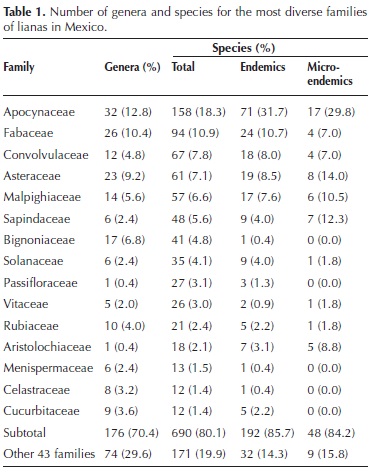
<body><![CDATA[<p align="justify"><font face="verdana" size="2"><b>Study area</b></font></p>  	    <p align="justify"><font face="verdana" size="2">Mexico has a land area of close to two million km<sup>2</sup>. The country has been subject to complex geological changes throughout its history (Ferrusqu&iacute;a&#150;Villafranca, 1993) that have caused the topography, with the exception of the Yucat&aacute;n peninsula, to be dominated by mountains. Rzedowski (1978) states that only 35 % of the country is below 500 m asl, while more than half is above 1,000 m altitude, with the highest peaks found along the length of the Trans&#150;Mexican Volcanic Belt, where the volcano Pico de Orizaba (Citlalt&eacute;petl) stands at 5,636 m elevation. Such a heterogeneous landscape, along with the position of the country astride the Tropic of Cancer, have produced a broad range of climates and vegetation types, including practically all of those that are recognized worldwide (Rzedowski 1978, 1991a). According to the K&ouml;ppen classification, the climates that affect the greatest territorial area are (Kottek <i>et al</i>., 2006): A (tropical wet, with the mean temperature in the coldest month greater than 18 &deg;C), B (dry, with a mean temperature in the coldest month greater or less than 18 &deg;C and a mean annual temperature between 18 and 22 &deg;C), C (temperate wet, with a mean temperature in the coldest month between &#150;3 and 18 &deg;C and in the hottest month greater than 10 &deg;C) and, in very reduced areas and high altitude locations of the volcanoes of central Mexico, E (cold, with a mean temperature in the hottest month less than 10 &deg;C). Rzedowski (1978) recognized four biogeographic regions (Pacific North American, Montane Mesoamerican, Xerophytic Mexican and Caribbean) that include 17 provinces. The number of recognized vegetation types range from ten (Rzedowski, 1978) to 32 (Miranda and Hern&aacute;ndez&#150;X., 1963). These publications describe the physiognomic characteristics and principal floristic components of these plant communities, as well as the climates and soil types in which they are found. In global terms, floristic affinities are more meridional than boreal, and, according to the fossil evidence, their origin goes back to at least the Cenozoic era, some 65 million years ago (Rzedowski, 1991a, b).</font></p>  	    <p>&nbsp;</p>  	    <p align="justify"><font face="verdana" size="2"><b>Materials and methods</b></font></p>  	    <p align="justify"><font face="verdana" size="2">There is no accurate definition by which to categorize liana species; however, they are generally described as climbing plants with woody stems that cannot remain upright autonomously once they have germinated in the soil (Gentry, 1991a; Bongers <i>et al</i>., 2002). Unfortunately, these basic attributes are not known for many species. For example, the designation of a plant as woody is not simple because this characteristic may be presented in individuals with very thin stems (<i>i.e</i>. &#8804; 1 mm diameter) or only toward the base of stems. This information is rarely included in floristic publications that report climber species or in their descriptions of herbarium specimens and is even often neglected in taxonomic descriptions. The need of information is even more acute for germination in the soil, which is the main characteristic by which to separate lianas from woody climbing hemiepiphytes because the latter only germinate on the trunks or branches of trees (Gentry, 1991a). Another aspect that is difficult to evaluate is whether the plants are erect or require support for growth because this can vary with the age of the plants or in different vegetation types. An example of this situation is <i>Salacia cordata</i> (Miers) Mennega (Celastraceae), which is a liana that we can found in the upper canopy in the tropical evergreen forest but when young, is as small erect tree that grows up to a height of 3 m in the Los Tuxtlas Tropical Biological Station in Veracruz. At this same site grows the liana <i>Celtis iguanaea</i> (Jacq.) Sarg. (Cannabaceae), which in the tropical deciduous forest of the Chamela&#150;Cuixmala region in Jalisco, can exhibit the liana habit or may grow as a shrub.</font></p>  	    <p align="justify"><font face="verdana" size="2">&#9;To assign a native species as liana (naturalized species were excluded), we considered: (1) the floristic&#150;taxonomic literature (<a href="/img/revistas/bs/v93n3/html/a2ap.html#ap1" target="_blank">Appendix 1</a>) and specimens that were deposited in herbaria (IEB, MEXU, MO, and XAL) where the species is described as a liana or woody climber, even if this condition is only presented towards the stem base, and (2) field observations in different parts of the country examining climbing species to evaluate the degree of woodiness (<a href="/img/revistas/bs/v93n3/a2f1.jpg" target="_blank">Figure 1</a>) and to collect specimens with flowers and/or fruits in order to identify correctly the species (<a href="/img/revistas/bs/v93n3/a2f2.jpg" target="_blank">Figure 2</a> and <a href="/img/revistas/bs/v93n3/a2f3.jpg" target="_blank">3</a>). Consequently, the list also includes: (i) species that exhibit a growth habit that is similar to that of the lianas but do not germinate in the soil (hemiepiphytes), (ii) those that have a highly lignified atactostele (monocots, members of the families Arecaceae and Smilacaceae) or (iii) scandent shrubs with climbing branches that are greater than 5 m in length. Therefore, one or more of the following three growth forms were assigned to the species (<a href="/img/revistas/bs/v93n3/html/a2ap.html#ap2" target="_blank">Appendix 2</a>): liana (including monocots), hemiepiphytes, and scandent shrubs. The identification of the specimens in the herbaria was verified by specialists or by the authors using monographs.</font></p>  	    <p align="justify"><font face="verdana" size="2">&#9;The altitude, vegetation type, and geographical distribution were obtained from the examined literature and herbarium specimens. Endemic species were those lianas only found in Mexico, whereas microendemics were identified such those species that are recorded in only one state of the country. Vegetation types and biomes were assigned according to the classifications of Rzedowski (1978) and Villase&ntilde;or and Ortiz (2014), respectively. In states with greater taxonomic richness, an analysis was conducted to determine whether the size of their territory could be a factor that explains this attribute. For this analysis, a weighted ratio was obtained between the number of families, genera, and species (total, endemics and microendemics) and the log10 of the area of each state. This value approaches the average richness of a given taxon in an area of 10 km2 (Rejm&aacute;nek, 1996). The authors of the species and the publication in which they were described were recorded from the consulted literature (<a href="/img/revistas/bs/v93n3/html/a2ap.html#ap1" target="_blank">Appendix 1</a>) and/or the database Tropicos (Tropicos, 2014).</font></p>  	    <p>&nbsp;</p>  	    <p align="justify"><font face="verdana" size="2"><b>Results</b></font></p>  	    <p align="justify"><font face="verdana" size="2"><i>Taxonomic richness</i>. Mexican native lianas are included in 59 families, 250 genera, and 861 species (<a href="/img/revistas/bs/v93n3/html/a2ap.html#ap2" target="_blank">Appendix 2</a>). Among the three growth form categories that were recognized in this study, the lianas were the most important (<i>n</i> = 789 species), followed by the scandent shrubs (<i>n</i> = 246) and the hemiepiphytes (<i>n</i> = 26). A total of 15 families contributed differentially to the taxonomic richness of lianas because account for 70.4 % of the genera, 80.1 % of the total number of species, 85.7 % of the endemics and 84.2 % of the microendemics (<a href="#t1">Table 1</a>). Apocynaceae dominated these four groups, followed by Fabaceae, except for the microendemic species, where second place was taken by Asteraceae. In contrast, 15 families were each represented by one species (<a href="/img/revistas/bs/v93n3/html/a2ap.html#ap2" target="_blank">Appendix 2</a>).</font></p>  	    ]]></body>
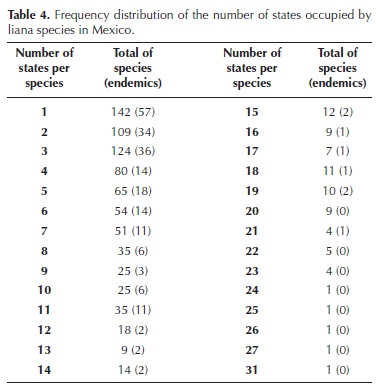
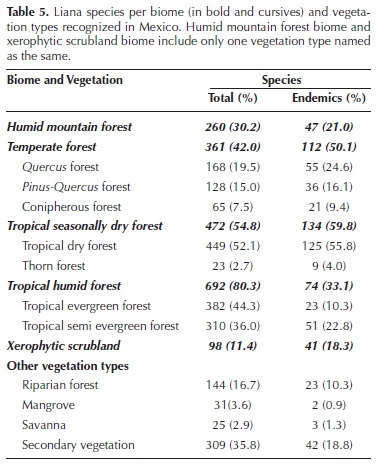
<body><![CDATA[<p align="center"><font face="verdana" size="2"><a name="t1"></a></font></p>  	    <p align="center"><font face="verdana" size="2"><img src="/img/revistas/bs/v93n3/a2t1.jpg"></font></p>  	    <p align="justify"><font face="verdana" size="2">&#9;The 18 genera with the greatest richness account for 38.1 % of the species (<a href="/img/revistas/bs/v93n3/a2t2.jpg" target="_blank">Table 2</a>), with slightly higher percentages of endemic and microendemic taxa (45.1 % and 50.9 %, respectively). The reduced dominance of the most speciose genera compared to that documented for the families occurs because approximately half of genera present only one species (<i>n</i> = 114). The genus with the greatest number of species (<i>n</i> = 43) is <i>Ipomoea</i> (Convolvulaceae), whereas <i>Serjania</i> (Sapindaceae) and <i>Passiflora</i> (Passifloraceae) have 33 and 27 species (<a href="/img/revistas/bs/v93n3/a2t2.jpg" target="_blank">Table 2</a>); the first place in the endemic species is <i>Marsdenia</i> (Apocynaceae), followed by <i>Ipomoea</i> and <i>Matelea</i> (Apocynaceae). Finally, standing out in terms of microendemic species are <i>Serjania</i> and <i>Aristolochia</i> (Aristolochiaceae), with six and five species, respectively.</font></p>  	    <p align="justify"><font face="verdana" size="2"><i>Geographic distribution</i>. A total of 25.9 % (<i>n</i> = 224) of the recorded species of lianas are endemic to Mexico, while only three genera (1.2 %) are included in this category (<i>Balsas</i> J.Jim&eacute;nez&#150;Ram. &amp; K.Vega, Sapindaceae; <i>Peponopsis</i> Naudin, Cucurbitaceae; and <i>Thoreauea</i> J.K. Williams, Apocynaceae). Of whole sample of Mexican lianas, 57 species were recorded as microendemic (<a href="/img/revistas/bs/v93n3/a2t3.jpg" target="_blank">Table 3</a>, <a href="/img/revistas/bs/v93n3/html/a2ap.html#ap2" target="_blank">Appendix 2</a>), including those that were assigned to two endemic genera (<i>Balsas guerrerensis</i> Cruz&#150;Dur&aacute;n &amp; K.Vega restricted to Guerrero, <i>Thoreaua aberrans</i> J.F. Morales to Veracruz, <i>T. guerrerensis</i> Diego &amp; Lozada&#150;P&eacute;rez to Guerrero and <i>T. paneroi</i> J.K. Williams to Oaxaca).</font></p>  	    <p align="justify"><font face="verdana" size="2">&#9;Chiapas is highlighted at the state level (<a href="/img/revistas/bs/v93n3/a2t3.jpg" target="_blank">Table 3</a>) because almost all of the families are recorded within its area (<i>n</i> = 57, 97 %), as well as 85.2 % (<i>n</i> = 213) of the genera, and 65.2 % (<i>n</i> = 562) of species. In these categories, Oaxaca presents very similar figures and therefore normally follows Chiapas in hierarchical order. In general, Veracruz occupies third place for these attributes of taxonomic richness, with the exception of the microendemic species, where second place is shared with Chiapas. Oaxaca encompass the greatest number of endemic species, with close to half of the total found in Mexico (<i>n</i> = 111), followed by Jalisco, Guerrero, and Michoac&aacute;n, the percentages of which range from 34.8 to 39.7 %. Unexpectedly, the differences in area among the seven states that were cited in this section did not affect the position they occupy in these comparisons of diversity because the ratio values between the richness of taxa and the log10 of the area of each state follow the same pattern as described above using the number of species (<a href="/img/revistas/bs/v93n3/a2t3.jpg" target="_blank">Table 3</a>).</font></p>  	    <p align="justify"><font face="verdana" size="2">&#9;The frequency with which the lianas have been recorded in the 32 states of Mexico indicate that 142 (16.5 %) and 109 (12.6 %) species are found in only one and two states, respectively (<a href="#t4">Table 4</a>). Of the total species, 60.3 % have been found in up to five states, and only 18 (2 %) exist in more than 20 states. The most widely distributed species are <i>Cardiospermum halicacabum</i> L. (Sapindaceae, <i>n</i> = 31 states), <i>Toxicodendron radicans</i> (L.) Kuntze (Anacardiaceae, <i>n</i> = 27), and <i>Canavalia villosa</i> Benth. (Fabaceae, <i>n</i> = 26). Restriction at state level is more noteworthy in the 224 endemic species because 40.6 % are found in one or two states, and 29 % (<i>n</i> = 65 species) do not occupy more than five states (<a href="#t4">Table 4</a>). The endemic lianas with the greatest geographic distribution are <i>Lonicera pilosa</i> (Kunth) Willd. ex Kunth (Caprifoliaceae; <i>n</i> = 21 states), followed by <i>Funastrum pannosum</i> Schltr. (Apocynaceae), and <i>Nissolia microptera</i> Poir. (Fabaceae), both found in 19 states.</font></p>  	    <p align="center"><font face="verdana" size="2"><a name="t4"></a></font></p>  	    <p align="center"><font face="verdana" size="2"><img src="/img/revistas/bs/v93n3/a2t4.jpg"></font></p>  	    <p align="justify"><font face="verdana" size="2"><i>Biomes, vegetation types and altitude</i>. The richness of lianas species is dissimilar among the five recognized biomes of Mexico (<a href="#t5">Table 5</a>) because the tropical humid forest clearly is the most important, hosting 692 species (80.3 %), followed by tropical seasonally dry forest, temperate forest, humid mountain forest and xerophytic scrubland. Regarding the endemic species, the position of the latter two biomes in terms of total species is not altered; however, the top two places are changed because the tropical seasonally dry forest becomes of highest importance (<i>n</i> = 134 species, 59.8 %), whereas second and third position was taken by temperate forest and tropical humid forest, respectively. The values of richness differ significantly among the biomes, both for the total number of species (<i>&#967;</i><sup>2</sup> = 531.16, d.f. 4, <i>P</i> = 0.001) and the number of endemic species (<i>&#967;</i><sup>2</sup> = 80.55, d.f. 4, <i>P</i> = 0.001).</font></p>  	    <p align="center"><font face="verdana" size="2"><a name="t5"></a></font></p>  	    ]]></body>
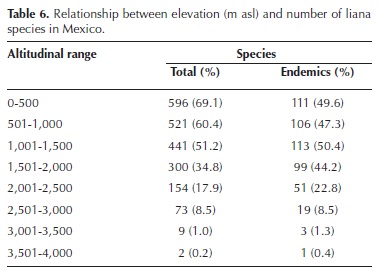
<body><![CDATA[<p align="center"><font face="verdana" size="2"><img src="/img/revistas/bs/v93n3/a2t5.jpg"></font></p>  	    <p align="justify"><font face="verdana" size="2">&#9;When species richness is evaluated by vegetation type, the tropical dry forest occupies first place, both for the total number of species (52.1 %) and for that of the endemic species (55.8 %); another similarity between both sets of species is the reduced importance of mangrove, savanna and thorn forest (<a href="#t5">Table 5</a>). Second place in terms of the total number of species is occupied by the tropical evergreen forest (44.3 %), while for the endemic species this position is held by the oak forest (24.6 %). The nine vegetation types also showed difference for all lianas species (<i>&#967;</i><sup>2</sup> = 836.92, d.f. 8, <i>P</i> = 0.001) and by their number of endemics (<i>&#967;</i><sup>2</sup> = 194.15, d.f. 8, <i>P</i> = 0.001).</font></p>  	    <p align="justify"><font face="verdana" size="2">&#9;Species of lianas are negatively correlated with altitude, with a higher concentration found at lower elevations (<a href="#t6">Table 6</a>), particularly below 1,500 m elevation, with a statistically significant correlation, both for the total number of species (<i>R</i>= &#150;0.98, <i>P</i> = 0.001) and for endemic species (<i>R</i> = &#150;0.904, <i>P</i> = 0.001).</font></p>  	    <p align="center"><font face="verdana" size="2"><a name="t6"></a></font></p>  	    <p align="center"><font face="verdana" size="2"><img src="/img/revistas/bs/v93n3/a2t6.jpg"></font></p>  	    <p>&nbsp;</p>  	    <p align="justify"><font face="verdana" size="2"><b>Discussion</b></font></p>  	    <p align="justify"><font face="verdana" size="2"><i>Taxonomic richness</i>. Fifteen families with the greatest taxonomic diversity include 81 % of the species (<a href="#t1">Table 1</a>). This figure differs from that documented by Gentry (1991a), who found that 26 families of the Neotropics contained 85 % of the species that exhibit a scandent habit. Likewise, there is no coincidence at the level of the entire Mexican flora because the most speciose 15 families include 55 % of the total species (Villase&ntilde;or, 2003). Families with more species for Mexico as documented by this last author and for the lianas in the present study indicate a marginal similarity because these groups only share Asteraceae, Fabaceae, Rubiaceae, and Solanaceae, although a subsequent modification of the data of Villase&ntilde;or (2003) by Ju&aacute;rez&#150;Jaimes <i>et al</i>. (2007) also incorporated Apocynaceae <i>s.l</i>. within the most diverse Mexican families (position 14). These data suggest that the specialization of climbers has centered in particular family lineages (<i>e.g</i>., Apocynaceae, Convolvulaceae, Malpighiaceae, or Passifloraceae). In addition, it is important to consider that in Apocynaceae and Malpighiaceae, the climbing habit is more frequent compared to other growth forms, such as the trees or shrubs (Ju&aacute;rez&#150;Jaimes <i>et al</i>., 2007; Anderson, 2013).</font></p>  	    <p align="justify"><font face="verdana" size="2">&#9;Considering that the 20 most diverse genera in Mexico include 15 % of the species (Villase&ntilde;or, 2004), our results are important given that the 18 more diverse liana genera comprise 38.1 % (<i>n</i> = 328) of the species (<a href="/img/revistas/bs/v93n3/a2t2.jpg" target="_blank">Table 2</a>), despite the fact that the proportion of liana genera with only one species is greater (50 %) than that of the entire flora (n = 988; 37 %). The role of <i>Ipomoea</i> is of the greatest importance, and it is no surprise that it is cited as the second most speciose genus among the Neotropical climbing plants (Gentry, 1991a). If the genera of <a href="#t1">Table 1</a> are compared with those of the entire Mexican flora (Villase&ntilde;or, 2004), only <i>Solanum</i> and <i>Ipomoea</i> are found, occupying the nineth and tenth positions, respectively.</font></p>  	    <p align="justify"><font face="verdana" size="2"><i>Geographic distribution</i>. For endemic liana genera, our results are comparable with those of Rzedowski (1991a), who calculated an endemism of &plusmn;1 %, which is much lower than that obtained for the entire Mexican flora (8 %) by Villase&ntilde;or (2004). However, the value of 25.9 % of endemism for liana species is practically half of the percentage that was recently obtained for the whole country (Villase&ntilde;or and Ortiz, 2014) but is much closer to that estimated by these authors for the climbers (38 %) or for the vines or woody climbers (15 %) by Rzedowski (1991a). The causes of this important value of endemism may be found in the role that plant communities (<i>e.g</i>., the tropical deciduous forest) or biomes (<i>e.g</i>., the tropical montane humid forest) have played as "ecological islands", as well as the influence of the climate and edaphic substrate in the life cycle and evolution of plants in Mexico (Rzedowski, 1991a, b).</font></p>  	    ]]></body>
<body><![CDATA[<p align="justify"><font face="verdana" size="2">&#9;Another aspect to highlight is that the families and genera that are most notable for their richness of lianas play similar roles in their contribution to endemic and microendemic species (<a href="#t1">Tables 1</a>, <a href="/img/revistas/bs/v93n3/a2t2.jpg" target="_blank">2</a>). The trend for families is explained, in part, by the fact that some of these families are among the most speciose in Mexico, while also presenting noteworthy levels of endemism (Rzedowski, 1991a; Villase&ntilde;or, 2003; Ju&aacute;rez&#150;Jaimes <i>et al</i>., 2007): Apocynaceae 47 %, Asteraceae 65.9&#150;66 %, Fabaceae 52&#150;60 %, and Rubiaceae 49 %. A similar explanation can be applied to <i>Ipomoea</i> because it is the tenth most diverse genus in the country (Villase&ntilde;or, 2004). An important point to note is the contribution of Apocynaceae, with six genera (<a href="/img/revistas/bs/v93n3/a2t2.jpg" target="_blank">Table 2</a>), which present a notable level of restriction within the Mexican territory (Ju&aacute;rez&#150;Jaimes <i>et al</i>., 2007): <i>Dictyanthus</i> (87 %), <i>Gonolobus</i> (49 %), <i>Mandevilla</i> (47 %), <i>Marsdenia</i> (53 %), <i>Matelea</i> (60 %), and <i>Metastelma</i> (52 %).</font></p>  	    <p align="justify"><font face="verdana" size="2">&#9;The richness, number of endemics and of the microendemic species that were detected among the lianas of Mexico indicate a very clear inequality among the Mexican states; this relationship is maintained for the seven most important states, regardless of their different sizes (<a href="/img/revistas/bs/v93n3/a2t3.jpg" target="_blank">Table 3</a>). One factor that explains these relationships, both for the total number of liana species and for the endemic species, is the proximity of the states (Ibarra&#150;Manr&iacute;quez <i>et al</i>., 2015). Consequently, the floristic importance at the national level of the states of Chiapas, Guerrero, Jalisco, Michoac&aacute;n, Oaxaca, and Veracruz is ratified by our results, which support similar conclusions by studies that were conducted on different groups of plants (<i>e.g</i>., Villase&ntilde;or <i>et al</i>., 1998; Espejo&#150;Serna <i>et al</i>., 2004a; Ju&aacute;rez&#150;Jaimes <i>et al</i>., 2007; Alc&aacute;ntar&#150;Mej&iacute;a <i>et al</i>., 2012) or the entire flora (Rzedowski, 1991a, b; Villase&ntilde;or, 2003; Villase&ntilde;or and Ortiz, 2014).</font></p>  	    <p align="justify"><font face="verdana" size="2">&#9;The lianas found in only one state (<a href="#t4">Table 4</a>) present much lower values for the total number of species (16.5 %) and endemic species (26 %) than those obtained by Villase&ntilde;or (2003) for the entire Mexican flora, with 33 % (<i>n</i> = 8,228 of 24,626 species), and 43 % (<i>n</i> = 5,566 of 12,900), respectively. However, a direct comparison cannot be made because the figures that were presented by this author include sub&#150;specific categories. In addition, as indicated by Villase&ntilde;or (2003), these results must be treated with caution as they may be affected by collection bias, thus highlighting the need for a future floristic study that is directed towards a more exact characterization of the geographic distribution of these rare species.</font></p>  	    <p align="justify"><font face="verdana" size="2"><i>Biomes, vegetation types and altitude</i>. At the level of biomes, the tropical forests have proved to be the most important for liana species, a global pattern that has been indicated in previous studies (Gentry, 1982, 1991a, b; Schnitzer and Bongers, 2002; Schnitzer, 2005). The role of the tropical humid forest is particularly remarkable for its number of species, while the tropical seasonally dry forest stands out for its endemics (<a href="#t5">Table 5</a>). Contrasting results are seen at the level of the entire flora of Mexico (Villase&ntilde;or and Ortiz, 2014) because the temperate forest has the greatest importance both at the level of total richness and of endemic species; in fact, in this latter group of taxa, the tropical humid forest is the least important. These data affirm the significance of conducting particular biogeographic studies for the different growth forms present in Mexico because some can present patterns that are discordant with those that are obtained for the entire flora.</font></p>  	    <p align="justify"><font face="verdana" size="2">&#9;In terms of the hosted liana species, the vegetation types that are recognized in Mexico are of uneven importance (<a href="#t5">Table 5</a>). In this sense, it is notable that first place for the total number of species and of endemic species is occupied by the tropical deciduous forest, ratifying the ecological and floristic importance of this vegetation type at the global (Olson and Dinerstein, 2002), continental (Lott and Atkinson, 2006) and national scales (<i>e.g</i>., Trejo and Dirzo, 2002; Cu&eacute;&#150;B&auml;r <i>et al</i>., 2006a, b; Ju&aacute;rez&#150;Jaimes <i>et al</i>., 2007; Rzedowski and Calder&oacute;n de Rzedowski, 2013). The importance of the oak forest for endemic liana species was not expected because this vegetation type had been considered important for other growth forms, especially herbaceous plants (<i>e.g</i>., Rzedowski, 1978).</font></p>  	    <p align="justify"><font face="verdana" size="2">&#9;However, our results agree with those of Gentry (1991a), Bhattarai and Vetaas (2003) and Jim&eacute;nez&#150;Castillo <i>et al</i>. (2007) in terms of the negative relationship between the richness of lianas and the altitude. Additional evidence is found in Jim&eacute;nez&#150;Castillo <i>et al</i>. (2007), who analyzed the data for the lianas in a gradient of tropical vegetation in Mexico and detected the same statistically significant trend. One factor that may explain this result is the sensitivity of lianas to temperatures below the freezing point, which affect their vascular system and impede an efficient transport of water from the root to the crown (Gentry, 1991b; Schnitzer and Bongers, 2002; Schnitzer, 2005). However, the sensitivity of lianas to this factor must be explored in greater detail because other factors that change with altitude could also affect these plants; for example, the total annual precipitation, the seasonality of precipitation or the relative humidity of the air. This last factor has a direct effect on the hydric balance of the plants and the energy availability (Schnitzer and Bongers, 2002; Schnitzer, 2005). Furthermore, it should be considered that lianas in Mexico are by no means scarce in temperate forests (<a href="#t5">Table 5</a>), justifying the future investigation of the influence of frost and other climatic factors on liana physiology and ecology.</font></p>  	    <p>&nbsp;</p>  	    <p align="justify"><font face="verdana" size="2"><b>Conclusions</b></font></p>  	    <p align="justify"><font face="verdana" size="2">Mexican lianas present patterns of diversity and distribution that must be considered when defining strategies that are directed toward their conservation. The coincidence in the richness, endemism and microendemic taxa at the state level is of particular value, highlighting the relevance of these attributes in the states of Chiapas, Oaxaca, Guerrero, Jalisco and Michoac&aacute;n (<a href="/img/revistas/bs/v93n3/a2t3.jpg" target="_blank">Table 3</a>), where the establishment of Protected Areas is a urgent priority; the same conclusion can be invoked if we analyze the patterns of richness and endemism for the whole flora (Villase&ntilde;or, 2003; Villase&ntilde;or and Ort&iacute;z, 2014). These reserves should have the consent of the different social and political stakeholders that are involved, as well as financial income to guarantee their long&#150;term functioning. From the results that were obtained for the lianas, it is clear that these reserves must include important areas of tropical and temperate forest within the vegetation types that are under protection, especially the tropical deciduous forest, tropical montane cloud forest and oak forest. The high beta diversity that is exhibited by lianas is concordant with that exhibited by the flora (Villase&ntilde;or, 2003; P&eacute;rez&#150;Garc&iacute;a <i>et al</i>., 2005; Trejo, 2005) and fauna (Rodr&iacute;guez <i>et al</i>., 2003; Flores&#150;Villela <i>et al</i>., 2005), and their complementarity should be considered during these conservation exercises, especially in terms of the endemic species.</font></p>  	    <p align="justify"><font face="verdana" size="2">&#9;The data from the present study indicate that lianas play a fundamental role in the taxonomic diversity of the flora of Mexico, which is one of the greatest worldwide. Botanical exploration is an important task that must still be completed, particularly for those biological groups underrepresented in plant inventories and collections mainly by the difficulties inherent in their biological form, such as lianas, in which many species represent microendemics, that are currently being discovered and named (<i>e.g</i>. Cuevas&#150;Guzm&aacute;n and N&uacute;&ntilde;ez&#150;L&oacute;pez, 2015; Linares, 2015). However, Ibarra&#150;Manr&iacute;quez <i>et al</i>. (2015) indicated that the conservation status of lianas in Mexico is of concern. For this reason, it is hoped that our contribution can promote the development of studies that further the knowledge of the biogeography, ecology and systematic of the lianas in this country, providing broader information with which to prioritize efforts to ensure the future conservation of lianas in the ecosystems that they occupy.</font></p>  	    ]]></body>
<body><![CDATA[<p>&nbsp;</p>  	    <p align="justify"><font face="verdana" size="2"><b>Acknowledgments</b></font></p>  	    <p align="justify"><font face="verdana" size="2">This study formed part of the postdoctoral research project of Pablo Carrillo&#150;Reyes "Diversity and biogeography of the Mexican lianas", from 2011&#150;2012, which was funded by the Consejo T&eacute;cnico de la Investigaci&oacute;n Cient&iacute;fica (oficio CJIC/CTIC/2318/2010) of the Universidad Nacional Aut&oacute;noma de M&eacute;xico (UNAM). Francisco Javier Rend&oacute;n&#150;Sandoval was a Master's student in the Posgrado de Ciencias Biol&oacute;gicas of UNAM, for which he gratefully received a grant from the Consejo Nacional de Ciencia y Tecnolog&iacute;a (CONACyT). Thanks to Heberto Ferreira Medina, Alberto Valencia Garc&iacute;a and Atzimba L&oacute;pez Maldonado for their support with data base and computer programs. Finally, we thank Jos&eacute; Luis Villase&ntilde;or R&iacute;os, Luis Enrique Eguiarte Frunz and an anonymous reviewer for important comments on the manuscript.</font></p>  	    <p>&nbsp;</p>  	    <p align="justify"><font face="verdana" size="2"><b>Literature cited</b></font></p>  	    <!-- ref --><p align="justify"><font face="verdana" size="2">Alc&aacute;ntar&#150;Mej&iacute;a J., Carranza&#150;Gonz&aacute;lez E., Cuevas&#150;Garc&iacute;a G. and Cuevas&#150;Garc&iacute;a E. 2012. Distribuci&oacute;n geogr&aacute;fica y ecol&oacute;gica de <i>Ipomoea</i> (Convolvulaceae) en el estado de Michoac&aacute;n, M&eacute;xico. <i>Revista Mexicana de Biodiversidad</i> <b>83</b>:731&#150;741.    &nbsp;&nbsp;&nbsp;&nbsp;&nbsp;&nbsp;&nbsp;&nbsp;[&#160;<a href="javascript:void(0);" onclick="javascript: window.open('/scielo.php?script=sci_nlinks&ref=1789943&pid=S2007-4298201500030000200001&lng=','','width=640,height=500,resizable=yes,scrollbars=1,menubar=yes,');">Links</a>&#160;]<!-- end-ref --></font></p>  	    <!-- ref --><p align="justify"><font face="verdana" size="2">Alvarado&#150;C&aacute;rdenas L.O. 2004. Apocynaceae. <i>Flora del Valle de Tehuac&aacute;n&#150;Cuicatl&aacute;n, Fasc&iacute;culo</i> <i>38</i>. Instituto de Biolog&iacute;a, Universidad Nacional Aut&oacute;noma de M&eacute;xico, M&eacute;xico.    &nbsp;&nbsp;&nbsp;&nbsp;&nbsp;&nbsp;&nbsp;&nbsp;[&#160;<a href="javascript:void(0);" onclick="javascript: window.open('/scielo.php?script=sci_nlinks&ref=1789945&pid=S2007-4298201500030000200002&lng=','','width=640,height=500,resizable=yes,scrollbars=1,menubar=yes,');">Links</a>&#160;]<!-- end-ref --></font></p>  	    <!-- ref --><p align="justify"><font face="verdana" size="2">Anderson W.R. 2013. Origins of Mexican Malpighiaceae. <i>Acta Botanica Mexicana</i> <b>104</b>:107&#150;156.    &nbsp;&nbsp;&nbsp;&nbsp;&nbsp;&nbsp;&nbsp;&nbsp;[&#160;<a href="javascript:void(0);" onclick="javascript: window.open('/scielo.php?script=sci_nlinks&ref=1789947&pid=S2007-4298201500030000200003&lng=','','width=640,height=500,resizable=yes,scrollbars=1,menubar=yes,');">Links</a>&#160;]<!-- end-ref --></font></p>  	    <!-- ref --><p align="justify"><font face="verdana" size="2">Bhattarai K.R. and Vetaas O.R. 2003. Variation in plant species richness of different life forms along a subtropical elevation gradient in the Himalayas, east Nepal. <i>Global Ecology and Biogeography</i> <b>12</b>:327&#150;340.    &nbsp;&nbsp;&nbsp;&nbsp;&nbsp;&nbsp;&nbsp;&nbsp;[&#160;<a href="javascript:void(0);" onclick="javascript: window.open('/scielo.php?script=sci_nlinks&ref=1789949&pid=S2007-4298201500030000200004&lng=','','width=640,height=500,resizable=yes,scrollbars=1,menubar=yes,');">Links</a>&#160;]<!-- end-ref --></font></p>  	    <p align="justify"><font face="verdana" size="2">Bongers F., Schnitzer S.A. and Traor&eacute; D. 2002. The importance of lianas and consequences for forest management in West Africa. <i>Bioterre, Revue International des Sciences de la Vie et de la Terre</i> <b>N&deg; sp&eacute;cial</b>:59&#150;70.</font></p>  	    <!-- ref --><p align="justify"><font face="verdana" size="2">Borhidi A. 2006. <i>Rubi&aacute;ceas de M&eacute;xico</i>. Academia de Ciencias de Hungr&iacute;a, Budapest.    &nbsp;&nbsp;&nbsp;&nbsp;&nbsp;&nbsp;&nbsp;&nbsp;[&#160;<a href="javascript:void(0);" onclick="javascript: window.open('/scielo.php?script=sci_nlinks&ref=1789952&pid=S2007-4298201500030000200005&lng=','','width=640,height=500,resizable=yes,scrollbars=1,menubar=yes,');">Links</a>&#160;]<!-- end-ref --></font></p>  	    <!-- ref --><p align="justify"><font face="verdana" size="2">Calder&oacute;n de Rzedowski G., Rzedowski J. and MacDougal J.M. 2004. Passifloraceae. <i>Flora del Baj&iacute;o y de Regiones Adyacentes Fasc&iacute;culo 121</i>. Instituto de Ecolog&iacute;a A.C., P&aacute;tzcuaro.    &nbsp;&nbsp;&nbsp;&nbsp;&nbsp;&nbsp;&nbsp;&nbsp;[&#160;<a href="javascript:void(0);" onclick="javascript: window.open('/scielo.php?script=sci_nlinks&ref=1789954&pid=S2007-4298201500030000200006&lng=','','width=640,height=500,resizable=yes,scrollbars=1,menubar=yes,');">Links</a>&#160;]<!-- end-ref --></font></p>  	    <!-- ref --><p align="justify"><font face="verdana" size="2">Cu&eacute;&#150;B&auml;r E.M., Villase&ntilde;or J.L., Arredondo&#150;Amezcua L., Cornejo&#150;Tenorio G. and Ibarra&#150;Manr&iacute;quez G. 2006a. La flora arb&oacute;rea de Michoac&aacute;n, M&eacute;xico. <i>Bolet&iacute;n de la Sociedad Bot&aacute;nica de M&eacute;xico</i> <b>78</b>:47&#150;81.    &nbsp;&nbsp;&nbsp;&nbsp;&nbsp;&nbsp;&nbsp;&nbsp;[&#160;<a href="javascript:void(0);" onclick="javascript: window.open('/scielo.php?script=sci_nlinks&ref=1789956&pid=S2007-4298201500030000200007&lng=','','width=640,height=500,resizable=yes,scrollbars=1,menubar=yes,');">Links</a>&#160;]<!-- end-ref --></font></p>  	    ]]></body>
<body><![CDATA[<!-- ref --><p align="justify"><font face="verdana" size="2">Cu&eacute;&#150;B&auml;r E.M., Villase&ntilde;or J.L., Morrone J.J., and Ibarra&#150;Manr&iacute;quez G. 2006b. Identifying priority areas for conservation in Mexican tropical deciduous forest based on tree species. <i>Interciencia</i> <b>31</b>:712&#150;719.    &nbsp;&nbsp;&nbsp;&nbsp;&nbsp;&nbsp;&nbsp;&nbsp;[&#160;<a href="javascript:void(0);" onclick="javascript: window.open('/scielo.php?script=sci_nlinks&ref=1789958&pid=S2007-4298201500030000200008&lng=','','width=640,height=500,resizable=yes,scrollbars=1,menubar=yes,');">Links</a>&#160;]<!-- end-ref --></font></p>  	    <!-- ref --><p align="justify"><font face="verdana" size="2">Cuevas&#150;Guzm&aacute;n R. and N&uacute;&ntilde;ez&#150;L&oacute;pez N.M. 2015. <i>Solanum edmundoi</i> (Solanaceae), una especie nueva de bejuco con aguijones del occidente de M&eacute;xico. <i>Revista Mexicana de Biodiversidad</i> <b>86</b>:293&#150;297.    &nbsp;&nbsp;&nbsp;&nbsp;&nbsp;&nbsp;&nbsp;&nbsp;[&#160;<a href="javascript:void(0);" onclick="javascript: window.open('/scielo.php?script=sci_nlinks&ref=1789960&pid=S2007-4298201500030000200009&lng=','','width=640,height=500,resizable=yes,scrollbars=1,menubar=yes,');">Links</a>&#160;]<!-- end-ref --></font></p>  	    <!-- ref --><p align="justify"><font face="verdana" size="2">Espejo&#150;Serna A., L&oacute;pez&#150;Ferrari A. R. and Salgado U.I. 2004a. A current estimate of Angiosperm diversity in Mexico. <i>Taxon</i> <b>53</b>:127&#150;130.    &nbsp;&nbsp;&nbsp;&nbsp;&nbsp;&nbsp;&nbsp;&nbsp;[&#160;<a href="javascript:void(0);" onclick="javascript: window.open('/scielo.php?script=sci_nlinks&ref=1789962&pid=S2007-4298201500030000200010&lng=','','width=640,height=500,resizable=yes,scrollbars=1,menubar=yes,');">Links</a>&#160;]<!-- end-ref --></font></p>  	    <!-- ref --><p align="justify"><font face="verdana" size="2">Espejo&#150;Serna A., L&oacute;pez&#150;Ferrari A.R., Ram&iacute;rez&#150;Morillo I., Holst B.K., Luther H.E. and Till W. 2004b. Checklist of Mexican Bromeliaceae with notes on species distribution and levels of endemism. <i>Selbyana</i> <b>25</b>:33&#150;86.    &nbsp;&nbsp;&nbsp;&nbsp;&nbsp;&nbsp;&nbsp;&nbsp;[&#160;<a href="javascript:void(0);" onclick="javascript: window.open('/scielo.php?script=sci_nlinks&ref=1789964&pid=S2007-4298201500030000200011&lng=','','width=640,height=500,resizable=yes,scrollbars=1,menubar=yes,');">Links</a>&#160;]<!-- end-ref --></font></p>  	    <!-- ref --><p align="justify"><font face="verdana" size="2">Ferrusqu&iacute;a&#150;Villafranca I. 1993. Geology of Mexico: a synopsis. In: Ramamoorthy T.P., Bye R., Lot A. and Fa J. Eds. <i>Biological Diversity of Mexico: Origins and Distribution</i>, pp. 3&#150;108, Oxford University Press, Oxford.    &nbsp;&nbsp;&nbsp;&nbsp;&nbsp;&nbsp;&nbsp;&nbsp;[&#160;<a href="javascript:void(0);" onclick="javascript: window.open('/scielo.php?script=sci_nlinks&ref=1789966&pid=S2007-4298201500030000200012&lng=','','width=640,height=500,resizable=yes,scrollbars=1,menubar=yes,');">Links</a>&#160;]<!-- end-ref --></font></p>  	    ]]></body>
<body><![CDATA[<!-- ref --><p align="justify"><font face="verdana" size="2">Flores&#150;Villela O., Ochoa&#150;Ochoa L. and Moreno C.E. 2005. Variaci&oacute;n latitudinal y longitudinal de la riqueza de especies y la diversidad beta de la herpetofauna mexicana. In: Halffter G., Sober&oacute;n J., Koleff P. and Melic A. Eds. <i>Sobre Diversidad Biol&oacute;gica:</i> <i>el Significado de las Diversidades Alfa, Beta y Gama</i>, pp. 143&#150;151, Monograf&iacute;as Tercer Milenio, vol. 4, Sociedad Entomol&oacute;gica Aragonesa, Comisi&oacute;n Nacional para el Conocimiento y Uso de la Biodiversidad, Grupo Diversitas&#150;M&eacute;xico y Consejo Nacional de Ciencia y Tecnolog&iacute;a, Zaragoza.    &nbsp;&nbsp;&nbsp;&nbsp;&nbsp;&nbsp;&nbsp;&nbsp;[&#160;<a href="javascript:void(0);" onclick="javascript: window.open('/scielo.php?script=sci_nlinks&ref=1789968&pid=S2007-4298201500030000200013&lng=','','width=640,height=500,resizable=yes,scrollbars=1,menubar=yes,');">Links</a>&#160;]<!-- end-ref --></font></p>  	    <!-- ref --><p align="justify"><font face="verdana" size="2">Gallagher R.V. and Leishman M.R. 2012. A global analysis of trait variation and evolution in climbing plants. <i>Journal of Biogeography</i> <b>39</b>:1757&#150;1771.    &nbsp;&nbsp;&nbsp;&nbsp;&nbsp;&nbsp;&nbsp;&nbsp;[&#160;<a href="javascript:void(0);" onclick="javascript: window.open('/scielo.php?script=sci_nlinks&ref=1789970&pid=S2007-4298201500030000200014&lng=','','width=640,height=500,resizable=yes,scrollbars=1,menubar=yes,');">Links</a>&#160;]<!-- end-ref --></font></p>  	    <!-- ref --><p align="justify"><font face="verdana" size="2">Gentry A.H. 1982. Patterns of Neotropical plant species diversity. <i>Evolutionary Biology</i> <b>15</b>:1&#150;84.    &nbsp;&nbsp;&nbsp;&nbsp;&nbsp;&nbsp;&nbsp;&nbsp;[&#160;<a href="javascript:void(0);" onclick="javascript: window.open('/scielo.php?script=sci_nlinks&ref=1789972&pid=S2007-4298201500030000200015&lng=','','width=640,height=500,resizable=yes,scrollbars=1,menubar=yes,');">Links</a>&#160;]<!-- end-ref --></font></p>  	    <!-- ref --><p align="justify"><font face="verdana" size="2">Gentry A.H. 1991a. The distribution and evolution of climbing plants. In: Putz F.E. and Mooney H.A. Eds. <i>The Biology of Vines</i>, pp. 3&#150;52, Cambridge University Press, Cambridge.    &nbsp;&nbsp;&nbsp;&nbsp;&nbsp;&nbsp;&nbsp;&nbsp;[&#160;<a href="javascript:void(0);" onclick="javascript: window.open('/scielo.php?script=sci_nlinks&ref=1789974&pid=S2007-4298201500030000200016&lng=','','width=640,height=500,resizable=yes,scrollbars=1,menubar=yes,');">Links</a>&#160;]<!-- end-ref --></font></p>  	    <!-- ref --><p align="justify"><font face="verdana" size="2">Gentry A.H. 1991b. Breeding and dispersal systems of lianas. In: Putz F.E. and Mooney H.A. Eds. <i>The Biology of Vines</i>, pp. 393&#150;423, Cambridge University Press, Cambridge.    &nbsp;&nbsp;&nbsp;&nbsp;&nbsp;&nbsp;&nbsp;&nbsp;[&#160;<a href="javascript:void(0);" onclick="javascript: window.open('/scielo.php?script=sci_nlinks&ref=1789976&pid=S2007-4298201500030000200017&lng=','','width=640,height=500,resizable=yes,scrollbars=1,menubar=yes,');">Links</a>&#160;]<!-- end-ref --></font></p>  	    ]]></body>
<body><![CDATA[<!-- ref --><p align="justify"><font face="verdana" size="2">Gentry A.H and Dodson C.H. 1987.Contribution of nontrees to species richness of a tropical rain forest. <i>Biotropica</i> <b>19</b>:149&#150;156.    &nbsp;&nbsp;&nbsp;&nbsp;&nbsp;&nbsp;&nbsp;&nbsp;[&#160;<a href="javascript:void(0);" onclick="javascript: window.open('/scielo.php?script=sci_nlinks&ref=1789978&pid=S2007-4298201500030000200018&lng=','','width=640,height=500,resizable=yes,scrollbars=1,menubar=yes,');">Links</a>&#160;]<!-- end-ref --></font></p>  	    <!-- ref --><p align="justify"><font face="verdana" size="2">Gonz&aacute;lez&#150;Espinosa M., Meave J.A., Lorea&#150;Hern&aacute;ndez F.G., Ibarra&#150;Manr&iacute;quez G. and Newton A.C. Eds. 2011. <i>The Red List of Mexican Cloud Forest Trees</i>. Fauna and Flora International, Cambridge.    &nbsp;&nbsp;&nbsp;&nbsp;&nbsp;&nbsp;&nbsp;&nbsp;[&#160;<a href="javascript:void(0);" onclick="javascript: window.open('/scielo.php?script=sci_nlinks&ref=1789980&pid=S2007-4298201500030000200019&lng=','','width=640,height=500,resizable=yes,scrollbars=1,menubar=yes,');">Links</a>&#160;]<!-- end-ref --></font></p>  	    <!-- ref --><p align="justify"><font face="verdana" size="2">H&aacute;gsater E., Soto&#150;Arenas M.A., Salazar&#150;Ch&aacute;vez G.A., Jim&eacute;nez&#150;Machorro R., L&oacute;pez&#150;Rosas M.A. and Dressler R.L. 2005. <i>Las Orqu&iacute;deas de M&eacute;xico</i>. Instituto Chino&iacute;n, M&eacute;xico D.F.    &nbsp;&nbsp;&nbsp;&nbsp;&nbsp;&nbsp;&nbsp;&nbsp;[&#160;<a href="javascript:void(0);" onclick="javascript: window.open('/scielo.php?script=sci_nlinks&ref=1789982&pid=S2007-4298201500030000200020&lng=','','width=640,height=500,resizable=yes,scrollbars=1,menubar=yes,');">Links</a>&#160;]<!-- end-ref --></font></p>  	    <!-- ref --><p align="justify"><font face="verdana" size="2">Ibarra&#150;Manr&iacute;quez G., Villase&ntilde;or J.L. and Dur&aacute;n R. 1995. Riqueza y endemismo del componente arb&oacute;reo de la Pen&iacute;nsula de Yucat&aacute;n, M&eacute;xico. <i>Bolet&iacute;n de la Sociedad Bot&aacute;nica de M&eacute;xico</i> <b>57</b>:49&#150;77.    &nbsp;&nbsp;&nbsp;&nbsp;&nbsp;&nbsp;&nbsp;&nbsp;[&#160;<a href="javascript:void(0);" onclick="javascript: window.open('/scielo.php?script=sci_nlinks&ref=1789984&pid=S2007-4298201500030000200021&lng=','','width=640,height=500,resizable=yes,scrollbars=1,menubar=yes,');">Links</a>&#160;]<!-- end-ref --></font></p>  	    <!-- ref --><p align="justify"><font face="verdana" size="2">Ibarra&#150;Manr&iacute;quez G. and Sinaca S. 1995. Lista flor&iacute;stica comentada de la Estaci&oacute;n de Biolog&iacute;a Tropical "Los Tuxtlas", Veracruz, M&eacute;xico. <i>Revista de Biolog&iacute;a Tropical</i> <b>43</b>:75&#150;115.    &nbsp;&nbsp;&nbsp;&nbsp;&nbsp;&nbsp;&nbsp;&nbsp;[&#160;<a href="javascript:void(0);" onclick="javascript: window.open('/scielo.php?script=sci_nlinks&ref=1789986&pid=S2007-4298201500030000200022&lng=','','width=640,height=500,resizable=yes,scrollbars=1,menubar=yes,');">Links</a>&#160;]<!-- end-ref --></font></p>  	    ]]></body>
<body><![CDATA[<!-- ref --><p align="justify"><font face="verdana" size="2">Ibarra&#150;Manr&iacute;quez G. and Sinaca S. 1996a. Estaci&oacute;n de Biolog&iacute;a Tropical "Los Tuxtlas", Veracruz, M&eacute;xico: lista flor&iacute;stica comentada (Mimosaceae a Verbenaceae). <i>Revista de Biolog&iacute;a Tropical</i> <b>44</b>:41&#150;60.    &nbsp;&nbsp;&nbsp;&nbsp;&nbsp;&nbsp;&nbsp;&nbsp;[&#160;<a href="javascript:void(0);" onclick="javascript: window.open('/scielo.php?script=sci_nlinks&ref=1789988&pid=S2007-4298201500030000200023&lng=','','width=640,height=500,resizable=yes,scrollbars=1,menubar=yes,');">Links</a>&#160;]<!-- end-ref --></font></p>  	    <!-- ref --><p align="justify"><font face="verdana" size="2">Ibarra&#150;Manr&iacute;quez G. and Sinaca S. 1996b. Estaci&oacute;n de Biolog&iacute;a Tropical "Los Tuxtlas", Veracruz, M&eacute;xico: lista flor&iacute;stica comentada (Violaceae a Zingiberaceae). <i>Revista de Biolog&iacute;a Tropical</i> <b>44</b>:427&#150;447.    &nbsp;&nbsp;&nbsp;&nbsp;&nbsp;&nbsp;&nbsp;&nbsp;[&#160;<a href="javascript:void(0);" onclick="javascript: window.open('/scielo.php?script=sci_nlinks&ref=1789990&pid=S2007-4298201500030000200024&lng=','','width=640,height=500,resizable=yes,scrollbars=1,menubar=yes,');">Links</a>&#160;]<!-- end-ref --></font></p>  	    <!-- ref --><p align="justify"><font face="verdana" size="2">Ibarra&#150;Manr&iacute;quez G., Carrillo&#150;Reyes P., Rend&oacute;n&#150;Sandoval F. J. and Cornejo&#150;Tenorio G. 2015. Diversity and distribution of lianas in Mexico. In: Schnitzer S.A., Bongers F., Burnham R.J. y Putz F. Eds. <i>The Ecology of Lianas</i>, pp. 93&#150;105. John Wiley &amp; Sons, LTD., Oxford.    &nbsp;&nbsp;&nbsp;&nbsp;&nbsp;&nbsp;&nbsp;&nbsp;[&#160;<a href="javascript:void(0);" onclick="javascript: window.open('/scielo.php?script=sci_nlinks&ref=1789992&pid=S2007-4298201500030000200025&lng=','','width=640,height=500,resizable=yes,scrollbars=1,menubar=yes,');">Links</a>&#160;]<!-- end-ref --></font></p>  	    <!-- ref --><p align="justify"><font face="verdana" size="2">Jim&eacute;nez&#150;Castillo M., Wiser S.K. and Lusk C.H. 2007. Elevational parallels of latitudinal variation in the proportion of lianas in woody floras. <i>Journal of Biogeography</i> <b>34</b>:163&#150;168.    &nbsp;&nbsp;&nbsp;&nbsp;&nbsp;&nbsp;&nbsp;&nbsp;[&#160;<a href="javascript:void(0);" onclick="javascript: window.open('/scielo.php?script=sci_nlinks&ref=1789994&pid=S2007-4298201500030000200026&lng=','','width=640,height=500,resizable=yes,scrollbars=1,menubar=yes,');">Links</a>&#160;]<!-- end-ref --></font></p>  	    <!-- ref --><p align="justify"><font face="verdana" size="2">Ju&aacute;rez&#150;Jaimes V. and Lozada L. 2003. Asclepiadaceae. <i>Flora del Valle de Tehuac&aacute;n&#150;Cuicatl&aacute;n, Fasc&iacute;culo 37</i>. Instituto de Biolog&iacute;a, Universidad Nacional Aut&oacute;noma de M&eacute;xico, M&eacute;xico.    &nbsp;&nbsp;&nbsp;&nbsp;&nbsp;&nbsp;&nbsp;&nbsp;[&#160;<a href="javascript:void(0);" onclick="javascript: window.open('/scielo.php?script=sci_nlinks&ref=1789996&pid=S2007-4298201500030000200027&lng=','','width=640,height=500,resizable=yes,scrollbars=1,menubar=yes,');">Links</a>&#160;]<!-- end-ref --></font></p>  	    ]]></body>
<body><![CDATA[<!-- ref --><p align="justify"><font face="verdana" size="2">Ju&aacute;rez&#150;Jaimes V., Alvarado&#150;C&aacute;rdenas L.O. and Villase&ntilde;or J.L. 2007. La familia Apocynaceae <i>sensu lato</i> en M&eacute;xico: diversidad y distribuci&oacute;n. <i>Revista Mexicana de Biodiversidad</i> <b>78</b>:459&#150;482.    &nbsp;&nbsp;&nbsp;&nbsp;&nbsp;&nbsp;&nbsp;&nbsp;[&#160;<a href="javascript:void(0);" onclick="javascript: window.open('/scielo.php?script=sci_nlinks&ref=1789998&pid=S2007-4298201500030000200028&lng=','','width=640,height=500,resizable=yes,scrollbars=1,menubar=yes,');">Links</a>&#160;]<!-- end-ref --></font></p>  	    <!-- ref --><p align="justify"><font face="verdana" size="2">Kottek M., Grieser J., Beck C., Rudolf B. and Rubel F. 2006. World Map of the K&ouml;ppen&#150;Geiger climate classification updated. <i>Meteorologische Zeitschrift</i> <b>15</b>:259&#150;263.    &nbsp;&nbsp;&nbsp;&nbsp;&nbsp;&nbsp;&nbsp;&nbsp;[&#160;<a href="javascript:void(0);" onclick="javascript: window.open('/scielo.php?script=sci_nlinks&ref=1790000&pid=S2007-4298201500030000200029&lng=','','width=640,height=500,resizable=yes,scrollbars=1,menubar=yes,');">Links</a>&#160;]<!-- end-ref --></font></p>  	    <!-- ref --><p align="justify"><font face="verdana" size="2">Letcher S.G. and Chazdon R.L. 2012. Life history traits of lianas during tropical forest succession. <i>Biotropica</i> <b>44</b>:720&#150;727.    &nbsp;&nbsp;&nbsp;&nbsp;&nbsp;&nbsp;&nbsp;&nbsp;[&#160;<a href="javascript:void(0);" onclick="javascript: window.open('/scielo.php?script=sci_nlinks&ref=1790002&pid=S2007-4298201500030000200030&lng=','','width=640,height=500,resizable=yes,scrollbars=1,menubar=yes,');">Links</a>&#160;]<!-- end-ref --></font></p>  	    <!-- ref --><p align="justify"><font face="verdana" size="2">Linares J.L. 2015. Nuevas especies de <i>Machaerium</i> (Leguminosae: Papilionoideae: Dalbergiae) en M&eacute;xico y Centroam&eacute;rica. <i>Journal of the Botanical Research Institute of Texas</i> <b>9</b>:49&#150;61.    &nbsp;&nbsp;&nbsp;&nbsp;&nbsp;&nbsp;&nbsp;&nbsp;[&#160;<a href="javascript:void(0);" onclick="javascript: window.open('/scielo.php?script=sci_nlinks&ref=1790004&pid=S2007-4298201500030000200031&lng=','','width=640,height=500,resizable=yes,scrollbars=1,menubar=yes,');">Links</a>&#160;]<!-- end-ref --></font></p>  	    <!-- ref --><p align="justify"><font face="verdana" size="2">Lott E.J. 2002. Lista anotada de las plantas vasculares de Chamela&#150;Cuixmala. In: Noguera F.A., Vega R.J.H, Garc&iacute;a&#150;Aldrete A.N. and Quesada&#150;Avenda&ntilde;o M. Eds. <i>Historia Natural de Chamela</i>, pp. 99&#150;136, Instituto de Biolog&iacute;a, Universidad Nacional Aut&oacute;noma de M&eacute;xico, M&eacute;xico D.F.    &nbsp;&nbsp;&nbsp;&nbsp;&nbsp;&nbsp;&nbsp;&nbsp;[&#160;<a href="javascript:void(0);" onclick="javascript: window.open('/scielo.php?script=sci_nlinks&ref=1790006&pid=S2007-4298201500030000200032&lng=','','width=640,height=500,resizable=yes,scrollbars=1,menubar=yes,');">Links</a>&#160;]<!-- end-ref --></font></p>  	    ]]></body>
<body><![CDATA[<!-- ref --><p align="justify"><font face="verdana" size="2">Lott E.J., Bullock S.H. and Sol&iacute;s&#150;Magallanes A.J. 1987. Floristic diversity and structure of upland and arroyo forest of coastal Jalisco. <i>Biotropica</i> <b>19</b>:228&#150;235.    &nbsp;&nbsp;&nbsp;&nbsp;&nbsp;&nbsp;&nbsp;&nbsp;[&#160;<a href="javascript:void(0);" onclick="javascript: window.open('/scielo.php?script=sci_nlinks&ref=1790008&pid=S2007-4298201500030000200033&lng=','','width=640,height=500,resizable=yes,scrollbars=1,menubar=yes,');">Links</a>&#160;]<!-- end-ref --></font></p>  	    <!-- ref --><p align="justify"><font face="verdana" size="2">Lott E.J. and Atkinson T.H. 2006. Mexican and Central American seasonally dry tropical forests: Chamela&#150;Cuixmala, Jalisco, as a focal point for comparison. In: Pennington T., Lewis G.P. and Ratter J.A. Eds. <i>Neotropical Savannas and Seasonally Dry Forests, Plant Diversity, Biogeography, and Conservation</i>, pp. 315&#150;342, The Systematics Association Special Volume Series 69. CRC Press, Taylor and Francis Group, Boca Raton.    &nbsp;&nbsp;&nbsp;&nbsp;&nbsp;&nbsp;&nbsp;&nbsp;[&#160;<a href="javascript:void(0);" onclick="javascript: window.open('/scielo.php?script=sci_nlinks&ref=1790010&pid=S2007-4298201500030000200034&lng=','','width=640,height=500,resizable=yes,scrollbars=1,menubar=yes,');">Links</a>&#160;]<!-- end-ref --></font></p>  	    <!-- ref --><p align="justify"><font face="verdana" size="2">Mart&iacute;nez&#150;Cruz J., M&eacute;ndez&#150;Toribio M., Cort&eacute;s&#150;Flores J., Coba&#150;P&eacute;rez P., Cornejo&#150;Tenorio G. and Ibarra&#150;Manr&iacute;quez G. 2013. Estructura y diversidad de los bosques estacionales desaparecidos por la construcci&oacute;n de la presa Gral. Francisco J. M&uacute;gica, en la Depresi&oacute;n del Balsas, Michoac&aacute;n, M&eacute;xico. <i>Revista Mexicana de Biodiversidad</i> <b>84</b>:1216&#150;1234.    &nbsp;&nbsp;&nbsp;&nbsp;&nbsp;&nbsp;&nbsp;&nbsp;[&#160;<a href="javascript:void(0);" onclick="javascript: window.open('/scielo.php?script=sci_nlinks&ref=1790012&pid=S2007-4298201500030000200035&lng=','','width=640,height=500,resizable=yes,scrollbars=1,menubar=yes,');">Links</a>&#160;]<!-- end-ref --></font></p>  	    <!-- ref --><p align="justify"><font face="verdana" size="2">Meave J.A., Romero&#150;Romero M.A., Valle&#150;Dom&eacute;nech A., Rinc&oacute;n&#150;Guti&eacute;rrez A., Mart&iacute;nez E. and Ramos C.H. 2008. Plant diversity assessment in the Yaxchil&aacute;n Natural Monument, Chiapas, Mexico. <i>Bolet&iacute;n de la Sociedad Bot&aacute;nica de M&eacute;xico</i> <b>83</b>:53&#150;76.    &nbsp;&nbsp;&nbsp;&nbsp;&nbsp;&nbsp;&nbsp;&nbsp;[&#160;<a href="javascript:void(0);" onclick="javascript: window.open('/scielo.php?script=sci_nlinks&ref=1790014&pid=S2007-4298201500030000200036&lng=','','width=640,height=500,resizable=yes,scrollbars=1,menubar=yes,');">Links</a>&#160;]<!-- end-ref --></font></p>  	    <!-- ref --><p align="justify"><font face="verdana" size="2">Miranda F. and Hern&aacute;ndez&#150;X. E. 1963. Los tipos de vegetaci&oacute;n de M&eacute;xico y su clasificaci&oacute;n. <i>Bolet&iacute;n de la Sociedad Bot&aacute;nica de M&eacute;xico</i> <b>28</b>:29&#150;179.    &nbsp;&nbsp;&nbsp;&nbsp;&nbsp;&nbsp;&nbsp;&nbsp;[&#160;<a href="javascript:void(0);" onclick="javascript: window.open('/scielo.php?script=sci_nlinks&ref=1790016&pid=S2007-4298201500030000200037&lng=','','width=640,height=500,resizable=yes,scrollbars=1,menubar=yes,');">Links</a>&#160;]<!-- end-ref --></font></p>  	    ]]></body>
<body><![CDATA[<!-- ref --><p align="justify"><font face="verdana" size="2">Olson D.M. and Dinerstein E. 2002. The global 200: priority ecoregions for global conservation. <i>Annals of the Missouri Botanical Garden</i> <b>89</b>:199&#150;224.    &nbsp;&nbsp;&nbsp;&nbsp;&nbsp;&nbsp;&nbsp;&nbsp;[&#160;<a href="javascript:void(0);" onclick="javascript: window.open('/scielo.php?script=sci_nlinks&ref=1790018&pid=S2007-4298201500030000200038&lng=','','width=640,height=500,resizable=yes,scrollbars=1,menubar=yes,');">Links</a>&#160;]<!-- end-ref --></font></p>  	    <!-- ref --><p align="justify"><font face="verdana" size="2">Ortega J.F. and Ortega R.V. 1997. Aristolochiaceae. <i>Flora de Veracruz, Fasc&iacute;culo 99</i>. Instituto de Ecolog&iacute;a A.C., Xalapa.    &nbsp;&nbsp;&nbsp;&nbsp;&nbsp;&nbsp;&nbsp;&nbsp;[&#160;<a href="javascript:void(0);" onclick="javascript: window.open('/scielo.php?script=sci_nlinks&ref=1790020&pid=S2007-4298201500030000200039&lng=','','width=640,height=500,resizable=yes,scrollbars=1,menubar=yes,');">Links</a>&#160;]<!-- end-ref --></font></p>  	    <!-- ref --><p align="justify"><font face="verdana" size="2">Padilla&#150;Velarde E., Cuevas&#150;Guzm&aacute;n R., Ibarra&#150;Manr&iacute;quez G. y Moreno&#150;G&oacute;mez S. 2006. Riqueza y biogeograf&iacute;a de la flora arb&oacute;rea del estado de Colima, M&eacute;xico. <i>Revista Mexicana de Biodiversidad</i> <b>77</b>:271&#150;295.    &nbsp;&nbsp;&nbsp;&nbsp;&nbsp;&nbsp;&nbsp;&nbsp;[&#160;<a href="javascript:void(0);" onclick="javascript: window.open('/scielo.php?script=sci_nlinks&ref=1790022&pid=S2007-4298201500030000200040&lng=','','width=640,height=500,resizable=yes,scrollbars=1,menubar=yes,');">Links</a>&#160;]<!-- end-ref --></font></p>  	    <!-- ref --><p align="justify"><font face="verdana" size="2">P&eacute;rez&#150;Cueto E. 1995. Menispermaceae. <i>Flora de Veracruz, Fasc&iacute;culo 87</i>. Instituto de Ecolog&iacute;a A.C., Xalapa.    &nbsp;&nbsp;&nbsp;&nbsp;&nbsp;&nbsp;&nbsp;&nbsp;[&#160;<a href="javascript:void(0);" onclick="javascript: window.open('/scielo.php?script=sci_nlinks&ref=1790024&pid=S2007-4298201500030000200041&lng=','','width=640,height=500,resizable=yes,scrollbars=1,menubar=yes,');">Links</a>&#160;]<!-- end-ref --></font></p>  	    <!-- ref --><p align="justify"><font face="verdana" size="2">P&eacute;rez&#150;Garc&iacute;a E.A., Meave J.A. and Gallardo&#150;Cruz J.A. 2005. Diversidad &#946; y diferenciaci&oacute;n flor&iacute;stica en un paisaje complejo del tr&oacute;pico estacionalmente seco del sur de M&eacute;xico. In: Halffter G., Sober&oacute;n J., Koleff P. and Melic A. Eds. <i>Sobre Diversidad Biol&oacute;gica: el Significado de las Diversidades Alfa, Beta y Gama</i>, pp. 123&#150;142, Monograf&iacute;as Tercer Milenio, vol. 4, Sociedad Entomol&oacute;gica Aragonesa, Comisi&oacute;n Nacional para el Conocimiento y Uso de la Biodiversidad, Grupo Diversitas&#150;M&eacute;xico y Consejo Nacional de Ciencia y Tecnolog&iacute;a, Zaragoza.    &nbsp;&nbsp;&nbsp;&nbsp;&nbsp;&nbsp;&nbsp;&nbsp;[&#160;<a href="javascript:void(0);" onclick="javascript: window.open('/scielo.php?script=sci_nlinks&ref=1790026&pid=S2007-4298201500030000200042&lng=','','width=640,height=500,resizable=yes,scrollbars=1,menubar=yes,');">Links</a>&#160;]<!-- end-ref --></font></p>  	    ]]></body>
<body><![CDATA[<!-- ref --><p align="justify"><font face="verdana" size="2">Pineda&#150;Garc&iacute;a F., Arredondo&#150;Amezcua L. and Ibarra&#150;Manr&iacute;quez G. 2007. Riqueza y diversidad de especies le&ntilde;osas del bosque tropical caducifolio de El Tarimo, Cuenca del Balsas, Guerrero. <i>Revista Mexicana de Biodiversidad</i> <b>78</b>:129&#150;139.    &nbsp;&nbsp;&nbsp;&nbsp;&nbsp;&nbsp;&nbsp;&nbsp;[&#160;<a href="javascript:void(0);" onclick="javascript: window.open('/scielo.php?script=sci_nlinks&ref=1790028&pid=S2007-4298201500030000200043&lng=','','width=640,height=500,resizable=yes,scrollbars=1,menubar=yes,');">Links</a>&#160;]<!-- end-ref --></font></p>  	    <!-- ref --><p align="justify"><font face="verdana" size="2">Rejm&aacute;nek M. 1996. Species richness and resistance to invasions. In: Orians G., Dirzo R. and Cushman J.H. Eds. <i>Biodiversity and</i> <i>Ecosystem Processes in Tropical Forests</i>, pp.153&#150;172, Springer&#150;Verlag, Berlin.    &nbsp;&nbsp;&nbsp;&nbsp;&nbsp;&nbsp;&nbsp;&nbsp;[&#160;<a href="javascript:void(0);" onclick="javascript: window.open('/scielo.php?script=sci_nlinks&ref=1790030&pid=S2007-4298201500030000200044&lng=','','width=640,height=500,resizable=yes,scrollbars=1,menubar=yes,');">Links</a>&#160;]<!-- end-ref --></font></p>  	    <!-- ref --><p align="justify"><font face="verdana" size="2">Ricker M., Hern&aacute;ndez H.M., Sousa M. and Ochoterena H. 2013. Tree and tree&#150;like species of Mexico: Asteraceae, Leguminosae and Rubiaceae. <i>Revista Mexicana de Biodiversidad</i> <b>84</b>:439&#150;470.    &nbsp;&nbsp;&nbsp;&nbsp;&nbsp;&nbsp;&nbsp;&nbsp;[&#160;<a href="javascript:void(0);" onclick="javascript: window.open('/scielo.php?script=sci_nlinks&ref=1790032&pid=S2007-4298201500030000200045&lng=','','width=640,height=500,resizable=yes,scrollbars=1,menubar=yes,');">Links</a>&#160;]<!-- end-ref --></font></p>  	    <!-- ref --><p align="justify"><font face="verdana" size="2">Rodr&iacute;guez P., Sober&oacute;n J. and Arita H.T. 2003. El componente beta de la diversidad de mam&iacute;feros de M&eacute;xico. <i>Acta Zoologica Mexicana</i> <b>89</b>:241&#150;259.    &nbsp;&nbsp;&nbsp;&nbsp;&nbsp;&nbsp;&nbsp;&nbsp;[&#160;<a href="javascript:void(0);" onclick="javascript: window.open('/scielo.php?script=sci_nlinks&ref=1790034&pid=S2007-4298201500030000200046&lng=','','width=640,height=500,resizable=yes,scrollbars=1,menubar=yes,');">Links</a>&#160;]<!-- end-ref --></font></p>  	    <!-- ref --><p align="justify"><font face="verdana" size="2">Rzedowski J. 1978. <i>Vegetaci&oacute;n de M&eacute;xico</i>. Ed. Limusa, M&eacute;xico D.F.    &nbsp;&nbsp;&nbsp;&nbsp;&nbsp;&nbsp;&nbsp;&nbsp;[&#160;<a href="javascript:void(0);" onclick="javascript: window.open('/scielo.php?script=sci_nlinks&ref=1790036&pid=S2007-4298201500030000200047&lng=','','width=640,height=500,resizable=yes,scrollbars=1,menubar=yes,');">Links</a>&#160;]<!-- end-ref --></font></p>  	    ]]></body>
<body><![CDATA[<!-- ref --><p align="justify"><font face="verdana" size="2">Rzedowski J. 1991a. Diversidad y or&iacute;genes de la flora fanerog&aacute;mica de M&eacute;xico. <i>Acta Botanica Mexicana</i> <b>14</b>:3&#150;21.    &nbsp;&nbsp;&nbsp;&nbsp;&nbsp;&nbsp;&nbsp;&nbsp;[&#160;<a href="javascript:void(0);" onclick="javascript: window.open('/scielo.php?script=sci_nlinks&ref=1790038&pid=S2007-4298201500030000200048&lng=','','width=640,height=500,resizable=yes,scrollbars=1,menubar=yes,');">Links</a>&#160;]<!-- end-ref --></font></p>  	    <!-- ref --><p align="justify"><font face="verdana" size="2">Rzedowski J. 1991b. El endemismo de la flora fanerog&aacute;mica de M&eacute;xico, una apreciaci&oacute;n anal&iacute;tica preliminar. <i>Acta Botanica Mexicana</i> <b>15</b>:47&#150;64.    &nbsp;&nbsp;&nbsp;&nbsp;&nbsp;&nbsp;&nbsp;&nbsp;[&#160;<a href="javascript:void(0);" onclick="javascript: window.open('/scielo.php?script=sci_nlinks&ref=1790040&pid=S2007-4298201500030000200049&lng=','','width=640,height=500,resizable=yes,scrollbars=1,menubar=yes,');">Links</a>&#160;]<!-- end-ref --></font></p>  	    <!-- ref --><p align="justify"><font face="verdana" size="2">Rzedowski J. and Calder&oacute;n de Rzedowski G. 1993. Bignoniaceae. <i>Flora del Baj&iacute;o y de Regiones Adyacentes, Fasc&iacute;culo 22</i>. Instituto de Ecolog&iacute;a A.C., P&aacute;tzcuaro.    &nbsp;&nbsp;&nbsp;&nbsp;&nbsp;&nbsp;&nbsp;&nbsp;[&#160;<a href="javascript:void(0);" onclick="javascript: window.open('/scielo.php?script=sci_nlinks&ref=1790042&pid=S2007-4298201500030000200050&lng=','','width=640,height=500,resizable=yes,scrollbars=1,menubar=yes,');">Links</a>&#160;]<!-- end-ref --></font></p>  	    <!-- ref --><p align="justify"><font face="verdana" size="2">Rzedowski J. and Calder&oacute;n de Rzedowski G. 2013. Datos para la apreciaci&oacute;n de la flora fanerog&aacute;mica del bosque tropical caducifolio de M&eacute;xico. <i>Acta Botanica Mexicana</i> <b>102</b>:1&#150;23.    &nbsp;&nbsp;&nbsp;&nbsp;&nbsp;&nbsp;&nbsp;&nbsp;[&#160;<a href="javascript:void(0);" onclick="javascript: window.open('/scielo.php?script=sci_nlinks&ref=1790044&pid=S2007-4298201500030000200051&lng=','','width=640,height=500,resizable=yes,scrollbars=1,menubar=yes,');">Links</a>&#160;]<!-- end-ref --></font></p>  	    <!-- ref --><p align="justify"><font face="verdana" size="2">Schnitzer S.A. 2005. A mechanistic explanation for global patterns of liana abundance and distribution. <i>American Naturalist</i> <b>166</b>:262&#150;276.    &nbsp;&nbsp;&nbsp;&nbsp;&nbsp;&nbsp;&nbsp;&nbsp;[&#160;<a href="javascript:void(0);" onclick="javascript: window.open('/scielo.php?script=sci_nlinks&ref=1790046&pid=S2007-4298201500030000200052&lng=','','width=640,height=500,resizable=yes,scrollbars=1,menubar=yes,');">Links</a>&#160;]<!-- end-ref --></font></p>  	    ]]></body>
<body><![CDATA[<!-- ref --><p align="justify"><font face="verdana" size="2">Schnitzer S.A. and Bongers F. 2002.The ecology of lianas and their role in forests. <i>Trends in Ecology and Evolution</i> <b>17</b>:223&#150;230.    &nbsp;&nbsp;&nbsp;&nbsp;&nbsp;&nbsp;&nbsp;&nbsp;[&#160;<a href="javascript:void(0);" onclick="javascript: window.open('/scielo.php?script=sci_nlinks&ref=1790048&pid=S2007-4298201500030000200053&lng=','','width=640,height=500,resizable=yes,scrollbars=1,menubar=yes,');">Links</a>&#160;]<!-- end-ref --></font></p>  	    <!-- ref --><p align="justify"><font face="verdana" size="2">Schnitzer S.A., Kuzee M.E. and Bongers F. 2005. Disentangling above&#150; and below&#150;ground competition between lianas and trees in tropical forest. <i>Journal of Ecology</i> <b>93</b>:1115&#150;1125.    &nbsp;&nbsp;&nbsp;&nbsp;&nbsp;&nbsp;&nbsp;&nbsp;[&#160;<a href="javascript:void(0);" onclick="javascript: window.open('/scielo.php?script=sci_nlinks&ref=1790050&pid=S2007-4298201500030000200054&lng=','','width=640,height=500,resizable=yes,scrollbars=1,menubar=yes,');">Links</a>&#160;]<!-- end-ref --></font></p>  	    <!-- ref --><p align="justify"><font face="verdana" size="2">Sol&oacute;rzano S., Ibarra&#150;Manr&iacute;quez G. and Oyama K. 2002. Liana diversity and reproductive attributes in two tropical forests in Mexico. <i>Biodiversity and Conservation</i> <b>11</b>:197&#150;212.    &nbsp;&nbsp;&nbsp;&nbsp;&nbsp;&nbsp;&nbsp;&nbsp;[&#160;<a href="javascript:void(0);" onclick="javascript: window.open('/scielo.php?script=sci_nlinks&ref=1790052&pid=S2007-4298201500030000200055&lng=','','width=640,height=500,resizable=yes,scrollbars=1,menubar=yes,');">Links</a>&#160;]<!-- end-ref --></font></p>  	    <!-- ref --><p align="justify"><font face="verdana" size="2">Soto&#150;Arenas M. A., H&aacute;gsater E., Jim&eacute;nez&#150;Machorro R. and Solano&#150;G&oacute;mez R. 2007. Orqu&iacute;deas de M&eacute;xico. Herbario AMO&#150;Instituto Chino&iacute;n, A.C. y Centro Interdisciplinario de Investigaci&oacute;n para el Desarrollo Integral Regional&#150;Unidad&#150;Oaxaca, Instituto Polit&eacute;cnico Nacional. Informe final SNIB&#150;CONABIO proyecto No. P107. M&eacute;xico D.F.    &nbsp;&nbsp;&nbsp;&nbsp;&nbsp;&nbsp;&nbsp;&nbsp;[&#160;<a href="javascript:void(0);" onclick="javascript: window.open('/scielo.php?script=sci_nlinks&ref=1790054&pid=S2007-4298201500030000200056&lng=','','width=640,height=500,resizable=yes,scrollbars=1,menubar=yes,');">Links</a>&#160;]<!-- end-ref --></font></p>  	    <!-- ref --><p align="justify"><font face="verdana" size="2">Trejo I. 2005. An&aacute;lisis de la diversidad de la selva baja caducifolia en M&eacute;xico. In: Halffter G., Sober&oacute;n J., Koleff P. and Melic A. Eds. <i>Sobre Diversidad Biol&oacute;gica: el Significado de las Diversidades Alfa, Beta y Gama</i>, pp. 111&#150;122, Monograf&iacute;as Tercer Milenio, vol. 4, Sociedad Entomol&oacute;gica Aragonesa, Comisi&oacute;n Nacional para el Conocimiento y Uso de la Biodiversidad, Grupo Diversitas&#150;M&eacute;xico y Consejo Nacional de Ciencia y Tecnolog&iacute;a, Zaragoza.    &nbsp;&nbsp;&nbsp;&nbsp;&nbsp;&nbsp;&nbsp;&nbsp;[&#160;<a href="javascript:void(0);" onclick="javascript: window.open('/scielo.php?script=sci_nlinks&ref=1790056&pid=S2007-4298201500030000200057&lng=','','width=640,height=500,resizable=yes,scrollbars=1,menubar=yes,');">Links</a>&#160;]<!-- end-ref --></font></p>  	    ]]></body>
<body><![CDATA[<!-- ref --><p align="justify"><font face="verdana" size="2">Trejo I. and Dirzo R. 2002. Floristic diversity of Mexican seasonally dry tropical forests. <i>Biodiversity and Conservation</i> <b>11</b>:2063&#150;2048.    &nbsp;&nbsp;&nbsp;&nbsp;&nbsp;&nbsp;&nbsp;&nbsp;[&#160;<a href="javascript:void(0);" onclick="javascript: window.open('/scielo.php?script=sci_nlinks&ref=1790058&pid=S2007-4298201500030000200058&lng=','','width=640,height=500,resizable=yes,scrollbars=1,menubar=yes,');">Links</a>&#160;]<!-- end-ref --></font></p>  	    <p align="justify"><font face="verdana" size="2">Tropicos. 2014. Tropicos.org. Missouri Botanical Garden. &lt;<a href="http://www.tropicos.org" target="_blank">http://www.tropicos.org</a>&gt; (4 Septiembre 2014).</font></p>  	    <!-- ref --><p align="justify"><font face="verdana" size="2">Villase&ntilde;or J.L. 2003. Diversidad y distribuci&oacute;n de las Magnoliophyta de M&eacute;xico. <i>Interciencia</i> <b>28</b>:160&#150;167.    &nbsp;&nbsp;&nbsp;&nbsp;&nbsp;&nbsp;&nbsp;&nbsp;[&#160;<a href="javascript:void(0);" onclick="javascript: window.open('/scielo.php?script=sci_nlinks&ref=1790061&pid=S2007-4298201500030000200059&lng=','','width=640,height=500,resizable=yes,scrollbars=1,menubar=yes,');">Links</a>&#160;]<!-- end-ref --></font></p>  	    <!-- ref --><p align="justify"><font face="verdana" size="2">Villase&ntilde;or J.L. 2004. Los g&eacute;neros de plantas vasculares de la flora de M&eacute;xico. <i>Bolet&iacute;n de la Sociedad Bot&aacute;nica de M&eacute;xico</i> <b>75</b>:105&#150;135.    &nbsp;&nbsp;&nbsp;&nbsp;&nbsp;&nbsp;&nbsp;&nbsp;[&#160;<a href="javascript:void(0);" onclick="javascript: window.open('/scielo.php?script=sci_nlinks&ref=1790063&pid=S2007-4298201500030000200060&lng=','','width=640,height=500,resizable=yes,scrollbars=1,menubar=yes,');">Links</a>&#160;]<!-- end-ref --></font></p>  	    <!-- ref --><p align="justify"><font face="verdana" size="2">Villase&ntilde;or J.L., Ibarra&#150;Manr&iacute;quez G. and Oca&ntilde;a D. 1998. Strategies for the conservation of Asteraceae in Mexico. <i>Conservation Biology</i> <b>12</b>:1066&#150;1075.    &nbsp;&nbsp;&nbsp;&nbsp;&nbsp;&nbsp;&nbsp;&nbsp;[&#160;<a href="javascript:void(0);" onclick="javascript: window.open('/scielo.php?script=sci_nlinks&ref=1790065&pid=S2007-4298201500030000200061&lng=','','width=640,height=500,resizable=yes,scrollbars=1,menubar=yes,');">Links</a>&#160;]<!-- end-ref --></font></p>  	    <!-- ref --><p align="justify"><font face="verdana" size="2">Villase&ntilde;or J.L. and Ortiz E. 2014. Biodiversidad de las plantas con flores (Divisi&oacute;n Magnoliophyta) en M&eacute;xico. <i>Revista Mexicana de Biodiversidad Supl.</i> <b>85</b>:S134&#150;S142.    &nbsp;&nbsp;&nbsp;&nbsp;&nbsp;&nbsp;&nbsp;&nbsp;[&#160;<a href="javascript:void(0);" onclick="javascript: window.open('/scielo.php?script=sci_nlinks&ref=1790067&pid=S2007-4298201500030000200062&lng=','','width=640,height=500,resizable=yes,scrollbars=1,menubar=yes,');">Links</a>&#160;]<!-- end-ref --></font></p>  	    <!-- ref --><p align="justify"><font face="verdana" size="2">Wyka T.P., Oleksyn J., Karolewski P. and Schnitzer S.A. 2013. Phenotypic correlates of the lianescent growth form: a review. <i>Annals of Botany</i> <b>112</b>:1667&#150;1681.    &nbsp;&nbsp;&nbsp;&nbsp;&nbsp;&nbsp;&nbsp;&nbsp;[&#160;<a href="javascript:void(0);" onclick="javascript: window.open('/scielo.php?script=sci_nlinks&ref=1790069&pid=S2007-4298201500030000200063&lng=','','width=640,height=500,resizable=yes,scrollbars=1,menubar=yes,');">Links</a>&#160;]<!-- end-ref --></font></p>      ]]></body><back>
<ref-list>
<ref id="B1">
<nlm-citation citation-type="journal">
<person-group person-group-type="author">
<name>
<surname><![CDATA[Alcántar-Mejía]]></surname>
<given-names><![CDATA[J.]]></given-names>
</name>
<name>
<surname><![CDATA[Carranza-González]]></surname>
<given-names><![CDATA[E.]]></given-names>
</name>
<name>
<surname><![CDATA[Cuevas-García]]></surname>
<given-names><![CDATA[G.]]></given-names>
</name>
<name>
<surname><![CDATA[Cuevas-García]]></surname>
<given-names><![CDATA[E.]]></given-names>
</name>
</person-group>
<article-title xml:lang="es"><![CDATA[Distribución geográfica y ecológica de Ipomoea (Convolvulaceae) en el estado de Michoacán, México]]></article-title>
<source><![CDATA[Revista Mexicana de Biodiversidad]]></source>
<year>2012</year>
<volume>83</volume>
<page-range>731-741</page-range></nlm-citation>
</ref>
<ref id="B2">
<nlm-citation citation-type="journal">
<person-group person-group-type="author">
<name>
<surname><![CDATA[Alvarado-Cárdenas]]></surname>
<given-names><![CDATA[L.O.]]></given-names>
</name>
</person-group>
<source><![CDATA[Flora del Valle de Tehuacán-CuicatlánApocynaceae]]></source>
<year>2004</year>
<numero>38</numero>
<issue>38</issue>
<publisher-loc><![CDATA[México ]]></publisher-loc>
<publisher-name><![CDATA[Instituto de Biología, Universidad Nacional Autónoma de México]]></publisher-name>
</nlm-citation>
</ref>
<ref id="B3">
<nlm-citation citation-type="journal">
<person-group person-group-type="author">
<name>
<surname><![CDATA[Anderson]]></surname>
<given-names><![CDATA[W.R.]]></given-names>
</name>
</person-group>
<article-title xml:lang="en"><![CDATA[Origins of Mexican Malpighiaceae]]></article-title>
<source><![CDATA[Acta Botanica Mexicana]]></source>
<year>2013</year>
<volume>104</volume>
<page-range>107-156</page-range></nlm-citation>
</ref>
<ref id="B4">
<nlm-citation citation-type="journal">
<person-group person-group-type="author">
<name>
<surname><![CDATA[Bhattarai]]></surname>
<given-names><![CDATA[K.R.]]></given-names>
</name>
<name>
<surname><![CDATA[Vetaas]]></surname>
<given-names><![CDATA[O.R.]]></given-names>
</name>
</person-group>
<article-title xml:lang="en"><![CDATA[Variation in plant species richness of different life forms along a subtropical elevation gradient in the Himalayas, east Nepal]]></article-title>
<source><![CDATA[Global Ecology and Biogeography]]></source>
<year>2003</year>
<volume>12</volume>
<page-range>327-340</page-range></nlm-citation>
</ref>
<ref id="B5">
<nlm-citation citation-type="book">
<person-group person-group-type="author">
<name>
<surname><![CDATA[Borhidi]]></surname>
<given-names><![CDATA[A.]]></given-names>
</name>
</person-group>
<source><![CDATA[Rubiáceas de México]]></source>
<year>2006</year>
<publisher-loc><![CDATA[Budapest ]]></publisher-loc>
<publisher-name><![CDATA[Academia de Ciencias de Hungría]]></publisher-name>
</nlm-citation>
</ref>
<ref id="B6">
<nlm-citation citation-type="journal">
<person-group person-group-type="author">
<name>
<surname><![CDATA[Calderón de Rzedowski]]></surname>
<given-names><![CDATA[G.]]></given-names>
</name>
<name>
<surname><![CDATA[Rzedowski]]></surname>
<given-names><![CDATA[J.]]></given-names>
</name>
<name>
<surname><![CDATA[MacDougal]]></surname>
<given-names><![CDATA[J.M.]]></given-names>
</name>
</person-group>
<article-title xml:lang="es"><![CDATA[Passifloraceae]]></article-title>
<source><![CDATA[Flora del Bajío y de Regiones Adyacentes]]></source>
<year>2004</year>
<numero>121</numero>
<issue>121</issue>
<publisher-loc><![CDATA[Pátzcuaro ]]></publisher-loc>
<publisher-name><![CDATA[Instituto de Ecología A.C.]]></publisher-name>
</nlm-citation>
</ref>
<ref id="B7">
<nlm-citation citation-type="journal">
<person-group person-group-type="author">
<name>
<surname><![CDATA[Cué-Bär]]></surname>
<given-names><![CDATA[E.M.]]></given-names>
</name>
<name>
<surname><![CDATA[Villaseñor]]></surname>
<given-names><![CDATA[J.L.]]></given-names>
</name>
<name>
<surname><![CDATA[Arredondo-Amezcua]]></surname>
<given-names><![CDATA[L.]]></given-names>
</name>
<name>
<surname><![CDATA[Cornejo-Tenorio]]></surname>
<given-names><![CDATA[G.]]></given-names>
</name>
<name>
<surname><![CDATA[Ibarra-Manríquez]]></surname>
<given-names><![CDATA[G.]]></given-names>
</name>
</person-group>
<article-title xml:lang="es"><![CDATA[La flora arbórea de Michoacán, México]]></article-title>
<source><![CDATA[Boletín de la Sociedad Botánica de México]]></source>
<year>2006</year>
<volume>78</volume>
<page-range>47-81</page-range></nlm-citation>
</ref>
<ref id="B8">
<nlm-citation citation-type="journal">
<person-group person-group-type="author">
<name>
<surname><![CDATA[Cué-Bär]]></surname>
<given-names><![CDATA[E.M.]]></given-names>
</name>
<name>
<surname><![CDATA[Villaseñor]]></surname>
<given-names><![CDATA[J.L.]]></given-names>
</name>
<name>
<surname><![CDATA[Morrone]]></surname>
<given-names><![CDATA[J.J.]]></given-names>
</name>
<name>
<surname><![CDATA[Ibarra-Manríquez]]></surname>
<given-names><![CDATA[G.]]></given-names>
</name>
</person-group>
<article-title xml:lang="en"><![CDATA[Identifying priority areas for conservation in Mexican tropical deciduous forest based on tree species]]></article-title>
<source><![CDATA[Interciencia]]></source>
<year>2006</year>
<volume>31</volume>
<page-range>712-719</page-range></nlm-citation>
</ref>
<ref id="B9">
<nlm-citation citation-type="journal">
<person-group person-group-type="author">
<name>
<surname><![CDATA[Cuevas-Guzmán]]></surname>
<given-names><![CDATA[R.]]></given-names>
</name>
<name>
<surname><![CDATA[Núñez-López]]></surname>
<given-names><![CDATA[N.M.]]></given-names>
</name>
</person-group>
<article-title xml:lang="es"><![CDATA[Solanum edmundoi (Solanaceae), una especie nueva de bejuco con aguijones del occidente de México]]></article-title>
<source><![CDATA[Revista Mexicana de Biodiversidad]]></source>
<year>2015</year>
<volume>86</volume>
<page-range>293-297</page-range></nlm-citation>
</ref>
<ref id="B10">
<nlm-citation citation-type="journal">
<person-group person-group-type="author">
<name>
<surname><![CDATA[Espejo-Serna]]></surname>
<given-names><![CDATA[A.]]></given-names>
</name>
<name>
<surname><![CDATA[López-Ferrari]]></surname>
<given-names><![CDATA[A. R.]]></given-names>
</name>
<name>
<surname><![CDATA[Salgado]]></surname>
<given-names><![CDATA[U.I.]]></given-names>
</name>
</person-group>
<article-title xml:lang="en"><![CDATA[A current estimate of Angiosperm diversity in Mexico]]></article-title>
<source><![CDATA[Taxon]]></source>
<year>2004</year>
<volume>53</volume>
<page-range>127-130</page-range></nlm-citation>
</ref>
<ref id="B11">
<nlm-citation citation-type="journal">
<person-group person-group-type="author">
<name>
<surname><![CDATA[Espejo-Serna]]></surname>
<given-names><![CDATA[A.]]></given-names>
</name>
<name>
<surname><![CDATA[López-Ferrari]]></surname>
<given-names><![CDATA[A.R.]]></given-names>
</name>
<name>
<surname><![CDATA[Ramírez-Morillo]]></surname>
<given-names><![CDATA[I.]]></given-names>
</name>
<name>
<surname><![CDATA[Holst]]></surname>
<given-names><![CDATA[B.K.]]></given-names>
</name>
<name>
<surname><![CDATA[Luther]]></surname>
<given-names><![CDATA[H.E.]]></given-names>
</name>
<name>
<surname><![CDATA[Till]]></surname>
<given-names><![CDATA[W.]]></given-names>
</name>
</person-group>
<article-title xml:lang="en"><![CDATA[Checklist of Mexican Bromeliaceae with notes on species distribution and levels of endemism]]></article-title>
<source><![CDATA[Selbyana]]></source>
<year>2004</year>
<volume>25</volume>
<page-range>33-86</page-range></nlm-citation>
</ref>
<ref id="B12">
<nlm-citation citation-type="book">
<person-group person-group-type="author">
<name>
<surname><![CDATA[Ferrusquía-Villafranca]]></surname>
<given-names><![CDATA[I.]]></given-names>
</name>
</person-group>
<article-title xml:lang="en"><![CDATA[Geology of Mexico: a synopsis]]></article-title>
<person-group person-group-type="editor">
<name>
<surname><![CDATA[Ramamoorthy]]></surname>
<given-names><![CDATA[T.P.]]></given-names>
</name>
<name>
<surname><![CDATA[Bye]]></surname>
<given-names><![CDATA[R.]]></given-names>
</name>
<name>
<surname><![CDATA[Lot]]></surname>
<given-names><![CDATA[A.]]></given-names>
</name>
<name>
<surname><![CDATA[Fa]]></surname>
<given-names><![CDATA[J.]]></given-names>
</name>
</person-group>
<source><![CDATA[Biological Diversity of Mexico: Origins and Distribution]]></source>
<year>1993</year>
<page-range>3-108</page-range><publisher-loc><![CDATA[Oxford ]]></publisher-loc>
<publisher-name><![CDATA[Oxford University Press]]></publisher-name>
</nlm-citation>
</ref>
<ref id="B13">
<nlm-citation citation-type="book">
<person-group person-group-type="author">
<name>
<surname><![CDATA[Flores-Villela]]></surname>
<given-names><![CDATA[O.]]></given-names>
</name>
<name>
<surname><![CDATA[Ochoa-Ochoa]]></surname>
<given-names><![CDATA[L.]]></given-names>
</name>
<name>
<surname><![CDATA[Moreno]]></surname>
<given-names><![CDATA[C.E.]]></given-names>
</name>
</person-group>
<article-title xml:lang="es"><![CDATA[Variación latitudinal y longitudinal de la riqueza de especies y la diversidad beta de la herpetofauna mexicana]]></article-title>
<person-group person-group-type="editor">
<name>
<surname><![CDATA[Halffter]]></surname>
<given-names><![CDATA[G.]]></given-names>
</name>
<name>
<surname><![CDATA[Soberón]]></surname>
<given-names><![CDATA[J.]]></given-names>
</name>
<name>
<surname><![CDATA[Koleff]]></surname>
<given-names><![CDATA[P.]]></given-names>
</name>
<name>
<surname><![CDATA[Melic]]></surname>
<given-names><![CDATA[A.]]></given-names>
</name>
</person-group>
<source><![CDATA[Sobre Diversidad Biológica: el Significado de las Diversidades Alfa, Beta y Gama]]></source>
<year>2005</year>
<page-range>143-151</page-range><publisher-loc><![CDATA[Zaragoza ]]></publisher-loc>
<publisher-name><![CDATA[Sociedad Entomológica AragonesaComisión Nacional para el Conocimiento y Uso de la BiodiversidadGrupo Diversitas-MéxicoConsejo Nacional de Ciencia y Tecnología]]></publisher-name>
</nlm-citation>
</ref>
<ref id="B14">
<nlm-citation citation-type="journal">
<person-group person-group-type="author">
<name>
<surname><![CDATA[Gallagher]]></surname>
<given-names><![CDATA[R.V.]]></given-names>
</name>
<name>
<surname><![CDATA[Leishman]]></surname>
<given-names><![CDATA[M.R.]]></given-names>
</name>
</person-group>
<article-title xml:lang="en"><![CDATA[A global analysis of trait variation and evolution in climbing plants]]></article-title>
<source><![CDATA[Journal of Biogeography]]></source>
<year>2012</year>
<volume>39</volume>
<page-range>1757-1771</page-range></nlm-citation>
</ref>
<ref id="B15">
<nlm-citation citation-type="journal">
<person-group person-group-type="author">
<name>
<surname><![CDATA[Gentry]]></surname>
<given-names><![CDATA[A.H.]]></given-names>
</name>
</person-group>
<article-title xml:lang="en"><![CDATA[Patterns of Neotropical plant species diversity]]></article-title>
<source><![CDATA[Evolutionary Biology]]></source>
<year>1982</year>
<volume>15</volume>
<page-range>1-84</page-range></nlm-citation>
</ref>
<ref id="B16">
<nlm-citation citation-type="book">
<person-group person-group-type="author">
<name>
<surname><![CDATA[Gentry]]></surname>
<given-names><![CDATA[A.H.]]></given-names>
</name>
</person-group>
<article-title xml:lang="en"><![CDATA[The distribution and evolution of climbing plants]]></article-title>
<person-group person-group-type="editor">
<name>
<surname><![CDATA[Putz]]></surname>
<given-names><![CDATA[F.E.]]></given-names>
</name>
<name>
<surname><![CDATA[Mooney]]></surname>
<given-names><![CDATA[H.A.]]></given-names>
</name>
</person-group>
<source><![CDATA[The Biology of Vines]]></source>
<year>1991</year>
<page-range>3-52</page-range><publisher-loc><![CDATA[Cambridge ]]></publisher-loc>
<publisher-name><![CDATA[Cambridge University Press]]></publisher-name>
</nlm-citation>
</ref>
<ref id="B17">
<nlm-citation citation-type="book">
<person-group person-group-type="author">
<name>
<surname><![CDATA[Gentry]]></surname>
<given-names><![CDATA[A.H.]]></given-names>
</name>
</person-group>
<article-title xml:lang="en"><![CDATA[Breeding and dispersal systems of lianas]]></article-title>
<person-group person-group-type="editor">
<name>
<surname><![CDATA[Putz]]></surname>
<given-names><![CDATA[F.E.]]></given-names>
</name>
<name>
<surname><![CDATA[Mooney]]></surname>
<given-names><![CDATA[H.A.]]></given-names>
</name>
</person-group>
<source><![CDATA[The Biology of Vines]]></source>
<year>1991</year>
<page-range>393-423</page-range><publisher-loc><![CDATA[Cambridge ]]></publisher-loc>
<publisher-name><![CDATA[Cambridge University Press]]></publisher-name>
</nlm-citation>
</ref>
<ref id="B18">
<nlm-citation citation-type="journal">
<person-group person-group-type="author">
<name>
<surname><![CDATA[Gentry]]></surname>
<given-names><![CDATA[A.H]]></given-names>
</name>
<name>
<surname><![CDATA[Dodson]]></surname>
<given-names><![CDATA[C.H.]]></given-names>
</name>
</person-group>
<article-title xml:lang="en"><![CDATA[Contribution of nontrees to species richness of a tropical rain forest]]></article-title>
<source><![CDATA[Biotropica]]></source>
<year>1987</year>
<volume>19</volume>
<page-range>149-156</page-range></nlm-citation>
</ref>
<ref id="B19">
<nlm-citation citation-type="book">
<person-group person-group-type="author">
<name>
<surname><![CDATA[González-Espinosa]]></surname>
<given-names><![CDATA[M.]]></given-names>
</name>
<name>
<surname><![CDATA[Meave]]></surname>
<given-names><![CDATA[J.A.]]></given-names>
</name>
<name>
<surname><![CDATA[Lorea-Hernández]]></surname>
<given-names><![CDATA[F.G.]]></given-names>
</name>
<name>
<surname><![CDATA[Ibarra-Manríquez]]></surname>
<given-names><![CDATA[G.]]></given-names>
</name>
<name>
<surname><![CDATA[Newton]]></surname>
<given-names><![CDATA[A.C.]]></given-names>
</name>
</person-group>
<source><![CDATA[The Red List of Mexican Cloud Forest Trees]]></source>
<year>2011</year>
<publisher-loc><![CDATA[Cambridge ]]></publisher-loc>
<publisher-name><![CDATA[Fauna and Flora International]]></publisher-name>
</nlm-citation>
</ref>
<ref id="B20">
<nlm-citation citation-type="book">
<person-group person-group-type="author">
<name>
<surname><![CDATA[Hágsater]]></surname>
<given-names><![CDATA[E.]]></given-names>
</name>
<name>
<surname><![CDATA[Soto-Arenas]]></surname>
<given-names><![CDATA[M.A.]]></given-names>
</name>
<name>
<surname><![CDATA[Salazar-Chávez]]></surname>
<given-names><![CDATA[G.A.]]></given-names>
</name>
<name>
<surname><![CDATA[Jiménez-Machorro]]></surname>
<given-names><![CDATA[R.]]></given-names>
</name>
<name>
<surname><![CDATA[López-Rosas]]></surname>
<given-names><![CDATA[M.A.]]></given-names>
</name>
<name>
<surname><![CDATA[Dressler]]></surname>
<given-names><![CDATA[R.L.]]></given-names>
</name>
</person-group>
<source><![CDATA[Las Orquídeas de México]]></source>
<year>2005</year>
<publisher-loc><![CDATA[México^eD.F. D.F.]]></publisher-loc>
<publisher-name><![CDATA[Instituto Chinoín]]></publisher-name>
</nlm-citation>
</ref>
<ref id="B21">
<nlm-citation citation-type="journal">
<person-group person-group-type="author">
<name>
<surname><![CDATA[Ibarra-Manríquez]]></surname>
<given-names><![CDATA[G.]]></given-names>
</name>
<name>
<surname><![CDATA[Villaseñor]]></surname>
<given-names><![CDATA[J.L.]]></given-names>
</name>
<name>
<surname><![CDATA[Durán]]></surname>
<given-names><![CDATA[R.]]></given-names>
</name>
</person-group>
<article-title xml:lang="es"><![CDATA[Riqueza y endemismo del componente arbóreo de la Península de Yucatán, México]]></article-title>
<source><![CDATA[Boletín de la Sociedad Botánica de México]]></source>
<year>1995</year>
<volume>57</volume>
<page-range>49-77</page-range></nlm-citation>
</ref>
<ref id="B22">
<nlm-citation citation-type="journal">
<person-group person-group-type="author">
<name>
<surname><![CDATA[Ibarra-Manríquez]]></surname>
<given-names><![CDATA[G.]]></given-names>
</name>
<name>
<surname><![CDATA[Sinaca]]></surname>
<given-names><![CDATA[S.]]></given-names>
</name>
</person-group>
<article-title xml:lang="es"><![CDATA[Lista florística comentada de la Estación de Biología Tropical "Los Tuxtlas", Veracruz, México]]></article-title>
<source><![CDATA[Revista de Biología Tropical]]></source>
<year>1995</year>
<volume>43</volume>
<page-range>75-115</page-range></nlm-citation>
</ref>
<ref id="B23">
<nlm-citation citation-type="journal">
<person-group person-group-type="author">
<name>
<surname><![CDATA[Ibarra-Manríquez]]></surname>
<given-names><![CDATA[G.]]></given-names>
</name>
<name>
<surname><![CDATA[Sinaca]]></surname>
<given-names><![CDATA[S.]]></given-names>
</name>
</person-group>
<article-title xml:lang="es"><![CDATA[Estación de Biología Tropical "Los Tuxtlas", Veracruz, México: lista florística comentada (Mimosaceae a Verbenaceae)]]></article-title>
<source><![CDATA[Revista de Biología Tropical]]></source>
<year>1996</year>
<volume>44</volume>
<page-range>41-60</page-range></nlm-citation>
</ref>
<ref id="B24">
<nlm-citation citation-type="journal">
<person-group person-group-type="author">
<name>
<surname><![CDATA[Ibarra-Manríquez]]></surname>
<given-names><![CDATA[G.]]></given-names>
</name>
<name>
<surname><![CDATA[Sinaca]]></surname>
<given-names><![CDATA[S.]]></given-names>
</name>
</person-group>
<article-title xml:lang="es"><![CDATA[Estación de Biología Tropical "Los Tuxtlas", Veracruz, México: lista florística comentada (Violaceae a Zingiberaceae)]]></article-title>
<source><![CDATA[Revista de Biología Tropical]]></source>
<year>1996</year>
<volume>44</volume>
<page-range>427-447</page-range></nlm-citation>
</ref>
<ref id="B25">
<nlm-citation citation-type="book">
<person-group person-group-type="author">
<name>
<surname><![CDATA[Ibarra-Manríquez]]></surname>
<given-names><![CDATA[G.]]></given-names>
</name>
<name>
<surname><![CDATA[Carrillo-Reyes]]></surname>
<given-names><![CDATA[P.]]></given-names>
</name>
<name>
<surname><![CDATA[Rendón-Sandoval]]></surname>
<given-names><![CDATA[F. J.]]></given-names>
</name>
<name>
<surname><![CDATA[Cornejo-Tenorio]]></surname>
<given-names><![CDATA[G.]]></given-names>
</name>
</person-group>
<article-title xml:lang="en"><![CDATA[Diversity and distribution of lianas in Mexico]]></article-title>
<person-group person-group-type="editor">
<name>
<surname><![CDATA[Schnitzer]]></surname>
<given-names><![CDATA[S.A.]]></given-names>
</name>
<name>
<surname><![CDATA[Bongers]]></surname>
<given-names><![CDATA[F.]]></given-names>
</name>
<name>
<surname><![CDATA[Burnham]]></surname>
<given-names><![CDATA[R.J.]]></given-names>
</name>
<name>
<surname><![CDATA[Putz]]></surname>
<given-names><![CDATA[F.]]></given-names>
</name>
</person-group>
<source><![CDATA[The Ecology of Lianas]]></source>
<year>2015</year>
<page-range>93-105</page-range><publisher-loc><![CDATA[Oxford ]]></publisher-loc>
<publisher-name><![CDATA[John Wiley & Sons]]></publisher-name>
</nlm-citation>
</ref>
<ref id="B26">
<nlm-citation citation-type="journal">
<person-group person-group-type="author">
<name>
<surname><![CDATA[Jiménez-Castillo]]></surname>
<given-names><![CDATA[M.]]></given-names>
</name>
<name>
<surname><![CDATA[Wiser]]></surname>
<given-names><![CDATA[S.K.]]></given-names>
</name>
<name>
<surname><![CDATA[Lusk]]></surname>
<given-names><![CDATA[C.H.]]></given-names>
</name>
</person-group>
<article-title xml:lang="en"><![CDATA[Elevational parallels of latitudinal variation in the proportion of lianas in woody floras]]></article-title>
<source><![CDATA[Journal of Biogeography]]></source>
<year>2007</year>
<volume>34</volume>
<page-range>163-168</page-range></nlm-citation>
</ref>
<ref id="B27">
<nlm-citation citation-type="journal">
<person-group person-group-type="author">
<name>
<surname><![CDATA[Juárez-Jaimes]]></surname>
<given-names><![CDATA[V.]]></given-names>
</name>
<name>
<surname><![CDATA[Lozada]]></surname>
<given-names><![CDATA[L.]]></given-names>
</name>
</person-group>
<article-title xml:lang="es"><![CDATA[Asclepiadaceae]]></article-title>
<source><![CDATA[Flora del Valle de Tehuacán-Cuicatlán]]></source>
<year>2003</year>
<numero>37</numero>
<issue>37</issue>
<publisher-loc><![CDATA[México ]]></publisher-loc>
<publisher-name><![CDATA[Instituto de Biología, Universidad Nacional Autónoma de México]]></publisher-name>
</nlm-citation>
</ref>
<ref id="B28">
<nlm-citation citation-type="journal">
<person-group person-group-type="author">
<name>
<surname><![CDATA[Juárez-Jaimes]]></surname>
<given-names><![CDATA[V.]]></given-names>
</name>
<name>
<surname><![CDATA[Alvarado-Cárdenas]]></surname>
<given-names><![CDATA[L.O.]]></given-names>
</name>
<name>
<surname><![CDATA[Villaseñor]]></surname>
<given-names><![CDATA[J.L.]]></given-names>
</name>
</person-group>
<article-title xml:lang="es"><![CDATA[La familia Apocynaceae sensu lato en México: diversidad y distribución]]></article-title>
<source><![CDATA[Revista Mexicana de Biodiversidad]]></source>
<year>2007</year>
<volume>78</volume>
<page-range>459-482</page-range></nlm-citation>
</ref>
<ref id="B29">
<nlm-citation citation-type="journal">
<person-group person-group-type="author">
<name>
<surname><![CDATA[Kottek]]></surname>
<given-names><![CDATA[M.]]></given-names>
</name>
<name>
<surname><![CDATA[Grieser]]></surname>
<given-names><![CDATA[J.]]></given-names>
</name>
<name>
<surname><![CDATA[Beck]]></surname>
<given-names><![CDATA[C.]]></given-names>
</name>
<name>
<surname><![CDATA[Rudolf]]></surname>
<given-names><![CDATA[B.]]></given-names>
</name>
<name>
<surname><![CDATA[Rubel]]></surname>
<given-names><![CDATA[F.]]></given-names>
</name>
</person-group>
<article-title xml:lang="en"><![CDATA[World Map of the Köppen-Geiger climate classification updated]]></article-title>
<source><![CDATA[Meteorologische Zeitschrift]]></source>
<year>2006</year>
<volume>15</volume>
<page-range>259-263</page-range></nlm-citation>
</ref>
<ref id="B30">
<nlm-citation citation-type="journal">
<person-group person-group-type="author">
<name>
<surname><![CDATA[Letcher]]></surname>
<given-names><![CDATA[S.G.]]></given-names>
</name>
<name>
<surname><![CDATA[Chazdon]]></surname>
<given-names><![CDATA[R.L.]]></given-names>
</name>
</person-group>
<article-title xml:lang="en"><![CDATA[Life history traits of lianas during tropical forest succession]]></article-title>
<source><![CDATA[Biotropica]]></source>
<year>2012</year>
<volume>44</volume>
<page-range>720-727</page-range></nlm-citation>
</ref>
<ref id="B31">
<nlm-citation citation-type="journal">
<person-group person-group-type="author">
<name>
<surname><![CDATA[Linares]]></surname>
<given-names><![CDATA[J.L.]]></given-names>
</name>
</person-group>
<article-title xml:lang="es"><![CDATA[Nuevas especies de Machaerium (Leguminosae: Papilionoideae: Dalbergiae) en México y Centroamérica]]></article-title>
<source><![CDATA[Journal of the Botanical Research Institute of Texas]]></source>
<year>2015</year>
<volume>9</volume>
<page-range>49-61</page-range></nlm-citation>
</ref>
<ref id="B32">
<nlm-citation citation-type="book">
<person-group person-group-type="author">
<name>
<surname><![CDATA[Lott]]></surname>
<given-names><![CDATA[E.J.]]></given-names>
</name>
</person-group>
<article-title xml:lang="es"><![CDATA[Lista anotada de las plantas vasculares de Chamela-Cuixmala]]></article-title>
<person-group person-group-type="editor">
<name>
<surname><![CDATA[Noguera]]></surname>
<given-names><![CDATA[F.A.]]></given-names>
</name>
<name>
<surname><![CDATA[Vega]]></surname>
<given-names><![CDATA[R.J.H]]></given-names>
</name>
<name>
<surname><![CDATA[García-Aldrete]]></surname>
<given-names><![CDATA[A.N.]]></given-names>
</name>
<name>
<surname><![CDATA[Quesada-Avendaño]]></surname>
<given-names><![CDATA[M.]]></given-names>
</name>
</person-group>
<source><![CDATA[Historia Natural de Chamela]]></source>
<year>2002</year>
<page-range>99-136</page-range><publisher-loc><![CDATA[México^eD.F. D.F.]]></publisher-loc>
<publisher-name><![CDATA[Instituto de Biología, Universidad Nacional Autónoma de México]]></publisher-name>
</nlm-citation>
</ref>
<ref id="B33">
<nlm-citation citation-type="journal">
<person-group person-group-type="author">
<name>
<surname><![CDATA[Lott]]></surname>
<given-names><![CDATA[E.J.]]></given-names>
</name>
<name>
<surname><![CDATA[Bullock]]></surname>
<given-names><![CDATA[S.H.]]></given-names>
</name>
<name>
<surname><![CDATA[Solís-Magallanes]]></surname>
<given-names><![CDATA[A.J.]]></given-names>
</name>
</person-group>
<article-title xml:lang="en"><![CDATA[Floristic diversity and structure of upland and arroyo forest of coastal Jalisco]]></article-title>
<source><![CDATA[Biotropica]]></source>
<year>1987</year>
<volume>19</volume>
<page-range>228-235</page-range></nlm-citation>
</ref>
<ref id="B34">
<nlm-citation citation-type="book">
<person-group person-group-type="author">
<name>
<surname><![CDATA[Lott]]></surname>
<given-names><![CDATA[E.J.]]></given-names>
</name>
<name>
<surname><![CDATA[Atkinson]]></surname>
<given-names><![CDATA[T.H.]]></given-names>
</name>
</person-group>
<article-title xml:lang="en"><![CDATA[Mexican and Central American seasonally dry tropical forests: Chamela-Cuixmala, Jalisco, as a focal point for comparison]]></article-title>
<person-group person-group-type="editor">
<name>
<surname><![CDATA[Pennington]]></surname>
<given-names><![CDATA[T.]]></given-names>
</name>
<name>
<surname><![CDATA[Lewis]]></surname>
<given-names><![CDATA[G.P.]]></given-names>
</name>
<name>
<surname><![CDATA[Ratter]]></surname>
<given-names><![CDATA[J.A.]]></given-names>
</name>
</person-group>
<source><![CDATA[Neotropical Savannas and Seasonally Dry Forests, Plant Diversity, Biogeography, and Conservation]]></source>
<year>2006</year>
<page-range>315-342</page-range><publisher-loc><![CDATA[Boca Raton ]]></publisher-loc>
<publisher-name><![CDATA[CRC PressTaylor and Francis Group]]></publisher-name>
</nlm-citation>
</ref>
<ref id="B35">
<nlm-citation citation-type="journal">
<person-group person-group-type="author">
<name>
<surname><![CDATA[Martínez-Cruz]]></surname>
<given-names><![CDATA[J.]]></given-names>
</name>
<name>
<surname><![CDATA[Méndez-Toribio]]></surname>
<given-names><![CDATA[M.]]></given-names>
</name>
<name>
<surname><![CDATA[Cortés-Flores]]></surname>
<given-names><![CDATA[J.]]></given-names>
</name>
<name>
<surname><![CDATA[Coba-Pérez]]></surname>
<given-names><![CDATA[P.]]></given-names>
</name>
<name>
<surname><![CDATA[Cornejo-Tenorio]]></surname>
<given-names><![CDATA[G.]]></given-names>
</name>
<name>
<surname><![CDATA[Ibarra-Manríquez]]></surname>
<given-names><![CDATA[G.]]></given-names>
</name>
</person-group>
<article-title xml:lang="es"><![CDATA[Estructura y diversidad de los bosques estacionales desaparecidos por la construcción de la presa Gral. Francisco J. Múgica, en la Depresión del Balsas, Michoacán, México]]></article-title>
<source><![CDATA[Revista Mexicana de Biodiversidad]]></source>
<year>2013</year>
<volume>84</volume>
<page-range>1216-1234</page-range></nlm-citation>
</ref>
<ref id="B36">
<nlm-citation citation-type="journal">
<person-group person-group-type="author">
<name>
<surname><![CDATA[Meave]]></surname>
<given-names><![CDATA[J.A.]]></given-names>
</name>
<name>
<surname><![CDATA[Romero-Romero]]></surname>
<given-names><![CDATA[M.A.]]></given-names>
</name>
<name>
<surname><![CDATA[Valle-Doménech]]></surname>
<given-names><![CDATA[A.]]></given-names>
</name>
<name>
<surname><![CDATA[Rincón-Gutiérrez]]></surname>
<given-names><![CDATA[A.]]></given-names>
</name>
<name>
<surname><![CDATA[Martínez]]></surname>
<given-names><![CDATA[E.]]></given-names>
</name>
<name>
<surname><![CDATA[Ramos]]></surname>
<given-names><![CDATA[C.H.]]></given-names>
</name>
</person-group>
<article-title xml:lang="en"><![CDATA[Plant diversity assessment in the Yaxchilán Natural Monument, Chiapas, Mexico]]></article-title>
<source><![CDATA[Boletín de la Sociedad Botánica de México]]></source>
<year>2008</year>
<volume>83</volume>
<page-range>53-76</page-range></nlm-citation>
</ref>
<ref id="B37">
<nlm-citation citation-type="journal">
<person-group person-group-type="author">
<name>
<surname><![CDATA[Miranda]]></surname>
<given-names><![CDATA[F.]]></given-names>
</name>
<name>
<surname><![CDATA[Hernández-X.]]></surname>
<given-names><![CDATA[E.]]></given-names>
</name>
</person-group>
<article-title xml:lang="es"><![CDATA[Los tipos de vegetación de México y su clasificación]]></article-title>
<source><![CDATA[Boletín de la Sociedad Botánica de México]]></source>
<year>1963</year>
<volume>28</volume>
<page-range>29-179</page-range></nlm-citation>
</ref>
<ref id="B38">
<nlm-citation citation-type="journal">
<person-group person-group-type="author">
<name>
<surname><![CDATA[Olson]]></surname>
<given-names><![CDATA[D.M.]]></given-names>
</name>
<name>
<surname><![CDATA[Dinerstein]]></surname>
<given-names><![CDATA[E.]]></given-names>
</name>
</person-group>
<article-title xml:lang="en"><![CDATA[The global 200: priority ecoregions for global conservation]]></article-title>
<source><![CDATA[Annals of the Missouri Botanical Garden]]></source>
<year>2002</year>
<volume>89</volume>
<page-range>199-224</page-range></nlm-citation>
</ref>
<ref id="B39">
<nlm-citation citation-type="journal">
<person-group person-group-type="author">
<name>
<surname><![CDATA[Ortega]]></surname>
<given-names><![CDATA[J.F.]]></given-names>
</name>
<name>
<surname><![CDATA[Ortega]]></surname>
<given-names><![CDATA[R.V.]]></given-names>
</name>
</person-group>
<article-title xml:lang="es"><![CDATA[Aristolochiaceae]]></article-title>
<source><![CDATA[Flora de Veracruz]]></source>
<year>1997</year>
<numero>99</numero>
<issue>99</issue>
<publisher-loc><![CDATA[Xalapa ]]></publisher-loc>
<publisher-name><![CDATA[Instituto de Ecología A.C.]]></publisher-name>
</nlm-citation>
</ref>
<ref id="B40">
<nlm-citation citation-type="journal">
<person-group person-group-type="author">
<name>
<surname><![CDATA[Padilla-Velarde]]></surname>
<given-names><![CDATA[E.]]></given-names>
</name>
<name>
<surname><![CDATA[Cuevas-Guzmán]]></surname>
<given-names><![CDATA[R.]]></given-names>
</name>
<name>
<surname><![CDATA[Ibarra-Manríquez]]></surname>
<given-names><![CDATA[G.]]></given-names>
</name>
<name>
<surname><![CDATA[Moreno-Gómez]]></surname>
<given-names><![CDATA[S.]]></given-names>
</name>
</person-group>
<article-title xml:lang="es"><![CDATA[Riqueza y biogeografía de la flora arbórea del estado de Colima, México]]></article-title>
<source><![CDATA[Revista Mexicana de Biodiversidad]]></source>
<year>2006</year>
<volume>77</volume>
<page-range>271-295</page-range></nlm-citation>
</ref>
<ref id="B41">
<nlm-citation citation-type="journal">
<person-group person-group-type="author">
<name>
<surname><![CDATA[Pérez-Cueto]]></surname>
<given-names><![CDATA[E.]]></given-names>
</name>
</person-group>
<article-title xml:lang="es"><![CDATA[Menispermaceae]]></article-title>
<source><![CDATA[Flora de Veracruz]]></source>
<year>1995</year>
<numero>87</numero>
<issue>87</issue>
<publisher-loc><![CDATA[Xalapa ]]></publisher-loc>
<publisher-name><![CDATA[Instituto de Ecología A.C.]]></publisher-name>
</nlm-citation>
</ref>
<ref id="B42">
<nlm-citation citation-type="book">
<person-group person-group-type="author">
<name>
<surname><![CDATA[Pérez-García]]></surname>
<given-names><![CDATA[E.A.]]></given-names>
</name>
</person-group>
<person-group person-group-type="editor">
<name>
<surname><![CDATA[Halffter]]></surname>
<given-names><![CDATA[G.]]></given-names>
</name>
<name>
<surname><![CDATA[Soberón]]></surname>
<given-names><![CDATA[J.]]></given-names>
</name>
<name>
<surname><![CDATA[Koleff]]></surname>
<given-names><![CDATA[P.]]></given-names>
</name>
<name>
<surname><![CDATA[Melic]]></surname>
<given-names><![CDATA[A.]]></given-names>
</name>
</person-group>
<source><![CDATA[Sobre Diversidad Biológica: el Significado de las Diversidades Alfa, Beta y Gama]]></source>
<year></year>
<page-range>123-142</page-range><publisher-loc><![CDATA[Zaragoza ]]></publisher-loc>
<publisher-name><![CDATA[Sociedad Entomológica AragonesaComisión Nacional para el Conocimiento y Uso de la BiodiversidadGrupo Diversitas-MéxicoConsejo Nacional de Ciencia y Tecnología]]></publisher-name>
</nlm-citation>
</ref>
<ref id="B43">
<nlm-citation citation-type="journal">
<person-group person-group-type="author">
<name>
<surname><![CDATA[Pineda-García]]></surname>
<given-names><![CDATA[F.]]></given-names>
</name>
<name>
<surname><![CDATA[Arredondo-Amezcua]]></surname>
<given-names><![CDATA[L.]]></given-names>
</name>
<name>
<surname><![CDATA[Ibarra-Manríquez]]></surname>
<given-names><![CDATA[G.]]></given-names>
</name>
</person-group>
<article-title xml:lang="es"><![CDATA[Riqueza y diversidad de especies leñosas del bosque tropical caducifolio de El Tarimo, Cuenca del Balsas, Guerrero]]></article-title>
<source><![CDATA[Revista Mexicana de Biodiversidad]]></source>
<year>2007</year>
<volume>78</volume>
<page-range>129-139</page-range></nlm-citation>
</ref>
<ref id="B44">
<nlm-citation citation-type="book">
<person-group person-group-type="author">
<name>
<surname><![CDATA[Rejmánek]]></surname>
<given-names><![CDATA[M.]]></given-names>
</name>
</person-group>
<article-title xml:lang="en"><![CDATA[Species richness and resistance to invasions]]></article-title>
<person-group person-group-type="editor">
<name>
<surname><![CDATA[Orians]]></surname>
<given-names><![CDATA[G.]]></given-names>
</name>
<name>
<surname><![CDATA[Dirzo]]></surname>
<given-names><![CDATA[R.]]></given-names>
</name>
<name>
<surname><![CDATA[Cushman]]></surname>
<given-names><![CDATA[J.H.]]></given-names>
</name>
</person-group>
<source><![CDATA[Biodiversity and Ecosystem Processes in Tropical Forests]]></source>
<year>1996</year>
<page-range>153-172</page-range><publisher-loc><![CDATA[Berlin ]]></publisher-loc>
<publisher-name><![CDATA[Springer]]></publisher-name>
</nlm-citation>
</ref>
<ref id="B45">
<nlm-citation citation-type="journal">
<person-group person-group-type="author">
<name>
<surname><![CDATA[Ricker]]></surname>
<given-names><![CDATA[M.]]></given-names>
</name>
<name>
<surname><![CDATA[Hernández]]></surname>
<given-names><![CDATA[H.M.]]></given-names>
</name>
<name>
<surname><![CDATA[Sousa]]></surname>
<given-names><![CDATA[M.]]></given-names>
</name>
<name>
<surname><![CDATA[Ochoterena]]></surname>
<given-names><![CDATA[H.]]></given-names>
</name>
</person-group>
<article-title xml:lang="en"><![CDATA[Tree and tree-like species of Mexico: Asteraceae, Leguminosae and Rubiaceae]]></article-title>
<source><![CDATA[Revista Mexicana de Biodiversidad]]></source>
<year>2013</year>
<volume>84</volume>
<page-range>439-470</page-range></nlm-citation>
</ref>
<ref id="B46">
<nlm-citation citation-type="journal">
<person-group person-group-type="author">
<name>
<surname><![CDATA[Rodríguez]]></surname>
<given-names><![CDATA[P.]]></given-names>
</name>
<name>
<surname><![CDATA[Soberón]]></surname>
<given-names><![CDATA[J.]]></given-names>
</name>
<name>
<surname><![CDATA[Arita]]></surname>
<given-names><![CDATA[H.T.]]></given-names>
</name>
</person-group>
<article-title xml:lang="es"><![CDATA[El componente beta de la diversidad de mamíferos de México]]></article-title>
<source><![CDATA[Acta Zoologica Mexicana]]></source>
<year>2003</year>
<volume>89</volume>
<page-range>241-259</page-range></nlm-citation>
</ref>
<ref id="B47">
<nlm-citation citation-type="book">
<person-group person-group-type="author">
<name>
<surname><![CDATA[Rzedowski]]></surname>
<given-names><![CDATA[J.]]></given-names>
</name>
</person-group>
<source><![CDATA[Vegetación de México]]></source>
<year>1978</year>
<publisher-loc><![CDATA[México^eD.F. D.F.]]></publisher-loc>
<publisher-name><![CDATA[Limusa]]></publisher-name>
</nlm-citation>
</ref>
<ref id="B48">
<nlm-citation citation-type="journal">
<person-group person-group-type="author">
<name>
<surname><![CDATA[Rzedowski]]></surname>
<given-names><![CDATA[J.]]></given-names>
</name>
</person-group>
<article-title xml:lang="es"><![CDATA[Diversidad y orígenes de la flora fanerogámica de México]]></article-title>
<source><![CDATA[Acta Botanica Mexicana]]></source>
<year>1991</year>
<volume>14</volume>
<page-range>3-21</page-range></nlm-citation>
</ref>
<ref id="B49">
<nlm-citation citation-type="journal">
<person-group person-group-type="author">
<name>
<surname><![CDATA[Rzedowski]]></surname>
<given-names><![CDATA[J.]]></given-names>
</name>
</person-group>
<article-title xml:lang="es"><![CDATA[El endemismo de la flora fanerogámica de México, una apreciación analítica preliminar]]></article-title>
<source><![CDATA[Acta Botanica Mexicana]]></source>
<year>1991</year>
<volume>15</volume>
<page-range>47-64</page-range></nlm-citation>
</ref>
<ref id="B50">
<nlm-citation citation-type="journal">
<person-group person-group-type="author">
<name>
<surname><![CDATA[Rzedowski]]></surname>
<given-names><![CDATA[J.]]></given-names>
</name>
<name>
<surname><![CDATA[Calderón de Rzedowski]]></surname>
<given-names><![CDATA[G.]]></given-names>
</name>
</person-group>
<article-title xml:lang="es"><![CDATA[Bignoniaceae]]></article-title>
<source><![CDATA[Flora del Bajío y de Regiones Adyacentes]]></source>
<year>1993</year>
<numero>22</numero>
<issue>22</issue>
<publisher-loc><![CDATA[Pátzcuaro ]]></publisher-loc>
<publisher-name><![CDATA[Instituto de Ecología A.C.]]></publisher-name>
</nlm-citation>
</ref>
<ref id="B51">
<nlm-citation citation-type="journal">
<person-group person-group-type="author">
<name>
<surname><![CDATA[Rzedowski]]></surname>
<given-names><![CDATA[J.]]></given-names>
</name>
<name>
<surname><![CDATA[Calderón de Rzedowski]]></surname>
<given-names><![CDATA[G.]]></given-names>
</name>
</person-group>
<article-title xml:lang="es"><![CDATA[Datos para la apreciación de la flora fanerogámica del bosque tropical caducifolio de México]]></article-title>
<source><![CDATA[Acta Botanica Mexicana]]></source>
<year>2013</year>
<volume>102</volume>
<page-range>1-23</page-range></nlm-citation>
</ref>
<ref id="B52">
<nlm-citation citation-type="journal">
<person-group person-group-type="author">
<name>
<surname><![CDATA[Schnitzer]]></surname>
<given-names><![CDATA[S.A.]]></given-names>
</name>
</person-group>
<article-title xml:lang="en"><![CDATA[A mechanistic explanation for global patterns of liana abundance and distribution]]></article-title>
<source><![CDATA[American Naturalist]]></source>
<year>2005</year>
<volume>166</volume>
<page-range>262-276</page-range></nlm-citation>
</ref>
<ref id="B53">
<nlm-citation citation-type="journal">
<person-group person-group-type="author">
<name>
<surname><![CDATA[Schnitzer]]></surname>
<given-names><![CDATA[S.A.]]></given-names>
</name>
<name>
<surname><![CDATA[Bongers]]></surname>
<given-names><![CDATA[F.]]></given-names>
</name>
</person-group>
<article-title xml:lang="en"><![CDATA[The ecology of lianas and their role in forests]]></article-title>
<source><![CDATA[Trends in Ecology and Evolution]]></source>
<year>2002</year>
<volume>17</volume>
<page-range>223-230</page-range></nlm-citation>
</ref>
<ref id="B54">
<nlm-citation citation-type="journal">
<person-group person-group-type="author">
<name>
<surname><![CDATA[Schnitzer]]></surname>
<given-names><![CDATA[S.A.]]></given-names>
</name>
<name>
<surname><![CDATA[Kuzee]]></surname>
<given-names><![CDATA[M.E.]]></given-names>
</name>
<name>
<surname><![CDATA[Bongers]]></surname>
<given-names><![CDATA[F.]]></given-names>
</name>
</person-group>
<article-title xml:lang="en"><![CDATA[Disentangling above- and below-ground competition between lianas and trees in tropical forest]]></article-title>
<source><![CDATA[Journal of Ecology]]></source>
<year>2005</year>
<volume>93</volume>
<page-range>1115-1125</page-range></nlm-citation>
</ref>
<ref id="B55">
<nlm-citation citation-type="journal">
<person-group person-group-type="author">
<name>
<surname><![CDATA[Solórzano]]></surname>
<given-names><![CDATA[S.]]></given-names>
</name>
<name>
<surname><![CDATA[Ibarra-Manríquez]]></surname>
<given-names><![CDATA[G.]]></given-names>
</name>
<name>
<surname><![CDATA[Oyama]]></surname>
<given-names><![CDATA[K.]]></given-names>
</name>
</person-group>
<article-title xml:lang="en"><![CDATA[Liana diversity and reproductive attributes in two tropical forests in Mexico]]></article-title>
<source><![CDATA[Biodiversity and Conservation]]></source>
<year>2002</year>
<volume>11</volume>
<page-range>197-212</page-range></nlm-citation>
</ref>
<ref id="B56">
<nlm-citation citation-type="book">
<person-group person-group-type="author">
<name>
<surname><![CDATA[Soto-Arenas]]></surname>
<given-names><![CDATA[M. A.]]></given-names>
</name>
<name>
<surname><![CDATA[Hágsater]]></surname>
<given-names><![CDATA[E.]]></given-names>
</name>
<name>
<surname><![CDATA[Jiménez-Machorro]]></surname>
<given-names><![CDATA[R.]]></given-names>
</name>
<name>
<surname><![CDATA[Solano-Gómez]]></surname>
<given-names><![CDATA[R.]]></given-names>
</name>
</person-group>
<source><![CDATA[Orquídeas de México]]></source>
<year>2007</year>
<publisher-loc><![CDATA[México^eD.F. D.F.]]></publisher-loc>
<publisher-name><![CDATA[Herbario AMO-Instituto Chinoín, A.C.Centro Interdisciplinario de Investigación para el Desarrollo Integral Regional-Unidad-Oaxaca, Instituto Politécnico Nacional]]></publisher-name>
</nlm-citation>
</ref>
<ref id="B57">
<nlm-citation citation-type="book">
<person-group person-group-type="author">
<name>
<surname><![CDATA[Trejo]]></surname>
<given-names><![CDATA[I.]]></given-names>
</name>
</person-group>
<article-title xml:lang="es"><![CDATA[Análisis de la diversidad de la selva baja caducifolia en México]]></article-title>
<person-group person-group-type="editor">
<name>
<surname><![CDATA[Halffter]]></surname>
<given-names><![CDATA[G.]]></given-names>
</name>
<name>
<surname><![CDATA[Soberón]]></surname>
<given-names><![CDATA[J.]]></given-names>
</name>
<name>
<surname><![CDATA[Koleff]]></surname>
<given-names><![CDATA[P.]]></given-names>
</name>
<name>
<surname><![CDATA[Melic]]></surname>
<given-names><![CDATA[A.]]></given-names>
</name>
</person-group>
<source><![CDATA[Sobre Diversidad Biológica: el Significado de las Diversidades Alfa, Beta y Gama]]></source>
<year>2005</year>
<page-range>111-122</page-range><publisher-loc><![CDATA[Zaragoza ]]></publisher-loc>
<publisher-name><![CDATA[Sociedad Entomológica AragonesaComisión Nacional para el Conocimiento y Uso de la BiodiversidadGrupo Diversitas-MéxicoConsejo Nacional de Ciencia y Tecnología]]></publisher-name>
</nlm-citation>
</ref>
<ref id="B58">
<nlm-citation citation-type="journal">
<person-group person-group-type="author">
<name>
<surname><![CDATA[Trejo]]></surname>
<given-names><![CDATA[I.]]></given-names>
</name>
<name>
<surname><![CDATA[Dirzo]]></surname>
<given-names><![CDATA[R.]]></given-names>
</name>
</person-group>
<article-title xml:lang="en"><![CDATA[Floristic diversity of Mexican seasonally dry tropical forests]]></article-title>
<source><![CDATA[Biodiversity and Conservation]]></source>
<year>2002</year>
<volume>11</volume>
<page-range>2063-2048</page-range></nlm-citation>
</ref>
<ref id="B59">
<nlm-citation citation-type="journal">
<person-group person-group-type="author">
<name>
<surname><![CDATA[Villaseñor]]></surname>
<given-names><![CDATA[J.L.]]></given-names>
</name>
</person-group>
<article-title xml:lang="es"><![CDATA[Diversidad y distribución de las Magnoliophyta de México]]></article-title>
<source><![CDATA[Interciencia]]></source>
<year>2003</year>
<volume>28</volume>
<page-range>160-167</page-range></nlm-citation>
</ref>
<ref id="B60">
<nlm-citation citation-type="journal">
<person-group person-group-type="author">
<name>
<surname><![CDATA[Villaseñor]]></surname>
<given-names><![CDATA[J.L.]]></given-names>
</name>
</person-group>
<article-title xml:lang="es"><![CDATA[Los géneros de plantas vasculares de la flora de México]]></article-title>
<source><![CDATA[Boletín de la Sociedad Botánica de México]]></source>
<year>2004</year>
<volume>75</volume>
<page-range>105-135</page-range></nlm-citation>
</ref>
<ref id="B61">
<nlm-citation citation-type="journal">
<person-group person-group-type="author">
<name>
<surname><![CDATA[Villaseñor]]></surname>
<given-names><![CDATA[J.L.]]></given-names>
</name>
<name>
<surname><![CDATA[Ibarra-Manríquez]]></surname>
<given-names><![CDATA[G.]]></given-names>
</name>
<name>
<surname><![CDATA[Ocaña]]></surname>
<given-names><![CDATA[D.]]></given-names>
</name>
</person-group>
<article-title xml:lang="en"><![CDATA[Strategies for the conservation of Asteraceae in Mexico]]></article-title>
<source><![CDATA[Conservation Biology]]></source>
<year>1998</year>
<volume>12</volume>
<page-range>1066-1075</page-range></nlm-citation>
</ref>
<ref id="B62">
<nlm-citation citation-type="journal">
<person-group person-group-type="author">
<name>
<surname><![CDATA[Villaseñor]]></surname>
<given-names><![CDATA[J.L.]]></given-names>
</name>
<name>
<surname><![CDATA[Ortiz]]></surname>
<given-names><![CDATA[E.]]></given-names>
</name>
</person-group>
<article-title xml:lang="es"><![CDATA[Biodiversidad de las plantas con flores (División Magnoliophyta) en México]]></article-title>
<source><![CDATA[Revista Mexicana de Biodiversidad]]></source>
<year>2014</year>
<numero>^s85</numero>
<issue>^s85</issue>
<supplement>85</supplement>
<page-range>S134-S142</page-range></nlm-citation>
</ref>
<ref id="B63">
<nlm-citation citation-type="journal">
<person-group person-group-type="author">
<name>
<surname><![CDATA[Wyka]]></surname>
<given-names><![CDATA[T.P.]]></given-names>
</name>
<name>
<surname><![CDATA[Oleksyn]]></surname>
<given-names><![CDATA[J.]]></given-names>
</name>
<name>
<surname><![CDATA[Karolewski]]></surname>
<given-names><![CDATA[P.]]></given-names>
</name>
<name>
<surname><![CDATA[Schnitzer]]></surname>
<given-names><![CDATA[S.A.]]></given-names>
</name>
</person-group>
<article-title xml:lang="en"><![CDATA[Phenotypic correlates of the lianescent growth form: a review]]></article-title>
<source><![CDATA[Annals of Botany]]></source>
<year>2013</year>
<volume>112</volume>
<page-range>1667-1681</page-range></nlm-citation>
</ref>
</ref-list>
</back>
</article>