<?xml version="1.0" encoding="ISO-8859-1"?><article xmlns:mml="http://www.w3.org/1998/Math/MathML" xmlns:xlink="http://www.w3.org/1999/xlink" xmlns:xsi="http://www.w3.org/2001/XMLSchema-instance">
<front>
<journal-meta>
<journal-id>2007-4298</journal-id>
<journal-title><![CDATA[Botanical Sciences]]></journal-title>
<abbrev-journal-title><![CDATA[Bot. sci]]></abbrev-journal-title>
<issn>2007-4298</issn>
<publisher>
<publisher-name><![CDATA[Sociedad Botánica de México A.C.]]></publisher-name>
</publisher>
</journal-meta>
<article-meta>
<article-id>S2007-42982014000100012</article-id>
<title-group>
<article-title xml:lang="en"><![CDATA[Floral movements: Stamen motion in Berberis trifoliolata]]></article-title>
<article-title xml:lang="es"><![CDATA[Movimientos florales: Desplazamiento de los estambres en Berberis trifoliolata]]></article-title>
</title-group>
<contrib-group>
<contrib contrib-type="author">
<name>
<surname><![CDATA[Angulo]]></surname>
<given-names><![CDATA[Diego F.]]></given-names>
</name>
</contrib>
<contrib contrib-type="author">
<name>
<surname><![CDATA[Sosa]]></surname>
<given-names><![CDATA[Victoria]]></given-names>
</name>
<xref ref-type="aff" rid="A01"/>
</contrib>
<contrib contrib-type="author">
<name>
<surname><![CDATA[García-Franco]]></surname>
<given-names><![CDATA[José G.]]></given-names>
</name>
</contrib>
</contrib-group>
<aff id="A01">
<institution><![CDATA[,Instituto de Ecología, A.C.  ]]></institution>
<addr-line><![CDATA[Xalapa Veracruz]]></addr-line>
<country>Mexico</country>
</aff>
<pub-date pub-type="pub">
<day>00</day>
<month>03</month>
<year>2014</year>
</pub-date>
<pub-date pub-type="epub">
<day>00</day>
<month>03</month>
<year>2014</year>
</pub-date>
<volume>92</volume>
<numero>1</numero>
<fpage>141</fpage>
<lpage>144</lpage>
<copyright-statement/>
<copyright-year/>
<self-uri xlink:href="http://www.scielo.org.mx/scielo.php?script=sci_arttext&amp;pid=S2007-42982014000100012&amp;lng=en&amp;nrm=iso"></self-uri><self-uri xlink:href="http://www.scielo.org.mx/scielo.php?script=sci_abstract&amp;pid=S2007-42982014000100012&amp;lng=en&amp;nrm=iso"></self-uri><self-uri xlink:href="http://www.scielo.org.mx/scielo.php?script=sci_pdf&amp;pid=S2007-42982014000100012&amp;lng=en&amp;nrm=iso"></self-uri></article-meta>
</front><body><![CDATA[  	    <p align="justify"><font face="verdana" size="4">Nota bot&aacute;nica</font></p>  	    <p align="justify"><font face="verdana" size="2">&nbsp;</font></p>  	    <p align="center"><font face="verdana" size="4"><b>Floral movements: Stamen motion in <i>Berberis trifoliolata</i></b></font></p> 	    <p align="center">&nbsp;</p> 	    <p align="center"><font face="verdana" size="3"><b>Movimientos florales: Desplazamiento de los estambres en<i> Berberis trifoliolata</i></b></font></p>     <p align="center"><font face="verdana" size="2">&nbsp;</font></p>  	    <p align="center"><font face="verdana" size="2"><b>Diego F. Angulo, Victoria Sosa<sup>1</sup>, Jos&eacute; G. Garc&iacute;a&#45;Franco</b></font></p>  	    <p align="justify"><font face="verdana" size="2">&nbsp;</font></p>  	    <p align="justify"><font face="verdana" size="2"><i>Instituto de Ecolog&iacute;a, A.C., Xalapa, Veracruz, Mexico</i></font></p>  	    ]]></body>
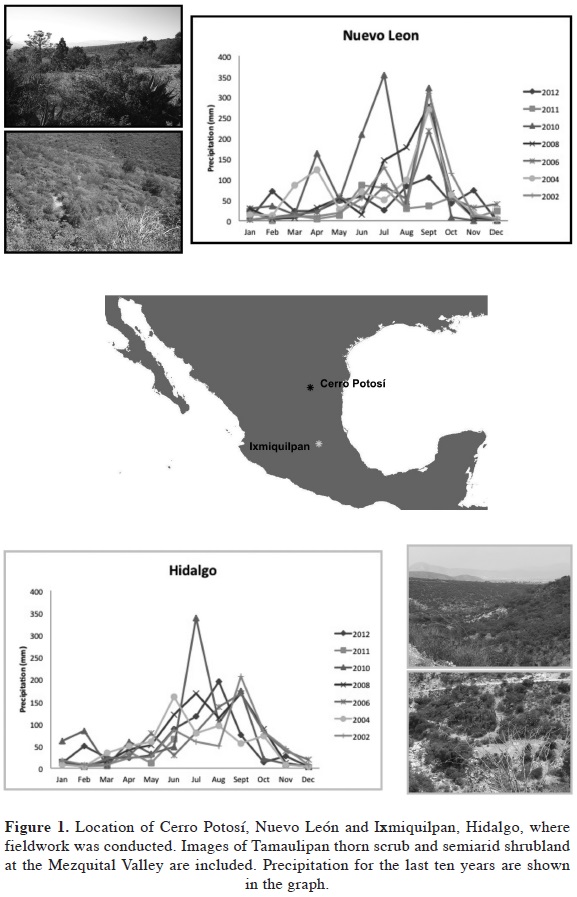
<body><![CDATA[<p align="justify"><font face="verdana" size="2"><i><sup>1</sup>Author for correspondence:</i> <a href="mailto:victona.sosa@mecol.mx">victona.sosa@mecol.mx</a></font></p>  	    <p align="justify"><font face="verdana" size="2">&nbsp;</font></p>  	    <p align="justify"><font face="verdana" size="2">Received: March 19th, 2013    <br> 	Accepted: June 25th, 2013</font></p>  	    <p align="justify"><font face="verdana" size="2">&nbsp;</font></p>  	    <p align="justify"><font face="verdana" size="2">Floral movements have been appointed as mechanisms to avoid self&#45;pollination (Darwin, 1862), and new evidence indicates that they reduce intrafloral male&#45;female interference as well (Barrett, 2003; Sun <i>et al.,</i> 2007). Motion occurs in different floral parts: corolla, gynoecium, style, stigma, or stamens, and motility is either insect&#45;induced or active (Ruan and Texeira da Silva, 2011). A recent review on adaptative advantages of floral movement indicated four main benefits: (1) they promote outcrossing, (2) allow delayed selling, (3) support tolerance to harsh environments, and (4) reduce intrafloral male&#45;female interference (Ruan and Teixeira da Silva, 2011). Investigation of motility of floral elements and its adaptive significance allows understanding evolution of mating systems, ecological habitat shifts and pollinator environments in different groups of plants (Herlihy and Eckert, 2002; Kalisz <i>et al.,</i> 2004; Goodwillie <i>et al.,</i> 2005; Barrett, 2008). Stamen movement has been documented in a few plant families, among them Berberidaceae (Lechowski and Bialczyk, 1992). Ren (2010) suggested that there are four main types of stamen movement: cascade movement (Weigend and Gottschling, 2006); quick and explosive movement (Taylor <i>et al.,</i> 2006); simultaneous and slow movement (Azuma <i>et al.,</i> 2005); and stimulated movement (Lechowski and Bialczyk, 1992; Lebuhn and Anderson, 1994). Stamen movement can affect the reproductive biology of flowering plants because this mechanism forces the visitors to enter flowers and may alter the interaction plant&#45;pollinator (Schlindwein and Wittmann, 1997; Edwards <i>et al.,</i> 2005; Liu <i>et al.,</i> 2006; Ren, 2010).</font></p>  	    <p align="justify"><font face="verdana" size="2">In the case of Berberidaceae, stamen stimulated movement has been associated with a quick transmembrane flux of ions and subsequent water efflux (Bialczyk and Lechowski, 1988; Lechowski and Bialczyk, 1992). It is usually triggered by insects that visit and touch stamens, enhancing the probability of the anther/pollen coming into contact with pollinators, or for helping the anther come into contact with a self pistil, promoting autogamy (Ren, 2010).</font></p>  	    <p align="justify"><font face="verdana" size="2">Here we selected <i>Berber&iacute;s trifoliolata,</i> a shrub known by common names like agarito, algerita, chiper and palo amarillo to corroborate if a stimulated movement of stamens occurrs in response to contact with visitors as previously reported for Berberidaceae (Lechowski and Bialczyk, 1992) as well as to identify pollinators and floral visitors. Plants of <i>B. trifoliolata</i> are small to medium in sized, evergreen shrubs that produce abundant red berries. Agarito is one of the noteworthy species in the arid and semi&#45;arid lands of North America, in the Chihuahuan and Sonoran Deserts and in Tamaulipan thorn scrub.</font></p>  	    <p align="justify"><font face="verdana" size="2">We conducted fieldwork in two localities, in the foothills of the Cerro Potos&iacute; in Galeana, Nuevo Le&oacute;n, a mountain located in northeastern Mexico in the Chihuahuan Desert (24&deg; 53' 16" N and 100&deg; 15' 12" W). Altitude is approximately 2,100 m a.s.l. and vegetation is thorny semi&#45;arid scrub. The second study site was located within the Mezquital Valley, a semiarid shrubland at the north of Ixmiquilpan on the southern area of "Cerro La Mu&ntilde;eca" in Hidalgo (20&deg; 37' 12.8" N and 99&deg; 13' 44.8" W). Altitude is approximately 2,129 m a.s.l. (<a href="#a12f1">Figure 1</a>). Observations of floral visitors were made during the flowering peak in March of 2011 and 2012. The behaviour of bees visiting the flowers was observed. To estimate floral visitors a transect method was followed (revised in Dafni <i>et al.,</i> 2005) using three transects measuring 10 x 50 m along which the frequency, time of occurrence and visit rate were recorded. Each individual within a transect was observed for a 10 minute period from 0700 to 1430 h over six days in 2011, and from 0700 to 1700 h over three days in 2012. Insects were killed with ethyl acetate for identification and deposited in the entomological collection of the Instituto de Ecolog&iacute;a, A.C. (IEXA).</font></p>  	    <p align="center"><font face="verdana" size="2"><a name="a12f1" id="a12f1"></a></font></p>  	    ]]></body>
<body><![CDATA[<p align="center"><font face="verdana" size="2"><img src="/img/revistas/bs/v92n1/a12f1.jpg"></font></p>  	    <p align="justify"><font face="verdana" size="2">Our field observations detected a sweet smell emitted by the corollas throughout anthesis. The number of showy yellow flowers varies from 14 per raceme, and plants usually produce two close racemes. Fruit are red spherical berries that are fleshy and juicy with citrous flavor (<a href="/img/revistas/bs/v92n1/a12f2.jpg" target="_blank">Figure 2</a>). Flowering season is in winter&#45;spring. In both field study sites, blooming started in February, reaching a peak by mid&#45;February and continued through early April, ending in late April and early May. Flowers open successively along inlorescences and anthesis last 6 &plusmn; 2 days (n = 20). At Cerro Potos&iacute;, the number of flowers per individual was 194 &plusmn; 87.3 (n=10). At Ixmiquilpan, the nuber of flowers per individual was 42.5 &plusmn; 24.4 (n = 8).</font></p>  	    <p align="justify"><font face="verdana" size="2">In both field study sites, in newly opened flowers, the following tripping mechanism occurs: the stamens are pressed to the outside of the flower against the corolla. When the inner surface of the filaments is stimulated by an insect visitor, the filament snaps inward, placing pollen from the anther on the vector. Later, the stamens return to their original position against the corolla. Nectaries are located on both sides of each of the six stamens. When they are touched by visitors probing for nectar, the filaments rapidly propel the anthers to the stigma, placing pollen on the body of the pollinator. Filaments can be folded independently forcing the pollinator to move around the flower and its legs to touch neighboring flowers, thus increasing the amount of pollen that adheres to the insect (<a href="/img/revistas/bs/v92n1/a12f2.jpg" target="_blank">Figure 2</a>). In Cerro Potos&iacute;, Nuevo Le&oacute;n, flower&#45;visiting insects included members of Apidae, Syrphidae and Vespidae. The most common visitor was the honeybee, <i>Apis melli&#45;fera.</i> In addition, two species of flies <i>(Copestylum mexicanum</i> and <i>Copestylum</i> sp.), and a social wasp <i>(Vespula</i> sp.) occasionally visited flowers. Our observations in Ixmiquilpan, Hidalgo, detected other pollinators, like the bee <i>Megachile</i> sp. and plants are not pollinated by honeybees. Our field site in Cerro Potos&iacute; was surrounded by cornfields and beehives are abundant. Thus, we believe that the abundant populations of <i>Apis mellifera,</i> instead of native bees, pollinated the agarito flowers in this site. It has been discovered that honeybees dominate the pollinator assemblage in sites close to field crops (S&aacute;ez <i>et al.,</i> 2012).</font></p>  	    <p align="justify"><font face="verdana" size="2">The tripping pollination mechanism described above facilitates the transport of pollen by an insect that moves among the flowers of different plants, touching receptive stigmas with the pollen on the surface of its body, completing cross&#45;pollination. Bees are important pollinators for other plant species of arid and desert regions in North America (Arizaga <i>et</i> al., 2000; Clark&#45;Tapia and Molina&#45;Freaner, 2004; Pendleton <i>et al.,</i> 2008; Ortiz <i>et al.,</i> 2010). Previous research has found that they are the main pollinators in <i>Berberis.</i> Small Adrenidae, <i>Apis mellifera</i> and <i>Bombus</i> sp. have been reported for <i>B. thunbergii </i></font><font face="verdana" size="2">(Lebuhn and Anderson, 1994). Peterson (2003) reported that bees, wasps, flies, and beetles are the pollinators in <i>B. vulgaris.</i> Our results show <i>Apis mellifera</i> to be an effective pollinator for <i>B. trifoliolata.</i> Honeybees are known for moving short distances within the plant favoring transfer of pollen from one flower to another in the same individual (Schaffer <i>et al.,</i> 1983; Corbet, 1991).</font></p>     <p align="justify"><font face="verdana" size="2">It has been demonstrated that nectar production in plants from arid and semi&#45;arid lands is influenced by a number of factors such as weather variables like daily maximum temperature and precipitation (Lloyd <i>et al.,</i> 2002) or demographic parameters </font><font face="verdana" size="2">(Golubov <i>et al.,</i> 2004); nectar evaporates at high temperatures (Nocentini <i>et al.,</i> 2012). In the case of agarito, nectar was so scarce that we were unable to collect any amount. In Cerro Potos&iacute; precipitation was low and temperature was high compared to previous years (see <a href="#a12f1">Figure 1</a>). Thus, further questions for study include whether <i>B. trifoliolata</i> also produces abundant nectar, if humidity or demographic parameters are correlated to its production and if an increase in the amount of nectar attracts more and native pollinators. Moreover, it has been demonstrated that native bees selects flowers with abundant nectar, rejecting flowers with scarce or without nectar (Aizen <i>et al.,</i> 2011).</font></p>     <p align="justify"><font face="verdana" size="2">&nbsp;</font></p>  	    <p align="justify"><font face="verdana" size="2"><b>Acknowledgments</b></font></p>  	    <p align="justify"><font face="verdana" size="2">We thank two anonymous reviewers for helpful comments and suggestions. We thank Edmundo Saavedra for his illustration. We would like to thank Denisse Maldonado, Leticia Monje, Eduardo Ruiz S&aacute;nchez, Guillermo Huerta, Raquel Vargas and Jorge Vargas Jr. for their valuable help with the fieldwork. To Jorge Vargas and Florentina Rangel for providing lodging. To Carlos Vergara for identifying insects. Field work was supported by a grant from CONACyT to VS (106060).</font></p>  	    <p align="justify"><font face="verdana" size="2">&nbsp;</font></p>  	    <p align="justify"><font face="verdana" size="2"><b>Literature cited</b></font></p>  	    ]]></body>
<body><![CDATA[<!-- ref --><p align="justify"><font face="verdana" size="2">Aizen M.A., Lozada M. and Morales C.L. 2011. Comparative nectar&#45;foraging behaviors and efficiencies of an alien and a native bumble bee. <i>Biological Invasions</i> <b>13</b>:2901&#45;2909.    &nbsp;&nbsp;&nbsp;&nbsp;&nbsp;&nbsp;&nbsp;&nbsp;[&#160;<a href="javascript:void(0);" onclick="javascript: window.open('/scielo.php?script=sci_nlinks&ref=1777159&pid=S2007-4298201400010001200001&lng=','','width=640,height=500,resizable=yes,scrollbars=1,menubar=yes,');">Links</a>&#160;]<!-- end-ref --></font></p>  	    <!-- ref --><p align="justify"><font face="verdana" size="2">Arizaga S., Ezcurra E., Peters E., Ramirez de Arellano F. and Vega E. 2000. Pollination ecology of <i>Agave macroacantha</i> (Agavaceae) in a Mexican tropical desert. I. Floral biology and pollination mechanisms. <i>American Journal of Botany</i> <b>87</b>:1004&#45;1010.    &nbsp;&nbsp;&nbsp;&nbsp;&nbsp;&nbsp;&nbsp;&nbsp;[&#160;<a href="javascript:void(0);" onclick="javascript: window.open('/scielo.php?script=sci_nlinks&ref=1777161&pid=S2007-4298201400010001200002&lng=','','width=640,height=500,resizable=yes,scrollbars=1,menubar=yes,');">Links</a>&#160;]<!-- end-ref --></font></p>  	    <!-- ref --><p align="justify"><font face="verdana" size="2">Azuma H., Toyota M. and Asakawa Y. 2005. Floral scent chemistry and stamen movement of <i>Chimonanthus praecox</i> (L.) Link (Calycanthaceae). <i>Acta Phytotaxonomica et Geobotanica</i> <b>56</b>:197&#45;201.    &nbsp;&nbsp;&nbsp;&nbsp;&nbsp;&nbsp;&nbsp;&nbsp;[&#160;<a href="javascript:void(0);" onclick="javascript: window.open('/scielo.php?script=sci_nlinks&ref=1777163&pid=S2007-4298201400010001200003&lng=','','width=640,height=500,resizable=yes,scrollbars=1,menubar=yes,');">Links</a>&#160;]<!-- end-ref --></font></p>  	    <!-- ref --><p align="justify"><font face="verdana" size="2">Barrett S.C.H. 2003. Mating strategies in flowering plants: the outcrossing&#45;selfing paradigm and beyond. <i>Philosophical Transactions ofthe Royal Society. B. Biological Sciences</i> <b>358</b>:991&#45;1004.    &nbsp;&nbsp;&nbsp;&nbsp;&nbsp;&nbsp;&nbsp;&nbsp;[&#160;<a href="javascript:void(0);" onclick="javascript: window.open('/scielo.php?script=sci_nlinks&ref=1777165&pid=S2007-4298201400010001200004&lng=','','width=640,height=500,resizable=yes,scrollbars=1,menubar=yes,');">Links</a>&#160;]<!-- end-ref --></font></p>  	    <!-- ref --><p align="justify"><font face="verdana" size="2">Barrett S.C.H. 2008. Major evolutionary transitions in flowering plant reproduction: An overview. <i>International Journal of Plant Sciences</i> <b>169</b>:1&#45;5.    &nbsp;&nbsp;&nbsp;&nbsp;&nbsp;&nbsp;&nbsp;&nbsp;[&#160;<a href="javascript:void(0);" onclick="javascript: window.open('/scielo.php?script=sci_nlinks&ref=1777167&pid=S2007-4298201400010001200005&lng=','','width=640,height=500,resizable=yes,scrollbars=1,menubar=yes,');">Links</a>&#160;]<!-- end-ref --></font></p>  	    ]]></body>
<body><![CDATA[<!-- ref --><p align="justify"><font face="verdana" size="2">Bialczyk J. and Lechowski, Z. 1988. The seismonastic movements of plant organs. <i>Wiadomosci Botaniczne</i> <b>32</b>:209&#45;226.    &nbsp;&nbsp;&nbsp;&nbsp;&nbsp;&nbsp;&nbsp;&nbsp;[&#160;<a href="javascript:void(0);" onclick="javascript: window.open('/scielo.php?script=sci_nlinks&ref=1777169&pid=S2007-4298201400010001200006&lng=','','width=640,height=500,resizable=yes,scrollbars=1,menubar=yes,');">Links</a>&#160;]<!-- end-ref --></font></p>      <!-- ref --><p align="justify"><font face="verdana" size="2">Clark&#45;Tapia R. and Molina&#45;Freaner F. 2004. Reproductive ecology of the rare clonal cactus <i>Stenocereus eruca</i> in the Sonoran Desert. <i>Plant Systematics and Evolution</i> <b>247</b>:155&#45;164.    &nbsp;&nbsp;&nbsp;&nbsp;&nbsp;&nbsp;&nbsp;&nbsp;[&#160;<a href="javascript:void(0);" onclick="javascript: window.open('/scielo.php?script=sci_nlinks&ref=1777171&pid=S2007-4298201400010001200007&lng=','','width=640,height=500,resizable=yes,scrollbars=1,menubar=yes,');">Links</a>&#160;]<!-- end-ref --></font></p>  	    <!-- ref --><p align="justify"><font face="verdana" size="2">Corbet S.A. 1991. Applied pollination ecology. <i>Trends in Ecology and Evolution</i> <b>6</b>:3&#45;4.    &nbsp;&nbsp;&nbsp;&nbsp;&nbsp;&nbsp;&nbsp;&nbsp;[&#160;<a href="javascript:void(0);" onclick="javascript: window.open('/scielo.php?script=sci_nlinks&ref=1777173&pid=S2007-4298201400010001200008&lng=','','width=640,height=500,resizable=yes,scrollbars=1,menubar=yes,');">Links</a>&#160;]<!-- end-ref --></font></p>  	    <!-- ref --><p align="justify"><font face="verdana" size="2">Dafni, A., Kevan, P. G., and Husband, B. C. 2005. Practical pollination biology. Enviroquest, Ontario.    &nbsp;&nbsp;&nbsp;&nbsp;&nbsp;&nbsp;&nbsp;&nbsp;[&#160;<a href="javascript:void(0);" onclick="javascript: window.open('/scielo.php?script=sci_nlinks&ref=1777175&pid=S2007-4298201400010001200009&lng=','','width=640,height=500,resizable=yes,scrollbars=1,menubar=yes,');">Links</a>&#160;]<!-- end-ref --></font></p>  	    <!-- ref --><p align="justify"><font face="verdana" size="2">Darwin C. 1862. On the various contrivances by which British and foreign orchids are fertilized by insects. John Murray, London.    &nbsp;&nbsp;&nbsp;&nbsp;&nbsp;&nbsp;&nbsp;&nbsp;[&#160;<a href="javascript:void(0);" onclick="javascript: window.open('/scielo.php?script=sci_nlinks&ref=1777177&pid=S2007-4298201400010001200010&lng=','','width=640,height=500,resizable=yes,scrollbars=1,menubar=yes,');">Links</a>&#160;]<!-- end-ref --></font></p>  	    ]]></body>
<body><![CDATA[<!-- ref --><p align="justify"><font face="verdana" size="2">Edwards J., Whitaker D., Klionsky S. and Laskowski M.J. 2005. A record&#45;breaking pollen catapult. <i>Nature</i> <b>435</b>:164.    &nbsp;&nbsp;&nbsp;&nbsp;&nbsp;&nbsp;&nbsp;&nbsp;[&#160;<a href="javascript:void(0);" onclick="javascript: window.open('/scielo.php?script=sci_nlinks&ref=1777179&pid=S2007-4298201400010001200011&lng=','','width=640,height=500,resizable=yes,scrollbars=1,menubar=yes,');">Links</a>&#160;]<!-- end-ref --></font></p>  	    <!-- ref --><p align="justify"><font face="verdana" size="2">Golubov J., Mandujano M.C., Monta&ntilde;a C., L&oacute;pez&#45;Portillo J. and Eguiarte L.E. 2004. The demographic costs of nectar production in the desert perennial <i>Prosopis glandulosa</i> (Mimosoideae): a modular approach. <i>Plant Ecology</i> <b>170</b>:267&#45;275.    &nbsp;&nbsp;&nbsp;&nbsp;&nbsp;&nbsp;&nbsp;&nbsp;[&#160;<a href="javascript:void(0);" onclick="javascript: window.open('/scielo.php?script=sci_nlinks&ref=1777181&pid=S2007-4298201400010001200012&lng=','','width=640,height=500,resizable=yes,scrollbars=1,menubar=yes,');">Links</a>&#160;]<!-- end-ref --></font></p>  	    <!-- ref --><p align="justify"><font face="verdana" size="2">Goodwillie C., Kalisz S. and Eckert C.G. 2005. The evolutionary enigma of mixed mating systems in plants: occurrence, theoretical explanations, and empirical evidence. <i>Annual Review of Ecology, Evolution and Systematics</i> <b>36</b>:47&#45;79.    &nbsp;&nbsp;&nbsp;&nbsp;&nbsp;&nbsp;&nbsp;&nbsp;[&#160;<a href="javascript:void(0);" onclick="javascript: window.open('/scielo.php?script=sci_nlinks&ref=1777183&pid=S2007-4298201400010001200013&lng=','','width=640,height=500,resizable=yes,scrollbars=1,menubar=yes,');">Links</a>&#160;]<!-- end-ref --></font></p>  	    <!-- ref --><p align="justify"><font face="verdana" size="2">Herlihy C.R. and Eckert C.G. 2002. Genetic cost of reproductive assurance in a self&#45;fertilizing plant. <i>Nature</i> <b>416</b>:320&#45;323.    &nbsp;&nbsp;&nbsp;&nbsp;&nbsp;&nbsp;&nbsp;&nbsp;[&#160;<a href="javascript:void(0);" onclick="javascript: window.open('/scielo.php?script=sci_nlinks&ref=1777185&pid=S2007-4298201400010001200014&lng=','','width=640,height=500,resizable=yes,scrollbars=1,menubar=yes,');">Links</a>&#160;]<!-- end-ref --></font></p>  	    <!-- ref --><p align="justify"><font face="verdana" size="2">Kalisz S., Vogler D.W. and Hanley K.M. 2004. Context&#45;dependent autonomous self&#45;fertilization yields reproductive assurance and mixed mating. <i>Nature</i> <b>430</b>:884&#45;887.    &nbsp;&nbsp;&nbsp;&nbsp;&nbsp;&nbsp;&nbsp;&nbsp;[&#160;<a href="javascript:void(0);" onclick="javascript: window.open('/scielo.php?script=sci_nlinks&ref=1777187&pid=S2007-4298201400010001200015&lng=','','width=640,height=500,resizable=yes,scrollbars=1,menubar=yes,');">Links</a>&#160;]<!-- end-ref --></font></p>  	    ]]></body>
<body><![CDATA[<!-- ref --><p align="justify"><font face="verdana" size="2">Lebuhn G. and Anderson G.J., 1994. Anther tripping and pollen dispensing in <i>Berberis thunbergii. The American Midland Naturalist</i> <b>131</b>:257&#45;265.    &nbsp;&nbsp;&nbsp;&nbsp;&nbsp;&nbsp;&nbsp;&nbsp;[&#160;<a href="javascript:void(0);" onclick="javascript: window.open('/scielo.php?script=sci_nlinks&ref=1777189&pid=S2007-4298201400010001200016&lng=','','width=640,height=500,resizable=yes,scrollbars=1,menubar=yes,');">Links</a>&#160;]<!-- end-ref --></font></p>  	    <!-- ref --><p align="justify"><font face="verdana" size="2">Lechowski Z. and Bialczyk J. 1992. Effect of external calcium on the control of stamen movement in <i>Berberis vulgaris</i> L. <i>Biologia Plantarum</i> <b>34</b>:121&#45;130.    &nbsp;&nbsp;&nbsp;&nbsp;&nbsp;&nbsp;&nbsp;&nbsp;[&#160;<a href="javascript:void(0);" onclick="javascript: window.open('/scielo.php?script=sci_nlinks&ref=1777191&pid=S2007-4298201400010001200017&lng=','','width=640,height=500,resizable=yes,scrollbars=1,menubar=yes,');">Links</a>&#160;]<!-- end-ref --></font></p>  	    <!-- ref --><p align="justify"><font face="verdana" size="2">Liu K.W., Liu Z.J., Huang L.Q., Li L.Q., Chen L.J. and Tang G.D. 2006. Self&#45;fertilization strategy in an orchid. <i>Nature</i> <b>441</b>:945&#45;946.    &nbsp;&nbsp;&nbsp;&nbsp;&nbsp;&nbsp;&nbsp;&nbsp;[&#160;<a href="javascript:void(0);" onclick="javascript: window.open('/scielo.php?script=sci_nlinks&ref=1777193&pid=S2007-4298201400010001200018&lng=','','width=640,height=500,resizable=yes,scrollbars=1,menubar=yes,');">Links</a>&#160;]<!-- end-ref --></font></p>  	    <!-- ref --><p align="justify"><font face="verdana" size="2">Lloyd S., Ayre D.J. and Whelan R.J. 2002. A rapid and accurate visual assessment of nectar production can reveal patterns of temporal variation in <i>Banksia erici&#45;folia</i> (Proteaceae). <i>Australian Journal of Botany</i> <b>50</b>:595&#45;600.    &nbsp;&nbsp;&nbsp;&nbsp;&nbsp;&nbsp;&nbsp;&nbsp;[&#160;<a href="javascript:void(0);" onclick="javascript: window.open('/scielo.php?script=sci_nlinks&ref=1777195&pid=S2007-4298201400010001200019&lng=','','width=640,height=500,resizable=yes,scrollbars=1,menubar=yes,');">Links</a>&#160;]<!-- end-ref --></font></p>  	    <!-- ref --><p align="justify"><font face="verdana" size="2">Nocentini D., Pacini E., Guarnieri M. and Nepi M. 2012. Flower morphology, nectar traits and pollinator of <i>Cerinthe major</i> (Boraginaceae&#45;Lithospermae). <i>Flora</i> <b>207</b>:186&#45;196.    &nbsp;&nbsp;&nbsp;&nbsp;&nbsp;&nbsp;&nbsp;&nbsp;[&#160;<a href="javascript:void(0);" onclick="javascript: window.open('/scielo.php?script=sci_nlinks&ref=1777197&pid=S2007-4298201400010001200020&lng=','','width=640,height=500,resizable=yes,scrollbars=1,menubar=yes,');">Links</a>&#160;]<!-- end-ref --></font></p>  	    ]]></body>
<body><![CDATA[<!-- ref --><p align="justify"><font face="verdana" size="2">Ortiz F., Stoner K.E., P&eacute;rez&#45;Negr&oacute;n E. and Casas A. 2010. Pollination biology of <i>Myrtillocactus schenckii</i> (Cactaceae) in wild and managed populations of the Tehuac&aacute;n Valley, Mexico. <i>Journal of Arid Environments</i> <b>74</b>:897&#45;904.    &nbsp;&nbsp;&nbsp;&nbsp;&nbsp;&nbsp;&nbsp;&nbsp;[&#160;<a href="javascript:void(0);" onclick="javascript: window.open('/scielo.php?script=sci_nlinks&ref=1777199&pid=S2007-4298201400010001200021&lng=','','width=640,height=500,resizable=yes,scrollbars=1,menubar=yes,');">Links</a>&#160;]<!-- end-ref --></font></p>  	    <!-- ref --><p align="justify"><font face="verdana" size="2">Pendleton R.L., Pendleton B.K., Wetherill K.R. and Griswold T. 2008. Reproductive biology of <i>Larrea tridentata:</i> A preliminary comparison between core shrubland and isolated grassland plants at the Sevilleta National Wildlife Refuge, New Mexico. <i>USDA Forest Service Proceedings RMRS&#45;P</i> <b>52</b>:131&#45;135.    &nbsp;&nbsp;&nbsp;&nbsp;&nbsp;&nbsp;&nbsp;&nbsp;[&#160;<a href="javascript:void(0);" onclick="javascript: window.open('/scielo.php?script=sci_nlinks&ref=1777201&pid=S2007-4298201400010001200022&lng=','','width=640,height=500,resizable=yes,scrollbars=1,menubar=yes,');">Links</a>&#160;]<!-- end-ref --></font></p>  	    <!-- ref --><p align="justify"><font face="verdana" size="2">Peterson PD. 2003. <i>The common barberry: the past and present situation in Minnesota and the risk of wheat stem rust epidemics.</i> Ph.D. Dissertation. North Carolina State University. 199 pp.    &nbsp;&nbsp;&nbsp;&nbsp;&nbsp;&nbsp;&nbsp;&nbsp;[&#160;<a href="javascript:void(0);" onclick="javascript: window.open('/scielo.php?script=sci_nlinks&ref=1777203&pid=S2007-4298201400010001200023&lng=','','width=640,height=500,resizable=yes,scrollbars=1,menubar=yes,');">Links</a>&#160;]<!-- end-ref --></font></p>  	    <!-- ref --><p align="justify"><font face="verdana" size="2">Ren M.X. 2010. Stamen movements in hermaphroditic flowers: diversity and adaptive significance. <i>Chinese Journal of Plant Ecology</i> <b>34</b>:867&#45;875.    &nbsp;&nbsp;&nbsp;&nbsp;&nbsp;&nbsp;&nbsp;&nbsp;[&#160;<a href="javascript:void(0);" onclick="javascript: window.open('/scielo.php?script=sci_nlinks&ref=1777205&pid=S2007-4298201400010001200024&lng=','','width=640,height=500,resizable=yes,scrollbars=1,menubar=yes,');">Links</a>&#160;]<!-- end-ref --></font></p>  	    <!-- ref --><p align="justify"><font face="verdana" size="2">Ruan C.J. and Teixeira da Silva J.A. 2011. Adaptive significance of floral movement. <i>Critical Reviews in Plant Sciences</i> <b>30</b>:293&#45;328.    &nbsp;&nbsp;&nbsp;&nbsp;&nbsp;&nbsp;&nbsp;&nbsp;[&#160;<a href="javascript:void(0);" onclick="javascript: window.open('/scielo.php?script=sci_nlinks&ref=1777207&pid=S2007-4298201400010001200025&lng=','','width=640,height=500,resizable=yes,scrollbars=1,menubar=yes,');">Links</a>&#160;]<!-- end-ref --></font></p>  	    ]]></body>
<body><![CDATA[<!-- ref --><p align="justify"><font face="verdana" size="2">S&auml;ez A., Sabatino M. and Aizen M. 2012. Interactive effect of large&#45; and small&#45;scale sources of feral honey&#45;bees for sunflower in the Argentine pampas. <i>Plos One</i> 7:e30968.    &nbsp;&nbsp;&nbsp;&nbsp;&nbsp;&nbsp;&nbsp;&nbsp;[&#160;<a href="javascript:void(0);" onclick="javascript: window.open('/scielo.php?script=sci_nlinks&ref=1777209&pid=S2007-4298201400010001200026&lng=','','width=640,height=500,resizable=yes,scrollbars=1,menubar=yes,');">Links</a>&#160;]<!-- end-ref --></font></p>  	    <!-- ref --><p align="justify"><font face="verdana" size="2">Schaffer W.M., Zeh D.W., Buchmann S.L., Kleinhans S., Valentine Schaffer M. and Antrim J. 1983. Competition for nectar between introduced honey bees and native North American bees and ants. <i>Ecology</i> <b>64</b>:564&#45; 577.    &nbsp;&nbsp;&nbsp;&nbsp;&nbsp;&nbsp;&nbsp;&nbsp;[&#160;<a href="javascript:void(0);" onclick="javascript: window.open('/scielo.php?script=sci_nlinks&ref=1777211&pid=S2007-4298201400010001200027&lng=','','width=640,height=500,resizable=yes,scrollbars=1,menubar=yes,');">Links</a>&#160;]<!-- end-ref --></font></p>  	    <!-- ref --><p align="justify"><font face="verdana" size="2">Schlindwein C. and Wittmann D. 1997. Stamen movement in flowers of <i>Opuntia</i> (Cactaceae) favour oligolectic pollinators. <i>Plant Systematics and Evolution</i> <b>204</b>:179&#45;193.    &nbsp;&nbsp;&nbsp;&nbsp;&nbsp;&nbsp;&nbsp;&nbsp;[&#160;<a href="javascript:void(0);" onclick="javascript: window.open('/scielo.php?script=sci_nlinks&ref=1777213&pid=S2007-4298201400010001200028&lng=','','width=640,height=500,resizable=yes,scrollbars=1,menubar=yes,');">Links</a>&#160;]<!-- end-ref --></font></p>  	    <!-- ref --><p align="justify"><font face="verdana" size="2">Sun S., Gao J.Y., Liao W.J., Li Q.J. and Zhang D.Y. 2007. Adaptive significance of flexistyly in <i>Alpinia blepharocalyx</i> (Zingiberaceae): a hand&#45; pollination experiment. <i>Annals of Botany</i> <b>99</b>:661&#45;666.    &nbsp;&nbsp;&nbsp;&nbsp;&nbsp;&nbsp;&nbsp;&nbsp;[&#160;<a href="javascript:void(0);" onclick="javascript: window.open('/scielo.php?script=sci_nlinks&ref=1777215&pid=S2007-4298201400010001200029&lng=','','width=640,height=500,resizable=yes,scrollbars=1,menubar=yes,');">Links</a>&#160;]<!-- end-ref --></font></p>      <!-- ref --><p align="justify"><font face="verdana" size="2">Taylor P.E., Card G., House J., Dickinson M.H. and Flagan R.C. 2006. Highspeed pollen release in the white mulberry tree, <i>Morus alba</i> L. <i>Sexual Plant Reproduction</i> <b>19</b>.19&#45;24.    &nbsp;&nbsp;&nbsp;&nbsp;&nbsp;&nbsp;&nbsp;&nbsp;[&#160;<a href="javascript:void(0);" onclick="javascript: window.open('/scielo.php?script=sci_nlinks&ref=1777217&pid=S2007-4298201400010001200030&lng=','','width=640,height=500,resizable=yes,scrollbars=1,menubar=yes,');">Links</a>&#160;]<!-- end-ref --></font></p>  	    ]]></body>
<body><![CDATA[<!-- ref --><p align="justify"><font face="verdana" size="2">Weigend M. and Gottschling M. 2006. Evolution of funnel&#45;revolver flowers and ornithophily in <i>Nasa</i> (Loasaceae). <i>Plant Biology</i> <b>8</b>:120&#45;142.    &nbsp;&nbsp;&nbsp;&nbsp;&nbsp;&nbsp;&nbsp;&nbsp;[&#160;<a href="javascript:void(0);" onclick="javascript: window.open('/scielo.php?script=sci_nlinks&ref=1777219&pid=S2007-4298201400010001200031&lng=','','width=640,height=500,resizable=yes,scrollbars=1,menubar=yes,');">Links</a>&#160;]<!-- end-ref --></font></p>      ]]></body><back>
<ref-list>
<ref id="B1">
<nlm-citation citation-type="journal">
<person-group person-group-type="author">
<name>
<surname><![CDATA[Aizen]]></surname>
<given-names><![CDATA[M.A.]]></given-names>
</name>
<name>
<surname><![CDATA[Lozada]]></surname>
<given-names><![CDATA[M.]]></given-names>
</name>
<name>
<surname><![CDATA[Morales]]></surname>
<given-names><![CDATA[C.L.]]></given-names>
</name>
</person-group>
<article-title xml:lang="en"><![CDATA[Comparative nectar-foraging behaviors and efficiencies of an alien and a native bumble bee]]></article-title>
<source><![CDATA[Biological Invasions]]></source>
<year>2011</year>
<volume>13</volume>
<page-range>2901-2909</page-range></nlm-citation>
</ref>
<ref id="B2">
<nlm-citation citation-type="journal">
<person-group person-group-type="author">
<name>
<surname><![CDATA[Arizaga]]></surname>
<given-names><![CDATA[S.]]></given-names>
</name>
<name>
<surname><![CDATA[Ezcurra]]></surname>
<given-names><![CDATA[E.]]></given-names>
</name>
<name>
<surname><![CDATA[Peters]]></surname>
<given-names><![CDATA[E.]]></given-names>
</name>
<name>
<surname><![CDATA[Ramirez de Arellano]]></surname>
<given-names><![CDATA[F.]]></given-names>
</name>
<name>
<surname><![CDATA[Vega]]></surname>
<given-names><![CDATA[E.]]></given-names>
</name>
</person-group>
<article-title xml:lang="en"><![CDATA[Pollination ecology of Agave macroacantha (Agavaceae) in a Mexican tropical desert. I. Floral biology and pollination mechanisms]]></article-title>
<source><![CDATA[American Journal of Botany]]></source>
<year>2000</year>
<volume>87</volume>
<page-range>1004-1010</page-range></nlm-citation>
</ref>
<ref id="B3">
<nlm-citation citation-type="journal">
<person-group person-group-type="author">
<name>
<surname><![CDATA[Azuma]]></surname>
<given-names><![CDATA[H.]]></given-names>
</name>
<name>
<surname><![CDATA[Toyota]]></surname>
<given-names><![CDATA[M.]]></given-names>
</name>
<name>
<surname><![CDATA[Asakawa]]></surname>
<given-names><![CDATA[Y.]]></given-names>
</name>
</person-group>
<article-title xml:lang="en"><![CDATA[Floral scent chemistry and stamen movement of Chimonanthus praecox (L.) Link (Calycanthaceae)]]></article-title>
<source><![CDATA[Acta Phytotaxonomica et Geobotanica]]></source>
<year>2005</year>
<volume>56</volume>
<page-range>197-201</page-range></nlm-citation>
</ref>
<ref id="B4">
<nlm-citation citation-type="journal">
<person-group person-group-type="author">
<name>
<surname><![CDATA[Barrett]]></surname>
<given-names><![CDATA[S.C.H.]]></given-names>
</name>
</person-group>
<article-title xml:lang="en"><![CDATA[Mating strategies in flowering plants: the outcrossing-selfing paradigm and beyond]]></article-title>
<source><![CDATA[Philosophical Transactions ofthe Royal Society. B. Biological Sciences]]></source>
<year>2003</year>
<volume>358</volume>
<page-range>991-1004</page-range></nlm-citation>
</ref>
<ref id="B5">
<nlm-citation citation-type="journal">
<person-group person-group-type="author">
<name>
<surname><![CDATA[Barrett]]></surname>
<given-names><![CDATA[S.C.H.]]></given-names>
</name>
</person-group>
<article-title xml:lang="en"><![CDATA[Major evolutionary transitions in flowering plant reproduction: An overview]]></article-title>
<source><![CDATA[International Journal of Plant Sciences]]></source>
<year>2008</year>
<volume>169</volume>
<page-range>1-5</page-range></nlm-citation>
</ref>
<ref id="B6">
<nlm-citation citation-type="journal">
<person-group person-group-type="author">
<name>
<surname><![CDATA[Bialczyk]]></surname>
<given-names><![CDATA[J.]]></given-names>
</name>
<name>
<surname><![CDATA[Lechowski]]></surname>
<given-names><![CDATA[Z.]]></given-names>
</name>
</person-group>
<article-title xml:lang="en"><![CDATA[The seismonastic movements of plant organs]]></article-title>
<source><![CDATA[Wiadomosci Botaniczne]]></source>
<year>1988</year>
<volume>32</volume>
<page-range>209-226</page-range></nlm-citation>
</ref>
<ref id="B7">
<nlm-citation citation-type="journal">
<person-group person-group-type="author">
<name>
<surname><![CDATA[Clark-Tapia]]></surname>
<given-names><![CDATA[R.]]></given-names>
</name>
<name>
<surname><![CDATA[Molina-Freaner]]></surname>
<given-names><![CDATA[F.]]></given-names>
</name>
</person-group>
<article-title xml:lang="en"><![CDATA[Reproductive ecology of the rare clonal cactus Stenocereus eruca in the Sonoran Desert]]></article-title>
<source><![CDATA[Plant Systematics and Evolution]]></source>
<year>2004</year>
<volume>247</volume>
<page-range>155-164</page-range></nlm-citation>
</ref>
<ref id="B8">
<nlm-citation citation-type="journal">
<person-group person-group-type="author">
<name>
<surname><![CDATA[Corbet]]></surname>
<given-names><![CDATA[S.A.]]></given-names>
</name>
</person-group>
<article-title xml:lang="en"><![CDATA[Applied pollination ecology]]></article-title>
<source><![CDATA[Trends in Ecology and Evolution]]></source>
<year>1991</year>
<volume>6</volume>
<page-range>3-4</page-range></nlm-citation>
</ref>
<ref id="B9">
<nlm-citation citation-type="book">
<person-group person-group-type="author">
<name>
<surname><![CDATA[Dafni]]></surname>
<given-names><![CDATA[A.]]></given-names>
</name>
<name>
<surname><![CDATA[Kevan]]></surname>
<given-names><![CDATA[P. G.]]></given-names>
</name>
<name>
<surname><![CDATA[Husband]]></surname>
<given-names><![CDATA[B. C.]]></given-names>
</name>
</person-group>
<source><![CDATA[Practical pollination biology]]></source>
<year>2005</year>
<publisher-loc><![CDATA[^eOntario Ontario]]></publisher-loc>
<publisher-name><![CDATA[Enviroquest]]></publisher-name>
</nlm-citation>
</ref>
<ref id="B10">
<nlm-citation citation-type="book">
<person-group person-group-type="author">
<name>
<surname><![CDATA[Darwin]]></surname>
<given-names><![CDATA[C.]]></given-names>
</name>
</person-group>
<source><![CDATA[On the various contrivances by which British and foreign orchids are fertilized by insects]]></source>
<year>1862</year>
<publisher-loc><![CDATA[London ]]></publisher-loc>
<publisher-name><![CDATA[John Murray]]></publisher-name>
</nlm-citation>
</ref>
<ref id="B11">
<nlm-citation citation-type="journal">
<person-group person-group-type="author">
<name>
<surname><![CDATA[Edwards]]></surname>
<given-names><![CDATA[J.]]></given-names>
</name>
<name>
<surname><![CDATA[Whitaker]]></surname>
<given-names><![CDATA[D.]]></given-names>
</name>
<name>
<surname><![CDATA[Klionsky]]></surname>
<given-names><![CDATA[S.]]></given-names>
</name>
<name>
<surname><![CDATA[Laskowski]]></surname>
<given-names><![CDATA[M.J]]></given-names>
</name>
</person-group>
<article-title xml:lang="en"><![CDATA[A record-breaking pollen catapult]]></article-title>
<source><![CDATA[Nature]]></source>
<year>2005</year>
<volume>435</volume>
<page-range>164</page-range></nlm-citation>
</ref>
<ref id="B12">
<nlm-citation citation-type="journal">
<person-group person-group-type="author">
<name>
<surname><![CDATA[Golubov]]></surname>
<given-names><![CDATA[J.]]></given-names>
</name>
<name>
<surname><![CDATA[Mandujano]]></surname>
<given-names><![CDATA[M.C.]]></given-names>
</name>
<name>
<surname><![CDATA[Montaña]]></surname>
<given-names><![CDATA[C.]]></given-names>
</name>
<name>
<surname><![CDATA[López-Portillo]]></surname>
<given-names><![CDATA[J.]]></given-names>
</name>
<name>
<surname><![CDATA[Eguiarte]]></surname>
<given-names><![CDATA[L.E.]]></given-names>
</name>
</person-group>
<article-title xml:lang="en"><![CDATA[The demographic costs of nectar production in the desert perennial Prosopis glandulosa (Mimosoideae): a modular approach]]></article-title>
<source><![CDATA[Plant Ecology]]></source>
<year>2004</year>
<volume>170</volume>
<page-range>267-275</page-range></nlm-citation>
</ref>
<ref id="B13">
<nlm-citation citation-type="journal">
<person-group person-group-type="author">
<name>
<surname><![CDATA[Goodwillie]]></surname>
<given-names><![CDATA[C.]]></given-names>
</name>
<name>
<surname><![CDATA[Kalisz]]></surname>
<given-names><![CDATA[S.]]></given-names>
</name>
<name>
<surname><![CDATA[Eckert]]></surname>
<given-names><![CDATA[C.G.]]></given-names>
</name>
</person-group>
<article-title xml:lang="en"><![CDATA[The evolutionary enigma of mixed mating systems in plants: occurrence, theoretical explanations, and empirical evidence]]></article-title>
<source><![CDATA[Annual Review of Ecology, Evolution and Systematics]]></source>
<year>2005</year>
<volume>36</volume>
<page-range>47-79</page-range></nlm-citation>
</ref>
<ref id="B14">
<nlm-citation citation-type="journal">
<person-group person-group-type="author">
<name>
<surname><![CDATA[Herlihy]]></surname>
<given-names><![CDATA[C.R.]]></given-names>
</name>
<name>
<surname><![CDATA[Eckert]]></surname>
<given-names><![CDATA[C.G.]]></given-names>
</name>
</person-group>
<article-title xml:lang="en"><![CDATA[Genetic cost of reproductive assurance in a self-fertilizing plant]]></article-title>
<source><![CDATA[Nature]]></source>
<year>2002</year>
<volume>416</volume>
<page-range>320-323</page-range></nlm-citation>
</ref>
<ref id="B15">
<nlm-citation citation-type="journal">
<person-group person-group-type="author">
<name>
<surname><![CDATA[Kalisz]]></surname>
<given-names><![CDATA[S.]]></given-names>
</name>
<name>
<surname><![CDATA[Vogler]]></surname>
<given-names><![CDATA[D.W.]]></given-names>
</name>
<name>
<surname><![CDATA[Hanley]]></surname>
<given-names><![CDATA[K.M.]]></given-names>
</name>
</person-group>
<article-title xml:lang="en"><![CDATA[Context-dependent autonomous self-fertilization yields reproductive assurance and mixed mating]]></article-title>
<source><![CDATA[Nature]]></source>
<year>2004</year>
<volume>430</volume>
<page-range>884-887</page-range></nlm-citation>
</ref>
<ref id="B16">
<nlm-citation citation-type="journal">
<person-group person-group-type="author">
<name>
<surname><![CDATA[Lebuhn]]></surname>
<given-names><![CDATA[G.]]></given-names>
</name>
<name>
<surname><![CDATA[Anderson]]></surname>
<given-names><![CDATA[G.J.]]></given-names>
</name>
</person-group>
<article-title xml:lang="en"><![CDATA[Anther tripping and pollen dispensing in Berberis thunbergii]]></article-title>
<source><![CDATA[The American Midland Naturalist]]></source>
<year>1994</year>
<volume>131</volume>
<page-range>257-265</page-range></nlm-citation>
</ref>
<ref id="B17">
<nlm-citation citation-type="journal">
<person-group person-group-type="author">
<name>
<surname><![CDATA[Lechowski]]></surname>
<given-names><![CDATA[Z.]]></given-names>
</name>
<name>
<surname><![CDATA[Bialczyk]]></surname>
<given-names><![CDATA[J.]]></given-names>
</name>
</person-group>
<article-title xml:lang="en"><![CDATA[Effect of external calcium on the control of stamen movement in Berberis vulgaris L.]]></article-title>
<source><![CDATA[Biologia Plantarum]]></source>
<year>1992</year>
<volume>34</volume>
<page-range>121-130</page-range></nlm-citation>
</ref>
<ref id="B18">
<nlm-citation citation-type="journal">
<person-group person-group-type="author">
<name>
<surname><![CDATA[Liu]]></surname>
<given-names><![CDATA[K.W.]]></given-names>
</name>
<name>
<surname><![CDATA[Liu]]></surname>
<given-names><![CDATA[Z.J.]]></given-names>
</name>
<name>
<surname><![CDATA[Huang]]></surname>
<given-names><![CDATA[L.Q.]]></given-names>
</name>
<name>
<surname><![CDATA[Li]]></surname>
<given-names><![CDATA[L.Q.]]></given-names>
</name>
<name>
<surname><![CDATA[Chen]]></surname>
<given-names><![CDATA[L.J.]]></given-names>
</name>
<name>
<surname><![CDATA[Tang]]></surname>
<given-names><![CDATA[G.D.]]></given-names>
</name>
</person-group>
<article-title xml:lang="en"><![CDATA[Self-fertilization strategy in an orchid]]></article-title>
<source><![CDATA[Nature]]></source>
<year>2006</year>
<volume>441</volume>
<page-range>945-946</page-range></nlm-citation>
</ref>
<ref id="B19">
<nlm-citation citation-type="journal">
<person-group person-group-type="author">
<name>
<surname><![CDATA[Lloyd]]></surname>
<given-names><![CDATA[S.]]></given-names>
</name>
<name>
<surname><![CDATA[Ayre]]></surname>
<given-names><![CDATA[D.J.]]></given-names>
</name>
<name>
<surname><![CDATA[Whelan]]></surname>
<given-names><![CDATA[R.J.]]></given-names>
</name>
</person-group>
<article-title xml:lang="en"><![CDATA[A rapid and accurate visual assessment of nectar production can reveal patterns of temporal variation in Banksia erici-folia (Proteaceae)]]></article-title>
<source><![CDATA[Australian Journal of Botany]]></source>
<year>2002</year>
<volume>50</volume>
<page-range>595-600</page-range></nlm-citation>
</ref>
<ref id="B20">
<nlm-citation citation-type="journal">
<person-group person-group-type="author">
<name>
<surname><![CDATA[Nocentini]]></surname>
<given-names><![CDATA[D.]]></given-names>
</name>
<name>
<surname><![CDATA[Pacini]]></surname>
<given-names><![CDATA[E.]]></given-names>
</name>
<name>
<surname><![CDATA[Guarnieri]]></surname>
<given-names><![CDATA[M.]]></given-names>
</name>
<name>
<surname><![CDATA[Nepi]]></surname>
<given-names><![CDATA[M.]]></given-names>
</name>
</person-group>
<article-title xml:lang="en"><![CDATA[Flower morphology, nectar traits and pollinator of Cerinthe major (Boraginaceae-Lithospermae)]]></article-title>
<source><![CDATA[Flora]]></source>
<year>2012</year>
<volume>207</volume>
<page-range>186-196</page-range></nlm-citation>
</ref>
<ref id="B21">
<nlm-citation citation-type="journal">
<person-group person-group-type="author">
<name>
<surname><![CDATA[Ortiz]]></surname>
<given-names><![CDATA[F.]]></given-names>
</name>
<name>
<surname><![CDATA[Stoner]]></surname>
<given-names><![CDATA[K.E.]]></given-names>
</name>
<name>
<surname><![CDATA[Pérez-Negrón]]></surname>
<given-names><![CDATA[E.]]></given-names>
</name>
<name>
<surname><![CDATA[Casas]]></surname>
<given-names><![CDATA[A.]]></given-names>
</name>
</person-group>
<article-title xml:lang="en"><![CDATA[Pollination biology of Myrtillocactus schenckii (Cactaceae) in wild and managed populations of the Tehuacán Valley, Mexico]]></article-title>
<source><![CDATA[Journal of Arid Environments]]></source>
<year>2010</year>
<volume>74</volume>
<page-range>897-904</page-range></nlm-citation>
</ref>
<ref id="B22">
<nlm-citation citation-type="journal">
<person-group person-group-type="author">
<name>
<surname><![CDATA[Pendleton]]></surname>
<given-names><![CDATA[R.L.]]></given-names>
</name>
<name>
<surname><![CDATA[Pendleton]]></surname>
<given-names><![CDATA[B.K.]]></given-names>
</name>
<name>
<surname><![CDATA[Wetherill]]></surname>
<given-names><![CDATA[K.R.]]></given-names>
</name>
<name>
<surname><![CDATA[Griswold]]></surname>
<given-names><![CDATA[T.]]></given-names>
</name>
</person-group>
<article-title xml:lang="en"><![CDATA[Reproductive biology of Larrea tridentata: A preliminary comparison between core shrubland and isolated grassland plants at the Sevilleta National Wildlife Refuge, New Mexico]]></article-title>
<source><![CDATA[USDA Forest Service Proceedings RMRS-P]]></source>
<year>2008</year>
<volume>52</volume>
<page-range>131-135</page-range></nlm-citation>
</ref>
<ref id="B23">
<nlm-citation citation-type="">
<person-group person-group-type="author">
<name>
<surname><![CDATA[Peterson]]></surname>
<given-names><![CDATA[PD.]]></given-names>
</name>
</person-group>
<source><![CDATA[The common barberry: the past and present situation in Minnesota and the risk of wheat stem rust epidemics]]></source>
<year>2003</year>
<page-range>199</page-range></nlm-citation>
</ref>
<ref id="B24">
<nlm-citation citation-type="journal">
<person-group person-group-type="author">
<name>
<surname><![CDATA[Ren]]></surname>
<given-names><![CDATA[M.X.]]></given-names>
</name>
</person-group>
<article-title xml:lang="en"><![CDATA[Stamen movements in hermaphroditic flowers: diversity and adaptive significance]]></article-title>
<source><![CDATA[Chinese Journal of Plant Ecology]]></source>
<year>2010</year>
<volume>34</volume>
<page-range>867-875</page-range></nlm-citation>
</ref>
<ref id="B25">
<nlm-citation citation-type="journal">
<person-group person-group-type="author">
<name>
<surname><![CDATA[Ruan]]></surname>
<given-names><![CDATA[C.J.]]></given-names>
</name>
<name>
<surname><![CDATA[Teixeira da Silva]]></surname>
<given-names><![CDATA[J.A.]]></given-names>
</name>
</person-group>
<article-title xml:lang="en"><![CDATA[Adaptive significance of floral movement]]></article-title>
<source><![CDATA[Critical Reviews in Plant Sciences]]></source>
<year>2011</year>
<volume>30</volume>
<page-range>293-328</page-range></nlm-citation>
</ref>
<ref id="B26">
<nlm-citation citation-type="journal">
<person-group person-group-type="author">
<name>
<surname><![CDATA[Säez]]></surname>
<given-names><![CDATA[A.]]></given-names>
</name>
<name>
<surname><![CDATA[Sabatino]]></surname>
<given-names><![CDATA[M.]]></given-names>
</name>
<name>
<surname><![CDATA[Aizen]]></surname>
<given-names><![CDATA[M.]]></given-names>
</name>
</person-group>
<article-title xml:lang="en"><![CDATA[Interactive effect of large- and small-scale sources of feral honey-bees for sunflower in the Argentine pampas]]></article-title>
<source><![CDATA[Plos One]]></source>
<year>2012</year>
<volume>7</volume>
<page-range>e30968</page-range></nlm-citation>
</ref>
<ref id="B27">
<nlm-citation citation-type="journal">
<person-group person-group-type="author">
<name>
<surname><![CDATA[Schaffer]]></surname>
<given-names><![CDATA[W.M.]]></given-names>
</name>
<name>
<surname><![CDATA[Zeh]]></surname>
<given-names><![CDATA[D.W.]]></given-names>
</name>
<name>
<surname><![CDATA[Buchmann]]></surname>
<given-names><![CDATA[S.L.]]></given-names>
</name>
<name>
<surname><![CDATA[Kleinhans]]></surname>
<given-names><![CDATA[S.]]></given-names>
</name>
<name>
<surname><![CDATA[Valentine Schaffer]]></surname>
<given-names><![CDATA[M.]]></given-names>
</name>
<name>
<surname><![CDATA[Antrim]]></surname>
<given-names><![CDATA[J.]]></given-names>
</name>
</person-group>
<article-title xml:lang="en"><![CDATA[Competition for nectar between introduced honey bees and native North American bees and ants]]></article-title>
<source><![CDATA[Ecology]]></source>
<year>1983</year>
<volume>64</volume>
<page-range>564- 577</page-range></nlm-citation>
</ref>
<ref id="B28">
<nlm-citation citation-type="journal">
<person-group person-group-type="author">
<name>
<surname><![CDATA[Schlindwein]]></surname>
<given-names><![CDATA[C.]]></given-names>
</name>
<name>
<surname><![CDATA[Wittmann]]></surname>
<given-names><![CDATA[D.]]></given-names>
</name>
</person-group>
<article-title xml:lang="en"><![CDATA[Stamen movement in flowers of Opuntia (Cactaceae) favour oligolectic pollinators]]></article-title>
<source><![CDATA[Plant Systematics and Evolution]]></source>
<year>1997</year>
<volume>204</volume>
<page-range>179-193</page-range></nlm-citation>
</ref>
<ref id="B29">
<nlm-citation citation-type="journal">
<person-group person-group-type="author">
<name>
<surname><![CDATA[Sun]]></surname>
<given-names><![CDATA[S.]]></given-names>
</name>
<name>
<surname><![CDATA[Gao]]></surname>
<given-names><![CDATA[J.Y.]]></given-names>
</name>
<name>
<surname><![CDATA[Liao]]></surname>
<given-names><![CDATA[W.J.]]></given-names>
</name>
<name>
<surname><![CDATA[Li]]></surname>
<given-names><![CDATA[Q.J.]]></given-names>
</name>
<name>
<surname><![CDATA[Zhang]]></surname>
<given-names><![CDATA[D.Y.]]></given-names>
</name>
</person-group>
<article-title xml:lang="en"><![CDATA[Adaptive significance of flexistyly in Alpinia blepharocalyx (Zingiberaceae): a hand- pollination experiment]]></article-title>
<source><![CDATA[Annals of Botany]]></source>
<year>2007</year>
<volume>99</volume>
<page-range>661-666</page-range></nlm-citation>
</ref>
<ref id="B30">
<nlm-citation citation-type="journal">
<person-group person-group-type="author">
<name>
<surname><![CDATA[Taylor]]></surname>
<given-names><![CDATA[P.E.]]></given-names>
</name>
<name>
<surname><![CDATA[Card]]></surname>
<given-names><![CDATA[G.]]></given-names>
</name>
<name>
<surname><![CDATA[House]]></surname>
<given-names><![CDATA[J.]]></given-names>
</name>
<name>
<surname><![CDATA[Dickinson]]></surname>
<given-names><![CDATA[M.H.]]></given-names>
</name>
<name>
<surname><![CDATA[Flagan]]></surname>
<given-names><![CDATA[R.C.]]></given-names>
</name>
</person-group>
<article-title xml:lang="en"><![CDATA[Highspeed pollen release in the white mulberry tree, Morus alba L.]]></article-title>
<source><![CDATA[Sexual Plant Reproduction]]></source>
<year>2006</year>
<volume>19</volume>
<page-range>19-24</page-range></nlm-citation>
</ref>
<ref id="B31">
<nlm-citation citation-type="journal">
<person-group person-group-type="author">
<name>
<surname><![CDATA[Weigend]]></surname>
<given-names><![CDATA[M.]]></given-names>
</name>
<name>
<surname><![CDATA[Gottschling]]></surname>
<given-names><![CDATA[M.]]></given-names>
</name>
</person-group>
<article-title xml:lang="en"><![CDATA[Evolution of funnel-revolver flowers and ornithophily in Nasa (Loasaceae)]]></article-title>
<source><![CDATA[Plant Biology]]></source>
<year>2006</year>
<volume>8</volume>
<page-range>120-142</page-range></nlm-citation>
</ref>
</ref-list>
</back>
</article>