<?xml version="1.0" encoding="ISO-8859-1"?><article xmlns:mml="http://www.w3.org/1998/Math/MathML" xmlns:xlink="http://www.w3.org/1999/xlink" xmlns:xsi="http://www.w3.org/2001/XMLSchema-instance">
<front>
<journal-meta>
<journal-id>2007-4018</journal-id>
<journal-title><![CDATA[Revista Chapingo serie ciencias forestales y del ambiente]]></journal-title>
<abbrev-journal-title><![CDATA[Rev. Chapingo ser. cienc. for. ambient]]></abbrev-journal-title>
<issn>2007-4018</issn>
<publisher>
<publisher-name><![CDATA[Universidad Autónoma Chapingo, Coordinación de Revistas Institucionales]]></publisher-name>
</publisher>
</journal-meta>
<article-meta>
<article-id>S2007-40182015000100007</article-id>
<article-id pub-id-type="doi">10.5154/r.rchscfa.2014.08.033</article-id>
<title-group>
<article-title xml:lang="en"><![CDATA[Asexual propagation of Pinus leiophylla Schiede ex Schltdl. et Cham.]]></article-title>
<article-title xml:lang="es"><![CDATA[Propagación asexual de Pinus leiophylla Schiede ex Schltdl. et Cham.]]></article-title>
</title-group>
<contrib-group>
<contrib contrib-type="author">
<name>
<surname><![CDATA[Cuevas-Cruz]]></surname>
<given-names><![CDATA[Juan Carlos]]></given-names>
</name>
<xref ref-type="aff" rid="A04"/>
</contrib>
<contrib contrib-type="author">
<name>
<surname><![CDATA[Jiménez-Casas]]></surname>
<given-names><![CDATA[Marcos]]></given-names>
</name>
<xref ref-type="aff" rid="A01"/>
</contrib>
<contrib contrib-type="author">
<name>
<surname><![CDATA[Jasso-Mata]]></surname>
<given-names><![CDATA[Jesús]]></given-names>
</name>
<xref ref-type="aff" rid="A01"/>
</contrib>
<contrib contrib-type="author">
<name>
<surname><![CDATA[Pérez-Rodríguez]]></surname>
<given-names><![CDATA[Paulino]]></given-names>
</name>
<xref ref-type="aff" rid="A02"/>
</contrib>
<contrib contrib-type="author">
<name>
<surname><![CDATA[López-Uptón]]></surname>
<given-names><![CDATA[Javier]]></given-names>
</name>
<xref ref-type="aff" rid="A01"/>
</contrib>
<contrib contrib-type="author">
<name>
<surname><![CDATA[Villegas-Monter]]></surname>
<given-names><![CDATA[Ángel]]></given-names>
</name>
<xref ref-type="aff" rid="A03"/>
</contrib>
</contrib-group>
<aff id="A01">
<institution><![CDATA[,Colegio de Postgraduados Postgrado en Ciencias Forestales ]]></institution>
<addr-line><![CDATA[Montecillo Estado de México]]></addr-line>
<country>México</country>
</aff>
<aff id="A02">
<institution><![CDATA[,Colegio de Postgraduados Postgrado en Estadística ]]></institution>
<addr-line><![CDATA[Montecillo Estado de México]]></addr-line>
<country>México</country>
</aff>
<aff id="A03">
<institution><![CDATA[,Colegio de Postgraduados Postgrado en Fruticultura ]]></institution>
<addr-line><![CDATA[Montecillo Estado de México]]></addr-line>
<country>México</country>
</aff>
<aff id="A04">
<institution><![CDATA[,Universidad Autónoma Chapingo Centro Regional Universitario del Anáhuac ]]></institution>
<addr-line><![CDATA[Chapingo Estado de México]]></addr-line>
<country>México</country>
</aff>
<pub-date pub-type="pub">
<day>00</day>
<month>04</month>
<year>2015</year>
</pub-date>
<pub-date pub-type="epub">
<day>00</day>
<month>04</month>
<year>2015</year>
</pub-date>
<volume>21</volume>
<numero>1</numero>
<fpage>81</fpage>
<lpage>95</lpage>
<copyright-statement/>
<copyright-year/>
<self-uri xlink:href="http://www.scielo.org.mx/scielo.php?script=sci_arttext&amp;pid=S2007-40182015000100007&amp;lng=en&amp;nrm=iso"></self-uri><self-uri xlink:href="http://www.scielo.org.mx/scielo.php?script=sci_abstract&amp;pid=S2007-40182015000100007&amp;lng=en&amp;nrm=iso"></self-uri><self-uri xlink:href="http://www.scielo.org.mx/scielo.php?script=sci_pdf&amp;pid=S2007-40182015000100007&amp;lng=en&amp;nrm=iso"></self-uri><abstract abstract-type="short" xml:lang="en"><p><![CDATA[The effect of substrate, type of cutting and indole 3-butyric acid (IBA) concentration on the rooting of Pinus leiophylla cuttings was evaluated with the goal of multiplying progenies of half-sib families of this species, which have showed superior growth and positive response against Toumeyella pinícola attack. Two types of substrates (100 % perlite vs. a mix of peat, perlite, vermiculite at a ratio of 1:1:1), two types of cuttings (apical vs. basal) and two concentrations of IBA (0 vs. 10,000 ppm) were used. Probability and percentage of rooting, growth of cuttings and characteristics of the roots were evaluated. Results indicate that using basal cuttings is 3.5 times more likely to induce rooting of P. leiophylla than using apical cuttings. The treatment consisting of the mixture of peat-perlite-vermiculite, a basal cutting and 10,000 ppm of IBA produced 45.3 % rooting (highest percentage), while the control only yielded 8.6 % rooting (perlite, basal cutting and without IBA). Interactions with the type of substrate showed significant differences (P &#8804; 0.05) in the growth of the cuttings. The use of perlite and application of IBA promoted a greater number of roots, particularly in the basal cuttings of P. leiophylla.]]></p></abstract>
<abstract abstract-type="short" xml:lang="es"><p><![CDATA[El efecto del sustrato, tipo de estaca y concentración de ácido indolbutírico (AIB) se evaluó en el enraizado de estacas de Pinus leiophylla con el propósito de multiplicar progenies de familias de medios hermanos con crecimiento sobresaliente. Para ello se utilizaron dos tipos de sustratos (agrolita y una mezcla de turba-agrolita-vermiculita 1:1:1), dos tipos de estacas (apicales y basales) y dos concentraciones de AIB (0 y 10,000 ppm). La probabilidad y porcentaje de enraizado, crecimiento de la estaca y características de las raíces formadas de P. leiophylla se evaluaron. Los resultados indican que usando estacas basales es 3.5 veces más probable que el enraizamiento de P. leiophylla sea exitoso que utilizando estacas apicales. El tratamiento formado por la mezcla de turba-agrolita-vermiculita, estaca basal y 10,000 ppm de AIB produjo 45.3 % de enraizamiento (mayor porcentaje), mientras que con el testigo solo se obtuvo 8.6 % de enraizamiento (agrolita, estaca basal y sin AIB). Las interacciones que incluyeron el tipo de sustrato mostraron diferencias significativas (P &#8804; 0.05) en el crecimiento de la estaca. El uso de agrolita y la aplicación de AIB favorecieron un mayor número de raíces, particularmente en las estacas tipo basal de P. leiophylla.]]></p></abstract>
<kwd-group>
<kwd lng="en"><![CDATA[Indole 3-butyric acid]]></kwd>
<kwd lng="en"><![CDATA[clone]]></kwd>
<kwd lng="en"><![CDATA[root morphology]]></kwd>
<kwd lng="en"><![CDATA[rooting of cuttings]]></kwd>
<kwd lng="es"><![CDATA[Ácido 3-indolbutírico]]></kwd>
<kwd lng="es"><![CDATA[clon]]></kwd>
<kwd lng="es"><![CDATA[morfología de raíces]]></kwd>
<kwd lng="es"><![CDATA[enraizamiento de estacas]]></kwd>
</kwd-group>
</article-meta>
</front><body><![CDATA[  	    <p align="center"><font face="verdana" size="4"><b>Asexual propagation of <i>Pinus leiophylla</i> Schiede ex Schltdl. <i>et</i> Cham.</b></font></p>  	    <p align="justify"><font face="verdana" size="2">&nbsp;</font></p>  	    <p align="center"><font face="verdana" size="3"><b>Propagaci&oacute;n asexual de <i>Pinus leiophylla</i> Schiede ex Schltdl. <i>et</i> Cham.</b></font></p>  	    <p align="justify"><font face="verdana" size="2">&nbsp;</font></p>  	    <p align="center"><font face="verdana" size="2"><b>Juan Carlos Cuevas&#45;Cruz<sup>4</sup>; Marcos Jim&eacute;nez&#45;Casas<sup>1</sup>*; Jes&uacute;s Jasso&#45;Mata<sup>1</sup>; Paulino P&eacute;rez&#45;Rodr&iacute;guez<sup>2</sup>; Javier L&oacute;pez&#45;Upt&oacute;n<sup>1</sup>; &Aacute;ngel Villegas&#45;Monter<sup>3</sup></b></font></p>  	    <p align="justify"><font face="verdana" size="2">&nbsp;</font></p>  	    <p align="justify"><font face="verdana" size="2"><sup><i>1</i></sup> <i>Postgrado en Ciencias Forestales, Colegio de Postgraduados. Carretera M&eacute;xico&#45;Texcoco km 36.5. C. P. 56230. Montecillo, Texcoco, Edo. de M&eacute;xico.</i></font> <font face="verdana" size="2">Correo&#45;e: <a href="mailto:marcosjc@colpos.mx">marcosjc@colpos.mx</a>, Tel.: 595 95 20246 ext. 1454 <i>(*Autor para correspondencia).</i></font></p>  	    <p align="justify"><font face="verdana" size="2"><sup><i>2</i></sup> <i>Postgrado en Estad&iacute;stica, Colegio de Postgraduados. Carretera M&eacute;xico&#45;Texcoco km 36.5. C. P. 56230. Montecillo, Texcoco, Edo. de M&eacute;xico.</i></font></p>  	    <p align="justify"><font face="verdana" size="2"><sup><i>3</i></sup> <i>Postgrado en Fruticultura, Colegio de Postgraduados. Carretera M&eacute;xico&#45;Texcoco km 36.5. C. P. 56230. Montecillo, Texcoco, Edo. de M&eacute;xico.</i></font></p>  	    ]]></body>
<body><![CDATA[<p align="justify"><font face="verdana" size="2"><sup><i>4</i></sup> <i>Universidad Aut&oacute;noma Chapingo&#45;CRUAN. km 38.5 Carretera M&eacute;xico&#45;Texcoco. C. P. 56230. Chapingo, Texcoco, Edo. de M&eacute;xico.</i></font></p>  	    <p align="justify"><font face="verdana" size="2">&nbsp;</font></p>  	    <p align="justify"><font face="verdana" size="2">Received: August 19, 2014.    <br> 	Accepted: February 17, 2015.</font></p>  	    <p align="justify"><font face="verdana" size="2">&nbsp;</font></p>  	    <p align="justify"><font face="verdana" size="2"><b>ABSTRACT</b></font></p>  	    <p align="justify"><font face="verdana" size="2">The effect of substrate, type of cutting and indole 3&#45;butyric acid (IBA) concentration on the rooting of <i>Pinus leiophylla</i> cuttings was evaluated with the goal of multiplying progenies of half&#45;sib families of this species, which have showed superior growth and positive response against <i>Toumeyella pin&iacute;cola</i> attack. Two types of substrates (100 % perlite <i>vs.</i> a mix of peat, perlite, vermiculite at a ratio of 1:1:1), two types of cuttings (apical vs. basal) and two concentrations of IBA (0 <i>vs.</i> 10,000 ppm) were used. Probability and percentage of rooting, growth of cuttings and characteristics of the roots were evaluated. Results indicate that using basal cuttings is 3.5 times more likely to induce rooting of <i>P. leiophylla</i> than using apical cuttings. The treatment consisting of the mixture of peat&#45;perlite&#45;vermiculite, a basal cutting and 10,000 ppm of IBA produced 45.3 % rooting (highest percentage), while the control only yielded 8.6 % rooting (perlite, basal cutting and without IBA). Interactions with the type of substrate showed significant differences (<i>P</i> &#8804; 0.05) in the growth of the cuttings. The use of perlite and application of IBA promoted a greater number of roots, particularly in the basal cuttings of P. <i>leiophylla.</i></font></p>  	    <p align="justify"><font face="verdana" size="2"><b>Keywords:</b> Indole 3&#45;butyric acid, clone, root morphology, rooting of cuttings.</font></p>  	    <p align="justify"><font face="verdana" size="2">&nbsp;</font></p>  	    <p align="justify"><font face="verdana" size="2"><b>RESUMEN</b></font></p>  	    ]]></body>
<body><![CDATA[<p align="justify"><font face="verdana" size="2">El efecto del sustrato, tipo de estaca y concentraci&oacute;n de &aacute;cido indolbut&iacute;rico (AIB) se evalu&oacute; en el enraizado de estacas de <i>Pinus leiophylla</i> con el prop&oacute;sito de multiplicar progenies de familias de medios hermanos con crecimiento sobresaliente. Para ello se utilizaron dos tipos de sustratos (agrolita y una mezcla de turba&#45;agrolita&#45;vermiculita 1:1:1), dos tipos de estacas (apicales y basales) y dos concentraciones de AIB (0 y 10,000 ppm). La probabilidad y porcentaje de enraizado, crecimiento de la estaca y caracter&iacute;sticas de las ra&iacute;ces formadas de <i>P. leiophylla</i> se evaluaron. Los resultados indican que usando estacas basales es 3.5 veces m&aacute;s probable que el enraizamiento de <i>P. leiophylla</i> sea exitoso que utilizando estacas apicales. El tratamiento formado por la mezcla de turba&#45;agrolita&#45;vermiculita, estaca basal y 10,000 ppm de AIB produjo 45.3 % de enraizamiento (mayor porcentaje), mientras que con el testigo solo se obtuvo 8.6 % de enraizamiento (agrolita, estaca basal y sin AIB). Las interacciones que incluyeron el tipo de sustrato mostraron diferencias significativas (<i>P</i> &#8804; 0.05) en el crecimiento de la estaca. El uso de agrolita y la aplicaci&oacute;n de AIB favorecieron un mayor n&uacute;mero de ra&iacute;ces, particularmente en las estacas tipo basal de <i>P. leiophylla.</i></font></p>  	    <p align="justify"><font face="verdana" size="2"><b>Palabras clave:</b> &Aacute;cido 3&#45;indolbut&iacute;rico, clon, morfolog&iacute;a de ra&iacute;ces, enraizamiento de estacas.</font></p>  	    <p align="justify"><font face="verdana" size="2">&nbsp;</font></p>  	    <p align="justify"><font face="verdana" size="2"><b>INTRODUCTION</b></font></p>  	    <p align="justify"><font face="verdana" size="2">Propagation of the genus <i>Pinus</i> by rooting cuttings obtained from young buds is carried out to multiply progeny identified as superior, in order to obtain elite clones for reforestation and commercial plantations (Greenwood &amp; Weir, 1994; Mori, Miyahara, Tsutsumi, &amp; Kondo, 2011; Zobel &amp; Talbert, 1984). A sexual seed orchard located in Montecillo, State of Mexico, has progeny of some families of <i>Pinus leiophylla</i> Schiede ex Schltdl. <i>et</i> Cham. with proven superiority in growth, seed production and resistance to <i>Toumeyella pinicola</i> attack. Vegetative propagation of this progeny is important to speed up production of plants with desirable traits, intended to reforest and restore degraded forest sites; however, there is no information reported on the vegetative propagation of <i>P. leiophylla</i> and little is known about the methods of rooting other Mexican pines.</font></p>  	    <p align="justify"><font face="verdana" size="2">The rooting of cuttings has been aided by the use of stems with juvenile characteristics and variable size, conditions of high relative humidity, controlled temperature and types of substrate (Lebude, Goldfarb, Blazich, Wise, &amp; Frampton, 2004; Mori et al., 2011; Rosier, Frampton, Goldfarb, Blazich, &amp; Wise, 2004). The factors that have been the most evaluated in studies on rooting conifers are: substrates with good aeration, drainage, water&#45;holding capacity and no waterlogging; the juvenility of the cutting; and indole 3&#45;butyric acid (IBA) at optimal concentrations (King, Arnold, Welsh, &amp; Watson, 2011; Ragonezi et al., 2010; Rosier, Frampton, Goldfarb, Blazich, &amp; Wise, 2004). However, the results indicate that the requirements of these factors vary depending on the species and genotype (Majada et al., 2011; Sharma &amp; Verma, 2011).</font></p>  	    <p align="justify"><font face="verdana" size="2">In this context, the aim of this study was to determine the effect of substrate type, cutting type and IBA concentration on the rooting of <i>P. leiophylla</i> cuttings, in order to generate information and protocols on the rooting ofprogeny cuttings ofthis species. Furthermore, this paper proposes an alternative methodology that can be adapted without major investments for cloning and vegetative propagation of species of <i>Pinus.</i></font></p>  	    <p align="justify"><font face="verdana" size="2">&nbsp;</font></p>  	    <p align="justify"><font face="verdana" size="2"><b>MATERIALS AND METHODS</b></font></p>  	    <p align="justify"><font face="verdana" size="2"><b>Location of the experiment</b></font></p>  	    ]]></body>
<body><![CDATA[<p align="justify"><font face="verdana" size="2">The experiment was established in the <i>P. leiophylla</i> seed orchard at the Colegio de Postgraduados, Montecillo campus, located between the geographical coordinates 19&deg; 27' 34.8'' NL and 98&deg; 54' 15.8'' WL, at an altitude of 2,249 m, in Texcoco, State of Mexico. The area's climate is temperate with summer rains with annual rainfall of 659 mm and an average annual temperature of 15.3 &deg;C (Montecillo meteorological station).</font></p>  	    <p align="justify"><font face="verdana" size="2"><b>Plant material</b></font></p>  	    <p align="justify"><font face="verdana" size="2">In 2011, 800 seeds of eight half&#45;sib families (100 seeds per family), collected from the <i>P. leiophylla</i> sexual seed orchard in the spring of 2009, were germinated. At nine months of germination, the plants were transplanted into 310 cm<sup>3</sup> individual containers with peat&#45;perlite&#45;vermiculite substrate at a ratio of 2:1:1. The plants grew under greenhouse conditions until 11 months of age, continuing their development under 50 % shade mesh. At 14 months, the plants were pruned to a height of 15 cm and buds produced at the base of the stem were removed. At four months after pruning, new apical and basal buds of 8&#45;12 cm in length were generated. The plants were fertilized with Peters Profesional<sup>&#174;</sup> (0.7 g&middot;liter<sup>&#45;1</sup>) once a week during the first 2.5 months with the formula 7&#45;4017 (N&#45;P&#45;K); subsequently and up to 4.5 months, 20&#45;719 was applied, and finally 4&#45;25&#45;35 was applied until buds with juvenile characteristics were harvested.</font></p>  	    <p align="justify"><font face="verdana" size="2"><b>Experimental conditions</b></font></p>  	    <p align="justify"><font face="verdana" size="2">The study was conducted in a rustic greenhouse with partial control of the temperature by opening and closing curtains, and without an irrigation system. Inside the greenhouse a plastic micro&#45;tunnel (1.80 m wide x 2.5 m long x 1.5 m high) was installed; during the experiment, the average temperature in the microtunnel was 24 &deg;C, with a minimum of 19 &deg;C minimum and a maximum of 27.5 &deg;C. The relative humidity was 77 % on average, with a 65 % minimum and a 90 % maximum.</font></p>  	    <p align="justify"><font face="verdana" size="2"><b>Experimental design</b></font></p>  	    <p align="justify"><font face="verdana" size="2">The rooting of <i>P. leiophylla</i> was evaluated considering the following factors: two types of substrate (perlite and a mixture of peat&#45;perlite&#45;vermiculite &#91;1:1:1&#93;), two types of cuttings (basal and apical) and two concentrations of IBA (0 to 10,000 ppm), which were combined in a completely randomized design with a 2 x 2 x 2 factorial arrangement; i.e., eight treatments with three replications and 18 cuttings in each replication. <a href="/img/revistas/rcscfa/v21n1/a7t1.jpg" target="_blank">Table 1</a> presents the eight treatments evaluated.</font></p>  	    <p align="justify"><font face="verdana" size="2">Rooting was evaluated in two cutting types (apical and basal). The basal&#45;type cutting represented the sprouts emerging at the base of the plant's stem and the apical cutting refers to the sprouts that emerged at the apex. The sprouts were separated from the mother plants on the same day the experiment was established, obtaining cuttings of 8 cm in length and 1.5&#45;2 mm in diameter; 2 cm of needles were removed from the base of each cutting. The basal section (2 cm) of the cutting was immersed in rooting compound (4&#45;&#91;1H&#45;Indol&#45;3&#45;yl&#93; butyric acid), removing the excess. The cuttings treated with rooting compound and those of the control treatment (no IBA) were placed in plastic trays (96 cm long, 46 cm wide and 18 cm high) containing perlite (pH 6.5&#45;7.5) or the mixture of peat&#45;perlite&#45;vermiculite (pH 5.6&#45;6.1), according to the treatment. Previously, the cuttings were wetted to field capacity using distilled water. The cuttings were sprayed with 1 g&#45;liter<sup>1</sup> of fungicide (N&#45; &#91;trichloromethylthio&#93; cyclohex&#45;4&#45;en&#45;1,2&#45;dicarboximide) at the time of their establishment. Finally, the trays were fully covered with gauge&#45;200 transparent plastic, in order to facilitate a microclimate within them and thus retain the moisture, a product of the transpiration of the cuttings. As a result, watering was unnecessary during the 84&#45;day experiment since the relative humidity stayed within the required percentages (average relative humidity of 77 %, minimum 65 % and maximum 90 %), according to the monitoring carried out every eight days.</font></p>  	    <p align="justify"><font face="verdana" size="2"><b>Variables assessed and data analysis</b></font></p>  	    <p align="justify"><font face="verdana" size="2">A cutting from each experimental unit was randomly selected and extracted at 60 and 80 days after the experiment was established to review progress in root formation. Based on both samples, it was decided to perform the final evaluation at 84 days into the experiment. The probability of rooting, the percentage of rooting and growth of the cuttings were determined based on the factors studied; a rooted cutting was considered to be one that had at least one first&#45;order root &#8805; 1 cm in length. The number of first&#45; and second&#45;order roots in the rooted cuttings was counted, and the length of the longest root for both root types was measured.</font></p>  	    ]]></body>
<body><![CDATA[<p align="justify"><font face="verdana" size="2">The probability of rooting was analyzed with a binary regression model with three predictors (factors): factor 3 was the IBA concentration (k = 1, 2), factor 2 was the cutting type (j = 1, 2) and factor 1 the substrate type (k = 1, 2). The model used is shown in the following equation:</font></p>  	    <p align="justify"><font face="verdana" size="2"><img src="/img/revistas/rcscfa/v21n1/a7e1.jpg"></font></p>  	    <p align="justify"><font face="verdana" size="2">The variable <i>p</i><sub>ijk</sub> is the probability of rooting and it is assumed that it depends on the substrate type, cutting type and IBA concentration. In the model it is assumed that the response variable <i>Y<sub>ijk</sub></i> ~ Bernoulli(<i>p</i><sub>ijk</sub>), <i>Y<sub>ijk</sub></i> = 0 (cutting not rooted), <i>Y<sub>ijk</sub></i> = 1 (rooted cutting); D1 = 0 if the substrate type is perlite and 1 if it is the mixture, D2 = 0 if the cutting type is apical and 1 if it is basal; finally, D3 = 0 if the IBA concentration is zero (0 ppm) and 1 if the concentration is 10,000 ppm. The model was fitted using PROC LOGISTIC in SAS 9.1 software (Statistical Analysis System &#91;SAS&#93;, 2004).</font></p>  	    <p align="justify"><font face="verdana" size="2">The rooting percentage and cutting growth were analyzed with the GLM procedure in SAS 9.1 software (SAS, 2004). Comparison of means was performed with the Tukey test (<i>P</i> = 0.05). Prior to analysis of variance, the variable rooting percentage was transformed with the arcsine function (y = arcsin p), because the data did not meet with the assumption of normality and homogeneity of variance. The count variables (number of roots) were also transformed using the natural logarithm function (y' = ln &#91;counts&#93;), given that when analyzing the data they were not fitted to the Poisson distribution (&#955;). Subsequently, the mean values of rooting percentage and number of roots were re&#45;transformed to the original units.</font></p>  	    <p align="justify"><font face="verdana" size="2">&nbsp;</font></p>  	    <p align="justify"><font face="verdana" size="2"><b>RESULTS AND DISCUSSION</b></font></p>  	    <p align="justify"><font face="verdana" size="2"><b>Effect of substrate type on rooting of <i>P. leiophylla</i> cuttings</b></font></p>  	    <p align="justify"><font face="verdana" size="2"><a href="/img/revistas/rcscfa/v21n1/a7t2.jpg" target="_blank">Table 2</a> shows the result of the binary regression model for the analysis of the probability of rooting <i>P. leiophylla</i> cuttings. Based on this analysis, the substrate type had no effect on rooting probability (X<sup>2</sup> = 1.0, <i>gl</i> = 1, <i>P</i> = 0.314). On the other hand, <a href="/img/revistas/rcscfa/v21n1/a7t3.jpg" target="_blank">Table 3</a> presents the analysis of variance for each factor evaluated. This table shows that substrate type had no effect on rooting percentage, growth of cuttings or root length, but it did have an effect (<i>P</i> &#8804; 0.05) on the number of first&#45; and second&#45;order roots. According to the comparison of means shown in <a href="/img/revistas/rcscfa/v21n1/a7t4.jpg" target="_blank">Table 4</a>, the highest number of first&#45; and second&#45;order roots (2.4 and 4.5, respectively) was generated by using perlite as substrate. On average 26 % rooting was obtained in the trial.</font></p>  	    <p align="justify"><font face="verdana" size="2">Substrate has proved to be very important in root production, both in terms of number and length; for example, the use of sawdust fosters a greater number of roots than pine bark, due to the fact that the former has neutral pH (Santelices &amp; Cabello, 2006). In our study, perlite with pH 6.5 to 7.5 (commercial form) could be an important factor for the development and growth of first&#45; and second&#45;order roots, in contrast to what has been observed with peat that has acid values (Rodr&iacute;guez&#45;Mac&iacute;as et al., 2010). Although this research could confirm what has been reported by other authors on the importance that neutral pH values in substrate have in favoring rhizogenesis (Hartmann &amp; Kester, 2001), in our case, given the number and growth of roots, other physicochemical studies with perlite are needed to clarify its effects on rooting cuttings. The results suggest that the use of perlite as substrate is a viable option in the rooting of <i>P. leiophylla</i> cuttings, compared to peat&#45;perlite&#45;vermiculite (1:1:1) substrate, due to the economic aspects and benefits obtained in the root morphology produced.</font></p>  	    <p align="justify"><font face="verdana" size="2"><b>Effect of cutting type on rooting of <i>P. leiophylla</i> cuttings</b></font></p>  	    ]]></body>
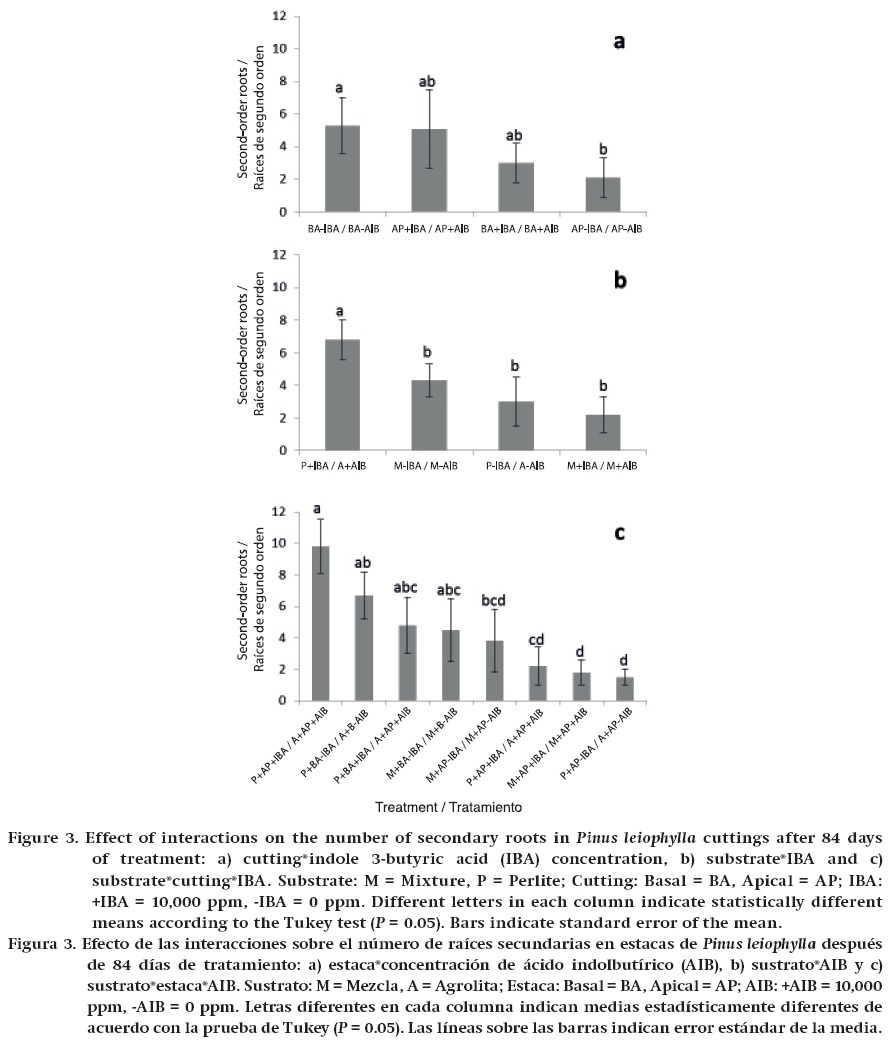
<body><![CDATA[<p align="justify"><font face="verdana" size="2">Cutting type had a significant effect on rooting probability (X<sup>2</sup>= 28.69, gl=1, <i>P</i> &lt; 0.0001) (<a href="/img/revistas/rcscfa/v21n1/a7t2.jpg" target="_blank">Table 2</a>). The binary regression model indicates that rooting probability is 3.5 times greater (value obtained from the exponential of the coefficient for the effects of treatment; that is, exp&#91;1.252 = 3.5&#93; when a basal cutting is used rather than an apical one. The type of cutting did not affect its growth during the rooting process, or the number and length of first&#45;order roots, but it did have an effect (<i>P</i> &#8804; 0.05) on the rooting percentage and the number and length of second&#45;order roots (<a href="/img/revistas/rcscfa/v21n1/a7t3.jpg" target="_blank">Table 3</a>). The average of rooted cuttings ranged from 14.9 % in apical cuttings to 38.5 % in basal cuttings, while the number and length of second&#45;order roots was higher in basal cuttings (<a href="/img/revistas/rcscfa/v21n1/a7t4.jpg" target="_blank">Table 4</a>).</font></p>  	    <p align="justify"><font face="verdana" size="2">The basal cuttings of <i>P. leiophylla</i> are more juvenile in structure and chronology than apical ones, which could explain the results obtained in both rooting percentage and root morphology (length and number of second&#45;order roots) of the cutting types tested. In conifers, several studies have shown that the juvenility of the explant is required to increase the rooting percentage and that positively influences the length, area and volume of the root (Foster, Stelzer, &amp; McRae, 2000). In <i>Gmelina arborea</i> Roxb., the position of the cutting is the only factor that affects the rooting percentage (Ru&iacute;z&#45;Garc&iacute;a, Vargas&#45;Hern&aacute;ndez, Cetina&#45;Alcal&aacute;, &amp; Villegas&#45;Monter, 2005). The characteristics of the stem from where the cuttings are taken, such as juvenility, ontogeny and position, as well as the management of the mother plants, are the factors that most affect the percentage of rooted cuttings in <i>Taxus globosa</i> Schltdl. (Mu&ntilde;oz&#45;Guti&eacute;rrez, Vargas&#45;Hern&aacute;ndez, L&oacute;pez&#45;Upton, &amp; Soto&#45;Hern&aacute;ndez, 2009), <i>Abies fraseri</i> (Pursh) Poir. (Rosier, Frampton, Goldfarb, Wise, &amp; Blazich, 2005) and <i>Pinus virginiana</i> Mill. (Rosier et al., 2006).</font></p>  	    <p align="justify"><font face="verdana" size="2"><b>Effect of IBA on rooting of <i>P. leiophylla</i> cuttings</b></font></p>  	    <p align="justify"><font face="verdana" size="2">IBA concentration had no significant effect (<i>X<sup>2</sup></i> = 1.5, gl = 1, <i>P</i> = 0.2193) on rooting probability (<a href="/img/revistas/rcscfa/v21n1/a7t2.jpg" target="_blank">Table 2</a>); it was only significant (P = 0.0194) for the number of first&#45;order roots (<a href="/img/revistas/rcscfa/v21n1/a7t3.jpg" target="_blank">Table 3</a>). This suggests that <i>P. leiophylla</i> cuttings are able to root without the application of IBA. Aparicio&#45;Renter&iacute;a, Ju&aacute;rez&#45;Cerrillo, and S&aacute;nchez&#45;Vel&aacute;zquez (2014) obtained a similar response in <i>Pinus patula</i> Schl. <i>et</i> Cham. cuttings, which rooted with percentages above 90 % without the application of growth regulators. However, in our study, IBA contributed to the formation of a larger number of first&#45;order roots (2.4 roots with IBA and 1.6 without it) (<a href="/img/revistas/rcscfa/v21n1/a7t4.jpg" target="_blank">Table 4</a>). Similar results have also been obtained in studies with species of pine and eucalyptus, where the IBA stimulated the production of a higher number of roots and other attributes related to root morphology (Majada et al., 2011; Navarrete&#45;Luna &amp; Vargas&#45;Hern&aacute;ndez, 2005). On the other hand, Hinesley, Blazich, and Snelling (1994) evaluated various IBA concentrations (0.0, 5.0, 10.0 and 15.0 g&middot;liter<sup>&#45;1</sup>) in <i>Chamaecyparis thyoides</i> (L.) B. S. P., and found that the number of first&#45;order roots increased linearly (r = 0.70). Production of first&#45;order roots provides increased water uptake and nutrient translocation, which improves plant growth and development (Davis &amp; Jacobs, 2005). IBA application is therefore desirable in order to increase the production of first&#45;order roots and improve the morphological attributes of <i>P. leiophylla</i> cuttings.</font></p>  	    <p align="justify"><font face="verdana" size="2"><b>Effect of interactions on rooting of <i>P. leiophylla</i> cuttings</b></font></p>  	    <p align="justify"><font face="verdana" size="2">Only the interaction of the three factors (substrate type*cutting type*IBA concentration) had an effect (<i>P</i> = 0.0219) on rooting percentage (<a href="/img/revistas/rcscfa/v21n1/a7t3.jpg" target="_blank">Table 3</a>), which ranged from 45.3 % in the substrate composed of peat&#45;perlite&#45;vermiculite, with basal cuttings and IBA(10,000 ppm), to 8.6 % in perlite, with apical cuttings and IBA (0 ppm). <a href="/img/revistas/rcscfa/v21n1/a7f1.jpg" target="_blank">Figure 1</a> shows the effect of the eight evaluated treatments on the rooting percentage.</font></p>  	    <p align="justify"><font face="verdana" size="2">The substrate*cutting and substrate*IBA interactions, and the triple interaction showed significant effects (<i>P</i> &#8804; 0.05) on cutting growth during the rooting process (<a href="/img/revistas/rcscfa/v21n1/a7t3.jpg" target="_blank">Table 3</a>). The peat&#45;perlite&#45;vermiculite substrate favored greater cutting growth (3.1 cm), while some of the substrate*IBA interactions and the triple interaction (<i>P</i> &#8804; 0.05) affected cutting growth (<a href="/img/revistas/rcscfa/v21n1/a7f2.jpg" target="_blank">Figure 2</a>). Rooting percentages of <i>P. leiophylla</i> are within the range of those reported by several authors for other species of <i>Pinus</i> (Lebude et al., 2004; Mori et al., 2011; Rosier et al., 2006). It should be noted that most of the published studies were carried out with controlled temperature and humidity, testing different misting systems that in many cases create disease problems (Preece, 2003). In the present study we used "moderate" technology constituted by microtunnels, where the hermetically&#45;sealed plastic cover (Ram&iacute;rez&#45;Villalobos, Urdaneta&#45;Fern&aacute;ndez, &amp; Vargas&#45;Simon, 2004) kept the relative humidity high, thereby avoiding the need for watering during the experiment.</font></p>  	    <p align="justify"><font face="verdana" size="2">The number of first&#45;order roots was not affected by any of the interactions, while the number of second&#45;order roots showed an effect (P &#8804; 0.05) as a result of the cutting type*IBA and substrate type*IBA interactions, as well as the triple interaction (<a href="/img/revistas/rcscfa/v21n1/a7t3.jpg" target="_blank">Table 3</a>). <a href="/img/revistas/rcscfa/v21n1/a7f3.jpg" target="_blank">Figure 3</a> shows a graphical representation of these interactions. The basal cutting*IBA(0 ppm) interaction resulted in 5.3 secondary roots, while the apical cutting*IBA(0 ppm) interaction only fostered 2.1 roots (<a href="/img/revistas/rcscfa/v21n1/a7f3.jpg" target="_blank">Figure 3a</a>); the perlite*IBA(10,000 ppm) interaction also formed more than double the number of roots of the other interactions (<a href="/img/revistas/rcscfa/v21n1/a7f3.jpg">Figure 3b</a>); finally, the difference between the triple interaction with the largest and smallest number of roots was 8.7 secondary roots (<a href="/img/revistas/rcscfa/v21n1/a7f3.jpg" target="_blank">Figure 3c</a>). The results show that the exogenous IBA concentration favors the formation of <i>P. leiophylla</i> roots depending on the cutting type and substrate type; in <i>G. arborea,</i> it has been observed that root formation is favored by the interaction between the IBA concentration and cutting type (Ru&iacute;z et al., 2005).</font></p>  	    <p align="justify"><font face="verdana" size="2">Regarding root length, only the substrate type*IBA interaction had an effect (<i>P</i> = 0.0053) on the length of primary roots (<a href="/img/revistas/rcscfa/v21n1/a7t3.jpg" target="_blank">Table 3</a>), where perlite*IBA (10,000 ppm) had the greatest length (10 cm) as shown in <a href="/img/revistas/rcscfa/v21n1/a7f4.jpg" target="_blank">Figure 4</a>. The cutting type*IBA interaction and the triple interaction affected (<i>P</i> &#8804; 0.05) the length of secondary roots (<a href="/img/revistas/rcscfa/v21n1/a7t3.jpg" target="_blank">Table</a> <a href="/img/revistas/rcscfa/v21n1/a7t3.jpg">3</a>). <a href="/img/revistas/rcscfa/v21n1/a7f5.jpg" target="_blank">Figure 5</a> shows that the cutting type*IBA interaction presented a 1.6&#45;cm difference between the largest and smallest length, while the combination of the three factors had a 2.5&#45;cm difference between the largest and smallest length. King et al. (2011) also observed increased root length as a result of the interaction of factors in <i>Taxodium distichum</i> (L.) Rich., obtaining root lengths of 3.8&#45;11.9 cm depending on the substrate type and IBA concentration.</font></p>  	    <p align="justify"><font face="verdana" size="2">&nbsp;</font></p>  	    ]]></body>
<body><![CDATA[<p align="justify"><font face="verdana" size="2"><b>CONCLUSIONS</b></font></p>  	    <p align="justify"><font face="verdana" size="2">The use of basal cuttings with 10,000 ppm of IBA and perlite as the substrate is the most feasible treatment for rooting cuttings from 18&#45;month&#45;old <i>P. leiophylla</i> plants. The technique and the method used in this study could represent an affordable option for vegetative propagation of conifers without large investments in infrastructure.</font></p>  	    <p align="justify"><font face="verdana" size="2">&nbsp;</font></p>  	    <p align="justify"><font face="verdana" size="2"><b>REFERENCES</b></font></p>  	    <!-- ref --><p align="justify"><font face="verdana" size="2">Aparicio&#45;Renter&iacute;a, A., Ju&aacute;rez&#45;Cerrillo, S. F., &amp; S&aacute;nchez&#45;Vel&aacute;zquez, L. R. (2014). Propagaci&oacute;n por enraizamiento de estacas y conservaci&oacute;n de &aacute;rboles plus extintos de <i>Pinus patula</i> procedentes del norte de Veracruz, M&eacute;xico. <i>Madera y Bosque, 20</i>(1), 85&#45;96. Obtenido de <a href="http://www.redalyc.org/articulo.oa?id=61730576008" target="_blank">http://www.redalyc.org/articulo.oa?id=61730576008</a>.    &nbsp;&nbsp;&nbsp;&nbsp;&nbsp;&nbsp;&nbsp;&nbsp;[&#160;<a href="javascript:void(0);" onclick="javascript: window.open('/scielo.php?script=sci_nlinks&ref=6632584&pid=S2007-4018201500010000700001&lng=','','width=640,height=500,resizable=yes,scrollbars=1,menubar=yes,');">Links</a>&#160;]<!-- end-ref --></font></p>  	    <!-- ref --><p align="justify"><font face="verdana" size="2">Davis, A. S., &amp; Jacobs, D. F. (2005). Quantifying root system quality of nursery seedlings and relationship to outplanting performance. <i>New Forests, 30,</i> 295&#45;311. doi: 10.1007/s11056&#45;005&#45;7480&#45;y.    &nbsp;&nbsp;&nbsp;&nbsp;&nbsp;&nbsp;&nbsp;&nbsp;[&#160;<a href="javascript:void(0);" onclick="javascript: window.open('/scielo.php?script=sci_nlinks&ref=6632586&pid=S2007-4018201500010000700002&lng=','','width=640,height=500,resizable=yes,scrollbars=1,menubar=yes,');">Links</a>&#160;]<!-- end-ref --></font></p>  	    <!-- ref --><p align="justify"><font face="verdana" size="2">Foster, G. S., Stelzer, H. E., &amp; McRae, J. B. (2000). Loblolly pine cutting morphological traits: Effects on rooting and field performance. <i>New Forests, 19,</i> 291&#45;306. doi: 10.1023/A:1006691808772.    &nbsp;&nbsp;&nbsp;&nbsp;&nbsp;&nbsp;&nbsp;&nbsp;[&#160;<a href="javascript:void(0);" onclick="javascript: window.open('/scielo.php?script=sci_nlinks&ref=6632588&pid=S2007-4018201500010000700003&lng=','','width=640,height=500,resizable=yes,scrollbars=1,menubar=yes,');">Links</a>&#160;]<!-- end-ref --></font></p>  	    ]]></body>
<body><![CDATA[<!-- ref --><p align="justify"><font face="verdana" size="2">Greenwood, M. S., &amp; Weir, R. J. (1994). Genetic variation in rooting ability of loblolly pine cutting: Effects of auxin and family on rooting by hypocotyl cuttings. <i>Tree Physiology, 15,</i> 41&#45;45. doi: 10.1093/treephys/15.1.41.    &nbsp;&nbsp;&nbsp;&nbsp;&nbsp;&nbsp;&nbsp;&nbsp;[&#160;<a href="javascript:void(0);" onclick="javascript: window.open('/scielo.php?script=sci_nlinks&ref=6632590&pid=S2007-4018201500010000700004&lng=','','width=640,height=500,resizable=yes,scrollbars=1,menubar=yes,');">Links</a>&#160;]<!-- end-ref --></font></p>  	    <!-- ref --><p align="justify"><font face="verdana" size="2">Hartmann, H., &amp; Kester, D. (2001). <i>Propagaci&oacute;n de plantas. Principios y pr&aacute;cticas.</i> M&eacute;xico, D. F.: Editorial Continental.    &nbsp;&nbsp;&nbsp;&nbsp;&nbsp;&nbsp;&nbsp;&nbsp;[&#160;<a href="javascript:void(0);" onclick="javascript: window.open('/scielo.php?script=sci_nlinks&ref=6632592&pid=S2007-4018201500010000700005&lng=','','width=640,height=500,resizable=yes,scrollbars=1,menubar=yes,');">Links</a>&#160;]<!-- end-ref --></font></p>  	    <!-- ref --><p align="justify"><font face="verdana" size="2">Hinesley, L. E., Blazich, F. A., &amp; Snelling, L. K. (1994). Propagation of Atlantic white cedar by stem cuttings. <i>HortScience, 29</i>(3), 217&#45;219. Obtenido de <a href="http://hortsci.ashspublications.org/content/29/3/217.full.pdf" target="_blank">http://hortsci.ashspublications.org/content/29/3/217.full.pdf</a>.    &nbsp;&nbsp;&nbsp;&nbsp;&nbsp;&nbsp;&nbsp;&nbsp;[&#160;<a href="javascript:void(0);" onclick="javascript: window.open('/scielo.php?script=sci_nlinks&ref=6632594&pid=S2007-4018201500010000700006&lng=','','width=640,height=500,resizable=yes,scrollbars=1,menubar=yes,');">Links</a>&#160;]<!-- end-ref --></font></p>  	    <!-- ref --><p align="justify"><font face="verdana" size="2">King, A. R., Arnold, M. A., Welsh, D. F., &amp; Watson, W. T. (2011). Substrates, wounding, and growth regulator concentrations alter adventitious rooting of Baldcypress cuttings. <i>Hortscience, 46</i>(10), 1387&#45;1393. Obtenido de <a href="http://hortsci.ashspublications.org/content/46/10/1387.full.pdf+html" target="_blank">http://hortsci.ashspublications.org/content/46/10/1387.full.pdf+html</a>.    &nbsp;&nbsp;&nbsp;&nbsp;&nbsp;&nbsp;&nbsp;&nbsp;[&#160;<a href="javascript:void(0);" onclick="javascript: window.open('/scielo.php?script=sci_nlinks&ref=6632596&pid=S2007-4018201500010000700007&lng=','','width=640,height=500,resizable=yes,scrollbars=1,menubar=yes,');">Links</a>&#160;]<!-- end-ref --></font></p>  	    <!-- ref --><p align="justify"><font face="verdana" size="2">Lebude, A. V., Goldfarb, B., Blazich, F. A., Wise, F. C., &amp; Frampton, J. (2004). Mist, substrate water potential and cutting water potential influence rooting of stem cuttings of loblolly pine. <i>Tree Physiology, 24,</i> 823&#45;831. Obtenido de <a href="http://treephys.oxfordjournals.org/content/24/7/823.full.pdf" target="_blank">http://treephys.oxfordjournals.org/content/24/7/823.full.pdf</a>.    &nbsp;&nbsp;&nbsp;&nbsp;&nbsp;&nbsp;&nbsp;&nbsp;[&#160;<a href="javascript:void(0);" onclick="javascript: window.open('/scielo.php?script=sci_nlinks&ref=6632598&pid=S2007-4018201500010000700008&lng=','','width=640,height=500,resizable=yes,scrollbars=1,menubar=yes,');">Links</a>&#160;]<!-- end-ref --></font></p>      ]]></body>
<body><![CDATA[<!-- ref --><p align="justify"><font face="verdana" size="2">Majada, J., Mart&iacute;nez&#45;Alonso, C., Feito, I., Kidelman, A., Aranda, I., &amp; Al&iacute;a, R. (2011). Mini&#45;cuttings: An effective technique for the propagation of <i>Pinus pinaster</i> Ait. <i>New Forests, 41,</i> 399&#45;412. doi: 10.1007/ s11056&#45;010&#45;9232&#45;x.    &nbsp;&nbsp;&nbsp;&nbsp;&nbsp;&nbsp;&nbsp;&nbsp;[&#160;<a href="javascript:void(0);" onclick="javascript: window.open('/scielo.php?script=sci_nlinks&ref=6632600&pid=S2007-4018201500010000700009&lng=','','width=640,height=500,resizable=yes,scrollbars=1,menubar=yes,');">Links</a>&#160;]<!-- end-ref --></font></p>  	    <!-- ref --><p align="justify"><font face="verdana" size="2">Mori, Y., Miyahara, F., Tsutsumi, Y., &amp; Kondo, R. (2011). Effects of combinational treatment with ethephon and indole&#45;3&#45;butyric acid on adventitious rooting of <i>Pinus thunbergii</i> cuttings. <i>Plant Growth Regulators, 63,</i> 271&#45;278. doi: 10.1007/s10725&#45;010&#45;9524&#45;3.    &nbsp;&nbsp;&nbsp;&nbsp;&nbsp;&nbsp;&nbsp;&nbsp;[&#160;<a href="javascript:void(0);" onclick="javascript: window.open('/scielo.php?script=sci_nlinks&ref=6632602&pid=S2007-4018201500010000700010&lng=','','width=640,height=500,resizable=yes,scrollbars=1,menubar=yes,');">Links</a>&#160;]<!-- end-ref --></font></p>  	    <!-- ref --><p align="justify"><font face="verdana" size="2">Mu&ntilde;oz&#45;Guti&eacute;rrez, L., Vargas&#45;Hern&aacute;ndez, J. J., L&oacute;pez&#45;Upton, J., &amp; Soto&#45;Hern&aacute;ndez, M. (2009). Effect of cutting age and substrate temperature on rooting of <i>Taxus globosa. New Forests, 38,</i> 187&#45;196. doi: 10.1007/s11056&#45;009&#45;9139&#45;6.    &nbsp;&nbsp;&nbsp;&nbsp;&nbsp;&nbsp;&nbsp;&nbsp;[&#160;<a href="javascript:void(0);" onclick="javascript: window.open('/scielo.php?script=sci_nlinks&ref=6632604&pid=S2007-4018201500010000700011&lng=','','width=640,height=500,resizable=yes,scrollbars=1,menubar=yes,');">Links</a>&#160;]<!-- end-ref --></font></p>  	    <!-- ref --><p align="justify"><font face="verdana" size="2">Navarrete&#45;Luna, M. &amp; Vargas&#45;Hern&aacute;ndez, J. J. (2005). Propagaci&oacute;n asexual de clones de <i>Eucalyptus camaldulensis</i> Dehnh. utilizando radix en diferentes concentraciones. <i>Revista Chapingo Serie Ciencias Forestales y del Ambiente, 11</i>(2), 111&#45;116. Obtenido de <a href="http://www.redalyc.org/articulo.oa?id=62911206" target="_blank">http://www.redalyc.org/articulo.oa?id=62911206</a>.    &nbsp;&nbsp;&nbsp;&nbsp;&nbsp;&nbsp;&nbsp;&nbsp;[&#160;<a href="javascript:void(0);" onclick="javascript: window.open('/scielo.php?script=sci_nlinks&ref=6632606&pid=S2007-4018201500010000700012&lng=','','width=640,height=500,resizable=yes,scrollbars=1,menubar=yes,');">Links</a>&#160;]<!-- end-ref --></font></p>  	    <!-- ref --><p align="justify"><font face="verdana" size="2">Preece, J. E. (2003). A century of progress with vegetative plant propagation. <i>HortScience, 38</i>(5), 1015&#45;1025. Obtenido de <a href="http://hortsci.ashspublications.org/content/38/5/1015.full.pdf+html" target="_blank">http://hortsci.ashspublications.org/content/38/5/1015.full.pdf+html</a>.    &nbsp;&nbsp;&nbsp;&nbsp;&nbsp;&nbsp;&nbsp;&nbsp;[&#160;<a href="javascript:void(0);" onclick="javascript: window.open('/scielo.php?script=sci_nlinks&ref=6632608&pid=S2007-4018201500010000700013&lng=','','width=640,height=500,resizable=yes,scrollbars=1,menubar=yes,');">Links</a>&#160;]<!-- end-ref --></font></p>  	    ]]></body>
<body><![CDATA[<!-- ref --><p align="justify"><font face="verdana" size="2">Ragonezi, C., Klimaszewska, K., Castro, M. R., Lima, M., de Oliveira, P., &amp; Zavattieri, M. A. (2010). Adventitious rooting of conifers: Influence of physical and chemical factors. <i>Trees, 24,</i> 975&#45;992. doi: 10.1007/s00468&#45;010&#45;0488&#45;8.    &nbsp;&nbsp;&nbsp;&nbsp;&nbsp;&nbsp;&nbsp;&nbsp;[&#160;<a href="javascript:void(0);" onclick="javascript: window.open('/scielo.php?script=sci_nlinks&ref=6632610&pid=S2007-4018201500010000700014&lng=','','width=640,height=500,resizable=yes,scrollbars=1,menubar=yes,');">Links</a>&#160;]<!-- end-ref --></font></p>  	    <!-- ref --><p align="justify"><font face="verdana" size="2">Ram&iacute;rez&#45;Villalobos, M., Urdaneta&#45;Fern&aacute;ndez, A., &amp; Vargas&#45;Sim&oacute;n, G. (2004). Tratamientos con &aacute;cido indolbut&iacute;rico y lesionado sobre el enraizamiento de estacas de icaco (<i>Chrysobalanus icaco</i> L.). <i>Agronom&iacute;a Tropical, 54</i>(2), 203&#45;218. Obtenido de <a href="http://www.scielo.org.ve/scielo.php?pid=S0002&#45;192X2004000200005&amp;script=sci_arttext" target="_blank">http://www.scielo.org.ve/scielo.php?pid=S0002&#45;192X2004000200005&amp;script=sci_arttext</a>.    &nbsp;&nbsp;&nbsp;&nbsp;&nbsp;&nbsp;&nbsp;&nbsp;[&#160;<a href="javascript:void(0);" onclick="javascript: window.open('/scielo.php?script=sci_nlinks&ref=6632612&pid=S2007-4018201500010000700015&lng=','','width=640,height=500,resizable=yes,scrollbars=1,menubar=yes,');">Links</a>&#160;]<!-- end-ref --></font></p>  	    <!-- ref --><p align="justify"><font face="verdana" size="2">Rodr&iacute;guez&#45;Mac&iacute;as, R., Alcantar&#45;Gonz&aacute;lez, E. G., I&ntilde;iguez&#45;Covarrubias, G., Zamora&#45;Natera, F., Garc&iacute;a&#45;L&oacute;pez, P. M., Ru&iacute;z&#45;L&oacute;pez, M. A., &amp; Salcedo&#45;P&eacute;rez, E. (2010). Caracterizaci&oacute;n f&iacute;sica y qu&iacute;mica de sustratos agr&iacute;colas a partir de bagazo de agave tequilero. <i>Interciencia,</i> 35(7), 515&#45;520. Obtenido de <a href="http://www.interciencia.org/v35_07/515.pdf" target="_blank">http://www.interciencia.org/v35_07/515.pdf</a>.    &nbsp;&nbsp;&nbsp;&nbsp;&nbsp;&nbsp;&nbsp;&nbsp;[&#160;<a href="javascript:void(0);" onclick="javascript: window.open('/scielo.php?script=sci_nlinks&ref=6632614&pid=S2007-4018201500010000700016&lng=','','width=640,height=500,resizable=yes,scrollbars=1,menubar=yes,');">Links</a>&#160;]<!-- end-ref --></font></p>  	    <!-- ref --><p align="justify"><font face="verdana" size="2">Rosier, C. L., Frampton, J., Goldfarb, B., Blazich, F. A., &amp; Wise, F. C. (2004). Growth stage, auxin type, and concentration influence rooting of Virginia pine stem cuttings. <i>HortScience, 39</i>(6), 1397&#45;1402. Obtenido de <a href="http://www.ces.ncsu.edu/fletcher/programs/xmas/production-east/virginia-pine-auxin-study.pdf" target="_blank">http://www.ces.ncsu.edu/fletcher/programs/xmas/production&#45;east/virginia&#45;pine&#45;auxin&#45;study.pdf</a>.    &nbsp;&nbsp;&nbsp;&nbsp;&nbsp;&nbsp;&nbsp;&nbsp;[&#160;<a href="javascript:void(0);" onclick="javascript: window.open('/scielo.php?script=sci_nlinks&ref=6632616&pid=S2007-4018201500010000700017&lng=','','width=640,height=500,resizable=yes,scrollbars=1,menubar=yes,');">Links</a>&#160;]<!-- end-ref --></font></p>  	    <!-- ref --><p align="justify"><font face="verdana" size="2">Rosier, C. L., Frampton, J., Goldfarb, B., Blazich, F. A., &amp; Wise, F. C. (2006). Improving the rooting capacity of stem cuttings ofVirginia pine by severe stumping of parent trees. <i>Southern Journal of Applied Forestry, 30</i>(4), 172&#45;181. Obtenido de <a href="http://www4.ncsu.edu/~frampton/personnel/documents/2006VirginiaPineStumpingStudy.pdf" target="_blank">http://www4.ncsu.edu/~frampton/personnel/documents/2006VirginiaPineStumpingStudy.pdf</a>.    &nbsp;&nbsp;&nbsp;&nbsp;&nbsp;&nbsp;&nbsp;&nbsp;[&#160;<a href="javascript:void(0);" onclick="javascript: window.open('/scielo.php?script=sci_nlinks&ref=6632618&pid=S2007-4018201500010000700018&lng=','','width=640,height=500,resizable=yes,scrollbars=1,menubar=yes,');">Links</a>&#160;]<!-- end-ref --></font></p>      ]]></body>
<body><![CDATA[<!-- ref --><p align="justify"><font face="verdana" size="2">Rosier, C. L., Frampton, J., Goldfarb, B., Wise, F. C., &amp; Blazich, F. A. (2005). Stumping height, crow position, and age of parent tree influence rooting of stem cuttings of Fraser fir. <i>HortScience, 40</i>(3), 771&#45;777. Obtenido de <a href="http://hortsci.ashspublications.org/content/40/3/771.full.pdf" target="_blank">http://hortsci.ashspublications.org/content/40/3/771.full.pdf</a>.    &nbsp;&nbsp;&nbsp;&nbsp;&nbsp;&nbsp;&nbsp;&nbsp;[&#160;<a href="javascript:void(0);" onclick="javascript: window.open('/scielo.php?script=sci_nlinks&ref=6632620&pid=S2007-4018201500010000700019&lng=','','width=640,height=500,resizable=yes,scrollbars=1,menubar=yes,');">Links</a>&#160;]<!-- end-ref --></font></p>  	    <!-- ref --><p align="justify"><font face="verdana" size="2">Ru&iacute;z&#45;Garc&iacute;a, R., Vargas&#45;Hern&aacute;ndez, J. J., Cetina&#45;Alcal&aacute;, V. M., &amp; Villegas&#45;Monter, A. (2005). Efecto del &aacute;cido indolbut&iacute;rico (AIB) y tipo de estaca en el enraizado de <i>Gmelina arborea</i> Roxb. <i>Revista Fitotecnia Mexicana, 28</i>(4), 319&#45;326. Obtenido de <a href="http://www.redalyc.org/articulo.oa?id=61028403" target="_blank">http://www.redalyc.org/articulo.oa?id=61028403</a>.    &nbsp;&nbsp;&nbsp;&nbsp;&nbsp;&nbsp;&nbsp;&nbsp;[&#160;<a href="javascript:void(0);" onclick="javascript: window.open('/scielo.php?script=sci_nlinks&ref=6632622&pid=S2007-4018201500010000700020&lng=','','width=640,height=500,resizable=yes,scrollbars=1,menubar=yes,');">Links</a>&#160;]<!-- end-ref --></font></p>  	    <!-- ref --><p align="justify"><font face="verdana" size="2">Santelices, R. &amp; Cabello, A. (2006). Efecto del &aacute;cido indolbut&iacute;rico, del tipo de la cama de arraigamiento, del sustrato, y del &aacute;rbol madre en la capacidad de arraigamiento de estacas de <i>Nothofagus glauca</i> (Phil.) Krasser. <i>Revista Chilena de Historia Natural, 79,</i> 55&#45;64. doi: 10.4067/S0716&#45;078X2006000100005.    &nbsp;&nbsp;&nbsp;&nbsp;&nbsp;&nbsp;&nbsp;&nbsp;[&#160;<a href="javascript:void(0);" onclick="javascript: window.open('/scielo.php?script=sci_nlinks&ref=6632624&pid=S2007-4018201500010000700021&lng=','','width=640,height=500,resizable=yes,scrollbars=1,menubar=yes,');">Links</a>&#160;]<!-- end-ref --></font></p>  	    <!-- ref --><p align="justify"><font face="verdana" size="2">Sharma, S. K. &amp; Verma, S. K. (2011). Seasonal influences on the rooting response of Chir pine <i>(Pinus roxburghii</i> Sarg.). <i>Annals of Forest Research, 54</i>(2), 241&#45;247. Obtenido de <a href="http://www.editurasilvica.ro/afr/54/2/sharma.pdf" target="_blank">http://www.editurasilvica.ro/afr/54/2/sharma.pdf</a>.    &nbsp;&nbsp;&nbsp;&nbsp;&nbsp;&nbsp;&nbsp;&nbsp;[&#160;<a href="javascript:void(0);" onclick="javascript: window.open('/scielo.php?script=sci_nlinks&ref=6632626&pid=S2007-4018201500010000700022&lng=','','width=640,height=500,resizable=yes,scrollbars=1,menubar=yes,');">Links</a>&#160;]<!-- end-ref --></font></p>  	    <!-- ref --><p align="justify"><font face="verdana" size="2">Statistical Analysis System (SAS Institute). (2004). SAS/STAT9.1 user's guide. Cary, NC, USA: Autor.    &nbsp;&nbsp;&nbsp;&nbsp;&nbsp;&nbsp;&nbsp;&nbsp;[&#160;<a href="javascript:void(0);" onclick="javascript: window.open('/scielo.php?script=sci_nlinks&ref=6632628&pid=S2007-4018201500010000700023&lng=','','width=640,height=500,resizable=yes,scrollbars=1,menubar=yes,');">Links</a>&#160;]<!-- end-ref --></font></p>  	    ]]></body>
<body><![CDATA[<!-- ref --><p align="justify"><font face="verdana" size="2">Zobel, B. &amp; Talbert, J. (1984). <i>Applied forest tree improvement.</i> New York, USA: John Wiley &amp; Sons.    &nbsp;&nbsp;&nbsp;&nbsp;&nbsp;&nbsp;&nbsp;&nbsp;[&#160;<a href="javascript:void(0);" onclick="javascript: window.open('/scielo.php?script=sci_nlinks&ref=6632630&pid=S2007-4018201500010000700024&lng=','','width=640,height=500,resizable=yes,scrollbars=1,menubar=yes,');">Links</a>&#160;]<!-- end-ref --></font></p>      ]]></body><back>
<ref-list>
<ref id="B1">
<nlm-citation citation-type="journal">
<person-group person-group-type="author">
<name>
<surname><![CDATA[Aparicio-Rentería]]></surname>
<given-names><![CDATA[A.]]></given-names>
</name>
<name>
<surname><![CDATA[Juárez-Cerrillo]]></surname>
<given-names><![CDATA[S. F.]]></given-names>
</name>
<name>
<surname><![CDATA[Sánchez-Velázquez]]></surname>
<given-names><![CDATA[L. R.]]></given-names>
</name>
</person-group>
<article-title xml:lang="es"><![CDATA[Propagación por enraizamiento de estacas y conservación de árboles plus extintos de Pinus patula procedentes del norte de Veracruz, México]]></article-title>
<source><![CDATA[Madera y Bosque]]></source>
<year>2014</year>
<volume>20</volume>
<numero>1</numero>
<issue>1</issue>
<page-range>85-96</page-range></nlm-citation>
</ref>
<ref id="B2">
<nlm-citation citation-type="journal">
<person-group person-group-type="author">
<name>
<surname><![CDATA[Davis]]></surname>
<given-names><![CDATA[A. S.]]></given-names>
</name>
<name>
<surname><![CDATA[Jacobs]]></surname>
<given-names><![CDATA[D. F.]]></given-names>
</name>
</person-group>
<article-title xml:lang="en"><![CDATA[Quantifying root system quality of nursery seedlings and relationship to outplanting performance]]></article-title>
<source><![CDATA[New Forests]]></source>
<year>2005</year>
<volume>30</volume>
<page-range>295-311</page-range></nlm-citation>
</ref>
<ref id="B3">
<nlm-citation citation-type="journal">
<person-group person-group-type="author">
<name>
<surname><![CDATA[Foster]]></surname>
<given-names><![CDATA[G. S.]]></given-names>
</name>
<name>
<surname><![CDATA[Stelzer]]></surname>
<given-names><![CDATA[H. E.]]></given-names>
</name>
<name>
<surname><![CDATA[McRae]]></surname>
<given-names><![CDATA[J. B.]]></given-names>
</name>
</person-group>
<article-title xml:lang="en"><![CDATA[Loblolly pine cutting morphological traits: Effects on rooting and field performance]]></article-title>
<source><![CDATA[New Forests]]></source>
<year>2000</year>
<volume>19</volume>
<page-range>291-306</page-range></nlm-citation>
</ref>
<ref id="B4">
<nlm-citation citation-type="journal">
<person-group person-group-type="author">
<name>
<surname><![CDATA[Greenwood]]></surname>
<given-names><![CDATA[M. S.]]></given-names>
</name>
<name>
<surname><![CDATA[Weir]]></surname>
<given-names><![CDATA[R. J.]]></given-names>
</name>
</person-group>
<article-title xml:lang="en"><![CDATA[Genetic variation in rooting ability of loblolly pine cutting: Effects of auxin and family on rooting by hypocotyl cuttings]]></article-title>
<source><![CDATA[Tree Physiology]]></source>
<year>1994</year>
<volume>15</volume>
<page-range>41-45</page-range></nlm-citation>
</ref>
<ref id="B5">
<nlm-citation citation-type="book">
<person-group person-group-type="author">
<name>
<surname><![CDATA[Hartmann]]></surname>
<given-names><![CDATA[H.]]></given-names>
</name>
<name>
<surname><![CDATA[Kester]]></surname>
<given-names><![CDATA[D.]]></given-names>
</name>
</person-group>
<source><![CDATA[Propagación de plantas. Principios y prácticas]]></source>
<year>2001</year>
<publisher-loc><![CDATA[México^eD. F. D. F.]]></publisher-loc>
<publisher-name><![CDATA[Editorial Continental]]></publisher-name>
</nlm-citation>
</ref>
<ref id="B6">
<nlm-citation citation-type="journal">
<person-group person-group-type="author">
<name>
<surname><![CDATA[Hinesley]]></surname>
<given-names><![CDATA[L. E.]]></given-names>
</name>
<name>
<surname><![CDATA[Blazich]]></surname>
<given-names><![CDATA[F. A.]]></given-names>
</name>
<name>
<surname><![CDATA[Snelling]]></surname>
<given-names><![CDATA[L. K.]]></given-names>
</name>
</person-group>
<article-title xml:lang="en"><![CDATA[Propagation of Atlantic white cedar by stem cuttings]]></article-title>
<source><![CDATA[HortScience]]></source>
<year>1994</year>
<volume>29</volume>
<numero>3</numero>
<issue>3</issue>
<page-range>217-219</page-range></nlm-citation>
</ref>
<ref id="B7">
<nlm-citation citation-type="journal">
<person-group person-group-type="author">
<name>
<surname><![CDATA[King]]></surname>
<given-names><![CDATA[A. R.]]></given-names>
</name>
<name>
<surname><![CDATA[Arnold]]></surname>
<given-names><![CDATA[M. A.]]></given-names>
</name>
<name>
<surname><![CDATA[Welsh]]></surname>
<given-names><![CDATA[D. F.]]></given-names>
</name>
<name>
<surname><![CDATA[Watson]]></surname>
<given-names><![CDATA[W. T.]]></given-names>
</name>
</person-group>
<article-title xml:lang="en"><![CDATA[Substrates, wounding, and growth regulator concentrations alter adventitious rooting of Baldcypress cuttings]]></article-title>
<source><![CDATA[Hortscience]]></source>
<year>2011</year>
<volume>46</volume>
<numero>10</numero>
<issue>10</issue>
<page-range>1387-1393</page-range></nlm-citation>
</ref>
<ref id="B8">
<nlm-citation citation-type="journal">
<person-group person-group-type="author">
<name>
<surname><![CDATA[Lebude]]></surname>
<given-names><![CDATA[A. V.]]></given-names>
</name>
<name>
<surname><![CDATA[Goldfarb]]></surname>
<given-names><![CDATA[B.]]></given-names>
</name>
<name>
<surname><![CDATA[Blazich]]></surname>
<given-names><![CDATA[F. A.]]></given-names>
</name>
<name>
<surname><![CDATA[Wise]]></surname>
<given-names><![CDATA[F. C.]]></given-names>
</name>
<name>
<surname><![CDATA[Frampton]]></surname>
<given-names><![CDATA[J.]]></given-names>
</name>
</person-group>
<article-title xml:lang="en"><![CDATA[Mist, substrate water potential and cutting water potential influence rooting of stem cuttings of loblolly pine]]></article-title>
<source><![CDATA[Tree Physiology]]></source>
<year>2004</year>
<volume>24</volume>
<page-range>823-831</page-range></nlm-citation>
</ref>
<ref id="B9">
<nlm-citation citation-type="journal">
<person-group person-group-type="author">
<name>
<surname><![CDATA[Majada]]></surname>
<given-names><![CDATA[J.]]></given-names>
</name>
<name>
<surname><![CDATA[Martínez-Alonso]]></surname>
<given-names><![CDATA[C.]]></given-names>
</name>
<name>
<surname><![CDATA[Feito]]></surname>
<given-names><![CDATA[I.]]></given-names>
</name>
<name>
<surname><![CDATA[Kidelman]]></surname>
<given-names><![CDATA[A.]]></given-names>
</name>
<name>
<surname><![CDATA[Aranda]]></surname>
<given-names><![CDATA[I.]]></given-names>
</name>
<name>
<surname><![CDATA[Alía]]></surname>
<given-names><![CDATA[R.]]></given-names>
</name>
</person-group>
<article-title xml:lang="en"><![CDATA[Mini-cuttings: An effective technique for the propagation of Pinus pinaster Ait]]></article-title>
<source><![CDATA[New Forests]]></source>
<year>2011</year>
<volume>41</volume>
<page-range>399-412</page-range></nlm-citation>
</ref>
<ref id="B10">
<nlm-citation citation-type="journal">
<person-group person-group-type="author">
<name>
<surname><![CDATA[Mori]]></surname>
<given-names><![CDATA[Y.]]></given-names>
</name>
<name>
<surname><![CDATA[Miyahara]]></surname>
<given-names><![CDATA[F.]]></given-names>
</name>
<name>
<surname><![CDATA[Tsutsumi]]></surname>
<given-names><![CDATA[Y.]]></given-names>
</name>
<name>
<surname><![CDATA[Kondo]]></surname>
<given-names><![CDATA[R.]]></given-names>
</name>
</person-group>
<article-title xml:lang="en"><![CDATA[Effects of combinational treatment with ethephon and indole-3-butyric acid on adventitious rooting of Pinus thunbergii cuttings]]></article-title>
<source><![CDATA[Plant Growth Regulators]]></source>
<year>2011</year>
<volume>63</volume>
<page-range>271-278</page-range></nlm-citation>
</ref>
<ref id="B11">
<nlm-citation citation-type="journal">
<person-group person-group-type="author">
<name>
<surname><![CDATA[Muñoz-Gutiérrez]]></surname>
<given-names><![CDATA[L.]]></given-names>
</name>
<name>
<surname><![CDATA[Vargas-Hernández]]></surname>
<given-names><![CDATA[J. J.]]></given-names>
</name>
<name>
<surname><![CDATA[López-Upton]]></surname>
<given-names><![CDATA[J.]]></given-names>
</name>
<name>
<surname><![CDATA[Soto-Hernández]]></surname>
<given-names><![CDATA[M.]]></given-names>
</name>
</person-group>
<article-title xml:lang="en"><![CDATA[Effect of cutting age and substrate temperature on rooting of Taxus globosa]]></article-title>
<source><![CDATA[New Forests]]></source>
<year>2009</year>
<volume>38</volume>
<page-range>187-196</page-range></nlm-citation>
</ref>
<ref id="B12">
<nlm-citation citation-type="journal">
<person-group person-group-type="author">
<name>
<surname><![CDATA[Navarrete-Luna]]></surname>
<given-names><![CDATA[M.]]></given-names>
</name>
<name>
<surname><![CDATA[Vargas-Hernández]]></surname>
<given-names><![CDATA[J. J.]]></given-names>
</name>
</person-group>
<article-title xml:lang="es"><![CDATA[Propagación asexual de clones de Eucalyptus camaldulensis Dehnh. utilizando radix en diferentes concentraciones]]></article-title>
<source><![CDATA[Revista Chapingo Serie Ciencias Forestales y del Ambiente]]></source>
<year>2005</year>
<volume>11</volume>
<numero>2</numero>
<issue>2</issue>
<page-range>111-116</page-range></nlm-citation>
</ref>
<ref id="B13">
<nlm-citation citation-type="journal">
<person-group person-group-type="author">
<name>
<surname><![CDATA[Preece]]></surname>
<given-names><![CDATA[J. E.]]></given-names>
</name>
</person-group>
<article-title xml:lang="en"><![CDATA[A century of progress with vegetative plant propagation]]></article-title>
<source><![CDATA[HortScience]]></source>
<year>2003</year>
<volume>38</volume>
<numero>5</numero>
<issue>5</issue>
<page-range>1015-1025</page-range></nlm-citation>
</ref>
<ref id="B14">
<nlm-citation citation-type="journal">
<person-group person-group-type="author">
<name>
<surname><![CDATA[Ragonezi]]></surname>
<given-names><![CDATA[C.]]></given-names>
</name>
<name>
<surname><![CDATA[Klimaszewska]]></surname>
<given-names><![CDATA[K.]]></given-names>
</name>
<name>
<surname><![CDATA[Castro]]></surname>
<given-names><![CDATA[M. R.]]></given-names>
</name>
<name>
<surname><![CDATA[Lima]]></surname>
<given-names><![CDATA[M.]]></given-names>
</name>
<name>
<surname><![CDATA[de Oliveira]]></surname>
<given-names><![CDATA[P.]]></given-names>
</name>
<name>
<surname><![CDATA[Zavattieri]]></surname>
<given-names><![CDATA[M. A.]]></given-names>
</name>
</person-group>
<article-title xml:lang="en"><![CDATA[Adventitious rooting of conifers: Influence of physical and chemical factors]]></article-title>
<source><![CDATA[Trees]]></source>
<year>2010</year>
<volume>24</volume>
<page-range>975-992</page-range></nlm-citation>
</ref>
<ref id="B15">
<nlm-citation citation-type="journal">
<person-group person-group-type="author">
<name>
<surname><![CDATA[Ramírez-Villalobos]]></surname>
<given-names><![CDATA[M.]]></given-names>
</name>
<name>
<surname><![CDATA[Urdaneta-Fernández]]></surname>
<given-names><![CDATA[A.]]></given-names>
</name>
<name>
<surname><![CDATA[Vargas-Simón]]></surname>
<given-names><![CDATA[G.]]></given-names>
</name>
</person-group>
<article-title xml:lang="es"><![CDATA[Tratamientos con ácido indolbutírico y lesionado sobre el enraizamiento de estacas de icaco (Chrysobalanus icaco L.)]]></article-title>
<source><![CDATA[Agronomía Tropical]]></source>
<year>2004</year>
<volume>54</volume>
<numero>2</numero>
<issue>2</issue>
<page-range>203-218</page-range></nlm-citation>
</ref>
<ref id="B16">
<nlm-citation citation-type="journal">
<person-group person-group-type="author">
<name>
<surname><![CDATA[Rodríguez-Macías]]></surname>
<given-names><![CDATA[R.]]></given-names>
</name>
<name>
<surname><![CDATA[Alcantar-González]]></surname>
<given-names><![CDATA[E. G.]]></given-names>
</name>
<name>
<surname><![CDATA[Iñiguez-Covarrubias]]></surname>
<given-names><![CDATA[G.]]></given-names>
</name>
<name>
<surname><![CDATA[Zamora-Natera]]></surname>
<given-names><![CDATA[F.]]></given-names>
</name>
<name>
<surname><![CDATA[García-López]]></surname>
<given-names><![CDATA[P. M.]]></given-names>
</name>
<name>
<surname><![CDATA[Ruíz-López]]></surname>
<given-names><![CDATA[M. A.]]></given-names>
</name>
<name>
<surname><![CDATA[Salcedo-Pérez]]></surname>
<given-names><![CDATA[E.]]></given-names>
</name>
</person-group>
<article-title xml:lang="es"><![CDATA[Caracterización física y química de sustratos agrícolas a partir de bagazo de agave tequilero]]></article-title>
<source><![CDATA[Interciencia]]></source>
<year>2010</year>
<volume>35</volume>
<numero>7</numero>
<issue>7</issue>
<page-range>515-520</page-range></nlm-citation>
</ref>
<ref id="B17">
<nlm-citation citation-type="journal">
<person-group person-group-type="author">
<name>
<surname><![CDATA[Rosier]]></surname>
<given-names><![CDATA[C. L.]]></given-names>
</name>
<name>
<surname><![CDATA[Frampton]]></surname>
<given-names><![CDATA[J.]]></given-names>
</name>
<name>
<surname><![CDATA[Goldfarb]]></surname>
<given-names><![CDATA[B.]]></given-names>
</name>
<name>
<surname><![CDATA[Blazich]]></surname>
<given-names><![CDATA[F. A.]]></given-names>
</name>
<name>
<surname><![CDATA[Wise]]></surname>
<given-names><![CDATA[F. C.]]></given-names>
</name>
</person-group>
<article-title xml:lang="en"><![CDATA[Growth stage, auxin type, and concentration influence rooting of Virginia pine stem cuttings]]></article-title>
<source><![CDATA[HortScience]]></source>
<year>2004</year>
<volume>39</volume>
<numero>6</numero>
<issue>6</issue>
<page-range>1397-1402</page-range></nlm-citation>
</ref>
<ref id="B18">
<nlm-citation citation-type="journal">
<person-group person-group-type="author">
<name>
<surname><![CDATA[Rosier]]></surname>
<given-names><![CDATA[C. L.]]></given-names>
</name>
<name>
<surname><![CDATA[Frampton]]></surname>
<given-names><![CDATA[J.]]></given-names>
</name>
<name>
<surname><![CDATA[Goldfarb]]></surname>
<given-names><![CDATA[B.]]></given-names>
</name>
<name>
<surname><![CDATA[Blazich]]></surname>
<given-names><![CDATA[F. A.]]></given-names>
</name>
<name>
<surname><![CDATA[Wise]]></surname>
<given-names><![CDATA[F. C.]]></given-names>
</name>
</person-group>
<article-title xml:lang="en"><![CDATA[Improving the rooting capacity of stem cuttings ofVirginia pine by severe stumping of parent trees]]></article-title>
<source><![CDATA[Southern Journal of Applied Forestry]]></source>
<year>2006</year>
<volume>30</volume>
<numero>4</numero>
<issue>4</issue>
<page-range>172-181</page-range></nlm-citation>
</ref>
<ref id="B19">
<nlm-citation citation-type="journal">
<person-group person-group-type="author">
<name>
<surname><![CDATA[Rosier]]></surname>
<given-names><![CDATA[C. L.]]></given-names>
</name>
<name>
<surname><![CDATA[Frampton]]></surname>
<given-names><![CDATA[J.]]></given-names>
</name>
<name>
<surname><![CDATA[Goldfarb]]></surname>
<given-names><![CDATA[B.]]></given-names>
</name>
<name>
<surname><![CDATA[Wise]]></surname>
<given-names><![CDATA[F. C.]]></given-names>
</name>
<name>
<surname><![CDATA[Blazich]]></surname>
<given-names><![CDATA[F. A.]]></given-names>
</name>
</person-group>
<article-title xml:lang="en"><![CDATA[Stumping height, crow position, and age of parent tree influence rooting of stem cuttings of Fraser fir]]></article-title>
<source><![CDATA[HortScience]]></source>
<year>2005</year>
<volume>40</volume>
<numero>3</numero>
<issue>3</issue>
<page-range>771-777</page-range></nlm-citation>
</ref>
<ref id="B20">
<nlm-citation citation-type="journal">
<person-group person-group-type="author">
<name>
<surname><![CDATA[Ruíz-García]]></surname>
<given-names><![CDATA[R.]]></given-names>
</name>
<name>
<surname><![CDATA[Vargas-Hernández]]></surname>
<given-names><![CDATA[J. J.]]></given-names>
</name>
<name>
<surname><![CDATA[Cetina-Alcalá]]></surname>
<given-names><![CDATA[V. M.]]></given-names>
</name>
<name>
<surname><![CDATA[Villegas-Monter]]></surname>
<given-names><![CDATA[A.]]></given-names>
</name>
</person-group>
<article-title xml:lang="es"><![CDATA[Efecto del ácido indolbutírico (AIB) y tipo de estaca en el enraizado de Gmelina arborea Roxb]]></article-title>
<source><![CDATA[Revista Fitotecnia Mexicana]]></source>
<year>2005</year>
<volume>28</volume>
<numero>4</numero>
<issue>4</issue>
<page-range>319-326</page-range></nlm-citation>
</ref>
<ref id="B21">
<nlm-citation citation-type="journal">
<person-group person-group-type="author">
<name>
<surname><![CDATA[Santelices]]></surname>
<given-names><![CDATA[R.]]></given-names>
</name>
<name>
<surname><![CDATA[Cabello]]></surname>
<given-names><![CDATA[A.]]></given-names>
</name>
</person-group>
<article-title xml:lang="es"><![CDATA[Efecto del ácido indolbutírico, del tipo de la cama de arraigamiento, del sustrato, y del árbol madre en la capacidad de arraigamiento de estacas de Nothofagus glauca (Phil.) Krasser]]></article-title>
<source><![CDATA[Revista Chilena de Historia Natural]]></source>
<year>2006</year>
<volume>79</volume>
<page-range>55-64</page-range></nlm-citation>
</ref>
<ref id="B22">
<nlm-citation citation-type="journal">
<person-group person-group-type="author">
<name>
<surname><![CDATA[Sharma]]></surname>
<given-names><![CDATA[S. K.]]></given-names>
</name>
<name>
<surname><![CDATA[Verma]]></surname>
<given-names><![CDATA[S. K.]]></given-names>
</name>
</person-group>
<article-title xml:lang="en"><![CDATA[Seasonal influences on the rooting response of Chir pine (Pinus roxburghii Sarg.)]]></article-title>
<source><![CDATA[Annals of Forest Research]]></source>
<year>2011</year>
<volume>54</volume>
<numero>2</numero>
<issue>2</issue>
<page-range>241-247</page-range></nlm-citation>
</ref>
<ref id="B23">
<nlm-citation citation-type="book">
<collab>Statistical Analysis System</collab>
<source><![CDATA[SAS/STAT9.1 user's guide]]></source>
<year>2004</year>
<publisher-loc><![CDATA[Cary^eNC NC]]></publisher-loc>
<publisher-name><![CDATA[Autor]]></publisher-name>
</nlm-citation>
</ref>
<ref id="B24">
<nlm-citation citation-type="book">
<person-group person-group-type="author">
<name>
<surname><![CDATA[Zobel]]></surname>
<given-names><![CDATA[B.]]></given-names>
</name>
<name>
<surname><![CDATA[Talbert]]></surname>
<given-names><![CDATA[J.]]></given-names>
</name>
</person-group>
<source><![CDATA[Applied forest tree improvement]]></source>
<year>1984</year>
<publisher-loc><![CDATA[New York ]]></publisher-loc>
<publisher-name><![CDATA[John Wiley & Sons]]></publisher-name>
</nlm-citation>
</ref>
</ref-list>
</back>
</article>