<?xml version="1.0" encoding="ISO-8859-1"?><article xmlns:mml="http://www.w3.org/1998/Math/MathML" xmlns:xlink="http://www.w3.org/1999/xlink" xmlns:xsi="http://www.w3.org/2001/XMLSchema-instance">
<front>
<journal-meta>
<journal-id>1870-3453</journal-id>
<journal-title><![CDATA[Revista mexicana de biodiversidad]]></journal-title>
<abbrev-journal-title><![CDATA[Rev. Mex. Biodiv.]]></abbrev-journal-title>
<issn>1870-3453</issn>
<publisher>
<publisher-name><![CDATA[Instituto de Biología]]></publisher-name>
</publisher>
</journal-meta>
<article-meta>
<article-id>S1870-34532014000500014</article-id>
<article-id pub-id-type="doi">10.7550/rmb.41776</article-id>
<title-group>
<article-title xml:lang="en"><![CDATA[Richness and similarity of helminth communities of the freshwater fish Profundulus punctatus (Pisces: Cyprinodontidae) from Oaxaca, Mexico]]></article-title>
<article-title xml:lang="es"><![CDATA[Riqueza y similitud de comunidades de helmintos del pez dulceacuícola Profundulus punctatus (Pisces: Cyprinodontidae) en Oaxaca, México]]></article-title>
</title-group>
<contrib-group>
<contrib contrib-type="author">
<name>
<surname><![CDATA[Pinacho-Pinacho]]></surname>
<given-names><![CDATA[Carlos Daniel]]></given-names>
</name>
<xref ref-type="aff" rid="A01"/>
</contrib>
<contrib contrib-type="author">
<name>
<surname><![CDATA[Pérez-Ruiz]]></surname>
<given-names><![CDATA[Ma. de los Ángeles]]></given-names>
</name>
<xref ref-type="aff" rid="A01"/>
</contrib>
<contrib contrib-type="author">
<name>
<surname><![CDATA[Sereno-Uribe]]></surname>
<given-names><![CDATA[Ana L.]]></given-names>
</name>
<xref ref-type="aff" rid="A02"/>
</contrib>
<contrib contrib-type="author">
<name>
<surname><![CDATA[García-Varela]]></surname>
<given-names><![CDATA[Martín]]></given-names>
</name>
<xref ref-type="aff" rid="A02"/>
</contrib>
<contrib contrib-type="author">
<name>
<surname><![CDATA[Martínez-Ramírez]]></surname>
<given-names><![CDATA[Emilio]]></given-names>
</name>
<xref ref-type="aff" rid="A03"/>
</contrib>
</contrib-group>
<aff id="A01">
<institution><![CDATA[,Universidad Nacional Autónoma de México Instituto de Biología Posgrado en Ciencias Biológicas]]></institution>
<addr-line><![CDATA[México Distrito Federal]]></addr-line>
<country>México</country>
</aff>
<aff id="A02">
<institution><![CDATA[,Universidad Nacional Autónoma de México Instituto de Biología ]]></institution>
<addr-line><![CDATA[México Distrito Federal]]></addr-line>
<country>México</country>
</aff>
<aff id="A03">
<institution><![CDATA[,Instituto Politécnico Nacional Centro Interdisciplinario de Investigación para el Desarrollo Integral Regional Departamento de Investigación]]></institution>
<addr-line><![CDATA[Xoxocotlán Oaxaca]]></addr-line>
<country>México</country>
</aff>
<pub-date pub-type="pub">
<day>00</day>
<month>00</month>
<year>2014</year>
</pub-date>
<pub-date pub-type="epub">
<day>00</day>
<month>00</month>
<year>2014</year>
</pub-date>
<volume>85</volume>
<numero>4</numero>
<fpage>1129</fpage>
<lpage>1138</lpage>
<copyright-statement/>
<copyright-year/>
<self-uri xlink:href="http://www.scielo.org.mx/scielo.php?script=sci_arttext&amp;pid=S1870-34532014000500014&amp;lng=en&amp;nrm=iso"></self-uri><self-uri xlink:href="http://www.scielo.org.mx/scielo.php?script=sci_abstract&amp;pid=S1870-34532014000500014&amp;lng=en&amp;nrm=iso"></self-uri><self-uri xlink:href="http://www.scielo.org.mx/scielo.php?script=sci_pdf&amp;pid=S1870-34532014000500014&amp;lng=en&amp;nrm=iso"></self-uri><abstract abstract-type="short" xml:lang="en"><p><![CDATA[The helminth parasite fauna of Profundulus punctatus in 7 localities from Oaxaca State, Mexico, was studied. A total of 132 fish were analyzed. Fourteen helminth taxa were recorded, including 9 digeneans (Paracreptotrema blancoi, Paracreptotrema profundulusi, Phyllodistomum sp., Culuwiya cf. cichlidorum, Clinostomum sp., Diplostomidae gen. sp., Posthodiplostomum minimum, Ascocotyle (Ascocotyle) felippei and Centrocestus formosanus), 2 monogeneans (Gyrodactylus sp. and Salsuginus sp.), and 3 nematodes (Spinitectus humbertoi, Rhabdochona salgadoi, and Eustrongylides sp.). Helminth parasite communities showed low values of richness (14 species) and diversity (Shannon-Wiener and Brillouin indices ranged between 0.359 to 2.083 and 0.358 to 2.042 bits/ind.) in the 7 localities, and some were dominated by 3 helminth species (Ascocotyle (Ascocotyle) felippei, Centrocestus formosanus, and Rhabdochona salgadoi). With the current data, we concluded that P. punctatus is parasitized by a particular group of helminth species (e. g., Paracreptotrema blancoi, Paracreptotrema profundulusi, Spinitectus humbertoi, and Rhabdochona salgadoi) exclusive to this fish family that are not shared with other Central American fish species.]]></p></abstract>
<abstract abstract-type="short" xml:lang="es"><p><![CDATA[Se estudió la helmintofauna de Profundulus punctatus de 7 localidades del estado de Oaxaca, México. Se examinó un total de 132 peces. El registro helmintológico de este pez consta de 14 taxa de helmintos, los cuales incluyen 9 taxa de digéneos (Paracreptotrema blancoi, Paracreptotrema profundulusi, Phyllodistomum sp., Culuwiya cf. cichlidorum, Clinostomum sp., Diplostomidae gen. sp., Posthodiplostomum minimum, Ascocotyle (Ascocotyle) felippei y Centrocestus formosanus), 2 taxa de monogéneos (Gyrodactylus sp. y Salsuginus sp.) y 3 taxa de nemátodos (Spinitectus humbertoi, Rhabdochona salgadoi y Eustrongylides sp.). Las comunidades de helmintos mostraron bajos valores de riqueza (14 especies) y diversidad (índices de Shannon-Wiener y Brillouin mostraron valores entre 0.359 a 2.083 y 0.358 a 2.042 bits/ind.) en las 7 localidades y algunas de estas fueron dominadas por 3 especies de helmintos (esto es, Ascocotyle (Ascocotyle) felippei, Centrocestus formosanus y Rhabdochona salgadoi). Nuestros datos sugieren que Profundulus punctatus es parasitado por un grupo particular de helmintos (esto es, Paracreptotrema blancoi, Paracreptotrema profundulusi, Spinitectus humbertoi y Rhabdochona salgadoi) especies exclusivas de esta familia de peces y al parecer no se encuentran en otras especies de peces de Centroamérica.]]></p></abstract>
<kwd-group>
<kwd lng="en"><![CDATA[species richness]]></kwd>
<kwd lng="en"><![CDATA[community diversity]]></kwd>
<kwd lng="es"><![CDATA[riqueza de especies]]></kwd>
<kwd lng="es"><![CDATA[diversidad de la comunidad]]></kwd>
</kwd-group>
</article-meta>
</front><body><![CDATA[ 
	    <p align="justify"><font face="verdana" size="4">Ecolog&iacute;a</font></p>

	    <p align="justify"><font face="verdana" size="2">&nbsp;</font></p>

	    <p align="center"><font face="verdana" size="4"><b>Richness and similarity of helminth communities of the freshwater fish</b> <b><i>Profundulus punctatus</i> (Pisces: Cyprinodontidae) from Oaxaca, Mexico</b></font></p>

	    <p align="center"><font face="verdana" size="2">&nbsp;</font></p>

	    <p align="center"><font face="verdana" size="3"><b>Riqueza y similitud de comunidades de helmintos del pez dulceacu&iacute;cola <i>Profundulus punctatus</i> (Pisces: Cyprinodontidae) en Oaxaca, M&eacute;xico</b></font></p>

	    <p align="center"><font face="verdana" size="2">&nbsp;</font></p>

	    <p align="center"><font face="verdana" size="2"><b>Carlos Daniel Pinacho&#45;Pinacho<sup>1*</sup>, Ma. de los &Aacute;ngeles P&eacute;rez&#45;Ruiz<sup>1</sup>, Ana L. Sereno&#45;Uribe<sup>2</sup>, Mart&iacute;n Garc&iacute;a&#45;Varela<sup>2</sup> and Emilio Mart&iacute;nez&#45;Ram&iacute;rez<sup>3</sup></b></font></p>

	    <p align="justify"><font face="verdana" size="2">&nbsp;</font></p>

	    <p align="justify"><font face="verdana" size="2"><sup><i>1</i></sup><i> Posgrado en Ciencias Biol&oacute;gicas, Instituto de Biolog&iacute;a, Universidad Nacional Aut&oacute;noma de M&eacute;xico. Apartado postal 70&#45;153, 04510 M&eacute;xico D.F., Mexico.</i><i></i></font> <font face="verdana" size="2">* <a href="mailto:%20danyboy_jd26@hotmail.com">danyboy_jd26@hotmail.com</a></font></p>

	    ]]></body>
<body><![CDATA[<p align="justify"><font face="verdana" size="2"><sup><i>2</i></sup><i> Instituto de Biolog&iacute;a, Universidad Nacional Aut&oacute;noma de M&eacute;xico. Apartado postal 70&#45;153, 04510 M&eacute;xico D.F., Mexico.</i><i></i></font></p>

	    <p align="justify"><font face="verdana" size="2"><sup><i>3</i></sup><i> Departamento de Investigaci&oacute;n, &Aacute;rea de Acuacultura, Centro Interdisciplinario de Investigaci&oacute;n para el Desarrollo Integral Regional, Unidad Oaxaca, Instituto Polit&eacute;cnico Nacional. Hornos N&uacute;m. 1003, Col. Noche Buena, Santa Cruz Xoxocotl&aacute;n, 71230 Oaxaca, Mexico.</i><i></i></font></p>

	    <p align="justify"><font face="verdana" size="2">&nbsp;</font></p>

	    <p align="justify"><font face="verdana" size="2">Recibido: 09 septiembre 2013    <br>
	Aceptado: 21 mayo 2014</font></p>

	    <p align="justify"><font face="verdana" size="2">&nbsp;</font></p>

	    <p align="justify"><font face="verdana" size="2"><b>Abstract</b></font></p>

	    <p align="justify"><font face="verdana" size="2">The helminth parasite fauna of <i>Profundulus punctatus</i> in 7 localities from Oaxaca State, Mexico, was studied. A total of 132 fish were analyzed. Fourteen helminth taxa were recorded, including 9 digeneans (<i>Paracreptotrema blancoi</i>, <i>Paracreptotrema profundulusi, Phyllodistomum</i> sp., <i>Culuwiya</i> cf. <i>cichlidorum</i>, <i>Clinostomum</i> sp., Diplostomidae gen. sp., <i>Posthodiplostomum minimum</i>, <i>Ascocotyle</i> (<i>Ascocotyle</i>) <i>felippei</i> and <i>Centrocestus formosanus</i>), 2 monogeneans (<i>Gyrodactylus</i> sp. and <i>Salsuginus</i> sp.), and 3 nematodes (<i>Spinitectus humbertoi</i>, <i>Rhabdochona salgadoi</i>, and <i>Eustrongylides</i> sp.). Helminth parasite communities showed low values of richness (14 species) and diversity (Shannon&#150;Wiener and Brillouin indices ranged between 0.359 to 2.083 and 0.358 to 2.042 bits/ind.) in the 7 localities, and some were dominated by 3 helminth species (<i>Ascocotyle</i> (<i>Ascocotyle</i>) <i>felippei</i>, <i>Centrocestus formosanus</i>, and <i>Rhabdochona salgadoi</i>). With the current data, we concluded that <i>P. punctatus</i> is parasitized by a particular group of helminth species (e. g., <i>Paracreptotrema blancoi</i>, <i>Paracreptotrema profundulusi</i>, <i>Spinitectus humbertoi</i>, and <i>Rhabdochona salgadoi</i>) exclusive to this fish family that are not shared with other Central American fish species.</font></p>

	    <p align="justify"><font face="verdana" size="2"><b>Key words</b>: species richness, community diversity.</font></p>

	    <p align="justify"><font face="verdana" size="2">&nbsp;</font></p>

	    ]]></body>
<body><![CDATA[<p align="justify"><font face="verdana" size="2"><b>Resumen</b></font></p>

	    <p align="justify"><font face="verdana" size="2">Se estudi&oacute; la helmintofauna de <i>Profundulus punctatus</i> de 7 localidades del estado de Oaxaca, M&eacute;xico. Se examin&oacute; un total de 132 peces. El registro helmintol&oacute;gico de este pez consta de 14 taxa de helmintos, los cuales incluyen 9 taxa de dig&eacute;neos (<i>Paracreptotrema blancoi</i>, <i>Paracreptotrema profundulusi</i>, <i>Phyllodistomum</i> sp., <i>Culuwiya</i> cf. <i>cichlidorum</i>, <i>Clinostomum</i> sp., Diplostomidae gen. sp., <i>Posthodiplostomum minimum</i>, <i>Ascocotyle</i> (<i>Ascocotyle</i>) <i>felippei</i> y <i>Centrocestus formosanus</i>), 2 taxa de monog&eacute;neos (<i>Gyrodactylus</i> sp. y <i>Salsuginus</i> sp.) y 3 taxa de nem&aacute;todos (<i>Spinitectus humbertoi</i>, <i>Rhabdochona salgadoi</i> y <i>Eustrongylides</i> sp.). Las comunidades de helmintos mostraron bajos valores de riqueza (14 especies) y diversidad (&iacute;ndices de Shannon&#150;Wiener y Brillouin mostraron valores entre 0.359 a 2.083 y 0.358 a 2.042 bits/ind.) en las 7 localidades y algunas de estas fueron dominadas por 3 especies de helmintos (esto es, <i>Ascocotyle</i> (<i>Ascocotyle</i>) <i>felippei</i>, <i>Centrocestus formosanus</i> y <i>Rhabdochona salgadoi)</i>. Nuestros datos sugieren que <i>Profundulus punctatus</i> es parasitado por un grupo particular de helmintos (esto es, <i>Paracreptotrema blancoi</i>, <i>Paracreptotrema profundulusi</i>, <i>Spinitectus humbertoi</i> y <i>Rhabdochona salgadoi</i>) especies exclusivas de esta familia de peces y al parecer no se encuentran en otras especies de peces de Centroam&eacute;rica.</font></p>

	    <p align="justify"><font face="verdana" size="2"><b>Palabras clave</b>: riqueza de especies, diversidad de la comunidad.</font></p>

	    <p align="justify"><font face="verdana" size="2">&nbsp;</font></p>

	    <p align="justify"><font face="verdana" size="2"><b>Introduction</b></font></p>

	    <p align="justify"><font face="verdana" size="2">Members of Profundulidae Hoedeman and Bronner are distributed along the Atlantic and Pacific Ocean slopes of southern Mexico, Guatemala, and Honduras (Miller, 1955, 2005; Doadrio et al., 1999; Matamoros and Schaeffer, 2010). This group shows low levels of richness with 7 known species classified in a single genus (<i>Profundulus</i> Hubbs) and all their members represent an endemic lineage, that probably inhabited this region since the Pliocene and perhaps even the Miocene (Miller, 1955; Doadrio et al., 1999; Gonz&aacute;lez&#45;Diaz et al., 2005; Nelson, 2006; Frose and Pauly, 2010; Matamoros and Schaeffer, 2010).</font></p>

	    <p align="justify"><font face="verdana" size="2">In Mexico, the freshwater fish species of <i>Profundulus</i> (Teleostei: Profundulidae) inhabit the hydrological basins of the southern part of the country; the previous helminthological record for these fishes comprises the adult nematodes <i>Spinitectus humbertoi</i> Mandujano&#45;Caspeta and Moravec, 2000; <i>Rhabdochona salgadoi</i> Caspeta&#45;Mandujano and Moravec, 2000; and <i>Spinitectus mariaisabelae</i> Caspeta&#45;Mandujano, Caba&ntilde;as&#45;Carranza and Salgado&#45;Maldonado, 2007, all found in the intestine of <i>Profundulus labialis</i> and <i>P. punctatus</i> (Caspeta&#45;Mandujano and Moravec, 2000; Caspeta&#45;Mandujano et al., 2007); the metacercariae of <i>Clinostomum</i> sp<i>.</i>, the larvae of the nematodes <i>Contracaecum</i> sp. and <i>Eustrongylides</i> sp., and the adult cestode <i>Bothriocephalus acheilognathi</i> Yamaguti, 1934 recorded from <i>P. punctatus</i>, <i>P. labialis</i>, and the endangered fish <i>P. hildebrandi</i> (Salgado&#45;Maldonado et al., 2011a; Vel&aacute;zquez&#45;Vel&aacute;zquez et al., 2011). In addition, a new species of digenean, <i>Paracreptotrema profundulusi</i> Salgado&#45;Maldonado, Caspeta&#45;Manduajano and Mart&iacute;nez&#45;Ram&iacute;rez, 2011, was described from <i>P. punctatus</i> and <i>P. balsanus</i> from Oaxaca, Mexico (Salgado&#45;Maldonado et al., 2011b). However, the helminth fauna of <i>Profundulus</i> is far from complete due to their wide distribution range in Mexico; therefore, in the current research a total of 132 fish belonging <i>Profundulus punctatus</i> were collected in 7 localities from Oaxaca State, Mexico with the aims of (1) presenting the helminthological record in this area of distribution, in terms of taxonomic composition and (2) describing for the first time the richness and diversity of helminth communities in <i>P. punctatus</i> by examining the similarity among the structures in fishes from all these localities.</font></p>

	    <p align="justify"><font face="verdana" size="2">&nbsp;</font></p>

	    <p align="justify"><font face="verdana" size="2"><b>Materials and methods</b></font></p>

	    <p align="justify"><font face="verdana" size="2"><i>Localities and sampling.</i> The nomenclature for host species follows Mart&iacute;nez&#45;Ram&iacute;rez et al. (2004) and Doadrio et al. (1999). A total of 132 fish specimens from 7 localities in Oaxaca were examined for the presence of helminth parasites between March 2007 and March 2010 (<a href="/img/revistas/rmbiodiv/v85n4/a14t1.jpg" target="_blank">Table 1</a>, <a href="#f1">Fig. 1</a>): <i>1)</i> La Soledad Carrizo River, Santiago Tetepec (16&#186;25'00.4" N, 97&#186;40'12.9" W, altitude 733 m) (n= 25); <i>2)</i> San Jos&eacute; de las Flores River, Santiago Jamiltepec (16&#186;24'21.5" N, 97&#186;44'22.6" W, altitude 619 m) (n= 20); <i>3)</i> Santa Cruz Flores Mag&oacute;n River, Santiago Jamiltepec (16&#186;21'06.1" N, 97&#186;45'38.3" W, altitude 275 m) (n= 18); <i>4)</i> Pichuaca River, Santiago Jocotepec (16&#186;05'34.2" N, 97&#186;24'18.1" W, altitude 139 m) (n= 22); <i>5)</i> La Reforma River, San Juan Lachao, Manialtepec (16&#186;8'33.5" N, 97&#186;8'41.6" W, altitude 517 m) (n= 20); <i>6)</i> Pueblo Viejo River, San Gabriel Mixtepec (16&#186;06'22.3" N, 97&#186;03'47.8" W, altitude 522 m) (n= 20), and <i>7)</i> Santa Mar&iacute;a Huatulco River, Pochutla (15&#186;50'14.2" N, 96&#186;19'30.8" W, altitude 199 m) (n= 7).</font></p>

	    ]]></body>
<body><![CDATA[<p align="center"><font face="verdana" size="2"><a name="f1"></a></font></p>

	    <p align="center"><font face="verdana" size="2"><img src="/img/revistas/rmbiodiv/v85n4/a14f1.jpg"></font></p>

	    <p align="justify"><font face="verdana" size="2">In each locality, fish were caught by electrofishing, transported live to a laboratory, and necropsied immediately after capture. All the external surfaces, viscera, and musculature of each host were examined under a stereomicroscope; all the helminths were counted <i>in situ</i>. Digenean larvae, monogeneans, and nematodes were fixed in hot 4% neutral formalin. Some monogeneans were mounted in ammonium picrate (Ergens, 1969), and mounted unstained in Gray&#45;Wess fixative (Vidal&#45;Mart&iacute;nez et al., 2001) for study of sclerotized structures. Digeneans and monogeneans used for morphological studies of whole mounts were stained with Mayer's paracarmine, dehydrated using a graded alcohol series, cleared in methyl salicylate, and mounted in Canada balsam. Nematodes were cleared with glycerine for light microscopy and stored in 70% ethanol. Voucher specimens of each helminth species were deposited in the Colecci&oacute;n Nacional de Helmintos (CNHE), Instituto de Biolog&iacute;a, Universidad Nacional Aut&oacute;noma de M&eacute;xico, Mexico City, Mexico. Prevalence (% infected), mean intensity of infection (number of parasites per parasitized fish), and mean abundance were used as proposed by Bush et al. (1997).</font></p>

	    <p align="justify"><font face="verdana" size="2"><i>Community structure.</i> Analyses were carried out at the component community level (Holmes and Price, 1986) i.e., considering all helminth species in the sample of <i>P. punctatus</i> in each particular site of collection. To determine if sample size was sufficient to produce an accurate estimate of the pool of parasites in each sampled locality, a species accumulation curve and the species richness estimators Clench equation were used for each component community (Magurran, 1988). A final value of the slope of the species accumulation curve no higher than 0.1 species per sample was used as the criterion for adequate sampling because empirically this final slope of accumulation curve indicates that at least 70% of the species in the component have been sampled already (Jim&eacute;nez&#45;Valverde and Hortal, 2003). The attributes at component community level structure calculated were the total number of helminth species per locality (richness); the total number of individuals (abundance) (Bush et al., 1990); diversity (Shannon&#45;Wiener index and Brillouin index) and evenness (Simpson's reciprocal index); and the numerical dominance at the component community level, determined using the Berger&#45;Parker dominance index, all calculated following Magurran (1988). The possible relation among the number of fish examined and the number of helminth species was analyzed using the Spearman rank correlation coefficient.</font></p>

	    <p align="justify"><font face="verdana" size="2">The similarity between each pair of localities was determined qualitatively (Jaccard similarity index) and quantitatively using the percent similarity index separately, following Esch et al. (1988), and the mean of all possible pair combinations was obtained. Additionally, species were categorized as allogeneic (completing their life cycle in terrestrial hosts, such as birds and mammals) or autogenic (developing the full life cycle in aquatic environments) (Esch et al., 1988).</font></p>

	    <p align="justify"><font face="verdana" size="2">&nbsp;</font></p>

	    <p align="justify"><font face="verdana" size="2"><b>Results</b></font></p>

	    <p align="justify"><font face="verdana" size="2"><i>General descriptions.</i> A total of 7 freshwater bodies were sampled (<a href="/img/revistas/rmbiodiv/v85n4/a14t1.jpg" target="_blank">Table 1</a>, <a href="#f1">Fig. 1</a>) and 132 individual fish were examined. A total of 14 helminth species belonging to 13 genera and 11 families were collected (<a href="/img/revistas/rmbiodiv/v85n4/a14t1.jpg" target="_blank">Table 1</a>). Eight helminth species were recorded for the first time in this host species from Mexico. The helminthological record comprises 9 digenean species: <i>Paracreptotrema blancoi</i> Choudhury, P&eacute;rez&#45;Ponce de Le&oacute;n, Brooks, and Daverdin, 2006, <i>Paracreptotrema profundulusi</i> Salgado&#45;Maldonado, Caspeta&#45;Mandujano and Mart&iacute;nez&#45;Ram&iacute;rez, 2011, <i>Phyllodistomum</i> sp., <i>Culuwiya</i> cf. <i>cichlidorum</i>, and the metacercariae of <i>Clinostomum</i> sp., Diplostomidae gen. sp., <i>Posthodiplostomum minimum</i> MacCallum, 1921, <i>Ascocotyle</i> (<i>Ascocotyle</i>) <i>felippei</i> Travassos, 1928, and <i>Centrocestus formosanus</i> Nishigori, 1924; 2 monogeneans: <i>Gyrodactylus</i> sp. and <i>Salsuginus</i> sp.; 3 nematodes: <i>Spinitectus humbertoi</i> Caspeta&#45;Mandujano and Moravec, 2000, <i>Rhabdochona salgadoi</i> Caspeta&#45;Mandujano and Moravec, 2000, and the larval forms of <i>Eustrongylides</i> sp. The most abundant group was the digeneans (4 adults and 5 metacercariae), followed by the nematodes (2 adults and 1 larval form), and 2 monogeneans. The adult nematode <i>Rhabdochona salgadoi</i> and the metacercaria of <i>Ascocotyle</i> (<i>Ascocotyle</i>) <i>felippei</i> reached the highest levels of prevalence and mean abundance in the 7 localities. Helminth parasite taxa, infection site, number of infected fish, prevalence, mean intensity, and abundance for each helminth species are shown in <a href="/img/revistas/rmbiodiv/v85n4/a14t1.jpg" target="_blank">Table 1</a>. Eight of these species are autogenics, completing their life cycle in water and incapable of crossing land barriers between freshwater bodies. Six more species found as larvae are generalist allogenics, using birds as definitive hosts. Prevalence, mean intensity, and abundance between autogenics and allogenics species were highly variable (<a href="/img/revistas/rmbiodiv/v85n4/a14t1.jpg" target="_blank">Table 1</a>). The number of helminth taxa varied among localities, from a minimum of 6 species in the Pichuaca River to a maximum of 10 species in La Reforma River and Pueblo Viejo River. The number of individuals was also variable between localities, with a minimum of 196 in San Jos&eacute; de las Flores River and a maximum of 19,265 in Pichuaca River. The total number of taxa was not significantly correlated with the number of fish examined (<i>r</i>= &#45;0.47, <i>p</i>&gt; 0.05). <i>Ascocotyle</i> (<i>A.</i>) <i>felippei</i> was the most abundant species in all samples sites<i>.</i></font></p>

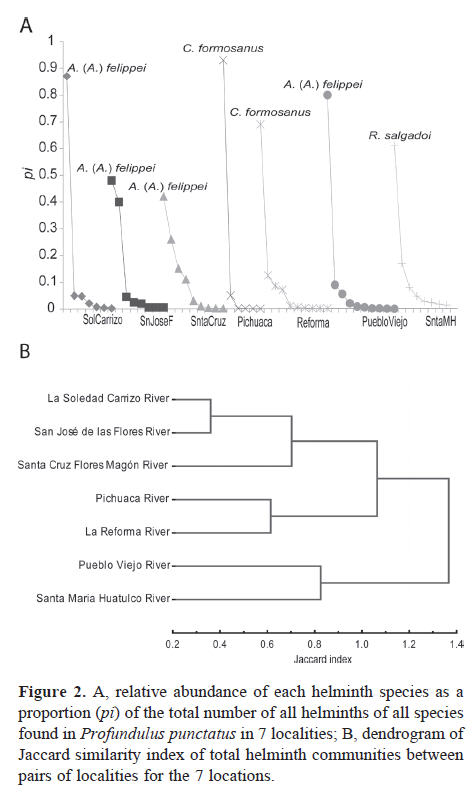
	    <p align="justify"><font face="verdana" size="2"><i>Community structure.</i> The sample size was sufficient in 6 of 7 sampled localities. <a href="/img/revistas/rmbiodiv/v85n4/a14t2.jpg" target="_blank">Table 2</a> shows the richness estimated by the Clench model a/b and the slope of the last point of the curve a/(1+b*n)<sup>2</sup>. The analysis of species accumulation curves shows that the inventory of helminth species of the component communities was almost complete for 6 of 7 sampled localities; the slope of the last point of each curve calculated from the Clench model was &lt; 0.1, indicating a good coverage of helminth species recovered from each component community (<a href="/img/revistas/rmbiodiv/v85n4/a14t2.jpg" target="_blank">Table 2</a>). Santa Mar&iacute;a Huatulco River was the only locality where the asymptote in the curve is not reached. The total number of helminth species oscillated among 6 to 10 in fish from the 7 sampled localities (<a href="/img/revistas/rmbiodiv/v85n4/a14t3.jpg" target="_blank">Table 3</a>). The abundance varied between 196 and 19,265 in San Jos&eacute; de las Flores River and Pichuaca River, respectively. The Shannon&#150;Wiener and Brillouin diversity values ranged from 0.359 to 2.083 and 0.358 to 2.042 in the 7 sampled localities, with the evenness and numerical dominance values also ranging from 0.151 to 0.390, and 0.42 to 0.93, respectively. The matacercariae of <i>Ascocotyle</i> (<i>A.</i>) <i>felippei</i> were numerically dominant in 4 localities; 2 localities were dominated by <i>Centrocestus formosanus</i>, and 1 locality by the nematode <i>Rhabdochona salgadoi</i> (<a href="/img/revistas/rmbiodiv/v85n4/a14t3.jpg" target="_blank">Table 3</a>; <a href="#f2">Fig. 2A</a>). Likewise, qualitative similarity among the 7 component communities evaluated was heterogeneous. <a href="/img/revistas/rmbiodiv/v85n4/a14t4.jpg" target="_blank">Table 4</a> shows that several localities shared a relatively high number of helminth species, resulting in a Jaccard value that ranged 0.33 to 0.81; the percent similarity index ranged from 0.05 to 0.86. Helminth communities from Pueblo Viejo River and La Reforma River consistently showed the highest levels of qualitative similarity (0.81) with respect to other localities; San Jos&eacute; de las Flores River and Santa Mar&iacute;a Huatulco River showed the lowest values of qualitative similarity (0.33) (<a href="#f2">Fig. 2B</a>).</font></p>

	    <p align="center"><font face="verdana" size="2"><a name="f2"></a></font></p>

	    ]]></body>
<body><![CDATA[<p align="center"><font face="verdana" size="2"><img src="/img/revistas/rmbiodiv/v85n4/a14f2.jpg"></font></p>

	    <p align="justify"><font face="verdana" size="2">&nbsp;</font></p>

	    <p align="justify"><font face="verdana" size="2"><b>Discussion</b></font></p>

	    <p align="justify"><font face="verdana" size="2">The helminth parasite fauna of <i>Profundulus punctatus</i> in the 7 studied localities from Oaxaca, Mexico includes 14 helminth species: 9 digeneans, 2 monogeneans, and 3 nematodes. Most of the helminth species found in this study have been previously recorded from diverse freshwater fish species in southwest Mexico (Salgado&#45;Maldonado, 2006; Salgado&#45;Maldonado et al., 2011a). <i>Profundulus punctatus</i> from Oaxaca acts as definitive host for 8 species, namely, <i>P. blancoi</i>, <i>P. profundulusi</i>, <i>Phyllodistomum</i> sp., <i>Culuwiya</i> cf. <i>cichlidorum</i>, <i>Gyrodactylus</i> sp., <i>Salsuginus</i> sp., <i>S. humbertoi</i>, and <i>R. salgadoi</i>. In addition, it serves as an intermediate/paratenic host for 6 helminth taxa (<i>Clinostomum</i> sp., Diplostomidae gen. sp., <i>P. minimum</i>, <i>Ascocotyle</i> (<i>A.</i>) <i>felippei</i>, <i>C. formosanus</i>, and <i>Eustrongylides</i> sp.). Previous studies on helminth communities of freshwater fishes in Mexico recorded a higher number of larvae in their taxonomic composition than reported here (see Salgado&#45;Maldonado and Kennedy, 1997; Mart&iacute;nez&#45;Aquino et al., 2007, 2009, 2011; Salgado&#45;Maldonado et al., 2014). The low larval richness in our work can be attributed to the food habits of <i>P. punctatus</i> (see below), and/or the absence of suitable intermediate&#45;definitive hosts in the studied areas. Nevertheless, our ecological results convey a rather static picture of the helminth species richness of <i>P. punctatus</i> for a short period of time. Therefore, further long&#45;term parasitological studies are necessary to understand the helminth community dynamics, and assess variation in the helminth species richnes of <i>P. punctatus</i>.</font></p>

	    <p align="justify"><font face="verdana" size="2">Four of these taxa, 2 digenean (<i>P. blancoi</i> and <i>P. profundulusi</i>), and 2 nematodes, (<i>S. humbertoi</i> and <i>R. salgadoi</i>), are commonly found in profundulid fishes, and have been considered as a part of the core fauna for this fish family (Caspeta&#45;Mandujano and Moravec, 2000; Caspeta&#45;Mandujano et al., 2007; Salgado&#45;Maldonado et al., 2011b). <i>Paracreptotrema blancoi</i> lives sympatrically with <i>P. profundulusi</i> as a parasite of the fish <i>P. punctatus</i> in San Jos&eacute; de las Flores River. Co&#45;occurrence of trematode species in the same profundulid species may be attributed to recent contact among different host populations, but the geology of the area is not well known, which prevents establishing the biological significance of these data (Salgado&#45;Maldonado et al., 2011b). Other helminth species recorded herein as adults were <i>Phyllodistomum</i> sp., and <i>Culuwiya</i> cf. <i>cichlidorum</i>. The findings of <i>Phyllodistomum</i> sp. in the present study represent a new record in profundulid fishes. In Mexico, 6 nominal species of <i>Phyllodistomum</i> have been recorded so far, 4 of them in marine or brackish water fishes: <i>Phyllodistomum carangis</i> Manter, 1947, <i>P. marinae</i> Bravo&#45;Hollis and Manter 1957, <i>P. mirandai</i> Lamothe, 1969, and <i>P. centropomi</i> Mendoza&#45;Garfias and P&eacute;rez&#45;Ponce de Le&oacute;n 2005, and 2 in freshwater fishes: <i>P. lacustri</i> (Loewen, 1929) Lewis, 1935, as a parasite of ictalurid and cichlid fishes, and <i>P. inecoli</i> Razo&#45;Meldivil, P&eacute;rez&#45;Ponce de Le&oacute;n and Rubio&#45;Godoy, 2013, found in <i>Heterandria bimaculata</i> (Razo&#45;Mendivil et al., 2013). Considering the host associations and geographical distribution of the species of <i>Phyllodistomum</i> in freshwater fishes of North and Central America, we may speculate that our specimens represent an undescribed species.</font></p>

	    <p align="justify"><font face="verdana" size="2">The trematode <i>Culuwiya</i> cf. <i>cichlidorum</i> found in this research represents a new record in profundulid fishes. <i>Culuwiya cichlidorum</i> was described from the intestine of the black&#45;belt cichlid <i>Vieja maculicauda</i> (= <i>Cichlasoma maculicauda</i> (Regan)) from the Atlantic coast of Nicaragua (Aguirre&#45;Macedo and Scholz, 2005). However, the taxonomy of these digeneans is complicated for several reasons: its morphology (external and internal) is very complicated and tends to change during fixation and staining processes (Overstreet and Curran, 2005). Further analyses using both morphological and molecular data, will allow us to identify with accuracy this digenean.</font></p>

	    <p align="justify"><font face="verdana" size="2">Of the 14 taxa found, 42.85% were larval forms of generalist species that use freshwater fish as intermediate or paratenic hosts. The taxonomic composition of the helminth parasite fauna of <i>P. punctatus</i> comprises 5 generalist species:, <i>Clinostomum</i> sp., Diplostomidae gen. sp., <i>Posthodiplostomum minimum</i> (MacCallum, 1921) Dubois, 1936, <i>Ascocotyle</i> (<i>Ascocotyle</i>) <i>felippei</i> Travassos, 1928, and <i>Eustrongylides</i> sp., which are widely distributed among freshwater fish in several localities in Mexico (Salgado&#45;Maldonado, 2006). <i>Centrocestus formosanus</i> (Nishigori, 1924) was introduced to Mexican water bodies from Asia (Scholz and Salgado&#45;Maldonado, 2000); the current study represents the first report of this species in <i>P. punctatus</i>. The 2 monogenean, taxa, <i>Gyrodactylus</i> sp., and <i>Salsuginus</i> sp., collected from the fins and gills of their hosts, have been recently recorded from diverse freshwater fishes in central and northern Mexico (Mendoza&#45;Palmero, 2007; Mendoza&#45;Palmero et al., 2009); further studies will enable us to establish the taxonomic identity and potential host specificity of <i>Gyrodactylus</i> and <i>Salsuginus</i> species occurring in Mexican freshwater fishes. The helminth fauna found for this host species included digeneans, monogeneans, and nematodes, but no tapeworms or acanthocephalans were recorded. This could be because the diet of this fish species does not include crustaceans, which act as intermediate host for these 2 groups of helminths.</font></p>

	    <p align="justify"><font face="verdana" size="2">Prevalence of species recovered from <i>P. punctatus</i> was variable and mean abundances were generally low for the fish sampled in the 7 locations (<a href="/img/revistas/rmbiodiv/v85n4/a14t1.jpg" target="_blank">Table 1</a>). The high variability in the infection parameters of most species suggests that the host is subject to the effect of wide environmental variability, the presence and abundance of <i>P. punctatus</i> appears to be associated aquatic ecosystems with little human disturbance, where the physical and chemical characteristics of the water and habitat are good (Vel&aacute;zquez&#45;Vel&aacute;zquez et al., 2011). The community structure of the helminth parasites of <i>P. punctatus</i> is consistent with the pattern that shows a poor parasite fauna with respect to <i>Cichlasoma urophthalmus</i> inhabiting freshwater localities in the Neotropical part of Mexico (Salgado&#45;Maldonado and Kennedy, 1997). However, the helminth fauna composition and the community structure of <i>P. punctatus</i> was more diverse than parasite fauna of goodeid fishes in the Nearctic part of Mexico, such as of <i>Characodon audax</i> Smith and Miller (parasitized by 8 species), <i>Xenotaenia resolanae</i> Turner (infected by 6 species), and <i>Zoogoneticus purhepechus</i> Dom&iacute;nguez&#45;Dom&iacute;nguez (7 species) (Mart&iacute;nez&#45;Aquino et al., 2007; 2009; 2011). The richness and component communities of <i>P. punctatus</i> were similar to helminth communities of <i>Heterandria bimaculata</i> from the upper R&iacute;o La Antigua basin, east&#45;central Mexico (parasitized by 12 species) (Salgado&#45;Maldonado et al., 2014). Previous studies showed that <i>P. punctatus</i> feeds primarily on clams and snails (Melaneidae); its habitat is characterized by environments with sandy substrate, silt, mud, gravel, rock, and boulders (Miller, 2005), which facilitates contact with mollusks. Both factors determine the helminth community structure herein described, and are in accordance with those described in the aforementioned studies (in this case, feeding habits and omnivory). Parasite communities of <i>P. punctatus</i> in the 7 localities have low diversity (Shannon&#45;Wiener index= 0.359 to 2.083 and Brillouin index= 0.358 to 2.042). Pichuaca River was the locality with the lowest values (Shannon&#45;Wiener index= 0.359 and Brillouin index= 0.358), and Santa Cruz Flores Mag&oacute;n River had the highest diversity (Shannon&#45;Wiener index= 2.083 and Brillouin index= 2.042). In the Pichuaca River, the diversity was low due to high dominance of <i>Centrocestus formasanus</i>, which caused a heterogeneous distribution of the proportional abundance. Our values of diversity (Shannon&#45;Wiener) were higher than those reported by Salgado&#45;Maldonado et al. (2014) which ranged from 0.75 to 1.358, establishing the helminth communities of <i>P</i>. <i>punctatus</i> as more diverse than those of <i>Heterandria bimaculata</i>. Also, our diversity values obtained for the Brillouin index are higher than those obtained for goodeid fishes in the Nearctic part of Mexico (Mart&iacute;nez&#45;Aquino et al., 2009). The similarity between the 7 component communities (qualitative and quantitative), was low, due to the heterogeneity of infection between fishes from different localities; San Jos&eacute; de las Flores River and Santa Mar&iacute;a Huatulco River showed the lowest values of similarity (Jaccard index= 0.33); our data suggest that the similarity in species composition decreases among remote locations, as suggested for many communities of parasites (similarity vs. distance) (Poulin and Morand, 1999; Salgado&#45;Maldonado et al., 2014). Based on the results of the species accumulation curves and the species richness estimators, we are confident about the accuracy of species richness and community structure patterns herein described. Likewise, our analysis confirmed that the number of host analyzed represents a sufficient sample size to recover most members of the parasite community. Our data revealed that <i>P. punctatus</i> is parasitized by 14 helminth species, 9 digeneans, 2 monogeneans, and 3 nematodes, and that <i>Paracreptotrema blancoi</i>, <i>Paracreptotrema profundulusi</i>, <i>Spinitectus humbertoi</i>, and <i>Rhabdochona salgadoi</i> represent the core fauna of this species of fish host.</font></p>

	    <p align="justify"><font face="verdana" size="2">&nbsp;</font></p>

	    <p align="justify"><font face="verdana" size="2"><b>Acknowledgments</b></font></p>

	    ]]></body>
<body><![CDATA[<p align="justify"><font face="verdana" size="2">We are grateful to Marly Mart&iacute;nez, David Hern&aacute;ndez Mena, Jes&uacute;s Hern&aacute;ndez Orts, and Mirza Patricia Ortega Olivares for their help during field work. CDPP thanks Conacyt and the Posgrado en Ciencias Biol&oacute;gicas, Universidad Nacional Aut&oacute;noma de M&eacute;xico for the scholarships.</font></p>

	    <p align="justify"><font face="verdana" size="2">&nbsp;</font></p>

	    <p align="justify"><font face="verdana" size="2"><b>Literature cited</b></font></p>

	    <!-- ref --><p align="justify"><font face="verdana" size="2">Aguirre&#45;Macedo M. L. and T. Scholz. 2005. <i>Culuwiya cichlidorum</i> n. sp. (Digenea: Haploporidae) from the black&#45;belt cichlid <i>Vieja maculicauda</i> (Pisces: Cichlidae) from Nicaragua. Journal of Parasitology 91:1379&#45;1384.    &nbsp;&nbsp;&nbsp;&nbsp;&nbsp;&nbsp;&nbsp;&nbsp;[&#160;<a href="javascript:void(0);" onclick="javascript: window.open('/scielo.php?script=sci_nlinks&ref=7640808&pid=S1870-3453201400050001400001&lng=','','width=640,height=500,resizable=yes,scrollbars=1,menubar=yes,');">Links</a>&#160;]<!-- end-ref --></font></p>

	    <!-- ref --><p align="justify"><font face="verdana" size="2">Bush, A. O., J. M. Aho and C. R. Kennedy. 1990. Ecological versus phylogenetic determinants of helminth parasite community richness. Evolutionary Ecology 4:1&#45;20.    &nbsp;&nbsp;&nbsp;&nbsp;&nbsp;&nbsp;&nbsp;&nbsp;[&#160;<a href="javascript:void(0);" onclick="javascript: window.open('/scielo.php?script=sci_nlinks&ref=7640810&pid=S1870-3453201400050001400002&lng=','','width=640,height=500,resizable=yes,scrollbars=1,menubar=yes,');">Links</a>&#160;]<!-- end-ref --></font></p>

	    <!-- ref --><p align="justify"><font face="verdana" size="2">Bush, A. O., K. D. Lafferty, J. M. Lotz and A. W. Shostak. 1997. Parasitology meets ecology on its own terms: Margolis et al. revisited. Journal of Parasitology 83:575&#45;583.    &nbsp;&nbsp;&nbsp;&nbsp;&nbsp;&nbsp;&nbsp;&nbsp;[&#160;<a href="javascript:void(0);" onclick="javascript: window.open('/scielo.php?script=sci_nlinks&ref=7640812&pid=S1870-3453201400050001400003&lng=','','width=640,height=500,resizable=yes,scrollbars=1,menubar=yes,');">Links</a>&#160;]<!-- end-ref --></font></p>

	    <!-- ref --><p align="justify"><font face="verdana" size="2">Caspeta&#45;Mandujano, J. M., G. Caba&ntilde;as&#45;Carranza and G. Salgado&#45;Maldonado. 2007. <i>Spinitectus mariaisabelae</i> n. sp. (Nematoda: Cystidicolidae) from the intestine of the freshwater fish <i>Profundulus punctatus</i> (Cyprinodontiformes) in Mexico. Helminthologia 44:103&#45;106.    &nbsp;&nbsp;&nbsp;&nbsp;&nbsp;&nbsp;&nbsp;&nbsp;[&#160;<a href="javascript:void(0);" onclick="javascript: window.open('/scielo.php?script=sci_nlinks&ref=7640814&pid=S1870-3453201400050001400004&lng=','','width=640,height=500,resizable=yes,scrollbars=1,menubar=yes,');">Links</a>&#160;]<!-- end-ref --></font></p>

	    <!-- ref --><p align="justify"><font face="verdana" size="2">Caspeta&#45;Mandujano, J. M. and F. Moravec. 2000. Two new intestinal nematodes of <i>Profundulus labialis</i> (Pisces, Cyprinodontidae) from freshwaters in Mexico. Acta Parasitologica 45:332&#45;339.    &nbsp;&nbsp;&nbsp;&nbsp;&nbsp;&nbsp;&nbsp;&nbsp;[&#160;<a href="javascript:void(0);" onclick="javascript: window.open('/scielo.php?script=sci_nlinks&ref=7640816&pid=S1870-3453201400050001400005&lng=','','width=640,height=500,resizable=yes,scrollbars=1,menubar=yes,');">Links</a>&#160;]<!-- end-ref --></font></p>

	    <!-- ref --><p align="justify"><font face="verdana" size="2">Doadrio, I., J. A. Carmona, E. Mart&iacute;nez and A. de Sostoa. 1999. Genetic variation and taxonomic analysis of the subgenus <i>Profundulus</i>. Journal of Fish Biology 55:751&#45;766.    &nbsp;&nbsp;&nbsp;&nbsp;&nbsp;&nbsp;&nbsp;&nbsp;[&#160;<a href="javascript:void(0);" onclick="javascript: window.open('/scielo.php?script=sci_nlinks&ref=7640818&pid=S1870-3453201400050001400006&lng=','','width=640,height=500,resizable=yes,scrollbars=1,menubar=yes,');">Links</a>&#160;]<!-- end-ref --></font></p>

	    <!-- ref --><p align="justify"><font face="verdana" size="2">Ergens, R. 1969. The suitability of ammonium picrate&#45;glycerin in preparing slides of lower Monogenoidea. Folia Parasitologica 16:320.    &nbsp;&nbsp;&nbsp;&nbsp;&nbsp;&nbsp;&nbsp;&nbsp;[&#160;<a href="javascript:void(0);" onclick="javascript: window.open('/scielo.php?script=sci_nlinks&ref=7640820&pid=S1870-3453201400050001400007&lng=','','width=640,height=500,resizable=yes,scrollbars=1,menubar=yes,');">Links</a>&#160;]<!-- end-ref --></font></p>

	    <!-- ref --><p align="justify"><font face="verdana" size="2">Esch, G. W., C. R. Kennedy, A. O. Bush and J. M. Aho. 1988. Patterns in helminth communities in freshwater fish in Great Britain: alternative strategies for colonization. Parasitology 96:519&#45;532.    &nbsp;&nbsp;&nbsp;&nbsp;&nbsp;&nbsp;&nbsp;&nbsp;[&#160;<a href="javascript:void(0);" onclick="javascript: window.open('/scielo.php?script=sci_nlinks&ref=7640822&pid=S1870-3453201400050001400008&lng=','','width=640,height=500,resizable=yes,scrollbars=1,menubar=yes,');">Links</a>&#160;]<!-- end-ref --></font></p>

	    <!-- ref --><p align="justify"><font face="verdana" size="2">Frose, R. and D. Pauly. 2011. FishBase World Wide Web electronic publication. Available at: <a href="http://www.fishbase.org" target="_blank">www.fishbase.org</a>. Last access: 11.XI.2011.    &nbsp;&nbsp;&nbsp;&nbsp;&nbsp;&nbsp;&nbsp;&nbsp;[&#160;<a href="javascript:void(0);" onclick="javascript: window.open('/scielo.php?script=sci_nlinks&ref=7640824&pid=S1870-3453201400050001400009&lng=','','width=640,height=500,resizable=yes,scrollbars=1,menubar=yes,');">Links</a>&#160;]<!-- end-ref --></font></p>

	    <!-- ref --><p align="justify"><font face="verdana" size="2">Jim&eacute;nez&#45;Valverde, A. and J. Hortal. 2003. Las curvas de acumulaci&oacute;n de especies y la necesidad de evaluar la calidad de los inventarios biol&oacute;gicos. Revista Ib&eacute;rica de Aracnolog&iacute;a 8:151&#45;161.    &nbsp;&nbsp;&nbsp;&nbsp;&nbsp;&nbsp;&nbsp;&nbsp;[&#160;<a href="javascript:void(0);" onclick="javascript: window.open('/scielo.php?script=sci_nlinks&ref=7640826&pid=S1870-3453201400050001400010&lng=','','width=640,height=500,resizable=yes,scrollbars=1,menubar=yes,');">Links</a>&#160;]<!-- end-ref --></font></p>

	    <!-- ref --><p align="justify"><font face="verdana" size="2">Gonz&aacute;lez&#45;D&iacute;az, A. A., E. D&iacute;az&#45;Pardo, M. Soria&#45;Barreto and R. Rodiles&#45;Hern&aacute;ndez. 2005. An&aacute;lisis morfom&eacute;trico de los peces del grupo labialis, g&eacute;nero <i>Profundulus</i> (Cyprinodontiformes: Profundulidae), en Chiapas, M&eacute;xico. Revista Mexicana de Biodiversidad 76:55&#45;61.    &nbsp;&nbsp;&nbsp;&nbsp;&nbsp;&nbsp;&nbsp;&nbsp;[&#160;<a href="javascript:void(0);" onclick="javascript: window.open('/scielo.php?script=sci_nlinks&ref=7640828&pid=S1870-3453201400050001400011&lng=','','width=640,height=500,resizable=yes,scrollbars=1,menubar=yes,');">Links</a>&#160;]<!-- end-ref --></font></p>

	    <!-- ref --><p align="justify"><font face="verdana" size="2">Holmes, J. C. and P. W. Price. 1986. Communities of parasites. <i>In</i> Community ecology, pattern and processes, J. Kikkawa and D. J. Anderson (eds.). Blackwell Scientific Publications, Oxford. p. 187&#45;213.    &nbsp;&nbsp;&nbsp;&nbsp;&nbsp;&nbsp;&nbsp;&nbsp;[&#160;<a href="javascript:void(0);" onclick="javascript: window.open('/scielo.php?script=sci_nlinks&ref=7640830&pid=S1870-3453201400050001400012&lng=','','width=640,height=500,resizable=yes,scrollbars=1,menubar=yes,');">Links</a>&#160;]<!-- end-ref --></font></p>

	    <!-- ref --><p align="justify"><font face="verdana" size="2">Magurran, A. 1988. Ecological diversity and its measurement. Croom Helm, London. 179 p.    &nbsp;&nbsp;&nbsp;&nbsp;&nbsp;&nbsp;&nbsp;&nbsp;[&#160;<a href="javascript:void(0);" onclick="javascript: window.open('/scielo.php?script=sci_nlinks&ref=7640832&pid=S1870-3453201400050001400013&lng=','','width=640,height=500,resizable=yes,scrollbars=1,menubar=yes,');">Links</a>&#160;]<!-- end-ref --></font></p>

	    <!-- ref --><p align="justify"><font face="verdana" size="2">Mart&iacute;nez&#45;Aquino, A., G. Salgado&#45;Maldonado, R. Aguilar&#45;Aguilar, G. Caba&ntilde;as&#45;Carranza and C. Mendoza&#45;Palmero. 2007. Helminth parasite communities of <i>Characodonaudax</i> and <i>C. lateralis</i> (Pisces: Goodeidae), endemic freshwater fishes from Durango, Mexico. The Southwestern Naturalist 52:125&#45;130.    &nbsp;&nbsp;&nbsp;&nbsp;&nbsp;&nbsp;&nbsp;&nbsp;[&#160;<a href="javascript:void(0);" onclick="javascript: window.open('/scielo.php?script=sci_nlinks&ref=7640834&pid=S1870-3453201400050001400014&lng=','','width=640,height=500,resizable=yes,scrollbars=1,menubar=yes,');">Links</a>&#160;]<!-- end-ref --></font></p>

	    <!-- ref --><p align="justify"><font face="verdana" size="2">Mart&iacute;nez&#45;Aquino, A., R. Aguilar&#45;Aguilar, R. P&eacute;rez&#45;Rodr&iacute;guez and G. P&eacute;rez&#45;Ponce de Le&oacute;n. 2009. Helminth Parasites of <i>Xenotaeniaresolanae</i> (Osteichthyes: Cyprinodontiformes: Goodeidae) From the Cuzalapa Hydrological System, Jalisco, Mexico. Journal of Parasitology 95:1221&#45;1223.    &nbsp;&nbsp;&nbsp;&nbsp;&nbsp;&nbsp;&nbsp;&nbsp;[&#160;<a href="javascript:void(0);" onclick="javascript: window.open('/scielo.php?script=sci_nlinks&ref=7640836&pid=S1870-3453201400050001400015&lng=','','width=640,height=500,resizable=yes,scrollbars=1,menubar=yes,');">Links</a>&#160;]<!-- end-ref --></font></p>

	    <!-- ref --><p align="justify"><font face="verdana" size="2">Mart&iacute;nez&#45;Aquino, A., D. I. Hern&aacute;ndez&#45;Mena, R. P&eacute;rez&#45;Rodr&iacute;guez, R. Aguilar&#45;Aguilar and G. P&eacute;rez&#45;Ponce de Le&oacute;n. 2011. Endohelminth parasites of the freshwater fish <i>Zoogoneticus purhepechus</i> (Cyprinodontiformes: Goodeidae) from two springs in the lower Lerma river, Mexico. Revista Mexicana de Biodiversidad 82:1132&#45;1137.    &nbsp;&nbsp;&nbsp;&nbsp;&nbsp;&nbsp;&nbsp;&nbsp;[&#160;<a href="javascript:void(0);" onclick="javascript: window.open('/scielo.php?script=sci_nlinks&ref=7640838&pid=S1870-3453201400050001400016&lng=','','width=640,height=500,resizable=yes,scrollbars=1,menubar=yes,');">Links</a>&#160;]<!-- end-ref --></font></p>

	    <!-- ref --><p align="justify"><font face="verdana" size="2">Mart&iacute;nez&#45;Ram&iacute;rez, E., I. Doadrio&#45;Villarejo and A. de Sostoa&#45;Fern&aacute;ndez. 2004. Peces Continentales. <i>In</i> Biodiversidad de Oaxaca, A. J. Garc&iacute;a&#45;Mendoza, M. J. Ord&oacute;&ntilde;ez and M. Briones&#45;Salas (eds.). Instituto de Biolog&iacute;a, Universidad Nacional Aut&oacute;noma de M&eacute;xico, Fondo Oaxaque&ntilde;o para la Conservaci&oacute;n de la Naturaleza and World Wildlife Fund, M&eacute;xico, D. F. p. 357&#45;373.    &nbsp;&nbsp;&nbsp;&nbsp;&nbsp;&nbsp;&nbsp;&nbsp;[&#160;<a href="javascript:void(0);" onclick="javascript: window.open('/scielo.php?script=sci_nlinks&ref=7640840&pid=S1870-3453201400050001400017&lng=','','width=640,height=500,resizable=yes,scrollbars=1,menubar=yes,');">Links</a>&#160;]<!-- end-ref --></font></p>

	    <!-- ref --><p align="justify"><font face="verdana" size="2">Matamoros, W. A. and J. F. Schaefer. 2010. A new species of <i>Profundulus</i> (Cyprinodontiformes: Profundulidae) from the Honduran central highlands. Journal of Fish Biology 76:1498&#45;1507.    &nbsp;&nbsp;&nbsp;&nbsp;&nbsp;&nbsp;&nbsp;&nbsp;[&#160;<a href="javascript:void(0);" onclick="javascript: window.open('/scielo.php?script=sci_nlinks&ref=7640842&pid=S1870-3453201400050001400018&lng=','','width=640,height=500,resizable=yes,scrollbars=1,menubar=yes,');">Links</a>&#160;]<!-- end-ref --></font></p>

	    <!-- ref --><p align="justify"><font face="verdana" size="2">Mendoza&#45;Palmero, C. A. 2007. Monog&eacute;neos par&aacute;sitos de peces de la subfamilia Goodeinae (Pisces: Cyprinodontiformes) con un an&aacute;lisis de su distribuci&oacute;n geogr&aacute;fica. MSc thesis, Mexico, Posgrado en Ciencias Biol&oacute;gicas, Universidad Nacional Aut&oacute;noma de M&eacute;xico, Mexico, D. F. 70 p.    &nbsp;&nbsp;&nbsp;&nbsp;&nbsp;&nbsp;&nbsp;&nbsp;[&#160;<a href="javascript:void(0);" onclick="javascript: window.open('/scielo.php?script=sci_nlinks&ref=7640844&pid=S1870-3453201400050001400019&lng=','','width=640,height=500,resizable=yes,scrollbars=1,menubar=yes,');">Links</a>&#160;]<!-- end-ref --></font></p>

	    <!-- ref --><p align="justify"><font face="verdana" size="2">Mendoza&#45;Palmero, C. A., A. L. Sereno&#45;Uribe and G. Salgado&#45;Maldonado. 2009. Two new species of <i>Gyrodactylus</i> Von Nordmann, 1832 (Monogenea: Gyrodactylidae) parasitizing <i>Girardinichthys multiradiatus</i> (Cyprinodontiformes: Goodeidae), an endemic freshwater fish from central Mexico. Journal of Parasitology 95:315&#45;318.    &nbsp;&nbsp;&nbsp;&nbsp;&nbsp;&nbsp;&nbsp;&nbsp;[&#160;<a href="javascript:void(0);" onclick="javascript: window.open('/scielo.php?script=sci_nlinks&ref=7640846&pid=S1870-3453201400050001400020&lng=','','width=640,height=500,resizable=yes,scrollbars=1,menubar=yes,');">Links</a>&#160;]<!-- end-ref --></font></p>

	    <!-- ref --><p align="justify"><font face="verdana" size="2">Miller, R. R. 1955. A systematic review of the middle American fishes of the genus <i>Profundulus</i>. Miscellaneous Publications Museum of Zoology University of Michigan, Ann Arbor, Michigan 92:1&#45;64.    &nbsp;&nbsp;&nbsp;&nbsp;&nbsp;&nbsp;&nbsp;&nbsp;[&#160;<a href="javascript:void(0);" onclick="javascript: window.open('/scielo.php?script=sci_nlinks&ref=7640848&pid=S1870-3453201400050001400021&lng=','','width=640,height=500,resizable=yes,scrollbars=1,menubar=yes,');">Links</a>&#160;]<!-- end-ref --></font></p>

	    <!-- ref --><p align="justify"><font face="verdana" size="2">Miller, R. R. 2005. Freshwater fishes of Mexico. The University of Chicago Press, Chicago. p. 490.    &nbsp;&nbsp;&nbsp;&nbsp;&nbsp;&nbsp;&nbsp;&nbsp;[&#160;<a href="javascript:void(0);" onclick="javascript: window.open('/scielo.php?script=sci_nlinks&ref=7640850&pid=S1870-3453201400050001400022&lng=','','width=640,height=500,resizable=yes,scrollbars=1,menubar=yes,');">Links</a>&#160;]<!-- end-ref --></font></p>

	    <!-- ref --><p align="justify"><font face="verdana" size="2">Nelson, J. S. 2006. Fishes of the world. John Wiley and Sons, Inc., Hoboken, New Jersey. p. 601.    &nbsp;&nbsp;&nbsp;&nbsp;&nbsp;&nbsp;&nbsp;&nbsp;[&#160;<a href="javascript:void(0);" onclick="javascript: window.open('/scielo.php?script=sci_nlinks&ref=7640852&pid=S1870-3453201400050001400023&lng=','','width=640,height=500,resizable=yes,scrollbars=1,menubar=yes,');">Links</a>&#160;]<!-- end-ref --></font></p>

	    <!-- ref --><p align="justify"><font face="verdana" size="2">Overstreet, R. M. and S. S. Curran. 2005. Family Haploporidae Nicoll, 1914. <i>In</i> Keys to the Trematoda, Vol. 2, A. Jones, R. A. Bray and D. I. Gibson (eds.). CAB International and The Natural History Museum, London. p. 129&#45;165.    &nbsp;&nbsp;&nbsp;&nbsp;&nbsp;&nbsp;&nbsp;&nbsp;[&#160;<a href="javascript:void(0);" onclick="javascript: window.open('/scielo.php?script=sci_nlinks&ref=7640854&pid=S1870-3453201400050001400024&lng=','','width=640,height=500,resizable=yes,scrollbars=1,menubar=yes,');">Links</a>&#160;]<!-- end-ref --></font></p>

	    <!-- ref --><p align="justify"><font face="verdana" size="2">Poulin, R. and S. Morand. 1999. Geographical distances and the similarity among parasite communities of conspecific host populations. Parasitology 119:369&#45;374.    &nbsp;&nbsp;&nbsp;&nbsp;&nbsp;&nbsp;&nbsp;&nbsp;[&#160;<a href="javascript:void(0);" onclick="javascript: window.open('/scielo.php?script=sci_nlinks&ref=7640856&pid=S1870-3453201400050001400025&lng=','','width=640,height=500,resizable=yes,scrollbars=1,menubar=yes,');">Links</a>&#160;]<!-- end-ref --></font></p>

	    <!-- ref --><p align="justify"><font face="verdana" size="2">Razo&#45;Mendivil, U., G. P&eacute;rez&#45;Ponce de Le&oacute;n and M. Rubio&#45;Godoy. 2013. Integrative taxonomy identifies a new species of <i>Phyllodistomum</i> (Digenea: Gorgoderidae) from the two spot livebearer, <i>Heterandria bimaculata</i> (Teleostei: Poeciliidae), in Central Veracruz, Mexico. Parasitology Research 112:4137&#45;4150.    &nbsp;&nbsp;&nbsp;&nbsp;&nbsp;&nbsp;&nbsp;&nbsp;[&#160;<a href="javascript:void(0);" onclick="javascript: window.open('/scielo.php?script=sci_nlinks&ref=7640858&pid=S1870-3453201400050001400026&lng=','','width=640,height=500,resizable=yes,scrollbars=1,menubar=yes,');">Links</a>&#160;]<!-- end-ref --></font></p>

	    <!-- ref --><p align="justify"><font face="verdana" size="2">Salgado&#45;Maldonado, G. 2006. Checklist of helminth parasites of freshwater fishes from Mexico. Zootaxa 1324:1&#45;357.    &nbsp;&nbsp;&nbsp;&nbsp;&nbsp;&nbsp;&nbsp;&nbsp;[&#160;<a href="javascript:void(0);" onclick="javascript: window.open('/scielo.php?script=sci_nlinks&ref=7640860&pid=S1870-3453201400050001400027&lng=','','width=640,height=500,resizable=yes,scrollbars=1,menubar=yes,');">Links</a>&#160;]<!-- end-ref --></font></p>

	    <!-- ref --><p align="justify"><font face="verdana" size="2">Salgado&#45;Maldonado, G. and C. R. Kennedy. 1997. Richness and similarity of helminth communities in the tropical cichlid fish <i>Cichlasoma urophthalmus</i> from the Yucat&aacute;n Peninsula, Mexico. Parasitology 114:581&#45;590.    &nbsp;&nbsp;&nbsp;&nbsp;&nbsp;&nbsp;&nbsp;&nbsp;[&#160;<a href="javascript:void(0);" onclick="javascript: window.open('/scielo.php?script=sci_nlinks&ref=7640862&pid=S1870-3453201400050001400028&lng=','','width=640,height=500,resizable=yes,scrollbars=1,menubar=yes,');">Links</a>&#160;]<!-- end-ref --></font></p>

	    <!-- ref --><p align="justify"><font face="verdana" size="2">Salgado&#45;Maldonado, G., J. M. Caspeta&#45;Mandujano, F. Moravec, E. Soto&#45;Galera, R. Rodiles&#45;Hern&aacute;ndez, G. Caba&ntilde;as&#45;Carranza and J. Montoya&#45;Mendoza. 2011a. Helminth parasites of freshwater fish in Chiapas, Mexico. Parasitology Research 108:31&#45;59.    &nbsp;&nbsp;&nbsp;&nbsp;&nbsp;&nbsp;&nbsp;&nbsp;[&#160;<a href="javascript:void(0);" onclick="javascript: window.open('/scielo.php?script=sci_nlinks&ref=7640864&pid=S1870-3453201400050001400029&lng=','','width=640,height=500,resizable=yes,scrollbars=1,menubar=yes,');">Links</a>&#160;]<!-- end-ref --></font></p>

	    <!-- ref --><p align="justify"><font face="verdana" size="2">Salgado&#45;Maldonado, G., J. M. Caspeta&#45;Mandujano and E. Mart&iacute;nez&#45;Ram&iacute;rez. 2011b. <i>Paracreptotrema profundulusi</i> n. sp. and <i>P. blancoi</i> Choudhury, P&eacute;rez Ponce de Le&oacute;n, Brooks, and Daverdin, 2006 (Trematoda: Allocreadiidae) from freshwater fishes of the genus <i>Profundulus</i> (Teleostei: Profundulidae) in Southern Mexico. Journal of Parasitology 97:707&#45;712.    &nbsp;&nbsp;&nbsp;&nbsp;&nbsp;&nbsp;&nbsp;&nbsp;[&#160;<a href="javascript:void(0);" onclick="javascript: window.open('/scielo.php?script=sci_nlinks&ref=7640866&pid=S1870-3453201400050001400030&lng=','','width=640,height=500,resizable=yes,scrollbars=1,menubar=yes,');">Links</a>&#160;]<!-- end-ref --></font></p>

	    <p align="justify"><font face="verdana" size="2">Salgado&#45;Maldonado, G., M. T. Novelo&#45;Turcotte, G. V&aacute;zquez, J. M. Caspeta&#45;Mandujano, B. Quiroz&#45;Mart&iacute;nez and M. Favila. 2014. The communities of helminth parasites of <i>Heterandria bimaculata</i> (Teleostei: Poeciliidae) from the upper R&iacute;o La Antigua basin, east&#45;central Mexico show a predictable structure. Parasitology, available on CJO2014. doi:10.1017/S0031182014000122.</font></p>

	    <!-- ref --><p align="justify"><font face="verdana" size="2">Scholz, T. and G. Salgado&#45;Maldonado. 2000. The introduction and dispersal of <i>Centrocestus formosanus</i> (Nishigori, 1924) (Digenea: Heterophyidae) in Mexico: a review. American Midland Naturalist 143:185&#45;200.    &nbsp;&nbsp;&nbsp;&nbsp;&nbsp;&nbsp;&nbsp;&nbsp;[&#160;<a href="javascript:void(0);" onclick="javascript: window.open('/scielo.php?script=sci_nlinks&ref=7640869&pid=S1870-3453201400050001400031&lng=','','width=640,height=500,resizable=yes,scrollbars=1,menubar=yes,');">Links</a>&#160;]<!-- end-ref --></font></p>

	    <!-- ref --><p align="justify"><font face="verdana" size="2">Vel&aacute;zquez&#45;Vel&aacute;zquez, E., D. Gonz&aacute;lez&#45;Sol&iacute;s and G. Salgado&#45;Maldonado. 2011. <i>Bothriocephalus acheilognathi</i> (Cestoda) in the endangered fish <i>Profundulus hildebrandi</i> (Cyprinodontiformes), Mexico. Revista de Biolog&iacute;a Tropical 59:1099&#45;1104.    &nbsp;&nbsp;&nbsp;&nbsp;&nbsp;&nbsp;&nbsp;&nbsp;[&#160;<a href="javascript:void(0);" onclick="javascript: window.open('/scielo.php?script=sci_nlinks&ref=7640871&pid=S1870-3453201400050001400032&lng=','','width=640,height=500,resizable=yes,scrollbars=1,menubar=yes,');">Links</a>&#160;]<!-- end-ref --></font></p>

	    <!-- ref --><p align="justify"><font face="verdana" size="2">Vidal&#45;Mart&iacute;nez, V. M., M. L. Aguirre&#45;Macedo, T. Scholz, D. Gonz&aacute;lez&#45;Sol&iacute;s and E. F. Mendoza&#45;Franco. 2001. Atlas of the helminth parasites of cichlid fish of Mexico. Academia, Praha. p.165.    &nbsp;&nbsp;&nbsp;&nbsp;&nbsp;&nbsp;&nbsp;&nbsp;[&#160;<a href="javascript:void(0);" onclick="javascript: window.open('/scielo.php?script=sci_nlinks&ref=7640873&pid=S1870-3453201400050001400033&lng=','','width=640,height=500,resizable=yes,scrollbars=1,menubar=yes,');">Links</a>&#160;]<!-- end-ref --></font></p>
    ]]></body>
<body><![CDATA[ ]]></body><back>
<ref-list>
<ref id="B1">
<nlm-citation citation-type="journal">
<person-group person-group-type="author">
<name>
<surname><![CDATA[Aguirre-Macedo]]></surname>
<given-names><![CDATA[M. L.]]></given-names>
</name>
<name>
<surname><![CDATA[Scholz]]></surname>
<given-names><![CDATA[T.]]></given-names>
</name>
</person-group>
<article-title xml:lang="en"><![CDATA[Culuwiya cichlidorum n. sp. (Digenea: Haploporidae) from the black-belt cichlid Vieja maculicauda (Pisces: Cichlidae) from Nicaragua]]></article-title>
<source><![CDATA[Journal of Parasitology]]></source>
<year>2005</year>
<volume>91</volume>
<page-range>1379-1384</page-range></nlm-citation>
</ref>
<ref id="B2">
<nlm-citation citation-type="journal">
<person-group person-group-type="author">
<name>
<surname><![CDATA[Bush]]></surname>
<given-names><![CDATA[A. O.]]></given-names>
</name>
<name>
<surname><![CDATA[Aho]]></surname>
<given-names><![CDATA[J. M.]]></given-names>
</name>
<name>
<surname><![CDATA[Kennedy]]></surname>
<given-names><![CDATA[C. R.]]></given-names>
</name>
</person-group>
<article-title xml:lang="en"><![CDATA[Ecological versus phylogenetic determinants of helminth parasite community richness]]></article-title>
<source><![CDATA[Evolutionary Ecology]]></source>
<year>1990</year>
<volume>4</volume>
<page-range>1-20</page-range></nlm-citation>
</ref>
<ref id="B3">
<nlm-citation citation-type="journal">
<person-group person-group-type="author">
<name>
<surname><![CDATA[Bush]]></surname>
<given-names><![CDATA[A. O.]]></given-names>
</name>
<name>
<surname><![CDATA[Lafferty]]></surname>
<given-names><![CDATA[K. D.]]></given-names>
</name>
<name>
<surname><![CDATA[Lotz]]></surname>
<given-names><![CDATA[J. M.]]></given-names>
</name>
<name>
<surname><![CDATA[Shostak]]></surname>
<given-names><![CDATA[A. W.]]></given-names>
</name>
</person-group>
<article-title xml:lang="en"><![CDATA[Parasitology meets ecology on its own terms: Margolis et al. revisited]]></article-title>
<source><![CDATA[Journal of Parasitology]]></source>
<year>1997</year>
<volume>83</volume>
<page-range>575-583</page-range></nlm-citation>
</ref>
<ref id="B4">
<nlm-citation citation-type="journal">
<person-group person-group-type="author">
<name>
<surname><![CDATA[Caspeta-Mandujano]]></surname>
<given-names><![CDATA[J. M.]]></given-names>
</name>
<name>
<surname><![CDATA[Cabañas-Carranza]]></surname>
<given-names><![CDATA[G.]]></given-names>
</name>
<name>
<surname><![CDATA[Salgado-Maldonado]]></surname>
<given-names><![CDATA[G.]]></given-names>
</name>
</person-group>
<article-title xml:lang="en"><![CDATA[Spinitectus mariaisabelae n. sp. (Nematoda: Cystidicolidae) from the intestine of the freshwater fish Profundulus punctatus (Cyprinodontiformes) in Mexico]]></article-title>
<source><![CDATA[Helminthologia]]></source>
<year>2007</year>
<volume>44</volume>
<page-range>103-106</page-range></nlm-citation>
</ref>
<ref id="B5">
<nlm-citation citation-type="journal">
<person-group person-group-type="author">
<name>
<surname><![CDATA[Caspeta-Mandujano]]></surname>
<given-names><![CDATA[J. M.]]></given-names>
</name>
<name>
<surname><![CDATA[Moravec]]></surname>
<given-names><![CDATA[F.]]></given-names>
</name>
</person-group>
<article-title xml:lang="en"><![CDATA[Two new intestinal nematodes of Profundulus labialis (Pisces, Cyprinodontidae) from freshwaters in Mexico]]></article-title>
<source><![CDATA[Acta Parasitologica]]></source>
<year>2000</year>
<volume>45</volume>
<page-range>332-339</page-range></nlm-citation>
</ref>
<ref id="B6">
<nlm-citation citation-type="journal">
<person-group person-group-type="author">
<name>
<surname><![CDATA[Doadrio]]></surname>
<given-names><![CDATA[I.]]></given-names>
</name>
<name>
<surname><![CDATA[Carmona]]></surname>
<given-names><![CDATA[J. A.]]></given-names>
</name>
<name>
<surname><![CDATA[Martínez]]></surname>
<given-names><![CDATA[E.]]></given-names>
</name>
<name>
<surname><![CDATA[de Sostoa]]></surname>
<given-names><![CDATA[A.]]></given-names>
</name>
</person-group>
<article-title xml:lang="en"><![CDATA[Genetic variation and taxonomic analysis of the subgenus Profundulus]]></article-title>
<source><![CDATA[Journal of Fish Biology]]></source>
<year>1999</year>
<volume>55</volume>
<page-range>751-766</page-range></nlm-citation>
</ref>
<ref id="B7">
<nlm-citation citation-type="journal">
<person-group person-group-type="author">
<name>
<surname><![CDATA[Ergens]]></surname>
<given-names><![CDATA[R]]></given-names>
</name>
</person-group>
<article-title xml:lang="en"><![CDATA[The suitability of ammonium picrate-glycerin in preparing slides of lower Monogenoidea]]></article-title>
<source><![CDATA[Folia Parasitologica]]></source>
<year>1969</year>
<volume>16</volume>
<page-range>320</page-range></nlm-citation>
</ref>
<ref id="B8">
<nlm-citation citation-type="journal">
<person-group person-group-type="author">
<name>
<surname><![CDATA[Esch]]></surname>
<given-names><![CDATA[G. W.]]></given-names>
</name>
<name>
<surname><![CDATA[Kennedy]]></surname>
<given-names><![CDATA[C. R.]]></given-names>
</name>
<name>
<surname><![CDATA[Bush]]></surname>
<given-names><![CDATA[A. O.]]></given-names>
</name>
<name>
<surname><![CDATA[Aho]]></surname>
<given-names><![CDATA[J. M.]]></given-names>
</name>
</person-group>
<article-title xml:lang="en"><![CDATA[Patterns in helminth communities in freshwater fish in Great Britain: alternative strategies for colonization]]></article-title>
<source><![CDATA[Parasitology]]></source>
<year>1988</year>
<volume>96</volume>
<page-range>519-532</page-range></nlm-citation>
</ref>
<ref id="B9">
<nlm-citation citation-type="">
<person-group person-group-type="author">
<name>
<surname><![CDATA[Frose]]></surname>
<given-names><![CDATA[R.]]></given-names>
</name>
<name>
<surname><![CDATA[Pauly]]></surname>
<given-names><![CDATA[D.]]></given-names>
</name>
</person-group>
<source><![CDATA[FishBase World Wide Web electronic publication]]></source>
<year>2011</year>
</nlm-citation>
</ref>
<ref id="B10">
<nlm-citation citation-type="journal">
<person-group person-group-type="author">
<name>
<surname><![CDATA[Jiménez-Valverde]]></surname>
<given-names><![CDATA[A.]]></given-names>
</name>
<name>
<surname><![CDATA[Hortal]]></surname>
<given-names><![CDATA[J.]]></given-names>
</name>
</person-group>
<article-title xml:lang="es"><![CDATA[Las curvas de acumulación de especies y la necesidad de evaluar la calidad de los inventarios biológicos]]></article-title>
<source><![CDATA[Revista Ibérica de Aracnología]]></source>
<year>2003</year>
<volume>8</volume>
<page-range>151-161</page-range></nlm-citation>
</ref>
<ref id="B11">
<nlm-citation citation-type="journal">
<person-group person-group-type="author">
<name>
<surname><![CDATA[González-Díaz]]></surname>
<given-names><![CDATA[A. A.]]></given-names>
</name>
<name>
<surname><![CDATA[Díaz-Pardo]]></surname>
<given-names><![CDATA[E.]]></given-names>
</name>
<name>
<surname><![CDATA[Soria-Barreto]]></surname>
<given-names><![CDATA[M.]]></given-names>
</name>
<name>
<surname><![CDATA[Rodiles-Hernández]]></surname>
<given-names><![CDATA[R.]]></given-names>
</name>
</person-group>
<article-title xml:lang="es"><![CDATA[Análisis morfométrico de los peces del grupo labialis, género Profundulus (Cyprinodontiformes: Profundulidae), en Chiapas, México]]></article-title>
<source><![CDATA[Revista Mexicana de Biodiversidad]]></source>
<year>2005</year>
<volume>76</volume>
<page-range>55-61</page-range></nlm-citation>
</ref>
<ref id="B12">
<nlm-citation citation-type="book">
<person-group person-group-type="author">
<name>
<surname><![CDATA[Holmes]]></surname>
<given-names><![CDATA[J. C.]]></given-names>
</name>
<name>
<surname><![CDATA[Price]]></surname>
<given-names><![CDATA[P. W.]]></given-names>
</name>
</person-group>
<article-title xml:lang="en"><![CDATA[Communities of parasites]]></article-title>
<person-group person-group-type="editor">
<name>
<surname><![CDATA[Kikkawa]]></surname>
<given-names><![CDATA[J.]]></given-names>
</name>
<name>
<surname><![CDATA[Anderson]]></surname>
<given-names><![CDATA[D. J.]]></given-names>
</name>
</person-group>
<source><![CDATA[Community ecology, pattern and processes]]></source>
<year>1986</year>
<page-range>187-213</page-range><publisher-loc><![CDATA[Oxford ]]></publisher-loc>
<publisher-name><![CDATA[Blackwell Scientific Publications]]></publisher-name>
</nlm-citation>
</ref>
<ref id="B13">
<nlm-citation citation-type="book">
<person-group person-group-type="author">
<name>
<surname><![CDATA[Magurran]]></surname>
<given-names><![CDATA[A]]></given-names>
</name>
</person-group>
<source><![CDATA[Ecological diversity and its measurement]]></source>
<year>1988</year>
<page-range>179</page-range><publisher-loc><![CDATA[London ]]></publisher-loc>
<publisher-name><![CDATA[Croom Helm]]></publisher-name>
</nlm-citation>
</ref>
<ref id="B14">
<nlm-citation citation-type="journal">
<person-group person-group-type="author">
<name>
<surname><![CDATA[Martínez-Aquino]]></surname>
<given-names><![CDATA[A.]]></given-names>
</name>
<name>
<surname><![CDATA[Salgado-Maldonado]]></surname>
<given-names><![CDATA[G.]]></given-names>
</name>
<name>
<surname><![CDATA[Aguilar-Aguilar]]></surname>
<given-names><![CDATA[R.]]></given-names>
</name>
<name>
<surname><![CDATA[Cabañas-Carranza]]></surname>
<given-names><![CDATA[G.]]></given-names>
</name>
<name>
<surname><![CDATA[Mendoza-Palmero]]></surname>
<given-names><![CDATA[C.]]></given-names>
</name>
</person-group>
<article-title xml:lang="en"><![CDATA[Helminth parasite communities of Characodonaudax and C. lateralis (Pisces: Goodeidae), endemic freshwater fishes from Durango, Mexico]]></article-title>
<source><![CDATA[The Southwestern Naturalist]]></source>
<year>2007</year>
<volume>52</volume>
<page-range>125-130</page-range></nlm-citation>
</ref>
<ref id="B15">
<nlm-citation citation-type="journal">
<person-group person-group-type="author">
<name>
<surname><![CDATA[Martínez-Aquino]]></surname>
<given-names><![CDATA[A.]]></given-names>
</name>
<name>
<surname><![CDATA[Aguilar-Aguilar]]></surname>
<given-names><![CDATA[R.]]></given-names>
</name>
<name>
<surname><![CDATA[Pérez-Rodríguez]]></surname>
<given-names><![CDATA[R.]]></given-names>
</name>
<name>
<surname><![CDATA[Pérez-Ponce de León]]></surname>
<given-names><![CDATA[G.]]></given-names>
</name>
</person-group>
<article-title xml:lang="en"><![CDATA[Helminth Parasites of Xenotaeniaresolanae (Osteichthyes: Cyprinodontiformes: Goodeidae) From the Cuzalapa Hydrological System, Jalisco, Mexico]]></article-title>
<source><![CDATA[Journal of Parasitology]]></source>
<year>2009</year>
<volume>95</volume>
<page-range>1221-1223</page-range></nlm-citation>
</ref>
<ref id="B16">
<nlm-citation citation-type="journal">
<person-group person-group-type="author">
<name>
<surname><![CDATA[Martínez-Aquino]]></surname>
<given-names><![CDATA[A.]]></given-names>
</name>
<name>
<surname><![CDATA[Hernández-Mena]]></surname>
<given-names><![CDATA[D. I.]]></given-names>
</name>
<name>
<surname><![CDATA[Pérez-Rodríguez]]></surname>
<given-names><![CDATA[R.]]></given-names>
</name>
<name>
<surname><![CDATA[Aguilar-Aguilar]]></surname>
<given-names><![CDATA[R.]]></given-names>
</name>
<name>
<surname><![CDATA[Pérez-Ponce de León]]></surname>
<given-names><![CDATA[G.]]></given-names>
</name>
</person-group>
<article-title xml:lang="en"><![CDATA[Endohelminth parasites of the freshwater fish Zoogoneticus purhepechus (Cyprinodontiformes: Goodeidae) from two springs in the lower Lerma river, Mexico]]></article-title>
<source><![CDATA[Revista Mexicana de Biodiversidad]]></source>
<year>2011</year>
<volume>82</volume>
<page-range>1132-1137</page-range></nlm-citation>
</ref>
<ref id="B17">
<nlm-citation citation-type="book">
<person-group person-group-type="author">
<name>
<surname><![CDATA[Martínez-Ramírez]]></surname>
<given-names><![CDATA[E.]]></given-names>
</name>
<name>
<surname><![CDATA[Doadrio-Villarejo]]></surname>
<given-names><![CDATA[I.]]></given-names>
</name>
<name>
<surname><![CDATA[de Sostoa-Fernández]]></surname>
<given-names><![CDATA[A.]]></given-names>
</name>
</person-group>
<article-title xml:lang="es"><![CDATA[Peces Continentales]]></article-title>
<person-group person-group-type="editor">
<name>
<surname><![CDATA[García-Mendoza]]></surname>
<given-names><![CDATA[A. J.]]></given-names>
</name>
<name>
<surname><![CDATA[Ordóñez]]></surname>
<given-names><![CDATA[M. J.]]></given-names>
</name>
<name>
<surname><![CDATA[Briones-Salas]]></surname>
<given-names><![CDATA[M.]]></given-names>
</name>
</person-group>
<source><![CDATA[Biodiversidad de Oaxaca]]></source>
<year>2004</year>
<page-range>357-373</page-range><publisher-loc><![CDATA[México^eD. F. D. F.]]></publisher-loc>
<publisher-name><![CDATA[Instituto de Biología, Universidad Nacional Autónoma de MéxicoFondo Oaxaqueño para la Conservación de la NaturalezaWorld Wildlife Fund]]></publisher-name>
</nlm-citation>
</ref>
<ref id="B18">
<nlm-citation citation-type="journal">
<person-group person-group-type="author">
<name>
<surname><![CDATA[Matamoros]]></surname>
<given-names><![CDATA[W. A.]]></given-names>
</name>
<name>
<surname><![CDATA[Schaefer]]></surname>
<given-names><![CDATA[J. F.]]></given-names>
</name>
</person-group>
<article-title xml:lang="en"><![CDATA[A new species of Profundulus (Cyprinodontiformes: Profundulidae) from the Honduran central highlands]]></article-title>
<source><![CDATA[Journal of Fish Biology]]></source>
<year>2010</year>
<volume>76</volume>
<page-range>1498-1507</page-range></nlm-citation>
</ref>
<ref id="B19">
<nlm-citation citation-type="">
<person-group person-group-type="author">
<name>
<surname><![CDATA[Mendoza-Palmero]]></surname>
<given-names><![CDATA[C. A.]]></given-names>
</name>
</person-group>
<source><![CDATA[Monogéneos parásitos de peces de la subfamilia Goodeinae (Pisces: Cyprinodontiformes) con un análisis de su distribución geográfica]]></source>
<year>2007</year>
<page-range>70</page-range></nlm-citation>
</ref>
<ref id="B20">
<nlm-citation citation-type="journal">
<person-group person-group-type="author">
<name>
<surname><![CDATA[Mendoza-Palmero]]></surname>
<given-names><![CDATA[C. A.]]></given-names>
</name>
<name>
<surname><![CDATA[Sereno-Uribe]]></surname>
<given-names><![CDATA[A. L.]]></given-names>
</name>
<name>
<surname><![CDATA[Salgado-Maldonado]]></surname>
<given-names><![CDATA[G.]]></given-names>
</name>
</person-group>
<article-title xml:lang="en"><![CDATA[Two new species of Gyrodactylus Von Nordmann, 1832 (Monogenea: Gyrodactylidae) parasitizing Girardinichthys multiradiatus (Cyprinodontiformes: Goodeidae), an endemic freshwater fish from central Mexico]]></article-title>
<source><![CDATA[Journal of Parasitology]]></source>
<year>2009</year>
<volume>95</volume>
<page-range>315-318</page-range></nlm-citation>
</ref>
<ref id="B21">
<nlm-citation citation-type="book">
<person-group person-group-type="author">
<name>
<surname><![CDATA[Miller]]></surname>
<given-names><![CDATA[R. R.]]></given-names>
</name>
</person-group>
<source><![CDATA[A systematic review of the middle American fishes of the genus Profundulus]]></source>
<year>1955</year>
<volume>92</volume>
<page-range>1-64</page-range><publisher-loc><![CDATA[Ann Arbor^eMichigan Michigan]]></publisher-loc>
<publisher-name><![CDATA[Miscellaneous Publications Museum of Zoology University of Michigan]]></publisher-name>
</nlm-citation>
</ref>
<ref id="B22">
<nlm-citation citation-type="book">
<person-group person-group-type="author">
<name>
<surname><![CDATA[Miller]]></surname>
<given-names><![CDATA[R. R.]]></given-names>
</name>
</person-group>
<source><![CDATA[Freshwater fishes of Mexico]]></source>
<year>2005</year>
<page-range>490</page-range><publisher-loc><![CDATA[Chicago ]]></publisher-loc>
<publisher-name><![CDATA[The University of Chicago Press]]></publisher-name>
</nlm-citation>
</ref>
<ref id="B23">
<nlm-citation citation-type="book">
<person-group person-group-type="author">
<name>
<surname><![CDATA[Nelson]]></surname>
<given-names><![CDATA[J. S.]]></given-names>
</name>
</person-group>
<source><![CDATA[Fishes of the world]]></source>
<year>2006</year>
<page-range>601</page-range><publisher-loc><![CDATA[Hoboken^eNew Jersey New Jersey]]></publisher-loc>
<publisher-name><![CDATA[John Wiley and Sons, Inc.]]></publisher-name>
</nlm-citation>
</ref>
<ref id="B24">
<nlm-citation citation-type="book">
<person-group person-group-type="author">
<name>
<surname><![CDATA[Overstreet]]></surname>
<given-names><![CDATA[R. M.]]></given-names>
</name>
<name>
<surname><![CDATA[Curran]]></surname>
<given-names><![CDATA[S. S.]]></given-names>
</name>
</person-group>
<article-title xml:lang="en"><![CDATA[Family Haploporidae Nicoll, 1914]]></article-title>
<person-group person-group-type="editor">
<name>
<surname><![CDATA[Jones]]></surname>
<given-names><![CDATA[A.]]></given-names>
</name>
<name>
<surname><![CDATA[Bray]]></surname>
<given-names><![CDATA[R. A.]]></given-names>
</name>
<name>
<surname><![CDATA[Gibson]]></surname>
<given-names><![CDATA[D. I.]]></given-names>
</name>
</person-group>
<source><![CDATA[Keys to the Trematoda]]></source>
<year>2005</year>
<volume>2</volume>
<page-range>129-165</page-range><publisher-loc><![CDATA[London ]]></publisher-loc>
<publisher-name><![CDATA[CAB InternationalThe Natural History Museum]]></publisher-name>
</nlm-citation>
</ref>
<ref id="B25">
<nlm-citation citation-type="journal">
<person-group person-group-type="author">
<name>
<surname><![CDATA[Poulin]]></surname>
<given-names><![CDATA[R.]]></given-names>
</name>
<name>
<surname><![CDATA[Morand]]></surname>
<given-names><![CDATA[S.]]></given-names>
</name>
</person-group>
<article-title xml:lang="en"><![CDATA[Geographical distances and the similarity among parasite communities of conspecific host populations]]></article-title>
<source><![CDATA[Parasitology]]></source>
<year>1999</year>
<volume>119</volume>
<page-range>369-374</page-range></nlm-citation>
</ref>
<ref id="B26">
<nlm-citation citation-type="journal">
<person-group person-group-type="author">
<name>
<surname><![CDATA[Razo-Mendivil]]></surname>
<given-names><![CDATA[U.]]></given-names>
</name>
<name>
<surname><![CDATA[Pérez-Ponce de León]]></surname>
<given-names><![CDATA[G.]]></given-names>
</name>
<name>
<surname><![CDATA[Rubio-Godoy]]></surname>
<given-names><![CDATA[M.]]></given-names>
</name>
</person-group>
<article-title xml:lang="en"><![CDATA[Integrative taxonomy identifies a new species of Phyllodistomum (Digenea: Gorgoderidae) from the two spot livebearer, Heterandria bimaculata (Teleostei: Poeciliidae), in Central Veracruz, Mexico]]></article-title>
<source><![CDATA[Parasitology Research]]></source>
<year>2013</year>
<volume>112</volume>
<page-range>4137-4150</page-range></nlm-citation>
</ref>
<ref id="B27">
<nlm-citation citation-type="journal">
<person-group person-group-type="author">
<name>
<surname><![CDATA[Salgado-Maldonado]]></surname>
<given-names><![CDATA[G]]></given-names>
</name>
</person-group>
<article-title xml:lang="en"><![CDATA[Checklist of helminth parasites of freshwater fishes from Mexico]]></article-title>
<source><![CDATA[Zootaxa]]></source>
<year>2006</year>
<volume>1324</volume>
<page-range>1-357</page-range></nlm-citation>
</ref>
<ref id="B28">
<nlm-citation citation-type="journal">
<person-group person-group-type="author">
<name>
<surname><![CDATA[Salgado-Maldonado]]></surname>
<given-names><![CDATA[G.]]></given-names>
</name>
<name>
<surname><![CDATA[Kennedy]]></surname>
<given-names><![CDATA[C. R.]]></given-names>
</name>
</person-group>
<article-title xml:lang="en"><![CDATA[Richness and similarity of helminth communities in the tropical cichlid fish Cichlasoma urophthalmus from the Yucatán Peninsula, Mexico]]></article-title>
<source><![CDATA[Parasitology]]></source>
<year>1997</year>
<volume>114</volume>
<page-range>581-590</page-range></nlm-citation>
</ref>
<ref id="B29">
<nlm-citation citation-type="journal">
<person-group person-group-type="author">
<name>
<surname><![CDATA[Salgado-Maldonado]]></surname>
<given-names><![CDATA[G.]]></given-names>
</name>
<name>
<surname><![CDATA[Caspeta-Mandujano]]></surname>
<given-names><![CDATA[J. M.]]></given-names>
</name>
<name>
<surname><![CDATA[Moravec]]></surname>
<given-names><![CDATA[F.]]></given-names>
</name>
<name>
<surname><![CDATA[Soto-Galera]]></surname>
<given-names><![CDATA[E.]]></given-names>
</name>
<name>
<surname><![CDATA[Rodiles-Hernández]]></surname>
<given-names><![CDATA[R.]]></given-names>
</name>
<name>
<surname><![CDATA[Cabañas-Carranza]]></surname>
<given-names><![CDATA[G.]]></given-names>
</name>
<name>
<surname><![CDATA[Montoya-Mendoza]]></surname>
<given-names><![CDATA[J.]]></given-names>
</name>
</person-group>
<article-title xml:lang="en"><![CDATA[Helminth parasites of freshwater fish in Chiapas, Mexico]]></article-title>
<source><![CDATA[Parasitology Research]]></source>
<year>2011</year>
<month>a</month>
<volume>108</volume>
<page-range>31-59</page-range></nlm-citation>
</ref>
<ref id="B30">
<nlm-citation citation-type="journal">
<person-group person-group-type="author">
<name>
<surname><![CDATA[Salgado-Maldonado]]></surname>
<given-names><![CDATA[G.]]></given-names>
</name>
<name>
<surname><![CDATA[Caspeta-Mandujano]]></surname>
<given-names><![CDATA[J. M.]]></given-names>
</name>
<name>
<surname><![CDATA[Martínez-Ramírez]]></surname>
<given-names><![CDATA[E.]]></given-names>
</name>
</person-group>
<article-title xml:lang="en"><![CDATA[Paracreptotrema profundulusi n. sp. and P. blancoi Choudhury, Pérez Ponce de León, Brooks, and Daverdin, 2006 (Trematoda: Allocreadiidae) from freshwater fishes of the genus Profundulus (Teleostei: Profundulidae) in Southern Mexico]]></article-title>
<source><![CDATA[Journal of Parasitology]]></source>
<year>2011</year>
<month>b</month>
<volume>97</volume>
<page-range>707-712</page-range></nlm-citation>
</ref>
<ref id="B31">
<nlm-citation citation-type="journal">
<person-group person-group-type="author">
<name>
<surname><![CDATA[Scholz]]></surname>
<given-names><![CDATA[T.]]></given-names>
</name>
<name>
<surname><![CDATA[Salgado-Maldonado]]></surname>
<given-names><![CDATA[G.]]></given-names>
</name>
</person-group>
<article-title xml:lang="en"><![CDATA[The introduction and dispersal of Centrocestus formosanus (Nishigori, 1924) (Digenea: Heterophyidae) in Mexico: a review]]></article-title>
<source><![CDATA[American Midland Naturalist]]></source>
<year>2000</year>
<volume>143</volume>
<page-range>185-200</page-range></nlm-citation>
</ref>
<ref id="B32">
<nlm-citation citation-type="journal">
<person-group person-group-type="author">
<name>
<surname><![CDATA[Velázquez-Velázquez]]></surname>
<given-names><![CDATA[E.]]></given-names>
</name>
<name>
<surname><![CDATA[González-Solís]]></surname>
<given-names><![CDATA[D.]]></given-names>
</name>
<name>
<surname><![CDATA[Salgado-Maldonado]]></surname>
<given-names><![CDATA[G.]]></given-names>
</name>
</person-group>
<article-title xml:lang="en"><![CDATA[Bothriocephalus acheilognathi (Cestoda) in the endangered fish Profundulus hildebrandi (Cyprinodontiformes), Mexico]]></article-title>
<source><![CDATA[Revista de Biología Tropical]]></source>
<year>2011</year>
<volume>59</volume>
<page-range>1099-1104</page-range></nlm-citation>
</ref>
<ref id="B33">
<nlm-citation citation-type="book">
<person-group person-group-type="author">
<name>
<surname><![CDATA[Vidal-Martínez]]></surname>
<given-names><![CDATA[V. M.]]></given-names>
</name>
<name>
<surname><![CDATA[Aguirre-Macedo]]></surname>
<given-names><![CDATA[M. L.]]></given-names>
</name>
<name>
<surname><![CDATA[Scholz]]></surname>
<given-names><![CDATA[T.]]></given-names>
</name>
<name>
<surname><![CDATA[González-Solís]]></surname>
<given-names><![CDATA[D.]]></given-names>
</name>
<name>
<surname><![CDATA[Mendoza-Franco]]></surname>
<given-names><![CDATA[E. F.]]></given-names>
</name>
</person-group>
<source><![CDATA[Atlas of the helminth parasites of cichlid fish of Mexico]]></source>
<year>2001</year>
<page-range>165</page-range><publisher-loc><![CDATA[Praha ]]></publisher-loc>
<publisher-name><![CDATA[Academia]]></publisher-name>
</nlm-citation>
</ref>
</ref-list>
</back>
</article>