<?xml version="1.0" encoding="ISO-8859-1"?><article xmlns:mml="http://www.w3.org/1998/Math/MathML" xmlns:xlink="http://www.w3.org/1999/xlink" xmlns:xsi="http://www.w3.org/2001/XMLSchema-instance">
<front>
<journal-meta>
<journal-id>1870-3453</journal-id>
<journal-title><![CDATA[Revista mexicana de biodiversidad]]></journal-title>
<abbrev-journal-title><![CDATA[Rev. Mex. Biodiv.]]></abbrev-journal-title>
<issn>1870-3453</issn>
<publisher>
<publisher-name><![CDATA[Instituto de Biología]]></publisher-name>
</publisher>
</journal-meta>
<article-meta>
<article-id>S1870-34532008000300019</article-id>
<title-group>
<article-title xml:lang="en"><![CDATA[Placobdella lamothei n. sp. (Hirudinea: Glossiphoniidae), a new leech parasite of freshwater turtles from Estado de México, Mexico]]></article-title>
<article-title xml:lang="es"><![CDATA[Placobdella lamothei n. sp. (Hirudinea: Glossiphoniidae), sanguijuela nueva parásita de tortugas de agua dulce del Estado de México, México]]></article-title>
</title-group>
<contrib-group>
<contrib contrib-type="author">
<name>
<surname><![CDATA[Oceguera-Figueroa]]></surname>
<given-names><![CDATA[Alejandro]]></given-names>
</name>
<xref ref-type="aff" rid="A01"/>
</contrib>
<contrib contrib-type="author">
<name>
<surname><![CDATA[Siddall]]></surname>
<given-names><![CDATA[Mark E.]]></given-names>
</name>
<xref ref-type="aff" rid="A02"/>
</contrib>
</contrib-group>
<aff id="A01">
<institution><![CDATA[,City University of New York  ]]></institution>
<addr-line><![CDATA[ ]]></addr-line>
<country>USA</country>
</aff>
<aff id="A02">
<institution><![CDATA[,American Museum of Natural History Division of Invertebrate Zoology ]]></institution>
<addr-line><![CDATA[New York New York]]></addr-line>
<country>USA</country>
</aff>
<pub-date pub-type="pub">
<day>00</day>
<month>08</month>
<year>2008</year>
</pub-date>
<pub-date pub-type="epub">
<day>00</day>
<month>08</month>
<year>2008</year>
</pub-date>
<volume>79</volume>
<fpage>135</fpage>
<lpage>139</lpage>
<copyright-statement/>
<copyright-year/>
<self-uri xlink:href="http://www.scielo.org.mx/scielo.php?script=sci_arttext&amp;pid=S1870-34532008000300019&amp;lng=en&amp;nrm=iso"></self-uri><self-uri xlink:href="http://www.scielo.org.mx/scielo.php?script=sci_abstract&amp;pid=S1870-34532008000300019&amp;lng=en&amp;nrm=iso"></self-uri><self-uri xlink:href="http://www.scielo.org.mx/scielo.php?script=sci_pdf&amp;pid=S1870-34532008000300019&amp;lng=en&amp;nrm=iso"></self-uri><abstract abstract-type="short" xml:lang="en"><p><![CDATA[Placobdella lamothei n. sp. is described based on 10 specimens collected in Tonatico, Estado de México, Mexico. The new species resembles other species of the genus in the disposition of eyespots and mycetomes connected to the oesophagus and yet can be distinguished primarily on the basis of body pigmentation pattern. This species represents the second of the genus endemic to Mexico. We also discuss previous records of Placobdella spp. in Mexico and clarify some apparently incorrect determinations.]]></p></abstract>
<abstract abstract-type="short" xml:lang="es"><p><![CDATA[Se describe Placobdella lamothei n. sp. con base en el estudio de 10 ejemplares recolectados en Tonatico, Estado de México, México. La nueva especie se parece al resto de las especies del género en la disposición de las manchas oculares y en la presencia de micetomas que se conectan al esófago y se puede distinguir de ellas principalmente por los patrones de pigmentación del cuerpo. Esta especie endémica representa el segundo registro del género en México. Se discute sobre registros previos de Placobdella spp. en México y se hacen aclaraciones sobre registros aparentemente erróneos.]]></p></abstract>
<kwd-group>
<kwd lng="en"><![CDATA[Placobdella]]></kwd>
<kwd lng="en"><![CDATA[Kinosternon integrum]]></kwd>
<kwd lng="en"><![CDATA[ectoparasite]]></kwd>
<kwd lng="en"><![CDATA[bloodfeeding]]></kwd>
<kwd lng="es"><![CDATA[Placobdella]]></kwd>
<kwd lng="es"><![CDATA[Kinosternon integrum]]></kwd>
<kwd lng="es"><![CDATA[ectoparásito]]></kwd>
<kwd lng="es"><![CDATA[hematofagia]]></kwd>
</kwd-group>
</article-meta>
</front><body><![CDATA[ <p align="center"><font face="verdana" size="4"><b><i>Placobdella lamothei</i> n. sp. (Hirudinea: Glossiphoniidae), a new leech parasite of freshwater turtles from Estado de M&eacute;xico, Mexico</b></font></p>     <p align="center"><font face="verdana" size="2">&nbsp;</font></p>     <p align="center"><font face="verdana" size="3"><b><i>Placobdella lamothei</i> n. sp. (Hirudinea: Glossiphoniidae), sanguijuela nueva par&aacute;sita de tortugas de agua dulce del Estado de M&eacute;xico, M&eacute;xico</b></font></p>     <p align="center"><font face="verdana" size="2">&nbsp;</font></p>     <p align="center"><font face="verdana" size="2"><b>Alejandro Oceguera&#150;Figueroa <sup>1, 2*</sup> and Mark E. Siddall<sup> 2</sup></b></font></p>     <p align="justify"><font face="verdana" size="2">&nbsp;</font></p>     <p align="justify"><font face="verdana" size="2"><i><sup>1</sup> City University of New York (CUNY), Graduate School and University Center, USA.</i></font></p>     <p align="justify"><font face="verdana" size="2"><i><sup>2</sup> Division of Invertebrate Zoology, American Museum of Natural History, Central Park West at 79th Street, New York, New York, 10024, USA.</i></font></p>     <p align="justify"><font face="verdana" size="2">&nbsp;</font></p>     <p align="justify"><font face="verdana" size="2"><b>*Correspondent:</b>     ]]></body>
<body><![CDATA[<br>   <a href="mailto:aoceguera@amnh.org">aoceguera@amnh.org</a></font></p>     <p align="justify"><font face="verdana" size="2">&nbsp;</font></p>     <p align="justify"><font face="verdana" size="2">Recibido: 19 septiembre 2007    <br> Aceptado: 19 febrero 2008</font></p>     <p align="justify"><font face="verdana" size="2">&nbsp;</font></p>     <p align="justify"><font face="verdana" size="2"><b>Abstract</b></font></p>     <p align="justify"><font face="verdana" size="2"><i>Placobdella lamothei</i> n. sp. is described based on 10 specimens collected in Tonatico, Estado de M&eacute;xico, Mexico. The new species resembles other species of the genus in the disposition of eyespots and mycetomes connected to the oesophagus and yet can be distinguished primarily on the basis of body pigmentation pattern. This species represents the second of the genus endemic to Mexico. We also discuss previous records of <i>Placobdella</i> spp. in Mexico and clarify some apparently incorrect determinations.</font></p>     <p align="justify"><font face="verdana" size="2"><b>Key words:</b> <i>Placobdella</i>, <i>Kinosternon integrum</i>, ectoparasite, bloodfeeding.</font></p>     <p align="justify"><font face="verdana" size="2">&nbsp;</font></p>     <p align="justify"><font face="verdana" size="2"><b>Resumen</b></font></p>     ]]></body>
<body><![CDATA[<p align="justify"><font face="verdana" size="2">Se describe <i>Placobdella lamothei</i> n. sp. con base en el estudio de 10 ejemplares recolectados en Tonatico, Estado de M&eacute;xico, M&eacute;xico. La nueva especie se parece al resto de las especies del g&eacute;nero en la disposici&oacute;n de las manchas oculares y en la presencia de micetomas que se conectan al es&oacute;fago y se puede distinguir de ellas principalmente por los patrones de pigmentaci&oacute;n del cuerpo. Esta especie end&eacute;mica representa el segundo registro del g&eacute;nero en M&eacute;xico. Se discute sobre registros previos de <i>Placobdella</i> spp. en M&eacute;xico y se hacen aclaraciones sobre registros aparentemente err&oacute;neos. </font></p>     <p align="justify"><font face="verdana" size="2"><b>Palabras clave:</b> <i>Placobdella</i>, <i>Kinosternon integrum</i>, ectopar&aacute;sito, hematofagia.</font></p>     <p align="justify"><font face="verdana" size="2">&nbsp;</font></p>     <p align="justify"><font face="verdana" size="2"><b>Introduction</b></font></p>     <p align="justify"><font face="verdana" size="2">Placobdellid leeches are well known and relatively common in North America where they occur feeding on amphibians, turtles and fish. According to Sawyer (1986), the genus <i>Placobdella</i> includes species defined by possessing triannulate somites, placobdellid ocular morphology (1 obvious pair of ocelli plus another smaller coalesced pair), 2 pairs of compact salivary glands and 1 pair of sac&#150;like symbiont&#150;bearing structures in the oesophagus called mycetomes. In a recent phylogenetic analysis of Glossiphoniidae, Siddall et al. (2005) found that members having placobdellid ocular morphology like those of <i>Desserobdella</i> spp. and <i>Oligobdella biannulata</i> Moore, 1900 all appear well&#150;nested within <i>Placobdella</i>, notwithstanding their possession of diffuse salivary glands in the first case and biannulate somites in the later. As such, <i>Desserobdella</i> and <i>Oligobdella</i> should be considered subjective junior synonyms of <i>Placobdella</i>. The number of species of the genus is not well established and it is clear that a major revision is needed in order to clarify this issue. Tentativelly, 16 species of <i>Placobdella</i> have been described in North America, 1 in Europe: <i>Placobdella costata</i> (M&uuml;ller 1864), and 3 poorly characterized species from South America (Ringuelet, 1985) that may well be species of <i>Haementeria</i> typical of that area. Contrasting with the substantial number of species from USA and Canada, only 2 species of placobdellids have been recorded in Mexico (Sawyer, 1986): <i>Placobdella moorei</i> Autrum, 1936 and <i>Placobdella multilineata</i> Moore 1953.</font></p>     <p align="justify"><font face="verdana" size="2">&nbsp;</font></p>     <p align="justify"><font face="verdana" size="2"><b>Materials and methods</b></font></p>     <p align="justify"><font face="verdana" size="2">In the course of ongoing research on the reproductive ecology of freshwater turtles conducted by Rodrigo Macip&#150;R&iacute;os in Tonatico, Estado de M&eacute;xico, Mexico, placobdellid leeches were found attached to the carapace of <i>Kinosternon integrum</i> Le Conte, 1854. Leech specimens were collected and sent to the first author in July, 2004 in order to identify them. Following morphological inspection of the leeches, additional collections were made so as to preserve specimens in 100% ethanol for further studies and in order to record the colors of live specimens. Freshwater turtles were collected using a beach seine and examined for leeches attached to the plastron, the carapace, and to soft body regions. All the specimens were collected under the Scientific Collecting License FAUT0056, issued to Virginia Le&oacute;n&#150;R&egrave;gagnon. Leeches were detached from their host, transported to the laboratory and relaxed with gradual addition of 96% ethanol followed by fixation in 70% ethanol. The posterior sucker of 1 specimen was stored in 100% ethanol. Examination of external morphology and dissections were accomplished with a Nikon SMZ&#150;U stereomicroscope. Photographs were taken using a Sony Cyber&#150;shot DSC&#150;H5 and a SPOT&#150;RT (Diagnostic Instruments, Inc.) digital camera attached to a stereomicroscope. Drawings were made by superposition of vector&#150;art on placed images in Adobe Illustrator (Adobe Systems, San Jose California). Leeches were deposited in the Colecci&oacute;n Nacional de Helmintos (CNHE), Instituto de Biolog&iacute;a, Universidad Nacional Aut&oacute;noma de M&eacute;xico, Mexico and in the American Museum of Natural History, New York, New York, USA (AMNH). For comparative purposes, <i>Placobdella rugosa</i> (Verrill, 1874) (CNHE 1691, 1695) and <i>Placobdella mexicana</i> (Moore, 1898) (CNHE 1646, 1683) also were examined.</font></p>     <p align="justify"><font face="verdana" size="2">&nbsp;</font></p>     <p align="justify"><font face="verdana" size="2"><b>Description</b></font></p>     ]]></body>
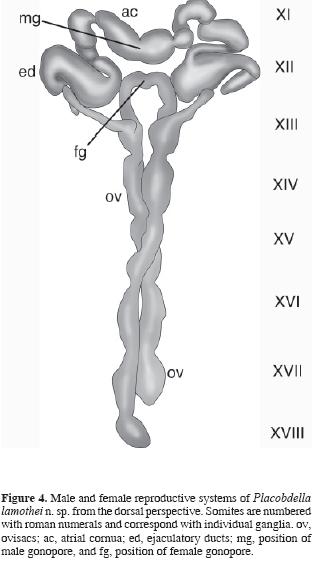
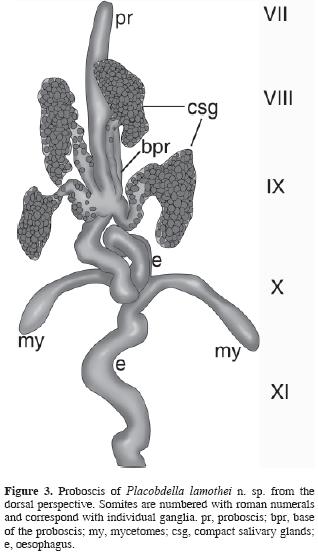
<body><![CDATA[<p align="justify"><font face="verdana" size="2"><i>Placobdella lamothei</i> n. sp. (<a href="/img/revistas/rmbiodiv/v79sago/a19f5.jpg" target="_blank">Figs. 1&#150;4</a>)</font></p> 				    <p align="justify"><font face="verdana" size="2"><i>External morphology.</i> Brownish, largest specimen 19 mm long, 4.8 mm wide. Complete somite triannulate, Somites I&#150;II uniannulate. Somites III&#150;IV biannulate. Somites V&#150;XXIV triannulate. Somites XXV&#150;XXVII biannulate. Dorsum with 3 inconspicuous longitudinal rows of papillae from VII through XXV, 1 medial row with papillae in a1, a2 and a3, and 2 paramedial rows with papillae only on a2. Small papillae irregularly dispersed in the space not occupied by rows of papillae. One heavily pigmented longitudinal strip from VII to XXIV. Metameric paramedial and marginal pigmented patches on a2 from IX to XIV. Unpigmented medial zone on dorsum in somites I&#150;VIII partially interrupted in VI and VII a3. Posterior sucker brownish without radial pigmentation or papillae (<a href="/img/revistas/rmbiodiv/v79sago/a19f1.jpg" target="_blank">Fig. 1</a>). Ventral surface unpigmented save for rare chromatophores and without papillae (<a href="/img/revistas/rmbiodiv/v79sago/a19f2.jpg" target="_blank">fig. 2</a>). Two pair eyespots in &laquo;placobdellid&raquo; arrangement, inconspicuous confluent pair on II and larger, conspicuous pair on III, also confluent. Mouth pore on the anterior margin of the oral sucker. Male gonopore between XI and XII. Female gonopore on XII between a2/a3, thus 2 annuli between gonopores. Anus between (a1,a2) and a3 of the biannulate somite XXVII. </font></p> 				    <p align="justify"><font face="verdana" size="2"><i>Alimentary tract.</i> Short and robust proboscis in membranous sheath reaching posteriorly to IX connecting to a conspicuously long and recurved oesophagus. Two pairs of well developed compact salivary glands connecting into base of proboscis; anterior (medial) pair is located in VIII connecting to base of proboscis via strong ducts in IX; posterior (lateral) pair of compact salivary glands in IX. Oesophagus unusually long for the genus, thick, connected anteriorly to base of proboscis and posteriorly with crop. One pair of sac&#150;like mycetomes in X connected with the oesophagus. Length of oesophagus from base of proboscis to mycetomes is approximately 2 times the length of the proboscis (<a href="#f3">Fig. 3</a>). Crop with 7 pairs branched caeca from XIII to XIX; last pair forming postcaeca. Intestine with 4 simple caeca in somites XIX&#150;XXIII.</font></p> 				    <p align="center"><font face="verdana" size="2"><a name="f3"></a></font></p> 				    <p align="center"><font face="verdana" size="2"><img src="/img/revistas/rmbiodiv/v79sago/a19f3.jpg"></font></p> 				    <p align="justify"><font face="verdana" size="2"><i>Reproductive anatomy.</i> Atrial cornua well&#150;developed anterolaterally directed. Highly coiled ejaculatory ducts immediately posterior to atrial cornua on somites XI&#150;XIII. Male median reproductive anatomy entirely anterior to XIII/a2. Five pairs intersegmental testisacs from XIII/XIV to XVII/XVIII. Ovisacs without common oviduct. Ovarian lobes from XII to XVIII, accessory anterior lobe arising from bifurcation at XIII, extending anteriorly to XII a3 (<a href="#f4">Fig. 4</a>).</font></p> 				    <p align="center"><font face="verdana" size="2"><a name="f4"></a></font></p> 				    <p align="center"><font face="verdana" size="2"><img src="/img/revistas/rmbiodiv/v79sago/a19f4.jpg"></font></p> 				    <p align="justify"><font face="verdana" size="2"><b>Taxonomic summary</b></font></p> 				    <p align="justify"><font face="verdana" size="2"><i>Type host:</i> freshwater turtle <i>Kinosternon integrum</i> Le Conte, 1854. </font></p> 				    ]]></body>
<body><![CDATA[<p align="justify"><font face="verdana" size="2"><i>Type locality:</i> La Puerta de Santiago, Municipio de Tonatico, Estado de M&eacute;xico. Mexico. 18&deg;45'00''N 99&deg;37'31''W. Altitude 1 630 m</font></p> 				    <p align="justify"><font face="verdana" size="2"><i>Type material:</i> holotype, CNHE 6030, August, 11 2007. Paratypes CNHE 6031, AMNH 5510 annelida, July, 2004. Specimens collected by Rodrigo Macip&#150;R&iacute;os, Noem&iacute; Mat&iacute;as&#150;Ferrer and Alejandro Oceguera&#150;Figueroa in the same locality and on the same host.</font></p> 				    <p align="justify"><font face="verdana" size="2"><i>Etymology:</i> this species is named in honor of Rafael Lamothe Argumedo, in recognition of his prolific scientific production and for being professor of invertebrate zoology for many years in the Facultad de Ciencias, UNAM, inspiring and sharing with young biologists his love and passion for invertebrates.</font></p> 				    <p align="justify"><font face="verdana" size="2"><b>Remarks</b></font></p> 				    <p align="justify"><font face="verdana" size="2">According to the most recent account of World leeches (Sawyer, 1986), 2 species of <i>Placobdella</i> have been recorded from Mexico: <i>P. moorei</i> Autrum, 1936 and <i>P. multilineata</i> Moore, 1953. Autrum (1936) considered <i>Placobdella</i> a junior synonym of <i>Haementeria</i>. According to this, the name <i>Placobdella mexicana</i> Moore, 1898 was considered preoccupied by <i>Haementeria mexicana</i> de Fillipi, 1849. For this reason, <i>Placobdella moorei</i> Autrum, 1936 was erected in order to solve this apparently subjective synonymy. Interestingly, <i>Haementeria mexicana</i> was previously synonymized with <i>Haementeria officinalis</i> by Blanchard (1893) and presently <i>Placobdella</i> is no longer considered a synonym of <i>Haementeria</i>. This confusion was well understood and clarified in Ringuelet (1981, 1982) but not fully recovered in Sawyer's (1986) treatment, wherein he recognized <i>Placobdella</i> and <i>Haementeria</i> as distinct genera, yet still used the name <i>Placobdella moorei</i> instead of the correct ressurection of the available name <i>Placobdella mexicana</i>. As such, herein we formally resurrect <i>Placobdella mexicana</i> and consider <i>Placobdella moorei</i> to be a junior synonym.</font></p> 				    <p align="justify"><font face="verdana" size="2"><i>Placobdella mexicana</i> has been recorded only twice: in the original description, which was based on 3 specimens from an unspecified locality in Mexico (Moore, 1898) and 34 years later, by Oka (1932) who recorded this species from Chapala, Jalisco.</font></p> 				    <p align="justify"><font face="verdana" size="2">Caballero (1940, 1941) recorded <i>Placobdella rugosa</i> Verrill, 1874 from Xochimilco, M&eacute;xico City and Cacahuamilpa, Guerrero. This species was considered a junior synonym of <i>Placobdella ornata</i> (Verrill, 1872) by So&oacute;s (1969), to the extent that Klemm (1982) recorded <i>P. ornata</i> in Mexico based solely on this synonymy. The existence of multiple species of papillated leeches in North America has recently become clearer (Huges and Siddall, 2007; Siddall and Bowerman, 2006). Moore (1960) noted that the leeches depicted in Caballero's (1940; 1941) figures resemble <i>Placobdella multistriata</i> (Johansson, 1909) more closely than they do <i>P. rugosa</i> (i. e., <i>P. ornata</i>). This is an apparently mistake of Moore, 1960, who actually was referring to <i>P. multilineata</i> and not to P. multistriata as was made clear previously by Moore (1953). Alas, Sawyer (1986) considered the Mexican records of this leech to be <i>P. multilineata</i>.</font></p> 				    <p align="justify"><font face="verdana" size="2">Based on the revision of the material deposited in the CNHE labeled with the name <i>Placobdella rugosa</i>, collected in Xochimilco, M&eacute;xico City (CNHE 1695) that contributed to the confusion described above, we determined that these specimens, illustrated in Caballero (1940) actually correspond to 2 different species of <i>Helobdella</i>: 4 specimens of <i>Helobdella socimulcensis</i> (Caballero, 1931) and 1 specimen of <i>Helobdella atli</i> Oceguera&#150;Figueroa and Le&oacute;n&#150;R&egrave;gagnon, 2005. Specimens collected in Cacahuamilpa, Guerrero (CNHE 1691) which were noted by Caballero (1941), correspond to the new species described in this work: <i>Placobdella lamothei</i> n. sp.</font></p> 				    <p align="justify"><font face="verdana" size="2"><i>Placobdella lamothei</i> n. sp. can be easily differentiated from the other placobdellid leech distributed in Mexico, <i>P. mexicana</i> (as noted above, previously <i>P. moorei</i> sensu Autrum, 1936 and Sawyer, 1986) based on the dorsal coloration pattern. <i>Placobdella lamothei</i> has a single, continuous longitudinal stripe in the dorsal surface, whereas in <i>P. mexicana</i> is interrupted. In addition to this character, is the unusual length of the oesophagus of <i>Placobdella lamothei</i> n. sp. that can be used to distinguish between both species. The length of the portion of the oesophagus between the base of the proboscis and the mycetomes is approximately 2 times the length of the proboscis in <i>Placobdella lamothei</i> n. sp., whereas in <i>P. mexicana</i>, it is shorter than the proboscis.</font></p> 				    <p align="justify"><font face="verdana" size="2">In terms of the development of dorsal papillae, the weak rows of papillae on <i>Placobdella lamothei</i> n. sp. strongly contrast with those of <i>Placobdella ali</i> Hughes and Siddall, 2007, <i>Placobdella papillifera</i> (Verrill, 1872), <i>Placobdella ornata</i>, <i>Placobdella multilineata</i> Yang and Davies, 1984 and Placobdella burresonae Siddall and Bowerman, 2006.</font></p> 				    ]]></body>
<body><![CDATA[<p align="justify"><font face="verdana" size="2"><i>Placobdella biannulata</i> (Moore, 1900) presents biannulate somites clearly distinguishing it from <i>Placobdella lamothei</i> n. sp. <i>Placobdella phalera</i> (Graff, 1899), <i>Placobdella michiganensis</i> (Sawyer, 1972), <i>Placobdella cryptobranchii</i> (Johnson and Klemm, 1977), <i>Placobdella transluscens</i> (Sawyer and Shelley, 1976) and P<i>lacobdella picta</i> (Verrill, 1872) lack compact salivary glands clearly distinguishing these species from <i>Placobdella lamothei</i> n. sp.</font></p> 				    <p align="justify"><font face="verdana" size="2"><i>Placobdella montifera</i> Moore, 1906, which also has 3 rows of pronounced papillae, and <i>Placobdella nuchalis</i> Sawyer and Shelley, 1976 regularly present a constriction in the neck region (VII), resulting in a discoid head, in contrast to <i>Placobdella lamothei</i> n. sp. that lacks that characteristic.</font></p> 				    <p align="justify"><font face="verdana" size="2"><i>Placobdella parasitica</i> (Say, 1824) lacks papillae altogether, and has 8&#150;12 bluish, greenish or brownish ventral longitudinal stripes. <i>Placobdella translucens</i> (Sawyer and Shelley, 1976) presents an indistinct medial interrupted longitudinal dorsal stripe and is weakly muscularized. Any of these characteristics are as observed in <i>Placobdella lamothei</i> n. sp.</font></p> 				    <p align="justify"><font face="verdana" size="2">In conclusion, 2 species of placobdellid leeches parasites of freshwater turtles occur in Mexico, <i>Placobdella lamothei</i> n. sp. and <i>P. mexicana</i>. Previous record of <i>Placobdella ornata</i> by Caballero (1941) should be considered erroneous, actually, this record corresponds to <i>Placobdella lamothei</i> n. sp.</font></p> 				    <p align="justify"><font face="verdana" size="2">&nbsp;</font></p> 				    <p align="justify"><font face="verdana" size="2"><b>Acknowledgments </b></font></p> 				    <p align="justify"><font face="verdana" size="2">The authors thank Rodrigo Macip&#150;R&iacute;os for the collection of specimens. Special thanks to Virginia Le&oacute;n&#150;R&egrave;gagnon, Luis Garc&iacute;a&#150;Prieto, Gerardo P&eacute;rez Ponce de Le&oacute;n, and David Osorio&#150;Sarabia for the invitation to participate in this volume. This study was partially founded by CONACyT in the form of a graduate scholarship (172322) to the first author.</font></p> 				    <p align="justify"><font face="verdana" size="2">&nbsp;</font></p> 				    <p align="justify"><font face="verdana" size="2"><b>Literature cited</b></font></p> 				    <!-- ref --><p align="justify"><font face="verdana" size="2">Autrum, H. 1936. Hirudineen. <i>In</i> Bronns: Klassen und Ordnungen des Tierreichs, 4, III Abt., 4 Buch, 1 Teil, 1 Lief., Leipzig. 96 p. </font>&nbsp;&nbsp;&nbsp;&nbsp;&nbsp;&nbsp;&nbsp;&nbsp;[&#160;<a href="javascript:void(0);" onclick="javascript: window.open('/scielo.php?script=sci_nlinks&ref=7503426&pid=S1870-3453200800030001900001&lng=','','width=640,height=500,resizable=yes,scrollbars=1,menubar=yes,');">Links</a>&#160;]<!-- end-ref --> 				    <!-- ref --><p align="justify"><font face="verdana" size="2">Blanchard, R. 1893. Revision des Hirudin&eacute;es du Mus&eacute;e de Turin. Bollettino dei Musei di Zoologia ed Anatomia Comparata della Universita di Torino 8:1&#150;32.</font>&nbsp;&nbsp;&nbsp;&nbsp;&nbsp;&nbsp;&nbsp;&nbsp;[&#160;<a href="javascript:void(0);" onclick="javascript: window.open('/scielo.php?script=sci_nlinks&ref=7503428&pid=S1870-3453200800030001900002&lng=','','width=640,height=500,resizable=yes,scrollbars=1,menubar=yes,');">Links</a>&#160;]<!-- end-ref --> 				    <!-- ref --><p align="justify"><font face="verdana" size="2">Caballero y C., E. 1940. Sobre la presencia de <i>Placobdella rugosa</i> (Hirudinea: Glossosiphonidae) en las aguas del lago de Xochimilco XIII. Anales del Instituto de Biolog&iacute;a. Universidad Nacional Aut&oacute;noma de M&eacute;xico, Serie Zoolog&iacute;a 11:255&#150;260.</font>&nbsp;&nbsp;&nbsp;&nbsp;&nbsp;&nbsp;&nbsp;&nbsp;[&#160;<a href="javascript:void(0);" onclick="javascript: window.open('/scielo.php?script=sci_nlinks&ref=7503430&pid=S1870-3453200800030001900003&lng=','','width=640,height=500,resizable=yes,scrollbars=1,menubar=yes,');">Links</a>&#160;]<!-- end-ref --> 				    <!-- ref --><p align="justify"><font face="verdana" size="2">Caballero y C., E. 1941. Hirud&iacute;neos de M&eacute;xico XVI.&#150;Nuevos hu&eacute;spedes y localidades para algunas sanguijuelas ya conocidas y descripci&oacute;n de una nueva especie. Anales del Instituto de Biolog&iacute;a. Universidad Nacional Aut&oacute;noma de M&eacute;xico, Serie Zoolog&iacute;a 12:747&#150;757.</font>&nbsp;&nbsp;&nbsp;&nbsp;&nbsp;&nbsp;&nbsp;&nbsp;[&#160;<a href="javascript:void(0);" onclick="javascript: window.open('/scielo.php?script=sci_nlinks&ref=7503432&pid=S1870-3453200800030001900004&lng=','','width=640,height=500,resizable=yes,scrollbars=1,menubar=yes,');">Links</a>&#160;]<!-- end-ref --> 				    <!-- ref --><p align="justify"><font face="verdana" size="2">Hughes, J. L. and M. E. Siddall. 2007. A new species of leech from the New York metropolitan area. American Museum Novitates 3578:1&#150;6. </font>&nbsp;&nbsp;&nbsp;&nbsp;&nbsp;&nbsp;&nbsp;&nbsp;[&#160;<a href="javascript:void(0);" onclick="javascript: window.open('/scielo.php?script=sci_nlinks&ref=7503434&pid=S1870-3453200800030001900005&lng=','','width=640,height=500,resizable=yes,scrollbars=1,menubar=yes,');">Links</a>&#160;]<!-- end-ref --> 				    <!-- ref --><p align="justify"><font face="verdana" size="2">Klemm, D. J. 1982. Leeches (Annelida: Hirudinea) of North America. Aquatic Biology Section, Environmental Monitoring and Support Laboratory, Office of Support Laboratory. Office of Research and Development, U.S. Environmental Protection Agency, Cincinnati. 177 p.</font>&nbsp;&nbsp;&nbsp;&nbsp;&nbsp;&nbsp;&nbsp;&nbsp;[&#160;<a href="javascript:void(0);" onclick="javascript: window.open('/scielo.php?script=sci_nlinks&ref=7503436&pid=S1870-3453200800030001900006&lng=','','width=640,height=500,resizable=yes,scrollbars=1,menubar=yes,');">Links</a>&#160;]<!-- end-ref --> 				    <!-- ref --><p align="justify"><font face="verdana" size="2">Moore, J. P. 1898. The leeches of the U.S. National Museum. Proceedings of the U.S. National Museum 1160: 543&#150;363.</font>&nbsp;&nbsp;&nbsp;&nbsp;&nbsp;&nbsp;&nbsp;&nbsp;[&#160;<a href="javascript:void(0);" onclick="javascript: window.open('/scielo.php?script=sci_nlinks&ref=7503438&pid=S1870-3453200800030001900007&lng=','','width=640,height=500,resizable=yes,scrollbars=1,menubar=yes,');">Links</a>&#160;]<!-- end-ref --> 				    <!-- ref --><p align="justify"><font face="verdana" size="2">Moore, J. P. 1953. Three undescribed north American leeches (Hirudinea). Notulae Naturae of the Academy of Natural Sciences of Philadelphia 250:1&#150;13.</font>&nbsp;&nbsp;&nbsp;&nbsp;&nbsp;&nbsp;&nbsp;&nbsp;[&#160;<a href="javascript:void(0);" onclick="javascript: window.open('/scielo.php?script=sci_nlinks&ref=7503440&pid=S1870-3453200800030001900008&lng=','','width=640,height=500,resizable=yes,scrollbars=1,menubar=yes,');">Links</a>&#160;]<!-- end-ref --> 				    <!-- ref --><p align="justify"><font face="verdana" size="2">Moore, J. P. 1960. On the contributions of Dr. Eduardo Caballero y C. to Mexican hirudinology. Libro Homenaje al Dr. Eduardo Caballero y Caballero. Secretar&iacute;a de Educaci&oacute;n P&uacute;blica&#150;Instituto Polit&eacute;cnico Nacional, M&eacute;xico, D.F. p. 529&#150;531.</font>&nbsp;&nbsp;&nbsp;&nbsp;&nbsp;&nbsp;&nbsp;&nbsp;[&#160;<a href="javascript:void(0);" onclick="javascript: window.open('/scielo.php?script=sci_nlinks&ref=7503442&pid=S1870-3453200800030001900009&lng=','','width=640,height=500,resizable=yes,scrollbars=1,menubar=yes,');">Links</a>&#160;]<!-- end-ref --> 				    <!-- ref --><p align="justify"><font face="verdana" size="2">Oka, A. 1932. Hirudin&eacute;es extraeurop&eacute;ennes du Mus&eacute;e Zoologique Polonais. Annales Musei Zoologici Polonici 9:313&#150;330.</font>&nbsp;&nbsp;&nbsp;&nbsp;&nbsp;&nbsp;&nbsp;&nbsp;[&#160;<a href="javascript:void(0);" onclick="javascript: window.open('/scielo.php?script=sci_nlinks&ref=7503444&pid=S1870-3453200800030001900010&lng=','','width=640,height=500,resizable=yes,scrollbars=1,menubar=yes,');">Links</a>&#160;]<!-- end-ref --> 				    <!-- ref --><p align="justify"><font face="verdana" size="2">Ringuelet, R. A. 1981. Clave para el reconocimiento de los hirud&iacute;neos de M&eacute;xico. Anales del Instituto de Biolog&iacute;a, Universidad Nacional Aut&oacute;noma de M&eacute;xico, Serie Zoolog&iacute;a 52:89&#150;97.</font>&nbsp;&nbsp;&nbsp;&nbsp;&nbsp;&nbsp;&nbsp;&nbsp;[&#160;<a href="javascript:void(0);" onclick="javascript: window.open('/scielo.php?script=sci_nlinks&ref=7503446&pid=S1870-3453200800030001900011&lng=','','width=640,height=500,resizable=yes,scrollbars=1,menubar=yes,');">Links</a>&#160;]<!-- end-ref --> 				    <!-- ref --><p align="justify"><font face="verdana" size="2">Ringuelet, R. A. 1982. Hirudinea. <i>In</i> Aquatic biota of Mexico, Central America and the West Indies, S. H. Hurlbert and A. Villalobos&#150;Figueroa (eds.). San Diego State University, San Diego. p. 166&#150;171. </font>&nbsp;&nbsp;&nbsp;&nbsp;&nbsp;&nbsp;&nbsp;&nbsp;[&#160;<a href="javascript:void(0);" onclick="javascript: window.open('/scielo.php?script=sci_nlinks&ref=7503448&pid=S1870-3453200800030001900012&lng=','','width=640,height=500,resizable=yes,scrollbars=1,menubar=yes,');">Links</a>&#160;]<!-- end-ref --> 				    <!-- ref --><p align="justify"><font face="verdana" size="2">Ringuelet, R. A. 1985. Fauna de agua dulce de la Rep&uacute;blica de Argentina, Hirudinea, FECIC, Buenos Aires, 321 p.</font>&nbsp;&nbsp;&nbsp;&nbsp;&nbsp;&nbsp;&nbsp;&nbsp;[&#160;<a href="javascript:void(0);" onclick="javascript: window.open('/scielo.php?script=sci_nlinks&ref=7503450&pid=S1870-3453200800030001900013&lng=','','width=640,height=500,resizable=yes,scrollbars=1,menubar=yes,');">Links</a>&#160;]<!-- end-ref --> 				    <!-- ref --><p align="justify"><font face="verdana" size="2">Sawyer, R. T. 1986. Leech biology and behaviour, feeding biology, ecology and systematics. Oxford University Press, Oxford. 1065 p.</font>&nbsp;&nbsp;&nbsp;&nbsp;&nbsp;&nbsp;&nbsp;&nbsp;[&#160;<a href="javascript:void(0);" onclick="javascript: window.open('/scielo.php?script=sci_nlinks&ref=7503452&pid=S1870-3453200800030001900014&lng=','','width=640,height=500,resizable=yes,scrollbars=1,menubar=yes,');">Links</a>&#160;]<!-- end-ref --> 				    <!-- ref --><p align="justify"><font face="verdana" size="2">Siddall M. E. and J. Bowerman. 2006. A new species of glossiphoniid leech from <i>Rana pretiosa</i> (Amphibia: Raniidae) in Oregon. Journal of Parasitology 92:855&#150;857.</font>&nbsp;&nbsp;&nbsp;&nbsp;&nbsp;&nbsp;&nbsp;&nbsp;[&#160;<a href="javascript:void(0);" onclick="javascript: window.open('/scielo.php?script=sci_nlinks&ref=7503454&pid=S1870-3453200800030001900015&lng=','','width=640,height=500,resizable=yes,scrollbars=1,menubar=yes,');">Links</a>&#160;]<!-- end-ref --> 				    <!-- ref --><p align="justify"><font face="verdana" size="2">Siddall, M. E., R. B. Budinoff and E. Borda. 2005. Phylogenetic evaluation of systematics and biogeography of the leech family Glossiphoniidae. Invertebrate Systematics 19:105&#150;112.</font>&nbsp;&nbsp;&nbsp;&nbsp;&nbsp;&nbsp;&nbsp;&nbsp;[&#160;<a href="javascript:void(0);" onclick="javascript: window.open('/scielo.php?script=sci_nlinks&ref=7503456&pid=S1870-3453200800030001900016&lng=','','width=640,height=500,resizable=yes,scrollbars=1,menubar=yes,');">Links</a>&#160;]<!-- end-ref --> 				    <!-- ref --><p align="justify"><font face="verdana" size="2">So&oacute;s, A. 1969. Identification key to the leech (Hirudinoidea) genera of the world, with a catalogue of the species. IV. Family: Glossiphoniidae. Acta Zoologica Academiae Scientiarum Hungaricae 15:397&#150;454.</font>&nbsp;&nbsp;&nbsp;&nbsp;&nbsp;&nbsp;&nbsp;&nbsp;[&#160;<a href="javascript:void(0);" onclick="javascript: window.open('/scielo.php?script=sci_nlinks&ref=7503458&pid=S1870-3453200800030001900017&lng=','','width=640,height=500,resizable=yes,scrollbars=1,menubar=yes,');">Links</a>&#160;]<!-- end-ref --> ]]></body><back>
<ref-list>
<ref id="B1">
<nlm-citation citation-type="">
<person-group person-group-type="author">
<name>
<surname><![CDATA[Autrum]]></surname>
<given-names><![CDATA[H]]></given-names>
</name>
</person-group>
<article-title xml:lang="de"><![CDATA[Hirudineen]]></article-title>
<source><![CDATA[Bronns: Klassen und Ordnungen des Tierreichs]]></source>
<year>1936</year>
<volume>4</volume>
<page-range>96</page-range><publisher-loc><![CDATA[Leipzig ]]></publisher-loc>
</nlm-citation>
</ref>
<ref id="B2">
<nlm-citation citation-type="journal">
<person-group person-group-type="author">
<name>
<surname><![CDATA[Blanchard]]></surname>
<given-names><![CDATA[R]]></given-names>
</name>
</person-group>
<article-title xml:lang="fr"><![CDATA[Revision des Hirudinées du Musée de Turin]]></article-title>
<source><![CDATA[Bollettino dei Musei di Zoologia ed Anatomia Comparata della Universita di Torino]]></source>
<year>1893</year>
<volume>8</volume>
<page-range>1-32</page-range></nlm-citation>
</ref>
<ref id="B3">
<nlm-citation citation-type="journal">
<person-group person-group-type="author">
<name>
<surname><![CDATA[Caballero y C.]]></surname>
<given-names><![CDATA[E]]></given-names>
</name>
</person-group>
<article-title xml:lang="es"><![CDATA[Sobre la presencia de Placobdella rugosa (Hirudinea: Glossosiphonidae) en las aguas del lago de Xochimilco XIII]]></article-title>
<source><![CDATA[Anales del Instituto de Biología]]></source>
<year>1940</year>
<volume>11</volume>
<page-range>255-260</page-range><publisher-name><![CDATA[Universidad Nacional Autónoma de México]]></publisher-name>
</nlm-citation>
</ref>
<ref id="B4">
<nlm-citation citation-type="journal">
<person-group person-group-type="author">
<name>
<surname><![CDATA[Caballero y C.]]></surname>
<given-names><![CDATA[E]]></given-names>
</name>
</person-group>
<article-title xml:lang="es"><![CDATA[Hirudíneos de México XVI.-Nuevos huéspedes y localidades para algunas sanguijuelas ya conocidas y descripción de una nueva especie]]></article-title>
<source><![CDATA[Anales del Instituto de Biología]]></source>
<year>1941</year>
<volume>12</volume>
<page-range>747-757</page-range><publisher-name><![CDATA[Universidad Nacional Autónoma de México]]></publisher-name>
</nlm-citation>
</ref>
<ref id="B5">
<nlm-citation citation-type="journal">
<person-group person-group-type="author">
<name>
<surname><![CDATA[Hughes]]></surname>
<given-names><![CDATA[J. L]]></given-names>
</name>
<name>
<surname><![CDATA[Siddall]]></surname>
<given-names><![CDATA[M. E.]]></given-names>
</name>
</person-group>
<article-title xml:lang="en"><![CDATA[A new species of leech from the New York metropolitan area]]></article-title>
<source><![CDATA[American Museum Novitates]]></source>
<year>2007</year>
<volume>3578</volume>
<page-range>1-6</page-range></nlm-citation>
</ref>
<ref id="B6">
<nlm-citation citation-type="book">
<person-group person-group-type="author">
<name>
<surname><![CDATA[Klemm]]></surname>
<given-names><![CDATA[D. J.]]></given-names>
</name>
</person-group>
<source><![CDATA[Leeches (Annelida: Hirudinea) of North America]]></source>
<year>1982</year>
<page-range>177</page-range><publisher-loc><![CDATA[Cincinnati ]]></publisher-loc>
<publisher-name><![CDATA[Aquatic Biology Section, Environmental Monitoring and Support Laboratory, Office of Support Laboratory. Office of Research and Development, U.S. Environmental Protection Agency]]></publisher-name>
</nlm-citation>
</ref>
<ref id="B7">
<nlm-citation citation-type="journal">
<person-group person-group-type="author">
<name>
<surname><![CDATA[Moore]]></surname>
<given-names><![CDATA[J. P]]></given-names>
</name>
</person-group>
<article-title xml:lang="en"><![CDATA[The leeches of the U.S. National Museum]]></article-title>
<source><![CDATA[Proceedings of the U.S. National Museum]]></source>
<year>1898</year>
<volume>1160</volume>
<page-range>543-363</page-range></nlm-citation>
</ref>
<ref id="B8">
<nlm-citation citation-type="journal">
<person-group person-group-type="author">
<name>
<surname><![CDATA[Moore]]></surname>
<given-names><![CDATA[J. P]]></given-names>
</name>
</person-group>
<article-title xml:lang="en"><![CDATA[Three undescribed north American leeches (Hirudinea)]]></article-title>
<source><![CDATA[Notulae Naturae of the Academy of Natural Sciences of Philadelphia]]></source>
<year>1953</year>
<volume>250</volume>
<page-range>1-13</page-range></nlm-citation>
</ref>
<ref id="B9">
<nlm-citation citation-type="book">
<person-group person-group-type="author">
<name>
<surname><![CDATA[Moore]]></surname>
<given-names><![CDATA[J. P.]]></given-names>
</name>
</person-group>
<source><![CDATA[On the contributions of Dr. Eduardo Caballero y C. to Mexican hirudinology: Libro Homenaje al Dr. Eduardo Caballero y Caballero]]></source>
<year>1960</year>
<page-range>529-531</page-range><publisher-loc><![CDATA[México^eD.F. D.F.]]></publisher-loc>
<publisher-name><![CDATA[Secretaría de Educación PúblicaInstituto Politécnico Nacional]]></publisher-name>
</nlm-citation>
</ref>
<ref id="B10">
<nlm-citation citation-type="journal">
<person-group person-group-type="author">
<name>
<surname><![CDATA[Oka]]></surname>
<given-names><![CDATA[A]]></given-names>
</name>
</person-group>
<article-title xml:lang="fr"><![CDATA[Hirudinées extraeuropéennes du Musée Zoologique Polonais]]></article-title>
<source><![CDATA[Annales Musei Zoologici Polonici]]></source>
<year>1932</year>
<volume>9</volume>
<page-range>313-330</page-range></nlm-citation>
</ref>
<ref id="B11">
<nlm-citation citation-type="journal">
<person-group person-group-type="author">
<name>
<surname><![CDATA[Ringuelet]]></surname>
<given-names><![CDATA[R. A]]></given-names>
</name>
</person-group>
<article-title xml:lang="es"><![CDATA[Clave para el reconocimiento de los hirudíneos de México]]></article-title>
<source><![CDATA[Anales del Instituto de Biología]]></source>
<year>1981</year>
<volume>52</volume>
<page-range>89-97</page-range><publisher-name><![CDATA[Universidad Nacional Autónoma de México]]></publisher-name>
</nlm-citation>
</ref>
<ref id="B12">
<nlm-citation citation-type="book">
<person-group person-group-type="author">
<name>
<surname><![CDATA[Ringuelet]]></surname>
<given-names><![CDATA[R. A]]></given-names>
</name>
</person-group>
<article-title xml:lang="en"><![CDATA[Hirudinea]]></article-title>
<person-group person-group-type="editor">
<name>
<surname><![CDATA[Hurlbert]]></surname>
<given-names><![CDATA[S. H.]]></given-names>
</name>
<name>
<surname><![CDATA[Villalobos-Figueroa]]></surname>
<given-names><![CDATA[A]]></given-names>
</name>
</person-group>
<source><![CDATA[Aquatic biota of Mexico, Central America and the West Indies]]></source>
<year>1982</year>
<page-range>166-171</page-range><publisher-loc><![CDATA[San Diego ]]></publisher-loc>
<publisher-name><![CDATA[San Diego State University]]></publisher-name>
</nlm-citation>
</ref>
<ref id="B13">
<nlm-citation citation-type="book">
<person-group person-group-type="author">
<name>
<surname><![CDATA[Ringuelet]]></surname>
<given-names><![CDATA[R. A.]]></given-names>
</name>
</person-group>
<source><![CDATA[Fauna de agua dulce de la República de Argentina, Hirudinea]]></source>
<year>1985</year>
<page-range>321</page-range><publisher-loc><![CDATA[Buenos Aires ]]></publisher-loc>
<publisher-name><![CDATA[FECIC]]></publisher-name>
</nlm-citation>
</ref>
<ref id="B14">
<nlm-citation citation-type="book">
<person-group person-group-type="author">
<name>
<surname><![CDATA[Sawyer]]></surname>
<given-names><![CDATA[R. T.]]></given-names>
</name>
</person-group>
<source><![CDATA[Leech biology and behaviour, feeding biology, ecology and systematics]]></source>
<year>1986</year>
<page-range>1065</page-range><publisher-loc><![CDATA[Oxford ]]></publisher-loc>
<publisher-name><![CDATA[Oxford University Press]]></publisher-name>
</nlm-citation>
</ref>
<ref id="B15">
<nlm-citation citation-type="journal">
<person-group person-group-type="author">
<name>
<surname><![CDATA[Siddall]]></surname>
<given-names><![CDATA[M. E]]></given-names>
</name>
<name>
<surname><![CDATA[Bowerman]]></surname>
<given-names><![CDATA[J]]></given-names>
</name>
</person-group>
<article-title xml:lang="en"><![CDATA[A new species of glossiphoniid leech from Rana pretiosa (Amphibia: Raniidae) in Oregon]]></article-title>
<source><![CDATA[Journal of Parasitology]]></source>
<year>2006</year>
<volume>92</volume>
<page-range>855-857</page-range></nlm-citation>
</ref>
<ref id="B16">
<nlm-citation citation-type="journal">
<person-group person-group-type="author">
<name>
<surname><![CDATA[Siddall]]></surname>
<given-names><![CDATA[M. E]]></given-names>
</name>
<name>
<surname><![CDATA[Budinoff]]></surname>
<given-names><![CDATA[R. B.]]></given-names>
</name>
<name>
<surname><![CDATA[Borda]]></surname>
<given-names><![CDATA[E]]></given-names>
</name>
</person-group>
<article-title xml:lang="en"><![CDATA[Phylogenetic evaluation of systematics and biogeography of the leech family Glossiphoniidae]]></article-title>
<source><![CDATA[Invertebrate Systematics]]></source>
<year>2005</year>
<volume>19</volume>
<page-range>105-112</page-range></nlm-citation>
</ref>
<ref id="B17">
<nlm-citation citation-type="journal">
<person-group person-group-type="author">
<name>
<surname><![CDATA[Soós]]></surname>
<given-names><![CDATA[A]]></given-names>
</name>
</person-group>
<article-title xml:lang="en"><![CDATA[Identification key to the leech (Hirudinoidea) genera of the world, with a catalogue of the species: IV. Family: Glossiphoniidae]]></article-title>
<source><![CDATA[Acta Zoologica Academiae Scientiarum Hungaricae]]></source>
<year>1969</year>
<volume>15</volume>
<page-range>397-454</page-range></nlm-citation>
</ref>
</ref-list>
</back>
</article>