<?xml version="1.0" encoding="ISO-8859-1"?><article xmlns:mml="http://www.w3.org/1998/Math/MathML" xmlns:xlink="http://www.w3.org/1999/xlink" xmlns:xsi="http://www.w3.org/2001/XMLSchema-instance">
<front>
<journal-meta>
<journal-id>1870-0462</journal-id>
<journal-title><![CDATA[Tropical and subtropical agroecosystems]]></journal-title>
<abbrev-journal-title><![CDATA[Trop. subtrop. agroecosyt]]></abbrev-journal-title>
<issn>1870-0462</issn>
<publisher>
<publisher-name><![CDATA[Universidad Autónoma de Yucatán, Facultad de Medicina Veterinaria]]></publisher-name>
</publisher>
</journal-meta>
<article-meta>
<article-id>S1870-04622011000400013</article-id>
<title-group>
<article-title xml:lang="en"><![CDATA[Molecular characterization and identification of biocontrol isolates of Trichoderma harzianum from Embu District, Kenia]]></article-title>
<article-title xml:lang="es"><![CDATA[Caracterización molecular e identificación de aislamientos de biocontrol de Trichoderma harzianum del Distrito de Embu, Kenia]]></article-title>
</title-group>
<contrib-group>
<contrib contrib-type="author">
<name>
<surname><![CDATA[Siameto]]></surname>
<given-names><![CDATA[E. N.]]></given-names>
</name>
<xref ref-type="aff" rid="A01"/>
</contrib>
<contrib contrib-type="author">
<name>
<surname><![CDATA[Okoth]]></surname>
<given-names><![CDATA[S.]]></given-names>
</name>
<xref ref-type="aff" rid="A02"/>
</contrib>
<contrib contrib-type="author">
<name>
<surname><![CDATA[Amugune]]></surname>
<given-names><![CDATA[N. O.]]></given-names>
</name>
<xref ref-type="aff" rid="A02"/>
</contrib>
<contrib contrib-type="author">
<name>
<surname><![CDATA[Chege]]></surname>
<given-names><![CDATA[N. C]]></given-names>
</name>
<xref ref-type="aff" rid="A02"/>
</contrib>
</contrib-group>
<aff id="A01">
<institution><![CDATA[,Narok University College School of Sciences ]]></institution>
<addr-line><![CDATA[Narok ]]></addr-line>
</aff>
<aff id="A02">
<institution><![CDATA[,University of Nairobi School of Biological Sciences ]]></institution>
<addr-line><![CDATA[Nairobi ]]></addr-line>
</aff>
<pub-date pub-type="pub">
<day>00</day>
<month>00</month>
<year>2011</year>
</pub-date>
<pub-date pub-type="epub">
<day>00</day>
<month>00</month>
<year>2011</year>
</pub-date>
<volume>13</volume>
<numero>1</numero>
<fpage>81</fpage>
<lpage>90</lpage>
<copyright-statement/>
<copyright-year/>
<self-uri xlink:href="http://www.scielo.org.mx/scielo.php?script=sci_arttext&amp;pid=S1870-04622011000400013&amp;lng=en&amp;nrm=iso"></self-uri><self-uri xlink:href="http://www.scielo.org.mx/scielo.php?script=sci_abstract&amp;pid=S1870-04622011000400013&amp;lng=en&amp;nrm=iso"></self-uri><self-uri xlink:href="http://www.scielo.org.mx/scielo.php?script=sci_pdf&amp;pid=S1870-04622011000400013&amp;lng=en&amp;nrm=iso"></self-uri><abstract abstract-type="short" xml:lang="en"><p><![CDATA[Species in the genus Trichoderma are important commercial source of several enzymes, biofungicides and growth promoters. The most common biological control agents of the genus are strains of T. harzianum, T .viride and T. viriens. In this study, sixteen selected isolates of T. harzianum from different land use types in Embu, Kenya were tested for antagonistic action against five soil borne phytopathogenic fungi (Rhizoctonia solani, Pythium sp, Fusarium graminearum, F. oxysporum f sp phaseoli and F. oxysporum f sp Lycopersici) using dual culture assay and through production of non-volatile inhibitors. Seven isolates were further characterized using RAPD-PCR procedure to determine genetic variability. All T. harzianum isolates had considerable antagonistic effect on mycelial growth of the pathogens in dual cultures compared to the control. Maximum inhibitions occurred in Pythium sp-055E interactions (73%).The culture filtrates obtained from Czapek's liquid medium reduced the dry weight (mg) of the mycelia significantly while those from the potato dextrose broth showed minimum inhibition growth. Pythium sp. was most sensitive compared to other pathogens. Genetic similarities generated using Jaccard's coefficient of similarity ranged from 0.231 to 0.857 for isolates 055E, 011E, 010E and 015E. Since all T. harzianum isolates evaluated were effective in controlling colony growth of the soil borne pathogens both in dual cultures and in culture filtrates they could be tried as a broad spectrum biological control agent in the green house and under field conditions.]]></p></abstract>
<kwd-group>
<kwd lng="en"><![CDATA[Trichoderma harzianum]]></kwd>
<kwd lng="en"><![CDATA[growth antagonism]]></kwd>
<kwd lng="en"><![CDATA[genetic similarity RAPDs]]></kwd>
</kwd-group>
</article-meta>
</front><body><![CDATA[  	    <p align="justify"><font face="verdana" size="4">Art&iacute;culos de investigaci&oacute;n</font></p>  	    <p align="justify"><font face="verdana" size="2">&nbsp;</font></p>  	    <p align="center"><font face="verdana" size="4"><b>Molecular characterization and identification of biocontrol isolates of <i>Trichoderma harzianum</i> from Embu District, Kenia</b></font></p>  	    <p align="justify"><font face="verdana" size="2">&nbsp;</font></p>  	    <p align="center"><font face="verdana" size="3"><b>Caracterizaci&oacute;n molecular e identificaci&oacute;n de aislamientos de biocontrol de <i>Trichoderma harzianum</i> del Distrito de Embu, Kenia</b></font></p>  	    <p align="justify"><font face="verdana" size="2">&nbsp;</font></p>  	    <p align="center"><font face="verdana" size="2"><b>E. N. Siameto<sup>1</sup>, S. Okoth<sup>2</sup>*, N. O. Amugune<sup>2</sup>, and N. C. Chege<sup>2</sup></b></font></p>  	    <p align="justify"><font face="verdana" size="2">&nbsp;</font></p>  	    <p align="justify"><font face="verdana" size="2"><i><sup>1</sup> School of Sciences, Narok University College, P. O Box 861, Narok * Corresponding author E&#45;mail: </i><a href="mailto:dorisokoth@yahoo.com">dorisokoth@yahoo.com</a><i> Tel: 02&#45;444904 Ext 2483.</i></font></p>      ]]></body>
<body><![CDATA[<p align="justify"><font face="verdana" size="2"><i><sup>2</sup> School of Biological Sciences, University of Nairobi, P.O Box 30197, Nairobi.</i></font></p>  	      <p align="justify">&nbsp;</p>     <p align="justify"><font face="verdana" size="2">Submitted February 15, 2010    <br> 	Accepted May 25, 2010    <br> 	Revised received June 11, 2010</font></p>  	    <p align="justify"><font face="verdana" size="2">&nbsp;</font></p>  	    <p align="justify"><font face="verdana" size="2"><b>Abstract</b></font></p>  	    <p align="justify"><font face="verdana" size="2">Species in the genus <i>Trichoderma</i> are important commercial source of several enzymes, biofungicides and growth promoters. The most common biological control agents of the genus are strains of <i>T. harzianum, T .viride</i> and <i>T. viriens.</i> In this study, sixteen selected isolates of <i>T. harzianum</i> from different land use types in Embu, Kenya were tested for antagonistic action against five soil borne phytopathogenic fungi <i>(Rhizoctonia solani, Pythium sp, Fusarium graminearum, F. oxysporum f sp phaseoli</i> and <i>F. oxysporum f sp Lycopersici)</i> using dual culture assay and through production of non&#45;volatile inhibitors. Seven isolates were further characterized using RAPD&#45;PCR procedure to determine genetic variability. All <i>T. harzianum</i> isolates had considerable antagonistic effect on mycelial growth of the pathogens in dual cultures compared to the control. Maximum inhibitions occurred in <i>Pythium sp&#45;055E</i> interactions (73%).The culture filtrates obtained from Czapek's liquid medium reduced the dry weight (mg) of the mycelia significantly while those from the potato dextrose broth showed minimum inhibition growth. <i>Pythium sp.</i> was most sensitive compared to other pathogens. Genetic similarities generated using Jaccard's coefficient of similarity ranged from 0.231 to 0.857 for isolates 055E, 011E, 010E and 015E. Since all <i>T. harzianum</i> isolates evaluated were effective in controlling colony growth of the soil borne pathogens both in dual cultures and in culture filtrates they could be tried as a broad spectrum biological control agent in the green house and under field conditions.</font></p>  	    <p align="justify"><font face="verdana" size="2"><b>Key words:</b> <i>Trichoderma harzianum,</i> growth antagonism, genetic similarity RAPDs.</font></p>  	    <p align="justify"><font face="verdana" size="2">&nbsp;</font></p>  	    ]]></body>
<body><![CDATA[<p align="justify"><font face="verdana" size="2"><b>INTRODUCTION</b></font></p>  	    <p align="justify"><font face="verdana" size="2"><i>Trichoderma harzianum</i> is an asexually reproducing filamentous fungus and a species aggregate. It is grouped on the basis of conidiophores branching patterns with short side branches, short inflated phialides, smooth and small conidia (Rifai 1969). These characteristics allow for the relatively easy identification of <i>Trichoderma</i> as a genus, but the species concept is difficult to interpret and there is considerable confusion over the application of specific names (Rifai 1969; Papavizas 1985). This disparity of criteria makes it difficult to search for, and above all characterize new biocontrol agents (BCAs) within the species and to reidentify them in natural environment once they are present in a pathosystem (Papavizas 1985).</font></p>  	    <p align="justify"><font face="verdana" size="2">The advent of polymerase chain reaction (PCR) has allowed the analysis of small numbers of fungal cells or even single spores, dried herbarium material (Carlies & Watkinson 1994), or extinct organisms (Golenberg <i>et al.</i> 1990).The selection of universal oligonucleotide primers specific to fungi (Van Belkum <i>et al.</i> 1993; Sandhu <i>et al.</i> 1995) has provided easy access to nucleotide sequences. These techniques have been proven to be valuable tools in fungal taxonomy and their application has led to the reconsideration of several genera (Sherriff <i>et al.,</i> 1994)</font></p>  	    <p align="justify"><font face="verdana" size="2">Hence, Random markers as products of the PCR&#45;RAPD technique have been used for taxonomy of <i>Trichoderma</i> to discriminate species (Hadrys <i>et al.,</i> 1992; Williams <i>et al.,</i> 1990).</font></p>  	    <p align="justify"><font face="verdana" size="2"><i>Trichoderma</i> species have been investigated for over 70 years (Hjeljord & Tronsmo 1998). They have been used as biological control agents (BCAs) and their isolates have become commercially available of late (Freeman <i>et al.,</i> 2004). This development is largely the result of a change in public attitude towards the use of chemical pesticides and fungicides such as methyl bromide (Elad <i>et al.</i> 1980; Basim <i>et al.</i> 1999). In this respect <i>Trichoderma</i> species have been studied as BCAs against soil&#45;borne plant pathogenic fungi (Henis 1984; Chet and Inbar, 1994). Replacement or reduction of chemical application can be achieved through use of biologically based fungicides, a concept included in the broad definition of biological control proposed by Cook &amp; Baker (1983). The commercial use of <i>Trichoderma</i> BCAs must be preceded by precise identification, adequate formulation, and studies about the synergistic effects of their mechanisms of biocontrol.</font></p>  	    <p align="justify"><font face="verdana" size="2">In this study the <i>in vitro</i> antifungal activity of <i>T. harzianum</i> isolates were evaluated against selected soil borne plant pathogens <i>(Rhizoctonia solani, Pythium sp, Fusarium graminearum, F .oxysporum f. sp phaseoli</i> and <i>F. oxysporum f. sp Lycopersici).</i> We aimed also at characterizing <i>T. harzianum</i> isolates using RAPD&#45;PCR technique to establish the degree of genetic variation and determine any relationship between molecular variation and antifungal activity.</font></p>  	    <p align="justify"><font face="verdana" size="2">&nbsp;</font></p>  	    <p align="justify"><font face="verdana" size="2"><b>MATERIAL AND METHODS</b></font></p>  	    <p align="justify"><font face="verdana" size="2"><b>Isolation and identification of Trichoderma species</b></font></p>  	    <p align="justify"><font face="verdana" size="2">Trich<i>oderma sp</i> were isolated using dilution plate technique (Johnson <i>et al,</i> 1959) and soil washing methods (Gams <i>et al,</i> 1987; Bills &amp; Polishook 1994) on malt extract agar (MEA) and cornmeal agar (CMA) with 2% dextrose) both with streptomycin 50mg/L and cyclcosporin 10mg/L. The colonies were counted and identified and transferred to Petri dishes containing potato dextrose agar (PDA) and incubated at 15, 25, 30 and 35&deg;C for further identification to species level.</font></p>  	    ]]></body>
<body><![CDATA[<p align="justify"><font face="verdana" size="2">Genus identification of green fungus was undertaken using the method of Domsch <i>et al.</i> (1980). <i>Trichoderma</i> isolates were identified to species level following the taxonomic key of Samuels <i>et al.</i> (2004). Microscopic examination was carried out by mounting the culture in lactophenol cotton blue but for size measurements KOH and water was used as the mounting fluid. A small amount of material was placed in a drop of 3% KOH on a slide and then replaced with water. The isolates were preserved in sterile soil and stored at 4&deg;C.</font></p>  	    <p align="justify"><font face="verdana" size="2">&nbsp;</font></p>  	    <p align="justify"><font face="verdana" size="2"><b>Isolation of phytopathogenic fungi.</b></font></p>  	    <p align="justify"><font face="verdana" size="2">Diseased plant tissues were obtained from the University of Nairobi, College of Agriculture and Veterinary Medicine (CAVM), Upper Kabete campus field station which is 10 Km north&#45;west of Nairobi. <i>Rhizoctonia solani</i> was isolated from Spinach (Spinacea oler&aacute;cea), <i>Fusarium oxysporum f. sp Lycopersici from</i> tomato <i>(Lycopersicum esculetum), F. oxysporum f. sp phaseoli</i> from beans <i>(Phaseolus vulgaris)</i> and <i>F. graminearum from</i> maize cob <i>(Zea mays).</i> Diseased plant tissues were washed under running tap water to remove surface soil, dust and other contaminants. Tissue pieces were cut out from the leading edge of lesion, and placed in one percent sodium hypochlorite for five minutes, then washed in sterile distilled water and dried on sterile filter paper. The dried pieces were cut into approximately one centimeter pieces, plated onto PDA and incubated at 25&deg;C. <i>Pythium sp was</i> obtained by planting beet root seeds in water logged soil. The seedlings that emerged were infected by dumping&#45; off. The seedlings stems were cut into one centimeter pieces and inoculated onto PDA plates.</font></p>  	    <p align="justify"><font face="verdana" size="2">&nbsp;</font></p>  	    <p align="justify"><font face="verdana" size="2"><b>Evaluation of Dual culture on agar plates</b></font></p>  	    <p align="justify"><font face="verdana" size="2">Plates of PDA were inoculated with five millimeter disc obtained from five&#45;day&#45;old cultures of the phytopathogens ten millimeter from the edge of the plate. After two days a five millimeter disc of the <i>Trichoderma harzianum</i> cultures was placed in the same plate at a distance of fifty five millimeter from the phytopathogens disc. <i>Pythium sp</i> and the biocontrol strains were inoculated at the same time. The paired cultures were incubated at room temperature for six days. The growth of the fungi was recorded by measuring the radial growth of the pathogens. The percentage growth of the pathogens was calculated as follows:</font></p>  	    <p align="justify"><font face="verdana" size="2">Percent growth=Radius of the growth in the direction of the test strain &divide; radius of the growth in the absence of the test strain x100 (Edington <i>et al,</i> 1971).&#45;&#45;&#45;&#45;&#45;&#45;&#45;&#45;&#45; Equation 1</font></p>  	    <p align="justify"><font face="verdana" size="2">&nbsp;</font></p>  	    <p align="justify"><font face="verdana" size="2"><b>Evaluation of dual culture using Slide method</b></font></p>  	    ]]></body>
<body><![CDATA[<p align="justify"><font face="verdana" size="2">For <i>Rhizoctonia solani</i> and <i>Pythium sp &#45;Trichoderma</i> interaction, a clean sterile glass slide was placed in nine centimeter diameter plates. A small amount of melted PDA was spread over the slide to make a thin film on the slide. Five millimeter discs of one week old growing colonies cut from the margin of each pathogen and <i>Trichoderma</i> isolates were placed on the opposite sides of the slide three centimeter apart on the PDA surface. A two milliliter of sterilized distilled water was added to the plate to prevent drying and incubated 25 &plusmn; 1&deg;C for a week. At the end of incubation period, point of contact between <i>Trichoderma&#151;Pathogen</i> hyphae was stained with lactophenol in cotton blue and observed under a light microscope for the presence of mycelial penetration and for cell wall disintegration.</font></p>  	    <p align="justify"><font face="verdana" size="2">&nbsp;</font></p>  	    <p align="justify"><font face="verdana" size="2"><b>Determination of antifungal properties of <i>T. harzianum</i> culture filtrates</b></font></p>  	    <p align="justify"><font face="verdana" size="2">To harvest non&#45;volatile antibiotics produced by <i>Trichoderma</i> isolates, the fungus was grown on potato dextrose broth (PDB) and Czapek's liquid medium (CLM) Each <i>T. harzianum</i> isolate was inoculated into 100ml PDB incubated at 20OC then filtered through 0.22 mm Millipore filters after 10 days. 2ml aliquots of these filtrates were placed in sterile Petri dishes and 25ml of PDA added. Five millimeter wide mycelial discs of the pathogen were placed at the center of the solidified agar plates and incubated at room temperature for 6 days. Colony diameters were measured daily and inhibition percentage obtained using the formula:</font></p>  	    <p align="justify"><font face="verdana" size="2">Inhibition percent = &#91;(C2&#45;C1) &divide; C2) x 100&#93; ((Edington <i>etal.</i> 1971).&#45;&#45;&#45;&#45;&#45;&#45;&#45;&#45;&#45;&#45;&#45;&#45;&#45;&#45;&#45;&#45;Equation 2</font></p>  	    <p align="justify"><font face="verdana" size="2">Where: C1 means growth of the pathogens in the presence of antagonist and C2 means the growth of control. Each experiment had three replicates and complete randomized design was adopted .PDA without the culture filtrates served as the control.</font></p>  	    <p align="justify"><font face="verdana" size="2">To test for non&#45;volatile antibiotics from Czapek's liquid medium the method of Tianhui (1994) was amended. Flasks containing 50 ml of CLM were inoculated with a five millimeter disc of <i>T. harzianum</i> isolates and incubated at 25&deg;C in the dark for two weeks. Culture liquids were filtered through filter paper and sterilized by bacterial filtration (Acrodisc nitrocellophane membranes, pore size 0.22|am). The filtrates were diluted with PDB to a concentration of 70%. PDB lacking the filtrate of <i>Trichoderma</i> served as a control. Two agar discs containing the pathogen were inoculated in each flask and then incubated at 25&deg;C and mycelia filtered through filter paper after eight days, dried and weighed. The percent dry weight was then obtained using the following formula:</font></p>  	    <p align="justify"><font face="verdana" size="2">Percent dry weight = dry weight of control &#45; dry weight of pathogen &divide; dry weight of control x 100.&#45;&#45;&#45;&#45;&#45;&#45;&#45;&#45;&#45;&#45;&#45;&#45;&#45;&#45;&#45;&#45;&#45;&#45;&#45;Equation 3.</font></p>  	    <p align="justify"><font face="verdana" size="2">Each treatment was replicated three times.</font></p>  	    <p align="justify"><font face="verdana" size="2">&nbsp;</font></p>  	    ]]></body>
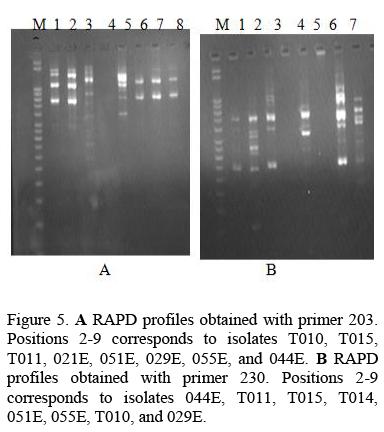
<body><![CDATA[<p align="justify"><font face="verdana" size="2"><b>Isolation of DNA from filamentous fungi</b></font></p>  	    <p align="justify"><font face="verdana" size="2">Mycelia for DNA extraction were cultured in 50 ml of yeast potato dextrose broth (YPDB) at 20&deg;C with rotary shaking at 120 revolutions per minute (rpm), harvested by filtration through a filter paper and washed with distilled water after two days. The mycelia were freeze&#45;dried and ground in the presence of sand and stored at &#45;20&deg;C. One hundred milligrams of the mycelial powder was transferred into eppendorf tubes. 500&#956;1 of 2xCTAB buffer (equilibrated to 65&deg;C) and 1.0% of p&#45;mercaptoethanol were added and the tubes heated at 65&deg;C for 30 minutes. 500&#956;1 of chloroform&#45;isoamyl alcohol (24:1) was added to the tubes and then vortexed for 30 seconds then centrifuged at 12,000rpm for 15 minutes. The upper portion of the aqueous phase was recovered and 1/5 volume of 5% CTAB and mix. Another chloroform&#45;isoamyl alcohol (24:1) extraction was performed. Equal volume of CTAB precipitation buffer was mixed with the recovered supernatant and left to stand on ice for 20 minutes. The mixture was centrifuged for 15 minutes at 12,000rpm and the supernatant discarded. The pellet was rehydrated with high salt TE buffer (heat at 65&deg;C for 5&#45;10 minutes). DNA was precipitated by the addition of an equal volume of cold absolute ethanol with incubation at &#45;20&deg;C for 10 min. DNA was collected by centrifugation at 12,000rpm for 10 minutes, washed with 70% ethanol, dried, and re&#45;suspended in lOOul of 1XTE buffer and stored at &#45;20&deg;C. The quality of the DNA was checked by use of 0.7% agarose gel and quantified spectrophotometrically.</font></p>  	    <p align="justify"><font face="verdana" size="2">&nbsp;</font></p>  	    <p align="justify"><font face="verdana" size="2"><b>RAPD analysis and PCR conditions</b></font></p>  	    <p align="justify"><font face="verdana" size="2">Amplification reactions were performed in 0.6ml microcentrifuge tubes in a 25 &#956;1 reaction volumes containing 5ng of template DNA, <i>Taq</i> buffer, 2.5mM MgC1<sub>2</sub>, 0.8mM each dNTP, 1.15ng/&#956;1 Primer and lunit <i>Taq</i> DNA polymerase. Amplification reactions were performed in a Perkin&#45;Elmer, Gene amp PCR system 2400 thermal Cycler programmed for 35 cycles of denaturation at 94&deg;C for 30 seconds, low stringency annealing temperature at 31&deg;C for 1.0 minute and polymerization at 72&deg;C for 1.0 minute with a final extension step at 72&deg;C for 10 minutes. PCR products were separated on 2.5 % agarose/ IX TBE gels. A 50bp DNA molecular size marker was loaded on the first well and used for comparison. The banding pattern was visualized on Ultraviolet ttansilluminator and documented by MultiDoc digital imaging system.</font></p>  	    <p align="justify"><font face="verdana" size="2">&nbsp;</font></p>  	    <p align="justify"><font face="verdana" size="2"><b>Data analysis</b></font></p>  	    <p align="justify"><font face="verdana" size="2">Bands were manually scored 1 for presence and 0 for absence and the binary data used for statistical analysis using the software R&#45;command version 2.1.1. The size of the fragments (molecular weight in base pairs) was estimated by using 50 bp ladder marker, which was run along with the amplified products. A genetic dissimilarity matrix was calculated according to Squared Euclidean Distance which estimated all pair&#45;wise differences in the amplification product and Cluster analysis was done by Wards method using a minimum variance algorithm (Ward, 1963).</font></p>  	    <p align="justify"><font face="verdana" size="2">Genetic Similarity (GS) was analyzed using the equation (Jaccard, 1908):</font></p>  	    <p align="justify"><font face="verdana" size="2">GS = (N<sub>ab</sub>)/(N<sub>a</sub>+N<sub>b</sub>&#45;N<sub>ab</sub>) &#45;&#45;&#45;&#45;&#45;&#45;&#45;&#45;&#45;&#45; Equation 4.</font></p>  	    ]]></body>
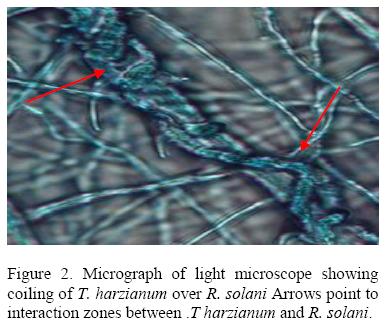
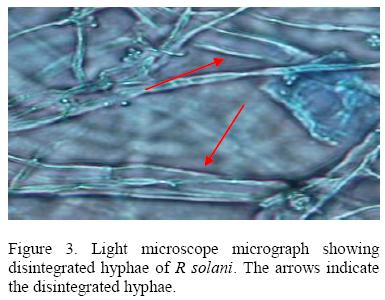
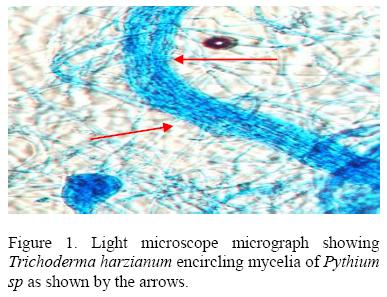
<body><![CDATA[<p align="justify"><font face="verdana" size="2">Where N<sub>ab</sub> is the number of shared fragments between isolates a and b, N<sub>a</sub> is the number of scored fragments of isolate a, and N<sub>b</sub> the number of scored fragments of isolate b. Genetic distance (GD) was then calculated as GD = 1&#45;GS. The data for growth inhibition measurement were arcsine transformed then subjected to analysis using the Statistica version 6 software.</font></p>  	    <p align="justify"><font face="verdana" size="2">&nbsp;</font></p>  	    <p align="justify"><font face="verdana" size="2"><b>RESULTS</b></font></p>  	    <p align="justify"><font face="verdana" size="2"><b>Inhibition of growth of pathogenic fungi by <i>T. harzianum</i> on culture media</b></font></p>  	    <p align="justify"><font face="verdana" size="2">As single cultures <i>Phythium</i> sp grew actively and colonized the entire agar surface within two days, whereas <i>F. oxysporum</i> took two weeks, and <i>F. graminearum</i> and <i>Rhizoctonia</i> sp filled the plate in six days. Dual culture assays provided evidence that <i>T. harzianum</i> isolates reduced growth of the pathogens. Nine out of the sixteen isolates tested were able to inhibit the growth of three pathogens each by more than 50%.Three of the <i>T. harzianum</i> isolates inhibited four pathogens. Isolates 015E and 05 IE were superior to others since they inhibited the growth of five pathogens tested.</font></p>  	    <p align="justify"><font face="verdana" size="2"><i>T. harzianum</i> showed parasitic behavior against <i>Pythium</i> (<a href="#f1">Fig 1</a>) by coiling round the host hyphae and degrading it. The dual cultures plates showed initial rapid growth of the host which stopped at the point of contact with the parasite. <i>T. harzianum</i> over grew the pathogen resulting into complete degradation of the latter and sporulation of the former over the entire plate. The isolate 055E gave the lowest percentage inhibition of 31.76% against <i>T. harzianum</i> while 015E gave the highest inhibition of 73.33 %.</font></p>  	    <p align="center"><font face="verdana" size="2"><a name="f1"></a></font></p>  	    <p align="center"><font face="verdana" size="2"><img src="/img/revistas/tsa/v13n1/a13f1.jpg"></font></p>  	    <p align="justify"><font face="verdana" size="2">All isolates of <i>T. harzianum</i> that were tested inhibited growth of <i>R .solani</i> with isolate 029E giving the highest percentage inhibition (61.55 %) while 063E the lowest (25.88%). The inhibition process was parasitic (<a href="#f2">Fig. 2</a>), where the parasite penetrated the host cell wall directly suggested that there was some mechanical activity that led to the disintegration of the hyphae (<a href="#f3">Fig 3</a>).</font></p>  	    <p align="center"><font face="verdana" size="2"><a name="f2"></a></font></p>  	    ]]></body>
<body><![CDATA[<p align="center"><font face="verdana" size="2"><img src="/img/revistas/tsa/v13n1/a13f2.jpg"></font></p>  	    <p align="center"><font face="verdana" size="2"><a name="f3"></a></font></p>  	    <p align="center"><font face="verdana" size="2"><img src="/img/revistas/tsa/v13n1/a13f3.jpg"></font></p>  	    <p align="justify"><font face="verdana" size="2">&nbsp;</font></p>  	    <p align="justify"><font face="verdana" size="2"><b>Inhibition of growth of pathogenic fungi by <i>T. harzianum</i> through production of non&#45;volatile compounds</b></font></p>  	    <p align="justify"><font face="verdana" size="2">Slight colony inhibition of the pathogens <i>(F. oxysporum f.sp Lycopersici, F. oxysporum f.</i> spp. <i>phaseoli, Pythium</i> spp., <i>Fusarium graminearum</i> and <i>Rhizoctonia solani)</i> was observed when exposed to the culture filtrates of <i>T. harzianum</i> (<a href="/img/revistas/tsa/v13n1/a13t1.jpg" target="_blank">Table 1</a>). There was no inhibition of radial growth by all tested isolates on <i>Pythium</i> sp. Isolate 014E inhibited <i>F. oxysporum</i> growth by 80%. Isolates 057E, 021E, 055E, 015E, 0051E, and 010E had no effect on <i>F. graminearum.</i> The culture filtrates from isolates 042E, 063E, 030E, 029E, 046E, 044E, 011E, 049E, and 014E inhibited the growth of <i>R. solani.</i></font></p>  	    <p align="justify"><font face="verdana" size="2">The different culture filtrate from the <i>T. harzianum</i> isolates caused significant (P =0.05) effect on the dry weight of the phytopathogens: <i>F. oxysporum f. sp Lycopersici, F. oxysporum f. sp phaseoli Pythium sp, Fusarium graminearum</i> and <i>Rhizoctonia solani.</i> The culture filtrates of the isolates suppressed the growth of the pathogens and reduced the dry weight (mg) mycelia (<a href="/img/revistas/tsa/v13n1/a13f4.jpg" target="_blank">Fig 4</a>). <i>Pythium sp</i> was the most influenced as compared to the control. However some isolates' filtrates seems to have enhanced the accumulation of mycelia since the percentage weight obtained of the mycelia was more than 100%. <i>Pythium sp</i> for example was enhanced by the isolates 042E, 049E, 046E, 045E, 02 IE and 05 IE while the rest (014E, 029E, 010E, 044E, 055E, 011E, 015E, 057E, and 031E) greatly suppressed the accumulation of the mycelia of <i>Pythium</i> by more than 50%. The filtrate from the isolate 011E was superior to others since the dry weight of the mycelia of four <i>(F. oxysporum f. sp Lycopersici, F. oxysporum f. sp phaseoli Pythium sp</i> and <i>F. graminearum)</i> phytopathogens was less than 50%. The <i>Fusarium</i> pathogens were always susceptible to the culture filtrates from all the <i>T. harzianum</i> isolates.</font></p>  	    <p align="justify"><font face="verdana" size="2">&nbsp;</font></p>  	    <p align="justify"><font face="verdana" size="2"><b>DNA polymorphism analysis of the <i>T. harzianum</i> isolates</b></font></p>  	    <p align="justify"><font face="verdana" size="2">In the study four random primers namely 203, 230, 220, Op 13 were used which gave bands ranging from 350bp to 2000bp as shown in <a href="/img/revistas/tsa/v13n1/a13t2.jpg" target="_blank">Table 2</a>. All the primers produced intense bands totaling to81 bands were produced. The 7 samples used for DNA polymorphism were antagonistic to the phytopathogens used. In dual cultures the isolates 015E and 05 IE were superior to others since they inhibited the growth of five pathogens by more than 50% and 029E inhibited the growth of four pathogens. In the culture filtrate activity the isolates 011E and 055E had a wide range of activity by suppressing the growth of five pathogens while isolates 044E and 010E suppressed the growth of four pathogens each.</font></p>  	    ]]></body>
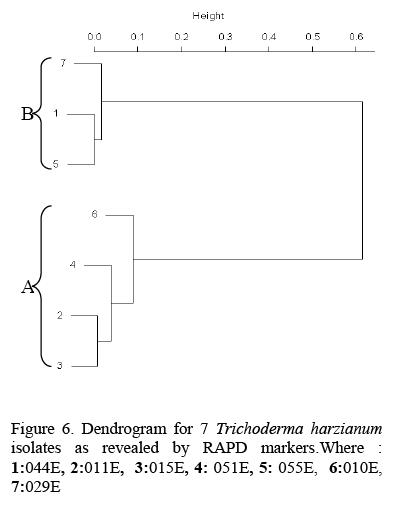
<body><![CDATA[<p align="justify"><font face="verdana" size="2">The DNA profiles obtained for <i>Trichoderma harzianum</i> isolates were scored (<a href="#f5">Fig 5</a>) and a Dendrogram or Dissimilarity matrix developed using Squared Euclidean Distance and Clustering based on Wards method (<a href="#f6">Fig 6</a>).</font></p>  	    <p align="center"><font face="verdana" size="2"><a name="f5"></a></font></p>  	    <p align="center"><font face="verdana" size="2"><img src="/img/revistas/tsa/v13n1/a13f5.jpg"></font></p>  	    <p align="center"><font face="verdana" size="2"><a name="f6"></a></font></p>  	    <p align="center"><font face="verdana" size="2"><img src="/img/revistas/tsa/v13n1/a13f6.jpg"></font></p>  	    <p align="justify"><font face="verdana" size="2">In the Dendrogram, all the 7 isolates were distinctly divided into two major clusters 'A' and 'B' at 20 units. Isolate 05 IE and 029E spanned the extremes of the entire Dendrogram. Genetic dissimilarity ranged from a lowest of 0.143 (between T010 and T015) to a highest of 0.857 (between 055E and 051E).Isolate 051E, T011, T015, and T010 were assigned to cluster 'A'. Genetic dissimilarity among the entries in this cluster ranged from a lowest of 14.3 percent (between T015and T010) to a highest of 35.7 percent (between TOlOand 05 IE). The other cluster 'B' comprised of three accessions. In this cluster isolate 044E 055E and 029E were grouped together. The genetic dissimilarity in this group was ranging from 33.3 percent between 055E and 029E to a high of 75 percent between 044E and 029E.</font></p>  	    <p align="justify"><font face="verdana" size="2">&nbsp;</font></p>  	    <p align="justify"><font face="verdana" size="2"><b>DISCUSSION</b></font></p>  	    <p align="justify"><font face="verdana" size="2"><i>T. harzianum</i> inhibited the growth of the target organisms through its ability to grow much faster than the pathogenic fungi thus competing efficiently for space and nutrients. Starvation was the most common cause of death for microorganisms, so that competition for limiting nutrients resulted in biological control of fungal phytopathogens.</font></p>  	    <p align="justify"><font face="verdana" size="2">A second mechanism of pathogen control was mycoparasitism. Microscopic observation of the interaction region between <i>R. solani</i> and <i>Pythium</i> spp. with <i>T. harzianum showed</i> that the mycelia of <i>T. harzianum</i> grew on the surface of the pathogens always coiling round their mycelia and later penetrating their cell walls directly without formation of appresorium structures. The pathogen mycelia then disintegrated suggesting enzyme action. Lorito <i>et al.</i> (1998), Metcalf <i>et al.</i> (2001) and Sharon <i>et al.,</i> 2001 demonstrated possible role of chitinolytic and/or glucanases enzymes in bio&#45;control by <i>Trichoderma.</i> These enzymes function by breaking down the polysaccharides, chitin, and glucans that are responsible for the rigidity of fungal cell walls, thereby destroying cell wall integrity limiting the growth of the pathogen. A mixture of several enzymes might be necessary for efficient cell wall lysis. <i>T. harziunum</i> has been reported to apply high chitinase and &#946;&#45;1, 3&#45;glucanase activities (Sivan <i>et al.,</i> 1984).</font></p>  	    ]]></body>
<body><![CDATA[<p align="justify"><font face="verdana" size="2">A third mechanism of pathogen control by <i>Trichoderma</i> was through antibiosis. Culture filtrates of the isolates had an inhibitory effect on the radial growth of the pathogens and mycelial accumulation suggesting action of non&#45;volatile antibiotics in the filtrates. This agrees with the findings of Sivan <i>et al.,</i> (1984) who noted that culture filtrates of <i>T. harzianum</i> strongly inhibited the growth of <i>Pythium aphanidermatum</i> whereas <i>T. hamatum</i> filtrates caused only minor inhibition of growth. Antibiotic inhibitions have been documented by Claydon <i>et al.</i> (1987), Dubey and Suresh (2006), Kucuk and Kivanc (2003) and Lynch (1990). Claydon <i>et al.</i> (1987) reported inhibition due to antibiotics trichodermin, harzianum A and harzianolide. Dubey and Suresh (2006) found that non&#45;volatile substances produced by <i>T. harzianum</i> are inhibitory to <i>F. oxysporum f. sp. ciceris</i> causing chickpea wilt.</font></p>  	    <p align="justify"><font face="verdana" size="2">Culture filtrate from PDB inhibited <i>Fusarium</i> spp. and <i>R. solani</i> but not <i>Pythium sp.</i> The difference in activity of the culture filtrates displayed by PDB and Czapek's liquid media on the pathogens indicates the importance of substrate in fungal production of secondary metabolites.</font></p>  	    <p align="justify"><font face="verdana" size="2">The presence of inhibition zones in dual cultures between <i>F. oxysporum f. sp Lycopersici</i> and <i>T. harzianum</i> suggested secretion of diffusible nonvolatile inhibitory substance by the <i>T. harzianum</i> isolates, which has also been documented by Grodona <i>etal,</i> (1997)and Behzade <i>et al</i>., (2008).</font></p>  	    <p align="justify"><font face="verdana" size="2">The DNA analysis of <i>T. harzianum</i> isolates from Embu showed existence of intraspecific variation. The genetic variation shown by the four random primers 203, 230, 220, Op 13 resulted in bands ranging from 350bp to 2000bp. This agrees with Moller <i>et al.</i> (1995) who detected intraspecific diversity not only between isolates of <i>Chaunopycnis alba</i> from different geographic regions or hosts, but also between isolates from a single location.</font></p>  	    <p align="justify"><font face="verdana" size="2">Based on RAPD data isolates from the same land use appeared in different groups due to intraspecific variation, for example isolate 044E and isolate 01 IE collected from camphor plantation were clustered in different groups and were 54.4% dissimilar. Goes <i>et al.,</i> (2002) also found intraspecific genetic variation among <i>Trichoderma</i> isolates. In his work the isolate Tm isolated from corn seed was grouped in the Dendrogram with the isolate 2820 isolated from sugar cane.</font></p>  	    <p align="center"><font face="verdana" size="2"><a href="/img/revistas/tsa/v13n1/a13t3.jpg" target="_blank">Table 3</a></font></p>  	    <p align="justify"><font face="verdana" size="2">&nbsp;</font></p>  	    <p align="justify"><font face="verdana" size="2"><b>CONCLUSION</b></font></p>  	    <p align="justify"><font face="verdana" size="2"><i>T. harzianum</i> is a good candidate for biological control due to the different modes of action the fungus employs in inhibiting the growth of other fungi. Through RAPD technique intraspecific genetic variation between <i>T. harzianum</i> isolates was observed. The results presented here support the existence of cryptic species with similar morphology.</font></p>  	    <p align="justify"><font face="verdana" size="2">&nbsp;</font></p>  	    ]]></body>
<body><![CDATA[<p align="justify"><font face="verdana" size="2"><b>ACKNOWLEDGEMENTS</b></font></p>  	    <p align="justify"><font face="verdana" size="2">We would like to express our special thanks to the University of Nairobi for laboratory equipment and enabling environment to conduct research and the Conservation and sustainable management of below ground biodiversity (CSM&#45;BGBD) project. A project executed by TSBF/CIAT with cofinancing from the Global Environment Facility (GEF) and implementation support from the United Nations Environment Programme (UNEP) for financial support of the research.</font></p>  	    <p align="justify"><font face="verdana" size="2">&nbsp;</font></p>  	    <p align="justify"><font face="verdana" size="2"><b>REFERENCES</b></font></p>  	    <!-- ref --><p align="justify"><font face="verdana" size="2">Basim, H., Ozturk, S.B. and Yegen, O. 1999. Efficacy of a biological fungicide (Planter Box <i>Trichoderma harzianum</i> Rifai T&#45;22) against seedling root rot pathogens <i>(Rhizoctonia solani, Fusarum sp)</i> of cotton. GAP&#45;Environmental Symposium. Sanliurfa. Turkey, 137&#45;144.    &nbsp;&nbsp;&nbsp;&nbsp;&nbsp;&nbsp;&nbsp;&nbsp;[&#160;<a href="javascript:void(0);" onclick="javascript: window.open('/scielo.php?script=sci_nlinks&ref=10110112&pid=S1870-0462201100040001300001&lng=','','width=640,height=500,resizable=yes,scrollbars=1,menubar=yes,');">Links</a>&#160;]<!-- end-ref --></font></p>  	    <!-- ref --><p align="justify"><font face="verdana" size="2">Behzad, H., Mousa, T., Mohammad, R.M. and Mahdi, D. 2008. Biological potential of some Iranian <i>Trichoderma</i> isolates in the control of soilborne plant pathogenic fungi. African Journal of Biotechnology. 7: 967&#45;972.    &nbsp;&nbsp;&nbsp;&nbsp;&nbsp;&nbsp;&nbsp;&nbsp;[&#160;<a href="javascript:void(0);" onclick="javascript: window.open('/scielo.php?script=sci_nlinks&ref=10110114&pid=S1870-0462201100040001300002&lng=','','width=640,height=500,resizable=yes,scrollbars=1,menubar=yes,');">Links</a>&#160;]<!-- end-ref --></font></p>  	    <!-- ref --><p align="justify"><font face="verdana" size="2">Bills, G. F. and Polishook, J. D. 1994. Abundance and diversity of microfungi in leaf litter of a lowland rain forest in Costa Rica. Mycologia. 86: 187&#45;198.    &nbsp;&nbsp;&nbsp;&nbsp;&nbsp;&nbsp;&nbsp;&nbsp;[&#160;<a href="javascript:void(0);" onclick="javascript: window.open('/scielo.php?script=sci_nlinks&ref=10110116&pid=S1870-0462201100040001300003&lng=','','width=640,height=500,resizable=yes,scrollbars=1,menubar=yes,');">Links</a>&#160;]<!-- end-ref --></font></p>  	    ]]></body>
<body><![CDATA[<!-- ref --><p align="justify"><font face="verdana" size="2">Carlie, M. J. and Watkinson, S. C. 1994. The fungi. Academic press,Ltd., London, United Kingdom.    &nbsp;&nbsp;&nbsp;&nbsp;&nbsp;&nbsp;&nbsp;&nbsp;[&#160;<a href="javascript:void(0);" onclick="javascript: window.open('/scielo.php?script=sci_nlinks&ref=10110118&pid=S1870-0462201100040001300004&lng=','','width=640,height=500,resizable=yes,scrollbars=1,menubar=yes,');">Links</a>&#160;]<!-- end-ref --></font></p>  	    <!-- ref --><p align="justify"><font face="verdana" size="2">Chet, I. and Inbar, J. 1994. Biological control of fungal pathogens. Applied Biochemistry and Biotechnology 48: 37&#45;43.    &nbsp;&nbsp;&nbsp;&nbsp;&nbsp;&nbsp;&nbsp;&nbsp;[&#160;<a href="javascript:void(0);" onclick="javascript: window.open('/scielo.php?script=sci_nlinks&ref=10110120&pid=S1870-0462201100040001300005&lng=','','width=640,height=500,resizable=yes,scrollbars=1,menubar=yes,');">Links</a>&#160;]<!-- end-ref --></font></p>  	    <!-- ref --><p align="justify"><font face="verdana" size="2">Claydon, N., Allan, M, Hanso, J. R. and Avent, A. G. 1987. Antifungal alkyl pyrones of <i>Trichoderma harzianum.</i> Transactions British Mycological Society. 88: 503&#45;513.    &nbsp;&nbsp;&nbsp;&nbsp;&nbsp;&nbsp;&nbsp;&nbsp;[&#160;<a href="javascript:void(0);" onclick="javascript: window.open('/scielo.php?script=sci_nlinks&ref=10110122&pid=S1870-0462201100040001300006&lng=','','width=640,height=500,resizable=yes,scrollbars=1,menubar=yes,');">Links</a>&#160;]<!-- end-ref --></font></p>  	    <!-- ref --><p align="justify"><font face="verdana" size="2">Cook, R. J. and Baker, K. F. 1983. The Nature and Practise of Biological Control of Plant Pathogens. American Phytopathological Society, St Paul M N, 539.    &nbsp;&nbsp;&nbsp;&nbsp;&nbsp;&nbsp;&nbsp;&nbsp;[&#160;<a href="javascript:void(0);" onclick="javascript: window.open('/scielo.php?script=sci_nlinks&ref=10110124&pid=S1870-0462201100040001300007&lng=','','width=640,height=500,resizable=yes,scrollbars=1,menubar=yes,');">Links</a>&#160;]<!-- end-ref --></font></p>  	    <!-- ref --><p align="justify"><font face="verdana" size="2">Domsch, K.H., Gams, W. and Anderson, T.H. 1980. Compendium of soil fungi. Academic Press London. 809.    &nbsp;&nbsp;&nbsp;&nbsp;&nbsp;&nbsp;&nbsp;&nbsp;[&#160;<a href="javascript:void(0);" onclick="javascript: window.open('/scielo.php?script=sci_nlinks&ref=10110126&pid=S1870-0462201100040001300008&lng=','','width=640,height=500,resizable=yes,scrollbars=1,menubar=yes,');">Links</a>&#160;]<!-- end-ref --></font></p>  	    ]]></body>
<body><![CDATA[<!-- ref --><p align="justify"><font face="verdana" size="2">Dubey, S.C. and Suresh, M. 2006. Randomly Amplified Polymorphic DNA Markers for <i>Trichoderma</i> species and Antagonism against <i>Fusarium oxysporum f. sp. ciceris</i> Causing Chickpea Wilt. Journal Phytopathology. 154: 663&#45;669.    &nbsp;&nbsp;&nbsp;&nbsp;&nbsp;&nbsp;&nbsp;&nbsp;[&#160;<a href="javascript:void(0);" onclick="javascript: window.open('/scielo.php?script=sci_nlinks&ref=10110128&pid=S1870-0462201100040001300009&lng=','','width=640,height=500,resizable=yes,scrollbars=1,menubar=yes,');">Links</a>&#160;]<!-- end-ref --></font></p>  	    <!-- ref --><p align="justify"><font face="verdana" size="2">Edington, L.L., Khew, K.L. and Barron, G.I. 1971. Fungitoxic spectrum of benzimidazole compounds. Phytopathology. 61: 42&#45;44.    &nbsp;&nbsp;&nbsp;&nbsp;&nbsp;&nbsp;&nbsp;&nbsp;[&#160;<a href="javascript:void(0);" onclick="javascript: window.open('/scielo.php?script=sci_nlinks&ref=10110130&pid=S1870-0462201100040001300010&lng=','','width=640,height=500,resizable=yes,scrollbars=1,menubar=yes,');">Links</a>&#160;]<!-- end-ref --></font></p>  	    <!-- ref --><p align="justify"><font face="verdana" size="2">Elad, Y., Chet, I. and Katan, Y. 1980. <i>Trichoderma harzianum</i> a biocontrol agent effective against <i>Sclerotium rolfsii</i> and <i>Rhizoctonia solani.</i> Phytopathology. 70: 119&#45;121.    &nbsp;&nbsp;&nbsp;&nbsp;&nbsp;&nbsp;&nbsp;&nbsp;[&#160;<a href="javascript:void(0);" onclick="javascript: window.open('/scielo.php?script=sci_nlinks&ref=10110132&pid=S1870-0462201100040001300011&lng=','','width=640,height=500,resizable=yes,scrollbars=1,menubar=yes,');">Links</a>&#160;]<!-- end-ref --></font></p>  	    <!-- ref --><p align="justify"><font face="verdana" size="2">Freeman, S., Minz, D., Kolesnik, I., Barbul, O., Zreibil, A., Maymon, M, Nitzani, Y., Kirshner, B., Rav&#45;David, D., Bilu, A., Dag, A., Shafir, S. and Elad, Y. 2004. <i>Trichoderma</i> biocontrol of <i>Colletotricum acutatum</i> and <i>Botrytis cin&eacute;rea,</i> and survival in strawberry.    &nbsp;&nbsp;&nbsp;&nbsp;&nbsp;&nbsp;&nbsp;&nbsp;[&#160;<a href="javascript:void(0);" onclick="javascript: window.open('/scielo.php?script=sci_nlinks&ref=10110134&pid=S1870-0462201100040001300012&lng=','','width=640,height=500,resizable=yes,scrollbars=1,menubar=yes,');">Links</a>&#160;]<!-- end-ref --></font></p>  	    <!-- ref --><p align="justify"><font face="verdana" size="2">Gams, W., Aa, H.A. van der; Plaats&#45;Niterink, A.J. van der; Samson, R. A. and Stalpers, J. A. 1987. CBS course of mycology. Baarn, Netherlands; Centraalbureau voor Schimmelcultures. 3, 136</font>&nbsp;&nbsp;&nbsp;&nbsp;&nbsp;&nbsp;&nbsp;&nbsp;[&#160;<a href="javascript:void(0);" onclick="javascript: window.open('/scielo.php?script=sci_nlinks&ref=10110136&pid=S1870-0462201100040001300013&lng=','','width=640,height=500,resizable=yes,scrollbars=1,menubar=yes,');">Links</a>&#160;]<!-- end-ref --><!-- ref --><p align="justify"><font face="verdana" size="2">Goes, L.B., Costa, A.B.L., Freir&eacute;, L.L.C. and Oliveria, N.T. 2002. Randomly amplified polymorphic DNA of <i>Trichoderma</i> isolates and antagonism against <i>Rhizoctonia solani.</i> Brazilian Archives Biology Technology. 45: 151&#45;160.    &nbsp;&nbsp;&nbsp;&nbsp;&nbsp;&nbsp;&nbsp;&nbsp;[&#160;<a href="javascript:void(0);" onclick="javascript: window.open('/scielo.php?script=sci_nlinks&ref=10110137&pid=S1870-0462201100040001300014&lng=','','width=640,height=500,resizable=yes,scrollbars=1,menubar=yes,');">Links</a>&#160;]<!-- end-ref --></font></p>  	    <!-- ref --><p align="justify"><font face="verdana" size="2">Golenberg, E.M., Giannasi, D.E., Clegg, M.T., Smiley, C.J., Durbin, M, Henderson, D. and Zurawski, G. 1990. Chloroplast DNA sequence from a miocene Magnolia species. Nature 344: 656&#45;658.    &nbsp;&nbsp;&nbsp;&nbsp;&nbsp;&nbsp;&nbsp;&nbsp;[&#160;<a href="javascript:void(0);" onclick="javascript: window.open('/scielo.php?script=sci_nlinks&ref=10110139&pid=S1870-0462201100040001300015&lng=','','width=640,height=500,resizable=yes,scrollbars=1,menubar=yes,');">Links</a>&#160;]<!-- end-ref --></font></p>  	    <!-- ref --><p align="justify"><font face="verdana" size="2">Grondona, L, Hermosa, M.R., Tejada, M., Gomis, M. D., Mateos, P.F., Bridge, P., Monte, E. and Garcia&#45;Acha, I. 1997. Physiological and biochemical characterization of <i>Trichoderma harzianum,</i> a biological control agent against soilborne fungal plant pathogens. Appl. Environ. Microbiol. 63: 3189&#45;3198.    &nbsp;&nbsp;&nbsp;&nbsp;&nbsp;&nbsp;&nbsp;&nbsp;[&#160;<a href="javascript:void(0);" onclick="javascript: window.open('/scielo.php?script=sci_nlinks&ref=10110141&pid=S1870-0462201100040001300016&lng=','','width=640,height=500,resizable=yes,scrollbars=1,menubar=yes,');">Links</a>&#160;]<!-- end-ref --></font></p>  	    <!-- ref --><p align="justify"><font face="verdana" size="2">Hadrys, H., Balick, M. and Schierwater, B. 1992. Application of random amplified polymorphic DNA (RAPD) in molecular ecology. Molecular Ecology. 1: 55&#45;63.    &nbsp;&nbsp;&nbsp;&nbsp;&nbsp;&nbsp;&nbsp;&nbsp;[&#160;<a href="javascript:void(0);" onclick="javascript: window.open('/scielo.php?script=sci_nlinks&ref=10110143&pid=S1870-0462201100040001300017&lng=','','width=640,height=500,resizable=yes,scrollbars=1,menubar=yes,');">Links</a>&#160;]<!-- end-ref --></font></p>  	    <!-- ref --><p align="justify"><font face="verdana" size="2">Herds, C. 1984. Biologicol control. In: Current perspectives in microbial ecology Klug, M.J. Reddy, C. A. (Eds). American Society of Microbiology, Washington. 353&#45;361.    &nbsp;&nbsp;&nbsp;&nbsp;&nbsp;&nbsp;&nbsp;&nbsp;[&#160;<a href="javascript:void(0);" onclick="javascript: window.open('/scielo.php?script=sci_nlinks&ref=10110145&pid=S1870-0462201100040001300018&lng=','','width=640,height=500,resizable=yes,scrollbars=1,menubar=yes,');">Links</a>&#160;]<!-- end-ref --></font></p>  	    <!-- ref --><p align="justify"><font face="verdana" size="2">Hjeljord, L.G. and Tronsmo, A. 1998. <i>Trichoderma</i> and <i>Gliocladium</i> in biocontrol: an overwiew,.In Kubicek, C.P. Harman, G.E.(Eds), <i>Trichoderma</i> and <i>Gliocladium.</i> Taylor & Francis, Ltd., London. United Kingdom. 135&#45;151</font>&nbsp;&nbsp;&nbsp;&nbsp;&nbsp;&nbsp;&nbsp;&nbsp;[&#160;<a href="javascript:void(0);" onclick="javascript: window.open('/scielo.php?script=sci_nlinks&ref=10110147&pid=S1870-0462201100040001300019&lng=','','width=640,height=500,resizable=yes,scrollbars=1,menubar=yes,');">Links</a>&#160;]<!-- end-ref --><!-- ref --><p align="justify"><font face="verdana" size="2">Jaccard, P. 1908. Nouvelles recherches surla distribution florale. Bui. Soc. Vaudoise Sci. Nat. 44: 223&#45;270.    &nbsp;&nbsp;&nbsp;&nbsp;&nbsp;&nbsp;&nbsp;&nbsp;[&#160;<a href="javascript:void(0);" onclick="javascript: window.open('/scielo.php?script=sci_nlinks&ref=10110148&pid=S1870-0462201100040001300020&lng=','','width=640,height=500,resizable=yes,scrollbars=1,menubar=yes,');">Links</a>&#160;]<!-- end-ref --></font></p>  	    <!-- ref --><p align="justify"><font face="verdana" size="2">Johnson, L.E., Bond, C.J. and Fribourg, H. 1959. Methods for studying soil microflora&#45;plant disease relationships. Minneapolis: Burgess Publishing Company.    &nbsp;&nbsp;&nbsp;&nbsp;&nbsp;&nbsp;&nbsp;&nbsp;[&#160;<a href="javascript:void(0);" onclick="javascript: window.open('/scielo.php?script=sci_nlinks&ref=10110150&pid=S1870-0462201100040001300021&lng=','','width=640,height=500,resizable=yes,scrollbars=1,menubar=yes,');">Links</a>&#160;]<!-- end-ref --></font></p>  	    <!-- ref --><p align="justify"><font face="verdana" size="2">Kucuk, C. and Kivanc, M. 2003. Isolation of <i>Trichoderma</i> Spp. and determination of their antifungal, biochemical and physiological features. Turkish Journal Biology. 27: 247&#45;253.    &nbsp;&nbsp;&nbsp;&nbsp;&nbsp;&nbsp;&nbsp;&nbsp;[&#160;<a href="javascript:void(0);" onclick="javascript: window.open('/scielo.php?script=sci_nlinks&ref=10110152&pid=S1870-0462201100040001300022&lng=','','width=640,height=500,resizable=yes,scrollbars=1,menubar=yes,');">Links</a>&#160;]<!-- end-ref --></font></p>  	    <!-- ref --><p align="justify"><font face="verdana" size="2">Lorito, M., Woo, S.L., Garcia Fernandez, I., Colucci, G., Harman, G.E., Pintor&#45;Toro, J.A., Filippone, E., Mucciflora, S., Lawrence, C.B., Zoina, A., Tuzun, S. and Scala, F. 1998. Genes from mycoparasitic fungi as a source for improving plant resistance to fungal pathogens. Procceedings National Academy Science, USA. 95: 7860&#45;7865.    &nbsp;&nbsp;&nbsp;&nbsp;&nbsp;&nbsp;&nbsp;&nbsp;[&#160;<a href="javascript:void(0);" onclick="javascript: window.open('/scielo.php?script=sci_nlinks&ref=10110154&pid=S1870-0462201100040001300023&lng=','','width=640,height=500,resizable=yes,scrollbars=1,menubar=yes,');">Links</a>&#160;]<!-- end-ref --></font></p>  	    <!-- ref --><p align="justify"><font face="verdana" size="2">Lynch, J.M. 1990. Fungi as antagonists. In: "New Directions in Biological Control: Alternative for suppressing Agricultural Pests and Diseases". Liss, New York. 243&#45;253.    &nbsp;&nbsp;&nbsp;&nbsp;&nbsp;&nbsp;&nbsp;&nbsp;[&#160;<a href="javascript:void(0);" onclick="javascript: window.open('/scielo.php?script=sci_nlinks&ref=10110156&pid=S1870-0462201100040001300024&lng=','','width=640,height=500,resizable=yes,scrollbars=1,menubar=yes,');">Links</a>&#160;]<!-- end-ref --></font></p>  	    ]]></body>
<body><![CDATA[<!-- ref --><p align="justify"><font face="verdana" size="2">Metcalf, D.D. and Wilson, C.C. 2001.The process of antagonism of <i>Sclerotium cepivorum</i> in white rot affected onion roots by <i>Trichoderma koningii.</i> Plant Pathology. 50: 249&#45;257.    &nbsp;&nbsp;&nbsp;&nbsp;&nbsp;&nbsp;&nbsp;&nbsp;[&#160;<a href="javascript:void(0);" onclick="javascript: window.open('/scielo.php?script=sci_nlinks&ref=10110158&pid=S1870-0462201100040001300025&lng=','','width=640,height=500,resizable=yes,scrollbars=1,menubar=yes,');">Links</a>&#160;]<!-- end-ref --></font></p>  	    <!-- ref --><p align="justify"><font face="verdana" size="2">M&ouml;ller, C, Biihler, T. and Dreyfuss, M.M. 1995. Intraspecific genetic diversity of <i>Chaunopycnis alba</i> detected by random amplified polymorphic DNA assay. Mycology Research 99: 681&#45;688.    &nbsp;&nbsp;&nbsp;&nbsp;&nbsp;&nbsp;&nbsp;&nbsp;[&#160;<a href="javascript:void(0);" onclick="javascript: window.open('/scielo.php?script=sci_nlinks&ref=10110160&pid=S1870-0462201100040001300026&lng=','','width=640,height=500,resizable=yes,scrollbars=1,menubar=yes,');">Links</a>&#160;]<!-- end-ref --></font></p>  	    <!-- ref --><p align="justify"><font face="verdana" size="2">Papavizas, G.C. 1985. <i>Trichoderma</i> and <i>Gliocladium:</i> biology, ecology, and potential for biocontrol. Annual Review Phytopathology. 23: 23&#45;54.    &nbsp;&nbsp;&nbsp;&nbsp;&nbsp;&nbsp;&nbsp;&nbsp;[&#160;<a href="javascript:void(0);" onclick="javascript: window.open('/scielo.php?script=sci_nlinks&ref=10110162&pid=S1870-0462201100040001300027&lng=','','width=640,height=500,resizable=yes,scrollbars=1,menubar=yes,');">Links</a>&#160;]<!-- end-ref --></font></p>  	    <!-- ref --><p align="justify"><font face="verdana" size="2">Rifai, M.A. 1969. A revision of the genus <i>Trichoderma.</i> Mycology. 116: 1&#45;56.    &nbsp;&nbsp;&nbsp;&nbsp;&nbsp;&nbsp;&nbsp;&nbsp;[&#160;<a href="javascript:void(0);" onclick="javascript: window.open('/scielo.php?script=sci_nlinks&ref=10110164&pid=S1870-0462201100040001300028&lng=','','width=640,height=500,resizable=yes,scrollbars=1,menubar=yes,');">Links</a>&#160;]<!-- end-ref --></font></p>  	    <!-- ref --><p align="justify"><font face="verdana" size="2">Samuels, G. J., Chaverri, P., Farr, D.F. and McCray, E.B. 2004. USDA, Beltsville, USA. <i>Trichoderma</i> online systematic Botany and Mycology Laboratory, ARS, USDA. Retrieved September 20, 2004, from <a href="http://nt.arsgrin.gov/taxadescriptions/keys/TrichodermaIndex.cfm" target="_blank">http://nt.arsgrin.gov/taxadescriptions/keys/TrichodermaIndex.cfm</a></font>&nbsp;&nbsp;&nbsp;&nbsp;&nbsp;&nbsp;&nbsp;&nbsp;[&#160;<a href="javascript:void(0);" onclick="javascript: window.open('/scielo.php?script=sci_nlinks&ref=10110166&pid=S1870-0462201100040001300029&lng=','','width=640,height=500,resizable=yes,scrollbars=1,menubar=yes,');">Links</a>&#160;]<!-- end-ref --><!-- ref --><p align="justify"><font face="verdana" size="2">Sandhu, G.S., Kline, B.C., Stockman, L. and Roberts, G.D. 1995. Molecular probes for diagnosis of fungal infections. Journal Clinical Microbiology. 35: 2270&#45;2274.    &nbsp;&nbsp;&nbsp;&nbsp;&nbsp;&nbsp;&nbsp;&nbsp;[&#160;<a href="javascript:void(0);" onclick="javascript: window.open('/scielo.php?script=sci_nlinks&ref=10110167&pid=S1870-0462201100040001300030&lng=','','width=640,height=500,resizable=yes,scrollbars=1,menubar=yes,');">Links</a>&#160;]<!-- end-ref --></font></p>  	    <!-- ref --><p align="justify"><font face="verdana" size="2">Sherriff, C, Whelan, M.J., Arnold, G.M., Lafai, J.F., Brygoo, Y. and Bailey, J.A. 1994. Ribosomal DNA sequence analysis reveals new species grouping in the genus <i>Colletotricum.</i> Experimental Mycology 18: 121&#45;138.    &nbsp;&nbsp;&nbsp;&nbsp;&nbsp;&nbsp;&nbsp;&nbsp;[&#160;<a href="javascript:void(0);" onclick="javascript: window.open('/scielo.php?script=sci_nlinks&ref=10110169&pid=S1870-0462201100040001300031&lng=','','width=640,height=500,resizable=yes,scrollbars=1,menubar=yes,');">Links</a>&#160;]<!-- end-ref --></font></p>  	    <!-- ref --><p align="justify"><font face="verdana" size="2">Sivan, A., Elad, Y. and Chet, I. 1984. Biological control effects of a new isolate of <i>Trichoderma harzianum</i> on <i>Pythium aphanidermatum.</i> Phytopathology 74: 498&#45;501.    &nbsp;&nbsp;&nbsp;&nbsp;&nbsp;&nbsp;&nbsp;&nbsp;[&#160;<a href="javascript:void(0);" onclick="javascript: window.open('/scielo.php?script=sci_nlinks&ref=10110171&pid=S1870-0462201100040001300032&lng=','','width=640,height=500,resizable=yes,scrollbars=1,menubar=yes,');">Links</a>&#160;]<!-- end-ref --></font></p>  	    <!-- ref --><p align="justify"><font face="verdana" size="2">Tianhui, Z. and Dexun, Q. 1994. Antagonism of <i>Trichoderma harzianum</i> to <i>Rhizoctonia solani.</i> Journal Sichuan AgriculturalUniversity. 12: 11&#45;11.    &nbsp;&nbsp;&nbsp;&nbsp;&nbsp;&nbsp;&nbsp;&nbsp;[&#160;<a href="javascript:void(0);" onclick="javascript: window.open('/scielo.php?script=sci_nlinks&ref=10110173&pid=S1870-0462201100040001300033&lng=','','width=640,height=500,resizable=yes,scrollbars=1,menubar=yes,');">Links</a>&#160;]<!-- end-ref --></font></p>  	    <!-- ref --><p align="justify"><font face="verdana" size="2">Van Belkum, A., Quint, W.G., de Pauw, B.E., Melchers, W.J.G. and Meis, J.F. 1993.Typing of Asprgillus species and Aspergillus fumigatus isolates by inerrepeat polymerase chain reaction. Journal Clinical Microbiology. 31:2502&#45;2505.    &nbsp;&nbsp;&nbsp;&nbsp;&nbsp;&nbsp;&nbsp;&nbsp;[&#160;<a href="javascript:void(0);" onclick="javascript: window.open('/scielo.php?script=sci_nlinks&ref=10110175&pid=S1870-0462201100040001300034&lng=','','width=640,height=500,resizable=yes,scrollbars=1,menubar=yes,');">Links</a>&#160;]<!-- end-ref --></font></p>  	    <!-- ref --><p align="justify"><font face="verdana" size="2">Ward, J.H. 1963. Hierarchical grouping to optimize an objective function. Journal American Statistical Association. 58: 236&#45;244. doi: 10.2307/2282967.    &nbsp;&nbsp;&nbsp;&nbsp;&nbsp;&nbsp;&nbsp;&nbsp;[&#160;<a href="javascript:void(0);" onclick="javascript: window.open('/scielo.php?script=sci_nlinks&ref=10110177&pid=S1870-0462201100040001300035&lng=','','width=640,height=500,resizable=yes,scrollbars=1,menubar=yes,');">Links</a>&#160;]<!-- end-ref --></font></p>  	    <!-- ref --><p align="justify"><font face="verdana" size="2">Williams, J.G.K., Kubelik, A.R., Livak, K.J., Rafalski, J.A. and Tingey, S.V. 1990. DNA polymorphisms amplified by arbitrary primers are useful as genetic markers. Nucleic Acids Res. 18:6531&#45;6535.    &nbsp;&nbsp;&nbsp;&nbsp;&nbsp;&nbsp;&nbsp;&nbsp;[&#160;<a href="javascript:void(0);" onclick="javascript: window.open('/scielo.php?script=sci_nlinks&ref=10110179&pid=S1870-0462201100040001300036&lng=','','width=640,height=500,resizable=yes,scrollbars=1,menubar=yes,');">Links</a>&#160;]<!-- end-ref --></font></p>      ]]></body><back>
<ref-list>
<ref id="B1">
<nlm-citation citation-type="confpro">
<person-group person-group-type="author">
<name>
<surname><![CDATA[Basim]]></surname>
<given-names><![CDATA[H.]]></given-names>
</name>
<name>
<surname><![CDATA[Ozturk]]></surname>
<given-names><![CDATA[S.B.]]></given-names>
</name>
<name>
<surname><![CDATA[Yegen]]></surname>
<given-names><![CDATA[O.]]></given-names>
</name>
</person-group>
<article-title xml:lang="en"><![CDATA[Efficacy of a biological fungicide (Planter Box Trichoderma harzianum Rifai T-22) against seedling root rot pathogens (Rhizoctonia solani, Fusarum sp) of cotton]]></article-title>
<source><![CDATA[]]></source>
<year>1999</year>
<conf-name><![CDATA[ GAP-Environmental Symposium]]></conf-name>
<conf-loc>Sanliurfa </conf-loc>
<page-range>137-144</page-range></nlm-citation>
</ref>
<ref id="B2">
<nlm-citation citation-type="journal">
<person-group person-group-type="author">
<name>
<surname><![CDATA[Behzad]]></surname>
<given-names><![CDATA[H.]]></given-names>
</name>
<name>
<surname><![CDATA[Mousa]]></surname>
<given-names><![CDATA[T.]]></given-names>
</name>
<name>
<surname><![CDATA[Mohammad]]></surname>
<given-names><![CDATA[R.M.]]></given-names>
</name>
<name>
<surname><![CDATA[Mahdi]]></surname>
<given-names><![CDATA[D.]]></given-names>
</name>
</person-group>
<article-title xml:lang="en"><![CDATA[Biological potential of some Iranian Trichoderma isolates in the control of soilborne plant pathogenic fungi]]></article-title>
<source><![CDATA[African Journal of Biotechnology]]></source>
<year>2008</year>
<volume>7</volume>
<page-range>967-972</page-range></nlm-citation>
</ref>
<ref id="B3">
<nlm-citation citation-type="journal">
<person-group person-group-type="author">
<name>
<surname><![CDATA[Bills]]></surname>
<given-names><![CDATA[G. F.]]></given-names>
</name>
<name>
<surname><![CDATA[Polishook]]></surname>
<given-names><![CDATA[J. D.]]></given-names>
</name>
</person-group>
<article-title xml:lang="en"><![CDATA[Abundance and diversity of microfungi in leaf litter of a lowland rain forest in Costa Rica]]></article-title>
<source><![CDATA[Mycologia]]></source>
<year>1994</year>
<volume>86</volume>
<page-range>187-198</page-range></nlm-citation>
</ref>
<ref id="B4">
<nlm-citation citation-type="book">
<person-group person-group-type="author">
<name>
<surname><![CDATA[Carlie]]></surname>
<given-names><![CDATA[M. J.]]></given-names>
</name>
<name>
<surname><![CDATA[Watkinson]]></surname>
<given-names><![CDATA[S. C.]]></given-names>
</name>
</person-group>
<source><![CDATA[The fungi]]></source>
<year>1994</year>
<publisher-loc><![CDATA[London ]]></publisher-loc>
<publisher-name><![CDATA[Academic press,Ltd.United Kingdom]]></publisher-name>
</nlm-citation>
</ref>
<ref id="B5">
<nlm-citation citation-type="journal">
<person-group person-group-type="author">
<name>
<surname><![CDATA[Chet]]></surname>
<given-names><![CDATA[I.]]></given-names>
</name>
<name>
<surname><![CDATA[Inbar]]></surname>
<given-names><![CDATA[J.]]></given-names>
</name>
</person-group>
<article-title xml:lang="en"><![CDATA[Biological control of fungal pathogens]]></article-title>
<source><![CDATA[Applied Biochemistry and Biotechnology]]></source>
<year>1994</year>
<volume>48</volume>
<page-range>37-43</page-range></nlm-citation>
</ref>
<ref id="B6">
<nlm-citation citation-type="journal">
<person-group person-group-type="author">
<name>
<surname><![CDATA[Claydon]]></surname>
<given-names><![CDATA[N.]]></given-names>
</name>
<name>
<surname><![CDATA[Allan]]></surname>
<given-names><![CDATA[M]]></given-names>
</name>
<name>
<surname><![CDATA[Hanso]]></surname>
<given-names><![CDATA[J. R.]]></given-names>
</name>
<name>
<surname><![CDATA[Avent]]></surname>
<given-names><![CDATA[A. G.]]></given-names>
</name>
</person-group>
<article-title xml:lang="en"><![CDATA[Antifungal alkyl pyrones of Trichoderma harzianum]]></article-title>
<source><![CDATA[Transactions British Mycological Society]]></source>
<year>1987</year>
<volume>88</volume>
<page-range>503-513</page-range></nlm-citation>
</ref>
<ref id="B7">
<nlm-citation citation-type="book">
<person-group person-group-type="author">
<name>
<surname><![CDATA[Cook]]></surname>
<given-names><![CDATA[R. J.]]></given-names>
</name>
<name>
<surname><![CDATA[Baker]]></surname>
<given-names><![CDATA[K. F.]]></given-names>
</name>
</person-group>
<source><![CDATA[The Nature and Practise of Biological Control of Plant Pathogens]]></source>
<year>1983</year>
<page-range>539</page-range><publisher-loc><![CDATA[St Paul^eM N M N]]></publisher-loc>
<publisher-name><![CDATA[American Phytopathological Society]]></publisher-name>
</nlm-citation>
</ref>
<ref id="B8">
<nlm-citation citation-type="book">
<person-group person-group-type="author">
<name>
<surname><![CDATA[Domsch]]></surname>
<given-names><![CDATA[K.H.]]></given-names>
</name>
<name>
<surname><![CDATA[Gams]]></surname>
<given-names><![CDATA[W.]]></given-names>
</name>
<name>
<surname><![CDATA[Anderson]]></surname>
<given-names><![CDATA[T.H.]]></given-names>
</name>
</person-group>
<source><![CDATA[Compendium of soil fungi]]></source>
<year>1980</year>
<page-range>809</page-range><publisher-loc><![CDATA[London ]]></publisher-loc>
<publisher-name><![CDATA[Academic Press]]></publisher-name>
</nlm-citation>
</ref>
<ref id="B9">
<nlm-citation citation-type="journal">
<person-group person-group-type="author">
<name>
<surname><![CDATA[Dubey]]></surname>
<given-names><![CDATA[S.C.]]></given-names>
</name>
<name>
<surname><![CDATA[Suresh]]></surname>
<given-names><![CDATA[M.]]></given-names>
</name>
</person-group>
<article-title xml:lang="en"><![CDATA[Randomly Amplified Polymorphic DNA Markers for Trichoderma species and Antagonism against Fusarium oxysporum f. sp. ciceris Causing Chickpea Wilt]]></article-title>
<source><![CDATA[Journal Phytopathology]]></source>
<year>2006</year>
<volume>154</volume>
<page-range>663-669</page-range></nlm-citation>
</ref>
<ref id="B10">
<nlm-citation citation-type="journal">
<person-group person-group-type="author">
<name>
<surname><![CDATA[Edington]]></surname>
<given-names><![CDATA[L.L.]]></given-names>
</name>
<name>
<surname><![CDATA[Khew]]></surname>
<given-names><![CDATA[K.L.]]></given-names>
</name>
<name>
<surname><![CDATA[Barron]]></surname>
<given-names><![CDATA[G.I.]]></given-names>
</name>
</person-group>
<article-title xml:lang="en"><![CDATA[Fungitoxic spectrum of benzimidazole compounds]]></article-title>
<source><![CDATA[Phytopathology]]></source>
<year>1971</year>
<volume>61</volume>
<page-range>42-44</page-range></nlm-citation>
</ref>
<ref id="B11">
<nlm-citation citation-type="journal">
<person-group person-group-type="author">
<name>
<surname><![CDATA[Elad]]></surname>
<given-names><![CDATA[Y.]]></given-names>
</name>
<name>
<surname><![CDATA[Chet]]></surname>
<given-names><![CDATA[I.]]></given-names>
</name>
<name>
<surname><![CDATA[Katan]]></surname>
<given-names><![CDATA[Y.]]></given-names>
</name>
</person-group>
<article-title xml:lang="en"><![CDATA[Trichoderma harzianum a biocontrol agent effective against Sclerotium rolfsii and Rhizoctonia solani]]></article-title>
<source><![CDATA[Phytopathology]]></source>
<year>1980</year>
<volume>70</volume>
<page-range>119-121</page-range></nlm-citation>
</ref>
<ref id="B12">
<nlm-citation citation-type="">
<person-group person-group-type="author">
<name>
<surname><![CDATA[Freeman]]></surname>
<given-names><![CDATA[S.]]></given-names>
</name>
<name>
<surname><![CDATA[Minz]]></surname>
<given-names><![CDATA[D.]]></given-names>
</name>
<name>
<surname><![CDATA[Kolesnik]]></surname>
<given-names><![CDATA[I.]]></given-names>
</name>
<name>
<surname><![CDATA[Barbul]]></surname>
<given-names><![CDATA[O.]]></given-names>
</name>
<name>
<surname><![CDATA[Zreibil]]></surname>
<given-names><![CDATA[A.]]></given-names>
</name>
<name>
<surname><![CDATA[Maymon]]></surname>
<given-names><![CDATA[M]]></given-names>
</name>
<name>
<surname><![CDATA[Nitzani]]></surname>
<given-names><![CDATA[Y.]]></given-names>
</name>
<name>
<surname><![CDATA[Kirshner]]></surname>
<given-names><![CDATA[B.]]></given-names>
</name>
<name>
<surname><![CDATA[Rav-David]]></surname>
<given-names><![CDATA[D.]]></given-names>
</name>
<name>
<surname><![CDATA[Bilu]]></surname>
<given-names><![CDATA[A.]]></given-names>
</name>
<name>
<surname><![CDATA[Dag]]></surname>
<given-names><![CDATA[A.]]></given-names>
</name>
<name>
<surname><![CDATA[Shafir]]></surname>
<given-names><![CDATA[S.]]></given-names>
</name>
<name>
<surname><![CDATA[Elad]]></surname>
<given-names><![CDATA[Y]]></given-names>
</name>
</person-group>
<source><![CDATA[Trichoderma biocontrol of Colletotricum acutatum and Botrytis cinérea, and survival in strawberry]]></source>
<year>2004</year>
</nlm-citation>
</ref>
<ref id="B13">
<nlm-citation citation-type="book">
<person-group person-group-type="author">
<name>
<surname><![CDATA[Gams]]></surname>
<given-names><![CDATA[W.]]></given-names>
</name>
<name>
<surname><![CDATA[Aa]]></surname>
<given-names><![CDATA[H.A.. van der]]></given-names>
</name>
<name>
<surname><![CDATA[Plaats-Niterink]]></surname>
<given-names><![CDATA[A.J. van der]]></given-names>
</name>
<name>
<surname><![CDATA[Samson]]></surname>
<given-names><![CDATA[R. A]]></given-names>
</name>
<name>
<surname><![CDATA[Stalpers]]></surname>
<given-names><![CDATA[J. A.]]></given-names>
</name>
</person-group>
<source><![CDATA[CBS course of mycology]]></source>
<year>1987</year>
<volume>3</volume>
<page-range>136</page-range><publisher-loc><![CDATA[Baarn ]]></publisher-loc>
<publisher-name><![CDATA[Centraalbureau voor Schimmelcultures]]></publisher-name>
</nlm-citation>
</ref>
<ref id="B14">
<nlm-citation citation-type="journal">
<person-group person-group-type="author">
<name>
<surname><![CDATA[Goes]]></surname>
<given-names><![CDATA[L.B.]]></given-names>
</name>
<name>
<surname><![CDATA[Costa]]></surname>
<given-names><![CDATA[A.B.L.]]></given-names>
</name>
<name>
<surname><![CDATA[Freiré]]></surname>
<given-names><![CDATA[L.L.C.]]></given-names>
</name>
<name>
<surname><![CDATA[Oliveria]]></surname>
<given-names><![CDATA[N.T.]]></given-names>
</name>
</person-group>
<article-title xml:lang="en"><![CDATA[Randomly amplified polymorphic DNA of Trichoderma isolates and antagonism against Rhizoctonia solani]]></article-title>
<source><![CDATA[Brazilian Archives Biology Technology]]></source>
<year>2002</year>
<volume>45</volume>
<page-range>151-160</page-range></nlm-citation>
</ref>
<ref id="B15">
<nlm-citation citation-type="journal">
<person-group person-group-type="author">
<name>
<surname><![CDATA[Golenberg]]></surname>
<given-names><![CDATA[E.M.]]></given-names>
</name>
<name>
<surname><![CDATA[Giannasi]]></surname>
<given-names><![CDATA[D.E.]]></given-names>
</name>
<name>
<surname><![CDATA[Clegg]]></surname>
<given-names><![CDATA[M.T.]]></given-names>
</name>
<name>
<surname><![CDATA[Smiley]]></surname>
<given-names><![CDATA[C.J.]]></given-names>
</name>
<name>
<surname><![CDATA[Durbin]]></surname>
<given-names><![CDATA[M]]></given-names>
</name>
<name>
<surname><![CDATA[Henderson]]></surname>
<given-names><![CDATA[D.]]></given-names>
</name>
<name>
<surname><![CDATA[Zurawski]]></surname>
<given-names><![CDATA[G.]]></given-names>
</name>
</person-group>
<article-title xml:lang="en"><![CDATA[Chloroplast DNA sequence from a miocene Magnolia species]]></article-title>
<source><![CDATA[Nature]]></source>
<year>1990</year>
<volume>344</volume>
<page-range>656-658</page-range></nlm-citation>
</ref>
<ref id="B16">
<nlm-citation citation-type="journal">
<person-group person-group-type="author">
<name>
<surname><![CDATA[Grondona]]></surname>
<given-names><![CDATA[L]]></given-names>
</name>
<name>
<surname><![CDATA[Hermosa]]></surname>
<given-names><![CDATA[M.R.]]></given-names>
</name>
<name>
<surname><![CDATA[Tejada]]></surname>
<given-names><![CDATA[M.]]></given-names>
</name>
<name>
<surname><![CDATA[Gomis]]></surname>
<given-names><![CDATA[M. D.]]></given-names>
</name>
<name>
<surname><![CDATA[Mateos]]></surname>
<given-names><![CDATA[P.F.]]></given-names>
</name>
<name>
<surname><![CDATA[Bridge]]></surname>
<given-names><![CDATA[P.]]></given-names>
</name>
<name>
<surname><![CDATA[Monte]]></surname>
<given-names><![CDATA[E.]]></given-names>
</name>
<name>
<surname><![CDATA[Garcia-Acha]]></surname>
<given-names><![CDATA[I.]]></given-names>
</name>
</person-group>
<article-title xml:lang="en"><![CDATA[Physiological and biochemical characterization of Trichoderma harzianum, a biological control agent against soilborne fungal plant pathogens. Appl. Environ]]></article-title>
<source><![CDATA[Microbiol]]></source>
<year>1997</year>
<volume>63</volume>
<page-range>3189-3198</page-range></nlm-citation>
</ref>
<ref id="B17">
<nlm-citation citation-type="journal">
<person-group person-group-type="author">
<name>
<surname><![CDATA[Hadrys]]></surname>
<given-names><![CDATA[H.]]></given-names>
</name>
<name>
<surname><![CDATA[Balick]]></surname>
<given-names><![CDATA[M.]]></given-names>
</name>
<name>
<surname><![CDATA[Schierwater]]></surname>
<given-names><![CDATA[B.]]></given-names>
</name>
</person-group>
<article-title xml:lang="en"><![CDATA[Application of random amplified polymorphic DNA (RAPD) in molecular ecology]]></article-title>
<source><![CDATA[Molecular Ecology]]></source>
<year>1992</year>
<volume>1</volume>
<page-range>55-63</page-range></nlm-citation>
</ref>
<ref id="B18">
<nlm-citation citation-type="book">
<person-group person-group-type="author">
<name>
<surname><![CDATA[Herds]]></surname>
<given-names><![CDATA[C.]]></given-names>
</name>
</person-group>
<article-title xml:lang="es"><![CDATA[Biologicol control]]></article-title>
<person-group person-group-type="editor">
<name>
<surname><![CDATA[Klug]]></surname>
<given-names><![CDATA[M.J.]]></given-names>
</name>
<name>
<surname><![CDATA[Reddy]]></surname>
<given-names><![CDATA[C. A.]]></given-names>
</name>
</person-group>
<source><![CDATA[Current perspectives in microbial ecology]]></source>
<year>1984</year>
<page-range>353-361</page-range><publisher-loc><![CDATA[Washington ]]></publisher-loc>
<publisher-name><![CDATA[American Society of Microbiology]]></publisher-name>
</nlm-citation>
</ref>
<ref id="B19">
<nlm-citation citation-type="book">
<person-group person-group-type="author">
<name>
<surname><![CDATA[Hjeljord]]></surname>
<given-names><![CDATA[L.G.]]></given-names>
</name>
<name>
<surname><![CDATA[Tronsmo]]></surname>
<given-names><![CDATA[A.]]></given-names>
</name>
</person-group>
<article-title xml:lang="en"><![CDATA[Trichoderma and Gliocladium in biocontrol: an overwiew]]></article-title>
<person-group person-group-type="editor">
<name>
<surname><![CDATA[Kubicek]]></surname>
<given-names><![CDATA[C.P.]]></given-names>
</name>
<name>
<surname><![CDATA[Harman]]></surname>
<given-names><![CDATA[G.E.]]></given-names>
</name>
</person-group>
<source><![CDATA[Trichoderma and Gliocladium]]></source>
<year>1998</year>
<page-range>135-151</page-range><publisher-loc><![CDATA[London ]]></publisher-loc>
<publisher-name><![CDATA[Taylor & Francis, Ltd.]]></publisher-name>
</nlm-citation>
</ref>
<ref id="B20">
<nlm-citation citation-type="journal">
<person-group person-group-type="author">
<name>
<surname><![CDATA[Jaccard]]></surname>
<given-names><![CDATA[P.]]></given-names>
</name>
</person-group>
<article-title xml:lang="en"><![CDATA[Nouvelles recherches surla distribution florale]]></article-title>
<source><![CDATA[Bui. Soc. Vaudoise Sci. Nat]]></source>
<year>1908</year>
<volume>44</volume>
<page-range>223-270</page-range></nlm-citation>
</ref>
<ref id="B21">
<nlm-citation citation-type="book">
<person-group person-group-type="author">
<name>
<surname><![CDATA[Johnson]]></surname>
<given-names><![CDATA[L.E.]]></given-names>
</name>
<name>
<surname><![CDATA[Bond]]></surname>
<given-names><![CDATA[C.J.]]></given-names>
</name>
<name>
<surname><![CDATA[Fribourg]]></surname>
<given-names><![CDATA[H.]]></given-names>
</name>
</person-group>
<source><![CDATA[Methods for studying soil microflora-plant disease relationships]]></source>
<year>1959</year>
<publisher-loc><![CDATA[Minneapolis ]]></publisher-loc>
<publisher-name><![CDATA[Burgess Publishing Company]]></publisher-name>
</nlm-citation>
</ref>
<ref id="B22">
<nlm-citation citation-type="journal">
<person-group person-group-type="author">
<name>
<surname><![CDATA[Kucuk]]></surname>
<given-names><![CDATA[C.]]></given-names>
</name>
<name>
<surname><![CDATA[Kivanc]]></surname>
<given-names><![CDATA[M.]]></given-names>
</name>
</person-group>
<article-title xml:lang="en"><![CDATA[Isolation of Trichoderma Spp. and determination of their antifungal, biochemical and physiological features]]></article-title>
<source><![CDATA[Turkish Journal Biology]]></source>
<year>2003</year>
<volume>27</volume>
<page-range>247-253</page-range></nlm-citation>
</ref>
<ref id="B23">
<nlm-citation citation-type="journal">
<person-group person-group-type="author">
<name>
<surname><![CDATA[Lorito]]></surname>
<given-names><![CDATA[M.]]></given-names>
</name>
<name>
<surname><![CDATA[Woo]]></surname>
<given-names><![CDATA[S.L.]]></given-names>
</name>
<name>
<surname><![CDATA[Garcia Fernandez]]></surname>
<given-names><![CDATA[I.]]></given-names>
</name>
<name>
<surname><![CDATA[Colucci]]></surname>
<given-names><![CDATA[G.]]></given-names>
</name>
<name>
<surname><![CDATA[Harman]]></surname>
<given-names><![CDATA[G.E.]]></given-names>
</name>
<name>
<surname><![CDATA[Pintor-Toro]]></surname>
<given-names><![CDATA[J.A.]]></given-names>
</name>
<name>
<surname><![CDATA[Filippone]]></surname>
<given-names><![CDATA[E.]]></given-names>
</name>
<name>
<surname><![CDATA[Mucciflora]]></surname>
<given-names><![CDATA[S.]]></given-names>
</name>
<name>
<surname><![CDATA[Lawrence]]></surname>
<given-names><![CDATA[C.B.]]></given-names>
</name>
<name>
<surname><![CDATA[Zoina]]></surname>
<given-names><![CDATA[A.]]></given-names>
</name>
<name>
<surname><![CDATA[Tuzun]]></surname>
<given-names><![CDATA[S.]]></given-names>
</name>
<name>
<surname><![CDATA[Scala]]></surname>
<given-names><![CDATA[F.]]></given-names>
</name>
</person-group>
<article-title xml:lang="en"><![CDATA[Genes from mycoparasitic fungi as a source for improving plant resistance to fungal pathogens]]></article-title>
<source><![CDATA[Procceedings National Academy Science]]></source>
<year>1998</year>
<volume>95</volume>
<page-range>7860-7865</page-range></nlm-citation>
</ref>
<ref id="B24">
<nlm-citation citation-type="book">
<person-group person-group-type="author">
<name>
<surname><![CDATA[Lynch]]></surname>
<given-names><![CDATA[J.M.]]></given-names>
</name>
</person-group>
<article-title xml:lang="es"><![CDATA[Fungi as antagonists]]></article-title>
<source><![CDATA[New Directions in Biological Control: Alternative for suppressing Agricultural Pests and Diseases]]></source>
<year>1990</year>
<page-range>243-253</page-range><publisher-loc><![CDATA[New York ]]></publisher-loc>
<publisher-name><![CDATA[Liss]]></publisher-name>
</nlm-citation>
</ref>
<ref id="B25">
<nlm-citation citation-type="journal">
<person-group person-group-type="author">
<name>
<surname><![CDATA[Metcalf]]></surname>
<given-names><![CDATA[D.D.]]></given-names>
</name>
<name>
<surname><![CDATA[Wilson]]></surname>
<given-names><![CDATA[C.C.]]></given-names>
</name>
</person-group>
<article-title xml:lang="en"><![CDATA[The process of antagonism of Sclerotium cepivorum in white rot affected onion roots by Trichoderma koningii]]></article-title>
<source><![CDATA[Plant Pathology]]></source>
<year>2001</year>
<volume>50</volume>
<page-range>249-257</page-range></nlm-citation>
</ref>
<ref id="B26">
<nlm-citation citation-type="journal">
<person-group person-group-type="author">
<name>
<surname><![CDATA[Möller]]></surname>
<given-names><![CDATA[C]]></given-names>
</name>
<name>
<surname><![CDATA[Biihler]]></surname>
<given-names><![CDATA[T.]]></given-names>
</name>
<name>
<surname><![CDATA[Dreyfuss]]></surname>
<given-names><![CDATA[M.M.]]></given-names>
</name>
</person-group>
<article-title xml:lang="en"><![CDATA[Intraspecific genetic diversity of Chaunopycnis alba detected by random amplified polymorphic DNA assay]]></article-title>
<source><![CDATA[Mycology Research]]></source>
<year>1995</year>
<volume>99</volume>
<page-range>681-688</page-range></nlm-citation>
</ref>
<ref id="B27">
<nlm-citation citation-type="journal">
<person-group person-group-type="author">
<name>
<surname><![CDATA[Papavizas]]></surname>
<given-names><![CDATA[G.C.]]></given-names>
</name>
</person-group>
<article-title xml:lang="en"><![CDATA[Trichoderma and Gliocladium: biology, ecology, and potential for biocontrol]]></article-title>
<source><![CDATA[Annual Review Phytopathology]]></source>
<year>1985</year>
<volume>23</volume>
<page-range>23-54</page-range></nlm-citation>
</ref>
<ref id="B28">
<nlm-citation citation-type="journal">
<person-group person-group-type="author">
<name>
<surname><![CDATA[Rifai]]></surname>
<given-names><![CDATA[M.A.]]></given-names>
</name>
</person-group>
<article-title xml:lang="en"><![CDATA[A revision of the genus Trichoderma]]></article-title>
<source><![CDATA[Mycology]]></source>
<year>1969</year>
<volume>116</volume>
<page-range>1-56</page-range></nlm-citation>
</ref>
<ref id="B29">
<nlm-citation citation-type="book">
<person-group person-group-type="author">
<name>
<surname><![CDATA[Samuels]]></surname>
<given-names><![CDATA[G. J.]]></given-names>
</name>
<name>
<surname><![CDATA[Chaverri]]></surname>
<given-names><![CDATA[P.]]></given-names>
</name>
<name>
<surname><![CDATA[Farr]]></surname>
<given-names><![CDATA[D.F.]]></given-names>
</name>
<name>
<surname><![CDATA[McCray]]></surname>
<given-names><![CDATA[E.B.]]></given-names>
</name>
</person-group>
<source><![CDATA[Trichoderma online systematic Botany and Mycology Laboratory]]></source>
<year>2004</year>
<publisher-name><![CDATA[ARS, USDA]]></publisher-name>
</nlm-citation>
</ref>
<ref id="B30">
<nlm-citation citation-type="journal">
<person-group person-group-type="author">
<name>
<surname><![CDATA[Sandhu]]></surname>
<given-names><![CDATA[G.S.]]></given-names>
</name>
<name>
<surname><![CDATA[Kline]]></surname>
<given-names><![CDATA[B.C.]]></given-names>
</name>
<name>
<surname><![CDATA[Stockman]]></surname>
<given-names><![CDATA[L.]]></given-names>
</name>
<name>
<surname><![CDATA[Roberts]]></surname>
<given-names><![CDATA[G.D.]]></given-names>
</name>
</person-group>
<article-title xml:lang="en"><![CDATA[Molecular probes for diagnosis of fungal infections]]></article-title>
<source><![CDATA[Journal Clinical Microbiology]]></source>
<year>1995</year>
<volume>35</volume>
<page-range>2270-2274</page-range></nlm-citation>
</ref>
<ref id="B31">
<nlm-citation citation-type="journal">
<person-group person-group-type="author">
<name>
<surname><![CDATA[Sherriff]]></surname>
<given-names><![CDATA[C]]></given-names>
</name>
<name>
<surname><![CDATA[Whelan]]></surname>
<given-names><![CDATA[M.J.]]></given-names>
</name>
<name>
<surname><![CDATA[Arnold]]></surname>
<given-names><![CDATA[G.M.]]></given-names>
</name>
<name>
<surname><![CDATA[Lafai]]></surname>
<given-names><![CDATA[J.F.]]></given-names>
</name>
<name>
<surname><![CDATA[Brygoo]]></surname>
<given-names><![CDATA[Y.]]></given-names>
</name>
<name>
<surname><![CDATA[Bailey]]></surname>
<given-names><![CDATA[J.A.]]></given-names>
</name>
</person-group>
<article-title xml:lang="en"><![CDATA[Ribosomal DNA sequence analysis reveals new species grouping in the genus Colletotricum]]></article-title>
<source><![CDATA[Experimental Mycology]]></source>
<year>1994</year>
<volume>18</volume>
<page-range>121-138</page-range></nlm-citation>
</ref>
<ref id="B32">
<nlm-citation citation-type="journal">
<person-group person-group-type="author">
<name>
<surname><![CDATA[Sivan]]></surname>
<given-names><![CDATA[A.]]></given-names>
</name>
<name>
<surname><![CDATA[Elad]]></surname>
<given-names><![CDATA[Y.]]></given-names>
</name>
<name>
<surname><![CDATA[Chet]]></surname>
<given-names><![CDATA[I.]]></given-names>
</name>
</person-group>
<article-title xml:lang="en"><![CDATA[Biological control effects of a new isolate of Trichoderma harzianum on Pythium aphanidermatum]]></article-title>
<source><![CDATA[Phytopathology]]></source>
<year>1984</year>
<volume>74</volume>
<page-range>498-501</page-range></nlm-citation>
</ref>
<ref id="B33">
<nlm-citation citation-type="journal">
<person-group person-group-type="author">
<name>
<surname><![CDATA[Tianhui]]></surname>
<given-names><![CDATA[Z.]]></given-names>
</name>
<name>
<surname><![CDATA[Dexun]]></surname>
<given-names><![CDATA[Q.]]></given-names>
</name>
</person-group>
<article-title xml:lang="en"><![CDATA[Antagonism of Trichoderma harzianum to Rhizoctonia solani]]></article-title>
<source><![CDATA[Journal Sichuan AgriculturalUniversity]]></source>
<year>1994</year>
<volume>12</volume>
<page-range>11-11</page-range></nlm-citation>
</ref>
<ref id="B34">
<nlm-citation citation-type="journal">
<person-group person-group-type="author">
<name>
<surname><![CDATA[Van Belkum]]></surname>
<given-names><![CDATA[A.]]></given-names>
</name>
<name>
<surname><![CDATA[Quint]]></surname>
<given-names><![CDATA[W.G.]]></given-names>
</name>
<name>
<surname><![CDATA[de Pauw]]></surname>
<given-names><![CDATA[B.E.]]></given-names>
</name>
<name>
<surname><![CDATA[Melchers]]></surname>
<given-names><![CDATA[W.J.G.]]></given-names>
</name>
<name>
<surname><![CDATA[Meis]]></surname>
<given-names><![CDATA[J.F.]]></given-names>
</name>
</person-group>
<article-title xml:lang="en"><![CDATA[Typing of Asprgillus species and Aspergillus fumigatus isolates by inerrepeat polymerase chain reaction]]></article-title>
<source><![CDATA[Journal Clinical Microbiology]]></source>
<year>1993</year>
<volume>31</volume>
<page-range>2502-2505</page-range></nlm-citation>
</ref>
<ref id="B35">
<nlm-citation citation-type="journal">
<person-group person-group-type="author">
<name>
<surname><![CDATA[Ward]]></surname>
<given-names><![CDATA[J.H.]]></given-names>
</name>
</person-group>
<article-title xml:lang="en"><![CDATA[Hierarchical grouping to optimize an objective function]]></article-title>
<source><![CDATA[Journal American Statistical Association]]></source>
<year>1963</year>
<volume>58</volume>
<page-range>236-244</page-range></nlm-citation>
</ref>
<ref id="B36">
<nlm-citation citation-type="journal">
<person-group person-group-type="author">
<name>
<surname><![CDATA[Williams]]></surname>
<given-names><![CDATA[J.G.K.]]></given-names>
</name>
<name>
<surname><![CDATA[Kubelik]]></surname>
<given-names><![CDATA[A.R.]]></given-names>
</name>
<name>
<surname><![CDATA[Livak]]></surname>
<given-names><![CDATA[K.J.]]></given-names>
</name>
<name>
<surname><![CDATA[Rafalski]]></surname>
<given-names><![CDATA[J.A.]]></given-names>
</name>
<name>
<surname><![CDATA[Tingey]]></surname>
<given-names><![CDATA[S.V.]]></given-names>
</name>
</person-group>
<article-title xml:lang="en"><![CDATA[DNA polymorphisms amplified by arbitrary primers are useful as genetic markers]]></article-title>
<source><![CDATA[Nucleic Acids Res]]></source>
<year>1990</year>
<volume>18</volume>
<page-range>6531-6535</page-range></nlm-citation>
</ref>
</ref-list>
</back>
</article>