<?xml version="1.0" encoding="ISO-8859-1"?><article xmlns:mml="http://www.w3.org/1998/Math/MathML" xmlns:xlink="http://www.w3.org/1999/xlink" xmlns:xsi="http://www.w3.org/2001/XMLSchema-instance">
<front>
<journal-meta>
<journal-id>1665-2738</journal-id>
<journal-title><![CDATA[Revista mexicana de ingeniería química]]></journal-title>
<abbrev-journal-title><![CDATA[Rev. Mex. Ing. Quím]]></abbrev-journal-title>
<issn>1665-2738</issn>
<publisher>
<publisher-name><![CDATA[Universidad Autónoma Metropolitana, División de Ciencias Básicas e Ingeniería]]></publisher-name>
</publisher>
</journal-meta>
<article-meta>
<article-id>S1665-27382011000200007</article-id>
<title-group>
<article-title xml:lang="en"><![CDATA[Morphological characterization of aerial hypahe and simulation growth of Fusarium solani under different carbon source for application in the hydrofobic VOCs biofiltration]]></article-title>
<article-title xml:lang="es"><![CDATA[Caracterización morfológica de hifas aéreas y simulación del crecimiento de Fusarium solani bajo diferentes fuentes de carbono para su aplicación en la biofiltración de COVs hidrofóbicos]]></article-title>
</title-group>
<contrib-group>
<contrib contrib-type="author">
<name>
<surname><![CDATA[Vergara-Fernández]]></surname>
<given-names><![CDATA[A.]]></given-names>
</name>
<xref ref-type="aff" rid="A01"/>
</contrib>
<contrib contrib-type="author">
<name>
<surname><![CDATA[Hernández]]></surname>
<given-names><![CDATA[S.]]></given-names>
</name>
<xref ref-type="aff" rid="A01"/>
</contrib>
<contrib contrib-type="author">
<name>
<surname><![CDATA[San Martín-Davison]]></surname>
<given-names><![CDATA[J.]]></given-names>
</name>
<xref ref-type="aff" rid="A02"/>
</contrib>
<contrib contrib-type="author">
<name>
<surname><![CDATA[Revah]]></surname>
<given-names><![CDATA[S.]]></given-names>
</name>
<xref ref-type="aff" rid="A03"/>
</contrib>
</contrib-group>
<aff id="A01">
<institution><![CDATA[,Universidad Autónoma Metropolitana Unidad Iztapalapa Departamento de Ingeniería de Procesos e Hidráulica]]></institution>
<addr-line><![CDATA[México DF]]></addr-line>
<country>México</country>
</aff>
<aff id="A02">
<institution><![CDATA[,Universidad Católica de Temuco Facultad de Ingeniería Escuela de Ingeniería de Procesos Industriales]]></institution>
<addr-line><![CDATA[Temuco ]]></addr-line>
<country>Chile</country>
</aff>
<aff id="A03">
<institution><![CDATA[,Universidad Autónoma Metropolitana Unidad Cuajimalpa Departamento de Procesos y Tecnología]]></institution>
<addr-line><![CDATA[México D. F.]]></addr-line>
<country>Mexico</country>
</aff>
<pub-date pub-type="pub">
<day>00</day>
<month>08</month>
<year>2011</year>
</pub-date>
<pub-date pub-type="epub">
<day>00</day>
<month>08</month>
<year>2011</year>
</pub-date>
<volume>10</volume>
<numero>2</numero>
<fpage>225</fpage>
<lpage>233</lpage>
<copyright-statement/>
<copyright-year/>
<self-uri xlink:href="http://www.scielo.org.mx/scielo.php?script=sci_arttext&amp;pid=S1665-27382011000200007&amp;lng=en&amp;nrm=iso"></self-uri><self-uri xlink:href="http://www.scielo.org.mx/scielo.php?script=sci_abstract&amp;pid=S1665-27382011000200007&amp;lng=en&amp;nrm=iso"></self-uri><self-uri xlink:href="http://www.scielo.org.mx/scielo.php?script=sci_pdf&amp;pid=S1665-27382011000200007&amp;lng=en&amp;nrm=iso"></self-uri><abstract abstract-type="short" xml:lang="en"><p><![CDATA[This work presents the effect of different carbon sources (glycerol, 1-hexanol and n-hexane) over the morphology of the aerial hyphae of the filamentous fungus Fusarium solani for its application in the biofiltration of volatile organic compounds (VOCs). A mathematical model was developed and further verified that combines microscopic and macroscopic parameters describing the mycelial fungal growth. Image analysis of microcultures and culture in agar dishes was performed to determine the morphological parameters. Theresults show that the hydrophobic and volatile carbon rources modified the morphology of Fusarium solani, this is associated with thebettor utilization of the volatile carbon source. The main morphology changes observed with glycerol and n-hexane, were the reduction in both the hyphal diameter (from 2.99+0.29 &#956;m to 2.01+0.35 &#956;m) and the average hyphal length (from 603.8+48.3 &#956;m to 280. 1+36.6 &#956;m). These results indicate an increase in the transport area for the same amount of biomass as an adaptation response to increase the uptake of volatile hydrophobic substrates.]]></p></abstract>
<abstract abstract-type="short" xml:lang="es"><p><![CDATA[Este trabajo presenta el efecto de diferentes fuentes de carbono (glicerol, 1-hexanol y n-hexano) sobre la morfología de las hifas aéreas del hongo filamento Fusarium solani para su aplicación en la biofiltración de compuestos orgánicos volátiles (COVs). Un modelo matemático que combina parámetros microscópicos y macroscópicos que describen el crecimiento del micelio del hongo fue desarrollado y verificado. Análisis de imágenes de los microcultivos y cultivos en placas de agar fue realizado para determinar los parámetros morfológicos. Los resultados muestran que las fuentes de carbono hidrofóbicas y volátiles modifican la morfología de Fusarium solani, esto está asociado con la mejor utilización de la fuente de carbono volátil. Los principales cambios morfológicos observados con glicerol y n-hexano, fueron la reducción en ambos diámetros de las hifas (desde 2.99+0.29 &#956;m a 2.01+0.35 &#956;m) y la longitud promedio de la hifa (desde 603.8+48.3 &#956;m a 280.1+36.6 &#956;m). Éstos resultados indican un aumento en el Área de transporte para la misma cantidad de biomasa como una respuesta de adaptación para aumentar la captación de los sustratos hidrofóbicos volátiles.]]></p></abstract>
<kwd-group>
<kwd lng="en"><![CDATA[filamentous fungi]]></kwd>
<kwd lng="en"><![CDATA[morphology]]></kwd>
<kwd lng="en"><![CDATA[fungal biofiltration]]></kwd>
<kwd lng="en"><![CDATA[Fusarium solani]]></kwd>
<kwd lng="es"><![CDATA[hongos filamentosos]]></kwd>
<kwd lng="es"><![CDATA[morfología]]></kwd>
<kwd lng="es"><![CDATA[biofiltración fúngica]]></kwd>
<kwd lng="es"><![CDATA[Fusarium solani]]></kwd>
</kwd-group>
</article-meta>
</front><body><![CDATA[ <p align="justify"><font face="verdana" size="4">Biotecnolog&iacute;a</font></p>     <p align="justify"><font face="verdana" size="4">&nbsp;</font></p>     <p align="center"><font face="verdana" size="4"><b>Morphological characterization of aerial hypahe and simulation growth of<i> Fusarium solani </i>under different carbon source for application in the hydrofobic VOCs biofiltration</b></font></p>     <p align="center"><font face="verdana" size="2">&nbsp;</font></p>     <p align="center"><font face="verdana" size="3"><b>Caracterizaci&oacute;n morfol&oacute;gica de hifas a&eacute;reas y simulaci&oacute;n del crecimiento de<i> Fusarium solani </i>bajo diferentes fuentes de carbono para su aplicaci&oacute;n en la biofiltraci&oacute;n de COVs hidrof&oacute;bicos</b></font></p>     <p align="center"><font face="verdana" size="2">&nbsp;</font></p>     <p align="center"><font face="verdana" size="2"><b>A. Vergara&#150;Fern&aacute;ndez<sup>1,2</sup>*, S. Hern&aacute;ndez<sup>1</sup>, J. San Mart&iacute;n&#150;Davison<sup>2</sup> and S. Revah<sup>3</sup></b></font></p>     <p align="justify"><font face="verdana" size="2">&nbsp;</font></p>     <p align="justify"><font face="verdana" size="2"><i><sup>1</sup> Departamento de Ingenier&iacute;a de Procesos e Hidr&aacute;ulica, Universidad Aut&oacute;noma Metropolitana&#150;Iztapalapa, Apdo. Postal 55&#150;534, CP 09340, M&eacute;xico DF, M&eacute;xico. </i></font></p>     <p align="justify"><font face="verdana" size="2"><i><sup>2</sup> Centro de Energ&iacute;as Renovables y Calidad Ambiental, Escuela de Ingenier&iacute;a de Procesos Industriales, Facultad de Ingenier&iacute;a, Universidad Cat&oacute;lica de Temuco, Rudecindo Ortega 0259 Campus Norte, Casilla 15&#150;D, Temuco, Chile. * Corresponding author. E&#150;mail: </i><a href="mailto:avergara@uctemuco.cl">avergara@uctemuco.cl</a> <i>Tel.+56&#150;45&#150;205684, Fax +56&#150;45&#150;205630.</i></font></p>     ]]></body>
<body><![CDATA[<p align="justify"><font face="verdana" size="2"><i><sup>3</sup> Departamento de Procesos </i>y <i>Tecnolog&iacute;a, Universidad Aut&oacute;noma Metropolitana&#150;Cuajimalpa, c/o IPH, UAM&#150;Iztapalapa, Av. San Rafael Atlixco No. 186, 09340 M&eacute;xico D. F., Mexico.</i></font></p>     <p align="justify"><font face="verdana" size="2">&nbsp;</font></p>     <p align="justify"><font face="verdana" size="2">Received 28 of April 2011.    <br> Accepted 27 of June 2011.</font></p>     <p align="justify"><font face="verdana" size="2">&nbsp;</font></p>     <p align="justify"><font face="verdana" size="2"><b>Abstract</b></font></p>     <p align="justify"><font face="verdana" size="2">This work presents the effect of different carbon sources (glycerol, 1&#150;hexanol and <i>n</i>&#150;hexane) over the morphology of the aerial hyphae of the filamentous fungus <i>Fusarium solani </i>for its application in the biofiltration of volatile organic compounds (VOCs). <i>A </i>mathematical model was developed and further verified that combines microscopic and macroscopic parameters describing the mycelial fungal growth. Image analysis of microcultures and culture in agar dishes was performed to determine the morphological parameters. Theresults show that the hydrophobic and volatile carbon rources modified the morphology of <i>Fusarium solani, </i>this is associated with thebettor utilization of the volatile carbon source. The main morphology changes observed with glycerol and n&#150;hexane, were the reduction in both the hyphal diameter (from 2.99+0.29 <i>&#956;</i>m to 2.01+0.35 <i>&#956;</i>m) and the average hyphal length (from 603.8+48.3 <i>&#956;</i>m to 280. 1+36.6 <i>&#956;</i>m). These results indicate an increase in the transport area for the same amount of biomass as an adaptation response to increase the uptake of volatile hydrophobic substrates.</font></p>     <p align="justify"><font face="verdana" size="2"><b>Keywords: </b>filamentous fungi, morphology, fungal biofiltration, <i>Fusarium solani. </i></font></p>     <p align="justify"><font face="verdana" size="2">&nbsp;</font></p>     <p align="justify"><font face="verdana" size="2"><b>Resumen</b></font></p>     ]]></body>
<body><![CDATA[<p align="justify"><font face="verdana" size="2">Este trabajo presenta el efecto de diferentes fuentes de carbono (glicerol, 1&#150;hexanol y <i>n</i>&#150;hexano) sobre la morfolog&iacute;a de las hifas a&eacute;reas del hongo filamento<i> Fusarium solani </i>para su aplicaci&oacute;n en la biofiltraci&oacute;n de compuestos org&aacute;nicos vol&aacute;tiles (COVs). Un modelo matem&aacute;tico que combina par&aacute;metros microsc&oacute;picos y macrosc&oacute;picos que describen el crecimiento del micelio del hongo fue desarrollado y verificado. An&aacute;lisis de im&aacute;genes de los microcultivos y cultivos en placas de agar fue realizado para determinar los par&aacute;metros morfol&oacute;gicos. Los resultados muestran que las fuentes de carbono hidrof&oacute;bicas y vol&aacute;tiles modifican la morfolog&iacute;a de <i>Fusarium solani, </i>esto est&aacute; asociado con la mejor utilizaci&oacute;n de la fuente de carbono vol&aacute;til. Los principales cambios morfol&oacute;gicos observados con glicerol y <i>n</i>&#150;hexano, fueron la reducci&oacute;n en ambos di&aacute;metros de las hifas (desde 2.99+0.29 <i>&#956;</i>m a 2.01+0.35 <i>&#956;</i>m) y la longitud promedio de la hifa (desde 603.8+48.3 <i>&#956;</i>m a 280.1+36.6 <i>&#956;</i>m). Estos resultados indican un aumento en el &Aacute;rea de transporte para la misma cantidad de biomasa como una respuesta de adaptaci&oacute;n para aumentar la captaci&oacute;n de los sustratos hidrof&oacute;bicos vol&aacute;tiles.</font></p>     <p align="justify"><font face="verdana" size="2"><b>Palabras clave: </b>hongos filamentosos, morfolog&iacute;a, biofiltraci&oacute;n f&uacute;ngica, <i>Fusarium solani.</i></font></p>     <p align="justify"><font face="verdana" size="2">&nbsp;</font></p>     <p align="justify"><font face="verdana" size="2"><b>1 Introduction</b></font></p>     <p align="justify"><font face="verdana" size="2">Although bacteria are the predominant organism in most of the reported applications in biofilters for volatile organic compounds (VOCs) elimination, the presence of fungi, has been reported frequently even in cases where the conditions were manipulated to avoid their growth (Auria <i>et al. </i>2000; Agathos <i>et al. </i>1997).</font></p>     <p align="justify"><font face="verdana" size="2">Reports of fungi isolated from biofilters have shown that these microorganisms can metabolize hydrocarbons as their sole carbon source and energy. Several investigations have reported that fungi can degrade a wide variety of VOCs at elimination capacities (EC) equal or greater than those observed in bacterial systems (Garc&iacute;a&#150;Pe&ntilde;a <i>et al. </i>2001; Woertz <i>et al. </i>2001; Qi <i>et al. </i>2002). The hyphae, due to its small diameter, have a very large surface area compared to its volume, which facilitates the diffusion of nutrients and carbon sources (Vergara&#150;Fern&aacute;ndez <i>et al. </i>2006). Vergara&#150;Fern&aacute;ndez <i>et al. </i>(2008) suggests that the aerial mycelium, which is in direct contact with the gas, could make degradation of hydrophobic compounds faster than in a bacterial biofilm.</font></p>     <p align="justify"><font face="verdana" size="2">One of the main problems when studying the kinetics of filamentous fungi are the multiple processes involved in mycelial morphogenesis such as germination, vegetative and aerial growth and sporulation. For this reason, the models based on macroscopic parameters generally include implicitly the microscopic morphological parameters.</font></p>     <p align="justify"><font face="verdana" size="2">Trinci (1974) and Steele and Trinci (1975) were the first to introduce the morphological concept for the interpretations of fungal growth. Twenty years later a mathematical model proposed by Nielsen (1993), described branching, tip growth and differentiation during growth in submerged culture. McIntyre <i>et al. </i>(2001) developed a mathematical model to estimate the fragmentation rate of <i>Aspergillus nidulans </i>in a mixed batch reactor.</font></p>     <p align="justify"><font face="verdana" size="2">Lopez&#150;Franco <i>et al. </i>(1994) analyzed the effect on the diameter and the rate radial of colony in many filamentous fungus growths under different culture conditions in petri dishes containing potato dextrose/agar. The effect of glucose concentration in the morphology parameters of <i>Aspergillus niger </i>was investigated by Larralde&#150;Corona <i>et al. </i>(1997). Mendonca <i>et al. </i>(2005) observed morphologic changes on the hyphae of <i>Neurospora crassa </i>when was exposed to benzenic compounds from plants, including cinnamic acid, coumaric acid, ferulic acid, caffeic acid, and cinnamic aldehyde.</font></p>     <p align="justify"><font face="verdana" size="2">The objectives of this study were to quantitatively determinate, by developing a mathematical model including both microscopic and macroscopic parameters, the effect of different carbon sources (glycerol, 1&#150;hexanol and <i>n</i>&#150;hexane) on the changes in the aerial hyphae morphology of <i>Fusarium solani. </i>Furthermore, it was intended to relate these changes with the performance of fungal biofilters.</font></p>     ]]></body>
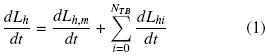
<body><![CDATA[<p align="justify"><font face="verdana" size="2">&nbsp;</font></p>     <p align="justify"><font face="verdana" size="2"><b>2  Model development</b></font></p>     <p align="justify"><font face="verdana" size="2">The individual hyphal growth was estimated by adding the main hyphal length and the branching from the main hyphae (Pazouki and Panda, 2000). In the <a href="#f1">Fig. 1</a> it is shown a representation of a mycelium. The variation of hyphal length was calculated according to Eq.(1): </font></p>     <p align="center"><font face="verdana" size="2"><img src="/img/revistas/rmiq/v10n2/a7s1.jpg"></font></p>     <p align="center"><font face="verdana" size="2"><a name="f1"></a></font></p>     <p align="center"><font face="verdana" size="2"><img src="/img/revistas/rmiq/v10n2/a7f1.jpg"></font></p>     <p align="justify"><font face="verdana" size="2">Where the second term is the main hyphal growth and the third term is the branching contribution.</font></p>     <p align="justify"><font face="verdana" size="2">The hyphal extension on a solid substrate can be described by the logistic expression (Okasaki <i>et al. </i>980), and considering an average apical growth rate for each branch (<i>u<sub>rB</sub></i>) and a colony radial extension rate for the main hyphae, <i>u<sub>r</sub></i>, the Eq. (2) was obtained:</font></p>     <p align="center"><font face="verdana" size="2"><img src="/img/revistas/rmiq/v10n2/a7s2.jpg"></font></p>     <p align="justify"><font face="verdana" size="2">Where, <i>N<sub>TB</sub></i> is the total number of branches in the individual hyphae. Then developing the summation and introducing the branching factor <i>&#947;<sub>i</sub></i> (<i>L<sub>hi</sub> = &#947;<sub>i</sub>L<sub>h</sub></i>) and the fraction of the main hyphal length with respect to the individual total hyphal length <i>&#955;</i> (<i>L<sub>h,m</sub>= &#955;L<sub>h</sub></i>), Eq. (3) was obtained:</font></p>     ]]></body>
<body><![CDATA[<p align="center"><font face="verdana" size="2"><img src="/img/revistas/rmiq/v10n2/a7s3.jpg"></font></p>     <p align="justify"><font face="verdana" size="2">The radial extension rate of the colony for the main hyphae, Eq. (4), was represented according to Nielsen (1993) and McIntyre <i>et al. </i>(2001). Eq. (5) describes the branching growth rate according to Krabben <i>et al. </i>(1997):</font></p>     <p align="center"><font face="verdana" size="2"><img src="/img/revistas/rmiq/v10n2/a7s4.jpg"></font></p>     <p align="center"><font face="verdana" size="2"><img src="/img/revistas/rmiq/v10n2/a7s5.jpg"></font></p>     <p align="justify"><font face="verdana" size="2">Where, <i>L<sub>AV</sub> </i> is the average length of segments, defined according to Viniegra&#150;Gonz&aacute;lez <i>et al. </i>(1993) (Eq. 6):</font></p>     <p align="center"><font face="verdana" size="2"><img src="/img/revistas/rmiq/v10n2/a7s6.jpg"></font></p>     <p align="justify"><font face="verdana" size="2">Where, <i>L<sub>h</sub></i> is the individual total hyphal length and <i>N<sub>S</sub></i> the number of segment and equal <i>N<sub>S</sub> = </i>2<i>N<sub>t,i</sub></i>&#151;1, where <i>N<sub>t,i</sub></i> is the total number of tips in an individual hyphae. Then relating <i>L<sub>h</sub> </i>and <i>N<sub>t,i</sub> </i>the hyphal growth unit (G) was obtained according to Caldwell and Trinci (1973):</font></p>     <p align="center"><font face="verdana" size="2"><img src="/img/revistas/rmiq/v10n2/a7s7.jpg"></font></p>     <p align="justify"><font face="verdana" size="2">Replacing Eqs. (4) and (5) in Eq. (3) and considering a cylindrical hyphae and constant density biomass (<i>X<sub>h</sub>=L<sub>h</sub>&#960;</i>(<i>D<sub>h</sub></i>/<i>2</i>)<sup>2</sup><i>&#961;<sub>h</sub></i>), the individual biomass growth was obtained (Eq. 8). The total biomass and hyphal length were obtained according to <i>X<sub>h,</sub><sub>Total</sub>=X<sub>h</sub> &middot;</i> N<i><sub>0</sub></i> and <i>L<sub>h,</sub><sub>Total</sub> = L<sub>h</sub> &middot;</i> N<i><sub>0</sub></i>, respectively.</font></p>     <p align="center"><font face="verdana" size="2"><img src="/img/revistas/rmiq/v10n2/a7s8.jpg"></font></p>     ]]></body>
<body><![CDATA[<p align="justify"><font face="verdana" size="2">Where, <i>&#966;</i> is the branching frequency, which was obtained integrating the section of the principal hyphae at the time <i>t = &#964;, </i>where <i>&#964;</i> is the time at the critical length of branching <i>L<sub>C</sub> </i>and equal to <i>&#966;</i> = 1/<i>&#964;</i>, according to Viniegra&#150;Gonz&aacute;lez (2003) (Eq. 10) and <i>&#956;<sub>calc</sub></i> is the specific rate determined according to Larralde&#150;Corona <i>et al. </i>(1997) (Eq. 11).</font></p>     <p align="center"><font face="verdana" size="2"><img src="/img/revistas/rmiq/v10n2/a7s9.jpg"></font></p>     <p align="center"><font face="verdana" size="2"><img src="/img/revistas/rmiq/v10n2/a7s10.jpg"></font></p>     <p align="justify"><font face="verdana" size="2">&nbsp;</font></p>     <p align="justify"><font face="verdana" size="2"><b>3 Materials and methods</b></font></p>     <p align="justify"><font face="verdana" size="2"><i>3.1 Microorganisms</i></font></p>     <p align="justify"><font face="verdana" size="2"><i>Fusarium solani </i>B1 has been reported previously by Vergara&#150;Fern&aacute;ndez <i>et al. </i>(2006), it was grown in agar plates and microculture. Its preservation, cultivation conditions and spore production were similar to reported by Garc&iacute;a&#150;Pe&ntilde;a <i>et al. </i>(2001).</font></p>     <p align="justify"><font face="verdana" size="2"><i>3.2 Carbon sources and mineral medium</i></font></p>     <p align="justify"><font face="verdana" size="2">The mineral medium reported by Arriaga and Revah (2005) for fungi isolation, maintenance and cultivation was used. Three carbon sources were used: glycerol (0.7 g L<sup>&#150;1</sup>) (Baker, 99.8%), 1&#150;hexanol (0.7 g L<sup>&#150;1</sup>) (Merck, 98%) and n&#150;hexane (7 g m<sup>&#150;3</sup> in headspace) (Tecsiquim M&eacute;xico, 95%).</font></p>     <p align="justify"><font face="verdana" size="2"><i>3.3 Microcultures</i></font></p>     ]]></body>
<body><![CDATA[<p align="justify"><font face="verdana" size="2">Microcultures were realized in Petri dishes, where microscopic slides were placed on the top of glass bar and then were sterilized. Then agar blocks of 8 mm&times;1.5 cm&times;1.5 cm were placed on the top of the slide. The experimental system utilized is represented in the <a href="#f2">Fig. 2</a>. Agar blocks were prepared with mineral medium, Noble Agar (30 g L<sup>&#150;1</sup> DifcoTM Becton Dickinson USA) and either glycerol or 1&#150;hexanol as carbon source. Some dishes were prepared without carbon source and incubated in a closed chamber with n&#150;hexane vapors. The four sides of the agar block were inoculated by direct puncture with a needle from a spore suspension (2 &times; 10<sup>7</sup> spores mL<sup>&#150;1</sup>). Sterile cover slips were put on the top of the agar and then were cultivated at 30&deg;C between 3 to 8 days, depending of the growth rate in each carbon source. A glycerin solution (5% v/v) was used to control the humidity in the dishes and to avoid the dehydration of agar. Four microcultures were performed for each carbon source.</font></p>     <p align="center"><font face="verdana" size="2"><a name="f2"></a></font></p>     <p align="center"><font face="verdana" size="2"><img src="/img/revistas/rmiq/v10n2/a7f2.jpg"></font></p>     <p align="justify"><font face="verdana" size="2"><i>3.4 Biomass growth in agar</i></font></p>     <p align="justify"><font face="verdana" size="2">Fungi were grown in Petri dishes at the same conditions that those in microcultures. Sterile hydrophilic membranes (Millipore, cellulose membrane 0.45 <i>&#956;</i>m, 47 mm diameter) were placed on the top of the solidified agar and then were inoculated with 0.5 <i>&#956;</i>L of a spore suspension containing 2 &times; 10<sup>7</sup> spores mL<sup>&#150;1</sup> in the center of the membrane and incubated at 30<sup>&deg;</sup>C during 8 days. For the determination of the radial extension rate of the colony, Petri dishes without membranes were used and inoculated by puncture in the center of the dish and incubated for 8 days at 30<sup>&deg;</sup>C (Esquivel&#150;Viveros <i>et al. </i>2009).</font></p>     <p align="justify"><font face="verdana" size="2"><i>3.5 Analytical methods</i></font></p>     <p align="justify"><font face="verdana" size="2">The biomass grown on membranes was quantified by dry weight as reported by Vergara&#150;Fern&aacute;ndez <i>et </i>al. (2006) and Gonz&aacute;lez&#150;Vazquez <i>et al. </i>(2011). Three dishes were used daily. Microcultures were analyzed in an Optic Microscopic (Nikon Optithop&#150;2) equipped with a Leica DC 300 camera and a computer. The Leica IM50 (Version 4.0 Release 85) software was used for images acquisitions. The images were analyzed using the Image J v1.34s software (Wayne Rasband, National Institute of Health, USA). Pictures were digitalized to a resolution of 3132 x 2325 pixels.</font></p>     <p align="justify"><font face="verdana" size="2">For the hyphal diameter measurements <i>L<sub>AV</sub></i>, <i>L<sub>C</sub></i>, <i>L<sub>max</sub></i> and <i>L<sub>maxB</sub></i> at least 20 hyphal tubes per microculture were measured. Radial growth was measured as the length increment of the colony every 24 h.</font></p>     <p align="justify"><font face="verdana" size="2">The experimental results were adjusted to the model proposed using the software Mathcad Plus.</font></p>     <p align="justify"><font face="verdana" size="2">&nbsp;</font></p>     ]]></body>
<body><![CDATA[<p align="justify"><font face="verdana" size="2"><b>4 Results and discussion</b></font></p>     <p align="justify"><font face="verdana" size="2"><i>4.1 Morphology parameters</i></font></p>     <p align="justify"><font face="verdana" size="2"><a href="#t1">Table 1</a> shows the morphological parameters obtained for <i>F. solani </i>grown under different carbon sources in microcultures and Petri dishes. These results show that the carbon source has an effect over the radial rate extension of colony and important reductions between 22 to 54% were observed for the fungus grown in 1&#150;hexanol and <i>n</i>&#150;hexane respectively as compared to glycerol. These results can be attributed to the higher volatility and lower biodegradability of 1&#150;hexanol and <i>n</i>&#150;hexane. On the other hand, the rate of radial growth with 1&#150;hexanol was higher than with <i>n</i>&#150;hexane, probably due to its higher availability being less volatile and hydrophobic than <i>n</i>&#150;hexane (Vergara&#150;Fern&aacute;ndez <i>et al. </i>2006). The <i>u<sub>r</sub> </i>values obtained for <i>F. solani </i>grown in 1&#150;hexanol were half to those obtained by Larralde&#150;Corona <i>et al. </i>(1997) with <i>Aspergillus niger </i>to a glucose initial concentration of 10 g L<sup>&#150;1</sup>, whereas Lopez&#150;Franco <i>et al. </i>(1994) found 228 values which were 2.5 times larger than those obtained with glycerol with <i>Fusarium culmorum </i>grown in agar plates containing potato dextrose.</font></p>     <p align="center"><font face="verdana" size="2"><a name="t1"></a></font></p>     <p align="center"><font face="verdana" size="2"><img src="/img/revistas/rmiq/v10n2/a7t1.jpg"></font></p>     <p align="justify"><font face="verdana" size="2">Furthermore, the different carbon sources have an effect on the morphological characteristics of <i>F. solani, </i>as seen in <a href="/img/revistas/rmiq/v10n2/a7f3.jpg" target="_blank">Fig. 3</a>. The fungus grown in 1&#150;hexanol and <i>n</i>&#150;hexane presented a reduced diameter (about 30% compared with glycerol) which translates into an important increase in the transport area for the same amount of biomass. Vergara&#150;Fern&aacute;ndez <i>et al. </i>(2006) obtained similar results for the fungus <i>F. solani </i>grown on the same carbon sources, indicating that this difference in diameter predicts that for the same biomass, the exposed surface would be twice larger for 1&#150;hexanol and <i>n</i>&#150;hexane as compared to glycerol. In addition, <i>L<sub>max</sub></i> increased 59% when the fungus was grown in <i>n</i>&#150;hexane and 1&#150;hexanol with respect to the value in glycerol. Similar result for <i>L<sub>maxB</sub> </i>was obtained with an increase of 81% for n&#150;hexane and 1&#150;hexanol over glycerol.</font></p>     <p align="justify"><font face="verdana" size="2">The average hyphal diameters obtained with <i>F. solani </i>in this study was 1.5 times larger than those reported in the studies by L&oacute;pez&#150;Franco <i>et al. </i>(1994) with <i>F. culmorum </i>and Larralde&#150;Corona <i>et al. </i>(1992) with <i>Aspergillus niger, </i>both grown in glucose.</font></p>     <p align="justify"><font face="verdana" size="2">The results obtained for <i>L<sub>AV</sub></i> (<a href="#t1">Table 1</a>) showed a decrease of 2.4 times for 1&#150;hexanol and 2.2 times for <i>n</i>&#150;hexane compared to glycerol, this behavior has consequences in the increment of the number of hyphae segments and therefore a greater number of ramifications, for the same hyphal length, it is also observed with an increased in the proportionality factor, &#947;. This factor increases 3 times when the fungus was grown with 1&#150;hexanol and <i>n</i>&#150;hexane as compared to glycerol. This effect in morphology is probably due to the longer ramifications; indicating a better contribution of the transport area. Rahardjo <i>et al. </i>(2002) also observed this contribution of aerial growth in the cellular respiration using <i>Aspergillus oryzae.</i></font></p>     <p align="justify"><font face="verdana" size="2"><i>4.2 Growth and simulation</i></font></p>     <p align="justify"><font face="verdana" size="2"><a href="#f4">Fig. 4</a> shows the growth of <i>F. solani </i>with three different carbon sources, the experimental results are denoted by the symbols, whereas the curve represents the model simulation with the morphological parameters condensed in <a href="#t1">Table 1</a>. In all cases the model presents a good correlation with the fungal biomass obtain experimentally. These results support the feasibility of the model based on morphological parameters to represent the fungal biomass growth.</font></p>     ]]></body>
<body><![CDATA[<p align="center"><font face="verdana" size="2"><a name="f4"></a></font></p>     <p align="center"><font face="verdana" size="2"><img src="/img/revistas/rmiq/v10n2/a7f4.jpg"></font></p>     <p align="justify"><font face="verdana" size="2"><a href="#f4">Fig. 4</a> shows that the biomass obtained for the fungi grown on 1&#150;hexanol and <i>n</i>&#150;hexane were similar, however it was 3 times smaller than the biomass grown on glycerol. The more abundant biomass produced from glycerol was attributed to its higher bioavailability, due to the lower solubility of <i>n</i>&#150;hexane and 1&#150;hexanol. On the other hand, the <a href="#f4">Fig. 4</a> show that the carbon source has an effect over the specific growth rate (<i>&#956;</i>) and important reductions between 25% (<i>&#956;</i> = 0.037 h&#150;1) to 59% (<i>&#956;</i> = 0.029 h<sup>&#150;1</sup>) were observed for the fungus grown in 1&#150;hexanol and <i>n&#150;</i>hexane respectively as compared to glycerol (<i>&#956;</i> = 0.046 day<sup>&#150;1</sup>), similar result to that obtained for the radial extension of colony.</font></p>     <p align="justify"><font face="verdana" size="2"><a href="#f5">Fig. 5a</a>) was constructed using the values of the <a href="#t1">Table 1</a>. This figure shows when the fungus is grown in more hydrophobic and volatile carbon sources a greater number tips were obtained (120% more tips for 1&#150;hexanol and 30% more with n&#150;hexane as compared to glycerol). This indicate an important change in the morphology of aerial hyphae, considering that the biomass generated with glycerol was three time larger than that generated with 1&#150;hexanol and <i>n</i>&#150;hexane.</font></p>     <p align="center"><font face="verdana" size="2"><a name="f5"></a></font></p>     <p align="center"><font face="verdana" size="2"><img src="/img/revistas/rmiq/v10n2/a7f5.jpg"></font></p>     <p align="justify"><font face="verdana" size="2">Values of <i>N<i><sub>Total</sub></i> </i> obtained for <i>n</i>&#150;hexane and 1&#150;hexanol are related to the increase of the proportionally branching constant &#947; and the lower <i>L<sub>AV</sub>.</i> The fungus adapts to the carbon source by generating an increase in the length (see <a href="#t1">Table 1</a>) and the amount of ramifications in the aerial hyphae. As result of these changes, in the aerial volume occupied by the fungus was increased (although with a lower apparent density) favoring the transfer contact between the more volatile carbon sources and the biomass. Vergara&#150;Fern&aacute;ndez <i>et al. </i>(2008) indicate that the growth of the fungal aerial hyphae enhances the EC of the hydrophobic VOCs, when compared with a bacterial biofilter, by increasing the transport area available, when the fungus is grown in a volatile and hydrophobic carbon source.</font></p>     <p align="justify"><font face="verdana" size="2"><a href="#f5">Fig. 5b</a>) represents the correlation between the hyphal growth unit G estimated as a equivalent function to the amount of branching and <i>N<sub>t,i</sub></i>. It can be observed that for 1&#150;hexanol and n&#150;hexane G is constant between 2 and 3 number of tips for two days of growth approximately, while for glycerol G is constant between 5 and 6 number of tips, corresponding to approximately 3.5 days of growth.</font></p>     <p align="justify"><font face="verdana" size="2">These results show that it is possible to consider constant the average length of segments, <i>L<sub>AV</sub></i>, in the experimental conditions, according to the relationship between the Eqs. (6) and (7) given by the equation <i>G = </i>(<i>N<sub>S</sub></i>/<i>N<sub>t,i</sub></i>)<i> L<sub>AV</sub> = </i>&#950;<i>L<sub>AV</sub></i>, for growth periods over 2 days for 1&#150;hexanol and <i>n</i>&#150;hexane and for more of 3 days for glycerol. This is valid when G is constant.</font></p>     <p align="justify"><font face="verdana" size="2">The G max obtained when the fungus was grown in glycerol was 1150 <i>&#956;</i>m, whereas when it was grown in 1&#150;hexanol and <i>n</i>&#150;hexane was on average 400 <i>&#956;</i>m. This decrease is related to a 2.3 times reduction in the <i>L<sub>AV</sub></i> value from glycerol to 1&#150;hexanol and <i>n</i>&#150;hexane.</font></p>     ]]></body>
<body><![CDATA[<p align="justify"><font face="verdana" size="2">&nbsp;</font></p>     <p align="justify"><font face="verdana" size="2"><b>Conclusions</b></font></p>     <p align="justify"><font face="verdana" size="2">The results show that hydrophobic volatile carbon sources have a strong influence in inducing morphological changes in <i>Fusarium solani </i>that increase the aerial mycelium and the contact area, and the mass transfer, with the carbon source. These findings are relevant to explain the higher uptake rates that fungal biofilters have shown with respect to bacterial biofilters when treating hydrophobic volatile pollutants.</font></p>     <p align="justify"><font face="verdana" size="2">The mathematical model developed presents a good correlation with the fungal biomass obtains experimentally. The independent evaluation of the parameters allowed a small deviation with experimental data below 8% for the biomass growth with all carbon sources used. The results support the feasibility of using a model based on combining microscopic and macroscopic parameters describing the mycelial fungal growth to represent the fungal biomass growth.</font></p>     <p align="justify"><font face="verdana" size="2">&nbsp;</font></p>     <p align="justify"><font face="verdana" size="2"><b>Acknowledgements</b></font></p>     <p align="justify"><font face="verdana" size="2">The authors wish to thank the Direcci&oacute;n de Investigaci&oacute;n de la Universidad Cat&oacute;lica de Temuco&#150;Chile and SEMARNAT&#150;CONACyT M&eacute;xico for the doctorate support of A. Vergara&#150;Fern&aacute;ndez. The support of CONACyT (Mexican Council for Science and Technology) for this project is acknowledged.</font></p>     <p align="justify"><font face="verdana" size="2">&nbsp;</font></p>     <p align="justify"><font face="verdana" size="2"><b>Notation</b></font></p>     <p align="justify"><font face="verdana" size="2"><img src="/img/revistas/rmiq/v10n2/a7n1.jpg"></font></p>     ]]></body>
<body><![CDATA[<p align="justify"><font face="verdana" size="2">&nbsp;</font></p>     <p align="justify"><font face="verdana" size="2"><b>References</b></font></p>     <!-- ref --><p align="justify"><font face="verdana" size="2">Agathos, S.N., Hellin, E., Ali&#150;Khodja, H., Deseveaux, S., Vandermesse, F. and Naveau, H. (1997). Gas&#150;phase methyl ethyl ketone biodegradation in a tubular biofilm reactor: microbiological and bioprocess aspects. <i>Biodegradation 8, </i>251&#150;264.    &nbsp;&nbsp;&nbsp;&nbsp;&nbsp;&nbsp;&nbsp;&nbsp;[&#160;<a href="javascript:void(0);" onclick="javascript: window.open('/scielo.php?script=sci_nlinks&ref=8549127&pid=S1665-2738201100020000700001&lng=','','width=640,height=500,resizable=yes,scrollbars=1,menubar=yes,');">Links</a>&#160;]<!-- end-ref --></font></p>     <!-- ref --><p align="justify"><font face="verdana" size="2">Arriaga, S. and Revah, S. (2005). Removal of <i>n&#150;</i>hexane by <i>Fusarium solani </i>with a gas&#150;phase biofilter. <i>Journal Industrial Microbiology and Biotechnology 32, </i>548&#150;553.    &nbsp;&nbsp;&nbsp;&nbsp;&nbsp;&nbsp;&nbsp;&nbsp;[&#160;<a href="javascript:void(0);" onclick="javascript: window.open('/scielo.php?script=sci_nlinks&ref=8549129&pid=S1665-2738201100020000700002&lng=','','width=640,height=500,resizable=yes,scrollbars=1,menubar=yes,');">Links</a>&#160;]<!-- end-ref --></font></p>     <!-- ref --><p align="justify"><font face="verdana" size="2">Auria, R., Frere, G., Morales, M., Acu&ntilde;a, M.E. and Revah, S. (2000). Influence of mixing and water addition on the removal rate of toluene vapors in a biofilter. <i>Biotechnology and Bioengineering 68, </i>448&#150;455.    &nbsp;&nbsp;&nbsp;&nbsp;&nbsp;&nbsp;&nbsp;&nbsp;[&#160;<a href="javascript:void(0);" onclick="javascript: window.open('/scielo.php?script=sci_nlinks&ref=8549131&pid=S1665-2738201100020000700003&lng=','','width=640,height=500,resizable=yes,scrollbars=1,menubar=yes,');">Links</a>&#160;]<!-- end-ref --></font></p>     <!-- ref --><p align="justify"><font face="verdana" size="2">Caldwell, Y. and Trinci, P.J. (1973). The growth unit of the mould <i>Geotrichum candidum. Archivfur Mikrobiologie 88, </i>1&#150;10.    &nbsp;&nbsp;&nbsp;&nbsp;&nbsp;&nbsp;&nbsp;&nbsp;[&#160;<a href="javascript:void(0);" onclick="javascript: window.open('/scielo.php?script=sci_nlinks&ref=8549133&pid=S1665-2738201100020000700004&lng=','','width=640,height=500,resizable=yes,scrollbars=1,menubar=yes,');">Links</a>&#160;]<!-- end-ref --></font></p>     ]]></body>
<body><![CDATA[<!-- ref --><p align="justify"><font face="verdana" size="2">Esquivel&#150;Viveros, A., Ponce&#150;Vargas, F., Esponda&#150;Aguilar, P., Prado&#150;Barrag&aacute;n, L.A., Guti&eacute;rrez&#150;Rojas, M., Lye, G.J. and Huerta&#150;Ochoa, S. (2009). Biodegradation of &#91;bmim&#93;&#91;PF<sub>6</sub>&#93; using <i>Fusarium </i>sp. <i>Revista Mexicana de Ingenier&iacute;a Qu&iacute;mica </i>8(2), 163&#150;168.    &nbsp;&nbsp;&nbsp;&nbsp;&nbsp;&nbsp;&nbsp;&nbsp;[&#160;<a href="javascript:void(0);" onclick="javascript: window.open('/scielo.php?script=sci_nlinks&ref=8549135&pid=S1665-2738201100020000700005&lng=','','width=640,height=500,resizable=yes,scrollbars=1,menubar=yes,');">Links</a>&#160;]<!-- end-ref --></font></p>     <!-- ref --><p align="justify"><font face="verdana" size="2">Garc&iacute;a&#150;Pe&ntilde;a, E.I., Hernandez, S., Favela&#150;Torres, E., Auria, R. and Revah, S. (2001). Toluene biofiltration by the fungus <i>Scedosporium apiospermum </i>TB1. <i>Biotechnology and Bioengineering 76, </i>61&#150;69.    &nbsp;&nbsp;&nbsp;&nbsp;&nbsp;&nbsp;&nbsp;&nbsp;[&#160;<a href="javascript:void(0);" onclick="javascript: window.open('/scielo.php?script=sci_nlinks&ref=8549137&pid=S1665-2738201100020000700006&lng=','','width=640,height=500,resizable=yes,scrollbars=1,menubar=yes,');">Links</a>&#160;]<!-- end-ref --></font></p>     <!-- ref --><p align="justify"><font face="verdana" size="2">Gonz&aacute;lez&#150;V&aacute;zquez, R., Azaola&#150;Espinosa, A., Osorio&#150;Revilla, G., Gallardo&#150;Vel&aacute;zquez, T., Cruz&#150;Victoria, T., Arana&#150;Errasquin, R. and Rivera&#150;Espinoza, Y. (2011). The effect of different carbon sources and salts in the production of naringinase by <i>Aspergillus niger </i>ATCC1015. <i>Revista Mexicana de Ingenier&iacute;a Qu&iacute;mica </i>10(1), 1&#150;8.    &nbsp;&nbsp;&nbsp;&nbsp;&nbsp;&nbsp;&nbsp;&nbsp;[&#160;<a href="javascript:void(0);" onclick="javascript: window.open('/scielo.php?script=sci_nlinks&ref=8549139&pid=S1665-2738201100020000700007&lng=','','width=640,height=500,resizable=yes,scrollbars=1,menubar=yes,');">Links</a>&#160;]<!-- end-ref --></font></p>     <!-- ref --><p align="justify"><font face="verdana" size="2">Krabben, P., Nielsen, J. and Michelsen, M.L. (1997). Analysis of single hyphal growth and fragmentation in submerged cultures using a population model. <i>Chemical Engineering Science </i>52(15), 2641&#150;2652.    &nbsp;&nbsp;&nbsp;&nbsp;&nbsp;&nbsp;&nbsp;&nbsp;[&#160;<a href="javascript:void(0);" onclick="javascript: window.open('/scielo.php?script=sci_nlinks&ref=8549141&pid=S1665-2738201100020000700008&lng=','','width=640,height=500,resizable=yes,scrollbars=1,menubar=yes,');">Links</a>&#160;]<!-- end-ref --></font></p>     <!-- ref --><p align="justify"><font face="verdana" size="2">Larralde&#150;Corona, C.P., L&oacute;pez&#150;Isunza, F. and Viniegra&#150;Gonz&aacute;lez, G. (1992). A kinetic model for germ tube elongation of <i>Aspergillus niger. </i>Abstract 335. August 16&#150;21. 9th <i>International Biotechnology Symposium Crystal City, VA.    &nbsp;&nbsp;&nbsp;&nbsp;&nbsp;&nbsp;&nbsp;&nbsp;[&#160;<a href="javascript:void(0);" onclick="javascript: window.open('/scielo.php?script=sci_nlinks&ref=8549143&pid=S1665-2738201100020000700009&lng=','','width=640,height=500,resizable=yes,scrollbars=1,menubar=yes,');">Links</a>&#160;]<!-- end-ref --></i></font></p>     ]]></body>
<body><![CDATA[<!-- ref --><p align="justify"><font face="verdana" size="2">Larralde&#150;Corona, C.P., L&oacute;pez&#150;Isunza, F. and Viniegra&#150;Gonz&aacute;lez, G. (1997). Morphometric evaluation of the specific growth rate of <i>Aspergillus niger </i>grown in agar plates at high glucose levels.      <i>Biotechnology and Bioengineering 56</i>(3), 287&#150;294.    &nbsp;&nbsp;&nbsp;&nbsp;&nbsp;&nbsp;&nbsp;&nbsp;[&#160;<a href="javascript:void(0);" onclick="javascript: window.open('/scielo.php?script=sci_nlinks&ref=8549145&pid=S1665-2738201100020000700010&lng=','','width=640,height=500,resizable=yes,scrollbars=1,menubar=yes,');">Links</a>&#160;]<!-- end-ref --></font></p>     <!-- ref --><p align="justify"><font face="verdana" size="2">L&oacute;pez&#150;Franco, R., Bartnicki&#150;Garc&iacute;a, S. and Bracker, C.E. (1994). Pulsed growth of fungal hyphal tips. <i>Proceedings of the National Academy of Sciences USA </i>91(25), 12228&#150;12232.    &nbsp;&nbsp;&nbsp;&nbsp;&nbsp;&nbsp;&nbsp;&nbsp;[&#160;<a href="javascript:void(0);" onclick="javascript: window.open('/scielo.php?script=sci_nlinks&ref=8549147&pid=S1665-2738201100020000700011&lng=','','width=640,height=500,resizable=yes,scrollbars=1,menubar=yes,');">Links</a>&#160;]<!-- end-ref --></font></p>     <!-- ref --><p align="justify"><font face="verdana" size="2">McIntyre, M., Dynesen, J. and Nielsen, J. (2001). Morphological characterization of <i>Aspergillus nidulans: </i>growth, septation and fragmentation. <i>Microbiology 147, </i>239&#150;246.    &nbsp;&nbsp;&nbsp;&nbsp;&nbsp;&nbsp;&nbsp;&nbsp;[&#160;<a href="javascript:void(0);" onclick="javascript: window.open('/scielo.php?script=sci_nlinks&ref=8549149&pid=S1665-2738201100020000700012&lng=','','width=640,height=500,resizable=yes,scrollbars=1,menubar=yes,');">Links</a>&#160;]<!-- end-ref --></font></p>     <!-- ref --><p align="justify"><font face="verdana" size="2">Mendon&ccedil;a, F., Yoshiko, C. and Said, S. (2005). Effect of benzene compounds from plants on the growth and hyphal morphology in <i>Neurospora crassa.   Brazilian Journal Microbiology 36, </i>190&#150;195.    &nbsp;&nbsp;&nbsp;&nbsp;&nbsp;&nbsp;&nbsp;&nbsp;[&#160;<a href="javascript:void(0);" onclick="javascript: window.open('/scielo.php?script=sci_nlinks&ref=8549151&pid=S1665-2738201100020000700013&lng=','','width=640,height=500,resizable=yes,scrollbars=1,menubar=yes,');">Links</a>&#160;]<!-- end-ref --></font></p>     <!-- ref --><p align="justify"><font face="verdana" size="2">Nielsen, J. (1993). A simple morphologically structured model describing the growth of filamentous microorganisms. <i>Biotechnology and Bioengineering 41, </i>715&#150;727.    &nbsp;&nbsp;&nbsp;&nbsp;&nbsp;&nbsp;&nbsp;&nbsp;[&#160;<a href="javascript:void(0);" onclick="javascript: window.open('/scielo.php?script=sci_nlinks&ref=8549153&pid=S1665-2738201100020000700014&lng=','','width=640,height=500,resizable=yes,scrollbars=1,menubar=yes,');">Links</a>&#160;]<!-- end-ref --></font></p>     ]]></body>
<body><![CDATA[<!-- ref --><p align="justify"><font face="verdana" size="2">Pazouki, M. and Panda, T. (2000). Understanding the morphology of fungi. <i>Bioprocess Engineering </i>22, 127&#150;143.    &nbsp;&nbsp;&nbsp;&nbsp;&nbsp;&nbsp;&nbsp;&nbsp;[&#160;<a href="javascript:void(0);" onclick="javascript: window.open('/scielo.php?script=sci_nlinks&ref=8549155&pid=S1665-2738201100020000700015&lng=','','width=640,height=500,resizable=yes,scrollbars=1,menubar=yes,');">Links</a>&#160;]<!-- end-ref --></font></p>     <!-- ref --><p align="justify"><font face="verdana" size="2">Qi, B., Moe, W.M. and Kinney, K.A., (2002). Biodegradation of volatile organic compounds by five fungal species. <i>Applied Microbiology and Biotechnology 58</i>(5), 684&#150; 689.    &nbsp;&nbsp;&nbsp;&nbsp;&nbsp;&nbsp;&nbsp;&nbsp;[&#160;<a href="javascript:void(0);" onclick="javascript: window.open('/scielo.php?script=sci_nlinks&ref=8549157&pid=S1665-2738201100020000700016&lng=','','width=640,height=500,resizable=yes,scrollbars=1,menubar=yes,');">Links</a>&#160;]<!-- end-ref --></font></p>     <!-- ref --><p align="justify"><font face="verdana" size="2">Okazaki, N., Sugama, S. and Tanaka, T. (1980). Mathematical model for surface culture of <i>Koji </i>mold. <i>Journal of Fermentation Technology 58, </i>471&#150;476.    &nbsp;&nbsp;&nbsp;&nbsp;&nbsp;&nbsp;&nbsp;&nbsp;[&#160;<a href="javascript:void(0);" onclick="javascript: window.open('/scielo.php?script=sci_nlinks&ref=8549159&pid=S1665-2738201100020000700017&lng=','','width=640,height=500,resizable=yes,scrollbars=1,menubar=yes,');">Links</a>&#160;]<!-- end-ref --></font></p>     <!-- ref --><p align="justify"><font face="verdana" size="2">Trinci, A.P.J. (1974). A study of the kinetics of hyphal extension and branch initiation offungal mycelia. <i>Journal of General Microbiology 81, </i>225&#150;236.    &nbsp;&nbsp;&nbsp;&nbsp;&nbsp;&nbsp;&nbsp;&nbsp;[&#160;<a href="javascript:void(0);" onclick="javascript: window.open('/scielo.php?script=sci_nlinks&ref=8549161&pid=S1665-2738201100020000700018&lng=','','width=640,height=500,resizable=yes,scrollbars=1,menubar=yes,');">Links</a>&#160;]<!-- end-ref --></font></p>     <!-- ref --><p align="justify"><font face="verdana" size="2">Rahardjo, Y.S.P., Weber, F.J., le Comte, E.P., Tramper, J. and Rinzema, A. (2002). Contribution of aerial hyphae of <i>Aspergillus oryzae </i>to respiration in a model solid&#150;state fermentation system. <i>Biotechnology and Bioengineering 78</i>(5), 539&#150;544.    &nbsp;&nbsp;&nbsp;&nbsp;&nbsp;&nbsp;&nbsp;&nbsp;[&#160;<a href="javascript:void(0);" onclick="javascript: window.open('/scielo.php?script=sci_nlinks&ref=8549163&pid=S1665-2738201100020000700019&lng=','','width=640,height=500,resizable=yes,scrollbars=1,menubar=yes,');">Links</a>&#160;]<!-- end-ref --></font></p>     ]]></body>
<body><![CDATA[<!-- ref --><p align="justify"><font face="verdana" size="2">Steele, G.C. and Trinci, A.P.J. (1975). Morphology and growth kinetics of hyphae of differentiated and undifferentiated mycelia of <i>Neurospora crassa. Journal General Microbiology 91, </i>362368.    &nbsp;&nbsp;&nbsp;&nbsp;&nbsp;&nbsp;&nbsp;&nbsp;[&#160;<a href="javascript:void(0);" onclick="javascript: window.open('/scielo.php?script=sci_nlinks&ref=8549165&pid=S1665-2738201100020000700020&lng=','','width=640,height=500,resizable=yes,scrollbars=1,menubar=yes,');">Links</a>&#160;]<!-- end-ref --></font></p>     <!-- ref --><p align="justify"><font face="verdana" size="2">Vergara&#150;Fern&aacute;ndez, A., Van Haaren, B. and Revah, S. (2006). Phase partition of gaseous hexane and surface hydrophobicity of <i>Fusarium solani </i>when grown in liquid and solid media with hexanol and hexane. <i>Biotechnology Letters 28, </i>2011&#150;2017.    &nbsp;&nbsp;&nbsp;&nbsp;&nbsp;&nbsp;&nbsp;&nbsp;[&#160;<a href="javascript:void(0);" onclick="javascript: window.open('/scielo.php?script=sci_nlinks&ref=8549167&pid=S1665-2738201100020000700021&lng=','','width=640,height=500,resizable=yes,scrollbars=1,menubar=yes,');">Links</a>&#160;]<!-- end-ref --></font></p>     <!-- ref --><p align="justify"><font face="verdana" size="2">Vergara&#150;Fern&aacute;ndez, A., Hern&aacute;ndez, S. and Revah, S. (2008). Phenomenological model of fungal biofilters for the abatement of hydrophobic VOCs. B<i>iotechnology and Bioengineering </i>101(6), 1182&#150;1192.    &nbsp;&nbsp;&nbsp;&nbsp;&nbsp;&nbsp;&nbsp;&nbsp;[&#160;<a href="javascript:void(0);" onclick="javascript: window.open('/scielo.php?script=sci_nlinks&ref=8549169&pid=S1665-2738201100020000700022&lng=','','width=640,height=500,resizable=yes,scrollbars=1,menubar=yes,');">Links</a>&#160;]<!-- end-ref --></font></p>     <!-- ref --><p align="justify"><font face="verdana" size="2">Viniegra&#150;Gonz&aacute;lez, G., Saucedo&#150;Castaneda, G., Loi pez&#150;Isunza, F. and Favela&#150;Torres, E. (1993). Symmetric branching model for the kinetics of mycelial growth. <i>Biotechnology and Bioengineering 42</i>(1), 1&#150;10.    &nbsp;&nbsp;&nbsp;&nbsp;&nbsp;&nbsp;&nbsp;&nbsp;[&#160;<a href="javascript:void(0);" onclick="javascript: window.open('/scielo.php?script=sci_nlinks&ref=8549171&pid=S1665-2738201100020000700023&lng=','','width=640,height=500,resizable=yes,scrollbars=1,menubar=yes,');">Links</a>&#160;]<!-- end-ref --></font></p>     <!-- ref --><p align="justify"><font face="verdana" size="2">Viniegra&#150;Gonz&aacute;lez, G. (2003). Producci&oacute;n de enzimas por <i>Aspergillus. BioTecnolog&iacute;a Revista Sociedad Mexicana Biotectolog&iacute;a Bioengenier&iacute;a 8</i>(2), 18&#150;30.    &nbsp;&nbsp;&nbsp;&nbsp;&nbsp;&nbsp;&nbsp;&nbsp;[&#160;<a href="javascript:void(0);" onclick="javascript: window.open('/scielo.php?script=sci_nlinks&ref=8549173&pid=S1665-2738201100020000700024&lng=','','width=640,height=500,resizable=yes,scrollbars=1,menubar=yes,');">Links</a>&#160;]<!-- end-ref --></font></p>     ]]></body>
<body><![CDATA[<!-- ref --><p align="justify"><font face="verdana" size="2">Woertz, J.R., Kinney, K.A. and Szaniszlo, P.J. (2001). A fungal vapor&#150;phase bioreactor for the removal of nitric oxide from waste gas streams. <i>Journal of the Air and Waste Management Association 51, </i>895&#150;902.    &nbsp;&nbsp;&nbsp;&nbsp;&nbsp;&nbsp;&nbsp;&nbsp;[&#160;<a href="javascript:void(0);" onclick="javascript: window.open('/scielo.php?script=sci_nlinks&ref=8549175&pid=S1665-2738201100020000700025&lng=','','width=640,height=500,resizable=yes,scrollbars=1,menubar=yes,');">Links</a>&#160;]<!-- end-ref --></font></p>      ]]></body><back>
<ref-list>
<ref id="B1">
<nlm-citation citation-type="journal">
<person-group person-group-type="author">
<name>
<surname><![CDATA[Agathos]]></surname>
<given-names><![CDATA[S.N.]]></given-names>
</name>
<name>
<surname><![CDATA[Hellin]]></surname>
<given-names><![CDATA[E.]]></given-names>
</name>
<name>
<surname><![CDATA[Ali-Khodja]]></surname>
<given-names><![CDATA[H.]]></given-names>
</name>
<name>
<surname><![CDATA[Deseveaux]]></surname>
<given-names><![CDATA[S.]]></given-names>
</name>
<name>
<surname><![CDATA[Vandermesse]]></surname>
<given-names><![CDATA[F.]]></given-names>
</name>
<name>
<surname><![CDATA[Naveau]]></surname>
<given-names><![CDATA[H.]]></given-names>
</name>
</person-group>
<article-title xml:lang="en"><![CDATA[Gas-phase methyl ethyl ketone biodegradation in a tubular biofilm reactor: microbiological and bioprocess aspects]]></article-title>
<source><![CDATA[Biodegradation]]></source>
<year>1997</year>
<volume>8</volume>
<page-range>251-264</page-range></nlm-citation>
</ref>
<ref id="B2">
<nlm-citation citation-type="journal">
<person-group person-group-type="author">
<name>
<surname><![CDATA[Arriaga]]></surname>
<given-names><![CDATA[S.]]></given-names>
</name>
<name>
<surname><![CDATA[Revah]]></surname>
<given-names><![CDATA[S.]]></given-names>
</name>
</person-group>
<article-title xml:lang="en"><![CDATA[Removal of n-hexane by Fusarium solani with a gas-phase biofilter]]></article-title>
<source><![CDATA[Journal Industrial Microbiology and Biotechnology]]></source>
<year>2005</year>
<volume>32</volume>
<page-range>548-553</page-range></nlm-citation>
</ref>
<ref id="B3">
<nlm-citation citation-type="journal">
<person-group person-group-type="author">
<name>
<surname><![CDATA[Auria]]></surname>
<given-names><![CDATA[R.]]></given-names>
</name>
<name>
<surname><![CDATA[Frere]]></surname>
<given-names><![CDATA[G.]]></given-names>
</name>
<name>
<surname><![CDATA[Morales]]></surname>
<given-names><![CDATA[M.]]></given-names>
</name>
<name>
<surname><![CDATA[Acuña]]></surname>
<given-names><![CDATA[M.E.]]></given-names>
</name>
<name>
<surname><![CDATA[Revah]]></surname>
<given-names><![CDATA[S.]]></given-names>
</name>
</person-group>
<article-title xml:lang="en"><![CDATA[Influence of mixing and water addition on the removal rate of toluene vapors in a biofilter]]></article-title>
<source><![CDATA[Biotechnology and Bioengineering]]></source>
<year>2000</year>
<volume>68</volume>
<page-range>448-455</page-range></nlm-citation>
</ref>
<ref id="B4">
<nlm-citation citation-type="journal">
<person-group person-group-type="author">
<name>
<surname><![CDATA[Caldwell]]></surname>
<given-names><![CDATA[Y.]]></given-names>
</name>
<name>
<surname><![CDATA[Trinci]]></surname>
<given-names><![CDATA[P.J.]]></given-names>
</name>
</person-group>
<article-title xml:lang="en"><![CDATA[The growth unit of the mould Geotrichum candidum]]></article-title>
<source><![CDATA[Archivfur Mikrobiologie]]></source>
<year>1973</year>
<volume>88</volume>
<page-range>1-10</page-range></nlm-citation>
</ref>
<ref id="B5">
<nlm-citation citation-type="journal">
<person-group person-group-type="author">
<name>
<surname><![CDATA[Esquivel-Viveros]]></surname>
<given-names><![CDATA[A.]]></given-names>
</name>
<name>
<surname><![CDATA[Ponce-Vargas]]></surname>
<given-names><![CDATA[F.]]></given-names>
</name>
<name>
<surname><![CDATA[Esponda-Aguilar]]></surname>
<given-names><![CDATA[P.]]></given-names>
</name>
<name>
<surname><![CDATA[Prado-Barragán]]></surname>
<given-names><![CDATA[L.A.]]></given-names>
</name>
<name>
<surname><![CDATA[Gutiérrez-Rojas]]></surname>
<given-names><![CDATA[M.]]></given-names>
</name>
<name>
<surname><![CDATA[Lye]]></surname>
<given-names><![CDATA[G.J.]]></given-names>
</name>
<name>
<surname><![CDATA[Huerta-Ochoa]]></surname>
<given-names><![CDATA[S.]]></given-names>
</name>
</person-group>
<article-title xml:lang="en"><![CDATA[Biodegradation of [bmim][PF6] using Fusarium sp]]></article-title>
<source><![CDATA[Revista Mexicana de Ingeniería Química]]></source>
<year>2009</year>
<volume>8</volume>
<numero>2</numero>
<issue>2</issue>
<page-range>163-168</page-range></nlm-citation>
</ref>
<ref id="B6">
<nlm-citation citation-type="journal">
<person-group person-group-type="author">
<name>
<surname><![CDATA[García-Peña]]></surname>
<given-names><![CDATA[E.I.]]></given-names>
</name>
<name>
<surname><![CDATA[Hernandez]]></surname>
<given-names><![CDATA[S.]]></given-names>
</name>
<name>
<surname><![CDATA[Favela-Torres]]></surname>
<given-names><![CDATA[E.]]></given-names>
</name>
<name>
<surname><![CDATA[Auria]]></surname>
<given-names><![CDATA[R.]]></given-names>
</name>
<name>
<surname><![CDATA[Revah]]></surname>
<given-names><![CDATA[S.]]></given-names>
</name>
</person-group>
<article-title xml:lang="en"><![CDATA[Toluene biofiltration by the fungus Scedosporium apiospermum TB1]]></article-title>
<source><![CDATA[Biotechnology and Bioengineering]]></source>
<year>2001</year>
<volume>76</volume>
<page-range>61-69</page-range></nlm-citation>
</ref>
<ref id="B7">
<nlm-citation citation-type="journal">
<person-group person-group-type="author">
<name>
<surname><![CDATA[González-Vázquez]]></surname>
<given-names><![CDATA[R.]]></given-names>
</name>
<name>
<surname><![CDATA[Azaola-Espinosa]]></surname>
<given-names><![CDATA[A.]]></given-names>
</name>
<name>
<surname><![CDATA[Osorio-Revilla]]></surname>
<given-names><![CDATA[G.]]></given-names>
</name>
<name>
<surname><![CDATA[Gallardo-Velázquez]]></surname>
<given-names><![CDATA[T.]]></given-names>
</name>
<name>
<surname><![CDATA[Cruz-Victoria]]></surname>
<given-names><![CDATA[T.]]></given-names>
</name>
<name>
<surname><![CDATA[Arana-Errasquin]]></surname>
<given-names><![CDATA[R.]]></given-names>
</name>
<name>
<surname><![CDATA[Rivera-Espinoza]]></surname>
<given-names><![CDATA[Y.]]></given-names>
</name>
</person-group>
<article-title xml:lang="en"><![CDATA[The effect of different carbon sources and salts in the production of naringinase by Aspergillus niger ATCC1015]]></article-title>
<source><![CDATA[Revista Mexicana de Ingeniería Química]]></source>
<year>2011</year>
<volume>10</volume>
<numero>1</numero>
<issue>1</issue>
<page-range>1-8</page-range></nlm-citation>
</ref>
<ref id="B8">
<nlm-citation citation-type="journal">
<person-group person-group-type="author">
<name>
<surname><![CDATA[Krabben]]></surname>
<given-names><![CDATA[P.]]></given-names>
</name>
<name>
<surname><![CDATA[Nielsen]]></surname>
<given-names><![CDATA[J.]]></given-names>
</name>
<name>
<surname><![CDATA[Michelsen]]></surname>
<given-names><![CDATA[M.L.]]></given-names>
</name>
</person-group>
<article-title xml:lang="en"><![CDATA[Analysis of single hyphal growth and fragmentation in submerged cultures using a population model]]></article-title>
<source><![CDATA[Chemical Engineering Science]]></source>
<year>1997</year>
<volume>52</volume>
<numero>15</numero>
<issue>15</issue>
<page-range>2641-2652</page-range></nlm-citation>
</ref>
<ref id="B9">
<nlm-citation citation-type="confpro">
<person-group person-group-type="author">
<name>
<surname><![CDATA[Larralde-Corona]]></surname>
<given-names><![CDATA[C.P.]]></given-names>
</name>
<name>
<surname><![CDATA[López-Isunza]]></surname>
<given-names><![CDATA[F.]]></given-names>
</name>
<name>
<surname><![CDATA[Viniegra-González]]></surname>
<given-names><![CDATA[G.]]></given-names>
</name>
</person-group>
<source><![CDATA[A kinetic model for germ tube elongation of Aspergillus niger]]></source>
<year>1992</year>
<conf-name><![CDATA[9 International Biotechnology Symposium]]></conf-name>
<conf-loc>Crystal City VA</conf-loc>
</nlm-citation>
</ref>
<ref id="B10">
<nlm-citation citation-type="journal">
<person-group person-group-type="author">
<name>
<surname><![CDATA[Larralde-Corona]]></surname>
<given-names><![CDATA[C.P.]]></given-names>
</name>
<name>
<surname><![CDATA[López-Isunza]]></surname>
<given-names><![CDATA[F.]]></given-names>
</name>
<name>
<surname><![CDATA[Viniegra-González]]></surname>
<given-names><![CDATA[G.]]></given-names>
</name>
</person-group>
<article-title xml:lang="en"><![CDATA[Morphometric evaluation of the specific growth rate of Aspergillus niger grown in agar plates at high glucose levels]]></article-title>
<source><![CDATA[Biotechnology and Bioengineering]]></source>
<year>1997</year>
<volume>56</volume>
<numero>3</numero>
<issue>3</issue>
<page-range>287-294</page-range></nlm-citation>
</ref>
<ref id="B11">
<nlm-citation citation-type="journal">
<person-group person-group-type="author">
<name>
<surname><![CDATA[López-Franco]]></surname>
<given-names><![CDATA[R.]]></given-names>
</name>
<name>
<surname><![CDATA[Bartnicki-García]]></surname>
<given-names><![CDATA[S.]]></given-names>
</name>
<name>
<surname><![CDATA[Bracker]]></surname>
<given-names><![CDATA[C.E.]]></given-names>
</name>
</person-group>
<article-title xml:lang="en"><![CDATA[Pulsed growth of fungal hyphal tips]]></article-title>
<source><![CDATA[Proceedings of the National Academy of Sciences USA]]></source>
<year>1994</year>
<volume>91</volume>
<numero>25</numero>
<issue>25</issue>
<page-range>12228-12232</page-range></nlm-citation>
</ref>
<ref id="B12">
<nlm-citation citation-type="journal">
<person-group person-group-type="author">
<name>
<surname><![CDATA[McIntyre]]></surname>
<given-names><![CDATA[M.]]></given-names>
</name>
<name>
<surname><![CDATA[Dynesen]]></surname>
<given-names><![CDATA[J.]]></given-names>
</name>
<name>
<surname><![CDATA[Nielsen]]></surname>
<given-names><![CDATA[J.]]></given-names>
</name>
</person-group>
<article-title xml:lang="en"><![CDATA[Morphological characterization of Aspergillus nidulans: growth, septation and fragmentation]]></article-title>
<source><![CDATA[Microbiology]]></source>
<year>2001</year>
<volume>147</volume>
<page-range>239-246</page-range></nlm-citation>
</ref>
<ref id="B13">
<nlm-citation citation-type="journal">
<person-group person-group-type="author">
<name>
<surname><![CDATA[Mendonça]]></surname>
<given-names><![CDATA[F.]]></given-names>
</name>
<name>
<surname><![CDATA[Yoshiko]]></surname>
<given-names><![CDATA[C.]]></given-names>
</name>
<name>
<surname><![CDATA[Said]]></surname>
<given-names><![CDATA[S.]]></given-names>
</name>
</person-group>
<article-title xml:lang="en"><![CDATA[Effect of benzene compounds from plants on the growth and hyphal morphology in Neurospora crassa]]></article-title>
<source><![CDATA[Brazilian Journal Microbiology]]></source>
<year>2005</year>
<volume>36</volume>
<page-range>190-195</page-range></nlm-citation>
</ref>
<ref id="B14">
<nlm-citation citation-type="journal">
<person-group person-group-type="author">
<name>
<surname><![CDATA[Nielsen]]></surname>
<given-names><![CDATA[J.]]></given-names>
</name>
</person-group>
<article-title xml:lang="en"><![CDATA[A simple morphologically structured model describing the growth of filamentous microorganisms]]></article-title>
<source><![CDATA[Biotechnology and Bioengineering]]></source>
<year>1993</year>
<volume>41</volume>
<page-range>715-727</page-range></nlm-citation>
</ref>
<ref id="B15">
<nlm-citation citation-type="journal">
<person-group person-group-type="author">
<name>
<surname><![CDATA[Pazouki]]></surname>
<given-names><![CDATA[M.]]></given-names>
</name>
<name>
<surname><![CDATA[Panda]]></surname>
<given-names><![CDATA[T.]]></given-names>
</name>
</person-group>
<article-title xml:lang="en"><![CDATA[Understanding the morphology of fungi]]></article-title>
<source><![CDATA[Bioprocess Engineering]]></source>
<year>2000</year>
<volume>22</volume>
<page-range>127-143</page-range></nlm-citation>
</ref>
<ref id="B16">
<nlm-citation citation-type="journal">
<person-group person-group-type="author">
<name>
<surname><![CDATA[Qi]]></surname>
<given-names><![CDATA[B.]]></given-names>
</name>
<name>
<surname><![CDATA[Moe]]></surname>
<given-names><![CDATA[W.M.]]></given-names>
</name>
<name>
<surname><![CDATA[Kinney]]></surname>
<given-names><![CDATA[K.A.]]></given-names>
</name>
</person-group>
<article-title xml:lang="en"><![CDATA[Biodegradation of volatile organic compounds by five fungal species]]></article-title>
<source><![CDATA[Applied Microbiology and Biotechnology]]></source>
<year>2002</year>
<volume>58</volume>
<numero>5</numero>
<issue>5</issue>
<page-range>684- 689</page-range></nlm-citation>
</ref>
<ref id="B17">
<nlm-citation citation-type="journal">
<person-group person-group-type="author">
<name>
<surname><![CDATA[Okazaki]]></surname>
<given-names><![CDATA[N.]]></given-names>
</name>
<name>
<surname><![CDATA[Sugama]]></surname>
<given-names><![CDATA[S.]]></given-names>
</name>
<name>
<surname><![CDATA[Tanaka]]></surname>
<given-names><![CDATA[T.]]></given-names>
</name>
</person-group>
<article-title xml:lang="en"><![CDATA[Mathematical model for surface culture of Koji mold]]></article-title>
<source><![CDATA[Journal of Fermentation Technology]]></source>
<year>1980</year>
<volume>58</volume>
<page-range>471-476</page-range></nlm-citation>
</ref>
<ref id="B18">
<nlm-citation citation-type="journal">
<person-group person-group-type="author">
<name>
<surname><![CDATA[Trinci]]></surname>
<given-names><![CDATA[A.P.J.]]></given-names>
</name>
</person-group>
<article-title xml:lang="en"><![CDATA[A study of the kinetics of hyphal extension and branch initiation offungal mycelia]]></article-title>
<source><![CDATA[Journal of General Microbiology]]></source>
<year>1974</year>
<volume>81</volume>
<page-range>225-236</page-range></nlm-citation>
</ref>
<ref id="B19">
<nlm-citation citation-type="journal">
<person-group person-group-type="author">
<name>
<surname><![CDATA[Rahardjo]]></surname>
<given-names><![CDATA[Y.S.P.]]></given-names>
</name>
<name>
<surname><![CDATA[Weber]]></surname>
<given-names><![CDATA[F.J.]]></given-names>
</name>
<name>
<surname><![CDATA[le Comte]]></surname>
<given-names><![CDATA[E.P.]]></given-names>
</name>
<name>
<surname><![CDATA[Tramper]]></surname>
<given-names><![CDATA[J.]]></given-names>
</name>
<name>
<surname><![CDATA[Rinzema]]></surname>
<given-names><![CDATA[A.]]></given-names>
</name>
</person-group>
<article-title xml:lang="en"><![CDATA[Contribution of aerial hyphae of Aspergillus oryzae to respiration in a model solid-state fermentation system]]></article-title>
<source><![CDATA[Biotechnology and Bioengineering]]></source>
<year>2002</year>
<volume>78</volume>
<numero>5</numero>
<issue>5</issue>
<page-range>539-544</page-range></nlm-citation>
</ref>
<ref id="B20">
<nlm-citation citation-type="journal">
<person-group person-group-type="author">
<name>
<surname><![CDATA[Steele]]></surname>
<given-names><![CDATA[G.C.]]></given-names>
</name>
<name>
<surname><![CDATA[Trinci]]></surname>
<given-names><![CDATA[A.P.J.]]></given-names>
</name>
</person-group>
<article-title xml:lang="en"><![CDATA[Morphology and growth kinetics of hyphae of differentiated and undifferentiated mycelia of Neurospora crassa]]></article-title>
<source><![CDATA[Journal General Microbiology]]></source>
<year>1975</year>
<volume>91</volume>
<page-range>362368</page-range></nlm-citation>
</ref>
<ref id="B21">
<nlm-citation citation-type="journal">
<person-group person-group-type="author">
<name>
<surname><![CDATA[Vergara-Fernández]]></surname>
<given-names><![CDATA[A.]]></given-names>
</name>
<name>
<surname><![CDATA[Van Haaren]]></surname>
<given-names><![CDATA[B.]]></given-names>
</name>
<name>
<surname><![CDATA[Revah]]></surname>
<given-names><![CDATA[S.]]></given-names>
</name>
</person-group>
<article-title xml:lang="en"><![CDATA[Phase partition of gaseous hexane and surface hydrophobicity of Fusarium solani when grown in liquid and solid media with hexanol and hexane]]></article-title>
<source><![CDATA[Biotechnology Letters]]></source>
<year>2006</year>
<volume>28</volume>
<page-range>2011-2017</page-range></nlm-citation>
</ref>
<ref id="B22">
<nlm-citation citation-type="journal">
<person-group person-group-type="author">
<name>
<surname><![CDATA[Vergara-Fernández]]></surname>
<given-names><![CDATA[A.]]></given-names>
</name>
<name>
<surname><![CDATA[Hernández]]></surname>
<given-names><![CDATA[S.]]></given-names>
</name>
<name>
<surname><![CDATA[Revah]]></surname>
<given-names><![CDATA[S.]]></given-names>
</name>
</person-group>
<article-title xml:lang="en"><![CDATA[Phenomenological model of fungal biofilters for the abatement of hydrophobic VOCs]]></article-title>
<source><![CDATA[Biotechnology and Bioengineering]]></source>
<year>2008</year>
<volume>101</volume>
<numero>6</numero>
<issue>6</issue>
<page-range>1182-1192</page-range></nlm-citation>
</ref>
<ref id="B23">
<nlm-citation citation-type="journal">
<person-group person-group-type="author">
<name>
<surname><![CDATA[Viniegra-González]]></surname>
<given-names><![CDATA[G.]]></given-names>
</name>
<name>
<surname><![CDATA[Saucedo-Castaneda]]></surname>
<given-names><![CDATA[G.]]></given-names>
</name>
<name>
<surname><![CDATA[Loi pez-Isunza]]></surname>
<given-names><![CDATA[F.]]></given-names>
</name>
<name>
<surname><![CDATA[Favela-Torres]]></surname>
<given-names><![CDATA[E.]]></given-names>
</name>
</person-group>
<article-title xml:lang="en"><![CDATA[Symmetric branching model for the kinetics of mycelial growth]]></article-title>
<source><![CDATA[Biotechnology and Bioengineering]]></source>
<year>1993</year>
<volume>42</volume>
<numero>1</numero>
<issue>1</issue>
<page-range>1-10</page-range></nlm-citation>
</ref>
<ref id="B24">
<nlm-citation citation-type="journal">
<person-group person-group-type="author">
<name>
<surname><![CDATA[Viniegra-González]]></surname>
<given-names><![CDATA[G.]]></given-names>
</name>
</person-group>
<article-title xml:lang="es"><![CDATA[Producción de enzimas por Aspergillus]]></article-title>
<source><![CDATA[BioTecnología Revista Sociedad Mexicana Biotectología Bioengeniería]]></source>
<year>2003</year>
<volume>8</volume>
<numero>2</numero>
<issue>2</issue>
<page-range>18-30</page-range></nlm-citation>
</ref>
<ref id="B25">
<nlm-citation citation-type="journal">
<person-group person-group-type="author">
<name>
<surname><![CDATA[Woertz]]></surname>
<given-names><![CDATA[J.R.]]></given-names>
</name>
<name>
<surname><![CDATA[Kinney]]></surname>
<given-names><![CDATA[K.A.]]></given-names>
</name>
<name>
<surname><![CDATA[Szaniszlo]]></surname>
<given-names><![CDATA[P.J.]]></given-names>
</name>
</person-group>
<article-title xml:lang="en"><![CDATA[A fungal vapor-phase bioreactor for the removal of nitric oxide from waste gas streams]]></article-title>
<source><![CDATA[Journal of the Air and Waste Management Association]]></source>
<year>2001</year>
<volume>51</volume>
<page-range>895-902</page-range></nlm-citation>
</ref>
</ref-list>
</back>
</article>



