<?xml version="1.0" encoding="ISO-8859-1"?><article xmlns:mml="http://www.w3.org/1998/Math/MathML" xmlns:xlink="http://www.w3.org/1999/xlink" xmlns:xsi="http://www.w3.org/2001/XMLSchema-instance">
<front>
<journal-meta>
<journal-id>1405-3322</journal-id>
<journal-title><![CDATA[Boletín de la Sociedad Geológica Mexicana]]></journal-title>
<abbrev-journal-title><![CDATA[Bol. Soc. Geol. Mex]]></abbrev-journal-title>
<issn>1405-3322</issn>
<publisher>
<publisher-name><![CDATA[Sociedad Geológica Mexicana A.C.]]></publisher-name>
</publisher>
</journal-meta>
<article-meta>
<article-id>S1405-33222013000200015</article-id>
<title-group>
<article-title xml:lang="en"><![CDATA[Calappa granulata (Linnaeus, 1758) (Crustacea, Decapoda, Brachyura, Calappidae) and Astiplax aspera n. gen., n. sp. (Crustacea, Decapoda, Brachyura, Goneplacidae) from the Asti sands Fm. (Late Pliocene) of S. Pietro (Asti, Piedmont, NW Italy)]]></article-title>
<article-title xml:lang="es"><![CDATA[Calappa granulata (Linneo, 1758) (Crustacea, Decapoda, Brachyura, Calappidae) y Astiplax aspera n. gen., n. sp. (Crustacea, Decapoda, Brachyura, Goneplacidae) de la Formación Asti (Plioceno tardío) de S. Pietro (Asti, Piamonte, NW Italia)]]></article-title>
</title-group>
<contrib-group>
<contrib contrib-type="author">
<name>
<surname><![CDATA[Garassino]]></surname>
<given-names><![CDATA[Alessandro]]></given-names>
</name>
<xref ref-type="aff" rid="A01"/>
</contrib>
<contrib contrib-type="author">
<name>
<surname><![CDATA[Pasini]]></surname>
<given-names><![CDATA[Giovanni]]></given-names>
</name>
</contrib>
</contrib-group>
<aff id="A01">
<institution><![CDATA[,Museo di Storia Naturale Sezione di Paleontologia ]]></institution>
<addr-line><![CDATA[Milano ]]></addr-line>
<country>Italia</country>
</aff>
<pub-date pub-type="pub">
<day>00</day>
<month>08</month>
<year>2013</year>
</pub-date>
<pub-date pub-type="epub">
<day>00</day>
<month>08</month>
<year>2013</year>
</pub-date>
<volume>65</volume>
<numero>2</numero>
<fpage>329</fpage>
<lpage>334</lpage>
<copyright-statement/>
<copyright-year/>
<self-uri xlink:href="http://www.scielo.org.mx/scielo.php?script=sci_arttext&amp;pid=S1405-33222013000200015&amp;lng=en&amp;nrm=iso"></self-uri><self-uri xlink:href="http://www.scielo.org.mx/scielo.php?script=sci_abstract&amp;pid=S1405-33222013000200015&amp;lng=en&amp;nrm=iso"></self-uri><self-uri xlink:href="http://www.scielo.org.mx/scielo.php?script=sci_pdf&amp;pid=S1405-33222013000200015&amp;lng=en&amp;nrm=iso"></self-uri><abstract abstract-type="short" xml:lang="en"><p><![CDATA[Two crabs from the Pliocene sands of S. Pietro (Asti, Piedmont, NW Italy) have been assigned to Calappa granulata (Linnaeus, 1758) (Calappidae De Haan, 1833) and to Astiplax aspera n. gen., n. sp. (Goneplacidae MacLeay, 1838). Although C. granulata has already been reported from the Pliocene of other Italian regions, the Piedmont specimen represents one of the most complete carapaces known to date in the fossil record of this extant species. The discovery of Astiplax n. gen., with A. aspera n. sp. increases the number of species of Goneplacidae from the Pliocene of Italy, limited to Goneplax rhomboides (Linnaeus, 1758) and G. sacci Crema, 1895.]]></p></abstract>
<abstract abstract-type="short" xml:lang="es"><p><![CDATA[Dos cangrejos de las areniscas del Plioceno de S. Pietro (Asti, Piemonte, NO Italia) han sido asignados a Calappa granulata (Linnaeus, 1758) (Calappidae De Haan, 1833) y a Astiplax aspera n. gen., n. sp. (Goneplacidae MacLeay, 1838). Aunque C. granulata ha sido previamente reportada del Plioceno de otras regiones de Italia, el ejemplar de Piemonte representa uno de los más completos caparazones conocidos hasta la fecha en el registro fósil de esa especie viviente. El descubrimiento de Astiplax n. gen., con A. aspera n. sp., incrementa el número de especies de Goneplacidae del Plioceno de Italia, limitado a Goneplax rhomboides (Linnaeus, 1758) y G. sacci Crema, 1895.]]></p></abstract>
<kwd-group>
<kwd lng="en"><![CDATA[Crustacea]]></kwd>
<kwd lng="en"><![CDATA[Decapoda]]></kwd>
<kwd lng="en"><![CDATA[Brachyura]]></kwd>
<kwd lng="en"><![CDATA[Late Pliocene]]></kwd>
<kwd lng="en"><![CDATA[Italy]]></kwd>
<kwd lng="es"><![CDATA[Crustacea]]></kwd>
<kwd lng="es"><![CDATA[Decapoda]]></kwd>
<kwd lng="es"><![CDATA[Brachyura]]></kwd>
<kwd lng="es"><![CDATA[Plioceno superior]]></kwd>
<kwd lng="es"><![CDATA[Italia]]></kwd>
</kwd-group>
</article-meta>
</front><body><![CDATA[  	    <p align="justify"><font face="verdana" size="4">Art&iacute;culos</font></p>  	    <p align="justify"><font face="verdana" size="2">&nbsp;</font></p>  	    <p align="center"><font face="verdana" size="4"><b><i>Calappa granulata</i> (Linnaeus, 1758) (Crustacea, Decapoda, Brachyura, Calappidae) and <i>Astiplax aspera</i> n. gen., n. sp. (Crustacea, Decapoda, Brachyura, Goneplacidae) from the Asti sands Fm. (Late Pliocene) of S. Pietro (Asti, Piedmont, NW Italy)</b></font></p>  	    <p align="justify"><font face="verdana" size="2">&nbsp;</font></p>  	    <p align="center"><font face="verdana" size="3"><b><i>Calappa granulata</i>&nbsp;(Linneo, 1758) (Crustacea, Decapoda, Brachyura, Calappidae) y&nbsp;<i>Astiplax aspera</i>&nbsp;n. gen., n. sp. (Crustacea, Decapoda, Brachyura,&nbsp;Goneplacidae) de la Formaci&oacute;n Asti (Plioceno tard&iacute;o) de S. Pietro (Asti, Piamonte, NW Italia)</b></font></p>  	    <p align="justify"><font face="verdana" size="2">&nbsp;</font></p>  	    <p align="center"><font face="verdana" size="2"><b>Alessandro Garassino<sup>1,*</sup>, Giovanni Pasini<sup>2</sup></b></font></p>  	    <p align="justify"><font face="verdana" size="2">&nbsp;</font></p>  	    <p align="justify"><font face="verdana" size="2"><sup><i>1</i></sup> <i>Museo di Storia Naturale, Sezione di Paleontologia, Corso Venezia 55, 20121 Milano, Italia.</i> *<a href="mailto:alegarassino@gmail.com">alegarassino@gmail.com</a></font></p>  	    ]]></body>
<body><![CDATA[<p align="justify"><font face="verdana" size="2"><i><sup>2</sup> Via Alessandro Volta 16, I&#45;22070 Appiano Gentile (Como), Italia.</i></font></p>  	    <p align="justify"><font face="verdana" size="2">&nbsp;</font></p>  	    <p align="justify"><font face="verdana" size="2">Manuscript received: July 6, 2012.    <br> 	Corrected manuscript received: October 20, 2012.    <br> 	Manuscript accepted: October 22, 2012.</font></p>  	    <p align="justify"><font face="verdana" size="2">&nbsp;</font></p>  	    <p align="justify"><font face="verdana" size="2"><b>Abstract</b></font></p>  	    <p align="justify"><font face="verdana" size="2">Two crabs from the Pliocene sands of S. Pietro (Asti, Piedmont, NW Italy) have been assigned to <i>Calappa granulata</i> (Linnaeus, 1758) (Calappidae De Haan, 1833) and to <i>Astiplax aspera</i> n. gen., n. sp. (Goneplacidae MacLeay, 1838). Although <i>C. granulata</i> has already been reported from the Pliocene of other Italian regions, the Piedmont specimen represents one of the most complete carapaces known to date in the fossil record of this extant species. The discovery of <i>Astiplax</i> n. gen., with <i>A. aspera</i> n. sp. increases the number of species of Goneplacidae from the Pliocene of Italy, limited to <i>Goneplax rhomboides</i> (Linnaeus, 1758) and <i>G. sacci</i> Crema, 1895.</font></p>  	    <p align="justify"><font face="verdana" size="2"><b>Keywords:</b> Crustacea, Decapoda, Brachyura, Late Pliocene, Italy.</font></p>  	    <p align="justify"><font face="verdana" size="2">&nbsp;</font></p>  	    ]]></body>
<body><![CDATA[<p align="justify"><font face="verdana" size="2"><b>Resumen</b></font></p>  	    <p align="justify"><font face="verdana" size="2">Dos cangrejos de las areniscas del Plioceno de S. Pietro (Asti, Piemonte, NO Italia) han sido asignados a <i>Calappa granulata</i> (Linnaeus, 1758) (Calappidae De Haan, 1833) y a <i>Astiplax aspera</i> n. gen., n. sp. (Goneplacidae MacLeay, 1838). Aunque <i>C. granulata</i> ha sido previamente reportada del Plioceno de otras regiones de Italia, el ejemplar de Piemonte representa uno de los m&aacute;s completos caparazones conocidos hasta la fecha en el registro f&oacute;sil de esa especie viviente. El descubrimiento de <i>Astiplax</i> n. gen., con <i>A. aspera</i> n. sp., incrementa el n&uacute;mero de especies de Goneplacidae del Plioceno de Italia, limitado a <i>Goneplax rhomboides</i> (Linnaeus, 1758) y <i>G. sacci</i> Crema, 1895.</font></p>  	    <p align="justify"><font face="verdana" size="2"><b>Palabras clave:</b> Crustacea, Decapoda, Brachyura, Plioceno superior, Italia.</font></p>  	    <p align="justify"><font face="verdana" size="2">&nbsp;</font></p>  	    <p align="justify"><font face="verdana" size="2"><b>1. Introduction</b></font></p>  	    <p align="justify"><font face="verdana" size="2">The specimens were discovered in sand blocks crashed by natural erosion along the hills of S. Pietro outcrop located near Asti, Piedmont (NW Italy), in the Astian Pliocene Basin. The yellow sedimentary Asti sands constitute the main body of the surrounding hills, and were deposited in a coastal environment of the old Padano Gulf. The marine Asti sands Fm. is rich in fossils, mainly in molluscs, indicating an infralittoral environment (Astiana facies), and was dated to the Late Pliocene (Damarco, 2009). Lacking micropaleontological and sedimentological data, we assign the specimens to the Asti sands Fm. (Late Pliocene) in a generic way.</font></p>  	    <p align="justify"><font face="verdana" size="2">&nbsp;</font></p>  	    <p align="justify"><font face="verdana" size="2"><b>2. Material</b></font></p>  	    <p align="justify"><font face="verdana" size="2">The sample includes two specimens: one carapace dorsally preserved as a three&#45;dimensional mould with the original epicuticle partially preserved; one three&#45;dimensional specimen preserving the carapace and the incomplete right cheliped. The specimens have been assigned to <i>Calappa</i> <i>granulata</i> (Linnaeus, 1758) (Calappidae De Haan, 1833) and <i>Astiplax aspera</i> n. gen., n. sp. (Goneplacidae MacLeay, 1838). The specimens are deposited in the Palaeontological Collections of the Museo di Storia Naturale di Milano (MSNM).</font></p>  	    <p align="justify"><font face="verdana" size="2">The systematic arrangement used in this paper follows the recent classifications proposed by Castro (2007) and Ng <i>et al</i>. (2008).</font></p>  	    ]]></body>
<body><![CDATA[<p align="justify"><font face="verdana" size="2">2.1. Abbreviations</font></p>  	    <p align="justify"><font face="verdana" size="2">lc: length of carpus; lcxp: length of carapace; lm: length of merus; wcxp: width of carapace.</font></p>  	    <p align="justify"><font face="verdana" size="2">&nbsp;</font></p>  	    <p align="justify"><font face="verdana" size="2"><b>3. Systematic Palaeontology</b></font></p>  	    <blockquote> 		    <p align="center"><font face="verdana" size="2">Section Eubrachyura de Saint Laurent, 1980    <br> 		</font><font face="verdana" size="2">Superfamily Calappoidea De Haan, 1833    <br> 		</font><font face="verdana" size="2">Family Calappidae De Haan, 1833    <br> 		</font><font face="verdana" size="2">Genus <i>Calappa</i> Weber, 1795</font></p> </blockquote>  	    <p align="justify"><font face="verdana" size="2"><b>Type species:</b> <i>Cancer granulatus</i> Linnaeus, 1758, subsequent designation by Latreille (1810).</font></p>  	    ]]></body>
<body><![CDATA[<blockquote> 		    <p align="center"><font face="verdana" size="2"><i>Calappa granulata</i> (Linnaeus, 1758)    <br> 		</font><font face="verdana" size="2"><a href="/img/revistas/bsgm/v65n2/a15f1.jpg" target="_blank">Figure 1</a></font></p> </blockquote>  	    <p align="justify"><font face="verdana" size="2"><i>Cancer granulatus</i> Linnaeus, 1758: 627.</font></p>  	    <p align="justify"><font face="verdana" size="2"><i>Cancer granulatus</i> &#150; Linnaeus, 1767: 533.</font></p>  	    <p align="justify"><font face="verdana" size="2"><i>Calappa granulata</i> &#150; Garassino and De Angeli, 2004: 38, fig. 4 (1&#45;3). &#150; Garassino <i>et al</i>., 2004: 264, fig. 7 a&#45;c. &#150; De Angeli and Garassino, 2006: 40. &#150; Ng <i>et al</i>., 2008: 48. &#150; De Angeli <i>et al</i>., 2009: 176, 177, 195, 196, fig. 8a, b. &#150; Schweitzer <i>et al</i>., 2010: 82. &#150; Garassino <i>et al</i>., 2012: 51. &#150; Pasini and Garassino, 2013: 320, 321.</font></p>  	    <p align="justify"><font face="verdana" size="2"><b>Material and measurements:</b> one carapace in dorsal view (MSNM i27827 &#150; lcxp: 33 mm; wcxp: 40 mm).</font></p>  	    <p align="justify"><font face="verdana" size="2"><b>Discussion.</b> The specimen has been compared with the extant species of <i>Calappa</i> Weber, 1795, from the Indo&#45;West Pacific region from which it differs notably in the general shape and ornamentation of the carapace and distribution of the posterolateral teeth (Ng <i>et al</i>., 2008); and with the extant and fossil <i>C. granulata</i>, widespread in the Mediterranean Sea.</font></p>  	    <p align="justify"><font face="verdana" size="2">Zariquiey&#45;&Aacute;lvarez (1968) pointed out the main characters of this species, such as the convex and wider than long carapace; rounded anterolateral margins; straight posterior margin; poorly produced, bidentate straight front; small well&#45;marked orbits, inferior margin with two small separate teeth; anterolateral margins with small poorly developed teeth wider at the base, followed on the posterior third by four larger teeth pointed medially; posterior margin straight lacking teeth on the median portion; mesogastric and cardiointestinal regions appear fused, forming a prominent longitudinal ridge delimited laterally by two marked longitudinal grooves; at each side of these two grooves, generally four longitudinal grooves not reaching the posterior margin and delimiting other ridges; all the ridges bear longitudinally nodules of decreasing size, with the larger sizes in the mesogastric region; a small nodule is present in the anterior cardiac region; the other regions are covered by granules.</font></p>  	    <p align="justify"><font face="verdana" size="2">The specimen, although poorly preserved, shows close affinities with <i>C. granulata</i> as follows: suboval convex carapace wider than long; straight front and small rounded orbits; raised convex anterolateral margins, with posterior triangular and pointed teeth and nearly straight posterior margin; regions well marked by two longitudinal grooves that divide the carapace in three parts; tuberculate longitudinal ridges and a dense granulation covering the regions, mainly the central dorsal part of the carapace. The specimen is also very similar in shape and ornamentation to the only carapace from the Italian Pliocene of Tuscany reported by De Angeli <i>et al</i>. (2009; 177, fig. 8). Based on these data we attest that the previous reports from the Pliocene of Piedmont, Emilia Romagna, and Sicily and from the Pleistocene of Monte Pellegrino (Sicily) can be assigned to the extant and fossil <i>C. granulata</i> (Ristori, 1891; Gemmellaro, 1914; Garassino and De Angeli, 2004; Garassino <i>et al</i>., 2004; De Angeli <i>et al</i>., 2009; Pasini and Garassino, 2013).</font></p>  	    ]]></body>
<body><![CDATA[<blockquote> 		    <p align="center"><font face="verdana" size="2">Superfamily Goneplacoidea MacLeay, 1838    <br> 		</font><font face="verdana" size="2">Family Goneplacidae MacLeay, 1838    <br> 		</font><font face="verdana" size="2">Subfamily Goneplacinae MacLeay, 1838    <br> 		</font><font face="verdana" size="2">Genus <i>Astiplax</i> n. gen.</font></p> </blockquote>  	    <p align="justify"><font face="verdana" size="2"><b>Diagnosis:</b> carapace transversely rectangular, much wider than long; front slightly turned downwards, not marked by slight median notch or projection; inner edge of supraorbital margin distinct; wide orbits 1.3 longer than front; outer orbital angle without teeth or spines; supraorbital margins strongly sinuous; suborbital margins sinuous, toothless; anterolateral margins slightly convex, toothless; posterolateral margins straight, converging posteriorly; posterior margin long, slightly convex; dorsal surface of carapace conspicuously granular, with slight horizontal ridges, moderately convex, without clear indication of regions; produced lateral knock under the postorbital angles; stout and heavy chelipeds, strongly granulose.</font></p>  	    <p align="justify"><font face="verdana" size="2"><b>Etymology:</b> from Asti, city located close to the outcrop where the specimen was discovered.</font></p>  	    <p align="justify"><font face="verdana" size="2"><b>Type species:</b> <i>Astiplax aspera</i> n. gen., n. sp. (gender feminine).</font></p>  	    <p align="justify"><font face="verdana" size="2"><b>Description:</b> as for the type species.</font></p>  	    <p align="justify"><font face="verdana" size="2"><b>Discussion.</b> The family Goneplacidae, as reported by Castro (2007), has the following diagnostic characters: carapace transversely rectangular, subquadrate, or trapezoidal; front narrow to wide, typically lamellar, straight; dorsal surface smooth; varying number of anterolateral spines posterior to outer orbital angle (sometimes none but typically one or two); orbits moderately to conspicuously wide, long; fissure in supraorbital margin absent; dorsal surface of carapace typically smooth or with slight horizontal ridges, moderately convex, without clear indication of regions. Most of these characters are present in the specimen, here, assigned to Goneplacidae. Moreover, we justify the erection of the new genus <i>Astiplax</i> based on some supplementary morphological observations. The outer orbital angle and the anterolateral margin of carapace spineless of <i>Astiplax</i> n. gen. are two characters shared with the extant <i>Notonyx</i> Milne Edwards, 1873. The carapace, however, is distinctively quadrate and the typically smooth dorsal surface of <i>Notonyx</i> exclude <i>Astiplax</i> n. gen. from belonging to this genus. The dorsal surface of the carapace of the <i>Astiplax</i> n. gen., with slight horizontal ridges, moderately convex, without clear indication of regions, is a character shared with some species of the extant genera: <i>Carcinoplax</i> H. Milne Edwards, 1852, <i>Pycnoplax</i> Castro, 2007, <i>Goneplax</i> Leach, 1814, <i>Neogoneplax</i> Castro, 2007, <i>Paragoneplax</i> Castro, 2007, and <i>Ommatocarcinus</i> White, 1852 (see Castro, 2007). The dorsal surface of the carapace, however, conspicuously granular in <i>Astiplax</i> n. gen., excludes it from belonging to <i>Pycnoplax</i>, <i>Goneplax</i>, <i>Neogoneplax</i>, and <i>Paragoneplax</i> where the dorsal surface of the carapace is typically smooth. We also exclude it from belonging to <i>Carcinoplax</i>, although slight horizontal ridges and granules along the antero&#45; and posterolateral margins are present in two species, <i>C. cracens</i> Castro, 2007, and <i>C. tuberosa</i> Castro, 2007; as reported by Castro (2007) these are not considered as generic characters. Finally, although the carapace of <i>Ommatocarcinus</i> has slight horizontal ridges, a smooth or conspicuously granular dorsal surface and the anterolateral margin toothless, the outer orbital angles, each with a conspicuous acute tooth, exclude <i>Astiplax</i>&nbsp;n. gen. from belonging to this genus.</font></p>  	    ]]></body>
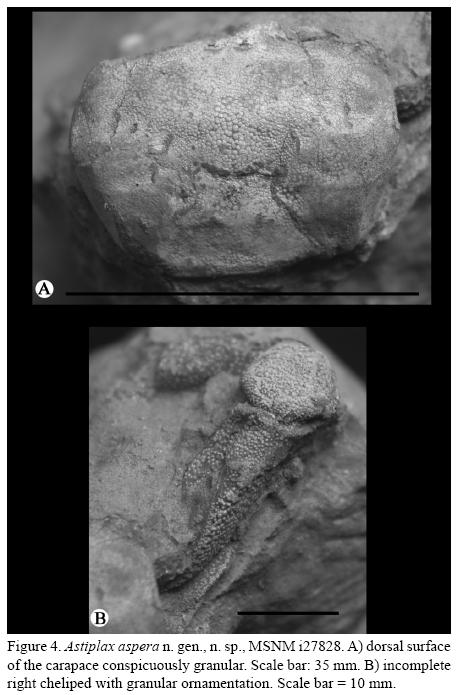
<body><![CDATA[<p align="justify"><font face="verdana" size="2">As reported by Karasawa and Kato (2003) and Schweitzer <i>et al</i>. (2010) the Goneplacidae includes eight fossil genera: <i>Amydrocarcinus</i> Schweitzer, Feldmann, Gonz&aacute;lez&#45;Barba and Vega, 2002; <i>Carcinoplax</i> H. Milne Edwards, 1852; <i>Goneplax</i> Leach, 1814; <i>Icriocarcinus</i> Bishop, 1988; <i>Kowaicarcinus</i> Feldmann, Schweitzer, Maxwell and Kelley, 2008; <i>Magyarcarcinus</i> Schweitzer and Karasawa, 2004; <i>Ommatocarcinus</i> White, 1852; <i>Psopheticus</i> Wood&#45;Mason, 1892. <i>Carcinoplax</i>, <i>Goneplax</i>, and <i>Ommatocarcinus</i> are extant genera from which <i>Astiplax</i> n. gen. is excluded. <i>Amydrocarcinus</i> was described from the Eocene Tepetate Fm. (Mexico) (Schweitzer <i>et al</i>., 2002; Schweitzer and Karasawa, 2004), <i>Icriocarcinus</i> from the Late Cretaceous (late Campanian or early Maastrichtian) of San Diego County (California, USA) (Bishop, 1988), <i>Kowaicarcinus</i> from the Pliocene of New Zealand (Feldmann <i>et al</i>., 2008), <i>Magyarcarcinus</i> from the Late Eocene of Hungary (Schweitzer and Karasawa, 2004), and <i>Psopheticus</i> from the Oligocene of Taiwan (Hu and Tao, 1996; Karasawa and Kato, 2003) and the Pliocene of Japan (Karasawa, 1997). We exclude <i>Astiplax</i> n. gen. from these genera not only for geological and paleogeographic implications, but also for the ovoid carapace, small and squared orbits, and the dorsal surface of the carapace typically smooth in <i>Amydrocarcinus</i>; the pentagonal carapace, anterolateral margins with three acute spines, and the dorsal surface of the carapace strongly ridged of <i>Icriocarcinus</i>; the hexagonal carapace, small and ovoid orbits, and tri&#45;lobed anterolateral margin of <i>Kowaicarcinus</i>; the circular carapace, small and ovoid orbits, and smooth dorsal surface of the carapace of <i>Magyarcarcinus</i>; the subquadrate carapace, the outer orbital angle with acute tooth, anterolateral margin with one acute spine, and the dorsal surface of the carapace typically smooth of <i>Psopheticus</i>.</font></p>  	    <blockquote> 		    <p align="center"><font face="verdana" size="2"><i>Astiplax aspera</i> n. sp.    <br> 		</font><font face="verdana" size="2"><a href="#f2">Figures 2</a>&#45;<a href="#f4">4</a> (<a href="#f3">3</a>)</font></p> </blockquote>  	    <p align="center"><font face="verdana" size="2"><a name="f2"></a></font></p>  	    <p align="center"><font face="verdana" size="2"><img src="/img/revistas/bsgm/v65n2/a15f2.jpg"></font></p>  	    <p align="center"><font face="verdana" size="2"><a name="f3"></a></font></p>  	    <p align="center"><font face="verdana" size="2"><img src="/img/revistas/bsgm/v65n2/a15f3.jpg"></font></p>  	    <p align="center"><font face="verdana" size="2"><a name="f4"></a></font></p>  	    <p align="center"><font face="verdana" size="2"><img src="/img/revistas/bsgm/v65n2/a15f4.jpg"></font></p>  	    ]]></body>
<body><![CDATA[<p align="justify"><font face="verdana" size="2"><b>Etymology:</b> from the Latin <i>asper</i>, <i>aspera</i>, <i>asperum</i> = rough, alluding to the strong granular ornamentation of carapace and cheliped.</font></p>  	    <p align="justify"><font face="verdana" size="2"><b>Holotype:</b> MSNM i27828 &#150; specimen, lacking left cheliped, chela of right cheliped, and ambulatory legs (lcxp: 22 mm (excluding front); wcxp: 32 mm; lm: 20 mm; lc: 8 mm).</font></p>  	    <p align="justify"><font face="verdana" size="2"><b>Type locality:</b> S. Pietro (Asti, Piedmont, NW Italy).</font></p>  	    <p align="justify"><font face="verdana" size="2"><b>Geological age:</b> Asti sands Fm., Late Pliocene.</font></p>  	    <p align="justify"><font face="verdana" size="2"><b>Description.</b> Carapace transversely rectangular, much wider than long; widest at junction between antero&#45; and posterolateral margins; front slightly turned downwards, not marked by slight median notch or projection; inner edge of supraorbital margin distinct; wide orbits 1.3 longer than front, with granular eye&#45;stalk; orbits greatly expanded distally with outer orbital angle toothless; supraorbital margins strongly sinuous, without fissures; sinuous, toothless suborbital margins; toothless anterolateral margins slightly convex; long, straight posterolateral margins, converging posteriorly; long posterior margin slightly convex; deep gastric pits; branchiocardiac grooves slightly distinct in cardiac region; dorsal surface of the carapace strongly granular, with bigger granules in the metagastric region; slight horizontal ridges, moderately convex, without clear indication of regions; an elevated notch under both postorbital angles, produced forwardly. Stout, heavy cheliped, with moderately long merus, subtriangular in section; carpus subsquare in section, dorsolaterally convex and toothless; merus and carpus surface strongly granular; granules of cheliped bigger than those of the carapace.</font></p>  	    <p align="justify"><font face="verdana" size="2"><b>Discussion.</b> Among the fossil crabs from the Pliocene of Italy, only <i>Simonellia quiricensis</i> Vinassa de Regny, 1897 (Euryplacidae Stimpson, 1871) from S. Quirico d'Orcia (Tuscany) could be compared with the new genus (Vinassa de Regny, 1897). As reported by De Angeli and Garassino (2006), however, the holotype of this species is lost, making difficult a comparison between the two species based on the published description and the line drawing (Vinassa de Regny, 1897: Pl. 2, figs. 1, 1a). Moreover, this specimen was reported from the clays of S. Quirico d'Orcia (middle Pliocene), younger than the Asti sands Fm. (Late Pliocene) from where the specimen was discovered. <i>Simonellia quiricensis</i> is therefore considered a <i>nomen</i> <i>dubium</i> for not having other specimens of the same species and from the same locality in order to be able to confirm its description. Some characters, reported by Vinassa de Regny, however, distinguish <i>Simonellia</i> from <i>Astiplax</i> n. gen.: the compressed, ovoid carapace, with sharp margins; the small, ovoid orbits; the anterolateral margin with one spine. Finally it is difficult to compare the ornamentation of the dorsal surface of the carapace. Indeed the author described a "scabrous" surface, a term that does not explain if the surface is granular, tubercular or uneven.</font></p>  	    <p align="justify"><font face="verdana" size="2">&nbsp;</font></p>  	    <p align="justify"><font face="verdana" size="2"><b>Acknowledgments</b></font></p>  	    <p align="justify"><font face="verdana" size="2">We wish to thank P. Frediani (Gruppo Paleontologico "C. De Giuli", Castelfiorentino (Firenze), for useful information on the outcrop, and P. Castro (Biological Sciences Department, California State Polytechnic University, Pomona, USA) for useful suggestions about the systematics of Goneplacidae, careful review and criticism.</font></p>  	    <p align="justify"><font face="verdana" size="2">&nbsp;</font></p>  	    ]]></body>
<body><![CDATA[<p align="justify"><font face="verdana" size="2"><b>References</b></font></p>  	    <!-- ref --><p align="justify"><font face="verdana" size="2">Bishop, G.A., 1988, Two crabs, <i>Xandaros sternbergi</i> (Rathbun, 1926) n. gen., and <i>Icriocarcinus xestos</i> n. gen., n. sp., from the Late Cretaceous of San Diego County, California, USA, and Baja California Norte, Mexico: Transactions of the San Diego Society of Natural History, 21(15), 245&#45;257.    &nbsp;&nbsp;&nbsp;&nbsp;&nbsp;&nbsp;&nbsp;&nbsp;[&#160;<a href="javascript:void(0);" onclick="javascript: window.open('/scielo.php?script=sci_nlinks&ref=1409964&pid=S1405-3322201300020001500001&lng=','','width=640,height=500,resizable=yes,scrollbars=1,menubar=yes,');">Links</a>&#160;]<!-- end-ref --></font></p>  	    <!-- ref --><p align="justify"><font face="verdana" size="2">Castro, P., 2007, A reappraisal of the family Goneplacidae MacLeay, 1838 (Crustacea, Decapoda, Brachyura) and revision of the subfamily Goneplacinae, with the description of 10 new genera and 18 new species: Zoosystema, 29(4), 609&#45;774.    &nbsp;&nbsp;&nbsp;&nbsp;&nbsp;&nbsp;&nbsp;&nbsp;[&#160;<a href="javascript:void(0);" onclick="javascript: window.open('/scielo.php?script=sci_nlinks&ref=1409966&pid=S1405-3322201300020001500002&lng=','','width=640,height=500,resizable=yes,scrollbars=1,menubar=yes,');">Links</a>&#160;]<!-- end-ref --></font></p>  	    <!-- ref --><p align="justify"><font face="verdana" size="2">Crema, C., 1895, Sopra alcuni decapodi terziarii del Piemonte: Atti della Reale Accademia di Scienze di Torino, 30, 664&#45;681.    &nbsp;&nbsp;&nbsp;&nbsp;&nbsp;&nbsp;&nbsp;&nbsp;[&#160;<a href="javascript:void(0);" onclick="javascript: window.open('/scielo.php?script=sci_nlinks&ref=1409968&pid=S1405-3322201300020001500003&lng=','','width=640,height=500,resizable=yes,scrollbars=1,menubar=yes,');">Links</a>&#160;]<!-- end-ref --></font></p>  	    <!-- ref --><p align="justify"><font face="verdana" size="2">Damarco, P., 2009, Il Pliocene, <i>in</i> Museo Paleontologico "Giulio Maini", Paleontologia e Geologia, Citt&agrave; di Ovada, 108&#45;122.    &nbsp;&nbsp;&nbsp;&nbsp;&nbsp;&nbsp;&nbsp;&nbsp;[&#160;<a href="javascript:void(0);" onclick="javascript: window.open('/scielo.php?script=sci_nlinks&ref=1409970&pid=S1405-3322201300020001500004&lng=','','width=640,height=500,resizable=yes,scrollbars=1,menubar=yes,');">Links</a>&#160;]<!-- end-ref --></font></p>  	    <!-- ref --><p align="justify"><font face="verdana" size="2">De Angeli, A., Garassino, A., 2006, Catalog and bibliography of fossil stomatopoda and decapoda from Italy: Memorie della Societ&agrave; italiana di Scienze naturali e del Museo civico di Storia naturale di Milano, 35(1), 3&#45;96.    &nbsp;&nbsp;&nbsp;&nbsp;&nbsp;&nbsp;&nbsp;&nbsp;[&#160;<a href="javascript:void(0);" onclick="javascript: window.open('/scielo.php?script=sci_nlinks&ref=1409972&pid=S1405-3322201300020001500005&lng=','','width=640,height=500,resizable=yes,scrollbars=1,menubar=yes,');">Links</a>&#160;]<!-- end-ref --></font></p>  	    <!-- ref --><p align="justify"><font face="verdana" size="2">De Angeli, A., Garassino, A., Pasini G., 2009, New reports of anomurans and brachyurans from the Cenozoic of Tuscany (Italy): Atti della Societ&agrave; italiana di Scienze naturali e del Museo civico di Storia naturale in Milano, 150(2), 163&#45;196.    &nbsp;&nbsp;&nbsp;&nbsp;&nbsp;&nbsp;&nbsp;&nbsp;[&#160;<a href="javascript:void(0);" onclick="javascript: window.open('/scielo.php?script=sci_nlinks&ref=1409974&pid=S1405-3322201300020001500006&lng=','','width=640,height=500,resizable=yes,scrollbars=1,menubar=yes,');">Links</a>&#160;]<!-- end-ref --></font></p>  	    <!-- ref --><p align="justify"><font face="verdana" size="2">De Haan, H.M., 1833&#45;1849, Crustacea, <i>in</i> von Siebold, P.F., Fauna Japonica, sive Descriptio animalium, quae in itinere per Japoniam, jussu et auspiciis superiorum, qui summum in India Batavia imperium tenent, suscepto, annis 1823&#45;1830 collegit, notis, observationibus a adumbrationibus illustravit, Lugduni Batavorum, 1&#45;8, 1&#45;243.    &nbsp;&nbsp;&nbsp;&nbsp;&nbsp;&nbsp;&nbsp;&nbsp;[&#160;<a href="javascript:void(0);" onclick="javascript: window.open('/scielo.php?script=sci_nlinks&ref=1409976&pid=S1405-3322201300020001500007&lng=','','width=640,height=500,resizable=yes,scrollbars=1,menubar=yes,');">Links</a>&#160;]<!-- end-ref --></font></p>  	    <!-- ref --><p align="justify"><font face="verdana" size="2">de Saint Laurent, M., 1980, Sur la classification et la phylog&eacute;nie des Crustac&eacute;s D&eacute;capodes brachyoures I, Podotremata Guinot, 1977, et Eubrachyura sect. nov: Comptes rendus hebdomadaires des S&eacute;ances de l'Acad&eacute;mie des Sciences, (D) 290, 1265&#45;1268.    &nbsp;&nbsp;&nbsp;&nbsp;&nbsp;&nbsp;&nbsp;&nbsp;[&#160;<a href="javascript:void(0);" onclick="javascript: window.open('/scielo.php?script=sci_nlinks&ref=1409978&pid=S1405-3322201300020001500008&lng=','','width=640,height=500,resizable=yes,scrollbars=1,menubar=yes,');">Links</a>&#160;]<!-- end-ref --></font></p>  	    <!-- ref --><p align="justify"><font face="verdana" size="2">Feldmann, R.M., Schweitzer, C.E., Maxwell, P.A., Kelley B.M., 2008, Fossil isopod and decapod crustaceans from the Kowai Formation (Pliocene) near Makikihi, South Canterbury, NewZealand: New Zealand Journal of Geology and Geophysics, 51, 43&#45;58.    &nbsp;&nbsp;&nbsp;&nbsp;&nbsp;&nbsp;&nbsp;&nbsp;[&#160;<a href="javascript:void(0);" onclick="javascript: window.open('/scielo.php?script=sci_nlinks&ref=1409980&pid=S1405-3322201300020001500009&lng=','','width=640,height=500,resizable=yes,scrollbars=1,menubar=yes,');">Links</a>&#160;]<!-- end-ref --></font></p>  	    <!-- ref --><p align="justify"><font face="verdana" size="2">Garassino, A., De Angeli, A., 2004, Decapod crustacean fauna from the Pliocene and Pleistocene of Arda, Stirone and Enza Rivers (Piacenza, Parma and Reggio Emilia Provinces, N Italy): Atti della Societ&agrave; italiana di Scienze naturali e del Museo civico di Storia naturale in Milano, 145(1), 29&#45;57.    &nbsp;&nbsp;&nbsp;&nbsp;&nbsp;&nbsp;&nbsp;&nbsp;[&#160;<a href="javascript:void(0);" onclick="javascript: window.open('/scielo.php?script=sci_nlinks&ref=1409982&pid=S1405-3322201300020001500010&lng=','','width=640,height=500,resizable=yes,scrollbars=1,menubar=yes,');">Links</a>&#160;]<!-- end-ref --></font></p>  	    <!-- ref --><p align="justify"><font face="verdana" size="2">Garassino, A., De Angeli, A., Gallo, L.M., Pasini G., 2004, Brachyuran and anomuran fauna from the Cenozoic of Piemonte (NW Italy): Atti della Societ&agrave; italiana di Scienze naturali e del Museo civico di Storia naturale in Milano, 145(2), 251&#45;281.    &nbsp;&nbsp;&nbsp;&nbsp;&nbsp;&nbsp;&nbsp;&nbsp;[&#160;<a href="javascript:void(0);" onclick="javascript: window.open('/scielo.php?script=sci_nlinks&ref=1409984&pid=S1405-3322201300020001500011&lng=','','width=640,height=500,resizable=yes,scrollbars=1,menubar=yes,');">Links</a>&#160;]<!-- end-ref --></font></p>  	    <!-- ref --><p align="justify"><font face="verdana" size="2">Garassino, A., Pasini, G. Marini, F., 2012, <i>Bathypluma pliocenica</i> n. sp. (Decapoda, Brachyura, Retroplumidae) from the Zanclean (Early Pliocene) of Volterra (Pisa, Toscana, Italy): Atti della Societ&agrave; italiana di Scienze naturali e del Museo civico di Storia naturale in Milano, 153(1), 63&#45;69.    &nbsp;&nbsp;&nbsp;&nbsp;&nbsp;&nbsp;&nbsp;&nbsp;[&#160;<a href="javascript:void(0);" onclick="javascript: window.open('/scielo.php?script=sci_nlinks&ref=1409986&pid=S1405-3322201300020001500012&lng=','','width=640,height=500,resizable=yes,scrollbars=1,menubar=yes,');">Links</a>&#160;]<!-- end-ref --></font></p>  	    <!-- ref --><p align="justify"><font face="verdana" size="2">Gemmellaro, M., 1914, Crostacei e pesci fossili del "Piano Siciliano" dei dintorni di Palermo: Giornale di Scienze Naturali ed Economiche di Palermo, 30, 73&#45;94.    &nbsp;&nbsp;&nbsp;&nbsp;&nbsp;&nbsp;&nbsp;&nbsp;[&#160;<a href="javascript:void(0);" onclick="javascript: window.open('/scielo.php?script=sci_nlinks&ref=1409988&pid=S1405-3322201300020001500013&lng=','','width=640,height=500,resizable=yes,scrollbars=1,menubar=yes,');">Links</a>&#160;]<!-- end-ref --></font></p>  	    <!-- ref --><p align="justify"><font face="verdana" size="2">Hu, C.&#45;H., Tao H.&#45;J., 1996, Crustacean fossils of Taiwan: Taipei, Taiwan, Republic of China, Ta&#45;Jen Printers, Taipei, Taiwan, 228 p.    &nbsp;&nbsp;&nbsp;&nbsp;&nbsp;&nbsp;&nbsp;&nbsp;[&#160;<a href="javascript:void(0);" onclick="javascript: window.open('/scielo.php?script=sci_nlinks&ref=1409990&pid=S1405-3322201300020001500014&lng=','','width=640,height=500,resizable=yes,scrollbars=1,menubar=yes,');">Links</a>&#160;]<!-- end-ref --></font></p>  	    <!-- ref --><p align="justify"><font face="verdana" size="2">Karasawa, H., 1997, A Monograph of Cenozoic Stomatopod, Decapod, Isopod and Amphipod Crustacea from West Japan: Monograph of the Mizunami Fossil Museum, 8, 1&#45;81.    &nbsp;&nbsp;&nbsp;&nbsp;&nbsp;&nbsp;&nbsp;&nbsp;[&#160;<a href="javascript:void(0);" onclick="javascript: window.open('/scielo.php?script=sci_nlinks&ref=1409992&pid=S1405-3322201300020001500015&lng=','','width=640,height=500,resizable=yes,scrollbars=1,menubar=yes,');">Links</a>&#160;]<!-- end-ref --></font></p>  	    <!-- ref --><p align="justify"><font face="verdana" size="2">Karasawa, H., Kato H., 2003, The family Goneplacidae MacLeay, 1838 (Crustacea: Decapoda: Brachyura): systematics, phylogeny, and fossil records: Paleontological Research, 7(2), 129&#45;151.    &nbsp;&nbsp;&nbsp;&nbsp;&nbsp;&nbsp;&nbsp;&nbsp;[&#160;<a href="javascript:void(0);" onclick="javascript: window.open('/scielo.php?script=sci_nlinks&ref=1409994&pid=S1405-3322201300020001500016&lng=','','width=640,height=500,resizable=yes,scrollbars=1,menubar=yes,');">Links</a>&#160;]<!-- end-ref --></font></p>  	    <!-- ref --><p align="justify"><font face="verdana" size="2">Latreille, P.A., 1810, Consid&eacute;rations g&eacute;n&eacute;rales sur l'Ordre naturel des Animaux composant les Classes des Crustac&eacute;s, des Arachnides et des Insectes; avec un tableau M&eacute;thodique de leurs genres, dispos&eacute;s en familles, Paris.    &nbsp;&nbsp;&nbsp;&nbsp;&nbsp;&nbsp;&nbsp;&nbsp;[&#160;<a href="javascript:void(0);" onclick="javascript: window.open('/scielo.php?script=sci_nlinks&ref=1409996&pid=S1405-3322201300020001500017&lng=','','width=640,height=500,resizable=yes,scrollbars=1,menubar=yes,');">Links</a>&#160;]<!-- end-ref --></font></p>  	    <!-- ref --><p align="justify"><font face="verdana" size="2">Leach, W. E., 1814, Crustaceology, <i>in</i> Brewster, D., The Edinburgh Encyclopaedia, 7, 383&#45;437.    &nbsp;&nbsp;&nbsp;&nbsp;&nbsp;&nbsp;&nbsp;&nbsp;[&#160;<a href="javascript:void(0);" onclick="javascript: window.open('/scielo.php?script=sci_nlinks&ref=1409998&pid=S1405-3322201300020001500018&lng=','','width=640,height=500,resizable=yes,scrollbars=1,menubar=yes,');">Links</a>&#160;]<!-- end-ref --></font></p>  	    <!-- ref --><p align="justify"><font face="verdana" size="2">Linnaeus, C., 1758, Systema Naturae per Regna Tria Naturae, Secundum Classes, Ordines, Genera, Species, cum Characteribus, Differentiis, Synonymis, Locis, 10(1), 1&#45;824.    &nbsp;&nbsp;&nbsp;&nbsp;&nbsp;&nbsp;&nbsp;&nbsp;[&#160;<a href="javascript:void(0);" onclick="javascript: window.open('/scielo.php?script=sci_nlinks&ref=1410000&pid=S1405-3322201300020001500019&lng=','','width=640,height=500,resizable=yes,scrollbars=1,menubar=yes,');">Links</a>&#160;]<!-- end-ref --></font></p>  	    <!-- ref --><p align="justify"><font face="verdana" size="2">Linnaeus, C., 1767, Systema naturae, Volume 1, Pars 2, Editio duodecima, reformata, Holmiae, 533&#45;1327.    &nbsp;&nbsp;&nbsp;&nbsp;&nbsp;&nbsp;&nbsp;&nbsp;[&#160;<a href="javascript:void(0);" onclick="javascript: window.open('/scielo.php?script=sci_nlinks&ref=1410002&pid=S1405-3322201300020001500020&lng=','','width=640,height=500,resizable=yes,scrollbars=1,menubar=yes,');">Links</a>&#160;]<!-- end-ref --></font></p>  	    <!-- ref --><p align="justify"><font face="verdana" size="2">MacLeay , W.S., 1838, On the brachyurous decapod Crustacea brought from the Cape by Dr. Smith, <i>in</i> Smith, A., Illustrations of the Zoology of South Africa; Consisting Chiefly of Figures and Descriptions of the Objects of National History Collected During an Expedition into the Interior of South Africa, in the Years 1834, 1835, and 1836; Fitted out by "The Cape of Good Hope Association for Exploring Central Africa": Together with a Summary of African Zoology, and an Inquiry into the Geographical Ranges of Species in that Quarter of the Globe: Invertebratae, 53&#45;71.    &nbsp;&nbsp;&nbsp;&nbsp;&nbsp;&nbsp;&nbsp;&nbsp;[&#160;<a href="javascript:void(0);" onclick="javascript: window.open('/scielo.php?script=sci_nlinks&ref=1410004&pid=S1405-3322201300020001500021&lng=','','width=640,height=500,resizable=yes,scrollbars=1,menubar=yes,');">Links</a>&#160;]<!-- end-ref --></font></p>  	    <!-- ref --><p align="justify"><font face="verdana" size="2">Milne&#45;Edwards, A., 1873, Groupe des cyclometopes, Portuniens. Recherches sur la faune carcinologique de la Nouvelle&#45;Cal&eacute;donie, deuxi&egrave;me partie: Nouvelles Archives du Mus&eacute;um d'Histoire naturelle de Paris, 9, 155&#45;352.    &nbsp;&nbsp;&nbsp;&nbsp;&nbsp;&nbsp;&nbsp;&nbsp;[&#160;<a href="javascript:void(0);" onclick="javascript: window.open('/scielo.php?script=sci_nlinks&ref=1410006&pid=S1405-3322201300020001500022&lng=','','width=640,height=500,resizable=yes,scrollbars=1,menubar=yes,');">Links</a>&#160;]<!-- end-ref --></font></p>  	    <!-- ref --><p align="justify"><font face="verdana" size="2">Milne Edwards, H., 1852, Observations sur les affinit&eacute;s zoologiques et la classification naturelle des crustac&eacute;s: Annales des Sciences Naturelles, Zoologie, ser. 3(18), 109&#45;166.    &nbsp;&nbsp;&nbsp;&nbsp;&nbsp;&nbsp;&nbsp;&nbsp;[&#160;<a href="javascript:void(0);" onclick="javascript: window.open('/scielo.php?script=sci_nlinks&ref=1410008&pid=S1405-3322201300020001500023&lng=','','width=640,height=500,resizable=yes,scrollbars=1,menubar=yes,');">Links</a>&#160;]<!-- end-ref --></font></p>  	    <!-- ref --><p align="justify"><font face="verdana" size="2">Ng, P.K.L., Guinot, D., Davie, P.J., 2008, Systema Brachyurorum: Part I. An annotated checklist of extant brachyuran crabs of the world: The Raffles Bulletin of Zoology, Supplement 17, 1&#45;286.    &nbsp;&nbsp;&nbsp;&nbsp;&nbsp;&nbsp;&nbsp;&nbsp;[&#160;<a href="javascript:void(0);" onclick="javascript: window.open('/scielo.php?script=sci_nlinks&ref=1410010&pid=S1405-3322201300020001500024&lng=','','width=640,height=500,resizable=yes,scrollbars=1,menubar=yes,');">Links</a>&#160;]<!-- end-ref --></font></p>  	    <!-- ref --><p align="justify"><font face="verdana" size="2">Pasini, G., Garassino, A., 2013, Record of brachyurans from the Pliocene (Piacenzian) of Reggio Emilia Province, Emilia Romagna (N Italy): Bolet&iacute;n de la Sociedad Geol&oacute;gica Mexicana, 65(2), 319&#45;328.    &nbsp;&nbsp;&nbsp;&nbsp;&nbsp;&nbsp;&nbsp;&nbsp;[&#160;<a href="javascript:void(0);" onclick="javascript: window.open('/scielo.php?script=sci_nlinks&ref=1410012&pid=S1405-3322201300020001500025&lng=','','width=640,height=500,resizable=yes,scrollbars=1,menubar=yes,');">Links</a>&#160;]<!-- end-ref --></font></p>  	    <!-- ref --><p align="justify"><font face="verdana" size="2">Ristori, G., 1891, Contributo alla fauna carcinologica del Pliocene italiano: Atti della Societ&agrave; Toscana di Scienze Naturali, Memorie, 11, 3&#45;18.    &nbsp;&nbsp;&nbsp;&nbsp;&nbsp;&nbsp;&nbsp;&nbsp;[&#160;<a href="javascript:void(0);" onclick="javascript: window.open('/scielo.php?script=sci_nlinks&ref=1410014&pid=S1405-3322201300020001500026&lng=','','width=640,height=500,resizable=yes,scrollbars=1,menubar=yes,');">Links</a>&#160;]<!-- end-ref --></font></p>  	    <!-- ref --><p align="justify"><font face="verdana" size="2">Schweitzer, C.E, Feldmann, R.M., Garassino, A., Karasawa, H., Schweigert, G., 2010, Systematic list of fossil decapod crustacean species: Crustaceana Monographs, 10, 1&#150;222.    &nbsp;&nbsp;&nbsp;&nbsp;&nbsp;&nbsp;&nbsp;&nbsp;[&#160;<a href="javascript:void(0);" onclick="javascript: window.open('/scielo.php?script=sci_nlinks&ref=1410016&pid=S1405-3322201300020001500027&lng=','','width=640,height=500,resizable=yes,scrollbars=1,menubar=yes,');">Links</a>&#160;]<!-- end-ref --></font></p>  	    <!-- ref --><p align="justify"><font face="verdana" size="2">Schweitzer, C.E., Feldmann, R.M., Gonz&aacute;les&#45;Barba, G., Vega, F.J., 2002, New crabs from the Eocene and Oligocene of Baja California Sur, Mexico and an assessment of the evolutionary and paleobiogeographic implications of Mexican fossil decapods: Journal of Paleontology, memoir 59, 1&#45;43.    &nbsp;&nbsp;&nbsp;&nbsp;&nbsp;&nbsp;&nbsp;&nbsp;[&#160;<a href="javascript:void(0);" onclick="javascript: window.open('/scielo.php?script=sci_nlinks&ref=1410018&pid=S1405-3322201300020001500028&lng=','','width=640,height=500,resizable=yes,scrollbars=1,menubar=yes,');">Links</a>&#160;]<!-- end-ref --></font></p>  	    <!-- ref --><p align="justify"><font face="verdana" size="2">Schweitzer, C.E., Karasawa H., 2004, Revision of <i>Amydrocarcinus</i> and <i>Palaeograpsus</i> (Decapoda: Brachyura: Xanthoidea) with definition of three new genera: Paleontological Research, 8(1), 71&#45;86.    &nbsp;&nbsp;&nbsp;&nbsp;&nbsp;&nbsp;&nbsp;&nbsp;[&#160;<a href="javascript:void(0);" onclick="javascript: window.open('/scielo.php?script=sci_nlinks&ref=1410020&pid=S1405-3322201300020001500029&lng=','','width=640,height=500,resizable=yes,scrollbars=1,menubar=yes,');">Links</a>&#160;]<!-- end-ref --></font></p>  	    <!-- ref --><p align="justify"><font face="verdana" size="2">Stimpson, W., 1871, Preliminary Report on the Crustacea dredged in the Gulf Stream in the Straits of Florida, by L. F. de Pourtales, Assist U. S. Coast Survey. Part I., Brachyura: Bulletin of the Museum of Comparative Zoology at Harvard College in Cambridge, 2, 109&#45;160.    &nbsp;&nbsp;&nbsp;&nbsp;&nbsp;&nbsp;&nbsp;&nbsp;[&#160;<a href="javascript:void(0);" onclick="javascript: window.open('/scielo.php?script=sci_nlinks&ref=1410022&pid=S1405-3322201300020001500030&lng=','','width=640,height=500,resizable=yes,scrollbars=1,menubar=yes,');">Links</a>&#160;]<!-- end-ref --></font></p>  	    <!-- ref --><p align="justify"><font face="verdana" size="2">Vinassa de Regny, P.E., 1897, Contribuzioni alla conoscenza dei crostacei fossili italiani: <i>Simonellia quiricensis</i> n. gen., n. sp. del Pliocene di S. Quirico d'Orcia: Rivista italiana di Paleontologia, 3(5&#45;6), 19&#45;24.    &nbsp;&nbsp;&nbsp;&nbsp;&nbsp;&nbsp;&nbsp;&nbsp;[&#160;<a href="javascript:void(0);" onclick="javascript: window.open('/scielo.php?script=sci_nlinks&ref=1410024&pid=S1405-3322201300020001500031&lng=','','width=640,height=500,resizable=yes,scrollbars=1,menubar=yes,');">Links</a>&#160;]<!-- end-ref --></font></p>  	    <!-- ref --><p align="justify"><font face="verdana" size="2">Weber, F., 1785, Nomenclator entomologicus secundum Entomologiam systematicam ill: Fabricii adjectis speciebus recens detectis et varietatibus, 171 pp.    &nbsp;&nbsp;&nbsp;&nbsp;&nbsp;&nbsp;&nbsp;&nbsp;[&#160;<a href="javascript:void(0);" onclick="javascript: window.open('/scielo.php?script=sci_nlinks&ref=1410026&pid=S1405-3322201300020001500032&lng=','','width=640,height=500,resizable=yes,scrollbars=1,menubar=yes,');">Links</a>&#160;]<!-- end-ref --></font></p>  	    <!-- ref --><p align="justify"><font face="verdana" size="2">White, A., 1852, Descriptions of some apparently new species of Annulosa (collected by Mr. Macgillvray during the voyage of H.M.S. Rattlesnake), Appendix no. 6, <i>in</i> Macgillivray J., Narrative of the voyage of H.M.S. Rattlesnake, commanded by the late Captain Owen Stanley, R.N., F.R.S. etc. during the years 1846&#45;1850. Including discoveries and surveys in New Guinea, the Louisiade Archipelago, etc. to which is added the account of Mr. E.B. Kennedy's expedition for the exploration of the Cape York Peninsula. 2, 387&#45;395.    &nbsp;&nbsp;&nbsp;&nbsp;&nbsp;&nbsp;&nbsp;&nbsp;[&#160;<a href="javascript:void(0);" onclick="javascript: window.open('/scielo.php?script=sci_nlinks&ref=1410028&pid=S1405-3322201300020001500033&lng=','','width=640,height=500,resizable=yes,scrollbars=1,menubar=yes,');">Links</a>&#160;]<!-- end-ref --></font></p>  	    <!-- ref --><p align="justify"><font face="verdana" size="2">Wood&#45;Mason, J., 1892, Illustrations of the Zoology of the Royal Indian Marine Surveying Steamer Investigator, Under the Command of Commander A. Carpenter R. N., D. S. O. and Commander R. F. Hoskyn, R. N. Crustacea, Part 1, Office of the Superintendent of Government Printing, Calcutta.    &nbsp;&nbsp;&nbsp;&nbsp;&nbsp;&nbsp;&nbsp;&nbsp;[&#160;<a href="javascript:void(0);" onclick="javascript: window.open('/scielo.php?script=sci_nlinks&ref=1410030&pid=S1405-3322201300020001500034&lng=','','width=640,height=500,resizable=yes,scrollbars=1,menubar=yes,');">Links</a>&#160;]<!-- end-ref --></font></p>  	    <!-- ref --><p align="justify"><font face="verdana" size="2">Zariquiey&#45;&Aacute;lvarez, R., 1968, Crust&aacute;ceos Dec&aacute;podos Ib&eacute;ricos: Investigaci&oacute;n Pesquera, Barcelona, 32, 1&#45;499.    &nbsp;&nbsp;&nbsp;&nbsp;&nbsp;&nbsp;&nbsp;&nbsp;[&#160;<a href="javascript:void(0);" onclick="javascript: window.open('/scielo.php?script=sci_nlinks&ref=1410032&pid=S1405-3322201300020001500035&lng=','','width=640,height=500,resizable=yes,scrollbars=1,menubar=yes,');">Links</a>&#160;]<!-- end-ref --></font></p>      ]]></body><back>
<ref-list>
<ref id="B1">
<nlm-citation citation-type="journal">
<person-group person-group-type="author">
<name>
<surname><![CDATA[Bishop]]></surname>
<given-names><![CDATA[G.A.]]></given-names>
</name>
</person-group>
<article-title xml:lang="en"><![CDATA[Two crabs, Xandaros sternbergi (Rathbun, 1926) n. gen., and Icriocarcinus xestos n. gen., n. sp., from the Late Cretaceous of San Diego County, California, USA, and Baja California Norte, Mexico]]></article-title>
<source><![CDATA[Transactions of the San Diego Society of Natural History]]></source>
<year>1988</year>
<volume>21</volume>
<numero>15</numero>
<issue>15</issue>
<page-range>245-257</page-range></nlm-citation>
</ref>
<ref id="B2">
<nlm-citation citation-type="journal">
<person-group person-group-type="author">
<name>
<surname><![CDATA[Castro]]></surname>
<given-names><![CDATA[P.]]></given-names>
</name>
</person-group>
<article-title xml:lang="en"><![CDATA[A reappraisal of the family Goneplacidae MacLeay, 1838 (Crustacea, Decapoda, Brachyura) and revision of the subfamily Goneplacinae, with the description of 10 new genera and 18 new species]]></article-title>
<source><![CDATA[Zoosystema]]></source>
<year>2007</year>
<volume>29</volume>
<numero>4</numero>
<issue>4</issue>
<page-range>609-774</page-range></nlm-citation>
</ref>
<ref id="B3">
<nlm-citation citation-type="journal">
<person-group person-group-type="author">
<name>
<surname><![CDATA[Crema]]></surname>
<given-names><![CDATA[C.]]></given-names>
</name>
</person-group>
<article-title xml:lang="it"><![CDATA[Sopra alcuni decapodi terziarii del Piemonte]]></article-title>
<source><![CDATA[Atti della Reale Accademia di Scienze di Torino]]></source>
<year>1895</year>
<volume>30</volume>
<page-range>664-681</page-range></nlm-citation>
</ref>
<ref id="B4">
<nlm-citation citation-type="">
<person-group person-group-type="author">
<name>
<surname><![CDATA[Damarco]]></surname>
<given-names><![CDATA[P.]]></given-names>
</name>
</person-group>
<article-title xml:lang="it"><![CDATA[Il Pliocene]]></article-title>
<source><![CDATA[Museo Paleontologico "Giulio Maini", Paleontologia e Geologia, Città di Ovada]]></source>
<year>2009</year>
<page-range>108-122</page-range></nlm-citation>
</ref>
<ref id="B5">
<nlm-citation citation-type="journal">
<person-group person-group-type="author">
<name>
<surname><![CDATA[De Angeli]]></surname>
<given-names><![CDATA[A.]]></given-names>
</name>
<name>
<surname><![CDATA[Garassino]]></surname>
<given-names><![CDATA[A.]]></given-names>
</name>
</person-group>
<article-title xml:lang="en"><![CDATA[Catalog and bibliography of fossil stomatopoda and decapoda from Italy]]></article-title>
<source><![CDATA[Memorie della Società italiana di Scienze naturali e del Museo civico di Storia naturale di Milano]]></source>
<year>2006</year>
<volume>35</volume>
<numero>1</numero>
<issue>1</issue>
<page-range>3-96</page-range></nlm-citation>
</ref>
<ref id="B6">
<nlm-citation citation-type="journal">
<person-group person-group-type="author">
<name>
<surname><![CDATA[De Angeli]]></surname>
<given-names><![CDATA[A.]]></given-names>
</name>
<name>
<surname><![CDATA[Garassino]]></surname>
<given-names><![CDATA[A.]]></given-names>
</name>
<name>
<surname><![CDATA[Pasini]]></surname>
<given-names><![CDATA[G.]]></given-names>
</name>
</person-group>
<article-title xml:lang="en"><![CDATA[New reports of anomurans and brachyurans from the Cenozoic of Tuscany (Italy)]]></article-title>
<source><![CDATA[Atti della Società italiana di Scienze naturali e del Museo civico di Storia naturale in Milano]]></source>
<year>2009</year>
<volume>150</volume>
<numero>2</numero>
<issue>2</issue>
<page-range>163-196</page-range></nlm-citation>
</ref>
<ref id="B7">
<nlm-citation citation-type="book">
<person-group person-group-type="author">
<name>
<surname><![CDATA[De Haan]]></surname>
<given-names><![CDATA[H.M.]]></given-names>
</name>
</person-group>
<article-title xml:lang="en"><![CDATA[Crustacea]]></article-title>
<person-group person-group-type="editor">
<name>
<surname><![CDATA[von Siebold]]></surname>
<given-names><![CDATA[P.F.]]></given-names>
</name>
</person-group>
<source><![CDATA[Fauna Japonica, sive Descriptio animalium, quae in itinere per Japoniam, jussu et auspiciis superiorum, qui summum in India Batavia imperium tenent, suscepto, annis 1823-1830 collegit, notis, observationibus a adumbrationibus illustravit]]></source>
<year>1833</year>
<page-range>1-243</page-range><publisher-name><![CDATA[Lugduni Batavorum]]></publisher-name>
</nlm-citation>
</ref>
<ref id="B8">
<nlm-citation citation-type="journal">
<person-group person-group-type="author">
<name>
<surname><![CDATA[de Saint Laurent]]></surname>
<given-names><![CDATA[M.]]></given-names>
</name>
</person-group>
<article-title xml:lang="fr"><![CDATA[Sur la classification et la phylogénie des Crustacés Décapodes brachyoures I, Podotremata Guinot, 1977, et Eubrachyura sect. nov]]></article-title>
<source><![CDATA[Comptes rendus hebdomadaires des Séances de l'Académie des Sciences]]></source>
<year>1980</year>
<volume>290</volume>
<numero>D</numero>
<issue>D</issue>
<page-range>1265-1268</page-range></nlm-citation>
</ref>
<ref id="B9">
<nlm-citation citation-type="journal">
<person-group person-group-type="author">
<name>
<surname><![CDATA[Feldmann]]></surname>
<given-names><![CDATA[R.M.]]></given-names>
</name>
<name>
<surname><![CDATA[Schweitzer]]></surname>
<given-names><![CDATA[C.E.]]></given-names>
</name>
<name>
<surname><![CDATA[Maxwell]]></surname>
<given-names><![CDATA[P.A.]]></given-names>
</name>
<name>
<surname><![CDATA[Kelley]]></surname>
<given-names><![CDATA[B.M.]]></given-names>
</name>
</person-group>
<article-title xml:lang="en"><![CDATA[Fossil isopod and decapod crustaceans from the Kowai Formation (Pliocene) near Makikihi, South Canterbury, NewZealand]]></article-title>
<source><![CDATA[New Zealand Journal of Geology and Geophysics]]></source>
<year>2008</year>
<volume>51</volume>
<page-range>43-58</page-range></nlm-citation>
</ref>
<ref id="B10">
<nlm-citation citation-type="journal">
<person-group person-group-type="author">
<name>
<surname><![CDATA[Garassino]]></surname>
<given-names><![CDATA[A.]]></given-names>
</name>
<name>
<surname><![CDATA[De Angeli]]></surname>
<given-names><![CDATA[A.]]></given-names>
</name>
</person-group>
<article-title xml:lang="en"><![CDATA[Decapod crustacean fauna from the Pliocene and Pleistocene of Arda, Stirone and Enza Rivers (Piacenza, Parma and Reggio Emilia Provinces, N Italy)]]></article-title>
<source><![CDATA[Atti della Società italiana di Scienze naturali e del Museo civico di Storia naturale in Milano]]></source>
<year>2004</year>
<volume>145</volume>
<numero>1</numero>
<issue>1</issue>
<page-range>29-57</page-range></nlm-citation>
</ref>
<ref id="B11">
<nlm-citation citation-type="journal">
<person-group person-group-type="author">
<name>
<surname><![CDATA[Garassino]]></surname>
<given-names><![CDATA[A.]]></given-names>
</name>
<name>
<surname><![CDATA[De Angeli]]></surname>
<given-names><![CDATA[A.]]></given-names>
</name>
<name>
<surname><![CDATA[Gallo]]></surname>
<given-names><![CDATA[L.M.]]></given-names>
</name>
<name>
<surname><![CDATA[Pasini]]></surname>
<given-names><![CDATA[G.]]></given-names>
</name>
</person-group>
<article-title xml:lang="en"><![CDATA[Brachyuran and anomuran fauna from the Cenozoic of Piemonte (NW Italy)]]></article-title>
<source><![CDATA[Atti della Società italiana di Scienze naturali e del Museo civico di Storia naturale in Milano]]></source>
<year>2004</year>
<volume>145</volume>
<numero>2</numero>
<issue>2</issue>
<page-range>251-281</page-range></nlm-citation>
</ref>
<ref id="B12">
<nlm-citation citation-type="journal">
<person-group person-group-type="author">
<name>
<surname><![CDATA[Garassino]]></surname>
<given-names><![CDATA[A.]]></given-names>
</name>
<name>
<surname><![CDATA[Pasini]]></surname>
<given-names><![CDATA[G.]]></given-names>
</name>
<name>
<surname><![CDATA[Marini]]></surname>
<given-names><![CDATA[F.]]></given-names>
</name>
</person-group>
<article-title xml:lang="en"><![CDATA[Bathypluma pliocenica n. sp. (Decapoda, Brachyura, Retroplumidae) from the Zanclean (Early Pliocene) of Volterra (Pisa, Toscana, Italy)]]></article-title>
<source><![CDATA[Atti della Società italiana di Scienze naturali e del Museo civico di Storia naturale in Milano]]></source>
<year>2012</year>
<volume>153</volume>
<numero>1</numero>
<issue>1</issue>
<page-range>63-69</page-range></nlm-citation>
</ref>
<ref id="B13">
<nlm-citation citation-type="journal">
<person-group person-group-type="author">
<name>
<surname><![CDATA[Gemmellaro]]></surname>
<given-names><![CDATA[M.]]></given-names>
</name>
</person-group>
<article-title xml:lang="it"><![CDATA[Crostacei e pesci fossili del "Piano Siciliano" dei dintorni di Palermo]]></article-title>
<source><![CDATA[Giornale di Scienze Naturali ed Economiche di Palermo]]></source>
<year>1914</year>
<volume>30</volume>
<page-range>73-94</page-range></nlm-citation>
</ref>
<ref id="B14">
<nlm-citation citation-type="book">
<person-group person-group-type="author">
<name>
<surname><![CDATA[Hu]]></surname>
<given-names><![CDATA[C.-H.]]></given-names>
</name>
<name>
<surname><![CDATA[Tao]]></surname>
<given-names><![CDATA[H.-J.]]></given-names>
</name>
</person-group>
<source><![CDATA[Crustacean fossils of Taiwan: Taipei, Taiwan, Republic of China]]></source>
<year>1996</year>
<page-range>228</page-range><publisher-loc><![CDATA[Taipei ]]></publisher-loc>
<publisher-name><![CDATA[Ta-Jen Printers]]></publisher-name>
</nlm-citation>
</ref>
<ref id="B15">
<nlm-citation citation-type="journal">
<person-group person-group-type="author">
<name>
<surname><![CDATA[Karasawa]]></surname>
<given-names><![CDATA[H.]]></given-names>
</name>
</person-group>
<article-title xml:lang="en"><![CDATA[A Monograph of Cenozoic Stomatopod, Decapod, Isopod and Amphipod Crustacea from West Japan]]></article-title>
<source><![CDATA[Monograph of the Mizunami Fossil Museum]]></source>
<year>1997</year>
<volume>8</volume>
<page-range>1-81</page-range></nlm-citation>
</ref>
<ref id="B16">
<nlm-citation citation-type="journal">
<person-group person-group-type="author">
<name>
<surname><![CDATA[Karasawa]]></surname>
<given-names><![CDATA[H.]]></given-names>
</name>
<name>
<surname><![CDATA[Kato]]></surname>
<given-names><![CDATA[H.]]></given-names>
</name>
</person-group>
<article-title xml:lang="en"><![CDATA[The family Goneplacidae MacLeay, 1838 (Crustacea: Decapoda: Brachyura): systematics, phylogeny, and fossil records]]></article-title>
<source><![CDATA[Paleontological Research]]></source>
<year>2003</year>
<volume>7</volume>
<numero>2</numero>
<issue>2</issue>
<page-range>129-151</page-range></nlm-citation>
</ref>
<ref id="B17">
<nlm-citation citation-type="">
<person-group person-group-type="author">
<name>
<surname><![CDATA[Latreille]]></surname>
<given-names><![CDATA[P.A.]]></given-names>
</name>
</person-group>
<source><![CDATA[Considérations générales sur l'Ordre naturel des Animaux composant les Classes des Crustacés, des Arachnides et des Insectes; avec un tableau Méthodique de leurs genres, disposés en familles]]></source>
<year>1810</year>
<publisher-loc><![CDATA[Paris ]]></publisher-loc>
</nlm-citation>
</ref>
<ref id="B18">
<nlm-citation citation-type="">
<person-group person-group-type="author">
<name>
<surname><![CDATA[Leach]]></surname>
<given-names><![CDATA[W. E.]]></given-names>
</name>
</person-group>
<article-title xml:lang="en"><![CDATA[Crustaceology]]></article-title>
<person-group person-group-type="editor">
<name>
<surname><![CDATA[Brewster]]></surname>
<given-names><![CDATA[D.]]></given-names>
</name>
</person-group>
<source><![CDATA[The Edinburgh Encyclopaedia]]></source>
<year>1814</year>
<volume>7</volume>
<page-range>383-437</page-range></nlm-citation>
</ref>
<ref id="B19">
<nlm-citation citation-type="journal">
<person-group person-group-type="author">
<name>
<surname><![CDATA[Linnaeus]]></surname>
<given-names><![CDATA[C.]]></given-names>
</name>
</person-group>
<article-title xml:lang="en"><![CDATA[Systema Naturae per Regna Tria Naturae, Secundum Classes, Ordines, Genera, Species, cum Characteribus, Differentiis, Synonymis]]></article-title>
<source><![CDATA[Locis]]></source>
<year>1758</year>
<volume>10</volume>
<numero>1</numero>
<issue>1</issue>
<page-range>1-824</page-range></nlm-citation>
</ref>
<ref id="B20">
<nlm-citation citation-type="book">
<person-group person-group-type="author">
<name>
<surname><![CDATA[Linnaeus]]></surname>
<given-names><![CDATA[C.]]></given-names>
</name>
</person-group>
<source><![CDATA[Systema naturae]]></source>
<year>1767</year>
<volume>1</volume>
<page-range>533-1327</page-range><publisher-name><![CDATA[Editio duodecima, reformata, Holmiae]]></publisher-name>
</nlm-citation>
</ref>
<ref id="B21">
<nlm-citation citation-type="">
<person-group person-group-type="author">
<name>
<surname><![CDATA[MacLeay]]></surname>
<given-names><![CDATA[W.S.]]></given-names>
</name>
</person-group>
<article-title xml:lang="en"><![CDATA[On the brachyurous decapod Crustacea brought from the Cape by Dr. Smith]]></article-title>
<person-group person-group-type="editor">
<name>
<surname><![CDATA[Smith]]></surname>
<given-names><![CDATA[A.]]></given-names>
</name>
</person-group>
<source><![CDATA[Illustrations of the Zoology of South Africa; Consisting Chiefly of Figures and Descriptions of the Objects of National History Collected During an Expedition into the Interior of South Africa, in the Years 1834, 1835, and 1836; Fitted out by "The Cape of Good Hope Association for Exploring Central Africa": Together with a Summary of African Zoology, and an Inquiry into the Geographical Ranges of Species in that Quarter of the Globe: Invertebratae]]></source>
<year>1838</year>
<page-range>53-71</page-range></nlm-citation>
</ref>
<ref id="B22">
<nlm-citation citation-type="journal">
<person-group person-group-type="author">
<name>
<surname><![CDATA[Milne-Edwards]]></surname>
<given-names><![CDATA[A.]]></given-names>
</name>
</person-group>
<article-title xml:lang="fr"><![CDATA[Groupe des cyclometopes, Portuniens. Recherches sur la faune carcinologique de la Nouvelle-Calédonie, deuxième partie]]></article-title>
<source><![CDATA[Nouvelles Archives du Muséum d'Histoire naturelle de Paris]]></source>
<year>1873</year>
<volume>9</volume>
<page-range>155-352</page-range></nlm-citation>
</ref>
<ref id="B23">
<nlm-citation citation-type="journal">
<person-group person-group-type="author">
<name>
<surname><![CDATA[Milne Edwards]]></surname>
<given-names><![CDATA[H.]]></given-names>
</name>
</person-group>
<article-title xml:lang="fr"><![CDATA[Observations sur les affinités zoologiques et la classification naturelle des crustacés]]></article-title>
<source><![CDATA[Annales des Sciences Naturelles, Zoologie]]></source>
<year>1852</year>
<volume>3</volume>
<numero>18</numero>
<issue>18</issue>
<page-range>109-166</page-range></nlm-citation>
</ref>
<ref id="B24">
<nlm-citation citation-type="journal">
<person-group person-group-type="author">
<name>
<surname><![CDATA[Ng]]></surname>
<given-names><![CDATA[P.K.L.]]></given-names>
</name>
<name>
<surname><![CDATA[Guinot]]></surname>
<given-names><![CDATA[D.]]></given-names>
</name>
<name>
<surname><![CDATA[Davie]]></surname>
<given-names><![CDATA[P.J.]]></given-names>
</name>
</person-group>
<article-title xml:lang="en"><![CDATA[Systema Brachyurorum: Part I. An annotated checklist of extant brachyuran crabs of the world]]></article-title>
<source><![CDATA[The Raffles Bulletin of Zoology]]></source>
<year>2008</year>
<numero>^s17</numero>
<issue>^s17</issue>
<supplement>17</supplement>
<page-range>1-286</page-range></nlm-citation>
</ref>
<ref id="B25">
<nlm-citation citation-type="journal">
<person-group person-group-type="author">
<name>
<surname><![CDATA[Pasini]]></surname>
<given-names><![CDATA[G.]]></given-names>
</name>
<name>
<surname><![CDATA[Garassino]]></surname>
<given-names><![CDATA[A.]]></given-names>
</name>
</person-group>
<article-title xml:lang="en"><![CDATA[Record of brachyurans from the Pliocene (Piacenzian) of Reggio Emilia Province, Emilia Romagna (N Italy)]]></article-title>
<source><![CDATA[Boletín de la Sociedad Geológica Mexicana]]></source>
<year>2013</year>
<volume>65</volume>
<numero>2</numero>
<issue>2</issue>
<page-range>319-328</page-range></nlm-citation>
</ref>
<ref id="B26">
<nlm-citation citation-type="journal">
<person-group person-group-type="author">
<name>
<surname><![CDATA[Ristori]]></surname>
<given-names><![CDATA[G.]]></given-names>
</name>
</person-group>
<article-title xml:lang="it"><![CDATA[Contributo alla fauna carcinologica del Pliocene italiano]]></article-title>
<source><![CDATA[Atti della Società Toscana di Scienze Naturali, Memorie]]></source>
<year>1891</year>
<volume>11</volume>
<page-range>3-18</page-range></nlm-citation>
</ref>
<ref id="B27">
<nlm-citation citation-type="journal">
<person-group person-group-type="author">
<name>
<surname><![CDATA[Schweitzer]]></surname>
<given-names><![CDATA[C.E]]></given-names>
</name>
<name>
<surname><![CDATA[Feldmann]]></surname>
<given-names><![CDATA[R.M.]]></given-names>
</name>
<name>
<surname><![CDATA[Garassino]]></surname>
<given-names><![CDATA[A.]]></given-names>
</name>
<name>
<surname><![CDATA[Karasawa]]></surname>
<given-names><![CDATA[H.]]></given-names>
</name>
<name>
<surname><![CDATA[Schweigert]]></surname>
<given-names><![CDATA[G.]]></given-names>
</name>
</person-group>
<article-title xml:lang="en"><![CDATA[Systematic list of fossil decapod crustacean species]]></article-title>
<source><![CDATA[Crustaceana Monographs]]></source>
<year>2010</year>
<volume>10</volume>
<page-range>1-222</page-range></nlm-citation>
</ref>
<ref id="B28">
<nlm-citation citation-type="journal">
<person-group person-group-type="author">
<name>
<surname><![CDATA[Schweitzer]]></surname>
<given-names><![CDATA[C.E.]]></given-names>
</name>
<name>
<surname><![CDATA[Feldmann]]></surname>
<given-names><![CDATA[R.M.]]></given-names>
</name>
<name>
<surname><![CDATA[Gonzáles-Barba]]></surname>
<given-names><![CDATA[G.]]></given-names>
</name>
<name>
<surname><![CDATA[Vega]]></surname>
<given-names><![CDATA[F.J.]]></given-names>
</name>
</person-group>
<article-title xml:lang="en"><![CDATA[New crabs from the Eocene and Oligocene of Baja California Sur, Mexico and an assessment of the evolutionary and paleobiogeographic implications of Mexican fossil decapods]]></article-title>
<source><![CDATA[Journal of Paleontology]]></source>
<year>2002</year>
<volume>59</volume>
<page-range>1-43</page-range></nlm-citation>
</ref>
<ref id="B29">
<nlm-citation citation-type="journal">
<person-group person-group-type="author">
<name>
<surname><![CDATA[Schweitzer]]></surname>
<given-names><![CDATA[C.E.]]></given-names>
</name>
<name>
<surname><![CDATA[Karasawa]]></surname>
<given-names><![CDATA[H.]]></given-names>
</name>
</person-group>
<article-title xml:lang="en"><![CDATA[Revision of Amydrocarcinus and Palaeograpsus (Decapoda: Brachyura: Xanthoidea) with definition of three new genera]]></article-title>
<source><![CDATA[Paleontological Research]]></source>
<year>2004</year>
<volume>8</volume>
<numero>1</numero>
<issue>1</issue>
<page-range>71-86</page-range></nlm-citation>
</ref>
<ref id="B30">
<nlm-citation citation-type="journal">
<person-group person-group-type="author">
<name>
<surname><![CDATA[Stimpson]]></surname>
<given-names><![CDATA[W.]]></given-names>
</name>
</person-group>
<article-title xml:lang="en"><![CDATA[Preliminary Report on the Crustacea dredged in the Gulf Stream in the Straits of Florida, by L. F. de Pourtales, Assist U. S. Coast Survey. Part I., Brachyura]]></article-title>
<source><![CDATA[Bulletin of the Museum of Comparative Zoology at Harvard College in Cambridge]]></source>
<year>1871</year>
<volume>2</volume>
<page-range>109-160</page-range></nlm-citation>
</ref>
<ref id="B31">
<nlm-citation citation-type="journal">
<person-group person-group-type="author">
<name>
<surname><![CDATA[Vinassa de Regny]]></surname>
<given-names><![CDATA[P.E.]]></given-names>
</name>
</person-group>
<article-title xml:lang="it"><![CDATA[Contribuzioni alla conoscenza dei crostacei fossili italiani: Simonellia quiricensis n. gen., n. sp. del Pliocene di S. Quirico d'Orcia]]></article-title>
<source><![CDATA[Rivista italiana di Paleontologia]]></source>
<year>1897</year>
<volume>3</volume>
<numero>5</numero><numero>6</numero>
<issue>5</issue><issue>6</issue>
<page-range>19-24</page-range></nlm-citation>
</ref>
<ref id="B32">
<nlm-citation citation-type="">
<person-group person-group-type="author">
<name>
<surname><![CDATA[Weber]]></surname>
<given-names><![CDATA[F.]]></given-names>
</name>
</person-group>
<source><![CDATA[Nomenclator entomologicus secundum Entomologiam systematicam ill: Fabricii adjectis speciebus recens detectis et varietatibus]]></source>
<year>1785</year>
<page-range>171</page-range></nlm-citation>
</ref>
<ref id="B33">
<nlm-citation citation-type="">
<person-group person-group-type="author">
<name>
<surname><![CDATA[White]]></surname>
<given-names><![CDATA[A.]]></given-names>
</name>
</person-group>
<article-title xml:lang="en"><![CDATA[Descriptions of some apparently new species of Annulosa (collected by Mr. Macgillvray during the voyage of H.M.S. Rattlesnake), Appendix no. 6]]></article-title>
<person-group person-group-type="editor">
<name>
<surname><![CDATA[Macgillivray]]></surname>
<given-names><![CDATA[J.]]></given-names>
</name>
</person-group>
<source><![CDATA[Narrative of the voyage of H.M.S. Rattlesnake, commanded by the late Captain Owen Stanley, R.N., F.R.S. etc. during the years 1846-1850. Including discoveries and surveys in New Guinea, the Louisiade Archipelago, etc. to which is added the account of Mr. E.B. Kennedy's expedition for the exploration of the Cape York Peninsula]]></source>
<year>1852</year>
<volume>2</volume>
<page-range>387-395</page-range></nlm-citation>
</ref>
<ref id="B34">
<nlm-citation citation-type="book">
<person-group person-group-type="author">
<name>
<surname><![CDATA[Wood-Mason]]></surname>
<given-names><![CDATA[J.]]></given-names>
</name>
</person-group>
<source><![CDATA[Illustrations of the Zoology of the Royal Indian Marine Surveying Steamer Investigator, Under the Command of Commander A. Carpenter R. N., D. S. O. and Commander R. F. Hoskyn, R. N. Crustacea]]></source>
<year>1892</year>
<publisher-loc><![CDATA[Calcutta ]]></publisher-loc>
<publisher-name><![CDATA[Office of the Superintendent of Government Printing]]></publisher-name>
</nlm-citation>
</ref>
<ref id="B35">
<nlm-citation citation-type="journal">
<person-group person-group-type="author">
<name>
<surname><![CDATA[Zariquiey-Álvarez]]></surname>
<given-names><![CDATA[R.]]></given-names>
</name>
</person-group>
<article-title xml:lang="es"><![CDATA[Crustáceos Decápodos Ibéricos]]></article-title>
<source><![CDATA[Investigación Pesquera]]></source>
<year>1968</year>
<volume>32</volume>
<page-range>1-499</page-range><publisher-loc><![CDATA[Barcelona ]]></publisher-loc>
</nlm-citation>
</ref>
</ref-list>
</back>
</article>