<?xml version="1.0" encoding="ISO-8859-1"?><article xmlns:mml="http://www.w3.org/1998/Math/MathML" xmlns:xlink="http://www.w3.org/1999/xlink" xmlns:xsi="http://www.w3.org/2001/XMLSchema-instance">
<front>
<journal-meta>
<journal-id>1405-3322</journal-id>
<journal-title><![CDATA[Boletín de la Sociedad Geológica Mexicana]]></journal-title>
<abbrev-journal-title><![CDATA[Bol. Soc. Geol. Mex]]></abbrev-journal-title>
<issn>1405-3322</issn>
<publisher>
<publisher-name><![CDATA[Sociedad Geológica Mexicana A.C.]]></publisher-name>
</publisher>
</journal-meta>
<article-meta>
<article-id>S1405-33222009000300009</article-id>
<title-group>
<article-title xml:lang="en"><![CDATA[Petrology and geochemistry of Tehuitzingo serpentinites (Acatlán Complex, SW Mexico)]]></article-title>
<article-title xml:lang="es"><![CDATA[Petrología y geoquímica de las serpentinitas de Tehuitzingo (Complejo Acatlán, SW México): implicaciones tectónicas]]></article-title>
</title-group>
<contrib-group>
<contrib contrib-type="author">
<name>
<surname><![CDATA[González-Mancera]]></surname>
<given-names><![CDATA[Guillermina]]></given-names>
</name>
<xref ref-type="aff" rid="A01"/>
</contrib>
<contrib contrib-type="author">
<name>
<surname><![CDATA[Ortega-Gutiérrez]]></surname>
<given-names><![CDATA[Fernando]]></given-names>
</name>
<xref ref-type="aff" rid="A02"/>
</contrib>
<contrib contrib-type="author">
<name>
<surname><![CDATA[Proenza]]></surname>
<given-names><![CDATA[Joaquín A.]]></given-names>
</name>
<xref ref-type="aff" rid="A03"/>
</contrib>
<contrib contrib-type="author">
<name>
<surname><![CDATA[Atudorei]]></surname>
<given-names><![CDATA[Viorel]]></given-names>
</name>
<xref ref-type="aff" rid="A04"/>
</contrib>
</contrib-group>
<aff id="A01">
<institution><![CDATA[,Universidad Nacional Autónoma de México Facultad de Química ]]></institution>
<addr-line><![CDATA[México D.F.]]></addr-line>
</aff>
<aff id="A02">
<institution><![CDATA[,Universidad Nacional Autónoma de México Instituto de Geología ]]></institution>
<addr-line><![CDATA[México D.F.]]></addr-line>
</aff>
<aff id="A03">
<institution><![CDATA[,Universitat de Barcelona Facultat de Geologia Departament de Cristallografa, Mineralogia i Dipòsits Minerals]]></institution>
<addr-line><![CDATA[Barcelona ]]></addr-line>
<country>Spain</country>
</aff>
<aff id="A04">
<institution><![CDATA[,University of New Mexico Department of Earth and Planetary Sciences ]]></institution>
<addr-line><![CDATA[Albuquerque NM]]></addr-line>
<country>USA</country>
</aff>
<pub-date pub-type="pub">
<day>00</day>
<month>12</month>
<year>2009</year>
</pub-date>
<pub-date pub-type="epub">
<day>00</day>
<month>12</month>
<year>2009</year>
</pub-date>
<volume>61</volume>
<numero>3</numero>
<fpage>419</fpage>
<lpage>435</lpage>
<copyright-statement/>
<copyright-year/>
<self-uri xlink:href="http://www.scielo.org.mx/scielo.php?script=sci_arttext&amp;pid=S1405-33222009000300009&amp;lng=en&amp;nrm=iso"></self-uri><self-uri xlink:href="http://www.scielo.org.mx/scielo.php?script=sci_abstract&amp;pid=S1405-33222009000300009&amp;lng=en&amp;nrm=iso"></self-uri><self-uri xlink:href="http://www.scielo.org.mx/scielo.php?script=sci_pdf&amp;pid=S1405-33222009000300009&amp;lng=en&amp;nrm=iso"></self-uri><abstract abstract-type="short" xml:lang="en"><p><![CDATA[Petrographic and geochemical studies of the serpentinites from the Tehuitzingo body, the main ophiolitic outcrop of the Paleozoic Acatlán Complex of southern Mexico, provide new petrogenetic evidence and preliminary data on the nature of the fuids that interacted with an original mantle peridotite. Textures of the studied serpentinites show the principal events of recrystallization and metasomatism, but the diagnostic phases associated with the high pressure events related to subduction were erased. Preliminary H and O isotope studies in serpentinite and chorite suggest the involvement of marine water, probably under oceanic conditions during the frst serpentinization event. Accessory chromite in the serpentinites is characterized by #Cr ~0.6 and serpentinites display low abundances of Ti, Na, Nd, Sm, Lu and Hf, which suggest that Tehuitzingo serpentinites represent relicts of a depleted mantle formed in a suprasubduction zone, probably in a back-arc setting that experienced partial melting in excess of 18%. Normalized REE patterns of the studied serpentinite samples are characteristic of peridotites from both suprasubduction (SSZ) and mid-ocean ridge (MOR) zones. This preliminary, but important, result may be related to the probable presence of lithospheric mantle slivers tectonically juxtaposed on the Acatlán Complex.]]></p></abstract>
<abstract abstract-type="short" xml:lang="es"><p><![CDATA[El estudio petrológico y geoquímico de las serpentinitas de la región de Tehuitzingo proporciona nuevas evidencias petrogenéticas y datos preliminares de la naturaleza de los fluidos que interactuaron con el manto peridotítico que fue el protolito del cuerpo ultramáfico de Tehuitzingo, el mayor cuerpo ofolítico Paleozoico expuesto del Complejo Acatlán al sur de México. Las texturas de las serpentinitas estudiadas muestran los principales eventos de recristalización y metasomatismo, pero las fases diagnósticas asociadas con eventos de alta presión relacionados con subducción fueron borradas. Estudios preliminares de isótopos de H y O en serpentina y clorita sugieren que agua marina fue involucrada probablemente durante el primer evento de serpentinización bajo condiciones oceánicas. La cromita accesoria en las serpentinitas tiene un #Cr ~0.6 y las serpentinitas presentan bajos contenidos de Ti, Na, Nd, Sm, Lu y Hf, lo cual sugiere que las serpentinitas de Tehuitzingo representan relictos de un manto empobrecido formado en una zona de suprasubducción, probablemente en un ambiente de trasarco que experimentó una tasa de fusión parcial mayor al 18%. Los patrones normalizados de REEs de las muestras de serpentinita estudiadas son característicos de peridotitas representativas de zonas de suprasubducción (peridotitas tipo SSZ) y de dorsales oceánicas (peridotitas tipo MOR). Este resultado preeliminar podría estar relacionado con la presencia de fragmentos de la cuña del manto litosférico y de la placa subducida, yuxtapuestos tectónicamente en el Complejo Acatlán.]]></p></abstract>
<kwd-group>
<kwd lng="en"><![CDATA[Serpentinites]]></kwd>
<kwd lng="en"><![CDATA[Cr-spinel]]></kwd>
<kwd lng="en"><![CDATA["Xayacatlán" ophiolites]]></kwd>
<kwd lng="en"><![CDATA[trace elements]]></kwd>
<kwd lng="en"><![CDATA[Tehuitzingo]]></kwd>
<kwd lng="en"><![CDATA[Mexico]]></kwd>
<kwd lng="es"><![CDATA[Serpentinitas]]></kwd>
<kwd lng="es"><![CDATA[Cr espinela]]></kwd>
<kwd lng="es"><![CDATA[Ofolita "Xayacatlán"]]></kwd>
<kwd lng="es"><![CDATA[elementos traza]]></kwd>
<kwd lng="es"><![CDATA[Tehuitzingo]]></kwd>
<kwd lng="es"><![CDATA[México]]></kwd>
</kwd-group>
</article-meta>
</front><body><![CDATA[ <p align="justify"><font face="verdana" size="4">Art&iacute;culos</font></p>     <p align="justify"><font face="verdana" size="4">&nbsp;</font></p>     <p align="center"><font face="verdana" size="4"><b>Petrology and geochemistry of Tehuitzingo serpentinites (Acatl&aacute;n Complex, SW Mexico)</b></font></p>     <p align="center"><font face="verdana" size="2">&nbsp;</font></p>     <p align="center"><font face="verdana" size="3"><b>Petrolog&iacute;a y geoqu&iacute;mica de las serpentinitas de Tehuitzingo (Complejo Acatl&aacute;n, SW M&eacute;xico): implicaciones tect&oacute;nicas</b></font></p>     <p align="center"><font face="verdana" size="2">&nbsp;</font></p>     <p align="center"><font face="verdana" size="2"><b>Guillermina Gonz&aacute;lez&#150;Mancera*<sup>1</sup>, Fernando Ortega&#150;Guti&eacute;rrez<sup>2</sup>, Joaqu&iacute;n A. Proenza<sup>3</sup> y Viorel Atudorei<sup>4</sup></b></font></p>     <p align="justify"><font face="verdana" size="2">&nbsp;</font></p>     <p align="justify"><font face="verdana" size="2"><i><sup>1</sup> Facultad de Qu&iacute;mica, Universidad Nacional Aut&oacute;noma de M&eacute;xico, 04510, M&eacute;xico, D.F. *E&#150;mail</i>: <a href="mailto:ggm@servidor.unam.mx">ggm@servidor.unam.mx</a>.</font></p>     <p align="justify"><font face="verdana" size="2"><i><sup>2</sup> Instituto de Geolog&iacute;a, Universidad Nacional Aut&oacute;noma de M&eacute;xico, 04510, M&eacute;xico, D.F.</i></font></p>     ]]></body>
<body><![CDATA[<p align="justify"><font face="verdana" size="2"><i><sup>3</sup> Departament de Cristallografa, Mineralogia i Dip&ograve;sits Minerals, Facultat de Geologia, Universitat de Barcelona, C/Mart&iacute; i Franqu&egrave;s s/n 08028 Barcelona, Spain.</i></font></p>     <p align="justify"><font face="verdana" size="2"><i><sup>4</sup> Department of Earth and Planetary Sciences, Northrop Hall, University of New Mexico, Albuquerque, NM 87131, USA.</i></font></p>     <p align="justify"><font face="verdana" size="2">&nbsp;</font></p>     <p align="justify"><font face="verdana" size="2">Manuscript received: March 30, 2009.    <br> Corrected manuscript received: July 12, 2009.    <br>  Manuscript accepted: August 20, 2009.</font></p>     <p align="justify"><font face="verdana" size="2">&nbsp;</font></p>     <p align="justify"><font face="verdana" size="2"><b>Abstract</b></font></p>     <p align="justify"><font face="verdana" size="2">Petrographic and geochemical studies of the serpentinites from the Tehuitzingo body, the main ophiolitic outcrop of the Paleozoic Acatl&aacute;n Complex of southern Mexico, provide new petrogenetic evidence and preliminary data on the nature of the fuids that interacted with an original mantle peridotite. Textures of the studied serpentinites show the principal events of recrystallization and metasomatism, but the diagnostic phases associated with the high pressure events related to subduction were erased. Preliminary H and O isotope studies in serpentinite and chorite suggest the involvement of marine water, probably under oceanic conditions during the frst serpentinization event.</font></p>     <p align="justify"><font face="verdana" size="2">Accessory chromite in the serpentinites is characterized by #Cr &#126;0.6 and serpentinites display low abundances of Ti, Na, Nd, Sm, Lu and Hf, which suggest that Tehuitzingo serpentinites represent relicts of a depleted mantle formed in a suprasubduction zone, probably in a back&#150;arc setting that experienced partial melting in excess of 18%. Normalized REE patterns of the studied serpentinite samples are characteristic of peridotites from both suprasubduction (SSZ) and mid&#150;ocean ridge (MOR) zones. This preliminary, but important, result may be related to the probable presence of lithospheric mantle slivers tectonically juxtaposed on the Acatl&aacute;n Complex.</font></p>     ]]></body>
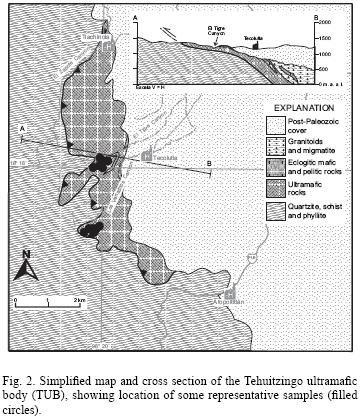
<body><![CDATA[<p align="justify"><font face="verdana" size="2"><b>Key words:</b> Serpentinites, Cr&#150;spinel, "Xayacatl&aacute;n" ophiolites, trace elements, Tehuitzingo, Mexico.</font></p>     <p align="justify"><font face="verdana" size="2">&nbsp;</font></p>     <p align="justify"><font face="verdana" size="2"><b>Resumen</b></font></p>     <p align="justify"><font face="verdana" size="2">El estudio petrol&oacute;gico y geoqu&iacute;mico de las serpentinitas de la regi&oacute;n de Tehuitzingo proporciona nuevas evidencias petrogen&eacute;ticas y datos preliminares de la naturaleza de los fluidos que interactuaron con el manto peridot&iacute;tico que fue el protolito del cuerpo ultram&aacute;fico de Tehuitzingo, el mayor cuerpo ofol&iacute;tico Paleozoico expuesto del Complejo Acatl&aacute;n al sur de M&eacute;xico. Las texturas de las serpentinitas estudiadas muestran los principales eventos de recristalizaci&oacute;n y metasomatismo, pero las fases diagn&oacute;sticas asociadas con eventos de alta presi&oacute;n relacionados con subducci&oacute;n fueron borradas. Estudios preliminares de is&oacute;topos de H y O en serpentina y clorita sugieren que agua marina fue involucrada probablemente durante el primer evento de serpentinizaci&oacute;n bajo condiciones oce&aacute;nicas.</font></p>     <p align="justify"><font face="verdana" size="2">La cromita accesoria en las serpentinitas tiene un #Cr &#126;0.6 y las serpentinitas presentan bajos contenidos de Ti, Na, Nd, Sm, Lu y Hf, lo cual sugiere que las serpentinitas de Tehuitzingo representan relictos de un manto empobrecido formado en una zona de suprasubducci&oacute;n, probablemente en un ambiente de trasarco que experiment&oacute; una tasa de fusi&oacute;n parcial mayor al 18%. Los patrones normalizados de REEs de las muestras de serpentinita estudiadas son caracter&iacute;sticos de peridotitas representativas de zonas de suprasubducci&oacute;n (peridotitas tipo SSZ) y de dorsales oce&aacute;nicas (peridotitas tipo MOR). Este resultado preeliminar podr&iacute;a estar relacionado con la presencia de fragmentos de la cu&ntilde;a del manto litosf&eacute;rico y de la placa subducida, yuxtapuestos tect&oacute;nicamente en el Complejo Acatl&aacute;n.</font></p>     <p align="justify"><font face="verdana" size="2"><b>Palabras claves:</b> Serpentinitas, Cr espinela, Ofolita "Xayacatl&aacute;n", elementos traza, Tehuitzingo, M&eacute;xico.</font></p>     <p align="justify"><font face="verdana" size="2">&nbsp;</font></p>     <p align="justify"><font face="verdana" size="2"><b>1.  &nbsp;Introduction</b></font></p>     <p align="justify"><font face="verdana" size="2">Serpentinite bodies, up to 500 meters thick and 8 km long, are present in the Tehuitzingo area of the Acatl&aacute;n Complex, in Puebla State, SW Mexico (<a href="/img/revistas/bsgm/v61n3/a9f1.jpg" target="_blank">Figure 1a</a>). The Acatl&aacute;n Complex comprises a deformed and polymetamorphic assemblage of Paleozoic metasedimentary and metavolcanic rocks, granitoids and serpentinized ultramafic bodies (<a href="/img/revistas/bsgm/v61n3/a9f1.jpg" target="_blank">Figure 1b</a>). The Tehuitzingo serpentinite body (TUB) is by far the largest ultramafic body within the Acatl&aacute;n Complex. The sequence extends from Tlachinola to Atolpotitlan, about 10 km south of Tehuitzingo (<a href="#f2">Figure 2).</a> The serpentinites are juxtaposed along a regional thrust fault above low&#150;grade metasedimentary rocks of the Cosoltepec lithodeme (Ortega&#150;Guti&eacute;rrez, 1993).</font></p>     <p align="center"><font face="verdana" size="2"><a name="f2"></a></font></p>     ]]></body>
<body><![CDATA[<p align="center"><font face="verdana" size="2"><img src="/img/revistas/bsgm/v61n3/a9f2.jpg"></font></p>     <p align="justify"><font face="verdana" size="2">Previous studies of the Tehuitzingo serpentinites mainly focused on geology (Ortega&#150;Guti&eacute;rrez, 1978; Carballido&#150;S&aacute;nchez and Delgado&#150;Argote, 1989), mineralogy (Sol&iacute;s&#150;Mu&ntilde;oz, 1978; Gonz&aacute;lez&#150;Mancera, 2001), and associated chromitite bodies (Proenza <i>et al.</i>, 2004; Zaccarini <i>et al.</i>, 2005). However, the signifcance of Tehuitzingo serpentinites is still a matter of debate. These serpentinites were frst interpreted as part of an ophiolite originated at a mid&#150;ocean ridge (Ortega&#150;Guti&eacute;rrez, 1978). In contrast, Proenza <i>et al. </i>(2004) suggested that Tehuitzingo serpentinites were formed at a convergent plate boundary as part of an island arc structure, and were interpreted as a fragment of oceanic lithosphere (Xayacatl&aacute;n Ophiolite) formed in an arc/back&#150;arc environment. In a more recent paper (<i>e. g. </i>Nance <i>et al.</i>, 2006 and references therein), the ultramafic bodies of the Acatl&aacute;n Complex have been interpreted as being associated with the early stages (Ordovician) of the Rheic Ocean opening in the western margin of Gondwana.</font></p>     <p align="justify"><font face="verdana" size="2">In this paper, we provide detailed petrographic and mineral assemblages together with composition of bulk&#150;rock (major and trace elements), minerals, and stable isotopes (D, O), which are used to assess the petrogenesis and tectonic setting of the Tehuitzingo serpentinites.</font></p>     <p align="justify"><font face="verdana" size="2">&nbsp;</font></p>     <p align="justify"><font face="verdana" size="2"><b>2.  &nbsp;Geological setting</b></font></p>     <p align="justify"><font face="verdana" size="2">The Acatl&aacute;n Complex is a polymetamorphic unit of Paleozoic age composed of metasediments, granitoids and mafic&#150;ultramafic rocks metamorphosed at high pressure/ low temperature (subduction event) and high temperature/oderate pressure (collision event) (Ortega&#150;Guti&eacute;rrez, 1978, 1993; Ya&ntilde;ez <i>et al</i>., 1991; Weber <i>et al</i>., 1997; Ortega Guti&eacute;rrez <i>et al</i>., 1999; Malone <i>et al</i>., 2002; El&iacute;as&#150;Herrera and Ortega&#150;Guti&eacute;rrrez, 2002; Meza&#150;Figueroa <i>et al</i>., 2003). According to Ortega&#150;Guti&eacute;rrez (1978, 1993) the Acatl&aacute;n Complex formed essentially as a collisional orogen in Cambro&#150;Devonian times associated with closure of the Iapetus Ocean. However, recent views (e. g. Murphy <i>et al</i>., 2006; Nance <i>et al</i>., 2006) relate it to the opening and closure of the younger Rheic Ocean, and to Permo&#150;Triassic convergence of Pacifc plates on the western margin of Pangea.</font></p>     <p align="justify"><font face="verdana" size="2">These serpentinite bodies are part of the Xayacatl&aacute;n Formation (Ortega&#150;Guti&eacute;rrez, 1978) and comprise greenschists, pelitic schists, gneisses, quartzites, amphibolites, metagabbros, mafic eclogitic and pelitic rocks, and the serpentinites studied in this work.</font></p>     <p align="justify"><font face="verdana" size="2">The Tehuitzingo serpentinite bodies, containing chromitite lenses, are in close relationship with eclogitic rocks embedded within a metasedimentary matrix rich in garnet, rutile and phengite, suggesting that the entire assemblage underwent a common high&#150;pressure metamorphic history. The serpentinites elsewhere in the Acatl&aacute;n Complex also form lenses associated with tabular units of ecloglitic metabasite and high pressure metapelitic rocks (<a href="#f2">Figure 2</a>). They are frequently mylonitic and commonly display foliation defined by the preferred dimensional orientation of antigorite blades and spinels (Proenza <i>et al.</i>, 2004).</font></p>     <p align="justify"><font face="verdana" size="2">The Tehuitzingo ultramafic body can be interpreted as a completely serpentinized harzburgite, where the dominant occurrence of antigorite and interpenetrative and interlocking (non&#150;pseudomorphic) textures are in agreement with the geological history suggested for the Acatl&aacute;n Complex (Ortega&#150;Guti&eacute;rrez, 1978). It forms the base of a dismembered ophiolite consisting of eclogitized mafic metabasites and metapelites thrust over low grade phyllites and quartzites of the Cosoltepec Formation (<a href="/img/revistas/bsgm/v61n3/a9f1.jpg" target="_blank">Figure 1b</a>). Talc rock, chloritites and other metasomatic monomineralic rocks such as tremolitites and epidotites commonly occur in the sole of the thrust. However, because of the wide pressure stability of serpentine (antigorite) and protracted retrogression of the studied rocks, the high pressure regime that affected the ultramafic rocks was only partially preserved in the accompanying metabasites and metasediments.</font></p>     <p align="justify"><font face="verdana" size="2">&nbsp;</font></p>     ]]></body>
<body><![CDATA[<p align="justify"><font face="verdana" size="2"><b>3.  Sampling and analytical methods</b></font></p>     <p align="justify"><font face="verdana" size="2">The serpentinites studied here were collected at Los Venaditos Canyon and El Tigre Canyon at the Tehuitzingo ultramafic body in the Xayacatl&aacute;n Formation of the Acatl&aacute;n Complex in southern Mexico (<a href="/img/revistas/bsgm/v61n3/a9f1.jpg" target="_blank">Figure 1</a>, <a href="#t1">Table 1</a>). Petrographic, mineralogical and textural analyses of serpentinitic rocks were determined frst on six thin sections and then electron microprobe analyses were performed on selected samples.</font></p>     <p align="center"><font face="verdana" size="2"><a name="t1"></a></font></p>     <p align="center"><font face="verdana" size="2"><img src="/img/revistas/bsgm/v61n3/a9t1.jpg"></font></p>     <p align="justify"><font face="verdana" size="2">Mineral compositions were obtained in rock thin sections by electron microprobe using a CAMECA SX 50 instrument at the Serveis Cientifcot&egrave;cnics of the Universitat de Barcelona (Spain). Excitation voltage was 20 kV and beam current 15 nA, except for analyses of Cr&#150;spinel for which a current of 20 nA was preferred. Most elements were measured with a counting time of 10 s, except for Ni, V and Zn (30 s). Calibrations were performed using natural and synthetic reference materials: chromite (Cr, Al, Fe), periclase (Mg), rhodonite (Mn), rutile (Ti), NiO (Ni) and metallic V. The chemical data for Cr&#150;spinels were stoichiometrically recalculated in order to distinguish FeO from Fe<sub>2</sub>O<sub>3</sub> according to the procedure described by Carmichael (1967).</font></p>     <p align="justify"><font face="verdana" size="2">The serpentine polymorphs in twelve serpentinite samples were analyzed using X&#150;ray diffractometry at the Institute of Materials, and electronic transmission microscopy JEOL/2010 at the Faculty of Chemistry, both at the National Autonomous University of Mexico, at 200 Kv operating conditions.</font></p>     <p align="justify"><font face="verdana" size="2">Bulk rock major and minor elements were measured by X&#150;ray fuorescence (XRF) spectrometry at the University Isotope Geochemistry Laboratory (LUGIS) in the Instituto de Geolog&iacute;a, UNAM, using a SIEMENS SRS 3000 spectrometer. Rare earth elements (REE), Sc, As, Rb, Sr, Y, Zr, Nb, Sb, Cs, Ba, Th, U, Pb, Nb, Ta and Hf were analyzed by a commercial laboratory (ACT&#150;LABS) using lithium metaborate/tetraborate fusion with inductively coupled plasma mass spectrometry (ICP&#150;MS), except Sc and As that were analyzed by Instrumental Neutron Activation Analysis (INAA).</font></p>     <p align="justify"><font face="verdana" size="2">Three serpentine and three chlorite separates from the serpentinites were used for oxygen and hydrogen isotope analyses. Samples were grounded and disaggregated in distilled water using an ultrasonic cleaner. The size fraction to mesh &lt;80 was separated in order to remove contaminants. Then a magnet was used to separate magnetite from this fraction. These processes were repeated until no magnetic fraction remained in the separate. Purity of separates was checked by X&#150;ray diffraction and is estimated to be better than 95%. Isotope stable analyses were carried out at the University of New Mexico Department of Earth and Planetary Sciences. Oxygen isotope analyses were carried out using the Sharp (1990) laser fuorination technique. Silicate samples were reacted with BrF<sub>5</sub> and heated with a 25&#150;W Merchantek CO<sub>2</sub> laser. Liberated O<sub>2</sub> gas was purifed and collected on a 13X molecular sieve. The &#948;<sup>18</sup>O values were performed with 1&#150;2 mg of sample and measured on a Finnigan MAT Delta XL mass spectrometer. Hydrogen isotopic analyses were performed with 2&#150;4 mg of sample using the Sharp <i>et al. </i>(2001) method. The &#948;D was measured on a Finnigan MAT Delta<sup>Plus</sup> XL mass spectrometer.</font></p>     <p align="justify"><font face="verdana" size="2">&nbsp;</font></p>     <p align="justify"><font face="verdana" size="2"><b>4.  Results</b></font></p>     ]]></body>
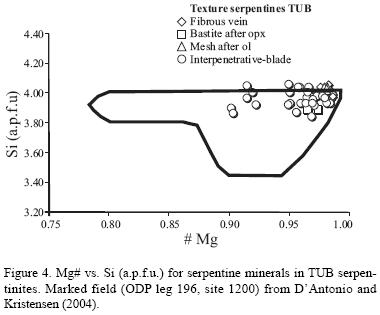
<body><![CDATA[<p align="justify"><font face="verdana" size="2">4.1. Petrography</font></p>     <p align="justify"><font face="verdana" size="2">The studied samples (<a href="#t1">Table 1</a>) consist essentially of 100% serpentinized ultramafic bodies of antigorite serpentinites (Ve02) and occasional chloritites (Ve38) or tremolitites (Ve11), indicating pervasive events of retrogression and metasomatism. The only preserved primary phase is Cr&#150;spinel (<a href="/img/revistas/bsgm/v61n3/a9f3.jpg" target="_blank">Figure 3a</a>). Some samples (Te03, Te04) show a penetrative fabric defined by the preferred dimensional and crystallographic orientation of antigorite blades with grain size between 100&#150;500 &#956;m, but many other lack any foliation and the antigorite blades in some samples tend to form radial aggregates. Clinochlore, rarely accompanied by secondary tremolite and clinopyroxene (Ve06), is a common accessory phase in calcium&#150;rich metasomatized serpentinites. Opaque phases consist of minor Ni&#150;Fe&#150;Cu sulphides, Cr&#150;spinel, and magnetite (<a href="/img/revistas/bsgm/v61n3/a9f3.jpg" target="_blank">Figure 3b</a>), the last usually altered to hematite and goethite. Magnetite and its alteration products occur dispersed regularly or remobilized along the foliated or blastomylonitic serpentinite matrix, although magnetite is more commonly associated with secondary veins of carbonates (<a href="/img/revistas/bsgm/v61n3/a9f3.jpg" target="_blank">Figure 3c</a>). Occasionally, the largest magnetite crystals (up to 1.5 mm) preserved cores of red Cr&#150;spinel, indicating that many grains may be the oxidation end product of primary Cr&#150;spinel. In other samples, it defines symplectitic patterns that suggest a complex metamorphic origin and evolution.</font></p>     <p align="justify"><font face="verdana" size="2">Pseudomorphic textures include bastite (Ve26) in grains about 3&#150;6 mm in size, mainly after orthopyroxene (<a href="/img/revistas/bsgm/v61n3/a9f3.jpg" target="_blank">Figure 3d</a>), and in some samples (Ve02) many crystals of antigorite contain lamellar rods (<a href="/img/revistas/bsgm/v61n3/a9f3.jpg" target="_blank">Figure 3e</a>) of a translucent phase, probably hematites or ilmenite, exsolved along two intersecting planes at 60&deg; from an original iron&#150;bearing pyroxene. Carbonate pseudomorphs after olivine (Ve38) replaced the mesh texture (<a href="/img/revistas/bsgm/v61n3/a9f3.jpg" target="_blank">Figure 3f</a>). In some cases (Ve23), carbonates define pseudomorphic structures up to 1 mm in size (<a href="/img/revistas/bsgm/v61n3/a9f3.jpg" target="_blank">Figure 3g</a>), apparently after clinopyroxene cut by veins of deformed antigorite. Serpentinized olivine pseudomorphs that escaped late deformation were occasionally distinguished forming grains up to 850 &#956;m long (Te18).</font></p>     <p align="justify"><font face="verdana" size="2">Chloritites consist of two generations of chlorite and very fine&#150;grained opaque oxides. Chlorite 1 (older and magnesian) is pleochroic from green to pale yellow (probably Cr&#150;spinel rich), aligned in the foliation and kinked, whereas chlorite 2 (younger and ferrian) flls spaces between Mg&#150;chlorite grains and is not pleochroic. Fe&#150;chlorite appears deformed and foliated inside deformed veins indicating syntectonic emplacement. Moreover, the oxide dust appears to have been formed by pressure&#150;solution phenomena during deformation because it is concentrated in folded stylolitic surfaces in the chloritite.</font></p>     <p align="justify"><font face="verdana" size="2">Irregular, discontinuous veins cutting or following the foliated serpentine groundmass consist of carbonate and magnetite (<a href="/img/revistas/bsgm/v61n3/a9f3.jpg" target="_blank">Figure 3c</a>), indicating late introduction or remobilization of the oxide phase during vein formation. Some of the secondary carbonates replace the cores of many serpentine crystals (<a href="/img/revistas/bsgm/v61n3/a9f3.jpg" target="_blank">Figure 3f</a>), and numerous opaque grains show rims of clinochlore about 200 &#956;m wide cut by the carbonate veins, further suggesting that they represent high&#150;Al primary Cr&#150;spinel altered before carbonate metasomatism. These secondary carbonates (calcite and dolomite) may form up to 20 % of the surface of the thin section area and they are usually very fne grained (10&#150;20 &#956;m), dirty, and associated with very fne grained chrysotile, altering from the antigorite blades.</font></p>     <p align="justify"><font face="verdana" size="2">Deformation fabrics include textures with three penetrative phases of deformation, D<sub>1</sub> represented by intrafolial isoclinal folds (Te01), D<sub>2</sub> by a mylonitic&#150;phyllonitic (Te04) superposed fabric, and D<sub>3</sub> by crenulation of these early folds. S<sub>1</sub> is defined by coarse antigorite blades and large (up to 2 cm; Te01) elongate porphyroclasts (<a href="/img/revistas/bsgm/v61n3/a9f3.jpg" target="_blank">Figure 3h</a>), whereas fner grained (0.5 mm) antigorite (blastomylonitic) is associated with the S<sub>2</sub> and oriented subparallel to S<sub>1</sub>. S<sub>3</sub> is associated to a late crenulation cleavage and to the injection of carbonate&#150;magnetite veins, which show an irregular distribution, arrangements sub&#150;parallel to S<sub>3</sub>, or simple patches replacing the serpentine matrix. Only one carbonate vein traversed the entire thin section, showing in this case a more complex mineralogy that includes a phase optically identifed as prehnite, probably indicating incipient calcium metasomatism that ended locally with rodingite formation, where garnet and clinopyroxene replaced small patches of the serpentinite. Stylolitic folded surfaces defined by concentrations of opaque oxides, phrenite and probably stilpnomelane appear to be related to D<sub>2</sub>.</font></p>     <p align="justify"><font face="verdana" size="2">4.2. Mineral chemistry</font></p>     <p align="justify"><font face="verdana" size="2"><i>4.2.1. Serpentine</i></font></p>     <p align="justify"><font face="verdana" size="2">The chemical compositions of serpentines from Tehuitzingo are presented in <a href="/img/revistas/bsgm/v61n3/a9t2.jpg" target="_blank">Table 2</a>. These results illustrate that SiO<sub>2</sub> exhibits contents from 40.2 to 43.4 wt.%, MgO from 36.3 to 43.1 wt.%, FeO from 1.0 to 6.9 wt.%, Al<sub>2</sub>O<sub>3 </sub>from 0.01 to 2.5 wt.% and Cr<sub>2</sub>O<sub>3</sub> from 0.03 to 1.9 wt.%. The binary diagram Mg# vs. Si (<a href="#f4">Figure 4</a>) shows the wide chemical diversity of the Tehuitzingo serpentines, which also matches the feld representing the compositional range of serpentines described in the literature (D'Antonio and Kristensen, 2004). The Si content of some serpentines shows values slightly higher (&gt;4 a.p.f.u) than commonly reported (<a href="#f4">Figure 4</a>), which could be explained by the occurrence of antigorite, as it has slightly higher SiO<sub>2 </sub>(D'Antonio and Kristensen, 2004).</font></p>     <p align="center"><font face="verdana" size="2"><a name="f4"></a></font></p>     ]]></body>
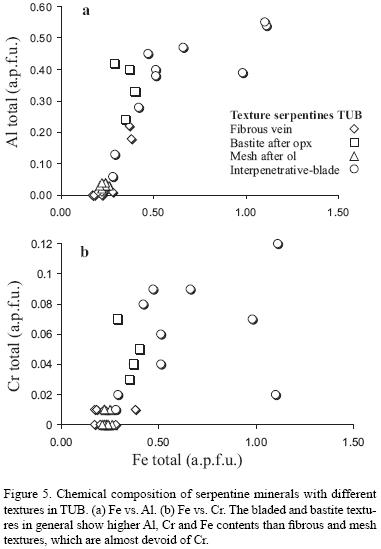
<body><![CDATA[<p align="center"><font face="verdana" size="2"><img src="/img/revistas/bsgm/v61n3/a9f4.jpg"></font></p>     <p align="justify"><font face="verdana" size="2">The chemical composition related to different textures of serpentine analyzed here show signifcant overlap (<a href="/img/revistas/bsgm/v61n3/a9t2.jpg" target="_blank">Table 2</a>, <a href="#f4">Figures 4</a>&#150;<a href="#f5">5</a>). Nevertheless, <a href="#f5">Figure 5</a> shows that bastite textures are different from mesh textures, the former having signifcant amounts of Al and Cr. Serpentine after olivine generally has an Al content below 0.04 and a Cr content below 0.01 a.p.f.u (<a href="/img/revistas/bsgm/v61n3/a9t2.jpg" target="_blank">Table 2</a>). Serpentine minerals flling veins are similar in terms of Al and Cr content, to those replacing olivine (mesh texture).</font></p>     <p align="center"><font face="verdana" size="2"><a name="f5"></a></font></p>     <p align="center"><font face="verdana" size="2"><img src="/img/revistas/bsgm/v61n3/a9f5.jpg"></font></p>     <p align="justify"><font face="verdana" size="2">Serpentines showing interpenetrative&#150;blade texture have Si contents that are between 3.8 and 4.0 (a.p.f.u.), which overlaps with the other studied textures (<a href="#f4">Figure 4</a>). Some of their Mg# values (<a href="#f4">Figure 4</a>) are similar to those textures but are generally lower (0.9). Al can enter in serpentines by tschermak substitution (<sup>VI</sup>Al<sup>IV</sup>Al<sup>VI</sup>Mg<sub>&#150;1</sub><sup>IV</sup>Si<sub>&#150;1</sub>), which is characterized by increasing Al (and Fe) and decreasing Mg and Si (Li <i>et al.</i>, 2004; Hajialioghli <i>et al.</i>, 2007).</font></p>     <p align="justify"><font face="verdana" size="2"><i>4.2.2. Accesory Cr&#150;spinel</i></font></p>     <p align="justify"><font face="verdana" size="2">Ch&#150;spinel (chromite) occurs in irregular to amoeboid shapes. In the serpentine matrix, spinel grains display three different zones: the core (deep red color in thin section when viewed under plane polarized light) represents unaltered (primary) chromite, the intermediate zone (black when viewed under plane polarized light) corresponds to chromite altered to "ferritchromite" and the outer zone is evolved magnetite. Chlorite also occurs as thin rims surrounding altered chromite. Only analyses performed in unaltered cores have been considered in the interpretation of the primary chromite and used for petrogenetic purposes.</font></p>     <p align="justify"><font face="verdana" size="2">The chemical composition of chromite cores in four samples is listed in <a href="/img/revistas/bsgm/v61n3/a9t3.jpg" target="_blank">Table 3</a>. The plots of Cr# (Cr/Cr+Al) vs. Mg# (Mg/Mg+Fe<sup>2+</sup>), and Cr# vs. TiO<sub>2</sub> show that primary chromite compositions are uniform, and plot close to the intermediate part of the SSZ feld, near the depleted end of the abyssal peridotite spinels (<a href="#f6">Figure 6a</a>).</font></p>     <p align="center"><font face="verdana" size="2"><a name="f6"></a></font></p>     <p align="center"><font face="verdana" size="2"><img src="/img/revistas/bsgm/v61n3/a9f6.jpg"></font></p>     ]]></body>
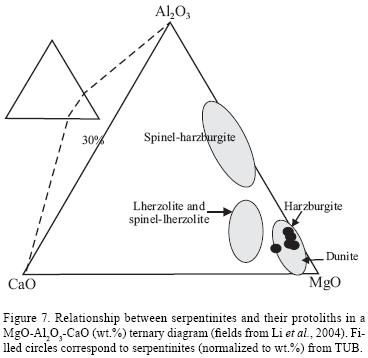
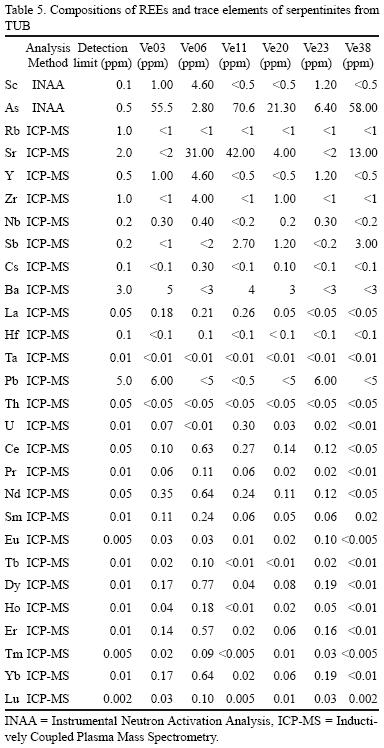
<body><![CDATA[<p align="justify"><font face="verdana" size="2">The Cr# ranges between 0.54&#150;0.63 (<a href="/img/revistas/bsgm/v61n3/a9t3.jpg" target="_blank">Table 3</a>), Mg# ranges from 0.33 to 0.51, and Fe<sup>+3</sup># = &#91;Fe<sup>+3</sup>/ (Fe<sup>+3</sup>+Cr+Al)&#93; is lower than 0.03, corresponding to Fe<sub>2</sub>O<sub>3</sub> contents between 0.2 and 2.6 wt. %; TiO<sub>2</sub> (&lt;0.16 wt.%), MnO (&lt;1 wt.%), ZnO (&lt;1 wt.%), V<sub>2</sub>O<sub>3</sub> (&lt;0.28 wt.%), and NiO (&lt;0.12 wt.%) concentrations are low.</font></p>     <p align="justify"><font face="verdana" size="2">In a Cr# vs. TiO<sub>2</sub> diagram (<a href="#f6">Figure 6b</a>) chromite compositions show an increase in TiO<sub>2</sub> at practically constant Cr#. This trend is probably the result of melt&#150;mantle interactions (<i>e. g. </i>Kelemen <i>et al.</i>, 1995; Dupuis <i>et al.</i>, 2005; Choi <i>et al.</i>, 2008). On the other hand, chromite compositions from Tehuitzingo serpentinites have Al<sub>2</sub>O<sub>3</sub> and TiO<sub>2 </sub>contents similar to those from subduction related mantle peridotites and highly depleted MOR peridotites (Kame&#150;netsky <i>et al.</i>, 2001).</font></p>     <p align="justify"><font face="verdana" size="2"><i>4.2.3. Chlorite</i></font></p>     <p align="justify"><font face="verdana" size="2">Chlorite in the serpentinites is found associated with serpentine, around altered chromite and in massive form. According to the nomenclature proposed by Hey (1954), the first two types were classified as clinochlore with smooth variations to pennine, whilst the last was classifed as chamosite. The FeO<sub>total</sub> content in chamosite (6.7&#150;7.2 wt.%) is higher than in clinochlore (3.2&#150;4.6 wt.%), whereas its Cr<sub>2</sub>O<sub>3</sub> content is lower (&lt; 1 wt.%) than in the latter.</font></p>     <p align="justify"><font face="verdana" size="2">4.3. Whole rock geochemistry</font></p>     <p align="justify"><font face="verdana" size="2"><i>4.3.1. Major elements</i></font></p>     <p align="justify"><font face="verdana" size="2">The whole rock major elements (<a href="/img/revistas/bsgm/v61n3/a9t4.jpg" target="_blank">Table 4</a>) plotted in a CaO&#150;Al<sub>2</sub>O<sub>3</sub>&#150;MgO ternary diagram (<a href="#f7">Figure 7</a>) show that the ultramafic serpentinized rocks of Tehuitzingo correspond to a harzburgitic protolith. Because of the Tehuitzingo serpentinite alteration and its lack of primary mineral phases, it was impossible to calculate the normative values.</font></p>     <p align="center"><font face="verdana" size="2"><a name="f7"></a></font></p>     <p align="center"><font face="verdana" size="2"><img src="/img/revistas/bsgm/v61n3/a9f7.jpg"></font></p>     <p align="justify"><font face="verdana" size="2"><i>4.3.2. Minor and trace elements</i></font></p>     ]]></body>
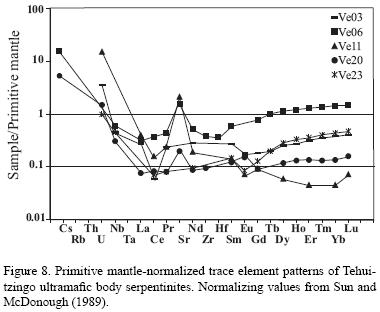
<body><![CDATA[<p align="justify"><font face="verdana" size="2">Whole rock trace element data of six serpentinite samples from the Tehuitzingo ultramafic body are listed in <a href="#t5">Table 5</a>.</font></p>     <p align="center"><font face="verdana" size="2"><a name="t5"></a></font></p>     <p align="center"><font face="verdana" size="2"><img src="/img/revistas/bsgm/v61n3/a9t5.jpg"></font></p>     <p align="justify"><font face="verdana" size="2"><a href="#f8">Figure 8</a> shows the distribution of lithophile trace elements normalized to primitive upper mantle (McDonough and Sun, 1995) for the Tehuitzingo serpentinites. They are depleted in terms of lithophile trace elements. Nevertheless, they show variable relative enrichment in the most of incompatible trace elements (Cs, U, and Nb), and exhibit a positive Sr spike. The REE patterns of Tehuitzingo serpentinites show two groups: group 1 (Ve11 and Ve20) has lower HREE abundances and display relatively fat REE patterns (Ve20) (<a href="#f8">Figure 8</a>), and group 2 (Ve03, Ve06, Ve23) is characterized by LREE&#150;HREE profles with positive slopes (<a href="#f8">Figure 8</a>). A characteristic feature of all REE patterns is the negative Ce anomaly, which probably results from the mobility of the trivalent LREE during secondary alteration (<i>e. g. </i>Gruau <i>et al.</i>, 1998), such as, seafoor weathering or serpentinization (Niu, 2004).</font></p>     <p align="center"><font face="verdana" size="2"><a name="f8"></a></font></p>     <p align="center"><font face="verdana" size="2"><img src="/img/revistas/bsgm/v61n3/a9f8.jpg"></font></p>     <p align="justify"><font face="verdana" size="2">The compositions of Tehuitzingo serpentinites indicate the enrichment of fuid mobile elements (As, Sb, Pb, Sr; <a href="#f9">Figure 9</a>). In this fgure, fuid&#150;mobile elements refer to those with high solubilities in aqueous fluids, whereas fuid&#150;immobile elements are listed in order of compatibility with mantle minerals during partial melting (see Hattori and Guillot, 2007).</font></p>     <p align="center"><font face="verdana" size="2"><a name="f9"></a></font></p>     <p align="center"><font face="verdana" size="2"><img src="/img/revistas/bsgm/v61n3/a9f9.jpg"></font></p>     <p align="justify"><font face="verdana" size="2">4.4. D, O isotopes</font></p>     ]]></body>
<body><![CDATA[<p align="justify"><font face="verdana" size="2">Most analyzed serpentines and chlorites from TUB exhibit similar isotopic compositions (&#948;<sup>18</sup>O between +7.04<img src="/img/revistas/bsgm/v61n3/a9s1.jpg"> and +6.29<img src="/img/revistas/bsgm/v61n3/a9s1.jpg"> and &#948;D values from &#150;47.4<img src="/img/revistas/bsgm/v61n3/a9s1.jpg"> to &#150;66.0<img src="/img/revistas/bsgm/v61n3/a9s1.jpg">) (<a href="/img/revistas/bsgm/v61n3/a9t6.jpg" target="_blank">Table 6</a>). Such values are typical for serpentine formed in the presence of fuids dominated by oceanic water (<a href="#f10">Figure 10</a>). It should be noted that the preliminary nature of these data does not exclude other possible sources in the crust or mantle. The chrysotile vein separate, however, has the lowest &#948;D value (&#150;112<img src="/img/revistas/bsgm/v61n3/a9s1.jpg">; <a href="/img/revistas/bsgm/v61n3/a9t6.jpg" target="_blank">Table 6</a>), which indicates that it formed at a lower temperature than the interpenetrative serpentine.</font></p>     <p align="center"><font face="verdana" size="2"><a name="f10"></a></font></p>     <p align="center"><font face="verdana" size="2"><img src="/img/revistas/bsgm/v61n3/a9f10.jpg"></font></p>     <p align="justify"><font face="verdana" size="2">&nbsp;</font></p>     <p align="justify"><font face="verdana" size="2"><b>5.  Discussion</b></font></p>     <p align="justify"><font face="verdana" size="2">5.1. Implications of serpentinite textures</font></p>     <p align="justify"><font face="verdana" size="2">The composition, mineralogy, and textures of studied serpentinites indicate different processes of serpentinization. The common presence of pseudomorphic textures, representing former orthopyroxene (bastite) and olivine (hour&#150;glass textures), supports the harzburgitic nature of the original mantle rock. However, occasional tremolite&#150;rich rock associated with the serpentinites indicates that clinopyroxene may also have been altered from an original fertile lherzolite by reactions such as Atg + 2 Di + 2 SiO<sub>2</sub> (in the fuid) = Tr + H<sub>2</sub>O, or Di + H<sup>+</sup> = Srp + SiO<sub>2 </sub>+ Ca<sup>++</sup> + H<sub>2</sub>O, rather than by Cametasomatism of the associated metabasites (<i>cf</i>. Frost and Beard, 2007). Bastite pseudomorphs, with their higher content of chromium and aluminum and probably derived from the breakdown of orthopyroxene as previously noticed by Wicks and Plant (1979), represent the frst event of peridotite serpentinization. The pseudomorphic textures probably resulted from ocean foor hydrothermal metamorphism, with some domains of bastite or mesh texture surviving subsequent prograde metamorphism and deformation. Mylonitic fabrics and folded bladed texture are dominated by anti&#150;gorite (determined by XRD), which may have developed during subduction of the oceanic lithosphere or collisional emplacement. Interpenetrative and interlocking textures, which are interpreted as having formed by retrograde metamorphism during exhumation of a previously existing non&#150;pseudomorphic texture, are composed of prograde antigorite. Veins of chrysotile and blades of serpentine accompanied by abundant magnetite were produced in a late&#150;stage hydrothermal activity. Some of these veins crosscut earlier carbonate generations.</font></p>     <p align="justify"><font face="verdana" size="2">Cr&#150;spinel is the only residue of the original mantle peridotite and, except for a few pseudomorphic textures (bastite and mesh), the majority of the Tehuitzingo serpentinites exhibit interpenetrating textures, where most serpentine is antigorite with minor lizardite. Experimental studies have confrmed that antigorite is the most stable mineral at high pressures and moderate temperatures in subduction zones (Chernosky <i>et al.</i>, 1988; Ulmer and Trommsdorff, 1995).</font></p>     <p align="justify"><font face="verdana" size="2">5.2. P&#150;T conditions of serpentinization</font></p>     <p align="justify"><font face="verdana" size="2">Geothermometry in completely serpentinized ultra&#150;mafic bodies, devoid of higher temperature metamorphic silicates such as anthophyllite, olivine and pyroxenes, can only be based on the stability of the high&#150;temperature serpentine polymorph antigorite. Temperatures above 650&deg; C at any pressure would have originated olivine and pyroxenes for which textural evidence (bastite and hourglass pseudomorphs) is scant, but in this work these textures are ascribed to the original mantle peridotite olivine and pyroxene before its frst serpentinization.</font></p>     ]]></body>
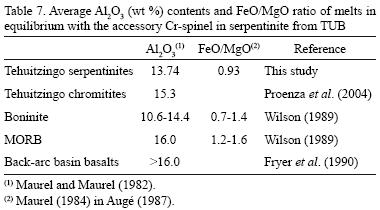
<body><![CDATA[<p align="justify"><font face="verdana" size="2">The residual pseudomorphic textures could represent the oceanic stage alteration within the stability of lizardite and chrysotile relative to antigorite. However, the neocrystallization of olivine and pyroxene (deserpentinization produced by high&#150;grade metamorphism) as the source of pseudomorphic textures of TUB is discarded on the basis of two criteria: (a) the large size (up to 0.5 cm; <a href="/img/revistas/bsgm/v61n3/a9f3.jpg" target="_blank">Figure 3d</a>) of pseudomorphs, which is similar to most mantle peridotite primary textures, and (b) because it has been shown that bastite may be resistant to later changes within the antigorite feld (Dungan, 1979). Moreover, it must be kept in mind that the vast majority of analyzed serpentines (<a href="/img/revistas/bsgm/v61n3/a9t3.jpg" target="_blank">Table 3</a>) have relatively high concentrations of Al<sub>2</sub>O<sub>3</sub> and SiO<sub>2</sub>, which would considerably increase the stability of the lizardite in pseudomorphic textures (Dungan, 1979). Strongly sheared and folded serpentines, composed of antigorite, may correspond to the different orogenic stages leading to tectonic collisions, while the complex textures formed by replacement of antigorite by chrysotile and late emplacement of veins of hydroxides, carbonates and oxides were formed during the fnal stages of exhumation and under a stress regime in the brittle&#150;ductile transition.</font></p>     <p align="justify"><font face="verdana" size="2">The Mg/Si rates between 1.30 and 1.47 obtained for most of Tehuitzingo serpentines are different from the theoretical stoichiometric value (1.5) for certain serpentine minerals, which implies an excess of silica more common in antigorite compared to lizardite and chrysotile. This, in turn, would indicate silica metasomatism during formation of antigorite through mobilization of subduction fluids towards the mantle wedge and before its incorporation to the continental crust during the collision process. Antigorite could also have been generated by the orogenic interaction of the ultramafic mass with continental crust. However, the frst explanation is more reasonable because the silicifcation process would have permeated the entire ultramafic body, whereas interaction of the ultramafic body with crustal rock usually only results in local steatization, where serpentinite is altered across metric sized aureoles in its contact with country rocks.</font></p>     <p align="justify"><font face="verdana" size="2">Most probably the serpentinization events represented by replacement of antigorite by chrysotile&#150;lizardite, occurred between 250 &deg;C and 350 &deg;C, at pressures of about two kbar, corresponding to the late Paleozoic exhumation of the orogen, associated with early stages of the Rheic Ocean closure (<i>e. g</i>., Nance <i>et al.</i>, 2006; Keppie <i>et al.</i>, 2008).</font></p>     <p align="justify"><font face="verdana" size="2">On the other hand, it is clear that the Tehuitzingo ultramafic body, whatever its ultimate origin, has undergone a complex petrological evolution associated with its birth in the mantle to incorporation in the core of a collisional orogen. Clearly distinguishing each of these stages in the present mineralogy and textural relations was not possible because the integrated processes lead to total serpentinization of the original peridotite accompanied by intense shearing, hydrothermal alteration, and metasomatism. Nonetheless, pseudomorphic textures and local preservation of igneous chromite permitted some important inferences about the nature of the precursor mantle rock and the physicochemical conditions that assisted the main events. Whole rock chemistry indicates, assuming an isochemical process except for the massive access of water to the system, that the Tehuitzingo ultramafic body massif evolved from an original suprasubduction zone harzburgite.</font></p>     <p align="justify"><font face="verdana" size="2">5.3. Accessory chromite composition of TUB serpentinites and tectonic implications</font></p>     <p align="justify"><font face="verdana" size="2">The composition of accessory chromite shows that the TUB was formed in a suprasubduction zone in arc/back&#150;arc environment (<a href="#f6">Figure 6a</a>). Two arguments for this interpretation are: (i) the chromite composition in Tehuitzingo serpentinite has predominantly Cr#&lt;0.6, whereas fore&#150;arc peridotites usually have Cr#&gt;0.65 and up to 0.85 (Dick and Bullen, 1984; Niu <i>et al.</i>, 2003), and (ii) the presence of Al&#150;rich chromitites associated with the Tehuitzingo serpentinites. Al&#150;rich chromitites tend to form in nascent spreading centers, such as back&#150;arc basins. By contrast, Al&#150;rich chromitites have not been reported in forearc environments. In addition, no ophiolitic chromitites are thought to form in mature spreading centers, such as mid&#150;ocean ridges (<i>e. g. </i>Arai and Yurimoto, 1995; Zhou and Robinson, 1997; Proenza <i>et al.</i>, 1999).</font></p>     <p align="justify"><font face="verdana" size="2">The accessory chromite in Tehuitzingo serpentinites have Cr# that plot outside the felds defined by boninites of primitive oceanic arcs and mid&#150;ocean ridge basalts (MORB) (<a href="#f6">Figure 6b</a>). Instead, the compositions fall between these felds, which may be explained by a magma of transitional provenance such as a young back&#150;arc, where the chromite would originate from a depleted mantle affected by high degrees of partial melting (&#126;20%; Kamenetsky <i>et al.</i>, 2001). The variation in the Mg# depends on the Cr&#150;spinel/olivine ratio since it is the result of subsolidus Mg&#150;Fe exchange between olivine and Cr spinel on cooling.</font></p>     <p align="justify"><font face="verdana" size="2">5.4. Parental melts</font></p>     <p align="justify"><font face="verdana" size="2">Further insights into the chemistry of the parental melts for the studied chromites can be gained using the equation of Maurel and Maurel (1982), namely, (Al<sub>2</sub>O<sub>3</sub> wt%)<sub>Sp</sub> = 0.035(Al<sub>2</sub>O<sub>3</sub> wt%)<sub>Liquid</sub><sup>2.42</sup>.</font></p>     <p align="justify"><font face="verdana" size="2">The results show that melts had an average Al<sub>2</sub>O<sub>3</sub> content of 13.74% (<a href="#t7">Table 7</a>). This value is similar to the Al<sub>2</sub>O<sub>3 </sub>contents of mid&#150;ocean ridge and backarc basin basalts (Wilson, 1989; Fryer <i>et al.</i>, 1990).</font></p>     ]]></body>
<body><![CDATA[<p align="center"><font face="verdana" size="2"><a name="t7"></a></font></p>     <p align="center"><font face="verdana" size="2"><img src="/img/revistas/bsgm/v61n3/a9t7.jpg"></font></p>     <p align="justify"><font face="verdana" size="2">&nbsp;</font></p>     <p align="justify"><font face="verdana" size="2">Probably this Al<sub>2</sub>O<sub>3</sub> content represents transitional compositions associated with non&#150;evolved back arc basin basalt. We calculated the degree of partial melting (F) of the TUB precursor peridotite, based on the empirical equation proposed by Hellebrand <i>et al. </i>(2001), F = 10 ln (Cr#) + 24, suggesting partial melting up to 18 % (<a href="#t8">Table 8</a>), which is within the range of peridotites from suprasubduction zones (<a href="#t8">Table 8</a>).</font></p>     <p align="center"><font face="verdana" size="2"><a name="t8"></a></font></p>     <p align="center"><font face="verdana" size="2"><img src="/img/revistas/bsgm/v61n3/a9t8.jpg"></font></p>     <p align="justify"><font face="verdana" size="2">5.5. Geochemistry</font></p>     <p align="justify"><font face="verdana" size="2">Preliminary REE geochemistry of TUB serpentinites distinguished two groups of samples, as observed in primitive&#150;normalized REE patterns (<a href="#f8">Figure 8</a>). One group (Ve11, Ve20) displays morphological REE patterns with fat to negative slope trends (<a href="#f8">Figure 8</a>). This preferential fractionation of LREE in relation to the rest of the REEs cannot be explained exclusively in terms of partial melting with extraction of melt. In contrast, it can be interpreted as a result of fractionation of the most incompatible REE associated with percolation of small fractions of volatile&#150;rich melt through porous channels (Van der Wal and Bodinier, 1996; Proenza <i>et al.</i>, 1999; Melcher <i>et al.</i>, 2002). The LREE enrichment with respect to the HREE is probably not related to the addition of seawater (serpentinization), as seawater is depleted in REE (<i>e. g.</i>, Li and Lee, 2006). These patterns are more characteristic of suprasubduction zones (SSZ) and may be due to secondary metasomatism during subduction or metamorphic interaction with the continental crust. However, because the TUB in Acatl&aacute;n Complex underwent a very complex orogenic history, these effects could not be evaluated in this paper.</font></p>     <p align="justify"><font face="verdana" size="2">The other group (Ve03, Ve06, Ve23) shows higher REE values, and in general developed patterns with positive slopes (<a href="#f8">Figure 8</a>). These REE patterns are characteristic of abyssal peridotites (MOR&#150;type), but such geochemical signatures in mantle peridotites (SSZ and MOR) are common in many ophiolites. MOR&#150;type signatures may be naturally preserved because melt/peridotite interaction in SSZ does not affect equally the entire wedge.</font></p>     <p align="justify"><font face="verdana" size="2">On the other hand, all samples are enriched in LILE (<a href="#f8">Figures 8</a>&#150;<a href="#f9">9</a>) (As, Sb, Cs, U, Sr), which could be associated with seawater alteration or fuids produced by dehydration of subducted slab (Stolper and Newman, 1994; Keppler, 1996; Stalder <i>et al.</i>, 1998). Thus, this enrichment of Tehuitzingo serpentinites can be explained by infltration of hydrothermal fuids derived from seawater and/or fuids related to dehydration of the subducted slab. Fluids related to the subducted slab are hotter than those related to seawater infltration; in the former case, LREE enrichment can be expected relative to HFSE.</font></p>     ]]></body>
<body><![CDATA[<p align="justify"><font face="verdana" size="2">The extremely low content of tantalum in the TUB serpentinites and low content of thorium (<a href="#t5">Table 5</a>), compared to ytterbium also indicates a suprasubduction environment (Gorton and Schandl, 2000), probably associated with an oceanic arc.</font></p>     <p align="justify"><font face="verdana" size="2">5.6. Preliminary study on the isotopic composition of <sup>18</sup>O and D</font></p>     <p align="justify"><font face="verdana" size="2">The isotopic compositions of oxygen and hydrogen have been used (Wenner and Taylor, 1973) to identify the source of water that produced the serpentinization. Sheppard (1986) mentions that the D/H ratio rather than the 18O/16O ratio of water is often the most defnitive parameter to determine the source of water because oxygen isotope composition of water may not retain the "label" of its source. In this study, the calculated <sup>18</sup>O fuid compositions of fuid in equilibrium with serpentine (antigorite) are consistent with marine water interaction (<a href="/img/revistas/bsgm/v61n3/a9t6.jpg" target="_blank">Table 6</a>). <a href="#f10">Figure 10</a> shows that chlorites and serpentines fall near the range of "oceanic serpentine" (&#948;<sup>18</sup>O= +0.8<img src="/img/revistas/bsgm/v61n3/a9s1.jpg"> to +6.7<img src="/img/revistas/bsgm/v61n3/a9s1.jpg">, &#948;D= &#150;68<img src="/img/revistas/bsgm/v61n3/a9s1.jpg"> to &#150; 35<img src="/img/revistas/bsgm/v61n3/a9s1.jpg">) as defined by Wenner and Taylor (1973), whereas the D/H values exhibit values that could suggest moderate temperatures (350 &plusmn; 50&deg;C). If continental serpentinization had occurred, we would expect minerals with relatively high <sup>18</sup>O values (around 12&#150;15<img src="/img/revistas/bsgm/v61n3/a9s1.jpg"> or higher).</font></p>     <p align="justify"><font face="verdana" size="2">Analyses of hydrogen and oxygen isotopes in serpentine minerals indicate that lizardite and chrysotile can be distinguished from antigorite by their isotopic signature (Wicks and O'Hanley, 1988).</font></p>     <p align="justify"><font face="verdana" size="2">Chrysotile veins in TUB have lower &#948;D (&#150;112<img src="/img/revistas/bsgm/v61n3/a9s1.jpg">) than matrix antigorite or chlorite (<a href="#f10">Figure 10</a>, <a href="/img/revistas/bsgm/v61n3/a9t6.jpg" target="_blank">Table 6</a>), probably indicating that chrysotile experienced exchange with water at low temperatures. Moreover, the relatively higher &#948;<sup>18</sup>O values of chrysotile (7.02<img src="/img/revistas/bsgm/v61n3/a9s1.jpg">) suggest that the fuid activity occurred at temperatures lower than antigorite crystallization.</font></p>     <p align="justify"><font face="verdana" size="2">Data for serpentine and other phyllosilicates show that chrysotile and lizardite readily exchange hydrogen with ambient fuids at low temperatures, leading to very low &#948;D (Kyser and Kerrich, 1991; Kyser <i>e</i>/ <i>ah, </i>1999). In contrast, coarse grained antigorite exchanges hydrogen much more slowly and retains its original &#948;D.</font></p>     <p align="justify"><font face="verdana" size="2">The oxygen and hydrogen isotopic compositions of the analyzed serpentine and accessory chlorite mainly fall within the "oceanic serpentine" (<a href="#f10">Figure 10</a>) or forearc sea&#150;mount felds defined by Wenner and Taylor (1973, 1974) and Sakai <i>et al. </i>(1990) respectively, which suggests that chloritization and serpentinization took place in an oceanic arc setting process at moderate temperatures (&#126;300&deg;C) by seawater&#150;derived fuids. Wenner and Taylor (1973) concluded that antigorite serpentinization apparently occurs at higher temperatures (220&deg; to 460&deg;C) than lizardite&#150;chrysotile serpentinization of alpine ultramafic rocks. Chlorite geothermometry (Gonz&aacute;lez&#150;Mancera <i>et al.</i>, 2006) suggests that serpentinization&#150;chloritization processes occurred at 250&deg; to 400&deg;C.</font></p>     <p align="justify"><font face="verdana" size="2">&nbsp;</font></p>     <p align="justify"><font face="verdana" size="2"><b>6. Conclusions</b></font></p>     <p align="justify"><font face="verdana" size="2">The chemical composition and petrographic observations of textures in TUB serpentinites show different stages of alteration from original mantle harzburgites. Residual pseudomorphic coarse grained textures (0.5&#150;1 cm) could represent the oceanic stage developed under anorogenic conditions, within the stability of lizardite and chrysotile. In this phase, a process of neocrystallization of olivine and pyroxene (deserpentinization) as the source of pseudomorphic textures was discarded.</font></p>     ]]></body>
<body><![CDATA[<p align="justify"><font face="verdana" size="2">The dominant serpentinization process found is characterized by interpenetrative textures composed of antigorite, which indicate prograde metamorphism conditions and P(H<sub>2</sub>O)=P<sub>total</sub> (O'Hanley, 1996). The estimated temperature during TUB peak metamorphism was below 600&deg;C and probably occurred during a collisional orogeny that closed the ocean tract where the original peridotites were emplaced. Subsequent serpentinization events represented by replacement of antigorite for chrysotile&#150;lizardite occurred between 300 &deg;C to 500 &deg;C, at unknown pressures. These events should correspond to the orogenic process that exhumed the Acatl&aacute;n Complex by Devonian&#150;Mississippian times.</font></p>     <p align="justify"><font face="verdana" size="2">The composition of accessory chromite suggests that Tehuitzingo serpentinites represent residual mantle that interacted with some melt in a back arc setting.</font></p>     <p align="justify"><font face="verdana" size="2">Our main conclusion is that Tehuitzingo serpentinites represent the relicts of depleted mantle peridotite formed in a suprasubduction zone (probably in a arc/back&#150;arc environment), which experienced a high grade of partial melting (&gt;18%). The enrichment of Mn and Zn in the "ferritcromite" aureoles of Tehuitzingo accessory chromites may be associated with different stages of hydrothermal alteration related to a polymetamorphic history as proposed by Ortega&#150;Guti&eacute;rrez (1981).</font></p>     <p align="justify"><font face="verdana" size="2">The REE patterns obtained from TUB serpentinites are characteristic of suprasubduction peridotites. Two geochemical signatures were found: MOR and SSZ, which could suggest the presence of two tectonic domains: the mantle wedge and the subducted slab. The enrichment in incompatible LILE (Sr, As, Sb, Pb) suggest addition of a fuid component rich in these elements, presumably transferred from the subducted slab in to the mantle wedge within the suprasubduction zone.</font></p>     <p align="justify"><font face="verdana" size="2">Preliminary results from &#948;<sup>18</sup>O and &#948;D compositions determined in serpentine and chlorite minerals from TUB suggest interaction with marine waters.</font></p>     <p align="justify"><font face="verdana" size="2">&nbsp;</font></p>     <p align="justify"><font face="verdana" size="2"><b>Acknowledgements</b></font></p>     <p align="justify"><font face="verdana" size="2">The EPMA analyses were carried out in the Serveis Cientifcot&egrave;cnics of the Universitat of Barcelona (UB). We also acknowledge the assistance of R. Lozano Santa Cruz for his help with XRF analyses and of Antoni Camprub&iacute; for his constructive comments to the analytical work. In addition, the stay to carry out most of analytical part of this work at the Universitat de Barcelona, was possible due to fnancial support from the student mobility program DGEP&#150;UNAM. This paper was supported by a COSUA of the Chemistry Faculty and an UNAM DGAPA project to Fernando Ortega Guti&eacute;rrez. Detailed and critical reviews by F. Zaccarini, I. Uysal and S. Guillot signifcantly improved the manuscript.</font></p>     <p align="justify"><font face="verdana" size="2">&nbsp;</font></p>     <p align="justify"><font face="verdana" size="2"><b>References</b></font></p>     ]]></body>
<body><![CDATA[<!-- ref --><p align="justify"><font face="verdana" size="2">Arai, S., Yurimoto, H., 1995, Possible sub&#150;arc origin of podiform chromitites: Island Arc, 4, 104&#150;111.</font>&nbsp;&nbsp;&nbsp;&nbsp;&nbsp;&nbsp;&nbsp;&nbsp;[&#160;<a href="javascript:void(0);" onclick="javascript: window.open('/scielo.php?script=sci_nlinks&ref=1386807&pid=S1405-3322200900030000900001&lng=','','width=640,height=500,resizable=yes,scrollbars=1,menubar=yes,');">Links</a>&#160;]<!-- end-ref --><!-- ref --><p align="justify"><font face="verdana" size="2">Aug&eacute;, T., 1987, Chromite deposits in the northern Oman ophiolite: mineralogical constraints: Mineralium Deposita, 22, 1&#150;10.</font>&nbsp;&nbsp;&nbsp;&nbsp;&nbsp;&nbsp;&nbsp;&nbsp;[&#160;<a href="javascript:void(0);" onclick="javascript: window.open('/scielo.php?script=sci_nlinks&ref=1386808&pid=S1405-3322200900030000900002&lng=','','width=640,height=500,resizable=yes,scrollbars=1,menubar=yes,');">Links</a>&#160;]<!-- end-ref --><!-- ref --><p align="justify"><font face="verdana" size="2">Burkhard, D.J.M., O'Neil, J.R., 1988, Contrasting serpentinization processes in the eastern Central Alps: Contributions to Mineralogy and Petrology, 99, 498&#150;506.</font>&nbsp;&nbsp;&nbsp;&nbsp;&nbsp;&nbsp;&nbsp;&nbsp;[&#160;<a href="javascript:void(0);" onclick="javascript: window.open('/scielo.php?script=sci_nlinks&ref=1386809&pid=S1405-3322200900030000900003&lng=','','width=640,height=500,resizable=yes,scrollbars=1,menubar=yes,');">Links</a>&#160;]<!-- end-ref --><!-- ref --><p align="justify"><font face="verdana" size="2">Carballido&#150;S&aacute;nchez, E.A., Delgado&#150;Argote, L.A., 1989, Geolog&iacute;a del cuerpo serpent&iacute;nico de Tehuitzingo, Estado de Puebla. Interpretaci&oacute;n preliminar de su emplazamiento: Revista del Instituto de Geolog&iacute;a&#150;Universidad Nacional Aut&oacute;noma de M&eacute;xico, 8, 134&#150;148.</font>&nbsp;&nbsp;&nbsp;&nbsp;&nbsp;&nbsp;&nbsp;&nbsp;[&#160;<a href="javascript:void(0);" onclick="javascript: window.open('/scielo.php?script=sci_nlinks&ref=1386810&pid=S1405-3322200900030000900004&lng=','','width=640,height=500,resizable=yes,scrollbars=1,menubar=yes,');">Links</a>&#160;]<!-- end-ref --><!-- ref --><p align="justify"><font face="verdana" size="2">Carmichael, I.S.E., 1967, The iron&#150;titanium oxides of salic volcanic rocks and their associated ferromagnesian silicates: Contributions to Mineralogy and Petrology, 14, 36&#150;64.</font>&nbsp;&nbsp;&nbsp;&nbsp;&nbsp;&nbsp;&nbsp;&nbsp;[&#160;<a href="javascript:void(0);" onclick="javascript: window.open('/scielo.php?script=sci_nlinks&ref=1386811&pid=S1405-3322200900030000900005&lng=','','width=640,height=500,resizable=yes,scrollbars=1,menubar=yes,');">Links</a>&#160;]<!-- end-ref --><!-- ref --><p align="justify"><font face="verdana" size="2">Chernosky, J.V., Berman, R.G., Bryndzia, L.T, 1988, Stability, phase relations, and thermodynamic properties of chlorites and serpentine group minerals, in Bailey, S.W. (ed.), Hydrous phyllosilicates: Mineralogical Society of America Reviews in Mineralogy 19: 295&#150;346.</font>&nbsp;&nbsp;&nbsp;&nbsp;&nbsp;&nbsp;&nbsp;&nbsp;[&#160;<a href="javascript:void(0);" onclick="javascript: window.open('/scielo.php?script=sci_nlinks&ref=1386812&pid=S1405-3322200900030000900006&lng=','','width=640,height=500,resizable=yes,scrollbars=1,menubar=yes,');">Links</a>&#160;]<!-- end-ref --><!-- ref --><p align="justify"><font face="verdana" size="2">Choi, S.H., Shervais, J.W., Mukasa, S.B., 2008, Suprasubduction and abyssal mantle peridotites of the coast range ophiolite, California: Contributions to Mineralogy and Petrology, 156, 551&#150;576.</font>&nbsp;&nbsp;&nbsp;&nbsp;&nbsp;&nbsp;&nbsp;&nbsp;[&#160;<a href="javascript:void(0);" onclick="javascript: window.open('/scielo.php?script=sci_nlinks&ref=1386813&pid=S1405-3322200900030000900007&lng=','','width=640,height=500,resizable=yes,scrollbars=1,menubar=yes,');">Links</a>&#160;]<!-- end-ref --><!-- ref --><p align="justify"><font face="verdana" size="2">D'Antonio, M., Kristensen, M.B., 2004, Serpentine and brucite of ultramafic clasts from the South Chamorro Seamount (Ocean Drilling Program Leg 196, Site 1200): inferences for the serpentinization of the Mariana forearc mantle: Mineralogical Magazine, 68, 887&#150;904.</font>&nbsp;&nbsp;&nbsp;&nbsp;&nbsp;&nbsp;&nbsp;&nbsp;[&#160;<a href="javascript:void(0);" onclick="javascript: window.open('/scielo.php?script=sci_nlinks&ref=1386814&pid=S1405-3322200900030000900008&lng=','','width=640,height=500,resizable=yes,scrollbars=1,menubar=yes,');">Links</a>&#160;]<!-- end-ref --><!-- ref --><p align="justify"><font face="verdana" size="2">Dick, H.J.B., Bullen, T., 1984, Chromite as a petrogenetic indicator in abyssal and alpine&#150;type peridotites and spatially associated lavas: Contributions to Mineralogy and Petrology, 86, 54&#150;76.</font>&nbsp;&nbsp;&nbsp;&nbsp;&nbsp;&nbsp;&nbsp;&nbsp;[&#160;<a href="javascript:void(0);" onclick="javascript: window.open('/scielo.php?script=sci_nlinks&ref=1386815&pid=S1405-3322200900030000900009&lng=','','width=640,height=500,resizable=yes,scrollbars=1,menubar=yes,');">Links</a>&#160;]<!-- end-ref --><!-- ref --><p align="justify"><font face="verdana" size="2">Dungan, A.M., 1979, A microprobe study of antigorite and some serpentine pseudomorphs: Canadian Mineralogist, 17, 771&#150;784.</font>&nbsp;&nbsp;&nbsp;&nbsp;&nbsp;&nbsp;&nbsp;&nbsp;[&#160;<a href="javascript:void(0);" onclick="javascript: window.open('/scielo.php?script=sci_nlinks&ref=1386816&pid=S1405-3322200900030000900010&lng=','','width=640,height=500,resizable=yes,scrollbars=1,menubar=yes,');">Links</a>&#160;]<!-- end-ref --><!-- ref --><p align="justify"><font face="verdana" size="2">Dupuis, C., H&eacute;bert, R., Dubois&#150;C&ocirc;te, V., Guilmette, C., Wang, C.S., Li, Y.L., Li, Z.J., 2005, The Yurlung Zangbo Suture Zone ophiolitic m&eacute;lange (southern Tibet): new insights from geochemistry of ultramafic rocks: Journal of Asian Earth Sciences, 25, 937&#150;960.</font>&nbsp;&nbsp;&nbsp;&nbsp;&nbsp;&nbsp;&nbsp;&nbsp;[&#160;<a href="javascript:void(0);" onclick="javascript: window.open('/scielo.php?script=sci_nlinks&ref=1386817&pid=S1405-3322200900030000900011&lng=','','width=640,height=500,resizable=yes,scrollbars=1,menubar=yes,');">Links</a>&#160;]<!-- end-ref --><!-- ref --><p align="justify"><font face="verdana" size="2">El&iacute;as&#150;Herrera, M., Ortega&#150;Guti&eacute;rrez, F., 2002, Caltepec fault zone: an Early Permian dextral transpressional boundary between the Proterozoic Oaxaca and Paleozoic Acatl&aacute;n complexes, southern Mexico, and regional tectonic implications: Tectonics, 21, 1&#150;4.</font>&nbsp;&nbsp;&nbsp;&nbsp;&nbsp;&nbsp;&nbsp;&nbsp;[&#160;<a href="javascript:void(0);" onclick="javascript: window.open('/scielo.php?script=sci_nlinks&ref=1386818&pid=S1405-3322200900030000900012&lng=','','width=640,height=500,resizable=yes,scrollbars=1,menubar=yes,');">Links</a>&#160;]<!-- end-ref --><!-- ref --><p align="justify"><font face="verdana" size="2">Frost, B.R., Beard, J.S., 2007, On silica activity and serpentinization: Journal of Petrology, 48, 1351&#150;1368.</font>&nbsp;&nbsp;&nbsp;&nbsp;&nbsp;&nbsp;&nbsp;&nbsp;[&#160;<a href="javascript:void(0);" onclick="javascript: window.open('/scielo.php?script=sci_nlinks&ref=1386819&pid=S1405-3322200900030000900013&lng=','','width=640,height=500,resizable=yes,scrollbars=1,menubar=yes,');">Links</a>&#160;]<!-- end-ref --><!-- ref --><p align="justify"><font face="verdana" size="2">Fr&uuml;h&#150;Green G.L., Scambelluri, M., Vallis, F., 2001, O&#150;H isotope ratios of high pressure ultramafic rocks: implications for fuid sources and mobility in the subducted hydrous mantle: Contributions to Mineralogy and Petrology, 141, 145&#150;159.</font>&nbsp;&nbsp;&nbsp;&nbsp;&nbsp;&nbsp;&nbsp;&nbsp;[&#160;<a href="javascript:void(0);" onclick="javascript: window.open('/scielo.php?script=sci_nlinks&ref=1386820&pid=S1405-3322200900030000900014&lng=','','width=640,height=500,resizable=yes,scrollbars=1,menubar=yes,');">Links</a>&#160;]<!-- end-ref --><!-- ref --><p align="justify"><font face="verdana" size="2">Fryer, P., Taylor, B., Langmuir, C.H., Hochstaedter, A.G., 1990, Petrology and geochemistry of lavas from the Sumisu and Torishima backarc rifts: Earth and Planetary Science Letters, 100, 161&#150;178.</font>&nbsp;&nbsp;&nbsp;&nbsp;&nbsp;&nbsp;&nbsp;&nbsp;[&#160;<a href="javascript:void(0);" onclick="javascript: window.open('/scielo.php?script=sci_nlinks&ref=1386821&pid=S1405-3322200900030000900015&lng=','','width=640,height=500,resizable=yes,scrollbars=1,menubar=yes,');">Links</a>&#160;]<!-- end-ref --><!-- ref --><p align="justify"><font face="verdana" size="2">Gonz&aacute;lez&#150;Mancera, G., 2001, Mineralog&iacute;a y petrolog&iacute;a de las serpentinas del cuerpo ultram&aacute;fico de Tehuitzingo, Estado de Puebla: M&eacute;xico, D.F., Universidad Nacional Aut&oacute;noma de M&eacute;xico, masters thesis, 103 p.</font>&nbsp;&nbsp;&nbsp;&nbsp;&nbsp;&nbsp;&nbsp;&nbsp;[&#160;<a href="javascript:void(0);" onclick="javascript: window.open('/scielo.php?script=sci_nlinks&ref=1386822&pid=S1405-3322200900030000900016&lng=','','width=640,height=500,resizable=yes,scrollbars=1,menubar=yes,');">Links</a>&#160;]<!-- end-ref --><!-- ref --><p align="justify"><font face="verdana" size="2">Gonz&aacute;lez&#150;Mancera, G., Proenza&#150;Fern&aacute;ndez, J.A., Ortega&#150;Guti&eacute;rrez, F., 2006, Geotermometr&iacute;a de cloritas en serpentinitas del cuerpo ultram&aacute;fico de Tehuitzingo sur de M&eacute;xico, en XVI congreso nacional de geoqu&iacute;mica, UADY: M&eacute;rida, Yucat&aacute;n, M&eacute;xico, INAGEQ, 39&#150;41.</font>&nbsp;&nbsp;&nbsp;&nbsp;&nbsp;&nbsp;&nbsp;&nbsp;[&#160;<a href="javascript:void(0);" onclick="javascript: window.open('/scielo.php?script=sci_nlinks&ref=1386823&pid=S1405-3322200900030000900017&lng=','','width=640,height=500,resizable=yes,scrollbars=1,menubar=yes,');">Links</a>&#160;]<!-- end-ref --><!-- ref --><p align="justify"><font face="verdana" size="2">Gorton, P.M., Schandl, E.S., 2000, From continents to island arcs: a geochemical index of tectonic setting for arc&#150;related and within&#150;plate felsic to intermediate volcanic rocks: <i>The Canadian Mineralogist, </i>38, 1065&#150;1073.</font>&nbsp;&nbsp;&nbsp;&nbsp;&nbsp;&nbsp;&nbsp;&nbsp;[&#160;<a href="javascript:void(0);" onclick="javascript: window.open('/scielo.php?script=sci_nlinks&ref=1386824&pid=S1405-3322200900030000900018&lng=','','width=640,height=500,resizable=yes,scrollbars=1,menubar=yes,');">Links</a>&#160;]<!-- end-ref --><!-- ref --><p align="justify"><font face="verdana" size="2">Gruau, G., Bernard Griffths, J., Lecuyer, C., 1998, The origin of U&#150;shaped rate earth patterns in ophiolite peridotites: assessing the role of secondary alteration and melt/rock reaction&#150;Western United States: Geochemica et Cosmochimica Acta, 62, 3545&#150;3560.</font>&nbsp;&nbsp;&nbsp;&nbsp;&nbsp;&nbsp;&nbsp;&nbsp;[&#160;<a href="javascript:void(0);" onclick="javascript: window.open('/scielo.php?script=sci_nlinks&ref=1386825&pid=S1405-3322200900030000900019&lng=','','width=640,height=500,resizable=yes,scrollbars=1,menubar=yes,');">Links</a>&#160;]<!-- end-ref --><!-- ref --><p align="justify"><font face="verdana" size="2">Hajialioghli, R., Moazzen, M., Droop, G.T.R., Oberh&auml;nsli, R., Bousquet, R., Jahangiri, A., Ziemann, M., 2007, Serpentine polymorphs and P&#150;T evolution of metaperidotites and serpentinites in the Takab area, NW Iran: Mineralogical Magazine, 71, 203&#150;222.</font>&nbsp;&nbsp;&nbsp;&nbsp;&nbsp;&nbsp;&nbsp;&nbsp;[&#160;<a href="javascript:void(0);" onclick="javascript: window.open('/scielo.php?script=sci_nlinks&ref=1386826&pid=S1405-3322200900030000900020&lng=','','width=640,height=500,resizable=yes,scrollbars=1,menubar=yes,');">Links</a>&#160;]<!-- end-ref --><!-- ref --><p align="justify"><font face="verdana" size="2">Hattori, K.H., Guillot, S., 2007, Geochemical character of serpentinites associated with high&#150; to ultrahigh&#150;pressure metamorphic rocks in the Alps, Cuba, and the Himalayas: Recycling of elements in subduction zones: Geochemistry Geophysics Geosystems, 8, Q09010, 1&#150;27.</font>&nbsp;&nbsp;&nbsp;&nbsp;&nbsp;&nbsp;&nbsp;&nbsp;[&#160;<a href="javascript:void(0);" onclick="javascript: window.open('/scielo.php?script=sci_nlinks&ref=1386827&pid=S1405-3322200900030000900021&lng=','','width=640,height=500,resizable=yes,scrollbars=1,menubar=yes,');">Links</a>&#160;]<!-- end-ref --><!-- ref --><p align="justify"><font face="verdana" size="2">Hellebrand, E., Snow, J.E., Dick, H.J.B., Hofmann, A.W., 2001, Coupled major and trace elements as indicators of the extent of melting in mid&#150;ocean&#150;ridge peridotites: Nature, 410, 677&#150;681.</font>&nbsp;&nbsp;&nbsp;&nbsp;&nbsp;&nbsp;&nbsp;&nbsp;[&#160;<a href="javascript:void(0);" onclick="javascript: window.open('/scielo.php?script=sci_nlinks&ref=1386828&pid=S1405-3322200900030000900022&lng=','','width=640,height=500,resizable=yes,scrollbars=1,menubar=yes,');">Links</a>&#160;]<!-- end-ref --><!-- ref --><p align="justify"><font face="verdana" size="2">Hey, M.H., 1954, A new review of the chlorites: Mineralogical Magazine, 30, 277&#150;292.</font>&nbsp;&nbsp;&nbsp;&nbsp;&nbsp;&nbsp;&nbsp;&nbsp;[&#160;<a href="javascript:void(0);" onclick="javascript: window.open('/scielo.php?script=sci_nlinks&ref=1386829&pid=S1405-3322200900030000900023&lng=','','width=640,height=500,resizable=yes,scrollbars=1,menubar=yes,');">Links</a>&#160;]<!-- end-ref --><!-- ref --><p align="justify"><font face="verdana" size="2">Kamenetsky, V.S., Crawford, A.J., Meffre, S., 2001, Factors controlling chemistry of magmatic spinel: an empirical study of associated olivine, Cr&#150;spinel and melt inclusions from primitive rocks: Journal of Petrology, 42, 655&#150;671.</font>&nbsp;&nbsp;&nbsp;&nbsp;&nbsp;&nbsp;&nbsp;&nbsp;[&#160;<a href="javascript:void(0);" onclick="javascript: window.open('/scielo.php?script=sci_nlinks&ref=1386830&pid=S1405-3322200900030000900024&lng=','','width=640,height=500,resizable=yes,scrollbars=1,menubar=yes,');">Links</a>&#160;]<!-- end-ref --><!-- ref --><p align="justify"><font face="verdana" size="2">Kelemen, P.B., Shimizu, N., Salters, V.J.M., 1995, Extraction of mid&#150;ocean ridge basalt from the upwelling mantle by focused fow of melt in dunite channels: Nature, 375, 747&#150;753.*</font>&nbsp;&nbsp;&nbsp;&nbsp;&nbsp;&nbsp;&nbsp;&nbsp;[&#160;<a href="javascript:void(0);" onclick="javascript: window.open('/scielo.php?script=sci_nlinks&ref=1386831&pid=S1405-3322200900030000900025&lng=','','width=640,height=500,resizable=yes,scrollbars=1,menubar=yes,');">Links</a>&#160;]<!-- end-ref --><!-- ref --><p align="justify"><font face="verdana" size="2">Keppie, J.D., Dostal, J., Miller, B.V.., Ramos&#150;Arias, M.A., Morales&#150;G&aacute;mez, M., Nance, R.D., Murphy, J.B., Ortega&#150;Rivera, A., Lee, J.W.K., Housh, T., Cooper, P., 2008, Ordovician&#150;earliest Silurian rift tholeiites in the Acatl&aacute;n Complex, southern Mexico: Evidence of rifting on the southern margin of the Rheic Ocean: Tectonophysics, 461, 130&#150;156.*</font>&nbsp;&nbsp;&nbsp;&nbsp;&nbsp;&nbsp;&nbsp;&nbsp;[&#160;<a href="javascript:void(0);" onclick="javascript: window.open('/scielo.php?script=sci_nlinks&ref=1386832&pid=S1405-3322200900030000900026&lng=','','width=640,height=500,resizable=yes,scrollbars=1,menubar=yes,');">Links</a>&#160;]<!-- end-ref --><!-- ref --><p align="justify"><font face="verdana" size="2">Keppler, H., 1996, Constraints from partitioning experiments on the composition of subduction&#150;zone fuids: Nature, 380, 237&#150;240.*</font>&nbsp;&nbsp;&nbsp;&nbsp;&nbsp;&nbsp;&nbsp;&nbsp;[&#160;<a href="javascript:void(0);" onclick="javascript: window.open('/scielo.php?script=sci_nlinks&ref=1386833&pid=S1405-3322200900030000900027&lng=','','width=640,height=500,resizable=yes,scrollbars=1,menubar=yes,');">Links</a>&#160;]<!-- end-ref --><!-- ref --><p align="justify"><font face="verdana" size="2">Kyser, T.K., Kerrich, R., 1991, Retrograde exchange of hydrogen isotopes between hydrous mineral and water at low temperatures, in Taylor H.P., O'Neil J.R., Kaplan L.R. (eds.), Stable isotope geochemistry: a tribute to Samuel Epstein: Geochemical Society Special Publication 3, 409&#150;422.*</font>&nbsp;&nbsp;&nbsp;&nbsp;&nbsp;&nbsp;&nbsp;&nbsp;[&#160;<a href="javascript:void(0);" onclick="javascript: window.open('/scielo.php?script=sci_nlinks&ref=1386834&pid=S1405-3322200900030000900028&lng=','','width=640,height=500,resizable=yes,scrollbars=1,menubar=yes,');">Links</a>&#160;]<!-- end-ref --><!-- ref --><p align="justify"><font face="verdana" size="2">Kyser, T.K., O'Hanley, D.S., Wicks, F.J., 1999, The origin of fluids associated with serpentinization processes: evidences from stable&#150;isotope compositions: The Canadian Mineralogist, 37, 223&#150;237.*</font>&nbsp;&nbsp;&nbsp;&nbsp;&nbsp;&nbsp;&nbsp;&nbsp;[&#160;<a href="javascript:void(0);" onclick="javascript: window.open('/scielo.php?script=sci_nlinks&ref=1386835&pid=S1405-3322200900030000900029&lng=','','width=640,height=500,resizable=yes,scrollbars=1,menubar=yes,');">Links</a>&#160;]<!-- end-ref --><!-- ref --><p align="justify"><font face="verdana" size="2">Li, Z.A., Lee, C.A., 2006, Geochemical investigation of serpentinized oceanic lithospheric mantle in the Feather River Ophiolite, California: implications for the recycling rate of water by subduction: Chemical Geology, 235, 161&#150;185.</font>&nbsp;&nbsp;&nbsp;&nbsp;&nbsp;&nbsp;&nbsp;&nbsp;[&#160;<a href="javascript:void(0);" onclick="javascript: window.open('/scielo.php?script=sci_nlinks&ref=1386836&pid=S1405-3322200900030000900030&lng=','','width=640,height=500,resizable=yes,scrollbars=1,menubar=yes,');">Links</a>&#160;]<!-- end-ref --><!-- ref --><p align="justify"><font face="verdana" size="2">Li, X.P., Rahn, M., Bucher, K., 2004, Serpentinites of the Zermatt&#150;Saas ophiolite complex and their texture evolution: Journal of Metamorphic Geology, 22, 159&#150;177.</font>&nbsp;&nbsp;&nbsp;&nbsp;&nbsp;&nbsp;&nbsp;&nbsp;[&#160;<a href="javascript:void(0);" onclick="javascript: window.open('/scielo.php?script=sci_nlinks&ref=1386837&pid=S1405-3322200900030000900031&lng=','','width=640,height=500,resizable=yes,scrollbars=1,menubar=yes,');">Links</a>&#160;]<!-- end-ref --><!-- ref --><p align="justify"><font face="verdana" size="2">Malone, J.R., Nance, R.D., Keppie, J.D., Dostal, J., 2002, Deformation history of part of the Acatl&aacute;n Complex: Late Ordovician&#150;Early Silurian and Early Permian orogenesis in southern Mexico: Journal South American Earth Sciences, 15, 511&#150;524.</font>&nbsp;&nbsp;&nbsp;&nbsp;&nbsp;&nbsp;&nbsp;&nbsp;[&#160;<a href="javascript:void(0);" onclick="javascript: window.open('/scielo.php?script=sci_nlinks&ref=1386838&pid=S1405-3322200900030000900032&lng=','','width=640,height=500,resizable=yes,scrollbars=1,menubar=yes,');">Links</a>&#160;]<!-- end-ref --><!-- ref --><p align="justify"><font face="verdana" size="2">Maurel, C., Maurel, O., 1982, &Eacute;tude experimentale de la distribution de l'aluminiun entre bain silicat&eacute; basique et spinelle chromif&eacute;re. Implications p&eacute;trog&eacute;n&eacute;tiques: teneur en chrome des spinelles: Bulletin de Min&eacute;ralogie, 105, 197&#150;202.</font>&nbsp;&nbsp;&nbsp;&nbsp;&nbsp;&nbsp;&nbsp;&nbsp;[&#160;<a href="javascript:void(0);" onclick="javascript: window.open('/scielo.php?script=sci_nlinks&ref=1386839&pid=S1405-3322200900030000900033&lng=','','width=640,height=500,resizable=yes,scrollbars=1,menubar=yes,');">Links</a>&#160;]<!-- end-ref --><!-- ref --><p align="justify"><font face="verdana" size="2">McDonough, W.F., Sun, S.S., 1995, The composition of the earth: Chemical Geology, 120, 223&#150;253.</font>&nbsp;&nbsp;&nbsp;&nbsp;&nbsp;&nbsp;&nbsp;&nbsp;[&#160;<a href="javascript:void(0);" onclick="javascript: window.open('/scielo.php?script=sci_nlinks&ref=1386840&pid=S1405-3322200900030000900034&lng=','','width=640,height=500,resizable=yes,scrollbars=1,menubar=yes,');">Links</a>&#160;]<!-- end-ref --><!-- ref --><p align="justify"><font face="verdana" size="2">Melcher, F., Meisel, T., Puhl, J., Koller, F., 2002, Petrogenesis and geotectonic setting of ultramafic rocks in the Eastern Alps: constraints from geochemistry: Lithos, 65, 69&#150;112.</font>&nbsp;&nbsp;&nbsp;&nbsp;&nbsp;&nbsp;&nbsp;&nbsp;[&#160;<a href="javascript:void(0);" onclick="javascript: window.open('/scielo.php?script=sci_nlinks&ref=1386841&pid=S1405-3322200900030000900035&lng=','','width=640,height=500,resizable=yes,scrollbars=1,menubar=yes,');">Links</a>&#160;]<!-- end-ref --><!-- ref --><p align="justify"><font face="verdana" size="2">Mellini, M., Rumori, C., Viti, C., 2005, Hydrothermally reset magmatic spines in retrograde serpentinites: formation of "ferritchromit" rims and chlorite aureoles: Contributions to Mineralogy and Petrology, 149, 266&#150;275.</font>&nbsp;&nbsp;&nbsp;&nbsp;&nbsp;&nbsp;&nbsp;&nbsp;[&#160;<a href="javascript:void(0);" onclick="javascript: window.open('/scielo.php?script=sci_nlinks&ref=1386842&pid=S1405-3322200900030000900036&lng=','','width=640,height=500,resizable=yes,scrollbars=1,menubar=yes,');">Links</a>&#160;]<!-- end-ref --><!-- ref --><p align="justify"><font face="verdana" size="2">Meza&#150;Figueroa, D., Ruiz, J., Talavera&#150;Mendoza, O., Ortega&#150;Gutierrez, F., 2003, Tectonometamorphic evolution of the Acatlan Complex eclogites (southern Mexico): Canadian Journal of Earth Sciences, 40, 27&#150;44.</font>&nbsp;&nbsp;&nbsp;&nbsp;&nbsp;&nbsp;&nbsp;&nbsp;[&#160;<a href="javascript:void(0);" onclick="javascript: window.open('/scielo.php?script=sci_nlinks&ref=1386843&pid=S1405-3322200900030000900037&lng=','','width=640,height=500,resizable=yes,scrollbars=1,menubar=yes,');">Links</a>&#160;]<!-- end-ref --><!-- ref --><p align="justify"><font face="verdana" size="2">Murphy, J.B., Keppie, J.D., Nance, R.D., Miller B.V., Dostal J., Middleton, M., Fern&aacute;ndez&#150;Su&aacute;rez J., Jeffries T.E., Storey, C. D., 2006, Geochemistry and U&#150;Pb protolith ages of eclogitic rocks of the As&iacute;s Lithodeme, Piaxtla Suite, Acatl&aacute;n Complex, southern Mexico: tectonothermal activity along the southern margin of the Rheic Ocean: Journal of the Geological Society, 163, 683&#150;695.</font>&nbsp;&nbsp;&nbsp;&nbsp;&nbsp;&nbsp;&nbsp;&nbsp;[&#160;<a href="javascript:void(0);" onclick="javascript: window.open('/scielo.php?script=sci_nlinks&ref=1386844&pid=S1405-3322200900030000900038&lng=','','width=640,height=500,resizable=yes,scrollbars=1,menubar=yes,');">Links</a>&#160;]<!-- end-ref --><!-- ref --><p align="justify"><font face="verdana" size="2">Nance, R.D., Miller, B. V. , Keppie, J.D., Murphy J.B., Dostal, J., 2006, Comment on "U&#150;Pb geochronology of the Acatl&aacute;n Complex and implications for the Paleozoic paleogeography and tectonic evolution of southern M&eacute;xico" by O. Talavera&#150;Mendoza, J. Ru&iacute;z, G.E. Geherels, D.M. Meza&#150;Figueroa, R., Vega&#150;Granillo M.F., Campa&#150;Uranga: Earth and Planetary Science Letters, 245, 471&#150;475.</font>&nbsp;&nbsp;&nbsp;&nbsp;&nbsp;&nbsp;&nbsp;&nbsp;[&#160;<a href="javascript:void(0);" onclick="javascript: window.open('/scielo.php?script=sci_nlinks&ref=1386845&pid=S1405-3322200900030000900039&lng=','','width=640,height=500,resizable=yes,scrollbars=1,menubar=yes,');">Links</a>&#160;]<!-- end-ref --><!-- ref --><p align="justify"><font face="verdana" size="2">Niu, Y., O'Hara, M.J., Pearce, J.A., 2003, Initiation of subduction zones as a consequence of lateral compositional bouyancy contrast within the lithosphere: a petrological perspective: Journal of Petrology, 44, 851&#150;866.</font>&nbsp;&nbsp;&nbsp;&nbsp;&nbsp;&nbsp;&nbsp;&nbsp;[&#160;<a href="javascript:void(0);" onclick="javascript: window.open('/scielo.php?script=sci_nlinks&ref=1386846&pid=S1405-3322200900030000900040&lng=','','width=640,height=500,resizable=yes,scrollbars=1,menubar=yes,');">Links</a>&#160;]<!-- end-ref --><!-- ref --><p align="justify"><font face="verdana" size="2">Niu, Y., 2004, Bulk&#150;rock major and trace element compositions of abyssal peridotites: implications for mantle melting, melt extraction and post&#150;melting processes beneath mid&#150;ocean ridges: Journal of Petrology, 45, 2423&#150;2458.</font>&nbsp;&nbsp;&nbsp;&nbsp;&nbsp;&nbsp;&nbsp;&nbsp;[&#160;<a href="javascript:void(0);" onclick="javascript: window.open('/scielo.php?script=sci_nlinks&ref=1386847&pid=S1405-3322200900030000900041&lng=','','width=640,height=500,resizable=yes,scrollbars=1,menubar=yes,');">Links</a>&#160;]<!-- end-ref --><!-- ref --><p align="justify"><font face="verdana" size="2">O'Hanley, D.S., 1996. Serpentinites: Records of tectonic and petrological history: New York, U.S.A., Oxford University Press, 277 p.</font>&nbsp;&nbsp;&nbsp;&nbsp;&nbsp;&nbsp;&nbsp;&nbsp;[&#160;<a href="javascript:void(0);" onclick="javascript: window.open('/scielo.php?script=sci_nlinks&ref=1386848&pid=S1405-3322200900030000900042&lng=','','width=640,height=500,resizable=yes,scrollbars=1,menubar=yes,');">Links</a>&#160;]<!-- end-ref --><!-- ref --><p align="justify"><font face="verdana" size="2">Ortega&#150;Guti&eacute;rrez, F., 1978, Estratigraf&iacute;a del Complejo Acatl&aacute;n en la Mixteca Baja, estados de Puebla y Oaxaca: Revista del Instituto de Geolog&iacute;a&#150;Universidad Nacional Aut&oacute;noma de M&eacute;xico,, 2, 112&#150;131.</font>&nbsp;&nbsp;&nbsp;&nbsp;&nbsp;&nbsp;&nbsp;&nbsp;[&#160;<a href="javascript:void(0);" onclick="javascript: window.open('/scielo.php?script=sci_nlinks&ref=1386849&pid=S1405-3322200900030000900043&lng=','','width=640,height=500,resizable=yes,scrollbars=1,menubar=yes,');">Links</a>&#160;]<!-- end-ref --><!-- ref --><p align="justify"><font face="verdana" size="2">Ortega&#150;Guti&eacute;rrez, F., 1981, Metamorphic belts of southern Mexico and their tectonic signifcance: Geofsica Internacional, 20, 177&#150;202.</font>&nbsp;&nbsp;&nbsp;&nbsp;&nbsp;&nbsp;&nbsp;&nbsp;[&#160;<a href="javascript:void(0);" onclick="javascript: window.open('/scielo.php?script=sci_nlinks&ref=1386850&pid=S1405-3322200900030000900044&lng=','','width=640,height=500,resizable=yes,scrollbars=1,menubar=yes,');">Links</a>&#160;]<!-- end-ref --><!-- ref --><p align="justify"><font face="verdana" size="2">Ortega&#150;Guti&eacute;rrez, F., 1993, Tectonostratigraphic analysis and signifcance of the Paleozoic Acatl&aacute;n Complex of Southern Mexico, in Ortega&#150;Guti&eacute;rrez, F., Centeno&#150;Garc&iacute;a, E., Mor&aacute;n&#150;Zenteno, D.J., G&oacute;mez&#150;Caballero, A. (eds.), Guidebook of Field Trip B: Terrane geology of southern M&eacute;xico, First circum&#150;Pacifc and circum&#150;Atlantic terrane conference: M&eacute;xico, D. F., Instituto de Geolog&iacute;a&#150;UNAM, 54&#150;60.</font>&nbsp;&nbsp;&nbsp;&nbsp;&nbsp;&nbsp;&nbsp;&nbsp;[&#160;<a href="javascript:void(0);" onclick="javascript: window.open('/scielo.php?script=sci_nlinks&ref=1386851&pid=S1405-3322200900030000900045&lng=','','width=640,height=500,resizable=yes,scrollbars=1,menubar=yes,');">Links</a>&#160;]<!-- end-ref --><!-- ref --><p align="justify"><font face="verdana" size="2">Ortega&#150;Guti&eacute;rrez F., El&iacute;as&#150;Herrera, M., Reyes&#150;Salas, M., Mac&iacute;as&#150;Romo, C., 1999, Late Ordovician&#150;Early Silurian continental collisional orogeny in southern Mexico and its bearing on Gondwana&#150;Laurentia connections: Geology, 27, 719&#150;722.</font>&nbsp;&nbsp;&nbsp;&nbsp;&nbsp;&nbsp;&nbsp;&nbsp;[&#160;<a href="javascript:void(0);" onclick="javascript: window.open('/scielo.php?script=sci_nlinks&ref=1386852&pid=S1405-3322200900030000900046&lng=','','width=640,height=500,resizable=yes,scrollbars=1,menubar=yes,');">Links</a>&#160;]<!-- end-ref --><!-- ref --><p align="justify"><font face="verdana" size="2">Pearce, J.A., Barker, P.F., Edward, S.J., 2000, Geochemistry and tectonic signifcance of peridotites from the South Sandwich arc&#150;basin system, South Atlantic: Contributions to Mineralogy and Petrolology, 139, 36&#150;53.</font>&nbsp;&nbsp;&nbsp;&nbsp;&nbsp;&nbsp;&nbsp;&nbsp;[&#160;<a href="javascript:void(0);" onclick="javascript: window.open('/scielo.php?script=sci_nlinks&ref=1386853&pid=S1405-3322200900030000900047&lng=','','width=640,height=500,resizable=yes,scrollbars=1,menubar=yes,');">Links</a>&#160;]<!-- end-ref --><!-- ref --><p align="justify"><font face="verdana" size="2">Proenza, J.A., Gervilla, F., Melgarejo, J.C., Bodinier, J.L., 1999, Al&#150; and Cr&#150;rich chromitites from the Mayar&iacute;&#150;Baracoa Ophiolitic Belt (Eastern Cuba): Consequence of interaction between volatile&#150;rich melts and peridotites in suprasubduction mantle: Economic Geology, 94, 547&#150;566.</font>&nbsp;&nbsp;&nbsp;&nbsp;&nbsp;&nbsp;&nbsp;&nbsp;[&#160;<a href="javascript:void(0);" onclick="javascript: window.open('/scielo.php?script=sci_nlinks&ref=1386854&pid=S1405-3322200900030000900048&lng=','','width=640,height=500,resizable=yes,scrollbars=1,menubar=yes,');">Links</a>&#160;]<!-- end-ref --><!-- ref --><p align="justify"><font face="verdana" size="2">Proenza, J.A., Alfonso, P. , Melgarejo, J.C., Gervilla, F., Tritlla, J., Fallick, A.E., 2003, D, O, and C isotopes in podiform chromitites as fuids tracers for hydrotermal alteration processes of the Mayari&#150;Baracoa ophiolitic belt, eastern Cuba: Journal of Geochemical Exploration, 78&#150;79, 117&#150;122.</font>&nbsp;&nbsp;&nbsp;&nbsp;&nbsp;&nbsp;&nbsp;&nbsp;[&#160;<a href="javascript:void(0);" onclick="javascript: window.open('/scielo.php?script=sci_nlinks&ref=1386855&pid=S1405-3322200900030000900049&lng=','','width=640,height=500,resizable=yes,scrollbars=1,menubar=yes,');">Links</a>&#160;]<!-- end-ref --><!-- ref --><p align="justify"><font face="verdana" size="2">Proenza, J.A., Ortega&#150;Guti&eacute;rrez, F., Camprub&iacute;, A., Tritlla, J., El&iacute;as&#150;He&#150;rrera, M., Reyes&#150;Salas, M., 2004, Paleozoic serpentinite&#150;enclosed chromitites from Tehuitzingo (Acatl&aacute;n Complex, southern Mexico): a petrological and mineralogical study: Journal of South American Earth Sciences, 16, 649&#150;666.</font>&nbsp;&nbsp;&nbsp;&nbsp;&nbsp;&nbsp;&nbsp;&nbsp;[&#160;<a href="javascript:void(0);" onclick="javascript: window.open('/scielo.php?script=sci_nlinks&ref=1386856&pid=S1405-3322200900030000900050&lng=','','width=640,height=500,resizable=yes,scrollbars=1,menubar=yes,');">Links</a>&#160;]<!-- end-ref --><!-- ref --><p align="justify"><font face="verdana" size="2">Sakai, R., Kusakabe, M., Noto, M., Ishii, T., 1990, Origin of waters responsible for serpentinization of the Izu&#150;Ogasawara&#150;Mariana forearc seamounts in view of hydrogen and oxygen isotope ratios: Earth and Planetary Science Letters, 100, 291&#150;303.</font>&nbsp;&nbsp;&nbsp;&nbsp;&nbsp;&nbsp;&nbsp;&nbsp;[&#160;<a href="javascript:void(0);" onclick="javascript: window.open('/scielo.php?script=sci_nlinks&ref=1386857&pid=S1405-3322200900030000900051&lng=','','width=640,height=500,resizable=yes,scrollbars=1,menubar=yes,');">Links</a>&#160;]<!-- end-ref --><!-- ref --><p align="justify"><font face="verdana" size="2">Sharp, Z.D., 1990, A laser based microanalytical method for the in situ determination of oxygen isotope ratios of silicates and oxides: Geochimica et Cosmochimica Acta, 54, 1354&#150;1357.</font>&nbsp;&nbsp;&nbsp;&nbsp;&nbsp;&nbsp;&nbsp;&nbsp;[&#160;<a href="javascript:void(0);" onclick="javascript: window.open('/scielo.php?script=sci_nlinks&ref=1386858&pid=S1405-3322200900030000900052&lng=','','width=640,height=500,resizable=yes,scrollbars=1,menubar=yes,');">Links</a>&#160;]<!-- end-ref --><!-- ref --><p align="justify"><font face="verdana" size="2">Sharp, Z.D., Atudorei, V. , Durakiewicz, T., 2001, A rapid method for determination of hydrogen and oxygen isotope ratios from water and hydrous minerals: Chemical Geology, 178, 197&#150;210.</font>&nbsp;&nbsp;&nbsp;&nbsp;&nbsp;&nbsp;&nbsp;&nbsp;[&#160;<a href="javascript:void(0);" onclick="javascript: window.open('/scielo.php?script=sci_nlinks&ref=1386859&pid=S1405-3322200900030000900053&lng=','','width=640,height=500,resizable=yes,scrollbars=1,menubar=yes,');">Links</a>&#160;]<!-- end-ref --><!-- ref --><p align="justify"><font face="verdana" size="2">Sheppard, S.M.F., 1986, Characterization and isotopic variations in natural waters: Reviews in Mineralogy and Geochemistry, 16, 165&#150;183.</font>&nbsp;&nbsp;&nbsp;&nbsp;&nbsp;&nbsp;&nbsp;&nbsp;[&#160;<a href="javascript:void(0);" onclick="javascript: window.open('/scielo.php?script=sci_nlinks&ref=1386860&pid=S1405-3322200900030000900054&lng=','','width=640,height=500,resizable=yes,scrollbars=1,menubar=yes,');">Links</a>&#160;]<!-- end-ref --><!-- ref --><p align="justify"><font face="verdana" size="2">Snow, J.E., Dick, H.J.B., 1995, Pervasive magnesium loss by marine weathering of peridotite: Geochimica et Cosmochimica Acta, 59, 4219&#150;4235.</font>&nbsp;&nbsp;&nbsp;&nbsp;&nbsp;&nbsp;&nbsp;&nbsp;[&#160;<a href="javascript:void(0);" onclick="javascript: window.open('/scielo.php?script=sci_nlinks&ref=1386861&pid=S1405-3322200900030000900055&lng=','','width=640,height=500,resizable=yes,scrollbars=1,menubar=yes,');">Links</a>&#160;]<!-- end-ref --><!-- ref --><p align="justify"><font face="verdana" size="2">Sol&iacute;s&#150;Mu&ntilde;oz, H.T., 1978, Exploraci&oacute;n minera en el cuerpo serpentinizado de Tehuitzingo Municipio de Tehuitzingo, Puebla: M&eacute;xico, D.F., M&eacute;xico, Consejo de Recursos Minerales, Seminario interno sobre exploraci&oacute;n geol&oacute;gico&#150;minera, Memoria t&eacute;cnica 7, 301&#150;323.</font>&nbsp;&nbsp;&nbsp;&nbsp;&nbsp;&nbsp;&nbsp;&nbsp;[&#160;<a href="javascript:void(0);" onclick="javascript: window.open('/scielo.php?script=sci_nlinks&ref=1386862&pid=S1405-3322200900030000900056&lng=','','width=640,height=500,resizable=yes,scrollbars=1,menubar=yes,');">Links</a>&#160;]<!-- end-ref --><!-- ref --><p align="justify"><font face="verdana" size="2">Stalder, R., Foley, S.F., Brey, G.P., Horn, I., 1998, Mineral-aqueous fuid partitioning of trace elements at 900&#150;1200&deg;C and 3.0&#150;5.7 GPa: new experimental data for garnet, clinopyroxene, and rutile, and implications for mantle metasomatism: Geochimica et Cosmochimica Acta, 62, 1781&#150;1801.</font>&nbsp;&nbsp;&nbsp;&nbsp;&nbsp;&nbsp;&nbsp;&nbsp;[&#160;<a href="javascript:void(0);" onclick="javascript: window.open('/scielo.php?script=sci_nlinks&ref=1386863&pid=S1405-3322200900030000900057&lng=','','width=640,height=500,resizable=yes,scrollbars=1,menubar=yes,');">Links</a>&#160;]<!-- end-ref --><!-- ref --><p align="justify"><font face="verdana" size="2">Stolper, E., Newman, S., 1994, The role of water in the petrogenesis of Mariana trough magmas: Earth and Planetary Science Letters, 121, 293&#150;325.</font>&nbsp;&nbsp;&nbsp;&nbsp;&nbsp;&nbsp;&nbsp;&nbsp;[&#160;<a href="javascript:void(0);" onclick="javascript: window.open('/scielo.php?script=sci_nlinks&ref=1386864&pid=S1405-3322200900030000900058&lng=','','width=640,height=500,resizable=yes,scrollbars=1,menubar=yes,');">Links</a>&#160;]<!-- end-ref --><!-- ref --><p align="justify"><font face="verdana" size="2">Sun, S.S., McDonough, W.F., 1989, Chemical and isotopic systematic of oceanic basalts: implications for mantle composition and processes, in Saunders, A.D., Norry, M.J. (eds.), Magmatism in the ocean basins: London, U.K., Geological Society Special Publication, 42, 313&#150;345.</font>&nbsp;&nbsp;&nbsp;&nbsp;&nbsp;&nbsp;&nbsp;&nbsp;[&#160;<a href="javascript:void(0);" onclick="javascript: window.open('/scielo.php?script=sci_nlinks&ref=1386865&pid=S1405-3322200900030000900059&lng=','','width=640,height=500,resizable=yes,scrollbars=1,menubar=yes,');">Links</a>&#160;]<!-- end-ref --><!-- ref --><p align="justify"><font face="verdana" size="2">Ulmer, P., Trommsdorff, V., 1995, Serpentine stability to mantle depths and subduction&#150;related magmatism: Science, 268, 858&#150;861.</font>&nbsp;&nbsp;&nbsp;&nbsp;&nbsp;&nbsp;&nbsp;&nbsp;[&#160;<a href="javascript:void(0);" onclick="javascript: window.open('/scielo.php?script=sci_nlinks&ref=1386866&pid=S1405-3322200900030000900060&lng=','','width=640,height=500,resizable=yes,scrollbars=1,menubar=yes,');">Links</a>&#160;]<!-- end-ref --><!-- ref --><p align="justify"><font face="verdana" size="2">Van der Wal, D., Bodinier, J.L., 1996, Origin of the recrystallization front in the Ronda peridotites by km&#150;scale pervasive porous melt fow: Contributions to Mineralogy and Petrology, 122, 387&#150;405.</font>&nbsp;&nbsp;&nbsp;&nbsp;&nbsp;&nbsp;&nbsp;&nbsp;[&#160;<a href="javascript:void(0);" onclick="javascript: window.open('/scielo.php?script=sci_nlinks&ref=1386867&pid=S1405-3322200900030000900061&lng=','','width=640,height=500,resizable=yes,scrollbars=1,menubar=yes,');">Links</a>&#160;]<!-- end-ref --><!-- ref --><p align="justify"><font face="verdana" size="2">Weber, B., Meschede, M., Ratschbacher, L., Frisch, W., 1997, Structure and kinematic history of the Acatl&aacute;n Complex in the Nuevos Horizontes&#150;San Bernardo region, Puebla: Geof&iacute;sica Internacional, 36, 63&#150;76.</font>&nbsp;&nbsp;&nbsp;&nbsp;&nbsp;&nbsp;&nbsp;&nbsp;[&#160;<a href="javascript:void(0);" onclick="javascript: window.open('/scielo.php?script=sci_nlinks&ref=1386868&pid=S1405-3322200900030000900062&lng=','','width=640,height=500,resizable=yes,scrollbars=1,menubar=yes,');">Links</a>&#160;]<!-- end-ref --><!-- ref --><p align="justify"><font face="verdana" size="2">Wenner, D.B., Taylor, H.P., 1973, Oxygen and hydrogen isotopes studies of the serpentinization of ultramafic rocks in oceanic environments and continental ophiolite complexes: American Journal of Science, 273, 207&#150;239.</font>&nbsp;&nbsp;&nbsp;&nbsp;&nbsp;&nbsp;&nbsp;&nbsp;[&#160;<a href="javascript:void(0);" onclick="javascript: window.open('/scielo.php?script=sci_nlinks&ref=1386869&pid=S1405-3322200900030000900063&lng=','','width=640,height=500,resizable=yes,scrollbars=1,menubar=yes,');">Links</a>&#160;]<!-- end-ref --><!-- ref --><p align="justify"><font face="verdana" size="2">Wenner, D.B., Taylor, H.P., 1974, D/H and <sup>18</sup>O/<sup>16</sup>O studies of serpentinization of ultramafic rocks: Geochimica et Cosmochimica Acta, 38, 1255&#150;1286.</font>&nbsp;&nbsp;&nbsp;&nbsp;&nbsp;&nbsp;&nbsp;&nbsp;[&#160;<a href="javascript:void(0);" onclick="javascript: window.open('/scielo.php?script=sci_nlinks&ref=1386870&pid=S1405-3322200900030000900064&lng=','','width=640,height=500,resizable=yes,scrollbars=1,menubar=yes,');">Links</a>&#160;]<!-- end-ref --><!-- ref --><p align="justify"><font face="verdana" size="2">Wicks, F.J., Plant, A.G., 1979, Electron microprobe and X&#150;ray micro&#150;beam studies of serpentine minerals: Canadian Mineralogist, 17<b>, </b>785&#150;830.</font>&nbsp;&nbsp;&nbsp;&nbsp;&nbsp;&nbsp;&nbsp;&nbsp;[&#160;<a href="javascript:void(0);" onclick="javascript: window.open('/scielo.php?script=sci_nlinks&ref=1386871&pid=S1405-3322200900030000900065&lng=','','width=640,height=500,resizable=yes,scrollbars=1,menubar=yes,');">Links</a>&#160;]<!-- end-ref --><!-- ref --><p align="justify"><font face="verdana" size="2">Wicks, F.J., O'Hanley, D.S., 1988, Serpentine minerals: structure and petrology, in Bailey, S.W. (ed.), Hydrous Phyllosilicates: Mineralogical Society of America Reviews in Mineralogy 19, 91&#150;167.</font>&nbsp;&nbsp;&nbsp;&nbsp;&nbsp;&nbsp;&nbsp;&nbsp;[&#160;<a href="javascript:void(0);" onclick="javascript: window.open('/scielo.php?script=sci_nlinks&ref=1386872&pid=S1405-3322200900030000900066&lng=','','width=640,height=500,resizable=yes,scrollbars=1,menubar=yes,');">Links</a>&#160;]<!-- end-ref --><!-- ref --><p align="justify"><font face="verdana" size="2">Wilson, M., 1989, Igneous petrogenesis: London, U.K., Unwin Hyman, 466 p.</font>&nbsp;&nbsp;&nbsp;&nbsp;&nbsp;&nbsp;&nbsp;&nbsp;[&#160;<a href="javascript:void(0);" onclick="javascript: window.open('/scielo.php?script=sci_nlinks&ref=1386873&pid=S1405-3322200900030000900067&lng=','','width=640,height=500,resizable=yes,scrollbars=1,menubar=yes,');">Links</a>&#160;]<!-- end-ref --><!-- ref --><p align="justify"><font face="verdana" size="2">Ya&ntilde;ez, P. , Ruiz, J., Patchett, P.J., Ortega&#150;Gutierrez, F., Gehrels, G.E., 1991, Isotopic studies of the Acatlan Complex, southern Mexico: implications for Paleozoic North American tectonics: Geological Society of America Bulletin, 103, 817&#150;828.</font>&nbsp;&nbsp;&nbsp;&nbsp;&nbsp;&nbsp;&nbsp;&nbsp;[&#160;<a href="javascript:void(0);" onclick="javascript: window.open('/scielo.php?script=sci_nlinks&ref=1386874&pid=S1405-3322200900030000900068&lng=','','width=640,height=500,resizable=yes,scrollbars=1,menubar=yes,');">Links</a>&#160;]<!-- end-ref --><!-- ref --><p align="justify"><font face="verdana" size="2">Zaccarini, F., Proenza, J.A., Ortega&#150;Guti&eacute;rrez, F., Garuti, G., 2005, Platinum group minerals in ophiolitic chromitites from Tehuitzingo (Acatl&aacute;n complex, southern Mexico): implications for post&#150;magmatic modifcation: Mineralogy and Petrology, 84, 147&#150;168.</font>&nbsp;&nbsp;&nbsp;&nbsp;&nbsp;&nbsp;&nbsp;&nbsp;[&#160;<a href="javascript:void(0);" onclick="javascript: window.open('/scielo.php?script=sci_nlinks&ref=1386875&pid=S1405-3322200900030000900069&lng=','','width=640,height=500,resizable=yes,scrollbars=1,menubar=yes,');">Links</a>&#160;]<!-- end-ref --><!-- ref --><p align="justify"><font face="verdana" size="2">Zhou, M.F., Robinson, P.T., 1997, Origin and tectonic environment of podiform chromite deposits: Economic Geology, 92, 259&#150;262.</font>&nbsp;&nbsp;&nbsp;&nbsp;&nbsp;&nbsp;&nbsp;&nbsp;[&#160;<a href="javascript:void(0);" onclick="javascript: window.open('/scielo.php?script=sci_nlinks&ref=1386876&pid=S1405-3322200900030000900070&lng=','','width=640,height=500,resizable=yes,scrollbars=1,menubar=yes,');">Links</a>&#160;]<!-- end-ref --> ]]></body><back>
<ref-list>
<ref id="B1">
<nlm-citation citation-type="journal">
<person-group person-group-type="author">
<name>
<surname><![CDATA[Arai]]></surname>
<given-names><![CDATA[S.]]></given-names>
</name>
<name>
<surname><![CDATA[Yurimoto]]></surname>
<given-names><![CDATA[H.]]></given-names>
</name>
</person-group>
<article-title xml:lang="en"><![CDATA[Possible sub-arc origin of podiform chromitites]]></article-title>
<source><![CDATA[Island Arc]]></source>
<year>1995</year>
<volume>4</volume>
<page-range>104-111</page-range></nlm-citation>
</ref>
<ref id="B2">
<nlm-citation citation-type="journal">
<person-group person-group-type="author">
<name>
<surname><![CDATA[Augé]]></surname>
<given-names><![CDATA[T.]]></given-names>
</name>
</person-group>
<article-title xml:lang="en"><![CDATA[Chromite deposits in the northern Oman ophiolite: mineralogical constraints]]></article-title>
<source><![CDATA[Mineralium Deposita]]></source>
<year>1987</year>
<volume>22</volume>
<page-range>1-10</page-range></nlm-citation>
</ref>
<ref id="B3">
<nlm-citation citation-type="journal">
<person-group person-group-type="author">
<name>
<surname><![CDATA[Burkhard]]></surname>
<given-names><![CDATA[D.J.M.]]></given-names>
</name>
<name>
<surname><![CDATA[O'Neil]]></surname>
<given-names><![CDATA[J.R.]]></given-names>
</name>
</person-group>
<article-title xml:lang="en"><![CDATA[Contrasting serpentinization processes in the eastern Central Alps]]></article-title>
<source><![CDATA[Contributions to Mineralogy and Petrology]]></source>
<year>1988</year>
<volume>99</volume>
<page-range>498-506</page-range></nlm-citation>
</ref>
<ref id="B4">
<nlm-citation citation-type="journal">
<person-group person-group-type="author">
<name>
<surname><![CDATA[Carballido-Sánchez]]></surname>
<given-names><![CDATA[E.A.]]></given-names>
</name>
<name>
<surname><![CDATA[Delgado-Argote]]></surname>
<given-names><![CDATA[L.A.]]></given-names>
</name>
</person-group>
<article-title xml:lang="es"><![CDATA[Geología del cuerpo serpentínico de Tehuitzingo, Estado de Puebla: Interpretación preliminar de su emplazamiento]]></article-title>
<source><![CDATA[Revista del Instituto de Geología]]></source>
<year>1989</year>
<volume>8</volume>
<page-range>134-148</page-range><publisher-name><![CDATA[Universidad Nacional Autónoma de México]]></publisher-name>
</nlm-citation>
</ref>
<ref id="B5">
<nlm-citation citation-type="journal">
<person-group person-group-type="author">
<name>
<surname><![CDATA[Carmichael]]></surname>
<given-names><![CDATA[I.S.E.]]></given-names>
</name>
</person-group>
<article-title xml:lang="en"><![CDATA[The iron-titanium oxides of salic volcanic rocks and their associated ferromagnesian silicates]]></article-title>
<source><![CDATA[Contributions to Mineralogy and Petrology]]></source>
<year>1967</year>
<volume>14</volume>
<page-range>36-64</page-range></nlm-citation>
</ref>
<ref id="B6">
<nlm-citation citation-type="">
<person-group person-group-type="author">
<name>
<surname><![CDATA[Chernosky]]></surname>
<given-names><![CDATA[J.V.]]></given-names>
</name>
<name>
<surname><![CDATA[Berman]]></surname>
<given-names><![CDATA[R.G.]]></given-names>
</name>
<name>
<surname><![CDATA[Bryndzia]]></surname>
<given-names><![CDATA[L.T]]></given-names>
</name>
</person-group>
<article-title xml:lang="en"><![CDATA[Stability, phase relations, and thermodynamic properties of chlorites and serpentine group minerals]]></article-title>
<person-group person-group-type="editor">
<name>
<surname><![CDATA[Bailey]]></surname>
<given-names><![CDATA[S.W.]]></given-names>
</name>
</person-group>
<source><![CDATA[Hydrous phyllosilicates: Mineralogical Society of America Reviews in Mineralogy]]></source>
<year>1988</year>
<volume>19</volume>
<page-range>295-346</page-range></nlm-citation>
</ref>
<ref id="B7">
<nlm-citation citation-type="journal">
<person-group person-group-type="author">
<name>
<surname><![CDATA[Choi]]></surname>
<given-names><![CDATA[S.H.]]></given-names>
</name>
<name>
<surname><![CDATA[Shervais]]></surname>
<given-names><![CDATA[J.W.]]></given-names>
</name>
<name>
<surname><![CDATA[Mukasa]]></surname>
<given-names><![CDATA[S.B.]]></given-names>
</name>
</person-group>
<article-title xml:lang="en"><![CDATA[Suprasubduction and abyssal mantle peridotites of the coast range ophiolite, California]]></article-title>
<source><![CDATA[Contributions to Mineralogy and Petrology]]></source>
<year>2008</year>
<volume>156</volume>
<page-range>551-576</page-range></nlm-citation>
</ref>
<ref id="B8">
<nlm-citation citation-type="journal">
<person-group person-group-type="author">
<name>
<surname><![CDATA[D'Antonio]]></surname>
<given-names><![CDATA[M.]]></given-names>
</name>
<name>
<surname><![CDATA[Kristensen]]></surname>
<given-names><![CDATA[M.B.]]></given-names>
</name>
</person-group>
<article-title xml:lang="en"><![CDATA[Serpentine and brucite of ultramafic clasts from the South Chamorro Seamount (Ocean Drilling Program Leg 196, Site 1200): inferences for the serpentinization of the Mariana forearc mantle]]></article-title>
<source><![CDATA[Mineralogical Magazine]]></source>
<year>2004</year>
<volume>68</volume>
<page-range>887-904</page-range></nlm-citation>
</ref>
<ref id="B9">
<nlm-citation citation-type="journal">
<person-group person-group-type="author">
<name>
<surname><![CDATA[Dick]]></surname>
<given-names><![CDATA[H.J.B.]]></given-names>
</name>
<name>
<surname><![CDATA[Bullen]]></surname>
<given-names><![CDATA[T.]]></given-names>
</name>
</person-group>
<article-title xml:lang="en"><![CDATA[Chromite as a petrogenetic indicator in abyssal and alpine-type peridotites and spatially associated lavas]]></article-title>
<source><![CDATA[Contributions to Mineralogy and Petrology]]></source>
<year>1984</year>
<volume>86</volume>
<page-range>54-76</page-range></nlm-citation>
</ref>
<ref id="B10">
<nlm-citation citation-type="journal">
<person-group person-group-type="author">
<name>
<surname><![CDATA[Dungan]]></surname>
<given-names><![CDATA[A.M.]]></given-names>
</name>
</person-group>
<article-title xml:lang="en"><![CDATA[A microprobe study of antigorite and some serpentine pseudomorphs]]></article-title>
<source><![CDATA[Canadian Mineralogist]]></source>
<year>1979</year>
<volume>17</volume>
<page-range>771-784</page-range></nlm-citation>
</ref>
<ref id="B11">
<nlm-citation citation-type="journal">
<person-group person-group-type="author">
<name>
<surname><![CDATA[Dupuis]]></surname>
<given-names><![CDATA[C.]]></given-names>
</name>
<name>
<surname><![CDATA[Hébert]]></surname>
<given-names><![CDATA[R.]]></given-names>
</name>
<name>
<surname><![CDATA[Dubois-Côte]]></surname>
<given-names><![CDATA[V.]]></given-names>
</name>
<name>
<surname><![CDATA[Guilmette]]></surname>
<given-names><![CDATA[C.]]></given-names>
</name>
<name>
<surname><![CDATA[Wang]]></surname>
<given-names><![CDATA[C.S.]]></given-names>
</name>
<name>
<surname><![CDATA[Li]]></surname>
<given-names><![CDATA[Y.L.]]></given-names>
</name>
<name>
<surname><![CDATA[Li]]></surname>
<given-names><![CDATA[Z.J.]]></given-names>
</name>
</person-group>
<article-title xml:lang="en"><![CDATA[The Yurlung Zangbo Suture Zone ophiolitic mélange (southern Tibet): new insights from geochemistry of ultramafic rocks]]></article-title>
<source><![CDATA[Journal of Asian Earth Sciences]]></source>
<year>2005</year>
<volume>25</volume>
<page-range>937-960</page-range></nlm-citation>
</ref>
<ref id="B12">
<nlm-citation citation-type="journal">
<person-group person-group-type="author">
<name>
<surname><![CDATA[Elías-Herrera]]></surname>
<given-names><![CDATA[M.]]></given-names>
</name>
<name>
<surname><![CDATA[Ortega-Gutiérrez]]></surname>
<given-names><![CDATA[F.]]></given-names>
</name>
</person-group>
<article-title xml:lang="en"><![CDATA[Caltepec fault zone: an Early Permian dextral transpressional boundary between the Proterozoic Oaxaca and Paleozoic Acatlán complexes, southern Mexico, and regional tectonic implications]]></article-title>
<source><![CDATA[Tectonics]]></source>
<year>2002</year>
<volume>21</volume>
<page-range>1-4</page-range></nlm-citation>
</ref>
<ref id="B13">
<nlm-citation citation-type="journal">
<person-group person-group-type="author">
<name>
<surname><![CDATA[Frost]]></surname>
<given-names><![CDATA[B.R.]]></given-names>
</name>
<name>
<surname><![CDATA[Beard]]></surname>
<given-names><![CDATA[J.S.]]></given-names>
</name>
</person-group>
<article-title xml:lang="en"><![CDATA[On silica activity and serpentinization]]></article-title>
<source><![CDATA[Journal of Petrology]]></source>
<year>2007</year>
<volume>48</volume>
<page-range>1351-1368</page-range></nlm-citation>
</ref>
<ref id="B14">
<nlm-citation citation-type="journal">
<person-group person-group-type="author">
<name>
<surname><![CDATA[Früh-Green]]></surname>
<given-names><![CDATA[G.L.]]></given-names>
</name>
<name>
<surname><![CDATA[Scambelluri]]></surname>
<given-names><![CDATA[M.]]></given-names>
</name>
<name>
<surname><![CDATA[Vallis]]></surname>
<given-names><![CDATA[F.]]></given-names>
</name>
</person-group>
<article-title xml:lang="en"><![CDATA[O-H isotope ratios of high pressure ultramafic rocks: implications for fuid sources and mobility in the subducted hydrous mantle]]></article-title>
<source><![CDATA[Contributions to Mineralogy and Petrology]]></source>
<year>2001</year>
<volume>141</volume>
<page-range>145-159</page-range></nlm-citation>
</ref>
<ref id="B15">
<nlm-citation citation-type="journal">
<person-group person-group-type="author">
<name>
<surname><![CDATA[Fryer]]></surname>
<given-names><![CDATA[P.]]></given-names>
</name>
<name>
<surname><![CDATA[Taylor]]></surname>
<given-names><![CDATA[B.]]></given-names>
</name>
<name>
<surname><![CDATA[Langmuir]]></surname>
<given-names><![CDATA[C.H.]]></given-names>
</name>
<name>
<surname><![CDATA[Hochstaedter]]></surname>
<given-names><![CDATA[A.G.]]></given-names>
</name>
</person-group>
<article-title xml:lang="en"><![CDATA[Petrology and geochemistry of lavas from the Sumisu and Torishima backarc rifts]]></article-title>
<source><![CDATA[Earth and Planetary Science Letters]]></source>
<year>1990</year>
<volume>100</volume>
<page-range>161-178</page-range></nlm-citation>
</ref>
<ref id="B16">
<nlm-citation citation-type="">
<person-group person-group-type="author">
<name>
<surname><![CDATA[González-Mancera]]></surname>
<given-names><![CDATA[G.]]></given-names>
</name>
</person-group>
<source><![CDATA[Mineralogía y petrología de las serpentinas del cuerpo ultramáfico de Tehuitzingo, Estado de Puebla]]></source>
<year>2001</year>
<page-range>103</page-range></nlm-citation>
</ref>
<ref id="B17">
<nlm-citation citation-type="confpro">
<person-group person-group-type="author">
<name>
<surname><![CDATA[González-Mancera]]></surname>
<given-names><![CDATA[G.]]></given-names>
</name>
<name>
<surname><![CDATA[Proenza-Fernández]]></surname>
<given-names><![CDATA[J.A.]]></given-names>
</name>
<name>
<surname><![CDATA[Ortega-Gutiérrez]]></surname>
<given-names><![CDATA[F.]]></given-names>
</name>
</person-group>
<article-title xml:lang="es"><![CDATA[Geotermometría de cloritas en serpentinitas del cuerpo ultramáfico de Tehuitzingo sur de México]]></article-title>
<source><![CDATA[]]></source>
<year>2006</year>
<conf-name><![CDATA[XVI congreso nacional de geoquímica, UADY]]></conf-name>
<conf-loc>Mérida Yucatán</conf-loc>
<page-range>39-41</page-range></nlm-citation>
</ref>
<ref id="B18">
<nlm-citation citation-type="journal">
<person-group person-group-type="author">
<name>
<surname><![CDATA[Gorton]]></surname>
<given-names><![CDATA[P.M.]]></given-names>
</name>
<name>
<surname><![CDATA[Schandl]]></surname>
<given-names><![CDATA[E.S.]]></given-names>
</name>
</person-group>
<article-title xml:lang="en"><![CDATA[From continents to island arcs: a geochemical index of tectonic setting for arc-related and within-plate felsic to intermediate volcanic rocks]]></article-title>
<source><![CDATA[The Canadian Mineralogist]]></source>
<year>2000</year>
<volume>38</volume>
<page-range>1065-1073</page-range></nlm-citation>
</ref>
<ref id="B19">
<nlm-citation citation-type="journal">
<person-group person-group-type="author">
<name>
<surname><![CDATA[Gruau]]></surname>
<given-names><![CDATA[G.]]></given-names>
</name>
<name>
<surname><![CDATA[Bernard Griffths]]></surname>
<given-names><![CDATA[J.]]></given-names>
</name>
<name>
<surname><![CDATA[Lecuyer]]></surname>
<given-names><![CDATA[C.]]></given-names>
</name>
</person-group>
<article-title xml:lang="en"><![CDATA[The origin of U-shaped rate earth patterns in ophiolite peridotites: assessing the role of secondary alteration and melt/rock reaction-Western United States]]></article-title>
<source><![CDATA[Geochemica et Cosmochimica Acta]]></source>
<year>1998</year>
<volume>62</volume>
<page-range>3545-3560</page-range></nlm-citation>
</ref>
<ref id="B20">
<nlm-citation citation-type="journal">
<person-group person-group-type="author">
<name>
<surname><![CDATA[Hajialioghli]]></surname>
<given-names><![CDATA[R.]]></given-names>
</name>
<name>
<surname><![CDATA[Moazzen]]></surname>
<given-names><![CDATA[M.]]></given-names>
</name>
<name>
<surname><![CDATA[Droop]]></surname>
<given-names><![CDATA[G.T.R.]]></given-names>
</name>
<name>
<surname><![CDATA[Oberhänsli]]></surname>
<given-names><![CDATA[R.]]></given-names>
</name>
<name>
<surname><![CDATA[Bousquet]]></surname>
<given-names><![CDATA[R.]]></given-names>
</name>
<name>
<surname><![CDATA[Jahangiri]]></surname>
<given-names><![CDATA[A.]]></given-names>
</name>
<name>
<surname><![CDATA[Ziemann]]></surname>
<given-names><![CDATA[M.]]></given-names>
</name>
</person-group>
<article-title xml:lang="en"><![CDATA[Serpentine polymorphs and P-T evolution of metaperidotites and serpentinites in the Takab area, NW Iran]]></article-title>
<source><![CDATA[Mineralogical Magazine]]></source>
<year>2007</year>
<volume>71</volume>
<page-range>203-222</page-range></nlm-citation>
</ref>
<ref id="B21">
<nlm-citation citation-type="journal">
<person-group person-group-type="author">
<name>
<surname><![CDATA[Hattori]]></surname>
<given-names><![CDATA[K.H.]]></given-names>
</name>
<name>
<surname><![CDATA[Guillot]]></surname>
<given-names><![CDATA[S.]]></given-names>
</name>
</person-group>
<article-title xml:lang="en"><![CDATA[Geochemical character of serpentinites associated with high- to ultrahigh-pressure metamorphic rocks in the Alps, Cuba, and the Himalayas: Recycling of elements in subduction zones]]></article-title>
<source><![CDATA[Geochemistry Geophysics Geosystems]]></source>
<year>2007</year>
<volume>8</volume>
<page-range>1-27</page-range></nlm-citation>
</ref>
<ref id="B22">
<nlm-citation citation-type="journal">
<person-group person-group-type="author">
<name>
<surname><![CDATA[Hellebrand]]></surname>
<given-names><![CDATA[E.]]></given-names>
</name>
<name>
<surname><![CDATA[Snow]]></surname>
</name>
<name>
<surname><![CDATA[Dick]]></surname>
<given-names><![CDATA[H.J.B.]]></given-names>
</name>
<name>
<surname><![CDATA[Hofmann]]></surname>
<given-names><![CDATA[A.W.]]></given-names>
</name>
</person-group>
<article-title xml:lang="en"><![CDATA[Coupled major and trace elements as indicators of the extent of melting in mid-ocean-ridge peridotites]]></article-title>
<source><![CDATA[Nature]]></source>
<year>2001</year>
<volume>410</volume>
<page-range>677-681</page-range></nlm-citation>
</ref>
<ref id="B23">
<nlm-citation citation-type="journal">
<person-group person-group-type="author">
<name>
<surname><![CDATA[Hey]]></surname>
<given-names><![CDATA[M.H.]]></given-names>
</name>
</person-group>
<article-title xml:lang="en"><![CDATA[A new review of the chlorites]]></article-title>
<source><![CDATA[Mineralogical Magazine]]></source>
<year>1954</year>
<volume>30</volume>
<page-range>277-292</page-range></nlm-citation>
</ref>
<ref id="B24">
<nlm-citation citation-type="journal">
<person-group person-group-type="author">
<name>
<surname><![CDATA[Kamenetsky]]></surname>
<given-names><![CDATA[V.S.]]></given-names>
</name>
<name>
<surname><![CDATA[Crawford]]></surname>
<given-names><![CDATA[A.J.]]></given-names>
</name>
<name>
<surname><![CDATA[Meffre]]></surname>
<given-names><![CDATA[S.]]></given-names>
</name>
</person-group>
<article-title xml:lang="en"><![CDATA[Factors controlling chemistry of magmatic spinel: an empirical study of associated olivine, Cr-spinel and melt inclusions from primitive rocks]]></article-title>
<source><![CDATA[Journal of Petrology]]></source>
<year>2001</year>
<volume>42</volume>
<page-range>655-671</page-range></nlm-citation>
</ref>
<ref id="B25">
<nlm-citation citation-type="journal">
<person-group person-group-type="author">
<name>
<surname><![CDATA[Kelemen]]></surname>
<given-names><![CDATA[P.B.]]></given-names>
</name>
<name>
<surname><![CDATA[Shimizu]]></surname>
<given-names><![CDATA[N.]]></given-names>
</name>
<name>
<surname><![CDATA[Salters]]></surname>
<given-names><![CDATA[V.J.M.]]></given-names>
</name>
</person-group>
<article-title xml:lang="en"><![CDATA[Extraction of mid-ocean ridge basalt from the upwelling mantle by focused fow of melt in dunite channels]]></article-title>
<source><![CDATA[Nature]]></source>
<year>1995</year>
<volume>375</volume>
<page-range>747-753</page-range></nlm-citation>
</ref>
<ref id="B26">
<nlm-citation citation-type="journal">
<person-group person-group-type="author">
<name>
<surname><![CDATA[Keppie]]></surname>
<given-names><![CDATA[J.D.]]></given-names>
</name>
<name>
<surname><![CDATA[Dostal]]></surname>
<given-names><![CDATA[J.]]></given-names>
</name>
<name>
<surname><![CDATA[Miller]]></surname>
<given-names><![CDATA[B.V.]]></given-names>
</name>
<name>
<surname><![CDATA[Ramos-Arias]]></surname>
<given-names><![CDATA[M.A.]]></given-names>
</name>
<name>
<surname><![CDATA[Morales-Gámez]]></surname>
<given-names><![CDATA[M.]]></given-names>
</name>
<name>
<surname><![CDATA[Nance]]></surname>
<given-names><![CDATA[R.D.]]></given-names>
</name>
<name>
<surname><![CDATA[Murphy]]></surname>
<given-names><![CDATA[J.B.]]></given-names>
</name>
<name>
<surname><![CDATA[Ortega-Rivera]]></surname>
<given-names><![CDATA[A.]]></given-names>
</name>
<name>
<surname><![CDATA[Lee]]></surname>
<given-names><![CDATA[J.W.K.]]></given-names>
</name>
<name>
<surname><![CDATA[Housh]]></surname>
<given-names><![CDATA[T.]]></given-names>
</name>
<name>
<surname><![CDATA[Cooper]]></surname>
<given-names><![CDATA[P.]]></given-names>
</name>
</person-group>
<article-title xml:lang="en"><![CDATA[Ordovician-earliest Silurian rift tholeiites in the Acatlán Complex, southern Mexico: Evidence of rifting on the southern margin of the Rheic Ocean]]></article-title>
<source><![CDATA[Tectonophysics]]></source>
<year>2008</year>
<volume>461</volume>
<page-range>130-156</page-range></nlm-citation>
</ref>
<ref id="B27">
<nlm-citation citation-type="journal">
<person-group person-group-type="author">
<name>
<surname><![CDATA[Keppler]]></surname>
<given-names><![CDATA[H.]]></given-names>
</name>
</person-group>
<article-title xml:lang="en"><![CDATA[Constraints from partitioning experiments on the composition of subduction-zone fuids]]></article-title>
<source><![CDATA[Nature]]></source>
<year>1996</year>
<numero>380</numero>
<issue>380</issue>
<page-range>237-240</page-range></nlm-citation>
</ref>
<ref id="B28">
<nlm-citation citation-type="book">
<person-group person-group-type="author">
<name>
<surname><![CDATA[Kyser]]></surname>
<given-names><![CDATA[T.K.]]></given-names>
</name>
<name>
<surname><![CDATA[Kerrich]]></surname>
<given-names><![CDATA[R.]]></given-names>
</name>
</person-group>
<person-group person-group-type="editor">
<name>
<surname><![CDATA[Taylor]]></surname>
<given-names><![CDATA[H.P.]]></given-names>
</name>
<name>
<surname><![CDATA[O'Neil]]></surname>
<given-names><![CDATA[J.R.]]></given-names>
</name>
<name>
<surname><![CDATA[Kaplan]]></surname>
<given-names><![CDATA[L.R.]]></given-names>
</name>
</person-group>
<source><![CDATA[Stable isotope geochemistry: a tribute to Samuel Epstein]]></source>
<year>1991</year>
<volume>3</volume>
<page-range>409-422</page-range><publisher-name><![CDATA[Geochemical Society]]></publisher-name>
</nlm-citation>
</ref>
<ref id="B29">
<nlm-citation citation-type="journal">
<person-group person-group-type="author">
<name>
<surname><![CDATA[Kyser]]></surname>
<given-names><![CDATA[T.K.]]></given-names>
</name>
<name>
<surname><![CDATA[O'Hanley]]></surname>
<given-names><![CDATA[D.S.]]></given-names>
</name>
<name>
<surname><![CDATA[Wicks]]></surname>
<given-names><![CDATA[F.J.]]></given-names>
</name>
</person-group>
<article-title xml:lang="en"><![CDATA[The origin of fluids associated with serpentinization processes: evidences from stable-isotope compositions]]></article-title>
<source><![CDATA[The Canadian Mineralogist]]></source>
<year>1999</year>
<volume>37</volume>
<page-range>223-237</page-range></nlm-citation>
</ref>
<ref id="B30">
<nlm-citation citation-type="journal">
<person-group person-group-type="author">
<name>
<surname><![CDATA[Li]]></surname>
<given-names><![CDATA[Z.A.]]></given-names>
</name>
<name>
<surname><![CDATA[Lee]]></surname>
<given-names><![CDATA[C.A.]]></given-names>
</name>
</person-group>
<article-title xml:lang="en"><![CDATA[Geochemical investigation of serpentinized oceanic lithospheric mantle in the Feather River Ophiolite, California: implications for the recycling rate of water by subduction]]></article-title>
<source><![CDATA[Chemical Geology]]></source>
<year>2006</year>
<volume>235</volume>
<page-range>161-185</page-range></nlm-citation>
</ref>
<ref id="B31">
<nlm-citation citation-type="journal">
<person-group person-group-type="author">
<name>
<surname><![CDATA[Li]]></surname>
<given-names><![CDATA[X.P.]]></given-names>
</name>
<name>
<surname><![CDATA[Rahn]]></surname>
<given-names><![CDATA[M.]]></given-names>
</name>
<name>
<surname><![CDATA[Bucher]]></surname>
<given-names><![CDATA[K.]]></given-names>
</name>
</person-group>
<article-title xml:lang="en"><![CDATA[Serpentinites of the Zermatt-Saas ophiolite complex and their texture evolution]]></article-title>
<source><![CDATA[Journal of Metamorphic Geology]]></source>
<year>2004</year>
<volume>22</volume>
<page-range>159-177</page-range></nlm-citation>
</ref>
<ref id="B32">
<nlm-citation citation-type="journal">
<person-group person-group-type="author">
<name>
<surname><![CDATA[Malone]]></surname>
<given-names><![CDATA[J.R.]]></given-names>
</name>
<name>
<surname><![CDATA[Nance]]></surname>
<given-names><![CDATA[R.D.]]></given-names>
</name>
<name>
<surname><![CDATA[Keppie]]></surname>
<given-names><![CDATA[J.D.]]></given-names>
</name>
<name>
<surname><![CDATA[Dostal]]></surname>
<given-names><![CDATA[J.]]></given-names>
</name>
</person-group>
<article-title xml:lang="en"><![CDATA[Deformation history of part of the Acatlán Complex: Late Ordovician-Early Silurian and Early Permian orogenesis in southern Mexico]]></article-title>
<source><![CDATA[Journal South American Earth Sciences]]></source>
<year>2002</year>
<volume>15</volume>
<page-range>511-524</page-range></nlm-citation>
</ref>
<ref id="B33">
<nlm-citation citation-type="journal">
<person-group person-group-type="author">
<name>
<surname><![CDATA[Maurel]]></surname>
<given-names><![CDATA[C.]]></given-names>
</name>
<name>
<surname><![CDATA[Maurel]]></surname>
<given-names><![CDATA[O.]]></given-names>
</name>
</person-group>
<article-title xml:lang="fr"><![CDATA[Étude experimentale de la distribution de l'aluminiun entre bain silicaté basique et spinelle chromifére: Implications pétrogénétiques: teneur en chrome des spinelles]]></article-title>
<source><![CDATA[Bulletin de Minéralogie]]></source>
<year>1982</year>
<volume>105</volume>
<page-range>197-202</page-range></nlm-citation>
</ref>
<ref id="B34">
<nlm-citation citation-type="journal">
<person-group person-group-type="author">
<name>
<surname><![CDATA[McDonough]]></surname>
<given-names><![CDATA[W.F.]]></given-names>
</name>
<name>
<surname><![CDATA[Sun]]></surname>
<given-names><![CDATA[S.S.]]></given-names>
</name>
</person-group>
<article-title xml:lang="en"><![CDATA[The composition of the earth]]></article-title>
<source><![CDATA[Chemical Geology]]></source>
<year>1995</year>
<volume>120</volume>
<page-range>223-253</page-range></nlm-citation>
</ref>
<ref id="B35">
<nlm-citation citation-type="journal">
<person-group person-group-type="author">
<name>
<surname><![CDATA[Melcher]]></surname>
<given-names><![CDATA[F.]]></given-names>
</name>
<name>
<surname><![CDATA[Meisel]]></surname>
<given-names><![CDATA[T.]]></given-names>
</name>
<name>
<surname><![CDATA[Puhl]]></surname>
<given-names><![CDATA[J.]]></given-names>
</name>
<name>
<surname><![CDATA[Koller]]></surname>
<given-names><![CDATA[F.]]></given-names>
</name>
</person-group>
<article-title xml:lang="en"><![CDATA[Petrogenesis and geotectonic setting of ultramafic rocks in the Eastern Alps: constraints from geochemistry]]></article-title>
<source><![CDATA[Lithos]]></source>
<year>2002</year>
<volume>65</volume>
<page-range>69-112</page-range></nlm-citation>
</ref>
<ref id="B36">
<nlm-citation citation-type="journal">
<person-group person-group-type="author">
<name>
<surname><![CDATA[Mellini]]></surname>
<given-names><![CDATA[M.]]></given-names>
</name>
<name>
<surname><![CDATA[Rumori]]></surname>
<given-names><![CDATA[C.]]></given-names>
</name>
<name>
<surname><![CDATA[Viti]]></surname>
<given-names><![CDATA[C.]]></given-names>
</name>
</person-group>
<article-title xml:lang="en"><![CDATA[Hydrothermally reset magmatic spines in retrograde serpentinites: formation of "ferritchromit" rims and chlorite aureoles]]></article-title>
<source><![CDATA[Contributions to Mineralogy and Petrology]]></source>
<year>2005</year>
<volume>149</volume>
<page-range>266-275</page-range></nlm-citation>
</ref>
<ref id="B37">
<nlm-citation citation-type="journal">
<person-group person-group-type="author">
<name>
<surname><![CDATA[Meza-Figueroa]]></surname>
<given-names><![CDATA[D.]]></given-names>
</name>
<name>
<surname><![CDATA[Ruiz]]></surname>
<given-names><![CDATA[J.]]></given-names>
</name>
<name>
<surname><![CDATA[Talavera-Mendoza]]></surname>
<given-names><![CDATA[O.]]></given-names>
</name>
<name>
<surname><![CDATA[Ortega-Gutierrez]]></surname>
<given-names><![CDATA[F.]]></given-names>
</name>
</person-group>
<article-title xml:lang="en"><![CDATA[Tectonometamorphic evolution of the Acatlan Complex eclogites (southern Mexico)]]></article-title>
<source><![CDATA[Canadian Journal of Earth Sciences]]></source>
<year>2003</year>
<volume>40</volume>
<page-range>27-44</page-range></nlm-citation>
</ref>
<ref id="B38">
<nlm-citation citation-type="journal">
<person-group person-group-type="author">
<name>
<surname><![CDATA[Murphy]]></surname>
<given-names><![CDATA[J.B.]]></given-names>
</name>
<name>
<surname><![CDATA[Keppie]]></surname>
<given-names><![CDATA[J.D.]]></given-names>
</name>
<name>
<surname><![CDATA[Nance]]></surname>
<given-names><![CDATA[R.D.]]></given-names>
</name>
<name>
<surname><![CDATA[Miller]]></surname>
<given-names><![CDATA[B.V.]]></given-names>
</name>
<name>
<surname><![CDATA[Dostal]]></surname>
<given-names><![CDATA[J.]]></given-names>
</name>
<name>
<surname><![CDATA[Middleton]]></surname>
<given-names><![CDATA[M.]]></given-names>
</name>
<name>
<surname><![CDATA[Fernández-Suárez]]></surname>
<given-names><![CDATA[J.]]></given-names>
</name>
<name>
<surname><![CDATA[Jeffries]]></surname>
<given-names><![CDATA[T.E.]]></given-names>
</name>
<name>
<surname><![CDATA[Storey]]></surname>
<given-names><![CDATA[C. D.]]></given-names>
</name>
</person-group>
<article-title xml:lang="en"><![CDATA[Geochemistry and U-Pb protolith ages of eclogitic rocks of the Asís Lithodeme, Piaxtla Suite, Acatlán Complex, southern Mexico: tectonothermal activity along the southern margin of the Rheic Ocean]]></article-title>
<source><![CDATA[Journal of the Geological Society]]></source>
<year>2006</year>
<volume>163</volume>
<page-range>683-695</page-range></nlm-citation>
</ref>
<ref id="B39">
<nlm-citation citation-type="journal">
<person-group person-group-type="author">
<name>
<surname><![CDATA[Nance]]></surname>
<given-names><![CDATA[R.D.]]></given-names>
</name>
<name>
<surname><![CDATA[Miller]]></surname>
<given-names><![CDATA[B. V.]]></given-names>
</name>
<name>
<surname><![CDATA[Keppie]]></surname>
<given-names><![CDATA[J.D.]]></given-names>
</name>
<name>
<surname><![CDATA[Murphy]]></surname>
<given-names><![CDATA[J.B.]]></given-names>
</name>
<name>
<surname><![CDATA[Dostal]]></surname>
<given-names><![CDATA[J.]]></given-names>
</name>
</person-group>
<article-title xml:lang="en"><![CDATA[Comment on "U-Pb geochronology of the Acatlán Complex and implications for the Paleozoic paleogeography and tectonic evolution of southern México"]]></article-title>
<source><![CDATA[Earth and Planetary Science Letters]]></source>
<year>2006</year>
<volume>245</volume>
<page-range>471-475</page-range></nlm-citation>
</ref>
<ref id="B40">
<nlm-citation citation-type="journal">
<person-group person-group-type="author">
<name>
<surname><![CDATA[Niu]]></surname>
<given-names><![CDATA[Y.]]></given-names>
</name>
<name>
<surname><![CDATA[O'Hara]]></surname>
<given-names><![CDATA[M.J.]]></given-names>
</name>
<name>
<surname><![CDATA[Pearce]]></surname>
<given-names><![CDATA[J.A.]]></given-names>
</name>
</person-group>
<article-title xml:lang="en"><![CDATA[Initiation of subduction zones as a consequence of lateral compositional bouyancy contrast within the lithosphere: a petrological perspective]]></article-title>
<source><![CDATA[Journal of Petrology]]></source>
<year>2003</year>
<volume>44</volume>
<page-range>851-866</page-range></nlm-citation>
</ref>
<ref id="B41">
<nlm-citation citation-type="journal">
<person-group person-group-type="author">
<name>
<surname><![CDATA[Niu]]></surname>
<given-names><![CDATA[Y.]]></given-names>
</name>
</person-group>
<article-title xml:lang="en"><![CDATA[Bulk-rock major and trace element compositions of abyssal peridotites: implications for mantle melting, melt extraction and post-melting processes beneath mid-ocean ridges]]></article-title>
<source><![CDATA[Journal of Petrology]]></source>
<year>2004</year>
<volume>45</volume>
<page-range>2423-2458</page-range></nlm-citation>
</ref>
<ref id="B42">
<nlm-citation citation-type="book">
<person-group person-group-type="author">
<name>
<surname><![CDATA[O'Hanley]]></surname>
<given-names><![CDATA[D.S.]]></given-names>
</name>
</person-group>
<source><![CDATA[Serpentinites: Records of tectonic and petrological history]]></source>
<year>1996</year>
<page-range>277</page-range><publisher-loc><![CDATA[New York ]]></publisher-loc>
<publisher-name><![CDATA[Oxford University Press]]></publisher-name>
</nlm-citation>
</ref>
<ref id="B43">
<nlm-citation citation-type="journal">
<person-group person-group-type="author">
<name>
<surname><![CDATA[Ortega-Gutiérrez]]></surname>
<given-names><![CDATA[F.]]></given-names>
</name>
</person-group>
<article-title xml:lang="es"><![CDATA[Estratigrafía del Complejo Acatlán en la Mixteca Baja, estados de Puebla y Oaxaca]]></article-title>
<source><![CDATA[Revista del Instituto de Geología]]></source>
<year>1978</year>
<volume>2</volume>
<page-range>112-131</page-range><publisher-name><![CDATA[Universidad Nacional Autónoma de México]]></publisher-name>
</nlm-citation>
</ref>
<ref id="B44">
<nlm-citation citation-type="journal">
<person-group person-group-type="author">
<name>
<surname><![CDATA[Ortega-Gutiérrez]]></surname>
<given-names><![CDATA[F.]]></given-names>
</name>
</person-group>
<article-title xml:lang="en"><![CDATA[Metamorphic belts of southern Mexico and their tectonic signifcance]]></article-title>
<source><![CDATA[Geofsica Internacional]]></source>
<year>1981</year>
<volume>20</volume>
<page-range>177-202</page-range></nlm-citation>
</ref>
<ref id="B45">
<nlm-citation citation-type="book">
<person-group person-group-type="author">
<name>
<surname><![CDATA[Ortega-Gutiérrez]]></surname>
<given-names><![CDATA[F.]]></given-names>
</name>
</person-group>
<article-title xml:lang="en"><![CDATA[Tectonostratigraphic analysis and signifcance of the Paleozoic Acatlán Complex of Southern Mexico]]></article-title>
<person-group person-group-type="editor">
<name>
<surname><![CDATA[Ortega-Gutiérrez]]></surname>
<given-names><![CDATA[F.]]></given-names>
</name>
<name>
<surname><![CDATA[Centeno-García]]></surname>
<given-names><![CDATA[E.]]></given-names>
</name>
<name>
<surname><![CDATA[Morán-Zenteno]]></surname>
<given-names><![CDATA[D.J.]]></given-names>
</name>
<name>
<surname><![CDATA[Gómez-Caballero]]></surname>
<given-names><![CDATA[A.]]></given-names>
</name>
</person-group>
<source><![CDATA[Guidebook of Field Trip B: Terrane geology of southern México, First circum-Pacifc and circum-Atlantic terrane conference]]></source>
<year>1993</year>
<page-range>54-60</page-range><publisher-loc><![CDATA[México^eD. F. D. F.]]></publisher-loc>
<publisher-name><![CDATA[Instituto de Geología-UNAM]]></publisher-name>
</nlm-citation>
</ref>
<ref id="B46">
<nlm-citation citation-type="journal">
<person-group person-group-type="author">
<name>
<surname><![CDATA[Ortega-Gutiérrez]]></surname>
<given-names><![CDATA[F.]]></given-names>
</name>
<name>
<surname><![CDATA[Elías-Herrera]]></surname>
<given-names><![CDATA[M.]]></given-names>
</name>
<name>
<surname><![CDATA[Reyes-Salas]]></surname>
<given-names><![CDATA[M.]]></given-names>
</name>
<name>
<surname><![CDATA[Macías-Romo]]></surname>
<given-names><![CDATA[C.]]></given-names>
</name>
</person-group>
<article-title xml:lang="en"><![CDATA[Late Ordovician-Early Silurian continental collisional orogeny in southern Mexico and its bearing on Gondwana-Laurentia connections]]></article-title>
<source><![CDATA[Geology]]></source>
<year>1999</year>
<volume>27</volume>
<page-range>719-722</page-range></nlm-citation>
</ref>
<ref id="B47">
<nlm-citation citation-type="journal">
<person-group person-group-type="author">
<name>
<surname><![CDATA[Pearce]]></surname>
<given-names><![CDATA[J.A.]]></given-names>
</name>
<name>
<surname><![CDATA[Barker]]></surname>
<given-names><![CDATA[P.F.]]></given-names>
</name>
<name>
<surname><![CDATA[Edward]]></surname>
<given-names><![CDATA[S.J.]]></given-names>
</name>
</person-group>
<article-title xml:lang="en"><![CDATA[Geochemistry and tectonic signifcance of peridotites from the South Sandwich arc-basin system, South Atlantic]]></article-title>
<source><![CDATA[Contributions to Mineralogy and Petrolology]]></source>
<year>2000</year>
<volume>139</volume>
<page-range>36-53</page-range></nlm-citation>
</ref>
<ref id="B48">
<nlm-citation citation-type="journal">
<person-group person-group-type="author">
<name>
<surname><![CDATA[Proenza]]></surname>
<given-names><![CDATA[J.A.]]></given-names>
</name>
<name>
<surname><![CDATA[Gervilla]]></surname>
<given-names><![CDATA[F.]]></given-names>
</name>
<name>
<surname><![CDATA[Melgarejo]]></surname>
<given-names><![CDATA[J.C.]]></given-names>
</name>
<name>
<surname><![CDATA[Bodinier]]></surname>
<given-names><![CDATA[J.L.]]></given-names>
</name>
</person-group>
<article-title xml:lang="en"><![CDATA[Al- and Cr-rich chromitites from the Mayarí-Baracoa Ophiolitic Belt (Eastern Cuba): Consequence of interaction between volatile-rich melts and peridotites in suprasubduction mantle]]></article-title>
<source><![CDATA[Economic Geology]]></source>
<year>1999</year>
<volume>94</volume>
<page-range>547-566</page-range></nlm-citation>
</ref>
<ref id="B49">
<nlm-citation citation-type="journal">
<person-group person-group-type="author">
<name>
<surname><![CDATA[Proenza]]></surname>
<given-names><![CDATA[J.A.]]></given-names>
</name>
<name>
<surname><![CDATA[Alfonso]]></surname>
<given-names><![CDATA[P.]]></given-names>
</name>
<name>
<surname><![CDATA[Melgarejo]]></surname>
<given-names><![CDATA[J.C.]]></given-names>
</name>
<name>
<surname><![CDATA[Gervilla]]></surname>
<given-names><![CDATA[F.]]></given-names>
</name>
<name>
<surname><![CDATA[Tritlla]]></surname>
<given-names><![CDATA[J.]]></given-names>
</name>
<name>
<surname><![CDATA[Fallick]]></surname>
<given-names><![CDATA[A.E.]]></given-names>
</name>
</person-group>
<article-title xml:lang="en"><![CDATA[D, O, and C isotopes in podiform chromitites as fuids tracers for hydrotermal alteration processes of the Mayari-Baracoa ophiolitic belt, eastern Cuba]]></article-title>
<source><![CDATA[Journal of Geochemical Exploration]]></source>
<year>2003</year>
<volume>78-79</volume>
<page-range>117-122</page-range></nlm-citation>
</ref>
<ref id="B50">
<nlm-citation citation-type="journal">
<person-group person-group-type="author">
<name>
<surname><![CDATA[Proenza]]></surname>
<given-names><![CDATA[J.A.]]></given-names>
</name>
<name>
<surname><![CDATA[Ortega-Gutiérrez]]></surname>
<given-names><![CDATA[F.]]></given-names>
</name>
<name>
<surname><![CDATA[Camprubí]]></surname>
<given-names><![CDATA[A.]]></given-names>
</name>
<name>
<surname><![CDATA[Tritlla]]></surname>
<given-names><![CDATA[J.]]></given-names>
</name>
<name>
<surname><![CDATA[Elías-He-rrera]]></surname>
<given-names><![CDATA[M.]]></given-names>
</name>
<name>
<surname><![CDATA[Reyes-Salas]]></surname>
<given-names><![CDATA[M.]]></given-names>
</name>
</person-group>
<article-title xml:lang="en"><![CDATA[Paleozoic serpentinite-enclosed chromitites from Tehuitzingo (Acatlán Complex, southern Mexico): a petrological and mineralogical study]]></article-title>
<source><![CDATA[Journal of South American Earth Sciences]]></source>
<year>2004</year>
<volume>16</volume>
<page-range>649-666</page-range></nlm-citation>
</ref>
<ref id="B51">
<nlm-citation citation-type="journal">
<person-group person-group-type="author">
<name>
<surname><![CDATA[Sakai]]></surname>
<given-names><![CDATA[R.]]></given-names>
</name>
<name>
<surname><![CDATA[Kusakabe]]></surname>
<given-names><![CDATA[M.]]></given-names>
</name>
<name>
<surname><![CDATA[Noto]]></surname>
<given-names><![CDATA[M.]]></given-names>
</name>
<name>
<surname><![CDATA[Ishii]]></surname>
<given-names><![CDATA[T.]]></given-names>
</name>
</person-group>
<article-title xml:lang="en"><![CDATA[Origin of waters responsible for serpentinization of the Izu-Ogasawara-Mariana forearc seamounts in view of hydrogen and oxygen isotope ratios]]></article-title>
<source><![CDATA[Earth and Planetary Science Letters]]></source>
<year>1990</year>
<volume>100</volume>
<page-range>291-303</page-range></nlm-citation>
</ref>
<ref id="B52">
<nlm-citation citation-type="journal">
<person-group person-group-type="author">
<name>
<surname><![CDATA[Sharp]]></surname>
<given-names><![CDATA[Z.D.]]></given-names>
</name>
</person-group>
<article-title xml:lang="en"><![CDATA[A laser based microanalytical method for the in situ determination of oxygen isotope ratios of silicates and oxides]]></article-title>
<source><![CDATA[Geochimica et Cosmochimica Acta]]></source>
<year>1990</year>
<volume>54</volume>
<page-range>1354-1357</page-range></nlm-citation>
</ref>
<ref id="B53">
<nlm-citation citation-type="journal">
<person-group person-group-type="author">
<name>
<surname><![CDATA[Sharp]]></surname>
<given-names><![CDATA[Z.D.]]></given-names>
</name>
<name>
<surname><![CDATA[Atudorei]]></surname>
<given-names><![CDATA[V.]]></given-names>
</name>
<name>
<surname><![CDATA[Durakiewicz]]></surname>
<given-names><![CDATA[T.]]></given-names>
</name>
</person-group>
<article-title xml:lang="en"><![CDATA[A rapid method for determination of hydrogen and oxygen isotope ratios from water and hydrous minerals]]></article-title>
<source><![CDATA[Chemical Geology]]></source>
<year>2001</year>
<volume>178</volume>
<page-range>197-210</page-range></nlm-citation>
</ref>
<ref id="B54">
<nlm-citation citation-type="journal">
<person-group person-group-type="author">
<name>
<surname><![CDATA[Sheppard]]></surname>
<given-names><![CDATA[S.M.F.]]></given-names>
</name>
</person-group>
<article-title xml:lang="en"><![CDATA[Characterization and isotopic variations in natural waters]]></article-title>
<source><![CDATA[Reviews in Mineralogy and Geochemistry]]></source>
<year>1986</year>
<volume>16</volume>
<page-range>165-183</page-range></nlm-citation>
</ref>
<ref id="B55">
<nlm-citation citation-type="journal">
<person-group person-group-type="author">
<name>
<surname><![CDATA[Snow]]></surname>
<given-names><![CDATA[J.E.]]></given-names>
</name>
<name>
<surname><![CDATA[Dick]]></surname>
<given-names><![CDATA[H.J.B.]]></given-names>
</name>
</person-group>
<article-title xml:lang="en"><![CDATA[Pervasive magnesium loss by marine weathering of peridotite]]></article-title>
<source><![CDATA[Geochimica et Cosmochimica Acta]]></source>
<year>1995</year>
<volume>59</volume>
<page-range>4219-4235</page-range></nlm-citation>
</ref>
<ref id="B56">
<nlm-citation citation-type="book">
<person-group person-group-type="author">
<name>
<surname><![CDATA[Solís-Muñoz]]></surname>
<given-names><![CDATA[H.T.]]></given-names>
</name>
</person-group>
<source><![CDATA[Exploración minera en el cuerpo serpentinizado de Tehuitzingo Municipio de Tehuitzingo, Puebla]]></source>
<year>1978</year>
<volume>7</volume>
<page-range>301-323</page-range><publisher-loc><![CDATA[México^eD.F. D.F.]]></publisher-loc>
<publisher-name><![CDATA[Consejo de Recursos Minerales]]></publisher-name>
</nlm-citation>
</ref>
<ref id="B57">
<nlm-citation citation-type="journal">
<person-group person-group-type="author">
<name>
<surname><![CDATA[Stalder]]></surname>
<given-names><![CDATA[R.]]></given-names>
</name>
<name>
<surname><![CDATA[Foley]]></surname>
<given-names><![CDATA[S.F.]]></given-names>
</name>
<name>
<surname><![CDATA[Brey]]></surname>
<given-names><![CDATA[G.P.]]></given-names>
</name>
<name>
<surname><![CDATA[Horn]]></surname>
<given-names><![CDATA[I.]]></given-names>
</name>
</person-group>
<article-title xml:lang="en"><![CDATA[Mineral-aqueous fuid partitioning of trace elements at 900-1200°C and 3.0-5.7 GPa: new experimental data for garnet, clinopyroxene, and rutile, and implications for mantle metasomatism]]></article-title>
<source><![CDATA[Geochimica et Cosmochimica Acta]]></source>
<year>1998</year>
<volume>62</volume>
<page-range>1781-1801</page-range></nlm-citation>
</ref>
<ref id="B58">
<nlm-citation citation-type="journal">
<person-group person-group-type="author">
<name>
<surname><![CDATA[Stolper]]></surname>
<given-names><![CDATA[E.]]></given-names>
</name>
<name>
<surname><![CDATA[Newman]]></surname>
<given-names><![CDATA[S.]]></given-names>
</name>
</person-group>
<article-title xml:lang="en"><![CDATA[The role of water in the petrogenesis of Mariana trough magmas]]></article-title>
<source><![CDATA[Earth and Planetary Science Letters]]></source>
<year>1994</year>
<volume>121</volume>
<page-range>293-325</page-range></nlm-citation>
</ref>
<ref id="B59">
<nlm-citation citation-type="book">
<person-group person-group-type="author">
<name>
<surname><![CDATA[Sun]]></surname>
<given-names><![CDATA[S.S.]]></given-names>
</name>
<name>
<surname><![CDATA[McDonough]]></surname>
<given-names><![CDATA[W.F.]]></given-names>
</name>
</person-group>
<article-title xml:lang="en"><![CDATA[Chemical and isotopic systematic of oceanic basalts: implications for mantle composition and processes]]></article-title>
<person-group person-group-type="editor">
<name>
<surname><![CDATA[Saunders]]></surname>
<given-names><![CDATA[A.D.]]></given-names>
</name>
<name>
<surname><![CDATA[Norry]]></surname>
<given-names><![CDATA[M.J.]]></given-names>
</name>
</person-group>
<source><![CDATA[Magmatism in the ocean basins]]></source>
<year>1989</year>
<volume>42</volume>
<page-range>313-345</page-range><publisher-loc><![CDATA[London ]]></publisher-loc>
<publisher-name><![CDATA[Geological Society]]></publisher-name>
</nlm-citation>
</ref>
<ref id="B60">
<nlm-citation citation-type="journal">
<person-group person-group-type="author">
<name>
<surname><![CDATA[Ulmer]]></surname>
<given-names><![CDATA[P.]]></given-names>
</name>
<name>
<surname><![CDATA[Trommsdorff]]></surname>
<given-names><![CDATA[V.]]></given-names>
</name>
</person-group>
<article-title xml:lang="en"><![CDATA[Serpentine stability to mantle depths and subduction-related magmatism]]></article-title>
<source><![CDATA[Science]]></source>
<year>1995</year>
<volume>268</volume>
<page-range>858-861</page-range></nlm-citation>
</ref>
<ref id="B61">
<nlm-citation citation-type="journal">
<person-group person-group-type="author">
<name>
<surname><![CDATA[Van der Wal]]></surname>
<given-names><![CDATA[D.]]></given-names>
</name>
<name>
<surname><![CDATA[Bodinier]]></surname>
<given-names><![CDATA[J.L.]]></given-names>
</name>
</person-group>
<article-title xml:lang="en"><![CDATA[Origin of the recrystallization front in the Ronda peridotites by km-scale pervasive porous melt fow]]></article-title>
<source><![CDATA[Contributions to Mineralogy and Petrology]]></source>
<year>1996</year>
<volume>122</volume>
<page-range>387-405</page-range></nlm-citation>
</ref>
<ref id="B62">
<nlm-citation citation-type="journal">
<person-group person-group-type="author">
<name>
<surname><![CDATA[Weber]]></surname>
<given-names><![CDATA[B.]]></given-names>
</name>
<name>
<surname><![CDATA[Meschede]]></surname>
<given-names><![CDATA[M.]]></given-names>
</name>
<name>
<surname><![CDATA[Ratschbacher]]></surname>
<given-names><![CDATA[L.]]></given-names>
</name>
<name>
<surname><![CDATA[Frisch]]></surname>
<given-names><![CDATA[W.]]></given-names>
</name>
</person-group>
<article-title xml:lang="en"><![CDATA[Structure and kinematic history of the Acatlán Complex in the Nuevos Horizontes-San Bernardo region, Puebla]]></article-title>
<source><![CDATA[Geofísica Internacional]]></source>
<year>1997</year>
<volume>36</volume>
<page-range>63-76</page-range></nlm-citation>
</ref>
<ref id="B63">
<nlm-citation citation-type="journal">
<person-group person-group-type="author">
<name>
<surname><![CDATA[Wenner]]></surname>
<given-names><![CDATA[D.B.]]></given-names>
</name>
<name>
<surname><![CDATA[Taylor]]></surname>
<given-names><![CDATA[H.P.]]></given-names>
</name>
</person-group>
<article-title xml:lang="en"><![CDATA[Oxygen and hydrogen isotopes studies of the serpentinization of ultramafic rocks in oceanic environments and continental ophiolite complexes]]></article-title>
<source><![CDATA[American Journal of Science]]></source>
<year>1973</year>
<volume>273</volume>
<page-range>207-239</page-range></nlm-citation>
</ref>
<ref id="B64">
<nlm-citation citation-type="journal">
<person-group person-group-type="author">
<name>
<surname><![CDATA[Wenner]]></surname>
<given-names><![CDATA[D.B.]]></given-names>
</name>
<name>
<surname><![CDATA[Taylor]]></surname>
<given-names><![CDATA[H.P.]]></given-names>
</name>
</person-group>
<article-title xml:lang="en"><![CDATA[D/H and 18O/16O studies of serpentinization of ultramafic rocks]]></article-title>
<source><![CDATA[Geochimica et Cosmochimica Acta]]></source>
<year>1974</year>
<volume>38</volume>
<page-range>1255-1286</page-range></nlm-citation>
</ref>
<ref id="B65">
<nlm-citation citation-type="journal">
<person-group person-group-type="author">
<name>
<surname><![CDATA[Wicks]]></surname>
<given-names><![CDATA[F.J.]]></given-names>
</name>
<name>
<surname><![CDATA[Plant]]></surname>
<given-names><![CDATA[A.G.]]></given-names>
</name>
</person-group>
<article-title xml:lang="en"><![CDATA[Electron microprobe and X-ray micro-beam studies of serpentine minerals]]></article-title>
<source><![CDATA[Canadian Mineralogist]]></source>
<year>1979</year>
<volume>17</volume>
<page-range>785-830</page-range></nlm-citation>
</ref>
<ref id="B66">
<nlm-citation citation-type="book">
<person-group person-group-type="author">
<name>
<surname><![CDATA[Wicks]]></surname>
<given-names><![CDATA[F.J.]]></given-names>
</name>
<name>
<surname><![CDATA[O'Hanley]]></surname>
<given-names><![CDATA[D.S.]]></given-names>
</name>
</person-group>
<article-title xml:lang="en"><![CDATA[Serpentine minerals]]></article-title>
<person-group person-group-type="editor">
<name>
<surname><![CDATA[Bailey]]></surname>
<given-names><![CDATA[S.W.]]></given-names>
</name>
</person-group>
<source><![CDATA[Hydrous Phyllosilicates]]></source>
<year>1988</year>
<volume>19</volume>
<page-range>91-167</page-range><publisher-name><![CDATA[Mineralogical Society of America]]></publisher-name>
</nlm-citation>
</ref>
<ref id="B67">
<nlm-citation citation-type="book">
<person-group person-group-type="author">
<name>
<surname><![CDATA[Wilson]]></surname>
<given-names><![CDATA[M.]]></given-names>
</name>
</person-group>
<source><![CDATA[Igneous petrogenesis]]></source>
<year>1989</year>
<page-range>466</page-range><publisher-loc><![CDATA[London ]]></publisher-loc>
<publisher-name><![CDATA[Unwin Hyman]]></publisher-name>
</nlm-citation>
</ref>
<ref id="B68">
<nlm-citation citation-type="journal">
<person-group person-group-type="author">
<name>
<surname><![CDATA[Yañez]]></surname>
<given-names><![CDATA[P.]]></given-names>
</name>
<name>
<surname><![CDATA[Ruiz]]></surname>
<given-names><![CDATA[J.]]></given-names>
</name>
<name>
<surname><![CDATA[Patchett]]></surname>
<given-names><![CDATA[P.J.]]></given-names>
</name>
<name>
<surname><![CDATA[Ortega-Gutierrez]]></surname>
<given-names><![CDATA[F.]]></given-names>
</name>
<name>
<surname><![CDATA[Gehrels]]></surname>
<given-names><![CDATA[G.E.]]></given-names>
</name>
</person-group>
<article-title xml:lang="en"><![CDATA[Isotopic studies of the Acatlan Complex, southern Mexico: implications for Paleozoic North American tectonics]]></article-title>
<source><![CDATA[Geological Society of America Bulletin]]></source>
<year>1991</year>
<volume>103</volume>
<page-range>817-828</page-range></nlm-citation>
</ref>
<ref id="B69">
<nlm-citation citation-type="journal">
<person-group person-group-type="author">
<name>
<surname><![CDATA[Zaccarini]]></surname>
<given-names><![CDATA[F.]]></given-names>
</name>
<name>
<surname><![CDATA[Proenza]]></surname>
<given-names><![CDATA[J.A.]]></given-names>
</name>
<name>
<surname><![CDATA[Ortega-Gutiérrez]]></surname>
<given-names><![CDATA[F.]]></given-names>
</name>
<name>
<surname><![CDATA[Garuti]]></surname>
<given-names><![CDATA[G.]]></given-names>
</name>
</person-group>
<article-title xml:lang="en"><![CDATA[Platinum group minerals in ophiolitic chromitites from Tehuitzingo (Acatlán complex, southern Mexico): implications for post-magmatic modifcation]]></article-title>
<source><![CDATA[Mineralogy and Petrology]]></source>
<year>2005</year>
<volume>84</volume>
<page-range>147-168</page-range></nlm-citation>
</ref>
<ref id="B70">
<nlm-citation citation-type="journal">
<person-group person-group-type="author">
<name>
<surname><![CDATA[Zhou]]></surname>
<given-names><![CDATA[M.F.]]></given-names>
</name>
<name>
<surname><![CDATA[Robinson]]></surname>
<given-names><![CDATA[P.T.]]></given-names>
</name>
</person-group>
<article-title xml:lang="en"><![CDATA[Origin and tectonic environment of podiform chromite deposits]]></article-title>
<source><![CDATA[Economic Geology]]></source>
<year>1997</year>
<volume>92</volume>
<page-range>259-262</page-range></nlm-citation>
</ref>
</ref-list>
</back>
</article>