<?xml version="1.0" encoding="ISO-8859-1"?><article xmlns:mml="http://www.w3.org/1998/Math/MathML" xmlns:xlink="http://www.w3.org/1999/xlink" xmlns:xsi="http://www.w3.org/2001/XMLSchema-instance">
<front>
<journal-meta>
<journal-id>1026-8774</journal-id>
<journal-title><![CDATA[Revista mexicana de ciencias geológicas]]></journal-title>
<abbrev-journal-title><![CDATA[Rev. mex. cienc. geol]]></abbrev-journal-title>
<issn>1026-8774</issn>
<publisher>
<publisher-name><![CDATA[Universidad Nacional Autónoma de México, Instituto de Geología]]></publisher-name>
</publisher>
</journal-meta>
<article-meta>
<article-id>S1026-87742011000300007</article-id>
<title-group>
<article-title xml:lang="en"><![CDATA[Agostella terrersensis gen. et sp. nov. (Crustacea, Decapoda, Brachyura, Goneplacoidea) from the middle Eocene of Alicante province, Spain]]></article-title>
<article-title xml:lang="es"><![CDATA[Agostella terrersensis gen. et sp. nov. (Crustacea, Decapoda, Brachyura, Goneplacoidea) del Eoceno Medio de la provincia de Alicante, España]]></article-title>
</title-group>
<contrib-group>
<contrib contrib-type="author">
<name>
<surname><![CDATA[Ossó-Morales]]></surname>
<given-names><![CDATA[Àlex]]></given-names>
</name>
<xref ref-type="aff" rid="A01"/>
</contrib>
</contrib-group>
<aff id="A01">
<institution><![CDATA[,Josep Vicenç Foix  ]]></institution>
<addr-line><![CDATA[Tarragona Catalonia]]></addr-line>
<country>Spain</country>
</aff>
<pub-date pub-type="pub">
<day>00</day>
<month>12</month>
<year>2011</year>
</pub-date>
<pub-date pub-type="epub">
<day>00</day>
<month>12</month>
<year>2011</year>
</pub-date>
<volume>28</volume>
<numero>3</numero>
<fpage>413</fpage>
<lpage>419</lpage>
<copyright-statement/>
<copyright-year/>
<self-uri xlink:href="http://www.scielo.org.mx/scielo.php?script=sci_arttext&amp;pid=S1026-87742011000300007&amp;lng=en&amp;nrm=iso"></self-uri><self-uri xlink:href="http://www.scielo.org.mx/scielo.php?script=sci_abstract&amp;pid=S1026-87742011000300007&amp;lng=en&amp;nrm=iso"></self-uri><self-uri xlink:href="http://www.scielo.org.mx/scielo.php?script=sci_pdf&amp;pid=S1026-87742011000300007&amp;lng=en&amp;nrm=iso"></self-uri><abstract abstract-type="short" xml:lang="en"><p><![CDATA[A new decapod brachyuran, Agostella terrersensis n. gen. et sp. (Goneplacoidea) is described from the Lutetian, middle Eocene outcrops of Agost (Alicante province, Spain ) increasing the number of new species discovered in this zone of the western Tethys. The taxonomic placement of Agostella n.gen. is discussed and also the assignment of some fossil genera to the Mathildellidae (Goneplacoidea).]]></p></abstract>
<abstract abstract-type="short" xml:lang="es"><p><![CDATA[Se describe un nuevo decápodo braquiuro, Agostella terrersensis n. gen. et sp. (Goneplacoidea), procedente de los yacimientos del Luteciano, Eoceno medio, de Agost (provincia de Alicante, España) que se añade a otras nuevas especies previamente descritas y descubiertas en esta zona del Tethys occidental. Se discute la posición sistemática de Agostella n.gén. en las familias de Goneplacoidea y al mismo tiempo, la posición de algunos géneros fósiles dentro de la familia Mathildellidae Goneplacoidea).]]></p></abstract>
<kwd-group>
<kwd lng="en"><![CDATA[Crustacea]]></kwd>
<kwd lng="en"><![CDATA[Decapoda]]></kwd>
<kwd lng="en"><![CDATA[Brachyura]]></kwd>
<kwd lng="en"><![CDATA[Goneplacoidea]]></kwd>
<kwd lng="en"><![CDATA[Mathildellidae]]></kwd>
<kwd lng="en"><![CDATA[Agostella]]></kwd>
<kwd lng="en"><![CDATA[Eocene]]></kwd>
<kwd lng="en"><![CDATA[Lutetian]]></kwd>
<kwd lng="en"><![CDATA[Agost]]></kwd>
<kwd lng="es"><![CDATA[Crustacea]]></kwd>
<kwd lng="es"><![CDATA[Decapoda]]></kwd>
<kwd lng="es"><![CDATA[Braquiura]]></kwd>
<kwd lng="es"><![CDATA[Goneplacoidea]]></kwd>
<kwd lng="es"><![CDATA[Mathildellidae]]></kwd>
<kwd lng="es"><![CDATA[Agostella]]></kwd>
<kwd lng="es"><![CDATA[Eoceno]]></kwd>
<kwd lng="es"><![CDATA[Luteciano]]></kwd>
<kwd lng="es"><![CDATA[Agost]]></kwd>
</kwd-group>
</article-meta>
</front><body><![CDATA[ <p align="center"><font face="verdana" size="4"><i><b>Agostella terrersensis</b></i><b> gen. et sp. nov. (Crustacea, Decapoda, Brachyura, Goneplacoidea) from the middle Eocene of Alicante province, Spain</b></font></p>     <p align="center"><font face="verdana" size="2">&nbsp;</font></p>     <p align="center"><font face="verdana" size="3"><b><i>Agostella terrersensis</i> gen. et sp. nov. (Crustacea, Decapoda, Brachyura, Goneplacoidea) del Eoceno Medio de la provincia de Alicante, Espa&ntilde;a</b></font></p>     <p align="center"><font face="verdana" size="2">&nbsp;</font></p>     <p align="center"><font face="verdana" size="2"><b>&Agrave;lex Oss&oacute;&#150;Morales</b></font></p>     <p align="justify"><font face="verdana" size="2">&nbsp;</font></p>     <p align="justify"><font face="verdana" size="2"><i>Josep Vicen&ccedil; Foix, 12&#150;H, 1er&#150;1&ordf;, 43007 Tarragona, Catalonia, Spain</i>. <a href="mailto:aosso@comt.cat">aosso@comt.cat</a>.</font></p>     <p align="justify"><font face="verdana" size="2">&nbsp;</font></p>     <p align="justify"><font face="verdana" size="2">Manuscript received: May, 28, 2011    <br>   Corrected manuscript received: July 21, 2011    ]]></body>
<body><![CDATA[<br>   Manuscript accepted: July 27, 2011</font></p>     <p align="justify"><font face="verdana" size="2">&nbsp;</font></p>     <p align="justify"><font face="verdana" size="2"><b>ABSTRACT</b></font></p>     <p align="justify"><font face="verdana" size="2"><i>A new decapod brachyuran, Agostella terrersensis n. gen. et sp. (Goneplacoidea) is described from the Lutetian, middle Eocene outcrops of Agost (Alicante province, Spain ) increasing the number of new species discovered in this zone of the western Tethys. The taxonomic placement of Agostella n.gen. is discussed and also the assignment of some fossil genera to the Mathildellidae (Goneplacoidea).</i></font></p>     <p align="justify"><font face="verdana" size="2"><b>Keywords:</b><i> Crustacea, Decapoda, Brachyura, Goneplacoidea, Mathildellidae, Agostella, Eocene, Lutetian, Agost.</i></font></p>     <p align="justify"><font face="verdana" size="2">&nbsp;</font></p>     <p align="justify"><font face="verdana" size="2"><b>RESUMEN</b></font></p>     <p align="justify"><font face="verdana" size="2"><i>Se describe un nuevo dec&aacute;podo braquiuro, Agostella terrersensis n. gen. et sp. (Goneplacoidea), procedente de los yacimientos del Luteciano, Eoceno medio, de Agost (provincia de Alicante, Espa&ntilde;a) que se a&ntilde;ade a otras nuevas especies previamente descritas y descubiertas en esta zona del Tethys occidental. Se discute la posici&oacute;n sistem&aacute;tica de Agostella n.g&eacute;n. en las familias de Goneplacoidea y al mismo tiempo, la posici&oacute;n de algunos g&eacute;neros f&oacute;siles dentro de la familia Mathildellidae Goneplacoidea).</i></font></p>     <p align="justify"><font face="verdana" size="2"><b>Palabras clave:</b><i> Crustacea, Decapoda, Braquiura, Goneplacoidea, Mathildellidae, Agostella, Eoceno, Luteciano, Agost.</i></font></p>     <p align="justify"><font face="verdana" size="2">&nbsp;</font></p>     ]]></body>
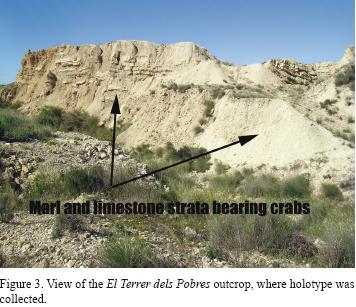
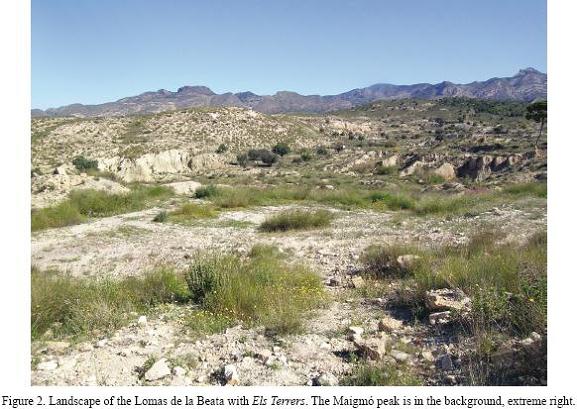
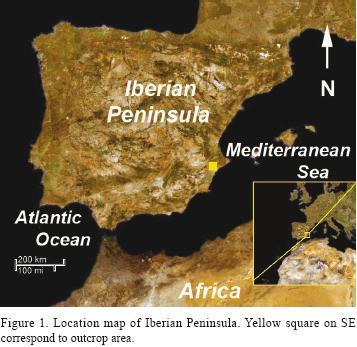
<body><![CDATA[<p align="justify"><font face="verdana" size="2"><b>INTRODUCTION</b></font></p>     <p align="justify"><font face="verdana" size="2">Since the first report one century ago (Jim&eacute;nez de Cisneros, 1911) of decapod crustaceans from the middle Eocene of the Alicante province (SE Spain) (<a href="#f1">Figure 1</a>), specially from the outcrops known as <i>Els Terrers<a href="#notas">*</a></i> in the Lomas de la Beata zone, north of Agost village (<a href="#f2">Figure 2</a>), several species have been mentioned or described from the Lutetian of the Alicante province (Van Straelen, 1927; Via, 1959, 1965, 1969). Via (1991) reported twelve species found in this province, and quoted four of them as found in <i>Els Terrers</i> outcrops: <i>Dromilites pastoris</i> Via, 1959; <i>Lophoranina marestiana</i> K&ouml;nig, 1825; <i>L. straeleni</i> Via, 1959 and <i>Micromaia margaritata</i> Fabiani, 1910. Furthemore, <i>Harpactoxanthopsis quadrilobata</i> Desmarest, 1822 and <i>Harpactocarcinus punctulatus</i> Desmarest, 1822 are also known in <i>Els Terrers</i> (J.R. Pastor, pers. comm.). <i>Agostella terrersensis</i> n.gen. n. sp. is the third new species provided by the <i>Els Terrers</i> outcrops, more precisely by the <i>El Terrer dels Pobres</i> <a href="#notas">**</a> (<a href="#f3">Figure 3</a>).</font></p>     <p align="center"><font face="verdana" size="2"><a name="f1"></a></font></p>     <p align="center"><font face="verdana" size="2"><img src="/img/revistas/rmcg/v28n3/a7f1.jpg"></font></p>     <p align="center"><font face="verdana" size="2"><a name="f3"></a></font></p>     <p align="center"><font face="verdana" size="2"><img src="/img/revistas/rmcg/v28n3/a7f3.jpg"></font></p>     <p align="center"><font face="verdana" size="2"><a name="f2"></a></font></p>     <p align="center"><font face="verdana" size="2"><img src="/img/revistas/rmcg/v28n3/a7f2.jpg"></font></p>     <p align="justify"><font face="verdana" size="2">All the decapod genera and species found in the Lutetian of the Alicante province (except <i>Agostella</i>) are also present in some of the other contemporary outcrops of the western Tethys area, for instance in Catalonia, Italy or Hungary and are representatives of a warm sea period.</font></p>     <p align="justify"><font face="verdana" size="2">The specimens studied in this paper are deposited in the Museu de Geologia de Barcelona&#150;MCNB paleontological collection under acronym MGB.</font></p>     ]]></body>
<body><![CDATA[<p align="justify"><font face="verdana" size="2">&nbsp;</font></p>     <p align="justify"><font size="2" face="verdana"><b>GEOLOGICAL SETTING</b></font></p>     <p align="justify"><font face="verdana" size="2">The Agost area is situated within the so called Internal Prebetic System (<i>sensu</i> Garc&iacute;a&#150;Hern&aacute;ndez, 1978) of the Betic Ranges, in the SE of Iberian Peninsula. Formed during the Alpine orogeny, the geology of this area is highly interesting. For instance, the very well exposed Cretaceous&#150;Paleogene series, allows a perfectly visible K/T boundary in a section near the northern border of the village. The Paleogene series at Lomas de la Beata are also very well exposed, including the section containing the Ypresian&#150; Lutetian (Y&#150;L) or the early&#150;middle Eocene transition that has been proposed as Global Stratotype Section and Point or GSSP (Molina <i>et al</i>., 2000, Ortiz <i>et al</i>., 2008).</font></p>     <p align="justify"><font face="verdana" size="2">The Agost section is composed of 115 m of marl with intercalated limestone and sandstone beds. The marl and limestones deposited as hemipelagic sediments and predominate in the lower and upper parts of the section. The upper half of the section is mainly composed of sandstone that correspond to slope deposits. During the Eocene, the study area was part of the Iberian passive margin, where carbonate sedimentation in the platform with abundant macroforaminifera changed to pelagic sediments, turbidites, and mass flow deposits in the continental slope, located to the south. The presence of echinoids and decapod crustaceans indicates a change from sublittoral to circalittoral paleodepths after the Ypresian&#150;Lutetian transition, suggesting a relative sea&#150;level fall. The shallowing is accompanied by a sedimentation change from proximal turbidites to immature gravity flow sediments generated by storms. Planktonic and benthonic foraminiferal assemblages, allow to place the crab&#150;bearing levels of <i>Els Terrers</i> in the Lutetian age, middle Eocene (Ortiz <i>et al</i>., 2008).</font></p>     <p align="justify"><font face="verdana" size="2">&nbsp;</font></p>     <p align="justify"><font size="2" face="verdana"><b>SYSTEMATIC PALAEONTOLOGY</b></font></p>     <p align="center"><font size="2" face="verdana">Order Decapoda Latreille, 1802    <br> Infraorder Brachyura Latreille, 1802    <br> Superfamily Goneplacoidea MacLeay, 1838    <br> Family <i>incerta sedis</i></font></p>     ]]></body>
<body><![CDATA[<p align="center"><font face="verdana" size="2"><b>Genus <i>Agostella</i> new genus</b></font></p>     <p align="justify"><font face="verdana" size="2"><b>Type species.</b> <i>Agostella terrersensis</i> n. gen., new species    <br> <b>Etymology.</b> From Agost, village of Alicante province (SE Spain).    <br> <b>Diagnosis.</b> Subhexagonal, flattened, slightly wider than long carapace; slightly convex longitudinally, somewhat less in transverse section; maximum width at anterior third; regions weakly defined; finely granular dorsal surface. Slightly swollen epigastric, protogastric, hepatic and epibranchial regions. Long, straight, subtruncate front, divided by a small median notch. Small orbits with two fissures; infraorbital margin visible in dorsal view. Short, convex anterolateral margin with three spiny form teeth, excluding outer orbital tooth. Convex, smooth posterolateral margins, converging backwards. Straight, rimmed posterior margin. Granulate thoracic sternum. Sternites 1&#150;2 not visible; sternite 3 well developed and vaulted, with median longitudinal depression; sternite 3 and 4 vaulted and separated by depression, just forward the triangle formed by the last portion of sterno&#150;abdominal cavity receiving (not preserved) telson, suture visible only laterally; both covered by large granules; sternites 4 &#150; 6 with granulated episternites; sternite 7 not extended laterally; sternite 8 not visible in dorsal view. Well defined sutures 4/5, 5/6, 6/7. Male abdomen with 6 free somites and telson, somite 3 larger, reaching P5 coxae; somites 4&#150;6 becoming progressively narrower. Chelipeds and ambulatory legs unknown.    <br> <b>Discussion.</b> Taxonomic status of <i>Agostella</i> gen et sp nov. is quite difficult because it shares many similarities with different taxa of different families. For instance, the shape of the carapace of <i>Agostella</i> could seem close to that of <i>Palaeograpsus inflatus</i>, Bittner, 1875 (Panopeidae, Eucratopsinae) (see Schweitzer and Karasawa, 2004), figured by De Angeli (1995, p. 18, figs. 2, 3) but it differs from <i>Agostella</i> in having a more inflated and longitudinally convex carapace and the abdominal somites 3&#150;4 fused (De Angeli, 1995, p. 18, fig. 4). This character exclude <i>Agostella</i> from the Panopeidae. In the same regard, <i>Agostella</i> shares similarities with several genera of the Tumidocarcinidae (Schweitzer, 2005). For example, <i>Nitotacarcinus</i> Schweitzer, Artal, van Bakel, Jagt, and Karasawa, 2007, shows similar features like the shape of abdomen and all of the free somites; however <i>Nitotacarcinus</i> differs from <i>Agostella</i> by the abdominal somites that completely cover the spacebetween the coxae of P5 and also by its dorsal features, inparticular the subquadrate carapace, the dorsal regions verywell defined, and the wider, posterior margin. Additionally,the Tumidocarcinidae, characterised by a front formed by four lobes, cannot accomodate <i>Agostella</i> (see Karasawaand Schweitzer, 2006).</font></p>     <p align="justify"><font face="verdana" size="2">Thus, according to the diagnosis of Karasawa andSchweitzer (2006), it seems that the most congruent placefor <i>Agostella</i> is the superfamily Goneplacoidea MacLeay,1838, on the basis of characters like its flattened carapace, the weakly defined regions, straight and weakly protrudedfront with a median notch, broad fronto&#150;orbital width, thetwo orbital fissures, short anterolateral margins of carapace,and all abdominal somites free, not covering the entirespace between the coxa of P5. Although some differencesare evident, such as the very well developed sternite 3 and presence of median depression in sternites 3 and 4 in<i>Agostella</i>, the refined keys and diagnoses recently provided by Ng and Manuel&#150;Santos (2007) and Castro <i>et al</i>. (2010) show that some members of the Goneplacoidea possess a median depression on sternites 3 and 4, as also happens in the Recent families Vultocinidae Ng and Manuel&#150;Santos, 2007 and Sotoplacidae Castro, Guinot and Ng, 2010, and also in the exclusively fossil family Martinocarcinidae Schweitzer, Feldmann and Bonadio, 2009.</font></p>     <p align="justify"><font face="verdana" size="2">Although accommodation of <i>Agostella</i> into the Goneplacoidea is adequate, familial assignment remains unclear. Castro (2007), Ng and Manuel&#150;Santos (2007) and Castro <i>et al</i>. (2010), provided accurate diagnosis and keys for the various goneplacoid families, based on a set of characters that can easily be observed in extant crabs, like sexual organs, thoracic sternal sutures, abdominal locking mechanism, etc., which are not always preserved or visible in the fossil crabs, and reducing all the dorsal features almost to a single character. In this way, paying attention as far as possible to these diagnoses, <i>Agostella</i> is compared with all of the fossil and extant goneplacoid families as follows.</font></p>     <p align="justify"><font face="verdana" size="2">Members of the familyAcidopsidae Stevcic, 2005 differ from <i>Agostella</i> by the subcircular and areolate carapace and by the abdominal somites 1&#150;2 being almost wider than somite 3 (see Stevcic, 2005; Castro <i>et al</i>., 2010). Family Carinocarcinoididae Karasawa and Kato, 2003 cannot accommodate <i>Agostella</i> because it has fused abdominal somites 3&#150;5 and has the upper orbital margin without fissures (see Stevcic, 2005; Karasawa and Schweitzer, 2006). The Chasmocarcinidae Ser&egrave;ne, 1964 differs in having the entire, orbital margin, fused abdominal somites 3&#150;5, and a supplementary plate at level of thoracic sternite 8 in males (see Karasawa and Schweitzer, 2006; Castro <i>et al</i>., 2010). <i>Agostella</i> cannot be included in the Conleyidae Stevcic, 2005 because this family has a clearly, triangular abdomen and an even thoracic sternite 3, without median depression (see Ng and Manuel&#150;Santos, 2007; Castro <i>et al</i>., 2010), neither in the Euryplacidae Stimpson, 1871 which possesses a triangular or slender abdomen with somite 5 as long as wide and somite 6 much longer than wide (see Castro and Ng, 2010; Castro <i>et al.,</i> 2010). <i>Agostella</i> does not seem to belong to the Goneplacidae MacLeay, 1838 which is diagnosed by a smooth surface carapace without clear indication of regions and the absence of fissures on the supraorbital margin; additionally, Goneplacidae does not have thoracic sternites 3 and 4 with a median depression (in contrast to the new genus) and shows abdominal somites 1 and 2 almost wider than somite 3 (see Castro, 2007, Ng and Manuel&#150;Santos, 2007; Castro <i>et al</i>., 2010). Litocheiridae Stevcic, 2005,differs from <i>Agostella</i> in having a wider front and fronto&#150;orbital margin, shorter and unarmed anterolateral margin, and a subquadrangular carapace (see T&uuml;rkay, 1983; Stevcic, 2005; Castro <i>et al</i>., 2010). The monotypic family Martinocarcinidae Schweitzer <i>et al</i>., 2009, cannot accommodate <i>Agostella</i>: although its only representative <i>Martinocarcinus ickeae</i> B&ouml;hm, 1922 has, such as <i>Agostella,</i> a median depression on the thoracic sternites 3 and 4, it differs by the presence of spines on the anterolateral and posterolateral margins, the broad grooves marking the dorsal regions and granular central areas, different frontoorbital ratio, and by somite 6 being longer than wide (see Schweitzer <i>et al</i>., 2009). Despite the surprising dorsal similarities between <i>Agostella</i> and several members of the family Mathildellidae Karasawa and Kato, 2003, <i>Agostella</i> cannot be included in this family in which, abdominal somites 3&#150;5 are even and unmovable, and sternite 3 does not show a median depression (see Ng and Manuel&#150;Santos, 2007; Castro <i>et al</i>., 2010). Progeryonidae Stevcic, 2005 has low frontoorbital ratio, somites 4&#150;5 almost broader than somite 3 and the abdomen filling the entire space between coxae of P5, thus differing from the studied specimen (see Stevcic, 2005, Karasawa and Schweitzer, 2006; Ng and Manuel&#150;Santos, 2007; Castro <i>et al</i>., 2010). <i>Agostella</i> cannot be placed into family Scalopidiidae Stevcic, 2005 attending to important differences as the semicircular carapace, orbits not visible dorsally, bilobed front , cristiform anterolateral margin and fused abdominal somites 3&#150;5 (see Stevcic, 2005; Ng and Manuel&#150;Santos, 2007). The monotypic family Sotoplacidae has a vaulted sternite 4 as in <i>Agostella</i>; however, there are many differences as the dorsal features, larger orbits and very slender somites 4&#150;6 (see Castro <i>et al</i>. 2010). Finally, the monotypic family Vultocinidae Ng and Manuel&#150;Santos, 2007, although sharing with <i>Agostella</i> the median depression on abdominal sternites 3&#150;4, displays quite different dorsal features with a complex pattern of ridges and grooves, being nearly smooth in <i>Agostella.</i></font></p>     <p align="justify"><font face="verdana" size="2">Therefore, <i>Agostella</i> cannot be accommodated in any of the above mentioned families and is placed within the superfamily Goneplacoidea as <i>incerta sedis</i>.</font></p>     <p align="justify"><font face="verdana" size="2">As mentioned before, <i>Agostella</i> presents many dorsal and orbito&#150;frontal resemblances with some members of the Mathildellidae, like with <i>Mathildella</i> Guinot and Richer de Forges, 1981 and <i>Beuroisia</i> Guinot and Richer de Forges, 1981. Even though this family would seem a correct place for <i>Agostella</i>, the previously mentioned differences in the sternal features and the fact that all of the abdominal somites of <i>Agostella</i> are free, while in Mathildellidae somites 3&#150;5 are unmovable or fused, and in spite of the visible sutures, it does not allow placement in this family. Explanations of this last character in fossil forms was discussed in Karasawa <i>et al</i>. (2008, p. 97, 98, 101). They concluded that it is possible to determine that condition in fossil forms, and how in fossil forms with fused abdominal somites 3&#150;5, but with sutures, will appear as unfused somites. In the holotype of <i>Agostella</i>, very good preservation of the articulated somites and undamaged edges, allow a clear observation of spaces between somites 3&#150;4 and 4&#150;5, and how they are slightly displaced, which would confirm that they were free when alive (D. Guinot, pers. com. and P. K. L. Ng, pers. com.).</font></p>     ]]></body>
<body><![CDATA[<p align="justify"><font face="verdana" size="2">In the same sense, the genus <i>Tehuacana</i> Stenzel, 1944, (see sample in ventral view of <i>Tehuacana</i> <i>americana</i> (Rathbun, 1935) figured in Armstrong <i>et al</i>. (2009, p. 754, fig. 2, hypotype NPL31168) and figured in this paper (<a href="/img/revistas/rmcg/v28n3/a7f4.jpg" target="_blank">Figures 4.6, 4.7</a>), shows the space separating all the well preserved abdominal somites with undamaged edges, suggesting that they were also free when alive. Thus, <i>Tehuacana</i> cannot remain in the family Mathildellidae; a set of characters allow its inclusion in the superfamily Goneplacoidea but in a different, uncertain family.</font></p>     <p align="center"><font face="verdana" size="2"><b><i>Agostella terrersensis</i> new species    <br> </b><a href="/img/revistas/rmcg/v28n3/a7f4.jpg" target="_blank">Figure 4.1 &#150; 4.5</a></font></p>     <p align="justify"><font face="verdana" size="2"><b>Etymology.</b> From <i>Els Terrers dels Pobres,</i> the small quarry where it was found.    <br> <b>Diagnosis.</b> As for the genus.    <br> <b>Description.</b> Small carapace, subhexagonal in outline, somewhat broader than long, maximum width at level of epibranchial spine; dorsal surface slightly convex in longitudinally section and less convex in transverse section, finely granular. Fronto&#150;orbital margin, about two thirds of maximum width. Relatively large front, about one third of maximum width, subtruncate and bimarginate, divided by a faint V&#150;shaped median notch. Relatively small orbits, rimmed, with two fissures on supraorbital margin, one median completely fused and second opened close to the outer orbital tooth; infraorbital margin dorsally visible, granular, with prominent inner tooth. Short, convex anterolateral margin with three teeth and nodes excluding outer orbital tooth, first and third (epibranchial tooth) ones prominent and sharp, second tooth being a blunt node. Posterolateral margin broadly convex. Straight posterior margin, about half of maximum width. Epigastric and protogastric regions slightly swollen, well delimited by a faint gastro&#150;hepatic groove; mesogastric region not well defined; swollen hepatic region; metagastric and urogastric regions slightly swollen, well delimited by scars; inflated branchial lobes, laterally forming a sort of branchial ridge, bearing a median pit; mesobranchial region swollen. Flat cardiac region, laterally delimited by scars. Flat intestinal region. Subtriangular, rimmed pterygostomial regions. Subquadrate buccal frame. Relatively broad, granulate thoracic sternum, and transversely prominent. Sterno&#150;abdominal cavity reaching almost the anterior portion of sternite 4. Sternites 1&#150;2 not present. Invert subtriangle&#150;shaped, much inflated sternite 3 with median shallow depression. Sternites 3&#150;4 separated by a deep depression, suture visible only laterally. Subtrapezoidal sternite 4 with prominent inflations at both sides of the sterno&#150;abdominal cavity, and more salient axially; episternites elongate; sternites 3&#150;4 covered by larger granules than on other parts; sternites 5&#150;6 with similar shape and size, subtrapezoidal, width two times the length, with long episternite directed backwards; subtriangular sternite 7, as long as wide, two thirds the width of the sternites 5&#150;6, reaching coxae of P5. Sternite 8 not visible. Abdomen with six free somites, telson not present. Somite 3 is the broadest of all somites. Somite 1 broad, very narrow and apparently not reaching coxae of P5, but a slight deformation in this part makes difficult the exact observation of this character. Somite 2 is transversaly subtrapezoidal, narrow, apparently as broad as somite 1 but without touching P5 coxae. Somite 3 is transversaly subtrapezoidal, broader than somite 2 and with angular lateral margins reaching P5 coxae. Somites 4&#150;6 are subrectangular, becoming progressively slightly narrower; somites 4&#150;5 with equal length, and somite 6 is one third longer than somites 4&#150;5. Ischium of third maxilliped subrectangular, with median sulcus, concave at outer margin and convex at the inner margin. Chelipeds and ambulatory legs not present.    <br>   <b>Material.</b> Holotype MGB 57606 and paratype MGB 57607.    <br>   <b>Measurements (in mm).</b> Holotype MGB 57606, carapace length = 23 (possibly 24 or 25, due to a posterior deformation), width = 28, orbito&#150;frontal width = 18. Paratype MGB 57607, length = 30, width = 35, orbito&#150;frontal width = 22.</font></p>     <p align="justify"><font face="verdana" size="2">&nbsp;</font></p>     <p align="justify"><font size="2" face="verdana"><b>FINAL COMMENTS</b></font></p>     ]]></body>
<body><![CDATA[<p align="justify"><font size="2" face="verdana">Even though the Paleogene is very well exposed in southeastern Spain, including a remarkable richness of invertebrates in the Alicante province, it is surprising that the decapod crustaceans are scarcely represented, specially if we compare its lower number of taxa with other coeval faunas from the western Tethys realm, as Italy or Hungary. One possible explanation is that the outcrops in southeastern Spain correspond to slope deposits and there are no good exposures equivalent to near shore or reefal environments.</font></p>     <p align="justify"><font face="verdana" size="2">&nbsp;</font></p>     <p align="justify"><font size="2" face="verdana"><b>ACKNOWLEDGMENTS</b></font></p>     <p align="justify"><font size="2" face="verdana">To Dani&egrave;le Guinot (MNHN, Paris, France) and Francisco Vega (UNAM, Mexico) for their guidance and review of the manuscript. Peter K.L. Ng (NUS, Singapore) and Jaume Gallemi (MGB, Barcelona, Catalonia) made useful and encouraging comments helping thus in the preparation of this paper; Antonio Porras (Murcia, Spain) who found the holotype; Jos&eacute; Ram&oacute;n Pastor (Agost, Spain) donated the paratype and provided pictures and very useful information about the outcrops.</font></p>     <p align="justify"><font face="verdana" size="2">&nbsp;</font></p>     <p align="justify"><font size="2" face="verdana"><b>REFERENCES</b></font></p>     <!-- ref --><p align="justify"><font size="2" face="verdana">Armstrong, A., Nyborg, T., Bishop, G.A., Oss&oacute;&#150;Morales &Agrave;., Vega, F.J., 2009, Decapod crustaceans from the Paleocene of Central Texas, USA: Revista Mexicana de Ciencias Geol&oacute;gicas, 26(3), 745&#150;763.    &nbsp;&nbsp;&nbsp;&nbsp;&nbsp;&nbsp;&nbsp;&nbsp;[&#160;<a href="javascript:void(0);" onclick="javascript: window.open('/scielo.php?script=sci_nlinks&ref=8066605&pid=S1026-8774201100030000700001&lng=','','width=640,height=500,resizable=yes,scrollbars=1,menubar=yes,');">Links</a>&#160;]<!-- end-ref --></font></p>     <!-- ref --><p align="justify"><font face="verdana" size="2">Bittner, A., 1875, Die Brachyuren des vicentinischen Tertiargebirges: Denkschriften der kaiserlichen Akademie der Wissenschaften in Wien, 34, 63&#150;103.    &nbsp;&nbsp;&nbsp;&nbsp;&nbsp;&nbsp;&nbsp;&nbsp;[&#160;<a href="javascript:void(0);" onclick="javascript: window.open('/scielo.php?script=sci_nlinks&ref=8066607&pid=S1026-8774201100030000700002&lng=','','width=640,height=500,resizable=yes,scrollbars=1,menubar=yes,');">Links</a>&#160;]<!-- end-ref --></font></p>     ]]></body>
<body><![CDATA[<!-- ref --><p align="justify"><font face="verdana" size="2">B&ouml;hm, J., 1922, Arthropoda. Crustacea, <i>in</i> Martin, K. (ed.), Die Fossilien von Java I. Band, 2 Abteilung: Leiden, E. J. Brill, 521&#150;535.    &nbsp;&nbsp;&nbsp;&nbsp;&nbsp;&nbsp;&nbsp;&nbsp;[&#160;<a href="javascript:void(0);" onclick="javascript: window.open('/scielo.php?script=sci_nlinks&ref=8066609&pid=S1026-8774201100030000700003&lng=','','width=640,height=500,resizable=yes,scrollbars=1,menubar=yes,');">Links</a>&#160;]<!-- end-ref --></font></p>     <!-- ref --><p align="justify"><font face="verdana" size="2">Castro P., 2007, A reappraisal of the family Goneplacidae MacLeay, 1838 (Crustacea, Decapoda, Brachyura) and revision of the subfamily Goneplacinae, with the description of 10 new genera and 18 new species: Zoosystema29(4), 609&#150;774.    &nbsp;&nbsp;&nbsp;&nbsp;&nbsp;&nbsp;&nbsp;&nbsp;[&#160;<a href="javascript:void(0);" onclick="javascript: window.open('/scielo.php?script=sci_nlinks&ref=8066611&pid=S1026-8774201100030000700004&lng=','','width=640,height=500,resizable=yes,scrollbars=1,menubar=yes,');">Links</a>&#160;]<!-- end-ref --></font></p>     <!-- ref --><p align="justify"><font face="verdana" size="2">Castro, P., Ng, P.K.L., 2010, Revision of the family Euryplacidae Stimpson, 1871 (Crustacea: Decapoda: Brachyura: Goneplacoidea): Zootaxa, 2375, 1&#150;130.    &nbsp;&nbsp;&nbsp;&nbsp;&nbsp;&nbsp;&nbsp;&nbsp;[&#160;<a href="javascript:void(0);" onclick="javascript: window.open('/scielo.php?script=sci_nlinks&ref=8066613&pid=S1026-8774201100030000700005&lng=','','width=640,height=500,resizable=yes,scrollbars=1,menubar=yes,');">Links</a>&#160;]<!-- end-ref --></font></p>     <!-- ref --><p align="justify"><font face="verdana" size="2">Castro, P., Guinot, D., Ng, P.K.L., 2010,Anew family for <i>Sotoplax robertsi</i> Guinot, 1984, with a diagnosis and key to the Goneplacoidea Macleay, 1838 (Crustacea: Decapoda: Brachyura): Zootaxa, 2356, 36&#150;56.    &nbsp;&nbsp;&nbsp;&nbsp;&nbsp;&nbsp;&nbsp;&nbsp;[&#160;<a href="javascript:void(0);" onclick="javascript: window.open('/scielo.php?script=sci_nlinks&ref=8066615&pid=S1026-8774201100030000700006&lng=','','width=640,height=500,resizable=yes,scrollbars=1,menubar=yes,');">Links</a>&#160;]<!-- end-ref --></font></p>     <!-- ref --><p align="justify"><font face="verdana" size="2">De Angeli, A., 1995, Crostacei dell'Eocene superiore di "Fontanella" di Grancona (Vicenza &#150;Italia settentrionale): Studi e ricerche, AssociacioneAmici del Museo Civico "G. Zannato", Montecchio Maggiore, 7&#150;26.    &nbsp;&nbsp;&nbsp;&nbsp;&nbsp;&nbsp;&nbsp;&nbsp;[&#160;<a href="javascript:void(0);" onclick="javascript: window.open('/scielo.php?script=sci_nlinks&ref=8066617&pid=S1026-8774201100030000700007&lng=','','width=640,height=500,resizable=yes,scrollbars=1,menubar=yes,');">Links</a>&#160;]<!-- end-ref --></font></p>     ]]></body>
<body><![CDATA[<!-- ref --><p align="justify"><font face="verdana" size="2">Desmarest, A.G., 1822, Malacostrac&eacute;s: Paris, France, F. G. Levreault, Dictionnaire des sciences naturelles, 28, 138&#150;425.    &nbsp;&nbsp;&nbsp;&nbsp;&nbsp;&nbsp;&nbsp;&nbsp;[&#160;<a href="javascript:void(0);" onclick="javascript: window.open('/scielo.php?script=sci_nlinks&ref=8066619&pid=S1026-8774201100030000700008&lng=','','width=640,height=500,resizable=yes,scrollbars=1,menubar=yes,');">Links</a>&#160;]<!-- end-ref --></font></p>     <!-- ref --><p align="justify"><font face="verdana" size="2">Fabiani, R., 1910, I crostacei terziari del Vicentino: Bolletino Museo Civico Vicenza, 1(1), 29&#150;45, 1&#150;2.    &nbsp;&nbsp;&nbsp;&nbsp;&nbsp;&nbsp;&nbsp;&nbsp;[&#160;<a href="javascript:void(0);" onclick="javascript: window.open('/scielo.php?script=sci_nlinks&ref=8066621&pid=S1026-8774201100030000700009&lng=','','width=640,height=500,resizable=yes,scrollbars=1,menubar=yes,');">Links</a>&#160;]<!-- end-ref --></font></p>     <!-- ref --><p align="justify"><font face="verdana" size="2">Garc&iacute;a&#150;Hern&aacute;ndez, M., 1978. El Jur&aacute;sico terminal y el Cret&aacute;cico inferior en las sierras de Cazorla y Segura: Granada, Universidad de Granada, tesis doctoral, 344 pp.    &nbsp;&nbsp;&nbsp;&nbsp;&nbsp;&nbsp;&nbsp;&nbsp;[&#160;<a href="javascript:void(0);" onclick="javascript: window.open('/scielo.php?script=sci_nlinks&ref=8066623&pid=S1026-8774201100030000700010&lng=','','width=640,height=500,resizable=yes,scrollbars=1,menubar=yes,');">Links</a>&#160;]<!-- end-ref --></font></p>     <!-- ref --><p align="justify"><font face="verdana" size="2">Guinot, D., Richer de Forges, B., 1981, Crabes de profondeur, nouveaux ou rares, de l'Indo&#150;Pacifique (Crustacea, Decapoda, Brachyura) (Deuxi&egrave;me partie): Bulletin du Mus&eacute;um national d'Histoire naturelle, Paris, 4(A1), 227&#150;260.    &nbsp;&nbsp;&nbsp;&nbsp;&nbsp;&nbsp;&nbsp;&nbsp;[&#160;<a href="javascript:void(0);" onclick="javascript: window.open('/scielo.php?script=sci_nlinks&ref=8066625&pid=S1026-8774201100030000700011&lng=','','width=640,height=500,resizable=yes,scrollbars=1,menubar=yes,');">Links</a>&#160;]<!-- end-ref --></font></p>     <!-- ref --><p align="justify"><font face="verdana" size="2">Jim&eacute;nez de Cisneros, D., 1911, Datos para la Geolog&iacute;a del SE de Espa&ntilde;a: Asociaci&oacute;n espa&ntilde;ola para el Progreso de las Ciencias, Congreso de Valencia, 5, 75&#150;79.    &nbsp;&nbsp;&nbsp;&nbsp;&nbsp;&nbsp;&nbsp;&nbsp;[&#160;<a href="javascript:void(0);" onclick="javascript: window.open('/scielo.php?script=sci_nlinks&ref=8066627&pid=S1026-8774201100030000700012&lng=','','width=640,height=500,resizable=yes,scrollbars=1,menubar=yes,');">Links</a>&#160;]<!-- end-ref --></font></p>     ]]></body>
<body><![CDATA[<!-- ref --><p align="justify"><font face="verdana" size="2">Karasawa, H., Kato, H., 2003, The family Goneplacidae MacLeay, 1838 (Crustacea: Decapoda: Brachyura): systematics, phylogeny, and fossil records: Paleontological Research, 7(2), 129&#150;151.    &nbsp;&nbsp;&nbsp;&nbsp;&nbsp;&nbsp;&nbsp;&nbsp;[&#160;<a href="javascript:void(0);" onclick="javascript: window.open('/scielo.php?script=sci_nlinks&ref=8066629&pid=S1026-8774201100030000700013&lng=','','width=640,height=500,resizable=yes,scrollbars=1,menubar=yes,');">Links</a>&#160;]<!-- end-ref --></font></p>     <!-- ref --><p align="justify"><font face="verdana" size="2">Karasawa, H., Schweitzer, C.C., 2006, A new classification of the Xanthoidea sensu lato (Crustacea: Decapoda: Brachyura) based on a phylogenetic analysis and traditional systematics and evaluation of all fossil Xanthoidea sensu lato: Contributions to Zoology, 75 (1&#150;2), 23&#150;73.    &nbsp;&nbsp;&nbsp;&nbsp;&nbsp;&nbsp;&nbsp;&nbsp;[&#160;<a href="javascript:void(0);" onclick="javascript: window.open('/scielo.php?script=sci_nlinks&ref=8066631&pid=S1026-8774201100030000700014&lng=','','width=640,height=500,resizable=yes,scrollbars=1,menubar=yes,');">Links</a>&#160;]<!-- end-ref --></font></p>     <!-- ref --><p align="justify"><font face="verdana" size="2">Karasawa, H., Schweitzer, C.E., Feldmann, R.M., 2008, Revision of Portunoidea Rafinesque, 1815 (Decapoda: Brachyura) with emphasis on the fossil genera and families: Journal of Crustacean Biology, 28 (1), 82&#150;127.    &nbsp;&nbsp;&nbsp;&nbsp;&nbsp;&nbsp;&nbsp;&nbsp;[&#160;<a href="javascript:void(0);" onclick="javascript: window.open('/scielo.php?script=sci_nlinks&ref=8066633&pid=S1026-8774201100030000700015&lng=','','width=640,height=500,resizable=yes,scrollbars=1,menubar=yes,');">Links</a>&#160;]<!-- end-ref --></font></p>     <!-- ref --><p align="justify"><font face="verdana" size="2">K&ouml;nig, C., 1825, Icones Fossilium Sectiles: London, G. B. Sowerby, 4, 19 pls.    &nbsp;&nbsp;&nbsp;&nbsp;&nbsp;&nbsp;&nbsp;&nbsp;[&#160;<a href="javascript:void(0);" onclick="javascript: window.open('/scielo.php?script=sci_nlinks&ref=8066635&pid=S1026-8774201100030000700016&lng=','','width=640,height=500,resizable=yes,scrollbars=1,menubar=yes,');">Links</a>&#160;]<!-- end-ref --></font></p>     <!-- ref --><p align="justify"><font face="verdana" size="2">Latreille, P.A., 1802, Histoire naturelle, g&eacute;n&eacute;rale et particuli&egrave;re des crustac&eacute;s et des insectes: Paris, F. Dufart, Tome 3, 468 pp.    &nbsp;&nbsp;&nbsp;&nbsp;&nbsp;&nbsp;&nbsp;&nbsp;[&#160;<a href="javascript:void(0);" onclick="javascript: window.open('/scielo.php?script=sci_nlinks&ref=8066637&pid=S1026-8774201100030000700017&lng=','','width=640,height=500,resizable=yes,scrollbars=1,menubar=yes,');">Links</a>&#160;]<!-- end-ref --></font></p>     ]]></body>
<body><![CDATA[<!-- ref --><p align="justify"><font face="verdana" size="2">MacLeay, W.S.,1838, On the Brachyurous Decapod Crustacea brought from the Cape by Dr. Smith, <i>in</i> MacLeay, W. S., Smith, A., Illustrations of the Annulosa of South Africa, being a portion of the objects of Natural History chiefly collected during an expedition into the interior of South Africa, under the direction of Dr. Andrew Smith, in the years 1834, 1835 and 1836; fittedout by "The Cape of Good Hope Association for Exploring Central Africa: London, 53&#150;71.    &nbsp;&nbsp;&nbsp;&nbsp;&nbsp;&nbsp;&nbsp;&nbsp;[&#160;<a href="javascript:void(0);" onclick="javascript: window.open('/scielo.php?script=sci_nlinks&ref=8066639&pid=S1026-8774201100030000700018&lng=','','width=640,height=500,resizable=yes,scrollbars=1,menubar=yes,');">Links</a>&#160;]<!-- end-ref --></font></p>     <!-- ref --><p align="justify"><font face="verdana" size="2">Molina, E., Cosovic, V., Gonzalvo, C., Von Salis, K., 2000, Integrated biostratigraphy across the Ypresian/Lutetian boundary at Agost, Spain: Revue de Micropal&eacute;ontologie 43, 381&#150;391.    &nbsp;&nbsp;&nbsp;&nbsp;&nbsp;&nbsp;&nbsp;&nbsp;[&#160;<a href="javascript:void(0);" onclick="javascript: window.open('/scielo.php?script=sci_nlinks&ref=8066641&pid=S1026-8774201100030000700019&lng=','','width=640,height=500,resizable=yes,scrollbars=1,menubar=yes,');">Links</a>&#160;]<!-- end-ref --></font></p>     <!-- ref --><p align="justify"><font face="verdana" size="2">Ng, P.K.L., Manuel&#150;Santos, M.R., 2007, Establishment of the Vultocinidae, a new family for an unusual new genus and new species of Indo&#150;West Pacific crab (Crustacea: Decapoda: Brachyura: Goneplacoidea), with comments on the taxonomy of the Goneplacidae: Zootaxa,1558, 39&#150;68.    &nbsp;&nbsp;&nbsp;&nbsp;&nbsp;&nbsp;&nbsp;&nbsp;[&#160;<a href="javascript:void(0);" onclick="javascript: window.open('/scielo.php?script=sci_nlinks&ref=8066643&pid=S1026-8774201100030000700020&lng=','','width=640,height=500,resizable=yes,scrollbars=1,menubar=yes,');">Links</a>&#160;]<!-- end-ref --></font></p>     <!-- ref --><p align="justify"><font face="verdana" size="2">Ortiz, S., Gonzalvo, C., Molina, E., Rodr&iacute;guez&#150;Tovar, F.J.,Uchman, A., Vandenberghe, N., Zeelmaekers, E., 2008, Palaeoenvironmental turnover across the Ypresian&#150;Lutetian Transition at the Agost section. Southeastern Spain: In search of a marker event to define the Stratotype for the base of the Lutetian Stage: Marine Micropaleontology, 69, 297&#150;313.    &nbsp;&nbsp;&nbsp;&nbsp;&nbsp;&nbsp;&nbsp;&nbsp;[&#160;<a href="javascript:void(0);" onclick="javascript: window.open('/scielo.php?script=sci_nlinks&ref=8066645&pid=S1026-8774201100030000700021&lng=','','width=640,height=500,resizable=yes,scrollbars=1,menubar=yes,');">Links</a>&#160;]<!-- end-ref --></font></p>     <!-- ref --><p align="justify"><font face="verdana" size="2">Rathbun, M.J., 1935, Fossil Crustacea of the Atlantic and Gulf Coastal Plain: Geological Society of America, Special Paper, 2, 1&#150;160.    &nbsp;&nbsp;&nbsp;&nbsp;&nbsp;&nbsp;&nbsp;&nbsp;[&#160;<a href="javascript:void(0);" onclick="javascript: window.open('/scielo.php?script=sci_nlinks&ref=8066647&pid=S1026-8774201100030000700022&lng=','','width=640,height=500,resizable=yes,scrollbars=1,menubar=yes,');">Links</a>&#160;]<!-- end-ref --></font></p>     ]]></body>
<body><![CDATA[<!-- ref --><p align="justify"><font face="verdana" size="2">Schweitzer, C.E., 2005, The genus Xanthilites Bell, 1858 and a new xanthoid family (Crustacea: Decapoda: Brachyura: Xanthoidea): new hypotheses on the origin of the Xanthoidea MacLeay, 1838: Journal of Paleontology, 79 (2), 277&#150;295.    &nbsp;&nbsp;&nbsp;&nbsp;&nbsp;&nbsp;&nbsp;&nbsp;[&#160;<a href="javascript:void(0);" onclick="javascript: window.open('/scielo.php?script=sci_nlinks&ref=8066649&pid=S1026-8774201100030000700023&lng=','','width=640,height=500,resizable=yes,scrollbars=1,menubar=yes,');">Links</a>&#160;]<!-- end-ref --></font></p>     <!-- ref --><p align="justify"><font face="verdana" size="2">Schweitzer, C.E., Karasawa, H., 2004, Revision of <i>Amydrocarcinus</i> and <i>Palaeograpsus</i> (Decapoda: Brachyura: Xanthoidea) with definition of three new genera: Paleontological Research, 8 (1), 71&#150;86.    &nbsp;&nbsp;&nbsp;&nbsp;&nbsp;&nbsp;&nbsp;&nbsp;[&#160;<a href="javascript:void(0);" onclick="javascript: window.open('/scielo.php?script=sci_nlinks&ref=8066651&pid=S1026-8774201100030000700024&lng=','','width=640,height=500,resizable=yes,scrollbars=1,menubar=yes,');">Links</a>&#160;]<!-- end-ref --></font></p>     <!-- ref --><p align="justify"><font face="verdana" size="2">Schweitzer, C.E.,Artal, P., van Bakel, B., Jagt J.W.M., Karasawa, H., 2007, Revision of the Genus <i>Titanocarcinus</i> (Decapoda: Brachyura: Xanthoidea) with two new genera and one new species: Journal of Crustacean Biology, 27, 278&#150;295.    &nbsp;&nbsp;&nbsp;&nbsp;&nbsp;&nbsp;&nbsp;&nbsp;[&#160;<a href="javascript:void(0);" onclick="javascript: window.open('/scielo.php?script=sci_nlinks&ref=8066653&pid=S1026-8774201100030000700025&lng=','','width=640,height=500,resizable=yes,scrollbars=1,menubar=yes,');">Links</a>&#160;]<!-- end-ref --></font></p>     <!-- ref --><p align="justify"><font face="verdana" size="2">Schweitzer, C.E., Feldmann, R.M., Bonadio, C., 2009, A new family of brachyuran (Crustacea: Decapoda: Goneplacoidea) from the Eocene of Java, Indonesia: Scripta Geologica, 138, 1&#150;10.    &nbsp;&nbsp;&nbsp;&nbsp;&nbsp;&nbsp;&nbsp;&nbsp;[&#160;<a href="javascript:void(0);" onclick="javascript: window.open('/scielo.php?script=sci_nlinks&ref=8066655&pid=S1026-8774201100030000700026&lng=','','width=640,height=500,resizable=yes,scrollbars=1,menubar=yes,');">Links</a>&#160;]<!-- end-ref --></font></p>     <!-- ref --><p align="justify"><font face="verdana" size="2">Ser&egrave;ne, R., 1964, Goneplacidae et Pinnotheridae recolt&eacute;s par le Dr. Mortensen. Papers from Dr. Th. Mortensen's Pacific Expedition 1914&#150;1916, part 80: Videnskabelige Meddelelser fra Dansk Naturhistorisk Forening I Kobenhavn, 126, 181&#150;282, pls. 16&#150;24.    &nbsp;&nbsp;&nbsp;&nbsp;&nbsp;&nbsp;&nbsp;&nbsp;[&#160;<a href="javascript:void(0);" onclick="javascript: window.open('/scielo.php?script=sci_nlinks&ref=8066657&pid=S1026-8774201100030000700027&lng=','','width=640,height=500,resizable=yes,scrollbars=1,menubar=yes,');">Links</a>&#160;]<!-- end-ref --></font></p>     ]]></body>
<body><![CDATA[<!-- ref --><p align="justify"><font face="verdana" size="2">Stenzel, H.B., 1944, A new Paleocene catometope crab from Texas, <i>Tehuacana tehuacana</i>: Journal of Paleontology, 18, 546&#150;549.    &nbsp;&nbsp;&nbsp;&nbsp;&nbsp;&nbsp;&nbsp;&nbsp;[&#160;<a href="javascript:void(0);" onclick="javascript: window.open('/scielo.php?script=sci_nlinks&ref=8066659&pid=S1026-8774201100030000700028&lng=','','width=640,height=500,resizable=yes,scrollbars=1,menubar=yes,');">Links</a>&#160;]<!-- end-ref --></font></p>     <!-- ref --><p align="justify"><font face="verdana" size="2">Stevcic, Z., 2005, The reclassification of brachyuran crabs (Crustacea: Decapoda: Brachyura): Natura Croatica, 14 (1), 1&#150;159.    &nbsp;&nbsp;&nbsp;&nbsp;&nbsp;&nbsp;&nbsp;&nbsp;[&#160;<a href="javascript:void(0);" onclick="javascript: window.open('/scielo.php?script=sci_nlinks&ref=8066661&pid=S1026-8774201100030000700029&lng=','','width=640,height=500,resizable=yes,scrollbars=1,menubar=yes,');">Links</a>&#160;]<!-- end-ref --></font></p>     <!-- ref --><p align="justify"><font face="verdana" size="2">Stimpson, W., 1871, Preliminary report on the Crustacea dredged in the Gulf Stream in the Straits of Florida by L. F. de Pourtales, Assist. U. S. Coast Survey. Part I. Brachyura: Bulletin of the Museum of Comparative Zoology at Harvard College, 2, 109&#150;160.    &nbsp;&nbsp;&nbsp;&nbsp;&nbsp;&nbsp;&nbsp;&nbsp;[&#160;<a href="javascript:void(0);" onclick="javascript: window.open('/scielo.php?script=sci_nlinks&ref=8066663&pid=S1026-8774201100030000700030&lng=','','width=640,height=500,resizable=yes,scrollbars=1,menubar=yes,');">Links</a>&#160;]<!-- end-ref --></font></p>     <!-- ref --><p align="justify"><font face="verdana" size="2">T&uuml;rkay, M., 1983, <i>Georgeoplax</i>, new genus for <i>Litocheira glabra</i> Baker, 1906 (Crustacea: Decapoda: Brachyura): Memoirs of the Australian Museum, 18, 101&#150;105.    &nbsp;&nbsp;&nbsp;&nbsp;&nbsp;&nbsp;&nbsp;&nbsp;[&#160;<a href="javascript:void(0);" onclick="javascript: window.open('/scielo.php?script=sci_nlinks&ref=8066665&pid=S1026-8774201100030000700031&lng=','','width=640,height=500,resizable=yes,scrollbars=1,menubar=yes,');">Links</a>&#160;]<!-- end-ref --></font></p>     <!-- ref --><p align="justify"><font face="verdana" size="2">Van Straelen, V., 1927, Contribution &agrave; l'&eacute;tude des Crustac&eacute;s d&eacute;capodes de la P&eacute;ninsule Ib&eacute;rique: Eos, 3, 79&#150;94.    &nbsp;&nbsp;&nbsp;&nbsp;&nbsp;&nbsp;&nbsp;&nbsp;[&#160;<a href="javascript:void(0);" onclick="javascript: window.open('/scielo.php?script=sci_nlinks&ref=8066667&pid=S1026-8774201100030000700032&lng=','','width=640,height=500,resizable=yes,scrollbars=1,menubar=yes,');">Links</a>&#160;]<!-- end-ref --></font></p>     ]]></body>
<body><![CDATA[<!-- ref --><p align="justify"><font face="verdana" size="2">Via, L., 1959, Dec&aacute;podos f&oacute;siles del Eoceno espa&ntilde;ol: Bolet&iacute;n del Instituto Geol&oacute;gico y Minero de Espa&ntilde;a, 70, 331&#150;402.    &nbsp;&nbsp;&nbsp;&nbsp;&nbsp;&nbsp;&nbsp;&nbsp;[&#160;<a href="javascript:void(0);" onclick="javascript: window.open('/scielo.php?script=sci_nlinks&ref=8066669&pid=S1026-8774201100030000700033&lng=','','width=640,height=500,resizable=yes,scrollbars=1,menubar=yes,');">Links</a>&#160;]<!-- end-ref --></font></p>     <!-- ref --><p align="justify"><font face="verdana" size="2">Via, L., 1965, Ran&iacute;nidos f&oacute;siles. Contribuci&oacute;n al estudio paleontol&oacute;gico de la familia Raninidae (Crust&aacute;ceos dec&aacute;podos): Bolet&iacute;n del Instituto Geol&oacute;gico y Minero de Espa&ntilde;a, 76, 233&#150;275.    &nbsp;&nbsp;&nbsp;&nbsp;&nbsp;&nbsp;&nbsp;&nbsp;[&#160;<a href="javascript:void(0);" onclick="javascript: window.open('/scielo.php?script=sci_nlinks&ref=8066671&pid=S1026-8774201100030000700034&lng=','','width=640,height=500,resizable=yes,scrollbars=1,menubar=yes,');">Links</a>&#160;]<!-- end-ref --></font></p>     <!-- ref --><p align="justify"><font face="verdana" size="2">Via, L., 1969, Crust&aacute;ceos dec&aacute;podos del Eoceno espa&ntilde;ol: Pirineos, (91&#150;94), 480 pp.    &nbsp;&nbsp;&nbsp;&nbsp;&nbsp;&nbsp;&nbsp;&nbsp;[&#160;<a href="javascript:void(0);" onclick="javascript: window.open('/scielo.php?script=sci_nlinks&ref=8066673&pid=S1026-8774201100030000700035&lng=','','width=640,height=500,resizable=yes,scrollbars=1,menubar=yes,');">Links</a>&#160;]<!-- end-ref --></font></p>     <!-- ref --><p align="justify"><font face="verdana" size="2">Via, L., 1991, Fauna carc&iacute;nica del Eoceno Alicantino: Revista Espa&ntilde;ola de Paleontolog&iacute;a, N&uacute;mero Extraordinario, 181&#150;187.    &nbsp;&nbsp;&nbsp;&nbsp;&nbsp;&nbsp;&nbsp;&nbsp;[&#160;<a href="javascript:void(0);" onclick="javascript: window.open('/scielo.php?script=sci_nlinks&ref=8066675&pid=S1026-8774201100030000700036&lng=','','width=640,height=500,resizable=yes,scrollbars=1,menubar=yes,');">Links</a>&#160;]<!-- end-ref --></font></p>     <p align="justify"><font face="verdana" size="2">&nbsp;</font></p>     <p align="justify"><font face="verdana" size="2"><a name="notas"></a><b>NOTAS</b></font></p>     ]]></body>
<body><![CDATA[<p align="justify"><font face="verdana" size="2">* Local name given to the clay quarries, in Catalan language, exploited for the handicrafts pottery industry since the Iberian times to the present days, and prospected during decades by fossil echinoid collectors.</font></p>     <p align="justify"><font face="verdana" size="2">**The Poor&rsquo;s quarry, a clay quarry without owner, collectively exploited by potters having no own quarry.</font></p>      ]]></body><back>
<ref-list>
<ref id="B1">
<nlm-citation citation-type="journal">
<person-group person-group-type="author">
<name>
<surname><![CDATA[Armstrong]]></surname>
<given-names><![CDATA[A.]]></given-names>
</name>
<name>
<surname><![CDATA[Nyborg]]></surname>
<given-names><![CDATA[T.]]></given-names>
</name>
<name>
<surname><![CDATA[Bishop]]></surname>
<given-names><![CDATA[G.A.]]></given-names>
</name>
<name>
<surname><![CDATA[Ossó-Morales]]></surname>
<given-names><![CDATA[À.]]></given-names>
</name>
<name>
<surname><![CDATA[Vega]]></surname>
<given-names><![CDATA[F.J.]]></given-names>
</name>
</person-group>
<article-title xml:lang="en"><![CDATA[Decapod crustaceans from the Paleocene of Central Texas, USA]]></article-title>
<source><![CDATA[Revista Mexicana de Ciencias Geológicas]]></source>
<year>2009</year>
<volume>26</volume>
<numero>3</numero>
<issue>3</issue>
<page-range>745-763</page-range></nlm-citation>
</ref>
<ref id="B2">
<nlm-citation citation-type="">
<person-group person-group-type="author">
<name>
<surname><![CDATA[Bittner]]></surname>
<given-names><![CDATA[A.]]></given-names>
</name>
</person-group>
<article-title xml:lang="de"><![CDATA[Die Brachyuren des vicentinischen Tertiargebirges]]></article-title>
<source><![CDATA[Denkschriften der kaiserlichen Akademie der Wissenschaften in Wien]]></source>
<year>1875</year>
<volume>34</volume>
<page-range>63-103</page-range></nlm-citation>
</ref>
<ref id="B3">
<nlm-citation citation-type="book">
<person-group person-group-type="author">
<name>
<surname><![CDATA[Böhm]]></surname>
<given-names><![CDATA[J.]]></given-names>
</name>
</person-group>
<article-title xml:lang="en"><![CDATA[Arthropoda. Crustacea]]></article-title>
<person-group person-group-type="editor">
<name>
<surname><![CDATA[Martin]]></surname>
<given-names><![CDATA[K.]]></given-names>
</name>
</person-group>
<source><![CDATA[Die Fossilien von Java I. Band, 2 Abteilung]]></source>
<year>1922</year>
<page-range>521-535</page-range><publisher-loc><![CDATA[Leiden ]]></publisher-loc>
<publisher-name><![CDATA[E. J. Brill]]></publisher-name>
</nlm-citation>
</ref>
<ref id="B4">
<nlm-citation citation-type="journal">
<person-group person-group-type="author">
<name>
<surname><![CDATA[Castro]]></surname>
<given-names><![CDATA[P.]]></given-names>
</name>
</person-group>
<article-title xml:lang="en"><![CDATA[A reappraisal of the family Goneplacidae MacLeay, 1838 (Crustacea, Decapoda, Brachyura) and revision of the subfamily Goneplacinae, with the description of 10 new genera and 18 new species]]></article-title>
<source><![CDATA[Zoosystema]]></source>
<year>2007</year>
<volume>29</volume>
<numero>4</numero>
<issue>4</issue>
<page-range>609-774</page-range></nlm-citation>
</ref>
<ref id="B5">
<nlm-citation citation-type="journal">
<person-group person-group-type="author">
<name>
<surname><![CDATA[Castro]]></surname>
<given-names><![CDATA[P.]]></given-names>
</name>
<name>
<surname><![CDATA[Ng]]></surname>
<given-names><![CDATA[P.K.L.]]></given-names>
</name>
</person-group>
<article-title xml:lang="en"><![CDATA[Revision of the family Euryplacidae Stimpson, 1871 (Crustacea: Decapoda: Brachyura: Goneplacoidea)]]></article-title>
<source><![CDATA[Zootaxa]]></source>
<year>2010</year>
<volume>2375</volume>
<page-range>1-130</page-range></nlm-citation>
</ref>
<ref id="B6">
<nlm-citation citation-type="journal">
<person-group person-group-type="author">
<name>
<surname><![CDATA[Castro]]></surname>
<given-names><![CDATA[P.]]></given-names>
</name>
<name>
<surname><![CDATA[Guinot]]></surname>
<given-names><![CDATA[D.]]></given-names>
</name>
<name>
<surname><![CDATA[Ng]]></surname>
<given-names><![CDATA[P.K.L.]]></given-names>
</name>
</person-group>
<article-title xml:lang="en"><![CDATA[Anew family for Sotoplax robertsi Guinot, 1984, with a diagnosis and key to the Goneplacoidea Macleay, 1838 (Crustacea: Decapoda: Brachyura)]]></article-title>
<source><![CDATA[Zootaxa]]></source>
<year>2010</year>
<volume>2356</volume>
<page-range>36-56</page-range></nlm-citation>
</ref>
<ref id="B7">
<nlm-citation citation-type="">
<person-group person-group-type="author">
<name>
<surname><![CDATA[De Angeli]]></surname>
<given-names><![CDATA[A.]]></given-names>
</name>
</person-group>
<article-title xml:lang="it"><![CDATA[Crostacei dell'Eocene superiore di "Fontanella" di Grancona (Vicenza -Italia settentrionale)]]></article-title>
<source><![CDATA[Studi e ricerche, AssociacioneAmici del Museo Civico "G. Zannato", Montecchio Maggiore]]></source>
<year>1995</year>
<page-range>7-26</page-range></nlm-citation>
</ref>
<ref id="B8">
<nlm-citation citation-type="">
<person-group person-group-type="author">
<name>
<surname><![CDATA[Desmarest]]></surname>
<given-names><![CDATA[A.G.]]></given-names>
</name>
</person-group>
<article-title xml:lang="en"><![CDATA[Malacostracés]]></article-title>
<person-group person-group-type="editor">
<name>
<surname><![CDATA[Levreault]]></surname>
<given-names><![CDATA[F. G.]]></given-names>
</name>
</person-group>
<source><![CDATA[Dictionnaire des sciences naturelles]]></source>
<year>1822</year>
<volume>28</volume>
<page-range>138-425</page-range><publisher-loc><![CDATA[Paris ]]></publisher-loc>
</nlm-citation>
</ref>
<ref id="B9">
<nlm-citation citation-type="journal">
<person-group person-group-type="author">
<name>
<surname><![CDATA[Fabiani]]></surname>
<given-names><![CDATA[R.]]></given-names>
</name>
</person-group>
<article-title xml:lang="en"><![CDATA[I crostacei terziari del Vicentino]]></article-title>
<source><![CDATA[Bolletino Museo Civico Vicenza]]></source>
<year>1910</year>
<volume>1</volume>
<numero>1</numero>
<issue>1</issue>
<page-range>29-45, 1-2</page-range></nlm-citation>
</ref>
<ref id="B10">
<nlm-citation citation-type="">
<person-group person-group-type="author">
<name>
<surname><![CDATA[García-Hernández]]></surname>
<given-names><![CDATA[M.]]></given-names>
</name>
</person-group>
<source><![CDATA[El Jurásico terminal y el Cretácico inferior en las sierras de Cazorla y Segura]]></source>
<year>1978</year>
<page-range>344</page-range></nlm-citation>
</ref>
<ref id="B11">
<nlm-citation citation-type="journal">
<person-group person-group-type="author">
<name>
<surname><![CDATA[Guinot]]></surname>
<given-names><![CDATA[D.]]></given-names>
</name>
<name>
<surname><![CDATA[Richer de Forges]]></surname>
<given-names><![CDATA[B.]]></given-names>
</name>
</person-group>
<article-title xml:lang="fr"><![CDATA[Crabes de profondeur, nouveaux ou rares, de l'Indo-Pacifique (Crustacea, Decapoda, Brachyura) (Deuxième partie)]]></article-title>
<source><![CDATA[Bulletin du Muséum national d'Histoire naturelle, Paris]]></source>
<year>1981</year>
<volume>4</volume>
<numero>A1</numero>
<issue>A1</issue>
<page-range>227-260</page-range></nlm-citation>
</ref>
<ref id="B12">
<nlm-citation citation-type="confpro">
<person-group person-group-type="author">
<name>
<surname><![CDATA[Jiménez de Cisneros]]></surname>
<given-names><![CDATA[D.]]></given-names>
</name>
</person-group>
<source><![CDATA[Datos para la Geología del SE de España]]></source>
<year>1911</year>
<volume>5</volume>
<conf-name><![CDATA[ Congreso de Valencia]]></conf-name>
<conf-loc> </conf-loc>
<page-range>75-79</page-range><publisher-name><![CDATA[Asociación española para el Progreso de las Ciencias]]></publisher-name>
</nlm-citation>
</ref>
<ref id="B13">
<nlm-citation citation-type="journal">
<person-group person-group-type="author">
<name>
<surname><![CDATA[Karasawa]]></surname>
<given-names><![CDATA[H.]]></given-names>
</name>
<name>
<surname><![CDATA[Kato]]></surname>
<given-names><![CDATA[H.]]></given-names>
</name>
</person-group>
<article-title xml:lang="en"><![CDATA[The family Goneplacidae MacLeay, 1838 (Crustacea: Decapoda: Brachyura): systematics, phylogeny, and fossil records]]></article-title>
<source><![CDATA[Paleontological Research]]></source>
<year>2003</year>
<volume>7</volume>
<numero>2</numero>
<issue>2</issue>
<page-range>129-151</page-range></nlm-citation>
</ref>
<ref id="B14">
<nlm-citation citation-type="journal">
<person-group person-group-type="author">
<name>
<surname><![CDATA[Karasawa]]></surname>
<given-names><![CDATA[H.]]></given-names>
</name>
<name>
<surname><![CDATA[Schweitzer]]></surname>
<given-names><![CDATA[C.C.]]></given-names>
</name>
</person-group>
<article-title xml:lang="en"><![CDATA[A new classification of the Xanthoidea sensu lato (Crustacea: Decapoda: Brachyura) based on a phylogenetic analysis and traditional systematics and evaluation of all fossil Xanthoidea sensu lato]]></article-title>
<source><![CDATA[Contributions to Zoology]]></source>
<year>2006</year>
<volume>75</volume>
<numero>1-2</numero>
<issue>1-2</issue>
<page-range>23-73</page-range></nlm-citation>
</ref>
<ref id="B15">
<nlm-citation citation-type="journal">
<person-group person-group-type="author">
<name>
<surname><![CDATA[Karasawa]]></surname>
<given-names><![CDATA[H.]]></given-names>
</name>
<name>
<surname><![CDATA[Schweitzer]]></surname>
<given-names><![CDATA[C.E.]]></given-names>
</name>
<name>
<surname><![CDATA[Feldmann]]></surname>
<given-names><![CDATA[R.M.]]></given-names>
</name>
</person-group>
<article-title xml:lang="en"><![CDATA[Revision of Portunoidea Rafinesque, 1815 (Decapoda: Brachyura) with emphasis on the fossil genera and families]]></article-title>
<source><![CDATA[Journal of Crustacean Biology]]></source>
<year>2008</year>
<volume>28</volume>
<numero>1</numero>
<issue>1</issue>
<page-range>82-127</page-range></nlm-citation>
</ref>
<ref id="B16">
<nlm-citation citation-type="book">
<person-group person-group-type="author">
<name>
<surname><![CDATA[König]]></surname>
<given-names><![CDATA[C.]]></given-names>
</name>
</person-group>
<source><![CDATA[Icones Fossilium Sectiles]]></source>
<year>1825</year>
<publisher-loc><![CDATA[London ]]></publisher-loc>
<publisher-name><![CDATA[G. B. Sowerby]]></publisher-name>
</nlm-citation>
</ref>
<ref id="B17">
<nlm-citation citation-type="book">
<person-group person-group-type="author">
<name>
<surname><![CDATA[Latreille]]></surname>
<given-names><![CDATA[P.A.]]></given-names>
</name>
</person-group>
<source><![CDATA[Histoire naturelle, générale et particulière des crustacés et des insectes]]></source>
<year>1802</year>
<volume>3</volume>
<page-range>468</page-range><publisher-loc><![CDATA[Paris ]]></publisher-loc>
<publisher-name><![CDATA[F. Dufart]]></publisher-name>
</nlm-citation>
</ref>
<ref id="B18">
<nlm-citation citation-type="">
<person-group person-group-type="author">
<name>
<surname><![CDATA[MacLeay]]></surname>
<given-names><![CDATA[W.S.]]></given-names>
</name>
</person-group>
<article-title xml:lang="en"><![CDATA[On the Brachyurous Decapod Crustacea brought from the Cape by Dr. Smith]]></article-title>
<person-group person-group-type="editor">
<name>
<surname><![CDATA[MacLeay]]></surname>
<given-names><![CDATA[W. S.]]></given-names>
</name>
<name>
<surname><![CDATA[Smith]]></surname>
<given-names><![CDATA[A.]]></given-names>
</name>
</person-group>
<source><![CDATA[Illustrations of the Annulosa of South Africa, being a portion of the objects of Natural History chiefly collected during an expedition into the interior of South Africa, under the direction of Dr. Andrew Smith, in the years 1834, 1835 and 1836; fittedout by "The Cape of Good Hope Association for Exploring Central Africa]]></source>
<year>1838</year>
<page-range>53-71</page-range><publisher-loc><![CDATA[London ]]></publisher-loc>
</nlm-citation>
</ref>
<ref id="B19">
<nlm-citation citation-type="journal">
<person-group person-group-type="author">
<name>
<surname><![CDATA[Molina]]></surname>
<given-names><![CDATA[E.]]></given-names>
</name>
<name>
<surname><![CDATA[Cosovic]]></surname>
<given-names><![CDATA[V.]]></given-names>
</name>
<name>
<surname><![CDATA[Gonzalvo]]></surname>
<given-names><![CDATA[C.]]></given-names>
</name>
<name>
<surname><![CDATA[Von Salis]]></surname>
<given-names><![CDATA[K.]]></given-names>
</name>
</person-group>
<article-title xml:lang="en"><![CDATA[Integrated biostratigraphy across the Ypresian/Lutetian boundary at Agost, Spain]]></article-title>
<source><![CDATA[Revue de Micropaléontologie]]></source>
<year>2000</year>
<volume>43</volume>
<page-range>381-391</page-range></nlm-citation>
</ref>
<ref id="B20">
<nlm-citation citation-type="journal">
<person-group person-group-type="author">
<name>
<surname><![CDATA[Ng]]></surname>
<given-names><![CDATA[P.K.L.]]></given-names>
</name>
<name>
<surname><![CDATA[Manuel-Santos]]></surname>
<given-names><![CDATA[M.R.]]></given-names>
</name>
</person-group>
<article-title xml:lang="en"><![CDATA[Establishment of the Vultocinidae, a new family for an unusual new genus and new species of Indo-West Pacific crab (Crustacea: Decapoda: Brachyura: Goneplacoidea), with comments on the taxonomy of the Goneplacidae]]></article-title>
<source><![CDATA[Zootaxa]]></source>
<year>2007</year>
<volume>1558</volume>
<page-range>39-68</page-range></nlm-citation>
</ref>
<ref id="B21">
<nlm-citation citation-type="journal">
<person-group person-group-type="author">
<name>
<surname><![CDATA[Ortiz]]></surname>
<given-names><![CDATA[S.]]></given-names>
</name>
<name>
<surname><![CDATA[Gonzalvo]]></surname>
<given-names><![CDATA[C.]]></given-names>
</name>
<name>
<surname><![CDATA[Molina]]></surname>
<given-names><![CDATA[E.]]></given-names>
</name>
<name>
<surname><![CDATA[Rodríguez-Tovar]]></surname>
<given-names><![CDATA[F.J.,Uchman, A.]]></given-names>
</name>
<name>
<surname><![CDATA[Vandenberghe]]></surname>
<given-names><![CDATA[N.]]></given-names>
</name>
<name>
<surname><![CDATA[Zeelmaekers]]></surname>
<given-names><![CDATA[E.]]></given-names>
</name>
</person-group>
<article-title xml:lang="en"><![CDATA[Palaeoenvironmental turnover across the Ypresian-Lutetian Transition at the Agost section. Southeastern Spain: In search of a marker event to define the Stratotype for the base of the Lutetian Stage]]></article-title>
<source><![CDATA[Marine Micropaleontology]]></source>
<year>2008</year>
<volume>69</volume>
<page-range>297-313</page-range></nlm-citation>
</ref>
<ref id="B22">
<nlm-citation citation-type="journal">
<person-group person-group-type="author">
<name>
<surname><![CDATA[Rathbun]]></surname>
<given-names><![CDATA[M.J.]]></given-names>
</name>
</person-group>
<article-title xml:lang="en"><![CDATA[Fossil Crustacea of the Atlantic and Gulf Coastal Plain]]></article-title>
<source><![CDATA[Geological Society of America, Special Paper]]></source>
<year>1935</year>
<volume>2</volume>
<page-range>1-160</page-range></nlm-citation>
</ref>
<ref id="B23">
<nlm-citation citation-type="journal">
<person-group person-group-type="author">
<name>
<surname><![CDATA[Schweitzer]]></surname>
<given-names><![CDATA[C.E.]]></given-names>
</name>
</person-group>
<article-title xml:lang="en"><![CDATA[The genus Xanthilites Bell, 1858 and a new xanthoid family (Crustacea: Decapoda: Brachyura: Xanthoidea): new hypotheses on the origin of the Xanthoidea MacLeay, 1838]]></article-title>
<source><![CDATA[Journal of Paleontology]]></source>
<year>2005</year>
<volume>79</volume>
<numero>2</numero>
<issue>2</issue>
<page-range>277-295</page-range></nlm-citation>
</ref>
<ref id="B24">
<nlm-citation citation-type="journal">
<person-group person-group-type="author">
<name>
<surname><![CDATA[Schweitzer]]></surname>
<given-names><![CDATA[C.E.]]></given-names>
</name>
<name>
<surname><![CDATA[Karasawa]]></surname>
<given-names><![CDATA[H.]]></given-names>
</name>
</person-group>
<article-title xml:lang="en"><![CDATA[Revision of Amydrocarcinus and Palaeograpsus (Decapoda: Brachyura: Xanthoidea) with definition of three new genera]]></article-title>
<source><![CDATA[Paleontological Research]]></source>
<year>2004</year>
<volume>8</volume>
<numero>1</numero>
<issue>1</issue>
<page-range>71-86</page-range></nlm-citation>
</ref>
<ref id="B25">
<nlm-citation citation-type="journal">
<person-group person-group-type="author">
<name>
<surname><![CDATA[Schweitzer]]></surname>
<given-names><![CDATA[C.E.,Artal, P.]]></given-names>
</name>
<name>
<surname><![CDATA[van Bakel]]></surname>
<given-names><![CDATA[B.]]></given-names>
</name>
<name>
<surname><![CDATA[Jagt]]></surname>
<given-names><![CDATA[J.W.M.]]></given-names>
</name>
<name>
<surname><![CDATA[Karasawa]]></surname>
<given-names><![CDATA[H.]]></given-names>
</name>
</person-group>
<article-title xml:lang="en"><![CDATA[Revision of the Genus Titanocarcinus (Decapoda: Brachyura: Xanthoidea) with two new genera and one new species]]></article-title>
<source><![CDATA[Journal of Crustacean Biology]]></source>
<year>2007</year>
<volume>27</volume>
<page-range>278-295</page-range></nlm-citation>
</ref>
<ref id="B26">
<nlm-citation citation-type="journal">
<person-group person-group-type="author">
<name>
<surname><![CDATA[Schweitzer]]></surname>
<given-names><![CDATA[C.E.]]></given-names>
</name>
<name>
<surname><![CDATA[Feldmann]]></surname>
<given-names><![CDATA[R.M.]]></given-names>
</name>
<name>
<surname><![CDATA[Bonadio]]></surname>
<given-names><![CDATA[C.]]></given-names>
</name>
</person-group>
<article-title xml:lang="en"><![CDATA[A new family of brachyuran (Crustacea: Decapoda: Goneplacoidea) from the Eocene of Java, Indonesia]]></article-title>
<source><![CDATA[Scripta Geologica]]></source>
<year>2009</year>
<volume>138</volume>
<page-range>1-10</page-range></nlm-citation>
</ref>
<ref id="B27">
<nlm-citation citation-type="">
<person-group person-group-type="author">
<name>
<surname><![CDATA[Serène]]></surname>
<given-names><![CDATA[R.]]></given-names>
</name>
</person-group>
<article-title xml:lang="sv"><![CDATA[Goneplacidae et Pinnotheridae recoltés par le Dr. Mortensen. Papers from Dr. Th. Mortensen's Pacific Expedition 1914-1916, part 80]]></article-title>
<source><![CDATA[Videnskabelige Meddelelser fra Dansk Naturhistorisk Forening I Kobenhavn]]></source>
<year>1964</year>
<volume>126</volume>
<page-range>181-282</page-range></nlm-citation>
</ref>
<ref id="B28">
<nlm-citation citation-type="journal">
<person-group person-group-type="author">
<name>
<surname><![CDATA[Stenzel]]></surname>
<given-names><![CDATA[H.B.]]></given-names>
</name>
</person-group>
<article-title xml:lang="en"><![CDATA[A new Paleocene catometope crab from Texas, Tehuacana tehuacana]]></article-title>
<source><![CDATA[Journal of Paleontology]]></source>
<year>1944</year>
<volume>18</volume>
<page-range>546-549</page-range></nlm-citation>
</ref>
<ref id="B29">
<nlm-citation citation-type="journal">
<person-group person-group-type="author">
<name>
<surname><![CDATA[Stevcic]]></surname>
<given-names><![CDATA[Z.]]></given-names>
</name>
</person-group>
<article-title xml:lang="en"><![CDATA[The reclassification of brachyuran crabs (Crustacea: Decapoda: Brachyura)]]></article-title>
<source><![CDATA[Natura Croatica]]></source>
<year>2005</year>
<volume>14</volume>
<numero>1</numero>
<issue>1</issue>
<page-range>1-159</page-range></nlm-citation>
</ref>
<ref id="B30">
<nlm-citation citation-type="journal">
<person-group person-group-type="author">
<name>
<surname><![CDATA[Stimpson]]></surname>
<given-names><![CDATA[W.]]></given-names>
</name>
</person-group>
<article-title xml:lang="en"><![CDATA[Preliminary report on the Crustacea dredged in the Gulf Stream in the Straits of Florida by L. F. de Pourtales, Assist. U. S. Coast Survey. Part I. Brachyura]]></article-title>
<source><![CDATA[Bulletin of the Museum of Comparative Zoology at Harvard College]]></source>
<year>1871</year>
<volume>2</volume>
<page-range>109-160</page-range></nlm-citation>
</ref>
<ref id="B31">
<nlm-citation citation-type="">
<person-group person-group-type="author">
<name>
<surname><![CDATA[Türkay]]></surname>
<given-names><![CDATA[M.]]></given-names>
</name>
</person-group>
<article-title xml:lang="en"><![CDATA[Georgeoplax, new genus for Litocheira glabra Baker, 1906 (Crustacea: Decapoda: Brachyura)]]></article-title>
<source><![CDATA[Memoirs of the Australian Museum]]></source>
<year>1983</year>
<volume>18</volume>
<page-range>101-105</page-range></nlm-citation>
</ref>
<ref id="B32">
<nlm-citation citation-type="journal">
<person-group person-group-type="author">
<name>
<surname><![CDATA[Van Straelen]]></surname>
<given-names><![CDATA[V.]]></given-names>
</name>
</person-group>
<article-title xml:lang="la"><![CDATA[Contribution à l'étude des Crustacés décapodes de la Péninsule Ibérique]]></article-title>
<source><![CDATA[Eos]]></source>
<year>1927</year>
<volume>3</volume>
<page-range>79-94</page-range></nlm-citation>
</ref>
<ref id="B33">
<nlm-citation citation-type="journal">
<person-group person-group-type="author">
<name>
<surname><![CDATA[Via]]></surname>
<given-names><![CDATA[L.]]></given-names>
</name>
</person-group>
<article-title xml:lang="es"><![CDATA[Decápodos fósiles del Eoceno español]]></article-title>
<source><![CDATA[Boletín del Instituto Geológico y Minero de España]]></source>
<year>1959</year>
<volume>70</volume>
<page-range>331-402</page-range></nlm-citation>
</ref>
<ref id="B34">
<nlm-citation citation-type="journal">
<person-group person-group-type="author">
<name>
<surname><![CDATA[Via]]></surname>
<given-names><![CDATA[L.]]></given-names>
</name>
</person-group>
<article-title xml:lang="es"><![CDATA[Ranínidos fósiles. Contribución al estudio paleontológico de la familia Raninidae (Crustáceos decápodos)]]></article-title>
<source><![CDATA[Boletín del Instituto Geológico y Minero de España]]></source>
<year>1965</year>
<volume>76</volume>
<page-range>233-275</page-range></nlm-citation>
</ref>
<ref id="B35">
<nlm-citation citation-type="book">
<person-group person-group-type="author">
<name>
<surname><![CDATA[Via]]></surname>
<given-names><![CDATA[L.]]></given-names>
</name>
</person-group>
<source><![CDATA[Crustáceos decápodos del Eoceno español]]></source>
<year>1969</year>
<page-range>480</page-range><publisher-loc><![CDATA[Pirineos ]]></publisher-loc>
<publisher-name><![CDATA[(91-94)]]></publisher-name>
</nlm-citation>
</ref>
<ref id="B36">
<nlm-citation citation-type="journal">
<person-group person-group-type="author">
<name>
<surname><![CDATA[Via]]></surname>
<given-names><![CDATA[L.]]></given-names>
</name>
</person-group>
<article-title xml:lang="en"><![CDATA[Fauna carcínica del Eoceno Alicantino]]></article-title>
<source><![CDATA[Revista Española de Paleontología]]></source>
<year>1991</year>
<page-range>181-187</page-range></nlm-citation>
</ref>
</ref-list>
</back>
</article>