<?xml version="1.0" encoding="ISO-8859-1"?><article xmlns:mml="http://www.w3.org/1998/Math/MathML" xmlns:xlink="http://www.w3.org/1999/xlink" xmlns:xsi="http://www.w3.org/2001/XMLSchema-instance">
<front>
<journal-meta>
<journal-id>1026-8774</journal-id>
<journal-title><![CDATA[Revista mexicana de ciencias geológicas]]></journal-title>
<abbrev-journal-title><![CDATA[Rev. mex. cienc. geol]]></abbrev-journal-title>
<issn>1026-8774</issn>
<publisher>
<publisher-name><![CDATA[Universidad Nacional Autónoma de México, Instituto de Geología]]></publisher-name>
</publisher>
</journal-meta>
<article-meta>
<article-id>S1026-87742010000100013</article-id>
<title-group>
<article-title xml:lang="en"><![CDATA[Petrography and mineral chemistry of Escalón meteorite, an H4 chondrite, Mexico]]></article-title>
<article-title xml:lang="es"><![CDATA[Petrografía y química mineral del meteorito Escalón, una condrita H4, México]]></article-title>
</title-group>
<contrib-group>
<contrib contrib-type="author">
<name>
<surname><![CDATA[Reyes-Salas]]></surname>
<given-names><![CDATA[Adela M.]]></given-names>
</name>
<xref ref-type="aff" rid="A01"/>
</contrib>
<contrib contrib-type="author">
<name>
<surname><![CDATA[Sánchez-Rubio]]></surname>
<given-names><![CDATA[Gerardo]]></given-names>
</name>
<xref ref-type="aff" rid="A01"/>
</contrib>
<contrib contrib-type="author">
<name>
<surname><![CDATA[Altuzar-Coello]]></surname>
<given-names><![CDATA[Patricia]]></given-names>
</name>
<xref ref-type="aff" rid="A02"/>
</contrib>
<contrib contrib-type="author">
<name>
<surname><![CDATA[Ortega-Gutiérrez]]></surname>
<given-names><![CDATA[Fernando]]></given-names>
</name>
<xref ref-type="aff" rid="A01"/>
</contrib>
<contrib contrib-type="author">
<name>
<surname><![CDATA[Flores-Gutiérrez]]></surname>
<given-names><![CDATA[Daniel]]></given-names>
</name>
<xref ref-type="aff" rid="A03"/>
</contrib>
<contrib contrib-type="author">
<name>
<surname><![CDATA[Cervantes de la Cruz]]></surname>
<given-names><![CDATA[Karina]]></given-names>
</name>
<xref ref-type="aff" rid="A01"/>
</contrib>
<contrib contrib-type="author">
<name>
<surname><![CDATA[Reyes]]></surname>
<given-names><![CDATA[Eugenio]]></given-names>
</name>
<xref ref-type="aff" rid="A04"/>
</contrib>
<contrib contrib-type="author">
<name>
<surname><![CDATA[Linares]]></surname>
<given-names><![CDATA[Carlos]]></given-names>
</name>
<xref ref-type="aff" rid="A05"/>
</contrib>
</contrib-group>
<aff id="A01">
<institution><![CDATA[,Universidad Nacional Autónoma de México Instituto de Geología ]]></institution>
<addr-line><![CDATA[México D.F]]></addr-line>
<country>Mexico</country>
</aff>
<aff id="A02">
<institution><![CDATA[,Universidad Nacional Autónoma de México Centro de Investigación en Energía ]]></institution>
<addr-line><![CDATA[Temixco Morelos]]></addr-line>
<country>Mexico</country>
</aff>
<aff id="A03">
<institution><![CDATA[,Universidad Nacional Autónoma de México Instituto de Astronomía ]]></institution>
<addr-line><![CDATA[México D.F.]]></addr-line>
<country>Mexico</country>
</aff>
<aff id="A04">
<institution><![CDATA[,Universidad Nacional Autónoma de México Facultad de Química ]]></institution>
<addr-line><![CDATA[México D.F.]]></addr-line>
<country>Mexico</country>
</aff>
<aff id="A05">
<institution><![CDATA[,Universidad Nacional Autónoma de México Instituto de Geofísica ]]></institution>
<addr-line><![CDATA[México D.F.]]></addr-line>
<country>Mexico</country>
</aff>
<pub-date pub-type="pub">
<day>00</day>
<month>04</month>
<year>2010</year>
</pub-date>
<pub-date pub-type="epub">
<day>00</day>
<month>04</month>
<year>2010</year>
</pub-date>
<volume>27</volume>
<numero>1</numero>
<fpage>148</fpage>
<lpage>161</lpage>
<copyright-statement/>
<copyright-year/>
<self-uri xlink:href="http://www.scielo.org.mx/scielo.php?script=sci_arttext&amp;pid=S1026-87742010000100013&amp;lng=en&amp;nrm=iso"></self-uri><self-uri xlink:href="http://www.scielo.org.mx/scielo.php?script=sci_abstract&amp;pid=S1026-87742010000100013&amp;lng=en&amp;nrm=iso"></self-uri><self-uri xlink:href="http://www.scielo.org.mx/scielo.php?script=sci_pdf&amp;pid=S1026-87742010000100013&amp;lng=en&amp;nrm=iso"></self-uri><abstract abstract-type="short" xml:lang="en"><p><![CDATA[The Escalón meteorite, a crusted mass weighing 54.3 g, was recovered near Zona del Silencio in Escalón, state of Chihuahua, México. The stone is an ordinary chondrite belonging to the high iron group H, type 4. Electron microprobe analyses of olivine (Fa18.1) and pyroxene (Fs16.5), phosphate, plagioclase, opaque phases, matrix and chondrule glasses are presented. The metal phases present are kamacite (6.08%Ni), taenite (31.66%Ni), high nickel taenite (50.01%Ni) and traces of native Cu. The chondrules average apparent diameter measures 0.62 mm. X-ray diffraction pattern shows olivine, pyroxene and kamacite. Alkaline-type glass is found mainly in chondrules. This meteorite is a stage S3, shock-blackened chondrite with weathering grade W0.]]></p></abstract>
<abstract abstract-type="short" xml:lang="es"><p><![CDATA[La meteorita Escalón, una roca con corteza de fusión de 54.3 g de peso, se recuperó cerca de la Zona del Silencio en el poblado de Escalón, Estado de Chihuahua, México. La roca es una condrita ordinaria que por su alto contenido en fierro pertenece al grupo H. Se realizaron análisis con microsonda electrónica, obteniendo olivino (Fa18.1) y piroxena (Fs16.5). Otros minerales analizados son fosfatos, plagioclasa, fases opacas y vidrios, tanto en matriz como en condros. Las fases metálicas presentes son kamacita (6.08%Ni), taenita (31.66%Ni), tetrataenita (50.01%Ni) y trazas de cobre nativo. Con difracción de rayos X se identificaron los minerales olivino, piroxena, plagioclasa, troilita, y metales de Fe-Ni. El promedio del diámetro aparente de los condros es de 0.62 mm. El vidrio es de tipo alcalino y se encuentra principalmente en condros. Los patrones de difracción de rayos X muestran la presencia de olivino, piroxena y kamacita. El estado de metamorfismo de choque en Escalón es S3 y el grado de intemperismo es W0.]]></p></abstract>
<kwd-group>
<kwd lng="en"><![CDATA[chondrite]]></kwd>
<kwd lng="en"><![CDATA[H4 type]]></kwd>
<kwd lng="en"><![CDATA[electron microprobe analyses]]></kwd>
<kwd lng="en"><![CDATA[Chihuahua]]></kwd>
<kwd lng="en"><![CDATA[México]]></kwd>
<kwd lng="es"><![CDATA[condrita]]></kwd>
<kwd lng="es"><![CDATA[H4]]></kwd>
<kwd lng="es"><![CDATA[metamorfismo]]></kwd>
<kwd lng="es"><![CDATA[microsonda electrónica]]></kwd>
<kwd lng="es"><![CDATA[Chihuahua]]></kwd>
<kwd lng="es"><![CDATA[México]]></kwd>
</kwd-group>
</article-meta>
</front><body><![CDATA[ <p align="justify"><font face="verdana" size="4">Secci&oacute;n especial </font></p>     <p align="justify"><font face="verdana" size="4">&nbsp;</font></p>     <p align="center"><font face="verdana" size="4"><b>Petrography and mineral chemistry of Escal&oacute;n meteorite, an H4 chondrite, Mexico</b></font></p>     <p align="center"><font face="verdana" size="2">&nbsp;</font></p>     <p align="center"><font face="verdana" size="3"><b>Petrograf&iacute;a y qu&iacute;mica mineral del meteorito Escal&oacute;n, una condrita H4, M&eacute;xico   </b></font></p>     <p align="center"><font face="verdana" size="2">&nbsp;</font></p>     <p align="center"><font face="verdana" size="2"><b>Adela M. Reyes&#150;Salas<sup>1,*</sup>, Gerardo S&aacute;nchez&#150;Rubio<sup>1</sup>, Patricia Altuzar&#150;Coello<sup>2</sup>, Fernando Ortega&#150;Guti&eacute;rrez<sup>1</sup>, Daniel Flores&#150;Guti&eacute;rrez<sup>3</sup>, Karina Cervantes de la Cruz<sup>1</sup>, Eugenio Reyes<sup>4</sup>, and Carlos Linares<sup>5</sup></b></font></p>     <p align="justify"><font face="verdana" size="2">&nbsp;</font></p>     <p align="justify"><font face="verdana" size="2"><i><sup>1</sup> Universidad Nacional Aut&oacute;noma de M&eacute;xico, Instituto de Geolog&iacute;a, Del. Coyoac&aacute;n, 04510 M&eacute;xico D.F., Mexico. *E&#150;mail: <a href="mailto:adelars@servidor.unam.mx">adelars@servidor.unam.mx</a>.</i></font></p>     <p align="justify"><font face="verdana" size="2"><i><sup>2</sup> Universidad Nacional Aut&oacute;noma de M&eacute;xico, Centro de Investigaci&oacute;n en Energ&iacute;a, Campus Temixco, Priv. Xochicalco s/n, 62580 Temixco Morelos, Mexico.</i></font></p>     ]]></body>
<body><![CDATA[<p align="justify"><font face="verdana" size="2"><i><sup>3</sup> Universidad Nacional Aut&oacute;noma de M&eacute;xico, Instituto de Astronom&iacute;a, Del. Coyoac&aacute;n, 04510 M&eacute;xico D.F., Mexico.</i></font></p>     <p align="justify"><font face="verdana" size="2"><i><sup>4</sup> Universidad Nacional Aut&oacute;noma de M&eacute;xico, Facultad de Qu&iacute;mica, Del. Coyoac&aacute;n, 04510 M&eacute;xico D.F., Mexico.</i></font></p>     <p align="justify"><font face="verdana" size="2"><i><sup>5</sup> Universidad Nacional Aut&oacute;noma de M&eacute;xico, Instituto de Geof&iacute;sica, Del. Coyoac&aacute;n, 04510 M&eacute;xico D.F., Mexico.</i></font></p>     <p align="justify"><font face="verdana" size="2">&nbsp;</font></p>     <p align="justify"><font face="verdana" size="2">Manuscript received: December 2, 2008.    <br> Corrected manuscript received: October 15, 2009.    <br> Manuscript accepted: November 23, 2009.</font></p>     <p align="justify"><font face="verdana" size="2">&nbsp;</font></p>     <p align="justify"><font face="verdana" size="2"><b>ABSTRACT</b></font></p>     <p align="justify"><i><font face="verdana" size="2">The Escal&oacute;n meteorite, a crusted mass weighing 54.3 g, was recovered near Zona del Silencio in Escal&oacute;n, state of Chihuahua, M&eacute;xico. The stone is an ordinary chondrite belonging to the high iron group H, type 4. Electron microprobe analyses of olivine (Fa<sub>18.1</sub>) and pyroxene (Fs<sub>16.5</sub>), phosphate, plagioclase, opaque phases, matrix and chondrule glasses are presented. The metal phases present are kamacite (6.08%Ni), taenite (31.66%Ni), high nickel taenite (50.01%Ni) and traces of native Cu. The chondrules average apparent diameter measures 0.62 mm. X&#150;ray diffraction pattern shows olivine, pyroxene and kamacite. Alkaline&#150;type glass is found mainly in chondrules. This meteorite is a stage S3, shock&#150;blackened chondrite with weathering grade W0.</font></i><font face="verdana" size="2"> </font></p>     ]]></body>
<body><![CDATA[<p align="justify"><font face="verdana" size="2"><b>Key words:</b> <i>chondrite</i>, <i>H4 type</i>, <i>electron microprobe analyses</i>, <i>Chihuahua</i>, <i>M&eacute;xico</i>.</font></p>     <p align="justify"><font face="verdana" size="2">&nbsp;</font></p>     <p align="justify"><font face="verdana" size="2"><b>RESUMEN</b></font></p>     <p align="justify"><i><font face="verdana" size="2">La meteorita Escal&oacute;n, una roca con corteza de fusi&oacute;n de 54.3 g de peso, se recuper&oacute; cerca de la Zona del Silencio en el poblado de Escal&oacute;n, Estado de Chihuahua, M&eacute;xico. La roca es una condrita ordinaria que por su alto contenido en fierro pertenece al grupo H. Se realizaron an&aacute;lisis con microsonda electr&oacute;nica, obteniendo olivino (Fa<sub>18.1</sub>) y piroxena (Fs<sub>16.5</sub>). Otros minerales analizados son fosfatos, plagioclasa, fases opacas y vidrios, tanto en matriz como en condros. Las fases met&aacute;licas presentes son kamacita (6.08%Ni), taenita (31.66%Ni), tetrataenita (50.01%Ni) y trazas de cobre nativo. Con difracci&oacute;n de rayos X se identificaron los minerales olivino, piroxena, plagioclasa, troilita, y metales de Fe&#150;Ni. El promedio del di&aacute;metro aparente de los condros es de 0.62 mm. El vidrio es de tipo alcalino y se encuentra principalmente en condros. Los patrones de difracci&oacute;n de rayos X muestran la presencia de olivino, piroxena y kamacita. El estado de metamorfismo de choque en Escal&oacute;n es S3 y el grado de intemperismo es W0.</font></i></p>     <p align="justify"><font face="verdana" size="2"><b>Palabras clave:</b> <i>condrita</i>, <i>H4</i>, <i>metamorfismo</i>, <i>microsonda electr&oacute;nica</i>, <i>Chihuahua</i>, <i>M&eacute;xico</i>.</font></p>     <p align="justify"><font face="verdana" size="2">&nbsp;</font></p>     <p align="justify"><font face="verdana" size="2"><b>INTRODUCTION</b></font></p>     <p align="justify"><font face="verdana" size="2">Meteorites recovered following observed falls are called <i>falls</i>; those which can not definitely be associated with observed falls are called <i>finds</i>. Based on their bulk compositions and textures, meteorites can be divided into two major categories <i>chondrites</i> and a<i>chondrites or nonchondritic meteorites; </i>the latter include the <i>primitive achondrites</i> and <i>igneously differentiated meteorites</i> (Krot <i>et al.</i>, 2003). Chondrites are broadly ultramafic in composition, consisting largely of iron, magnesium silicon and oxygen. The most abundant constituents of <i>chondrites</i> are chondrules, which are igneous particles that crystallized rapidly in minutes to hours. They are composed largely of olivine and pyroxene, commonly contain metallic Fe Ni, are 0.01&#150;10 mm in size and are rounded (Scott and Krot, 2003).</font></p>     <p align="justify"><font face="verdana" size="2">The primary divisions of chondrite classification include the carbonaceous (C), ordinary (O) and enstatite (E) classes, each of which contains distinct groups that are closely related. The O class is divided into three groups, H, L and LL. H chondrites have high total Fe content, L chondrites have low total Fe content, and LL chondrites have low metallic Fe relative to total Fe, as well as low total Fe content.</font></p>     <p align="justify"><font face="verdana" size="2">A classification scheme that identifies the degree and nature of secondary alteration (petrologic type) experienced by a chondrite was introduced by Van Schmus and Wood (1967). In this scheme, type 3 is the least altered material, types 2 to 1 represent increasing degrees of aqueous alteration and types 4 to 6 represent increasing degrees of thermal metamorphism (Brearley and Jones, 1998).</font></p>     ]]></body>
<body><![CDATA[<p align="justify"><font face="verdana" size="2">The degree of shock metamorphism recorded in a chondrite is determined from a variety of mineralogical and textural parameters. St&ouml;ffler <i>et al.</i> (1991) defined increasing shock stages of S1 to S6 for ordinary chondrites. An additional classification parameter is used to identify the degree of terrestrial weathering that a chondrite has experienced; Wlotzka (1993) suggested progressive alteration stages, based on features in polished sections, from W0 to W6.</font></p>     <p align="justify"><font face="verdana" size="2">One piece of Escal&oacute;n meteorite was found in 1979 by Dr. Luis Maeda Villalobos in the surroundings of the Escal&oacute;n railroad station, which is located in southern Chihuahua, northern M&eacute;xico at 26&deg;45' N, 104&deg;20' W (S&aacute;nchez&#150;Rubio <i>et al.</i>, 2001) (<a href="/img/revistas/rmcg/v27n1/a13f1.jpg" target="_blank">Figure 1</a>). This unique and fresh looking piece shows an intact black fusion crust, which suggests that the stone did not suffer terrestrial weathering. It has a rounded shape and 54.3 grams in weight. The finder, Dr. Maeda, unfortunately, failed to search the area for others specimens. The fresh cut surface is black in color and, under the petrographic microscope, it shows an extremely unsorted pseudosedimentary material where chondrules form about 60%of the whole mass and show well defined shapes, with size ranging up to 2 mm in diameter. </font></p>     <p align="justify"><font face="verdana" size="2">The name Escal&oacute;n meteorite was submitted to the Nomenclature Committee of the Meteoritical Society, and the find as well as the classification of the stone as an H4 chondrite, were published in the Meteoritical Bulletin (Wlotzka, 1994).</font></p>     <p align="justify"><font face="verdana" size="2">The meteorite was classified as an ordinary chondrite H4, according to its chemical composition and petrography, following the scheme devised by Van Schmus and Wood (1967) (S&aacute;nchez&#150;Rubio, in Wlotzka, 1994). The purpose of this paper is to present a detailed petrographic and mineralogic study to confirm the classification of the meteorite as H4. These data include studies of its texture and composition of main minerals. To complete this classification, schock stage (St&ouml;ffler <i>et al.</i>, 1991) and weathering grade (Wlotzka, 1993) were studied, indicating a slight shock stage of S3, and weathering grade W0.</font></p>     <p align="justify"><font face="verdana" size="2">&nbsp;</font></p>     <p align="justify"><font face="verdana" size="2"><b>ANALYTICAL PROCEDURES</b></font></p>     <p align="justify"><font face="verdana" size="2">Sample of Escal&oacute;n were obtained by request from the Meteorite working group of Instituto de Geolog&iacute;a, UNAM. X&#150;ray diffraction analyses were obtained from bulk powders. One polished thin section was prepared and studied under the polarizing microscope. Quantitative analyses of minerals and glasses were performed on the polished thin section, using a JEOL superprobe 733 of the National Institute of Polar Research, Japan. A JEOL JXA&#150;8900R with a quantitative wavelength&#150;dispersive analyses and also a JEOL jsm 35c with a Tracor&#150;Noran energy dispersive X&#150;ray analysis system attached to the SEM, using natural and synthetic minerals as standards in the premises of the institutes of Geophysics and Geology, at the main campus of the Universidad Nacional Aut&oacute;noma de M&eacute;xico, in M&eacute;xico City. Analyses were conducted at 20 keV accelerating potential with a probe current of 20 nA, a beam size of 1 &#956;m and 10&#150;40 s counting times. ZAF correction was made to all analytical data obtained. The polished thin section of the Escal&oacute;n meteorite was also examined with scanning&#150;electron microscopy (SEM) using back&#150;scattered electron (BSE) image techniques. XRD analysis were performed on pulverized bulk rock samples. X&#150;ray diffraction (XRD) were collected using a Siemens D5000 diffractometer (40 kV, 30 mA) with Cu K&#945; radiation (&#955;<sub>K&#945;1</sub>= 1.5406 &Aring;, &#955;<sub>K&#945;2</sub> = 1.54439 &Aring;), 2&#952; range between 20&deg; and 70&deg;, step size of 0.02 &deg;2&#952;, 1.2 s/step, divergence slit = 0.5 mm, and receiving slit = 0.3 mm.</font></p>     <p align="justify"><font face="verdana" size="2">&nbsp;</font></p>     <p align="justify"><font face="verdana" size="2"><b>RESULTS</b></font></p>     <p align="justify"><font face="verdana" size="2"><b>Petrography and mineral chemistry</b></font></p>     ]]></body>
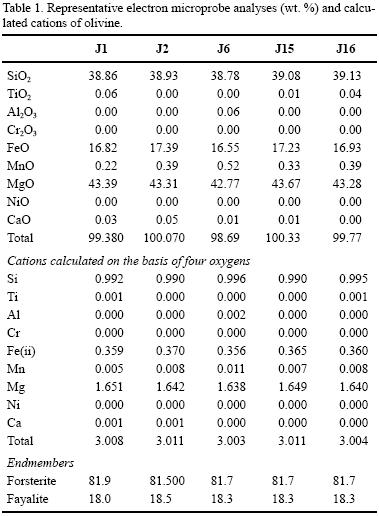
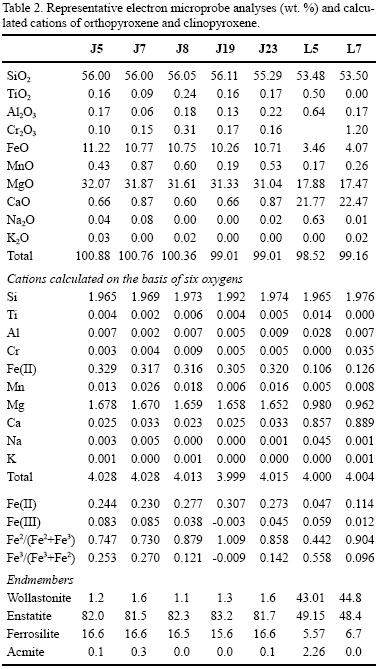
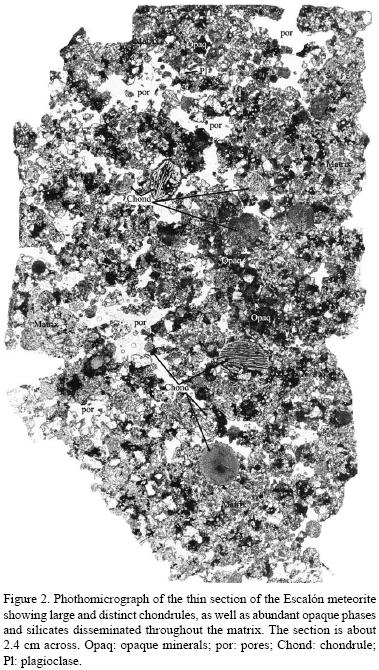
<body><![CDATA[<p align="justify"><font face="verdana" size="2"><i><b>Optical microscopy</b></i></font></p>     <p align="justify"><font face="verdana" size="2">The chondrite consists of chondrules (spherical or subspherical, commonly sub&#150;milimetric petrographic objects that show evidence of a molten or partially molten origin), crystal fragments, and matrix (fine grained aggregates of material filling the interstices between chondrules and crystal fragments) (<a href="#f2">Figure 2</a>). The identified mineral phases in Escal&oacute;n are olivine, pyroxene, plagioclase, merrilite and chlorapatite as well as troilite, taenite, kamacite, chromite and pentlandite. Olivine, pyroxene, troilite, kamacite and taenite are the main constituents besides chondrules.</font></p>     <p align="center"><font face="verdana" size="2"><a name="f2"></a></font></p>     <p align="center"><font face="verdana" size="2"><img src="/img/revistas/rmcg/v27n1/a13f2.jpg"></font></p>     <p align="justify"><font face="verdana" size="2">Olivine and pyroxene are the predominant silicates; minor plagioclase shows characteristic albite twinning. Olivine is resorbed and silicates show euhedral to anhedral shape, with common wavy extinction. There is no visible oxidation of metal or sulfide, and only a limonitic staining may be noticeable in transmitted light.</font></p>     <p align="justify"><font face="verdana" size="2"><i><b>Electron microscopy</b></i></font></p>     <p align="justify"><font face="verdana" size="2">Olivine and pyroxene grains were analysed by electron microprobe to determine their compositions and degree of equilibration. Representative analyses are given in <a href="#t1">Tables 1</a> and <a href="#t2">2</a>. The composition is quite uniform; grains inside chondrules have the same composition as those outside chondrules. Olivine (34 analyses) with an average fayalite (Fa) content of 18.1&plusmn; 0.4 mol%; low&#150;Ca pyroxene (32 analyses) show an average ferrosilite (Fs) content of 16.5 &plusmn; 0.35 mol%, whereas wollastonite content (Wo) in orthopyroxene is 1.5 &plusmn; 0.2 mol%; the average composition of four high&#150;Ca pyroxene grains is Wo 41.7 &plusmn; 2.7 mol%. This composition is similar to most analyses in the H group range (Scott <i>et al.</i>, 1986; Brearley and Jones, 1998).</font></p>     <p align="center"><font face="verdana" size="2"><a name="t1"></a></font></p>     <p align="center"><font face="verdana" size="2"><img src="/img/revistas/rmcg/v27n1/a13t1.jpg"></font></p>     <p align="center"><font face="verdana" size="2"><a name="t2"></a></font></p>     ]]></body>
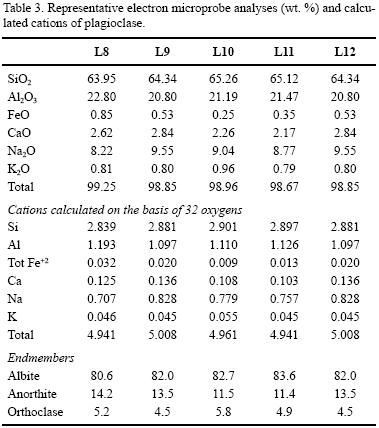
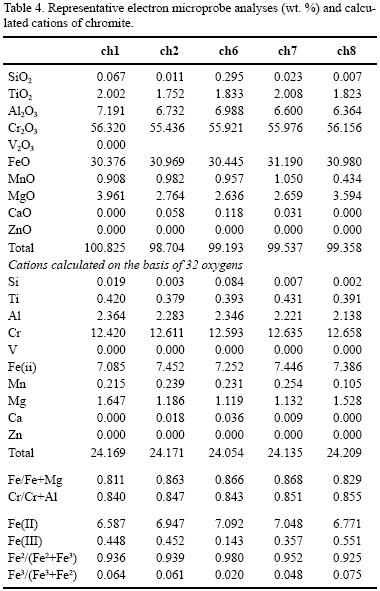
<body><![CDATA[<p align="center"><font face="verdana" size="2"><img src="/img/revistas/rmcg/v27n1/a13t2.jpg"></font></p>     <p align="justify"><font face="verdana" size="2">Pyroxenes are mainly orthopyroxene, but less than 5% of the grains are clinopyroxene with Wo<sub>41.7</sub> (%mol), which is similar to diopside composition. Growth steps are visible on the faces of olivine and pyroxene crystals. Other minerals identified in the polished thin section are pentlandite, merrilite, chlorapatite, native copper as inclusion in taenite, and tetrataenite.</font></p>     <p align="justify"><font face="verdana" size="2">Plagioclase occurs in the matrix, with composition Ab<sub>85.2&plusmn;1.1</sub>, An<sub>12.8&plusmn;1.3 </sub>, Or<sub>5&plusmn;0.5</sub> (<a href="#t3">Table 3</a>), which is near the mean equilibrated H chondrite plagioclase composition (Van Schmus and Ribbe, 1968).</font></p>     <p align="center"><font face="verdana" size="2"><a name="t3"></a></font></p>     <p align="center"><font face="verdana" size="2"><img src="/img/revistas/rmcg/v27n1/a13t3.jpg"></font></p>     <p align="justify"><font face="verdana" size="2">Chloroapatite and merrilite are common accessory minerals in equilibrated ordinary <i>chondrites</i> and they usually occur interstitially among ferromagnesian silicates in the matrix and associated with metal and sulphide phases (Yabuki and Goresy, 1986).</font></p>     <p align="justify"><font face="verdana" size="2">The phosphates in Escal&oacute;n are mostly merrillite and up to 200 &micro;m in size; merrillite was found in the matrix associated with kamacite, troilite and chromite; it was also found as relatively large crystals in the groundmass of barred olivine chondrule (<a href="/img/revistas/rmcg/v27n1/a13f3.jpg" target="_blank">Figure 3a</a>) and as crystals attached to the surface of chondrules. Merrillite is also mixed with chlorapatite (<a href="/img/revistas/rmcg/v27n1/a13f3.jpg" target="_blank">Figure 3b</a>).</font></p>     <p align="justify"><font face="verdana" size="2">Opaque minerals make up less than 20% of the meteorite, with troilite more abundant than Fe&#150;Ni grains and minor chromite, merrillite, pentlandite and copper metal. </font></p>     <p align="justify"><font face="verdana" size="2">Chromite crystals are frequent. The composition of chromite (<a href="#t4">Table 4</a>) shows a Fe/(Fe+Mg) of 0.847 &plusmn; 0.03, which is within the range of those reported for H <i>chondrites</i> (Bunch <i>et al.</i>, 1967; Nehru <i>et al.</i>, 1997).</font></p>     <p align="center"><font face="verdana" size="2"><a name="t4"></a></font></p>     ]]></body>
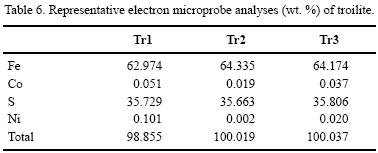
<body><![CDATA[<p align="center"><font face="verdana" size="2"><img src="/img/revistas/rmcg/v27n1/a13t4.jpg"></font></p>     <p align="justify"><font face="verdana" size="2">The chromite forms individual anhedral to subhedral grains, 20&#150;100 &#956;m in size, isolated from other opaque phases or close to metals and troilite. Also, there are local aggregates up to 300 &#956;m, associated with plagioclase glass (<a href="/img/revistas/rmcg/v27n1/a13f3.jpg" target="_blank">Figures 3c</a>, <a href="/img/revistas/rmcg/v27n1/a13f3.jpg" target="_blank">3d</a>) and similar to CPA (chromite&#150;plagioclase assemblages) of Rubin (2003). Chromite in Escal&oacute;n meteorite also occurs as small inclusions (blebs) &lt;3 &#956;m in chondrules and in olivine crystals (<a href="/img/revistas/rmcg/v27n1/a13f3.jpg" target="_blank">Figure 3f</a>).</font></p>     <p align="justify"><font face="verdana" size="2">A few mafic silicate grains in Escal&oacute;n contain Fe&#150;Ni blebs (<a href="/img/revistas/rmcg/v27n1/a13f3.jpg" target="_blank">Figure 3e</a>) and small chromite blebs (<a href="/img/revistas/rmcg/v27n1/a13f3.jpg" target="_blank">Figure 3f</a>). Similar chromite blebs have been reported in shocked ordinary chondrite (Rubin, 1992).</font></p>     <p align="justify"><font face="verdana" size="2">Modal analysis, based on 300 points counts on an area of a thin section by using SEM&#150;EDS thechnique, were obtained for metals and sulfides, showing the following values: troilite 52%; kamacite 35%; taenite 10%; tetrataenite 3% and scarce native copper and pentlandite. </font></p>     <p align="justify"><font face="verdana" size="2">Kamacite can be observed on large grains up to 1 mm in diameter, as tiny granules (1&#150;5 &#956;m) inside some chondrules and also in the matrix. The larger grains have irregular margins and some of them present growth steps typical of group H chondrite (Michel&#150;Levy, 1981), and perhaps it also contains olivine inclusions (<a href="/img/revistas/rmcg/v27n1/a13f4.jpg" target="_blank">Figure 4a</a>), or other opaque phases such as native copper (<a href="/img/revistas/rmcg/v27n1/a13f4.jpg" target="_blank">Figures 4b</a>, <a href="/img/revistas/rmcg/v27n1/a13f4.jpg" target="_blank">4c</a>). </font></p>     <p align="justify"><font face="verdana" size="2">The average cobalt concentration in kamacite is 0.318&#150;0.432 wt.%. The results for Ni and Co are similar to other H group meteorites.</font></p>     <p align="justify"><font face="verdana" size="2">Taenite is present in less proportion that kamacite and tends to form slightly smaller grains, in places associated with troilite, kamacite and tetrataenite (<a href="/img/revistas/rmcg/v27n1/a13f4.jpg" target="_blank">Figures 4d</a>, <a href="/img/revistas/rmcg/v27n1/a13f4.jpg" target="_blank">4e</a>, <a href="/img/revistas/rmcg/v27n1/a13f4.jpg" target="_blank">4f</a>). Ni&#150;rich zones known as clear taenite (tetrataenite) that surround taenite display a characteristic M&#150;shaped (Wood, 1967; Clarke and Scott, 1980) Ni concentration profile, with the highest Ni content concentrated at the edge (&plusmn; 50 wt%), and the lowest in the center (&plusmn; 30 wt.%). Tetrataenite occurs as grains of 5&#150;50 &#956;m, some also as rims 1&#150;20 &#956;m wide on taenite grains (<a href="/img/revistas/rmcg/v27n1/a13f4.jpg" target="_blank">Figures 4e</a>, <a href="/img/revistas/rmcg/v27n1/a13f4.jpg" target="_blank">4f</a>) and in places with troilite grain inclusions. In Escal&oacute;n meteorite, kamacite and taenite also occur intergrown, forming the phase plessite (<a href="/img/revistas/rmcg/v27n1/a13f4.jpg" target="_blank">Figures 4d</a>, <a href="/img/revistas/rmcg/v27n1/a13f4.jpg" target="_blank">4f</a>) (Brearley and Jones, 1998).</font></p>     <p align="justify"><font face="verdana" size="2">Troilite is more abundant than metal grains and can be seen with sizes of 10&#150;200 &#956;m. It is associated with metal and chromite grains and also occurs inside metal grains. Representative analyses of Fe&#150;Ni and troilite are given in <a href="/img/revistas/rmcg/v27n1/a13t5.jpg" target="_blank">Tables 5</a> and <a href="#t6">6</a>. </font></p>     <p align="center"><font face="verdana" size="2"><a name="t6"></a></font></p>     <p align="center"><font face="verdana" size="2"><img src="/img/revistas/rmcg/v27n1/a13t6.jpg"></font></p>     ]]></body>
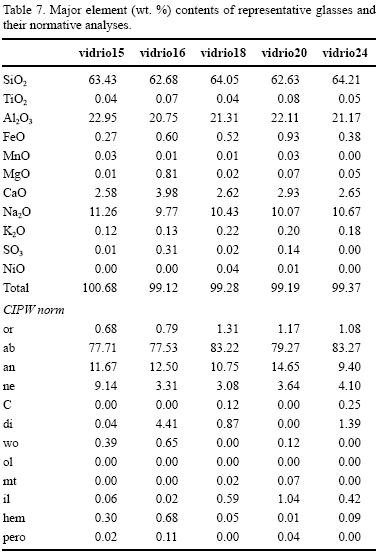
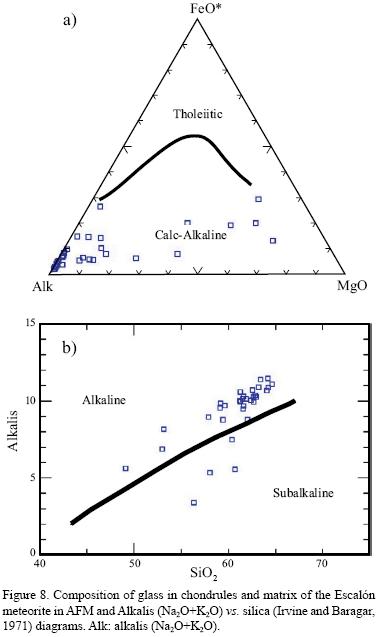
<body><![CDATA[<p align="justify"><font face="verdana" size="2">Scanning electron images were obtained from grains of opaque phases in the Escal&oacute;n meteorite. Although some grains appear homogeneous, other show complex intergrowths of Ni&#150;rich areas (<a href="/img/revistas/rmcg/v27n1/a13f4.jpg" target="_blank">Figure 4f</a>).</font></p>     <p align="justify"><font face="verdana" size="2">Chondrules tend to show well defined boundaries. The measurement of the apparent diameters of about 50 chondrules showed an average of 0.62 mm and a range of 0.23&#150;2.25 mm apparent diameters. The mean diameter of 0.62 mm was larger than the normal for H <i>chondrites</i> (300 &#956;m for H <i>chondrites</i> ; Grossman <i>et al.</i>, 1988).</font></p>     <p align="justify"><font face="verdana" size="2">The chondrules are spherical or oval in shape, sometimes polysomatic (<a href="/img/revistas/rmcg/v27n1/a13f5.jpg" target="_blank">Figure 5a</a>), often display rims of fine&#150;grained olivine, pyroxene and opaque phases in a glass matrix (<a href="/img/revistas/rmcg/v27n1/a13f5.jpg" target="_blank">Figure 5b</a>). Chondrules in the Escal&oacute;n meteorite are of two main types: BO (barred olivine) (<a href="/img/revistas/rmcg/v27n1/a13f3.jpg" target="_blank">Figures 3a</a>, <a href="/img/revistas/rmcg/v27n1/a13f5.jpg" target="_blank">5a</a>, <a href="/img/revistas/rmcg/v27n1/a13f5.jpg" target="_blank">5b</a>, <a href="/img/revistas/rmcg/v27n1/a13f6.jpg" target="_blank">6b</a>, <a href="/img/revistas/rmcg/v27n1/a13f6.jpg" target="_blank">6c</a>, <a href="/img/revistas/rmcg/v27n1/a13f7.jpg" target="_blank">7c</a>, <a href="/img/revistas/rmcg/v27n1/a13f7.jpg" target="_blank">7e</a>, <a href="/img/revistas/rmcg/v27n1/a13f7.jpg" target="_blank">7f</a>) and RP (radial pyroxene) (<a href="/img/revistas/rmcg/v27n1/a13f6.jpg" target="_blank">Figure 6f</a>). The BO chondrules may also have orthopyroxene combined with minor amounts of Fe&#150;Ni metal grains distributed throughout the chondrule (<a href="/img/revistas/rmcg/v27n1/a13f7.jpg" target="_blank">Figure 7f</a>). Some interstitial glass was also observed (<a href="/img/revistas/rmcg/v27n1/a13f7.jpg" target="_blank">Figure 7f</a>). A readily distinguished porphyritic olivine and pyroxene (POP) chondrule, whith some olivine grains showing ondulatory extinction, is also present (<a href="/img/revistas/rmcg/v27n1/a13f5.jpg" target="_blank">Figure 5d</a>).</font></p>     <p align="justify"><font face="verdana" size="2">Others chondrules were GO (granular olivine) with well&#150;defined borders (<a href="/img/revistas/rmcg/v27n1/a13f6.jpg" target="_blank">Figure 6a</a>); some are porphyritic (with phenocrysts), a common texture termed POP (porphyritic chondrules composed of olivine and pyroxene) (<a href="/img/revistas/rmcg/v27n1/a13f6.jpg" target="_blank">Figure 6e</a>), and finally some are C (cryptocrystalline) (<a href="/img/revistas/rmcg/v27n1/a13f6.jpg" target="_blank">Figure 6d</a>). Apart from these typical petrological textures, other chondrules in Escal&oacute;n show unusual textures such as probably barred pyroxene with glass (<a href="/img/revistas/rmcg/v27n1/a13f7.jpg" target="_blank">Figure 7a</a>), a transitional texture BO with pyroxene radial texture (<a href="/img/revistas/rmcg/v27n1/a13f7.jpg" target="_blank">Figure 7f</a>), Radial olivine and pyroxene (ROP) chondrules with a complex texture of radial olivine and pyroxene where the fine grained fibers grow in different orientations (<a href="/img/revistas/rmcg/v27n1/a13f5.jpg" target="_blank">Figure 5c</a>). It includes an unusual matrix&#150;rich chondrule with chromite and high&#150;Ca pyroxene (<a href="/img/revistas/rmcg/v27n1/a13f7.jpg" target="_blank">Figure 7b</a>), some glass&#150;rich chondrules (<a href="/img/revistas/rmcg/v27n1/a13f7.jpg" target="_blank">Figure 7c</a>, <a href="/img/revistas/rmcg/v27n1/a13f7.jpg" target="_blank">7e</a>), and one POP chondrule has a large central euhedral olivine crystal with a discontinuous chromite veinlet (possible restitic grain?), which is rimmed by orthopyroxene grains (<a href="/img/revistas/rmcg/v27n1/a13f7.jpg" target="_blank">Figure 7d</a>).</font></p>     <p align="justify"><font face="verdana" size="2">Glass is found in chondrules (10&#150;29%) and in the matrix (&#126;5%). All analysed glasses (<a href="#t7">Table 7</a>) are similar in composition and they are highly recrystallized in some instances. This glass is rich in Na, Al, and Ca, and poor in Fe and Mg. The glass analyses reveal an alkaline composition (<a href="#f8">Figures 8a</a>, <a href="#f8">8b</a>). Normative mineralogy includes albite, anorthite, nepheline, orthoclase and corundum (<a href="#t7">Table 7</a>).</font></p>     <p align="center"><font face="verdana" size="2"><a name="t7"></a></font></p>     <p align="center"><font face="verdana" size="2"><img src="/img/revistas/rmcg/v27n1/a13t7.jpg"></font></p>     <p align="center"><font face="verdana" size="2"><a name="f8"></a></font></p>     <p align="center"><font face="verdana" size="2"><img src="/img/revistas/rmcg/v27n1/a13f8.jpg"></font></p>     <p align="justify"><font face="verdana" size="2">Troilite, kamacite and chromite were identified also within the glass phase. </font></p>     ]]></body>
<body><![CDATA[<p align="justify"><font face="verdana" size="2"><b>X&#150;ray diffraction</b></font></p>     <p align="justify"><font face="verdana" size="2">X&#150;ray diffraction (XRD) pattern recorded for Escal&oacute;n samples are shown in <a href="/img/revistas/rmcg/v27n1/a13f9.jpg" target="_blank">Figure 9</a>. The XRD pattern from the powdered sample shows three phases: pyroxenes (enstatite) (PDF 19&#150;0768); olivine (forsterite) (PDF 34&#150;0189); and iron (kamacite) (PDF 37&#150;0474).</font></p>     <p align="justify"><font face="verdana" size="2">The most abundant mineral in Escal&oacute;n is olivine (&#126;50%), followed by pyroxene (enstatite) (&#126;32%), and iron (kamacite) (&#126;18%). The semiquantitative analysis were estimated from the main peak intensity of each mineral phase: Olivine (forsterite) (d = 2.4567 &Aring;), pyroxene (enstatite) (d = 2.8700 &Aring;) and , iron (kamacite) (d = 2.0280 &Aring;).</font></p>     <p align="justify"><font face="verdana" size="2">&nbsp;</font></p>     <p align="justify"><font face="verdana" size="2"><b>DISCUSSION</b></font></p>     <p align="justify"><font face="verdana" size="2">Based on olivine and low&#150;Ca pyroxene composition, Escal&oacute;n meteorite can be classified as an H group chondrite. The olivine and orthopyroxene compositions are within the range of the H chondrites (fayalite content of 18.1 mol% for their olivines and ferrosilite with 16.5 mol% for their orthopyroxenes). The silicate mineral composition homogeneity and the well defined chondrule boundaries suggest that Escal&oacute;n belongs to petrologic type 4 (classification of Van Schmus and Wood, 1967).</font></p>     <p align="justify"><font face="verdana" size="2">Kamacite Co concentrations vary systematically in the chondrite chemical groups; kamacite in H, L, LL group chondrites contain 0.4&#150;0.5, 0.7&#150;1.0, and 1.5&#150;3 wt.% Co, respectively (Rubin, 1990; Reisener and Goldstein, 2003). The kamacite Co content (0.318&#150;0.432) in Escal&oacute;n meteorite is almost similar to H group chondrites.</font></p>     <p align="justify"><font face="verdana" size="2">There are no visible oxidation of metal or sulfide, and only a limonitic staining may be noticeable in transmitted light, which characterize a weathering grade W0, according to the classification scheme proposed by Wlotzka (1993) for ordinary chondrites. </font></p>     <p align="justify"><font face="verdana" size="2">The average diameter in Escal&oacute;n chondrules of 0.62 mm is larger than normal for H chondrites, which show the smallest sizes among ordinary chondrite (Rubin, 2005). Possibly, chondrule precursors were larger or more densely distributed in the environment where this meteorite formed as part of a primitive asteroid.</font></p>     <p align="justify"><font face="verdana" size="2">Glass in Escal&oacute;n is alkaline and similar to igneous rocks of the alkaline series (<a href="#f8">Figures 8a</a>, <a href="#f8">8b</a>). Normative albite content is dominant and resemble that of other ordinary chondrites , in particular to Dimmitt H chondrite (Krot and Rubin, 1994). Glass in Escal&oacute;n chondrules and matrix has the same composition, maybe because it is a quench product solidified at very high temperatures. According to Varela <i>et al.</i> (2006) all meteorite glasses are the result of an unique universal process, representing the remnants of the liquid that facilitated growth of crystals from primary liquid condensation; they reasoned that, in contrast to mayor elements, trace element abundances of all glasses display the same pattern. </font></p>     ]]></body>
<body><![CDATA[<p align="justify"><font face="verdana" size="2">The opaque phases study is important because they registred the thermal histories of meteorites (Wood, 1967; Reisener and Goldstein, 2003). The spherical shape of metallic phases inside some silicate grains in Escal&oacute;n (<a href="/img/revistas/rmcg/v27n1/a13f3.jpg" target="_blank">Figure 3e</a>) indicate an origin as liquid droplets that may be interpreted as relicts of a primary solidification structure by the rapid, non&#150;equilibrium cooling of the Fe&#150;Ni&#150;S melts to temperatures of about 700 &deg;C, similar to some textures in Tieschitz meteorite (Bevan and Axon, 1980). The plessitic texture also observed in this chondrite, possibly was formed at low temperatures from the decomposition of high temperature taenite, which was retained during slow cooling (Brearley and Jones, 1998).</font></p>     <p align="justify"><font face="verdana" size="2">Zoned taenite has received much attention because the Ni profiles are useful for calculating metallographic cooling rates (Reisener and Goldstein, 2003). Tetrataenite, which forms by ordering of Fe and Ni atoms in taenite, makes rims around taenite grains in chondrites below 350 &deg;C and slow cooling (Clarke and Scott, 1980). Taenite in the Escal&oacute;n meteorite shows the highest Ni content at the edge (&plusmn;50 wt.%), and the lowest at the center (&plusmn;30 wt.%) (<a href="/img/revistas/rmcg/v27n1/a13f4.jpg" target="_blank">Figure 4e</a>).</font></p>     <p align="justify"><font face="verdana" size="2">The metallic Ni&#150;Fe phases of this meteorite are typical of slowly&#150;cooled ordinary chondrites. The kamacite is monocrystalline and has Neumann bands. Most of the zoned taenites are isolated from kamacite; larger zoned taenite grains have martensitic interiors. Tetrataenite, an ordered FeNi phase (Clarke and Scott, 1980), occurs at some kamacite borders, and also surrounds some of the zoned taenite grains that are associated with troilite.</font></p>     <p align="justify"><font face="verdana" size="2">In ordinary chondrites, metallic copper is rare compared to metallic Fe&#150;Ni alloy, and it occurs in several petrographic assemblages (Rubin, 1994); In Escal&oacute;n, metallic Cu, 10&#150;16 &#956;m in size, occurs enclosed in metallic Fe&#150;Ni (taenite), and it is adjacent to small irregular troilite grains inside taenite. This type of assemblage is reported as the most common occurrence in ordinary chondrites, and it may have formed by localized shock melting or remelting of a metal&#150;troilite assemblage (Rubin, 1994).</font></p>     <p align="justify"><font face="verdana" size="2">Shock metamorphic effects on Escal&oacute;n correspond to shock stage S3, based on the presence of planar fractures in olivine (not shown by all grains) and undulatory extinction in all olivine grains, irregular fractures, and the presence of thin opaque veins. The black color of the hand specimen can be the result of numerous fine&#150;grained metallic Fe&#150;Ni&#150;troilite particles, which may be associated with the shock effects (St&ouml;ffler <i>et al.</i>, 1991). The other petrographic shock signatures in Escal&oacute;n occur as chromite&#150;plagioclase assemblages, and polycrystalline troilite, metallic Cu, Cr and Fe&#150;Ni blebs inclusions in olivine are relict shock features, which are consistent with a history of shock and annealing (Rubin, 2003, 2004; Bennett and McSween, 1996).</font></p>     <p align="justify"><font face="verdana" size="2">Other H4 chondrite with similar characteristics to Escal&oacute;n are Menow and Ste. Marguerite (Michel&#150;Levy, 1981).</font></p>     <p align="justify"><font face="verdana" size="2">&nbsp;</font></p>     <p align="justify"><font face="verdana" size="2"><b>CONCLUSIONS</b></font></p>     <p align="justify"><font face="verdana" size="2">Escal&oacute;n is a high iron chondrite (H) as indicated by the average olivine composition (Fa<sub>19</sub>) and average composition of pyroxene (Fs<sub>13.6&#150;16.3</sub>). </font></p>     <p align="justify"><font face="verdana" size="2">Classification as petrologic type 4 is indicated by the readily discernible chondrules, modest recrystallization and the Wo content of low&#150;Ca pyroxene, which is within the range of typical type 4 chondrites.</font></p>     ]]></body>
<body><![CDATA[<p align="justify"><font face="verdana" size="2">The occurrence of plessitic texture and tetrataenite points to a slow cooling at low temperature.</font></p>     <p align="justify"><font face="verdana" size="2">Growth steps were observed in olivine, pyroxene and troilite crystals, whereas shock effects determined in Escal&oacute;n were undulatory extinction of most olivine grains, and the occurrence of planar fractures, as well as some opaque shock veins indicating stage 3 of St&ouml;ffler <i>et al.</i> (1991). Other petrographic shock indicators observed in Escal&oacute;n and stated by Rubin (2004) in equilibrated ordinary chondrite include: chromite&#150;plagioclase assemblages, polycrystalline troilite, metallic Cu and Fe&#150;Ni blebs inclusions in olivine, confirming shock stage S3 for Escal&oacute;n.</font></p>     <p align="justify"><font face="verdana" size="2">&nbsp;</font></p>     <p align="justify"><font face="verdana" size="2"><b>ACKNOWLEDGEMENTS</b></font></p>     <p align="justify"><font face="verdana" size="2">This project received funds from Conacyt Project 43227, which are gratefully acknowledged. The authors acknowledge to M. Naito of the National Institute of Polar Research, Japan, for the use of the electron&#150;probe microanalyser; Dr. Hugo Delgado for allowing the use of electronprobe at Laboratorio Universitario de Petrolog&iacute;a, UNAM, M&eacute;xico; Juan T. V&aacute;zquez&#150;Ram&iacute;rez prepared one polished thin section and L. Ba&ntilde;os provided technical support in the XRD laboratory of IIM&#150;UNAM. The authors thank Dr. Mikhail Ostrooumov and an anonymous reviewer for valuable comments and suggestions for improving the manuscript.</font></p>     <p align="justify"><font face="verdana" size="2">&nbsp;</font></p>     <p align="justify"><font face="verdana" size="2"><b>REFERENCES</b></font></p>     <!-- ref --><p align="justify"><font face="verdana" size="2">Bennett, M.E., McSween, H.Y., 1996, Shock features in iron&#150;nickel metal and troilite of L&#150;group ordinary chondrites: Meteoritics &amp; Planetary Science, 31, 255&#150;264.</font>&nbsp;&nbsp;&nbsp;&nbsp;&nbsp;&nbsp;&nbsp;&nbsp;[&#160;<a href="javascript:void(0);" onclick="javascript: window.open('/scielo.php?script=sci_nlinks&ref=8094792&pid=S1026-8774201000010001300001&lng=','','width=640,height=500,resizable=yes,scrollbars=1,menubar=yes,');">Links</a>&#160;]<!-- end-ref --><!-- ref --><p align="justify"><font face="verdana" size="2">Bevan, A.W.R., Axon, H.J., 1980, Metallography and thermal history of the Tieschitz unequilibrated meteorite&#150;metallic chondrules and the origin of polycrystalline taenite: Earth and Planetary Science Letters, 47, 353&#150;360. </font>&nbsp;&nbsp;&nbsp;&nbsp;&nbsp;&nbsp;&nbsp;&nbsp;[&#160;<a href="javascript:void(0);" onclick="javascript: window.open('/scielo.php?script=sci_nlinks&ref=8094793&pid=S1026-8774201000010001300002&lng=','','width=640,height=500,resizable=yes,scrollbars=1,menubar=yes,');">Links</a>&#160;]<!-- end-ref --><!-- ref --><p align="justify"><font face="verdana" size="2">Brearley, A. J., Jones, R. H., 1998, Chondritic meteorites, <i>in</i> Papike J.J., (ed.), Planetary materials: Washington D.C., Mineralogical Society of America, Reviews in Mineralogy, 36, 3.1&#150;3.398.</font>&nbsp;&nbsp;&nbsp;&nbsp;&nbsp;&nbsp;&nbsp;&nbsp;[&#160;<a href="javascript:void(0);" onclick="javascript: window.open('/scielo.php?script=sci_nlinks&ref=8094794&pid=S1026-8774201000010001300003&lng=','','width=640,height=500,resizable=yes,scrollbars=1,menubar=yes,');">Links</a>&#160;]<!-- end-ref --><!-- ref --><p align="justify"><font face="verdana" size="2">Bunch, T.E., Keil, K., Snetsinger, K.G., 1967, Chromite composition in relation to chemistry and texture of ordinary chondrites: Geochimica et Cosmochimica Acta, 31, 1568&#150;1582. </font>&nbsp;&nbsp;&nbsp;&nbsp;&nbsp;&nbsp;&nbsp;&nbsp;[&#160;<a href="javascript:void(0);" onclick="javascript: window.open('/scielo.php?script=sci_nlinks&ref=8094795&pid=S1026-8774201000010001300004&lng=','','width=640,height=500,resizable=yes,scrollbars=1,menubar=yes,');">Links</a>&#160;]<!-- end-ref --><!-- ref --><p align="justify"><font face="verdana" size="2">Clarke, R.S., Scott, E.R.D., 1980, Tetrataenite&#150;ordered FeNi, a new mineral in meteorites: American Mineralogist, 65, 624&#150;630.</font>&nbsp;&nbsp;&nbsp;&nbsp;&nbsp;&nbsp;&nbsp;&nbsp;[&#160;<a href="javascript:void(0);" onclick="javascript: window.open('/scielo.php?script=sci_nlinks&ref=8094796&pid=S1026-8774201000010001300005&lng=','','width=640,height=500,resizable=yes,scrollbars=1,menubar=yes,');">Links</a>&#160;]<!-- end-ref --><!-- ref --><p align="justify"><font face="verdana" size="2">Grossman, J.N., Rubin, A.E., Nagahara H., King E.A., 1988, Properties of chondrules, <i>in</i> Kerridge, J.F., Matthews M.S. (eds.), Meteorites and the early solar system: Tucson, Arizona, U.S.A., University of. Arizona Press, 619&#150;654.</font>&nbsp;&nbsp;&nbsp;&nbsp;&nbsp;&nbsp;&nbsp;&nbsp;[&#160;<a href="javascript:void(0);" onclick="javascript: window.open('/scielo.php?script=sci_nlinks&ref=8094797&pid=S1026-8774201000010001300006&lng=','','width=640,height=500,resizable=yes,scrollbars=1,menubar=yes,');">Links</a>&#160;]<!-- end-ref --><!-- ref --><p align="justify"><font face="verdana" size="2">Irvine, T.N., Baragar W.R.A., 1971, A guide to the chemical classification of the common volcanic rocks: Canadian Journal of Earth Science, 8, 523&#150;548.</font>&nbsp;&nbsp;&nbsp;&nbsp;&nbsp;&nbsp;&nbsp;&nbsp;[&#160;<a href="javascript:void(0);" onclick="javascript: window.open('/scielo.php?script=sci_nlinks&ref=8094798&pid=S1026-8774201000010001300007&lng=','','width=640,height=500,resizable=yes,scrollbars=1,menubar=yes,');">Links</a>&#160;]<!-- end-ref --><!-- ref --><p align="justify"><font face="verdana" size="2">Krot, A., Rubin, A.E., 1994, Glass&#150;rich chondrules in ordinary chondrites: Meteoritics &amp; Planetary Science, 29, 697&#150;707.</font>&nbsp;&nbsp;&nbsp;&nbsp;&nbsp;&nbsp;&nbsp;&nbsp;[&#160;<a href="javascript:void(0);" onclick="javascript: window.open('/scielo.php?script=sci_nlinks&ref=8094799&pid=S1026-8774201000010001300008&lng=','','width=640,height=500,resizable=yes,scrollbars=1,menubar=yes,');">Links</a>&#160;]<!-- end-ref --><!-- ref --><p align="justify"><font face="verdana" size="2">Krot, A.N., Keil, K., Goodrich, C.A., Scott, E.R.D., Weisberg, M.K., 2003, Classification of meteorites, <i>in</i> Davis A.M. (ed.), Meteorites, Comets and Planets: Oxford, Elsevier, Treatise on Geochemistry (Holland H.D., Turekian K.K., eds.), v. 1, 83&#150;128.</font>&nbsp;&nbsp;&nbsp;&nbsp;&nbsp;&nbsp;&nbsp;&nbsp;[&#160;<a href="javascript:void(0);" onclick="javascript: window.open('/scielo.php?script=sci_nlinks&ref=8094800&pid=S1026-8774201000010001300009&lng=','','width=640,height=500,resizable=yes,scrollbars=1,menubar=yes,');">Links</a>&#160;]<!-- end-ref --><!-- ref --><p align="justify"><font face="verdana" size="2">Michel&#150;Levy, M.C., 1981, Some clues to the history of the H&#150;group chondrites: Earth and Planetary Science Letters, 54, 67&#150;80.</font>&nbsp;&nbsp;&nbsp;&nbsp;&nbsp;&nbsp;&nbsp;&nbsp;[&#160;<a href="javascript:void(0);" onclick="javascript: window.open('/scielo.php?script=sci_nlinks&ref=8094801&pid=S1026-8774201000010001300010&lng=','','width=640,height=500,resizable=yes,scrollbars=1,menubar=yes,');">Links</a>&#160;]<!-- end-ref --><!-- ref --><p align="justify"><font face="verdana" size="2">Nehru, C.E., Weisberg, M.K., Prinz, M., 1997, Chromites in unequilibrated ordinary chondrites, <i>en</i> 28th Annual Lunar and Planetary Science Conference, 1651.PDF, 2 pp.</font>&nbsp;&nbsp;&nbsp;&nbsp;&nbsp;&nbsp;&nbsp;&nbsp;[&#160;<a href="javascript:void(0);" onclick="javascript: window.open('/scielo.php?script=sci_nlinks&ref=8094802&pid=S1026-8774201000010001300011&lng=','','width=640,height=500,resizable=yes,scrollbars=1,menubar=yes,');">Links</a>&#160;]<!-- end-ref --><!-- ref --><p align="justify"><font face="verdana" size="2">Reisener, R.J., Goldstein, J.I., 2003, Ordinary chondrite metallography, Part 2. Formation of zoned and unzoned metal particles in relatively unshocked H, L, and LL chondrites: Meteoritics &amp; Planetary Science, 38, 1679&#150;1696.</font>&nbsp;&nbsp;&nbsp;&nbsp;&nbsp;&nbsp;&nbsp;&nbsp;[&#160;<a href="javascript:void(0);" onclick="javascript: window.open('/scielo.php?script=sci_nlinks&ref=8094803&pid=S1026-8774201000010001300012&lng=','','width=640,height=500,resizable=yes,scrollbars=1,menubar=yes,');">Links</a>&#160;]<!-- end-ref --><!-- ref --><p align="justify"><font face="verdana" size="2">Rubin, A.E., 1990, Kamacite and olivine in ordinary chondrites: Intergroup and intragroup relationships: Geochimica et Cosmochimica Acta, 54, 1217&#150;1232.</font>&nbsp;&nbsp;&nbsp;&nbsp;&nbsp;&nbsp;&nbsp;&nbsp;[&#160;<a href="javascript:void(0);" onclick="javascript: window.open('/scielo.php?script=sci_nlinks&ref=8094804&pid=S1026-8774201000010001300013&lng=','','width=640,height=500,resizable=yes,scrollbars=1,menubar=yes,');">Links</a>&#160;]<!-- end-ref --><!-- ref --><p align="justify"><font face="verdana" size="2">Rubin, A.E., 1992, A shock&#150;metamorphic model for silicate darkening and compositionally Kamacite and olivine in ordinary chondrites: Intergroup and intragroup relationships: Geochimica et Cosmochimica Acta, 54, 1217&#150;1232.</font>&nbsp;&nbsp;&nbsp;&nbsp;&nbsp;&nbsp;&nbsp;&nbsp;[&#160;<a href="javascript:void(0);" onclick="javascript: window.open('/scielo.php?script=sci_nlinks&ref=8094805&pid=S1026-8774201000010001300014&lng=','','width=640,height=500,resizable=yes,scrollbars=1,menubar=yes,');">Links</a>&#160;]<!-- end-ref --><!-- ref --><p align="justify"><font face="verdana" size="2">Rubin, A.E., 1994, Metallic copper in ordinary chondrites: Meteoritics &amp; Planetary Science, 29, 93&#150;98.</font>&nbsp;&nbsp;&nbsp;&nbsp;&nbsp;&nbsp;&nbsp;&nbsp;[&#160;<a href="javascript:void(0);" onclick="javascript: window.open('/scielo.php?script=sci_nlinks&ref=8094806&pid=S1026-8774201000010001300015&lng=','','width=640,height=500,resizable=yes,scrollbars=1,menubar=yes,');">Links</a>&#160;]<!-- end-ref --><!-- ref --><p align="justify"><font face="verdana" size="2">Rubin, A.E., 2003, Chromite&#150;plagioclse assemblages as a new shock indicator; Implications for the schock and thermal histories of ordinary <i>chondrites</i> : Geochimica et Cosmochimica Acta, 67, 2695&#150;2709.</font>&nbsp;&nbsp;&nbsp;&nbsp;&nbsp;&nbsp;&nbsp;&nbsp;[&#160;<a href="javascript:void(0);" onclick="javascript: window.open('/scielo.php?script=sci_nlinks&ref=8094807&pid=S1026-8774201000010001300016&lng=','','width=640,height=500,resizable=yes,scrollbars=1,menubar=yes,');">Links</a>&#160;]<!-- end-ref --><!-- ref --><p align="justify"><font face="verdana" size="2">Rubin, A.E., 2004, Post&#150;shock annealing and post&#150;annealing shock in equilibrated ordinary chondrites: implications for the thermal and schock histories of chondritic asteroids: Geochimica et Cosmochimica Acta, 68, 673&#150;689.</font>&nbsp;&nbsp;&nbsp;&nbsp;&nbsp;&nbsp;&nbsp;&nbsp;[&#160;<a href="javascript:void(0);" onclick="javascript: window.open('/scielo.php?script=sci_nlinks&ref=8094808&pid=S1026-8774201000010001300017&lng=','','width=640,height=500,resizable=yes,scrollbars=1,menubar=yes,');">Links</a>&#160;]<!-- end-ref --><!-- ref --><p align="justify"><font face="verdana" size="2">Rubin, A.E., 2005, Relationships among intrinsic properties of ordinary chondrites: Oxidation state, bulk chemistry oxygen&#150;isotopic composition, petrologic type and chondrule size: Geochimica et Cosmochimica Acta, 69(20), 4907&#150;4918.</font>&nbsp;&nbsp;&nbsp;&nbsp;&nbsp;&nbsp;&nbsp;&nbsp;[&#160;<a href="javascript:void(0);" onclick="javascript: window.open('/scielo.php?script=sci_nlinks&ref=8094809&pid=S1026-8774201000010001300018&lng=','','width=640,height=500,resizable=yes,scrollbars=1,menubar=yes,');">Links</a>&#160;]<!-- end-ref --><!-- ref --><p align="justify"><font face="verdana" size="2">S&aacute;nchez&#150;Rubio, G., Rubinovich&#150;Kogan, R., Lozano&#150;Santa Cruz, R., Medina&#150;Malag&oacute;n, S., Flores&#150;Guti&eacute;rrez, D., 2001, Las Meteoritas de M&eacute;xico: M&eacute;xico, Universidad Nacional Aut&oacute;noma de M&eacute;xico, Instituto de Geolog&iacute;a, Instituto de Geof&iacute;sica e Instituto de Astronom&iacute;a, 85 pp.</font>&nbsp;&nbsp;&nbsp;&nbsp;&nbsp;&nbsp;&nbsp;&nbsp;[&#160;<a href="javascript:void(0);" onclick="javascript: window.open('/scielo.php?script=sci_nlinks&ref=8094810&pid=S1026-8774201000010001300019&lng=','','width=640,height=500,resizable=yes,scrollbars=1,menubar=yes,');">Links</a>&#160;]<!-- end-ref --><!-- ref --><p align="justify"><font face="verdana" size="2">Scott, E.R.D., Krot, A.N., 2003, Chondrites and their components, <i>in</i> Davis, A.M. (ed.), Meteorites, Comets and Planets: Oxford, Elsevier, Treatise on Geochemistry, (Holland H.D., Turekian K.K., eds.), v. 1, 143&#150;200.</font>&nbsp;&nbsp;&nbsp;&nbsp;&nbsp;&nbsp;&nbsp;&nbsp;[&#160;<a href="javascript:void(0);" onclick="javascript: window.open('/scielo.php?script=sci_nlinks&ref=8094811&pid=S1026-8774201000010001300020&lng=','','width=640,height=500,resizable=yes,scrollbars=1,menubar=yes,');">Links</a>&#160;]<!-- end-ref --><!-- ref --><p align="justify"><font face="verdana" size="2">Scott, E.R., Taylor, G.J., Keil, K., 1986, Accretion, metamorphism and brecciation of ordinary chondrites: Evidence from petrologic studies of meteorites from Rooselvet County, New Mexico, <i>in</i> Procedings of the 17<sup>th</sup> Lunar and Planetary Science Conference, Part 1: Journal of Geophysical Research, 91(B13), E115&#150;E123.</font>&nbsp;&nbsp;&nbsp;&nbsp;&nbsp;&nbsp;&nbsp;&nbsp;[&#160;<a href="javascript:void(0);" onclick="javascript: window.open('/scielo.php?script=sci_nlinks&ref=8094812&pid=S1026-8774201000010001300021&lng=','','width=640,height=500,resizable=yes,scrollbars=1,menubar=yes,');">Links</a>&#160;]<!-- end-ref --><!-- ref --><p align="justify"><font face="verdana" size="2">St&ouml;ffler, D., Keil, K., Scott, E.R.D., 1991, Shock metamorphism of ordinary chondrites: Geochimica et Cosmochimica Acta, 55, 3845&#150;3867.</font>&nbsp;&nbsp;&nbsp;&nbsp;&nbsp;&nbsp;&nbsp;&nbsp;[&#160;<a href="javascript:void(0);" onclick="javascript: window.open('/scielo.php?script=sci_nlinks&ref=8094813&pid=S1026-8774201000010001300022&lng=','','width=640,height=500,resizable=yes,scrollbars=1,menubar=yes,');">Links</a>&#160;]<!-- end-ref --><!-- ref --><p align="justify"><font face="verdana" size="2">Van Schmus, W.R., Ribbe, P.H., 1968, The composition and structural state of feldspar from chondritic meteorites: Geochimica et Cosmochimica Acta, 32, 1327&#150;1342.</font>&nbsp;&nbsp;&nbsp;&nbsp;&nbsp;&nbsp;&nbsp;&nbsp;[&#160;<a href="javascript:void(0);" onclick="javascript: window.open('/scielo.php?script=sci_nlinks&ref=8094814&pid=S1026-8774201000010001300023&lng=','','width=640,height=500,resizable=yes,scrollbars=1,menubar=yes,');">Links</a>&#160;]<!-- end-ref --><!-- ref --><p align="justify"><font face="verdana" size="2">Van Schmus, W.R., Wood, J.A., 1967, A chemical&#150;petrologic classification for the chondritic meteorites: Geochimica et Cosmochimica Acta, 31(5), 747&#150;765.</font>&nbsp;&nbsp;&nbsp;&nbsp;&nbsp;&nbsp;&nbsp;&nbsp;[&#160;<a href="javascript:void(0);" onclick="javascript: window.open('/scielo.php?script=sci_nlinks&ref=8094815&pid=S1026-8774201000010001300024&lng=','','width=640,height=500,resizable=yes,scrollbars=1,menubar=yes,');">Links</a>&#160;]<!-- end-ref --><!-- ref --><p align="justify"><font face="verdana" size="2">Varela, M.E., Kurat, G., 2006, An universal meteorite formation process (resumen), <i>en</i> 69<sup>th</sup> Meeting of the Meteoritical Society: Meteoritics &amp; Planetary Science, 41(suppl.), p. A180.</font>&nbsp;&nbsp;&nbsp;&nbsp;&nbsp;&nbsp;&nbsp;&nbsp;[&#160;<a href="javascript:void(0);" onclick="javascript: window.open('/scielo.php?script=sci_nlinks&ref=8094816&pid=S1026-8774201000010001300025&lng=','','width=640,height=500,resizable=yes,scrollbars=1,menubar=yes,');">Links</a>&#160;]<!-- end-ref --><!-- ref --><p align="justify"><font face="verdana" size="2">Yabuki, H., Goresy, A., 1986, Phosphate&#150;bearing microspherules in chondrules of unequilibrated ordinary chondrite, <i>in</i> Proceedings of the Tenth Symposium on Antartic Meteorites: Tokyo, National Institute of Polar Research, Memoirs, Special Issue 4, 235&#150;242.</font>&nbsp;&nbsp;&nbsp;&nbsp;&nbsp;&nbsp;&nbsp;&nbsp;[&#160;<a href="javascript:void(0);" onclick="javascript: window.open('/scielo.php?script=sci_nlinks&ref=8094817&pid=S1026-8774201000010001300026&lng=','','width=640,height=500,resizable=yes,scrollbars=1,menubar=yes,');">Links</a>&#160;]<!-- end-ref --><!-- ref --><p align="justify"><font face="verdana" size="2">Wlotzka, F., 1993, A weathering scale for the ordinary chondrites (resumen): Meteoritics &amp; Planetary Science, 23, 312.</font>&nbsp;&nbsp;&nbsp;&nbsp;&nbsp;&nbsp;&nbsp;&nbsp;[&#160;<a href="javascript:void(0);" onclick="javascript: window.open('/scielo.php?script=sci_nlinks&ref=8094818&pid=S1026-8774201000010001300027&lng=','','width=640,height=500,resizable=yes,scrollbars=1,menubar=yes,');">Links</a>&#160;]<!-- end-ref --><!-- ref --><p align="justify"><font face="verdana" size="2">Wlotzka F. 1994, The Meteoritical Bulletin, No. 77: Meteoritics &amp; Planetary Science, 29, 891&#150;897.</font>&nbsp;&nbsp;&nbsp;&nbsp;&nbsp;&nbsp;&nbsp;&nbsp;[&#160;<a href="javascript:void(0);" onclick="javascript: window.open('/scielo.php?script=sci_nlinks&ref=8094819&pid=S1026-8774201000010001300028&lng=','','width=640,height=500,resizable=yes,scrollbars=1,menubar=yes,');">Links</a>&#160;]<!-- end-ref --><!-- ref --><p align="justify"><font face="verdana" size="2">Wood, J.A., 1967, Chondrites: Their metallic minerals, thermal histories, and parent bodies: Icarus,6, 1&#150;49.</font>&nbsp;&nbsp;&nbsp;&nbsp;&nbsp;&nbsp;&nbsp;&nbsp;[&#160;<a href="javascript:void(0);" onclick="javascript: window.open('/scielo.php?script=sci_nlinks&ref=8094820&pid=S1026-8774201000010001300029&lng=','','width=640,height=500,resizable=yes,scrollbars=1,menubar=yes,');">Links</a>&#160;]<!-- end-ref --> ]]></body><back>
<ref-list>
<ref id="B1">
<nlm-citation citation-type="journal">
<person-group person-group-type="author">
<name>
<surname><![CDATA[Bennett]]></surname>
<given-names><![CDATA[M.E]]></given-names>
</name>
<name>
<surname><![CDATA[McSween]]></surname>
<given-names><![CDATA[H.Y]]></given-names>
</name>
</person-group>
<article-title xml:lang="en"><![CDATA[Shock features in iron-nickel metal and troilite of L-group ordinary chondrites]]></article-title>
<source><![CDATA[Meteoritics & Planetary Science]]></source>
<year>1996</year>
<volume>31</volume>
<page-range>255-264</page-range></nlm-citation>
</ref>
<ref id="B2">
<nlm-citation citation-type="journal">
<person-group person-group-type="author">
<name>
<surname><![CDATA[Bevan]]></surname>
<given-names><![CDATA[A.W.R]]></given-names>
</name>
<name>
<surname><![CDATA[Axon]]></surname>
<given-names><![CDATA[H.J]]></given-names>
</name>
</person-group>
<article-title xml:lang="en"><![CDATA[Metallography and thermal history of the Tieschitz unequilibrated meteorite-metallic chondrules and the origin of polycrystalline taenite]]></article-title>
<source><![CDATA[Earth and Planetary Science Letters]]></source>
<year>1980</year>
<volume>47</volume>
<page-range>353-360</page-range></nlm-citation>
</ref>
<ref id="B3">
<nlm-citation citation-type="book">
<person-group person-group-type="author">
<name>
<surname><![CDATA[Brearley]]></surname>
<given-names><![CDATA[A. J.]]></given-names>
</name>
<name>
<surname><![CDATA[Jones]]></surname>
<given-names><![CDATA[R. H.]]></given-names>
</name>
</person-group>
<article-title xml:lang="en"><![CDATA[Chondritic meteorites]]></article-title>
<person-group person-group-type="editor">
<name>
<surname><![CDATA[Papike]]></surname>
<given-names><![CDATA[J.J.]]></given-names>
</name>
</person-group>
<source><![CDATA[Planetary materials]]></source>
<year>1998</year>
<volume>36</volume>
<publisher-loc><![CDATA[Washington^eD.C. D.C.]]></publisher-loc>
<publisher-name><![CDATA[Mineralogical Society of America]]></publisher-name>
</nlm-citation>
</ref>
<ref id="B4">
<nlm-citation citation-type="journal">
<person-group person-group-type="author">
<name>
<surname><![CDATA[Bunch]]></surname>
<given-names><![CDATA[T.E]]></given-names>
</name>
<name>
<surname><![CDATA[Keil]]></surname>
<given-names><![CDATA[K]]></given-names>
</name>
<name>
<surname><![CDATA[Snetsinger]]></surname>
<given-names><![CDATA[K.G]]></given-names>
</name>
</person-group>
<article-title xml:lang="en"><![CDATA[Chromite composition in relation to chemistry and texture of ordinary chondrites]]></article-title>
<source><![CDATA[Geochimica et Cosmochimica Acta]]></source>
<year>1967</year>
<volume>31</volume>
<page-range>1568-1582</page-range></nlm-citation>
</ref>
<ref id="B5">
<nlm-citation citation-type="journal">
<person-group person-group-type="author">
<name>
<surname><![CDATA[Clarke]]></surname>
<given-names><![CDATA[R.S]]></given-names>
</name>
<name>
<surname><![CDATA[Scott]]></surname>
<given-names><![CDATA[E.R.D]]></given-names>
</name>
</person-group>
<article-title xml:lang="en"><![CDATA[Tetrataenite-ordered FeNi, a new mineral in meteorites]]></article-title>
<source><![CDATA[American Mineralogist]]></source>
<year>1980</year>
<volume>65</volume>
<page-range>624-630</page-range></nlm-citation>
</ref>
<ref id="B6">
<nlm-citation citation-type="book">
<person-group person-group-type="author">
<name>
<surname><![CDATA[Grossman]]></surname>
<given-names><![CDATA[J.N.]]></given-names>
</name>
<name>
<surname><![CDATA[Rubin]]></surname>
<given-names><![CDATA[A.E.]]></given-names>
</name>
<name>
<surname><![CDATA[Nagahara]]></surname>
<given-names><![CDATA[H.]]></given-names>
</name>
<name>
<surname><![CDATA[King]]></surname>
<given-names><![CDATA[E.A.]]></given-names>
</name>
</person-group>
<article-title xml:lang="en"><![CDATA[Properties of chondrules]]></article-title>
<person-group person-group-type="editor">
<name>
<surname><![CDATA[Kerridge]]></surname>
<given-names><![CDATA[J.F.]]></given-names>
</name>
<name>
<surname><![CDATA[Matthews]]></surname>
<given-names><![CDATA[M.S.]]></given-names>
</name>
</person-group>
<source><![CDATA[Meteorites and the early solar system]]></source>
<year>1988</year>
<page-range>619-654</page-range><publisher-loc><![CDATA[Tucson^eArizona Arizona]]></publisher-loc>
<publisher-name><![CDATA[University of. Arizona Press]]></publisher-name>
</nlm-citation>
</ref>
<ref id="B7">
<nlm-citation citation-type="journal">
<person-group person-group-type="author">
<name>
<surname><![CDATA[Irvine]]></surname>
<given-names><![CDATA[T.N]]></given-names>
</name>
<name>
<surname><![CDATA[Baragar]]></surname>
<given-names><![CDATA[W.R.A.]]></given-names>
</name>
</person-group>
<article-title xml:lang="en"><![CDATA[A guide to the chemical classification of the common volcanic rocks]]></article-title>
<source><![CDATA[Canadian Journal of Earth Science]]></source>
<year>1971</year>
<volume>8</volume>
<page-range>523-548</page-range></nlm-citation>
</ref>
<ref id="B8">
<nlm-citation citation-type="journal">
<person-group person-group-type="author">
<name>
<surname><![CDATA[Krot]]></surname>
<given-names><![CDATA[A]]></given-names>
</name>
<name>
<surname><![CDATA[Rubin]]></surname>
<given-names><![CDATA[A.E]]></given-names>
</name>
</person-group>
<article-title xml:lang="en"><![CDATA[Glass-rich chondrules in ordinary chondrites]]></article-title>
<source><![CDATA[Meteoritics & Planetary Science]]></source>
<year>1994</year>
<volume>29</volume>
<page-range>697-707</page-range></nlm-citation>
</ref>
<ref id="B9">
<nlm-citation citation-type="book">
<person-group person-group-type="author">
<name>
<surname><![CDATA[Krot]]></surname>
<given-names><![CDATA[A.N.]]></given-names>
</name>
<name>
<surname><![CDATA[Keil]]></surname>
<given-names><![CDATA[K.]]></given-names>
</name>
<name>
<surname><![CDATA[Goodrich]]></surname>
<given-names><![CDATA[C.A.]]></given-names>
</name>
<name>
<surname><![CDATA[Scott]]></surname>
<given-names><![CDATA[E.R.D.]]></given-names>
</name>
<name>
<surname><![CDATA[Weisberg]]></surname>
<given-names><![CDATA[M.K.]]></given-names>
</name>
</person-group>
<article-title xml:lang="en"><![CDATA[Classification of meteorites]]></article-title>
<person-group person-group-type="editor">
<name>
<surname><![CDATA[Davis]]></surname>
<given-names><![CDATA[A.M.]]></given-names>
</name>
</person-group>
<source><![CDATA[Meteorites, Comets and Planets]]></source>
<year>2003</year>
<volume>1</volume>
<page-range>83-128</page-range><publisher-loc><![CDATA[Oxford ]]></publisher-loc>
<publisher-name><![CDATA[Elsevier]]></publisher-name>
</nlm-citation>
</ref>
<ref id="B10">
<nlm-citation citation-type="journal">
<person-group person-group-type="author">
<name>
<surname><![CDATA[Michel-Levy]]></surname>
<given-names><![CDATA[M.C]]></given-names>
</name>
</person-group>
<article-title xml:lang="en"><![CDATA[Some clues to the history of the H-group chondrites]]></article-title>
<source><![CDATA[Earth and Planetary Science Letters]]></source>
<year>1981</year>
<volume>54</volume>
<page-range>67-80</page-range></nlm-citation>
</ref>
<ref id="B11">
<nlm-citation citation-type="confpro">
<person-group person-group-type="author">
<name>
<surname><![CDATA[Nehru]]></surname>
<given-names><![CDATA[C.E.]]></given-names>
</name>
<name>
<surname><![CDATA[Weisberg]]></surname>
<given-names><![CDATA[M.K.]]></given-names>
</name>
<name>
<surname><![CDATA[Prinz]]></surname>
<given-names><![CDATA[M.]]></given-names>
</name>
</person-group>
<source><![CDATA[Chromites in unequilibrated ordinary chondrites]]></source>
<year>1997</year>
<conf-name><![CDATA[28 Annual Lunar and Planetary Science Conference]]></conf-name>
<conf-loc> </conf-loc>
<page-range>2</page-range></nlm-citation>
</ref>
<ref id="B12">
<nlm-citation citation-type="journal">
<person-group person-group-type="author">
<name>
<surname><![CDATA[Reisener]]></surname>
<given-names><![CDATA[R.J]]></given-names>
</name>
<name>
<surname><![CDATA[Goldstein]]></surname>
<given-names><![CDATA[J.I]]></given-names>
</name>
</person-group>
<article-title xml:lang="en"><![CDATA[Ordinary chondrite metallography, Part 2. Formation of zoned and unzoned metal particles in relatively unshocked H, L, and LL chondrites]]></article-title>
<source><![CDATA[Meteoritics & Planetary Science]]></source>
<year>2003</year>
<volume>38</volume>
<page-range>1679-1696</page-range></nlm-citation>
</ref>
<ref id="B13">
<nlm-citation citation-type="journal">
<person-group person-group-type="author">
<name>
<surname><![CDATA[Rubin]]></surname>
<given-names><![CDATA[A.E.]]></given-names>
</name>
</person-group>
<article-title xml:lang="en"><![CDATA[Kamacite and olivine in ordinary chondrites: Intergroup and intragroup relationships]]></article-title>
<source><![CDATA[Geochimica et Cosmochimica Acta]]></source>
<year>1990</year>
<volume>54</volume>
<page-range>1217-1232</page-range></nlm-citation>
</ref>
<ref id="B14">
<nlm-citation citation-type="journal">
<person-group person-group-type="author">
<name>
<surname><![CDATA[Rubin]]></surname>
<given-names><![CDATA[A.E]]></given-names>
</name>
</person-group>
<article-title xml:lang="en"><![CDATA[A shock-metamorphic model for silicate darkening and compositionally Kamacite and olivine in ordinary chondrites: Intergroup and intragroup relationships]]></article-title>
<source><![CDATA[Geochimica et Cosmochimica Acta]]></source>
<year>1992</year>
<volume>54</volume>
<page-range>1217-1232</page-range></nlm-citation>
</ref>
<ref id="B15">
<nlm-citation citation-type="journal">
<person-group person-group-type="author">
<name>
<surname><![CDATA[Rubin]]></surname>
<given-names><![CDATA[A.E]]></given-names>
</name>
</person-group>
<article-title xml:lang="en"><![CDATA[Metallic copper in ordinary chondrites]]></article-title>
<source><![CDATA[Meteoritics & Planetary Science]]></source>
<year>1994</year>
<volume>29</volume>
<page-range>93-98</page-range></nlm-citation>
</ref>
<ref id="B16">
<nlm-citation citation-type="journal">
<person-group person-group-type="author">
<name>
<surname><![CDATA[Rubin]]></surname>
<given-names><![CDATA[A.E]]></given-names>
</name>
</person-group>
<article-title xml:lang="en"><![CDATA[Chromite-plagioclse assemblages as a new shock indicator; Implications for the schock and thermal histories of ordinary chondrites]]></article-title>
<source><![CDATA[Geochimica et Cosmochimica Acta]]></source>
<year>2003</year>
<volume>67</volume>
<page-range>2695-2709</page-range></nlm-citation>
</ref>
<ref id="B17">
<nlm-citation citation-type="journal">
<person-group person-group-type="author">
<name>
<surname><![CDATA[Rubin]]></surname>
<given-names><![CDATA[A.E]]></given-names>
</name>
</person-group>
<article-title xml:lang="en"><![CDATA[Post-shock annealing and post-annealing shock in equilibrated ordinary chondrites: implications for the thermal and schock histories of chondritic asteroids]]></article-title>
<source><![CDATA[Geochimica et Cosmochimica Acta]]></source>
<year>2004</year>
<volume>68</volume>
<page-range>673-689</page-range></nlm-citation>
</ref>
<ref id="B18">
<nlm-citation citation-type="journal">
<person-group person-group-type="author">
<name>
<surname><![CDATA[Rubin]]></surname>
<given-names><![CDATA[A.E]]></given-names>
</name>
</person-group>
<article-title xml:lang="en"><![CDATA[Relationships among intrinsic properties of ordinary chondrites: Oxidation state, bulk chemistry oxygen-isotopic composition, petrologic type and chondrule size]]></article-title>
<source><![CDATA[Geochimica et Cosmochimica Acta]]></source>
<year>2005</year>
<volume>69</volume>
<numero>20</numero>
<issue>20</issue>
<page-range>4907-4918</page-range></nlm-citation>
</ref>
<ref id="B19">
<nlm-citation citation-type="book">
<person-group person-group-type="author">
<name>
<surname><![CDATA[Sánchez-Rubio]]></surname>
<given-names><![CDATA[G.]]></given-names>
</name>
<name>
<surname><![CDATA[Rubinovich-Kogan]]></surname>
<given-names><![CDATA[R.]]></given-names>
</name>
<name>
<surname><![CDATA[Lozano-Santa Cruz]]></surname>
<given-names><![CDATA[R.]]></given-names>
</name>
<name>
<surname><![CDATA[Medina-Malagón]]></surname>
<given-names><![CDATA[S.]]></given-names>
</name>
<name>
<surname><![CDATA[Flores-Gutiérrez]]></surname>
<given-names><![CDATA[D.]]></given-names>
</name>
</person-group>
<source><![CDATA[Las Meteoritas de México]]></source>
<year>2001</year>
<page-range>85</page-range><publisher-name><![CDATA[Universidad Nacional Autónoma de MéxicoInstituto de Geología, Instituto de Geofísica e Instituto de Astronomía]]></publisher-name>
</nlm-citation>
</ref>
<ref id="B20">
<nlm-citation citation-type="book">
<person-group person-group-type="author">
<name>
<surname><![CDATA[Scott]]></surname>
<given-names><![CDATA[E.R.D.]]></given-names>
</name>
<name>
<surname><![CDATA[Krot]]></surname>
<given-names><![CDATA[A.N.]]></given-names>
</name>
</person-group>
<article-title xml:lang="en"><![CDATA[Chondrites and their components]]></article-title>
<person-group person-group-type="editor">
<name>
<surname><![CDATA[Davis]]></surname>
<given-names><![CDATA[A.M.]]></given-names>
</name>
</person-group>
<source><![CDATA[Meteorites, Comets and Planets]]></source>
<year>2003</year>
<volume>1</volume>
<page-range>143-200</page-range><publisher-loc><![CDATA[Oxford ]]></publisher-loc>
<publisher-name><![CDATA[Elsevier]]></publisher-name>
</nlm-citation>
</ref>
<ref id="B21">
<nlm-citation citation-type="journal">
<person-group person-group-type="author">
<name>
<surname><![CDATA[Scott]]></surname>
<given-names><![CDATA[E.R.]]></given-names>
</name>
<name>
<surname><![CDATA[Taylor]]></surname>
<given-names><![CDATA[G.J.]]></given-names>
</name>
<name>
<surname><![CDATA[Keil]]></surname>
<given-names><![CDATA[K.]]></given-names>
</name>
</person-group>
<article-title xml:lang="en"><![CDATA[Accretion, metamorphism and brecciation of ordinary chondrites: Evidence from petrologic studies of meteorites from Rooselvet County, New Mexico]]></article-title>
<source><![CDATA[Journal of Geophysical Research]]></source>
<year>1986</year>
<volume>91</volume>
<numero>13</numero>
<conf-name><![CDATA[17 Lunar and Planetary Science Conference]]></conf-name>
<conf-loc> </conf-loc>
<issue>13</issue>
<page-range>E115-E123</page-range></nlm-citation>
</ref>
<ref id="B22">
<nlm-citation citation-type="journal">
<person-group person-group-type="author">
<name>
<surname><![CDATA[Stöffler]]></surname>
<given-names><![CDATA[D]]></given-names>
</name>
<name>
<surname><![CDATA[Keil]]></surname>
<given-names><![CDATA[K]]></given-names>
</name>
<name>
<surname><![CDATA[Scott]]></surname>
<given-names><![CDATA[E.R.D]]></given-names>
</name>
</person-group>
<article-title xml:lang="en"><![CDATA[Shock metamorphism of ordinary chondrites]]></article-title>
<source><![CDATA[Geochimica et Cosmochimica Acta]]></source>
<year>1991</year>
<volume>55</volume>
<page-range>3845-3867</page-range></nlm-citation>
</ref>
<ref id="B23">
<nlm-citation citation-type="journal">
<person-group person-group-type="author">
<name>
<surname><![CDATA[Van Schmus]]></surname>
<given-names><![CDATA[W.R]]></given-names>
</name>
<name>
<surname><![CDATA[Ribbe]]></surname>
<given-names><![CDATA[P.H]]></given-names>
</name>
</person-group>
<article-title xml:lang="en"><![CDATA[The composition and structural state of feldspar from chondritic meteorites]]></article-title>
<source><![CDATA[Geochimica et Cosmochimica Acta]]></source>
<year>1968</year>
<volume>32</volume>
<page-range>1327-1342</page-range></nlm-citation>
</ref>
<ref id="B24">
<nlm-citation citation-type="journal">
<person-group person-group-type="author">
<name>
<surname><![CDATA[Van Schmus]]></surname>
<given-names><![CDATA[W.R]]></given-names>
</name>
<name>
<surname><![CDATA[Wood]]></surname>
<given-names><![CDATA[J.A]]></given-names>
</name>
</person-group>
<article-title xml:lang="en"><![CDATA[A chemical-petrologic classification for the chondritic meteorites]]></article-title>
<source><![CDATA[Geochimica et Cosmochimica Acta]]></source>
<year>1967</year>
<volume>31</volume>
<numero>5</numero>
<issue>5</issue>
<page-range>747-765</page-range></nlm-citation>
</ref>
<ref id="B25">
<nlm-citation citation-type="journal">
<person-group person-group-type="author">
<name>
<surname><![CDATA[Varela]]></surname>
<given-names><![CDATA[M.E.]]></given-names>
</name>
<name>
<surname><![CDATA[Kurat]]></surname>
<given-names><![CDATA[G.]]></given-names>
</name>
</person-group>
<article-title xml:lang="en"><![CDATA[An universal meteorite formation process (resumen), en 69th Meeting of the Meteoritical Society]]></article-title>
<source><![CDATA[Meteoritics & Planetary Science]]></source>
<year>2006</year>
<volume>41</volume>
<page-range>180</page-range></nlm-citation>
</ref>
<ref id="B26">
<nlm-citation citation-type="confpro">
<person-group person-group-type="author">
<name>
<surname><![CDATA[Yabuki]]></surname>
<given-names><![CDATA[H.]]></given-names>
</name>
<name>
<surname><![CDATA[Goresy]]></surname>
<given-names><![CDATA[A.]]></given-names>
</name>
</person-group>
<source><![CDATA[Phosphate-bearing microspherules in chondrules of unequilibrated ordinary chondrite]]></source>
<year>1986</year>
<volume>4</volume>
<conf-name><![CDATA[Tenth Symposium on Antartic Meteorites]]></conf-name>
<conf-loc>Tokyo </conf-loc>
<page-range>235-242</page-range></nlm-citation>
</ref>
<ref id="B27">
<nlm-citation citation-type="journal">
<person-group person-group-type="author">
<name>
<surname><![CDATA[Wlotzka]]></surname>
<given-names><![CDATA[F]]></given-names>
</name>
</person-group>
<article-title xml:lang="en"><![CDATA[A weathering scale for the ordinary chondrites (resumen)]]></article-title>
<source><![CDATA[Meteoritics & Planetary Science]]></source>
<year>1993</year>
<volume>23</volume>
<page-range>312</page-range></nlm-citation>
</ref>
<ref id="B28">
<nlm-citation citation-type="journal">
<person-group person-group-type="author">
<name>
<surname><![CDATA[Wlotzka]]></surname>
<given-names><![CDATA[F.]]></given-names>
</name>
</person-group>
<article-title xml:lang="en"><![CDATA[The Meteoritical Bulletin, No. 77]]></article-title>
<source><![CDATA[Meteoritics & Planetary Science]]></source>
<year>1994</year>
<volume>29</volume>
<page-range>891-897</page-range></nlm-citation>
</ref>
<ref id="B29">
<nlm-citation citation-type="journal">
<person-group person-group-type="author">
<name>
<surname><![CDATA[Wood]]></surname>
<given-names><![CDATA[J.A.]]></given-names>
</name>
</person-group>
<article-title xml:lang="en"><![CDATA[Chondrites: Their metallic minerals, thermal histories, and parent bo]]></article-title>
<source><![CDATA[Icarus]]></source>
<year>1967</year>
<volume>6</volume>
<page-range>1-49</page-range></nlm-citation>
</ref>
</ref-list>
</back>
</article>