<?xml version="1.0" encoding="ISO-8859-1"?><article xmlns:mml="http://www.w3.org/1998/Math/MathML" xmlns:xlink="http://www.w3.org/1999/xlink" xmlns:xsi="http://www.w3.org/2001/XMLSchema-instance">
<front>
<journal-meta>
<journal-id>1026-8774</journal-id>
<journal-title><![CDATA[Revista mexicana de ciencias geológicas]]></journal-title>
<abbrev-journal-title><![CDATA[Rev. mex. cienc. geol]]></abbrev-journal-title>
<issn>1026-8774</issn>
<publisher>
<publisher-name><![CDATA[Universidad Nacional Autónoma de México, Instituto de Geología]]></publisher-name>
</publisher>
</journal-meta>
<article-meta>
<article-id>S1026-87742007000300010</article-id>
<title-group>
<article-title xml:lang="en"><![CDATA[Grain size, mineralogical and geochemical studies of coastal and inland dune sands from El Vizcaíno Desert, Baja California Peninsula, Mexico]]></article-title>
<article-title xml:lang="es"><![CDATA[Estudios granulométricos, mineralógicos y geoquímicos de arenas de dunas costeras e interiores del Desierto de El Vizcaíno, península de Baja California, México]]></article-title>
</title-group>
<contrib-group>
<contrib contrib-type="author">
<name>
<surname><![CDATA[Kasper-Zubillaga]]></surname>
<given-names><![CDATA[Juan José]]></given-names>
</name>
<xref ref-type="aff" rid="A01"/>
</contrib>
<contrib contrib-type="author">
<name>
<surname><![CDATA[Zolezzi-Ruiz]]></surname>
<given-names><![CDATA[Hugo]]></given-names>
</name>
<xref ref-type="aff" rid="A02"/>
</contrib>
</contrib-group>
<aff id="A01">
<institution><![CDATA[,Universidad Nacional Autónoma de México Instituto de Ciencias del Mar y Limnología, Geología Marina y Ambiental ]]></institution>
<addr-line><![CDATA[México D.F.]]></addr-line>
<country>México</country>
</aff>
<aff id="A02">
<institution><![CDATA[,Universidad Nacional Autónoma de México Instituto de Ciencias del Mar y Limnología Posgrado en Ciencias del Mar y Limnología]]></institution>
<addr-line><![CDATA[México D.F.]]></addr-line>
<country>México</country>
</aff>
<pub-date pub-type="pub">
<day>00</day>
<month>12</month>
<year>2007</year>
</pub-date>
<pub-date pub-type="epub">
<day>00</day>
<month>12</month>
<year>2007</year>
</pub-date>
<volume>24</volume>
<numero>3</numero>
<fpage>423</fpage>
<lpage>438</lpage>
<copyright-statement/>
<copyright-year/>
<self-uri xlink:href="http://www.scielo.org.mx/scielo.php?script=sci_arttext&amp;pid=S1026-87742007000300010&amp;lng=en&amp;nrm=iso"></self-uri><self-uri xlink:href="http://www.scielo.org.mx/scielo.php?script=sci_abstract&amp;pid=S1026-87742007000300010&amp;lng=en&amp;nrm=iso"></self-uri><self-uri xlink:href="http://www.scielo.org.mx/scielo.php?script=sci_pdf&amp;pid=S1026-87742007000300010&amp;lng=en&amp;nrm=iso"></self-uri><abstract abstract-type="short" xml:lang="en"><p><![CDATA[A sedimentological, petrological and geochemical research work was carried out in order to find out the origin and provenance of coastal and inland desert dunes from El Vizcaíno Desert, northwestern Mexico. Fifty four sand samples were collected from the windward, crest and slip face of coastal and desert dunes (barchan, transverse, aeolian sand sheets). Onshore winds generates fine, well sorted, near symmetrical dune sands with mesokurtic distributions in the El Vizcaíno Desert inherited from beach sands from the Vizcaíno bay. The coastal and inland dune sands are derived from nearby sand sources like the beach sands and also from alluvial deposits originated from sedimentary-volcanic and schists, granitic and granodiorite sources. This is evidenced by the presence of high quartz content, shell debris, carbonates, mica and hornblende that are constituents of the both coastal and inland dune sands and are probably derived from the action of longshore drifts and onshore winds. The El Vizcaíno coastal and inland dune sands are placed in the craton interior and recycled orogen fields in the Q-F-L diagram suggesting intrusive, sedimentary and partly metamorphosed sources in the composition of the sand. The geochemistry of the sands supports also the maturity process of the sands mainly associated with the presence of alluvial deposits and marine-aeolian action. Additionally, the El Vizcaíno dune sands are chemically related to acid rocks, felsic-plutonic detritus source rocks, which are associated to an active continental margin. The low chemical index of alteration (CIA) values in the dune sands suggest that dryness of the area plays a role in the preservation of labile minerals. The presence of volcanic, metamorphic and plutonic rock around the El Vizcaíno desert basin might contribute to the higher content of plagioclase and mica in the sands when compared to other North American deserts.]]></p></abstract>
<abstract abstract-type="short" xml:lang="es"><p><![CDATA[Se realizó un estudio sedimentológico, petrológico y geoquímico en arena de dunas para establecer el origen y procedencia de las dunas costeras y continentales del Desierto de El Vizcaíno, Noroeste de México. Cincuenta y cuatro muestras se colectaron del barlovento, cresta y sotavento de dunas costeras y continentales (barjan, transversales, depósitos eólicos arenosos). Vientos hacia la costa generan arenas finas, bien clasificadas, casi simétricas, con distribuciones mesocúrticas en el Desierto de El Vizcaíno heredadas de la arena de playa de la Bahía del Vizcaíno. Las dunas costeras y continentales se derivan de fuentes cercanas como las playas, pero también de depósitos aluviales originados a partir de rocas sedimentarias, volcánicas y esquistos, graníticas y granodioritas. La evidencia está en la presencia de fragmentos de conchas, carbonatos, mica y hornblenda que componen las dunas costeras y continentales y que se derivan por transporte litoral y vientos hacia la costa. Las dunas costeras y continentales del Vizcaíno se clasifican dentro del cratón interior y orógeno reciclado en el diagrama C-F-L sugiriendo fuentes intrusivas, sedimentarias y parcialmente metamorfoseadas en la composición de la arena. La geoquímica respalda el proceso de madurez composicional de la arena de duna asociada a la presencia de depósitos aluviales y acción marina-eólica. Adicionalmente, las dunas del Vizcaíno están químicamente relacionadas a rocas ácidas, fuentes félsicas-plutónicas asociadas a una margen continental activa. El bajo índice de alteración química (IAQ) en las dunas indica que el clima seco del área juega un papel importante en la preservación de minerales inestables. La presencia de rocas volcánicas, metamórficas y plutónicas alrededor del Vizcaíno contribuye a la presencia de plagioclasa y mica en comparación con otros desiertos de Norteamérica.]]></p></abstract>
<kwd-group>
<kwd lng="en"><![CDATA[grain size]]></kwd>
<kwd lng="en"><![CDATA[mineralogy]]></kwd>
<kwd lng="en"><![CDATA[geochemistry]]></kwd>
<kwd lng="en"><![CDATA[provenance]]></kwd>
<kwd lng="en"><![CDATA[coastal and inland dune sands]]></kwd>
<kwd lng="en"><![CDATA[Vizcaíno Desert]]></kwd>
<kwd lng="en"><![CDATA[Mexico]]></kwd>
<kwd lng="es"><![CDATA[tamaño de grano]]></kwd>
<kwd lng="es"><![CDATA[mineralogía]]></kwd>
<kwd lng="es"><![CDATA[geoquímica]]></kwd>
<kwd lng="es"><![CDATA[procedencia]]></kwd>
<kwd lng="es"><![CDATA[dunas costeras y continentales]]></kwd>
<kwd lng="es"><![CDATA[Desierto de El Vizcaíno]]></kwd>
<kwd lng="es"><![CDATA[México]]></kwd>
</kwd-group>
</article-meta>
</front><body><![CDATA[  			        <p align="center"><font face="verdana" size="4"><b>Grain size, mineralogical and geochemical studies of coastal and inland dune sands from El Vizca&iacute;no Desert, Baja California Peninsula, Mexico</b></font></p> 			        <p align="center"><font face="verdana" size="2">&nbsp;</font></p> 			        <p align="center"><font face="verdana" size="3"><b>Estudios granulom&eacute;tricos, mineral&oacute;gicos y geoqu&iacute;micos de arenas de dunas costeras e interiores del Desierto de El Vizca&iacute;no, pen&iacute;nsula de Baja California, M&eacute;xico</b></font></p> 			        <p align="center"><font face="verdana" size="2">&nbsp;</font></p> 			        <p align="center"><font face="verdana" size="2"><b>Juan Jos&eacute; Kasper&#150;Zubillaga<sup>1</sup>* and Hugo Zolezzi&#150;Ruiz<sup>2</sup></b></font></p> 			        <p align="justify"><font face="verdana" size="2">&nbsp;</font></p> 			        <p align="justify"><font face="verdana" size="2"><i><sup>1 </sup>Instituto de Ciencias del Mar y Limnolog&iacute;a, Geolog&iacute;a Marina y Ambiental, Universidad Nacional Aut&oacute;noma de M&eacute;xico, Circuito Exterior s/n, 04510, M&eacute;xico D.F., M&eacute;xico. * <a href="mailto:kasper@icmyl.unam.mx" target="_blank">kasper@icmyl.unam.mx</a></i></font></p> 				    <p align="justify"><font face="verdana" size="2"><i><sup>2 </sup>Posgrado en Ciencias del Mar y Limnolog&iacute;a, Instituto de Ciencias del Mar y Limnolog&iacute;a, Universidad Nacional Aut&oacute;noma de M&eacute;xico, Circuito Exterior s/n, 04510, M&eacute;xico D.F., M&eacute;xico.</i></font></p> 				    <p align="justify"><font face="verdana" size="2">&nbsp;</font></p> 				    ]]></body>
<body><![CDATA[<p align="justify"><font face="verdana" size="2">Manuscript received: May 17, 2007    <br> 			    Corrected manuscript received: September 7, 2007    <br> 			    Manuscript accepted: September 9, 2007</font></p> 				    <p align="justify"><font face="verdana" size="2">&nbsp;</font></p> 				    <p align="justify"><font face="verdana" size="2"><b>ABSTRACT</b></font></p> 				    <p align="justify"><font face="verdana" size="2">A sedimentological, petrological and geochemical research work was carried out in order to find out the origin and provenance of coastal and inland desert dunes from El Vizca&iacute;no Desert, northwestern Mexico. Fifty four sand samples were collected from the windward, crest and slip face of coastal and desert dunes (barchan, transverse, aeolian sand sheets). Onshore winds generates fine, well sorted, near symmetrical dune sands with mesokurtic distributions in the El Vizca&iacute;no Desert inherited from beach sands from the Vizca&iacute;no bay. The coastal and inland dune sands are derived from nearby sand sources like the beach sands and also from alluvial deposits originated from sedimentary&#150;volcanic and schists, granitic and granodiorite sources. This is evidenced by the presence of high quartz content, shell debris, carbonates, mica and hornblende that are constituents of the both coastal and inland dune sands and are probably derived from the action of longshore drifts and onshore winds. The El Vizca&iacute;no coastal and inland dune sands are placed in the craton interior and recycled orogen fields in the Q&#150;F&#150;L diagram suggesting intrusive, sedimentary and partly metamorphosed sources in the composition of the sand. The geochemistry of the sands supports also the maturity process of the sands mainly associated with the presence of alluvial deposits and marine&#150;aeolian action. Additionally, the El Vizca&iacute;no dune sands are chemically related to acid rocks, felsic&#150;plutonic detritus source rocks, which are associated to an active continental margin. The low chemical index of alteration (CIA) values in the dune sands suggest that dryness of the area plays a role in the preservation of labile minerals. The presence of volcanic, metamorphic and plutonic rock around the El Vizca&iacute;no desert basin might contribute to the higher content of plagioclase and mica in the sands when compared to other North American deserts. </font></p> 				    <p align="justify"><font face="verdana" size="2"><b>Key words</b>: grain size, mineralogy, geochemistry, provenance, coastal and inland dune sands, Vizca&iacute;no Desert, Mexico. </font></p> 				    <p align="justify"><font face="verdana" size="2">&nbsp;</font></p> 				    <p align="justify"><font face="verdana" size="2"><b>RESUMEN</b></font></p> 				    <p align="justify"><font face="verdana" size="2">Se realiz&oacute; un estudio sedimentol&oacute;gico, petrol&oacute;gico y geoqu&iacute;mico en arena de dunas para establecer el origen y procedencia de las dunas costeras y continentales del Desierto de El Vizca&iacute;no, Noroeste de M&eacute;xico. Cincuenta y cuatro muestras se colectaron del barlovento, cresta y sotavento de dunas costeras y continentales (barjan, transversales, dep&oacute;sitos e&oacute;licos arenosos). Vientos hacia la costa generan arenas finas, bien clasificadas, casi sim&eacute;tricas, con distribuciones mesoc&uacute;rticas en el Desierto de El Vizca&iacute;no heredadas de la arena de playa de la Bah&iacute;a del Vizca&iacute;no. Las dunas costeras y continentales se derivan de fuentes cercanas como las playas, pero tambi&eacute;n de dep&oacute;sitos aluviales originados a partir de rocas sedimentarias, volc&aacute;nicas y esquistos, gran&iacute;ticas y granodioritas. La evidencia est&aacute; en la presencia de fragmentos de conchas, carbonatos, mica y hornblenda que componen las dunas costeras y continentales y que se derivan por transporte litoral y vientos hacia la costa. Las dunas costeras y continentales del Vizca&iacute;no se clasifican dentro del crat&oacute;n interior y or&oacute;geno reciclado en el diagrama C&#150;F&#150;L sugiriendo fuentes intrusivas, sedimentarias y parcialmente metamorfoseadas en la composici&oacute;n de la arena. La geoqu&iacute;mica respalda el proceso de madurez composicional de la arena de duna asociada a la presencia de dep&oacute;sitos aluviales y acci&oacute;n marina&#150;e&oacute;lica. Adicionalmente, las dunas del Vizca&iacute;no est&aacute;n qu&iacute;micamente relacionadas a rocas &aacute;cidas, fuentes f&eacute;lsicas&#150;plut&oacute;nicas asociadas a una margen continental activa. El bajo &iacute;ndice de alteraci&oacute;n qu&iacute;mica (IAQ) en las dunas indica que el clima seco del &aacute;rea juega un papel importante en la preservaci&oacute;n de minerales inestables. La presencia de rocas volc&aacute;nicas, metam&oacute;rficas y plut&oacute;nicas alrededor del Vizca&iacute;no contribuye a la presencia de plagioclasa y mica en comparaci&oacute;n con otros desiertos de Norteam&eacute;rica. </font></p> 				    ]]></body>
<body><![CDATA[<p align="justify"><font face="verdana" size="2"><b>Palabras clave:</b> tama&ntilde;o de grano, mineralog&iacute;a, geoqu&iacute;mica, procedencia, dunas costeras y continentales, Desierto de El Vizca&iacute;no, M&eacute;xico.</font></p> 				    <p align="justify"><font face="verdana" size="2">&nbsp;</font></p> 				    <p align="justify"><font face="verdana" size="2"><b>INTRODUCTION</b></font></p> 				    <p align="justify"><font face="verdana" size="2">Coastal and inland dune sands in desert environments are compositionally and texturally controlled by physical and chemical processes such as the wind action, marine/ fluvial processes, weathering, air temperature and precipitation ( Pye and Mazzullo, 1994; Lancaster 1995; Livingstone <i>et al.</i>, 1999; Muhs and Holliday, 2001; Garzanti <i>et al.</i>, 2003; Muhs <i>et al.</i>, 2003, Honda <i>et al.</i>, 2004). Grain size variations in coastal and desert dune sands have been widely used to infer transport and depositional mechanisms (Bagnold, 1941; Khalaf, 1989, Pye and Tsoar, 1990; Lancaster, 1992; Wang <i>et al.</i>, 2003; Kasper&#150;Zubillaga and Carranza&#150;Edwards, 2005). For example, size coarsening of the dune sands may be due to wind deflation of fine grains leaving behind the coarse fraction in the sands (Khalaf, 1989). It has been also observed that moderately to poorly sorted dune sands occur with short transport from the source of sediments to the dune systems (Blount and Lancaster, 1990). In contrast, longer aeolian transport produces better sorted and fine&#150;grained dune sands (Leeder, 1982; Kasper&#150;Zubillaga and Carranza Edwards 2005). In addition, mineralogical and geochemical studies of dune sands provide new insights into the origin and evolution of aeolian sand bodies (Muhs, 2004). Quartz&#150;rich sand dunes are mineralogically mature and they might have inherited their composition from quartz&#150;rich sandstones and weathered plutonic and metamorphic rocks. Maturity of the sands might also be related to losses of labile minerals like feldspar grains due to ballistic impacts in high energy aeolian environments, chemical weathering of feldspar in soils, and fluvial size reduction of feldspars (Dutta <i>et al.</i>, 1993; Muhs <i>et al.</i>, 2003; Muhs 2004). In contrast, feldspar&#150;rich dune sands might be derived from feldspar&#150;rich sources (arkosic sources) but also by little chemical weathering and short aeolian transport (Muhs, 2004). </font></p> 				    <p align="justify"><font face="verdana" size="2">In this paper, we establish the provenance of coastal and inland dune sands from El Vizca&iacute;no Desert, Baja California Peninsula, Mexico. The specific aim of this paper is to observe the grain size attributes, mineralogical and geochemical differences between the dune fields close to the beaches of the Vizca&iacute;no Bay and the inland dune fields to interpret the processes (i.e., fluvial, aeolian, chemical) that dominate the grain size characteristics and composition of both dune fields. Furthermore, this study provides information on dune sands probably derived from a mix of sedimentary, volcanic, metamorphic and plutonic rocks. Our hypothesis states that the El Vizca&iacute;no dune sands are probably influenced by more than one source rock compared to other North American desert dunes (i.e., Altar Desert, Mexico, Algodones Dunes, California, and Parker Dunes, Arizona) (Muhs <i>et al.</i>, 1995; Winspear and Pye, 1995; Zimbelman and Williams, 2002; Muhs <i>et al.</i>, 2003; Kasper&#150;Zubillaga <i>et al.</i>, 2006b, in press) but still with mature composition despite the complex lithology surrounding the dune fields.</font></p> 				    <p align="justify"><font face="verdana" size="2">&nbsp;</font></p> 				    <p align="justify"><font face="verdana" size="2"><b>STUDY AREA</b></font></p> 				    <p align="justify"><font face="verdana" size="2">The study area is located in the Baja California Peninsula, Mexico between 26&deg; 29' and 28&deg; 30' N and 112&deg; 15' 45" and 115&deg; 15' W. (<a href="/img/revistas/rmcg/v24n3/a10f1.jpg" target="_blank">Figure 1a</a>). The low elevations of the central and western parts of the reserve receive constant coastal winds and intense solar radiation. Altitudes range from 0 m at the coast to 1,985 m above sea level at the highest peaks in the mountains. </font></p> 				    <p align="justify"><font face="verdana" size="2">According to K&ouml;eppen (1948), climate in the El Vizca&iacute;no Desert is arid (Bw) with an average annual rainfall between 10 to 25 mm (Tamayo, 2000). Onshore winds are northerly, westerly and northwesterly measured at the Vizca&iacute;no Bay (P&eacute;rez&#150;Villegas, 1989). Northerly and westerly winds occur 10 % to 30 % of the time in one month with velocities between 2 to 4 m&bull;s&#150;1, whilst northwesterly winds occur 40 % of the time in one month with velocities between 4 to 6 m&bull;s&#150;1 (P&eacute;rez&#150;Villegas, 1989). Longshore current comes from the north with average velocities from 6 to 12 cm&bull;s&#150;1 (Fern&aacute;ndez&#150;Eguiarte <i>et al.</i>, 1992). Average wave height is 2.4 m near Guerrero Negro and further north (Buoy Weather, 2005). The geomorphological unit in the western coastal area of the Baja California Peninsula is the Western Californian Plain (WCP) (Tamayo, 2000). Average slope in Guerrero Negro and northern beaches is 4.3&deg; (Carranza&#150;Edwards <i>et al.</i>, 1998). </font></p> 				    <p align="justify"><font face="verdana" size="2">Coastal dunes are mobile and semimobile, vegetated dune types, and morphologically they are barchan, transverse and linear types. Desert dunes are vegetated, semimobile, linear and transverse dune types (Inman <i>et al.</i>, 1966; Zolezzi&#150;Ruiz, 2007). </font></p> 				    ]]></body>
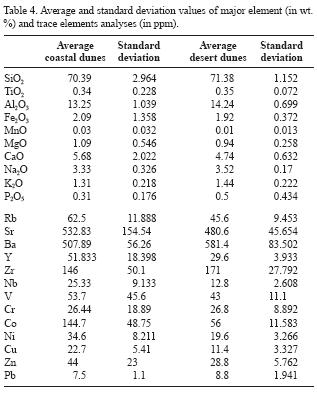
<body><![CDATA[<p align="justify"><font face="verdana" size="2">The El Vizca&iacute;no Desert is surrounded by shales, sandstones, conglomerate, and limestones present mainly in the southern part of the desert basin. Slate and schists are also present in the north, and basalts, rhyolite, granites, diorites and granodiorites in the northern and the eastern part of the basin (<a href="/img/revistas/rmcg/v24n3/a10f1.jpg" target="_blank">Figure 1a</a>). </font></p> 				    <p align="justify"><font face="verdana" size="2">&nbsp;</font></p> 				    <p align="justify"><font face="verdana" size="2"><b>MATERIALS AND METHODS</b></font></p> 				    <p align="justify"><font face="verdana" size="2">A systematic dune sand sampling was performed on coastal and inland dune sands during May&#150;June 2005 (<a href="/img/revistas/rmcg/v24n3/a10f1.jpg" target="_blank">Figure 1b</a>). Samples were collected from the windward, crest and slip face of coastal and desert barchan dunes and transverse sand sheets from El Vizca&iacute;no Desert. This was done because in some cases such as in certain linear and crescent dunes, morphology might control the grain size parameters and mineralogy of the coastal (Kasper&#150;Zubillaga and Dickinson, 2001) and desert dunes (Lancaster 1983; Watson; 1986; Livingstone <i>et al.</i>, 1999; Wang <i>et al.</i>, 2003). Fifty four sand samples were placed in plastic bags, labeled and separated for grain size, thin sectioning and geochemical determinations. A Global Positioning System (GPS) was used to locate sampling sites and to measure dune heights above sea level.</font></p> 				    <p align="justify"><font face="verdana" size="2">Approximately 1 to 2 g of sand samples were used for grain size analysis after storing 10 g of each sand sample to ensure repeatability in the grain size analysis. The grain size analysis was performed with a Laser Particle Size Analyser (Model Coulter LS230) that determines the particle sizes between &#150;1.0 &Phi; and 14.6 &Phi;. Particle size distributions were given in &micro;m and converted into &Phi; units to calculate the grain size distribution parameters with the formula Log2 (mm) and percentiles utilized in Folk's formulae (Folk, 1980) (<a href="/img/revistas/rmcg/v24n3/a10t1.jpg" target="_blank">Table 1</a>). Graphic mean represents the average grain size and it was calculated using Mz= (&Phi;16 + &Phi;50 + &Phi;84)/3. Sorting represents the degree in which the sediment is mixed with coarse and fine sizes. It is computed with (&Phi;84 &#150; &Phi;16)/4 + (&Phi;95 &#150; 5)/6.6. Skewness is a measure of symmetry in a grain size distribution. Its values can be obtained with (&Phi;16 + &Phi;84 &#150; 2&Phi;50)/(&Phi;84 &#150; &Phi;16). Kurtosis is the degree of peakedness in the graphic distribution (Folk, 1980). </font></p> 				    <p align="justify"><font face="verdana" size="2">Fifty four thin sections of bulk composition were prepared to analyze the dune sands. Point counting was carried out using the traditional standard method of 250 grains for the major compositional framework of quartz, feldspar and lithics in 54 dune sand samples and three river sand samples (Franzinelli and Potter 1983) (<a href="/img/revistas/rmcg/v24n3/a10t2.jpg" target="_blank">Tables 2</a> and <a href="#t3">3</a>). This was done because quartz enrichment of the sands and little dispersion in the size fractions has been observed in dune sands (Livingstone <i>et al.</i>, 1999; Wang <i>et al.</i>, 2003; Honda <i>et al.</i>, 2004; Muhs, 2004; Kasper&#150;Zubillaga and Carranza&#150;Edwards, 2005). Additionaly 50 grains were counted for minor components like opaque minerals (magnetite)(Op), translucid heavy minerals (pyroxenes, hornblende, apatite, ilmenite, magnetite)(Hm), mica (biotite, chlorite)(Mc) and biogenic (broken shells, foraminifera, calcareous algae) plus carbonates (limestone, calcite, dolomite) (Bg + C). In addition, three river samples were also collected near the sites 1, 2 and 9. River sands were collected from the uppermost centimeter in the bed of dry streams at sites close to the main road. The whole bulk sediment was used for point counting of 250 grains. In the case of the dune and river sands, point counts were normalized to 100 % and ternary diagrams for mineralogic (n= 54) and geochemical data (n=24) were plotted for the dune sands data only using confidence regions of the population mean (CRPM) at 95 % confidence level around the mean population of samples. These regions were constructed with the algorithm developed by Weltje (2002) and converted into ellipses by using the Sigma Plot software. The ellipses represent the area in which samples might have variations in relation to the mean. This implies that the CRPM define rigorously if two mean populations are significantly different (Weltje, 2002). </font></p> 				    <p align="center"><font face="verdana" size="2"><a name="t3"></a></font></p> 				    <p align="center"><font face="verdana" size="2"><img src="/img/revistas/rmcg/v24n3/a10t3.jpg"></font></p> 				    <p align="justify"><font face="verdana" size="2">Sand samples (n= 24) were dried at 110&deg; C and treated with lithium metaborate and lithium tetraborate to make pressed powder pellets. They were analysed with a X&#150;ray fluorescence Siemens SRS 3000 equipment for major and trace elements (<a href="#t4">Table 4</a>). For major and trace elements, precision is valuated in terms of relative standard deviation being &lt;1 % (Sutarno and Steger, 1985). The Chemical Index of Alteration (CIA) values, based on the equation CIA= 100&bull; &#91;Al2O3/(Al<sub>2</sub>O<sub>3</sub>+CaO*+Na<sub>2</sub>O+K<sub>2</sub>O)&#93; (Nesbitt and Young, 1982), were obtained using the CaO* values present only in the silicate fraction (Honda, electronic communication). No geochemical data were available for surrounding/parental rocks. Correlations were established between textural, mineralogic and geochemical parameters. However, we should mention that discordancy tests for the correlations were not carried out, which implies that rejection or identification of outliers of special interest could not be established (Barnet and Lewis, 1994, Verma, 1997; Verma and Quiroz&#150;Ruiz, 2006). </font></p> 				    <p align="center"><font face="verdana" size="2"><a name="t4"></a></font></p> 				    ]]></body>
<body><![CDATA[<p align="center"><font face="verdana" size="2"><img src="/img/revistas/rmcg/v24n3/a10t4.jpg"></font></p> 				    <p align="justify"><font face="verdana" size="2">&nbsp;</font></p> 				    <p align="justify"><font face="verdana" size="2"><b>RESULTS</b></font></p> 				    <p align="justify"><font face="verdana" size="2"><b>El Vizca&iacute;no dune sands characteristics </b></font></p> 				    <p align="justify"><font face="verdana" size="2">According to the field observations and satellite images, coastal and desert dunes were separated on the basis of the physiography of the area. Coastal dunes are located mainly near beaches of the Vizca&iacute;no Bay (sites 1&#150;7). They are of transverse (sites 1, 2, 4, 6) and barchan types (sites 3, 4, 5, 7) Inland desert dunes are vegetated sand sheets with little morphological definition but probably parallel to the dominant wind direction (sites 8&#150;9) (<a href="/img/revistas/rmcg/v24n3/a10f1.jpg" target="_blank">Figure 1B</a>). Mobile dunes are located in sites 3, 5 and 7 whilst the rest of the dune sites are semi&#150;mobile vegetated systems. The average heights for the coastal and desert dunes are 7.7 m and 14.0 m above sea level respectively.</font></p> 				    <p align="justify"><font face="verdana" size="2">&nbsp;</font></p> 				    <p align="justify"><font face="verdana" size="2"><b>Grain size distributions </b></font></p> 				    <p align="justify"><font face="verdana" size="2">Average grain size parameters for each sampling site are presented in <a href="/img/revistas/rmcg/v24n3/a10t1.jpg" target="_blank">Table 1</a>. The average grain size for the coastal desert sands is 2.434 &Phi;, sorting is 0.466 &Phi;, skewness is &#150;0.040, and kurtosis is 1.025. The average grain size for the inland dune sands is 2.520 &Phi;, sorting is 0.476 &Phi;, skewness is 0.028, and kurtosis is 1.015 (<a href="/img/revistas/rmcg/v24n3/a10t1.jpg" target="_blank">Table 1</a>). The grain size correlations among textural parameters for the El Vizca&iacute;no Desert dune sands show that there are only two significant correlations between grain size, sorting and grain size and skewness (Khalaf, 1989; Kasper&#150;Zubillaga and Carranza&#150;Edwards, 2005) (<a href="/img/revistas/rmcg/v24n3/a10f2.jpg" target="_blank">Figure 2</a>).</font></p> 				    <p align="justify"><font face="verdana" size="2">&nbsp;</font></p> 				    <p align="justify"><font face="verdana" size="2"><b>Mineralogy </b></font></p> 				    ]]></body>
<body><![CDATA[<p align="justify"><font face="verdana" size="2">The compositional framework of the sands consisted of monocrystalline (Qm) and polycrystalline quartz (Qp), potassium feldspar (Fk), plagioclase (P), volanic (basalt, andesite) (Lv), sedimentary (sandstone, siltsone, chert) (Ls), metamorphic (schist) (Lm) and plutonic lithics (granite) (Lp). The El Vizca&iacute;no Desert coastal dune sands are quartzolithic sands (Qt<sub>82</sub> Ft<sub>14</sub> Lt<sub>4</sub>) (<a href="#f3">Figure 3</a>). Average lithic percentages are 67 %, 18 % and 15 % for Ls, Lv and Lm+Lp respectively. Mica and biogenic detritus plus carbonates are abundant with 47 % and 42 % content in relation to opaque and heavy minerals (2 % to 9 %, respectively) (<a href="/img/revistas/rmcg/v24n3/a10t2.jpg" target="_blank">Table 2</a>).</font></p> 				    <p align="center"><font face="verdana" size="2"><a name="f3"></a></font></p> 				    <p align="center"><font face="verdana" size="2"><img src="/img/revistas/rmcg/v24n3/a10f3.jpg"></font></p> 				    <p align="justify"><font face="verdana" size="2">The El Vizca&iacute;no inland dune sands are quartzolithic sands (Qt<sub>85</sub> Ft<sub>10</sub> Lt<sub>5</sub>)(<a href="#f3">Figure 3</a>). Average lithic percentages are 43 %, 20 % and 37 % for Ls, Lv and Lm+Lp respectively. Point counts of accessory minerals show an increase in the mica content compared to the rest of the trace components (<a href="/img/revistas/rmcg/v24n3/a10t2.jpg" target="_blank">Table 2</a>). Mica and biogenic detrirtus plus carbonates content is 68 % and 15 % content, respectively, whereas opaque and heavy minerals are 11 % and 15 %, respectively.</font></p> 				    <p align="justify"><font face="verdana" size="2">The Q&#150;F&#150;L diagram (Dickinson <i>et al.</i>, 1983) shows that the coastal and inland dune sands plot in the craton interior and recycled orogen fields (<a href="#f4">Figure 4</a>). </font></p> 				    <p align="center"><font face="verdana" size="2"><a name="f4"></a></font></p> 				    <p align="center"><font face="verdana" size="2"><img src="/img/revistas/rmcg/v24n3/a10f4.jpg"></font></p> 				    <p align="justify"><font face="verdana" size="2">&nbsp;</font></p> 				    <p align="justify"><font face="verdana" size="2"><b>Geochemistry </b></font></p> 				    <p align="justify"><font face="verdana" size="2">Similar major elements values are presented for coastal and inland dunes sands (<a href="/img/revistas/rmcg/v24n3/a10t5.jpg" target="_blank">Tables 5</a>, <a href="/img/revistas/rmcg/v24n3/a10t6.jpg" target="_blank">6</a>). However there are higher values of trace elements like Rb, Sr, Y, Co, Ni, Cu and Zn for coastal dune sands compared to the inland dune sands (<a href="/img/revistas/rmcg/v24n3/a10t6.jpg" target="_blank">Table 6</a>). </font></p> 				    ]]></body>
<body><![CDATA[<p align="justify"><font face="verdana" size="2"> The A&#150;B&#150;C ternary diagram with CRPM, where A is SiO<sub>2</sub>, B is K2O+Na2O+Al2O3, and C is Fe<sub>2</sub>O<sub>3</sub>+TiO<sub>2</sub>+MgO, shows a dispersal towards the A&#150;B poles for the coastal dune sands (<a href="/img/revistas/rmcg/v24n3/a10f5.jpg" target="_blank">Figure 5a</a>). Average content of SiO<sub>2</sub> is 76 %. In the CaO&#150;Na<sub>2</sub>O&#150;K<sub>2</sub>O ternary diagram, the content of CaO, Na<sub>2</sub>O and K<sub>2</sub>O is 53% and 34 % and 13 %, respectively. The slight dispersal of the CRPM is towards the K<sub>2</sub>O pole (<a href="/img/revistas/rmcg/v24n3/a10f5.jpg" target="_blank">Figure 5b</a>). </font></p> 				    <p align="justify"><font face="verdana" size="2">The A&#150;B&#150;C ternary diagram with CRPM shows a dispersal towards the A&#150;B poles with similar percentages in A&#150;B&#150;C for the inland dune sands compared to the coastal dune sands. (<a href="/img/revistas/rmcg/v24n3/a10f5.jpg" target="_blank">Figure 5a</a>). The CaO&#150;Na<sub>2</sub>O&#150;K<sub>2</sub>O ternary diagram shows a slight increase in K<sub>2</sub>O and abrupt dispersal of the CRPM towards the K<sub>2</sub>O pole compared to the coastal dune sands (<a href="/img/revistas/rmcg/v24n3/a10f5.jpg" target="_blank">Figure 5b</a>).</font></p> 				    <p align="justify"><font face="verdana" size="2">The CIA&#150;A&#150;CN&#150;K triangle (Nesbitt and Young, 1996) shows that most of the coastal and inland dune sand samples tend towards the A pole, representing the Al<sub>2</sub>O<sub>3</sub> concentration, with relatively low CIA values (<a href="#f6">Figure 6</a>)</font></p> 				    <p align="center"><font face="verdana" size="2"><a name="f6"></a></font></p> 				    <p align="center"><font face="verdana" size="2"><img src="/img/revistas/rmcg/v24n3/a10f6.jpg"></font></p> 				    <p align="justify"><font face="verdana" size="2">The K<sub>2</sub>O/Na<sub>2</sub>O vs. SiO<sub>2</sub>/Al<sub>2</sub>O<sub>3</sub> diagram (Roser and Korsch, 1986) indicates that some coastal and inland dune sand samples plot in the evolved arc setting felsic&#150;plutonic detritus field and in the active continental margin arc, and passive margin fields (<a href="#f7">Figure 7</a>). </font></p> 				    <p align="center"><font face="verdana" size="2"><a name="f7"></a></font></p> 				    <p align="center"><font face="verdana" size="2"><img src="/img/revistas/rmcg/v24n3/a10f7.jpg"></font></p> 				    <p align="justify"><font face="verdana" size="2">The Ni vs. Ti plot (Floyd <i>et al.</i>, 1989; Nagarajan <i>et al.</i>, 2007) shows that the overall of the coastal and inland dune sand samples are placed in the mature sediments fields with only three samples in the acidic source field (<a href="#f8">Figure 8</a>)</font></p> 				    <p align="center"><font face="verdana" size="2"><a name="f8"></a></font></p> 				    ]]></body>
<body><![CDATA[<p align="center"><font face="verdana" size="2"><img src="/img/revistas/rmcg/v24n3/a10f8.jpg"></font></p> 				    <p align="justify"><font face="verdana" size="2">&nbsp;</font></p> 				    <p align="justify"><font face="verdana" size="2"><b>DISCUSSION</b></font></p> 				    <p align="justify"><font face="verdana" size="2"><b>Grain size distribution</b></font></p> 				    <p align="justify"><font face="verdana" size="2">The coastal and inland dune sands are fine, well sorted, near symmetrical sands with mesokurtic distributions. Similar patterns in coastal and desert dune sands have been reported in dune systems from five continents where dune sands are well sorted fine sands with symmetrical distributions and mesokurtic curves (Ahlbrandt, 1979). </font></p> 				    <p align="justify"><font face="verdana" size="2">The El Vizca&iacute;no coastal and inland dune sands suggest that the sands have experienced an aeolian process due to westerly and northerly onshore winds, which might have caused that the dune sands have retained some of the beach sands textural characteristics as it is observed by the fine&#150;grained and well&#150;sorted values (average= 2.6 &Phi;; sorting= 0.42 &Phi;) (Carranza&#150;Edwards <i>et al.</i>, 1998). The onshore wind patterns with velocities of 2 to 6 m&bull;s&#150;1 and 40 % of frequency might control the fine&#150;sized and well&#150;sorted distributions of the dune sands. This can be supported by the fact that threshold velocities in fine to medium sands are above 4 m&bull;s&#150;1. This suggests that the fine&#150;sized beach sand grains might have experienced a short transport after their removal from the beach into the dune systems, leaving their textural characteristics similar to those observed for the beach sands. The grain size distributions of coastal and inland dunes indicate that the dune sands are not grain size selective when the beach sediments are fine grained and well sorted (Pye 1991). </font></p> 				    <p align="justify"><font face="verdana" size="2">&nbsp;</font></p> 				    <p align="justify"><font face="verdana" size="2"><b>Mineralogy </b></font></p> 				    <p align="justify"><font face="verdana" size="2">The CRPM shape of coastal dune sands, compared to the inland sands, suggests more concentration of coastal sand samples near the mean population compared to the inland dune sands, but this is also due to the higher number of samples for the costal dune sands (<a href="#f3">Figure 3</a>). These shapes are associated with the amount of dispersal of data plotted in the ternary diagram (Weltje , 2002). The CRPM quantitative approach reveals that coastal and inland dune fields are not significantly different. The enrichment of quartz in both dune systems within the El Vizca&iacute;no desert basin probably resulted from the maturity process, where the source rock might provide quartz&#150;rich sediments. This interpretation is supported by 1) the presence of the alluvial deposits in the El Vizca&iacute;no basin underlying the dune fields; 2) the composition of some of the rivers draining throughout the basin with moderately high quartz content; 3) the high content of sedimentary lithics probably derived from sedimentary outcrops in the area, but also from the alluvial deposits that provides quartz detritus to the coastal and desert dune sands; and 4) the presence of quartz&#150;rich beach sands (Qt<sub>90</sub> Ft<sub>9</sub> Lt<sub>1</sub>) near sites 1 to 7 that might contribute to the landward transport of beach sands by the wind (Carranza&#150;Edwards <i>et al.</i>, 1998). Moreover, the Q&#150;F&#150;L plot (Dickinson <i>et al.</i>, 1983) indicates a craton interior and recycled orogen with tectonic fields suggesting intrusive, sedimentary and partly metamorphosed sources (Dickinson <i>et al.</i>, 1983; Amstrong&#150;Altrin <i>et al.</i>, 2004) (<a href="#f4">Figure 4</a>). Maturation of the sands may be related to secondary processes as wind action leads to quartz&#150;rich dune sands (Muhs, 2004; Kasper&#150;Zubillaga <i>et al.</i>, 1999). Furthermore, some samples from the inland dune sands (V9C, V13C, LB5F) have been probably influenced by some eroded acid, volcanic, and metamorphic (schist) rocks, as well as by acid&#150;intermediate plutonic rocks like the granitic and granodiorite outcrops in the north of the El Vizca&iacute;no Desert basins. The alluvial deposits in the El Vizca&iacute;no Desert were mainly derived from the above mentioned rock types. This is especially observed for the volcanic lithic fractions. From the alluvial deposits, the wind transports sediment towards the inland dune sands. Also, the release of mica and hornblende in the inland dune sands might support the influence of granitic, granodiorite and schist sources to the alluvial deposits, and consequently to the dune sands during short aeolian transport. This is especially observed in the San Pablo (SP) river, where mica is a relatively important constituent of fluvial sands and where plutonic and metamorphic fractions are depleted (<a href="#t3">Table 3</a>).</font></p> 				    <p align="justify"><font face="verdana" size="2">The presence of carbonate shells in the coastal dune sands indicates the beach sand influence in the composition of these sands. It is likely that the northwesterly and northerly winds are capable of transporting shell fragments onto the dune fields of the coast. The amounts of broken shells and carbonate minerals like calcite are depleted landward as result of their softness and long transport by the wind. </font></p> 				    ]]></body>
<body><![CDATA[<p align="justify"><font face="verdana" size="2">&nbsp;</font></p> 				    <p align="justify"><font face="verdana" size="2"><b>Geochemistry </b></font></p> 				    <p align="justify"><font face="verdana" size="2">In the A&#150;B&#150;C ternary diagram (<a href="/img/revistas/rmcg/v24n3/a10f5.jpg" target="_blank">Figure 5a</a>), it is observed that the compositions of the coastal and desert sands overlap, which can be attributed to the maturity of the dune sands near and away from the coast. This can be visualized by the high SiO<sub>2</sub> contents and relatively similar mineralogical composition of feldspar and lithic fractions for both dune types. The CaO&#150;Na<sub>2</sub>O&#150;K<sub>2</sub>O diagramm shows no significant differences between the coastal and desert dune sands (<a href="/img/revistas/rmcg/v24n3/a10f5.jpg" target="_blank">Figure 5b</a>). The K<sub>2</sub>O content in the desert dune sands might be associated with the presence of mica, and dispersal of the CRPM towards the K<sub>2</sub>O pole may be due to the different amount of mica in the samples. Furthermore, low concentration of potassium feldspar in the El Vizca&iacute;no dune sands (<a href="/img/revistas/rmcg/v24n3/a10t2.jpg" target="_blank">Table 2</a>) might be associated with the composition of the beach and alluvial deposits that provide little K&#150;feldspar. This is also related to the chemical composition of the northern beach sands that in the overall have more than 60% of CaO, derived from plagioclase, and less than 30 % of K<sub>2</sub>O, associated with potassium feldspar (Carranza&#150;Edwards <i>et al.</i>, 1998). </font></p> 				    <p align="justify"><font face="verdana" size="2">In addition, the Chemical Index of Alteration (CIA) values obtained for the sand samples indicate low chemical weathering for the coastal and inland dune sands (<a href="#f6">Figure 6</a>). The ACNK diagram indicates that, in the overall, El Vizca&iacute;no sand samples have experienced low chemical weathering probably because of the dryness of the area. El Vizca&iacute;no dune sands have similar CIA values to those observed in arkose and litharenites from ancient sandstones in India (Armstrong&#150;Altrin <i>et al.</i>, 2004). </font></p> 				    <p align="justify"><font face="verdana" size="2">The presence of Rb, Sr and Ba in both dune systems is probably associated with the presence of mica and, in lesser extent, of potash feldspars. This is because Rb, Sr and Ba are trace elements that may substitute for K in the lattice of mica and potash feldspar (Sawyer, 1986; Gallet <i>et al.</i>, 1996; Canfield, 1997; Muhs <i>et al.</i>, 2003). Yttrium may be associated with the presence of basaltic and metamorphic sources in the coastal dune sands (Hawkesworth and Morrison, 1978; Hill <i>et al.</i>, 2000). </font></p> 				    <p align="justify"><font face="verdana" size="2">The enrichment in Co in the coastal dunes may be related to the recycling of sedimentary lithics within sand samples near marine environments, where correlation between Co and Ls is relatively significant (r= 0.72). This is because some sedimentary lithics can be potential carriers of some accessory minerals like opaques and heavy minerals that may concentrate Co under marine weathering conditions because of the immobility of Co in aqueous conditions (Zolezzi&#150;Ruiz, 2007). Furthermore, Co may be associated with the presence of titanium and iron oxides (Krupka and Serne, 2002) in the sedimentary lithics composed of accessory minerals like rutile, sphene, Ilmenite and magnetite. This is evidenced by 1) the high concentrations of Co in sand samples coming from the sites 2, 3, 4, 5, 6, and 7, near the coastal areas with marine influence; and 2) the presence of titanium and iron minerals in the El Vizca&iacute;no dune sands. Ni, Cu and Zn may be associated with the presence of sedimentary lithics in the coastal dune sands, which may contain some opaque and heavy minerals probably associated to ultramafic rocks (Lee, 2002; Zolezzi&#150;Ruiz, 2007). </font></p> 				    <p align="justify"><font face="verdana" size="2">Correlations between Fe<sub>2</sub>O<sub>3</sub>, TiO<sub>2</sub>, MgO and V (<a href="/img/revistas/rmcg/v24n3/a10f9.jpg" target="_blank">Figure 9</a>) indicate the following: 1) The positive correlation between Fe<sub>2</sub>O<sub>3</sub>, TiO<sub>2</sub>, and MgO suggests the presence of heavy minerals associated with sedimentary sources mainly ilmenite and magnetite (Basu and Molinaroli, 1989; Carranza&#150;Edwards <i>et al.</i>, 2001); 2) the positive correlations between TiO<sub>2</sub>, Zr and V suggests that the sands are influenced by magnetite, ilmenite and zircon minerals associated with some other heavy minerals probably derived from sedimentary&#150;volcanic sources. In both cases, similar correlations have been observed in dune and beach sands in the Gulf of Mexico coast, the Mexican western coast and northwestern Mexico (Kasper&#150;Zubillaga <i>et al.</i>, 1999; Carranza&#150;Edwards <i>et al.</i>, 2001; Kasper&#150;Zubillaga <i>et al.</i>, 2006b). In the El Vizca&iacute;no dune sands, velocity and frequency of the winds might transport magnetite and some other heavy minerals landward. This process has been also observed for the Altar Desert dune sands close to the Colorado Delta River in northwestern Mexico, where short aeolian transport enables the transport of heavy minerals from the source sediment to the dune system (Kasper&#150;Zubillaga <i>et al.</i>, in press). </font></p> 				    <p align="justify"><font face="verdana" size="2">&nbsp;</font></p> 				    <p align="justify"><font face="verdana" size="2"><b>Comparisons of dune fields from El Vizca&iacute;no Desert with other North American Deserts</b></font></p> 				    <p align="justify"><font face="verdana" size="2">Quartz percentages in the El Vizca&iacute;no dune sands are similar to those found in the Altar Desert dune sands in northwestern Mexico (Kasper&#150;Zubillaga <i>et al.</i>, 2006b) with a slight enrichment in plagioclase minerals (<a href="/img/revistas/rmcg/v24n3/a10f10.jpg" target="_blank">Figures 10a, b</a>). The data plotted in a Qt&#150;Ft&#150;Lt ternary diagram with the CRPM show that the El Vizca&iacute;no sands tend slightly towards the total feldspar pole. The CRPM for both sites do not overlap, which suggests that dune sands from both areas are significantly different (<a href="/img/revistas/rmcg/v24n3/a10f10.jpg" target="_blank">Figure 10b</a>).</font></p> 				    ]]></body>
<body><![CDATA[<p align="justify"><font face="verdana" size="2">One source of the El Vizca&iacute;no dune sands are probably beach sands in turn derived mainly from sedimentary (alluvial) and, in lesser extent, by metamorphic and plutonic sources exposed near the El Vizca&iacute;no Desert. Some volcanic lithics also contribute to the dune composition but the release of monomineralic crystals of plagioclase, some pyroxenes, hornblende and opaque minerals are important constituents of the dune sands despite the short aeolian transport, especially in the coastal dunes (Akulov and Agafonov, 2007). The slight enrichment in plagioclase and lithics in the El Vizca&iacute;no dune sands might derive from the alluvial deposits. This is evidenced by the large content of sedimentary lithics in the El Vizca&iacute;no dune sands and also by the extensive area in which the alluvial deposits outcrop north of the El Vizca&iacute;no. When comparing the Vizca&iacute;no dune sands with the Altar Desert dune sands in Sonora, the CaO&#150;Na<sub>2</sub>O&#150;K<sub>2</sub>O diagram ( <a href="#f11">Figure 11</a>) shows that El Vizca&iacute;no dune sands follow the CaO&#150;Na<sub>2</sub>O line, whereas the Altar Desert dune sands follow slightly the CaO&#150;K<sub>2</sub>O trend and approaches towards the K<sub>2</sub>O peak. High content of CaO&#150;Na<sub>2</sub>O in the El Vizca&iacute;no Desert dune sands is again probably due to the slight enrichment of plagioclase feldspar.</font></p> 				    <p align="center"><font face="verdana" size="2"><a name="f11"></a></font></p> 				    <p align="center"><font face="verdana" size="2"><img src="/img/revistas/rmcg/v24n3/a10f11.jpg"></font></p> 				    <p align="justify"><font face="verdana" size="2">An A&#150;B diagram was plotted for different dune systems of North America where A= SiO<sub>2</sub> and B= K<sub>2</sub>O+ Na<sub>2</sub>O+Al<sub>2</sub>O<sub>3</sub>. The El Vizca&iacute;no Desert dune sands are higher in B content compared to the Altar Desert dune sands, the Algodones and Parker dunes and the Colorado River sediments (Muhs, 2004; Kasper&#150;Zubillaga <i>et al.</i>, 2006) (<a href="#f12">Figure 12</a>). Likewise, the El Vizca&iacute;no dune sands lay within the range of A and B content (with the exception of sample ES5F) of the Rice Valley dunes in California (Muhs, 2004). In the case of the El Vizca&iacute;no dune sands, high B content is probably associated with the presence of mica in the sands High mica content in the El Vizca&iacute;no dune sands indicates that wind velocity exerts a control in the composition of the sands carrying beach and alluvial sands into the dune systems. perhaps enhanced by the platy morphology of the micas. </font></p> 				    <p align="center"><font face="verdana" size="2"><a name="f12"></a></font></p> 				    <p align="center"><font face="verdana" size="2"><img src="/img/revistas/rmcg/v24n3/a10f12.jpg"></font></p> 				    <p align="justify"><font face="verdana" size="2">In addition, the low chemical index of alteration values in the El Vizca&iacute;no Desert, similar to those in the Rice Valley dunes (Muhs 2004), indicate that the plagioclase content might be preserved in the sands. This is evidenced by the content of Na<sub>2</sub>O. In contrast, dune sands from the Altar Desert and Algodones have inherited their maturity from the silica&#150;rich Colorado River Delta sediments (Muhs 2004; Kasper&#150;Zubillaga <i>et al.</i>, 2006, in press). </font></p> 				    <p align="justify"><font face="verdana" size="2">&nbsp; </font></p> 				    <p align="justify"><font face="verdana" size="2"><b>CONCLUSIONS</b></font></p> 				    <p align="justify"><font face="verdana" size="2">1. The El Vizca&iacute;no dune sands are fine, well sorted, near symmetrical sands with mesokurtic distributions. This reflects that onshore wind frequencies and velocities produce fine&#150;sized and well&#150;sorted dune sands inherited from beach sands during short aeolian transport into the coastal and inland dunes.</font></p> 				    ]]></body>
<body><![CDATA[<p align="justify"><font face="verdana" size="2">2. The El Vizca&iacute;no coastal and desert dune sands are placed in the craton interior and recycled orogen fields in the Q&#150;F&#150;L&#150; triangle, which suggest intrusive, sedimentary and partly metamorphosed sources have contributed to the composition of the sands. The presence of minerals like mica and hornblende in the bulk composition of the dune sands supports the influence of granitic, granodioritic and schistose sources. The presence of biogenic detritus and carbonates in the coastal dune sands suggests that they are derived from beach sand sources mixed with alluvial deposits, whereas the inland desert dune sands are derived from alluvial deposits derived from sedimentary, volcanic, schists and granitic and granodiorites.</font></p> 				    <p align="justify"><font face="verdana" size="2">3. Maturity of the El Vizca&iacute;no dune sands is inherited from the alluvial and beach sands of the Vizca&iacute;no Bay and the desert basin, despite the complex lithology surrounding the dune fields. Maturity of the dune sands is related to aeolian/marine processes. </font></p> 				    <p align="justify"><font face="verdana" size="2">4. The geochemistry of the El Vizca&iacute;no dune sands show that the dune sands are associated with acid, felsic&#150;plutonic detritus linked to an active continental margin. Low CIA values are related to the dry climate of the area. The high concentrations of Rb, Sr, Ba, Y, Co Ni, Cu and Zn in the coastal dune sands are probably associated with the presence of mica, basaltic and metamorphic sources, sedimentary lithics containing titanium and iron minerals, opaques and heavy minerals. Correlations between Fe<sub>2</sub>O<sub>3</sub>, TiO<sub>2</sub>, MgO, Zr and V in the dune sands indicate the presence of ilmenite, magnetite and zircon in the sands. </font></p> 				    <p align="justify"><font face="verdana" size="2">&nbsp;</font></p> 				    <p align="justify"><font face="verdana" size="2"><b>ACKNOWLEDGEMENTS</b></font></p> 				    <p align="justify"><font face="verdana" size="2">We are indebted to the Instituto de Ciencias del Mar y Limnolog&iacute;a, UNAM, for the financial support (internal project 109, Marine processes in coastal sedimentary environments). We are also grateful to Eduardo Morales de la Garza for his invaluable assistance during the particle size analysis. We are indebted to Dr. Thomas E. Gill and Dr. J. Madhavaraju for their invaluable review of this paper. </font></p> 				    <p align="justify"><font face="verdana" size="2">&nbsp;</font></p> 				    <p align="justify"><font face="verdana" size="2"><b>REFERENCES</b></font></p> 				    <!-- ref --><p align="justify"><font face="verdana" size="2">Ahlbrandt, T.S., 1979, Textural parameters of eolian deposits, in McKee, E.D. (ed.), A Study of Global Sand Seas: Washington, United States Geological Survey, Professional Paper, 1052, 21&#150;58. </font>&nbsp;&nbsp;&nbsp;&nbsp;&nbsp;&nbsp;&nbsp;&nbsp;[&#160;<a href="javascript:void(0);" onclick="javascript: window.open('/scielo.php?script=sci_nlinks&ref=8068300&pid=S1026-8774200700030001000001&lng=','','width=640,height=500,resizable=yes,scrollbars=1,menubar=yes,');">Links</a>&#160;]<!-- end-ref --> 				    ]]></body>
<body><![CDATA[<!-- ref --><p align="justify"><font face="verdana" size="2">Akulov, N.I., Agafonov, B.F., 2007, The behavior of heavy minerals in lithostream: Russian Geology and Geophysics, 48, 267&#150;271. </font>&nbsp;&nbsp;&nbsp;&nbsp;&nbsp;&nbsp;&nbsp;&nbsp;[&#160;<a href="javascript:void(0);" onclick="javascript: window.open('/scielo.php?script=sci_nlinks&ref=8068302&pid=S1026-8774200700030001000002&lng=','','width=640,height=500,resizable=yes,scrollbars=1,menubar=yes,');">Links</a>&#160;]<!-- end-ref --> 				    <!-- ref --><p align="justify"><font face="verdana" size="2">Armstrong&#150;Altrin, J.S., Lee, I.Y., Verma, S.P., Ramasamy, S., 2004, Geochemistry of sandstones from the Upper Miocene Kudankulam Formation, Southern India: implications for provenence, weathering and tectonic setting: Journal of Sedimentary Research, 74, 285&#150;297. </font>&nbsp;&nbsp;&nbsp;&nbsp;&nbsp;&nbsp;&nbsp;&nbsp;[&#160;<a href="javascript:void(0);" onclick="javascript: window.open('/scielo.php?script=sci_nlinks&ref=8068304&pid=S1026-8774200700030001000003&lng=','','width=640,height=500,resizable=yes,scrollbars=1,menubar=yes,');">Links</a>&#160;]<!-- end-ref --> 				    <!-- ref --><p align="justify"><font face="verdana" size="2">Bagnold R.A., 1941, The Physics of Blown Sand and Desert Dunes: London, Methuen, 265 p. </font>&nbsp;&nbsp;&nbsp;&nbsp;&nbsp;&nbsp;&nbsp;&nbsp;[&#160;<a href="javascript:void(0);" onclick="javascript: window.open('/scielo.php?script=sci_nlinks&ref=8068306&pid=S1026-8774200700030001000004&lng=','','width=640,height=500,resizable=yes,scrollbars=1,menubar=yes,');">Links</a>&#160;]<!-- end-ref --> 				    <!-- ref --><p align="justify"><font face="verdana" size="2">Basu, A., Molinaroli, E., 1989, Provenance characteristics of detrital opaque Fe&#150;Ti oxide minerals: Journal of Sedimentary Research, 59, 922&#150;934. </font>&nbsp;&nbsp;&nbsp;&nbsp;&nbsp;&nbsp;&nbsp;&nbsp;[&#160;<a href="javascript:void(0);" onclick="javascript: window.open('/scielo.php?script=sci_nlinks&ref=8068308&pid=S1026-8774200700030001000005&lng=','','width=640,height=500,resizable=yes,scrollbars=1,menubar=yes,');">Links</a>&#160;]<!-- end-ref --> 				    <!-- ref --><p align="justify"><font face="verdana" size="2">Blount, G., Lancaster, N., 1990, Development of the Gran Desierto sand sea: Geology, 18, 724&#150;728.</font>&nbsp;&nbsp;&nbsp;&nbsp;&nbsp;&nbsp;&nbsp;&nbsp;[&#160;<a href="javascript:void(0);" onclick="javascript: window.open('/scielo.php?script=sci_nlinks&ref=8068310&pid=S1026-8774200700030001000006&lng=','','width=640,height=500,resizable=yes,scrollbars=1,menubar=yes,');">Links</a>&#160;]<!-- end-ref --> 				    ]]></body>
<body><![CDATA[<!-- ref --><p align="justify"><font face="verdana" size="2">Barnett, V., Lewis, T., 1994, Outliers in statistical data: Chichester, John Wiley &amp; Sons, 584 p.</font>&nbsp;&nbsp;&nbsp;&nbsp;&nbsp;&nbsp;&nbsp;&nbsp;[&#160;<a href="javascript:void(0);" onclick="javascript: window.open('/scielo.php?script=sci_nlinks&ref=8068312&pid=S1026-8774200700030001000007&lng=','','width=640,height=500,resizable=yes,scrollbars=1,menubar=yes,');">Links</a>&#160;]<!-- end-ref --> 				    <!-- ref --><p align="justify"><font face="verdana" size="2">Buoy Weather, 2005, A Global Weather Service (en l&iacute;nea): <a href="http://www.buoyweather.com/index2.jsp" target="_blank">http://buoyweather.com</a>, accessed on July 4, 2005, 13.00 hrs.</font>&nbsp;&nbsp;&nbsp;&nbsp;&nbsp;&nbsp;&nbsp;&nbsp;[&#160;<a href="javascript:void(0);" onclick="javascript: window.open('/scielo.php?script=sci_nlinks&ref=8068314&pid=S1026-8774200700030001000008&lng=','','width=640,height=500,resizable=yes,scrollbars=1,menubar=yes,');">Links</a>&#160;]<!-- end-ref --> 				    <!-- ref --><p align="justify"><font face="verdana" size="2">Canfield, D.E., 1997, The geochemistry of river particulate from USA: major elements: Geochimica et Cosmochimica Acta, 61, 3349&#150;3365. </font>&nbsp;&nbsp;&nbsp;&nbsp;&nbsp;&nbsp;&nbsp;&nbsp;[&#160;<a href="javascript:void(0);" onclick="javascript: window.open('/scielo.php?script=sci_nlinks&ref=8068316&pid=S1026-8774200700030001000009&lng=','','width=640,height=500,resizable=yes,scrollbars=1,menubar=yes,');">Links</a>&#160;]<!-- end-ref --> 				    <!-- ref --><p align="justify"><font face="verdana" size="2">Carranza&#150;Edwards, A., Bocanegra&#150;Garc&iacute;a, G., Rosales&#150;Hoz, L., de Pablo&#150;Gal&aacute;n, L., 1998, Beach sands from Baja California Peninsula, M&eacute;xico: Sedimentary Geology, 119, 263&#150;274.</font>&nbsp;&nbsp;&nbsp;&nbsp;&nbsp;&nbsp;&nbsp;&nbsp;[&#160;<a href="javascript:void(0);" onclick="javascript: window.open('/scielo.php?script=sci_nlinks&ref=8068318&pid=S1026-8774200700030001000010&lng=','','width=640,height=500,resizable=yes,scrollbars=1,menubar=yes,');">Links</a>&#160;]<!-- end-ref --> 				    <!-- ref --><p align="justify"><font face="verdana" size="2">Carranza&#150;Edwards, A., Centeno&#150;Garc&iacute;a, L., Rosales&#150;Hoz, L., Lozano&#150;Santa Cruz, R., 2001, Provenance of beach gray sands from western M&eacute;xico: Journal of South American Earth Sciences, 14, 291&#150;301.</font>&nbsp;&nbsp;&nbsp;&nbsp;&nbsp;&nbsp;&nbsp;&nbsp;[&#160;<a href="javascript:void(0);" onclick="javascript: window.open('/scielo.php?script=sci_nlinks&ref=8068320&pid=S1026-8774200700030001000011&lng=','','width=640,height=500,resizable=yes,scrollbars=1,menubar=yes,');">Links</a>&#160;]<!-- end-ref --> 				    ]]></body>
<body><![CDATA[<!-- ref --><p align="justify"><font face="verdana" size="2">Dickinson, W.R., Beard, L.S., Brakenridge, G.R., Erjavec, J.L., Ferguson, R.C., Inman, K.F., Knepp, R.A., Lindberg, F.A. Ryberg, P.T., 1983, Provenanve of North American Phanerozoic sandstones in relation to tectonic setting: Geological Society of America Bulletin, 94, 222&#150;235. </font>&nbsp;&nbsp;&nbsp;&nbsp;&nbsp;&nbsp;&nbsp;&nbsp;[&#160;<a href="javascript:void(0);" onclick="javascript: window.open('/scielo.php?script=sci_nlinks&ref=8068322&pid=S1026-8774200700030001000012&lng=','','width=640,height=500,resizable=yes,scrollbars=1,menubar=yes,');">Links</a>&#160;]<!-- end-ref --> 				    <!-- ref --><p align="justify"><font face="verdana" size="2">Dutta, P.K., Zhou, Z, dos Santos, P.R., 1993, A theoretical study of mineralogical maturation of eolian sand: Geological Society of America. Special Paper, 284, 203&#150;209. </font>&nbsp;&nbsp;&nbsp;&nbsp;&nbsp;&nbsp;&nbsp;&nbsp;[&#160;<a href="javascript:void(0);" onclick="javascript: window.open('/scielo.php?script=sci_nlinks&ref=8068324&pid=S1026-8774200700030001000013&lng=','','width=640,height=500,resizable=yes,scrollbars=1,menubar=yes,');">Links</a>&#160;]<!-- end-ref --> 				    <!-- ref --><p align="justify"><font face="verdana" size="2">Fern&aacute;ndez&#150;Eguiarte, A., Gallegos&#150;Garc&iacute;a, A., Zavala&#150;Hidalgo, J., 1992, Oceanograf&iacute;a F&iacute;sica 1 (Masas de Agua y Mareas de los Mares Mexicanos), escala 1:4,000,000: M&eacute;xico, Universidad Nacional Aut&oacute;noma de M&eacute;xico, Instituto de Geograf&iacute;a, Atlas Nacional de M&eacute;xico, Tomo II, IV. Naturaleza, 9. Oceanograf&iacute;a, map IV.9.1.</font>&nbsp;&nbsp;&nbsp;&nbsp;&nbsp;&nbsp;&nbsp;&nbsp;[&#160;<a href="javascript:void(0);" onclick="javascript: window.open('/scielo.php?script=sci_nlinks&ref=8068326&pid=S1026-8774200700030001000014&lng=','','width=640,height=500,resizable=yes,scrollbars=1,menubar=yes,');">Links</a>&#160;]<!-- end-ref --> 				    <!-- ref --><p align="justify"><font face="verdana" size="2">Folk, L., 1980, Petrology of Sedimentary Rocks: Austin Texas, Hemphill, 182 p.</font>&nbsp;&nbsp;&nbsp;&nbsp;&nbsp;&nbsp;&nbsp;&nbsp;[&#160;<a href="javascript:void(0);" onclick="javascript: window.open('/scielo.php?script=sci_nlinks&ref=8068328&pid=S1026-8774200700030001000015&lng=','','width=640,height=500,resizable=yes,scrollbars=1,menubar=yes,');">Links</a>&#160;]<!-- end-ref --> 				    <!-- ref --><p align="justify"><font face="verdana" size="2">Floyd, P.A., Winchester, J.A., Park, R.G., 1989, Geochemistry and tectonic setting of Lewisian clastic metasediments from the Early Proterozoic Loch Maree Group of Gairloch, N.W. Scotland: Precambrian Research, 451, 203&#150;214. </font>&nbsp;&nbsp;&nbsp;&nbsp;&nbsp;&nbsp;&nbsp;&nbsp;[&#160;<a href="javascript:void(0);" onclick="javascript: window.open('/scielo.php?script=sci_nlinks&ref=8068330&pid=S1026-8774200700030001000016&lng=','','width=640,height=500,resizable=yes,scrollbars=1,menubar=yes,');">Links</a>&#160;]<!-- end-ref --> 				    ]]></body>
<body><![CDATA[<!-- ref --><p align="justify"><font face="verdana" size="2">Franzinelli, E., Potter, P.E., 1983, Petrology, chemistry and texture of moder river sands Amazon River System: Journal of Geology, 91, 23&#150;29. </font>&nbsp;&nbsp;&nbsp;&nbsp;&nbsp;&nbsp;&nbsp;&nbsp;[&#160;<a href="javascript:void(0);" onclick="javascript: window.open('/scielo.php?script=sci_nlinks&ref=8068332&pid=S1026-8774200700030001000017&lng=','','width=640,height=500,resizable=yes,scrollbars=1,menubar=yes,');">Links</a>&#160;]<!-- end-ref --> 				    <!-- ref --><p align="justify"><font face="verdana" size="2">Gallet, S., Jahn, B.M., Torii, M., 1996, Geochemical characterization of the Luochuan loess&#150;paleosol sequence, China, and paleoclimatic implications: Chemical Geology, 133, 67&#150;88. </font>&nbsp;&nbsp;&nbsp;&nbsp;&nbsp;&nbsp;&nbsp;&nbsp;[&#160;<a href="javascript:void(0);" onclick="javascript: window.open('/scielo.php?script=sci_nlinks&ref=8068334&pid=S1026-8774200700030001000018&lng=','','width=640,height=500,resizable=yes,scrollbars=1,menubar=yes,');">Links</a>&#160;]<!-- end-ref --> 				    <!-- ref --><p align="justify"><font face="verdana" size="2">Garzanti, E., And&oacute;, S., Vezzoli, G, Dell'era, D., 2003, From rifted margins to foreland basin: investigating provenance and sediment dispersal across desert Arabia (Oman, U.A.E.): Journal of Sedimentary Research, 73, 572&#150;588.</font>&nbsp;&nbsp;&nbsp;&nbsp;&nbsp;&nbsp;&nbsp;&nbsp;[&#160;<a href="javascript:void(0);" onclick="javascript: window.open('/scielo.php?script=sci_nlinks&ref=8068336&pid=S1026-8774200700030001000019&lng=','','width=640,height=500,resizable=yes,scrollbars=1,menubar=yes,');">Links</a>&#160;]<!-- end-ref --> 				    <!-- ref --><p align="justify"><font face="verdana" size="2">Hawkesworth, C.J., Morrison, M.A., 1978, A reduction in <sup>87</sup>Sr / <sup>86</sup>Sr during basalt alteration: Nature, 276, 381&#150;383. </font>&nbsp;&nbsp;&nbsp;&nbsp;&nbsp;&nbsp;&nbsp;&nbsp;[&#160;<a href="javascript:void(0);" onclick="javascript: window.open('/scielo.php?script=sci_nlinks&ref=8068338&pid=S1026-8774200700030001000020&lng=','','width=640,height=500,resizable=yes,scrollbars=1,menubar=yes,');">Links</a>&#160;]<!-- end-ref --> 				    <!-- ref --><p align="justify"><font face="verdana" size="2">Hill, I.G., Meighan, I.G., Worden, R.H., 2000, Yttrium: the immobility&#150;mobility transition during basaltic weathering: Geology, 28, 923&#150;926. </font>&nbsp;&nbsp;&nbsp;&nbsp;&nbsp;&nbsp;&nbsp;&nbsp;[&#160;<a href="javascript:void(0);" onclick="javascript: window.open('/scielo.php?script=sci_nlinks&ref=8068340&pid=S1026-8774200700030001000021&lng=','','width=640,height=500,resizable=yes,scrollbars=1,menubar=yes,');">Links</a>&#160;]<!-- end-ref --> 				    ]]></body>
<body><![CDATA[<!-- ref --><p align="justify"><font face="verdana" size="2">Honda, M., Yabuki, S., Shimizu, H., 2004, Geochemical and isotopic studies of aeolian sediments in China: Sedimentology, 51, 211&#150;230.</font>&nbsp;&nbsp;&nbsp;&nbsp;&nbsp;&nbsp;&nbsp;&nbsp;[&#160;<a href="javascript:void(0);" onclick="javascript: window.open('/scielo.php?script=sci_nlinks&ref=8068342&pid=S1026-8774200700030001000022&lng=','','width=640,height=500,resizable=yes,scrollbars=1,menubar=yes,');">Links</a>&#160;]<!-- end-ref --> 				    <!-- ref --><p align="justify"><font face="verdana" size="2">Inman, D.L., Ewing, G.C., Corliss, J.B., 1966, Coastal sand dunes of Guerrero Negro, Baja California, Mexico: Geological Society of America Bulletin, 77, 787&#150;802.</font>&nbsp;&nbsp;&nbsp;&nbsp;&nbsp;&nbsp;&nbsp;&nbsp;[&#160;<a href="javascript:void(0);" onclick="javascript: window.open('/scielo.php?script=sci_nlinks&ref=8068344&pid=S1026-8774200700030001000023&lng=','','width=640,height=500,resizable=yes,scrollbars=1,menubar=yes,');">Links</a>&#160;]<!-- end-ref --> 				    <!-- ref --><p align="justify"><font face="verdana" size="2">Kasper&#150;Zubillaga, J.J., Carranza&#150;Edwards, A., Rosales&#150;Hoz, L., 1999, Petrography and geochemistry of Holocene sands in the western Gulf of Mexico: implications for provenance and tectonic setting: Journal of Sedimentary Research, 69, 1003&#150;1010. </font>&nbsp;&nbsp;&nbsp;&nbsp;&nbsp;&nbsp;&nbsp;&nbsp;[&#160;<a href="javascript:void(0);" onclick="javascript: window.open('/scielo.php?script=sci_nlinks&ref=8068346&pid=S1026-8774200700030001000024&lng=','','width=640,height=500,resizable=yes,scrollbars=1,menubar=yes,');">Links</a>&#160;]<!-- end-ref --> 				    <!-- ref --><p align="justify"><font face="verdana" size="2">Kasper&#150;Zubillaga, J.J., Carranza&#150;Edwards, A., 2005, Grain size discrimination between sands of desert and coastal dunes from northwestern Mexico: Revista Mexicana de Ciencias Geol&oacute;gicas, 22(3), 383&#150;390.</font>&nbsp;&nbsp;&nbsp;&nbsp;&nbsp;&nbsp;&nbsp;&nbsp;[&#160;<a href="javascript:void(0);" onclick="javascript: window.open('/scielo.php?script=sci_nlinks&ref=8068348&pid=S1026-8774200700030001000025&lng=','','width=640,height=500,resizable=yes,scrollbars=1,menubar=yes,');">Links</a>&#160;]<!-- end-ref --> 				    <!-- ref --><p align="justify"><font face="verdana" size="2">Kasper&#150;Zubillaga, J.J., Dickinson, W.W., 2001, Discriminating depositonal environments of sands from modern source terranes using modal analysis: Sedimentary Geology, 143, 149&#150;167. </font>&nbsp;&nbsp;&nbsp;&nbsp;&nbsp;&nbsp;&nbsp;&nbsp;[&#160;<a href="javascript:void(0);" onclick="javascript: window.open('/scielo.php?script=sci_nlinks&ref=8068350&pid=S1026-8774200700030001000026&lng=','','width=640,height=500,resizable=yes,scrollbars=1,menubar=yes,');">Links</a>&#160;]<!-- end-ref --> 				    ]]></body>
<body><![CDATA[<!-- ref --><p align="justify"><font face="verdana" size="2">Kasper&#150;Zubillaga, J. J., Zolezzi&#150;Ru&iacute;z, H., Carranza&#150;Edwards, A., Gir&oacute;n&#150;Garc&iacute;a, P., Ortiz&#150;Zamora, G., Palma, M., 2006, Sedimentological, modal analysis and geochemical studies of desert and coastal dune sands, Altar Desert, NW Mexico: Earth Surface Processes and Landforms, DOI:101002/esp1402.</font>&nbsp;&nbsp;&nbsp;&nbsp;&nbsp;&nbsp;&nbsp;&nbsp;[&#160;<a href="javascript:void(0);" onclick="javascript: window.open('/scielo.php?script=sci_nlinks&ref=8068352&pid=S1026-8774200700030001000027&lng=','','width=640,height=500,resizable=yes,scrollbars=1,menubar=yes,');">Links</a>&#160;]<!-- end-ref --> 				    <!-- ref --><p align="justify"><font face="verdana" size="2">Kasper&#150;Zubillaga, J.J., Acevedo&#150;Vargas, B., Morton&#150;Bermea, O, Ortiz&#150;Zamora, G., in press, Rare earth elements of the Altar Desert dune and coastal sands, Northwestern Mexico: Chemie Der Erde Geochemistry. </font>&nbsp;&nbsp;&nbsp;&nbsp;&nbsp;&nbsp;&nbsp;&nbsp;[&#160;<a href="javascript:void(0);" onclick="javascript: window.open('/scielo.php?script=sci_nlinks&ref=8068354&pid=S1026-8774200700030001000028&lng=','','width=640,height=500,resizable=yes,scrollbars=1,menubar=yes,');">Links</a>&#160;]<!-- end-ref --> 				    <!-- ref --><p align="justify"><font face="verdana" size="2">Khalaf, F., 1989, Textural characteristics and genesis of the aeolian sediments in the Kuwaiti desert: Sedimentology, 36, 253&#150;271.</font>&nbsp;&nbsp;&nbsp;&nbsp;&nbsp;&nbsp;&nbsp;&nbsp;[&#160;<a href="javascript:void(0);" onclick="javascript: window.open('/scielo.php?script=sci_nlinks&ref=8068356&pid=S1026-8774200700030001000029&lng=','','width=640,height=500,resizable=yes,scrollbars=1,menubar=yes,');">Links</a>&#160;]<!-- end-ref --> 				    <!-- ref --><p align="justify"><font face="verdana" size="2">K&ouml;eppen, W., 1948, Climatolog&iacute;a: M&eacute;xico, Fondo de Cultura Econ&oacute;mica, 478 p.</font>&nbsp;&nbsp;&nbsp;&nbsp;&nbsp;&nbsp;&nbsp;&nbsp;[&#160;<a href="javascript:void(0);" onclick="javascript: window.open('/scielo.php?script=sci_nlinks&ref=8068358&pid=S1026-8774200700030001000030&lng=','','width=640,height=500,resizable=yes,scrollbars=1,menubar=yes,');">Links</a>&#160;]<!-- end-ref --> 				    <!-- ref --><p align="justify"><font face="verdana" size="2">Krupka K.M., Serne R.J., 2002, Geochemical factors affecting the behaviour of antimony, cobalt, europium, technetium and uranium in vadose sediments: U.S.A., Department of Energy, Pacific Northwest National Laboratory, 95 p. </font>&nbsp;&nbsp;&nbsp;&nbsp;&nbsp;&nbsp;&nbsp;&nbsp;[&#160;<a href="javascript:void(0);" onclick="javascript: window.open('/scielo.php?script=sci_nlinks&ref=8068360&pid=S1026-8774200700030001000031&lng=','','width=640,height=500,resizable=yes,scrollbars=1,menubar=yes,');">Links</a>&#160;]<!-- end-ref --> 				    ]]></body>
<body><![CDATA[<!-- ref --><p align="justify"><font face="verdana" size="2">Lancaster, N., 1983, Controls on dune morphology in the Namib Sand Sea, in Brookfield, M.E., Ahlbrandt, T.S. (eds.), Eolian Sediments and Processes: Amsterdam, Elsevier, 261&#150;289. </font>&nbsp;&nbsp;&nbsp;&nbsp;&nbsp;&nbsp;&nbsp;&nbsp;[&#160;<a href="javascript:void(0);" onclick="javascript: window.open('/scielo.php?script=sci_nlinks&ref=8068362&pid=S1026-8774200700030001000032&lng=','','width=640,height=500,resizable=yes,scrollbars=1,menubar=yes,');">Links</a>&#160;]<!-- end-ref --> 				    <!-- ref --><p align="justify"><font face="verdana" size="2">Lancaster, N., 1992, Relations between dune generations in the Gran Desierto of Mexico: Sedimentology, 39, 631&#150;644.</font>&nbsp;&nbsp;&nbsp;&nbsp;&nbsp;&nbsp;&nbsp;&nbsp;[&#160;<a href="javascript:void(0);" onclick="javascript: window.open('/scielo.php?script=sci_nlinks&ref=8068364&pid=S1026-8774200700030001000033&lng=','','width=640,height=500,resizable=yes,scrollbars=1,menubar=yes,');">Links</a>&#160;]<!-- end-ref --> 				    <!-- ref --><p align="justify"><font face="verdana" size="2">Lancaster, N., 1995, Origin of the Gran Desierto Sand Sea, Sonora, Mexico: Evidence from dune morphology and sediments in Tchakerian V.P. (ed.). Desert Aeolian Processes: New York, Chapman and Hall, 11&#150;36.</font>&nbsp;&nbsp;&nbsp;&nbsp;&nbsp;&nbsp;&nbsp;&nbsp;[&#160;<a href="javascript:void(0);" onclick="javascript: window.open('/scielo.php?script=sci_nlinks&ref=8068366&pid=S1026-8774200700030001000034&lng=','','width=640,height=500,resizable=yes,scrollbars=1,menubar=yes,');">Links</a>&#160;]<!-- end-ref --> 				    <!-- ref --><p align="justify"><font face="verdana" size="2">Livingstone, I., Bullard, J.E., Wiggs, G.F.S., Thomas, D.S.G., 1999, Grain&#150;size variation on dunes in the Southwest Kalahari, Southern Africa: Journal of Sedimentary Research, 69, 546&#150;552.</font>&nbsp;&nbsp;&nbsp;&nbsp;&nbsp;&nbsp;&nbsp;&nbsp;[&#160;<a href="javascript:void(0);" onclick="javascript: window.open('/scielo.php?script=sci_nlinks&ref=8068368&pid=S1026-8774200700030001000035&lng=','','width=640,height=500,resizable=yes,scrollbars=1,menubar=yes,');">Links</a>&#160;]<!-- end-ref --> 				    <!-- ref --><p align="justify"><font face="verdana" size="2">Lee, C.T.A., 2002, Platinum&#150;group element geochemistry of peridotite xenoliths from the Sierra Nevada and the Basin and range, California: Geochimica et Cosmochimica Acta, 66, 3987&#150;4005. </font>&nbsp;&nbsp;&nbsp;&nbsp;&nbsp;&nbsp;&nbsp;&nbsp;[&#160;<a href="javascript:void(0);" onclick="javascript: window.open('/scielo.php?script=sci_nlinks&ref=8068370&pid=S1026-8774200700030001000036&lng=','','width=640,height=500,resizable=yes,scrollbars=1,menubar=yes,');">Links</a>&#160;]<!-- end-ref --> 				    ]]></body>
<body><![CDATA[<!-- ref --><p align="justify"><font face="verdana" size="2">Leeder, M.R., 1982, Sedimentology: Process and Product: London, Allen and Unwin, 344 pp. </font>&nbsp;&nbsp;&nbsp;&nbsp;&nbsp;&nbsp;&nbsp;&nbsp;[&#160;<a href="javascript:void(0);" onclick="javascript: window.open('/scielo.php?script=sci_nlinks&ref=8068372&pid=S1026-8774200700030001000037&lng=','','width=640,height=500,resizable=yes,scrollbars=1,menubar=yes,');">Links</a>&#160;]<!-- end-ref --> 				    <!-- ref --><p align="justify"><font face="verdana" size="2">Muhs, D.R., Bush, C.A., Cowherd, S.D. Mahan, S., 1995, Geomorphic and geochemical evidence for the source of sand in the Algodones dunes, Colorado desert, southeastern California, in Tchakerian,V.P. (ed.), Desert Aeolian Processes: London., Chapman and Hall, 37&#150;74. </font>&nbsp;&nbsp;&nbsp;&nbsp;&nbsp;&nbsp;&nbsp;&nbsp;[&#160;<a href="javascript:void(0);" onclick="javascript: window.open('/scielo.php?script=sci_nlinks&ref=8068374&pid=S1026-8774200700030001000038&lng=','','width=640,height=500,resizable=yes,scrollbars=1,menubar=yes,');">Links</a>&#160;]<!-- end-ref --> 				    <!-- ref --><p align="justify"><font face="verdana" size="2">Muhs, D.R., Holliday, V.T., 2001, Origin of late Quaternary dune fields on the Southern High. Plains of Texas and New Mexico: Geological Society of America Bulletin, 113, 75&#150;87.</font>&nbsp;&nbsp;&nbsp;&nbsp;&nbsp;&nbsp;&nbsp;&nbsp;[&#160;<a href="javascript:void(0);" onclick="javascript: window.open('/scielo.php?script=sci_nlinks&ref=8068376&pid=S1026-8774200700030001000039&lng=','','width=640,height=500,resizable=yes,scrollbars=1,menubar=yes,');">Links</a>&#160;]<!-- end-ref --> 				    <!-- ref --><p align="justify"><font face="verdana" size="2">Muhs, D.R., Reynolds, R.L., Been, J., Skipp, G., 2003, Eolian sand transport pathways in the southwestern United States: importance of the Colorado River and local sources: Quaternary International, 104, 3&#150;18.</font>&nbsp;&nbsp;&nbsp;&nbsp;&nbsp;&nbsp;&nbsp;&nbsp;[&#160;<a href="javascript:void(0);" onclick="javascript: window.open('/scielo.php?script=sci_nlinks&ref=8068378&pid=S1026-8774200700030001000040&lng=','','width=640,height=500,resizable=yes,scrollbars=1,menubar=yes,');">Links</a>&#160;]<!-- end-ref --> 				    <!-- ref --><p align="justify"><font face="verdana" size="2">Muhs, D.R., 2004, Mineralogical maturity in dune fields of North America, Africa and Australia: Geomorphology, 59, 247&#150;269.</font>&nbsp;&nbsp;&nbsp;&nbsp;&nbsp;&nbsp;&nbsp;&nbsp;[&#160;<a href="javascript:void(0);" onclick="javascript: window.open('/scielo.php?script=sci_nlinks&ref=8068380&pid=S1026-8774200700030001000041&lng=','','width=640,height=500,resizable=yes,scrollbars=1,menubar=yes,');">Links</a>&#160;]<!-- end-ref --> 				    ]]></body>
<body><![CDATA[<!-- ref --><p align="justify"><font face="verdana" size="2">Nagarajan, R, Madhavaraju, J., Nagendra, R., Armstrong&#150;Altrin, J.S., Moutte, J., 2007, Geochemistry of Neoproterozoic shales of the Rabanpalli Formation, Bhima Basin, Northern Karnataka, southern India: implications for provenance and paleoredox conditions: Revista Mexicana de Ciencias Geol&oacute;gicas, 24, 150&#150;160. </font>&nbsp;&nbsp;&nbsp;&nbsp;&nbsp;&nbsp;&nbsp;&nbsp;[&#160;<a href="javascript:void(0);" onclick="javascript: window.open('/scielo.php?script=sci_nlinks&ref=8068382&pid=S1026-8774200700030001000042&lng=','','width=640,height=500,resizable=yes,scrollbars=1,menubar=yes,');">Links</a>&#160;]<!-- end-ref --> 				    <!-- ref --><p align="justify"><font face="verdana" size="2">Nesbitt, H.W., Young, G., 1982, Early Proterozoic climate and plate motions inferred from major chemistry of lutites: Nature, 279, 715&#150;717. </font>&nbsp;&nbsp;&nbsp;&nbsp;&nbsp;&nbsp;&nbsp;&nbsp;[&#160;<a href="javascript:void(0);" onclick="javascript: window.open('/scielo.php?script=sci_nlinks&ref=8068384&pid=S1026-8774200700030001000043&lng=','','width=640,height=500,resizable=yes,scrollbars=1,menubar=yes,');">Links</a>&#160;]<!-- end-ref --> 				    <!-- ref --><p align="justify"><font face="verdana" size="2">Nesbitt, H.W., Young, G., 1996, Petrogenesis of sediments in the absence of chemical weathering: effects of abrasion and sorting on bulk composition and mineralogy: Sedimentology, 43, 341&#150;358.</font>&nbsp;&nbsp;&nbsp;&nbsp;&nbsp;&nbsp;&nbsp;&nbsp;[&#160;<a href="javascript:void(0);" onclick="javascript: window.open('/scielo.php?script=sci_nlinks&ref=8068386&pid=S1026-8774200700030001000044&lng=','','width=640,height=500,resizable=yes,scrollbars=1,menubar=yes,');">Links</a>&#160;]<!-- end-ref --> 				    <!-- ref --><p align="justify"><font face="verdana" size="2">Padilla y S&aacute;nchez, R.J., Aceves&#150;Quesada, J.F., 1992, Geolog&iacute;a, escala 1:4,000,000: M&eacute;xico, Universidad Nacional Aut&oacute;noma de M&eacute;xico, Instituto de Geograf&iacute;a, Atlas Nacional de M&eacute;xico, Tomo II, IV. Naturaleza, 1. Geolog&iacute;a, map IV.1.1.</font>&nbsp;&nbsp;&nbsp;&nbsp;&nbsp;&nbsp;&nbsp;&nbsp;[&#160;<a href="javascript:void(0);" onclick="javascript: window.open('/scielo.php?script=sci_nlinks&ref=8068388&pid=S1026-8774200700030001000045&lng=','','width=640,height=500,resizable=yes,scrollbars=1,menubar=yes,');">Links</a>&#160;]<!-- end-ref --> 				    <!-- ref --><p align="justify"><font face="verdana" size="2">P&eacute;rez&#150;Villegas, G., 1989, Viento Dominante Durante el A&ntilde;o, escala 1:4,000,000: M&eacute;xico, Universidad Nacional Aut&oacute;noma de M&eacute;xico, Instituto de Geograf&iacute;a, Atlas Nacional de M&eacute;xico, Tomo II, IV. Naturaleza, 4. Clima, map IV.4.2. </font>&nbsp;&nbsp;&nbsp;&nbsp;&nbsp;&nbsp;&nbsp;&nbsp;[&#160;<a href="javascript:void(0);" onclick="javascript: window.open('/scielo.php?script=sci_nlinks&ref=8068390&pid=S1026-8774200700030001000046&lng=','','width=640,height=500,resizable=yes,scrollbars=1,menubar=yes,');">Links</a>&#160;]<!-- end-ref --> 				    ]]></body>
<body><![CDATA[<!-- ref --><p align="justify"><font face="verdana" size="2">Pye, K., Tsoar, H., 1990, Aeolian Sand and Sand Dunes: London, Unwin Hyman, 396 pp. </font>&nbsp;&nbsp;&nbsp;&nbsp;&nbsp;&nbsp;&nbsp;&nbsp;[&#160;<a href="javascript:void(0);" onclick="javascript: window.open('/scielo.php?script=sci_nlinks&ref=8068392&pid=S1026-8774200700030001000047&lng=','','width=640,height=500,resizable=yes,scrollbars=1,menubar=yes,');">Links</a>&#160;]<!-- end-ref --> 				    <!-- ref --><p align="justify"><font face="verdana" size="2">Pye, K., 1991, Beach deflation and backshore dune formation following erosion under surge conditions: an example from Northwest England: Acta Mechanica, 2, 171&#150;181.</font>&nbsp;&nbsp;&nbsp;&nbsp;&nbsp;&nbsp;&nbsp;&nbsp;[&#160;<a href="javascript:void(0);" onclick="javascript: window.open('/scielo.php?script=sci_nlinks&ref=8068394&pid=S1026-8774200700030001000048&lng=','','width=640,height=500,resizable=yes,scrollbars=1,menubar=yes,');">Links</a>&#160;]<!-- end-ref --> 				    <!-- ref --><p align="justify"><font face="verdana" size="2">Pye, K., Mazullo, J., 1994, Effects of tropical weathering on quartz shape: an example from northeastern Australia: Journal of Sedimentary Research, A64, 500&#150;507.</font>&nbsp;&nbsp;&nbsp;&nbsp;&nbsp;&nbsp;&nbsp;&nbsp;[&#160;<a href="javascript:void(0);" onclick="javascript: window.open('/scielo.php?script=sci_nlinks&ref=8068396&pid=S1026-8774200700030001000049&lng=','','width=640,height=500,resizable=yes,scrollbars=1,menubar=yes,');">Links</a>&#160;]<!-- end-ref --> 				    <!-- ref --><p align="justify"><font face="verdana" size="2">Roser, B.P., Korsch, R.J., 1986, Determination of tectonic setting of sandstone&#150;mudstone suites using SiO<sub>2</sub> content and K<sub>2</sub>O/Na<sub>2</sub>O ratio: The Journal of Geology, 94, 635&#150;650.</font>&nbsp;&nbsp;&nbsp;&nbsp;&nbsp;&nbsp;&nbsp;&nbsp;[&#160;<a href="javascript:void(0);" onclick="javascript: window.open('/scielo.php?script=sci_nlinks&ref=8068398&pid=S1026-8774200700030001000050&lng=','','width=640,height=500,resizable=yes,scrollbars=1,menubar=yes,');">Links</a>&#160;]<!-- end-ref --> 				    <!-- ref --><p align="justify"><font face="verdana" size="2">Sawyer, E.W., 1986, The influence of source rock type, chemical weathering and sorting on the geochemistry of clastic sediments from the Quetico metasedimentary belt, Superior Province, Canada: Chemical Geology, 55, 77&#150;95. </font>&nbsp;&nbsp;&nbsp;&nbsp;&nbsp;&nbsp;&nbsp;&nbsp;[&#160;<a href="javascript:void(0);" onclick="javascript: window.open('/scielo.php?script=sci_nlinks&ref=8068400&pid=S1026-8774200700030001000051&lng=','','width=640,height=500,resizable=yes,scrollbars=1,menubar=yes,');">Links</a>&#160;]<!-- end-ref --> 				    ]]></body>
<body><![CDATA[<!-- ref --><p align="justify"><font face="verdana" size="2">Sutarno, R., Steger, H.F., 1985, The use of certified reference materials in the verification of analytical data and methods: Talanta, 32, 439&#150;445.</font>&nbsp;&nbsp;&nbsp;&nbsp;&nbsp;&nbsp;&nbsp;&nbsp;[&#160;<a href="javascript:void(0);" onclick="javascript: window.open('/scielo.php?script=sci_nlinks&ref=8068402&pid=S1026-8774200700030001000052&lng=','','width=640,height=500,resizable=yes,scrollbars=1,menubar=yes,');">Links</a>&#160;]<!-- end-ref --> 				    <!-- ref --><p align="justify"><font face="verdana" size="2">Tamayo, J.L., 2000, Geograf&iacute;a Moderna de M&eacute;xico: M&eacute;xico, Editorial Trillas, 512 p.</font>&nbsp;&nbsp;&nbsp;&nbsp;&nbsp;&nbsp;&nbsp;&nbsp;[&#160;<a href="javascript:void(0);" onclick="javascript: window.open('/scielo.php?script=sci_nlinks&ref=8068404&pid=S1026-8774200700030001000053&lng=','','width=640,height=500,resizable=yes,scrollbars=1,menubar=yes,');">Links</a>&#160;]<!-- end-ref --> 				    <!-- ref --><p align="justify"><font face="verdana" size="2">Verma, S.P., 1997, Sixteen statistical tests for outliers detection and rejection in evaluation of International Reference Materials; example of microgabbro PM&#150;S: Geostandards Newsletters, Journal of Geostandards and Geoanalysis, 21, 59&#150;75. </font>&nbsp;&nbsp;&nbsp;&nbsp;&nbsp;&nbsp;&nbsp;&nbsp;[&#160;<a href="javascript:void(0);" onclick="javascript: window.open('/scielo.php?script=sci_nlinks&ref=8068406&pid=S1026-8774200700030001000054&lng=','','width=640,height=500,resizable=yes,scrollbars=1,menubar=yes,');">Links</a>&#160;]<!-- end-ref --> 				    <!-- ref --><p align="justify"><font face="verdana" size="2">Verma, S.P., Quiroz&#150;Ruiz, A., 2006, Critical values for 22 discordancy test variants for outliers in normal samples up to sizes 100, and applications in science and engineering: Revista Mexicana de Ciencias Geol&oacute;gicas, 23, 302&#150;319. </font>&nbsp;&nbsp;&nbsp;&nbsp;&nbsp;&nbsp;&nbsp;&nbsp;[&#160;<a href="javascript:void(0);" onclick="javascript: window.open('/scielo.php?script=sci_nlinks&ref=8068408&pid=S1026-8774200700030001000055&lng=','','width=640,height=500,resizable=yes,scrollbars=1,menubar=yes,');">Links</a>&#160;]<!-- end-ref --> 				    <!-- ref --><p align="justify"><font face="verdana" size="2">Wang, X., Dong, Z., Zhang, J., Qu, J. Zhao, A., 2003, Grain size characteristics of dune sands in the central Taklimakan Sand Sea: Sedimentary Geology, 161, 1&#150;14.</font>&nbsp;&nbsp;&nbsp;&nbsp;&nbsp;&nbsp;&nbsp;&nbsp;[&#160;<a href="javascript:void(0);" onclick="javascript: window.open('/scielo.php?script=sci_nlinks&ref=8068410&pid=S1026-8774200700030001000056&lng=','','width=640,height=500,resizable=yes,scrollbars=1,menubar=yes,');">Links</a>&#160;]<!-- end-ref --> 				    ]]></body>
<body><![CDATA[<!-- ref --><p align="justify"><font face="verdana" size="2">Watson, A., 1986, Grain&#150;size variations on a longitudinal dune and a barchan dune: Sedimentary Geology, 10, 77&#150;106. </font>&nbsp;&nbsp;&nbsp;&nbsp;&nbsp;&nbsp;&nbsp;&nbsp;[&#160;<a href="javascript:void(0);" onclick="javascript: window.open('/scielo.php?script=sci_nlinks&ref=8068412&pid=S1026-8774200700030001000057&lng=','','width=640,height=500,resizable=yes,scrollbars=1,menubar=yes,');">Links</a>&#160;]<!-- end-ref --> 				    <!-- ref --><p align="justify"><font face="verdana" size="2">Weltje, G.J., 2002, Quantitative analysis of detrital modes: statistically rigorous confidence regions in ternary diagrams and their use in sedimentary petrology: Earth Science Review, 57, 211&#150;253.</font>&nbsp;&nbsp;&nbsp;&nbsp;&nbsp;&nbsp;&nbsp;&nbsp;[&#160;<a href="javascript:void(0);" onclick="javascript: window.open('/scielo.php?script=sci_nlinks&ref=8068414&pid=S1026-8774200700030001000058&lng=','','width=640,height=500,resizable=yes,scrollbars=1,menubar=yes,');">Links</a>&#160;]<!-- end-ref --> 				    <!-- ref --><p align="justify"><font face="verdana" size="2">Winspear, N.R., Pye, K., 1995, Sand supply to the Algodones dunefield, south&#150;eastern California USA: Sedimentology, 42, 875&#150;891. </font>&nbsp;&nbsp;&nbsp;&nbsp;&nbsp;&nbsp;&nbsp;&nbsp;[&#160;<a href="javascript:void(0);" onclick="javascript: window.open('/scielo.php?script=sci_nlinks&ref=8068416&pid=S1026-8774200700030001000059&lng=','','width=640,height=500,resizable=yes,scrollbars=1,menubar=yes,');">Links</a>&#160;]<!-- end-ref --> 				    <!-- ref --><p align="justify"><font face="verdana" size="2">Zimbelman, J.R., Williams, S.H., 2002, Geochemical indicators of separate sources for eolian sands in the eastern Mojave Desert California and western Arizona: Geological Society of America Bulletin, 114, 490&#150;496. </font>&nbsp;&nbsp;&nbsp;&nbsp;&nbsp;&nbsp;&nbsp;&nbsp;[&#160;<a href="javascript:void(0);" onclick="javascript: window.open('/scielo.php?script=sci_nlinks&ref=8068418&pid=S1026-8774200700030001000060&lng=','','width=640,height=500,resizable=yes,scrollbars=1,menubar=yes,');">Links</a>&#160;]<!-- end-ref --> 				    <!-- ref --><p align="justify"><font face="verdana" size="2">Zolezzi&#150;Ruiz, H., 2007, Modelo Composicional de las Dunas de Bah&iacute;a Sebasti&aacute;n Vizca&iacute;no, M&eacute;xico: Distribuci&oacute;n de Tama&ntilde;o de Grano, Petrograf&iacute;a, Geoqu&iacute;mica e Implicaciones de la Procedencia del Sedimento: Mexico, D.F., Universidad Nacional Aut&oacute;noma de M&eacute;xico, tesis de maestr&iacute;a, 180 p.</font>&nbsp;&nbsp;&nbsp;&nbsp;&nbsp;&nbsp;&nbsp;&nbsp;[&#160;<a href="javascript:void(0);" onclick="javascript: window.open('/scielo.php?script=sci_nlinks&ref=8068420&pid=S1026-8774200700030001000061&lng=','','width=640,height=500,resizable=yes,scrollbars=1,menubar=yes,');">Links</a>&#160;]<!-- end-ref --> 	    ]]></body>
<body><![CDATA[ ]]></body><back>
<ref-list>
<ref id="B1">
<nlm-citation citation-type="book">
<person-group person-group-type="author">
<name>
<surname><![CDATA[Ahlbrandt]]></surname>
<given-names><![CDATA[T.S.]]></given-names>
</name>
</person-group>
<article-title xml:lang="en"><![CDATA[Textural parameters of eolian deposits]]></article-title>
<person-group person-group-type="editor">
<name>
<surname><![CDATA[McKee]]></surname>
<given-names><![CDATA[E.D.]]></given-names>
</name>
</person-group>
<source><![CDATA[A Study of Global Sand Seas]]></source>
<year>1979</year>
<volume>1052</volume>
<page-range>21-58</page-range><publisher-loc><![CDATA[^eWashington Washington]]></publisher-loc>
<publisher-name><![CDATA[United States Geological Survey]]></publisher-name>
</nlm-citation>
</ref>
<ref id="B2">
<nlm-citation citation-type="journal">
<person-group person-group-type="author">
<name>
<surname><![CDATA[Akulov]]></surname>
<given-names><![CDATA[N.I]]></given-names>
</name>
<name>
<surname><![CDATA[Agafonov]]></surname>
<given-names><![CDATA[B.F]]></given-names>
</name>
</person-group>
<article-title xml:lang="en"><![CDATA[The behavior of heavy minerals in lithostream]]></article-title>
<source><![CDATA[Russian Geology and Geophysics]]></source>
<year>2007</year>
<volume>48</volume>
<page-range>267-271</page-range></nlm-citation>
</ref>
<ref id="B3">
<nlm-citation citation-type="journal">
<person-group person-group-type="author">
<name>
<surname><![CDATA[Armstrong-Altrin]]></surname>
<given-names><![CDATA[J.S]]></given-names>
</name>
<name>
<surname><![CDATA[Lee]]></surname>
<given-names><![CDATA[I.Y]]></given-names>
</name>
<name>
<surname><![CDATA[Verma]]></surname>
<given-names><![CDATA[S.P]]></given-names>
</name>
<name>
<surname><![CDATA[Ramasamy]]></surname>
<given-names><![CDATA[S]]></given-names>
</name>
</person-group>
<article-title xml:lang="en"><![CDATA[Geochemistry of sandstones from the Upper Miocene Kudankulam Formation, Southern India: implications for provenence, weathering and tectonic setting]]></article-title>
<source><![CDATA[Journal of Sedimentary Research]]></source>
<year>2004</year>
<volume>74</volume>
<page-range>285-297</page-range></nlm-citation>
</ref>
<ref id="B4">
<nlm-citation citation-type="book">
<person-group person-group-type="author">
<name>
<surname><![CDATA[Bagnold]]></surname>
<given-names><![CDATA[R.A.]]></given-names>
</name>
</person-group>
<source><![CDATA[The Physics of Blown Sand and Desert Dunes]]></source>
<year>1941</year>
<page-range>265</page-range><publisher-loc><![CDATA[^eLondon London]]></publisher-loc>
<publisher-name><![CDATA[Methuen]]></publisher-name>
</nlm-citation>
</ref>
<ref id="B5">
<nlm-citation citation-type="journal">
<person-group person-group-type="author">
<name>
<surname><![CDATA[Basu]]></surname>
<given-names><![CDATA[A]]></given-names>
</name>
<name>
<surname><![CDATA[Molinaroli]]></surname>
<given-names><![CDATA[E]]></given-names>
</name>
</person-group>
<article-title xml:lang="en"><![CDATA[Provenance characteristics of detrital opaque Fe-Ti oxide minerals]]></article-title>
<source><![CDATA[Journal of Sedimentary Research]]></source>
<year>1989</year>
<volume>59</volume>
<page-range>922-934</page-range></nlm-citation>
</ref>
<ref id="B6">
<nlm-citation citation-type="journal">
<person-group person-group-type="author">
<name>
<surname><![CDATA[Blount]]></surname>
<given-names><![CDATA[G]]></given-names>
</name>
<name>
<surname><![CDATA[Lancaster]]></surname>
<given-names><![CDATA[N]]></given-names>
</name>
</person-group>
<article-title xml:lang="en"><![CDATA[Development of the Gran Desierto sand sea]]></article-title>
<source><![CDATA[Geology]]></source>
<year>1990</year>
<volume>18</volume>
<page-range>724-728</page-range></nlm-citation>
</ref>
<ref id="B7">
<nlm-citation citation-type="book">
<person-group person-group-type="author">
<name>
<surname><![CDATA[Barnett]]></surname>
<given-names><![CDATA[V]]></given-names>
</name>
<name>
<surname><![CDATA[Lewis]]></surname>
<given-names><![CDATA[T]]></given-names>
</name>
</person-group>
<source><![CDATA[Outliers in statistical data]]></source>
<year>1994</year>
<page-range>584</page-range><publisher-loc><![CDATA[^eChichester Chichester]]></publisher-loc>
<publisher-name><![CDATA[John Wiley & Sons]]></publisher-name>
</nlm-citation>
</ref>
<ref id="B8">
<nlm-citation citation-type="">
<collab>Buoy Weather</collab>
<source><![CDATA[A Global Weather Service (en línea)]]></source>
<year>2005</year>
</nlm-citation>
</ref>
<ref id="B9">
<nlm-citation citation-type="journal">
<person-group person-group-type="author">
<name>
<surname><![CDATA[Canfield]]></surname>
<given-names><![CDATA[D.E]]></given-names>
</name>
</person-group>
<article-title xml:lang="en"><![CDATA[The geochemistry of river particulate from USA: major elements]]></article-title>
<source><![CDATA[Geochimica et Cosmochimica Acta]]></source>
<year>1997</year>
<volume>61</volume>
<page-range>3349-3365</page-range></nlm-citation>
</ref>
<ref id="B10">
<nlm-citation citation-type="journal">
<person-group person-group-type="author">
<name>
<surname><![CDATA[Carranza-Edwards]]></surname>
<given-names><![CDATA[A]]></given-names>
</name>
<name>
<surname><![CDATA[Bocanegra-García]]></surname>
<given-names><![CDATA[G]]></given-names>
</name>
<name>
<surname><![CDATA[Rosales-Hoz]]></surname>
<given-names><![CDATA[L]]></given-names>
</name>
<name>
<surname><![CDATA[de Pablo-Galán]]></surname>
<given-names><![CDATA[L]]></given-names>
</name>
</person-group>
<article-title xml:lang="en"><![CDATA[Beach sands from Baja California Peninsula, México]]></article-title>
<source><![CDATA[Sedimentary Geology]]></source>
<year>1998</year>
<volume>119</volume>
<page-range>263-274</page-range></nlm-citation>
</ref>
<ref id="B11">
<nlm-citation citation-type="journal">
<person-group person-group-type="author">
<name>
<surname><![CDATA[Carranza-Edwards]]></surname>
<given-names><![CDATA[A]]></given-names>
</name>
<name>
<surname><![CDATA[Centeno-García]]></surname>
<given-names><![CDATA[L]]></given-names>
</name>
<name>
<surname><![CDATA[Rosales-Hoz]]></surname>
<given-names><![CDATA[L]]></given-names>
</name>
<name>
<surname><![CDATA[Lozano-Santa Cruz]]></surname>
<given-names><![CDATA[R]]></given-names>
</name>
</person-group>
<article-title xml:lang="en"><![CDATA[Provenance of beach gray sands from western México]]></article-title>
<source><![CDATA[Journal of South American Earth Sciences]]></source>
<year>2001</year>
<volume>14</volume>
<page-range>291-301</page-range></nlm-citation>
</ref>
<ref id="B12">
<nlm-citation citation-type="journal">
<person-group person-group-type="author">
<name>
<surname><![CDATA[Dickinson]]></surname>
<given-names><![CDATA[W.R]]></given-names>
</name>
<name>
<surname><![CDATA[Beard]]></surname>
<given-names><![CDATA[L.S]]></given-names>
</name>
<name>
<surname><![CDATA[Brakenridge]]></surname>
<given-names><![CDATA[G.R]]></given-names>
</name>
<name>
<surname><![CDATA[Erjavec]]></surname>
<given-names><![CDATA[J.L]]></given-names>
</name>
<name>
<surname><![CDATA[Ferguson]]></surname>
<given-names><![CDATA[R.C]]></given-names>
</name>
<name>
<surname><![CDATA[Inman]]></surname>
<given-names><![CDATA[K.F]]></given-names>
</name>
<name>
<surname><![CDATA[Knepp]]></surname>
<given-names><![CDATA[R.A]]></given-names>
</name>
<name>
<surname><![CDATA[Lindberg]]></surname>
<given-names><![CDATA[F.A.]]></given-names>
</name>
<name>
<surname><![CDATA[Ryberg]]></surname>
<given-names><![CDATA[P.T.]]></given-names>
</name>
</person-group>
<article-title xml:lang="en"><![CDATA[Provenanve of North American Phanerozoic sandstones in relation to tectonic setting]]></article-title>
<source><![CDATA[Geological Society of America Bulletin]]></source>
<year>1983</year>
<volume>94</volume>
<page-range>222-235</page-range></nlm-citation>
</ref>
<ref id="B13">
<nlm-citation citation-type="book">
<person-group person-group-type="author">
<name>
<surname><![CDATA[Dutta]]></surname>
<given-names><![CDATA[P.K.]]></given-names>
</name>
<name>
<surname><![CDATA[Zhou]]></surname>
<given-names><![CDATA[Z]]></given-names>
</name>
<name>
<surname><![CDATA[dos Santos]]></surname>
<given-names><![CDATA[P.R.]]></given-names>
</name>
</person-group>
<source><![CDATA[A theoretical study of mineralogical maturation of eolian sand]]></source>
<year>1993</year>
<volume>284</volume>
<page-range>203-209</page-range><publisher-name><![CDATA[Geological Society of America]]></publisher-name>
</nlm-citation>
</ref>
<ref id="B14">
<nlm-citation citation-type="book">
<person-group person-group-type="author">
<name>
<surname><![CDATA[Fernández-Eguiarte]]></surname>
<given-names><![CDATA[A]]></given-names>
</name>
<name>
<surname><![CDATA[Gallegos-García]]></surname>
<given-names><![CDATA[A]]></given-names>
</name>
<name>
<surname><![CDATA[Zavala-Hidalgo]]></surname>
<given-names><![CDATA[J]]></given-names>
</name>
</person-group>
<source><![CDATA[Oceanografía Física 1 (Masas de Agua y Mareas de los Mares Mexicanos), escala 1:4,000,000]]></source>
<year>1992</year>
<volume>II</volume>
<publisher-name><![CDATA[Universidad Nacional Autónoma de México, Instituto de Geografía, Atlas Nacional de México]]></publisher-name>
</nlm-citation>
</ref>
<ref id="B15">
<nlm-citation citation-type="book">
<person-group person-group-type="author">
<name>
<surname><![CDATA[Folk]]></surname>
<given-names><![CDATA[L]]></given-names>
</name>
</person-group>
<source><![CDATA[Petrology of Sedimentary Rocks]]></source>
<year>1980</year>
<page-range>182</page-range><publisher-loc><![CDATA[Austin^eTexas Texas]]></publisher-loc>
<publisher-name><![CDATA[Hemphill]]></publisher-name>
</nlm-citation>
</ref>
<ref id="B16">
<nlm-citation citation-type="journal">
<person-group person-group-type="author">
<name>
<surname><![CDATA[Floyd]]></surname>
<given-names><![CDATA[P.A]]></given-names>
</name>
<name>
<surname><![CDATA[Winchester]]></surname>
<given-names><![CDATA[J.A]]></given-names>
</name>
<name>
<surname><![CDATA[Park]]></surname>
<given-names><![CDATA[R.G]]></given-names>
</name>
</person-group>
<article-title xml:lang="en"><![CDATA[Geochemistry and tectonic setting of Lewisian clastic metasediments from the Early Proterozoic Loch Maree Group of Gairloch, N.W. Scotland]]></article-title>
<source><![CDATA[Precambrian Research]]></source>
<year>1989</year>
<volume>451</volume>
<page-range>203-214</page-range></nlm-citation>
</ref>
<ref id="B17">
<nlm-citation citation-type="journal">
<person-group person-group-type="author">
<name>
<surname><![CDATA[Franzinelli]]></surname>
<given-names><![CDATA[E]]></given-names>
</name>
<name>
<surname><![CDATA[Potter]]></surname>
<given-names><![CDATA[P.E]]></given-names>
</name>
</person-group>
<article-title xml:lang="en"><![CDATA[Petrology, chemistry and texture of moder river sands Amazon River System]]></article-title>
<source><![CDATA[Journal of Geology]]></source>
<year>1983</year>
<volume>91</volume>
<page-range>23-29</page-range></nlm-citation>
</ref>
<ref id="B18">
<nlm-citation citation-type="journal">
<person-group person-group-type="author">
<name>
<surname><![CDATA[Gallet]]></surname>
<given-names><![CDATA[S]]></given-names>
</name>
<name>
<surname><![CDATA[Jahn]]></surname>
<given-names><![CDATA[B.M]]></given-names>
</name>
<name>
<surname><![CDATA[Torii]]></surname>
<given-names><![CDATA[M]]></given-names>
</name>
</person-group>
<article-title xml:lang="en"><![CDATA[Geochemical characterization of the Luochuan loess-paleosol sequence, China, and paleoclimatic implications]]></article-title>
<source><![CDATA[Chemical Geology]]></source>
<year>1996</year>
<volume>133</volume>
<page-range>67-88</page-range></nlm-citation>
</ref>
<ref id="B19">
<nlm-citation citation-type="journal">
<person-group person-group-type="author">
<name>
<surname><![CDATA[Garzanti]]></surname>
<given-names><![CDATA[E]]></given-names>
</name>
<name>
<surname><![CDATA[Andó]]></surname>
<given-names><![CDATA[S]]></given-names>
</name>
<name>
<surname><![CDATA[Vezzoli]]></surname>
<given-names><![CDATA[G]]></given-names>
</name>
<name>
<surname><![CDATA[Dell'era]]></surname>
<given-names><![CDATA[D]]></given-names>
</name>
</person-group>
<article-title xml:lang="en"><![CDATA[From rifted margins to foreland basin]]></article-title>
<source><![CDATA[investigating provenance and sediment dispersal across desert Arabia (Oman]]></source>
<year>2003</year>
<volume>U.A.E.): Journal of Sedimentary Research</volume>
<page-range>73, 572-588</page-range></nlm-citation>
</ref>
<ref id="B20">
<nlm-citation citation-type="journal">
<person-group person-group-type="author">
<name>
<surname><![CDATA[Hawkesworth]]></surname>
<given-names><![CDATA[C.J]]></given-names>
</name>
<name>
<surname><![CDATA[Morrison]]></surname>
<given-names><![CDATA[M.A]]></given-names>
</name>
</person-group>
<article-title xml:lang="en"><![CDATA[A reduction in 87Sr / 86Sr during basalt alteration]]></article-title>
<source><![CDATA[Nature]]></source>
<year>1978</year>
<volume>276</volume>
<page-range>381-383</page-range></nlm-citation>
</ref>
<ref id="B21">
<nlm-citation citation-type="journal">
<person-group person-group-type="author">
<name>
<surname><![CDATA[Hill]]></surname>
<given-names><![CDATA[I.G]]></given-names>
</name>
<name>
<surname><![CDATA[Meighan]]></surname>
<given-names><![CDATA[I.G]]></given-names>
</name>
<name>
<surname><![CDATA[Worden]]></surname>
<given-names><![CDATA[R.H]]></given-names>
</name>
</person-group>
<article-title xml:lang="en"><![CDATA[Yttrium: the immobility-mobility transition during basaltic weathering]]></article-title>
<source><![CDATA[Geology]]></source>
<year>2000</year>
<volume>28</volume>
<page-range>923-926</page-range></nlm-citation>
</ref>
<ref id="B22">
<nlm-citation citation-type="journal">
<person-group person-group-type="author">
<name>
<surname><![CDATA[Honda]]></surname>
<given-names><![CDATA[M]]></given-names>
</name>
<name>
<surname><![CDATA[Yabuki]]></surname>
<given-names><![CDATA[S]]></given-names>
</name>
<name>
<surname><![CDATA[Shimizu]]></surname>
<given-names><![CDATA[H]]></given-names>
</name>
</person-group>
<article-title xml:lang="en"><![CDATA[Geochemical and isotopic studies of aeolian sediments in China]]></article-title>
<source><![CDATA[Sedimentology]]></source>
<year>2004</year>
<volume>51</volume>
<page-range>211-230</page-range></nlm-citation>
</ref>
<ref id="B23">
<nlm-citation citation-type="journal">
<person-group person-group-type="author">
<name>
<surname><![CDATA[Inman]]></surname>
<given-names><![CDATA[D.L]]></given-names>
</name>
<name>
<surname><![CDATA[Ewing]]></surname>
<given-names><![CDATA[G.C]]></given-names>
</name>
<name>
<surname><![CDATA[Corliss]]></surname>
<given-names><![CDATA[J.B]]></given-names>
</name>
</person-group>
<article-title xml:lang="en"><![CDATA[Coastal sand dunes of Guerrero Negro, Baja California, Mexico]]></article-title>
<source><![CDATA[Geological Society of America Bulletin]]></source>
<year>1966</year>
<volume>77</volume>
<page-range>787-802</page-range></nlm-citation>
</ref>
<ref id="B24">
<nlm-citation citation-type="journal">
<person-group person-group-type="author">
<name>
<surname><![CDATA[Kasper-Zubillaga]]></surname>
<given-names><![CDATA[J.J]]></given-names>
</name>
<name>
<surname><![CDATA[Carranza-Edwards]]></surname>
<given-names><![CDATA[A]]></given-names>
</name>
<name>
<surname><![CDATA[Rosales-Hoz]]></surname>
<given-names><![CDATA[L]]></given-names>
</name>
</person-group>
<article-title xml:lang="en"><![CDATA[Petrography and geochemistry of Holocene sands in the western Gulf of Mexico]]></article-title>
<source><![CDATA[implications for provenance and tectonic setting: Journal of Sedimentary Research]]></source>
<year>1999</year>
<volume>69</volume>
<page-range>1003-1010</page-range></nlm-citation>
</ref>
<ref id="B25">
<nlm-citation citation-type="journal">
<person-group person-group-type="author">
<name>
<surname><![CDATA[Kasper-Zubillaga]]></surname>
<given-names><![CDATA[J.J]]></given-names>
</name>
<name>
<surname><![CDATA[Carranza-Edwards]]></surname>
<given-names><![CDATA[A]]></given-names>
</name>
</person-group>
<article-title xml:lang="en"><![CDATA[Grain size discrimination between sands of desert and coastal dunes from northwestern Mexico]]></article-title>
<source><![CDATA[Revista Mexicana de Ciencias Geológicas]]></source>
<year>2005</year>
<volume>22</volume>
<numero>3</numero>
<issue>3</issue>
<page-range>383-390</page-range></nlm-citation>
</ref>
<ref id="B26">
<nlm-citation citation-type="journal">
<person-group person-group-type="author">
<name>
<surname><![CDATA[Kasper-Zubillaga]]></surname>
<given-names><![CDATA[J.J]]></given-names>
</name>
<name>
<surname><![CDATA[Dickinson]]></surname>
<given-names><![CDATA[W.W]]></given-names>
</name>
</person-group>
<article-title xml:lang="en"><![CDATA[Discriminating depositonal environments of sands from modern source terranes using modal analysis]]></article-title>
<source><![CDATA[Sedimentary Geology]]></source>
<year>2001</year>
<volume>143</volume>
<page-range>149-167</page-range></nlm-citation>
</ref>
<ref id="B27">
<nlm-citation citation-type="book">
<person-group person-group-type="author">
<name>
<surname><![CDATA[Kasper-Zubillaga]]></surname>
<given-names><![CDATA[J. J.]]></given-names>
</name>
<name>
<surname><![CDATA[Zolezzi-Ruíz]]></surname>
<given-names><![CDATA[H]]></given-names>
</name>
<name>
<surname><![CDATA[Carranza-Edwards]]></surname>
<given-names><![CDATA[A]]></given-names>
</name>
<name>
<surname><![CDATA[Girón-García]]></surname>
<given-names><![CDATA[P]]></given-names>
</name>
<name>
<surname><![CDATA[Ortiz-Zamora]]></surname>
<given-names><![CDATA[G]]></given-names>
</name>
<name>
<surname><![CDATA[Palma]]></surname>
<given-names><![CDATA[M]]></given-names>
</name>
</person-group>
<source><![CDATA[Sedimentological, modal analysis and geochemical studies of desert and coastal dune sands, Altar Desert, NW Mexico]]></source>
<year>2006</year>
<publisher-name><![CDATA[Earth Surface Processes and Landforms]]></publisher-name>
</nlm-citation>
</ref>
<ref id="B28">
<nlm-citation citation-type="book">
<person-group person-group-type="author">
<name>
<surname><![CDATA[Kasper-Zubillaga]]></surname>
<given-names><![CDATA[J.J.]]></given-names>
</name>
<name>
<surname><![CDATA[Acevedo-Vargas]]></surname>
<given-names><![CDATA[B]]></given-names>
</name>
<name>
<surname><![CDATA[Morton-Bermea]]></surname>
<given-names><![CDATA[O]]></given-names>
</name>
<name>
<surname><![CDATA[Ortiz-Zamora]]></surname>
<given-names><![CDATA[G]]></given-names>
</name>
</person-group>
<source><![CDATA[Rare earth elements of the Altar Desert dune and coastal sands, Northwestern Mexico]]></source>
<year></year>
<publisher-name><![CDATA[Chemie Der Erde Geochemistry]]></publisher-name>
</nlm-citation>
</ref>
<ref id="B29">
<nlm-citation citation-type="journal">
<person-group person-group-type="author">
<name>
<surname><![CDATA[Khalaf]]></surname>
<given-names><![CDATA[F]]></given-names>
</name>
</person-group>
<article-title xml:lang="en"><![CDATA[Textural characteristics and genesis of the aeolian sediments in the Kuwaiti desert]]></article-title>
<source><![CDATA[Sedimentology]]></source>
<year>1989</year>
<volume>36</volume>
<page-range>253-271</page-range></nlm-citation>
</ref>
<ref id="B30">
<nlm-citation citation-type="book">
<person-group person-group-type="author">
<name>
<surname><![CDATA[Köeppen]]></surname>
<given-names><![CDATA[W]]></given-names>
</name>
</person-group>
<source><![CDATA[Climatología]]></source>
<year>1948</year>
<page-range>478</page-range><publisher-name><![CDATA[Fondo de Cultura Económica]]></publisher-name>
</nlm-citation>
</ref>
<ref id="B31">
<nlm-citation citation-type="book">
<person-group person-group-type="author">
<name>
<surname><![CDATA[Krupka]]></surname>
<given-names><![CDATA[K.M.]]></given-names>
</name>
<name>
<surname><![CDATA[Serne]]></surname>
<given-names><![CDATA[R.J.]]></given-names>
</name>
</person-group>
<source><![CDATA[Geochemical factors affecting the behaviour of antimony, cobalt, europium, technetium and uranium in vadose sediments]]></source>
<year>2002</year>
<page-range>95</page-range><publisher-name><![CDATA[Department of Energy, Pacific Northwest National Laboratory]]></publisher-name>
</nlm-citation>
</ref>
<ref id="B32">
<nlm-citation citation-type="book">
<person-group person-group-type="author">
<name>
<surname><![CDATA[Lancaster]]></surname>
<given-names><![CDATA[N]]></given-names>
</name>
</person-group>
<article-title xml:lang="en"><![CDATA[Controls on dune morphology in the Namib Sand Sea]]></article-title>
<person-group person-group-type="editor">
<name>
<surname><![CDATA[Brookfield]]></surname>
<given-names><![CDATA[M.E.]]></given-names>
</name>
<name>
<surname><![CDATA[Ahlbrandt]]></surname>
<given-names><![CDATA[T.S.]]></given-names>
</name>
</person-group>
<source><![CDATA[Eolian Sediments and Processes]]></source>
<year>1983</year>
<page-range>261-289</page-range><publisher-loc><![CDATA[^eAmsterdam Amsterdam]]></publisher-loc>
<publisher-name><![CDATA[Elsevier]]></publisher-name>
</nlm-citation>
</ref>
<ref id="B33">
<nlm-citation citation-type="journal">
<person-group person-group-type="author">
<name>
<surname><![CDATA[Lancaster]]></surname>
<given-names><![CDATA[N]]></given-names>
</name>
</person-group>
<article-title xml:lang="en"><![CDATA[Relations between dune generations in the Gran Desierto of Mexico]]></article-title>
<source><![CDATA[Sedimentology]]></source>
<year>1992</year>
<volume>39</volume>
<page-range>631-644</page-range></nlm-citation>
</ref>
<ref id="B34">
<nlm-citation citation-type="book">
<person-group person-group-type="author">
<name>
<surname><![CDATA[Lancaster]]></surname>
<given-names><![CDATA[N]]></given-names>
</name>
</person-group>
<article-title xml:lang="en"><![CDATA[Origin of the Gran Desierto Sand Sea, Sonora, Mexico: Evidence from dune morphology and sediments]]></article-title>
<person-group person-group-type="editor">
<name>
<surname><![CDATA[Tchakerian]]></surname>
<given-names><![CDATA[V.P.]]></given-names>
</name>
</person-group>
<source><![CDATA[Desert Aeolian Processes]]></source>
<year>1995</year>
<page-range>11-36</page-range><publisher-loc><![CDATA[^eNew York New York]]></publisher-loc>
<publisher-name><![CDATA[Chapman and Hall]]></publisher-name>
</nlm-citation>
</ref>
<ref id="B35">
<nlm-citation citation-type="journal">
<person-group person-group-type="author">
<name>
<surname><![CDATA[Livingstone]]></surname>
<given-names><![CDATA[I]]></given-names>
</name>
<name>
<surname><![CDATA[Bullard]]></surname>
<given-names><![CDATA[J.E]]></given-names>
</name>
<name>
<surname><![CDATA[Wiggs]]></surname>
<given-names><![CDATA[G.F.S]]></given-names>
</name>
<name>
<surname><![CDATA[Thomas]]></surname>
<given-names><![CDATA[D.S.G]]></given-names>
</name>
</person-group>
<article-title xml:lang="en"><![CDATA[Grain-size variation on dunes in the Southwest Kalahari, Southern Africa]]></article-title>
<source><![CDATA[Journal of Sedimentary Research]]></source>
<year>1999</year>
<volume>69</volume>
<page-range>546-552</page-range></nlm-citation>
</ref>
<ref id="B36">
<nlm-citation citation-type="journal">
<person-group person-group-type="author">
<name>
<surname><![CDATA[Lee]]></surname>
<given-names><![CDATA[C.T.A]]></given-names>
</name>
</person-group>
<article-title xml:lang="en"><![CDATA[Platinum-group element geochemistry of peridotite xenoliths from the Sierra Nevada and the Basin and range, California]]></article-title>
<source><![CDATA[Geochimica et Cosmochimica Acta]]></source>
<year>2002</year>
<volume>66</volume>
<page-range>3987-4005</page-range></nlm-citation>
</ref>
<ref id="B37">
<nlm-citation citation-type="book">
<person-group person-group-type="author">
<name>
<surname><![CDATA[Leeder]]></surname>
<given-names><![CDATA[M.R.]]></given-names>
</name>
</person-group>
<source><![CDATA[Sedimentology: Process and Product]]></source>
<year>1982</year>
<page-range>344</page-range><publisher-loc><![CDATA[^eLondon London]]></publisher-loc>
<publisher-name><![CDATA[Allen and Unwin]]></publisher-name>
</nlm-citation>
</ref>
<ref id="B38">
<nlm-citation citation-type="book">
<person-group person-group-type="author">
<name>
<surname><![CDATA[Muhs]]></surname>
<given-names><![CDATA[D.R.]]></given-names>
</name>
<name>
<surname><![CDATA[Bush]]></surname>
<given-names><![CDATA[C.A.]]></given-names>
</name>
<name>
<surname><![CDATA[Cowherd]]></surname>
<given-names><![CDATA[S.D.]]></given-names>
</name>
<name>
<surname><![CDATA[Mahan]]></surname>
<given-names><![CDATA[S]]></given-names>
</name>
</person-group>
<article-title xml:lang="en"><![CDATA[Geomorphic and geochemical evidence for the source of sand in the Algodones dunes, Colorado desert, southeastern California]]></article-title>
<person-group person-group-type="editor">
<name>
<surname><![CDATA[Tchakerian]]></surname>
<given-names><![CDATA[V.P.]]></given-names>
</name>
</person-group>
<source><![CDATA[Desert Aeolian Processes]]></source>
<year>1995</year>
<page-range>37-74</page-range><publisher-loc><![CDATA[^eLondon London]]></publisher-loc>
<publisher-name><![CDATA[Chapman and Hall]]></publisher-name>
</nlm-citation>
</ref>
<ref id="B39">
<nlm-citation citation-type="journal">
<person-group person-group-type="author">
<name>
<surname><![CDATA[Muhs]]></surname>
<given-names><![CDATA[D.R]]></given-names>
</name>
<name>
<surname><![CDATA[Holliday]]></surname>
<given-names><![CDATA[V.T]]></given-names>
</name>
</person-group>
<article-title xml:lang="en"><![CDATA[Origin of late Quaternary dune fields on the Southern High. Plains of Texas and New Mexico]]></article-title>
<source><![CDATA[Geological Society of America Bulletin]]></source>
<year>2001</year>
<volume>113</volume>
<page-range>75-87</page-range></nlm-citation>
</ref>
<ref id="B40">
<nlm-citation citation-type="journal">
<person-group person-group-type="author">
<name>
<surname><![CDATA[Muhs]]></surname>
<given-names><![CDATA[D.R]]></given-names>
</name>
<name>
<surname><![CDATA[Reynolds]]></surname>
<given-names><![CDATA[R.L]]></given-names>
</name>
<name>
<surname><![CDATA[Been]]></surname>
<given-names><![CDATA[J]]></given-names>
</name>
<name>
<surname><![CDATA[Skipp]]></surname>
<given-names><![CDATA[G]]></given-names>
</name>
</person-group>
<article-title xml:lang="en"><![CDATA[Eolian sand transport pathways in the southwestern United States: importance of the Colorado River and local sources]]></article-title>
<source><![CDATA[Quaternary International]]></source>
<year>2003</year>
<volume>104</volume>
<page-range>3-18</page-range></nlm-citation>
</ref>
<ref id="B41">
<nlm-citation citation-type="journal">
<person-group person-group-type="author">
<name>
<surname><![CDATA[Muhs]]></surname>
<given-names><![CDATA[D.R]]></given-names>
</name>
</person-group>
<article-title xml:lang="en"><![CDATA[Mineralogical maturity in dune fields of North America, Africa and Australia]]></article-title>
<source><![CDATA[Geomorphology]]></source>
<year>2004</year>
<volume>59</volume>
<page-range>247-269</page-range></nlm-citation>
</ref>
<ref id="B42">
<nlm-citation citation-type="journal">
<person-group person-group-type="author">
<name>
<surname><![CDATA[Nagarajan]]></surname>
<given-names><![CDATA[R]]></given-names>
</name>
<name>
<surname><![CDATA[Madhavaraju]]></surname>
<given-names><![CDATA[J]]></given-names>
</name>
<name>
<surname><![CDATA[Nagendra]]></surname>
<given-names><![CDATA[R]]></given-names>
</name>
<name>
<surname><![CDATA[Armstrong-Altrin]]></surname>
<given-names><![CDATA[J.S]]></given-names>
</name>
<name>
<surname><![CDATA[Moutte]]></surname>
<given-names><![CDATA[J]]></given-names>
</name>
</person-group>
<article-title xml:lang="en"><![CDATA[Geochemistry of Neoproterozoic shales of the Rabanpalli Formation, Bhima Basin, Northern Karnataka, southern India: implications for provenance and paleoredox conditions]]></article-title>
<source><![CDATA[Revista Mexicana de Ciencias Geológicas]]></source>
<year>2007</year>
<volume>24</volume>
<page-range>150-160</page-range></nlm-citation>
</ref>
<ref id="B43">
<nlm-citation citation-type="journal">
<person-group person-group-type="author">
<name>
<surname><![CDATA[Nesbitt]]></surname>
<given-names><![CDATA[H.W]]></given-names>
</name>
<name>
<surname><![CDATA[Young]]></surname>
<given-names><![CDATA[G]]></given-names>
</name>
</person-group>
<article-title xml:lang="en"><![CDATA[Early Proterozoic climate and plate motions inferred from major chemistry of lutites]]></article-title>
<source><![CDATA[Nature]]></source>
<year>1982</year>
<volume>279</volume>
<page-range>715-717</page-range></nlm-citation>
</ref>
<ref id="B44">
<nlm-citation citation-type="journal">
<person-group person-group-type="author">
<name>
<surname><![CDATA[Nesbitt]]></surname>
<given-names><![CDATA[H.W]]></given-names>
</name>
<name>
<surname><![CDATA[Young]]></surname>
<given-names><![CDATA[G]]></given-names>
</name>
</person-group>
<article-title xml:lang="en"><![CDATA[Petrogenesis of sediments in the absence of chemical weathering: effects of abrasion and sorting on bulk composition and mineralogy]]></article-title>
<source><![CDATA[Sedimentology]]></source>
<year>1996</year>
<volume>43</volume>
<page-range>341-358</page-range></nlm-citation>
</ref>
<ref id="B45">
<nlm-citation citation-type="book">
<person-group person-group-type="author">
<name>
<surname><![CDATA[Padilla y Sánchez]]></surname>
<given-names><![CDATA[R.J.]]></given-names>
</name>
<name>
<surname><![CDATA[Aceves-Quesada]]></surname>
<given-names><![CDATA[J.F.]]></given-names>
</name>
</person-group>
<source><![CDATA[Geología, escala 1:4,000,000]]></source>
<year>1992</year>
<volume>II</volume>
<publisher-name><![CDATA[Universidad Nacional Autónoma de México, Instituto de Geografía]]></publisher-name>
</nlm-citation>
</ref>
<ref id="B46">
<nlm-citation citation-type="book">
<person-group person-group-type="author">
<name>
<surname><![CDATA[Pérez-Villegas]]></surname>
<given-names><![CDATA[G]]></given-names>
</name>
</person-group>
<source><![CDATA[Viento Dominante Durante el Año, escala 1:4,000,000]]></source>
<year>1989</year>
<volume>II</volume>
<publisher-name><![CDATA[Universidad Nacional Autónoma de México, Instituto de Geografía]]></publisher-name>
</nlm-citation>
</ref>
<ref id="B47">
<nlm-citation citation-type="book">
<person-group person-group-type="author">
<name>
<surname><![CDATA[Pye]]></surname>
<given-names><![CDATA[K]]></given-names>
</name>
<name>
<surname><![CDATA[Tsoar]]></surname>
<given-names><![CDATA[H]]></given-names>
</name>
</person-group>
<source><![CDATA[Aeolian Sand and Sand Dunes]]></source>
<year>1990</year>
<page-range>396</page-range><publisher-loc><![CDATA[^eLondon London]]></publisher-loc>
<publisher-name><![CDATA[Unwin Hyman]]></publisher-name>
</nlm-citation>
</ref>
<ref id="B48">
<nlm-citation citation-type="journal">
<person-group person-group-type="author">
<name>
<surname><![CDATA[Pye]]></surname>
<given-names><![CDATA[K]]></given-names>
</name>
</person-group>
<article-title xml:lang="en"><![CDATA[Beach deflation and backshore dune formation following erosion under surge conditions: an example from Northwest England]]></article-title>
<source><![CDATA[Acta Mechanica]]></source>
<year>1991</year>
<volume>2</volume>
<page-range>171-181</page-range></nlm-citation>
</ref>
<ref id="B49">
<nlm-citation citation-type="journal">
<person-group person-group-type="author">
<name>
<surname><![CDATA[Pye]]></surname>
<given-names><![CDATA[K]]></given-names>
</name>
<name>
<surname><![CDATA[Mazullo]]></surname>
<given-names><![CDATA[J]]></given-names>
</name>
</person-group>
<article-title xml:lang="en"><![CDATA[Effects of tropical weathering on quartz shape: an example from northeastern Australia]]></article-title>
<source><![CDATA[Journal of Sedimentary Research]]></source>
<year>1994</year>
<volume>A64</volume>
<page-range>500-507</page-range></nlm-citation>
</ref>
<ref id="B50">
<nlm-citation citation-type="journal">
<person-group person-group-type="author">
<name>
<surname><![CDATA[Roser]]></surname>
<given-names><![CDATA[B.P]]></given-names>
</name>
<name>
<surname><![CDATA[Korsch]]></surname>
<given-names><![CDATA[R.J]]></given-names>
</name>
</person-group>
<article-title xml:lang="en"><![CDATA[Determination of tectonic setting of sandstone-mudstone suites using SiO2 content and K2O/Na2O ratio]]></article-title>
<source><![CDATA[The Journal of Geology]]></source>
<year>1986</year>
<volume>94</volume>
<page-range>635-650</page-range></nlm-citation>
</ref>
<ref id="B51">
<nlm-citation citation-type="journal">
<person-group person-group-type="author">
<name>
<surname><![CDATA[Sawyer]]></surname>
<given-names><![CDATA[E.W]]></given-names>
</name>
</person-group>
<article-title xml:lang="en"><![CDATA[The influence of source rock type, chemical weathering and sorting on the geochemistry of clastic sediments from the Quetico metasedimentary belt, Superior Province, Canada]]></article-title>
<source><![CDATA[Chemical Geology]]></source>
<year>1986</year>
<volume>55</volume>
<page-range>77-95</page-range></nlm-citation>
</ref>
<ref id="B52">
<nlm-citation citation-type="journal">
<person-group person-group-type="author">
<name>
<surname><![CDATA[Sutarno]]></surname>
<given-names><![CDATA[R]]></given-names>
</name>
<name>
<surname><![CDATA[Steger]]></surname>
<given-names><![CDATA[H.F]]></given-names>
</name>
</person-group>
<article-title xml:lang="en"><![CDATA[The use of certified reference materials in the verification of analytical data and methods]]></article-title>
<source><![CDATA[Talanta]]></source>
<year>1985</year>
<volume>32</volume>
<page-range>439-445</page-range></nlm-citation>
</ref>
<ref id="B53">
<nlm-citation citation-type="book">
<person-group person-group-type="author">
<name>
<surname><![CDATA[Tamayo]]></surname>
<given-names><![CDATA[J.L.]]></given-names>
</name>
</person-group>
<source><![CDATA[Geografía Moderna de México]]></source>
<year>2000</year>
<page-range>512</page-range><publisher-name><![CDATA[Editorial Trillas]]></publisher-name>
</nlm-citation>
</ref>
<ref id="B54">
<nlm-citation citation-type="journal">
<person-group person-group-type="author">
<name>
<surname><![CDATA[Verma]]></surname>
<given-names><![CDATA[S.P]]></given-names>
</name>
</person-group>
<article-title xml:lang="en"><![CDATA[Sixteen statistical tests for outliers detection and rejection in evaluation of International Reference Materials; example of microgabbro PM-S]]></article-title>
<source><![CDATA[Geostandards Newsletters, Journal of Geostandards and Geoanalysis]]></source>
<year>1997</year>
<volume>21</volume>
<page-range>59-75.</page-range></nlm-citation>
</ref>
<ref id="B55">
<nlm-citation citation-type="journal">
<person-group person-group-type="author">
<name>
<surname><![CDATA[Verma]]></surname>
<given-names><![CDATA[S.P]]></given-names>
</name>
<name>
<surname><![CDATA[Quiroz-Ruiz]]></surname>
<given-names><![CDATA[A]]></given-names>
</name>
</person-group>
<article-title xml:lang="en"><![CDATA[Critical values for 22 discordancy test variants for outliers in normal samples up to sizes 100, and applications in science and engineering]]></article-title>
<source><![CDATA[Revista Mexicana de Ciencias Geológicas]]></source>
<year>2006</year>
<volume>23</volume>
<page-range>302-319</page-range></nlm-citation>
</ref>
<ref id="B56">
<nlm-citation citation-type="journal">
<person-group person-group-type="author">
<name>
<surname><![CDATA[Wang]]></surname>
<given-names><![CDATA[X]]></given-names>
</name>
<name>
<surname><![CDATA[Dong]]></surname>
<given-names><![CDATA[Z]]></given-names>
</name>
<name>
<surname><![CDATA[Zhang]]></surname>
<given-names><![CDATA[J]]></given-names>
</name>
<name>
<surname><![CDATA[Qu]]></surname>
<given-names><![CDATA[J. Zhao, A]]></given-names>
</name>
</person-group>
<article-title xml:lang="en"><![CDATA[Grain size characteristics of dune sands in the central Taklimakan Sand Sea]]></article-title>
<source><![CDATA[Sedimentary Geology]]></source>
<year>2003</year>
<volume>161</volume>
<page-range>1-14</page-range></nlm-citation>
</ref>
<ref id="B57">
<nlm-citation citation-type="journal">
<person-group person-group-type="author">
<name>
<surname><![CDATA[Watson]]></surname>
<given-names><![CDATA[A]]></given-names>
</name>
</person-group>
<article-title xml:lang="en"><![CDATA[Grain-size variations on a longitudinal dune and a barchan dune]]></article-title>
<source><![CDATA[Sedimentary Geology]]></source>
<year>1986</year>
<volume>10</volume>
<page-range>77-106</page-range></nlm-citation>
</ref>
<ref id="B58">
<nlm-citation citation-type="journal">
<person-group person-group-type="author">
<name>
<surname><![CDATA[Weltje]]></surname>
<given-names><![CDATA[G.J]]></given-names>
</name>
</person-group>
<article-title xml:lang="en"><![CDATA[Quantitative analysis of detrital modes: statistically rigorous confidence regions in ternary diagrams and their use in sedimentary petrology]]></article-title>
<source><![CDATA[Earth Science Review]]></source>
<year>2002</year>
<volume>57</volume>
<page-range>211-253</page-range></nlm-citation>
</ref>
<ref id="B59">
<nlm-citation citation-type="journal">
<person-group person-group-type="author">
<name>
<surname><![CDATA[Winspear]]></surname>
<given-names><![CDATA[N.R]]></given-names>
</name>
<name>
<surname><![CDATA[Pye]]></surname>
<given-names><![CDATA[K]]></given-names>
</name>
</person-group>
<article-title xml:lang="en"><![CDATA[Sand supply to the Algodones dunefield, south-eastern California USA]]></article-title>
<source><![CDATA[Sedimentology]]></source>
<year>1995</year>
<volume>42</volume>
<page-range>875-891</page-range></nlm-citation>
</ref>
<ref id="B60">
<nlm-citation citation-type="journal">
<person-group person-group-type="author">
<name>
<surname><![CDATA[Zimbelman]]></surname>
<given-names><![CDATA[J.R]]></given-names>
</name>
<name>
<surname><![CDATA[Williams]]></surname>
<given-names><![CDATA[S.H]]></given-names>
</name>
</person-group>
<article-title xml:lang="en"><![CDATA[Geochemical indicators of separate sources for eolian sands in the eastern Mojave Desert California and western Arizona]]></article-title>
<source><![CDATA[Geological Society of America Bulletin]]></source>
<year>2002</year>
<volume>114</volume>
<page-range>490-496</page-range></nlm-citation>
</ref>
<ref id="B61">
<nlm-citation citation-type="">
<person-group person-group-type="author">
<name>
<surname><![CDATA[Zolezzi-Ruiz]]></surname>
<given-names><![CDATA[H]]></given-names>
</name>
</person-group>
<source><![CDATA[Modelo Composicional de las Dunas de Bahía Sebastián Vizcaíno, México: Distribución de Tamaño de Grano, Petrografía, Geoquímica e Implicaciones de la Procedencia del Sedimento]]></source>
<year>2007</year>
<page-range>180</page-range></nlm-citation>
</ref>
</ref-list>
</back>
</article>