<?xml version="1.0" encoding="ISO-8859-1"?><article xmlns:mml="http://www.w3.org/1998/Math/MathML" xmlns:xlink="http://www.w3.org/1999/xlink" xmlns:xsi="http://www.w3.org/2001/XMLSchema-instance">
<front>
<journal-meta>
<journal-id>1026-8774</journal-id>
<journal-title><![CDATA[Revista mexicana de ciencias geológicas]]></journal-title>
<abbrev-journal-title><![CDATA[Rev. mex. cienc. geol]]></abbrev-journal-title>
<issn>1026-8774</issn>
<publisher>
<publisher-name><![CDATA[Universidad Nacional Autónoma de México, Instituto de Geología]]></publisher-name>
</publisher>
</journal-meta>
<article-meta>
<article-id>S1026-87742007000200012</article-id>
<title-group>
<article-title xml:lang="en"><![CDATA[Geochemical features of a soil chronosequence developed on basalt in Hainan Island, China]]></article-title>
<article-title xml:lang="es"><![CDATA[Características geoquímicas de una cronosecuencia de suelos desarrollados a partir de basaltos en la Isla Hainan, China]]></article-title>
</title-group>
<contrib-group>
<contrib contrib-type="author">
<name>
<surname><![CDATA[Zhang]]></surname>
<given-names><![CDATA[Gan-Lin]]></given-names>
</name>
<xref ref-type="aff" rid="A01"/>
</contrib>
<contrib contrib-type="author">
<name>
<surname><![CDATA[Pan]]></surname>
<given-names><![CDATA[Ji-Hua]]></given-names>
</name>
<xref ref-type="aff" rid="A01"/>
</contrib>
<contrib contrib-type="author">
<name>
<surname><![CDATA[Huang]]></surname>
<given-names><![CDATA[Cheng-Min]]></given-names>
</name>
<xref ref-type="aff" rid="A02"/>
</contrib>
<contrib contrib-type="author">
<name>
<surname><![CDATA[Gong]]></surname>
<given-names><![CDATA[Zi-Tong]]></given-names>
</name>
<xref ref-type="aff" rid="A02"/>
</contrib>
</contrib-group>
<aff id="A01">
<institution><![CDATA[,Chinese Academy of Sciences Institute of Soil Science State Key Laboratory of Soil and Sustainable Agriculture]]></institution>
<addr-line><![CDATA[Nanjing ]]></addr-line>
<country>China</country>
</aff>
<aff id="A02">
<institution><![CDATA[,Sichuan University College of Construction and Environmental Engineering ]]></institution>
<addr-line><![CDATA[ ]]></addr-line>
<country>China</country>
</aff>
<pub-date pub-type="pub">
<day>00</day>
<month>08</month>
<year>2007</year>
</pub-date>
<pub-date pub-type="epub">
<day>00</day>
<month>08</month>
<year>2007</year>
</pub-date>
<volume>24</volume>
<numero>2</numero>
<fpage>261</fpage>
<lpage>269</lpage>
<copyright-statement/>
<copyright-year/>
<self-uri xlink:href="http://www.scielo.org.mx/scielo.php?script=sci_arttext&amp;pid=S1026-87742007000200012&amp;lng=en&amp;nrm=iso"></self-uri><self-uri xlink:href="http://www.scielo.org.mx/scielo.php?script=sci_abstract&amp;pid=S1026-87742007000200012&amp;lng=en&amp;nrm=iso"></self-uri><self-uri xlink:href="http://www.scielo.org.mx/scielo.php?script=sci_pdf&amp;pid=S1026-87742007000200012&amp;lng=en&amp;nrm=iso"></self-uri><abstract abstract-type="short" xml:lang="en"><p><![CDATA[Hainan Island is located in the South China Sea. Basalts of different geological ages are widely distributed in the north of the island, and soils developed from them form a well dated soil chronosequence. The absolute ages of basalt from which soils have developed varied from 1.0×10(4) a to 1.81 Ma. A few indicative soil features, especially typical geochemical features, were studied and related to the stages of soil development. Relative depletion/enrichment ratios of macroelements and microelements, as well as of rare earth elements (REE), were calculated and several indices were proposed to illustrate the development of the soil chronosequence. The study found that Fe and Al were relatively enriched, while Ca, Mg, K and Na as well as Si were strongly lost during rock weathering and soil formation. Indices based on soil macroelements, such as the chemical index of alteration (CIA), the chemical index of weathering (CIW), the silicon-aluminum ratio (Sa), and the Silicon-aluminum-iron ratio (Saf) could not adequately express the sequential weathering degree of the chronosequence. The weathering index (WI) gave a good relationship with soil age and can be taken as an index of soil development. Ba/Nb correlated significantly with soil age and can be used as an indicator of soil development. REE content increased linearly with soil age so it can express the degree of soil development. The relative depletion rates of major elements showed that Si was lost up to 80% of the original content before 1 Ma and remained in constant concentrations afterwards. Easily mobilized elements were lost quickly during the initial stage of weathering and more than 90% of them were depleted within the first 1.0×10(4) a.]]></p></abstract>
<abstract abstract-type="short" xml:lang="es"><p><![CDATA[La isla Hainan se localiza en el Mar del Sur de China. Basaltos de diferentes edades geológicas están ampliamente distribuidos en la parte norte de la isla; a partir de ellos se desarrollaron suelos que forman una cronosecuencia de edad bien conocida. Las edades absolutas de los basaltos a partir de los cuales se desarrollaron los suelos varían de 1.0×10(4) a a 1.81 Ma. Algunas características de los suelos, especialmente las características geoquímicas típicas, fueron estudiadas y relacionadas con las etapas de desarrollo del suelo. Se calcularon las relaciones de empobrecimiento/enriquecimiento relativo de macroelementos y microelementos, así como de los elementos de las Tierras Raras, y se propusieron algunos índices para ilustrar el desarrollo de la cronosecuencia de suelos. En el estudio se encontró que Fe y Al están relativamente enriquecidos, mientras que Ca, Mg, K y Na, así como Si fueron fuertemente lixiviados durante el intemperismo de la roca y formación del suelo. Índices basados en macroelementos de los suelos, tales cmo el índice químico de alteración, el índice químico de intemperismo, la relación silicio-aluminio, y la relación silicio-aluminio-hierro no expresaron adecuadamente el grado secuencial de intemperismo de la cronosecuencia. El índice de intemperismo presentó una buena relación con la edad del suelo y puede ser tomado como un índice del desarrollo del suelo. La relación Ba/Nb presentó una correlación significativa con la edad del suelo y puede ser usada como un índice del desarrollo del suelo. El contenido de los elementos de las Tierras Raras se incrementó linealmente con la edad del suelo y por lo tanto pueden expresar el grado de desarrollo del suelo. Las tasas de empobrecimiento relativo de los elementos mayores mostraron que Si se perdió hasta en un 80% del contenido original antes de 1 Ma, permaneciendo después en concentraciones constantes. Los elementos que se movilizan fácilmente se perdieron rápidamente en la etapa inicial de inremperismo y más del 90% de ellos se empobrecieron en los primeros 1.0×10(4) a.]]></p></abstract>
<kwd-group>
<kwd lng="en"><![CDATA[soil chronosequence]]></kwd>
<kwd lng="en"><![CDATA[soil geochemistry]]></kwd>
<kwd lng="en"><![CDATA[element migration]]></kwd>
<kwd lng="en"><![CDATA[basalt]]></kwd>
<kwd lng="en"><![CDATA[Hainan Island]]></kwd>
<kwd lng="en"><![CDATA[China]]></kwd>
<kwd lng="es"><![CDATA[cronosecuencia de suelos]]></kwd>
<kwd lng="es"><![CDATA[geoquímica de suelos]]></kwd>
<kwd lng="es"><![CDATA[migración de elementos]]></kwd>
<kwd lng="es"><![CDATA[basalto]]></kwd>
<kwd lng="es"><![CDATA[Isal Hainan]]></kwd>
<kwd lng="es"><![CDATA[China]]></kwd>
</kwd-group>
</article-meta>
</front><body><![CDATA[  				    <p align="justify"><font face="verdana" size="4">Special Section</font></p> 				    <p align="justify"><font face="verdana" size="2">&nbsp;</font></p> 				    <p align="center"><font face="verdana" size="4"><b>Geochemical features of a soil chronosequence developed on basalt in Hainan Island, China</b></font></p> 				    <p align="center"><font face="verdana" size="2">&nbsp;</font></p> 				    <p align="center"><font face="verdana" size="3"><b>Caracter&iacute;sticas geoqu&iacute;micas de una cronosecuencia de suelos desarrollados a partir de basaltos en la Isla Hainan, China</b></font></p> 				    <p align="center"><font face="verdana" size="2">&nbsp;</font></p> 				    <p align="center"><font face="verdana" size="2"><b>Gan&#150;Lin Zhang<sup>1,*</sup>, Ji&#150;Hua Pan<sup>1</sup>, Cheng&#150;Min Huang<sup>1,2</sup>, and Zi&#150;Tong Gong<sup>1</sup></b></font></p> 				    <p align="justify"><font face="verdana" size="2">&nbsp;</font></p> 				    <p align="justify"><font face="verdana" size="2"><i><sup>1 </sup>State Key Laboratory of Soil and Sustainable Agriculture, Institute of Soil Science, Chinese Academy of Sciences, Nanjing 210008, China. * <a href="mailto:glzhang@issas.ac.cn">glzhang@issas.ac.cn</a></i></font></p> 				    ]]></body>
<body><![CDATA[<p align="justify"><font face="verdana" size="2"><i><sup>2 </sup>College of Construction and Environmental Engineering, Sichuan University, Chengdu 610065, China.</i></font></p> 				    <p align="justify"><font face="verdana" size="2">&nbsp;</font></p> 				    <p align="justify"><font face="verdana" size="2">Manuscript received: November 14, 2005    <br> 			    Corrected manuscript received: October 9, 2006    <br> 			    Manuscript accepted: February 27, 2007</font></p> 				    <p align="justify"><font face="verdana" size="2">&nbsp;</font></p> 				    <p align="justify"><font face="verdana" size="2"><b>ABSTRACT</b></font></p> 				    <p align="justify"><font face="verdana" size="2">Hainan Island is located in the South China Sea. Basalts of different geological ages are widely distributed in the north of the island, and soils developed from them form a well dated soil chronosequence. The absolute ages of basalt from which soils have developed varied from 1.0&times;10<sup>4</sup> a to 1.81 Ma. A few indicative soil features, especially typical geochemical features, were studied and related to the stages of soil development. Relative depletion/enrichment ratios of macroelements and microelements, as well as of rare earth elements (REE), were calculated and several indices were proposed to illustrate the development of the soil chronosequence. </font></p> 				    <p align="justify"><font face="verdana" size="2">The study found that Fe and Al were relatively enriched, while Ca, Mg, K and Na as well as Si were strongly lost during rock weathering and soil formation. Indices based on soil macroelements, such as the chemical index of alteration (CIA), the chemical index of weathering (CIW), the silicon&#150;aluminum ratio (Sa), and the Silicon&#150;aluminum&#150;iron ratio (Saf) could not adequately express the sequential weathering degree of the chronosequence. The weathering index (WI) gave a good relationship with soil age and can be taken as an index of soil development. Ba/Nb correlated significantly with soil age and can be used as an indicator of soil development. REE content increased linearly with soil age so it can express the degree of soil development. The relative depletion rates of major elements showed that Si was lost up to 80% of the original content before 1 Ma and remained in constant concentrations afterwards. Easily mobilized elements were lost quickly during the initial stage of weathering and more than 90% of them were depleted within the first 1.0&times;10<sup>4</sup> a. </font></p> 				    <p align="justify"><font face="verdana" size="2"><b>Key words:</b> soil chronosequence, soil geochemistry, element migration, basalt, Hainan Island, China.</font></p> 				    ]]></body>
<body><![CDATA[<p align="justify"><font face="verdana" size="2">&nbsp;</font></p> 				    <p align="justify"><font face="verdana" size="2"><b>RESUMEN</b></font></p> 				    <p align="justify"><font face="verdana" size="2">La isla Hainan se localiza en el Mar del Sur de China. Basaltos de diferentes edades geol&oacute;gicas est&aacute;n ampliamente distribuidos en la parte norte de la isla; a partir de ellos se desarrollaron suelos que forman una cronosecuencia de edad bien conocida. Las edades absolutas de los basaltos a partir de los cuales se desarrollaron los suelos var&iacute;an de 1.0&times;10<sup>4</sup> a a 1.81 Ma. Algunas caracter&iacute;sticas de los suelos, especialmente las caracter&iacute;sticas geoqu&iacute;micas t&iacute;picas, fueron estudiadas y relacionadas con las etapas de desarrollo del suelo. Se calcularon las relaciones de empobrecimiento/enriquecimiento relativo de macroelementos y microelementos, as&iacute; como de los elementos de las Tierras Raras, y se propusieron algunos &iacute;ndices para ilustrar el desarrollo de la cronosecuencia de suelos.</font></p> 				    <p align="justify"><font face="verdana" size="2">En el estudio se encontr&oacute; que Fe y Al est&aacute;n relativamente enriquecidos, mientras que Ca, Mg, K y Na, as&iacute; como Si fueron fuertemente lixiviados durante el intemperismo de la roca y formaci&oacute;n del suelo. &Iacute;ndices basados en macroelementos de los suelos, tales cmo el &iacute;ndice qu&iacute;mico de alteraci&oacute;n, el &iacute;ndice qu&iacute;mico de intemperismo, la relaci&oacute;n silicio&#150;aluminio, y la relaci&oacute;n silicio&#150;aluminio&#150;hierro no expresaron adecuadamente el grado secuencial de intemperismo de la cronosecuencia. El &iacute;ndice de intemperismo present&oacute; una buena relaci&oacute;n con la edad del suelo y puede ser tomado como un &iacute;ndice del desarrollo del suelo. La relaci&oacute;n Ba/Nb present&oacute; una correlaci&oacute;n significativa con la edad del suelo y puede ser usada como un &iacute;ndice del desarrollo del suelo. El contenido de los elementos de las Tierras Raras se increment&oacute; linealmente con la edad del suelo y por lo tanto pueden expresar el grado de desarrollo del suelo. Las tasas de empobrecimiento relativo de los elementos mayores mostraron que Si se perdi&oacute; hasta en un 80% del contenido original antes de 1 Ma, permaneciendo despu&eacute;s en concentraciones constantes. Los elementos que se movilizan f&aacute;cilmente se perdieron r&aacute;pidamente en la etapa inicial de inremperismo y m&aacute;s del 90% de ellos se empobrecieron en los primeros 1.0&times;10<sup>4</sup> a.</font></p> 				    <p align="justify"><font face="verdana" size="2"><b>Palabras clave:</b> cronosecuencia de suelos, geoqu&iacute;mica de suelos, migraci&oacute;n de elementos, basalto, Isal Hainan, China.</font></p> 				    <p align="justify"><font face="verdana" size="2">&nbsp;</font></p> 				    <p align="justify"><font face="verdana" size="2"><b>INTRODUCTION</b></font></p> 				    <p align="justify"><font face="verdana" size="2">Soils evolve under the governance of soil&#150;forming factors (Jenny, 1941). The age of soil formation determines soil properties in different ways, for instance, by changing the physical, chemical and mineralogical compositions of soils, or by forming a number of different soil horizons. The determination of soil age is the basis for the assessment of soil development and understanding Quaternary environmental changes quantitatively (Phillips, 1993; Schaetzl <i>et al.</i>, 1994). However, the absolute duration of formation of a given soil is often difficult to determine, because there is not a single method that can adequately cover the time spans of soil formation in different environment conditions, which can vary from years to millions of years. For soil development from 'time zero', <i>i.e.</i>, soil developed on parent rock or unconsolidated materials <i>in situ</i>, the age of the parent rock can be a proxy of the time&#150;span of soil formation, given that no substantial re&#150;deposition took place. </font></p> 				    <p align="justify"><font face="verdana" size="2">Soil chronosequences are often used to demonstrate the relative degree of soil development under varying duration of soil formation (Stevens and Walker, 1970), given that the other soil&#150;forming factors are similar. Many studies have investigated soil chronosequences to illustrate rates of formation and soil changes in general (Tejan&#150;Kella <i>et al.</i>, 1991; Vidic and Lobnic, 1997; Pillans, 1997). The rate of soil changes varies substantially with respect to different properties, for example, the formation of redoximorphic features may occur within decades and even several years, while the formation of an argillic horizon normally takes thousands of years (Yaalon, 1971; Walker, 1989; Zhang and Gong, 2001). Lichter (1998) found that organic matter of a sand dune sequence increased with soil age within 700 a, while Bockheim (1980) summarized that clay content of B horizons have a good statistical relationship with soil ages typically within 10<sup>4</sup>&#150;10<sup>5</sup> a to 10<sup>5</sup>&#150;10<sup>7</sup> a in different climate zones. </font></p> 				    <p align="justify"><font face="verdana" size="2">The difficulty in determining the age of soils and the general lack of well&#150;dated sites are the main limitations in chronosequence studies (Rabenhorst, 1997). A comprehensive soil chronosequence study based on well&#150;dated parent rock and with an adequate number of soil profiles of different ages, may add substantial information for the quantitative understanding of soil development models in the tropics, by using a series of geochemical indicators. Various studies have been conducted on the geochemical changes of soil chronosequences in the tropics and interesting results were obtained. For example, Kennedy <i>et al.</i> (1998), Chadwick <i>et al.</i> (1999, 2003), Kurtz <i>et al.</i> (2001) and Derry <i>et al.</i> (2005) systematically studied soil development in Hawaii and clearly illustrated the chemical and geochemical changes of soil chronosequences. They also found that Asian dust played an important role in providing base cations and other refractory elements during soil genesis, and in changing soil mineralogy and geochemistry. </font></p> 				    ]]></body>
<body><![CDATA[<p align="justify"><font face="verdana" size="2">Soil changes during chronosequence development are manifold, and include mineral decomposition, elemental geochemistry and cycling in the soil&#150;water&#150;plant system. This study investigates the progressive soil development of a soil chronosequence derived from basalt, by showing bulk Si and Al, Fe ratios and microelement contents.</font></p> 				    <p align="justify"><font face="verdana" size="2">&nbsp;</font></p> 				    <p align="justify"><font face="verdana" size="2"><b>MATERIALS AND METHODS</b></font></p> 				    <p align="justify"><font face="verdana" size="2"><b>Study area</b></font></p> 				    <p align="justify"><font face="verdana" size="2">Hainan Island is the largest tropical island of China. It is located in the South China Sea, on the north fringe of the tropical zone. The study was conducted in the northeastern part of the Island (<a href="/img/revistas/rmcg/v24n2/a12f1.jpg" target="_blank">Figure 1</a>). This area has a tropical monsoon climate with a mean annual temperature of 23.3&deg;C and an annual precipitation of 1,826 mm. The dominant parent rocks of soils of the island are basalt, granite and granodiorite. The majority of the soils are classified as Udic Ferralisol according to the Chinese Soil Taxonomy (CST, 2001), Udic Ferralsol in the World Reference Base for Soil Resources (FAO, 1998), or Oxisol according to USDA Soil Taxonomy (Soil Survey Staff, 2003). The effect of climate change during the Quaternary was negligible on the north part of the island, because during the late Pleistocene glacial period it remained under a warm subtropical climate; the amplitude of temperature change was not more than 2.5&deg;C (Huang <i>et al.</i>, 1999), so the changes of soil properties were mainly controlled by the time period of weathering and soil development. </font></p> 				    <p align="justify"><font face="verdana" size="2">&nbsp;</font></p> 				    <p align="justify"><font face="verdana" size="2"><b>Sampling sites and pedon description</b></font></p> 				    <p align="justify"><font face="verdana" size="2">The major distribution of basalt in Hainan Island occurs on terraced mesa land, with elevations from 0&#150;100 m and slopes of less than 8 degrees. In total, 8 pedons of different eruption ages were selected and sampled. All the sites where the pedons were sampled have well&#150;documented age information according to previous geological studies (Ge <i>et al.</i>, 1989; Feng, 1992; Feng and Hu, 1992; Huang <i>et al.</i>, 1993). Generally, the younger erupted basaltic lava outcrop near the recent crater, while older basalt outcrops at larger distances. The relative positions of these pedons are given in <a href="/img/revistas/rmcg/v24n2/a12f2.jpg" target="_blank">Figure 2</a>. The age of the basalt was determined by different methods listed in <a href="/img/revistas/rmcg/v24n2/a12t1.jpg" target="_blank">Table 1</a>. All sites have udic soil moisture regimes and hyperthermic soil temperature regimes. All the soils were under secondary shrub or forest vegetation.</font></p> 				    <p align="justify"><font face="verdana" size="2">The pedons we sampled are classified as Primosols (equivalent to Entisols) to Ferralsols (equivalent to Oxisols) (CST, 2001; Soil Survey Staff, 2003) (<a href="/img/revistas/rmcg/v24n2/a12t1.jpg" target="_blank">Table 1</a>). Soils were sampled by genetic horizon. Because basalts were erupted more in lava form than as volcanic ash, the soils are too heavy (in bulk density) to be classified as Andosols. </font></p> 				    <p align="justify"><font face="verdana" size="2">&nbsp;</font></p> 				    ]]></body>
<body><![CDATA[<p align="justify"><font face="verdana" size="2"><b>Laboratory analyses and calculations</b></font></p> 				    <p align="justify"><font face="verdana" size="2">Soils were passed through a 100&#150;mesh sieve and ovendried for analysis. Routine chemical analysis (including total analysis) methods were based on standard techniques of the Institute of Soil Science, Chinese Academy of Science (ISSAS, 1978). Crystalline iron (Fe<sub>d</sub>) was extracted by the DCB (dithionite&#150;citrate&#150;bicarbonate solution) method and determined by atomic absorption spectrophotometry (AAS). Microelements and rare earth elements (REE) were digested in mixed HCl&#150;HF&#150;HClO<sub>4</sub> and determined with an inductively coupled plasma&#150;optical emission spectrometer (ICP&#150;OES), Model JY38S (Lu, 1999). </font></p> 				    <p align="justify"><font face="verdana" size="2">Besides, some direct chemical indicators, a series of soil chemical and geochemical indices were calculated according to the following formula:</font></p> 				    <p align="justify"><font face="verdana" size="2">Sa = SiO<sub>2</sub>/Al<sub>2</sub>O<sub>3</sub> (ratio for clay fraction) </font></p> 				    <p align="justify"><font face="verdana" size="2">Saf = SiO<sub>2</sub>/(Al<sub>2</sub>O<sub>3</sub>+Fe<sub>2</sub>O<sub>3</sub>) (ratio for clay fraction)</font></p> 				    <p align="justify"><font face="verdana" size="2">CIA = Al<sub>2</sub>O<sub>3</sub>/(Al<sub>2</sub>O<sub>3</sub>+CaO+K<sub>2</sub>O+Na<sub>2</sub>O) &times; 100 (Nesbitt and Young, 1982)</font></p> 				    <p align="justify"><font face="verdana" size="2">CIW = Al<sub>2</sub>O<sub>3</sub>/(Al<sub>2</sub>O<sub>3</sub>+CaO+Na<sub>2</sub>O) &times; 100 (Harnois, 1988)</font></p> 				    <p align="justify"><font face="verdana" size="2">WI = R<sub>sample</sub> / R<sub>reference</sub>, where R=Al<sub>2</sub>O<sub>3</sub>/(CaO+Na<sub>2</sub>O) (Price <i>et al.</i>, 1991), using the underlying bedrock as the reference. </font></p> 				    <p align="justify"><font face="verdana" size="2">The depletion rate of a given element was based on its relative loss in comparison with a stable element, such as Zr or Ti. Among the stable elements, Zr, Th and Ti, Zr and Th were believed to be even less mobile than Ti, however, their concentrations are usually much smaller than that of Ti. Taking Ti as a reference element could reduce sampling and analysis errors in many cases (Nesbitt, 1979; Nieuwenhuyse and van Breemen, 1997). However, many studies have found Ti to be relatively mobile and that Nb/Ta ratio remained almost unchanged in strongly weathered Hawaiian soils (Kurtz <i>et al.</i>, 2000), and the calculated results based on mass balance method can be substantially altered. Unfortunately the current study could only adopt Ti as the reference element due to shortage of other data on more stable elements. In the current study, the depletion rate of Si, Al, Fe, Ca, Mg, K and Na was calculated according to:</font></p> 				    <p align="center"><font face="verdana" size="2"><img src="/img/revistas/rmcg/v24n2/a12s1.jpg"> X (%) = &#91;(Xs/Is)/ (Xr/Ir) &#150;1&#93; *100%</font></p> 				    ]]></body>
<body><![CDATA[<p align="justify"><font face="verdana" size="2">where Xs and Xr are the contents of element X in soils and rocks, respectively, while Is and Ir are the contents of Ti in soils and rocks, respectively. Although all layers were analyzed for the above properties, usually B horizons of well&#150;developed pedons were adopted for regression analysis with soil ages.</font></p> 				    <p align="justify"><font face="verdana" size="2">&nbsp;</font></p> 				    <p align="justify"><font face="verdana" size="2"><b>RESULTS AND DISCUSSION</b></font></p> 				    <p align="justify"><font face="verdana" size="2"><b>Macroelement indicators</b></font></p> 				    <p align="justify"><font face="verdana" size="2">Macroelement indicators involve mainly the major elements related to soil formation, including Si, Al, Fe, and easily mobilized elements such as Ca, Mg, K and Na. The ratios of more active elements to that of more stable elements, like the molecular ratio of Si to Al or Si to (Al+Fe), have been used in soil genesis studies for a long time to judge soil weathering degree and as criteria in soil genetic classification systems. More comprehensive indices based on these elements, such as A value, B value, WI, CIW and CIA have been also proposed (Parker, 1970; Nesbitt and Young, 1982; Harnois, 1988). </font></p> 				    <p align="justify"><font face="verdana" size="2">The content and the chemical composition of iron oxides are most often used as soil development indicators. Considered as the product of soil formation, soil DCB&#150;extractable iron oxides (Fe<sub>d</sub>) have been widely used in many soil chronosequence studies (Torrent and Nettleton, 1979; Arduino, 1984; Malucelli <i>et al.</i>, 1999). In our study, Fe<sub>d</sub> varied from 104.5 to 172.5 g<img src="/img/revistas/rmcg/v24n2/a12s2.jpg">kg<sup>&#150;1</sup>, in contrast to 58.4&#150;143.9 g<img src="/img/revistas/rmcg/v24n2/a12s2.jpg">kg<sup>&#150;1</sup> in corresponding saprolite. Generally, more weathered soils (Ferralsols) contained higher Fe<sub>d</sub> than younger soils (Primosols and Cambosols) and there was a linear correlation between Fe<sub>d</sub> and the total content of iron in soils (Fet). The ratio Fe<sub>d</sub>/Fe<sub>t</sub> showed a significant correlation with soil age (<a href="#f3">Figure 3</a>), increasing from 0.46 (pedon HE09, 1.0&times;10<sup>4</sup> a) to 0.70 (pedon HW02, 1.81 Ma) with soil development. Note that Fe<sub>d</sub>/Fe<sub>t</sub> increased only slightly with age when soils were already well developed (<a href="#f3">Figure 3</a>), which means that given the humid tropical environment of this region, even very old soils (more than 1.8 Ma) may have crystalline iron oxide ratio up to around 70%. Similarly, Pillans (1997) also found that soil development was very slow in a 6 Ma soil chronosequence under subtropical environment.</font></p> 				    <p align="center"><font face="verdana" size="2"><a name="f3"></a></font></p> 				    <p align="center"><font face="verdana" size="2"><img src="/img/revistas/rmcg/v24n2/a12f3.jpg"></font></p> 				    <p align="justify"><font face="verdana" size="2">A general correlation between soil age and the molecular ratios of Si to Al (Sa) and of Si to (Al+Fe) (Saf) (<a href="/img/revistas/rmcg/v24n2/a12f4.jpg" target="_blank">Figure 4</a>) was found, which indicates that, during weathering of basalt and soil formation, Sa and Saf decreased gradually from about 3 in the weathered volcanic rock (saprolite) to 1.5 in well developed Ferralsols. A good linear correlation exists between Sa, Saf (clay based) and soil age. However, the major decrease of Sa and Saf took place during the interval 6.4&times;10<sup>5</sup> a to 1.0 Ma, while before 6.4&times;10<sup>5</sup>a and after 1.0 Ma, the two ratios remained at around 2 and 1.5 for Sa, respectively, (<a href="/img/revistas/rmcg/v24n2/a12f4.jpg" target="_blank">Figure 4a</a>), or at around 1.5 and 1 for Saf, respectively (<a href="/img/revistas/rmcg/v24n2/a12f4.jpg" target="_blank">Figure 4b</a>). This is to say that although both Sa and Saf (clay based) are generally correlated with soil age, they are not adequate indicators of the time&#150;dependence of soil composition change. In other words, the loss of Si and, correspondingly, the relative enrichment of Al and Fe can be seen obviously within 1 Ma in this region. The use of Sa or Saf as indices of soil development in highly weathered soils should be done with care (Chen, 1990). </font></p> 				    <p align="justify"><font face="verdana" size="2">The indices CIW (Nesbitt and Young, 1982) and CIA (Harnois, 1988) illustrate the relative loss of Ca, K and Na. In this study, both CIA and CIW reached a stable value at a relatively early stage (within 9.0&times;104a), which means that the loss of Ca, K and Na can take place very rapidly during soil formation in humid tropical environments. However, we found no age dependence of the change of CIA and CIW (<a href="#f5">Figure 5</a>), therefore, neither CIA nor CIW can act as good indicators of soil development with time. The indices CIA and CIW are perhaps more suitable for the study of early stages of rock weathering rather than for well&#150;developed tropical soils.</font></p> 				    ]]></body>
<body><![CDATA[<p align="center"><font face="verdana" size="2"><a name="f5"></a></font></p> 				    <p align="center"><font face="verdana" size="2"><img src="/img/revistas/rmcg/v24n2/a12f5.jpg"></font></p> 				    <p align="justify"><font face="verdana" size="2">An excellent linear relationship exists between soil age and the index WI, the weathering index. Basically, WI increased almost proportionally with the duration of soil formation (<a href="#f6">Figure 6</a>). As implied by this index, the relative enrichment of Al (the formation of the secondary clay minerals kaolinite and gibbsite) and the loss of Ca and Na are the typical processes of rock weathering and soil formation in this area, and their relative degrees change linearly with soil age.</font></p> 				    <p align="center"><font face="verdana" size="2"><a name="f6"></a> </font></p> 				    <p align="center"><font face="verdana" size="2"><img src="/img/revistas/rmcg/v24n2/a12f6.jpg"></font></p> 				    <p align="justify"><font face="verdana" size="2"><b>Microelement and rare earth indicators</b></font></p> 				    <p align="justify"><font face="verdana" size="2">From the point of view of pedogenesis, the natural content of soil microelements is mainly determined by parent materials and by the soil&#150;forming environment. Soils developed on basalt normally have higher contents an elements of the iron family, such as Ti, V, Co, Cr and Ni, than those developed on acid rocks such as granite (Liu <i>et al.</i>, 1996). Iron family elements normally get relatively enriched during soil development, because of the preferential loss of other major elements. </font></p> 				    <p align="justify"><font face="verdana" size="2">In this study, the strongly leachable microelements, such as Sr and Ba, have universally lower contents in soils than in parent rocks, because of their similar chemical behaviors to Ca and K. However, there was little variation among different horizons of the same pedon. Except for Sr and Ba, the content of all other microelements were higher in soils than in their corresponding parent rocks, showing an obvious relative enrichment during weathering and soil formation. This has been explained mainly by the adsorption of elements on soil colloids and clay minerals (Liu <i>et al.</i>, 1996). The enrichment ratio (soil content to rock content) of Ti, V and Sc increased generally with soil age, while Ni, Co and Cr showed no clear trend and remained between 1.0 and 2.0 values. </font></p> 				    <p align="justify"><font face="verdana" size="2">Other previously used geochemical indices, such as Ba/Sr, Pb/Zn, Ti/Nb and Cr/Sc (Condie <i>et al.</i>, 1995) showed no significant correlation with soil age in our study. We found Sr/Ba decreased from 379.2 in basalt to around 10 in highly weathered Ferrasols (pedon HE10), however no significant relationship existed between this value and soil age. As Nb is considered as a stable microelement (Eggleton <i>et al.</i>, 1987; Price <i>et al.</i>, 1991), while Ba has similar geochemical behavior to that of Ca and Sr, we tried to calculate the Ba/Nb ratios of all the studied pedons. We found a significant exponential relationship between Ba/Nb and soil age (<a href="#f7">Figure 7</a>). Price <i>et al.</i> (1991) showed that during the weathering stages from new basalt to saprolite, Ba could be adsorbed by secondary clay minerals or phosphates, which means that during early weathering stages the Ba/Nb value would change little. However, with the transformation of secondary minerals and stronger/longer leaching of phosphates, Ba could gradually be leached from soil, leading to the continuous decrease of Ba/Nb. Our study showed similar results and we found a quite strong correlation between Ba/Nb and soil age.</font></p> 				    <p align="center"><font face="verdana" size="2"><a name="f7"></a></font></p> 				    ]]></body>
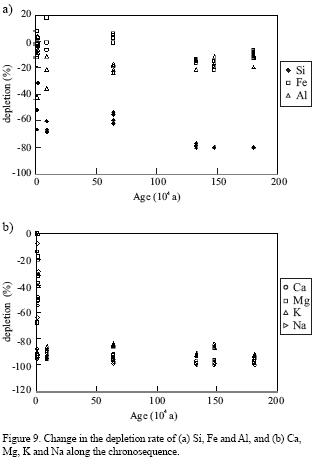
<body><![CDATA[<p align="center"><font face="verdana" size="2"><img src="/img/revistas/rmcg/v24n2/a12f7.jpg"></font></p> 				    <p align="justify"><font face="verdana" size="2">Besides microelements, rare earth elements (REE) were also investigated in our study. Diverging views exist about the movement and differentiation of REE during rock weathering and soil formation. Price <i>et al.</i> (1991) illustrated that REE change dramatically during the initial stage of weathering, while Middelburg <i>et al.</i> (1988) recognized that the migration and differentiation of REE occurs at advanced stages of weathering. However, REE are in general relative stable during pedogenesis. Our study showed that the total REE (&Sigma;REE) increased with soil development under the similar soil&#150;forming conditions. All soil horizons contained higher &Sigma;REE than bedrock, with largest content of &Sigma;REE (333 mg<img src="/img/revistas/rmcg/v24n2/a12s2.jpg">kg<sup>&#150;1</sup>) in the well&#150;developed Ferrasol (pedon HW02). <a href="#f8">Figure 8</a> shows that an excellent linear correlation exists between &Sigma;REE and soil age. This result suggests that REE is a good index of soil development for a chronosequence. Our study also showed that there was no obvious differentiation between the light REE (LREE) and heavy REE (HREE) during soil development, <i>i.e.</i>, the ratio of LREE/HREE varied only slightly among pedons of different ages; this was basically in line with the study by Yang <i>et al.</i> (1999) about REE redistribution in subtropical and tropical soils of China.</font></p> 				    <p align="center"><font face="verdana" size="2"><a name="f8"></a></font></p> 				    <p align="center"><font face="verdana" size="2"><img src="/img/revistas/rmcg/v24n2/a12f8.jpg"></font></p> 				    <p align="justify"><font face="verdana" size="2">An important contribution other than rock weathering to the variation of REE in soils was discussed by Kurtz <i>et al.</i> (2001). In their study about soil development in Hawaii, it was found that near&#150;surface soil horizons showed typical values of upper continental crustal sources and the REE budgets in these surface soils were dominated by dust through a combination of original basaltic REE and dust&#150;derived REE, while deeper soils were less directly affected by fallout of atmospheric dust.</font></p> 				    <p align="justify"><font face="verdana" size="2">&nbsp;</font></p> 				    <p align="justify"><font face="verdana" size="2"><b>Depletion rate</b></font></p> 				    <p align="justify"><font face="verdana" size="2">Elements may be depleted or enriched during pedogenesis. Mass&#150;balance theory and method has been considered as the most common and efficient in assessing element migration (Brimhall <i>et al.</i>, 1988); it is based on the so&#150;called 'isovolume' change of soil or saprolite during weathering and soil formation (Middelburg <i>et al.</i>, 1988). </font></p> 				    <p align="justify"><font face="verdana" size="2">The depletion rate of major elements was calculated, using Ti as a reference. The change of Si, Fe and Al is shown in <a href="#f9">Figure 9a</a>, and that of Ca, Mg, K and Na in <a href="#f9">Figure 9b</a>. The loss of Si took place mainly in the initial stage (Cambosol stage) with less evident loss in the middle stage. When the total loss reached about 80%, the depletion rate became very slow and showed even no change after about 1 Ma. Similarly, Nieuwenhuyse and Van Breemen (1997) also found that the relative loss of Si amounted to and remained at 85%, in an Oxisol of about 4.50&times;10<sup>5</sup> a, developed from andesite in tropical Costa Rica, with mean annual temperature of 25&#150;26 oC and annual rainfall of 3,500&#150;5,500 mm. However, it should be pointed out that for the strongly weathered soils, other mechanisms can control Si budgets. Dust deposition containing more weatherable Si&#150;containing minerals can compensate for Si weathering and leaching in old basalt soils, and Si leaching from them is partly balanced by dust Si addition (Kurtz <i>et al.</i>, 2001). More recently Derry <i>et al.</i> (2005) found that in the strongly weathered soils, the biogenic silica pool controlled Si leaching, whereas direct mineral&#150;water reactions accounted for a smaller fraction of the exported silica. Our results imply that Si loss under current environmental conditions (mean annual temperature of 23&#150;24 &deg;C and mean annual rainfall of 1,400&#150;1,800 mm) could reach up to 80% and remain around that percentage. This result also coincides with the above&#150;discussed change patterns of Sa and Saf in the entire soil development history. Unfortunately, no data about dust Si contribution are available in our study, so we are unable to judge if this constant ratio (80% loss) was controlled by dust addition or by the biogenic pool. Obviously more data should be acquired in this respect.</font></p> 				    <p align="center"><font face="verdana" size="2"><a name="f9"></a></font></p> 				    ]]></body>
<body><![CDATA[<p align="center"><font face="verdana" size="2"><img src="/img/revistas/rmcg/v24n2/a12f9.jpg"></font></p> 				    <p align="justify"><font face="verdana" size="2">Comparatively, the migration rates of Fe and Al were quite small and generally less than 20% and 40%, respectively. Fe was rather stable in the initial stage of rock weathering and its depletion rate was smaller than 10% or was even relatively enriched in Ferrosols (HW04). From Ferrosols to Ferralsols iron was further lost, but the highest depletion rate was still less than 20% after 1 Ma, and changed only slightly after that. It was recognized that Fe and Al are retained preferentially because of the precipitation of poorly crystalline solid phases (e.g., ferrihydrite) from supersaturated solutions (Chadwick <i>et al.</i>, 2003). On the other hand, the migration of Al was more evident in the initial stage of rock weathering and soil formation, showing stronger activity than Fe at the early period of soil formation. </font></p> 				    <p align="justify"><font face="verdana" size="2"><a href="#f9">Figure 9b</a> shows the depletion of Ca, Mg, K and Na during soil formation and development of this region. The migration and loss of these elements happened substantially in the early stage of weathering, especially for Ca, Mg and Na, which already decreased more than 92% within the first 1.0&times;10<sup>4</sup> a. The loss of Ca, Mg and Na became gradually slower, and the depletion rate reached 100%, 99% and 97% respectively at the age of 1.33 Ma, and by then K lost 94% of its original content. At the advanced Ferralsols stage, the magnitude of depletion ranked as Ca&gt;Mg&gt;Na&gt;K. We also found that about 99% of Sr and 92% of Ba was lost by the late stage of weathering and soil formation, while the depletion rate of other microelements such as Cr, Ni, Zn, Pb and Co varied not more than 60%. Nb lost less than 40% of its original content, which once again proved its relative immobility and possible potential as a reference element.</font></p> 				    <p align="justify"><font face="verdana" size="2">&nbsp;</font></p> 				    <p align="justify"><font face="verdana" size="2"><b>CONCLUSIONS</b></font></p> 				    <p align="justify"><font face="verdana" size="2">A series of soil geochemical indices involving macroelements and microelements, including Fe<sub>d</sub>/Fe<sub>t</sub>, Sa, Saf, CIA, CIW, WI, Ba/Nb, REE and the depletion rate of major elements, were calculated and applied to a soil chronosequence developed from basaltic rock. Other geochemical properties were also briefly discussed.</font></p> 				    <p align="justify"><font face="verdana" size="2">The ratio Fe<sub>d</sub>/Fe<sub>t</sub> increased with soil age, following a significant log&#150;normal relationship. The highest Fe<sub>d</sub>/Fe<sub>t</sub> was lower than 0.70 even at highly weathered Ferralsol stage, showing that given the humid tropical environment of this region, even very old soils may have crystalline iron oxide ratio up to around 0.70. Although both Sa and Saf (clay) are generally correlated with soil age, they were not adequate indicators as there was no time&#150;dependence of soil composition change. Neither CIA nor CIW can be regarded as good indicators of soil development with time, but they perhaps are suitable for indicating rock weathering at the initial stage. We found that WI increased almost proportionally with the age of soil formation and it can serve satisfactorily as a soil development index.</font></p> 				    <p align="justify"><font face="verdana" size="2">A significant exponential relationship exists between Ba/Nb and soil age; meanwhile an excellent linear correlation exists between &Sigma;REE and soil age. These results suggest that both Ba/Nb and REE are good indices of soil development for this chronosequence. </font></p> 				    <p align="justify"><font face="verdana" size="2">The leaching loss of Si occurred mainly in the initial and middle stage (Cambosols) of weathering and soil formation, and is less evident in the middle stage (Ferrosols). Si loss reached about 80% and became very slow and showed no change after about 1 Ma, which implies that the ratio represents the maximum Si loss under the current environmental conditions. Although no data were obtained in the current work on Si addition from atmospheric dust, other studies suggest it as an existing mechanism of Si rejuvenation in very old tropical soils. The migration and loss of Ca, Mg, Na and K happened substantially in the early stage of weathering, especially for Ca, Mg and Na, which were already lost in more than 92% just within the first 1.0&times;10<sup>4</sup> a of soil formation.</font></p> 				    <p align="justify"><font face="verdana" size="2">&nbsp;</font></p> 				    ]]></body>
<body><![CDATA[<p align="justify"><font face="verdana" size="2"><b>ACKNOWLEDGEMENTS</b></font></p> 				    <p align="justify"><font face="verdana" size="2">This study was supported by the Natural Science Foundation of China (grant no. 40625001) and Chinese Academy of Sciences (KZCX2&#150;YW&#150;409).</font></p> 				    <p align="justify"><font face="verdana" size="2">&nbsp;</font></p> 				    <p align="justify"><font face="verdana" size="2"><b>REFERENCES</b></font></p> 				    <!-- ref --><p align="justify"><font face="verdana" size="2">Arduino, E., 1984, Estimating relative ages from iron&#150;oxide/total&#150;iron ratios of soils in the western Po valley, Italy: Geoderma, 33, 39&#150;52.</font>&nbsp;&nbsp;&nbsp;&nbsp;&nbsp;&nbsp;&nbsp;&nbsp;[&#160;<a href="javascript:void(0);" onclick="javascript: window.open('/scielo.php?script=sci_nlinks&ref=8065502&pid=S1026-8774200700020001200001&lng=','','width=640,height=500,resizable=yes,scrollbars=1,menubar=yes,');">Links</a>&#160;]<!-- end-ref --> 				    <!-- ref --><p align="justify"><font face="verdana" size="2">Bockheim, J.G., 1980, Solution and use of chronofunctions in studying soil development: Geoderma, 24, 71&#150;85.</font>&nbsp;&nbsp;&nbsp;&nbsp;&nbsp;&nbsp;&nbsp;&nbsp;[&#160;<a href="javascript:void(0);" onclick="javascript: window.open('/scielo.php?script=sci_nlinks&ref=8065504&pid=S1026-8774200700020001200002&lng=','','width=640,height=500,resizable=yes,scrollbars=1,menubar=yes,');">Links</a>&#160;]<!-- end-ref --> 				    <!-- ref --><p align="justify"><font face="verdana" size="2">Brimhall, G.H., Lewis, C.J., Ague, J.J., 1988, Metal enrichment in bauxites by deposition of chemically mature aeolian dust: Nature, 333, 781&#150;795. </font>&nbsp;&nbsp;&nbsp;&nbsp;&nbsp;&nbsp;&nbsp;&nbsp;[&#160;<a href="javascript:void(0);" onclick="javascript: window.open('/scielo.php?script=sci_nlinks&ref=8065506&pid=S1026-8774200700020001200003&lng=','','width=640,height=500,resizable=yes,scrollbars=1,menubar=yes,');">Links</a>&#160;]<!-- end-ref --> 				    ]]></body>
<body><![CDATA[<!-- ref --><p align="justify"><font face="verdana" size="2">Chadwick, O.A., Derry, L.A., Vitousek, P.M., Huebert, B.M, Hedin, L.O., 1999, Changing sources of nutrients during four million years of ecosystem development: Nature, 397, 491&#150;497.</font>&nbsp;&nbsp;&nbsp;&nbsp;&nbsp;&nbsp;&nbsp;&nbsp;[&#160;<a href="javascript:void(0);" onclick="javascript: window.open('/scielo.php?script=sci_nlinks&ref=8065508&pid=S1026-8774200700020001200004&lng=','','width=640,height=500,resizable=yes,scrollbars=1,menubar=yes,');">Links</a>&#160;]<!-- end-ref --> 				    <!-- ref --><p align="justify"><font face="verdana" size="2">Chadwick, O.A., Gavenda, R.T., Kelly, E.F., Ziegler, K., Olson, C.G., Elliott, W.C., Hendricks, D.M., 2003, The impact of climate on the biogeochemical functioning of volcanic soils: Chemical Geology, 202, 195&#150;223.</font>&nbsp;&nbsp;&nbsp;&nbsp;&nbsp;&nbsp;&nbsp;&nbsp;[&#160;<a href="javascript:void(0);" onclick="javascript: window.open('/scielo.php?script=sci_nlinks&ref=8065510&pid=S1026-8774200700020001200005&lng=','','width=640,height=500,resizable=yes,scrollbars=1,menubar=yes,');">Links</a>&#160;]<!-- end-ref --> 				    <!-- ref --><p align="justify"><font face="verdana" size="2">Chen, Z.C., 1990, Ferralization, <i>in</i> Yu, T.R., Chen, Z.C. (eds.), Chemical processes in pedogenesis: Beijing, Science Press, 195&#150;200. </font>&nbsp;&nbsp;&nbsp;&nbsp;&nbsp;&nbsp;&nbsp;&nbsp;[&#160;<a href="javascript:void(0);" onclick="javascript: window.open('/scielo.php?script=sci_nlinks&ref=8065512&pid=S1026-8774200700020001200006&lng=','','width=640,height=500,resizable=yes,scrollbars=1,menubar=yes,');">Links</a>&#160;]<!-- end-ref --> 				    <!-- ref --><p align="justify"><font face="verdana" size="2">Chinese Soil Taxonomy Research Group (CST), 2001, Chinese Soil Taxonomy: Beijing, New York, Science Press, 203 p.</font>&nbsp;&nbsp;&nbsp;&nbsp;&nbsp;&nbsp;&nbsp;&nbsp;[&#160;<a href="javascript:void(0);" onclick="javascript: window.open('/scielo.php?script=sci_nlinks&ref=8065514&pid=S1026-8774200700020001200007&lng=','','width=640,height=500,resizable=yes,scrollbars=1,menubar=yes,');">Links</a>&#160;]<!-- end-ref --> 				    <!-- ref --><p align="justify"><font face="verdana" size="2">Condie, K.C., Dengate, J., Cullers, R.L., 1995, Behavior of rare earth elements in a paleoweathering profile on granodiorite in the Front Range, Colorado, USA: Geochimica et Cosmochimica Acta, 59, 279&#150;294.</font>&nbsp;&nbsp;&nbsp;&nbsp;&nbsp;&nbsp;&nbsp;&nbsp;[&#160;<a href="javascript:void(0);" onclick="javascript: window.open('/scielo.php?script=sci_nlinks&ref=8065516&pid=S1026-8774200700020001200008&lng=','','width=640,height=500,resizable=yes,scrollbars=1,menubar=yes,');">Links</a>&#160;]<!-- end-ref --> 				    ]]></body>
<body><![CDATA[<!-- ref --><p align="justify"><font face="verdana" size="2">Derry, L.A., Kurtz, A.C., Ziegler, K., Chadwick, O.A., 2005, Biological control of terrestrial silica cycling and export fluxes to watersheds: Nature, 433, 728&#150;731.</font>&nbsp;&nbsp;&nbsp;&nbsp;&nbsp;&nbsp;&nbsp;&nbsp;[&#160;<a href="javascript:void(0);" onclick="javascript: window.open('/scielo.php?script=sci_nlinks&ref=8065518&pid=S1026-8774200700020001200009&lng=','','width=640,height=500,resizable=yes,scrollbars=1,menubar=yes,');">Links</a>&#160;]<!-- end-ref --> 				    <!-- ref --><p align="justify"><font face="verdana" size="2">Eggleton, R.A., Foudoulis, C., Varkevisser, D., 1987, Weathering of basalt: change in rock chemistry and mineralogy: Clays and Clay Minerals, 35, 161&#150;169.</font>&nbsp;&nbsp;&nbsp;&nbsp;&nbsp;&nbsp;&nbsp;&nbsp;[&#160;<a href="javascript:void(0);" onclick="javascript: window.open('/scielo.php?script=sci_nlinks&ref=8065520&pid=S1026-8774200700020001200010&lng=','','width=640,height=500,resizable=yes,scrollbars=1,menubar=yes,');">Links</a>&#160;]<!-- end-ref --> 				    <!-- ref --><p align="justify"><font face="verdana" size="2">Food and Agriculture Organization (FAO), 1998, World Reference Base for Soil Resources: Rome, Food and Agriculture Organization of the United Nations, World Soil Resources Reports, 84, 88 p.</font>&nbsp;&nbsp;&nbsp;&nbsp;&nbsp;&nbsp;&nbsp;&nbsp;[&#160;<a href="javascript:void(0);" onclick="javascript: window.open('/scielo.php?script=sci_nlinks&ref=8065522&pid=S1026-8774200700020001200011&lng=','','width=640,height=500,resizable=yes,scrollbars=1,menubar=yes,');">Links</a>&#160;]<!-- end-ref --> 				    <!-- ref --><p align="justify"><font face="verdana" size="2">Feng, G.R., 1992, Basic features of Miocene basalt in the South China coast region in relation to its tectonic settings: Journal of Zhongshan University, 27, 41&#150;73. </font>&nbsp;&nbsp;&nbsp;&nbsp;&nbsp;&nbsp;&nbsp;&nbsp;[&#160;<a href="javascript:void(0);" onclick="javascript: window.open('/scielo.php?script=sci_nlinks&ref=8065524&pid=S1026-8774200700020001200012&lng=','','width=640,height=500,resizable=yes,scrollbars=1,menubar=yes,');">Links</a>&#160;]<!-- end-ref --> 				    <!-- ref --><p align="justify"><font face="verdana" size="2">Feng, J.J., Hu, B.R., 1992, The rate of chemical weathering of basalt in north Hainan Island: Geological Science, Supplement, 295&#150;301.</font>&nbsp;&nbsp;&nbsp;&nbsp;&nbsp;&nbsp;&nbsp;&nbsp;[&#160;<a href="javascript:void(0);" onclick="javascript: window.open('/scielo.php?script=sci_nlinks&ref=8065526&pid=S1026-8774200700020001200013&lng=','','width=640,height=500,resizable=yes,scrollbars=1,menubar=yes,');">Links</a>&#160;]<!-- end-ref --> 				    ]]></body>
<body><![CDATA[<!-- ref --><p align="justify"><font face="verdana" size="2">Ge, T.M., Chen, W.Q., Xu, X., Li, D.M., Fan, L.M., Li, Q., Wen, S.Y., Wang, X., 1989, The geomagnetic polarity time scale of quaternary for Leizhou&#150;Hainan region &#150; the K&#150;Ar dating and palaomagnetic evidences from igneous rocks: Acta Geophysical Sinica, 32, 550&#150;58. </font>&nbsp;&nbsp;&nbsp;&nbsp;&nbsp;&nbsp;&nbsp;&nbsp;[&#160;<a href="javascript:void(0);" onclick="javascript: window.open('/scielo.php?script=sci_nlinks&ref=8065528&pid=S1026-8774200700020001200014&lng=','','width=640,height=500,resizable=yes,scrollbars=1,menubar=yes,');">Links</a>&#160;]<!-- end-ref --> 				    <!-- ref --><p align="justify"><font face="verdana" size="2">Harnois, L., 1988, The CIW index: A new chemical index of weathering: Sedimentary Geology, 55, 319&#150;322. </font>&nbsp;&nbsp;&nbsp;&nbsp;&nbsp;&nbsp;&nbsp;&nbsp;[&#160;<a href="javascript:void(0);" onclick="javascript: window.open('/scielo.php?script=sci_nlinks&ref=8065530&pid=S1026-8774200700020001200015&lng=','','width=640,height=500,resizable=yes,scrollbars=1,menubar=yes,');">Links</a>&#160;]<!-- end-ref --> 				    <!-- ref --><p align="justify"><font face="verdana" size="2">Huang, Z.G., Cai, F.X., Han, Z.Y., 1993, Quaternary Volcanoes of Leizhou and Hainan Region: Beijing, Science Press, 106 p.</font>&nbsp;&nbsp;&nbsp;&nbsp;&nbsp;&nbsp;&nbsp;&nbsp;[&#160;<a href="javascript:void(0);" onclick="javascript: window.open('/scielo.php?script=sci_nlinks&ref=8065532&pid=S1026-8774200700020001200016&lng=','','width=640,height=500,resizable=yes,scrollbars=1,menubar=yes,');">Links</a>&#160;]<!-- end-ref --> 				    <!-- ref --><p align="justify"><font face="verdana" size="2">Huang, Z.G., Zhang, W.Q., Chen, H.J., 1999, Red soils in China and the shift of its border: Journal of Geographical Science, 54(3), 193&#150;205.</font>&nbsp;&nbsp;&nbsp;&nbsp;&nbsp;&nbsp;&nbsp;&nbsp;[&#160;<a href="javascript:void(0);" onclick="javascript: window.open('/scielo.php?script=sci_nlinks&ref=8065534&pid=S1026-8774200700020001200017&lng=','','width=640,height=500,resizable=yes,scrollbars=1,menubar=yes,');">Links</a>&#160;]<!-- end-ref --> 				    <!-- ref --><p align="justify"><font face="verdana" size="2">Institute of Soil Science, Chinese Academy of Science (ISSAS), 1978, Soil Physical and Chemical Analysis: Shanghai, Shanghai Science and Technology Press, 573 p.</font>&nbsp;&nbsp;&nbsp;&nbsp;&nbsp;&nbsp;&nbsp;&nbsp;[&#160;<a href="javascript:void(0);" onclick="javascript: window.open('/scielo.php?script=sci_nlinks&ref=8065536&pid=S1026-8774200700020001200018&lng=','','width=640,height=500,resizable=yes,scrollbars=1,menubar=yes,');">Links</a>&#160;]<!-- end-ref --> 				    ]]></body>
<body><![CDATA[<!-- ref --><p align="justify"><font face="verdana" size="2">Jenny, H., 1941, Factors of Soil Formation: New York, London, McGraw&#150;Hill Book Company, 281p.</font>&nbsp;&nbsp;&nbsp;&nbsp;&nbsp;&nbsp;&nbsp;&nbsp;[&#160;<a href="javascript:void(0);" onclick="javascript: window.open('/scielo.php?script=sci_nlinks&ref=8065538&pid=S1026-8774200700020001200019&lng=','','width=640,height=500,resizable=yes,scrollbars=1,menubar=yes,');">Links</a>&#160;]<!-- end-ref --> 				    <!-- ref --><p align="justify"><font face="verdana" size="2">Kennedy, M.J., Chadwick, O.A., Vitousek, P.M., Derry, L.A., Hendricks, D.M., 1998, Changing sources of base cations during ecosystem development, Hawaiian Islands: Geology, 26, 1015&#150;1018.</font>&nbsp;&nbsp;&nbsp;&nbsp;&nbsp;&nbsp;&nbsp;&nbsp;[&#160;<a href="javascript:void(0);" onclick="javascript: window.open('/scielo.php?script=sci_nlinks&ref=8065540&pid=S1026-8774200700020001200020&lng=','','width=640,height=500,resizable=yes,scrollbars=1,menubar=yes,');">Links</a>&#160;]<!-- end-ref --> 				    <!-- ref --><p align="justify"><font face="verdana" size="2">Kurtz, A.C., Derry, L.A., Chadwick, O.A., Alfano, M.J., 2000, Refractory element mobility in volcanic soils: Geology, 28, 683&#150;686.</font>&nbsp;&nbsp;&nbsp;&nbsp;&nbsp;&nbsp;&nbsp;&nbsp;[&#160;<a href="javascript:void(0);" onclick="javascript: window.open('/scielo.php?script=sci_nlinks&ref=8065542&pid=S1026-8774200700020001200021&lng=','','width=640,height=500,resizable=yes,scrollbars=1,menubar=yes,');">Links</a>&#160;]<!-- end-ref --> 				    <!-- ref --><p align="justify"><font face="verdana" size="2">Kurtz, A.C., Derry, L.A., Chadwick, O.A., 2001, Accretion of Asian dust to Hawaiian soils: Geochimica et Cosmochimica Acta, 65, 1971&#150;1983.</font>&nbsp;&nbsp;&nbsp;&nbsp;&nbsp;&nbsp;&nbsp;&nbsp;[&#160;<a href="javascript:void(0);" onclick="javascript: window.open('/scielo.php?script=sci_nlinks&ref=8065544&pid=S1026-8774200700020001200022&lng=','','width=640,height=500,resizable=yes,scrollbars=1,menubar=yes,');">Links</a>&#160;]<!-- end-ref --> 				    <!-- ref --><p align="justify"><font face="verdana" size="2">Lichter, J., 1998, Rates of weathering and chemical depletion in soils across a chronosequence of Lake Michigan sand dunes: Geoderma, 85, 255&#150;282.</font>&nbsp;&nbsp;&nbsp;&nbsp;&nbsp;&nbsp;&nbsp;&nbsp;[&#160;<a href="javascript:void(0);" onclick="javascript: window.open('/scielo.php?script=sci_nlinks&ref=8065546&pid=S1026-8774200700020001200023&lng=','','width=640,height=500,resizable=yes,scrollbars=1,menubar=yes,');">Links</a>&#160;]<!-- end-ref --> 				    ]]></body>
<body><![CDATA[<!-- ref --><p align="justify"><font face="verdana" size="2">Liu, Z., Cai, Z.C., Wang, J.F., 1996, Microelements of Soils in China: Nanjing, Jiangsu Science and Technology Press, 329 p.</font>&nbsp;&nbsp;&nbsp;&nbsp;&nbsp;&nbsp;&nbsp;&nbsp;[&#160;<a href="javascript:void(0);" onclick="javascript: window.open('/scielo.php?script=sci_nlinks&ref=8065548&pid=S1026-8774200700020001200024&lng=','','width=640,height=500,resizable=yes,scrollbars=1,menubar=yes,');">Links</a>&#160;]<!-- end-ref --> 				    <!-- ref --><p align="justify"><font face="verdana" size="2">Lu, R.K., 1999, Analytical method of soil agricultural Chemistry. Beijing: Beijing, China, Chinese Agriculture Science and Technology Press, 560 p. </font>&nbsp;&nbsp;&nbsp;&nbsp;&nbsp;&nbsp;&nbsp;&nbsp;[&#160;<a href="javascript:void(0);" onclick="javascript: window.open('/scielo.php?script=sci_nlinks&ref=8065550&pid=S1026-8774200700020001200025&lng=','','width=640,height=500,resizable=yes,scrollbars=1,menubar=yes,');">Links</a>&#160;]<!-- end-ref --> 				    <!-- ref --><p align="justify"><font face="verdana" size="2">Malucelli, F., Terribile, F., Colombo, C., 1999, Mineralogy, micromorphology and chemical analysis of Andosols on the Island of S&atilde;o Miguel (Azores): Geoderma, 88, 73&#150;98.</font>&nbsp;&nbsp;&nbsp;&nbsp;&nbsp;&nbsp;&nbsp;&nbsp;[&#160;<a href="javascript:void(0);" onclick="javascript: window.open('/scielo.php?script=sci_nlinks&ref=8065552&pid=S1026-8774200700020001200026&lng=','','width=640,height=500,resizable=yes,scrollbars=1,menubar=yes,');">Links</a>&#160;]<!-- end-ref --> 				    <!-- ref --><p align="justify"><font face="verdana" size="2">Middelburg, J.J., Van Der Weijden, C.H., Woittiez, J.R.W., 1988, Chemical processes affecting the mobility of major, minor and trace elements during weathering of granite rocks: Chemical Geology, 68, 253&#150;273.</font>&nbsp;&nbsp;&nbsp;&nbsp;&nbsp;&nbsp;&nbsp;&nbsp;[&#160;<a href="javascript:void(0);" onclick="javascript: window.open('/scielo.php?script=sci_nlinks&ref=8065554&pid=S1026-8774200700020001200027&lng=','','width=640,height=500,resizable=yes,scrollbars=1,menubar=yes,');">Links</a>&#160;]<!-- end-ref --> 				    <!-- ref --><p align="justify"><font face="verdana" size="2">Nesbitt, H.W., 1979, Mobility and fractionation of rare earth elements during weathering of granodiorite: Nature, 279, 206&#150;210. </font>&nbsp;&nbsp;&nbsp;&nbsp;&nbsp;&nbsp;&nbsp;&nbsp;[&#160;<a href="javascript:void(0);" onclick="javascript: window.open('/scielo.php?script=sci_nlinks&ref=8065556&pid=S1026-8774200700020001200028&lng=','','width=640,height=500,resizable=yes,scrollbars=1,menubar=yes,');">Links</a>&#160;]<!-- end-ref --> 				    ]]></body>
<body><![CDATA[<!-- ref --><p align="justify"><font face="verdana" size="2">Nesbitt, Y.W., Young, G.M., 1982, Early Proterozoic climates and plate motions inferred from major element chemistry of lutites: Nature, 299, 715&#150;717.</font>&nbsp;&nbsp;&nbsp;&nbsp;&nbsp;&nbsp;&nbsp;&nbsp;[&#160;<a href="javascript:void(0);" onclick="javascript: window.open('/scielo.php?script=sci_nlinks&ref=8065558&pid=S1026-8774200700020001200029&lng=','','width=640,height=500,resizable=yes,scrollbars=1,menubar=yes,');">Links</a>&#160;]<!-- end-ref --> 				    <!-- ref --><p align="justify"><font face="verdana" size="2">Nieuwenhuyse, A., Van Breemen, N., 1997, Quantitative aspects of weathering and neo&#150;formation in selected Costa Rica volcanic soils: Soil Science Society of America Journal, 61, 1450&#150;1458.</font>&nbsp;&nbsp;&nbsp;&nbsp;&nbsp;&nbsp;&nbsp;&nbsp;[&#160;<a href="javascript:void(0);" onclick="javascript: window.open('/scielo.php?script=sci_nlinks&ref=8065560&pid=S1026-8774200700020001200030&lng=','','width=640,height=500,resizable=yes,scrollbars=1,menubar=yes,');">Links</a>&#160;]<!-- end-ref --> 				    <!-- ref --><p align="justify"><font face="verdana" size="2">Parker, A., 1970, An index of weathering for silicate rocks: Geological Magazine, 107, 501&#150;504.</font>&nbsp;&nbsp;&nbsp;&nbsp;&nbsp;&nbsp;&nbsp;&nbsp;[&#160;<a href="javascript:void(0);" onclick="javascript: window.open('/scielo.php?script=sci_nlinks&ref=8065562&pid=S1026-8774200700020001200031&lng=','','width=640,height=500,resizable=yes,scrollbars=1,menubar=yes,');">Links</a>&#160;]<!-- end-ref --> 				    <!-- ref --><p align="justify"><font face="verdana" size="2">Phillips, J.D., 1993, Progressive and regressive pedogenesis and complex soil evolution: Quaternary Research, 40, 169&#150;176.</font>&nbsp;&nbsp;&nbsp;&nbsp;&nbsp;&nbsp;&nbsp;&nbsp;[&#160;<a href="javascript:void(0);" onclick="javascript: window.open('/scielo.php?script=sci_nlinks&ref=8065564&pid=S1026-8774200700020001200032&lng=','','width=640,height=500,resizable=yes,scrollbars=1,menubar=yes,');">Links</a>&#160;]<!-- end-ref --> 				    <!-- ref --><p align="justify"><font face="verdana" size="2">Pillans, B., 1997, Soil development at snail's pace: evidence from 6 Ma soil chronosequence on basalt in north Queensland, Australia: Geoderma, 80,117&#150;128.</font>&nbsp;&nbsp;&nbsp;&nbsp;&nbsp;&nbsp;&nbsp;&nbsp;[&#160;<a href="javascript:void(0);" onclick="javascript: window.open('/scielo.php?script=sci_nlinks&ref=8065566&pid=S1026-8774200700020001200033&lng=','','width=640,height=500,resizable=yes,scrollbars=1,menubar=yes,');">Links</a>&#160;]<!-- end-ref --> 				    ]]></body>
<body><![CDATA[<!-- ref --><p align="justify"><font face="verdana" size="2">Price, R.C., Gray, C.M., Wilson, R.E., 1991, The effect of weathering on rare&#150;earth element, Y and Ba abundances in Tertiary basalts from southeastern Australia: Chemical Geology, 93, 245&#150;265.</font>&nbsp;&nbsp;&nbsp;&nbsp;&nbsp;&nbsp;&nbsp;&nbsp;[&#160;<a href="javascript:void(0);" onclick="javascript: window.open('/scielo.php?script=sci_nlinks&ref=8065568&pid=S1026-8774200700020001200034&lng=','','width=640,height=500,resizable=yes,scrollbars=1,menubar=yes,');">Links</a>&#160;]<!-- end-ref --> 				    <!-- ref --><p align="justify"><font face="verdana" size="2">Rabenhorst, M.C., 1997, The chrono&#150;continuum: An approach to modeling pedogenesis in marsh soils along transgressive coastlines: Soil Science, 162, 2&#150;9.</font>&nbsp;&nbsp;&nbsp;&nbsp;&nbsp;&nbsp;&nbsp;&nbsp;[&#160;<a href="javascript:void(0);" onclick="javascript: window.open('/scielo.php?script=sci_nlinks&ref=8065570&pid=S1026-8774200700020001200035&lng=','','width=640,height=500,resizable=yes,scrollbars=1,menubar=yes,');">Links</a>&#160;]<!-- end-ref --> 				    <!-- ref --><p align="justify"><font face="verdana" size="2">Schaetzl, R.J., Barrett, L.R., and Winkler, 1994, Choosing models for soil chronofunctions and fitting them to data: European Journal of Soil Science, 45, 219&#150;232.</font>&nbsp;&nbsp;&nbsp;&nbsp;&nbsp;&nbsp;&nbsp;&nbsp;[&#160;<a href="javascript:void(0);" onclick="javascript: window.open('/scielo.php?script=sci_nlinks&ref=8065572&pid=S1026-8774200700020001200036&lng=','','width=640,height=500,resizable=yes,scrollbars=1,menubar=yes,');">Links</a>&#160;]<!-- end-ref --> 				    <!-- ref --><p align="justify"><font face="verdana" size="2">Soil Survey Staff, 2003, Keys to Soil Taxonomy: United States Department of Agriculture, Natural Resources Conservation Service, 9th edition, 332p.</font>&nbsp;&nbsp;&nbsp;&nbsp;&nbsp;&nbsp;&nbsp;&nbsp;[&#160;<a href="javascript:void(0);" onclick="javascript: window.open('/scielo.php?script=sci_nlinks&ref=8065574&pid=S1026-8774200700020001200037&lng=','','width=640,height=500,resizable=yes,scrollbars=1,menubar=yes,');">Links</a>&#160;]<!-- end-ref --> 				    <!-- ref --><p align="justify"><font face="verdana" size="2">Stevens, P.R., Walker, T.W., 1970, The chronosequence concept and soil formation: The Quarterly Review of Biology, 45, 333&#150;350.</font>&nbsp;&nbsp;&nbsp;&nbsp;&nbsp;&nbsp;&nbsp;&nbsp;[&#160;<a href="javascript:void(0);" onclick="javascript: window.open('/scielo.php?script=sci_nlinks&ref=8065576&pid=S1026-8774200700020001200038&lng=','','width=640,height=500,resizable=yes,scrollbars=1,menubar=yes,');">Links</a>&#160;]<!-- end-ref --> 				    ]]></body>
<body><![CDATA[<!-- ref --><p align="justify"><font face="verdana" size="2">Tejan&#150;Kella, M.S., Chittleborough, D.J., Fitzpatrick, R.W., 1991, Weathering assessment of heavy metals in age sequence of Australian sandy soils: Soil Science Society of America Journal, 55, 427&#150;438.</font>&nbsp;&nbsp;&nbsp;&nbsp;&nbsp;&nbsp;&nbsp;&nbsp;[&#160;<a href="javascript:void(0);" onclick="javascript: window.open('/scielo.php?script=sci_nlinks&ref=8065578&pid=S1026-8774200700020001200039&lng=','','width=640,height=500,resizable=yes,scrollbars=1,menubar=yes,');">Links</a>&#160;]<!-- end-ref --> 				    <!-- ref --><p align="justify"><font face="verdana" size="2">Torrent, J., Nettleton, W.D., 1979, A simple index for assessing chemical weathering in soils: Soil Science Society of America Journal, 43, 373&#150;377.</font>&nbsp;&nbsp;&nbsp;&nbsp;&nbsp;&nbsp;&nbsp;&nbsp;[&#160;<a href="javascript:void(0);" onclick="javascript: window.open('/scielo.php?script=sci_nlinks&ref=8065580&pid=S1026-8774200700020001200040&lng=','','width=640,height=500,resizable=yes,scrollbars=1,menubar=yes,');">Links</a>&#160;]<!-- end-ref --> 				    <!-- ref --><p align="justify"><font face="verdana" size="2">Vidic, N.J., Lobnic, F., 1997, Rates of soil development of the chronosequence in the Ljubjana Basin, Slovenia: Geoderma, 76, 35&#150;64.</font>&nbsp;&nbsp;&nbsp;&nbsp;&nbsp;&nbsp;&nbsp;&nbsp;[&#160;<a href="javascript:void(0);" onclick="javascript: window.open('/scielo.php?script=sci_nlinks&ref=8065582&pid=S1026-8774200700020001200041&lng=','','width=640,height=500,resizable=yes,scrollbars=1,menubar=yes,');">Links</a>&#160;]<!-- end-ref --> 				    <!-- ref --><p align="justify"><font face="verdana" size="2">Walker, P.H., 1989, Contribution to the understanding of soil and landscape relationships: Australian Journal of Soil Research, 27, 589&#150;605.</font>&nbsp;&nbsp;&nbsp;&nbsp;&nbsp;&nbsp;&nbsp;&nbsp;[&#160;<a href="javascript:void(0);" onclick="javascript: window.open('/scielo.php?script=sci_nlinks&ref=8065584&pid=S1026-8774200700020001200042&lng=','','width=640,height=500,resizable=yes,scrollbars=1,menubar=yes,');">Links</a>&#160;]<!-- end-ref --> 				    <!-- ref --><p align="justify"><font face="verdana" size="2">Yaalon, D.H., 1971, Soil&#150;forming processes in time and space, <i>in</i> Yaalon, D.H. (ed.), Paleopedology: Origin, Nature and Dating of Paleosols: Jerusalem, Israel University Press, 29&#150;39.</font>&nbsp;&nbsp;&nbsp;&nbsp;&nbsp;&nbsp;&nbsp;&nbsp;[&#160;<a href="javascript:void(0);" onclick="javascript: window.open('/scielo.php?script=sci_nlinks&ref=8065586&pid=S1026-8774200700020001200043&lng=','','width=640,height=500,resizable=yes,scrollbars=1,menubar=yes,');">Links</a>&#160;]<!-- end-ref --> 				    ]]></body>
<body><![CDATA[<!-- ref --><p align="justify"><font face="verdana" size="2">Yang, Y.G., Liu, C.Q., Yuan, K.N., 1999, Study on the distribution of rare earth elements in red soils of southern China: Geochemistry, 28(1), 70&#150;79.</font>&nbsp;&nbsp;&nbsp;&nbsp;&nbsp;&nbsp;&nbsp;&nbsp;[&#160;<a href="javascript:void(0);" onclick="javascript: window.open('/scielo.php?script=sci_nlinks&ref=8065588&pid=S1026-8774200700020001200044&lng=','','width=640,height=500,resizable=yes,scrollbars=1,menubar=yes,');">Links</a>&#160;]<!-- end-ref --> 				    <!-- ref --><p align="justify"><font face="verdana" size="2">Zhang, G.L., Gong, Z.T., 2001, Microstructure and formation mechanisms of redoximorphic features of Hydragric Anthrosols: Acta Pedologica Sinica, 38(1), 10&#150;16.</font>&nbsp;&nbsp;&nbsp;&nbsp;&nbsp;&nbsp;&nbsp;&nbsp;[&#160;<a href="javascript:void(0);" onclick="javascript: window.open('/scielo.php?script=sci_nlinks&ref=8065590&pid=S1026-8774200700020001200045&lng=','','width=640,height=500,resizable=yes,scrollbars=1,menubar=yes,');">Links</a>&#160;]<!-- end-ref --> ]]></body><back>
<ref-list>
<ref id="B1">
<nlm-citation citation-type="journal">
<person-group person-group-type="author">
<name>
<surname><![CDATA[Arduino]]></surname>
<given-names><![CDATA[E]]></given-names>
</name>
</person-group>
<article-title xml:lang="en"><![CDATA[Estimating relative ages from iron-oxide/total-iron ratios of soils in the western Po valley, Italy]]></article-title>
<source><![CDATA[Geoderma]]></source>
<year>1984</year>
<volume>33</volume>
<page-range>39-52</page-range></nlm-citation>
</ref>
<ref id="B2">
<nlm-citation citation-type="journal">
<person-group person-group-type="author">
<name>
<surname><![CDATA[Bockheim]]></surname>
<given-names><![CDATA[J.G]]></given-names>
</name>
</person-group>
<article-title xml:lang="en"><![CDATA[Solution and use of chronofunctions in studying soil development]]></article-title>
<source><![CDATA[Geoderma]]></source>
<year>1980</year>
<volume>24</volume>
<page-range>71-85</page-range></nlm-citation>
</ref>
<ref id="B3">
<nlm-citation citation-type="journal">
<person-group person-group-type="author">
<name>
<surname><![CDATA[Brimhall]]></surname>
<given-names><![CDATA[G.H]]></given-names>
</name>
<name>
<surname><![CDATA[Lewis]]></surname>
<given-names><![CDATA[C.J]]></given-names>
</name>
<name>
<surname><![CDATA[Ague]]></surname>
<given-names><![CDATA[J.J]]></given-names>
</name>
</person-group>
<article-title xml:lang="en"><![CDATA[Metal enrichment in bauxites by deposition of chemically mature aeolian dust]]></article-title>
<source><![CDATA[Nature]]></source>
<year>1988</year>
<volume>333</volume>
<page-range>781-795</page-range></nlm-citation>
</ref>
<ref id="B4">
<nlm-citation citation-type="journal">
<person-group person-group-type="author">
<name>
<surname><![CDATA[Chadwick]]></surname>
<given-names><![CDATA[O.A]]></given-names>
</name>
<name>
<surname><![CDATA[Derry]]></surname>
<given-names><![CDATA[L.A]]></given-names>
</name>
<name>
<surname><![CDATA[Vitousek]]></surname>
<given-names><![CDATA[P.M]]></given-names>
</name>
<name>
<surname><![CDATA[Huebert]]></surname>
<given-names><![CDATA[B.M, Hedin, L.O]]></given-names>
</name>
</person-group>
<article-title xml:lang="en"><![CDATA[Changing sources of nutrients during four million years of ecosystem development]]></article-title>
<source><![CDATA[Nature]]></source>
<year>1999</year>
<volume>397</volume>
<page-range>491-497</page-range></nlm-citation>
</ref>
<ref id="B5">
<nlm-citation citation-type="journal">
<person-group person-group-type="author">
<name>
<surname><![CDATA[Chadwick]]></surname>
<given-names><![CDATA[O.A]]></given-names>
</name>
<name>
<surname><![CDATA[Gavenda]]></surname>
<given-names><![CDATA[R.T]]></given-names>
</name>
<name>
<surname><![CDATA[Kelly]]></surname>
<given-names><![CDATA[E.F]]></given-names>
</name>
<name>
<surname><![CDATA[Ziegler]]></surname>
<given-names><![CDATA[K]]></given-names>
</name>
<name>
<surname><![CDATA[Olson]]></surname>
<given-names><![CDATA[C.G]]></given-names>
</name>
<name>
<surname><![CDATA[Elliott]]></surname>
<given-names><![CDATA[W.C]]></given-names>
</name>
<name>
<surname><![CDATA[Hendricks]]></surname>
<given-names><![CDATA[D.M]]></given-names>
</name>
</person-group>
<article-title xml:lang="en"><![CDATA[The impact of climate on the biogeochemical functioning of volcanic soils]]></article-title>
<source><![CDATA[Chemical Geology]]></source>
<year>2003</year>
<volume>202</volume>
<page-range>195-223</page-range></nlm-citation>
</ref>
<ref id="B6">
<nlm-citation citation-type="book">
<person-group person-group-type="author">
<name>
<surname><![CDATA[Chen]]></surname>
<given-names><![CDATA[Z.C.]]></given-names>
</name>
</person-group>
<article-title xml:lang="en"><![CDATA[Ferralization]]></article-title>
<person-group person-group-type="editor">
<name>
<surname><![CDATA[Yu]]></surname>
<given-names><![CDATA[T.R.]]></given-names>
</name>
<name>
<surname><![CDATA[Chen]]></surname>
<given-names><![CDATA[Z.C.]]></given-names>
</name>
</person-group>
<source><![CDATA[Chemical processes in pedogenesis]]></source>
<year>1990</year>
<page-range>195-200</page-range><publisher-loc><![CDATA[^eBeijing Beijing]]></publisher-loc>
<publisher-name><![CDATA[Science Press]]></publisher-name>
</nlm-citation>
</ref>
<ref id="B7">
<nlm-citation citation-type="book">
<collab>Chinese Soil Taxonomy Research Group (CST)</collab>
<source><![CDATA[Chinese Soil Taxonomy]]></source>
<year>2001</year>
<page-range>203</page-range><publisher-loc><![CDATA[^eBeijing^eNew York BeijingNew York]]></publisher-loc>
<publisher-name><![CDATA[Science Press]]></publisher-name>
</nlm-citation>
</ref>
<ref id="B8">
<nlm-citation citation-type="journal">
<person-group person-group-type="author">
<name>
<surname><![CDATA[Condie]]></surname>
<given-names><![CDATA[K.C]]></given-names>
</name>
<name>
<surname><![CDATA[Dengate]]></surname>
<given-names><![CDATA[J]]></given-names>
</name>
<name>
<surname><![CDATA[Cullers]]></surname>
<given-names><![CDATA[R.L]]></given-names>
</name>
</person-group>
<article-title xml:lang="en"><![CDATA[Behavior of rare earth elements in a paleoweathering profile on granodiorite in the Front Range, Colorado, USA]]></article-title>
<source><![CDATA[Geochimica et Cosmochimica Acta]]></source>
<year>1995</year>
<volume>59</volume>
<page-range>279-294</page-range></nlm-citation>
</ref>
<ref id="B9">
<nlm-citation citation-type="journal">
<person-group person-group-type="author">
<name>
<surname><![CDATA[Derry]]></surname>
<given-names><![CDATA[L.A]]></given-names>
</name>
<name>
<surname><![CDATA[Kurtz]]></surname>
<given-names><![CDATA[A.C]]></given-names>
</name>
<name>
<surname><![CDATA[Ziegler]]></surname>
<given-names><![CDATA[K]]></given-names>
</name>
<name>
<surname><![CDATA[Chadwick]]></surname>
<given-names><![CDATA[O.A]]></given-names>
</name>
</person-group>
<article-title xml:lang="en"><![CDATA[Biological control of terrestrial silica cycling and export fluxes to watersheds]]></article-title>
<source><![CDATA[Nature]]></source>
<year>2005</year>
<volume>433</volume>
<page-range>728-731</page-range></nlm-citation>
</ref>
<ref id="B10">
<nlm-citation citation-type="journal">
<person-group person-group-type="author">
<name>
<surname><![CDATA[Eggleton]]></surname>
<given-names><![CDATA[R.A]]></given-names>
</name>
<name>
<surname><![CDATA[Foudoulis]]></surname>
<given-names><![CDATA[C]]></given-names>
</name>
<name>
<surname><![CDATA[Varkevisser]]></surname>
<given-names><![CDATA[D]]></given-names>
</name>
</person-group>
<article-title xml:lang="en"><![CDATA[Weathering of basalt: change in rock chemistry and mineralogy]]></article-title>
<source><![CDATA[Clays and Clay Minerals]]></source>
<year>1987</year>
<volume>35</volume>
<page-range>161-169</page-range></nlm-citation>
</ref>
<ref id="B11">
<nlm-citation citation-type="book">
<collab>Food and Agriculture Organization (FAO)</collab>
<source><![CDATA[World Reference Base for Soil Resources]]></source>
<year>1998</year>
<volume>84</volume>
<page-range>88</page-range><publisher-loc><![CDATA[^eRome Rome]]></publisher-loc>
<publisher-name><![CDATA[Food and Agriculture Organization of the United Nations]]></publisher-name>
</nlm-citation>
</ref>
<ref id="B12">
<nlm-citation citation-type="journal">
<person-group person-group-type="author">
<name>
<surname><![CDATA[Feng]]></surname>
<given-names><![CDATA[G.R]]></given-names>
</name>
</person-group>
<article-title xml:lang="en"><![CDATA[Basic features of Miocene basalt in the South China coast region in relation to its tectonic settings]]></article-title>
<source><![CDATA[Journal of Zhongshan University]]></source>
<year>1992</year>
<volume>27</volume>
<page-range>41-73</page-range></nlm-citation>
</ref>
<ref id="B13">
<nlm-citation citation-type="journal">
<person-group person-group-type="author">
<name>
<surname><![CDATA[Feng]]></surname>
<given-names><![CDATA[J.J]]></given-names>
</name>
<name>
<surname><![CDATA[Hu]]></surname>
<given-names><![CDATA[B.R]]></given-names>
</name>
</person-group>
<article-title xml:lang="en"><![CDATA[The rate of chemical weathering of basalt in north Hainan Island]]></article-title>
<source><![CDATA[Geological Science]]></source>
<year>1992</year>
<volume>Supplement</volume>
<page-range>295-301</page-range></nlm-citation>
</ref>
<ref id="B14">
<nlm-citation citation-type="journal">
<person-group person-group-type="author">
<name>
<surname><![CDATA[Ge]]></surname>
<given-names><![CDATA[T.M]]></given-names>
</name>
<name>
<surname><![CDATA[Chen]]></surname>
<given-names><![CDATA[W.Q]]></given-names>
</name>
<name>
<surname><![CDATA[Xu]]></surname>
<given-names><![CDATA[X]]></given-names>
</name>
<name>
<surname><![CDATA[Li]]></surname>
<given-names><![CDATA[D.M]]></given-names>
</name>
<name>
<surname><![CDATA[Fan]]></surname>
<given-names><![CDATA[L.M]]></given-names>
</name>
<name>
<surname><![CDATA[Li]]></surname>
<given-names><![CDATA[Q]]></given-names>
</name>
<name>
<surname><![CDATA[Wen]]></surname>
<given-names><![CDATA[S.Y]]></given-names>
</name>
<name>
<surname><![CDATA[Wang]]></surname>
<given-names><![CDATA[X]]></given-names>
</name>
</person-group>
<article-title xml:lang="en"><![CDATA[The geomagnetic polarity time scale of quaternary for Leizhou-Hainan region - the K-Ar dating and palaomagnetic evidences from igneous rocks]]></article-title>
<source><![CDATA[Acta Geophysical Sinica]]></source>
<year>1989</year>
<volume>32</volume>
<page-range>550-58</page-range></nlm-citation>
</ref>
<ref id="B15">
<nlm-citation citation-type="journal">
<person-group person-group-type="author">
<name>
<surname><![CDATA[Harnois]]></surname>
<given-names><![CDATA[L]]></given-names>
</name>
</person-group>
<article-title xml:lang="en"><![CDATA[The CIW index: A new chemical index of weathering]]></article-title>
<source><![CDATA[Sedimentary Geology]]></source>
<year>1988</year>
<volume>55</volume>
<page-range>319-322</page-range></nlm-citation>
</ref>
<ref id="B16">
<nlm-citation citation-type="book">
<person-group person-group-type="author">
<name>
<surname><![CDATA[Huang]]></surname>
<given-names><![CDATA[Z.G.]]></given-names>
</name>
<name>
<surname><![CDATA[Cai]]></surname>
<given-names><![CDATA[F.X.]]></given-names>
</name>
<name>
<surname><![CDATA[Han]]></surname>
<given-names><![CDATA[Z.Y.]]></given-names>
</name>
</person-group>
<source><![CDATA[Quaternary Volcanoes of Leizhou and Hainan Region]]></source>
<year>1993</year>
<page-range>106</page-range><publisher-loc><![CDATA[^eBeijing Beijing]]></publisher-loc>
<publisher-name><![CDATA[Science Press]]></publisher-name>
</nlm-citation>
</ref>
<ref id="B17">
<nlm-citation citation-type="journal">
<person-group person-group-type="author">
<name>
<surname><![CDATA[Huang]]></surname>
<given-names><![CDATA[Z.G]]></given-names>
</name>
<name>
<surname><![CDATA[Zhang]]></surname>
<given-names><![CDATA[W.Q]]></given-names>
</name>
<name>
<surname><![CDATA[Chen]]></surname>
<given-names><![CDATA[H.J]]></given-names>
</name>
</person-group>
<article-title xml:lang="en"><![CDATA[Red soils in China and the shift of its border]]></article-title>
<source><![CDATA[Journal of Geographical Science]]></source>
<year>1999</year>
<volume>54</volume>
<numero>3</numero>
<issue>3</issue>
<page-range>193-205</page-range></nlm-citation>
</ref>
<ref id="B18">
<nlm-citation citation-type="book">
<collab>Institute of Soil Science, Chinese Academy of Science (ISSAS)</collab>
<source><![CDATA[Soil Physical and Chemical Analysis]]></source>
<year>1978</year>
<page-range>573</page-range><publisher-loc><![CDATA[^eShanghai Shanghai]]></publisher-loc>
<publisher-name><![CDATA[Shanghai Science and Technology Press]]></publisher-name>
</nlm-citation>
</ref>
<ref id="B19">
<nlm-citation citation-type="book">
<person-group person-group-type="author">
<name>
<surname><![CDATA[Jenny]]></surname>
<given-names><![CDATA[H]]></given-names>
</name>
</person-group>
<source><![CDATA[Factors of Soil Formation]]></source>
<year>1941</year>
<page-range>281</page-range><publisher-loc><![CDATA[^eNew York, London New York, London]]></publisher-loc>
<publisher-name><![CDATA[McGraw-Hill Book Company]]></publisher-name>
</nlm-citation>
</ref>
<ref id="B20">
<nlm-citation citation-type="journal">
<person-group person-group-type="author">
<name>
<surname><![CDATA[Kennedy]]></surname>
<given-names><![CDATA[M.J]]></given-names>
</name>
<name>
<surname><![CDATA[Chadwick]]></surname>
<given-names><![CDATA[O.A]]></given-names>
</name>
<name>
<surname><![CDATA[Vitousek]]></surname>
<given-names><![CDATA[P.M]]></given-names>
</name>
<name>
<surname><![CDATA[Derry]]></surname>
<given-names><![CDATA[L.A]]></given-names>
</name>
<name>
<surname><![CDATA[Hendricks]]></surname>
<given-names><![CDATA[D.M]]></given-names>
</name>
</person-group>
<article-title xml:lang="en"><![CDATA[Changing sources of base cations during ecosystem development, Hawaiian Islands]]></article-title>
<source><![CDATA[Geology]]></source>
<year>1998</year>
<volume>26</volume>
<page-range>1015-1018</page-range></nlm-citation>
</ref>
<ref id="B21">
<nlm-citation citation-type="journal">
<person-group person-group-type="author">
<name>
<surname><![CDATA[Kurtz]]></surname>
<given-names><![CDATA[A.C]]></given-names>
</name>
<name>
<surname><![CDATA[Derry]]></surname>
<given-names><![CDATA[L.A]]></given-names>
</name>
<name>
<surname><![CDATA[Chadwick]]></surname>
<given-names><![CDATA[O.A]]></given-names>
</name>
<name>
<surname><![CDATA[Alfano]]></surname>
<given-names><![CDATA[M.J]]></given-names>
</name>
</person-group>
<article-title xml:lang="en"><![CDATA[Refractory element mobility in volcanic soils]]></article-title>
<source><![CDATA[Geology]]></source>
<year>2000</year>
<volume>28</volume>
<page-range>683-686</page-range></nlm-citation>
</ref>
<ref id="B22">
<nlm-citation citation-type="journal">
<person-group person-group-type="author">
<name>
<surname><![CDATA[Kurtz]]></surname>
<given-names><![CDATA[A.C]]></given-names>
</name>
<name>
<surname><![CDATA[Derry]]></surname>
<given-names><![CDATA[L.A]]></given-names>
</name>
<name>
<surname><![CDATA[Chadwick]]></surname>
<given-names><![CDATA[O.A]]></given-names>
</name>
</person-group>
<article-title xml:lang="en"><![CDATA[Accretion of Asian dust to Hawaiian soils]]></article-title>
<source><![CDATA[Geochimica et Cosmochimica Acta]]></source>
<year>2001</year>
<volume>65</volume>
<page-range>1971-1983</page-range></nlm-citation>
</ref>
<ref id="B23">
<nlm-citation citation-type="journal">
<person-group person-group-type="author">
<name>
<surname><![CDATA[Lichter]]></surname>
<given-names><![CDATA[J]]></given-names>
</name>
</person-group>
<article-title xml:lang="en"><![CDATA[Rates of weathering and chemical depletion in soils across a chronosequence of Lake Michigan sand dunes]]></article-title>
<source><![CDATA[Geoderma]]></source>
<year>1998</year>
<volume>85</volume>
<page-range>255-282</page-range></nlm-citation>
</ref>
<ref id="B24">
<nlm-citation citation-type="book">
<person-group person-group-type="author">
<name>
<surname><![CDATA[Liu]]></surname>
<given-names><![CDATA[Z]]></given-names>
</name>
<name>
<surname><![CDATA[Cai]]></surname>
<given-names><![CDATA[Z.C.]]></given-names>
</name>
<name>
<surname><![CDATA[Wang]]></surname>
<given-names><![CDATA[J.F.]]></given-names>
</name>
</person-group>
<source><![CDATA[Microelements of Soils in China]]></source>
<year>1996</year>
<page-range>329</page-range><publisher-loc><![CDATA[Nanjing ]]></publisher-loc>
<publisher-name><![CDATA[Jiangsu Science and Technology Press]]></publisher-name>
</nlm-citation>
</ref>
<ref id="B25">
<nlm-citation citation-type="book">
<person-group person-group-type="author">
<name>
<surname><![CDATA[Lu]]></surname>
<given-names><![CDATA[R.K.]]></given-names>
</name>
</person-group>
<source><![CDATA[Analytical method of soil agricultural Chemistry]]></source>
<year>1999</year>
<page-range>560</page-range><publisher-loc><![CDATA[Beijing^eBeijing Beijing]]></publisher-loc>
<publisher-name><![CDATA[Chinese Agriculture Science and Technology Press]]></publisher-name>
</nlm-citation>
</ref>
<ref id="B26">
<nlm-citation citation-type="journal">
<person-group person-group-type="author">
<name>
<surname><![CDATA[Malucelli]]></surname>
<given-names><![CDATA[F]]></given-names>
</name>
<name>
<surname><![CDATA[Terribile]]></surname>
<given-names><![CDATA[F]]></given-names>
</name>
<name>
<surname><![CDATA[Colombo]]></surname>
<given-names><![CDATA[C]]></given-names>
</name>
</person-group>
<article-title xml:lang="en"><![CDATA[Mineralogy, micromorphology and chemical analysis of Andosols on the Island of São Miguel (Azores)]]></article-title>
<source><![CDATA[Geoderma]]></source>
<year>1999</year>
<volume>88</volume>
<page-range>73-98</page-range></nlm-citation>
</ref>
<ref id="B27">
<nlm-citation citation-type="journal">
<person-group person-group-type="author">
<name>
<surname><![CDATA[Middelburg]]></surname>
<given-names><![CDATA[J.J]]></given-names>
</name>
<name>
<surname><![CDATA[Van Der Weijden]]></surname>
<given-names><![CDATA[C.H]]></given-names>
</name>
<name>
<surname><![CDATA[Woittiez]]></surname>
<given-names><![CDATA[J.R.W]]></given-names>
</name>
</person-group>
<article-title xml:lang="en"><![CDATA[Chemical processes affecting the mobility of major, minor and trace elements during weathering of granite rocks]]></article-title>
<source><![CDATA[Chemical Geology]]></source>
<year>1988</year>
<volume>68</volume>
<page-range>253-273</page-range></nlm-citation>
</ref>
<ref id="B28">
<nlm-citation citation-type="journal">
<person-group person-group-type="author">
<name>
<surname><![CDATA[Nesbitt]]></surname>
<given-names><![CDATA[H.W]]></given-names>
</name>
</person-group>
<article-title xml:lang="en"><![CDATA[Mobility and fractionation of rare earth elements during weathering of granodiorite]]></article-title>
<source><![CDATA[Nature]]></source>
<year>1979</year>
<volume>279</volume>
<page-range>206-210</page-range></nlm-citation>
</ref>
<ref id="B29">
<nlm-citation citation-type="journal">
<person-group person-group-type="author">
<name>
<surname><![CDATA[Nesbitt]]></surname>
<given-names><![CDATA[Y.W]]></given-names>
</name>
<name>
<surname><![CDATA[Young]]></surname>
<given-names><![CDATA[G.M]]></given-names>
</name>
</person-group>
<article-title xml:lang="en"><![CDATA[Early Proterozoic climates and plate motions inferred from major element chemistry of lutites]]></article-title>
<source><![CDATA[Nature]]></source>
<year>1982</year>
<volume>299</volume>
<page-range>715-717</page-range></nlm-citation>
</ref>
<ref id="B30">
<nlm-citation citation-type="journal">
<person-group person-group-type="author">
<name>
<surname><![CDATA[Nieuwenhuyse]]></surname>
<given-names><![CDATA[A]]></given-names>
</name>
<name>
<surname><![CDATA[Van Breemen]]></surname>
<given-names><![CDATA[N]]></given-names>
</name>
</person-group>
<article-title xml:lang="en"><![CDATA[Quantitative aspects of weathering and neo-formation in selected Costa Rica volcanic soils]]></article-title>
<source><![CDATA[Soil Science Society of America Journal]]></source>
<year>1997</year>
<volume>61</volume>
<page-range>1450-1458</page-range></nlm-citation>
</ref>
<ref id="B31">
<nlm-citation citation-type="journal">
<person-group person-group-type="author">
<name>
<surname><![CDATA[Parker]]></surname>
<given-names><![CDATA[A]]></given-names>
</name>
</person-group>
<article-title xml:lang="en"><![CDATA[An index of weathering for silicate rocks]]></article-title>
<source><![CDATA[Geological Magazine]]></source>
<year>1970</year>
<volume>107</volume>
<page-range>501-504</page-range></nlm-citation>
</ref>
<ref id="B32">
<nlm-citation citation-type="journal">
<person-group person-group-type="author">
<name>
<surname><![CDATA[Phillips]]></surname>
<given-names><![CDATA[J.D]]></given-names>
</name>
</person-group>
<article-title xml:lang="en"><![CDATA[Progressive and regressive pedogenesis and complex soil evolution]]></article-title>
<source><![CDATA[Quaternary Research]]></source>
<year>1993</year>
<volume>40</volume>
<page-range>169-176</page-range></nlm-citation>
</ref>
<ref id="B33">
<nlm-citation citation-type="journal">
<person-group person-group-type="author">
<name>
<surname><![CDATA[Pillans]]></surname>
<given-names><![CDATA[B]]></given-names>
</name>
</person-group>
<article-title xml:lang="en"><![CDATA[Soil development at snail's pace: evidence from 6 Ma soil chronosequence on basalt in north Queensland, Australia]]></article-title>
<source><![CDATA[Geoderma]]></source>
<year>1997</year>
<volume>80</volume>
<page-range>117-128</page-range></nlm-citation>
</ref>
<ref id="B34">
<nlm-citation citation-type="journal">
<person-group person-group-type="author">
<name>
<surname><![CDATA[Price]]></surname>
<given-names><![CDATA[R.C]]></given-names>
</name>
<name>
<surname><![CDATA[Gray]]></surname>
<given-names><![CDATA[C.M]]></given-names>
</name>
<name>
<surname><![CDATA[Wilson]]></surname>
<given-names><![CDATA[R.E]]></given-names>
</name>
</person-group>
<article-title xml:lang="en"><![CDATA[The effect of weathering on rare-earth element, Y and Ba abundances in Tertiary basalts from southeastern Australia]]></article-title>
<source><![CDATA[Chemical Geology]]></source>
<year>1991</year>
<volume>93</volume>
<page-range>245-265</page-range></nlm-citation>
</ref>
<ref id="B35">
<nlm-citation citation-type="journal">
<person-group person-group-type="author">
<name>
<surname><![CDATA[Rabenhorst]]></surname>
<given-names><![CDATA[M.C]]></given-names>
</name>
</person-group>
<article-title xml:lang="en"><![CDATA[The chrono-continuum: An approach to modeling pedogenesis in marsh soils along transgressive coastlines]]></article-title>
<source><![CDATA[Soil Science]]></source>
<year>1997</year>
<volume>162</volume>
<page-range>2-9</page-range></nlm-citation>
</ref>
<ref id="B36">
<nlm-citation citation-type="journal">
<person-group person-group-type="author">
<name>
<surname><![CDATA[Schaetzl]]></surname>
<given-names><![CDATA[R.J]]></given-names>
</name>
<name>
<surname><![CDATA[Barrett]]></surname>
<given-names><![CDATA[L.R]]></given-names>
</name>
<name>
<surname><![CDATA[Winkler]]></surname>
</name>
</person-group>
<article-title xml:lang="en"><![CDATA[Choosing models for soil chronofunctions and fitting them to data]]></article-title>
<source><![CDATA[European Journal of Soil Science]]></source>
<year>1994</year>
<volume>45</volume>
<page-range>219-232</page-range></nlm-citation>
</ref>
<ref id="B37">
<nlm-citation citation-type="book">
<collab>Soil Survey Staff</collab>
<source><![CDATA[Keys to Soil Taxonomy]]></source>
<year>2003</year>
<edition>9</edition>
<page-range>332</page-range><publisher-name><![CDATA[United States Department of Agriculture, Natural Resources Conservation Service]]></publisher-name>
</nlm-citation>
</ref>
<ref id="B38">
<nlm-citation citation-type="journal">
<person-group person-group-type="author">
<name>
<surname><![CDATA[Stevens]]></surname>
<given-names><![CDATA[P.R]]></given-names>
</name>
<name>
<surname><![CDATA[Walker]]></surname>
<given-names><![CDATA[T.W]]></given-names>
</name>
</person-group>
<article-title xml:lang="en"><![CDATA[The chronosequence concept and soil formation]]></article-title>
<source><![CDATA[The Quarterly Review of Biology]]></source>
<year>1970</year>
<volume>45</volume>
<page-range>333-350</page-range></nlm-citation>
</ref>
<ref id="B39">
<nlm-citation citation-type="journal">
<person-group person-group-type="author">
<name>
<surname><![CDATA[Tejan-Kella]]></surname>
<given-names><![CDATA[M.S]]></given-names>
</name>
<name>
<surname><![CDATA[Chittleborough]]></surname>
<given-names><![CDATA[D.J]]></given-names>
</name>
<name>
<surname><![CDATA[Fitzpatrick]]></surname>
<given-names><![CDATA[R.W]]></given-names>
</name>
</person-group>
<article-title xml:lang="en"><![CDATA[Weathering assessment of heavy metals in age sequence of Australian sandy soils]]></article-title>
<source><![CDATA[Soil Science Society of America Journal]]></source>
<year>1991</year>
<volume>55</volume>
<page-range>427-438</page-range></nlm-citation>
</ref>
<ref id="B40">
<nlm-citation citation-type="journal">
<person-group person-group-type="author">
<name>
<surname><![CDATA[Torrent]]></surname>
<given-names><![CDATA[J]]></given-names>
</name>
<name>
<surname><![CDATA[Nettleton]]></surname>
<given-names><![CDATA[W.D]]></given-names>
</name>
</person-group>
<article-title xml:lang="en"><![CDATA[A simple index for assessing chemical weathering in soils]]></article-title>
<source><![CDATA[Soil Science Society of America Journal]]></source>
<year>1979</year>
<volume>43</volume>
<page-range>373-377</page-range></nlm-citation>
</ref>
<ref id="B41">
<nlm-citation citation-type="journal">
<person-group person-group-type="author">
<name>
<surname><![CDATA[Vidic]]></surname>
<given-names><![CDATA[N.J]]></given-names>
</name>
<name>
<surname><![CDATA[Lobnic]]></surname>
<given-names><![CDATA[F]]></given-names>
</name>
</person-group>
<article-title xml:lang="en"><![CDATA[Rates of soil development of the chronosequence in the Ljubjana Basin, Slovenia]]></article-title>
<source><![CDATA[Geoderma]]></source>
<year>1997</year>
<volume>76</volume>
<page-range>35-64</page-range></nlm-citation>
</ref>
<ref id="B42">
<nlm-citation citation-type="journal">
<person-group person-group-type="author">
<name>
<surname><![CDATA[Walker]]></surname>
<given-names><![CDATA[P.H]]></given-names>
</name>
</person-group>
<article-title xml:lang="en"><![CDATA[Contribution to the understanding of soil and landscape relationships]]></article-title>
<source><![CDATA[Australian Journal of Soil Research]]></source>
<year>1989</year>
<volume>27</volume>
<page-range>589-605</page-range></nlm-citation>
</ref>
<ref id="B43">
<nlm-citation citation-type="book">
<person-group person-group-type="author">
<name>
<surname><![CDATA[Yaalon]]></surname>
<given-names><![CDATA[D.H.]]></given-names>
</name>
</person-group>
<article-title xml:lang="en"><![CDATA[Soil-forming processes in time and space]]></article-title>
<person-group person-group-type="editor">
<name>
<surname><![CDATA[Yaalon]]></surname>
<given-names><![CDATA[D.H.]]></given-names>
</name>
</person-group>
<source><![CDATA[Paleopedology: Origin, Nature and Dating of Paleosols]]></source>
<year>1971</year>
<page-range>29-39</page-range><publisher-loc><![CDATA[^eJerusalem Jerusalem]]></publisher-loc>
<publisher-name><![CDATA[Israel University Press]]></publisher-name>
</nlm-citation>
</ref>
<ref id="B44">
<nlm-citation citation-type="journal">
<person-group person-group-type="author">
<name>
<surname><![CDATA[Yang]]></surname>
<given-names><![CDATA[Y.G]]></given-names>
</name>
<name>
<surname><![CDATA[Liu]]></surname>
<given-names><![CDATA[C.Q]]></given-names>
</name>
<name>
<surname><![CDATA[Yuan]]></surname>
<given-names><![CDATA[K.N]]></given-names>
</name>
</person-group>
<article-title xml:lang="en"><![CDATA[Study on the distribution of rare earth elements in red soils of southern China]]></article-title>
<source><![CDATA[Geochemistry]]></source>
<year>1999</year>
<volume>28</volume>
<numero>1</numero>
<issue>1</issue>
<page-range>70-79</page-range></nlm-citation>
</ref>
<ref id="B45">
<nlm-citation citation-type="journal">
<person-group person-group-type="author">
<name>
<surname><![CDATA[Zhang]]></surname>
<given-names><![CDATA[G.L]]></given-names>
</name>
<name>
<surname><![CDATA[Gong]]></surname>
<given-names><![CDATA[Z.T]]></given-names>
</name>
</person-group>
<article-title xml:lang="en"><![CDATA[Microstructure and formation mechanisms of redoximorphic features of Hydragric Anthrosols]]></article-title>
<source><![CDATA[Acta Pedologica Sinica]]></source>
<year>2001</year>
<volume>38</volume>
<numero>1</numero>
<issue>1</issue>
<page-range>10-16</page-range></nlm-citation>
</ref>
</ref-list>
</back>
</article>