<?xml version="1.0" encoding="ISO-8859-1"?><article xmlns:mml="http://www.w3.org/1998/Math/MathML" xmlns:xlink="http://www.w3.org/1999/xlink" xmlns:xsi="http://www.w3.org/2001/XMLSchema-instance">
<front>
<journal-meta>
<journal-id>0583-7693</journal-id>
<journal-title><![CDATA[Revista de la Sociedad Química de México]]></journal-title>
<abbrev-journal-title><![CDATA[Rev. Soc. Quím. Méx]]></abbrev-journal-title>
<issn>0583-7693</issn>
<publisher>
<publisher-name><![CDATA[Sociedad Química de México A.C.]]></publisher-name>
</publisher>
</journal-meta>
<article-meta>
<article-id>S0583-76932002000100002</article-id>
<title-group>
<article-title xml:lang="en"><![CDATA[Phytotoxicity of crude alkaloid fractions from Erythrina americana]]></article-title>
</title-group>
<contrib-group>
<contrib contrib-type="author">
<name>
<surname><![CDATA[García-Mateos]]></surname>
<given-names><![CDATA[Rosario]]></given-names>
</name>
<xref ref-type="aff" rid="A01"/>
</contrib>
<contrib contrib-type="author">
<name>
<surname><![CDATA[Peña-Valdivia]]></surname>
<given-names><![CDATA[Cecilia Beatriz]]></given-names>
</name>
<xref ref-type="aff" rid="A02"/>
</contrib>
<contrib contrib-type="author">
<name>
<surname><![CDATA[Soto-Hernández]]></surname>
<given-names><![CDATA[Marcos]]></given-names>
</name>
<xref ref-type="aff" rid="A02"/>
</contrib>
</contrib-group>
<aff id="A01">
<institution><![CDATA[,Universidad Autónoma Chapingo Preparatoria Agrícola Área de Química]]></institution>
<addr-line><![CDATA[Chapingo Estado de México]]></addr-line>
<country>México</country>
</aff>
<aff id="A02">
<institution><![CDATA[,Colegio de Postgraduados Botánica ]]></institution>
<addr-line><![CDATA[Montecillo Estado de México]]></addr-line>
<country>México</country>
</aff>
<pub-date pub-type="pub">
<day>00</day>
<month>03</month>
<year>2002</year>
</pub-date>
<pub-date pub-type="epub">
<day>00</day>
<month>03</month>
<year>2002</year>
</pub-date>
<volume>46</volume>
<numero>1</numero>
<fpage>04</fpage>
<lpage>09</lpage>
<copyright-statement/>
<copyright-year/>
<self-uri xlink:href="http://www.scielo.org.mx/scielo.php?script=sci_arttext&amp;pid=S0583-76932002000100002&amp;lng=en&amp;nrm=iso"></self-uri><self-uri xlink:href="http://www.scielo.org.mx/scielo.php?script=sci_abstract&amp;pid=S0583-76932002000100002&amp;lng=en&amp;nrm=iso"></self-uri><self-uri xlink:href="http://www.scielo.org.mx/scielo.php?script=sci_pdf&amp;pid=S0583-76932002000100002&amp;lng=en&amp;nrm=iso"></self-uri><abstract abstract-type="short" xml:lang="es"><p><![CDATA[Se evaluaron los efectos de extractos alcaloideos obtenidos de las semillas de Erythrina americana en la germinación de frijol (Phaseolus vulgaris L.) y maíz (Zea mays L.), así como en las actividades fotoquímicas de cloroplastos aislados de chícharo (Pisum sativum L.). Los extractos no afectaron la germinación, pero concentraciones bajas de alcaloides libres (< 2.5 mg / mL) inhibieron la síntesis de ATP y el consumo de protones inducido por luz en los cloroplastos aislados. Los alcaloides liberados (< 5 mg / mL) estimularon la síntesis de ATP, pero no afectaron el consumo de protones inducido por luz en los cloroplastos aislados. Aunque podría ser necesaria mayor evidencia experimental, los resultados mostraron la baja fitotoxicidad de las fracciones crudas de alcaloides de E. americana.]]></p></abstract>
<abstract abstract-type="short" xml:lang="en"><p><![CDATA[Effects of alkaloid extracts from Erythrina americana seeds were evaluated on common bean (Phaseolus vulgaris L.) and maize (Zea mays L.) germination and also on the photochemical activities of isolated chloroplasts of pea (Pisum sativum L.). The alkaloid mixtures did not affect the germination, but low concentrations of free alkaloids (< 2.5 mg / mL) inhibited the ATP synthesis and the light induced proton uptake in isolated chloroplasts. The liberated alkaloid fraction (< 5 mg / mL) stimulated the ATP synthesis, but did not affect the proton uptake. Although more experimental evidence could be necessary, these results demonstrated a low phytotoxicity of the crude alkaloid fractions of E. americana.]]></p></abstract>
<kwd-group>
<kwd lng="es"><![CDATA[Metabolitos secundarios]]></kwd>
<kwd lng="es"><![CDATA[germinación]]></kwd>
<kwd lng="es"><![CDATA[fotosíntesis]]></kwd>
<kwd lng="en"><![CDATA[Secondary metabolites]]></kwd>
<kwd lng="en"><![CDATA[germination]]></kwd>
<kwd lng="en"><![CDATA[photosynthesis]]></kwd>
</kwd-group>
</article-meta>
</front><body><![CDATA[ <p align="justify"><font face="Verdana" size="4">Investigaci&oacute;n</font></p>     <p align="justify"><font face="Verdana" size="2">&nbsp;</font></p>     <p align="center"><font face="verdana" size="4"><b>Phytotoxicity of crude alkaloid fractions from <i>Erythrina americana</i></b></font></p>     <p align="justify"><font face="Verdana" size="2">&nbsp;</font></p>     <p align="center"><font face="verdana" size="2"><b>Rosario Garc&iacute;a&#45;Mateos,<sup>1</sup> Cecilia Beatriz Pe&ntilde;a&#45;Valdivia,<sup>2</sup>* and Marcos Soto&#45;Hern&aacute;ndez<sup>2</sup></b></font></p>     <p align="justify"><font face="Verdana" size="2">&nbsp;</font></p>     <p align="justify"><font face="verdana" size="2"><i><sup>1</sup> &Aacute;rea de Qu&iacute;mica. Preparatoria Agr&iacute;cola. Universidad Aut&oacute;noma Chapingo, M&eacute;xico 56230, Chapingo.</i></font></p>     <p align="justify"><font face="verdana" size="2"><i><sup>2</sup> Bot&aacute;nica Colegio de Postgraduados, Carretera M&eacute;xico&#45;Texcoco km 35.5, Montecillo M&eacute;xico 56230, M&eacute;xico. Phone/Fax: + (595) 2 02&#45;47.</i> E&#45;mail: <a href="mailto:cecilia@colpos.colpos.mx">cecilia@colpos.colpos.mx</a></font></p>     <p align="justify"><font face="Verdana" size="2">&nbsp;</font></p>     <p align="justify"><font face="verdana" size="2">Recibido el 10 de enero del 2001.    ]]></body>
<body><![CDATA[<br> Aceptado el 26 de septiembre del 2001.</font></p>     <p align="justify"><font face="Verdana" size="2">&nbsp;</font></p>     <p align="justify"><font face="verdana" size="2"><b>Resumen</b></font></p>     <p align="justify"><font face="verdana" size="2">Se evaluaron los efectos de extractos alcaloideos obtenidos de las semillas de <i>Erythrina americana</i> en la germinaci&oacute;n de frijol (<i>Phaseolus vulgaris</i> L.) y ma&iacute;z (<i>Zea mays</i> L.), as&iacute; como en las actividades fotoqu&iacute;micas de cloroplastos aislados de ch&iacute;charo (<i>Pisum sativum</i> L.). Los extractos no afectaron la germinaci&oacute;n, pero concentraciones bajas de alcaloides libres (&lt; 2.5 mg / mL) inhibieron la s&iacute;ntesis de ATP y el consumo de protones inducido por luz en los cloroplastos aislados. Los alcaloides liberados (&lt; 5 mg / mL) estimularon la s&iacute;ntesis de ATP, pero no afectaron el consumo de protones inducido por luz en los cloroplastos aislados. Aunque podr&iacute;a ser necesaria mayor evidencia experimental, los resultados mostraron la baja fitotoxicidad de las fracciones crudas de alcaloides de <i>E. americana.</i></font></p>     <p align="justify"><font face="verdana" size="2"><b>Palabras clave:</b> Metabolitos secundarios, germinaci&oacute;n, fotos&iacute;ntesis.</font></p>     <p align="justify"><font face="Verdana" size="2">&nbsp;</font></p>     <p align="justify"><font face="verdana" size="2"><b>Abstract</b></font></p>     <p align="justify"><font face="verdana" size="2">Effects of alkaloid extracts from <i>Erythrina americana</i> seeds were evaluated on common bean (<i>Phaseolus vulgaris</i> L.) and maize (<i>Zea mays</i> L.) germination and also on the photochemical activities of isolated chloroplasts of pea (<i>Pisum sativum</i> L.). The alkaloid mixtures did not affect the germination, but low concentrations of free alkaloids (&lt; 2.5 mg / mL) inhibited the ATP synthesis and the light induced proton uptake in isolated chloroplasts. The liberated alkaloid fraction (&lt; 5 mg / mL) stimulated the ATP synthesis, but did not affect the proton uptake. Although more experimental evidence could be necessary, these results demonstrated a low phytotoxicity of the crude alkaloid fractions of <i>E. americana</i>.</font></p>     <p align="justify"><font face="verdana" size="2"><b>Keywords:</b> Secondary metabolites, germination, photosynthesis.</font></p>     <p align="justify"><font face="Verdana" size="2">&nbsp;</font></p>     ]]></body>
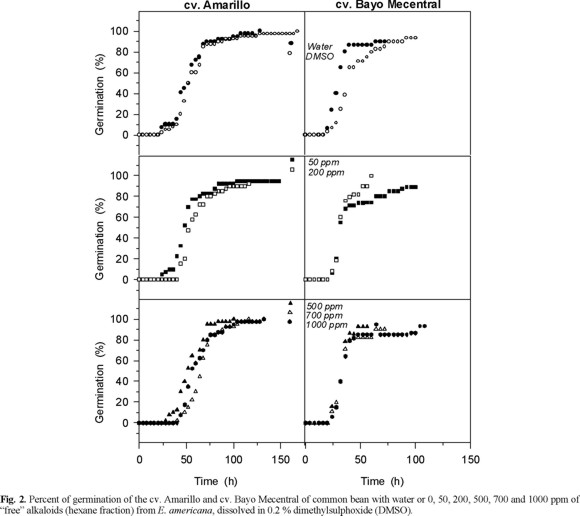
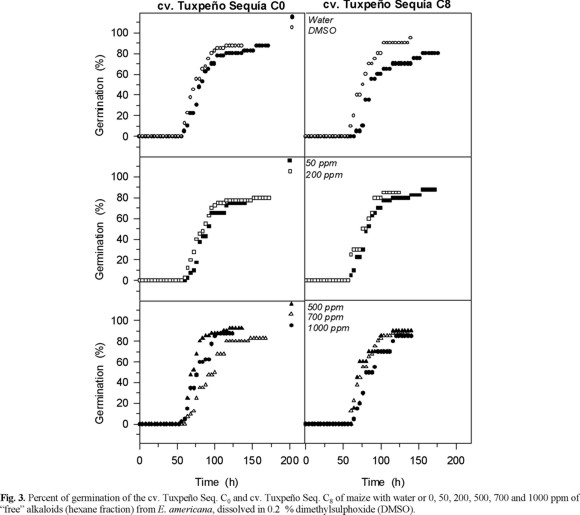
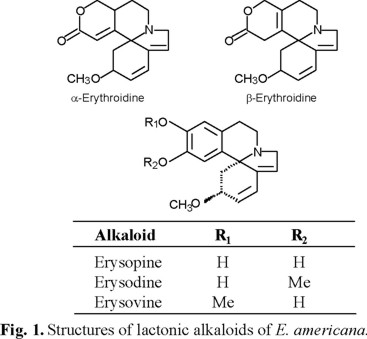
<body><![CDATA[<p align="justify"><font face="verdana" size="2"><b>Introduction</b></font></p>     <p align="justify"><font face="verdana" size="2">There is an increasing body of evidence to suggest that alkaloids affect negatively the growth of microorganisms, plants and both vertebrate or invertebrate animals &#91;1&#93;. The multiplicity and variety of susceptible target suggests mechanisms of action for the alkaloids that are either common to all types of organism &#91;2&#93;, or perhaps depend on paralleled modes of action. Wink and Latz&#45;Brunning &#91;3&#93;, referred to many basic plant processes that might be targeted by allelochemicals, <i>e.g</i>. membrane stability, protein synthesis, photosynthetic electron transport and light induced proton uptake. These authors developed bioassays to elucidate the mode of action of some alkaloids that inhibited radicle growth in cress. Many of these alkaloids where found to be inhibitors in more than one assay, but some were active in none. It has been shown that the Fabaceae family has allelophatic activity against plants, and this plant family is recognized by its alkaloid production. Some of this alkaloids are weak inhibitors of germination <i>e.g.</i> quinolizidine alkaloids, found in lupinus (<i>Lupinus</i> spp.) &#91;4&#93;. Others alkaloids inhibit the germination of lettuce (<i>Lattuca sativa</i> L.) and lawngrass mixture &#91;1&#93; and affect the germination of various other species &#91;5&#93;.</font></p>     <p align="justify"><font face="verdana" size="2">The <i>Erythrina</i> genus contains some toxic alkaloids which are found mainly in the seeds &#91;6&#93;. Hastings &#91;7&#93; observed low and moderate inhibition of corn and bean germination, respectively, in a bioassay of <i>E. americana</i> bark; beside, some details about the LD<sub>50</sub> <i>Erythrina</i> genus alkaloids on experimental animals are known &#91;8, 9&#93;. However, it can be say that information about allelophatic effect of <i>Erythrina</i> genus in plants is scarce. The knowledge of its eventual phytotoxicity could be used in natural herbicide studies. The focus of the present work was to explore the effect of the crude alkaloid fraction on germination of common bean (<i>Phaseolus vulgaris</i> L.) and maize (<i>Zea mays</i> L.), and also on ATP synthesis and light induced proton uptake in isolated chloroplasts from pea (<i>Pisum sativum</i> L.) leaves.</font></p>     <p align="justify"><font face="Verdana" size="2">&nbsp;</font></p>     <p align="justify"><font face="verdana" size="2"><b>Results and discussion</b></font></p>     <p align="justify"><font face="verdana" size="2"><b>Identification of the alkaloids</b>. &#945;&#45;Erythoidine and &#946;&#45;erythoidine were the most abundant alkaloids in the "free" fraction (0.55 mg per 100 g of dry weight), whereas in the "liberated" alkaloids fraction (0.47 mg per 100 g of dry weight) were identified erysodine, erysovine and erysopine (<a href="#f1">Fig. 1</a>). The relative alkaloid proportions were calculated from the GC peak areas and the time retention of the alkaloids: 82.6 mm<sup>2</sup> and 30.25 min to &#945;&#45;erythoidine and 17.4 mm<sup>2</sup> and 23.70 min to &#946;&#45;erythoidine in the free alkaloid fraction; 39.6 mm<sup>2</sup> and 17.85 min to erysodine, 56.5 mm<sup>2</sup> and 18.50 min to erysovine and 3.6 mm<sup>2</sup> and 17.75 min to erysopine in the liberated alkaloids fraction, respectively. This results confirm the composition of the fractions of <i>E. americana</i> seed previously reported &#91;8, 10&#93;.</font></p>     <p align="center"><font face="verdana" size="2"><a name="f1"></a></font></p>     <p align="center"><font face="verdana" size="2"><img src="/img/revistas/rsqm/v46n1/a2f1.jpg"></font></p>     <p align="justify"><font face="verdana" size="2"><b>Effect of the alkaloids on bean and maize seeds germination</b>. Neither fraction, "free" or "liberated" alkaloids, affected the percentage of germination of bean and maize (<a href="#f2">Fig. 2</a> and <a href="#f3">3</a>). The percentage of germination ranged between 90 and 100 % and there were not any significant difference between the controls and the alkaloid treatments. These results differ from those reported by Hastings &#91;7&#93;, who stressed that in a bioassay <i>E. americana</i> bark induced low and moderate inhibition on corn and bean germination, respectively. This author did not provide information about the type of extract used; however, the small differences between the effects on seed germination of seeds and bark extracts of <i>E. americana</i> could result of the different composition, since bark contain furanoid derivative, flavonoids, one polyphenol, tannins, and terpenoids &#91;17&#93;.</font></p>     <p align="center"><font face="verdana" size="2"><a name="f2"></a></font></p>     ]]></body>
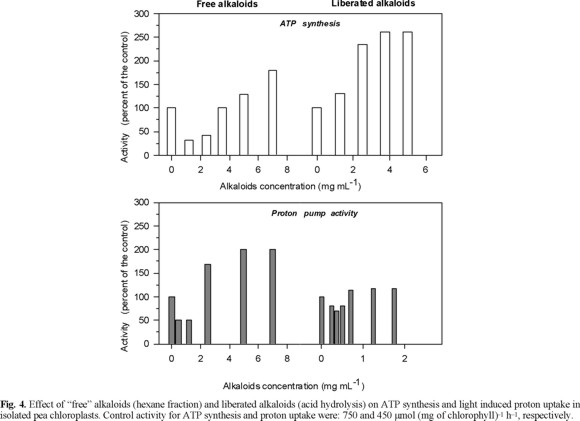
<body><![CDATA[<p align="center"><font face="verdana" size="2"><img src="/img/revistas/rsqm/v46n1/a2f2.jpg"></font></p>     <p align="center"><font face="verdana" size="2"><a name="f3"></a></font></p>     <p align="center"><font face="verdana" size="2"><img src="/img/revistas/rsqm/v46n1/a2f3.jpg"></font></p>     <p align="justify"><font face="verdana" size="2"><b>Effects of the "free" alkaloids on ATP synthesis and on light induced proton uptake in isolated pea chlorolplasts</b>. Low concentration of free alkaloids (&lt; 2 mg / mL) inhibited the ATP synthesis (photophosphorylation) and the light induced proton uptake, but higher concentration (3.5&#45;7 mg / L) had the opposite effect, <i>e.g.</i> they stimulated the ATP synthesis and proton uptake (<a href="#f4">Fig. 4</a>). The ATP synthesis could be inhibited indirectly by a proton gradient depression or directly by inhibition of the ATP synthase (CF<sub>0</sub>&#45;CF<sub>1</sub> complex) &#91;13, 18&#93;. The inhibition of the photophosphorylation by low concentrations (&le;2.5 mg mL<sup>&#45;1</sup>) of the free alkaloids fraction could be a result of the depression of the proton electrochemical gradient, because also inhibited the proton uptake (<a href="#f4">Fig. 4</a>). These results showed that low concentrations (2.5 mg mL<sup>&#45;1</sup>) of free alkaloids fraction of <i>E. americana</i> affect negatively the photochemical activities of the chloroplasts. However, the stimulation of photophosphorylation and proton pump with concentrations higher than 3 mg mL<sup>&#45;1</sup> suggests that only one of the lactonic alkaloids could be inhibitor of the photochemical activities in isolated chloroplast and the other could alleviated this effect. Another possibility could be the synergetic effect of the mixture dimethylsulfoxide (solvent) and alkaloids, which is hardly detected with the control treatments. To this respect, it has been observed that solvents used for dissolving chemical effectors inhibit energy transducting reactions &#91;13, 19&#93;.</font></p>     <p align="center"><font face="verdana" size="2"><a name="f4"></a></font></p>     <p align="center"><font face="verdana" size="2"><img src="/img/revistas/rsqm/v46n1/a2f4.jpg"></font></p>     <p align="justify"><font face="verdana" size="2"><b>Effect of the "liberated" alkaloids fraction on the ATP synthesis and light induced proton uptake in isolate pea chloroplasts</b>. The "liberated" alkaloid fraction (1&#45;5 mg mL<sup>&#45;1</sup>) activated ATP synthesis (150 %), but none of the tested concentrations affected the proton uptake (<a href="#f4">Fig. 4</a>). The increase of photophosphorylation induced for the "liberated" alkaloid fraction could be a result of the direct interaction of the alkaloids with the CF<sub>0</sub>&#45;CF<sub>1</sub>, which result in an ATP synthase activation without effect on the proton uptake &#91;13&#93;. Although with the available information it is not possible to explain how this activation could occur. These alkaloids could induce some structural conformation of the CF<sub>0</sub>&#45;CF<sub>1</sub> complex, by modifying the polarity of the complex microenvironment, which produce an activation.</font></p>     <p align="justify"><font face="verdana" size="2">All these results showed a low phytotoxicity of the crude alkaloids of <i>E. americana</i> in the physiological processes evaluated: germination, photophosphorylation and light induced proton uptake on the tested plant material, and they contrast with those obtained in other studies with experimental animals in which a high toxicity of the &#945; and &#946;&#45;erythroidines is described &#91;16, 20, 21, 22&#93;. However there are some similarities between the results of the present study and those obtained by Garcia&#45;Mateos <i>et al.</i> &#91;8&#93;, who described the LC<sub>50</sub> of the free and liberated alkaloids on <i>Daphnia magna</i> (393 and 79 ppm, respectively) and also the toxicity of the liberated alkaloids to <i>Panagrellus redivivus</i>.</font></p>     <p align="justify"><font face="Verdana" size="2">&nbsp;</font></p>     <p align="justify"><font face="verdana" size="2"><b>Conclusions</b></font></p>     ]]></body>
<body><![CDATA[<p align="justify"><font face="verdana" size="2">This work showed that "free" (methanol soluble) and "liberated" (acid hydrolysis liberated) alkaloid fractions extract from <i>E. americana</i> seeds do not affect significantly the photochemical activities in isolated chloroplasts. Beside, these fractions do not affect the germination of common bean and maize seeds. Although more experimental evidence could be necessary, including the effects of this extracts on other plant species, like weeds, and in other biochemical processes, like lipids, carbohydrates and nitrogen metabolism, it was demostrated the low phytotoxicity of the crude alkaloids of <i>E. americana</i>.</font></p>     <p align="justify"><font face="Verdana" size="2">&nbsp;</font></p>     <p align="justify"><font face="verdana" size="2"><b>Experimental</b></font></p>     <p align="justify"><font face="verdana" size="2"><b>Plant materials</b>. The seeds of <i>E. americana</i> were collected in Oaxtepec, Morelos (40 km southwest Mexico City). Voucher specimen of the plant were deposited at the CHAPA Herbarium (Especialidad de Bot&aacute;nica, Colegio de Postgraduados) under the number 112. The authenticity of the sample was certified by the curator of the Herbarium of the Especialidad de Botanica, Colegio de Postgraduados. The dried seeds were milled manually and the alkaloids were extracted exhaustively. The Bayo Mecentral and Amarillo cultivars of common bean were developed in the National Institute for Research in Agriculture, Forestry and Animal Husbandry, Mexico, and reproduce in an experimental plot at Colegio de Postgraduados, Montecillo, Mexico, located at 19&deg; 29' North latitude and 98&deg; 53' West longitude, and 2250 m above sea level, with an average annual temperature of 15.9 &deg;C and a mean rainfall of 691 mm &#91;9&#93;. The Tuxpe&ntilde;o Drought C<sub>0</sub> and Tuxpe&ntilde;o Drought C<sub>8</sub> cultivars of maize were obtained from the International Maize and Wheat Improvement Center (CIMMYT), Mexico.</font></p>     <p align="justify"><font face="verdana" size="2"><b>Preparation of the alkaloid fractions</b>. Alkaloids were extracted from the seed flour by the same method previously used &#91;10&#93;. Intact seeds were airdried at 70 &ordm;C and milled, the flour was extracted for 48 hours with hexane by Soxhlet extraction. Alkaloids in the hexane fraction were washed with 1M sulphuric acid (3 &times; 50 mL), and the aqueous acidic phase was adjusted to pH 8 using solid NaHCO<sub>3</sub>. Finally, an extraction with CH<sub>2</sub>Cl<sub>2</sub> (3 &times; 100 mL) gave the hexane "free" alkaloid fraction (0.22 %). The defatted flour of each fraction was next extracted in a Soxhlet for 48 hours with MeOH, the extract was evaporated under vacuum, and the residue taken up in 0.2 % sulphuric acid. The acidic solution was extracted with CH<sub>2</sub>Cl<sub>2</sub> to remove traces of fat. The aqueous phase pH was raised to 8 with NaHCO<sub>3</sub> and was extracted with CH<sub>2</sub>Cl<sub>2</sub> (3 &times; 100 mL) to give a methanolic fraction containing the "free" alkaloids; the acidic hydrolysis of the methanolic residue gave the "liberated" alkaloids (obtained by hydrolysis of alkaloids occurring as glycosides). The solvent of each sample was evaporated and the residue was dried in a desiccator and weighed.</font></p>     <p align="justify"><font face="verdana" size="2"><b>Identification of the alkaloids</b>. The alkaloids were identified previously on base of their Rf values, UV fluorescence, color reaction after treatment with cromogenic reagents (<i>e.g.</i> Dragendorff reagent), co&#45;chromotography with authentic samples of <i>Erythrina</i> alkaloids and subsequently with combined gas chromatography&#45;mass spectrometry (GC/MS). The alkaloid&#45;trimethylsilylderivatives (free alkaloids and liberated alkaloid fractions, separately) were obtained and identify by GC/MS as was previously described &#91;20&#93;. One or two mg of crude alkaloid mixture were treated with <i>N</i>,<i>O</i>&#45;bis (trimethylsilyl)acetamide (25 &micro;L) in acetonitrile (25 &micro;L), using a Teflon lined screw&#45;cap vials to prevent evaporation, during 30 min &#91;20&#93;. Mass spectra were determined on a JMS&#45;AX 505 HA (JEOL) mass spectrometer coupled with a GC Hewlett Packard 5890, Series II, equipped with a flame ionization detector and a PAS 1701 silicone capillary column, (25 m &times; 0.32 mm &times; 0.25 um), Hewlett Packard (Palo Alto, California), via a two&#45;stage Watson&#45;Biemann separator. The temperature of the ion source was 220 &deg;C and the acceleration and ionization potentials were 3 kV and 70 eV, respectively. Alkaloids were identified by comparison with &#945;&#45; and &#946;&#45;erythroidines, erysovine, erysodine and erysopine trimethylsilylderivatives, which were obtained using the same method previously described &#91;20&#93;.</font></p>     <p align="justify"><font face="verdana" size="2"><b>Evaluation of maize and bean seeds germination</b>. The effect of the "free" alkaloid fraction was evaluated on common bean (cv. Bayo Mecentral and cv. Amarillo) and maize (cv. Tuxpe&ntilde;o Drought C<sub>0</sub> and cv. Tuxpe&ntilde;o Drought C<sub>8</sub>) seeds germination as was previously described &#91;21&#93;. The germination was evaluated using 25 seeds on a Petri dish, at 25 &plusmn; 1 &deg;C in the dark, and four replications were included. The alkaloids were dissolved on 0.2 % DMSO. A stock solutions of alkaloids (5 g L<sup>&#45;1</sup>) was used to obtain 30, 200, 500, 700 and 1000 mg L<sup>&#45;1</sup> solutions and 25 mL of each solution was added to each Petri dish. Also, the treatments with water or DMSO (without alkaloids) were included. Seed germination was quantified each 12 h during ten days.</font></p>     <p align="justify"><font face="verdana" size="2"><b>Evaluation of photophosforilation (ATP synthesis) and light&#45;dependent proton uptake (proton pump activity) in isolated pea chloroplasts</b>. Chloroplasts were isolated from fresh leaves of pea growing in a greenhouse, as was previously described &#91;12&#93;. Light&#45;dependent ATP formation and light&#45;dependent proton uptake were quantified in a suspension of freshly lysed chloroplasts as the pH of the medium rose 8.0 and 6.0, respectively, as was previously described &#91;12, 22&#93;. These photochemical activities were evaluated in 3 mL of an assay medium containing chloroplasts (10 mg of chlorophyll mL<sup>&#45;1</sup>), 0.1 mM sorbitol, 0.01 M KCl, 0.05 mM methylviologen and 1 mM tricine, plus 1 mM and 3 mM KH<sub>2</sub>PO<sub>4</sub> in the case of ATP synthesis. The suspension was stirred and maintained at 22 &deg;C, and after one minute of illumination (400 &micro;mol photons m<sup>&#45;2</sup> s<sup>&#45;1</sup>) the light source was switched off, and the total pH change of the suspension was quantified by titration with a calibrate solution of 0.1 N HCl. The pH was measured with a microelectrode connected to an expanded scale potentiometer &#91;12&#93;; and light&#45;dependent pH changes were recorded by a 2210 LKB recorder.</font></p>     <p align="justify"><font face="verdana" size="2"><b>Statistical analysis</b>. The statistical procedures included analysis of variance (ANOVA) and multiple comparison of means by Tukey test. Data analysis were performed with the Statistical Analysis System (SAS) software &#91;23&#93;.</font></p>     <p align="justify"><font face="Verdana" size="2">&nbsp;</font></p>     ]]></body>
<body><![CDATA[<p align="justify"><font face="verdana" size="2"><b>Acknowledgement</b></font></p>     <p align="justify"><font face="verdana" size="2">The authors gratefully acknowledge the provision of the maize seeds (cv. Tuxpe&ntilde;o Drought C<sub>0</sub> and Tuxpe&ntilde;o Drought C<sub>8</sub>) by the International Maize and Wheat Improvement Center (CIMMYT), Mexico.</font></p>     <p align="justify"><font face="Verdana" size="2">&nbsp;</font></p>     <p align="justify"><font face="verdana" size="2"><b>References</b></font></p>     <!-- ref --><p align="justify"><font face="verdana" size="2">1. Stermitz, F.R.; Bebfsky, G.N.; Ng, D.; Singer, M.C. <i>J. Chem. Ecol.</i> <b>1989</b>, <i>15</i>, 521&#45;530.    &nbsp;&nbsp;&nbsp;&nbsp;&nbsp;&nbsp;&nbsp;&nbsp;[&#160;<a href="javascript:void(0);" onclick="javascript: window.open('/scielo.php?script=sci_nlinks&ref=6924008&pid=S0583-7693200200010000200001&lng=','','width=640,height=500,resizable=yes,scrollbars=1,menubar=yes,');">Links</a>&#160;]<!-- end-ref --></font></p>     <!-- ref --><p align="justify"><font face="verdana" size="2">2. Wink, M., in: <i>The Alkaloids</i>, Vol. 43, Cordell, G., Ed., Academic Press, San Diego, <b>1993</b>, 1&#45;118.    &nbsp;&nbsp;&nbsp;&nbsp;&nbsp;&nbsp;&nbsp;&nbsp;[&#160;<a href="javascript:void(0);" onclick="javascript: window.open('/scielo.php?script=sci_nlinks&ref=6924010&pid=S0583-7693200200010000200002&lng=','','width=640,height=500,resizable=yes,scrollbars=1,menubar=yes,');">Links</a>&#160;]<!-- end-ref --></font></p>     <!-- ref --><p align="justify"><font face="verdana" size="2">3. Robinson, T. <i>Science</i> <b>1974</b>, 184, 430&#45;435.    &nbsp;&nbsp;&nbsp;&nbsp;&nbsp;&nbsp;&nbsp;&nbsp;[&#160;<a href="javascript:void(0);" onclick="javascript: window.open('/scielo.php?script=sci_nlinks&ref=6924012&pid=S0583-7693200200010000200003&lng=','','width=640,height=500,resizable=yes,scrollbars=1,menubar=yes,');">Links</a>&#160;]<!-- end-ref --></font></p>     ]]></body>
<body><![CDATA[<!-- ref --><p align="justify"><font face="verdana" size="2">4. Wink, M.; Latz, B., in: <i>Insights into Allelopathy</i>. <i>Dakshini</i>, M., K. M.; Einhelling, F. A., Eds., American Chemical Society, Symposium Series No. 582, American Chemical Society, Washington, D.C., <b>1995</b>, 117&#45;126.    &nbsp;&nbsp;&nbsp;&nbsp;&nbsp;&nbsp;&nbsp;&nbsp;[&#160;<a href="javascript:void(0);" onclick="javascript: window.open('/scielo.php?script=sci_nlinks&ref=6924014&pid=S0583-7693200200010000200004&lng=','','width=640,height=500,resizable=yes,scrollbars=1,menubar=yes,');">Links</a>&#160;]<!-- end-ref --></font></p>     <p align="justify"><font face="verdana" size="2">5. Muzquiz de la Cuadra, M. <b>1998</b>. Personal communication.</font></p>     <!-- ref --><p align="justify"><font face="verdana" size="2">6. Hargreaves, R. T.; Johnson, R. D.; Millington, D.S.; Mondal, M. H.; Breavers, W.; Becker, L.; Young, C.; Rinehart, K. L. <i>Lloydia</i> <b>1974</b>, <i>37</i>, 569&#45;580.    &nbsp;&nbsp;&nbsp;&nbsp;&nbsp;&nbsp;&nbsp;&nbsp;[&#160;<a href="javascript:void(0);" onclick="javascript: window.open('/scielo.php?script=sci_nlinks&ref=6924017&pid=S0583-7693200200010000200005&lng=','','width=640,height=500,resizable=yes,scrollbars=1,menubar=yes,');">Links</a>&#160;]<!-- end-ref --></font></p>     <!-- ref --><p align="justify"><font face="verdana" size="2">7. Hastings, R. B. <i>Econ. Bot.</i> <b>1990</b>, <i>44</i>, 336&#45;348.    &nbsp;&nbsp;&nbsp;&nbsp;&nbsp;&nbsp;&nbsp;&nbsp;[&#160;<a href="javascript:void(0);" onclick="javascript: window.open('/scielo.php?script=sci_nlinks&ref=6924019&pid=S0583-7693200200010000200006&lng=','','width=640,height=500,resizable=yes,scrollbars=1,menubar=yes,');">Links</a>&#160;]<!-- end-ref --></font></p>     <!-- ref --><p align="justify"><font face="verdana" size="2">8. Garc&iacute;a&#45;Mateos, R. <i>Estudio qu&iacute;mico&#45;biol&oacute;gico de los alcaloides de Erythrina</i>. Tesis Doctoral, Programa de Fisiolog&iacute;a Vegetal, Colegio de Postgraduados. Montecillo, M&eacute;x. M&eacute;xico, <b>1996</b>.    &nbsp;&nbsp;&nbsp;&nbsp;&nbsp;&nbsp;&nbsp;&nbsp;[&#160;<a href="javascript:void(0);" onclick="javascript: window.open('/scielo.php?script=sci_nlinks&ref=6924021&pid=S0583-7693200200010000200007&lng=','','width=640,height=500,resizable=yes,scrollbars=1,menubar=yes,');">Links</a>&#160;]<!-- end-ref --></font></p>     <!-- ref --><p align="justify"><font face="verdana" size="2">9. Garc&iacute;a&#45;Mateos, R. M.; Soto&#45;Hern&aacute;ndez, M.; Mart&iacute;nez&#45;V&aacute;zquez, M. <i>Ciencia Ergo Sum</i> <b>2000</b>, <i>7</i>, 166&#45;170.    &nbsp;&nbsp;&nbsp;&nbsp;&nbsp;&nbsp;&nbsp;&nbsp;[&#160;<a href="javascript:void(0);" onclick="javascript: window.open('/scielo.php?script=sci_nlinks&ref=6924023&pid=S0583-7693200200010000200008&lng=','','width=640,height=500,resizable=yes,scrollbars=1,menubar=yes,');">Links</a>&#160;]<!-- end-ref --></font></p>     <!-- ref --><p align="justify"><font face="verdana" size="2">10. Abdullah, M. I.; Barakat, I. E.; Games, D. E.; Ludgate, P.; Mavragaiis, V. G.; Ratnayake, V. U.; Jackson, A. H. <i>Ann. Missouri Bot. Gard.</i> <b>1979</b>, <i>66</i>, 533&#45;540.    &nbsp;&nbsp;&nbsp;&nbsp;&nbsp;&nbsp;&nbsp;&nbsp;[&#160;<a href="javascript:void(0);" onclick="javascript: window.open('/scielo.php?script=sci_nlinks&ref=6924025&pid=S0583-7693200200010000200009&lng=','','width=640,height=500,resizable=yes,scrollbars=1,menubar=yes,');">Links</a>&#160;]<!-- end-ref --></font></p>     <!-- ref --><p align="justify"><font face="verdana" size="2">11. Dom&iacute;nguez, X. A.; Alarc&oacute;n, J. B. <i>J. Ethnopharmacol.</i> <b>1985</b>, <i>13</i>, 139&#45;156.    &nbsp;&nbsp;&nbsp;&nbsp;&nbsp;&nbsp;&nbsp;&nbsp;[&#160;<a href="javascript:void(0);" onclick="javascript: window.open('/scielo.php?script=sci_nlinks&ref=6924027&pid=S0583-7693200200010000200010&lng=','','width=640,height=500,resizable=yes,scrollbars=1,menubar=yes,');">Links</a>&#160;]<!-- end-ref --></font></p>     <!-- ref --><p align="justify"><font face="verdana" size="2">12. Pe&ntilde;a&#45;Valdivia, C. B.; Rodr&iacute;guez&#45;Flores, L.; Tuena de G&oacute;mez&#45;Puyou, M.; Lotina&#45;Hennsen, B. <i>Biophys. Chemist.</i> <b>1991</b>, <i>41</i>, 169&#45;174.    &nbsp;&nbsp;&nbsp;&nbsp;&nbsp;&nbsp;&nbsp;&nbsp;[&#160;<a href="javascript:void(0);" onclick="javascript: window.open('/scielo.php?script=sci_nlinks&ref=6924029&pid=S0583-7693200200010000200011&lng=','','width=640,height=500,resizable=yes,scrollbars=1,menubar=yes,');">Links</a>&#160;]<!-- end-ref --></font></p>     <!-- ref --><p align="justify"><font face="verdana" size="2">13. Pe&ntilde;a&#45;Valdivia, C. B.; Lotina H., B., <i>Bolet&iacute;n de Educaci&oacute;n Bioqu&iacute;mica</i> <b>1991</b>, <i>8</i>, 52&#45;61.    &nbsp;&nbsp;&nbsp;&nbsp;&nbsp;&nbsp;&nbsp;&nbsp;[&#160;<a href="javascript:void(0);" onclick="javascript: window.open('/scielo.php?script=sci_nlinks&ref=6924031&pid=S0583-7693200200010000200012&lng=','','width=640,height=500,resizable=yes,scrollbars=1,menubar=yes,');">Links</a>&#160;]<!-- end-ref --></font></p>     <!-- ref --><p align="justify"><font face="verdana" size="2">14. Tuena de G&oacute;mez&#45;Poyou, M.; Ayala, G.; Darzon, A.; G&oacute;mez&#45;Poyou, A. <i>J. Biol. Chem.</i> <b>1984</b>, <i>259</i>, 9472&#45;9478.    &nbsp;&nbsp;&nbsp;&nbsp;&nbsp;&nbsp;&nbsp;&nbsp;[&#160;<a href="javascript:void(0);" onclick="javascript: window.open('/scielo.php?script=sci_nlinks&ref=6924033&pid=S0583-7693200200010000200013&lng=','','width=640,height=500,resizable=yes,scrollbars=1,menubar=yes,');">Links</a>&#160;]<!-- end-ref --></font></p>     <!-- ref --><p align="justify"><font face="verdana" size="2">15. Craig, L. E., in: <i>The Alkaloids</i>, Vol. V, Manske, R. H. F.; Holmes H. L., Eds., Academic Press, London, <b>1955</b>, 265&#45;293.    &nbsp;&nbsp;&nbsp;&nbsp;&nbsp;&nbsp;&nbsp;&nbsp;[&#160;<a href="javascript:void(0);" onclick="javascript: window.open('/scielo.php?script=sci_nlinks&ref=6924035&pid=S0583-7693200200010000200014&lng=','','width=640,height=500,resizable=yes,scrollbars=1,menubar=yes,');">Links</a>&#160;]<!-- end-ref --></font></p>     <!-- ref --><p align="justify"><font face="verdana" size="2">16. Lozoya, X.; Lozoya, M. <i>Flora medicinal de M&eacute;xico. 1. Plantas ind&iacute;genas.</i> Instituto Mexicano del Seguro Social. M&eacute;xico, D. F. <b>1982</b>, 174&#45;192.    &nbsp;&nbsp;&nbsp;&nbsp;&nbsp;&nbsp;&nbsp;&nbsp;[&#160;<a href="javascript:void(0);" onclick="javascript: window.open('/scielo.php?script=sci_nlinks&ref=6924037&pid=S0583-7693200200010000200015&lng=','','width=640,height=500,resizable=yes,scrollbars=1,menubar=yes,');">Links</a>&#160;]<!-- end-ref --></font></p>     <!-- ref --><p align="justify"><font face="verdana" size="2">17. Payne, L. G.; Foley, J. P., in: <i>Chromatography and Pharmaceutical Analysis</i>, Ahuja, S., Ed., American Chemical Society Symposium Series No. 512, American Chemical Society, Washington, D.C., <b>1992</b>, 85&#45;99.    &nbsp;&nbsp;&nbsp;&nbsp;&nbsp;&nbsp;&nbsp;&nbsp;[&#160;<a href="javascript:void(0);" onclick="javascript: window.open('/scielo.php?script=sci_nlinks&ref=6924039&pid=S0583-7693200200010000200016&lng=','','width=640,height=500,resizable=yes,scrollbars=1,menubar=yes,');">Links</a>&#160;]<!-- end-ref --></font></p>     <!-- ref --><p align="justify"><font face="verdana" size="2">18. Garc&iacute;a, E. <i>Modificaciones al Sistema de Clasificaci&oacute;n de K&ouml;ppen</i>. Instituto de Geograf&iacute;a, UNAM, M&eacute;xico, D.F., <b>1988</b>.    &nbsp;&nbsp;&nbsp;&nbsp;&nbsp;&nbsp;&nbsp;&nbsp;[&#160;<a href="javascript:void(0);" onclick="javascript: window.open('/scielo.php?script=sci_nlinks&ref=6924041&pid=S0583-7693200200010000200017&lng=','','width=640,height=500,resizable=yes,scrollbars=1,menubar=yes,');">Links</a>&#160;]<!-- end-ref --></font></p>     <!-- ref --><p align="justify"><font face="verdana" size="2">19. Games, D. E.; Jackson, A. H.; Khan, N. A.; Millington, D. S. <i>Lloydia</i> <b>1974</b>, <i>37</i>, 581&#45;588.    &nbsp;&nbsp;&nbsp;&nbsp;&nbsp;&nbsp;&nbsp;&nbsp;[&#160;<a href="javascript:void(0);" onclick="javascript: window.open('/scielo.php?script=sci_nlinks&ref=6924043&pid=S0583-7693200200010000200018&lng=','','width=640,height=500,resizable=yes,scrollbars=1,menubar=yes,');">Links</a>&#160;]<!-- end-ref --></font></p>     <!-- ref --><p align="justify"><font face="verdana" size="2">20. Soto H. M.; Jackson, A. H. <i>Planta Medica</i>, <b>1994</b>, <i>60</i>, 175&#45;177.    &nbsp;&nbsp;&nbsp;&nbsp;&nbsp;&nbsp;&nbsp;&nbsp;[&#160;<a href="javascript:void(0);" onclick="javascript: window.open('/scielo.php?script=sci_nlinks&ref=6924045&pid=S0583-7693200200010000200019&lng=','','width=640,height=500,resizable=yes,scrollbars=1,menubar=yes,');">Links</a>&#160;]<!-- end-ref --></font></p>     <!-- ref --><p align="justify"><font face="verdana" size="2">21. Ellis, R. H. <i>Handbook of Seed Technology. Principles and Methodology.</i> Vol. I, International Board for Plant Genetics Resources, Rome, <b>1985</b>.    &nbsp;&nbsp;&nbsp;&nbsp;&nbsp;&nbsp;&nbsp;&nbsp;[&#160;<a href="javascript:void(0);" onclick="javascript: window.open('/scielo.php?script=sci_nlinks&ref=6924047&pid=S0583-7693200200010000200020&lng=','','width=640,height=500,resizable=yes,scrollbars=1,menubar=yes,');">Links</a>&#160;]<!-- end-ref --></font></p>     <!-- ref --><p align="justify"><font face="verdana" size="2">22. Dilley, R. A., in: <i>Methods in Enzimology</i>, Vol. 24, San Piero A., Ed., Academic Press, New York, <b>1972</b>, 68&#45;74.    &nbsp;&nbsp;&nbsp;&nbsp;&nbsp;&nbsp;&nbsp;&nbsp;[&#160;<a href="javascript:void(0);" onclick="javascript: window.open('/scielo.php?script=sci_nlinks&ref=6924049&pid=S0583-7693200200010000200021&lng=','','width=640,height=500,resizable=yes,scrollbars=1,menubar=yes,');">Links</a>&#160;]<!-- end-ref --></font></p>     <!-- ref --><p align="justify"><font face="verdana" size="2">23. SAS Institute. <i>SAS/STAT User&acute;s Guide.</i> SAS Institute, North Carolina, <b>1986</b>.    &nbsp;&nbsp;&nbsp;&nbsp;&nbsp;&nbsp;&nbsp;&nbsp;[&#160;<a href="javascript:void(0);" onclick="javascript: window.open('/scielo.php?script=sci_nlinks&ref=6924051&pid=S0583-7693200200010000200022&lng=','','width=640,height=500,resizable=yes,scrollbars=1,menubar=yes,');">Links</a>&#160;]<!-- end-ref --></font></p>      ]]></body><back>
<ref-list>
<ref id="B1">
<label>1</label><nlm-citation citation-type="journal">
<person-group person-group-type="author">
<name>
<surname><![CDATA[Stermitz]]></surname>
<given-names><![CDATA[F.R.]]></given-names>
</name>
<name>
<surname><![CDATA[Bebfsky]]></surname>
<given-names><![CDATA[G.N.]]></given-names>
</name>
<name>
<surname><![CDATA[Ng]]></surname>
<given-names><![CDATA[D.]]></given-names>
</name>
<name>
<surname><![CDATA[Singer]]></surname>
<given-names><![CDATA[M.C.]]></given-names>
</name>
</person-group>
<source><![CDATA[J. Chem. Ecol.]]></source>
<year>1989</year>
<volume>15</volume>
<page-range>521-530</page-range></nlm-citation>
</ref>
<ref id="B2">
<label>2</label><nlm-citation citation-type="book">
<person-group person-group-type="author">
<name>
<surname><![CDATA[Wink]]></surname>
<given-names><![CDATA[M.]]></given-names>
</name>
</person-group>
<person-group person-group-type="editor">
<name>
<surname><![CDATA[Cordell]]></surname>
<given-names><![CDATA[G.]]></given-names>
</name>
</person-group>
<source><![CDATA[The Alkaloids]]></source>
<year>1993</year>
<volume>43</volume>
<page-range>1-118</page-range><publisher-loc><![CDATA[San Diego ]]></publisher-loc>
<publisher-name><![CDATA[Academic Press]]></publisher-name>
</nlm-citation>
</ref>
<ref id="B3">
<label>3</label><nlm-citation citation-type="journal">
<person-group person-group-type="author">
<name>
<surname><![CDATA[Robinson]]></surname>
<given-names><![CDATA[T.]]></given-names>
</name>
</person-group>
<source><![CDATA[Science]]></source>
<year>1974</year>
<volume>184</volume>
<page-range>430-435</page-range></nlm-citation>
</ref>
<ref id="B4">
<label>4</label><nlm-citation citation-type="book">
<person-group person-group-type="author">
<name>
<surname><![CDATA[Wink]]></surname>
<given-names><![CDATA[M.]]></given-names>
</name>
<name>
<surname><![CDATA[Latz]]></surname>
<given-names><![CDATA[B.]]></given-names>
</name>
</person-group>
<person-group person-group-type="editor">
<name>
<surname><![CDATA[Dakshini]]></surname>
<given-names><![CDATA[M., K. M.]]></given-names>
</name>
<name>
<surname><![CDATA[Einhelling]]></surname>
<given-names><![CDATA[F. A.]]></given-names>
</name>
</person-group>
<source><![CDATA[Insights into Allelopathy]]></source>
<year>1995</year>
<page-range>117-126</page-range><publisher-loc><![CDATA[Washington^eD.C. D.C.]]></publisher-loc>
<publisher-name><![CDATA[American Chemical SocietyAmerican Chemical Society]]></publisher-name>
</nlm-citation>
</ref>
<ref id="B5">
<label>6</label><nlm-citation citation-type="journal">
<person-group person-group-type="author">
<name>
<surname><![CDATA[Hargreaves]]></surname>
<given-names><![CDATA[R. T.]]></given-names>
</name>
<name>
<surname><![CDATA[Johnson]]></surname>
<given-names><![CDATA[R. D.]]></given-names>
</name>
<name>
<surname><![CDATA[Millington]]></surname>
<given-names><![CDATA[D.S.]]></given-names>
</name>
<name>
<surname><![CDATA[Mondal]]></surname>
<given-names><![CDATA[M. H.]]></given-names>
</name>
<name>
<surname><![CDATA[Breavers]]></surname>
<given-names><![CDATA[W.]]></given-names>
</name>
<name>
<surname><![CDATA[Becker]]></surname>
<given-names><![CDATA[L.]]></given-names>
</name>
<name>
<surname><![CDATA[Young]]></surname>
<given-names><![CDATA[C.]]></given-names>
</name>
<name>
<surname><![CDATA[Rinehart]]></surname>
<given-names><![CDATA[K. L.]]></given-names>
</name>
</person-group>
<source><![CDATA[Lloydia]]></source>
<year>1974</year>
<volume>37</volume>
<page-range>569-580</page-range></nlm-citation>
</ref>
<ref id="B6">
<label>7</label><nlm-citation citation-type="journal">
<person-group person-group-type="author">
<name>
<surname><![CDATA[Hastings]]></surname>
<given-names><![CDATA[R. B.]]></given-names>
</name>
</person-group>
<source><![CDATA[Econ. Bot.]]></source>
<year>1990</year>
<volume>44</volume>
<page-range>336-348</page-range></nlm-citation>
</ref>
<ref id="B7">
<label>8</label><nlm-citation citation-type="">
<person-group person-group-type="author">
<name>
<surname><![CDATA[García-Mateos]]></surname>
<given-names><![CDATA[R.]]></given-names>
</name>
</person-group>
<source><![CDATA[Estudio químico-biológico de los alcaloides de Erythrina]]></source>
<year></year>
</nlm-citation>
</ref>
<ref id="B8">
<label>9</label><nlm-citation citation-type="journal">
<person-group person-group-type="author">
<name>
<surname><![CDATA[García-Mateos]]></surname>
<given-names><![CDATA[R. M.]]></given-names>
</name>
<name>
<surname><![CDATA[Soto-Hernández]]></surname>
<given-names><![CDATA[M.]]></given-names>
</name>
<name>
<surname><![CDATA[Martínez-Vázquez]]></surname>
<given-names><![CDATA[M.]]></given-names>
</name>
</person-group>
<source><![CDATA[Ciencia Ergo Sum]]></source>
<year>2000</year>
<volume>7</volume>
<page-range>166-170</page-range></nlm-citation>
</ref>
<ref id="B9">
<label>10</label><nlm-citation citation-type="journal">
<person-group person-group-type="author">
<name>
<surname><![CDATA[Abdullah]]></surname>
<given-names><![CDATA[M. I.]]></given-names>
</name>
<name>
<surname><![CDATA[Barakat]]></surname>
<given-names><![CDATA[I. E.]]></given-names>
</name>
<name>
<surname><![CDATA[Games]]></surname>
<given-names><![CDATA[D. E.]]></given-names>
</name>
<name>
<surname><![CDATA[Ludgate]]></surname>
<given-names><![CDATA[P.]]></given-names>
</name>
<name>
<surname><![CDATA[Mavragaiis]]></surname>
<given-names><![CDATA[V. G.]]></given-names>
</name>
<name>
<surname><![CDATA[Ratnayake]]></surname>
<given-names><![CDATA[V. U.]]></given-names>
</name>
<name>
<surname><![CDATA[Jackson]]></surname>
<given-names><![CDATA[A. H.]]></given-names>
</name>
</person-group>
<source><![CDATA[Ann. Missouri Bot. Gard.]]></source>
<year>1979</year>
<volume>66</volume>
<page-range>533-540</page-range></nlm-citation>
</ref>
<ref id="B10">
<label>11</label><nlm-citation citation-type="journal">
<person-group person-group-type="author">
<name>
<surname><![CDATA[Domínguez]]></surname>
<given-names><![CDATA[X. A.]]></given-names>
</name>
<name>
<surname><![CDATA[Alarcón]]></surname>
<given-names><![CDATA[J. B.]]></given-names>
</name>
</person-group>
<source><![CDATA[J. Ethnopharmacol.]]></source>
<year>1985</year>
<volume>13</volume>
<page-range>139-156</page-range></nlm-citation>
</ref>
<ref id="B11">
<label>12</label><nlm-citation citation-type="journal">
<person-group person-group-type="author">
<name>
<surname><![CDATA[Peña-Valdivia]]></surname>
<given-names><![CDATA[C. B.]]></given-names>
</name>
<name>
<surname><![CDATA[Rodríguez-Flores]]></surname>
<given-names><![CDATA[L.]]></given-names>
</name>
<name>
<surname><![CDATA[Tuena de Gómez-Puyou]]></surname>
<given-names><![CDATA[M.]]></given-names>
</name>
<name>
<surname><![CDATA[Lotina-Hennsen]]></surname>
<given-names><![CDATA[B.]]></given-names>
</name>
</person-group>
<source><![CDATA[Biophys. Chemist.]]></source>
<year>1991</year>
<volume>41</volume>
<page-range>169-174</page-range></nlm-citation>
</ref>
<ref id="B12">
<label>13</label><nlm-citation citation-type="journal">
<person-group person-group-type="author">
<name>
<surname><![CDATA[Peña-Valdivia]]></surname>
<given-names><![CDATA[C. B.]]></given-names>
</name>
<name>
<surname><![CDATA[Lotina H.]]></surname>
<given-names><![CDATA[B.]]></given-names>
</name>
</person-group>
<source><![CDATA[Boletín de Educación Bioquímica]]></source>
<year>1991</year>
<volume>8</volume>
<page-range>52-61</page-range></nlm-citation>
</ref>
<ref id="B13">
<label>14</label><nlm-citation citation-type="journal">
<person-group person-group-type="author">
<name>
<surname><![CDATA[Tuena de Gómez-Poyou]]></surname>
<given-names><![CDATA[M.]]></given-names>
</name>
<name>
<surname><![CDATA[Ayala]]></surname>
<given-names><![CDATA[G.]]></given-names>
</name>
<name>
<surname><![CDATA[Darzon]]></surname>
<given-names><![CDATA[A.]]></given-names>
</name>
<name>
<surname><![CDATA[Gómez-Poyou]]></surname>
<given-names><![CDATA[A.]]></given-names>
</name>
</person-group>
<source><![CDATA[J. Biol. Chem.]]></source>
<year>1984</year>
<volume>259</volume>
<page-range>9472-9478</page-range></nlm-citation>
</ref>
<ref id="B14">
<label>15</label><nlm-citation citation-type="book">
<person-group person-group-type="author">
<name>
<surname><![CDATA[Craig]]></surname>
<given-names><![CDATA[L. E.]]></given-names>
</name>
</person-group>
<person-group person-group-type="editor">
<name>
<surname><![CDATA[Manske]]></surname>
<given-names><![CDATA[R. H. F.]]></given-names>
</name>
<name>
<surname><![CDATA[Holmes]]></surname>
<given-names><![CDATA[H. L.]]></given-names>
</name>
</person-group>
<source><![CDATA[The Alkaloids]]></source>
<year>1955</year>
<volume>V</volume>
<page-range>265-293</page-range><publisher-loc><![CDATA[London ]]></publisher-loc>
<publisher-name><![CDATA[Academic Press]]></publisher-name>
</nlm-citation>
</ref>
<ref id="B15">
<label>16</label><nlm-citation citation-type="book">
<person-group person-group-type="author">
<name>
<surname><![CDATA[Lozoya]]></surname>
<given-names><![CDATA[X.]]></given-names>
</name>
<name>
<surname><![CDATA[Lozoya]]></surname>
<given-names><![CDATA[M.]]></given-names>
</name>
</person-group>
<source><![CDATA[Flora medicinal de México. 1. Plantas indígenas]]></source>
<year>1982</year>
<page-range>174-192</page-range><publisher-loc><![CDATA[México^eD. F. D. F.]]></publisher-loc>
<publisher-name><![CDATA[Instituto Mexicano del Seguro Social]]></publisher-name>
</nlm-citation>
</ref>
<ref id="B16">
<label>17</label><nlm-citation citation-type="book">
<person-group person-group-type="author">
<name>
<surname><![CDATA[Payne]]></surname>
<given-names><![CDATA[L. G.]]></given-names>
</name>
<name>
<surname><![CDATA[Foley]]></surname>
<given-names><![CDATA[J. P.]]></given-names>
</name>
</person-group>
<person-group person-group-type="editor">
<name>
<surname><![CDATA[Ahuja]]></surname>
<given-names><![CDATA[S.]]></given-names>
</name>
</person-group>
<source><![CDATA[Chromatography and Pharmaceutical Analysis]]></source>
<year>1992</year>
<page-range>85-99</page-range><publisher-loc><![CDATA[Washington^eD.C. D.C.]]></publisher-loc>
<publisher-name><![CDATA[American Chemical Society]]></publisher-name>
</nlm-citation>
</ref>
<ref id="B17">
<label>18</label><nlm-citation citation-type="book">
<person-group person-group-type="author">
<name>
<surname><![CDATA[García]]></surname>
<given-names><![CDATA[E.]]></given-names>
</name>
</person-group>
<source><![CDATA[Modificaciones al Sistema de Clasificación de Köppen]]></source>
<year>1988</year>
<publisher-loc><![CDATA[México^eD.F. D.F.]]></publisher-loc>
<publisher-name><![CDATA[Instituto de Geografía, UNAM]]></publisher-name>
</nlm-citation>
</ref>
<ref id="B18">
<label>19</label><nlm-citation citation-type="journal">
<person-group person-group-type="author">
<name>
<surname><![CDATA[Games]]></surname>
<given-names><![CDATA[D. E.]]></given-names>
</name>
<name>
<surname><![CDATA[Jackson]]></surname>
<given-names><![CDATA[A. H.]]></given-names>
</name>
<name>
<surname><![CDATA[Khan]]></surname>
<given-names><![CDATA[N. A.]]></given-names>
</name>
<name>
<surname><![CDATA[Millington]]></surname>
<given-names><![CDATA[D. S.]]></given-names>
</name>
</person-group>
<source><![CDATA[Lloydia]]></source>
<year>1974</year>
<volume>37</volume>
<page-range>581-588</page-range></nlm-citation>
</ref>
<ref id="B19">
<label>20</label><nlm-citation citation-type="journal">
<person-group person-group-type="author">
<name>
<surname><![CDATA[Soto]]></surname>
<given-names><![CDATA[H. M.]]></given-names>
</name>
<name>
<surname><![CDATA[Jackson]]></surname>
<given-names><![CDATA[A. H.]]></given-names>
</name>
</person-group>
<source><![CDATA[Planta Medica]]></source>
<year>1994</year>
<volume>60</volume>
<page-range>175-177</page-range></nlm-citation>
</ref>
<ref id="B20">
<label>21</label><nlm-citation citation-type="book">
<person-group person-group-type="author">
<name>
<surname><![CDATA[Ellis]]></surname>
<given-names><![CDATA[R. H.]]></given-names>
</name>
</person-group>
<source><![CDATA[Handbook of Seed Technology. Principles and Methodology]]></source>
<year>1985</year>
<volume>I</volume>
<publisher-loc><![CDATA[Rome ]]></publisher-loc>
<publisher-name><![CDATA[International Board for Plant Genetics Resources]]></publisher-name>
</nlm-citation>
</ref>
<ref id="B21">
<label>22</label><nlm-citation citation-type="book">
<person-group person-group-type="author">
<name>
<surname><![CDATA[Dilley]]></surname>
<given-names><![CDATA[R. A.]]></given-names>
</name>
</person-group>
<person-group person-group-type="editor">
<name>
<surname><![CDATA[San Piero]]></surname>
<given-names><![CDATA[A.]]></given-names>
</name>
</person-group>
<source><![CDATA[Methods in Enzimology]]></source>
<year>1972</year>
<volume>24</volume>
<page-range>68-74</page-range><publisher-loc><![CDATA[New York ]]></publisher-loc>
<publisher-name><![CDATA[Academic Press]]></publisher-name>
</nlm-citation>
</ref>
<ref id="B22">
<label>23</label><nlm-citation citation-type="book">
<collab>SAS Institute</collab>
<source><![CDATA[SAS/STAT User´s Guide]]></source>
<year>1986</year>
<publisher-loc><![CDATA[^eNorth Carolina North Carolina]]></publisher-loc>
<publisher-name><![CDATA[SAS Institute]]></publisher-name>
</nlm-citation>
</ref>
</ref-list>
</back>
</article>