<?xml version="1.0" encoding="ISO-8859-1"?><article xmlns:mml="http://www.w3.org/1998/Math/MathML" xmlns:xlink="http://www.w3.org/1999/xlink" xmlns:xsi="http://www.w3.org/2001/XMLSchema-instance">
<front>
<journal-meta>
<journal-id>0568-2517</journal-id>
<journal-title><![CDATA[Agricultura técnica en México]]></journal-title>
<abbrev-journal-title><![CDATA[Agric. Téc. Méx]]></abbrev-journal-title>
<issn>0568-2517</issn>
<publisher>
<publisher-name><![CDATA[Instituto Nacional de Investigaciones Forestales, Agrícolas y Pecuarias]]></publisher-name>
</publisher>
</journal-meta>
<article-meta>
<article-id>S0568-25172009000300009</article-id>
<title-group>
<article-title xml:lang="en"><![CDATA[Genetic differences between Anastrepha ludens (Loew) populations stemming from a native and an exotic host in NE Mexico]]></article-title>
<article-title xml:lang="es"><![CDATA[Diferencias genéticas entre poblaciones de Anastrepha ludens (Loew) de hospederos nativos y exóticos en el NE México]]></article-title>
</title-group>
<contrib-group>
<contrib contrib-type="author">
<name>
<surname><![CDATA[Pecina Quintero]]></surname>
<given-names><![CDATA[Víctor]]></given-names>
</name>
<xref ref-type="aff" rid="A01"/>
</contrib>
<contrib contrib-type="author">
<name>
<surname><![CDATA[López Arroyo]]></surname>
<given-names><![CDATA[José Isabel]]></given-names>
</name>
<xref ref-type="aff" rid="A01"/>
</contrib>
<contrib contrib-type="author">
<name>
<surname><![CDATA[Loera Gallardo]]></surname>
<given-names><![CDATA[Jesús]]></given-names>
</name>
<xref ref-type="aff" rid="A01"/>
</contrib>
<contrib contrib-type="author">
<name>
<surname><![CDATA[Rull]]></surname>
<given-names><![CDATA[Juan]]></given-names>
</name>
<xref ref-type="aff" rid="A02"/>
</contrib>
<contrib contrib-type="author">
<name>
<surname><![CDATA[Rosales Robles]]></surname>
<given-names><![CDATA[Enrique]]></given-names>
</name>
<xref ref-type="aff" rid="A01"/>
</contrib>
<contrib contrib-type="author">
<name>
<surname><![CDATA[Cortez Mondaca]]></surname>
<given-names><![CDATA[Edgardo]]></given-names>
</name>
<xref ref-type="aff" rid="A01"/>
</contrib>
<contrib contrib-type="author">
<name>
<surname><![CDATA[Hernández Delgado]]></surname>
<given-names><![CDATA[Sanjuana]]></given-names>
</name>
<xref ref-type="aff" rid="A03"/>
</contrib>
<contrib contrib-type="author">
<name>
<surname><![CDATA[Mayek Perez]]></surname>
<given-names><![CDATA[Netzahualcóyotl]]></given-names>
</name>
<xref ref-type="aff" rid="A03"/>
</contrib>
<contrib contrib-type="author">
<name>
<surname><![CDATA[Aluja Schuneman]]></surname>
<given-names><![CDATA[Martín]]></given-names>
</name>
<xref ref-type="aff" rid="A02"/>
</contrib>
</contrib-group>
<aff id="A01">
<institution><![CDATA[,Instituto Nacional de Investigaciones Forestales, Agrícolas y Pecuarias Campo Experimental Río Bravo ]]></institution>
<addr-line><![CDATA[Río Bravo Tamaulipas]]></addr-line>
<country>México</country>
</aff>
<aff id="A02">
<institution><![CDATA[,Instituto de Ecología, A. C.  ]]></institution>
<addr-line><![CDATA[Xalapa Veracruz]]></addr-line>
<country>México</country>
</aff>
<aff id="A03">
<institution><![CDATA[,Instituto Politécnico Nacional Centro de Biotecnología Genómica ]]></institution>
<addr-line><![CDATA[Ciudad Reynosa Tamaulipas]]></addr-line>
<country>México</country>
</aff>
<pub-date pub-type="pub">
<day>00</day>
<month>09</month>
<year>2009</year>
</pub-date>
<pub-date pub-type="epub">
<day>00</day>
<month>09</month>
<year>2009</year>
</pub-date>
<volume>35</volume>
<numero>3</numero>
<fpage>323</fpage>
<lpage>331</lpage>
<copyright-statement/>
<copyright-year/>
<self-uri xlink:href="http://www.scielo.org.mx/scielo.php?script=sci_arttext&amp;pid=S0568-25172009000300009&amp;lng=en&amp;nrm=iso"></self-uri><self-uri xlink:href="http://www.scielo.org.mx/scielo.php?script=sci_abstract&amp;pid=S0568-25172009000300009&amp;lng=en&amp;nrm=iso"></self-uri><self-uri xlink:href="http://www.scielo.org.mx/scielo.php?script=sci_pdf&amp;pid=S0568-25172009000300009&amp;lng=en&amp;nrm=iso"></self-uri><abstract abstract-type="short" xml:lang="en"><p><![CDATA[The objective of this study was to determine the genetic structure of populations of the mexican fruit fly Anastrepha ludens (Loew) in NE citrus growing regions of Mexico. The work was conducted during 2005 at the Center of Genomic Biotechnology in Reynosa, Tamaulipas, Mexico. AFLP markers using four different pairs of initiators were used on specimens collected from the native, ancestral host, yellow chapote (Casimiroa greggii S. Wats) and the exotic host, citrus (Citrus sinensis (L.) Osbeck cv Valencia). The four combinations of initiators amplified an average of 95 AFLP fragments. A total of 382 products were obtained and 259 (67%) of them were polymorphous. The overall index of genetic diversity was 28%, with 3% difference between the genotypes collected from yellow chapote as compared to the genotypes collected from sweet orange. Cluster analysis and principal components showed a close genetic relation among A. ludens specimens regardless of the origin. Although, the dendrogram showed two main groups, the genetic distance varied from 0.0 to 10%, suggesting that despite the reproductive isolation, host groups are not evolving. These results are discussed in the context of evolution and conclude on practical implications of the ongoing eradication program through sterile insect technique and the geographical origin of this species.]]></p></abstract>
<abstract abstract-type="short" xml:lang="es"><p><![CDATA[El objetivo de este trabajo fue determinar la estructura genética de poblaciones de mosca mexicana de la fruta Anastrepha ludens (Loew) en las regiones citrícolas del noreste de México. La caracterización molecular se realizó durante 2005 en Centro de Biotecnología Genómica del Instituto Politécnico Nacional en Reynosa, Tamaulipas. Se utilizaron marcadores AFLP con cuatro diferentes pares de iniciadores para analizar individuos de A. ludens colectados del hospedero nativo chapote amarillo (Casimiroa greggii S. Wats) y del hospedero exótico naranja dulce (Citrus sinensis L. Osbeck cv Valencia). Las cuatro combinaciones de iniciadores amplificaron en promedio 95 fragmentos de AFLP. Se obtuvieron 382 productos de los cuales, 259 (67%) fueron polimórficos. El índice general de diversidad genética fue de 28% con 3% de diferencia entre los genotipos colectados de chapote amarillo y los de naranja dulce. El análisis de conglomerados y de componentes principales mostró estrecha relación genética entre individuos de A. ludens independientemente de su origen. No obstante de que el dendrograma divide las poblaciones de mosca mexicana de la fruta en dos grandes grupos, la distancia genética varió de 0.0 a 10%, lo que sugiere que no obstante el aislamiento reproductivo entre los grupos, estos no están en evolución. Estos resultados se discuten en el contexto de evolución (historia de vida) y se concluye sobre las implicaciones que tienen sobre la campaña en curso para la erradicación mediante la técnica de insectos estériles y para determinar el origen geográfico de estas especies.]]></p></abstract>
<kwd-group>
<kwd lng="en"><![CDATA[AFLP markers]]></kwd>
<kwd lng="en"><![CDATA[genetic diversity]]></kwd>
<kwd lng="en"><![CDATA[host fidelity]]></kwd>
<kwd lng="es"><![CDATA[diversidad genética]]></kwd>
<kwd lng="es"><![CDATA[fidelidad al hospedero]]></kwd>
<kwd lng="es"><![CDATA[marcadores AFLP]]></kwd>
</kwd-group>
</article-meta>
</front><body><![CDATA[ <p align="justify"><font face="verdana" size="4">Art&iacute;culos</font></p>       <p align="justify"><font face="verdana" size="2">&nbsp;</font></p>       <p align="center"><font face="verdana" size="4"><b>Genetic differences between  <i>Anastrepha ludens</i> (Loew) populations stemming from a native and an exotic host in NE Mexico*</b></font></p>       <p align="justify"><font face="verdana" size="2">&nbsp;</font></p>       <p align="center"><font face="verdana" size="3"><b>Diferencias gen&eacute;ticas entre poblaciones de <i>Anastrepha ludens</i> (Loew) de hospederos nativos y ex&oacute;ticos en el  NE M&eacute;xico</b></font></p>       <p align="justify"><font face="verdana" size="2">&nbsp;</font></p>       <p align="center"><font face="verdana" size="2"><b>V&iacute;ctor Pecina Quintero<sup>1&sect;</sup>, Jos&eacute; Isabel L&oacute;pez Arroyo<sup>1</sup>, Jes&uacute;s Loera Gallardo<sup>1</sup>, Juan Rull<sup>2</sup>, Enrique Rosales Robles<sup>1</sup>, Edgardo Cortez Mondaca<sup>1</sup>, Sanjuana Hern&aacute;ndez Delgado<sup>3</sup>, Netzahualc&oacute;yotl Mayek Perez<sup>3</sup> and Mart&iacute;n Aluja Schuneman<sup>2</sup></b></font></p>       <p align="justify"><font face="verdana" size="2">&nbsp;</font></p>       <p align="justify"><font face="verdana" size="2"><sup>1</sup> <i>Campo Experimental R&iacute;o Bravo, INIFAP. A. P. 172, C. P. 88900, R&iacute;o Bravo, Tamaulipas, M&eacute;xico.</i> Tel. 01 899 944 10 46. E&#150; mails: <a href="mailto:lopez.jose@inifap.gob.mx">lopez.jose@inifap.gob.mx</a>, <a href="mailto:loera.jesus@inifap.gob.mx">loera.jesus@inifap.gob.mx</a>, <a href="mailto:rosales.enrique@inifap.gob.mx">rosales.enrique@inifap.gob.mx</a>, <a href="mailto:cortez.edgardo@inifap.gob.mx">cortez.edgardo@inifap.gob.mx</a>.</font></p>       <p align="justify"><font face="verdana" size="2"><sup>2</sup> I<i>nstituto de Ecolog&iacute;a, A. C., A. P. 63 C. P. 91000 Xalapa, Veracruz, M&eacute;xico. Tel. 01 228 842 18 41.</i> E&#150;mails: <a href="mailto:juan.rull@inecol.edu.mx">juan.rull@inecol.edu.mx</a>, <a href="mailto:martin.aluja@inecol.edu.mx">martin.aluja@inecol.edu.mx</a>.</font></p>     ]]></body>
<body><![CDATA[<p align="justify"><font face="verdana" size="2"><sup>3</sup> <i>Centro de Biotecnolog&iacute;a Gen&oacute;mica, Instituto Polit&eacute;cnico Nacional. A. P. 152, C. P. 88730. Ciudad Reynosa, Tamaulipas, M&eacute;xico.</i> E&#150;mails: <a href="mailto:shernandez@ipn.mx">shernandez@ipn.mx</a>, <a href="mailto:nmayek@ipn.mx">nmayek@ipn.mx</a>.</font></p>       <p align="justify"><font face="verdana" size="2">&nbsp;</font></p>       <p align="justify"><font face="verdana" size="2">* Recibido: Febrero, 2009    <br>   Aceptado: Septiembre, 2009</font></p>       <p align="justify"><font face="verdana" size="2">&nbsp;</font></p>       <p align="justify"><font face="verdana" size="2"><b>&sect;Autor para correspondencia:</b>     <br>     <a href="mailto:pecina.victor@inifap.gob.mx">pecina.victor@inifap.gob.mx</a>.</font></p>       <p align="justify"><font face="verdana" size="2">&nbsp;</font></p>       <p align="justify"><font face="verdana" size="2"><b>ABSTRACT</b></font></p>       <p align="justify"><font face="verdana" size="2">The objective of this study was to determine the genetic structure of populations of the mexican fruit fly <i>Anastrepha ludens</i> (Loew) in NE citrus growing regions of Mexico. The work was conducted during 2005 at the Center of Genomic Biotechnology in Reynosa, Tamaulipas, Mexico. AFLP markers using four different pairs of initiators were used on specimens collected from the native, ancestral host, yellow chapote (<i>Casimiroa greggii</i> S. Wats) and the exotic host, citrus (<i>Citrus sinensis</i> (L.) Osbeck cv Valencia). The four combinations of initiators amplified an average of 95 AFLP fragments. A total of 382 products were obtained and 259 (67%) of them were polymorphous. The overall index of genetic diversity was 28%, with 3% difference between the genotypes collected from yellow chapote as compared to the genotypes collected from sweet orange. Cluster analysis and principal components showed a close genetic relation among <i>A. ludens</i> specimens regardless of the origin. Although, the dendrogram showed two main groups, the genetic distance varied from 0.0 to 10%, suggesting that despite the reproductive isolation, host groups are not evolving. These results are discussed in the context of evolution and conclude on practical implications of the ongoing eradication program through sterile insect technique and the geographical origin of this species.</font></p>       ]]></body>
<body><![CDATA[<p align="justify"><font face="verdana" size="2"><b>Key words:</b> AFLP markers, genetic diversity, host fidelity.</font></p>       <p align="justify"><font face="verdana" size="2">&nbsp;</font></p>       <p align="justify"><font face="verdana" size="2"><b>RESUMEN</b></font></p>       <p align="justify"><font face="verdana" size="2">El objetivo de este trabajo fue determinar la estructura gen&eacute;tica de poblaciones de mosca mexicana de la fruta <i>Anastrepha ludens</i> (Loew) en las regiones citr&iacute;colas del noreste de M&eacute;xico. La caracterizaci&oacute;n molecular se realiz&oacute; durante 2005 en Centro de Biotecnolog&iacute;a Gen&oacute;mica del Instituto Polit&eacute;cnico Nacional en Reynosa, Tamaulipas. Se utilizaron marcadores AFLP con cuatro diferentes pares de iniciadores para analizar individuos de <i>A. ludens</i> colectados del hospedero nativo chapote amarillo (<i>Casimiroa greggii</i> S. Wats) y del hospedero ex&oacute;tico naranja dulce (<i>Citrus sinensis</i> L. Osbeck cv Valencia). Las cuatro combinaciones de iniciadores amplificaron en promedio 95 fragmentos de AFLP. Se obtuvieron 382 productos de los cuales, 259 (67%) fueron polim&oacute;rficos. El &iacute;ndice general de diversidad gen&eacute;tica fue de 28% con 3% de diferencia entre los genotipos colectados de chapote amarillo y los de naranja dulce. El an&aacute;lisis de conglomerados y de componentes principales mostr&oacute; estrecha relaci&oacute;n gen&eacute;tica entre individuos de <i>A. ludens</i> independientemente de su origen. No obstante de que el dendrograma divide las poblaciones de mosca mexicana de la fruta en dos grandes grupos, la distancia gen&eacute;tica vari&oacute; de 0.0 a 10%, lo que sugiere que no obstante el aislamiento reproductivo entre los grupos, estos no est&aacute;n en evoluci&oacute;n. Estos resultados se discuten en el contexto de evoluci&oacute;n (historia de vida) y se concluye sobre las implicaciones que tienen sobre la campa&ntilde;a en curso para la erradicaci&oacute;n mediante la t&eacute;cnica de insectos est&eacute;riles y para determinar el origen geogr&aacute;fico de estas especies.</font></p>       <p align="justify"><font face="verdana" size="2"><b>Palabras clave: </b>diversidad gen&eacute;tica, fidelidad al hospedero, marcadores AFLP.</font></p>       <p align="justify"><font face="verdana" size="2">&nbsp;</font></p>       <p align="justify"><font face="verdana" size="2"><b>INTRODUCTION</b></font></p>       <p align="justify"><font face="verdana" size="2">The genetic structure of <i>A. ludens</i> populations can be an important component for a successful region&#150;wide pest management (Via, 1990; Krafsur, 2005) and it is fundamental to establish the origin and identity of the invasive species into agricultural regions (Roderick, 1996; Armstrong and Ball, 2005). The mexican fruit fly complex is different enough from others that renaming it has been long overdue (Baker <i>et al</i>., 1944; Aluja <i>et al</i>., 2003; Hern&aacute;ndez&#150;Ortiz <i>et al</i>., 2004). In the A. fraterculus sibling complex, some sibling species appear to have different geographic range, but others do not. Sibling species exhibit differences in biology, host diversity (Aluja <i>et al</i>., 2000a, 2003) and consistent morphological characteristics (Hernandez&#150;Ort&iacute;z <i>et al</i>., 2004). Mating compatibility tests among different populations of South America A. fraterculus have provided evidence of prezygotic reproductive isolation due in part to asynchronies in the daily patterns of sexual activity (Vera <i>et al</i>., 2006). The latter finding has important management implications, particularly on the sterile insect technique (SIT). <i>A. ludens</i> is the most devastating pest of citrus in Mexico and Central America (Aluja, 1993; Thomas, 2003); however, its genetic structure is almost unknown. Up to date the only published report indicate that it is difficult to genetically differentiate <i>A. ludens</i> populations, because it's high intra&#150;population variability (Mangan and Moreno, 2003). Currently, this species are subject to an area&#150;wide management program based on the sterile insect technique that has resulted in the partial/temporary declaration of several fruit fly free areas in NW Mexico (Reyes <i>et al</i>., 2000). Introduced <i>A. ludens</i> populations have been eradicated through SIT from the San Diego area in the US. (Dowell <i>et al</i>., 2000) and have been a recurrent problem in the Rio Grande valley of Texas (Thomas, 2003).</font></p>       <p align="justify"><font face="verdana" size="2">In NE Mexico, the widespread abundance of naturally occurring ancestral hosts of <i>A. ludens</i> such as the yellow chapote (Casimiroa greggi S. Wats), hinders the official declaration of low pest prevalence area; therefore, a stiff regulation on citrus fruit transport has been impose. It is assumed that there is a permanent massive flow of mexican fruit flies from their native hosts (yellow chapote and white zapote &#91;Casimiroa edulis Llave et Lex&#93;) into citrus groves (Enkerlin, 1987), that complicates an effective pest control. However, there is no solid evidence based on the genetic structure of the populations that demonstrates that there is a flow of flies from the native habitats to crop areas. Studies on mobility and longevity of sterile mexican fruit flies revealed that adults can fly up to 9 km; however, 98% were recaptured within 100 m from the release site (Enkerlin 1987, Thomas &amp; Loera&#150;Gallardo, 1998). The latter study determined a mean mobility distance of 240 m (using a regression model), which suggest that mexican fruit flies in citrus, reproduce within the orchard or at nearby neglected plantations. Nevertheless, studies on the reproductive phenology of <i>A. ludens</i> in NE Mexico (Enkerlin, 1987; Thomas, 2003) suggest that the fly is essentially bivoltine in the area and may exploit yellow chapote fruits during spring and citrus at fall. A recent study compared the reaction of wild and lab&#150;reared <i>A. ludens</i> strains to host fruits, the results showed that wild flies were incapable of recognize introduced grapefruit as host, while laboratory flies did. Such reaction is the effect of selective pressures to which the mexican fruit flies have been submitted at the laboratory (Robacker and Fraser, 2004) and a manifestation of the inherent plasticity of this species. Also, when wild and lab&#150;reared flies had previous contact with yellow chapote, the attraction towards this host increased.</font></p>       <p align="justify"><font face="verdana" size="2">The objective of this study was to determine the genetic structure of <i>A. ludens</i> populations from two of the most important citrus producing states of Mexico: Tamaulipas and Nuevo Leon. Molecular characterization of <i>A. ludens</i> populations is important for the successful application of the SIT in pest management programs. If <i>A. ludens</i>, as is the case with A. fraterculus, is found to enclose a complex of cryptic species, then the strain currently being release on SIT programs in Mexico would be useless at certain areas due to reproductive isolation. Furthermore, molecular characterization of <i>A. ludens</i> populations will be an aid to confirm and identify the origin of recurrent putative introductions into citrus growing areas of California, Texas and Florida.</font></p>       ]]></body>
<body><![CDATA[<p align="justify"><font face="verdana" size="2">&nbsp;</font></p>       <p align="justify"><font face="verdana" size="2"><b>MATERIALS AND METHODS</b></font></p>       <p align="justify"><font face="verdana" size="2"><b>DNA collection and extraction</b></font></p>       <p align="justify"><font face="verdana" size="2">A total of 25 specimens (adult and larvae) of the mexican fruit fly, <i>A. ludens</i> were directly collected from infested <i>C. greggii</i> (yellow chapote) and <i>Citrus sinensis</i> cv. Valencia (citrus), in different geographical regions within NE Mexico during 2005. (<a href="/img/revistas/agritm/v35n3/a9t1.jpg" target="_blank">Table 1</a>). The specimens were preserved in ethanol (90%), then washed with sterilized water (to remove alcohol) and stored at&#150; 80 &deg;C. The specimens were ground to a fine powder with a mortar and pestle. The protocol for DNA extraction was according to Corsini <i>et al</i>., 1999, with extraction solution (50 mM Tris HCl, pH 8.0, 50 mM, EDTA, 3% w/v SDS and 0.1 M 2&#150;mercaptoetanol) and 25 &micro;l proteinase K (10 mg ml).</font></p>       <p align="justify"><font face="verdana" size="2"><b>AFLP analysis</b></font></p>       <p align="justify"><font face="verdana" size="2">The AFLP protocol utilized was that of Vos <i>et al</i>. (1995). It consists in the genomic DNA digestion and ligation of specific adaptors, followed by two PCR selective amplifications. For DNA digestion a reaction mixture of 30 &micro;L containing 3 &micro;L of DNA (150 ng &micro;L<sup>-1</sup>), 1.5 &micro;L of EcoRI (Roche&reg;) of 10 U &micro;L<sup>-1</sup>, 1.5 &micro;L of Tru9I (Roche&reg;) of 10 U &micro;L<sup>-1</sup> and 3 &micro;L of 10X RL was used. The samples were incubated for 4 h at 37&deg;C, followed by heating the reaction mixture to 70&deg;C for 15 min to inactivate the restriction enzymes. The specific adapters were united to the sites of restriction. The mixture consisted of 1 &micro;L of EcoRI adapter (5 pmol), 1 &micro;L of MseI adapter (50 pmol), 1.2 &micro;L of 10 mM ATP, 1 &micro;L of 10X RL buffer and 1 &micro;L of T4 DNA ligase (Roche&reg;) of 1 U &micro;L<sup>-1</sup> in a total volume of 10 &micro;L. The preamp included 5 &micro;L of the ligation mixture plus the addition of a mixture of oligonucleotides specific AFLP (50 ng &micro;L<sup>-1</sup>), 2 &micro;L of 10 mM dNTPs in a total volume of 25 &micro;L. The reaction mixture consisted of 0.2 &micro;L addition of Taq DNA polymerase (Roche&reg;) (5 U &micro;L<sup>-1</sup>) and 5 &micro;L of 10X PCR buffer in a final volume of 20 &micro;L. The total volume of the reaction mixture was 50 &micro;L. The mixture was subjected to PCR amplification in a GeneAmp 9 700 thermocycler (Applied Biosystems&reg;). The following PCR program was used: 94 &deg;C for 30 s, 56 &deg;C for 60 s and 72 &deg;C for 60 s for 20 cycles. Subsequently, 2.5 &micro;L of pre&#150;amplified DNA was added with 0.5 &micro;L of the oligonucleotide EcoRI + 3 (EcoRI + AAA), 0.6 &micro;L of oligonucleotide MseI + 3 (AAA, AAC, ATG and AGG), both with a concentration of 50 ng &micro;L<sup>-1</sup>, and 0.4 &micro;L of 10 mM dNTPs mix, for a total volume of 5 &micro;L, plus 0.2 &micro;L of Taq DNA polymerase 5 U &micro;L<sup>-1</sup> and 1.4 &micro;L of 10 X PCR buffer, for a total volume of 11 &micro;L.</font></p>       <p align="justify"><font face="verdana" size="2">The reaction mixture was subjected to the following PCR program: 94 &deg;C for 30 s, 65 &deg;C for 30 s and 72 &deg;C for 60 s; this for 11 cycles where the temperature was reduced by alignment of 0.7 &deg;C per cycle and then continued with the following PCR program: 94 &deg;C for 30 s, 56 &deg;C for 30 s and 72 &deg;C for 60 s for 23 cycles. Amplified products were separated in acrylamide gel at 6%. Electrophoresis was performed at 2 000 V for 3 h. For detection of amplified products using the Silver Sequence Staining Reagents kit Promega&reg;. The AFLP analysis was conducted at the laboratory of plant biotechnology of the Genomic Biotechnology Center of the National Polytechnic Institute in Reynosa, Tamaulipas, Mexico.</font></p>       <p align="justify"><font face="verdana" size="2"><b>Data analysis</b></font></p>       <p align="justify"><font face="verdana" size="2">All bands that showed molecular weight over 250 bp were included in the AFLP analysis. It was assumed that bands of the same molecular weight in different individuals were identical. All gels were scored visually for both polymorphic and monomorphic bands. Band presence was indicated by a (1) and absence by a (0). Analysis of molecular variance was used to estimate variance components among and within groups, following Excoffier <i>et al</i>. (1992). Wright's (1951) F statistics were used to estimate the amount of genetic differentiation among populations and subdivisions of populations. Genetic relationship was calculated by the method of Nei and Li (1979), using the S&#150;Plus Version 4.0 (S&#150;Plus, 1997). Principal components (CPs) and cluster analysis were performed. Cluster analysis was performed on the relationship matrices using the unweighted pair group method arithmetic average (UPGMA), (Avise, 1994) and the relationships were graphically presented as dendrograms. Finally, the diversity index was calculated as DI= 1 &#150; p<sup>2</sup><sub>i</sub>, where p<sub>i</sub> is the frequency of the ith allele, each allele is considered as a unique locus and at the same time, an amplification fragment (Powell <i>et al</i>., 1996).</font></p>       <p align="justify"><font face="verdana" size="2">&nbsp;</font></p>       ]]></body>
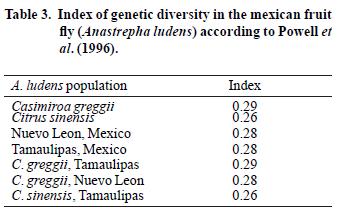
<body><![CDATA[<p align="justify"><font face="verdana" size="2"><b>RESULTS AND DISCUSSION</b></font></p>       <p align="justify"><font face="verdana" size="2">The four&#150;primer combinations amplified among 91 and 99 bands, with a mean of 95 for each pair of primers. A total of 382 products were obtained and 259 of them (67%) were polymorphic (<a href="/img/revistas/agritm/v35n3/a9t2.jpg" target="_blank">Table 2</a>). A slight difference among hosts was noticed, specimens from yellow chapote showed 3% difference with respect to specimens from citrus (<a href="#t3">Table 3</a>).</font></p>       <p align="center"><font face="verdana" size="2"><a name="t3"></a></font></p>       <p align="center"><font face="verdana" size="2"><img src="/img/revistas/agritm/v35n3/a9t3.jpg"></font></p>       <p align="justify"><font face="verdana" size="2">The analysis of molecular variance (AMOVA) showed significant differences (<i>p</i>&lt;0.001) within <i>A. ludens</i> populations (among specimens), while no population differences in regard to host or region were observed. The fixation index (F<sub>ST</sub>) for the three analyzed levels (population, host and region), showed a close relationship among <i>A. ludens</i> specimens in regard to host and region as evidenced by negligible genetic differences among subpopulations. Similarly, cluster analysis and principal components analysis confirmed that there is a strong genetic relationship among specimens of <i>A. ludens</i> (<a href="/img/revistas/agritm/v35n3/a9t4.jpg" target="_blank">Table 4</a>).</font></p>       <p align="justify"><font face="verdana" size="2">The dendrogram based on the cluster analysis of AFLP data (<a href="/img/revistas/agritm/v35n3/a9f1.jpg" target="_blank">Figure 1</a>) showed one main group that includes 88% of the specimens, with differences varying from 0.0 to 7.6%. In this main group, a defined grouping pattern was observed: first, genotypes of flies collected from yellow chapote, followed by genotypes from citrus, including the control CITSLP; however, two specimens from yellow chapote (CHANL1 and CHANL2) were mixed with specimens collected from citrus, and two genotypes from yellow chapote (CHATAM6 and CHANL4) clearly differ from the rest.</font></p>       <p align="justify"><font face="verdana" size="2">Due to the observed trend of grouping by host, which suggests the possibility of a marker linked to a fruit fly&#150;host relation, a second cluster analysis was performed, using specimens collected from Tamaulipas and San Luis Potosi (citrus) as control. One thousand bootstrap replicates were obtained from the original data and a distance matrix was calculated for each replicate. In this new analysis, two main genotype groups were observed; the first one, included yellow chapote and citrus specimens from Tamaulipas and the other the citrus specimen from San Luis Potosi (control). The dendrogram showed that all specimens from yellow chapote are closely related, followed by citrus specimens collectedin Tamaulipas (<a href="/img/revistas/agritm/v35n3/a9f2.jpg" target="_blank">Figure 2</a>).</font></p>       <p align="justify"><font face="verdana" size="2">This suggests the existence of a DNA marker linked to the fruit fly&#150;host relation. Moreover, in the matrices of AFLP, it was observed that the Eco/Mse AAA/AAA pair of primers amplify a DNA band which was present in the whole set of specimens collected in citrus; meanwhile, in the yellow chapote specimens this DNA band was absent, except for one individual.</font></p>       <p align="justify"><font face="verdana" size="2">The AFLP analysis showed a high level of polymorphism (67%), with a mean index of diversity of 28%. The technique was sensitive enough to detect differences among individuals. A slight trend toward greater genetic diversity of <i>A. ludens</i> populations stemming from native yellow chapote was observed, which is possibly due to the fact that these populations have been less perturbed (Robacker and Fraser, 2004) and subjected to a lesser selection than citrus populations subjected to frecuent insecticide sprays.</font></p>       <p align="justify"><font face="verdana" size="2">A weak grouping trend related to host origin was observed; particularly in the specimens from Tamaulipas (<a href="/img/revistas/agritm/v35n3/a9f2.jpg" target="_blank">Figure 2</a>). The analyses showed a close relation among specimens from the same host with genotypes collected from yellow chapote separated from those collected from citrus.</font></p>       ]]></body>
<body><![CDATA[<p align="justify"><font face="verdana" size="2">Phenotypic plasticity has been defined as the ability of a single genotype to produce more than one alternative form in response to environmental conditions (West&#150;Eberhard, 1989). It has been recognized that plasticity itself is a trait subject to natural selection and evolutionary change (Williams, 1966). The results of this research indicate that <i>A. ludens</i> exploiting different hosts have a slightly different genetic composition, probably owing to the fact that citrus colonization by yellow chapote flies implies going through a series of bottlenecks as described by Alberti <i>et al</i>. (1999) for A. fraterculus in Argentina. Nevertheless, the detected differences were not significant, suggesting that reproductive isolation is not evolving among the studied populations. It is important to note that <i>A. ludens</i> is polyphagous and multivoltine (Aluja, 1994; Thomas, 2003). Multivoltine fruit flies have to cope with long periods when host fruit is not available without undergoing diapuase. There are a few possible life strategies to overcome this hurdle. The first one would be through evolution of adult longevity, which has occurred in some <i>Anastrepha</i> species (Aluja <i>et al</i>., 2000a) but not in the case of <i>A. ludens</i>; the second would be by exploiting hosts with long fruiting periods, as it is the papaya fruit fly, Toxotrypana curvicauda Gerstaecker. Multivoltine fruit flies can bridge the fruiting gaps of their main host by exploiting alternate hosts (Aluja and Mangan, 2008). This survival strategy might select for genetic plasticity but also restricts genetic differentiation of host plant races. A likely scenario would explain the observed results, where an <i>A. ludens</i> population switching from chapote to citrus undergoes a genetic bottleneck that can change allele frequency, followed by a return to the ancestral host that may result in homogenizing the gene pool. This life strategy and the phenotypic plasticity observed may help to explain the findings of Robacker and Fraser (2004) showing that mexican fruit flies with previous contact with yellow chapote will prefer this host over other alternatives regardless of their own origin. It also provides support to the idea that chapote populations move back and forth from chapote to citrus as documented by Enkerlin (1987) and more recently by Thomas (2003).</font></p>       <p align="justify"><font face="verdana" size="2">Practical implications of these findings suggest that at a regional scale, the sterile insect technique can be applied for <i>A. ludens</i> without the need to colonize different strains stemming from different hosts. AFLP markers proved to be a useful tool to differentiate among <i>A. ludens</i> specimens allowing to detect a high level of polymorphism, measure genetic diversity and to detect genetic differences in host relation. It is important to mention that this is the first step of several more to follow attempting to characterize <i>A. ludens</i> populations within their geographical range. Molecular scrutiny of these populations at a wider scale is essential for a thorough understanding of the evolution of <i>A. ludens</i> life strategies. Wide range sampling is also critical to rule out geographical effects (Atlantic&#150;Pacific, altiplano&#150;coastal plains) on <i>A. ludens</i> population's genetic composition and to get evidence that these factors may be leading to the evolution of inter population reproductive isolation. That attempt will also contribute to determine the origin of recurrent introductions of <i>A. ludens</i> into citrus growing regions of the U. S., whether occur by natural dispersal (the case of Texas and Nuevo Leon), or human transport. It is also necessary to widen the scope of sampling of host&#150;associated populations considering that both chapote and citrus belong to Rutaceae and <i>A. ludens</i> has been reported infesting plants in very different families: Solanaceae (Thomas, 2004), Anacardaceae, and Rosaceae (Aluja <i>et al</i>., 2000b; Norrbom, 2003). Based on the above, the next step to genetically characterize the <i>A. ludens</i> populations in Mexico, will be to extend the sampling to other regions and other host plants and to incorporate other molecular tools as microsatellites.</font></p>       <p align="justify"><font face="verdana" size="2">&nbsp;</font></p>       <p align="justify"><font face="verdana" size="2"><b>CONCLUSIONS</b></font></p>       <p align="justify"><font face="verdana" size="2">Despite there is a high level of polymorphism (67%) in <i>A. ludens</i> in NE Mexico, the genetic diversity of this species is low (ID 28%).</font></p>       <p align="justify"><font face="verdana" size="2">The AFLP technique was sensitive enough to detect differences among individuals, a silght 3% difference was observed among specimens collected from yellow chapote as compared to those collected from sweet orange.</font></p>       <p align="justify"><font face="verdana" size="2">Cluster analysis and principal components showed a tight genetic relation among <i>A. ludens</i> individual regardless of origin.</font></p>       <p align="justify"><font face="verdana" size="2">Although the dendrogram divided divide the mexican fruit fly populations into two main groups, the genetic distance (0.0 to 10%) suggest that despite the reproductive isolation, host groups are not evolving.</font></p>       <p align="justify"><font face="verdana" size="2">&nbsp;</font></p>       <p align="justify"><font face="verdana" size="2"><b>ACKNOWLEDGEMENTS</b></font></p>       ]]></body>
<body><![CDATA[<p align="justify"><font face="verdana" size="2">We thank Victor Maya Hernandez for the collection of flies in Tamaulipas, Mexico and Alberto Anzures for the review of this manuscript. This study was sponsored by INIFAP, Fondo Mixto CONACyT&#150;Gobierno de Nuevo Leon and Fundacion Produce Tamaulipas A. C. MA and JR acknowledge the support from the Campa&ntilde;a Nacional Contra Moscas de la Fruta.</font></p>       <p align="justify"><font face="verdana" size="2">&nbsp;</font></p>       <p align="justify"><font face="verdana" size="2"><b>LITERATURE CITED</b></font></p>       <!-- ref --><p align="justify"><font face="verdana" size="2">Alberti, A. C.; Calcagno, G.; Saidman, B. O and Vilardi, J. C. 1999. Analysis of the genetic structure of a natural population of <i>Anastrepha fraterculus</i> (Diptera: Tephrititdae). Ann. Entomol. Soc. Am. 92:731&#150;736.</font>&nbsp;&nbsp;&nbsp;&nbsp;&nbsp;&nbsp;&nbsp;&nbsp;[&#160;<a href="javascript:void(0);" onclick="javascript: window.open('/scielo.php?script=sci_nlinks&ref=514230&pid=S0568-2517200900030000900001&lng=','','width=640,height=500,resizable=yes,scrollbars=1,menubar=yes,');">Links</a>&#160;]<!-- end-ref --><!-- ref --><p align="justify"><font face="verdana" size="2">Aluja, M. 1993. Manejo integrado de las moscas de la fruta. Ed. Trillas, Mexico D. F. M&eacute;xico.</font>&nbsp;&nbsp;&nbsp;&nbsp;&nbsp;&nbsp;&nbsp;&nbsp;[&#160;<a href="javascript:void(0);" onclick="javascript: window.open('/scielo.php?script=sci_nlinks&ref=514231&pid=S0568-2517200900030000900002&lng=','','width=640,height=500,resizable=yes,scrollbars=1,menubar=yes,');">Links</a>&#160;]<!-- end-ref --><!-- ref --><p align="justify"><font face="verdana" size="2">Aluja, M. 1994. Bionomics and management of <i>Anastrepha</i>. Ann. Rev. Entomol. 39:155&#150;178.</font>&nbsp;&nbsp;&nbsp;&nbsp;&nbsp;&nbsp;&nbsp;&nbsp;[&#160;<a href="javascript:void(0);" onclick="javascript: window.open('/scielo.php?script=sci_nlinks&ref=514232&pid=S0568-2517200900030000900003&lng=','','width=640,height=500,resizable=yes,scrollbars=1,menubar=yes,');">Links</a>&#160;]<!-- end-ref --><!-- ref --><p align="justify"><font face="verdana" size="2">Aluja, M. and Mangan, R. 2008. Fruit fly (Diptera: Tephritidae) host status determination: critical conceptual, methodological and regulatory considerations. Annu. Rev. Entomol. 53: In press.</font>&nbsp;&nbsp;&nbsp;&nbsp;&nbsp;&nbsp;&nbsp;&nbsp;[&#160;<a href="javascript:void(0);" onclick="javascript: window.open('/scielo.php?script=sci_nlinks&ref=514233&pid=S0568-2517200900030000900004&lng=','','width=640,height=500,resizable=yes,scrollbars=1,menubar=yes,');">Links</a>&#160;]<!-- end-ref --><!-- ref --><p align="justify"><font face="verdana" size="2">Aluja, M.; Pi&ntilde;ero, J.; J&aacute;come, I.; D&iacute;az&#150;Fleischer, F. and Sivinski, J. 2000a. Behavior of flies in the genus <i>Anastrepha</i> (Trypetinae: Toxotrypanini), p. 375&#150;408. In: Aluja, M. and Norrbom, A. L. (eds.), Fruit flies (Tephritidae): phylogeny and evolution of behaviour. CRC Press, Boca Raton, FL.</font>&nbsp;&nbsp;&nbsp;&nbsp;&nbsp;&nbsp;&nbsp;&nbsp;[&#160;<a href="javascript:void(0);" onclick="javascript: window.open('/scielo.php?script=sci_nlinks&ref=514234&pid=S0568-2517200900030000900005&lng=','','width=640,height=500,resizable=yes,scrollbars=1,menubar=yes,');">Links</a>&#160;]<!-- end-ref --><!-- ref --><p align="justify"><font face="verdana" size="2">Aluja, M.; Pi&ntilde;ero, J.; L&oacute;pez, M.; Ru&iacute;z, C.; Z&uacute;&ntilde;iga, A.; Piedra, E.; D&iacute;az&#150;Fleischer, F. and Sivinski. F. 2000b. New host plant and distribution records in Mexico for <i>Anastrepha</i> spp., Toxotrypana curvicauda Gerstacker, Rhagoletis zoqui Bush, Rhagoletis sp., and Hexachaeta sp. (Diptera: Tephritidae). Proc. Entomol. Soc. Wash. 102:802&#150;815.</font>&nbsp;&nbsp;&nbsp;&nbsp;&nbsp;&nbsp;&nbsp;&nbsp;[&#160;<a href="javascript:void(0);" onclick="javascript: window.open('/scielo.php?script=sci_nlinks&ref=514235&pid=S0568-2517200900030000900006&lng=','','width=640,height=500,resizable=yes,scrollbars=1,menubar=yes,');">Links</a>&#160;]<!-- end-ref --><!-- ref --><p align="justify"><font face="verdana" size="2">Aluja, M.; P&eacute;rez&#150;Staples, D.; Mac&iacute;as&#150;Ord&oacute;&ntilde;ez, R.; Pi&ntilde;ero, J.; McPheron, B. and Hern&aacute;ndez&#150;Ortiz, V. 2003. Nonhost status of <i>citrus sinensis</i> cultivar Valencia and C. paradisi cultivar ruby red to mexican <i>Anastrepha fraterculus</i> (Diptera: Tephritidae). J. Econ. Entomol. 96:1693&#150;1703.</font>&nbsp;&nbsp;&nbsp;&nbsp;&nbsp;&nbsp;&nbsp;&nbsp;[&#160;<a href="javascript:void(0);" onclick="javascript: window.open('/scielo.php?script=sci_nlinks&ref=514236&pid=S0568-2517200900030000900007&lng=','','width=640,height=500,resizable=yes,scrollbars=1,menubar=yes,');">Links</a>&#160;]<!-- end-ref --><!-- ref --><p align="justify"><font face="verdana" size="2">Armstrong, K. F. and Ball, S. L. 2005. DNA barcodes for biosecurity: invasive species identification. Philos. Trans. R. Soc. Lond. Biol. Sci. 360:1813&#150;1823.</font>&nbsp;&nbsp;&nbsp;&nbsp;&nbsp;&nbsp;&nbsp;&nbsp;[&#160;<a href="javascript:void(0);" onclick="javascript: window.open('/scielo.php?script=sci_nlinks&ref=514237&pid=S0568-2517200900030000900008&lng=','','width=640,height=500,resizable=yes,scrollbars=1,menubar=yes,');">Links</a>&#160;]<!-- end-ref --><!-- ref --><p align="justify"><font face="verdana" size="2">Avise, J. C. 1994. Molecular markers, natural history and evolution. Chapman &amp; Hall, New York, NY.</font>&nbsp;&nbsp;&nbsp;&nbsp;&nbsp;&nbsp;&nbsp;&nbsp;[&#160;<a href="javascript:void(0);" onclick="javascript: window.open('/scielo.php?script=sci_nlinks&ref=514238&pid=S0568-2517200900030000900009&lng=','','width=640,height=500,resizable=yes,scrollbars=1,menubar=yes,');">Links</a>&#160;]<!-- end-ref --><!-- ref --><p align="justify"><font face="verdana" size="2">Baker, A. C.; Stone, W. E.; Plummer, C. C. and McPhail, M. 1944. A review of studies on the mexican fruit fly and related mexican species. USDA, Miscellaneous publication No. 531.</font>&nbsp;&nbsp;&nbsp;&nbsp;&nbsp;&nbsp;&nbsp;&nbsp;[&#160;<a href="javascript:void(0);" onclick="javascript: window.open('/scielo.php?script=sci_nlinks&ref=514239&pid=S0568-2517200900030000900010&lng=','','width=640,height=500,resizable=yes,scrollbars=1,menubar=yes,');">Links</a>&#160;]<!-- end-ref --><!-- ref --><p align="justify"><font face="verdana" size="2">Corsini, G.; Manubens, A.; Lladser, A.; Lobos, S.; Seelenfreund, D. and Lobos, C. 1999. AFLP analisis of fruit fly Ceratitis capitata. Focus 21(3):72&#150;73.</font>&nbsp;&nbsp;&nbsp;&nbsp;&nbsp;&nbsp;&nbsp;&nbsp;[&#160;<a href="javascript:void(0);" onclick="javascript: window.open('/scielo.php?script=sci_nlinks&ref=514240&pid=S0568-2517200900030000900011&lng=','','width=640,height=500,resizable=yes,scrollbars=1,menubar=yes,');">Links</a>&#160;]<!-- end-ref --><!-- ref --><p align="justify"><font face="verdana" size="2">Dowell, R. V.; Sidiqui, I. A.; Meyer, F. and Spaugy, L. 2000. Mediterranean fruit fly preventive release program in Southern California, p. 369&#150;375. <i>In</i>: Tan, K. H. (ed), Area&#150;wide control of fruit flies and other insect pests. Universiti Sains Malaysia, Penang, Malaysia.</font>&nbsp;&nbsp;&nbsp;&nbsp;&nbsp;&nbsp;&nbsp;&nbsp;[&#160;<a href="javascript:void(0);" onclick="javascript: window.open('/scielo.php?script=sci_nlinks&ref=514241&pid=S0568-2517200900030000900012&lng=','','width=640,height=500,resizable=yes,scrollbars=1,menubar=yes,');">Links</a>&#160;]<!-- end-ref --><!-- ref --><p align="justify"><font face="verdana" size="2">Enkerlin, W. 1987. Orientaci&oacute;n y dispersi&oacute;n de poblaciones de la mosca mexicana de la fruta (<i>Anastrepha ludens</i>, Loew), est&eacute;riles y silvestres, en el municipio de Allende, N. L., en el per&iacute;odo de septiembre de 1985 a agosto de 1986. M. S. Thesis, Instituto Tecnol&oacute;gico y de Estudios Superiores de Monterrey (ITESM), Campus Monterrey, Monterrey, Nuevo Le&oacute;n, M&eacute;xico.</font>&nbsp;&nbsp;&nbsp;&nbsp;&nbsp;&nbsp;&nbsp;&nbsp;[&#160;<a href="javascript:void(0);" onclick="javascript: window.open('/scielo.php?script=sci_nlinks&ref=514242&pid=S0568-2517200900030000900013&lng=','','width=640,height=500,resizable=yes,scrollbars=1,menubar=yes,');">Links</a>&#160;]<!-- end-ref --><!-- ref --><p align="justify"><font face="verdana" size="2">Excoffier, L.; Simouse, P. and Quattro, J. 1992. Analysis of molecular variance inferred for metric distances among DNA haplotypes: application to human mitochondrial DNA restriction data. Genetics 131:479&#150;491.</font>&nbsp;&nbsp;&nbsp;&nbsp;&nbsp;&nbsp;&nbsp;&nbsp;[&#160;<a href="javascript:void(0);" onclick="javascript: window.open('/scielo.php?script=sci_nlinks&ref=514243&pid=S0568-2517200900030000900014&lng=','','width=640,height=500,resizable=yes,scrollbars=1,menubar=yes,');">Links</a>&#160;]<!-- end-ref --><!-- ref --><p align="justify"><font face="verdana" size="2">Hernandez&#150;Ortiz, V.; Gomez&#150;Amaya, J. A.; Sanchez, A.; McPheron, B. A. and Aluja, M. 2004. Morphometric analysis of mexican and South American populations of the <i>Anastrepha fraterculus</i> complex (Diptera: tephritidae) and recognition of a distinct mexican morphotype. Bull. Entomol. Res. 94:487&#150;499.</font>&nbsp;&nbsp;&nbsp;&nbsp;&nbsp;&nbsp;&nbsp;&nbsp;[&#160;<a href="javascript:void(0);" onclick="javascript: window.open('/scielo.php?script=sci_nlinks&ref=514244&pid=S0568-2517200900030000900015&lng=','','width=640,height=500,resizable=yes,scrollbars=1,menubar=yes,');">Links</a>&#160;]<!-- end-ref --><!-- ref --><p align="justify"><font face="verdana" size="2">Krafsur, E. S. 2005. Role of population genetics in the sterile insect technique, pp. 389&#150; 406. In: Dyck, V. A., Hendrichs, J. and Robinson, A. S. (eds). Sterile insect technique: principles and practice in area&#150;wide integrated pest management. Springer, Dordrech, The Netherlands.</font>&nbsp;&nbsp;&nbsp;&nbsp;&nbsp;&nbsp;&nbsp;&nbsp;[&#160;<a href="javascript:void(0);" onclick="javascript: window.open('/scielo.php?script=sci_nlinks&ref=514245&pid=S0568-2517200900030000900016&lng=','','width=640,height=500,resizable=yes,scrollbars=1,menubar=yes,');">Links</a>&#160;]<!-- end-ref --><!-- ref --><p align="justify"><font face="verdana" size="2">Mangan, R. L. and Moreno, D. S. 2003. Molecular analysis of <i>Anastrepha ludens</i> genetic variation. <a href="http://www.depts.ttu.edu/aged/tard/" target="_blank">http://www.tard.state.tx.us/listing.php?id=3d6d01c202fe8</a>.(05&#150;08&#150;2003).</font>&nbsp;&nbsp;&nbsp;&nbsp;&nbsp;&nbsp;&nbsp;&nbsp;[&#160;<a href="javascript:void(0);" onclick="javascript: window.open('/scielo.php?script=sci_nlinks&ref=514246&pid=S0568-2517200900030000900017&lng=','','width=640,height=500,resizable=yes,scrollbars=1,menubar=yes,');">Links</a>&#160;]<!-- end-ref --><!-- ref --><p align="justify"><font face="verdana" size="2">Nei, M. and Li, W. H. 1979. Mathematical model for studying genetic variation in terms of restriction endonucleases. Proc. Natl. Acad. Sci. USA. 76:5269&#150;5273.</font>&nbsp;&nbsp;&nbsp;&nbsp;&nbsp;&nbsp;&nbsp;&nbsp;[&#160;<a href="javascript:void(0);" onclick="javascript: window.open('/scielo.php?script=sci_nlinks&ref=514247&pid=S0568-2517200900030000900018&lng=','','width=640,height=500,resizable=yes,scrollbars=1,menubar=yes,');">Links</a>&#160;]<!-- end-ref --><!-- ref --><p align="justify"><font face="verdana" size="2">Norrbom, A. L. 2003. Host plant data base for <i>Anastrepha</i> and <i>Toxotrypana</i> (Diptera: Tephritidae: Toxotrypanini). Diptera data dissemination disk. CD&#150;ROM, North Amer. Dipterist's Soc. Washington, D. C.</font>&nbsp;&nbsp;&nbsp;&nbsp;&nbsp;&nbsp;&nbsp;&nbsp;[&#160;<a href="javascript:void(0);" onclick="javascript: window.open('/scielo.php?script=sci_nlinks&ref=514248&pid=S0568-2517200900030000900019&lng=','','width=640,height=500,resizable=yes,scrollbars=1,menubar=yes,');">Links</a>&#160;]<!-- end-ref --><!-- ref --><p align="justify"><font face="verdana" size="2">Powell, W.; Morgante, M.; Andre, C.; Hanafey, M.; Vogel, J.; Tingey, S. and Rafalski, A. 1996. The comparasion of RFLP, RAPD, AFLP and SSR (microsatellite) markers for germplasm analysis. Mol. Breeding 2:225&#150;238.</font>&nbsp;&nbsp;&nbsp;&nbsp;&nbsp;&nbsp;&nbsp;&nbsp;[&#160;<a href="javascript:void(0);" onclick="javascript: window.open('/scielo.php?script=sci_nlinks&ref=514249&pid=S0568-2517200900030000900020&lng=','','width=640,height=500,resizable=yes,scrollbars=1,menubar=yes,');">Links</a>&#160;]<!-- end-ref --><!-- ref --><p align="justify"><font face="verdana" size="2">Reyes, J.; Santiago, G. and Hern&aacute;ndez, P. 2000. The mexican fruit fly eradication programme, p. 377&#150;380. <i>In</i>: Tan, K. H. (ed.). Area&#150;wide control of fruit flies and other insect pests. University Sains Malaysia, Penang, Malaysia.</font>&nbsp;&nbsp;&nbsp;&nbsp;&nbsp;&nbsp;&nbsp;&nbsp;[&#160;<a href="javascript:void(0);" onclick="javascript: window.open('/scielo.php?script=sci_nlinks&ref=514250&pid=S0568-2517200900030000900021&lng=','','width=640,height=500,resizable=yes,scrollbars=1,menubar=yes,');">Links</a>&#160;]<!-- end-ref --><!-- ref --><p align="justify"><font face="verdana" size="2">Robacker, D. C. and Fraser, I. 2004. Do mexican fruit flies (Diptera: Tephritidae) prefer grapefruit to yellow chapote, a native host? Fla. Entomol. 85:481&#150;487.</font>&nbsp;&nbsp;&nbsp;&nbsp;&nbsp;&nbsp;&nbsp;&nbsp;[&#160;<a href="javascript:void(0);" onclick="javascript: window.open('/scielo.php?script=sci_nlinks&ref=514251&pid=S0568-2517200900030000900022&lng=','','width=640,height=500,resizable=yes,scrollbars=1,menubar=yes,');">Links</a>&#160;]<!-- end-ref --><!-- ref --><p align="justify"><font face="verdana" size="2">Roderick, G. K. 1996. Geographic structure of insect populations: gene flow, phylogeography, and their uses. Ann. Rev. Entomol. 41:325&#150;352.</font>&nbsp;&nbsp;&nbsp;&nbsp;&nbsp;&nbsp;&nbsp;&nbsp;[&#160;<a href="javascript:void(0);" onclick="javascript: window.open('/scielo.php?script=sci_nlinks&ref=514252&pid=S0568-2517200900030000900023&lng=','','width=640,height=500,resizable=yes,scrollbars=1,menubar=yes,');">Links</a>&#160;]<!-- end-ref --><!-- ref --><p align="justify"><font face="verdana" size="2">S&#150;Plus (S&#150;Plus) User`s Guide Version 4.0. 1997. Seattle: Math Soft. 525 p.</font>&nbsp;&nbsp;&nbsp;&nbsp;&nbsp;&nbsp;&nbsp;&nbsp;[&#160;<a href="javascript:void(0);" onclick="javascript: window.open('/scielo.php?script=sci_nlinks&ref=514253&pid=S0568-2517200900030000900024&lng=','','width=640,height=500,resizable=yes,scrollbars=1,menubar=yes,');">Links</a>&#160;]<!-- end-ref --><!-- ref --><p align="justify"><font face="verdana" size="2">Thomas, D. B. and Loera&#150;Gallardo, J. 1998. Dispersal and longevity of mass&#150;released mexican fruit files (Diptera: Tephritidae). Environ. Entomol. 27:1045&#150;1052.</font>&nbsp;&nbsp;&nbsp;&nbsp;&nbsp;&nbsp;&nbsp;&nbsp;[&#160;<a href="javascript:void(0);" onclick="javascript: window.open('/scielo.php?script=sci_nlinks&ref=514254&pid=S0568-2517200900030000900025&lng=','','width=640,height=500,resizable=yes,scrollbars=1,menubar=yes,');">Links</a>&#160;]<!-- end-ref --><!-- ref --><p align="justify"><font face="verdana" size="2">Thomas, D. B. 2003. Reproductive phenology of the mexican fruit fly <i>Anastrepha ludens</i> (Loew) (Diptera: Tephritidae) in the Sierra Madre Oriental, Northern Mexico. Neotrop. Entomol. 32:385&#150;397.</font>&nbsp;&nbsp;&nbsp;&nbsp;&nbsp;&nbsp;&nbsp;&nbsp;[&#160;<a href="javascript:void(0);" onclick="javascript: window.open('/scielo.php?script=sci_nlinks&ref=514255&pid=S0568-2517200900030000900026&lng=','','width=640,height=500,resizable=yes,scrollbars=1,menubar=yes,');">Links</a>&#160;]<!-- end-ref --><!-- ref --><p align="justify"><font face="verdana" size="2">Thomas, D. B. 2004. Hot peppers as a host for the mexican fruit fly <i>Anastrepha ludens</i> (Diptera: Tephritidae). Fla. Entomol. 87:603&#150;608.</font>&nbsp;&nbsp;&nbsp;&nbsp;&nbsp;&nbsp;&nbsp;&nbsp;[&#160;<a href="javascript:void(0);" onclick="javascript: window.open('/scielo.php?script=sci_nlinks&ref=514256&pid=S0568-2517200900030000900027&lng=','','width=640,height=500,resizable=yes,scrollbars=1,menubar=yes,');">Links</a>&#160;]<!-- end-ref --><!-- ref --><p align="justify"><font face="verdana" size="2">Vera, M. T.; C&aacute;ceres, C.; Wornoayporn, V.; Islam, A.; Robinson, A. S.; De La Vega, M. H.; Hendrichs, J. and Cayol, J. P. 2006. Mating in compatibility among populations of the South American fruit fly <i>Anastrepha fraterculus</i> (Diptera: Tephritidae). Ann. Entomol. Soc. Am. 99:387&#150;397.</font>&nbsp;&nbsp;&nbsp;&nbsp;&nbsp;&nbsp;&nbsp;&nbsp;[&#160;<a href="javascript:void(0);" onclick="javascript: window.open('/scielo.php?script=sci_nlinks&ref=514257&pid=S0568-2517200900030000900028&lng=','','width=640,height=500,resizable=yes,scrollbars=1,menubar=yes,');">Links</a>&#160;]<!-- end-ref --><!-- ref --><p align="justify"><font face="verdana" size="2">Via, S. 1990. Ecological genetics and host adaptation in herbivorous insects: The experimental study of evolution in natural and agricultural systems. Ann. Rev. Entomol. 35:421&#150; 446.</font>&nbsp;&nbsp;&nbsp;&nbsp;&nbsp;&nbsp;&nbsp;&nbsp;[&#160;<a href="javascript:void(0);" onclick="javascript: window.open('/scielo.php?script=sci_nlinks&ref=514258&pid=S0568-2517200900030000900029&lng=','','width=640,height=500,resizable=yes,scrollbars=1,menubar=yes,');">Links</a>&#160;]<!-- end-ref --><!-- ref --><p align="justify"><font face="verdana" size="2">Vos, P.; Hogers, R.; Bleeker, M.; Reijans, M.; Van de Lee, T.; Hornes, M.; Frijters, A.; Pot, J.; Peleman, J.; Kuiper, M. &amp; Zabeau, M. 1995. AFLP: a new technique for DNA fingerprinting. Nucleic Acids Res. 23:4407&#150;4414.</font>&nbsp;&nbsp;&nbsp;&nbsp;&nbsp;&nbsp;&nbsp;&nbsp;[&#160;<a href="javascript:void(0);" onclick="javascript: window.open('/scielo.php?script=sci_nlinks&ref=514259&pid=S0568-2517200900030000900030&lng=','','width=640,height=500,resizable=yes,scrollbars=1,menubar=yes,');">Links</a>&#160;]<!-- end-ref --><!-- ref --><p align="justify"><font face="verdana" size="2">West&#150;Eberhard, M. J. 1989. Phenotypic plasticity and the origins of diversity. Annu. Rev. Ecol. Syst. 20:249&#150;278.</font>&nbsp;&nbsp;&nbsp;&nbsp;&nbsp;&nbsp;&nbsp;&nbsp;[&#160;<a href="javascript:void(0);" onclick="javascript: window.open('/scielo.php?script=sci_nlinks&ref=514260&pid=S0568-2517200900030000900031&lng=','','width=640,height=500,resizable=yes,scrollbars=1,menubar=yes,');">Links</a>&#160;]<!-- end-ref --><!-- ref --><p align="justify"><font face="verdana" size="2">Williams, G. C. 1966. Adaptation and natural selection. Princeton University Press, Princeton, USA.</font>&nbsp;&nbsp;&nbsp;&nbsp;&nbsp;&nbsp;&nbsp;&nbsp;[&#160;<a href="javascript:void(0);" onclick="javascript: window.open('/scielo.php?script=sci_nlinks&ref=514261&pid=S0568-2517200900030000900032&lng=','','width=640,height=500,resizable=yes,scrollbars=1,menubar=yes,');">Links</a>&#160;]<!-- end-ref --><!-- ref --><p align="justify"><font face="verdana" size="2">Wright, S. 1951. The genetical structure of populations. Ann. Eugen. 15:323&#150;354.   </font>&nbsp;&nbsp;&nbsp;&nbsp;&nbsp;&nbsp;&nbsp;&nbsp;[&#160;<a href="javascript:void(0);" onclick="javascript: window.open('/scielo.php?script=sci_nlinks&ref=514262&pid=S0568-2517200900030000900033&lng=','','width=640,height=500,resizable=yes,scrollbars=1,menubar=yes,');">Links</a>&#160;]<!-- end-ref --> ]]></body><back>
<ref-list>
<ref id="B1">
<nlm-citation citation-type="journal">
<person-group person-group-type="author">
<name>
<surname><![CDATA[Alberti]]></surname>
<given-names><![CDATA[A. C.]]></given-names>
</name>
<name>
<surname><![CDATA[Calcagno]]></surname>
<given-names><![CDATA[G.]]></given-names>
</name>
<name>
<surname><![CDATA[Saidman]]></surname>
<given-names><![CDATA[B. O]]></given-names>
</name>
<name>
<surname><![CDATA[Vilardi]]></surname>
<given-names><![CDATA[J. C.]]></given-names>
</name>
</person-group>
<article-title xml:lang="en"><![CDATA[Analysis of the genetic structure of a natural population of Anastrepha fraterculus (Diptera: Tephrititdae)]]></article-title>
<source><![CDATA[Ann. Entomol. Soc. Am.]]></source>
<year>1999</year>
<volume>92</volume>
<page-range>731-736</page-range></nlm-citation>
</ref>
<ref id="B2">
<nlm-citation citation-type="book">
<person-group person-group-type="author">
<name>
<surname><![CDATA[Aluja]]></surname>
<given-names><![CDATA[M.]]></given-names>
</name>
</person-group>
<source><![CDATA[Manejo integrado de las moscas de la fruta]]></source>
<year>1993</year>
<publisher-loc><![CDATA[Mexico^eD. F. D. F.]]></publisher-loc>
<publisher-name><![CDATA[Trillas]]></publisher-name>
</nlm-citation>
</ref>
<ref id="B3">
<nlm-citation citation-type="journal">
<person-group person-group-type="author">
<name>
<surname><![CDATA[Aluja]]></surname>
<given-names><![CDATA[M.]]></given-names>
</name>
</person-group>
<article-title xml:lang="en"><![CDATA[Bionomics and management of Anastrepha]]></article-title>
<source><![CDATA[Ann. Rev. Entomol.]]></source>
<year>1994</year>
<volume>39</volume>
<page-range>155-178</page-range></nlm-citation>
</ref>
<ref id="B4">
<nlm-citation citation-type="journal">
<person-group person-group-type="author">
<name>
<surname><![CDATA[Aluja]]></surname>
<given-names><![CDATA[M.]]></given-names>
</name>
<name>
<surname><![CDATA[Mangan]]></surname>
<given-names><![CDATA[R.]]></given-names>
</name>
</person-group>
<article-title xml:lang="en"><![CDATA[Fruit fly (Diptera: Tephritidae) host status determination: critical conceptual, methodological and regulatory considerations]]></article-title>
<source><![CDATA[Annu. Rev. Entomol.]]></source>
<year>2008</year>
<volume>53</volume>
</nlm-citation>
</ref>
<ref id="B5">
<nlm-citation citation-type="book">
<person-group person-group-type="author">
<name>
<surname><![CDATA[Aluja]]></surname>
<given-names><![CDATA[M.]]></given-names>
</name>
<name>
<surname><![CDATA[Piñero]]></surname>
<given-names><![CDATA[J.]]></given-names>
</name>
<name>
<surname><![CDATA[Jácome]]></surname>
<given-names><![CDATA[I.]]></given-names>
</name>
<name>
<surname><![CDATA[Díaz-Fleischer]]></surname>
<given-names><![CDATA[F.]]></given-names>
</name>
<name>
<surname><![CDATA[Sivinski]]></surname>
<given-names><![CDATA[J.]]></given-names>
</name>
</person-group>
<article-title xml:lang="en"><![CDATA[Behavior of flies in the genus Anastrepha (Trypetinae: Toxotrypanini)]]></article-title>
<person-group person-group-type="editor">
<name>
<surname><![CDATA[Aluja]]></surname>
<given-names><![CDATA[M.]]></given-names>
</name>
<name>
<surname><![CDATA[Norrbom]]></surname>
<given-names><![CDATA[A. L.]]></given-names>
</name>
</person-group>
<source><![CDATA[Fruit flies (Tephritidae): phylogeny and evolution of behaviour]]></source>
<year>2000</year>
<page-range>375-408</page-range><publisher-loc><![CDATA[Boca Raton^eFL FL]]></publisher-loc>
<publisher-name><![CDATA[CRC Press]]></publisher-name>
</nlm-citation>
</ref>
<ref id="B6">
<nlm-citation citation-type="journal">
<person-group person-group-type="author">
<name>
<surname><![CDATA[Aluja]]></surname>
<given-names><![CDATA[M.]]></given-names>
</name>
<name>
<surname><![CDATA[Piñero]]></surname>
<given-names><![CDATA[J.]]></given-names>
</name>
<name>
<surname><![CDATA[López]]></surname>
<given-names><![CDATA[M.]]></given-names>
</name>
<name>
<surname><![CDATA[Ruíz]]></surname>
<given-names><![CDATA[C.]]></given-names>
</name>
<name>
<surname><![CDATA[Zúñiga]]></surname>
<given-names><![CDATA[A.]]></given-names>
</name>
<name>
<surname><![CDATA[Piedra]]></surname>
<given-names><![CDATA[E.]]></given-names>
</name>
<name>
<surname><![CDATA[Díaz-Fleischer]]></surname>
<given-names><![CDATA[F.]]></given-names>
</name>
<name>
<surname><![CDATA[Sivinski]]></surname>
<given-names><![CDATA[F.]]></given-names>
</name>
</person-group>
<article-title xml:lang="en"><![CDATA[New host plant and distribution records in Mexico for Anastrepha spp., Toxotrypana curvicauda Gerstacker, Rhagoletis zoqui Bush, Rhagoletis sp., and Hexachaeta sp. (Diptera: Tephritidae)]]></article-title>
<source><![CDATA[Proc. Entomol. Soc. Wash.]]></source>
<year>2000</year>
<volume>102</volume>
<page-range>802-815</page-range></nlm-citation>
</ref>
<ref id="B7">
<nlm-citation citation-type="journal">
<person-group person-group-type="author">
<name>
<surname><![CDATA[Aluja]]></surname>
<given-names><![CDATA[M.]]></given-names>
</name>
<name>
<surname><![CDATA[Pérez-Staples]]></surname>
<given-names><![CDATA[D.]]></given-names>
</name>
<name>
<surname><![CDATA[Macías-Ordóñez]]></surname>
<given-names><![CDATA[R.]]></given-names>
</name>
<name>
<surname><![CDATA[Piñero]]></surname>
<given-names><![CDATA[J.]]></given-names>
</name>
<name>
<surname><![CDATA[McPheron]]></surname>
<given-names><![CDATA[B.]]></given-names>
</name>
<name>
<surname><![CDATA[Hernández-Ortiz]]></surname>
<given-names><![CDATA[V.]]></given-names>
</name>
</person-group>
<article-title xml:lang="en"><![CDATA[Nonhost status of citrus sinensis cultivar Valencia and C. paradisi cultivar ruby red to mexican Anastrepha fraterculus (Diptera: Tephritidae)]]></article-title>
<source><![CDATA[J. Econ. Entomol.]]></source>
<year>2003</year>
<volume>96</volume>
<page-range>1693-1703</page-range></nlm-citation>
</ref>
<ref id="B8">
<nlm-citation citation-type="journal">
<person-group person-group-type="author">
<name>
<surname><![CDATA[Armstrong]]></surname>
<given-names><![CDATA[K. F.]]></given-names>
</name>
<name>
<surname><![CDATA[Ball]]></surname>
<given-names><![CDATA[S. L.]]></given-names>
</name>
</person-group>
<article-title xml:lang="en"><![CDATA[DNA barcodes for biosecurity: invasive species identification]]></article-title>
<source><![CDATA[Philos. Trans. R. Soc. Lond. Biol. Sci.]]></source>
<year>2005</year>
<volume>360</volume>
<page-range>1813-1823</page-range></nlm-citation>
</ref>
<ref id="B9">
<nlm-citation citation-type="book">
<person-group person-group-type="author">
<name>
<surname><![CDATA[Avise]]></surname>
<given-names><![CDATA[J. C.]]></given-names>
</name>
</person-group>
<source><![CDATA[Molecular markers, natural history and evolution]]></source>
<year>1994</year>
<publisher-loc><![CDATA[New York^eNY NY]]></publisher-loc>
<publisher-name><![CDATA[Chapman & Hall]]></publisher-name>
</nlm-citation>
</ref>
<ref id="B10">
<nlm-citation citation-type="book">
<person-group person-group-type="author">
<name>
<surname><![CDATA[Baker]]></surname>
<given-names><![CDATA[A. C.]]></given-names>
</name>
<name>
<surname><![CDATA[Stone]]></surname>
<given-names><![CDATA[W. E.]]></given-names>
</name>
<name>
<surname><![CDATA[Plummer]]></surname>
<given-names><![CDATA[C. C.]]></given-names>
</name>
<name>
<surname><![CDATA[McPhail]]></surname>
<given-names><![CDATA[M.]]></given-names>
</name>
</person-group>
<source><![CDATA[A review of studies on the mexican fruit fly and related mexican species]]></source>
<year>1944</year>
<volume>531</volume>
<publisher-name><![CDATA[USDA]]></publisher-name>
</nlm-citation>
</ref>
<ref id="B11">
<nlm-citation citation-type="journal">
<person-group person-group-type="author">
<name>
<surname><![CDATA[Corsini]]></surname>
<given-names><![CDATA[G.]]></given-names>
</name>
<name>
<surname><![CDATA[Manubens]]></surname>
<given-names><![CDATA[A.]]></given-names>
</name>
<name>
<surname><![CDATA[Lladser]]></surname>
<given-names><![CDATA[A.]]></given-names>
</name>
<name>
<surname><![CDATA[Lobos]]></surname>
<given-names><![CDATA[S.]]></given-names>
</name>
<name>
<surname><![CDATA[Seelenfreund]]></surname>
<given-names><![CDATA[D.]]></given-names>
</name>
<name>
<surname><![CDATA[Lobos]]></surname>
<given-names><![CDATA[C.]]></given-names>
</name>
</person-group>
<article-title xml:lang="en"><![CDATA[AFLP analisis of fruit fly Ceratitis capitata]]></article-title>
<source><![CDATA[Focus]]></source>
<year>1999</year>
<volume>21</volume>
<numero>3</numero>
<issue>3</issue>
<page-range>72-73</page-range></nlm-citation>
</ref>
<ref id="B12">
<nlm-citation citation-type="book">
<person-group person-group-type="author">
<name>
<surname><![CDATA[Dowell]]></surname>
<given-names><![CDATA[R. V.]]></given-names>
</name>
<name>
<surname><![CDATA[Sidiqui]]></surname>
<given-names><![CDATA[I. A.]]></given-names>
</name>
<name>
<surname><![CDATA[Meyer]]></surname>
<given-names><![CDATA[F.]]></given-names>
</name>
<name>
<surname><![CDATA[Spaugy]]></surname>
<given-names><![CDATA[L.]]></given-names>
</name>
</person-group>
<article-title xml:lang="en"><![CDATA[Mediterranean fruit fly preventive release program in Southern California]]></article-title>
<person-group person-group-type="editor">
<name>
<surname><![CDATA[Tan]]></surname>
<given-names><![CDATA[K. H.]]></given-names>
</name>
</person-group>
<source><![CDATA[Area-wide control of fruit flies and other insect pests]]></source>
<year>2000</year>
<page-range>369-375</page-range><publisher-loc><![CDATA[Penang ]]></publisher-loc>
<publisher-name><![CDATA[Universiti Sains Malaysia]]></publisher-name>
</nlm-citation>
</ref>
<ref id="B13">
<nlm-citation citation-type="">
<person-group person-group-type="author">
<name>
<surname><![CDATA[Enkerlin]]></surname>
<given-names><![CDATA[W.]]></given-names>
</name>
</person-group>
<source><![CDATA[Orientación y dispersión de poblaciones de la mosca mexicana de la fruta (Anastrepha ludens, Loew), estériles y silvestres, en el municipio de Allende, N. L., en el período de septiembre de 1985 a agosto de 1986]]></source>
<year>1987</year>
</nlm-citation>
</ref>
<ref id="B14">
<nlm-citation citation-type="journal">
<person-group person-group-type="author">
<name>
<surname><![CDATA[Excoffier]]></surname>
<given-names><![CDATA[L.]]></given-names>
</name>
<name>
<surname><![CDATA[Simouse]]></surname>
<given-names><![CDATA[P.]]></given-names>
</name>
<name>
<surname><![CDATA[Quattro]]></surname>
<given-names><![CDATA[J.]]></given-names>
</name>
</person-group>
<article-title xml:lang="en"><![CDATA[Analysis of molecular variance inferred for metric distances among DNA haplotypes: application to human mitochondrial DNA restriction data]]></article-title>
<source><![CDATA[Genetics]]></source>
<year>1992</year>
<volume>131</volume>
<page-range>479-491</page-range></nlm-citation>
</ref>
<ref id="B15">
<nlm-citation citation-type="journal">
<person-group person-group-type="author">
<name>
<surname><![CDATA[Hernandez-Ortiz]]></surname>
<given-names><![CDATA[V.]]></given-names>
</name>
<name>
<surname><![CDATA[Gomez-Amaya]]></surname>
<given-names><![CDATA[J. A.]]></given-names>
</name>
<name>
<surname><![CDATA[Sanchez]]></surname>
<given-names><![CDATA[A.]]></given-names>
</name>
<name>
<surname><![CDATA[McPheron]]></surname>
<given-names><![CDATA[B. A.]]></given-names>
</name>
<name>
<surname><![CDATA[Aluja]]></surname>
<given-names><![CDATA[M.]]></given-names>
</name>
</person-group>
<article-title xml:lang="en"><![CDATA[Morphometric analysis of mexican and South American populations of the Anastrepha fraterculus complex (Diptera: tephritidae) and recognition of a distinct mexican morphotype]]></article-title>
<source><![CDATA[Bull. Entomol. Res.]]></source>
<year>2004</year>
<volume>94</volume>
<page-range>487-499</page-range></nlm-citation>
</ref>
<ref id="B16">
<nlm-citation citation-type="book">
<person-group person-group-type="author">
<name>
<surname><![CDATA[Krafsur]]></surname>
<given-names><![CDATA[E. S.]]></given-names>
</name>
</person-group>
<article-title xml:lang="en"><![CDATA[Role of population genetics in the sterile insect technique]]></article-title>
<person-group person-group-type="editor">
<name>
<surname><![CDATA[Dyck]]></surname>
<given-names><![CDATA[V. A.]]></given-names>
</name>
<name>
<surname><![CDATA[Hendrichs]]></surname>
<given-names><![CDATA[J.]]></given-names>
</name>
<name>
<surname><![CDATA[Robinson]]></surname>
<given-names><![CDATA[A. S.]]></given-names>
</name>
</person-group>
<source><![CDATA[Sterile insect technique: principles and practice in area-wide integrated pest management]]></source>
<year>2005</year>
<page-range>389- 406</page-range><publisher-loc><![CDATA[Dordrech ]]></publisher-loc>
<publisher-name><![CDATA[Springer]]></publisher-name>
</nlm-citation>
</ref>
<ref id="B17">
<nlm-citation citation-type="">
<person-group person-group-type="author">
<name>
<surname><![CDATA[Mangan]]></surname>
<given-names><![CDATA[R. L.]]></given-names>
</name>
<name>
<surname><![CDATA[Moreno]]></surname>
<given-names><![CDATA[D. S.]]></given-names>
</name>
</person-group>
<source><![CDATA[Molecular analysis of Anastrepha ludens genetic variation]]></source>
<year>2003</year>
</nlm-citation>
</ref>
<ref id="B18">
<nlm-citation citation-type="journal">
<person-group person-group-type="author">
<name>
<surname><![CDATA[Nei]]></surname>
<given-names><![CDATA[M.]]></given-names>
</name>
<name>
<surname><![CDATA[Li]]></surname>
<given-names><![CDATA[W. H.]]></given-names>
</name>
</person-group>
<article-title xml:lang="en"><![CDATA[Mathematical model for studying genetic variation in terms of restriction endonucleases]]></article-title>
<source><![CDATA[Proc. Natl. Acad. Sci.]]></source>
<year>1979</year>
<volume>76</volume>
<page-range>5269-5273</page-range></nlm-citation>
</ref>
<ref id="B19">
<nlm-citation citation-type="book">
<person-group person-group-type="author">
<name>
<surname><![CDATA[Norrbom]]></surname>
<given-names><![CDATA[A. L.]]></given-names>
</name>
</person-group>
<source><![CDATA[Host plant data base for Anastrepha and Toxotrypana (Diptera: Tephritidae: Toxotrypanini): Diptera data dissemination disk. CD-ROM]]></source>
<year>2003</year>
<publisher-loc><![CDATA[Washington^eD. C. D. C.]]></publisher-loc>
<publisher-name><![CDATA[North Amer. Dipterist's Soc.]]></publisher-name>
</nlm-citation>
</ref>
<ref id="B20">
<nlm-citation citation-type="journal">
<person-group person-group-type="author">
<name>
<surname><![CDATA[Powell]]></surname>
<given-names><![CDATA[W.]]></given-names>
</name>
<name>
<surname><![CDATA[Morgante]]></surname>
<given-names><![CDATA[M.]]></given-names>
</name>
<name>
<surname><![CDATA[Andre]]></surname>
<given-names><![CDATA[C.]]></given-names>
</name>
<name>
<surname><![CDATA[Hanafey]]></surname>
<given-names><![CDATA[M.]]></given-names>
</name>
<name>
<surname><![CDATA[Vogel]]></surname>
<given-names><![CDATA[J.]]></given-names>
</name>
<name>
<surname><![CDATA[Tingey]]></surname>
<given-names><![CDATA[S.]]></given-names>
</name>
<name>
<surname><![CDATA[Rafalski]]></surname>
<given-names><![CDATA[A.]]></given-names>
</name>
</person-group>
<article-title xml:lang="en"><![CDATA[The comparasion of RFLP, RAPD, AFLP and SSR (microsatellite) markers for germplasm analysis]]></article-title>
<source><![CDATA[Mol. Breeding]]></source>
<year>1996</year>
<volume>2</volume>
<page-range>225-238</page-range></nlm-citation>
</ref>
<ref id="B21">
<nlm-citation citation-type="book">
<person-group person-group-type="author">
<name>
<surname><![CDATA[Reyes]]></surname>
<given-names><![CDATA[J.]]></given-names>
</name>
<name>
<surname><![CDATA[Santiago]]></surname>
<given-names><![CDATA[G.]]></given-names>
</name>
<name>
<surname><![CDATA[Hernández]]></surname>
<given-names><![CDATA[P.]]></given-names>
</name>
</person-group>
<article-title xml:lang="en"><![CDATA[The mexican fruit fly eradication programme]]></article-title>
<person-group person-group-type="editor">
<name>
<surname><![CDATA[Tan]]></surname>
<given-names><![CDATA[K. H.]]></given-names>
</name>
</person-group>
<source><![CDATA[Area-wide control of fruit flies and other insect pests]]></source>
<year>2000</year>
<page-range>377-380</page-range><publisher-loc><![CDATA[Penang ]]></publisher-loc>
<publisher-name><![CDATA[University Sains Malaysia]]></publisher-name>
</nlm-citation>
</ref>
<ref id="B22">
<nlm-citation citation-type="journal">
<person-group person-group-type="author">
<name>
<surname><![CDATA[Robacker]]></surname>
<given-names><![CDATA[D. C.]]></given-names>
</name>
<name>
<surname><![CDATA[Fraser]]></surname>
<given-names><![CDATA[I.]]></given-names>
</name>
</person-group>
<article-title xml:lang="en"><![CDATA[Do mexican fruit flies (Diptera: Tephritidae) prefer grapefruit to yellow chapote, a native host?]]></article-title>
<source><![CDATA[Fla. Entomol.]]></source>
<year>2004</year>
<volume>85</volume>
<page-range>481-487</page-range></nlm-citation>
</ref>
<ref id="B23">
<nlm-citation citation-type="journal">
<person-group person-group-type="author">
<name>
<surname><![CDATA[Roderick]]></surname>
<given-names><![CDATA[G. K.]]></given-names>
</name>
</person-group>
<article-title xml:lang="en"><![CDATA[Geographic structure of insect populations: gene flow, phylogeography, and their uses]]></article-title>
<source><![CDATA[Ann. Rev. Entomol.]]></source>
<year>1996</year>
<volume>41</volume>
<page-range>325-352</page-range></nlm-citation>
</ref>
<ref id="B24">
<nlm-citation citation-type="book">
<collab>S-Plus (S-Plus)</collab>
<source><![CDATA[User`s Guide Version 4.0.]]></source>
<year>1997</year>
<page-range>525</page-range><publisher-loc><![CDATA[Seattle ]]></publisher-loc>
<publisher-name><![CDATA[Math Soft]]></publisher-name>
</nlm-citation>
</ref>
<ref id="B25">
<nlm-citation citation-type="journal">
<person-group person-group-type="author">
<name>
<surname><![CDATA[Thomas]]></surname>
<given-names><![CDATA[D. B.]]></given-names>
</name>
<name>
<surname><![CDATA[Loera-Gallardo]]></surname>
<given-names><![CDATA[J.]]></given-names>
</name>
</person-group>
<article-title xml:lang="en"><![CDATA[Dispersal and longevity of mass-released mexican fruit files (Diptera: Tephritidae)]]></article-title>
<source><![CDATA[Environ. Entomol.]]></source>
<year>1998</year>
<volume>27</volume>
<page-range>1045-1052</page-range></nlm-citation>
</ref>
<ref id="B26">
<nlm-citation citation-type="journal">
<person-group person-group-type="author">
<name>
<surname><![CDATA[Thomas]]></surname>
<given-names><![CDATA[D. B.]]></given-names>
</name>
</person-group>
<article-title xml:lang="en"><![CDATA[Reproductive phenology of the mexican fruit fly Anastrepha ludens (Loew) (Diptera: Tephritidae) in the Sierra Madre Oriental, Northern Mexico]]></article-title>
<source><![CDATA[Neotrop. Entomol.]]></source>
<year>2003</year>
<volume>32</volume>
<page-range>385-397</page-range></nlm-citation>
</ref>
<ref id="B27">
<nlm-citation citation-type="journal">
<person-group person-group-type="author">
<name>
<surname><![CDATA[Thomas]]></surname>
<given-names><![CDATA[D. B.]]></given-names>
</name>
</person-group>
<article-title xml:lang="en"><![CDATA[Hot peppers as a host for the mexican fruit fly Anastrepha ludens (Diptera: Tephritidae)]]></article-title>
<source><![CDATA[Fla. Entomol.]]></source>
<year>2004</year>
<volume>87</volume>
<page-range>603-608</page-range></nlm-citation>
</ref>
<ref id="B28">
<nlm-citation citation-type="journal">
<person-group person-group-type="author">
<name>
<surname><![CDATA[Vera]]></surname>
<given-names><![CDATA[M. T.]]></given-names>
</name>
<name>
<surname><![CDATA[Cáceres]]></surname>
<given-names><![CDATA[C.]]></given-names>
</name>
<name>
<surname><![CDATA[Wornoayporn]]></surname>
<given-names><![CDATA[V.]]></given-names>
</name>
<name>
<surname><![CDATA[Islam]]></surname>
<given-names><![CDATA[A.]]></given-names>
</name>
<name>
<surname><![CDATA[Robinson]]></surname>
<given-names><![CDATA[A. S.]]></given-names>
</name>
<name>
<surname><![CDATA[De La Vega]]></surname>
<given-names><![CDATA[M. H.]]></given-names>
</name>
<name>
<surname><![CDATA[Hendrichs]]></surname>
<given-names><![CDATA[J.]]></given-names>
</name>
<name>
<surname><![CDATA[Cayol]]></surname>
<given-names><![CDATA[J. P.]]></given-names>
</name>
</person-group>
<article-title xml:lang="en"><![CDATA[Mating in compatibility among populations of the South American fruit fly Anastrepha fraterculus (Diptera: Tephritidae)]]></article-title>
<source><![CDATA[Ann. Entomol. Soc. Am.]]></source>
<year>2006</year>
<volume>99</volume>
<page-range>387-397</page-range></nlm-citation>
</ref>
<ref id="B29">
<nlm-citation citation-type="journal">
<person-group person-group-type="author">
<name>
<surname><![CDATA[Via]]></surname>
<given-names><![CDATA[S.]]></given-names>
</name>
</person-group>
<article-title xml:lang="en"><![CDATA[Ecological genetics and host adaptation in herbivorous insects: The experimental study of evolution in natural and agricultural systems]]></article-title>
<source><![CDATA[Ann. Rev. Entomol.]]></source>
<year>1990</year>
<volume>35</volume>
<page-range>421- 446</page-range></nlm-citation>
</ref>
<ref id="B30">
<nlm-citation citation-type="journal">
<person-group person-group-type="author">
<name>
<surname><![CDATA[Vos]]></surname>
<given-names><![CDATA[P.]]></given-names>
</name>
<name>
<surname><![CDATA[Hogers]]></surname>
<given-names><![CDATA[R.]]></given-names>
</name>
<name>
<surname><![CDATA[Bleeker]]></surname>
<given-names><![CDATA[M.]]></given-names>
</name>
<name>
<surname><![CDATA[Reijans]]></surname>
<given-names><![CDATA[M.]]></given-names>
</name>
<name>
<surname><![CDATA[Van de Lee]]></surname>
<given-names><![CDATA[T.]]></given-names>
</name>
<name>
<surname><![CDATA[Hornes]]></surname>
<given-names><![CDATA[M.]]></given-names>
</name>
<name>
<surname><![CDATA[Frijters]]></surname>
<given-names><![CDATA[A.]]></given-names>
</name>
<name>
<surname><![CDATA[Pot]]></surname>
<given-names><![CDATA[J.]]></given-names>
</name>
<name>
<surname><![CDATA[Peleman]]></surname>
<given-names><![CDATA[J.]]></given-names>
</name>
<name>
<surname><![CDATA[Kuiper]]></surname>
<given-names><![CDATA[M.]]></given-names>
</name>
<name>
<surname><![CDATA[Zabeau]]></surname>
<given-names><![CDATA[M.]]></given-names>
</name>
</person-group>
<article-title xml:lang="en"><![CDATA[AFLP: a new technique for DNA fingerprinting]]></article-title>
<source><![CDATA[Nucleic Acids Res.]]></source>
<year>1995</year>
<volume>23</volume>
<page-range>4407-4414</page-range></nlm-citation>
</ref>
<ref id="B31">
<nlm-citation citation-type="journal">
<person-group person-group-type="author">
<name>
<surname><![CDATA[West-Eberhard]]></surname>
<given-names><![CDATA[M. J.]]></given-names>
</name>
</person-group>
<article-title xml:lang="en"><![CDATA[Phenotypic plasticity and the origins of diversity]]></article-title>
<source><![CDATA[Annu. Rev. Ecol. Syst.]]></source>
<year>1989</year>
<volume>20</volume>
<page-range>249-278</page-range></nlm-citation>
</ref>
<ref id="B32">
<nlm-citation citation-type="book">
<person-group person-group-type="author">
<name>
<surname><![CDATA[Williams]]></surname>
<given-names><![CDATA[G. C.]]></given-names>
</name>
</person-group>
<source><![CDATA[Adaptation and natural selection]]></source>
<year>1966</year>
<publisher-loc><![CDATA[Princeton ]]></publisher-loc>
<publisher-name><![CDATA[Princeton University Press]]></publisher-name>
</nlm-citation>
</ref>
<ref id="B33">
<nlm-citation citation-type="journal">
<person-group person-group-type="author">
<name>
<surname><![CDATA[Wright]]></surname>
<given-names><![CDATA[S.]]></given-names>
</name>
</person-group>
<article-title xml:lang="en"><![CDATA[The genetical structure of populations]]></article-title>
<source><![CDATA[Ann. Eugen.]]></source>
<year>1951</year>
<volume>15</volume>
<page-range>323-354</page-range></nlm-citation>
</ref>
</ref-list>
</back>
</article>
