<?xml version="1.0" encoding="ISO-8859-1"?><article xmlns:mml="http://www.w3.org/1998/Math/MathML" xmlns:xlink="http://www.w3.org/1999/xlink" xmlns:xsi="http://www.w3.org/2001/XMLSchema-instance">
<front>
<journal-meta>
<journal-id>0187-7151</journal-id>
<journal-title><![CDATA[Acta botánica mexicana]]></journal-title>
<abbrev-journal-title><![CDATA[Act. Bot. Mex]]></abbrev-journal-title>
<issn>0187-7151</issn>
<publisher>
<publisher-name><![CDATA[Instituto de Ecología A.C., Centro Regional del Bajío]]></publisher-name>
</publisher>
</journal-meta>
<article-meta>
<article-id>S0187-71512010000100005</article-id>
<title-group>
<article-title xml:lang="en"><![CDATA[Euphorbia spellenbergiana (Euphorbiaceae), a new species from Mexico]]></article-title>
<article-title xml:lang="es"><![CDATA[Euphorbia spellenbergiana (Euphorbiaceae), una nueva especie de México]]></article-title>
</title-group>
<contrib-group>
<contrib contrib-type="author">
<name>
<surname><![CDATA[Mayfield]]></surname>
<given-names><![CDATA[Mark H.]]></given-names>
</name>
<xref ref-type="aff" rid="A01"/>
</contrib>
<contrib contrib-type="author">
<name>
<surname><![CDATA[Steinmann]]></surname>
<given-names><![CDATA[Victor W.]]></given-names>
</name>
<xref ref-type="aff" rid="A02"/>
</contrib>
</contrib-group>
<aff id="A01">
<institution><![CDATA[,Kansas State University Herbarium and Division of Biology, Ackert Hall ]]></institution>
<addr-line><![CDATA[Manhattan Kansas]]></addr-line>
<country>U.S.A</country>
</aff>
<aff id="A02">
<institution><![CDATA[,Instituto de Ecología, A.C. Centro Regional del Bajío ]]></institution>
<addr-line><![CDATA[Pátzcuaro Michoacán]]></addr-line>
<country>Mexico</country>
</aff>
<pub-date pub-type="pub">
<day>00</day>
<month>01</month>
<year>2010</year>
</pub-date>
<pub-date pub-type="epub">
<day>00</day>
<month>01</month>
<year>2010</year>
</pub-date>
<numero>90</numero>
<fpage>43</fpage>
<lpage>50</lpage>
<copyright-statement/>
<copyright-year/>
<self-uri xlink:href="http://www.scielo.org.mx/scielo.php?script=sci_arttext&amp;pid=S0187-71512010000100005&amp;lng=en&amp;nrm=iso"></self-uri><self-uri xlink:href="http://www.scielo.org.mx/scielo.php?script=sci_abstract&amp;pid=S0187-71512010000100005&amp;lng=en&amp;nrm=iso"></self-uri><self-uri xlink:href="http://www.scielo.org.mx/scielo.php?script=sci_pdf&amp;pid=S0187-71512010000100005&amp;lng=en&amp;nrm=iso"></self-uri><abstract abstract-type="short" xml:lang="en"><p><![CDATA[Euphorbia spellenbergiana is described and illustrated as a new species. It belongs to subgenus Chamaesyce within which it is easily distinguished from similar species by its possession of undivided styles with capitate stigmas. This new species is endemic to Mexico and occurs from central western Chihuahua to northern Michoacán. Although widespread, it is highly habitat-specific and prospers only in the moist soil around ephemeral pools in pine-oak forest, grassland and pachycaulous scrub at elevations from 2100 to 2600 m.]]></p></abstract>
<abstract abstract-type="short" xml:lang="es"><p><![CDATA[Se describe e ilustra a Euphorbia spellenbergiana como especie nueva. Pertenece al subgénero Chamaesyce y se distingue fácilmente de las especies parecidas por tener los estilos sin dividir y estigmas capitados. Es endémica de México y se distribuye desde la parte centro-occidental de Chihuahua hasta el norte de Michoacán. Aunque ampliamente distribuida, tiene un hábitat altamente específico; prospera solamente en el suelo húmedo de charcos temporales en bosque de pino-encino, pastizal y matorral crasicaule, entre 2100 a 2600 m.]]></p></abstract>
<kwd-group>
<kwd lng="en"><![CDATA[Euphorbia]]></kwd>
<kwd lng="en"><![CDATA[Mexico]]></kwd>
<kwd lng="en"><![CDATA[new species]]></kwd>
<kwd lng="en"><![CDATA[subgenus Chamaesyce]]></kwd>
<kwd lng="es"><![CDATA[especie nueva]]></kwd>
<kwd lng="es"><![CDATA[Euphorbia]]></kwd>
<kwd lng="es"><![CDATA[México]]></kwd>
<kwd lng="es"><![CDATA[subgénero Chamaesyce]]></kwd>
</kwd-group>
</article-meta>
</front><body><![CDATA[  		 				    <p align="center"><font face="verdana" size="4"><b><i>Euphorbia spellenbergiana</i> (Euphorbiaceae), a new species from Mexico</b></font></p> 				    <p align="center"><font face="verdana" size="2">&nbsp;</font></p> 				    <p align="center"><font face="verdana" size="3"><b><i>Euphorbia spellenbergiana</i> (Euphorbiaceae), una nueva especie de M&eacute;xico</b></font></p> 				    <p align="center"><font face="verdana" size="2">&nbsp;</font></p> 				    <p align="center"><font face="verdana" size="2"><b>Mark H. Mayfield<sup>1</sup> and Victor W. Steinmann<sup>2</sup></b></font></p> 				    <p align="center"><font face="verdana" size="2">&nbsp;</font></p> 				    <p align="justify"><font face="verdana" size="2"><sup>1</sup> <i>Herbarium and Division of Biology, Ackert Hall, Kansas State University, Manhattan, Kansas, 66506, U.S.A.</i> <a href="mailto:ferguson.mayfield@gmail.com">ferguson.mayfield@gmail.com</a></font></p> 				    <p align="justify"><font face="verdana" size="2"><sup>2 </sup><i>Instituto de Ecolog&iacute;a, A.C., Centro Regional del Baj&iacute;o, Apdo. postal 386, 61600 P&aacute;tzcuaro, Michoac&aacute;n, Mexico.</i> <a href="mailto:victor.steinmann@inecol.edu.mx">victor.steinmann@inecol.edu.mx</a></font></p> 				    <p align="justify"><font face="verdana" size="2">&nbsp;</font></p> 				    ]]></body>
<body><![CDATA[<p align="justify"><font face="verdana" size="2">Recibido en febrero de 2009    <br> 			    Aceptado en octubre de 2009</font></p> 				    <p align="justify"><font face="verdana" size="2">&nbsp;</font></p> 				    <p align="justify"><font face="verdana" size="2"><b>ABSTRACT</b></font></p> 				    <p align="justify"><font face="verdana" size="2"><i>Euphorbia spellenbergiana</i> is described and illustrated as a new species. It belongs to subgenus <i>Chamaesyce</i> within which it is easily distinguished from similar species by its possession of undivided styles with capitate stigmas. This new species is endemic to Mexico and occurs from central western Chihuahua to northern Michoac&aacute;n. Although widespread, it is highly habitat&#150;specific and prospers only in the moist soil around ephemeral pools in pine&#150;oak forest, grassland and pachycaulous scrub at elevations from 2100 to 2600 m.</font></p> 				    <p align="justify"><font face="verdana" size="2"><b>Key words:</b> <i>Euphorbia</i>, Mexico, new species, subgenus <i>Chamaesyce</i>.</font></p> 				    <p align="justify"><font face="verdana" size="2">&nbsp;</font></p> 				    <p align="justify"><font face="verdana" size="2"><b>RESUMEN</b></font></p> 				    <p align="justify"><font face="verdana" size="2">Se describe e ilustra a <i>Euphorbia spellenbergiana</i> como especie nueva. Pertenece al subg&eacute;nero <i>Chamaesyce</i> y se distingue f&aacute;cilmente de las especies parecidas por tener los estilos sin dividir y estigmas capitados. Es end&eacute;mica de M&eacute;xico y se distribuye desde la parte centro&#150;occidental de Chihuahua hasta el norte de Michoac&aacute;n. Aunque ampliamente distribuida, tiene un h&aacute;bitat altamente espec&iacute;fico; prospera solamente en el suelo h&uacute;medo de charcos temporales en bosque de pino&#150;encino, pastizal y matorral crasicaule, entre 2100 a 2600 m.</font></p> 				    <p align="justify"><font face="verdana" size="2"><b>Palabras clave:</b> especie nueva, <i>Euphorbia</i>, M&eacute;xico, subg&eacute;nero <i>Chamaesyce.</i></font></p> 				    ]]></body>
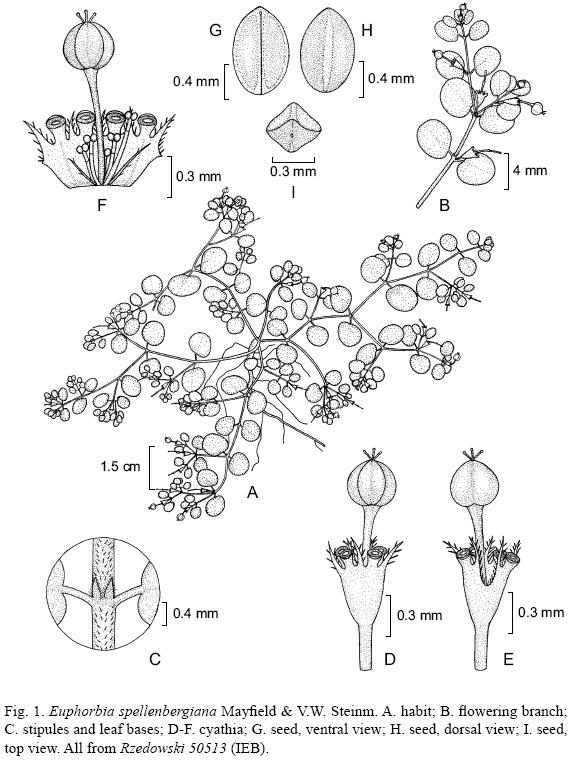
<body><![CDATA[<p align="justify"><font face="verdana" size="2">&nbsp;</font></p> 				    <p align="justify"><font face="verdana" size="2">With approximately 250 species (Mart&iacute;nez&#150;Gordillo et al., 2002; Steinmann, 2002), <i>Euphorbia </i>L. is one of the largest genera in Mexico, and the country represents a major center of diversity for the genus. In the course of routine identifications of <i>Euphorbia</i> specimens from Mexico and in the preparation of the Flora del Baj&iacute;o y de Regiones Adyacentes, we encountered specimens of an inconspicuous but widespread species that had been collected numerous times from Chihuahua to Michoac&aacute;n. Despite the facts that the first gatherings were made over a hundred years ago by the renowned botanist Cyrus G. Pringle and that there are specimens in many major herbaria, the species has been overlooked until recently. The purpose of this paper is to describe this species and provide information we have on its distribution, habitat, and distinguishing characteristics.</font></p> 				    <p align="justify"><font face="verdana" size="2"><b>Euphorbia spellenbergiana</b> Mayfield &amp; V.W. Steinm., sp. nov. Type: MEXICO. Chihuahua: mpio. Ocampo, Parque Nacional "Cascada de Basaseachic," along the rd to the Divisadero overlook on the S side of the park, just below the Divisadero, at a drying temporary pond near hotel, 28&deg;11' N, 108&deg;12'30" W, ca. 2100 m, moist pale gray igneous nearly dry mud, heavily cattle&#150;trampled area, with <i>Eragrostis pectinacea, Muhlenbergia vaginata, Eragrostis pringlei, Tillaea aquatica, Bulbostylis capillaris</i>, 25 Oct 1992, <i>Spellenberg 11675</i> (holotype: NMC!; isotypes: TEX (2 sheets)!, MEXU!). <a href="#f1">Fig. 1.</a></font></p> 				    <p align="center"><font face="verdana" size="2"><a name="f1"></a></font></p> 				    <p align="center"><font face="verdana" size="2"><img src="/img/revistas/abm/n90/a5f1.jpg"></font></p> 				    <p align="justify"><font face="verdana" size="2">Annua prostrata, caulibus 3&#150;7 cm longis, supra puberula, infra glabra, internodia 0.2&#150;1.0 cm longa, teretia, stipulae 0.2&#150;0.4 mm longae, ciliatae, folia opposita, petioli 0.2&#150;0.9 mm longi, glabri, laminae oblongae, suborbiculatae vel subrhombeo&#150;ovatae, 1.5&#150;4.5 mm longae, 1&#150;4 mm latae, bases rotundatae vel hemicordatae, obliquae, apices obtusi vel mucronati, margines integri; involucra campanulata vel obconica, 0.5 mm longa, 0.3&#150;0.6 mm lata, glabra; glandulae 4, subcirculares, oblongae vel reniformes, ca. 0.1 mm longae (radialiter), 0.1&#150;0.2 mm latae (tangentialiter), leviter concavae, appendices ut videtur ausentes vel rudimentariae; flores staminati 5&#150;8, ovarium glabrum, styli 3, filiformes, ca. 0.2 mm longi, distincti, integri; capsula ovoidea, 0.9&#150;1.1 mm longa, 1.1&#150;1.2 mm lata, 3&#150;lobata; semina ellipsoidea vel oblongo&#150;ovoidea, quadrangulata, 0.7&#150;0.9 mm longa, 0.4 mm lata, ut videtur laevigata.</font></p> 				    <p align="justify"><font face="verdana" size="2">Delicate annual herbs forming orbicular mats to 14 cm wide, with the herbage frequently reddened; roots slender, fibrous; stems prostrate, several radiating evenly from the base, often slightly zigzag, 3&#150;7 cm long, puberulent on the upper surface with short, stiff, white, straight to slightly curved hairs less than 0.1 mm long, lower surface glabrous, internodes terete or slightly flattened above, those of the primary stems 0.2&#150;1.0 cm long, 0.2&#150;0.4 mm in diameter; leaves opposite, stipules similar on both sides of the stems, paired, distinct or united at the base, discontinuous between the petioles, lunate to semiorbicular or triangular, sometimes 2 to 3&#150;lobed, 0.2&#150;0.4 mm long, margins ciliate, apex acute to laciniate; petioles 0.2&#150;0.9 mm long, glabrous; laminas oblong to suborbicular or subrhombic&#150;ovate, 1.5&#150;4.5 mm long, 1&#150;4 mm wide, base strongly oblique, rounded to hemicordate, apex rounded or rarely mucronulate, margin entire; cyathia solitary or 3&#150;7 in condensed floriferous axillary shoots in the upper 2&#150;4 nodes, leaves of the floriferous shoots much reduced and elliptic to narrowly obovate; peduncles 0.1&#150;0.5 mm long, glabrous, involucre campanulate to narrowly obconic, glabrous, ca. 0.5 mm long (excluding the glands and appendages), 0.3&#150;0.6 mm wide; involucral lobes narrowly triangular to subulate, ca. 0.15&#150;0.20 mm long, acuminate to attenuate, ciliate, protruding above the level of the glands; involucral glands 4, suborbicular, oblong or reniform, ca. 0.1 mm long (radially), 0.1&#150;0.2 mm wide (tangentially), slightly concave, red, appendages absent or rudimentary and scarcely protruding from below the rim of the gland, to 0.1 mm long (radially) and 0.2 mm wide (tangentially), entire white to pink; staminate flowers 5&#150;8; ovary glabrous, styles 3, linear, ca. 0.2 mm long, distinct to the base and spreading perpendicularly, straight, undivided; stigma capitate; capsules on gynophores exserted 0.3 to 1.4 mm, narrowly to broadly ovoid, 0.9&#150;1.1 mm long, 1.1&#150;1.2 mm wide, 3&#150;lobed, slightly sulcate between the carpels, columella 0.6&#150;0.9 mm long; seeds elliptic to oblong&#150;ovoid in abaxial outline, quadrangular in cross section, 0.7&#150;0.9 mm long, 0.4 mm wide, bluntly pointed at the apex, rounded to truncate at the base, dorsal angle acute, subcarinate, uninterrupted, testa orangish&#150;red to light brown, appearing smooth, but with obscure longitudinal rows of cells barely visible under 20X magnification, caruncle absent.</font></p> 				    <p align="justify"><font face="verdana" size="2">Taxonomic discussion. <i>Euphorbia spellenbergiana</i> belongs to subgenus <i>Chamaesyce</i> Raf., as defined by Wheeler (1941). Subgenus <i>Chamaesyce</i> (sensu Wheeler, 1941) is a widely understood concept for a monophyletic group of species that share an easily recognizable suite of morphological features (Mayfield, 1991; McVaugh, 1993). The subgenus has also been ranked as a genus (e.g., McVaugh, 1993; Mayfield, 1993; Webster, 1994) but recent phylogenetic analyses (Bruyns et al., 2006; Park and Jansen, 2007; Steinmann and Porter, 2002) demonstrate that the group is a well&#150;supported monophyletic assemblage nested within <i>Euphorbia</i> (when treated as equivalent of Webster's (1994) Euphorbieae subtribe Euphorbiinae).</font></p> 				    <p align="justify"><font face="verdana" size="2"><i>Euphorbia spellenbergiana</i> is one of the most diminutive members of its genus. Despite approximately 1200 km separation between its most&#150;distant populations, the plants are remarkably uniform morphologically across the geographic range. It resembles members of the <i>Euphorbia polycarpa </i>Benth. complex (as circumscribed by Wheeler, 1936) in that it is non&#150;shrubby and possesses entire leaves. It is worth noting, however, that we suspect this assemblage of species (being defined on the basis of geography, habit and leaf morphology) almost certainly represents an unnatural, purely convenient grouping. <i>Euphorbia spellenbergiana</i> is at once distinguished from the members of this complex by its undivided styles with capitate stigmas (vs. bifid styles and non&#150;capitate stigmas). Undivided styles are a very uncommon feature in <i>Euphorbia</i> as a whole, and in particular in species of subg. <i>Chamaesyce</i>. We are aware of only four other species of this taxon in northern Mexico that possess this trait: <i>E. astyla</i> Boiss., <i>E. indivisa</i> (Engelm.) Tidestr., <i>E. revoluta </i>Engelm., and <i>E. stictospora</i> Engelm. There is no close similarity between any of these species with undivided styles, among themselves or with <i>E. spellenbergiana. Euphorbia spellenbergiana</i> is a delicate completely prostrate annual, with entire, oblong to suborbicular, or ovate leaves, reduced subequal or nonexistant involucral gland appendages, smooth (non&#150;ridged) seeds, and puberulent stems. <i>Euphorbia revoluta</i> is an erect to ascending, glabrous species with linear leaves. <i>Euphorbia astyla</i> is a strongly perennial herb with a woody, thickened root and considerably larger cyathia and seeds. <i>Euphorbia indivisa</i> and <i>E. stictospora</i> are both prostrate, annual species, but they are decidedly more robust, have serrulate or serrate leaf margins, and have conspicuous pubescence on the stems, leaves, ovaries, and capsules. <i>Euphorbia indivisa</i> differs further in its conspicuously unequal involucral appendages and transversely sulcate seeds.</font></p> 				    <p align="justify"><font face="verdana" size="2">Some material of <i>Euphorbia spellenbergiana</i> was previously determined as either <i>E. micromera</i> Boiss. or <i>E. serpens</i> H.B.K., annual species that both possess divided styles. Besides the style difference, <i>E. serpens</i> is a completely glabrous plant with broad white stipules, and it roots at the nodes. The latter feature is noteworthy because specimens of <i>E. serpens</i> are usually extracted in small irregular pieces, owing to the adhering node roots and brittle stems. In contrast <i>E. spellenbergiana </i>specimens are without exception composed of one or more complete individual circular mats. More similar in this and other features is <i>E. micromera</i>; the only features that appear to unambiguously separate it from <i>E. spellenbergiana</i> are its divided styles and slightly longer seeds (1.1&#150;1.3 mm vs. 0.7&#150;0.9 mm).</font></p> 				    ]]></body>
<body><![CDATA[<p align="justify"><font face="verdana" size="2">Etymology. It is a pleasure to name this species after Richard Spellenberg, professor emeritus in biology at New Mexico State University. Although he was not the first person to collect this interesting plant, he was first to bring it to our attention after he encountered it more than 20 years ago in conjunction with his floristic research in the vicinity of the Cascada de Basaseachic, Chihuahua.</font></p> 				    <p align="justify"><font face="verdana" size="2">Distribution and habitat. <i>Euphorbia spellenbergiana</i> is endemic to Mexico, ranging from central western Chihuahua south to northern Michoac&aacute;n. The distance between the northernmost and southernmost populations is approximately 1200 km. Although widespread, it is highly habitat specific and occurs only in the thin, moist soil around ephemeral pools that form during the summer monsoon season. It occurs at elevations from 2100 to 2600 m, and the surrounding vegetation has been described as pine&#150;oak forest, grassland and pachycaulous scrub. Although sporadic and localized, its populations are widely separated and frequently found in secondary vegetation; the majority of the collections have been made in the last twenty years. For these reasons, the species is probably not under any immediate risk of extinction.</font></p> 				    <p align="justify"><font face="verdana" size="2">Phenology. Flowering and fruiting overlap broadly and occur from August to November.</font></p> 				    <p align="justify"><font face="verdana" size="2">Additional specimens examined. MEXICO. <b>Aguascalientes</b>: mpio. Calvillo, 2 km al NW de Terrero de Refugio, 2325 m, 02 Sep 1996, <i>de la Cerda 5830</i> (HUAA, IEB); mpio. San Jos&eacute; de Gracia, ca&ntilde;ada al SSE de km 53, carr. La Congoja &#150; La Labor, 2600 m, 30 Oct 2001, <i>Rosales 2145</i> (HUAA, IEB). <b>Chihuahua:</b> base of the Sierra Madre (apparently in the general vicinity of Tonachic according to Pringle's field notes published in Davis (1936)), 28 Sep 1887, <i>Pringle 1360</i> (K, MEXU, MICH); mpio. Guerrero, 6.8 km E of Tomochic on Mexico Hwy. 16, 28&deg;23' N, 107&deg;47' W, ca. 2100 m, 05 Oct 1986, <i>Spellenberg et al. 8879</i> (ARIZ, NMC, TEX). <b>Durango:</b> mpio. Durango, Parque El Tecu&aacute;n, extremo NO, 03 Oct 1996, <i>Garc&iacute;a 2486</i> (IEB); mpio. Durango, Parque El Tecu&aacute;n, Mesa Pelona, al E de la entrada al parque, 23&deg;54'21" N, 105&deg;01'33" W, 2570 m, 17 Oct 1996, <i>Gonz&aacute;lez et al. 5810</i> (IEB); city of Durango and vicinity, Apr&#150;Nov 1896, <i>Palmer 819</i> (K, MEXU, MO). <b>Guanajuato:</b> mpio. Ocampo, desviaci&oacute;n a la Estancia, 06 Oct 1992, <i>Carranza et al. 4299</i> (IEB); mpio. San Diego de la Uni&oacute;n, alrededores de La Sauceda, km 114 carretera Quer&eacute;taro &#150; S.L.P., 11 Sep 1997, <i>P&eacute;rez et al. 3708</i> (IEB). <b>Michoac&aacute;n:</b> mpio. Morelia, 5 km al W de San Miguel del Monte, sobre el camino a At&eacute;cuaro, 2400 m, 25 Oct 1986, <i>Rzedowski 41253</i> (IEB); mpio. Huaniqueo, 5 km al S de Tendeparacua, 2150 m, 21 Oct 1990, <i>Rzedowski 50335</i> (IEB); mpio. Epitacio Huerta, cerca de Palmas, 2550 m, 28 Oct 1990, <i>Rzedowski 50513</i> (IEB). <b>Quer&eacute;taro:</b> mpio. Huimilpan, alrededores de Huimilpan, 2300 m, 14 Oct 1990, <i>Rzedowski 50302</i> (IEB); cerca de San Bartolo, 2600 m, 27 Oct 1990, <i>Rzedowski 50436</i> (IEB); mpio. Huimilpan, 4 km al E de Huimilpan, sobre la carretera a Amealco, 2350 m, 27 Oct 1990, <i>Rzedowski 50463</i> (IEB); mpio. Amealco, 2 km al N de San Ildefonso, 2400 m, 23 Oct 1991, <i>Rzedowski 51130</i> (IEB). <b>Zacatecas:</b> mpio. Valpara&iacute;so, Puerto de la Paja, ca. 20 km WSW of Valpara&iacute;so, along rd to Huejuquilla el Alto, Jalisco, overgrazed oak woodland, 2250 m, 30 Oct 1963, <i>Feddema 2245 </i>(MICH, a mixed collection with <i>Euphorbia indivisa</i> (Englem.) Tidestr.; the plants of <i>Euphorbia spellenbergiana</i> were indicated with an "A" by McVaugh); &plusmn;38 km al W de Jalpa, sobre la carr. a Tlaltenango, 30 km del entronque con la carr. Jalpa &#150; Juchipila, 2550 m, 21&#150;23 Oct 1973, <i>Rzedowski &amp; McVaugh 925</i> (IEB), ibid., 21 Oct 1973, <i>Rzedowski &amp; McVaugh s.n.</i> (ENCB).</font></p> 				    <p align="justify"><font face="verdana" size="2">&nbsp;</font></p> 				    <p align="justify"><font face="verdana" size="2"><b>ACKNOWLEDGMENTS</b></font></p> 				    <p align="justify"><font face="verdana" size="2">We gratefully acknowledge funding support to the Instituto de Ecolog&iacute;a, A.C. (account number 20006) from the Mexican Consejo Nacional de Ciencia y Tecnolog&iacute;a and from the Comisi&oacute;n Nacional para el Conocimiento y Uso de la Biodiversidad, as well as support from an NSF Planetary Biodiversity Inventory grant (DEB&#150;0616533). We thank the curators and staffs of ARIZ, HUAA, IEB, K, MEXU, MICH, MO, NMC, and TEX for allowing access to their collections. Rogelio C&aacute;rdenas kindly prepared the illustration.</font></p> 				    <p align="justify"><font face="verdana" size="2">&nbsp;</font></p> 				    <p align="justify"><font face="verdana" size="2"><b>LITERATURE CITED</b></font></p> 				    <!-- ref --><p align="justify"><font face="verdana" size="2">Bruyns, P. V., R. J. Mapaya and T.J. Hedderson. 2006. A new subgeneric classification for <i>Euphorbia</i> (Euphorbiaceae) in southern Africa based on ITS and psbA&#150;trnH sequence data. Taxon 55: 397&#150;420.</font>&nbsp;&nbsp;&nbsp;&nbsp;&nbsp;&nbsp;&nbsp;&nbsp;[&#160;<a href="javascript:void(0);" onclick="javascript: window.open('/scielo.php?script=sci_nlinks&ref=028980&pid=S0187-7151201000010000500001&lng=','','width=640,height=500,resizable=yes,scrollbars=1,menubar=yes,');">Links</a>&#160;]<!-- end-ref --> 				    <!-- ref --><p align="justify"><font face="verdana" size="2">Davis, H. B. 1936. Life and work of Cyrus Guernsey Pringle. University of Vermont. Burlington. 756 pp.</font>&nbsp;&nbsp;&nbsp;&nbsp;&nbsp;&nbsp;&nbsp;&nbsp;[&#160;<a href="javascript:void(0);" onclick="javascript: window.open('/scielo.php?script=sci_nlinks&ref=028982&pid=S0187-7151201000010000500002&lng=','','width=640,height=500,resizable=yes,scrollbars=1,menubar=yes,');">Links</a>&#160;]<!-- end-ref --> 				    <!-- ref --><p align="justify"><font face="verdana" size="2">Mart&iacute;nez&#150;Gordillo, M., J. Jim&eacute;nez&#150;Ram&iacute;rez, R. Cruz&#150;Dur&aacute;n, E. Ju&aacute;rez&#150;Arriaga, R. Garc&iacute;a, A. Cervantes and R. Mej&iacute;a&#150;Hern&aacute;ndez. 2002. Los g&eacute;neros de la familia Euphorbiaceae en M&eacute;xico. Anales Inst. Biol. Univ. Nac. Aut&oacute;n. M&eacute;xico, Ser. Bot. 73: 155&#150;281. </font>&nbsp;&nbsp;&nbsp;&nbsp;&nbsp;&nbsp;&nbsp;&nbsp;[&#160;<a href="javascript:void(0);" onclick="javascript: window.open('/scielo.php?script=sci_nlinks&ref=028984&pid=S0187-7151201000010000500003&lng=','','width=640,height=500,resizable=yes,scrollbars=1,menubar=yes,');">Links</a>&#160;]<!-- end-ref --> 				    <!-- ref --><p align="justify"><font face="verdana" size="2">Mayfield, M. H. 1991. <i>Euphorbia johnstonii</i> (Euphorbiaceae), a new species from Tamaulipas, Mexico with notes on Euphorbia subsection <i>Acutae</i>. Sida 14(4): 573&#150;579.</font>&nbsp;&nbsp;&nbsp;&nbsp;&nbsp;&nbsp;&nbsp;&nbsp;[&#160;<a href="javascript:void(0);" onclick="javascript: window.open('/scielo.php?script=sci_nlinks&ref=028986&pid=S0187-7151201000010000500004&lng=','','width=640,height=500,resizable=yes,scrollbars=1,menubar=yes,');">Links</a>&#160;]<!-- end-ref --> 				    <!-- ref --><p align="justify"><font face="verdana" size="2">Mayfield, M. H. 1993. New combinations in <i>Chamaesyce</i> Gray (Euphorbiaceae) from Texas and the Chihuahuan Desert. Phytologia 75: 178&#150;83.</font>&nbsp;&nbsp;&nbsp;&nbsp;&nbsp;&nbsp;&nbsp;&nbsp;[&#160;<a href="javascript:void(0);" onclick="javascript: window.open('/scielo.php?script=sci_nlinks&ref=028988&pid=S0187-7151201000010000500005&lng=','','width=640,height=500,resizable=yes,scrollbars=1,menubar=yes,');">Links</a>&#160;]<!-- end-ref --> 				    <!-- ref --><p align="justify"><font face="verdana" size="2">McVaugh, R. 1993. Euphorbiae Novo&#150;Galiciane revisae. Contr. Univ. Michigan Herb. 19: 207&#150;239.</font>&nbsp;&nbsp;&nbsp;&nbsp;&nbsp;&nbsp;&nbsp;&nbsp;[&#160;<a href="javascript:void(0);" onclick="javascript: window.open('/scielo.php?script=sci_nlinks&ref=028990&pid=S0187-7151201000010000500006&lng=','','width=640,height=500,resizable=yes,scrollbars=1,menubar=yes,');">Links</a>&#160;]<!-- end-ref --> 				    <!-- ref --><p align="justify"><font face="verdana" size="2">Park, K.&#150;R. and R. K. Jansen. 2007. A phylogeny of Euphorbieae subtribe Euphorbiinae (Euphorbiaceae) based on molecular data. J. Plant Biol. 50: 644&#150;649.</font>&nbsp;&nbsp;&nbsp;&nbsp;&nbsp;&nbsp;&nbsp;&nbsp;[&#160;<a href="javascript:void(0);" onclick="javascript: window.open('/scielo.php?script=sci_nlinks&ref=028992&pid=S0187-7151201000010000500007&lng=','','width=640,height=500,resizable=yes,scrollbars=1,menubar=yes,');">Links</a>&#160;]<!-- end-ref --> 				    <!-- ref --><p align="justify"><font face="verdana" size="2">Steinmann, V. W. 2002. Diversidad y endemismo de la familia Euphorbiaceae en M&eacute;xico. Acta Bot. Mex. 61: 61&#150;93.</font>&nbsp;&nbsp;&nbsp;&nbsp;&nbsp;&nbsp;&nbsp;&nbsp;[&#160;<a href="javascript:void(0);" onclick="javascript: window.open('/scielo.php?script=sci_nlinks&ref=028994&pid=S0187-7151201000010000500008&lng=','','width=640,height=500,resizable=yes,scrollbars=1,menubar=yes,');">Links</a>&#160;]<!-- end-ref --> 				    <!-- ref --><p align="justify"><font face="verdana" size="2">Steinmann, V. W. and J. M. Porter. 2002. Phylogenetic relationships in Euphorbieae (Euphorbiaceae) based on ITS and <i>ndh</i>F sequence data. Ann. Mo. Bot. Gard. 89: 453&#150;490.</font>&nbsp;&nbsp;&nbsp;&nbsp;&nbsp;&nbsp;&nbsp;&nbsp;[&#160;<a href="javascript:void(0);" onclick="javascript: window.open('/scielo.php?script=sci_nlinks&ref=028996&pid=S0187-7151201000010000500009&lng=','','width=640,height=500,resizable=yes,scrollbars=1,menubar=yes,');">Links</a>&#160;]<!-- end-ref --> 				    <!-- ref --><p align="justify"><font face="verdana" size="2">Webster, G. L. 1994. Synopsis of the genera and suprageneric taxa of Euphorbiaceae. Ann. Mo. Bot. Gard. 81: 33&#150;144.</font>&nbsp;&nbsp;&nbsp;&nbsp;&nbsp;&nbsp;&nbsp;&nbsp;[&#160;<a href="javascript:void(0);" onclick="javascript: window.open('/scielo.php?script=sci_nlinks&ref=028998&pid=S0187-7151201000010000500010&lng=','','width=640,height=500,resizable=yes,scrollbars=1,menubar=yes,');">Links</a>&#160;]<!-- end-ref --> 				    <!-- ref --><p align="justify"><font face="verdana" size="2">Wheeler, L. C. 1936. Revision of the <i>Euphorbia polycarpa</i> group of the Southwestern United States and adjacent Mexico; a preliminary treatment. Bull. Torr. Bot. Club 63: 397&#150;416, 429&#150;450.</font>&nbsp;&nbsp;&nbsp;&nbsp;&nbsp;&nbsp;&nbsp;&nbsp;[&#160;<a href="javascript:void(0);" onclick="javascript: window.open('/scielo.php?script=sci_nlinks&ref=029000&pid=S0187-7151201000010000500011&lng=','','width=640,height=500,resizable=yes,scrollbars=1,menubar=yes,');">Links</a>&#160;]<!-- end-ref --> 				    <!-- ref --><p align="justify"><font face="verdana" size="2">Wheeler, L. C. 1941. <i>Euphorbia</i> subgenus <i>Chamaesyce</i> in Canada and the United States exclusive of southern Florida. Rhodora 43: 97&#150;154, 168&#150;205, 223&#150;286; plates 654&#150;668.</font>&nbsp;&nbsp;&nbsp;&nbsp;&nbsp;&nbsp;&nbsp;&nbsp;[&#160;<a href="javascript:void(0);" onclick="javascript: window.open('/scielo.php?script=sci_nlinks&ref=029002&pid=S0187-7151201000010000500012&lng=','','width=640,height=500,resizable=yes,scrollbars=1,menubar=yes,');">Links</a>&#160;]<!-- end-ref --> ]]></body><back>
<ref-list>
<ref id="B1">
<nlm-citation citation-type="journal">
<person-group person-group-type="author">
<name>
<surname><![CDATA[Bruyns]]></surname>
<given-names><![CDATA[P. V.]]></given-names>
</name>
<name>
<surname><![CDATA[Mapaya]]></surname>
<given-names><![CDATA[R. J.]]></given-names>
</name>
<name>
<surname><![CDATA[Hedderson]]></surname>
<given-names><![CDATA[T.J.]]></given-names>
</name>
</person-group>
<article-title xml:lang="en"><![CDATA[A new subgeneric classification for Euphorbia (Euphorbiaceae) in southern Africa based on ITS and psbA-trnH sequence data]]></article-title>
<source><![CDATA[Taxon]]></source>
<year>2006</year>
<volume>55</volume>
<page-range>397-420</page-range></nlm-citation>
</ref>
<ref id="B2">
<nlm-citation citation-type="book">
<person-group person-group-type="author">
<name>
<surname><![CDATA[Davis]]></surname>
<given-names><![CDATA[H. B.]]></given-names>
</name>
</person-group>
<source><![CDATA[Life and work of Cyrus Guernsey Pringle]]></source>
<year>1936</year>
<page-range>756</page-range><publisher-loc><![CDATA[Burlington ]]></publisher-loc>
<publisher-name><![CDATA[University of Vermont]]></publisher-name>
</nlm-citation>
</ref>
<ref id="B3">
<nlm-citation citation-type="journal">
<person-group person-group-type="author">
<name>
<surname><![CDATA[Martínez-Gordillo]]></surname>
<given-names><![CDATA[M.]]></given-names>
</name>
<name>
<surname><![CDATA[Jiménez-Ramírez]]></surname>
<given-names><![CDATA[J.]]></given-names>
</name>
<name>
<surname><![CDATA[Cruz-Durán]]></surname>
<given-names><![CDATA[R.]]></given-names>
</name>
<name>
<surname><![CDATA[Juárez-Arriaga]]></surname>
<given-names><![CDATA[E.]]></given-names>
</name>
<name>
<surname><![CDATA[García]]></surname>
<given-names><![CDATA[R.]]></given-names>
</name>
<name>
<surname><![CDATA[Cervantes]]></surname>
<given-names><![CDATA[A.]]></given-names>
</name>
<name>
<surname><![CDATA[Mejía-Hernández]]></surname>
<given-names><![CDATA[R.]]></given-names>
</name>
</person-group>
<article-title xml:lang="es"><![CDATA[Los géneros de la familia Euphorbiaceae en México]]></article-title>
<source><![CDATA[Anales Inst. Biol.]]></source>
<year>2002</year>
<volume>73</volume>
<numero>^sSer. Bot.</numero>
<issue>^sSer. Bot.</issue>
<supplement>Ser. Bot.</supplement>
<page-range>155-281</page-range><publisher-name><![CDATA[Univ. Nac. Autón. México]]></publisher-name>
</nlm-citation>
</ref>
<ref id="B4">
<nlm-citation citation-type="journal">
<person-group person-group-type="author">
<name>
<surname><![CDATA[Mayfield]]></surname>
<given-names><![CDATA[M. H.]]></given-names>
</name>
</person-group>
<article-title xml:lang="en"><![CDATA[Euphorbia johnstonii (Euphorbiaceae), a new species from Tamaulipas, Mexico with notes on Euphorbia subsection Acutae]]></article-title>
<source><![CDATA[Sida]]></source>
<year>1991</year>
<volume>14</volume>
<numero>4</numero>
<issue>4</issue>
<page-range>573-579</page-range></nlm-citation>
</ref>
<ref id="B5">
<nlm-citation citation-type="journal">
<person-group person-group-type="author">
<name>
<surname><![CDATA[Mayfield]]></surname>
<given-names><![CDATA[M. H.]]></given-names>
</name>
</person-group>
<article-title xml:lang="en"><![CDATA[New combinations in Chamaesyce Gray (Euphorbiaceae) from Texas and the Chihuahuan Desert]]></article-title>
<source><![CDATA[Phytologia]]></source>
<year>1993</year>
<volume>75</volume>
<page-range>178-83</page-range></nlm-citation>
</ref>
<ref id="B6">
<nlm-citation citation-type="journal">
<person-group person-group-type="author">
<name>
<surname><![CDATA[McVaugh]]></surname>
<given-names><![CDATA[R.]]></given-names>
</name>
</person-group>
<article-title xml:lang="pt"><![CDATA[Euphorbiae Novo-Galiciane revisae]]></article-title>
<source><![CDATA[Contr. Univ. Michigan Herb.]]></source>
<year>1993</year>
<volume>19</volume>
<page-range>207-239</page-range></nlm-citation>
</ref>
<ref id="B7">
<nlm-citation citation-type="journal">
<person-group person-group-type="author">
<name>
<surname><![CDATA[Park]]></surname>
<given-names><![CDATA[K.-R.]]></given-names>
</name>
<name>
<surname><![CDATA[Jansen]]></surname>
<given-names><![CDATA[R. K.]]></given-names>
</name>
</person-group>
<article-title xml:lang="en"><![CDATA[A phylogeny of Euphorbieae subtribe Euphorbiinae (Euphorbiaceae) based on molecular data]]></article-title>
<source><![CDATA[J. Plant Biol.]]></source>
<year>2007</year>
<volume>50</volume>
<page-range>644-649</page-range></nlm-citation>
</ref>
<ref id="B8">
<nlm-citation citation-type="journal">
<person-group person-group-type="author">
<name>
<surname><![CDATA[Steinmann]]></surname>
<given-names><![CDATA[V. W.]]></given-names>
</name>
</person-group>
<article-title xml:lang="es"><![CDATA[Diversidad y endemismo de la familia Euphorbiaceae en México]]></article-title>
<source><![CDATA[Acta Bot. Mex.]]></source>
<year>2002</year>
<volume>61</volume>
<page-range>61-93</page-range></nlm-citation>
</ref>
<ref id="B9">
<nlm-citation citation-type="journal">
<person-group person-group-type="author">
<name>
<surname><![CDATA[Steinmann]]></surname>
<given-names><![CDATA[V. W.]]></given-names>
</name>
<name>
<surname><![CDATA[Porter]]></surname>
<given-names><![CDATA[J. M.]]></given-names>
</name>
</person-group>
<article-title xml:lang="en"><![CDATA[Phylogenetic relationships in Euphorbieae (Euphorbiaceae) based on ITS and ndhF sequence data]]></article-title>
<source><![CDATA[Ann. Mo. Bot. Gard.]]></source>
<year>2002</year>
<volume>89</volume>
<page-range>453-490</page-range></nlm-citation>
</ref>
<ref id="B10">
<nlm-citation citation-type="journal">
<person-group person-group-type="author">
<name>
<surname><![CDATA[Webster]]></surname>
<given-names><![CDATA[G. L.]]></given-names>
</name>
</person-group>
<article-title xml:lang="en"><![CDATA[Synopsis of the genera and suprageneric taxa of Euphorbiaceae]]></article-title>
<source><![CDATA[Ann. Mo. Bot. Gard.]]></source>
<year>1994</year>
<volume>81</volume>
<page-range>33-144</page-range></nlm-citation>
</ref>
<ref id="B11">
<nlm-citation citation-type="journal">
<person-group person-group-type="author">
<name>
<surname><![CDATA[Wheeler]]></surname>
<given-names><![CDATA[L. C.]]></given-names>
</name>
</person-group>
<article-title xml:lang="en"><![CDATA[Revision of the Euphorbia polycarpa group of the Southwestern United States and adjacent Mexico; a preliminary treatment]]></article-title>
<source><![CDATA[Bull. Torr. Bot. Club]]></source>
<year>1936</year>
<volume>63</volume>
<page-range>397-416</page-range><page-range>429-450</page-range></nlm-citation>
</ref>
<ref id="B12">
<nlm-citation citation-type="journal">
<person-group person-group-type="author">
<name>
<surname><![CDATA[Wheeler]]></surname>
<given-names><![CDATA[L. C.]]></given-names>
</name>
</person-group>
<article-title xml:lang="en"><![CDATA[Euphorbia subgenus Chamaesyce in Canada and the United States exclusive of southern Florida]]></article-title>
<source><![CDATA[Rhodora]]></source>
<year>1941</year>
<volume>43</volume>
<page-range>97-154</page-range><page-range>168-205</page-range><page-range>223-286</page-range></nlm-citation>
</ref>
</ref-list>
</back>
</article>
