<?xml version="1.0" encoding="ISO-8859-1"?><article xmlns:mml="http://www.w3.org/1998/Math/MathML" xmlns:xlink="http://www.w3.org/1999/xlink" xmlns:xsi="http://www.w3.org/2001/XMLSchema-instance">
<front>
<journal-meta>
<journal-id>0187-6236</journal-id>
<journal-title><![CDATA[Atmósfera]]></journal-title>
<abbrev-journal-title><![CDATA[Atmósfera]]></abbrev-journal-title>
<issn>0187-6236</issn>
<publisher>
<publisher-name><![CDATA[Universidad Nacional Autónoma de México, Instituto de Ciencias de la Atmósfera y Cambio Climático]]></publisher-name>
</publisher>
</journal-meta>
<article-meta>
<article-id>S0187-62362008000400003</article-id>
<title-group>
<article-title xml:lang="en"><![CDATA[Universal multifractal description of an hourly rainfall time series from a location in southern Spain]]></article-title>
</title-group>
<contrib-group>
<contrib contrib-type="author">
<name>
<surname><![CDATA[GARCÍA-MARÍN]]></surname>
<given-names><![CDATA[A. P]]></given-names>
</name>
<xref ref-type="aff" rid="A01"/>
</contrib>
<contrib contrib-type="author">
<name>
<surname><![CDATA[JIMÉNEZ-HORNERO]]></surname>
<given-names><![CDATA[F. J]]></given-names>
</name>
<xref ref-type="aff" rid="A02"/>
</contrib>
<contrib contrib-type="author">
<name>
<surname><![CDATA[AYUSO-MUÑOZ]]></surname>
<given-names><![CDATA[J. L]]></given-names>
</name>
<xref ref-type="aff" rid="A01"/>
</contrib>
</contrib-group>
<aff id="A01">
<institution><![CDATA[,Universidad de Córdoba Departamento de Ingeniería Rural ]]></institution>
<addr-line><![CDATA[Córdoba ]]></addr-line>
<country>España</country>
</aff>
<aff id="A02">
<institution><![CDATA[,Universidad de Córdoba Departamento de Ingeniería Gráfica y Geomática ]]></institution>
<addr-line><![CDATA[Cordoba ]]></addr-line>
<country>España</country>
</aff>
<pub-date pub-type="pub">
<day>00</day>
<month>10</month>
<year>2008</year>
</pub-date>
<pub-date pub-type="epub">
<day>00</day>
<month>10</month>
<year>2008</year>
</pub-date>
<volume>21</volume>
<numero>4</numero>
<fpage>347</fpage>
<lpage>355</lpage>
<copyright-statement/>
<copyright-year/>
<self-uri xlink:href="http://www.scielo.org.mx/scielo.php?script=sci_arttext&amp;pid=S0187-62362008000400003&amp;lng=en&amp;nrm=iso"></self-uri><self-uri xlink:href="http://www.scielo.org.mx/scielo.php?script=sci_abstract&amp;pid=S0187-62362008000400003&amp;lng=en&amp;nrm=iso"></self-uri><self-uri xlink:href="http://www.scielo.org.mx/scielo.php?script=sci_pdf&amp;pid=S0187-62362008000400003&amp;lng=en&amp;nrm=iso"></self-uri><abstract abstract-type="short" xml:lang="es"><p><![CDATA[El formalismo multifractal de turbulencia ha sido usado para llevar a cabo el análisis de la estructura temporal, para escalas desde 1 hora hasta casi 6 meses, de la serie de datos de lluvia horaria registrada durante veinticuatro años en Córdoba, localidad situada en el sur de España. Los parámetros del modelo multifractal universal fueron estimados y se obtuvo la función teórica de los momentos estadísticos. Se encontró un buen ajuste a la función empírica para un intervalo de valores de momentos, demostrándose que el modelo multifractal universal resulta adecuado para describir estadísticamente la serie temporal de lluvia registrada en Córdoba.]]></p></abstract>
<abstract abstract-type="short" xml:lang="en"><p><![CDATA[Multifractal turbulence formalism has been used to perform an analysis for scales from 1 hour to almost 6 months of the time structure of the hourly rainfall series recorded during twenty-four years in Córdoba, a location in southern Spain. The parameters of the universal multifractal model were estimated and the theoretical moments scaling exponent function was obtained exhibiting an acceptable agreement with the empirical function for a range of moments. The universal multifractal model shown itself to be a suitable tool for describing the statistics of the rainfall series recorded in Córdoba.]]></p></abstract>
<kwd-group>
<kwd lng="en"><![CDATA[Rainfall]]></kwd>
<kwd lng="en"><![CDATA[multifractal analysis]]></kwd>
<kwd lng="en"><![CDATA[universal multifractal model]]></kwd>
</kwd-group>
</article-meta>
</front><body><![CDATA[ <p align="center"><font face="verdana" size="4"><b>Universal multifractal description of an hourly rainfall time series from a location in southern Spain</b></font></p>     <p align="center"><font face="verdana" size="2">&nbsp;</font></p>     <p align="center"><font face="verdana" size="2"><b>A. P. GARC&Iacute;A&#150;MAR&Iacute;N</b>    <br> <i>Departamento de Ingenier&iacute;a Rural, Universidad de C&oacute;rdoba,     <br> Campus Rabanales, 14071 C&oacute;rdoba, Espa&ntilde;a</i></font></p>     <p align="center"><font face="verdana" size="2"><b>F. J. JIM&Eacute;NEZ&#150;HORNERO</b>    <br> <i>Departamento de Ingenier&iacute;a Gr&aacute;fica y Geom&aacute;tica,     <br> Universidad de C&oacute;rdoba, Edificio Gregor Mendel,</i>    <br> <i>Campus Rabanales, 14071 Cordoba, Espa&ntilde;a </i>    <br> Corresponding author; e&#150;mail: <a href="mailto:fjhornero@uco.es" target="_blank">fjhornero@uco.es</a></font></p>     ]]></body>
<body><![CDATA[<p align="center"><font face="verdana" size="2"><b>J. L. AYUSO&#150;MU&Ntilde;OZ</b>    <br> <i>Departamento de Ingenier&iacute;a Rural, Universidad de C&oacute;rdoba,     <br> Campus Rabanales, 14071 C&oacute;rdoba, Espa&ntilde;a</i></font></p>     <p align="center"><font face="verdana" size="2">&nbsp;</font></p>     <p align="center"><font face="verdana" size="2">Received March 20, 2007; accepted June 2, 2008 </font></p>     <p align="justify"><font face="verdana" size="2">&nbsp;</font></p>     <p align="justify"><font face="verdana" size="2"><b>RESUMEN</b></font></p>     <p align="justify"><font face="verdana" size="2">El formalismo multifractal de turbulencia ha sido usado para llevar a cabo el an&aacute;lisis de la estructura temporal, para escalas desde 1 hora hasta casi 6 meses, de la serie de datos de lluvia horaria registrada durante veinticuatro a&ntilde;os en C&oacute;rdoba, localidad situada en el sur de Espa&ntilde;a. Los par&aacute;metros del modelo multifractal universal fueron estimados y se obtuvo la funci&oacute;n te&oacute;rica de los momentos estad&iacute;sticos. Se encontr&oacute; un buen ajuste a la funci&oacute;n emp&iacute;rica para un intervalo de valores de momentos, demostr&aacute;ndose que el modelo multifractal universal resulta adecuado para describir estad&iacute;sticamente la serie temporal de lluvia registrada en C&oacute;rdoba.</font></p>     <p align="justify"><font face="verdana" size="2">&nbsp;</font></p>     <p align="justify"><font face="verdana" size="2"><b>ABSTRACT</b></font></p>     ]]></body>
<body><![CDATA[<p align="justify"><font face="verdana" size="2">Multifractal turbulence formalism has been used to perform an analysis for scales from 1 hour to almost 6 months of the time structure of the hourly rainfall series recorded during twenty&#150;four years in C&oacute;rdoba, a location in southern Spain. The parameters of the universal multifractal model were estimated and the theoretical moments scaling exponent function was obtained exhibiting an acceptable agreement with the empirical function for a range of moments. The universal multifractal model shown itself to be a suitable tool for describing the statistics of the rainfall series recorded in C&oacute;rdoba.</font></p>     <p align="justify"><font face="verdana" size="2"><b>Keywords:</b> Rainfall, multifractal analysis, universal multifractal model.</font></p>     <p align="justify"><font face="verdana" size="2">&nbsp;</font></p>     <p align="justify"><font face="verdana" size="2"><b>1.</b>&nbsp;<b>Introduction</b></font></p>     <p align="justify"><font face="verdana" size="2">Rainfall is the main factor in many processes with a significant environmental impact such as floods, droughts, runoff, soil erosion or spread of pollutants. However, the great temporal (and spatial) non&#150;linear variability of precipitation limits the use of many existing models to describe this process.</font></p>     <p align="justify"><font face="verdana" size="2">On certain space&#150;time scales and, specifically, in very small catchments and in urban areas, rainfall intensities present larger fluctuations, and therefore higher values than on meteorological model scales. Thus, the reliability of a forecast provided by meteorological models also depends on the efficiency of downscaling models.</font></p>     <p align="justify"><font face="verdana" size="2">The invariance of properties in any process over a range of scales is called scaling. Scaling systems can be described by fractal and multifractal theories, the latter being an evolution of the former. Fractal theory (Mandelbrot, 1982) deals with simple scaling and can describe complex phenomena by using few parameters. However, multifractal theory deals with multiscaling that allows to generalize the scaling properties of a process (Grassberger, 1983; Hentschel and Procaccia, 1983; Deidda, 2000; Deidda<i> et al., </i>2006).</font></p>     <p align="justify"><font face="verdana" size="2">The multifractal analysis of rainfall has been widely used to describe its temporal and spatial distribution (Schertzer and Lovejoy, 1987; Fraedrich and Larnder, 1993; Ladoy <i>et al., </i>1993; Tessier <i>et al., </i>1993, 1996; Over and Gupta, 1994; Svensson et al., 1996; de Lima and Grasman, 1999; Kiely and Ivanova, 1999; Sivakumar, 2001; Labat <i>et al., </i>2002; Veneziano and Furcolo, 2002; Olsson and Burlando, 2002; Kantelhardt <i>et al., </i>2006; Langousis and Veneziano, 2007). The universal multifractal model (UM) which uses the formalism of turbulence, was developed by Schertzer and Lovejoy (1987) to model the variability of rainfall by a multiplicative cascade process, in which the flux of water is transferred from larger to small regions (scales) of the atmosphere (Over and Gupta, 1994), in a similar way to what happens in turbulence models, where the transfer of energy from larger to smaller scales is assumed. This multifractal approach has been used to carry out multiple analyses of rainfall and related topics (Hubert <i>et al., </i>1993; Ladoy <i>et al., </i>1993; Tessier <i>et al., </i>1993, 1996; Svensson <i>et al., </i>1996; de Lima and Grassman, 1999; Lilley <i>et al., </i>2006; Lovejoy and Schertzer, 2006; Lashermes and Foufoula&#150;Georgiou, 2007).</font></p>     <p align="justify"><font face="verdana" size="2">The objective of the present work was to perform an analysis of the long&#150;term hourly rainfall series recorded in C&oacute;rdoba, a location in southern Spain, by using the multifractal turbulence formalism to check whether the results were consistent with those found in earlier studies for other locations. This was done as a contribution to the consolidation of the existing knowledge on the multifractal nature of precipitation, and to confirm the possible use of the universal multifractal model to generate synthetic rainfall data in the cited location.</font></p>     <p align="justify"><font face="verdana" size="2">&nbsp;</font></p>     ]]></body>
<body><![CDATA[<p align="justify"><font face="verdana" size="2"><b>2.</b>&nbsp;<b>Material and methods</b></font></p>     <p align="justify"><font face="verdana" size="2"><i>2.1 Universal multifractals</i></font></p>     <p align="justify"><font face="verdana" size="2">To carry out a rainfall time structure analysis by applying multifractal turbulence formalism, the data series should be divided into non&#150;overlapping intervals of a certain resolution. The ratio of the maximum scale of the field to this interval is termed "scale ratio", &lambda; (Svensson <i>et al., </i>1996). Considering &epsilon;<sub>&lambda;</sub> as the rainfall intensity on each time interval at the scale ratio &lambda; divided by the average of the sample corresponding to the largest scale of interest (&lambda; =1), the ensemble average <i>qth </i>moment &lt;&epsilon;<sub>&lambda;</sub><sup>q</sup> &gt; is related to the empirical moments scaling exponent function <i>K</i>(<i>q</i>) in such a way that (Schertzer and Lovejoy, 1987):</font></p>     <p align="center"><font face="verdana" size="2"><img src="/img/revistas/atm/v21n4/a3s1.jpg" alt=""></font></p>     <p align="justify"><font face="verdana" size="2">The scaling behaviour expressed by Eq. (1) can be investigated by plotting  &lt;&epsilon;<sub>&lambda;</sub><sup>q</sup> &gt;  as a function of  &lambda; in a log&#150;log diagram for different values of <i>q. </i>The curves obtained will exhibit an approximately linear behaviour with slopes that are estimations of <i>K</i>(<i>q</i>) if Eq. (1) is valid. If <i>K</i>(<i>q</i>) versus <i>q </i>is a straight line, the data set is monofractal. However, if <i>K</i>(<i>q</i>) versus <i>q </i>is a convex function, the data set is multifractal (Parisi and Frisch, 1985).</font></p>     <p align="justify"><font face="verdana" size="2">The universal multifractal (UM) model was proposed by Schertzer and Lovejoy (1987) assuming that the generator of multifractals was a random variable with an exponentiated extremal L&eacute;vy distribution. Thus, the theoretical scaling exponent function K(<i>q</i>) for the moments <i>q <u>&gt;</u> </i>0 of a cascade process is obtained according to:</font></p>     <p align="center"><font face="verdana" size="2"><img src="/img/revistas/atm/v21n4/a3s2.jpg" alt=""></font></p>     <p align="justify"><font face="verdana" size="2">in which &alpha; <img src="/img/revistas/atm/v21n4/a3s5.jpg" alt=""> &#91;0, 2&#93; is the L&eacute;vy index and indicates the degree of multifractality (i.e. the deviation from monofractality). &alpha; = 0 and &alpha; = 2 correspond to the monofractal and log&#150;normal cases, respectively.<i>C</i><sub>1</sub><img src="/img/revistas/atm/v21n4/a3s5.jpg" alt=""> &#91;0, <i>d</i>&#93;<i>, </i>with dbeing the dimension of the support (<i>d = </i>1 in this case), describes the sparseness or inhomogeneity of the mean of the process. Parameter <i>H </i>determines the deviation from conservation times (&lt;&epsilon;<sub>&lambda;</sub><sup>q</sup> &gt; = &lambda; <i><sup>&#150;H</sup>). </i>For conserved processes, <i>H = 0.</i></font></p>     <p align="justify"><font face="verdana" size="2">The estimation of the parameters<i> C</i><sub>1</sub><i> </i>and a can be made by applying the double trace moment (DTM) technique (Lavall&eacute;e <i>et al., </i>1993). Thus, the intensity &epsilon;<sub>&Lambda;</sub> associated with the finest resolution &Lambda; is first raised to the power &eta;, degraded to the scale ratio &lambda; and the <i>q</i>th power of the result averaged over the available data. The double moment exponent function <i>K</i>(<i>q,</i>&eta;) is derived from:</font></p>     <p align="center"><font face="verdana" size="2"><img src="/img/revistas/atm/v21n4/a3s3.jpg" alt=""></font></p>     ]]></body>
<body><![CDATA[<p align="justify"><font face="verdana" size="2">by using log&#150;log plots, as described for the <i>K</i>(<i>q</i>) function.</font></p>     <p align="justify"><font face="verdana" size="2">The parameter can be estimated as the slope of the linear regression fitted to the plot of <i>|K(q, </i>&eta;<i>)| </i>versus log (&eta;) for fixed <i>q </i>(Tessier <i>et al., </i>1996). The estimation of<i> C</i><sub>1 </sub>is derived by considering that <i>K</i>(<i>q, </i>1) is the intercept of the linear regression with log (&eta;) = 0. Alternatively, it can be obtained from the empirical moments scaling exponent function <i>K</i>(<i>q</i>)<i>, </i>considering <i>C</i><sub>1</sub>= &#91;<i>dK</i>(<i>q</i>)<i>/dq</i>&#93;<i><sub>q</sub> <sub>=</sub> </i><sub>1</sub></font></p>     <p align="justify"><font face="verdana" size="2">From the estimated values of a and<i> C</i><sub>1</sub><i> </i>and taking the value of exponent &beta; that characterizes the energy spectrum of the conserved process <i>E</i>(&omega;)<i> &asymp; </i>&omega;<sup>&#150;&beta;</sup></sup>, with w being the frequency, the parameter <i>H is </i>given by (Lavall&eacute;e <i>et al., </i>1993):</font></p>     <p align="center"><font face="verdana" size="2"><img src="/img/revistas/atm/v21n4/a3s4.jpg" alt=""></font></p>     <p align="justify"><font face="verdana" size="2">&nbsp;</font></p>     <p align="justify"><font face="verdana" size="2"><i>2.2. Rainfall data</i></font></p>     <p align="justify"><font face="verdana" size="2">The hourly rainfall data analyzed in this work were collected at C&oacute;rdoba airport weather station (37.85&deg; N, 4.85&deg; W) from 1980 to 2003. The altitude is 117 m and the climate of this area can be defined as a mixture between Mediterranean characteristics and Continental effects. The mean annual temperature is 17.7 &deg;C and the amplitude of the average temperatures is 19.6 &deg;C. The annual average potential evaporation is 1500&#150;2000 mm and the mean precipitation is around 600 mm. The rainy period mainly occurs from October to May with the highest amount of precipitation recorded during November&#150;December and February. The general impression for the area is that it is semi&#150;arid with hot, dry summers and relatively temperate winters.</font></p>     <p align="justify"><font face="verdana" size="2">The rainfall data were recorded using a Hellmann rain gauge (World Meteorological Organization standard), with a horizontal opening of 200 cm<sup>2</sup> at a height of 1.2 m. The temporal resolution of this continuously&#150;recorded rain gauge was 1 hour and its accuracy, expressed as the minimum amount of rain that it was able to record, was 0.1 mm.</font></p>     <p align="justify"><font face="verdana" size="2">&nbsp;</font></p>     <p align="justify"><font face="verdana" size="2"><b>3. Results</b></font></p>     ]]></body>
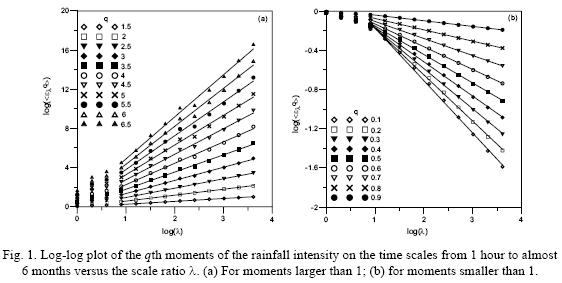
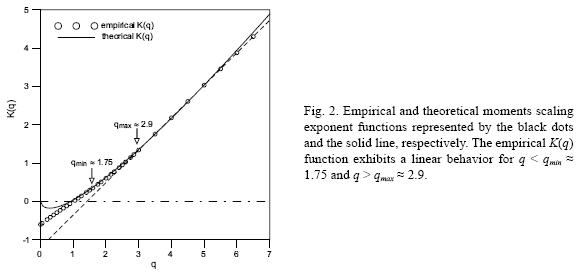
<body><![CDATA[<p align="justify"><font face="verdana" size="2">Following Eq. (1), a wide range of moments of the rainfall intensity &epsilon;<sub>&lambda;</sub> on the time scales from 1 hour (&lambda;<i> = </i>4096) to almost 6 months (&lambda; = 1) have been calculated (<a href="#f1">Figs. 1a and 1b</a>).</font></p>     <p align="center"><font face="verdana" size="2"><a name="f1"></a></font></p>     <p align="center"><font face="verdana" size="2"><img src="/img/revistas/atm/v21n4/a3f1.jpg" alt=""></font></p>     <p align="justify"><font face="verdana" size="2">Straight lines in <a href="#f1">Figs. 1a and 1b</a> can be fitted for all the <i>q</i>th moments, showing the scaling behavior from 1 hour to almost 21 days. The accuracy of the rain gauge (0.1 mm) and the value of large observations in the rainfall data set, affect the results obtained for the <i>q</i>th moments (de Lima and Grasman, 1999). This influence can be observed for small and high values of <i>q, </i>for which the experimental data (symbols in <a href="#f1">Figs 1a and 1b</a>) are not aligned. This fact is a consequence of the limitations of the data set.</font></p>     <p align="justify"><font face="verdana" size="2">The scaling break at 21 days shown in <a href="#f1">Figures 1a and 1b</a> is presumably a manifestation of the "synoptic maximum", which is the typical lifetime of planetary scale atmospheric structures (Kolesnikov and Monin, 1965). Different values of the "synoptic maximum" for the rainfall have been found between 11 (de Lima and Grasman, 1999) and 16 days (Ladoy <i>et al.</i>, 1993; Tessier <i>et al., </i>1996), and one month (Fraedrich and Larnder, 1993; Svensson <i>et al., </i>1996).</font></p>     <p align="justify"><font face="verdana" size="2"><a href="#f2">Figure 2</a> shows the empirical exponent function <i>K</i>(<i>q</i>) that describes the scaling of the moments from 1 hour to 21 days. The shape of <i>K</i>(<i>q</i>) is mainly convex, meaning that the rainfall time series is multifractal. Nevertheless, this function exhibits a linear behaviour for <i>q &lt; q<sub>min</sub>&asymp; </i>1.75 and <i>q &gt; q<sub>max</sub> </i><i>&asymp;</i> 2.9.</font></p>     <p align="center"><font face="verdana" size="2"><a name="f2"></a></font></p>     <p align="center"><font face="verdana" size="2"><img src="/img/revistas/atm/v21n4/a3f2.jpg" alt=""></font></p>     <p align="justify"><font face="verdana" size="2"><a href="/img/revistas/atm/v21n4/a3f3.jpg" target="_blank">Fig. 3a</a> shows the log&#150;log plots of ((&epsilon;<sub>&Lambda;</sub><sup>&eta;</sup>)<sub>&lambda;</sub><i><sup>q</sup></i>) versus &lambda; for <i>q = </i>2, considering different values of &eta;<i>. </i>The log&#150;log linearity in these plots demonstrates the scaling nature of the rainfall series. The corresponding plots of log <i>|K (q, </i>&eta;<i>)| </i>versus log (&eta;)<i>, </i>for &eta; values of 10&#150;1 to 10 at 10<sup>0.05</sup> increments, are shown in <a href="/img/revistas/atm/v21n4/a3f3.jpg" target="_blank">Figure 3b</a> for some of the investigated q&#150;moments, all of them within the range from <i>q<sub>max</sub></i>= 1 .75 up to <i>q<sub>max</sub> = </i>2.9; these values being those that delimit the scaling behavior (i.e. convex shape) in the empirical scaling exponent function <i>K</i>(<i>q</i>) described in <a href="#f2">Figure 2</a>. The slope of the linear segments located at the middle parts of these curves permitted to obtain a value of &alpha; = 0.732 &plusmn; 0.011. According to the estimated value for a, the rainfall process belongs to the universality class with 1 &lt; &alpha; &lt; 0 (Lovejoy and Schertzer, 1990) that corresponds to (log) L&eacute;vy processes with bounded singularities, denominated as conditionally hard multifractals. This result is in agreement with those found by authors such as Tessier <i>et al. </i>(1993) for a global network of 1000 weather stations, Hubert <i>et al. </i>(1993) for Reunion Island (Indian Ocean), Ladoy <i>et al. </i>(1993) for Nimes (France) and de Lima and Grasman (1999) for Vale Formoso (Portugal).</font></p>     <p align="justify"><font face="verdana" size="2">From <a href="/img/revistas/atm/v21n4/a3f3.jpg" target="_blank">Figure 3b</a> the value of <i>C</i><sub>1</sub> can be yielded, this being <i>C</i><sub>1</sub><i> = </i>0.434 &plusmn; 0.005. Working with the empirical scaling exponent function <i>K</i>(<i>q</i>) shown in <a href="#f2">Figure 2</a>, a similar value is obtained, this being <i>C</i><sub>1</sub> = &#91;<i>dk </i>(<i>q</i>)<i>/dq</i>&#93;<i><sub>q</sub> <sub>=</sub> </i><sub>1</sub><i> = </i>0.458. Parameter <i>C</i><sub>1</sub> is the measurement of the sparseness of the data. The larger<i> C</i><sub>1</sub> the more the mean rainfall is inhomogeneous.</font></p>     ]]></body>
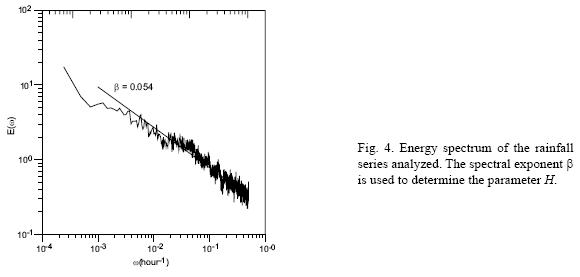
<body><![CDATA[<p align="justify"><font face="verdana" size="2">The estimation of <i>H </i>requires the spectral exponent &beta; = 0.54 estimated from the log&#150;log plot of the energy spectrum for the rainfall series analyzed (<a href="#f4">Fig. 4</a>). The energy spectrum was calculated by using a Tukey&#150;Hanning window of 4096 hours in length with a 50% overlap. Applying Eq. (4) and taking into account the value <i>K</i>(<i>2</i>)<i> = </i>0.561, H = 0.04 was yielded. The theoretical scaling exponent function is then obtained by replacing in Eq. (2) the estimated parameters &alpha;, <i>C</i><sub>1</sub> and <i>H </i>(<a href="#f2">Fig. 2</a>, solid line). The agreement between this function and the empirical <i>K</i>(<i>q</i>) is acceptable for a range of values limited by the small and very high orders of the moments. The disparity between both functions for the smaller orders of moments was a consequence of the presence of zeros in the time series analyzed, because the universal multifractal model implicitly assumes zero&#150;free data.</font></p>     <p align="center"><font face="verdana" size="2"><a name="f4"></a></font></p>     <p align="center"><font face="verdana" size="2"><img src="/img/revistas/atm/v21n4/a3f4.jpg" alt=""></font></p>     <p align="justify"><font face="verdana" size="2">&nbsp;</font></p>     <p align="justify"><font face="verdana" size="2"><b>4. Conclusions</b></font></p>     <p align="justify"><font face="verdana" size="2">The analysis of the 23&#150;year long&#150;term series of hourly rainfall recorded in C&oacute;rdoba has shown that the multifractal framework is suitable for describing the temporal structure of the rainfall process at this location. Scales from 1 hour to almost 6 months have been explored in this work, and a scaling behaviour of rainfall has been detected for a range from 1 hour to almost 21 days. Although factors such as the accuracy of the rain gauge or the maximum data recorded may affect the results, the scale break interpreted as the synoptic maximum is comparable to values found in the literature for different places.</font></p>     <p align="justify"><font face="verdana" size="2">The theoretical moments scaling exponent function has been obtained by applying the universal multifractal model. It is very similar to the empirical function, with the exception of the small and very high moments. The good agreement between both functions suggests that universal multifractals can be used in generating synthetic hourly rainfall data in C&oacute;rdoba.</font></p>     <p align="justify"><font face="verdana" size="2">&nbsp;</font></p>     <p align="justify"><font face="verdana" size="2"><b>References</b></font></p>     <!-- ref --><p align="justify"><font face="verdana" size="2">de Lima M. I. P. and J. Grasman, 1999. Multifractal analysis of 15&#150;min and daily rainfall from a semi&#150;arid region in Portugal. <i>J. Hydrol. </i><b>220, </b>1&#150;31.</font>&nbsp;&nbsp;&nbsp;&nbsp;&nbsp;&nbsp;&nbsp;&nbsp;[&#160;<a href="javascript:void(0);" onclick="javascript: window.open('/scielo.php?script=sci_nlinks&ref=1275323&pid=S0187-6236200800040000300001&lng=','','width=640,height=500,resizable=yes,scrollbars=1,menubar=yes,');">Links</a>&#160;]<!-- end-ref --><!-- ref --><p align="justify"><font face="verdana" size="2">Deidda R., 2000. Rainfall downscaling in a space&#150;time multifractal framework. <i>Water Resour. Res.. </i><b>36</b>, 1779&#150;1794.</font>&nbsp;&nbsp;&nbsp;&nbsp;&nbsp;&nbsp;&nbsp;&nbsp;[&#160;<a href="javascript:void(0);" onclick="javascript: window.open('/scielo.php?script=sci_nlinks&ref=1275324&pid=S0187-6236200800040000300002&lng=','','width=640,height=500,resizable=yes,scrollbars=1,menubar=yes,');">Links</a>&#160;]<!-- end-ref --><!-- ref --><p align="justify"><font face="verdana" size="2">Deidda R., M. G. Badas and E. Piga, 2006. Space&#150;time multifractality of remotely sensed rainfall <i>fields. J. Hydrol. </i><b>322, </b>2&#150;13.</font>&nbsp;&nbsp;&nbsp;&nbsp;&nbsp;&nbsp;&nbsp;&nbsp;[&#160;<a href="javascript:void(0);" onclick="javascript: window.open('/scielo.php?script=sci_nlinks&ref=1275325&pid=S0187-6236200800040000300003&lng=','','width=640,height=500,resizable=yes,scrollbars=1,menubar=yes,');">Links</a>&#160;]<!-- end-ref --><!-- ref --><p align="justify"><font face="verdana" size="2">Fraedrich K. and C. Larnder, 1993. Scaling regimes of composite rainfall time series. <i>Tellus </i><b>45A, </b>289&#150;298.</font>&nbsp;&nbsp;&nbsp;&nbsp;&nbsp;&nbsp;&nbsp;&nbsp;[&#160;<a href="javascript:void(0);" onclick="javascript: window.open('/scielo.php?script=sci_nlinks&ref=1275326&pid=S0187-6236200800040000300004&lng=','','width=640,height=500,resizable=yes,scrollbars=1,menubar=yes,');">Links</a>&#160;]<!-- end-ref --><!-- ref --><p align="justify"><font face="verdana" size="2">Grassberger P., 1983. Generalized dimensions of strange attractors. <i>Phys. Lett. </i><b>A 97</b>, 227&#150;230.</font>&nbsp;&nbsp;&nbsp;&nbsp;&nbsp;&nbsp;&nbsp;&nbsp;[&#160;<a href="javascript:void(0);" onclick="javascript: window.open('/scielo.php?script=sci_nlinks&ref=1275327&pid=S0187-6236200800040000300005&lng=','','width=640,height=500,resizable=yes,scrollbars=1,menubar=yes,');">Links</a>&#160;]<!-- end-ref --><!-- ref --><p align="justify"><font face="verdana" size="2">Hentschel H. G. E. and I. Procaccia, 1983. The infinite number of generalized dimensions of fractals and strange attractors. <i>Physica </i><b>D8</b>, 435&#150;444.</font>&nbsp;&nbsp;&nbsp;&nbsp;&nbsp;&nbsp;&nbsp;&nbsp;[&#160;<a href="javascript:void(0);" onclick="javascript: window.open('/scielo.php?script=sci_nlinks&ref=1275328&pid=S0187-6236200800040000300006&lng=','','width=640,height=500,resizable=yes,scrollbars=1,menubar=yes,');">Links</a>&#160;]<!-- end-ref --><!-- ref --><p align="justify"><font face="verdana" size="2">Hubert P., Y. Tessier, S. Lovejoy, D. Schertzer, P. Ladoy, J. P. Carbonnel and S. Violette, 1993. Multifractals and extreme rainfall events. <i>Geophys. Res. Lett. </i><b>20</b>, 931&#150;934.</font>&nbsp;&nbsp;&nbsp;&nbsp;&nbsp;&nbsp;&nbsp;&nbsp;[&#160;<a href="javascript:void(0);" onclick="javascript: window.open('/scielo.php?script=sci_nlinks&ref=1275329&pid=S0187-6236200800040000300007&lng=','','width=640,height=500,resizable=yes,scrollbars=1,menubar=yes,');">Links</a>&#160;]<!-- end-ref --><!-- ref --><p align="justify"><font face="verdana" size="2">Kantelhardt J.W., E. Koscielny&#150;Bunde, D. Rybski, P. Braun, A. Bunde and S. Havlin, 2006. Long&#150;term persistence and multifractality of precipitation and river runoff records. <i>J. Geoph. Research&#150;Atmospheres </i><b>111 </b>(D1): Art. No. D01106.</font>&nbsp;&nbsp;&nbsp;&nbsp;&nbsp;&nbsp;&nbsp;&nbsp;[&#160;<a href="javascript:void(0);" onclick="javascript: window.open('/scielo.php?script=sci_nlinks&ref=1275330&pid=S0187-6236200800040000300008&lng=','','width=640,height=500,resizable=yes,scrollbars=1,menubar=yes,');">Links</a>&#160;]<!-- end-ref --><!-- ref --><p align="justify"><font face="verdana" size="2">Kiely G. and K. Ivanova, 1999. Multifractal analysis of hourly precipitation. <i>Physics and Chemistry of the Earth Part B&#150;Hydrology Oceans and Atmosphere </i><b>24</b>, 781&#150;786.</font>&nbsp;&nbsp;&nbsp;&nbsp;&nbsp;&nbsp;&nbsp;&nbsp;[&#160;<a href="javascript:void(0);" onclick="javascript: window.open('/scielo.php?script=sci_nlinks&ref=1275331&pid=S0187-6236200800040000300009&lng=','','width=640,height=500,resizable=yes,scrollbars=1,menubar=yes,');">Links</a>&#160;]<!-- end-ref --><!-- ref --><p align="justify"><font face="verdana" size="2">Kolesnikov V. N. and A. S. Monin, 1965. Spectra of meteorological field fluctuations. <i>Izv. Acad. Sci. USSR Atmos. Oceanic Phys. </i><b>1</b>, 653&#150;669.</font>&nbsp;&nbsp;&nbsp;&nbsp;&nbsp;&nbsp;&nbsp;&nbsp;[&#160;<a href="javascript:void(0);" onclick="javascript: window.open('/scielo.php?script=sci_nlinks&ref=1275332&pid=S0187-6236200800040000300010&lng=','','width=640,height=500,resizable=yes,scrollbars=1,menubar=yes,');">Links</a>&#160;]<!-- end-ref --><!-- ref --><p align="justify"><font face="verdana" size="2">Labat D., A. Mangin and R. Ababou, 2002. Rainfall&#150;runoffs relations for karstic springs: multifractal analyses. <i>J. Hydrol. </i><b>256, </b>176&#150;195.</font>&nbsp;&nbsp;&nbsp;&nbsp;&nbsp;&nbsp;&nbsp;&nbsp;[&#160;<a href="javascript:void(0);" onclick="javascript: window.open('/scielo.php?script=sci_nlinks&ref=1275333&pid=S0187-6236200800040000300011&lng=','','width=640,height=500,resizable=yes,scrollbars=1,menubar=yes,');">Links</a>&#160;]<!-- end-ref --><!-- ref --><p align="justify"><font face="verdana" size="2">Ladoy P., F. Schmitt, D. Schertzer and S. Lovejoy, 1993. Variabilit&eacute; temporelle multifractale des observations pluviom&eacute;triques &agrave; N&icirc;mes. <i>Comptes Rendues Acad. des Sciences </i><b>317, </b>775&#150;782.</font>&nbsp;&nbsp;&nbsp;&nbsp;&nbsp;&nbsp;&nbsp;&nbsp;[&#160;<a href="javascript:void(0);" onclick="javascript: window.open('/scielo.php?script=sci_nlinks&ref=1275334&pid=S0187-6236200800040000300012&lng=','','width=640,height=500,resizable=yes,scrollbars=1,menubar=yes,');">Links</a>&#160;]<!-- end-ref --><!-- ref --><p align="justify"><font face="verdana" size="2">Langousis A. and D. Veneziano, 2007. Intensity&#150;duration&#150;frequency curves from scaling representations of rainfall. <i>Water Resour. Res. </i><b>43</b>, doi: 10.1029/2006WR005245.</font>&nbsp;&nbsp;&nbsp;&nbsp;&nbsp;&nbsp;&nbsp;&nbsp;[&#160;<a href="javascript:void(0);" onclick="javascript: window.open('/scielo.php?script=sci_nlinks&ref=1275335&pid=S0187-6236200800040000300013&lng=','','width=640,height=500,resizable=yes,scrollbars=1,menubar=yes,');">Links</a>&#160;]<!-- end-ref --><!-- ref --><p align="justify"><font face="verdana" size="2">Lashermes B. and E. Foufoula&#150;Georgiou, 2007. Area and width functions in river networks: new results on multifractal properties. <i>Water Resour. Res. </i><b>43</b>, doi. 10.1029/2006WR005329.</font>&nbsp;&nbsp;&nbsp;&nbsp;&nbsp;&nbsp;&nbsp;&nbsp;[&#160;<a href="javascript:void(0);" onclick="javascript: window.open('/scielo.php?script=sci_nlinks&ref=1275336&pid=S0187-6236200800040000300014&lng=','','width=640,height=500,resizable=yes,scrollbars=1,menubar=yes,');">Links</a>&#160;]<!-- end-ref --><!-- ref --><p align="justify"><font face="verdana" size="2">Lavall&eacute;e D., S. Lovejoy, D. Schertzer and P. Ladoy, 1993. Nonlinear variability and landscape topography: analysis and simulation. In: <i>Fractals in Geography </i>(N. Lam and L. De Cola, Eds.) Prentice Hall, Englewood Cliffs, 158&#150;192.</font>&nbsp;&nbsp;&nbsp;&nbsp;&nbsp;&nbsp;&nbsp;&nbsp;[&#160;<a href="javascript:void(0);" onclick="javascript: window.open('/scielo.php?script=sci_nlinks&ref=1275337&pid=S0187-6236200800040000300015&lng=','','width=640,height=500,resizable=yes,scrollbars=1,menubar=yes,');">Links</a>&#160;]<!-- end-ref --><!-- ref --><p align="justify"><font face="verdana" size="2">Lilley M., S. Lovejoy, N. Desaulniers&#150;Soucy and D. Schertzer, 2006. Multifractal large number of drops limit in rain. <i>J. Hydrol. </i><b>328, </b>20&#150;37.</font>&nbsp;&nbsp;&nbsp;&nbsp;&nbsp;&nbsp;&nbsp;&nbsp;[&#160;<a href="javascript:void(0);" onclick="javascript: window.open('/scielo.php?script=sci_nlinks&ref=1275338&pid=S0187-6236200800040000300016&lng=','','width=640,height=500,resizable=yes,scrollbars=1,menubar=yes,');">Links</a>&#160;]<!-- end-ref --><!-- ref --><p align="justify"><font face="verdana" size="2">Lovejoy S. and D. Schertzer, 1990. Multifractals, universality classes, satellite and radar measurements of clouds and rain. <i>J. Geophys. Res. </i><b>95</b>, 2021&#150;2034.</font>&nbsp;&nbsp;&nbsp;&nbsp;&nbsp;&nbsp;&nbsp;&nbsp;[&#160;<a href="javascript:void(0);" onclick="javascript: window.open('/scielo.php?script=sci_nlinks&ref=1275339&pid=S0187-6236200800040000300017&lng=','','width=640,height=500,resizable=yes,scrollbars=1,menubar=yes,');">Links</a>&#160;]<!-- end-ref --><!-- ref --><p align="justify"><font face="verdana" size="2">Lovejoy S. and D. Schertzer, 2006. Multifractals, cloud radiances and rain. <i>J. Hydrol. </i><b>322, </b>59&#150;88.</font>&nbsp;&nbsp;&nbsp;&nbsp;&nbsp;&nbsp;&nbsp;&nbsp;[&#160;<a href="javascript:void(0);" onclick="javascript: window.open('/scielo.php?script=sci_nlinks&ref=1275340&pid=S0187-6236200800040000300018&lng=','','width=640,height=500,resizable=yes,scrollbars=1,menubar=yes,');">Links</a>&#160;]<!-- end-ref --><!-- ref --><p align="justify"><font face="verdana" size="2">Mandelbrot B. B., 1982. <i>The fractal geometry of nature. </i>W. H. Freeman &amp; Company, New York, 480 pp.</font>&nbsp;&nbsp;&nbsp;&nbsp;&nbsp;&nbsp;&nbsp;&nbsp;[&#160;<a href="javascript:void(0);" onclick="javascript: window.open('/scielo.php?script=sci_nlinks&ref=1275341&pid=S0187-6236200800040000300019&lng=','','width=640,height=500,resizable=yes,scrollbars=1,menubar=yes,');">Links</a>&#160;]<!-- end-ref --><!-- ref --><p align="justify"><font face="verdana" size="2">Olsson J. and P. Burlando, 2002. Reproduction of temporal scaling by rectangular pulses rainfall model. <i>Hydrol. Proc. </i><b>16, </b>611&#150;630.</font>&nbsp;&nbsp;&nbsp;&nbsp;&nbsp;&nbsp;&nbsp;&nbsp;[&#160;<a href="javascript:void(0);" onclick="javascript: window.open('/scielo.php?script=sci_nlinks&ref=1275342&pid=S0187-6236200800040000300020&lng=','','width=640,height=500,resizable=yes,scrollbars=1,menubar=yes,');">Links</a>&#160;]<!-- end-ref --><!-- ref --><p align="justify"><font face="verdana" size="2">Over T. M. and V. K. Gupta, 1994. Statistical analysis of mesoscale rainfall: dependence of a random cascade generator on large scaling forcing. <i>J. Appl. Meteor. </i><b>33, </b>1526&#150;1543.</font>&nbsp;&nbsp;&nbsp;&nbsp;&nbsp;&nbsp;&nbsp;&nbsp;[&#160;<a href="javascript:void(0);" onclick="javascript: window.open('/scielo.php?script=sci_nlinks&ref=1275343&pid=S0187-6236200800040000300021&lng=','','width=640,height=500,resizable=yes,scrollbars=1,menubar=yes,');">Links</a>&#160;]<!-- end-ref --><!-- ref --><p align="justify"><font face="verdana" size="2">Parisi G. and U. Frisch, 1985. A multifractal model of intermittency. In: <i>Turbulence and predictability in geophysical fluid dynamics and climate dynamics. </i>(M. Ghil, R. Benzi, and G. Parisi, Eds.). North&#150;Holland, Amsterdam, 84&#150;88.</font>&nbsp;&nbsp;&nbsp;&nbsp;&nbsp;&nbsp;&nbsp;&nbsp;[&#160;<a href="javascript:void(0);" onclick="javascript: window.open('/scielo.php?script=sci_nlinks&ref=1275344&pid=S0187-6236200800040000300022&lng=','','width=640,height=500,resizable=yes,scrollbars=1,menubar=yes,');">Links</a>&#160;]<!-- end-ref --><!-- ref --><p align="justify"><font face="verdana" size="2">Schertzer D. and S. Lovejoy, 1987. Physical modelling and analysis of rain and clouds by aniso&#150;tropic scaling multiplicative processes. <i>J. Geophys. Res. </i><b>92</b>, 9693&#150;9714.</font>&nbsp;&nbsp;&nbsp;&nbsp;&nbsp;&nbsp;&nbsp;&nbsp;[&#160;<a href="javascript:void(0);" onclick="javascript: window.open('/scielo.php?script=sci_nlinks&ref=1275345&pid=S0187-6236200800040000300023&lng=','','width=640,height=500,resizable=yes,scrollbars=1,menubar=yes,');">Links</a>&#160;]<!-- end-ref --><!-- ref --><p align="justify"><font face="verdana" size="2">Sivakumar B., 2001. Is a chaotic multi&#150;fractal approach for rainfall possible? <i>Hydrol. Processes </i>15, 943&#150;955, (with a minor correction) in <i>Hydrol. Processes </i><b>15</b>, 2381&#150;2382.</font>&nbsp;&nbsp;&nbsp;&nbsp;&nbsp;&nbsp;&nbsp;&nbsp;[&#160;<a href="javascript:void(0);" onclick="javascript: window.open('/scielo.php?script=sci_nlinks&ref=1275346&pid=S0187-6236200800040000300024&lng=','','width=640,height=500,resizable=yes,scrollbars=1,menubar=yes,');">Links</a>&#160;]<!-- end-ref --><!-- ref --><p align="justify"><font face="verdana" size="2">Svensson C., J. Olsson and R. Berndtsson, 1996. Multifractal properties of daily rainfall in two different climates. <i>Water Resour. Res. </i><b>32</b>, 2463&#150;2472.</font>&nbsp;&nbsp;&nbsp;&nbsp;&nbsp;&nbsp;&nbsp;&nbsp;[&#160;<a href="javascript:void(0);" onclick="javascript: window.open('/scielo.php?script=sci_nlinks&ref=1275347&pid=S0187-6236200800040000300025&lng=','','width=640,height=500,resizable=yes,scrollbars=1,menubar=yes,');">Links</a>&#160;]<!-- end-ref --><!-- ref --><p align="justify"><font face="verdana" size="2">Tessier Y., S. Lovejoy and D. Schertzer, 1993. Universal multifractals in rain and clouds: theory and observations. <i>J. Appl. Meteor. </i><b>32</b>, 223&#150;250.</font>&nbsp;&nbsp;&nbsp;&nbsp;&nbsp;&nbsp;&nbsp;&nbsp;[&#160;<a href="javascript:void(0);" onclick="javascript: window.open('/scielo.php?script=sci_nlinks&ref=1275348&pid=S0187-6236200800040000300026&lng=','','width=640,height=500,resizable=yes,scrollbars=1,menubar=yes,');">Links</a>&#160;]<!-- end-ref --><!-- ref --><p align="justify"><font face="verdana" size="2">Tessier Y., S. Lovejoy, P. Hubert, D. Schertzer and S. Pecknold, 1996. Multifractal analysis and modelling of rainfall and river flows and scaling, causal transfer functions. <i>J. Geophys. Res. </i><b>101</b>, 26427&#150;26440.</font>&nbsp;&nbsp;&nbsp;&nbsp;&nbsp;&nbsp;&nbsp;&nbsp;[&#160;<a href="javascript:void(0);" onclick="javascript: window.open('/scielo.php?script=sci_nlinks&ref=1275349&pid=S0187-6236200800040000300027&lng=','','width=640,height=500,resizable=yes,scrollbars=1,menubar=yes,');">Links</a>&#160;]<!-- end-ref --><!-- ref --><p align="justify"><font face="verdana" size="2">Veneziano D. and P. Furcolo, 2002. Multifractality of rainfall and scaling of intensity&#150;duration&#150;frequency curves. <i>Water Resour. Res. </i><b>38</b>, doi: 10.1029/2001WR000372.</font>&nbsp;&nbsp;&nbsp;&nbsp;&nbsp;&nbsp;&nbsp;&nbsp;[&#160;<a href="javascript:void(0);" onclick="javascript: window.open('/scielo.php?script=sci_nlinks&ref=1275350&pid=S0187-6236200800040000300028&lng=','','width=640,height=500,resizable=yes,scrollbars=1,menubar=yes,');">Links</a>&#160;]<!-- end-ref --> ]]></body><back>
<ref-list>
<ref id="B1">
<nlm-citation citation-type="journal">
<person-group person-group-type="author">
<name>
<surname><![CDATA[de Lima]]></surname>
<given-names><![CDATA[M. I. P]]></given-names>
</name>
<name>
<surname><![CDATA[Grasman]]></surname>
<given-names><![CDATA[J]]></given-names>
</name>
</person-group>
<article-title xml:lang="en"><![CDATA[Multifractal analysis of 15-min and daily rainfall from a semi-arid region in Portugal]]></article-title>
<source><![CDATA[J. Hydrol]]></source>
<year>1999</year>
<volume>220</volume>
<page-range>1-31</page-range></nlm-citation>
</ref>
<ref id="B2">
<nlm-citation citation-type="journal">
<person-group person-group-type="author">
<name>
<surname><![CDATA[Deidda]]></surname>
<given-names><![CDATA[R]]></given-names>
</name>
</person-group>
<article-title xml:lang="en"><![CDATA[Rainfall downscaling in a space-time multifractal framework]]></article-title>
<source><![CDATA[Water Resour. Res.]]></source>
<year>2000</year>
<volume>36</volume>
<page-range>1779-1794</page-range></nlm-citation>
</ref>
<ref id="B3">
<nlm-citation citation-type="journal">
<person-group person-group-type="author">
<name>
<surname><![CDATA[Deidda]]></surname>
<given-names><![CDATA[R]]></given-names>
</name>
<name>
<surname><![CDATA[Badas]]></surname>
<given-names><![CDATA[M. G]]></given-names>
</name>
<name>
<surname><![CDATA[Piga]]></surname>
<given-names><![CDATA[E]]></given-names>
</name>
</person-group>
<article-title xml:lang="en"><![CDATA[Space-time multifractality of remotely sensed rainfall fields]]></article-title>
<source><![CDATA[J. Hydrol]]></source>
<year>2006</year>
<volume>322</volume>
<page-range>2-13</page-range></nlm-citation>
</ref>
<ref id="B4">
<nlm-citation citation-type="journal">
<person-group person-group-type="author">
<name>
<surname><![CDATA[Fraedrich]]></surname>
<given-names><![CDATA[K]]></given-names>
</name>
<name>
<surname><![CDATA[Larnder]]></surname>
<given-names><![CDATA[C]]></given-names>
</name>
</person-group>
<article-title xml:lang="en"><![CDATA[Scaling regimes of composite rainfall time series]]></article-title>
<source><![CDATA[Tellus]]></source>
<year>1993</year>
<volume>45A</volume>
<page-range>289-298</page-range></nlm-citation>
</ref>
<ref id="B5">
<nlm-citation citation-type="journal">
<person-group person-group-type="author">
<name>
<surname><![CDATA[Grassberger]]></surname>
<given-names><![CDATA[P]]></given-names>
</name>
</person-group>
<article-title xml:lang="en"><![CDATA[Generalized dimensions of strange attractors]]></article-title>
<source><![CDATA[Phys. Lett]]></source>
<year>1983</year>
<volume>A 97</volume>
<page-range>227-230</page-range></nlm-citation>
</ref>
<ref id="B6">
<nlm-citation citation-type="journal">
<person-group person-group-type="author">
<name>
<surname><![CDATA[Hentschel]]></surname>
<given-names><![CDATA[H. G. E]]></given-names>
</name>
<name>
<surname><![CDATA[Procaccia]]></surname>
<given-names><![CDATA[I]]></given-names>
</name>
</person-group>
<article-title xml:lang="en"><![CDATA[The infinite number of generalized dimensions of fractals and strange attractors]]></article-title>
<source><![CDATA[Physica]]></source>
<year>1983</year>
<volume>D8</volume>
<page-range>435-444</page-range></nlm-citation>
</ref>
<ref id="B7">
<nlm-citation citation-type="journal">
<person-group person-group-type="author">
<name>
<surname><![CDATA[Hubert]]></surname>
<given-names><![CDATA[P]]></given-names>
</name>
<name>
<surname><![CDATA[Tessier]]></surname>
<given-names><![CDATA[Y]]></given-names>
</name>
<name>
<surname><![CDATA[Lovejoy]]></surname>
<given-names><![CDATA[S]]></given-names>
</name>
<name>
<surname><![CDATA[Schertzer]]></surname>
<given-names><![CDATA[D]]></given-names>
</name>
<name>
<surname><![CDATA[Ladoy]]></surname>
<given-names><![CDATA[P]]></given-names>
</name>
<name>
<surname><![CDATA[Carbonnel]]></surname>
<given-names><![CDATA[J. P]]></given-names>
</name>
<name>
<surname><![CDATA[Violette]]></surname>
<given-names><![CDATA[S]]></given-names>
</name>
</person-group>
<article-title xml:lang="en"><![CDATA[Multifractals and extreme rainfall events]]></article-title>
<source><![CDATA[Geophys. Res. Lett]]></source>
<year>1993</year>
<volume>20</volume>
<page-range>931-934</page-range></nlm-citation>
</ref>
<ref id="B8">
<nlm-citation citation-type="journal">
<person-group person-group-type="author">
<name>
<surname><![CDATA[Kantelhardt]]></surname>
<given-names><![CDATA[J.W]]></given-names>
</name>
<name>
<surname><![CDATA[Koscielny-Bunde]]></surname>
<given-names><![CDATA[E]]></given-names>
</name>
<name>
<surname><![CDATA[Rybski]]></surname>
<given-names><![CDATA[D]]></given-names>
</name>
<name>
<surname><![CDATA[Braun]]></surname>
<given-names><![CDATA[P]]></given-names>
</name>
<name>
<surname><![CDATA[Bunde]]></surname>
<given-names><![CDATA[A]]></given-names>
</name>
<name>
<surname><![CDATA[Havlin]]></surname>
<given-names><![CDATA[S]]></given-names>
</name>
</person-group>
<article-title xml:lang="en"><![CDATA[Long-term persistence and multifractality of precipitation and river runoff records]]></article-title>
<source><![CDATA[J. Geoph. Research-Atmospheres]]></source>
<year>2006</year>
<volume>111</volume>
</nlm-citation>
</ref>
<ref id="B9">
<nlm-citation citation-type="journal">
<person-group person-group-type="author">
<name>
<surname><![CDATA[Kiely]]></surname>
<given-names><![CDATA[G]]></given-names>
</name>
<name>
<surname><![CDATA[Ivanova]]></surname>
<given-names><![CDATA[K]]></given-names>
</name>
</person-group>
<article-title xml:lang="en"><![CDATA[Multifractal analysis of hourly precipitation]]></article-title>
<source><![CDATA[Physics and Chemistry of the Earth Part B-Hydrology Oceans and Atmosphere]]></source>
<year>1999</year>
<volume>24</volume>
<page-range>781-786</page-range></nlm-citation>
</ref>
<ref id="B10">
<nlm-citation citation-type="journal">
<person-group person-group-type="author">
<name>
<surname><![CDATA[Kolesnikov]]></surname>
<given-names><![CDATA[V. N]]></given-names>
</name>
<name>
<surname><![CDATA[Monin]]></surname>
<given-names><![CDATA[A. S]]></given-names>
</name>
</person-group>
<article-title xml:lang="en"><![CDATA[Spectra of meteorological field fluctuations]]></article-title>
<source><![CDATA[Izv. Acad. Sci. USSR Atmos. Oceanic Phys]]></source>
<year>1965</year>
<volume>1</volume>
<page-range>653-669</page-range></nlm-citation>
</ref>
<ref id="B11">
<nlm-citation citation-type="journal">
<person-group person-group-type="author">
<name>
<surname><![CDATA[Labat]]></surname>
<given-names><![CDATA[D]]></given-names>
</name>
<name>
<surname><![CDATA[Mangin]]></surname>
<given-names><![CDATA[A]]></given-names>
</name>
<name>
<surname><![CDATA[Ababou]]></surname>
<given-names><![CDATA[R]]></given-names>
</name>
</person-group>
<article-title xml:lang="en"><![CDATA[Rainfall-runoffs relations for karstic springs: multifractal analyses]]></article-title>
<source><![CDATA[J. Hydrol]]></source>
<year>2002</year>
<volume>256</volume>
<page-range>176-195</page-range></nlm-citation>
</ref>
<ref id="B12">
<nlm-citation citation-type="journal">
<person-group person-group-type="author">
<name>
<surname><![CDATA[Ladoy]]></surname>
<given-names><![CDATA[P]]></given-names>
</name>
<name>
<surname><![CDATA[Schmitt]]></surname>
<given-names><![CDATA[F]]></given-names>
</name>
<name>
<surname><![CDATA[Schertzer]]></surname>
<given-names><![CDATA[D]]></given-names>
</name>
<name>
<surname><![CDATA[Lovejoy]]></surname>
<given-names><![CDATA[S]]></given-names>
</name>
</person-group>
<article-title xml:lang="en"><![CDATA[Variabilité temporelle multifractale des observations pluviométriques à Nîmes]]></article-title>
<source><![CDATA[Comptes Rendues Acad. des Sciences]]></source>
<year>1993</year>
<volume>317</volume>
<page-range>775-782</page-range></nlm-citation>
</ref>
<ref id="B13">
<nlm-citation citation-type="journal">
<person-group person-group-type="author">
<name>
<surname><![CDATA[Langousis]]></surname>
<given-names><![CDATA[A]]></given-names>
</name>
<name>
<surname><![CDATA[Veneziano]]></surname>
<given-names><![CDATA[D]]></given-names>
</name>
</person-group>
<article-title xml:lang="en"><![CDATA[Intensity-duration-frequency curves from scaling representations of rainfall]]></article-title>
<source><![CDATA[Water Resour. Res.]]></source>
<year>2007</year>
<volume>43</volume>
</nlm-citation>
</ref>
<ref id="B14">
<nlm-citation citation-type="journal">
<person-group person-group-type="author">
<name>
<surname><![CDATA[Lashermes]]></surname>
<given-names><![CDATA[B]]></given-names>
</name>
<name>
<surname><![CDATA[Foufoula-Georgiou]]></surname>
<given-names><![CDATA[E]]></given-names>
</name>
</person-group>
<article-title xml:lang="en"><![CDATA[Area and width functions in river networks: new results on multifractal properties]]></article-title>
<source><![CDATA[Water Resour. Res]]></source>
<year>2007</year>
<volume>43</volume>
</nlm-citation>
</ref>
<ref id="B15">
<nlm-citation citation-type="book">
<person-group person-group-type="author">
<name>
<surname><![CDATA[Lavallée]]></surname>
<given-names><![CDATA[D]]></given-names>
</name>
<name>
<surname><![CDATA[Lovejoy]]></surname>
<given-names><![CDATA[S]]></given-names>
</name>
<name>
<surname><![CDATA[Schertzer]]></surname>
<given-names><![CDATA[D]]></given-names>
</name>
<name>
<surname><![CDATA[Ladoy]]></surname>
<given-names><![CDATA[P]]></given-names>
</name>
</person-group>
<article-title xml:lang="en"><![CDATA[Nonlinear variability and landscape topography: analysis and simulation]]></article-title>
<person-group person-group-type="editor">
<name>
<surname><![CDATA[Lam]]></surname>
<given-names><![CDATA[N]]></given-names>
</name>
<name>
<surname><![CDATA[De Cola]]></surname>
<given-names><![CDATA[L]]></given-names>
</name>
</person-group>
<source><![CDATA[Fractals in Geography]]></source>
<year>1993</year>
<page-range>158-192</page-range><publisher-name><![CDATA[Prentice HallEnglewood Cliffs]]></publisher-name>
</nlm-citation>
</ref>
<ref id="B16">
<nlm-citation citation-type="journal">
<person-group person-group-type="author">
<name>
<surname><![CDATA[Lilley]]></surname>
<given-names><![CDATA[M]]></given-names>
</name>
<name>
<surname><![CDATA[Lovejoy]]></surname>
<given-names><![CDATA[S]]></given-names>
</name>
<name>
<surname><![CDATA[Desaulniers-Soucy]]></surname>
<given-names><![CDATA[N]]></given-names>
</name>
<name>
<surname><![CDATA[Schertzer]]></surname>
<given-names><![CDATA[D]]></given-names>
</name>
</person-group>
<article-title xml:lang="en"><![CDATA[Multifractal large number of drops limit in rain]]></article-title>
<source><![CDATA[J. Hydrol]]></source>
<year>2006</year>
<volume>328</volume>
<page-range>20-37</page-range></nlm-citation>
</ref>
<ref id="B17">
<nlm-citation citation-type="journal">
<person-group person-group-type="author">
<name>
<surname><![CDATA[Lovejoy]]></surname>
<given-names><![CDATA[S]]></given-names>
</name>
<name>
<surname><![CDATA[Schertzer]]></surname>
<given-names><![CDATA[D]]></given-names>
</name>
</person-group>
<article-title xml:lang="en"><![CDATA[Multifractals, universality classes, satellite and radar measurements of clouds and rain]]></article-title>
<source><![CDATA[J. Geophys. Res]]></source>
<year>1990</year>
<volume>95</volume>
<page-range>2021-2034</page-range></nlm-citation>
</ref>
<ref id="B18">
<nlm-citation citation-type="journal">
<person-group person-group-type="author">
<name>
<surname><![CDATA[Lovejoy]]></surname>
<given-names><![CDATA[S]]></given-names>
</name>
<name>
<surname><![CDATA[Schertzer]]></surname>
<given-names><![CDATA[D]]></given-names>
</name>
</person-group>
<article-title xml:lang="en"><![CDATA[Multifractals, cloud radiances and rain]]></article-title>
<source><![CDATA[J. Hydrol]]></source>
<year>2006</year>
<volume>322</volume>
<page-range>59-88</page-range></nlm-citation>
</ref>
<ref id="B19">
<nlm-citation citation-type="book">
<person-group person-group-type="author">
<name>
<surname><![CDATA[Mandelbrot]]></surname>
<given-names><![CDATA[B. B]]></given-names>
</name>
</person-group>
<source><![CDATA[The fractal geometry of nature]]></source>
<year>1982</year>
<page-range>480</page-range><publisher-loc><![CDATA[New York ]]></publisher-loc>
<publisher-name><![CDATA[W. H. Freeman & Company]]></publisher-name>
</nlm-citation>
</ref>
<ref id="B20">
<nlm-citation citation-type="journal">
<person-group person-group-type="author">
<name>
<surname><![CDATA[Olsson]]></surname>
<given-names><![CDATA[J]]></given-names>
</name>
<name>
<surname><![CDATA[Burlando]]></surname>
<given-names><![CDATA[P]]></given-names>
</name>
</person-group>
<article-title xml:lang="en"><![CDATA[Reproduction of temporal scaling by rectangular pulses rainfall model]]></article-title>
<source><![CDATA[Hydrol. Proc]]></source>
<year>2002</year>
<volume>16</volume>
<page-range>611-630</page-range></nlm-citation>
</ref>
<ref id="B21">
<nlm-citation citation-type="journal">
<person-group person-group-type="author">
<name>
<surname><![CDATA[Over]]></surname>
<given-names><![CDATA[T. M]]></given-names>
</name>
<name>
<surname><![CDATA[Gupta]]></surname>
<given-names><![CDATA[V. K]]></given-names>
</name>
</person-group>
<article-title xml:lang="en"><![CDATA[Statistical analysis of mesoscale rainfall: dependence of a random cascade generator on large scaling forcing]]></article-title>
<source><![CDATA[J. Appl. Meteor]]></source>
<year>1994</year>
<volume>33</volume>
<page-range>1526-1543</page-range></nlm-citation>
</ref>
<ref id="B22">
<nlm-citation citation-type="">
<person-group person-group-type="author">
<name>
<surname><![CDATA[Parisi]]></surname>
<given-names><![CDATA[G]]></given-names>
</name>
<name>
<surname><![CDATA[Frisch]]></surname>
<given-names><![CDATA[U]]></given-names>
</name>
</person-group>
<article-title xml:lang="en"><![CDATA[A multifractal model of intermittency]]></article-title>
<person-group person-group-type="editor">
<name>
<surname><![CDATA[Ghil]]></surname>
<given-names><![CDATA[M]]></given-names>
</name>
<name>
<surname><![CDATA[Benzi]]></surname>
<given-names><![CDATA[R]]></given-names>
</name>
<name>
<surname><![CDATA[Parisi]]></surname>
<given-names><![CDATA[G]]></given-names>
</name>
</person-group>
<source><![CDATA[Turbulence and predictability in geophysical fluid dynamics and climate dynamics]]></source>
<year>1985</year>
<page-range>84-88</page-range><publisher-loc><![CDATA[North-Holland^eAmsterdam Amsterdam]]></publisher-loc>
</nlm-citation>
</ref>
<ref id="B23">
<nlm-citation citation-type="journal">
<person-group person-group-type="author">
<name>
<surname><![CDATA[Schertzer]]></surname>
<given-names><![CDATA[D]]></given-names>
</name>
<name>
<surname><![CDATA[Lovejoy]]></surname>
<given-names><![CDATA[S]]></given-names>
</name>
</person-group>
<article-title xml:lang="en"><![CDATA[Physical modelling and analysis of rain and clouds by aniso-tropic scaling multiplicative processes]]></article-title>
<source><![CDATA[J. Geophys. Res]]></source>
<year>1987</year>
<volume>92</volume>
<page-range>9693-9714</page-range></nlm-citation>
</ref>
<ref id="B24">
<nlm-citation citation-type="journal">
<person-group person-group-type="author">
<name>
<surname><![CDATA[Sivakumar]]></surname>
<given-names><![CDATA[B]]></given-names>
</name>
</person-group>
<article-title xml:lang="en"><![CDATA[Is a chaotic multi-fractal approach for rainfall possible?]]></article-title>
<source><![CDATA[Hydrol. Processes]]></source>
<year>2001</year>
<volume>15</volume>
<page-range>943-955</page-range></nlm-citation>
</ref>
<ref id="B25">
<nlm-citation citation-type="journal">
<person-group person-group-type="author">
<name>
<surname><![CDATA[Svensson]]></surname>
<given-names><![CDATA[C]]></given-names>
</name>
<name>
<surname><![CDATA[Olsson]]></surname>
<given-names><![CDATA[J]]></given-names>
</name>
<name>
<surname><![CDATA[Berndtsson]]></surname>
<given-names><![CDATA[R]]></given-names>
</name>
</person-group>
<article-title xml:lang="en"><![CDATA[Multifractal properties of daily rainfall in two different climates]]></article-title>
<source><![CDATA[Water Resour. Res]]></source>
<year>1996</year>
<volume>32</volume>
<page-range>2463-2472</page-range></nlm-citation>
</ref>
<ref id="B26">
<nlm-citation citation-type="journal">
<person-group person-group-type="author">
<name>
<surname><![CDATA[Tessier]]></surname>
<given-names><![CDATA[Y]]></given-names>
</name>
<name>
<surname><![CDATA[Lovejoy]]></surname>
<given-names><![CDATA[S]]></given-names>
</name>
<name>
<surname><![CDATA[Schertzer]]></surname>
<given-names><![CDATA[D]]></given-names>
</name>
</person-group>
<article-title xml:lang="en"><![CDATA[Universal multifractals in rain and clouds: theory and observations]]></article-title>
<source><![CDATA[J. Appl. Meteor]]></source>
<year>1993</year>
<volume>32</volume>
<page-range>223-250</page-range></nlm-citation>
</ref>
<ref id="B27">
<nlm-citation citation-type="journal">
<person-group person-group-type="author">
<name>
<surname><![CDATA[Tessier]]></surname>
<given-names><![CDATA[Y]]></given-names>
</name>
<name>
<surname><![CDATA[Lovejoy]]></surname>
<given-names><![CDATA[S]]></given-names>
</name>
<name>
<surname><![CDATA[Hubert]]></surname>
<given-names><![CDATA[P]]></given-names>
</name>
<name>
<surname><![CDATA[Schertzer]]></surname>
<given-names><![CDATA[D]]></given-names>
</name>
<name>
<surname><![CDATA[Pecknold]]></surname>
<given-names><![CDATA[S]]></given-names>
</name>
</person-group>
<article-title xml:lang="en"><![CDATA[Multifractal analysis and modelling of rainfall and river flows and scaling, causal transfer functions]]></article-title>
<source><![CDATA[J. Geophys. Res]]></source>
<year>1996</year>
<volume>101</volume>
<page-range>26427-26440</page-range></nlm-citation>
</ref>
<ref id="B28">
<nlm-citation citation-type="journal">
<person-group person-group-type="author">
<name>
<surname><![CDATA[Veneziano]]></surname>
<given-names><![CDATA[D]]></given-names>
</name>
<name>
<surname><![CDATA[Furcolo]]></surname>
<given-names><![CDATA[P]]></given-names>
</name>
</person-group>
<article-title xml:lang="en"><![CDATA[Multifractality of rainfall and scaling of intensity-duration-frequency curves]]></article-title>
<source><![CDATA[Water Resour. Res]]></source>
<year>2002</year>
<volume>38</volume>
</nlm-citation>
</ref>
</ref-list>
</back>
</article>