<?xml version="1.0" encoding="ISO-8859-1"?><article xmlns:mml="http://www.w3.org/1998/Math/MathML" xmlns:xlink="http://www.w3.org/1999/xlink" xmlns:xsi="http://www.w3.org/2001/XMLSchema-instance">
<front>
<journal-meta>
<journal-id>0036-3634</journal-id>
<journal-title><![CDATA[Salud Pública de México]]></journal-title>
<abbrev-journal-title><![CDATA[Salud pública Méx]]></abbrev-journal-title>
<issn>0036-3634</issn>
<publisher>
<publisher-name><![CDATA[Instituto Nacional de Salud Pública]]></publisher-name>
</publisher>
</journal-meta>
<article-meta>
<article-id>S0036-36342011000300007</article-id>
<title-group>
<article-title xml:lang="en"><![CDATA[The physical activity level of Mexican children decreases upon entry to elementary school]]></article-title>
<article-title xml:lang="es"><![CDATA[El nivel de actividad física disminuye en niños mexicanos al ingresar a la escuela primaria]]></article-title>
</title-group>
<contrib-group>
<contrib contrib-type="author">
<name>
<surname><![CDATA[Jáuregui]]></surname>
<given-names><![CDATA[Alejandra]]></given-names>
</name>
<xref ref-type="aff" rid="A01"/>
</contrib>
<contrib contrib-type="author">
<name>
<surname><![CDATA[Villalpando]]></surname>
<given-names><![CDATA[Salvador]]></given-names>
</name>
<xref ref-type="aff" rid="A01"/>
</contrib>
<contrib contrib-type="author">
<name>
<surname><![CDATA[Rangel-Baltazar]]></surname>
<given-names><![CDATA[Eduardo]]></given-names>
</name>
<xref ref-type="aff" rid="A01"/>
</contrib>
<contrib contrib-type="author">
<name>
<surname><![CDATA[Castro-Hernández]]></surname>
<given-names><![CDATA[Jessica]]></given-names>
</name>
<xref ref-type="aff" rid="A01"/>
</contrib>
<contrib contrib-type="author">
<name>
<surname><![CDATA[Lara-Zamudio]]></surname>
<given-names><![CDATA[Yaveth]]></given-names>
</name>
<xref ref-type="aff" rid="A01"/>
</contrib>
<contrib contrib-type="author">
<name>
<surname><![CDATA[Méndez-Gómez-Humarán]]></surname>
<given-names><![CDATA[Ignacio]]></given-names>
</name>
<xref ref-type="aff" rid="A01"/>
</contrib>
</contrib-group>
<aff id="A01">
<institution><![CDATA[,Instituto Nacional de Salud Pública  ]]></institution>
<addr-line><![CDATA[Cuernavaca Morelos]]></addr-line>
<country>México</country>
</aff>
<pub-date pub-type="pub">
<day>00</day>
<month>06</month>
<year>2011</year>
</pub-date>
<pub-date pub-type="epub">
<day>00</day>
<month>06</month>
<year>2011</year>
</pub-date>
<volume>53</volume>
<numero>3</numero>
<fpage>228</fpage>
<lpage>236</lpage>
<copyright-statement/>
<copyright-year/>
<self-uri xlink:href="http://www.scielo.org.mx/scielo.php?script=sci_arttext&amp;pid=S0036-36342011000300007&amp;lng=en&amp;nrm=iso"></self-uri><self-uri xlink:href="http://www.scielo.org.mx/scielo.php?script=sci_abstract&amp;pid=S0036-36342011000300007&amp;lng=en&amp;nrm=iso"></self-uri><self-uri xlink:href="http://www.scielo.org.mx/scielo.php?script=sci_pdf&amp;pid=S0036-36342011000300007&amp;lng=en&amp;nrm=iso"></self-uri><abstract abstract-type="short" xml:lang="en"><p><![CDATA[OBJECTIVE: To compare the physical activity patterns of a cohort of Mexican children in kindergarten (K), first (1ES) and second grade (2ES) of elementary school. MATERIAL AND METHODS: The physical activity of 217 children (123 girls and 94 boys) aged 5-6 years was measured (five full-day triaxial accelerometry) annually.Weekday and weekend moderate/ vigorous physical activity (MVPA) and school and off-school MVPA was calculated. Comparisons between surveys were made using longitudinal multilevel generalized linear models. RESULTS: Weekday MVPA was 22 and 37 min/d lower for 1ES (p=0.06) and 2ES (p<0.01), respectively, compared to K. School MVPA for 1ES and 2ES was 37 (-5.0 min/h) and 40% (-5.5 min/h) (p<0.001) lower, respectively, compared to K. No differences were found between weekend and off-school MVPA among school stages (p&gt;0.5). CONCLUSION: MVPA was significantly reduced from K to ES,in part because of a decline in MVPA during school activities. Interventions targeted to school environment modifications should be promoted.]]></p></abstract>
<abstract abstract-type="short" xml:lang="pt"><p><![CDATA[OBJETIVO: Comparar los patrones de actividad física (AF) en una cohorte de niños mexicanos en el jardín de niños, primer y segundo grado de primaria. MATERIAL Y MÉTODOS: Se midió anualmente la AF (acelerometría triaxial de cinco días completos) en 217 niños (123 niñas y 94 niños) de 5 a 6 años de edad. Se calculó la AF moderada/vigorosa (AFMV) entre semana y de fin de semana, dentro y fuera del horario escolar. Se realizaron comparaciones mediante modelos lineales generalizados multinivel longitudinales. RESULTADOS: La AFMV entre semana fue 22 (p=0.06) y 37 min/d (p<0.01) menor, y la AFMV durante el horario escolar disminuyó 37 (-5.0 min/h) y 40% (-5.5 min/h) (p<0.001), en 1º y 2º de primaria,respectivamente,comparado con el jardín de niños.No se encontraron diferencias en la AFMV de fin de semana o fuera del horario escolar entre los grados escolares (p&gt;0.05). CONCLUSIONES: La AFMV disminuyó de manera significativa del jardín de niños a 2º de primaria en parte debido a una reducción de AFMV durante las actividades escolares. Es necesaria la promoción de intervenciones enfocadas a la modificación del ambiente escolar.]]></p></abstract>
<kwd-group>
<kwd lng="en"><![CDATA[preschool]]></kwd>
<kwd lng="en"><![CDATA[children]]></kwd>
<kwd lng="en"><![CDATA[physical activity]]></kwd>
<kwd lng="en"><![CDATA[life style]]></kwd>
<kwd lng="en"><![CDATA[Mexico]]></kwd>
<kwd lng="pt"><![CDATA[preescolar]]></kwd>
<kwd lng="pt"><![CDATA[actividad física]]></kwd>
<kwd lng="pt"><![CDATA[estilo de vida]]></kwd>
<kwd lng="pt"><![CDATA[México]]></kwd>
</kwd-group>
</article-meta>
</front><body><![CDATA[ <p align="right"><font size="2" face="Verdana"><b>ART&Iacute;CULO ORIGINAL</b></font></p>     <p>&nbsp;</p>     <p><font size="4" face="Verdana"><a name="tx"></a><b>The physical activity level of Mexican children decreases upon entry to elementary school</b></font></p>     <p>&nbsp;</p>     <p><font size="3" face="Verdana"><b>El nivel de actividad f&iacute;sica disminuye en ni&ntilde;os mexicanos al ingresar a la escuela primaria</b></font></p>     <p>&nbsp;</p>     <p>&nbsp;</p>     <p><font size="2" face="Verdana"><b>Alejandra J&aacute;uregui, MSc;  Salvador Villalpando, PhD;  Eduardo Rangel&#45;Baltazar, MSc;  Jessica Castro&#45;Hern&aacute;ndez, MSc;  Yaveth Lara&#45;Zamudio, MSc;  Ignacio M&eacute;ndez&#45;G&oacute;mez&#45;Humar&aacute;n, MSc</b></font></p>     <p><font size="2" face="Verdana">Instituto Nacional de Salud P&uacute;blica, Cuernavaca, Morelos, M&eacute;xico</font></p>     <p><font size="2" face="Verdana"><a href="#nt">Address reprint requests to</a></font></p>     ]]></body>
<body><![CDATA[<p>&nbsp;</p>     <p>&nbsp;</p> <hr size="1" noshade>     <p><font size="2" face="Verdana"><b>ABSTRACT</b></font></p>     <p><font size="2" face="Verdana"><b>OBJECTIVE:</b> To compare the physical activity patterns of a cohort of Mexican children in kindergarten (K), first (1ES) and second grade (2ES) of elementary school.    <br>   <B>MATERIAL AND METHODS:</B> The physical activity of 217 children (123 girls and 94 boys) aged 5&#45;6 years was measured (five full&#45;day triaxial accelerometry) annually.Weekday and weekend moderate/ vigorous physical activity (MVPA) and school and off&#45;school MVPA was calculated. Comparisons between surveys were made using longitudinal multilevel generalized linear models.    <br>   <B>RESULTS:</B> Weekday MVPA was 22 and 37 min/d lower for 1ES (<I>p</I>=0.06) and 2ES (<I>p</I>&lt;0.01), respectively, compared to K. School MVPA for 1ES and 2ES was 37 (&#45;5.0 min/h) and 40% (&#45;5.5 min/h) (<I>p</I>&lt;0.001) lower, respectively, compared to K. No differences were found between weekend and off&#45;school MVPA among school stages (<I>p</I>&gt;0.5).    <br>   <B>CONCLUSION:</B> MVPA was significantly reduced from K to ES,in part because of a decline in MVPA during school activities. Interventions targeted to school environment modifications should be promoted.</font></p>     <p><font size="2" face="Verdana"><b>Key words:</b> preschool;  children;  physical activity;  life style;  Mexico</font></p> <hr size="1" noshade>     <p><font size="2" face="Verdana"><b>RESUMEN</b></font></p>     <p><font size="2" face="Verdana"><b>OBJETIVO:</b> Comparar los patrones de actividad f&iacute;sica (AF) en una cohorte de ni&ntilde;os mexicanos en el jard&iacute;n de ni&ntilde;os, primer y segundo grado de primaria.    ]]></body>
<body><![CDATA[<br>   <B>MATERIAL Y M&Eacute;TODOS:</B> Se midi&oacute; anualmente la AF (acelerometr&iacute;a triaxial de cinco d&iacute;as completos) en 217 ni&ntilde;os (123 ni&ntilde;as y 94 ni&ntilde;os) de 5 a 6 a&ntilde;os de edad. Se calcul&oacute; la AF moderada/vigorosa (AFMV) entre semana y de fin de semana, dentro y fuera del horario escolar. Se realizaron comparaciones mediante modelos lineales generalizados multinivel longitudinales.    <br>   <B>RESULTADOS:</B> La AFMV entre semana fue 22 (<I>p</I>=0.06) y 37 min/d (p&lt;0.01) menor, y la AFMV durante el horario escolar disminuy&oacute; 37 (&#45;5.0 min/h) y 40% (&#45;5.5 min/h) (<I>p</I>&lt;0.001), en 1º y 2º de primaria,respectivamente,comparado con el jard&iacute;n de ni&ntilde;os.No se encontraron diferencias en la AFMV de fin de semana o fuera del horario escolar entre los grados escolares (<I>p</I>&gt;0.05).    <br>   <B>CONCLUSIONES:</B> La AFMV disminuy&oacute; de manera significativa del jard&iacute;n de ni&ntilde;os a 2º de primaria en parte debido a una reducci&oacute;n de AFMV durante las actividades escolares. Es necesaria la promoci&oacute;n de intervenciones enfocadas a la modificaci&oacute;n del ambiente escolar.</font></p>     <p><font size="2" face="Verdana"><b>Palabras clave:</b> preescolar;  actividad f&iacute;sica;  estilo de vida;  M&eacute;xico</font></p> <hr size="1" noshade>     <p>&nbsp;</p>     <p>&nbsp;</p>     <p><font size="2" face="Verdana">Information about the patterns and trends for physical activity (PA) among populations is scarce, nevertheless there is a notion that it has lessened in populations during the past decade.<Sup>1</sup> Focal studies report more sedentary lifestyles among children,<Sup>2,3</sup> such that less than 30% of youth globally are active enough to expect a benefit in their present and future health.<Sup>4</sup> In Mexico, the recommendation by the World Health Organization (WHO)<Sup>5</sup> to perform 60 minutes of moderate to vigorous PA (MVPA) daily was met by only 35% of adolescents in 2006, according to self report.<Sup>6</sup> This percentage may be even lower because the instrument used has been proved to overestimate vigorous PA.<Sup>7</sup></font></p>     <p><font size="2" face="Verdana">Regular PAhelps children to develop muscle mass<Sup>8</sup> and a healthy cardiovascular system,<Sup>9</sup> as well as to maintain a healthy bodyweight.<Sup>10</sup> In adults, reversing inactivity lowers the risk of cardiovascular diseases, diabetes mellitus, hypertension, some forms of cancer,<Sup>11</sup> overweight and obesity.<Sup>12</sup> Some studies have demonstrated that physical inactivity tracks from childhood to adulthood,<Sup>13,14</sup> thus, public health interventions should be focused on young children.</font></p>     <p><font size="2" face="Verdana">The transition from kindergarten (K) to elementary school (ES) in Mexico may negatively influence PA patterns because ES involves more time sitting in the classroom or doing homework, and children have fewer opportunities for active recreation.<Sup>15&#45;17</sup> Very few longitudinal studies have measured PA during this transition.<Sup>16,17</sup></font></p>     <p><font size="2" face="Verdana">The objective of this study was to compare the PA patterns, measured by triaxial accelerometry, in a cohort of children while transiting from K to first (1ES) and second (2ES) grade elementary school. Comparisons include school and off&#45;school hours as well as week and weekend days. We aim to provideobjective information that contributes to designing effective strategies for PA promotion within the schoolenvironment.</font></p>     ]]></body>
<body><![CDATA[<p>&nbsp;</p>     <p><font size="3" face="Verdana"><b>Methods and Materials</b></font></p>     <p><font size="2" face="Verdana"><B>Subjects and study design</B></font></p>     <p><font size="2" face="Verdana">The cohort was assembled with healthy children 5 to 6 years old at the beginning of the study, recruited from a convenience sample of five kindergartens located in high, middle and low socioeconomic status (SES) neighborhoods in Cuernavaca, Mexico. The number of children attending kindergartens varied from 120 to 310. Inclusion criteria included being healthy according to report of mothers or care&#45;takers, being free of chronic diseases or physical impediments affecting physical growth and having adequate feeding or anthropometric measurements.</font></p>     <p><font size="2" face="Verdana">In Mexico, kindergartens have three grades. Once students graduate they may attend a different ES. Parents registering children for the last grade of K were invited to participate in the study. After discussing the objectives and risks of the study, parents signed an informed consent;  before initiating data collection, children were asked for their assent. Three consecutive annual surveys were performed: during the last grade of K (2004), during 1ES (2005) and during 2ES (2006). After graduating fromK, children were dispersed into 36 ES.</font></p>     <p><font size="2" face="Verdana">The protocol was reviewed and approved by the Ethics, Biosafety and Research Committees of the Mexican National Institute of Public Health, Cuernavaca, Mexico. Education authorities gave their authorization for the study.</font></p>     <p><font size="2" face="Verdana"><I>Sociodemographic information</I></font></p>     <p><font size="2" face="Verdana">Sociodemographic information was collected usinga questionnaire administered to the mother or caretaker,<Sup>18</sup> validated in several studies in the Mexican population.<Sup>19</sup> An indicator of SES was constructed using a principal component analysis based on household characteristics (flooring material, ceiling, walls, water source, sewage and number of domestic appliances). The first component explained 40.4% of the total variance, with a Kaiser&#45;Meyer&#45;Olkin measure of sampling adequacy= 0.83. This component, divided into tertiles, was used as a proxy for low, medium and high SEScategories.<Sup>18</sup></font></p>     <p><font size="2" face="Verdana"><I>Physical Activity</I></font></p>     <p><font size="2" face="Verdana">PA was measured using RT3 accelerometers. This motion sensor detects body movement in three planes (X, Y and Z) and integrates acceleration into a single value, called "monitor vector," also known as "counts." The RT3 had previously been validated for adults<Sup>20</sup> and children,<Sup>21</sup> but not for preschool children.<Sup>22</sup> To validate the method, we developed a calibration protocol in a subsample of the cohort, regressing RT3 counts on total energy expenditure estimated by doubly labeled water. The degree of association was acceptable (R<Sup>2</Sup>= 0.6, <I>p</I>&lt;0.01) (unpublished data).</font></p>     ]]></body>
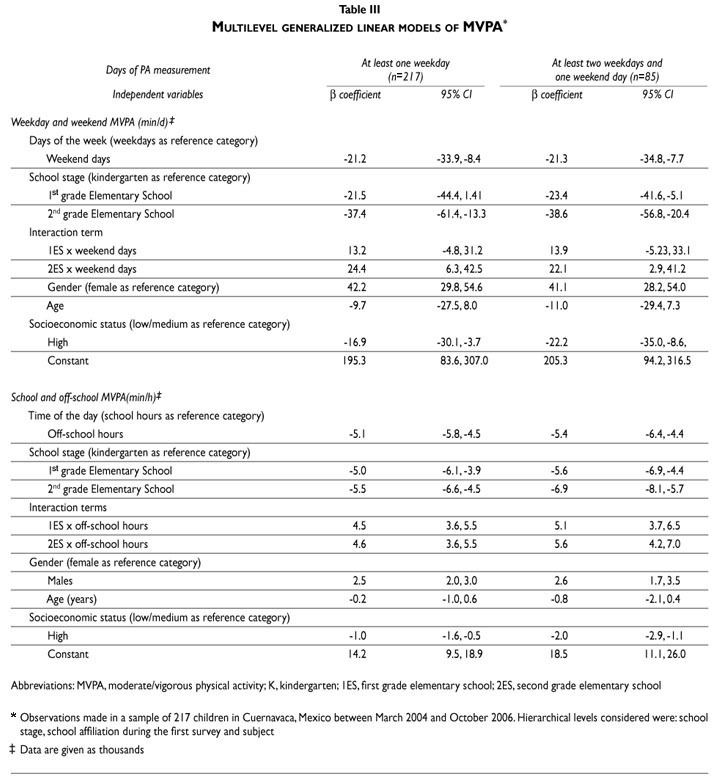
<body><![CDATA[<p><font size="2" face="Verdana">Children wore the accelerometers during five full days, attached to the right hip by a small denim sack and a belt. They were instructed to wear the accelerometer from 07:00 to 23:00 h, and take it off only for showering or water sports. The accelerometer was programmed to record activity counts in 1&#45;min epochs.</font></p>     <p><font size="2" face="Verdana"><I>Anthropometry</I></font></p>     <p><font size="2" face="Verdana">Trained and standardized personnel<Sup>23</sup> measured the height of children and mothers to the nearest mm using a stadimeter, and body weight using an electronic scale. BMI was calculated (kg/m<Sup>2</Sup>) and categorized using International Obesity Taskforce (IOTF) criteria<Sup>24</sup> for children and WHO criteria<Sup>25</Sup> for mothers.</font></p>     <p><font size="2" face="Verdana"><B>Processing of PA counts</B></font></p>     <p><font size="2" face="Verdana">Accelerometry records of at least 10 h/d were considered as valid for the analysis. Children wore the accelerometers for a mean of 13.6 h/d. Any 20 min string of continuous zeroes was considered as missing data and replaced by imputed values. Imputed values were calculated with an eight routine algorithm in Visual Basic and SQLS, based on the counts for 15 minutes preceding and following the zeroes string. Overall, 10% of the counts were imputations (K: 11%;  1ES: 8.8%;  2ES: 10.4%). The validity of these imputations has been discussed by others.<Sup>26,27</sup> For this analysis we included cases with at least one valid day of PA measurements for each school stage. Additionally, 95 children (43.7%) had at least one weekend day recorded for each school stage.</font></p>     <p><font size="2" face="Verdana">Minutes of MVPA were calculated using the cut&#45;off points proposed by Rowlands<Sup>20</sup> for children &gt;9 years old, as they are comparable to the cut&#45;offs proposed for preschool children.<Sup>28</sup> Minutes of MVPA during weekdays and weekend days and school and off&#45;school hours were computed. We defined school hours from 09:00 to 12:00 h for K, and from 08:00 to 13:00 h for ES, according to school calendars. Off&#45;school hours were defined as the rest of the hours of the day. Daily MVPA was expressed in min/d. To control for the difference in the duration of the school day, time engaged in MPVA during these periods was further converted into min/h, calculated as the sum of MVPA minutes during school hours divided by the duration of the school day. Off&#45;school MVPAminutes were calculated by a similar procedure. We also computed separately MVPA for specific periods of the day: prior to the start of classes (K=8:00&#45;9:00hrs;  ES=7:008:00hrs), recess (10:30&#45;11:30) and after school dismissal (K=12:00&#45;23:00hrs;  ES=13:00&#45;23:00hrs). Likewise, time engaged in MVPA was expressed in min/h.</font></p>     <p><font size="2" face="Verdana"><B>Data analysis</B></font></p>     <p><font size="2" face="Verdana">PA patterns during weekdays and weekend days were described by plotting the distribution of the unadjusted counts as recorded by the RT3 throughout the day. Comparisons among the adjusted means of MVPAwere assessed by a series of multilevel generalized linear regression models. We assembled two separate models. In the first model daily MPVA (min/d) was the dependent variable and days of the week (weekdays or weekend days) the independent variable. To assess differences among school stages in daily MVPAbetween weekdays or weekend days, we included an interaction term between days of the week and school stage. In the second model, MVPA (min/h) was the dependent variable and time of the day (school and off&#45;school hours) the independent variable. We included an interaction term between school stage and time of the day to compare trends in MVPA among school stages. Models were adjusted for baseline age, gender, SES and maternal education. Hierarchical levels were: 1) school stage (K, 1ES and 2ES) as the time variable;  2) school affiliation during the first survey, to control for the clustering effect of the design and 3) subject, as the panel variable. We decided to use K schools, and not ES, as the clustering variable because the design effect was stronger in K.</font></p>     <p><font size="2" face="Verdana">Additionally, fixed effects linear regression models were constructed for each period of the day (prior to the start of classes, recess and after school dismissal) to identify differences in MVPA (min/h) among school stages. Models were adjusted for baseline age, gender, SES and maternal education, as well as for repeated measures of the same subjects and school stage.</font></p>     <p><font size="2" face="Verdana">Models were repeated using daily accelerometry counts or school and off&#45;school counts/h as dependant variables. Weekday models included the whole analytical sample;  weekend day models included children with weekend measurements for all school stages (n=95). Only variables with significant associations (<I>p</I>&lt;0.05) or considered as conceptual confounders were kept in the final model. Differences among adjusted means were significant if confidence intervals did not overlap.</font></p>     ]]></body>
<body><![CDATA[<p><font size="2" face="Verdana">Some studies have demonstrated that a valid accelerometry PA measurement must include at least two weekdays and one weekend day.<Sup>29</sup> To test the potential bias incurred for this reason, we performed an additional analysis which included only children meeting this definition (n=85, 49 girls and 36 boys).</font></p>     <p><font size="2" face="Verdana">Significance was set at <I>p</I>&lt;0.05 for differences among unadjusted means, frequencies and main effects associations, and at <I>p</I>&lt;0.1 for interactions. Data were analyzed using STATA software, version 11.0.</font></p>     <p>&nbsp;</p>     <p><font size="3" face="Verdana"><b>Results</b></font></p>     <p><font size="2" face="Verdana">The analytical sample included 217 children (123 girls and 94 boys) out of the 320 originally recruited;  14.4% were lost&#45;to&#45;follow&#45;up (n=46) because of moving out the neighborhood (n=34) or refusing to participate (n=12). We excluded 57 additional cases from the analysis due to incomplete data (<a href="#fig01">Figure 1</a>). To assess potential bias, selected variables for children lost&#45;to&#45;follow&#45;up or excluded from the analysis (n=103) were compared with their analytical sample counterparts. No differences were found among most sociodemographic and anthropometric characteristics, however, the proportion of boys resulted significantly lower in the analytical sample (43%) than in the lost&#45;to&#45;follow&#45;up or excluded children (61%, <I>p</I>&lt;0.0001). Within the analytical sample, no differences were found between boys and girls with respect to baseline age, weight, height and BMI (<a href="#tab01">Table I</a>). The prevalences for the analytical sample of overweight (boys: 14.0%;  girls: 12.0%) and obesity (boys: 10.0%;  girls: 9.0%) were not different than those for the 2006 Mexican National Nutrition Survey.<Sup>30</sup> Compared with the mean for the WHO&#45;2007 reference,<Sup>31</sup> children in the analytical sample tended to be heavier (boys: 21.4 vs 20.0 kg), had higher BMI (girls: 16.0 vs 15.3 kg/m<Sup>2</Sup>;  boys: 16.3 vs 15.3 kg/m<Sup>2</Sup>), and girls tended to be shorter (113.2cm vs. 115.1cm).</font></p>     <p><a name="fig01"></a></p>     <p>&nbsp;</p>     <p align="center"><img src="/img/revistas/spm/v53n3/a07fig01.jpg"></p>     <p>&nbsp;</p>     <p><a name="tab01"></a></p>     ]]></body>
<body><![CDATA[<p>&nbsp;</p>     <p align="center"><img src="/img/revistas/spm/v53n3/a07tab01.jpg"></p>     <p>&nbsp;</p>     <p><font size="2" face="Verdana"><B>Daily PA patterns</B></font></p>     <p><font size="2" face="Verdana">Noticeable differences in PA patterns were observed between weekdays and weekend days. Weekdays presented larger fluctuations throughout the day. At least three main peaks of activity were identified, mostly associated with the daily routines: commuting to school (8:00&#45;9:00 h for K and 7:00&#45;8:00 h for ES), school recess (10:30&#45;11.30) and commuting home (12:00&#45;13:00 h for K and 13:00&#45;14:00 h for ES). The first and the third peaks for both ES grades were displaced to the left and to the right, respectively, relative to the kindergarten peaks, most probably reflecting differences in school schedules. The three PApeaks were smaller for both ES grades than for K. In contrast, no consistent differences among school stages were noted during weekday afternoons (<a href="/img/revistas/spm/v53n3/a07fig02.jpg">Figure 2, panel A</a>). On weekend days, PA patterns tended to be flatter and lower compared with weekdays. No differences were noted among school stages (<a href="/img/revistas/spm/v53n3/a07fig02.jpg">Figure 2, panel B</a>) in a linear regression model (data not shown).</font></p>     <p><font size="2" face="Verdana"><B>Daily MVPA</B></font></p>     <p><font size="2" face="Verdana">The adjusted means of weekday MVPA were 22 and 37 min/d lower for 1ES (<I>p</I>=0.06) and 2ES (<I>p</I>&lt;0.01),respectively, compared to K. The difference between both ES grades was not significant (<I>p</I>=0.07) (<a href="/img/revistas/spm/v53n3/a07tab02.jpg">Table II</a>). No differences were found in weekend MVPAamong school stages. However, the results referring to weekends should be interpreted cautiously because the sample was biased due to self selection. Childrenwithout weekend PA measurements had larger BMIs.For K, weekday MVPA was higher than that for theweekend (21 min/d, <I>p</I>&lt;0.01), but not for 1ES (7.6 min/d, <I>p</I>=0.25) or 2ES (&#45;4.17, <I>p</I>=0.46). Total accelerometry counts/d showed similar differences as describedabove (<a href="/img/revistas/spm/v53n3/a07tab02.jpg">Table II</a>).</font></p>     <p><font size="2" face="Verdana"><B>School and off&#45;school MVPA</B></font></p>     <p><font size="2" face="Verdana">The adjusted mean MVPA during school hours was 37.5% (5.1 min/h) higher than during off&#45;school hours for K (<I>p</I>&lt;0.01), but not for 1ES (0.7 min/h, <I>p</I>= 0.10) or 2ES (0.5 min/h, <I>p</I>=0.20). The MVPAduring school hours was 37 (&#45;5.0 min/h) and 40% (&#45;5.5 min/h) lower for 1ES and 2ES, respectively, compared to K (<I>p</I>&lt;0.001). No differences were found during off&#45;school hours among school stages. Total accelerometry counts/h showed similar differences as described above (<a href="/img/revistas/spm/v53n3/a07tab02.jpg">Table II</a>).</font></p>     <p><font size="2" face="Verdana"><B>PA during periods of the day</B></font></p>     ]]></body>
<body><![CDATA[<p><font size="2" face="Verdana">The adjusted means of MVPA during the periods prior to the start of classes and school recess were 42 (&#45;2.7 min/h) and 36% (&#45;4.0 min/h) lower, respectively, for 1ES, and 64 (&#45;4.0 min/h) and 40% (&#45;4.4 min/h) lower, respectively, for 2ES, compared to K (p&lt;0.01). The MVPAafter school dismissal was 12% (1.1 min/h, <I>p</I>=0.017) lower for 2ES compared to K;  no differences were found between K and 1ES (&#45;0.73 min/h, <I>p</I>=0.10). Total accelerometry counts/h showed similar differences as described above, however counts for the period after school dismissal were significantly lower for 1ES and 2ES compared to K (<a href="/img/revistas/spm/v53n3/a07tab02.jpg">Table II</a>).</font></p>     <p><font size="2" face="Verdana"><B>Additional analyses</B></font></p>     <p><font size="2" face="Verdana">Additional analyses, including children with at least two weekdays and one weekend day of PA measurements for daily MVPAand school and off&#45;school MVPA (<a href="/img/revistas/spm/v53n3/a07tab02.jpg">Table II</a>), showed no substantial differences in the magnitude and directionality of adjusted variables compared to the ones previously described.</font></p>     <p>&nbsp;</p>     <p><font size="3" face="Verdana"><b>Discussion</b></font></p>     <p><font size="2" face="Verdana">In this study we demonstrated that weekday MVPAdeclined during the transition from K to ES. The reduction occurred during school hours, in general, andprior to the start of classes and during school recess, in particular. A similar reduction was reported among Czech children; <Sup>16</sup> among preschool children in theUnited States the tracking of PA during the transition from K to ES showed a decline during school recess.<Sup>17</sup> These latter studies support the notion that moving from the K to the ES environment might negatively influence PA patterns. Furthermore, weekday MVPA decreased by 21 and 37 minutes for 1ES and 2 ES,respectively, compared with K;  while no differences were found for weekend MVPA. A longitudinal study in 9 year&#45;old children in the United States found a reduction in MVPA during weekdays (37 min/y) andweekend days (39 min/y). The biological implications of these changes are relevant and may represent the beginning of an energy imbalance that could result inbecoming overweight.</font></p>     <p><font size="2" face="Verdana">Although identifying the causes of changes in PAis outside the scope of our study, changes associated with the transition from K to ES seem to be a reasonable explanation for the decline in PA. While the kindergarten environment promotes ludic learning and structured activities during school recess, the ES environment in Mexico frequently does not favor PA. A study in public ES in Mexico City<Sup>15</sup> found overcrowded school grounds, specific rules banning students from running because of safety reasons, curricular physical education classes occurring once a week with 10 minutes of effective PAand very few schools having sporting equipment. Additionally, differences in other aspects that may contribute to explain the changes in PA during the period prior to the start of school activities, such as transportation to school, were not registered. Though the reduction in PAreported herein may also be explained by a tendency of PA to decline with age,<Sup>32</sup> several facts make this explanation less plausible: regression models were adjusted by age and PA changes occurred mostly during school hours (up to 40% reduction during school recess) and periods before the beginning of the school day, while no difference was found among school stages during the period after school dismissal.</font></p>     <p>&nbsp;</p>     <p align="center"><font size="2" face="Verdana"><a href="/img/revistas/spm/v53n3/a07tab03.jpg">Table III</a></font></p>     <p>&nbsp;</p>     ]]></body>
<body><![CDATA[<p><font size="2" face="Verdana">One of the main strengths of this study is its longitudinal design, giving robustness to causality implications. Another strength is the imputation of data to substitute selected chains of zeroes, improving the precision of daily PAregistries using a proven methodology.<Sup>27</sup> Some limitations are also recognized. Reliable measurement of habitual PArequires two weekdays and one weekend day of PA measurements,<Sup>29</sup> while our analyses included children with at least one day of PA measurement, suggesting potential bias. Nevertheless, a comparison with a set of 95 children with at least two weekdays and one weekend day measurements of PA showed no substantial differences in the magnitude and directionality of unadjusted and adjusted statistics. Because losses to follow&#45;up and exclusions from the analytical sample (n=103) could induce selection bias, we compared the original and analytical samples. No significant differences were found among the variables examined, though there was a smaller proportion of boys in the analytical sample. Because boys resulted more active than girls, the overall mean of activity counts could, therefore, be underestimated. However, the internal validity is preserved, since the analytical sample includes the same subjects for all three surveys. Nevertheless, because our findings are based on a selected sample of children, extrapolations to a wider population should be made with caution.</font></p>     <p><font size="2" face="Verdana">In summary, we demonstrate in a cohort of Mexican children that the MVPAwas significantly reduced when transiting from K to ES, mainly because of a decline in the MVPA during school hours and the period prior to the school day. These observations attempt to identify relevant programmatic opportunities for interventions. Further formative research is needed to design more effective PA interventions aimed at modifying school environments.</font></p>     <p>&nbsp;</p>     <p><font size="3" face="Verdana"><B>Acknowledgements</B></font></p>     <p><font size="2" face="Verdana">This study was supported by the grant SALUD&#45;2003C01&#45;48/A&#45;1 from the National Council for Science and Technology (CONACyT) of Mexico.</font></p>     <p><font size="2" face="Verdana"><I>Declaration of conflicts of interest: </I>The authors declare that they have no conflict of interests.</font></p>     <p>&nbsp;</p>     <p><font size="3" face="Verdana"><B>References</B></font></p>     <!-- ref --><p><font size="2" face="Verdana">1. Knuth AG, Hallal PC.Temporal trends in physical activity: a systematic review. J Phys Act Health 2009; 6:548&#45;559.    &nbsp;&nbsp;&nbsp;&nbsp;&nbsp;&nbsp;&nbsp;&nbsp;[&#160;<a href="javascript:void(0);" onclick="javascript: window.open('/scielo.php?script=sci_nlinks&ref=9378261&pid=S0036-3634201100030000700001&lng=','','width=640,height=500,resizable=yes,scrollbars=1,menubar=yes,');">Links</a>&#160;]<!-- end-ref --></font></p>     ]]></body>
<body><![CDATA[<!-- ref --><p><font size="2" face="Verdana">2. Riddoch CJ, Mattocks C, Deere K, Saunders J, Kirkby J, Tilling K, et al. Objective measurement of levels and patterns of physical activity.Arch Dis Child 2007; 92:963&#45;969.    &nbsp;&nbsp;&nbsp;&nbsp;&nbsp;&nbsp;&nbsp;&nbsp;[&#160;<a href="javascript:void(0);" onclick="javascript: window.open('/scielo.php?script=sci_nlinks&ref=9378263&pid=S0036-3634201100030000700002&lng=','','width=640,height=500,resizable=yes,scrollbars=1,menubar=yes,');">Links</a>&#160;]<!-- end-ref --></font></p>     <!-- ref --><p><font size="2" face="Verdana">3. Pate RR, Stevens J, Pratt C, Sallis JF, Schmitz KH, Webber LS, et al. Objectively measured physical activity in sixth&#45;grade girls.Arch Pediatr Adolesc Med 2006; 160:1262&#45;1268.    &nbsp;&nbsp;&nbsp;&nbsp;&nbsp;&nbsp;&nbsp;&nbsp;[&#160;<a href="javascript:void(0);" onclick="javascript: window.open('/scielo.php?script=sci_nlinks&ref=9378265&pid=S0036-3634201100030000700003&lng=','','width=640,height=500,resizable=yes,scrollbars=1,menubar=yes,');">Links</a>&#160;]<!-- end-ref --></font></p>     <!-- ref --><p><font size="2" face="Verdana">4. World Health Organization. Physical Activity and Young People. Global Strategy on Diet, Physical Activity and Health. Geneva:WHO, 2010 &#91;Accessed March 16, 2010&#93;. Available at: <a href="http://www.who.int/dietphysicalactivity/factsheet_young_people/en/index.html" target="_blank">http://www.who.int/dietphysicalactivity/factsheet_young_people/en/index.html</a>.    &nbsp;&nbsp;&nbsp;&nbsp;&nbsp;&nbsp;&nbsp;&nbsp;[&#160;<a href="javascript:void(0);" onclick="javascript: window.open('/scielo.php?script=sci_nlinks&ref=9378267&pid=S0036-3634201100030000700004&lng=','','width=640,height=500,resizable=yes,scrollbars=1,menubar=yes,');">Links</a>&#160;]<!-- end-ref --></font></p>     <!-- ref --><p><font size="2" face="Verdana">5. World Health Organization. Recommended amount of physical activity. Geneva:WHO, 2010 &#91;Accessed August 28, 2009&#93;.Available at: <a href="http://www.who.int/dietphysicalactivity/factsheet_recommendations/en/index.html" target="_blank">http://www.who.int/dietphysicalactivity/factsheet_recommendations/en/index.html</a>.    &nbsp;&nbsp;&nbsp;&nbsp;&nbsp;&nbsp;&nbsp;&nbsp;[&#160;<a href="javascript:void(0);" onclick="javascript: window.open('/scielo.php?script=sci_nlinks&ref=9378269&pid=S0036-3634201100030000700005&lng=','','width=640,height=500,resizable=yes,scrollbars=1,menubar=yes,');">Links</a>&#160;]<!-- end-ref --></font></p>     <!-- ref --><p><font size="2" face="Verdana">6. Morales&#45;Ru&aacute;n M, Hern&aacute;ndez&#45;Prado B, G&oacute;mez&#45;Acosta L, Shamah&#45;Levy T, Cuevas&#45;Nasu L. Obesity, overweight, screen time and physical activity in Mexican adolescents. Salud Publica Mex 2009; 51 suppl 4:S613&#45;S620.    &nbsp;&nbsp;&nbsp;&nbsp;&nbsp;&nbsp;&nbsp;&nbsp;[&#160;<a href="javascript:void(0);" onclick="javascript: window.open('/scielo.php?script=sci_nlinks&ref=9378271&pid=S0036-3634201100030000700006&lng=','','width=640,height=500,resizable=yes,scrollbars=1,menubar=yes,');">Links</a>&#160;]<!-- end-ref --></font></p>     ]]></body>
<body><![CDATA[<!-- ref --><p><font size="2" face="Verdana">7. Hernandez B, Gortmaker SL, Laird NM, Colditz GA, Parra&#45;Cabrera S, Peterson KE.Validity and reproducibility of a questionnaire on physical activity and non&#45;activity for school children in Mexico City. Salud Publica Mex 2000; 42:315&#45;323.    &nbsp;&nbsp;&nbsp;&nbsp;&nbsp;&nbsp;&nbsp;&nbsp;[&#160;<a href="javascript:void(0);" onclick="javascript: window.open('/scielo.php?script=sci_nlinks&ref=9378273&pid=S0036-3634201100030000700007&lng=','','width=640,height=500,resizable=yes,scrollbars=1,menubar=yes,');">Links</a>&#160;]<!-- end-ref --></font></p>     <!-- ref --><p><font size="2" face="Verdana">8. Strong WB, Malina RM, Blimkie CJ, Daniels SR, Dishman RK, Gutin B, et al. Evidence based physical activity for school&#45;age youth. J Pediatr 2005; 146:732&#45;737.    &nbsp;&nbsp;&nbsp;&nbsp;&nbsp;&nbsp;&nbsp;&nbsp;[&#160;<a href="javascript:void(0);" onclick="javascript: window.open('/scielo.php?script=sci_nlinks&ref=9378275&pid=S0036-3634201100030000700008&lng=','','width=640,height=500,resizable=yes,scrollbars=1,menubar=yes,');">Links</a>&#160;]<!-- end-ref --></font></p>     <!-- ref --><p><font size="2" face="Verdana">9. Saakslahti A, Numminen P,Varstala V, Helenius H, Tammi A, Viikari J, et al. Physical activity as a preventive measure for coronary heart disease risk factors in early childhood. Scand J Med Sci Sports 2004; 14:143&#45;149.    &nbsp;&nbsp;&nbsp;&nbsp;&nbsp;&nbsp;&nbsp;&nbsp;[&#160;<a href="javascript:void(0);" onclick="javascript: window.open('/scielo.php?script=sci_nlinks&ref=9378277&pid=S0036-3634201100030000700009&lng=','','width=640,height=500,resizable=yes,scrollbars=1,menubar=yes,');">Links</a>&#160;]<!-- end-ref --></font></p>     <!-- ref --><p><font size="2" face="Verdana">10. Janz KF, Kwon S, Letuchy EM, Eichenberger Gilmore JM, Burns TL, Torner JC, et al. Sustained effect of early physical activity on body fat mass in older children.Am J Prev Med 2009; 37:35&#45;40.    &nbsp;&nbsp;&nbsp;&nbsp;&nbsp;&nbsp;&nbsp;&nbsp;[&#160;<a href="javascript:void(0);" onclick="javascript: window.open('/scielo.php?script=sci_nlinks&ref=9378279&pid=S0036-3634201100030000700010&lng=','','width=640,height=500,resizable=yes,scrollbars=1,menubar=yes,');">Links</a>&#160;]<!-- end-ref --></font></p>     <!-- ref --><p><font size="2" face="Verdana">11. World Health Organization. Physical activity and health in Europe: evidence for action. Copenhagen, Denmark:WHO, 2006.    &nbsp;&nbsp;&nbsp;&nbsp;&nbsp;&nbsp;&nbsp;&nbsp;[&#160;<a href="javascript:void(0);" onclick="javascript: window.open('/scielo.php?script=sci_nlinks&ref=9378281&pid=S0036-3634201100030000700011&lng=','','width=640,height=500,resizable=yes,scrollbars=1,menubar=yes,');">Links</a>&#160;]<!-- end-ref --></font></p>     ]]></body>
<body><![CDATA[<!-- ref --><p><font size="2" face="Verdana">12. Obesity: preventing and managing the global epidemic. Report of a WHO consultation.World Health Organ Tech Rep Ser 2000; 894:i&#45;xii, 1&#45;253.    &nbsp;&nbsp;&nbsp;&nbsp;&nbsp;&nbsp;&nbsp;&nbsp;[&#160;<a href="javascript:void(0);" onclick="javascript: window.open('/scielo.php?script=sci_nlinks&ref=9378283&pid=S0036-3634201100030000700012&lng=','','width=640,height=500,resizable=yes,scrollbars=1,menubar=yes,');">Links</a>&#160;]<!-- end-ref --></font></p>     <!-- ref --><p><font size="2" face="Verdana">13. Malina RM. Physical activity and fitness: pathways from childhood to adulthood.Am J Hum Biol 2001; 13:162&#45;172.    &nbsp;&nbsp;&nbsp;&nbsp;&nbsp;&nbsp;&nbsp;&nbsp;[&#160;<a href="javascript:void(0);" onclick="javascript: window.open('/scielo.php?script=sci_nlinks&ref=9378285&pid=S0036-3634201100030000700013&lng=','','width=640,height=500,resizable=yes,scrollbars=1,menubar=yes,');">Links</a>&#160;]<!-- end-ref --></font></p>     <!-- ref --><p><font size="2" face="Verdana">14. Corbin CB.The "untracking" of sedentary living:A call for action Pediatr Exerc Sci 2001; 13:347&#45;356</font>&nbsp;&nbsp;&nbsp;&nbsp;&nbsp;&nbsp;&nbsp;&nbsp;[&#160;<a href="javascript:void(0);" onclick="javascript: window.open('/scielo.php?script=sci_nlinks&ref=9378287&pid=S0036-3634201100030000700014&lng=','','width=640,height=500,resizable=yes,scrollbars=1,menubar=yes,');">Links</a>&#160;]<!-- end-ref --><!-- ref --><p><font size="2" face="Verdana">15. Jennings&#45;Aburto N, Nava F, Bonvecchio A, Safdie M, Gonzalez&#45;Casanova I, Gust T, et al. Physical activity during the school day in public primary schools in Mexico City. Salud Publica Mex 2009; 51:141&#45;147.    &nbsp;&nbsp;&nbsp;&nbsp;&nbsp;&nbsp;&nbsp;&nbsp;[&#160;<a href="javascript:void(0);" onclick="javascript: window.open('/scielo.php?script=sci_nlinks&ref=9378288&pid=S0036-3634201100030000700015&lng=','','width=640,height=500,resizable=yes,scrollbars=1,menubar=yes,');">Links</a>&#160;]<!-- end-ref --></font></p>     <!-- ref --><p><font size="2" face="Verdana">16. Sigmund E, Sigmundova D, Ansari WE. Changes in physical activity in pre&#45;schoolers and first&#45;grade children: longitudinal study in the Czech Republic. Child Care Health Dev 2009; 35:376&#45;382.    &nbsp;&nbsp;&nbsp;&nbsp;&nbsp;&nbsp;&nbsp;&nbsp;[&#160;<a href="javascript:void(0);" onclick="javascript: window.open('/scielo.php?script=sci_nlinks&ref=9378290&pid=S0036-3634201100030000700016&lng=','','width=640,height=500,resizable=yes,scrollbars=1,menubar=yes,');">Links</a>&#160;]<!-- end-ref --></font></p>     <!-- ref --><p><font size="2" face="Verdana">17. Sallis JF, Berry CC, Broyles SL, McKenzie TL, Nader PR. Variability and tracking of physical activity over 2 yr in young children. Med Sci Sports Exerc 1995; 27:1042&#45;1049.    &nbsp;&nbsp;&nbsp;&nbsp;&nbsp;&nbsp;&nbsp;&nbsp;[&#160;<a href="javascript:void(0);" onclick="javascript: window.open('/scielo.php?script=sci_nlinks&ref=9378292&pid=S0036-3634201100030000700017&lng=','','width=640,height=500,resizable=yes,scrollbars=1,menubar=yes,');">Links</a>&#160;]<!-- end-ref --></font></p>     <!-- ref --><p><font size="2" face="Verdana">18. Bronfman M, Guiscafr&eacute; H, Castro V, Castro R, Guti&eacute;rrez G. Medici&oacute;n de la desigualdad: una estrategia metodol&oacute;gica, an&aacute;lisis de las caracter&iacute;sticas socioecon&oacute;micas de la muestra. Arch Invest Med Mex 1988; 19:351&#45;360.    &nbsp;&nbsp;&nbsp;&nbsp;&nbsp;&nbsp;&nbsp;&nbsp;[&#160;<a href="javascript:void(0);" onclick="javascript: window.open('/scielo.php?script=sci_nlinks&ref=9378294&pid=S0036-3634201100030000700018&lng=','','width=640,height=500,resizable=yes,scrollbars=1,menubar=yes,');">Links</a>&#160;]<!-- end-ref --></font></p>     <!-- ref --><p><font size="2" face="Verdana">19. Shamah&#45;Levy T, Villalpando&#45;Hern&aacute;ndez S, Rivera JA. Resultados de Nutrici&oacute;n de la ENSANUT 2006. 1 ed. Cuernavaca, Mexico: Instituto Nacional de Salud P&uacute;blica, 2007.    &nbsp;&nbsp;&nbsp;&nbsp;&nbsp;&nbsp;&nbsp;&nbsp;[&#160;<a href="javascript:void(0);" onclick="javascript: window.open('/scielo.php?script=sci_nlinks&ref=9378296&pid=S0036-3634201100030000700019&lng=','','width=640,height=500,resizable=yes,scrollbars=1,menubar=yes,');">Links</a>&#160;]<!-- end-ref --></font></p>     <!-- ref --><p><font size="2" face="Verdana">20. Rowlands AV,Thomas PW, Eston RG, Topping R. Validation of the RT3 triaxial accelerometer for the assessment of physical activity. Med Sci Sports Exerc 2004; 36:518&#45;524.    &nbsp;&nbsp;&nbsp;&nbsp;&nbsp;&nbsp;&nbsp;&nbsp;[&#160;<a href="javascript:void(0);" onclick="javascript: window.open('/scielo.php?script=sci_nlinks&ref=9378298&pid=S0036-3634201100030000700020&lng=','','width=640,height=500,resizable=yes,scrollbars=1,menubar=yes,');">Links</a>&#160;]<!-- end-ref --></font></p>     <!-- ref --><p><font size="2" face="Verdana">21. Hussey J, Bennett K, Dwyer JO, Langford S, Bell C, Gormley J. Validation of the RT3 in the measurement of physical activity in children. J Sci Med Sport 2009; 12:130&#45;133.    &nbsp;&nbsp;&nbsp;&nbsp;&nbsp;&nbsp;&nbsp;&nbsp;[&#160;<a href="javascript:void(0);" onclick="javascript: window.open('/scielo.php?script=sci_nlinks&ref=9378300&pid=S0036-3634201100030000700021&lng=','','width=640,height=500,resizable=yes,scrollbars=1,menubar=yes,');">Links</a>&#160;]<!-- end-ref --></font></p>     <!-- ref --><p><font size="2" face="Verdana">22. Oliver M, Schofield GM, Kolt GS. Physical activity in preschoolers: understanding prevalence and measurement issues. Sports Med 2007; 37:1045&#45;1070.    &nbsp;&nbsp;&nbsp;&nbsp;&nbsp;&nbsp;&nbsp;&nbsp;[&#160;<a href="javascript:void(0);" onclick="javascript: window.open('/scielo.php?script=sci_nlinks&ref=9378302&pid=S0036-3634201100030000700022&lng=','','width=640,height=500,resizable=yes,scrollbars=1,menubar=yes,');">Links</a>&#160;]<!-- end-ref --></font></p>     <!-- ref --><p><font size="2" face="Verdana">23. Habicht JP. Standarization of cuantitative epidemiological methods in the field. Bol of Sanit Panam 1974; 74:375&#45;384.    &nbsp;&nbsp;&nbsp;&nbsp;&nbsp;&nbsp;&nbsp;&nbsp;[&#160;<a href="javascript:void(0);" onclick="javascript: window.open('/scielo.php?script=sci_nlinks&ref=9378304&pid=S0036-3634201100030000700023&lng=','','width=640,height=500,resizable=yes,scrollbars=1,menubar=yes,');">Links</a>&#160;]<!-- end-ref --></font></p>     <!-- ref --><p><font size="2" face="Verdana">24. Cole TJ, Bellizzi MC, Flegal KM, Dietz WH. Establishing a standard definition for child overweight and obesity worldwide: international survey. BMJ 2000; 320:1240&#45;1243.    &nbsp;&nbsp;&nbsp;&nbsp;&nbsp;&nbsp;&nbsp;&nbsp;[&#160;<a href="javascript:void(0);" onclick="javascript: window.open('/scielo.php?script=sci_nlinks&ref=9378306&pid=S0036-3634201100030000700024&lng=','','width=640,height=500,resizable=yes,scrollbars=1,menubar=yes,');">Links</a>&#160;]<!-- end-ref --></font></p>     <!-- ref --><p><font size="2" face="Verdana">25. World Health Organization. Physical status: the use and interpretation of anthropometry. Geneva:WHO, 1995.    &nbsp;&nbsp;&nbsp;&nbsp;&nbsp;&nbsp;&nbsp;&nbsp;[&#160;<a href="javascript:void(0);" onclick="javascript: window.open('/scielo.php?script=sci_nlinks&ref=9378308&pid=S0036-3634201100030000700025&lng=','','width=640,height=500,resizable=yes,scrollbars=1,menubar=yes,');">Links</a>&#160;]<!-- end-ref --></font></p>     <!-- ref --><p><font size="2" face="Verdana">26. Catellier DJ, Hannan PJ, Murray DM, Addy CL, Conway TL, Yang S, et al. Imputation of missing data when measuring physical activity by accelerometry. Med Sci Sports Exerc 2005;  37:S555&#45;562.    &nbsp;&nbsp;&nbsp;&nbsp;&nbsp;&nbsp;&nbsp;&nbsp;[&#160;<a href="javascript:void(0);" onclick="javascript: window.open('/scielo.php?script=sci_nlinks&ref=9378310&pid=S0036-3634201100030000700026&lng=','','width=640,height=500,resizable=yes,scrollbars=1,menubar=yes,');">Links</a>&#160;]<!-- end-ref --></font></p>     <!-- ref --><p><font size="2" face="Verdana">27. Paul DR, Kramer M, Stote KS, Spears KE, Moshfegh AJ, Baer DJ, et al. Estimates of adherence and error analysis of physical activity data collected via accelerometry in a large study of free&#45;living adults. BMC Med Res Methodol 2008; 8:38.    &nbsp;&nbsp;&nbsp;&nbsp;&nbsp;&nbsp;&nbsp;&nbsp;[&#160;<a href="javascript:void(0);" onclick="javascript: window.open('/scielo.php?script=sci_nlinks&ref=9378312&pid=S0036-3634201100030000700027&lng=','','width=640,height=500,resizable=yes,scrollbars=1,menubar=yes,');">Links</a>&#160;]<!-- end-ref --></font></p>     <!-- ref --><p><font size="2" face="Verdana">28. Vasquez F, Salazar G, Andrade M, Vasquez L, Diaz E. Energy balance and physical activity in obese children attending day&#45;care centres. Eur J Clin Nutr 2006; 60:1115&#45;1121.    &nbsp;&nbsp;&nbsp;&nbsp;&nbsp;&nbsp;&nbsp;&nbsp;[&#160;<a href="javascript:void(0);" onclick="javascript: window.open('/scielo.php?script=sci_nlinks&ref=9378314&pid=S0036-3634201100030000700028&lng=','','width=640,height=500,resizable=yes,scrollbars=1,menubar=yes,');">Links</a>&#160;]<!-- end-ref --></font></p>     <!-- ref --><p><font size="2" face="Verdana">29. Mattocks C, Ness A, Leary S, Tilling K, Blair SN, Shield J, et al. Use of accelerometers in a large field&#45;based study of children: protocols, design issues, and effects on precision. J Phys Act Health 2008; 5 Suppl 1:S98&#45;111.    &nbsp;&nbsp;&nbsp;&nbsp;&nbsp;&nbsp;&nbsp;&nbsp;[&#160;<a href="javascript:void(0);" onclick="javascript: window.open('/scielo.php?script=sci_nlinks&ref=9378316&pid=S0036-3634201100030000700029&lng=','','width=640,height=500,resizable=yes,scrollbars=1,menubar=yes,');">Links</a>&#160;]<!-- end-ref --></font></p>     <!-- ref --><p><font size="2" face="Verdana">30. Cuevas&#45;Nasu L, Shamah&#45;Levy T, Gonz&aacute;lez de Coss&iacute;o&#45;Mart&iacute;nez TNJ, Moreno&#45;Mac&iacute;as LB, &Aacute;vila&#45;Arcos MA. Estado Nutricio. In: Shamah&#45;Levy T,Villalpando&#45;Hern&aacute;ndez S, Rivera&#45;Dommarco J, eds. Resultados de Nutrici&oacute;n de la ENSANUT 2006 (Report of the National Health and Nutrition Survey, 2006). Cuernavaca, Mexico: Instituto Nacional de Salud P&uacute;blica, 2007.    &nbsp;&nbsp;&nbsp;&nbsp;&nbsp;&nbsp;&nbsp;&nbsp;[&#160;<a href="javascript:void(0);" onclick="javascript: window.open('/scielo.php?script=sci_nlinks&ref=9378318&pid=S0036-3634201100030000700030&lng=','','width=640,height=500,resizable=yes,scrollbars=1,menubar=yes,');">Links</a>&#160;]<!-- end-ref --></font></p>     <!-- ref --><p><font size="2" face="Verdana">31. de Onis M, Onyango AW, Borghi E, Siyam A, Nishida C, Siekmann J. Development of a WHO growth reference for school&#45;aged children and adolescents. Bull World Health Organ 2007; 85:660&#45;667.    &nbsp;&nbsp;&nbsp;&nbsp;&nbsp;&nbsp;&nbsp;&nbsp;[&#160;<a href="javascript:void(0);" onclick="javascript: window.open('/scielo.php?script=sci_nlinks&ref=9378320&pid=S0036-3634201100030000700031&lng=','','width=640,height=500,resizable=yes,scrollbars=1,menubar=yes,');">Links</a>&#160;]<!-- end-ref --></font></p>     <!-- ref --><p><font size="2" face="Verdana">32. Sallis JF, Prochaska JJ, Taylor WC.A review of correlates of physical activity of children and adolescents. Med Sci Sports Exerc 2000; 32:963&#45;975.    &nbsp;&nbsp;&nbsp;&nbsp;&nbsp;&nbsp;&nbsp;&nbsp;[&#160;<a href="javascript:void(0);" onclick="javascript: window.open('/scielo.php?script=sci_nlinks&ref=9378322&pid=S0036-3634201100030000700032&lng=','','width=640,height=500,resizable=yes,scrollbars=1,menubar=yes,');">Links</a>&#160;]<!-- end-ref --></font></p>     <p>&nbsp;</p>     <p>&nbsp;</p>     <p><font size="2" face="Verdana"><a name="nt"></a><a href="#tx"><img src="/img/revistas/spm/v53n3/seta.jpg" border="0" align="baseline"></a> <b>Address reprint requests to:</b>    <br>   Dr. Salvador Villalpando    <br>   Instituto Nacional de Salud P&uacute;blica    <br>   Av. Universidad 655    <br>   62100 Cuernavaca, Morelos, M&eacute;xico    <br>   E&#45;mail: <a href="mailto:svillalp@insp.mx">svillalp@insp.mx</a></font></p>     <p><font size="2" face="Verdana">Received on: July 9, 2010    ]]></body>
<body><![CDATA[<br>   Accepted on: May 4, 2011</font></p>      ]]></body><back>
<ref-list>
<ref id="B1">
<label>1</label><nlm-citation citation-type="journal">
<person-group person-group-type="author">
<name>
<surname><![CDATA[Knuth]]></surname>
<given-names><![CDATA[AG]]></given-names>
</name>
<name>
<surname><![CDATA[Hallal]]></surname>
<given-names><![CDATA[PC]]></given-names>
</name>
</person-group>
<article-title xml:lang="en"><![CDATA[Temporal trends in physical activity: a systematic review]]></article-title>
<source><![CDATA[J Phys Act Health]]></source>
<year>2009</year>
<volume>6</volume>
<page-range>548-559</page-range></nlm-citation>
</ref>
<ref id="B2">
<label>2</label><nlm-citation citation-type="journal">
<person-group person-group-type="author">
<name>
<surname><![CDATA[Riddoch]]></surname>
<given-names><![CDATA[CJ]]></given-names>
</name>
<name>
<surname><![CDATA[Mattocks]]></surname>
<given-names><![CDATA[C]]></given-names>
</name>
<name>
<surname><![CDATA[Deere]]></surname>
<given-names><![CDATA[K]]></given-names>
</name>
<name>
<surname><![CDATA[Saunders]]></surname>
<given-names><![CDATA[J]]></given-names>
</name>
<name>
<surname><![CDATA[Kirkby]]></surname>
<given-names><![CDATA[J]]></given-names>
</name>
<name>
<surname><![CDATA[Tilling]]></surname>
<given-names><![CDATA[K]]></given-names>
</name>
</person-group>
<article-title xml:lang="en"><![CDATA[Objective measurement of levels and patterns of physical activity: Arch Dis]]></article-title>
<source><![CDATA[Child]]></source>
<year>2007</year>
<volume>92</volume>
<page-range>963-969</page-range></nlm-citation>
</ref>
<ref id="B3">
<label>3</label><nlm-citation citation-type="journal">
<person-group person-group-type="author">
<name>
<surname><![CDATA[Pate]]></surname>
<given-names><![CDATA[RR]]></given-names>
</name>
<name>
<surname><![CDATA[Stevens]]></surname>
<given-names><![CDATA[J]]></given-names>
</name>
<name>
<surname><![CDATA[Pratt]]></surname>
<given-names><![CDATA[C]]></given-names>
</name>
<name>
<surname><![CDATA[Sallis]]></surname>
<given-names><![CDATA[JF]]></given-names>
</name>
<name>
<surname><![CDATA[Schmitz]]></surname>
<given-names><![CDATA[KH]]></given-names>
</name>
<name>
<surname><![CDATA[Webber]]></surname>
<given-names><![CDATA[LS]]></given-names>
</name>
</person-group>
<article-title xml:lang="en"><![CDATA[Objectively measured physical activity in sixth-grade girls: Arch Pediatr Adolesc]]></article-title>
<source><![CDATA[Med]]></source>
<year>2006</year>
<volume>160</volume>
<page-range>1262-1268</page-range></nlm-citation>
</ref>
<ref id="B4">
<label>4</label><nlm-citation citation-type="book">
<collab>World Health Organization</collab>
<source><![CDATA[Physical Activity and Young People. Global Strategy on Diet, Physical Activity and Health]]></source>
<year>2010</year>
<publisher-loc><![CDATA[Geneva ]]></publisher-loc>
<publisher-name><![CDATA[WHO]]></publisher-name>
</nlm-citation>
</ref>
<ref id="B5">
<label>5</label><nlm-citation citation-type="book">
<collab>World Health Organization</collab>
<source><![CDATA[Recommended amount of physical activity]]></source>
<year>2010</year>
<publisher-loc><![CDATA[Geneva ]]></publisher-loc>
<publisher-name><![CDATA[WHO]]></publisher-name>
</nlm-citation>
</ref>
<ref id="B6">
<label>6</label><nlm-citation citation-type="journal">
<person-group person-group-type="author">
<name>
<surname><![CDATA[Morales-Ruán]]></surname>
<given-names><![CDATA[M]]></given-names>
</name>
<name>
<surname><![CDATA[Hernández-Prado]]></surname>
<given-names><![CDATA[B]]></given-names>
</name>
<name>
<surname><![CDATA[Gómez-Acosta]]></surname>
<given-names><![CDATA[L]]></given-names>
</name>
<name>
<surname><![CDATA[Shamah-Levy]]></surname>
<given-names><![CDATA[T]]></given-names>
</name>
<name>
<surname><![CDATA[Cuevas-Nasu]]></surname>
<given-names><![CDATA[L]]></given-names>
</name>
</person-group>
<article-title xml:lang="en"><![CDATA[Obesity, overweight, screen time and physical activity in Mexican adolescents]]></article-title>
<source><![CDATA[Salud Publica Mex]]></source>
<year>2009</year>
<volume>51</volume>
<numero>^s4</numero>
<issue>^s4</issue>
<supplement>4</supplement>
<page-range>S613-S620</page-range></nlm-citation>
</ref>
<ref id="B7">
<label>7</label><nlm-citation citation-type="journal">
<person-group person-group-type="author">
<name>
<surname><![CDATA[Hernandez]]></surname>
<given-names><![CDATA[B]]></given-names>
</name>
<name>
<surname><![CDATA[Gortmaker]]></surname>
<given-names><![CDATA[SL]]></given-names>
</name>
<name>
<surname><![CDATA[Laird]]></surname>
<given-names><![CDATA[NM]]></given-names>
</name>
<name>
<surname><![CDATA[Colditz]]></surname>
<given-names><![CDATA[GA]]></given-names>
</name>
<name>
<surname><![CDATA[Parra-Cabrera]]></surname>
<given-names><![CDATA[S]]></given-names>
</name>
<name>
<surname><![CDATA[Peterson]]></surname>
<given-names><![CDATA[KE]]></given-names>
</name>
</person-group>
<article-title xml:lang="en"><![CDATA[Validity and reproducibility of a questionnaire on physical activity and non-activity for school children in Mexico City]]></article-title>
<source><![CDATA[Salud Publica Mex]]></source>
<year>2000</year>
<volume>42</volume>
<page-range>315-323</page-range></nlm-citation>
</ref>
<ref id="B8">
<label>8</label><nlm-citation citation-type="journal">
<person-group person-group-type="author">
<name>
<surname><![CDATA[Strong]]></surname>
<given-names><![CDATA[WB]]></given-names>
</name>
<name>
<surname><![CDATA[Malina]]></surname>
<given-names><![CDATA[RM]]></given-names>
</name>
<name>
<surname><![CDATA[Blimkie]]></surname>
<given-names><![CDATA[CJ]]></given-names>
</name>
<name>
<surname><![CDATA[Daniels]]></surname>
<given-names><![CDATA[SR]]></given-names>
</name>
<name>
<surname><![CDATA[Dishman]]></surname>
<given-names><![CDATA[RK]]></given-names>
</name>
<name>
<surname><![CDATA[Gutin]]></surname>
<given-names><![CDATA[B]]></given-names>
</name>
</person-group>
<article-title xml:lang="en"><![CDATA[Evidence based physical activity for school-age youth]]></article-title>
<source><![CDATA[J Pediatr]]></source>
<year>2005</year>
<volume>146</volume>
<page-range>732-737</page-range></nlm-citation>
</ref>
<ref id="B9">
<label>9</label><nlm-citation citation-type="journal">
<person-group person-group-type="author">
<name>
<surname><![CDATA[Saakslahti]]></surname>
<given-names><![CDATA[A]]></given-names>
</name>
<name>
<surname><![CDATA[Numminen]]></surname>
<given-names><![CDATA[P]]></given-names>
</name>
<name>
<surname><![CDATA[Varstala]]></surname>
<given-names><![CDATA[V]]></given-names>
</name>
<name>
<surname><![CDATA[Helenius]]></surname>
<given-names><![CDATA[H]]></given-names>
</name>
<name>
<surname><![CDATA[Tammi]]></surname>
<given-names><![CDATA[A]]></given-names>
</name>
<name>
<surname><![CDATA[Viikari]]></surname>
<given-names><![CDATA[J]]></given-names>
</name>
</person-group>
<article-title xml:lang="en"><![CDATA[Physical activity as a preventive measure for coronary heart disease risk factors in early childhood]]></article-title>
<source><![CDATA[Scand J Med Sci Sports]]></source>
<year>2004</year>
<volume>14</volume>
<page-range>143-149</page-range></nlm-citation>
</ref>
<ref id="B10">
<label>10</label><nlm-citation citation-type="journal">
<person-group person-group-type="author">
<name>
<surname><![CDATA[Janz]]></surname>
<given-names><![CDATA[KF]]></given-names>
</name>
<name>
<surname><![CDATA[Kwon]]></surname>
<given-names><![CDATA[S]]></given-names>
</name>
<name>
<surname><![CDATA[Letuchy]]></surname>
<given-names><![CDATA[EM]]></given-names>
</name>
<name>
<surname><![CDATA[Eichenberger Gilmore]]></surname>
<given-names><![CDATA[JM]]></given-names>
</name>
<name>
<surname><![CDATA[Burns]]></surname>
<given-names><![CDATA[TL]]></given-names>
</name>
<name>
<surname><![CDATA[Torner]]></surname>
<given-names><![CDATA[JC]]></given-names>
</name>
</person-group>
<article-title xml:lang="en"><![CDATA[Sustained effect of early physical activity on body fat mass in older children: Am J Prev]]></article-title>
<source><![CDATA[Med]]></source>
<year>2009</year>
<volume>37</volume>
<page-range>35-40</page-range></nlm-citation>
</ref>
<ref id="B11">
<label>11</label><nlm-citation citation-type="book">
<collab>World Health Organization</collab>
<source><![CDATA[Physical activity and health in Europe: evidence for action. Copenhagen,]]></source>
<year>2006</year>
<publisher-loc><![CDATA[Denmark ]]></publisher-loc>
<publisher-name><![CDATA[WHO]]></publisher-name>
</nlm-citation>
</ref>
<ref id="B12">
<label>12</label><nlm-citation citation-type="journal">
<article-title xml:lang="en"><![CDATA[Obesity: preventing and managing the global epidemic. Report of a WHO consultation]]></article-title>
<source><![CDATA[World Health Organ Tech Rep Ser]]></source>
<year>2000</year>
<volume>894</volume>
<numero>i-xii</numero>
<issue>i-xii</issue>
<page-range>1-253</page-range></nlm-citation>
</ref>
<ref id="B13">
<label>13</label><nlm-citation citation-type="journal">
<person-group person-group-type="author">
<name>
<surname><![CDATA[Malina]]></surname>
<given-names><![CDATA[RM]]></given-names>
</name>
</person-group>
<article-title xml:lang="en"><![CDATA[Physical activity and fitness: pathways from childhood to adulthood.Am J Hum]]></article-title>
<source><![CDATA[Biol]]></source>
<year>2001</year>
<volume>13</volume>
<page-range>162-172</page-range></nlm-citation>
</ref>
<ref id="B14">
<label>14</label><nlm-citation citation-type="journal">
<person-group person-group-type="author">
<name>
<surname><![CDATA[Corbin]]></surname>
<given-names><![CDATA[CB]]></given-names>
</name>
</person-group>
<article-title xml:lang="en"><![CDATA[The "untracking" of sedentary living: A call for action]]></article-title>
<source><![CDATA[Pediatr Exerc Sci]]></source>
<year>2001</year>
<volume>13</volume>
<page-range>347-356</page-range></nlm-citation>
</ref>
<ref id="B15">
<label>15</label><nlm-citation citation-type="journal">
<person-group person-group-type="author">
<name>
<surname><![CDATA[Jennings-Aburto]]></surname>
<given-names><![CDATA[N]]></given-names>
</name>
<name>
<surname><![CDATA[Nava]]></surname>
<given-names><![CDATA[F]]></given-names>
</name>
<name>
<surname><![CDATA[Bonvecchio]]></surname>
<given-names><![CDATA[A]]></given-names>
</name>
<name>
<surname><![CDATA[Safdie]]></surname>
<given-names><![CDATA[M]]></given-names>
</name>
<name>
<surname><![CDATA[Gonzalez-Casanova]]></surname>
<given-names><![CDATA[I]]></given-names>
</name>
<name>
<surname><![CDATA[Gust]]></surname>
<given-names><![CDATA[T]]></given-names>
</name>
</person-group>
<article-title xml:lang="en"><![CDATA[Physical activity during the school day in public primary schools in Mexico City]]></article-title>
<source><![CDATA[Salud Publica Mex]]></source>
<year>2009</year>
<volume>51</volume>
<page-range>141-147</page-range></nlm-citation>
</ref>
<ref id="B16">
<label>16</label><nlm-citation citation-type="journal">
<person-group person-group-type="author">
<name>
<surname><![CDATA[Sigmund]]></surname>
<given-names><![CDATA[E]]></given-names>
</name>
<name>
<surname><![CDATA[Sigmundova]]></surname>
<given-names><![CDATA[D]]></given-names>
</name>
<name>
<surname><![CDATA[Ansari]]></surname>
<given-names><![CDATA[WE]]></given-names>
</name>
</person-group>
<article-title xml:lang="en"><![CDATA[Changes in physical activity in pre-schoolers and first-grade children: longitudinal study in the Czech Republic]]></article-title>
<source><![CDATA[Child Care Health Dev]]></source>
<year>2009</year>
<volume>35</volume>
<page-range>376-382</page-range></nlm-citation>
</ref>
<ref id="B17">
<label>17</label><nlm-citation citation-type="journal">
<person-group person-group-type="author">
<name>
<surname><![CDATA[Sallis]]></surname>
<given-names><![CDATA[JF]]></given-names>
</name>
<name>
<surname><![CDATA[Berry]]></surname>
<given-names><![CDATA[CC]]></given-names>
</name>
<name>
<surname><![CDATA[Broyles]]></surname>
<given-names><![CDATA[SL]]></given-names>
</name>
<name>
<surname><![CDATA[McKenzie]]></surname>
<given-names><![CDATA[TL]]></given-names>
</name>
<name>
<surname><![CDATA[Nader]]></surname>
<given-names><![CDATA[PR]]></given-names>
</name>
</person-group>
<article-title xml:lang="en"><![CDATA[Variability and tracking of physical activity over 2 yr in young children]]></article-title>
<source><![CDATA[Med Sci Sports Exerc]]></source>
<year>1995</year>
<volume>27</volume>
<page-range>1042-1049</page-range></nlm-citation>
</ref>
<ref id="B18">
<label>18</label><nlm-citation citation-type="journal">
<person-group person-group-type="author">
<name>
<surname><![CDATA[Bronfman]]></surname>
<given-names><![CDATA[M]]></given-names>
</name>
<name>
<surname><![CDATA[Guiscafré]]></surname>
<given-names><![CDATA[H]]></given-names>
</name>
<name>
<surname><![CDATA[Castro]]></surname>
<given-names><![CDATA[V]]></given-names>
</name>
<name>
<surname><![CDATA[Castro]]></surname>
<given-names><![CDATA[R]]></given-names>
</name>
<name>
<surname><![CDATA[Gutiérrez]]></surname>
<given-names><![CDATA[G]]></given-names>
</name>
</person-group>
<article-title xml:lang="pt"><![CDATA[Medición de la desigualdad: una estrategia metodológica, análisis de las características socioeconómicas de la muestra]]></article-title>
<source><![CDATA[Arch Invest Med Mex]]></source>
<year>1988</year>
<volume>19</volume>
<page-range>351-360</page-range></nlm-citation>
</ref>
<ref id="B19">
<label>19</label><nlm-citation citation-type="book">
<person-group person-group-type="author">
<name>
<surname><![CDATA[Shamah-Levy]]></surname>
<given-names><![CDATA[T]]></given-names>
</name>
<name>
<surname><![CDATA[Villalpando-Hernández]]></surname>
<given-names><![CDATA[S]]></given-names>
</name>
<name>
<surname><![CDATA[Rivera]]></surname>
<given-names><![CDATA[JA]]></given-names>
</name>
</person-group>
<source><![CDATA[Resultados de Nutrición de la ENSANUT 2006.1 ed. Cuernavaca,]]></source>
<year>2007</year>
<publisher-loc><![CDATA[Mexico ]]></publisher-loc>
<publisher-name><![CDATA[Instituto Nacional de Salud Pública]]></publisher-name>
</nlm-citation>
</ref>
<ref id="B20">
<label>20</label><nlm-citation citation-type="journal">
<person-group person-group-type="author">
<name>
<surname><![CDATA[Rowlands]]></surname>
<given-names><![CDATA[AV]]></given-names>
</name>
<name>
<surname><![CDATA[Thomas]]></surname>
<given-names><![CDATA[PW]]></given-names>
</name>
<name>
<surname><![CDATA[Eston]]></surname>
<given-names><![CDATA[RG]]></given-names>
</name>
<name>
<surname><![CDATA[Topping]]></surname>
<given-names><![CDATA[R]]></given-names>
</name>
</person-group>
<article-title xml:lang="en"><![CDATA[Validation of the RT3 triaxial accelerometer for the assessment of physical activity]]></article-title>
<source><![CDATA[Med Sci Sports Exerc]]></source>
<year>2004</year>
<volume>36</volume>
<page-range>518-524</page-range></nlm-citation>
</ref>
<ref id="B21">
<label>21</label><nlm-citation citation-type="journal">
<person-group person-group-type="author">
<name>
<surname><![CDATA[Hussey]]></surname>
<given-names><![CDATA[J]]></given-names>
</name>
<name>
<surname><![CDATA[Bennett]]></surname>
<given-names><![CDATA[K]]></given-names>
</name>
<name>
<surname><![CDATA[Dwyer]]></surname>
<given-names><![CDATA[JO]]></given-names>
</name>
<name>
<surname><![CDATA[Langford]]></surname>
<given-names><![CDATA[S]]></given-names>
</name>
<name>
<surname><![CDATA[Bell]]></surname>
<given-names><![CDATA[C]]></given-names>
</name>
<name>
<surname><![CDATA[Gormley]]></surname>
<given-names><![CDATA[J]]></given-names>
</name>
</person-group>
<article-title xml:lang="en"><![CDATA[Validation of the RT3 in the measurement of physical activity in children]]></article-title>
<source><![CDATA[J Sci Med Sport]]></source>
<year>2009</year>
<volume>12</volume>
<page-range>130-133</page-range></nlm-citation>
</ref>
<ref id="B22">
<label>22</label><nlm-citation citation-type="journal">
<person-group person-group-type="author">
<name>
<surname><![CDATA[Oliver]]></surname>
<given-names><![CDATA[M]]></given-names>
</name>
<name>
<surname><![CDATA[Schofield]]></surname>
<given-names><![CDATA[GM]]></given-names>
</name>
<name>
<surname><![CDATA[Kolt]]></surname>
<given-names><![CDATA[GS]]></given-names>
</name>
</person-group>
<article-title xml:lang="en"><![CDATA[Physical activity in preschoolers: understanding prevalence and measurement issues]]></article-title>
<source><![CDATA[Sports Med]]></source>
<year>2007</year>
<volume>37</volume>
<page-range>1045-1070</page-range></nlm-citation>
</ref>
<ref id="B23">
<label>23</label><nlm-citation citation-type="journal">
<person-group person-group-type="author">
<name>
<surname><![CDATA[Habicht]]></surname>
<given-names><![CDATA[JP]]></given-names>
</name>
</person-group>
<article-title xml:lang="en"><![CDATA[Standarization of cuantitative epidemiological methods in the field]]></article-title>
<source><![CDATA[Bol of Sanit Panam]]></source>
<year>1974</year>
<volume>74</volume>
<page-range>375-384</page-range></nlm-citation>
</ref>
<ref id="B24">
<label>24</label><nlm-citation citation-type="journal">
<person-group person-group-type="author">
<name>
<surname><![CDATA[Cole]]></surname>
<given-names><![CDATA[TJ]]></given-names>
</name>
<name>
<surname><![CDATA[Bellizzi]]></surname>
<given-names><![CDATA[MC]]></given-names>
</name>
<name>
<surname><![CDATA[Flegal]]></surname>
<given-names><![CDATA[KM]]></given-names>
</name>
<name>
<surname><![CDATA[Dietz]]></surname>
<given-names><![CDATA[WH]]></given-names>
</name>
</person-group>
<article-title xml:lang="en"><![CDATA[Establishing a standard definition for child overweight and obesity worldwide: international survey]]></article-title>
<source><![CDATA[BMJ]]></source>
<year>2000</year>
<volume>320</volume>
<page-range>1240-1243</page-range></nlm-citation>
</ref>
<ref id="B25">
<label>25</label><nlm-citation citation-type="book">
<collab>World Health Organization</collab>
<source><![CDATA[Physical status: the use and interpretation of anthropometry]]></source>
<year>1995</year>
<publisher-loc><![CDATA[Geneva ]]></publisher-loc>
<publisher-name><![CDATA[WHO]]></publisher-name>
</nlm-citation>
</ref>
<ref id="B26">
<label>26</label><nlm-citation citation-type="journal">
<person-group person-group-type="author">
<name>
<surname><![CDATA[Catellier]]></surname>
<given-names><![CDATA[DJ]]></given-names>
</name>
<name>
<surname><![CDATA[Hannan]]></surname>
<given-names><![CDATA[PJ]]></given-names>
</name>
<name>
<surname><![CDATA[Murray]]></surname>
<given-names><![CDATA[DM]]></given-names>
</name>
<name>
<surname><![CDATA[Addy]]></surname>
<given-names><![CDATA[CL]]></given-names>
</name>
<name>
<surname><![CDATA[Conway]]></surname>
<given-names><![CDATA[TL]]></given-names>
</name>
<name>
<surname><![CDATA[Yang]]></surname>
<given-names><![CDATA[S]]></given-names>
</name>
</person-group>
<article-title xml:lang="en"><![CDATA[Imputation of missing data when measuring physical activity by accelerometry]]></article-title>
<source><![CDATA[Med Sci Sports Exerc]]></source>
<year>2005</year>
<volume>37</volume>
<page-range>S555-562</page-range></nlm-citation>
</ref>
<ref id="B27">
<label>27</label><nlm-citation citation-type="journal">
<person-group person-group-type="author">
<name>
<surname><![CDATA[Paul]]></surname>
<given-names><![CDATA[DR]]></given-names>
</name>
<name>
<surname><![CDATA[Kramer]]></surname>
<given-names><![CDATA[M]]></given-names>
</name>
<name>
<surname><![CDATA[Stote]]></surname>
<given-names><![CDATA[KS]]></given-names>
</name>
<name>
<surname><![CDATA[Spears]]></surname>
<given-names><![CDATA[KE]]></given-names>
</name>
<name>
<surname><![CDATA[Moshfegh]]></surname>
<given-names><![CDATA[AJ]]></given-names>
</name>
<name>
<surname><![CDATA[Baer]]></surname>
<given-names><![CDATA[DJ]]></given-names>
</name>
</person-group>
<article-title xml:lang="en"><![CDATA[Estimates of adherence and error analysis of physical activity data collected via accelerometry in a large study of free-living adults]]></article-title>
<source><![CDATA[BMC Med Res Methodol]]></source>
<year>2008</year>
<volume>8</volume>
<page-range>38</page-range></nlm-citation>
</ref>
<ref id="B28">
<label>28</label><nlm-citation citation-type="journal">
<person-group person-group-type="author">
<name>
<surname><![CDATA[Vasquez]]></surname>
<given-names><![CDATA[F]]></given-names>
</name>
<name>
<surname><![CDATA[Salazar]]></surname>
<given-names><![CDATA[G]]></given-names>
</name>
<name>
<surname><![CDATA[Andrade]]></surname>
<given-names><![CDATA[M]]></given-names>
</name>
<name>
<surname><![CDATA[Vasquez]]></surname>
<given-names><![CDATA[L]]></given-names>
</name>
<name>
<surname><![CDATA[Diaz]]></surname>
<given-names><![CDATA[E]]></given-names>
</name>
</person-group>
<article-title xml:lang="en"><![CDATA[Energy balance and physical activity in obese children attending day-care centres]]></article-title>
<source><![CDATA[Eur J Clin Nutr]]></source>
<year>2006</year>
<volume>60</volume>
<page-range>1115-1121</page-range></nlm-citation>
</ref>
<ref id="B29">
<label>29</label><nlm-citation citation-type="journal">
<person-group person-group-type="author">
<name>
<surname><![CDATA[Mattocks]]></surname>
<given-names><![CDATA[C]]></given-names>
</name>
<name>
<surname><![CDATA[Ness]]></surname>
<given-names><![CDATA[A]]></given-names>
</name>
<name>
<surname><![CDATA[Leary]]></surname>
<given-names><![CDATA[S]]></given-names>
</name>
<name>
<surname><![CDATA[Tilling]]></surname>
<given-names><![CDATA[K]]></given-names>
</name>
<name>
<surname><![CDATA[Blair]]></surname>
<given-names><![CDATA[SN]]></given-names>
</name>
<name>
<surname><![CDATA[Shield]]></surname>
<given-names><![CDATA[J]]></given-names>
</name>
</person-group>
<article-title xml:lang="en"><![CDATA[Use of accelerometers in a large field-based study of children: protocols, design issues, and effects on precision]]></article-title>
<source><![CDATA[J Phys Act Health]]></source>
<year>2008</year>
<volume>5</volume>
<numero>^s1</numero>
<issue>^s1</issue>
<supplement>1</supplement>
<page-range>S98-111</page-range></nlm-citation>
</ref>
<ref id="B30">
<label>30</label><nlm-citation citation-type="book">
<person-group person-group-type="author">
<name>
<surname><![CDATA[Cuevas-Nasu]]></surname>
<given-names><![CDATA[L]]></given-names>
</name>
<name>
<surname><![CDATA[Shamah-Levy]]></surname>
<given-names><![CDATA[T]]></given-names>
</name>
<name>
<surname><![CDATA[González de Cossío-Martínez]]></surname>
<given-names><![CDATA[TNJ]]></given-names>
</name>
<name>
<surname><![CDATA[Moreno-Macías]]></surname>
<given-names><![CDATA[LB]]></given-names>
</name>
<name>
<surname><![CDATA[Ávila-Arcos]]></surname>
<given-names><![CDATA[MA]]></given-names>
</name>
</person-group>
<article-title xml:lang="es"><![CDATA[Estado Nutricio]]></article-title>
<person-group person-group-type="editor">
<name>
<surname><![CDATA[Shamah-Levy]]></surname>
<given-names><![CDATA[T]]></given-names>
</name>
<name>
<surname><![CDATA[Villalpando-Hernández]]></surname>
<given-names><![CDATA[S]]></given-names>
</name>
<name>
<surname><![CDATA[Rivera-Dommarco]]></surname>
<given-names><![CDATA[J]]></given-names>
</name>
</person-group>
<source><![CDATA[Resultados de Nutrición de la ENSANUT 2006 (Report of the National Health and Nutrition Survey, 2006).Cuernavaca,]]></source>
<year>2007</year>
<publisher-loc><![CDATA[Mexico ]]></publisher-loc>
<publisher-name><![CDATA[Instituto Nacional de Salud Pública]]></publisher-name>
</nlm-citation>
</ref>
<ref id="B31">
<label>31</label><nlm-citation citation-type="journal">
<person-group person-group-type="author">
<name>
<surname><![CDATA[de Onis]]></surname>
<given-names><![CDATA[M]]></given-names>
</name>
<name>
<surname><![CDATA[Onyango]]></surname>
<given-names><![CDATA[AW]]></given-names>
</name>
<name>
<surname><![CDATA[Borghi]]></surname>
<given-names><![CDATA[E]]></given-names>
</name>
<name>
<surname><![CDATA[Siyam]]></surname>
<given-names><![CDATA[A]]></given-names>
</name>
<name>
<surname><![CDATA[Nishida]]></surname>
<given-names><![CDATA[C]]></given-names>
</name>
<name>
<surname><![CDATA[Siekmann]]></surname>
<given-names><![CDATA[J]]></given-names>
</name>
</person-group>
<article-title xml:lang="en"><![CDATA[Development of a WHO growth reference for school-aged children and adolescents]]></article-title>
<source><![CDATA[Bull World Health Organ]]></source>
<year>2007</year>
<volume>85</volume>
<page-range>660-667</page-range></nlm-citation>
</ref>
<ref id="B32">
<label>32</label><nlm-citation citation-type="journal">
<person-group person-group-type="author">
<name>
<surname><![CDATA[Sallis]]></surname>
<given-names><![CDATA[JF]]></given-names>
</name>
<name>
<surname><![CDATA[Prochaska]]></surname>
<given-names><![CDATA[JJ]]></given-names>
</name>
<name>
<surname><![CDATA[Taylor]]></surname>
<given-names><![CDATA[WC]]></given-names>
</name>
</person-group>
<article-title xml:lang="en"><![CDATA[A review of correlates of physical activity of children and adolescents]]></article-title>
<source><![CDATA[Med Sci Sports Exerc]]></source>
<year>2000</year>
<volume>32</volume>
<page-range>963-975</page-range></nlm-citation>
</ref>
</ref-list>
</back>
</article>