<?xml version="1.0" encoding="ISO-8859-1"?><article xmlns:mml="http://www.w3.org/1998/Math/MathML" xmlns:xlink="http://www.w3.org/1999/xlink" xmlns:xsi="http://www.w3.org/2001/XMLSchema-instance">
<front>
<journal-meta>
<journal-id>0036-3634</journal-id>
<journal-title><![CDATA[Salud Pública de México]]></journal-title>
<abbrev-journal-title><![CDATA[Salud pública Méx]]></abbrev-journal-title>
<issn>0036-3634</issn>
<publisher>
<publisher-name><![CDATA[Instituto Nacional de Salud Pública]]></publisher-name>
</publisher>
</journal-meta>
<article-meta>
<article-id>S0036-36342010000800009</article-id>
<title-group>
<article-title xml:lang="en"><![CDATA[Promoting smoke-free environments in Latin America: a comparison of methods to assess secondhand smoke exposure]]></article-title>
<article-title xml:lang="es"><![CDATA[Promoción de ambientes libres de humo en América Latina: una comparación de métodos para evaluar la exposición a humo de tabaco]]></article-title>
</title-group>
<contrib-group>
<contrib contrib-type="author">
<name>
<surname><![CDATA[Avila-Tang]]></surname>
<given-names><![CDATA[Erika]]></given-names>
</name>
<xref ref-type="aff" rid="A01"/>
<xref ref-type="aff" rid="A02"/>
</contrib>
<contrib contrib-type="author">
<name>
<surname><![CDATA[Travers]]></surname>
<given-names><![CDATA[Mark J]]></given-names>
</name>
<xref ref-type="aff" rid="A03"/>
</contrib>
<contrib contrib-type="author">
<name>
<surname><![CDATA[Navas-Acien]]></surname>
<given-names><![CDATA[Ana]]></given-names>
</name>
<xref ref-type="aff" rid="A01"/>
<xref ref-type="aff" rid="A02"/>
<xref ref-type="aff" rid="A04"/>
</contrib>
</contrib-group>
<aff id="A01">
<institution><![CDATA[,Johns Hopkins Bloomberg School of Public Health Institute for Global Tobacco Control ]]></institution>
<addr-line><![CDATA[Baltimore Maryland]]></addr-line>
<country>USA</country>
</aff>
<aff id="A02">
<institution><![CDATA[,Johns Hopkins Bloomberg School of Public Health Department of Epidemiology ]]></institution>
<addr-line><![CDATA[Baltimore Maryland]]></addr-line>
<country>USA</country>
</aff>
<aff id="A03">
<institution><![CDATA[,Roswell Park Cancer Institute Department of Health Behavior ]]></institution>
<addr-line><![CDATA[Buffalo New York]]></addr-line>
<country>USA</country>
</aff>
<aff id="A04">
<institution><![CDATA[,Johns Hopkins Bloomberg School of Public Health Department of Environmental Health Sciences ]]></institution>
<addr-line><![CDATA[Maryland ]]></addr-line>
<country>USA</country>
</aff>
<pub-date pub-type="pub">
<day>00</day>
<month>00</month>
<year>2010</year>
</pub-date>
<pub-date pub-type="epub">
<day>00</day>
<month>00</month>
<year>2010</year>
</pub-date>
<volume>52</volume>
<fpage>S138</fpage>
<lpage>S148</lpage>
<copyright-statement/>
<copyright-year/>
<self-uri xlink:href="http://www.scielo.org.mx/scielo.php?script=sci_arttext&amp;pid=S0036-36342010000800009&amp;lng=en&amp;nrm=iso"></self-uri><self-uri xlink:href="http://www.scielo.org.mx/scielo.php?script=sci_abstract&amp;pid=S0036-36342010000800009&amp;lng=en&amp;nrm=iso"></self-uri><self-uri xlink:href="http://www.scielo.org.mx/scielo.php?script=sci_pdf&amp;pid=S0036-36342010000800009&amp;lng=en&amp;nrm=iso"></self-uri><abstract abstract-type="short" xml:lang="en"><p><![CDATA[Secondhand smoke (SHS) contains toxicants and carcinogens that are known to cause premature death and disease. Objectively measuring SHS exposure can support and evaluate smoke-free legislations. In Latin America, the most commonly used methods to measure SHS exposure are airborne nicotine and respirable suspended particles (PM2.5). Here we present results from studies conducted in public places and homes across Latin American countries. Airborne nicotine was detected in most locations between 2002-2006, before the implementation of 100% smoke-free legislation in Uruguay, Panama, Guatemala and other large cities within Latin America. Between 2006 and 2008, PM2.5 levels were found to be five times higher in places where smoking was present at the time of sampling compared to those without smoking. Measuring SHS exposure across Latin America has increased our understanding of the magnitude of exposure in this region and results have been used to effectively promote smoke-free legislation.]]></p></abstract>
<abstract abstract-type="short" xml:lang="es"><p><![CDATA[El humo de tabaco (HT) contiene tóxicos y carcinógenos que causan muerte prematura y enfermedades. La medición objetiva de la exposición en el ambiente a HT puede apoyar y evaluar las legislaciones que prohiben fumar. Aquí presentamos resultados de estudios realizados en lugares públicos y hogares latinoamericanos usando los métodos más comunes para esta exposición: nicotina y partículas respirables (PM2.5). Se detectó nicotina en el aire de la mayoría de los lugares muestreados entre 2002-2006, antes de la ejecución de la legislación 100% libre de humo en Uruguay, Panamá, y Guatemala. Entre 2006-2008, los niveles de PM2.5 resultaron ser cinco veces mayores en lugares donde personas fumaban comparado con lugares sin fumadores. Medir la exposición al HT en América Latina ha aumentado nuestra comprensión de la magnitud de la exposición en esta región y ha servido para promover eficazmente legislación libre de humo de tabaco.]]></p></abstract>
<kwd-group>
<kwd lng="en"><![CDATA[air pollution]]></kwd>
<kwd lng="en"><![CDATA[tobacco smoke]]></kwd>
<kwd lng="en"><![CDATA[nicotine]]></kwd>
<kwd lng="en"><![CDATA[particulate matter]]></kwd>
<kwd lng="en"><![CDATA[surveillance]]></kwd>
<kwd lng="es"><![CDATA[contaminación por humo de tabaco]]></kwd>
<kwd lng="es"><![CDATA[nicotina]]></kwd>
<kwd lng="es"><![CDATA[material particulado]]></kwd>
<kwd lng="es"><![CDATA[vigilancia]]></kwd>
</kwd-group>
</article-meta>
</front><body><![CDATA[ <p align="right"><font face="Verdana" size="4"><b><font size="2">ENVIRONMENTAL    EXPOSURE TO TOBACCO SMOKE</font></b></font></p>     <p>&nbsp;</p>     <p><font face="Verdana" size="4"><b>Promoting smoke-free environments in Latin    America: a comparison of methods to assess secondhand smoke exposure</b></font></p>     <p>&nbsp;</p>     <p><b><font size="3" face="Verdana, Arial, Helvetica, sans-serif">Promoci&oacute;n    de ambientes libres de humo en Am&eacute;rica Latina: una comparaci&oacute;n    de m&eacute;todos para evaluar la exposici&oacute;n a humo de tabaco</font></b></p>     <p>&nbsp;</p>     <p>&nbsp;</p>     <p><font face="Verdana" size="3"><b><font size="2">Erika Avila-Tang, PhD, MHS<sup>I,II</sup>;    Mark J Travers, PhD, MS<sup>III</sup>; Ana Navas-Acien, MD, PhD.<sup>I,II,IV</sup></font></b></font></p>     <p><font face="Verdana" size="2"><sup>I</sup>Institute for Global Tobacco Control,    Johns Hopkins Bloomberg School of Public Health. Baltimore, Maryland, USA.    <br>   </font><font face="Verdana" size="2"><sup>II</sup>Department of Epidemiology,    Johns Hopkins Bloomberg School of Public Health. Baltimore, Maryland, USA.    ]]></body>
<body><![CDATA[<br>   </font><font face="Verdana" size="2"><sup>III</sup>Department of Health Behavior,    Roswell Park Cancer Institute. Buffalo, New York, USA.    <br>   </font><font face="Verdana" size="2"><sup>IV</sup>Department of Environmental    Health Sciences, Johns Hopkins Bloomberg School of Public Health. Maryland,    USA.</font></p>     <p>&nbsp;</p>     <p>&nbsp;</p> <hr size="1" noshade>     <p><font face="Verdana" size="2"><b>ABSTRACT</b></font></p>     <p><font face="Verdana" size="2">Secondhand smoke (SHS) contains toxicants and    carcinogens that are known to cause premature death and disease. Objectively    measuring SHS exposure can support and evaluate smoke-free legislations. In    Latin America, the most commonly used methods to measure SHS exposure are airborne    nicotine and respirable suspended particles (PM2.5). Here we present results    from studies conducted in public places and homes across Latin American countries.    Airborne nicotine was detected in most locations between 2002-2006, before the    implementation of 100% smoke-free legislation in Uruguay, Panama, Guatemala    and other large cities within Latin America. Between 2006 and 2008, PM2.5 levels    were found to be five times higher in places where smoking was present at the    time of sampling compared to those without smoking. Measuring SHS exposure across    Latin America has increased our understanding of the magnitude of exposure in    this region and results have been used to effectively promote smoke-free legislation.</font></p>     <p><font face="Verdana" size="2"><b>Keywords:</b></font><font face="Verdana" size="2">air    pollution, tobacco smoke; nicotine; particulate matter; surveillance</font></p>     <p></p> <hr size="1" noshade>     <p><font face="Verdana" size="2"><b>RESUMEN</b></font></p>     <p><font face="Verdana" size="2">El humo de tabaco (HT) contiene t&oacute;xicos    y carcin&oacute;genos que causan muerte prematura y enfermedades. La medici&oacute;n    objetiva de la exposici&oacute;n en el ambiente a HT puede apoyar y evaluar    las legislaciones que prohiben fumar. Aqu&iacute; presentamos resultados de    estudios realizados en lugares p&uacute;blicos y hogares latinoamericanos usando    los m&eacute;todos m&aacute;s comunes para esta exposici&oacute;n: nicotina    y part&iacute;culas respirables (PM2.5). Se detect&oacute; nicotina en el aire    de la mayor&iacute;a de los lugares muestreados entre 2002-2006, antes de la    ejecuci&oacute;n de la legislaci&oacute;n 100% libre de humo en Uruguay, Panam&aacute;,    y Guatemala. Entre 2006-2008, los niveles de PM2.5 resultaron ser cinco veces    mayores en lugares donde personas fumaban comparado con lugares sin fumadores.    Medir la exposici&oacute;n al HT en Am&eacute;rica Latina ha aumentado nuestra    comprensi&oacute;n de la magnitud de la exposici&oacute;n en esta regi&oacute;n    y ha servido para promover eficazmente legislaci&oacute;n libre de humo de tabaco.    </font></p>     ]]></body>
<body><![CDATA[<p><font face="Verdana" size="2"><b>Keywords: </b>contaminaci&oacute;n por humo    de tabaco; nicotina; material particulado; vigilancia</font></p>     <p></p> <hr size="1" noshade>     <p>&nbsp;</p>     <p>&nbsp;</p>     <p><font face="Verdana" size="2">Secondhand smoke (SHS), a mixture of mainstream    and sidestream tobacco smoke, contains well known toxicants and carcinogens    that cause premature death and disease worldwide.<sup>1</sup> Mainstream smoke    is the tobacco smoke exhaled by the smoker whereas sidestream smoke is the tobacco    smoke released from the burning cigarette.<sup>1</sup> In 2001, the Pan American    Health Organization (PAHO) launched the Smoke-Free Americas initiative to mobilize    action in support of smoke-free communities, workplaces and homes. The World    Health Organization Framework Convention on Tobacco Control (WHO-FCTC), the    United Nations first public health treaty, entered into force in February 2005.    The FCTC was developed in response to the globalization of the tobacco epidemic    and has been adopted by 168 countries (parties) as of March 4th, 2010, including    26 countries from the Americas. Article 8 of the WHO-FCTC and its implementation    guidelines legally binds all parties to adopt and implement comprehensive smoke-free    legislations in all public places and workplaces to protect all people from    exposure to tobacco smoke.<sup>2,3</sup></font></p>     <p><font face="Verdana" size="2"> The WHO-FCTC indicates that smoke-free legislation    should be monitored and evaluated, and objective measurement of SHS exposure    can play a key role. First, such measurements quantify the levels of SHS to    which people are exposed in critical locations. Second, determining SHS exposure    can be used to assess health risks associated with SHS. Third, SHS levels can    be used to educate policy makers and the population at large about SHS occurrence    and the importance of enacting smoke-free legislations to eliminate health risks    associated with SHS exposure. Finally, objective measures of SHS are excellent    tools to evaluate smoke-free legislation once the law has been implemented.    </font></p>     <p><font face="Verdana" size="2"> In this review, we present a summary of the    methods used to measure exposure to SHS in Latin America, results obtained using    these methods, and potential next steps for the region.</font></p>     <p>&nbsp;</p>     <p><font face="Verdana" size="3"><b>Methods and environments for monitoring exposure    to SHS</b></font></p>     <p><font face="Verdana" size="2">In general, a good marker of SHS exposure should    be easily and accurately measured at an affordable cost, providing a valid assessment    of SHS exposure as a whole.<sup>4</sup> However, SHS is a dynamic and complex    mixture of thousands of compounds in vapor and particulate phases. This has    important implications for measuring SHS in the air, as it is not possible to    directly measure SHS in its entirety. To facilitate the understanding of total    suspended particles (TSP) dynamic behavior, Daisey<sup>5</sup> proposed grouping    TSP compounds into 5 major components according to their physicochemical properties    (physical state, vapor pressure, and type of compound): 1) very volatile organic    compounds (VVOCs) such as formaldehyde, <sup>2</sup>) volatile organic compounds    (VOCs) such as benzene, <sup>3</sup>) semivolatile organic compounds (SVOCs)    such as nicotine, 4) particulate matter (PM) and its organic compounds such    as benzoapyrene, and 5) gas-phase inorganic compounds such as carbon monoxide.    </font></p>     ]]></body>
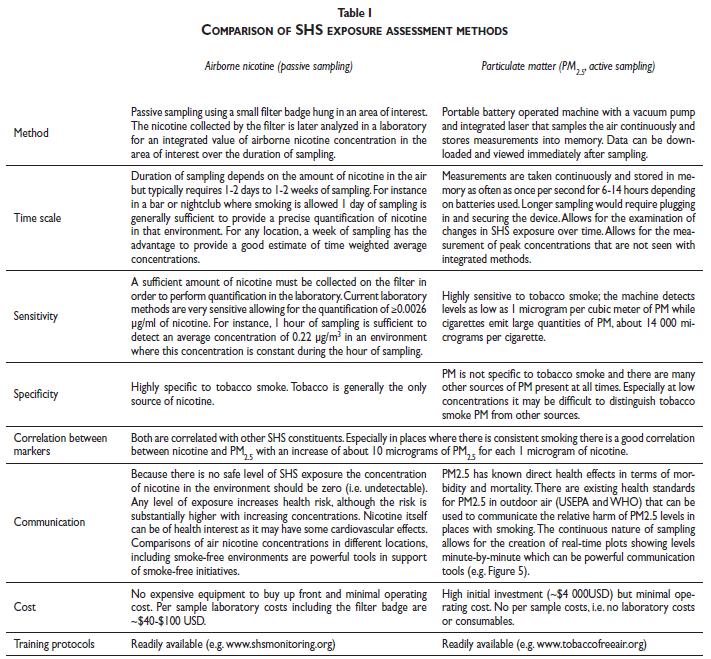
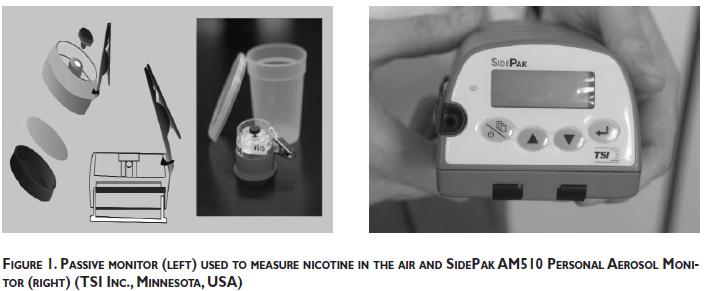
<body><![CDATA[<p><font face="Verdana" size="2"> Each of these different components will behave    differently in the environment. The primary determinants of PM and VVOC are    the amount of smoking and ventilation rates, with 20-30% of PM also being deposited    on surfaces.<sup>6,7</sup> Deposition is the process by which aerosol particles    collect or deposit themselves on solid surfaces, decreasing the concentration    of the particles in the air over time. For VOCs and SVOCs, such as nicotine,    significant amounts of the compound will also sorb (adhere) onto room surfaces.    This sorption will decrease the concentration of the SHS component in the air.    Subsequent desorption (i.e. reemission into the environment), however, will    increase the concentration of the component in the air. The amount and time-scale    across which the sorption and desorption occurs is a function of the specific    SHS component in question, ventilation rate, and the amount and type of surfaces    (e.g. furnishings) in the room. Exposure to these compounds can hence occur    hours, days, or even weeks after active smoking has stopped and these compounds    are adsorbed and desorbed into the air of the room.<sup>6</sup></font></p>     <p><font face="Verdana" size="2"> Dozens of different markers of SHS in the air    have been measured, including nicotine, respirable particles, 3-ethenylpyridine    (3-EP), polycyclic aromatic hydrocarbons (PAHs), carbon monoxide, and acrolein.    Each marker has advantages and disadvantages in terms of specificity, sensitivity,    cost and ease of determination. Furthermore, the choice of marker will also    depend on the specific question being addressed and the environment studied.    Nevertheless, two methods have become the most commonly used for determining    SHS exposure in different environments: airborne nicotine and respirable suspended    particles. The two methods are compared side-by-side in <a href="/img/revistas/spm/v52s2/a05quad01.jpg">Table    I</a>. </font></p>     <p>&nbsp;</p>     <p><font face="Verdana" size="3"><b>Air nicotine</b></font></p>     <p><font face="Verdana" size="2">Airborne nicotine concentrations are well correlated    with the number of cigarettes smoked and with respirable PM generated by the    burning cigarette. They also provide reasonable estimates of exposure to the    rest of tobacco components.<sup>5,7</sup> Nicotine is a particularly attractive    marker because tobacco smoke is its only source in most environments (i.e.,    it is specific to tobacco smoke) and the measurement methods, based on a small    passive filter-badge, are accurate, precise, relatively inexpensive and easy    to use.<sup>7,8,9</sup> The quantification of SHS with airborne nicotine is    generally made by passive sampling, a method that does not rely on mechanized    air pumping. The sampling device is a small, lightweight, circular plastic badge    containing a filter treated with sodium bisulfate (<a href="/img/revistas/spm/v52s2/a05img01.jpg">Figure    1</a>). As air passes through a porous membrane, nicotine in the air is absorbed    into the filter.<sup>8</sup></font></p>     <p><font face="Verdana" size="2"> After the sampling devices have been in place    for a period of time in the location of interest (e.g. one to two weeks), they    are sent to a laboratory where the nicotine collected by the filter is extracted    into heptane with an internal standard, and then injected into a gas chromatograph,    coupled with a nitrogen phosphorus detector and a capillary column.<sup>8,10</sup>    The lowest amount of nicotine that the laboratory method/instrument has been    able to determine in a 7-day sample is around 0.001 &#181;/m3, although the    limit of detection can vary across different laboratories. For quality control    purposes, it is important to use around 10% duplicate samples and at least 10%    blanks. Duplicate samples, a second monitor placed next to the main sampler,    are used to determine how repeatable the laboratory analysis is. Correlation    coefficients between 0.85 and 0.97 have been reported between duplicate and    original samples.<sup>11,12,13</sup> Blanks are monitors that are opened for    3-5 seconds at the sampling site, stored, and analyzed with the rest of the    monitors. These blank samples are used to assess background nicotine levels    trapped by the filter during shipping, storage and manipulation of the sampling    devices. Final concentrations are calculated after subtraction of nicotine background    levels from these blank samples. Because nicotine directly relates to tobacco    smoke, there is no safe level of air nicotine and nicotine should be undetectable    in all indoor environments. Protocols and analysis using this method are readily    available at <a href="http://www.shsmonitoring.org" target="_blank">www.shsmonitoring.org</a>.</font></p>     <p>&nbsp;</p>     <p><font face="Verdana" size="3"><b>Particulate matter</b></font></p>     <p><font face="Verdana" size="2">PM can be divided into categories based on size.    Respirable suspended particulates (RSP) refer only to particles small enough    to be inhaled into the lower airways of the lungs. The maximum particle size    for RSP is generally considered 3.5 or 4 microns. PM2.5 is a measure of the    mass concentration of particles less than 2.5 microns in diameter. It is commonly    used to assess SHS as it closely approximates the respirable fraction (RSP)    and there are existing outdoor air quality standards based on PM2.5 concentrations    that can be used for comparison.<sup>14,15</sup> Virtually all PM in tobacco    smoke is less than one micron in diameter, with the median particle size around    0.2 µm.<sup>16 ,</sup><sup><sup>17 </sup></sup>Other properties of particles,    besides mass concentration, can be measured including particle count and surface    chemistry,<sup>18</sup> although the relevance of these measures for secondhand    monitoring is less clear.</font></p>     <p><font face="Verdana" size="2"> In contrast to nicotine, PM is not specific    to tobacco smoke and thus measurements in environments where smoking occurs    must be compared to concentrations in comparable environments where smoking    does not occur. In environments without smoking, sources of PM could be related    to the presence of burning ovens and candles or to varying levels of outdoor    pollution. Like nicotine, measured concentrations of SHS-associated particulate    range about 100-fold, from 5 to 500 &micro;/m3, over a wide variety of indoor    environments,<sup>19</sup> although extreme levels of several thousand micrograms    per cubic meter are not rare in some indoor environments (e.g. in certain bars    and nightclubs). Indoor environments with smoking commonly have concentrations    of PM2.5 and/or RSP in the range of 10-20 or even more times higher than the    maximum allowed by the Environmental Protection Agency (EPA) concentrations    for outdoor pollution.<sup>14,20</sup></font></p>     ]]></body>
<body><![CDATA[<p><font face="Verdana" size="2"> The novelty in PM monitoring is the availability    of portable, user-friendly, affordable instruments capable of real-time continuous    monitoring (one measurement every second to minutes).<sup>21</sup> The continuous    nature of measurement allows for examination of changes in tobacco smoke levels    over time. These instruments allow multiple assessments of indoor air quality    and are suited to check compliance with smoking policy rules. PM measurements    can also be compared with health based national air quality standards for outdoor    air.<sup>14</sup> Moreover, the results of the measurements can be shared instantly    with bartenders, patrons and customers, thus representing an educational opportunity.    Real-time monitors can also compare outdoor and indoor air quality instantly,    often a shocking experience for lay people who are accustomed to considering    pollution mainly as an outdoor problem.<sup>21</sup> The principal drawback    of this marker is its poor specificity to SHS: in order to collect reliable    information about exposure, it is sometimes useful to link PM measures with    other specific markers such as nicotine.*</font></p>     <p><font face="Verdana" size="2"> One commonly used device for measuring SHS-derived    PM is the TSI SidePak AM510 Personal Aerosol Monitor (TSI, Inc., St. Paul, MN)(<a href="/img/revistas/spm/v52s2/a05img01.jpg">Figure    1</a>). The SidePak uses a built-in sampling pump to draw air through the device    where the PM in the air scatters the light from a laser. The amount of light    scattering is correlated with the particle mass concentration or PM2.5. It is    important to note that with any type of light-scattering instrument such as    the SidePak, it is important to calibrate the device for the specific aerosol    of interest, in this case tobacco smoke. The SidePak has been calibrated and    validated for use in studies of SHS exposure.<sup>22,23,24,25,26</sup> Protocols    and a training course to measure SHS exposure using this device are readily    available at <a href="http://www.tobaccofreeair.org" target="_blank">www.tobaccofreeair.org</a>.</font></p>     <p>&nbsp;</p>     <p><font face="Verdana" size="3"><b>Studies in Latin America</b></font></p>     <p>&nbsp;</p>     <p><font face="Verdana" size="2"><i>Air nicotine</i></font></p>     <p><font face="Verdana" size="2">Public places: Between 2002 and 2004, we measured    indoor air nicotine concentrations in public places in Argentina, Brazil, Chile,    Costa Rica, Guatemala, Honduras, Mexico, Panama, Paraguay, Peru and Uruguay.<sup>11,13,27,28,29</sup>    In each of the countries, we included two secondary schools, a hospital, a government    building, an airport (two airports in Argentina), and 10 restaurants and bars.    </font></p>     <p><font face="Verdana" size="2">Homes: Between 2005 and 2006, we measured indoor    air nicotine concentrations in approximately 40 homes of smokers and non-smokers    in each of the following countries: Argentina, Brazil, Dominican Republic, Guatemala,    Mexico, Panama, Peru, Uruguay, and Venezuela.<sup>12</sup></font></p>     <p><font face="Verdana" size="2">Sampling methods: For both studies, the filter-badges    were assembled at the Secondhand Smoke Exposure Assessment Laboratory of the    Johns Hopkins Institute for Global Tobacco Control and shipped to each country    in securely closed smoke-free containers. Trained, in-country investigators    placed the small, unnoticeable filter-badges in locations selected to represent    areas that people frequently occupy and spend time in. The filter-badges passively    filtered the air trapping the nicotine for a period of <sup>7,8,9,10,11,12,13,14</sup>days    in each location. At the end of the sampling period, the filter-badges were    sent back to the Johns Hopkins laboratory where nicotine was extracted to provide    a time weighted average estimate of air nicotine concentrations (µg/m3) in each    location using the method described above. Using this relatively simple method,    we have monitored more than 1100 indoor public places (around 100 per country)    and 400 homes across major cities in Latin America. </font></p>     <p>&nbsp;</p>     ]]></body>
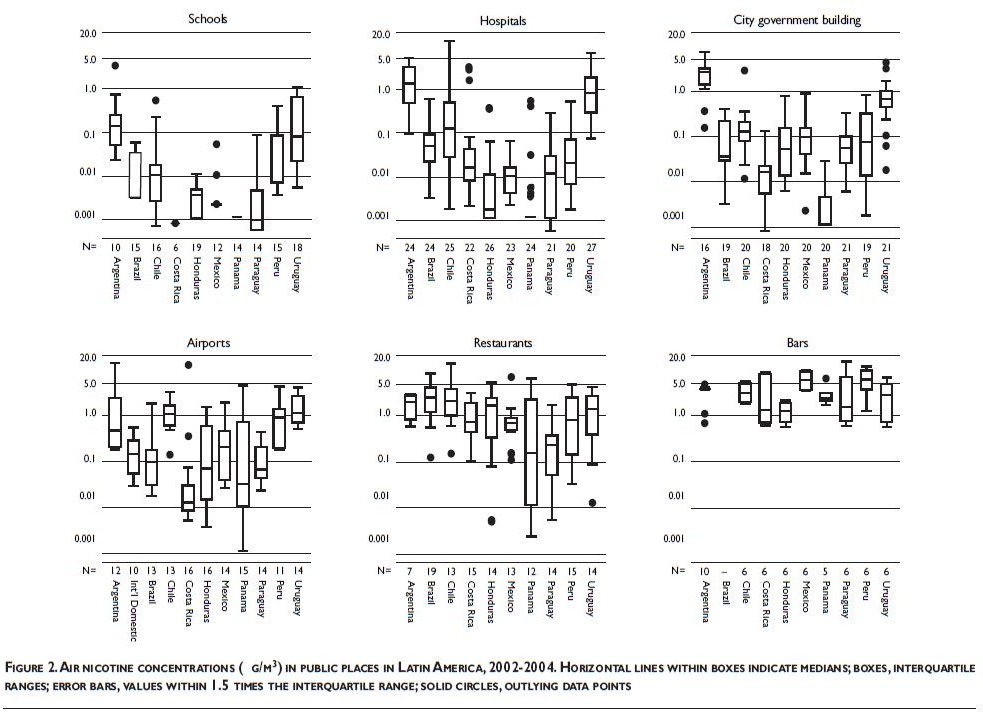
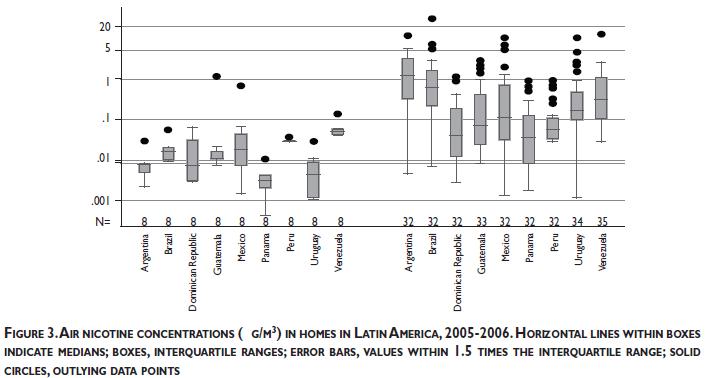
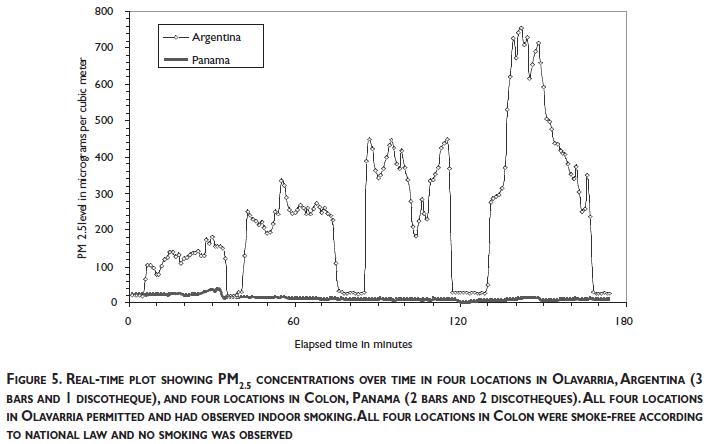
<body><![CDATA[<p><font face="Verdana" size="2"><i>Air nicotine in Latin America - Key findings</i>    </font></p>     <p><font face="Verdana" size="2">Public places: Airborne nicotine was detected    in most locations surveyed (&gt;90%) confirming that smoking was widespread    in indoor public environments across these Latin American countries between    2002-2004, before the implementation of 100% smoke-free legislation in Uruguay,    Panama, Guatemala and other large cities within Latin America. Nicotine concentrations,    however, ranged widely across locations and countries (<a href="/img/revistas/spm/v52s2/a05img02.jpg">Figure    2</a>). Concentrations in hospitals, schools and city government buildings were    highest in Argentina and Uruguay, followed by Chile and other countries. At    the time of the study, legislation banning smoking in schools, hospitals and    government buildings were in place in most countries. Our quantification of    nicotine, however, revealed incomplete compliance with these laws and the need    for better enforcement. The highest nicotine concentrations within all countries    were found in bars and restaurants. Air nicotine concentrations were high even    in non-smoking areas, showing once more that nonsmoking areas contiguous to    smoking areas do not prevent SHS exposure. Most importantly, the high concentrations    of SHS measured in restaurants and bars raised major concerns about the health    of employees who work long hours in those environments. Our study clearly documented    that comprehensive smoke-free laws were urgently needed to protect all people,    including workers in the hospitality industry.</font></p>     <p><font face="Verdana" size="2">Homes: Airborne nicotine was detected in more    than 85% of the homes surveyed. Non-smoking households had very low levels of    airborne nicotine although nicotine was detected in nearly 60% of these homes.    The median levels of air nicotine in households with smokers in these Latin    American countries ranged from 0.04 µg/m3 in Panama, Dominican Republic, and    Peru, to 1.19 µg/m3 in Argentina (<a href="/img/revistas/spm/v52s2/a05img03.jpg">Figure    3</a>). A major concern was that air nicotine levels in some smoking households    were as high as or even higher than air nicotine levels in restaurants or bars    in some of the countries. Children, in particular young children, are at high    risk of SHS exposure at home since they spend a large amount of time in their    homes and because of their limited mobility.<sup>30</sup>" </font></p>     <p>&nbsp;</p>     <p><font face="Verdana" size="3"><b>Particulate matter</b></font></p>     <p><font face="Verdana" size="2">In 2006 and 2007 PM2.5 was assessed in restaurants,    bars, transportation areas such as airports and bus and train stations, and    other types of venues including hotels, shopping malls, offices, casinos and    schools. This study was conducted in 1822 locations in 32 countries around the    world,<sup>31</sup> including 385 locations in 5 Latin American countries: Argentina,    Brazil, Mexico, Uruguay and Venezuela. In 2008, an additional 79 locations in    Panama, and 56 locations in Argentina were added to the previous data collection.    All of the sampling in Panama was conducted after Panama implemented nation-wide    smoke-free air legislation in April 2008. Each location was visited for a minimum    of 30 minutes with the SidePak monitor continuously recording PM2.5 concentrations.    The number of people inside the venue and the number of burning cigarettes were    recorded every 15 minutes during sampling. These observations were averaged    over the time inside the venue to determine the average number of people on    the premises and the average number of burning cigarettes. A sonic measuring    device was used to measure room dimensions and hence the volume of each of venue    where measurements were taken. The active smoker density was calculated by dividing    the average number of burning cigarettes by the volume of the room in meters.</font></p>     <p>&nbsp;</p>     <p><font face="Verdana" size="2"><i>Particulate matter - Key findings in Latin    America</i></font></p>     <p><font face="Verdana" size="2"><a href="#img04">Figure 4</a> shows an overall    5-fold increase in PM2.5 concentration in places where smoking was present at    the time of sampling compared to those without smoking. The particle concentrations    in the presence of smoking far exceeded limits established by the U.S. Environmental    Protection Agency and the World Health Organization to protect human health.    Brazil showed a smaller difference between places with and without smoking (2-fold)    compared to other Latin American countries. This is due to the higher PM2.5    concentration in the non-smoking restaurants sampled in Brazil, likely because    of the common practice of open-fire cooking in these restaurants. Compliance    with the Panama smoke-free air legislation was extremely high with only a single    burning cigarette observed indoors in the 79 locations sampled. As a result,    public places in Panama had low levels of indoor particulate air pollution.    <a href="/img/revistas/spm/v52s2/a05img05.jpg">Figure 5</a> compares    4 locations sampled in smoke-free Colon, Panama to 4 locations sampled in smoking-permitted    Olavarria, Argentina. This example plot shows the change in PM2.5 concentrations    minute-by-minute as the monitor moved between the outdoors and the four locations    in each city. Immediate and dramatic increases in PM2.5 levels are seen in Olavarria    as the monitor moves from outdoors to indoor places with smoking. In contrast,    in Colon, levels stay low as the monitor moves between the outdoor and indoor    smoke-free places.</font></p>     <p align="center">&nbsp;</p>     ]]></body>
<body><![CDATA[<p align="center">&nbsp;</p>     <p align="center"><img src="/img/revistas/spm/v52s2/a05img04.jpg"><a name="img04"></a></p>     <p align="center">&nbsp;</p>     <p align="center">&nbsp;</p>     <p><b><font face="Verdana" size="2">Using monitoring data in support of smoke-free    environments in Latin America</font></b></p>     <p><font face="Verdana" size="2">Dissemination. SHS exposure levels quantified    in Latin America between 2002 and 2004 had immediate implications for public    health professionals and for the government entities responsible for protecting    the public from exposure to SHS. The initial peer-review publication of the    study of air nicotine levels in public places<sup>11</sup> received substantial    media attention in Latin America. More importantly, partner organizations were    actively involved in tobacco control activities in their countries. To help    them disseminate the study findings, we prepared specific country reports trying    to make them attractive and easy to understand. Tips to prepare policy relevant    reports are provided in <a href="http://www.shsmonitoring.org" target="_blank">www.shsmonitoring.org</a>.    Reports included summary tables, figures, and conclusions highlighting the key    points for each country. They also provided details on tobacco legislation at    the country level and summarized the international evidence for smoke-free environments.    Our target audiences were policy makers, medical and public health providers,    media and the public at large. </font></p>     <p><font face="Verdana" size="2">Some successes. The air nicotine data and the    multi-country approach proved to be powerful tools in support of smoke-free    environments. Both air nicotine and PM2.5 data have been extensively used for    media advocacy in Latin America. The air nicotine findings had a substantial    media impact in Latin America, including at least Argentina, Uruguay, Chile    and Guatemala and were actively used in support of smoke-free legislations in    those countries. PM2.5 results also received very important media coverage in    Argentina where PM2.5 monitoring has been used to demonstrate the need for smoke-free    air legislation, to evaluate the positive impact of 100% smoke-free air legislation    in some provinces, and to document the shortcomings of partial restrictions    requiring only separate sections.<sup><sup>32</sup></sup> In most countries,    the air nicotine and PM2.5 results were presented to legislative bodies debating    tobacco control legislation at the national and sub-national levels. In 2004,    the Uruguayan government cited the air nicotine study in a decree that made    all health care facilities smoke-free.<sup>11</sup> Two years later, Uruguay    was the first country in the Americas and the first low- or middle-income country    in the world to enact comprehensive national smoke-free legislation that prohibited    smoking in all indoor public places and workplaces, including bars and restaurants.    In 2008, air nicotine data were used in the successful promotion of comprehensive    smokefree legislation in Panama and Guatemala and PM2.5 data were used for promotion    of sub-national laws in Argentina and in evaluation of the national law in Panama.    In other countries, legislation remains incomplete: however, many cities are    taking the lead and passing comprehensive smoke-free legislation in their jurisdictions.    </font></p>     <p>&nbsp;</p>     <p><font face="Verdana" size="3"><b>Evaluation of smoke-free legislation in Latin    America</b></font></p>     <p><font face="Verdana" size="2">We are currently revisiting locations from the    2002-2004 studies in Uruguay<sup>33</sup> and Guatemala to measure air nicotine    concentrations following the implementation of smoke-free legislation in these    countries. Our questions are the following: Has exposure to SHS changed? Are    levels of enforcement similar across different institutions? Are additional    enforcement efforts needed? In Montevideo, Uruguay, air nicotine levels in public    places and workplaces have decreased extraordinarily after the implementation    of the comprehensive national smoke-free legislation in 2006.<sup>33</sup> These    findings, consistent with self-reported data on seeing smoking in regulated    venues<sup>34</sup> confirm that similar legislation can be enacted and implemented    successfully in other countries. By objectively documenting decreases in SHS    exposure from before to after implementation of comprehensive smoke-free legislation,    we expect to encourage other countries in Latin America and other regions of    the world to take the necessary steps to eliminate toxic tobacco smoke from    indoor public places and workplaces. </font></p>     ]]></body>
<body><![CDATA[<p>&nbsp;</p>     <p><font face="Verdana" size="3"><b>Next steps</b></font></p>     <p><font face="Verdana" size="2">Measuring air nicotine and respirable suspended    particles in public places in Latin America has contributed to increase our    understanding of the magnitude of exposure to SHS in Latin America and to use    those data to support and promote compliance with smoke-free legislation. The    measurement of nicotine in the home environment objectively revealed the critical    need to implement educational measures that would protect children from SHS    in their homes. Additional efforts to monitor and reduce SHS exposure in private    environments, such as homes and motor vehicles, are needed in Latin America.    While legislating smoke-free environments in private homes is challenging,<sup>35</sup>    ethical support for banning smoking across different environments can be obtained    when the goal is to protect children's health.<sup>36</sup> These environments    could include multi-unit housing, parks and other outdoor places where children    gather and spend time, as well as in motor vehicles. There is substantial legislative    experience showing that it is possible to ban smoking in cars when children    are present. Air nicotine levels<sup>37</sup> and respirable suspended particles<sup>38</sup>    have been assessed in motor vehicles in some countries and could also be applied    in Latin American countries to support smoke-free motor-vehicle legislation    there. The source of SHS pollution is easily identifiable: the burning cigarette.    Smoke-free environments, through legislation and education, are thus relatively    simple and straightforward measures to eliminate tobacco smoke pollution. </font></p>     <p>&nbsp;</p>     <p><font face="Verdana" size="3"><b>Acknowledgements</b></font></p>     <p><font face="Verdana" size="2">Conducting these multi-country studies in Latin    America was possible thanks to the collaboration of multiple institutions and    investigators. Dr. Armando Peruga from the Pan American Health Organization    (PAHO) and Drs. Patrick Breysse, Jonathan Samet and Heather Wipfli from the    Johns Hopkins Bloomberg School of Public Health provided the necessary leadership    to define the study goals, refine the study methods and protocols and identify    the study coordinators and partnering institutions for the air nicotine in public    places and home studies. The effective study conduction and dissemination of    the findings in each country was possible thanks to the following lead country    investigators: Marta Angueira (Argentina), Vera Colombo and Valeska Figueiredo    (Brazil), Marisol Acu&ntilde;a (Chile), Katya Jimenez (Costa Rica), Sergio Diaz, Deborah    Ossip-Klein and Essie Sierra (Dominican Republic), Joaquin Barnoya (Guatemala),    Claudia Gomez (Honduras), Raydel Valdes and Luz Myriam Reynales (Mexico), Reina    Roa (Panama), Graciela Gamarra (Paraguay), Carmen Barco (Peru), Adriana Blanco    (Uruguay) and Natasha Herrera (Venezuela). The public places nicotine study    was originally funded by PAHO and the Institute for Global Tobacco Control,    and in recent years by a Clinical Investigator Award from the Flight Attendant    Medical Research Institute (FAMRI), the FAMRI Center of Excellence Award to    the Johns Hopkins Medical Institutions, and the Bloomberg Initiative to Reduce    to Tobacco Use. The home nicotine study was funded by FAMRI through a Dr William    Cahan Distinguished Professor award to Dr. Jonathan M. Samet. Dr. Travers'    work in measuring SHS-derived particulate matter is also funded by FAMRI. The    new particle monitoring data presented was made possible by lead investigators    Ver&oacute;nica Schoj and Mar&iacute;a Elizabeth Pizarro in Argentina and Reina Roa in Panama.</font></p>     <p>&nbsp;</p>     <p><font face="Verdana" size="3"><b>Declaration of conflicts of interest</b></font></p>     <p><font face="Verdana" size="2">We declare that we have no conflicts of interest.</font></p>     <p>&nbsp;</p>     ]]></body>
<body><![CDATA[<p><font face="Verdana" size="3"><b>References</b></font></p>     <!-- ref --><p><font face="Verdana" size="2">01. U.S. Department of Health and Human Services.    The Health Consequences of Involuntary Exposure to Tobacco Smoke: A Report of    the Surgeon General. Atlanta: U.S. Department of Health and Human Services,    Centers for Disease Control and Prevention, Coordinating Center for Health Promotion,    National Center for Chronic Disease Prevention and Health Promotion, Office    on Smoking and Health, 2006.    &nbsp;&nbsp;&nbsp;&nbsp;&nbsp;&nbsp;&nbsp;&nbsp;[&#160;<a href="javascript:void(0);" onclick="javascript: window.open('/scielo.php?script=sci_nlinks&ref=9310949&pid=S0036-3634201000080000900001&lng=','','width=640,height=500,resizable=yes,scrollbars=1,menubar=yes,');">Links</a>&#160;]<!-- end-ref --> </font></p>     <!-- ref --><p><font face="Verdana" size="2">02. World Health Organization. WHO Framework    Convention on Tobacco Control. Geneva: WHO, 2003.    &nbsp;&nbsp;&nbsp;&nbsp;&nbsp;&nbsp;&nbsp;&nbsp;[&#160;<a href="javascript:void(0);" onclick="javascript: window.open('/scielo.php?script=sci_nlinks&ref=9310951&pid=S0036-3634201000080000900002&lng=','','width=640,height=500,resizable=yes,scrollbars=1,menubar=yes,');">Links</a>&#160;]<!-- end-ref --> </font></p>     <!-- ref --><p><font face="Verdana" size="2">03. World Health Organization. WHO Framework    Convention on Tobacco Control Guidelines for implementation Article 5.3; Article    8; Article 11; Article 13. Geneva: WHO, 2009.    &nbsp;&nbsp;&nbsp;&nbsp;&nbsp;&nbsp;&nbsp;&nbsp;[&#160;<a href="javascript:void(0);" onclick="javascript: window.open('/scielo.php?script=sci_nlinks&ref=9310953&pid=S0036-3634201000080000900003&lng=','','width=640,height=500,resizable=yes,scrollbars=1,menubar=yes,');">Links</a>&#160;]<!-- end-ref --> </font></p>     <!-- ref --><p><font face="Verdana" size="2">04. National Research Council (NRC), Committee    on Passive Smoking. Environmental tobacco smoke: Measuring exposures and assessing    health effects. Washington, DC: National Academies Press, 1986.    &nbsp;&nbsp;&nbsp;&nbsp;&nbsp;&nbsp;&nbsp;&nbsp;[&#160;<a href="javascript:void(0);" onclick="javascript: window.open('/scielo.php?script=sci_nlinks&ref=9310955&pid=S0036-3634201000080000900004&lng=','','width=640,height=500,resizable=yes,scrollbars=1,menubar=yes,');">Links</a>&#160;]<!-- end-ref --> </font></p>     <!-- ref --><p><font face="Verdana" size="2">05. Daisey JM. Tracers for assessing exposure    to environmental tobacco smoke: what are they tracing? Environ Health Perspect    1999;107(Suppl 2):319-327.    &nbsp;&nbsp;&nbsp;&nbsp;&nbsp;&nbsp;&nbsp;&nbsp;[&#160;<a href="javascript:void(0);" onclick="javascript: window.open('/scielo.php?script=sci_nlinks&ref=9310957&pid=S0036-3634201000080000900005&lng=','','width=640,height=500,resizable=yes,scrollbars=1,menubar=yes,');">Links</a>&#160;]<!-- end-ref --></font></p>     <!-- ref --><p><font face="Verdana" size="2">06. Singer BC, Hodgson AT, Guevarra KS, Hawley    EL, Nazaroff WW. Gas-phase organics in environmental tobacco smoke. 1. Effects    of smoking rate, ventilation, and furnishing level on emission factors. Environ    Sci Technol 2002 Mar 1;36(5):846-853.    &nbsp;&nbsp;&nbsp;&nbsp;&nbsp;&nbsp;&nbsp;&nbsp;[&#160;<a href="javascript:void(0);" onclick="javascript: window.open('/scielo.php?script=sci_nlinks&ref=9310959&pid=S0036-3634201000080000900006&lng=','','width=640,height=500,resizable=yes,scrollbars=1,menubar=yes,');">Links</a>&#160;]<!-- end-ref --></font></p>     <!-- ref --><p><font face="Verdana" size="2">07. Leaderer BP, Hammond SK. Evaluation of vapor-phase    nicotine and respirable suspended particle mass as markers for environmental    tobacco smoke. Environ Sci Technol 1991 Apr 1;25(4):770-777.    &nbsp;&nbsp;&nbsp;&nbsp;&nbsp;&nbsp;&nbsp;&nbsp;[&#160;<a href="javascript:void(0);" onclick="javascript: window.open('/scielo.php?script=sci_nlinks&ref=9310961&pid=S0036-3634201000080000900007&lng=','','width=640,height=500,resizable=yes,scrollbars=1,menubar=yes,');">Links</a>&#160;]<!-- end-ref --></font></p>     <!-- ref --><p><font face="Verdana" size="2">08. Hammond SK, Leaderer BP. A diffusion monitor    to measure exposure to passive smoking. Environ Sci Technol 1987;21:494-497.    &nbsp;&nbsp;&nbsp;&nbsp;&nbsp;&nbsp;&nbsp;&nbsp;[&#160;<a href="javascript:void(0);" onclick="javascript: window.open('/scielo.php?script=sci_nlinks&ref=9310963&pid=S0036-3634201000080000900008&lng=','','width=640,height=500,resizable=yes,scrollbars=1,menubar=yes,');">Links</a>&#160;]<!-- end-ref --></font></p>     <!-- ref --><p><font face="Verdana" size="2">09. Guerin MR, Jenkins RA, Tomkins BA. The chemistry    of environmental tobacco smoke: composition and measurement. 2nd. ed. Washington,    DC: Lewis Publishers Inc., 1992.    &nbsp;&nbsp;&nbsp;&nbsp;&nbsp;&nbsp;&nbsp;&nbsp;[&#160;<a href="javascript:void(0);" onclick="javascript: window.open('/scielo.php?script=sci_nlinks&ref=9310965&pid=S0036-3634201000080000900009&lng=','','width=640,height=500,resizable=yes,scrollbars=1,menubar=yes,');">Links</a>&#160;]<!-- end-ref --></font></p>     <!-- ref --><p><font face="Verdana" size="2">10. Hammond SK, Leaderer BP, Roche AC, Schenker    M. Collection and analysis of nicotine as a marker for environmental tobacco    smoke. Atmospheric Environment 1987;21(2):457-462.    &nbsp;&nbsp;&nbsp;&nbsp;&nbsp;&nbsp;&nbsp;&nbsp;[&#160;<a href="javascript:void(0);" onclick="javascript: window.open('/scielo.php?script=sci_nlinks&ref=9310967&pid=S0036-3634201000080000900010&lng=','','width=640,height=500,resizable=yes,scrollbars=1,menubar=yes,');">Links</a>&#160;]<!-- end-ref --></font></p>     <!-- ref --><p><font face="Verdana" size="2">11. Navas-Acien A, Peruga A, Breysse P, Zavaleta    A, Blanco-Marquizo A, Pitarque R, et al. Secondhand smoke in public places in    Latin America, 2002-2003. JAMA 2004;291(22):2741-2745.    &nbsp;&nbsp;&nbsp;&nbsp;&nbsp;&nbsp;&nbsp;&nbsp;[&#160;<a href="javascript:void(0);" onclick="javascript: window.open('/scielo.php?script=sci_nlinks&ref=9310969&pid=S0036-3634201000080000900011&lng=','','width=640,height=500,resizable=yes,scrollbars=1,menubar=yes,');">Links</a>&#160;]<!-- end-ref --></font></p>     <!-- ref --><p><font face="Verdana" size="2">12. Wipfli H, Avila-Tang E, Navas-Acien A, Kim    S, Onicescu G, Yuan J, et al. Secondhand smoke exposure among women and children:    Evidence from 31 countries. Am J Public Health 2008;98(4):672-679.    &nbsp;&nbsp;&nbsp;&nbsp;&nbsp;&nbsp;&nbsp;&nbsp;[&#160;<a href="javascript:void(0);" onclick="javascript: window.open('/scielo.php?script=sci_nlinks&ref=9310971&pid=S0036-3634201000080000900012&lng=','','width=640,height=500,resizable=yes,scrollbars=1,menubar=yes,');">Links</a>&#160;]<!-- end-ref --></font></p>     <!-- ref --><p><font face="Verdana" size="2">13. Barnoya J, Mendoza-Montano C, Navas-Acien    A. Secondhand smoke exposure in public places in Guatemala: comparison with    other Latin American countries. Cancer Epidemiol Biomarkers Prev 2007;16(12):2730-2735.    &nbsp;&nbsp;&nbsp;&nbsp;&nbsp;&nbsp;&nbsp;&nbsp;[&#160;<a href="javascript:void(0);" onclick="javascript: window.open('/scielo.php?script=sci_nlinks&ref=9310973&pid=S0036-3634201000080000900013&lng=','','width=640,height=500,resizable=yes,scrollbars=1,menubar=yes,');">Links</a>&#160;]<!-- end-ref --></font></p>     <!-- ref --><p><font face="Verdana" size="2">14. Environmental Protection Agency. PM Standards    Revision - 2006. <a href="http://www.epa.gov/oar/particlepollution/naaqsrev2006.html" target="_blank">http://www    epa gov/oar/particlepollution/naaqsrev2006.html</a> 2007 cited 2010 Mar 11;Available    from: URL: <a href="http://www.epa.gov/oar/particlepollution/naaqsrev2006.html" target="_blank">http://www.epa.gov/oar/particlepollution/naaqsrev2006.html</a></font>&nbsp;&nbsp;&nbsp;&nbsp;&nbsp;&nbsp;&nbsp;&nbsp;[&#160;<a href="javascript:void(0);" onclick="javascript: window.open('/scielo.php?script=sci_nlinks&ref=9310975&pid=S0036-3634201000080000900014&lng=','','width=640,height=500,resizable=yes,scrollbars=1,menubar=yes,');">Links</a>&#160;]<!-- end-ref --><!-- ref --><p><font face="Verdana" size="2">15. World Health Organization. WHO Air quality    guidelines for particulate matter, ozone, nitrogen dioxide and sulfur dioxide.    Global update 2005. Summary of risk assessment. Geneva: WHO, 2006.    &nbsp;&nbsp;&nbsp;&nbsp;&nbsp;&nbsp;&nbsp;&nbsp;[&#160;<a href="javascript:void(0);" onclick="javascript: window.open('/scielo.php?script=sci_nlinks&ref=9310976&pid=S0036-3634201000080000900015&lng=','','width=640,height=500,resizable=yes,scrollbars=1,menubar=yes,');">Links</a>&#160;]<!-- end-ref --> </font></p>     ]]></body>
<body><![CDATA[<!-- ref --><p><font face="Verdana" size="2">16. Klepeis NE, Apte MG, Gundel LA, Sextro RG,    Nazaroff WW. Determining size-specific emission factors for environmental tobacco    smoke particles. Aerosol Science and Technology 2003;37(10):780-790.    &nbsp;&nbsp;&nbsp;&nbsp;&nbsp;&nbsp;&nbsp;&nbsp;[&#160;<a href="javascript:void(0);" onclick="javascript: window.open('/scielo.php?script=sci_nlinks&ref=9310978&pid=S0036-3634201000080000900016&lng=','','width=640,height=500,resizable=yes,scrollbars=1,menubar=yes,');">Links</a>&#160;]<!-- end-ref --></font></p>     <!-- ref --><p><font face="Verdana" size="2">17. Morawska L, Barron W, Hitchins J. Experimental    deposition of environmental tobacco smoke submicrometer particulate matter in    the human respiratory tract. American Industrial Hygiene Association Journal    1999;60(3):334-339.    &nbsp;&nbsp;&nbsp;&nbsp;&nbsp;&nbsp;&nbsp;&nbsp;[&#160;<a href="javascript:void(0);" onclick="javascript: window.open('/scielo.php?script=sci_nlinks&ref=9310980&pid=S0036-3634201000080000900017&lng=','','width=640,height=500,resizable=yes,scrollbars=1,menubar=yes,');">Links</a>&#160;]<!-- end-ref --></font></p>     <!-- ref --><p><font face="Verdana" size="2">18. Ott WR, Siegmann HC. Using multiple continuous    fine particle monitors to characterize tobacco, incense, candle, cooking, wood    burning, and vehicular sources in indoor, outdoor, and in-transit settings.    Atmospheric Environment 2006;40:821-843.    &nbsp;&nbsp;&nbsp;&nbsp;&nbsp;&nbsp;&nbsp;&nbsp;[&#160;<a href="javascript:void(0);" onclick="javascript: window.open('/scielo.php?script=sci_nlinks&ref=9310982&pid=S0036-3634201000080000900018&lng=','','width=640,height=500,resizable=yes,scrollbars=1,menubar=yes,');">Links</a>&#160;]<!-- end-ref --></font></p>     <!-- ref --><p><font face="Verdana" size="2">19. National Cancer Institute. Smoking and Tobacco    Control Monograph 10. Health Effects of Exposure to Environmental Tobacco Smoke,    Final Report. 1999.    &nbsp;&nbsp;&nbsp;&nbsp;&nbsp;&nbsp;&nbsp;&nbsp;[&#160;<a href="javascript:void(0);" onclick="javascript: window.open('/scielo.php?script=sci_nlinks&ref=9310984&pid=S0036-3634201000080000900019&lng=','','width=640,height=500,resizable=yes,scrollbars=1,menubar=yes,');">Links</a>&#160;]<!-- end-ref --> </font></p>     <!-- ref --><p><font face="Verdana" size="2">20. Repace J. Respirable particles and carcinogens    in the air of delaware hospitality venues before and after a smoking ban. J    Occup Environ Med 2004;46(9):887-905.    &nbsp;&nbsp;&nbsp;&nbsp;&nbsp;&nbsp;&nbsp;&nbsp;[&#160;<a href="javascript:void(0);" onclick="javascript: window.open('/scielo.php?script=sci_nlinks&ref=9310986&pid=S0036-3634201000080000900020&lng=','','width=640,height=500,resizable=yes,scrollbars=1,menubar=yes,');">Links</a>&#160;]<!-- end-ref --></font></p>     ]]></body>
<body><![CDATA[<!-- ref --><p><font face="Verdana" size="2">21. Invernizzi G, Ruprecht A, Mazza R, Rossetti    E, Sasco A, Nardini S, et al. Particulate matter from tobacco versus diesel    car exhaust: an educational perspective. Tobacco Control 2004;13(3):219-221.    &nbsp;&nbsp;&nbsp;&nbsp;&nbsp;&nbsp;&nbsp;&nbsp;[&#160;<a href="javascript:void(0);" onclick="javascript: window.open('/scielo.php?script=sci_nlinks&ref=9310988&pid=S0036-3634201000080000900021&lng=','','width=640,height=500,resizable=yes,scrollbars=1,menubar=yes,');">Links</a>&#160;]<!-- end-ref --></font></p>     <!-- ref --><p><font face="Verdana" size="2">22. Klepeis NE, Ott WR, Switzer P. Real-time    measurement of outdoor tobacco smoke particles 6. Journal of the Air &amp; Waste    Management Association 2007;57(5):522-534.    &nbsp;&nbsp;&nbsp;&nbsp;&nbsp;&nbsp;&nbsp;&nbsp;[&#160;<a href="javascript:void(0);" onclick="javascript: window.open('/scielo.php?script=sci_nlinks&ref=9310990&pid=S0036-3634201000080000900022&lng=','','width=640,height=500,resizable=yes,scrollbars=1,menubar=yes,');">Links</a>&#160;]<!-- end-ref --></font></p>     <!-- ref --><p><font face="Verdana" size="2">23. Travers MJ, Cummings KM, Hyland A, Repace    J, Babb S, Pechacek T, et al. Indoor air quality in hospitality venues before    and after implementation of a clean indoor air law -- Western New York, 2003.    MMWR: Morbidity &amp; Mortality Weekly Report 2004;53(44):1038-1041.    &nbsp;&nbsp;&nbsp;&nbsp;&nbsp;&nbsp;&nbsp;&nbsp;[&#160;<a href="javascript:void(0);" onclick="javascript: window.open('/scielo.php?script=sci_nlinks&ref=9310992&pid=S0036-3634201000080000900023&lng=','','width=640,height=500,resizable=yes,scrollbars=1,menubar=yes,');">Links</a>&#160;]<!-- end-ref --></font></p>     <!-- ref --><p><font face="Verdana" size="2">24. Travers MJ, Lee K. Particulate air pollution    in Irish pubs is grossly underestimated. Am J Respir Crit Care Med 2008;177(2):236-237.    &nbsp;&nbsp;&nbsp;&nbsp;&nbsp;&nbsp;&nbsp;&nbsp;[&#160;<a href="javascript:void(0);" onclick="javascript: window.open('/scielo.php?script=sci_nlinks&ref=9310994&pid=S0036-3634201000080000900024&lng=','','width=640,height=500,resizable=yes,scrollbars=1,menubar=yes,');">Links</a>&#160;]<!-- end-ref --></font></p>     <!-- ref --><p><font face="Verdana" size="2">25. Waring MS, Siegel JA. An evaluation of the    indoor air quality in bars before and after a smoking ban in Austin, Texas.    J Expo Sci Environ Epidemiol 2007;17(3):260-268.    &nbsp;&nbsp;&nbsp;&nbsp;&nbsp;&nbsp;&nbsp;&nbsp;[&#160;<a href="javascript:void(0);" onclick="javascript: window.open('/scielo.php?script=sci_nlinks&ref=9310996&pid=S0036-3634201000080000900025&lng=','','width=640,height=500,resizable=yes,scrollbars=1,menubar=yes,');">Links</a>&#160;]<!-- end-ref --></font></p>     ]]></body>
<body><![CDATA[<!-- ref --><p><font face="Verdana" size="2">26. Lee K, Hahn EJ, Pieper N, Okoli CT, Repace    J, Troutman A. Differential impacts of smoke-free laws on indoor air quality.    J Environ Health 2008;70(8):24-30, 54.    &nbsp;&nbsp;&nbsp;&nbsp;&nbsp;&nbsp;&nbsp;&nbsp;[&#160;<a href="javascript:void(0);" onclick="javascript: window.open('/scielo.php?script=sci_nlinks&ref=9310998&pid=S0036-3634201000080000900026&lng=','','width=640,height=500,resizable=yes,scrollbars=1,menubar=yes,');">Links</a>&#160;]<!-- end-ref --></font></p>     <!-- ref --><p><font face="Verdana" size="2">27. Navas-Acien A, Blanco-Marquizo A, Goja B.    Estudio de vigilancia de la exposici&oacute;n a humo de tabaco en Uruguay. Rev    Salud Publica de Uruguay 2004;2:3-8.    &nbsp;&nbsp;&nbsp;&nbsp;&nbsp;&nbsp;&nbsp;&nbsp;[&#160;<a href="javascript:void(0);" onclick="javascript: window.open('/scielo.php?script=sci_nlinks&ref=9311000&pid=S0036-3634201000080000900027&lng=','','width=640,height=500,resizable=yes,scrollbars=1,menubar=yes,');">Links</a>&#160;]<!-- end-ref --></font></p>     <!-- ref --><p><font face="Verdana" size="2">28. Navas-Acien A, G&oacute;mez Mass CDHACE.    Exposici&oacute;n ambiental a humo de tabaco en Tegucigalpa, Honduras. Revista    Facultad Ciencias M&eacute;dicas Hondure&ntilde;a 2005;2:51-59.    &nbsp;&nbsp;&nbsp;&nbsp;&nbsp;&nbsp;&nbsp;&nbsp;[&#160;<a href="javascript:void(0);" onclick="javascript: window.open('/scielo.php?script=sci_nlinks&ref=9311002&pid=S0036-3634201000080000900028&lng=','','width=640,height=500,resizable=yes,scrollbars=1,menubar=yes,');">Links</a>&#160;]<!-- end-ref --></font></p>     <!-- ref --><p><font face="Verdana" size="2">29. Barrientos-Gutierrez T, Valdes-Salgado R,    Reynales-Shigematsu LM, Navas-Acien A, Lazcano-Ponce E. Involuntary exposure    to tobacco smoke in public places in Mexico City. Salud Publica Mex 2007;49    Suppl 2:S205-S212.    &nbsp;&nbsp;&nbsp;&nbsp;&nbsp;&nbsp;&nbsp;&nbsp;[&#160;<a href="javascript:void(0);" onclick="javascript: window.open('/scielo.php?script=sci_nlinks&ref=9311004&pid=S0036-3634201000080000900029&lng=','','width=640,height=500,resizable=yes,scrollbars=1,menubar=yes,');">Links</a>&#160;]<!-- end-ref --></font></p>     <!-- ref --><p><font face="Verdana" size="2">30. Kim S, Wipfli H, Navas-Acien A, Dominici    F, vila-Tang E, Onicescu G, et al. Determinants of hair nicotine concentrations    in nonsmoking women and children: a multicountry study of secondhand smoke exposure    in homes. Cancer Epidemiol Biomarkers Prev 2009;18(12):3407-3414.    &nbsp;&nbsp;&nbsp;&nbsp;&nbsp;&nbsp;&nbsp;&nbsp;[&#160;<a href="javascript:void(0);" onclick="javascript: window.open('/scielo.php?script=sci_nlinks&ref=9311006&pid=S0036-3634201000080000900030&lng=','','width=640,height=500,resizable=yes,scrollbars=1,menubar=yes,');">Links</a>&#160;]<!-- end-ref --></font></p>     ]]></body>
<body><![CDATA[<!-- ref --><p><font face="Verdana" size="2">31. Hyland A, Travers MJ, Dresler C, Higbee C,    Cummings KM. A 32-country comparison of tobacco smoke derived particle levels    in indoor public places. Tob Control 2008;17(3):159-165.    &nbsp;&nbsp;&nbsp;&nbsp;&nbsp;&nbsp;&nbsp;&nbsp;[&#160;<a href="javascript:void(0);" onclick="javascript: window.open('/scielo.php?script=sci_nlinks&ref=9311008&pid=S0036-3634201000080000900031&lng=','','width=640,height=500,resizable=yes,scrollbars=1,menubar=yes,');">Links</a>&#160;]<!-- end-ref --></font></p>     <!-- ref --><p><font face="Verdana" size="2">32. Schoj V, Sebrie E, Pizarro M, Hyland A, Travers    MJ. Informing effective smokefree policies in Argentina: air quality monitoring    study in 15 cities (2007-20009). Salud Publica Mex 2010.    &nbsp;&nbsp;&nbsp;&nbsp;&nbsp;&nbsp;&nbsp;&nbsp;[&#160;<a href="javascript:void(0);" onclick="javascript: window.open('/scielo.php?script=sci_nlinks&ref=9311010&pid=S0036-3634201000080000900032&lng=','','width=640,height=500,resizable=yes,scrollbars=1,menubar=yes,');">Links</a>&#160;]<!-- end-ref --> </font></p>     <!-- ref --><p><font face="Verdana" size="2">33. Blanco-Marquizo A, Goja B, Peruga A, Jones    MR, Yuan J, Samet JM, et al. Reduction of secondhand tobacco smoke in public    places following national smoke-free legislation in Uruguay. Tobacco Control.    2010;19:231-234.    &nbsp;&nbsp;&nbsp;&nbsp;&nbsp;&nbsp;&nbsp;&nbsp;[&#160;<a href="javascript:void(0);" onclick="javascript: window.open('/scielo.php?script=sci_nlinks&ref=9311012&pid=S0036-3634201000080000900033&lng=','','width=640,height=500,resizable=yes,scrollbars=1,menubar=yes,');">Links</a>&#160;]<!-- end-ref --></font></p>     <!-- ref --><p><font face="Verdana" size="2">34. Thrasher JF, Boado M, Sebrie EM, Bianco E.    Smoke-free policies and the social acceptability of smoking in Uruguay and Mexico:    Findings from the International Tobacco Control Policy Evaluation Project. Nicotine    &amp; Tobacco Research 2009;11(6):591-599.    &nbsp;&nbsp;&nbsp;&nbsp;&nbsp;&nbsp;&nbsp;&nbsp;[&#160;<a href="javascript:void(0);" onclick="javascript: window.open('/scielo.php?script=sci_nlinks&ref=9311014&pid=S0036-3634201000080000900034&lng=','','width=640,height=500,resizable=yes,scrollbars=1,menubar=yes,');">Links</a>&#160;]<!-- end-ref --></font></p>     <!-- ref --><p><font face="Verdana" size="2">35. Jarvie JA, Malone RE. Children's secondhand    smoke exposure in private homes and cars: an ethical analysis. Am J Public Health    2008;98(12):2140-2145.    &nbsp;&nbsp;&nbsp;&nbsp;&nbsp;&nbsp;&nbsp;&nbsp;[&#160;<a href="javascript:void(0);" onclick="javascript: window.open('/scielo.php?script=sci_nlinks&ref=9311016&pid=S0036-3634201000080000900035&lng=','','width=640,height=500,resizable=yes,scrollbars=1,menubar=yes,');">Links</a>&#160;]<!-- end-ref --></font></p>     ]]></body>
<body><![CDATA[<!-- ref --><p><font face="Verdana" size="2">36. Tobacco and the Rights of the Child. World    Health Organization Tobacco and the Rights of the Child Web site. accessed December,    2009. Available at: <a href="http://www.who.int/tobacco/media/en/CRCreport.pdf" target="_blank">http://www.who.int/tobacco/media/en/CRCreport.pdf</a></font>&nbsp;&nbsp;&nbsp;&nbsp;&nbsp;&nbsp;&nbsp;&nbsp;[&#160;<a href="javascript:void(0);" onclick="javascript: window.open('/scielo.php?script=sci_nlinks&ref=9311018&pid=S0036-3634201000080000900036&lng=','','width=640,height=500,resizable=yes,scrollbars=1,menubar=yes,');">Links</a>&#160;]<!-- end-ref --><!-- ref --><p><font face="Verdana" size="2">37. Jones MR, Navas-Acien A, Yuan J, Breysse    PN. Secondhand tobacco smoke concentrations in motor vehicles: a pilot study.    Tob Control 2009;18(5):399-404.    &nbsp;&nbsp;&nbsp;&nbsp;&nbsp;&nbsp;&nbsp;&nbsp;[&#160;<a href="javascript:void(0);" onclick="javascript: window.open('/scielo.php?script=sci_nlinks&ref=9311019&pid=S0036-3634201000080000900037&lng=','','width=640,height=500,resizable=yes,scrollbars=1,menubar=yes,');">Links</a>&#160;]<!-- end-ref --></font></p>     <!-- ref --><p><font face="Verdana" size="2">38. Sendzik T, Fong GT, Travers MJ, Hyland A.    An experimental investigation of tobacco smoke pollution in cars. Nicotine Tob    Res 2009;11(6):627-634.    &nbsp;&nbsp;&nbsp;&nbsp;&nbsp;&nbsp;&nbsp;&nbsp;[&#160;<a href="javascript:void(0);" onclick="javascript: window.open('/scielo.php?script=sci_nlinks&ref=9311021&pid=S0036-3634201000080000900038&lng=','','width=640,height=500,resizable=yes,scrollbars=1,menubar=yes,');">Links</a>&#160;]<!-- end-ref --></font></p>     <p>&nbsp;</p>     <p>&nbsp;</p>     <p><font face="Verdana" size="2">Received on: March 22, 2010    <br>   Accepted on: April 21, 2010</font></p>     <p>&nbsp;</p>     ]]></body>
<body><![CDATA[<p><font face="Verdana" size="2">    <br>   </font><font face="Verdana" size="2">Address reprint requests to: Erika Avila-    Tang, PhD, MHS. Department of Epidemiology, Johns Hopkins Bloomberg School    <br>   </font><font face="Verdana" size="2">of Public Health 627 N. Washington St.    2nd floor. Baltimore, Maryland, USA 21205    <br>   </font><font face="Verdana" size="2">E-mail: <a href="mailto:etang@jhsph.edu">etang@jhsph.edu</a>    </font></p>      ]]></body><back>
<ref-list>
<ref id="B1">
<label>1</label><nlm-citation citation-type="book">
<collab>U.S.^dDepartment of Health and Human Services</collab>
<source><![CDATA[The Health Consequences of Involuntary Exposure to Tobacco Smoke: A Report of the Surgeon General]]></source>
<year>2006</year>
<publisher-loc><![CDATA[Atlanta ]]></publisher-loc>
<publisher-name><![CDATA[U.S. Department of Health and Human ServicesCenters for Disease Control and PreventionCoordinating Center for Health PromotionNational Center for Chronic Disease Prevention and Health PromotionOffice on Smoking and Health]]></publisher-name>
</nlm-citation>
</ref>
<ref id="B2">
<label>2</label><nlm-citation citation-type="book">
<collab>World Health Organization</collab>
<source><![CDATA[WHO Framework Convention on Tobacco Control]]></source>
<year>2003</year>
<publisher-loc><![CDATA[Geneva ]]></publisher-loc>
<publisher-name><![CDATA[WHO]]></publisher-name>
</nlm-citation>
</ref>
<ref id="B3">
<label>3</label><nlm-citation citation-type="book">
<collab>World Health Organization</collab>
<source><![CDATA[WHO Framework Convention on Tobacco Control Guidelines for implementation Article 5.3; Article 8; Article 11; Article 13]]></source>
<year>2009</year>
<publisher-loc><![CDATA[Geneva ]]></publisher-loc>
<publisher-name><![CDATA[WHO]]></publisher-name>
</nlm-citation>
</ref>
<ref id="B4">
<label>4</label><nlm-citation citation-type="book">
<collab>National Research Council.Committee on Passive Smoking</collab>
<source><![CDATA[Environmental tobacco smoke: Measuring exposures and assessing health effects. Washington,]]></source>
<year>1986</year>
<publisher-loc><![CDATA[DC ]]></publisher-loc>
<publisher-name><![CDATA[National Academies Press]]></publisher-name>
</nlm-citation>
</ref>
<ref id="B5">
<label>5</label><nlm-citation citation-type="journal">
<person-group person-group-type="author">
<name>
<surname><![CDATA[Daisey]]></surname>
<given-names><![CDATA[JM]]></given-names>
</name>
</person-group>
<article-title xml:lang="en"><![CDATA[Tracers for assessing exposure to environmental tobacco smoke: what are they tracing?]]></article-title>
<source><![CDATA[Environ Health Perspect]]></source>
<year>1999</year>
<volume>107</volume>
<numero>^s2</numero>
<issue>^s2</issue>
<supplement>2</supplement>
<page-range>319-327</page-range></nlm-citation>
</ref>
<ref id="B6">
<label>6</label><nlm-citation citation-type="journal">
<person-group person-group-type="author">
<name>
<surname><![CDATA[Singer]]></surname>
<given-names><![CDATA[BC]]></given-names>
</name>
<name>
<surname><![CDATA[Hodgson]]></surname>
<given-names><![CDATA[AT]]></given-names>
</name>
<name>
<surname><![CDATA[Guevarra]]></surname>
<given-names><![CDATA[KS]]></given-names>
</name>
<name>
<surname><![CDATA[Hawley]]></surname>
<given-names><![CDATA[EL]]></given-names>
</name>
<name>
<surname><![CDATA[Nazaroff]]></surname>
<given-names><![CDATA[WW]]></given-names>
</name>
</person-group>
<article-title xml:lang="en"><![CDATA[Gas-phase organics in environmental tobacco smoke: 1. Effects of smoking rate, ventilation, and furnishing level on emission factors]]></article-title>
<source><![CDATA[Environ Sci Technol]]></source>
<year>2002</year>
<month>03</month>
<day>01</day>
<volume>36</volume>
<numero>5</numero>
<issue>5</issue>
<page-range>846-853</page-range></nlm-citation>
</ref>
<ref id="B7">
<label>7</label><nlm-citation citation-type="journal">
<person-group person-group-type="author">
<name>
<surname><![CDATA[Leaderer]]></surname>
<given-names><![CDATA[BP]]></given-names>
</name>
<name>
<surname><![CDATA[Hammond]]></surname>
<given-names><![CDATA[SK]]></given-names>
</name>
</person-group>
<article-title xml:lang="en"><![CDATA[Evaluation of vapor-phase nicotine and respirable suspended particle mass as markers for environmental tobacco smoke]]></article-title>
<source><![CDATA[Environ Sci Technol]]></source>
<year>1991</year>
<month>04</month>
<day>01</day>
<volume>25</volume>
<numero>4</numero>
<issue>4</issue>
<page-range>770-777</page-range></nlm-citation>
</ref>
<ref id="B8">
<label>8</label><nlm-citation citation-type="journal">
<person-group person-group-type="author">
<name>
<surname><![CDATA[Hammond]]></surname>
<given-names><![CDATA[SK]]></given-names>
</name>
<name>
<surname><![CDATA[Leaderer]]></surname>
<given-names><![CDATA[BP]]></given-names>
</name>
</person-group>
<article-title xml:lang="en"><![CDATA[A diffusion monitor to measure exposure to passive smoking]]></article-title>
<source><![CDATA[Environ Sci Technol]]></source>
<year>1987</year>
<volume>21</volume>
<page-range>494-497</page-range></nlm-citation>
</ref>
<ref id="B9">
<label>9</label><nlm-citation citation-type="book">
<person-group person-group-type="author">
<name>
<surname><![CDATA[Guerin]]></surname>
<given-names><![CDATA[MR]]></given-names>
</name>
<name>
<surname><![CDATA[Jenkins]]></surname>
<given-names><![CDATA[RA]]></given-names>
</name>
<name>
<surname><![CDATA[Tomkins]]></surname>
<given-names><![CDATA[BA]]></given-names>
</name>
</person-group>
<source><![CDATA[The chemistry of environmental tobacco smoke: composition and measurement]]></source>
<year>1992</year>
<edition>2</edition>
<publisher-loc><![CDATA[Washington^eDC DC]]></publisher-loc>
<publisher-name><![CDATA[Lewis Publishers Inc.]]></publisher-name>
</nlm-citation>
</ref>
<ref id="B10">
<label>10</label><nlm-citation citation-type="journal">
<person-group person-group-type="author">
<name>
<surname><![CDATA[Hammond]]></surname>
<given-names><![CDATA[SK]]></given-names>
</name>
<name>
<surname><![CDATA[Leaderer]]></surname>
<given-names><![CDATA[BP]]></given-names>
</name>
<name>
<surname><![CDATA[Roche]]></surname>
<given-names><![CDATA[AC]]></given-names>
</name>
<name>
<surname><![CDATA[Schenker]]></surname>
<given-names><![CDATA[M]]></given-names>
</name>
</person-group>
<article-title xml:lang="en"><![CDATA[Collection and analysis of nicotine as a marker for environmental tobacco smoke]]></article-title>
<source><![CDATA[Atmospheric Environment]]></source>
<year>1987</year>
<volume>21</volume>
<numero>2</numero>
<issue>2</issue>
<page-range>457-462</page-range></nlm-citation>
</ref>
<ref id="B11">
<label>11</label><nlm-citation citation-type="journal">
<person-group person-group-type="author">
<name>
<surname><![CDATA[Navas-Acien]]></surname>
<given-names><![CDATA[A]]></given-names>
</name>
<name>
<surname><![CDATA[Peruga]]></surname>
<given-names><![CDATA[A]]></given-names>
</name>
<name>
<surname><![CDATA[Breysse]]></surname>
<given-names><![CDATA[P]]></given-names>
</name>
<name>
<surname><![CDATA[Zavaleta]]></surname>
<given-names><![CDATA[A]]></given-names>
</name>
<name>
<surname><![CDATA[Blanco-Marquizo]]></surname>
<given-names><![CDATA[A]]></given-names>
</name>
<name>
<surname><![CDATA[Pitarque]]></surname>
<given-names><![CDATA[R]]></given-names>
</name>
</person-group>
<article-title xml:lang="en"><![CDATA[Secondhand smoke in public places in Latin America, 2002-2003]]></article-title>
<source><![CDATA[JAMA]]></source>
<year>2004</year>
<volume>291</volume>
<numero>22</numero>
<issue>22</issue>
<page-range>2741-2745</page-range></nlm-citation>
</ref>
<ref id="B12">
<label>12</label><nlm-citation citation-type="journal">
<person-group person-group-type="author">
<name>
<surname><![CDATA[Wipfli]]></surname>
<given-names><![CDATA[H]]></given-names>
</name>
<name>
<surname><![CDATA[Avila-Tang]]></surname>
<given-names><![CDATA[E]]></given-names>
</name>
<name>
<surname><![CDATA[Navas-Acien]]></surname>
<given-names><![CDATA[A]]></given-names>
</name>
<name>
<surname><![CDATA[Kim]]></surname>
<given-names><![CDATA[S]]></given-names>
</name>
<name>
<surname><![CDATA[Onicescu]]></surname>
<given-names><![CDATA[G]]></given-names>
</name>
<name>
<surname><![CDATA[Yuan]]></surname>
<given-names><![CDATA[J]]></given-names>
</name>
</person-group>
<article-title xml:lang="en"><![CDATA[Secondhand smoke exposure among women and children: Evidence from 31 countries]]></article-title>
<source><![CDATA[Am J Public Health]]></source>
<year>2008</year>
<volume>98</volume>
<numero>4</numero>
<issue>4</issue>
<page-range>672-679</page-range></nlm-citation>
</ref>
<ref id="B13">
<label>13</label><nlm-citation citation-type="journal">
<person-group person-group-type="author">
<name>
<surname><![CDATA[Barnoya]]></surname>
<given-names><![CDATA[J]]></given-names>
</name>
<name>
<surname><![CDATA[Mendoza-Montano]]></surname>
<given-names><![CDATA[C]]></given-names>
</name>
<name>
<surname><![CDATA[Navas-Acien]]></surname>
<given-names><![CDATA[A]]></given-names>
</name>
</person-group>
<article-title xml:lang="en"><![CDATA[Secondhand smoke exposure in public places in Guatemala: comparison with other Latin American countries]]></article-title>
<source><![CDATA[Cancer Epidemiol Biomarkers Prev]]></source>
<year>2007</year>
<volume>16</volume>
<numero>12</numero>
<issue>12</issue>
<page-range>2730-2735</page-range></nlm-citation>
</ref>
<ref id="B14">
<label>14</label><nlm-citation citation-type="">
<collab>Environmental Protection Agency</collab>
<source><![CDATA[PM Standards Revision: 2006]]></source>
<year>2007</year>
</nlm-citation>
</ref>
<ref id="B15">
<label>15</label><nlm-citation citation-type="book">
<collab>World Health Organization</collab>
<source><![CDATA[WHO Air quality guidelines for particulate matter, ozone, nitrogen dioxide and sulfur dioxide.Global update 2005. Summary of risk assessment]]></source>
<year>2006</year>
<publisher-loc><![CDATA[Geneva ]]></publisher-loc>
<publisher-name><![CDATA[WHO]]></publisher-name>
</nlm-citation>
</ref>
<ref id="B16">
<label>16</label><nlm-citation citation-type="journal">
<person-group person-group-type="author">
<name>
<surname><![CDATA[Klepeis]]></surname>
<given-names><![CDATA[NE]]></given-names>
</name>
<name>
<surname><![CDATA[Apte]]></surname>
<given-names><![CDATA[MG]]></given-names>
</name>
<name>
<surname><![CDATA[Gundel]]></surname>
<given-names><![CDATA[LA]]></given-names>
</name>
<name>
<surname><![CDATA[Sextro]]></surname>
<given-names><![CDATA[RG]]></given-names>
</name>
<name>
<surname><![CDATA[Nazaroff]]></surname>
<given-names><![CDATA[WW]]></given-names>
</name>
</person-group>
<article-title xml:lang="en"><![CDATA[Determining size-specific emission factors for environmental tobacco smoke particles]]></article-title>
<source><![CDATA[Aerosol Science and Technology]]></source>
<year>2003</year>
<volume>37</volume>
<numero>10</numero>
<issue>10</issue>
<page-range>780-790</page-range></nlm-citation>
</ref>
<ref id="B17">
<label>17</label><nlm-citation citation-type="journal">
<person-group person-group-type="author">
<name>
<surname><![CDATA[Morawska]]></surname>
<given-names><![CDATA[L]]></given-names>
</name>
<name>
<surname><![CDATA[Barron]]></surname>
<given-names><![CDATA[W]]></given-names>
</name>
<name>
<surname><![CDATA[Hitchins]]></surname>
<given-names><![CDATA[J]]></given-names>
</name>
</person-group>
<article-title xml:lang="en"><![CDATA[Experimental deposition of environmental tobacco smoke submicrometer particulate matter in the human respiratory tract]]></article-title>
<source><![CDATA[American Industrial Hygiene Association Journal]]></source>
<year>1999</year>
<volume>60</volume>
<numero>3</numero>
<issue>3</issue>
<page-range>334-339</page-range></nlm-citation>
</ref>
<ref id="B18">
<label>18</label><nlm-citation citation-type="journal">
<person-group person-group-type="author">
<name>
<surname><![CDATA[Ott]]></surname>
<given-names><![CDATA[WR]]></given-names>
</name>
<name>
<surname><![CDATA[Siegmann]]></surname>
<given-names><![CDATA[HC]]></given-names>
</name>
</person-group>
<article-title xml:lang="en"><![CDATA[Using multiple continuous fine particle monitors to characterize tobacco, incense, candle, cooking, wood burning, and vehicular sources in indoor, outdoor, and in-transit settings]]></article-title>
<source><![CDATA[Atmospheric Environment]]></source>
<year>2006</year>
<volume>40</volume>
<page-range>821-843</page-range></nlm-citation>
</ref>
<ref id="B19">
<label>19</label><nlm-citation citation-type="">
<collab>National Cancer Institute</collab>
<source><![CDATA[Smoking and Tobacco Control Monograph 10: Health Effects of Exposure to Environmental Tobacco Smoke]]></source>
<year>1999</year>
</nlm-citation>
</ref>
<ref id="B20">
<label>20</label><nlm-citation citation-type="journal">
<person-group person-group-type="author">
<name>
<surname><![CDATA[Repace]]></surname>
<given-names><![CDATA[J]]></given-names>
</name>
</person-group>
<article-title xml:lang="en"><![CDATA[Respirable particles and carcinogens in the air of delaware hospitality venues before and after a smoking ban]]></article-title>
<source><![CDATA[J Occup Environ Med]]></source>
<year>2004</year>
<volume>46</volume>
<numero>9</numero>
<issue>9</issue>
<page-range>887-905</page-range></nlm-citation>
</ref>
<ref id="B21">
<label>21</label><nlm-citation citation-type="journal">
<person-group person-group-type="author">
<name>
<surname><![CDATA[Invernizzi]]></surname>
<given-names><![CDATA[G]]></given-names>
</name>
<name>
<surname><![CDATA[Ruprecht]]></surname>
<given-names><![CDATA[A]]></given-names>
</name>
<name>
<surname><![CDATA[Mazza]]></surname>
<given-names><![CDATA[R]]></given-names>
</name>
<name>
<surname><![CDATA[Rossetti]]></surname>
<given-names><![CDATA[E]]></given-names>
</name>
<name>
<surname><![CDATA[Sasco]]></surname>
<given-names><![CDATA[A]]></given-names>
</name>
<name>
<surname><![CDATA[Nardini]]></surname>
<given-names><![CDATA[S]]></given-names>
</name>
</person-group>
<article-title xml:lang="en"><![CDATA[Particulate matter from tobacco versus diesel car exhaust: an educational perspective]]></article-title>
<source><![CDATA[Tobacco Control]]></source>
<year>2004</year>
<volume>13</volume>
<numero>3</numero>
<issue>3</issue>
<page-range>219-221</page-range></nlm-citation>
</ref>
<ref id="B22">
<label>22</label><nlm-citation citation-type="journal">
<person-group person-group-type="author">
<name>
<surname><![CDATA[Klepeis]]></surname>
<given-names><![CDATA[NE]]></given-names>
</name>
<name>
<surname><![CDATA[Ott]]></surname>
<given-names><![CDATA[WR]]></given-names>
</name>
<name>
<surname><![CDATA[Switzer]]></surname>
<given-names><![CDATA[P]]></given-names>
</name>
</person-group>
<article-title xml:lang="en"><![CDATA[Real-time measurement of outdoor tobacco smoke particles 6]]></article-title>
<source><![CDATA[Journal of the Air & Waste Management Association]]></source>
<year>2007</year>
<volume>57</volume>
<numero>5</numero>
<issue>5</issue>
<page-range>522-534</page-range></nlm-citation>
</ref>
<ref id="B23">
<label>23</label><nlm-citation citation-type="journal">
<person-group person-group-type="author">
<name>
<surname><![CDATA[Travers]]></surname>
<given-names><![CDATA[MJ]]></given-names>
</name>
<name>
<surname><![CDATA[Cummings]]></surname>
<given-names><![CDATA[KM]]></given-names>
</name>
<name>
<surname><![CDATA[Hyland]]></surname>
<given-names><![CDATA[A]]></given-names>
</name>
<name>
<surname><![CDATA[Repace]]></surname>
<given-names><![CDATA[J]]></given-names>
</name>
<name>
<surname><![CDATA[Babb]]></surname>
<given-names><![CDATA[S]]></given-names>
</name>
<name>
<surname><![CDATA[Pechacek]]></surname>
<given-names><![CDATA[T]]></given-names>
</name>
</person-group>
<article-title xml:lang="en"><![CDATA[Indoor air quality in hospitality venues before and after implementation of a clean indoor air law -- Western New York, 2003]]></article-title>
<source><![CDATA[MMWR: Morbidity & Mortality Weekly Report]]></source>
<year>2004</year>
<volume>53</volume>
<numero>44</numero>
<issue>44</issue>
<page-range>1038-1041</page-range></nlm-citation>
</ref>
<ref id="B24">
<label>24</label><nlm-citation citation-type="journal">
<person-group person-group-type="author">
<name>
<surname><![CDATA[Travers]]></surname>
<given-names><![CDATA[MJ]]></given-names>
</name>
<name>
<surname><![CDATA[Lee]]></surname>
<given-names><![CDATA[K]]></given-names>
</name>
</person-group>
<article-title xml:lang="en"><![CDATA[Particulate air pollution in Irish pubs is grossly underestimated]]></article-title>
<source><![CDATA[Am J Respir Crit Care Med]]></source>
<year>2008</year>
<volume>177</volume>
<numero>2</numero>
<issue>2</issue>
<page-range>236-237</page-range></nlm-citation>
</ref>
<ref id="B25">
<label>25</label><nlm-citation citation-type="journal">
<person-group person-group-type="author">
<name>
<surname><![CDATA[Waring]]></surname>
<given-names><![CDATA[MS]]></given-names>
</name>
<name>
<surname><![CDATA[Siegel]]></surname>
<given-names><![CDATA[JA]]></given-names>
</name>
</person-group>
<article-title xml:lang="en"><![CDATA[An evaluation of the indoor air quality in bars before and after a smoking ban in Austin, Texas]]></article-title>
<source><![CDATA[J Expo Sci Environ Epidemiol]]></source>
<year>2007</year>
<volume>17</volume>
<numero>3</numero>
<issue>3</issue>
<page-range>260-268</page-range></nlm-citation>
</ref>
<ref id="B26">
<label>26</label><nlm-citation citation-type="journal">
<person-group person-group-type="author">
<name>
<surname><![CDATA[Lee]]></surname>
<given-names><![CDATA[K]]></given-names>
</name>
<name>
<surname><![CDATA[Hahn]]></surname>
<given-names><![CDATA[EJ]]></given-names>
</name>
<name>
<surname><![CDATA[Pieper]]></surname>
<given-names><![CDATA[N]]></given-names>
</name>
<name>
<surname><![CDATA[Okoli]]></surname>
<given-names><![CDATA[CT]]></given-names>
</name>
<name>
<surname><![CDATA[Repace]]></surname>
<given-names><![CDATA[J]]></given-names>
</name>
<name>
<surname><![CDATA[Troutman]]></surname>
<given-names><![CDATA[A]]></given-names>
</name>
</person-group>
<article-title xml:lang="en"><![CDATA[Differential impacts of smoke-free laws on indoor air quality]]></article-title>
<source><![CDATA[J Environ Health]]></source>
<year>2008</year>
<volume>70</volume>
<numero>8</numero>
<issue>8</issue>
<page-range>24-30</page-range><page-range>54</page-range></nlm-citation>
</ref>
<ref id="B27">
<label>27</label><nlm-citation citation-type="journal">
<person-group person-group-type="author">
<name>
<surname><![CDATA[Navas-Acien]]></surname>
<given-names><![CDATA[A]]></given-names>
</name>
<name>
<surname><![CDATA[Blanco-Marquizo]]></surname>
<given-names><![CDATA[A]]></given-names>
</name>
<name>
<surname><![CDATA[Goja]]></surname>
<given-names><![CDATA[B]]></given-names>
</name>
</person-group>
<article-title xml:lang="es"><![CDATA[Estudio de vigilancia de la exposición a humo de tabaco en Uruguay]]></article-title>
<source><![CDATA[Rev Salud Publica de Uruguay]]></source>
<year>2004</year>
<volume>2</volume>
<page-range>3-8</page-range></nlm-citation>
</ref>
<ref id="B28">
<label>28</label><nlm-citation citation-type="journal">
<person-group person-group-type="author">
<name>
<surname><![CDATA[Navas-Acien]]></surname>
<given-names><![CDATA[A]]></given-names>
</name>
<name>
<surname><![CDATA[Gómez Mass]]></surname>
<given-names><![CDATA[CDHACE]]></given-names>
</name>
</person-group>
<article-title xml:lang="es"><![CDATA[Exposición ambiental a humo de tabaco en Tegucigalpa, Honduras]]></article-title>
<source><![CDATA[Revista Facultad Ciencias Médicas Hondureña]]></source>
<year>2005</year>
<volume>2</volume>
<page-range>51-59</page-range></nlm-citation>
</ref>
<ref id="B29">
<label>29</label><nlm-citation citation-type="journal">
<person-group person-group-type="author">
<name>
<surname><![CDATA[Barrientos-Gutierrez]]></surname>
<given-names><![CDATA[T]]></given-names>
</name>
<name>
<surname><![CDATA[Valdes-Salgado]]></surname>
<given-names><![CDATA[R]]></given-names>
</name>
<name>
<surname><![CDATA[Reynales-Shigematsu]]></surname>
<given-names><![CDATA[LM]]></given-names>
</name>
<name>
<surname><![CDATA[Navas-Acien]]></surname>
<given-names><![CDATA[A]]></given-names>
</name>
<name>
<surname><![CDATA[Lazcano-Ponce]]></surname>
<given-names><![CDATA[E]]></given-names>
</name>
</person-group>
<article-title xml:lang="es"><![CDATA[&#091Involuntary exposure to tobacco smoke in public places in Mexico City&#093]]></article-title>
<source><![CDATA[Salud Publica Mex]]></source>
<year>2007</year>
<volume>49</volume>
<numero>^s2</numero>
<issue>^s2</issue>
<supplement>2</supplement>
<page-range>S205-S212</page-range></nlm-citation>
</ref>
<ref id="B30">
<label>30</label><nlm-citation citation-type="journal">
<person-group person-group-type="author">
<name>
<surname><![CDATA[Kim]]></surname>
<given-names><![CDATA[S]]></given-names>
</name>
<name>
<surname><![CDATA[Wipfli]]></surname>
<given-names><![CDATA[H]]></given-names>
</name>
<name>
<surname><![CDATA[Navas-Acien]]></surname>
<given-names><![CDATA[A]]></given-names>
</name>
<name>
<surname><![CDATA[Dominici]]></surname>
<given-names><![CDATA[F]]></given-names>
</name>
<name>
<surname><![CDATA[vila-Tang]]></surname>
<given-names><![CDATA[E]]></given-names>
</name>
<name>
<surname><![CDATA[Onicescu]]></surname>
<given-names><![CDATA[G]]></given-names>
</name>
</person-group>
<article-title xml:lang="en"><![CDATA[Determinants of hair nicotine concentrations in nonsmoking women and children: a multicountry study of secondhand smoke exposure in homes]]></article-title>
<source><![CDATA[Cancer Epidemiol Biomarkers Prev]]></source>
<year>2009</year>
<volume>18</volume>
<numero>12</numero>
<issue>12</issue>
<page-range>3407-3414</page-range></nlm-citation>
</ref>
<ref id="B31">
<label>31</label><nlm-citation citation-type="journal">
<person-group person-group-type="author">
<name>
<surname><![CDATA[Hyland]]></surname>
<given-names><![CDATA[A]]></given-names>
</name>
<name>
<surname><![CDATA[Travers]]></surname>
<given-names><![CDATA[MJ]]></given-names>
</name>
<name>
<surname><![CDATA[Dresler]]></surname>
<given-names><![CDATA[C]]></given-names>
</name>
<name>
<surname><![CDATA[Higbee]]></surname>
<given-names><![CDATA[C]]></given-names>
</name>
<name>
<surname><![CDATA[Cummings]]></surname>
<given-names><![CDATA[KM]]></given-names>
</name>
</person-group>
<article-title xml:lang="en"><![CDATA[A 32-country comparison of tobacco smoke derived particle levels in indoor public places]]></article-title>
<source><![CDATA[Tob Control]]></source>
<year>2008</year>
<volume>17</volume>
<numero>3</numero>
<issue>3</issue>
<page-range>159-165</page-range></nlm-citation>
</ref>
<ref id="B32">
<label>32</label><nlm-citation citation-type="journal">
<person-group person-group-type="author">
<name>
<surname><![CDATA[Schoj]]></surname>
<given-names><![CDATA[V]]></given-names>
</name>
<name>
<surname><![CDATA[Sebrie]]></surname>
<given-names><![CDATA[E]]></given-names>
</name>
<name>
<surname><![CDATA[Pizarro]]></surname>
<given-names><![CDATA[M]]></given-names>
</name>
<name>
<surname><![CDATA[Hyland]]></surname>
<given-names><![CDATA[A]]></given-names>
</name>
<name>
<surname><![CDATA[Travers]]></surname>
<given-names><![CDATA[MJ]]></given-names>
</name>
</person-group>
<article-title xml:lang="en"><![CDATA[Informing effective smokefree policies in Argentina: air quality monitoring study in 15 cities (2007-20009)]]></article-title>
<source><![CDATA[Salud Publica Mex]]></source>
<year>2010</year>
</nlm-citation>
</ref>
<ref id="B33">
<label>33</label><nlm-citation citation-type="journal">
<person-group person-group-type="author">
<name>
<surname><![CDATA[Blanco-Marquizo]]></surname>
<given-names><![CDATA[A]]></given-names>
</name>
<name>
<surname><![CDATA[Goja]]></surname>
<given-names><![CDATA[B]]></given-names>
</name>
<name>
<surname><![CDATA[Peruga]]></surname>
<given-names><![CDATA[A]]></given-names>
</name>
<name>
<surname><![CDATA[Jones]]></surname>
<given-names><![CDATA[MR]]></given-names>
</name>
<name>
<surname><![CDATA[Yuan]]></surname>
<given-names><![CDATA[J]]></given-names>
</name>
<name>
<surname><![CDATA[Samet]]></surname>
<given-names><![CDATA[JM]]></given-names>
</name>
</person-group>
<article-title xml:lang="en"><![CDATA[Reduction of secondhand tobacco smoke in public places following national smoke-free legislation in Uruguay]]></article-title>
<source><![CDATA[Tobacco Control]]></source>
<year>2010</year>
<volume>19</volume>
<page-range>231-234</page-range></nlm-citation>
</ref>
<ref id="B34">
<label>34</label><nlm-citation citation-type="journal">
<person-group person-group-type="author">
<name>
<surname><![CDATA[Thrasher]]></surname>
<given-names><![CDATA[JF]]></given-names>
</name>
<name>
<surname><![CDATA[Boado]]></surname>
<given-names><![CDATA[M]]></given-names>
</name>
<name>
<surname><![CDATA[Sebrie]]></surname>
<given-names><![CDATA[EM]]></given-names>
</name>
<name>
<surname><![CDATA[Bianco]]></surname>
<given-names><![CDATA[E]]></given-names>
</name>
</person-group>
<article-title xml:lang="en"><![CDATA[Smoke-free policies and the social acceptability of smoking in Uruguay and Mexico: Findings from the International Tobacco Control Policy Evaluation Project]]></article-title>
<source><![CDATA[Nicotine & Tobacco Research]]></source>
<year>2009</year>
<volume>11</volume>
<numero>6</numero>
<issue>6</issue>
<page-range>591-599</page-range></nlm-citation>
</ref>
<ref id="B35">
<label>35</label><nlm-citation citation-type="journal">
<person-group person-group-type="author">
<name>
<surname><![CDATA[Jarvie]]></surname>
<given-names><![CDATA[JA]]></given-names>
</name>
<name>
<surname><![CDATA[Malone]]></surname>
<given-names><![CDATA[RE]]></given-names>
</name>
</person-group>
<article-title xml:lang="en"><![CDATA[Children's secondhand smoke exposure in private homes and cars: an ethical analysis]]></article-title>
<source><![CDATA[Am J Public Health]]></source>
<year>2008</year>
<volume>98</volume>
<numero>12</numero>
<issue>12</issue>
<page-range>2140-2145</page-range></nlm-citation>
</ref>
<ref id="B36">
<label>36</label><nlm-citation citation-type="">
<source><![CDATA[Tobacco and the Rights of the Child: World Health Organization Tobacco and the Rights of the Child Web site]]></source>
<year></year>
</nlm-citation>
</ref>
<ref id="B37">
<label>37</label><nlm-citation citation-type="journal">
<person-group person-group-type="author">
<name>
<surname><![CDATA[Jones]]></surname>
<given-names><![CDATA[MR]]></given-names>
</name>
<name>
<surname><![CDATA[Navas-Acien]]></surname>
<given-names><![CDATA[A]]></given-names>
</name>
<name>
<surname><![CDATA[Yuan]]></surname>
<given-names><![CDATA[J]]></given-names>
</name>
<name>
<surname><![CDATA[Breysse]]></surname>
<given-names><![CDATA[PN]]></given-names>
</name>
</person-group>
<article-title xml:lang="en"><![CDATA[Secondhand tobacco smoke concentrations in motor vehicles: a pilot study]]></article-title>
<source><![CDATA[Tob Control]]></source>
<year>2009</year>
<volume>18</volume>
<numero>5</numero>
<issue>5</issue>
<page-range>399-404</page-range></nlm-citation>
</ref>
<ref id="B38">
<label>38</label><nlm-citation citation-type="journal">
<person-group person-group-type="author">
<name>
<surname><![CDATA[Sendzik]]></surname>
<given-names><![CDATA[T]]></given-names>
</name>
<name>
<surname><![CDATA[Fong]]></surname>
<given-names><![CDATA[GT]]></given-names>
</name>
<name>
<surname><![CDATA[Travers]]></surname>
<given-names><![CDATA[MJ]]></given-names>
</name>
<name>
<surname><![CDATA[Hyland]]></surname>
<given-names><![CDATA[A]]></given-names>
</name>
</person-group>
<article-title xml:lang="en"><![CDATA[An experimental investigation of tobacco smoke pollution in cars]]></article-title>
<source><![CDATA[Nicotine Tob Res]]></source>
<year>2009</year>
<volume>11</volume>
<numero>6</numero>
<issue>6</issue>
<page-range>627-634</page-range></nlm-citation>
</ref>
</ref-list>
</back>
</article>
