<?xml version="1.0" encoding="ISO-8859-1"?><article xmlns:mml="http://www.w3.org/1998/Math/MathML" xmlns:xlink="http://www.w3.org/1999/xlink" xmlns:xsi="http://www.w3.org/2001/XMLSchema-instance">
<front>
<journal-meta>
<journal-id>0036-3634</journal-id>
<journal-title><![CDATA[Salud Pública de México]]></journal-title>
<abbrev-journal-title><![CDATA[Salud pública Méx]]></abbrev-journal-title>
<issn>0036-3634</issn>
<publisher>
<publisher-name><![CDATA[Instituto Nacional de Salud Pública]]></publisher-name>
</publisher>
</journal-meta>
<article-meta>
<article-id>S0036-36342007000800013</article-id>
<title-group>
<article-title xml:lang="en"><![CDATA[Smokers' reactions to cigarette package warnings with graphic imagery and with only text: a comparison between Mexico and Canada]]></article-title>
<article-title xml:lang="es"><![CDATA[Reacciones de los fumadores a las advertencias en la cajetilla de cigarrillos con imágenes gráficas o sólo con textos: una comparación entre México y Canadá]]></article-title>
</title-group>
<contrib-group>
<contrib contrib-type="author">
<name>
<surname><![CDATA[Thrasher]]></surname>
<given-names><![CDATA[James F]]></given-names>
</name>
<xref ref-type="aff" rid="A01"/>
<xref ref-type="aff" rid="A02"/>
</contrib>
<contrib contrib-type="author">
<name>
<surname><![CDATA[Hammond]]></surname>
<given-names><![CDATA[David]]></given-names>
</name>
<xref ref-type="aff" rid="A03"/>
</contrib>
<contrib contrib-type="author">
<name>
<surname><![CDATA[Fong]]></surname>
<given-names><![CDATA[Geoffrey T]]></given-names>
</name>
<xref ref-type="aff" rid="A04"/>
</contrib>
<contrib contrib-type="author">
<name>
<surname><![CDATA[Arillo-Santillán]]></surname>
<given-names><![CDATA[Edna]]></given-names>
</name>
<xref ref-type="aff" rid="A02"/>
</contrib>
</contrib-group>
<aff id="A01">
<institution><![CDATA[,Education & Behavior Department of Health Promotion ]]></institution>
<addr-line><![CDATA[ ]]></addr-line>
<country>USA</country>
</aff>
<aff id="A02">
<institution><![CDATA[,Mexican National Institute of Public Health Department of Tobacco Research ]]></institution>
<addr-line><![CDATA[ ]]></addr-line>
<country>Mexico</country>
</aff>
<aff id="A03">
<institution><![CDATA[,University of Waterloo Department of Health Studies and Gerontology ]]></institution>
<addr-line><![CDATA[ ]]></addr-line>
<country>Canada</country>
</aff>
<aff id="A04">
<institution><![CDATA[,University of Waterloo Department of Psychology ]]></institution>
<addr-line><![CDATA[ ]]></addr-line>
<country>Canada</country>
</aff>
<pub-date pub-type="pub">
<day>00</day>
<month>00</month>
<year>2007</year>
</pub-date>
<pub-date pub-type="epub">
<day>00</day>
<month>00</month>
<year>2007</year>
</pub-date>
<volume>49</volume>
<fpage>s233</fpage>
<lpage>s240</lpage>
<copyright-statement/>
<copyright-year/>
<self-uri xlink:href="http://www.scielo.org.mx/scielo.php?script=sci_arttext&amp;pid=S0036-36342007000800013&amp;lng=en&amp;nrm=iso"></self-uri><self-uri xlink:href="http://www.scielo.org.mx/scielo.php?script=sci_abstract&amp;pid=S0036-36342007000800013&amp;lng=en&amp;nrm=iso"></self-uri><self-uri xlink:href="http://www.scielo.org.mx/scielo.php?script=sci_pdf&amp;pid=S0036-36342007000800013&amp;lng=en&amp;nrm=iso"></self-uri><abstract abstract-type="short" xml:lang="en"><p><![CDATA[OBJECTIVE: This comparison of population-based representative samples of adult smokers in Canada (n=1 751) and Mexico (n=1 081) aimed to determine whether cigarette packages with graphic warning labels in Canada had a stronger impact than the text-only warning labels in Mexico. MATERIALS AND METHODS: Bivariate and multivariate adjusted models were used in this study. Results. Canadian smokers reported higher warning label salience (i.e., noticing labels & processing label messages) than Mexican smokers, and warning label salience independently predicted intention to quit. Moreover, Canadians had higher levels of knowledge about smoking-related health outcomes that were included as content on Canadian, but not Mexican, warning labels. Finally, a majority of Mexican smokers want their cigarette packs to contain more information than they currently contain. DISCUSSION: These results are consistent with other studies that indicate that cigarette packages whose warning labels contain prominent graphic imagery are more likely than text-only warning labels to promote smoking-related knowledge and smoking cessation.]]></p></abstract>
<abstract abstract-type="short" xml:lang="es"><p><![CDATA[OBJETIVO: Esta comparación basada en muestras representativas de la población de fumadores adultos de Canadá (n = 1 751) y México (n = 1 081) pretendió determinar si las cajetillas de cigarrillos con leyendas de advertencia que contienen imágenes gráficas en Canadá tuvieron un impacto más acentuado que las leyendas mexicanas que se basan sólo en textos. MATERIAL Y MÉTODOS: En el presente estudio se usaron modelos bivariados y multivariados. Resultados. Los fumadores canadienses respondieron mucho mejor a las advertencias de la etiqueta (es decir, atención que prestaban a los anuncios de las etiquetas y comprensión del mensaje) que los fumadores mexicanos y fueron influidos por las características de las advertencias independientemente de la intención previa que tuvieran de abandonar el hábito. Más aún, los canadienses tienen grados de conocimiento más altos acerca de las repercusiones en la salud que tiene fumar y que fueron incluidas en las advertencias de las etiquetas canadienses pero no en las mexicanas. Por otro lado, la mayoría de los fumadores mexicanos deseó que las cajetillas de cigarrillos incluyeran más información que la que contienen actualmente. CONCLUSIÓN: Estos resultados son consistentes con los de otros estudios en cuanto a indicar que las cajetillas de cigarrillos cuyas etiquetas incluyen mensajes de advertencia con imágenes gráficas destacadas tienen más probabilidad de promover el conocimiento relativo a las consecuencias del tabaquismo y la cesación del mismo que las advertencias que sólo se basan en textos.]]></p></abstract>
<kwd-group>
<kwd lng="en"><![CDATA[tobacco policy]]></kwd>
<kwd lng="en"><![CDATA[smoking cessation]]></kwd>
<kwd lng="en"><![CDATA[cigarette packaging]]></kwd>
<kwd lng="en"><![CDATA[warning labels]]></kwd>
<kwd lng="en"><![CDATA[communication]]></kwd>
<kwd lng="en"><![CDATA[Canada]]></kwd>
<kwd lng="es"><![CDATA[política contra el tabaco]]></kwd>
<kwd lng="es"><![CDATA[cesación de fumar]]></kwd>
<kwd lng="es"><![CDATA[cajetilla de cigarrillos]]></kwd>
<kwd lng="es"><![CDATA[etiquetas con advertencias]]></kwd>
<kwd lng="es"><![CDATA[comunicación]]></kwd>
<kwd lng="es"><![CDATA[Canadá]]></kwd>
</kwd-group>
</article-meta>
</front><body><![CDATA[ <p align="right"><font size="2" face="Verdana"><b>ART&Iacute;CULO ORIGINAL</b></font></p>     <p>&nbsp;</p>     <p><font size="4" face="verdana"><b>Smokers' reactions to cigarette package warnings    with graphic imagery and with only text: a comparison between Mexico and Canada    </b></font></p>     <p>&nbsp;</p>     <p><font size="3" face="verdana"><B>Reacciones de los fumadores a las advertencias    en la cajetilla de cigarrillos con im&aacute;genes gr&aacute;ficas o s&oacute;lo    con textos: una comparaci&oacute;n entre M&eacute;xico y Canad&aacute;</B></font></p>     <p>&nbsp;</p>     <p>&nbsp;</p>     <p><FONT SIZE="2" face="Verdana"><b>James F Thrasher, PhD<SUP>I, II</SUP>; David    Hammond, PhD<sup>III</sup>; Geoffrey T Fong, PhD<sup>IV</sup>; Edna Arillo-Santill&aacute;n,    M en C<sup>II</sup></b></FONT></p>     <p><FONT SIZE="2" face="Verdana"><sup>I</sup>Department of Health Promotion, Education    &amp; Behavior, USA    <br>   <sup>II</sup>Department of Tobacco Research, Mexican National Institute of Public    Health, Mexico    ]]></body>
<body><![CDATA[<br>   <sup>III</sup>Department of Health Studies and Gerontology, University of Waterloo,    Canada    <br>   <sup>IV</sup>Department of Psychology, University of Waterloo, Canada</FONT></p>     <p>&nbsp;</p>     <p>&nbsp;</p> <hr size="1" noshade>     <p><FONT SIZE="2" face="Verdana"><b>ABSTRACT</b></FONT></p>     <p><FONT SIZE="2" face="Verdana"><B>OBJECTIVE:</b> This comparison of population-based    representative samples of adult smokers in Canada (n=1 751) and Mexico (n=1    081) aimed to determine whether cigarette packages with graphic warning labels    in Canada had a stronger impact than the text-only warning labels in Mexico.    <br>   <B>MATERIALS AND METHODS:</B> Bivariate and multivariate adjusted models were    used in this study. Results. Canadian smokers reported higher warning label    salience (i.e., noticing labels &amp; processing label messages) than Mexican    smokers, and warning label salience independently predicted intention to quit.    Moreover, Canadians had higher levels of knowledge about smoking-related health    outcomes that were included as content on Canadian, but not Mexican, warning    labels. Finally, a majority of Mexican smokers want their cigarette packs to    contain more information than they currently contain.    <br>   <B>DISCUSSION: </B>These results are consistent with other studies that indicate    that cigarette packages whose warning labels contain prominent graphic imagery    are more likely than text-only warning labels to promote smoking-related knowledge    and smoking cessation. </FONT></p>     <p><FONT SIZE="2" face="Verdana"><b>Key words:</b> tobacco policy; smoking cessation;    cigarette packaging; warning labels; communication; Canada</FONT></p> <hr size="1" noshade>     <p><font size="2" face="Verdana"><B>RESUMEN</B></font></p>     ]]></body>
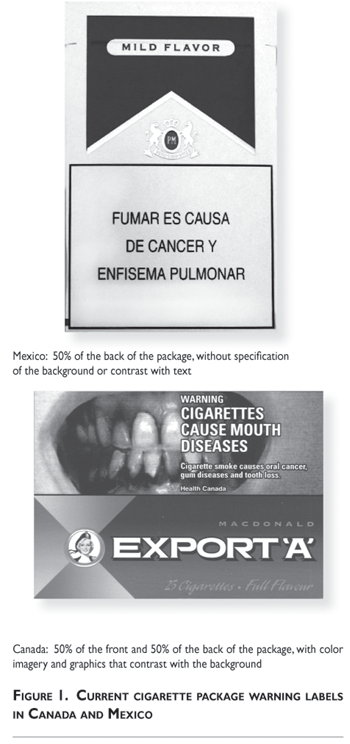
<body><![CDATA[<p><FONT SIZE="2" face="Verdana"><B>OBJETIVO: </b>Esta comparaci&oacute;n basada    en muestras representativas de la poblaci&oacute;n de fumadores adultos de Canad&aacute;    (n = 1 751) y M&eacute;xico (n = 1 081) pretendi&oacute; determinar si las cajetillas    de cigarrillos con leyendas de advertencia que contienen im&aacute;genes gr&aacute;ficas    en Canad&aacute; tuvieron un impacto m&aacute;s acentuado que las leyendas mexicanas    que se basan s&oacute;lo en textos.    <br>   <B>MATERIAL Y M&Eacute;TODOS:</B> En el presente estudio se usaron modelos bivariados    y multivariados. Resultados. Los fumadores canadienses respondieron mucho mejor    a las advertencias de la etiqueta (es decir, atenci&oacute;n que prestaban a    los anuncios de las etiquetas y comprensi&oacute;n del mensaje) que los fumadores    mexicanos y fueron influidos por las caracter&iacute;sticas de las advertencias    independientemente de la intenci&oacute;n previa que tuvieran de abandonar el    h&aacute;bito. M&aacute;s a&uacute;n, los canadienses tienen grados de conocimiento    m&aacute;s altos acerca de las repercusiones en la salud que tiene fumar y que    fueron incluidas en las advertencias de las etiquetas canadienses pero no en    las mexicanas. Por otro lado, la mayor&iacute;a de los fumadores mexicanos dese&oacute;    que las cajetillas de cigarrillos incluyeran m&aacute;s informaci&oacute;n que    la que contienen actualmente.    <br>   <b>CONCLUSI&Oacute;N:</b> Estos resultados son consistentes con los de otros    estudios en cuanto a indicar que las cajetillas de cigarrillos cuyas etiquetas    incluyen mensajes de advertencia con im&aacute;genes gr&aacute;ficas destacadas    tienen m&aacute;s probabilidad de promover el conocimiento relativo a las consecuencias    del tabaquismo y la cesaci&oacute;n del mismo que las advertencias que s&oacute;lo    se basan en textos. </FONT></p>     <p><FONT SIZE="2" face="Verdana"><b>Palabras clave:</b> pol&iacute;tica contra    el tabaco; cesaci&oacute;n de fumar; cajetilla de cigarrillos; etiquetas con    advertencias; comunicaci&oacute;n; Canad&aacute;</FONT></p> <hr size="1" noshade>     <p>&nbsp;</p>     <p>&nbsp;</p>     <p><FONT SIZE="2" face="Verdana">The Framework Convention on Tobacco Control’s    (FCTC) guiding principle is that "every person should be informed of the    health consequences, addictive nature, and mortal threat posed by tobacco consumption    and exposure to tobacco smoke."<SUP>1</SUP> Indeed, smokers who are more    aware of these risks are more motivated to quit smoking.<SUP>2</SUP> Warning    labels on cigarette packages are meant to communicate such smoking-associated    risks. When the tobacco industry bears printing costs, warning labels can be    an extremely cost-effective educational intervention, especially when compared    to other efforts, such as mass media campaigns. However, to be effective, warning    labels should be prominent enough to capture smoker’s attention and must stave    off the "wear-out" that results from habituation to messages.<SUP>3</SUP>    For this reason, the FCTC states that warning labels "should be 50% or    more of the principal display areas but shall be no less than 30% of the principal    display areas" and "may be in the form of or use pictures or pictograms."</FONT></p>     <p><FONT SIZE="2" face="Verdana"> Research suggests that warning labels with prominent    graphic elements are more effective than text-only messages in engaging smokers,    promoting quitting, and impeding "wear-out" that results from habituation    to messages.<SUP>4-6</SUP> Evidence from Brazil suggests that once graphic warnings    were implemented there (2002), the number of calls to quit lines advertised    on warning labels increased significantly, and two-thirds of smokers reported    that the graphic warning labels increased their desire to quit smoking.<SUP>7</SUP>    In 2000, Canada implemented 16 rotating graphic warning labels that covered    50% of the front and back sides of cigarette packs (<a href="#fig01">Figure    1</a>). Studies comparing Canadian smokers with smokers in the US, Australia,    and the UK have indicated the greater strength of graphic warnings compared    to text warnings. For example, in 2002 —2.5 years after the introduction of    graphic warning labels in Canada— Canadian smokers were more likely than smokers    in the other countries to notice the warning labels, to read or look closely    at the labels, and to have reported that a warning label had stopped them from    having a cigarette.<SUP>8</SUP> Follow-up of cohorts of adult smokers in these    four Anglo countries indicated that the introduction of larger, bolded text    warning labels in the UK (i.e, from 6% of the front of the package to 30% of    the front and 40% of the back) increased their being noticed, read, and caused    smokers to think about the health risks of smoking. Nevertheless, the Canadian    graphic warnings appeared to have stronger, more durable effects over time with    regard to making smokers think about smoking-related dangers and about quitting.<SUP>9</SUP>    These results suggest that prominent warning labels with graphic elements appear    to be a particularly powerful means of education and promoting smoking cessation.    Furthermore, the use of images to express the consequences of smoking may be    a particularly effective educational strategy where a sizeable proportion of    the population is not literate and, therefore, unlikely to notice or understand    text-based warnings.</FONT></p>     <p><a name="fig01"></a></p>     <p>&nbsp;</p>     ]]></body>
<body><![CDATA[<p align="center"><img src="/img/revistas/spm/v49s2/a13fig01.gif"></p>     <p>&nbsp;</p>     <p><FONT SIZE="2" face="Verdana"> The effectiveness of current cigarette labeling    practices in Mexico is generally unknown. In 2004, warning labels were increased    to 50% of the backside of cigarette packages, with three rotating messages in    the warning label area, while the message "Currently, there are no cigarettes    that reduce health risks" (i.e. "Actualmente no existe un cigarro    que reduzca los riesgos a la salud") is on the side of every pack. The    warning text font is not bolded, is relatively small (12 point, normal helvetica),    and there are no warnings on the front of the pack (<a href="#fig01">Figure    1</a>). Only one study has examined Mexican smokers’ reactions to current warning    labels, using methods from experimental economics to compare the perceived value    of a normal pack of Marlboros with a pack that was identical except for its    graphic warning label. This study concluded that smokers attributed values that    were on average 17% lower for the pack with the graphic warning than for the    pack with the current text-only warning, indicating a significantly reduced    demand for the pack with the graphic warning. Moreover, this significantly lower    perceived value was found within population subgroups defined by sociodemographics,    average daily consumption of cigarettes, history of quit attempts, and levels    of perceived smoking risks.<SUP>10</SUP> The current study aims to complement    this effort by comparing reactions to warning labels across population-based    representative samples of adult smokers in Mexico and Canada.</FONT></p>     <p>&nbsp;</p>     <p><font size="3" face="Verdana"><b>Material and Methods</b></font></p>     <p><FONT SIZE="2" face="Verdana"><I>Study sample:</i> Data were drawn from the    International Tobacco Control Policy Evaluation Project (ITC), an international    effort to understand policy impacts, as well as the mechanisms of these impacts,    by comparing cohorts of adult smokers in countries with different tobacco policy    environments.<SUP>11,12</SUP> For the Canadian sample, households with smokers    were identified using random digit dialing techniques, with probability of selection    proportional to community size. Telephone surveys have been administered to    participants each year since 2002, with replenishment from the same sampling    frame for those lost to attrition.<SUP>13</SUP> For the present analysis, data    from the 2005 ITC-Canada survey were used (2006 data were unavailable at the    time of analysis). </font></p>     <p><FONT SIZE="2" face="Verdana"> The ITC-Mexico sample involved a two-stage sampling    scheme, with the sampling frame limited to and stratified by four major urban    areas (i.e., Mexico City, Guadalajara, Tijuana, and Ciudad Ju&aacute;rez). Data    from the 2000 census were used to estimate the number of households within each    Basic GeoStatistical Area (i.e. AGEB, in its spanish acronym) and block groups    (i.e., <I>manzana</I>) for each city. Within each city, 20 AGEB were randomly    selected, with selection probability proportional to the number of households    within the AGEB. Proportional sampling methods were used again to select two    <I>manzanas</I> within each selected AGEB, with a target of seven interviews    per <I>manzana.</I> Households within each selected <I>manzana </I>were visited    in random order, with up to four visits on distinct days (two weekend days and    two weekdays) and at different times of day. As in ITC-Canada, once contact    was made with an adult household member, households were enumerated and eligible    smokers identified. Only those who were 18 or older, had smoked at least once    in the previous week, and had smoked 100 cigarettes in their lifetimes were    eligible to participate in ITC-Mexico. ITC-Canada used the same criteria except    for including adults who had smoked at least once in the last month, but not    in the last week (n=23), and those who had quit smoking since their initial    inclusion in the cohort (n=255). These participants were excluded from the current    analytic sample. If more than one smoker was identified in a household, then    only one was randomly selected for an interview. Cooperation rates with eligible    participants were 65.4% in Canada and 86.1% in Mexico. The final sample size    included 1 751 participants from the 2005 ITC-Canada survey and 1 081 from the    baseline 2006 ITC-Mexico survey.</FONT></p>     <p><FONT SIZE="2" face="Verdana"><I>Measurement: </i> The English language ITC    survey was adapted to Mexico using committee translation methods,<SUP>14</SUP>    cognitive interviewing,<SUP>15</SUP> and analysis of pilot data to help ensure    adequate comprehension and the equivalence of measures across countries. Standard    questions regarding frequency of smoking were used to divide smokers into daily    and non-daily smokers. Furthermore, extent of nicotine dependence was estimated    using the heaviness of smoking index, a 7-point index that considers both the    average daily consumption of cigarettes and the usual amount of time that passes    from awakening to smoking the first cigarette of the day.<SUP>16</SUP> Questions    regarding quit attempts and intentions were dichotomized to reflect any attempts    at quitting smoking in the past year and any intention to quit smoking in the    future, respectively, both of which have been shown to predict future quit status.<SUP>17,18</sup></FONT></p>     <p><FONT SIZE="2" face="Verdana"> Questions to assess warning label salience and    impact reflect theories regarding stages of message processing:<SUP>8</SUP>    1) awareness of the stimulus (i.e. "En el &uacute;ltimo mes, ¿cu&aacute;ntas    veces ha notado las advertencias sobre los da&ntilde;os a la salud en las cajetillas    de cigarros?: Nunca, De vez en cuando, Con frecuencia, Con mucha frecuencia");    2) engagement with its message (i.e. "En el &uacute;ltimo mes, ¿con qu&eacute;    frecuencia ha le&iacute;do o ha puesto atenci&oacute;n en las advertencias de    las cajetillas de cigarros?: Nunca, De vez en cuando, Con frecuencia, Con mucha    frecuencia"); 3) depth of processing the dangers of smoking because of    the labels (i.e. "Hasta que punto ¿las advertencias en cajetillas le hacen    pensar en los da&ntilde;os que causa fumar?: Nada, Poco, Bastante, Mucho");    and 4) depth of processing about quitting because of the labels (i.e. "Hasta    que punto ¿las advertencies en cajetillas le hacen pensar en dejar de fumar?    Nada, Poco, Bastante, Mucho"). In analyses, these variables were treated    in two ways. First, responses were dichotomized by collapsing the two highest    categories as well as the two lowest categories. For subsequent bivariate and    multivariate analyses to assess relationships with other study variables, participants’    responses to all four questions were averaged to create a label salience scale.    In the ITC Mexico survey, but not the ITC Canada survey, participants were also    asked whether they would like warning labels to contain more information (i.e.    "¿Opina que las cajetillas de cigarros deben de tener m&aacute;s, menos,    o la misma cantidad de informaci&oacute;n que la que tienen ahora?").</FONT></p>     <p><FONT SIZE="2" face="Verdana"> Study participants in both countries were asked    to respond to a series of questions to assess beliefs about the health outcomes    associated with smoking. Outcomes addressed in both countries included stroke,    impotence, and oral cancer in smokers, as well as lung cancer in non-smokers    exposed to cigarette smoke. Canadian warning labels, but not Mexican warning    labels, describe each of these outcomes. A four-point index was constructed    to indicate extent of knowledge within this domain that is specific to Canadian    warning labels. Finally, the survey assessed age, gender, and education. Education    level was collapsed into three categories: less than high school; completion    of high school or technical school; some college or more. </FONT></p>     ]]></body>
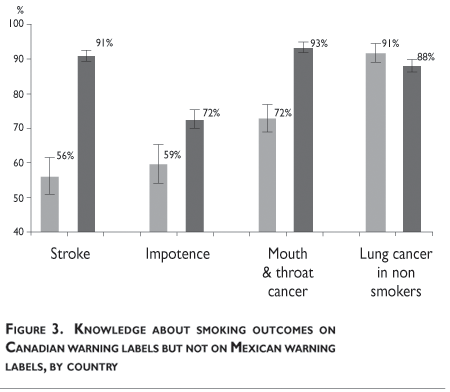
<body><![CDATA[<p><FONT SIZE="2" face="Verdana"><I>Analyses: </i> All analyses were conducted    using STATA, version 8.0, adjusting for the study design effect and sampling    weights so that estimates were representative of their respective sampling frames.    Hence, the Canadian data were representative of the country with listed phone    numbers, whereas the Mexico data were representative of the four major urban    areas where data were collected. Population-level estimates and respective 95%    confidence intervals were generated, by country, for each warning label reaction    variable and health knowledge variable. The bivariate and multivariate adjusted    relationships with the continuous label salience scale and the health knowledge    index were estimated using linear regression models. When the dichotomous quit    intention outcome was considered, logistic regression models were estimated.</FONT></p>     <p>&nbsp;</p>     <p><font size="3" face="Verdana"><b>Results</b></font></p>     <p><FONT SIZE="2" face="Verdana">The study populations from each country differed    with regard to sociodemographics and smoking profiles (<a href="#tab01">Table    I</a>). The majority of the Canada sample was female (58%), whereas males comprised    the majority of the Mexico sample (61%). The Canada sample was slightly older    than the Mexican sample (mean age = 43.8 vs. 39.1) and more highly educated,    with 25% of Canadians and 18% of Mexicans having at least some college. Educational    differences were starker when comparing the percentage of people with less than    a high school degree (53% in Mexico vs. 16% in Canada). Very few smokers in    the Canadian sample smoked less than daily (3%), whereas about one fifth of    those in the Mexican sample did (22%). Reported quit attempts in the previous    year were more than twice as high among Canadian smokers than among Mexican    smokers (36% vs. 17%, respectively), and intention to quit was also higher among    Canadians (76% vs. 51%). </FONT></p>     <p><a name="tab01"></a></p>     <p>&nbsp;</p>     <p align="center"><img src="/img/revistas/spm/v49s2/a13tab01.gif"></p>     <p>&nbsp;</p>     <p><FONT SIZE="2" face="Verdana"> Estimates associated with the dichotomous warning    label salience variables were derived for each country, and differences were    assessed using chi-square tests. Label salience was significantly higher in    Canada than Mexico when considering the frequency of noticing warning labels    and for the two depth-of-processing variables, which focused on the label making    participants think about the dangers of smoking and about quitting smoking (<a href="#fig02">Figure    2</a>). However, the prevalence of smokers who frequently read warning labels    was not statistically different across the two countries. These four items had    generally equivalent, good inter-item reliability for both countries (Canada    <font face="Symbol">a</font>=0.75; Mexico <font face="Symbol">a</font>=0.74)    and, hence, were averaged to create a scale (range 0-3). The unadjusted mean    for this scale was higher for the Canada sample than for the Mexico sample (1.27    vs. 1.13; p=0.002).</font></p>     <p><a name="fig02"></a></p>     ]]></body>
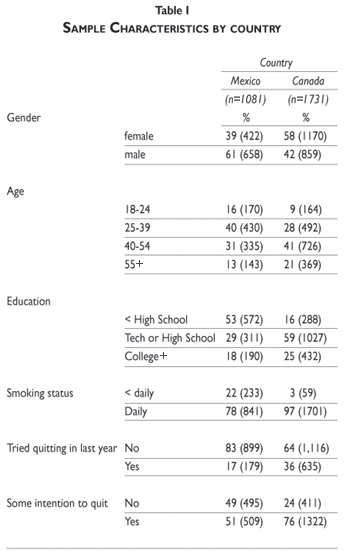
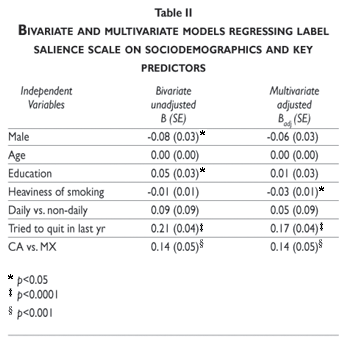
<body><![CDATA[<p>&nbsp;</p>     <p align="center"><img src="/img/revistas/spm/v49s2/a13fig02.gif"></p>     <p>&nbsp;</p>     <p><FONT SIZE="2" face="Verdana"> Bivariate and multivariate models were estimated,    regressing the label salience scale on sociodemographics, smoking variables,    and a dummy coded country variable, in order to determine country differences    in label salience both before and after statistical adjustment for differences    across the two samples (<a href="#tab02">Table II</a>). Bivariate coefficients    suggested that higher education and being female were associated with greater    label salience; however, these associations were not statistically significant    in the mulitivariate model. Having attempted to quit smoking in the previous    year, being less addicted to smoking, and being in the Canadian sample were    all independently associated with greater warning label salience in the multivariate    model. </FONT></p>     <p><a name="tab02"></a></p>     <p>&nbsp;</p>     <p align="center"><img src="/img/revistas/spm/v49s2/a13tab02.gif"></p>     <p>&nbsp;</p>     <p><FONT SIZE="2" face="Verdana"> It was hypothesized that knowledge of certain    smoking-related health outcomes would be higher in Canada than in Mexico, because    these health outcomes were included as content on Canadian warning labels but    not on the Mexican labels. Indeed, this was the case when examining the prevalence    of knowledge regarding whether smoking causes stroke, impotence, and mouth cancer,    but not when assessing knowledge of second-hand smoke causing lung cancer in    non-smokers (<a href="#fig03">Figure 3</a>). When these items were summed to    create a health knowledge index (range 0-4), average scores were higher among    Canadians than among Mexicans (3.44 vs. 2.79; <I>p</I>&lt;0.0001). Bivariate    and multivariate models indicated that health knowledge was inversely and independently    associated with age and the heaviness of smoking, whereas it was positively    associated with education and being from the Canadian sample (<a href="#tab03">Table    III</a>). Hence, warning label-specific knowledge appeared higher in the Canadian    sample after adjustment for confounding variables.</FONT></p>     <p><a name="fig03"></a></p>     ]]></body>
<body><![CDATA[<p>&nbsp;</p>     <p align="center"><img src="/img/revistas/spm/v49s2/a13fig03.gif"></p>     <p>&nbsp;</p>     <p><a name="tab03"></a></p>     <p>&nbsp;</p>     <p align="center"><img src="/img/revistas/spm/v49s2/a13tab03.gif"></p>     <p>&nbsp;</p>     <p><FONT SIZE="2" face="Verdana">Next, the relationships between the intention    to quit and key study variables, including warning label salience, were examined    (<a href="#tab04">Table IV</a>). Bivariate analyses suggested quit intention    was associated with being female, being younger, having more education, having    tried to quit in the last year, having more knowledge of health outcomes, reporting    stronger salience of warning labels, and being in Canada. A logistic multivariate    adjusted model was estimated, regressing quit intention on these and the other    variables under consideration. Results indicated that education level and health    knowledge were no longer statistically significant, but other variables continued    to be statistically significant: younger age, less heavy smoking, having tried    to quit in the past year, and being in Canada. Of specific interest was the    independent association between warning label salience and quit intention.</FONT></p>     <p><a name="tab04"></a></p>     <p>&nbsp;</p>     ]]></body>
<body><![CDATA[<p align="center"><img src="/img/revistas/spm/v49s2/a13tab04.gif"></p>     <p>&nbsp;</p>     <p><FONT SIZE="2" face="Verdana"> Finally, we examined the prevalence of adult    smokers’ desires for more health information on cigarette packs, for which data    were available only for the Mexico sample. Prevalence estimates indicated that    the majority (55%) wanted more information, whereas 42% were content with the    current amount of information. </FONT></p>     <p>&nbsp;</p>     <p><font size="3" face="Verdana"><b>Discussion</b></font></p>     <p><FONT SIZE="2" face="Verdana">The results from this study demonstrate a linkage    between warning label salience and quit intention, an important predictor of    actual cessation behavior.<SUP>2</SUP> Moreover, the salience of warning labels    on cigarette packages, as well as the knowledge about smoking-related health    outcomes that is specific to Canadian warning labels, is stronger in Canada    than in Mexico. Furthermore, the lower "wear-out" of graphic warnings    is indicated by the difference in salience, in spite of the five years that    had passed from warning implementation to the 2005 ITC-Canada data collection    effort, whereas the warning label size increase was only two years prior to    data collection in Mexico. Overall, these results are consistent with findings    from research comparing reactions to Canadian graphic warnings with reactions    to text-only warning labels in other countries.<SUP>8,9</SUP> Furthermore, these    results complement and strengthen conclusions from experimental research in    Mexico, which indicates that graphic warning labels are likely to decrease demand    for cigarettes among adult smokers.<SUP>10</SUP> </FONT></p>     <p><FONT SIZE="2" face="Verdana"> Sociodemographic factors were inconsistently    associated with key study outcomes. For example, gender was not independently    associated with any outcome examined. Not surprisingly, education was independently    associated with knowledge about health outcomes, but, somewhat surprisingly,    not with quit intention or label salience. Younger age was independently associated    with both intention to quit and health knowledge, indicating that different    efforts may be needed to target younger than older populations. </FONT></p>     <p><FONT SIZE="2" face="Verdana"> Smoking and quitting behavior variables showed    a similarly inconsistent relationship to the outcomes of interest. No study    outcome was associated with being a daily versus non-daily smoker. However,    those with higher levels of nicotine dependence —as measured by the heaviness    of smoking index —were less likely to process warning labels, possess knowledge    of health outcomes, or intend to quit. The population of nicotine dependent    smokers is likely to prove the most difficult to influence, even with warning    labels, and may demand extra intervention efforts, such as provision of nicotine    replacement therapies. As expected, recent quit attempts predicted both warning    label salience and future quit intentions.</FONT></p>     <p><FONT SIZE="2" face="Verdana"> A number of weaknesses in our study derive from    its cross-sectional nature. It was impossible to determine the temporal sequence    of some key study constructs. For example, those who are most interested in    quitting may pay more attention to warning labels, rather than labels causing    intention to quit. When possible, our models include statistical controls, such    as recent quit attempts, to reduce such confounding. Later follow-up of the    sample should help clarify temporal precedence in our models. Another issue    concerns comparability of the Canadian and Mexican samples. Indeed, the samples    differed on most measured variables and may differ in other important ways that    we did not assess. For example, the greater health knowledge among Canadian    smokers may be accounted for by factors other than the warnings on cigarette    packages, such as mass media counter-advertising campaigns. Nevertheless, when    we were able to employ statistical controls, our primary conclusions regarding    the stronger graphic warning labels in Canada did not change. Finally, the different    modes of survey administration may have systematically biased our results.<SUP>19</SUP>    However, if, as we hypothesize, face-to-face survey administration in Mexico    produced more acquiescence and socially desirable responding than telephone    administration in Canada, it is likely that we have underestimated the difference    between the two countries. Further research on differential influence of administration    modalities across countries and sociocultural contexts should clarify this issue.    </FONT></p>     <p><FONT SIZE="2" face="Verdana"> In sum, the present study is consistent with    other research indicating that prominent warning labels with graphic elements    are more likely to promote quitting behavior among smokers than text-only warning    labels. As Mexico and other signatories of the Framework Convention on Tobacco    Control contemplate implementation of different warning label strategies, the    scientific evidence is increasingly clear: graphic warning labels are a powerful,    low-cost means of informing consumers about smoking dangers in a manner that    mitigates the level of "wear-out" and habituation that occurs with    text-only messages. Moreover, the implementation of this policy can respond    to the majority of Mexican smokers who, our study suggests, want more information    on their cigarette packs. In deciding which labels to implement, policymakers    should consider other research on existing graphic warning labels, including    which images prompt Mexican smokers to think most about quitting.<SUP>20</SUP>    </FONT></p>     ]]></body>
<body><![CDATA[<p><FONT SIZE="2" face="Verdana"><b>Acknowledgements </b></FONT></p>     <p><FONT SIZE="2" face="Verdana">This research was supported by the National Cancer    Institute of the United States through The University of Illinois at Chicago    Cancer Center, Cancer Education and Career Development Program (R25-CA57699)    and the Roswell Park Transdisciplinary Tobacco Use Research Center (RO1 CA100362    and P5OCA111236) as well as by the Canadian Institutes of Health Research (57897    and 79551).</FONT></p>     <p>&nbsp;</p>     <p><FONT SIZE="3" face="Verdana"><b>References</b></FONT></p>     <!-- ref --><p><FONT SIZE="2" face="Verdana">1. WHO. Framework Convention on Tobacco Control.    Geneva, Switzerland: World Health Organization, Tobacco Free Initiative, 2003.</FONT>&nbsp;&nbsp;&nbsp;&nbsp;&nbsp;&nbsp;&nbsp;&nbsp;[&#160;<a href="javascript:void(0);" onclick="javascript: window.open('/scielo.php?script=sci_nlinks&ref=9301076&pid=S0036-3634200700080001300001&lng=','','width=640,height=500,resizable=yes,scrollbars=1,menubar=yes,');">Links</a>&#160;]<!-- end-ref --><!-- ref --><p><FONT SIZE="2" face="Verdana">2. Romer D, Jamieson P. The role of perceived    risk in starting and stopping smoking. In: Slovic, ed. Smoking: Risk, perception,    and policy. Thousand Oaks, CA: Sage, 2001:65-80.</FONT>&nbsp;&nbsp;&nbsp;&nbsp;&nbsp;&nbsp;&nbsp;&nbsp;[&#160;<a href="javascript:void(0);" onclick="javascript: window.open('/scielo.php?script=sci_nlinks&ref=9301077&pid=S0036-3634200700080001300002&lng=','','width=640,height=500,resizable=yes,scrollbars=1,menubar=yes,');">Links</a>&#160;]<!-- end-ref --><!-- ref --><p><FONT SIZE="2" face="Verdana">3. USDHHS. Reducing the health consequences of    smoking: 25 years of progress. A report of the Surgeon General. Bethesda, MD:    US Department of Health and Human Services, 1989.</FONT>&nbsp;&nbsp;&nbsp;&nbsp;&nbsp;&nbsp;&nbsp;&nbsp;[&#160;<a href="javascript:void(0);" onclick="javascript: window.open('/scielo.php?script=sci_nlinks&ref=9301078&pid=S0036-3634200700080001300003&lng=','','width=640,height=500,resizable=yes,scrollbars=1,menubar=yes,');">Links</a>&#160;]<!-- end-ref --><!-- ref --><p><FONT SIZE="2" face="Verdana">4. Strahan E, White KS, Fong GT, Fabrigar L,    Zanna MP, Cameron R. Enhancing the effectiveness of message labels on tobacco    packaging: A social psychological perspective. Tobacco Control 2002;11:183-190.</FONT>&nbsp;&nbsp;&nbsp;&nbsp;&nbsp;&nbsp;&nbsp;&nbsp;[&#160;<a href="javascript:void(0);" onclick="javascript: window.open('/scielo.php?script=sci_nlinks&ref=9301079&pid=S0036-3634200700080001300004&lng=','','width=640,height=500,resizable=yes,scrollbars=1,menubar=yes,');">Links</a>&#160;]<!-- end-ref --><!-- ref --><p><FONT SIZE="2" face="Verdana">5. Hammond D, Fong GT, MacDonald P, Cameron R,    Brown K. Impact of graphic Canadian warning labels on adult smoking behavior.    Tobacco Control 2003;12:391-395.</FONT>&nbsp;&nbsp;&nbsp;&nbsp;&nbsp;&nbsp;&nbsp;&nbsp;[&#160;<a href="javascript:void(0);" onclick="javascript: window.open('/scielo.php?script=sci_nlinks&ref=9301080&pid=S0036-3634200700080001300005&lng=','','width=640,height=500,resizable=yes,scrollbars=1,menubar=yes,');">Links</a>&#160;]<!-- end-ref --><!-- ref --><p><FONT SIZE="2" face="Verdana">6. O’Hegarty M, Pederson LL, Nelson DE, Mowery    P, Gable JM, Wortley P. Reactions of young adult smokers to warning labels on    cigarette packages. American Journal of Preventive Medicine 2006;30(6):467-473.</FONT>&nbsp;&nbsp;&nbsp;&nbsp;&nbsp;&nbsp;&nbsp;&nbsp;[&#160;<a href="javascript:void(0);" onclick="javascript: window.open('/scielo.php?script=sci_nlinks&ref=9301081&pid=S0036-3634200700080001300006&lng=','','width=640,height=500,resizable=yes,scrollbars=1,menubar=yes,');">Links</a>&#160;]<!-- end-ref --><!-- ref --><p><FONT SIZE="2" face="Verdana">7. Cavalcante TM. Labelling and packaging in    Brazil. Geneva, Switzerland: World Health Organization,2003.</FONT>&nbsp;&nbsp;&nbsp;&nbsp;&nbsp;&nbsp;&nbsp;&nbsp;[&#160;<a href="javascript:void(0);" onclick="javascript: window.open('/scielo.php?script=sci_nlinks&ref=9301082&pid=S0036-3634200700080001300007&lng=','','width=640,height=500,resizable=yes,scrollbars=1,menubar=yes,');">Links</a>&#160;]<!-- end-ref --><!-- ref --><p><FONT SIZE="2" face="Verdana">8. Hammond D, Fong GT, McNeil A, Borland R, Cummings    KM. The effectiveness of cigarette warning labels in informing smokers about    the risks of smoking: Findings from the International Tobacco Control (ITC)    Four Country Survey. Tobacco Control 2006;15(Supp 3):iii19-25.</FONT>&nbsp;&nbsp;&nbsp;&nbsp;&nbsp;&nbsp;&nbsp;&nbsp;[&#160;<a href="javascript:void(0);" onclick="javascript: window.open('/scielo.php?script=sci_nlinks&ref=9301083&pid=S0036-3634200700080001300008&lng=','','width=640,height=500,resizable=yes,scrollbars=1,menubar=yes,');">Links</a>&#160;]<!-- end-ref --><!-- ref --><p><FONT SIZE="2" face="Verdana">9. Hammond D, Fong GT, Borland R, Cummings KM,    McNeil AD, Driezen P. Text and graphic warnings on cigarette packages: Findings    from the International Tobacco Control Four Country Study. Am Prev Med 2007;32(3):210-217.</FONT>&nbsp;&nbsp;&nbsp;&nbsp;&nbsp;&nbsp;&nbsp;&nbsp;[&#160;<a href="javascript:void(0);" onclick="javascript: window.open('/scielo.php?script=sci_nlinks&ref=9301084&pid=S0036-3634200700080001300009&lng=','','width=640,height=500,resizable=yes,scrollbars=1,menubar=yes,');">Links</a>&#160;]<!-- end-ref --><!-- ref --><p><FONT SIZE="2" face="Verdana">10. Thrasher JF, Rousu MC, Ocampo-Anaya R, Reynales-Shigematsu    LM, Arillo-Santill&aacute;n E, Hern&aacute;ndez-&Aacute;vila M. Estimating the    impact of graphic warning labels on cigarette packs: The auction method. Addiction    under review.</FONT>&nbsp;&nbsp;&nbsp;&nbsp;&nbsp;&nbsp;&nbsp;&nbsp;[&#160;<a href="javascript:void(0);" onclick="javascript: window.open('/scielo.php?script=sci_nlinks&ref=9301085&pid=S0036-3634200700080001300010&lng=','','width=640,height=500,resizable=yes,scrollbars=1,menubar=yes,');">Links</a>&#160;]<!-- end-ref --><!-- ref --><p><FONT SIZE="2" face="Verdana">11. Thrasher JF, Chaloupka F, Hammond D, Fong    GT, Borland R, Hastings G, <I>et al</I>. Evaluaci&oacute;n de las pol&iacute;ticas    contra el tabaquismo en pa&iacute;ses latinoamericanos en la era del Convenio    Marco para el Control del Tabaco. Salud Publica Mex 2006;48(Supp 1):S155-S166.</FONT>&nbsp;&nbsp;&nbsp;&nbsp;&nbsp;&nbsp;&nbsp;&nbsp;[&#160;<a href="javascript:void(0);" onclick="javascript: window.open('/scielo.php?script=sci_nlinks&ref=9301086&pid=S0036-3634200700080001300011&lng=','','width=640,height=500,resizable=yes,scrollbars=1,menubar=yes,');">Links</a>&#160;]<!-- end-ref --><!-- ref --><p><FONT SIZE="2" face="Verdana">12. Fong GT, Cummings KM, Borland R, Hastings    G. The conceptual framework of the International Tobacco Control Policy Evaluation    Project. Tob Control 2006;15(Supp 3):iii3-iii11.</FONT>&nbsp;&nbsp;&nbsp;&nbsp;&nbsp;&nbsp;&nbsp;&nbsp;[&#160;<a href="javascript:void(0);" onclick="javascript: window.open('/scielo.php?script=sci_nlinks&ref=9301087&pid=S0036-3634200700080001300012&lng=','','width=640,height=500,resizable=yes,scrollbars=1,menubar=yes,');">Links</a>&#160;]<!-- end-ref --><!-- ref --><p><FONT SIZE="2" face="Verdana">13. Thompson ME, Fong GT, Hammond D, Boudreau    C, Dreizen PR, Hyland A, <I>et al</I>. The methodology of the International    Tobacco Control Policy Evaluation Project. Tob Control 2006;15(Supp 3):iii12-iii18.</FONT>&nbsp;&nbsp;&nbsp;&nbsp;&nbsp;&nbsp;&nbsp;&nbsp;[&#160;<a href="javascript:void(0);" onclick="javascript: window.open('/scielo.php?script=sci_nlinks&ref=9301088&pid=S0036-3634200700080001300013&lng=','','width=640,height=500,resizable=yes,scrollbars=1,menubar=yes,');">Links</a>&#160;]<!-- end-ref --><!-- ref --><p><FONT SIZE="2" face="Verdana">14. Harkness JA. Questionnaire translation. In:    Harkness JA, Van de Vijver FJR, Mohler PP, eds. Cross-cultural survey research.    Hoboken, NJ: Wiley &amp; Sons, 2003:35-56.</FONT>&nbsp;&nbsp;&nbsp;&nbsp;&nbsp;&nbsp;&nbsp;&nbsp;[&#160;<a href="javascript:void(0);" onclick="javascript: window.open('/scielo.php?script=sci_nlinks&ref=9301089&pid=S0036-3634200700080001300014&lng=','','width=640,height=500,resizable=yes,scrollbars=1,menubar=yes,');">Links</a>&#160;]<!-- end-ref --><!-- ref --><p><FONT SIZE="2" face="Verdana">15. Willis GB. Cognitive interviewing. London:    Sage, 2005.</FONT>&nbsp;&nbsp;&nbsp;&nbsp;&nbsp;&nbsp;&nbsp;&nbsp;[&#160;<a href="javascript:void(0);" onclick="javascript: window.open('/scielo.php?script=sci_nlinks&ref=9301090&pid=S0036-3634200700080001300015&lng=','','width=640,height=500,resizable=yes,scrollbars=1,menubar=yes,');">Links</a>&#160;]<!-- end-ref --><!-- ref --><p><FONT SIZE="2" face="Verdana">16. Heatherton TF, Koslowski LT, Frecker RC,    Rickert WS, Robinson J. Measuring the heaviness of smoking using self-reported    time to the first cigarette of the day and number of cigarettes smoked per day.    Br J Addict 1989;84:791-800.</FONT>&nbsp;&nbsp;&nbsp;&nbsp;&nbsp;&nbsp;&nbsp;&nbsp;[&#160;<a href="javascript:void(0);" onclick="javascript: window.open('/scielo.php?script=sci_nlinks&ref=9301091&pid=S0036-3634200700080001300016&lng=','','width=640,height=500,resizable=yes,scrollbars=1,menubar=yes,');">Links</a>&#160;]<!-- end-ref --><!-- ref --><p><FONT SIZE="2" face="Verdana">17. Hammond D, Fong GT, Zanna MP, Thrasher JF,    Borland R. Tobacco denormalization, anti-industry beliefs, and cessation behavior    among smokers from four countries. Am J Prev Med 2006;31(3):225-232.</FONT>&nbsp;&nbsp;&nbsp;&nbsp;&nbsp;&nbsp;&nbsp;&nbsp;[&#160;<a href="javascript:void(0);" onclick="javascript: window.open('/scielo.php?script=sci_nlinks&ref=9301092&pid=S0036-3634200700080001300017&lng=','','width=640,height=500,resizable=yes,scrollbars=1,menubar=yes,');">Links</a>&#160;]<!-- end-ref --><!-- ref --><p><FONT SIZE="2" face="Verdana">18. Hyland A, Laux F, Higbee C, Hastings G, Ross    H, Chaloupka FJ, <I>et al</I>, Cummings KM. Cigarette purchase patterns in four    countries and its relationship with cessation: Findings from the International    Tobacco Control Policy Evaluation Survey. Tobacco Control 2006;15(Supp 3):iii59-64.</FONT>&nbsp;&nbsp;&nbsp;&nbsp;&nbsp;&nbsp;&nbsp;&nbsp;[&#160;<a href="javascript:void(0);" onclick="javascript: window.open('/scielo.php?script=sci_nlinks&ref=9301093&pid=S0036-3634200700080001300018&lng=','','width=640,height=500,resizable=yes,scrollbars=1,menubar=yes,');">Links</a>&#160;]<!-- end-ref --><!-- ref --><p><FONT SIZE="2" face="Verdana">19. Harkness JA, Van de Vijver FJR, Mohler PP,    eds. Cross-cultural survey methods. Hoboken, NJ: Wiley, 2003.</FONT>&nbsp;&nbsp;&nbsp;&nbsp;&nbsp;&nbsp;&nbsp;&nbsp;[&#160;<a href="javascript:void(0);" onclick="javascript: window.open('/scielo.php?script=sci_nlinks&ref=9301094&pid=S0036-3634200700080001300019&lng=','','width=640,height=500,resizable=yes,scrollbars=1,menubar=yes,');">Links</a>&#160;]<!-- end-ref --><!-- ref --><p><FONT SIZE="2" face="Verdana">20. Thrasher JF, Allen B, Anaya-Ocampo R, Reynales    LM, Lazcano-Ponce EC, Hern&aacute;ndez-Avila M. An&aacute;lisis del impacto    en fumadores Mexicanos de los avisos gr&aacute;ficos en las cajetillas de cigarros.    Salud Publica Mex 2006;48:S65-S75.</FONT>&nbsp;&nbsp;&nbsp;&nbsp;&nbsp;&nbsp;&nbsp;&nbsp;[&#160;<a href="javascript:void(0);" onclick="javascript: window.open('/scielo.php?script=sci_nlinks&ref=9301095&pid=S0036-3634200700080001300020&lng=','','width=640,height=500,resizable=yes,scrollbars=1,menubar=yes,');">Links</a>&#160;]<!-- end-ref --><p>&nbsp;</p>     <p>&nbsp;</p>     <p><FONT SIZE="2" face="Verdana">Received on: April 4, 2007    <br>   Accepted on: April 24, 2007</FONT></p>     <p>&nbsp;</p>     <p>&nbsp;</p>     ]]></body>
<body><![CDATA[<p><FONT SIZE="2" face="Verdana">Address reprint request to: PhD, James F. Thrasher.    Department of Health Promotion, Education &amp; Behavior. 800 Sumter Street,    Room 215 Columbia, SC 29208, USA. E-mail: <a href="mailto:thrasher@gwm.sc.edu">thrasher@gwm.sc.edu</a></FONT></p>      ]]></body><back>
<ref-list>
<ref id="B1">
<label>1</label><nlm-citation citation-type="book">
<collab>WHO</collab>
<source><![CDATA[Framework Convention on Tobacco Control]]></source>
<year>2003</year>
<publisher-loc><![CDATA[Geneva ]]></publisher-loc>
<publisher-name><![CDATA[World Health OrganizationTobacco Free Initiative]]></publisher-name>
</nlm-citation>
</ref>
<ref id="B2">
<label>2</label><nlm-citation citation-type="book">
<person-group person-group-type="author">
<name>
<surname><![CDATA[Romer]]></surname>
<given-names><![CDATA[D]]></given-names>
</name>
<name>
<surname><![CDATA[Jamieson]]></surname>
<given-names><![CDATA[P]]></given-names>
</name>
</person-group>
<article-title xml:lang="en"><![CDATA[The role of perceived risk in starting and stopping smoking]]></article-title>
<person-group person-group-type="editor">
<name>
<surname><![CDATA[Slovic]]></surname>
</name>
</person-group>
<source><![CDATA[Smoking: Risk, perception, and policy]]></source>
<year>2001</year>
<page-range>65-80</page-range><publisher-loc><![CDATA[Thousand Oaks^eCA CA]]></publisher-loc>
<publisher-name><![CDATA[Sage]]></publisher-name>
</nlm-citation>
</ref>
<ref id="B3">
<label>3</label><nlm-citation citation-type="book">
<collab>USDHHS</collab>
<source><![CDATA[Reducing the health consequences of smoking: 25 years of progress. A report of the Surgeon General]]></source>
<year>1989</year>
<publisher-loc><![CDATA[Bethesda^eMD MD]]></publisher-loc>
<publisher-name><![CDATA[US Department of Health and Human Services]]></publisher-name>
</nlm-citation>
</ref>
<ref id="B4">
<label>4</label><nlm-citation citation-type="journal">
<person-group person-group-type="author">
<name>
<surname><![CDATA[Strahan]]></surname>
<given-names><![CDATA[E]]></given-names>
</name>
<name>
<surname><![CDATA[White]]></surname>
<given-names><![CDATA[KS]]></given-names>
</name>
<name>
<surname><![CDATA[Fong]]></surname>
<given-names><![CDATA[GT]]></given-names>
</name>
<name>
<surname><![CDATA[Fabrigar]]></surname>
<given-names><![CDATA[L]]></given-names>
</name>
<name>
<surname><![CDATA[Zanna]]></surname>
<given-names><![CDATA[MP]]></given-names>
</name>
<name>
<surname><![CDATA[Cameron]]></surname>
<given-names><![CDATA[R]]></given-names>
</name>
</person-group>
<article-title xml:lang="en"><![CDATA[Enhancing the effectiveness of message labels on tobacco packaging: A social psychological perspective]]></article-title>
<source><![CDATA[Tobacco Control]]></source>
<year>2002</year>
<volume>11</volume>
<page-range>183-190</page-range></nlm-citation>
</ref>
<ref id="B5">
<label>5</label><nlm-citation citation-type="journal">
<person-group person-group-type="author">
<name>
<surname><![CDATA[Hammond]]></surname>
<given-names><![CDATA[D]]></given-names>
</name>
<name>
<surname><![CDATA[Fong]]></surname>
<given-names><![CDATA[GT]]></given-names>
</name>
<name>
<surname><![CDATA[MacDonald]]></surname>
<given-names><![CDATA[P]]></given-names>
</name>
<name>
<surname><![CDATA[Cameron]]></surname>
<given-names><![CDATA[R]]></given-names>
</name>
<name>
<surname><![CDATA[Brown]]></surname>
<given-names><![CDATA[K]]></given-names>
</name>
</person-group>
<article-title xml:lang="en"><![CDATA[Impact of graphic Canadian warning labels on adult smoking behavior]]></article-title>
<source><![CDATA[Tobacco Control]]></source>
<year>2003</year>
<volume>12</volume>
<page-range>391-395</page-range></nlm-citation>
</ref>
<ref id="B6">
<label>6</label><nlm-citation citation-type="journal">
<person-group person-group-type="author">
<name>
<surname><![CDATA[O’Hegarty]]></surname>
<given-names><![CDATA[M]]></given-names>
</name>
<name>
<surname><![CDATA[Pederson]]></surname>
<given-names><![CDATA[LL]]></given-names>
</name>
<name>
<surname><![CDATA[Nelson]]></surname>
<given-names><![CDATA[DE]]></given-names>
</name>
<name>
<surname><![CDATA[Mowery]]></surname>
<given-names><![CDATA[P]]></given-names>
</name>
<name>
<surname><![CDATA[Gable]]></surname>
<given-names><![CDATA[JM]]></given-names>
</name>
<name>
<surname><![CDATA[Wortley]]></surname>
<given-names><![CDATA[P]]></given-names>
</name>
</person-group>
<article-title xml:lang="en"><![CDATA[Reactions of young adult smokers to warning labels on cigarette packages]]></article-title>
<source><![CDATA[American Journal of Preventive Medicine]]></source>
<year>2006</year>
<volume>30</volume>
<numero>6</numero>
<issue>6</issue>
<page-range>467-473</page-range></nlm-citation>
</ref>
<ref id="B7">
<label>7</label><nlm-citation citation-type="book">
<person-group person-group-type="author">
<name>
<surname><![CDATA[Cavalcante]]></surname>
<given-names><![CDATA[TM]]></given-names>
</name>
</person-group>
<source><![CDATA[Labelling and packaging in Brazil]]></source>
<year>2003</year>
<publisher-loc><![CDATA[Geneva ]]></publisher-loc>
<publisher-name><![CDATA[World Health Organization]]></publisher-name>
</nlm-citation>
</ref>
<ref id="B8">
<label>8</label><nlm-citation citation-type="journal">
<person-group person-group-type="author">
<name>
<surname><![CDATA[Hammond]]></surname>
<given-names><![CDATA[D]]></given-names>
</name>
<name>
<surname><![CDATA[Fong]]></surname>
<given-names><![CDATA[GT]]></given-names>
</name>
<name>
<surname><![CDATA[McNeil]]></surname>
<given-names><![CDATA[A]]></given-names>
</name>
<name>
<surname><![CDATA[Borland]]></surname>
<given-names><![CDATA[R]]></given-names>
</name>
<name>
<surname><![CDATA[Cummings]]></surname>
<given-names><![CDATA[KM]]></given-names>
</name>
</person-group>
<article-title xml:lang="en"><![CDATA[The effectiveness of cigarette warning labels in informing smokers about the risks of smoking: Findings from the International Tobacco Control (ITC) Four Country Survey]]></article-title>
<source><![CDATA[Tobacco Control]]></source>
<year>2006</year>
<volume>15</volume>
<numero>^s3</numero>
<issue>^s3</issue>
<supplement>3</supplement>
<page-range>iii19-25</page-range></nlm-citation>
</ref>
<ref id="B9">
<label>9</label><nlm-citation citation-type="journal">
<person-group person-group-type="author">
<name>
<surname><![CDATA[Hammond]]></surname>
<given-names><![CDATA[D]]></given-names>
</name>
<name>
<surname><![CDATA[Fong]]></surname>
<given-names><![CDATA[GT]]></given-names>
</name>
<name>
<surname><![CDATA[Borland]]></surname>
<given-names><![CDATA[R]]></given-names>
</name>
<name>
<surname><![CDATA[Cummings]]></surname>
<given-names><![CDATA[KM]]></given-names>
</name>
<name>
<surname><![CDATA[McNeil]]></surname>
<given-names><![CDATA[AD]]></given-names>
</name>
<name>
<surname><![CDATA[Driezen]]></surname>
<given-names><![CDATA[P]]></given-names>
</name>
</person-group>
<article-title xml:lang="en"><![CDATA[Text and graphic warnings on cigarette packages: Findings from the International Tobacco Control Four Country Study]]></article-title>
<source><![CDATA[Am Prev Med]]></source>
<year>2007</year>
<volume>32</volume>
<numero>3</numero>
<issue>3</issue>
<page-range>210-217</page-range></nlm-citation>
</ref>
<ref id="B10">
<label>10</label><nlm-citation citation-type="">
<person-group person-group-type="author">
<name>
<surname><![CDATA[Thrasher]]></surname>
<given-names><![CDATA[JF]]></given-names>
</name>
<name>
<surname><![CDATA[Rousu]]></surname>
<given-names><![CDATA[MC]]></given-names>
</name>
<name>
<surname><![CDATA[Ocampo-Anaya]]></surname>
<given-names><![CDATA[R]]></given-names>
</name>
<name>
<surname><![CDATA[Reynales-Shigematsu]]></surname>
<given-names><![CDATA[LM]]></given-names>
</name>
<name>
<surname><![CDATA[Arillo-Santillán]]></surname>
<given-names><![CDATA[E]]></given-names>
</name>
<name>
<surname><![CDATA[Hernández-Ávila]]></surname>
<given-names><![CDATA[M]]></given-names>
</name>
</person-group>
<source><![CDATA[Estimating the impact of graphic warning labels on cigarette packs: The auction method]]></source>
<year></year>
</nlm-citation>
</ref>
<ref id="B11">
<label>11</label><nlm-citation citation-type="journal">
<person-group person-group-type="author">
<name>
<surname><![CDATA[Thrasher]]></surname>
<given-names><![CDATA[JF]]></given-names>
</name>
<name>
<surname><![CDATA[Chaloupka]]></surname>
<given-names><![CDATA[F]]></given-names>
</name>
<name>
<surname><![CDATA[Hammond]]></surname>
<given-names><![CDATA[D]]></given-names>
</name>
<name>
<surname><![CDATA[Fong]]></surname>
<given-names><![CDATA[GT]]></given-names>
</name>
<name>
<surname><![CDATA[Borland]]></surname>
<given-names><![CDATA[R]]></given-names>
</name>
<name>
<surname><![CDATA[Hastings]]></surname>
<given-names><![CDATA[G]]></given-names>
</name>
</person-group>
<article-title xml:lang="es"><![CDATA[Evaluación de las políticas contra el tabaquismo en países latinoamericanos en la era del Convenio Marco para el Control del Tabaco]]></article-title>
<source><![CDATA[Salud Publica Mex]]></source>
<year>2006</year>
<volume>48</volume>
<numero>Supp 1</numero>
<issue>Supp 1</issue>
<page-range>S155-S166</page-range></nlm-citation>
</ref>
<ref id="B12">
<label>12</label><nlm-citation citation-type="journal">
<person-group person-group-type="author">
<name>
<surname><![CDATA[Fong]]></surname>
<given-names><![CDATA[GT]]></given-names>
</name>
<name>
<surname><![CDATA[Cummings]]></surname>
<given-names><![CDATA[KM]]></given-names>
</name>
<name>
<surname><![CDATA[Borland]]></surname>
<given-names><![CDATA[R]]></given-names>
</name>
<name>
<surname><![CDATA[Hastings]]></surname>
<given-names><![CDATA[G]]></given-names>
</name>
</person-group>
<article-title xml:lang="en"><![CDATA[The conceptual framework of the International Tobacco Control Policy Evaluation Project]]></article-title>
<source><![CDATA[Tob Control]]></source>
<year>2006</year>
<volume>15</volume>
<numero>^s3</numero>
<issue>^s3</issue>
<supplement>3</supplement>
<page-range>iii3-iii11</page-range></nlm-citation>
</ref>
<ref id="B13">
<label>13</label><nlm-citation citation-type="journal">
<person-group person-group-type="author">
<name>
<surname><![CDATA[Thompson]]></surname>
<given-names><![CDATA[ME]]></given-names>
</name>
<name>
<surname><![CDATA[Fong]]></surname>
<given-names><![CDATA[GT]]></given-names>
</name>
<name>
<surname><![CDATA[Hammond]]></surname>
<given-names><![CDATA[D]]></given-names>
</name>
<name>
<surname><![CDATA[Boudreau]]></surname>
<given-names><![CDATA[C]]></given-names>
</name>
<name>
<surname><![CDATA[Dreizen]]></surname>
<given-names><![CDATA[PR]]></given-names>
</name>
<name>
<surname><![CDATA[Hyland]]></surname>
<given-names><![CDATA[A]]></given-names>
</name>
</person-group>
<article-title xml:lang="en"><![CDATA[The methodology of the International Tobacco Control Policy Evaluation Project]]></article-title>
<source><![CDATA[Tob Control]]></source>
<year>2006</year>
<volume>15</volume>
<numero>^s3</numero>
<issue>^s3</issue>
<supplement>3</supplement>
<page-range>iii12-iii18</page-range></nlm-citation>
</ref>
<ref id="B14">
<label>14</label><nlm-citation citation-type="book">
<person-group person-group-type="author">
<name>
<surname><![CDATA[Harkness]]></surname>
<given-names><![CDATA[JA]]></given-names>
</name>
</person-group>
<article-title xml:lang="en"><![CDATA[Questionnaire translation]]></article-title>
<person-group person-group-type="editor">
<name>
<surname><![CDATA[Harkness]]></surname>
<given-names><![CDATA[JA]]></given-names>
</name>
<name>
<surname><![CDATA[Van de Vijver]]></surname>
<given-names><![CDATA[FJR]]></given-names>
</name>
<name>
<surname><![CDATA[Mohler]]></surname>
<given-names><![CDATA[PP]]></given-names>
</name>
</person-group>
<source><![CDATA[Cross-cultural survey research]]></source>
<year>2003</year>
<page-range>35-56</page-range><publisher-loc><![CDATA[Hoboken^eNJ NJ]]></publisher-loc>
<publisher-name><![CDATA[Wiley & Sons]]></publisher-name>
</nlm-citation>
</ref>
<ref id="B15">
<label>15</label><nlm-citation citation-type="book">
<person-group person-group-type="author">
<name>
<surname><![CDATA[Willis]]></surname>
<given-names><![CDATA[GB]]></given-names>
</name>
</person-group>
<source><![CDATA[Cognitive interviewing]]></source>
<year>2005</year>
<publisher-loc><![CDATA[London ]]></publisher-loc>
<publisher-name><![CDATA[Sage]]></publisher-name>
</nlm-citation>
</ref>
<ref id="B16">
<label>16</label><nlm-citation citation-type="journal">
<person-group person-group-type="author">
<name>
<surname><![CDATA[Heatherton]]></surname>
<given-names><![CDATA[TF]]></given-names>
</name>
<name>
<surname><![CDATA[Koslowski]]></surname>
<given-names><![CDATA[LT]]></given-names>
</name>
<name>
<surname><![CDATA[Frecker]]></surname>
<given-names><![CDATA[RC]]></given-names>
</name>
<name>
<surname><![CDATA[Rickert]]></surname>
<given-names><![CDATA[WS]]></given-names>
</name>
<name>
<surname><![CDATA[Robinson]]></surname>
<given-names><![CDATA[J]]></given-names>
</name>
</person-group>
<article-title xml:lang="en"><![CDATA[Measuring the heaviness of smoking using self-reported time to the first cigarette of the day and number of cigarettes smoked per day]]></article-title>
<source><![CDATA[Br J Addict]]></source>
<year>1989</year>
<volume>84</volume>
<page-range>791-800</page-range></nlm-citation>
</ref>
<ref id="B17">
<label>17</label><nlm-citation citation-type="journal">
<person-group person-group-type="author">
<name>
<surname><![CDATA[Hammond]]></surname>
<given-names><![CDATA[D]]></given-names>
</name>
<name>
<surname><![CDATA[Fong]]></surname>
<given-names><![CDATA[GT]]></given-names>
</name>
<name>
<surname><![CDATA[Zanna]]></surname>
<given-names><![CDATA[MP]]></given-names>
</name>
<name>
<surname><![CDATA[Thrasher]]></surname>
<given-names><![CDATA[JF]]></given-names>
</name>
<name>
<surname><![CDATA[Borland]]></surname>
<given-names><![CDATA[R]]></given-names>
</name>
</person-group>
<article-title xml:lang="en"><![CDATA[Tobacco denormalization, anti-industry beliefs, and cessation behavior among smokers from four countries]]></article-title>
<source><![CDATA[Am J Prev Med]]></source>
<year>2006</year>
<volume>31</volume>
<numero>3</numero>
<issue>3</issue>
<page-range>225-232</page-range></nlm-citation>
</ref>
<ref id="B18">
<label>18</label><nlm-citation citation-type="journal">
<person-group person-group-type="author">
<name>
<surname><![CDATA[Hyland]]></surname>
<given-names><![CDATA[A]]></given-names>
</name>
<name>
<surname><![CDATA[Laux]]></surname>
<given-names><![CDATA[F]]></given-names>
</name>
<name>
<surname><![CDATA[Higbee]]></surname>
<given-names><![CDATA[C]]></given-names>
</name>
<name>
<surname><![CDATA[Hastings]]></surname>
<given-names><![CDATA[G]]></given-names>
</name>
<name>
<surname><![CDATA[Ross]]></surname>
<given-names><![CDATA[H]]></given-names>
</name>
<name>
<surname><![CDATA[Chaloupka]]></surname>
<given-names><![CDATA[FJ]]></given-names>
</name>
<name>
<surname><![CDATA[Cummings]]></surname>
<given-names><![CDATA[KM]]></given-names>
</name>
</person-group>
<article-title xml:lang="en"><![CDATA[Cigarette purchase patterns in four countries and its relationship with cessation: Findings from the International Tobacco Control Policy Evaluation Survey]]></article-title>
<source><![CDATA[Tobacco Control]]></source>
<year>2006</year>
<volume>15</volume>
<numero>^s3</numero>
<issue>^s3</issue>
<supplement>3</supplement>
<page-range>iii59-64</page-range></nlm-citation>
</ref>
<ref id="B19">
<label>19</label><nlm-citation citation-type="book">
<person-group person-group-type="author">
<name>
<surname><![CDATA[Harkness]]></surname>
<given-names><![CDATA[JA]]></given-names>
</name>
<name>
<surname><![CDATA[Van de Vijver]]></surname>
<given-names><![CDATA[FJR]]></given-names>
</name>
<name>
<surname><![CDATA[Mohler]]></surname>
<given-names><![CDATA[PP]]></given-names>
</name>
</person-group>
<source><![CDATA[Cross-cultural survey methods]]></source>
<year>2003</year>
<publisher-loc><![CDATA[Hoboken^eNJ NJ]]></publisher-loc>
<publisher-name><![CDATA[Wiley]]></publisher-name>
</nlm-citation>
</ref>
<ref id="B20">
<label>20</label><nlm-citation citation-type="journal">
<person-group person-group-type="author">
<name>
<surname><![CDATA[Thrasher]]></surname>
<given-names><![CDATA[JF]]></given-names>
</name>
<name>
<surname><![CDATA[Allen]]></surname>
<given-names><![CDATA[B]]></given-names>
</name>
<name>
<surname><![CDATA[Anaya-Ocampo]]></surname>
<given-names><![CDATA[R]]></given-names>
</name>
<name>
<surname><![CDATA[Reynales]]></surname>
<given-names><![CDATA[LM]]></given-names>
</name>
<name>
<surname><![CDATA[Lazcano-Ponce]]></surname>
<given-names><![CDATA[EC]]></given-names>
</name>
<name>
<surname><![CDATA[Hernández-Avila]]></surname>
<given-names><![CDATA[M]]></given-names>
</name>
</person-group>
<article-title xml:lang="es"><![CDATA[Análisis del impacto en fumadores Mexicanos de los avisos gráficos en las cajetillas de cigarros]]></article-title>
<source><![CDATA[Salud Publica Mex]]></source>
<year>2006</year>
<volume>48</volume>
<page-range>S65-S75</page-range></nlm-citation>
</ref>
</ref-list>
</back>
</article>