<?xml version="1.0" encoding="ISO-8859-1"?><article xmlns:mml="http://www.w3.org/1998/Math/MathML" xmlns:xlink="http://www.w3.org/1999/xlink" xmlns:xsi="http://www.w3.org/2001/XMLSchema-instance">
<front>
<journal-meta>
<journal-id>0034-8376</journal-id>
<journal-title><![CDATA[Revista de investigación clínica]]></journal-title>
<abbrev-journal-title><![CDATA[Rev. invest. clín.]]></abbrev-journal-title>
<issn>0034-8376</issn>
<publisher>
<publisher-name><![CDATA[Instituto Nacional de Ciencias Médicas y Nutrición Salvador Zubirán]]></publisher-name>
</publisher>
</journal-meta>
<article-meta>
<article-id>S0034-83762007000100011</article-id>
<title-group>
<article-title xml:lang="en"><![CDATA[Aortic dissection presenting as a febrile disease and atrial fibrillation]]></article-title>
<article-title xml:lang="es"><![CDATA[Síndrome febril y fibrilación auricular como presentación de la disección aórtica]]></article-title>
</title-group>
<contrib-group>
<contrib contrib-type="author">
<name>
<surname><![CDATA[Blas-Macedo]]></surname>
<given-names><![CDATA[Jorge]]></given-names>
</name>
<xref ref-type="aff" rid="A01"/>
</contrib>
<contrib contrib-type="author">
<name>
<surname><![CDATA[Márquez-Ramírez]]></surname>
<given-names><![CDATA[Dolores]]></given-names>
</name>
<xref ref-type="aff" rid="A02"/>
</contrib>
<contrib contrib-type="author">
<name>
<surname><![CDATA[Gómez-Dominguez]]></surname>
<given-names><![CDATA[José de Jesús]]></given-names>
</name>
<xref ref-type="aff" rid="A02"/>
</contrib>
</contrib-group>
<aff id="A01">
<institution><![CDATA[,Instituto Mexicano del Seguro Social Departaments of Internal Medicine ]]></institution>
<addr-line><![CDATA[ ]]></addr-line>
</aff>
<aff id="A02">
<institution><![CDATA[,Instituto Mexicano del Seguro Social Radiology Hospital General ]]></institution>
<addr-line><![CDATA[ ]]></addr-line>
</aff>
<pub-date pub-type="pub">
<day>00</day>
<month>02</month>
<year>2007</year>
</pub-date>
<pub-date pub-type="epub">
<day>00</day>
<month>02</month>
<year>2007</year>
</pub-date>
<volume>59</volume>
<numero>1</numero>
<fpage>87</fpage>
<lpage>89</lpage>
<copyright-statement/>
<copyright-year/>
<self-uri xlink:href="http://www.scielo.org.mx/scielo.php?script=sci_arttext&amp;pid=S0034-83762007000100011&amp;lng=en&amp;nrm=iso"></self-uri><self-uri xlink:href="http://www.scielo.org.mx/scielo.php?script=sci_abstract&amp;pid=S0034-83762007000100011&amp;lng=en&amp;nrm=iso"></self-uri><self-uri xlink:href="http://www.scielo.org.mx/scielo.php?script=sci_pdf&amp;pid=S0034-83762007000100011&amp;lng=en&amp;nrm=iso"></self-uri><abstract abstract-type="short" xml:lang="en"><p><![CDATA[Aortic dissection is a cardiovascular emergency. Its main manifestation is severe chest pain, and approximately 50% of patients present with an elevated systemic blood pressure. Rare reported physical findings include a pulsatile sterno-clavicular joint, dysphagia or testicular tenderness. The absence of sudden onset of pain lowers the likelihood of aortic dissection. We describe a patient in whom aortic dissection was accompanied by fever, nightsweats, suprasternal pain and atrial fibrillation.]]></p></abstract>
<abstract abstract-type="short" xml:lang="es"><p><![CDATA[La disección aórtica es una emergencia cardiovascular. La principal manifestación clínica es el dolor torácico severo y agudo. Se acompaña de presión arterial sistémica hasta en 50% de los pacientes en el momento de su presentación. Otras formas inusuales han sido reportadas en la literatura médica como disfagia, movimiento pulsátil en la unión esterno-clavicular y dolor testicular. La ausencia de dolor torácico disminuye la probabilidad de la disección aórtica. Se describe el caso de una paciente en quien la disección aórtica se presentó con fiebre, sudoración profunda, dolor supraesternal y fibrilación auricular.]]></p></abstract>
<kwd-group>
<kwd lng="en"><![CDATA[Aortic dissection]]></kwd>
<kwd lng="en"><![CDATA[Emergency]]></kwd>
<kwd lng="en"><![CDATA[Nightsweats]]></kwd>
<kwd lng="en"><![CDATA[Fever]]></kwd>
<kwd lng="en"><![CDATA[Atrial fibrillation]]></kwd>
<kwd lng="es"><![CDATA[Disección aórtica]]></kwd>
<kwd lng="es"><![CDATA[Emergencia]]></kwd>
<kwd lng="es"><![CDATA[Sudoración nocturna]]></kwd>
<kwd lng="es"><![CDATA[Fiebre]]></kwd>
<kwd lng="es"><![CDATA[Fibrilación auricular]]></kwd>
</kwd-group>
</article-meta>
</front><body><![CDATA[ <p align="justify"><font face="verdana" size="4">Carta al editor</font></p>     <p align="justify"><font face="verdana" size="2">&nbsp;</font></p>     <p align="center"><font face="verdana" size="4"><b>Aortic dissection presenting as a febrile disease and atrial fibrillation</b></font></p>     <p align="center"><font face="verdana" size="2">&nbsp;</font></p>     <p align="center"><font face="verdana" size="3"><b>S&iacute;ndrome febril y fibrilaci&oacute;n auricular como presentaci&oacute;n de la disecci&oacute;n a&oacute;rtica</b></font></p>     <p align="center"><font face="verdana" size="2">&nbsp;</font></p>     <p align="center"><font face="verdana" size="2"><b>Jorge Blas&#150;Macedo,* Dolores M&aacute;rquez&#150;Ram&iacute;rez,** Jos&eacute; de Jes&uacute;s G&oacute;mez&#150;Dominguez**</b></font></p>     <p align="justify"><font face="verdana" size="2">&nbsp;</font></p>     <p align="justify"><font face="verdana" size="2"><i>* Departaments of Internal Medicine and</i></font></p>     <p align="justify"><font face="verdana" size="2"><i>** Radiology Hospital General del IMSS de Durango.</i></font></p>     ]]></body>
<body><![CDATA[<p align="justify"><font face="verdana" size="2">&nbsp;</font></p>     <p align="justify"><font face="verdana" size="2"><b>Correspondence and reprint request:</b><i>    <br>   </i><i>Jorge Blas Macedo, MD.<b>    <br>   </b>Margarita 136    <br>   Jardines de Durango.    <br>   Fax/Phone Number: 01&#150;618&#150;818&#150;27&#150;33.</i>    <br> E&#150;mail: <a href="mailto:drjblas@yahoo.com.mx">drjblas@yahoo.com.mx</a></font></p>     <p align="justify"><font face="verdana" size="2">&nbsp;</font></p>     <p align="justify"><font face="verdana" size="2">Recibido el 8 de agosto de 2006.    <br> Aceptado el 11 de enero de 2007.</font></p>     ]]></body>
<body><![CDATA[<p align="justify"><font face="verdana" size="2">&nbsp;</font></p>     <p align="justify"><font face="verdana" size="2"><b>ABSTRACT</b></font></p>     <p align="justify"><font face="verdana" size="2">Aortic dissection is a cardiovascular emergency. Its main manifestation is severe chest pain, and approximately 50% of patients present with an elevated systemic blood pressure. Rare reported physical findings include a pulsatile sterno&#150;clavicular joint, dysphagia or testicular tenderness. The absence of sudden onset of pain lowers the likelihood of aortic dissection. We describe a patient in whom aortic dissection was accompanied by fever, nightsweats, suprasternal pain and atrial fibrillation.</font></p>     <p align="justify"><font face="verdana" size="2"><b>Key words. </b>Aortic dissection. Emergency. Nightsweats. Fever. Atrial fibrillation.</font></p>     <p align="justify"><font face="verdana" size="2">&nbsp;</font></p>     <p align="justify"><font face="verdana" size="2"><b><i>RESUMEN</i></b></font></p>     <p align="justify"><font face="verdana" size="2"><i>La disecci&oacute;n a&oacute;rtica es una emergencia cardiovascular. La principal manifestaci&oacute;n cl&iacute;nica es el dolor tor&aacute;cico severo y agudo. Se acompa&ntilde;a de presi&oacute;n arterial sist&eacute;mica hasta en 50% de los pacientes en el momento de su presentaci&oacute;n. Otras formas inusuales han sido reportadas en la literatura m&eacute;dica como disfagia, movimiento puls&aacute;til en la uni&oacute;n esterno&#150;clavicular y dolor testicular. La ausencia de dolor tor&aacute;cico disminuye la probabilidad de la disecci&oacute;n a&oacute;rtica. Se describe el caso de una paciente en quien la disecci&oacute;n a&oacute;rtica se present&oacute; con fiebre, sudoraci&oacute;n profunda, dolor supraesternal y fibrilaci&oacute;n auricular.</i></font></p>     <p align="justify"><font face="verdana" size="2"><b><i>Palabras clave. </i></b><i>Disecci&oacute;n a&oacute;rtica. Emergencia. Sudoraci&oacute;n nocturna. Fiebre. Fibrilaci&oacute;n auricular.</i></font></p>     <p align="justify"><font face="verdana" size="2">&nbsp;</font></p>     <p align="justify"><font face="verdana" size="2"><b>INTRODUCTION</b></font></p>     ]]></body>
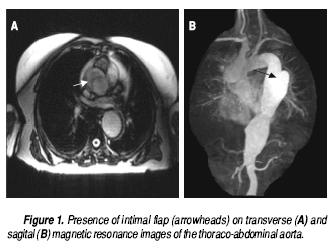
<body><![CDATA[<p align="justify"><font face="verdana" size="2">Dissection is one of the most common disorders of the aorta, with an incidence estimated at 2.9 per 100,000 per year. If the patient survives the acute phase, aortic dissection becomes chronic, its symptoms become less prominent and, past the first 2 weeks, the risk of death decreases rapidly over time.<sup>1,</sup><sup>2</sup> While abrupt onset and severe chest pain are present in most cases, extraordinary clinical presentations have been reported. In particular, fever or subfebrile temperatures and inflammatory responses have been described in only a few patients.<sup>3,</sup><sup>4</sup> We observed a patient in whom aortic dissection was manifested as fever, night sweats, suprasternal pain and atrial fibrillation.</font></p>     <p align="justify"><font face="verdana" size="2">&nbsp;</font></p>     <p align="justify"><font face="verdana" size="2"><b>CASE REPORT</b></font></p>     <p align="justify"><font face="verdana" size="2">A 65&#150;year&#150;old woman had suffered from systemic hypertension for 5 years. Her medication regimen included captopril, 50 mg daily, and chlortalidone, 25 mg daily. She presented to the emergency room complaining of abrupt onset of severe pain in the suprasternal notch area, radiating toward the interscapular region. The systemic blood pressure was 150/100 mm Hg, body temperature 39.5 &deg;C, and oxygen saturation 92%. The cardio&#150;pulmonary examination was unremarkable, except for a heart rate at 145 bpm and an irregularly irregular rhythm. The chest roentgenogram showed no abnormalities, the 12&#150;lead electrocardiogram showed atrial fibrillation and non&#150;specific ST segment changes, and all cardiac enzymes were within normal limits. Several hours after admission of the patient to the hospital, the pain resolved. Eight days later, her body temperature was 39.5 &deg;C, the C&#150;reactive protein concentration was elevated at 90 mg/L, erythrocyte sedimentation rate (Westergren method) 100 mm/h, white blood count was 15,000 cells/&micro;L, and hemoglobin concentration 10 mg/d. The blood cultures grew no organism.</font></p>     <p align="justify"><font face="verdana" size="2">A transesophageal echocardiogram, performed to exclude infective endocarditis, showed normal cardiac valves. However, a dissection flap, starting 1 cm above the aortic valve extending to the thoraco&#150;abdominal aorta, and a small pericardial effusion were present. Computed tomography of the chest showed a Stanford type A dissection of an aneurysmatic ascending aorta, 1 cm above the aortic valve, confirmed by magnetic resonance imaging (<a href="#f1">Figure 1</a>). Considering her uneventful clinical evolution, stable cardio&#150;pulmonary status, and absence of neurologic deficit, the patient was transferred to another hospital, from which she was discharged 2 weeks later in good condition, on medical treatment only.</font></p>     <p align="center"><font face="verdana" size="2"><a name="f1"></a></font></p>     <p align="center"><font face="verdana" size="2"><img src="/img/revistas/ric/v59n1/a11f1.jpg"></font></p>     <p align="justify"><font face="verdana" size="2">&nbsp;</font></p>     <p align="justify"><font face="verdana" size="2"><b>DISCUSSION</b></font></p>     <p align="justify"><font face="verdana" size="2">The diagnosis of aortic dissection is missed on initial presentation in over 50% of patients.<sup>5</sup> However imaging methods are currently available, which can confirm the diagnosis when it is suspected. While we favor transesophageal echocadiography the choice of diagnostic methods is often dictated by the resources available, the stability of the clinical status, and the costs involved.<sup>6</sup></font></p>     ]]></body>
<body><![CDATA[<p align="justify"><font face="verdana" size="2">Aortic dissection rarely presents, as in this case, with fever of unknown origin, sweats, pain in the suprasternal notch area, and during active inflammation, atrial fibrillation. While the etiology of the inflammatory response remains unclear, it has been hypothesized that cytokines are involved since, in patients with abdominal aortic aneurysms, the circulating concentrations of cytokines are elevated and correlate with aneurysm expansion.<sup>7,</sup><sup>8</sup> While this is a tenable hypothesis in this case, other factors might have caused fever and triggered atrial fibrillation such as acute pericarditis due to the intrapericardial presence of blood. Paroxysmal bouts of sympathetic hyperactivity have recently been described during type A dissection of aorta,<sup>9</sup> presenting as fever and arrythmias including atrial fibrillation in a small proportion of cases.<sup>10</sup></font></p>     <p align="justify"><font face="verdana" size="2">A long history of hypertension, present in our patient, is a risk factor of both aortic dissection and atrial fibrillation, and the latter can develop in hypertensive patients as a paroxysmal or chronic event.</font></p>     <p align="justify"><font face="verdana" size="2">Current strategies for the treatment of aortic dissection depend on the exent of dissection, but when the ascending aorta is involved, surgical graft replacement must be performed in emergency, since this type of dissection is associated with a high mortality when managed conservatively.<sup>11</sup> In this case the decision not to operate was based on the patient's relative clinical stability, as well as on her refusal to consider surgery. The outcomes of surgery are better when it is performed before the development of hemodynamic unstability or worst clinical status.<sup>12 </sup>Given the elusive presentation of aortic dissection and its similarity to other conditions a high proportion of patients later found to be suffering from aortic dissection are initially suspected to have other disorders, such as acute coronary syndromes, pericarditis, pulmonary embolism or even cholecystitis. In conclusions, physicians should consider the diagnosis of aortic dissection when a patient, particularly elderly, and hypertensive, presents with fever, severe pain in the suprasternal notch area and new onset atrial fibrillation.</font></p>     <p align="justify"><font face="verdana" size="2">&nbsp;</font></p>     <p align="justify"><font face="verdana" size="2"><b>REFERENCES</b></font></p>     <!-- ref --><p align="justify"><font face="verdana" size="2">1. Spittell PC, Spitell JA, Joyce JW, et al. Clinical features and differential diagnosis of aortic dissection: experiencie with 236 cases. <i>Mayo Clinic Proc </i>1993; 68: 642&#150;51.</font>&nbsp;&nbsp;&nbsp;&nbsp;&nbsp;&nbsp;&nbsp;&nbsp;[&#160;<a href="javascript:void(0);" onclick="javascript: window.open('/scielo.php?script=sci_nlinks&ref=6790358&pid=S0034-8376200700010001100001&lng=','','width=640,height=500,resizable=yes,scrollbars=1,menubar=yes,');">Links</a>&#160;]<!-- end-ref --><!-- ref --><p align="justify"><font face="verdana" size="2">2. Hagan PG, Nienaber CA, Isselbacher EM, et al. The International Registry of Acute Aortic Dissection (IRAD): new insights into an old disease. <i>JAMA </i>2000; 283: 897&#150;0.</font>&nbsp;&nbsp;&nbsp;&nbsp;&nbsp;&nbsp;&nbsp;&nbsp;[&#160;<a href="javascript:void(0);" onclick="javascript: window.open('/scielo.php?script=sci_nlinks&ref=6790359&pid=S0034-8376200700010001100002&lng=','','width=640,height=500,resizable=yes,scrollbars=1,menubar=yes,');">Links</a>&#160;]<!-- end-ref --><!-- ref --><p align="justify"><font face="verdana" size="2">3. Joya S, del Valle LP, Arenas SS, Sanchez FM, Rodriguez BP. Fever of unknown origin as presentation of chronic aortic dissection. <i>An Med Interna </i>2004; 21: 569&#150;70.</font>&nbsp;&nbsp;&nbsp;&nbsp;&nbsp;&nbsp;&nbsp;&nbsp;[&#160;<a href="javascript:void(0);" onclick="javascript: window.open('/scielo.php?script=sci_nlinks&ref=6790360&pid=S0034-8376200700010001100003&lng=','','width=640,height=500,resizable=yes,scrollbars=1,menubar=yes,');">Links</a>&#160;]<!-- end-ref --><!-- ref --><p align="justify"><font face="verdana" size="2">4. Davutoglu V, Kervancioglu S, Celkan A, Soydinc S, Dinckal H. Painless intimointimal intussusception and fever of unknown origin: an unusual form of aortic dissection. <i>Cardiology </i>2004;  102:  1&#150;3.</font>&nbsp;&nbsp;&nbsp;&nbsp;&nbsp;&nbsp;&nbsp;&nbsp;[&#160;<a href="javascript:void(0);" onclick="javascript: window.open('/scielo.php?script=sci_nlinks&ref=6790361&pid=S0034-8376200700010001100004&lng=','','width=640,height=500,resizable=yes,scrollbars=1,menubar=yes,');">Links</a>&#160;]<!-- end-ref --><!-- ref --><p align="justify"><font face="verdana" size="2">5. Hirst AE, Johns VJ, Kim SW. Diseccting aneurysm of the aorta: a review of 505 cases. <i>Medicine </i>1958; 37: 217&#150;79.</font>&nbsp;&nbsp;&nbsp;&nbsp;&nbsp;&nbsp;&nbsp;&nbsp;[&#160;<a href="javascript:void(0);" onclick="javascript: window.open('/scielo.php?script=sci_nlinks&ref=6790362&pid=S0034-8376200700010001100005&lng=','','width=640,height=500,resizable=yes,scrollbars=1,menubar=yes,');">Links</a>&#160;]<!-- end-ref --><!-- ref --><p align="justify"><font face="verdana" size="2">6. Kasher JA, El&#150;Bialy A, Balingit P. Aortic dissection: a dreaded disease with many faces. <i>J Cardiovasc Pharmacol Ther </i>2004; 9:  211&#150;18.</font>&nbsp;&nbsp;&nbsp;&nbsp;&nbsp;&nbsp;&nbsp;&nbsp;[&#160;<a href="javascript:void(0);" onclick="javascript: window.open('/scielo.php?script=sci_nlinks&ref=6790363&pid=S0034-8376200700010001100006&lng=','','width=640,height=500,resizable=yes,scrollbars=1,menubar=yes,');">Links</a>&#160;]<!-- end-ref --><!-- ref --><p align="justify"><font face="verdana" size="2">7. Swartbol P, Nogren L, Albrechtssson U, et al. Biological responses differ considerably between endovascular and conventional aortic aneurysm surgery. <i>Eur J Vase Endovas Surg </i>1996; 12: 18&#150;25.</font>&nbsp;&nbsp;&nbsp;&nbsp;&nbsp;&nbsp;&nbsp;&nbsp;[&#160;<a href="javascript:void(0);" onclick="javascript: window.open('/scielo.php?script=sci_nlinks&ref=6790364&pid=S0034-8376200700010001100007&lng=','','width=640,height=500,resizable=yes,scrollbars=1,menubar=yes,');">Links</a>&#160;]<!-- end-ref --><!-- ref --><p align="justify"><font face="verdana" size="2">8. Juvonen J, Surcel HM, Satta J, et al. Elevated circulating levels of inflamatory citokines in patients with abdominal aortic aneurysm. <i>Aterioscler Thromb Vase Biol </i>1997; 17: 2843&#150;7. </font>&nbsp;&nbsp;&nbsp;&nbsp;&nbsp;&nbsp;&nbsp;&nbsp;[&#160;<a href="javascript:void(0);" onclick="javascript: window.open('/scielo.php?script=sci_nlinks&ref=6790365&pid=S0034-8376200700010001100008&lng=','','width=640,height=500,resizable=yes,scrollbars=1,menubar=yes,');">Links</a>&#160;]<!-- end-ref --><!-- ref --><p align="justify"><font face="verdana" size="2">9. Rey M, Borrallo JM, Vogel CM, Pereira MA, V&aacute;rela MA, Diz JC. Paroxysmal sympathetic storms after type a dissection of the aorta. <i>J Cardiothorac Vase Anesth </i>2005; 19: 654&#150;5.</font>&nbsp;&nbsp;&nbsp;&nbsp;&nbsp;&nbsp;&nbsp;&nbsp;[&#160;<a href="javascript:void(0);" onclick="javascript: window.open('/scielo.php?script=sci_nlinks&ref=6790366&pid=S0034-8376200700010001100009&lng=','','width=640,height=500,resizable=yes,scrollbars=1,menubar=yes,');">Links</a>&#160;]<!-- end-ref --><!-- ref --><p align="justify"><font face="verdana" size="2">10. Chew HC, Lim, SH. Aortic disecction presenting with atrial fibrillation. <i>Am J of Emerg Med </i>2006; 24: 379&#150;80.</font>&nbsp;&nbsp;&nbsp;&nbsp;&nbsp;&nbsp;&nbsp;&nbsp;[&#160;<a href="javascript:void(0);" onclick="javascript: window.open('/scielo.php?script=sci_nlinks&ref=6790367&pid=S0034-8376200700010001100010&lng=','','width=640,height=500,resizable=yes,scrollbars=1,menubar=yes,');">Links</a>&#160;]<!-- end-ref --><!-- ref --><p align="justify"><font face="verdana" size="2">11. Nienaber CA, Eagle KA. Aortic dissection: new frontiers in diagnosis and management: part 1: from etiology to diagnosis strategies. <i>Circulation </i>2003;  108: 628&#150;35.</font>&nbsp;&nbsp;&nbsp;&nbsp;&nbsp;&nbsp;&nbsp;&nbsp;[&#160;<a href="javascript:void(0);" onclick="javascript: window.open('/scielo.php?script=sci_nlinks&ref=6790368&pid=S0034-8376200700010001100011&lng=','','width=640,height=500,resizable=yes,scrollbars=1,menubar=yes,');">Links</a>&#160;]<!-- end-ref --><!-- ref --><p align="justify"><font face="verdana" size="2">12. Tsai TT, Nienaber CA, Eagle KA. Acute aortic syndromes. <i>Circulation </i>2005;  112: 3802&#150;13.</font>&nbsp;&nbsp;&nbsp;&nbsp;&nbsp;&nbsp;&nbsp;&nbsp;[&#160;<a href="javascript:void(0);" onclick="javascript: window.open('/scielo.php?script=sci_nlinks&ref=6790369&pid=S0034-8376200700010001100012&lng=','','width=640,height=500,resizable=yes,scrollbars=1,menubar=yes,');">Links</a>&#160;]<!-- end-ref --> ]]></body><back>
<ref-list>
<ref id="B1">
<nlm-citation citation-type="journal">
<person-group person-group-type="author">
<name>
<surname><![CDATA[Spittell]]></surname>
<given-names><![CDATA[PC]]></given-names>
</name>
<name>
<surname><![CDATA[Spitell]]></surname>
<given-names><![CDATA[JA]]></given-names>
</name>
<name>
<surname><![CDATA[Joyce]]></surname>
<given-names><![CDATA[JW]]></given-names>
</name>
</person-group>
<article-title xml:lang="en"><![CDATA[Clinical features and differential diagnosis of aortic dissection: experiencie with 236 cases]]></article-title>
<source><![CDATA[Mayo Clinic Proc]]></source>
<year>1993</year>
<volume>68</volume>
<page-range>642-51</page-range></nlm-citation>
</ref>
<ref id="B2">
<nlm-citation citation-type="journal">
<person-group person-group-type="author">
<name>
<surname><![CDATA[Hagan]]></surname>
<given-names><![CDATA[PG]]></given-names>
</name>
<name>
<surname><![CDATA[Nienaber]]></surname>
<given-names><![CDATA[CA]]></given-names>
</name>
<name>
<surname><![CDATA[Isselbacher]]></surname>
<given-names><![CDATA[EM]]></given-names>
</name>
</person-group>
<article-title xml:lang="en"><![CDATA[The International Registry of Acute Aortic Dissection (IRAD): new insights into an old disease]]></article-title>
<source><![CDATA[JAMA]]></source>
<year>2000</year>
<volume>283</volume>
<page-range>897-0</page-range></nlm-citation>
</ref>
<ref id="B3">
<nlm-citation citation-type="journal">
<person-group person-group-type="author">
<name>
<surname><![CDATA[Joya]]></surname>
<given-names><![CDATA[S]]></given-names>
</name>
<name>
<surname><![CDATA[del Valle]]></surname>
<given-names><![CDATA[LP]]></given-names>
</name>
<name>
<surname><![CDATA[Arenas]]></surname>
<given-names><![CDATA[SS]]></given-names>
</name>
<name>
<surname><![CDATA[Sanchez]]></surname>
<given-names><![CDATA[FM]]></given-names>
</name>
<name>
<surname><![CDATA[Rodriguez]]></surname>
<given-names><![CDATA[BP]]></given-names>
</name>
</person-group>
<article-title xml:lang="en"><![CDATA[Fever of unknown origin as presentation of chronic aortic dissection]]></article-title>
<source><![CDATA[An Med Interna]]></source>
<year>2004</year>
<volume>21</volume>
<page-range>569-70</page-range></nlm-citation>
</ref>
<ref id="B4">
<nlm-citation citation-type="journal">
<person-group person-group-type="author">
<name>
<surname><![CDATA[Davutoglu]]></surname>
<given-names><![CDATA[V]]></given-names>
</name>
<name>
<surname><![CDATA[Kervancioglu]]></surname>
<given-names><![CDATA[S]]></given-names>
</name>
<name>
<surname><![CDATA[Celkan]]></surname>
<given-names><![CDATA[A]]></given-names>
</name>
<name>
<surname><![CDATA[Soydinc]]></surname>
<given-names><![CDATA[S]]></given-names>
</name>
<name>
<surname><![CDATA[Dinckal]]></surname>
<given-names><![CDATA[H]]></given-names>
</name>
</person-group>
<article-title xml:lang="en"><![CDATA[Painless intimointimal intussusception and fever of unknown origin: an unusual form of aortic dissection]]></article-title>
<source><![CDATA[Cardiology]]></source>
<year>2004</year>
<volume>102</volume><volume>1-3</volume>
</nlm-citation>
</ref>
<ref id="B5">
<nlm-citation citation-type="journal">
<person-group person-group-type="author">
<name>
<surname><![CDATA[Hirst]]></surname>
<given-names><![CDATA[AE]]></given-names>
</name>
<name>
<surname><![CDATA[Johns]]></surname>
<given-names><![CDATA[VJ]]></given-names>
</name>
<name>
<surname><![CDATA[Kim]]></surname>
<given-names><![CDATA[SW]]></given-names>
</name>
</person-group>
<article-title xml:lang="en"><![CDATA[Diseccting aneurysm of the aorta: a review of 505 cases]]></article-title>
<source><![CDATA[Medicine]]></source>
<year>1958</year>
<volume>37</volume>
<page-range>217-79</page-range></nlm-citation>
</ref>
<ref id="B6">
<nlm-citation citation-type="journal">
<person-group person-group-type="author">
<name>
<surname><![CDATA[Kasher]]></surname>
<given-names><![CDATA[JA]]></given-names>
</name>
<name>
<surname><![CDATA[El-Bialy]]></surname>
<given-names><![CDATA[A]]></given-names>
</name>
<name>
<surname><![CDATA[Balingit]]></surname>
<given-names><![CDATA[P]]></given-names>
</name>
</person-group>
<article-title xml:lang="en"><![CDATA[Aortic dissection: a dreaded disease with many faces]]></article-title>
<source><![CDATA[J Cardiovasc Pharmacol Ther]]></source>
<year>2004</year>
<volume>9</volume>
<page-range>211-18</page-range></nlm-citation>
</ref>
<ref id="B7">
<nlm-citation citation-type="journal">
<person-group person-group-type="author">
<name>
<surname><![CDATA[Swartbol]]></surname>
<given-names><![CDATA[P]]></given-names>
</name>
<name>
<surname><![CDATA[Nogren]]></surname>
<given-names><![CDATA[L]]></given-names>
</name>
<name>
<surname><![CDATA[Albrechtssson]]></surname>
<given-names><![CDATA[U]]></given-names>
</name>
</person-group>
<article-title xml:lang="en"><![CDATA[Biological responses differ considerably between endovascular and conventional aortic aneurysm surgery]]></article-title>
<source><![CDATA[Eur J Vase Endovas Surg]]></source>
<year>1996</year>
<volume>12</volume>
<page-range>18-25</page-range></nlm-citation>
</ref>
<ref id="B8">
<nlm-citation citation-type="journal">
<person-group person-group-type="author">
<name>
<surname><![CDATA[Juvonen]]></surname>
<given-names><![CDATA[J]]></given-names>
</name>
<name>
<surname><![CDATA[Surcel]]></surname>
<given-names><![CDATA[HM]]></given-names>
</name>
<name>
<surname><![CDATA[Satta]]></surname>
<given-names><![CDATA[J]]></given-names>
</name>
</person-group>
<article-title xml:lang="en"><![CDATA[Elevated circulating levels of inflamatory citokines in patients with abdominal aortic aneurysm]]></article-title>
<source><![CDATA[Aterioscler Thromb Vase Biol]]></source>
<year>1997</year>
<volume>17</volume>
<page-range>2843-7</page-range></nlm-citation>
</ref>
<ref id="B9">
<nlm-citation citation-type="journal">
<person-group person-group-type="author">
<name>
<surname><![CDATA[Rey]]></surname>
<given-names><![CDATA[M]]></given-names>
</name>
<name>
<surname><![CDATA[Borrallo]]></surname>
<given-names><![CDATA[JM]]></given-names>
</name>
<name>
<surname><![CDATA[Vogel]]></surname>
<given-names><![CDATA[CM]]></given-names>
</name>
<name>
<surname><![CDATA[Pereira]]></surname>
<given-names><![CDATA[MA]]></given-names>
</name>
<name>
<surname><![CDATA[Várela]]></surname>
<given-names><![CDATA[MA]]></given-names>
</name>
<name>
<surname><![CDATA[Diz]]></surname>
<given-names><![CDATA[JC]]></given-names>
</name>
</person-group>
<article-title xml:lang="en"><![CDATA[Paroxysmal sympathetic storms after type a dissection of the aorta]]></article-title>
<source><![CDATA[J Cardiothorac Vase Anesth]]></source>
<year>2005</year>
<volume>19</volume>
<page-range>654-5</page-range></nlm-citation>
</ref>
<ref id="B10">
<nlm-citation citation-type="journal">
<person-group person-group-type="author">
<name>
<surname><![CDATA[Chew]]></surname>
<given-names><![CDATA[HC]]></given-names>
</name>
<name>
<surname><![CDATA[Lim]]></surname>
<given-names><![CDATA[SH]]></given-names>
</name>
</person-group>
<article-title xml:lang="en"><![CDATA[Aortic disecction presenting with atrial fibrillation]]></article-title>
<source><![CDATA[Am J of Emerg Med]]></source>
<year>2006</year>
<volume>24</volume>
<page-range>379-80</page-range></nlm-citation>
</ref>
<ref id="B11">
<nlm-citation citation-type="journal">
<person-group person-group-type="author">
<name>
<surname><![CDATA[Nienaber]]></surname>
<given-names><![CDATA[CA]]></given-names>
</name>
<name>
<surname><![CDATA[Eagle]]></surname>
<given-names><![CDATA[KA]]></given-names>
</name>
</person-group>
<article-title xml:lang="en"><![CDATA[Aortic dissection: new frontiers in diagnosis and management: part 1: from etiology to diagnosis strategies]]></article-title>
<source><![CDATA[Circulation]]></source>
<year>2003</year>
<volume>108</volume>
<page-range>628-35</page-range></nlm-citation>
</ref>
<ref id="B12">
<nlm-citation citation-type="journal">
<person-group person-group-type="author">
<name>
<surname><![CDATA[Tsai]]></surname>
<given-names><![CDATA[TT]]></given-names>
</name>
<name>
<surname><![CDATA[Nienaber]]></surname>
<given-names><![CDATA[CA]]></given-names>
</name>
<name>
<surname><![CDATA[Eagle]]></surname>
<given-names><![CDATA[KA]]></given-names>
</name>
</person-group>
<article-title xml:lang="en"><![CDATA[Acute aortic syndromes]]></article-title>
<source><![CDATA[Circulation]]></source>
<year>2005</year>
<volume>112</volume>
<page-range>3802-13</page-range></nlm-citation>
</ref>
</ref-list>
</back>
</article>
