<?xml version="1.0" encoding="ISO-8859-1"?><article xmlns:mml="http://www.w3.org/1998/Math/MathML" xmlns:xlink="http://www.w3.org/1999/xlink" xmlns:xsi="http://www.w3.org/2001/XMLSchema-instance">
<front>
<journal-meta>
<journal-id>0016-7169</journal-id>
<journal-title><![CDATA[Geofísica internacional]]></journal-title>
<abbrev-journal-title><![CDATA[Geofís. Intl]]></abbrev-journal-title>
<issn>0016-7169</issn>
<publisher>
<publisher-name><![CDATA[Universidad Nacional Autónoma de México, Instituto de Geofísica]]></publisher-name>
</publisher>
</journal-meta>
<article-meta>
<article-id>S0016-71692011000200003</article-id>
<title-group>
<article-title xml:lang="en"><![CDATA[New detailed paleosecular variation record at Santa Lucía archaeological site (Corrientes province, northeastern Argentina)]]></article-title>
</title-group>
<contrib-group>
<contrib contrib-type="author">
<name>
<surname><![CDATA[Nami]]></surname>
<given-names><![CDATA[Hugo G]]></given-names>
</name>
<xref ref-type="aff" rid="A01"/>
</contrib>
</contrib-group>
<aff id="A01">
<institution><![CDATA[,Consejo Nacional de Investigaciones Científicas y TécnicasConsejo Nacional de Investigaciones Científicas y Técnicas  ]]></institution>
<addr-line><![CDATA[ ]]></addr-line>
</aff>
<pub-date pub-type="pub">
<day>00</day>
<month>06</month>
<year>2011</year>
</pub-date>
<pub-date pub-type="epub">
<day>00</day>
<month>06</month>
<year>2011</year>
</pub-date>
<volume>50</volume>
<numero>2</numero>
<fpage>163</fpage>
<lpage>175</lpage>
<copyright-statement/>
<copyright-year/>
<self-uri xlink:href="http://www.scielo.org.mx/scielo.php?script=sci_arttext&amp;pid=S0016-71692011000200003&amp;lng=en&amp;nrm=iso"></self-uri><self-uri xlink:href="http://www.scielo.org.mx/scielo.php?script=sci_abstract&amp;pid=S0016-71692011000200003&amp;lng=en&amp;nrm=iso"></self-uri><self-uri xlink:href="http://www.scielo.org.mx/scielo.php?script=sci_pdf&amp;pid=S0016-71692011000200003&amp;lng=en&amp;nrm=iso"></self-uri><abstract abstract-type="short" xml:lang="es"><p><![CDATA[Se reporta información paleomagnética de una sección sedimentaria del sitio arqueológico Santa Lucía, provincia de Corrientes (Nordeste de Argentina). El magnetismo remanente natural obtenido en 74 especimenes orientados mostró una remanencia magnética normal e intermedia con bajos valores negativos y positivos de inclinación durante el Holoceno tardío. La magnetización remanente característica fue determinada por desmagnetización progresiva utilizando campos alternos. Los polos geomagnéticos virtuales muestran algunas coincidencias con los registrados durante el Pleistoceno Terminal y Holoceno en otros sitos del cono sur de Sudamérica. Los polos paleomagnéticos calculados con sitios del nordeste de Argentina se localizan ~3-15° alejados del eje de rotación de la Tierra.]]></p></abstract>
<abstract abstract-type="short" xml:lang="en"><p><![CDATA[Paleomagnetic data from a sedimentary section from Santa Lucía archaeological site, Corrientes province (Northeastern Argentina) are reported. Natural remanent magnetization obtained from 74 oriented cores showed normal and intermediate magnetic remanence with negative and positive low inclination values during the Late Holocene. Characteristic remanent magnetization was determined by progressive demagnetization using the AF method. Virtual geomagnetic poles show some agreement with those registered during the terminal Pleistocene and Holocene in other sites from the southern cone of South America. Palaeomagnetic poles for other contemporaneous sites from northeastern Argentina fall some ~3-15° away from the Earth's rotation's axis.]]></p></abstract>
<kwd-group>
<kwd lng="es"><![CDATA[paleomagnetismo]]></kwd>
<kwd lng="es"><![CDATA[variaciones paleoseculares]]></kwd>
<kwd lng="es"><![CDATA[Holoceno]]></kwd>
<kwd lng="es"><![CDATA[Arqueología]]></kwd>
<kwd lng="es"><![CDATA[Sudamérica]]></kwd>
<kwd lng="es"><![CDATA[Argentina]]></kwd>
<kwd lng="en"><![CDATA[paleomagnetism]]></kwd>
<kwd lng="en"><![CDATA[paleosecular variations]]></kwd>
<kwd lng="en"><![CDATA[Holocene]]></kwd>
<kwd lng="en"><![CDATA[Archaeology]]></kwd>
<kwd lng="en"><![CDATA[South America]]></kwd>
<kwd lng="en"><![CDATA[Argentina]]></kwd>
</kwd-group>
</article-meta>
</front><body><![CDATA[ <p align="justify"><font face="verdana" size="4">Original paper </font></p>     <p align="center"><font face="verdana" size="2">&nbsp;</font></p>     <p align="center"><font face="verdana" size="4"><b>New detailed paleosecular variation record at Santa Luc&iacute;a archaeological site (Corrientes province, northeastern Argentina)</b></font></p>     <p align="center"><font face="verdana" size="2">&nbsp;</font></p>     <p align="center"><font face="verdana" size="2"><b>Hugo G. Nami</b></font></p>     <p align="justify"><font face="verdana" size="2">&nbsp;</font></p>     <p align="justify"><font face="verdana" size="2"><i>CONICET. Instituto de Geof&iacute;sica Daniel A. Valencio, Departamento de Ciencias Geol&oacute;gicas, Facultad de Ciencias Exactas, F&iacute;sicas y Naturales, Universidad de Buenos Aires, Ciudad Universitaria (Pabell&oacute;n II), Buenos Aires (C1428EHA), Rep&uacute;blica Argentina. Associated Research, Department of Anthropology, National Museum of Natural History, Smithsonian Institution, Washington, D. C. </i>Corresponding author: <a href="mailto:hgnami@fulbrightmail.org">hgnami@fulbrightmail.org</a></font></p>     <p align="justify"><font face="verdana" size="2">&nbsp;</font></p>     <p align="justify"><font face="verdana" size="2">Received: June 2, 2009    <br>   Accepted: March 9, 2011    ]]></body>
<body><![CDATA[<br> </font><font size="2" face="verdana">Published on line: March 29, 2011 </font></p>     <p align="justify"><font face="verdana" size="2">&nbsp;</font></p>     <p align="justify"><font face="verdana" size="2"><b>Resumen</b></font></p>     <p align="justify"><font face="verdana" size="2">Se reporta informaci&oacute;n paleomagn&eacute;tica de una secci&oacute;n sedimentaria del sitio arqueol&oacute;gico Santa Luc&iacute;a, provincia de Corrientes (Nordeste de Argentina). El magnetismo remanente natural obtenido en 74 especimenes orientados mostr&oacute; una remanencia magn&eacute;tica normal e intermedia con bajos valores negativos y positivos de inclinaci&oacute;n durante el Holoceno tard&iacute;o. La magnetizaci&oacute;n remanente caracter&iacute;stica fue determinada por desmagnetizaci&oacute;n progresiva utilizando campos alternos. Los polos geomagn&eacute;ticos virtuales muestran algunas coincidencias con los registrados durante el Pleistoceno Terminal y Holoceno en otros sitos del cono sur de Sudam&eacute;rica. Los polos paleomagn&eacute;ticos calculados con sitios del nordeste de Argentina se localizan &#126;3&#150;15&deg; alejados del eje de rotaci&oacute;n de la Tierra.</font></p>     <p align="justify"><font face="verdana" size="2"><b>Palabras clave:</b> paleomagnetismo, variaciones paleoseculares, Holoceno, Arqueolog&iacute;a, Sudam&eacute;rica, Argentina.</font></p>     <p align="justify"><font face="verdana" size="2">&nbsp;</font></p>     <p align="justify"><font face="verdana" size="2"><b>Abstract</b></font></p>     <p align="justify"><font face="verdana" size="2">Paleomagnetic data from a sedimentary section from Santa Luc&iacute;a archaeological site, Corrientes province (Northeastern Argentina) are reported. Natural remanent magnetization obtained from 74 oriented cores showed normal and intermediate magnetic remanence with negative and positive low inclination values during the Late Holocene. Characteristic remanent magnetization was determined by progressive demagnetization using the AF method. Virtual geomagnetic poles show some agreement with those registered during the terminal Pleistocene and Holocene in other sites from the southern cone of South America. Palaeomagnetic poles for other contemporaneous sites from northeastern Argentina fall some &#126;3&#150;15&deg; away from the Earth's rotation's axis.</font></p>     <p align="justify"><font face="verdana" size="2"><b>Key words:</b> paleomagnetism, paleosecular variations, Holocene, Archaeology, South America, Argentina.</font></p>     <p align="justify"><font face="verdana" size="2">&nbsp;</font></p>     ]]></body>
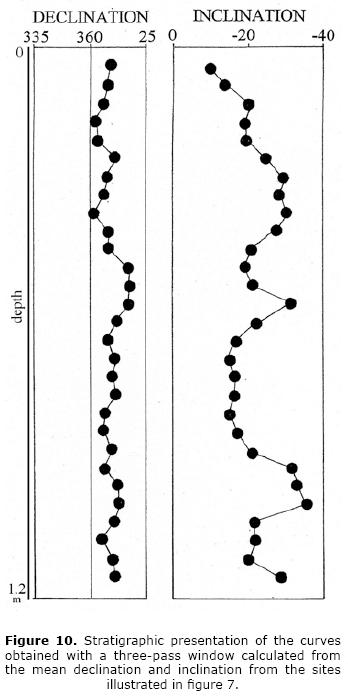
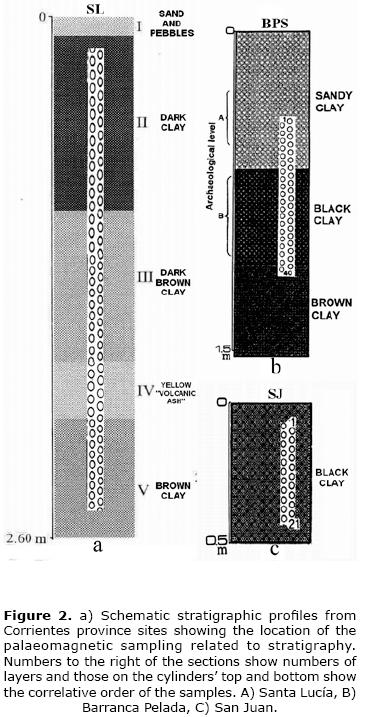
<body><![CDATA[<p align="justify"><font face="verdana" size="2"><b>Introduction</b></font></p>     <p align="justify"><font face="verdana" size="2">Paleomagnetic research recently performed in several archaeological, paleontological and geological deposits located in the southern cone of South America yielded large paleosecular variation (PSV) logs (especially in inclination) during the terminal Pleistocene and Holocene at &#126;12&#150;0.1 ka (Sinito <i>et al., </i>1997, Nami 1995, 1999, 2006, 2008, R&eacute; <i>et al., </i>2008). To go deeper in the knowledge of the geomagnetic field (GMF) in this part of the continent, a variety of sections of recent sediments were sampled. This paper reports the results of a detailed palaeomagnetic research performed at the Santa Luc&iacute;a (SL) archaeological site in Northeastern Corrientes province, Argentine Republic. Additionally, by using regional PSV logs previously reported diverse aspects of paleomagnetic records are discussed.</font></p>     <p align="justify"><font face="verdana" size="2">Santa Luc&iacute;a (30&deg; 20.52'S, 57&deg; 39.25'W) is located on the Uruguay river shoreline, 5 km south of Monte Caseros village (<a href="/img/revistas/geoint/v50n2//a3f1.jpg" target="_blank">Fig. 1</a>). It is a well&#150;known place due to the quality and quantity of stone tool finds in the earliest periods of the regional archaeological research (Serrano 1932, 1950). The archaeological finds occur in almost 500 m along the surface of the river shore. Test pits showed that there are archaeological remains until 1.10 m depth (Mujica pers. comm.1997). The sampled profile is 2.90 m thick. Five natural strata can be seen I, II, III, IV and V. Level I is mostly sand and pebbles, II, III and V are black, dark brown and brown clays respectively (<a href="#f2">Fig. 2</a>). The sediments have abundant fine grain quartz and some calcium carbonate with cubic structure (Smorczewski, 1994). Level IV is a yellowish white layer, likely volcanic ash that near SL in south Brazil was dated at &#126;10&#150;11 ka BP (Miller, 1987). Therefore, this section belongs to terminal Pleistocene and Holocene, lasting the last &#126;10&#150;ll ka. Here is significant to point out that nearby SL, the Barranca Pelada site (BPS), showed a similar stratigraphy (<a href="#f2">Fig. 2b</a>). There, an AMS radiocarbon date from a very small sample of organic sediment obtained at 90 cm depth in level II was dated at 3,160 &plusmn; 35 yr B.P. (CURL&#150;5506). This date was made from the humic acid fraction of the sediment, which tends to provide more reliable ages for this kind of materials (Pessenda <i>et al., </i>2001). However, it can be considered as a minimum age because the apparent mean residence time of organic components is a significant factor in soil dating (Scharpenseel 1971, Stein 1992).</font></p>     <p align="center"><font face="verdana" size="2"><a name="f2"></a></font></p>     <p align="center"><font face="verdana" size="2"><img src="/img/revistas/geoint/v50n2//a3f2.jpg"></font></p>     <p align="justify"><font face="verdana" size="2">One vertical paleomagnetic sampling (n = 84) was performed to study the GMF directions in the deposit. To collect samples, cylindrical containers 2.5 cm long and 2.5 cm diameter were carefully pushed into levels II (samples SL1 to 31), level III (SL32 to 58), SL 59 to 66 from level IV and 67 to 84 from level V, overlapping each other by about 50 percent. Their strike and dip were measured using a Brunton compass and inclinometer; they were consolidated with sodium silicate after removal and numbered from top to bottom.</font></p>     <p align="justify"><font face="verdana" size="2">&nbsp;</font></p>     <p align="justify"><font face="verdana" size="2"><b>Laboratory methods and results</b></font></p>     <p align="justify"><font face="verdana" size="2">Santa Luc&iacute;a specimens were processed with progressive alternating field (AF) demagnetization in steps of 3, 6, 9, 12, 15, 20, 25, 30, 40, 60 and 80 mT. Additional steps from 100 to 140 mT were used in some samples (SL1 and SL38, <a href="/img/revistas/geoint/v50n2//a3f3.jpg" target="_blank">Fig. 3b</a>, <a href="/img/revistas/geoint/v50n2//a3f3.jpg" target="_blank">e</a>). Samples 14, 34, 40, 44, 47, and 52 were rejected because they loose their orientation. Measurements of the directions and intensity of the natural remanent magnetization (NRM) were done in a DC squid cryogenic magnetomer (2G 755R) and demagnetization was performed with a static three axis AF demagnetizer attached to the magnetometer. In most SL cores, less than 20 percent of the NRM intensity remained at fields of 80 mT (<a href="/img/revistas/geoint/v50n2//a3f3.jpg" target="_parent">Fig. 3</a>). This behavior suggests titano&#150;magnetite as the dominant carrier of the NRM (Nagata 1961, Stacey and Banerjee 1974, Tarling 1983, Thompson and Oldfield 1986). However, specimens subjected to fields of 140mT suggest hematite or goethite as the principal carrier (Piper 1989). Characteristic remanent magnetization (ChRM) was calculated using principal&#150;components analysis (Kirschvink 1980). Intervals of selected ChRM for each specimen are given <a href="/img/revistas/geoint/v50n2//a3t1.jpg" target="_blank">Table 1</a>. The samples shown in <a href="/img/revistas/geoint/v50n2//a3f3.jpg" target="_blank">Figure 3</a> display similar patterns, going to the origin in the Zijderveld (1967) diagrams (e. g., SL36, 55, 68, 71, 80, <a href="/img/revistas/geoint/v50n2//a3f3.jpg" target="_blank">Fig. 3d</a>, <a href="/img/revistas/geoint/v50n2//a3f3.jpg" target="_blank">f</a>&#150;<a href="/img/revistas/geoint/v50n2//a3f3.jpg" target="_blank">j</a>); thought, some do not converge toward the origin (e.g., SL3, <a href="/img/revistas/geoint/v50n2//a3f3.jpg" target="_blank">Fig. 3c</a>), in these cases the line have been forced to pass through the origin (anchored line fit, <i>cf. </i>Butler, 1992; McElhinny and McFadden, 2001). Maximum angular deviations were generally within low values and most of them ranges between 0&deg; to 5&deg; (n = 48, 64.86%) and 5.1&deg; to 10 (n = 26, 35.14%). Some samples had univectorial behavior (e.g., SL71, <a href="/img/revistas/geoint/v50n2//a3f3.jpg" target="_blank">Fig. 3i</a>). Other specimens had two magnetic components; some of them had a viscous overprint of the present GMF, removed around 3 to 6 mT (e.g., SL68, SL80, <a href="/img/revistas/geoint/v50n2//a3f3.jpg" target="_blank">Fig. 3h</a>, <a href="/img/revistas/geoint/v50n2//a3f3.jpg" target="_blank">j</a>) while other ones showed two vectors, one of them was removed from 30&#150;40 mT (e.g., SL3, SL59, <a href="/img/revistas/geoint/v50n2//a3f3.jpg" target="_blank">Fig. 3a</a>, <a href="/img/revistas/geoint/v50n2//a3f3.jpg" target="_blank">g</a>). Samples SL20 and SL38 showed two or three components that could not be well isolated unless remagnetization circle analysis was used (<a href="/img/revistas/geoint/v50n2//a3f3.jpg" target="_blank">Fig. 3c</a>, <a href="/img/revistas/geoint/v50n2//a3f3.jpg" target="_blank">e</a>, <a href="/img/revistas/geoint/v50n2//a3f4.jpg" target="_blank">Fig. 4</a>); both samples were not used in this study. However, it is significant to point out that SL38 carried two magnetic components in the Zijderveld (1967) diagram (<a href="/img/revistas/geoint/v50n2//a3f3.jpg" target="_blank">Fig 3e</a>), its stereoplot illustrated in <a href="/img/revistas/geoint/v50n2//a3f4.jpg" target="_blank">Figure 4a</a> shows that the vector changes from negative to positive inclinations (intermediate or reverse) moving in a great circle. The demagnetization curve depicted in <a href="/img/revistas/geoint/v50n2//a3f4.jpg" target="_blank">figure 4b</a> displays almost regular decay at 20% of the NRM up to 20 mT, however after a little remagnetization at almost 40% of the NRM remained at field of 140 mT. Many samples showed either high (SL55 and SL80, <a href="/img/revistas/geoint/v50n2//a3f3.jpg" target="_blank">Fig. 3c</a>, <a href="/img/revistas/geoint/v50n2//a3f3.jpg" target="_blank">f</a>, <a href="/img/revistas/geoint/v50n2//a3f3.jpg" target="_blank">j</a>) or low negative inclinations (e.g., SL36, <a href="/img/revistas/geoint/v50n2//a3f3.jpg" target="_blank">Fig. 3d</a>). A few ones showed westerly (SL55, SL59, <a href="/img/revistas/geoint/v50n2//a3f3.jpg" target="_blank">Fig. 3f</a>&#150;<a href="/img/revistas/geoint/v50n2//a3f3.jpg" target="_blank">g</a>) and northwesterly directions (e.g., SL68, SL71 and SL80, <a href="/img/revistas/geoint/v50n2//a3f3.jpg" target="_blank">Fig. 3h</a>&#150;<a href="/img/revistas/geoint/v50n2//a3f3.jpg" target="_blank">j</a>). The number and intervals of demagnetization steps used to isolate de ChRM are given in <a href="/img/revistas/geoint/v50n2//a3t1.jpg" target="_blank">Table 1</a>. As result of this analysis, SL deposit has a normal and intermediate magnetic remanence with negative and positive low inclination values. <a href="/img/revistas/geoint/v50n2//a3f5.jpg" target="_blank">Figures 5a</a> and <a href="/img/revistas/geoint/v50n2//a3f5.jpg" target="_blank">b</a> illustrates the stereographic projection of ChRM and virtual geomagnetic pole (VGP) calculated from the directions of <a href="/img/revistas/geoint/v50n2//a3t1.jpg" target="_blank">Table 1</a>. <a href="/img/revistas/geoint/v50n2//a3f6.jpg" target="_blank">Figure 6</a> shows changes in the declination and inclination from ChRM isolated for the entire section according to the stratigraphic depth. They clearly show a similar GMF behavior with the most conspicuous long declination and inclination departures depicted between dashed lines and pointed with an arrow. The record of inclination presents a general decreasing trend from &#150;80&deg; at the lower part to 20&deg; at the upper part. The uppermost samples vary widely and there are transitional positions between the swings. An important oscillation in declination, that reaches values of &#126;40&deg; to the east, is located between SL7 and SL46 samples (level II and top of level III).</font></p>     <p align="justify"><font face="verdana" size="2">Nearby SL, also in the Corrientes province, results obtained at BPS and San Juan (SJ) sites were previously reported (Nami 1999: <a href="/img/revistas/geoint/v50n2//a3f9.jpg" target="_blank">Figs. 9</a> and <a href="#f10">10b</a>). They also showed unstable records with a similar behavior, suggesting that these variations might reflect the PSV. <a href="/img/revistas/geoint/v50n2//a3f7.jpg" target="_blank">Figure 7</a> illustrates the overlapped stratigraphic presentation of each section showing a remarkably match of BPS (samples BPS9 to BPS39) and SJ logs with the upper and middle part of SL. Hence, it is possible to suggest that BPS might temporally range between &#126;3.2&#150;0.3 kya and SJ is &#126;&lt;3.0 ka (<a href="/img/revistas/geoint/v50n2//a3f7.jpg" target="_blank">Fig. 7</a>). Furthermore, a smooth curve was constructed with the mean declination and inclination from correlative samples of SL, BPS and SJ sites (<a href="/img/revistas/geoint/v50n2//a3f8.jpg" target="_blank">Fig. 8</a>). Samples with difference in directions of 45&deg; were not considered in this analysis. The resulting curve was compared with the Lomas del Mirador (LM) log, the nearest place located in eastern Argentina (NE Buenos Aires province) at 803 km southeast of SL. It has an AMS date of 4900 &plusmn; 110 yr B.P. (OS&#150;24330). The PSV of LM also recorded low inclination values and easterly directions (Nami 2006). This comparison showed a notably agreement with the upper part of LM curve (<a href="/img/revistas/geoint/v50n2//a3f9.jpg" target="_blank">Fig. 9</a>). Despite the lost of resolution, the data employed to construct the curve showed in <a href="/img/revistas/geoint/v50n2//a3f8.jpg" target="_blank">Figure 8</a> was filtered to eliminate the noise; then, a three&#150;point window was used to define the high frequencies directional changes of the GMF. The results are shown in a log according to depth (<a href="#f10">Fig. 10</a>). After checking that the directional data from SL was useful to assess a Fisherian distribution, the site mean direction was computed by Fisher (1953) statistic (<a href="/img/revistas/geoint/v50n2//a3f11.jpg" target="_blank">Fig. 11</a>). Additionally, a mean direction was calculated using the data from the upper (samples SL1 to SL48 from levels II and III) and the lower part of the section (samples SL 49 to SL 84 from levels III to V), respectively named SLa and SLb (<a href="/img/revistas/geoint/v50n2//a3t2.jpg" target="_blank">Table 2</a>, <a href="/img/revistas/geoint/v50n2//a3f11.jpg" target="_blank">Fig. 11</a>). SL mean direction agrees with the IGRF direction (D = &#150;351.5&deg;, I = &#150;32.0&deg;) for 1997, year when the sampling was performed. However, a significant difference is observed with Sla and SLb (<a href="/img/revistas/geoint/v50n2//a3f11.jpg" target="_blank">Fig 11a</a>). Furthermore, these results were compared with the mean directions calculated for all the previously reported sites located in eastern Argentina (Nami, 1999, 2006). The data belongs from SJ and BPS (Corrientes province), Arroyo Yarar&aacute; (AY, Misiones province) and LM. As illustrated in <a href="/img/revistas/geoint/v50n2//a3f11.jpg" target="_blank">Figure 11</a>, BPS, SJ and AY sites shows a similar site mean direction with Sla, and some similarities with the upper part of LM, named LM1a (<a href="/img/revistas/geoint/v50n2//a3t2.jpg" target="_blank">Table 2</a>).</font></p>     ]]></body>
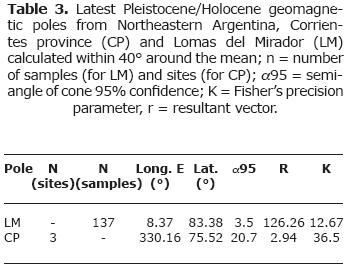
<body><![CDATA[<p align="center"><font face="verdana" size="2"><a name="f10"></a></font></p>     <p align="center"><font face="verdana" size="2"><img src="/img/revistas/geoint/v50n2//a3f10.jpg"></font></p>     <p align="justify"><font face="verdana" size="2">Virtual geomagnetic pole positions were calculated from the declination and inclination data presented in <a href="/img/revistas/geoint/v50n2//a3t1.jpg" target="_blank">Table 1</a>. When plotted on a present world map, they show intermediate VGPs from the rotation northern latitude axis in the northern Hemisphere between 60&deg; and 30&deg;, and in two patches located in northern North America and Greenland and northern Eurasia (<a href="/img/revistas/geoint/v50n2//a3f12.jpg" target="_blank">Fig. 12</a>). These positions agree remarkably well with VGPs observed in previous paleomagnetic studies with Latest Pleistocene and Holocene sections from the southern cone of South America (Mena and Nami 2002, Nami 1995, 1999, 2006, 2007, 2008).</font></p>     <p align="justify"><font face="verdana" size="2">Finally, as depicted in <a href="/img/revistas/geoint/v50n2//a3f13.jpg" target="_blank">Figure 13</a>, the mean geomagnetic poles were computed using all VGPs located within a 40&deg; window around the mean geomagnetic pole (cf. McElhinny <i>et al. </i>1974). The first one was computed using the poles obtained with VGPs from BPS, SJ and SL sites from Corrientes province (CP); the &#945;95 of CP include the paleopole determined from the LM site (<a href="/img/revistas/geoint/v50n2//a3f13.jpg" target="_blank">Fig. 13</a>). It coincides remarkably well with the paleopole called "Mylodon excursion" (ME = 336.7&deg; W. Long, 68.65&deg;S Lat. with &#91;&#945;95 8.2&deg;&#93;) which was calculated using the sites with anomalous directions observed across Argentina and Chile (Nami 1999). Like other poles previously reported they do not agree with the geographical pole and shows &#126;3&#150;15&deg; difference in relation to the rotation's axis of the Earth (<a href="#t3">Table 3</a>); as it has previously stated, this fact suggests that a time span of &#126;10 ka is insufficient to average out geomagnetic secular variations (Mena and Nami 2002, Nami 1999, 2006).</font></p>     <p align="center"><font face="verdana" size="2"><a name="t3"></a></font></p>     <p align="center"><font face="verdana" size="2"><img src="/img/revistas/geoint/v50n2//a3t3.jpg"></font></p>     <p align="justify"><font face="verdana" size="2">&nbsp;</font></p>     <p align="justify"><font face="verdana" size="2"><b>Final remarks</b></font></p>     <p align="justify"><font face="verdana" size="2">As conclusion of the investigations described above, we have that SL samples recorded normal and intermediate polarity directions far from the present GMF. A &#126;100&deg; difference in inclination with low values and significant westward shift with fluctuations in declination occurred in the upper (with positive inclination values) and lower parts of the SL section, respectively. However, major swings in inclination are observed between samples SL25 to SL51 and SL48 to SL84. Similar variations were also documented in the paleomagnetic records from NE Argentina. Actually, AY, SJ and BPS sites also registered low and positive inclination values; additionally westerly directions were observed in BPS (Nami, 1999). Nevertheless, LM is the longer comparable detailed record that yielded similar GMF directions with wide amplitude variations in declination and a pronounced swing of &#126;70&deg; in declination recognized at &#126;5 ka (<a href="/img/revistas/geoint/v50n2//a3f11.jpg" target="_blank">Fig. 11</a>). Remarkable similarities exist in the decreasing inclination values from &#126;80&deg; to <20/25&deg; in the upper part (Nami 2006). This suggests that the large PSV record observed in northeastern Buenos Aires province has a regional extent confirming the late Holocene age for the low inclination values existing in northeastern and southwestern Argentina (Sinito <i>et al., </i>1997; Gogorza <i>et al., </i>2000; Sinito and Nu&ntilde;ez 1997; Nami 1999; R&eacute; <i>et al., </i>2008).</font></p>     <p align="justify"><font face="verdana" size="2">&nbsp;</font></p>     ]]></body>
<body><![CDATA[<p align="justify"><font face="verdana" size="2"><b>Acknowledgements</b></font></p>     <p align="justify"><font face="verdana" size="2">I am indebted to: the University of Buenos Aires and CONICET for their continuous support; Paleomagnetic data was processed with IAPD and MAG88 programs developed by Torsvik (Norwegian Geological Survey) and E. Oviedo (University of Buenos Aires); AMS dating was kindly provided by the NSF and IAI program for Latin American Quaternary research on global change. AMS measurement and age calculation were performed by the NOSAMS facility at Woods Hole Oceanographic Institute and the CU&#150;Boulder INSTAAR Laboratory for AMS Radiocarbon; all other preparation of the samples were performed by the CU&#150;Boulder INSTAAR Laboratory for AMS Radiocarbon Preparation and Research (University of Colorado at Boulder; Monte Caseros Municipality; thanks J. Mujica for his help and support during the field work. A. Rapalini and H. Viz&aacute;n provided continuous support, help and counseling during the processing and interpretation of the paleomagnetic data. An anonymous reviewer and J. Urrutia Fucugauchi provided useful observations, help and cooperation during the edition of this paper.</font></p>     <p align="justify"><font face="verdana" size="2">&nbsp;</font></p>     <p align="justify"><font face="verdana" size="2"><b>Bibliography</b></font></p>     <!-- ref --><p align="justify"><font face="verdana" size="2">Butler R.F., 1992, Paleomagnetism: Magnetic Domains to Geologic Terranes, Blackwell Scientific Publications, Cambridge.    &nbsp;&nbsp;&nbsp;&nbsp;&nbsp;&nbsp;&nbsp;&nbsp;[&#160;<a href="javascript:void(0);" onclick="javascript: window.open('/scielo.php?script=sci_nlinks&ref=3939183&pid=S0016-7169201100020000300001&lng=','','width=640,height=500,resizable=yes,scrollbars=1,menubar=yes,');">Links</a>&#160;]<!-- end-ref --></font></p>     <!-- ref --><p align="justify"><font face="verdana" size="2">Fisher R.A., 1953, Dispersion on a Sphere. <i>Proc. R. Soc. Ser. A., </i>217, 295&#150;305.    &nbsp;&nbsp;&nbsp;&nbsp;&nbsp;&nbsp;&nbsp;&nbsp;[&#160;<a href="javascript:void(0);" onclick="javascript: window.open('/scielo.php?script=sci_nlinks&ref=3939185&pid=S0016-7169201100020000300002&lng=','','width=640,height=500,resizable=yes,scrollbars=1,menubar=yes,');">Links</a>&#160;]<!-- end-ref --></font></p>     <!-- ref --><p align="justify"><font face="verdana" size="2">Gogorza C.S.G., Sinito A.M., Vilas J.F., Creer K., Nu&ntilde;ez H., 2000, Geomagnetic Secular Variations. Over the Last 6500 Years as Recorded by Sediments from the Lakes of South Argentina. <i>Geophys. J. Int., </i>143, 787&#150;798.    &nbsp;&nbsp;&nbsp;&nbsp;&nbsp;&nbsp;&nbsp;&nbsp;[&#160;<a href="javascript:void(0);" onclick="javascript: window.open('/scielo.php?script=sci_nlinks&ref=3939187&pid=S0016-7169201100020000300003&lng=','','width=640,height=500,resizable=yes,scrollbars=1,menubar=yes,');">Links</a>&#160;]<!-- end-ref --></font></p>     ]]></body>
<body><![CDATA[<!-- ref --><p align="justify"><font face="verdana" size="2">Kirschvink J.L., 1980, The least&#150;squares line and plane and the analysis of palaeomagnetic data. <i>Geophys. J. R. Astr. Soc. </i>62, 699&#150;718.    &nbsp;&nbsp;&nbsp;&nbsp;&nbsp;&nbsp;&nbsp;&nbsp;[&#160;<a href="javascript:void(0);" onclick="javascript: window.open('/scielo.php?script=sci_nlinks&ref=3939189&pid=S0016-7169201100020000300004&lng=','','width=640,height=500,resizable=yes,scrollbars=1,menubar=yes,');">Links</a>&#160;]<!-- end-ref --></font></p>     <!-- ref --><p align="justify"><font face="verdana" size="2">McElhinny M.W., Embleton B.J.J., Wellman P., 1974, A Synthesis of Australian Cenozoic Palaeomagnetic Results. <i>Geophys. J. Roy. Astr. Soc., </i>36, 141&#150;151.    &nbsp;&nbsp;&nbsp;&nbsp;&nbsp;&nbsp;&nbsp;&nbsp;[&#160;<a href="javascript:void(0);" onclick="javascript: window.open('/scielo.php?script=sci_nlinks&ref=3939191&pid=S0016-7169201100020000300005&lng=','','width=640,height=500,resizable=yes,scrollbars=1,menubar=yes,');">Links</a>&#160;]<!-- end-ref --></font></p>     <!-- ref --><p align="justify"><font face="verdana" size="2">McElhinny M.W., Mcfadden P.L., 2001, Paleomagnetism. Continents and Oceans, Academic Press.    &nbsp;&nbsp;&nbsp;&nbsp;&nbsp;&nbsp;&nbsp;&nbsp;[&#160;<a href="javascript:void(0);" onclick="javascript: window.open('/scielo.php?script=sci_nlinks&ref=3939193&pid=S0016-7169201100020000300006&lng=','','width=640,height=500,resizable=yes,scrollbars=1,menubar=yes,');">Links</a>&#160;]<!-- end-ref --></font></p>     <!-- ref --><p align="justify"><font face="verdana" size="2">Mena M., Nami H.G., 2002, Distribuci&oacute;n Geogr&aacute;fica de PGVs Pleistoceno Tard&iacute;o&#150;Holoceno Obtenidos en Sedimentos de Am&eacute;rica del Norte y Am&eacute;rica del Sur. XXI Reuni&oacute;n Cient&iacute;fica de la Asociaci&oacute;n Argentina de Geof&iacute;sicos y Geodestas, pp. 213&#150;218, Buenos Aires.    &nbsp;&nbsp;&nbsp;&nbsp;&nbsp;&nbsp;&nbsp;&nbsp;[&#160;<a href="javascript:void(0);" onclick="javascript: window.open('/scielo.php?script=sci_nlinks&ref=3939195&pid=S0016-7169201100020000300007&lng=','','width=640,height=500,resizable=yes,scrollbars=1,menubar=yes,');">Links</a>&#160;]<!-- end-ref --></font></p>     <!-- ref --><p align="justify"><font face="verdana" size="2">Miller E.T., 1987, Pesquisas arqueol&oacute;gicas paleoind&iacute;genas no Brasil Ocidental. <i>Est. Atac. </i>8, 37&#150;61.    &nbsp;&nbsp;&nbsp;&nbsp;&nbsp;&nbsp;&nbsp;&nbsp;[&#160;<a href="javascript:void(0);" onclick="javascript: window.open('/scielo.php?script=sci_nlinks&ref=3939197&pid=S0016-7169201100020000300008&lng=','','width=640,height=500,resizable=yes,scrollbars=1,menubar=yes,');">Links</a>&#160;]<!-- end-ref --></font></p>     ]]></body>
<body><![CDATA[<!-- ref --><p align="justify"><font face="verdana" size="2">Nagata T., 1961, <i>Rock Magnetism, </i>Maruzen Ltd., Tokyo, 350 pp.    &nbsp;&nbsp;&nbsp;&nbsp;&nbsp;&nbsp;&nbsp;&nbsp;[&#160;<a href="javascript:void(0);" onclick="javascript: window.open('/scielo.php?script=sci_nlinks&ref=3939199&pid=S0016-7169201100020000300009&lng=','','width=640,height=500,resizable=yes,scrollbars=1,menubar=yes,');">Links</a>&#160;]<!-- end-ref --></font></p>     <!-- ref --><p align="justify"><font face="verdana" size="2">Nami H.G., 1995, Holocene Geomagnetic Excursion at Mylodon Cave, Ultima Esperanza, Chile. <i>J. Geomag Geoelect., </i>47, 1,325&#150;1,332.    &nbsp;&nbsp;&nbsp;&nbsp;&nbsp;&nbsp;&nbsp;&nbsp;[&#160;<a href="javascript:void(0);" onclick="javascript: window.open('/scielo.php?script=sci_nlinks&ref=3939201&pid=S0016-7169201100020000300010&lng=','','width=640,height=500,resizable=yes,scrollbars=1,menubar=yes,');">Links</a>&#160;]<!-- end-ref --></font></p>     <!-- ref --><p align="justify"><font face="verdana" size="2">Nami H.G., 1999, Possible Holocene Excursion of the Earth's Magnetic Field in Southern South America: New Records from Archaeological Sites in Argentina. <i>Earth Planets Space, </i>51, 175&#150;191.    &nbsp;&nbsp;&nbsp;&nbsp;&nbsp;&nbsp;&nbsp;&nbsp;[&#160;<a href="javascript:void(0);" onclick="javascript: window.open('/scielo.php?script=sci_nlinks&ref=3939203&pid=S0016-7169201100020000300011&lng=','','width=640,height=500,resizable=yes,scrollbars=1,menubar=yes,');">Links</a>&#160;]<!-- end-ref --></font></p>     <!-- ref --><p align="justify"><font face="verdana" size="2">Nami H.G., 2006, Preliminary Paleomagnetic Results of a Terminal Pleistocene/Holocene Record from Northeastern Buenos Aires Province (Argentina), <i>Geofizika, </i>23, 2, 119&#150;41.    &nbsp;&nbsp;&nbsp;&nbsp;&nbsp;&nbsp;&nbsp;&nbsp;[&#160;<a href="javascript:void(0);" onclick="javascript: window.open('/scielo.php?script=sci_nlinks&ref=3939205&pid=S0016-7169201100020000300012&lng=','','width=640,height=500,resizable=yes,scrollbars=1,menubar=yes,');">Links</a>&#160;]<!-- end-ref --></font></p>     <!-- ref --><p align="justify"><font face="verdana" size="2">Nami H.G., 2007, Paleomagnetismo en sedimentos de Bah&iacute;a San Blas (SE de Buenos Aires) y otros sitios de la Patagonia: M&aacute;s datos para discutir la excursi&oacute;n del campo magn&eacute;tico terrestre durante el Holoceno. <i>VI Jornadas Geol&oacute;gicas y Geof&iacute;sicas Bonaerenses. </i>Edited by G. B&eacute;rtola, M. Osterriech and M. Bernasconi, 61, Mar del Plata.    &nbsp;&nbsp;&nbsp;&nbsp;&nbsp;&nbsp;&nbsp;&nbsp;[&#160;<a href="javascript:void(0);" onclick="javascript: window.open('/scielo.php?script=sci_nlinks&ref=3939207&pid=S0016-7169201100020000300013&lng=','','width=640,height=500,resizable=yes,scrollbars=1,menubar=yes,');">Links</a>&#160;]<!-- end-ref --></font></p>     ]]></body>
<body><![CDATA[<!-- ref --><p align="justify"><font face="verdana" size="2">Nami H.G., 2008, Paleomagnetic Results from the Urupez Paleoindian Site, Maldonado Department, Uruguay. C. Res. Pleist. 25, 40&#150;43.    &nbsp;&nbsp;&nbsp;&nbsp;&nbsp;&nbsp;&nbsp;&nbsp;[&#160;<a href="javascript:void(0);" onclick="javascript: window.open('/scielo.php?script=sci_nlinks&ref=3939209&pid=S0016-7169201100020000300014&lng=','','width=640,height=500,resizable=yes,scrollbars=1,menubar=yes,');">Links</a>&#160;]<!-- end-ref --></font></p>     <!-- ref --><p align="justify"><font face="verdana" size="2">Pessenda L.C.R., Gouveia S.E.M., Aravena R., 2001, Radiocarbon Dating of Total Soil Organic Matter and Humin Fraction and its Comparison with 14C Ages of Fossil Charcoal. Radiocarbon 43 (2B), 595&#150;601.    &nbsp;&nbsp;&nbsp;&nbsp;&nbsp;&nbsp;&nbsp;&nbsp;[&#160;<a href="javascript:void(0);" onclick="javascript: window.open('/scielo.php?script=sci_nlinks&ref=3939211&pid=S0016-7169201100020000300015&lng=','','width=640,height=500,resizable=yes,scrollbars=1,menubar=yes,');">Links</a>&#160;]<!-- end-ref --></font></p>     <!-- ref --><p align="justify"><font face="verdana" size="2">Piper J.D.A., 1989, Paleomagnetism. In: Geomagnetism, edited by Jacobs, J.R., pp. 31&#150;161, Cambridge University Press, Cambridge.    &nbsp;&nbsp;&nbsp;&nbsp;&nbsp;&nbsp;&nbsp;&nbsp;[&#160;<a href="javascript:void(0);" onclick="javascript: window.open('/scielo.php?script=sci_nlinks&ref=3939213&pid=S0016-7169201100020000300016&lng=','','width=640,height=500,resizable=yes,scrollbars=1,menubar=yes,');">Links</a>&#160;]<!-- end-ref --></font></p>     <!-- ref --><p align="justify"><font face="verdana" size="2">R&eacute; G.H., Mena M., Vilas J.F., 2008, Late Cenozoic Paleomagnetic Studies in Patagonia. The Late Cenozoic of Patagonia and Tierra Del Fuego, pp. 121&#150;150, ed. J.Rabassa, Elsevier.    &nbsp;&nbsp;&nbsp;&nbsp;&nbsp;&nbsp;&nbsp;&nbsp;[&#160;<a href="javascript:void(0);" onclick="javascript: window.open('/scielo.php?script=sci_nlinks&ref=3939215&pid=S0016-7169201100020000300017&lng=','','width=640,height=500,resizable=yes,scrollbars=1,menubar=yes,');">Links</a>&#160;]<!-- end-ref --></font></p>     <!-- ref --><p align="justify"><font face="verdana" size="2">Scharpenseel H.W., 1971, Radiocarbon Dating of Soils&#150;Problems, Troubles, Hopes. <i>Paleopedology. Origin, Nature and Dating, </i>edited by D. H. Yaalon, pp. 77&#150;88, International Society of Soil Scientists and Israel University Press, Jerusalem.    &nbsp;&nbsp;&nbsp;&nbsp;&nbsp;&nbsp;&nbsp;&nbsp;[&#160;<a href="javascript:void(0);" onclick="javascript: window.open('/scielo.php?script=sci_nlinks&ref=3939217&pid=S0016-7169201100020000300018&lng=','','width=640,height=500,resizable=yes,scrollbars=1,menubar=yes,');">Links</a>&#160;]<!-- end-ref --></font></p>     ]]></body>
<body><![CDATA[<!-- ref --><p align="justify"><font face="verdana" size="2">Schmitz P.I., 1987, Prehistoric Hunter and Gatherers of Brazil, <i>J. W. Prehistory, </i>1, 53&#150;126.    &nbsp;&nbsp;&nbsp;&nbsp;&nbsp;&nbsp;&nbsp;&nbsp;[&#160;<a href="javascript:void(0);" onclick="javascript: window.open('/scielo.php?script=sci_nlinks&ref=3939219&pid=S0016-7169201100020000300019&lng=','','width=640,height=500,resizable=yes,scrollbars=1,menubar=yes,');">Links</a>&#160;]<!-- end-ref --></font></p>     <!-- ref --><p align="justify"><font face="verdana" size="2">Serrano A., 1932, Exploraciones arqueol&oacute;gicas en el r&iacute;o Uruguay Medio, Paran&aacute;    &nbsp;&nbsp;&nbsp;&nbsp;&nbsp;&nbsp;&nbsp;&nbsp;[&#160;<a href="javascript:void(0);" onclick="javascript: window.open('/scielo.php?script=sci_nlinks&ref=3939221&pid=S0016-7169201100020000300020&lng=','','width=640,height=500,resizable=yes,scrollbars=1,menubar=yes,');">Links</a>&#160;]<!-- end-ref -->.</font></p>     <!-- ref --><p align="justify"><font face="verdana" size="2">Serrano A., 1950, Los primitivos habitantes de Entre R&iacute;os, Biblioteca entrerriana Gral. Per&oacute;n, Ministerio de Educaci&oacute;n, Paran&aacute;    &nbsp;&nbsp;&nbsp;&nbsp;&nbsp;&nbsp;&nbsp;&nbsp;[&#160;<a href="javascript:void(0);" onclick="javascript: window.open('/scielo.php?script=sci_nlinks&ref=3939223&pid=S0016-7169201100020000300021&lng=','','width=640,height=500,resizable=yes,scrollbars=1,menubar=yes,');">Links</a>&#160;]<!-- end-ref -->.</font></p>     <!-- ref --><p align="justify"><font face="verdana" size="2">Sinito A.M., Nami H.G., Gogorza C., 1997, Analysis of palaeomagnetic results from Holocene sediments sampled at archaeological excavations in South America, <i>Quat. South Am. Antarc. Penninsula, </i>10, 31&#150;44.    &nbsp;&nbsp;&nbsp;&nbsp;&nbsp;&nbsp;&nbsp;&nbsp;[&#160;<a href="javascript:void(0);" onclick="javascript: window.open('/scielo.php?script=sci_nlinks&ref=3939225&pid=S0016-7169201100020000300022&lng=','','width=640,height=500,resizable=yes,scrollbars=1,menubar=yes,');">Links</a>&#160;]<!-- end-ref --></font></p>     <!-- ref --><p align="justify"><font face="verdana" size="2">Sinito A.M., Nu&ntilde;ez H.J., 1997, Paleosecular Variations Recorded on Lake Sediments from South America. <i>J. Geomagn. Geoelectr., </i>49, 473&#150;483.    &nbsp;&nbsp;&nbsp;&nbsp;&nbsp;&nbsp;&nbsp;&nbsp;[&#160;<a href="javascript:void(0);" onclick="javascript: window.open('/scielo.php?script=sci_nlinks&ref=3939227&pid=S0016-7169201100020000300023&lng=','','width=640,height=500,resizable=yes,scrollbars=1,menubar=yes,');">Links</a>&#160;]<!-- end-ref --></font></p>     ]]></body>
<body><![CDATA[<!-- ref --><p align="justify"><font face="verdana" size="2">Smorczewski M., 1994, Protocolo de An&aacute;lisis F&iacute;sico&#150;Qu&iacute;mico, Laboratorio de An&aacute;lisis de Suelo (INTA), MS.    &nbsp;&nbsp;&nbsp;&nbsp;&nbsp;&nbsp;&nbsp;&nbsp;[&#160;<a href="javascript:void(0);" onclick="javascript: window.open('/scielo.php?script=sci_nlinks&ref=3939229&pid=S0016-7169201100020000300024&lng=','','width=640,height=500,resizable=yes,scrollbars=1,menubar=yes,');">Links</a>&#160;]<!-- end-ref --></font></p>     <!-- ref --><p align="justify"><font face="verdana" size="2">Stacey F.D., Banerjee S.K., 1974, <i>The Physical Principles of Rock Magnetism, </i>Elsevier, Amsterdan, 195 pp.    &nbsp;&nbsp;&nbsp;&nbsp;&nbsp;&nbsp;&nbsp;&nbsp;[&#160;<a href="javascript:void(0);" onclick="javascript: window.open('/scielo.php?script=sci_nlinks&ref=3939231&pid=S0016-7169201100020000300025&lng=','','width=640,height=500,resizable=yes,scrollbars=1,menubar=yes,');">Links</a>&#160;]<!-- end-ref --></font></p>     <!-- ref --><p align="justify"><font face="verdana" size="2">Stein J.K., 1992, Organic Matter in Archaeological Contexts. <i>Soils in Archaeology </i>(Holliday, V. T., editor), pp. 193&#150;216, Smithsonian Institution Press, Washington D.C.    &nbsp;&nbsp;&nbsp;&nbsp;&nbsp;&nbsp;&nbsp;&nbsp;[&#160;<a href="javascript:void(0);" onclick="javascript: window.open('/scielo.php?script=sci_nlinks&ref=3939233&pid=S0016-7169201100020000300026&lng=','','width=640,height=500,resizable=yes,scrollbars=1,menubar=yes,');">Links</a>&#160;]<!-- end-ref --></font></p>     <!-- ref --><p align="justify"><font face="verdana" size="2">Thompson R., Oldfield F, 1986, <i>Environmental Magnetism, </i>Allen and Unwin, London, 227 pp.    &nbsp;&nbsp;&nbsp;&nbsp;&nbsp;&nbsp;&nbsp;&nbsp;[&#160;<a href="javascript:void(0);" onclick="javascript: window.open('/scielo.php?script=sci_nlinks&ref=3939235&pid=S0016-7169201100020000300027&lng=','','width=640,height=500,resizable=yes,scrollbars=1,menubar=yes,');">Links</a>&#160;]<!-- end-ref --></font></p>     <!-- ref --><p align="justify"><font face="verdana" size="2">Tarling D., 1983, Paleomagnetism, Chapman and Hall, New York 379 pp.    &nbsp;&nbsp;&nbsp;&nbsp;&nbsp;&nbsp;&nbsp;&nbsp;[&#160;<a href="javascript:void(0);" onclick="javascript: window.open('/scielo.php?script=sci_nlinks&ref=3939237&pid=S0016-7169201100020000300028&lng=','','width=640,height=500,resizable=yes,scrollbars=1,menubar=yes,');">Links</a>&#160;]<!-- end-ref --></font></p>     ]]></body>
<body><![CDATA[<!-- ref --><p align="justify"><font face="verdana" size="2">Zijderveld J.D.A., 1967, AC demagnetization of rocks: Analysis of results. Methods in Paleomagnetism, pp.254&#150;286, ed. Collinson, D. W., Creer, K. M. &amp; Runcorn, S.K., Elsevier.    &nbsp;&nbsp;&nbsp;&nbsp;&nbsp;&nbsp;&nbsp;&nbsp;[&#160;<a href="javascript:void(0);" onclick="javascript: window.open('/scielo.php?script=sci_nlinks&ref=3939239&pid=S0016-7169201100020000300029&lng=','','width=640,height=500,resizable=yes,scrollbars=1,menubar=yes,');">Links</a>&#160;]<!-- end-ref --></font></p>      ]]></body><back>
<ref-list>
<ref id="B1">
<nlm-citation citation-type="book">
<person-group person-group-type="author">
<name>
<surname><![CDATA[Butler]]></surname>
<given-names><![CDATA[R.F.]]></given-names>
</name>
</person-group>
<source><![CDATA[Paleomagnetism: Magnetic Domains to Geologic Terranes]]></source>
<year>1992</year>
<publisher-loc><![CDATA[Cambridge ]]></publisher-loc>
<publisher-name><![CDATA[Blackwell Scientific Publications]]></publisher-name>
</nlm-citation>
</ref>
<ref id="B2">
<nlm-citation citation-type="journal">
<person-group person-group-type="author">
<name>
<surname><![CDATA[Fisher]]></surname>
<given-names><![CDATA[R.A]]></given-names>
</name>
</person-group>
<article-title xml:lang="en"><![CDATA[Dispersion on a Sphere]]></article-title>
<source><![CDATA[Proc. R. Soc. Ser. A]]></source>
<year>1953</year>
<volume>217</volume>
<page-range>295-305</page-range></nlm-citation>
</ref>
<ref id="B3">
<nlm-citation citation-type="journal">
<person-group person-group-type="author">
<name>
<surname><![CDATA[Gogorza]]></surname>
<given-names><![CDATA[C.S.G]]></given-names>
</name>
<name>
<surname><![CDATA[Sinito]]></surname>
<given-names><![CDATA[A.M]]></given-names>
</name>
<name>
<surname><![CDATA[Vilas]]></surname>
<given-names><![CDATA[J.F]]></given-names>
</name>
<name>
<surname><![CDATA[Creer]]></surname>
<given-names><![CDATA[K]]></given-names>
</name>
<name>
<surname><![CDATA[Nuñez]]></surname>
<given-names><![CDATA[H]]></given-names>
</name>
</person-group>
<article-title xml:lang="en"><![CDATA[Geomagnetic Secular Variations. Over the Last 6500 Years as Recorded by Sediments from the Lakes of South Argentina]]></article-title>
<source><![CDATA[Geophys. J. Int]]></source>
<year>2000</year>
<volume>143</volume>
<page-range>787-798</page-range></nlm-citation>
</ref>
<ref id="B4">
<nlm-citation citation-type="journal">
<person-group person-group-type="author">
<name>
<surname><![CDATA[Kirschvink]]></surname>
<given-names><![CDATA[J.L.]]></given-names>
</name>
</person-group>
<article-title xml:lang="en"><![CDATA[The least-squares line and plane and the analysis of palaeomagnetic data]]></article-title>
<source><![CDATA[Geophys. J. R. Astr. Soc.]]></source>
<year>1980</year>
<volume>62</volume>
<page-range>699-718</page-range></nlm-citation>
</ref>
<ref id="B5">
<nlm-citation citation-type="journal">
<person-group person-group-type="author">
<name>
<surname><![CDATA[McElhinny]]></surname>
<given-names><![CDATA[M.W]]></given-names>
</name>
<name>
<surname><![CDATA[Embleton]]></surname>
<given-names><![CDATA[B.J.J]]></given-names>
</name>
<name>
<surname><![CDATA[Wellman]]></surname>
<given-names><![CDATA[P]]></given-names>
</name>
</person-group>
<article-title xml:lang="en"><![CDATA[A Synthesis of Australian Cenozoic Palaeomagnetic Results]]></article-title>
<source><![CDATA[Geophys. J. Roy. Astr. Soc]]></source>
<year>1974</year>
<volume>36</volume>
<page-range>141-151</page-range></nlm-citation>
</ref>
<ref id="B6">
<nlm-citation citation-type="book">
<person-group person-group-type="author">
<name>
<surname><![CDATA[McElhinny]]></surname>
<given-names><![CDATA[M.W.]]></given-names>
</name>
<name>
<surname><![CDATA[Mcfadden]]></surname>
<given-names><![CDATA[P.L.]]></given-names>
</name>
</person-group>
<source><![CDATA[Paleomagnetism]]></source>
<year>2001</year>
<publisher-name><![CDATA[Academic Press]]></publisher-name>
</nlm-citation>
</ref>
<ref id="B7">
<nlm-citation citation-type="confpro">
<person-group person-group-type="author">
<name>
<surname><![CDATA[Mena]]></surname>
<given-names><![CDATA[M]]></given-names>
</name>
<name>
<surname><![CDATA[Nami]]></surname>
<given-names><![CDATA[H.G.]]></given-names>
</name>
</person-group>
<source><![CDATA[Distribución Geográfica de PGVs Pleistoceno Tardío-Holoceno Obtenidos en Sedimentos de América del Norte y América del Sur]]></source>
<year>2002</year>
<conf-name><![CDATA[XXI Reunión Científica de la Asociación Argentina de Geofísicos y Geodestas]]></conf-name>
<conf-loc> </conf-loc>
<page-range>213-218</page-range><publisher-loc><![CDATA[Buenos Aires ]]></publisher-loc>
</nlm-citation>
</ref>
<ref id="B8">
<nlm-citation citation-type="journal">
<person-group person-group-type="author">
<name>
<surname><![CDATA[Miller]]></surname>
<given-names><![CDATA[E.T.]]></given-names>
</name>
</person-group>
<article-title xml:lang="en"><![CDATA[Pesquisas arqueológicas paleoindígenas no Brasil Ocidental]]></article-title>
<source><![CDATA[Est. Atac.]]></source>
<year>1987</year>
<volume>8</volume>
<page-range>37-61</page-range></nlm-citation>
</ref>
<ref id="B9">
<nlm-citation citation-type="book">
<person-group person-group-type="author">
<name>
<surname><![CDATA[Nagata]]></surname>
<given-names><![CDATA[T]]></given-names>
</name>
</person-group>
<source><![CDATA[Rock Magnetism]]></source>
<year>1961</year>
<page-range>350</page-range><publisher-loc><![CDATA[Tokyo ]]></publisher-loc>
<publisher-name><![CDATA[Maruzen Ltd]]></publisher-name>
</nlm-citation>
</ref>
<ref id="B10">
<nlm-citation citation-type="journal">
<person-group person-group-type="author">
<name>
<surname><![CDATA[Nami]]></surname>
<given-names><![CDATA[H.G]]></given-names>
</name>
</person-group>
<article-title xml:lang="en"><![CDATA[Holocene Geomagnetic Excursion at Mylodon Cave, Ultima Esperanza, Chile]]></article-title>
<source><![CDATA[J. Geomag Geoelect]]></source>
<year>1995</year>
<volume>47</volume>
<page-range>1,325-1,332</page-range></nlm-citation>
</ref>
<ref id="B11">
<nlm-citation citation-type="journal">
<person-group person-group-type="author">
<name>
<surname><![CDATA[Nami]]></surname>
<given-names><![CDATA[H.G]]></given-names>
</name>
</person-group>
<article-title xml:lang="en"><![CDATA[Possible Holocene Excursion of the Earth's Magnetic Field in Southern South America: New Records from Archaeological Sites in Argentina]]></article-title>
<source><![CDATA[Earth Planets Space]]></source>
<year>1999</year>
<volume>51</volume>
<page-range>175-191</page-range></nlm-citation>
</ref>
<ref id="B12">
<nlm-citation citation-type="journal">
<person-group person-group-type="author">
<name>
<surname><![CDATA[Nami]]></surname>
<given-names><![CDATA[H.G.]]></given-names>
</name>
</person-group>
<article-title xml:lang="en"><![CDATA[Preliminary Paleomagnetic Results of a Terminal Pleistocene/Holocene Record from Northeastern Buenos Aires Province (Argentina)]]></article-title>
<source><![CDATA[Geofizika]]></source>
<year>2006</year>
<volume>23</volume>
<numero>2</numero>
<issue>2</issue>
<page-range>119-41</page-range></nlm-citation>
</ref>
<ref id="B13">
<nlm-citation citation-type="confpro">
<person-group person-group-type="author">
<name>
<surname><![CDATA[Nami]]></surname>
<given-names><![CDATA[H.G.]]></given-names>
</name>
<name>
<surname><![CDATA[Bértola]]></surname>
<given-names><![CDATA[G]]></given-names>
</name>
<name>
<surname><![CDATA[Osterriech]]></surname>
<given-names><![CDATA[M]]></given-names>
</name>
<name>
<surname><![CDATA[Bernasconi]]></surname>
<given-names><![CDATA[M]]></given-names>
</name>
</person-group>
<source><![CDATA[Paleomagnetismo en sedimentos de Bahía San Blas (SE de Buenos Aires) y otros sitios de la Patagonia: Más datos para discutir la excursión del campo magnético terrestre durante el Holoceno]]></source>
<year>2007</year>
<volume>61</volume>
<conf-name><![CDATA[VI Jornadas Geológicas y Geofísicas Bonaerenses]]></conf-name>
<conf-loc> </conf-loc>
<publisher-loc><![CDATA[Mar del Plata ]]></publisher-loc>
</nlm-citation>
</ref>
<ref id="B14">
<nlm-citation citation-type="journal">
<person-group person-group-type="author">
<name>
<surname><![CDATA[Nami]]></surname>
<given-names><![CDATA[H.G.]]></given-names>
</name>
</person-group>
<article-title xml:lang="en"><![CDATA[Paleomagnetic Results from the Urupez Paleoindian Site, Maldonado Department, Uruguay]]></article-title>
<source><![CDATA[C. Res. Pleist.]]></source>
<year>2008</year>
<volume>25</volume>
<page-range>40-43</page-range></nlm-citation>
</ref>
<ref id="B15">
<nlm-citation citation-type="journal">
<person-group person-group-type="author">
<name>
<surname><![CDATA[Pessenda]]></surname>
<given-names><![CDATA[L.C.R.]]></given-names>
</name>
<name>
<surname><![CDATA[Gouveia]]></surname>
<given-names><![CDATA[S.E.M.]]></given-names>
</name>
<name>
<surname><![CDATA[Aravena]]></surname>
<given-names><![CDATA[R]]></given-names>
</name>
</person-group>
<article-title xml:lang="en"><![CDATA[Radiocarbon Dating of Total Soil Organic Matter and Humin Fraction and its Comparison with 14C Ages of Fossil Charcoal]]></article-title>
<source><![CDATA[Radiocarbon]]></source>
<year>2001</year>
<volume>43</volume>
<numero>2B</numero>
<issue>2B</issue>
<page-range>595-601</page-range></nlm-citation>
</ref>
<ref id="B16">
<nlm-citation citation-type="book">
<person-group person-group-type="author">
<name>
<surname><![CDATA[Piper]]></surname>
<given-names><![CDATA[J.D.A.]]></given-names>
</name>
</person-group>
<article-title xml:lang="en"><![CDATA[Paleomagnetism]]></article-title>
<person-group person-group-type="editor">
<name>
<surname><![CDATA[Jacobs]]></surname>
<given-names><![CDATA[J.R.]]></given-names>
</name>
</person-group>
<source><![CDATA[Geomagnetism]]></source>
<year>1989</year>
<page-range>31-161</page-range><publisher-loc><![CDATA[Cambridge ]]></publisher-loc>
<publisher-name><![CDATA[Cambridge University Press]]></publisher-name>
</nlm-citation>
</ref>
<ref id="B17">
<nlm-citation citation-type="book">
<person-group person-group-type="author">
<name>
<surname><![CDATA[Ré]]></surname>
<given-names><![CDATA[G.H.]]></given-names>
</name>
<name>
<surname><![CDATA[Mena]]></surname>
<given-names><![CDATA[M]]></given-names>
</name>
<name>
<surname><![CDATA[Vilas]]></surname>
<given-names><![CDATA[J.F.]]></given-names>
</name>
<name>
<surname><![CDATA[Rabassa]]></surname>
<given-names><![CDATA[J]]></given-names>
</name>
</person-group>
<source><![CDATA[Late Cenozoic Paleomagnetic Studies in Patagonia. The Late Cenozoic of Patagonia and Tierra Del Fuego]]></source>
<year>2008</year>
<page-range>121-150</page-range><publisher-name><![CDATA[Elsevier]]></publisher-name>
</nlm-citation>
</ref>
<ref id="B18">
<nlm-citation citation-type="book">
<person-group person-group-type="author">
<name>
<surname><![CDATA[Scharpenseel]]></surname>
<given-names><![CDATA[H.W.]]></given-names>
</name>
</person-group>
<article-title xml:lang="en"><![CDATA[Radiocarbon Dating of Soils-Problems, Troubles, Hopes]]></article-title>
<person-group person-group-type="editor">
<name>
<surname><![CDATA[Yaalon]]></surname>
<given-names><![CDATA[D. H.]]></given-names>
</name>
</person-group>
<source><![CDATA[Paleopedology. Origin, Nature and Dating]]></source>
<year>1971</year>
<page-range>77-88</page-range><publisher-loc><![CDATA[Jerusalem ]]></publisher-loc>
<publisher-name><![CDATA[International Society of Soil Scientists and Israel University Press]]></publisher-name>
</nlm-citation>
</ref>
<ref id="B19">
<nlm-citation citation-type="journal">
<person-group person-group-type="author">
<name>
<surname><![CDATA[Schmitz]]></surname>
<given-names><![CDATA[P.I]]></given-names>
</name>
</person-group>
<article-title xml:lang="en"><![CDATA[Prehistoric Hunter and Gatherers of Brazil]]></article-title>
<source><![CDATA[J. W. Prehistory]]></source>
<year>1987</year>
<volume>1</volume>
<page-range>53-126</page-range></nlm-citation>
</ref>
<ref id="B20">
<nlm-citation citation-type="book">
<person-group person-group-type="author">
<name>
<surname><![CDATA[Serrano]]></surname>
<given-names><![CDATA[A]]></given-names>
</name>
</person-group>
<source><![CDATA[Exploraciones arqueológicas en el río Uruguay Medio]]></source>
<year>1932</year>
<publisher-name><![CDATA[Paraná]]></publisher-name>
</nlm-citation>
</ref>
<ref id="B21">
<nlm-citation citation-type="book">
<person-group person-group-type="author">
<name>
<surname><![CDATA[Serrano]]></surname>
<given-names><![CDATA[A]]></given-names>
</name>
</person-group>
<source><![CDATA[Los primitivos habitantes de Entre Ríos]]></source>
<year>1950</year>
<publisher-name><![CDATA[Biblioteca entrerriana Gral. PerónMinisterio de EducaciónParaná]]></publisher-name>
</nlm-citation>
</ref>
<ref id="B22">
<nlm-citation citation-type="journal">
<person-group person-group-type="author">
<name>
<surname><![CDATA[Sinito]]></surname>
<given-names><![CDATA[A.M]]></given-names>
</name>
<name>
<surname><![CDATA[Nami]]></surname>
<given-names><![CDATA[H.G]]></given-names>
</name>
<name>
<surname><![CDATA[Gogorza]]></surname>
<given-names><![CDATA[C]]></given-names>
</name>
</person-group>
<article-title xml:lang="en"><![CDATA[Analysis of palaeomagnetic results from Holocene sediments sampled at archaeological excavations in South America]]></article-title>
<source><![CDATA[Quat. South Am. Antarc. Penninsula]]></source>
<year>1997</year>
<volume>10</volume>
<page-range>31-44</page-range></nlm-citation>
</ref>
<ref id="B23">
<nlm-citation citation-type="journal">
<person-group person-group-type="author">
<name>
<surname><![CDATA[Sinito]]></surname>
<given-names><![CDATA[A.M]]></given-names>
</name>
<name>
<surname><![CDATA[Nuñez]]></surname>
<given-names><![CDATA[H.J]]></given-names>
</name>
</person-group>
<article-title xml:lang="en"><![CDATA[Paleosecular Variations Recorded on Lake Sediments from South America]]></article-title>
<source><![CDATA[J. Geomagn. Geoelectr]]></source>
<year>1997</year>
<volume>49</volume>
<page-range>473-483</page-range></nlm-citation>
</ref>
<ref id="B24">
<nlm-citation citation-type="book">
<person-group person-group-type="author">
<name>
<surname><![CDATA[Smorczewski]]></surname>
<given-names><![CDATA[M]]></given-names>
</name>
</person-group>
<source><![CDATA[Protocolo de Análisis Físico-Químico]]></source>
<year>1994</year>
<publisher-loc><![CDATA[MS ]]></publisher-loc>
<publisher-name><![CDATA[Laboratorio de Análisis de Suelo]]></publisher-name>
</nlm-citation>
</ref>
<ref id="B25">
<nlm-citation citation-type="book">
<person-group person-group-type="author">
<name>
<surname><![CDATA[Stacey]]></surname>
<given-names><![CDATA[F.D.]]></given-names>
</name>
<name>
<surname><![CDATA[Banerjee]]></surname>
<given-names><![CDATA[S.K.]]></given-names>
</name>
</person-group>
<source><![CDATA[The Physical Principles of Rock Magnetism]]></source>
<year>1974</year>
<page-range>195</page-range><publisher-loc><![CDATA[Amsterdan ]]></publisher-loc>
<publisher-name><![CDATA[Elsevier]]></publisher-name>
</nlm-citation>
</ref>
<ref id="B26">
<nlm-citation citation-type="book">
<person-group person-group-type="author">
<name>
<surname><![CDATA[Stein]]></surname>
<given-names><![CDATA[J.K.]]></given-names>
</name>
<name>
<surname><![CDATA[Holliday]]></surname>
<given-names><![CDATA[V. T.]]></given-names>
</name>
</person-group>
<source><![CDATA[Organic Matter in Archaeological Contexts. Soils in Archaeology]]></source>
<year>1992</year>
<page-range>193-216</page-range><publisher-loc><![CDATA[^eWashington D.C. Washington D.C.]]></publisher-loc>
<publisher-name><![CDATA[Smithsonian Institution Press]]></publisher-name>
</nlm-citation>
</ref>
<ref id="B27">
<nlm-citation citation-type="book">
<person-group person-group-type="author">
<name>
<surname><![CDATA[Thompson]]></surname>
<given-names><![CDATA[R]]></given-names>
</name>
<name>
<surname><![CDATA[Oldfield]]></surname>
<given-names><![CDATA[F]]></given-names>
</name>
</person-group>
<source><![CDATA[Environmental Magnetism]]></source>
<year>1986</year>
<page-range>227</page-range><publisher-loc><![CDATA[London ]]></publisher-loc>
<publisher-name><![CDATA[Allen and Unwin]]></publisher-name>
</nlm-citation>
</ref>
<ref id="B28">
<nlm-citation citation-type="book">
<person-group person-group-type="author">
<name>
<surname><![CDATA[Tarling]]></surname>
<given-names><![CDATA[D]]></given-names>
</name>
</person-group>
<source><![CDATA[Paleomagnetism]]></source>
<year>1983</year>
<page-range>379</page-range><publisher-loc><![CDATA[New York ]]></publisher-loc>
<publisher-name><![CDATA[Chapman and Hall]]></publisher-name>
</nlm-citation>
</ref>
<ref id="B29">
<nlm-citation citation-type="book">
<person-group person-group-type="author">
<name>
<surname><![CDATA[Zijderveld]]></surname>
<given-names><![CDATA[J.D.A.]]></given-names>
</name>
<name>
<surname><![CDATA[Collinson]]></surname>
<given-names><![CDATA[D. W.]]></given-names>
</name>
<name>
<surname><![CDATA[Creer]]></surname>
<given-names><![CDATA[K. M.]]></given-names>
</name>
<name>
<surname><![CDATA[Runcorn]]></surname>
<given-names><![CDATA[S.K.]]></given-names>
</name>
</person-group>
<source><![CDATA[AC demagnetization of rocks: Analysis of results. Methods in Paleomagnetism]]></source>
<year>1967</year>
<page-range>254-286</page-range><publisher-name><![CDATA[Elsevier]]></publisher-name>
</nlm-citation>
</ref>
</ref-list>
</back>
</article>