<?xml version="1.0" encoding="ISO-8859-1"?><article xmlns:mml="http://www.w3.org/1998/Math/MathML" xmlns:xlink="http://www.w3.org/1999/xlink" xmlns:xsi="http://www.w3.org/2001/XMLSchema-instance">
<front>
<journal-meta>
<journal-id>0016-7169</journal-id>
<journal-title><![CDATA[Geofísica internacional]]></journal-title>
<abbrev-journal-title><![CDATA[Geofís. Intl]]></abbrev-journal-title>
<issn>0016-7169</issn>
<publisher>
<publisher-name><![CDATA[Universidad Nacional Autónoma de México, Instituto de Geofísica]]></publisher-name>
</publisher>
</journal-meta>
<article-meta>
<article-id>S0016-71692011000100008</article-id>
<title-group>
<article-title xml:lang="en"><![CDATA[Unified formulation of enhanced oil-recovery methods]]></article-title>
</title-group>
<contrib-group>
<contrib contrib-type="author">
<name>
<surname><![CDATA[Herrera]]></surname>
<given-names><![CDATA[Ismael]]></given-names>
</name>
<xref ref-type="aff" rid="A01"/>
</contrib>
<contrib contrib-type="author">
<name>
<surname><![CDATA[Herrera]]></surname>
<given-names><![CDATA[Graciela S.]]></given-names>
</name>
<xref ref-type="aff" rid="A01"/>
</contrib>
</contrib-group>
<aff id="A01">
<institution><![CDATA[,Universidad Nacional Autónoma de México Instituto de Geofísica ]]></institution>
<addr-line><![CDATA[Mexico D.F.]]></addr-line>
</aff>
<pub-date pub-type="pub">
<day>00</day>
<month>03</month>
<year>2011</year>
</pub-date>
<pub-date pub-type="epub">
<day>00</day>
<month>03</month>
<year>2011</year>
</pub-date>
<volume>50</volume>
<numero>1</numero>
<fpage>85</fpage>
<lpage>98</lpage>
<copyright-statement/>
<copyright-year/>
<self-uri xlink:href="http://www.scielo.org.mx/scielo.php?script=sci_arttext&amp;pid=S0016-71692011000100008&amp;lng=en&amp;nrm=iso"></self-uri><self-uri xlink:href="http://www.scielo.org.mx/scielo.php?script=sci_abstract&amp;pid=S0016-71692011000100008&amp;lng=en&amp;nrm=iso"></self-uri><self-uri xlink:href="http://www.scielo.org.mx/scielo.php?script=sci_pdf&amp;pid=S0016-71692011000100008&amp;lng=en&amp;nrm=iso"></self-uri><abstract abstract-type="short" xml:lang="es"><p><![CDATA[En la actualidad las técnicas de recuperación mejorada de petróleo (EOR, por sus siglas en inglés) son esenciales para mantener los suministros de petróleo del mundo. A su vez, los modelos matemáticos y computacionales de los métodos EOR son fundamentales para su aplicación y perfeccionamiento. Debido a la gran diversidad de procesos que ocurren en la EOR, es valioso contar con procedimientos generales unificados para la construcción de los mismos, que puedan aplicarse fácilmente independientemente de la complejidad del sistema considerado. El objetivo de este trabajo es presentar un modelo matemático unificado, que incluya ambos: el sistema gobernante de las ecuaciones en derivadas parciales y las condiciones de choque. Éste se basa en una formulación axiomática, pues las formulaciones axiomáticas son el medio más eficaz para lograr generalidad, sencillez y claridad. En el enfoque que se propone aquí, la construcción del modelo matemático es en gran medida automática, todo lo que se requiere a fin de definir las ecuaciones en derivadas parciales y las condiciones de choque que constituyen un modelo básico consiste en identificar las fases y las propiedades extensivas que participan en el sistema de la EOR. Este modelo básico proporciona una base muy firme para incorporar la fenomenología. El procedimiento se ilustra derivando los modelos matemáticos más utilizados en la tecnología EOR; en particular, se derivan los modelos de petróleo negro y los composicionales, tanto en su versión isotérmica como sus variantes térmicas, en las cuales es indispensable incluir el balance de energía. Para ilustrar la aplicación de la formulación axiomática a modelos con discontinuidades, se realiza también una descripción exhaustiva de los choques que pueden ocurrir en el Modelo de Petróleo Negro.]]></p></abstract>
<abstract abstract-type="short" xml:lang="en"><p><![CDATA[At present enhanced oil recovery (EOR) techniques are essential for maintaining the oil supplies of the world. In turn, mathematical and computational models of the processes that occur in EOR are fundamental for the application and advancement of such methods. Due to the great diversity of processes occurring in EOR, it is valuable to possess unified general procedures for constructing them, which can be easily applied independently of the complexity of the system considered. The leitmotiv of this paper is to present a unified mathematical model, including both: the governing system of partial differential equations and shock conditions. It is based on an axiomatic formulation, since axiomatic formulations are the most effective means for achieving generality, simplicity and clarity. In the approach here proposed, the construction of the mathematical model is to a large extent automatic; all what is required in order to define the partial differential equations and the shock conditions that constitute such a basic model is to identify the phases and extensive properties that participate in the EOR system. Such a basic model supplies a very firm basis on which the phenomenology is incorporated. The procedure is illustrated by deriving the mathematical models of the most commonly occurring EOR models: black-oil, compositional and non-isothermal compositional. An exhaustive description of the shocks that may occur in black-oil models is also included.]]></p></abstract>
<kwd-group>
<kwd lng="es"><![CDATA[EOR]]></kwd>
<kwd lng="es"><![CDATA[recuperación mejorada]]></kwd>
<kwd lng="es"><![CDATA[modelación matemática]]></kwd>
<kwd lng="es"><![CDATA[modelo del petróleo negro]]></kwd>
<kwd lng="es"><![CDATA[modelo composicional]]></kwd>
<kwd lng="es"><![CDATA[procesos térmicos]]></kwd>
<kwd lng="en"><![CDATA[enhanced oil recovery]]></kwd>
<kwd lng="en"><![CDATA[mathematical models]]></kwd>
<kwd lng="en"><![CDATA[black-oil model]]></kwd>
<kwd lng="en"><![CDATA[compositional model]]></kwd>
<kwd lng="en"><![CDATA[non-isothermal compositional model]]></kwd>
</kwd-group>
</article-meta>
</front><body><![CDATA[ <p align="justify"><font face="verdana" size="4">Original paper</font></p>     <p align="justify"><font face="verdana" size="2">&nbsp;</font></p>     <p align="center"><font face="verdana" size="4"><b>Unified formulation of enhanced oil&#150;recovery methods</b></font></p>     <p align="center"><font face="verdana" size="2">&nbsp;</font></p>     <p align="center"><font face="verdana" size="2"><b>Ismael Herrera and Graciela S. Herrera<Sup>*</Sup></b></font></p>     <p align="justify"><font face="verdana" size="2">&nbsp;</font></p>     <p align="justify"><font face="verdana" size="2"><i>Instituto de Geof&iacute;sica Universidad Nacional Aut&oacute;noma de M&eacute;xico Ciudad Universitaria Del. Coyoac&aacute;n 04510 Mexico D.F.</i> e&#150;mail: <a href="mailto:iherrera@geofisica.unam.mx">iherrera@geofisica.unam.mx</a><Sup><I>*</I> </Sup>Corresponding author: <a href="mailto:ghz@geofisica.unam.mx">ghz@geofisica.unam.mx</a></font></p>     <p align="justify"><font face="verdana" size="2">&nbsp;</font></p>     <p align="justify"><font face="verdana" size="2">Received: June 7,2010    <br> Accepted: October 6, 2010    ]]></body>
<body><![CDATA[<br> Published on line: December 17, 2010</font></p>     <p align="justify"><font face="verdana" size="2">&nbsp;</font></p>     <p align="justify"><font face="verdana" size="2"><b>Resumen</b></font></p>     <p align="justify"><font face="verdana" size="2">En la actualidad las t&eacute;cnicas de recuperaci&oacute;n mejorada de petr&oacute;leo (EOR, por sus siglas en ingl&eacute;s) son esenciales para mantener los suministros de petr&oacute;leo del mundo. A su vez, los modelos matem&aacute;ticos y computacionales de los m&eacute;todos EOR son fundamentales para su aplicaci&oacute;n y perfeccionamiento. Debido a la gran diversidad de procesos que ocurren en la EOR, es valioso contar con procedimientos generales unificados para la construcci&oacute;n de los mismos, que puedan aplicarse f&aacute;cilmente independientemente de la complejidad del sistema considerado. El objetivo de este trabajo es presentar un modelo matem&aacute;tico unificado, que incluya ambos: el sistema gobernante de las ecuaciones en derivadas parciales y las condiciones de choque. &Eacute;ste se basa en una formulaci&oacute;n axiom&aacute;tica, pues las formulaciones axiom&aacute;ticas son el medio m&aacute;s eficaz para lograr generalidad, sencillez y claridad. En el enfoque que se propone aqu&iacute;, la construcci&oacute;n del modelo matem&aacute;tico es en gran medida autom&aacute;tica, todo lo que se requiere a fin de definir las ecuaciones en derivadas parciales y las condiciones de choque que constituyen un modelo b&aacute;sico consiste en identificar las fases y las propiedades extensivas que participan en el sistema de la EOR. Este modelo b&aacute;sico proporciona una base muy firme para incorporar la fenomenolog&iacute;a. El procedimiento se ilustra derivando los modelos matem&aacute;ticos m&aacute;s utilizados en la tecnolog&iacute;a EOR; en particular, se derivan los modelos de petr&oacute;leo negro y los composicionales, tanto en su versi&oacute;n isot&eacute;rmica como sus variantes t&eacute;rmicas, en las cuales es indispensable incluir el balance de energ&iacute;a. Para ilustrar la aplicaci&oacute;n de la formulaci&oacute;n axiom&aacute;tica a modelos con discontinuidades, se realiza tambi&eacute;n una descripci&oacute;n exhaustiva de los choques que pueden ocurrir en el Modelo de Petr&oacute;leo Negro.</font></p>     <p align="justify"><font face="verdana" size="2"><b>Palabras clave:</b> EOR, recuperaci&oacute;n mejorada, modelaci&oacute;n matem&aacute;tica,<B> </B>modelo del petr&oacute;leo negro, modelo composicional, procesos t&eacute;rmicos.</font></p>     <p align="justify"><font face="verdana" size="2">&nbsp;</font></p>     <p align="justify"><font face="verdana" size="2"><b>Abstract</b></font></p>     <p align="justify"><font face="verdana" size="2">At present enhanced oil recovery (EOR) techniques are essential for maintaining the oil supplies of the world. In turn, mathematical and computational models of the processes that occur in EOR are fundamental for the application and advancement of such methods. Due to the great diversity of processes occurring in EOR, it is valuable to possess unified general procedures for constructing them, which can be easily applied independently of the complexity of the system considered. The <I>leitmotiv </I>of this paper is to present a unified mathematical model, including both: the governing system of partial differential equations and shock conditions. It is based on an axiomatic formulation, since axiomatic formulations are the most effective means for achieving generality, simplicity and clarity. In the approach here proposed, the construction of the mathematical model is to a large extent automatic; all what is required in order to define the partial differential equations and the shock conditions that constitute such a basic model is to identify the phases and <I>extensive properties </I>that participate in the EOR system. Such a basic model supplies a very firm basis on which the phenomenology is incorporated. The procedure is illustrated by deriving the mathematical models of the most commonly occurring EOR models: black&#150;oil, compositional and non&#150;isothermal compositional. An exhaustive description of the shocks that may occur in black&#150;oil models is also included.</font></p>     <p align="justify"><font face="verdana" size="2"><b>Key words:</b> enhanced oil recovery, mathematical models,<B> </B>black&#150;oil model, compositional model, non&#150;isothermal compositional model.</font></p>     <p align="justify"><font face="verdana" size="2">&nbsp;</font></p>     ]]></body>
<body><![CDATA[<p align="justify"><font face="verdana" size="2"><b>Introduction</b></font></p>     <p align="justify"><font face="verdana" size="2">Generally, three stages of oil recovery are identified in the production life of a petroleum reservoir: <I>primary, secondary and tertiary</I> <I>recovery</I> (Lake, 1989). <I>Primary recovery</I> refers to the production that is obtained using the energy inherent in the reservoir due to gas under pressure or a natural water drive. At a very early stage the reservoir essentially contains a single fluid such as gas or oil (the presence of immobile water can be usually neglected) and often the pressure is so high that the oil or gas is produced without any pumping of the wells. <I>Primary recovery </I>ends when the oil field and the atmosphere reach pressure equilibrium. The total recovery obtained at this stage is usually around 12&#150;15% of the hydrocarbons contained in the reservoir (OIIP: oil initially in place).</font></p>     <p align="justify"><font face="verdana" size="2">The technique of<I> waterflooding</I> used to be considered as an <I>enhanced oil recovery </I>method, but nowadays <I>secondary recovery</I> most frequently refers to waterflooding. In this approach, water is injected into some wells <I>(injection wells) </I>to maintain the field pressure and flow rates, while oil is produced through other wells <I>(production wells)</I>. In secondary recovery, if the oil phase is above the bubble point, the flow is <I>two&#150;phase immiscible</I> with water in one phase and oil in the other one. In such a case, there is no mass exchange between the phases. When the pressure drops below the bubble point, due to oil production, the hydrocarbon component of the system separates into two phases: oil and gas. In this case the <I>black&#150;oil </I>model applies; in such a model the oil and gas phases exchange mass while the water phase does not. <I>Secondary recovery</I> yields an additional 15&#150;20% of the OIIP. </font></p>     <p align="justify"><font face="verdana" size="2">After secondary recoveryhas been completed, 50% or more of the hydrocarbons often remains in the reservoir. The more advanced techniques that have been developed for recovering such a valuable volume of hydrocarbons are known as <I>tertiary recovery techniques </I>or by the more generic term <I>enhanced oil recovery (EOR)</I>.</font></p>     <p align="justify"><font face="verdana" size="2">The terms <I>primary</I>, <I>secondary</I> and <I>tertiary</I> may be confusing. For example, water injection (a secondary recovery strategy) is often implemented from the start in the North Sea and cyclic steam injection is also often applied from the start in heavy oil reservoirs. Actually, <I>EOR </I>methods are employed both to obtain additional yields from a reservoir after secondary recoveryprocedures have been applied and also to treat non&#150;conventional fields which, due to their difficult characteristics, require advanced methods from the start. In this respect, the term <I>EOR</I> (also called <I>improved oil recovery; IOR</I>) is more adequate. A suitable definition of EOR is: <I>"enhanced oil recovery processes are those methods that use external sources of materials and energy to recover oil from a reservoir that cannot be produced economically by conventional means".</I></font></p>     <p align="justify"><font face="verdana" size="2">The most important EOR methods can be grouped as follows:</font></p>     <p align="justify"><font face="verdana" size="2">1. waterflooding (conventional, water&#150;alternating&#150;gas, or WAG, polymer flooding);</font></p>     <p align="justify"><font face="verdana" size="2">2. miscible gas injection: hydrocarbon gas, <I>CO</I><Sub>2</Sub>, nitrogen, flue gas;</font></p>     <p align="justify"><font face="verdana" size="2">3. chemical injection: polymer/surfactant, caustic and micellar/polymer flooding; and</font></p>     <p align="justify"><font face="verdana" size="2">4. thermal oil recovery: cyclic steam injection, steam&#150;flooding, hot&#150;water drive, in&#150;situ combustion.</font></p>     ]]></body>
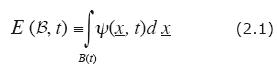
<body><![CDATA[<p align="justify"><font face="verdana" size="2">At present a large part of the oil reserves of the world are located in mature oil&#150;fields whose production is declining and for which the only possibility for expanding their yield is by application of EOR techniques. Another large fraction of oil reserves are non&#150;conventional oil&#150;fields that are very difficult to exploit, either because of the characteristics of their hydrocarbons &#150;such as very large viscosity&#150; or because of the characteristics of the soils and rocks in which they are contained. In both cases, such reservoirs can only be exploited applying EOR methods. Therefore, today, EOR is an important strategy for sustaining the oil supply of the world (Lake, 1989; Chen <I>et al.,</I> 2006).</font></p>     <p align="justify"><font face="verdana" size="2">On the other hand, mathematical and computational modeling (MCM) of oil reservoirs is fundamental for the development and application of EOR techniques, because it permits predicting and understanding the behavior of a reservoir when it is subjected to the complicated and varied processes that occur in EOR techniques (Lake, 1989; Chen <I>et al.</I>, 2006). Among other important capabilities supplied by MCM, applying it, it is possible to evaluate the different production strategies and choose that which maximizes oil recovery; also, to correct deviations from the reservoir expected&#150;behavior when they occur, as well as to estimate its production life and overall yield.</font></p>     <p align="justify"><font face="verdana" size="2"><b>Processes to be modeled</b></font></p>     <p align="justify"><font face="verdana" size="2">In primary production, the processes to be modeled are the motion of one phase or of two phases at most (Chen <I>et al</I>., 2006), without mass exchange between the phases. In secondary production, generally the motion of a three&#150;phase fluid system has to be modeled; the phases being water, oil and gas. Mass exchange between the oil and gas phases must be included. The standard computational model to mimic such a system is technically known as the <I>black&#150;oil model</I>. In Enhanced Oil Recovery, the processes to be modeled are extremely varied; among them, multiphase&#150;multispecies transport in two modalities, isothermal conditions and non&#150;isothermal conditions, and many more. A process especially complex is in&#150;situ combustion, which is further complicated by the fact that sharp fronts (shocks) may need to be included.</font></p>     <p align="justify"><font face="verdana" size="2">Generally, when constructing a simulator for the processes occurring in EOR the following models have to be developed successively: a mathematical model, a numerical model and a computational model (Lake, 1989; Chen <I>et al.</I>, 2007). The <I>mathematical models </I>of petroleum reservoirs consist of a system of partial differential equations, usually non&#150;linear, whose numerical solution by computational means permits predicting the reservoir behavior. Due to the great diversity of processes occurring in EOR, it is valuable to possess a <I>unified mathematical model</I> that can be applied independently of the complexity of the system considered. The <I>leitmotiv </I>of this paper is to present such a unified model.</font></p>     <p align="justify"><font face="verdana" size="2">Furthermore, this unified model includes the systematic manner of treating shocks (i.e., discontinuous solutions). The petroleum engineering community has been aware of the occurrence of shocks in oil&#150;reservoir models since Buckley&#150;Leverett reported them (Buckley and Leverett, 1942). Double discontinuity shocks that occur in Black&#150;Oil models were more recently reported and studied (Herrera, 1996; Herrera and Camacho, 1997). Furthermore, an exhaustive account of those that may occur in Black&#150;Oil models was presented by I. Herrera et al. (1993). As it is well known, shocks are useful approximations to abrupt changes of the values of physical properties that may occur in the real systems. In EOR technology, they may valuable for example when modeling combustion fronts (Akkutlu and Yortsos, 2003).</font></p>     <p align="justify"><font face="verdana" size="2"><b>Extensive properties and balance equations</b></font></p>     <p align="justify"><font face="verdana" size="2">Axiomatic formulations are the most effective means for achieving generality, simplicity and clarity. In particular, in what follows the use of an axiomatic approach will permit us to construct the <I>unified general model</I> for the very varied processes that occur, or may occur in the future, in <I>Enhanced Oil Recovery</I>.</font></p>     <p align="justify"><font face="verdana" size="2">There are two approaches to the study of matter and its motion: the microscopic and the macroscopic approaches. The former studies molecules, atoms and elemental particles, while the latter studies and models large systems. Oil reservoirs constitute macroscopic physical&#150;chemical systems. The theoretical foundations of macroscopic models lie on Continuous Mechanics. The axiomatic method of Continuous Mechanics was established in the second half of the XX Century by a group of scholars and researchers two of whose most conspicuous leaders were Noll (1974). Recently, Allen <I>et al.</I> (1988), summarized the results that are essential for the axiomatic formulation of the basic mathematical models. A revised and, in some respects, improved presentation of the subject, in which we base the developments of the present paper, is due to appear soon (Herrera and Pinder, to appear). </font></p>     <p align="justify"><font face="verdana" size="2">Firstly, an abstract framework that is essential in the axiomatic approach will be introduced. The main thrust of this paper lies on the applications; so, when explaining the axiomatic formulation that will be applied to EOR processes, the theoretical foundations are explained as briefly as possible; details are included just enough to make them understandable and without sacrificing clarity. We start with a definition:An<I> 'extensive property' </I>is a body property such that<I>, </I>for every body <img src="/img/revistas/geoint/v50n1/a8s88.jpg">and every time <I>t</I>, can be expressed as a volume integral over the domain, <I>B</I> (<I>t</I>)(see <a href="/img/revistas/geoint/v50n1/a8f1.jpg" target="_blank">Figure 1</a>), of the physical space occupied by the body; that is,</font></p>     ]]></body>
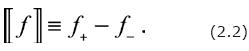
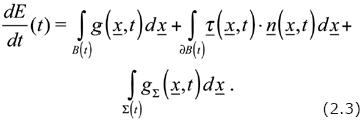
<body><![CDATA[<p align="center"><font face="verdana" size="2"><img src="/img/revistas/geoint/v50n1/a8s1.jpg"></font></p>     <p align="justify"><font face="verdana" size="2">The integrand <i>&#936;</i>(<U><I>&#958;</I></U><I>, t</I>) which represents the extensive property per unit volume, is said to be the <I>intensive property </I>associated with the <I>extensive property</I> <I>E</I>. The main extensive properties considered in EOR models are the mass of different components, as well as the energy, contained in each phase of an EOR system. </font></p>     <p align="justify"><font face="verdana" size="2">A model of a macroscopic system is said to contain a shock when there is a surface, &#931;(<I>t</I>), across which at least one of the <I>intensive properties</I> of the model is discontinuous. In our notation, &#931;(<I>t</I>) will be the union of the surfaces across which the intensive properties are discontinuous. In particular, if the model does not contain a shock, &#931;(<I>t</I>) is void. The kind of discontinuities that may occur across &#931;(<I>t</I>) are <I>'jump discontinuities'</I>, exclusively. By definition, a <I>jump discontinuity</I> of a function is one in which the limits from each side of &#931;(<I>t</I>) exist, but they are different from each other. Furthermore, the surface &#931;(<I>t</I>) is oriented arbitrarily (i.e., a <I>positive </I>and a <I>negative </I>side are defined) and a unit normal vector, <U><I>n</I></U>, pointing towards the <I>positive </I>side is taken on it. The <I>jump </I>on &#931;(<I>t</I>) of any function, <I>f</I>(<U><I>&#958;</I></U>), is defined to be</font></p>     <p align="center"><font face="verdana" size="2"><img src="/img/revistas/geoint/v50n1/a8s2.jpg"></font></p>     <p align="justify"><font face="verdana" size="2">Here, <I>f</I><Sub>+</Sub> and <I>f</I><Sub>&#151;</Sub> are the limits on the positive and negative sides, respectively.</font></p>     <p align="justify"><font face="verdana" size="2"><U>A Basic Axiom</U> is: <I>"An extensive property can change in time, exclusively, because it enters into the body. In turn, it can enter into the body through its boundary or directly in its interior."</I> The mathematical expression of this Axiom is:</font></p>     <p align="center"><font face="verdana" size="2"><img src="/img/revistas/geoint/v50n1/a8s3.jpg"></font></p>     <p align="justify"><font face="verdana" size="2">In these statements the amount that <I>'enters'</I> may be positive or negative. With regards to Eq. (2.3), in the nomenclature of the general formulation of Continuum Mechanics, Allen<I> et al.</I> (1988), <I>g </I>(<U><I>&#958;</I></U>, <I>t</I>) is called the <I>external (distributed) supply </I>of the <I>extensive property </I>and <u>&#964;</u> (<U><I>&#958;</I></U>, <I>t</I>) is the <I>flux of the extensive property</I>. As for <I>g</I><Sub>&#931;</Sub>(<U><I>&#958;</I></U>, <I>t</I>), it is also an <I>external supply</I>, but this one is concentrated on the surface &#931;(<I>t</I>); see: (Herrera and Pinder, to appear). The function <I>g </I>(<U><I>&#958;</I></U>, <I>t</I>) is the amount of the <I>extensive property</I> per unit volume per unit time that enters the body at the point <U><I>&#958;</I></U> of the physical space at time <I>t</I>, while the function <I>g</I><Sub>&#931;</Sub>(<U><I>&#958;</I></U>, <I>t</I>) is the amount of the <I>extensive property</I> per unit area per unit time that enters the body at the point <U><I>&#958;</I></U>of the surface &#931;(<I>t</I>), at time <I>t</I>. The inclusion of such concentrated sources is essential in order to be able to treat shocks with sufficient generality; in particular, this will permit us to present in Section 5 an exhaustive description of shocks that may occur in Black&#150;Oil models, which was originally reported in (Herrera <I>et. al.</I>, 1993) and includes Buckley&#150;Leverett's shocks (Buckley and Leverett, 1942) as well as those reported by Herrera and Camacho (1997) and Herrera <I>et al.</I> (1993). In particular, the double&#150;discontinuity models of shocks occurring in <I>variable&#150;bubble&#150;point </I>systemsis an example in which, for some of the extensive properties that constitute the model, <I>g</I><Sub>&#931;</Sub>(<U><I>&#958;</I></U>, <I>t</I>) &ne; 0 (Buckley and Leverett, 1942; Herrera <I>et al</I>., 1993; Herrera, 1996; Herrera and Camacho, 1997).</font></p>     <p align="justify"><font face="verdana" size="2">Finally, in Eq. (2.3), the function <u>&#964;</u> (<U><I>&#958;</I></U>, <I>t</I>)&bull;<U><I>n</I></U>at the point <U><I>&#958;</I></U>of the body external&#150;boundary, &part;<I>B</I>(<I>t</I>), is the amount of <I>extensive property </I>that enters the body there at time <I>t </I>(<a href="/img/revistas/geoint/v50n1/a8f1.jpg" target="_blank">Figure 1</a>), per unit area per unit time. In EOR models, <u>&#964;</u> (<U><I>&#958;</I></U>, <I>t</I>) represents the flux due to diffusion (mainly, material dispersion&#150;diffusion or thermal diffusion).</font></p>     <p align="justify"><font face="verdana" size="2">A purely mathematical result (i.e., a <I>mathematical theorem</I>; see, Allen <I>et al</I>.,1988 and Herrera and Pinder, to appear) shows that Eq. (2.3) is fulfilled by each body of a continuous system, if and only if, the following <I>'balance conditions'</I> are satisfied:</font></p>     ]]></body>
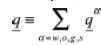
<body><![CDATA[<p align="center"><font face="verdana" size="2"><img src="/img/revistas/geoint/v50n1/a8s4.jpg"></font></p>     <p align="justify"><font face="verdana" size="2">Eq. (2.4) will be referred to as the <I>"balance differential equation"</I>, while Eq. (2.5) is the <I>"jump condition"</I>. The systems of differential equations that constitute the mathematical models will be derived from Eq. (2.4), while the treatment of shocks will be based on Eq (2.5).</font></p>     <p align="justify"><font face="verdana" size="2"><b>A unified model of EOR systems</b></font></p>     <p align="justify"><font face="verdana" size="2">Most EOR systems are multiphase systems, albeit there are a few that are one&#150;phase systems. In any event, EOR systems are particular cases of the most general multiphase system treated in this Section. In the axiomatic approach that permits such a unified treatment any multiphase system is characterized by the following axioms:</font></p>     <p align="justify"><font face="verdana" size="2">1.	A family of phases. Each phase of this family moves with its own velocity;</font></p>     <p align="justify"><font face="verdana" size="2">2.	A family of extensive properties. Each extensive property of such a family is associated with one and only one phase; and</font></p>     <p align="justify"><font face="verdana" size="2">3.	The <I>basic mathematical model</I> <I>of the multiphase system</I> is constituted by the system of partial differential equations and jump conditions that is obtained when the <I>balance conditions</I> for each one of the extensive properties of the family is expressed in terms of the corresponding <I>intensive property</I>.</font></p>     <p align="justify"><font face="verdana" size="2">Once the axioms of multiphase systems have been described in this very brief manner, what remains is to state them with greater precision in mathematical terms, as we do next. In particular, with respect to Axiom 2, the manner in which <I>extensive properties </I>are associated with <I>phases</I> requires being described in greater detail.</font></p>     <p align="justify"><font face="verdana" size="2">The number of phases and extensive properties of these families will be denoted by <I>M</I> and <I>N</I>, respectively. We observe that <I>N&ge;M</I>, necessarily. It is assumed that at each time, at each point of the physical space, there are <I>M </I>particles; each one of them corresponds to one and only one phase. Furthermore, given any domain of the physical space, let <I>B</I><Sub>&#958;</Sub>(<I>t</I>) be the set of particles of phase &#958; (&#958; may be 1,..., <I>M</I>) that are located at such a domain at time <I>t</I>. A family of <I>M </I>bodies   {<I>B</I><Sub>1 </Sub>(<I>t</I>),..., <I>B</I><Sub><I>M </I></Sub>(<I>t</I>)}<Sub> </Sub>, is defined in this manner.</font></p>     <p align="justify"><font face="verdana" size="2">Then, a precise statement of the association between <I>extensive properties </I>and <I>phases</I> referred to in Axiom 2 follows. Given any <I>extensive property E</I><Sup>&#945;</Sup>&isin;{<I>E</I><Sup>1</Sup>,..., <I>E</I><Sup><I>N</I></Sup>}, there is a unique &#958;, to be denoted by &#958;(&#945;), such that it has the property</font></p>     ]]></body>
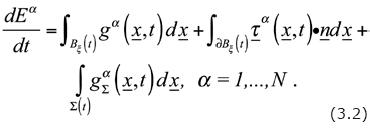
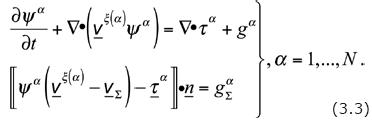
<body><![CDATA[<p align="center"><font face="verdana" size="2"><img src="/img/revistas/geoint/v50n1/a8s5.jpg"></font></p>     <p align="justify"><font face="verdana" size="2">Clearly, here the range of &#945; is {1,..., <I>N</I>}, while that of &#958; is {1,..., <I>M</I>}. In Eq. (3.1), <i><i>&#968;</i><Sup>&#945;</Sup></i> is the unique <I>intensive property </I>associated with <I>E</I><Sup>&#945;</Sup>. Thereby, we observe that corresponding to the family {<I>E</I><Sup>1</Sup>,..., <I>E</I><Sup><I>N</I></Sup>} of <I>extensive properties</I>, we have a unique family {<i>&#968;</i><Sup>1</Sup> (<U><I>&#958;</I></U>, <I>t</I>),.., <i>&#968;</i><Sup><I>N </I></Sup>(<U><I>&#958;</I></U>, <I>t</I>)} of <I>intensive properties</I>, since the correspondence <I>E</I><Sup>&#945;</Sup>&harr;<i><i>&#968;</i><Sup>&#945;</Sup></i>, &#945; = 1,..., <I>N</I> is one&#150;to&#150;one. Therefore, every <I>intensive property </I>is also associated with one and only one phase.</font></p>     <p align="justify"><font face="verdana" size="2">The <I>global balance conditions</I> for each extensive property <I>E</I><Sup>&#945;</Sup>&isin;{<I>E</I><Sup>1</Sup>,..., <I>E</I><Sup><I>N</I></Sup>} can now be expressed, as follows (see <a href="/img/revistas/geoint/v50n1/a8f2.jpg" target="_blank">Figure 2</a>):</font></p>     <p align="center"><font face="verdana" size="2"><img src="/img/revistas/geoint/v50n1/a8s6.jpg"></font></p>     <p align="justify"><font face="verdana" size="2">Here, it is understood(&#945;) that &#958; = &#958; (&#945;), where &#958;  corresponds to the unique phase associated with extensive property <I>E</I><Sup>&#945;</Sup>. Furthermore, <I>g</I><Sup>&#945;</Sup> and <I>g</I><Sup>&#945;</Sup><Sub>&#931;</Sub>, are the <I>'supplies'</I> of the extensive property a, the first one distributed in <I>B</I><Sub>&#958;</Sub>(<I>t</I>) and the second one concentrated on &#931;(<I>t</I>), while <u>&#964;</u><Sup>&#945; </Sup>is the <I>'flux'</I> field of the same extensive property. The <I>supply terms</I>, <I>g</I><Sup>&#945;</Sup> and <I>g</I><Sup>&#945;</Sup><Sub>&#931;</Sub>, will also be referred to as the <I>source terms</I>. As was mentioned before, &#931;(<I>t</I>) is the surface where discontinuities of any of the <I>intensive properties </I>of the model may occur;we observe that this definition is independent of the <I>extensive property </I>considered. However, for many extensive properties to be considered we will have <I>g</I><Sup>&#945;</Sup><Sub>&#931;</Sub> = 0, on &#931;(<I>t</I>).</font></p>     <p align="justify"><font face="verdana" size="2">As it was seen in Section 2, the balance equation of any <I>extensive property </I>can also be expressed in terms of its corresponding <I>intensive property</I> by means of Eqs. (2.4) and (2.5). So, instead of the system of Eqs. (3.2), in what follows we use</font></p>     <p align="center"><font face="verdana" size="2"><img src="/img/revistas/geoint/v50n1/a8s7.jpg"></font></p>     <p align="justify"><font face="verdana" size="2">We recall that the <I>jump conditions </I>are fulfilled on &#931;(<I>t</I>), while the differential equations everywhere, except at &#931;(<I>t</I>) and the outer boundary of the continuous system.</font></p>     <p align="justify"><font face="verdana" size="2">This system of <I>partial differential equations and jump conditions</I> constitutes a unified mathematical model of EOR systems, which is the <I>leitmotiv</I> of the present article mentioned before; it includes exhaustively the mathematical models of EOR systems. In the remaining of this article, this general model is specialized to obtain the most commonly used models of EOR technology. In particular, we will obtain the models discussed in the very comprehensive and complete treaty of EOR models, authored by Chen <I>et al</I>. (2006).</font></p>     <p align="justify"><font face="verdana" size="2">For models of <I>EOR </I>systems, it is useful to decompose the <I>source terms</I> <I>g</I><Sup>&#945;</Sup> (&#945; = 1,..., <I>N</I>) into two parts whose origins can be traced back to the system <I>exterior</I> (<I>g</I><Sup>&#945;</Sup><Sub>e</Sub>) and the system <I>interior</I> (<I>g</I><Sup>&#945;</Sup><Sub>I</Sub>),respectively. Thus, we write</font></p>     ]]></body>
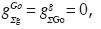
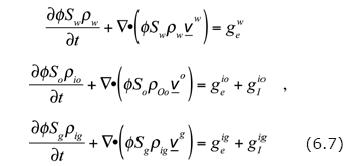
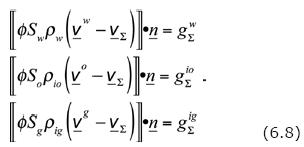
<body><![CDATA[<p align="center"><font face="verdana" size="2"><img src="/img/revistas/geoint/v50n1/a8s8.jpg"></font></p>     <p align="justify"><font face="verdana" size="2"><b>The black&#150;oil model</b></font></p>     <p align="justify"><font face="verdana" size="2">The basic mathematical model of a Black&#150;Oil system corresponds to the case when in the <I>unified EOR model </I>of Section 3, the following conditions are satisfied; the family of phases is constituted by:</font></p>     <blockquote>       <p align="justify"><font face="verdana" size="2">1. A water&#150;phase,</font></p>       <p align="justify"><font face="verdana" size="2">2. An oil&#150;phase (liquid), and</font></p>       <p align="justify"><font face="verdana" size="2">3. A gas&#150;phase.</font></p> </blockquote>     <p align="justify"><font face="verdana" size="2">In Black&#150;Oil and isothermal Compositional Models the phase constituted by the solid matrix of the oil reservoir is usually ignored because it does not move and it does not exchange mass with the fluid phases.</font></p>     <p align="justify"><font face="verdana" size="2">There are three different substances (or components): water, nonvolatile oil (usually called 'oil') and volatile oil (usually called 'gas'), and only the volatile&#150;oil may be in more than one phase; namely, the oil and gas phases. The family of extensive properties has four members:</font></p>     <p align="justify"><font face="verdana" size="2">1. The <I>mass of water in the water&#150;phase</I>,</font></p>     ]]></body>
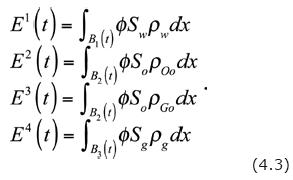
<body><![CDATA[<p align="justify"><font face="verdana" size="2">2. The <I>mass of nonvolatile oil in the oil&#150;phase</I>, </font></p>     <p align="justify"><font face="verdana" size="2">3. The <I>mass of volatile&#150;oil contained in the oil&#150;phase</I> ('dissolved gas'), and</font></p>     <p align="justify"><font face="verdana" size="2">4. The <I>mass of volatile&#150;oil contained in the gas&#150;phase</I>.</font></p>     <p align="justify"><font face="verdana" size="2">Let <i>&#968;</i><Sup><I>i</I></Sup> (<I>i</I> = 1,2,3,4) the <I>intensive properties </I>associated with each one of them. In this case the function &#958; (&#945;) is: &#958;(1)=1, &#958;(2)=2, &#958;(3)=2 and &#958;(4)=3. Then, the most basic mathematical model of Black&#150;oil systems is given by Eq.(3.3); that is:</font></p>     <p align="center"><font face="verdana" size="2"><img src="/img/revistas/geoint/v50n1/a8s9.jpg"></font></p>     <p align="justify"><font face="verdana" size="2">The <I>jump conditions</I> are:</font></p>     <p align="center"><font face="verdana" size="2"><img src="/img/revistas/geoint/v50n1/a8s10.jpg"></font></p>     <p align="justify"><font face="verdana" size="2">However, the jump conditionswill not be discussed in this Section; instead, in the next one they will be used for making an exhaustive analysis of shocks that may occur in Black&#150;Oil models.</font></p>     <p align="justify"><font face="verdana" size="2">Explicit expressions, as integrals, of these extensive properties are:</font></p>     <p align="center"><font face="verdana" size="2"><img src="/img/revistas/geoint/v50n1/a8s11.jpg"></font></p>     ]]></body>
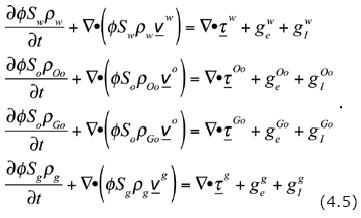
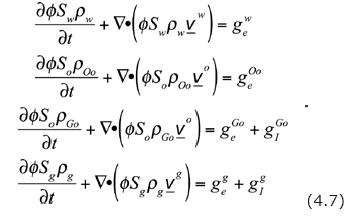
<body><![CDATA[<p align="justify"><font face="verdana" size="2">So, the corresponding <I>intensive properties</I> are</font></p>     <p align="center"><font face="verdana" size="2"><img src="/img/revistas/geoint/v50n1/a8s12.jpg"></font></p>     <p align="justify"><font face="verdana" size="2">Furthermore, in what follows, we shall replace the superscripts <I>1,2,3,4,</I> above, by<I> w, Oo, Go</I> and <I>g</I>, respectively.</font></p>     <p align="justify"><font face="verdana" size="2">Therefore, the <I>basic system of differential equations </I>of the Black&#150;Oil model is constituted by the following system of equations</font></p>     <p align="center"><font face="verdana" size="2"><img src="/img/revistas/geoint/v50n1/a8s13.jpg"></font></p>     <p align="justify"><font face="verdana" size="2">In the Black&#150;Oil model <I>dispersion&#150;diffusion processes </I>are neglected, so that <u>&#964;</u><Sup>a</Sup> = 0 (= <I>w, Oo, Go, g</I>). As for the <I>internal sources, g</I><Sup>&#945;</Sup><Sub><I>I</I></Sub>, all them are zero except when &#945; = <I>Go, g</I>. In the absence of chemical reactions, as it is assumed in the Black&#150;Oil Model, the mass of volatile oil is conserved and then:</font></p>     <p align="center"><font face="verdana" size="2"><img src="/img/revistas/geoint/v50n1/a8s14.jpg"></font></p>     <p align="justify"><font face="verdana" size="2">Hence, Eq. (4.5) reduces to:</font></p>     <p align="center"><font face="verdana" size="2"><img src="/img/revistas/geoint/v50n1/a8s15.jpg"></font></p>     <p align="justify"><font face="verdana" size="2">Generally, the external sources <I>g</I><Sup>&#945;</Sup><Sub><I>e </I></Sub>are due to wells; they are negative if extraction occurs and positive if injection takes place. In particular, the terms &#151;<I>g</I><Sup><I>w</I></Sup><Sub><I>e </I></Sub>and &#151;<I>g</I><Sup><I>Oo</I></Sup><Sub><I>e</I></Sub>represent the mass of water and non&#150;volatile oil extracted from the water and oil phases, respectively, while &#151;<I>g</I><Sup><I>Go</I></Sup><Sub><I>e</I></Sub> and &#151;<I>g</I><Sup><I>g</I></Sup><Sub><I>e </I></Sub>represent the mass of nonvolatile&#150;oil extracted from the oil and gas phases, respectively.</font></p>     ]]></body>
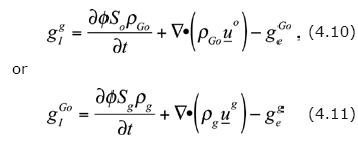
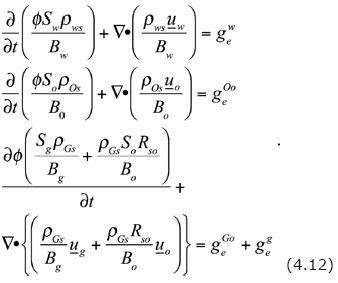
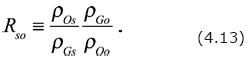
<body><![CDATA[<p align="justify"><font face="verdana" size="2">Starting with Eq. (4.7) it is easy to derive the standard forms of the mathematical model of Black&#150;Oil reservoirs; in particular, for comparison we will use that presented in Chen <I>et al.</I> (2006). To this end we introduce the Darcy velocity, for each phase, which is defined by</font></p>     <p align="center"><font face="verdana" size="2"><img src="/img/revistas/geoint/v50n1/a8s16.jpg"></font></p>     <p align="justify"><font face="verdana" size="2">Then, adding up the last two equalities of Eq. (4.7), we get</font></p>     <p align="center"><font face="verdana" size="2"><img src="/img/revistas/geoint/v50n1/a8s17.jpg"></font></p>     <p align="justify"><font face="verdana" size="2">together with</font></p>     <p align="center"><font face="verdana" size="2"><img src="/img/revistas/geoint/v50n1/a8s18.jpg"></font></p>     <p align="justify"><font face="verdana" size="2">Eqs. (4.10) and (4.11) are not usually mentioned in the literature, since they are a sub&#150;product of the methodology here applied for deriving the basic differential equations. However, they may be useful in some instances since either one of them can be applied for evaluating the <I>nonvolatile&#150;oil</I> exchanged by the oil and gas phases.</font></p>     <p align="justify"><font face="verdana" size="2">The rest of the derivation is standard. Eqs. (4.9) can be transformed into (see Chen <I>et al</I>., 2006):</font></p>     <p align="center"><font face="verdana" size="2"><img src="/img/revistas/geoint/v50n1/a8s19.jpg"></font></p>     <p align="justify"><font face="verdana" size="2">This is achieved introducing the following notation (further details of the symbols used here are given at the end of this Section):</font></p>     ]]></body>
<body><![CDATA[<p align="center"><font face="verdana" size="2"><img src="/img/revistas/geoint/v50n1/a8s20.jpg"></font></p>     <p align="justify"><font face="verdana" size="2">The <I>formation volume factors</I>, <I>B</I><Sub><I>w</I></Sub>, <I>B</I><Sub><I>0</I></Sub> and <I>B</I><Sub><I>g</I></Sub> are defined by</font></p>     <p align="center"><font face="verdana" size="2"><img src="/img/revistas/geoint/v50n1/a8s21.jpg"></font></p>     <p align="justify"><font face="verdana" size="2">Eqs. (4.12) have to be complemented by several <I>constitutive equations</I> relating the variables occurring in them. In particular, Darcy's law</font></p>     <p align="center"><font face="verdana" size="2"><img src="/img/revistas/geoint/v50n1/a8s22.jpg"></font></p>     <p align="justify"><font face="verdana" size="2">the saturations identity</font></p>     <p align="center"><font face="verdana" size="2"><img src="/img/revistas/geoint/v50n1/a8s23.jpg"></font></p>     <p align="justify"><font face="verdana" size="2">The capillary pressure equations</font></p>     <p align="center"><font face="verdana" size="2"><img src="/img/revistas/geoint/v50n1/a8s24.jpg"></font></p>     <p align="justify"><font face="verdana" size="2">which relate the phase pressures. Both <I>p</I><Sub><I>cow</I></Sub>and <I>p</I><Sub><I>cgo </I></Sub>are functions of other parameters of the reservoir system, the saturations in particular, which must be determined in advance, experimentally or otherwise. The <I>gas&#150;oil ratio</I> equation of state:</font></p>     ]]></body>
<body><![CDATA[<p align="center"><font face="verdana" size="2"><img src="/img/revistas/geoint/v50n1/a8s25.jpg"></font></p>     <p align="justify"><font face="verdana" size="2">which is satisfied when <I>S</I><Sub><I>g</I></Sub> &gt; 0; i.e., when the reservoir is truly a three&#150;phase system. </font></p>     <p align="justify"><font face="verdana" size="2">The following list of symbols complements the notation already explained in the text of this Section:</font></p>     <p align="center"><font face="verdana" size="2"><img src="/img/revistas/geoint/v50n1/a8s26.jpg"></font></p>     <p align="justify"><font face="verdana" size="2">From the mere fact that the system consists of three phases and one of them contains two components, while each one of the other two contains only one, without any additional knowledge, we have derived the system of equations given by Eqs. (4.1) and (4.2). Such equations give a very firm basis for incorporating all the scientific and technological knowledge available about the system, as we have done, to obtain as final product the mathematical model of Black&#150;Oil systems.</font></p>     <p align="justify"><font face="verdana" size="2"><b>Analysis of shocks that may occur in black&#150;oil models</b></font></p>     <p align="justify"><font face="verdana" size="2">To start with, we observe that Darcy's Law implies that the pressure is continuous and, if the solid&#150;matrix does not have abrupt changes in properties, as in the contact between two geological formations of different origin, the porosity is also continuous. Then, the shock conditions of Eq. (4.2) when the external source terms vanish can be written as:</font></p>     <p align="center"><font face="verdana" size="2"><img src="/img/revistas/geoint/v50n1/a8s27.jpg"></font></p>     <p align="justify"><font face="verdana" size="2"><I>where R</I><Sub><I>s</I></Sub>(<I>p, T</I>)is the <I>gas&#150;oil ratio </I>defined by <i>&#961;</i><Sub><I>Go</I></Sub><Sub> </Sub>= <I>R</I><Sub><I>s</I></Sub><i>&#961;</i><Sub><I>Oo</I></Sub>.</font></p>     <p align="justify"><font face="verdana" size="2"><b>A. In a region where the gas&#150;phase is absent</b></font></p>     ]]></body>
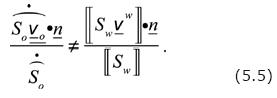
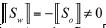
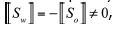
<body><![CDATA[<p align="justify"><font face="verdana" size="2">The density <i>&#961;</i><Sub><I>Oo </I></Sub>is continuous across the shock &#931; because so is the pressure<I> p</I><Sub><I>o</I></Sub>. When the gas&#150;phase is not present <I>S</I><Sub><I>g</I></Sub> = 0, so that Eq. (5.1) implies <img src="/img/revistas/geoint/v50n1/a8s89.jpg"> and implies</font></p>     <p align="center"><font face="verdana" size="2"><img src="/img/revistas/geoint/v50n1/a8s28.jpg"></font></p>     <p align="justify"><font face="verdana" size="2">where the notation is such that for any function <I>f</I>, <img src="/img/revistas/geoint/v50n1/a8s29.jpg"> is the the <I>average</I> of the function <I>f</I> across &#931;.</font></p>     <p align="justify"><font face="verdana" size="2">From the first equality in Eq. (5.1) it follows that when <img src="/img/revistas/geoint/v50n1/a8s30.jpg">, the shock velocity is given by</font></p>     <p align="center"><font face="verdana" size="2"><img src="/img/revistas/geoint/v50n1/a8s31.jpg"></font></p>     <p align="justify"><font face="verdana" size="2">On the other hand, from Eq. (5.2) it follows that when <img src="/img/revistas/geoint/v50n1/a8s32.jpg">, the shock velocity is given by</font></p>     <p align="center"><font face="verdana" size="2"><img src="/img/revistas/geoint/v50n1/a8s33.jpg"></font></p>     <p align="justify"><font face="verdana" size="2">Generally,</font></p>     <p align="center"><font face="verdana" size="2"><img src="/img/revistas/geoint/v50n1/a8s34.jpg"></font></p>     <p align="justify"><font face="verdana" size="2">Therefore, if these two kinds of shocks coincide at any time they will separate, since their velocities are different. Thus, at a shock either <img src="/img/revistas/geoint/v50n1/a8s35.jpg">, in which case <img src="/img/revistas/geoint/v50n1/a8s36.jpg"> and the velocity of the shock is given by Eq. (5.3), or <img src="/img/revistas/geoint/v50n1/a8s37.jpg">, in which case <img src="/img/revistas/geoint/v50n1/a8s38.jpg"> and the velocity of the shock is given by</font></p>     ]]></body>
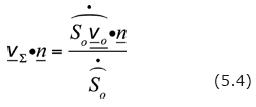
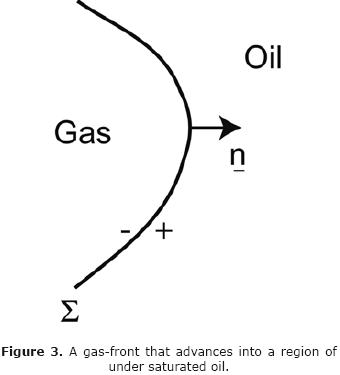
<body><![CDATA[<p align="center"><font face="verdana" size="2"><img src="/img/revistas/geoint/v50n1/a8s39.jpg"></font></p>     <p align="justify"><font face="verdana" size="2"><b>B. At a gas front</b></font></p>     <p align="justify"><font face="verdana" size="2">For simplicity in what follows we only consider the case when the water phase is not present. At a front that advances into a region of under saturated oil, we take the unit normal vector pointing towards the under saturated region (<a href="#f3">Figure 3</a>). Adding up the last two equalities in Eq. (5.1), one gets:</font></p>     <p align="center"><font face="verdana" size="2"><a name="f3"></a></font></p>     <p align="center"><font face="verdana" size="2"><img src="/img/revistas/geoint/v50n1/a8f3.jpg"></font></p>     <p align="center"><font face="verdana" size="2"><img src="/img/revistas/geoint/v50n1/a8s40.jpg"></font></p>     <p align="justify"><font face="verdana" size="2">In the under&#150;saturated oil region <I>Sg</I> = 0; i.e. (<I>S</I><Sub><I>g</I></Sub>)<Sub>+ </Sub>= 0, on &#931;.</font></p>     <p align="justify"><font face="verdana" size="2">According to the second equality in Eq. (5.1),  <I>&#931;</I><Sub><I>o</I></Sub>(<U>v</U><Sup><I>o</I></Sup><I> &#151; </I><U>v </U><Sub>&#931;</Sub>) is continuous across the shock and therefore, from Eq. (5.7), it follows that</font></p>     <p align="center"><font face="verdana" size="2"><img src="/img/revistas/geoint/v50n1/a8s41.jpg"></font></p>     <p align="justify"><font face="verdana" size="2">Using the identity <img src="/img/revistas/geoint/v50n1/a8s42.jpg">it can be seen that</font></p>     ]]></body>
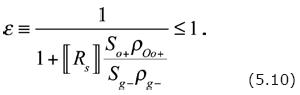
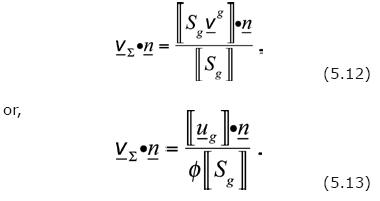
<body><![CDATA[<p align="center"><font face="verdana" size="2"><img src="/img/revistas/geoint/v50n1/a8s43.jpg"></font></p>     <p align="justify"><font face="verdana" size="2">With</font></p>     <p align="center"><font face="verdana" size="2"><img src="/img/revistas/geoint/v50n1/a8s44.jpg"></font></p>     <p align="justify"><font face="verdana" size="2">The physical interpretation of this result is that when a gas front advances into a region of under&#150;saturated oil, it is retarded in its motion by the <I>'retardation factor'</I> &#949; (see Herrera, 1996, and Herrera and Camacho, 1997).</font></p>     <p align="justify"><font face="verdana" size="2"><b>C. In a saturated oil&#150;region (Buckley&#150;Leverett theory)</b></font></p>     <p align="justify"><font face="verdana" size="2">This is the case of a biphasic system in which the gas&#150;phase and the liquid oil&#150;phase coexist, which was treated by Buckley&#150;Leverett in their classical theory (Buckley and Leverett,1942). In this case<img src="/img/revistas/geoint/v50n1/a8s35.jpg">, because the oil is saturated and the pressure is continuous, Eq (5.1). reduce to</font></p>     <p align="center"><font face="verdana" size="2"><img src="/img/revistas/geoint/v50n1/a8s45.jpg"></font></p>     <p align="justify"><font face="verdana" size="2">This is analogous to Eq. (5.2). Corresponding to Eq. (5.3), we now derive the equation:</font></p>     <p align="center"><font face="verdana" size="2"><img src="/img/revistas/geoint/v50n1/a8s46.jpg"></font></p>     <p align="justify"><font face="verdana" size="2">A special case of this equation is the immiscible and incompressible case considered by the classical Buckley&#150;Theory, for which Eq. (5.13) becomes the well&#150;known relation (see, for example, Herrera and Camacho, 1997):</font></p>     ]]></body>
<body><![CDATA[<p align="center"><font face="verdana" size="2"><img src="/img/revistas/geoint/v50n1/a8s47.jpg"></font></p>     <p align="justify"><font face="verdana" size="2">Here,</font></p>     <p align="center"><font face="verdana" size="2"><img src="/img/revistas/geoint/v50n1/a8s48.jpg"></font></p>     <p align="justify"><font face="verdana" size="2"><b>The compositional model</b></font></p>     <p align="justify"><font face="verdana" size="2">In this Section we apply the general scheme of Section 3 to obtain the <I>basic mathematical model</I> of compositional oil reservoirs. The derivation need not be as formal as in Section 4, since the general protocol has already been illustrated there.</font></p>     <p align="justify"><font face="verdana" size="2">The characteristic features of <I>compositional models</I> are:</font></p>     <p align="justify"><font face="verdana" size="2">1. The <I>family of phases</I> is the same as before: the water&#150;phase, the oil&#150;phase and the gas&#150;phase. The notation used for the velocities of such phases is also the same:</font></p>     <p align="justify"><font face="verdana" size="2">i) <U><I>v</I></U><Sup><I>w</I></Sup> is the velocity of the water&#150;phase;</font></p>     <p align="justify"><font face="verdana" size="2">ii) <U><I>v</I></U><Sup><I>o </I></Sup>is the velocity of the oil&#150;phase; and</font></p>     <p align="justify"><font face="verdana" size="2">iii) <U><I>v</I></U><Sup><I>g </I></Sup>is the velocity of the gas&#150;phase.</font></p>     ]]></body>
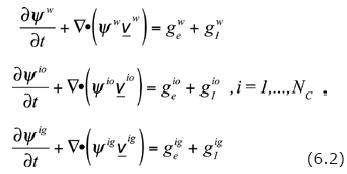
<body><![CDATA[<p align="justify"><font face="verdana" size="2">2. Besides the water, we distinguish <I>Nc </I>chemi&#150;cal substances; these substances do not change chemical composition through time. However, through time, each one of them is exchanged by the oil and gas phases. The <I>family of extensive properties</I> consists of 2<I>Nc </I>+ 1members; namely,</font></p>     <p align="justify"><font face="verdana" size="2">i) The <I>mass of the water&#150;phase,</I> denoted by <I>M</I><Sup><I>w</I></Sup>;</font></p>     <p align="justify"><font face="verdana" size="2">ii) The<I> mass of the i&#150;th component in the oil&#150;phase, </I>denoted by <I>M</I><Sup><I>io</I></Sup>(<I>t</I>), <I>i </I>= 1,...,<I>Nc</I>; and</font></p>     <p align="justify"><font face="verdana" size="2">iii) The<I> mass of the i&#150;th component in the gas&#150;phase,</I> denoted by <I>M</I><Sup><I>ig</I></Sup>, <I>i </I>= 1,...,<I>Nc.</I></font></p>     <p align="justify"><font face="verdana" size="2">The notations used for the corresponding <I>intensive properties</I>, <I>supplies </I>(i.e., mass&#150;sources) and <I>flux&#150;fields </I>are:</font></p>     <p align="center"><font face="verdana" size="2"><img src="/img/revistas/geoint/v50n1/a8s49.jpg"></font></p>     <p align="justify"><font face="verdana" size="2">3. The <I>basic mathematical model</I> <I>of the multiphase system</I> is constituted by the <I>system of partial differential equations</I> and <I>jump conditions</I> of Eqs. (3.3); i.e.,</font></p>     <p align="center"><font face="verdana" size="2"><img src="/img/revistas/geoint/v50n1/a8s50.jpg"></font></p>     <p align="justify"><font face="verdana" size="2">and</font></p>     <p align="center"><font face="verdana" size="2"><img src="/img/revistas/geoint/v50n1/a8s51.jpg"></font></p>     ]]></body>
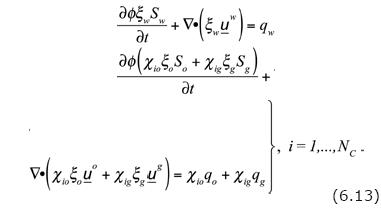
<body><![CDATA[<p align="justify"><font face="verdana" size="2">In Eq. (6.2), the <I>source&#150;terms </I>have been expressed as in Eq. (3.4).</font></p>     <p align="justify"><font face="verdana" size="2">Eqs. (6.2) and (6.3) constitute the <I>basic mathematical model of 'compositional' EOR systems</I>.A model capable of predicting the system behavior, when it is subjected to suitable initial and boundary conditions, will be derived from it by incorporating sufficient scientific and technical information about the actual system following the protocol <I>leitmotiv </I>of this article.</font></p>     <p align="justify"><font face="verdana" size="2">The integral expressions for each one of the 2<I>Nc </I>+ 1 extensive properties are:</font></p>     <p align="center"><font face="verdana" size="2"><img src="/img/revistas/geoint/v50n1/a8s52.jpg"></font></p>     <p align="justify"><font face="verdana" size="2">Therefore,</font></p>     <p align="center"><font face="verdana" size="2"><img src="/img/revistas/geoint/v50n1/a8s53.jpg"></font></p>     <p align="justify"><font face="verdana" size="2">Furthermore, in the <I>Compositional Model</I> diffusion&#150;dispersion processes of the components are neglected; this implies that all the <I>flux&#150;fields</I> are zero; i.e.,</font></p>     <p align="center"><font face="verdana" size="2"><img src="/img/revistas/geoint/v50n1/a8s54.jpg"></font></p>     <p align="justify"><font face="verdana" size="2">According to our assumptions <img src="/img/revistas/geoint/v50n1/a8s90.jpg"> since no matter is exchanged with the water&#150;phase. </font></p>     <p align="justify"><font face="verdana" size="2">When all this is taken into account, the <I>basic mathematical model</I> for compositional systems, of Eqs. (6.2) and (6.3), becomes:</font></p>     ]]></body>
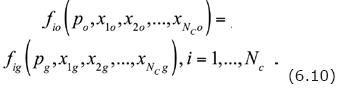
<body><![CDATA[<p align="center"><font face="verdana" size="2"><img src="/img/revistas/geoint/v50n1/a8s55.jpg"></font></p>     <p align="justify"><font face="verdana" size="2">and</font></p>     <p align="center"><font face="verdana" size="2"><img src="/img/revistas/geoint/v50n1/a8s56.jpg"></font></p>     <p align="justify"><font face="verdana" size="2">The contributions to <I>g</I><Sup>&#945;</Sup><Sub><I>e</I></Sub>, &#945; = <I>w</I>, <I>io</I>, <I>ig</I>, generally, are due to extraction or injection through wells. We observe that the following conditions are fulfilled:</font></p>     <p align="center"><font face="verdana" size="2"><img src="/img/revistas/geoint/v50n1/a8s57.jpg"></font></p>     <p align="justify"><font face="verdana" size="2">since the mass of each component must be conserved.</font></p>     <p align="justify"><font face="verdana" size="2">Mass interchange between phases is determined by the mass distribution of each component in the oil and gas phases through the condition of <I>stable thermodynamic equilibrium </I>(Chen <I>et al</I>, 2006). This condition is expressed by means of the equation</font></p>     <p align="center"><font face="verdana" size="2"><img src="/img/revistas/geoint/v50n1/a8s58.jpg"></font></p>     <p align="justify"><font face="verdana" size="2">Here, <I>f</I><Sub><I>io</I></Sub> and <I>f</I><Sub><I>ig</I></Sub> are the <I>fugacity functions </I>of the component in the oil and gas phases, respectively.</font></p>     <p align="justify"><font face="verdana" size="2">For the application of the <I>stable thermodynamic equilibrium</I> condition, the following notation and nomenclature is relevant:</font></p>     ]]></body>
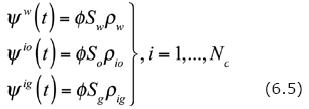
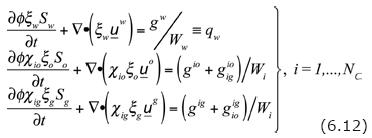
<body><![CDATA[<p align="center"><font face="verdana" size="2"><img src="/img/revistas/geoint/v50n1/a8s59.jpg"></font></p>     <p align="justify"><font face="verdana" size="2">Here, <I>W</I><Sub><I>w</I></Sub> and <I>W</I><Sub><I>i</I></Sub> are the <I>"molar masses"</I>. On the other hand &#958;<Sub><I>w</I></Sub>, &#958;<Sub><I>io</I></Sub>, and &#958;<Sub><I>ig</I></Sub> are the <I>"molar densities"</I> of the water, the <I>i&#151;th</I> component in the oil&#150;phase and of the <I>i&#151;th </I>component in the gas&#150;phase, respectively. Furthermore, &#958;<Sub>&#945;</Sub> is the <I>"molar density of phase </I>&#945;<I>"</I>. The <I>"mole fraction of component i in phase </I>&#945;<I>",</I> is &#967;<Sub><I>i</I></Sub><Sub>&#945;</Sub>. Since the condition of <I>stable thermodynamic equilibrium </I>is expressed in terms of the <I>mole fraction of component i in phase </I>a, it is advantageous to express the basic equations of the <I>compositional model </I>in terms of such parameters. Then</font></p>     <p align="center"><font face="verdana" size="2"><img src="/img/revistas/geoint/v50n1/a8s60.jpg"></font></p>     <p align="justify"><font face="verdana" size="2">Adding up the last two equalities appearing in Eq. (6.12) and using Eq. (6.9), we get</font></p>     <p align="center"><font face="verdana" size="2"><img src="/img/revistas/geoint/v50n1/a8s61.jpg"></font></p>     <p align="justify"><font face="verdana" size="2">As in the case of the Black&#150;Oil model, the last two equalities in Eq. (6.12), can be used to evaluate the supplies <I>g</I><Sup><I>io</I></Sup><Sub><I>ig</I></Sub> and <I>g</I><Sup><I>ig</I></Sup><Sub><I>io </I></Sub>due to exchange. We recall that for saturated flows, these equations are supplemented with the saturation identity:</font></p>     <p align="center"><font face="verdana" size="2"><img src="/img/revistas/geoint/v50n1/a8s62.jpg"></font></p>     <p align="justify"><font face="verdana" size="2">Other equations that are applied in order to obtain a model capable of predicting the system behavior are:</font></p>     <p align="justify"><font face="verdana" size="2">Darcy's Law,</font></p>     <p align="center"><font face="verdana" size="2"><img src="/img/revistas/geoint/v50n1/a8s63.jpg"></font></p>     ]]></body>
<body><![CDATA[<p align="justify"><font face="verdana" size="2">where <i>k<Sub>r&#946;</Sub></i> and <i>&#956;<Sub>&#946;</Sub></i> are the relative permeability and the dynamic viscosity of the b<Sub> </Sub>phase, and  <img src="/img/revistas/geoint/v50n1/a8s64.jpg">is the absolute permeability.</font></p>     <p align="justify"><font face="verdana" size="2">Mole fractions identities,</font></p>     <p align="center"><font face="verdana" size="2"><img src="/img/revistas/geoint/v50n1/a8s65.jpg"></font></p>     <p align="justify"><font face="verdana" size="2">Capillary relations,</font></p>     <p align="center"><font face="verdana" size="2"><img src="/img/revistas/geoint/v50n1/a8s66.jpg"></font></p>     <p align="justify"><font face="verdana" size="2">here <I>p</I><Sub><I>cow</I></Sub> and <I>p</I><Sub><I>cgo</I></Sub> are the capillarity pressures of oil and water and gas and oil, respectively, and <i>p<Sub>&#946;</Sub></i> is the pressure of the b phase. Equations (6.13)&#150;(6.17), together with the <I>stable thermodynamic equilibrium </I>condition of Eq. (6.10) constitute a 2<I>N</I><Sub><I>c</I></Sub>+ 9<Sub></Sub>system of equations for the 2<I>N</I><Sub><I>c</I></Sub>+ 9 dependent variables &#967;<Sub><I>io</I></Sub>, &#967;<Sub><I>ig</I></Sub>, <U><I>u</I></U><Sub>&#945;</Sub>, <I>p</I><U><I></I></U><Sub>&#945;</Sub> and <I>S</I><U><I></I></U><Sub>&#945;</Sub>, &#945; = <I>w, o, g,</I> <I>i</I> = 1,...,<I>N</I><Sub><I>c</I></Sub>, which when subjected to suitable boundary and initial conditions provide a model capable of predicting the behavior of the compositional system.</font></p>     <p align="justify"><font face="verdana" size="2"><b>The non&#150;isothermal models</b></font></p>     <p align="justify"><font face="verdana" size="2">As stated before, in Black&#150;Oil and Isothermal Compositional Models the phase constituted by the solid matrix of the oil reservoir is usually ignored because it does not move and it does not exchange mass with the fluid phases. However, the solid matrix cannot be ignored when formulating non&#150;isothermal models since then energy balances have to be included and the solid phase plays a significant role in them. In turn, this is due to the fact that rocks and other materials that form the solid matrices of oil reservoirs have large heat capacities, frequently larger than the fluid phases participating in the reservoir systems.</font></p>     <p align="justify"><font face="verdana" size="2">Thus, the basic mathematical model of the non&#150;isothermal compositional systems here discussed, has the general features that follow. The family of phases has four members: the solid matrix, the water&#150;phase, the oil&#150;phase and the gas&#150;phase. The velocity of the solid phase is zero, while the notation used for the velocities of the other phases is the same that has been used in previous Sections. The family of extensive properties has 2<I>N</I><Sub><I>c</I></Sub> + 5 members. The first 2<I>N</I><Sub><I>c</I></Sub> + 1  are the same as for the Compositional Model. So, we only discuss here the other four; they are:</font></p>     <p align="justify"><font face="verdana" size="2">i) The <I>total energy of the water&#150;phase,</I> denoted by <I>E</I><Sup><I>w </I></Sup>(<I>t</I>);</font></p>     ]]></body>
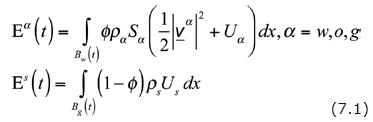
<body><![CDATA[<p align="justify"><font face="verdana" size="2">ii) The<I> total energy of the oil&#150;phase, </I>denoted by, <I>E</I><Sup><I>o </I></Sup>(<I>t</I>);</font></p>     <p align="justify"><font face="verdana" size="2">iii) The<I> total energy of the gas&#150;phase, </I>denoted by, <I>E</I><Sup><I>g </I></Sup>(<I>t</I>);and</font></p>     <p align="justify"><font face="verdana" size="2">iv) The<I> total energy of the solid&#150;phase, </I>denoted by, <I>E</I><Sup><I>S </I></Sup>(<I>t</I>)</font></p>     <p align="justify"><font face="verdana" size="2">For simplicity jump conditions will not be discussed. The differential equations required to complete the <I>non&#150;thermal compositional model</I> are obtained applying Eq. (3.3). The <I>total energy </I>of each one of the phases is given by</font></p>     <p align="center"><font face="verdana" size="2"><img src="/img/revistas/geoint/v50n1/a8s67.jpg"></font></p>     <p align="justify"><font face="verdana" size="2">Where <I>U</I><Sub>&#945;</Sub> is the specific internal energy (per unit mass) of phase a. Due to the smallness of the velocities occurring in flow of fluids through porous media, inertial effects are neglected and the kinetic energy is taken to be identically zero. Therefore, we take</font></p>     <p align="center"><font face="verdana" size="2"><img src="/img/revistas/geoint/v50n1/a8s68.jpg"></font></p>     <p align="justify"><font face="verdana" size="2">Using Eqs. (7.1) and (7.2) it is seen that the <I>intensive properties</I> that correspond to the total&#150;energies of the different phases are</font></p>     <p align="center"><font face="verdana" size="2"><img src="/img/revistas/geoint/v50n1/a8s69.jpg"></font></p>     <p align="justify"><font face="verdana" size="2">Since we are dealing with total energy, the energy sources should be decomposed into two parts: heat sources and mechanical&#150;energy sources (Herrera and Pinder, to appear). A similar decomposition applies to the energy fluxes. This is better understood making the analysis in integral form. In such a form, the balance equations for the <I>extensive properties</I> associated with the different fluid phases (&#945; = <I>w,o,g</I>) are:</font></p>     ]]></body>
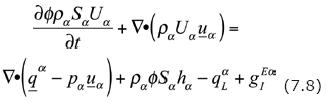
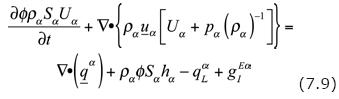
<body><![CDATA[<p align="center"><font face="verdana" size="2"><img src="/img/revistas/geoint/v50n1/a8s70.jpg"></font></p>     <p align="justify"><font face="verdana" size="2">Here, the heat sources are: <i>&#966;<Sub>&#945;</Sub>&#961;<Sub>&#945;</Sub>h<Sub>&#945;</Sub></i> and <I>q</I><Sup>&#945;</Sup><Sub>L</Sub> . The former represents the rate per unit volume of the physical space at which internal energy is supplied to the a<Sub> </Sub>phase by sources distributed in the body&#150;interior (due, for example, to exothermal chemical reactions), while <I>q</I><Sup>&#945;</Sup><Sub>L </Sub>is the heat loss of the &#945; phase to the overburden and underburden, also per unit volume of the physical space. The term &#151;&#947;&#961;<Sub><i></i>&#945;</Sub>(<U><I>u</I></U><Sub>&#945;</Sub>)<Sub><I>z</I></Sub> (&#947; is the gravity acceleration and (<U><I>u</I></U><Sub>&#945;</Sub>)<Sub><I>z </I></Sub>is the component of <U><I>u</I></U><Sub>&#945; </Sub>in the <I>z</I><Sub></Sub>direction) represents the mechanical work done by the gravity force on phase &#945;. Furthermore, we put together the exchange of energy between the phases in the term g <Sup><I>E</I></Sup><Sup>&#945;</Sup><Sub><I>I</I></Sub>, which represents the total energy that enters phase a from other phases. As for energy fluxes that enter the &#945; phase through its boundary, they are given by <I>q</I><Sup>&#945;</Sup> and <img src="/img/revistas/geoint/v50n1/a8s71.jpg">. The former is the heat flux, while the latter comes from mechanical work done on the boundary of a bodies. Finally, we observe that</font></p>     <p align="center"><font face="verdana" size="2"><img src="/img/revistas/geoint/v50n1/a8s72.jpg"></font></p>     <p align="justify"><font face="verdana" size="2">For the <I>non&#150;isothermal compositional model </I>to be developed, the mechanical work done by the gravity force will be neglected (i.e., g(<U><I>u</I></U><Sub>a</Sub>)<Sub><I>z </I></Sub>0). Also, the work done by viscous forces will be neglected and, so, the stress tensor acting on phase a will be <img src="/img/revistas/geoint/v50n1/a8s73.jpg">. Therefore,</font></p>     <p align="center"><font face="verdana" size="2"><img src="/img/revistas/geoint/v50n1/a8s74.jpg"></font></p>     <p align="justify"><font face="verdana" size="2">and Eq. (7.4) becomes</font></p>     <p align="center"><font face="verdana" size="2"><img src="/img/revistas/geoint/v50n1/a8s75.jpg"></font></p>     <p align="justify"><font face="verdana" size="2">This balance equation, when expressed in terms of the <I>intensive property, </I>becomes</font></p>     <p align="center"><font face="verdana" size="2"><img src="/img/revistas/geoint/v50n1/a8s76.jpg"></font></p>     <p align="justify"><font face="verdana" size="2">It can also be written as</font></p>     ]]></body>
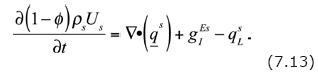
<body><![CDATA[<p align="center"><font face="verdana" size="2"><img src="/img/revistas/geoint/v50n1/a8s77.jpg"></font></p>     <p align="justify"><font face="verdana" size="2">By definition, the <I>"enthalpy per unit mass"</I> of the fluid phase <I>H</I><Sub>&#945;</Sub> (&#945; = <I>w, o, g</I>), satisfies</font></p>     <p align="center"><font face="verdana" size="2"><img src="/img/revistas/geoint/v50n1/a8s78.jpg"></font></p>     <p align="justify"><font face="verdana" size="2">Therefore, for &#945; = <I>w, o, g</I>, Eq. (7.9) is</font></p>     <p align="center"><font face="verdana" size="2"><img src="/img/revistas/geoint/v50n1/a8s79.jpg"></font></p>     <p align="justify"><font face="verdana" size="2">The balance equation for the <I>extensive property</I> associated with the energy of the solid phase is:</font></p>     <p align="center"><font face="verdana" size="2"><img src="/img/revistas/geoint/v50n1/a8s80.jpg"></font></p>     <p align="justify"><font face="verdana" size="2">This balance equation, when expressed in terms of the <I>intensive property</I>, is:</font></p>     <p align="center"><font face="verdana" size="2"><img src="/img/revistas/geoint/v50n1/a8s81.jpg"></font></p>     <p align="justify"><font face="verdana" size="2">Adding up Eq. (7.13) and the four equalities of Eq. (7.11), we get</font></p>     ]]></body>
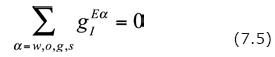
<body><![CDATA[<p align="center"><font face="verdana" size="2"><img src="/img/revistas/geoint/v50n1/a8s82.jpg"></font></p>     <p align="justify"><font face="verdana" size="2">Here, we have applied Eq. (7.5) and written <img src="/img/revistas/geoint/v50n1/a8s83.jpg"> as well as <img src="/img/revistas/geoint/v50n1/a8s84.jpg"> . They are refe&#150;rred to as <I>total heat flux</I> and <I>overall</I> <I>heat source term</I>, respectively.</font></p>     <p align="justify"><font face="verdana" size="2">A very important assumption that is made in the <I>non&#150;isothermal compositional model </I>that we are presenting is that, at each point of the oil reservoir, the different phases reach thermal equilibrium instantly, which implies that all the phases have the same temperature, denoted by <I>T</I>, at each point. Then, the <I>total heat flux</I> is given by an overall Fourier Law:</font></p>     <p align="center"><font face="verdana" size="2"><img src="/img/revistas/geoint/v50n1/a8s85.jpg"></font></p>     <p align="justify"><font face="verdana" size="2">This leads to the following form, of Eq. (7.14):</font></p>     <p align="center"><font face="verdana" size="2"><img src="/img/revistas/geoint/v50n1/a8s86.jpg"></font></p>     <p align="justify"><font face="verdana" size="2">Here, <I>q</I><Sub><I>c</I></Sub> is referred to as the overall <I>heat source term</I> and it is defined by</font></p>     <p align="center"><font face="verdana" size="2"><img src="/img/revistas/geoint/v50n1/a8s87.jpg"></font></p>     <p align="justify"><font face="verdana" size="2"><b>Conclusions</b></font></p>     <p align="justify"><font face="verdana" size="2">Mathematical and computational models of the processes that occur in enhanced oil recovery (EOR) technology are fundamental for the application and advancement of such methods. At least the following three stages can be distinguished in the development of EOR models: construction of a mathematical, a numerical and a computational model, respectively. In particular, the construction of the mathematical model is the starting point and base on which the remaining construction is built. Due to the great diversity of processes occurring in EOR, it is valuable to possess a general and systematic procedure for constructing their mathematical models, which can be used as a unified protocol when building the corresponding computational simulators. In this paper we have presented such a procedure, based on an axiomatic formulation of Continuous Mechanics (Allen <I>et al</I>., 1988), which is systematic, rigorous and easy to apply independently of the complexity of the system considered.</font></p>     ]]></body>
<body><![CDATA[<p align="justify"><font face="verdana" size="2">As it is here explained, mathematical models of EOR processes are constituted by a system of partial differential equations together with a system of conditions, the <I>jump conditions</I>, which model discontinuities must fulfill when and where they occur; albeit, in standard treatments the <I>jump conditions </I>are not usually discussed. When building the mathematical model of an EOR system, the following stages can be distinguished: firstly, a basic system of partial differential equations and <I>jump conditions</I> that only depend on the number of phases and components in each phase are established &#151;given in Eq. (3.3)&#150;; and secondly, the phenomenology is incorporated into it. In this paper, the system of partial differential equations and <I>jump conditions</I> derived in the first step is referred to as the <I>'basic mathematical model'</I>. This supplies a very sound and firm basis for a second step, which consists in incorporating other scientific and technological information that is required to complete the mathematical model; this latter purpose is achieved by means of certain number of <I>constitutive equations</I> such as Darcy's Law, chemical laws, results of field measurements and many more. Specific applications of the procedures here introduced have already been made in the development of EOR projects such as water&#150;alternating&#150;gas injection and air injection methods.</font></p>     <p align="justify"><font face="verdana" size="2">In standard approaches, the system of partial differential equations of the <I>basic mathematical model </I>is derived by means of balances that are carried out in cubes (or parallelepipeds) of the physical space, putting together the different phases of the system and the <I>jump conditions </I>are not usually discussed. In the protocol here proposed, on the other hand, such balances in cubes are not required since instead the starting point is the system of <I>partial differential equations</I> and <I>shock conditions</I> of Eq. (3.3). The procedure is systematic, rigorous and easy to apply independently of the complexity of the system considered. In Sections 4 to 6, we have shown that when this approach is used for constructing the basic mathematical models, such construction is to a large extent automatic; all what is required in order to define the partial differential equations and the jump conditions of the mathematical model is to identify the phases and species, as well the energy sources, that participate in the EOR system.</font></p>     <p align="justify"><font face="verdana" size="2">&nbsp;</font></p>     <p align="justify"><font face="verdana" size="2"><b>Bibliography</b></font></p>     <!-- ref --><p align="justify"><font face="verdana" size="2">Akkutlu I.Y. and Yortsos Y.C., 2003, The Dynamics of in&#150;situ Combustion Fronts in Porous Media, <I>Combustion and Flame</I>, 134, p.229&#150;247.    &nbsp;&nbsp;&nbsp;&nbsp;&nbsp;&nbsp;&nbsp;&nbsp;[&#160;<a href="javascript:void(0);" onclick="javascript: window.open('/scielo.php?script=sci_nlinks&ref=3938304&pid=S0016-7169201100010000800001&lng=','','width=640,height=500,resizable=yes,scrollbars=1,menubar=yes,');">Links</a>&#160;]<!-- end-ref --> </font></p>     <!-- ref --><p align="justify"><font face="verdana" size="2">Allen M.B., Herrera I. and Pinder G.F., 1988, Numerical modeling in science and engineering, John Wiley &amp; Sons. 418 p.    &nbsp;&nbsp;&nbsp;&nbsp;&nbsp;&nbsp;&nbsp;&nbsp;[&#160;<a href="javascript:void(0);" onclick="javascript: window.open('/scielo.php?script=sci_nlinks&ref=3938306&pid=S0016-7169201100010000800002&lng=','','width=640,height=500,resizable=yes,scrollbars=1,menubar=yes,');">Links</a>&#160;]<!-- end-ref --></font></p>     <!-- ref --><p align="justify"><font face="verdana" size="2">Buckley S.E. and Leverett M.C., 1942, Mechanics of fluid displacement in sands, <I>Trans.</I>, <I>AIME</I>, 146, p. 107&#150;116.    &nbsp;&nbsp;&nbsp;&nbsp;&nbsp;&nbsp;&nbsp;&nbsp;[&#160;<a href="javascript:void(0);" onclick="javascript: window.open('/scielo.php?script=sci_nlinks&ref=3938308&pid=S0016-7169201100010000800003&lng=','','width=640,height=500,resizable=yes,scrollbars=1,menubar=yes,');">Links</a>&#160;]<!-- end-ref --></font></p>     ]]></body>
<body><![CDATA[<!-- ref --><p align="justify"><font face="verdana" size="2">Chen Z., Huan G. and Ma Y., 2006, <I>Computational </I>Methods for Multiphase Flows in Porous Media, SIAM. 549 p.    &nbsp;&nbsp;&nbsp;&nbsp;&nbsp;&nbsp;&nbsp;&nbsp;[&#160;<a href="javascript:void(0);" onclick="javascript: window.open('/scielo.php?script=sci_nlinks&ref=3938310&pid=S0016-7169201100010000800004&lng=','','width=640,height=500,resizable=yes,scrollbars=1,menubar=yes,');">Links</a>&#160;]<!-- end-ref --></font></p>     <!-- ref --><p align="justify"><font face="verdana" size="2">Chen Z., Ma Y. and Chen G., 2007, A sequential numerical chemical compositional simulator,<B> </B><I>Transport in Porous Media</I>, 68, p. 389&#150;411.    &nbsp;&nbsp;&nbsp;&nbsp;&nbsp;&nbsp;&nbsp;&nbsp;[&#160;<a href="javascript:void(0);" onclick="javascript: window.open('/scielo.php?script=sci_nlinks&ref=3938312&pid=S0016-7169201100010000800005&lng=','','width=640,height=500,resizable=yes,scrollbars=1,menubar=yes,');">Links</a>&#160;]<!-- end-ref --> </font></p>     <!-- ref --><p align="justify"><font face="verdana" size="2">Herrera I. Shocks and Bifurcations in Black&#150;Oil Models, 1996, <I>SPE J.</I> 1,1, p. 51&#150;58.    &nbsp;&nbsp;&nbsp;&nbsp;&nbsp;&nbsp;&nbsp;&nbsp;[&#160;<a href="javascript:void(0);" onclick="javascript: window.open('/scielo.php?script=sci_nlinks&ref=3938314&pid=S0016-7169201100010000800006&lng=','','width=640,height=500,resizable=yes,scrollbars=1,menubar=yes,');">Links</a>&#160;]<!-- end-ref --></font></p>     <!-- ref --><p align="justify"><font face="verdana" size="2">Herrera I. and Camacho R.G., 1997. A Consistent Approach to Variable Bubble&#150;Point Systems, <I>Numerical Methods for Partial Differential Equations</I>, 13,1, p. 1&#150;18.    &nbsp;&nbsp;&nbsp;&nbsp;&nbsp;&nbsp;&nbsp;&nbsp;[&#160;<a href="javascript:void(0);" onclick="javascript: window.open('/scielo.php?script=sci_nlinks&ref=3938316&pid=S0016-7169201100010000800007&lng=','','width=640,height=500,resizable=yes,scrollbars=1,menubar=yes,');">Links</a>&#160;]<!-- end-ref --></font></p>     <!-- ref --><p align="justify"><font face="verdana" size="2">Herrera I., Camacho R. and Galindo A., 1993, Mechanisms of Shock  Generation  in Variable Bubble Point Systems, <I>Computational Modelling of Free and  Moving Boundary Problems</I>, <I>2</I>, Computational Mechanics Publicactions, Southampton &amp; Boston, p. 435&#150;453.    &nbsp;&nbsp;&nbsp;&nbsp;&nbsp;&nbsp;&nbsp;&nbsp;[&#160;<a href="javascript:void(0);" onclick="javascript: window.open('/scielo.php?script=sci_nlinks&ref=3938318&pid=S0016-7169201100010000800008&lng=','','width=640,height=500,resizable=yes,scrollbars=1,menubar=yes,');">Links</a>&#160;]<!-- end-ref --></font></p>     ]]></body>
<body><![CDATA[<!-- ref --><p align="justify"><font face="verdana" size="2">Herrera I. and Pinder G.F., Mathematical modeling in science and engineering, Wiley, 2011 (submitted).    &nbsp;&nbsp;&nbsp;&nbsp;&nbsp;&nbsp;&nbsp;&nbsp;[&#160;<a href="javascript:void(0);" onclick="javascript: window.open('/scielo.php?script=sci_nlinks&ref=3938320&pid=S0016-7169201100010000800009&lng=','','width=640,height=500,resizable=yes,scrollbars=1,menubar=yes,');">Links</a>&#160;]<!-- end-ref --></font></p>     <!-- ref --><p align="justify"><font face="verdana" size="2">Lake L.W., 1989, <I>Enhanced Oil Recovery</I>, Prentice&#150;Hall, Englewood Cliffs, NJ. 550 p.    &nbsp;&nbsp;&nbsp;&nbsp;&nbsp;&nbsp;&nbsp;&nbsp;[&#160;<a href="javascript:void(0);" onclick="javascript: window.open('/scielo.php?script=sci_nlinks&ref=3938322&pid=S0016-7169201100010000800010&lng=','','width=640,height=500,resizable=yes,scrollbars=1,menubar=yes,');">Links</a>&#160;]<!-- end-ref --></font></p>     <!-- ref --><p align="justify"><font face="verdana" size="2">Noll W., 1974, <I>The foundations of mechanics and thermodynamics </I>(selected papers by W. Noll, with a preface by C. Truesdell), Berlin&#150;Heidelberg&#150;Berlin: Springer&#150;Verlag, 324 p.    &nbsp;&nbsp;&nbsp;&nbsp;&nbsp;&nbsp;&nbsp;&nbsp;[&#160;<a href="javascript:void(0);" onclick="javascript: window.open('/scielo.php?script=sci_nlinks&ref=3938324&pid=S0016-7169201100010000800011&lng=','','width=640,height=500,resizable=yes,scrollbars=1,menubar=yes,');">Links</a>&#160;]<!-- end-ref --></font></p>      ]]></body><back>
<ref-list>
<ref id="B1">
<nlm-citation citation-type="journal">
<person-group person-group-type="author">
<name>
<surname><![CDATA[Akkutlu]]></surname>
<given-names><![CDATA[I.Y.]]></given-names>
</name>
<name>
<surname><![CDATA[Yortsos]]></surname>
<given-names><![CDATA[Y.C.]]></given-names>
</name>
</person-group>
<article-title xml:lang="en"><![CDATA[The Dynamics of in-situ Combustion Fronts in Porous Media]]></article-title>
<source><![CDATA[Combustion and Flame]]></source>
<year>2003</year>
<volume>134</volume>
<page-range>229-247</page-range></nlm-citation>
</ref>
<ref id="B2">
<nlm-citation citation-type="book">
<person-group person-group-type="author">
<name>
<surname><![CDATA[Allen]]></surname>
<given-names><![CDATA[M.B.]]></given-names>
</name>
<name>
<surname><![CDATA[Herrera]]></surname>
<given-names><![CDATA[I]]></given-names>
</name>
<name>
<surname><![CDATA[Pinder]]></surname>
<given-names><![CDATA[G.F.]]></given-names>
</name>
</person-group>
<source><![CDATA[Numerical modeling in science and engineering]]></source>
<year>1988</year>
<page-range>418</page-range><publisher-name><![CDATA[John Wiley & Sons]]></publisher-name>
</nlm-citation>
</ref>
<ref id="B3">
<nlm-citation citation-type="journal">
<person-group person-group-type="author">
<name>
<surname><![CDATA[Buckley]]></surname>
<given-names><![CDATA[S.E.]]></given-names>
</name>
<name>
<surname><![CDATA[Leverett]]></surname>
<given-names><![CDATA[M.C.]]></given-names>
</name>
</person-group>
<article-title xml:lang="en"><![CDATA[Mechanics of fluid displacement in sands]]></article-title>
<source><![CDATA[Trans., AIME]]></source>
<year>1942</year>
<volume>146</volume>
<page-range>107-116</page-range></nlm-citation>
</ref>
<ref id="B4">
<nlm-citation citation-type="book">
<person-group person-group-type="author">
<name>
<surname><![CDATA[Chen]]></surname>
<given-names><![CDATA[Z]]></given-names>
</name>
<name>
<surname><![CDATA[Huan]]></surname>
<given-names><![CDATA[G]]></given-names>
</name>
<name>
<surname><![CDATA[Ma]]></surname>
<given-names><![CDATA[Y]]></given-names>
</name>
</person-group>
<source><![CDATA[Computational Methods for Multiphase Flows in Porous Media]]></source>
<year>2006</year>
<page-range>549</page-range><publisher-name><![CDATA[SIAM]]></publisher-name>
</nlm-citation>
</ref>
<ref id="B5">
<nlm-citation citation-type="journal">
<person-group person-group-type="author">
<name>
<surname><![CDATA[Chen]]></surname>
<given-names><![CDATA[Z]]></given-names>
</name>
<name>
<surname><![CDATA[Ma]]></surname>
<given-names><![CDATA[Y]]></given-names>
</name>
<name>
<surname><![CDATA[Chen]]></surname>
<given-names><![CDATA[G]]></given-names>
</name>
</person-group>
<article-title xml:lang="en"><![CDATA[A sequential numerical chemical compositional simulator]]></article-title>
<source><![CDATA[Transport in Porous Media]]></source>
<year>2007</year>
<volume>68</volume>
<page-range>389-411</page-range></nlm-citation>
</ref>
<ref id="B6">
<nlm-citation citation-type="journal">
<person-group person-group-type="author">
<name>
<surname><![CDATA[Herrera]]></surname>
<given-names><![CDATA[I]]></given-names>
</name>
</person-group>
<article-title xml:lang="en"><![CDATA[Shocks and Bifurcations in Black-Oil Models]]></article-title>
<source><![CDATA[SPE J.]]></source>
<year>1996</year>
<volume>1</volume>
<numero>1</numero>
<issue>1</issue>
<page-range>51-58</page-range></nlm-citation>
</ref>
<ref id="B7">
<nlm-citation citation-type="journal">
<person-group person-group-type="author">
<name>
<surname><![CDATA[Herrera]]></surname>
<given-names><![CDATA[I]]></given-names>
</name>
<name>
<surname><![CDATA[Camacho]]></surname>
<given-names><![CDATA[R.G.]]></given-names>
</name>
</person-group>
<article-title xml:lang="en"><![CDATA[A Consistent Approach to Variable Bubble-Point Systems]]></article-title>
<source><![CDATA[Numerical Methods for Partial Differential Equations]]></source>
<year>1997</year>
<volume>13</volume>
<numero>1</numero>
<issue>1</issue>
<page-range>1-18</page-range></nlm-citation>
</ref>
<ref id="B8">
<nlm-citation citation-type="book">
<person-group person-group-type="author">
<name>
<surname><![CDATA[Herrera]]></surname>
<given-names><![CDATA[I]]></given-names>
</name>
<name>
<surname><![CDATA[Camacho]]></surname>
<given-names><![CDATA[R]]></given-names>
</name>
<name>
<surname><![CDATA[Galindo]]></surname>
<given-names><![CDATA[A]]></given-names>
</name>
</person-group>
<source><![CDATA[Mechanisms of Shock Generation in Variable Bubble Point Systems, Computational Modelling of Free and Moving Boundary Problems, 2]]></source>
<year>1993</year>
<page-range>435-453</page-range><publisher-name><![CDATA[Computational Mechanics Publicactions]]></publisher-name>
</nlm-citation>
</ref>
<ref id="B9">
<nlm-citation citation-type="book">
<person-group person-group-type="author">
<name>
<surname><![CDATA[Herrera]]></surname>
<given-names><![CDATA[I]]></given-names>
</name>
<name>
<surname><![CDATA[Pinder]]></surname>
<given-names><![CDATA[G.F.]]></given-names>
</name>
</person-group>
<source><![CDATA[Mathematical modeling in science and engineering]]></source>
<year>2011</year>
<publisher-name><![CDATA[Wiley]]></publisher-name>
</nlm-citation>
</ref>
<ref id="B10">
<nlm-citation citation-type="book">
<person-group person-group-type="author">
<name>
<surname><![CDATA[Lake]]></surname>
<given-names><![CDATA[L.W.]]></given-names>
</name>
</person-group>
<source><![CDATA[Enhanced Oil Recovery]]></source>
<year>1989</year>
<page-range>550</page-range><publisher-loc><![CDATA[Englewood Cliffs^eNJ NJ]]></publisher-loc>
<publisher-name><![CDATA[Prentice-Hall]]></publisher-name>
</nlm-citation>
</ref>
<ref id="B11">
<nlm-citation citation-type="book">
<person-group person-group-type="author">
<name>
<surname><![CDATA[Noll]]></surname>
<given-names><![CDATA[W]]></given-names>
</name>
</person-group>
<source><![CDATA[The foundations of mechanics and thermodynamics]]></source>
<year>1974</year>
<page-range>324</page-range><publisher-loc><![CDATA[BerlinHeidelbergBerlin ]]></publisher-loc>
<publisher-name><![CDATA[Springer-Verlag]]></publisher-name>
</nlm-citation>
</ref>
</ref-list>
</back>
</article>