<?xml version="1.0" encoding="ISO-8859-1"?><article xmlns:mml="http://www.w3.org/1998/Math/MathML" xmlns:xlink="http://www.w3.org/1999/xlink" xmlns:xsi="http://www.w3.org/2001/XMLSchema-instance">
<front>
<journal-meta>
<journal-id>0016-7169</journal-id>
<journal-title><![CDATA[Geofísica internacional]]></journal-title>
<abbrev-journal-title><![CDATA[Geofís. Intl]]></abbrev-journal-title>
<issn>0016-7169</issn>
<publisher>
<publisher-name><![CDATA[Universidad Nacional Autónoma de México, Instituto de Geofísica]]></publisher-name>
</publisher>
</journal-meta>
<article-meta>
<article-id>S0016-71692008000300014</article-id>
<title-group>
<article-title xml:lang="en"><![CDATA[Wavelet coherence analysis of Atlantic hurricanes and cosmic rays]]></article-title>
</title-group>
<contrib-group>
<contrib contrib-type="author">
<name>
<surname><![CDATA[Pérez-Peraza]]></surname>
<given-names><![CDATA[J]]></given-names>
</name>
<xref ref-type="aff" rid="A01"/>
</contrib>
<contrib contrib-type="author">
<name>
<surname><![CDATA[Velasco]]></surname>
<given-names><![CDATA[V]]></given-names>
</name>
<xref ref-type="aff" rid="A01"/>
</contrib>
<contrib contrib-type="author">
<name>
<surname><![CDATA[Kavlakov]]></surname>
<given-names><![CDATA[S]]></given-names>
</name>
<xref ref-type="aff" rid="A02"/>
</contrib>
</contrib-group>
<aff id="A01">
<institution><![CDATA[,Universidad Nacional Autónoma de México Instituto de Geofísica ]]></institution>
<addr-line><![CDATA[México City ]]></addr-line>
<country>México</country>
</aff>
<aff id="A02">
<institution><![CDATA[,Bulgarian Academy of Sciences  ]]></institution>
<addr-line><![CDATA[ ]]></addr-line>
<country>Bulgaria</country>
</aff>
<pub-date pub-type="pub">
<day>00</day>
<month>09</month>
<year>2008</year>
</pub-date>
<pub-date pub-type="epub">
<day>00</day>
<month>09</month>
<year>2008</year>
</pub-date>
<volume>47</volume>
<numero>3</numero>
<fpage>231</fpage>
<lpage>244</lpage>
<copyright-statement/>
<copyright-year/>
<self-uri xlink:href="http://www.scielo.org.mx/scielo.php?script=sci_arttext&amp;pid=S0016-71692008000300014&amp;lng=en&amp;nrm=iso"></self-uri><self-uri xlink:href="http://www.scielo.org.mx/scielo.php?script=sci_abstract&amp;pid=S0016-71692008000300014&amp;lng=en&amp;nrm=iso"></self-uri><self-uri xlink:href="http://www.scielo.org.mx/scielo.php?script=sci_pdf&amp;pid=S0016-71692008000300014&amp;lng=en&amp;nrm=iso"></self-uri><abstract abstract-type="short" xml:lang="es"><p><![CDATA[Se sustentan resultados previos relativos al Análisis Correlacional entre Ciclones Tropicales y fenómenos cosmofísicos, tales como los Rayos Cósmicos (CR y Actividad Solar (SS) y se amplía el estudio análisis espectral del tipo Coherencia con Ondúlelas de Morlet. El objetivo de este trabajo es el de encontrar periodicidades cosmofísicas incidentes capaces potencialmente de modular fenómenos terrestres. Usando datos históricos del (10Be), se confirma la existencia de fluctuaciones en el flujo de RC con frecuencia aproximada de 30 años, puesta en evidencia por primera vez con un análisis de Coherencia de Ondúlelas, en un trabajo previo. Además, se analizan aquí periodicidades comunes entre fenómenos presumiblemente asociados a Huracanes, como son la Oscilación Multidecal Atlántica (AMO) y Temperatura Superficial Marítima (SST) versus Rayos cósmicos, y por otro lado Rayos Cósmicos versus Huracanes Atlánticos. Se encuentra una frecuencia común entre ellos de 30± 2 años, misma que habíamos encontrado en trabajos previos, entre las propiedades de los Huracanes, como la Energía Total Ciclónica, el Número Total de tormentas Tropicales en la costa Atlántica de México y otros. Parece ser que los CR modulan de alguna manera el AMO y el SST, y estos a su vez modulan de alguna forma a los Huracanes. Como una medida de la relevancia de los fenómenos cosmofísicas con respecto a las fuentes terrestres de afectación al desarrollo de Huracanes, hemos aplicado el Análisis de Coherencia con Ondúlelas a las capa de Polvo que se emanan en erupciones de origen Africano versus Huracanes Atlánticos, y encontrado que la coherencia con el Polvo es menor en la mayoría de los casos que con los CR a las mismas frecuencias. Esto no lleva a inferir que los fenómenos cosmofísicos pueden ser más importantes de lo que convencionalmente se asume, particularmente en el desarrollo de Huracanes.]]></p></abstract>
<abstract abstract-type="short" xml:lang="en"><p><![CDATA[In order to sustain previous results regarding the Correlational Analysis between Tropical Cyclones and Cosmophysical phenomena, namely Galactic Cosmic Rays (CR) and Solar Activity (SS), we extend here such analysis by means of the Coherence Morlet Wavelet spectral analysis. Then, the aim of this work is to find incident cosmophysical periodicities that may potentially modulate terrestrial phenomena. We confirm the previous evidence, for the first time from a Coherence wavelet study, the existence of fluctuations in the flux of (CR) at the frequency of 30 years through the study of historical data (10Be). Next, we analyze common periodicities between phenomena presumably associated to hurricanes, the Atlantic Multidecadal Oscillation (AMO) and the Sea-Surface Temperature (SST) versus Cosmic Rays, and on the other hand Cosmic Rays versus Atlantic Hurricanes. We find a common frequency of 30± 2 yrs, among them, same that had been found in previous works in some properties of Hurricanes, as the total Cyclonal Energy, the total number of Tropical Storms landing in the Atlantic coast of Mexico and others. It seems that CR modulates in some way both the AMO and SST, and these in turn modulate in some way hurricanes. As a measure of the relevance of cosmophysical phenomena with respect to terrestrial sources of affectation for Hurricane development, we also applied the Wavelet Coherence analysis to the Dust cover originated in African dust outbreaks versus Atlantic Hurricanes and found that the coherence with Dust is weaker than with CR at the same frequencies, which allows us to infer that cosmophysical phenomena may be more important of what is now conventionally assumed in the development of Hurricanes.]]></p></abstract>
<kwd-group>
<kwd lng="es"><![CDATA[Huracanes del Atlántico]]></kwd>
<kwd lng="es"><![CDATA[rayos cósmicos]]></kwd>
<kwd lng="es"><![CDATA[análisis espectral por ondoletas]]></kwd>
<kwd lng="en"><![CDATA[Atlantic hurricanes]]></kwd>
<kwd lng="en"><![CDATA[cosmic rays]]></kwd>
<kwd lng="en"><![CDATA[spectral wavelet analysis]]></kwd>
</kwd-group>
</article-meta>
</front><body><![CDATA[ <p align="justify"><font face="verdana" size="4">Article</font></p>     <p align="justify"><font face="verdana" size="2">&nbsp;</font></p>     <p align="center"><font face="verdana" size="4"><b>Wavelet coherence analysis of Atlantic hurricanes and cosmic rays</b></font></p>     <p align="center"><font face="verdana" size="2">&nbsp;</font></p>     <p align="center"><font face="verdana" size="2"><b>J. P&eacute;rez&#150;Peraza<sup>1,</sup>*, V. Velasco<sup>1</sup> and S. Kavlakov<sup>2</sup></b></font></p>     <p align="justify"><font face="verdana" size="2">&nbsp;</font></p>     <p align="justify"><font face="verdana" size="2"><sup>1</sup> <i>Instituto de Geof&iacute;sica, Universidad Nacional Aut&oacute;noma de M&eacute;xico, Del. Coyoac&aacute;n, 04510 M&eacute;xico City, M&eacute;xico.</i> E&#150;mail: <a href="mailto:vmv@geofisica.unam.mx">vmv@geofisica.unam.mx</sup></a> * Corresponding author: <a href="mailto:perperaz@geofisica.unam.mx">perperaz@geofisica.unam.mx</a></font></p>     <p align="justify"><font face="verdana" size="2"><sup>2</sup> <i>Bulgarian Academy of Sciences, Galileo Galilei Street 17/B, Sofia 1113, Bulgaria </i>E&#150;mail: <a href="mailto:skavlakov@gmail.com">skavlakov@gmail.com</a></font></p>     <p align="justify"><font face="verdana" size="2">&nbsp;</font></p>     <p align="justify"><font face="verdana" size="2">Received: October 29, 2007    ]]></body>
<body><![CDATA[<br> Accepted: April 29, 2008</font></p>     <p align="justify"><font face="verdana" size="2">&nbsp;</font></p>     <p align="justify"><font face="verdana" size="2"><b>Resumen</b></font></p>     <p align="justify"><font face="verdana" size="2">Se sustentan resultados previos relativos al An&aacute;lisis Correlacional entre Ciclones Tropicales y fen&oacute;menos cosmof&iacute;sicos, tales como los Rayos C&oacute;smicos (CR y Actividad Solar (SS) y se ampl&iacute;a el estudio an&aacute;lisis espectral del tipo Coherencia con Ond&uacute;lelas de Morlet. El objetivo de este trabajo es el de encontrar periodicidades cosmof&iacute;sicas incidentes capaces potencialmente de modular fen&oacute;menos terrestres. Usando datos hist&oacute;ricos del (10Be), se confirma la existencia de fluctuaciones en el flujo de RC con frecuencia aproximada de 30 a&ntilde;os, puesta en evidencia por primera vez con un an&aacute;lisis de Coherencia de Ond&uacute;lelas, en un trabajo previo. Adem&aacute;s, se analizan aqu&iacute; periodicidades comunes entre fen&oacute;menos presumiblemente asociados a Huracanes, como son la Oscilaci&oacute;n Multidecal Atl&aacute;ntica (AMO) y Temperatura Superficial Mar&iacute;tima (SST) versus Rayos c&oacute;smicos, y por otro lado Rayos C&oacute;smicos versus Huracanes Atl&aacute;nticos. Se encuentra una frecuencia com&uacute;n entre ellos de 30&plusmn; 2 a&ntilde;os, misma que hab&iacute;amos encontrado en trabajos previos, entre las propiedades de los Huracanes, como la Energ&iacute;a Total Cicl&oacute;nica, el N&uacute;mero Total de tormentas Tropicales en la costa Atl&aacute;ntica de M&eacute;xico y otros.</font></p>     <p align="justify"><font face="verdana" size="2">Parece ser que los CR modulan de alguna manera el AMO y el SST, y estos a su vez modulan de alguna forma a los Huracanes. Como una medida de la relevancia de los fen&oacute;menos cosmof&iacute;sicas con respecto a las fuentes terrestres de afectaci&oacute;n al desarrollo de Huracanes, hemos aplicado el An&aacute;lisis de Coherencia con Ond&uacute;lelas a las capa de Polvo que se emanan en erupciones de origen Africano versus Huracanes Atl&aacute;nticos, y encontrado que la coherencia con el Polvo es menor en la mayor&iacute;a de los casos que con los CR a las mismas frecuencias. Esto no lleva a inferir que los fen&oacute;menos cosmof&iacute;sicos pueden ser m&aacute;s importantes de lo que convencionalmente se asume, particularmente en el desarrollo de Huracanes.</font></p>     <p align="justify"><font face="verdana" size="2"><b>Palabras clave: </b>Huracanes del Atl&aacute;ntico, rayos c&oacute;smicos, an&aacute;lisis espectral por ondoletas.</font></p>     <p align="justify"><font face="verdana" size="2">&nbsp;</font></p>     <p align="justify"><font face="verdana" size="2"><b>Abstract</b></font></p>     <p align="justify"><font face="verdana" size="2">In order to sustain previous results regarding the Correlational Analysis between Tropical Cyclones and Cosmophysical phenomena, namely Galactic Cosmic Rays (CR) and Solar Activity (SS), we extend here such analysis by means of the Coherence Morlet Wavelet spectral analysis. Then, the aim of this work is to find incident cosmophysical periodicities that may potentially modulate terrestrial phenomena. We confirm the previous evidence, for the first time from a Coherence wavelet study, the existence of fluctuations in the flux of (CR) at the frequency of 30 years through the study of historical data (10Be). Next, we analyze common periodicities between phenomena presumably associated to hurricanes, the Atlantic Multidecadal Oscillation (AMO) and the Sea&#150;Surface Temperature (SST) versus Cosmic Rays, and on the other hand Cosmic Rays versus Atlantic Hurricanes. We find a common frequency of 30&plusmn; 2 yrs, among them, same that had been found in previous works in some properties of Hurricanes, as the total Cyclonal Energy, the total number of Tropical Storms landing in the Atlantic coast of Mexico and others. It seems that CR modulates in some way both the AMO and SST, and these in turn modulate in some way hurricanes. As a measure of the relevance of cosmophysical phenomena with respect to terrestrial sources of affectation for Hurricane development, we also applied the Wavelet Coherence analysis to the Dust cover originated in African dust outbreaks versus Atlantic Hurricanes and found that the coherence with Dust is weaker than with CR at the same frequencies, which allows us to infer that cosmophysical phenomena may be more important of what is now conventionally assumed in the development of Hurricanes.</font></p>     <p align="justify"><font face="verdana" size="2"><b>Key words:</b> Atlantic hurricanes, cosmic rays, spectral wavelet analysis.</font></p>     ]]></body>
<body><![CDATA[<p align="justify"><font face="verdana" size="2">&nbsp;</font></p>     <p align="justify"><font face="verdana" size="2"><b>Introduction</b></font></p>     <p align="justify"><font face="verdana" size="2">Hugh mass of atmospheric air rotating over the oceans with a velocity higher than 60 Km/hr, and reaching rotational velocities beyond 300 Km/hr is called <i>Tropical Cyclone</i>. When they born over the Atlantic and north&#150;eastern Pacific Oceans are called Hurricanes, and if they born over the western Pacific Ocean they are called <i>Typhoons</i>. So, we use here indifferently the terms Cyclone and hurricane. They are classified in several ways depending upon the vortex wind velocity, their destructive power and other factors. The most popular is the so called Saffir&#150;Simpson scale, going from Tropical Storms (TS), hurricanes type&#150;1 up to type&#150;5). Independently of Hurricane category, the damages they potentially may cause are more intense when their translation speed is small or almost zero, provided they stay longer time over one location. The energy concentrated in the vortex system is enormous. If we consider that the air over a surface with a diameter of 800 km has a mass of 2x10<sup>12</sup> tons, and that it turns with a relatively low velocity of ~70 Km/hr, then the involved energy is ~ 1018 Joules (or ~ 10<sup>11</sup> KWh). This corresponds to the energy released during the explosion of more than 2000 Atomic bombs of the Hiroshima type. That explains the devastating effect of the hurricanes when they touche a populated area. A single hurricane hitting over the Coasts of Caribbean Islands, USA or Mexico can take many human lives and cause damages for billions dollars. Practically, every year, one or two of such hurricanes devastate these regions. So, to&#150;day a lot of efforts are devoted to understand better the Hurricane formation and intensification, to improve the forecasting of its complicated trajectories for a better foresee of hurricane appearances, prediction of their probable devastation, and then, to warm with enough time the threatened population. All this provokes our interest for a detailed study of many collateral phenomena and their statistical comparison with the development of Hurricanes. Such a kind of studies using data recorded in the past seems to give unexpected possibilities. To contribute to such a big task is then the main goal of this research.</font></p>     <p align="justify"><font face="verdana" size="2">In previous works P&eacute;rez&#150;Peraza <i>et al.</i> (2007, 2008) Kavlakov <i>et al.</i> (2007a, b) Kavlakov and Elsner (2007) (here after referred as PI, PII, PIII, PIV and PV respectively) we have boarded the problem from the point of view of a plausible extraterrestrial influence on hurricanes development, as a complement of the local terrestrial factors which are certainly at the origin of the Tropical Cyclone phenomenon.</font></p>     <p align="justify"><font face="verdana" size="2">Following this line, we examine here whether two phenomena, a cosmophysical one and hurricanes, have an interconnection among them, and if so, we contrast such an influence with that of terrestrial phenomena, for which a certain association with hurricanes is well established.</font></p>     <p align="justify">&nbsp;</p>     <p align="justify"><font face="verdana" size="2"><b>Cosmophysical influence on climatic phenomena</b></font></p>     <p align="justify"><font face="verdana" size="2">The links between the Space Weather and Meteorological Weather have been often discussed not only for the last century (Mason <i>et al.</i>, 1992), (Mazzarella <i>et al.</i>, 1992), but also for several centuries ago (Rodrigo <i>et al.</i>, 2000), and even before, some thousands of years ago (Neff <i>et al.</i>, 2001). In the last years more and more investigations show that Solar activity and Cosmic Rays have noticeable impact on meteorological parameters, (Raibeck and Yiou, 1980; Gierenes and Ponater,1999; Tinsley 1996, 2000; Tinsley and Beard, 1997; Yiou <i>et al.</i>, 1997; Marsh and Svensmark, 2000; Kudela <i>et al.</i>, 2000; Kristjansson <i>et al.</i>, 2002; Laut, 2003; Ramirez <i>et al.</i>, 2004; Gray <i>et al.</i>, 2005; Mavromichalaki <i>et al.</i>, 2006; Dorman, 2006, Joel Pedro <i>et al.,</i> 2006.)</font></p>     <p align="justify"><font face="verdana" size="2">One of the main enigmas of solar&#150;terrestrial physics is to know how and when the periodicities of solar magnetic activity do modulate the terrestrial climatic changes. Some insights have been obtained: for one side, the solar Hale cycle (20&#150;25 years). Changes in solar activity for the last 500 years have been studied (Raspopov <i>et al.</i>, 2005), with the aim of revealing a possible contribution of solar activity to climatic variability. On the other hand, quasiperiodic climatic oscillations with periods of 20&#150;25 years have been revealed in the analysis of parameters such as ground surface temperatures, drought rhythm, variations in sea surface temperature, precipitation periodicity, etc. (Ol', 1969; Cook, Meko, and Stockton, 1997; Pudovkin and Lybchich, 1989; Pudovkin and Raspopov, 1992; White, Dettinger, and Cayan, 2000; Roig <i>et al.</i>, 2001; Raspopov <i>et al.</i>, 2001, Khorozov <i>et al.</i>, 2006).</font></p>     <p align="justify"><font face="verdana" size="2">To clarify the mechanism of all the complicated interconnections between the cosmophysical phenomena and climatic phenomena at earth, a great deal of efforts have been done; for instance, Fastrup (2001), Haigh <i>et al.</i> (2005), Benestad (2006), Kanipe (2006). It must be emphasized that it is not a matter of this paper deal with such a physical mechanism. Obviously, to understand the involved physical mechanisms it is required, as a first step, of confident observational or experimental facts. Secondly, correlational works between cosmophysical and climatic parameters may be done, giving often interesting results (e.g. Chernavskaya <i>et al.</i>, 2006). Within this context, the pretension of the previous works (PI, PIII, PIV and PV) is limited to a Correlational Analysis. The obtained results from the performed correlational analysis are enough exciting to motivate a further statistical analysis with more precise spectral techniques, as it is described in next section.</font></p>     ]]></body>
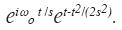
<body><![CDATA[<p align="justify"><font face="verdana" size="2">Besides, the correlational analysis, it was found in PI and PII (<a href="/img/revistas/geoint/v47n3/a14f1.jpg" target="_blank">Figs. 1</a> and 5 respectively) that the yearly change of the Total Energy released from all type of cyclones together, has an interesting sinusoid form, with a period around 30 years. Tropical Cyclones (TC) landing into Mexico show a similar cyclic behavior of 30 years (Figs. 12 and 6 in PI and PII respectively). It is worth mentioning that an analysis of the total number of TC and the number of category 4&#150;5 (Saffir&#150;Simpson scale), in the Northwest Pacific basin, also shows such a cyclic behavior around 30 years (Webster <i>et al.</i>, 2006).Similarly occurs with other indexes of TC intensity, as for instance the Potential Destruction index (PDI) (Chan, 2006). Besides, we had evidenced for the first time, with coherence analysis, such a periodicity of 30 years between RC and Hurricanes (P&eacute;rez&#150;Peraza <i>et al.</i>, 2008) and with AMO, SST and Hurricanes, (P&eacute;rez&#150;Peraza <i>et al.</i>, 2007). On the other hand Velasco <i>et al.</i> (2007, 2008) found the same frequency between CR (the Be10 proxy and the earth surface temperature in the North Hemisphere (Velasco, 2008).Therefore we will refer here after as the PP&#150;VV Cycle for the 30 years periodicity.</font></p>     <p align="justify"><font face="verdana" size="2">It should be appreciated in figures of the papers PI and PII (1 and 12 respectively) the regularity exhibited between the outstanding peaks of cyclonic energy, and the rise and fall periods of the 20th solar cycle, as well as the tendency of coincidence peaks of cyclonic energy with rise and fall periods during other solar cycles; at this regard, it should be reminded that active processes on the Sun: CME, flares and related phenomena to them, as Forbush effects and geomagnetic storms, have also the occurrence peaks on the rise and decline phases of a solar cycle. One would expect then, that the selective account of cosmophysical factors would allow obtaining better correlation dependences.</font></p>     <p align="justify">&nbsp;</p>     <p align="justify"><font face="verdana" size="2"><b>The morlet wavelet spectral analysis</b></font></p>     <p align="justify"><font face="verdana" size="2">The correlational analysis developed in the mentioned works (PI, PIII, PIV, PV) indicates the possibility of a certain relation between two time series, however, this is of global nature and does not furnish us precise information about when such a relation occurs: the fact that two data series (cosmophysical and climatic) have similar periodicities does not necessarily implies that one is the cause and the other the effect; besides, even if the correlation coefficient is very low, that does not means that there is no relation. In fact, there is the possibility that such a relation could be of non&#150;linear nature, or that there is a strong phase shift between the cosmophysical phenomenon and the plausible associated terrestrial effect.</font></p>     <p align="justify"><font face="verdana" size="2">The spectral analysis to investigate common periodicities between two series of data is the Fourier Transform. However, though useful for stationary time series, this method is not appropriate for time series that are not of stationary nature.</font></p>     <p align="justify"><font face="verdana" size="2">A way to analyze two non&#150;stationary time series, to discern whether there is a lineal or non linear relation, is by means of the Coherence Wavelet Method. This furnishes valuable information about when and which periodicity do coincide in time, and about its nature, lineal or non linear relation between the extraterrestrial and terrestrial phenomena, provided there is not a noticeable diphase among them. The Morlet wavelet consists of a complex exponential modulated by a Gaussian</font></p>     <p align="justify"><font face="verdana" size="2"><img src="/img/revistas/geoint/v47n3/a14s1.jpg"></font></p>     <p align="justify"><font face="verdana" size="2">where <i>t</i> is the time, with</font></p>     <p align="justify"><font face="verdana" size="2"><i>s</i> = 1/frecuency and <i>&omega;<sub>0</sub></i> is a non&#150;dimensional frequency (we use here <i>&omega;<sub>0</sub></i>= 6) (Torrence and Compo, 1998).</font></p>     ]]></body>
<body><![CDATA[<p align="justify"><font face="verdana" size="2"><img src="/img/revistas/geoint/v47n3/a14s2.jpg"></font></p>     <p align="justify"><font face="verdana" size="2">For the Wavelet spectrum, we estimate the significance level for each scale, using only values inside the cone of influence (COI). COI is the region of the wavelet spectrum where edge effects become important: it is defined as the e&#150;folding time for the autocorrelation at each scale of the wavelet power. This e&#150;folding time is chosen such that, the wavelet power for a discontinuity at the edge drops by a factor e&#150;2, and ensures that the edge effects are negligible beyond that point (Torrence and Compo, 1998). To determine significance levels of the global wavelet power spectrum, it is necessary to choose an appropriate background spectrum.</font></p>     <p align="justify"><font face="verdana" size="2">The <i>Coherence</i> is defined as the cross&#150;spectrum normalized to an individual power spectrum. It is a number between 0 and 1, and gives a measurement of the cross&#150;correlation between two time&#150;series and a frequency function. The wavelet squared coherency is a measure of the intensity of the covariance of the two series in time&#150;frequency space (Torrence and Compo, 1998): it is used to identify frequency bands within which two time series are covarying.</font></p>     <p align="justify"><font face="verdana" size="2">If the coherence between two series is high, the arrows in the coherence spectra show the phase between the phenomena: arrows at 0&deg; (horizontal right) indicate that both phenomena are in phase and arrows at 180&deg; (horizontal left) indicating that they are in anti&#150;phase.</font></p>     <p align="justify"><font face="verdana" size="2">It is important to point out that these two cases imply a linear relation between the considered phenomena. Non horizontal arrows indicate an out of phase situation, meaning that the two phenomena do not have a linear relation but a more complex relationship.</font></p>     <p align="justify"><font face="verdana" size="2">Based on the previous explanations, we may state that the wavelet coherence is especially useful in highlighting the time and frequency intervals where two phenomena have a strong interaction. Such a spectral analysis should be done in an exhaustive study with data of cosmic rays, solar indexes (Wolf number, Radio in 10.3 cm, coronal holes) versus hurricane parameters (vorticity, linear velocity, duration, energy, PDI, ACE, storm intensity) as well as with climatic phenomena, presumable associated with hurricanes, as for instance the Atlantic Multidecal Oscillation AMO (Goldenberg <i>et al.</i>, 2001), the sea surface temperature (SST), the lower tropospheric moist static energy, the Dust cover of African Outbreaks (Evan <i>et al.</i>, 2006; Lau and Kim, 2007; Chronis <i>et al.</i>, 2007). Here, we limit our study to Cosmic Rays (through a proxy, the Be10) and Solar Activity, through sunspots (SS) versus terrestrial phenomena, that are generally assumed to be involved in Hurricane development, namely AMO and SST, as well as the Dust cover originated in African dust outbreaks phenomena.</font></p>     <p align="justify">&nbsp;</p>     <p align="justify"><font size="2" face="verdana"><b>Data and results</b></font></p>     <p align="justify"><font face="verdana" size="2">We assume here that, if there is a good interconnection between the studied terrestrial phenomena and hurricanes, and on the other hand, there is a good interconnection between these terrestrial phenomena and cosmophysical phenomena, therefore it should be also a good interconnection between hurricanes and cosmophysical phenomena.</font></p>     <p align="justify"><font face="verdana" size="2">To assess the long&#150;term relations between space phenomena and indicators of the global climate, it is necessary to use reconstructions of Galactic Cosmic Rays (CR), solar activity (SS) and climate phenomena. Direct measurements of solar activity based on sunspot numbers exist since 1749, and trustable CR data is only available since the 1950's decade. Records of climatic phenomena exist from the end of the 19th century.</font></p>     ]]></body>
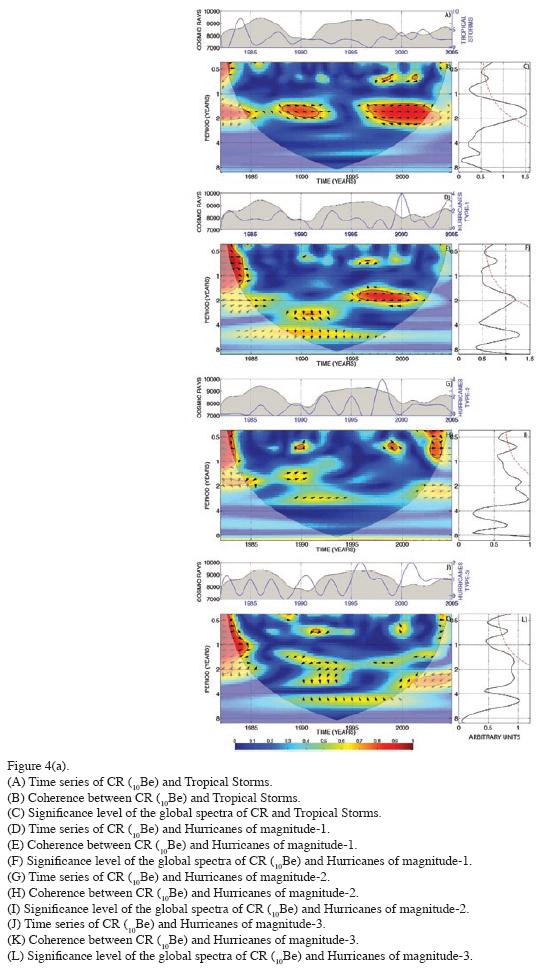
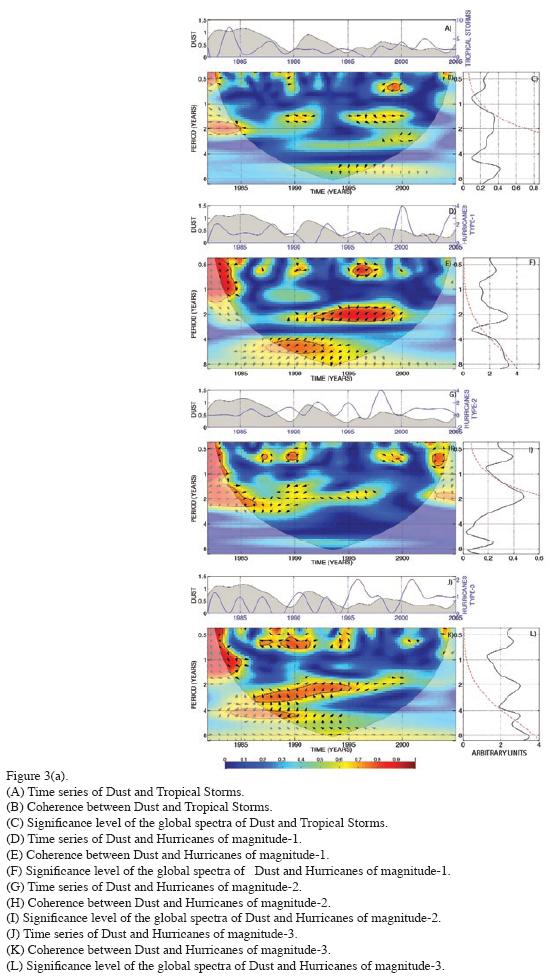
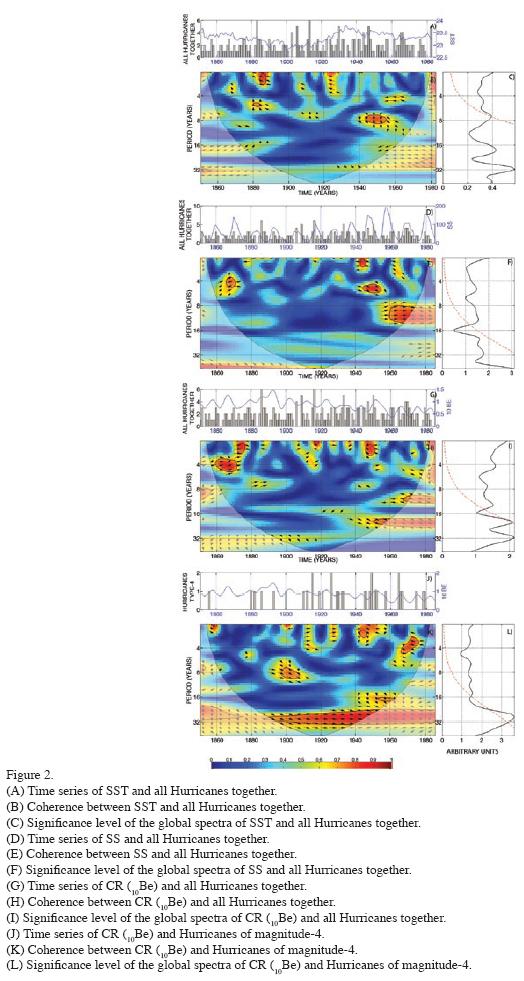
<body><![CDATA[<p align="justify"><font face="verdana" size="2">For the AMO we use here annual time series data between 1851&#150; 1985, obtained from the World Data Center for Paleoclimatology: (<a href="http://www.ncdc.noaa.gov/paleo/paleo.html" target="_blank">http://www.ncdc.gov/paleo/</a> ).</font></p>     <p align="justify"><font face="verdana" size="2">For Solar Activity we use the daily number of Sun Spots number (SS):</font></p>     <p align="justify"><font face="verdana" size="2"><a href="http://www.ngdc.noaa.gov/stp/SOLAR/ftpsunspotnumber.html#american" target="_blank">http://www.ngdc.noaa.gov/stp/SOLAR/ftpsunspotnumber.html#american</a>).</font></p>     <p align="justify"><font face="verdana" size="2">Data on Sea&#150;Surface temperature in the Atlantic are given in the literature as Temperature Anomalies: for the period 1851&#150;2005.we used data from:(<a href="ftp://ftp.ncdc.noaa.gov/pub/data/paleo/treering/reconstructions/amo-gray2004.txt" target="_blank">ftp://ftp.ncdc.noaa.gov/pub/data/paleo/treering/reconstructions/amo&#150;gray2004.txt</a>).</font></p>     <p align="justify"><font face="verdana" size="2">Concerning the <sup>10</sup>Be, there is a polemic about whether it can be considered as a Proxy of Galactic Cosmic Rays (Stozhkov <i>et al.</i>, 2004; Stozhkov, 2007). A number of re&#150;searchers still support the use of <sup>10</sup>Be as a Proxy of CR (Wagner <i>et al.</i>, 2000; McCracken, 2001; MacCracken and MacDonald, 2001; Usoskin, 2005; Usoskin and Kovaltzov, 2007) etc. Under this last context we have considered the <sup>10</sup>Be concentration in the Dye 3 ice core (65.2 N, 43.8 W, 2477 m. altitude) from Beer <i>et al.</i> (1990), which data for the period 1851&#150;1985 were offered by the author to one of us (VV).</font></p>     <p align="justify"><font face="verdana" size="2">Regarding data of Hurricanes the WEB page <a href="http://weather.unisys.com/hurricane/" target="_blank">http://weather.unisys.com/hurricane/</a> has been considered.</font></p>     <p align="justify"><font face="verdana" size="2">Results of our analysis are displayed through <a href="/img/revistas/geoint/v47n3/a14f1.jpg" target="_blank">Fig. 1</a> to Fig. 4. (<a href="#f4a">Fig.4a</a> and <a href="/img/revistas/geoint/v47n3/a14f4b.jpg" target="_blank">Fig.4b</a>). The upper panel of each figure shows the time series of the involved data. The power level color code used throughout this paper is indicated at the bottom of each panel. Areas inside black contours correspond to the 95% significance level. As we are working with two time series, the wavelet coherence and phase difference are obtained. The wavelet coherence is especially useful in highlighting the time and frequency intervals where two phenomena have a strong interaction. We also include the global spectra, which is an average of the power of each periodicity in the wavelet, or, wavelet coherence spectra It allows us to notice at a glance the global periodicities of either the time series or the coherence analysis. The significance level of the global spectra is indicated by the dashed curves (on the right blocks of each figure). It refers to the power of the red noise level at the 95% of confidence. Peaks below the line implies a global periodicity with a confidence lower than 95% at the corresponding frequency, whereas peak for above indicates a confidence level higher than 95% at the given frequency. Spectral power (abscissa axis) is given in arbitrary units.</font></p>     <p align="center"><font face="verdana" size="2"><a name="f4a"></a></font></p>     <p align="center"><font face="verdana" size="2"><img src="/img/revistas/geoint/v47n3/a14f4a.jpg"></font></p>     <p align="justify"><font face="verdana" size="2">a) There is a coherence of 0.95 inside the COI between the AMO and SST anomalies through the band of 15&#150;32 years, in the time interval 1900&#150;1980 (<a href="/img/revistas/geoint/v47n3/a14f1.jpg" target="_blank">Figs. 1B and 1C</a>). The oscillation in the 30 years frequency is completely in phase, indicating a lineal relation among both phenomena, which is not surprising because is something very well known by climate specialists</font></p>     ]]></body>
<body><![CDATA[<p align="justify"><font face="verdana" size="2">b) There is an anti&#150;phase linear coherence &lt; 0.70 inside the COI between the AMO and SS at the 11years frequency, in limited time intervals (1870&#150;1890 and 1980&#150;1990). There is a coherence of 0.6 between the SST anomalies and SS, also limited to short intervals, 1895&#150;1910 1945&#150;1960 at the frequency of 11 years with tendency to be in antiphase, and 1940&#150;1980 at the 22 years frequency, with tendency to be in phase (<a href="/img/revistas/geoint/v47n3/a14f1.jpg" target="_blank">Figs. 1Ee and 1F</a>). It can be seen from these figures, as well as in <a href="#f2">Figs. 2E and 2F,</a> that no frequency at the 30 years periodicity was found for Solar Activity (at least through the use of SS), by means of the wavelet spectral analysis.</font></p>     <p align="center"><font face="verdana" size="2"><a name="f2"></a></font></p>     <p align="center"><font face="verdana" size="2"><img src="/img/revistas/geoint/v47n3/a14f2.jpg"></font></p>     <p align="justify"><font face="verdana" size="2">c) There is a coherence of 0.90 inside the COI between SST anomalies and <sup>10</sup>Be (the CR proxy) at the 30 years frequency, in the time interval 1920&#150;1950 (<a href="/img/revistas/geoint/v47n3/a14f1.jpg" target="_blank">Figs. 1H and 1I</a>) for the case of SST anomalies. The oscillations have a tendency to be quasi&#150;perpendicular, indicating a complex relation among both terrestrial phenomena and CR. It can be mentioned that the same frequency is found among AMO and <sup>10</sup>Be in the period 1870&#150;1950, but with a lower coherence of ~ 0.75 (Fig. 6a in Velasco and Mendoza, 2008).</font></p>     <p align="justify"><font face="verdana" size="2">d) There is a coherence of 0.90 inside the COI at the 7 years frequency, between the total number of hurricanes (i.e., including all magnitudes from TS to all together) and the SST anomalies, in the time interval 1945&#150;1955. This is illustrated in <a href="#f2">Figs. 2B and 2C</a>, for the case of SST anomalies. The oscillations have a tendency to be in anti&#150;phase, indicating a lineal relation of both phenomena with hurricanes.</font></p>     <p align="justify"><font face="verdana" size="2">e) The coherence between SS and Hurricanes of all magnitudes together is about 0.9, limited at the frequency of 11 years during the period 1955&#150;1965, (<a href="#f2">Figs. 2E and 2F</a>). However, the analysis of SS vs. hurricanes of individual magnitudes gives relatively low values of coherence inside the COI.</font></p>     <p align="justify"><font face="verdana" size="2">f) The coherence at the frequency of 30 years, between CR (through the proxy (<sup>10</sup>B) with hurricanes of all magnitudes together is about 0.6 in the period 1890&#150;1940 (<a href="#f2">Figs. 2H and 2I</a>). In contrast those of 5, 11, and 22 reach a coherence of 0.9 in the intervals 1860&#150;1870, 1960&#150;1970 and 1950&#150;1960 respectively.</font></p>     <p align="justify"><font face="verdana" size="2">g) For some hurricanes, as for instance those of magnitude&#150;4, the coherence with CR (<sup>10</sup>B) is &gt; 0.9 at the 30 years frequency, during a relatively long period, 1890&#150;1950 (<a href="#f2">Figs. 2K and 2L</a>). In these cases there is a tendency of the oscillations to be in&#150;phase, indicating a linear relationship among both phenomena.</font></p>     <p align="justify">&nbsp;</p>     <p align="justify"><font size="2" face="verdana"><b>Influence on cyclones: cr vs. dust</b></font></p>     ]]></body>
<body><![CDATA[<p align="justify"><font face="verdana" size="2">In order to rise the relevance of extraterrestrial influence on hurricane phenomena, it is needed a frame of reference. We consider here, as such a frame a terrestrial phenomenon which is well established to be related with cyclone development, as is the case of the Dust Cover originated in African Dust Outbreaks (e.g., Evan <i>et al.</i>, 2006, Lau and Kim, 2007, Chronis et al., 2007). At this regard we have done a spectral analysis of coherence, by the wavelet method mentioned before, for Atlantic tropical cyclones of all categories together, versus cosmic rays, and versus African Dust Outbreaks, for the period worked out in the previously mentioned works on Dust Outbreaks (1982&#150;2005).</font></p>     <p align="justify"><font face="verdana" size="2">It should be mentioned that results presented in <a href="/img/revistas/geoint/v47n3/a14f1.jpg" target="_blank">Figs. 1</a> and <a href="#f2">2</a> correspond to a long term analysis, whereas those displayed in Figs. 3(<a href="#f3a">Fig.3a</a> and <a href="/img/revistas/geoint/v47n3/a14f3b.jpg" target="_blank">3b</a>) &#150;Fig. 4 (<a href="#f4a">Fig. 4a</a> and <a href="/img/revistas/geoint/v47n3/a14f4b.jpg" target="_blank">4b</a>) correspond to the short period just mentioned.</font></p>     <p align="center"><font face="verdana" size="2"><a name="f3a"></a></font></p>     <p align="center"><font face="verdana" size="2"><img src="/img/revistas/geoint/v47n3/a14f3a.jpg"></font></p>     <p align="justify"><font face="verdana" size="2">It can be seen from <a href="/img/revistas/geoint/v47n3/a14f4b.jpg" target="_blank">Figs. 4(b)&#150;T and 4(b)&#150;U</a> that the coherence between all kind of Atlantic hurricanes together (from Tropical Storms up to magnitude&#150;5) and cosmic rays (<sub>10</sub>B) is quite good for long periods, at the 1.3 and 1.7 yrs frequencies. Variations seem to be in phase from 1987 to 1991 with coherence of 0.6, and suddenly they switch to antiphase during 1996&#150;2002, with coherence higher than 0.9. In contrast, on <a href="/img/revistas/geoint/v47n3/a14f3b.jpg" target="_blank">Figs. 3(b)&#150;T and 3(B)</a>&#150;u it is shown that the coherence between all kind of Atlantic hurricanes together and the African Dust Outbreaks is lower than with CR (around 0.7), and it is concentrated around the 1.3 and 2 years periodicities, for long time periods, with complex non&#150;linear phases. Moreover, it should be mentioned that the red noise of the confidence level of the global spectrum in <a href="/img/revistas/geoint/v47n3/a14f3b.jpg" target="_blank">Fig. 3(b)&#150;U</a> is not shown, because it is far above the frequency picks. It can also be seen on <a href="#f3a">Figs. 3(a)&#150;B, 3(a)&#150;C</a>, <a href="#f4a">4(a)&#150;B</a> and <a href="#f4a">4(a)&#150;C</a> for Tropical Storms, that the situation is similar, i.e., the coherence is higher with CR than with Dust.</font></p>     <p align="justify"><font face="verdana" size="2">It can be appreciated from <a href="#f3a">Figs. 3(a)&#150;E, 3(a)&#150;F</a>, <a href="#f4a">4(a)&#150;E and 4(a)&#150;F</a> for hurricanes of magnitude&#150;1, that the coherence at the frequencies of 0.7 and 2 years is more or less of the same order, around 0.9, for both Dust and CR, but for longer periods with Dust. For Hurricanes of magnitude&#150;2 the coherence with CR at about 0.7 years is near 0.9, again stronger than with Dust &#91;<a href="#f3a">Figs. 3(a)&#150;H, 3(a)&#150;I</a>,<a href="#f4a"> 4(a)&#150;H and 4(a)&#150;I&#93;</a>. At the periodicity of 2 years the coherence with dust (about 0.6) is higher than with RC. Also from <a href="#f3a">Figs. 3(a)&#150;K, 3(a)&#150;L</a>, <a href="#f4a">4(a)&#150;K and 4(a)&#150;L</a>, we can see that, for hurricanes of Magnitude&#150;3 the coherence for the band 0.5&#150;1 years, for both Dust and CR, is about 0.9; though, the periodicity of 2 years is very well defined for Dust, but not for RC. For Hurricanes of Magnitude&#150;4 the coherence with CR at the periodicity of 1.7 years takes longer time intervals than with Dust (<a href="/img/revistas/geoint/v47n3/a14f3b.jpg" target="_blank">Figs. 3(b)&#150;N, 3(b)</a>&#150;O, <a href="/img/revistas/geoint/v47n3/a14f4b.jpg" target="_blank">4(b)&#150;N and 4(b)&#150;O</a>). For the more dangerous hurricanes, those of magnitude&#150;5 we can see from <a href="/img/revistas/geoint/v47n3/a14f3b.jpg" target="_blank">Figs. 3(b)&#150;Q, 3(b)</a>&#150;R, <a href="/img/revistas/geoint/v47n3/a14f4b.jpg" target="_blank">4(b)&#150;Q and 4(b)&#150;R</a> that, the coherence at the frequencies of 0.7, 1.7 and 3 years is much better with CR than with Dust. Again for all the Hurricanes together the coherence is 0.9 at the 1.7 years, higher than with dust 0.65 at the 2 years periodicity. Summarizing, with the exception of the cases of Hurricanes of magnitude 1, 2 and 3 (which are not the more dangerous), the coherence is higher with CR than with Dust for TS (which are the most frequent events), for Hurricanes of Magnitude 4 and 5 (which are the more dangerous) and for All Hurricanes together.</font></p>     <p align="justify">&nbsp;</p>     <p align="justify"><font size="2" face="verdana"><b>Conclusions</b></font></p>     <p align="justify"><font face="verdana" size="2">The spectral analysis carried out here for the study of common periodicities among Cosmic Rays and pheno&#150;mena which are presumably associated with Hurricanes (AMO and SST&#150;anomalies) is in agreement with previous results of papers PI and PII. We find again that the PP&#150;VV frequency of 30 years is often present (<a href="/img/revistas/geoint/v47n3/a14f1.jpg" target="_blank">Figs 1(B), 1(H)</a>, <a href="#f2">Fig. 2(K)</a>) with exception of SS. It should be mentioned that no figure with Dust (Fig.3 <a href="#f3a">Fig.3a</a> and <a href="/img/revistas/geoint/v47n3/a14f3b.jpg" target="_blank">3b</a>) shows the 30 year periodicity, because data of Dust only cover 23 years. Obviously, <a href="#f4a">Fig. 4a</a> and <a href="/img/revistas/geoint/v47n3/a14f4b.jpg" target="_blank">4b</a> cannot show such a periodicity, because we only consider data for the same lapse of 23 years; but, such a periodicity is present in CR vs. Hurricanes of the most dangerous magnitudes as was shown in P&eacute;rez&#150;Peraza <i>et al.</i> (2007) for Hurricanes of Type&#150;4, since confident data on type&#150;5 exist only since 1980. It should be mentioned that this frequency is also found in other indexes of hurricane activity, as mentioned in papers PI and PII. The applied Morlet technique allows us to put in evidence the periodicity of 30 years in cosmic ray fluctuations. Preliminarily, we speculate that this PP&#150;VV cycle may be associated to a semi&#150;phase (either of the maximum or the minimum) of the Secular Cycle of 120 years of Solar Activity, that is, half of the so called Yoshimura&#150;Gleissberg cycles (Yoshimura, 1979;Velasco and Mendoza, 2008).</font></p>     <p align="justify"><font face="verdana" size="2">If the coherence at the later frequency with other phenomena may be interpreted as a modulator factor, then, from the analysis of the previous results, it can be said that the modulator agent of terrestrial phenomena is the open solar magnetic field, translated in CR (via the <sup>10</sup>Be). It seems then, that CR are modulating in some way both the AMO and SST (Figs. 1H and 1I), and these in turn modulate in some way hurricanes, as it can be seen from the Coherence Wavelet Analysis (<a href="#f2">Figs. 2B and 2C</a>); this confirms the conventional statement of hurricanes to be linked to warmer oceans. It should be appreciated the good coherence between CR (<sup>10</sup>Be) and hurricanes of all magnitude, particularly with those of magnitude&#150;4 (<a href="#f2">Figs. 2K and 2L</a>). In contrast, the indicator of closed solar magnetic field (via SS) does not present the 30 year periodicity, and only presents within the COI, a very low and attenuated coherence with terrestrial phenomena, at the frequencies of 3.5, 5, 7, 11 and 22 years (<a href="/img/revistas/geoint/v47n3/a14f1.jpg" target="_blank">Figs. 1E, 1F, 2E and 2F</a>).</font></p>     ]]></body>
<body><![CDATA[<p align="justify"><font face="verdana" size="2">Though it is well known that cosmic rays and solar activity phenomena are inversely related in time, such a relation is not directly translated on their influence on hurricanes development. The temporal scale of their influence is certainly different: cosmic rays influence is a relatively prompt effect, whereas solar activity seems to act as a result of a slower buildup effect (P&eacute;rez&#150;Peraza, 1990).</font></p>     <p align="justify"><font face="verdana" size="2">In order to estimate the relevance of cosmophysical influence on hurricane activity we have compared it with the African Dust outbreaks <a href="#f3a">(Figs. 3a</a> and <a href="/img/revistas/geoint/v47n3/a14f3b.jpg" target="_blank">3b</a>&#150;<a href="#f4a">4a</a> and <a href="/img/revistas/geoint/v47n3/a14f4b.jpg" target="_blank">4b</a>) and found that the coherence at similar frequencies is better with CR than with dust, with exception of Hurricanes of magnitude 1, 2 and 3. CR and Hurricane phenomena present a linear correlation, whereas Dust and Hurricane phenomena present a non&#150;linear complex correlation. We conclude that Cosmophysical influences cannot be disregarded, and may eventually become of the same order of importance or even more that some terrestrial effects.</font></p>     <p align="justify"><font face="verdana" size="2">Finally, we would like to state that though we cannot say in a conclusive way, that CR modulates the AMO and SST, we must keep in mind that the AMO has intrinsic periodicities (at least since 1572) at 30, 60, 100 (Velasco and Mendoza, 2008) and the AMO is in turn a modulator of the SST (Sutton and Hudson, 2005). Because, the only other phenomena that we know that present such periodicities are SS and CR, we infer that such a modulation of AMO and SST may be related to one or both cosmophysical phenomena.</font></p>     <p align="justify">&nbsp;</p>     <p align="justify"><font face="verdana" size="2"><b>Bibliography</b></font></p>     <!-- ref --><p align="justify"><font face="verdana" size="2">Bell, J. T., S. Gussenhoven and E. G. Mullen, 1997. Super storms, <i>J. Geophys. Res., 102</i>, 14189&#150;14198.</font>&nbsp;&nbsp;&nbsp;&nbsp;&nbsp;&nbsp;&nbsp;&nbsp;[&#160;<a href="javascript:void(0);" onclick="javascript: window.open('/scielo.php?script=sci_nlinks&ref=3925355&pid=S0016-7169200800030001400001&lng=','','width=640,height=500,resizable=yes,scrollbars=1,menubar=yes,');">Links</a>&#160;]<!-- end-ref --><!-- ref --><p align="justify"><font face="verdana" size="2">Benestad, R. E., 2006. Solar Activity and Earth's Climate, Springer, Praxis Publish. Ltd., UK.</font>&nbsp;&nbsp;&nbsp;&nbsp;&nbsp;&nbsp;&nbsp;&nbsp;[&#160;<a href="javascript:void(0);" onclick="javascript: window.open('/scielo.php?script=sci_nlinks&ref=3925356&pid=S0016-7169200800030001400002&lng=','','width=640,height=500,resizable=yes,scrollbars=1,menubar=yes,');">Links</a>&#160;]<!-- end-ref --><!-- ref --><p align="justify"><font face="verdana" size="2">Beer, J., A. Blimov, G. Bonani, H. J. Hofman and Finkel, 1990. <i>Nature 347</i>, 164.</font>&nbsp;&nbsp;&nbsp;&nbsp;&nbsp;&nbsp;&nbsp;&nbsp;[&#160;<a href="javascript:void(0);" onclick="javascript: window.open('/scielo.php?script=sci_nlinks&ref=3925357&pid=S0016-7169200800030001400003&lng=','','width=640,height=500,resizable=yes,scrollbars=1,menubar=yes,');">Links</a>&#160;]<!-- end-ref --><!-- ref --><p align="justify"><font face="verdana" size="2">Chan, J. C. L., 2006. Comment on "Changes in Tropical Cyclone Number, Duration, and Intensity in a Warming Environment", <i>Science 311</i>, 1713a.</font>&nbsp;&nbsp;&nbsp;&nbsp;&nbsp;&nbsp;&nbsp;&nbsp;[&#160;<a href="javascript:void(0);" onclick="javascript: window.open('/scielo.php?script=sci_nlinks&ref=3925358&pid=S0016-7169200800030001400004&lng=','','width=640,height=500,resizable=yes,scrollbars=1,menubar=yes,');">Links</a>&#160;]<!-- end-ref --><!-- ref --><p align="justify"><font face="verdana" size="2">Chernavskaya, M. M., N. K. Kononova and T. E. Val'Chuk, 2006. <i>Advances in Space Research 37(8)</i>, 1640.</font>&nbsp;&nbsp;&nbsp;&nbsp;&nbsp;&nbsp;&nbsp;&nbsp;[&#160;<a href="javascript:void(0);" onclick="javascript: window.open('/scielo.php?script=sci_nlinks&ref=3925359&pid=S0016-7169200800030001400005&lng=','','width=640,height=500,resizable=yes,scrollbars=1,menubar=yes,');">Links</a>&#160;]<!-- end-ref --><!-- ref --><p align="justify"><font face="verdana" size="2">Cook, E. R., D. M. Meko and C. W. Stockton, 1997. <i>J. Climate 10</i>, 1343.</font>&nbsp;&nbsp;&nbsp;&nbsp;&nbsp;&nbsp;&nbsp;&nbsp;[&#160;<a href="javascript:void(0);" onclick="javascript: window.open('/scielo.php?script=sci_nlinks&ref=3925360&pid=S0016-7169200800030001400006&lng=','','width=640,height=500,resizable=yes,scrollbars=1,menubar=yes,');">Links</a>&#160;]<!-- end-ref --><!-- ref --><p align="justify"><font face="verdana" size="2">Chronis, T., E. Williams and W. Petersen, 2007. EOS, Transactions, <i>AGU, 88(40)</i>, 397.</font>&nbsp;&nbsp;&nbsp;&nbsp;&nbsp;&nbsp;&nbsp;&nbsp;[&#160;<a href="javascript:void(0);" onclick="javascript: window.open('/scielo.php?script=sci_nlinks&ref=3925361&pid=S0016-7169200800030001400007&lng=','','width=640,height=500,resizable=yes,scrollbars=1,menubar=yes,');">Links</a>&#160;]<!-- end-ref --><!-- ref --><p align="justify"><font face="verdana" size="2">Dorman, L. I., 2006. <i>Advances in Space Research 37 (8)</i>, 1621.</font>&nbsp;&nbsp;&nbsp;&nbsp;&nbsp;&nbsp;&nbsp;&nbsp;[&#160;<a href="javascript:void(0);" onclick="javascript: window.open('/scielo.php?script=sci_nlinks&ref=3925362&pid=S0016-7169200800030001400008&lng=','','width=640,height=500,resizable=yes,scrollbars=1,menubar=yes,');">Links</a>&#160;]<!-- end-ref --><!-- ref --><p align="justify"><font face="verdana" size="2">Evan, A. T., J. Dunion, J. A. Foley, C. S. Heidinger and A. K. Velden, 2006. <i>Geophys. Res. Lett. 33</i>, L19813, doi.10.1029/2006GL026408.</font>&nbsp;&nbsp;&nbsp;&nbsp;&nbsp;&nbsp;&nbsp;&nbsp;[&#160;<a href="javascript:void(0);" onclick="javascript: window.open('/scielo.php?script=sci_nlinks&ref=3925363&pid=S0016-7169200800030001400009&lng=','','width=640,height=500,resizable=yes,scrollbars=1,menubar=yes,');">Links</a>&#160;]<!-- end-ref --><!-- ref --><p align="justify"><font face="verdana" size="2">Fastrup, E., E. Pedersen, E. Lillestol, <i>et al.</i>, 2001. A Study of the Link between Cosmic Rays and Clouds with a Cloud Chamber at the CERN PS, Los Alamos National Laboratory arXiv:physics/0104048 v1, 1&#150;111.</font>&nbsp;&nbsp;&nbsp;&nbsp;&nbsp;&nbsp;&nbsp;&nbsp;[&#160;<a href="javascript:void(0);" onclick="javascript: window.open('/scielo.php?script=sci_nlinks&ref=3925364&pid=S0016-7169200800030001400010&lng=','','width=640,height=500,resizable=yes,scrollbars=1,menubar=yes,');">Links</a>&#160;]<!-- end-ref --><!-- ref --><p align="justify"><font face="verdana" size="2">Gierenes, K. and M. Ponate, 1999. <i>JASTP 61(11)</i>, 795&#150;797.</font>&nbsp;&nbsp;&nbsp;&nbsp;&nbsp;&nbsp;&nbsp;&nbsp;[&#160;<a href="javascript:void(0);" onclick="javascript: window.open('/scielo.php?script=sci_nlinks&ref=3925365&pid=S0016-7169200800030001400011&lng=','','width=640,height=500,resizable=yes,scrollbars=1,menubar=yes,');">Links</a>&#160;]<!-- end-ref --><!-- ref --><p align="justify"><font face="verdana" size="2">Gray, L. J., J. D. Haigh and R. G. Harrison, 2005. The influence of solar changes on the Earth's climate, Hadley Centre technical note 62, Publisher: MET Office, pp. 1&#150;81.</font>&nbsp;&nbsp;&nbsp;&nbsp;&nbsp;&nbsp;&nbsp;&nbsp;[&#160;<a href="javascript:void(0);" onclick="javascript: window.open('/scielo.php?script=sci_nlinks&ref=3925366&pid=S0016-7169200800030001400012&lng=','','width=640,height=500,resizable=yes,scrollbars=1,menubar=yes,');">Links</a>&#160;]<!-- end-ref --><!-- ref --><p align="justify"><font face="verdana" size="2">Haigh, J. D., M. Lockwood, M. S. Giampapa, 2005. The Sun, Solar Analogs and the Climate, Saas&#150;Fee. Advanced Course 34, Swiss Society for Astrophysics and Astronomy, Springer&#150;Verlag, Berlin.</font>&nbsp;&nbsp;&nbsp;&nbsp;&nbsp;&nbsp;&nbsp;&nbsp;[&#160;<a href="javascript:void(0);" onclick="javascript: window.open('/scielo.php?script=sci_nlinks&ref=3925367&pid=S0016-7169200800030001400013&lng=','','width=640,height=500,resizable=yes,scrollbars=1,menubar=yes,');">Links</a>&#160;]<!-- end-ref --><!-- ref --><p align="justify"><font face="verdana" size="2">Tas van Ommen, J. P., M. Curran, V. Morgan, A. Smith and A. McMorrow, 2006. <i>J. Geophys. Res. 111</i>, 21105.</font>&nbsp;&nbsp;&nbsp;&nbsp;&nbsp;&nbsp;&nbsp;&nbsp;[&#160;<a href="javascript:void(0);" onclick="javascript: window.open('/scielo.php?script=sci_nlinks&ref=3925368&pid=S0016-7169200800030001400014&lng=','','width=640,height=500,resizable=yes,scrollbars=1,menubar=yes,');">Links</a>&#160;]<!-- end-ref --><!-- ref --><p align="justify"><font face="verdana" size="2">Kanipe, J., 2006. Climate change. A cosmic connection. <i>Nature 443, (7108)</i>,141&#150;143.</font>&nbsp;&nbsp;&nbsp;&nbsp;&nbsp;&nbsp;&nbsp;&nbsp;[&#160;<a href="javascript:void(0);" onclick="javascript: window.open('/scielo.php?script=sci_nlinks&ref=3925369&pid=S0016-7169200800030001400015&lng=','','width=640,height=500,resizable=yes,scrollbars=1,menubar=yes,');">Links</a>&#160;]<!-- end-ref --><!-- ref --><p align="justify"><font face="verdana" size="2">Kavlakov, S., J. B. Elsner and J. P&eacute;rez&#150;Peraza, 2007a. Proc. 30<sup>th</sup> ICRC M&eacute;rida, Yucat&aacute;n, (in Press).</font>&nbsp;&nbsp;&nbsp;&nbsp;&nbsp;&nbsp;&nbsp;&nbsp;[&#160;<a href="javascript:void(0);" onclick="javascript: window.open('/scielo.php?script=sci_nlinks&ref=3925370&pid=S0016-7169200800030001400016&lng=','','width=640,height=500,resizable=yes,scrollbars=1,menubar=yes,');">Links</a>&#160;]<!-- end-ref --><!-- ref --><p align="justify"><font face="verdana" size="2">Kavlakov, S., J. B. Elsner and J. P&eacute;rez&#150;Peraza, 2007b. In Press, <i>Geof. Inter.</i></font>&nbsp;&nbsp;&nbsp;&nbsp;&nbsp;&nbsp;&nbsp;&nbsp;[&#160;<a href="javascript:void(0);" onclick="javascript: window.open('/scielo.php?script=sci_nlinks&ref=3925371&pid=S0016-7169200800030001400017&lng=','','width=640,height=500,resizable=yes,scrollbars=1,menubar=yes,');">Links</a>&#160;]<!-- end-ref --><!-- ref --><p align="justify"><font face="verdana" size="2">Kavlakov, S. and J. B. Elsner, 2007. Proc. 30<sup>th</sup>ICRC, M&eacute;rida, Yucat&aacute;n, (in Press).</font>&nbsp;&nbsp;&nbsp;&nbsp;&nbsp;&nbsp;&nbsp;&nbsp;[&#160;<a href="javascript:void(0);" onclick="javascript: window.open('/scielo.php?script=sci_nlinks&ref=3925372&pid=S0016-7169200800030001400018&lng=','','width=640,height=500,resizable=yes,scrollbars=1,menubar=yes,');">Links</a>&#160;]<!-- end-ref --><!-- ref --><p align="justify"><font face="verdana" size="2">Khorozov, S. V., V. I. Budovy, I. M. Martin, V. A. Medvedev and V. S. Belogolov, 2006. COSPAR, Beijing, TCI&#150; 0232; C4.2&#150;0056&#150;06.</font>&nbsp;&nbsp;&nbsp;&nbsp;&nbsp;&nbsp;&nbsp;&nbsp;[&#160;<a href="javascript:void(0);" onclick="javascript: window.open('/scielo.php?script=sci_nlinks&ref=3925373&pid=S0016-7169200800030001400019&lng=','','width=640,height=500,resizable=yes,scrollbars=1,menubar=yes,');">Links</a>&#160;]<!-- end-ref --><!-- ref --><p align="justify"><font face="verdana" size="2">Kristjansson, J. E., A. Staple, J. Kristiansen and E. Kaas, 2002. <i>GRL 29, (23)</i>, 2017, doi: 10.1029/2002GL015646.</font>&nbsp;&nbsp;&nbsp;&nbsp;&nbsp;&nbsp;&nbsp;&nbsp;[&#160;<a href="javascript:void(0);" onclick="javascript: window.open('/scielo.php?script=sci_nlinks&ref=3925374&pid=S0016-7169200800030001400020&lng=','','width=640,height=500,resizable=yes,scrollbars=1,menubar=yes,');">Links</a>&#160;]<!-- end-ref --><!-- ref --><p align="justify"><font face="verdana" size="2">Kudela, K, M. Storini, M. Y. Hofer and A. Belov, 2000. <i>Space Sci. Rev. 93</i>, 153.</font>&nbsp;&nbsp;&nbsp;&nbsp;&nbsp;&nbsp;&nbsp;&nbsp;[&#160;<a href="javascript:void(0);" onclick="javascript: window.open('/scielo.php?script=sci_nlinks&ref=3925375&pid=S0016-7169200800030001400021&lng=','','width=640,height=500,resizable=yes,scrollbars=1,menubar=yes,');">Links</a>&#160;]<!-- end-ref --><!-- ref --><p align="justify"><font face="verdana" size="2">Lau, W. K. M. and K. M. Kim, 2007. Eos Trans. <i>AGU, 88(9)</i>, 105.</font>&nbsp;&nbsp;&nbsp;&nbsp;&nbsp;&nbsp;&nbsp;&nbsp;[&#160;<a href="javascript:void(0);" onclick="javascript: window.open('/scielo.php?script=sci_nlinks&ref=3925376&pid=S0016-7169200800030001400022&lng=','','width=640,height=500,resizable=yes,scrollbars=1,menubar=yes,');">Links</a>&#160;]<!-- end-ref --><!-- ref --><p align="justify"><font face="verdana" size="2">Laut, P., 2003. <i>JASTP 65</i>, 801.</font>&nbsp;&nbsp;&nbsp;&nbsp;&nbsp;&nbsp;&nbsp;&nbsp;[&#160;<a href="javascript:void(0);" onclick="javascript: window.open('/scielo.php?script=sci_nlinks&ref=3925377&pid=S0016-7169200800030001400023&lng=','','width=640,height=500,resizable=yes,scrollbars=1,menubar=yes,');">Links</a>&#160;]<!-- end-ref --><!-- ref --><p align="justify"><font face="verdana" size="2">Mason, S. J. and P. D. Tyson, 1992. <i>J. Geophys. Res., Atmos. D5</i>, 5847.</font>&nbsp;&nbsp;&nbsp;&nbsp;&nbsp;&nbsp;&nbsp;&nbsp;[&#160;<a href="javascript:void(0);" onclick="javascript: window.open('/scielo.php?script=sci_nlinks&ref=3925378&pid=S0016-7169200800030001400024&lng=','','width=640,height=500,resizable=yes,scrollbars=1,menubar=yes,');">Links</a>&#160;]<!-- end-ref --><!-- ref --><p align="justify"><font face="verdana" size="2">Mavromichalaki, H., G. Souvatzoglou, C. Sarlanis, G. Mariatos, C. Plainaki, M. Gerontidou, A. Belov, E. Eroshenko and V. Yanke, 2006. <i>Advances in Space Research, 37(6),</i> 1141.</font>&nbsp;&nbsp;&nbsp;&nbsp;&nbsp;&nbsp;&nbsp;&nbsp;[&#160;<a href="javascript:void(0);" onclick="javascript: window.open('/scielo.php?script=sci_nlinks&ref=3925379&pid=S0016-7169200800030001400025&lng=','','width=640,height=500,resizable=yes,scrollbars=1,menubar=yes,');">Links</a>&#160;]<!-- end-ref --><!-- ref --><p align="justify"><font face="verdana" size="2">Mazzarella, A. and F. Palumbo, 1992. <i>Theoret. &amp; Applied Climatol. 45(3)</i>, 201, 1992.</font>&nbsp;&nbsp;&nbsp;&nbsp;&nbsp;&nbsp;&nbsp;&nbsp;[&#160;<a href="javascript:void(0);" onclick="javascript: window.open('/scielo.php?script=sci_nlinks&ref=3925380&pid=S0016-7169200800030001400026&lng=','','width=640,height=500,resizable=yes,scrollbars=1,menubar=yes,');">Links</a>&#160;]<!-- end-ref --><!-- ref --><p align="justify"><font face="verdana" size="2">Neff, U. S., J. Burns, A. Mangini, M. Mudelsee and D. Fleitmann, 2001. Matter A411 (6835): 290.</font>&nbsp;&nbsp;&nbsp;&nbsp;&nbsp;&nbsp;&nbsp;&nbsp;[&#160;<a href="javascript:void(0);" onclick="javascript: window.open('/scielo.php?script=sci_nlinks&ref=3925381&pid=S0016-7169200800030001400027&lng=','','width=640,height=500,resizable=yes,scrollbars=1,menubar=yes,');">Links</a>&#160;]<!-- end-ref --><!-- ref --><p align="justify"><font face="verdana" size="2">Ol', A. I., 1969. Reports of Arctic and Antarctic Research Institute (Trudy Arkticheskogo i Antarkticheskog).</font>&nbsp;&nbsp;&nbsp;&nbsp;&nbsp;&nbsp;&nbsp;&nbsp;[&#160;<a href="javascript:void(0);" onclick="javascript: window.open('/scielo.php?script=sci_nlinks&ref=3925382&pid=S0016-7169200800030001400028&lng=','','width=640,height=500,resizable=yes,scrollbars=1,menubar=yes,');">Links</a>&#160;]<!-- end-ref --><!-- ref --><p align="justify"><font face="verdana" size="2">P&eacute;rez&#150;Peraza, J., 1990. Space Plasma Physics (Invited Talk), Space Conference of the Americas: Perspectives of Cooperation for the Development, PNUD, San Jos&eacute; de Costarica, 1, 96&#150;113.</font>&nbsp;&nbsp;&nbsp;&nbsp;&nbsp;&nbsp;&nbsp;&nbsp;[&#160;<a href="javascript:void(0);" onclick="javascript: window.open('/scielo.php?script=sci_nlinks&ref=3925383&pid=S0016-7169200800030001400029&lng=','','width=640,height=500,resizable=yes,scrollbars=1,menubar=yes,');">Links</a>&#160;]<!-- end-ref --><!-- ref --><p align="justify"><font face="verdana" size="2">P&eacute;rez&#150;Peraza, J., S. Kavlakov, V. Velasco, A. Gallegos&#150;Cruz, E. Azpra&#150;Romero, O. Delgado&#150;Delgado and F. Villica&ntilde;a&#150;Cruz, 2007. Proc. 30th ICRC, M&eacute;rida, Yucat&aacute;n (in Press).</font>&nbsp;&nbsp;&nbsp;&nbsp;&nbsp;&nbsp;&nbsp;&nbsp;[&#160;<a href="javascript:void(0);" onclick="javascript: window.open('/scielo.php?script=sci_nlinks&ref=3925384&pid=S0016-7169200800030001400030&lng=','','width=640,height=500,resizable=yes,scrollbars=1,menubar=yes,');">Links</a>&#160;]<!-- end-ref --><!-- ref --><p align="justify"><font face="verdana" size="2">P&eacute;rez&#150;Peraza, J., S. Kavlakov, V. Velasco, A. Gallegos&#150;Cruz, E. Azpra&#150;Romero, O. Delgado&#150;Delgado and F. Villica&ntilde;a&#150;Cruz, 2008. <i>Journal of Advances in Space Research, 42</i> (in Press).</font>&nbsp;&nbsp;&nbsp;&nbsp;&nbsp;&nbsp;&nbsp;&nbsp;[&#160;<a href="javascript:void(0);" onclick="javascript: window.open('/scielo.php?script=sci_nlinks&ref=3925385&pid=S0016-7169200800030001400031&lng=','','width=640,height=500,resizable=yes,scrollbars=1,menubar=yes,');">Links</a>&#160;]<!-- end-ref --><!-- ref --><p align="justify"><font face="verdana" size="2">Pudovkin, M. I. and A. A. Lyubchich, 1989. <i>Geomagnetism and Aeronomy 29(3)</i>, 359.</font>&nbsp;&nbsp;&nbsp;&nbsp;&nbsp;&nbsp;&nbsp;&nbsp;[&#160;<a href="javascript:void(0);" onclick="javascript: window.open('/scielo.php?script=sci_nlinks&ref=3925386&pid=S0016-7169200800030001400032&lng=','','width=640,height=500,resizable=yes,scrollbars=1,menubar=yes,');">Links</a>&#160;]<!-- end-ref --><!-- ref --><p align="justify"><font face="verdana" size="2">Pudovkin, M. I. and O. M. Raspopov, 1992. <i>Geomagnetism and Aeronomy 32(5)</i>, 593.</font>&nbsp;&nbsp;&nbsp;&nbsp;&nbsp;&nbsp;&nbsp;&nbsp;[&#160;<a href="javascript:void(0);" onclick="javascript: window.open('/scielo.php?script=sci_nlinks&ref=3925387&pid=S0016-7169200800030001400033&lng=','','width=640,height=500,resizable=yes,scrollbars=1,menubar=yes,');">Links</a>&#160;]<!-- end-ref --><!-- ref --><p align="justify"><font face="verdana" size="2">Ramirez, J., B. Mendoza, V. Mendoza and J. Adem, 2004. <i>JASTP 66</i>, 1683.</font>&nbsp;&nbsp;&nbsp;&nbsp;&nbsp;&nbsp;&nbsp;&nbsp;[&#160;<a href="javascript:void(0);" onclick="javascript: window.open('/scielo.php?script=sci_nlinks&ref=3925388&pid=S0016-7169200800030001400034&lng=','','width=640,height=500,resizable=yes,scrollbars=1,menubar=yes,');">Links</a>&#160;]<!-- end-ref --><!-- ref --><p align="justify"><font face="verdana" size="2">Raisbeck, G. M. and F. Yiou, in The Ancient Sun: Fossil Record in the Earth, Moon and meteorites: Ed. by R.O. Peppin, J. A., Eddy and R. B. Merril, pp. 185&#150;190, Elsevier, New York.</font>&nbsp;&nbsp;&nbsp;&nbsp;&nbsp;&nbsp;&nbsp;&nbsp;[&#160;<a href="javascript:void(0);" onclick="javascript: window.open('/scielo.php?script=sci_nlinks&ref=3925389&pid=S0016-7169200800030001400035&lng=','','width=640,height=500,resizable=yes,scrollbars=1,menubar=yes,');">Links</a>&#160;]<!-- end-ref --> 				    <!-- ref --><p align="justify"><font face="verdana" size="2">Raisbeck, G. M. and F. Yiou, 2004. <i>Phys Rev Lett. 92</i>, 199001.</font>&nbsp;&nbsp;&nbsp;&nbsp;&nbsp;&nbsp;&nbsp;&nbsp;[&#160;<a href="javascript:void(0);" onclick="javascript: window.open('/scielo.php?script=sci_nlinks&ref=3925391&pid=S0016-7169200800030001400036&lng=','','width=640,height=500,resizable=yes,scrollbars=1,menubar=yes,');">Links</a>&#160;]<!-- end-ref --> 				    <!-- ref --><p align="justify"><font face="verdana" size="2">Raspopov, O. M., O. I. Shumilov, E. A. Kasatkina, E. Turunen, M. Lindholm and T. Kolstrom, 2001. <i>Geomagnetism and Aeronomy 41(3)</i>, 407.</font>&nbsp;&nbsp;&nbsp;&nbsp;&nbsp;&nbsp;&nbsp;&nbsp;[&#160;<a href="javascript:void(0);" onclick="javascript: window.open('/scielo.php?script=sci_nlinks&ref=3925393&pid=S0016-7169200800030001400037&lng=','','width=640,height=500,resizable=yes,scrollbars=1,menubar=yes,');">Links</a>&#160;]<!-- end-ref --> 				    <!-- ref --><p align="justify"><font face="verdana" size="2">Raspopov, O. M., V. A. Dergachev and T. Kolstrom, 2005. Solar Physics 224, 455, doi10.1007/s11207&#150;005&#150;5251&#150;8.</font>&nbsp;&nbsp;&nbsp;&nbsp;&nbsp;&nbsp;&nbsp;&nbsp;[&#160;<a href="javascript:void(0);" onclick="javascript: window.open('/scielo.php?script=sci_nlinks&ref=3925395&pid=S0016-7169200800030001400038&lng=','','width=640,height=500,resizable=yes,scrollbars=1,menubar=yes,');">Links</a>&#160;]<!-- end-ref --> 				    <!-- ref --><p align="justify"><font face="verdana" size="2">Rodrigo F. S., M. J. Esteban&#150;Parra, D. Pozo&#150;Vazquez, Y. Castro&#150;Diez, 2000. <i>Int. Journal of Climatology, 20(7)</i>, 721.</font>&nbsp;&nbsp;&nbsp;&nbsp;&nbsp;&nbsp;&nbsp;&nbsp;[&#160;<a href="javascript:void(0);" onclick="javascript: window.open('/scielo.php?script=sci_nlinks&ref=3925397&pid=S0016-7169200800030001400039&lng=','','width=640,height=500,resizable=yes,scrollbars=1,menubar=yes,');">Links</a>&#160;]<!-- end-ref --> 				    <!-- ref --><p align="justify"><font face="verdana" size="2">Roig, F. A., C. Le&#150;Quesne, J. A. Boninsegna, K. R. Briffa, A. Lara, H. Grudd, Ph. Jones and C. Villagran, 2001. <i>Nature 410</i>, 567.</font>&nbsp;&nbsp;&nbsp;&nbsp;&nbsp;&nbsp;&nbsp;&nbsp;[&#160;<a href="javascript:void(0);" onclick="javascript: window.open('/scielo.php?script=sci_nlinks&ref=3925399&pid=S0016-7169200800030001400040&lng=','','width=640,height=500,resizable=yes,scrollbars=1,menubar=yes,');">Links</a>&#160;]<!-- end-ref --> 				    <!-- ref --><p align="justify"><font face="verdana" size="2">Stozhkov Y. I., V. P. Okhlopkov and N. S. Svirzhevsky, 2004. <i>Solar Phys. 224(1)</i>, 323.</font>&nbsp;&nbsp;&nbsp;&nbsp;&nbsp;&nbsp;&nbsp;&nbsp;[&#160;<a href="javascript:void(0);" onclick="javascript: window.open('/scielo.php?script=sci_nlinks&ref=3925401&pid=S0016-7169200800030001400041&lng=','','width=640,height=500,resizable=yes,scrollbars=1,menubar=yes,');">Links</a>&#160;]<!-- end-ref --> 				    <!-- ref --><p align="justify"><font face="verdana" size="2">Stozhkov, Y. I, 2007. <i>Bulletin of the Lebedev Physical Institute 34(5)</i>, 135.</font>&nbsp;&nbsp;&nbsp;&nbsp;&nbsp;&nbsp;&nbsp;&nbsp;[&#160;<a href="javascript:void(0);" onclick="javascript: window.open('/scielo.php?script=sci_nlinks&ref=3925403&pid=S0016-7169200800030001400042&lng=','','width=640,height=500,resizable=yes,scrollbars=1,menubar=yes,');">Links</a>&#160;]<!-- end-ref --> 				    <!-- ref --><p align="justify"><font face="verdana" size="2">Sutton, R. T. and D. R. L. Hudson, 2005. <i>Science 290</i>, 2133.</font>&nbsp;&nbsp;&nbsp;&nbsp;&nbsp;&nbsp;&nbsp;&nbsp;[&#160;<a href="javascript:void(0);" onclick="javascript: window.open('/scielo.php?script=sci_nlinks&ref=3925405&pid=S0016-7169200800030001400043&lng=','','width=640,height=500,resizable=yes,scrollbars=1,menubar=yes,');">Links</a>&#160;]<!-- end-ref --> 				    <!-- ref --><p align="justify"><font face="verdana" size="2">Tinsley, B. A., 1996. <i>J. Geophys. Res, 101</i>. 29701, 1996.</font>&nbsp;&nbsp;&nbsp;&nbsp;&nbsp;&nbsp;&nbsp;&nbsp;[&#160;<a href="javascript:void(0);" onclick="javascript: window.open('/scielo.php?script=sci_nlinks&ref=3925407&pid=S0016-7169200800030001400044&lng=','','width=640,height=500,resizable=yes,scrollbars=1,menubar=yes,');">Links</a>&#160;]<!-- end-ref --> 				    <!-- ref --><p align="justify"><font face="verdana" size="2">Tinsley, B. A. and K. V. Beard, 1997. <i>Bull. Amer. Meteor. Soc. 78</i>, 685.</font>&nbsp;&nbsp;&nbsp;&nbsp;&nbsp;&nbsp;&nbsp;&nbsp;[&#160;<a href="javascript:void(0);" onclick="javascript: window.open('/scielo.php?script=sci_nlinks&ref=3925409&pid=S0016-7169200800030001400045&lng=','','width=640,height=500,resizable=yes,scrollbars=1,menubar=yes,');">Links</a>&#160;]<!-- end-ref --> 				    <!-- ref --><p align="justify"><font face="verdana" size="2">Tinsley, B. A., 2000. Influence of Solar Wind on the Global Electric Circuit, and Inferred Effects on Cloud Microphysics, Temperature, and Dynamics in the Troposphere, Space Sci. Rev. 94, 231.</font>&nbsp;&nbsp;&nbsp;&nbsp;&nbsp;&nbsp;&nbsp;&nbsp;[&#160;<a href="javascript:void(0);" onclick="javascript: window.open('/scielo.php?script=sci_nlinks&ref=3925411&pid=S0016-7169200800030001400046&lng=','','width=640,height=500,resizable=yes,scrollbars=1,menubar=yes,');">Links</a>&#160;]<!-- end-ref --> 				    <!-- ref --><p align="justify"><font face="verdana" size="2">Torrence, C. and G. Compo, 1998. <i>Bull Am. Meteorol. Soc. 79</i>, 61.</font>&nbsp;&nbsp;&nbsp;&nbsp;&nbsp;&nbsp;&nbsp;&nbsp;[&#160;<a href="javascript:void(0);" onclick="javascript: window.open('/scielo.php?script=sci_nlinks&ref=3925413&pid=S0016-7169200800030001400047&lng=','','width=640,height=500,resizable=yes,scrollbars=1,menubar=yes,');">Links</a>&#160;]<!-- end-ref --> 				    <!-- ref --><p align="justify"><font face="verdana" size="2">Usokin, I. G., M. Sch&uuml;ssler, S. Solanki and K. Mursula, 2005. <i>J. Geophys. Res. 110</i>, A101102, doi: 10.1029/2004JAA010946.</font>&nbsp;&nbsp;&nbsp;&nbsp;&nbsp;&nbsp;&nbsp;&nbsp;[&#160;<a href="javascript:void(0);" onclick="javascript: window.open('/scielo.php?script=sci_nlinks&ref=3925415&pid=S0016-7169200800030001400048&lng=','','width=640,height=500,resizable=yes,scrollbars=1,menubar=yes,');">Links</a>&#160;]<!-- end-ref --> 				    <!-- ref --><p align="justify"><font face="verdana" size="2">Usokin, I. G. and G. Kovaltsov, 2007. Review Paper, Comptes Rendus Geoscience, doi: 10.1016/ j.crte.2007.11.001, (In Press).</font>&nbsp;&nbsp;&nbsp;&nbsp;&nbsp;&nbsp;&nbsp;&nbsp;[&#160;<a href="javascript:void(0);" onclick="javascript: window.open('/scielo.php?script=sci_nlinks&ref=3925417&pid=S0016-7169200800030001400049&lng=','','width=640,height=500,resizable=yes,scrollbars=1,menubar=yes,');">Links</a>&#160;]<!-- end-ref --> 				    <!-- ref --><p align="justify"><font face="verdana" size="2">Webster P. J., J. A. Curry, J. Liu and G. J. Holland, 2006. Response to comment on "Changes in tropical cyclone number, duration, and intensity in a warming environment", <i>Science, 311</i>, 1713c.</font>&nbsp;&nbsp;&nbsp;&nbsp;&nbsp;&nbsp;&nbsp;&nbsp;[&#160;<a href="javascript:void(0);" onclick="javascript: window.open('/scielo.php?script=sci_nlinks&ref=3925419&pid=S0016-7169200800030001400050&lng=','','width=640,height=500,resizable=yes,scrollbars=1,menubar=yes,');">Links</a>&#160;]<!-- end-ref --> 				    <!-- ref --><p align="justify"><font face="verdana" size="2">Velasco, V. and B. Mendoza, 2007. <i>Advances in Space Research</i>, (In Press).</font>&nbsp;&nbsp;&nbsp;&nbsp;&nbsp;&nbsp;&nbsp;&nbsp;[&#160;<a href="javascript:void(0);" onclick="javascript: window.open('/scielo.php?script=sci_nlinks&ref=3925421&pid=S0016-7169200800030001400051&lng=','','width=640,height=500,resizable=yes,scrollbars=1,menubar=yes,');">Links</a>&#160;]<!-- end-ref --> 				    <!-- ref --><p align="justify"><font face="verdana" size="2">Velasco, V., 2008. American Geophysical Union meeting, Lauderdale, Flo., A111344, 2008.</font>&nbsp;&nbsp;&nbsp;&nbsp;&nbsp;&nbsp;&nbsp;&nbsp;[&#160;<a href="javascript:void(0);" onclick="javascript: window.open('/scielo.php?script=sci_nlinks&ref=3925423&pid=S0016-7169200800030001400052&lng=','','width=640,height=500,resizable=yes,scrollbars=1,menubar=yes,');">Links</a>&#160;]<!-- end-ref --> 				    <!-- ref --><p align="justify"><font face="verdana" size="2">White, W. B., M. D. Dettinger and D. R. Cayan, 2000. The Solar Cycle and Terrestrial Climate, Proceedings of 1st Solar and Space Weather Euroconference, Santa Cruz de Tenerife, Spain, ESA&#150;SP&#150;463, 125.</font>&nbsp;&nbsp;&nbsp;&nbsp;&nbsp;&nbsp;&nbsp;&nbsp;[&#160;<a href="javascript:void(0);" onclick="javascript: window.open('/scielo.php?script=sci_nlinks&ref=3925425&pid=S0016-7169200800030001400053&lng=','','width=640,height=500,resizable=yes,scrollbars=1,menubar=yes,');">Links</a>&#160;]<!-- end-ref --> 				    <!-- ref --><p align="justify"><font face="verdana" size="2">Yiou, F., G. M. Raisbeck, S. Baumgartner, J. Beer, C. Hammer, S. Johnson, <i>et al.</i>, 1997. <i>J. Geophys. Res.</i> 102, 26783&#150;26794.</font>&nbsp;&nbsp;&nbsp;&nbsp;&nbsp;&nbsp;&nbsp;&nbsp;[&#160;<a href="javascript:void(0);" onclick="javascript: window.open('/scielo.php?script=sci_nlinks&ref=3925427&pid=S0016-7169200800030001400054&lng=','','width=640,height=500,resizable=yes,scrollbars=1,menubar=yes,');">Links</a>&#160;]<!-- end-ref --> 				    <!-- ref --><p align="justify"><font face="verdana" size="2">Yoshimura, H., 1979. <i>Astrophys. J. 227</i>, 1047. </font>&nbsp;&nbsp;&nbsp;&nbsp;&nbsp;&nbsp;&nbsp;&nbsp;[&#160;<a href="javascript:void(0);" onclick="javascript: window.open('/scielo.php?script=sci_nlinks&ref=3925429&pid=S0016-7169200800030001400055&lng=','','width=640,height=500,resizable=yes,scrollbars=1,menubar=yes,');">Links</a>&#160;]<!-- end-ref --> ]]></body><back>
<ref-list>
<ref id="B1">
<nlm-citation citation-type="journal">
<person-group person-group-type="author">
<name>
<surname><![CDATA[Bell]]></surname>
<given-names><![CDATA[J. T.]]></given-names>
</name>
<name>
<surname><![CDATA[Gussenhoven]]></surname>
<given-names><![CDATA[S]]></given-names>
</name>
<name>
<surname><![CDATA[Mullen]]></surname>
<given-names><![CDATA[E. G.]]></given-names>
</name>
</person-group>
<article-title xml:lang="en"><![CDATA[Super storms]]></article-title>
<source><![CDATA[J. Geophys. Res.]]></source>
<year>1997</year>
<numero>102</numero>
<issue>102</issue>
<page-range>14189-14198</page-range></nlm-citation>
</ref>
<ref id="B2">
<nlm-citation citation-type="book">
<person-group person-group-type="author">
<name>
<surname><![CDATA[Benestad]]></surname>
<given-names><![CDATA[R. E.]]></given-names>
</name>
</person-group>
<source><![CDATA[Solar Activity and Earth's Climate]]></source>
<year>2006</year>
<publisher-loc><![CDATA[^eUK UK]]></publisher-loc>
<publisher-name><![CDATA[Springer, Praxis Publish. Ltd.]]></publisher-name>
</nlm-citation>
</ref>
<ref id="B3">
<nlm-citation citation-type="journal">
<person-group person-group-type="author">
<name>
<surname><![CDATA[Beer]]></surname>
<given-names><![CDATA[J]]></given-names>
</name>
<name>
<surname><![CDATA[Blimov]]></surname>
<given-names><![CDATA[A]]></given-names>
</name>
<name>
<surname><![CDATA[Bonani]]></surname>
<given-names><![CDATA[G]]></given-names>
</name>
<name>
<surname><![CDATA[Hofman]]></surname>
<given-names><![CDATA[H. J.]]></given-names>
</name>
<name>
<surname><![CDATA[Finkel]]></surname>
</name>
</person-group>
<source><![CDATA[Nature]]></source>
<year>1990</year>
<numero>347</numero>
<issue>347</issue>
<page-range>164</page-range></nlm-citation>
</ref>
<ref id="B4">
<nlm-citation citation-type="journal">
<person-group person-group-type="author">
<name>
<surname><![CDATA[Chan]]></surname>
<given-names><![CDATA[J. C. L.]]></given-names>
</name>
</person-group>
<article-title xml:lang="en"><![CDATA[Comment on "Changes in Tropical Cyclone Number, Duration, and Intensity in a Warming Environment"]]></article-title>
<source><![CDATA[Science]]></source>
<year>2006</year>
<numero>311</numero>
<issue>311</issue>
<page-range>1713a</page-range></nlm-citation>
</ref>
<ref id="B5">
<nlm-citation citation-type="journal">
<person-group person-group-type="author">
<name>
<surname><![CDATA[Chernavskaya,]]></surname>
<given-names><![CDATA[M. M.]]></given-names>
</name>
<name>
<surname><![CDATA[Kononova]]></surname>
<given-names><![CDATA[N. K.]]></given-names>
</name>
<name>
<surname><![CDATA[Val'Chuk]]></surname>
<given-names><![CDATA[T. E.]]></given-names>
</name>
</person-group>
<source><![CDATA[Advances in Space Research]]></source>
<year>2006</year>
<volume>37</volume>
<numero>8</numero>
<issue>8</issue>
<page-range>1640</page-range></nlm-citation>
</ref>
<ref id="B6">
<nlm-citation citation-type="journal">
<person-group person-group-type="author">
<name>
<surname><![CDATA[Cook]]></surname>
<given-names><![CDATA[E. R.]]></given-names>
</name>
<name>
<surname><![CDATA[Meko]]></surname>
<given-names><![CDATA[D. M.]]></given-names>
</name>
<name>
<surname><![CDATA[Stockton]]></surname>
<given-names><![CDATA[C. W.]]></given-names>
</name>
</person-group>
<source><![CDATA[J. Climate]]></source>
<year>1997</year>
<numero>10</numero>
<issue>10</issue>
<page-range>1343</page-range></nlm-citation>
</ref>
<ref id="B7">
<nlm-citation citation-type="journal">
<person-group person-group-type="author">
<name>
<surname><![CDATA[Chronis]]></surname>
<given-names><![CDATA[T]]></given-names>
</name>
<name>
<surname><![CDATA[Williams]]></surname>
<given-names><![CDATA[E]]></given-names>
</name>
<name>
<surname><![CDATA[Petersen]]></surname>
<given-names><![CDATA[W]]></given-names>
</name>
</person-group>
<source><![CDATA[EOS, Transactions]]></source>
<year>2007</year>
<volume>88</volume>
<numero>40</numero>
<issue>40</issue>
<page-range>397</page-range><publisher-name><![CDATA[AGU]]></publisher-name>
</nlm-citation>
</ref>
<ref id="B8">
<nlm-citation citation-type="journal">
<person-group person-group-type="author">
<name>
<surname><![CDATA[Dorman]]></surname>
<given-names><![CDATA[L. I.]]></given-names>
</name>
</person-group>
<source><![CDATA[Advances in Space Research]]></source>
<year>2006</year>
<volume>37</volume>
<numero>8</numero>
<issue>8</issue>
<page-range>1621</page-range></nlm-citation>
</ref>
<ref id="B9">
<nlm-citation citation-type="journal">
<person-group person-group-type="author">
<name>
<surname><![CDATA[Evan]]></surname>
<given-names><![CDATA[A. T.]]></given-names>
</name>
<name>
<surname><![CDATA[Dunion]]></surname>
<given-names><![CDATA[J]]></given-names>
</name>
<name>
<surname><![CDATA[Foley]]></surname>
<given-names><![CDATA[J. A.]]></given-names>
</name>
<name>
<surname><![CDATA[Heidinger]]></surname>
<given-names><![CDATA[C. S.]]></given-names>
</name>
<name>
<surname><![CDATA[Velden]]></surname>
<given-names><![CDATA[A. K.]]></given-names>
</name>
</person-group>
<source><![CDATA[Geophys. Res. Lett.]]></source>
<year>2006</year>
<numero>33</numero>
<issue>33</issue>
</nlm-citation>
</ref>
<ref id="B10">
<nlm-citation citation-type="book">
<person-group person-group-type="author">
<name>
<surname><![CDATA[Fastrup]]></surname>
<given-names><![CDATA[E]]></given-names>
</name>
<name>
<surname><![CDATA[Pedersen]]></surname>
<given-names><![CDATA[E]]></given-names>
</name>
<name>
<surname><![CDATA[Lillestol]]></surname>
<given-names><![CDATA[E]]></given-names>
</name>
</person-group>
<source><![CDATA[A Study of the Link between Cosmic Rays and Clouds with a Cloud Chamber at the CERN PS]]></source>
<year>2001</year>
<volume>1</volume>
<page-range>1-111</page-range><publisher-name><![CDATA[Los Alamos National Laboratory]]></publisher-name>
</nlm-citation>
</ref>
<ref id="B11">
<nlm-citation citation-type="journal">
<person-group person-group-type="author">
<name>
<surname><![CDATA[Gierenes]]></surname>
<given-names><![CDATA[K]]></given-names>
</name>
<name>
<surname><![CDATA[Ponate]]></surname>
<given-names><![CDATA[M]]></given-names>
</name>
</person-group>
<source><![CDATA[JASTP]]></source>
<year>1999</year>
<volume>61</volume>
<numero>11</numero>
<issue>11</issue>
<page-range>795-797</page-range></nlm-citation>
</ref>
<ref id="B12">
<nlm-citation citation-type="book">
<person-group person-group-type="author">
<name>
<surname><![CDATA[Gray]]></surname>
<given-names><![CDATA[L. J.]]></given-names>
</name>
<name>
<surname><![CDATA[Haigh]]></surname>
<given-names><![CDATA[J. D.]]></given-names>
</name>
<name>
<surname><![CDATA[Harrison]]></surname>
<given-names><![CDATA[R. G.]]></given-names>
</name>
</person-group>
<source><![CDATA[The influence of solar changes on the Earth's climate]]></source>
<year>2005</year>
<page-range>1-81</page-range><publisher-name><![CDATA[MET Office]]></publisher-name>
</nlm-citation>
</ref>
<ref id="B13">
<nlm-citation citation-type="book">
<person-group person-group-type="author">
<name>
<surname><![CDATA[Haigh]]></surname>
<given-names><![CDATA[J. D.]]></given-names>
</name>
<name>
<surname><![CDATA[Lockwood]]></surname>
<given-names><![CDATA[M]]></given-names>
</name>
<name>
<surname><![CDATA[Giampapa]]></surname>
<given-names><![CDATA[M. S.]]></given-names>
</name>
</person-group>
<source><![CDATA[The Sun, Solar Analogs and the Climate, Saas-Fee: Advanced Course]]></source>
<year>2005</year>
<volume>34</volume>
<publisher-loc><![CDATA[Berlin ]]></publisher-loc>
<publisher-name><![CDATA[Swiss Society for Astrophysics and Astronomy, Springer-Verlag,]]></publisher-name>
</nlm-citation>
</ref>
<ref id="B14">
<nlm-citation citation-type="journal">
<person-group person-group-type="author">
<name>
<surname><![CDATA[Tas van Ommen]]></surname>
<given-names><![CDATA[J. P.]]></given-names>
</name>
<name>
<surname><![CDATA[Curran]]></surname>
<given-names><![CDATA[M]]></given-names>
</name>
<name>
<surname><![CDATA[Morgan]]></surname>
<given-names><![CDATA[V]]></given-names>
</name>
<name>
<surname><![CDATA[Smith]]></surname>
<given-names><![CDATA[A]]></given-names>
</name>
<name>
<surname><![CDATA[McMorrow]]></surname>
<given-names><![CDATA[A]]></given-names>
</name>
</person-group>
<source><![CDATA[J. Geophys. Res.]]></source>
<year>2006</year>
<numero>111</numero>
<issue>111</issue>
<page-range>21105</page-range></nlm-citation>
</ref>
<ref id="B15">
<nlm-citation citation-type="journal">
<person-group person-group-type="author">
<name>
<surname><![CDATA[Kanipe]]></surname>
<given-names><![CDATA[J]]></given-names>
</name>
</person-group>
<article-title xml:lang="en"><![CDATA[Climate change: A cosmic connection]]></article-title>
<source><![CDATA[Nature]]></source>
<year>2006</year>
<volume>443</volume>
<numero>7108</numero>
<issue>7108</issue>
<page-range>141-143</page-range></nlm-citation>
</ref>
<ref id="B16">
<nlm-citation citation-type="confpro">
<person-group person-group-type="author">
<name>
<surname><![CDATA[Kavlakov]]></surname>
<given-names><![CDATA[S]]></given-names>
</name>
<name>
<surname><![CDATA[Elsner]]></surname>
<given-names><![CDATA[J. B.]]></given-names>
</name>
<name>
<surname><![CDATA[Pérez-Peraza]]></surname>
<given-names><![CDATA[J]]></given-names>
</name>
</person-group>
<source><![CDATA[]]></source>
<year>2007</year>
<month>a</month>
<conf-name><![CDATA[ Proc. 30th ICRC]]></conf-name>
<conf-loc>Mérida Yucatán</conf-loc>
</nlm-citation>
</ref>
<ref id="B17">
<nlm-citation citation-type="">
<person-group person-group-type="author">
<name>
<surname><![CDATA[Kavlakov]]></surname>
<given-names><![CDATA[S]]></given-names>
</name>
<name>
<surname><![CDATA[Elsner]]></surname>
<given-names><![CDATA[J. B.]]></given-names>
</name>
<name>
<surname><![CDATA[Pérez-Peraza]]></surname>
<given-names><![CDATA[J]]></given-names>
</name>
</person-group>
<source><![CDATA[]]></source>
<year>2007</year>
<month>b</month>
</nlm-citation>
</ref>
<ref id="B18">
<nlm-citation citation-type="confpro">
<person-group person-group-type="author">
<name>
<surname><![CDATA[Kavlakov]]></surname>
<given-names><![CDATA[S]]></given-names>
</name>
<name>
<surname><![CDATA[Elsner]]></surname>
<given-names><![CDATA[J. B.]]></given-names>
</name>
</person-group>
<source><![CDATA[]]></source>
<year>2007</year>
<conf-name><![CDATA[ Proc. 30thICRC]]></conf-name>
<conf-loc>Mérida Yucatán</conf-loc>
</nlm-citation>
</ref>
<ref id="B19">
<nlm-citation citation-type="">
<person-group person-group-type="author">
<name>
<surname><![CDATA[Khorozov]]></surname>
<given-names><![CDATA[S. V.]]></given-names>
</name>
<name>
<surname><![CDATA[Budovy]]></surname>
<given-names><![CDATA[V. I.]]></given-names>
</name>
<name>
<surname><![CDATA[Martin]]></surname>
<given-names><![CDATA[I. M.]]></given-names>
</name>
<name>
<surname><![CDATA[Medvedev]]></surname>
<given-names><![CDATA[V. A.]]></given-names>
</name>
<name>
<surname><![CDATA[Belogolov]]></surname>
<given-names><![CDATA[V. S.]]></given-names>
</name>
</person-group>
<source><![CDATA[COSPAR]]></source>
<year>2006</year>
<publisher-loc><![CDATA[Beijing ]]></publisher-loc>
</nlm-citation>
</ref>
<ref id="B20">
<nlm-citation citation-type="journal">
<person-group person-group-type="author">
<name>
<surname><![CDATA[Kristjansson]]></surname>
<given-names><![CDATA[J. E.]]></given-names>
</name>
<name>
<surname><![CDATA[Staple]]></surname>
<given-names><![CDATA[A]]></given-names>
</name>
<name>
<surname><![CDATA[Kristiansen]]></surname>
<given-names><![CDATA[J]]></given-names>
</name>
<name>
<surname><![CDATA[Kaas]]></surname>
<given-names><![CDATA[E]]></given-names>
</name>
</person-group>
<source><![CDATA[GRL]]></source>
<year>2002</year>
<volume>29</volume>
<numero>23</numero>
<issue>23</issue>
<page-range>2017</page-range></nlm-citation>
</ref>
<ref id="B21">
<nlm-citation citation-type="journal">
<person-group person-group-type="author">
<name>
<surname><![CDATA[Kudela]]></surname>
<given-names><![CDATA[K]]></given-names>
</name>
<name>
<surname><![CDATA[Storini]]></surname>
<given-names><![CDATA[M]]></given-names>
</name>
<name>
<surname><![CDATA[Hofer]]></surname>
<given-names><![CDATA[M. Y.]]></given-names>
</name>
<name>
<surname><![CDATA[Belov]]></surname>
<given-names><![CDATA[A]]></given-names>
</name>
</person-group>
<source><![CDATA[Space Sci. Rev.]]></source>
<year>2000</year>
<numero>93</numero>
<issue>93</issue>
<page-range>153</page-range></nlm-citation>
</ref>
<ref id="B22">
<nlm-citation citation-type="journal">
<person-group person-group-type="author">
<name>
<surname><![CDATA[Lau]]></surname>
<given-names><![CDATA[W. K. M.]]></given-names>
</name>
<name>
<surname><![CDATA[Kim]]></surname>
<given-names><![CDATA[K. M.]]></given-names>
</name>
</person-group>
<source><![CDATA[Eos Trans. AGU]]></source>
<year>2007</year>
<volume>88</volume>
<numero>9</numero>
<issue>9</issue>
<page-range>105</page-range></nlm-citation>
</ref>
<ref id="B23">
<nlm-citation citation-type="journal">
<person-group person-group-type="author">
<name>
<surname><![CDATA[Laut]]></surname>
<given-names><![CDATA[P]]></given-names>
</name>
</person-group>
<source><![CDATA[JASTP]]></source>
<year>2003</year>
<numero>65</numero>
<issue>65</issue>
<page-range>801</page-range></nlm-citation>
</ref>
<ref id="B24">
<nlm-citation citation-type="journal">
<person-group person-group-type="author">
<name>
<surname><![CDATA[Mason]]></surname>
<given-names><![CDATA[S. J.]]></given-names>
</name>
<name>
<surname><![CDATA[Tyson]]></surname>
<given-names><![CDATA[P. D.]]></given-names>
</name>
</person-group>
<source><![CDATA[J. Geophys. Res., Atmos.]]></source>
<year>1992</year>
<numero>D5</numero>
<issue>D5</issue>
<page-range>5847</page-range></nlm-citation>
</ref>
<ref id="B25">
<nlm-citation citation-type="journal">
<person-group person-group-type="author">
<name>
<surname><![CDATA[Mavromichalaki]]></surname>
<given-names><![CDATA[H]]></given-names>
</name>
<name>
<surname><![CDATA[Souvatzoglou]]></surname>
<given-names><![CDATA[G]]></given-names>
</name>
<name>
<surname><![CDATA[Sarlanis]]></surname>
<given-names><![CDATA[C]]></given-names>
</name>
<name>
<surname><![CDATA[Mariatos]]></surname>
<given-names><![CDATA[G]]></given-names>
</name>
<name>
<surname><![CDATA[Plainaki]]></surname>
<given-names><![CDATA[C]]></given-names>
</name>
<name>
<surname><![CDATA[Gerontidou]]></surname>
<given-names><![CDATA[M]]></given-names>
</name>
<name>
<surname><![CDATA[Belov]]></surname>
<given-names><![CDATA[A]]></given-names>
</name>
<name>
<surname><![CDATA[Eroshenko]]></surname>
<given-names><![CDATA[E]]></given-names>
</name>
<name>
<surname><![CDATA[Yanke]]></surname>
<given-names><![CDATA[V]]></given-names>
</name>
</person-group>
<source><![CDATA[Advances in Space Research]]></source>
<year>2006</year>
<volume>37</volume>
<numero>6</numero>
<issue>6</issue>
<page-range>1141</page-range></nlm-citation>
</ref>
<ref id="B26">
<nlm-citation citation-type="journal">
<person-group person-group-type="author">
<name>
<surname><![CDATA[Mazzarella]]></surname>
<given-names><![CDATA[A]]></given-names>
</name>
<name>
<surname><![CDATA[Palumbo]]></surname>
<given-names><![CDATA[F]]></given-names>
</name>
</person-group>
<source><![CDATA[Theoret. & Applied Climatol.]]></source>
<year>1992</year>
<month>19</month>
<day>92</day>
<volume>45</volume>
<numero>3</numero>
<issue>3</issue>
<page-range>201</page-range></nlm-citation>
</ref>
<ref id="B27">
<nlm-citation citation-type="journal">
<person-group person-group-type="author">
<name>
<surname><![CDATA[Neff]]></surname>
<given-names><![CDATA[U. S.]]></given-names>
</name>
<name>
<surname><![CDATA[Burns]]></surname>
<given-names><![CDATA[J]]></given-names>
</name>
<name>
<surname><![CDATA[Mangini]]></surname>
<given-names><![CDATA[A]]></given-names>
</name>
<name>
<surname><![CDATA[Mudelsee]]></surname>
<given-names><![CDATA[M]]></given-names>
</name>
<name>
<surname><![CDATA[Fleitmann]]></surname>
<given-names><![CDATA[D]]></given-names>
</name>
</person-group>
<source><![CDATA[Matter]]></source>
<year>2001</year>
<volume>A411</volume>
<numero>6835</numero>
<issue>6835</issue>
<page-range>290</page-range></nlm-citation>
</ref>
<ref id="B28">
<nlm-citation citation-type="">
<person-group person-group-type="author">
<name>
<surname><![CDATA[Ol']]></surname>
<given-names><![CDATA[A. I.]]></given-names>
</name>
</person-group>
<source><![CDATA[Reports of Arctic and Antarctic Research Institute]]></source>
<year>1969</year>
</nlm-citation>
</ref>
<ref id="B29">
<nlm-citation citation-type="confpro">
<person-group person-group-type="author">
<name>
<surname><![CDATA[Pérez-Peraza]]></surname>
<given-names><![CDATA[J]]></given-names>
</name>
</person-group>
<source><![CDATA[Space Plasma Physics (Invited Talk)]]></source>
<year>1990</year>
<volume>1</volume>
<conf-name><![CDATA[ Space Conference of the Americas: Perspectives of Cooperation for the Development]]></conf-name>
<conf-loc>San José de Costarica </conf-loc>
<page-range>96-113</page-range></nlm-citation>
</ref>
<ref id="B30">
<nlm-citation citation-type="confpro">
<person-group person-group-type="author">
<name>
<surname><![CDATA[Pérez-Peraza]]></surname>
<given-names><![CDATA[J]]></given-names>
</name>
<name>
<surname><![CDATA[Kavlakov]]></surname>
<given-names><![CDATA[S]]></given-names>
</name>
<name>
<surname><![CDATA[Velasco]]></surname>
<given-names><![CDATA[V]]></given-names>
</name>
<name>
<surname><![CDATA[Gallegos-Cruz]]></surname>
<given-names><![CDATA[A]]></given-names>
</name>
<name>
<surname><![CDATA[Azpra-Romero]]></surname>
<given-names><![CDATA[E]]></given-names>
</name>
<name>
<surname><![CDATA[Delgado-Delgado]]></surname>
<given-names><![CDATA[O]]></given-names>
</name>
<name>
<surname><![CDATA[Villicaña-Cruz]]></surname>
<given-names><![CDATA[F]]></given-names>
</name>
</person-group>
<source><![CDATA[]]></source>
<year>2007</year>
<conf-name><![CDATA[ Proc. 30th ICRC]]></conf-name>
<conf-loc>Mérida Yucatán</conf-loc>
</nlm-citation>
</ref>
<ref id="B31">
<nlm-citation citation-type="journal">
<person-group person-group-type="author">
<name>
<surname><![CDATA[Pérez-Peraza]]></surname>
<given-names><![CDATA[J]]></given-names>
</name>
<name>
<surname><![CDATA[Kavlakov]]></surname>
<given-names><![CDATA[S]]></given-names>
</name>
<name>
<surname><![CDATA[Velasco]]></surname>
<given-names><![CDATA[V]]></given-names>
</name>
<name>
<surname><![CDATA[Gallegos-Cruz]]></surname>
<given-names><![CDATA[A]]></given-names>
</name>
<name>
<surname><![CDATA[Azpra-Romero]]></surname>
<given-names><![CDATA[E]]></given-names>
</name>
<name>
<surname><![CDATA[Delgado-Delgado]]></surname>
<given-names><![CDATA[O]]></given-names>
</name>
<name>
<surname><![CDATA[Villicaña-Cruz]]></surname>
<given-names><![CDATA[F]]></given-names>
</name>
</person-group>
<source><![CDATA[Journal of Advances in Space Research]]></source>
<year>2008</year>
<numero>42</numero>
<issue>42</issue>
</nlm-citation>
</ref>
<ref id="B32">
<nlm-citation citation-type="journal">
<person-group person-group-type="author">
<name>
<surname><![CDATA[Pudovkin]]></surname>
<given-names><![CDATA[M. I.]]></given-names>
</name>
<name>
<surname><![CDATA[Lyubchich]]></surname>
<given-names><![CDATA[A. A.]]></given-names>
</name>
</person-group>
<source><![CDATA[Geomagnetism and Aeronomy]]></source>
<year>1989</year>
<volume>29</volume>
<numero>3</numero>
<issue>3</issue>
<page-range>359</page-range></nlm-citation>
</ref>
<ref id="B33">
<nlm-citation citation-type="journal">
<person-group person-group-type="author">
<name>
<surname><![CDATA[Pudovkin]]></surname>
<given-names><![CDATA[M. I.]]></given-names>
</name>
<name>
<surname><![CDATA[Raspopov]]></surname>
<given-names><![CDATA[O. M.]]></given-names>
</name>
</person-group>
<source><![CDATA[Geomagnetism and Aeronomy]]></source>
<year>1992</year>
<volume>32</volume>
<numero>5</numero>
<issue>5</issue>
<page-range>593</page-range></nlm-citation>
</ref>
<ref id="B34">
<nlm-citation citation-type="journal">
<person-group person-group-type="author">
<name>
<surname><![CDATA[Ramirez]]></surname>
<given-names><![CDATA[J]]></given-names>
</name>
<name>
<surname><![CDATA[Mendoza]]></surname>
<given-names><![CDATA[B]]></given-names>
</name>
<name>
<surname><![CDATA[Mendoza]]></surname>
<given-names><![CDATA[V]]></given-names>
</name>
<name>
<surname><![CDATA[Adem]]></surname>
<given-names><![CDATA[J]]></given-names>
</name>
</person-group>
<source><![CDATA[JASTP]]></source>
<year>2004</year>
<numero>66</numero>
<issue>66</issue>
<page-range>1683</page-range></nlm-citation>
</ref>
<ref id="B35">
<nlm-citation citation-type="book">
<person-group person-group-type="author">
<name>
<surname><![CDATA[Raisbeck]]></surname>
<given-names><![CDATA[G. M.]]></given-names>
</name>
<name>
<surname><![CDATA[Yiou]]></surname>
<given-names><![CDATA[F]]></given-names>
</name>
</person-group>
<person-group person-group-type="editor">
<name>
<surname><![CDATA[Peppin]]></surname>
<given-names><![CDATA[R.O.]]></given-names>
</name>
<name>
<surname><![CDATA[Eddy]]></surname>
<given-names><![CDATA[J. A.]]></given-names>
</name>
<name>
<surname><![CDATA[Merril]]></surname>
<given-names><![CDATA[R. B.]]></given-names>
</name>
</person-group>
<source><![CDATA[The Ancient Sun: Fossil Record in the Earth, Moon and meteorites]]></source>
<year></year>
<page-range>185-190</page-range><publisher-loc><![CDATA[New York ]]></publisher-loc>
<publisher-name><![CDATA[Elsevier]]></publisher-name>
</nlm-citation>
</ref>
<ref id="B36">
<nlm-citation citation-type="journal">
<person-group person-group-type="author">
<name>
<surname><![CDATA[Raisbeck]]></surname>
<given-names><![CDATA[G. M.]]></given-names>
</name>
<name>
<surname><![CDATA[Yiou]]></surname>
<given-names><![CDATA[F]]></given-names>
</name>
</person-group>
<source><![CDATA[Phys Rev Lett.]]></source>
<year>2004</year>
<numero>92</numero>
<issue>92</issue>
</nlm-citation>
</ref>
<ref id="B37">
<nlm-citation citation-type="journal">
<person-group person-group-type="author">
<name>
<surname><![CDATA[Raspopov]]></surname>
<given-names><![CDATA[O. M.]]></given-names>
</name>
<name>
<surname><![CDATA[Shumilov]]></surname>
<given-names><![CDATA[O. I.]]></given-names>
</name>
<name>
<surname><![CDATA[Kasatkina]]></surname>
<given-names><![CDATA[E. A.]]></given-names>
</name>
<name>
<surname><![CDATA[Turunen]]></surname>
<given-names><![CDATA[E]]></given-names>
</name>
<name>
<surname><![CDATA[Lindholm]]></surname>
<given-names><![CDATA[M]]></given-names>
</name>
<name>
<surname><![CDATA[Kolstrom]]></surname>
<given-names><![CDATA[T]]></given-names>
</name>
</person-group>
<source><![CDATA[Geomagnetism and Aeronomy]]></source>
<year>2001</year>
<volume>41</volume>
<numero>3</numero>
<issue>3</issue>
<page-range>407</page-range></nlm-citation>
</ref>
<ref id="B38">
<nlm-citation citation-type="journal">
<person-group person-group-type="author">
<name>
<surname><![CDATA[Raspopov]]></surname>
<given-names><![CDATA[O. M.]]></given-names>
</name>
<name>
<surname><![CDATA[Dergachev]]></surname>
<given-names><![CDATA[V. A.]]></given-names>
</name>
<name>
<surname><![CDATA[Kolstrom]]></surname>
<given-names><![CDATA[T]]></given-names>
</name>
</person-group>
<source><![CDATA[Solar Physics]]></source>
<year>2005</year>
<numero>224</numero>
<issue>224</issue>
<page-range>455</page-range></nlm-citation>
</ref>
<ref id="B39">
<nlm-citation citation-type="journal">
<person-group person-group-type="author">
<name>
<surname><![CDATA[Rodrigo]]></surname>
<given-names><![CDATA[F. S.]]></given-names>
</name>
<name>
<surname><![CDATA[Esteban-Parra]]></surname>
<given-names><![CDATA[M. J.]]></given-names>
</name>
<name>
<surname><![CDATA[Pozo-Vazquez]]></surname>
<given-names><![CDATA[D]]></given-names>
</name>
<name>
<surname><![CDATA[Castro-Diez]]></surname>
<given-names><![CDATA[Y]]></given-names>
</name>
</person-group>
<source><![CDATA[Int. Journal of Climatology]]></source>
<year>2000</year>
<volume>20</volume>
<numero>7</numero>
<issue>7</issue>
<page-range>721</page-range></nlm-citation>
</ref>
<ref id="B40">
<nlm-citation citation-type="journal">
<person-group person-group-type="author">
<name>
<surname><![CDATA[Roig]]></surname>
<given-names><![CDATA[F. A.]]></given-names>
</name>
<name>
<surname><![CDATA[Le-Quesne]]></surname>
<given-names><![CDATA[C]]></given-names>
</name>
<name>
<surname><![CDATA[Boninsegna]]></surname>
<given-names><![CDATA[J. A.]]></given-names>
</name>
<name>
<surname><![CDATA[Briffa]]></surname>
<given-names><![CDATA[K. R.]]></given-names>
</name>
<name>
<surname><![CDATA[Lara]]></surname>
<given-names><![CDATA[A]]></given-names>
</name>
<name>
<surname><![CDATA[Grudd]]></surname>
<given-names><![CDATA[H]]></given-names>
</name>
<name>
<surname><![CDATA[Jones]]></surname>
<given-names><![CDATA[Ph]]></given-names>
</name>
<name>
<surname><![CDATA[Villagran]]></surname>
<given-names><![CDATA[C]]></given-names>
</name>
</person-group>
<source><![CDATA[Nature]]></source>
<year>2001</year>
<numero>410</numero>
<issue>410</issue>
<page-range>567</page-range></nlm-citation>
</ref>
<ref id="B41">
<nlm-citation citation-type="journal">
<person-group person-group-type="author">
<name>
<surname><![CDATA[Stozhkov]]></surname>
<given-names><![CDATA[Y. I.]]></given-names>
</name>
<name>
<surname><![CDATA[Okhlopkov]]></surname>
<given-names><![CDATA[V. P.]]></given-names>
</name>
<name>
<surname><![CDATA[Svirzhevsky]]></surname>
<given-names><![CDATA[N. S.]]></given-names>
</name>
</person-group>
<source><![CDATA[Solar Phys.]]></source>
<year>2004</year>
<volume>224</volume>
<numero>1</numero>
<issue>1</issue>
<page-range>323</page-range></nlm-citation>
</ref>
<ref id="B42">
<nlm-citation citation-type="journal">
<person-group person-group-type="author">
<name>
<surname><![CDATA[Stozhkov]]></surname>
<given-names><![CDATA[Y. I]]></given-names>
</name>
</person-group>
<source><![CDATA[Bulletin of the Lebedev Physical Institute]]></source>
<year>2007</year>
<volume>34</volume>
<numero>5</numero>
<issue>5</issue>
<page-range>135</page-range></nlm-citation>
</ref>
<ref id="B43">
<nlm-citation citation-type="journal">
<person-group person-group-type="author">
<name>
<surname><![CDATA[Sutton]]></surname>
<given-names><![CDATA[R. T.]]></given-names>
</name>
<name>
<surname><![CDATA[Hudson]]></surname>
<given-names><![CDATA[D. R. L.]]></given-names>
</name>
</person-group>
<source><![CDATA[Science]]></source>
<year>2005</year>
<numero>290</numero>
<issue>290</issue>
<page-range>2133</page-range></nlm-citation>
</ref>
<ref id="B44">
<nlm-citation citation-type="journal">
<person-group person-group-type="author">
<name>
<surname><![CDATA[Tinsley]]></surname>
<given-names><![CDATA[B. A.]]></given-names>
</name>
</person-group>
<source><![CDATA[J. Geophys. Res]]></source>
<year>1996</year>
<month>19</month>
<day>96</day>
<numero>101</numero>
<issue>101</issue>
<page-range>29701</page-range></nlm-citation>
</ref>
<ref id="B45">
<nlm-citation citation-type="journal">
<person-group person-group-type="author">
<name>
<surname><![CDATA[Tinsley]]></surname>
<given-names><![CDATA[B. A.]]></given-names>
</name>
<name>
<surname><![CDATA[Beard]]></surname>
<given-names><![CDATA[K. V.]]></given-names>
</name>
</person-group>
<source><![CDATA[Bull. Amer. Meteor. Soc.]]></source>
<year>1997</year>
<numero>78</numero>
<issue>78</issue>
<page-range>685</page-range></nlm-citation>
</ref>
<ref id="B46">
<nlm-citation citation-type="journal">
<person-group person-group-type="author">
<name>
<surname><![CDATA[Tinsley]]></surname>
<given-names><![CDATA[B. A.]]></given-names>
</name>
</person-group>
<article-title xml:lang="en"><![CDATA[Influence of Solar Wind on the Global Electric Circuit, and Inferred Effects on Cloud Microphysics, Temperature, and Dynamics in the Troposphere]]></article-title>
<source><![CDATA[Space Sci. Rev.]]></source>
<year>2000</year>
<numero>94</numero>
<issue>94</issue>
<page-range>231</page-range></nlm-citation>
</ref>
<ref id="B47">
<nlm-citation citation-type="journal">
<person-group person-group-type="author">
<name>
<surname><![CDATA[Torrence]]></surname>
<given-names><![CDATA[C]]></given-names>
</name>
<name>
<surname><![CDATA[Compo]]></surname>
<given-names><![CDATA[G]]></given-names>
</name>
</person-group>
<source><![CDATA[Bull Am. Meteorol. Soc.]]></source>
<year>1998</year>
<numero>79</numero>
<issue>79</issue>
<page-range>61</page-range></nlm-citation>
</ref>
<ref id="B48">
<nlm-citation citation-type="journal">
<person-group person-group-type="author">
<name>
<surname><![CDATA[Usokin]]></surname>
<given-names><![CDATA[I. G.]]></given-names>
</name>
<name>
<surname><![CDATA[Schüssler]]></surname>
<given-names><![CDATA[M]]></given-names>
</name>
<name>
<surname><![CDATA[Solanki]]></surname>
<given-names><![CDATA[S]]></given-names>
</name>
<name>
<surname><![CDATA[Mursula]]></surname>
<given-names><![CDATA[K]]></given-names>
</name>
</person-group>
<source><![CDATA[J. Geophys. Res.]]></source>
<year>2005</year>
<numero>110</numero>
<issue>110</issue>
</nlm-citation>
</ref>
<ref id="B49">
<nlm-citation citation-type="journal">
<person-group person-group-type="author">
<name>
<surname><![CDATA[Usokin]]></surname>
<given-names><![CDATA[I. G.]]></given-names>
</name>
<name>
<surname><![CDATA[Kovaltsov]]></surname>
<given-names><![CDATA[G]]></given-names>
</name>
</person-group>
<article-title xml:lang="en"><![CDATA[Review Paper]]></article-title>
<source><![CDATA[Comptes Rendus Geoscience]]></source>
<year>2007</year>
</nlm-citation>
</ref>
<ref id="B50">
<nlm-citation citation-type="journal">
<person-group person-group-type="author">
<name>
<surname><![CDATA[Webster]]></surname>
<given-names><![CDATA[P. J.]]></given-names>
</name>
<name>
<surname><![CDATA[Curry]]></surname>
<given-names><![CDATA[J. A.]]></given-names>
</name>
<name>
<surname><![CDATA[Liu]]></surname>
<given-names><![CDATA[J]]></given-names>
</name>
<name>
<surname><![CDATA[Holland]]></surname>
<given-names><![CDATA[G. J.]]></given-names>
</name>
</person-group>
<article-title xml:lang="en"><![CDATA[Response to comment on "Changes in tropical cyclone number, duration, and intensity in a warming environment"]]></article-title>
<source><![CDATA[Science]]></source>
<year>2006</year>
<numero>311</numero>
<issue>311</issue>
<page-range>1713c</page-range></nlm-citation>
</ref>
<ref id="B51">
<nlm-citation citation-type="journal">
<person-group person-group-type="author">
<name>
<surname><![CDATA[Velasco]]></surname>
<given-names><![CDATA[V]]></given-names>
</name>
<name>
<surname><![CDATA[Mendoza]]></surname>
<given-names><![CDATA[B]]></given-names>
</name>
</person-group>
<source><![CDATA[Advances in Space Research]]></source>
<year>2007</year>
</nlm-citation>
</ref>
<ref id="B52">
<nlm-citation citation-type="book">
<person-group person-group-type="author">
<name>
<surname><![CDATA[Velasco]]></surname>
<given-names><![CDATA[V]]></given-names>
</name>
</person-group>
<source><![CDATA[American Geophysical Union meeting]]></source>
<year>2008</year>
<publisher-loc><![CDATA[^eFlo Flo]]></publisher-loc>
<publisher-name><![CDATA[Lauderdale]]></publisher-name>
</nlm-citation>
</ref>
<ref id="B53">
<nlm-citation citation-type="confpro">
<person-group person-group-type="author">
<name>
<surname><![CDATA[White]]></surname>
<given-names><![CDATA[W. B.]]></given-names>
</name>
<name>
<surname><![CDATA[Dettinger]]></surname>
<given-names><![CDATA[M. D.]]></given-names>
</name>
<name>
<surname><![CDATA[Cayan]]></surname>
<given-names><![CDATA[D. R.]]></given-names>
</name>
</person-group>
<source><![CDATA[The Solar Cycle and Terrestrial Climate]]></source>
<year>2000</year>
<conf-name><![CDATA[ Proceedings of 1st Solar and Space Weather Euroconference]]></conf-name>
<conf-loc>Santa Cruz de Tenerife </conf-loc>
<page-range>125</page-range></nlm-citation>
</ref>
<ref id="B54">
<nlm-citation citation-type="journal">
<person-group person-group-type="author">
<name>
<surname><![CDATA[Yiou]]></surname>
<given-names><![CDATA[F]]></given-names>
</name>
<name>
<surname><![CDATA[Raisbeck]]></surname>
<given-names><![CDATA[G. M.]]></given-names>
</name>
<name>
<surname><![CDATA[Baumgartner]]></surname>
<given-names><![CDATA[S]]></given-names>
</name>
<name>
<surname><![CDATA[Beer]]></surname>
<given-names><![CDATA[J]]></given-names>
</name>
<name>
<surname><![CDATA[Hammer]]></surname>
<given-names><![CDATA[C]]></given-names>
</name>
<name>
<surname><![CDATA[Johnson]]></surname>
<given-names><![CDATA[S]]></given-names>
</name>
</person-group>
<source><![CDATA[J. Geophys. Res.]]></source>
<year>1997</year>
<numero>102</numero>
<issue>102</issue>
<page-range>26783-26794</page-range></nlm-citation>
</ref>
<ref id="B55">
<nlm-citation citation-type="journal">
<person-group person-group-type="author">
<name>
<surname><![CDATA[Yoshimura]]></surname>
<given-names><![CDATA[H]]></given-names>
</name>
</person-group>
<source><![CDATA[Astrophys. J.]]></source>
<year>1979</year>
<numero>227</numero>
<issue>227</issue>
<page-range>1047</page-range></nlm-citation>
</ref>
</ref-list>
</back>
</article>