<?xml version="1.0" encoding="ISO-8859-1"?><article xmlns:mml="http://www.w3.org/1998/Math/MathML" xmlns:xlink="http://www.w3.org/1999/xlink" xmlns:xsi="http://www.w3.org/2001/XMLSchema-instance">
<front>
<journal-meta>
<journal-id>0016-7169</journal-id>
<journal-title><![CDATA[Geofísica internacional]]></journal-title>
<abbrev-journal-title><![CDATA[Geofís. Intl]]></abbrev-journal-title>
<issn>0016-7169</issn>
<publisher>
<publisher-name><![CDATA[Universidad Nacional Autónoma de México, Instituto de Geofísica]]></publisher-name>
</publisher>
</journal-meta>
<article-meta>
<article-id>S0016-71692007000300002</article-id>
<title-group>
<article-title xml:lang="en"><![CDATA[An equation of state for more than two phases, with an application to the Earth's mantle]]></article-title>
</title-group>
<contrib-group>
<contrib contrib-type="author">
<name>
<surname><![CDATA[Robles-Dominguez]]></surname>
<given-names><![CDATA[J. A. M.]]></given-names>
</name>
<xref ref-type="aff" rid="A01"/>
</contrib>
<contrib contrib-type="author">
<name>
<surname><![CDATA[Robles-Gutiérrez]]></surname>
<given-names><![CDATA[J. A]]></given-names>
</name>
<xref ref-type="aff" rid="A01"/>
</contrib>
<contrib contrib-type="author">
<name>
<surname><![CDATA[Lomnitz]]></surname>
<given-names><![CDATA[C.]]></given-names>
</name>
<xref ref-type="aff" rid="A02"/>
</contrib>
</contrib-group>
<aff id="A01">
<institution><![CDATA[,Universidad Autónoma Metropolitana  ]]></institution>
<addr-line><![CDATA[México D.F]]></addr-line>
</aff>
<aff id="A02">
<institution><![CDATA[,Universidad Nacional Autónoma de México Instituto de Geofísica ]]></institution>
<addr-line><![CDATA[México ]]></addr-line>
<country>México</country>
</aff>
<pub-date pub-type="pub">
<day>00</day>
<month>09</month>
<year>2007</year>
</pub-date>
<pub-date pub-type="epub">
<day>00</day>
<month>09</month>
<year>2007</year>
</pub-date>
<volume>46</volume>
<numero>3</numero>
<fpage>155</fpage>
<lpage>161</lpage>
<copyright-statement/>
<copyright-year/>
<self-uri xlink:href="http://www.scielo.org.mx/scielo.php?script=sci_arttext&amp;pid=S0016-71692007000300002&amp;lng=en&amp;nrm=iso"></self-uri><self-uri xlink:href="http://www.scielo.org.mx/scielo.php?script=sci_abstract&amp;pid=S0016-71692007000300002&amp;lng=en&amp;nrm=iso"></self-uri><self-uri xlink:href="http://www.scielo.org.mx/scielo.php?script=sci_pdf&amp;pid=S0016-71692007000300002&amp;lng=en&amp;nrm=iso"></self-uri><abstract abstract-type="short" xml:lang="es"><p><![CDATA[Se deriva una ecuación general de estado para fluidos de cualquier número de fases. La ecuación contiene a las principales ecuaciones de estado experimentales como casos especiales. Las energías no-aditivas de 3,4,... partículas deben también de ser consideradas, además de las energías binarias aditivas. Para derivar la isoterma en la vecindad de un punto crítico, se encuentra que la ecuación de estado debe contener al menos tres parámetros, incluyendo la energía potencial no-aditiva de tres cuerpos. Mostramos como obtener el espectro de interacciones de una ecuación de estado para el manto terrestre.]]></p></abstract>
<abstract abstract-type="short" xml:lang="en"><p><![CDATA[A general equation of state for fluids of any number of phases is derived. The equation contains the principal experimental state equations as special cases. The non-additive energies of 3, 4, ... particles must also be considered, plus the additive binary energies. In order to derive the isotherm in the vicinity of a critical point, it is found that the equation of state must contain at least three parameters, including the non-additive three-body potential energy. We show how to obtain the interaction spectra of an equation of state for the earth's mantle.]]></p></abstract>
<kwd-group>
<kwd lng="es"><![CDATA[Ecuación de estado]]></kwd>
<kwd lng="es"><![CDATA[fases]]></kwd>
<kwd lng="es"><![CDATA[energías no aditivas]]></kwd>
<kwd lng="es"><![CDATA[energias binarias]]></kwd>
<kwd lng="es"><![CDATA[isotermas]]></kwd>
<kwd lng="en"><![CDATA[Equation of state]]></kwd>
<kwd lng="en"><![CDATA[phases]]></kwd>
<kwd lng="en"><![CDATA[non-additive energies]]></kwd>
<kwd lng="en"><![CDATA[additive binary energies]]></kwd>
<kwd lng="en"><![CDATA[isotherms]]></kwd>
</kwd-group>
</article-meta>
</front><body><![CDATA[ <p align="justify"><font face="verdana" size="4">Articles</font></p>     <p align="justify"><font face="verdana" size="2">&nbsp;</font></p>     <p align="center"><font face="verdana" size="4"><b>An equation of state for more than two phases, with an application to the Earth's mantle</b></font></p>     <p align="justify"><font face="verdana" size="2">&nbsp;</font></p>     <p align="center"><font face="verdana" size="2"><b>J. A. M. Robles&#150;Dominguez<sup>1,</sup>*, J. A, Robles&#150;Guti&eacute;rrez<sup>1</sup> and C. Lomnitz<sup>2</sup></b></font></p>     <p align="justify"><font face="verdana" size="2">&nbsp;</font></p>     <p align="justify"><font face="verdana" size="2"><i><sup>1</sup> Universidad Aut&oacute;noma Metropolitana, 09340 Iztapalapa, D.F., M&eacute;xico. <sup>*</sup> Corresponding author: <a href="mailto:nautilo68@yahoo.fr">nautilo68@yahoo.fr</a> Email: <a href="mailto:rodj@xanum.uam.mx">rodj@xanum.uam.mx</a></i></font></p>     <p align="justify"><font face="verdana" size="2"><i><sup>2</sup> Instituto de Geof&iacute;sica, Universidad Nacional Aut&oacute;noma de M&eacute;xico, 04510 M&eacute;xico City, M&eacute;xico.</i></font></p>     <p align="justify"><font face="verdana" size="2">&nbsp;</font></p>     <p align="justify"><font face="verdana" size="2">Received: October 18, 2006    ]]></body>
<body><![CDATA[<br>   Accepted: July 27, 2007</font></p>     <p align="justify"><font face="verdana" size="2">&nbsp;</font></p>     <p align="justify"><font face="verdana" size="2"><b>Resumen</b></font></p>     <p align="justify"><font face="verdana" size="2">Se deriva una ecuaci&oacute;n general de estado para fluidos de cualquier n&uacute;mero de fases. La ecuaci&oacute;n contiene a las principales ecuaciones de estado experimentales como casos especiales. Las energ&iacute;as no&#150;aditivas de 3,4,... part&iacute;culas deben tambi&eacute;n de ser consideradas, adem&aacute;s de las energ&iacute;as binarias aditivas. Para derivar la isoterma en la vecindad de un punto cr&iacute;tico, se encuentra que la ecuaci&oacute;n de estado debe contener al menos tres par&aacute;metros, incluyendo la energ&iacute;a potencial no&#150;aditiva de tres cuerpos. Mostramos como obtener el espectro de interacciones de una ecuaci&oacute;n de estado para el manto terrestre.</font></p>     <p align="justify"><font face="verdana" size="2"><b>Palabras clave: </b>Ecuaci&oacute;n de estado, fases, energ&iacute;as no aditivas, energias binarias, isotermas.</font></p>     <p align="justify"><font face="verdana" size="2">&nbsp;</font></p>     <p align="justify"><font face="verdana" size="2"><b>Abstract</b></font></p>     <p align="justify"><font face="verdana" size="2">A general equation of state for fluids of any number of phases is derived. The equation contains the principal experimental state equations as special cases. The non&#150;additive energies of 3, 4, ... particles must also be considered, plus the additive binary energies. In order to derive the isotherm in the vicinity of a critical point, it is found that the equation of state must contain at least three parameters, including the non&#150;additive three&#150;body potential energy. We show how to obtain the interaction spectra of an equation of state for the earth's mantle.</font></p>     <p align="justify"><font face="verdana" size="2"><b>Key words: </b>Equation of state, phases, non&#150;additive energies, additive binary energies, isotherms.</font></p>     <p align="justify"><font face="verdana" size="2">&nbsp;</font></p>     ]]></body>
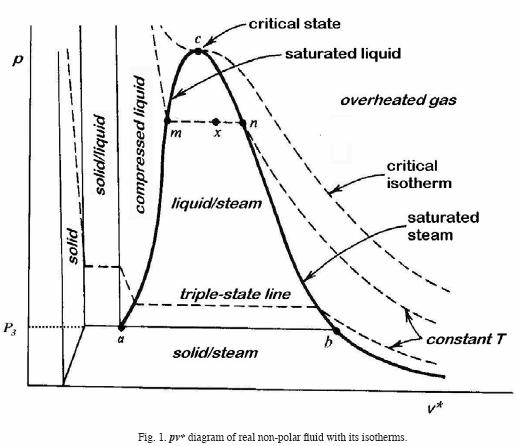
<body><![CDATA[<p align="justify"><font face="verdana" size="2"><b>Introduction</b></font></p>     <p align="justify"><font face="verdana" size="2">Recent experimental evidence suggests the presence of an infinity of new forces acting in the electromagnetic field. Three&#150;body forces are also beginning to be considered in nuclear physics (Mermod <i>et al., </i>2005; Amir&#150;Ahmadi <i>et al. </i>(2007). It seems reasonable to expect that non&#150;additive forces may exist in other fields of physics as well.</font></p>     <p align="justify"><font face="verdana" size="2">Single&#150;component fluids feature isotherms belonging to several phases (<a href="#f1">Figure 1</a>). In 1873 van der Waals published an empirical equation of state which assumes that the free Helmholtz energy contains up to binary potentials only. He assumed short&#150;range repelling potentials and long&#150;range attracting potentials. His equation contains two terms, and the two phases of the isotherms agree qualitatively but not quantitatively with experiment.</font></p>     <p align="center"><font face="verdana" size="2"><a name="f1"></a></font></p>     <p align="center"><font face="verdana" size="2"><img src="/img/revistas/geoint/v46n3/a2f1.jpg"></font></p>     <p align="justify"><font face="verdana" size="2">In 1901, Kamerlingh Onnes proposed an improved equation of state which contains an infinite series of negative powers of the molar specific volume <i>v</i>*, known as a <i>virial expansion. </i>While he did not evaluate the coefficients of the expansion, the two first terms are virtually identical with van der Waals' expression.</font></p>     <p align="justify"><font face="verdana" size="2">In 1930, Ursell and Mayer found that the expansion converged only for weak binary molecular interactions. The discrepancies found when one attempts to apply the Ursell&#150;Mayer theory to both solids and fluids may be due to their introducing a small perturbation in the behavior of an ideal gas.</font></p>     <p align="justify"><font face="verdana" size="2">Another approach is functional analysis, where any function may be expressed as an expansion consisting in an infinite series of independent terms, such as an experimental isotherm of several phases. Such an isotherm would never be obtained by an Ursell&#150;Mayer expansion. In order to obtain the missing terms in the van der Waals equation we shall consider the non&#150;additive tertiary, quaternary,..., forces in the Helmholz free energy, i.e., all forces that are not included in the binary forces. A similar situation applies to the potential energies.</font></p>     <p align="justify"><font face="verdana" size="2">This is achieved in statistical mechanics by using the mean field. Any multiphase isothermal may be obtained directly by expansion in negative powers of the molar volume. The second term is associated to binary potentials, the third term with tertiary non&#150;additive potentials, and so on. Note that the molar volume must exceed a thermodynamically compatible minimum molar volume for a given system, as otherwise the integrals will diverge.</font></p>     <p align="justify"><font face="verdana" size="2">Equations of state may be either empirical or theoretical. Empirical equations include the equations due to van der Waals or Berthelot. Theoretical equations of state, such as the Yang&#150;Lee equation (Thompson, 1972), are mostly based on statistical mechanics. These equations do not address problems involving three or more different phases.</font></p>     ]]></body>
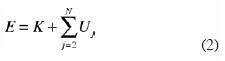
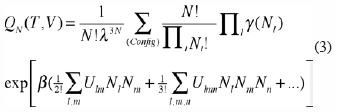
<body><![CDATA[<p align="justify"><font face="verdana" size="2">Some equations of state are obtained by fitting various functions to the experimental isotherms. An early example is Sugie and Lu (1971). This approach can successfully replicate the behavior of three&#150;phase systems in specific ranges of thermodynamic space. It does not consider energy potentials, however; and the terms do not always have a physical meaning. In this paper we propose an equation of state derived from first principles, which attempts to overcome these shortcomings.</font></p>     <p align="justify"><font face="verdana" size="2"><b>2. The model</b></font></p>     <p align="justify"><font face="verdana" size="2">Consider a system of <i>N </i>identical particles interacting by means of additive binary energy potentials, and non&#150;additive energy potentials involving 3, 4, ... particles. The particles are contained in a variable volume <i>V </i>which is weakly coupled to a large heat reservoir at a temperature <i>T.</i></font></p>     <p align="justify"><font face="verdana" size="2">The total additive binary potential energy between N particles is defined as the sum of all binary potential energies between pairs of particles. The total non&#150;additive 3&#150;particle potential energy that exists between N particles (N<u>&gt;</u>3) is defined as the sum of all triads of particles. It is called non&#150;additive because these energies cannot be included in the sum of binaries. The other non&#150;additive potential energies are defined in a similar way.</font></p>     <p align="justify"><font face="verdana" size="2">In this paper it will be shown, from experiment, that the non&#150;additive potential energies are both real and necessary for consideration in a thermodynamic system composed of liquids and solids. The system may be described by a canonical partition function <i>Q<sub>N</sub>(T, V) </i>defined as follows (Uhlenbeck and Ford, 1963):</font></p>     <p align="center"><font face="verdana" size="2"><img src="/img/revistas/geoint/v46n3/a2s1.jpg"></font></p>     <p align="justify"><font face="verdana" size="2">where <i>h </i>is Planck's constant, &#915; stands for integration over phase space, &#946;=(kT)<sup>&#150;1</sup>, k is Boltzmann's constant, and E is the total energy of the system from classical mechanics, i.e.</font></p>     <p align="center"><font face="verdana" size="2"><img src="/img/revistas/geoint/v46n3/a2s2.jpg"></font></p>     <p align="justify"><font face="verdana" size="2">where K is the total kinetic energy, U<sub>2</sub> is the total additive binary potential energy from binary energy potentials between pairs of particles, U<sub>3</sub> is the total non&#150;additive 3&#150;particle energy potential, and so on.</font></p>     <p align="justify"><font face="verdana" size="2">We integrate over the moments. The volume <i>V </i>is partitioned into cells in such a manner that all energy potentials remain approximately constant within any given cell. If <i>N<sub>i</sub> &gt;&gt; </i>1 is the number of molecules in the <i>i</i>&#150;th cell we have</font></p>     ]]></body>
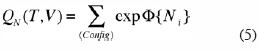
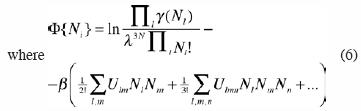
<body><![CDATA[<p align="center"><font face="verdana" size="2"><img src="/img/revistas/geoint/v46n3/a2s3.jpg"></font></p>     <p align="justify"><font face="verdana" size="2">where &lambda;, = h/(2&pi;<i>mkT), m </i>is the mass of a particle, &#947;(N<sub>1</sub>) contains the short&#150;range energy potentials and the summation is over all possible configurations, i.e., all distributions of <i>N </i>particles in all cells. Further, <i>U<sub>lm</sub> </i>is the long&#150;range contribution of the binary energy potential, <i>U<sub>lm</sub><sub>n</sub> </i>is the long&#150;range contribution of three&#150;particle energy potentials and so on. Every configuration must also obey the constraint</font></p>     <p align="center"><font face="verdana" size="2"><img src="/img/revistas/geoint/v46n3/a2s4.jpg"></font></p>     <p align="justify"><font face="verdana" size="2">over the number of cells. Equation (3) may be rewritten as:</font></p>     <p align="center"><font face="verdana" size="2"><img src="/img/revistas/geoint/v46n3/a2s5.jpg"></font></p>     <p align="justify"><font face="verdana" size="2">where</font></p>     <p align="center"><font face="verdana" size="2"><img src="/img/revistas/geoint/v46n3/a2s6.jpg"></font></p>     <p align="justify"><font face="verdana" size="2">and &#947;(N<sub>1</sub>) is the volume &#916; of a cell minus the volume of molecules in the cell. The volume of cells is assumed constant.</font></p>     <p align="justify"><font face="verdana" size="2">Let &#948; be the volume of a molecule. Ornstein (in van Kampen, 1964) assumed that the molecules are tightly packed as spheres in each cell so that</font></p>     <p align="center"><font face="verdana" size="2"><img src="/img/revistas/geoint/v46n3/a2s7.jpg"></font></p>     ]]></body>
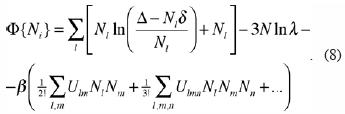
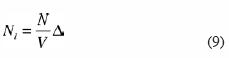
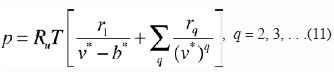
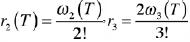
<body><![CDATA[<p align="justify"><font face="verdana" size="2">Substituting (7) into (6) and using Stirling's approximation we find</font></p>     <p align="center"><font face="verdana" size="2"><img src="/img/revistas/geoint/v46n3/a2s8.jpg"></font></p>     <p align="justify"><font face="verdana" size="2">The restriction associated with equation (4) was considered by employing a Lagrange multiplier. In equation (8), all terms except for the term corresponding to the most probable configuration vanish. This term is the maximum in equation (8) which turns out to be for a uniform distribution of particles in V, i.e.</font></p>     <p align="center"><font face="verdana" size="2"><img src="/img/revistas/geoint/v46n3/a2s9.jpg"></font></p>     <p align="justify"><font face="verdana" size="2">for all <i>l. </i>Thus, the partition function is practically the same as the one obtained when introducing (9) into (8), or</font></p>     <p align="center"><font face="verdana" size="2"><img src="/img/revistas/geoint/v46n3/a2s10.jpg"></font></p>     <p align="justify"><font face="verdana" size="2">Now, the pressure <i>p </i>in an isothermal system may be written as <i>p=&#150;</i>&part;<i>F /&part;V, </i>where <i>F=&#150;lnQ<sub>N</sub>(T,V)</i>&#946; is the Helmholtz energy. Using the specific volume per mole <i>v</i>*, we obtain</font></p>     <p align="center"><font face="verdana" size="2"><img src="/img/revistas/geoint/v46n3/a2s11.jpg"></font></p>     <p align="justify"><font face="verdana" size="2"><img src="/img/revistas/geoint/v46n3/a2s12.jpg"><img src="/img/revistas/geoint/v46n3/a2s13.jpg"> and so on; the specific molar volume <i>v</i>* is obviously larger than the molar volume of all particles. Let v*<sub>0</sub> be the minimum value of v* which is characteristic of any given gas. The integration limits of <i>v</i>*are <i>v</i>*<sub>0</sub> and &#8734;, thus the integrals will not diverge. As for &#969;<sub>q</sub> (T), <i>q<u>&gt;</u>2, </i>it can be shown than &#969;<sub>2</sub>(Z) is the mean field produced by additive binary forces, &omega;<sub>3</sub>(Z) is the mean field produced by non&#150;additive tertiary forces, etc.</font></p>     <p align="justify"><font face="verdana" size="2">By functional analysis (Kolmogorov and Fomin, 1970; Morse and Feshbach, 1953) the functions &#969;<i><sub>q </sub></i><i>(T), q=</i>2, 3,..., may be expressed on a base of linear independent functions</font></p>     ]]></body>
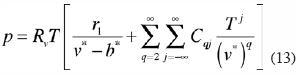
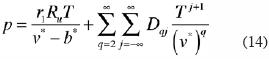
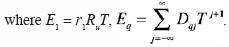
<body><![CDATA[<p align="center"><font face="verdana" size="2"><img src="/img/revistas/geoint/v46n3/a2s14.jpg"></font></p>     <p align="justify"><font face="verdana" size="2">And, substituting eq.(12) into (11):</font></p>     <p align="center"><font face="verdana" size="2"><img src="/img/revistas/geoint/v46n3/a2s15.jpg"></font></p>     <p align="justify"><font face="verdana" size="2"><img src="/img/revistas/geoint/v46n3/a2s16.jpg"></font></p>     <p align="justify"><font face="verdana" size="2">Another possible form of equation (13) is</font></p>     <p align="center"><font face="verdana" size="2"><img src="/img/revistas/geoint/v46n3/a2s17.jpg"></font></p>     <p align="justify"><font face="verdana" size="2">where: <i>D<sub>qj</sub>  = R<sub>u</sub> C<sub>qj</sub> </i>, or</font></p>     <p align="center"><font face="verdana" size="2"><img src="/img/revistas/geoint/v46n3/a2s18.jpg"></font></p>     <p align="justify"><font face="verdana" size="2"><i><img src="/img/revistas/geoint/v46n3/a2s19.jpg"></i></font></p>     <p align="justify"><font face="verdana" size="2">Equations (11), (13), (14) and (15) are expressions for a new equation of state which employs mean field potential energies&#151;both additive and non&#150;additive&#151;between particles. As a result we have a base of linear independent functions (for v*<u>&gt;</u> v*<sub>0</sub>) from functional analysis, being the spectra of interaction of the system. The parameters <i>C </i>may be obtained from experimental data for any particular gas. In conclusion, equation (13) reproduces exactly and completely all experimental properties, e.g. the values of the critical indices, the specific heat at constant volume, the isothermal compressibility near the critical point, etc.</font></p>     ]]></body>
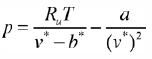
<body><![CDATA[<p align="justify"><font face="verdana" size="2">On the other hand, the experimental critical indices <i>&#945;, &#946;, &#947;</i>,... (Reichl, 1977) may be obtained from the experimental equation of state (for example: <img src="/img/revistas/geoint/v46n3/a2s20.jpg">). As equation (13) reproduces exactly the experimental equation we can also obtain the values of these experimental critical indices.</font></p>     <p align="justify"><font face="verdana" size="2"><b>3. Comparison with other equations</b></font></p>     <p align="justify"><font face="verdana" size="2">1.&#150; Equation (13) reduces to the ideal gas equation if <i>b* = 0, r<sub>q</sub> = 0 </i>for <i>q <u>&gt;</u> </i>2:</font></p>     <p align="center"><font face="verdana" size="2"><img src="/img/revistas/geoint/v46n3/a2s21.jpg"></font></p>     <p align="justify"><font face="verdana" size="2">2.&#150; Equation (13) reduces to the van der Waals equation if<i> </i><img src="/img/revistas/geoint/v46n3/a2s22.jpg"></font></p>     <p align="center"><font face="verdana" size="2"><img src="/img/revistas/geoint/v46n3/a2s23.jpg"></font></p>     <p align="justify"><font face="verdana" size="2">3.&#150;  The virial equation Kamerlingh Onnes and equation (11) are equal if <i>b*=0:</i></font></p>     <p align="justify"><font face="verdana" size="2">&nbsp;</font></p>     <p align="justify"><font face="verdana" size="2"><b>Discussion</b></font></p>     <p align="justify"><font face="verdana" size="2">Equation (13) is obtained from statistical mechanics. The base of the space of equations of state for simple fluids is formed by an infinite number of linear independent functions (where v* <u>&gt;</u> v*<sub>0</sub>). From functional analysis, all equations of state can be expressed as linear combinations of the elements of this base.</font></p>     ]]></body>
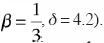
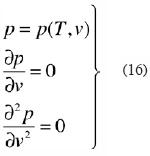
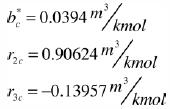
<body><![CDATA[<p align="justify"><font face="verdana" size="2">For this functional space we may use an infinity of different bases but the one used in this paper for equation (13) is important because it expresses the equation of state as a convergent series which is a spectrum of mean field interactions. Thus the second term contains the binary (additive) mean field, the third contains the tertiary (non&#150;additive) mean field, the fourth contains the quaternary (non&#150;additive) mean field, and so on.</font></p>     <p align="justify"><font face="verdana" size="2">At a critical point an equation of state is restricted by three conditions:</font></p>     <p align="center"><font face="verdana" size="2"><img src="/img/revistas/geoint/v46n3/a2s25.jpg"></font></p>     <p align="justify"><font face="verdana" size="2">Equation (11) can be used to obtain approximately the isotherm in the vicinity of the critical point, considering <i>C<sub>qj</sub></i>=0 for <i>q&gt;</i>3,<i> r</i><sub>1</sub>,<i>=</i>1, and defining <i>a </i>and <i>c</i> so that <i><img src="/img/revistas/geoint/v46n3/a2s26.jpg" alt=""> </i>for q=2 and <img src="/img/revistas/geoint/v46n3/a2s27.jpg">. In this case the <sup></sup> system of equations to be solved is</font></p>     <p align="center"><font face="verdana" size="2"><img src="/img/revistas/geoint/v46n3/a2s28.jpg"></font></p>     <p align="justify"><font face="verdana" size="2">where the subscript <i>c </i>denotes the critical values. We may rewrite this system as</font></p>     <p align="center"><font face="verdana" size="2"><img src="/img/revistas/geoint/v46n3/a2s29.jpg"></font></p>     <p align="justify"><font face="verdana" size="2">from which the parameters <i>b<sub>c</sub>*, r<sub>2c</sub> </i>and <i>r<sub>3c</sub> </i>can be determined for a given gas.</font></p>     <p align="justify"><font face="verdana" size="2">Van der Waals attempted to solve the same problem. However, his equation of state failed to provide a solution for the critical point, because it contains only two unknowns. When substituting the van der Waals equation into (16) the system of equations has no solution, because van der Waals failed to consider non&#150;additive forces.</font></p>     <p align="justify"><font face="verdana" size="2">As a simple example, in the case of water <i>p<sub>c</sub></i>=2.209x10<sup>7</sup><i>Pa</i>, <i>T<sub>c</sub></i> =647.3K and <i>v*<sub>c</sub> =</i>0.0558m<sup>3</sup>/<i>kmol. </i>Introducing these values into (18) we find:</font></p>     ]]></body>
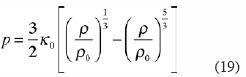
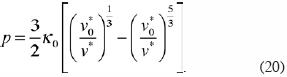
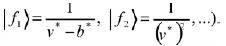
<body><![CDATA[<p align="center"><font face="verdana" size="2"><img src="/img/revistas/geoint/v46n3/a2s30.jpg"></font></p>     <p align="justify"><font face="verdana" size="2">These values define the isotherm in the vicinity of the critical point. Inserting into (15) and solving this system of equations <i>for p<sub>c</sub>, T<sub>c</sub>, </i>and <i>v*<sub>c</sub>, </i>we obviously obtain the values <i>p=2.209xWPa, T=6473Kandv*=0.0558m<sup>3</sup>/kmol. </i>Thus we have shown that the isotherm in the vicinity of the critical point is obtained by necessarily considering non&#150;additive forces of three particles at the very least.</font></p>     <p align="justify"><font face="verdana" size="2">In the case of the isotherm of a triple point in a single&#150;component gas (<a href="#f1">Figure 1</a>), the curve <i>acb </i>represents coexistence of liquid and gas, and <i>P<sub>3</sub> </i>is the pressure at the triple state. If we introduce the pressure at the triple point into equation (13) and we neglect the terms higher than the sixth order the result is a fifth&#150;degree equation in <i>v* </i>as shown in <a href="/img/revistas/geoint/v46n3/a2f2.jpg" target="_blank">Figure 2</a>. This means that at the triple point there are contributions of non&#150;additive potentials of 2,3,4,5 particles at least. Also it is necessary to employ two Maxwell constructions in order to fit the experimental curve.</font></p>     <p align="justify"><font face="verdana" size="2">&nbsp;</font></p>     <p align="justify"><font face="verdana" size="2"><b>5. An application to geophysics</b></font></p>     <p align="justify"><font face="verdana" size="2">The mantle of the Earth may be treated as a highly viscous convecting fluid. Birch (1947) proposed the following equation of state for the mantle:</font></p>     <p align="center"><font face="verdana" size="2"><img src="/img/revistas/geoint/v46n3/a2s31.jpg"></font></p>     <p align="justify"><font face="verdana" size="2">where <i>&#954; </i>is the compressibility, <i>&#961; </i>is the density, and the zero subscript indicates evaluation at atmospheric pressure. Equation (17) in terms of specific volume <i>v* </i>per mole may be written</font></p>     <p align="center"><font face="verdana" size="2"><img src="/img/revistas/geoint/v46n3/a2s32.jpg"></font></p>     <p align="justify"><font face="verdana" size="2">This equation can be expressed in the form of equations (11), (13), (14) or (15). As Birch's expression does not include temperature explicitly it is more convenient to use equation (15) expressed in the base of linear independent functions <img src="/img/revistas/geoint/v46n3/a2s33.jpg">. However, the coefficients are more easily obtained by using the orthonormal base after Gram&#150;Schmidt (see Dennery and Krzywicki, 1995), as follows.</font></p>     ]]></body>
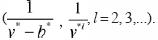
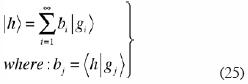
<body><![CDATA[<p align="justify"><font face="verdana" size="2">In the bracket notation of functional analysis (Dennery and Krzywicky, 1995) the functions, also called vectors, being elements of base of linear independent functions in equation (11) yield     <img src="/img/revistas/geoint/v46n3/a2s46.jpg">or, more simply, <img src="/img/revistas/geoint/v46n3/a2s35.jpg">. For example, <img src="/img/revistas/geoint/v46n3/a2s34.jpg" alt=""> Thus elements of the new base will be orthonormal and may be written <img src="/img/revistas/geoint/v46n3/a2s36.jpg"> or simply <img src="/img/revistas/geoint/v46n3/a2s37.jpg">for <i>i</i>, <i>j</i> <img src="/img/revistas/geoint/v46n3/a2s38.jpg"> (1, &#8734;).</font></p>     <p align="justify"><font face="verdana" size="2">The inner product between two vectors <img src="/img/revistas/geoint/v46n3/a2s39.jpg"><b> </b>is defined as follows:</font></p>     <p align="center"><font face="verdana" size="2"><img src="/img/revistas/geoint/v46n3/a2s40.jpg"></font></p>     <p align="justify"><font face="verdana" size="2">Two vectors are orthonormal if</font></p>     <p align="center"><font face="verdana" size="2"><img src="/img/revistas/geoint/v46n3/a2s41.jpg"></font></p>     <p align="justify"><font face="verdana" size="2">for <i>i</i>, <i>j </i><img src="/img/revistas/geoint/v46n3/a2s38.jpg" alt=""> (1, &#8734;).</font></p>     <p align="justify"><font face="verdana" size="2">In the case of the vectors of the new base, these vectors must form an orthonormal set</font></p>     <p align="center"><font face="verdana" size="2"><img src="/img/revistas/geoint/v46n3/a2s42.jpg"></font></p>     <p align="justify"><font face="verdana" size="2">Thus any equation of state given by an empirical equation or by means of experimental data can be expressed as</font></p>     <p align="justify"><font face="verdana" size="2"><img src="/img/revistas/geoint/v46n3/a2s43.jpg"></font></p>     ]]></body>
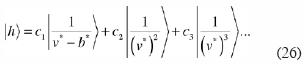
<body><![CDATA[<p align="justify"><font face="verdana" size="2">both bases are new in functional analysis in the domain considered.</font></p>     <p align="justify"><font face="verdana" size="2">If the equation of the Mantle is denoted by <img src="/img/revistas/geoint/v46n3/a2s47.jpg">   and we use the orthonormal base the result is:</font></p>     <p align="center"><font face="verdana" size="2"><img src="/img/revistas/geoint/v46n3/a2s44.jpg"></font></p>     <p align="justify"><font face="verdana" size="2">or by reorganizing the terms in the non&#150;orthonormal; base</font></p>     <p align="center"><font face="verdana" size="2"><img src="/img/revistas/geoint/v46n3/a2s45.jpg"></font></p>     <p align="justify"><font face="verdana" size="2">where: <i>c<sub>1</sub>=a<sub>1</sub>b<sub>1</sub>+a<sub>1</sub>b<sub>2</sub>a<sub>2</sub>a<sub>3</sub>, </i>etc.</font></p>     <p align="justify"><font face="verdana" size="2">In conclusion, the Mantle has 1, 2, 3, 4,...phases and there is at least one critical point and one triple point.</font></p>     <p align="justify"><font face="verdana" size="2">&nbsp;</font></p>     <p align="justify"><font face="verdana" size="2"><b>Conclusions</b></font></p>     <p align="justify"><font face="verdana" size="2">We derive an equation of state which predicts several phases. Equations (11), (13), (14) or (15) can explicitly generate 1, 2, 3,... phases depending on the experimental data, by using non&#150;additive many&#150;body energy potentials. A treatment based on statistical mechanics will agree with the experimental data, for systems of 1, 2,...phases, if and only if it considers non&#150;additive many&#150;body energy potentials plus binary additive energy potentials. The fact that the non&#150;additive many&#150;body energy potentials are absolutely indispensable to explain the experimental data means that they really exist. Thus we find that the earth's mantle is composed of many phases and has at least one critical point and one triple point. Independent linear and orthonormal bases are not used in functional analysis in the domain considered.</font></p>     ]]></body>
<body><![CDATA[<p align="justify"><font face="verdana" size="2">&nbsp;</font></p>     <p align="justify"><font face="verdana" size="2"><b>Bibliography</b></font></p>     <!-- ref --><p align="justify"><font face="verdana" size="2">AMIR&#150;AHMADI, H. R. <i>et al. </i>2007. Three&#150;nucleon force effects in cross section and spin observables of elastic deuteron&#150;proton scattering at 90 MeV/nucleon. <i>Phys. Rev. C 75, </i>04100 (R).</font>&nbsp;&nbsp;&nbsp;&nbsp;&nbsp;&nbsp;&nbsp;&nbsp;[&#160;<a href="javascript:void(0);" onclick="javascript: window.open('/scielo.php?script=sci_nlinks&ref=3922084&pid=S0016-7169200700030000200001&lng=','','width=640,height=500,resizable=yes,scrollbars=1,menubar=yes,');">Links</a>&#160;]<!-- end-ref --><!-- ref --><p align="justify"><font face="verdana" size="2">BIRCH, F., 1947. Finite Elastic Strain of Cubic Crystals. <i>Phys. Rev., </i>809&#150;824.</font>&nbsp;&nbsp;&nbsp;&nbsp;&nbsp;&nbsp;&nbsp;&nbsp;[&#160;<a href="javascript:void(0);" onclick="javascript: window.open('/scielo.php?script=sci_nlinks&ref=3922085&pid=S0016-7169200700030000200002&lng=','','width=640,height=500,resizable=yes,scrollbars=1,menubar=yes,');">Links</a>&#160;]<!-- end-ref --><!-- ref --><p align="justify"><font face="verdana" size="2">DENNERY, P. and A. KRZYWICKI, 1995. <i>Mathematics for Physicists </i>(Dover Publications Inc.).</font>&nbsp;&nbsp;&nbsp;&nbsp;&nbsp;&nbsp;&nbsp;&nbsp;[&#160;<a href="javascript:void(0);" onclick="javascript: window.open('/scielo.php?script=sci_nlinks&ref=3922086&pid=S0016-7169200700030000200003&lng=','','width=640,height=500,resizable=yes,scrollbars=1,menubar=yes,');">Links</a>&#160;]<!-- end-ref --><!-- ref --><p align="justify"><font face="verdana" size="2">KOLMOGOROV, A. N. and S. V. FOMIN, 1970. Introductory Real Analysis (Dover Publications Inc.).</font>&nbsp;&nbsp;&nbsp;&nbsp;&nbsp;&nbsp;&nbsp;&nbsp;[&#160;<a href="javascript:void(0);" onclick="javascript: window.open('/scielo.php?script=sci_nlinks&ref=3922087&pid=S0016-7169200700030000200004&lng=','','width=640,height=500,resizable=yes,scrollbars=1,menubar=yes,');">Links</a>&#160;]<!-- end-ref --><!-- ref --><p align="justify"><font face="verdana" size="2">MERMOD, P. <i>et al. </i>2005. Evidence of three&#150;body force effects in neutron&#150;deuteron scattering at 95 MeV. <i>Phys. Rev. C 72, </i>061002 (R).</font>&nbsp;&nbsp;&nbsp;&nbsp;&nbsp;&nbsp;&nbsp;&nbsp;[&#160;<a href="javascript:void(0);" onclick="javascript: window.open('/scielo.php?script=sci_nlinks&ref=3922088&pid=S0016-7169200700030000200005&lng=','','width=640,height=500,resizable=yes,scrollbars=1,menubar=yes,');">Links</a>&#160;]<!-- end-ref --><!-- ref --><p align="justify"><font face="verdana" size="2">MORSE, P. M. and H. FESHBACH, 1953. Methods of Theoretical Physics (McGraw Hill Inc.).</font>&nbsp;&nbsp;&nbsp;&nbsp;&nbsp;&nbsp;&nbsp;&nbsp;[&#160;<a href="javascript:void(0);" onclick="javascript: window.open('/scielo.php?script=sci_nlinks&ref=3922089&pid=S0016-7169200700030000200006&lng=','','width=640,height=500,resizable=yes,scrollbars=1,menubar=yes,');">Links</a>&#160;]<!-- end-ref --><!-- ref --><p align="justify"><font face="verdana" size="2">REICHL, L., 1977. A Modern Course in statistical Mechanics (University of Texas Press, Austin).</font>&nbsp;&nbsp;&nbsp;&nbsp;&nbsp;&nbsp;&nbsp;&nbsp;[&#160;<a href="javascript:void(0);" onclick="javascript: window.open('/scielo.php?script=sci_nlinks&ref=3922090&pid=S0016-7169200700030000200007&lng=','','width=640,height=500,resizable=yes,scrollbars=1,menubar=yes,');">Links</a>&#160;]<!-- end-ref --><!-- ref --><p align="justify"><font face="verdana" size="2">SUGIE, H. and LU, B. C.&#150;Y., 1971. AIChE Journal 17, 1068.</font>&nbsp;&nbsp;&nbsp;&nbsp;&nbsp;&nbsp;&nbsp;&nbsp;[&#160;<a href="javascript:void(0);" onclick="javascript: window.open('/scielo.php?script=sci_nlinks&ref=3922091&pid=S0016-7169200700030000200008&lng=','','width=640,height=500,resizable=yes,scrollbars=1,menubar=yes,');">Links</a>&#160;]<!-- end-ref --><!-- ref --><p align="justify"><font face="verdana" size="2">THOMPSON, C. J., 1972. Statistical Mechanics (McMillan, New York).</font>&nbsp;&nbsp;&nbsp;&nbsp;&nbsp;&nbsp;&nbsp;&nbsp;[&#160;<a href="javascript:void(0);" onclick="javascript: window.open('/scielo.php?script=sci_nlinks&ref=3922092&pid=S0016-7169200700030000200009&lng=','','width=640,height=500,resizable=yes,scrollbars=1,menubar=yes,');">Links</a>&#160;]<!-- end-ref --><!-- ref --><p align="justify"><font face="verdana" size="2">UHLENBECK, G. E. and G. W. FORD, 1963. Lectures in Statistical Mechanics (American Mathematical Society, New York).</font>&nbsp;&nbsp;&nbsp;&nbsp;&nbsp;&nbsp;&nbsp;&nbsp;[&#160;<a href="javascript:void(0);" onclick="javascript: window.open('/scielo.php?script=sci_nlinks&ref=3922093&pid=S0016-7169200700030000200010&lng=','','width=640,height=500,resizable=yes,scrollbars=1,menubar=yes,');">Links</a>&#160;]<!-- end-ref --><!-- ref --><p align="justify"><font face="verdana" size="2">VAN KAMPEN, N. G., 1964. Phys. Rev. A 135, 362.</font>&nbsp;&nbsp;&nbsp;&nbsp;&nbsp;&nbsp;&nbsp;&nbsp;[&#160;<a href="javascript:void(0);" onclick="javascript: window.open('/scielo.php?script=sci_nlinks&ref=3922094&pid=S0016-7169200700030000200011&lng=','','width=640,height=500,resizable=yes,scrollbars=1,menubar=yes,');">Links</a>&#160;]<!-- end-ref --> ]]></body><back>
<ref-list>
<ref id="B1">
<nlm-citation citation-type="journal">
<person-group person-group-type="author">
<name>
<surname><![CDATA[AMIR-AHMADI]]></surname>
<given-names><![CDATA[H. R.]]></given-names>
</name>
</person-group>
<article-title xml:lang="en"><![CDATA[Three-nucleon force effects in cross section and spin observables of elastic deuteron-proton scattering at 90 MeV/nucleon]]></article-title>
<source><![CDATA[Phys. Rev.]]></source>
<year>2007</year>
</nlm-citation>
</ref>
<ref id="B2">
<nlm-citation citation-type="journal">
<person-group person-group-type="author">
<name>
<surname><![CDATA[BIRCH]]></surname>
<given-names><![CDATA[F.]]></given-names>
</name>
</person-group>
<article-title xml:lang="en"><![CDATA[Finite Elastic Strain of Cubic Crystals]]></article-title>
<source><![CDATA[Phys. Rev.]]></source>
<year>1947</year>
<page-range>809-824</page-range></nlm-citation>
</ref>
<ref id="B3">
<nlm-citation citation-type="book">
<person-group person-group-type="author">
<name>
<surname><![CDATA[DENNERY]]></surname>
<given-names><![CDATA[P.]]></given-names>
</name>
<name>
<surname><![CDATA[KRZYWICKI]]></surname>
<given-names><![CDATA[A.]]></given-names>
</name>
</person-group>
<source><![CDATA[Mathematics for Physicists]]></source>
<year>1995</year>
<publisher-name><![CDATA[Dover]]></publisher-name>
</nlm-citation>
</ref>
<ref id="B4">
<nlm-citation citation-type="book">
<person-group person-group-type="author">
<name>
<surname><![CDATA[KOLMOGOROV]]></surname>
<given-names><![CDATA[A. N.]]></given-names>
</name>
<name>
<surname><![CDATA[FOMIN]]></surname>
<given-names><![CDATA[S. V.]]></given-names>
</name>
</person-group>
<source><![CDATA[Introductory Real Analysis]]></source>
<year>1970</year>
<publisher-name><![CDATA[Dover]]></publisher-name>
</nlm-citation>
</ref>
<ref id="B5">
<nlm-citation citation-type="journal">
<person-group person-group-type="author">
<name>
<surname><![CDATA[MERMOD]]></surname>
<given-names><![CDATA[P.]]></given-names>
</name>
</person-group>
<article-title xml:lang="en"><![CDATA[Evidence of three-body force effects in neutron-deuteron scattering at 95 MeV.]]></article-title>
<source><![CDATA[Phys. Rev.]]></source>
<year>2005</year>
</nlm-citation>
</ref>
<ref id="B6">
<nlm-citation citation-type="book">
<person-group person-group-type="author">
<name>
<surname><![CDATA[MORSE]]></surname>
<given-names><![CDATA[P. M.]]></given-names>
</name>
<name>
<surname><![CDATA[FESHBACH]]></surname>
<given-names><![CDATA[H.]]></given-names>
</name>
</person-group>
<source><![CDATA[Methods of Theoretical Physics]]></source>
<year>1953</year>
<publisher-name><![CDATA[McGraw Hill Inc.]]></publisher-name>
</nlm-citation>
</ref>
<ref id="B7">
<nlm-citation citation-type="book">
<person-group person-group-type="author">
<name>
<surname><![CDATA[REICHL]]></surname>
<given-names><![CDATA[L.]]></given-names>
</name>
</person-group>
<source><![CDATA[A Modern Course in statistical Mechanics]]></source>
<year>1977</year>
<publisher-loc><![CDATA[Austin ]]></publisher-loc>
<publisher-name><![CDATA[University of Texas Press]]></publisher-name>
</nlm-citation>
</ref>
<ref id="B8">
<nlm-citation citation-type="journal">
<person-group person-group-type="author">
<name>
<surname><![CDATA[SUGIE]]></surname>
<given-names><![CDATA[H.]]></given-names>
</name>
<name>
<surname><![CDATA[B. C.-Y.]]></surname>
<given-names><![CDATA[LU]]></given-names>
</name>
</person-group>
<source><![CDATA[AIChE Journal]]></source>
<year>1971</year>
<volume>17</volume>
</nlm-citation>
</ref>
<ref id="B9">
<nlm-citation citation-type="book">
<person-group person-group-type="author">
<name>
<surname><![CDATA[THOMPSON]]></surname>
<given-names><![CDATA[C. J.]]></given-names>
</name>
</person-group>
<source><![CDATA[Statistical Mechanics]]></source>
<year>1972</year>
<publisher-loc><![CDATA[New York ]]></publisher-loc>
<publisher-name><![CDATA[McMillan]]></publisher-name>
</nlm-citation>
</ref>
<ref id="B10">
<nlm-citation citation-type="book">
<person-group person-group-type="author">
<name>
<surname><![CDATA[UHLENBECK]]></surname>
<given-names><![CDATA[G. E.]]></given-names>
</name>
<name>
<surname><![CDATA[FORD]]></surname>
<given-names><![CDATA[G. W.]]></given-names>
</name>
</person-group>
<source><![CDATA[Lectures in Statistical Mechanics]]></source>
<year>1963</year>
<publisher-loc><![CDATA[New York ]]></publisher-loc>
<publisher-name><![CDATA[American Mathematical Society]]></publisher-name>
</nlm-citation>
</ref>
<ref id="B11">
<nlm-citation citation-type="journal">
<person-group person-group-type="author">
<name>
<surname><![CDATA[VAN KAMPEN]]></surname>
<given-names><![CDATA[N. G.]]></given-names>
</name>
</person-group>
<source><![CDATA[Phys. Rev.]]></source>
<year>1964</year>
</nlm-citation>
</ref>
</ref-list>
</back>
</article>