<?xml version="1.0" encoding="ISO-8859-1"?><article xmlns:mml="http://www.w3.org/1998/Math/MathML" xmlns:xlink="http://www.w3.org/1999/xlink" xmlns:xsi="http://www.w3.org/2001/XMLSchema-instance">
<front>
<journal-meta>
<journal-id>1870-3453</journal-id>
<journal-title><![CDATA[Revista mexicana de biodiversidad]]></journal-title>
<abbrev-journal-title><![CDATA[Rev. Mex. Biodiv.]]></abbrev-journal-title>
<issn>1870-3453</issn>
<publisher>
<publisher-name><![CDATA[Instituto de Biología]]></publisher-name>
</publisher>
</journal-meta>
<article-meta>
<article-id>S1870-34532014000300036</article-id>
<article-id pub-id-type="doi">10.7550/rmb.40543</article-id>
<title-group>
<article-title xml:lang="en"><![CDATA[New state record for the snake Amastridium sapperi (Squamata: Dipsadidae) from Hidalgo, Mexico]]></article-title>
<article-title xml:lang="es"><![CDATA[Nuevo registro estatal de la serpiente Amastridium sapperi (Squamata: Dipsadidae) para Hidalgo, México]]></article-title>
</title-group>
<contrib-group>
<contrib contrib-type="author">
<name>
<surname><![CDATA[Lara-Tufiño]]></surname>
<given-names><![CDATA[Daniel]]></given-names>
</name>
<xref ref-type="aff" rid="A01"/>
</contrib>
<contrib contrib-type="author">
<name>
<surname><![CDATA[Hernández-Austria]]></surname>
<given-names><![CDATA[Raquel]]></given-names>
</name>
<xref ref-type="aff" rid="A01"/>
</contrib>
<contrib contrib-type="author">
<name>
<surname><![CDATA[Wilson]]></surname>
<given-names><![CDATA[Larry David]]></given-names>
</name>
<xref ref-type="aff" rid="A02"/>
</contrib>
<contrib contrib-type="author">
<name>
<surname><![CDATA[Berriozabal-Islas]]></surname>
<given-names><![CDATA[Christian]]></given-names>
</name>
<xref ref-type="aff" rid="A01"/>
</contrib>
<contrib contrib-type="author">
<name>
<surname><![CDATA[Ramírez-Bautista]]></surname>
<given-names><![CDATA[Aurelio]]></given-names>
</name>
<xref ref-type="aff" rid="A01"/>
</contrib>
</contrib-group>
<aff id="A01">
<institution><![CDATA[,Universidad Autónoma del Estado de Hidalgo Centro de Investigaciones Biológicas ]]></institution>
<addr-line><![CDATA[Pachuca Hidalgo]]></addr-line>
<country>México</country>
</aff>
<aff id="A02">
<institution><![CDATA[,Escuela Agrícola Panamericana/Zamorano Centro Zamorano de Biodiversidad ]]></institution>
<addr-line><![CDATA[Tegucigalpa Francisco Morazán]]></addr-line>
<country>Honduras</country>
</aff>
<pub-date pub-type="pub">
<day>00</day>
<month>00</month>
<year>2014</year>
</pub-date>
<pub-date pub-type="epub">
<day>00</day>
<month>00</month>
<year>2014</year>
</pub-date>
<volume>85</volume>
<numero>2</numero>
<fpage>654</fpage>
<lpage>657</lpage>
<copyright-statement/>
<copyright-year/>
<self-uri xlink:href="http://www.scielo.org.mx/scielo.php?script=sci_arttext&amp;pid=S1870-34532014000300036&amp;lng=en&amp;nrm=iso"></self-uri><self-uri xlink:href="http://www.scielo.org.mx/scielo.php?script=sci_abstract&amp;pid=S1870-34532014000300036&amp;lng=en&amp;nrm=iso"></self-uri><self-uri xlink:href="http://www.scielo.org.mx/scielo.php?script=sci_pdf&amp;pid=S1870-34532014000300036&amp;lng=en&amp;nrm=iso"></self-uri><abstract abstract-type="short" xml:lang="en"><p><![CDATA[The dipsadid snake Amastridium sapperi is reported for the first time from the state of Hidalgo, Mexico. The single male specimen was found in a shaded coffee grove, which agrees well with the habitat preference shown by other male specimens reported from Mexico. This snake is broadly distributed, but rarely encountered and was not evaluated by either the Semarnat or IUCN systems of conservation assessment, although it has been evaluated using the EVS measure. Also included are details of body length, scutellation, dentition, coloration, testicular development, diet, habitat, and conservation status.]]></p></abstract>
<abstract abstract-type="short" xml:lang="es"><p><![CDATA[Se registra por primera vez la culebra Dipsadidae Amastridium sapperi para el estado de Hidalgo, México. El ejemplar es un individuo macho encontrado en un cafetal de sombra, el cual coincide con las características mostradas en otros ejemplares machos documentados previamente para México. Esta serpiente se distribuye ampliamente, pero rara vez se la encuentra y no está considerada por sistemas para la evaluación de la conservación como Semarnat o IUCN; sin embargo, se ha evaluado empleando el método de EVS. También se incluyen datos sobre la longitud del cuerpo, escutelación, dentición, coloración, desarrollo testicular, dieta, hábitat y estatus de conservación.]]></p></abstract>
<kwd-group>
<kwd lng="en"><![CDATA[Amastridium sapperi]]></kwd>
<kwd lng="en"><![CDATA[geographic distribution]]></kwd>
<kwd lng="en"><![CDATA[Hidalgo]]></kwd>
<kwd lng="en"><![CDATA[Mexico]]></kwd>
<kwd lng="es"><![CDATA[Amastridium sapperi]]></kwd>
<kwd lng="es"><![CDATA[distribución geográfica]]></kwd>
<kwd lng="es"><![CDATA[Hidalgo]]></kwd>
<kwd lng="es"><![CDATA[México]]></kwd>
</kwd-group>
</article-meta>
</front><body><![CDATA[ 
	    <p align="justify"><font face="verdana" size="4">Notas cient&iacute;ficas</font></p>

    <p>&nbsp;</p>

	    <p align="center"><font face="verdana" size="4"><b>New state record for the snake <i>Amastridium sapperi</i> (Squamata: Dipsadidae) from Hidalgo, Mexico</b></font></p>

	    <p>&nbsp;</p>

	    <p align="center"><font face="verdana" size="3"><b>Nuevo registro estatal de la serpiente <i>Amastridium sapperi</i> (Squamata: Dipsadidae) para Hidalgo, M&eacute;xico</b></font></p>

	    <p>&nbsp;</p>

	    <p align="center"><font face="verdana" size="2"><b>Daniel Lara&#45;Tufi&ntilde;o<sup>1*</sup>, Raquel Hern&aacute;ndez&#45;Austria<sup>1</sup>, Larry David Wilson<sup>2</sup>, Christian Berriozabal&#45;Islas<sup>1</sup> and Aurelio Ram&iacute;rez&#45;Bautista<sup>1</sup></b></font></p>

	    <p>&nbsp;</p>

	
    <p align="justify"><font face="verdana" size="2"><sup><i>1</i></sup><i> Centro de Investigaciones 
  Biol&oacute;gicas (CIB), Universidad Aut&oacute;noma del Estado de Hidalgo. 
  Apartado postal 1&#45;69, Plaza Ju&aacute;rez, 42001 Pachuca, Hidalgo, M&eacute;xico.</i> 
  * <a href="mailto:jdanieluah@hotmail.com">jdanieluah@hotmail.com</a></font></p>

	    ]]></body>
<body><![CDATA[<p align="justify"><font face="verdana" size="2"><sup><i>2</i> </sup><i>Centro Zamorano de Biodiversidad, Escuela Agr&iacute;cola Panamericana Zamorano. Zamorano, Departamento de Francisco Moraz&aacute;n, Honduras.</i></font></p>

	    <p>&nbsp;</p>

	
    <p align="justify"><font face="verdana" size="2">Recibido: 24 julio 2013    <br>
  Aceptado: 13 noviembre 2013</font></p>

	    <p>&nbsp;</p>

	    <p align="justify"><font face="verdana" size="2"><b>Abstract</b></font></p> 
        <p align="justify"><font face="verdana" size="2">The dipsadid snake <i>Amastridium sapperi</i> is reported for the first time from the state of Hidalgo, Mexico. The single male specimen was found in a shaded coffee grove, which agrees well with the habitat preference shown by other male specimens reported from Mexico. This snake is broadly distributed, but rarely encountered and was not evaluated by either the Semarnat or IUCN systems of conservation assessment, although it has been evaluated using the EVS measure. Also included are details of body length, scutellation, dentition, coloration, testicular development, diet, habitat, and conservation status.</font></p>

	    <p align="justify"><font face="verdana" size="2"><b>Key words:</b> <i>Amastridium sapperi</i>, geographic distribution, Hidalgo, Mexico.</font></p>

	    <p>&nbsp;</p>

	    <p align="justify"><font face="verdana" size="2"><b>Resumen</b></font></p> 
        ]]></body>
<body><![CDATA[<p align="justify"><font face="verdana" size="2">Se registra por primera vez la culebra Dipsadidae <i>Amastridium sapperi</i> para el estado de Hidalgo, M&eacute;xico. El ejemplar es un individuo macho encontrado en un cafetal de sombra, el cual coincide con las caracter&iacute;sticas mostradas en otros ejemplares machos documentados previamente para M&eacute;xico. Esta serpiente se distribuye ampliamente, pero rara vez se la encuentra y no est&aacute; considerada por sistemas para la evaluaci&oacute;n de la conservaci&oacute;n como Semarnat o IUCN; sin embargo, se ha evaluado empleando el m&eacute;todo de EVS. Tambi&eacute;n se incluyen datos sobre la longitud del cuerpo, escutelaci&oacute;n, dentici&oacute;n, coloraci&oacute;n, desarrollo testicular, dieta, h&aacute;bitat y estatus de conservaci&oacute;n.</font></p>

	    <p align="justify"><font face="verdana" size="2"><b>Palabras claves:</b> <i>Amastridium sapperi</i>, distribuci&oacute;n geogr&aacute;fica, Hidalgo, M&eacute;xico.</font></p>

	    <p>&nbsp;</p>

	    <p align="justify"><font face="verdana" size="2"><i>Amastridium</i> Cope, 1861, is a dipsadid snake genus (Pyron et al., 2013) containing 2 species, <i>A. sapperi</i> (Werner, 1903) and <i>A. veliferum</i> Cope, 1861. These 2 taxa had long been considered separate, allopatric species (Smith, 1971; Savage, 2002). Wilson and Meyer (1969) argued, however, that these 2 taxa were conspecific, based on the discordant nature of the variation in the characters used to distinguish them, and maintained that position for a number of years (Wilson and Meyer, 1985; Wilson, 1988). Soon after the Wilson and Meyer (1969) review appeared, however, Smith (1971) opined that northern and southern populations were distinguishable on the basis of the presence of a loreal scale and a relatively high number of ventrals in the former (144&#45;170), and the lack of this scale and the presence of a relatively low number of ventrals (111&#45;134) in the latter. Smith concluded that these 2 groups should be recognized as subspecies. Savage (2002) accepted Smith's (1971) argument, but recognized the taxa <i>sapperi</i> and <i>veliferum</i> as separate species&#45;level taxa, a position that has been followed by several other authors (K&ouml;hler, 2008; Acevedo et al., 2010; Johnson et al., 2010; Stafford et al., 2010; Townsend and Wilson, 2010; Wilson and Johnson, 2010; McCranie, 2011; Wilson et al., 2013) in recent years. Interestingly however, only 1 species is recognized on The Reptile Database website (accessed 5 July 2013). At present, we consider <i>A. sapperi</i> to be the valid name for the northern population by adhering to the evolutionary species concepts as discussed by Porras et al. (2013). <i>Amastridium sapperi</i> has an allopatric distribution and discernible taxonomic characters, and thus is considered a separate evolutionary lineage.</font></p>

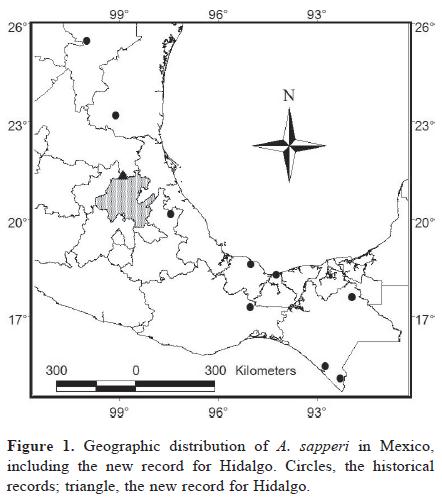
	    <p align="justify"><font face="verdana" size="2"><i>Amastridium sapperi</i> occurs in Mexico, Belize, Guatemala, and Honduras, at elevations ranging from 100&#45;1 600 m (Wilson and Johnson, 2010). In Mexico (<a href="#f1">Fig. 1</a>), it is recorded from the states of Nuevo Leon, Tamaulipas, Puebla, Veracruz, Oaxaca, and Chiapas (Wilson and Meyer, 1969; Smith, 1971; Canseco&#45;M&aacute;rquez and Guti&eacute;rrez&#45;May&eacute;n, 2006). <i>Amastridium veliferum</i> Cope (1861) is distributed from extreme southern Nicaragua to Colombia (Wilson and Meyer, 1969; Savage, 2002; Rueda&#45;Almonacid and Rueda&#45;Mart&iacute;nez, 2004).</font></p>

	    <p align="center"><font face="verdana" size="2"><a name="f1"></a></font></p>

	    <p align="center"><font face="verdana" size="2"><img src="/img/revistas/rmbiodiv/v85n2/a36f1.jpg"></font></p>

	    <p align="justify"><font face="verdana" size="2"><i>Amastridium sapperi</i> occurs in natural settings in lowland and premontane rain forest, lowland dry forest, premontane moist forest, and lower montane wet forest (Wilson and Johnson, 2010), and anthropogenic situations such as shaded coffee plantations (Wilson and Meyer, 1969; McCranie, 2011) and citrus groves (Stafford and Meyer, 2000), and in microhabitats such as decaying logs, leaf litter, and soil. The diet is known to consist of invertebrates such as millipedes and vertebrates, among which are frogs of the genus <i>Eleutherodactylus</i> and lizards of the genus <i>Lepidophyma</i> (Martin, 1955; P&eacute;rez&#45;Higareda et al., 2007). It is an oviparous species; P&eacute;rez&#45;Higareda et al. (2007) reported a female from the Los Tuxtlas, Veracruz, region that contained 2 well&#45;developed eggs in October.</font></p>

	    <p align="justify"><font face="verdana" size="2">On 29 June 2013 at 22:30 hours, an adult male <i>A. sapperi</i> was collected at 560 m in the town of La Cueva, Municipality de Pisaflores, Hidalgo (21&#176;16'00" N, 98&#176;59'50" W; <a href="#f1">Fig. 1</a>). The snake was captured while crawling on a rural road in a shaded coffee plantation. Collecting was allowed under permit number SGPA/DGVS/02419/13 issued by Semarnat (Secretar&iacute;a de Medio Ambiente y Recursos Naturales). The specimen (CIB&#45;4300) is deposited in the herpetological collection of the Centro de Investigaciones Biol&oacute;gicas (CIB), Universidad Aut&oacute;noma del Estado de Hidalgo.</font></p>

	
    <p align="justify"><font face="verdana" size="2">The specimen depicted in <a href="#f2">figure 
  2</a> (<a href="#f2">A</a>, <a href="#f2">B</a>) has a SVL length of 385 mm 
  and a tail length of 164 mm. The scutellation is as follows: nasal divided; 
  canthal edge sharp; supralabials 7&#45;7, third and fourth entering the orbit; 
  parietal separated from fifth supralabial by anterior temporal(s); loreal present; 
  preoculars 1&#45;1; postoculars 2&#45;2; temporals 2&#45;1 (temporals fused 
  on right side); infralabials 9&#45;9, 4 in contact with first pair of chin shields 
  and 2 with the second pair; ventrals 149; cloacal scute divided; subcaudals 
  90, divided; dorsal scales in 17&#45;17&#45;17 rows, scales in cervical region 
  with 2 apical pits, smooth on rest of body, except for scales on tail lightly 
  keeled. Maxillary teeth are 11&#45;12, which increase in size from anterior 
  to posterior. The coloration in life was as follows: ground color of head yellowish 
  red with dark gray spots on the rostral, prefrontal, frontal, supraoculars and 
  parietals; supralabials dark brown, each with a pale central spot, with the 
  exception of the seventh; mental, infralabials and both pairs of chin shields 
  pale brown, with the mental and the first 4 infralabials each with central spot; 
  iris dark brown; dorsum of body and tail dark olive brown, with a series of 
  small pale spots, each confined to a single scale on the 5th row and separated 
  from one another by 2 to 3 scales; ground color of entire venter gray heavily 
  patterned with dark gray markings (<a href="#f2">Fig. 2 B</a>).</font></p>

	    ]]></body>
<body><![CDATA[<p align="center"><font face="verdana" size="2"><a name="f2"></a></font></p>

	    <p align="center"><font face="verdana" size="2"><img src="/img/revistas/rmbiodiv/v85n2/a36f2.jpg"></font></p>

	    <p align="justify"><font face="verdana" size="2">The data on scutellation, morphometrics (body and tail lengths), and coloration for this specimen are mostly within the ranges described in the original description of <i>A. sapperi</i> (Werner, 1903), as well as those reported for specimens from populations in Nuevo Le&oacute;n, Tamaulipas, Veracruz, and Chiapas discussed by Wilson and Meyer (1969) and those from Oaxaca and Chiapas reported by Smith (1971) and Blaney and Kimmich&#45;Blaney (1978). The Hidalgo specimen, however, has 90 subcaudals, a number greater than the maximum of 86 previously reported for the species by Wilson (1988). In addition, it has a greater total length (549 mm) than previously reported for the species in Mexico (378 mm) by Smith (1944). Finally, the dorsal coloration (dark olive brown) is relatively paler than individuals previously reported from other populations (Wilson and Meyer, 1969).</font></p>

	    <p align="justify"><font face="verdana" size="2">The individual collected exhibited advanced testicular development, with the right testicle measuring 22.2 &#215; 5.4 mm and the left 24.9 &#215; 5.1 mm, and thus appeared to be reproductively active. The stomach contained mineral matter and teeth of a snake, the latter representing a previously unreported element in the diet of this species.</font></p>

	    <p align="justify"><font face="verdana" size="2">This male specimen represents a first record for the state of Hidalgo. It also belongs to a rare species, and most of the reported specimens are females (Wilson and Meyer, 1969; Smith, 1971). We are aware of only 5 males reported for Mexico (Smith, 1944; Wilson and Meyer, 1969; Ram&iacute;rez&#45;Bautista, 1977; Blaney and Kimmich&#45;Blaney, 1978). The features exhibited by the Hidalgo specimen generally are in agreement with those of the males previously reported for the country.</font></p>

	    <p align="justify"><font face="verdana" size="2">The new record extends the distribution of the species 204 km northwest of the nearest locality, Cuetzalan del Progreso, Puebla (Canseco&#45;M&aacute;rquez and Guti&eacute;rrez&#45;May&eacute;n, 2006), and increases the number of genera to 44 and species to 84 of snakes known from the state of Hidalgo (Ram&iacute;rez&#45;Bautista et al., 2013).</font></p>

	    <p align="justify"><font face="verdana" size="2">The relatively few specimens of <i>A. sapperi</i> recorded from Mexico were found in tropical rain forest and cloud forest, as well as in shaded coffee plantations, as noted above, which suggests that this species would be susceptible to more drastic land&#45;use changes such as the introduction of pastures and crop monocultures. <i>Amastridium sapperi</i> is given no status in the Semarnat system and is not evaluated by the IUCN (Wilson et al., 2013). Wilson et al. (2013), however, placed this species within the medium category of environmental vulnerability, with an EVS of 10. Nonetheless it is important to acquire more information on distribution and ecological requirements in order to establish more appropriate conservation measures for this snake.</font></p>

	    <p align="justify"><font face="verdana" size="2">The authors wish to thank A. Lozano, L. Badillo&#45;Salda&ntilde;a, R. Cruz&#45;Elizalde, U. Hern&aacute;ndez&#45;Salinas, I. Magno&#45;Ben&iacute;tez, and the people of the communities of La Cueva and Casas Viejas of the Pisaflores Municipality for their logistic help. This study was supported financially by the projects Conabio FB1580/JM001/12 and Fomix 2012/191908.</font></p>

	    <p>&nbsp;</p>

	    <p align="justify"><font face="verdana" size="2"><b>Literature cited</b></font></p>

	    ]]></body>
<body><![CDATA[<!-- ref --><p align="justify"><font face="verdana" size="2">Acevedo, M., L. D. Wilson, E. B. Cano and C. V&aacute;squez&#45;Almaz&aacute;n. 2010. Diversity and conservation status of the Guatemalan herpetofauna. <i>In</i> Conservation of Mesoamerican amphibians and reptiles, L. D. Wilson, J. H. Townsend and J. D. Johnson (eds.). Eagle Mountain Publishing, L. C., Eagle Mountain, Utah. p. 406&#45;435.    &nbsp;&nbsp;&nbsp;&nbsp;&nbsp;&nbsp;&nbsp;&nbsp;[&#160;<a href="javascript:void(0);" onclick="javascript: window.open('/scielo.php?script=sci_nlinks&ref=7631202&pid=S1870-3453201400030003600001&lng=','','width=640,height=500,resizable=yes,scrollbars=1,menubar=yes,');">Links</a>&#160;]<!-- end-ref --></font></p>

	    <!-- ref --><p align="justify"><font face="verdana" size="2">Blaney, R. M. and P. Kimmich&#45;Blaney. 1978. Additional specimens of <i>Amastridium veliferum</i> Cope (Serpentes: Colubridae) from Chiapas, M&eacute;xico. The Southwestern Naturalist 23:269.    &nbsp;&nbsp;&nbsp;&nbsp;&nbsp;&nbsp;&nbsp;&nbsp;[&#160;<a href="javascript:void(0);" onclick="javascript: window.open('/scielo.php?script=sci_nlinks&ref=7631204&pid=S1870-3453201400030003600002&lng=','','width=640,height=500,resizable=yes,scrollbars=1,menubar=yes,');">Links</a>&#160;]<!-- end-ref --></font></p>

	    <!-- ref --><p align="justify"><font face="verdana" size="2">Canseco&#45;M&aacute;rquez, L. and M. G. Guti&eacute;rrez&#45;May&eacute;n. 2006. Herpetofauna del municipio de Cuetzalan del Progreso, Puebla. <i>In</i> Inventarios herpetofaun&iacute;sticos de M&eacute;xico: avances en el conocimiento de su biodiversidad, A. Ram&iacute;rez&#45;Bautista, L. Canseco&#45;M&aacute;rquez and F. Mendoza&#45;Quijano (eds.). Publicaci&oacute;n Especial de la Sociedad Herpetol&oacute;gica Mexicana No. 3. p. 180&#45;196.    &nbsp;&nbsp;&nbsp;&nbsp;&nbsp;&nbsp;&nbsp;&nbsp;[&#160;<a href="javascript:void(0);" onclick="javascript: window.open('/scielo.php?script=sci_nlinks&ref=7631206&pid=S1870-3453201400030003600003&lng=','','width=640,height=500,resizable=yes,scrollbars=1,menubar=yes,');">Links</a>&#160;]<!-- end-ref --></font></p>

	    <!-- ref --><p align="justify"><font face="verdana" size="2">Cope, E. D. 1861. Descriptions of reptiles from tropical America and Asia. Proceeding of the Academy of Natural Sciences of Philadelphia 11:368&#45;374.    &nbsp;&nbsp;&nbsp;&nbsp;&nbsp;&nbsp;&nbsp;&nbsp;[&#160;<a href="javascript:void(0);" onclick="javascript: window.open('/scielo.php?script=sci_nlinks&ref=7631208&pid=S1870-3453201400030003600004&lng=','','width=640,height=500,resizable=yes,scrollbars=1,menubar=yes,');">Links</a>&#160;]<!-- end-ref --></font></p>

	    <!-- ref --><p align="justify"><font face="verdana" size="2">Johnson, J. D., V. Mata&#45;Silva and A. Ram&iacute;rez&#45;Bautista. 2010. Geographic distribution and conservation of the herpetofauna of southeastern Mexico. <i>In</i> Conservation of Mesoamerican amphibians and reptiles, L. D. Wilson, J. H. Townsend and J. D. Johnson (eds.). Eagle Mountain Publishing, L. C., Eagle Mountain, Utah. p. 322&#45;369.    &nbsp;&nbsp;&nbsp;&nbsp;&nbsp;&nbsp;&nbsp;&nbsp;[&#160;<a href="javascript:void(0);" onclick="javascript: window.open('/scielo.php?script=sci_nlinks&ref=7631210&pid=S1870-3453201400030003600005&lng=','','width=640,height=500,resizable=yes,scrollbars=1,menubar=yes,');">Links</a>&#160;]<!-- end-ref --></font></p>

	    ]]></body>
<body><![CDATA[<!-- ref --><p align="justify"><font face="verdana" size="2">K&ouml;hler, G. 2008. Reptiles of Central America. Second edition. Herpeton, Offenbach, Germany. 400 p.    &nbsp;&nbsp;&nbsp;&nbsp;&nbsp;&nbsp;&nbsp;&nbsp;[&#160;<a href="javascript:void(0);" onclick="javascript: window.open('/scielo.php?script=sci_nlinks&ref=7631212&pid=S1870-3453201400030003600006&lng=','','width=640,height=500,resizable=yes,scrollbars=1,menubar=yes,');">Links</a>&#160;]<!-- end-ref --></font></p>

	    <!-- ref --><p align="justify"><font face="verdana" size="2">Martin, P. S. 1955. Herpetological records from the G&oacute;mez Far&iacute;as region of southwestern Tamaulipas, Mexico. Copeia 3:173&#45;180.    &nbsp;&nbsp;&nbsp;&nbsp;&nbsp;&nbsp;&nbsp;&nbsp;[&#160;<a href="javascript:void(0);" onclick="javascript: window.open('/scielo.php?script=sci_nlinks&ref=7631214&pid=S1870-3453201400030003600007&lng=','','width=640,height=500,resizable=yes,scrollbars=1,menubar=yes,');">Links</a>&#160;]<!-- end-ref --></font></p>

	    <!-- ref --><p align="justify"><font face="verdana" size="2">McCranie, J. R. 2011. The snakes of Honduras: systematics, distribution, and conservation. Society for the Study of Amphibians and Reptiles, Contributions to Herpetology, Vol.19, Ithaca. 714 p.    &nbsp;&nbsp;&nbsp;&nbsp;&nbsp;&nbsp;&nbsp;&nbsp;[&#160;<a href="javascript:void(0);" onclick="javascript: window.open('/scielo.php?script=sci_nlinks&ref=7631216&pid=S1870-3453201400030003600008&lng=','','width=640,height=500,resizable=yes,scrollbars=1,menubar=yes,');">Links</a>&#160;]<!-- end-ref --></font></p>

	    <!-- ref --><p align="justify"><font face="verdana" size="2">P&eacute;rez&#45;Higareda, G., M. A. L&oacute;pez&#45;Luna and H. M. Smith. 2007. Serpientes de la regi&oacute;n de Los Tuxtlas, Veracruz, M&eacute;xico. Gu&iacute;a de identificaci&oacute;n ilustrada. Instituto de Biolog&iacute;a, Universidad Nacional Aut&oacute;noma de M&eacute;xico. 189 p.    &nbsp;&nbsp;&nbsp;&nbsp;&nbsp;&nbsp;&nbsp;&nbsp;[&#160;<a href="javascript:void(0);" onclick="javascript: window.open('/scielo.php?script=sci_nlinks&ref=7631218&pid=S1870-3453201400030003600009&lng=','','width=640,height=500,resizable=yes,scrollbars=1,menubar=yes,');">Links</a>&#160;]<!-- end-ref --></font></p>

	    <!-- ref --><p align="justify"><font face="verdana" size="2">Porras, L. W., L. D. Wilson, G. W. Schuett and R. S. Reiserer. 2013. A taxonomic reevaluation and conservation assessment of the common cantil, <i>Agkistrodon bilineatus</i> (Squamata: Viperidae): a race against time. Amphibian &amp; Reptile Conservation 7:48&#45;73.    &nbsp;&nbsp;&nbsp;&nbsp;&nbsp;&nbsp;&nbsp;&nbsp;[&#160;<a href="javascript:void(0);" onclick="javascript: window.open('/scielo.php?script=sci_nlinks&ref=7631220&pid=S1870-3453201400030003600010&lng=','','width=640,height=500,resizable=yes,scrollbars=1,menubar=yes,');">Links</a>&#160;]<!-- end-ref --></font></p>

	    ]]></body>
<body><![CDATA[<!-- ref --><p align="justify"><font face="verdana" size="2">Pyron, R. A., F. T. Burbrink and J. J. Wiens. 2013. A phylogeny and revised classification of Squamata, including 4161 species of lizards and snakes. BioMed Central Evolutionary Biology 13:93.    &nbsp;&nbsp;&nbsp;&nbsp;&nbsp;&nbsp;&nbsp;&nbsp;[&#160;<a href="javascript:void(0);" onclick="javascript: window.open('/scielo.php?script=sci_nlinks&ref=7631222&pid=S1870-3453201400030003600011&lng=','','width=640,height=500,resizable=yes,scrollbars=1,menubar=yes,');">Links</a>&#160;]<!-- end-ref --></font></p>

	    <!-- ref --><p align="justify"><font face="verdana" size="2">Ram&iacute;rez&#45;Bautista, A. 1977. Algunos anfibios y reptiles de la regi&oacute;n de "Los Tuxtlas" Veracruz. Tesis, Facultad de Biolog&iacute;a. Universidad Veracruzana. Xalapa. 183 p.    &nbsp;&nbsp;&nbsp;&nbsp;&nbsp;&nbsp;&nbsp;&nbsp;[&#160;<a href="javascript:void(0);" onclick="javascript: window.open('/scielo.php?script=sci_nlinks&ref=7631224&pid=S1870-3453201400030003600012&lng=','','width=640,height=500,resizable=yes,scrollbars=1,menubar=yes,');">Links</a>&#160;]<!-- end-ref --></font></p>

	    <!-- ref --><p align="justify"><font face="verdana" size="2">Ram&iacute;rez&#45;Bautista, A., C. S. Berriozabal&#45;Islas, R. Cruz&#45;Elizalde, U. Hern&aacute;ndez&#45;Salinas and L. M. Badillo&#45;Salda&ntilde;a. 2013. Rediscovery of the snake <i>Chersodromus rubriventris</i> (Squamata: Colubridae) in cloud forest from Sierra Madre Oriental, M&eacute;xico. Western North American Naturalist 73:392&#45;398.    &nbsp;&nbsp;&nbsp;&nbsp;&nbsp;&nbsp;&nbsp;&nbsp;[&#160;<a href="javascript:void(0);" onclick="javascript: window.open('/scielo.php?script=sci_nlinks&ref=7631226&pid=S1870-3453201400030003600013&lng=','','width=640,height=500,resizable=yes,scrollbars=1,menubar=yes,');">Links</a>&#160;]<!-- end-ref --></font></p>

	    <!-- ref --><p align="justify"><font face="verdana" size="2">Rueda&#45;Almonacid, J. V. and J. N. Rueda&#45;Mart&iacute;nez. 2004. Primer registro de una serpiente del g&eacute;nero <i>Amastridium</i> Cope, (Serpentes: Colubridae), para Sudam&eacute;rica. Revista de la Academia Colombiana de Ciencias Exactas, F&iacute;sicas y Naturales 28:291&#45;293.    &nbsp;&nbsp;&nbsp;&nbsp;&nbsp;&nbsp;&nbsp;&nbsp;[&#160;<a href="javascript:void(0);" onclick="javascript: window.open('/scielo.php?script=sci_nlinks&ref=7631228&pid=S1870-3453201400030003600014&lng=','','width=640,height=500,resizable=yes,scrollbars=1,menubar=yes,');">Links</a>&#160;]<!-- end-ref --></font></p>

	    <!-- ref --><p align="justify"><font face="verdana" size="2">Savage, J. M. 2002. The amphibians and reptiles of Costa Rica: a herpetofauna between two continents, between two seas. The University of Chicago Press, Chicago. 934 p.    &nbsp;&nbsp;&nbsp;&nbsp;&nbsp;&nbsp;&nbsp;&nbsp;[&#160;<a href="javascript:void(0);" onclick="javascript: window.open('/scielo.php?script=sci_nlinks&ref=7631230&pid=S1870-3453201400030003600015&lng=','','width=640,height=500,resizable=yes,scrollbars=1,menubar=yes,');">Links</a>&#160;]<!-- end-ref --></font></p>

	    ]]></body>
<body><![CDATA[<!-- ref --><p align="justify"><font face="verdana" size="2">Smith, H. M. 1944. Snake of the Hoogstral expeditions to northern Mexico. Zoological Series of the Field Museum of Natural History 29:135&#45;152.    &nbsp;&nbsp;&nbsp;&nbsp;&nbsp;&nbsp;&nbsp;&nbsp;[&#160;<a href="javascript:void(0);" onclick="javascript: window.open('/scielo.php?script=sci_nlinks&ref=7631232&pid=S1870-3453201400030003600016&lng=','','width=640,height=500,resizable=yes,scrollbars=1,menubar=yes,');">Links</a>&#160;]<!-- end-ref --></font></p>

	    <!-- ref --><p align="justify"><font face="verdana" size="2">Smith, H. M. 1971. The snake genus <i>Amastridium</i> in Oaxaca, M&eacute;xico. Great Basin Naturalist 31:254&#45;255.    &nbsp;&nbsp;&nbsp;&nbsp;&nbsp;&nbsp;&nbsp;&nbsp;[&#160;<a href="javascript:void(0);" onclick="javascript: window.open('/scielo.php?script=sci_nlinks&ref=7631234&pid=S1870-3453201400030003600017&lng=','','width=640,height=500,resizable=yes,scrollbars=1,menubar=yes,');">Links</a>&#160;]<!-- end-ref --></font></p>

	    <!-- ref --><p align="justify"><font face="verdana" size="2">Stafford, P. J. and J. R. Meyer. 2000. A guide to the reptiles of Belize. Academic Press, London. 356 p.    &nbsp;&nbsp;&nbsp;&nbsp;&nbsp;&nbsp;&nbsp;&nbsp;[&#160;<a href="javascript:void(0);" onclick="javascript: window.open('/scielo.php?script=sci_nlinks&ref=7631236&pid=S1870-3453201400030003600018&lng=','','width=640,height=500,resizable=yes,scrollbars=1,menubar=yes,');">Links</a>&#160;]<!-- end-ref --></font></p>

	    <!-- ref --><p align="justify"><font face="verdana" size="2">Stafford, P. J., P. Walker, P. Edgar and M. G. Penn. 2010. Distribution and conservation of the herpetofauna of Belize. <i>In</i> Conservation of Mesoamerican amphibians and reptiles, L. D. Wilson, J. H. Townsend and J. D. Johnson (eds.). Eagle Mountain Publishing, L.C., Eagle Mountain, Utah. p. 370&#45;405.    &nbsp;&nbsp;&nbsp;&nbsp;&nbsp;&nbsp;&nbsp;&nbsp;[&#160;<a href="javascript:void(0);" onclick="javascript: window.open('/scielo.php?script=sci_nlinks&ref=7631238&pid=S1870-3453201400030003600019&lng=','','width=640,height=500,resizable=yes,scrollbars=1,menubar=yes,');">Links</a>&#160;]<!-- end-ref --></font></p>

	    <!-- ref --><p align="justify"><font face="verdana" size="2">The Reptile Database. 2013. <a href="http://reptiledatabase.reptarium.cz/species?genus=Amastridium&amp;species=veliferum" target="_blank">http://reptiledatabase.reptarium.cz/species?genus=Amastridium&amp;species=veliferum</a>; last access: 5.VI.2013.    &nbsp;&nbsp;&nbsp;&nbsp;&nbsp;&nbsp;&nbsp;&nbsp;[&#160;<a href="javascript:void(0);" onclick="javascript: window.open('/scielo.php?script=sci_nlinks&ref=7631240&pid=S1870-3453201400030003600020&lng=','','width=640,height=500,resizable=yes,scrollbars=1,menubar=yes,');">Links</a>&#160;]<!-- end-ref --></font></p>

	    ]]></body>
<body><![CDATA[<!-- ref --><p align="justify"><font face="verdana" size="2">Towsend, J. H. and L. D. Wilson. 2010. Conservation of the Honduran herpetofauna: issues and imperatives. <i>In</i> Conservation of Mesoamerican amphibians and reptiles, L. D. Wilson, J. H. Townsend and J. D. Johnson (eds.). Eagle Mountain Publishing, L. C., Eagle Mountain, Utah. p. 460&#45;487.    &nbsp;&nbsp;&nbsp;&nbsp;&nbsp;&nbsp;&nbsp;&nbsp;[&#160;<a href="javascript:void(0);" onclick="javascript: window.open('/scielo.php?script=sci_nlinks&ref=7631242&pid=S1870-3453201400030003600021&lng=','','width=640,height=500,resizable=yes,scrollbars=1,menubar=yes,');">Links</a>&#160;]<!-- end-ref --></font></p>

	    <!-- ref --><p align="justify"><font face="verdana" size="2">Werner, F. 1903. Ueber reptilian und batrachier aus Guatemala und China in der zoologischen Staats&#45;Sammulng in M&uuml;nchen nebst einem Anhang &uuml;ber seltene Formen aus anderen Gegenden. Abhandlungen K&ouml;niglich Bayerische Akademie der Wissenschaften 22:343&#45;384.    &nbsp;&nbsp;&nbsp;&nbsp;&nbsp;&nbsp;&nbsp;&nbsp;[&#160;<a href="javascript:void(0);" onclick="javascript: window.open('/scielo.php?script=sci_nlinks&ref=7631244&pid=S1870-3453201400030003600022&lng=','','width=640,height=500,resizable=yes,scrollbars=1,menubar=yes,');">Links</a>&#160;]<!-- end-ref --></font></p>

	    <!-- ref --><p align="justify"><font face="verdana" size="2">Wilson, L. D. 1988. <i>Amastridium, A. veliferum.</i> Catalogue of American Amphibians and Reptiles 449.1&#45;449.3.    &nbsp;&nbsp;&nbsp;&nbsp;&nbsp;&nbsp;&nbsp;&nbsp;[&#160;<a href="javascript:void(0);" onclick="javascript: window.open('/scielo.php?script=sci_nlinks&ref=7631246&pid=S1870-3453201400030003600023&lng=','','width=640,height=500,resizable=yes,scrollbars=1,menubar=yes,');">Links</a>&#160;]<!-- end-ref --></font></p>

	    <!-- ref --><p align="justify"><font face="verdana" size="2">Wilson, L. D. and J. D. Johnson. 2010. Distributional patterns of the herpetofauna of Mesoamerica, a biodiversity hotspot. <i>In</i> Conservation of Mesoamerican amphibians and reptiles, L. D. Wilson, J. H. Townsend and J. D. Johnson (eds.). Eagle Mountain Publishing, L. C., Eagle Mountain, Utah. p. 30&#45;235.    &nbsp;&nbsp;&nbsp;&nbsp;&nbsp;&nbsp;&nbsp;&nbsp;[&#160;<a href="javascript:void(0);" onclick="javascript: window.open('/scielo.php?script=sci_nlinks&ref=7631248&pid=S1870-3453201400030003600024&lng=','','width=640,height=500,resizable=yes,scrollbars=1,menubar=yes,');">Links</a>&#160;]<!-- end-ref --></font></p>

	    <!-- ref --><p align="justify"><font face="verdana" size="2">Wilson, L. D. and J. R. Meyer. 1969. A review of the colubrid snake genus <i>Amastridium</i>. Bulletin of the Southern California Academy of Science 68:146&#45;160.    &nbsp;&nbsp;&nbsp;&nbsp;&nbsp;&nbsp;&nbsp;&nbsp;[&#160;<a href="javascript:void(0);" onclick="javascript: window.open('/scielo.php?script=sci_nlinks&ref=7631250&pid=S1870-3453201400030003600025&lng=','','width=640,height=500,resizable=yes,scrollbars=1,menubar=yes,');">Links</a>&#160;]<!-- end-ref --></font></p>

	    ]]></body>
<body><![CDATA[<!-- ref --><p align="justify"><font face="verdana" size="2">Wilson, L. D. and J. R. Meyer. 1985. The snakes of Honduras. Milwaukee Public Museum, Milwaukee. 150 p.    &nbsp;&nbsp;&nbsp;&nbsp;&nbsp;&nbsp;&nbsp;&nbsp;[&#160;<a href="javascript:void(0);" onclick="javascript: window.open('/scielo.php?script=sci_nlinks&ref=7631252&pid=S1870-3453201400030003600026&lng=','','width=640,height=500,resizable=yes,scrollbars=1,menubar=yes,');">Links</a>&#160;]<!-- end-ref --></font></p>

	    <!-- ref --><p align="justify"><font face="verdana" size="2">Wilson, L. D., V. Mata&#45;Silva and J. D. Johnson. 2013. A conservation reassessment of the reptiles of Mexico based on the EVS measure. Amphibian and Reptile Conservation 7:1&#45;47.    &nbsp;&nbsp;&nbsp;&nbsp;&nbsp;&nbsp;&nbsp;&nbsp;[&#160;<a href="javascript:void(0);" onclick="javascript: window.open('/scielo.php?script=sci_nlinks&ref=7631254&pid=S1870-3453201400030003600027&lng=','','width=640,height=500,resizable=yes,scrollbars=1,menubar=yes,');">Links</a>&#160;]<!-- end-ref --></font></p>
     ]]></body><back>
<ref-list>
<ref id="B1">
<nlm-citation citation-type="book">
<person-group person-group-type="author">
<name>
<surname><![CDATA[Acevedo]]></surname>
<given-names><![CDATA[M.]]></given-names>
</name>
<name>
<surname><![CDATA[Wilson]]></surname>
<given-names><![CDATA[L. D.]]></given-names>
</name>
<name>
<surname><![CDATA[Cano]]></surname>
<given-names><![CDATA[E. B.]]></given-names>
</name>
<name>
<surname><![CDATA[Vásquez-Almazán]]></surname>
<given-names><![CDATA[C.]]></given-names>
</name>
</person-group>
<article-title xml:lang="en"><![CDATA[Diversity and conservation status of the Guatemalan herpetofauna]]></article-title>
<person-group person-group-type="editor">
<name>
<surname><![CDATA[Wilson]]></surname>
<given-names><![CDATA[L. D.]]></given-names>
</name>
<name>
<surname><![CDATA[Townsend]]></surname>
<given-names><![CDATA[J. H.]]></given-names>
</name>
<name>
<surname><![CDATA[Johnson]]></surname>
<given-names><![CDATA[J. D.]]></given-names>
</name>
</person-group>
<source><![CDATA[Conservation of Mesoamerican amphibians and reptiles]]></source>
<year>2010</year>
<page-range>406-435</page-range><publisher-loc><![CDATA[Eagle Mountain^eUtah Utah]]></publisher-loc>
<publisher-name><![CDATA[Eagle Mountain Publishing, L. C.]]></publisher-name>
</nlm-citation>
</ref>
<ref id="B2">
<nlm-citation citation-type="journal">
<person-group person-group-type="author">
<name>
<surname><![CDATA[Blaney]]></surname>
<given-names><![CDATA[R. M.]]></given-names>
</name>
<name>
<surname><![CDATA[Kimmich-Blaney]]></surname>
<given-names><![CDATA[P.]]></given-names>
</name>
</person-group>
<article-title xml:lang="en"><![CDATA[Additional specimens of Amastridium veliferum Cope (Serpentes: Colubridae) from Chiapas, México]]></article-title>
<source><![CDATA[The Southwestern Naturalist]]></source>
<year>1978</year>
<volume>23</volume>
<page-range>269</page-range></nlm-citation>
</ref>
<ref id="B3">
<nlm-citation citation-type="">
<person-group person-group-type="author">
<name>
<surname><![CDATA[Canseco-Márquez]]></surname>
<given-names><![CDATA[L.]]></given-names>
</name>
<name>
<surname><![CDATA[Gutiérrez-Mayén]]></surname>
<given-names><![CDATA[M. G.]]></given-names>
</name>
</person-group>
<article-title xml:lang="es"><![CDATA[Herpetofauna del municipio de Cuetzalan del Progreso, Puebla]]></article-title>
<person-group person-group-type="editor">
<name>
<surname><![CDATA[Ramírez-Bautista]]></surname>
<given-names><![CDATA[A.]]></given-names>
</name>
<name>
<surname><![CDATA[Canseco-Márquez]]></surname>
<given-names><![CDATA[L.]]></given-names>
</name>
<name>
<surname><![CDATA[Mendoza-Quijano]]></surname>
<given-names><![CDATA[F.]]></given-names>
</name>
</person-group>
<source><![CDATA[Inventarios herpetofaunísticos de México: avances en el conocimiento de su biodiversidad]]></source>
<year>2006</year>
<page-range>180-196</page-range></nlm-citation>
</ref>
<ref id="B4">
<nlm-citation citation-type="journal">
<person-group person-group-type="author">
<name>
<surname><![CDATA[Cope]]></surname>
<given-names><![CDATA[E. D.]]></given-names>
</name>
</person-group>
<article-title xml:lang="en"><![CDATA[Descriptions of reptiles from tropical America and Asia]]></article-title>
<source><![CDATA[Proceeding of the Academy of Natural Sciences of Philadelphia]]></source>
<year>1861</year>
<volume>11</volume>
<page-range>368-374</page-range></nlm-citation>
</ref>
<ref id="B5">
<nlm-citation citation-type="book">
<person-group person-group-type="author">
<name>
<surname><![CDATA[Johnson]]></surname>
<given-names><![CDATA[J. D.]]></given-names>
</name>
<name>
<surname><![CDATA[Mata-Silva]]></surname>
<given-names><![CDATA[V.]]></given-names>
</name>
<name>
<surname><![CDATA[Ramírez-Bautista]]></surname>
<given-names><![CDATA[A.]]></given-names>
</name>
</person-group>
<article-title xml:lang="en"><![CDATA[Geographic distribution and conservation of the herpetofauna of southeastern Mexico]]></article-title>
<person-group person-group-type="editor">
<name>
<surname><![CDATA[Wilson]]></surname>
<given-names><![CDATA[L. D.]]></given-names>
</name>
<name>
<surname><![CDATA[Townsend]]></surname>
<given-names><![CDATA[J. H.]]></given-names>
</name>
<name>
<surname><![CDATA[Johnson]]></surname>
<given-names><![CDATA[J. D.]]></given-names>
</name>
</person-group>
<source><![CDATA[Conservation of Mesoamerican amphibians and reptiles]]></source>
<year>2010</year>
<page-range>322-369</page-range><publisher-loc><![CDATA[Eagle Mountain^eUtah Utah]]></publisher-loc>
<publisher-name><![CDATA[Eagle Mountain Publishing, L. C.]]></publisher-name>
</nlm-citation>
</ref>
<ref id="B6">
<nlm-citation citation-type="book">
<person-group person-group-type="author">
<name>
<surname><![CDATA[Köhler]]></surname>
<given-names><![CDATA[G.]]></given-names>
</name>
</person-group>
<source><![CDATA[Reptiles of Central America]]></source>
<year>2008</year>
<edition>Second</edition>
<page-range>400</page-range><publisher-loc><![CDATA[Offenbach ]]></publisher-loc>
<publisher-name><![CDATA[Herpeton]]></publisher-name>
</nlm-citation>
</ref>
<ref id="B7">
<nlm-citation citation-type="journal">
<person-group person-group-type="author">
<name>
<surname><![CDATA[Martin]]></surname>
<given-names><![CDATA[P. S.]]></given-names>
</name>
</person-group>
<article-title xml:lang="en"><![CDATA[Herpetological records from the Gómez Farías region of southwestern Tamaulipas, Mexico]]></article-title>
<source><![CDATA[Copeia]]></source>
<year>1955</year>
<volume>3</volume>
<page-range>173-180</page-range></nlm-citation>
</ref>
<ref id="B8">
<nlm-citation citation-type="book">
<person-group person-group-type="author">
<name>
<surname><![CDATA[McCranie]]></surname>
<given-names><![CDATA[J. R.]]></given-names>
</name>
</person-group>
<source><![CDATA[The snakes of Honduras: systematics, distribution, and conservation]]></source>
<year>2011</year>
<volume>19</volume>
<page-range>714</page-range><publisher-loc><![CDATA[Ithaca ]]></publisher-loc>
<publisher-name><![CDATA[Society for the Study of Amphibians and Reptiles, Contributions to Herpetology]]></publisher-name>
</nlm-citation>
</ref>
<ref id="B9">
<nlm-citation citation-type="book">
<person-group person-group-type="author">
<name>
<surname><![CDATA[Pérez-Higareda]]></surname>
<given-names><![CDATA[G.]]></given-names>
</name>
<name>
<surname><![CDATA[López-Luna]]></surname>
<given-names><![CDATA[M. A.]]></given-names>
</name>
<name>
<surname><![CDATA[Smith]]></surname>
<given-names><![CDATA[H. M.]]></given-names>
</name>
</person-group>
<source><![CDATA[Serpientes de la región de Los Tuxtlas, Veracruz, México. Guía de identificación ilustrada]]></source>
<year>2007</year>
<page-range>189</page-range><publisher-name><![CDATA[Instituto de Biología, Universidad Nacional Autónoma de México]]></publisher-name>
</nlm-citation>
</ref>
<ref id="B10">
<nlm-citation citation-type="journal">
<person-group person-group-type="author">
<name>
<surname><![CDATA[Porras]]></surname>
<given-names><![CDATA[L. W.]]></given-names>
</name>
<name>
<surname><![CDATA[Wilson]]></surname>
<given-names><![CDATA[L. D.]]></given-names>
</name>
<name>
<surname><![CDATA[Schuett]]></surname>
<given-names><![CDATA[G. W.]]></given-names>
</name>
<name>
<surname><![CDATA[Reiserer]]></surname>
<given-names><![CDATA[R. S.]]></given-names>
</name>
</person-group>
<article-title xml:lang="en"><![CDATA[A taxonomic reevaluation and conservation assessment of the common cantil, Agkistrodon bilineatus (Squamata: Viperidae): a race against time]]></article-title>
<source><![CDATA[Amphibian & Reptile Conservation]]></source>
<year>2013</year>
<volume>7</volume>
<page-range>48-73</page-range></nlm-citation>
</ref>
<ref id="B11">
<nlm-citation citation-type="journal">
<person-group person-group-type="author">
<name>
<surname><![CDATA[Pyron]]></surname>
<given-names><![CDATA[R. A.]]></given-names>
</name>
<name>
<surname><![CDATA[Burbrink]]></surname>
<given-names><![CDATA[F. T.]]></given-names>
</name>
<name>
<surname><![CDATA[Wiens]]></surname>
<given-names><![CDATA[J. J.]]></given-names>
</name>
</person-group>
<article-title xml:lang="en"><![CDATA[A phylogeny and revised classification of Squamata, including 4161 species of lizards and snakes]]></article-title>
<source><![CDATA[BioMed Central Evolutionary Biology]]></source>
<year>2013</year>
<volume>13</volume>
<page-range>93</page-range></nlm-citation>
</ref>
<ref id="B12">
<nlm-citation citation-type="book">
<person-group person-group-type="author">
<name>
<surname><![CDATA[Ramírez-Bautista]]></surname>
<given-names><![CDATA[A.]]></given-names>
</name>
</person-group>
<source><![CDATA[Algunos anfibios y reptiles de la región de "Los Tuxtlas" Veracruz]]></source>
<year>1977</year>
<page-range>183</page-range><publisher-loc><![CDATA[Xalapa ]]></publisher-loc>
<publisher-name><![CDATA[Facultad de Biología. Universidad Veracruzana]]></publisher-name>
</nlm-citation>
</ref>
<ref id="B13">
<nlm-citation citation-type="journal">
<person-group person-group-type="author">
<name>
<surname><![CDATA[Ramírez-Bautista]]></surname>
<given-names><![CDATA[A.]]></given-names>
</name>
<name>
<surname><![CDATA[Berriozabal-Islas]]></surname>
<given-names><![CDATA[C. S.]]></given-names>
</name>
<name>
<surname><![CDATA[Cruz-Elizalde]]></surname>
<given-names><![CDATA[R.]]></given-names>
</name>
<name>
<surname><![CDATA[Hernández-Salinas]]></surname>
<given-names><![CDATA[U.]]></given-names>
</name>
<name>
<surname><![CDATA[Badillo-Saldaña]]></surname>
<given-names><![CDATA[L. M.]]></given-names>
</name>
</person-group>
<article-title xml:lang="en"><![CDATA[Rediscovery of the snake Chersodromus rubriventris (Squamata: Colubridae) in cloud forest from Sierra Madre Oriental, México]]></article-title>
<source><![CDATA[Western North American Naturalist]]></source>
<year>2013</year>
<volume>73</volume>
<page-range>392-398</page-range></nlm-citation>
</ref>
<ref id="B14">
<nlm-citation citation-type="journal">
<person-group person-group-type="author">
<name>
<surname><![CDATA[Rueda-Almonacid]]></surname>
<given-names><![CDATA[J. V.]]></given-names>
</name>
<name>
<surname><![CDATA[Rueda-Martínez]]></surname>
<given-names><![CDATA[J. N.]]></given-names>
</name>
</person-group>
<article-title xml:lang="es"><![CDATA[Primer registro de una serpiente del género Amastridium Cope, (Serpentes: Colubridae), para Sudamérica]]></article-title>
<source><![CDATA[Revista de la Academia Colombiana de Ciencias Exactas, Físicas y Naturales]]></source>
<year>2004</year>
<volume>28</volume>
<page-range>291-293</page-range></nlm-citation>
</ref>
<ref id="B15">
<nlm-citation citation-type="book">
<person-group person-group-type="author">
<name>
<surname><![CDATA[Savage]]></surname>
<given-names><![CDATA[J. M.]]></given-names>
</name>
</person-group>
<source><![CDATA[The amphibians and reptiles of Costa Rica: a herpetofauna between two continents, between two seas]]></source>
<year>2002</year>
<page-range>934</page-range><publisher-loc><![CDATA[Chicago ]]></publisher-loc>
<publisher-name><![CDATA[The University of Chicago Press]]></publisher-name>
</nlm-citation>
</ref>
<ref id="B16">
<nlm-citation citation-type="journal">
<person-group person-group-type="author">
<name>
<surname><![CDATA[Smith]]></surname>
<given-names><![CDATA[H. M.]]></given-names>
</name>
</person-group>
<article-title xml:lang="en"><![CDATA[Snake of the Hoogstral expeditions to northern Mexico]]></article-title>
<source><![CDATA[Zoological Series of the Field Museum of Natural History]]></source>
<year>1944</year>
<volume>29</volume>
<page-range>135-152</page-range></nlm-citation>
</ref>
<ref id="B17">
<nlm-citation citation-type="journal">
<person-group person-group-type="author">
<name>
<surname><![CDATA[Smith]]></surname>
<given-names><![CDATA[H. M.]]></given-names>
</name>
</person-group>
<article-title xml:lang="en"><![CDATA[The snake genus Amastridium in Oaxaca, México]]></article-title>
<source><![CDATA[Great Basin Naturalist]]></source>
<year>1971</year>
<volume>31</volume>
<page-range>254-255</page-range></nlm-citation>
</ref>
<ref id="B18">
<nlm-citation citation-type="book">
<person-group person-group-type="author">
<name>
<surname><![CDATA[Stafford]]></surname>
<given-names><![CDATA[P. J.]]></given-names>
</name>
<name>
<surname><![CDATA[Meyer]]></surname>
<given-names><![CDATA[J. R.]]></given-names>
</name>
</person-group>
<source><![CDATA[A guide to the reptiles of Belize]]></source>
<year>2000</year>
<page-range>356</page-range><publisher-loc><![CDATA[London ]]></publisher-loc>
<publisher-name><![CDATA[Academic Press]]></publisher-name>
</nlm-citation>
</ref>
<ref id="B19">
<nlm-citation citation-type="book">
<person-group person-group-type="author">
<name>
<surname><![CDATA[Stafford]]></surname>
<given-names><![CDATA[P. J.]]></given-names>
</name>
<name>
<surname><![CDATA[Walker]]></surname>
<given-names><![CDATA[P.]]></given-names>
</name>
<name>
<surname><![CDATA[Edgar]]></surname>
<given-names><![CDATA[P.]]></given-names>
</name>
<name>
<surname><![CDATA[Penn]]></surname>
<given-names><![CDATA[M. G.]]></given-names>
</name>
</person-group>
<article-title xml:lang="en"><![CDATA[Distribution and conservation of the herpetofauna of Belize]]></article-title>
<person-group person-group-type="editor">
<name>
<surname><![CDATA[Wilson]]></surname>
<given-names><![CDATA[L. D.]]></given-names>
</name>
<name>
<surname><![CDATA[Townsend]]></surname>
<given-names><![CDATA[J. H.]]></given-names>
</name>
<name>
<surname><![CDATA[Johnson]]></surname>
<given-names><![CDATA[J. D.]]></given-names>
</name>
</person-group>
<source><![CDATA[Conservation of Mesoamerican amphibians and reptiles]]></source>
<year>2010</year>
<page-range>370-405</page-range><publisher-loc><![CDATA[Eagle Mountain^eUtah Utah]]></publisher-loc>
<publisher-name><![CDATA[Eagle Mountain Publishing, L.C.]]></publisher-name>
</nlm-citation>
</ref>
<ref id="B20">
<nlm-citation citation-type="">
<source><![CDATA[The Reptile Database]]></source>
<year>2013</year>
</nlm-citation>
</ref>
<ref id="B21">
<nlm-citation citation-type="book">
<person-group person-group-type="author">
<name>
<surname><![CDATA[Towsend]]></surname>
<given-names><![CDATA[J. H.]]></given-names>
</name>
<name>
<surname><![CDATA[Wilson]]></surname>
<given-names><![CDATA[L. D.]]></given-names>
</name>
</person-group>
<article-title xml:lang="en"><![CDATA[Conservation of the Honduran herpetofauna: issues and imperatives]]></article-title>
<person-group person-group-type="editor">
<name>
<surname><![CDATA[Wilson]]></surname>
<given-names><![CDATA[L. D.]]></given-names>
</name>
<name>
<surname><![CDATA[Townsend]]></surname>
<given-names><![CDATA[J. H.]]></given-names>
</name>
<name>
<surname><![CDATA[Johnson]]></surname>
<given-names><![CDATA[J. D.]]></given-names>
</name>
</person-group>
<source><![CDATA[Conservation of Mesoamerican amphibians and reptiles]]></source>
<year>2010</year>
<page-range>460-487</page-range><publisher-loc><![CDATA[Eagle Mountain^eUtah Utah]]></publisher-loc>
<publisher-name><![CDATA[Eagle Mountain Publishing, L. C.]]></publisher-name>
</nlm-citation>
</ref>
<ref id="B22">
<nlm-citation citation-type="journal">
<person-group person-group-type="author">
<name>
<surname><![CDATA[Werner]]></surname>
<given-names><![CDATA[F.]]></given-names>
</name>
</person-group>
<article-title xml:lang="de"><![CDATA[Ueber reptilian und batrachier aus Guatemala und China in der zoologischen Staats-Sammulng in München nebst einem Anhang über seltene Formen aus anderen Gegenden]]></article-title>
<source><![CDATA[Abhandlungen Königlich Bayerische Akademie der Wissenschaften]]></source>
<year>1903</year>
<volume>22</volume>
<page-range>343-384</page-range></nlm-citation>
</ref>
<ref id="B23">
<nlm-citation citation-type="journal">
<person-group person-group-type="author">
<name>
<surname><![CDATA[Wilson]]></surname>
<given-names><![CDATA[L. D.]]></given-names>
</name>
</person-group>
<article-title xml:lang="en"><![CDATA[Amastridium, A. veliferum]]></article-title>
<source><![CDATA[Catalogue of American Amphibians and Reptiles]]></source>
<year>1988</year>
<volume>449</volume>
<page-range>1-449.3</page-range></nlm-citation>
</ref>
<ref id="B24">
<nlm-citation citation-type="book">
<person-group person-group-type="author">
<name>
<surname><![CDATA[Wilson]]></surname>
<given-names><![CDATA[L. D.]]></given-names>
</name>
<name>
<surname><![CDATA[Johnson]]></surname>
<given-names><![CDATA[J. D.]]></given-names>
</name>
</person-group>
<article-title xml:lang="en"><![CDATA[Distributional patterns of the herpetofauna of Mesoamerica, a biodiversity hotspot]]></article-title>
<person-group person-group-type="editor">
<name>
<surname><![CDATA[Wilson]]></surname>
<given-names><![CDATA[L. D.]]></given-names>
</name>
<name>
<surname><![CDATA[Townsend]]></surname>
<given-names><![CDATA[J. H.]]></given-names>
</name>
<name>
<surname><![CDATA[Johnson]]></surname>
<given-names><![CDATA[J. D.]]></given-names>
</name>
</person-group>
<source><![CDATA[Conservation of Mesoamerican amphibians and reptiles]]></source>
<year>2010</year>
<page-range>30-235</page-range><publisher-loc><![CDATA[Eagle Mountain^eUtah Utah]]></publisher-loc>
<publisher-name><![CDATA[Eagle Mountain Publishing, L. C.]]></publisher-name>
</nlm-citation>
</ref>
<ref id="B25">
<nlm-citation citation-type="journal">
<person-group person-group-type="author">
<name>
<surname><![CDATA[Wilson]]></surname>
<given-names><![CDATA[L. D.]]></given-names>
</name>
<name>
<surname><![CDATA[Meyer]]></surname>
<given-names><![CDATA[J. R.]]></given-names>
</name>
</person-group>
<article-title xml:lang="en"><![CDATA[A review of the colubrid snake genus Amastridium]]></article-title>
<source><![CDATA[Bulletin of the Southern California Academy of Science]]></source>
<year>1969</year>
<volume>68</volume>
<page-range>146-160</page-range></nlm-citation>
</ref>
<ref id="B26">
<nlm-citation citation-type="book">
<person-group person-group-type="author">
<name>
<surname><![CDATA[Wilson]]></surname>
<given-names><![CDATA[L. D.]]></given-names>
</name>
<name>
<surname><![CDATA[Meyer]]></surname>
<given-names><![CDATA[J. R.]]></given-names>
</name>
</person-group>
<source><![CDATA[The snakes of Honduras]]></source>
<year>1985</year>
<page-range>150</page-range><publisher-loc><![CDATA[Milwaukee ]]></publisher-loc>
<publisher-name><![CDATA[Milwaukee Public Museum]]></publisher-name>
</nlm-citation>
</ref>
<ref id="B27">
<nlm-citation citation-type="journal">
<person-group person-group-type="author">
<name>
<surname><![CDATA[Wilson]]></surname>
<given-names><![CDATA[L. D.]]></given-names>
</name>
<name>
<surname><![CDATA[Mata-Silva]]></surname>
<given-names><![CDATA[V.]]></given-names>
</name>
<name>
<surname><![CDATA[Johnson]]></surname>
<given-names><![CDATA[J. D.]]></given-names>
</name>
</person-group>
<article-title xml:lang="en"><![CDATA[A conservation reassessment of the reptiles of Mexico based on the EVS measure]]></article-title>
<source><![CDATA[Amphibian and Reptile Conservation]]></source>
<year>2013</year>
<volume>7</volume>
<page-range>1-47</page-range></nlm-citation>
</ref>
</ref-list>
</back>
</article>
