<?xml version="1.0" encoding="ISO-8859-1"?><article xmlns:mml="http://www.w3.org/1998/Math/MathML" xmlns:xlink="http://www.w3.org/1999/xlink" xmlns:xsi="http://www.w3.org/2001/XMLSchema-instance">
<front>
<journal-meta>
<journal-id>1870-3453</journal-id>
<journal-title><![CDATA[Revista mexicana de biodiversidad]]></journal-title>
<abbrev-journal-title><![CDATA[Rev. Mex. Biodiv.]]></abbrev-journal-title>
<issn>1870-3453</issn>
<publisher>
<publisher-name><![CDATA[Instituto de Biología]]></publisher-name>
</publisher>
</journal-meta>
<article-meta>
<article-id>S1870-34532009000300009</article-id>
<title-group>
<article-title xml:lang="en"><![CDATA[A list of Psocoptera (Insecta: Psocodea) from Brazil]]></article-title>
<article-title xml:lang="es"><![CDATA[Listado de Psocoptera (Insecta: Psocodea) de Brasil]]></article-title>
</title-group>
<contrib-group>
<contrib contrib-type="author">
<name>
<surname><![CDATA[García Aldrete]]></surname>
<given-names><![CDATA[Alfonso N.]]></given-names>
</name>
<xref ref-type="aff" rid="A01"/>
</contrib>
<contrib contrib-type="author">
<name>
<surname><![CDATA[Mockford]]></surname>
<given-names><![CDATA[Edward L.]]></given-names>
</name>
<xref ref-type="aff" rid="A02"/>
</contrib>
</contrib-group>
<aff id="A01">
<institution><![CDATA[,Universidad Nacional Autónoma de México Instituto de Biología ]]></institution>
<addr-line><![CDATA[México D. F.]]></addr-line>
<country>Mexico</country>
</aff>
<aff id="A02">
<institution><![CDATA[,Illinois State University Department of Biological Sciences ]]></institution>
<addr-line><![CDATA[ Illinois]]></addr-line>
<country>USA</country>
</aff>
<pub-date pub-type="pub">
<day>00</day>
<month>12</month>
<year>2009</year>
</pub-date>
<pub-date pub-type="epub">
<day>00</day>
<month>12</month>
<year>2009</year>
</pub-date>
<volume>80</volume>
<numero>3</numero>
<fpage>665</fpage>
<lpage>673</lpage>
<copyright-statement/>
<copyright-year/>
<self-uri xlink:href="http://www.scielo.org.mx/scielo.php?script=sci_arttext&amp;pid=S1870-34532009000300009&amp;lng=en&amp;nrm=iso"></self-uri><self-uri xlink:href="http://www.scielo.org.mx/scielo.php?script=sci_abstract&amp;pid=S1870-34532009000300009&amp;lng=en&amp;nrm=iso"></self-uri><self-uri xlink:href="http://www.scielo.org.mx/scielo.php?script=sci_pdf&amp;pid=S1870-34532009000300009&amp;lng=en&amp;nrm=iso"></self-uri><abstract abstract-type="short" xml:lang="en"><p><![CDATA[The species of Psocoptera currently known for Brazil are listed, with state distribution and biogeographic status. The categories of geographic distribution are discussed, as well as some of the evidence indicating that the present size of the Brazilian fauna is underestimated.]]></p></abstract>
<abstract abstract-type="short" xml:lang="es"><p><![CDATA[Se listan las especies de Psocoptera actualmente registradas en Brasil, incluyendo la distribución por estado y su categoría biogeográfica. Se presenta alguna de la evidencia que hace suponer que el tamaño actual de la fauna de Psocoptera de Brasil está subestimada.]]></p></abstract>
<kwd-group>
<kwd lng="en"><![CDATA[Psocodea]]></kwd>
<kwd lng="en"><![CDATA[Psocoptera]]></kwd>
<kwd lng="en"><![CDATA[Brazil]]></kwd>
<kwd lng="en"><![CDATA[geographic distribution]]></kwd>
<kwd lng="es"><![CDATA[Psocodea]]></kwd>
<kwd lng="es"><![CDATA[Psocoptera]]></kwd>
<kwd lng="es"><![CDATA[Brasil]]></kwd>
<kwd lng="es"><![CDATA[distribución geográfica]]></kwd>
</kwd-group>
</article-meta>
</front><body><![CDATA[ <p align="justify"><font face="verdana" size="4">Taxonom&iacute;a y sistem&aacute;tica</font></p>     <p align="justify"><font face="verdana" size="2">&nbsp;</font></p>     <p align="center"><font face="verdana" size="4"><b>A list of Psocoptera (Insecta: Psocodea) from Brazil</b> </font></p>     <p align="justify"><font face="verdana" size="2">&nbsp;</font></p>     <p align="center"><font face="verdana" size="3"><b>Listado de Psocoptera (Insecta: Psocodea) de Brasil</b></font></p>     <p align="justify"><font face="verdana" size="2">&nbsp;</font></p>     <p align="center"><font face="verdana" size="2"><b>Alfonso N. Garc&iacute;a Aldrete<sup>1,</sup>* and Edward L. Mockford <sup>2</sup></b></font></p>     <p align="justify"><font face="verdana" size="2">&nbsp;</font></p>     <p align="justify"><font face="verdana" size="2"><i><sup>1 </sup>Instituto de Biolog&iacute;a, Universidad Nacional Aut&oacute;noma de M&eacute;xico, Apartado postal 70&#150;153, 04510 M&eacute;xico, D. F., Mexico.</i></font></p>     <p align="justify"><font face="verdana" size="2"><i><sup>2 </sup>Department of Biological Sciences, Illinois State University, Campus Box 4120, Normal, Illinois 61790&#150;4120, USA.</i></font></p>     ]]></body>
<body><![CDATA[<p align="justify"><font face="verdana" size="2">&nbsp;</font></p>     <p align="justify"><font face="verdana" size="2"><b>* Correspondent: </b>    <br>   <a href="mailto:anga@ibiologia.unam.mx">anga@ibiologia.unam.mx</a></font></p>     <p align="justify"><font face="verdana" size="2">&nbsp;</font></p>     <p align="justify"><font face="verdana" size="2">Recibido: 14 octubre 2008    <br>   Aceptado: 14 enero 2009</font></p>     <p align="justify"><font face="verdana" size="2">&nbsp;</font></p>     <p align="justify"><font face="verdana" size="2"><b>Abstract</b></font></p>     <p align="justify"><font face="verdana" size="2">The species of Psocoptera currently known for Brazil are listed, with state distribution and biogeographic status. The categories of geographic distribution are discussed, as well as some of the evidence indicating that the present size of the Brazilian fauna is underestimated.</font></p>     <p align="justify"><font face="verdana" size="2"><b>Key words: </b>Psocodea, Psocoptera, Brazil, geographic distribution.</font></p>     ]]></body>
<body><![CDATA[<p align="justify"><font face="verdana" size="2">&nbsp;</font></p>     <p align="justify"><font face="verdana" size="2"><b>Resumen</b></font></p>     <p align="justify"><font face="verdana" size="2">Se listan las especies de Psocoptera actualmente registradas en Brasil, incluyendo la distribuci&oacute;n por estado y su categor&iacute;a biogeogr&aacute;fica. Se presenta alguna de la evidencia que hace suponer que el tama&ntilde;o actual de la fauna de Psocoptera de Brasil est&aacute; subestimada.</font></p>     <p align="justify"><font face="verdana" size="2"><b>Palabras clave: </b>Psocodea, Psocoptera, Brasil, distribuci&oacute;n geogr&aacute;fica.</font></p>     <p align="justify"><font face="verdana" size="2">&nbsp;</font></p>     <p align="justify"><font face="verdana" size="2"><b>Introduction</b></font></p>     <p align="justify"><font face="verdana" size="2">The Catalogue of the Psocoptera (Lienhard and Smithers, 2002) lists for Brazil 374 species in 87 genera and 29 families. We have updated this information, and the list presented here includes 425 species in 94 genera and 28 families (<a href="/img/revistas/rmbiodiv/v80n3/a9t1.jpg" target="_blank">Table 1</a>). The 'Psocoptera', a paraphyletic group, are the non&#150;parasitic members of the order Psocodea (sensu Yoshizawa and Johnson, 2006: 358), which comprises also the ectoparasitic chewing and sucking lice ('Phthiraptera') (see Johnson et al., 2004). The list below is to be considered as a work in progress subject to modification as more information on the Brazilian psocid fauna becomes available.</font></p>     <p align="justify"><font face="verdana" size="2">&nbsp;</font></p>     <p align="justify"><font face="verdana" size="2"><b>Material and methods</b></font></p>     <p align="justify"><font face="verdana" size="2">The updating of the information on the Brazilian fauna in Lienhard and Smithers (2002) is derived mostly from the ongoing study of the vast Psocoptera collection in the Instituto Nacional de Pesquisas da Amaz&ocirc;nia (INPA), in Manaus, Amazonas, and from the study of the Psocoptera collected through the program PPBio, housed in the Laboratory of Insect Systematics, Universidade Estadual de Feira de Santana, Bahia, Brasil. The distributions in <a href="/img/revistas/rmbiodiv/v80n3/a9t1.jpg" target="_blank">Table 1</a> were taken from the literature and from specimens in collections (mostly INPA and Colecci&oacute;n Nacional de Insectos, CNIN, Instituto de Biolog&iacute;a, Universidad Nacional Aut&oacute;noma de M&eacute;xico, M&eacute;xico City).</font></p>     ]]></body>
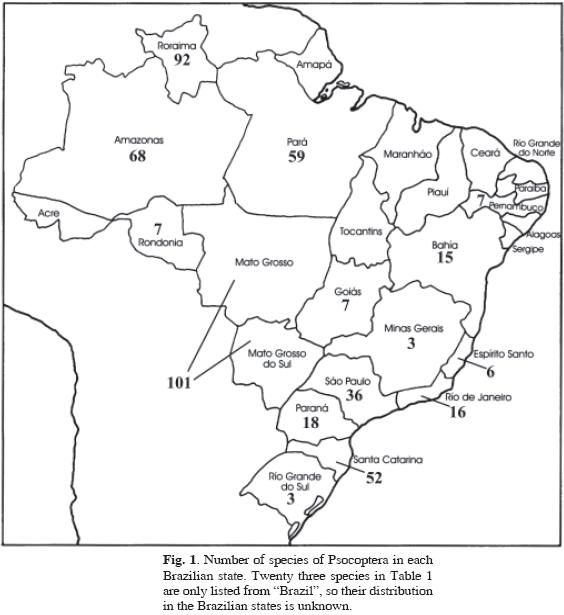
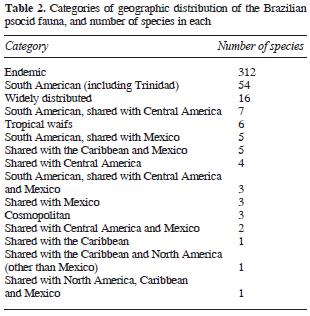
<body><![CDATA[<p align="justify"><font face="verdana" size="2">&nbsp;</font></p>     <p align="justify"><font face="verdana" size="2"><b>Results</b></font></p>     <p align="justify"><font face="verdana" size="2"><a href="/img/revistas/rmbiodiv/v80n3/a9t1.jpg" target="_blank">Table 1</a> presents the list of species of Psocoptera known in Brazil; 425 species are listed, in 94 genera and 28 families. The largest and most diverse family is Psocidae, with 89 species in 23 genera, followed by Ptiloneuridae (50 species in 5 genera), Epipsocidae (48 species in 6 genera), and Lachesillidae (41 species in 6 genera). The most speciose genera <i>(Lachesilla, Triplocania, Epipsocus, Archipsocus, Mesepipsocus, </i>and <i>Valenzuela) </i>account for 135 species, and on the other extreme, 32 genera are represented by 1 species and 11 genera have 2 species. It is likely that <i>Notolepium brasiliense </i>New will have to be transferred to <i>Thylacella </i>(cf. Mockford, 2005). Twelve additional genera <i>(Thylacella, Cyptophania, Neolepolepis, Lepinotus, Nanopsocus, Peritroctes, Epitroctes, Compsocus, Spurostigma, Par archipsocus, Tricholachesilla </i>and <i>Palmicola) </i>probably occur in Brazil (Garc&iacute;a Aldrete and Mockford, unpublished data), but they have not yet been detected.</font></p>     <p align="justify"><font face="verdana" size="2"><a href="#t2">Table 2</a> presents the categories of geographic distribution of the species listed in <a href="/img/revistas/rmbiodiv/v80n3/a9t1.jpg" target="_blank">Table 1</a>. The most important component is that of the endemics, resulting in a strikingly high level of endemism (73.41%); the second most important component is that of the species shared with other South American countries (54 species). It is likely that, as the South American fauna becomes better known, the level of endemism will decrease. The number of widely distributed species, and the group of South American species shared with Central America is relatively important, although small in relation to the size of the fauna. The usual assemblage of cosmopolitans and tropical waifs (9 species) is also present.</font></p>     <p align="center"><font face="verdana" size="2"><a name="t2"></a></font></p>     <p align="center"><font face="verdana" size="2"><img src="/img/revistas/rmbiodiv/v80n3/a9t2.jpg"></font></p>     <p align="justify"><font face="verdana" size="2">&nbsp;</font></p>     <p align="justify"><font face="verdana" size="2"><b>Discussion</b></font></p>     <p align="justify"><font face="verdana" size="2">Lienhard and Smithers (2002: <a href="/img/revistas/rmbiodiv/v80n3/a9t1.jpg" target="_blank">Table 1</a>) list 762 species of Psocoptera for South America. A conservative estimate of total species for South America is 1 300 species of Psocoptera, representing 13% of the world psocid fauna. Garc&iacute;a&#150;Aldrete (2006) pointed out that, by the end of 2005, there were 5 557 described species in 474 genera; the potential total can be easily rounded up to 10 000 species, to account for the undescribed ones. The 13% above constitutes a gross underestimation, given that South America includes 4 megadiverse countries (Brazil, Colombia, Ecuador and Per&uacute;), and that the number of species in an extra&#150;South American megadiverse country (Mexico) represents about 10% of the estimated world fauna (Mittermeier and Goetsch de Mittermeier, 1992; Llorente et al., 1996). In this context, Brazil, with 425 species recorded, stands as the richest country for Psocoptera in South America.</font></p>     <p align="justify"><font face="verdana" size="2">The nature of the Brazilian psocid fauna is, as expected, strongly South American, with many endemics and a good number of species shared with the surrounding countries; some species are also shared with the Caribbean area and with Central America (see <a href="#t2">Table 2</a>). There is evidence indicating that the known size of the Brazilian fauna is underestimated; some of it is speculative, e.g. the psocid fauna of Mexico, also a megadiverse country, but nearly 4 times smaller than Brazil, is almost twice as large (Mockford and Garc&iacute;a&#150;Aldrete, 1996; Garc&iacute;a&#150;Aldrete, 2001); if psocid species diversity is proportional to geographical area, then many more species remain to be collected in Brazil. Other evidence comes from examination of a small fraction of the Psocoptera deposited in the INPA (Manaus, Amaz&ocirc;nas) Invertebrate Collection, and the Psocoptera of the PPBio Program. In the latter, for example, 7 out of 8, in 5 genera, are new to science. In addition, the lack of records in 9 Brazilian states (<a href="#f1">Fig. 1</a>) almost certainly refl ects a lack of collecting efforts and not genuine absences. It could be hypothesized that, in a medium time period, the psocid fauna of Brazil could be shown to be twice that presently recorded.</font></p>     ]]></body>
<body><![CDATA[<p align="center"><font face="verdana" size="2"><a name="f1"></a></font></p>     <p align="center"><font face="verdana" size="2"><img src="/img/revistas/rmbiodiv/v80n3/a9f1.jpg"></font></p>     <p align="justify"><font face="verdana" size="2">&nbsp;</font></p>     <p align="justify"><font face="verdana" size="2"><b>Acknowledgments</b></font></p>     <p align="justify"><font face="verdana" size="2">We thank Jos&eacute; Albertino Rafael (INPA, Manaus, Amaz&ocirc;nas) for the loan of specimens in the INPA collection to ANGA, and for the facilities provided to ANGA during his visit to Manaus in April 2005. Thanks are also extended to Freddy Bravo (Universidade Estadual de Feira de Santana, Feira de Santana, Bahia) for the loan of specimens in the Museu de Zoolog&iacute;a, Universidade Estadual de Feira de Santana Collection, and for the attention and facilities provided to ANGA during his stay in Feira de Santana in September, 2008. We also thank Charles Lienhard (Mus&eacute;um d'histoire naturelle, Gen&egrave;ve, Suisse) and an anonymous reviewer, who read a former version of this work, and whose comments improved it considerably. Special thanks to PPBio Project, for partially financing the stay of ANGA at the UEFS in September 2008.</font></p>     <p align="justify"><font face="verdana" size="2">&nbsp;</font></p>     <p align="justify"><font face="verdana" size="2"><b>Literature cited</b></font></p>     <!-- ref --><p align="justify"><font face="verdana" size="2">Garc&iacute;a Aldrete, A. N. 2001. Genera of Psocoptera new to Mexico. Entomological News 112:94&#150;100.</font>&nbsp;&nbsp;&nbsp;&nbsp;&nbsp;&nbsp;&nbsp;&nbsp;[&#160;<a href="javascript:void(0);" onclick="javascript: window.open('/scielo.php?script=sci_nlinks&ref=7509348&pid=S1870-3453200900030000900001&lng=','','width=640,height=500,resizable=yes,scrollbars=1,menubar=yes,');">Links</a>&#160;]<!-- end-ref --><!-- ref --><p align="justify"><font face="verdana" size="2">Garc&iacute;a Aldrete, A. N. 2004a. New species of Psocoptera (Insecta) from Brazil. Anales del Instituto de Biolog&iacute;a, Universidad Nacional   Aut&oacute;noma   de   M&eacute;xico,   Serie Zoolog&iacute;a 75:303&#150;311.</font>&nbsp;&nbsp;&nbsp;&nbsp;&nbsp;&nbsp;&nbsp;&nbsp;[&#160;<a href="javascript:void(0);" onclick="javascript: window.open('/scielo.php?script=sci_nlinks&ref=7509349&pid=S1870-3453200900030000900002&lng=','','width=640,height=500,resizable=yes,scrollbars=1,menubar=yes,');">Links</a>&#160;]<!-- end-ref --><!-- ref --><p align="justify"><font face="verdana" size="2">Garc&iacute;a Aldrete, A. N. 2004b. Rediscovery of <i>Ptiloneuropsis immaculata </i>Roesler 1940 (Psocoptera: Ptiloneuridae), augmented description and neotype designation. Studies on Neotropical Fauna and Environment 39:207&#150;215.</font>&nbsp;&nbsp;&nbsp;&nbsp;&nbsp;&nbsp;&nbsp;&nbsp;[&#160;<a href="javascript:void(0);" onclick="javascript: window.open('/scielo.php?script=sci_nlinks&ref=7509350&pid=S1870-3453200900030000900003&lng=','','width=640,height=500,resizable=yes,scrollbars=1,menubar=yes,');">Links</a>&#160;]<!-- end-ref --><!-- ref --><p align="justify"><font face="verdana" size="2">Garc&iacute;a Aldrete, A. N. 2005. Three new monotypic genera of Epipsocidae (Psocoptera) from Peru and Brazil. Zootaxa 1077:51&#150;60. </font>&nbsp;&nbsp;&nbsp;&nbsp;&nbsp;&nbsp;&nbsp;&nbsp;[&#160;<a href="javascript:void(0);" onclick="javascript: window.open('/scielo.php?script=sci_nlinks&ref=7509351&pid=S1870-3453200900030000900004&lng=','','width=640,height=500,resizable=yes,scrollbars=1,menubar=yes,');">Links</a>&#160;]<!-- end-ref --><!-- ref --><p align="justify"><font face="verdana" size="2">Garc&iacute;a Aldrete, A. N. 2006. New genera of Psocoptera (Insecta), from Mexico, Belize and Ecuador (Psoquillidae, Ptiloneuridae, Lachesillidae). Zootaxa 1319:1&#150;14. </font>&nbsp;&nbsp;&nbsp;&nbsp;&nbsp;&nbsp;&nbsp;&nbsp;[&#160;<a href="javascript:void(0);" onclick="javascript: window.open('/scielo.php?script=sci_nlinks&ref=7509352&pid=S1870-3453200900030000900005&lng=','','width=640,height=500,resizable=yes,scrollbars=1,menubar=yes,');">Links</a>&#160;]<!-- end-ref --><!-- ref --><p align="justify"><font face="verdana" size="2">Johnson, K. P., K. Yoshizawa and V. S. Smith. 2004. Multiple origins of parasitism in lice. Proceedings of the Royal Society of London, Series B, 271:1771&#150;1776.</font>&nbsp;&nbsp;&nbsp;&nbsp;&nbsp;&nbsp;&nbsp;&nbsp;[&#160;<a href="javascript:void(0);" onclick="javascript: window.open('/scielo.php?script=sci_nlinks&ref=7509353&pid=S1870-3453200900030000900006&lng=','','width=640,height=500,resizable=yes,scrollbars=1,menubar=yes,');">Links</a>&#160;]<!-- end-ref --><!-- ref --><p align="justify"><font face="verdana" size="2"> Lienhard, C. 2004. Worldwide country checklist of Psocoptera species (based on the World Catalogue by Lienhard and Smithers 2002). Online:&nbsp;<a href="http://www.ville-ge.ch/mhng/psocoptera/page/ps-coun.htm" target="_blank">http://www.ville&#150;ge.ch/mhng/psocoptera/page/ps&#150;coun.htm</a></font>&nbsp;&nbsp;&nbsp;&nbsp;&nbsp;&nbsp;&nbsp;&nbsp;[&#160;<a href="javascript:void(0);" onclick="javascript: window.open('/scielo.php?script=sci_nlinks&ref=7509354&pid=S1870-3453200900030000900007&lng=','','width=640,height=500,resizable=yes,scrollbars=1,menubar=yes,');">Links</a>&#160;]<!-- end-ref --><!-- ref --><p align="justify"><font face="verdana" size="2">Lienhard,   C.   and   C.   N.   Smithers.   2002. Psocoptera (Insecta). World Catalogue and Bibliography. Instrumenta Biodiversitatis V. Mus&eacute;um d'histoire naturelle, Gen&egrave;ve, Suisse. 745 p. </font>&nbsp;&nbsp;&nbsp;&nbsp;&nbsp;&nbsp;&nbsp;&nbsp;[&#160;<a href="javascript:void(0);" onclick="javascript: window.open('/scielo.php?script=sci_nlinks&ref=7509355&pid=S1870-3453200900030000900008&lng=','','width=640,height=500,resizable=yes,scrollbars=1,menubar=yes,');">Links</a>&#160;]<!-- end-ref --><!-- ref --><p align="justify"><font face="verdana" size="2">Llorente, B. J., E. Gonz&aacute;lez S., A. N. Garc&iacute;a Aldrete and C. Cordero. 1996. Breve panorama de la taxonom&iacute;a de artr&oacute;podos en M&eacute;xico. <i>In </i>Biodiversidad, biogeograf&iacute;a y taxonom&iacute;a de artr&oacute;podos de M&eacute;xico: hacia una s&iacute;ntesis de su conocimiento, J. Llorente B., A. N. Garc&iacute;a Aldrete and E. Gonz&aacute;lez S. (eds.). Instituto de Biolog&iacute;a, Universidad Nacional Aut&oacute;noma de M&eacute;xico. Mexico, D. F. p. 3&#150;14. </font>&nbsp;&nbsp;&nbsp;&nbsp;&nbsp;&nbsp;&nbsp;&nbsp;[&#160;<a href="javascript:void(0);" onclick="javascript: window.open('/scielo.php?script=sci_nlinks&ref=7509356&pid=S1870-3453200900030000900009&lng=','','width=640,height=500,resizable=yes,scrollbars=1,menubar=yes,');">Links</a>&#160;]<!-- end-ref --><!-- ref --><p align="justify"><font face="verdana" size="2">Mittermeier, R. A. and C. Goetsch de Mittermeier. 1992. La importancia de la diversidad biol&oacute;gica de M&eacute;xico. <i>In </i>M&eacute;xico ante los retos de la biodiversidad, J. Sarukh&aacute;n and R. Dirzo (Compiladores). Comisi&oacute;n Nacional para el Conocimiento y Uso de la Biodiversidad. Mexico, D.F. p. 63&#150;73. </font>&nbsp;&nbsp;&nbsp;&nbsp;&nbsp;&nbsp;&nbsp;&nbsp;[&#160;<a href="javascript:void(0);" onclick="javascript: window.open('/scielo.php?script=sci_nlinks&ref=7509357&pid=S1870-3453200900030000900010&lng=','','width=640,height=500,resizable=yes,scrollbars=1,menubar=yes,');">Links</a>&#160;]<!-- end-ref --><!-- ref --><p align="justify"><font face="verdana" size="2">Mockford, E. L. 2005. A new genus of Perientomine psocids (Psocoptera:   Lepidopsocidae)   with   a   review   of   the Perientomine   genera.   Transactions   of   the   American Entomological Society 131:201&#150;215.</font>&nbsp;&nbsp;&nbsp;&nbsp;&nbsp;&nbsp;&nbsp;&nbsp;[&#160;<a href="javascript:void(0);" onclick="javascript: window.open('/scielo.php?script=sci_nlinks&ref=7509358&pid=S1870-3453200900030000900011&lng=','','width=640,height=500,resizable=yes,scrollbars=1,menubar=yes,');">Links</a>&#160;]<!-- end-ref --><!-- ref --><p align="justify"><font face="verdana" size="2">Mockford, E. L. and A. N. Garc&iacute;a Aldrete. 1996. Psocoptera. <i>In </i>Biodiversidad, biogeograf&iacute;a y taxonom&iacute;a de artr&oacute;podos de M&eacute;xico: hacia una s&iacute;ntesis de su conocimiento, J. Llorente B., A. N. Garc&iacute;a Aldrete and E. Gonz&aacute;lez S. (eds.). Instituto de Biolog&iacute;a, Universidad Nacional Aut&oacute;noma de M&eacute;xico. Mexico, D.F. p. 175&#150;205.</font>&nbsp;&nbsp;&nbsp;&nbsp;&nbsp;&nbsp;&nbsp;&nbsp;[&#160;<a href="javascript:void(0);" onclick="javascript: window.open('/scielo.php?script=sci_nlinks&ref=7509359&pid=S1870-3453200900030000900012&lng=','','width=640,height=500,resizable=yes,scrollbars=1,menubar=yes,');">Links</a>&#160;]<!-- end-ref --><!-- ref --><p align="justify"><font face="verdana" size="2">Requena, G. S., B. A. Buzatto and G. Machado. 2007. Habitat use, phenology, and gregariousness of the Neotropical psocopteran <i>Cerastipsocus sivorii </i>(Psocoptera: Psocidae). Sociobiology 49:197&#150;214.</font>&nbsp;&nbsp;&nbsp;&nbsp;&nbsp;&nbsp;&nbsp;&nbsp;[&#160;<a href="javascript:void(0);" onclick="javascript: window.open('/scielo.php?script=sci_nlinks&ref=7509360&pid=S1870-3453200900030000900013&lng=','','width=640,height=500,resizable=yes,scrollbars=1,menubar=yes,');">Links</a>&#160;]<!-- end-ref --><!-- ref --><p align="justify"><font face="verdana" size="2">Yoshizawa, K. and K. Johnson. 2006. Morphology of male genitalia in lice and their relatives and phylogenetic implications. Systematic Entomology 31:350&#150;361.</font>&nbsp;&nbsp;&nbsp;&nbsp;&nbsp;&nbsp;&nbsp;&nbsp;[&#160;<a href="javascript:void(0);" onclick="javascript: window.open('/scielo.php?script=sci_nlinks&ref=7509361&pid=S1870-3453200900030000900014&lng=','','width=640,height=500,resizable=yes,scrollbars=1,menubar=yes,');">Links</a>&#160;]<!-- end-ref --> ]]></body><back>
<ref-list>
<ref id="B1">
<nlm-citation citation-type="journal">
<person-group person-group-type="author">
<name>
<surname><![CDATA[García Aldrete]]></surname>
<given-names><![CDATA[A. N.]]></given-names>
</name>
</person-group>
<article-title xml:lang="en"><![CDATA[Genera of Psocoptera new to Mexico]]></article-title>
<source><![CDATA[Entomological News]]></source>
<year>2001</year>
<volume>112</volume>
<page-range>94-100</page-range></nlm-citation>
</ref>
<ref id="B2">
<nlm-citation citation-type="journal">
<person-group person-group-type="author">
<name>
<surname><![CDATA[García Aldrete]]></surname>
<given-names><![CDATA[A. N.]]></given-names>
</name>
</person-group>
<article-title xml:lang="en"><![CDATA[New species of Psocoptera (Insecta) from Brazil]]></article-title>
<source><![CDATA[Anales del Instituto de Biología]]></source>
<year>2004</year>
<volume>75</volume>
<page-range>303-311</page-range><publisher-name><![CDATA[Universidad Nacional Autónoma de México]]></publisher-name>
</nlm-citation>
</ref>
<ref id="B3">
<nlm-citation citation-type="journal">
<person-group person-group-type="author">
<name>
<surname><![CDATA[García Aldrete]]></surname>
<given-names><![CDATA[A. N.]]></given-names>
</name>
</person-group>
<article-title xml:lang="en"><![CDATA[Rediscovery of Ptiloneuropsis immaculata Roesler 1940 (Psocoptera: Ptiloneuridae), augmented description and neotype designation]]></article-title>
<source><![CDATA[Studies on Neotropical Fauna and Environment]]></source>
<year>2004</year>
<volume>39</volume>
<page-range>207-215</page-range></nlm-citation>
</ref>
<ref id="B4">
<nlm-citation citation-type="journal">
<person-group person-group-type="author">
<name>
<surname><![CDATA[García Aldrete]]></surname>
<given-names><![CDATA[A. N.]]></given-names>
</name>
</person-group>
<article-title xml:lang="en"><![CDATA[Three new monotypic genera of Epipsocidae (Psocoptera) from Peru and Brazil]]></article-title>
<source><![CDATA[Zootaxa]]></source>
<year>2005</year>
<volume>1077</volume>
<page-range>51-60</page-range></nlm-citation>
</ref>
<ref id="B5">
<nlm-citation citation-type="journal">
<person-group person-group-type="author">
<name>
<surname><![CDATA[García Aldrete]]></surname>
<given-names><![CDATA[A. N.]]></given-names>
</name>
</person-group>
<article-title xml:lang="en"><![CDATA[New genera of Psocoptera (Insecta), from Mexico, Belize and Ecuador (Psoquillidae, Ptiloneuridae, Lachesillidae)]]></article-title>
<source><![CDATA[Zootaxa]]></source>
<year>2006</year>
<volume>1319</volume>
<page-range>1-14</page-range></nlm-citation>
</ref>
<ref id="B6">
<nlm-citation citation-type="journal">
<person-group person-group-type="author">
<name>
<surname><![CDATA[Johnson]]></surname>
<given-names><![CDATA[K. P.]]></given-names>
</name>
<name>
<surname><![CDATA[Yoshizawa]]></surname>
<given-names><![CDATA[K]]></given-names>
</name>
<name>
<surname><![CDATA[Smith]]></surname>
<given-names><![CDATA[V. S.]]></given-names>
</name>
</person-group>
<article-title xml:lang="en"><![CDATA[Multiple origins of parasitism in lice]]></article-title>
<source><![CDATA[Proceedings of the Royal Society of London, Series B]]></source>
<year>2004</year>
<volume>271</volume>
<page-range>1771-1776</page-range></nlm-citation>
</ref>
<ref id="B7">
<nlm-citation citation-type="">
<person-group person-group-type="author">
<name>
<surname><![CDATA[Lienhard]]></surname>
<given-names><![CDATA[C]]></given-names>
</name>
</person-group>
<source><![CDATA[Worldwide country checklist of Psocoptera species (based on the World Catalogue by Lienhard and Smithers 2002)]]></source>
<year>2004</year>
</nlm-citation>
</ref>
<ref id="B8">
<nlm-citation citation-type="book">
<person-group person-group-type="author">
<name>
<surname><![CDATA[Lienhard]]></surname>
<given-names><![CDATA[C]]></given-names>
</name>
<name>
<surname><![CDATA[Smithers]]></surname>
<given-names><![CDATA[C. N.]]></given-names>
</name>
</person-group>
<source><![CDATA[Psocoptera (Insecta). World Catalogue and Bibliography. Instrumenta Biodiversitatis V.]]></source>
<year>2002</year>
<page-range>745</page-range><publisher-loc><![CDATA[Genève ]]></publisher-loc>
<publisher-name><![CDATA[Muséum d'histoire naturelle]]></publisher-name>
</nlm-citation>
</ref>
<ref id="B9">
<nlm-citation citation-type="book">
<person-group person-group-type="author">
<name>
<surname><![CDATA[Llorente]]></surname>
<given-names><![CDATA[B. J.]]></given-names>
</name>
<name>
<surname><![CDATA[González S.]]></surname>
<given-names><![CDATA[E]]></given-names>
</name>
<name>
<surname><![CDATA[García Aldrete]]></surname>
<given-names><![CDATA[A. N.]]></given-names>
</name>
<name>
<surname><![CDATA[Cordero]]></surname>
<given-names><![CDATA[C]]></given-names>
</name>
</person-group>
<article-title xml:lang="es"><![CDATA[Breve panorama de la taxonomía de artrópodos en México]]></article-title>
<person-group person-group-type="editor">
<name>
<surname><![CDATA[Llorente B.]]></surname>
<given-names><![CDATA[J]]></given-names>
</name>
<name>
<surname><![CDATA[García Aldrete]]></surname>
<given-names><![CDATA[A. N.]]></given-names>
</name>
<name>
<surname><![CDATA[González S.]]></surname>
<given-names><![CDATA[E]]></given-names>
</name>
</person-group>
<source><![CDATA[Biodiversidad, biogeografía y taxonomía de artrópodos de México: hacia una síntesis de su conocimiento]]></source>
<year>1996</year>
<page-range>3-14</page-range><publisher-loc><![CDATA[^eD. F. D. F.]]></publisher-loc>
<publisher-name><![CDATA[Instituto de BiologíaUniversidad Nacional Autónoma de México]]></publisher-name>
</nlm-citation>
</ref>
<ref id="B10">
<nlm-citation citation-type="book">
<person-group person-group-type="author">
<name>
<surname><![CDATA[Mittermeier]]></surname>
<given-names><![CDATA[R. A.]]></given-names>
</name>
<name>
<surname><![CDATA[Goetsch de Mittermeier]]></surname>
<given-names><![CDATA[C]]></given-names>
</name>
</person-group>
<article-title xml:lang="es"><![CDATA[La importancia de la diversidad biológica de México]]></article-title>
<person-group person-group-type="editor">
<name>
<surname><![CDATA[Sarukhán]]></surname>
<given-names><![CDATA[J]]></given-names>
</name>
<name>
<surname><![CDATA[Dirzo]]></surname>
<given-names><![CDATA[R]]></given-names>
</name>
</person-group>
<source><![CDATA[México ante los retos de la biodiversidad]]></source>
<year>1992</year>
<page-range>63-73</page-range><publisher-loc><![CDATA[^eD.F. D.F.]]></publisher-loc>
<publisher-name><![CDATA[Comisión Nacional para el Conocimiento y Uso de la Biodiversidad]]></publisher-name>
</nlm-citation>
</ref>
<ref id="B11">
<nlm-citation citation-type="journal">
<person-group person-group-type="author">
<name>
<surname><![CDATA[Mockford]]></surname>
<given-names><![CDATA[E. L.]]></given-names>
</name>
</person-group>
<article-title xml:lang="en"><![CDATA[A new genus of Perientomine psocids (Psocoptera: Lepidopsocidae) with a review of the Perientomine genera]]></article-title>
<source><![CDATA[Transactions of the American Entomological Society]]></source>
<year>2005</year>
<volume>131</volume>
<page-range>201-215</page-range></nlm-citation>
</ref>
<ref id="B12">
<nlm-citation citation-type="book">
<person-group person-group-type="author">
<name>
<surname><![CDATA[Mockford]]></surname>
<given-names><![CDATA[E. L.]]></given-names>
</name>
<name>
<surname><![CDATA[García Aldrete]]></surname>
<given-names><![CDATA[A. N.]]></given-names>
</name>
</person-group>
<article-title xml:lang="en"><![CDATA[Psocoptera]]></article-title>
<person-group person-group-type="editor">
<name>
<surname><![CDATA[Llorente B]]></surname>
<given-names><![CDATA[J]]></given-names>
</name>
<name>
<surname><![CDATA[García Aldrete]]></surname>
<given-names><![CDATA[A. N.]]></given-names>
</name>
<name>
<surname><![CDATA[González S.]]></surname>
<given-names><![CDATA[E]]></given-names>
</name>
</person-group>
<source><![CDATA[Biodiversidad, biogeografía y taxonomía de artrópodos de México: hacia una síntesis de su conocimiento]]></source>
<year>1996</year>
<page-range>175-205</page-range><publisher-loc><![CDATA[^eD.F. D.F.]]></publisher-loc>
<publisher-name><![CDATA[Instituto de BiologíaUniversidad Nacional Autónoma de México]]></publisher-name>
</nlm-citation>
</ref>
<ref id="B13">
<nlm-citation citation-type="journal">
<person-group person-group-type="author">
<name>
<surname><![CDATA[Requena]]></surname>
<given-names><![CDATA[G. S.]]></given-names>
</name>
<name>
<surname><![CDATA[Buzatto]]></surname>
<given-names><![CDATA[B. A.]]></given-names>
</name>
<name>
<surname><![CDATA[Machado]]></surname>
<given-names><![CDATA[G]]></given-names>
</name>
</person-group>
<article-title xml:lang="en"><![CDATA[Habitat use, phenology, and gregariousness of the Neotropical psocopteran Cerastipsocus sivorii (Psocoptera: Psocidae)]]></article-title>
<source><![CDATA[Sociobiology]]></source>
<year>2007</year>
<volume>49</volume>
<page-range>197-214</page-range></nlm-citation>
</ref>
<ref id="B14">
<nlm-citation citation-type="journal">
<person-group person-group-type="author">
<name>
<surname><![CDATA[Yoshizawa]]></surname>
<given-names><![CDATA[K]]></given-names>
</name>
<name>
<surname><![CDATA[Johnson]]></surname>
<given-names><![CDATA[K]]></given-names>
</name>
</person-group>
<article-title xml:lang="en"><![CDATA[Morphology of male genitalia in lice and their relatives and phylogenetic implications]]></article-title>
<source><![CDATA[Systematic Entomology]]></source>
<year>2006</year>
<volume>31</volume>
<page-range>350-361</page-range></nlm-citation>
</ref>
</ref-list>
</back>
</article>