<?xml version="1.0" encoding="ISO-8859-1"?><article xmlns:mml="http://www.w3.org/1998/Math/MathML" xmlns:xlink="http://www.w3.org/1999/xlink" xmlns:xsi="http://www.w3.org/2001/XMLSchema-instance">
<front>
<journal-meta>
<journal-id>1870-3453</journal-id>
<journal-title><![CDATA[Revista mexicana de biodiversidad]]></journal-title>
<abbrev-journal-title><![CDATA[Rev. Mex. Biodiv.]]></abbrev-journal-title>
<issn>1870-3453</issn>
<publisher>
<publisher-name><![CDATA[Instituto de Biología]]></publisher-name>
</publisher>
</journal-meta>
<article-meta>
<article-id>S1870-34532009000300002</article-id>
<title-group>
<article-title xml:lang="en"><![CDATA[Gracilaria, Subgenus Textoriella (Gracilariaceae, Rhodophyta) in the Gulf of Mexico and the Mexican Caribbean]]></article-title>
<article-title xml:lang="es"><![CDATA[Gracilaria, subgénero Textoriella (Gracilariaceae, Rhodophyta) en el golfo de México y el Caribe mexicano]]></article-title>
</title-group>
<contrib-group>
<contrib contrib-type="author">
<name>
<surname><![CDATA[Dreckmann]]></surname>
<given-names><![CDATA[Kurt M.]]></given-names>
</name>
<xref ref-type="aff" rid="A01"/>
</contrib>
<contrib contrib-type="author">
<name>
<surname><![CDATA[Sentíes]]></surname>
<given-names><![CDATA[Abel]]></given-names>
</name>
<xref ref-type="aff" rid="A01"/>
</contrib>
</contrib-group>
<aff id="A01">
<institution><![CDATA[,Universidad Autónoma Metropolitana - Iztapalapa División de Ciencias Biológicas y de la Salud Departamento de Hidrobiología]]></institution>
<addr-line><![CDATA[México D.F.]]></addr-line>
<country>México</country>
</aff>
<pub-date pub-type="pub">
<day>00</day>
<month>12</month>
<year>2009</year>
</pub-date>
<pub-date pub-type="epub">
<day>00</day>
<month>12</month>
<year>2009</year>
</pub-date>
<volume>80</volume>
<numero>3</numero>
<fpage>593</fpage>
<lpage>601</lpage>
<copyright-statement/>
<copyright-year/>
<self-uri xlink:href="http://www.scielo.org.mx/scielo.php?script=sci_arttext&amp;pid=S1870-34532009000300002&amp;lng=en&amp;nrm=iso"></self-uri><self-uri xlink:href="http://www.scielo.org.mx/scielo.php?script=sci_abstract&amp;pid=S1870-34532009000300002&amp;lng=en&amp;nrm=iso"></self-uri><self-uri xlink:href="http://www.scielo.org.mx/scielo.php?script=sci_pdf&amp;pid=S1870-34532009000300002&amp;lng=en&amp;nrm=iso"></self-uri><abstract abstract-type="short" xml:lang="en"><p><![CDATA[Four species of Gracilaria (Gracilariaceae, Rhodophyta) with textorii-type spermatangial conceptacles (subgenus Textoriella Yamamoto) are recorded for the Gulf of Mexico and the Mexican Caribbean: Gracilaria blodgettii, G. cervicornis, G. mammillaris, and G. tikvahiae. The general distribution of the subgenus for Central America, both Pacific and Atlantic, displays a disjunct pattern explainable based on the geologic vicariant events that interrupted the connection between Pacific and Atlantic at the Isthmuses of Panama (closed 3.1-2.8 million years ago), and Tehuantepec (southern Mexico, closed 4-3.5 million years ago). Gracilaria cuneata/G. crispata, and G. mammillaris (G. hayi)/G. veleroae are 2 pairs of sibling species, or sister taxa, that diverged as a result of the final emergence of the Isthmus, and of the same age as the Central American Isthmus itself.]]></p></abstract>
<abstract abstract-type="short" xml:lang="es"><p><![CDATA[Se registran 4 especies de Gracilaria (Gracilariaceae, Rhodophyta) con conceptáculos espematangiales tipo textorii- (subgénero Textoriella Yamamoto) para el golfo de México y Caribe mexicano: Gracilaria blodgettii, G. cervicornis, G. mammillaris y G. tikvahiae. La distribución general del subgénero para Atlántico y Pacífico de Centroamérica despliega un patrón disyunto explicable por los eventos geológicos vicariantes que interrumpieron la conexión entre Pacífico y Atlántico en los istmos de Panamá (cerrado hace aprox. 3.1-2.8 millones de años) y Tehuantepec (sur de México, cerrado hace aprox. 4-3.5 millones de años). Gracilaria cuneata/G. crispata y G. mammillaris (= G. hayi)/ G. veleroae corresponden a 2 pares de especies hermanas que divergieron como resultado de la emersión del istmo, y con aproximadamente la misma edad del istmo centroamericano.]]></p></abstract>
<kwd-group>
<kwd lng="en"><![CDATA[Gracilaria]]></kwd>
<kwd lng="en"><![CDATA[Textoriella]]></kwd>
<kwd lng="en"><![CDATA[floristics]]></kwd>
<kwd lng="en"><![CDATA[biogeography]]></kwd>
<kwd lng="es"><![CDATA[Gracilaria]]></kwd>
<kwd lng="es"><![CDATA[Textoriella]]></kwd>
<kwd lng="es"><![CDATA[florística]]></kwd>
<kwd lng="es"><![CDATA[biogeografía]]></kwd>
</kwd-group>
</article-meta>
</front><body><![CDATA[ <p align="justify"><font face="verdana" size="4">Taxonom&iacute;a y sistem&aacute;tica</font></p>     <p align="justify"><font face="verdana" size="2">&nbsp;</font></p>     <p align="center"><font face="verdana" size="4"><b><i>Gracilaria, </i>Subgenus <i>Textoriella </i>(Gracilariaceae, Rhodophyta) in the Gulf of Mexico and the Mexican Caribbean</b></font></p>     <p align="justify"><font face="verdana" size="2">&nbsp;</font></p>     <p align="center"><font face="verdana" size="3"><b><i>Gracilaria, </i>subg&eacute;nero <i>Textoriella </i>(Gracilariaceae, Rhodophyta) en el golfo de M&eacute;xico y el Caribe mexicano</b></font></p>     <p align="justify"><font face="verdana" size="2">&nbsp;</font></p>     <p align="center"><font face="verdana" size="2"><b>Kurt M. Dreckmann* and Abel Sent&iacute;es</b></font></p>     <p align="justify"><font face="verdana" size="2">&nbsp;</font></p>     <p align="justify"><font face="verdana" size="2"><i>Departamento de Hidrobiolog&iacute;a, Divisi&oacute;n de Ciencias Biol&oacute;gicas y de la Salud, Universidad Aut&oacute;noma Metropolitana &#150; Iztapalapa. Apartado postal 55&#150;535, 09340, M&eacute;xico, D.F., M&eacute;xico.</i></font></p>     <p align="justify"><font face="verdana" size="2">&nbsp;</font></p>     ]]></body>
<body><![CDATA[<p align="justify"><font face="verdana" size="2"><b>* Correspondent: </b>    <br>   <a href="mailto:tuna@xanum.uam.mx">tuna@xanum.uam.mx</a></font></p>     <p align="justify"><font face="verdana" size="2">&nbsp;</font></p>     <p align="justify"><font face="verdana" size="2">Recibido: 10 octubre 2007    <br>   Aceptado: 21 abril 2009</font></p>     <p align="justify"><font face="verdana" size="2">&nbsp;</font></p>     <p align="justify"><font face="verdana" size="2"><b>Abstract</b></font></p>     <p align="justify"><font face="verdana" size="2">Four species of <i>Gracilaria </i>(Gracilariaceae, Rhodophyta) with <i>textorii&#150;type </i>spermatangial conceptacles (subgenus <i>Textoriella </i>Yamamoto) are recorded for the Gulf of Mexico and the Mexican Caribbean: <i>Gracilaria blodgettii, G. cervicornis, G. mammillaris, </i>and <i>G. tikvahiae. </i>The general distribution of the subgenus for Central America, both Pacific and Atlantic, displays a disjunct pattern explainable based on the geologic vicariant events that interrupted the connection between Pacific and Atlantic at the Isthmuses of Panama (closed 3.1&#150;2.8 million years ago), and Tehuantepec (southern Mexico, closed 4&#150;3.5 million years ago). <i>Gracilaria cuneata/G. crispata, </i>and <i>G. mammillaris (G. hayi)/G. veleroae </i>are 2 pairs of sibling species, or sister taxa, that diverged as a result of the final emergence of the Isthmus, and of the same age as the Central American Isthmus itself.</font></p>     <p align="justify"><font face="verdana" size="2"><b>Key words:</b> <i>Gracilaria, Textoriella, </i>floristics, biogeography.</font></p>     <p align="justify"><font face="verdana" size="2">&nbsp;</font></p>     ]]></body>
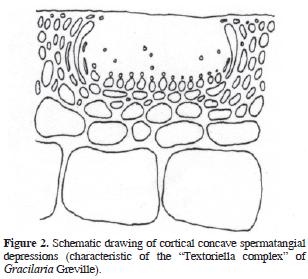
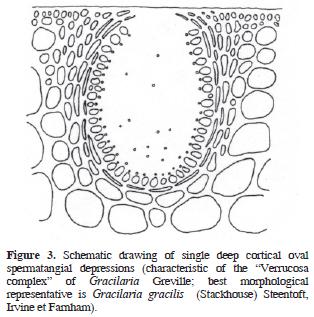
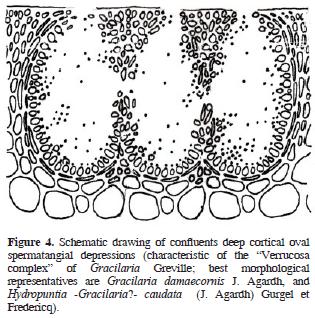
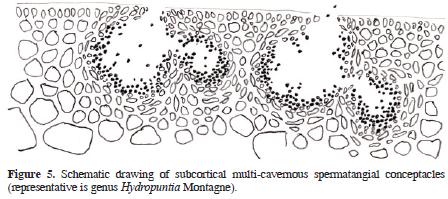
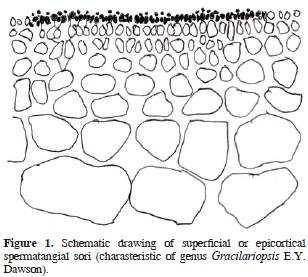
<body><![CDATA[<p align="justify"><font face="verdana" size="2"><b>Resumen</b></font></p>     <p align="justify"><font face="verdana" size="2">Se registran 4 especies de <i>Gracilaria </i>(Gracilariaceae, Rhodophyta) con concept&aacute;culos espematangiales tipo <i>textorii&#150; </i>(subg&eacute;nero <i>Textoriella </i>Yamamoto) para el golfo de M&eacute;xico y Caribe mexicano: <i>Gracilaria blodgettii, G. cervicornis, G. mammillaris </i>y <i>G. tikvahiae. </i>La distribuci&oacute;n general del subg&eacute;nero para Atl&aacute;ntico y Pac&iacute;fico de Centroam&eacute;rica despliega un patr&oacute;n disyunto explicable por los eventos geol&oacute;gicos vicariantes que interrumpieron la conexi&oacute;n entre Pac&iacute;fico y Atl&aacute;ntico en los istmos de Panam&aacute; (cerrado hace aprox. 3.1&#150;2.8 millones de a&ntilde;os) y Tehuantepec (sur de M&eacute;xico, cerrado hace aprox. 4&#150;3.5 millones de a&ntilde;os). <i>Gracilaria cuneata/G. crispata </i>y <i>G. mammillaris </i>(= <i>G. hayi)/ G. veleroae </i>corresponden a 2 pares de especies hermanas que divergieron como resultado de la emersi&oacute;n del istmo, y con aproximadamente la misma edad del istmo centroamericano.</font></p>     <p align="justify"><font face="verdana" size="2"><b>Palabras clave:</b> <i>Gracilaria, Textoriella, </i>flor&iacute;stica, biogeograf&iacute;a.</font></p>     <p align="justify"><font face="verdana" size="2">&nbsp;</font></p>     <p align="justify"><font face="verdana" size="2"><b>Introduction</b></font></p>     <p align="justify"><font face="verdana" size="2">The genus <i>Gracilaria </i>Greville <i>sensu lato </i>(incl. <i>Gracilariopsis </i>E.Y. Dawson, and <i>Hydropuntia </i>Montagne, Gracilariaceae, Rhodophyta) are distinguished from other gracilarioid algae in the structure and organization of male cells or spermatia. There are 4 recognized general arrangements (Homi 1958; Yamamoto 1975, 1978; Liao and Hommersand, 2003): in superficial or epicortical sori; in cortical concave depressions, in deep cortical oval depressions, single or confluents, and in subcortical multi&#150;cavernous conceptacles. Based on the differential distribution of these anatomical patterns within the genus <i>Gracilaria, </i>Yamamoto (1975) proposed the taxonomic establishment of 3 subgenera. The first, <i>Gracilariella </i>Yamamoto, is characterized by superficial spermatangia distributed all over the algal surface. The type of this subgenus is <i>Gracilaria chorda </i>Holmes. The second subgenus is <i>Textoriella </i>Yamamoto, which is characterized by spermatangial conceptacles in shallow depressions, each primordium of spermatangial mother cell giving place to a branched system that covers the floor of conceptacle when mature, each spermatangial mother cell producing spermatia. The type of <i>Textoriella </i>is <i>Gracilaria textorii </i>Suringar De Toni. Finally, subgenus <i>Gracilaria </i>has spermatangia in deep oval conceptacles, with each primordium of spermatangial mother cells giving rise to a branched system that covers the inner surface of the whole conceptacle when mature; each spermatangial mother cell produces spermatia. The type of this subgenus is <i>Gracilaria </i><i>verrucosa </i>(Hudson) Papenfuss. Recently, Tseng and Xia (1999) proposed a fourth subgenus, <i>Hydropuntia, </i>based on the ocurrence of spermatangia in multi&#150;cavernous conceptacles. The type of <i>Hydropuntia </i>is <i>Gracilaria edulis </i>(S. G. Gmelin) P. C. Silva.</font></p>     <p align="justify"><font face="verdana" size="2">The only available monograph of Gracilariaceae on the Mexican shores of the Gulf of Mexico and the Caribbean Sea is Taylor (1960). Because the family has experienced a great deal of taxonomic changes during the last 45 years, a monographic project that incorporates those changes is needed. As a part of that project, we present here our results on the subgenus <i>Textoriella.</i></font></p>     <p align="justify"><font face="verdana" size="2">&nbsp;</font></p>     <p align="justify"><font face="verdana" size="2"><b>Materials and methods</b></font></p>     <p align="justify"><font face="verdana" size="2">Algal material was collected along the Mexican shores of the Gulf of Mexico (Tamaulipas, Veracruz, Tabasco, Campeche), and the Mexican Caribbean (Yucat&aacute;n and Quintana Roo) throughout the past 10 years, preserved in 3&#150;4% formalin/seawater solution, and housed as herbarium specimens at UAMIZ. We also studied herbarium material from AHFH, CIQRO, ENCB, FCME, MEXU, UAT, UC, UNL, and US. Small segments were cut into cross or longitudinal sections with a razor blade, stained with aniline blue, and mounted in 100% glycerine for anatomical observations. When specimens came from dry material, segments were rehydrated in a 1&#150;2% aqueous solution of children's shampoo and warmed for 1&#150;2 min in a microwave oven before sectioning. Schematic drawings of the 4 gracilariacean spermatangial types mentioned above were drawn with pen and ink on bright&#150;white 90 g paper from a Leica<sup>TM</sup> DMLB compound microscope, and are presented below as <a href="#f1">figures 1</a>&#150;<a href="#f5">5</a> (<a href="#f1">Figures 1</a>, <a href="#f2">2</a>, <a href="#f3">3</a>, <a href="#f4">4</a> and <a href="#f5">5</a>). Maps were also drawn on bright&#150;white 90 g paper, and composed with Adobe<sup>TM</sup> Photoshop<sup>TM</sup> CS2. Photographs were taken with a Nikon<sup>TM</sup> D60 digital camera equipped with a standard Nikon<sup>TM</sup> 35&#150;55 mm Zoom lens.</font></p>     ]]></body>
<body><![CDATA[<p align="center"><font face="verdana" size="2"><a name="f1"></a></font></p>     <p align="center"><font face="verdana" size="2"><img src="/img/revistas/rmbiodiv/v80n3/a2f1.jpg"></font></p>     <p align="center"><font face="verdana" size="2"><a name="f2"></a></font></p>     <p align="center"><font face="verdana" size="2"><img src="/img/revistas/rmbiodiv/v80n3/a2f2.jpg"></font></p>     <p align="center"><font face="verdana" size="2"><a name="f3"></a></font></p>     <p align="center"><font face="verdana" size="2"><img src="/img/revistas/rmbiodiv/v80n3/a2f3.jpg"></font></p>     <p align="center"><font face="verdana" size="2"><a name="f4"></a></font></p>     <p align="center"><font face="verdana" size="2"><img src="/img/revistas/rmbiodiv/v80n3/a2f4.jpg"></font></p>     <p align="center"><font face="verdana" size="2"><a name="f5"></a></font></p>     <p align="center"><font face="verdana" size="2"><img src="/img/revistas/rmbiodiv/v80n3/a2f5.jpg"></font></p>     ]]></body>
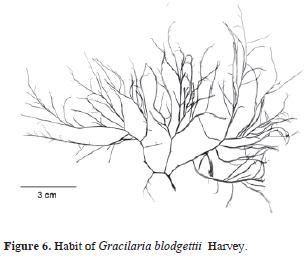
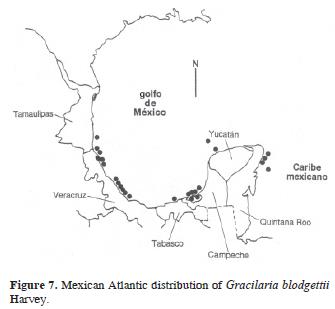
<body><![CDATA[<p align="justify"><font face="verdana" size="2">&nbsp;</font></p>     <p align="justify"><font face="verdana" size="2"><b>Descriptions</b></font></p>     <p align="justify"><font face="verdana" size="2"><i>Gracilaria blodgettii </i>Harvey, 1853: 111 (Type loc.: Key West, Florida, USA).</font></p>     <p align="justify"><font face="verdana" size="2">Synonym: <i>Gracilaria cylindrica </i>B&oslash;rgesen, 1920: 375&#150;377, figs. 364 and 365 (Syntype locs.: Virgin Islands; north of America Hill, St. John, and between St. John and St. Thomas). <a href="#f6">Figs. 6</a> and <a href="#f7">7</a>.</font></p>     <p align="center"><font face="verdana" size="2"><a name="f6"></a></font></p>     <p align="center"><font face="verdana" size="2"><img src="/img/revistas/rmbiodiv/v80n3/a2f6.jpg"></font></p>     <p align="center"><font face="verdana" size="2"><a name="f7"></a></font></p>     <p align="center"><font face="verdana" size="2"><img src="/img/revistas/rmbiodiv/v80n3/a2f7.jpg"></font></p>     <p align="justify"><font face="verdana" size="2">Thallus erect, up to 14 cm tall, texture soft, substance rubbery, dark red to pinkish <i>in situ, </i>pale brown once fixed. Adherence to herbarium sheets good. Holdfast a disc, small. Branching irregular, in more than one plane, secund or alternate in some parts. Axis and branches terete, (1.2)1.6&#150;1.7(1.9) mm diameter, constant in width, branches strongly constricted at the bases, frequently arched. Segments between forks variable in length. Apex rounded. Stipe large. Transition between medulla and cortex abrupt. Medulla with 7&#150;10 cells, subspherical to polygonal (240)340&#150;600(740) pm diameter. Cortex formed by (1&#150;3)8&#150;12(15) cellular layers. Cortical cells (6)10&#150;15(20) nm large, 7&#150;10(20) pm diameter, anticlinal. Spermatangia 30&#150;45 &micro;m high, 30&#150;50(50) &micro;m<i> </i>wide. Cystocarps hemispherical, apiculate and sessile, 550&#150;880 pm high, 750&#150;1000(1200) &micro;m<i> </i>diameter. Carpospores in clusters. Gonimoblast columnar. Tetrasporangia ovate, 28&#150;50 &micro;m large, 26&#150;35 &micro;m<i> </i>diameter, distributed all over the thallus except on main axis, apical region and stipe, rounded by 2&#150;4 cortical cells, pyriform, and longer than ordinary.</font></p>     <p align="justify"><font face="verdana" size="2">Selected specimens: Tamaulipas: ENCB 4977, Escolleras de Altamira, Ma. E. S&aacute;nchez R., 28.09.1983. Veracruz: ENCB 10461, Sobre Malec&oacute;n, calle Col&oacute;n, C. Mendoza et al., 17.06.1993. Campeche: ENCB 2955, Playas cercanas a Ciudad del Carmen, Rzedowski #30048, 23.12.1972; ENCB 2969, 69 km al N.E. de Isla Aguada, sobre la carretera a Champot&oacute;n, Rzedowski #30098, 23.12.1972; MEXU 1340, La Laguna de T&eacute;rminos, en la desembocadura de Ciudad del Carmen, M.M. Ortega #1027, 00.05.1964. Quintana Roo: ENCB 6680, Isla Mujeres, C. Mendoza, 01.03.1985; ENCB 8793, Puerto Morelos, C. Mendoza, 13.06.1987; ENCB 6614 Playa Lancheros, Isla Mujeres, L.E Mateo, 10.10.1983. Note: Synonym proposed by Norris and Fredericq (1990), and Fredericq and Norris (1992).</font></p>     ]]></body>
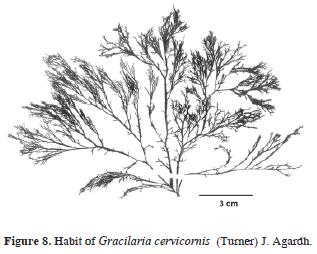
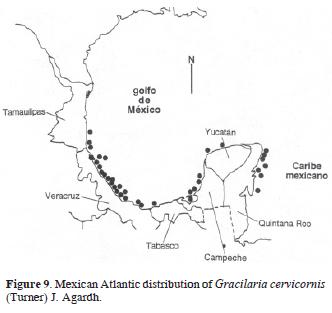
<body><![CDATA[<p align="justify"><font face="verdana" size="2"><i>Gracilaria cervicornis   </i>(Turner) J. Agardh, 1852 &#91;1851&#150;1863&#93;: 604.</font></p>     <p align="justify"><font face="verdana" size="2">= <i>Fucus cervicornis </i>Turner, 1808&#150;1809: 131&#150;132, pl. 121 (Type loc.: West Indies).</font></p>     <p align="justify"><font face="verdana" size="2">Synonym: <i>Gracilaria ferox. </i>J. Agardh, 1852 &#91;1851&#150;1863&#93;: 592 (Lectotype loc.: Martinique, West Indies <i>fide </i>Oliveira et al., 1983:3003). <a href="#f8">Figs. 8</a> and <a href="#f9">9</a>.</font></p>     <p align="center"><font face="verdana" size="2"><a name="f8"></a></font></p>     <p align="center"><font face="verdana" size="2"><img src="/img/revistas/rmbiodiv/v80n3/a2f8.jpg"></font></p>     <p align="center"><font face="verdana" size="2"><a name="f9"></a></font></p>     <p align="center"><font face="verdana" size="2"><img src="/img/revistas/rmbiodiv/v80n3/a2f9.jpg"></font></p>     <p align="justify"><font face="verdana" size="2">Thallus erect, up to 10&#150;25 cm tall, texture smooth, substance tough, brown red to yellowish green. Axes and branches complanate, 1&#150;5 mm width. Branching dichotomous, in 2 planes, bases continuous (with no constrictions). Adherence to herbarium sheets regular to good. Margins with horn&#150;like <i>(cervicornis) </i>branchlets. Segments between forks variable in length. Stipe very short or inconspicuous. Holdfast not distinct, disc&#150;like. Apex, as margins, with horn&#150;like processes or branchlets. Subcortex formed by 2 cellular layers, each 20&#150;30 &micro;m diameter, slightly pigmented. Transition is, however, abrupt. Cortex composed by 1&#150;7 cellular layers, superficial or external ones 6&#150;10 &micro;m diameter, very pigmented, anticlinal. Medullar cells hemispherical, 170&#150;300 &micro;m diameter, thick cell walls with no pigmentation, less than 10 layers from one surface to the other (in cross section). Spermatangia 40&#150;60 &micro;m width, 35&#150;40 &micro;m depth. Cystocarps hemispherical, 0.5&#150;1.1 mm diameter, mostly on horn&#150;like branchlets,      base&#150;constricted and apiculate. Carpospores in clusters. Gonimoblast columnar. Nutritive tubular cells in contact with external pericarp. Tetrasporangia ovate, 30&#150;40 &micro;m large, 22&#150;25 &micro;m diameter, spread in wide groups (but not sori) below external cortical cells, specially on flattened branches at medium&#150;superior thirds.</font></p>     <p align="justify"><font face="verdana" size="2">Selected specimens: Tamaulipas: ENCB 4785, Escolleras del r&iacute;o P&aacute;nuco, Ciudad Madero, Leg.: H. Alfaro Garc&iacute;a, 17.10.1982, Det.: J.M. L&oacute;pez Bautista, Hab.: Sobre rocas a 2 m de profundidad. Veracruz: UAMIZ 487, Morro de La Mancha, K.M. Dreckmann, 02.12.1990; UAMIZ 752, Barra de Cazones, Laguna de Tamiahua, N. Hern&aacute;ndez Soto M&#150;26, 06.06.1994; US 34264 (Barcode: 00551339), Bajo Tuxpan, J.F. Longoria #102,17.07.1965. Campeche: ENCB 4519, Lerma, L. Aguirre J., 28.12.73; MEXU 1123, Lagune de Terminos; dans l'embouchure de Paso Real, LTS 11, Rodolfo Cruz #1269, 00.09.65. Yucat&aacute;n: ENCB 8773, Yucaltep&eacute;n, L. Huerta, 02.06.1987. Quintana Roo: ENCB 6649, Playa Maya, Cozumel, C. Mendoza, 27.02.1985. Note: Synonymy proposed by Oliveira <i>et al. </i>(1983).</font></p>     <p align="justify"><font face="verdana" size="2"><i>Gracilaria mammillaris    </i>(Montagne) M. Howe,  1918: 515</font></p>     ]]></body>
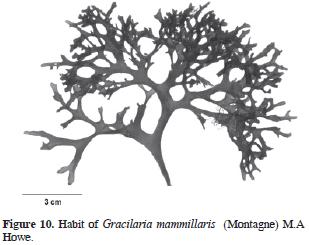
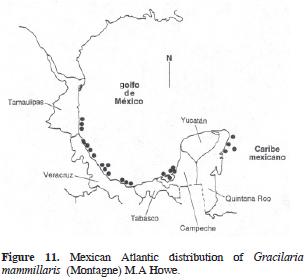
<body><![CDATA[<p align="justify"><font face="verdana" size="2">= <i>Rhodymenia mammillaris </i>Montagne, 1842: 252 (Type locality: Martinique). <a href="#f10">Figs. 10</a> and <a href="#f11">11</a>.</font></p>     <p align="center"><font face="verdana" size="2"><a name="f10"></a></font></p>     <p align="center"><font face="verdana" size="2"><img src="/img/revistas/rmbiodiv/v80n3/a2f10.jpg"></font></p>     <p align="center"><font face="verdana" size="2"><a name="f11"></a></font></p>     <p align="center"><font face="verdana" size="2"><img src="/img/revistas/rmbiodiv/v80n3/a2f11.jpg"></font></p>     <p align="justify"><font face="verdana" size="2">Thallus erect, (3)5&#150;10(14) cm high, dark red, texture smooth, substance tough. Adherence to herbarium sheets minimal. Branching dichotomous, in 2 planes. Branches flattened, up to 1 cm width, no base&#150;constricted. Margins free of proliferations or branchlets. Segments between forks constant in length up from the stipe. Apex rounded. Stipe short and stout. Holdfast not distinct, disc&#150;like. Subcortex absent, ence, transition abrupt. Cortex formed by 1&#150;3 cellular layers, external ones are slightly rectangular, 5&#150;18 &micro;m diameter, strongly pigmented, anticlinal. Medullary cells spherical to ovate, 50&#150;150 &micro;m diameter with no apparent pigmentation, less than 10 cellular layers from one surface to the other (in cross section). Spermatangia 18&#150;20 &micro;m depth, 40&#150;45 &micro;m width. Cystocarps hemispherical, 1.0&#150;1.3 mm diameter, constricted and slightly to evidently apiculate. Carpospores in clusters, spherical to slightly pyriform, up to 30 &micro;m large. Gonimoblast columnar. Nutritive tubular cells in contact with external pericarp. Tetrasporangia spherical to slightly ovate, 25&#150;35 &micro;m diameter, at external cortex, and rounded by enlarged cortical cells.</font></p>     <p align="justify"><font face="verdana" size="2">Selected specimens: Tamaulipas: ENCB 4071, Escolleras de Ciudad Madero, G. Galdi, 31.03.1978. Veracruz: ENCB 6644, Tuxpan, S. Pierd&aacute;nt, 06.02.1986; UAMIZ 761, Mocambo&#150;Boca del R&iacute;o, N. Hern&aacute;ndez Soto M2, 26.11.1994. Campeche: ENCB 4204 Ciudad del Carmen, A. Vargas #RHG 1543, 24.05.1965; US 36604 (Barcode: 00557649), Ciudad Del Carmen, Isla Carmen, A. Vargas #Rhg&#150;1544, 24.05.1965; MEXU 1122, Lagune de Terminos; dans la lagune en face a Ensenada, LTS 12, Rodolfo Cruz #1026a, 00.04.1964. Quintana Roo: ENCB 6631, Muelle de Isla Mujeres, C. Mendoza, 13.09.1985; UAMIZ 762, Playa del Carmen, A. Sent&iacute;es G., 01.03.1994; US 14417, Xel&#150;Ha, Quintana Roo, D.L. Ballantine #Dlb 1933, 12.04.1983.</font></p>     <p align="justify"><font face="verdana" size="2">Note: Schneider (1975), when comparing material of <i>Gracilaria mammillaris </i>from North Carolina (USA) with that of <i>G. veleroae, </i>collected by Dawson in the Gulf of California and housed in various herbaria, found no clear differences and proposed the heterotypic (or taxonomic) synonymy of <i>G. veleroae </i>with <i>G. mammillaris. </i>Norris (1985) suggested that, because Schneider never saw the type material belonging to either of the 2 binomials, both taxa should remain as distinct. Recently, Gurgel <i>et al. </i>(2004: 178) described <i>Gracilaria hayi </i>and included in it <i>Gracilaria mammillaris sensu </i>Schneider (1975) and Schneider and Searles (1991) not <i>G. mammillaris, </i>thus reducing the problem to nonexistent.</font></p>     <p align="justify"><font face="verdana" size="2"><i>Gracilaria tikvahiae  </i>McLachlan, 1979: 19, <a href="#f1">Fig. 1</a> (Type loc.: Barrachois Harbour, Colchester County, Nova Scotia, Canada).</font></p>     <p align="justify"><font face="verdana" size="2">Holotype: Hoja #6919 in the Marine Algal Herbarium, National Research Council of Canada, Halifax (NRCC, !, in McLachlan &#91;1979:21, <a href="#f1">fig. 1</a>&#93;). <a href="#f12">Figs. 12</a> and <a href="#f13">13</a>.</font></p>     ]]></body>
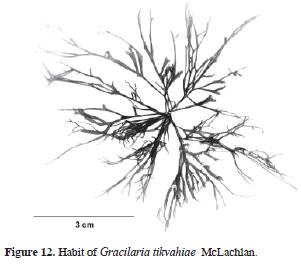
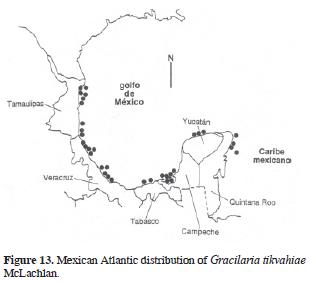
<body><![CDATA[<p align="center"><font face="verdana" size="2"><a name="f12"></a></font></p>     <p align="center"><font face="verdana" size="2"><img src="/img/revistas/rmbiodiv/v80n3/a2f12.jpg"></font></p>     <p align="center"><font face="verdana" size="2"><a name="f13"></a></font></p>     <p align="center"><font face="verdana" size="2"><img src="/img/revistas/rmbiodiv/v80n3/a2f13.jpg"></font></p>     <p align="justify"><font face="verdana" size="2">Thallus erect, (7)9&#150;15(30) cm tall, texture smooth, substance loose, color highly variable, olive brown, reddish, dark purple or even, yellowish green. Adherence to herbarium sheets minimal. Branching dichotomous to irregular. Axes complanate, bases not constricted. Apex rounded to acute. Stipe large and slender. Cortical cells 8&#150;9 &micro;m diameter, in 1&#150;2 layers, anticlinal. Medullary cells variable in size, around 100&#150;120 &micro;m diameter, more than 10 layers from one surface to the other (cross section). Spermatangia 18&#150;20  &micro;m depth 25&#150;30(40) &micro;m width. Cystocarps prominent, hemispherical, distributed all over the branch surface, 500&#150;520 &micro;m diameter, slightly apiculate, constricted. Carpospores in clusters. Gonimoblast columnar. Nutritive tubular cells in contact with external pericarp. Tetrasporangia ovate, distributed over the branches, variable in size, 25&#150;30 &micro;m width, 25&#150;40 &micro;m large. </font></p>     <p align="justify"><font face="verdana" size="2">Selected specimens: Tamaulipas: ENCB 5332, Punta Piedra, Municipio de San Fernando, J. Herrera, 20.09.1986. Veracruz: US 42509, Lagoon De Alvarado, G.B. Saunders #556, 31.01.1952. Campeche: MEXU 1056, Lagune de Terminos; dans la Lagune, en fase &agrave; Ensenada, LTS 12, Rodolfo Cruz #1026, 00.04.1964. Yucat&aacute;n: US 45386 (Barcode: 00556795), R&iacute;o San Miguel, Chicxulub, Puerto Progreso, M.A. Garza Hernandez#473, 12.03.67. Quintana Roo: ENCB 6678, Playa San Juan, Isla Cozumel, C. Mendoza, 04.06.1985.</font></p>     <p align="justify"><font face="verdana" size="2">&nbsp;</font></p>     <p align="justify"><font face="verdana" size="2"><b>Discussion</b></font></p>     <p align="justify"><font face="verdana" size="2"><i>Phylogenetic relationships of subgenus Textoriella. </i>Using 36 SSU rDNA sequences of Gracilariaceae from the tropical Atlantic and Pacific, Bellorin et al. (2002) found evidence that is relevant for subgenus <i>Textoriella. </i>For example, they found that the recognition of subgenera within <i>Gracilaria </i>based on spermatangial arrangement was not supported, and that most Pacific species with either <i>"textorii" </i>or <i>"verrucosa" </i>type spermatangia were deeply separated from Atlantic species (the exception being some sister taxa, as we will discuss below). Those Pacific taxa are <i>G. chilensis </i>Bird, McLachlan et Oliveira (central Chile), <i>G. pacifica </i>I.A. Abbott (California, subgenus <i>Gracilaria </i>Yamamoto), and <i>Gracilaria </i>"sp. Mexico" (California). Later, <i>Gracilaria </i>"sp. Mexico" proved to be <i>G. vermiculophylla </i>(Ohmi) Papenfuss (Bellorin et al., 2004). They also found that <i>G. isabellana </i>Gurgel, Fredericq et J.N. Norris (as <i>G. lacinulata </i>(Vahl) M. Howe; see Gurgel et al., 2004, and Wynne, 2005) from the Caribbean (Cuman&aacute;, Venezuela) and  northern   Brazil   (Bahia),   <i>G. foliifera   </i>(Forssk&aring;l) B&oslash;rgesen var. <i>angustissima </i>(Harvey) W.R. Taylor from the Caribbean, and <i>G. tepocensis </i>(E.Y. Dawson) E.Y. Dawson from Santa Catarina, Brazil, are closely related to <i>G. tikvahiae </i>from Canada, thus forming what they called the <i>"tikvahiae" </i>lineage. In this lineage, the temperate and subtropical isolates <i>G. tikvahiae </i>and <i>G. tepocensis </i>were closely related. It is significant, by the way, that the molecular study of Bellorin et al. (2002), supported the early proposal that <i>G. foliifera </i>var. <i>angustissima </i>is a taxonomic synonym of <i>G. tikvahiae </i>(Wynne, 1998). For the southern Pacific, Bellorin et al. (2002) found that <i>G. chilensis </i>and <i>G. tenuistipitata </i>C.F. Chang et B.M. Xia grouped in a single clade, although with very low bootstrap support (65%&#150;68%).</font></p>     <p align="justify"><font face="verdana" size="2">Instead of SSU, Gurgel and Fredericq (2004) used the chloroplast&#150;encoded <i>rbc </i>gene from 67 specimens worldwide, and found that selected taxa from subgenus <i>Textoriella </i>(G. <i>textorii, G. cervicornis, G. curtissiae, G. tikvahiae, G. mammillaris, </i>and <i>G. chilensis) </i>appear as belonging to sister groups such as verrucosa&#150;type&#150;bearing species (which is expected), as well as with <i>Hydropuntia </i>taxa (which they treat as a different genus); for example, <i>G. tikvahiae </i>is in the same clade of <i>Gracilaria damaecornis, </i>a multi&#150;cavernous type bearing species that should belong to subgenus <i>Hydropuntia sensu </i>Tseng et Xia (1999). It is clear that not all textorii&#150;type bearing taxa share a common ancestor (this, however, does not contradict the fact that <i>G. cuneata/G. crispata, </i>and <i>G. mammillaris/G. veleroae </i>are 2 pairs of sister taxa in the Central American Isthmus. See below). According to Gurgel and Fredericq's <a href="#f1">Fig. 1</a> (2004: 141), some of them even do share a common ancestor with <i>Hydropuntia.</i></font></p>     ]]></body>
<body><![CDATA[<p align="justify"><font face="verdana" size="2">While authors like Tseng and Xia (1999), based on anatomy, support a subgeneric scheme for genus <i>Gracilaria </i>(subgenera <i>Gracilariella, Textoriella, Gracilaria, </i>and <i>Hydropuntia), </i>other researchers (Gurgel and Fredericq, 2004; Gargiulo et al., 2006; Kim et al. 2008), based on molecular evidence, suggest the taxonomic independence of genus <i>Gracilariopsis, Gracilaria, </i>and <i>Hydropuntia </i>(but see Liao and Hommersand, 2003, for a morphological study that also supports this view). Although well aware that the representation of the <i>textorii&#150;type </i>in 2 distinct clusters of <i>Gracilaria sensu stricto </i>(Gugel and Fredericq, 2004) apparently represents homoplasy, we will recognize at least the subgenera <i>Textoriella </i>and <i>Gracilaria, </i>which are respectively close to the Bursa&#150;pastoris and Gracilis morphological groups of Liao and Hommersand (2003), until more studies on <i>textorii </i>and <i>verrucosa </i>spermatangial arrangements are done, especially in the western Atlantic where, as Gurgel and Fredericq (2004) pointed out, the number of species is underestimated. </font></p>     <p align="justify"><font face="verdana" size="2"><i>Distribution. </i>The general distribution of subgenus <i>Textoriella </i>in the Central America, both Pacific and Atlantic (Lists 1 and 2), displays a regional pattern explainable with reference to geologic vicariant events that interrupted the connection between the Pacific and Atlantic at the Isthmus of Panama (closed 3.1&#150;2.8 million years ago. Coates and Obando, 1996), and the Isthmus of Tehuantepec (southern Mexico, closed 4&#150;3.5 million years ago. See below). If we look at the notes for lists 1 and 2, we will see an apparently more general pattern that would reflect an early pantropical Tethyan distribution, from the early&#150;middle Eocene (60&#150;50 million years ago) to the closure of the Tethys sea, about the middle Miocene (15&#150;12 million years ago. Tomlinson, 1986; Brown and Lomolino, 1998).</font></p>     <p align="justify"><font face="verdana" size="2">List 1. Subgenus <i>Textoriella </i>in the tropical&#150;subtropical western Atlantic (Oliveira, 1984; Schneider and Searles, 1991; Ganesan, 1994; Gurgel et al., 2004; Wynne, 2005).</font></p>     <p align="justify"><font face="verdana" size="2"><i>Gracilaria armata </i>(C. Agardh) J. Agardh<sup>1</sup></font></p>     <p align="justify"><font face="verdana" size="2"><i>G. blodgettii </i>Harvey<sup>2</sup></font></p>     <p align="justify"><font face="verdana" size="2"><i>G. cervicornis </i>(Turner) J. Agardh<sup>3</sup></font></p>     <p align="justify"><font face="verdana" size="2"><i>G. cuneata </i>J.E. Areschoug<sup>4</sup></font></p>     <p align="justify"><font face="verdana" size="2"><i>G. curtissiae </i>J. Agardh<sup>4</sup></font></p>     <p align="justify"><font face="verdana" size="2"><i>G. galetensis </i>Gurgel, Fredericq et J. Norris</font></p>     <p align="justify"><font face="verdana" size="2"><i>G. hayi </i>Gurgel, Fredericq et J. Norris</font></p>     ]]></body>
<body><![CDATA[<p align="justify"><font face="verdana" size="2"><i>G. intermedia </i>J. Agardh subsp. <i>ganesana </i>Gurgel, Fredericq et J. Norris</font></p>     <p align="justify"><font face="verdana" size="2"><i>G. isabellana </i>Gurgel, Fredericq et J.N. Norris</font></p>     <p align="justify"><font face="verdana" size="2"><i>G. mammillaris </i>(Montagne) M. Howe</font></p>     <p align="justify"><font face="verdana" size="2"><i>G. smithsonensis </i>Gurgel, Fredericq et J. Norris</font></p>     <p align="justify"><font face="verdana" size="2"><i>G. tepocensis </i>(E.Y. Dawson) E.Y. Dawson</font></p>     <p align="justify"><font face="verdana" size="2"><i>G. tikvahiae </i>McLachlan<sup>5</sup></font></p>     <p align="justify"><font face="verdana" size="2">Notes: <sup>1</sup>Also recorded for the Mediterranean Sea (Gargiulo et al., 1992), and the Indian Ocean (Silva et al., 1996), <sup>2</sup>Also recorded for Western Australia (Millar and Xia Bangmei, 1997), and the Indian Ocean (Silva et al., 1996). <sup>3</sup>Also recorded for Canary Islands (Sosa et al., 1996), tropical West Africa (Lawson and John, 1982, as <i>G. ferox), </i>and the Indian Ocean (Silva et al., 1996). <sup>4</sup>Not found in the subject area. <sup>5</sup> Recorded as a commercial introduction for the Hawaiian Islands (Abbott, 1999).</font></p>     <p align="justify"><font face="verdana" size="2">List 2. Subgenus <i>Textoriella </i>in the tropical&#150;subtropical eastern Pacific (Taylor,  1945; Dawson,  1949; Norris, 1985; Dreckmann, 2002).</font></p>     <p align="justify"><font face="verdana" size="2"><i>Gracilaria cerrosiana </i>W.R. Taylor</font></p>     <p align="justify"><font face="verdana" size="2"><i>G. crispata </i>Setchell et Gardner</font></p>     ]]></body>
<body><![CDATA[<p align="justify"><font face="verdana" size="2"><i>G. pachydermatica </i>Setchell et Gardner</font></p>     <p align="justify"><font face="verdana" size="2"><i>G. parvispora </i>I.A. Abbott<sup>1</sup></font></p>     <p align="justify"><font face="verdana" size="2"><i>G. pinnata </i>Setchell et Gardner<sup>2</sup></font></p>     <p align="justify"><font face="verdana" size="2"><i>G. ramisecunda </i>E.Y. Dawson</font></p>     <p align="justify"><font face="verdana" size="2"><i>G. subsecundata </i>Setchell et Gardner<sup>3</sup></font></p>     <p align="justify"><font face="verdana" size="2"><i>G. tepocensis </i>(E.Y. Dawson) E.Y. Dawson</font></p>     <p align="justify"><font face="verdana" size="2"><i>G. textorii </i>(Suringar) De Toni</font></p>     <p align="justify"><font face="verdana" size="2"><i>G. turgida </i>E.Y. Dawson</font></p>     <p align="justify"><font face="verdana" size="2"><i>G. veleroae </i>E.Y. Dawson<sup>4</sup></font></p>     <p align="justify"><font face="verdana" size="2">Notes: <sup>1</sup>Hawaiian Islands (Abbott, 1999). <sup>2</sup> Reported as endemic for Central, and <sup>3</sup>Northern Gulf of California (Espinoza&#150;Avalos, 1993). <sup>4</sup>Also recorded for the Indian Ocean (Silva et al., 1996).</font></p>     ]]></body>
<body><![CDATA[<p align="justify"><font face="verdana" size="2">Taking into account the available distributional data, we found that there are 2 sibling pairs, or twin species (Collins, 1996), between the tropical eastern Pacific, and its western Atlantic counterpart: (1) <i>G. cuneata/G. crispata, </i>and (2) <i>G. mammillaris </i>(or <i>G. hayi)/G. veleroae. </i>Because these 2 pairs are very similar morphologically (Dreckmann, 2002. Also see note for <i>G. mammillaris </i>in this work), and the ranges of both are restricted to areas adjacent to the Central American Isthmus (they are not cosmopolitan), we take them as sister taxa that diverged as a result of the final emergence of the Isthmus, and to be of the same age as the Isthmus itself as the most parsimonious explanation for the pattern (Humphties and Parenti, 1999; Collins, 1996). Such patterns of morphologically similar sister taxa are common in most of the groups that have been studied in the area (Collins, 1996), including sea stars, sea urchins, brachyuran crabs, gastropods, bivalves, chitons, and polychaetes among others mentioned by Collins (1996. But also see Craw et al., 1999, for a worldwide review on vicariance).</font></p>     <p align="justify"><font face="verdana" size="2">&nbsp;</font></p>     <p align="justify"><font face="verdana" size="2"><b>Acknowledgments</b></font></p>     <p align="justify"><font face="verdana" size="2">This paper is a partial result of the first author's research in the Biological Sciences Doctorate Program at Universidad Aut&oacute;noma Metropolitana. We wish to thank Dr. Michael J. Wynne (University of Michigan), and 2 anonymous referees for their very valuable suggestions and the improvement of the English version. Sincere thanks are due to the program's Academic Committee for helpful assistance and patience throughout the study. To the Universidad Aut&oacute;noma Metropolitana Unidad Iztapalapa for financial support.</font></p>     <p align="justify"><font face="verdana" size="2">&nbsp;</font></p>     <p align="justify"><font face="verdana" size="2"><b>Literature cited</b></font></p>     <!-- ref --><p align="justify"><font face="verdana" size="2">Abbott, I. A. 1999. Marine Red Algae of the Hawaiian Islands. Bishop Museum Press. Honolulu. 477 p. </font>&nbsp;&nbsp;&nbsp;&nbsp;&nbsp;&nbsp;&nbsp;&nbsp;[&#160;<a href="javascript:void(0);" onclick="javascript: window.open('/scielo.php?script=sci_nlinks&ref=7506152&pid=S1870-3453200900030000200001&lng=','','width=640,height=500,resizable=yes,scrollbars=1,menubar=yes,');">Links</a>&#160;]<!-- end-ref --><!-- ref --><p align="justify"><font face="verdana" size="2">Abbott, I. A., Zhang Junfu and Xia Bangmei. 1991. <i>Gracilaria </i><i>mixta, </i>sp. nov. and other Western Pacific species of the genus (Rhodophyta: Gracilariaceae). Pacific Science 45:12&#150;27. </font>&nbsp;&nbsp;&nbsp;&nbsp;&nbsp;&nbsp;&nbsp;&nbsp;[&#160;<a href="javascript:void(0);" onclick="javascript: window.open('/scielo.php?script=sci_nlinks&ref=7506153&pid=S1870-3453200900030000200002&lng=','','width=640,height=500,resizable=yes,scrollbars=1,menubar=yes,');">Links</a>&#160;]<!-- end-ref --><!-- ref --><p align="justify"><font face="verdana" size="2">Agardh,  J.  G.   1876.   Species,  genera  et  ordines  algarum. Descriptiones succinctae specierum, generum et ordinum. Vol. III T. O. Weigel. Lipsiae. 724 p. </font>&nbsp;&nbsp;&nbsp;&nbsp;&nbsp;&nbsp;&nbsp;&nbsp;[&#160;<a href="javascript:void(0);" onclick="javascript: window.open('/scielo.php?script=sci_nlinks&ref=7506154&pid=S1870-3453200900030000200003&lng=','','width=640,height=500,resizable=yes,scrollbars=1,menubar=yes,');">Links</a>&#160;]<!-- end-ref --><!-- ref --><p align="justify"><font face="verdana" size="2">Bellorin, A. M., M. C. Oliveira and E. C. Oliveira. 2002. Phylogeny and systematics  of the marine algal family Gracilariaceae (Gracilariales, Rhodophyta) based on small subunits rDNA and its sequences of Atlantic and Pacific species. Journal of Phycology 38:551&#150;563. </font>&nbsp;&nbsp;&nbsp;&nbsp;&nbsp;&nbsp;&nbsp;&nbsp;[&#160;<a href="javascript:void(0);" onclick="javascript: window.open('/scielo.php?script=sci_nlinks&ref=7506155&pid=S1870-3453200900030000200004&lng=','','width=640,height=500,resizable=yes,scrollbars=1,menubar=yes,');">Links</a>&#160;]<!-- end-ref --><!-- ref --><p align="justify"><font face="verdana" size="2">Bellorin, A. M., M. C. Oliveira and E. C. Oliveira. 2004. <i>Gracilaria vermiculophylla: </i>A western Pacific species of Gracilariaceae (Rhodophyta) first recorded from the eastern Pacific. Phycological Research 52:69&#150;79. </font>&nbsp;&nbsp;&nbsp;&nbsp;&nbsp;&nbsp;&nbsp;&nbsp;[&#160;<a href="javascript:void(0);" onclick="javascript: window.open('/scielo.php?script=sci_nlinks&ref=7506156&pid=S1870-3453200900030000200005&lng=','','width=640,height=500,resizable=yes,scrollbars=1,menubar=yes,');">Links</a>&#160;]<!-- end-ref --><!-- ref --><p align="justify"><font face="verdana" size="2">B&oslash;rgesen, F. 1920. The marine algae of the Danish West Indies. Part 3. Rhodophyceae (6) with addenda to the Chlorophyceae, Phaeophyceae and Rhodophyceae. Dansk Botanisk Arkiv 4: 14&#150;35. </font>&nbsp;&nbsp;&nbsp;&nbsp;&nbsp;&nbsp;&nbsp;&nbsp;[&#160;<a href="javascript:void(0);" onclick="javascript: window.open('/scielo.php?script=sci_nlinks&ref=7506157&pid=S1870-3453200900030000200006&lng=','','width=640,height=500,resizable=yes,scrollbars=1,menubar=yes,');">Links</a>&#160;]<!-- end-ref --><!-- ref --><p align="justify"><font face="verdana" size="2">Brown, J. H. and M. V. Lomolino. 1998. Biogeography. Second Edition. Sinauer. Sunderland. 691 p. </font>&nbsp;&nbsp;&nbsp;&nbsp;&nbsp;&nbsp;&nbsp;&nbsp;[&#160;<a href="javascript:void(0);" onclick="javascript: window.open('/scielo.php?script=sci_nlinks&ref=7506158&pid=S1870-3453200900030000200007&lng=','','width=640,height=500,resizable=yes,scrollbars=1,menubar=yes,');">Links</a>&#160;]<!-- end-ref --><!-- ref --><p align="justify"><font face="verdana" size="2">Coates, A. G. and J. A. Obando. 1996. The geologic evolution of the Central American Isthmus. <i>In </i>Evolution and environments in tropical America, J. B. C. Jackson, A. F. Budd and A. G. Coates (eds.). The University of Chicago Press. Chicago. p. 21&#150;56.</font>&nbsp;&nbsp;&nbsp;&nbsp;&nbsp;&nbsp;&nbsp;&nbsp;[&#160;<a href="javascript:void(0);" onclick="javascript: window.open('/scielo.php?script=sci_nlinks&ref=7506159&pid=S1870-3453200900030000200008&lng=','','width=640,height=500,resizable=yes,scrollbars=1,menubar=yes,');">Links</a>&#160;]<!-- end-ref --><!-- ref --><p align="justify"><font face="verdana" size="2">Collins, T. 1996. Molecular comparition of transisthmian species pairs: rates and patterns of evolution. p. 303&#150;334. <i>In </i>Evolution and environments in tropical America, J.B.C. Jackson, A.F. Budd, and A.G. Coates (eds.). The University of Chicago Press. Chicago. 415 p. </font>&nbsp;&nbsp;&nbsp;&nbsp;&nbsp;&nbsp;&nbsp;&nbsp;[&#160;<a href="javascript:void(0);" onclick="javascript: window.open('/scielo.php?script=sci_nlinks&ref=7506160&pid=S1870-3453200900030000200009&lng=','','width=640,height=500,resizable=yes,scrollbars=1,menubar=yes,');">Links</a>&#160;]<!-- end-ref --><!-- ref --><p align="justify"><font face="verdana" size="2">Chang, C. F. and B. Xia. 1963. <i>Polycavernosa, </i>a new genus of the Gracilariaceae. Studia Marina Sinica 3:119&#150;126. </font>&nbsp;&nbsp;&nbsp;&nbsp;&nbsp;&nbsp;&nbsp;&nbsp;[&#160;<a href="javascript:void(0);" onclick="javascript: window.open('/scielo.php?script=sci_nlinks&ref=7506161&pid=S1870-3453200900030000200010&lng=','','width=640,height=500,resizable=yes,scrollbars=1,menubar=yes,');">Links</a>&#160;]<!-- end-ref --><!-- ref --><p align="justify"><font face="verdana" size="2">Craw, R. C., J. R. Grehan and M. J. Heads. 1999. Panbiogeography. Tracking the history of life. Oxford University Press. New York. 229 p. </font>&nbsp;&nbsp;&nbsp;&nbsp;&nbsp;&nbsp;&nbsp;&nbsp;[&#160;<a href="javascript:void(0);" onclick="javascript: window.open('/scielo.php?script=sci_nlinks&ref=7506162&pid=S1870-3453200900030000200011&lng=','','width=640,height=500,resizable=yes,scrollbars=1,menubar=yes,');">Links</a>&#160;]<!-- end-ref --><!-- ref --><p align="justify"><font face="verdana" size="2">Dawson, E. Y. 1949. Studies of northeast Pacific Gracilariaceae. Allan Hancock Foundation Pubs. Occasional Paper Number 7. The University of Southern California Press. Los Angeles. 105 p. </font>&nbsp;&nbsp;&nbsp;&nbsp;&nbsp;&nbsp;&nbsp;&nbsp;[&#160;<a href="javascript:void(0);" onclick="javascript: window.open('/scielo.php?script=sci_nlinks&ref=7506163&pid=S1870-3453200900030000200012&lng=','','width=640,height=500,resizable=yes,scrollbars=1,menubar=yes,');">Links</a>&#160;]<!-- end-ref --><!-- ref --><p align="justify"><font face="verdana" size="2">Dreckmann, K. M. 2002. El g&eacute;nero <i>Gracilaria </i>(Gracilariaceae, Rhodophyta) en el Pac&iacute;fico centro&#150;sur mexicano. p. 77&#150;118. <i>In </i>Monograf&iacute;as Ficol&oacute;gicas Vol. 1, A. Sent&iacute;es G., and K. M. Dreckmann (eds.). Universidad Aut&oacute;noma Metropolitana Unidad Iztapalapa and Red Latinoamericana de Bot&aacute;nica. M&eacute;xico, D.F. 192 p.</font>&nbsp;&nbsp;&nbsp;&nbsp;&nbsp;&nbsp;&nbsp;&nbsp;[&#160;<a href="javascript:void(0);" onclick="javascript: window.open('/scielo.php?script=sci_nlinks&ref=7506164&pid=S1870-3453200900030000200013&lng=','','width=640,height=500,resizable=yes,scrollbars=1,menubar=yes,');">Links</a>&#160;]<!-- end-ref --><!-- ref --><p align="justify"><font face="verdana" size="2">Espinoza&#150;Avalos, J. 1993. Macroalgas marinas del Golfo de California. <i>In </i>Biodiversidad marina y costera de M&eacute;xico, S. I. Salazar&#150;Vallejo and N. E. Gonz&aacute;lez (eds.). Comisi&oacute;n Nacional para el Conocimiento y Uso de la Biodiversidad and Centro de Investigaciones de Quintana Roo. Chetumal. 865 p.</font>&nbsp;&nbsp;&nbsp;&nbsp;&nbsp;&nbsp;&nbsp;&nbsp;[&#160;<a href="javascript:void(0);" onclick="javascript: window.open('/scielo.php?script=sci_nlinks&ref=7506165&pid=S1870-3453200900030000200014&lng=','','width=640,height=500,resizable=yes,scrollbars=1,menubar=yes,');">Links</a>&#160;]<!-- end-ref --><!-- ref --><p align="justify"><font face="verdana" size="2">Fredericq, S. and M.H. Hommersand. 1989. Comparative morphology and taxonomic status of <i>Gracilariopsis </i>(Gracilariales, Rhodophyta). Journal of Phycology 25:228&#150;241.</font>&nbsp;&nbsp;&nbsp;&nbsp;&nbsp;&nbsp;&nbsp;&nbsp;[&#160;<a href="javascript:void(0);" onclick="javascript: window.open('/scielo.php?script=sci_nlinks&ref=7506166&pid=S1870-3453200900030000200015&lng=','','width=640,height=500,resizable=yes,scrollbars=1,menubar=yes,');">Links</a>&#160;]<!-- end-ref --><!-- ref --><p align="justify"><font face="verdana" size="2">Fredericq, S. and J. N. Norris. 1992. Studies on cylindrical species of Western Atlantic <i>Gracilaria </i>(Gracilariales, Rhodophyta): <i>G. cylindrica </i>B&oslash;rgesen and <i>G. blodgettii </i>Harvey. B&oslash;rgesen. Taxonomy of Economic Seaweeds 3:211&#150;231.</font>&nbsp;&nbsp;&nbsp;&nbsp;&nbsp;&nbsp;&nbsp;&nbsp;[&#160;<a href="javascript:void(0);" onclick="javascript: window.open('/scielo.php?script=sci_nlinks&ref=7506167&pid=S1870-3453200900030000200016&lng=','','width=640,height=500,resizable=yes,scrollbars=1,menubar=yes,');">Links</a>&#160;]<!-- end-ref --><!-- ref --><p align="justify"><font face="verdana" size="2">Ganesan, E. K. 1994. Morphology and taxonomy of the little&#150;known species <i>Gracilaria cuneata </i>J.E. Areschoug (Gracilariales: Rhodophyta) from Venezuela. Carribbean Journal of Science 30:124&#150;129.</font>&nbsp;&nbsp;&nbsp;&nbsp;&nbsp;&nbsp;&nbsp;&nbsp;[&#160;<a href="javascript:void(0);" onclick="javascript: window.open('/scielo.php?script=sci_nlinks&ref=7506168&pid=S1870-3453200900030000200017&lng=','','width=640,height=500,resizable=yes,scrollbars=1,menubar=yes,');">Links</a>&#160;]<!-- end-ref --><!-- ref --><p align="justify"><font face="verdana" size="2">Gargiulo, G. M., F. De Mazi and G. Tripodi. 1992. Morphology, reproduction and taxonomy of the Mediterranean species of <i>Gracilaria </i>(Gracilariales, Rhodophyta). Phycologia 31:53&#150;80.</font>&nbsp;&nbsp;&nbsp;&nbsp;&nbsp;&nbsp;&nbsp;&nbsp;[&#160;<a href="javascript:void(0);" onclick="javascript: window.open('/scielo.php?script=sci_nlinks&ref=7506169&pid=S1870-3453200900030000200018&lng=','','width=640,height=500,resizable=yes,scrollbars=1,menubar=yes,');">Links</a>&#160;]<!-- end-ref --><!-- ref --><p align="justify"><font face="verdana" size="2">Gargiulo, G. M., M. Morabito, G. Genovese and F. De Masi. 2006. Molecular systematics and phylogenetics of Gracilariacean species from the Mediterranean Sea. Journal of Applied Phycology 18:497&#150;504.</font>&nbsp;&nbsp;&nbsp;&nbsp;&nbsp;&nbsp;&nbsp;&nbsp;[&#160;<a href="javascript:void(0);" onclick="javascript: window.open('/scielo.php?script=sci_nlinks&ref=7506170&pid=S1870-3453200900030000200019&lng=','','width=640,height=500,resizable=yes,scrollbars=1,menubar=yes,');">Links</a>&#160;]<!-- end-ref --><!-- ref --><p align="justify"><font face="verdana" size="2">Gurgel, C. F. D. and S. Fredericq. 2004. Systematics of the Gracilariaceae (Gracilariales, Rhodophyta): A critical assessment based on <i>rbc </i>L sequence analyses. Journal of Phycology 40:138&#150;159.</font>&nbsp;&nbsp;&nbsp;&nbsp;&nbsp;&nbsp;&nbsp;&nbsp;[&#160;<a href="javascript:void(0);" onclick="javascript: window.open('/scielo.php?script=sci_nlinks&ref=7506171&pid=S1870-3453200900030000200020&lng=','','width=640,height=500,resizable=yes,scrollbars=1,menubar=yes,');">Links</a>&#160;]<!-- end-ref --><!-- ref --><p align="justify"><font face="verdana" size="2">Gurgel, C. F. D., S. Fredericq and J. N. Norris. 2004. Molecular systematics and taxonomy of flattened species of Gracilaria Greville (Gracilariaceae, Gracilariales, Rhodophyta) from the Western Atlantic. Taxonomy of Economic Seaweeds 9:159&#150;199.</font>&nbsp;&nbsp;&nbsp;&nbsp;&nbsp;&nbsp;&nbsp;&nbsp;[&#160;<a href="javascript:void(0);" onclick="javascript: window.open('/scielo.php?script=sci_nlinks&ref=7506172&pid=S1870-3453200900030000200021&lng=','','width=640,height=500,resizable=yes,scrollbars=1,menubar=yes,');">Links</a>&#160;]<!-- end-ref --><!-- ref --><p align="justify"><font face="verdana" size="2">Harvey, W. H. 1853. Nereis boreali&#150;americana. Part I. Rhodospermae. Smithsonian Contributions to Knowledge 5(5), pls. XIII&#150;XXXVI. 258 p.</font>&nbsp;&nbsp;&nbsp;&nbsp;&nbsp;&nbsp;&nbsp;&nbsp;[&#160;<a href="javascript:void(0);" onclick="javascript: window.open('/scielo.php?script=sci_nlinks&ref=7506173&pid=S1870-3453200900030000200022&lng=','','width=640,height=500,resizable=yes,scrollbars=1,menubar=yes,');">Links</a>&#160;]<!-- end-ref --><!-- ref --><p align="justify"><font face="verdana" size="2">Howe, M. A. 1918. Algae. p. 553&#150;618 <i>In </i>The Flora of Bermuda, N. L. Briton (ed.). Charles Scribner's Sons. New York. 723 p.</font>&nbsp;&nbsp;&nbsp;&nbsp;&nbsp;&nbsp;&nbsp;&nbsp;[&#160;<a href="javascript:void(0);" onclick="javascript: window.open('/scielo.php?script=sci_nlinks&ref=7506174&pid=S1870-3453200900030000200023&lng=','','width=640,height=500,resizable=yes,scrollbars=1,menubar=yes,');">Links</a>&#160;]<!-- end-ref --><!-- ref --><p align="justify"><font face="verdana" size="2">Homi, H. 1958. The species of <i>Gracilaria </i>and <i>Gracilariopsis </i>from Japan and  adjacent  waters.  Memoirs  Faculty  of Fisheries, Hokkaido University 6:1&#150;66. </font>&nbsp;&nbsp;&nbsp;&nbsp;&nbsp;&nbsp;&nbsp;&nbsp;[&#160;<a href="javascript:void(0);" onclick="javascript: window.open('/scielo.php?script=sci_nlinks&ref=7506175&pid=S1870-3453200900030000200024&lng=','','width=640,height=500,resizable=yes,scrollbars=1,menubar=yes,');">Links</a>&#160;]<!-- end-ref --><!-- ref --><p align="justify"><font face="verdana" size="2">Humphries, C. J. and L. R. Parenti. 1999. Cladistic Biogeography. Interpreting patterns of plant and animal distribution. Second Edition. Oxford University Press. New York. 187 p. </font>&nbsp;&nbsp;&nbsp;&nbsp;&nbsp;&nbsp;&nbsp;&nbsp;[&#160;<a href="javascript:void(0);" onclick="javascript: window.open('/scielo.php?script=sci_nlinks&ref=7506176&pid=S1870-3453200900030000200025&lng=','','width=640,height=500,resizable=yes,scrollbars=1,menubar=yes,');">Links</a>&#160;]<!-- end-ref --><!-- ref --><p align="justify"><font face="verdana" size="2">Kim, M. S., M. Kim, R. Terada, E. C. Yang and S. M. Boo. 2008. <i>Gracilaria parvispora </i>is the correct name of the species known as <i>G. bursa&#150;pastoris </i>in Korea and Japan. Taxon 57:231&#150;237. </font>&nbsp;&nbsp;&nbsp;&nbsp;&nbsp;&nbsp;&nbsp;&nbsp;[&#160;<a href="javascript:void(0);" onclick="javascript: window.open('/scielo.php?script=sci_nlinks&ref=7506177&pid=S1870-3453200900030000200026&lng=','','width=640,height=500,resizable=yes,scrollbars=1,menubar=yes,');">Links</a>&#160;]<!-- end-ref --><!-- ref --><p align="justify"><font face="verdana" size="2">Lawson, G. W. and D. M. John. 1982. The marine algae and coastal environment of tropical West Africa. Nova Hedwigia 70:1&#150;455.</font>&nbsp;&nbsp;&nbsp;&nbsp;&nbsp;&nbsp;&nbsp;&nbsp;[&#160;<a href="javascript:void(0);" onclick="javascript: window.open('/scielo.php?script=sci_nlinks&ref=7506178&pid=S1870-3453200900030000200027&lng=','','width=640,height=500,resizable=yes,scrollbars=1,menubar=yes,');">Links</a>&#160;]<!-- end-ref --><!-- ref --><p align="justify"><font face="verdana" size="2">Liao, L. M. and M. H. Hommersand. 2003. A morphological study and taxonomic reassessment of the generitype species in the Gracilariaceae. Journal of Phycology 39:1207&#150;1232. </font>&nbsp;&nbsp;&nbsp;&nbsp;&nbsp;&nbsp;&nbsp;&nbsp;[&#160;<a href="javascript:void(0);" onclick="javascript: window.open('/scielo.php?script=sci_nlinks&ref=7506179&pid=S1870-3453200900030000200028&lng=','','width=640,height=500,resizable=yes,scrollbars=1,menubar=yes,');">Links</a>&#160;]<!-- end-ref --><!-- ref --><p align="justify"><font face="verdana" size="2">McLachlan, J. 1979. <i>Gracilaria tikvahiae </i>sp. nov. (Rhodophyta, Gigartinales, Gracilariaceae), from the northwestern Atlantic. Phycologia 18:19&#150;23. </font>&nbsp;&nbsp;&nbsp;&nbsp;&nbsp;&nbsp;&nbsp;&nbsp;[&#160;<a href="javascript:void(0);" onclick="javascript: window.open('/scielo.php?script=sci_nlinks&ref=7506180&pid=S1870-3453200900030000200029&lng=','','width=640,height=500,resizable=yes,scrollbars=1,menubar=yes,');">Links</a>&#160;]<!-- end-ref --><!-- ref --><p align="justify"><font face="verdana" size="2">Millar, A. J. K. and Xia Bangmei. 1997. Studies on terete species of Australian <i>Gracilaria. </i>Taxonomy of Economic Seaweeds 6:103&#150;109. </font>&nbsp;&nbsp;&nbsp;&nbsp;&nbsp;&nbsp;&nbsp;&nbsp;[&#160;<a href="javascript:void(0);" onclick="javascript: window.open('/scielo.php?script=sci_nlinks&ref=7506181&pid=S1870-3453200900030000200030&lng=','','width=640,height=500,resizable=yes,scrollbars=1,menubar=yes,');">Links</a>&#160;]<!-- end-ref --><!-- ref --><p align="justify"><font face="verdana" size="2">Montagne, J. F. C. 1842. Troisi&egrave;me centurie de plantes cellulares exotiques nouvelles. Annals Sciences Naturelle, Botanique II. 18:241&#150;282. </font>&nbsp;&nbsp;&nbsp;&nbsp;&nbsp;&nbsp;&nbsp;&nbsp;[&#160;<a href="javascript:void(0);" onclick="javascript: window.open('/scielo.php?script=sci_nlinks&ref=7506182&pid=S1870-3453200900030000200031&lng=','','width=640,height=500,resizable=yes,scrollbars=1,menubar=yes,');">Links</a>&#160;]<!-- end-ref --><!-- ref --><p align="justify"><font face="verdana" size="2">Norris, J. N. 1985. Studies on <i>Gracilaria </i>Grev. (Gracilariaceae, Rhodophyta) from the Gulf of California, Mexico. Taxonomy of Economic Seaweeds 1:123&#150;135.</font>&nbsp;&nbsp;&nbsp;&nbsp;&nbsp;&nbsp;&nbsp;&nbsp;[&#160;<a href="javascript:void(0);" onclick="javascript: window.open('/scielo.php?script=sci_nlinks&ref=7506183&pid=S1870-3453200900030000200032&lng=','','width=640,height=500,resizable=yes,scrollbars=1,menubar=yes,');">Links</a>&#160;]<!-- end-ref --><!-- ref --><p align="justify"><font face="verdana" size="2">Oliveira, E. C. 1984. Taxonomic criteria in the genus <i>Gracilaria </i>Grev. (Rhodophyta): An experience with the western Atlantic species. Hydrobiologia 116/117:55&#150;58. </font>&nbsp;&nbsp;&nbsp;&nbsp;&nbsp;&nbsp;&nbsp;&nbsp;[&#160;<a href="javascript:void(0);" onclick="javascript: window.open('/scielo.php?script=sci_nlinks&ref=7506184&pid=S1870-3453200900030000200033&lng=','','width=640,height=500,resizable=yes,scrollbars=1,menubar=yes,');">Links</a>&#160;]<!-- end-ref --><!-- ref --><p align="justify"><font face="verdana" size="2">Oliveira, E. C. de, C. J. Bird and J. McLachlan. 1983. The genus <i>Gracilaria </i>(Rhodophyta, Gigartinales) in the western Atlantic. <i>Gracilaria dominguensis, G. cervicornis, </i>and <i>G. </i><i>ferox. </i>Canadian Journal of Botany 61:2999&#150;3008. </font>&nbsp;&nbsp;&nbsp;&nbsp;&nbsp;&nbsp;&nbsp;&nbsp;[&#160;<a href="javascript:void(0);" onclick="javascript: window.open('/scielo.php?script=sci_nlinks&ref=7506185&pid=S1870-3453200900030000200034&lng=','','width=640,height=500,resizable=yes,scrollbars=1,menubar=yes,');">Links</a>&#160;]<!-- end-ref --><!-- ref --><p align="justify"><font face="verdana" size="2">Tseng, C. K. and B. M. Xia. 1999. On the <i>Gracilaria </i>in the Western Pacific and the Southeastern Asia Region. Botanica Marina 42:209&#150;217. </font>&nbsp;&nbsp;&nbsp;&nbsp;&nbsp;&nbsp;&nbsp;&nbsp;[&#160;<a href="javascript:void(0);" onclick="javascript: window.open('/scielo.php?script=sci_nlinks&ref=7506186&pid=S1870-3453200900030000200035&lng=','','width=640,height=500,resizable=yes,scrollbars=1,menubar=yes,');">Links</a>&#160;]<!-- end-ref --><!-- ref --><p align="justify"><font face="verdana" size="2">Schneider,   C.   W.   1975.   Taxonomic  notes   on <i>Gracilaria </i><i>mammillaris      </i>(Mont.)   Howe   and   <i>Gracilaria   veleroae </i>Dawson. Taxon 24:643&#150;646.</font>&nbsp;&nbsp;&nbsp;&nbsp;&nbsp;&nbsp;&nbsp;&nbsp;[&#160;<a href="javascript:void(0);" onclick="javascript: window.open('/scielo.php?script=sci_nlinks&ref=7506187&pid=S1870-3453200900030000200036&lng=','','width=640,height=500,resizable=yes,scrollbars=1,menubar=yes,');">Links</a>&#160;]<!-- end-ref --><!-- ref --><p align="justify"><font face="verdana" size="2">Schneider, C. W. and R. B. Searles. 1991. Seaweeds of the Southeastern United States. Duke University Press. Durham. 553 p.</font>&nbsp;&nbsp;&nbsp;&nbsp;&nbsp;&nbsp;&nbsp;&nbsp;[&#160;<a href="javascript:void(0);" onclick="javascript: window.open('/scielo.php?script=sci_nlinks&ref=7506188&pid=S1870-3453200900030000200037&lng=','','width=640,height=500,resizable=yes,scrollbars=1,menubar=yes,');">Links</a>&#160;]<!-- end-ref --><!-- ref --><p align="justify"><font face="verdana" size="2">Silva, P. C., P. W. Basson and R. L. Moe. 1996. Catalogue of the benthic marine algae of the Indian Ocean. University of California Publications in Botany 79:1&#150;1259. </font>&nbsp;&nbsp;&nbsp;&nbsp;&nbsp;&nbsp;&nbsp;&nbsp;[&#160;<a href="javascript:void(0);" onclick="javascript: window.open('/scielo.php?script=sci_nlinks&ref=7506189&pid=S1870-3453200900030000200038&lng=','','width=640,height=500,resizable=yes,scrollbars=1,menubar=yes,');">Links</a>&#160;]<!-- end-ref --><!-- ref --><p align="justify"><font face="verdana" size="2">Sosa, P. A., M. A. Cabrera&#150;P&eacute;rez and G. Garc&iacute;a&#150;Reina. 1996. Genetic variation of <i>Gracilaria cervicornis </i>(Rhodophyta) gametophytes from the Canary Islands. European Journal of Phycology 31:143&#150;147. </font>&nbsp;&nbsp;&nbsp;&nbsp;&nbsp;&nbsp;&nbsp;&nbsp;[&#160;<a href="javascript:void(0);" onclick="javascript: window.open('/scielo.php?script=sci_nlinks&ref=7506190&pid=S1870-3453200900030000200039&lng=','','width=640,height=500,resizable=yes,scrollbars=1,menubar=yes,');">Links</a>&#160;]<!-- end-ref --><!-- ref --><p align="justify"><font face="verdana" size="2">Taylor, W. R. 1945. Pacific marine algae of the Allan Hancock expedition to the Galapagos Islands. Allan Hancock Pacific Expeditions.   Volume   12.   The  University  of  Southern California Press. Los Angeles. 528 p. </font>&nbsp;&nbsp;&nbsp;&nbsp;&nbsp;&nbsp;&nbsp;&nbsp;[&#160;<a href="javascript:void(0);" onclick="javascript: window.open('/scielo.php?script=sci_nlinks&ref=7506191&pid=S1870-3453200900030000200040&lng=','','width=640,height=500,resizable=yes,scrollbars=1,menubar=yes,');">Links</a>&#160;]<!-- end-ref --><!-- ref --><p align="justify"><font face="verdana" size="2">Tomlinson, P. B. 1986. The Botany of Mangroves. Cambridge University Press. Cambridge. 419 p. </font>&nbsp;&nbsp;&nbsp;&nbsp;&nbsp;&nbsp;&nbsp;&nbsp;[&#160;<a href="javascript:void(0);" onclick="javascript: window.open('/scielo.php?script=sci_nlinks&ref=7506192&pid=S1870-3453200900030000200041&lng=','','width=640,height=500,resizable=yes,scrollbars=1,menubar=yes,');">Links</a>&#160;]<!-- end-ref --><!-- ref --><p align="justify"><font face="verdana" size="2">Turner, D. 1808&#150;1809. Fuci, sive plantarum fucorum generi botanicis ascriptarum, icones, descriptiones et historia. John &amp; Arthur Arch, London. Vol. II. pls. 72&#150;134. 162 (+ 2) p. </font>&nbsp;&nbsp;&nbsp;&nbsp;&nbsp;&nbsp;&nbsp;&nbsp;[&#160;<a href="javascript:void(0);" onclick="javascript: window.open('/scielo.php?script=sci_nlinks&ref=7506193&pid=S1870-3453200900030000200042&lng=','','width=640,height=500,resizable=yes,scrollbars=1,menubar=yes,');">Links</a>&#160;]<!-- end-ref --><!-- ref --><p align="justify"><font face="verdana" size="2">Wynne, J. M. 1989. The re&#150;instatement of <i>Hydropuntia </i>Montagne (Gracilariaceae, Rhodophyta). Taxon 38:476&#150;479. </font>&nbsp;&nbsp;&nbsp;&nbsp;&nbsp;&nbsp;&nbsp;&nbsp;[&#160;<a href="javascript:void(0);" onclick="javascript: window.open('/scielo.php?script=sci_nlinks&ref=7506194&pid=S1870-3453200900030000200043&lng=','','width=640,height=500,resizable=yes,scrollbars=1,menubar=yes,');">Links</a>&#160;]<!-- end-ref --><!-- ref --><p align="justify"><font face="verdana" size="2">Wynne, J. M. 2005. A checklist of benthic marine algae of the tropical and subtropical western Atlantic: Second revision. Nova Hedwigia 129:1&#150;152. </font>&nbsp;&nbsp;&nbsp;&nbsp;&nbsp;&nbsp;&nbsp;&nbsp;[&#160;<a href="javascript:void(0);" onclick="javascript: window.open('/scielo.php?script=sci_nlinks&ref=7506195&pid=S1870-3453200900030000200044&lng=','','width=640,height=500,resizable=yes,scrollbars=1,menubar=yes,');">Links</a>&#160;]<!-- end-ref --><!-- ref --><p align="justify"><font face="verdana" size="2">Yamamoto, H. 1975. The relationship between <i>Gracilariopsis </i>and <i>Gracilaria </i>from Japan. Bulletin of the Faculty of Fisheries, Hokkaido University 26:217&#150;222. </font>&nbsp;&nbsp;&nbsp;&nbsp;&nbsp;&nbsp;&nbsp;&nbsp;[&#160;<a href="javascript:void(0);" onclick="javascript: window.open('/scielo.php?script=sci_nlinks&ref=7506196&pid=S1870-3453200900030000200045&lng=','','width=640,height=500,resizable=yes,scrollbars=1,menubar=yes,');">Links</a>&#160;]<!-- end-ref --><!-- ref --><p align="justify"><font face="verdana" size="2">Yamamoto, H. 1978. Systematics and anatomical study of the genus <i>Gracilaria </i>in Japan. Memoirs Faculty of Fisheries, Hokkaido University 25: 97&#150;152.</font>&nbsp;&nbsp;&nbsp;&nbsp;&nbsp;&nbsp;&nbsp;&nbsp;[&#160;<a href="javascript:void(0);" onclick="javascript: window.open('/scielo.php?script=sci_nlinks&ref=7506197&pid=S1870-3453200900030000200046&lng=','','width=640,height=500,resizable=yes,scrollbars=1,menubar=yes,');">Links</a>&#160;]<!-- end-ref --> ]]></body><back>
<ref-list>
<ref id="B1">
<nlm-citation citation-type="book">
<person-group person-group-type="author">
<name>
<surname><![CDATA[Abbott]]></surname>
<given-names><![CDATA[I. A.]]></given-names>
</name>
</person-group>
<source><![CDATA[Marine Red Algae of the Hawaiian Islands]]></source>
<year>1999</year>
<page-range>477</page-range><publisher-loc><![CDATA[Honolulu ]]></publisher-loc>
<publisher-name><![CDATA[Bishop Museum Press]]></publisher-name>
</nlm-citation>
</ref>
<ref id="B2">
<nlm-citation citation-type="journal">
<person-group person-group-type="author">
<name>
<surname><![CDATA[Abbott]]></surname>
<given-names><![CDATA[I. A.]]></given-names>
</name>
<name>
<surname><![CDATA[Junfu]]></surname>
<given-names><![CDATA[Zhang]]></given-names>
</name>
<name>
<surname><![CDATA[Bangmei]]></surname>
<given-names><![CDATA[Xia]]></given-names>
</name>
</person-group>
<article-title xml:lang="en"><![CDATA[Gracilaria mixta, sp. nov. and other Western Pacific species of the genus (Rhodophyta: Gracilariaceae)]]></article-title>
<source><![CDATA[Pacific Science]]></source>
<year>1991</year>
<volume>45</volume>
<page-range>12-27</page-range></nlm-citation>
</ref>
<ref id="B3">
<nlm-citation citation-type="">
<person-group person-group-type="author">
<name>
<surname><![CDATA[Agardh]]></surname>
<given-names><![CDATA[J. G.]]></given-names>
</name>
</person-group>
<source><![CDATA[Species, genera et ordines algarum. Descriptiones succinctae specierum, generum et ordinum]]></source>
<year>1876</year>
<volume>III</volume>
<page-range>724</page-range></nlm-citation>
</ref>
<ref id="B4">
<nlm-citation citation-type="journal">
<person-group person-group-type="author">
<name>
<surname><![CDATA[Bellorin]]></surname>
<given-names><![CDATA[A. M.]]></given-names>
</name>
<name>
<surname><![CDATA[Oliveira]]></surname>
<given-names><![CDATA[M. C.]]></given-names>
</name>
<name>
<surname><![CDATA[Oliveira]]></surname>
<given-names><![CDATA[E. C.]]></given-names>
</name>
</person-group>
<article-title xml:lang="en"><![CDATA[Phylogeny and systematics of the marine algal family Gracilariaceae (Gracilariales, Rhodophyta) based on small subunits rDNA and its sequences of Atlantic and Pacific species]]></article-title>
<source><![CDATA[Journal of Phycology]]></source>
<year>2002</year>
<volume>38</volume>
<page-range>551-563</page-range></nlm-citation>
</ref>
<ref id="B5">
<nlm-citation citation-type="journal">
<person-group person-group-type="author">
<name>
<surname><![CDATA[Bellorin]]></surname>
<given-names><![CDATA[A. M.]]></given-names>
</name>
<name>
<surname><![CDATA[Oliveira]]></surname>
<given-names><![CDATA[M. C.]]></given-names>
</name>
<name>
<surname><![CDATA[Oliveira]]></surname>
<given-names><![CDATA[E. C.]]></given-names>
</name>
</person-group>
<article-title xml:lang="en"><![CDATA[Gracilaria vermiculophylla: A western Pacific species of Gracilariaceae (Rhodophyta) first recorded from the eastern Pacific]]></article-title>
<source><![CDATA[Phycological Research]]></source>
<year>2004</year>
<volume>52</volume>
<page-range>69-79</page-range></nlm-citation>
</ref>
<ref id="B6">
<nlm-citation citation-type="journal">
<person-group person-group-type="author">
<name>
<surname><![CDATA[Børgesen]]></surname>
<given-names><![CDATA[F]]></given-names>
</name>
</person-group>
<article-title xml:lang="en"><![CDATA[The marine algae of the Danish West Indies. Part 3. Rhodophyceae (6) with addenda to the Chlorophyceae, Phaeophyceae and Rhodophyceae]]></article-title>
<source><![CDATA[Dansk Botanisk Arkiv]]></source>
<year>1920</year>
<volume>4</volume>
<page-range>14-35</page-range></nlm-citation>
</ref>
<ref id="B7">
<nlm-citation citation-type="book">
<person-group person-group-type="author">
<name>
<surname><![CDATA[Brown]]></surname>
<given-names><![CDATA[J. H.]]></given-names>
</name>
<name>
<surname><![CDATA[Lomolino]]></surname>
<given-names><![CDATA[M. V.]]></given-names>
</name>
</person-group>
<source><![CDATA[Biogeography]]></source>
<year>1998</year>
<edition>Second</edition>
<page-range>691</page-range><publisher-loc><![CDATA[Sunderland ]]></publisher-loc>
<publisher-name><![CDATA[Sinauer]]></publisher-name>
</nlm-citation>
</ref>
<ref id="B8">
<nlm-citation citation-type="book">
<person-group person-group-type="author">
<name>
<surname><![CDATA[Coates]]></surname>
<given-names><![CDATA[A. G.]]></given-names>
</name>
<name>
<surname><![CDATA[Obando]]></surname>
<given-names><![CDATA[J. A.]]></given-names>
</name>
</person-group>
<article-title xml:lang="en"><![CDATA[The geologic evolution of the Central American Isthmus]]></article-title>
<person-group person-group-type="editor">
<name>
<surname><![CDATA[Jackson]]></surname>
<given-names><![CDATA[J. B. C.]]></given-names>
</name>
<name>
<surname><![CDATA[Budd]]></surname>
<given-names><![CDATA[A. F.]]></given-names>
</name>
<name>
<surname><![CDATA[Coates]]></surname>
<given-names><![CDATA[A. G.]]></given-names>
</name>
</person-group>
<source><![CDATA[Evolution and environments in tropical America]]></source>
<year>1996</year>
<page-range>21-56</page-range><publisher-loc><![CDATA[^eChicago Chicago]]></publisher-loc>
<publisher-name><![CDATA[The University of Chicago Press]]></publisher-name>
</nlm-citation>
</ref>
<ref id="B9">
<nlm-citation citation-type="book">
<person-group person-group-type="author">
<name>
<surname><![CDATA[Collins]]></surname>
<given-names><![CDATA[T]]></given-names>
</name>
</person-group>
<article-title xml:lang="en"><![CDATA[Molecular comparition of transisthmian species pairs: rates and patterns of evolution]]></article-title>
<person-group person-group-type="editor">
<name>
<surname><![CDATA[Jackson]]></surname>
<given-names><![CDATA[J.B.C.]]></given-names>
</name>
<name>
<surname><![CDATA[Budd]]></surname>
<given-names><![CDATA[A.F.]]></given-names>
</name>
<name>
<surname><![CDATA[Coates]]></surname>
<given-names><![CDATA[A.G.]]></given-names>
</name>
</person-group>
<source><![CDATA[Evolution and environments in tropical America]]></source>
<year>1996</year>
<page-range>303-334</page-range><page-range>415</page-range><publisher-loc><![CDATA[^eChicago Chicago]]></publisher-loc>
<publisher-name><![CDATA[The University of Chicago Press]]></publisher-name>
</nlm-citation>
</ref>
<ref id="B10">
<nlm-citation citation-type="journal">
<person-group person-group-type="author">
<name>
<surname><![CDATA[Chang]]></surname>
<given-names><![CDATA[C. F.]]></given-names>
</name>
<name>
<surname><![CDATA[Xia]]></surname>
<given-names><![CDATA[B]]></given-names>
</name>
</person-group>
<article-title xml:lang="en"><![CDATA[Polycavernosa, a new genus of the Gracilariaceae]]></article-title>
<source><![CDATA[Studia Marina Sinica]]></source>
<year>1963</year>
<volume>3</volume>
<page-range>119-126</page-range></nlm-citation>
</ref>
<ref id="B11">
<nlm-citation citation-type="book">
<person-group person-group-type="author">
<name>
<surname><![CDATA[Craw]]></surname>
<given-names><![CDATA[R. C.]]></given-names>
</name>
<name>
<surname><![CDATA[Grehan]]></surname>
<given-names><![CDATA[J. R.]]></given-names>
</name>
<name>
<surname><![CDATA[Heads]]></surname>
<given-names><![CDATA[M. J.]]></given-names>
</name>
</person-group>
<source><![CDATA[Panbiogeography. Tracking the history of life]]></source>
<year>1999</year>
<page-range>229</page-range><publisher-loc><![CDATA[New York ]]></publisher-loc>
<publisher-name><![CDATA[Oxford University Press]]></publisher-name>
</nlm-citation>
</ref>
<ref id="B12">
<nlm-citation citation-type="book">
<person-group person-group-type="author">
<name>
<surname><![CDATA[Dawson]]></surname>
<given-names><![CDATA[E. Y.]]></given-names>
</name>
</person-group>
<source><![CDATA[Studies of northeast Pacific Gracilariaceae]]></source>
<year>1949</year>
<page-range>105</page-range><publisher-loc><![CDATA[Los Angeles ]]></publisher-loc>
<publisher-name><![CDATA[Allan Hancock Foundation PubsThe University of Southern California Press]]></publisher-name>
</nlm-citation>
</ref>
<ref id="B13">
<nlm-citation citation-type="book">
<person-group person-group-type="author">
<name>
<surname><![CDATA[Dreckmann]]></surname>
<given-names><![CDATA[K. M.]]></given-names>
</name>
</person-group>
<article-title xml:lang="es"><![CDATA[El género Gracilaria (Gracilariaceae, Rhodophyta) en el Pacífico centro-sur mexicano]]></article-title>
<person-group person-group-type="editor">
<name>
<surname><![CDATA[Sentíes G.]]></surname>
<given-names><![CDATA[A]]></given-names>
</name>
<name>
<surname><![CDATA[Dreckmann]]></surname>
<given-names><![CDATA[K. M.]]></given-names>
</name>
</person-group>
<source><![CDATA[Monografías Ficológicas]]></source>
<year>2002</year>
<volume>1</volume>
<page-range>77-118</page-range><page-range>192</page-range><publisher-loc><![CDATA[México^eD.F. D.F.]]></publisher-loc>
<publisher-name><![CDATA[Universidad Autónoma Metropolitana Unidad IztapalapaRed Latinoamericana de Botánica]]></publisher-name>
</nlm-citation>
</ref>
<ref id="B14">
<nlm-citation citation-type="book">
<person-group person-group-type="author">
<name>
<surname><![CDATA[Espinoza-Avalos]]></surname>
<given-names><![CDATA[J]]></given-names>
</name>
</person-group>
<article-title xml:lang="es"><![CDATA[Macroalgas marinas del Golfo de California]]></article-title>
<person-group person-group-type="editor">
<name>
<surname><![CDATA[Salazar-Vallejo]]></surname>
<given-names><![CDATA[S. I.]]></given-names>
</name>
<name>
<surname><![CDATA[González]]></surname>
<given-names><![CDATA[N. E.]]></given-names>
</name>
</person-group>
<source><![CDATA[Biodiversidad marina y costera de México]]></source>
<year>1993</year>
<page-range>865</page-range><publisher-loc><![CDATA[Chetumal ]]></publisher-loc>
<publisher-name><![CDATA[Comisión Nacional para el Conocimiento y Uso de la BiodiversidadCentro de Investigaciones de Quintana Roo]]></publisher-name>
</nlm-citation>
</ref>
<ref id="B15">
<nlm-citation citation-type="journal">
<person-group person-group-type="author">
<name>
<surname><![CDATA[Fredericq]]></surname>
<given-names><![CDATA[S]]></given-names>
</name>
<name>
<surname><![CDATA[Hommersand]]></surname>
<given-names><![CDATA[M.H.]]></given-names>
</name>
</person-group>
<article-title xml:lang="en"><![CDATA[Comparative morphology and taxonomic status of Gracilariopsis (Gracilariales, Rhodophyta)]]></article-title>
<source><![CDATA[Journal of Phycology]]></source>
<year>1989</year>
<volume>25</volume>
<page-range>228-241</page-range></nlm-citation>
</ref>
<ref id="B16">
<nlm-citation citation-type="journal">
<person-group person-group-type="author">
<name>
<surname><![CDATA[Fredericq]]></surname>
<given-names><![CDATA[S]]></given-names>
</name>
<name>
<surname><![CDATA[Norris]]></surname>
<given-names><![CDATA[J. N.]]></given-names>
</name>
</person-group>
<article-title xml:lang="en"><![CDATA[Studies on cylindrical species of Western Atlantic Gracilaria (Gracilariales, Rhodophyta): G. cylindrica Børgesen and G. blodgettii Harvey. Børgesen]]></article-title>
<source><![CDATA[Taxonomy of Economic Seaweeds]]></source>
<year>1992</year>
<volume>3</volume>
<page-range>211-231</page-range></nlm-citation>
</ref>
<ref id="B17">
<nlm-citation citation-type="journal">
<person-group person-group-type="author">
<name>
<surname><![CDATA[Ganesan]]></surname>
<given-names><![CDATA[E. K.]]></given-names>
</name>
</person-group>
<article-title xml:lang="en"><![CDATA[Morphology and taxonomy of the little-known species Gracilaria cuneata J.E. Areschoug (Gracilariales: Rhodophyta) from Venezuela]]></article-title>
<source><![CDATA[Carribbean Journal of Science]]></source>
<year>1994</year>
<volume>30</volume>
<page-range>124-129</page-range></nlm-citation>
</ref>
<ref id="B18">
<nlm-citation citation-type="journal">
<person-group person-group-type="author">
<name>
<surname><![CDATA[Gargiulo]]></surname>
<given-names><![CDATA[G. M.]]></given-names>
</name>
<name>
<surname><![CDATA[De Mazi]]></surname>
<given-names><![CDATA[F]]></given-names>
</name>
<name>
<surname><![CDATA[Tripodi]]></surname>
<given-names><![CDATA[G]]></given-names>
</name>
</person-group>
<article-title xml:lang="en"><![CDATA[Morphology, reproduction and taxonomy of the Mediterranean species of Gracilaria (Gracilariales, Rhodophyta)]]></article-title>
<source><![CDATA[Phycologia]]></source>
<year>1992</year>
<volume>31</volume>
<page-range>53-80</page-range></nlm-citation>
</ref>
<ref id="B19">
<nlm-citation citation-type="journal">
<person-group person-group-type="author">
<name>
<surname><![CDATA[Gargiulo]]></surname>
<given-names><![CDATA[G. M.]]></given-names>
</name>
<name>
<surname><![CDATA[Morabito]]></surname>
<given-names><![CDATA[M]]></given-names>
</name>
<name>
<surname><![CDATA[Genovese]]></surname>
<given-names><![CDATA[G]]></given-names>
</name>
<name>
<surname><![CDATA[De Masi]]></surname>
<given-names><![CDATA[F]]></given-names>
</name>
</person-group>
<article-title xml:lang="en"><![CDATA[Molecular systematics and phylogenetics of Gracilariacean species from the Mediterranean Sea]]></article-title>
<source><![CDATA[Journal of Applied Phycology]]></source>
<year>2006</year>
<volume>18</volume>
<page-range>497-504</page-range></nlm-citation>
</ref>
<ref id="B20">
<nlm-citation citation-type="journal">
<person-group person-group-type="author">
<name>
<surname><![CDATA[Gurgel]]></surname>
<given-names><![CDATA[C. F. D.]]></given-names>
</name>
<name>
<surname><![CDATA[Fredericq]]></surname>
<given-names><![CDATA[S]]></given-names>
</name>
</person-group>
<article-title xml:lang="en"><![CDATA[Systematics of the Gracilariaceae (Gracilariales, Rhodophyta): A critical assessment based on rbc L sequence analyses]]></article-title>
<source><![CDATA[Journal of Phycology]]></source>
<year>2004</year>
<volume>40</volume>
<page-range>138-159</page-range></nlm-citation>
</ref>
<ref id="B21">
<nlm-citation citation-type="journal">
<person-group person-group-type="author">
<name>
<surname><![CDATA[Gurgel]]></surname>
<given-names><![CDATA[C. F. D.]]></given-names>
</name>
<name>
<surname><![CDATA[Fredericq]]></surname>
<given-names><![CDATA[S]]></given-names>
</name>
<name>
<surname><![CDATA[Norris]]></surname>
<given-names><![CDATA[J. N.]]></given-names>
</name>
</person-group>
<article-title xml:lang="en"><![CDATA[Molecular systematics and taxonomy of flattened species of Gracilaria Greville (Gracilariaceae, Gracilariales, Rhodophyta) from the Western Atlantic]]></article-title>
<source><![CDATA[Taxonomy of Economic Seaweeds]]></source>
<year>2004</year>
<volume>9</volume>
<page-range>159-199</page-range></nlm-citation>
</ref>
<ref id="B22">
<nlm-citation citation-type="journal">
<person-group person-group-type="author">
<name>
<surname><![CDATA[Harvey]]></surname>
<given-names><![CDATA[W. H.]]></given-names>
</name>
</person-group>
<article-title xml:lang="en"><![CDATA[Nereis boreali-americana. Part I. Rhodospermae]]></article-title>
<source><![CDATA[Smithsonian Contributions to Knowledge]]></source>
<year>1853</year>
<volume>5</volume>
<numero>5</numero>
<issue>5</issue>
<page-range>258</page-range></nlm-citation>
</ref>
<ref id="B23">
<nlm-citation citation-type="book">
<person-group person-group-type="author">
<name>
<surname><![CDATA[Howe]]></surname>
<given-names><![CDATA[M. A.]]></given-names>
</name>
</person-group>
<article-title xml:lang="en"><![CDATA[Algae]]></article-title>
<person-group person-group-type="editor">
<name>
<surname><![CDATA[Briton]]></surname>
<given-names><![CDATA[N. L.]]></given-names>
</name>
</person-group>
<source><![CDATA[The Flora of Bermuda]]></source>
<year>1918</year>
<page-range>553-618</page-range><page-range>723</page-range><publisher-loc><![CDATA[New York ]]></publisher-loc>
<publisher-name><![CDATA[Charles Scribner's Sons]]></publisher-name>
</nlm-citation>
</ref>
<ref id="B24">
<nlm-citation citation-type="journal">
<person-group person-group-type="author">
<name>
<surname><![CDATA[Homi]]></surname>
<given-names><![CDATA[H]]></given-names>
</name>
</person-group>
<article-title xml:lang="en"><![CDATA[The species of Gracilaria and Gracilariopsis from Japan and adjacent waters]]></article-title>
<source><![CDATA[Memoirs Faculty of Fisheries]]></source>
<year>1958</year>
<volume>6</volume>
<page-range>1-66</page-range><publisher-name><![CDATA[Hokkaido University]]></publisher-name>
</nlm-citation>
</ref>
<ref id="B25">
<nlm-citation citation-type="book">
<person-group person-group-type="author">
<name>
<surname><![CDATA[Humphries]]></surname>
<given-names><![CDATA[C. J.]]></given-names>
</name>
<name>
<surname><![CDATA[Parenti]]></surname>
<given-names><![CDATA[L. R.]]></given-names>
</name>
</person-group>
<source><![CDATA[Cladistic Biogeography. Interpreting patterns of plant and animal distribution]]></source>
<year>1999</year>
<edition>Second</edition>
<page-range>187</page-range><publisher-loc><![CDATA[New York ]]></publisher-loc>
<publisher-name><![CDATA[Oxford University Press]]></publisher-name>
</nlm-citation>
</ref>
<ref id="B26">
<nlm-citation citation-type="journal">
<person-group person-group-type="author">
<name>
<surname><![CDATA[Kim]]></surname>
<given-names><![CDATA[M. S]]></given-names>
</name>
<name>
<surname><![CDATA[Kim]]></surname>
<given-names><![CDATA[M]]></given-names>
</name>
<name>
<surname><![CDATA[Terada]]></surname>
<given-names><![CDATA[R]]></given-names>
</name>
<name>
<surname><![CDATA[Yang]]></surname>
<given-names><![CDATA[E. C.]]></given-names>
</name>
<name>
<surname><![CDATA[Boo]]></surname>
<given-names><![CDATA[S. M.]]></given-names>
</name>
</person-group>
<article-title xml:lang="en"><![CDATA[Gracilaria parvispora is the correct name of the species known as G. bursa-pastoris in Korea and Japan]]></article-title>
<source><![CDATA[Taxon]]></source>
<year>2008</year>
<volume>57</volume>
<page-range>231-237</page-range></nlm-citation>
</ref>
<ref id="B27">
<nlm-citation citation-type="journal">
<person-group person-group-type="author">
<name>
<surname><![CDATA[Lawson]]></surname>
<given-names><![CDATA[G. W]]></given-names>
</name>
<name>
<surname><![CDATA[John]]></surname>
<given-names><![CDATA[D. M.]]></given-names>
</name>
</person-group>
<article-title xml:lang="en"><![CDATA[The marine algae and coastal environment of tropical West Africa]]></article-title>
<source><![CDATA[Nova Hedwigia]]></source>
<year>1982</year>
<volume>70</volume>
<page-range>1-455</page-range></nlm-citation>
</ref>
<ref id="B28">
<nlm-citation citation-type="journal">
<person-group person-group-type="author">
<name>
<surname><![CDATA[Liao]]></surname>
<given-names><![CDATA[L. M.]]></given-names>
</name>
<name>
<surname><![CDATA[Hommersand]]></surname>
<given-names><![CDATA[M. H.]]></given-names>
</name>
</person-group>
<article-title xml:lang="en"><![CDATA[A morphological study and taxonomic reassessment of the generitype species in the Gracilariaceae]]></article-title>
<source><![CDATA[Journal of Phycology]]></source>
<year>2003</year>
<volume>39</volume>
<page-range>1207-1232</page-range></nlm-citation>
</ref>
<ref id="B29">
<nlm-citation citation-type="journal">
<person-group person-group-type="author">
<name>
<surname><![CDATA[McLachlan]]></surname>
<given-names><![CDATA[J]]></given-names>
</name>
</person-group>
<article-title xml:lang="en"><![CDATA[Gracilaria tikvahiae sp. nov. (Rhodophyta, Gigartinales, Gracilariaceae), from the northwestern Atlantic]]></article-title>
<source><![CDATA[Phycologia]]></source>
<year>1979</year>
<volume>18</volume>
<page-range>19-23</page-range></nlm-citation>
</ref>
<ref id="B30">
<nlm-citation citation-type="journal">
<person-group person-group-type="author">
<name>
<surname><![CDATA[Millar]]></surname>
<given-names><![CDATA[A. J. K.]]></given-names>
</name>
<name>
<surname><![CDATA[Bangmei]]></surname>
<given-names><![CDATA[Xia]]></given-names>
</name>
</person-group>
<article-title xml:lang="en"><![CDATA[Studies on terete species of Australian Gracilaria]]></article-title>
<source><![CDATA[Taxonomy of Economic Seaweeds]]></source>
<year>1997</year>
<volume>6</volume>
<page-range>103-109</page-range></nlm-citation>
</ref>
<ref id="B31">
<nlm-citation citation-type="journal">
<person-group person-group-type="author">
<name>
<surname><![CDATA[Montagne]]></surname>
<given-names><![CDATA[J. F. C.]]></given-names>
</name>
</person-group>
<article-title xml:lang="fr"><![CDATA[Troisième centurie de plantes cellulares exotiques nouvelles]]></article-title>
<source><![CDATA[Annals Sciences Naturelle, Botanique II]]></source>
<year>1842</year>
<volume>18</volume>
<page-range>241-282</page-range></nlm-citation>
</ref>
<ref id="B32">
<nlm-citation citation-type="journal">
<person-group person-group-type="author">
<name>
<surname><![CDATA[Norris]]></surname>
<given-names><![CDATA[J. N.]]></given-names>
</name>
</person-group>
<article-title xml:lang="en"><![CDATA[Studies on Gracilaria Grev. (Gracilariaceae, Rhodophyta) from the Gulf of California, Mexico]]></article-title>
<source><![CDATA[Taxonomy of Economic Seaweeds]]></source>
<year>1985</year>
<volume>1</volume>
<page-range>123-135</page-range></nlm-citation>
</ref>
<ref id="B33">
<nlm-citation citation-type="journal">
<person-group person-group-type="author">
<name>
<surname><![CDATA[Oliveira]]></surname>
<given-names><![CDATA[E. C.]]></given-names>
</name>
</person-group>
<article-title xml:lang="en"><![CDATA[Taxonomic criteria in the genus Gracilaria Grev. (Rhodophyta): An experience with the western Atlantic species]]></article-title>
<source><![CDATA[Hydrobiologia]]></source>
<year>1984</year>
<volume>116/117</volume>
<page-range>55-58</page-range></nlm-citation>
</ref>
<ref id="B34">
<nlm-citation citation-type="journal">
<person-group person-group-type="author">
<name>
<surname><![CDATA[Oliveira]]></surname>
<given-names><![CDATA[E. C. de]]></given-names>
</name>
<name>
<surname><![CDATA[Bird]]></surname>
<given-names><![CDATA[C. J.]]></given-names>
</name>
<name>
<surname><![CDATA[McLachlan]]></surname>
<given-names><![CDATA[J]]></given-names>
</name>
</person-group>
<article-title xml:lang="en"><![CDATA[The genus Gracilaria (Rhodophyta, Gigartinales) in the western Atlantic. Gracilaria dominguensis, G. cervicornis, and G. ferox]]></article-title>
<source><![CDATA[Canadian Journal of Botany]]></source>
<year>1983</year>
<volume>61</volume>
<page-range>2999-3008</page-range></nlm-citation>
</ref>
<ref id="B35">
<nlm-citation citation-type="journal">
<person-group person-group-type="author">
<name>
<surname><![CDATA[Tseng]]></surname>
<given-names><![CDATA[C. K.]]></given-names>
</name>
<name>
<surname><![CDATA[Xia]]></surname>
<given-names><![CDATA[B. M.]]></given-names>
</name>
</person-group>
<article-title xml:lang="en"><![CDATA[On the Gracilaria in the Western Pacific and the Southeastern Asia Region]]></article-title>
<source><![CDATA[Botanica Marina]]></source>
<year>1999</year>
<volume>42</volume>
<page-range>209-217</page-range></nlm-citation>
</ref>
<ref id="B36">
<nlm-citation citation-type="journal">
<person-group person-group-type="author">
<name>
<surname><![CDATA[Schneider]]></surname>
<given-names><![CDATA[C. W.]]></given-names>
</name>
</person-group>
<article-title xml:lang="en"><![CDATA[Taxonomic notes on Gracilaria mammillaris (Mont.) Howe and Gracilaria veleroae Dawson]]></article-title>
<source><![CDATA[Taxon]]></source>
<year>1975</year>
<volume>24</volume>
<page-range>643-646</page-range></nlm-citation>
</ref>
<ref id="B37">
<nlm-citation citation-type="book">
<person-group person-group-type="author">
<name>
<surname><![CDATA[Schneider]]></surname>
<given-names><![CDATA[C. W.]]></given-names>
</name>
<name>
<surname><![CDATA[Searles]]></surname>
<given-names><![CDATA[R. B.]]></given-names>
</name>
</person-group>
<source><![CDATA[Seaweeds of the Southeastern United States]]></source>
<year>1991</year>
<page-range>553</page-range><publisher-loc><![CDATA[Durham ]]></publisher-loc>
<publisher-name><![CDATA[Duke University Press]]></publisher-name>
</nlm-citation>
</ref>
<ref id="B38">
<nlm-citation citation-type="journal">
<person-group person-group-type="author">
<name>
<surname><![CDATA[Silva]]></surname>
<given-names><![CDATA[P. C.]]></given-names>
</name>
<name>
<surname><![CDATA[Basson]]></surname>
<given-names><![CDATA[P. W.]]></given-names>
</name>
<name>
<surname><![CDATA[Moe]]></surname>
<given-names><![CDATA[R. L.]]></given-names>
</name>
</person-group>
<article-title xml:lang="en"><![CDATA[Catalogue of the benthic marine algae of the Indian Ocean]]></article-title>
<source><![CDATA[University of California Publications in Botany]]></source>
<year>1996</year>
<volume>79</volume>
<page-range>1-1259</page-range></nlm-citation>
</ref>
<ref id="B39">
<nlm-citation citation-type="journal">
<person-group person-group-type="author">
<name>
<surname><![CDATA[Sosa]]></surname>
<given-names><![CDATA[P. A.]]></given-names>
</name>
<name>
<surname><![CDATA[Cabrera-Pérez]]></surname>
<given-names><![CDATA[M. A.]]></given-names>
</name>
<name>
<surname><![CDATA[García-Reina]]></surname>
<given-names><![CDATA[G]]></given-names>
</name>
</person-group>
<article-title xml:lang="en"><![CDATA[Genetic variation of Gracilaria cervicornis (Rhodophyta) gametophytes from the Canary Islands]]></article-title>
<source><![CDATA[European Journal of Phycology]]></source>
<year>1996</year>
<volume>31</volume>
<page-range>143-147</page-range></nlm-citation>
</ref>
<ref id="B40">
<nlm-citation citation-type="journal">
<person-group person-group-type="author">
<name>
<surname><![CDATA[Taylor]]></surname>
<given-names><![CDATA[W. R.]]></given-names>
</name>
</person-group>
<article-title xml:lang="en"><![CDATA[Pacific marine algae of the Allan Hancock expedition to the Galapagos Islands]]></article-title>
<source><![CDATA[Allan Hancock Pacific Expeditions]]></source>
<year>1945</year>
<volume>12</volume>
<page-range>528</page-range><publisher-loc><![CDATA[Los Angeles ]]></publisher-loc>
<publisher-name><![CDATA[The University of Southern California Press]]></publisher-name>
</nlm-citation>
</ref>
<ref id="B41">
<nlm-citation citation-type="book">
<person-group person-group-type="author">
<name>
<surname><![CDATA[Tomlinson]]></surname>
<given-names><![CDATA[P. B.]]></given-names>
</name>
</person-group>
<source><![CDATA[The Botany of Mangroves]]></source>
<year>1986</year>
<page-range>419</page-range><publisher-loc><![CDATA[Cambridge ]]></publisher-loc>
<publisher-name><![CDATA[Cambridge University Press]]></publisher-name>
</nlm-citation>
</ref>
<ref id="B42">
<nlm-citation citation-type="book">
<person-group person-group-type="author">
<name>
<surname><![CDATA[Turner]]></surname>
<given-names><![CDATA[D]]></given-names>
</name>
</person-group>
<source><![CDATA[Fuci, sive plantarum fucorum generi botanicis ascriptarum, icones, descriptiones et historia]]></source>
<year></year>
<volume>II</volume>
<publisher-loc><![CDATA[London ]]></publisher-loc>
<publisher-name><![CDATA[John & Arthur Arch]]></publisher-name>
</nlm-citation>
</ref>
<ref id="B43">
<nlm-citation citation-type="journal">
<person-group person-group-type="author">
<name>
<surname><![CDATA[Wynne]]></surname>
<given-names><![CDATA[J. M.]]></given-names>
</name>
</person-group>
<article-title xml:lang="en"><![CDATA[The re-instatement of Hydropuntia Montagne (Gracilariaceae, Rhodophyta)]]></article-title>
<source><![CDATA[Taxon]]></source>
<year>1989</year>
<volume>38</volume>
<page-range>476-479</page-range></nlm-citation>
</ref>
<ref id="B44">
<nlm-citation citation-type="journal">
<person-group person-group-type="author">
<name>
<surname><![CDATA[Wynne]]></surname>
<given-names><![CDATA[J. M.]]></given-names>
</name>
</person-group>
<article-title xml:lang="en"><![CDATA[A checklist of benthic marine algae of the tropical and subtropical western Atlantic: Second revision]]></article-title>
<source><![CDATA[Nova Hedwigia]]></source>
<year>2005</year>
<volume>129</volume>
<page-range>1-152</page-range></nlm-citation>
</ref>
<ref id="B45">
<nlm-citation citation-type="journal">
<person-group person-group-type="author">
<name>
<surname><![CDATA[Yamamoto]]></surname>
<given-names><![CDATA[H]]></given-names>
</name>
</person-group>
<article-title xml:lang="en"><![CDATA[The relationship between Gracilariopsis and Gracilaria from Japan]]></article-title>
<source><![CDATA[Bulletin of the Faculty of Fisheries]]></source>
<year>1975</year>
<volume>26</volume>
<page-range>217-222</page-range><publisher-name><![CDATA[Hokkaido University]]></publisher-name>
</nlm-citation>
</ref>
<ref id="B46">
<nlm-citation citation-type="journal">
<person-group person-group-type="author">
<name>
<surname><![CDATA[Yamamoto]]></surname>
<given-names><![CDATA[H]]></given-names>
</name>
</person-group>
<article-title xml:lang="en"><![CDATA[Systematics and anatomical study of the genus Gracilaria in Japan]]></article-title>
<source><![CDATA[Memoirs Faculty of Fisheries]]></source>
<year>1978</year>
<volume>25</volume>
<page-range>97-152</page-range><publisher-name><![CDATA[Hokkaido University]]></publisher-name>
</nlm-citation>
</ref>
</ref-list>
</back>
</article>