
Crime on the U.S.–Mexico Border: The Effect of Undocumented Immigration and Border Enforcement
Roberto Coronado* y Pia M. Orrenius**
Federal Reserve Bank of Dallas. E-mails:*roberto.coronado@dal.frb.org **Pia.Orrenius@dal.frb.org
Fecha de recepción: 4 de enero de 2006
Fecha de aceptación: 12 de septiembre de 2006
Abstract
In the 1990s, the U.S. border led the nation in the decline of property–related crimes, while violent crime rates fell twice as fast in the U.S. as in the median border county. This paper asks how changes in undocumented immigration and border enforcement have played a role in generating these divergent trends. We find that migrant apprehensions are correlated with violent crime and that increased border enforcement has not had a deterrent effect on such crime. Rather, increased border enforcement in a sector has led to more violent crime in neighboring sectors. In contrast to the results for violent crime, property crime is not correlated with migrant apprehensions, and while there is some evidence that border enforcement has lowered property crime rates, this result is sensitive to the model's specification. Our findings also indicate that the improved border economy over this period, specifically rapid job growth, played a significant role in lowering property crime rates.
Keywords: crime, immigration, border enforcement, U.S.–Mexico border, border counties.
Resumen
En los años noventa, la frontera sur de Estados Unidos lideró a la nación en la caída de los crímenes sobre la propiedad, mientras que los crímenes violentos disminuyeron dos veces más rápido en todo el país que en los condados fronterizos. En este documento se encontró que las aprehensiones de inmigrantes están correlacionadas con los crímenes violentos y que el incremento en la seguridad fronteriza no ha tenido un efecto disuasivo en este tipo de crímenes, mientras que el incremento en la seguridad fronteriza en un sector ha propiciado la generación de más crímenes violentos en los sectores aledaños. En contraste con los resultados respecto a los crímenes violentos, los crímenes sobre la propiedad no están correlacionados con las aprehensiones de emigrantes. Además, existe cierta evidencia de que la seguridad fronteriza ha disminuido las tasas de crímenes sobre la propiedad, resultado sensible a la especificación del modelo. Los resultados también indican que la mejora en la economía fronteriza durante el período, específicamente el rápido crecimiento en el empleo, desempeñó un papel significativo en la disminución de los crímenes sobre la propiedad.
Palabras clave: crimen, migración, seguridad fronteriza, frontera Estados Unidos–México, condados fronterizos.
Introduction*
]]> The 1990s saw a remarkable decline in crime rates not only in the U.S. as a whole, but also along the U.S.–Mexico border. Between 1991 and 2000, the median border county crime rate fell 34 percent while the U.S. crime rate fell 30 percent. It is tempting to attribute the steeper decline in border crime to stepped–up border enforcement since, over the same period, Border Patrol enforcement (as measured by officer linewatch hours) rose 331 percent while migrant apprehensions rose only 121 percent.1 The story is more complex, however, and requires a closer look at the types of crimes being committed. While the border led the decline in property–related crimes, violent crime rates fell twice as fast in the nation than in the median border county. Is the border becoming relatively more violent? How have immigration and border enforcement played a role in generating these divergent trends?This paper attempts to sort out the confounding effects of changes in undocumented immigration and border enforcement on border crime, while controlling for relevant factors such as other forms of law enforcement, legal migration, demographic composition and U.S. and Mexican economic conditions. There have been important changes along all these dimensions in recent years. Increased levels of enforcement and the extensiveness of human and drug smuggling are the most likely dynamics linking undocumented flows to violent crime. Current border enforcement policy, initiated in 1993 and 1994 as Operations Hold–the–Line and Gatekeeper, has had drastic effects on unauthorized entrants, including increased incidence of injury and death (Cornelius, 2001; Eschbach et al., 1999). Migrants have resorted to crossing away from heavily enforced urban areas and utilizing paths through dangerous waterways, deserts, and over mountains (Orrenius, 2004). Exposure to harsh climates has led to record deaths. The increased difficulty of crossing has also led to more dependence on 'coyotes' or human smugglers (Massey et al., 2002; Cornelius and Lewis, 2006).
Smuggler's fees have risen along with the increase in demand, heightened difficulty of crossing and harsher sentences for those convicted of smuggling.
At the same time, the lure of greater profits appears to have led to more violence than in the past. In the media, smuggling is often reported in the context of migrants who have died when they were abandoned in the wild or in locked containers.2 According to the Border Patrol, migrants who cannot pay the higher smuggler fees in cash sometimes resort to covering their costs by transporting small amounts of drugs for the smuggler (Bersin, 1997). Moreover, while coyotes were typically a migrant's friend or relative, smugglers today are increasingly sophisticated criminals and more likely to be associated with organized crime groups and drug cartels (Andreas, 2000; Ibarra, 1999; Miró, 2003; U.S. GAO, 2000; Wagner, 2006). Smugglers, and bandits posing as smugglers, prey on migrants and on each other, committing violent crimes such as assault, robbery, kidnapping and homicide. Recent congressional testimony by law enforcement officials underscores the link between smuggling and violent crime; for example, in 2003 one DHS agent testified "Local law enforcement agencies attribute most of the increase of violent crime, hostage taking, and home invasions in Arizona as being related to alien smuggling."3
There is no evidence linking foreign–born U.S. residents—whether legal or illegal—to higher crime rates more generally. Liu (2000) uses the 1996 immigration policy changes as a natural experiment to study whether immigration to Texas border counties leads to higher juvenile crime rates and he finds no effect. In analyzing prison survey data, Hagan and Palloni (1998) conclude that incarceration rates among Mexican immigrants are not notably different from native rates when age and gender are taken into account.4 Butcher and Piehl (1998a), by using Census data on institutionalized individuals show that immigrant men, despite their lower education levels, have lower institutionalization rates than native–born men. In another study using Current Population Survey (CPS) data and FBI Uniform Crime Reports, Butcher and Piehl (1998b) find that immigration is unrelated to levels and changes in city crime rates. Our analysis focuses on undocumented migration but includes controls for legal migration, both temporary and permanent.
The role of immigration and immigration policy in border crime rates is important for many reasons. Crime is not only costly to the victims, but also to taxpayers who fund police, courts, legal counsel and prisons to the tune of $167 billion (in 2001).5 On the border, the cost of crime is particularly important since many border counties are already reeling under public expenses associated with high immigration and poverty rates. A study by the U.S.–Mexico Border Counties Coalition (2001) estimates the total cost of undocumented immigration to border counties was $108.2 million in 1999. The estimate includes the cost of law enforcement, criminal justice and emergency medical services. The effect of current policies and immigration trends is also a useful tool in evaluating policy alternatives, such as President Bush's temporary worker plan that would allow more low–skilled workers to enter the country legally.
In this paper, we use monthly uniform crime reports from twenty border counties in California, Arizona and Texas and regress crime rates on Border Patrol migrant apprehensions (our proxy for undocumented immigration) and Border Patrol linewatch hours (our proxy for enforcement intensity) and other controls including legal immigration, local law enforcement, demographic composition and economic conditions. We ask to what extent undocumented immigration and higher border enforcement (in 'own' Border Patrol sectors as well as neighboring sectors) have contributed to changes in border crime rates. We consider both violent and property types of crime committed between October 1991 and September 2000. Violent crime includes assault, robbery, rape and homicide. Property crime includes larceny, auto theft and burglary and accounts for more than 85 percent of total crime. Our findings imply that migrant apprehensions are correlated with higher violent crime rates and border enforcement crackdowns in certain sectors have pushed up crime rates in others. Results are mixed on whether 'own sector' border enforcement has contributed to lower property crime rates, but appear to consistently show that there is no deterrent effect of border enforcement on violent crime.
Undocumented Immigration and Border Crime
There are two important issues in studying the impact of undocumented immigration on crime. First, there is the question of the causal nature of the link. Second, there is an empirical question regarding the measurement of undocumented immigration, specifically the extent to which Department of Homeland Security (DHS) apprehensions data capture changes in the volume of undocumented immigration.6 A relationship between undocumented immigration and border crime might be expected for three reasons: undocumented immigrants commit more crime; undocumented immigrants are more likely to be victimized by crime; and/or undocumented immigrants use smugglers who commit more crimes.
]]> As discussed above, there is little empirical evidence that immigrants— legal or otherwise—commit more crime than natives (apart from immigration–related offenses which we are not considering here). Border case studies confi rm this. In his 1988 case study of undocumented aliens and crime in San Diego County, Daniel Wolf divides undocumented aliens into four groups: migrant workers, coyotes, 'rob and return' criminals and border bandits. He found that migrant workers are generally responsible only for 'public order misdemeanor' type crimes, while the bulk of serious crimes are committed by the 'rob and return' criminals from Tijuana who make day–long excursions into San Diego and border bandits who prey nightly on undocumented migrants as they cross the border.Hence, the basis for the correlation we expect to find between undocumented immigration (the inflow of migrant workers, by Wolf's definition) and crime in this paper is that they are more likely to be victimized by crime and they use smugglers who commit more crime. It is widely known that immigrants are both more likely to be victimized by crime and less likely to report crime. The former suggests that immigrants are more vulnerable, while the latter suggests why that might be the case. It is also widely documented that migrant use of smugglers is widespread and growing. Over 70 percent of Mexican migrants use coyotes, or guides, and the likelihood of hiring a smuggler to assist in crossing increases when border enforcement rises (Singer and Massey, 1997). Although smugglers were traditionally more like guides than seasoned criminals, evidence suggests that as border enforcement and penalties on smuggling have risen, and the drug trade has expanded, the nature of smuggling has become more violent (Rico, 2003).7 The earliest signs of the change may have come with the onset of the 'war on drugs' in the 1980s (Dunn, 1996). Interactions between Border Patrol, Mexican police, smugglers and migrants were transformed from what had been characterized as a harmless 'cat and mouse game' to more dangerous, tense and increasingly armed conflict. Although the 1986 amnesty, by legalizing over two million Mexican immigrants, ushered in some years of relative calm on the border, tensions resumed in the early 1990s as undocumented immigration picked up again.
At this time, a series of border crackdowns ensued which shut down traditional border crossings through El Paso, Texas (Operation Hold–the–Line) and San Diego, California (Operation Gatekeeper) and increased the extent to which undocumented migrants rely on smugglers to make it across the border (Cornelius and Lewis, 2006). It also increased pressure at staffed points of entry as unauthorized migrants (and drug traffickers) would increasingly try to 'blend in' and pass 'por la línea'. In general, the intersection between drug and migrant interdiction grew larger as the border grew tighter and, shortly after Gatekeeper, the INS and Drug Enforcement Agency (DEA) entered into a 'Memorandum of Understanding' which authorized INS agents to handle drug cases (Bersin, 1997). The developments in drug trafficking are important since this is a significant source of violent crime. Partly to address this issue, we control separately for the volume of Border Patrol narcotics seizures in the regressions below.
From the above discussion, we expect a positive correlation between the volume of undocumented immigration and crime.8 The next issue is how to measure undocumented immigration. This paper uses the number of linewatch apprehensions by the Border Patrol as a proxy for changes in the volume of undocumented immigration from Mexico (where line–watch simply refers to apprehensions within a Border Patrol sector that is along the line—or border—between Mexico and the U.S). The number of apprehensions is, of course, not an ideal measure of the number of undocumented migrants successfully entering the United States or even of the number attempting to enter. In addition to counting the number of failed attempted crossings instead of the number of successful crossings, the data include repeat apprehensions for the same individual. The apprehensions data also do not reflect undocumented aliens who enter legally and then overstay their visas, who are believed to account for about one–quarter of undocumented immigrants present in the United States (although a smaller proportion of migrants from Mexico).
However, as noted by Bean et al. (1990), INS apprehensions data are believed to be correlated with undocumented crossings and are useful for examining periodic changes in the number of such crossings. Espenshade (1995) concludes that the simple correlation between apprehensions and the volume of undocumented migration is about 0.90 and that the flow of undocumented migrants is about 2.2 times the level of INS apprehensions. Lastly, apprehensions are also a function of enforcement. The more Border Patrols for a given level of undocumented crossings should yield more apprehensions. We deal with this issue by controlling separately for the level of enforcement.9
Border Enforcement and Crime
The effect of border enforcement on crime can be in two directions. Conditional on the amount of undocumented immigration, higher enforcement can deter crime by increasing the probability of detection and apprehension of criminals.10 However, enforcement can also lead to an increase in crime if it leads to more smuggling and smugglers commit other crimes—particularly violent crimes—as postulated in the Introduction. Site–specific enforcement can also lead to a spatial rearrangement of criminal activity. For example, if enforcement has rerouted migrants out into the wild and away from residential and commercial areas as the evidence suggests, then this strategy could have lowered property crime rates. However, in the case of violent crime, rerouting migrants and smugglers might mean an enforcement crackdown in one area causes violent crime to surface in another. In the first case, beefed–up enforcement has likely played a role in the reduction of certain crimes on the border. In the second case, tougher enforcement may have been a countervailing force to otherwise falling violent crime rates on the border or a factor behind the spatial redistribution of border crime.
A key issue in studying the impact of law enforcement activity on the incidence of crime is the endogenous relationship of the two variables. Crime is generally modeled as a function of the payoff to crime, the payoff to legal alternatives to crime such as work, the risk of apprehension and the severity of the expected punishment. Enforcement is modeled as a function of, among other things, the incidence of crime (Ehrlich and Brower, 1987). Levitt (1997) suggests that much empirical work showing a zero or positive effect of policing on crime is likely a result of the endogenous relationship of these two variables.11
The simultaneity problem is less severe when studying the impact of border enforcement on crime. Since changes in border enforcement are not directly driven by changes in the forms of crimes studied here, the Border Patrol measures we use are exogenously determined conditional on controlling for the volume of apprehensions and changes in local law enforcement such as police. After all, the intensity of border enforcement is determined largely at the federal level, while local law enforcement agencies, such as police and sheriff departments, are charged with responding to changes in the local crime rate. While county and state coffers pay for local law enforcement, the U.S. Congress determines the budget of the Bureau of Customs and Border Protection, which in turn allocates funds to the U.S. Border Patrol (which was part of the INS in the 1990s). Nevertheless, controls for the volume of immigration and police are needed since immigration influences crime and changes in police and Border Patrol could be spuriously correlated in the short run. Hence we include these in the regressions below.
]]> In the 1990s, congressional funding of the INS largely depended on the volume of undocumented immigration. Large increases in INS resources came at times when undocumented immigration was perceived to be high, not during surges of border crime rates. The two biggest increases in the INS budget came, for example, in 1987 in response to the passage of the Immigration Reform and Control Act (IRCA) and in 1995, following implementation of Operations Hold–the–Line and Gatekeeper. IRCA mandated a doubling of Border Patrol manpower while Hold–the–Line and Gatekeeper included not only large increases in personnel but also in equipment and infrastructure such as cameras, motion sensors, walls, fences and lights.
Data
The sample consists of crime, police, demographic and economic data for twenty U.S. counties bordering Mexico for which data were available.12 Apprehensions and enforcement data are by Border Patrol sector from the INS as discussed above. For the empirical analysis, the county data are aggregated to the Border Patrol sector level and regressions are run by sector.13 Given the extent of economic interdependence on the border, we also include economic data for the relevant Mexican border states.
The crime data are monthly observations spanning the years 1991–2000; they come from the state agencies that compile county crime data for FBI uniform crime reporting purposes and include annual observations on the number of sworn law enforcement officers.14 Local police authorities gather and report crime data for seven types of crime: auto theft, larceny, burglary, assault, robbery, rape and homicide. The first three are generally referred to as property crimes, with larceny being the most common, while the more serious offenses against individuals are considered violent crimes (with assault being the most common).15
The dates for the analysis were constrained by the availability of monthly sector–specific INS data on apprehensions and enforcement. As stated above, we expect apprehensions to be positively associated with the sector crime rates while enforcement may be positively associated with violent crime but negatively associated with property crime. We use Border Patrol officer linewatch hours to measure the intensity of border enforcement in a given sector. In some specifications, we also include these measures for the neighboring sectors, recognizing that there may be important geographical spillover effects.16 As mentioned above, we also include the estimated market value of Border Patrol narcotics seizures, available by fiscal year.17
An important set of control variables are demographic variables and include annual observations of sector population, the share of the population that is of a minority ethnic or racial group, and the share of the population that is made up of men ages 18 to 24 (these data are available at the county level from the Census Bureau Population Estimates Program). We also include measures of the inflow of legal immigrants and nonimmigrants from Mexico. Nonimmigrants measure the number of visas given to temporary visitors from Mexico, such as shoppers and tourists, and green card recipients capture the influx of legal immigrants (specifically, legal permanent residents or LPRs). The number of visas issued to Mexican nonimmigrants are available in annual values for the nation as a whole, while the LPR data is annual tabulation of new legal immigrants by state (in the regressions annual totals are divided by 12 so the sum of the months equals the yearly total).18
Economic conditions also affect the likelihood of committing a crime. The literature suggests both wages and unemployment rates play an important role. Gould, Weinberg and Mustard (2002) show that the improvement in wages for young unskilled men in the 1990s significantly reduced the crime rate among this group. Meanwhile, Grogger (1998) uses falling real wages to help explain rising youth arrest rates in the 1970s and 1980s. Mocan and Rees (1999) show that local unemployment rates and poverty also increase the probability of committing a crime. We include monthly measures of employment and the unemployment rate from the Bureau of Labor Statistics (BLS). Personal income (from the Bureau of Economic Analysis) is observed annually. All wage and income variables are deflated using the U.S. CPI. All annual values are interpolated across months.19
Measures of economic conditions on the Mexican side of the border are also included. These variables include the rate of inflation (from Banco de México), a real peso–dollar exchange rate index (from Federal Reserve Bank of Dallas), and two state–level measures of economic activity in the maquiladora industry. For each Border Patrol sector, we use the bordering Mexican state's level of maquiladora employment and average hourly wage (from Instituto Nacional de Estadística, Geografia e Informática, INEGI).20 Since maquiladoras have been the driving force of Mexican border economic growth, these are the most appropriate measure of changing economic conditions south of the border. All Mexican wage variables are deflated using the Mexican CPI. Summary statistics for the variables are presented in Table 1.
]]> Methodology
The natural log of the sector crime rate is regressed on Border Patrol linewatch apprehensions, Border Patrol linewatch hours, police officers, Border Patrol narcotics seizures, legal immigration, nonimmigrant visas, population, minority share of population, young male share of population, employment, unemployment rate, personal income, Mexican economic conditions, and month, year and sector fixed effects. State crime rates are also included as control variables. Regressions of violent, property and total crime are run separately; observations are by Border Patrol sector from October 1991 to September 2000 (9 Border Patrol sectors over 108 months for a total of 972 observations). Controls for border enforcement in neighboring sectors, along with own sector measures, are added in some specifications to measure spillover effects. Each neighbor enforcement measure is a simple average of the two surrounding sectors. Specifications include logging the enforcement and apprehensions variables and using a quadratic form.
Regressions are estimated using feasible generalized least squares (FGLS) regressions that allow for sector–level heteroscedasticity as well as an AR(1) error structure within sectors and across time. Month dummy variables control for the seasonal components of crime and immigration. Many of the control variables, such as apprehensions, have strong seasonal factors, with apprehensions peaking in the spring and bottoming out during the year–end holiday season.
Year fixed effects capture changes in economic conditions or implementation of new immigration policies or any other year–specificeffects that are not otherwise captured by the included right–hand side variables. Sector fixed effects will capture any fixed county–level characteristics that might otherwise bias the association of crime and immigration and enforcement measures. These can be institutional factors contributing to systematic under–reporting of crime or quality of policing or other cross–sectional influences such as geographic location and severity of climate or terrain. In the regression analysis, observations are weighted by average sector population over the time period.21
Results
Violent Crime
Table 2 shows the estimates of the effect of apprehensions and enforcement on violent crime rates along the border. The results indicate that apprehensions, our measure of the volume of undocumented immigration, are significantly and positively related to violent crime rates. The estimates in columns 1 and 2, where apprehensions and enforcement are logged, are elasticities. They suggest that a 10 percent increase in apprehensions, for a given level of enforcement, leads to a 0.3 percent increase in a sector's violent crime rate. The specification with quadratic terms of apprehensions and enforcement similarly show that apprehensions are significantly correlated with higher violent crime, although less so at higher levels as indicated by the negative coefficienton the squared term.22
With regard to hours, enforcement effort is not statistically significant in any of the violent crime regressions. Within sectors, border enforcement did not directly contribute to net changes in the violent crime rate during the 1990s. However, there appear to be very important cross–sector effects of enforcement on violent crime. The estimates in columns 2 and 4 suggest a ten percent increase in neighbor sectors' linewatch hours leads to a 0.8 percent increase in a sector's violent crime rate.23 The effect is precisely estimated—it is significant at the 1 percent confidence level—and suggests that spatial redistribution of violent crime occurs in response to Border Patrol crackdowns. This is consistent with research that shows that there has been spatial redistribution of migrant crossings in response to enforcement crackdowns.
These findings suggest that enforcement is likely reducing violent crime in its own sector (partly by reducing the flow of migrants), while pushing crime up in neighboring sectors. In the regressions, the total effect of enforcement on own–sector crime may not be obvious because some of the effect is operating through the apprehensions variable. Research on the long run effect of enforcement on apprehensions suggests the elasticity is between negative 0.5 and 1.2 implying that a 10 percent increase in linewatch hours reduces apprehensions by 5 to 12 percent (Hanson and Spilimbergo, 1999). Elasticity estimates of the effect of linewatch hours on illegal migration range from negative 0.43 to negative 3.05 (Gathmann, 2004).
Property Crime
Table 3 shows the same four specifications for property crime regressions. The log likelihoods rise drastically indicating the explanatory power of the regression is much improved over the violent crime regressions.

The volume of undocumented migration—apprehensions—are not systematically related to property crime rates once other variables are controlled for. Of course, it is possible that the analysis fails to capture an effect because the unit of analysis—the Border Patrol sector—is simply too large. After all, the 1994 U.S. Commission on Immigration Reform showed that when apprehensions in El Paso fell following Hold–the–Line, there was a significant drop in crime (see footnote 8). If Border Patrol enforcement results in migrant crossings switching from urban to rural areas within a sector, there would not have to be a change in apprehensions at the sector level but there would likely be a drop in property crime.
Consistent with our prediction, enforcement hours show a deterrent effect on property crime albeit only significantly so in the quadratic specifications in Table 3 columns 3 and 4 (the coefficient is negative but not statistically significant in columns 1 and 2). The estimates suggest that if monthly linewatch hours increase by 10 percent, property crime rates fall by about 0.7 percent. Again, the squared term is positive implying that increases in enforcement hours at higher levels become less effective in deterring crime than increases at lower levels. Although the coefficients on neighbor sector hours are positive, they are not statistically significant. Given the Table 3 analysis finds no relationship between apprehensions and property crime, it makes sense that it would not pick up spillover effects.
]]> Table 4 shows the regression results for total crime rate—the sum of violent and property crime, divided by the population. Since property crime makes up the great majority of crime, the results for total crime are similar to Table 3.
Effects of Other Control Variables
There are interesting findings with regard to the effects on crime of the remaining explanatory variables (listed in Table 5). More narcotics seizures drive down violent crime significantly, but have little to no effect on property crime. The results suggest that for every ten million more dollars in Border Patrol drug seizures, the violent crime rate falls by about 0.01 percent. This result is expected if drug seizures either deter traffickers or cause them to use other, less violence–prone methods. With regard to property crime, the policing variable is positive and significant. This likely reflects the endogenous nature of the variable as police presence is beefed up in response to more property crime and more police may increase the reporting of crime. A 10 percentage point increase in police officers per 100,000 people is correlated with about a 0.02 percent increase in the property crime rate.24
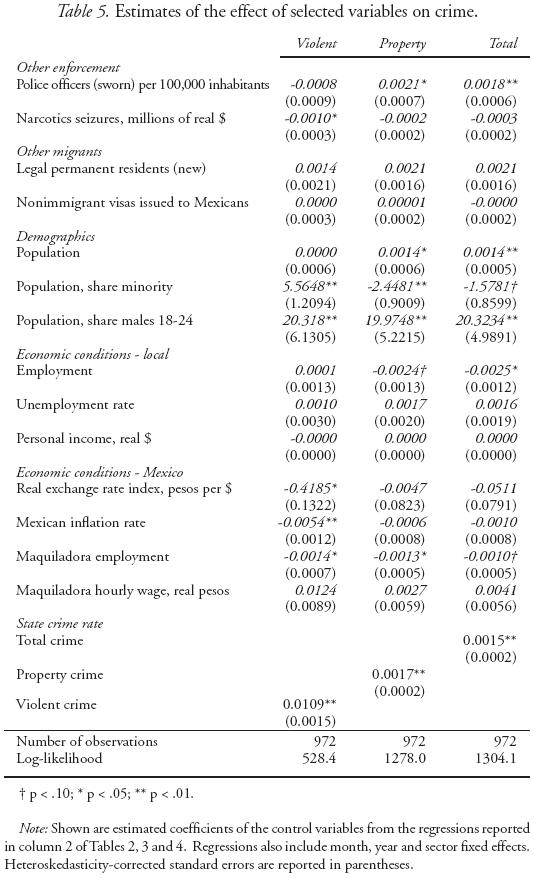
Legal migration and population measures have mixed effects on crime. The number of LPRs admitted and the number of nonimmigrant visas issued to Mexicans, do not have statistically significant effects on crime. Larger populations or higher population shares of young males, however, are positively correlated with higher property crime rates. The presence of more men ages 18 to 24 is also very highly correlated with violent crime. Greater population shares of minorities are positively related to violent crime rates but negatively related to property crime rates. The latter finding is probably picking up other differences between sectors with cities that have high versus low concentrations of Hispanics, such as the differences in crime rates in big cities with a smaller share of Hispanics (such as San Diego and El Paso) and small border cities with a greater share of Hispanics (such as Laredo and McAllen).
Economic conditions, particularly job growth, are also important and may help explain some of the overall reduction in border crime during the 1990s. As Table 5 indicates, the coefficients on sector employment and maquiladora employment are negative and highly significant. Property crime on the U.S. side falls in response to employment growth on both sides of the border. Job growth in the maquiladoras also reduces violent crime on the U.S. side.
]]> Other economic variables are generally not statistically significant in this model. Unemployment rates are not significant here, although other studies have found they have an important role in determining crime. Higher personal income is not significant either in these regressions. A lower real exchange rate (an appreciation of the peso) and lower Mexican inflation are positively correlated with violent crime on the U.S. side. Perhaps higher wages and a higher value of the peso are correlated with access to the United States such as frequency of border crossings—which might increase the opportunity for cross–border crime—or with the demand for illegal drugs, which is also correlated with violent crime on both sides of the border. Finally, state crime rates are highly significant which reflects the fact that some of the same factors are driving both local and state trends in criminal activity.
Discussion
This paper attempts to sort out the confounding effects of immigration and enforcement on border crime rates in the 1990s. Not surprisingly, we find evidence of a positive and significant correlation between the volume of undocumented migration and the incidence of violent crime. The underlying relationship is likely one in which migrants' reliance on human smugglers and the pervasiveness of drug smuggling contributes to violent crime. Because enforcement both deters illegal migration and contributes to smuggler usage, it is difficult to predict its net impact on violent crime. The regression results suggest that the net effect of enforcement on violent crime within a sector is zero, but the effect on violent crime in neighboring sectors is large and positive. The results are consistent with a scenario in which increased enforcement in certain sectors has driven migration and violent crime into neighboring sectors.
The results for property crime are slightly different. Some of the specifications pick up a deterrent effect of enforcement on property crime and, in addition, there are no sizable cross–sector effects of enforcement as there is with violent crime. There are several reasons for this result. First, property crime is not as closely related to undocumented migration as violent crime; for example, apprehensions are not a significant determinant of property crime in the Table 3 regressions. Second, there is no reason to expect increased smuggler usage to be correlated with more property crimes. Third, the funneling of crossings away from urban areas and into remote areas has likely contributed to breaking the link between the volume of undocumented migration and the incidence of property crime.
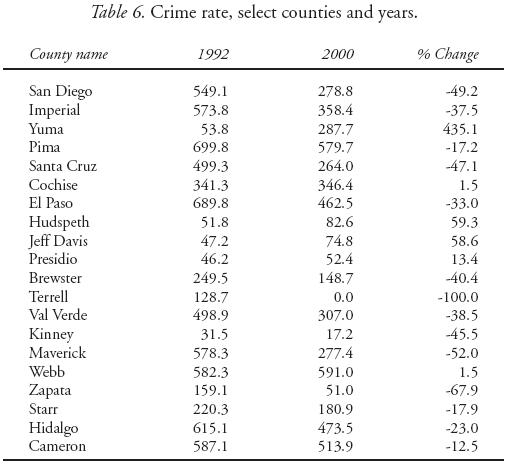
As a result of the 1990s changes in undocumented migration and the mode and concentration of border enforcement efforts, crime is more evenly distributed across the border today as compared with the past. In 1992, El Paso and San Diego counties accounted for 61 percent of border crime. In 2000, this share had fallen to 46 percent. Meanwhile, counties such as Yuma and Cochise in Arizona, and Hudspeth, Jefferson Davis, Presidio and Webb in Texas, became more crime ridden during this period, even as the U.S. crime rate fell. Table 6 shows the change in the county crime rates between 1992 and 2000.
There are several caveats to our analysis. Most importantly, if Border Patrol enforcement responds quickly to changes in a sector's crime rate, then our measure of enforcement is endogenous. An endogenous measure would result in a spurious positive correlation between enforcement and crime even though the true relationship may be negative or non–existent. Another caveat is that crime affecting undocumented immigrants is vastly underreported. This is especially true along the border where a migrant will probably only report crime if he or she is apprehended by the Border Patrol or other law enforcement personnel. Hence, not only are crime rates measured with error, but apprehensions are also endogenous to crime since apprehended migrants are both more likely to report crime and be victims of crime. Partly for these reasons, our findings point more to the correlation rather than the causation between crime and undocumented migration at the border. Another shortcoming of the analysis is that we have not controlled for detailed socio–demographic variables besides the broad indicators of population, minority share of population, young male share of population and personal income. Factors such as education and family structure are known predictors of the probability of committing crime (although unless they are correlated with our variables of interest, their omission should not bias our results). We also have not incorporated crime rates on the Mexican side of the border, which research suggests can be an important predictor of crime on the U.S. side (Albuquerque, 2004).
]]> Conclusion
Our results are consistent with the broader trends in border crime during the 1990s. While property crime declined drastically on the border over most of the years under study, the fall in violent crime in the 1990s did not track the much deeper decline experienced at the national level. The result has been that a greater share of border crime is now violent crime, although total crime rates have fallen. Our results help explain these trends. Migrant apprehensions are correlated with higher violent crime rates, while greater border enforcement has only had a role in reducing property crime rates. In fact, increases in border enforcement in one sector have had spillover effects that have led to higher violent crime rates in neighboring sectors.
The divergence with national trends with respect to violent crime, as well as the evidence suggesting more rural counties now contend with a greater share of border crime, suggests that sections of the border are becoming relatively more violent—this despite massive increases in enforcement since the middle of the 1990s. This evidence indicates that 1990s border enforcement policies such as the site–specific border crackdowns mentioned above may underlie some of the correlation between apprehensions, enforcement and crime. Future work should extend the analysis to the last five years to determine, among other things, whether the asymmetric effects of enforcement on crime have diminished as border enforcement has become more expansive and less concentrated.
References
Albuquerque, Pedro, "Shared Legacies, Disparate Outcomes: Why American South Border Cities Turned the Tables on Crime and Their Mexican Sisters Did Not", Texas A & M International University, 2004, mimeo. [ Links ]
Andreas, Peter, Border Games: Policing the U.S.–Mexico Divide, Cornell University Press, Ithaca (New York), 2000. [ Links ]
Bean, Frank D., Thomas J. Espenshade, Michael J. White and Robert F. Dymowski, "Post–IRCA Changes in the Volume and Composition of Undocumented Migration to the United States", in Frank D. Bean, Barry Edmonston and Jeffrey S. Passel (eds.), Undocumented Migration to the United States, Santa Monica, CA, RAND, 1990, pp. 111–158. [ Links ]
Bersin, Alan, "Testimony to the U.S. House of Representatives Committee on the Judiciary", April 23, 1997. Available at http://www.house.gov/judiciary/654.htm. [ Links ]
Butcher, Kristin F. and Anne Morrison Piehl, "Recent Immigrants: Unexpected Implications for Crime and Incarceration", Industrial and Labor Relations Review, 15, July, 1998a, pp. 654–679. [ Links ]
–––––––––, "Cross–City Evidence on the Relationship Between Immigration and Crime", Journal of Policy Analysis and Management, 17 (3), 1998b, pp. 457–493. [ Links ]
Cornelius, Wayne A., "Death at the Border: Efficacy and Unintended Consequences of U.S. Immigration Control Policy", Population and Development Review, 27, December, 2001, pp. 661–685. [ Links ]
––––––––– and Jessa M. Lewis, Impact of U.S. Immigration Control Policies on Mexican Migration: The View from Sending Communities, La Jolla (CA) and Boulder (Col.), Center for Comparative Immigration Studies–UCSD/Lynne Rienner Publishers, 2006. [ Links ]
Dunn, Timothy, The Militarization of the U.S.–Mexico Border, 1978–1992, Austin, Center for Mexican American Studies–University of Texas at Austin, 1996. [ Links ]
Ehrlich, Isaac and George D. Brower, "On the Issue of Causality in the Economic Model of Crime and Law Enforcement: Some Theoretical Considerations and Experimental Evidence", AEA Papers and Proceedings, May, 1987, pp. 99–106. [ Links ]
Eschbach, Karl, Jacqueline Hagan, Néstor Rodríguez, Rubén Hernández and Stanley Bailey, "Death at the Border," International Migration Review, 33 (2), 1999, pp. 430–454. [ Links ]
Espenshade, Thomas J., "Using INS Border Apprehension Data to Measure the Flow of Undocumented Migrants Crossing the U.S.Mexico Frontier", International Migration Review, 29 (2), 1995, pp. 545–565. [ Links ]
Gathmann, Christina, "The Effects of Enforcement on Illegal Markets: Evidence from Migrant Smuggling along the Southwestern Border", Stanford University, 2005, mimeo. [ Links ]
Gould, Eric D., Bruce A. Weinberg and David B. Mustard, "Crime Rates and Local Labor Market Opportunities in the United States: 1979–1997", The Review of Economics and Statistics, 84, February, 2002, pp. 45–61. [ Links ]
Grogger, Jeff, "Market Wages and Youth Crime", Journal of Labor Economics, 16, October, 1998, pp. 756–791. [ Links ]
Hagan, John and Alberto Palloni, "Immigration and Crime in the United States", in James P. Smith and Barry Edmonston (eds.), The Immigration Debate: Studies on the Economic, Demographic and Fiscal Effects of Immigration, Washington (D.C.), National Academy Press, 1998, pp. 367–387. [ Links ]
Hanson, Gordon H. and Antonio Spilimbergo, "Undocumented Immigration, Border Enforcement, and Relative Wages: Evidence from Apprehensions at the U.S.–Mexico Border", American Economic Review, 89, December, 1999, pp. 1337–1357. [ Links ]
Horowitz, Carl F. , An Examination of U.S. Immigration Policy and Serious Crime, Washington (D.C.), Center for Immigration Studies, 2001. [ Links ]
Ibarra, Ignacio, "Alien Smugglers Inc.", The Arizona Daily Star, July 11, 1999. [ Links ]
Levitt, Steven, "Using Electoral Cycles in Police Hiring to Estimate the Effect of Police on Crime", American Economic Review, 87 (3), 1997, pp. 270–290. [ Links ]
Liu, Samuel, "Essays on the Effects of Immigration on Education and Crime", Ph.D. Thesis, Massachusetts Institute of Technology, 2000. [ Links ]
Massey, Douglas S., Jorge Durand and Nolan J. Malone, Beyond Smoke and Mirrors: Mexican Immigration in an Era of Free Trade, New York, Russell Sage Foundation, 2002. [ Links ]
McCormick, Robert E. and Robert D. Tollison, "Crime on the Court", Journal of Political Economy, 92, April, 1984, pp. 223–235. [ Links ]
Miró, Ramón J., "Organized Crime and Terrorist Activity in Mexico, 1999–2002", Library of Congress Federal Research Division, 2003. Available at http://lcweb.loc.gov/rr/frd/pdf–files/OrgCrime_Mexico.pdf. [ Links ]
Mocan, Naci and Daniel Rees, "Economic Conditions, Deterrence and Juvenile Crime: Evidence from Micro Data", NBER Working Paper 7405. Cambridge (MA), 1999. [ Links ]
Orrenius, Pia M., "The Effect of U.S. Border Enforcement on the Crossing Behavior of Mexican Migrants", in Jorge Durand and Douglas Massey (eds.), Behind Smoke and Mirrors: Research from the Mexican Migration Project, New York, Russell Sage Foundation, 2004. [ Links ]
Reyes, Belinda I., Hans P. Johnson and Richard Van Swearingen, Holding the Line? The Effect of the Recent Border Build–up on Unauthorized Immigration, San Francisco, Public Policy Institute of California, 2002. [ Links ]
Rico, Gabriela, "Border Patrol Pressure Leads to More Violence", The Tucson Citizen, March 3, 2003, http://www.tucsoncitizen.com/local/3_3_03border_tension.htm. [ Links ]
Singer, Audrey and Douglas S. Massey, "The Social Process of Undocumented Border Crossing Among Mexican Migrants", International Migration Review, 32 (3), 1997, pp. 561–592. [ Links ]
Spener, David, "Migrant Smuggling as a Transnational Cottage Industry: Findings from the Tex–Mex Border Region", 2002, Forthcoming, Journal of International Migration and Integration. [ Links ]
U.S. Commission on Immigration Reform, "U.S. Immigration Policy: Restoring Credibility", Washington (D.C.), U.S. Commission on Immigration Reform, 1994. [ Links ]
U.S. General Accounting Office, "Alien Smuggling: Management and Operational Improvements Needed to Address Growing Problem", GAO/GGD–00–103, Washington (D.C.), GAO, 2000. [ Links ]
U.S.Immigratión and Naturalization Service, Statiscal Yearbook of the INS, Washington (D.C.), 2000. Available at http://uscis.gov/graphics/shared/aboutus/statistics/ENF00yrbk/ENF2000list.htm. [ Links ]
U.S./Mexico Border Counties Coalition, "Undocumented Immigrants in U.S.–Mexico Border Counties: Costs of Law Enforcement, Criminal Justice and Emergency Medical Services", University of Arizona, Tucson, January, 2001. [ Links ]
Wagner, Dennis, "Human Trafficking's Profits Spur Horrors", The Arizona Republic, July 23, 2006. [ Links ]
Wolf, Daniel, "Undocumented Aliens and Crime: The Case of San Diego", Monograph Series 29, Center for U.S.–Mexican Studies–University of California, San Diego, 1988. [ Links ]
* The views expressed here are those of the authors and do not necessarily represent the views of the Federal Reserve Bank of Dallas or the Federal Reserve System.
1 Linewatch hours are the number of hours the Border Patrol officers spend each month patrolling the border with Mexico. See text below for more detail.
2 Our data only include crimes that occur in border counties adjacent to Mexico and so are not a complete count of border–related or migration–related crimes.
3 Immigration and Customs Enforcement (ICE) Agent Thomas Homan in testimony to the House Judiciary Committee, June 24, 2003. Go to http://www.house.gov/judiciary.
4 Hagan and Palloni go on to make the point that prison data may overstate immigrant incarceration rates since non–citizen immigrants are more likely to be convicted and less likely to qualify for early release than comparable natives. See also Horowitz (2001) for a review of pertinent research on immigration and crime.
5 See U.S. Department of Justice, Bureau of Justice Statistics, Trends in Justice Expenditure and Employment, NCJ 202792, Table 1 [Online]. Available: http://www.ojp.usdoj.gov/bjs/pub/pdf/jeeus01.pdf [May, 2004].
6 The data are from the INS (Immigration and Naturalization Service) but the INS was moved to the Department of Homeland Security, split up and renamed in March 2003.
]]> 7 Spener (2002) uses case study evidence from South Texas to dispute the view that human smuggling on the Southwest border has become dominated by large criminal syndicates. Spener agrees however that migrants have become more dependent on smugglers as enforcement has intensified.8 The 1994 U.S. Commission on Immigration Reform, charged with assessing the effect of Operation Hold–the–Line on El Paso/Juárez, looked into the determinants of El Paso's crime rate and whether undocumented immigration played a role. In a cross–sectional regression of city characteristics on crime, they find that border cities have lower rates of crime as compared with non–border cities. El Paso is found only to have an above average rate of larceny–theft. The decline in the crime rate following implementation of Hold the Line is seen as possible evidence that undocumented immigration increases crime rates. However, the analysis only controls for time trends and seasonal effects.
9 There is still the issue of whether enforcement becomes more or less effective during this time, changing the probability of apprehension. New technology, for example, could make the Border Patrol more effective at catching migrants. We deal with this possibility by including both year and sector fixed effects.
10 As McCormick and Tollison (1984) demonstrate, the effect of police on crime is ambiguous. As the likelihood of detection and arrest rises and measured crime increases, the deterrent effect of more police should lower arrests and crime should fall. If Border Patrol serves more as a deterrent to crime than an engine for more arrests, then the analysis should be more likely to capture a negative effect of more Border Patrol on the incidence of crime.
11 Another complicating factor is the relationship of policing to the reporting of crime. Reported crime is an underestimate of actual crime, and the size of the bias is related to the degree of police presence.
12 California counties include San Diego and Imperial; Arizona includes Yuma, Pima, Santa Cruz and Cochise. Texas counties include El Paso, Hudspeth, Jeff Davis, Presidio, Brewster, Terrell, Val Verde, Kinney, Maverick, Webb, Zapata, Starr, Hidalgo and Cameron.
13 There are nine Border Patrol sectors along the Southwest border: San Diego, El Centro, Yuma, Tucson, El Paso, Marfa, Del Rio, Laredo and McAllen. These sectors consist of between one and five border–adjacent counties (as well as more inland counties which we ignore here). For those sectors that contain more than one border–adjacent county, we aggregate county crime, population and economic data up to the sector level. For sectors that contain only one border–adjacent county, we simply use the county–level values (these include San Diego, El Centro and Yuma).
14 Crime and police data was provided by the following state agencies: Special Request Unit, Criminal Justice Statistics Center, California Department of Justice; Uniform Crime Reporting Program, Access Integrity Unit, Arizona Department of Public Safety; Uniform Crime Reporting, Crime Information Bureau, Texas Department of Public Safety.
15 There are many problems with reported crime data such as the UCR. First, victims report only an estimated one–half of all crimes committed. Under–reporting introduces measurement error that varies by crime type and county of jurisdiction. Also, the methods of collecting and reporting data also vary across local authorities. Sector fixed effects should pick up most of the fixed differences in reporting methods across counties in the sample.
16 Neighbor sectors are the geographically defined neighbors (immediately to the east and west for the interior sectors, and the sector to the east (west) for San Diego (Cameron).
]]> 17 These data are available from the 2000 INS Statistical Yearbook. Values are deflated using the U.S. CPI.18 The number of Mexican nonimmigrants is based on the number of B1/B2 visas issued to Mexicans in a given year (available from the State Department). LPR data are available from the National Technical Information Service (NTIS) as "Immigrants Admitted into the United States as Legal Permanent Residents".
19 Variables with annual frequency whose values were interpolated monthly include police officers, narcotics seizures, LPRs, nonimmigrants, the population variables, and personal income.
20 The Border Patrol sectors are matched with Mexican states as follows: San Diego and El Centro with Baja California, Yuma and Tucson with Sonora, El Paso and Marfa with Chihuahua, Del Rio with Coahuila, Laredo and McAllen with Tamaulipas.
21 There is one month for which there is no violent crime reported in the Yuma sector. In this case, we replaced the zero with 0.01 before taking logs.
22 The coefficients in the quadratic specifications can be converted to elasticities by multiplying the derivative with respect to apprehensions by mean apprehensions (and similarly for enforcement).
23 We included measures of apprehensions in neighboring sectors in other specifications, but they were not significant and did not affect the coefficient on hours so we took them out.
24 The endogeneity of the police variable biases the coefficient on police presence upward, but does not affect the other coefficients. As it is not our variable of interest, we do not address the endogeneity issue here.
Información sobre autor(a)
]]> ROBERTO CORONADO es Economista en el Banco de la Reserva Federal de Dallas, sucursal Houston. Su investigación se concentra en temas como la economía de México, la industria maquiladora y la economía de la frontera México–Estados Unidos. Ha publicado artículos en varias revistas de la Reserva Federal, así como también en revistas académicas tales como Annals of Regional Science, Southern Economic Journal, Journal of Borderlands Studies, International Business and Economics Research Journal, e Investigación Económica.PIA M. ORRENIUS es economista senior y asesora de política monetaria en el Banco de la Reserva Federal de Dallas. Su investigación se concentra en las causas y consecuencias de la migración México–Estados Unidos, inmigración indocumentada y política migratoria de Estados Unidos. Sus más recientes artículos fueron sobre el impacto económico de la inmigración y aparecieron en Labour Economics y Economic Theory. Obtuvo su doctorado en economía en la Universidad de California en Los Ángeles.
]]>