<?xml version="1.0" encoding="ISO-8859-1"?><article xmlns:mml="http://www.w3.org/1998/Math/MathML" xmlns:xlink="http://www.w3.org/1999/xlink" xmlns:xsi="http://www.w3.org/2001/XMLSchema-instance">
<front>
<journal-meta>
<journal-id>1665-109X</journal-id>
<journal-title><![CDATA[Sinéctica]]></journal-title>
<abbrev-journal-title><![CDATA[Sinéctica]]></abbrev-journal-title>
<issn>1665-109X</issn>
<publisher>
<publisher-name><![CDATA[Instituto Tecnológico y de Estudios Superiores de Occidente, Departamento de Educación y Valores]]></publisher-name>
</publisher>
</journal-meta>
<article-meta>
<article-id>S1665-109X2015000100011</article-id>
<title-group>
<article-title xml:lang="en"><![CDATA[Social Media as Learning Tool in Higher Education: The case of Mexico and South Korea]]></article-title>
</title-group>
<contrib-group>
<contrib contrib-type="author">
<name>
<surname><![CDATA[Castro-Romero]]></surname>
<given-names><![CDATA[Oswaldo]]></given-names>
</name>
<xref ref-type="aff" rid="A01"/>
</contrib>
</contrib-group>
<aff id="A01">
<institution><![CDATA[,Universidad Autónoma de Nayarit Centro Especializado de Educación Virtual ]]></institution>
<addr-line><![CDATA[Tepic Nayarit]]></addr-line>
<country>México</country>
</aff>
<pub-date pub-type="pub">
<day>00</day>
<month>06</month>
<year>2015</year>
</pub-date>
<pub-date pub-type="epub">
<day>00</day>
<month>06</month>
<year>2015</year>
</pub-date>
<numero>44</numero>
<fpage>1</fpage>
<lpage>16</lpage>
<copyright-statement/>
<copyright-year/>
<self-uri xlink:href="http://www.scielo.org.mx/scielo.php?script=sci_arttext&amp;pid=S1665-109X2015000100011&amp;lng=en&amp;nrm=iso"></self-uri><self-uri xlink:href="http://www.scielo.org.mx/scielo.php?script=sci_abstract&amp;pid=S1665-109X2015000100011&amp;lng=en&amp;nrm=iso"></self-uri><self-uri xlink:href="http://www.scielo.org.mx/scielo.php?script=sci_pdf&amp;pid=S1665-109X2015000100011&amp;lng=en&amp;nrm=iso"></self-uri><abstract abstract-type="short" xml:lang="en"><p><![CDATA[This paper presents a contextualized research and analyzes the use of social media as a tool for learning in Higher Education between Mexico and South Korea. A comparative analysis by meta-analysis of major research works was conducted on the use of social media from the emergence of Web 2.0 to the rising and popularity of social networks. This study shows data describing the features and mechanisms of social media for learning, as purpose of use, technological environments, pedagogical strategies and the effect of learning.]]></p></abstract>
<abstract abstract-type="short" xml:lang="es"><p><![CDATA[Los medios sociales son un fenómeno tecnológico global a consecuencia del rápido desarrollo de las tecnologías de la información y la comunicación. Los medios sociales han abierto las puertas a nuevas formas de participación y han influido en el proceso de enseñanza-aprendizaje en muchas universidades del mundo. Este estudio presenta los resultados de un análisis comparativo sobre el uso de los medios sociales como herramientas para el aprendizaje en el marco de instituciones de educación superior a través de un metaanálisis de investigaciones entre México y Corea del Sur, 2004-2013. Según los resultados, los medios sociales tienen un enorme potencial para facilitar actividades de aprendizaje en los estudiantes y como recursos personales más allá del salón de clase. Sin embargo, es importante señalar que sus ventajas no son exclusivamente atribuibles a la gestión en el manejo de nuevas tecnologías, sino en implicaciones pedagógicas que promueven su incorporación. Blended learning, así como el aprendizaje autodirigido, han conducido el uso significativo de los medios sociales mediante el cambio de actitudes y valores propios de los estudiantes en su proceso de aprendizaje y en la construcción de conocimientos. Al final de este trabajo se comparten algunas implicaciones y sugerencas para futuros estudios.]]></p></abstract>
<kwd-group>
<kwd lng="en"><![CDATA[Higher education]]></kwd>
<kwd lng="en"><![CDATA[participatory culture]]></kwd>
<kwd lng="en"><![CDATA[social learning]]></kwd>
<kwd lng="en"><![CDATA[social media]]></kwd>
<kwd lng="es"><![CDATA[medios sociales]]></kwd>
<kwd lng="es"><![CDATA[social media]]></kwd>
<kwd lng="es"><![CDATA[aprendizaje social]]></kwd>
<kwd lng="es"><![CDATA[educación superior]]></kwd>
</kwd-group>
</article-meta>
</front><body><![CDATA[  	    <p align="justify"><font face="verdana" size="4">Tambi&eacute;n en sin&eacute;ctica</font></p>  	    <p>&nbsp;</p>  	    <p align="center"><font face="verdana" size="4"><b>Social Media as Learning Tool in Higher Education: The case of Mexico and South Korea</b></font></p>  	    <p>&nbsp;</p>  	    <p align="center"><font face="verdana" size="2"><b>Oswaldo Castro&#45;Romero</b></font></p>  	    <p>&nbsp;</p>  	    <p align="justify"><font face="verdana" size="2"><i>Master in Educational Technology by Kyung Hee University in Seoul, South Korea. Professor assigned to the Specialized Center of Virtual Education at University Autonomous of Nayarit in Tepic, Mexico. His research interests are educational technology, instructional design and virtual learning communities.</i></font></p>  	    <p>&nbsp;</p>  	    <p align="justify"><font face="verdana" size="2">Submitted:&nbsp;February 12, 2014.    ]]></body>
<body><![CDATA[<br> Accepted for publication: September 27, 2014.</font></p>  	    <p>&nbsp;</p>  	    <p align="justify"><font face="verdana" size="2"><b>Abstract</b></font></p>  	    <p align="justify"><font face="verdana" size="2">This paper presents a contextualized research and analyzes the use of social media as a tool for learning in Higher Education between Mexico and South Korea. A comparative analysis by meta&#45;analysis of major research works was conducted on the use of social media from the emergence of Web 2.0 to the rising and popularity of social networks. This study shows data describing the features and mechanisms of social media for learning, as purpose of use, technological environments, pedagogical strategies and the effect of learning.</font></p>  	    <p align="justify"><font face="verdana" size="2"><b>Keywords:</b> Higher education, participatory culture, social learning, social media.</font></p>  	    <p>&nbsp;</p>  	    <p align="justify"><font face="verdana" size="2"><b>Resumen</b></font></p>  	    <p align="justify"><font face="verdana" size="2">Los medios sociales son un fen&oacute;meno tecnol&oacute;gico global a consecuencia del r&aacute;pido desarrollo de las tecnolog&iacute;as de la informaci&oacute;n y la comunicaci&oacute;n. Los medios sociales han abierto las puertas a nuevas formas de participaci&oacute;n y han influido en el proceso de ense&ntilde;anza&#45;aprendizaje en muchas universidades del mundo. Este estudio presenta los resultados de un an&aacute;lisis comparativo sobre el uso de los medios sociales como herramientas para el aprendizaje en el marco de instituciones de educaci&oacute;n superior a trav&eacute;s de un metaan&aacute;lisis de investigaciones entre M&eacute;xico y Corea del Sur, 2004&#45;2013. Seg&uacute;n los resultados, los medios sociales tienen un enorme potencial para facilitar actividades de aprendizaje en los estudiantes y como recursos personales m&aacute;s all&aacute; del sal&oacute;n de clase. Sin embargo, es importante se&ntilde;alar que sus ventajas no son exclusivamente atribuibles a la gesti&oacute;n en el manejo de nuevas tecnolog&iacute;as, sino en implicaciones pedag&oacute;gicas que promueven su incorporaci&oacute;n.&nbsp;<i>Blended learning,</i>&nbsp;as&iacute; como el aprendizaje autodirigido, han conducido el uso significativo de los medios sociales mediante el cambio de actitudes y valores propios de los estudiantes en su proceso de aprendizaje y en la construcci&oacute;n de conocimientos. Al final de este trabajo se comparten algunas implicaciones y sugerencas para futuros estudios.</font></p>  	    <p align="justify"><font face="verdana" size="2"><b>Palabras clave:</b>&nbsp;medios sociales, social media, aprendizaje social,&nbsp;educaci&oacute;n superior.</font></p>      <p>&nbsp;</p>  	    ]]></body>
<body><![CDATA[<p align="justify"><font face="verdana" size="2"><b>INTRODUCTION</b></font></p>  	    <p align="justify"><font face="verdana" size="2">In recent years, social media has been part of a new culture that facilitates communication and interaction between people through the Internet (Mustonen, 2009; Davis et al. 2012; Kim, 2012; Seamean &amp; Tinti&#45;Kane, 2013). This has been possible due to the development of new Information and Communication Technologies (ICTs) which offer a variety of services; they are freely available and in some cases are free. The appearance on the market of new devices &#151;such as smartphones, tablet PCs, etc.&#151; and the development of web applications, accompanies the emergence of new interactive experiences adaptable to users' requirements.</font></p>  	    <p align="justify"><font face="verdana" size="2">Mexico is one of the fastest growing Latin American countries on Internet use. In 2012, World Internet Project (WIP) informed that 46% of Mexicans, about 52.3 million, have access to the Internet. Likewise, a study by The Competitive Intelligence Unit (CIU) revealed that the use of social networks is estimated, in 2013, about 85% of Internet users, nearly 34.7 million users. The heyday of social networks lies in the presidential election of 2012; similarly, other social media as thematic blogs and videoblogs have been the main tools in the digital age 2.0 in Mexico. The use of social media is no exception in South Korea. South Korea has attracted attention for its advances in the field of ICTs around the world. Firstly, because they have the fastest Internet and its penetration reached 81.6% of the population. Also, South Korea has better mobile connectivity and they were the creators of the first social network called "Cyworld" in 1999. By 2005 some educational and strategic policies were implemented to expand and enhance the use of ICTs in education and research. Nevertheless, in 2010, South Korea was able to position itself as one of the leading countries in the use of social media, ubiquitous learning and mobile learning through mobile devices.</font></p>  	    <p align="justify"><font face="verdana" size="2">The vision of the use of ICT in Higher Education in the twenty&#45;first century is associated with the development of lifelong learning, more equity of access, quality improvement of teaching methods, diversification for cooperative&#45;collaborative, autonomous learning, and troubleshooting of the physical environment (UNESCO, 1998). From this perspective, this study seeks to analyze and compare the use of social media in Mexico and South Korea, and thus to understand the features and mechanisms as an educational tool and its effects on learning. A comprehensive qualitative and quantitative synthesis of research on the use of social media in higher education during 2004 to 2013 through a systematic analysis is presented.</font></p>  	    <p>&nbsp;</p>  	    <p align="justify"><font face="verdana" size="2"><b>SOCIAL MEDIA</b></font></p>  	    <p align="justify"><font face="verdana" size="2">Social media are web&#45;based technologies such as social networks, wikis, blogs, microblogs and multimedia sharing tools that allow users to connect to the Internet to create and share content with other users (Schwartz, 2012). Social media has emerged with the potential of "social software" to increase dialogue, collaboration, networking and help establish social relationships based on common goals and interests (Mayfield, 2007; Ryberg, 2008; Safko &amp; Brake, 2009; Mustonen, 2009; Joosten, 2012). In educational terms, some authors emphasize the use of social media for better control and efficiency of resources to complement the work inside and outside the classroom in order to improve student learning, facilitate teacher&#45;student and student&#45;students interaction, development of skills and competencies and their level of satisfaction into new learning experiences (Ajjan &amp; Hartshorne, 2008).</font></p>  	    <p align="justify"><font face="verdana" size="2">Social media gains a special value after the emergence of Web 2.0 The evolution of the Internet helps us understand the emergence of this participatory platform that conceptualizes the importance of producing (or co&#45;producing), distribution and democratization of information. The characteristics of social media are: participation, openness, conversation, community and connectedness (FKII Josayeongu Team, 2006: 53).</font></p>  	    <blockquote> 		    <p align="justify"><font face="verdana" size="2">&bull; Participation. Social media encourages contributions and feedback from everyone who is interested. It blurs the line between media and audience.</font></p>  		    ]]></body>
<body><![CDATA[<p align="justify"><font face="verdana" size="2">&bull; Openness. Most social media services are open to feedback and participation. They encourage voting, comments and the sharing of information. There are rarely any barriers to accessing and making use of content&#45;password&#45;protected content is frowned upon.</font></p>  		    <p align="justify"><font face="verdana" size="2">&bull; Conversation. Whereas traditional media is about "broadcast" (content transmitted or distributed to an audience) social media is better seen as a two&#45;way conversation.</font></p>  		    <p align="justify"><font face="verdana" size="2">&bull; Community. Social media allows communities to form quickly and communicate effectively. Communities share common interests.</font></p>  		    <p align="justify"><font face="verdana" size="2">&bull; Connectivity. Most kinds of social media thrive on their connectivity, making use of links to other sites, resources and people.</font></p> 	</blockquote>  	    <p align="justify"><font face="verdana" size="2">Giaccardi (2012) highlights social media in a "participatory culture", that is, it features on encounters with heritage and on the socially produced meanings and values that individuals and communities ascribe to it. The author classifies it around three major themes: social practice, public information, and a sense of place. Social media users have new opportunities to gain experiences when participating in collections and representations, as well as the communication process as curators of content (social practice). The widespread presence of social technologies provides a platform for information exchanging in the public domain and the development of peer activities and promoting and legitimizing participation (public information). And, computing becomes more pervasive. Its digital networks extend our surroundings and support new ways to engage among people into a specific territorial setting (sense of place).</font></p>  	    <p align="justify"><font face="verdana" size="2"><a href="#t1">Table 1</a> shows a classification of social media according to a participation model proposed by Choi and Yang (2009), as well as some online services.</font></p>  	    <p align="center"><font face="verdana" size="2"><a name="t1"></a></font></p>  	    <p align="center"><font face="verdana" size="2"><img src="/img/revistas/sine/n44/a11t1.jpg"></font></p>  	    <p>&nbsp;</p>  	    <p align="justify"><font face="verdana" size="2"><b>SOCIAL MEDIA AT UNIVERSITY</b></font></p>  	    ]]></body>
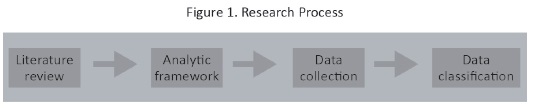
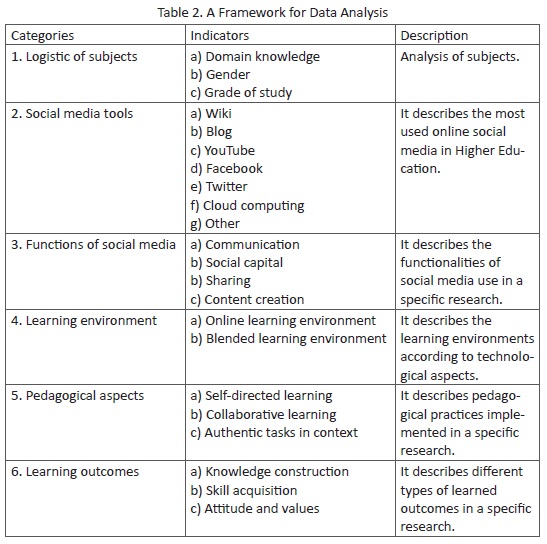
<body><![CDATA[<p align="justify"><font face="verdana" size="2">The adoption of social media in the university setting represents a valuable resource for learning, enabling students to find new channels of communication, a valuable source of information and participation (Ajjan &amp; Hartshorne, 2008; Munoz &amp; Towner, 2009; Junco, 2011). In recent years, blogs and wikis are the most used social media by students for individual tasks, especially to create content and add comments (Seamean &amp; Tinti&#45;Kane, 2013). Blogs or weblogs are valuable tools in education within a constructivist model. Blogs support E&#45;learning, establish channels for informal communication between teacher and student, promote social interactions and provide to students a personal media to get learning experiences (Lara, 2005). Furthermore, wikis are tools especially for collaborative learning because they allow students to construct, share, and explore information and knowledge from a peer communication (Haythornthwaite, 2006).</font></p>  	    <p align="justify"><font face="verdana" size="2">It is evident the interest and the possibilities offered by these tools for learning. However, these will depend on the manner teachers promote strategies. Some researches consider the importance of developing a set of skills and technological competencies (Kennedy et al., 2008); and overcome a 'digital dissonance' emphasizing technologies that bring positive effects on learning and need to be adaptable to socio&#45;cultural context of students (Clark et al., 2009); and ultimately, it is needed to design support activities through scaffolding of learning experiences with the use of technology (McLoughlin &amp; Lee, 2010).</font></p>  	    <p>&nbsp;</p>  	    <p align="justify"><font face="verdana" size="2"><b>RESEARCH METHODOLOGY</b></font></p>  	    <p align="justify"><font face="verdana" size="2">A comparative analysis was conducted through a meta&#45;analysis in order to measure the size and trends of use of social media as a learning tool in higher education. The sample size was determined based on the collection of articles published in Mexico and South Korea between 2004 and 2013. Meta&#45;analysis method was introduced by Glass in 1976 for systematic reviews of literature in an attempt to synthesize the results in context, interpret them and reach a conclusion.</font></p>  	    <p align="center"><font face="verdana" size="2"><img src="/img/revistas/sine/n44/a11f1.jpg"></font></p>  	    <p align="justify"><font face="verdana" size="2">The following <a href="#t2">Table 2</a> shows the analytical framework of this study and was designed around the literature of related studies (Jeung, 2010; Bennett et al., 2012; Davis et al., 2012; Tess, 2013; Nykvist &amp; Lee, 2013).</font></p>  	    <p align="center"><font face="verdana" size="2"><a name="t2"></a></font></p>  	    <p align="center"><font face="verdana" size="2"><img src="/img/revistas/sine/n44/a11t2.jpg"></font></p>  	    <p align="justify"><font face="verdana" size="2">Data was collected from 6 databases through the insertion of specific keywords. The bases are: REDALYC (an information network of scientific journals of Latin America, Caribbean, Spain and Portugal) consulted from <a href="http://www.redalyc.org/" target="_blank">http://www.redalyc.org/</a>; Scholar (an open web search engine by Google) consulted from <a href="http://scholar.google.co.kr/" target="_blank">http://scholar.google.co.kr/</a>; EBSCOhost (an online database that provides search information services) consulted from <a href="http://search.ebscohost.com/" target="_blank">http://search.ebscohost.com/</a>; RISS (an information repository by Korea Education and Research Information Service) consulted from <a href="http://www.riss.kr/" target="_blank">http://www.riss.kr/</a>; DBpia (an online service of Korean academic journals, conference proceedings, professional journals) consulted from <a href="http://www.dbpia.co.kr/" target="_blank">http://www.dbpia.co.kr/</a>; and E&#45;article (a digital library of Korean publications and academic research papers by the Haksul Kyoyugwon) consulted from <a href="http://www.earticle.net/" target="_blank">http://www.earticle.net/</a>. Data was collected from October to December 2013. Finally, data was extracted and organized into Excel sheets for sorting, analysis and interpretation.</font></p>  	    ]]></body>
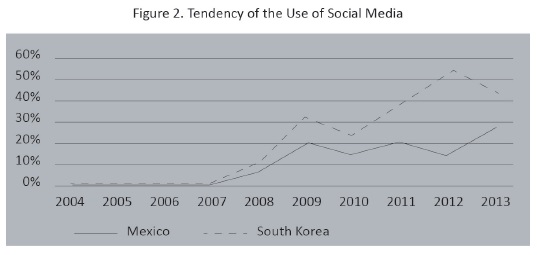
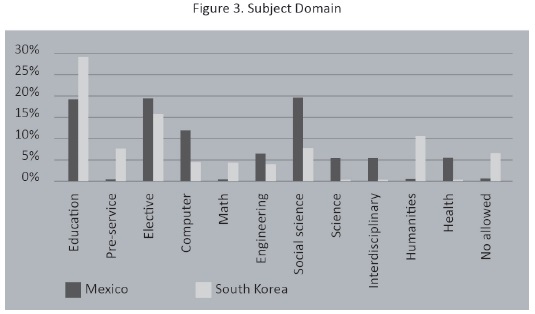
<body><![CDATA[<p>&nbsp;</p>  	    <p align="justify"><font face="verdana" size="2"><b>RESULTS</b></font></p>  	    <p align="justify"><font face="verdana" size="2">Once the validity and reliability of the data was realized, a comparative analysis was carried out of 15 research papers in Mexico and 23 South Korean works published in journals from 2004 to 2013.</font></p>  	    <p align="justify"><font face="verdana" size="2">Based on the results, in Mexico, the transition year of use of social media in Higher Education was in 2013 (26.7%), while in South Korea starting in 2012 (39.1%) (See <a href="#f2">Figure 2</a> for reference).</font></p>  	    <p align="center"><font face="verdana" size="2"><a name="f2"></a></font></p>  	    <p align="center"><font face="verdana" size="2"><img src="/img/revistas/sine/n44/a11f2.jpg"></font></p>  	    <p>&nbsp;</p>  	    <p align="justify"><font face="verdana" size="2"><i>1. What are the features of social media as a tool for learning in higher education in both Mexico and South Korea?</i></font></p>  	    <p align="justify"><font face="verdana" size="2">As can be seen in <a href="#f3">Figure 3</a>, in Mexico, the predominant domain knowledge are: social sciences 20% (Psychology, Communication Sciences and Administration), education 20% (Virtual Environments and Teaching Methods, and master's in Pedagogy and Educational Technology) and elective subjects 20% (for developing reading and writing skills, discussion skills and university students' development). But others domains are: computer 13.3%, engineering 6.7%, sciences, 6.7%, interdisciplinary 6.7% and health 6.7%. Meanwhile, in South Korea the field is predominant in education 30% (in subjects such as Educational Technology and Instructional Methods). But others domains are: elective 17%, humanities 13%, pre&#45;service 8.7%, social science 8.7%, not allowed 8.7%, computer 4.3%, math 4.3% and engineering 4.3%.</font></p>  	    <p align="center"><font face="verdana" size="2"><a name="f3"></a></font></p>  	    ]]></body>
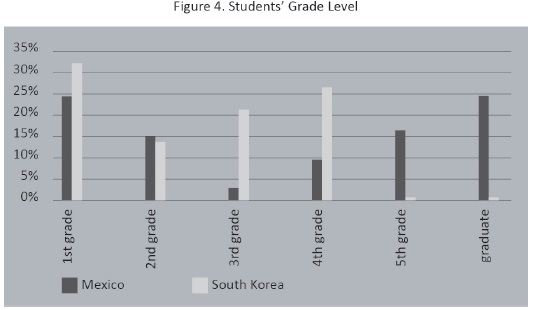
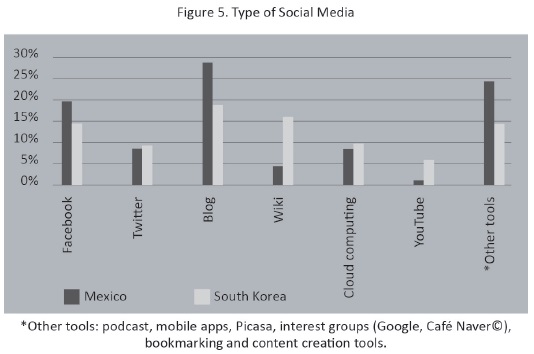
<body><![CDATA[<p align="center"><font face="verdana" size="2"><img src="/img/revistas/sine/n44/a11f3.jpg"></font></p>  	    <p align="justify"><font face="verdana" size="2">The following indicator refers to gender difference. In Mexico women constitute a larger population using social media in learning activities with 64.9% whereas 35.1% the men. It is interesting enough that in Mexico the use of these tools by women is higher, and ultimately these data show an imbalance in gender. Espinosa and Jim&eacute;nez (2013) noted it in their research. They describe an active role of women in supporting groups and online communities and the use of social networks for socialization. Some other data from AMIPCI, Mexican Internet Association (2012), shows that women send more emails, instant messages and access social networks more frequently. In the case of South Korea, the population in relation to gender difference is slightly a balanced value; women participate with 51.5% and 48.5% of men.</font></p>  	    <p align="justify"><font face="verdana" size="2">The following <a href="#f4">Figure 4</a> shows the grade level of students. In Mexico first grade obtained 25%, postgraduate 25%, fifth year 18.7%, second year 16.7%, fourth year 10.4% and third year 4.2%. Meanwhile in South Korea, first grade obtained 33.6%, fourth grade 28%, third year 22.4% and second grade 15.9%.</font></p>  	    <p align="center"><font face="verdana" size="2"><a name="f4"></a></font></p>  	    <p align="center"><font face="verdana" size="2"><img src="/img/revistas/sine/n44/a11f4.jpg"></font></p>  	    <p align="justify"><font face="verdana" size="2">In both countries, it is noted that the use of social media is mostly by freshmen. This is comprehensible from the perspective of Prensky (2001) which suggests that young people, who were born in the "digital age" (named digital natives), bring different preferences, skills and ways of processing information through the use of technology. At this point, it is noted the contributions of Herrera&#45;Batista (2009) and Ortega &amp; Banderas (2011) describing freshmen from Mexican universities with greater Internet access and preferences of technological resources to accomplish tasks and participate in daily activities.</font></p>  	    <p align="justify"><font face="verdana" size="2">Moreover, it can be appreciated that Mexican graduate students and Korean fourth grade' students mostly use social media. These results have (at least) two readings: in Mexico postgraduate students in service are developing technical&#45;didactic skills, particularly for integrating the use of new technologies into the class. And second, in South Korea, seniors use social networks to create personal and professional relationships into communities.</font></p>  	    <p align="justify"><font face="verdana" size="2">As shown in <a href="#f5">Figure 5</a>, the most used social media are: in Mexico blogs 30%, *other tools 25%, Facebook 20%, cloud computing 10%, Twitter 10% and wikis 5%. Meanwhile in South Korea are wikis 23.1%, Facebook 15.4%, blogs 15.4%, *other tools 15.4%, cloud computing 11.5%, Twitter 11.5% and YouTube 7.7%.</font></p>  	    <p align="center"><font face="verdana" size="2"><a name="f5"></a></font></p>  	    <p align="center"><font face="verdana" size="2"><img src="/img/revistas/sine/n44/a11f5.jpg"></font></p>  	    ]]></body>
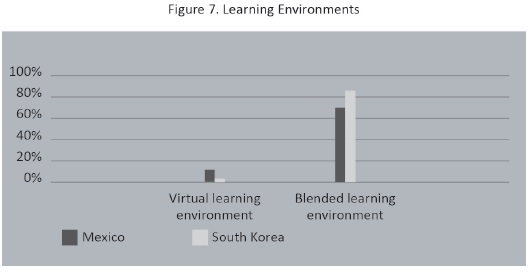
<body><![CDATA[<p align="justify"><font face="verdana" size="2">The called "blogosphere" in Mexico has unleashed a myriad of learning experiences such as the development of skills and competencies, virtual portfolios, and a platform for sharing materials and information of activities. In the case of South Korea, the use of wikis in learning activities has been possible by a service called Springnote&reg; (a virtual notebook opened from 2010 to 2012). This tool was designed to facilitate a virtual scenario and to motivate solving problems, decision&#45;making and the development of new ideas in collaboration (Han, Yim &amp; Lee, 2012).</font></p>  	    <p align="justify"><font face="verdana" size="2">However, Facebook is gaining popularity. In Mexico, Facebook usage has increased by 100% more over the previous year in 2013. Whereas in South Korea in the same year was increased by 200% over the previous year. In fact, this social network is a communicative phenomenon because they have helped in the formation of virtual communities for discussion and conversation. In addition, other usage of Facebook has been to develop strategies for inclusion (Yu, Park &amp; Cha, 2013) and socio&#45;cognitive skills (Kim, 2012).</font></p>  	    <p align="justify"><font face="verdana" size="2">In Mexico, the appearance in 2013 of cloud computing has offered a new technological innovation for IT service management. Nevertheless in South Korea cloud computing usage decreased slightly over the same year. This platform has provided access to information more easily without purchasing software licenses, buying external devices such as USB and wasting large amounts of money for management and data management.</font></p>  	    <p align="justify"><font face="verdana" size="2"><a href="#f6">Figure 6</a> shows the purpose of using social media. In Mexico are communication 58.3%, sharing content 25%, content creation 12.5% and social capital 4.2%. Whereas in South Korea are communication 45.5%, sharing content 20.5%, content creation 20.5% and social capital 13.6%.</font></p>  	    <p align="center"><font face="verdana" size="2"><a name="f6"></a></font></p>  	    <p align="center"><font face="verdana" size="2"><img src="/img/revistas/sine/n44/a11f6.jpg"></font></p>  	    <p align="justify"><font face="verdana" size="2">In both countries, social media is used for communication purpose. However, in Mexico compared with this Asian country is higher the use of these tools for communication. Another outstanding element is the emergence of an accumulation of social capital principally in South Korea while in Mexico is still low. Social capital means users from social networks interact with others in order to improve their living conditions (educational and occupational achievement, labor market access, building relationships, etc.). According to Jin (2013), a social presence is intimately related in the creation of social relationships. That is, the effect of social capital refers that users with a strong social presence are willing to trust others and are more likely to create intimate bonds with others.</font></p>  	    <p align="justify"><font face="verdana" size="2">In both countries, blended learning is the most used learning environment (see <a href="#f7">Figure 7</a>). Blended learning is widely used in Higher Education institutions especially those who have taken the face&#45;to&#45;face component in physical spaces and virtual spaces using formal learning platforms (as Moodle, Blackboard) or informal learning platforms (as social networks, blogs, wikis). In Mexico, the consequence of the failure of E&#45;learning (Flores, 2009) and the difficulties of implementing effectively Open Educational Resources (OER) (Contreras, 2010) give rise to the development of new learning environments and the use of other media technologies that contribute the design of new structures of socialization and collaboration.</font></p>  	    <p align="center"><font face="verdana" size="2"><a name="f7"></a></font></p>  	    <p align="center"><font face="verdana" size="2"><img src="/img/revistas/sine/n44/a11f7.jpg"></font></p>  	    ]]></body>
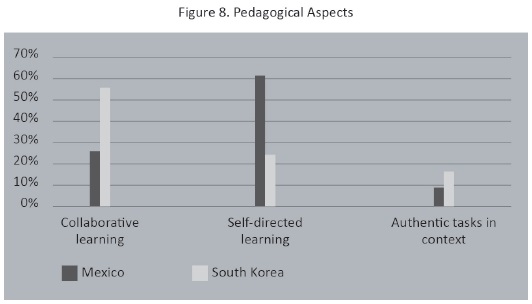
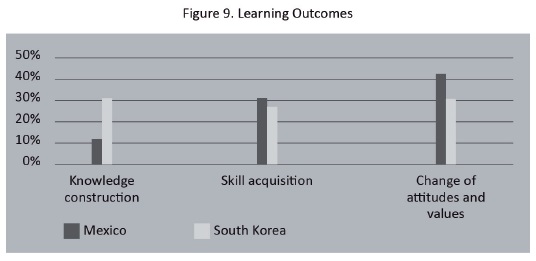
<body><![CDATA[<p align="justify"><font face="verdana" size="2">It is noteworthy to mention that in South Korea a paradigm in Christian education into blended learning environments has emerged. Some South Korean universities have opted to implement creative ways to teach religion through the use of social networks. Students are closely related to their mentors using a mentoring strategy. Kim (2013) describes this learning experience in which students are inserted into communities of practice in order to achieve a change in their values and attitudes.</font></p>  	    <p align="justify"><font face="verdana" size="2"><a href="#f8">Figure 8</a> shows the types of pedagogy used in learning activities. The results show that in Mexico are self&#45;directed learning 66.7%, collaboration 20% and authentic tasks in context 13.3%. Whereas in South Korea are collaboration 50%, self&#45;directed learning 29.2% and authentic tasks in context 20.8%.</font></p>  	    <p align="center"><font face="verdana" size="2"><a name="f8"></a></font></p>  	    <p align="center"><font face="verdana" size="2"><img src="/img/revistas/sine/n44/a11f8.jpg"></font></p>  	    <p align="justify"><font face="verdana" size="2">Self&#45;directed learning is an approach often discussed. It is mainly conceived by the designing of teaching and learning methods in which students are the key actor in their formative process. In this sense, data shows that in Mexico educational strategies lead self&#45;directed learning. However, by 2012 and 2013, authentic tasks in context combine the usage of social media for learning. These pedagogies refer to: problem&#45;based learning and project&#45;based learning.</font></p>  	    <p align="justify"><font face="verdana" size="2">In the case of South Korea, data shows that collaborative learning occurs as learning opportunity over the past 10 years. According to Lee (2011), collaborative learning has been implemented to reinforce students' socio&#45;emotional aspects and to create spaces for exchanging of ideas in a way that computer serves as a mediator. However, many authors in media such as television, newspaper, the internet, etc. argued that Korea's education field is recently in a boom of self&#45;directed learning due to the rapid spread and use of mobile devices support students to become more receptive to the incorporation of new tools for learning (Park, Nam, &amp; Cha, 2012). In this sense, students work individually from different locations (e.g. on the subway, at home, in the coffee shop, etc.) through the Internet; these behaviors encourages the emergence of other strategies that strengthen individual student work into communities, managing their own resources and interacting with others in performing tasks in a team.</font></p>  	    <p>&nbsp;</p>  	    <p align="justify"><font face="verdana" size="2"><i>2. What are the learning effects that result from the use of social media in higher education?</i></font></p>  	    <p align="justify"><font face="verdana" size="2">As seen in <a href="#f9">Figure 9</a>, in Mexico the use of social media impacts on the change of attitudes and values 47.8%, skills acquisition 34.8% and knowledge construction 17.4%. Whereas in South Korea impacts on construction of knowledge 35%, change of attitudes and values 35% and skills acquisition 30%.</font></p>  	    <p align="center"><font face="verdana" size="2"><a name="f9"></a></font></p>  	    ]]></body>
<body><![CDATA[<p align="center"><font face="verdana" size="2"><img src="/img/revistas/sine/n44/a11f9.jpg"></font></p>  	    <p align="justify"><font face="verdana" size="2">In Mexico students are more influenced on seeking for expression of their ideas through 'modern' technological tools when they combine study and leisure time. This demonstrates a cultural change, other interests and an 'enthusiasm' when using social media; however, in academic context there are not yet clear strategies to be potentiated. The added value of social networks, in particular, is characterized on a social attractiveness of the closeness between formal and informal, encouraging communication between students, the ability of decentralization and modulation of activity on widespread use but organized by various agents (Haro, 2009).</font></p>  	    <p align="justify"><font face="verdana" size="2">In the case of South Korea, the use of social media impacts the way in which virtual communities are built and students participate actively in them. The large number of interactions between students, teachers, experts, researchers, parents, etc. manifests the construction of meanings, discourses that lead to a transformation of the "ecology of learning" of students through the use of these new media through the Internet.</font></p>  	    <p>&nbsp;</p>  	    <p align="justify"><font face="verdana" size="2"><b>CONCLUSIONS</b></font></p>  	    <p align="justify"><font face="verdana" size="2">From this research, social media is understood as a set of Internet&#45;based technological services, which help to improve interpersonal communication and collaboration among peers. These tools facilitate informal learning through the acquisition and management of information, creation of open space for discussion, conversation, and to perform tasks beyond the classroom. Users have the ability to connect to a network to create, edit, transform, and/or share content with others through virtual learning communities. Diverse elements have also been identified as essential part for the implementation in the university.</font></p>  	    <p align="justify"><font face="verdana" size="2">First, in Mexico, social media have been implemented in knowledge domains such as social sciences, education and elective subjects. Users are mostly women. The participation of women is crucial since they represent an important element for effective communication and socialization. Freshmen bring a stronger digital culture to the university and they are able to carry out tasks and learning activities more efficiently using technology. Graduate students in service use more social media to develop technical&#45;didactic skills for teaching activities.</font></p>  	    <p align="justify"><font face="verdana" size="2">Second, in South Korea, social media has been mostly implemented in the department of education. The implementation of these tools is shown to be slightly balanced between men and women. Freshmen are more likely to use social media in both countries. One difference with Mexico is that this Asian country has implemented these tools more for pedagogy innovations than technological innovation.</font></p>  	    <p align="justify"><font face="verdana" size="2">Third, in Mexico, the purpose of the use of social media has been primarily to provide new means of communication. Blogs have worked as facilitators for the development of technical and cognitive skills. While in recent years, the use of Facebook promotes conversation, discussions and connection with others. Furthermore, cloud computing promises to be in Mexico an alternative to solving conflicts in access to education, infrastructure costs and software licensing. Blended learning environments facilitate the informal way of working inside and outside the classroom and it fosters self&#45;directed and individual work. Likewise, more flexible and adaptable pedagogy are observed according to students' nature as problem&#45;based learning and project&#45;based learning.</font></p>  	    <p align="justify"><font face="verdana" size="2">Fourth, in South Korea, the wiki was introduced as a fundamental key to creating collaborative environments for participation, primarily for problem solving and decision making. However, in recent years, social networks have facilitated the creation of social relationships and the emergence of a social capital. The effect "always&#45;on" with others through the Internet has contributed to trust with the group, the construction of new creative ideas and the maintenance of a social presence. Finally, blended learning environments are strongly accompanied with the designing of autonomous activities to enhance self&#45;directed learning.</font></p>  	    ]]></body>
<body><![CDATA[<p align="justify"><font face="verdana" size="2">Fifth, the effect of social media as learning outcome, in Mexico, showed changes in attitude and values toward the use of social media in school activities. Mainly, these resources help for expressing ideas, creating and transmitting digital content among peers combining study and leisure time. In contrast, in South Korea, not only a change in attitude and values were reflected, but the construction of meanings and discourses has conducted a transformation of the "ecology of learning" of students through the use of new media through the Internet.</font></p>  	    <p>&nbsp;</p>  	    <p align="justify"><font face="verdana" size="2"><b>REFERENCES</b></font></p>  	    <!-- ref --><p align="justify"><font face="verdana" size="2">Ajjan, H. &amp; Hartshorne, R. (2008). Investigating faculty decisions to adopt web 2.0 technologies: Theory and empirical tests.&nbsp;<i>The Internet and Higher Education,</i>&nbsp;11(2), 71&#45;80.    &nbsp;&nbsp;&nbsp;&nbsp;&nbsp;&nbsp;&nbsp;&nbsp;[&#160;<a href="javascript:void(0);" onclick="javascript: window.open('/scielo.php?script=sci_nlinks&ref=9601180&pid=S1665-109X201500010001100001&lng=','','width=640,height=500,resizable=yes,scrollbars=1,menubar=yes,');">Links</a>&#160;]<!-- end-ref --></font></p>  	    <!-- ref --><p align="justify"><font face="verdana" size="2">Bennett, S., Bisoph, A., Dalgarno, B., Waycott, J., &amp; Kennedy, G. (2012). Implementing web 2.0 technologies in higher education: A collective case study.&nbsp;<i>Computers and Education,</i>&nbsp;59(2), 524&#45;534.    &nbsp;&nbsp;&nbsp;&nbsp;&nbsp;&nbsp;&nbsp;&nbsp;[&#160;<a href="javascript:void(0);" onclick="javascript: window.open('/scielo.php?script=sci_nlinks&ref=9601182&pid=S1665-109X201500010001100002&lng=','','width=640,height=500,resizable=yes,scrollbars=1,menubar=yes,');">Links</a>&#160;]<!-- end-ref --></font></p>  	    <!-- ref --><p align="justify"><font face="verdana" size="2">Choi, K. J., &amp; Yang, S. C. (2009).&nbsp;<i>Internet social media and journalism.</i>&nbsp;Seoul: Korea Press Foundation.    &nbsp;&nbsp;&nbsp;&nbsp;&nbsp;&nbsp;&nbsp;&nbsp;[&#160;<a href="javascript:void(0);" onclick="javascript: window.open('/scielo.php?script=sci_nlinks&ref=9601184&pid=S1665-109X201500010001100003&lng=','','width=640,height=500,resizable=yes,scrollbars=1,menubar=yes,');">Links</a>&#160;]<!-- end-ref --></font></p>  	    <!-- ref --><p align="justify"><font face="verdana" size="2">Clark, W., Logan, K., Luckin, R., Mee, A., &amp; Oliver, M. (2009). Beyond web 2.0: Mapping the technology landscapes of young learners.&nbsp;<i>Journal of Computer Assisted Learning, 25, 56&#45;69</i>.    &nbsp;&nbsp;&nbsp;&nbsp;&nbsp;&nbsp;&nbsp;&nbsp;[&#160;<a href="javascript:void(0);" onclick="javascript: window.open('/scielo.php?script=sci_nlinks&ref=9601186&pid=S1665-109X201500010001100004&lng=','','width=640,height=500,resizable=yes,scrollbars=1,menubar=yes,');">Links</a>&#160;]<!-- end-ref --></font></p>  	    <!-- ref --><p align="justify"><font face="verdana" size="2">Contreras, R. (2010). Recursos educativos abiertos: Una iniciativa con barreras a&uacute;n por superar.&nbsp;<i>Revista Apertura,</i>&nbsp;2(2). Retrieved on May 20th, 2014 from: <a href="http://www.udgvirtual.udg.mx/apertura/index.php/apertura3/article/view/143/163" target="_blank">http://www.udgvirtual.udg.mx/apertura/index.php/apertura3/article/view/143/163</a></font>&nbsp;&nbsp;&nbsp;&nbsp;&nbsp;&nbsp;&nbsp;&nbsp;[&#160;<a href="javascript:void(0);" onclick="javascript: window.open('/scielo.php?script=sci_nlinks&ref=9601188&pid=S1665-109X201500010001100005&lng=','','width=640,height=500,resizable=yes,scrollbars=1,menubar=yes,');">Links</a>&#160;]<!-- end-ref --><!-- ref --><p align="justify"><font face="verdana" size="2">Davis, C., Deil&#45;Amen, R., Rios&#45;Aguilar, C., &amp; Gonzalez&#45;Canche, M. (2012).<i>Social media and higher education: A literature review and research directions.</i>Report printed by the University of Arizona and Claremont Graduate University.    &nbsp;&nbsp;&nbsp;&nbsp;&nbsp;&nbsp;&nbsp;&nbsp;[&#160;<a href="javascript:void(0);" onclick="javascript: window.open('/scielo.php?script=sci_nlinks&ref=9601189&pid=S1665-109X201500010001100006&lng=','','width=640,height=500,resizable=yes,scrollbars=1,menubar=yes,');">Links</a>&#160;]<!-- end-ref --></font></p>  	    <!-- ref --><p align="justify"><font face="verdana" size="2">De Haro, J. (2009). Las redes sociales aplicadas a la pr&aacute;ctica docente.<i>Did&aacute;ctica Innovaci&oacute;n y Multimedia,</i>&nbsp;13.    &nbsp;&nbsp;&nbsp;&nbsp;&nbsp;&nbsp;&nbsp;&nbsp;[&#160;<a href="javascript:void(0);" onclick="javascript: window.open('/scielo.php?script=sci_nlinks&ref=9601191&pid=S1665-109X201500010001100007&lng=','','width=640,height=500,resizable=yes,scrollbars=1,menubar=yes,');">Links</a>&#160;]<!-- end-ref --></font></p>  	    <!-- ref --><p align="justify"><font face="verdana" size="2">Espinosa, E. &amp; Jim&eacute;nez, S. (2013). Una mirada a las redes sociales virtuales desde el g&eacute;nero. Gesti&oacute;n y&nbsp;<i>estrategia,</i>&nbsp;43, 33&#45;50.    &nbsp;&nbsp;&nbsp;&nbsp;&nbsp;&nbsp;&nbsp;&nbsp;[&#160;<a href="javascript:void(0);" onclick="javascript: window.open('/scielo.php?script=sci_nlinks&ref=9601193&pid=S1665-109X201500010001100008&lng=','','width=640,height=500,resizable=yes,scrollbars=1,menubar=yes,');">Links</a>&#160;]<!-- end-ref --></font></p>  	    <!-- ref --><p align="justify"><font face="verdana" size="2">FKII Josayeongu Team (2006). Sosyeol midieo (Social media)ran mueosinga? <i>Jeongbo Saneopji,</i>&nbsp;52&#45;55. Retrieved on Feb 24th, 2014 from: <a href="http://mosechoi.tistory.com/attachment/gk130000000000.pdf" target="_blank">http://mosechoi.tistory.com/attachment/gk130000000000.pdf</a></font>&nbsp;&nbsp;&nbsp;&nbsp;&nbsp;&nbsp;&nbsp;&nbsp;[&#160;<a href="javascript:void(0);" onclick="javascript: window.open('/scielo.php?script=sci_nlinks&ref=9601195&pid=S1665-109X201500010001100009&lng=','','width=640,height=500,resizable=yes,scrollbars=1,menubar=yes,');">Links</a>&#160;]<!-- end-ref --><!-- ref --><p align="justify"><font face="verdana" size="2">Flores, Z. (2009). Desaf&iacute;os del blended learning en la educaci&oacute;n superior en M&eacute;xico (Monograf&iacute;a). Universidad Veracruzana, Xapala, Veracruz.    &nbsp;&nbsp;&nbsp;&nbsp;&nbsp;&nbsp;&nbsp;&nbsp;[&#160;<a href="javascript:void(0);" onclick="javascript: window.open('/scielo.php?script=sci_nlinks&ref=9601196&pid=S1665-109X201500010001100010&lng=','','width=640,height=500,resizable=yes,scrollbars=1,menubar=yes,');">Links</a>&#160;]<!-- end-ref --></font></p>  	    <!-- ref --><p align="justify"><font face="verdana" size="2">Giaccardi, E. (2012).&nbsp;<i>Heritage and social media: Understanding heritage in a participatory culture.</i>&nbsp;London &amp; New York: Routledge.    &nbsp;&nbsp;&nbsp;&nbsp;&nbsp;&nbsp;&nbsp;&nbsp;[&#160;<a href="javascript:void(0);" onclick="javascript: window.open('/scielo.php?script=sci_nlinks&ref=9601198&pid=S1665-109X201500010001100011&lng=','','width=640,height=500,resizable=yes,scrollbars=1,menubar=yes,');">Links</a>&#160;]<!-- end-ref --></font></p>  	    <!-- ref --><p align="justify"><font face="verdana" size="2">Glass, G. (1976). Primary, secondary, and meta&#45;analysis of research.<i>Educational Researcher,</i>&nbsp;5, 3&#45;8. Retrieved on Dic 16th, 2013 from: <a href="http://www.gvglass.info/papers/primary.pdf" target="_blank">http://www.gvglass.info/papers/primary.pdf</a></font>&nbsp;&nbsp;&nbsp;&nbsp;&nbsp;&nbsp;&nbsp;&nbsp;[&#160;<a href="javascript:void(0);" onclick="javascript: window.open('/scielo.php?script=sci_nlinks&ref=9601200&pid=S1665-109X201500010001100012&lng=','','width=640,height=500,resizable=yes,scrollbars=1,menubar=yes,');">Links</a>&#160;]<!-- end-ref --><!-- ref --><p align="justify"><font face="verdana" size="2">Han, J., Yim, H. &amp; Lee, J. (2012). Scenario planning based on collective intelligence using wiki.&nbsp;<i>Gisulhyeoksin&#45;Yeongu,</i>&nbsp;20(2).    &nbsp;&nbsp;&nbsp;&nbsp;&nbsp;&nbsp;&nbsp;&nbsp;[&#160;<a href="javascript:void(0);" onclick="javascript: window.open('/scielo.php?script=sci_nlinks&ref=9601201&pid=S1665-109X201500010001100013&lng=','','width=640,height=500,resizable=yes,scrollbars=1,menubar=yes,');">Links</a>&#160;]<!-- end-ref --></font></p>  	    <!-- ref --><p align="justify"><font face="verdana" size="2">Haythornthwaite, C. (2006). Facilitating collaboration in online learning.<i>Journal of Asynchronous Learning Networks,</i>&nbsp;10(1), 7&#45;24.    &nbsp;&nbsp;&nbsp;&nbsp;&nbsp;&nbsp;&nbsp;&nbsp;[&#160;<a href="javascript:void(0);" onclick="javascript: window.open('/scielo.php?script=sci_nlinks&ref=9601203&pid=S1665-109X201500010001100014&lng=','','width=640,height=500,resizable=yes,scrollbars=1,menubar=yes,');">Links</a>&#160;]<!-- end-ref --></font></p>  	    <!-- ref --><p align="justify"><font face="verdana" size="2">Herrera&#45;Batista, M. (2009). Disponibilidad, uso y apropiaci&oacute;n de las tecnolog&iacute;as por estudiantes universitarios en M&eacute;xico: Perspectivas para una incorporaci&oacute;n innovadora.&nbsp;<i>Revista Iberoamericana de Educaci&oacute;n,</i>&nbsp;48(6), 1&#45;9.    &nbsp;&nbsp;&nbsp;&nbsp;&nbsp;&nbsp;&nbsp;&nbsp;[&#160;<a href="javascript:void(0);" onclick="javascript: window.open('/scielo.php?script=sci_nlinks&ref=9601205&pid=S1665-109X201500010001100015&lng=','','width=640,height=500,resizable=yes,scrollbars=1,menubar=yes,');">Links</a>&#160;]<!-- end-ref --></font></p>  	    ]]></body>
<body><![CDATA[<!-- ref --><p align="justify"><font face="verdana" size="2">Jeung, H. (2010). Development and evaluation of usefulness on unplugged activity for information security education.&nbsp;<i>The Journal of Creative Informatics &amp; Computing Education,</i>&nbsp;4(2), 9&#45;14.    &nbsp;&nbsp;&nbsp;&nbsp;&nbsp;&nbsp;&nbsp;&nbsp;[&#160;<a href="javascript:void(0);" onclick="javascript: window.open('/scielo.php?script=sci_nlinks&ref=9601207&pid=S1665-109X201500010001100016&lng=','','width=640,height=500,resizable=yes,scrollbars=1,menubar=yes,');">Links</a>&#160;]<!-- end-ref --></font></p>  	    <!-- ref --><p align="justify"><font face="verdana" size="2">Jin, C. (2013). The role of Facebook users' self&#45;systems in generating social relationships and social capital effects.&nbsp;<i>New Media &amp; Society,</i>&nbsp;0(0), 1&#45;19.    &nbsp;&nbsp;&nbsp;&nbsp;&nbsp;&nbsp;&nbsp;&nbsp;[&#160;<a href="javascript:void(0);" onclick="javascript: window.open('/scielo.php?script=sci_nlinks&ref=9601209&pid=S1665-109X201500010001100017&lng=','','width=640,height=500,resizable=yes,scrollbars=1,menubar=yes,');">Links</a>&#160;]<!-- end-ref --></font></p>  	    <!-- ref --><p align="justify"><font face="verdana" size="2">Joosten, T. (2012).&nbsp;<i>Social media for educators: Strategies and best practices.</i>Hoboken, NJ, USA: Jossey&#45;Bass.    &nbsp;&nbsp;&nbsp;&nbsp;&nbsp;&nbsp;&nbsp;&nbsp;[&#160;<a href="javascript:void(0);" onclick="javascript: window.open('/scielo.php?script=sci_nlinks&ref=9601211&pid=S1665-109X201500010001100018&lng=','','width=640,height=500,resizable=yes,scrollbars=1,menubar=yes,');">Links</a>&#160;]<!-- end-ref --></font></p>  	    <!-- ref --><p align="justify"><font face="verdana" size="2">Junco, R. (2011). Twitter to improve college student engagement.&nbsp;<i>Paper presented at SXSW Interactive.</i>&nbsp;Austin, Texas.    &nbsp;&nbsp;&nbsp;&nbsp;&nbsp;&nbsp;&nbsp;&nbsp;[&#160;<a href="javascript:void(0);" onclick="javascript: window.open('/scielo.php?script=sci_nlinks&ref=9601213&pid=S1665-109X201500010001100019&lng=','','width=640,height=500,resizable=yes,scrollbars=1,menubar=yes,');">Links</a>&#160;]<!-- end-ref --></font></p>  	    <p align="justify"><font face="verdana" size="2">Kennedy, G., Delgarno, B., Bennet, S. et al. (2008). Immigrants and natives: Investigating differences between staff and students' use of technology. <i>Proceedings ascilite,</i>&nbsp;Melbourne.</font></p>  	    <!-- ref --><p align="justify"><font face="verdana" size="2">Kim, H. (2012). A study on the possibility of development of social media literacies using Facebook.&nbsp;<i>Korean Journal of the Learning Sciences,</i>&nbsp;6(2), 20&#45;38.    &nbsp;&nbsp;&nbsp;&nbsp;&nbsp;&nbsp;&nbsp;&nbsp;[&#160;<a href="javascript:void(0);" onclick="javascript: window.open('/scielo.php?script=sci_nlinks&ref=9601216&pid=S1665-109X201500010001100020&lng=','','width=640,height=500,resizable=yes,scrollbars=1,menubar=yes,');">Links</a>&#160;]<!-- end-ref --></font></p>  	    <!-- ref --><p align="justify"><font face="verdana" size="2">Kim, S. (2013). Facebook and creative teaching methods of seeking new possibilities in the way of Christian education.&nbsp;<i>Sinang Hakmun,</i>&nbsp;18(3), 37&#45;73.    &nbsp;&nbsp;&nbsp;&nbsp;&nbsp;&nbsp;&nbsp;&nbsp;[&#160;<a href="javascript:void(0);" onclick="javascript: window.open('/scielo.php?script=sci_nlinks&ref=9601218&pid=S1665-109X201500010001100021&lng=','','width=640,height=500,resizable=yes,scrollbars=1,menubar=yes,');">Links</a>&#160;]<!-- end-ref --></font></p>  	    <!-- ref --><p align="justify"><font face="verdana" size="2">Lara, T. (2005). Blogs para educar. Uso de los blogs en una pedagog&iacute;a constructivista.&nbsp;<i>Telos,</i>&nbsp;65(2). Retrieved on May 13th, 2014 from: <a href="http://itqro.com/moodledata/23/blogs/biblio&#45;blog/blog_Tiscar_Lara.pdf" target="_blank">http://itqro.com/moodledata/23/blogs/biblio&#45;blog/blog_Tiscar_Lara.pdf</a></font>&nbsp;&nbsp;&nbsp;&nbsp;&nbsp;&nbsp;&nbsp;&nbsp;[&#160;<a href="javascript:void(0);" onclick="javascript: window.open('/scielo.php?script=sci_nlinks&ref=9601220&pid=S1665-109X201500010001100022&lng=','','width=640,height=500,resizable=yes,scrollbars=1,menubar=yes,');">Links</a>&#160;]<!-- end-ref --><!-- ref --><p align="justify"><font face="verdana" size="2">Lee, B. (2011).&nbsp;<i>Conditions affecting Computer Supported Collaborative Learning in Higher Education in the UK and South Korea.</i>&nbsp;(Unpublished thesis/dissertation), University of Birmingham.    &nbsp;&nbsp;&nbsp;&nbsp;&nbsp;&nbsp;&nbsp;&nbsp;[&#160;<a href="javascript:void(0);" onclick="javascript: window.open('/scielo.php?script=sci_nlinks&ref=9601221&pid=S1665-109X201500010001100023&lng=','','width=640,height=500,resizable=yes,scrollbars=1,menubar=yes,');">Links</a>&#160;]<!-- end-ref --></font></p>  	    <!-- ref --><p align="justify"><font face="verdana" size="2">Mayfield, A. (2007).&nbsp;<i>What is social media?</i>&nbsp;iCrossing. Retrieved on Feb 4th, 2014 from: <a href="http://www.icrossing.com/sites/default/files/what&#45;is&#45;social&#45;media&#45;uk.pdf" target="_blank">http://www.icrossing.com/sites/default/files/what&#45;is&#45;social&#45;media&#45;uk.pdf</a></font>&nbsp;&nbsp;&nbsp;&nbsp;&nbsp;&nbsp;&nbsp;&nbsp;[&#160;<a href="javascript:void(0);" onclick="javascript: window.open('/scielo.php?script=sci_nlinks&ref=9601223&pid=S1665-109X201500010001100024&lng=','','width=640,height=500,resizable=yes,scrollbars=1,menubar=yes,');">Links</a>&#160;]<!-- end-ref --><!-- ref --><p align="justify"><font face="verdana" size="2">McLoughlin, C., &amp; Lee, M. (2010). Personalised and self regulated learning in the Web 2.0 era: International exemplars of innovative pedagogy using social software.&nbsp;<i>Australasian Journal of Educational Technology,</i>&nbsp;26(1), 28&#45;43.    &nbsp;&nbsp;&nbsp;&nbsp;&nbsp;&nbsp;&nbsp;&nbsp;[&#160;<a href="javascript:void(0);" onclick="javascript: window.open('/scielo.php?script=sci_nlinks&ref=9601224&pid=S1665-109X201500010001100025&lng=','','width=640,height=500,resizable=yes,scrollbars=1,menubar=yes,');">Links</a>&#160;]<!-- end-ref --></font></p>  	    <!-- ref --><p align="justify"><font face="verdana" size="2">Mu&ntilde;oz, C, &amp; Towner, T. (2010). Social networks: Facebook's role in the advertising classroom.&nbsp;<i>Journal of Advertising Education,</i>&nbsp;14(1), 20&#45;27.    &nbsp;&nbsp;&nbsp;&nbsp;&nbsp;&nbsp;&nbsp;&nbsp;[&#160;<a href="javascript:void(0);" onclick="javascript: window.open('/scielo.php?script=sci_nlinks&ref=9601226&pid=S1665-109X201500010001100026&lng=','','width=640,height=500,resizable=yes,scrollbars=1,menubar=yes,');">Links</a>&#160;]<!-- end-ref --></font></p>  	    <!-- ref --><p align="justify"><font face="verdana" size="2">Mustonen, P. (2009).&nbsp;<i>Social media a new way to success?</i>&nbsp;Retrieved on Dic 12th, 2013 from: <a href="http://info.tse.fi/julkaisut/kr/Kre1_2009.pdf" target="_blank">http://info.tse.fi/julkaisut/kr/Kre1_2009.pdf</a></font>&nbsp;&nbsp;&nbsp;&nbsp;&nbsp;&nbsp;&nbsp;&nbsp;[&#160;<a href="javascript:void(0);" onclick="javascript: window.open('/scielo.php?script=sci_nlinks&ref=9601228&pid=S1665-109X201500010001100027&lng=','','width=640,height=500,resizable=yes,scrollbars=1,menubar=yes,');">Links</a>&#160;]<!-- end-ref --><!-- ref --><p align="justify"><font face="verdana" size="2">Nykvist, S., &amp; Lee, K. (2013). Mixing higher education teaching and learning with mobile devices and social media. In&nbsp;<i>Proceedings of IAC&#45;ETel</i>&nbsp;2013 Prague Czech Republic.    &nbsp;&nbsp;&nbsp;&nbsp;&nbsp;&nbsp;&nbsp;&nbsp;[&#160;<a href="javascript:void(0);" onclick="javascript: window.open('/scielo.php?script=sci_nlinks&ref=9601229&pid=S1665-109X201500010001100028&lng=','','width=640,height=500,resizable=yes,scrollbars=1,menubar=yes,');">Links</a>&#160;]<!-- end-ref --></font></p>  	    <!-- ref --><p align="justify"><font face="verdana" size="2">Ortega, C., &amp; Balderas, A. (2011). Percepci&oacute;n de los j&oacute;venes universitarios sobre el uso de Twitter en los procesos de ense&ntilde;anza&#45;aprendizaje. <i>Apertura,</i>&nbsp;3(2).    &nbsp;&nbsp;&nbsp;&nbsp;&nbsp;&nbsp;&nbsp;&nbsp;[&#160;<a href="javascript:void(0);" onclick="javascript: window.open('/scielo.php?script=sci_nlinks&ref=9601231&pid=S1665-109X201500010001100029&lng=','','width=640,height=500,resizable=yes,scrollbars=1,menubar=yes,');">Links</a>&#160;]<!-- end-ref --></font></p>  	    <!-- ref --><p align="justify"><font face="verdana" size="2">Park, S., Nam, M., &amp; Cha, S. (2012). University students' behavioral intention to use mobile learning: Evaluating the technology acceptance model.&nbsp;<i>British Journal of Educational Technology,</i>&nbsp;43(4), 592&#45;605.    &nbsp;&nbsp;&nbsp;&nbsp;&nbsp;&nbsp;&nbsp;&nbsp;[&#160;<a href="javascript:void(0);" onclick="javascript: window.open('/scielo.php?script=sci_nlinks&ref=9601233&pid=S1665-109X201500010001100030&lng=','','width=640,height=500,resizable=yes,scrollbars=1,menubar=yes,');">Links</a>&#160;]<!-- end-ref --></font></p>  	    <!-- ref --><p align="justify"><font face="verdana" size="2">Prensky, M. (2001). Digital Natives, Digital Immigrants Part 1.&nbsp;<i>On the Horizon, 9</i>&nbsp;(5), 1&#45;6.    &nbsp;&nbsp;&nbsp;&nbsp;&nbsp;&nbsp;&nbsp;&nbsp;[&#160;<a href="javascript:void(0);" onclick="javascript: window.open('/scielo.php?script=sci_nlinks&ref=9601235&pid=S1665-109X201500010001100031&lng=','','width=640,height=500,resizable=yes,scrollbars=1,menubar=yes,');">Links</a>&#160;]<!-- end-ref --></font></p>  	    ]]></body>
<body><![CDATA[<!-- ref --><p align="justify"><font face="verdana" size="2">Ryberg, T. (2008). Challenges and potentials for institutional and technological infrastructures in adopting social media. In V. Hodgson, C. Jones, T. Kargidis, D. McConnell, S. Retalis, D. Stamatis &amp; M. Zenios (Eds), <i>Proceedings of the 6th International Conference on Networked Learning</i>&nbsp;(pp. 658&#45;665).    &nbsp;&nbsp;&nbsp;&nbsp;&nbsp;&nbsp;&nbsp;&nbsp;[&#160;<a href="javascript:void(0);" onclick="javascript: window.open('/scielo.php?script=sci_nlinks&ref=9601237&pid=S1665-109X201500010001100032&lng=','','width=640,height=500,resizable=yes,scrollbars=1,menubar=yes,');">Links</a>&#160;]<!-- end-ref --></font></p>  	    <!-- ref --><p align="justify"><font face="verdana" size="2">Safko, L., Brake, D. (2009).&nbsp;<i>The social media bible: Tactics, tools, and strategies for business success.</i>&nbsp;Hoboken, NJ: John Wiley &amp; Sons.    &nbsp;&nbsp;&nbsp;&nbsp;&nbsp;&nbsp;&nbsp;&nbsp;[&#160;<a href="javascript:void(0);" onclick="javascript: window.open('/scielo.php?script=sci_nlinks&ref=9601239&pid=S1665-109X201500010001100033&lng=','','width=640,height=500,resizable=yes,scrollbars=1,menubar=yes,');">Links</a>&#160;]<!-- end-ref --></font></p>  	    <!-- ref --><p align="justify"><font face="verdana" size="2">Schwartz, H. (2012).&nbsp;<i>Interpersonal boundaries in teaching and learning. new directions for teaching and learning.</i>&nbsp;San Francisco: Jossey&#45;Bass.    &nbsp;&nbsp;&nbsp;&nbsp;&nbsp;&nbsp;&nbsp;&nbsp;[&#160;<a href="javascript:void(0);" onclick="javascript: window.open('/scielo.php?script=sci_nlinks&ref=9601241&pid=S1665-109X201500010001100034&lng=','','width=640,height=500,resizable=yes,scrollbars=1,menubar=yes,');">Links</a>&#160;]<!-- end-ref --></font></p>  	    <!-- ref --><p align="justify"><font face="verdana" size="2">Seamean, J. &amp; Tinti&#45;Kane, H. (2013).&nbsp;<i>Social Media for Teaching &amp; Learning.</i>Boston: Pearson Learning Solutions. Retrieved on May 25th, 2014 from: <a href="http://dev.pearsonlearningsolutions.com/assets/downloads/reports/social&#45;media&#45;for&#45;teaching&#45;and&#45;learning&#45;2013&#45;report.pdf" target="_blank">http://dev.pearsonlearningsolutions.com/assets/downloads/reports/social&#45;media&#45;for&#45;teaching&#45;and&#45;learning&#45;2013&#45;report.pdf</a></font>&nbsp;&nbsp;&nbsp;&nbsp;&nbsp;&nbsp;&nbsp;&nbsp;[&#160;<a href="javascript:void(0);" onclick="javascript: window.open('/scielo.php?script=sci_nlinks&ref=9601243&pid=S1665-109X201500010001100035&lng=','','width=640,height=500,resizable=yes,scrollbars=1,menubar=yes,');">Links</a>&#160;]<!-- end-ref --><!-- ref --><p align="justify"><font face="verdana" size="2">Tess, P. (2013). The role of social media in higher education classes (real and virtual) &#45; A literature review.&nbsp;<i>Computers in Human Behavior,</i>&nbsp;29(5), 60&#45;68.    &nbsp;&nbsp;&nbsp;&nbsp;&nbsp;&nbsp;&nbsp;&nbsp;[&#160;<a href="javascript:void(0);" onclick="javascript: window.open('/scielo.php?script=sci_nlinks&ref=9601244&pid=S1665-109X201500010001100036&lng=','','width=640,height=500,resizable=yes,scrollbars=1,menubar=yes,');">Links</a>&#160;]<!-- end-ref --></font></p>  	    <!-- ref --><p align="justify"><font face="verdana" size="2">UNESCO (1998). Declaraci&oacute;n mundial sobre la educaci&oacute;n superior en el siglo XXI: Visi&oacute;n y acci&oacute;n. Retrieved from: <a href="http://www.unesco.org/education/educprog/wche/declaration_spa.htm" target="_blank">http://www.unesco.org/education/educprog/wche/declaration_spa.htm</a></font>&nbsp;&nbsp;&nbsp;&nbsp;&nbsp;&nbsp;&nbsp;&nbsp;[&#160;<a href="javascript:void(0);" onclick="javascript: window.open('/scielo.php?script=sci_nlinks&ref=9601246&pid=S1665-109X201500010001100037&lng=','','width=640,height=500,resizable=yes,scrollbars=1,menubar=yes,');">Links</a>&#160;]<!-- end-ref --><!-- ref --><p align="justify"><font face="verdana" size="2">Yu, B., Park, H., Cha, S. (2013). A study on the learning effect of the structural relationships model with the use of social networking services (SNS) in university classes. Gyoyuk gwahak yeongu, 44(3), 133&#45;159.    &nbsp;&nbsp;&nbsp;&nbsp;&nbsp;&nbsp;&nbsp;&nbsp;[&#160;<a href="javascript:void(0);" onclick="javascript: window.open('/scielo.php?script=sci_nlinks&ref=9601247&pid=S1665-109X201500010001100038&lng=','','width=640,height=500,resizable=yes,scrollbars=1,menubar=yes,');">Links</a>&#160;]<!-- end-ref --></font></p>      ]]></body><back>
<ref-list>
<ref id="B1">
<nlm-citation citation-type="journal">
<person-group person-group-type="author">
<name>
<surname><![CDATA[Ajjan]]></surname>
<given-names><![CDATA[H.]]></given-names>
</name>
<name>
<surname><![CDATA[Hartshorne]]></surname>
<given-names><![CDATA[R.]]></given-names>
</name>
</person-group>
<article-title xml:lang="en"><![CDATA[Investigating faculty decisions to adopt web 2.0 technologies: Theory and empirical tests]]></article-title>
<source><![CDATA[The Internet and Higher Education]]></source>
<year>2008</year>
<volume>11</volume>
<numero>2</numero>
<issue>2</issue>
<page-range>71-80</page-range></nlm-citation>
</ref>
<ref id="B2">
<nlm-citation citation-type="journal">
<person-group person-group-type="author">
<name>
<surname><![CDATA[Bennett]]></surname>
<given-names><![CDATA[S.]]></given-names>
</name>
<name>
<surname><![CDATA[Bisoph]]></surname>
<given-names><![CDATA[A.]]></given-names>
</name>
<name>
<surname><![CDATA[Dalgarno]]></surname>
<given-names><![CDATA[B.]]></given-names>
</name>
<name>
<surname><![CDATA[Waycott]]></surname>
<given-names><![CDATA[J.]]></given-names>
</name>
<name>
<surname><![CDATA[Kennedy]]></surname>
<given-names><![CDATA[G.]]></given-names>
</name>
</person-group>
<article-title xml:lang="en"><![CDATA[Implementing web 2.0 technologies in higher education: A collective case study]]></article-title>
<source><![CDATA[Computers and Education]]></source>
<year>2012</year>
<volume>59</volume>
<numero>2</numero>
<issue>2</issue>
<page-range>524-534</page-range></nlm-citation>
</ref>
<ref id="B3">
<nlm-citation citation-type="book">
<person-group person-group-type="author">
<name>
<surname><![CDATA[Choi]]></surname>
<given-names><![CDATA[K. J.]]></given-names>
</name>
<name>
<surname><![CDATA[Yang]]></surname>
<given-names><![CDATA[S. C.]]></given-names>
</name>
</person-group>
<source><![CDATA[Internet social media and journalism]]></source>
<year>2009</year>
<publisher-loc><![CDATA[Seoul ]]></publisher-loc>
<publisher-name><![CDATA[Korea Press Foundation]]></publisher-name>
</nlm-citation>
</ref>
<ref id="B4">
<nlm-citation citation-type="journal">
<person-group person-group-type="author">
<name>
<surname><![CDATA[Clark]]></surname>
<given-names><![CDATA[W.]]></given-names>
</name>
<name>
<surname><![CDATA[Logan]]></surname>
<given-names><![CDATA[K.]]></given-names>
</name>
<name>
<surname><![CDATA[Luckin]]></surname>
<given-names><![CDATA[R.]]></given-names>
</name>
<name>
<surname><![CDATA[Mee]]></surname>
<given-names><![CDATA[A.]]></given-names>
</name>
<name>
<surname><![CDATA[Oliver]]></surname>
<given-names><![CDATA[M.]]></given-names>
</name>
</person-group>
<article-title xml:lang="en"><![CDATA[Beyond web 2.0: Mapping the technology landscapes of young learners]]></article-title>
<source><![CDATA[Journal of Computer Assisted Learning]]></source>
<year>2009</year>
<volume>25</volume>
<page-range>56-69</page-range></nlm-citation>
</ref>
<ref id="B5">
<nlm-citation citation-type="journal">
<person-group person-group-type="author">
<name>
<surname><![CDATA[Contreras]]></surname>
<given-names><![CDATA[R.]]></given-names>
</name>
</person-group>
<article-title xml:lang="es"><![CDATA[Recursos educativos abiertos: Una iniciativa con barreras aún por superar]]></article-title>
<source><![CDATA[Revista Apertura]]></source>
<year>2010</year>
<volume>2</volume>
<numero>2</numero>
<issue>2</issue>
</nlm-citation>
</ref>
<ref id="B6">
<nlm-citation citation-type="book">
<person-group person-group-type="author">
<name>
<surname><![CDATA[Davis]]></surname>
<given-names><![CDATA[C.]]></given-names>
</name>
<name>
<surname><![CDATA[Deil-Amen]]></surname>
<given-names><![CDATA[R.]]></given-names>
</name>
<name>
<surname><![CDATA[Rios-Aguilar]]></surname>
<given-names><![CDATA[C.]]></given-names>
</name>
<name>
<surname><![CDATA[Gonzalez-Canche]]></surname>
<given-names><![CDATA[M.]]></given-names>
</name>
</person-group>
<source><![CDATA[Social media and higher education: A literature review and research directions]]></source>
<year>2012</year>
<publisher-name><![CDATA[University of ArizonaClaremont Graduate University]]></publisher-name>
</nlm-citation>
</ref>
<ref id="B7">
<nlm-citation citation-type="journal">
<person-group person-group-type="author">
<name>
<surname><![CDATA[De Haro]]></surname>
<given-names><![CDATA[J.]]></given-names>
</name>
</person-group>
<article-title xml:lang="es"><![CDATA[Las redes sociales aplicadas a la práctica docente]]></article-title>
<source><![CDATA[Didáctica Innovación y Multimedia]]></source>
<year>2009</year>
<numero>13</numero>
<issue>13</issue>
</nlm-citation>
</ref>
<ref id="B8">
<nlm-citation citation-type="journal">
<person-group person-group-type="author">
<name>
<surname><![CDATA[Espinosa]]></surname>
<given-names><![CDATA[E.]]></given-names>
</name>
<name>
<surname><![CDATA[Jiménez]]></surname>
<given-names><![CDATA[S.]]></given-names>
</name>
</person-group>
<article-title xml:lang="es"><![CDATA[Una mirada a las redes sociales virtuales desde el género]]></article-title>
<source><![CDATA[Gestión y estrategia]]></source>
<year>2013</year>
<volume>43</volume>
<page-range>33-50</page-range></nlm-citation>
</ref>
<ref id="B9">
<nlm-citation citation-type="">
<collab>FKII Josayeongu Team</collab>
<source><![CDATA[Sosyeol midieo (Social media)ran mueosinga? Jeongbo Saneopji]]></source>
<year>2006</year>
<page-range>52-55</page-range></nlm-citation>
</ref>
<ref id="B10">
<nlm-citation citation-type="book">
<person-group person-group-type="author">
<name>
<surname><![CDATA[Flores]]></surname>
<given-names><![CDATA[Z.]]></given-names>
</name>
</person-group>
<source><![CDATA[Desafíos del blended learning en la educación superior en México (Monografía)]]></source>
<year>2009</year>
<publisher-loc><![CDATA[Xapala^eVeracruz Veracruz]]></publisher-loc>
<publisher-name><![CDATA[Universidad Veracruzana]]></publisher-name>
</nlm-citation>
</ref>
<ref id="B11">
<nlm-citation citation-type="book">
<person-group person-group-type="author">
<name>
<surname><![CDATA[Giaccardi]]></surname>
<given-names><![CDATA[E.]]></given-names>
</name>
</person-group>
<source><![CDATA[Heritage and social media: Understanding heritage in a participatory culture]]></source>
<year>2012</year>
<publisher-loc><![CDATA[LondonNew York ]]></publisher-loc>
<publisher-name><![CDATA[Routledge]]></publisher-name>
</nlm-citation>
</ref>
<ref id="B12">
<nlm-citation citation-type="journal">
<person-group person-group-type="author">
<name>
<surname><![CDATA[Glass]]></surname>
<given-names><![CDATA[G.]]></given-names>
</name>
</person-group>
<article-title xml:lang="en"><![CDATA[Primary, secondary, and meta-analysis of research]]></article-title>
<source><![CDATA[Educational Researcher]]></source>
<year>1976</year>
<volume>5</volume>
<page-range>3-8</page-range></nlm-citation>
</ref>
<ref id="B13">
<nlm-citation citation-type="journal">
<person-group person-group-type="author">
<name>
<surname><![CDATA[Han]]></surname>
<given-names><![CDATA[J.]]></given-names>
</name>
<name>
<surname><![CDATA[Yim]]></surname>
<given-names><![CDATA[H.]]></given-names>
</name>
<name>
<surname><![CDATA[Lee]]></surname>
<given-names><![CDATA[J.]]></given-names>
</name>
</person-group>
<article-title xml:lang="en"><![CDATA[Scenario planning based on collective intelligence using wiki]]></article-title>
<source><![CDATA[Gisulhyeoksin-Yeongu]]></source>
<year>2012</year>
<volume>20</volume>
<numero>2</numero>
<issue>2</issue>
</nlm-citation>
</ref>
<ref id="B14">
<nlm-citation citation-type="journal">
<person-group person-group-type="author">
<name>
<surname><![CDATA[Haythornthwaite]]></surname>
<given-names><![CDATA[C.]]></given-names>
</name>
</person-group>
<article-title xml:lang="en"><![CDATA[Facilitating collaboration in online learning]]></article-title>
<source><![CDATA[Journal of Asynchronous Learning Networks]]></source>
<year>2006</year>
<volume>10</volume>
<numero>1</numero>
<issue>1</issue>
<page-range>7-24</page-range></nlm-citation>
</ref>
<ref id="B15">
<nlm-citation citation-type="journal">
<person-group person-group-type="author">
<name>
<surname><![CDATA[Herrera-Batista]]></surname>
<given-names><![CDATA[M.]]></given-names>
</name>
</person-group>
<article-title xml:lang="es"><![CDATA[Disponibilidad, uso y apropiación de las tecnologías por estudiantes universitarios en México: Perspectivas para una incorporación innovadora]]></article-title>
<source><![CDATA[Revista Iberoamericana de Educación]]></source>
<year>2009</year>
<volume>48</volume>
<numero>6</numero>
<issue>6</issue>
<page-range>1-9</page-range></nlm-citation>
</ref>
<ref id="B16">
<nlm-citation citation-type="journal">
<person-group person-group-type="author">
<name>
<surname><![CDATA[Jeung]]></surname>
<given-names><![CDATA[H.]]></given-names>
</name>
</person-group>
<article-title xml:lang="en"><![CDATA[Development and evaluation of usefulness on unplugged activity for information security education.]]></article-title>
<source><![CDATA[The Journal of Creative Informatics & Computing Education]]></source>
<year>2010</year>
<volume>4</volume>
<numero>2</numero>
<issue>2</issue>
<page-range>9-14</page-range></nlm-citation>
</ref>
<ref id="B17">
<nlm-citation citation-type="journal">
<person-group person-group-type="author">
<name>
<surname><![CDATA[Jin]]></surname>
<given-names><![CDATA[C.]]></given-names>
</name>
</person-group>
<article-title xml:lang="en"><![CDATA[The role of Facebook users' self-systems in generating social relationships and social capital effects]]></article-title>
<source><![CDATA[New Media & Society]]></source>
<year>2013</year>
<volume>0</volume>
<numero>0</numero>
<issue>0</issue>
<page-range>1-19</page-range></nlm-citation>
</ref>
<ref id="B18">
<nlm-citation citation-type="book">
<person-group person-group-type="author">
<name>
<surname><![CDATA[Joosten]]></surname>
<given-names><![CDATA[T.]]></given-names>
</name>
</person-group>
<source><![CDATA[Social media for educators: Strategies and best practices]]></source>
<year>2012</year>
<publisher-loc><![CDATA[Hoboken^eNJ NJ]]></publisher-loc>
<publisher-name><![CDATA[Jossey-Bass]]></publisher-name>
</nlm-citation>
</ref>
<ref id="B19">
<nlm-citation citation-type="">
<person-group person-group-type="author">
<name>
<surname><![CDATA[Junco]]></surname>
<given-names><![CDATA[R.]]></given-names>
</name>
</person-group>
<source><![CDATA[Twitter to improve college student engagement. Paper presented at SXSW Interactive]]></source>
<year>2011</year>
<publisher-loc><![CDATA[Austin^eTexas Texas]]></publisher-loc>
</nlm-citation>
</ref>
<ref id="B20">
<nlm-citation citation-type="journal">
<person-group person-group-type="author">
<name>
<surname><![CDATA[Kim]]></surname>
<given-names><![CDATA[H.]]></given-names>
</name>
</person-group>
<article-title xml:lang="en"><![CDATA[A study on the possibility of development of social media literacies using Facebook]]></article-title>
<source><![CDATA[Korean Journal of the Learning Sciences]]></source>
<year>2012</year>
<volume>6</volume>
<numero>2</numero>
<issue>2</issue>
<page-range>20-38</page-range></nlm-citation>
</ref>
<ref id="B21">
<nlm-citation citation-type="journal">
<person-group person-group-type="author">
<name>
<surname><![CDATA[Kim]]></surname>
<given-names><![CDATA[S.]]></given-names>
</name>
</person-group>
<article-title xml:lang="en"><![CDATA[Facebook and creative teaching methods of seeking new possibilities in the way of Christian education]]></article-title>
<source><![CDATA[Sinang Hakmun]]></source>
<year>2013</year>
<volume>18</volume>
<numero>3</numero>
<issue>3</issue>
<page-range>37-73</page-range></nlm-citation>
</ref>
<ref id="B22">
<nlm-citation citation-type="journal">
<person-group person-group-type="author">
<name>
<surname><![CDATA[Lara]]></surname>
<given-names><![CDATA[T.]]></given-names>
</name>
</person-group>
<article-title xml:lang="es"><![CDATA[Blogs para educar. Uso de los blogs en una pedagogía constructivista]]></article-title>
<source><![CDATA[Telos]]></source>
<year>2005</year>
<volume>65</volume>
<numero>2</numero>
<issue>2</issue>
</nlm-citation>
</ref>
<ref id="B23">
<nlm-citation citation-type="">
<person-group person-group-type="author">
<name>
<surname><![CDATA[Lee]]></surname>
<given-names><![CDATA[B.]]></given-names>
</name>
</person-group>
<source><![CDATA[Conditions affecting Computer Supported Collaborative Learning in Higher Education in the UK and South Korea]]></source>
<year>2011</year>
</nlm-citation>
</ref>
<ref id="B24">
<nlm-citation citation-type="book">
<person-group person-group-type="author">
<name>
<surname><![CDATA[Mayfield]]></surname>
<given-names><![CDATA[A.]]></given-names>
</name>
</person-group>
<source><![CDATA[What is social media?]]></source>
<year>2007</year>
<publisher-name><![CDATA[iCrossing]]></publisher-name>
</nlm-citation>
</ref>
<ref id="B25">
<nlm-citation citation-type="journal">
<person-group person-group-type="author">
<name>
<surname><![CDATA[McLoughlin]]></surname>
<given-names><![CDATA[C.]]></given-names>
</name>
<name>
<surname><![CDATA[Lee]]></surname>
<given-names><![CDATA[M.]]></given-names>
</name>
</person-group>
<article-title xml:lang="en"><![CDATA[Personalised and self regulated learning in the Web 2.0 era: International exemplars of innovative pedagogy using social software]]></article-title>
<source><![CDATA[Australasian Journal of Educational Technology]]></source>
<year>2010</year>
<volume>26</volume>
<numero>1</numero>
<issue>1</issue>
<page-range>28-43</page-range></nlm-citation>
</ref>
<ref id="B26">
<nlm-citation citation-type="journal">
<person-group person-group-type="author">
<name>
<surname><![CDATA[Muñoz]]></surname>
<given-names><![CDATA[C]]></given-names>
</name>
<name>
<surname><![CDATA[Towner]]></surname>
<given-names><![CDATA[T.]]></given-names>
</name>
</person-group>
<article-title xml:lang="en"><![CDATA[Social networks: Facebook's role in the advertising classroom]]></article-title>
<source><![CDATA[Journal of Advertising Education]]></source>
<year>2010</year>
<volume>14</volume>
<numero>1</numero>
<issue>1</issue>
<page-range>20-27</page-range></nlm-citation>
</ref>
<ref id="B27">
<nlm-citation citation-type="">
<person-group person-group-type="author">
<name>
<surname><![CDATA[Mustonen]]></surname>
<given-names><![CDATA[P.]]></given-names>
</name>
</person-group>
<source><![CDATA[Social media a new way to success?]]></source>
<year>2009</year>
</nlm-citation>
</ref>
<ref id="B28">
<nlm-citation citation-type="">
<person-group person-group-type="author">
<name>
<surname><![CDATA[Nykvist]]></surname>
<given-names><![CDATA[S.]]></given-names>
</name>
<name>
<surname><![CDATA[Lee]]></surname>
<given-names><![CDATA[K.]]></given-names>
</name>
</person-group>
<article-title xml:lang="en"><![CDATA[Mixing higher education teaching and learning with mobile devices and social media]]></article-title>
<source><![CDATA[Proceedings of IAC-ETel]]></source>
<year>2013</year>
<month>20</month>
<day>13</day>
<publisher-loc><![CDATA[Prague ]]></publisher-loc>
</nlm-citation>
</ref>
<ref id="B29">
<nlm-citation citation-type="journal">
<person-group person-group-type="author">
<name>
<surname><![CDATA[Ortega]]></surname>
<given-names><![CDATA[C.]]></given-names>
</name>
<name>
<surname><![CDATA[Balderas]]></surname>
<given-names><![CDATA[A.]]></given-names>
</name>
</person-group>
<article-title xml:lang="es"><![CDATA[Percepción de los jóvenes universitarios sobre el uso de Twitter en los procesos de enseñanza-aprendizaje]]></article-title>
<source><![CDATA[Apertura]]></source>
<year>2011</year>
<volume>3</volume>
<numero>2</numero>
<issue>2</issue>
</nlm-citation>
</ref>
<ref id="B30">
<nlm-citation citation-type="journal">
<person-group person-group-type="author">
<name>
<surname><![CDATA[Park]]></surname>
<given-names><![CDATA[S.]]></given-names>
</name>
<name>
<surname><![CDATA[Nam]]></surname>
<given-names><![CDATA[M.]]></given-names>
</name>
<name>
<surname><![CDATA[Cha]]></surname>
<given-names><![CDATA[S.]]></given-names>
</name>
</person-group>
<article-title xml:lang="en"><![CDATA[University students' behavioral intention to use mobile learning: Evaluating the technology acceptance model]]></article-title>
<source><![CDATA[British Journal of Educational Technology]]></source>
<year>2012</year>
<volume>43</volume>
<numero>4</numero>
<issue>4</issue>
<page-range>592-605</page-range></nlm-citation>
</ref>
<ref id="B31">
<nlm-citation citation-type="journal">
<person-group person-group-type="author">
<name>
<surname><![CDATA[Prensky]]></surname>
<given-names><![CDATA[M.]]></given-names>
</name>
</person-group>
<article-title xml:lang="en"><![CDATA[Digital Natives, Digital Immigrants Part 1.]]></article-title>
<source><![CDATA[On the Horizon]]></source>
<year>2001</year>
<volume>9</volume>
<numero>5</numero>
<issue>5</issue>
<page-range>1-6</page-range></nlm-citation>
</ref>
<ref id="B32">
<nlm-citation citation-type="">
<person-group person-group-type="author">
<name>
<surname><![CDATA[Ryberg]]></surname>
<given-names><![CDATA[T.]]></given-names>
</name>
</person-group>
<article-title xml:lang="en"><![CDATA[Challenges and potentials for institutional and technological infrastructures in adopting social media]]></article-title>
<person-group person-group-type="editor">
<name>
<surname><![CDATA[Hodgson]]></surname>
<given-names><![CDATA[V.]]></given-names>
</name>
<name>
<surname><![CDATA[Jones]]></surname>
<given-names><![CDATA[C.]]></given-names>
</name>
<name>
<surname><![CDATA[Kargidis]]></surname>
<given-names><![CDATA[T.]]></given-names>
</name>
<name>
<surname><![CDATA[McConnell]]></surname>
<given-names><![CDATA[D.]]></given-names>
</name>
<name>
<surname><![CDATA[Retalis]]></surname>
<given-names><![CDATA[S.]]></given-names>
</name>
<name>
<surname><![CDATA[Stamatis]]></surname>
<given-names><![CDATA[D.]]></given-names>
</name>
<name>
<surname><![CDATA[Zenios]]></surname>
<given-names><![CDATA[M.]]></given-names>
</name>
</person-group>
<source><![CDATA[Proceedings of the 6th International Conference on Networked Learning]]></source>
<year>2008</year>
<page-range>658-665</page-range></nlm-citation>
</ref>
<ref id="B33">
<nlm-citation citation-type="book">
<person-group person-group-type="author">
<name>
<surname><![CDATA[Safko]]></surname>
<given-names><![CDATA[L.]]></given-names>
</name>
<name>
<surname><![CDATA[Brake]]></surname>
<given-names><![CDATA[D.]]></given-names>
</name>
</person-group>
<source><![CDATA[The social media bible: Tactics, tools, and strategies for business success]]></source>
<year>2009</year>
<publisher-loc><![CDATA[Hoboken^eNJ NJ]]></publisher-loc>
<publisher-name><![CDATA[John Wiley & Sons]]></publisher-name>
</nlm-citation>
</ref>
<ref id="B34">
<nlm-citation citation-type="book">
<person-group person-group-type="author">
<name>
<surname><![CDATA[Schwartz]]></surname>
<given-names><![CDATA[H.]]></given-names>
</name>
</person-group>
<source><![CDATA[Interpersonal boundaries in teaching and learning. new directions for teaching and learning]]></source>
<year>2012</year>
<publisher-loc><![CDATA[San Francisco ]]></publisher-loc>
<publisher-name><![CDATA[Jossey-Bass]]></publisher-name>
</nlm-citation>
</ref>
<ref id="B35">
<nlm-citation citation-type="book">
<person-group person-group-type="author">
<name>
<surname><![CDATA[Seamean]]></surname>
<given-names><![CDATA[J.]]></given-names>
</name>
<name>
<surname><![CDATA[Tinti-Kane]]></surname>
<given-names><![CDATA[H.]]></given-names>
</name>
</person-group>
<source><![CDATA[Social Media for Teaching & Learning]]></source>
<year>2013</year>
<publisher-loc><![CDATA[Boston ]]></publisher-loc>
<publisher-name><![CDATA[Pearson Learning Solutions]]></publisher-name>
</nlm-citation>
</ref>
<ref id="B36">
<nlm-citation citation-type="journal">
<person-group person-group-type="author">
<name>
<surname><![CDATA[Tess]]></surname>
<given-names><![CDATA[P.]]></given-names>
</name>
</person-group>
<article-title xml:lang="en"><![CDATA[The role of social media in higher education classes (real and virtual) - A literature review]]></article-title>
<source><![CDATA[Computers in Human Behavior]]></source>
<year>2013</year>
<volume>29</volume>
<numero>5</numero>
<issue>5</issue>
<page-range>60-68</page-range></nlm-citation>
</ref>
<ref id="B37">
<nlm-citation citation-type="">
<collab>UNESCO</collab>
<source><![CDATA[Declaración mundial sobre la educación superior en el siglo XXI: Visión y acción]]></source>
<year>1998</year>
</nlm-citation>
</ref>
<ref id="B38">
<nlm-citation citation-type="journal">
<person-group person-group-type="author">
<name>
<surname><![CDATA[Yu]]></surname>
<given-names><![CDATA[B.]]></given-names>
</name>
<name>
<surname><![CDATA[Park]]></surname>
<given-names><![CDATA[H.]]></given-names>
</name>
<name>
<surname><![CDATA[Cha]]></surname>
<given-names><![CDATA[S.]]></given-names>
</name>
</person-group>
<article-title xml:lang="en"><![CDATA[A study on the learning effect of the structural relationships model with the use of social networking services (SNS) in university classes]]></article-title>
<source><![CDATA[Gyoyuk gwahak yeongu]]></source>
<year>2013</year>
<volume>44</volume>
<numero>3</numero>
<issue>3</issue>
<page-range>133-159</page-range></nlm-citation>
</ref>
</ref-list>
</back>
</article>