<?xml version="1.0" encoding="ISO-8859-1"?><article xmlns:mml="http://www.w3.org/1998/Math/MathML" xmlns:xlink="http://www.w3.org/1999/xlink" xmlns:xsi="http://www.w3.org/2001/XMLSchema-instance">
<front>
<journal-meta>
<journal-id>1405-7743</journal-id>
<journal-title><![CDATA[Ingeniería, investigación y tecnología]]></journal-title>
<abbrev-journal-title><![CDATA[Ing. invest. y tecnol.]]></abbrev-journal-title>
<issn>1405-7743</issn>
<publisher>
<publisher-name><![CDATA[Universidad Nacional Autónoma de México, Facultad de Ingeniería]]></publisher-name>
</publisher>
</journal-meta>
<article-meta>
<article-id>S1405-77432009000400009</article-id>
<title-group>
<article-title xml:lang="en"><![CDATA[Nonlinear Motion Control of a Rotary Wing Vehicle Powered by Four Rotors]]></article-title>
<article-title xml:lang="es"><![CDATA[Control no lineal del movimiento de un vehículo de ala rotativa impulsado por cuatro rotores]]></article-title>
</title-group>
<contrib-group>
<contrib contrib-type="author">
<name>
<surname><![CDATA[Araujo-Estrada]]></surname>
<given-names><![CDATA[S.]]></given-names>
</name>
<xref ref-type="aff" rid="A01"/>
</contrib>
<contrib contrib-type="author">
<name>
<surname><![CDATA[Liceaga-Castro]]></surname>
<given-names><![CDATA[E.]]></given-names>
</name>
<xref ref-type="aff" rid="A02"/>
</contrib>
<contrib contrib-type="author">
<name>
<surname><![CDATA[Rodríguez-Cortés]]></surname>
<given-names><![CDATA[H.]]></given-names>
</name>
<xref ref-type="aff" rid="A03"/>
</contrib>
</contrib-group>
<aff id="A01">
<institution><![CDATA[,Escuela Superior de Ingeniería Mecánica y Eléctrica Unidad Ticomán ]]></institution>
<addr-line><![CDATA[ ]]></addr-line>
<country>México</country>
</aff>
<aff id="A02">
<institution><![CDATA[,Escuela Superior de Ingeniería Mecánica y Eléctrica Unidad Ticomán ]]></institution>
<addr-line><![CDATA[ ]]></addr-line>
<country>México</country>
</aff>
<aff id="A03">
<institution><![CDATA[,Intituto Politécnico Nacional CINVESTAV Departamento de Ingeniería Eléctrica]]></institution>
<addr-line><![CDATA[ ]]></addr-line>
<country>México</country>
</aff>
<pub-date pub-type="pub">
<day>00</day>
<month>12</month>
<year>2009</year>
</pub-date>
<pub-date pub-type="epub">
<day>00</day>
<month>12</month>
<year>2009</year>
</pub-date>
<volume>10</volume>
<numero>4</numero>
<fpage>373</fpage>
<lpage>383</lpage>
<copyright-statement/>
<copyright-year/>
<self-uri xlink:href="http://www.scielo.org.mx/scielo.php?script=sci_arttext&amp;pid=S1405-77432009000400009&amp;lng=en&amp;nrm=iso"></self-uri><self-uri xlink:href="http://www.scielo.org.mx/scielo.php?script=sci_abstract&amp;pid=S1405-77432009000400009&amp;lng=en&amp;nrm=iso"></self-uri><self-uri xlink:href="http://www.scielo.org.mx/scielo.php?script=sci_pdf&amp;pid=S1405-77432009000400009&amp;lng=en&amp;nrm=iso"></self-uri><abstract abstract-type="short" xml:lang="en"><p><![CDATA[This paper presents a solution to the motion control problem for a rotary wing vehicle powered by four rotors. It is considered that the rotary wing vehicle performs an indoor low speed flight mission so that aerodynamic effects are not taken into account. The proposed controller is based on a combination of the well-known backstepping nonlinear control design technique and bounded controllers. It is shown that the resulting closed-loop dynamics evolves inside a set where singularities are avoided. Numerical simulations show the performance of the proposed controller.]]></p></abstract>
<abstract abstract-type="short" xml:lang="es"><p><![CDATA[En este artículo se presenta una solución al problema de seguimiento de trayectorias en un vehículo de ala rotativa impulsado por cuatro rotores. Se considera que el vehículo de ala rotativa realiza una misión en un espacio cerrado con baja velocidad de manera que los efectos aerodinámicos no se toman en cuenta. Se muestra que la dinámica en lazo cerrado resultante evoluciona en un espacio en el cual no se tienen singularidades. Por medio de simulaciones numéricas se muestra el desempeño de la estrategia de control propuesta.]]></p></abstract>
<kwd-group>
<kwd lng="en"><![CDATA[Nonlinear control]]></kwd>
<kwd lng="en"><![CDATA[bounded control]]></kwd>
<kwd lng="en"><![CDATA[unmanned aerial vehicle]]></kwd>
<kwd lng="en"><![CDATA[rotary wing vehicle]]></kwd>
<kwd lng="en"><![CDATA[trajectory tracking asymptotic stability]]></kwd>
<kwd lng="es"><![CDATA[Control no lineal]]></kwd>
<kwd lng="es"><![CDATA[control acotado]]></kwd>
<kwd lng="es"><![CDATA[vehículo aéreo no tripulado]]></kwd>
<kwd lng="es"><![CDATA[vehículo de ala rotativa]]></kwd>
<kwd lng="es"><![CDATA[seguimiento de trayectorias]]></kwd>
<kwd lng="es"><![CDATA[estabilidad asintótica]]></kwd>
</kwd-group>
</article-meta>
</front><body><![CDATA[ <p align="center"><font face="verdana" size="4"><b>Nonlinear Motion Control of a Rotary Wing Vehicle Powered by Four Rotors</b></font></p>     <p align="center"><font face="verdana" size="2">&nbsp;</font></p>     <p align="center"><font face="verdana" size="3"><b><i>Control no lineal del movimiento de un veh&iacute;culo de ala rotativa impulsado por cuatro rotores</i></b></font></p>     <p align="center"><font face="verdana" size="2">&nbsp;</font></p>     <p align="center"><font face="verdana" size="2"><b>S. Araujo&#150;Estrada<sup>1</sup>, E. Liceaga&#150;Castro<sup>2</sup>, and H. Rodr&iacute;guez&#150;Cort&eacute;s<sup>3</sup></b></font></p>     <p align="justify"><font face="verdana" size="2">&nbsp;</font></p>     <p align="justify"><font face="verdana" size="2"><i><sup>1</sup> Escuela Superior de Ingenier&iacute;a Mec&aacute;nica y El&eacute;ctrica, Unidad Ticom&aacute;n, M&eacute;xico. E&#150;mail: <a href="mailto:leon_re4@hotmail.com">leon_re4@hotmail.com</a></i></font></p>     <p align="justify"><font face="verdana" size="2"><i><sup>2</sup> Escuela Superior de Ingenier&iacute;a Mec&aacute;nica y El&eacute;ctrica, Unidad Ticom&aacute;n, M&eacute;xico.. E&#150;mail: <a href="mailto:eliceagac@uk2.net">eliceagac@uk2.net</a></i></font></p>     <p align="justify"><font face="verdana" size="2"><i><sup>3</sup> Departamento de Ingenier&iacute;a El&eacute;ctrica, CINVESTAV&#150;IPN. M&eacute;xico. E&#150;mail: <a href="mailto:hrodriguez@cinvestav.mx">hrodriguez@cinvestav.mx</a></i></font></p>     <p align="justify"><font face="verdana" size="2">&nbsp;</font></p>     ]]></body>
<body><![CDATA[<p align="justify"><font face="verdana" size="2">Recibido: octubre de 2007    <br> Aceptado: marzo de 2008</font></p>     <p align="justify"><font face="verdana" size="2">&nbsp;</font></p>     <p align="justify"><font face="verdana" size="2"><b>Abstract</b></font></p>     <p align="justify"><font face="verdana" size="2">This paper presents a solution to the motion control problem for a rotary wing vehicle powered by four rotors. It is considered that the rotary wing vehicle performs an indoor low speed flight mission so that aerodynamic effects are not taken into account. The proposed controller is based on a combination of the well&#150;known backstepping nonlinear control design technique and bounded controllers. It is shown that the resulting closed&#151;loop dynamics evolves inside a set where singularities are avoided. Numerical simulations show the performance of the proposed controller.</font></p>     <p align="justify"><font face="verdana" size="2"><b>Keywords: </b>Nonlinear control, bounded control, unmanned aerial vehicle, rotary wing vehicle, trajectory tracking asymptotic stability.</font></p>     <p align="justify"><font face="verdana" size="2">&nbsp;</font></p>     <p align="justify"><font face="verdana" size="2"><b><i>Resumen</i></b></font></p>     <p align="justify"><font face="verdana" size="2"><i>En este art&iacute;culo se presenta una soluci&oacute;n al problema de seguimiento de trayectorias en un veh&iacute;culo de ala rotativa impulsado por cuatro rotores. Se considera que el veh&iacute;culo de ala rotativa realiza una misi&oacute;n en un espacio cerrado con baja velocidad de manera que los efectos aerodin&aacute;micos no se toman en cuenta. Se muestra que la din&aacute;mica en lazo cerrado resultante evoluciona en un espacio en el cual no se tienen singularidades. Por medio de simulaciones num&eacute;ricas se muestra el desempe&ntilde;o de la estrategia de control propuesta.</i></font></p>     <p align="justify"><font face="verdana" size="2"><b><i>Desciptores: </i></b><i>Control no lineal, control acotado, veh&iacute;culo a&eacute;reo no tripulado, veh&iacute;culo de ala rotativa, seguimiento de trayectorias, estabilidad asint&oacute;tica.</i></font></p>     ]]></body>
<body><![CDATA[<p align="justify"><font face="verdana" size="2">&nbsp;</font></p>     <p align="justify"><font face="verdana" size="2"><b>Introduction</b></font></p>     <p align="justify"><font face="verdana" size="2">In the past years there has been a steady increase in the development of sophisticated unmanned aerial vehicles (UAVs)  for military and civilian applications. The UAVs have a variety of potential uses, including local reconnaissance, fire control, and detection of intruders. Law enforcement organizations use&nbsp; for hostage rescue, border patrol, traffic surveillance and riot control (Davis <i>et al., </i>1998). The commercial success of UAVs together with the revolutionary advances in the miniaturization of computers, sensors and mechanical actuators has posed new challenges to control engineers. Nowadays, UAVs are considered challenging benchmarks for the development of new nonlinear controllers to solve the motion control problem on existing UAV configurations and recently proposed UAV configurations (Kendoul <i>et al., </i>2005).</font></p>     <p align="justify"><font face="verdana" size="2">Existing UAVs can be classified mainly in two classes: rotary wing vehicles and fixed wing vehicles. For missions requiring the vehicle to remain stationary (hover) or to maneuver in tightly constrained environments rotary wing vehicles have significant advantages over fixed wing vehicles. For example, a traffic surveillance mission around buildings requires a hovering vehicle with good maneuverable characteristics. However, it is important to point out that hover flight consumes approximately twice the power of a similarly loaded fixed wing vehicle moving forward. This energy consumption difference between fixed and rotary wing vehicles is expected to be solved by new power technologies. The hope is that new power technologies will allow achieving reasonable endurance for rotary wing vehicles.</font></p>     <p align="justify"><font face="verdana" size="2">In this paper a rotorcraft powered by four non&#150;tilting rotors known as the X4&#150;flyer (Hamel <i>et al., </i>2002) or the Dragan&#150;flyer is considered. It is assumed that the vehicle performs an indoor low speed flight mission so that aerodynamic effects are disregarded. Although disregarding aerodynamic effects is a quite restrictive assumption it is common in most of the existing literature about this rotorcraft.</font></p>     <p align="justify"><font face="verdana" size="2">Besides its practical relevance, the Dragan&#150;flyer system is an interesting case of study, e.g. it is a six degrees of freedom mechanical system whose dynamics is described by an under&#150;actuated twelfth order highly coupled nonlinear model.</font></p>     <p align="justify"><font face="verdana" size="2">The goal of this paper is to address and solve the trajectory tracking problem. In particular, the problem is solved by combining the backstepping technique introduce in (Sepulchre <i>et al., </i>1997) and the results on bounded controllers of (Kaliora <i>et al., </i>2001). It is important to point out that the trajectory tracking problem for this rotary wing vehicle has been addressed in (Salazar <i>et al., </i>2005) using a nested saturation control algorithm and in (Hamel <i>et al., </i>2002) using the backstepping technique. However, it is necessary to underscore that the proposed controller in this paper is different to the controller presented in (Hamel <i>et al., </i>2002) as the translational dynamics has a different closed&#150;loop behavior.</font></p>     <p align="justify"><font face="verdana" size="2">The rest of the paper is organized as follows. In Section II the rotorcraft dynamical model and a precise definition of the control problem of interest are defined. Section III is devoted to the design of the state feedback controller. In Section IV the effectiveness of the control design is shown through a series of numerical simulations. Finally, in Section V some concluding remarks are presented.</font></p>     <p align="justify"><font face="verdana" size="2">&nbsp;</font></p>     <p align="justify"><font face="verdana" size="2"><b>II. The model</b></font></p>     ]]></body>
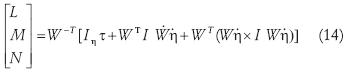
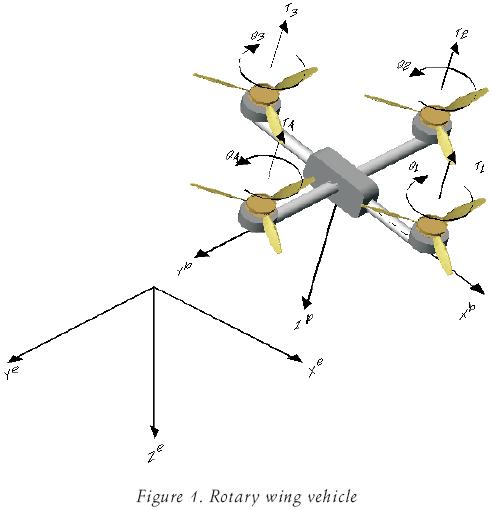
<body><![CDATA[<p align="justify"><font face="verdana" size="2">The rotary wing vehicle is shown in <a href="#f1">figure 1</a>. It is powered by four non&#150;tilting rotors attached to a rigid frame. The dynamical model of the rotary wing vehicle can be obtained as follows. Let <i>Ox<sup>e</sup> y<sup>e</sup> z<sup>e</sup> </i>denote a right&#150;hand inertial frame (earth frame) such that <i>z<sup>e</sup> </i>points downwards into the earth and <i>Ox<sup>b</sup> y<sup>b </sup>z<sup>b</sup> </i>a right&#150;hand frame fixed to the centre of mass of the aircraft structure (body frame). The vehicle dynamics in the body frame is described by (Roskam, 1982)</font></p>     <p align="center"><font face="verdana" size="2"><a name="f1"></a></font></p>     <p align="center"><font face="verdana" size="2"><img src="/img/revistas/iit/v10n4/a9f1.jpg"></font></p>     <p align="center"><font face="verdana" size="2"><img src="/img/revistas/iit/v10n4/a9s1.jpg"></font></p>     <p align="justify"><font face="verdana" size="2">where <i>m </i>represents the vehicle mass,</font></p>     <p align="center"><font face="verdana" size="2"><i>V <sup>b<sub>CM</sub></sup>=</i>&#91;<i>u v w</i>&#93;<sup></sup><i><sup>T</sup> </i></font></p>     <p align="justify"><font face="verdana" size="2">denotes the linear velocity of the vehicle centre of mass expressed in the body axis frame, &Omega; <i>=</i>&#91;<i>p q r</i>&#93;<i><sup>T</sup> </i>denote the angular velocity of the body frame, <i>I </i>is the vehicle inertia matrix<sup><a href="#notas">1</a></sup>, <i>F<sub>e</sub><sup>b</sup> </i>represents the external applied forces expressed in the body frame and <i>M<sub>e</sub><sup>b</sup></i>represents the external applied moments expressed in the body frame. In order to express the vehicle dynamics (1) referred to earth axis, it is necessary to specify the orientation of the body axis with respect to the earth frame. Considering the classical Euler yaw&#150;pitch&#150;roll rotation sequence. The rotation matrix that describes the orientation of the body reference frame relative to the earth frame is given by</font></p>     <p align="center"><font face="verdana" size="2"><img src="/img/revistas/iit/v10n4/a9s2.jpg"></font></p>     <p align="justify"><font face="verdana" size="2">where &Eta;<i> =</i>&#91;<img src="/img/revistas/iit/v10n4/a9s38.jpg"> &theta; &psi;&#93;<i><sup>T</sup> </i>are the Euler angles with <img src="/img/revistas/iit/v10n4/a9s38.jpg"><i> </i>the roll angular displacement, &theta; the pitch angular displacement and &Psi; the yaw angular displacement. Moreover, <i>c<sub>x</sub> = </i>cos(<i>x</i>) and <i>s<sub>x</sub> </i>= sin(<i>x</i>). On the other hand, the body frame angular velocity &Omega; is related to the Euler angles velocity as follows (Roskam, 1982)</font></p>     <p align="center"><font face="verdana" size="2"><img src="/img/revistas/iit/v10n4/a9s3.jpg"></font></p>     ]]></body>
<body><![CDATA[<p align="justify"><font face="verdana" size="2">From equation (2) we have that the relationship between the velocity components in the earth frame and the velocity components in the body frame is defined as</font></p>     <p align="center"><font face="verdana" size="2"><img src="/img/revistas/iit/v10n4/a9s4.jpg"></font></p>     <p align="justify"><font face="verdana" size="2">where <i>V<sup>e</sup><sub>CM</sub> = &#91;x y z&#93;<sup>T</sup> </i>is the linear velocity of the vehicle centre of mass expressed in the earth frame. Thus, the vehicle dynamics expressed in the earth frame can be written as</font></p>     <p align="center"><font face="verdana" size="2"><img src="/img/revistas/iit/v10n4/a9s5.jpg"></font></p>     <p align="justify"><font face="verdana" size="2">where   the   following   facts   have   been   considered <i>R<sup>&#150;1</sup> =R<sup>T</sup>,R<sup>.</sup>R<sup>T</sup>V<sup>b</sup><sub>CM</sub> =&#150;Sk</i>(&Omega;)<i>V<sup>b</sup><sub>CM</sub>, </i>with <i>Sk</i>(&Omega;) a skew symmetric matrix such that &Omega;x<i>V<sup>b</sup><sub>CM</sub></i> <i>=Sk</i>(&Omega;)<i>V <sup>b</sup><sub>CM </sub></i>and the new inertia matrix <i>I<sub>&Eta;</sub> =W<sup>T</sup> I W </i>has been introduced. Since we are not considering aerodynamic effects, the external applied forces expressed in the body frame are the vehicle weight and the total thrust produced by the four rotors, that is,</font></p>     <p align="center"><font face="verdana" size="2"><img src="/img/revistas/iit/v10n4/a9s6.jpg"></font></p>     <p align="justify"><font face="verdana" size="2">where <i>T<sub>T</sub> </i> = &sum;<sup>4<sub>i=1 </sub></sup><i>T<sub>i</sub> </i>with <i>T<sub>i</sub> </i>the thrust of each rotor. It is shown in (Gressow <i>et al., </i>1978) that the thrust generated by each rotor can be expressed as</font></p>     <p align="center"><font face="verdana" size="2"><i>T<sub>i</sub> =C<sub>Ti</sub> &pi; r<sup>4<sub>i</sub></sup></i>   &rho; &omega;<sup>2</sup><sub>i</sub></font></p>     <p align="justify"><font face="verdana" size="2">where <i>C<sub>T</sub> </i> is the thrust coefficient of rotor <i>i</i>, &rho; is the air density, <i>r<sub>i</sub> </i>is the radius of rotor <i>i</i> and <i>&omega;<sub>i</sub> </i>is the angular velocity of rotor <i>i</i>. The external applied moments in the body frame are defined as follows. The pitching motion is actuated by the moment around <i>y<sup>b</sup> </i>produced by increasing the thrust of rotor 1 and reducing the thrust of rotor 3. The roll movement is generated in a similar way, that is, by producing a differential thrust between rotors 2 and 4. Due to the torque applied to the rotor shaft by the motors a reaction torque of the same magnitude but opposite direction is experienced on the structure of the vehicle. By manipulating these reaction torques it is possible to control the yaw moment. Finally, the external applied moment is given by</font></p>     <p align="center"><font face="verdana" size="2"><img src="/img/revistas/iit/v10n4/a9s7.jpg"></font></p>     ]]></body>
<body><![CDATA[<p align="justify"><font face="verdana" size="2">where <img src="/img/revistas/iit/v10n4/a9s35.jpg">is the distance between the rotor rotation axis and the aircraft centre of mass and <i>Q<sub>i</sub> </i>is the reaction moment produced by rotor <i>i</i>. The reaction moment is given as (Gressow <i>et al., </i>1978)</font></p>     <p align="center"><font face="verdana" size="2"><i>Q<sub>1</sub> =C<sub>Qi</sub> &pi; r<sup>5</sup><sub>i</sub> </i>&rho; &omega;<i><sup>2</sup><sub>i</sub></i></font></p>     <p align="justify"><font face="verdana" size="2">As shown in (Hamel <i>et al., </i>2002) there exist a globally defined change of coordinates from</font></p>     <p align="center"><font face="verdana" size="2">&#91;<em>&#150;T<sub>T</sub> L M N</em>&#93;<sup><em>T</em></sup> to &#91;&omega;<sup>2</sup><sub>1</sub> &omega;<sup>2</sup><sub>2</sub> &omega;<sup>2</sup><sub>3</sub> &omega;<sup>2</sup><sub>4</sub>&#93;<sup>T</sup> for <em>C<sub>Ti</sub></em> &gt;0 and <em>C<sub>Qi</sub></em> &gt;0. </font></p>     <p align="justify"><font face="verdana" size="2">The control objective is to asymptotically track prescribed trajectories for the vehicle spatial position <i>(x, y, z) </i>and the yaw orientation &Psi;<i>. </i>In the following, we show that the considered control objective is achievable with a nonlinear time variant state feedback under the following standing assumption</font></p>     <blockquote>       <p align="justify"><font face="verdana" size="2">&#150; All system states are measurable and all system physical parameters are known.</font></p> </blockquote>     <p align="justify"><font face="verdana" size="2"><b>Control design</b></font></p>     <p align="justify"><font face="verdana" size="2">In this section we present a bounded backstepping control design for the rotary wing vehicle modeled by equation (5). The control strategy is developed as follows. First, the controller for the vehicle vertical motion is designed and then through the pitch and roll angles the vehicle position in the plane <i>xy </i>is controlled. The motion in the yaw direction is controlled independently. From the first equation of (5) we have that the translational dynamics is described by</font></p>     <p align="center"><font face="verdana" size="2"><img src="/img/revistas/iit/v10n4/a9s8.jpg"></font></p>     ]]></body>
<body><![CDATA[<p align="justify"><font face="verdana" size="2">Vertical motion control can be obtained by defining the total thrust as</font></p>     <p align="center"><font face="verdana" size="2"><img src="/img/revistas/iit/v10n4/a9s9.jpg"></font></p>     <p align="justify"><font face="verdana" size="2">where &gamma;<sub>z</sub> is a function defined in such a way that the dynamic equation</font></p>     <p align="center"><font face="verdana" size="2"><img src="/img/revistas/iit/v10n4/a9s36.jpg">&nbsp;</font></p>     <p align="justify"><font face="verdana" size="2">globally asymptotically satisfies</font></p>     <p align="center"><font face="verdana" size="2"><img src="/img/revistas/iit/v10n4/a9s37.jpg"></font></p>     <p align="justify"><font face="verdana" size="2">The translational dynamics (8) in closed loop with the controller (9) is described by the following equations</font></p>     <p align="center"><font face="verdana" size="2"><img src="/img/revistas/iit/v10n4/a9s10.jpg"></font></p>     <p align="justify"><font face="verdana" size="2">Following the backstepping nonlinear control design methodology (Sepulchre, 1997) the motion control in the <i>x </i>and <i>y </i>directions can be achieved through &theta; and <img src="/img/revistas/iit/v10n4/a9s38.jpg">  as follows.</font></p>     <p align="justify"><font face="verdana" size="2">Consider the functions</font></p>     ]]></body>
<body><![CDATA[<p align="center"><font face="verdana" size="2"><img src="/img/revistas/iit/v10n4/a9s11.jpg"></font></p>     <p align="justify"><font face="verdana" size="2">where <em>&gamma;</em><i><sub>x</sub> </i>and <em>&gamma;</em><sub>y</sub> are functions that will be defined in a similar way to <em>&gamma;<sub>z</sub></em>. Note that the new variables &zeta;<i><sub>x</sub> </i>and &zeta;<sub></sub><i><sub>x</sub> </i>will be well defined provided</font></p>     <p align="center"><font face="verdana" size="2"><img src="/img/revistas/iit/v10n4/a9s39.jpg"></font></p>     <p align="justify"><font face="verdana" size="2">therefore &gamma;<i><sub>z</sub></i> needs to satisfy the following condition</font></p>     <p align="center"><font face="verdana" size="2"><img src="/img/revistas/iit/v10n4/a9s12.jpg"></font></p>     <p align="justify"><font face="verdana" size="2">The condition above will be fulfilled by designing <em>&gamma;<sub>z</sub></em><sub></sub> as a bounded function; this will be achieved following the bounded control design technique proposed in (Kaliora et al., 2001).</font></p>     <p align="justify"><font face="verdana" size="2">Solving equation (11) for tan (&theta;) and tan(<img src="/img/revistas/iit/v10n4/a9s38.jpg">)<i>, </i>and replacing them into equation (10) we obtain</font></p>     <p align="center"><font face="verdana" size="2"><img src="/img/revistas/iit/v10n4/a9s13.jpg"></font></p>     <p align="justify"><font face="verdana" size="2">Supposing that &zeta;<sub></sub><i><sub>x</sub> </i>and &zeta;<sub>x</sub> are vanishing perturbations the trajectory tracking problem in the plane <i>x&#150;y </i>can be solved by selecting the functions <em>&gamma;<sub>x</sub></em> and <em>&gamma;<sub>y</sub></em> in such a way that the following dynamic equations </font></p>     <p align="center"><font face="verdana" size="2"><img src="/img/revistas/iit/v10n4/a9s40.jpg"></font></p >    ]]></body>
<body><![CDATA[<p align="justify"><font face="verdana" size="2">globally asymptotically satisfy</font></p>     <p align="center"><font face="verdana" size="2"><img src="/img/revistas/iit/v10n4/a9s41.jpg"></font></p >    <p align="justify"><font face="verdana" size="2">Now, we force the variables &zeta;<i><sub>x</sub> </i>and  &zeta;<sub></sub><i><sub>x</sub> </i>to be vanishing perturbations. For, let us define the following linearizing feedback for the angular dynamics</font></p>     <p align="center"><font face="verdana" size="2"><img src="/img/revistas/iit/v10n4/a9s14.jpg"></font></p>     <p align="justify"><font face="verdana" size="2">where <em>&tau;</em> =<img src="/img/revistas/iit/v10n4/a9s42.jpg">  is the new control input. With the controller defined by (14) the rotational dynamics reads as follows</font></p>     <p align="center"><font face="verdana" size="2"><img src="/img/revistas/iit/v10n4/a9s15.jpg"></font></p>     <p align="justify"><font face="verdana" size="2">It is easy to verify that the system described by equations (10) and (15) eith output (11) has vector relative degree {<em>r<sub>1</sub>, r<sub>2</sub></em>} ={2,2} provided (12) and</font></p>     <p align="center"><font face="verdana" size="2"><img src="/img/revistas/iit/v10n4/a9s16.jpg"> </font></p>     <p align="justify"><font face="verdana" size="2">holds. As a result, we have</font></p>     <p align="center"><font face="verdana" size="2"><img src="/img/revistas/iit/v10n4/a9s17.jpg"></font></p>     ]]></body>
<body><![CDATA[<p align="justify"><font face="verdana" size="2">is the decoupling matrix. The main characteristics of the proposed controller can be stated as follows.</font></p>     <p align="justify"><font face="verdana" size="2">Proposition 1</font></p>     <p align="justify"><font face="verdana" size="2">Consider the rotary wing vehicle dynamics described by equations (5). Let <i>x<sub>d</sub></i> (<em>t</em>), <i>y<sub>d</sub></i> (<em>t</em>), <i>Z<sub>d</sub></i> (<em>t</em>) and &Psi;<i><sub>d</sub></i>(<em>t</em>)  be reference signals with bounded derivatives. The state feedback control law defined by (9), (11) (14) and</font></p>     <p align="center"><font face="verdana" size="2"><img src="/img/revistas/iit/v10n4/a9s18.jpg"></font></p>     <p align="justify"><font face="verdana" size="2">with</font></p>     <p align="center"><font face="verdana" size="2">&nbsp;</font><font face="verdana" size="2"><img src="/img/revistas/iit/v10n4/a9s19.jpg"></font></p>     <p align="justify"><font face="verdana" size="2">and</font></p>     <p align="center"><font face="verdana" size="2"><img src="/img/revistas/iit/v10n4/a9s20.jpg"></font></p>     <p align="justify"><font face="verdana" size="2">where &lambda;<sub>(.2)1</sub> and &lambda;<sub>(.)2</sub> are constants such that the polynomial s<sup>2</sup> +&lambda;<sub>(.)1</sub> has all roots with negative real part, positive constants &epsilon;<sub>x</sub>, &epsilon;<sub>y </sub> and</font></p>     <p align="center"><font face="verdana" size="2"><img src="/img/revistas/iit/v10n4/a9s21.jpg"></font></p>     ]]></body>
<body><![CDATA[<p align="justify"><font face="verdana" size="2">generates a closed loop dynamics such that, for any initial conditions in the set</font></p>     <p align="center"><font face="verdana" size="2"><img src="/img/revistas/iit/v10n4/a9s22.jpg"></font></p>     <p align="justify"><font face="verdana" size="2">the trajectories of the closed loop system remain in <b>S</b> and are such that</font></p>     <p align="center"><font face="verdana" size="2"><img src="/img/revistas/iit/v10n4/a9s44.jpg"></font></p>     <p align="justify"><font face="verdana" size="2">for any positive constant &sigma;<i><sub>z</sub></i>&gt;0.</font></p>     <p align="justify"><font face="verdana" size="2">Proof</font></p>     <p align="justify"><font face="verdana" size="2">To begin with, note that vertical motion dynamics expressed in terms of the vertical tracking error is described by</font></p>     <p align="center"><font face="verdana" size="2"><img src="/img/revistas/iit/v10n4/a9s23.jpg"> </font></p>     <p align="justify"><font face="verdana" size="2">as shown in (Kaliora <i>et al.,</i> 2001) the dynamics (23) is globally asymptotically stable (LES) so that <i>z</i> (<i>t</i>) converges to <i>z<sub>d</sub></i> (<i>t</i>). Moreover, from (21) we have that</font></p>     <p align="center"><font face="verdana" size="2"><i><sub><img src="/img/revistas/iit/v10n4/a9s45.jpg"></sub></i></font></p>     ]]></body>
<body><![CDATA[<p align="justify"><font face="verdana" size="2">thus the new coordinates defined in (11) are well defined in the set S. In a similar way we have that the dynamics</font></p>     <p align="center"><font face="verdana" size="2"><img src="/img/revistas/iit/v10n4/a9s24.jpg"> </font></p>     <p align="justify"><font face="verdana" size="2">are GAS and LES. As a consequence, there exists quadratic Lyapunov functions</font></p>     <p align="center"><font face="verdana" size="2"><img src="/img/revistas/iit/v10n4/a9s25.jpg"></font></p>     <p align="justify"><font face="verdana" size="2">with <i>W<sub>x</sub> </i>and <i>W<sub>y</sub> </i>positive definite functions along (24). Additionally, it is easy to verify that for the dynamic equations</font></p>     <p align="center"><font face="verdana" size="2"><img src="/img/revistas/iit/v10n4/a9s26.jpg"></font></p>     <p align="justify"><font face="verdana" size="2">there exist radially unbouned Lyapunov functions <img src="/img/revistas/iit/v10n4/a9s46.jpg"> and <img src="/img/revistas/iit/v10n4/a9s47.jpg"> such that</font></p>     <p align="center"><font face="verdana" size="2"><img src="/img/revistas/iit/v10n4/a9s48.jpg"></font></p>     <p align="justify"><font face="verdana" size="2">with W<sub>&zeta;x</sub> and W<sub>&zeta;y</sub>. being positive definite functions. Consequently, there exist constants &#1082;<sub></sub><i><sub>x</sub> </i>and &#1082;<i><sub>y</sub></i> such that</font></p>     <p align="center"><font face="verdana" size="2"><img src="/img/revistas/iit/v10n4/a9s27.jpg"></font></p>     ]]></body>
<body><![CDATA[<p align="justify"><font face="verdana" size="2">Note now that the vehicle dynamics (5) in closed&#151;loop with (9), (14) and (18) can be expressed in terms of the</font></p>     <p align="center"><font face="verdana" size="2"><img src="/img/revistas/iit/v10n4/a9s28.jpg"></font></p>     <p align="justify"><font face="verdana" size="2">so that the time derivative of the Lyapunov functions (25) along (28) gives</font></p>     <p align="center"><font face="verdana" size="2"><img src="/img/revistas/iit/v10n4/a9s29.jpg"></font></p>     <p align="justify"><font face="verdana" size="2">Consider now equation (27) and some positive constants Kj,k<sub>2</sub> and K<sub>g</sub>.Then theLyapunovfunction time derivatives (29) can be bounded as follows</font></p>     <p align="center"><font face="verdana" size="2"><img src="/img/revistas/iit/v10n4/a9s30.jpg"></font></p>     <p align="justify"><font face="verdana" size="2">which gives</font></p>     <p align="center"><font face="verdana" size="2"><img src="/img/revistas/iit/v10n4/a9s31.jpg"> </font></p>     <p align="justify"><font face="verdana" size="2">this implies that along the trajectories of the closed loop dynamics <i>V<sub>x</sub> </i>and <i>V<sub>y</sub> </i>are bounded. As a result, the tracking errors <i>e<sub>x</sub> </i>and <i>e<sub>y</sub> </i>and their time derivatives are bounded and, by standard properties of cascade systems <i>x</i>(<i>t</i>) and <i>y</i>(<i>t</i>) converge to <i>x<sub>d</sub> </i>(<i>t</i>) and <i>y<sub>d</sub> </i>(<i>t</i>) respectively. It is easy to verify that the last equation of (28) is GAS and &Psi;(<i>t</i>) converges to &Psi;<i><sub>d</sub> </i>(<i>t</i>)<i>. </i>Finally, straightforward computations show that</font></p>     <p align="center"><font face="verdana" size="2"><img src="/img/revistas/iit/v10n4/a9s32.jpg"></font></p>     ]]></body>
<body><![CDATA[<p align="justify"><font face="verdana" size="2">Note that the functions <img src="/img/revistas/iit/v10n4/a9s49.jpg">, and &#150;<img src="/img/revistas/iit/v10n4/a9s50.jpg"> can be written in terms of {&zeta;<sub>x</sub>, &zeta;<sub>y</sub>, &gamma;<sub>x</sub>, &gamma;<sub>y</sub>, &gamma;<sub>z</sub>} then the diffeomorphism from<img src="/img/revistas/iit/v10n4/a9s51.jpg"> is well defined in the set S. This completes the proof.</font></p>     <p align="justify"><font face="verdana" size="2">Remark</font></p>     <p align="justify"><font face="verdana" size="2">The control law of <b>Proposition 1</b> has &epsilon;<sub>x</sub> and &epsilon;<sub>y</sub> as free parameters that could be used to enforce saturation limits on the actuators. Moreover, as the closed&#150;loop dynamics evolves inside S the singularities in equations (9) and (14) are avoided.</font></p>     <p align="justify"><font face="verdana" size="2"><b>Simulation results</b></font></p>     <p align="justify"><font face="verdana" size="2">Numerical simulations were carried out to asses the performance of the controller proposed. The numerical value of the vehicle parameters are presented in <a href="#t1">table 1</a>.</font></p>     <p align="center"><font face="verdana" size="2"><a name="t1"></a></font></p>     <p align="center"><font face="verdana" size="2"><img src="/img/revistas/iit/v10n4/a9t1.jpg"></font></p>     <p align="justify"><font face="verdana" size="2">Note that we consider similar characteristics for all rotors. The desired trajectory is defined as follows</font></p>     <p align="center"><font face="verdana" size="2"><img src="/img/revistas/iit/v10n4/a9s33.jpg"></font></p>     <p align="justify"><font face="verdana" size="2">In the numerical simulations we have considered the following initial conditions</font></p>     ]]></body>
<body><![CDATA[<p align="center"><font face="verdana" size="2"><img src="/img/revistas/iit/v10n4/a9s34.jpg"></font></p>     <p align="justify"><font face="verdana" size="2">In order to tune the controller parameters we do need to be careful to fulfill condition (12) this can be achieved by selecting adequately the controller gain &epsilon;<sub>z</sub>. Note that through the controller gains &epsilon;<sub>x</sub>, &epsilon;<sub>y</sub> the functions <i>&gamma;<sub>x</sub> </i>and <i>&gamma;<sub>y</sub></i>  can be arbitrarily bounded. However, by bounding <i>&gamma;<sub>x</sub> </i>and <i>&gamma;<sub>y</sub></i> we bound the available control force and slow the controller response. In the following numerical simulations we select the controller parameters presented in <a href="#t2">table 2</a>.</font></p>     <p align="center"><font face="verdana" size="2"><a name="t2"></a></font></p>     <p align="center"><font face="verdana" size="2"><img src="/img/revistas/iit/v10n4/a9t2.jpg"></font></p>     <p align="justify"><font face="verdana" size="2">In order to test the controller robustness in the following simulations the linearizing controller (14) is not included. Figures <a href="/img/revistas/iit/v10n4/a9f2.jpg" target="_blank">2</a> and <a href="/img/revistas/iit/v10n4/a9f3.jpg" target="_blank">3</a> show the time histories of the trajectory tracking as it can be observed they converge asymptotically to zero. The divergence observed at <i>t </i>=50 seg corresponds to the non smooth change of reference. However, after a transient period the trajectory tracking errors converge asymptotically to zero.</font></p>     <p align="justify"><font face="verdana" size="2">Figures <a href="/img/revistas/iit/v10n4/a9f4.jpg" target="_blank">4</a> and <a href="/img/revistas/iit/v10n4/a9f5.jpg" target="_blank">5</a> display time histories of the control signals, as it can be they remain bounded. Finally, in Figures <a href="/img/revistas/iit/v10n4/a9f6.jpg" target="_blank">6</a> and <a href="/img/revistas/iit/v10n4/a9f7.jpg" target="_blank">7</a> the time histories of the states <img src="/img/revistas/iit/v10n4/a9s52.jpg">as well as (&zeta;<sub>x</sub>, &zeta;<sub>y</sub>) and its time derivatives are shown. Note that all these signals remain bounded showing that the diffeomorphism from <img src="/img/revistas/iit/v10n4/a9s51.jpg">is well defined.</font></p>     <p align="justify"><font face="verdana" size="2">&nbsp;</font></p>     <p align="justify"><font face="verdana" size="2"><b>Conclusions</b></font></p>     <p align="justify"><font face="verdana" size="2">The trajectory tracking problem for a rotary wing vehicle powered by four rotors has been addressed and solved by means of a full information control law, which is based on the backstepping technique and bounded controllers. Numerical simulations have been proposed to illustrate the properties of the closed loop system.</font></p>     <p align="justify"><font face="verdana" size="2">A few issues are left open in the present paper. First, all the system parameters are assumed to be known. Second, all the states are assumed to be measurable, hence further work is necessary to relax (or avoid) these assumptions. A straightforward solution to the issues left open in this paper is to include an observer/estimator to observe some system' states and to estimate some system's parameters, for instance translational velocities, angular displacements and vehicle mass. The main complications in this direction is to be able to conclude some kind of stability of the new resulting nonlinear closed&#151;loop dynamics now composed of vehicle dynamics, controller and observer.</font></p>     ]]></body>
<body><![CDATA[<p align="justify"><font face="verdana" size="2">&nbsp;</font></p>     <p align="justify"><font face="verdana" size="2"><b>Acknowledgments</b></font></p>     <p align="justify"><font face="verdana" size="2">This work has been partially supported by the Instituto Polit&eacute;cnico Nacional under the project SIP&#150;20060127. Authors would like to thank to anonymous reviewers for their helpful suggestions.</font></p>     <p align="justify"><font face="verdana" size="2">&nbsp;</font></p>     <p align="justify"><font face="verdana" size="2"><b>References</b></font></p>     <!-- ref --><p align="justify"><font face="verdana" size="2">Davis Jr. W.R., Kosicki B.B., Boroson D.M., Kostishack D.F. Micro Air Vehicles for Optical Surveillance. <i>The Lincoln </i><i>Laboratory Journal, </i>9:2, 1998. </font>&nbsp;&nbsp;&nbsp;&nbsp;&nbsp;&nbsp;&nbsp;&nbsp;[&#160;<a href="javascript:void(0);" onclick="javascript: window.open('/scielo.php?script=sci_nlinks&ref=4249450&pid=S1405-7743200900040000900001&lng=','','width=640,height=500,resizable=yes,scrollbars=1,menubar=yes,');">Links</a>&#160;]<!-- end-ref --><!-- ref --><p align="justify"><font face="verdana" size="2">Gessow A., Myers C.G. Jr. <i>Aerodinamics of the Helicopter. </i>FREDERICK UNGAR PUBLISHING  CO.  New York. Fifth Printing. 1978. </font>&nbsp;&nbsp;&nbsp;&nbsp;&nbsp;&nbsp;&nbsp;&nbsp;[&#160;<a href="javascript:void(0);" onclick="javascript: window.open('/scielo.php?script=sci_nlinks&ref=4249451&pid=S1405-7743200900040000900002&lng=','','width=640,height=500,resizable=yes,scrollbars=1,menubar=yes,');">Links</a>&#160;]<!-- end-ref --><!-- ref --><p align="justify"><font face="verdana" size="2">Hamel T., Mahony R., Lozano R. Dynamic Modelling and Configuration Stabilization for an X4&#150;flyer. Proc. of the 15th Triennial World IFAC Congress Barcelona, Spain, 2002. </font>&nbsp;&nbsp;&nbsp;&nbsp;&nbsp;&nbsp;&nbsp;&nbsp;[&#160;<a href="javascript:void(0);" onclick="javascript: window.open('/scielo.php?script=sci_nlinks&ref=4249452&pid=S1405-7743200900040000900003&lng=','','width=640,height=500,resizable=yes,scrollbars=1,menubar=yes,');">Links</a>&#160;]<!-- end-ref --><!-- ref --><p align="justify"><font face="verdana" size="2">Kaliora G., Astolfi A. A Simple Design for the Stabilization of Cascaded Nonlinear Systems with Bounded Control.Proc. of the 40th Conference on Decision and Control Orlando, FL, pp. 3784&#150;3789, 2001. </font>&nbsp;&nbsp;&nbsp;&nbsp;&nbsp;&nbsp;&nbsp;&nbsp;[&#160;<a href="javascript:void(0);" onclick="javascript: window.open('/scielo.php?script=sci_nlinks&ref=4249453&pid=S1405-7743200900040000900004&lng=','','width=640,height=500,resizable=yes,scrollbars=1,menubar=yes,');">Links</a>&#160;]<!-- end-ref --><!-- ref --><p align="justify"><font face="verdana" size="2">Kendoul F., Fantoni I., Lozano R. Modelling and Control of Small Autonomous Aircraft Having Two Tilting Rotors. Proc. of the 44th Conference on Decision and Control and the European Control Conference 2005, Seville, Spain, December 12&#150;15, 2005. </font>&nbsp;&nbsp;&nbsp;&nbsp;&nbsp;&nbsp;&nbsp;&nbsp;[&#160;<a href="javascript:void(0);" onclick="javascript: window.open('/scielo.php?script=sci_nlinks&ref=4249454&pid=S1405-7743200900040000900005&lng=','','width=640,height=500,resizable=yes,scrollbars=1,menubar=yes,');">Links</a>&#160;]<!-- end-ref --><!-- ref --><p align="justify"><font face="verdana" size="2">Roskam J. <i>Airplane Flight Dynamics and Automatic Flight </i><i>Controls.  </i>Part I, A.  Roskam Aviation and Engineering Corporation. 1982.</font>&nbsp;&nbsp;&nbsp;&nbsp;&nbsp;&nbsp;&nbsp;&nbsp;[&#160;<a href="javascript:void(0);" onclick="javascript: window.open('/scielo.php?script=sci_nlinks&ref=4249455&pid=S1405-7743200900040000900006&lng=','','width=640,height=500,resizable=yes,scrollbars=1,menubar=yes,');">Links</a>&#160;]<!-- end-ref --><!-- ref --><p align="justify"><font face="verdana" size="2">Salazar&#150;Cruz S., Palomino A., Lozano R. Trajectory Tracking for a Four Rotor Mini&#150;craft. Proc. of the 44th Conference on Decision and  Control  and  the  European  Control Conference 2005, Seville, Spain, December 12&#150;15, 2005.</font>&nbsp;&nbsp;&nbsp;&nbsp;&nbsp;&nbsp;&nbsp;&nbsp;[&#160;<a href="javascript:void(0);" onclick="javascript: window.open('/scielo.php?script=sci_nlinks&ref=4249456&pid=S1405-7743200900040000900007&lng=','','width=640,height=500,resizable=yes,scrollbars=1,menubar=yes,');">Links</a>&#160;]<!-- end-ref --><!-- ref --><p align="justify"><font face="verdana" size="2">Sepulchre R., Jankovic M., Kokotovic P. <i>Constructive Nonlinear Control. </i>London. Springer Verlag. 1997.</font>&nbsp;&nbsp;&nbsp;&nbsp;&nbsp;&nbsp;&nbsp;&nbsp;[&#160;<a href="javascript:void(0);" onclick="javascript: window.open('/scielo.php?script=sci_nlinks&ref=4249457&pid=S1405-7743200900040000900008&lng=','','width=640,height=500,resizable=yes,scrollbars=1,menubar=yes,');">Links</a>&#160;]<!-- end-ref --><p align="justify"><font face="verdana" size="2">&nbsp;</font></p>     <p align="justify"><font face="verdana" size="2"><b>About the authors</b></font></p>     <p align="justify"><font face="verdana" size="2"><i>Sergio Araujo&#150;Estrada. </i>Is a M.S. student at the Centro de Investigaci&oacute;n y de Estudios Avanzados. He received his bachelor in aeronautical engineering from the Instituto Polit&eacute;cnico Nacional in 2008. His research interests are design and control of unmanned aerial vehicles.</font></p>     <p align="justify"><font face="verdana" size="2"><i>Eduardo Liceaga&#150;Castro. </i>He received his bachelor in aeronautical engineering from the Instituto Polit&eacute;cnico Nacional, M.S. in automatic control from the Centro de Investigaci&oacute;n y de Estudios Avanzados and Ph. D. from Glasgow University. He was a postdoctoral research fellow at Glasgow University, Strathclyde University and Glasgow Caledonian University. He has held academic appointments at Universidad Carlos III, Escuela Superior de Ingenier&iacute;a Mec&aacute;nica y El&eacute;ctrica Unidad Ticom&aacute;n and Instituto de Estudios Superiores de Monterrey Campus Cd. de M&eacute;xico. He has worked at Daimler Chrysler in Germany. His current research interests include nonlinear control of electric machines and aerial vehicles.</font></p>     <p align="justify"><font face="verdana" size="2"><i>Hugo Rodr&iacute;guez&#150;Cort&eacute;s. </i>Is a mechatronics researcher at the Centro de Investigaci&oacute;n y de Estudios Avanzados. He received his bachelor in aeronautical engineering from the Instituto Polit&eacute;cnico Nacional in 1995, M.S. in automatic control from the Centro de Investigaci&oacute;n y de Estudios Avanzados in 1997 and doctorate in signal processing and automatic control from Paris XI University in 2002. He has been a postdoctoral research fellow at the Imperial College of Technology and Medicine and Northeastern University. His research interests are design and control of unmanned aerial vehicles.</font></p>     <p align="justify"><font face="verdana" size="2">&nbsp;</font></p>     <p align="justify"><font face="verdana" size="2"><b><a name="notas"></a>Note</b></font></p>     ]]></body>
<body><![CDATA[<p align="justify"><font face="verdana" size="2"><sup>1</sup> As the vehicle has two symmetry axes <i>I</i> = <i>diag{I<sub>xx</sub>, I<sub>yy</sub>, I<sub>zz</sub>}</i>.</font></p>      ]]></body><back>
<ref-list>
<ref id="B1">
<nlm-citation citation-type="journal">
<person-group person-group-type="author">
<name>
<surname><![CDATA[Davis]]></surname>
<given-names><![CDATA[W.R.]]></given-names>
</name>
<name>
<surname><![CDATA[Kosicki]]></surname>
<given-names><![CDATA[B.B.]]></given-names>
</name>
<name>
<surname><![CDATA[Boroson]]></surname>
<given-names><![CDATA[D.M.]]></given-names>
</name>
<name>
<surname><![CDATA[Kostishack]]></surname>
<given-names><![CDATA[D.F.]]></given-names>
</name>
</person-group>
<article-title xml:lang="en"><![CDATA[Micro Air Vehicles for Optical Surveillance]]></article-title>
<source><![CDATA[The Lincoln Laboratory Journal]]></source>
<year>1998</year>
<volume>9</volume>
<numero>2</numero>
<issue>2</issue>
</nlm-citation>
</ref>
<ref id="B2">
<nlm-citation citation-type="book">
<person-group person-group-type="author">
<name>
<surname><![CDATA[Gessow]]></surname>
<given-names><![CDATA[A.]]></given-names>
</name>
<name>
<surname><![CDATA[Myers]]></surname>
<given-names><![CDATA[C.G.]]></given-names>
</name>
</person-group>
<source><![CDATA[Aerodinamics of the Helicopter]]></source>
<year>1978</year>
<publisher-loc><![CDATA[New York ]]></publisher-loc>
<publisher-name><![CDATA[FREDERICK UNGAR PUBLISHING CO]]></publisher-name>
</nlm-citation>
</ref>
<ref id="B3">
<nlm-citation citation-type="confpro">
<person-group person-group-type="author">
<name>
<surname><![CDATA[Hamel]]></surname>
<given-names><![CDATA[T.]]></given-names>
</name>
<name>
<surname><![CDATA[Mahony]]></surname>
<given-names><![CDATA[R.]]></given-names>
</name>
<name>
<surname><![CDATA[Lozano]]></surname>
<given-names><![CDATA[R.]]></given-names>
</name>
</person-group>
<source><![CDATA[Dynamic Modelling and Configuration Stabilization for an X4-flyer]]></source>
<year></year>
<conf-name><![CDATA[15 Triennial World]]></conf-name>
<conf-date>2002</conf-date>
<conf-loc>Barcelona </conf-loc>
</nlm-citation>
</ref>
<ref id="B4">
<nlm-citation citation-type="confpro">
<person-group person-group-type="author">
<name>
<surname><![CDATA[Kaliora]]></surname>
<given-names><![CDATA[G.]]></given-names>
</name>
<name>
<surname><![CDATA[Astolfi]]></surname>
<given-names><![CDATA[A.]]></given-names>
</name>
</person-group>
<source><![CDATA[A Simple Design for the Stabilization of Cascaded Nonlinear Systems with Bounded Control]]></source>
<year>2001</year>
<conf-name><![CDATA[40 Conference on Decision and Control]]></conf-name>
<conf-loc>Orlando FL</conf-loc>
<page-range>3784-3789</page-range></nlm-citation>
</ref>
<ref id="B5">
<nlm-citation citation-type="confpro">
<person-group person-group-type="author">
<name>
<surname><![CDATA[Kendoul]]></surname>
<given-names><![CDATA[F.]]></given-names>
</name>
<name>
<surname><![CDATA[Fantoni]]></surname>
<given-names><![CDATA[I.]]></given-names>
</name>
<name>
<surname><![CDATA[Lozano]]></surname>
<given-names><![CDATA[R.]]></given-names>
</name>
</person-group>
<source><![CDATA[Modelling and Control of Small Autonomous Aircraft Having Two Tilting Rotors]]></source>
<year></year>
<conf-name><![CDATA[44 Conference on Decision and Control]]></conf-name>
<conf-date>2005</conf-date><conf-date>December 12-15, 2005</conf-date>
<conf-loc>Seville Spain</conf-loc>
</nlm-citation>
</ref>
<ref id="B6">
<nlm-citation citation-type="book">
<person-group person-group-type="author">
<name>
<surname><![CDATA[Roskam]]></surname>
<given-names><![CDATA[J.]]></given-names>
</name>
</person-group>
<source><![CDATA[Airplane Flight Dynamics and Automatic Flight Controls: Part I]]></source>
<year>1982</year>
<publisher-name><![CDATA[Roskam Aviation and Engineering Corporation]]></publisher-name>
</nlm-citation>
</ref>
<ref id="B7">
<nlm-citation citation-type="confpro">
<person-group person-group-type="author">
<name>
<surname><![CDATA[Salazar-Cruz]]></surname>
<given-names><![CDATA[S.]]></given-names>
</name>
<name>
<surname><![CDATA[Palomino]]></surname>
<given-names><![CDATA[A.]]></given-names>
</name>
<name>
<surname><![CDATA[Lozano]]></surname>
<given-names><![CDATA[R.]]></given-names>
</name>
</person-group>
<source><![CDATA[Trajectory Tracking for a Four Rotor Mini-craft.]]></source>
<year></year>
<conf-name><![CDATA[44 Conference on Decision and Control]]></conf-name>
<conf-date>December 12-15, 2005</conf-date>
<conf-loc>Seville </conf-loc>
</nlm-citation>
</ref>
<ref id="B8">
<nlm-citation citation-type="book">
<person-group person-group-type="author">
<name>
<surname><![CDATA[Sepulchre]]></surname>
<given-names><![CDATA[R.]]></given-names>
</name>
<name>
<surname><![CDATA[Jankovic]]></surname>
<given-names><![CDATA[M.]]></given-names>
</name>
<name>
<surname><![CDATA[Kokotovic]]></surname>
<given-names><![CDATA[P.]]></given-names>
</name>
</person-group>
<source><![CDATA[Constructive Nonlinear Control]]></source>
<year>1997</year>
<publisher-loc><![CDATA[London ]]></publisher-loc>
<publisher-name><![CDATA[Springer Verlag]]></publisher-name>
</nlm-citation>
</ref>
</ref-list>
</back>
</article>