<?xml version="1.0" encoding="ISO-8859-1"?><article xmlns:mml="http://www.w3.org/1998/Math/MathML" xmlns:xlink="http://www.w3.org/1999/xlink" xmlns:xsi="http://www.w3.org/2001/XMLSchema-instance">
<front>
<journal-meta>
<journal-id>1405-7743</journal-id>
<journal-title><![CDATA[Ingeniería, investigación y tecnología]]></journal-title>
<abbrev-journal-title><![CDATA[Ing. invest. y tecnol.]]></abbrev-journal-title>
<issn>1405-7743</issn>
<publisher>
<publisher-name><![CDATA[Universidad Nacional Autónoma de México, Facultad de Ingeniería]]></publisher-name>
</publisher>
</journal-meta>
<article-meta>
<article-id>S1405-77432009000300007</article-id>
<title-group>
<article-title xml:lang="en"><![CDATA[Mixed Distributions in Low-Flow Frequency Analysis]]></article-title>
<article-title xml:lang="es"><![CDATA[Distribuciones mezcladas en el análisis de frecuencias de flujos mínimos]]></article-title>
</title-group>
<contrib-group>
<contrib contrib-type="author">
<name>
<surname><![CDATA[Escalante-Sandoval]]></surname>
<given-names><![CDATA[C.A.]]></given-names>
</name>
<xref ref-type="aff" rid="A01"/>
</contrib>
</contrib-group>
<aff id="A01">
<institution><![CDATA[,Universidad Nacional Autónoma de México Facultad de Ingeniería División de Ingenierías Civil y Geomática]]></institution>
<addr-line><![CDATA[México ]]></addr-line>
</aff>
<pub-date pub-type="pub">
<day>00</day>
<month>09</month>
<year>2009</year>
</pub-date>
<pub-date pub-type="epub">
<day>00</day>
<month>09</month>
<year>2009</year>
</pub-date>
<volume>10</volume>
<numero>3</numero>
<fpage>247</fpage>
<lpage>253</lpage>
<copyright-statement/>
<copyright-year/>
<self-uri xlink:href="http://www.scielo.org.mx/scielo.php?script=sci_arttext&amp;pid=S1405-77432009000300007&amp;lng=en&amp;nrm=iso"></self-uri><self-uri xlink:href="http://www.scielo.org.mx/scielo.php?script=sci_abstract&amp;pid=S1405-77432009000300007&amp;lng=en&amp;nrm=iso"></self-uri><self-uri xlink:href="http://www.scielo.org.mx/scielo.php?script=sci_pdf&amp;pid=S1405-77432009000300007&amp;lng=en&amp;nrm=iso"></self-uri><abstract abstract-type="short" xml:lang="en"><p><![CDATA[Low-flow characteristics are required to solve several water-engineering problems. In this paper, the Mixed Gumbel and the Two Component Extreme Value distributions are presented toward their applications in low-flow frequency analysis. A region in southern Mexico, with 39 gauging stations was selected to analyze the lowest 1 day flows. Additionally, in order to calculate the stream design flow ( 7Q10) for water quality standards down stream of the Hydroelectric project La Parota, the lowest 7 day average flows were used. Results produced by fitting the mixed distribution were compared with those obtained by the Weibull-3, Gumbel, Lognormal-3 and General Extreme Value distributions. Results suggest that mixed distributions are a suitable option to be considered when analyzing minimum flows.]]></p></abstract>
<abstract abstract-type="short" xml:lang="es"><p><![CDATA[En muchos de los problemas de ingeniería del agua se requiere conocer las características de los flujos mínimos. En el artículo se presenta la aplicación de las distribuciones Gumbel Mixta y de Valores Extremos de Dos Componentes en el análisis de frecuencias de gastos mínimos. Una región localizada en el sureste de México, con un total de 39 estaciones de aforos, fue seleccionada para analizar los gastos mínimos anuales con duración de un día. Adicionalmente se utilizaron los gastos mínimos anuales promedio de siete días consecutivos con el fin de obtener el gasto de diseño (7Q10) para cumplir con los estándares de calidad hídrica aguas abajo del proyecto hidroeléctrico La Parota. Los eventos estimados por las distribuciones mezcladas fueron comparados con aquellos obtenidos por las distribuciones Weibull-3, Gumbel, Lognormal-3 y General de Valores Extremos. Los resultados sugieren que las distribuciones mezcladas son una opción adecuada a ser considerada en el análisis de flujos mínimos.]]></p></abstract>
<kwd-group>
<kwd lng="en"><![CDATA[Minimum flow frequency analysis]]></kwd>
<kwd lng="en"><![CDATA[maximum likelihood]]></kwd>
<kwd lng="en"><![CDATA[heterogeneous samples]]></kwd>
<kwd lng="en"><![CDATA[water quality]]></kwd>
<kwd lng="es"><![CDATA[Análisis de frecuencias de flujos mínimos]]></kwd>
<kwd lng="es"><![CDATA[máxima verosimilitud]]></kwd>
<kwd lng="es"><![CDATA[muestras heterogéneas]]></kwd>
<kwd lng="es"><![CDATA[calidad del agua]]></kwd>
</kwd-group>
</article-meta>
</front><body><![CDATA[ <p align="center"><font face="verdana" size="4"><b>Mixed Distributions in Low&#150;Flow Frequency Analysis</b></font></p>     <p align="justify"><font face="verdana" size="2">&nbsp;</font></p>     <p align="center"><font face="verdana" size="3"><b><i>Distribuciones mezcladas en el an&aacute;lisis de frecuencias de flujos m&iacute;nimos</i></b></font></p>     <p align="center"><font face="verdana" size="2">&nbsp;</font></p>     <p align="center"><font face="verdana" size="2"><b>C.A. Escalante&#150;Sandoval</b></font></p>     <p align="justify"><font face="verdana" size="2">&nbsp;</font></p>     <p align="justify"><font face="verdana" size="2"><i>Divisi&oacute;n de Ingenier&iacute;as Civil y Geom&aacute;tica. Facultad de Ingenier&iacute;a, UNAM. M&eacute;xico. E&#150;mail: <a href="mailto:caes@servidor.unam.mx">caes@servidor.unam.mx</a></i></font></p>     <p align="justify"><font face="verdana" size="2">&nbsp;</font></p>     <p align="justify"><font face="verdana" size="2">Recibido: septiembre de 2007    <br> Aceptado: mayo de 2008</font></p>     ]]></body>
<body><![CDATA[<p align="justify"><font face="verdana" size="2">&nbsp;</font></p>     <p align="justify"><font face="verdana" size="2"><b>Abstract</b></font></p>     <p align="justify"><font face="verdana" size="2">Low&#150;flow characteristics are required to solve several water&#150;engineering problems. In this paper, the Mixed Gumbel and the Two Component Extreme Value distributions are presented toward their applications in low&#150;flow frequency analysis. A region in southern Mexico, with 39 gauging stations was selected to analyze the lowest 1 day flows. Additionally, in order to calculate the stream design flow ( <sub>7</sub>Q<sub>10</sub>) for water quality standards down stream of the Hydroelectric project La Parota, the lowest 7 day average flows were used. Results produced by fitting the mixed distribution were compared with those obtained by the Weibull&#150;3, Gumbel, Lognormal&#150;3 and General Extreme Value distributions. Results suggest that mixed distributions are a suitable option to be considered when analyzing minimum flows.</font></p>     <p align="justify"><font face="verdana" size="2"><b>Keywords: </b>Minimum flow frequency analysis, maximum likelihood, heterogeneoussamples, waterquality.</font></p>     <p align="justify"><font face="verdana" size="2">&nbsp;</font></p>     <p align="justify"><font face="verdana" size="2"><b><i>Resumen</i></b></font></p>     <p align="justify"><font face="verdana" size="2"><i>En muchos de los problemas de ingenier&iacute;a del agua se requiere conocer las caracter&iacute;sticas de los flujos m&iacute;nimos. En el art&iacute;culo se presenta la aplicaci&oacute;n de las distribuciones Gumbel Mixta y de Valores Extremos de Dos Componentes en el an&aacute;lisis de frecuencias de gastos m&iacute;nimos. Una regi&oacute;n localizada en el sureste de M&eacute;xico, con un total de 39 estaciones de aforos, fue seleccionada para analizar los gastos m&iacute;nimos anuales con duraci&oacute;n de un d&iacute;a. Adicionalmente se utilizaron los gastos m&iacute;nimos anuales promedio de siete d&iacute;as consecutivos con el fin de obtener el gasto de dise&ntilde;o (<sub>7</sub>Q<sub>10</sub>) para cumplir con los est&aacute;ndares de calidad h&iacute;drica aguas abajo del proyecto hidroel&eacute;ctrico La Parota. Los eventos estimados por las distribuciones mezcladas fueron comparados con aquellos obtenidos por las distribuciones Weibull&#150;3, Gumbel, Lognormal&#150;3 y General de Valores Extremos. Los resultados sugieren que las distribuciones mezcladas son una opci&oacute;n adecuada a ser considerada en el an&aacute;lisis de flujos m&iacute;nimos.</i></font></p>     <p align="justify"><font face="verdana" size="2"><b><i>Desciptores: </i></b><i>An&aacute;lisis de frecuencias de flujos m&iacute;nimos, m&aacute;xima verosimilitud, muestras heterog&eacute;neas, calidad del agua.</i></font></p>     <p align="justify"><font face="verdana" size="2">&nbsp;</font></p>     <p align="justify"><font face="verdana" size="2"><b>Introduction</b></font></p>     ]]></body>
<body><![CDATA[<p align="justify"><font face="verdana" size="2">Low&#150;flow is the flow of water in a stream during prolonged dry weather. By contrast, a drought is a natural event that results from an extended period of  below  average   precipitation. While   droughts include low&#150;flows,  a continuous seasonal low&#150;flow event is not necessarily a drought. A summary about the status of low&#150;flow hydrology can be found in Smakhtin (2001) and Pyrce (2004).</font></p>     <p align="justify"><font face="verdana" size="2">Quantiles of annual low&#150;flow are commonly used as  design  flows  on which  to  base  the  design  of structures such as wastewater&#150;treatment plants or for describing the capability of a stream to supply requirements for the regulation of fluvial transport, water supply, hydropower, liquid waste disposal, irrigation systems, or assessing the impact of prolonged droughts on aquatic ecosystems.</font></p>     <p align="justify"><font face="verdana" size="2">For instance, when assessing the suitable conditions for aquatic life, a hydrologically&#150;based design flow (EPA, 2006) is computed using the single lowest flow event from each year of record and then examining these flows for a series of years. When a sufficiently long discharge record is available at a river site, low&#150;flow statistics, such as the lowest 7 day average flow that occurs on average once every 10 years (<sub>7</sub>Q<sub>10</sub>), can be obtained through the use of probability distributions. By contrast, the biologically&#150;based design flows (EPA, 2006) use durations and frequencies specified in water quality criteria for individual pollutants and whole effluents; they can be based on the available biological, ecological and toxicological information concerning the stresses that aquatic organisms, ecosystems, and their uses can tolerate.</font></p>     <p align="justify"><font face="verdana" size="2">This method is empirical, not statistical, because it deals with the actual flow record itself, not with a statistical distribution intended to describe the flow record. The biologically&#150;based definition also recognizes that drought imposes severe stress on aquatic organisms, whet her pollutants a represent or not.</font></p>     <p align="justify"><font face="verdana" size="2">Low&#150;flows typically aggravate the effects of water pollution. During a low flow event, there is less water available to dilute effluent loadings, resulting in higher in&#150;stream concentration of pollutants. Aquatic life criteria are expressed in terms of the intensity of concentration, duration of averaging period, and average frequency of allowed excursions, which are defined as any flow lower than the design flow. Two concentrations, a continuous (CC) and a maximum (MC) are used to protect aquatic life from chronic and acute effects, respectively. From a hydrological point of view, EPA (2006) recommends the use of the <sub>1</sub>Q<sub>10</sub><i> </i>flow as the design flow for the MC and the <sub>7</sub>Q<sub>10</sub> as the design flow for the CC.</font></p>     <p align="justify"><font face="verdana" size="2">Extensive literature is available on the application of probability distributions for prediction of flood frequencies, while the number of studies reported on frequency of low flow is rather limited. The modest interest in finding the most appropriate distribution of low flow is due to the relatively short return periods used in low flow design (less than 50 years).</font></p>     <p align="justify"><font face="verdana" size="2">Gumbel (1958) discussed the use of the 3&#150;parameter Weibull distribution (W3) for fitting low flows:</font></p>     <p align="center"><font face="verdana" size="2"><img src="/img/revistas/iit/v10n3/a7s1.jpg"></font></p>     <p align="justify"><font face="verdana" size="2">where &alpha;, &beta; and &gamma; are the shape, scale and location parameters.</font></p>     <p align="justify"><font face="verdana" size="2">The Gumbel distribution (EV1) is commonly used for low flow frequency analysis (Al&#150;Mashidani <i>et al., </i>1980):</font></p>     ]]></body>
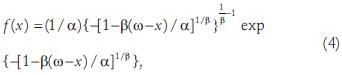
<body><![CDATA[<p align="center"><font face="verdana" size="2"><img src="/img/revistas/iit/v10n3/a7s2.jpg"></font></p>     <p align="justify"><font face="verdana" size="2">where &omega; and &alpha; are the location and scale parameters.</font></p>     <p align="justify"><font face="verdana" size="2">This distribution is not bounded in the lower or upper tail. The smallest values of the EV1 distribution have a high probability of negative values.</font></p>     <p align="justify"><font face="verdana" size="2">Chow (1964) provided a theoretical justification for the use of the 3&#150;parameter Lognormal distribution (LN3) in low flow analysis:</font></p>     <p align="center"><font face="verdana" size="2"><img src="/img/revistas/iit/v10n3/a7s3.jpg"></font></p>     <p align="justify"><font face="verdana" size="2">where <i>x<sub>o</sub></i>, &micro;<i><sub>y</sub></i> and &sigma;<i><sub>y</sub> </i>are the location, scale and shape parameters. This distribution is not bounded in the lower or upper tail.</font></p>     <p align="justify"><font face="verdana" size="2">Kroll and Vogel (2002) used L&#150;moments diagrams to examine 1505 gauged river sites in the United States, and recommended the LN3 distribution for describing low streamflow statistics at no intermittent (perennial) sites.</font></p>     <p align="justify"><font face="verdana" size="2">The General Extreme Value distribution (GEV) has been widely used in flood frequency and less in low&#150;flow frequency analysis (Raynal, 1987):</font></p>     <p align="center"><font face="verdana" size="2"><img src="/img/revistas/iit/v10n3/a7s4.jpg"></font></p>     <p align="justify"><font face="verdana" size="2">If &beta;&lt;0 then &#150;&infin;&lt;x &lt;&omega;&#150;&alpha;/&beta; and if &beta;&gt;0 then &omega;&#150;&alpha;/&beta;&lt;x  &lt; &infin;.</font></p>     ]]></body>
<body><![CDATA[<p align="justify"><font face="verdana" size="2">where&alpha;, &beta; and &omega; are the scale, shape and location parameters.</font></p>     <p align="justify"><font face="verdana" size="2">Onoz and Bayazit (1999) examined the fit of various probability distributions to low flows at European rivers, and recommended the GEV distribution.</font></p>     <p align="justify"><font face="verdana" size="2">Pearson (1995) analyzed 1 day annual minimum stream flows at over 500 river sites in New Zealand, concluding that no single 2&#150; or 3&#150;parameter distribution provided a superior fit. Same conclusions were reported by Kroll and Vogel (2002). In order to achieve more flexibility in modeling low flows, two mixed distributions with four and five parameters are proposed in this paper.</font></p>     <p align="justify">&nbsp;</p>     <p align="justify"><font size="2" face="verdana"><b>Mixed distributions</b></font></p>     <p align="justify"><font face="verdana" size="2">The use of a mixture of probability distributions functions for modeling samples of data coming from two populations has been proposed long time ago (Mood <i>et </i><i>al., </i>1974):</font></p>     <p align="center"><font face="verdana" size="2"><img src="/img/revistas/iit/v10n3/a7s5.jpg"></font></p>     <p align="justify"><font face="verdana" size="2">where <i> p  </i>is the proportion of <i>x </i>in the mixture (0 &lt; <i>p &lt; </i>1), and <i>F(x) </i>is said to be a mixture of distributions.</font></p>     <p align="justify"><font face="verdana" size="2">Annual low flows are attributed to a continued de pletion of basin water storage until the minimum level of discharge is attained.</font></p>     <p align="justify"><font face="verdana" size="2">The annual low flows of some rivers are related entirely to one process leading to water depletion (e.g. evaporation). In other basins, it may becaused by one process in some years, and anot her process in others (e.g. falllow flow due to evaporative loss, combined with spring low due to continental drainage without water replenishment from rain) (Waylen and Woo, 1987).</font></p>     ]]></body>
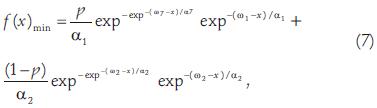
<body><![CDATA[<p align="justify"><font face="verdana" size="2">The events from each process form two separate annual minimum subpopulations can be combined to follow a distribution that reflects both sub&#150;samples.</font></p>     <p align="justify"><font face="verdana" size="2">If the EV1 distribution is used in equation 5, the mixed Gumbel distribution (EV1MIX) for the minima is</font></p>     <p align="center"><font face="verdana" size="2"><img src="/img/revistas/iit/v10n3/a7s6.jpg"></font></p>     <p align="justify"><font face="verdana" size="2">where &omega;<sub>1</sub>, <i>&alpha;<sub>1</sub> </i>and &omega;<sub>2</sub>, &alpha;<sub>2</sub> are the location and scale parameters for the first and second population. </font></p>     <p align="justify"><font face="verdana" size="2">The corresponding density function is</font></p>     <p align="center"><font face="verdana" size="2"><img src="/img/revistas/iit/v10n3/a7s7.jpg"></font></p>     <p align="justify"><font face="verdana" size="2">Parameters can be computed by the maximum likelihood procedure:</font></p>     <p align="center"><font face="verdana" size="2"><img src="/img/revistas/iit/v10n3/a7s8.jpg"></font></p>     <p align="justify"><font face="verdana" size="2">where L is called the likelihood function and ln is the natural logarithm.</font></p>     <p align="justify"><font face="verdana" size="2">Given the complexity of the resulting likelihood function and the partial de rivatives with respect to the parameters, the constrained multivariable Rosenbrock method (Kuester and Mize, 1973) was applied to obtain the estimators of the five parameters by the direct maximization of equation (8).</font></p>     ]]></body>
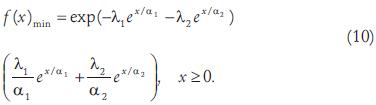
<body><![CDATA[<p align="justify"><font face="verdana" size="2">The Two Component Extreme Value distribution for the minima (TCEVMIN) is obtained by using the version for the maxima (Rossi <i>et al., </i>1984) and the symmetry principle, Gumbel (1958):</font></p>     <p align="center"><font face="verdana" size="2"><img src="/img/revistas/iit/v10n3/a7s9.jpg"></font></p>     <p align="justify"><font face="verdana" size="2">and</font></p>     <p align="center"><font face="verdana" size="2"><img src="/img/revistas/iit/v10n3/a7s10.jpg"></font></p>     <p align="justify"><font face="verdana" size="2">The parameters of the TCEVMIN distribution can be es ti ma ted from site&#150;specific data set by the direct maximization of equation (11) by using the Rosenbrock method.</font></p>     <p align="center"><font face="verdana" size="2"><img src="/img/revistas/iit/v10n3/a7s11.jpg"></font></p>     <p align="justify"><font face="verdana" size="2">A region located in southern Mexico with 39 gauging stations was selected to apply the mixed distributions to lo west 1 day flows. For each station, mixed and standard distributions were fitted and the best one was chosen according to the criterion of minimum standard error of fit (SEF), as defined by Kite (1988):</font></p>     <p align="center"><font face="verdana" size="2"><img src="/img/revistas/iit/v10n3/a7s12.jpg"></font></p>     <p align="justify"><font face="verdana" size="2">where g<i><sub>i</sub></i>; <i>i</i> = 1,..., <i>n </i>are the recorded events, <i>h<i><sub>i</sub></i>; i = </i>1,..., <i>n </i>are the events computed from the probability distribution; <i>q </i>is the number of parameters for each distribution <i>j</i>, and <i>n </i>is the length of record.</font></p>     <p align="justify"><font face="verdana" size="2">&nbsp;</font></p>     ]]></body>

<body><![CDATA[<p align="justify"><font face="verdana" size="2"><a href="/img/revistas/iit/v10n3/a7t1.jpg" target="_blank">Table 1</a> shows the available lenght of record and catchments area for each station in the region. Equatios (1), (2), (3), (4), (8) and (11) were used in order to fit all samples in the region. The corresponding SEF<sub>j</sub> were computed and the best distribution was selected according to its minimum value (<a href="/img/revistas/iit/v10n3/a7t2.jpg" target="_blank">table 2</a>).</font></p>     <p align="justify"><font face="verdana" size="2">In 2003, the <i>Comisi&oacute;n Federal de Electricidad </i>proposed the construction of La Parota Dam in the southern State of Guerrero, Mexico. The 180 m and 765&#150;megawatt dam located in the Papagayo River watershed would flood close to 17,000 hectares of land. Communities around the site of the project reconcerned because of the expected changes to the river ecosystem downstream of the dam. Major losses in fisheries could occur all the way downstream of the dam until the river's delta at the Pacific Ocean.</font></p>     <p align="justify"><font face="verdana" size="2">In order to do an integral assessment of the environmental impact associated with the hydroelectric project, it is necessary to account with an estimate of the possible ecological flow of the river. According to the one of the aquatic life criteria proposed by the United States Environmental Protection Agency (EPA, 2006), the hydrologically&#150;based design flow <sub>7</sub>Q<sub>10</sub> is obtained by using the lo west 7&#150;day average flows computed through the gauged data at station La Parota (<a href="/img/revistas/iit/v10n3/a7t3.jpg" target="_blank">table 3</a>). The EV1, GEV, W3, and mixed distributions were used to fit the sample. The corresponding SEFj and the design events for different return periods are shown in <a href="/img/revistas/iit/v10n3/a7t4.jpg" target="_blank">table 4</a>. By considering the criterion of the minimum stan dard error of fit and from an hydrological point of view, the EV1MIX distribution was selected, and the low flow <sub>7</sub>Q<sub>10</sub> = 10.4 m<sup>3</sup>/s would be the minimum condition to maintain the water quality and the aquatic life downstream of the dam.</font></p>     <p align="justify"><font face="verdana" size="2">When a short record is used, there is an increased risk that the low&#150;flow estimate will not provide adequate protection of designated uses. One way to reduce the bias or un certainty in the low&#150;flow estimate is to use a regional data set with observations from several sites. Mixed distributions can be easily used to obtain regional at&#150;site estimates of low&#150;flow by using the station&#150;year method (Cun na ne, 1988). For this purpose, there are two gauging stations ups tream of the station La Parota, called El Puente and Agua Salada, whose 7Q flows were used to obtain a regional at&#150;site quantile of the <sub>7</sub>Q<sub>10</sub> flows. The best fit was achieved through the use of the EV1MIX distribution, and the low flow <sub>7</sub>Q<sub>10 </sub>= 11.85 m<sup>3</sup>/s would be the minimum value of the discharge to maintain the conditions of water quality downstream of the dam.</font></p>     <p align="justify">&nbsp;</p>     <p align="justify"><font size="2" face="verdana"><b>Conclusions</b></font></p>     <p align="justify"><font face="verdana" size="2">In both applications the proposed mixed distributions behave very well. In the first case r sults shown that there exists a reduction in the standard error of fit when estimating the quantiles with mixed distributions (EV1MIX, 30% of cases and the TCEVMIN, 13%) in comparison with the GEV (49%), W3 (8%) and EV1(0%) distributions. In the se cond one, the best hydrological design event was obtained by using the EV1MIX distribution along with a regional technique (<sub>7</sub>Q<sub>10</sub> = 11.85 m<sup>3</sup>/s). It is very important to mention that it was not the intention of this paper to propose the final ecological flow for the hydroelectric project, but only to show the hydrological application of mixed distribution in studies of water quality.</font></p>     <p align="justify"><font face="verdana" size="2">Results indicate that mixed distributions can be considered as an additional tool when performing low&#150;flow frequency analysis.</font></p>     <p align="justify">&nbsp;</p>     <p align="justify"><font size="2" face="verdana"><b>References</b></font></p>     ]]></body>
<body><![CDATA[<!-- ref --><p align="justify"><font face="verdana" size="2">Al&#150;Mashidani G., Lal B.B., Quadri I. Drought Flow Analysis of River Tigris in Baghdad. <i>Hydrological Science Journal. </i>25(4):453&#150;459. 1980.</font>&nbsp;&nbsp;&nbsp;&nbsp;&nbsp;&nbsp;&nbsp;&nbsp;[&#160;<a href="javascript:void(0);" onclick="javascript: window.open('/scielo.php?script=sci_nlinks&ref=4247987&pid=S1405-7743200900030000700001&lng=','','width=640,height=500,resizable=yes,scrollbars=1,menubar=yes,');">Links</a>&#160;]<!-- end-ref --><!-- ref --><p align="justify"><font face="verdana" size="2">Chow V. T. <i>Handbook of Applied Hydrology. </i>Mc. Graw&#150;Hill. 1964.</font>&nbsp;&nbsp;&nbsp;&nbsp;&nbsp;&nbsp;&nbsp;&nbsp;[&#160;<a href="javascript:void(0);" onclick="javascript: window.open('/scielo.php?script=sci_nlinks&ref=4247988&pid=S1405-7743200900030000700002&lng=','','width=640,height=500,resizable=yes,scrollbars=1,menubar=yes,');">Links</a>&#160;]<!-- end-ref --><!-- ref --><p align="justify"><font face="verdana" size="2">Cunnane   C.   Methods   and   Merits of Regional Flood Frequency Analysis. <i>Journal of Hydrology,  </i>100:269&#150;290. 1988. </font>&nbsp;&nbsp;&nbsp;&nbsp;&nbsp;&nbsp;&nbsp;&nbsp;[&#160;<a href="javascript:void(0);" onclick="javascript: window.open('/scielo.php?script=sci_nlinks&ref=4247989&pid=S1405-7743200900030000700003&lng=','','width=640,height=500,resizable=yes,scrollbars=1,menubar=yes,');">Links</a>&#160;]<!-- end-ref --><!-- ref --><p align="justify"><font face="verdana" size="2">EPA. Environmental Protection Agency. July, 2006 (on line). Available on: <a href="http://www.epa.gov/" target="_blank">www.epa.gov</a></font>&nbsp;&nbsp;&nbsp;&nbsp;&nbsp;&nbsp;&nbsp;&nbsp;[&#160;<a href="javascript:void(0);" onclick="javascript: window.open('/scielo.php?script=sci_nlinks&ref=4247990&pid=S1405-7743200900030000700004&lng=','','width=640,height=500,resizable=yes,scrollbars=1,menubar=yes,');">Links</a>&#160;]<!-- end-ref --><!-- ref --><p align="justify"><font face="verdana" size="2">Gumbel E.J. <i>Statistics of Extremes. </i>Columbia University Press. New York. USA. 1958. </font>&nbsp;&nbsp;&nbsp;&nbsp;&nbsp;&nbsp;&nbsp;&nbsp;[&#160;<a href="javascript:void(0);" onclick="javascript: window.open('/scielo.php?script=sci_nlinks&ref=4247991&pid=S1405-7743200900030000700005&lng=','','width=640,height=500,resizable=yes,scrollbars=1,menubar=yes,');">Links</a>&#160;]<!-- end-ref --><!-- ref --><p align="justify"><font face="verdana" size="2">Kite G.W. <i>Frequency and Risk Analyses in Hydrology. </i>Water Resources Publications. USA. 1988. 257 p.</font>&nbsp;&nbsp;&nbsp;&nbsp;&nbsp;&nbsp;&nbsp;&nbsp;[&#160;<a href="javascript:void(0);" onclick="javascript: window.open('/scielo.php?script=sci_nlinks&ref=4247992&pid=S1405-7743200900030000700006&lng=','','width=640,height=500,resizable=yes,scrollbars=1,menubar=yes,');">Links</a>&#160;]<!-- end-ref --><!-- ref --><p align="justify"><font face="verdana" size="2">Kroll Ch., Vogel R. Probability Distribution of Low Stream Flow Series in the United States. <i>Journal of Hydrologic Engi</i><i>neering, </i>7(2):137&#150;146. 2002.</font>&nbsp;&nbsp;&nbsp;&nbsp;&nbsp;&nbsp;&nbsp;&nbsp;[&#160;<a href="javascript:void(0);" onclick="javascript: window.open('/scielo.php?script=sci_nlinks&ref=4247993&pid=S1405-7743200900030000700007&lng=','','width=640,height=500,resizable=yes,scrollbars=1,menubar=yes,');">Links</a>&#160;]<!-- end-ref --><!-- ref --><p align="justify"><font face="verdana" size="2">Kuester   J.L., Mize J.H. <i>Optimization  Techniques with </i><i>FORTRAN. </i>McGraw&#150;Hill Book Co. New York, 1973. Pp. 386&#150;398.</font>&nbsp;&nbsp;&nbsp;&nbsp;&nbsp;&nbsp;&nbsp;&nbsp;[&#160;<a href="javascript:void(0);" onclick="javascript: window.open('/scielo.php?script=sci_nlinks&ref=4247994&pid=S1405-7743200900030000700008&lng=','','width=640,height=500,resizable=yes,scrollbars=1,menubar=yes,');">Links</a>&#160;]<!-- end-ref --><!-- ref --><p align="justify"><font face="verdana" size="2">Mood A. , Graybill F., Boes D. <i>Introduction to the Theory of Statistics. </i>McGraw&#150;Hill. 1974. </font>&nbsp;&nbsp;&nbsp;&nbsp;&nbsp;&nbsp;&nbsp;&nbsp;[&#160;<a href="javascript:void(0);" onclick="javascript: window.open('/scielo.php?script=sci_nlinks&ref=4247995&pid=S1405-7743200900030000700009&lng=','','width=640,height=500,resizable=yes,scrollbars=1,menubar=yes,');">Links</a>&#160;]<!-- end-ref --><!-- ref --><p align="justify"><font face="verdana" size="2">Onoz B., Bayazit M. GEV&#150;PWM Model for Distribution of Minimum Flows.   <i>Journal   of  Hydrologic   Engineering, </i>4(3):289&#150;292. 1999.</font>&nbsp;&nbsp;&nbsp;&nbsp;&nbsp;&nbsp;&nbsp;&nbsp;[&#160;<a href="javascript:void(0);" onclick="javascript: window.open('/scielo.php?script=sci_nlinks&ref=4247996&pid=S1405-7743200900030000700010&lng=','','width=640,height=500,resizable=yes,scrollbars=1,menubar=yes,');">Links</a>&#160;]<!-- end-ref --><!-- ref --><p align="justify"><font face="verdana" size="2">Pearson C.P. Regional Frequency Analysis of Low Flows in New Zealand Rivers. <i>Journal of Hydrology, </i>30(2): 53&#150;64. 1995.</font>&nbsp;&nbsp;&nbsp;&nbsp;&nbsp;&nbsp;&nbsp;&nbsp;[&#160;<a href="javascript:void(0);" onclick="javascript: window.open('/scielo.php?script=sci_nlinks&ref=4247997&pid=S1405-7743200900030000700011&lng=','','width=640,height=500,resizable=yes,scrollbars=1,menubar=yes,');">Links</a>&#160;]<!-- end-ref --><!-- ref --><p align="justify"><font face="verdana" size="2">Pyrce R.S. <i>Hydrological Low Flows Indices and their Uses. </i>WSC Report No. 04&#150;2004. Watershed Science Centre. Peterborough. Ontario. 2004. 33 p.</font>&nbsp;&nbsp;&nbsp;&nbsp;&nbsp;&nbsp;&nbsp;&nbsp;[&#160;<a href="javascript:void(0);" onclick="javascript: window.open('/scielo.php?script=sci_nlinks&ref=4247998&pid=S1405-7743200900030000700012&lng=','','width=640,height=500,resizable=yes,scrollbars=1,menubar=yes,');">Links</a>&#160;]<!-- end-ref --><!-- ref --><p align="justify"><font face="verdana" size="2">Raynal J.A. Computation of Probability Weighted Moments Estimators for the Parameters of the General Extreme Value Distribution (Maxima and Minima). <i>Hydrological </i><i>Science and Technology, </i>3(1&#150;4):47&#150;52. 1987.</font>&nbsp;&nbsp;&nbsp;&nbsp;&nbsp;&nbsp;&nbsp;&nbsp;[&#160;<a href="javascript:void(0);" onclick="javascript: window.open('/scielo.php?script=sci_nlinks&ref=4247999&pid=S1405-7743200900030000700013&lng=','','width=640,height=500,resizable=yes,scrollbars=1,menubar=yes,');">Links</a>&#160;]<!-- end-ref --><!-- ref --><p align="justify"><font face="verdana" size="2">Rossi F., Fiorentino M., Versace P. Two Component Extreme Value Distribution for Flood Frequency Analysis. <i>Water </i><i>Resources Research, </i>20(7):847&#150;856. 1984.</font>&nbsp;&nbsp;&nbsp;&nbsp;&nbsp;&nbsp;&nbsp;&nbsp;[&#160;<a href="javascript:void(0);" onclick="javascript: window.open('/scielo.php?script=sci_nlinks&ref=4248000&pid=S1405-7743200900030000700014&lng=','','width=640,height=500,resizable=yes,scrollbars=1,menubar=yes,');">Links</a>&#160;]<!-- end-ref --><!-- ref --><p align="justify"><font face="verdana" size="2">Smakhtin V. Low Flow Hydrology:  a Review. <i>Journal of </i><i>Hydrology, </i>240(3&#150;4):147&#150;186. 2001.</font>&nbsp;&nbsp;&nbsp;&nbsp;&nbsp;&nbsp;&nbsp;&nbsp;[&#160;<a href="javascript:void(0);" onclick="javascript: window.open('/scielo.php?script=sci_nlinks&ref=4248001&pid=S1405-7743200900030000700015&lng=','','width=640,height=500,resizable=yes,scrollbars=1,menubar=yes,');">Links</a>&#160;]<!-- end-ref --><!-- ref --><p align="justify"><font face="verdana" size="2">Waylen P.R., Woo M. Annual Low Flows Generated by Mixed Processes. <i>Hydrological Science Journal, </i>32(3):371&#150;383. 1987.</font>&nbsp;&nbsp;&nbsp;&nbsp;&nbsp;&nbsp;&nbsp;&nbsp;[&#160;<a href="javascript:void(0);" onclick="javascript: window.open('/scielo.php?script=sci_nlinks&ref=4248002&pid=S1405-7743200900030000700016&lng=','','width=640,height=500,resizable=yes,scrollbars=1,menubar=yes,');">Links</a>&#160;]<!-- end-ref --><p align="justify"><font face="verdana" size="2">&nbsp;</font></p>     <p align="justify"><font face="verdana" size="2"><b>About author</b></font></p>     <p align="justify"><font face="verdana" size="2"><i>Carlos Agust&iacute;n Escalante&#150;Sandoval. </i>Civil Engineer (BUAP, 1985), M in S with major in Water Resources (UNAM, 1988), Ph D with major in Hydraulics (UNAM, 1991). He was Head of Hydraulics Department up to 2007 and currently Head of Civil Engineering Graduated Department, both in the Faculty of Engineering at UNAM. He has been granted some academic and scientific prizes such as the Gabino Barreda Medal in 1991 by UNAM and the Prize for Research "Enzo Levi" in 2000 by the Mexican Association of Hydraulics. He has been member of the American Society of Civil Engineers, the American Water Resources Association, The American Geophysical Union, the New York Academy of Sciences, the Mexican Academy of Sciences, the Mexican Academy of Engineering and the National System of Researches.</font></p>      ]]></body><back>
<ref-list>
<ref id="B1">
<nlm-citation citation-type="journal">
<person-group person-group-type="author">
<name>
<surname><![CDATA[Al-Mashidani]]></surname>
<given-names><![CDATA[G]]></given-names>
</name>
<name>
<surname><![CDATA[Lal]]></surname>
<given-names><![CDATA[B.B.]]></given-names>
</name>
</person-group>
<article-title xml:lang="en"><![CDATA[Quadri I. Drought Flow Analysis of River Tigris in Baghdad]]></article-title>
<source><![CDATA[Hydrological Science Journal]]></source>
<year>1980</year>
<volume>25</volume>
<numero>4</numero>
<issue>4</issue>
<page-range>453-459</page-range></nlm-citation>
</ref>
<ref id="B2">
<nlm-citation citation-type="book">
<person-group person-group-type="author">
<name>
<surname><![CDATA[Chow]]></surname>
<given-names><![CDATA[V. T.]]></given-names>
</name>
</person-group>
<source><![CDATA[Handbook of Applied Hydrology]]></source>
<year>1964</year>
<publisher-name><![CDATA[Mc. Graw-Hill]]></publisher-name>
</nlm-citation>
</ref>
<ref id="B3">
<nlm-citation citation-type="journal">
<person-group person-group-type="author">
<name>
<surname><![CDATA[Cunnane]]></surname>
<given-names><![CDATA[C]]></given-names>
</name>
</person-group>
<article-title xml:lang="en"><![CDATA[Methods and Merits of Regional Flood Frequency Analysis]]></article-title>
<source><![CDATA[Journal of Hydrology]]></source>
<year>1988</year>
<volume>100</volume>
<page-range>269-290</page-range></nlm-citation>
</ref>
<ref id="B4">
<nlm-citation citation-type="">
<collab>EPA. Environmental Protection Agency</collab>
<source><![CDATA[]]></source>
<year>July</year>
<month>, </month>
<day>20</day>
</nlm-citation>
</ref>
<ref id="B5">
<nlm-citation citation-type="book">
<person-group person-group-type="author">
<name>
<surname><![CDATA[Gumbel]]></surname>
<given-names><![CDATA[E.J.]]></given-names>
</name>
</person-group>
<source><![CDATA[Statistics of Extremes]]></source>
<year>1958</year>
<publisher-loc><![CDATA[New York ]]></publisher-loc>
<publisher-name><![CDATA[Columbia University Press]]></publisher-name>
</nlm-citation>
</ref>
<ref id="B6">
<nlm-citation citation-type="book">
<person-group person-group-type="author">
<name>
<surname><![CDATA[Kite]]></surname>
<given-names><![CDATA[G.W.]]></given-names>
</name>
</person-group>
<source><![CDATA[Frequency and Risk Analyses in Hydrology]]></source>
<year>1988</year>
<page-range>257</page-range><publisher-name><![CDATA[Water Resources Publications]]></publisher-name>
</nlm-citation>
</ref>
<ref id="B7">
<nlm-citation citation-type="journal">
<person-group person-group-type="author">
<name>
<surname><![CDATA[Kroll]]></surname>
<given-names><![CDATA[Ch.]]></given-names>
</name>
<name>
<surname><![CDATA[Vogel]]></surname>
<given-names><![CDATA[R]]></given-names>
</name>
</person-group>
<article-title xml:lang="en"><![CDATA[Probability Distribution of Low Stream Flow Series in the United States]]></article-title>
<source><![CDATA[Journal of Hydrologic Engineering]]></source>
<year>2002</year>
<volume>7</volume>
<numero>2</numero>
<issue>2</issue>
<page-range>137-146</page-range></nlm-citation>
</ref>
<ref id="B8">
<nlm-citation citation-type="book">
<person-group person-group-type="author">
<name>
<surname><![CDATA[Kuester]]></surname>
<given-names><![CDATA[J.L.]]></given-names>
</name>
<name>
<surname><![CDATA[Mize]]></surname>
<given-names><![CDATA[J.H.]]></given-names>
</name>
</person-group>
<source><![CDATA[Optimization Techniques with FORTRAN]]></source>
<year>1973</year>
<page-range>386-398</page-range><publisher-loc><![CDATA[New York ]]></publisher-loc>
<publisher-name><![CDATA[McGraw-Hill Book Co.]]></publisher-name>
</nlm-citation>
</ref>
<ref id="B9">
<nlm-citation citation-type="book">
<person-group person-group-type="author">
<name>
<surname><![CDATA[Mood]]></surname>
<given-names><![CDATA[A]]></given-names>
</name>
<name>
<surname><![CDATA[Graybill]]></surname>
<given-names><![CDATA[F]]></given-names>
</name>
<name>
<surname><![CDATA[Boes]]></surname>
<given-names><![CDATA[D]]></given-names>
</name>
</person-group>
<source><![CDATA[Introduction to the Theory of Statistics]]></source>
<year>1974</year>
<publisher-name><![CDATA[McGraw-Hill]]></publisher-name>
</nlm-citation>
</ref>
<ref id="B10">
<nlm-citation citation-type="journal">
<person-group person-group-type="author">
<name>
<surname><![CDATA[Onoz]]></surname>
<given-names><![CDATA[B]]></given-names>
</name>
<name>
<surname><![CDATA[Bayazit]]></surname>
<given-names><![CDATA[M]]></given-names>
</name>
</person-group>
<article-title xml:lang="en"><![CDATA[GEV-PWM Model for Distribution of Minimum Flows]]></article-title>
<source><![CDATA[Journal of Hydrologic Engineering]]></source>
<year>1999</year>
<volume>4</volume>
<numero>3</numero>
<issue>3</issue>
<page-range>289-292</page-range></nlm-citation>
</ref>
<ref id="B11">
<nlm-citation citation-type="journal">
<person-group person-group-type="author">
<name>
<surname><![CDATA[Pearson]]></surname>
<given-names><![CDATA[C.P.]]></given-names>
</name>
</person-group>
<article-title xml:lang="en"><![CDATA[Regional Frequency Analysis of Low Flows in New Zealand Rivers]]></article-title>
<source><![CDATA[Journal of Hydrology]]></source>
<year>1995</year>
<volume>30</volume>
<numero>2</numero>
<issue>2</issue>
<page-range>53-64</page-range></nlm-citation>
</ref>
<ref id="B12">
<nlm-citation citation-type="book">
<person-group person-group-type="author">
<name>
<surname><![CDATA[Pyrce]]></surname>
<given-names><![CDATA[R.S.]]></given-names>
</name>
</person-group>
<source><![CDATA[Hydrological Low Flows Indices and their Uses]]></source>
<year>2004</year>
<page-range>33</page-range><publisher-loc><![CDATA[Peterborough^eOntario Ontario]]></publisher-loc>
<publisher-name><![CDATA[Watershed Science Centre]]></publisher-name>
</nlm-citation>
</ref>
<ref id="B13">
<nlm-citation citation-type="journal">
<person-group person-group-type="author">
<name>
<surname><![CDATA[Raynal]]></surname>
<given-names><![CDATA[J.A.]]></given-names>
</name>
</person-group>
<article-title xml:lang="en"><![CDATA[Computation of Probability Weighted Moments Estimators for the Parameters of the General Extreme Value Distribution (Maxima and Minima)]]></article-title>
<source><![CDATA[Hydrological Science and Technology]]></source>
<year>1987</year>
<volume>3</volume>
<numero>1-4</numero>
<issue>1-4</issue>
<page-range>47-52</page-range></nlm-citation>
</ref>
<ref id="B14">
<nlm-citation citation-type="journal">
<person-group person-group-type="author">
<name>
<surname><![CDATA[Rossi]]></surname>
<given-names><![CDATA[F]]></given-names>
</name>
<name>
<surname><![CDATA[Fiorentino]]></surname>
<given-names><![CDATA[M]]></given-names>
</name>
<name>
<surname><![CDATA[Versace]]></surname>
<given-names><![CDATA[P]]></given-names>
</name>
</person-group>
<article-title xml:lang="en"><![CDATA[Two Component Extreme Value Distribution for Flood Frequency Analysis]]></article-title>
<source><![CDATA[Water Resources Research]]></source>
<year>1984</year>
<volume>20</volume>
<numero>7</numero>
<issue>7</issue>
<page-range>847-856</page-range></nlm-citation>
</ref>
<ref id="B15">
<nlm-citation citation-type="journal">
<person-group person-group-type="author">
<name>
<surname><![CDATA[Smakhtin]]></surname>
<given-names><![CDATA[V.]]></given-names>
</name>
</person-group>
<article-title xml:lang="en"><![CDATA[Low Flow Hydrology: a Review]]></article-title>
<source><![CDATA[Journal of Hydrology]]></source>
<year>2001</year>
<volume>240</volume>
<numero>3-4</numero>
<issue>3-4</issue>
<page-range>147-186</page-range></nlm-citation>
</ref>
<ref id="B16">
<nlm-citation citation-type="journal">
<person-group person-group-type="author">
<name>
<surname><![CDATA[Waylen]]></surname>
<given-names><![CDATA[P.R.]]></given-names>
</name>
<name>
<surname><![CDATA[Woo]]></surname>
<given-names><![CDATA[M]]></given-names>
</name>
</person-group>
<article-title xml:lang="en"><![CDATA[Annual Low Flows Generated by Mixed Processes]]></article-title>
<source><![CDATA[Hydrological Science Journal]]></source>
<year>1987</year>
<volume>32</volume>
<numero>3</numero>
<issue>3</issue>
<page-range>371-383</page-range></nlm-citation>
</ref>
</ref-list>
</back>
</article>