<?xml version="1.0" encoding="ISO-8859-1"?><article xmlns:mml="http://www.w3.org/1998/Math/MathML" xmlns:xlink="http://www.w3.org/1999/xlink" xmlns:xsi="http://www.w3.org/2001/XMLSchema-instance">
<front>
<journal-meta>
<journal-id>1405-7743</journal-id>
<journal-title><![CDATA[Ingeniería, investigación y tecnología]]></journal-title>
<abbrev-journal-title><![CDATA[Ing. invest. y tecnol.]]></abbrev-journal-title>
<issn>1405-7743</issn>
<publisher>
<publisher-name><![CDATA[Universidad Nacional Autónoma de México, Facultad de Ingeniería]]></publisher-name>
</publisher>
</journal-meta>
<article-meta>
<article-id>S1405-77432008000300004</article-id>
<title-group>
<article-title xml:lang="en"><![CDATA[Single and multi-objective optimization of path placement for redundant robotic manipulators]]></article-title>
<article-title xml:lang="es"><![CDATA[Optimización mono-objetivo y multi-objetivo del emplazamiento de trayectorias de robots manipuladores redundantes]]></article-title>
</title-group>
<contrib-group>
<contrib contrib-type="author">
<name>
<surname><![CDATA[Pamanes-García]]></surname>
<given-names><![CDATA[J.A.]]></given-names>
</name>
<xref ref-type="aff" rid="A01"/>
</contrib>
<contrib contrib-type="author">
<name>
<surname><![CDATA[Cuan-Durón]]></surname>
<given-names><![CDATA[E.]]></given-names>
</name>
<xref ref-type="aff" rid="A01"/>
</contrib>
<contrib contrib-type="author">
<name>
<surname><![CDATA[Zeghloul]]></surname>
<given-names><![CDATA[S.]]></given-names>
</name>
<xref ref-type="aff" rid="A02"/>
</contrib>
</contrib-group>
<aff id="A01">
<institution><![CDATA[,Instituto Tecnológico de la Laguna Dept. of Electric and Electronic Engineering ]]></institution>
<addr-line><![CDATA[Torreón Coahuila]]></addr-line>
<country>México</country>
</aff>
<aff id="A02">
<institution><![CDATA[,Université de Poitiers-Faculté des Sciences Laboratoire de Mécanique des Solides ]]></institution>
<addr-line><![CDATA[ ]]></addr-line>
<country>France</country>
</aff>
<pub-date pub-type="pub">
<day>00</day>
<month>09</month>
<year>2008</year>
</pub-date>
<pub-date pub-type="epub">
<day>00</day>
<month>09</month>
<year>2008</year>
</pub-date>
<volume>9</volume>
<numero>3</numero>
<fpage>231</fpage>
<lpage>257</lpage>
<copyright-statement/>
<copyright-year/>
<self-uri xlink:href="http://www.scielo.org.mx/scielo.php?script=sci_arttext&amp;pid=S1405-77432008000300004&amp;lng=en&amp;nrm=iso"></self-uri><self-uri xlink:href="http://www.scielo.org.mx/scielo.php?script=sci_abstract&amp;pid=S1405-77432008000300004&amp;lng=en&amp;nrm=iso"></self-uri><self-uri xlink:href="http://www.scielo.org.mx/scielo.php?script=sci_pdf&amp;pid=S1405-77432008000300004&amp;lng=en&amp;nrm=iso"></self-uri><abstract abstract-type="short" xml:lang="en"><p><![CDATA[General formulations are presented in this paper to determine the best position and orientation of a desired path to be followed by a redundant manipulator. Two classes of problem are considered. In the first, a single manipulator's index of kinematic performance associated to one path point must be improved as much as possible. In the second case distinct indices of kinematic performance, corresponding to different points of the path, are to be optimized. Constraints are taken into account in order to guarantee the accessibility to the whole de sired task. Several case studies are presented to illustrate the effectiveness of the method for planar and spatial manipulators.]]></p></abstract>
<abstract abstract-type="short" xml:lang="es"><p><![CDATA[En este artículo se presentan formulaciones generales para determinar la mejor posición y orientación de una ruta que se desea que recorra el órgano terminal de un manipulador redundante. Se consideran dos clases de problemas. En el primer caso un índice de desempeño cinemático, asociado a un solo punto de la trayectoria, debe mejorarse tanto como sea posible. En el segundo caso se optimizan distintos índices de desempeño cinemático, correspondientes a diferentes puntos de la ruta deseada. Se consideran restricciones para garantizar la accesibilidad a toda la ruta deseada. Para ilustrar la efectividad del método se presentan varios casos de estudio de manipuladores planares y espaciales.]]></p></abstract>
<kwd-group>
<kwd lng="en"><![CDATA[Optimization]]></kwd>
<kwd lng="en"><![CDATA[redundant manipulators]]></kwd>
<kwd lng="en"><![CDATA[path placement]]></kwd>
<kwd lng="en"><![CDATA[motion planning]]></kwd>
<kwd lng="en"><![CDATA[kinematic performances]]></kwd>
<kwd lng="es"><![CDATA[Optimización]]></kwd>
<kwd lng="es"><![CDATA[manipuladores redundantes]]></kwd>
<kwd lng="es"><![CDATA[colocación de trayectorias]]></kwd>
<kwd lng="es"><![CDATA[planificación de movimientos]]></kwd>
<kwd lng="es"><![CDATA[desempeño cinemático]]></kwd>
</kwd-group>
</article-meta>
</front><body><![CDATA[ <p align="justify"><font face="verdana" size="4">Estudios e investigaciones recientes</font></p>      <p align="justify"><font face="verdana" size="2">&nbsp;</font></p>      <p align="center"><font face="verdana" size="4"><b>Single and   multi&#150;objective  optimization   of  path  placement for redundant robotic manipulators</b></font></p>      <p align="center"><font face="verdana" size="2">&nbsp;</font></p>      <p align="center"><font face="verdana" size="3"><b>Optimizaci&oacute;n mono&#150;objetivo y  multi&#150;objetivo del emplazamiento de  trayectorias de   robots  manipuladores redundantes</b></font></p>      <p align="justify"><font face="verdana" size="2">&nbsp;</font></p>      <p align="center"><font face="verdana" size="2"><b>J.A. Pamanes&#150;Garc&iacute;a<sup>1</sup>, E. Cuan&#150;Dur&oacute;n<sup>1</sup> and S. Zeghloul<sup>2</sup></b></font></p>      <p align="justify"><font face="verdana" size="2">&nbsp;</font></p>      <p align="justify"><font face="verdana" size="2"><i><sup>1</sup> Instituto Tecnol&oacute;gico de la Laguna, Dept. of Electric and Electronic Engineering, Torre&oacute;n, Coahuila, M&eacute;xico E&#150;mails: </i><a href="mailto:apamanes@itlalaguna.edu.mx">apamanes@itlalaguna.edu.mx</a>, <a href="mailto:kcuan@itlalaguna.edu.mx">kcuan@itlalaguna.edu.mx</a><i> and</i></font></p>      <p align="justify"><font face="verdana" size="2"><i><sup>2</sup> Universit&eacute; de Poitiers&#150;Facult&eacute; des Sciences, Laboratoire de M&eacute;canique des Solides, CEDEX &#150; France E&#150;mail: </i><a href="mailto:Said.Zeghloul@lms.univ&#150;poitiers.fr">Said.Zeghloul@lms.univ-poitiers.fr</a></font></p>      ]]></body>
<body><![CDATA[<p align="justify"><font face="verdana" size="2">&nbsp;</font></p>      <p align="justify"><font face="verdana" size="2">Recibido: febrero de 2007    <br>   Aceptado: octubre de 2007</font></p>      <p align="justify"><font face="verdana" size="2">&nbsp;</font></p>      <p align="justify"><font face="verdana" size="2"><b><i>Abstract</i></b></font></p>      <p align="justify"><font face="verdana" size="2"><i>General formulations are presented in this paper to determine the best position and orientation of a desired path to be followed by a redundant manipulator. Two classes of problem are considered. In the first, a single manipulator's index of kinematic performance associated to one path point must be improved as much as possible. In the second case distinct indices of kinematic performance, corresponding to different points of the path, are to be optimized. Constraints are taken into account in order to guarantee the accessibility to the whole de sired task. Several case studies are presented to illustrate the effectiveness of the method for planar and spatial manipulators.</i></font></p>      <p align="justify"><font face="verdana" size="2"><b><i>Keywords: </i></b><i>Optimization, redundant manipulators, path placement, motion planning, kinematic performances.</i></font></p>      <p align="justify"><font face="verdana" size="2">&nbsp;</font></p>      <p align="justify"><font face="verdana" size="2"><b>Resumen</b></font></p>      <p align="justify"><font face="verdana" size="2">En este art&iacute;culo se presentan formulaciones generales para determinar la mejor posici&oacute;n y orientaci&oacute;n de una ruta que se desea que recorra el &oacute;rgano terminal de un manipulador redundante. Se consideran dos clases de problemas. En el primer caso un &iacute;ndice de desempe&ntilde;o cinem&aacute;tico, asociado a un solo punto de la trayectoria, debe mejorarse tanto como sea posible. En el segundo caso se optimizan distintos &iacute;ndices de desempe&ntilde;o cinem&aacute;tico, correspondientes a diferentes puntos de la ruta deseada. Se consideran restricciones para garantizar la accesibilidad a toda la ruta deseada. Para ilustrar la efectividad del m&eacute;todo se presentan varios casos de estudio de manipuladores planares y espaciales.</font></p>      ]]></body>
<body><![CDATA[<p align="justify"><font face="verdana" size="2"><b>Descriptores: </b>Optimizaci&oacute;n, manipuladores redundantes, colocaci&oacute;n de trayectorias, planificaci&oacute;n de movimientos, desempe&ntilde;o cinem&aacute;tico.</font></p>      <p align="justify"><font face="verdana" size="2">&nbsp;</font></p>      <p align="justify"><font face="verdana" size="2"><b>I. Introduction</b></font></p>      <p align="justify"><font face="verdana" size="2">A robot manipulator is kinematically redundant if it  has more de gree&#150;of&#150;freedom (dof) than the minimum required for the accomplishment of its tasks. </font></p>      <p align="justify"><font face="verdana" size="2">The redundancy increases the ability of the robot to avoid collisions as well as singular or degenerated configurations when a task is carried out. However, this class of manipulators requires more complex schemes for motion planning compared with non redundant manipulators. Indeed, a redundant manipulator should move in such a way that the end&#150;effector achieves a desired main task and the rest of the arm simultaneously accomplishes a secondary task. The secondary task may be defined as internal motions to optimize manipulator's performances, or to avoid collisions. The kinematic performances can be measured in terms of criteria chosen by the user, like the manipulability (Yoshikawa , 1985) or the condition number (Angeles et al., 1992) of the Jacobian matrix, which are interesting in certain applications.</font></p>      <p align="justify"><font face="verdana" size="2">The redundancy of manipulators has been solved in the literature by optimizing locally (Yoshikawa <i>et al., </i>1989), (Chiu, 1988) or globally (Nenchev, 1996), (Nakamura et al., 1987), (Pamanes et al., 1999) the kinematic or dynamic performances. In such works it is assumed that the path placement is specified with respect to the robot's frame. Therefore, the performances of the manipulator obtained by applying these methods are relative to the assumed path location. Nevertheless, in some applications, the user could find a suitable path location to improve as much as possible the robot's performances. An automatic turning table or a collaborative manipulator can be used as positioner devices in the robotic workstation to judiciously place the task to the main robot.</font></p>      <p align="justify"><font face="verdana" size="2">The subject of the optimal relative robot/path placement has been studied in the literature mainly for non&#150;redundant manipulators (Zhou et al., 1997), (Nelson et al., 1987), (Fardanesh et al., 1988), (Pamanes, 1989), (Pamanes et al., 1991), (Reynier et al., 1992), (Abdel&#150;Malek, 2000). To the author's knowledge, only <i>J.S. Hemmerle </i>and <i>F.B. Prinz </i>(Hemerle et al., 1991) considered the problem of the optimal path placement for redundant manipulators; in this study, it is assumed that the task is held by a collaborative manipulator (left <i>hand) </i>moving simultaneously with the main manipulator <i>(right hand) </i>which drives the tool. Two criteria of optimization were simultaneously considered: the joint variables were moved away from their limit values as much as possible and the joint displacements were minimized. In that method, however, constraints were not taken into account to assure continuous joint trajectories. On the other hand, the case was not studied in which the task doesn't move simultaneously with the main manipulator; besides, the optimization of kinematic performances on specific zones of the path was neither investigated. The resolution of both problems becomes interesting in industrial applications.</font></p>      <p align="justify"><font face="verdana" size="2">Two cases of optimal path placement are studied in this paper for redundant manipulators. In the former <i>(single&#150;objective problem) </i>we formulate a process to compute the path placement which allows to optimize one index of kinematic performance of the manipulator on only one point of the desired path. In the second case <i>(multi&#150;objective problem) </i>we compute the path placement such that distinct indices of kinematic performance are optimized on different zones of the path. Constraints are taken into account in order to avoid both exceed the joint limits and discontinuous joint trajectories.</font></p>      <p align="justify"><font face="verdana" size="2">In the next section some concepts of robot kinematics are evoked which are later applied in our formulations. A solution is presented in the third section for the single&#150;objective problem and then, in the fourth part of the paper, the multi&#150;objective problem is studied. The generalization of our formulations to solve the case of global optimization is observed in the fifth section. Some case studies are discussed to illustrate the effectiveness of the methods for both planar and spatial manipulators. The concluding remarks are finally presented.</font></p>      <p align="justify"><font face="verdana" size="2">&nbsp;</font></p>      ]]></body>
<body><![CDATA[<p align="justify"><font face="verdana" size="2"><b>II. Preliminaries</b></font></p>      <p align="justify"><font face="verdana" size="2">The kinematic function of a robot manipulator is defined as:</font></p>      <p align="justify"><font face="verdana" size="2"><b>x = <i> f(q)</i></b> <i>&nbsp; &nbsp; &nbsp; &nbsp; &nbsp; &nbsp; &nbsp; &nbsp; &nbsp; &nbsp; &nbsp; &nbsp;</i>(1)</font></p>      <p align="justify"><font face="verdana" size="2">where <b>x</b> is the m&#150;dimensional vector of operational coordinates describing the situation of the end&#150;effector in the Cartesian space; <i><b>q</b> </i>is the n&#150;dimensional vector of joint variables defining the instantaneous configuration of the manipulator; <i><b>f</b> </i>is an m&#150;dimensional function <i>(n <u>&gt;</u> m).</i></font></p>      <p align="justify"><font face="verdana" size="2">The inverse kinematic function of a manipulator, if it exists, is given by</font></p>      <p align="justify"><font face="verdana" size="2"><b><i>q = f<sup> &#150;1</sup>(x)</i></b> <i>&nbsp; &nbsp; &nbsp; &nbsp; &nbsp; &nbsp; &nbsp; &nbsp; &nbsp; &nbsp; &nbsp; &nbsp;</i>(2)</font></p>      <p align="justify"><font face="verdana" size="2">The direct velocity function of a robot manipulator is obtained by differentiation of equation 1:</font></p>      <p align="justify"><font face="verdana" size="2"><img src="/img/revistas/iit/v9n3/a4s1.jpg"></font></p>      <p align="justify"><font face="verdana" size="2">where the dot denotes differentiation with respect to time and <i><img src="/img/revistas/iit/v9n3/a4s2.jpg"> </i>is the Jacobian matrix of the manipulator. When the number <i>n </i>of joint variables <i>q<sub>i</sub> </i>of a manipulator is equal to the number <i>m </i>of operational coordinates x<i><sub>j </sub></i>of the end effector, then the manipulator is called <i>non redundant. </i>On the other hand, when <i>n &gt; m </i>the manipulator is termed redundant. In this case the inverse kinematic function of equation (2) has an infinite number of solutions.</font></p>      <p align="justify"><font face="verdana" size="2">The inverse velocity function of a manipulator is obtained from equation 3 as</font></p>      ]]></body>
<body><![CDATA[<p align="justify"><font face="verdana" size="2"><img src="/img/revistas/iit/v9n3/a4s3.jpg"></font></p>      <p align="justify"><font face="verdana" size="2">If <b><i>J (q) </i></b>is singular or <i>n &gt; m </i>then the inverse <i><b>J</b> <sup>&#150;1</sup>(<b>q</b>) </i>does not exists and the linear system of equation (3) cannot be solved by using equation (4). In such a case the inverse velocity function may be expressed as</font></p>      <p align="justify"><font face="verdana" size="2"><img src="/img/revistas/iit/v9n3/a4s4.jpg"></font></p>      <p align="justify"><font face="verdana" size="2">where</font></p>      <p align="justify"><font face="verdana" size="2"><i><b>J</b><sup>+</sup> </i>is the pseudo&#150;inverse of <i><b>J</b> (in order to simplify the terms in this paper <b>J</b>(<b>q</b>) will be equivalent to <b>J</b>).</i></font></p>      <p align="justify"><font face="verdana" size="2"><i><b>z</b> is an arbitrary vector </i><img src="/img/revistas/iit/v9n3/a4s5.jpg">.</font></p>      <p align="justify"><font face="verdana" size="2"><b><i>I</i></b> is the identity matrix of dimension n'n.</font></p>      <p align="justify"><font face="verdana" size="2">In equation (5), <i><img src="/img/revistas/iit/v9n3/a4s6.jpg"> </i>is the <i>least&#150;norm solution </i>of equation (3), i.e., it provides a vector with minimum Euclidean norm satisfying this Equation. On the other hand, <i>(<b>I&#150;J<sup>+</sup> J</b>) <b>z</b></i> represents the projection of <b>z</b> on the null&#150;space of <i><b>J</b>; </i>this part is called the <i>homogeneous solution </i>of equation (3); it is referred to as the self&#150;motion of the manipulator and does not cause any end&#150;effector motion. In order to use the self&#150;motion to improve configurations, the vector <i><b>z</b></i> is chosen as</font></p>      <p align="justify"><font face="verdana" size="2"><img src="/img/revistas/iit/v9n3/a4s7.jpg"></font></p>      <p align="justify"><font face="verdana" size="2">where</font></p>     ]]></body>
<body><![CDATA[<p align="justify"><font face="verdana" size="2"><img src="/img/revistas/iit/v9n3/a4s8.jpg"><i>h(<b>q</b>) </i>is the  gradient of an index of performance <i>h(<b>q</b>) </i>to be optimized.</font></p>     <p align="justify"><font face="verdana" size="2">k is a scaling factor of <i><img src="/img/revistas/iit/v9n3/a4s8.jpg">h(<b>q</b>). </i>It is taken to be positive if <i>h(<b>q</b>) </i>must be maximized and negative if <i>h(<b>q</b>) </i>is to be minimized.</font></p>     <p align="justify"><font face="verdana" size="2">Several criteria of kinematic performances for manipulators have been proposed in the literature, which can be considered for the index <i>h(<b>q</b>) </i>in equation (6). Each of such indices evaluates different kinematic features of a manipulator, which may be interesting depending on the nature of the task to be carried out. A succinct survey of two indices of performance is presented below. Such indices, the <i>manipulability </i>and the <i>condition number </i>of the jacobian matrix, will be applied as criteria of optimization to solve the path placement problems in section VI.</font></p>     <p align="justify"><font face="verdana" size="2">The <i>manipulability </i>index, introduced by Yoshikawa (1985), is defined as</font></p>     <p align="justify"><font face="verdana" size="2"><img src="/img/revistas/iit/v9n3/a4s9.jpg"></font></p>     <p align="justify"><font face="verdana" size="2">The manipulability is a measure of the ability to arbitrarily change the position or orientation of the end effector.</font></p>     <p align="justify"><font face="verdana" size="2">Thus, its maximization would be appreciated in task zones where relatively large deviations in the prescribed motion of the end&#150;effector are likely.</font></p>     <p align="justify"><font face="verdana" size="2">The <i>condition number </i>of the Jacobian matrix is another interesting index applied to evaluate the performances of robotic manipulators (Angeles et al., 1992). Such index can be computed as:</font></p>     <p align="justify"><font face="verdana" size="2"><img src="/img/revistas/iit/v9n3/a4s10.jpg"></font></p>     <p align="justify"><font face="verdana" size="2">where &micro;<sub>max</sub> is the largest singular value of <i><b>J </b></i>and &micro;<i><sub>min</sub> </i>is the smallest singular value of <b><i>J</i></b>.</font></p>     ]]></body>
<body><![CDATA[<p align="justify"><font face="verdana" size="2">The minimum condition number of a manipulator minimizes the error propagation from input joint velocities to output end&#150;effector velocities. Thus, it can be used as a local measure of accuracy of the manipulator's motions.</font></p>     <p align="justify"><font face="verdana" size="2">&nbsp;</font></p>     <p align="justify"><font face="verdana" size="2"><b>III. Optimal path placement for single&#150;objective optimization</b></font></p>     <p align="justify"><font face="verdana" size="2"><i>A.   Statement of the problem</i></font></p>     <p align="justify"><font face="verdana" size="2">The task of a n&#150;dof manipulator is specified by a set of <i>n<sub>t</sub> </i>m&#150;dimensional vectors of operational coordinates of the end&#150;effector in an orthonormal frame &Sigma;<sub>t</sub> The manipulator considered is assumed as being redundant <i>(n&gt;m). </i>The <i>n<sub>t</sub> </i>vectors correspond to a sample of points <i>p<sub>i</sub> </i>(i <i>= </i>1, 2, ..., <i>n<sub>t</sub></i>) of the desired path in the task space. The operational coordinates are the desired positions and orientations of the frame &Sigma;<sub>n+1</sub> attached to the end&#150;effector, as showed in <a href="/img/revistas/iit/v9n3/a4f1.jpg" target="_blank">figure 1</a>.</font></p>     <p align="justify"><font face="verdana" size="2">A suitable index of performance is then assigned by the user to one arbitrary path point, say <i>p<sub>k</sub></i>, <i>k </i><img src="/img/revistas/iit/v9n3/a4s54.jpg"> {1,..., <i>n<sub>t</sub></i>}, which must be maximized by the corresponding manipulator's configuration when the task will be accomplished. A law of motion is also given which refers to the time the position of the end effector on the path.</font></p>     <p align="justify"><font face="verdana" size="2">On the other hand, the path placement is specified by variables regarding the position and orientation of the frame &Sigma;<sub>t</sub> with respect to the frame &Sigma;<sub>0</sub> fixed to the base of the robot. They are the components of the <i>placement vector </i>defined as</font></p>     <p align="justify"><font face="verdana" size="2">&nbsp;0 e = &#91;r<sub>tx,</sub> r<sub>ty</sub>, r<sub>tz</sub>, &alpha;,&beta;, &gamma;&#93;<i><sup>T</sup></i> <i>&nbsp; &nbsp; &nbsp; &nbsp; &nbsp; &nbsp; &nbsp; &nbsp; &nbsp; &nbsp;  &nbsp; &nbsp;</i>(9)</font></p>     <p align="justify"><font face="verdana" size="2">where r<sub>tx,</sub> r<sub>ty</sub>, r<sub>tz</sub>, are the orthogonal components of the vector of position &deg;r<sub>t<img src="/img/revistas/iit/v9n3/a4s12.jpg"></sub> (<a href="/img/revistas/iit/v9n3/a4f1.jpg" target="_blank">Figure 1</a>), and &alpha;, &beta;, &gamma; are the Euler angles Z&#150;Y&#150;X defining the orientation of &Sigma;<sub>t</sub> with respect to the frame &Sigma;<sub>0</sub> .</font></p>     <p align="justify"><font face="verdana" size="2">It is desired to obtain the components of the placement vector <sup>0</sup>e of the path, so that the index of manipulator's kinematic performance associated to the sample point <i>p<sub>k</sub> </i>is optimized when the task is accomplished.</font></p>     ]]></body>
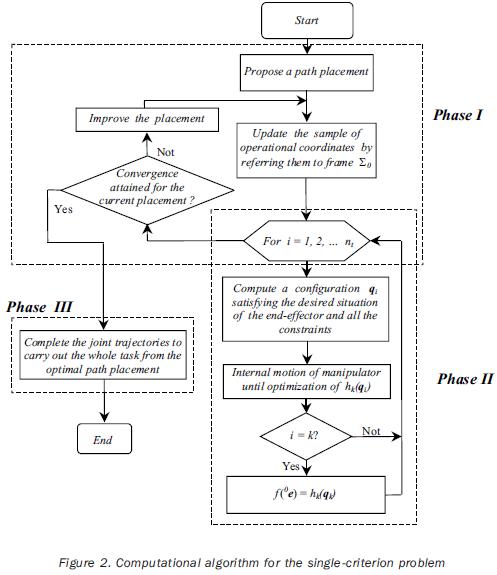
<body><![CDATA[<p align="justify"><font face="verdana" size="2">&nbsp;</font></p>     <p align="justify"><font face="verdana" size="2"><i>B.   Process of solution</i></font></p>     <p align="justify"><font face="verdana" size="2">The single&#150;objective problem is equivalent to a constrained non&#150;linear programming problem. The objective function is defined as the index of performance <i>h<sub>k</sub>(<b>q</b><sub>k</sub> ) </i>assigned to the path point <i>p<sub>k</sub>. </i>The number of independent variables will be generally 6+n: the 6 components of the placement vector <sup>0</sup><b><i>e</i></b> of the path and, because of the manipulator's redundancy, the <i>n </i>joint variables of the configuration <i><b>q</b><sub>k</sub> </i>which allow to satisfy the desired situation of the end&#150;effector at the path point <i><b>p</b><sub>k</sub>.</i></font></p>     <p align="justify"><font face="verdana" size="2">To solve the problem, we propose an optimization process in three phases: <i>phase I </i>in which the optimal placement vector must be found; <i>phase II </i>addressed to compute the optimal configuration on the path point <i>p<sub>k</sub> </i>for each proposed placement to be evaluated; and <i>phase III </i>committed to complete the manipulator's joint trajectories for the whole desired path by using the optimal path placement obtained in phase I. Notice that phase II allows to evaluate the objective function of phase I. Such a function in phase I can be defined as</font></p>     <p align="justify"><font face="verdana" size="2"><i>f = h<sub>k</sub> (<b>q</b><sub>k</sub>)&nbsp; &nbsp; &nbsp; &nbsp; &nbsp; &nbsp; &nbsp; &nbsp; &nbsp; &nbsp; &nbsp; &nbsp; &nbsp; &nbsp; &nbsp; &nbsp; &nbsp; &nbsp; &nbsp; &nbsp; &nbsp; &nbsp; &nbsp; &nbsp; &nbsp; &nbsp;</i>(10)</font></p>     <p align="justify"><font face="verdana" size="2">The general procedure to solve the single&#150;objective problem is schematized in the flow chart of <a href="#f2">figure 2</a>. Details on the three phases concerned are given below.</font></p>     <p align="center"><font face="verdana" size="2"><a name="f2"></a></font></p>     <p align="center"><font face="verdana" size="2"><img src="/img/revistas/iit/v9n3/a4f2.jpg"></font></p>     <p align="justify"><font face="verdana" size="2"><i>Phase I</i></font></p>     <p align="justify"><font face="verdana" size="2">Before obtain the configurations at each path point, the operational coordinates must be referred to frame &Sigma;<sub>0</sub>. Therefore, when a new placement is proposed in the optimization process, the operational coordinates have to be first updated in phase I by applying the following transformation:</font></p>     ]]></body>
<body><![CDATA[<p align="justify"><font face="verdana" size="2"><i>&nbsp;<sup>0 </sup>T<sub> l </sub></i>= <sup><i>0 </i></sup><i>T<sub>t <sup>t</sup></sub>T<sub><sub>l</sub> </sub></i><sub>&nbsp;&nbsp;&nbsp;&nbsp;&nbsp;&nbsp;&nbsp;&nbsp;&nbsp;&nbsp;&nbsp;&nbsp;&nbsp;&nbsp;&nbsp;&nbsp;&nbsp;&nbsp;&nbsp;&nbsp;&nbsp;&nbsp;&nbsp;&nbsp;&nbsp;&nbsp;&nbsp;&nbsp;&nbsp;&nbsp;&nbsp;&nbsp;</sub>  &nbsp;&nbsp;&nbsp;&nbsp;&nbsp;&nbsp;&nbsp;&nbsp;&nbsp;&nbsp;&nbsp;&nbsp;&nbsp;&nbsp;&nbsp;&nbsp;&nbsp;(11)</font></p>     <p align="justify"><font face="verdana" size="2">In this equation:</font></p>     <p align="justify"><font face="verdana" size="2"><sup><b><i>t</i></b></sup><i><b>T<sub>l</sub></b></i> is the homogeneous matrix establishing the desired  position and orientation of the end effector on the path point <b><i>p</i></b><sub>i</sub>  referred to frame &Sigma;<sub>t</sub></font></p>     <p align="justify"><font face="verdana" size="2"><sup><b><i>0</i></b></sup><i><b>T<sub>t</sub></b></i> is the homogeneous matrix for the position and orientation of frame &Sigma;<sub>t</sub> referred to frame &Sigma;<sub>0</sub>.</font></p>     <p align="justify"><font face="verdana" size="2"><sup><b><i>0</i></b></sup><i><b> T<sub>i</sub></b></i> is the homogeneous matrix defining the position and orientation of the end effector on the path point <i>p<sub>i</sub> </i>with respect to frame &Sigma;<sub>0</sub></font></p>     <p align="justify"><font face="verdana" size="2">When the given operational coordinates have been updated, then the objective function must be evaluated in phase II for the current placement; after the process returns to phase I in order to check for the convergence of the method. If the convergence is attained then the procedure goes to phase III; otherwise, the placement must be improved by applying a suitable strategy.</font></p>     <p align="justify"><font face="verdana" size="2">&nbsp;</font></p>     <p align="justify"><font face="verdana" size="2"><i>Phase II</i></font></p>     <p align="justify"><font face="verdana" size="2">After updating of the operational coordinates for a path placement proposed in phase I, the redundancy must be solved to find the configurations <i><b>q</b><sub>i</sub> (i=1, </i>2, .... <i>n<sub>t</sub>) </i>for all the path points. To do that, we assume as secondary task on point <i>p<i><sub>i</sub></i></i> the optimization of the same index of performance considered on <i>p<sub>k</sub>; i.e., </i>for one path point the manipulator has to achieve the corresponding operational coordinates and also optimize <i>h<sub>k</sub>(<b>q</b><i><sub>i</sub></i>). </i>To find such configurations the following process is carried out:</font></p>     <p align="justify"><font face="verdana" size="2">1. Find a configuration <i><b>q</b><sub>i</sub></i> at each path point in such a way that Equation (1) is satisfied. This configuration is obtained by minimization of the following function:</font></p>     ]]></body>
<body><![CDATA[<p align="justify"><font face="verdana" size="2"><img src="/img/revistas/iit/v9n3/a4s14.jpg"></font></p>     <p align="justify"><font face="verdana" size="2">where <b>x<sub>l</sub></b> is the vector defining the desired situation of the end&#150;effector at point <i>p</i><sub>i</sub>, and <i><b>x</b><sub>i</sub>'</i> is a vector of operational coordinates corresponding to a configuration <i><b>q<sub>l</sub></b></i><b>'</b> proposed when minimizing of equation (12). The symbol <img src="/img/revistas/iit/v9n3/a4s15.jpg"> denotes the Euclidean norm. If the task is feasible then equation <i><b>x <sub>l</sub></b></i> = <i><b>x<i><b><sub>l</sub></b></i></b>'</i>  will be satisfied when the norm of equation (12) is minimized. The numeric minimization is carried out by applying a method of constrained non&#150;linear optimization. The independent variables are the joint variables of <i><b>q<sub>l</sub>'</b>. </i>The constraints to be considered are presented in the next sub&#150;section.</font></p>     <p align="justify"><font face="verdana" size="2">2. When a configuration <i>qi </i>at one path point has been found, satisfying both equation (1) and all the constraints, then compute <i><b>J</b>, </i><b><i>J</i></b><sup>+</sup>and, <i><img src="/img/revistas/iit/v9n3/a4s8.jpg">h(<b>q</b>) </i>and optimize for such a configuration the index <i>h(<b>q</b>) </i>by successively obtaining of the homogeneous solution of equation (3). At each iteration of this process, when a vector <i><b>q</b><sub>i</sub> </i>of the homogeneous solution is obtained corresponding to a certain configuration <i><b>q<i><sub>i</sub></i></b></i><sub> </sub><i>,</i> an improved configuration <i><b>q</b><sub>i</sub>* </i>may be computed by</font></p>     <p align="justify"><font face="verdana" size="2"><img src="/img/revistas/iit/v9n3/a4s17.jpg"></font></p>     <p align="justify"><font face="verdana" size="2">where &Delta; is a sufficiently small time interval. Note that, because <img src="/img/revistas/iit/v9n3/a4s16.jpg"> is a homogeneous solution, the improved configuration <i><b>q</b><sub>i</sub></i>* will also preserve equation (1). The initial configuration of the optimization process has been determined in step <b>i</b>.</font></p>     <p align="justify"><font face="verdana" size="2">3. For one path&#150;point the optimization of a configuration is stopped when <img src="/img/revistas/iit/v9n3/a4s18.jpg"> becomes zero.</font></p>     <p align="justify"><font face="verdana" size="2">&nbsp;</font></p>     <p align="justify"><font face="verdana" size="2"><i>Phase III</i></font></p>     <p align="justify"><font face="verdana" size="2">When computing the optimal path placement only a significant sample of path points is considered in order to reduce the time of computation engaged in the optimization process. Nevertheless, the desired trajectory is a continuous curve which must be approximated by a sufficiently large number of supplementary points of the path. So, to synthesize continuous joint trajectories for the whole task, when the optimal placement has been found the redundancy must be solved for supplementary path points. This process is the same used to solve the redundancy in phase II by optimizing the desired index of performance <i>h<sub>k</sub>(<b>q</b>). </i>The number of supplementary points is proposed by the user in such a way that a conventional precision be satisfied. Continuous joint trajectories will be obtained as a result of this process because the index to be optimized is the same for all the considered points.</font></p>     <p align="justify"><font face="verdana" size="2">C. <i>Constraints of the problem</i></font></p>     ]]></body>
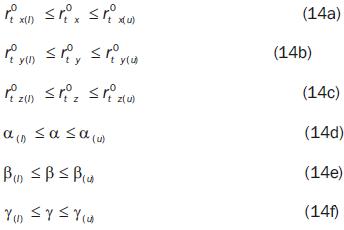
<body><![CDATA[<p align="justify"><font face="verdana" size="2">The optimization processes to obtain the path placement and to solve the redundancy must be constrained in order to obtain realistic solutions. The following constraints are taken into account:</font></p>     <p align="justify"><font face="verdana" size="2"><i>1.    Explicit constraints in phase I</i></font></p>     <p align="justify"><font face="verdana" size="2">Explicit constraints are imposed in phase I on the placement vector so that solutions are obtained only into the available physical space for the task placement. Such space may be imposed by a positioner device. The following constraints on the components of the placement vector are considered:</font></p>     <p align="justify"><font face="verdana" size="2"><img src="/img/revistas/iit/v9n3/a4s19.jpg"></font></p>     <p align="justify"><font face="verdana" size="2">In expressions (14), the indexes l and <i>u </i>denote, respectively, lower and upper bounds of the independent variables.</font></p>     <p align="justify"><font face="verdana" size="2">2.     <i>Implicit constraints in phase I for access to the task</i></font></p>     <p align="justify"><font face="verdana" size="2">Implicit constraints are also considered in order to guarantee the efficacy of placements proposed in the optimization process. To assure the accessibility to all the sample points on the path the following constraint is introduced:</font></p>     <p align="justify"><font face="verdana" size="2"><img src="/img/revistas/iit/v9n3/a4s20.jpg"></font></p>     <p align="justify"><font face="verdana" size="2">where<i> t <sub>l</sub></i> is the <i>reach </i>vector demanded to the manipulator at point p<sub>i</sub>; the symbol <img src="/img/revistas/iit/v9n3/a4s15.jpg"> denotes Euclidean norm. <i>t<sub>u</sub> </i>is the norm of the maximum reach which the manipulator can provide. Such norm depends on the geometric parameters of the manipulator.</font></p>     <p align="justify"><font face="verdana" size="2">3.<i> Explicit constraints in phase II for joint limits avoidance</i></font></p>     ]]></body>
<body><![CDATA[<p align="justify"><font face="verdana" size="2">An elemental condition for any feasible configuration consists in preserving the joint variables into the admissible domain of configurations. So, any configuration used for the task should verify the following conditions:</font></p>     <p align="justify"><font face="verdana" size="2"><img src="/img/revistas/iit/v9n3/a4s21.jpg"></font></p>     <p align="justify"><font face="verdana" size="2"> where:</font></p>     <p align="justify"><font face="verdana" size="2"><i>q<sub>ij</sub> </i>is the i&#150;th joint variable of the <i><b>q</b><i><sub>j</sub> </i></i> manipulator's configuration corresponding to the j&#150;th task point.</font></p>     <p align="justify"><font face="verdana" size="2"><i>q</i><sup>(l)</sup><i>q</i><sup>(u)</sup>    are the lower and upper limits, respectively, of the <i>i</i>&#150;th joint variable.</font></p>     <p align="justify"><font face="verdana" size="2">4.&nbsp; &nbsp; &nbsp;<i>Implicit    constraints    in    phase    II    to guarantee continuous joint trajectories</i></font></p>     <p align="justify"><font face="verdana" size="2">Implicit constraints are imposed in phase II which allow to assure the feasibility of the whole joint trajectories.</font></p>     <p align="justify"><font face="verdana" size="2">To introduce the considered constraints we recall here de notion of the <i>aspect </i>of a manipulator. One aspect is defined (Borrel <i>et </i>al., 1986) as a continuous subset of the manipulator's joint space composed by configurations which render non&#150;zero all the <i>m</i>&#150;order minors of the jacobian matrix, except those minors being zero everywhere in the joint space.</font></p>     <p align="justify"><font face="verdana" size="2">Thus, the aspects of a manipulator are subsets of the joint space separated by hypersurfaces whose equations are determined by the <i>m</i>&#150;order minors of the jacobian matrix equalized to zero.</font></p>     <p align="justify"><font face="verdana" size="2">On the other hand, it is known that for <i>non&#150;cuspidal </i>manipulators (Burdick<i>et al., </i>1995), (Wenger, 1997), the continuity of joint trajectories corresponding to a given task can be guaranteed if the manipulator is constrained to use configurations remaining in only one aspect of its joint space.</font></p>     ]]></body>

<body><![CDATA[<p align="justify"><font face="verdana" size="2">Consequently, to guarantee continuous joint trajectories the following conditions must be imposed to manipulator's configurations which will be used to accomplish a desired path:</font></p>     <p align="justify"><font face="verdana" size="2">&nbsp;<i>&epsilon;<sub>kj</sub> &delta;<sub>kj </sub></i>(<i><b>q</b></i>)  &gt; 0  &nbsp;&nbsp;&nbsp;&nbsp;&nbsp;&nbsp;&nbsp;&nbsp;&nbsp;&nbsp;&nbsp;&nbsp;&nbsp;&nbsp;&nbsp;&nbsp;&nbsp;(17)</font></p>     <p align="justify"><font face="verdana" size="2">where</font></p>     <p align="justify"><font face="verdana" size="2"><i><i>&delta;<sub>kj</sub></i> (<b>q</b>) </i>is the left hand function of the equation defining the j&#150;th hypersurface <i>(j = 1, 2,..., n<sub>hk</sub> ) </i>which borders the aspect <i>A<sub>k</sub> </i>in the joint space; <i><img src="/img/revistas/iit/v9n3/a4s23.jpg"></i><i>. n<sub>hk</sub> </i>is the number of such hypersurfaces. <i>n<sub>A</sub> </i>is the number of the robot's aspects. Only one aspect will be chosen containing all the configurations which allow to achieve the desired task.</font></p>     <p align="justify"><font face="verdana" size="2"><i><i>&epsilon;<sub>kj</sub></i> </i>is a constant (+1 or &#150;1) depending on the hypersurface and the considered aspect <i>A<sub>k</sub>.</i></font></p>     <p align="justify"><font face="verdana" size="2">In section VI we will identify the implicit constraints (17) for two manipulators.</font></p>     <p align="justify"><font face="verdana" size="2">&nbsp;</font></p>     <p align="justify"><font face="verdana" size="2"><b>VI. Optimal path placement for multi&#150;objective optimization</b></font></p>     <p align="justify"><font face="verdana" size="2"><i>A. Statement of the problem</i></font></p>     <p align="justify"><font face="verdana" size="2">The task of a n&#150;dof manipulator is specified by a set of <i>n<sub>t</sub> </i>m&#150;dimensional vectors of operational coordinates of the end&#150;effector <i>(n&gt;m) </i>in an orthonormal frame &Sigma;<sub> t</sub>. Such operational coordinates give the desired positions and orientations to be followed by a frame &Sigma;<b><sub>n+1 </sub></b>attached to the end&#150;effector, as showed in <a href="/img/revistas/iit/v9n3/a4f1.jpg" target="_blank">figure 1</a>. In that figure a sample of points <i>p<sub>i</sub> </i>(i <i>= </i>1, 2, ..., <i>n<sub>t</sub> </i>) is illustrated corresponding to the desired path in the task space. Suitable indexes of performance are then assigned by the user to several path points <i>p<sub>i</sub>. </i>Thus, we want to compute the path placement vector <sup>0</sup><b><i>e</i></b>, so that all the indexes associated to the sample points be optimized while the task is being accomplished. A law of motion is also specified which refers to the time and position of the end&#150;effector on the path.</font></p>     ]]></body>
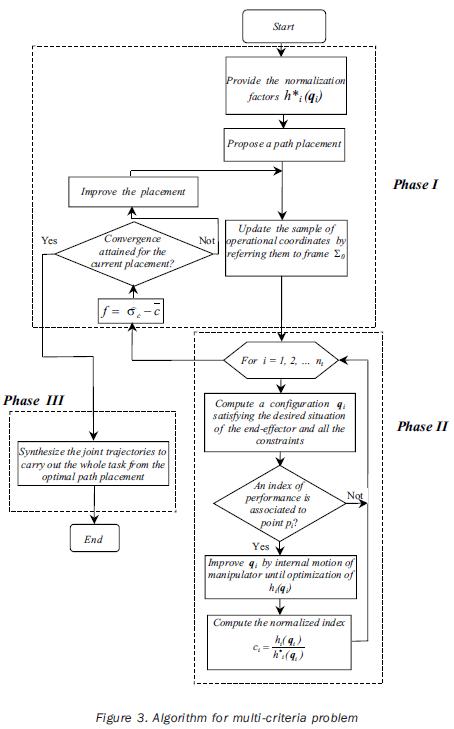
<body><![CDATA[<p align="justify"><font face="verdana" size="2"><i>B. Process of solution</i></font></p>     <p align="justify"><font face="verdana" size="2">The multi&#150;objective problem is also a constrained non&#150;linear programming problem. The objective function should consistently characterize a set of dissimilar indexes of performance to be optimized. Thus, it is required that the indexes be first normalized to eliminate scaling and unity differences; then they can be included in a coherent objective function.</font></p>     <p align="justify"><font face="verdana" size="2">As in the single&#150;objective problem, the independent variables will be the 6 components of the path placement vector <sup>0</sup><b><i>e</i></b> and, because of the manipulator's redundancy, the joint variables of configurations <b><i>q</i></b><sub>i</sub> which allow to satisfy the desired situation of the end&#150;effector on the path points p<sub>i</sub>. To solve the multi&#150;objective problem we propose an optimization process having also three phases. In <i>phase I </i>the optimal placement will be searched; <i>phase II </i>is addressed to compute the optimal configurations at the <i>n<sub>t</sub> </i>path points for each placement to be evaluated; <i>phase III </i>is finally committed to synthesize the manipulator's joint trajectories for the whole desired path by using the optimal path placement obtained in phase I. Note that phase II allows to evaluate the objective function of phase I. Such a function is defined below. The procedure presented here to solve the multiobjective problem is illustrated in the flow chart of <a href="#f3">Figure 3</a>. Details of the procedure are discussed in the next paragraphs.</font></p>     <p align="center"><font face="verdana" size="2"><a name="f3"></a></font></p>     <p align="center"><font face="verdana" size="2"><img src="/img/revistas/iit/v9n3/a4f3.jpg"></font></p>     <p align="justify"><font face="verdana" size="2"><i>Phase I</i></font></p>     <p align="justify"><font face="verdana" size="2">The path placement must be searched in this phase. For each placement proposed here we have to update the operational coordinates; then an evaluation of the placement can be accomplished in the process of optimization.</font></p>     <p align="justify"><font face="verdana" size="2">The transformation of such coordinates is carried out by applying equation (11); then the redundancy will be solved in phase II, and the objective function will be computed based on normalized indexes of performance. After that the process returns to Phase I in order to check for the convergence of the method. If the convergence is attained then the procedure goes to Phase III; otherwise, the placement must be improved by applying a suitable strategy. The objective function for the multi&#150;objective problem as well as the normalized indexes, are defined below.</font></p>     <p align="justify"><font face="verdana" size="2">A normalized index of performance associated to the sample point <i>p<sub>i</sub> </i>is obtained as:</font></p>     <p align="justify"><font face="verdana" size="2"><img src="/img/revistas/iit/v9n3/a4s24.jpg"></font></p>     ]]></body>
<body><![CDATA[<p align="justify"><font face="verdana" size="2">The normalization factor <i>h<sub>i</sub>* </i>in equation (18) is the maximum value of the index of performance at the point p<sub>i</sub> that can be obtained by the manipulator when only such index is optimized, and the accessibility to all the path points is satisfied. In fact, the normalization factor <i>h<sub>i</sub>* </i>is the optimal value obtained for the index <i>h<sub>i</sub></i> (<i><b>q</b><sub>i</sub></i>) in the single&#150;objective problem. Thus, to obtain the normalization factors we have to solve as much single&#150;objective problems as sample&#150;configurations are to be optimized. It must be observed that a sample&#150;point could hold or not an index of performance associated to be optimized; thus, the number of indexes to be optimized can be lower or equal than <i>n<sub>t</sub>.</i></font></p>     <p align="justify"><font face="verdana" size="2">The main idea to define the objective function is that the value of such function, corresponding to a path location, must be equivalent to a typical value of the set of normalized indices to be optimized. Such typical value can be defined as:</font></p>     <p align="justify"><font face="verdana" size="2"><img src="/img/revistas/iit/v9n3/a4s25.jpg"></font></p>     <p align="justify"><font face="verdana" size="2">where <img src="/img/revistas/iit/v9n3/a4s26.jpg"> and <img src="/img/revistas/iit/v9n3/a4s27.jpg"> are, respectively, the mean and the standard deviation of the set of normalized indexes associated to the sample points. Hence, the value of c obtained by equation (19) corresponds to a typically small value of the set of normalized indexes of the sample.</font></p>     <p align="justify"><font face="verdana" size="2">If we assume that the all the indexes of performance considered in the problem are to be maximized, then the global maximization of the set of <i>n<sub>t</sub> </i>indexes would be obtained by maximization of c. Nevertheless, algorithms in usual software for optimization are generally intended to minimize the objective function. Thus, to solve the optimization problem by minimization, the objective function could be defined as &#150; <i>c</i>; therefore, such a function can be finally written as:</font></p>     <p align="justify"><font face="verdana" size="2"><img src="/img/revistas/iit/v9n3/a4s28.jpg"></font></p>     <p align="justify"><font face="verdana" size="2"><i>Phase II</i></font></p>     <p align="justify"><font face="verdana" size="2">The <i>n<sub>t</sub> </i>optimal configurations satisfying the desired task and constraints, which are used to compute the normalized indexes, must be found in phase II. The algorithm to compute such configurations is the same used in single&#150;objective problem; this one has been described in section III.</font></p>     <p align="justify"><font face="verdana" size="2"><i>Phase III</i></font></p>     <p align="justify"><font face="verdana" size="2">The continuous joint trajectories for the whole task must be finally synthesized in Phase III for the optimal path placement. To do that, the redundancy has to be solved for supplementary path points in such a way that the optimal configurations of points <i>p<sub>i</sub> </i>obtained in phase II are preserved.</font></p>     ]]></body>
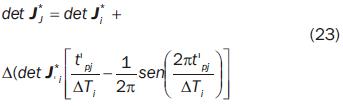
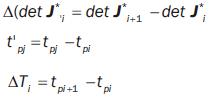
<body><![CDATA[<p align="justify"><font face="verdana" size="2">In the multi&#150;objective problem however, because of generally different indexes of performance are associated to adjacent sample path points, say p<sub>i </sub>and <i>p<sub>i+1</sub></i><sub> </sub>, we cannot use a single index to solve the redundancy by using the homogeneous solution for intermediate path points. In fact, if the homogeneous solution is applied on intermediate points to optimize the index associated to <i>p<i><sub>i</sub></i>, </i>then the joint trajectories becomes discontinuous on <i>p</i><sub>i+1 </sub>and vice versa.</font></p>     <p align="justify"><font face="verdana" size="2">To solve the redundancy and synthesize the continuous joint trajectories connecting adjacent sample path points, a judicious strategy must be used. We propose a suitable secondary task to be accomplished, which is specified in the joint space as a continuous trajectory between configurations associated to adjacent sample path points. This secondary trajectory is such that the determinant of <i><b>J J</b><sup>T</sup> </i>smoothly evolves from its value on point <i>pi </i>to the value on point <i>p</i><sub>i+1</sub>. Consequently, because all the configurations so obtained belong to only one aspect, the continuity of joint trajectories will be assured. Thus, to accomplish both the main and the secondary tasks, we propose to solve the redundancy by minimizing the following objective function at each intermediate point <i>p<i><sub>j </sub></i></i>between two successive sample points <i>p<i><sub>i</sub></i></i> and <i>p<sub>i+1</sub></i>:</font></p>     <p align="justify"><font face="verdana" size="2"><img src="/img/revistas/iit/v9n3/a4s29.jpg"></font></p>     <p align="justify"><font face="verdana" size="2">where <i>n<sub>int</sub> </i>is the number of intermediate points to be considered between two sample points. This number is chosen by the user so that a conventional precision be satisfied. The error of position of the end&#150;effector, e<sub>pos</sub> <sub>j</sub>, in equation (21), is defined like in equation (12) for intermediate points.</font></p>     <p align="justify"><font face="verdana" size="2">On the other hand, we define <i><b>J*</b><i><sub>J</sub></i> =  <b>J</b><i><sub>i</sub></i> <b>J</b><i><sub>i</sub></i><sup>T</sup></i>, where <i><b>J</b><i><sub>i</sub></i> </i>is the Jacobian matrix of the manipulator on the intermediate point <i>p<i><sub>j</sub></i>. </i>Then the error of the determinant of <i><b>J*</b><i><sub>j</sub></i></i> in equation (21) is defined as</font></p>     <p align="justify"><font face="verdana" size="2"><img src="/img/revistas/iit/v9n3/a4s30.jpg"></font></p>     <p align="justify"><font face="verdana" size="2"><i>det <i><b>J</b>*<i><sub>J</sub></i> </i></i>is the desired value of the determinant of <i><b>J</b>* </i>for the configuration at point <i>p<i><i><sub>J</sub></i> </i>. </i>Its value is assigned by a cycloidal law &#91;Equation (23)&#93; which is defined for the current segment of the path between two successive sample points. Such cycloidal law must smoothly change the determinant of <i><b>J</b>* </i>from its value corresponding to the configuration at point <i>p</i><sub>i</sub>, to that one at <i>p</i><sub>i+1</sub>.</font></p>     <p align="justify"><font face="verdana" size="2"><i>det<i><b> J</b><i><sub>i</sub></i></i></i>' is the value of the determinant of <i><b>J</b>* </i>for the  current  configuration  in  minimization  of equation 21.</font></p>     <p align="justify"><font face="verdana" size="2">The desired behavior of the determinant of <b><i>J</i></b><i>*</i> in the segment between sample points <i>p<sub>i</sub> </i>and <i>p<sub>i+1</sub> </i>is described by the following cycloidal law:</font></p>     <p align="justify"><font face="verdana" size="2"><img src="/img/revistas/iit/v9n3/a4s33.jpg"></font></p>     ]]></body>
<body><![CDATA[<p align="justify"><font face="verdana" size="2">The variables concerned in equation (23) are defined as follows:</font></p>     <p align="justify"><font face="verdana" size="2"><img src="/img/revistas/iit/v9n3/a4s34.jpg"></font></p>     <p align="justify"><font face="verdana" size="2">where <i>t<sub>pi</sub>, t<sub>pj</sub> </i>are the values of the time elapsed when the end&#150;effector arrives at points <i>p<sub>i</sub> </i>(sample) and <i>p<sub>j</sub> </i>(intermediate), respectively.</font></p>     <p align="justify"><font face="verdana" size="2"><i>C. Constraints of the problem</i></font></p>     <p align="justify"><font face="verdana" size="2">As considered for the single&#150;objective problem, to obtain realistic solutions in solving the multi&#150;objective problem, explicit and implicit constraints should also be taken into account. Such constraints are identical to those considered in Section III C. They were examined in that section.</font></p>     <p align="justify"><font face="verdana" size="2">&nbsp;</font></p>     <p align="justify"><font face="verdana" size="2"><b>V. Path placement for global optimization</b></font></p>     <p align="justify"><font face="verdana" size="2">The path placement problem was studied in section III for the optimization of manipulator's performance on a certain point of the path by taking into account a single kinematic criterion. Nevertheless, in some tasks the optimization of such criterion can be preferred not only on a particular point but on every one of points in the path; i.e. a <i>global optimization </i>of manipulator's performances is desired when the task is carried out. Note that such problem can be considered as a particular case of the multi&#150;objective problem examined in the previous section. In fact, in the formulation for multi&#150;objective optimization we can assign the same criterion of performance to all the sample points in order to attain the global optimization. However, it must be pointed out that the homogenization of the corresponding indices is not required in the process of solution; then equation (18) takes the form c<sub>i</sub> = <i>h<sub>i</sub> (<b>q</b><sub>i</sub></i>).</font></p>     <p align="justify"><font face="verdana" size="2">Furthermore, after optimizing the set of indexes on the sample points, the continuous trajectories of joint variables for the whole path can be synthesized by applying only the Phase III of the process for the single&#150;objective problem. Consequently, the minimization of function (21) is not necessary for global optimization.</font></p>     <p align="justify"><font face="verdana" size="2">&nbsp;</font></p>     ]]></body>
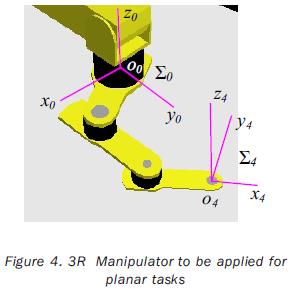
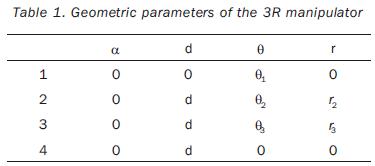
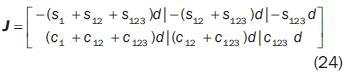
<body><![CDATA[<p align="justify"><font face="verdana" size="2"><b>VI. Case studies</b></font></p>     <p align="justify"><font face="verdana" size="2">Several case studies are presented in this section in which single and multi&#150;objective problems of optimal path placement are solved; we consider planar and spatial paths for each kind of problem. The planar task must be accomplished by a 3R manipulator, and the spatial task should be achieved by a 4R manipulator. In the following sub&#150;section, the geometric parameters of both manipulators will be specified and the implicit constraints of the problems to hold configurations in an aspect will be identified. Then, in succeeding subsections the problems will be solved.</font></p>     <p align="justify"><font face="verdana" size="2"><i>A.   Manipulators for the case studies </i></font></p>     <p align="justify"><font face="verdana" size="2"><i>1. The 3R manipulator</i></font></p>     <p align="justify"><font face="verdana" size="2">The considered planar manipulator is shown in <a href="#f4">Figure 4</a>, and its geometric parameters are presented in <a href="#t1">table 1</a>. These parameters are defined by using the modified Denavit&#150;Hartenberg method (Khalil <i>et </i>al., 1986). A frame &Sigma;<sub>4</sub> is attached at the tip of the third link in order to use its origin to specify the linear velocity of the end&#150;effector. The manipulator's joint variables are <i>&theta;<sub>1</sub>, <i>&theta;</i><sub>2</sub> </i>and <i>&theta;</i><sub>3</sub>, and its limit values are <i>&theta;</i><sub>i</sub><sup>(l)</sup> =&#150;150&deg; and <i>&theta;</i><sub>i</sub><sup>(u)</sup> =150&deg;, for <i>i</i> = 1, 2, 3 .</font></p>     <p align="center"><font size="2" face="verdana"><a name="f4"></a></font></p>     <p align="center"><font size="2" face="verdana"><img src="/img/revistas/iit/v9n3/a4f4.jpg"></font></p>     <p align="center"><font face="verdana" size="2"><a name="t1"></a></font></p>     <p align="center"><font face="verdana" size="2"><img src="/img/revistas/iit/v9n3/a4t1.jpg"></font></p>     <p align="justify"><font face="verdana" size="2">By considering the velocity vector of O<sub>4</sub> referred to the frame &Sigma;<sub>0</sub> as <i><sup><img src="/img/revistas/iit/v9n3/a4s37.jpg"></sup>, </i>the jacobian matrix of the manipulator is:</font></p>     ]]></body>
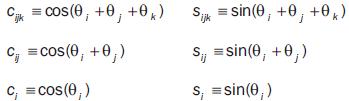
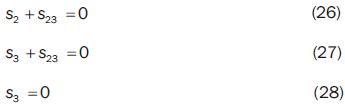
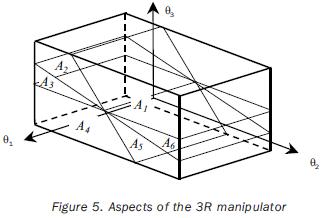
<body><![CDATA[<p align="justify"><font face="verdana" size="2"><img src="/img/revistas/iit/v9n3/a4s38.jpg"></font></p>     <p align="justify"><font face="verdana" size="2">In this matrix and hereafter we use the following compact notation:</font></p>     <p align="justify"><font face="verdana" size="2"><img src="/img/revistas/iit/v9n3/a4s39.jpg"></font></p>     <p align="justify"><font face="verdana" size="2">The 2&#150;order minors of the jacobian matrix are expressed as:</font></p>     <p align="justify"><font face="verdana" size="2"><img src="/img/revistas/iit/v9n3/a4s40.jpg"></font></p>     <p align="justify"><font face="verdana" size="2"><img src="/img/revistas/iit/v9n3/a4s41.jpg"></font></p>     <p align="justify"><font face="verdana" size="2">The conditions of configurations which render zero the above minors provide the following equations of the surfaces dividing the joint space in aspects:</font></p>     <p align="justify"><font face="verdana" size="2"><img src="/img/revistas/iit/v9n3/a4s42.jpg"></font></p>     <p align="justify"><font face="verdana" size="2">Thus, six aspects can be identified <i>(n<sub>A</sub>=6) </i>for the 3R manipulator, as showed in <a href="#f5">figure 5</a>. We chose the aspect <i>A<sub>1</sub> </i>for the achievement of the task; consequently for (17) we have <i>k=1. </i>Then we observe that the aspect <i>A<sub>1</sub> </i>is surrounded by the surfaces specified by equations (26) and (28); therefore we have <i>n<sub>hk</sub> </i>=2 and <i>&epsilon;<sub>11</sub></i>=1, <i>&epsilon;<sub>12</sub></i>=1 for inequality (17).</font></p>     <p align="center"><font size="2" face="verdana"><a name="f5"></a></font></p>     ]]></body>
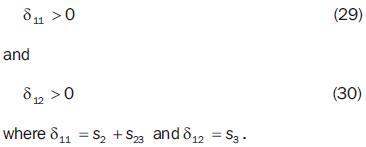
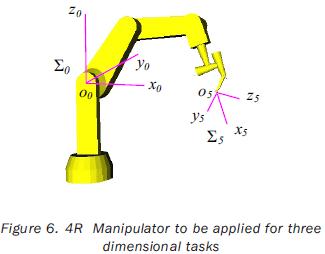
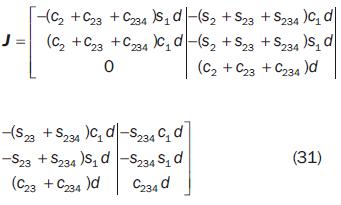
<body><![CDATA[<p align="center"><font size="2" face="verdana"><img src="/img/revistas/iit/v9n3/a4f5.jpg"></font></p>     <p align="justify"><font face="verdana" size="2">The implicit constraints on <i><i>&theta;</i><sub>2</sub> </i>and <i>&theta;</i><sub>3</sub> to hold configurations in the aspect <i>A<sub>1</sub> </i>are then expressed as</font></p>     <p align="justify"><font face="verdana" size="2"><img src="/img/revistas/iit/v9n3/a4s43.jpg"></font></p>     <p align="justify"><font face="verdana" size="2">&nbsp;</font></p>     <p align="justify"><font face="verdana" size="2"><i>2. The 4R manipulator</i></font></p>     <p align="justify"><font face="verdana" size="2">The manipulator is shown in <a href="#f6">figure 6</a> and its geometric parameters are presented in table 2. The joint variables are <i>&theta;<sub>1</sub>, &theta;</i><sub>2</sub>, <i>&theta;</i><sub>3</sub> and <i><i>&theta;</i><sub>4</sub>, </i>and its limits values are <i>&theta;<sub>i</sub></i><sup>(l)</sup> = &#150;150&deg; and <i>&theta;<sub>i</sub></i><sup>(u)</sup> = 150&deg;, for <i>i</i> = 1, 2, 3, 4. To specify the linear velocity of the end effector we use the point O<sub>5</sub> of the frame &Sigma; <sub>5 </sub>which is attached at the tip of the fourth link.</font></p>     <p align="center"><font face="verdana" size="2"><a name="f6"></a></font></p>     <p align="center"><font face="verdana" size="2"><img src="/img/revistas/iit/v9n3/a4f6.jpg"></font></p>     <p align="justify"><font face="verdana" size="2">By considering the velocity vector of O<sub>5</sub> referred to the frame &Sigma;<sub>0</sub> as <i><sup><img src="/img/revistas/iit/v9n3/a4s37.jpg"></sup></i>, the jacobian matrix of the 4R manipulator is:</font></p>     <p align="justify"><font face="verdana" size="2"><img src="/img/revistas/iit/v9n3/a4s44.jpg"></font></p>     ]]></body>
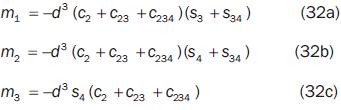
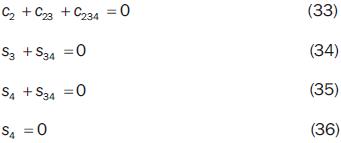
<body><![CDATA[<p align="justify"><font face="verdana" size="2">The 3&#150;order minors of the jacobian matrix which are non zero everywhere in the joint space are:</font></p>     <p align="justify"><font face="verdana" size="2"><img src="/img/revistas/iit/v9n3/a4s45.jpg"></font></p>     <p align="justify"><font face="verdana" size="2">The conditions of configurations which render zero the above minors provide the following equations of the surfaces dividing the joint space in aspects:</font></p>     <p align="justify"><font face="verdana" size="2"><img src="/img/revistas/iit/v9n3/a4s46.jpg"></font></p>     <p align="justify"><font face="verdana" size="2">Thus, twelve aspects can be identified <i>(n<sub>A</sub>=12) </i>for the 4R manipulator. We chose the aspect <i>A<sub>1</sub> </i>for the achievement of the task; consequently, for inequality (17) we have <i>k=1. </i>Then we observe that the aspect <i>A<sub>1</sub> </i>is bounded by the surfaces of equations (33), (34) and (36); therefore for inequality (17) we have n<sub>hk</sub>=3 and &epsilon;<sub>11</sub>=1, <i>&epsilon;<sub>12</sub>=1, </i>&epsilon;<sub>13</sub>=1. Thus, the implicit constraints on configurations to hold configurations in the aspect A1 are:</font></p>     <p align="justify"><font face="verdana" size="2">&nbsp;&delta;<sub>11 </sub>&gt; 0 &nbsp;&nbsp;&nbsp;&nbsp;&nbsp;&nbsp;&nbsp;&nbsp;&nbsp;&nbsp;&nbsp;&nbsp;&nbsp;&nbsp;&nbsp;&nbsp;&nbsp;(37)</font></p>     <p align="justify"><font face="verdana" size="2">&nbsp;&delta;<sub>12</sub> &gt; 0 &nbsp;&nbsp;&nbsp;&nbsp;&nbsp;&nbsp;&nbsp;&nbsp;&nbsp;&nbsp;&nbsp;&nbsp;&nbsp;&nbsp;&nbsp;&nbsp;&nbsp;(38)</font></p>     <p align="justify"><font face="verdana" size="2">&nbsp;&delta;<sub>13 </sub>&gt; 0 &nbsp;&nbsp;&nbsp;&nbsp;&nbsp;&nbsp;&nbsp;&nbsp;&nbsp;&nbsp;&nbsp;&nbsp;&nbsp;&nbsp;&nbsp;&nbsp;&nbsp;(39)</font></p>     <p align="justify"><font face="verdana" size="2">where</font></p>     <p align="justify"><font face="verdana" size="2">&nbsp;&delta;<sub>11</sub> = c<sub>2  </sub> + c<sub>23</sub> + c<sub>234  </sub> + &delta;<sub>12  </sub> = s <sub>3</sub> + s <sub>34</sub></font></p>     ]]></body>
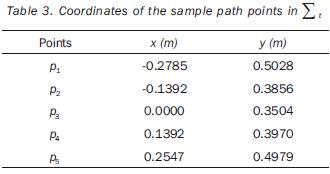
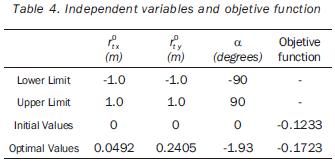
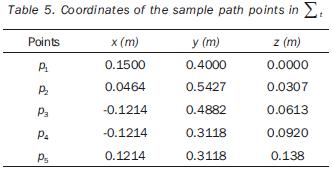
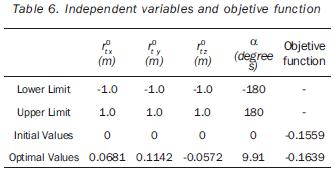
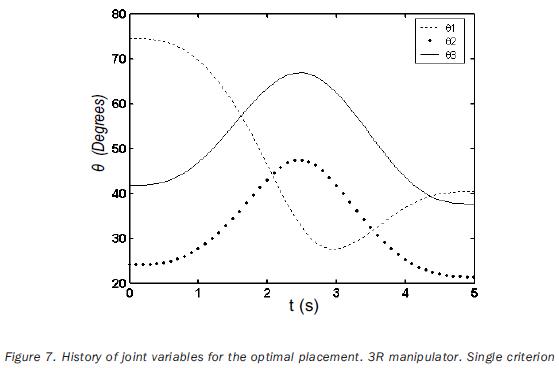
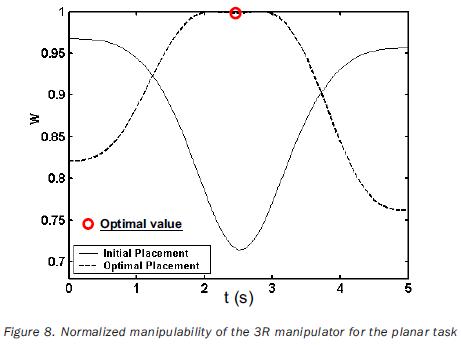
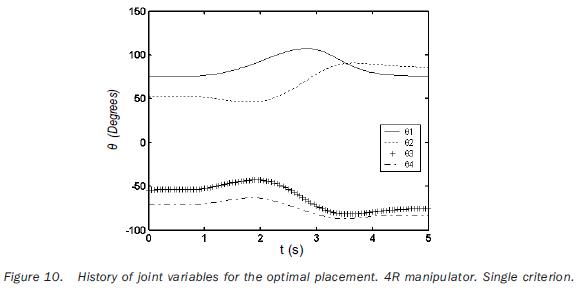
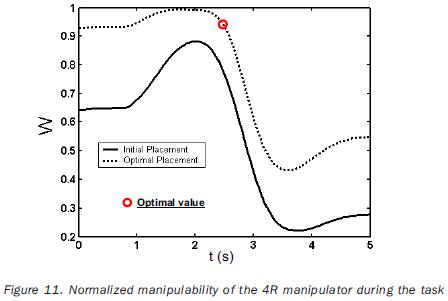
<body><![CDATA[<p align="justify"><font face="verdana" size="2">and</font></p>     <p align="justify"><font face="verdana" size="2">&nbsp;&delta;<sub>13 </sub>= s<sub>4</sub></font></p>     <p align="justify"><font face="verdana" size="2">&nbsp;</font></p>     <p align="justify"><font face="verdana" size="2"><i>B. Single&#150;objective problems</i></font></p>     <p align="justify"><font face="verdana" size="2">The tip of the 3R manipulator should complete a parabolic path; whereas in the case of the 4R manipulator, the tool has to describe a helicoidal path. The tasks of both robots are to be accomplished by applying cycloidal  laws of motion to the end&#150;effector during 5 seconds. The Cartesian coordinates of the sample&#150;points are referred to the frame &Sigma;<sub>t</sub>; they are given in <a href="#t3">tables 3</a> and 5. (<a href="#t3">table 3</a>, <a href="#t4">4</a> and <a href="#t5">5</a>). In the two cases the path placements must be determined in such a way that the manipulability index is maximized on the point p<sub>3</sub> (when <i>t=2.5 </i>s). The independent variables of the planar problem are <i>r<sub>t</sub>&deg;<sub>x</sub>, r<sub>t</sub>&deg;<sub>y</sub>, </i>and &alpha; (rotation about the axis <i><b>z<sub>0</sub></b></i> ); in the case of the 3D path, the additional variable <i>r<sub>t</sub>&deg;<sub>z </sub></i>must be included. The initial values for such variables, as well as the obtained optimal values are given in <a href="#t4">tables 4</a> and <a href="#t6">6</a>. In the same tables the initial and a the optimal values of the objective functions are presented. The joint trajectories corresponding to the optimal placement are observed in <a href="#f7">figures 7</a> and <a href="#f10">10</a> (<a href="#f7">Figures 7</a>, <a href="#f8">8</a>, <a href="/img/revistas/iit/v9n3/a4f9.jpg" target="_blank">9</a> and <a href="#f10">10</a>). The behaviors of the normalized manipulability are compared in <a href="#f8">figures 8</a> and <a href="#f11">11</a>. Sequences of configurations of the robots during the accomplishment of the tasks are presented in <a href="/img/revistas/iit/v9n3/a4f9.jpg" target="_blank">figures 9</a> and <a href="/img/revistas/iit/v9n3/a4f12.jpg" target="_blank">12</a> for the initial and the optimal placements.</font></p>     <p align="justify"><font face="verdana" size="2"><i>B1. Parabolic path</i></font></p>     <p align="center"><font face="verdana" size="2"><a name="t3"></a></font></p>     <p align="center"><font face="verdana" size="2"><img src="/img/revistas/iit/v9n3/a4t3.jpg"></font></p>     <p align="center"><font face="verdana" size="2"><a name="t4"></a></font></p>     <p align="center"><font face="verdana" size="2"><img src="/img/revistas/iit/v9n3/a4t4.jpg"></font></p>     ]]></body>
<body><![CDATA[<p align="left"><font size="2" face="verdana"><i>B2. Helicoidal paht</i> </font></p>     <p align="center"><font face="verdana" size="2"><a name="t5"></a></font></p>     <p align="center"><font face="verdana" size="2"><img src="/img/revistas/iit/v9n3/a4t5.jpg"></font></p>     <p align="center"><font face="verdana" size="2"><a name="t6"></a></font></p>     <p align="center"><font face="verdana" size="2"><img src="/img/revistas/iit/v9n3/a4t6.jpg"></font></p>     <p align="center"><font face="verdana" size="2"><a name="f7"></a></font></p>     <p align="center"><font face="verdana" size="2"><img src="/img/revistas/iit/v9n3/a4f7.jpg"></font></p>     <p align="center"><font face="verdana" size="2"><a name="f8"></a></font></p>     <p align="center"><font face="verdana" size="2"><img src="/img/revistas/iit/v9n3/a4f8.jpg"></font></p>     <p align="center"><font face="verdana" size="2"><a name="f10"></a></font></p>     ]]></body>
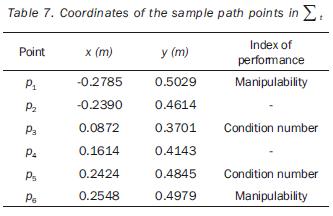
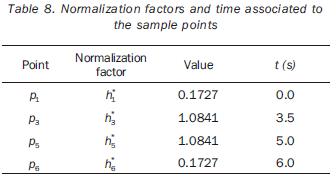
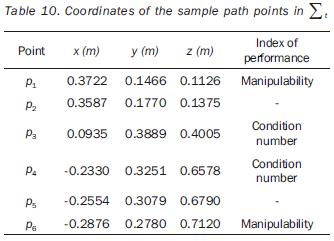
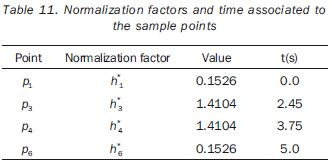
<body><![CDATA[<p align="center"><font face="verdana" size="2"><img src="/img/revistas/iit/v9n3/a4f10.jpg"></font></p>     <p align="center"><font face="verdana" size="2"><a name="f11"></a></font></p>     <p align="center"><font face="verdana" size="2"><img src="/img/revistas/iit/v9n3/a4f11.jpg"></font></p>     <p align="center"><font face="verdana" size="2">&nbsp;</font></p>     <p align="justify"><font face="verdana" size="2"><i>C. Multi-objetive problems</i></font></p>     <p align="justify"><font face="verdana" size="2">In the case of the planar task the extremity of the 3R manipulator should complete a parabolic path; for the 3D task the 4R manipulator's tool has to describe a helicoidal path. In both cases the motion of the end&#150;effector follows a cycloidal law. The periods of the tasks are 6 and 5 seconds for the 3R and 4R manipulators, respectively. The Cartesian coordinates of the sample&#150;points are referred to frame &Sigma;<sub>t</sub>, and different indexes of performance are associated to some points, as indicated in <a href="#t7">tables 7</a> and 10. (<a href="#t7">table 7</a>, <a href="#t8">8</a>, <a href="/img/revistas/iit/v9n3/a4t9.jpg" target="_blank">9</a> and <a href="#t10">10</a>). In the problems we want to determine the path placement which allows to optimize the value of the specified indexes by the related manipulator's configuration when the task is carried out.</font></p>     <p align="justify"><font size="2" face="verdana"><i>1. Parabolic path</i> </font></p>     <p align="center"><font face="verdana" size="2"><a name="t7"></a></font></p>     <p align="center"><font face="verdana" size="2"><img src="/img/revistas/iit/v9n3/a4t7.jpg"></font></p>     <p align="center"><font face="verdana" size="2"><a name="t8"></a></font></p>     ]]></body>
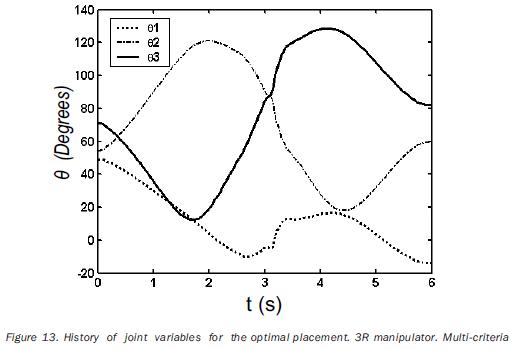
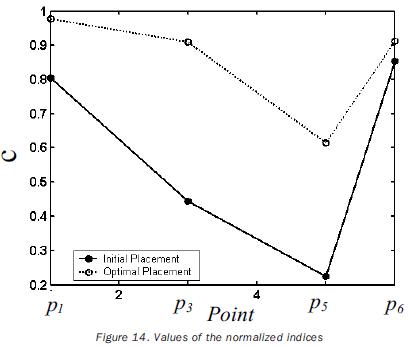
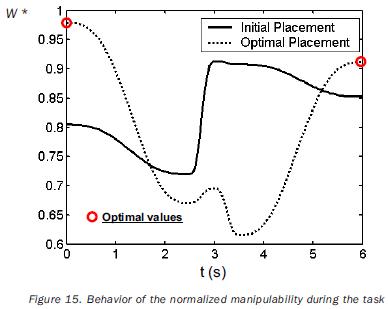
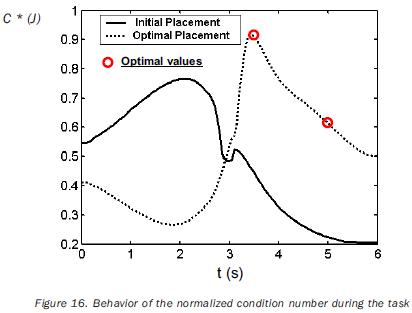
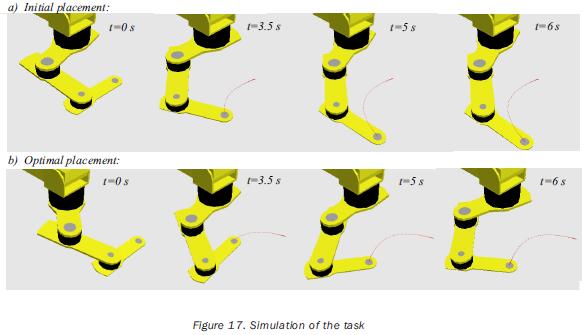
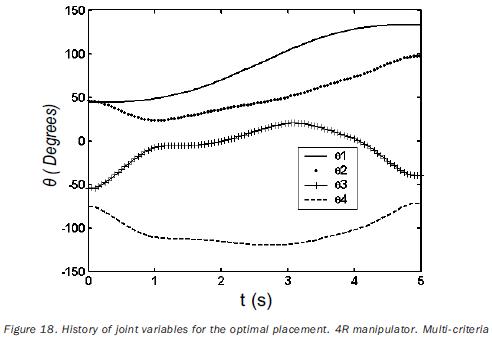
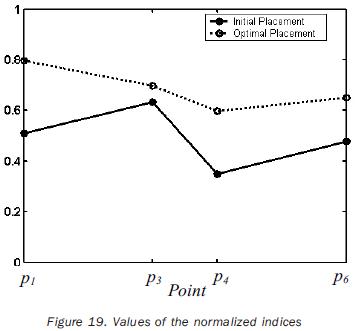
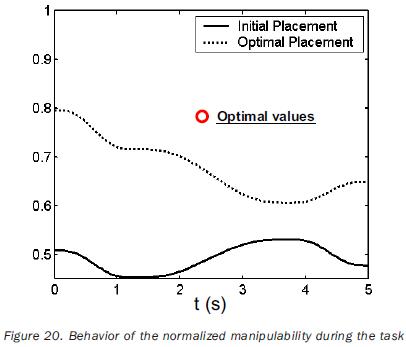
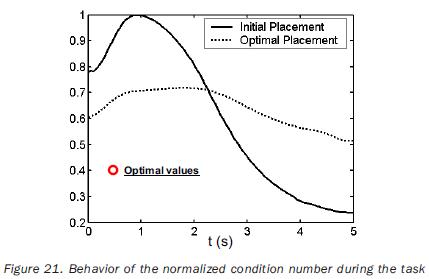
<body><![CDATA[<p align="center"><font face="verdana" size="2"><img src="/img/revistas/iit/v9n3/a4t8.jpg"></font></p>     <p align="center"><font face="verdana" size="2"><a name="t10"></a></font></p>     <p align="center"><font face="verdana" size="2"><img src="/img/revistas/iit/v9n3/a4t10.jpg"></font></p>     <p align="justify"><font face="verdana" size="2">The normalization factors used in equation (18) are previously computed by solving the single&#150;objective problem for points having a related index of performance. The obtained values of such factors are listed in <a href="#t8">tables 8</a> and <a href="#t11">11</a>. The independent variables of the planar problem are <i>r<sub>t</sub>&deg;<sub>x</sub>, r<sub>t</sub>&deg;<sub>y</sub> </i>and a (rotation about the axis <i><b>z<sub>0</sub></b></i>); in the case of the 3D path, the additional variable <i>r<sub>t</sub>&deg;<sub>y</sub> </i>must be included. The initial values for such variables, as well as the obtained optimal values are given in <a href="/img/revistas/iit/v9n3/a4t9.jpg" target="_blank">tables 9</a> and <a href="/img/revistas/iit/v9n3/a4t12.jpg" target="_blank">12</a>. In the same tables the initial and optimal values of the objective functions are presented. The joint trajectories corresponding to the optimal placement are observed in <a href="#f13">figures 13</a> and <a href="#f18">18</a>. The progress attained of the normalized indices associated to the sample points can be appreciated in <a href="#f14">figures 14</a> and <a href="#f19">19</a>. The behaviors of the manipulability and the condition number (both normalized) during the task are shown in <a href="#f15">figures 15</a>, <a href="#f16">16</a>, <a href="#f20">20</a> and <a href="#f21">21</a>. Sequences of configurations of the robots describing the desired paths are presented in <a href="#f17">figures 17</a> and <a href="/img/revistas/iit/v9n3/a4f22.jpg" target="_blank">22</a> for the initial and the optimal placements.</font></p>     <p align="center"><font face="verdana" size="2"><a name="t11"></a></font></p>     <p align="center"><font face="verdana" size="2"><img src="/img/revistas/iit/v9n3/a4t11.jpg"></font></p>     <p align="center"><font face="verdana" size="2"><a name="f13"></a></font></p>     <p align="center"><font face="verdana" size="2"><img src="/img/revistas/iit/v9n3/a4f13.jpg"></font></p>     <p align="center"><font face="verdana" size="2"><a name="f14"></a></font></p>     <p align="center"><font face="verdana" size="2"><img src="/img/revistas/iit/v9n3/a4f14.jpg"></font></p>     ]]></body>
<body><![CDATA[<p align="center"><font face="verdana" size="2"><a name="f15"></a></font></p>     <p align="center"><font face="verdana" size="2"><img src="/img/revistas/iit/v9n3/a4f15.jpg"></font></p>     <p align="center"><font face="verdana" size="2"><a name="f16"></a></font></p>     <p align="center"><font face="verdana" size="2"><img src="/img/revistas/iit/v9n3/a4f16.jpg"></font></p>     <p align="center"><font face="verdana" size="2"><a name="f17"></a></font></p>     <p align="center"><font face="verdana" size="2"><img src="/img/revistas/iit/v9n3/a4f17.jpg"></font></p>     <p align="center"><font face="verdana" size="2"><a name="f18"></a></font></p>     <p align="center"><font face="verdana" size="2"><img src="/img/revistas/iit/v9n3/a4f18.jpg"></font></p>     <p align="center"><font face="verdana" size="2"><a name="f19"></a></font></p>     <p align="center"><font face="verdana" size="2"><img src="/img/revistas/iit/v9n3/a4f19.jpg"></font></p>     ]]></body>
<body><![CDATA[<p align="center"><font face="verdana" size="2"><a name="f20"></a></font></p>     <p align="center"><font face="verdana" size="2"><img src="/img/revistas/iit/v9n3/a4f20.jpg"></font></p>     <p align="center"><font face="verdana" size="2"><a name="f21"></a></font></p>     <p align="center"><font face="verdana" size="2"><img src="/img/revistas/iit/v9n3/a4f21.jpg"></font></p>     <p align="justify"><font face="verdana" size="2">&nbsp;</font></p>     <p align="justify"><font face="verdana" size="2"><b>Conclusion</b></font></p>     <p align="justify"><font face="verdana" size="2">General formulations were presented in this paper to determine the best position and orientation of a path to be followed by a redundant robotic manipulator. Depending on the requirements of the user, the quality of a placement can be measured by using either a single criterion or multiple criteria of manipulator's performance. Consequently, the proposed formulations are addressed to solve both single and multi&#150;objective optimization problems. In the single&#150;objective problem, one index of performance associated to a specific path&#150;point is defined as the function to be optimized. On the other hand, in the multi&#150;objective problem such a function is equivalent to a characteristic index which represents the set of normalized indexes to be optimized. The proposed formulations take into account constraints regarding the accessibility to the manipulator's task. Indeed, we introduce constraints in order to: a) demarcate an available physical space to locate the task; b) avoid transgression of joint limits during the accomplishment of the task; c) generate continuous joint trajectories on the whole task.</font></p>     <p align="justify"><font face="verdana" size="2">The case studies examined here showed that significant improvements of the manipulator's performance can be obtained by applying our approach. In such cases all the constraints were satisfied and consequently the accessibility to the complete tasks was assured. However, in the hypothetical case in which a satisfactory solution could not be found by trying with a first manipulator's aspect, then further attempts could be accomplished by using other manipulator's aspects to satisfy the accessibility conditions and improve the manipulator's performance. On the other hand, the sample points considered in the problems were chosen by using a criterion of symmetry; nevertheless, both the number of points and the position of such points on the path could have an influence on the level of the improvement obtained for the indices of performance. Thus, supplementary studies should be carried out to characterize a suitable criterion to solve both questions. Furthermore, in future works additional constraints will be taken into account to avoid collisions of the manipulator when it works in cluttered environments.</font></p>     <p align="justify"><font face="verdana" size="2">&nbsp;</font></p>     <p align="justify"><font face="verdana" size="2"><b>Acknowledgments</b></font></p>     ]]></body>
<body><![CDATA[<p align="justify"><font face="verdana" size="2">The subvention for cooperation between researchers of the Instituto Tecnol&oacute;gico de la Laguna of Mexico and the Laboratoire de M&eacute;canique des Solides of France for this work was made possible under the grant M00 M02 ECOS&#150;CONACyT&#150;ANUIES. On the other hand, a part of the present work was supported by the National Council of Science and Technology &#150;CONACyT&#150; of Mexico, (grant 31948&#150;A).</font></p>     <p align="justify"><font face="verdana" size="2">&nbsp;</font></p>     <p align="justify"><font face="verdana" size="2"><b>References</b></font></p>     <!-- ref --><p align="justify"><font face="verdana" size="2">Abdel&#150;Malek S. and Nenchev D.N. Local torque minimization for redundant manipulators: a correct formulation. <i>Robotica, </i>14:235&#150;239, 2000.</font>&nbsp;&nbsp;&nbsp;&nbsp;&nbsp;&nbsp;&nbsp;&nbsp;[&#160;<a href="javascript:void(0);" onclick="javascript: window.open('/scielo.php?script=sci_nlinks&ref=4242766&pid=S1405-7743200800030000400001&lng=','','width=640,height=500,resizable=yes,scrollbars=1,menubar=yes,');">Links</a>&#160;]<!-- end-ref --><!-- ref --><p align="justify"><font face="verdana" size="2">Angeles J. and L&oacute;pez&#150;Caj&uacute;n C. <i>Kinematic isotropy and conditioning index of serial robotic manipulators. Int. J. Robotics Research, </i>11(6):560&#150;571, 1992.</font>&nbsp;&nbsp;&nbsp;&nbsp;&nbsp;&nbsp;&nbsp;&nbsp;[&#160;<a href="javascript:void(0);" onclick="javascript: window.open('/scielo.php?script=sci_nlinks&ref=4242767&pid=S1405-7743200800030000400002&lng=','','width=640,height=500,resizable=yes,scrollbars=1,menubar=yes,');">Links</a>&#160;]<!-- end-ref --><!-- ref --><p align="justify"><font face="verdana" size="2">Aspragathos N.A. and Foussias S. Optimal location of a robot path when considering velocity performance. <i>Robotica, </i>20:139&#150;147, 2002.</font>&nbsp;&nbsp;&nbsp;&nbsp;&nbsp;&nbsp;&nbsp;&nbsp;[&#160;<a href="javascript:void(0);" onclick="javascript: window.open('/scielo.php?script=sci_nlinks&ref=4242768&pid=S1405-7743200800030000400003&lng=','','width=640,height=500,resizable=yes,scrollbars=1,menubar=yes,');">Links</a>&#160;]<!-- end-ref --><!-- ref --><p align="justify"><font face="verdana" size="2">Borrel B. and Liegois A. A study of multiple manipulator inverse kinematic solution with applications to trajectory planning and workspace determination. IEEE Proc. of the 1986 International Conference on Robotics and Automation, pp. 1180&#150;1185.</font>&nbsp;&nbsp;&nbsp;&nbsp;&nbsp;&nbsp;&nbsp;&nbsp;[&#160;<a href="javascript:void(0);" onclick="javascript: window.open('/scielo.php?script=sci_nlinks&ref=4242769&pid=S1405-7743200800030000400004&lng=','','width=640,height=500,resizable=yes,scrollbars=1,menubar=yes,');">Links</a>&#160;]<!-- end-ref --><!-- ref --><p align="justify"><font face="verdana" size="2">Burdick J.W. A classification of 3R regional manipulator singularities and geometries. <i>Mechanisms and Machine Theory, </i>30(1): 71&#150;89, 1995.</font>&nbsp;&nbsp;&nbsp;&nbsp;&nbsp;&nbsp;&nbsp;&nbsp;[&#160;<a href="javascript:void(0);" onclick="javascript: window.open('/scielo.php?script=sci_nlinks&ref=4242770&pid=S1405-7743200800030000400005&lng=','','width=640,height=500,resizable=yes,scrollbars=1,menubar=yes,');">Links</a>&#160;]<!-- end-ref --><!-- ref --><p align="justify"><font face="verdana" size="2">Chiu S.L. Task compatibility of manipulators postures. <i>Int J. Robotics Research, </i>7(5):13&#150;21,1988.</font>&nbsp;&nbsp;&nbsp;&nbsp;&nbsp;&nbsp;&nbsp;&nbsp;[&#160;<a href="javascript:void(0);" onclick="javascript: window.open('/scielo.php?script=sci_nlinks&ref=4242771&pid=S1405-7743200800030000400006&lng=','','width=640,height=500,resizable=yes,scrollbars=1,menubar=yes,');">Links</a>&#160;]<!-- end-ref --><!-- ref --><p align="justify"><font face="verdana" size="2">El Omri J. and Wenger P. How to recognize simply a non&#150;singular posture changing 3&#150;DOF manipulator. Proceedings of the 7<sup>th</sup> International Conference on Advanced Robotics, 1995, pp. 215&#150;222.</font>&nbsp;&nbsp;&nbsp;&nbsp;&nbsp;&nbsp;&nbsp;&nbsp;[&#160;<a href="javascript:void(0);" onclick="javascript: window.open('/scielo.php?script=sci_nlinks&ref=4242772&pid=S1405-7743200800030000400007&lng=','','width=640,height=500,resizable=yes,scrollbars=1,menubar=yes,');">Links</a>&#160;]<!-- end-ref --><!-- ref --><p align="justify"><font face="verdana" size="2">Fardanesh B. and Rastegar J. Minimum cycle time location of task in the workspace of a robot arm. IEEE Proc. of the 21st Conference on Decision and Control, 1988, pp. 2280&#150;2283.</font>&nbsp;&nbsp;&nbsp;&nbsp;&nbsp;&nbsp;&nbsp;&nbsp;[&#160;<a href="javascript:void(0);" onclick="javascript: window.open('/scielo.php?script=sci_nlinks&ref=4242773&pid=S1405-7743200800030000400008&lng=','','width=640,height=500,resizable=yes,scrollbars=1,menubar=yes,');">Links</a>&#160;]<!-- end-ref --><!-- ref --><p align="justify"><font face="verdana" size="2">Hemerle J.S. and Prinz F.B. Optimal path place ment for kinematically redundant manipulators. Proceedings of the 1991 IEEE International Conference on Robotics and Automation, 1991, pp. 1234&#150;1243.</font>&nbsp;&nbsp;&nbsp;&nbsp;&nbsp;&nbsp;&nbsp;&nbsp;[&#160;<a href="javascript:void(0);" onclick="javascript: window.open('/scielo.php?script=sci_nlinks&ref=4242774&pid=S1405-7743200800030000400009&lng=','','width=640,height=500,resizable=yes,scrollbars=1,menubar=yes,');">Links</a>&#160;]<!-- end-ref --><!-- ref --><p align="justify"><font face="verdana" size="2">Hsu D., Latombe J.C. and Sorkin S. Placing a robot manipulator amid obstacles for optimized Execution. IEEE Int. Symp. on Assembly and Task Planning, 1999.</font>&nbsp;&nbsp;&nbsp;&nbsp;&nbsp;&nbsp;&nbsp;&nbsp;[&#160;<a href="javascript:void(0);" onclick="javascript: window.open('/scielo.php?script=sci_nlinks&ref=4242775&pid=S1405-7743200800030000400010&lng=','','width=640,height=500,resizable=yes,scrollbars=1,menubar=yes,');">Links</a>&#160;]<!-- end-ref --><!-- ref --><p align="justify"><font face="verdana" size="2">Khalil W. and Kleinfinger J.F. A new geometric notation for open and closed&#150;loop robots. In: Proceedings of the IEEE International Conference on Robotics and Automation, 1986, pp. 1174&#150;1180.</font>&nbsp;&nbsp;&nbsp;&nbsp;&nbsp;&nbsp;&nbsp;&nbsp;[&#160;<a href="javascript:void(0);" onclick="javascript: window.open('/scielo.php?script=sci_nlinks&ref=4242776&pid=S1405-7743200800030000400011&lng=','','width=640,height=500,resizable=yes,scrollbars=1,menubar=yes,');">Links</a>&#160;]<!-- end-ref --><!-- ref --><p align="justify"><font face="verdana" size="2">Klein C.A. and Blaho, B.E. Dexterity measures for the design and control of kinematically redundant manipulators. <i>Int. J. Robotics Research, </i>6 (2):72&#150;83, 1987.</font>&nbsp;&nbsp;&nbsp;&nbsp;&nbsp;&nbsp;&nbsp;&nbsp;[&#160;<a href="javascript:void(0);" onclick="javascript: window.open('/scielo.php?script=sci_nlinks&ref=4242777&pid=S1405-7743200800030000400012&lng=','','width=640,height=500,resizable=yes,scrollbars=1,menubar=yes,');">Links</a>&#160;]<!-- end-ref --><!-- ref --><p align="justify"><font face="verdana" size="2">Nakamura Y. and Hanafusa H. Optimal redundancy control of robot manipulators. <i>Int. J. Robotics Research, </i>6(1):32&#150;42, 1987.</font>&nbsp;&nbsp;&nbsp;&nbsp;&nbsp;&nbsp;&nbsp;&nbsp;[&#160;<a href="javascript:void(0);" onclick="javascript: window.open('/scielo.php?script=sci_nlinks&ref=4242778&pid=S1405-7743200800030000400013&lng=','','width=640,height=500,resizable=yes,scrollbars=1,menubar=yes,');">Links</a>&#160;]<!-- end-ref --><!-- ref --><p align="justify"><font face="verdana" size="2">Ma S. and Nenchev D.N. Local torque minimization for redundant manipulators: a correct formulation. <i>Robotica, </i>(14):235&#150;239, 1996.</font>&nbsp;&nbsp;&nbsp;&nbsp;&nbsp;&nbsp;&nbsp;&nbsp;[&#160;<a href="javascript:void(0);" onclick="javascript: window.open('/scielo.php?script=sci_nlinks&ref=4242779&pid=S1405-7743200800030000400014&lng=','','width=640,height=500,resizable=yes,scrollbars=1,menubar=yes,');">Links</a>&#160;]<!-- end-ref --><!-- ref --><p align="justify"><font face="verdana" size="2">Nelson B., Pedersen K. and Donath M. Locating assembly tasks in a manipulator's workspace. IEEE Proc. of the International Conference on Robotics and Automation, 1987, pp. 1367&#150;1372.</font>&nbsp;&nbsp;&nbsp;&nbsp;&nbsp;&nbsp;&nbsp;&nbsp;[&#160;<a href="javascript:void(0);" onclick="javascript: window.open('/scielo.php?script=sci_nlinks&ref=4242780&pid=S1405-7743200800030000400015&lng=','','width=640,height=500,resizable=yes,scrollbars=1,menubar=yes,');">Links</a>&#160;]<!-- end-ref --><!-- ref --><p align="justify"><font face="verdana" size="2">Pamanes G. J. A. A criterion for optimal place ment of robotic manipulators. IFAC Proc. of the 6th Symp. on Information Control Problems in Manufacturing Technology, 1989, pp.183&#150;187.</font>&nbsp;&nbsp;&nbsp;&nbsp;&nbsp;&nbsp;&nbsp;&nbsp;[&#160;<a href="javascript:void(0);" onclick="javascript: window.open('/scielo.php?script=sci_nlinks&ref=4242781&pid=S1405-7743200800030000400016&lng=','','width=640,height=500,resizable=yes,scrollbars=1,menubar=yes,');">Links</a>&#160;]<!-- end-ref --><!-- ref --><p align="justify"><font face="verdana" size="2">Pamanes G.J.A and Zeghloul S. Optimal place ment of robotic manipulators using multiple kinematic criteria. Proceedings of the 1991 IEEE International Conference on Robotics and Automation, 1991, pp. 933&#150;938.</font>&nbsp;&nbsp;&nbsp;&nbsp;&nbsp;&nbsp;&nbsp;&nbsp;[&#160;<a href="javascript:void(0);" onclick="javascript: window.open('/scielo.php?script=sci_nlinks&ref=4242782&pid=S1405-7743200800030000400017&lng=','','width=640,height=500,resizable=yes,scrollbars=1,menubar=yes,');">Links</a>&#160;]<!-- end-ref --><!-- ref --><p align="justify"><font face="verdana" size="2">Pamanes G.J.A., Barr&oacute;n L.A. and Pinedo C. Constrained optimization in redundancy resolution of robotic manipulators. Proceedings of the 10th World Congress on Theory of Machines and Mechanisms, Oulu, Finland, 1999, pp. 1057&#150;1066.</font>&nbsp;&nbsp;&nbsp;&nbsp;&nbsp;&nbsp;&nbsp;&nbsp;[&#160;<a href="javascript:void(0);" onclick="javascript: window.open('/scielo.php?script=sci_nlinks&ref=4242783&pid=S1405-7743200800030000400018&lng=','','width=640,height=500,resizable=yes,scrollbars=1,menubar=yes,');">Links</a>&#160;]<!-- end-ref --><!-- ref --><p align="justify"><font face="verdana" size="2">Reynier F., Chedmail P. and Wenger P. Optimal positioning of robots: feasibility of continuous trajectories among obstacles. IEEE Int. Conf. on Systems Man. and Cybernetics Proc., 1992.</font>&nbsp;&nbsp;&nbsp;&nbsp;&nbsp;&nbsp;&nbsp;&nbsp;[&#160;<a href="javascript:void(0);" onclick="javascript: window.open('/scielo.php?script=sci_nlinks&ref=4242784&pid=S1405-7743200800030000400019&lng=','','width=640,height=500,resizable=yes,scrollbars=1,menubar=yes,');">Links</a>&#160;]<!-- end-ref --><!-- ref --><p align="justify"><font face="verdana" size="2">Wenger P. Design of cuspidal and noncuspidal manipulators. Proceedings of the IEEE International Conference on Robotics and Automation, 1997, pp 2172&#150;2177.</font>&nbsp;&nbsp;&nbsp;&nbsp;&nbsp;&nbsp;&nbsp;&nbsp;[&#160;<a href="javascript:void(0);" onclick="javascript: window.open('/scielo.php?script=sci_nlinks&ref=4242785&pid=S1405-7743200800030000400020&lng=','','width=640,height=500,resizable=yes,scrollbars=1,menubar=yes,');">Links</a>&#160;]<!-- end-ref --><!-- ref --><p align="justify"><font face="verdana" size="2">Yoshikawa T. Manipulability of robotics mechanisms. <i>Int. J. Robotics Research, </i>4(2):3&#150;9,1985.</font>&nbsp;&nbsp;&nbsp;&nbsp;&nbsp;&nbsp;&nbsp;&nbsp;[&#160;<a href="javascript:void(0);" onclick="javascript: window.open('/scielo.php?script=sci_nlinks&ref=4242786&pid=S1405-7743200800030000400021&lng=','','width=640,height=500,resizable=yes,scrollbars=1,menubar=yes,');">Links</a>&#160;]<!-- end-ref --><!-- ref --><p align="justify"><font face="verdana" size="2">Yoshikawa T. and Kiriyama S. Four&#150;joint redundant wrist mechanism and its control. <i>Journal of Dynamic System, Measurement, and Control, </i>111:200&#150;204, 1989.</font>&nbsp;&nbsp;&nbsp;&nbsp;&nbsp;&nbsp;&nbsp;&nbsp;[&#160;<a href="javascript:void(0);" onclick="javascript: window.open('/scielo.php?script=sci_nlinks&ref=4242787&pid=S1405-7743200800030000400022&lng=','','width=640,height=500,resizable=yes,scrollbars=1,menubar=yes,');">Links</a>&#160;]<!-- end-ref --><!-- ref --><p align="justify"><font face="verdana" size="2">Zeghloul S. and Pamanes G.J.A. Multi&#150;criteria placement of robots in constrained environments. <i>Robotica, </i>11:105&#150;110, 1993.</font>&nbsp;&nbsp;&nbsp;&nbsp;&nbsp;&nbsp;&nbsp;&nbsp;[&#160;<a href="javascript:void(0);" onclick="javascript: window.open('/scielo.php?script=sci_nlinks&ref=4242788&pid=S1405-7743200800030000400023&lng=','','width=640,height=500,resizable=yes,scrollbars=1,menubar=yes,');">Links</a>&#160;]<!-- end-ref --><!-- ref --><p align="justify"><font face="verdana" size="2">Zhou Z.L., Charles C. and Nguyen. Globally optimal trajectory planning for redundant manipulators using state space augmentation method. <i>Journal of Intelligent and Robotic Systems, </i>Vol. 19(1):105&#150;117, 1997.</font>&nbsp;&nbsp;&nbsp;&nbsp;&nbsp;&nbsp;&nbsp;&nbsp;[&#160;<a href="javascript:void(0);" onclick="javascript: window.open('/scielo.php?script=sci_nlinks&ref=4242789&pid=S1405-7743200800030000400024&lng=','','width=640,height=500,resizable=yes,scrollbars=1,menubar=yes,');">Links</a>&#160;]<!-- end-ref --><p align="justify"><font face="verdana" size="2">&nbsp;</font></p>     <p align="justify"><font face="verdana" size="2"><b>Semblanza de los autores</b></font></p>     <p align="justify"><font face="verdana" size="2"><i>J. Alfonso Pamanes&#150;Garc&iacute;a. </i>Was born in Torreon, Mexico, in 1953. He received the B.S. degree from the La Laguna Institute of Technology in 1978, the M.S. degree in mechanics in 1984 from the National Polytechnic Institute of Mexico, and the Ph.D. degree in mechanics from the Poitiers University, France, in 1992. He is a professor in mechanics of robots at the La Laguna Institute of Technology, Torreon, Mexico. His research interests are in modeling and motion planning of robots. Author of more than 50 scientific papers published in national or international congress and journals. He has been reviewer of the National Council of Science and Technology of Mexico for evaluation of national research projects.</font></p>     ]]></body>
<body><![CDATA[<p align="justify"><font face="verdana" size="2"><i>Sa&iuml;d Zeghloul. </i>Received the M.S. degree in mechanics and the Ph.D. degree in robotics from the University of Poitiers, France, in 1980 and 1983, respectively, and the Doctorat d'Etat es sciences physiques degree in 1991. He is a professor at the Faculte des Sciences of the Poitiers University where he teaches robotics. He is leader of the research group in robotics of the Laboratoire de Mecanique des Solides of Poitiers, where his research interests include mobile robot and manipulator path planing, mechanical hand grasp planing.</font></p>     <p align="justify"><font face="verdana" size="2"><i>Enrique Cuan&#150;Dur&oacute;n. </i>Was born in Torreon, Mexico, in 1960. He received the B.S. degree from the La Laguna Institute of Technology in 1981, the M.S. degree in computer systems in 1985 from the Institute of Technology and Superior Studies of Monterrey. He develops his Ph.D. thesis at the Poitiers University, France, with the support of the La Laguna Institute of Technology, Torreon, Mexico. His main research interests are in motion planning and redundant robots.</font></p>      ]]></body><back>
<ref-list>
<ref id="B1">
<nlm-citation citation-type="journal">
<person-group person-group-type="author">
<name>
<surname><![CDATA[Abdel-Malek]]></surname>
<given-names><![CDATA[S.]]></given-names>
</name>
<name>
<surname><![CDATA[Nenchev]]></surname>
<given-names><![CDATA[D.N.]]></given-names>
</name>
</person-group>
<article-title xml:lang="en"><![CDATA[Local torque minimization for redundant manipulators: a correct formulation]]></article-title>
<source><![CDATA[Robotica]]></source>
<year>2000</year>
<volume>14</volume>
<page-range>235-239</page-range></nlm-citation>
</ref>
<ref id="B2">
<nlm-citation citation-type="journal">
<person-group person-group-type="author">
<name>
<surname><![CDATA[Angeles]]></surname>
<given-names><![CDATA[J.]]></given-names>
</name>
<name>
<surname><![CDATA[López-Cajún]]></surname>
<given-names><![CDATA[C.]]></given-names>
</name>
</person-group>
<article-title xml:lang="en"><![CDATA[Kinematic isotropy and conditioning index of serial robotic manipulators]]></article-title>
<source><![CDATA[Int. J. Robotics Research]]></source>
<year>1992</year>
<volume>11</volume>
<numero>6</numero>
<issue>6</issue>
<page-range>560-571</page-range></nlm-citation>
</ref>
<ref id="B3">
<nlm-citation citation-type="journal">
<person-group person-group-type="author">
<name>
<surname><![CDATA[Aspragathos]]></surname>
<given-names><![CDATA[N.A.]]></given-names>
</name>
<name>
<surname><![CDATA[Foussias]]></surname>
<given-names><![CDATA[S.]]></given-names>
</name>
</person-group>
<article-title xml:lang="en"><![CDATA[Optimal location of a robot path when considering velocity performance]]></article-title>
<source><![CDATA[Robotica]]></source>
<year>2002</year>
<volume>20</volume>
<page-range>139-147</page-range></nlm-citation>
</ref>
<ref id="B4">
<nlm-citation citation-type="confpro">
<person-group person-group-type="author">
<name>
<surname><![CDATA[Borrel]]></surname>
<given-names><![CDATA[B.]]></given-names>
</name>
<name>
<surname><![CDATA[Liegois]]></surname>
<given-names><![CDATA[A.]]></given-names>
</name>
</person-group>
<article-title xml:lang="en"><![CDATA[A study of multiple manipulator inverse kinematic solution with applications to trajectory planning and workspace determination.]]></article-title>
<source><![CDATA[]]></source>
<year></year>
<conf-name><![CDATA[ IEEE Proc. of the 1986 International Conference on Robotics and Automation]]></conf-name>
<conf-loc> </conf-loc>
<page-range>1180-1185</page-range></nlm-citation>
</ref>
<ref id="B5">
<nlm-citation citation-type="journal">
<person-group person-group-type="author">
<name>
<surname><![CDATA[Burdick]]></surname>
<given-names><![CDATA[J.W.]]></given-names>
</name>
</person-group>
<article-title xml:lang="en"><![CDATA[A classification of 3R regional manipulator singularities and geometries]]></article-title>
<source><![CDATA[Mechanisms and Machine Theory]]></source>
<year>1995</year>
<volume>30</volume>
<numero>1</numero>
<issue>1</issue>
</nlm-citation>
</ref>
<ref id="B6">
<nlm-citation citation-type="journal">
<person-group person-group-type="author">
<name>
<surname><![CDATA[Chiu]]></surname>
<given-names><![CDATA[S.L.]]></given-names>
</name>
</person-group>
<article-title xml:lang="en"><![CDATA[Task compatibility of manipulators postures]]></article-title>
<source><![CDATA[Int J. Robotics Research]]></source>
<year>1988</year>
<volume>7</volume>
<numero>5</numero>
<issue>5</issue>
<page-range>13-21</page-range></nlm-citation>
</ref>
<ref id="B7">
<nlm-citation citation-type="confpro">
<person-group person-group-type="author">
<name>
<surname><![CDATA[El Omri]]></surname>
<given-names><![CDATA[J.]]></given-names>
</name>
<name>
<surname><![CDATA[Wenger]]></surname>
<given-names><![CDATA[P.]]></given-names>
</name>
</person-group>
<article-title xml:lang="en"><![CDATA[How to recognize simply a non-singular posture changing 3-DOF manipulator]]></article-title>
<source><![CDATA[]]></source>
<year></year>
<conf-name><![CDATA[ Proceedings of the 7th International Conference on Advanced Robotics]]></conf-name>
<conf-date>1995</conf-date>
<conf-loc> </conf-loc>
<page-range>215-222</page-range></nlm-citation>
</ref>
<ref id="B8">
<nlm-citation citation-type="confpro">
<person-group person-group-type="author">
<name>
<surname><![CDATA[Fardanesh]]></surname>
<given-names><![CDATA[B.]]></given-names>
</name>
<name>
<surname><![CDATA[Rastegar]]></surname>
<given-names><![CDATA[J.]]></given-names>
</name>
</person-group>
<article-title xml:lang="en"><![CDATA[Minimum cycle time location of task in the workspace of a robot arm]]></article-title>
<source><![CDATA[]]></source>
<year></year>
<conf-name><![CDATA[ IEEE Proc. of the 21st Conference on Decision and Control]]></conf-name>
<conf-date>1988</conf-date>
<conf-loc> </conf-loc>
<page-range>2280-2283</page-range></nlm-citation>
</ref>
<ref id="B9">
<nlm-citation citation-type="confpro">
<person-group person-group-type="author">
<name>
<surname><![CDATA[Hemerle]]></surname>
<given-names><![CDATA[J.S.]]></given-names>
</name>
<name>
<surname><![CDATA[Prinz]]></surname>
<given-names><![CDATA[F.B.]]></given-names>
</name>
</person-group>
<article-title xml:lang="en"><![CDATA[Optimal path place ment for kinematically redundant manipulators]]></article-title>
<source><![CDATA[]]></source>
<year></year>
<conf-name><![CDATA[ Proceedings of the 1991 IEEE International Conference on Robotics and Automation]]></conf-name>
<conf-date>1991</conf-date>
<conf-loc> </conf-loc>
<page-range>1234-1243</page-range></nlm-citation>
</ref>
<ref id="B10">
<nlm-citation citation-type="confpro">
<person-group person-group-type="author">
<name>
<surname><![CDATA[Hsu]]></surname>
<given-names><![CDATA[D.]]></given-names>
</name>
<name>
<surname><![CDATA[Latombe]]></surname>
<given-names><![CDATA[J.C.]]></given-names>
</name>
<name>
<surname><![CDATA[Sorkin]]></surname>
<given-names><![CDATA[S.]]></given-names>
</name>
</person-group>
<article-title xml:lang="en"><![CDATA[Placing a robot manipulator amid obstacles for optimized Execution]]></article-title>
<source><![CDATA[]]></source>
<year>1999</year>
<conf-name><![CDATA[ IEEE Int. Symp. on Assembly and Task Planning]]></conf-name>
<conf-loc> </conf-loc>
</nlm-citation>
</ref>
<ref id="B11">
<nlm-citation citation-type="confpro">
<person-group person-group-type="author">
<name>
<surname><![CDATA[Khalil]]></surname>
<given-names><![CDATA[W.]]></given-names>
</name>
<name>
<surname><![CDATA[Kleinfinger]]></surname>
<given-names><![CDATA[J.F.]]></given-names>
</name>
</person-group>
<article-title xml:lang="en"><![CDATA[A new geometric notation for open and closed-loop robots]]></article-title>
<source><![CDATA[]]></source>
<year></year>
<conf-name><![CDATA[ Proceedings of the IEEE International Conference on Robotics and Automation]]></conf-name>
<conf-date>1986</conf-date>
<conf-loc> </conf-loc>
<page-range>1174-1180</page-range></nlm-citation>
</ref>
<ref id="B12">
<nlm-citation citation-type="journal">
<person-group person-group-type="author">
<name>
<surname><![CDATA[Klein]]></surname>
<given-names><![CDATA[C.A.]]></given-names>
</name>
<name>
<surname><![CDATA[Blaho]]></surname>
<given-names><![CDATA[B.E.]]></given-names>
</name>
</person-group>
<article-title xml:lang="en"><![CDATA[Dexterity measures for the design and control of kinematically redundant manipulators]]></article-title>
<source><![CDATA[Int. J. Robotics Research]]></source>
<year></year>
<volume>6</volume>
<numero>2</numero>
<issue>2</issue>
<page-range>72-83</page-range><page-range>1987</page-range></nlm-citation>
</ref>
<ref id="B13">
<nlm-citation citation-type="journal">
<person-group person-group-type="author">
<name>
<surname><![CDATA[Nakamura]]></surname>
<given-names><![CDATA[Y.]]></given-names>
</name>
<name>
<surname><![CDATA[Hanafusa]]></surname>
<given-names><![CDATA[H.]]></given-names>
</name>
</person-group>
<article-title xml:lang="en"><![CDATA[Optimal redundancy control of robot manipulators]]></article-title>
<source><![CDATA[Int. J. Robotics Research]]></source>
<year>1987</year>
<volume>6</volume>
<numero>1</numero>
<issue>1</issue>
<page-range>32-42</page-range></nlm-citation>
</ref>
<ref id="B14">
<nlm-citation citation-type="journal">
<person-group person-group-type="author">
<name>
<surname><![CDATA[Ma]]></surname>
<given-names><![CDATA[S.]]></given-names>
</name>
<name>
<surname><![CDATA[Nenchev]]></surname>
<given-names><![CDATA[D.N.]]></given-names>
</name>
</person-group>
<article-title xml:lang="en"><![CDATA[Local torque minimization for redundant manipulators: a correct formulation]]></article-title>
<source><![CDATA[Robotica]]></source>
<year>1996</year>
<numero>14</numero>
<issue>14</issue>
<page-range>235-239</page-range></nlm-citation>
</ref>
<ref id="B15">
<nlm-citation citation-type="confpro">
<person-group person-group-type="author">
<name>
<surname><![CDATA[Nelson]]></surname>
<given-names><![CDATA[B.]]></given-names>
</name>
<name>
<surname><![CDATA[Pedersen]]></surname>
<given-names><![CDATA[K.]]></given-names>
</name>
<name>
<surname><![CDATA[Donath]]></surname>
<given-names><![CDATA[M.]]></given-names>
</name>
</person-group>
<article-title xml:lang="en"><![CDATA[Locating assembly tasks in a manipulator's workspace]]></article-title>
<source><![CDATA[]]></source>
<year></year>
<conf-name><![CDATA[ IEEE Proc. of the International Conference on Robotics and Automation]]></conf-name>
<conf-date>1987</conf-date>
<conf-loc> </conf-loc>
<page-range>1367-1372</page-range></nlm-citation>
</ref>
<ref id="B16">
<nlm-citation citation-type="confpro">
<person-group person-group-type="author">
<name>
<surname><![CDATA[Pamanes]]></surname>
<given-names><![CDATA[G. J. A.]]></given-names>
</name>
</person-group>
<article-title xml:lang="en"><![CDATA[A criterion for optimal place ment of robotic manipulators]]></article-title>
<source><![CDATA[]]></source>
<year></year>
<conf-name><![CDATA[ IFAC Proc. of the 6th Symp. on Information Control Problems in Manufacturing Technology]]></conf-name>
<conf-date>1989</conf-date>
<conf-loc> </conf-loc>
<page-range>183-187</page-range></nlm-citation>
</ref>
<ref id="B17">
<nlm-citation citation-type="confpro">
<person-group person-group-type="author">
<name>
<surname><![CDATA[Pamanes]]></surname>
<given-names><![CDATA[G.J.A]]></given-names>
</name>
<name>
<surname><![CDATA[Zeghloul]]></surname>
<given-names><![CDATA[S.]]></given-names>
</name>
</person-group>
<article-title xml:lang="en"><![CDATA[Optimal place ment of robotic manipulators using multiple kinematic criteria]]></article-title>
<source><![CDATA[]]></source>
<year></year>
<conf-name><![CDATA[ Proceedings of the 1991 IEEE International Conference on Robotics and Automation]]></conf-name>
<conf-date>1991</conf-date>
<conf-loc> </conf-loc>
<page-range>933-938</page-range></nlm-citation>
</ref>
<ref id="B18">
<nlm-citation citation-type="confpro">
<person-group person-group-type="author">
<name>
<surname><![CDATA[Pamanes]]></surname>
<given-names><![CDATA[G.J.A.]]></given-names>
</name>
<name>
<surname><![CDATA[Barrón]]></surname>
<given-names><![CDATA[L.A.]]></given-names>
</name>
<name>
<surname><![CDATA[Pinedo]]></surname>
<given-names><![CDATA[C.]]></given-names>
</name>
</person-group>
<article-title xml:lang="en"><![CDATA[Constrained optimization in redundancy resolution of robotic manipulators]]></article-title>
<source><![CDATA[]]></source>
<year></year>
<conf-name><![CDATA[ Proceedings of the 10th World Congress on Theory of Machines and Mechanisms]]></conf-name>
<conf-date>1999</conf-date>
<conf-loc>Oulu </conf-loc>
<page-range>1057-1066</page-range></nlm-citation>
</ref>
<ref id="B19">
<nlm-citation citation-type="confpro">
<person-group person-group-type="author">
<name>
<surname><![CDATA[Reynier]]></surname>
<given-names><![CDATA[F.]]></given-names>
</name>
<name>
<surname><![CDATA[Chedmail]]></surname>
<given-names><![CDATA[P.]]></given-names>
</name>
<name>
<surname><![CDATA[Wenger]]></surname>
<given-names><![CDATA[P.]]></given-names>
</name>
</person-group>
<article-title xml:lang="en"><![CDATA[Optimal positioning of robots: feasibility of continuous trajectories among obstacles]]></article-title>
<source><![CDATA[]]></source>
<year></year>
<conf-name><![CDATA[ IEEE Int. Conf. on Systems Man. and Cybernetics Proc.]]></conf-name>
<conf-date>1992</conf-date>
<conf-loc> </conf-loc>
</nlm-citation>
</ref>
<ref id="B20">
<nlm-citation citation-type="confpro">
<person-group person-group-type="author">
<name>
<surname><![CDATA[Wenger]]></surname>
<given-names><![CDATA[P.]]></given-names>
</name>
</person-group>
<article-title xml:lang="en"><![CDATA[Design of cuspidal and noncuspidal manipulators]]></article-title>
<source><![CDATA[]]></source>
<year></year>
<conf-name><![CDATA[ Proceedings of the IEEE International Conference on Robotics and Automation]]></conf-name>
<conf-date>1997</conf-date>
<conf-loc> </conf-loc>
<page-range>2172-2177</page-range></nlm-citation>
</ref>
<ref id="B21">
<nlm-citation citation-type="journal">
<person-group person-group-type="author">
<name>
<surname><![CDATA[Yoshikawa]]></surname>
<given-names><![CDATA[T.]]></given-names>
</name>
</person-group>
<article-title xml:lang="en"><![CDATA[Manipulability of robotics mechanisms]]></article-title>
<source><![CDATA[Int. J. Robotics Research]]></source>
<year>1985</year>
<volume>4</volume>
<numero>2</numero>
<issue>2</issue>
<page-range>3-9</page-range></nlm-citation>
</ref>
<ref id="B22">
<nlm-citation citation-type="journal">
<person-group person-group-type="author">
<name>
<surname><![CDATA[Yoshikawa]]></surname>
<given-names><![CDATA[T.]]></given-names>
</name>
<name>
<surname><![CDATA[Kiriyama]]></surname>
<given-names><![CDATA[S.]]></given-names>
</name>
</person-group>
<article-title xml:lang="en"><![CDATA[Four-joint redundant wrist mechanism and its control]]></article-title>
<source><![CDATA[Journal of Dynamic System, Measurement, and Control]]></source>
<year>1989</year>
<volume>111</volume>
<page-range>200-204</page-range></nlm-citation>
</ref>
<ref id="B23">
<nlm-citation citation-type="journal">
<person-group person-group-type="author">
<name>
<surname><![CDATA[Zeghloul]]></surname>
<given-names><![CDATA[S.]]></given-names>
</name>
<name>
<surname><![CDATA[Pamanes]]></surname>
<given-names><![CDATA[G.J.A.]]></given-names>
</name>
</person-group>
<article-title xml:lang="en"><![CDATA[Multi-criteria placement of robots in constrained environments]]></article-title>
<source><![CDATA[Robotica]]></source>
<year>1993</year>
<numero>11</numero>
<issue>11</issue>
<page-range>105-110</page-range></nlm-citation>
</ref>
<ref id="B24">
<nlm-citation citation-type="journal">
<person-group person-group-type="author">
<name>
<surname><![CDATA[Zhou]]></surname>
<given-names><![CDATA[Z.L.]]></given-names>
</name>
<name>
<surname><![CDATA[Charles]]></surname>
<given-names><![CDATA[C.]]></given-names>
</name>
</person-group>
<collab>Nguyen</collab>
<article-title xml:lang="en"><![CDATA[Globally optimal trajectory planning for redundant manipulators using state space augmentation method]]></article-title>
<source><![CDATA[Journal of Intelligent and Robotic Systems]]></source>
<year>1997</year>
<volume>19</volume>
<numero>1</numero>
<issue>1</issue>
<page-range>105-117</page-range></nlm-citation>
</ref>
</ref-list>
</back>
</article>