<?xml version="1.0" encoding="ISO-8859-1"?><article xmlns:mml="http://www.w3.org/1998/Math/MathML" xmlns:xlink="http://www.w3.org/1999/xlink" xmlns:xsi="http://www.w3.org/2001/XMLSchema-instance">
<front>
<journal-meta>
<journal-id>1405-3195</journal-id>
<journal-title><![CDATA[Agrociencia]]></journal-title>
<abbrev-journal-title><![CDATA[Agrociencia]]></abbrev-journal-title>
<issn>1405-3195</issn>
<publisher>
<publisher-name><![CDATA[Colegio de Postgraduados]]></publisher-name>
</publisher>
</journal-meta>
<article-meta>
<article-id>S1405-31952014000500004</article-id>
<title-group>
<article-title xml:lang="en"><![CDATA[Development and initial growth of castor bean (Ricinus communis) crop submitted to different soil water tensions]]></article-title>
<article-title xml:lang="es"><![CDATA[Desarrollo y crecimiento inicial de la higuerilla (Ricinus communis) sometida a diferentes tensiones de agua en el suelo]]></article-title>
</title-group>
<contrib-group>
<contrib contrib-type="author">
<name>
<surname><![CDATA[Brito-Pinto]]></surname>
<given-names><![CDATA[Marília A.]]></given-names>
</name>
<xref ref-type="aff" rid="A01"/>
</contrib>
<contrib contrib-type="author">
<name>
<surname><![CDATA[Reisser-Júnior]]></surname>
<given-names><![CDATA[Carlos]]></given-names>
</name>
<xref ref-type="aff" rid="A02"/>
</contrib>
<contrib contrib-type="author">
<name>
<surname><![CDATA[Carlos-Timm]]></surname>
<given-names><![CDATA[L.]]></given-names>
</name>
<xref ref-type="aff" rid="A03"/>
</contrib>
<contrib contrib-type="author">
<name>
<surname><![CDATA[Franke-Brixner]]></surname>
<given-names><![CDATA[Gabriel]]></given-names>
</name>
<xref ref-type="aff" rid="A04"/>
</contrib>
<contrib contrib-type="author">
<name>
<surname><![CDATA[Silva]]></surname>
<given-names><![CDATA[S. Delmar dos Anjos e]]></given-names>
</name>
<xref ref-type="aff" rid="A04"/>
</contrib>
<contrib contrib-type="author">
<name>
<surname><![CDATA[Helwig-Penning]]></surname>
<given-names><![CDATA[Letiane]]></given-names>
</name>
<xref ref-type="aff" rid="A05"/>
</contrib>
</contrib-group>
<aff id="A01">
<institution><![CDATA[,Federal University of Pelotas Faculty of Agronomy Eliseu Maciel ]]></institution>
<addr-line><![CDATA[Pelotas Rio Grande do Sul]]></addr-line>
<country>Brazil</country>
</aff>
<aff id="A02">
<institution><![CDATA[,Empresa Brasileira de Pesquisa Agropecuária  ]]></institution>
<addr-line><![CDATA[Pelotas Rio Grande do Sul]]></addr-line>
<country>Brazil</country>
</aff>
<aff id="A03">
<institution><![CDATA[,Federal University of Pelotas Faculty of Agronomy Department of Rural Engineering]]></institution>
<addr-line><![CDATA[ Rio Grande do Sul]]></addr-line>
<country>Brazil</country>
</aff>
<aff id="A04">
<institution><![CDATA[,Federal University of Santa Maria Postgraduate Program in Agronomy ]]></institution>
<addr-line><![CDATA[ Rio Grande do Sul]]></addr-line>
<country>Brazil</country>
</aff>
<aff id="A05">
<institution><![CDATA[,Federal University of Pelotas Postgraduate Program in Soil and Water Management and Conservation ]]></institution>
<addr-line><![CDATA[ Rio Grande do Sul]]></addr-line>
<country>Brazil</country>
</aff>
<pub-date pub-type="pub">
<day>00</day>
<month>08</month>
<year>2014</year>
</pub-date>
<pub-date pub-type="epub">
<day>00</day>
<month>08</month>
<year>2014</year>
</pub-date>
<volume>48</volume>
<numero>5</numero>
<fpage>501</fpage>
<lpage>510</lpage>
<copyright-statement/>
<copyright-year/>
<self-uri xlink:href="http://www.scielo.org.mx/scielo.php?script=sci_arttext&amp;pid=S1405-31952014000500004&amp;lng=en&amp;nrm=iso"></self-uri><self-uri xlink:href="http://www.scielo.org.mx/scielo.php?script=sci_abstract&amp;pid=S1405-31952014000500004&amp;lng=en&amp;nrm=iso"></self-uri><self-uri xlink:href="http://www.scielo.org.mx/scielo.php?script=sci_pdf&amp;pid=S1405-31952014000500004&amp;lng=en&amp;nrm=iso"></self-uri><abstract abstract-type="short" xml:lang="en"><p><![CDATA[With the biodiesel production incentive grant program in Brazil, castor bean (Ricinus communis) crop has gained greater importance in the agricultural scenario. Therefore, the objective of this study was to evaluate the castor bean response to different levels of soil water tension. A greenhouse study was carried out with castor bean plants, cv. Al Guarany 2002, cultivated in pots, and a tensiometer was installed at 0.15 m deep to monitor soil water tension. The experimental design was completely randomized with three treatments (T) and four replicates: T1, water tension maintained at 0.01 MPa; T2, when soil water tension reached 0.03 MPa, water was added to restore it to 0.01 MPa; T3, when soil water tension reached 0.06 MPa, water was added to restore it to 0.01 MPa. Between 30 and 105 d after plant emergence, the leaf area, plant height, stem diameter and transpiration rates were measured every two weeks. The time of initial flowering and height of insertion of the first raceme were also determined. Results show that the castor bean is sensitive to the increase in water soil tension, and higher stress conditions lead to decreased growth, and lower transpiration rates and vegetative period.]]></p></abstract>
<abstract abstract-type="short" xml:lang="es"><p><![CDATA[Con el programa de becas de incentivo de producción de biodiesel en Brasil, el cultivo de la higuerilla (Ricinus communis) adquirió mayor importancia en el escenario agrícola. Por lo tanto, el objetivo de este estudio fue evaluar la respuesta de la higuerilla a diferentes tensiones de agua en el suelo. El estudio se realizó en invernadero con plantas de higuerilla, cv. Al Guarany 2002, cultivadas en macetas, y se instaló un tensió-metro a 0.15 m de profundidad para controlar la tensión de agua en el suelo. El diseño experimental fue completamente al azar con tres tratamientos (T) y cuatro repeticiones: T1, tensión de agua mantenida a 0.01 MPa; T2, cuando la tensión de agua en el suelo alcanzó 0.03 MPa, se agregó agua para restaurarlo a 0.01 MPa; T3, cuando la tensión de agua en el suelo alcanzó 0.06 MPa, se agregó agua para restaurarlo a 0.01 MPa. Entre 30 y 105 d después de emerger la planta, se midieron el área foliar, altura de la planta, diámetro del tallo y los índices de transpiración cada dos semanas. También se determinó el tiempo de la floración inicial y la altura de la inserción del primer racimo. Los resultados muestran que la higuerilla es sensible al aumento de la tensión de agua en el suelo y las condiciones de mayor estrés conducen a un crecimiento reducido, e índices de transpiración y período vegetativo menores.]]></p></abstract>
<kwd-group>
<kwd lng="en"><![CDATA[Ricinus communis L.]]></kwd>
<kwd lng="en"><![CDATA[transpiration]]></kwd>
<kwd lng="en"><![CDATA[water stress]]></kwd>
<kwd lng="es"><![CDATA[Ricinus communis L.]]></kwd>
<kwd lng="es"><![CDATA[transpiración]]></kwd>
<kwd lng="es"><![CDATA[estrés hídrico]]></kwd>
</kwd-group>
</article-meta>
</front><body><![CDATA[  	    <p align="justify"><font face="verdana" size="4">Fitociencia</font></p>  	    <p align="justify"><font face="verdana" size="2">&nbsp;</font></p>  	    <p align="center"><font face="verdana" size="4"><b>Development and initial growth of castor bean (<i>Ricinus communis</i>) crop submitted to different soil water tensions</b></font></p>  	    <p align="center"><font face="verdana" size="2">&nbsp;</font></p>  	    <p align="center"><font face="verdana" size="3"><b>Desarrollo y crecimiento inicial de la higuerilla (<i>Ricinus communis</i>) sometida a diferentes tensiones de agua en el suelo</b></font></p>  	    <p align="center"><font face="verdana" size="2">&nbsp;</font></p>  	    <p align="center"><font face="verdana" size="2"><b>Mar&iacute;lia A. Brito&#45;Pinto<sup>1</sup>*, Carlos Reisser&#45;J&uacute;nior<sup>2</sup>, L. Carlos&#45;Timm<sup>3</sup>, Gabriel Franke&#45;Brixner<sup>4</sup>, S. Delmar dos Anjos e Silva<sup>4</sup>, Letiane Helwig&#45;Penning<sup>5</sup></b></font></p>  	    <p align="center"><font face="verdana" size="2">&nbsp;</font></p>  	    <p align="justify"><font face="verdana" size="2"><i><sup>1</sup> Postgraduate Program in Agronomy, Faculty of Agronomy Eliseu Maciel, Federal University of Pelotas, Campus Universit&aacute;rio s/n, Caixa Postal 354, CEP: 96010&#45; 900, Pelotas, Rio Grande do Sul, Brazil. * Author for correspondence</i> (<a href="mailto:ma.agro@gmail.com">ma.agro@gmail.com</a>).</font></p>  	    ]]></body>
<body><![CDATA[<p align="justify"><font face="verdana" size="2"><i><sup>2</sup> Embrapa Clima Temperado, Pelotas, Rio Grande do Sul, Brazil.</i></font></p>  	    <p align="justify"><font face="verdana" size="2"><i><sup>3</sup> Department of Rural Engineering, Faculty of Agronomy, Federal University of Pelotas, Rio Grande do Sul, Brazil.</i></font></p>  	    <p align="justify"><font face="verdana" size="2"><i><sup>4</sup> Postgraduate Program in Agronomy, Federal University of Santa Maria, Rio Grande do Sul, Brazil.</i></font></p>  	    <p align="justify"><font face="verdana" size="2"><i><sup>5</sup> Postgraduate Program in Soil and Water Management and Conservation, Federal University of Pelotas, Rio Grande do Sul, Brazil.</i></font></p>  	    <p align="justify"><font face="verdana" size="2">&nbsp;</font></p>  	    <p align="justify"><font face="verdana" size="2">Received: January, 2014.    <br> 	Approved: July, 2014.</font></p>  	    <p align="justify"><font face="verdana" size="2">&nbsp;</font></p>  	    <p align="justify"><font face="verdana" size="2"><b>Abstract</b></font></p>  	    <p align="justify"><font face="verdana" size="2">With the biodiesel production incentive grant program in Brazil, castor bean <i>(Ricinus communis)</i> crop has gained greater importance in the agricultural scenario. Therefore, the objective of this study was to evaluate the castor bean response to different levels of soil water tension. A greenhouse study was carried out with castor bean plants, cv. Al Guarany 2002, cultivated in pots, and a tensiometer was installed at 0.15 m deep to monitor soil water tension. The experimental design was completely randomized with three treatments (T) and four replicates: T1, water tension maintained at 0.01 MPa; T2, when soil water tension reached 0.03 MPa, water was added to restore it to 0.01 MPa; T3, when soil water tension reached 0.06 MPa, water was added to restore it to 0.01 MPa. Between 30 and 105 d after plant emergence, the leaf area, plant height, stem diameter and transpiration rates were measured every two weeks. The time of initial flowering and height of insertion of the first raceme were also determined. Results show that the castor bean is sensitive to the increase in water soil tension, and higher stress conditions lead to decreased growth, and lower transpiration rates and vegetative period.</font></p>  	    ]]></body>
<body><![CDATA[<p align="justify"><font face="verdana" size="2"><b>Keywords:</b> <i>Ricinus communis</i> L., transpiration, water stress.</font></p>  	    <p align="justify"><font face="verdana" size="2">&nbsp;</font></p>  	    <p align="justify"><font face="verdana" size="2"><b>Resumen</b></font></p>  	    <p align="justify"><font face="verdana" size="2">Con el programa de becas de incentivo de producci&oacute;n de biodiesel en Brasil, el cultivo de la higuerilla <i>(Ricinus communis)</i> adquiri&oacute; mayor importancia en el escenario agr&iacute;cola. Por lo tanto, el objetivo de este estudio fue evaluar la respuesta de la higuerilla a diferentes tensiones de agua en el suelo. El estudio se realiz&oacute; en invernadero con plantas de higuerilla, cv. Al Guarany 2002, cultivadas en macetas, y se instal&oacute; un tensi&oacute;&#45;metro a 0.15 m de profundidad para controlar la tensi&oacute;n de agua en el suelo. El dise&ntilde;o experimental fue completamente al azar con tres tratamientos (T) y cuatro repeticiones: T1, tensi&oacute;n de agua mantenida a 0.01 MPa; T2, cuando la tensi&oacute;n de agua en el suelo alcanz&oacute; 0.03 MPa, se agreg&oacute; agua para restaurarlo a 0.01 MPa; T3, cuando la tensi&oacute;n de agua en el suelo alcanz&oacute; 0.06 MPa, se agreg&oacute; agua para restaurarlo a 0.01 MPa. Entre 30 y 105 d despu&eacute;s de emerger la planta, se midieron el &aacute;rea foliar, altura de la planta, di&aacute;metro del tallo y los &iacute;ndices de transpiraci&oacute;n cada dos semanas. Tambi&eacute;n se determin&oacute; el tiempo de la floraci&oacute;n inicial y la altura de la inserci&oacute;n del primer racimo. Los resultados muestran que la higuerilla es sensible al aumento de la tensi&oacute;n de agua en el suelo y las condiciones de mayor estr&eacute;s conducen a un crecimiento reducido, e &iacute;ndices de transpiraci&oacute;n y per&iacute;odo vegetativo menores.</font></p>  	    <p align="justify"><font face="verdana" size="2"><b>Palabras clave:</b> <i>Ricinus communis</i> L., transpiraci&oacute;n, estr&eacute;s h&iacute;drico.</font></p>  	    <p align="justify"><font face="verdana" size="2">&nbsp;</font></p>  	    <p align="justify"><font face="verdana" size="2"><b>INTRODUCTION</b></font></p>      <p align="justify"><font face="verdana" size="2">Brazil is the third largest producer of castor bean <i>Ricinus communis,</i> behind China and India; however, considering the present government program on biofuels, the country may, in the coming years, regain the first position held in 1980's. The average production of castor in the last three seasons was 61 000 t (IBGE, 2014).</font></p>  	    <p align="justify"><font face="verdana" size="2">In addition to the high potential of castor bean for oil production, which has a wide range of applications in the chemical and pharmaceutical industries, and the possibility of its usage as raw material for biofuel production (Savy Filho, 2005), castor bean by&#45;products can also be used. Castor presscake, for instance, obtained from the crushing of seeds, can be employed as an organic fertilizer since it has nematicidal and fungicidal properties, presents all macro and micro nutrients, and is rich in organic matter and nitrogen (Silva <i>et al.,</i> 2007).</font></p>  	    <p align="justify"><font face="verdana" size="2">The cultivated area of castor beans in the state of Rio Grande do Sul, Brazil, has increased driven by the Brazilian biofuel policy that promoted many oil and biofuel industries in the state. This generated a great demand for technical and scientific information about this crop (Silva <i>et al.,</i> 2007), among which is the effect of water deficit on castor bean development.</font></p>  	    ]]></body>
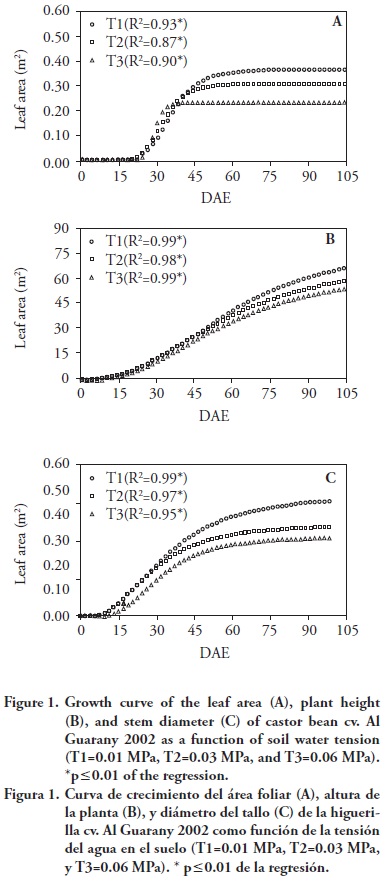
<body><![CDATA[<p align="justify"><font face="verdana" size="2">According to Beltr&atilde;o <i>et al.</i> (2003), despite being drought resistant, the castor bean is very sensitive to changes in soil moisture in its initial phase, which may compromise its production of assimilates. By assessing the response of castor bean cv. BRS Energy to different irrigation levels, Silva <i>et al.</i> (2009) observed that as the water availability increased, the plant height, leaf area, and yield of castor bean also did so. Lacerda <i>et al.</i> (2009) studied castor bean cv. BRS 188&#45;Paraguassu, and found that increasing soil water levels caused higher rates of growth and development, biomass production and photosynthetic efficiency of this cultivar.</font></p>  	    <p align="justify"><font face="verdana" size="2">As the soil dries, it becomes more difficult for plants to absorb water because the energy retention by the soil matrix (soil water tension) increases, thus decreasing its availability to plants. However, the greater the evaporative demand of the atmosphere, the higher the need for water flow in the Soil&#45;Plant&#45;Atmosphere system will be (Santos and Carlesso, 1998).</font></p>  	    <p align="justify"><font face="verdana" size="2">Knowledge of the castor bean water demand allows either to adapt the seeding to regions where rainfall is favorable to the crop or to use irrigation in order to meet the crop water needs when it is economically viable. The objective of this study was to evaluate the growth and development of the castor bean cv. Al Guarany 2002 submitted to three levels of soil water tension.</font></p>  	    <p align="justify"><font face="verdana" size="2">&nbsp;</font></p>  	    <p align="justify"><font face="verdana" size="2"><b>MATERIAL AND METHODS</b></font></p>      <p align="justify"><font face="verdana" size="2">The experiment was conducted in a greenhouse at Embrapa Clima Temperado, located in Pelotas, Rio Grande do Sul (32&deg; 45' S and 52&deg; 30' W), Brazil, from February to May 2010. The castor bean plants cv. Al Guarany 2002 were cultivated in pots of flexible polyethylene (30 dm<sup>3</sup> volume), filling each pot with a substrate of 40 % soil, 40 % sand and 20 % cattle manure. Sowing was carried out in February 2010, soil fertilization (4.5 g NPK; 10&#45;20&#45;20) was applied in each plot, equivalent to 300 kg ha<sup>&#45;1</sup>, which was the recommendation based on the chemical analysis of the substrate and in accordance with the technical instructions described by (Silva <i>et al.,</i> 2007). To monitor the soil water tension in the substrate, a tensiometer with mechanic vacuum gauge was installed in each pot at 0.15 m deep. Tensiometer readings were performed every day early in the morning, during 75 d.</font></p>  	    <p align="justify"><font face="verdana" size="2">Solar radiation data was obtained from Embrapa weather station. Since it is a controlled environment, the values of solar radiation were reduced by 30 % due to losses caused by the covering material of the greenhouse. The value of 30 % was adopted in line with data reported by Farias <i>et al.</i> (1993), Camacho <i>et al.</i> (1995), and Beckmann <i>et al.</i> (2006).</font></p>  	    <p align="justify"><font face="verdana" size="2">The experimental design was completely randomized with three treatments (T) and four replicates: T1, soil water tension in the substrate maintained at 0.01 MPa; T2, when soil water tension in the substrate reached 0.03 MPa, water was added to restore it to 0.01 MPa; T3, when soil water tension in the substrate reached 0.06 MPa, water was added to restore it to 0.01 MPa.</font></p>  	    <p align="justify"><font face="verdana" size="2">The amount of water to be added in the substrate to restore the soil water tension to 0.01 MPa was calculated as proposed by Libardi (2005): &#8710;h=Z(&#952;<sub>f</sub> &#45;&#952;<sub>i</sub> where &#8710;h is the amount of water to be added (mm), Z is the depth of the pot (mm), &#952;<sub>f</sub> is the soil water content retained at the soil water tension of 0.01 MPa (m<sup>3</sup>m<sup>&#45;3</sup>), and &#952;<sub>i</sub> is the soil water content at the moment of the tensiometer reading (m<sup>3</sup> m<sup>&#45;3</sup>). The &#952; values were obtained through the substrate water retention curve.</font></p>  	    <p align="justify"><font face="verdana" size="2">The evapotranspiration values were calculated every fortnight based on the water balance equation (Reichardt and Timm,2012): P+I&#45;DP&#45;ET=&#8710;ARM, where P is the precipitation (mm), I is the depth of irrigation (mm), DP is the depth of deep drainage (mm), ET is the actual evapotranspiration (mm), and &#8710;ARM is the soil water storage changes (mm) in each period. Precipitation values were disregarded since the study was carried out in a greenhouse. Irrigation depth was quantified by using graduated cylinders and corresponded to the total amount of water added fortnightly; to measure deep drainage depth, after irrigating, the accumulated water collected in the trays installed under the pots was quantified by using a graduated cylinder. Due to the fact that the pots were covered with aluminum foil, soil water evaporation (E) was considered null and plant transpiration (T) calculated according to the water balance equation, as described above.</font></p>  	    ]]></body>
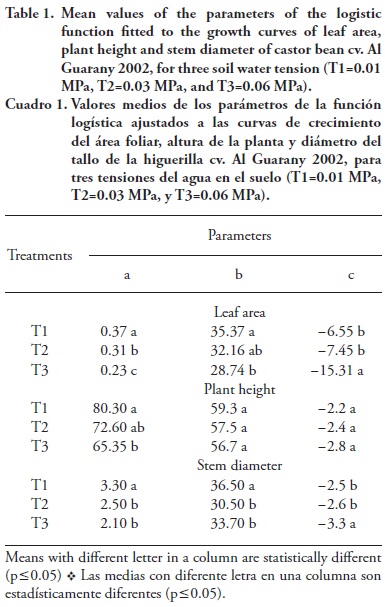
<body><![CDATA[<p align="justify"><font face="verdana" size="2">Measurements of leaf area (LA), plant height, and stem diameter were taken once every two weeks in a period from 30 to 105 d after plant emergence (DAE). To estimate LA a mathematical model was used (Severino <i>et al.,</i> 2005): LA=0.2439 (NP+NL)<sup>2.0598</sup>, where LA is the leaf area (m<sup>2</sup>), NP is the length of the main rib (m), and NL is the average length of the side ribs (m). Plant height was measured from the substrate surface to the youngest leaf point of insertion, and also the stem diameter using a caliper ruler at 0.10 m above the substrate surface. The time of initial flowering and the height of insertion of the first cluster were also determined.</font></p>  	    <p align="justify"><font face="verdana" size="2">The growth curves for LA, plant height and stem diameter were adjusted based on the following logistic model: y=a/1+(x/b)<sup>c</sup>, where y= is the response variable; x= is the number of days after plant emergence; and a, b and c= are adjusted parameters of the logistic model, and a is the difference between the maximum and minimum point of the growth curve, b is the time consumed for reaching 50 % of the variable response, and c is the slope of the growth curve (Regazzi, 2003). The adjusted parameters of the logistic function for each replicate were analyzed using ANOVA and the Tukey test (p&#8804;0.05) was used to compare treatment means. A correlation analysis between plant transpiration and radiation, LA and soil water tension was performed. Statistical analyses were carried out using SAS (SAS Institute, 1985).</font></p>  	    <p align="justify"><font face="verdana" size="2">&nbsp;</font></p>  	    <p align="justify"><font face="verdana" size="2"><b>RESULTS AND DISCUSSION</b></font></p>      <p align="justify"><font face="verdana" size="2">The LA growth curve was higher in T1, followed by T2 and T3 (<a href="#f1">Figure 1A</a>), indicating that water availability in the substrate (T1 average tension was 0.01 MPa) affected the castor bean Al Guarany 2002 LA growth.</font></p>  	    <p align="center"><font face="verdana" size="2"><a name="f1"></a></font></p>  	    <p align="center"><font face="verdana" size="2"><img src="/img/revistas/agro/v48n5/a4f1.jpg"></font></p>  	    <p align="justify"><font face="verdana" size="2">Besides, the LA growth curve in T1 stabilized after 75 DAE; however, with the increase in water average tension in the substrate to 0.03 MPa (T2) and 0.06 MPa (T3), the plants LA growth curve became stable after 30 DAE and 45 DAE, respectively (<a href="#f1">Figure 1A</a>). The reduction in LA growth curve of plants in T2 and T3 might be the plants response in order to avoid water loss. In case of water deficit, most vegetables seek for alternatives to decrease evaporation, mainly reducing transpiration. Fageria (1989) reported a reduction in leaf area, thereby decreasing water loss through transpiration. Rodrigues <i>et al.</i> (2009) also observed that in castor beans the LA was the most affected growth variable regarding the reduction of soil water content.</font></p>  	    <p align="justify"><font face="verdana" size="2">In all treatments the castor bean plant height growth curve increased up to 105 DAE. However, from 40 DAE as the substrate water tension, the plant height decreased (<a href="#f1">Figure 1B</a>). The water tension in the substrate also influenced the castor bean plant stem diameter (SD) growth curve (<a href="#f1">Figure 1C</a>). In T1, with more water availability in the substrate, SD growth curve increased up to 105 DAE, whereas in T2 and T3 SD growth curve became stable from 75 DAE as water average tension increased in the substrate.</font></p>  	    <p align="justify"><font face="verdana" size="2">Adjustment parameter values (a, b and c) of logistic models for LA growth curves, plant height and stem diameter in each treatment, are presented in <a href="#t1">Table 1</a>. LA growth curve b parameter, which is 50 % of the time the plant takes to reach the maximum LA value, was influenced by the increase in water tension in the substrate (p&#8804;0.05). The a parameter, which is the LA maximum value in the castor bean plant growth curve, was significantly higher in T1 followed by T2 and T3, highlighting, therefore, reduction in the castor bean LA maximum value as a function of the increase in substrate water tension. Silva <i>et al.</i> (2009) observed reduction in the maximum peak values (a parameter in this study) of the LA growth curve of the castor bean cv. BRS Energy, as a function of the decrease of the total depth irrigation. The castor bean plant LA growth rate is expressed by the c parameter, in which the higher the c value the faster the plant reaches the maximum LA, and the higher c value was observed in T3.</font></p>  	    ]]></body>
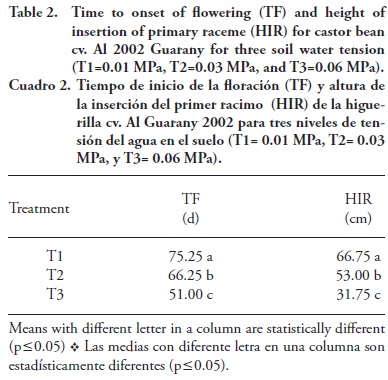
<body><![CDATA[<p align="center"><font face="verdana" size="2"><a name="t1"></a></font></p>  	    <p align="center"><font face="verdana" size="2"><img src="/img/revistas/agro/v48n5/a4t1.jpg"></font></p>  	    <p align="justify"><font face="verdana" size="2">Based on the tree parameters of logistic function, it was observed that as the soil water tension increased, the LA development was decreases. This may be due to the fact that cell growth is the most sensitive process to low water availability in the soil (Kr&aacute;me and Boyer, 1995); both cell division and expansion are directly inhibited by water stress (Zhu, 2002). In a study with castor bean plants under water stress, Heckenberger <i>et al.</i> (1998) observed that cell division and expansion were affected, causing maturation of the leaves into smaller sizes.</font></p>  	    <p align="justify"><font face="verdana" size="2">Parameters b and c of the castor bean plant height growth curve were not influenced by the increase in water tension in the substrate, whereas, parameter a was affected (<a href="#t1">Table 1</a>).</font></p>  	    <p align="justify"><font face="verdana" size="2">Parameters a and b of stem diameter growth curve were not statistically different between T2 and T3, but they were significantly lower than those in T1 (<a href="#t1">Table 1</a>). Parameter c values were not different between T1 and T2, indicating that increasing substrate water tension from 0.01 MPa to 0.03 MPa did not affect the castor bean cv. Al Guarany 2002 stem diameter growth curve slope. These results agree with those reported by Xavier <i>et al.</i> (2009), who observed higher castor bean BRS Nordestina stem diameter growth with 80 and 100 % available water levels, as compared to 70 % available water level.</font></p>  	    <p align="justify"><font face="verdana" size="2">Castor bean plant transpiration rate, as a function of time, was reduced significantly in the three treatments (<a href="/img/revistas/agro/v48n5/a4f2.jpg" target="_blank">Figure 2</a>). The effect of time on the castor bean plant transpiration may be due its strong relation with solar radiation. During the experiment from March to May 2010, days become shorter and there was a reduction in the radiation rates, decreasing the availability of daily energy, and, consequently, the plant transpiration rate. Besides, in T1, plants presented larger LA leaf area and higher water availability, causing the highest transpiration rate values (<a href="/img/revistas/agro/v48n5/a4f2.jpg" target="_blank">Figure 2</a>).</font></p>  	    <p align="justify"><font face="verdana" size="2">The correlation between plant transpiration and radiation, and the LA and soil water tension, shows that the solar radiation is the variable with the highest correlation with transpiration (r=0.746, p&#8804;0.001), followed by the soil water tension (r=&#45;0.512, p&#8804;0.001) and leaf area (r=0.485, p&#8804;0.001). Thus, the castor bean plant transpiration rate increases when soil water tension is reduced, and also when LA and incidence of solar radiation are increased, being, therefore, a result of the interaction soil&#45;plant&#45;atmosphere system.</font></p>  	    <p align="justify"><font face="verdana" size="2">The time for flowering onset and the primary raceme insertion height were significantly influenced by the soil water tension (<a href="#t2">Table 2</a>). The castor beans plant in T1 presented higher primary raceme insertion height (66.75 cm) and flowered later (75.25 d). The opposite was seen in plants of T3, which presented lower primary raceme insertion height (31.75 cm) and earlier flowering onset (51 d). Aires <i>et al.</i> (2011) found a positive and significant correlation between precipitation and length of the castor bean cv. BRS Energy vegetative period, indicating that the greater the water availability, the longest this cycle period will be. According to Zuchi <i>et al.</i> (2010), in the season with more water availability, the height of insertion of the primary raceme was 20 cm higher compared to castor bean plants growing in drier seasons.</font></p>  	    <p align="center"><font face="verdana" size="2"><a name="t2"></a></font></p>  	    <p align="center"><font face="verdana" size="2"><img src="/img/revistas/agro/v48n5/a4t2.jpg"></font></p>  	    ]]></body>
<body><![CDATA[<p align="justify"><font face="verdana" size="2">In our study there was a close relation between decrease in castor beans vegetative growth and flowering time, once the lowest values of LA, plant height and stem diameter were found in treatment T3, where plants flowered earlier (<a href="#f1">Figure 1</a>, <a href="#t1">Tables 1</a> and <a href="#t2">2</a>). Larcher (2000) pointed out that interruption in the vegetative growth as a function of production acceleration occur due to the energy canalization and materials destined to flowering and fruit production, which in turn are originated in the photosynthetic process, incorporation of mineral substances and mobilization of reserves to produce fruits.</font></p>  	    <p align="justify"><font face="verdana" size="2">&nbsp;</font></p>  	    <p align="justify"><font face="verdana" size="2"><b>CONCLUSION</b></font></p>      <p align="justify"><font face="verdana" size="2">Initial growth and development of castor beans cv. Al Guarany 2002 were reduced by the water stress caused by the increase in soil water tension.</font></p>  	    <p align="justify"><font face="verdana" size="2">The increase in soil water tension reduces the vegetative period of castor beans cv. Al Guarany 2002, indicated by the lower time necessary to its reproductive phase onset and lower primary raceme insertion height.</font></p>  	    <p align="justify"><font face="verdana" size="2">Castor bean is a species sensitive to drought whose values, vegetative growth behavior, and flowering are altered by lack of water. Maintaining soil moisture at the initial stage of its growth is essential, as restrictions at this stage will possibly impact the plant development.</font></p>  	    <p align="justify"><font face="verdana" size="2">&nbsp;</font></p>  	    <p align="justify"><font face="verdana" size="2"><b>ACKNOWLEDGMENTS</b></font></p>  	    <p align="justify"><font face="verdana" size="2">To CNPq for the scholarship, to Embrapa Clima Temperado for the experimental infrastructure needed for this work and to FAPERGS for the financial support.</font></p>  	    <p align="justify"><font face="verdana" size="2">&nbsp;</font></p>  	    ]]></body>
<body><![CDATA[<p align="justify"><font face="verdana" size="2"><b>LITERATURE CITED</b></font></p>      <!-- ref --><p align="justify"><font face="verdana" size="2">Aires, R. F., D. A. Silva S., D. Eicholz E. 2011. An&aacute;lise de crescimento de mamona semeada em diferentes &eacute;pocas. Ci&ecirc;ncia Rural 41:1347&#45;1353.    &nbsp;&nbsp;&nbsp;&nbsp;&nbsp;&nbsp;&nbsp;&nbsp;[&#160;<a href="javascript:void(0);" onclick="javascript: window.open('/scielo.php?script=sci_nlinks&ref=588959&pid=S1405-3195201400050000400001&lng=','','width=640,height=500,resizable=yes,scrollbars=1,menubar=yes,');">Links</a>&#160;]<!-- end-ref --></font></p>  	    <!-- ref --><p align="justify"><font face="verdana" size="2">Beckmann, M. Z., G. R. Duarte B., V. De Paula A., M. E. Mendez G., R. M. Peil N. 2006. Radia&ccedil;&atilde;o solar em ambiente protegido cultivado com tomateiro nas esta&ccedil;&otilde;es ver&atilde;o&#45;outono do Rio Grande do Sul. Ci&ecirc;ncia Rural 36:86&#45;92.    &nbsp;&nbsp;&nbsp;&nbsp;&nbsp;&nbsp;&nbsp;&nbsp;[&#160;<a href="javascript:void(0);" onclick="javascript: window.open('/scielo.php?script=sci_nlinks&ref=588961&pid=S1405-3195201400050000400002&lng=','','width=640,height=500,resizable=yes,scrollbars=1,menubar=yes,');">Links</a>&#160;]<!-- end-ref --></font></p>  	    <!-- ref --><p align="justify"><font face="verdana" size="2">Beltr&atilde;o, N. E. M., G. Souza J., W. Santos J., F. Jer&ocirc;nimo J., X. Costa F., M. A. Lucena A., C., Queiroz, U. 2003. Fisiologia da mamoneira, cultivar BRS 149 nordestina, na fase inicial de crescimento, submetida a estresse h&iacute;drico. Rev. Bras. Ol. Fibros. 7: 659&#45;664.    &nbsp;&nbsp;&nbsp;&nbsp;&nbsp;&nbsp;&nbsp;&nbsp;[&#160;<a href="javascript:void(0);" onclick="javascript: window.open('/scielo.php?script=sci_nlinks&ref=588963&pid=S1405-3195201400050000400003&lng=','','width=640,height=500,resizable=yes,scrollbars=1,menubar=yes,');">Links</a>&#160;]<!-- end-ref --></font></p>  	    <!-- ref --><p align="justify"><font face="verdana" size="2">Camacho, M. J., F. Assis N., S. Martins R., M. E. Mendez G. 1995. Avalia&ccedil;&atilde;o de elementos meteorol&oacute;gicos em estufa pl&aacute;stica em Pelotas, RS. Rev. Bras. Agromet. 3: 19&#45;24.    &nbsp;&nbsp;&nbsp;&nbsp;&nbsp;&nbsp;&nbsp;&nbsp;[&#160;<a href="javascript:void(0);" onclick="javascript: window.open('/scielo.php?script=sci_nlinks&ref=588965&pid=S1405-3195201400050000400004&lng=','','width=640,height=500,resizable=yes,scrollbars=1,menubar=yes,');">Links</a>&#160;]<!-- end-ref --></font></p>  	    <!-- ref --><p align="justify"><font face="verdana" size="2">Fageria, N. K. 1989. Solos Tropicais e Aspectos Fisiol&oacute;gicos das Culturas. Embrapa/DPU. Bras&iacute;lia. 425 p.    &nbsp;&nbsp;&nbsp;&nbsp;&nbsp;&nbsp;&nbsp;&nbsp;[&#160;<a href="javascript:void(0);" onclick="javascript: window.open('/scielo.php?script=sci_nlinks&ref=588967&pid=S1405-3195201400050000400005&lng=','','width=640,height=500,resizable=yes,scrollbars=1,menubar=yes,');">Links</a>&#160;]<!-- end-ref --></font></p>  	    <!-- ref --><p align="justify"><font face="verdana" size="2">Farias, J. R., B. Bergamaschi H., S. Martins, R., M. Berlato A. 1993. Efeito da cobertura pl&aacute;stica de estufa sobre a radia&ccedil;&atilde;o solar. Rev. Bras. Agromet. 1:31&#45;36.    &nbsp;&nbsp;&nbsp;&nbsp;&nbsp;&nbsp;&nbsp;&nbsp;[&#160;<a href="javascript:void(0);" onclick="javascript: window.open('/scielo.php?script=sci_nlinks&ref=588969&pid=S1405-3195201400050000400006&lng=','','width=640,height=500,resizable=yes,scrollbars=1,menubar=yes,');">Links</a>&#160;]<!-- end-ref --></font></p>  	    <!-- ref --><p align="justify"><font face="verdana" size="2">Heckenberger, U., U. Roggatz, and U. Schurr. 1998. Effect of drought stress on the cytological status in <i>Ricinus communis.</i> J. Exp. Bot. 49:181&#45;189.    &nbsp;&nbsp;&nbsp;&nbsp;&nbsp;&nbsp;&nbsp;&nbsp;[&#160;<a href="javascript:void(0);" onclick="javascript: window.open('/scielo.php?script=sci_nlinks&ref=588971&pid=S1405-3195201400050000400007&lng=','','width=640,height=500,resizable=yes,scrollbars=1,menubar=yes,');">Links</a>&#160;]<!-- end-ref --></font></p>  	    <!-- ref --><p align="justify"><font face="verdana" size="2">IBGE &#45; Instituto Brasileiro de Geografia e Estat&iacute;stica. 2014 &lt;<a href="http://www.ibge.gov.br/home/estatistica/indicadores/agropecuaria/lspa/lspa.htm" target="_blank">http://www.ibge.gov.br/home/estatistica/indicadores/agropecuaria/lspa/lspa.htm</a>&gt; (Acesso: mai 2014).    &nbsp;&nbsp;&nbsp;&nbsp;&nbsp;&nbsp;&nbsp;&nbsp;[&#160;<a href="javascript:void(0);" onclick="javascript: window.open('/scielo.php?script=sci_nlinks&ref=588973&pid=S1405-3195201400050000400008&lng=','','width=640,height=500,resizable=yes,scrollbars=1,menubar=yes,');">Links</a>&#160;]<!-- end-ref --></font></p>  	    <!-- ref --><p align="justify"><font face="verdana" size="2">Kramer, P. J., and J. Boyer S. 1995. Water Relations of Plants and Soils. Academic Press, San Diego. 495 p.    &nbsp;&nbsp;&nbsp;&nbsp;&nbsp;&nbsp;&nbsp;&nbsp;[&#160;<a href="javascript:void(0);" onclick="javascript: window.open('/scielo.php?script=sci_nlinks&ref=588975&pid=S1405-3195201400050000400009&lng=','','width=640,height=500,resizable=yes,scrollbars=1,menubar=yes,');">Links</a>&#160;]<!-- end-ref --></font></p>  	    <!-- ref --><p align="justify"><font face="verdana" size="2">Lacerda, R. D., H. O. Guerra C., B. J&uacute;nior. G. 2009. Influ&ecirc;ncia do d&eacute;ficit h&iacute;drico e da mat&eacute;ria org&acirc;nica do solo no crescimento e desenvolvimento da mamoneira BRS 188&#45;Paragua&ccedil;u. Rev. Bras. Ciencia Agrar. 4: 440&#45;447.    &nbsp;&nbsp;&nbsp;&nbsp;&nbsp;&nbsp;&nbsp;&nbsp;[&#160;<a href="javascript:void(0);" onclick="javascript: window.open('/scielo.php?script=sci_nlinks&ref=588977&pid=S1405-3195201400050000400010&lng=','','width=640,height=500,resizable=yes,scrollbars=1,menubar=yes,');">Links</a>&#160;]<!-- end-ref --></font></p>  	    <!-- ref --><p align="justify"><font face="verdana" size="2">Larcher, W. 2000. Ecofisiologia Vegetal. Rima. S&atilde;o Carlos. 531 p.    &nbsp;&nbsp;&nbsp;&nbsp;&nbsp;&nbsp;&nbsp;&nbsp;[&#160;<a href="javascript:void(0);" onclick="javascript: window.open('/scielo.php?script=sci_nlinks&ref=588979&pid=S1405-3195201400050000400011&lng=','','width=640,height=500,resizable=yes,scrollbars=1,menubar=yes,');">Links</a>&#160;]<!-- end-ref --></font></p>  	    <!-- ref --><p align="justify"><font face="verdana" size="2">Libardi, P. L. 2005. Din&acirc;mica da &Aacute;gua no Solo. Edusp. Piracicaba. 497 p.    &nbsp;&nbsp;&nbsp;&nbsp;&nbsp;&nbsp;&nbsp;&nbsp;[&#160;<a href="javascript:void(0);" onclick="javascript: window.open('/scielo.php?script=sci_nlinks&ref=588981&pid=S1405-3195201400050000400012&lng=','','width=640,height=500,resizable=yes,scrollbars=1,menubar=yes,');">Links</a>&#160;]<!-- end-ref --></font></p>  	    <!-- ref --><p align="justify"><font face="verdana" size="2">Regazzi, A. J. 2003. Teste para verificar a igualdade de par&acirc;metros e a identidade de modelos de regress&atilde;o n&atilde;o&#45;linear. Ceres 50: 9&#45;26.    &nbsp;&nbsp;&nbsp;&nbsp;&nbsp;&nbsp;&nbsp;&nbsp;[&#160;<a href="javascript:void(0);" onclick="javascript: window.open('/scielo.php?script=sci_nlinks&ref=588983&pid=S1405-3195201400050000400013&lng=','','width=640,height=500,resizable=yes,scrollbars=1,menubar=yes,');">Links</a>&#160;]<!-- end-ref --></font></p>  	    <!-- ref --><p align="justify"><font face="verdana" size="2">Reichardt, K., C. Timm L. 2012. Solo, Planta e Atmosfera: Conceitos, Processos e Aplica&ccedil;&otilde;es. 2. ed. Manole, Barueri. 500 p.    &nbsp;&nbsp;&nbsp;&nbsp;&nbsp;&nbsp;&nbsp;&nbsp;[&#160;<a href="javascript:void(0);" onclick="javascript: window.open('/scielo.php?script=sci_nlinks&ref=588985&pid=S1405-3195201400050000400014&lng=','','width=640,height=500,resizable=yes,scrollbars=1,menubar=yes,');">Links</a>&#160;]<!-- end-ref --></font></p>  	    <!-- ref --><p align="justify"><font face="verdana" size="2">Rodrigues, L. N., R. Nery A., D. Fernandes P., E. M. Beltr&atilde;o N., R. Gheyi H. 2009. Crescimento e produ&ccedil;&atilde;o de bagas da mamoneira irrigada com &aacute;gua residu&aacute;ria dom&eacute;stica. Rev. Bras. Eng. Agric. Amb. 13: 825&#45;835.    &nbsp;&nbsp;&nbsp;&nbsp;&nbsp;&nbsp;&nbsp;&nbsp;[&#160;<a href="javascript:void(0);" onclick="javascript: window.open('/scielo.php?script=sci_nlinks&ref=588987&pid=S1405-3195201400050000400015&lng=','','width=640,height=500,resizable=yes,scrollbars=1,menubar=yes,');">Links</a>&#160;]<!-- end-ref --></font></p>  	    <!-- ref --><p align="justify"><font face="verdana" size="2">Santos, R. F., R. Carlesso. 1998. D&eacute;ficit h&iacute;drico e os processos morfol&oacute;gico e fisiol&oacute;gico das plantas. Rev. Bras. Eng. Agric. Amb. 2: 287&#45;294.    &nbsp;&nbsp;&nbsp;&nbsp;&nbsp;&nbsp;&nbsp;&nbsp;[&#160;<a href="javascript:void(0);" onclick="javascript: window.open('/scielo.php?script=sci_nlinks&ref=588989&pid=S1405-3195201400050000400016&lng=','','width=640,height=500,resizable=yes,scrollbars=1,menubar=yes,');">Links</a>&#160;]<!-- end-ref --></font></p>  	    <!-- ref --><p align="justify"><font face="verdana" size="2">SAS&#45;Statistical Analysis System. 1985. User's Guide. 5th ed. Cary, N. C.: SAS Institute Inc.    &nbsp;&nbsp;&nbsp;&nbsp;&nbsp;&nbsp;&nbsp;&nbsp;[&#160;<a href="javascript:void(0);" onclick="javascript: window.open('/scielo.php?script=sci_nlinks&ref=588991&pid=S1405-3195201400050000400017&lng=','','width=640,height=500,resizable=yes,scrollbars=1,menubar=yes,');">Links</a>&#160;]<!-- end-ref --></font></p>  	    <!-- ref --><p align="justify"><font face="verdana" size="2">Savy Filho, A. 2005. Mamona Tecnologia Agr&iacute;cola. EMOPI. Campinas. 105 p.    &nbsp;&nbsp;&nbsp;&nbsp;&nbsp;&nbsp;&nbsp;&nbsp;[&#160;<a href="javascript:void(0);" onclick="javascript: window.open('/scielo.php?script=sci_nlinks&ref=588993&pid=S1405-3195201400050000400018&lng=','','width=640,height=500,resizable=yes,scrollbars=1,menubar=yes,');">Links</a>&#160;]<!-- end-ref --></font></p>  	    <!-- ref --><p align="justify"><font face="verdana" size="2">Severino, L. S., D. Cardoso G., S. Vale L., W. Santos J. 2005. M&eacute;todo para determina&ccedil;&atilde;o da &aacute;rea foliar da mamoneira. Embrapa Algod&atilde;o. Campina Grande. 20 p. (Boletim de Pesquisa e Desenvolvimento, 55).    &nbsp;&nbsp;&nbsp;&nbsp;&nbsp;&nbsp;&nbsp;&nbsp;[&#160;<a href="javascript:void(0);" onclick="javascript: window.open('/scielo.php?script=sci_nlinks&ref=588995&pid=S1405-3195201400050000400019&lng=','','width=640,height=500,resizable=yes,scrollbars=1,menubar=yes,');">Links</a>&#160;]<!-- end-ref --></font></p>  	    <!-- ref --><p align="justify"><font face="verdana" size="2">Silva, S. D. A., G. Casagrande Jr. J., B. Scivittaro W. 2007. A cultura da mamona no Rio Grande do Sul. Embrapa Clima Temperado. Pelotas. 115 p. (Embrapa Clima Temperado. Sistemas de Produ&ccedil;&atilde;o, 11).    &nbsp;&nbsp;&nbsp;&nbsp;&nbsp;&nbsp;&nbsp;&nbsp;[&#160;<a href="javascript:void(0);" onclick="javascript: window.open('/scielo.php?script=sci_nlinks&ref=588997&pid=S1405-3195201400050000400020&lng=','','width=640,height=500,resizable=yes,scrollbars=1,menubar=yes,');">Links</a>&#160;]<!-- end-ref --></font></p>  	    <!-- ref --><p align="justify"><font face="verdana" size="2">Silva, S. M. S., R. Gheyi H., E. M. Beltr&atilde;o N., W. Santos J., A. L. Soares F. 2009. Dota&ccedil;&otilde;es h&iacute;dricas em densidades de plantas na cultura da mamoneira cv. BRS Energia. Rev. Bras. Cienc. Agrar. 4: 338&#45;348.    &nbsp;&nbsp;&nbsp;&nbsp;&nbsp;&nbsp;&nbsp;&nbsp;[&#160;<a href="javascript:void(0);" onclick="javascript: window.open('/scielo.php?script=sci_nlinks&ref=588999&pid=S1405-3195201400050000400021&lng=','','width=640,height=500,resizable=yes,scrollbars=1,menubar=yes,');">Links</a>&#160;]<!-- end-ref --></font></p>  	    <!-- ref --><p align="justify"><font face="verdana" size="2">Xavier, J. F., A. V. Azevedo C., E. M. Beltr&atilde;o N., R. S. Andrade A., L. A. Lima V. 2009. Crescimento da mamoneira sob diferentes tipos de &aacute;guas residu&aacute;rias e n&iacute;veis de &aacute;gua no solo. Rev. Amb. &Aacute;gua 4: 196&#45;210.    &nbsp;&nbsp;&nbsp;&nbsp;&nbsp;&nbsp;&nbsp;&nbsp;[&#160;<a href="javascript:void(0);" onclick="javascript: window.open('/scielo.php?script=sci_nlinks&ref=589001&pid=S1405-3195201400050000400022&lng=','','width=640,height=500,resizable=yes,scrollbars=1,menubar=yes,');">Links</a>&#160;]<!-- end-ref --></font></p>  	    <!-- ref --><p align="justify"><font face="verdana" size="2">Zhu, J. K. 2002. Salt and drought stress signal transduction in plants. Ann. Rev. Plant Bio. 53: 247&#45;273.    &nbsp;&nbsp;&nbsp;&nbsp;&nbsp;&nbsp;&nbsp;&nbsp;[&#160;<a href="javascript:void(0);" onclick="javascript: window.open('/scielo.php?script=sci_nlinks&ref=589003&pid=S1405-3195201400050000400023&lng=','','width=640,height=500,resizable=yes,scrollbars=1,menubar=yes,');">Links</a>&#160;]<!-- end-ref --></font></p>  	    <!-- ref --><p align="justify"><font face="verdana" size="2">Zuchi, J., A. P. Bevilaqua G., C. Zanuncio J., T. Peske S., D. A. Silva S., S. Sediyama C. 2010. Caracter&iacute;sticas agron&ocirc;micas de cultivares de mamona em fun&ccedil;&atilde;o do local de cultivo e da &eacute;poca de semeadura no Rio Grande do Sul. Ci&ecirc;ncia Rural 40: 501&#45;506.    &nbsp;&nbsp;&nbsp;&nbsp;&nbsp;&nbsp;&nbsp;&nbsp;[&#160;<a href="javascript:void(0);" onclick="javascript: window.open('/scielo.php?script=sci_nlinks&ref=589005&pid=S1405-3195201400050000400024&lng=','','width=640,height=500,resizable=yes,scrollbars=1,menubar=yes,');">Links</a>&#160;]<!-- end-ref --></font></p>      ]]></body><back>
<ref-list>
<ref id="B1">
<nlm-citation citation-type="journal">
<person-group person-group-type="author">
<name>
<surname><![CDATA[Aires]]></surname>
<given-names><![CDATA[R. F.]]></given-names>
</name>
<name>
<surname><![CDATA[D. A. Silva]]></surname>
<given-names><![CDATA[S.]]></given-names>
</name>
<name>
<surname><![CDATA[D. Eicholz]]></surname>
<given-names><![CDATA[E]]></given-names>
</name>
</person-group>
<article-title xml:lang="pt"><![CDATA[Análise de crescimento de mamona semeada em diferentes épocas]]></article-title>
<source><![CDATA[Ciência Rural]]></source>
<year>2011</year>
<volume>41</volume>
<page-range>1347-1353</page-range></nlm-citation>
</ref>
<ref id="B2">
<nlm-citation citation-type="journal">
<person-group person-group-type="author">
<name>
<surname><![CDATA[Beckmann]]></surname>
<given-names><![CDATA[M. Z.]]></given-names>
</name>
<name>
<surname><![CDATA[G. R. Duarte]]></surname>
<given-names><![CDATA[B.]]></given-names>
</name>
<name>
<surname><![CDATA[V. De Paula]]></surname>
<given-names><![CDATA[A.]]></given-names>
</name>
<name>
<surname><![CDATA[M. E. Mendez]]></surname>
<given-names><![CDATA[G.]]></given-names>
</name>
<name>
<surname><![CDATA[R. M. Peil]]></surname>
<given-names><![CDATA[N]]></given-names>
</name>
</person-group>
<article-title xml:lang="pt"><![CDATA[Radiação solar em ambiente protegido cultivado com tomateiro nas estações verão-outono do Rio Grande do Sul]]></article-title>
<source><![CDATA[Ciência Rural]]></source>
<year>2006</year>
<volume>36</volume>
<page-range>86-92</page-range></nlm-citation>
</ref>
<ref id="B3">
<nlm-citation citation-type="journal">
<person-group person-group-type="author">
<name>
<surname><![CDATA[Beltrão]]></surname>
<given-names><![CDATA[N. E. M.]]></given-names>
</name>
<name>
<surname><![CDATA[G. Souza]]></surname>
<given-names><![CDATA[J.]]></given-names>
</name>
<name>
<surname><![CDATA[W. Santos]]></surname>
<given-names><![CDATA[J.]]></given-names>
</name>
<name>
<surname><![CDATA[F. Jerônimo]]></surname>
<given-names><![CDATA[J.]]></given-names>
</name>
<name>
<surname><![CDATA[X. Costa]]></surname>
<given-names><![CDATA[F.]]></given-names>
</name>
<name>
<surname><![CDATA[M. A. Lucena]]></surname>
<given-names><![CDATA[A.]]></given-names>
</name>
<name>
<surname><![CDATA[C., Queiroz]]></surname>
<given-names><![CDATA[U.]]></given-names>
</name>
</person-group>
<article-title xml:lang="pt"><![CDATA[Fisiologia da mamoneira, cultivar BRS 149 nordestina, na fase inicial de crescimento, submetida a estresse hídrico]]></article-title>
<source><![CDATA[Rev. Bras. Ol. Fibros.]]></source>
<year>2003</year>
<volume>7</volume>
<page-range>659-664</page-range></nlm-citation>
</ref>
<ref id="B4">
<nlm-citation citation-type="journal">
<person-group person-group-type="author">
<name>
<surname><![CDATA[Camacho]]></surname>
<given-names><![CDATA[M. J.]]></given-names>
</name>
<name>
<surname><![CDATA[F. Assis]]></surname>
<given-names><![CDATA[N.]]></given-names>
</name>
<name>
<surname><![CDATA[S. Martins]]></surname>
<given-names><![CDATA[R.]]></given-names>
</name>
<name>
<surname><![CDATA[M. E. Mendez]]></surname>
<given-names><![CDATA[G]]></given-names>
</name>
</person-group>
<article-title xml:lang="pt"><![CDATA[Avaliação de elementos meteorológicos em estufa plástica em Pelotas, RS]]></article-title>
<source><![CDATA[Rev. Bras. Agromet.]]></source>
<year>1995</year>
<volume>3</volume>
<page-range>19-24</page-range></nlm-citation>
</ref>
<ref id="B5">
<nlm-citation citation-type="book">
<person-group person-group-type="author">
<name>
<surname><![CDATA[Fageria]]></surname>
<given-names><![CDATA[N. K]]></given-names>
</name>
</person-group>
<source><![CDATA[Solos Tropicais e Aspectos Fisiológicos das Culturas]]></source>
<year>1989</year>
<page-range>425</page-range><publisher-loc><![CDATA[Brasília ]]></publisher-loc>
<publisher-name><![CDATA[Embrapa/DPU]]></publisher-name>
</nlm-citation>
</ref>
<ref id="B6">
<nlm-citation citation-type="journal">
<person-group person-group-type="author">
<name>
<surname><![CDATA[Farias]]></surname>
<given-names><![CDATA[J. R.]]></given-names>
</name>
<name>
<surname><![CDATA[B. Bergamaschi]]></surname>
<given-names><![CDATA[H.]]></given-names>
</name>
<name>
<surname><![CDATA[S. Martins]]></surname>
<given-names><![CDATA[R.]]></given-names>
</name>
<name>
<surname><![CDATA[M. Berlato]]></surname>
<given-names><![CDATA[A]]></given-names>
</name>
</person-group>
<article-title xml:lang="pt"><![CDATA[Efeito da cobertura plástica de estufa sobre a radiação solar]]></article-title>
<source><![CDATA[Rev. Bras. Agromet.]]></source>
<year>1993</year>
<volume>1</volume>
<page-range>31-36</page-range></nlm-citation>
</ref>
<ref id="B7">
<nlm-citation citation-type="journal">
<person-group person-group-type="author">
<name>
<surname><![CDATA[Heckenberger]]></surname>
<given-names><![CDATA[U.]]></given-names>
</name>
<name>
<surname><![CDATA[Roggatz]]></surname>
<given-names><![CDATA[U.]]></given-names>
</name>
<name>
<surname><![CDATA[Schurr]]></surname>
<given-names><![CDATA[U.]]></given-names>
</name>
</person-group>
<article-title xml:lang="en"><![CDATA[Effect of drought stress on the cytological status in Ricinus communis]]></article-title>
<source><![CDATA[J. Exp. Bot.]]></source>
<year>1998</year>
<volume>49</volume>
<page-range>181-189</page-range></nlm-citation>
</ref>
<ref id="B8">
<nlm-citation citation-type="">
<collab>Instituto Brasileiro de Geografia e Estatística</collab>
<source><![CDATA[]]></source>
<year>2014</year>
</nlm-citation>
</ref>
<ref id="B9">
<nlm-citation citation-type="book">
<person-group person-group-type="author">
<name>
<surname><![CDATA[Kramer]]></surname>
<given-names><![CDATA[P. J.]]></given-names>
</name>
<name>
<surname><![CDATA[J. Boyer]]></surname>
<given-names><![CDATA[S]]></given-names>
</name>
</person-group>
<source><![CDATA[Water Relations of Plants and Soils]]></source>
<year>1995</year>
<page-range>495</page-range><publisher-loc><![CDATA[San Diego ]]></publisher-loc>
<publisher-name><![CDATA[Academic Press]]></publisher-name>
</nlm-citation>
</ref>
<ref id="B10">
<nlm-citation citation-type="journal">
<person-group person-group-type="author">
<name>
<surname><![CDATA[Lacerda]]></surname>
<given-names><![CDATA[R. D.]]></given-names>
</name>
<name>
<surname><![CDATA[H. O. Guerra]]></surname>
<given-names><![CDATA[C.]]></given-names>
</name>
<name>
<surname><![CDATA[B. Júnior.]]></surname>
<given-names><![CDATA[G]]></given-names>
</name>
</person-group>
<article-title xml:lang="pt"><![CDATA[Influência do déficit hídrico e da matéria orgânica do solo no crescimento e desenvolvimento da mamoneira BRS 188-Paraguaçu]]></article-title>
<source><![CDATA[Rev. Bras. Ciencia Agrar.]]></source>
<year>2009</year>
<volume>4</volume>
<page-range>440-447</page-range></nlm-citation>
</ref>
<ref id="B11">
<nlm-citation citation-type="book">
<person-group person-group-type="author">
<name>
<surname><![CDATA[Larcher]]></surname>
<given-names><![CDATA[W]]></given-names>
</name>
</person-group>
<source><![CDATA[Ecofisiologia Vegetal]]></source>
<year>2000</year>
<page-range>531</page-range><publisher-loc><![CDATA[São Carlos ]]></publisher-loc>
<publisher-name><![CDATA[Rima]]></publisher-name>
</nlm-citation>
</ref>
<ref id="B12">
<nlm-citation citation-type="book">
<person-group person-group-type="author">
<name>
<surname><![CDATA[Libardi]]></surname>
<given-names><![CDATA[P. L]]></given-names>
</name>
</person-group>
<source><![CDATA[Dinâmica da Água no Solo]]></source>
<year>2005</year>
<page-range>497</page-range><publisher-loc><![CDATA[Piracicaba ]]></publisher-loc>
<publisher-name><![CDATA[Edusp]]></publisher-name>
</nlm-citation>
</ref>
<ref id="B13">
<nlm-citation citation-type="journal">
<person-group person-group-type="author">
<name>
<surname><![CDATA[Regazzi]]></surname>
<given-names><![CDATA[A. J]]></given-names>
</name>
</person-group>
<article-title xml:lang="pt"><![CDATA[Teste para verificar a igualdade de parâmetros e a identidade de modelos de regressão não-linear]]></article-title>
<source><![CDATA[Ceres]]></source>
<year>2003</year>
<volume>50</volume>
<page-range>9-26</page-range></nlm-citation>
</ref>
<ref id="B14">
<nlm-citation citation-type="book">
<person-group person-group-type="author">
<name>
<surname><![CDATA[Reichardt]]></surname>
<given-names><![CDATA[K.]]></given-names>
</name>
<name>
<surname><![CDATA[C. Timm]]></surname>
<given-names><![CDATA[L]]></given-names>
</name>
</person-group>
<source><![CDATA[Solo, Planta e Atmosfera: Conceitos, Processos e Aplicações]]></source>
<year>2012</year>
<edition>2</edition>
<page-range>500</page-range><publisher-loc><![CDATA[Barueri ]]></publisher-loc>
<publisher-name><![CDATA[Manole]]></publisher-name>
</nlm-citation>
</ref>
<ref id="B15">
<nlm-citation citation-type="journal">
<person-group person-group-type="author">
<name>
<surname><![CDATA[Rodrigues]]></surname>
<given-names><![CDATA[L. N.]]></given-names>
</name>
<name>
<surname><![CDATA[R. Nery]]></surname>
<given-names><![CDATA[A.]]></given-names>
</name>
<name>
<surname><![CDATA[D. Fernandes]]></surname>
<given-names><![CDATA[P.]]></given-names>
</name>
<name>
<surname><![CDATA[E. M. Beltrão]]></surname>
<given-names><![CDATA[N.]]></given-names>
</name>
<name>
<surname><![CDATA[R. Gheyi]]></surname>
<given-names><![CDATA[H]]></given-names>
</name>
</person-group>
<article-title xml:lang="pt"><![CDATA[Crescimento e produção de bagas da mamoneira irrigada com água residuária doméstica]]></article-title>
<source><![CDATA[Rev. Bras. Eng. Agric. Amb.]]></source>
<year>2009</year>
<volume>13</volume>
<page-range>825-835</page-range></nlm-citation>
</ref>
<ref id="B16">
<nlm-citation citation-type="journal">
<person-group person-group-type="author">
<name>
<surname><![CDATA[Santos]]></surname>
<given-names><![CDATA[R. F.]]></given-names>
</name>
<name>
<surname><![CDATA[Carlesso]]></surname>
<given-names><![CDATA[R.]]></given-names>
</name>
</person-group>
<article-title xml:lang="pt"><![CDATA[Déficit hídrico e os processos morfológico e fisiológico das plantas]]></article-title>
<source><![CDATA[Rev. Bras. Eng. Agric. Amb.]]></source>
<year>1998</year>
<volume>2</volume>
<page-range>287-294</page-range></nlm-citation>
</ref>
<ref id="B17">
<nlm-citation citation-type="book">
<collab>SAS-Statistical Analysis System</collab>
<source><![CDATA[User's Guide]]></source>
<year>1985</year>
<edition>5</edition>
<publisher-loc><![CDATA[Cary^eN. C. N. C.]]></publisher-loc>
<publisher-name><![CDATA[SAS Institute Inc]]></publisher-name>
</nlm-citation>
</ref>
<ref id="B18">
<nlm-citation citation-type="book">
<person-group person-group-type="author">
<name>
<surname><![CDATA[Savy Filho]]></surname>
<given-names><![CDATA[A]]></given-names>
</name>
</person-group>
<source><![CDATA[Mamona Tecnologia Agrícola]]></source>
<year>2005</year>
<page-range>105</page-range><publisher-loc><![CDATA[Campinas ]]></publisher-loc>
<publisher-name><![CDATA[EMOPI]]></publisher-name>
</nlm-citation>
</ref>
<ref id="B19">
<nlm-citation citation-type="book">
<person-group person-group-type="author">
<name>
<surname><![CDATA[Severino]]></surname>
<given-names><![CDATA[L. S.]]></given-names>
</name>
<name>
<surname><![CDATA[D. Cardoso]]></surname>
<given-names><![CDATA[G.]]></given-names>
</name>
<name>
<surname><![CDATA[S. Vale]]></surname>
<given-names><![CDATA[L.]]></given-names>
</name>
<name>
<surname><![CDATA[W. Santos]]></surname>
<given-names><![CDATA[J]]></given-names>
</name>
</person-group>
<source><![CDATA[Método para determinação da área foliar da mamoneira]]></source>
<year>2005</year>
<volume>55</volume>
<page-range>20</page-range><publisher-loc><![CDATA[Campina Grande ]]></publisher-loc>
<publisher-name><![CDATA[Embrapa Algodão]]></publisher-name>
</nlm-citation>
</ref>
<ref id="B20">
<nlm-citation citation-type="book">
<person-group person-group-type="author">
<name>
<surname><![CDATA[Silva]]></surname>
<given-names><![CDATA[S. D. A.]]></given-names>
</name>
<name>
<surname><![CDATA[G. Casagrande Jr.]]></surname>
<given-names><![CDATA[J.]]></given-names>
</name>
<name>
<surname><![CDATA[B. Scivittaro]]></surname>
<given-names><![CDATA[W]]></given-names>
</name>
</person-group>
<source><![CDATA[A cultura da mamona no Rio Grande do Sul]]></source>
<year>2007</year>
<volume>11</volume>
<page-range>115</page-range><publisher-loc><![CDATA[Pelotas ]]></publisher-loc>
<publisher-name><![CDATA[Embrapa Clima Temperado]]></publisher-name>
</nlm-citation>
</ref>
<ref id="B21">
<nlm-citation citation-type="journal">
<person-group person-group-type="author">
<name>
<surname><![CDATA[Silva]]></surname>
<given-names><![CDATA[S. M. S.]]></given-names>
</name>
<name>
<surname><![CDATA[R. Gheyi]]></surname>
<given-names><![CDATA[H.]]></given-names>
</name>
<name>
<surname><![CDATA[E. M. Beltrão]]></surname>
<given-names><![CDATA[N.]]></given-names>
</name>
<name>
<surname><![CDATA[W. Santos]]></surname>
<given-names><![CDATA[J.]]></given-names>
</name>
<name>
<surname><![CDATA[A. L. Soares]]></surname>
<given-names><![CDATA[F]]></given-names>
</name>
</person-group>
<article-title xml:lang="pt"><![CDATA[Dotações hídricas em densidades de plantas na cultura da mamoneira cv]]></article-title>
<source><![CDATA[BRS Energia. Rev. Bras. Cienc. Agrar.]]></source>
<year>2009</year>
<volume>4</volume>
<page-range>338-348</page-range></nlm-citation>
</ref>
<ref id="B22">
<nlm-citation citation-type="journal">
<person-group person-group-type="author">
<name>
<surname><![CDATA[Xavier]]></surname>
<given-names><![CDATA[J. F.]]></given-names>
</name>
<name>
<surname><![CDATA[A. V. Azevedo]]></surname>
<given-names><![CDATA[C.]]></given-names>
</name>
<name>
<surname><![CDATA[E. M. Beltrão]]></surname>
<given-names><![CDATA[N.]]></given-names>
</name>
<name>
<surname><![CDATA[R. S. Andrade]]></surname>
<given-names><![CDATA[A.]]></given-names>
</name>
<name>
<surname><![CDATA[L. A. Lima]]></surname>
<given-names><![CDATA[V]]></given-names>
</name>
</person-group>
<article-title xml:lang="pt"><![CDATA[Crescimento da mamoneira sob diferentes tipos de águas residuárias e níveis de água no solo]]></article-title>
<source><![CDATA[Rev. Amb. Água]]></source>
<year>2009</year>
<volume>4</volume>
<page-range>196-210</page-range></nlm-citation>
</ref>
<ref id="B23">
<nlm-citation citation-type="journal">
<person-group person-group-type="author">
<name>
<surname><![CDATA[Zhu]]></surname>
<given-names><![CDATA[J. K]]></given-names>
</name>
</person-group>
<article-title xml:lang="en"><![CDATA[Salt and drought stress signal transduction in plants]]></article-title>
<source><![CDATA[Ann. Rev. Plant Bio.]]></source>
<year>2002</year>
<volume>53</volume>
<page-range>247-273</page-range></nlm-citation>
</ref>
<ref id="B24">
<nlm-citation citation-type="journal">
<person-group person-group-type="author">
<name>
<surname><![CDATA[Zuchi]]></surname>
<given-names><![CDATA[J.]]></given-names>
</name>
<name>
<surname><![CDATA[A. P. Bevilaqua]]></surname>
<given-names><![CDATA[G.]]></given-names>
</name>
<name>
<surname><![CDATA[C. Zanuncio]]></surname>
<given-names><![CDATA[J.]]></given-names>
</name>
<name>
<surname><![CDATA[T. Peske]]></surname>
<given-names><![CDATA[S.]]></given-names>
</name>
<name>
<surname><![CDATA[D. A. Silva]]></surname>
<given-names><![CDATA[S.]]></given-names>
</name>
<name>
<surname><![CDATA[S. Sediyama]]></surname>
<given-names><![CDATA[C]]></given-names>
</name>
</person-group>
<article-title xml:lang="pt"><![CDATA[Características agronômicas de cultivares de mamona em função do local de cultivo e da época de semeadura no Rio Grande do Sul]]></article-title>
<source><![CDATA[Ciência Rural]]></source>
<year>2010</year>
<volume>40</volume>
<page-range>501-506</page-range></nlm-citation>
</ref>
</ref-list>
</back>
</article>