<?xml version="1.0" encoding="ISO-8859-1"?><article xmlns:mml="http://www.w3.org/1998/Math/MathML" xmlns:xlink="http://www.w3.org/1999/xlink" xmlns:xsi="http://www.w3.org/2001/XMLSchema-instance">
<front>
<journal-meta>
<journal-id>1026-8774</journal-id>
<journal-title><![CDATA[Revista mexicana de ciencias geológicas]]></journal-title>
<abbrev-journal-title><![CDATA[Rev. mex. cienc. geol]]></abbrev-journal-title>
<issn>1026-8774</issn>
<publisher>
<publisher-name><![CDATA[Universidad Nacional Autónoma de México, Instituto de Geología]]></publisher-name>
</publisher>
</journal-meta>
<article-meta>
<article-id>S1026-87742015000100012</article-id>
<title-group>
<article-title xml:lang="en"><![CDATA[Cretaceous-Paleogene boundary deposits and paleogeography in western and central Cuba]]></article-title>
<article-title xml:lang="es"><![CDATA[Depósitos y paleogeografía del límite Cretácico-Paleógeno en Cuba occidental y central]]></article-title>
</title-group>
<contrib-group>
<contrib contrib-type="author">
<name>
<surname><![CDATA[Cobiella-Reguera]]></surname>
<given-names><![CDATA[Jorge L.]]></given-names>
</name>
<xref ref-type="aff" rid="A01"/>
</contrib>
<contrib contrib-type="author">
<name>
<surname><![CDATA[Cruz-Gámez]]></surname>
<given-names><![CDATA[Esther M.]]></given-names>
</name>
<xref ref-type="aff" rid="A01"/>
</contrib>
<contrib contrib-type="author">
<name>
<surname><![CDATA[Blanco-Bustamante]]></surname>
<given-names><![CDATA[Silvia]]></given-names>
</name>
<xref ref-type="aff" rid="A02"/>
</contrib>
<contrib contrib-type="author">
<name>
<surname><![CDATA[Pérez-Estrada]]></surname>
<given-names><![CDATA[Lourdes]]></given-names>
</name>
<xref ref-type="aff" rid="A02"/>
</contrib>
<contrib contrib-type="author">
<name>
<surname><![CDATA[Gil-González]]></surname>
<given-names><![CDATA[Santa]]></given-names>
</name>
<xref ref-type="aff" rid="A02"/>
</contrib>
<contrib contrib-type="author">
<name>
<surname><![CDATA[Pedraza-Rozón]]></surname>
<given-names><![CDATA[Yania]]></given-names>
</name>
<xref ref-type="aff" rid="A03"/>
</contrib>
</contrib-group>
<aff id="A01">
<institution><![CDATA[,Universidad de Pinar del Río  ]]></institution>
<addr-line><![CDATA[Pinar del Río ]]></addr-line>
<country>Cuba</country>
</aff>
<aff id="A02">
<institution><![CDATA[,Centro de Investigaciones del Petróleo  ]]></institution>
<addr-line><![CDATA[La Habana ]]></addr-line>
<country>Cuba</country>
</aff>
<aff id="A03">
<institution><![CDATA[,Empresa Geológica del Centro  ]]></institution>
<addr-line><![CDATA[Santa Clara Villaclara]]></addr-line>
<country>Cuba</country>
</aff>
<pub-date pub-type="pub">
<day>00</day>
<month>00</month>
<year>2015</year>
</pub-date>
<pub-date pub-type="epub">
<day>00</day>
<month>00</month>
<year>2015</year>
</pub-date>
<volume>32</volume>
<numero>1</numero>
<fpage>156</fpage>
<lpage>176</lpage>
<copyright-statement/>
<copyright-year/>
<self-uri xlink:href="http://www.scielo.org.mx/scielo.php?script=sci_arttext&amp;pid=S1026-87742015000100012&amp;lng=en&amp;nrm=iso"></self-uri><self-uri xlink:href="http://www.scielo.org.mx/scielo.php?script=sci_abstract&amp;pid=S1026-87742015000100012&amp;lng=en&amp;nrm=iso"></self-uri><self-uri xlink:href="http://www.scielo.org.mx/scielo.php?script=sci_pdf&amp;pid=S1026-87742015000100012&amp;lng=en&amp;nrm=iso"></self-uri><abstract abstract-type="short" xml:lang="en"><p><![CDATA[Three types of Cretaceous/Paleogene (K/Pg) boundary deposits are widely distributed in western and central Cuba. Most deposits belong to type 1, with an original volume of circa 4000 km3 (Peñalver, Cacarajícara and Amaro formations), and contain in its lower part thick gravity flow deposits. Above the coarse clastics rests a monotonous, mainly massive calcarenite to calcilutite section (homogenite), settled from a hyperdense suspension. The Cacarajícara and Amaro formations accumulated in the southern border of the North American Mesozoic paleomargin, whereas the Peñalver Formation deposited in a southern basin, developed on the extinct Cuban Cretaceous volcanic arc. Type 1 deposits are similar to the "clastic carbonate unit" of Yucatán. Type 2 deposits (Deep Sea Drilling Project, DSDP, leg 77 sites 536, 540 and the "chaotic clastic complex" interbedded in the middle part of the Santa Clara Formation), are local, have thinner basal gravity flow accumulations, and, instead of homogenite, contain ejecta rich deposits. Type 3 deposits (Moncada Formation) are mainly built by reworked ejecta, accumulated during the pass of megatsunami waves, which also affected the upper levels of Type 1 and 2 deposits. We carefully searched for data on the sedimentology and geological setting of each deposit, in order to obtain a detailed picture of its paleogeographic framework. Our research shows that, in an area proximal to Chicxulub crater, the regional relief was a main factor controlling sediment features and distribution of the Mesozoic-Cenozoic boundary sections.]]></p></abstract>
<abstract abstract-type="short" xml:lang="es"><p><![CDATA[Tres tipos de capas del límite Cretácico-Paleógeno (K/Pg) están ampliamente distribuidas en Cuba occidental y central. El grueso pertenece a los depósitos del tipo 1 (originalmente unos 4000 km3; formaciones Peñalver, Cacarajícara y Amaro), que contienen en su porción inferior potentes depósitos de flujos gravitacionales. Encima descansa una sección mayormente masiva, calcarenítica a calcilutítica (homogenita), depositada a partir de suspensiones hiperdensas. Las formaciones Cacarajícara y Amaro se acumularon en el borde meridional del margen continental mesozoico norteamericano, mientras que la Formación Peñalver se depositó en una cuenca meridional, desarrollada sobre el extinto arco volcánico cretácico cubano. Los depósitos del tipo 1 son muy similares a la "unidad clástica carbonatada" de Yucatán. Los depósitos del tipo 2 (DSDP 536, 540 y el "complejo clástico caótico" intercalado en la Formación Santa Clara) son locales, con flujos gravitacionales basales menos potentes y, en lugar de la homogenita, sedimentos ricos en eyecta. Los depósitos del tipo 3 (Formación Moncada) están en gran parte constituidos de eyecta redepositada por olas de megatsunamis, las cuales afectaron también los niveles superiores de los tipos 1 y 2. Los autores revisamos cuidadosamente la información sedimentológica y el entorno geológico de cada depósito para lograr una imagen detallada de la paleogeografía regional. Nuestra investigación muestra que, en un área no lejana al cráter de Chicxulub, el relieve fue un factor fundamental en el control de los rasgos y distribución de los depósitos de la catástrofe en el tránsito Mesozoico/Cenozoico.]]></p></abstract>
<kwd-group>
<kwd lng="en"><![CDATA[Cretaceous-Paleogene boundary]]></kwd>
<kwd lng="en"><![CDATA[sedimentology]]></kwd>
<kwd lng="en"><![CDATA[aleogeography]]></kwd>
<kwd lng="en"><![CDATA[tsunami]]></kwd>
<kwd lng="en"><![CDATA[Cuba]]></kwd>
<kwd lng="es"><![CDATA[límite Cretácico-Paleógeno]]></kwd>
<kwd lng="es"><![CDATA[sedimentología]]></kwd>
<kwd lng="es"><![CDATA[paleogeografía]]></kwd>
<kwd lng="es"><![CDATA[tsunami]]></kwd>
<kwd lng="es"><![CDATA[Cuba]]></kwd>
</kwd-group>
</article-meta>
</front><body><![CDATA[  	    <p align="justify"><font face="verdana" size="4">Secci&oacute;n especial La transici&oacute;n Cret&aacute;cico&#45;Pale&oacute;geno</font></p>  	    <p align="justify"><font face="verdana" size="2">&nbsp;</font></p>  	    <p align="center"><font face="verdana" size="4"><b>Cretaceous&#45;Paleogene boundary deposits and paleogeography in western and central Cuba</b></font></p>  	    <p align="justify"><font face="verdana" size="2">&nbsp;</font></p>  	    <p align="center"><font face="verdana" size="3"><b>Dep&oacute;sitos y paleogeograf&iacute;a del l&iacute;mite Cret&aacute;cico&#45;Pale&oacute;geno en Cuba occidental y central</b></font></p>  	    <p align="justify"><font face="verdana" size="2">&nbsp;</font></p>  	    <p align="center"><font face="verdana" size="2"><b>Jorge L. Cobiella&#45;Reguera<sup>1,*</sup>, Esther M. Cruz&#45;G&aacute;mez<sup>1,<a href="#nota">**</a></sup>, Silvia Blanco&#45;Bustamante<sup>2</sup>, Lourdes P&eacute;rez&#45;Estrada<sup>2</sup>, Santa Gil&#45;Gonz&aacute;lez<sup>2</sup>, and Yania Pedraza&#45;Roz&oacute;n<sup>3</sup></b></font></p>  	    <p align="justify"><font face="verdana" size="2">&nbsp;</font></p>  	    <p align="justify"><font face="verdana" size="2"><sup><i>1</i></sup> <i>Universidad de Pinar del R&iacute;o, Mart&iacute; No. 270, Pinar del R&iacute;o, Cuba.</i>* <a href="mailto:jcobiellar@upr.edu.cu">jcobiellar@upr.edu.cu</a>; <a href="mailto:jorgecobiella45@gmail.com">jorgecobiella45@gmail.com</a></font></p>  	    ]]></body>
<body><![CDATA[<p align="justify"><font face="verdana" size="2"><i><sup>2</sup> Centro de Investigaci&oacute;n del Petr&oacute;leo, Washington No. 169, esquina a Churruca, Cerro, Havana, Cuba.</i></font></p>  	    <p align="justify"><font face="verdana" size="2"><i><sup>3</sup> Empresa Geol&oacute;gica del Centro, Carretera Maleza, Km. 2 1/2, Santa Clara, Villaclara, Cuba.</i></font></p>  	    <p align="justify"><font face="verdana" size="2">&nbsp;</font></p>  	    <p align="justify"><font face="verdana" size="2">Manuscript received: August 23, 2013    <br> 	Corrected manuscript accepted: January 23, 2015    <br> 	Manuscript corrected: January 28, 2015</font></p>  	    <p align="justify"><font face="verdana" size="2">&nbsp;</font></p>  	    <p align="justify"><font face="verdana" size="2"><b>ABSTRACT</b></font></p>  	    <p align="justify"><font face="verdana" size="2">Three types of Cretaceous/Paleogene (K/Pg) boundary deposits are widely distributed in western and central Cuba. Most deposits belong to type 1, with an original volume of circa 4000 km3 (Pe&ntilde;alver, Cacaraj&iacute;cara and Amaro formations), and contain in its lower part thick gravity flow deposits. Above the coarse clastics rests a monotonous, mainly massive calcarenite to calcilutite section (homogenite), settled from a hyperdense suspension. The Cacaraj&iacute;cara and Amaro formations accumulated in the southern border of the North American Mesozoic paleomargin, whereas the Pe&ntilde;alver Formation deposited in a southern basin, developed on the extinct Cuban Cretaceous volcanic arc. Type 1 deposits are similar to the "clastic carbonate unit" of Yucat&aacute;n. Type 2 deposits (Deep Sea Drilling Project, DSDP, leg 77 sites 536, 540 and the "chaotic clastic complex" interbedded in the middle part of the Santa Clara Formation), are local, have thinner basal gravity flow accumulations, and, instead of homogenite, contain ejecta rich deposits. Type 3 deposits (Moncada Formation) are mainly built by reworked ejecta, accumulated during the pass of megatsunami waves, which also affected the upper levels of Type 1 and 2 deposits. We carefully searched for data on the sedimentology and geological setting of each deposit, in order to obtain a detailed picture of its paleogeographic framework. Our research shows that, in an area proximal to Chicxulub crater, the regional relief was a main factor controlling sediment features and distribution of the Mesozoic&#45;Cenozoic boundary sections.</font>	</p> 	    <p align="justify"><font face="verdana" size="2"><b>Key words</b>: Cretaceous&#45;Paleogene boundary, sedimentology, paleogeography, tsunami, Cuba.</font></p>  	    ]]></body>
<body><![CDATA[<p align="justify"><font face="verdana" size="2">&nbsp;</font></p>  	    <p align="justify"><font face="verdana" size="2"><b>RESUMEN</b></font></p>  	    <p align="justify"><font face="verdana" size="2">Tres tipos de capas del l&iacute;mite Cret&aacute;cico&#45;Pale&oacute;geno (K/Pg) est&aacute;n ampliamente distribuidas en Cuba occidental y central. El grueso pertenece a los dep&oacute;sitos del tipo 1 (originalmente unos 4000 km3; formaciones Pe&ntilde;alver, Cacaraj&iacute;cara y Amaro), que contienen en su porci&oacute;n inferior potentes dep&oacute;sitos de flujos gravitacionales. Encima descansa una secci&oacute;n mayormente masiva, calcaren&iacute;tica a calcilut&iacute;tica (homogenita), depositada a partir de suspensiones hiperdensas. Las formaciones Cacaraj&iacute;cara y Amaro se acumularon en el borde meridional del margen continental mesozoico norteamericano, mientras que la Formaci&oacute;n Pe&ntilde;alver se deposit&oacute; en una cuenca meridional, desarrollada sobre el extinto arco volc&aacute;nico cret&aacute;cico cubano. Los dep&oacute;sitos del tipo 1 son muy similares a la "unidad cl&aacute;stica carbonatada" de Yucat&aacute;n. Los dep&oacute;sitos del tipo 2 (DSDP 536, 540 y el "complejo cl&aacute;stico ca&oacute;tico" intercalado en la Formaci&oacute;n Santa Clara) son locales, con flujos gravitacionales basales menos potentes y, en lugar de la homogenita, sedimentos ricos en eyecta. Los dep&oacute;sitos del tipo 3 (Formaci&oacute;n Moncada) est&aacute;n en gran parte constituidos de eyecta redepositada por olas de megatsunamis, las cuales afectaron tambi&eacute;n los niveles superiores de los tipos 1 y 2. Los autores revisamos cuidadosamente la informaci&oacute;n sedimentol&oacute;gica y el entorno geol&oacute;gico de cada dep&oacute;sito para lograr una imagen detallada de la paleogeograf&iacute;a regional. Nuestra investigaci&oacute;n muestra que, en un &aacute;rea no lejana al cr&aacute;ter de Chicxulub, el relieve fue un factor fundamental en el control de los rasgos y distribuci&oacute;n de los dep&oacute;sitos de la cat&aacute;strofe en el tr&aacute;nsito Mesozoico/Cenozoico.</font></p>  	    <p align="justify"><font face="verdana" size="2"><b>Palabras clave</b>: l&iacute;mite Cret&aacute;cico&#45;Pale&oacute;geno, sedimentolog&iacute;a, paleogeograf&iacute;a, tsunami, Cuba.</font></p>  	    <p align="justify"><font face="verdana" size="2">&nbsp;</font></p>  	    <p align="justify"><font face="verdana" size="2"><b>INTRODUCTION</b></font></p>  	    <p align="justify"><font face="verdana" size="2">Cretaceous&#45;Paleogene (K/Pg) boundary sediments with sharp contrasts in composition and thickness are widely distributed in central and western Cuba, resting on different basements. As these sediments accumulated instantaneously, they give an excellent horizon to restore the paleorelief at about 66 Ma (International Commission on Stratigraphy, 2013), a subject almost unexplored in the geological literature on Cuba. The K/Pg boundary beds in western and central Cuba record the event chronology, related to the asteroid impact, in an original area of approximately 90,000 km2, located 500 to 1200 km east to southeast of the Chicxulub impact crater. In such wide area, K/Pg boundary sediments accumulated (<a href="/img/revistas/rmcg/v32n1/a12f1.jpg" target="_blank">Figure 1</a>). The Cacaraj&iacute;cara, Moncada and Amaro formations, together with the K/Pg beds in Deep Sea Drilling Project (DSDP) sites 536 and 540 in the southeastern Gulf of Mexico, rest on the North American Mesozoic paleomargin. The Pe&ntilde;alver and Santa Clara formations lie on the extinct Cuban Cretaceous volcanic arc (Pszczolkowski, 1986; Alvarez <i>et al</i>., 1992; Tada <i>et al</i>., 2003; Alegret <i>et al</i>., 2005; Blanco&#45;Bustamante <i>et al</i>., 2007; Goto <i>et al</i>., 2008). Compared with other areas (Schulte et al. 2010), the Cuban K/Pg beds show extreme variation in thickness and composition in short distances.</font></p>  	    <p align="justify"><font face="verdana" size="2">&nbsp;</font></p>  	    <p align="justify"><font face="verdana" size="2"><b>Previous studies on K/Pg boundary event in Cuba</b></font></p>  	    <p align="justify"><font face="verdana" size="2">The ideas on the genesis of the extraordinary K/Pg boundary deposits in the western half of Cuba evolved with the geological sciences. In 1957, Hatten considered the Cacaraj&iacute;cara Formation a Middle or Upper Eocene talus deposit. Six years later, Br&ouml;nnimann and Rigassi (1963) considered the thick Pe&ntilde;alver Formation as a single event bed of a great turbidity current. The further step was done by Pszczolkowski (1986), who correlated the Pe&ntilde;alver Formation with the Cacaraj&iacute;cara and Amaro formations and considered all of them upper Maastrichtian megaturbidites. Pszczolkowski (1986), for the first time, also speculated with the possibility of a K/Pg boundary age for these units, but finally concluded that evidence was not conclusive. New proposals developed at end of the 20<sup>th</sup> century. Cobiella&#45;Reguera et al. (2000) considered the Cacaraj&iacute;cara Formation basal breccia (the Los Cayos Member) a debris flow deposit, in contrast with the overlying graded part, whose turbidity current origin remained unquestioned. Current ideas on the K/Pg boundary beds in Cuba began with several seminal presentations at 2000 Vienna meeting on "Catastrophic Events and Mass Extinctions: Impacts and Beyond", that reported the preliminary results of a Cuban&#45;Japanese research project. Results from intensive and detailed study in several localities included (1) ejecta grains (spherules, shocked quartz) recorded in different deposits in western Cuba; (2) the firmly supported K/Pg boundary age of these deposits; and (3) distinct compositions, sedimentary processes and origin established for different parts of the Pe&ntilde;alver and Cacaraj&iacute;cara formations.</font></p>  	    ]]></body>
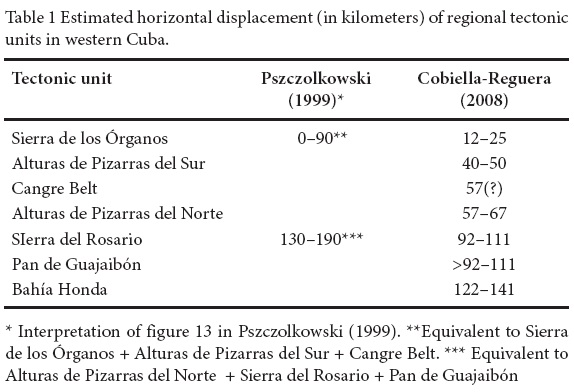
<body><![CDATA[<p align="justify"><font face="verdana" size="2">In the next years, several papers appeared by Takayama <i>et al</i>., 2000; Tada <i>et al</i>., 2002; 2003; Kiyokawa <i>et al</i>., 2002; Matsui <i>et al</i>., 2002, among others. Later, a group of Cuban and foreign geologists worked on the almost unknown chaotic deposits of the Santa Clara Formation, in the frame of the Cuban&#45;Spanish research project. A new K/Pg boundary deposit was reported by Alegret et al. (2005) and Rojas&#45;Consuegra et al. (2005) in central Cuba.</font></p>  	    <p align="justify"><font face="verdana" size="2">Despite the remarkable results derived from the study of K/Pg boundary beds in Cuba during the first decade of the current century (Takayama <i>et al</i>., 2000; Tada <i>et al</i>., 2003; Alegret <i>et al</i>., 2005, Goto <i>et al</i>., 2008, among others), an integrated model dealing with the distinct deposits and their relationships has not been fully attained (with the exception of the model presented by Tada et al. (2003)). Our paper will focus on three targets: 1) To restore the paleogeography (centered on paleorelief) of the western half of Cuba at the end of the Maastrichtian; 2) to develop a genetic classification of K/Pg boundary deposits in the western half of Cuba, related to the paleogeography in an area proximal to Chicxulub crater; 3) to obtain a dynamic model of the events related to the K/Pg boundary in western and central Cuba and its surroundings.</font></p>  	    <p align="justify"><font face="verdana" size="2">&nbsp;</font></p>  	    <p align="justify"><font face="verdana" size="2"><b>Methods</b></font></p>  	    <p align="justify"><font face="verdana" size="2">Our paper proposes a new approach to some items of the K/Pg boundary event. We present a critical review of contributions dealing on K/Pg boundary deposits in Cuba and surroundings. A major handicap in these publications is the insufficient data from the geological literature on Cuba. Therefore, their authors arrived to some questionable conclusions on the origin of such beds. In order to offer a clear geological setting, we discuss articles from Cuban journals and publications poorly known by foreign geologists containing important data for the study of K/Pg boundary event in Cuba. We insist on brief discussions about regional geology that are essential to understand the depositional frame and origin of the K/Pg boundary deposits. The coeval geography was an essential element in the characteristics and location of K/Pg boundary beds and this aspect, together with the paleoenvironment where each deposit accumulated, is analyzed. We also include a palinspastic reconstruction eliminating early Paleogene tectonic translations and develop an integrated geodynamic model.</font></p>  	    <p align="justify"><font face="verdana" size="2">Our research was complemented with sedimentological and biostratigraphic work in several outcrops, specially in the Santa Clara city area, central Cuba. These studies include not only the K/Pg boundary beds but also the overlying and underlying strata. We focus our attention on the contacts and sedimentary structures. Thin sections (mainly from limestone and tuffaceous turbidites) were studied; biostratigraphic results come mainly from the study of foraminifera in thin sections and soft rocks.</font></p>  	    <p align="justify"><font face="verdana" size="2">&nbsp;</font></p>  	    <p align="justify"><font face="verdana" size="2"><b>REGIONAL GEOLOGICAL SETTING</b></font></p>  	    <p align="justify"><font face="verdana" size="2">The K/Pg boundary deposits settled on the existing relief, related to the impact of an 10 km diameter asteroid on the Yucat&aacute;n platform (Hildebrand <i>et al</i>., 1991, Goto <i>et al</i>., 2004). The dense and poisonous cloud generated by the impact surrounded the Earth for several months and severely reduced the solar radiation at the planet surface, with catastrophic effects on the biosphere (Urrutia&#45;Fucugauchi <i>et al</i>., 1997; Fastovsky, 1997, Cevallos&#45;Ferriz, 1997, Grajales&#45;Nishimura <i>et al</i>., 2003, 2009; Schulte et al. 2010, Bralower <i>et al</i>., 2010). The K/Pg boundary beds are a perfect key horizon, sealing the last Mesozoic deposits and relief in the basins. In western and central Cuba, this deposit has a broad distribution and settled on two different regional Mesozoic tectonic units: (1) the passive Mesozoic paleomargin of North America, (2) the Cuban Cretaceous volcanic terrane (Iturralde&#45;Vinent, 1996; Cobiella&#45;Reguera, 2000, 2005). The configuration of the major Mesozoic tectonic units was attained essentially during the early Paleogene Cuban orogeny (Hatten, 1967; Kantchev <i>et al</i>., 1978; Pszczolkowski and Flores, 1986; Bralower and Iturralde&#45;Vinent, 1997; Cobiella&#45;Reguera, 2005, 2009; Saura <i>et al</i>., 2008; Pszczolkowski, 2009). To restore their paleopositions at the end of the Mesozoic, the effects of the Late Paleocene&#150;Middle Eocene thrusting must be removed.</font></p>  	    <p align="justify"><font face="verdana" size="2">In western Cuba, a wide area of Mesozoic rocks outcrops along the Cordillera de Guaniguanico mountains, in the northern half of Pinar del R&iacute;o and Artemisa mountains provinces (<a href="/img/revistas/rmcg/v32n1/a12f2.jpg" target="_blank">Figure 2</a>; Puscharovsky, 1988). Four distinct sections (zones) represent the North American Mesozoic paleomargin: (1) Sierra de los &Oacute;rganos (SO); (2) Alturas de Pizarras del Sur (APS); (3) Sierra del Rosario/Alturas de Pizarras del Norte (SR/APN); and (4) Cangre Belt (C).</font></p>  	    ]]></body>
<body><![CDATA[<p align="justify"><font face="verdana" size="2">In each zone, the Jurassic &#150; Paleocene section has distinct stratigraphy and tectonic features. They belong to a fold and thrust belt resting, with tectonic contact, below the northern Cuban ophiolites and the Cretaceous volcanic terrane (KVT+O in <a href="/img/revistas/rmcg/v32n1/a12f2.jpg" target="_blank">Figure 2</a>). Between the paleomargin and the northern oceanic sections, the Pan de Guajaib&oacute;n nappe (G), with an Albian &#150;Cenomanian carbonate bank, is located (Pszczolkowski, 1978). The tectonic units came from the S&#45;SE (Rigassi&#45;Studer, 1963; Hatten, 1967; Piotrowska, 1978). <a href="#t1">Table 1</a> summarizes recent estimates for their horizontal travel, supported on different approaches. Eastward, in Havana city, minimum estimates on the ophiolite belt displacement attain 15&#150;25 km northward (Cobiella&#45;Reguera, 2009). Data on the horizontal movements during the early Paleogene orogenesis in central Cuba are less well documented. For the southern border of the North American paleomargin (Placetas zone) Pszczolkowski (1983) calculated 50&#150;70 km toward the northeast. Following this figure, the authors considered that the overlying ophiolitic belt and the Cretaceous volcanic arc terrane moved at least 60&#150;80 km in the same direction during the early Paleogene event.</font></p>  	    <p align="center"><font face="verdana" size="2"><a name="t1"></a></font></p>  	    <p align="center"><font face="verdana" size="2"><img src="/img/revistas/rmcg/v32n1/a12t1.jpg"></font></p>  	    <p align="justify"><font face="verdana" size="2">&nbsp;</font></p>  	    <p align="justify"><font face="verdana" size="2"><b>EVIDENCE ON THE K/Pg AGE</b></font></p>  	    <p align="justify"><font face="verdana" size="2">Dealing with Cretaceous&#45;Paleogene boundary sediments, a basic point is to be sure that they actually were deposited 66 Ma ago (International Commission on Stratigraphy, 2013), at the turnover of the eras. This subject was studied in some detail in previous papers (Takayama <i>et al</i>., 2000; Tada <i>et al</i>., 2003; Alegret <i>et al</i>., 2005; Goto <i>et al</i>., 2008; S&aacute;nchez&#45;Arango, 2011, among others). The following four main criteria are considered in the current paper.</font></p>  	    <p align="justify"><font face="verdana" size="2">&nbsp;</font></p>  	    <p align="justify"><font face="verdana" size="2"><b>The fossil record</b></font></p>  	    <p align="justify"><font face="verdana" size="2">In all the lithostratigraphic units (<a href="/img/revistas/rmcg/v32n1/a12f1.jpg" target="_blank">Figure 1</a>), the typical "K/T boundary cocktail" of Bralower et al. (1998), a mix of Maastrichtian and older Cretaceous fossils (without Paleocene and younger taxa), is present. In some cases, the youngest taxa detected in clasts are upper or uppermost Maastrichtian: In the Pe&ntilde;alver Formation <i>Micula prinsii</i> (Tada <i>et al</i>., 2003); in the Cacaraj&iacute;cara Formation <i>Omphalocyclus macroporus, Globotruncana stuarti</i>, Globotruncanella havanensis, among others (Pszczolkowski, 1978; de la Torre, 1987). We visited the "chaotic clastic complex" (Alegret <i>et al</i>., 2005), located in the middle part of the Santa Clara Formation, and found upper Maastrichtian forms (<a href="/img/revistas/rmcg/v32n1/a12t2.jpg" target="_blank">Table 2</a>; see also fig. 2 in Alegret <i>et al</i>., 2005). <i>Abamthomphalus mayaroensis</i> (Pszczolkowski, 1986) and <i>Plummerita hantkeninoides</i> (Blanco&#45;Bustamante <i>et al</i>., 2007) were found in the Amaro Formation. D&iacute;az&#45;Otero et al. (2001) report <i>Abanthomphalus mayaroensis, Globotruncanella petaloidea, Guembelitria cretacea, Racemiguembelina fructicosa, Contusotruncana contusa,</i> and <i>Rugoglobigerina macrocephala</i> in the Moncada Formation.</font></p>  	    <p align="justify"><font face="verdana" size="2">&nbsp;</font></p>  	    ]]></body>
<body><![CDATA[<p align="justify"><font face="verdana" size="2"><b>The age of underlying and overlying beds (<a href="/img/revistas/rmcg/v32n1/a12f3.jpg" target="_blank">Figure 3</a>)</b></font></p>  	    <p align="justify"><font face="verdana" size="2">These criteria are very useful to constraint the age of the units in the cover of the Cretaceous volcanic arc. The Pe&ntilde;alver Formation rests upon V&iacute;a Blanca Formation, whose younger beds contain taxa from the uppermost Maastrichtian <i>Plummerita hantkeninoides</i> subzone, together with bentic forms from the Bolivinoides draco zone (Gil&#45;Gonz&aacute;lez <i>et al</i>., 2007; Men&eacute;ndez&#45;Pe&ntilde;ate and S&aacute;nchez&#45;Arango, 2007). Near Havana city, the oldest post&#45;Pe&ntilde;alver Formation deposits are lower Danian beds (Apolo Formation) with <i>Parvularugoglobigerina eugubina</i> and <i>Globoconusa fringa</i> (Goto <i>et al</i>., 2008). According to Arz et al. (2001; see fig. 5 in Grajales&#45;Nishimura <i>et al</i>., 2009), the first mentioned taxon has a small biozone, extending from 20 to 60 ka after the K/Pg boundary.</font></p>  	    <p align="justify"><font face="verdana" size="2">Alegret et al (2005) report the <i>Pseudoguembelina hariaensis</i> subzone in the beds just below the basal breccia of the K/Pg boundary beds in the Santa Clara Formation. Therefore, these authors believe that the last 0.3 Ma of the Maastrichtian stage are not represented in this section, according to the Arz and Molina (2002) zonation (see fig.5 in Grajales&#45;Nishimura <i>et al</i>., 2009). However, in samples collected by the authors in the Santa Clara Formation, <i>Plummerita hantkeninoides</i>, <i>Pseudoguembelina hariaensis</i> and other foraminifera, together with nannoplanktonic upper Maastrichtian taxa as Micula prinssi and M. murus (<a href="/img/revistas/rmcg/v32n1/a12t2.jpg" target="_blank">Table 2</a>) were found in the last 10 m of Cretaceous strata below the K/Pg beds. The preceding facts demonstrated that the uppermost Maastrichtian <i>Plummerita hantkeninoides</i> subzone is represented in the Santa Clara Formation strata (Pedraza&#45;Roz&oacute;n, 2010). Lowermost Danian beds, including the <i>Guembelitria cretacea</i> zone, were found in the Santa Clara Formation strata resting on the chaotic clastic complex in the Dos Hermanas hill section (<a href="/img/revistas/rmcg/v32n1/a12t2.jpg" target="_blank">Table 2</a>; Alegret <i>et al</i>., 2005), tightly bracketing its age.</font></p>  	    <p align="justify"><font face="verdana" size="2">Due to the unconformable or tectonic lower contact of the Cacaraj&iacute;cara, Amaro (Pszczolkowski, 1986) and Moncada (Tada <i>et al</i>., 2003) formations with the underlying Upper Cretaceous beds, this criteria is less definite in these cases. The same conclusion is valid for the DSDP K/Pg boundary sediments in the southeastern Gulf of Mexico (Alvarez <i>et al</i>., 1992).</font></p>  	    <p align="justify"><font face="verdana" size="2">In Sierra del Rosario, the Anc&oacute;n Formation rests on the Cacaraj&iacute;cara Formation (<a href="/img/revistas/rmcg/v32n1/a12f3.jpg" target="_blank">Figure 3</a>). The oldest known beds of Anc&oacute;n Formation in Sierra del Rosario mountains belong to P2, <i>Praemurica uncinata</i> zone (Pszczolkowski, 1994). In Sierra de los &Oacute;rganos this last unit rests on the Moncada Formation. A few poorly preserved small foraminifera skeletons, probably of lower Danian age, are scattered in the basal Anc&oacute;n Formation (Tada <i>et al</i>., 2002, 2003). The <i>Parvularugoglobigerina eugubina</i> zone is reported in the beds overlying the boundary deposits found in DSDP leg 77 (Alvarez <i>et al</i>., 1992). Paleocene deposits (Vega Alta Formation) rest on the Amaro Formation (<a href="#f4">Figure 4</a>; Pszczolkowski, 1986). Recent data record a Danian age (P1, Parasubbotina pseudobulloides&#45;<i>Praemurica uncinata</i> zone) for the Vega Alta Formation basal beds in northern central Cuba (Garc&iacute;a&#45;Delgado <i>et al</i>., 2011) and near Havana (Blanco&#45;Bustamante <i>et al</i>., 2007).</font></p>  	    <p align="center"><font face="verdana" size="2"><a name="f4"></a></font></p>  	    <p align="center"><font face="verdana" size="2"><img src="/img/revistas/rmcg/v32n1/a12f4.jpg"></font></p>  	    <p align="justify"><font face="verdana" size="2">&nbsp;</font></p>  	    <p align="justify"><font face="verdana" size="2"><b>Ejecta from asteroid impact</b></font></p>  	    <p align="justify"><font face="verdana" size="2">Collision produced particles have been recorded in many localities of western and central Cuba. In the Cacaraj&iacute;cara Formation, altered spherules are present in the lowest part of the basal breccia and shocked quartz (<a href="/img/revistas/rmcg/v32n1/a12f5.jpg" target="_blank">Figure 5d</a>) is distributed over almost the whole formation, except for its top (Kiyokawa <i>et al</i>., 2002; Tada <i>et al</i>., 2003). Spherules have been reported in the Amaro Formation (Fern&aacute;ndez&#45;P&eacute;rez <i>et al</i>., 2011). Shocked quartz (<a href="/img/revistas/rmcg/v32n1/a12f5.jpg" target="_blank">Figure 5b</a>), absent in the lower breccia, is present in the upper part of the Pe&ntilde;alver Formation, whereas altered vesicular glass presents a distribution similar to that recorded in the Cacaraj&iacute;cara Formation. Vitreous ejecta grains altered to chlorite or smectite are abundant in the Moncada and Cacaraj&iacute;cara formations (<a href="/img/revistas/rmcg/v32n1/a12f5.jpg" target="_blank">Figure 5f and 5g</a>; Kiyokawa <i>et al</i>., 2002; Tada <i>et al</i>., 2002, 2003). In the Dos Hermanas hill section of the Santa Clara Formation (<a href="/img/revistas/rmcg/v32n1/a12f1.jpg" target="_blank">Figure 1</a>), ejecta are reported only for its upper part and shocked quartz is scarce, but calcite spherules (from altered glass) and carbonate accretionary lapilli, are abundant (<a href="/img/revistas/rmcg/v32n1/a12f5.jpg" target="_blank">Figure 5c</a>; Alegret <i>et al</i>., 2005).</font></p>  	    ]]></body>
<body><![CDATA[<p align="justify"><font face="verdana" size="2">&nbsp;</font></p>  	    <p align="justify"><font face="verdana" size="2"><b>Iridium anomaly</b></font></p>  	    <p align="justify"><font face="verdana" size="2">This characteristic anomaly, reported at top of many Cretaceous&#45;Paleogene boundary deposits in the world, is known only from the Moncada Formation (western Cuba; Tada <i>et al</i>., 2003) and in DSDP sites 536 and 540 in the southeastern Gulf of Mexico (Alvarez <i>et al</i>., 1992).</font></p>  	    <p align="justify"><font face="verdana" size="2">Therefore, all the units contain two main features of K/Pg boundary deposits in the NW Caribbean&#45;Gulf of Mexico region: (a) the "K/T paleontological cocktail" of Bralower et al. (1997), and (b) impact ejecta grains. The biostratigraphic constraints for a K/Pg boundary age are tightly established for the Pe&ntilde;alver Formation, the "clastic complex" in the Santa Clara Formation and DSDP sites 536 and 540. Due to their current upper and lower tectonic contact, the stratigraphic position of the Cacaraj&iacute;cara and Amaro formations relative to K/Pg boundary is less constrained, but other data are not against a K/Pg boundary age.</font></p>  	    <p align="justify"><font face="verdana" size="2">An additional, but crucial fact, pointing to a K/Pg boundary age for all these units, is the abundant sedimentological evidence for a very fast deposition (Br&ouml;nnimann and Rigassi, 1963; Pszczolkowski, 1986; Tada <i>et al</i>., 2003, among others).</font></p>  	    <p align="justify"><font face="verdana" size="2">&nbsp;</font></p>  	    <p align="justify"><font face="verdana" size="2"><b>PALEOENVIRONMENTAL INTERPRETATION</b></font></p>  	    <p align="justify"><font face="verdana" size="2">As the K/Pg boundary sediments acted as an instantaneous mold of the underlying relief, in those places where they settled on active basins, the youngest Maastrichtian sediments were preserved below them. At the same time, the overlying sediments deposited just after the event, contain valuable paleoenvironmental information on the earliest Danian beds (<a href="/img/revistas/rmcg/v32n1/a12f3.jpg" target="_blank">Figure 3</a>). These two data can be contrasted and used as mutual controls in the paleoenvironmental interpretation, clarifying some details. In the next paragraphs this straightforward procedure will be applied to the interpretation of K/Pg boundary strata in the western half of Cuba.</font></p>  	    <p align="justify"><font face="verdana" size="2">In the southern part of the North American paleomargin in Cuba, Turonian to Maastrichtian beds are very rare and K/Pg boundary strata rest disconformably mainly on Cenomanian rocks (<a href="/img/revistas/rmcg/v32n1/a12f3.jpg" target="_blank">Figure 3</a>). This is the same <i>hiatus</i> of the Mid&#45;Cretaceous disconformity in the southeastern Gulf of Mexico (Schlager and Buffler, 1984). In Sierra del Rosario zone, in western Cuba (Cobiella&#45;Reguera <i>et al</i>., 2000; Cobiella&#45;Reguera, 2008), and in Placetas zone, in central Cuba (Piotrowska <i>et al</i>., 1981; Pszczolkowski, 1999), the lower contact of the K/Pg beds is always tectonic and generally rests on deep water Albian&#45;Cenomanian strata of the Carmita Formation (<a href="#f4">Figure 4</a>). In Sierra de los &Oacute;rganos zone (<a href="/img/revistas/rmcg/v32n1/a12f2.jpg" target="_blank">Figures 2</a> and <a href="/img/revistas/rmcg/v32n1/a12f3.jpg" target="_blank">3</a>), the K/Pg boundary beds lie disconformably on Cenomanian deposits (<a href="/img/revistas/rmcg/v32n1/a12f6.jpg" target="_blank">Figure 6</a>; the Pons Formation; Tada <i>et al</i>., 2003). In the southeastern Gulf of Mexico, K/Pg boundary beds in sites 536 and 540 rest on Cenomanian beds (<a href="/img/revistas/rmcg/v32n1/a12f1.jpg" target="_blank">Figure 1</a>, Alvarez <i>et al</i>., 1992; Bralower <i>et al</i>., 1998).</font></p>  	    <p align="justify"><font face="verdana" size="2">In Sierra del Rosario, the Anc&oacute;n Formation rest with tectonic contact upon Cacaraj&iacute;cara Formation. This deep water unit is also present in Sierra de los &Oacute;rganos, concordant above the Moncada Formation (<a href="/img/revistas/rmcg/v32n1/a12f3.jpg" target="_blank">Figure 3</a>; Tada <i>et al</i>., 2002, 2003). Lower Danian beds rest upon the Amaro Formation in Boca de Jaruco oil field, eastward from Havana city (Blanco&#45;Bustamante <i>et al</i>., 2007), and Middle Paleocene strata in northern central Cuba (Garc&iacute;a&#45;Delgado <i>et al</i>., 2011). The K/Pg boundary strata in DSDP sites 536 and 540 are covered by basal Danian ooze (Alvarez <i>et al</i>., 1992). Therefore we conclude that the general absence of Coniacian&#45;Maastrichtian beds, plus the rarity of Turonian strata suggest a starved basin condition in the North American margin from Cenomanian to Danian. Probably the margin was a deep basin, as suggested by the lower Danian beds in Sierra de los &Oacute;rganos (Tada <i>et al</i>., 2002) and the huge thickness of some sections of the Cacaraj&iacute;cara (Tada et al. 2003) and Amaro formations.</font></p>  	    ]]></body>
<body><![CDATA[<p align="justify"><font face="verdana" size="2">On the upper Campanian&#45;Maastrichtian cover of the volcanic arc terrane, the K/Pg boundary strata were deposited in basins filled with turbidites (the V&iacute;a Blanca Formation) in western Cuba and carbonate&#45;terrigenous sediments and reworked tephras in central Cuba (the Santa Clara Formation, Kantchev <i>et al</i>., 1978; Pedraza&#45;Roz&oacute;n, 2010). In both depressions, the contact with the underlying uppermost Maastrichtian beds is erosional. The V&iacute;a Blanca Formation (Bronnimann and Rigassi, 1963; Piotrowska <i>et al</i>., 1981; Albear&#45;Fr&aacute;nquiz and Iturralde&#45;Vinent, 1985; Gil&#45;Gonz&aacute;lez <i>et al</i>., 2007; Men&eacute;ndez&#45;Pe&ntilde;ate and S&aacute;nchez&#45;Arango, 2007) is a volcanomictic turbiditic sequence several hundred meters thick, with intercalated limestone, resting unconformably upon a strongly deformed basement, composed by Cretaceous volcanic arc and ophiolitic rocks (Albear Fr&aacute;nquiz and Iturralde&#45;Vinent, 1985; Pushcharovski, 1988; Cobiella&#45;Reguera, 2005). Most of the clastics were derived from a source to the south, with outcrops of the extinct Cuban Cretaceous volcanic arcs (<a href="/img/revistas/rmcg/v32n1/a12f6.jpg" target="_blank">Figure 6</a>; Piotrowska <i>et al</i>., 1981; Albear Fr&aacute;nquiz and Iturralde&#45;Vinent, 1985; Cobiella&#45;Reguera, 2005, 2009), whereas clasts derived from the ophiolitic suite are minor components (Albear and Iturralde&#45;Vinent, 1985).</font></p>  	    <p align="justify"><font face="verdana" size="2">Br&ouml;nnimann and Rigassi 1963), Piotrowska et al. (1981), and Pszczolkowski and Albear (1982) reported horizons with clastic limestone and rudist&#45;rich olistostrome for several localities within the upper V&iacute;a Blanca Formation. This fact clearly points to the development of abundant rudist reefs in the source area of this formation at the end Maastrichtian.</font></p>  	    <p align="justify"><font face="verdana" size="2">Br&ouml;nnimann and Rigassi (1963) suggested that in the Havana city area, the V&iacute;a Blanca Formation was deposited at water depths larger than 600 m. This interpretation has not been questioned in later publications and has been accepted for the whole distribution area (Pszczolkowski and Albear, 1982; Takayama <i>et al</i>., 2000). A recent study by P&eacute;rez&#45;Estrada et al. (2007), based on the bentic foraminifera record, considered deposition at depths between 200 and 1000 m in waters with low oxygen content for the samples from the V&iacute;a Blanca Formation they studied.</font></p>  	    <p align="justify"><font face="verdana" size="2">In central Cuba, the Santa Clara, Cocos, Vaquer&iacute;a and Fomento formations (Kantchev <i>et al</i>., 1978) record a Maastrichtian&#45;Danian section (<a href="/img/revistas/rmcg/v32n1/a12f1.jpg" target="_blank">Figure 1</a> and <a href="/img/revistas/rmcg/v32n1/a12f7.jpg" target="_blank">7</a>). In the Santa Clara Formation strata, the K/Pg boundary event had been studied with some detail only in the Dos Hermanas hill section by Alegret et al. (2005). In the same locality, below the erosional contact of the K/Pg boundary deposit (<a href="/img/revistas/rmcg/v32n1/a12f3.jpg" target="_blank">Figure 3</a>), we found a 100 m thick section of bioturbated marl, limestone and calcareous vitreous&#45;crystalline tuff (reworked tephra) belonging to the Santa Clara Formation (Pedraza&#45;Roz&oacute;n, 2010). However, carbonate pelagic sediments representing the basinal background, attain only 25&#150;30% of the total thickness, whereas the tuffs are interpreted as the result of instantaneous geological events, related to turbidity currents and submarine eruptions. Some uppermost Maastrichtian carbonate turbidites with shallow&#45;water bentonic fossil assemblages are present in this area (<a href="#f8">Figure 8</a>) below the K/Pg boundary deposits (<a href="/img/revistas/rmcg/v32n1/a12t2.jpg" target="_blank">Table 2</a>). Therefore, a batial paleoenvironment can be envisaged for the Santa Clara Formation beds in its type locality (see also Kantchev <i>et al</i>., 1978 and Alegret <i>et al</i>., 2005), with shallow&#45;water carbonate banks contributing to the sedimentary budget. Lithologically, other transitional Maastrichtian&#45;Danian units in central Cuba resemble those of the V&iacute;a Blanca Formation, but they contain tuffs as minor components, and shallow carbonates (Pszczolkowski, 2002) and marls (Kantchev <i>et al</i>., 1978) are locally dominant. Except for the lower part of the Vaquer&iacute;a Formation, the remaining units are exposed in very limited areas. Obviously, these sections did not accumulate in small isolated depressions, but are the remains of a deeply eroded basin, located near the northern fringe of the extinct Upper Cretaceous volcanic arc (<a href="/img/revistas/rmcg/v32n1/a12f7.jpg" target="_blank">Figure 7</a>).</font></p>  	    <p align="center"><font face="verdana" size="2"><a name="f8"></a></font></p>  	    <p align="center"><font face="verdana" size="2"><img src="/img/revistas/rmcg/v32n1/a12f8.jpg"></font></p>  	    <p align="justify"><font face="verdana" size="2">The oldest beds resting on the Pe&ntilde;alver Formation belong to the Apolo Formation. (<a href="/img/revistas/rmcg/v32n1/a12f3.jpg" target="_blank">Figure 3</a>, see below). Goto et al. (2008) remark the similarity of the V&iacute;a Blanca and Apolo formations, suggesting that the original environmental conditions were reestablished after the deposition of the Pe&ntilde;alver Formation. In central Cuba, lower Danian beds of the Santa Clara Formation, containing deep water fossils (<a href="#f8">Figure 8</a>, <a href="/img/revistas/rmcg/v32n1/a12t2.jpg" target="_blank">Table 2</a>; Alegret <i>et al</i>., 2005; Pedraza&#45;Roz&oacute;n, 2010) rest upon the chaotic clastic complex. Therefore, data from the underlying and overlying beds suggest the deposition of the Pe&ntilde;alver Formation and the K/Pg boundary section of the Santa Clara Formation in marine waters, at least several hundred meters deep. In the first case, this conclusion is reinforced by the great thickness of the unit (Goto <i>et al</i>., 2008).</font></p>  	    <p align="justify"><font face="verdana" size="2">&nbsp;</font></p>  	    <p align="justify"><font face="verdana" size="2"><b>END&#45;MESOZOIC PALEOGEOGRAPHY OF WESTERN AND CENTRAL CUBA AND ITS SURROUNDINGS</b></font></p>  	    <p align="justify"><font face="verdana" size="2"><a href="/img/revistas/rmcg/v32n1/a12f9.jpg" target="_blank">Figure 9</a> shows the location of the North America paleomargin and the extinct Cretaceous arc in western and central Cuba in the latest Maastrichtian, according to preceding data. Two tectonic realms become evident. A northern one, related to the North America Cretaceous paleomargin, and a southern one, related to the extinct Late Cretaceous Cuban volcanic arc. This general palinspastic scenario will be essential to understand the distribution and composition of the K/Pg beds in central and western Cuba.</font></p>  	    ]]></body>
<body><![CDATA[<p align="justify"><font face="verdana" size="2"><a href="/img/revistas/rmcg/v32n1/a12f10.jpg" target="_blank">Figure 10</a> is a paleogeographic map of the northwestern Caribbean area surrounding western and central Cuba at the end of Maastrichtian time, prepared with the information discussed in the preceding paragraphs and additional data from several sources (Pszczolkowski, 1982; Cobiella&#45;Reguera, 2008, 2009; among others). Some brief comments are necessary.</font></p>  	    <p align="justify"><font face="verdana" size="2">1) Two basins developed on the extinct Cretaceous arc. A western SSW&#45;NNE trending basin (V&iacute;a Blanca basin, VB), circa 300 km long and 100 km wide, collecting volcanoclastic turbidites derived from a southern source. Carbonate and terrigenous sediments, together with reworked tephra, accumulated in the eastern depression (Santa Clara Basin, SC; the Santa Clara, Cocos, Fomento and Vaquer&iacute;a formations; <a href="/img/revistas/rmcg/v32n1/a12f7.jpg" target="_blank">Figures 7</a> and <a href="/img/revistas/rmcg/v32n1/a12f10.jpg" target="_blank">10</a>). As no evidence exists for transitional sections between both basins, it seems very probable that some kind of geographic barrier interposed between them. In the map, a submarine high is assumed (<a href="/img/revistas/rmcg/v32n1/a12f10.jpg" target="_blank">Figure 10</a>).</font></p>  	    <p align="justify"><font face="verdana" size="2">2) A submarine ridge, related to the North American paleomargin/extinct Cretaceous arc collision belt, separated both domains (fig. 3 in Pszczolkowski, 1986; fig. 17 in Cobiella&#45;Reguera, 2000). This ridge probably existed since the late Campanian and acted as a barrier, preventing the spillover of the turbidity currents travelling northward along the V&iacute;a Blanca basin into the North American paleomargin in western Cuba (<a href="/img/revistas/rmcg/v32n1/a12f10.jpg" target="_blank">Figure 10</a>). This can explain why, despite the evidence of Cuban volcanic arc/North American paleomargin juxtaposition since the Campanian (Pszczolkowski, 1982, 1994; Cobiella&#45;Reguera, 2000, 2005), the late Campanian&#45;Maastrichtian volcanoclastic turbiditic currents did not arrive to the North American paleomargin. The turbidites originally accumulated at least circa 100 km southward of its present location, according to Cobiella&#45;Reguera (2008) palinspastic reconstruction. The northern half of the ridge contained Mesozoic rocks of the North American paleomargin border, whereas its southern half was a tectonic mix of Cretaceous volcanic arc rocks and the Mesozoic ophiolite suite (Cobiella&#45;Reguera, 2009).</font></p>  	    <p align="justify"><font face="verdana" size="2">3) Rudist banks were common along the coasts and on shallow marine floors. In late Maastrichtian time, they flourished on the coasts and shallow bottoms adjoining the southern sediment source of the V&iacute;a Blanca Formation (<a href="/img/revistas/rmcg/v32n1/a12f10.jpg" target="_blank">Figure 10</a>) and also on the submarine ridge separating the northwestern Caribbean realms, as suggested by the vast amount of shallow&#45;water Maastrichtian carbonate debris in the basal breccias of the Cretaceous/Paleogene boundary deposits (Kiyokawa <i>et al</i>., 2002; Tada <i>et al</i>., 2003; Garc&iacute;a&#45;Lav&iacute;n, 2009). However, nothing like the "Cuban Platform" carbonate bank (fig. 1 in Goto <i>et al</i>., 2008) probably existed. This subject will be treated later.</font></p>  	    <p align="justify"><font face="verdana" size="2">4) At least since Turonian time, the southern fringe of the North American paleomargin in Cuba (Cobiella&#45;Reguera, 2000) and the southeastern Gulf of Mexico (Schlager and Buffler, 1984) were part of a starved basin, perhaps with bottoms below the carbonate compensation depth or with strong bottom currents preventing deposition of fine sediments (<a href="/img/revistas/rmcg/v32n1/a12f10.jpg" target="_blank">Figure 10</a>).</font></p>  	    <p align="justify"><font face="verdana" size="2">&nbsp;</font></p>  	    <p align="justify"><font face="verdana" size="2"><b>TYPES AND DISTRIBUTION OF K/Pg BOUNDARY DEPOSITS</b></font></p>  	    <p align="justify"><font face="verdana" size="2">In the preceding section, the complex geographic scenario at the end of Maastrichtian time was shown. This fact, and the diverse nature and transportation mechanism (tsunamis, gravity flows, density currents, ballistic, etc.) of the huge mass of clastic particles generated by the asteroid impact and associated phenomena, ruled the sediment distribution and facies changes. According to its composition, internal architecture and thickness, we distinguish three types of K/Pg boundary deposits in Cuba: Type 1, with a thickness up to several hundred meters; basal chaotic breccia, followed by a thick massive fining upward sequence (calcarenite to calcilutite). Type 2, with a thickness of meters to tens of meters; basal chaotic breccias, followed by ejecta&#45;rich deposits. Type 3, with a thickness in meters; ejecta&#45;rich deposits.</font></p>  	    <p align="justify"><font face="verdana" size="2">The Cacaraj&iacute;cara, Amaro and Pe&ntilde;alver formations are Type 1 deposits, in which the impact ejecta are diluted in huge volumes of clastic particles. K/Pg boundary deposits in Santa Clara Formation and coeval rocks from ODP Leg 77 (Alvarez <i>et al</i>., 1992) are much thinner, type 2 beds. The Moncada Formation (Type 3) is a multiple graded sandy layer, less than 2 meters thick, with abundant ejecta.</font></p>  	    <p align="justify"><font face="verdana" size="2">&nbsp;</font></p>  	    ]]></body>
<body><![CDATA[<p align="justify"><font face="verdana" size="2"><b>Type 1 deposits</b></font></p>  	    <p align="justify"><font face="verdana" size="2">Very thick K/Pg beds extent over vast areas in western and central Cuba (<a href="/img/revistas/rmcg/v32n1/a12f1.jpg" target="_blank">Figure 1</a>). They all present the same general architecture, pointing to a common depositional process (<a href="#f11">Figure 11</a>). However some differences exist, particularly in the composition of basal breccias clasts.</font></p>  	    <p align="center"><font face="verdana" size="2"><a name="f11"></a></font></p>  	    <p align="center"><font face="verdana" size="2"><img src="/img/revistas/rmcg/v32n1/a12f11.jpg"></font></p>  	    <p align="justify"><font face="verdana" size="2">&nbsp;</font></p>  	    <p align="justify"><font face="verdana" size="2"><i>The Pe&ntilde;alver Formation</i></font></p>  	    <p align="justify"><font face="verdana" size="2">The Pe&ntilde;alver Formation (Bronnimann and Rigassi, 1963) crops out in Cretaceous volcanic terrane of western Cuba. In the last years the formation was studied in detail by Takayama et al. (2000), Tada et al. (2003), and Goto et al. (2008). These authors distinguished two main genetic and compositional units in the Pe&ntilde;alver Formation, a lower and an upper unit; the last one is divided in subunits A and B (<a href="#f11">Figure 11</a>). In the type locality, in Havana city, the formation is more than 180 meters thick. The lower unit is a massive, grain supported calcirudite, 30 meters thick, with large lutite olistoliths, derived from the V&iacute;a Blanca Formation (<a href="#f12">Figure 12</a>). The clasts are mainly angular, shallow&#45;water bioclasts with very subordinated matrix. Contact with the upper unit is a thin transitional zone (Goto <i>et al</i>., 2008). The upper unit of the Pe&ntilde;alver Formation represents a huge massive deposit or homogenite (Takayama <i>et al</i>., 2000; Goto <i>et al</i>., 2008), a term introduced by Kastens and Cita (1981) for graded homogeneous deposits, without current structures, accumulated from very dense suspensions in the Mediterranean Sea. The lower homogenite, subunit A, is a calcarenitic interval with a basal massive calcarenite, 55 m thick, with normal grading (<a href="#f11">Figure 11</a>). Above rests a bedded calcarenite, 40 m thick, with micritic grains and some skeletal foraminifera. Serpentine and volcanic clasts are frequent in the whole subunit, with several peaks in serpentine grain contents. Subunit B is a massive calcilutite, several tens meters thick; serpentine grains are absent, except in the lowermost part (fig. 8 in Goto et al. 2008).</font></p>  	    <p align="center"><font face="verdana" size="2"><a name="f12"></a></font></p>  	    <p align="center"><font face="verdana" size="2"><img src="/img/revistas/rmcg/v32n1/a12f12.jpg"></font></p>      <p align="justify"><font face="verdana" size="2">At Santa Isabel, westward from Havana (x in <a href="/img/revistas/rmcg/v32n1/a12f2.jpg" target="_blank">Figure 2</a>), the lower unit (45 m thick) of the Pe&ntilde;alver Formation contains several debris flow deposits, with upward grading. Bioclast of shallow&#45;water origin, biomicrites and crystalline carbonate are the main components, whereas non carbonate grains are less than 15%, and lutite clasts are abundant. The homogenite is 35 m thick. Subunit A is a massive calcarenite, similar to its equivalent in Havana, but lacks serpentine grains and contain abundant spinel. Subunit B is a calcilutite, which is stratified as result of fluctuations in clay content. A thin, slightly bioturbated bed, with a moderate Ir anomaly, rests at the top of the subunit. The easternmost outcrops are located in Matanzas province (<a href="/img/revistas/rmcg/v32n1/a12f1.jpg" target="_blank">Figure 1</a>; Tada <i>et al</i>., 2003; Goto <i>et al</i>., 2008). Near Cidra, approximately 90 km to the east of Havana, the lower unit is 18 m thick and it is composed of two calcirudite to calcarenite beds. The rock contains abundant rounded fragments of shallow&#45;water clasts and some shale fragments. The homogenite is only represented by subunit A, a fine to very fine graded grainstone bed, more than 67 m thick, with a basal erosional contact. The grain composition and size are similar to those in Havana. The amount of shallow marine fossils drastically decreases in its lower part, whereas serpentine grains first appear at the lower contact, with similar content fluctuations as recorded in Havana area. A faint bedding appears in its upper part. Pipe and pillar structures, related to water scape during sedimentation, are recorded in Havana and Cidra (Goto <i>et al</i>., 2008). According to Piotrowska et al. (1981), the calcilutites (subunit B) outcrop in minor areas in the Matanzas province, probably as result of pre&#45;Eocene erosion.</font></p>  	    ]]></body>
<body><![CDATA[<p align="justify"><font face="verdana" size="2">&nbsp;</font></p>  	    <p align="justify"><font face="verdana" size="2"><i>The Cacaraj&iacute;cara Formation</i></font></p>  	    <p align="justify"><font face="verdana" size="2">The Cacaraj&iacute;cara Formation (Hatten, 1957) rests on the Cretaceous beds of the North American paleomargin. The formation outcrops in Sierra del Rosario/Alturas de Pizarras del Norte tectonic unit, including its prolongation in the Martin Mesa window near Havana city area. This formation is also known in the deep wells of northwestern Cuba (<a href="/img/revistas/rmcg/v32n1/a12f1.jpg" target="_blank">Figures 1</a> and <a href="/img/revistas/rmcg/v32n1/a12f2.jpg" target="_blank">2</a>). In many places, tectonic slices of the formation are included in melanges, and the unit was strongly eroded during the early Paleogene tectonic events in western Cuba. Many olistoliths of the Cacaraj&iacute;cara Formation are included in the younger Manacas Formation (Cobiella&#45;Reguera, 1998, 2008, 2009). Also, because of the complex geologic scenario in Sierra del Rosario, tectonic slices of other lithostatigraphic units were considered as part of the lower breccias of the Cacaraj&iacute;cara Formation (the Los Cayos Member; Cobiella&#45;Reguera, 1998). Therefore, a correct interpretation of the Cacaraj&iacute;cara Formation original location must take account of all these facts. The unit is circa 800 m thick along the northern fringe of the mountains (<a href="/img/revistas/rmcg/v32n1/a12f2.jpg" target="_blank">Figure 2</a>; Kiyokawa <i>et al</i>., 2002; Tada et al. , 2003) but only tens of meters or less in others areas. As the beds originally deposited in the southernmost localities are located in the northern Sierra del Rosario (Pszczolkowski, 1999; Cobiella&#45;Reguera, 2008), the maximum thickness of the unit was located in its southern depositional area. The lower section (Kiyokawa <i>et al</i>., 2002; "Lower Breccia Member" of Tada <i>et al</i>., 2003) is a massive grain&#45;supported rudite, up to 400 m thick, almost without matrix (<a href="#f13">Figure 13</a>). Detritus is derived from the Lower Cretaceous rocks of the underlying paleomargin: Aptian&#45;Albian cherts with shaly interbeds (the Santa Teresa Formation) and Albian&#45;Cenomanian limestones with black cherts (the Carmita Formation), together with clasts from Albian&#45;Cenomanian and Campanian&#45;Maastrichtian carbonate banks (Gil&#45;Gonz&aacute;lez <i>et al</i>., 1998; Kiyokawa <i>et al</i>., 2002; Tada <i>et al</i>., 2003; Garc&iacute;a&#45;Lav&iacute;n, 2009) and, more sporadically, from older units. The clasts are in tight contact, with olistoliths attaining up to 25 meters by the long axis. A decrease in grain size occurs in the upper part of the "Lower Breccia Member" (pebble breccias of Kiyokawa <i>et al</i>., 2002). Spherules and shocked quartz grains are present but the first ones are concentrated only in the basal part of the breccia (Kiyokawa <i>et al</i>., 2002; Tada <i>et al</i>., 2003). Upon the rudites rests a coarse conglomeratic grainstone section, with similar clast composition. Tada et al. (2003) consider this calcarenite section (lower part of their "Grainstone Member") genetically related to the lower breccia and together make "the lower gravity flow unit" (<a href="#f11">Figure 11</a>). The middle and upper parts of the "Grainstone Member" and the "Mudstone Member" represent a massive well sorted fining upward, non stratified deposit almost 400 m of maximum thickness, equivalent to the Upper Unit (homogenite) of the Pe&ntilde;alver Formation. The sand grain composition includes micritic limestone and foraminiferal skeletons, circa 80% of them of Maastrichtian and 11% of Albian&#45;Cenomanian age (Garc&iacute;a&#45;Lav&iacute;n 2009), with some larger bioclasts, detrital quartz and feldspars. Fluid&#45;escape structures were recorded by Kiyokawa et al. (2002). A transition exists between the grainstone and the overlying "Mudstone Member". This last unit, composed of graded fine calcarenite to mudstone with disseminated foraminifera skeletons, bioclasts of shallow&#45;water origin and black carbon clasts, can attain thicknesses over 100 m.</font></p>  	    <p align="center"><font face="verdana" size="2"><a name="f13"></a></font></p>  	    <p align="center"><font face="verdana" size="2"><img src="/img/revistas/rmcg/v32n1/a12f13.jpg"></font></p>  	    <p align="justify"><font face="verdana" size="2">Several fluctuations in grain size and shocked quartz content are recorded in the Cacaraj&iacute;cara Formation homogenite. Shocked quartz and "carbonate pisoliths" (accretional carbonate tuff from impact&#45;induced calcite vapor) were recorded by Kiyokawa et al. (2002) in the grainstones.</font></p>  	    <p align="justify"><font face="verdana" size="2">The general features of the Cacaraj&iacute;cara Formation described above correspond to the northern outcrops (<a href="/img/revistas/rmcg/v32n1/a12f2.jpg" target="_blank">Figure 2</a>) in the Santiago river section. Southward, in the lower tectonic units with lesser horizontal movements (Cobiella&#45;Reguera, 2008), the thickness is remarkably reduced (Pszczolkowski, 1986; 1994), and we detected some graded structures related to pulses of turbiditic currents in the upper part of the "gravity flow unit" (<a href="/img/revistas/rmcg/v32n1/a12f14.jpg" target="_blank">Figure 14</a>). In these localities, the Cacaraj&iacute;cara Formation and other units are strongly dissected by numerous faults of different origins (Cobiella&#45;Reguera <i>et al</i>., 2000).</font></p>  	    <p align="justify"><font face="verdana" size="2">&nbsp;</font></p>  	    <p align="justify"><font face="verdana" size="2"><i>The Amaro Formation</i></font></p>  	    <p align="justify"><font face="verdana" size="2">The Amaro Formation rests upon Cretaceous units of the North American paleomargin in northcentral Cuba (<a href="/img/revistas/rmcg/v32n1/a12f1.jpg" target="_blank">Figure 1</a>). The deposit is a calcareous unit, 20 to 350 m thick, very similar to the Cacaraj&iacute;cara Formation (Pszczolkowski, 1986, Linares&#45;Cala <i>et al</i>., 2011). A massive breccia, with Upper Jurassic to Lower Cretaceous clasts derived from the North American paleomargin, lies below a grainstone middle part, containing upper Maastrichtian taxa (Blanco&#45;Bustamante <i>et al</i>., 2007, Fern&aacute;ndez&#45;P&eacute;rez <i>et al</i>., 2011). Mudstone, with poorly developed horizontal bedding, rests in the upper part (identified as the Rodrigo Formation in Kantchev <i>et al</i>., 1978). Frequently the formation lies with tectonic contact upon lower Upper Cretaceous beds (Piotrowska <i>et al</i>., 1981). Fern&aacute;ndez&#45;P&eacute;rez et al. (2011) report spherules in two wells at Boca de Jaruco, near Havana City. The Amaro Formation is known from the subsurface in an area extending from Havana eastward to Matanzas province (<a href="/img/revistas/rmcg/v32n1/a12f1.jpg" target="_blank">Figure 1</a>, Blanco&#45;Bustamante <i>et al</i>., 2007), and from outcrops in northern central Cuba (Pushcharovski, 1988). As the eastern outcrops of the Cacaraj&iacute;cara Formation are located in the Mart&iacute;n Mesa erosional window, 20 km west of Havana (<a href="/img/revistas/rmcg/v32n1/a12f2.jpg" target="_blank">Figure 2</a>), probably both units represent a single deposit. The Amaro Formation is a reservoir in northern Cuba hydrocarbon fields (Blanco&#45;Bustamante <i>et al</i>., 2007).</font></p>  	    ]]></body>
<body><![CDATA[<p align="justify"><font face="verdana" size="2">By far, Type 1 deposits constitute the bulk of K/Pg boundary strata in Cuba western half. On the basis of <a href="/img/revistas/rmcg/v32n1/a12f10.jpg" target="_blank">Figure 10</a>, some rough volume estimations are possible. Considering a moderate average thickness of 100 m for the Cacaraj&iacute;cara and Amaro formations and a common original depositional area of circa 25,000 km2, a rough estimate of about 2500 km3 of sediments seems possible for Type 1 beds deposited on the North American Mesozoic paleomargin in western and central Cuba. The same method, applied for the Pe&ntilde;alver Formation with an average thickness of 100 m and a depositional area (V&iacute;a Blanca basin) of 17,500 km2), yields 1750 km3 of original sediments. These values are at least one order of magnitude higher than those calculated by Pszczolkowski (1986).</font></p>  	    <p align="justify"><font face="verdana" size="2">&nbsp;</font></p>  	    <p align="justify"><font face="verdana" size="2"><b>Type 2 deposits</b></font></p>  	    <p align="justify"><font face="verdana" size="2"><i>K/Pg boundary beds in the Santa Clara Formation</i></font></p>  	    <p align="justify"><font face="verdana" size="2">The Santa Clara Formation is a deep&#45;water volcano&#45;sedimentary section, with the K/Pg section resting in its middle part (<a href="#f8">Figure 8</a>). Our team specially studied two sections of this unit, 0.5 km apart from each other, in Santa Clara city: Loma Capiro Monument and Dos Hermanas hill. A basal chaotic breccia is present in both places. In Loma Capiro Monument, the basal rudite is several meters thick, resting with erosional contact on Maastrichtian calcarenite and marl (<a href="/img/revistas/rmcg/v32n1/a12f15.jpg" target="_blank">Figure 15</a>). Its composition changes abruptly in short distances (carbonate to igneous clasts ratio and shallow water carbonate to marl + limolite clasts ratio). Some limolitic and marly clasts preserve irregular shapes, suggesting erosion and transport while they were unconsolidated fragments. A clast with an upper Maastrichtian association (<i>Orbitoides villasensis</i>, <i>Asterorbis</i> sp., <i>Hedbergella monmonthensis</i> and H. <i>holmdelensis</i>) was identified. The poor quality of the outcrops above the breccia do not allow documenting a complete section (<a href="/img/revistas/rmcg/v32n1/a12f15.jpg" target="_blank">Figure 15</a>).</font></p>  	    <p align="justify"><font face="verdana" size="2">Dos Hermanas hill section was studied by Alegret et al. (2005) and Rojas&#45;Consuegra et al. (2005). We visited it in December 2009 and returned briefly in October 2010. The outcrop is severely weathered and eroded (<a href="/img/revistas/rmcg/v32n1/a12f16.jpg" target="_blank">Figure 16</a>), and some differences were detected with respect to descriptions in previous papers. The Dos Hermanas hill section (<a href="#f8">Figure 8</a>, circa 9.5 m thick) has two peculiar features:</font></p>  	    <p align="justify"><font face="verdana" size="2">1) The basal unit (breccia, b in <a href="/img/revistas/rmcg/v32n1/a12f16.jpg" target="_blank">Figure 16</a>) rests on carbonate and tuffaceous beds of uppermost Maastrichtian age (<a href="/img/revistas/rmcg/v32n1/a12t2.jpg" target="_blank">Table 2</a>) not reported in the Alegret et al. (2005) study. The breccia contains abundant clasts from the ophiolitic suite (diabase and basalt) mixed with tuff, marl (sometimes deformed and with Maastrichtian fossils) and limestone. Fabrics ranges from grain supported in the lower part, to matrix supported upward, where the grains become finer. The breccia is overlain by circa one meter thick, graded, clastic, stratified deposits (perhaps an olistolith), with a marl bed on top (arrow in <a href="/img/revistas/rmcg/v32n1/a12f16.jpg" target="_blank">Figure 16</a>) containing Maastrichtian fossils (<a href="/img/revistas/rmcg/v32n1/a12t2.jpg" target="_blank">Table 2</a>).</font></p>  	    <p align="justify"><font face="verdana" size="2">2) Three calcareous fining upward layers with crude bedding, synsedimentary deformation, "acrettionary lapilli", and irregular carbonated vitreous splinters (similar to "cored melt fragments", recorded in unit 2 of Yax&#45;1 well in Chicxulub by Goto <i>et al</i>., (2004; fig. 4c) lie on the breccia. The beds probably correspond to the upper subunit of Alegret et al. (2005), for which these authors reported shocked quartz, terrestrial chondrules, abundant accretionary lapilli (spherules) and calcitized dark olive&#45;green glass (<a href="/img/revistas/rmcg/v32n1/a12f5.jpg" target="_blank">Figure 5c</a> and <a href="/img/revistas/rmcg/v32n1/a12f16.jpg" target="_blank">16</a>).</font></p>  	    <p align="justify"><font face="verdana" size="2">About 40 km southeast of Santa Clara city, a probable K/Pg boundary bed, deposited in the same basin (<a href="/img/revistas/rmcg/v32n1/a12f7.jpg" target="_blank">Figure 7</a>) as the Santa Clara Formation, was recently discovered in the Fomento Formation (<a href="/img/revistas/rmcg/v32n1/a12f7.jpg" target="_blank">Figure 7</a>; P&eacute;rez&#45;Estrada <i>et al</i>., 2009). However, information on its composition and internal architecture is still insufficient.</font></p>  	    <p align="justify"><font face="verdana" size="2">&nbsp;</font></p>  	    ]]></body>
<body><![CDATA[<p align="justify"><font face="verdana" size="2"><i>K/Pg boundary strata at DSDP sites 536 and 540</i></font></p>  	    <p align="justify"><font face="verdana" size="2">Alvarez et al. (1992) divided sequence detected at DSDP sites 536 and 540 of the southeastern Gulf of Mexico (<a href="/img/revistas/rmcg/v32n1/a12f1.jpg" target="_blank">Figure 1</a> and <a href="/img/revistas/rmcg/v32n1/a12f3.jpg" target="_blank">3</a>) in five units, and considered units 3 and 4 as the K/Pg boundary deposits. Unit 1 is the Cenomanian basement of the section. Unit 2 is a 45 meters thick pebbly mudstone interpreted, at least in part, as a mudflow deposit. Alvarez et al. (1992) suspected a K/Pg boundary age for this part of the section, and this was later established by Bralower et al. (1998). Unit 3 is a grainstone interval 0.6&#150;2.6 m thick. The rock contains smectite grains, derived from spherules, and impact&#45;related ejecta glass. Abundant shocked minerals (28% of grains showing shock features) were recovered from site 540 (quartz, quartzite and feldspar). Cross bedding (locally bidirectional) is conspicuous in some intervals. Iridium contents values are high in unit 3, supporting the idea that this unit accumulated simultaneously with the Chicxulub impact event. Unit 4 is a 50 cm thick section in which the planktic foraminifera are only tiny Cretaceous species. Unit 5 is a Danian ooze with small basal Paleocene taxa (not including the planctic foraminifera P0 zone). Near the top of unit 4, Ir content peaks at 650&#177;15 ng/g; high iridium contents continue at the base of unit 5, decreasing upward (Alvarez <i>et al</i>., 1992).</font></p>  	    <p align="justify"><font face="verdana" size="2">&nbsp;</font></p>  	    <p align="justify"><font face="verdana" size="2"><b>Type 3 deposit</b></font></p>  	    <p align="justify"><font face="verdana" size="2"><i>The Moncada Formation</i></font></p>  	    <p align="justify"><font face="verdana" size="2">The unit is a calcareous sandstone complex, circa two meters thick, with calcareous shales and fine sandstone intercalations near the top. The strata disconformably rest on Cenomanian beds of the Pons formation (<a href="/img/revistas/rmcg/v32n1/a12f6.jpg" target="_blank">Figure 6</a>; Tada <i>et al</i>., 2003). Moncada Formation is characterized by repetition of sandstone units with overall upward fining and thining. Ripple cross&#45;laminations at several horizons indicate north&#45;south trending paleocurrent directions with reversals. The unit contains abundant altered vesicular impact&#45;related melt fragments, shocked quartz and altered and deformed greenish grains (Tada <i>et al</i>., 2002) and also chert and limestone clasts derived from underlying Cretaceous beds (<a href="/img/revistas/rmcg/v32n1/a12f5.jpg" target="_blank">Figure 5f</a>). Changes in detrital composition corresponding to paleocurrent reversals are also present. At top, a 3&#150;5 cm thick bed (uppermost unit) of light colored shale and dark colored fine sandstone rests on unit 5. A strong Ir anomaly is related to the uppermost unit and the basal first centimeter of the overlying Anc&oacute;n Formation (Tada <i>et al</i>., 2002).</font></p>  	    <p align="justify"><font face="verdana" size="2">&nbsp;</font></p>  	    <p align="justify"><font face="verdana" size="2"><b>DISCUSSION. ORIGIN OF K/Pg BOUNDARY DEPOSITS IN WESTERN AND CENTRAL CUBA</b></font></p>  	    <p align="justify"><font face="verdana" size="2">The papers of the Cuban&#45;Japanese project (Takayama <i>et al</i>., 2000; Goto <i>et al</i>., 2008; among others), Alegret et al. (2005), and Rojas&#45;Consuegra et al. (2005), which appeared in the first years of the current century, reported that a remarkable and varied group of K/Pg boundary deposits are present in western and central Cuba. However, their geological setting, specially the paleogeography at Maastrichtian decline, was not fully understood. The following lines contain a brief discussion on the genesis and original distribution of the K/Pg boundary deposits in western and central Cuba, and on the role of latest Maastrichtian regional paleorelief in this event.</font></p>  	    <p align="justify"><font face="verdana" size="2">The coarse rudite in the Cacaraj&iacute;cara, Pe&ntilde;alver (Takayama <i>et al</i>., 2000; Tada <i>et al</i>., 2003; Goto <i>et al</i>., 2008), Amaro (Pszczolkowski, 1986) and Santa Clara (Rojas&#45;Consuegra <i>et al</i>., 2005) formations, and probably in DSDP sites in the southeastern Gulf of Mexico (Alvarez <i>et al</i>., 1992), are mainly debris flow deposits (Tada <i>et al</i>., 2003) derived from local sources. The origin of breccia in Type 1 and 2 deposits is tightly related to the coeval regional relief. They were generated along steep island talus and submarine scarps, frequently with Maastrichtian rudist banks flourishing on top. The clast composition in the beds resting on the North American paleomargin (the Cacaraj&iacute;cara and Amaro formations) is related to the Cretaceous substrat in the southern paleomargin border (<a href="/img/revistas/rmcg/v32n1/a12f9.jpg" target="_blank">Figures 9</a> and <a href="/img/revistas/rmcg/v32n1/a12f10.jpg" target="_blank">10</a>). In the Cacaraj&iacute;cara Formation, clasts are mainly derived from the Pan de Guajaib&oacute;n (Cenomanian; Gil&#45;Gonz&aacute;lez <i>et al</i>., 1998), Santa Teresa (Aptian&#45;Albian) and Carmita (Albian&#45;Cenomanian) formations. The abundant Maastrichtian clasts (Gil&#45;Gonz&aacute;lez <i>et al</i>., 1998) probably come from the combined erosion of the Maastrichtian carbonate banks growing on top of the collision zone submarine high (<a href="/img/revistas/rmcg/v32n1/a12f9.jpg" target="_blank">Figures 9</a> and <a href="/img/revistas/rmcg/v32n1/a12f10.jpg" target="_blank">10</a>) by giant tsunamis waves (Matsui <i>et al</i>., 2002) and the preceding seismic waves. Clast composition invalidates Kiyokawa et al. (2002) hypothesis, considering Yucat&aacute;n platform as the source of the Cacaraj&iacute;cara Formation gravity flow unit. In the Amaro Formation (at least near Havana city), the coarse clasts were derived mainly from Upper Jurassic&#45;Lower Cretaceous deposits of Placetas zone, whereas clasts from Maastrichtian carbonate banks have a subordinate role (Blanco&#45;Bustamante <i>et al</i>., 2007).</font></p>  	    ]]></body>
<body><![CDATA[<p align="justify"><font face="verdana" size="2">Kiyokawa et al. (2002) assumed an origin under "laminar flow conditions in a very high speed dilatant situation" for the basal unit of Cacaraj&iacute;cara Formation. We consider the beds of the lower unit (breccia plus coarse calcarenite) of the Cacaraj&iacute;cara and Amaro formations as originated mainly from huge and violent debris flows with contributions from massive slumps, avalanches, and sporadic turbidity currents, along the northern flank of the submarine ridge (<a href="/img/revistas/rmcg/v32n1/a12f10.jpg" target="_blank">Figure 10</a>).</font></p>  	    <p align="justify"><font face="verdana" size="2">In the lower unit of the Pe&ntilde;alver Formation, Cretaceous volcanic clasts and detritus derived from the underlying V&iacute;a Blanca Formation are subordinate (<a href="#f11">Figures 11</a> and <a href="#f12">12</a>), whereas upper Cretaceous shallow&#45;water carbonate biodetritus is very frequent. In the paleogeographic reconstructions by the Cuban&#45;Japanese team, a great carbonate bank is located southward of the depositional site of the Pe&ntilde;alver Formation (Tada <i>et al</i>., 2003; Goto <i>et al</i>., 2008). A fact, previously described in the current paper but not considered in previous studies, is the abundant content of coarse bioclastic beds in the uppermost strata of V&iacute;a Blanca Formation in all localities. In our opinion, this scenario suggests an episode of intense erosion of the carbonate banks flanking the coast during the late Maastrichtian (probably related to the coeval global regressive event), whereas highlands with volcanic outcrops, located toward the interior, were denudated (<a href="/img/revistas/rmcg/v32n1/a12f10.jpg" target="_blank">Figure 10</a>). Siliciclastic beds are dominant, even in the uppermost V&iacute;a Blanca strata, and little remains of that supposed platform could be invoked in western and central Cuba, except for the Cantabria Formation, in northern Cienfuegos basin (<a href="/img/revistas/rmcg/v32n1/a12f7.jpg" target="_blank">Figure 7</a>; Pszczolkowski, 2002) and small bioherms in the carbonate&#45;terrigenous Los Negros (San Juan y Mart&iacute;nez) Formation in westernmost Cuba (<a href="/img/revistas/rmcg/v32n1/a12f2.jpg" target="_blank">Figure 2</a>; Piotrowski, 1987; Gil&#45;Gonz&aacute;lez <i>et al</i>., 2007).</font></p>  	    <p align="justify"><font face="verdana" size="2">Following Goto et al. (2008), Tada et al. (2003) and others, we assume that the "lower unit" of the Pe&ntilde;alver Formation are huge debris flow deposits. These coarse sediments chaotically accumulated in the V&iacute;a Blanca basin during the first hours after the impact, previous to the arrival of the hiperdense carbonate suspension (Takayama <i>et al</i>., 2000).</font></p>  	    <p align="justify"><font face="verdana" size="2">In Type 2 deposits, the breccia composition in the Santa Clara Formation is tightly related to the substrate in nearby areas, where ophiolitic and volcanic arc rocks crop out (Pushcharovski, 1988; Rojas&#45;Consuegra <i>et al</i>., 2005). Besides, close areas with Maastrichtian shallow carbonates are evident from grain composition of the Santa Clara Formation carbonate turbidites (Pedraza&#45;Roz&oacute;n, 2010) and from reports for the nearby Cienfuegos basin (<a href="/img/revistas/rmcg/v32n1/a12f7.jpg" target="_blank">Figure 7</a>; Pszczolkowski, 2002). These Type 2 beds deposited at batial depths, more than 500&#150;700 meters below sea level (Alegret <i>et al</i>., 2005). On the other hand, in the southeastern Gulf of Mexico DSDP sites, the breccia was derived from Yucat&aacute;n or Florida&#45;Bahamas platform talus (Alvarez <i>et al</i>., 1992).</font></p>  	    <p align="justify"><font face="verdana" size="2">Homogenite clastic composition records a distinct source, unrelated to that of the underlying coarse clastics (<a href="#f11">Figure 11</a>; Takayama <i>et al</i>., 2000; Tada <i>et al</i>., 2003; Goto <i>et al</i>., 2008). Sedimentary structures as well as ejecta grain contents show that, in each case, the homogenite unit accumulated very fast from hyperdense suspensions (Tada <i>et al</i>., 2003). In their seminal paper, Kastens and Cita (1981) considered that the liquefaction of sediments originating the Mediterranean homogenite was due to tsunami erosion, whereas the impact of seismic waves was minor. Probably this was not the situation with the K/Pg boundary homogenite in Cuba, because the seismic waves of the megaearthquake generated by the Chicxulub impact (Matsui <i>et al</i>., 2002; Schulte et al. 2010), liberated an energy thousands times greater than the energy released in the major tectonic earthquakes so far recorded (Schulte <i>et al</i>., 2010). The liquefied carbonate sediments created dense suspensions that quickly moved along the deepest parts of the complex sea floor relief, flowing towards the basins, where they finally settled. Data from different sources show that some extraordinary tsunamis, several hours apart, traveled the Gulf of Mexico and the ancient Caribbean basin after the Chicxulub impact (Smit <i>et al</i>., 1992; Matsui <i>et al</i>., 2002). The fluctuations in grain composition and diameter, particularly in the Pe&ntilde;alver Formation homogenite, also suggest the travel of successive tsunami waves during sedimentation (Tada <i>et al</i>., 2003). Therefore, suspensions generating the homogenite of the Cacaraj&iacute;cara, Amaro and Pe&ntilde;alver formations formed before the late tsunamis, and were affected by them when settling was in progress in the deep basins (Tada <i>et al</i>., 2003; Goto <i>et al</i>., 2008). Additionally, the effect of oscillating currents, of the seiche type, described by Smit et al. (1992) in the northern Gulf of Mexico must be considered.</font></p>  	    <p align="justify"><font face="verdana" size="2">In the clastic complex of the Santa Clara Formation the homogenite is absent, probably because the Santa Clara and V&iacute;a Blanca deep basins were separated by a narrow shallow&#45;water area (<a href="/img/revistas/rmcg/v32n1/a12f10.jpg" target="_blank">Figures 10</a> and <a href="/img/revistas/rmcg/v32n1/a12f17.jpg" target="_blank">17</a>). Alvarez et al. (1992) reported cross bedding (in part bidirectional) in some parts of unit 3 in the DSDP sites, whereas cut and fill structures have been reported for the Dos Hermanas section (middle subunit of Alegret <i>et al</i>., 2005). Therefore, in both localities strong evidence for tsunami activity are present.</font></p>  	    <p align="justify"><font face="verdana" size="2">Type 3 deposits (Moncada Formation) are deprived of coarse chaotic sediments. This fact, together with the Upper Cretaceous unconformity below the Moncada Formation (<a href="/img/revistas/rmcg/v32n1/a12f6.jpg" target="_blank">Figure 6</a>), point to accumulation above an elevated seafloor area, contrary to Types 1 and 2. Clear evidences of tsunami waves during deposition are recorded in the paleocurrent inversions and reiterated changes in sedimentary structures in the ejecta&#45;rich deposits of the Moncada Formation (Tada <i>et al</i>., 2002, 2003).</font></p>  	    <p align="justify"><font face="verdana" size="2">&nbsp;</font></p>  	    <p align="justify"><font face="verdana" size="2"><b>Geodynamic model</b></font></p>  	    <p align="justify"><font face="verdana" size="2"><a href="/img/revistas/rmcg/v32n1/a12f17.jpg" target="_blank">Figure 17</a> resume our ideas to explain the genesis and original distribution of K/Pg boundary deposits in Cuba and its surroundings. The model assumes extraordinary slumps along the Yucat&aacute;n and Florida&#45;Bahamas carbonate platform margins just after the asteroid impact. At the Chicxulub event, the long submarine ridge of the extinct Cuban volcanic arc/North American paleomargin collision zone (<a href="/img/revistas/rmcg/v32n1/a12f10.jpg" target="_blank">Figure 10</a>) was a remarkable sea floor feature where great slumps and debris flows developed, triggered by the seismic waves and tsunamis traveling from the Chicxulub crater. These gravity flows originated the very thick "lower gravity flow unit" of the Cacaraj&iacute;cara and Amaro formations (<a href="/img/revistas/rmcg/v32n1/a12f17.jpg" target="_blank">Figure 17</a>). Its equivalent in the Pe&ntilde;alver Formation probably resulted from the destruction of the rudist banks and the youngest siliciclastic Maastrichtian deposits along the steep southern shore of V&iacute;a Blanca basin (<a href="/img/revistas/rmcg/v32n1/a12f17.jpg" target="_blank">Figures 10</a> and <a href="/img/revistas/rmcg/v32n1/a12f17.jpg" target="_blank">17</a>). A great mass of detritus, chaotically mingled with sea water, descended as one (in Havana city area) or several giant debris flows (in Bah&iacute;a Honda and Cidra areas), finally resting at considerable depths on the basin floor. At the same time, the coarse ejecta particles created during the asteroid impact settled through the atmosphere and hydrosphere, resting within the chaotic deposits.</font></p>  	    ]]></body>
<body><![CDATA[<p align="justify"><font face="verdana" size="2">Tada et al. (2003) proposed a 50 km wide and hundreds meters deep channel was excavated in the northern Sierra del Rosario Cretaceous deposits by flows carrying the clasts of Cacaraj&iacute;cara Formation breccia. However, the fact that, in most localities, the rocks below the Cacaraj&iacute;cara Formation breccia are Albian&#45;Cenomanian strata (the Carmita Formation; Pszczolkowski, 1978, 1994, 1999) and that Turonian&#45;Santonian clasts are almost absent in Cacaraj&iacute;cara calcirudite (Garc&iacute;a&#45;Lav&iacute;n, 2009) suggests that debris flow erosion was not very intensive (<a href="/img/revistas/rmcg/v32n1/a12f3.jpg" target="_blank">Figure 3</a>). Probably the same applies for the deposition of the Amaro Formation. At least for the Pe&ntilde;alver Formation (Goto <i>et al</i>., 2008) and for the breccia of the Santa Clara Formation (<a href="/img/revistas/rmcg/v32n1/a12f15.jpg" target="_blank">Figures 15</a> and <a href="/img/revistas/rmcg/v32n1/a12f16.jpg" target="_blank">16</a>; Rojas&#45;Consuegra et al.; 2005; Pedraza&#45;Roz&oacute;n, 2010), there is no clear evidence of a remarkable erosional event acting upon the underlying beds, because upper Maastrichtian strata rest below the coarse K/Pg boundary sediments (<a href="/img/revistas/rmcg/v32n1/a12f3.jpg" target="_blank">Figures 3</a> and <a href="/img/revistas/rmcg/v32n1/a12f15.jpg" target="_blank">15</a>).</font></p>  	    <p align="justify"><font face="verdana" size="2">Meanwhile, in the great carbonate platforms talus near Cuba (Yucat&aacute;n, Florida&#45;Bahamas), giant, very fast moving avalanches and debris flows entrained many cubic kilometers of unconsolidated and poorly consolidated carbonate sediments from the ocean floor, previously shocked and liquefied by seismic waves (<a href="/img/revistas/rmcg/v32n1/a12f17.jpg" target="_blank">Figure 17</a>). This process was followed by the first extraordinary receding and rushing tsunami waves (Matsui <i>et al</i>., 2002). The huge volumes of psamitic and pelitic grains of Maastrichtian age in the homogenite source point to intense erosion of the youngest sea&#45;floor deposits. A very dense suspension, at least several hundreds of meters thick, began to move, following the sea&#45;floor relief and flowing toward the deepest basins. After the arrival of the suspension to the basins, the hyperdense current was braked and trapped, quickly dropping its contents in waters still affected by reflected tsunami waves (Smit <i>et al</i>., 1992; Matsui <i>et al</i>., 2002). Takayama et al. (2000) estimated that settling of the Pe&ntilde;alver Formation calcarenite lasted between 3 and 12 days after the generation of the suspension, with an original concentration of 100&#150;300 g/L. According to numerical models by Matsui et al. (2002), tsunami reflected waves traveled through the Gulf of Mexico during more than 30 hours after the impact. Although the figures are not strictly coincident, they indicate a high probability of tsunami waves influencing lower homogenite deposition. No evidence exists for an exceptional erosional event affecting the rocks below the homogenite of the Pe&ntilde;alver or Cacaraj&iacute;cara formations.</font></p>  	    <p align="justify"><font face="verdana" size="2">The bulk homogenite composition and its stratigraphic position in the Pe&ntilde;alver and Cacaraj&iacute;cara formations deposits are similar, pointing to a common main source (with relative minor amounts of coeval fine ejecta). However, the noncarbonate grain composition in the Pe&ntilde;alver and Cacaraj&iacute;cara formations homogenite are remarkably different. Whereas serpentine and volcanic rocks are the main siliciclastic detritus in the Pe&ntilde;alver Formation, frequently attaining more than 50% of the noncarbonated grains (Takayama <i>et al</i>., 2000), in the Cacaraj&iacute;cara Formation homogenite, the main siliciclastic grains are feldspars and detrital quartz (Tada <i>et al</i>., 2003). In both cases, this composition is in general agreement with the respective basin substrate.</font></p>  	    <p align="justify"><font face="verdana" size="2">Goto et al. (2008) proposed that, in the case of the Pe&ntilde;alver Formation, the homogenite was derived from erosion and redeposition of the V&iacute;a Blanca Formation. However, V&iacute;a Blanca Formation is a mainly terrigenous unit (Br&ouml;nnimann and Rigassi, 1963; Albear&#45;Fr&aacute;nquiz and Iturralde&#45;Vinent, 1985), whereas the homogenite is a carbonate deposit and the erosional evidence below the Pe&ntilde;alver Formation breccia is modest (<a href="/img/revistas/rmcg/v32n1/a12f3.jpg" target="_blank">Figure 3</a>).</font></p>  	    <p align="justify"><font face="verdana" size="2">In the small semi&#45;closed V&iacute;a Blanca basin (<a href="/img/revistas/rmcg/v32n1/a12f10.jpg" target="_blank">Figure 10</a> and <a href="/img/revistas/rmcg/v32n1/a12f17.jpg" target="_blank">17</a>) the effects of the sudden injection of a hyperdense fast moving sediment suspension, gliding on the bottom can be assumed. Considering a bulk estimate of 1750 km3 for Pe&ntilde;alver Formation rocks (see section on deposit types above) and about 1200 km3 for its homogenite (circa 2/3 of the formation volume), the suspension had, at least, more than 1000 cubic kilometers. We suppose that the fast moving suspension wedge triggered the displacement of a similar volume of the overlying clear waters, generating exceptional waves and the abrupt drowning of the basin flanks by new tsunamis. The violent and repeated backwashs entrained and transported huge volumes of shallow and terrestrial deposits to the deep basin. In our opinion this mechanism explains the repeated changes in abundance of serpentine and volcanic grains in the Pe&ntilde;alver Formation homogenite section.</font></p>  	    <p align="justify"><font face="verdana" size="2">Regional data, including the Geological Map of Cuba (Pushcharovski, 1988), clearly shows outcrops of Mesozoic serpentinite next to the Pe&ntilde;alver Formation. Therefore, it is not necessary to invoke a provenance from central or eastern Cuba, 300&#150;1000 km eastward, to explain the presence of serpentine grains in the Pe&ntilde;alver Formation, as Goto et al. (2008) proposed.</font></p>  	    <p align="justify"><font face="verdana" size="2"><a href="/img/revistas/rmcg/v32n1/a12f18.jpg" target="_blank">Figure 18</a> shows a correlation chart for the K/Pg boundary strata of the western half of Cuba, embracing the first 100 years of the Cenozoic erathem, in which the chronological relationships among the different K/Pg boundary deposits discussed in this paper become more explicit. Obviously, the gravity flow sediments in Types 1 and 2 deposits accumulated in the first hours after the impact (Takayama <i>et al</i>., 2000; Tada <i>et al</i>., 2003). If variations in grain composition in the Pe&ntilde;alver Formation subunit A (lower homogenite) was due to its deposition during the "tsunamic storm", the subunit was probably settled between several hours and several days after the impact, if Takayama et al. (2000), Matsui et al. (2002) and Tada et al. (2003) calculations are correct. A similar time span for the deposition of the equivalents in the Cacaraj&iacute;cara and Amaro formations can be assumed.</font></p>  	    <p align="justify"><font face="verdana" size="2">The Moncada Formation (Tada <i>et al</i>., 2002, 2003), the clastic complex in the Santa Clara Formation and unit 3 in the southeastern Gulf of Mexico DSDP sites (&Aacute;lvarez et al. 1992) also contain clear evidence of several tsunami waves acting during their accumulation. In Matsui et al. (2002) model, the location of DSDP sites 536 and 540 suffered tsunami waves mainly in the first 25 hours after the impact.</font></p>  	    <p align="justify"><font face="verdana" size="2">The upper, fine grained homogenite in the Cacaraj&iacute;cara, Amaro and Pe&ntilde;alver formations were deposited after the tsunamis, when water movement became normal. The bed with very high Ir content is only found in the Moncada Formation (Tada <i>et al</i>., 2002, 2003) and in the DSDP sites 536 and 540 (&Aacute;lvarez <i>et al</i>., 1992), but a moderate Ir anomaly was found at top of the Pe&ntilde;alver Formation at Santa Isabel (Goto <i>et al</i>., 2008) and we speculate that a similar bed was originally deposited also on top of all Type 1 deposits. Probably the time recorded in Type 1, Ir&#45;rich bed is lesser than in their equivalents in types 2 and 3 deposits (<a href="/img/revistas/rmcg/v32n1/a12f18.jpg" target="_blank">Figure 18</a>), but this matter is only of theoretical interest.</font></p>  	    <p align="justify"><font face="verdana" size="2">&nbsp;</font></p>  	    ]]></body>
<body><![CDATA[<p align="justify"><font face="verdana" size="2"><b>Comparison with other K/Pg boundary deposits in the Gulf of Mexico&#150;northwestern Caribbean area</b></font></p>  	    <p align="justify"><font face="verdana" size="2">Unquestionably related to Type 1 Cuban deposits are the sections at Bochil, Chilil and Guayal in southeastern Mexico, and the offshore Campeche Sound. Grajales&#45;Nishimura et al. (2003, 2009) named these detrital carbonate deposits "Clastic Complex Unit" (CCU), and divided them in three subunits. The CCU rests on pelagic carbonate beds with black cherts. The lower subunit (1) is a gravity flow breccia with abundant pelagic carbonate blocks, attaining two meters in diameter, and black chert nodules. The lower subunit attains thicknesses between 40 and 300 m. As in Cuba, clast ages varies from Albian to Maastrichtian (Grajales&#45;Nishimura <i>et al</i>., 2003). Upward, the breccia becomes fine grained and, in subunit 2 (10&#150;30 m in thickness), the clasts are fragments of shallow&#45;water biodetrital limestone. Scarce matrix, with pelagic microfossils, is present between the grains. Finally, the breccia grades into coarse&#45;grained sandstone. Toward the top of unit 2, a 0.8 m thick ejecta&#45;rich layer, with accretionary lapilli and quartz with planar deformation features (PDF), is recorded. Subunit 3 (3&#150;15 m in thickness) rests with gradational contact and is a graded ejecta&#45;rich deposit beginning with calcarenite and ending with siltstone and claystone. This last subunit seems similar to the homogenite unit in Cuban Type 1 deposits.</font></p>  	    <p align="justify"><font face="verdana" size="2">Most of the Actela Formation in the southern Peten basin, Guatemala, is a K/Pg boundary carbonate breccia, up to 50 m thick, but lacks the overlying fine carbonate beds present in Cuban and Mexican equivalents (Fourcade <i>et al</i>., 1999).</font></p>  	    <p align="justify"><font face="verdana" size="2">In the northern Gulf of Mexico, K/Pg boundary deposits are different from those in the south that accumulated under the influence of the huge Yucat&aacute;n Bank. The terrigenous beds show a distinct scenario from those we studied in western and central Cuba or southeastern Mexico (Smit et al. 1992; Alegret <i>et al</i>., 2002 and others). One of the first cases studied was in El Mimbral, near the Gulf of Mexico coast (Smit et al. 1992), where a 3 m thick sequence records the depositional event of a megatsunami at the Mesozoic/Cenozoic boundary. The lower part is the "spherule bed", containing altered spherules and quartz grains, with planar deformation features. The rocks above this horizon are fine&#45;bedded strata with intraclasts, and plant debris, interpreted as the result of the backwash of megatsunamis that carried coarse debris from shallow parts of the continental margin into deeper water. The third unit is represented by fine&#45;bedded ripple beds alternating with clay drapes, with an Ir anomaly at the top of the ripple beds interval, interpreted as deposits of oscillating currents (seiches).</font></p>  	    <p align="justify"><font face="verdana" size="2">&nbsp;</font></p>  	    <p align="justify"><font face="verdana" size="2"><b>CONCLUSIONS</b></font></p>  	    <p align="justify"><font face="verdana" size="2">1) K/Pg boundary deposits attain great volumes and geographic distribution in western and central Cuba. This is related to the complex tectono&#45;geographic scenario in the ancient northwestern Caribbean&#150;southeastern Gulf of Mexico area at the time of the Chicxulub impact.</font></p>  	    <p align="justify"><font face="verdana" size="2">2) Three types of K/Pg boundary beds were distinguished. Type 1 deposits include in its lower part thick gravity flow sediments, derived from nearby cliffs. Above rests a fining upward massive calcarenite to calcilutite section, settled from hyperdense calcareous suspensions, formed by fine calcareous grains and some siliciclastic and impact ejecta grains (homogenite). Deposits accumulated in two depressions; in the south, a basin located upon the extinct Cretaceous Cuban arc (the Pe&ntilde;alver Formation); in the north, the southern fringe of the starved North American Mesozoic margin (the Cacaraj&iacute;cara and Amaro formations).</font></p>  	    <p align="justify"><font face="verdana" size="2">3) Type 2 deposits also contain gravity flow deposits in their lower part but, instead the homogenite, ejecta&#45;rich deposits are present. They accumulated in basins near cliffs, in areas protected from the influence of dense suspensions (the Santa Clara Formation and sediments in DSDP sites 536 and 540).</font></p>  	    <p align="justify"><font face="verdana" size="2">4) Type 3 deposits are built by reworked ejecta&#45;rich thin beds, accumulated in submarine highs. They are only known from a small outcrop at Sierra de los &Oacute;rganos (the Moncada Formation).</font></p>  	    ]]></body>
<body><![CDATA[<p align="justify"><font face="verdana" size="2">5) No evidence of a major erosional event in the basins, just preceding deposition, has been found. On the other hand, the clastic nature of all the sediments, especially in Type 1 deposits, point to huge erosional events in nearby more elevated source areas. In the basins developed on the extinct Cretaceous Cuban volcanic arc, the K/Pg boundary event was only a special moment in their long&#45;term Campanian&#45;Paleocene sediment accumulation. Also, in the North American late Mesozoic margin, the episode was an ephemeral interruption in its long submarine erosional history.</font></p>  	    <p align="justify"><font face="verdana" size="2">6) The fluctuations in siliciclastic grain composition in the homogenite of the Pe&ntilde;alver and Cacaraj&iacute;cara formations, the cut and fill structures in the clastic chaotic complex of the Santa Clara Formation, the opposite paleocurrent directions in the Moncada Formation and the cross bedding in DSDP sites 536 and 540 can be explained by the pass of several tsunami waves during the deposition of these sediments, a fact well documented in the northern circum&#45;Gulf of Mexico area and predicted in numerical models of tsunami generation by the fill of Chicxulub crater.</font></p>  	    <p align="justify"><font face="verdana" size="2">7) Deposits similar to Type 1 in Cuba, the "clastic carbonate unit", accumulated in the northern and southwestern fringes of Yucat&aacute;n peninsula. The main difference is the limited development of fine carbonate deposits (calcarenite plus calcilutite) in the Yucat&aacute;n area.</font></p>  	    <p align="justify"><font face="verdana" size="2">8) The original location of the reviewed Cuban K/Pg boundary deposits was between 800 and 1200 km from the Chicxulub crater (<a href="/img/revistas/rmcg/v32n1/a12f17.jpg" target="_blank">Figure 17</a>). A general worldwide correlation between distance from the Chicxulub crater on one hand, and bed thickness and grain size on the other is evident (Schulte <i>et al</i>., 2010). Our study shows that, in certain areas located proximal to the impact site, the regional relief at the Maastrichtian end was a main factor controlling sediment features and distribution, supporting Bralower et al. (2010) conclusion on the highly complex sequence of events in the circum Gulf of Mexico region after the asteroid impact. Our study does not supports a multiple impact hypothesis to explain the K/Pg event, as some authors have suggested (St&uuml;ben <i>et al</i>., 2005).</font></p>  	    <p align="justify"><font face="verdana" size="2">9) Despite the richness in K/Pg boundary beds in the western half of Cuba, coeval deposits are unknown from its eastern part, where Maastrichtian&#150;Danian units exist and, therefore, impact related accumulations are expected. At present, the best candidates for Cretaceous/Paleogene boundary deposits in the eastern half of Cuba are the Camaj&aacute;n Formation, resting on the North American Mesozoic paleomargin, in the Camag&uuml;ey province (Kantchev <i>et al</i>., 1978; Pszczolkowski, 1986), and the M&iacute;cara Formation (Urrutia&#45;Fucugauchi <i>et al</i>., 1998) on the cover of the Cretaceous volcanic terrane of easternmost Cuba.</font></p>  	    <p align="justify"><font face="verdana" size="2">&nbsp;</font></p>  	    <p align="justify"><font face="verdana" size="2"><b>ACKNOWLEDGEMENTS</b></font></p>  	    <p align="justify"><font face="verdana" size="2">The 2009 fieldwork at Santa Clara was supported by Empresa Geominera de Santa Clara and, specially, by Claro V&aacute;zquez, whose knowledge on local geology was decisive. Auran Randrianasolo, from Universit&eacute; des Antilles et de la Guyane, encouraged the presentation of a first draft of this paper at the 19th Caribbean Geological Conference, held in Guadeloupe, in March 2011. Centro de Investigaci&oacute;n del Petr&oacute;leo (CEINPET) collaborated with sample preparation. Y. W. Garc&iacute;a&#45;Lav&iacute;n gently gave the authors several thin section photomicrographs of ejecta grains from the Pe&ntilde;alver Formation. The comments of two anonymous referees greatly helped to improve the manuscript. This paper is a contribution to the project "Geodynamic (paleogeographic) evolution of western and central Cuba from late Jurassic to Pliocene" conducted at Universidad de Pinar del R&iacute;o, Cuba.</font></p>  	    <p align="justify"><font face="verdana" size="2">&nbsp;</font></p>  	    <p align="justify"><font face="verdana" size="2"><b>REFERENCES</b></font></p>  	    ]]></body>
<body><![CDATA[<!-- ref --><p align="justify"><font face="verdana" size="2">Albear&#45;Fr&aacute;nquiz, J., Iturralde&#45;Vinent, M., 1985, Estratigraf&iacute;a de las provincias habaneras, in Contribuci&oacute;n a la Geolog&iacute;a de las Provincias de La Habana y Ciudad de La Habana: Havana, Editorial Cient&iacute;fico&#45;T&eacute;cnica, 12&#45;54.    &nbsp;&nbsp;&nbsp;&nbsp;&nbsp;&nbsp;&nbsp;&nbsp;[&#160;<a href="javascript:void(0);" onclick="javascript: window.open('/scielo.php?script=sci_nlinks&ref=8104389&pid=S1026-8774201500010001200001&lng=','','width=640,height=500,resizable=yes,scrollbars=1,menubar=yes,');">Links</a>&#160;]<!-- end-ref --></font></p>  	    <!-- ref --><p align="justify"><font face="verdana" size="2">Alegret, L., Arenillas, I., Arz, J.A., Liesa, C., Mel&eacute;ndez, A., Molina, E., Soria, A.R., Thomas, E., 2002, The Cretaceous/Tertiary boundary: sedimentology and micropaleontology at El Mulato section, NE Mexico: Terra Nova, 14, 330&#45;336.    &nbsp;&nbsp;&nbsp;&nbsp;&nbsp;&nbsp;&nbsp;&nbsp;[&#160;<a href="javascript:void(0);" onclick="javascript: window.open('/scielo.php?script=sci_nlinks&ref=8104391&pid=S1026-8774201500010001200002&lng=','','width=640,height=500,resizable=yes,scrollbars=1,menubar=yes,');">Links</a>&#160;]<!-- end-ref --></font></p>  	    <!-- ref --><p align="justify"><font face="verdana" size="2">Alegret, L., Arenillas, I., Arz, J.A., D&iacute;az, C., Grajales&#45;Nishimura, J. M., Mel&eacute;ndez, A., Molina, E., Rojas, R., Soria, A.R., 2005, Cretaceous&#45;Paleogene boundary deposits at Loma Capiro, central Cuba: Evidence for the Chicxulub impact: Geology, 33, 721&#45;724.    &nbsp;&nbsp;&nbsp;&nbsp;&nbsp;&nbsp;&nbsp;&nbsp;[&#160;<a href="javascript:void(0);" onclick="javascript: window.open('/scielo.php?script=sci_nlinks&ref=8104393&pid=S1026-8774201500010001200003&lng=','','width=640,height=500,resizable=yes,scrollbars=1,menubar=yes,');">Links</a>&#160;]<!-- end-ref --></font></p>  	    <!-- ref --><p align="justify"><font face="verdana" size="2">Alvarez, W., Smit, J., Lowrie, W., Asaro, F., Margolis, S.V., Claeys, P., Kastner, M., Hildebrand, A.R., 1992, Proximal impact deposits at the Cretaceous&#45;Tertiary boundary in the Gulf of Mexico: a restudy of DSDP Leg 77 Sites 536 and 540: Geology, 20, 697&#45;700.    &nbsp;&nbsp;&nbsp;&nbsp;&nbsp;&nbsp;&nbsp;&nbsp;[&#160;<a href="javascript:void(0);" onclick="javascript: window.open('/scielo.php?script=sci_nlinks&ref=8104395&pid=S1026-8774201500010001200004&lng=','','width=640,height=500,resizable=yes,scrollbars=1,menubar=yes,');">Links</a>&#160;]<!-- end-ref --></font></p>  	    <!-- ref --><p align="justify"><font face="verdana" size="2">Arz, J.A., Molina, E., 2002, Bioestratigraf&iacute;a y cronoestratigraf&iacute;a con foramin&iacute;feros planct&oacute;nicos del Campaniense superior y Maastrichtiense de latitudes subtropicales y templadas (Espa&ntilde;a, Francia y Tunisia): Neues Jarhbuch f&uuml;r Geologie und Palaontologie, 224, 161&#45;195.    &nbsp;&nbsp;&nbsp;&nbsp;&nbsp;&nbsp;&nbsp;&nbsp;[&#160;<a href="javascript:void(0);" onclick="javascript: window.open('/scielo.php?script=sci_nlinks&ref=8104397&pid=S1026-8774201500010001200005&lng=','','width=640,height=500,resizable=yes,scrollbars=1,menubar=yes,');">Links</a>&#160;]<!-- end-ref --></font></p>  	    ]]></body>
<body><![CDATA[<!-- ref --><p align="justify"><font face="verdana" size="2">Arz, J.A., Alegret, L., Arenillas, I., Liesa, C.L., Molina, E., A., Soria, A.R., 2001, Extinci&oacute;n de foramin&iacute;feros del L&iacute;mite Cret&aacute;cico/Terciario en Coxquihui (M&eacute;xico) y su relaci&oacute;n con las evidencias de impacto: Revista Espa&ntilde;ola de Micropaleontolog&iacute;a, 33, 21&#45;236.    &nbsp;&nbsp;&nbsp;&nbsp;&nbsp;&nbsp;&nbsp;&nbsp;[&#160;<a href="javascript:void(0);" onclick="javascript: window.open('/scielo.php?script=sci_nlinks&ref=8104399&pid=S1026-8774201500010001200006&lng=','','width=640,height=500,resizable=yes,scrollbars=1,menubar=yes,');">Links</a>&#160;]<!-- end-ref --></font></p>  	    <!-- ref --><p align="justify"><font face="verdana" size="2">Blanco&#45;Bustamante, S., Brey del Rey, D., Casti&ntilde;eira Castro, O., P&eacute;rez Estrada, L., 2007, Consideraciones faciales de los dep&oacute;sitos de la Formaci&oacute;n Amaro en el yacimiento Boca de Jaruco, <i>in</i> VII Congreso Cubano de Geolog&iacute;a: Havana. ISBN: 978&#45;959&#45;7117&#45;16&#45;2, GEO2&#45;P26, 1&#45;7.    &nbsp;&nbsp;&nbsp;&nbsp;&nbsp;&nbsp;&nbsp;&nbsp;[&#160;<a href="javascript:void(0);" onclick="javascript: window.open('/scielo.php?script=sci_nlinks&ref=8104401&pid=S1026-8774201500010001200007&lng=','','width=640,height=500,resizable=yes,scrollbars=1,menubar=yes,');">Links</a>&#160;]<!-- end-ref --></font></p>  	    <!-- ref --><p align="justify"><font face="verdana" size="2">Bralower, T., Iturralde&#45;Vinent, M., 1997, Micropaleontological dating of the collision between the North America and Caribbean plates in western Cuba: Palaios, 12, 133&#45;150.    &nbsp;&nbsp;&nbsp;&nbsp;&nbsp;&nbsp;&nbsp;&nbsp;[&#160;<a href="javascript:void(0);" onclick="javascript: window.open('/scielo.php?script=sci_nlinks&ref=8104403&pid=S1026-8774201500010001200008&lng=','','width=640,height=500,resizable=yes,scrollbars=1,menubar=yes,');">Links</a>&#160;]<!-- end-ref --></font></p>  	    <!-- ref --><p align="justify"><font face="verdana" size="2">Bralower, T., Paull, C., Leckie, R.M., 1998, The Cretaceous&#45;Tertiary boundary cocktail: Chicxulub impact triggers margin collapse and extensive sediment gravity flows: Geology, 26, 331&#45;334</font>&nbsp;&nbsp;&nbsp;&nbsp;&nbsp;&nbsp;&nbsp;&nbsp;[&#160;<a href="javascript:void(0);" onclick="javascript: window.open('/scielo.php?script=sci_nlinks&ref=8104405&pid=S1026-8774201500010001200009&lng=','','width=640,height=500,resizable=yes,scrollbars=1,menubar=yes,');">Links</a>&#160;]<!-- end-ref --><!-- ref --><p align="justify"><font face="verdana" size="2">Bralower, T., Eccles, L., Kutz, J., Yancey, Schueth, T., Arthur, M., Bice, D., 2010, Grain size of Cretaceous&#45;Paleogene boundary sediments from Chicxulub to the open ocean: Implications for interpretation of the mass extinction event: Geology, 38, 199&#45;202.    &nbsp;&nbsp;&nbsp;&nbsp;&nbsp;&nbsp;&nbsp;&nbsp;[&#160;<a href="javascript:void(0);" onclick="javascript: window.open('/scielo.php?script=sci_nlinks&ref=8104406&pid=S1026-8774201500010001200010&lng=','','width=640,height=500,resizable=yes,scrollbars=1,menubar=yes,');">Links</a>&#160;]<!-- end-ref --></font></p>  	    <!-- ref --><p align="justify"><font face="verdana" size="2">Br&ouml;nnimann, P., Rigassi, D. 1963, Contribution to the geology and paleontology of the area of the city of La Habana, Cuba and its surroundings: Eclogae Geologicae Helvetiae, 56 (1), 193&#45;430.    &nbsp;&nbsp;&nbsp;&nbsp;&nbsp;&nbsp;&nbsp;&nbsp;[&#160;<a href="javascript:void(0);" onclick="javascript: window.open('/scielo.php?script=sci_nlinks&ref=8104408&pid=S1026-8774201500010001200011&lng=','','width=640,height=500,resizable=yes,scrollbars=1,menubar=yes,');">Links</a>&#160;]<!-- end-ref --></font></p>  	    <!-- ref --><p align="justify"><font face="verdana" size="2">Cevallos&#45;Ferriz, S., 1997, Muerte masiva <i>vs</i>. extinci&oacute;n de las plantas en la frontera del K/T, <i>in</i> Carre&ntilde;o, A., Montellano&#45;Ballestero, M. (eds.), Extinci&oacute;n masiva del l&iacute;mite Cret&aacute;cico&#45;Terciario, mitos y realidades: Uni&oacute;n Geof&iacute;sica Mexicana, Monograf&iacute;a No.4, 99&#45;107.    &nbsp;&nbsp;&nbsp;&nbsp;&nbsp;&nbsp;&nbsp;&nbsp;[&#160;<a href="javascript:void(0);" onclick="javascript: window.open('/scielo.php?script=sci_nlinks&ref=8104410&pid=S1026-8774201500010001200012&lng=','','width=640,height=500,resizable=yes,scrollbars=1,menubar=yes,');">Links</a>&#160;]<!-- end-ref --></font></p>  	    <!-- ref --><p align="justify"><font face="verdana" size="2">Cobiella&#45;Reguera, J.L., 1998, Las melanges de sierra del Rosario, Cuba occidental. Tipos e importancia regional: Miner&iacute;a y Geolog&iacute;a, 15(2), 3&#45;9.    &nbsp;&nbsp;&nbsp;&nbsp;&nbsp;&nbsp;&nbsp;&nbsp;[&#160;<a href="javascript:void(0);" onclick="javascript: window.open('/scielo.php?script=sci_nlinks&ref=8104412&pid=S1026-8774201500010001200013&lng=','','width=640,height=500,resizable=yes,scrollbars=1,menubar=yes,');">Links</a>&#160;]<!-- end-ref --></font></p>  	    <!-- ref --><p align="justify"><font face="verdana" size="2">Cobiella&#45;Reguera, J.L., 2000, Jurassic and Cretaceous geological history of Cuba: International Geology Review, 42 (7), 594&#45;616.    &nbsp;&nbsp;&nbsp;&nbsp;&nbsp;&nbsp;&nbsp;&nbsp;[&#160;<a href="javascript:void(0);" onclick="javascript: window.open('/scielo.php?script=sci_nlinks&ref=8104414&pid=S1026-8774201500010001200014&lng=','','width=640,height=500,resizable=yes,scrollbars=1,menubar=yes,');">Links</a>&#160;]<!-- end-ref --></font></p>  	    <!-- ref --><p align="justify"><font face="verdana" size="2">Cobiella&#45;Reguera, J.L., 2005, Emplacement of Cuban ophiolites: Geologica Acta, 3, 273&#45;294.    &nbsp;&nbsp;&nbsp;&nbsp;&nbsp;&nbsp;&nbsp;&nbsp;[&#160;<a href="javascript:void(0);" onclick="javascript: window.open('/scielo.php?script=sci_nlinks&ref=8104416&pid=S1026-8774201500010001200015&lng=','','width=640,height=500,resizable=yes,scrollbars=1,menubar=yes,');">Links</a>&#160;]<!-- end-ref --></font></p>  	    <!-- ref --><p align="justify"><font face="verdana" size="2">Cobiella&#45;Reguera, J.L., 2008, Reconstrucci&oacute;n palinsp&aacute;stica del paleomargen mesozoico de Am&eacute;rica del Norte en Cuba occidental y el sudeste del Golfo de M&eacute;xico. Implicaciones para la evoluci&oacute;n del SE del Golfo de M&eacute;xico: Revista Mexicana de Ciencias Geol&oacute;gicas, 25, 382&#45;401</font>&nbsp;&nbsp;&nbsp;&nbsp;&nbsp;&nbsp;&nbsp;&nbsp;[&#160;<a href="javascript:void(0);" onclick="javascript: window.open('/scielo.php?script=sci_nlinks&ref=8104418&pid=S1026-8774201500010001200016&lng=','','width=640,height=500,resizable=yes,scrollbars=1,menubar=yes,');">Links</a>&#160;]<!-- end-ref --><!-- ref --><p align="justify"><font face="verdana" size="2">Cobiella&#45;Reguera, J.L., 2009, Emplacement of the northern ophiolite belt of Cuba. Implications for the Campanian&#45;Eocene geological history of the northwestern Caribbean&#45;SE Gulf of Mexico region, <i>in</i> James, K., Lorente, M. , Pindell, J. (eds.), The Origin and Evolution of the Caribbean Plate: Geological Society of London, Special Publication 328, 313&#45;325.    &nbsp;&nbsp;&nbsp;&nbsp;&nbsp;&nbsp;&nbsp;&nbsp;[&#160;<a href="javascript:void(0);" onclick="javascript: window.open('/scielo.php?script=sci_nlinks&ref=8104419&pid=S1026-8774201500010001200017&lng=','','width=640,height=500,resizable=yes,scrollbars=1,menubar=yes,');">Links</a>&#160;]<!-- end-ref --></font></p>  	    <!-- ref --><p align="justify"><font face="verdana" size="2">Cobiella&#45;Reguera, J.L., Gil&#45;Gonz&aacute;lez, S., Hern&aacute;ndez&#45; Escobar, A., D&iacute;az&#45;D&iacute;az, N., 2000, Estratigraf&iacute;a y tect&oacute;nica de la Sierra del Rosario, Cordillera de Guaniguanico, Cuba occidental: Miner&iacute;a y Geolog&iacute;a, 17(1), 5&#45;15.    &nbsp;&nbsp;&nbsp;&nbsp;&nbsp;&nbsp;&nbsp;&nbsp;[&#160;<a href="javascript:void(0);" onclick="javascript: window.open('/scielo.php?script=sci_nlinks&ref=8104421&pid=S1026-8774201500010001200018&lng=','','width=640,height=500,resizable=yes,scrollbars=1,menubar=yes,');">Links</a>&#160;]<!-- end-ref --></font></p>  	    <!-- ref --><p align="justify"><font face="verdana" size="2">de la Torre, A., 1987, Resultados micropaleontol&oacute;gicos m&aacute;s importantes del levantamiento geol&oacute;gico de la provincia de Pinar del R&iacute;o, <i>in</i> Pszczolkowski, A. (ed.), Contribuci&oacute;n a la Geolog&iacute;a de la Provincia de Pinar del R&iacute;o: Havana, Editorial Cient&iacute;fico&#45;T&eacute;cnica, 170&#45;184.    &nbsp;&nbsp;&nbsp;&nbsp;&nbsp;&nbsp;&nbsp;&nbsp;[&#160;<a href="javascript:void(0);" onclick="javascript: window.open('/scielo.php?script=sci_nlinks&ref=8104423&pid=S1026-8774201500010001200019&lng=','','width=640,height=500,resizable=yes,scrollbars=1,menubar=yes,');">Links</a>&#160;]<!-- end-ref --></font></p>  	    <!-- ref --><p align="justify"><font face="verdana" size="2">D&iacute;az&#45;Otero, C., Iturralde&#45;Vinent, M., Garc&iacute;a&#45;Delgado, D., 2001, The Cretaceous&#45;Tertiary boundary "cocktail" in western Cuba, Greater Antilles (abstract), in Catastrophic events and mass extinctions: impact and beyond, Vienna, July 2000: Houston, Texas, Lunar and Planetary Institute, LPI Contribution No. 1053, 37&#45;38.    &nbsp;&nbsp;&nbsp;&nbsp;&nbsp;&nbsp;&nbsp;&nbsp;[&#160;<a href="javascript:void(0);" onclick="javascript: window.open('/scielo.php?script=sci_nlinks&ref=8104425&pid=S1026-8774201500010001200020&lng=','','width=640,height=500,resizable=yes,scrollbars=1,menubar=yes,');">Links</a>&#160;]<!-- end-ref --></font></p>  	    <!-- ref --><p align="justify"><font face="verdana" size="2">Fastovsky, D., 1997, La extinci&oacute;n de los dinosaurios, <i>in</i> Carre&ntilde;o, A.L., Montellano&#45;Ballestero, M. (eds.), Extinci&oacute;n masiva del l&iacute;mite Cret&aacute;cico&#45;Terciario, mitos y realidades: Uni&oacute;n Geof&iacute;sica Mexicana, Monograf&iacute;a No. 4, 77&#45;84.    &nbsp;&nbsp;&nbsp;&nbsp;&nbsp;&nbsp;&nbsp;&nbsp;[&#160;<a href="javascript:void(0);" onclick="javascript: window.open('/scielo.php?script=sci_nlinks&ref=8104427&pid=S1026-8774201500010001200021&lng=','','width=640,height=500,resizable=yes,scrollbars=1,menubar=yes,');">Links</a>&#160;]<!-- end-ref --></font></p>  	    ]]></body>
<body><![CDATA[<!-- ref --><p align="justify"><font face="verdana" size="2">Fern&aacute;ndez&#45;P&eacute;rez, J., Blanco&#45;Bustamante, S., P&eacute;rez&#45;Estrada, L., 2011, Acerca del l&iacute;mite Cret&aacute;cico/Terciario en pozos de la Franja Cubana Norte de crudos pesados, <i>in</i> IX Congreso Cubano de Geolog&iacute;a, ISBN 978&#45;959&#45;7117&#45;30&#45;8, Estratigraf&iacute;a y Paleontolog&iacute;a, GEO2&#45;06.    &nbsp;&nbsp;&nbsp;&nbsp;&nbsp;&nbsp;&nbsp;&nbsp;[&#160;<a href="javascript:void(0);" onclick="javascript: window.open('/scielo.php?script=sci_nlinks&ref=8104429&pid=S1026-8774201500010001200022&lng=','','width=640,height=500,resizable=yes,scrollbars=1,menubar=yes,');">Links</a>&#160;]<!-- end-ref --></font></p>  	    <!-- ref --><p align="justify"><font face="verdana" size="2">Fourcade, E., Piccioni, L., Escrib&aacute;, J., Rosselo, E., 1999, Cretaceous stratigraphy and paleoenvironments of the Southern Pet&eacute;n Basin, Guatemala: Cretaceous Research, 20, 793&#45;811.    &nbsp;&nbsp;&nbsp;&nbsp;&nbsp;&nbsp;&nbsp;&nbsp;[&#160;<a href="javascript:void(0);" onclick="javascript: window.open('/scielo.php?script=sci_nlinks&ref=8104431&pid=S1026-8774201500010001200023&lng=','','width=640,height=500,resizable=yes,scrollbars=1,menubar=yes,');">Links</a>&#160;]<!-- end-ref --></font></p>  	    <!-- ref --><p align="justify"><font face="verdana" size="2">Garc&iacute;a&#45;Delgado, D., P&eacute;rez&#45;Estrada, L., Blanco&#45;Bustamante, S., Garc&iacute;a&#45;Lav&iacute;n, Y., 2011, La Formaci&oacute;n Vega Alta en la regi&oacute;n occidental de Villaclara. Correlaci&oacute;n con el sello de la franja norte de crudos pesados, en IX Congreso Cubano de Geolog&iacute;a, ISBN 978&#45;959&#45;7117&#45;30&#45;8, Estratigraf&iacute;a y Paleontolog&iacute;a, GEO2&#45;06, 1&#45;21.    &nbsp;&nbsp;&nbsp;&nbsp;&nbsp;&nbsp;&nbsp;&nbsp;[&#160;<a href="javascript:void(0);" onclick="javascript: window.open('/scielo.php?script=sci_nlinks&ref=8104433&pid=S1026-8774201500010001200024&lng=','','width=640,height=500,resizable=yes,scrollbars=1,menubar=yes,');">Links</a>&#160;]<!-- end-ref --></font></p>  	    <!-- ref --><p align="justify"><font face="verdana" size="2">Garc&iacute;a&#45;Lav&iacute;n, Y., 2009, Estudio petrogr&aacute;fico de los dep&oacute;sitos de origen catastr&oacute;fico (formaciones Pe&ntilde;alver y Cacaraj&iacute;cara) del l&iacute;mite Cret&aacute;cico/Pale&oacute;geno en varias localidades de Cuba occidental: Cuba, Universidad de Pinar del R&iacute;o, Departamento de Geolog&iacute;a, Graduate Thesis, 164 pp.    &nbsp;&nbsp;&nbsp;&nbsp;&nbsp;&nbsp;&nbsp;&nbsp;[&#160;<a href="javascript:void(0);" onclick="javascript: window.open('/scielo.php?script=sci_nlinks&ref=8104435&pid=S1026-8774201500010001200025&lng=','','width=640,height=500,resizable=yes,scrollbars=1,menubar=yes,');">Links</a>&#160;]<!-- end-ref --></font></p>  	    <!-- ref --><p align="justify"><font face="verdana" size="2">Gil&#45;Gonz&aacute;lez, S., Echevarr&iacute;a&#45;Hern&aacute;ndez, B., Torres&#45;Silva, A., Garc&iacute;a&#45;Delgado, D., 1998, Estudio Cuantitativo de la composici&oacute;n biocl&aacute;stica de los dep&oacute;sitos del Maastrichtiano Superior de la Sierra del Rosario, Cuba Occidental, <i>in</i> Geolog&iacute;a y Miner&iacute;a '98, Memorias II: Havana, Cuba, Centro Nacional de Informaci&oacute;n Geol&oacute;gica (CNDIG), Instituto Geol&oacute;gico y Paleontol&oacute;gico (IGP), 301&#45;303.    &nbsp;&nbsp;&nbsp;&nbsp;&nbsp;&nbsp;&nbsp;&nbsp;[&#160;<a href="javascript:void(0);" onclick="javascript: window.open('/scielo.php?script=sci_nlinks&ref=8104437&pid=S1026-8774201500010001200026&lng=','','width=640,height=500,resizable=yes,scrollbars=1,menubar=yes,');">Links</a>&#160;]<!-- end-ref --></font></p>  	    ]]></body>
<body><![CDATA[<!-- ref --><p align="justify"><font face="verdana" size="2">Gil&#45;Gonz&aacute;lez, S., D&iacute;az Otero, C., Garc&iacute;a&#45;Delgado, D., 2007, Consideraciones bioestratigr&aacute;ficas de los sedimentos silicicl&aacute;sticos en Cuba, en cuencas de piggyback del Campaniano&#45;Maastrichtiano, <i>in</i> VII Congreso Cubano de Geolog&iacute;a, Havana ISBN: 978&#45;959&#45;7117&#45;16&#45;2 GEO2 P18, 1&#45;9.    &nbsp;&nbsp;&nbsp;&nbsp;&nbsp;&nbsp;&nbsp;&nbsp;[&#160;<a href="javascript:void(0);" onclick="javascript: window.open('/scielo.php?script=sci_nlinks&ref=8104439&pid=S1026-8774201500010001200027&lng=','','width=640,height=500,resizable=yes,scrollbars=1,menubar=yes,');">Links</a>&#160;]<!-- end-ref --></font></p>  	    <!-- ref --><p align="justify"><font face="verdana" size="2">Goto, K., Tada, R., Tajika, E., Bralower, T.J., Hasegawa, T., Matsui, T., 2004, Evidence for ocean water invasion into the Chicxulub crater at the Cretaceous/Tertiary boundary: Meteoritics and Planetary Sciences, 39, 1233&#45;1247.    &nbsp;&nbsp;&nbsp;&nbsp;&nbsp;&nbsp;&nbsp;&nbsp;[&#160;<a href="javascript:void(0);" onclick="javascript: window.open('/scielo.php?script=sci_nlinks&ref=8104441&pid=S1026-8774201500010001200028&lng=','','width=640,height=500,resizable=yes,scrollbars=1,menubar=yes,');">Links</a>&#160;]<!-- end-ref --></font></p>  	    <!-- ref --><p align="justify"><font face="verdana" size="2">Goto, K, Tada, R., Tajika, E., Iturralde&#45;Vinent, M.A., Matsui, T., Yamamoto, S., Nakano, Y., Oji, T., Kiyokawa, S., Garc&iacute;a&#45;Delgado, D.E., D&iacute;az&#45;Otero, C., Rojas&#45;Consuegra, R., 2008, Lateral and compositional variations of the Cretaceous/Tertiary deep&#45;sea deposits in northwestern Cuba: Cretaceous Research, 29, 217&#45;236.    &nbsp;&nbsp;&nbsp;&nbsp;&nbsp;&nbsp;&nbsp;&nbsp;[&#160;<a href="javascript:void(0);" onclick="javascript: window.open('/scielo.php?script=sci_nlinks&ref=8104443&pid=S1026-8774201500010001200029&lng=','','width=640,height=500,resizable=yes,scrollbars=1,menubar=yes,');">Links</a>&#160;]<!-- end-ref --></font></p>  	    <!-- ref --><p align="justify"><font face="verdana" size="2">Grajales&#45;Nishimura, J.M., Murillo&#45;Mu&ntilde;et&oacute;n, G., Rosales&#45;Dom&iacute;nguez, C., Cedillo&#45;Pardo, E., Garc&iacute;a&#45;Hern&aacute;ndez, J., 2003, Heterogeneity of lithoclast composition in the deep&#45;water carbonate breccias of the K/T boundary sedimentary succession, Southeastern Mexico and offshore Campeche, <i>in</i> Bartolini, C., Buffler, R.T., Blickwede, J. (eds). The Circum&#45;Gulf of Mexico and the Caribbean: Hydrocarbon habitats, basin formation and plate tectonics: AAPG Memoir, 79, 312&#45;329.    &nbsp;&nbsp;&nbsp;&nbsp;&nbsp;&nbsp;&nbsp;&nbsp;[&#160;<a href="javascript:void(0);" onclick="javascript: window.open('/scielo.php?script=sci_nlinks&ref=8104445&pid=S1026-8774201500010001200030&lng=','','width=640,height=500,resizable=yes,scrollbars=1,menubar=yes,');">Links</a>&#160;]<!-- end-ref --></font></p>  	    <!-- ref --><p align="justify"><font face="verdana" size="2">Grajales&#45;Nishimura, J.M., Murillo&#45;Mu&ntilde;et&oacute;n, G., Rosales&#45;Dominguez, C., Bermudez&#45;Santana, J.C., Velasquillo&#45;Mart&iacute;nez, L.G., Garc&iacute;a&#45;Hern&aacute;ndez, J., Arz, J.A., Arenillas, I., 2009, The Cretaceous&#45;Paleogene boundary Chicxulub impact: Its effect on carbonate sedimentation on the western margin of the Yucat&aacute;n Plataform and nearby areas, <i>in</i> Bartolini, C., Roman&#45;Ramos, J.R., (eds.), Petroleum System in the Southern Gulf of Mexico: AAPG Memoir, 90, 315&#45;335.    &nbsp;&nbsp;&nbsp;&nbsp;&nbsp;&nbsp;&nbsp;&nbsp;[&#160;<a href="javascript:void(0);" onclick="javascript: window.open('/scielo.php?script=sci_nlinks&ref=8104447&pid=S1026-8774201500010001200031&lng=','','width=640,height=500,resizable=yes,scrollbars=1,menubar=yes,');">Links</a>&#160;]<!-- end-ref --></font></p>  	    ]]></body>
<body><![CDATA[<!-- ref --><p align="justify"><font face="verdana" size="2">Hatten, C., 1957, Geologic report on Sierra de los &Oacute;rganos: Oficina Nacional de Recursos Minerales, Unpublished report.    &nbsp;&nbsp;&nbsp;&nbsp;&nbsp;&nbsp;&nbsp;&nbsp;[&#160;<a href="javascript:void(0);" onclick="javascript: window.open('/scielo.php?script=sci_nlinks&ref=8104449&pid=S1026-8774201500010001200032&lng=','','width=640,height=500,resizable=yes,scrollbars=1,menubar=yes,');">Links</a>&#160;]<!-- end-ref --></font></p>  	    <!-- ref --><p align="justify"><font face="verdana" size="2">Hatten, C.W., 1967, Principal features of Cuban geology: Discussion: The American Association of Petroleum Geologists Bulletin, 51, 780&#45;789.    &nbsp;&nbsp;&nbsp;&nbsp;&nbsp;&nbsp;&nbsp;&nbsp;[&#160;<a href="javascript:void(0);" onclick="javascript: window.open('/scielo.php?script=sci_nlinks&ref=8104451&pid=S1026-8774201500010001200033&lng=','','width=640,height=500,resizable=yes,scrollbars=1,menubar=yes,');">Links</a>&#160;]<!-- end-ref --></font></p>  	    <!-- ref --><p align="justify"><font face="verdana" size="2">Hildebrand, A.R., Penfield, G.T, Kring, D.A., Pilkington, M., Camargo&#45;Z., A., Jacobsen, S.B., Boynton, W.V, 1991, Chicxulub Crater: A possible Cretaceous/Tertiary boundary impact crater on the Yucat&aacute;n Peninsula, Mexico: Geology 19, 867&#45;871.    &nbsp;&nbsp;&nbsp;&nbsp;&nbsp;&nbsp;&nbsp;&nbsp;[&#160;<a href="javascript:void(0);" onclick="javascript: window.open('/scielo.php?script=sci_nlinks&ref=8104453&pid=S1026-8774201500010001200034&lng=','','width=640,height=500,resizable=yes,scrollbars=1,menubar=yes,');">Links</a>&#160;]<!-- end-ref --></font></p>  	    <!-- ref --><p align="justify"><font face="verdana" size="2">International Commission on Stratigraphy, 2013, International Chronostratigraphic Chart: International Union of Geological Sciences.    &nbsp;&nbsp;&nbsp;&nbsp;&nbsp;&nbsp;&nbsp;&nbsp;[&#160;<a href="javascript:void(0);" onclick="javascript: window.open('/scielo.php?script=sci_nlinks&ref=8104455&pid=S1026-8774201500010001200035&lng=','','width=640,height=500,resizable=yes,scrollbars=1,menubar=yes,');">Links</a>&#160;]<!-- end-ref --></font></p>  	    <!-- ref --><p align="justify"><font face="verdana" size="2">Iturralde&#45;Vinent, M., 1996, Introduction to Cuban geology and geophysics, <i>in</i> Iturralde&#45;Vinent, M. (ed.), Ofiolitas y Arcos Volc&aacute;nicos de Cuba: Miami, IUGS/UNESCO, International Geological Correlation Program, Project 364, Contribution No. 1, 3&#45;35.    &nbsp;&nbsp;&nbsp;&nbsp;&nbsp;&nbsp;&nbsp;&nbsp;[&#160;<a href="javascript:void(0);" onclick="javascript: window.open('/scielo.php?script=sci_nlinks&ref=8104457&pid=S1026-8774201500010001200036&lng=','','width=640,height=500,resizable=yes,scrollbars=1,menubar=yes,');">Links</a>&#160;]<!-- end-ref --></font></p>  	    ]]></body>
<body><![CDATA[<!-- ref --><p align="justify"><font face="verdana" size="2">Kantchev, I., Boyanov, I., Popov, N., Cabrera, R., Goranov, A. L., Lolkicev, N., Kanazirski, M., Stancheva, M., 1978, Geolog&iacute;a de la provincia de Las Villas. Resultado de las investigaciones geol&oacute;gicas y levantamiento geol&oacute;gico a escala 1: 250 000 realizado durante el periodo 1969&#45;1975: Oficina Nacional de Recursos Minerales, Unpublished report.    &nbsp;&nbsp;&nbsp;&nbsp;&nbsp;&nbsp;&nbsp;&nbsp;[&#160;<a href="javascript:void(0);" onclick="javascript: window.open('/scielo.php?script=sci_nlinks&ref=8104459&pid=S1026-8774201500010001200037&lng=','','width=640,height=500,resizable=yes,scrollbars=1,menubar=yes,');">Links</a>&#160;]<!-- end-ref --></font></p>  	    <!-- ref --><p align="justify"><font face="verdana" size="2">Kastens, K.A., Cita, M.B., 1981, Tsunami&#45;induced sediment transport in the abbysal Mediterranean Sea: Geological Society of America Bulletin, 92(11), 845&#45;857.    &nbsp;&nbsp;&nbsp;&nbsp;&nbsp;&nbsp;&nbsp;&nbsp;[&#160;<a href="javascript:void(0);" onclick="javascript: window.open('/scielo.php?script=sci_nlinks&ref=8104461&pid=S1026-8774201500010001200038&lng=','','width=640,height=500,resizable=yes,scrollbars=1,menubar=yes,');">Links</a>&#160;]<!-- end-ref --></font></p>  	    <!-- ref --><p align="justify"><font face="verdana" size="2">Kiyokawa, S., Tada, R., Iturralde&#45;Vinent, M., Tajika, E., Yamamoto, S., Oji, T., Nakano, Y., Goto, K., Takayama, H., Garc&iacute;a Delgado, D., D&iacute;az Otero, C., Rojas&#45;Consuegra, R., Matsui, T., 2002, Cretaceous &#150;Tertiary boundary sequence in the Cacarajicara Formation, western Cuba: An impact&#45;related, high energy, gravity flow deposit, <i>in</i> Koeberl, C., MacLeod, K.G. (eds.), Catastrophic Events and Mass Extinctions: Impacts and Beyond: Boulder, Colorado, Geological Society of America Special Paper 356, 125&#45;144.    &nbsp;&nbsp;&nbsp;&nbsp;&nbsp;&nbsp;&nbsp;&nbsp;[&#160;<a href="javascript:void(0);" onclick="javascript: window.open('/scielo.php?script=sci_nlinks&ref=8104463&pid=S1026-8774201500010001200039&lng=','','width=640,height=500,resizable=yes,scrollbars=1,menubar=yes,');">Links</a>&#160;]<!-- end-ref --></font></p>  	    <!-- ref --><p align="justify"><font face="verdana" size="2">Linares&#45;Cala, E., Garc&iacute;a Delgado, D., Delgado L&oacute;pez, O., L&oacute;pez Rivera, J., Strazhevich, V., 2011, Yacimientos y manifestaciones de hidrocarburos de la Rep&uacute;blica de Cuba: Havana, Centro de Investigaciones del Petr&oacute;leo, 480 pp.    &nbsp;&nbsp;&nbsp;&nbsp;&nbsp;&nbsp;&nbsp;&nbsp;[&#160;<a href="javascript:void(0);" onclick="javascript: window.open('/scielo.php?script=sci_nlinks&ref=8104465&pid=S1026-8774201500010001200040&lng=','','width=640,height=500,resizable=yes,scrollbars=1,menubar=yes,');">Links</a>&#160;]<!-- end-ref --></font></p>  	    <!-- ref --><p align="justify"><font face="verdana" size="2">Matsui, T, Imamura, F., Tajika,E., Nakano, Y., Fujisawa, T., 2002, Generation and propagation of a tsunami from the Cretaceous&#45;Tertiary impact event, <i>in</i> Koeberl, C., McLeod, K.G., (eds.), Catastrophic Events and Mass Extinctions: Impacts and Beyond: Boulder, Colorado, Geological Society of America Special Paper 356, 69&#45;77.    &nbsp;&nbsp;&nbsp;&nbsp;&nbsp;&nbsp;&nbsp;&nbsp;[&#160;<a href="javascript:void(0);" onclick="javascript: window.open('/scielo.php?script=sci_nlinks&ref=8104467&pid=S1026-8774201500010001200041&lng=','','width=640,height=500,resizable=yes,scrollbars=1,menubar=yes,');">Links</a>&#160;]<!-- end-ref --></font></p>  	    ]]></body>
<body><![CDATA[<!-- ref --><p align="justify"><font face="verdana" size="2">Men&eacute;ndez&#45;Pe&ntilde;ate, L., S&aacute;nchez Arango, J., 2007, Bioestratigraf&iacute;a de la formaci&oacute;n V&iacute;a Blanca y su relaci&oacute;n con la exploraci&oacute;n de hidrocarburos, <i>in</i> VII Congreso Cubano de Geolog&iacute;a, ISBN: 978&#45;959&#45;7117&#45;16&#45;2, GEO2 P&#45;19, 1&#45;9.    &nbsp;&nbsp;&nbsp;&nbsp;&nbsp;&nbsp;&nbsp;&nbsp;[&#160;<a href="javascript:void(0);" onclick="javascript: window.open('/scielo.php?script=sci_nlinks&ref=8104469&pid=S1026-8774201500010001200042&lng=','','width=640,height=500,resizable=yes,scrollbars=1,menubar=yes,');">Links</a>&#160;]<!-- end-ref --></font></p>  	    <!-- ref --><p align="justify"><font face="verdana" size="2">Pedraza&#45;Roz&oacute;n, Y., 2010, Las capas de tobas de la Formaci&oacute;n Santa Clara (Maastrichtiano&#45;Paleoceno) en Cuba central y sus implicaciones para la geolog&iacute;a regional: Cuba, Universidad de Pinar del R&iacute;o, Graduate thesis, 77 pp.    &nbsp;&nbsp;&nbsp;&nbsp;&nbsp;&nbsp;&nbsp;&nbsp;[&#160;<a href="javascript:void(0);" onclick="javascript: window.open('/scielo.php?script=sci_nlinks&ref=8104471&pid=S1026-8774201500010001200043&lng=','','width=640,height=500,resizable=yes,scrollbars=1,menubar=yes,');">Links</a>&#160;]<!-- end-ref --></font></p>  	    <!-- ref --><p align="justify"><font face="verdana" size="2">P&eacute;rez&#45;Estrada, L., Blanco Bustamante, S., Flores Nieves, A., Garc&iacute;a S&aacute;nchez, R., Hern&aacute;ndez Le&oacute;n, J., 2007, Consideraciones bioestratigr&aacute;ficas de la Formaci&oacute;n V&iacute;a Blanca basadas en foramin&iacute;feros bent&oacute;nicos peque&ntilde;os: su relaci&oacute;n con otros esquemas biozonales, <i>in</i> VII Congreso Cubano de Geolog&iacute;a, ISBN 978&#45;959&#45;7117&#45;16&#45;2, GEO2 P18, 1&#45;10.    &nbsp;&nbsp;&nbsp;&nbsp;&nbsp;&nbsp;&nbsp;&nbsp;[&#160;<a href="javascript:void(0);" onclick="javascript: window.open('/scielo.php?script=sci_nlinks&ref=8104473&pid=S1026-8774201500010001200044&lng=','','width=640,height=500,resizable=yes,scrollbars=1,menubar=yes,');">Links</a>&#160;]<!-- end-ref --></font></p>  	    <!-- ref --><p align="justify"><font face="verdana" size="2">P&eacute;rez&#45;Estrada, L., Garc&iacute;a, D., D&iacute;az, C., 2009, Nuevo reporte de foramin&iacute;feros bent&oacute;nicos peque&ntilde;os en la Formaci&oacute;n Fomento, <i>in</i> Memorias VIII Congreso Cubano de Geolog&iacute;a, ISBN 978&#45;959&#45;7117&#45;19&#45;3, GEO2 P18, 1&#45;7.    &nbsp;&nbsp;&nbsp;&nbsp;&nbsp;&nbsp;&nbsp;&nbsp;[&#160;<a href="javascript:void(0);" onclick="javascript: window.open('/scielo.php?script=sci_nlinks&ref=8104475&pid=S1026-8774201500010001200045&lng=','','width=640,height=500,resizable=yes,scrollbars=1,menubar=yes,');">Links</a>&#160;]<!-- end-ref --></font></p>  	    <!-- ref --><p align="justify"><font face="verdana" size="2">Piotrowska, K., 1978, Nappe structure of Sierra de los &Oacute;rganos, western Cuba: Acta Geologica Polonica 28, 97&#45;170.    &nbsp;&nbsp;&nbsp;&nbsp;&nbsp;&nbsp;&nbsp;&nbsp;[&#160;<a href="javascript:void(0);" onclick="javascript: window.open('/scielo.php?script=sci_nlinks&ref=8104477&pid=S1026-8774201500010001200046&lng=','','width=640,height=500,resizable=yes,scrollbars=1,menubar=yes,');">Links</a>&#160;]<!-- end-ref --></font></p>  	    ]]></body>
<body><![CDATA[<!-- ref --><p align="justify"><font face="verdana" size="2">Piotrowska, K., Pszczolkowski, A., Piotrowski, J., Myczynski, R., Rudnicki, J., Kuzniarski, M., Pe&ntilde;alver, Franco, G., P&eacute;rez, N., Albear, J., 1981, Texto explicativo para el mapa geol&oacute;gico en escala 1:250000 de la provincia de Matanzas: Oficina Nacional de Recursos Minerales, Unpublished report.    &nbsp;&nbsp;&nbsp;&nbsp;&nbsp;&nbsp;&nbsp;&nbsp;[&#160;<a href="javascript:void(0);" onclick="javascript: window.open('/scielo.php?script=sci_nlinks&ref=8104479&pid=S1026-8774201500010001200047&lng=','','width=640,height=500,resizable=yes,scrollbars=1,menubar=yes,');">Links</a>&#160;]<!-- end-ref --></font></p>  	    <!-- ref --><p align="justify"><font face="verdana" size="2">Piotrowski, J., 1987, Nuevos datos sobre los sedimentos del Cret&aacute;cico Superior tard&iacute;o y el Pale&oacute;geno en la zona estructuro&#45;facial San Diego, <i>in</i> Pszczolkowski, A. (Sc. Red.). Contribuci&oacute;n a la Geolog&iacute;a de la Provincia de Pinar del R&iacute;o: Havana, Editorial Cient&iacute;fico&#45;T&eacute;cnica, 185&#45;196.    &nbsp;&nbsp;&nbsp;&nbsp;&nbsp;&nbsp;&nbsp;&nbsp;[&#160;<a href="javascript:void(0);" onclick="javascript: window.open('/scielo.php?script=sci_nlinks&ref=8104481&pid=S1026-8774201500010001200048&lng=','','width=640,height=500,resizable=yes,scrollbars=1,menubar=yes,');">Links</a>&#160;]<!-- end-ref --></font></p>  	    <!-- ref --><p align="justify"><font face="verdana" size="2">Pszczolkowski, A., 1978, Geosynclinal sequences of the Cordillera de Guaniguanico in western Cuba: their lithostratigraphy, facies development and paleogeography: Acta Geologica Polonica 28(1), 1&#45;96.    &nbsp;&nbsp;&nbsp;&nbsp;&nbsp;&nbsp;&nbsp;&nbsp;[&#160;<a href="javascript:void(0);" onclick="javascript: window.open('/scielo.php?script=sci_nlinks&ref=8104483&pid=S1026-8774201500010001200049&lng=','','width=640,height=500,resizable=yes,scrollbars=1,menubar=yes,');">Links</a>&#160;]<!-- end-ref --></font></p>  	    <!-- ref --><p align="justify"><font face="verdana" size="2">Pszczolkowski, A., 1982, Cretaceous sediments and paleogeography in the western part of the Cuban miogeosyncline: Acta Geologica Polonica 32, 135&#45;161.    &nbsp;&nbsp;&nbsp;&nbsp;&nbsp;&nbsp;&nbsp;&nbsp;[&#160;<a href="javascript:void(0);" onclick="javascript: window.open('/scielo.php?script=sci_nlinks&ref=8104485&pid=S1026-8774201500010001200050&lng=','','width=640,height=500,resizable=yes,scrollbars=1,menubar=yes,');">Links</a>&#160;]<!-- end-ref --></font></p>  	    <!-- ref --><p align="justify"><font face="verdana" size="2">Pszczolkowski, A., 1983, Tect&oacute;nica del miogeosinclinal cubano en el &aacute;rea lim&iacute;trofe de las provincias de Matanzas y Villaclara: Ciencias de la Tierra y del Espacio, 6, 53&#45;61.    &nbsp;&nbsp;&nbsp;&nbsp;&nbsp;&nbsp;&nbsp;&nbsp;[&#160;<a href="javascript:void(0);" onclick="javascript: window.open('/scielo.php?script=sci_nlinks&ref=8104487&pid=S1026-8774201500010001200051&lng=','','width=640,height=500,resizable=yes,scrollbars=1,menubar=yes,');">Links</a>&#160;]<!-- end-ref --></font></p>  	    ]]></body>
<body><![CDATA[<!-- ref --><p align="justify"><font face="verdana" size="2">Pszczolkowski, A., 1986, Megacapas del Maestrichtiano en Cuba occidental: Bulletin of the Polish Academy of Sciences, 34(1), 81&#45;94.    &nbsp;&nbsp;&nbsp;&nbsp;&nbsp;&nbsp;&nbsp;&nbsp;[&#160;<a href="javascript:void(0);" onclick="javascript: window.open('/scielo.php?script=sci_nlinks&ref=8104489&pid=S1026-8774201500010001200052&lng=','','width=640,height=500,resizable=yes,scrollbars=1,menubar=yes,');">Links</a>&#160;]<!-- end-ref --></font></p>  	    <!-- ref --><p align="justify"><font face="verdana" size="2">Pszczolkowski, A., 1994, Lithostratigraphy of Mesozoic and Paleogene rocks of Sierra del Rosario, western Cuba: Studia Geologica Polonica 105, 39&#45;66.    &nbsp;&nbsp;&nbsp;&nbsp;&nbsp;&nbsp;&nbsp;&nbsp;[&#160;<a href="javascript:void(0);" onclick="javascript: window.open('/scielo.php?script=sci_nlinks&ref=8104491&pid=S1026-8774201500010001200053&lng=','','width=640,height=500,resizable=yes,scrollbars=1,menubar=yes,');">Links</a>&#160;]<!-- end-ref --></font></p>  	    <!-- ref --><p align="justify"><font face="verdana" size="2">Pszczolkowski, A., 1999, The expossed passive margin of North America in Western Cuba, <i>in</i> Mann, P. (ed.), Caribbean Basins: Amsterdam, Elsevier, Sedimentary Basins of the World, 4, 93&#45;121.    &nbsp;&nbsp;&nbsp;&nbsp;&nbsp;&nbsp;&nbsp;&nbsp;[&#160;<a href="javascript:void(0);" onclick="javascript: window.open('/scielo.php?script=sci_nlinks&ref=8104493&pid=S1026-8774201500010001200054&lng=','','width=640,height=500,resizable=yes,scrollbars=1,menubar=yes,');">Links</a>&#160;]<!-- end-ref --></font></p>  	    <!-- ref --><p align="justify"><font face="verdana" size="2">Pszczolkowski, A., 2002, Crustacean burrows from upper Maastrichtian deposits of South&#45;Central Cuba: Bulletin of the Polish Academy of Sciences, 50(2), 147&#45;163.    &nbsp;&nbsp;&nbsp;&nbsp;&nbsp;&nbsp;&nbsp;&nbsp;[&#160;<a href="javascript:void(0);" onclick="javascript: window.open('/scielo.php?script=sci_nlinks&ref=8104495&pid=S1026-8774201500010001200055&lng=','','width=640,height=500,resizable=yes,scrollbars=1,menubar=yes,');">Links</a>&#160;]<!-- end-ref --></font></p>  	    <!-- ref --><p align="justify"><font face="verdana" size="2">Pszczolkowski, A., 2009, Comment on "Structural and tectonic evolution of western Cuba fold and thrust belt" by Eduard Saura et al.: Tectonics 28(2) doi:10.1029/2008TC002389.    &nbsp;&nbsp;&nbsp;&nbsp;&nbsp;&nbsp;&nbsp;&nbsp;[&#160;<a href="javascript:void(0);" onclick="javascript: window.open('/scielo.php?script=sci_nlinks&ref=8104497&pid=S1026-8774201500010001200056&lng=','','width=640,height=500,resizable=yes,scrollbars=1,menubar=yes,');">Links</a>&#160;]<!-- end-ref --></font></p>  	    ]]></body>
<body><![CDATA[<!-- ref --><p align="justify"><font face="verdana" size="2">Pszczolkowski, A., de Albear, J.F., 1982, Subzona estructuro&#45;facial Bah&iacute;a Honda, Pinar del R&iacute;o; su tect&oacute;nica y datos sobre la sedimentaci&oacute;n y paleogeograf&iacute;a del Cret&aacute;cico Superior y Pale&oacute;geno: Ciencias de La Tierra y del Espacio, 5, 3&#45;24.    &nbsp;&nbsp;&nbsp;&nbsp;&nbsp;&nbsp;&nbsp;&nbsp;[&#160;<a href="javascript:void(0);" onclick="javascript: window.open('/scielo.php?script=sci_nlinks&ref=8104499&pid=S1026-8774201500010001200057&lng=','','width=640,height=500,resizable=yes,scrollbars=1,menubar=yes,');">Links</a>&#160;]<!-- end-ref --></font></p>  	    <!-- ref --><p align="justify"><font face="verdana" size="2">Pszczolkowski, A., Flores, R., 1986, Fases tect&oacute;nicas del Pale&oacute;geno y Cret&aacute;cico de Cuba occidental y central: Bulletin of the Polish Academy of Sciences, 134, 95&#45;111.    &nbsp;&nbsp;&nbsp;&nbsp;&nbsp;&nbsp;&nbsp;&nbsp;[&#160;<a href="javascript:void(0);" onclick="javascript: window.open('/scielo.php?script=sci_nlinks&ref=8104501&pid=S1026-8774201500010001200058&lng=','','width=640,height=500,resizable=yes,scrollbars=1,menubar=yes,');">Links</a>&#160;]<!-- end-ref --></font></p>  	    <!-- ref --><p align="justify"><font face="verdana" size="2">Pushcharovski, Y. (ed.), 1988, Mapa Geol&oacute;gico de la Rep&uacute;blica de Cuba escala 1:250000: Mosc&uacute;, Academia de Ciencias de Cuba y Academia de Ciencias de la Uni&oacute;n Sovi&eacute;tica.    &nbsp;&nbsp;&nbsp;&nbsp;&nbsp;&nbsp;&nbsp;&nbsp;[&#160;<a href="javascript:void(0);" onclick="javascript: window.open('/scielo.php?script=sci_nlinks&ref=8104503&pid=S1026-8774201500010001200059&lng=','','width=640,height=500,resizable=yes,scrollbars=1,menubar=yes,');">Links</a>&#160;]<!-- end-ref --></font></p>  	    <!-- ref --><p align="justify"><font face="verdana" size="2">Rigassi&#45;Studer, D., 1963, Sur la Geologie de La Sierra de los &Oacute;rganos, Cuba: Extrait des Archives de Sciences, Geneve, 16(2), 339&#45;350.    &nbsp;&nbsp;&nbsp;&nbsp;&nbsp;&nbsp;&nbsp;&nbsp;[&#160;<a href="javascript:void(0);" onclick="javascript: window.open('/scielo.php?script=sci_nlinks&ref=8104505&pid=S1026-8774201500010001200060&lng=','','width=640,height=500,resizable=yes,scrollbars=1,menubar=yes,');">Links</a>&#160;]<!-- end-ref --></font></p>  	    <!-- ref --><p align="justify"><font face="verdana" size="2">Rojas&#45;Consuegra, R., Iturralde&#45;Vinent, M.A., D&iacute;az&#45;Otero, C., Garc&iacute;a&#45;Delgado, D., Mel&eacute;ndez&#45;Evia, A., Soria, A.R., 2005, Significaci&oacute;n paleogeogr&aacute;fica de la brecha basal del l&iacute;mite K/T en Loma Dos Hermanas (Loma Capiro) en Santa Clara, Villaclara, Cuba central, <i>in</i> VI Congreso Cubano de Geolog&iacute;a, ISBN 959&#45;7117&#45;03&#45;7, GEO 8 P7, 1&#45;9.    &nbsp;&nbsp;&nbsp;&nbsp;&nbsp;&nbsp;&nbsp;&nbsp;[&#160;<a href="javascript:void(0);" onclick="javascript: window.open('/scielo.php?script=sci_nlinks&ref=8104507&pid=S1026-8774201500010001200061&lng=','','width=640,height=500,resizable=yes,scrollbars=1,menubar=yes,');">Links</a>&#160;]<!-- end-ref --></font></p>  	    ]]></body>
<body><![CDATA[<!-- ref --><p align="justify"><font face="verdana" size="2">S&aacute;nchez&#45;Arango, J., 2011, Una alternativa no catastrofista en la g&eacute;nesis de las clastitas del K/T en Cuba central y occidental. Importancia en la exploraci&oacute;n de hidrocarburos costa afuera, <i>in</i> III Congreso Cubano de Petr&oacute;leo y Gas, ISBN 978&#45;959&#45;7117&#45;30&#45;8, PETRO 1&#45;P3, 1&#45;18.    &nbsp;&nbsp;&nbsp;&nbsp;&nbsp;&nbsp;&nbsp;&nbsp;[&#160;<a href="javascript:void(0);" onclick="javascript: window.open('/scielo.php?script=sci_nlinks&ref=8104509&pid=S1026-8774201500010001200062&lng=','','width=640,height=500,resizable=yes,scrollbars=1,menubar=yes,');">Links</a>&#160;]<!-- end-ref --></font></p>  	    <!-- ref --><p align="justify"><font face="verdana" size="2">Saura, E, Verg&eacute;s, J., Brown, D., Lukito, P., Soriano, S., Torrescusa, S., Garc&iacute;a R., S&aacute;nchez, J.R., Sosa, C., Tenreyro, R., 2008, Structural and tectonic evolution of western Cuba fold and thrust belt: Tectonics 27(4), TC 4002, doi: 10.1029/2007TC002.    &nbsp;&nbsp;&nbsp;&nbsp;&nbsp;&nbsp;&nbsp;&nbsp;[&#160;<a href="javascript:void(0);" onclick="javascript: window.open('/scielo.php?script=sci_nlinks&ref=8104511&pid=S1026-8774201500010001200063&lng=','','width=640,height=500,resizable=yes,scrollbars=1,menubar=yes,');">Links</a>&#160;]<!-- end-ref --></font></p>  	    <!-- ref --><p align="justify"><font face="verdana" size="2">Schlager, W., Buffler, R.T, Angstadt, D., Bowdler, J. l., Cotillon, P.H., Dallmeyer, R.D., Halley, R.B., Kinoshita, H., Magoon III, L.B., Mcnulty, C.L., Patton, J.W., Pisciotto, K.A., Premoli&#45;Silva1, I., Avello Suarez, O., Testarmata, M.M., Tyson, R.V., Watkins, D.K., 1984, Deep Sea Drilling Project Leg 77, southeastern Gulf of Mexico: Geological Society of America Bulletin, 95, 226&#45;236.    &nbsp;&nbsp;&nbsp;&nbsp;&nbsp;&nbsp;&nbsp;&nbsp;[&#160;<a href="javascript:void(0);" onclick="javascript: window.open('/scielo.php?script=sci_nlinks&ref=8104513&pid=S1026-8774201500010001200064&lng=','','width=640,height=500,resizable=yes,scrollbars=1,menubar=yes,');">Links</a>&#160;]<!-- end-ref --></font></p>  	    <!-- ref --><p align="justify"><font face="verdana" size="2">Schulte, P., Alegret, L., Arenillas, I., Arz, J.A., Barton, P.J., Bown, P.R., Bralower, T.J., Christeson, G.L., Claeys, P., Cockell, C.S., Collins, G.S., Deutsch, A., Goldin, T.J., Goto, K., Grajales&#45;Nishimura, J.M., Grieve, R.A., Gulick, S.P., Johnson, K.R., Kiessling, W., Koeberl, C., Kring, D.A., MacLeod, K.G., Matsui, T., Melosh, J., Montanari, A., Morgan, J.V., Neal, C.R., Nichols, D.J., Norris, R.D., Pierazzo, E., Ravizza, G., Rebolledo&#45;Vieyra, M., Reimold, W.U., Robin, E., Salge, T., Speijer, R.P., Sweet, A.R., Urrutia&#45;Fucugauchi, J., Vajda, V., Whalen, M.T., Willumsen, P.S., 2010, The Chicxulub asteroid impact and mass extinction at the Cretaceous&#45;Paleogene boundary: Science 327, 1214&#45;1218.    &nbsp;&nbsp;&nbsp;&nbsp;&nbsp;&nbsp;&nbsp;&nbsp;[&#160;<a href="javascript:void(0);" onclick="javascript: window.open('/scielo.php?script=sci_nlinks&ref=8104515&pid=S1026-8774201500010001200065&lng=','','width=640,height=500,resizable=yes,scrollbars=1,menubar=yes,');">Links</a>&#160;]<!-- end-ref --></font></p>  	    <!-- ref --><p align="justify"><font face="verdana" size="2">Smit, J., Montanari, A., Swinburne, N.H., Alvarez, W., Hildebrand, A.R., Margolis, S.V., Clayes, P., Lowrie, W., Asaro, F., 1992, Tektite bearing, deep&#45;water clastic unit at the Cretaceous&#45;Tertiary boundary in northeastern Mexico: Geology, 20, 99&#45;103.    &nbsp;&nbsp;&nbsp;&nbsp;&nbsp;&nbsp;&nbsp;&nbsp;[&#160;<a href="javascript:void(0);" onclick="javascript: window.open('/scielo.php?script=sci_nlinks&ref=8104517&pid=S1026-8774201500010001200066&lng=','','width=640,height=500,resizable=yes,scrollbars=1,menubar=yes,');">Links</a>&#160;]<!-- end-ref --></font></p>  	    ]]></body>
<body><![CDATA[<!-- ref --><p align="justify"><font face="verdana" size="2">Stinnesbeck, W., Keller, G., Schulte, P., St&uuml;ben, D., Berner, Z., Kramar, U., L&oacute;pez&#45;Oliva, J.G., 2002, Cretaceous&#45;Tertiary (K/T) boundary transition at Coxquihui, state of Veracruz, Mexico: Evidence for an early Danian impact event?: Journal of South American Earth Sciences, 15, 497&#45;509.    &nbsp;&nbsp;&nbsp;&nbsp;&nbsp;&nbsp;&nbsp;&nbsp;[&#160;<a href="javascript:void(0);" onclick="javascript: window.open('/scielo.php?script=sci_nlinks&ref=8104519&pid=S1026-8774201500010001200067&lng=','','width=640,height=500,resizable=yes,scrollbars=1,menubar=yes,');">Links</a>&#160;]<!-- end-ref --></font></p>  	    <!-- ref --><p align="justify"><font face="verdana" size="2">St&uuml;ben, D., Kramar, U., Harting, M., Stinnesbeck, W., Keller, G., 2005, High resolution geochemical record of Cretaceous&#45;Tertiary boundary sections in Mexico: New constraints to the K/T and Chicxulub events: Geochimica et Cosmochimica Acta, 69, 2559&#45;2579.    &nbsp;&nbsp;&nbsp;&nbsp;&nbsp;&nbsp;&nbsp;&nbsp;[&#160;<a href="javascript:void(0);" onclick="javascript: window.open('/scielo.php?script=sci_nlinks&ref=8104521&pid=S1026-8774201500010001200068&lng=','','width=640,height=500,resizable=yes,scrollbars=1,menubar=yes,');">Links</a>&#160;]<!-- end-ref --></font></p>  	    <!-- ref --><p align="justify"><font face="verdana" size="2">Tada, R., Nakano, Y., Iturralde&#45;Vinent, M.A., Yamamoto, S., Kamata, T., Tajika, E., Toyoda, K., Kiyokawa, S., Garc&iacute;a&#45;Delgado, D., Oji, T., Goto, K., Takayama, H., Rojas&#45;Consuegra, R., Matsui, T., 2002, Complex tsunami waves suggested by the Cretaceous&#45;Tertiary boundary deposit at the Moncada section, western Cuba, <i>in</i> Koeberl, C., McLeod, K.G. (eds.), Catastrophic Events and Mass Extinctions: Impacts and Beyond: Boulder, Colorado, Geological Society of America Special Paper 356, 109&#45;123.    &nbsp;&nbsp;&nbsp;&nbsp;&nbsp;&nbsp;&nbsp;&nbsp;[&#160;<a href="javascript:void(0);" onclick="javascript: window.open('/scielo.php?script=sci_nlinks&ref=8104523&pid=S1026-8774201500010001200069&lng=','','width=640,height=500,resizable=yes,scrollbars=1,menubar=yes,');">Links</a>&#160;]<!-- end-ref --></font></p>  	    <!-- ref --><p align="justify"><font face="verdana" size="2">Tada, R., Iturralde&#45;Vinent, M.A., Matsui, T., Tajika, E., Oji, T, Goto, K., Nakano, Y., Takayama, H., Yamamoto, S., Kiyokawa, K., Toyoda, K., Garc&iacute;a&#45;Delgado, D., D&iacute;az&#45;Otero, C., Rojas&#45;Consuegra, R., 2003, K/T boundary deposits in the Paleo&#45;western Caribbean Basin, <i>in</i> Bartolini, C., Buffler, R.T., Blickwede, J. (eds.), The Circum&#45;Gulf of Mexico and the Caribbean: Hydrocarbon habitats, basin formation and plate tectonics: AAPG Memoir 79, 582&#45;604.    &nbsp;&nbsp;&nbsp;&nbsp;&nbsp;&nbsp;&nbsp;&nbsp;[&#160;<a href="javascript:void(0);" onclick="javascript: window.open('/scielo.php?script=sci_nlinks&ref=8104525&pid=S1026-8774201500010001200070&lng=','','width=640,height=500,resizable=yes,scrollbars=1,menubar=yes,');">Links</a>&#160;]<!-- end-ref --></font></p>  	    <!-- ref --><p align="justify"><font face="verdana" size="2">Takayama, H., Tada, R., Matsui, T., Iturralde&#45;Vinent, M.A., Oji, T., Tajika, E., Kiyokawa, S., Garc&iacute;a, D., Okada, H., Hasegawa, T., Toyoda, T., 2000, Origin of Pe&ntilde;alver Formation in northwestern Cuba and its relation to K/T boundary impact event: Sedimentary Geology, 135, 295&#45;320.    &nbsp;&nbsp;&nbsp;&nbsp;&nbsp;&nbsp;&nbsp;&nbsp;[&#160;<a href="javascript:void(0);" onclick="javascript: window.open('/scielo.php?script=sci_nlinks&ref=8104527&pid=S1026-8774201500010001200071&lng=','','width=640,height=500,resizable=yes,scrollbars=1,menubar=yes,');">Links</a>&#160;]<!-- end-ref --></font></p>  	    ]]></body>
<body><![CDATA[<!-- ref --><p align="justify"><font face="verdana" size="2">Urrutia&#45;Fucugauchi, J., Alva&#45;Valdivia, L., Esp&iacute;ndola&#45;Castro, J.M., 1997, El l&iacute;mite Cret&aacute;cico&#45;Terciario y el cr&aacute;ter de Chicxulub, <i>in</i> Carre&ntilde;o, A., Montellano&#45;Ballestero, M. (eds.), Extinci&oacute;n Masiva del L&iacute;mite Cret&aacute;cico&#45;Terciario, mitos y realidades: Uni&oacute;n Geof&iacute;sica Mexicana, Monograf&iacute;a No.4, 137&#45;146.    &nbsp;&nbsp;&nbsp;&nbsp;&nbsp;&nbsp;&nbsp;&nbsp;[&#160;<a href="javascript:void(0);" onclick="javascript: window.open('/scielo.php?script=sci_nlinks&ref=8104529&pid=S1026-8774201500010001200072&lng=','','width=640,height=500,resizable=yes,scrollbars=1,menubar=yes,');">Links</a>&#160;]<!-- end-ref --></font></p>  	    <!-- ref --><p align="justify"><font face="verdana" size="2">Urrutia&#45;Fucugauchi, J., P&eacute;rez&#45;Lazo, J., Fundora, M., Esp&iacute;ndola, J.M., 1998, Rock&#45;magnetic properties of the Cretaceous Micara Formation in the Guant&aacute;namo area, eastern Cuba: Geof&iacute;sica Internacional, 37, 253&#45;262.    &nbsp;&nbsp;&nbsp;&nbsp;&nbsp;&nbsp;&nbsp;&nbsp;[&#160;<a href="javascript:void(0);" onclick="javascript: window.open('/scielo.php?script=sci_nlinks&ref=8104531&pid=S1026-8774201500010001200073&lng=','','width=640,height=500,resizable=yes,scrollbars=1,menubar=yes,');">Links</a>&#160;]<!-- end-ref --></font></p>  	    <p align="justify"><font face="verdana" size="2">&nbsp;</font></p>  	    <p align="justify"><font face="verdana" size="2"><a name="nota"></a><b>Nota</b></font></p>  	    <p align="justify"><font face="verdana" size="2">** Present address: Universidad Aut&oacute;noma de Nuevo Le&oacute;n, Facultad de Ciencias de la Tierra, Carretera a Cerro Prieto Km. 8, Ex. Hacienda de Guadalupe, C.P. 67700 Linares, N.L., Mexico.</font></p>      ]]></body><back>
<ref-list>
<ref id="B1">
<nlm-citation citation-type="book">
<person-group person-group-type="author">
<name>
<surname><![CDATA[Albear-Fránquiz]]></surname>
<given-names><![CDATA[J.]]></given-names>
</name>
<name>
<surname><![CDATA[Iturralde-Vinent]]></surname>
<given-names><![CDATA[M.]]></given-names>
</name>
</person-group>
<article-title xml:lang="es"><![CDATA[Estratigrafía de las provincias habaneras]]></article-title>
<source><![CDATA[Contribución a la Geología de las Provincias de La Habana y Ciudad de La Habana]]></source>
<year>1985</year>
<page-range>12-54</page-range><publisher-loc><![CDATA[Havana ]]></publisher-loc>
<publisher-name><![CDATA[Editorial Científico-Técnica]]></publisher-name>
</nlm-citation>
</ref>
<ref id="B2">
<nlm-citation citation-type="journal">
<person-group person-group-type="author">
<name>
<surname><![CDATA[Alegret]]></surname>
<given-names><![CDATA[L.]]></given-names>
</name>
<name>
<surname><![CDATA[Arenillas]]></surname>
<given-names><![CDATA[I.]]></given-names>
</name>
<name>
<surname><![CDATA[Arz]]></surname>
<given-names><![CDATA[J.A.]]></given-names>
</name>
<name>
<surname><![CDATA[Liesa]]></surname>
<given-names><![CDATA[C.]]></given-names>
</name>
<name>
<surname><![CDATA[Meléndez]]></surname>
<given-names><![CDATA[A.]]></given-names>
</name>
<name>
<surname><![CDATA[Molina]]></surname>
<given-names><![CDATA[E.]]></given-names>
</name>
<name>
<surname><![CDATA[Soria]]></surname>
<given-names><![CDATA[A.R.]]></given-names>
</name>
<name>
<surname><![CDATA[Thomas]]></surname>
<given-names><![CDATA[E.]]></given-names>
</name>
</person-group>
<article-title xml:lang="en"><![CDATA[The Cretaceous/Tertiary boundary: sedimentology and micropaleontology at El Mulato section, NE Mexico]]></article-title>
<source><![CDATA[Terra Nova]]></source>
<year>2002</year>
<volume>14</volume>
<page-range>330-336</page-range></nlm-citation>
</ref>
<ref id="B3">
<nlm-citation citation-type="journal">
<person-group person-group-type="author">
<name>
<surname><![CDATA[Alegret]]></surname>
<given-names><![CDATA[L.]]></given-names>
</name>
<name>
<surname><![CDATA[Arenillas]]></surname>
<given-names><![CDATA[I.]]></given-names>
</name>
<name>
<surname><![CDATA[Arz]]></surname>
<given-names><![CDATA[J.A.]]></given-names>
</name>
<name>
<surname><![CDATA[Díaz]]></surname>
<given-names><![CDATA[C.]]></given-names>
</name>
<name>
<surname><![CDATA[Grajales-Nishimura]]></surname>
<given-names><![CDATA[J. M.]]></given-names>
</name>
<name>
<surname><![CDATA[Meléndez]]></surname>
<given-names><![CDATA[A.]]></given-names>
</name>
<name>
<surname><![CDATA[Molina]]></surname>
<given-names><![CDATA[E.]]></given-names>
</name>
<name>
<surname><![CDATA[Rojas]]></surname>
<given-names><![CDATA[R.]]></given-names>
</name>
<name>
<surname><![CDATA[Soria]]></surname>
<given-names><![CDATA[A.R.]]></given-names>
</name>
</person-group>
<article-title xml:lang="en"><![CDATA[Cretaceous-Paleogene boundary deposits at Loma Capiro, central Cuba: Evidence for the Chicxulub impact]]></article-title>
<source><![CDATA[Geology]]></source>
<year>2005</year>
<volume>33</volume>
<page-range>721-724</page-range></nlm-citation>
</ref>
<ref id="B4">
<nlm-citation citation-type="journal">
<person-group person-group-type="author">
<name>
<surname><![CDATA[Alvarez]]></surname>
<given-names><![CDATA[W.]]></given-names>
</name>
<name>
<surname><![CDATA[Smit]]></surname>
<given-names><![CDATA[J.]]></given-names>
</name>
<name>
<surname><![CDATA[Lowrie]]></surname>
<given-names><![CDATA[W.]]></given-names>
</name>
<name>
<surname><![CDATA[Asaro]]></surname>
<given-names><![CDATA[F.]]></given-names>
</name>
<name>
<surname><![CDATA[Margolis]]></surname>
<given-names><![CDATA[S.V.]]></given-names>
</name>
<name>
<surname><![CDATA[Claeys]]></surname>
<given-names><![CDATA[P.]]></given-names>
</name>
<name>
<surname><![CDATA[Kastner]]></surname>
<given-names><![CDATA[M.]]></given-names>
</name>
<name>
<surname><![CDATA[Hildebrand]]></surname>
<given-names><![CDATA[A.R.]]></given-names>
</name>
</person-group>
<article-title xml:lang="en"><![CDATA[Proximal impact deposits at the Cretaceous-Tertiary boundary in the Gulf of Mexico: a restudy of DSDP Leg 77 Sites 536 and 540]]></article-title>
<source><![CDATA[Geology]]></source>
<year>1992</year>
<volume>20</volume>
<page-range>697-700</page-range></nlm-citation>
</ref>
<ref id="B5">
<nlm-citation citation-type="journal">
<person-group person-group-type="author">
<name>
<surname><![CDATA[Arz]]></surname>
<given-names><![CDATA[J.A.]]></given-names>
</name>
<name>
<surname><![CDATA[Molina]]></surname>
<given-names><![CDATA[E.]]></given-names>
</name>
</person-group>
<article-title xml:lang="es"><![CDATA[Bioestratigrafía y cronoestratigrafía con foraminíferos planctónicos del Campaniense superior y Maastrichtiense de latitudes subtropicales y templadas (España, Francia y Tunisia)]]></article-title>
<source><![CDATA[Neues Jarhbuch für Geologie und Palaontologie]]></source>
<year>2002</year>
<volume>224</volume>
<page-range>161-195</page-range></nlm-citation>
</ref>
<ref id="B6">
<nlm-citation citation-type="journal">
<person-group person-group-type="author">
<name>
<surname><![CDATA[Arz]]></surname>
<given-names><![CDATA[J.A.]]></given-names>
</name>
<name>
<surname><![CDATA[Alegret]]></surname>
<given-names><![CDATA[L.]]></given-names>
</name>
<name>
<surname><![CDATA[Arenillas]]></surname>
<given-names><![CDATA[I.]]></given-names>
</name>
<name>
<surname><![CDATA[Liesa]]></surname>
<given-names><![CDATA[C.L.]]></given-names>
</name>
<name>
<surname><![CDATA[Molina]]></surname>
<given-names><![CDATA[E.]]></given-names>
</name>
<name>
<surname><![CDATA[Soria]]></surname>
<given-names><![CDATA[A.R.]]></given-names>
</name>
</person-group>
<article-title xml:lang="es"><![CDATA[Extinción de foraminíferos del Límite Cretácico/Terciario en Coxquihui (México) y su relación con las evidencias de impacto]]></article-title>
<source><![CDATA[Revista Española de Micropaleontología]]></source>
<year>2001</year>
<volume>33</volume>
<page-range>21-236</page-range></nlm-citation>
</ref>
<ref id="B7">
<nlm-citation citation-type="book">
<person-group person-group-type="author">
<name>
<surname><![CDATA[Blanco-Bustamante]]></surname>
<given-names><![CDATA[S.]]></given-names>
</name>
<name>
<surname><![CDATA[Brey del Rey]]></surname>
<given-names><![CDATA[D.]]></given-names>
</name>
<name>
<surname><![CDATA[Castiñeira Castro]]></surname>
<given-names><![CDATA[O.]]></given-names>
</name>
<name>
<surname><![CDATA[Pérez Estrada]]></surname>
<given-names><![CDATA[L.]]></given-names>
</name>
</person-group>
<article-title xml:lang="es"><![CDATA[Consideraciones faciales de los depósitos de la Formación Amaro en el yacimiento Boca de Jaruco]]></article-title>
<source><![CDATA[VII Congreso Cubano de Geología]]></source>
<year>2007</year>
<page-range>1-7</page-range><publisher-loc><![CDATA[Havana ]]></publisher-loc>
<publisher-name><![CDATA[GEO2]]></publisher-name>
</nlm-citation>
</ref>
<ref id="B8">
<nlm-citation citation-type="journal">
<person-group person-group-type="author">
<name>
<surname><![CDATA[Bralower]]></surname>
<given-names><![CDATA[T.]]></given-names>
</name>
<name>
<surname><![CDATA[Iturralde-Vinent]]></surname>
<given-names><![CDATA[M.]]></given-names>
</name>
</person-group>
<article-title xml:lang="en"><![CDATA[Micropaleontological dating of the collision between the North America and Caribbean plates in western Cuba]]></article-title>
<source><![CDATA[Palaios]]></source>
<year>1997</year>
<volume>12</volume>
<page-range>133-150</page-range></nlm-citation>
</ref>
<ref id="B9">
<nlm-citation citation-type="journal">
<person-group person-group-type="author">
<name>
<surname><![CDATA[Bralower]]></surname>
<given-names><![CDATA[T.]]></given-names>
</name>
<name>
<surname><![CDATA[Paull]]></surname>
<given-names><![CDATA[C.]]></given-names>
</name>
<name>
<surname><![CDATA[Leckie]]></surname>
<given-names><![CDATA[R.M.]]></given-names>
</name>
</person-group>
<article-title xml:lang="en"><![CDATA[The Cretaceous-Tertiary boundary cocktail: Chicxulub impact triggers margin collapse and extensive sediment gravity flows]]></article-title>
<source><![CDATA[Geology]]></source>
<year>1998</year>
<volume>26</volume>
<page-range>331-334</page-range></nlm-citation>
</ref>
<ref id="B10">
<nlm-citation citation-type="journal">
<person-group person-group-type="author">
<name>
<surname><![CDATA[Bralower]]></surname>
<given-names><![CDATA[T.]]></given-names>
</name>
<name>
<surname><![CDATA[Eccles]]></surname>
<given-names><![CDATA[L.]]></given-names>
</name>
<name>
<surname><![CDATA[Kutz]]></surname>
<given-names><![CDATA[J.]]></given-names>
</name>
<name>
<surname><![CDATA[Yancey]]></surname>
</name>
<name>
<surname><![CDATA[Schueth]]></surname>
</name>
<name>
<surname><![CDATA[Arthur]]></surname>
<given-names><![CDATA[M.]]></given-names>
</name>
<name>
<surname><![CDATA[Bice]]></surname>
<given-names><![CDATA[D.]]></given-names>
</name>
</person-group>
<article-title xml:lang="en"><![CDATA[Grain size of Cretaceous-Paleogene boundary sediments from Chicxulub to the open ocean: Implications for interpretation of the mass extinction event]]></article-title>
<source><![CDATA[Geology]]></source>
<year>2010</year>
<volume>38</volume>
<page-range>199-202</page-range></nlm-citation>
</ref>
<ref id="B11">
<nlm-citation citation-type="journal">
<person-group person-group-type="author">
<name>
<surname><![CDATA[Brönnimann]]></surname>
<given-names><![CDATA[P.]]></given-names>
</name>
<name>
<surname><![CDATA[Rigassi]]></surname>
<given-names><![CDATA[D.]]></given-names>
</name>
</person-group>
<article-title xml:lang="en"><![CDATA[Contribution to the geology and paleontology of the area of the city of La Habana, Cuba and its surroundings]]></article-title>
<source><![CDATA[Eclogae Geologicae Helvetiae]]></source>
<year>1963</year>
<volume>56</volume>
<numero>1</numero>
<issue>1</issue>
<page-range>193-430</page-range></nlm-citation>
</ref>
<ref id="B12">
<nlm-citation citation-type="book">
<person-group person-group-type="author">
<name>
<surname><![CDATA[Cevallos-Ferriz]]></surname>
<given-names><![CDATA[S.]]></given-names>
</name>
</person-group>
<article-title xml:lang="es"><![CDATA[Muerte masiva vs. extinción de las plantas en la frontera del K/T]]></article-title>
<person-group person-group-type="editor">
<name>
<surname><![CDATA[Carreño]]></surname>
<given-names><![CDATA[A.]]></given-names>
</name>
<name>
<surname><![CDATA[Montellano-Ballestero]]></surname>
<given-names><![CDATA[M.]]></given-names>
</name>
</person-group>
<source><![CDATA[Extinción masiva del límite Cretácico-Terciario, mitos y realidades]]></source>
<year>1997</year>
<page-range>99-107</page-range><publisher-name><![CDATA[Unión Geofísica Mexicana]]></publisher-name>
</nlm-citation>
</ref>
<ref id="B13">
<nlm-citation citation-type="journal">
<person-group person-group-type="author">
<name>
<surname><![CDATA[Cobiella-Reguera]]></surname>
<given-names><![CDATA[J.L.]]></given-names>
</name>
</person-group>
<article-title xml:lang="es"><![CDATA[Las melanges de sierra del Rosario, Cuba occidental. Tipos e importancia regional]]></article-title>
<source><![CDATA[Minería y Geología]]></source>
<year>1998</year>
<volume>15</volume>
<numero>2</numero>
<issue>2</issue>
<page-range>3-9</page-range></nlm-citation>
</ref>
<ref id="B14">
<nlm-citation citation-type="journal">
<person-group person-group-type="author">
<name>
<surname><![CDATA[Cobiella-Reguera]]></surname>
<given-names><![CDATA[J.L.]]></given-names>
</name>
</person-group>
<article-title xml:lang="en"><![CDATA[Jurassic and Cretaceous geological history of Cuba]]></article-title>
<source><![CDATA[International Geology Review]]></source>
<year>2000</year>
<volume>42</volume>
<numero>7</numero>
<issue>7</issue>
<page-range>594-616</page-range></nlm-citation>
</ref>
<ref id="B15">
<nlm-citation citation-type="journal">
<person-group person-group-type="author">
<name>
<surname><![CDATA[Cobiella-Reguera]]></surname>
<given-names><![CDATA[J.L.]]></given-names>
</name>
</person-group>
<article-title xml:lang="en"><![CDATA[Emplacement of Cuban ophiolites]]></article-title>
<source><![CDATA[Geologica Acta]]></source>
<year>2005</year>
<volume>3</volume>
<page-range>273-294</page-range></nlm-citation>
</ref>
<ref id="B16">
<nlm-citation citation-type="journal">
<person-group person-group-type="author">
<name>
<surname><![CDATA[Cobiella-Reguera]]></surname>
<given-names><![CDATA[J.L.]]></given-names>
</name>
</person-group>
<article-title xml:lang="es"><![CDATA[Reconstrucción palinspástica del paleomargen mesozoico de América del Norte en Cuba occidental y el sudeste del Golfo de México. Implicaciones para la evolución del SE del Golfo de México]]></article-title>
<source><![CDATA[Revista Mexicana de Ciencias Geológicas]]></source>
<year>2008</year>
<volume>25</volume>
<page-range>382-401</page-range></nlm-citation>
</ref>
<ref id="B17">
<nlm-citation citation-type="book">
<person-group person-group-type="author">
<name>
<surname><![CDATA[Cobiella-Reguera]]></surname>
<given-names><![CDATA[J.L.]]></given-names>
</name>
</person-group>
<article-title xml:lang="en"><![CDATA[Emplacement of the northern ophiolite belt of Cuba. Implications for the Campanian-Eocene geological history of the northwestern Caribbean-SE Gulf of Mexico region]]></article-title>
<person-group person-group-type="editor">
<name>
<surname><![CDATA[James]]></surname>
<given-names><![CDATA[K.]]></given-names>
</name>
<name>
<surname><![CDATA[Lorente]]></surname>
<given-names><![CDATA[M.]]></given-names>
</name>
<name>
<surname><![CDATA[Pindell]]></surname>
<given-names><![CDATA[J.]]></given-names>
</name>
</person-group>
<source><![CDATA[The Origin and Evolution of the Caribbean Plate]]></source>
<year>2009</year>
<page-range>313-325</page-range><publisher-name><![CDATA[Geological Society of London]]></publisher-name>
</nlm-citation>
</ref>
<ref id="B18">
<nlm-citation citation-type="journal">
<person-group person-group-type="author">
<name>
<surname><![CDATA[Cobiella-Reguera]]></surname>
<given-names><![CDATA[J.L.]]></given-names>
</name>
<name>
<surname><![CDATA[Gil-González]]></surname>
<given-names><![CDATA[S.]]></given-names>
</name>
<name>
<surname><![CDATA[Hernández- Escobar]]></surname>
<given-names><![CDATA[A.]]></given-names>
</name>
<name>
<surname><![CDATA[Díaz-Díaz]]></surname>
<given-names><![CDATA[N.]]></given-names>
</name>
</person-group>
<article-title xml:lang="es"><![CDATA[Estratigrafía y tectónica de la Sierra del Rosario, Cordillera de Guaniguanico, Cuba occidental]]></article-title>
<source><![CDATA[Minería y Geología]]></source>
<year>2000</year>
<volume>17</volume>
<numero>1</numero>
<issue>1</issue>
<page-range>5-15</page-range></nlm-citation>
</ref>
<ref id="B19">
<nlm-citation citation-type="book">
<person-group person-group-type="author">
<name>
<surname><![CDATA[de la Torre]]></surname>
<given-names><![CDATA[A.]]></given-names>
</name>
</person-group>
<article-title xml:lang="es"><![CDATA[Resultados micropaleontológicos más importantes del levantamiento geológico de la provincia de Pinar del Río]]></article-title>
<person-group person-group-type="editor">
<name>
<surname><![CDATA[Pszczolkowski]]></surname>
<given-names><![CDATA[A.]]></given-names>
</name>
</person-group>
<source><![CDATA[Contribución a la Geología de la Provincia de Pinar del Río]]></source>
<year>1987</year>
<page-range>170-184</page-range><publisher-loc><![CDATA[Havana ]]></publisher-loc>
<publisher-name><![CDATA[Editorial Científico-Técnica]]></publisher-name>
</nlm-citation>
</ref>
<ref id="B20">
<nlm-citation citation-type="book">
<person-group person-group-type="author">
<name>
<surname><![CDATA[Díaz-Otero]]></surname>
<given-names><![CDATA[C.]]></given-names>
</name>
<name>
<surname><![CDATA[Iturralde-Vinent]]></surname>
<given-names><![CDATA[M.]]></given-names>
</name>
<name>
<surname><![CDATA[García-Delgado]]></surname>
<given-names><![CDATA[D.]]></given-names>
</name>
</person-group>
<article-title xml:lang="en"><![CDATA[The Cretaceous-Tertiary boundary "cocktail" in western Cuba, Greater Antilles (abstract)]]></article-title>
<source><![CDATA[Catastrophic events and mass extinctions: impact and beyond, Vienna, July 2000]]></source>
<year>2001</year>
<page-range>37-38</page-range><publisher-loc><![CDATA[Houston^eTexas Texas]]></publisher-loc>
<publisher-name><![CDATA[Lunar and Planetary Institute]]></publisher-name>
</nlm-citation>
</ref>
<ref id="B21">
<nlm-citation citation-type="book">
<person-group person-group-type="author">
<name>
<surname><![CDATA[Fastovsky]]></surname>
<given-names><![CDATA[D.]]></given-names>
</name>
</person-group>
<article-title xml:lang="es"><![CDATA[La extinción de los dinosaurios]]></article-title>
<person-group person-group-type="editor">
<name>
<surname><![CDATA[Carreño]]></surname>
<given-names><![CDATA[A.L.]]></given-names>
</name>
<name>
<surname><![CDATA[Montellano-Ballestero]]></surname>
<given-names><![CDATA[M.]]></given-names>
</name>
</person-group>
<source><![CDATA[Extinción masiva del límite Cretácico-Terciario, mitos y realidades]]></source>
<year>1997</year>
<page-range>77-84</page-range><publisher-name><![CDATA[Unión Geofísica Mexicana]]></publisher-name>
</nlm-citation>
</ref>
<ref id="B22">
<nlm-citation citation-type="book">
<person-group person-group-type="author">
<name>
<surname><![CDATA[Fernández-Pérez]]></surname>
<given-names><![CDATA[J.]]></given-names>
</name>
<name>
<surname><![CDATA[Blanco-Bustamante]]></surname>
<given-names><![CDATA[S.]]></given-names>
</name>
<name>
<surname><![CDATA[Pérez-Estrada]]></surname>
<given-names><![CDATA[L.]]></given-names>
</name>
</person-group>
<article-title xml:lang="es"><![CDATA[Acerca del límite Cretácico/Terciario en pozos de la Franja Cubana Norte de crudos pesados]]></article-title>
<source><![CDATA[IX Congreso Cubano de Geología]]></source>
<year>2011</year>
<publisher-name><![CDATA[GEO2]]></publisher-name>
</nlm-citation>
</ref>
<ref id="B23">
<nlm-citation citation-type="journal">
<person-group person-group-type="author">
<name>
<surname><![CDATA[Fourcade]]></surname>
<given-names><![CDATA[E.]]></given-names>
</name>
<name>
<surname><![CDATA[Piccioni]]></surname>
<given-names><![CDATA[L.]]></given-names>
</name>
<name>
<surname><![CDATA[Escribá]]></surname>
<given-names><![CDATA[J.]]></given-names>
</name>
<name>
<surname><![CDATA[Rosselo]]></surname>
<given-names><![CDATA[E.]]></given-names>
</name>
</person-group>
<article-title xml:lang="en"><![CDATA[Cretaceous stratigraphy and paleoenvironments of the Southern Petén Basin, Guatemala]]></article-title>
<source><![CDATA[Cretaceous Research]]></source>
<year>1999</year>
<volume>20</volume>
<page-range>793-811</page-range></nlm-citation>
</ref>
<ref id="B24">
<nlm-citation citation-type="book">
<person-group person-group-type="author">
<name>
<surname><![CDATA[García-Delgado]]></surname>
<given-names><![CDATA[D.]]></given-names>
</name>
<name>
<surname><![CDATA[Pérez-Estrada]]></surname>
<given-names><![CDATA[L.]]></given-names>
</name>
<name>
<surname><![CDATA[Blanco-Bustamante]]></surname>
<given-names><![CDATA[S.]]></given-names>
</name>
<name>
<surname><![CDATA[García-Lavín]]></surname>
<given-names><![CDATA[Y.]]></given-names>
</name>
</person-group>
<article-title xml:lang="es"><![CDATA[La Formación Vega Alta en la región occidental de Villaclara. Correlación con el sello de la franja norte de crudos pesados]]></article-title>
<source><![CDATA[IX Congreso Cubano de Geología]]></source>
<year>2011</year>
<page-range>1-21</page-range><publisher-name><![CDATA[GEO2]]></publisher-name>
</nlm-citation>
</ref>
<ref id="B25">
<nlm-citation citation-type="">
<person-group person-group-type="author">
<name>
<surname><![CDATA[García-Lavín]]></surname>
<given-names><![CDATA[Y.]]></given-names>
</name>
</person-group>
<source><![CDATA[Estudio petrográfico de los depósitos de origen catastrófico (formaciones Peñalver y Cacarajícara) del límite Cretácico/Paleógeno en varias localidades de Cuba occidental]]></source>
<year>2009</year>
<page-range>164</page-range></nlm-citation>
</ref>
<ref id="B26">
<nlm-citation citation-type="book">
<person-group person-group-type="author">
<name>
<surname><![CDATA[Gil-González]]></surname>
<given-names><![CDATA[S.]]></given-names>
</name>
<name>
<surname><![CDATA[Echevarría-Hernández]]></surname>
<given-names><![CDATA[B.]]></given-names>
</name>
<name>
<surname><![CDATA[Torres-Silva]]></surname>
<given-names><![CDATA[A.]]></given-names>
</name>
<name>
<surname><![CDATA[García-Delgado]]></surname>
<given-names><![CDATA[D.]]></given-names>
</name>
</person-group>
<article-title xml:lang="es"><![CDATA[Estudio Cuantitativo de la composición bioclástica de los depósitos del Maastrichtiano Superior de la Sierra del Rosario, Cuba Occidental]]></article-title>
<source><![CDATA[Geología y Minería '98, Memorias II]]></source>
<year>1998</year>
<page-range>301-303</page-range><publisher-loc><![CDATA[Havana ]]></publisher-loc>
<publisher-name><![CDATA[Centro Nacional de Información Geológica (CNDIG)Instituto Geológico y Paleontológico (IGP)]]></publisher-name>
</nlm-citation>
</ref>
<ref id="B27">
<nlm-citation citation-type="book">
<person-group person-group-type="author">
<name>
<surname><![CDATA[Gil-González]]></surname>
<given-names><![CDATA[S.]]></given-names>
</name>
<name>
<surname><![CDATA[Díaz Otero]]></surname>
<given-names><![CDATA[C.]]></given-names>
</name>
<name>
<surname><![CDATA[García-Delgado]]></surname>
<given-names><![CDATA[D.]]></given-names>
</name>
</person-group>
<article-title xml:lang="es"><![CDATA[Consideraciones bioestratigráficas de los sedimentos siliciclásticos en Cuba, en cuencas de piggyback del Campaniano-Maastrichtiano]]></article-title>
<source><![CDATA[VII Congreso Cubano de Geología]]></source>
<year>2007</year>
<page-range>1-9</page-range><publisher-loc><![CDATA[Havana ]]></publisher-loc>
<publisher-name><![CDATA[GEO2]]></publisher-name>
</nlm-citation>
</ref>
<ref id="B28">
<nlm-citation citation-type="journal">
<person-group person-group-type="author">
<name>
<surname><![CDATA[Goto]]></surname>
<given-names><![CDATA[K.]]></given-names>
</name>
<name>
<surname><![CDATA[Tada]]></surname>
<given-names><![CDATA[R.]]></given-names>
</name>
<name>
<surname><![CDATA[Tajika]]></surname>
<given-names><![CDATA[E.]]></given-names>
</name>
<name>
<surname><![CDATA[Bralower]]></surname>
<given-names><![CDATA[T.J.]]></given-names>
</name>
<name>
<surname><![CDATA[Hasegawa]]></surname>
<given-names><![CDATA[T.]]></given-names>
</name>
<name>
<surname><![CDATA[Matsui]]></surname>
<given-names><![CDATA[T.]]></given-names>
</name>
</person-group>
<article-title xml:lang="en"><![CDATA[Evidence for ocean water invasion into the Chicxulub crater at the Cretaceous/Tertiary boundary]]></article-title>
<source><![CDATA[Meteoritics and Planetary Sciences]]></source>
<year>2004</year>
<volume>39</volume>
<page-range>1233-1247</page-range></nlm-citation>
</ref>
<ref id="B29">
<nlm-citation citation-type="journal">
<person-group person-group-type="author">
<name>
<surname><![CDATA[Goto]]></surname>
<given-names><![CDATA[K]]></given-names>
</name>
<name>
<surname><![CDATA[Tada]]></surname>
<given-names><![CDATA[R.]]></given-names>
</name>
<name>
<surname><![CDATA[Tajika]]></surname>
<given-names><![CDATA[E.]]></given-names>
</name>
<name>
<surname><![CDATA[Iturralde-Vinent]]></surname>
<given-names><![CDATA[M.A.]]></given-names>
</name>
<name>
<surname><![CDATA[Matsui]]></surname>
<given-names><![CDATA[T.]]></given-names>
</name>
<name>
<surname><![CDATA[Yamamoto]]></surname>
<given-names><![CDATA[S.]]></given-names>
</name>
<name>
<surname><![CDATA[Nakano]]></surname>
<given-names><![CDATA[Y.]]></given-names>
</name>
<name>
<surname><![CDATA[Oji]]></surname>
<given-names><![CDATA[T.]]></given-names>
</name>
<name>
<surname><![CDATA[Kiyokawa]]></surname>
<given-names><![CDATA[S.]]></given-names>
</name>
<name>
<surname><![CDATA[García-Delgado]]></surname>
<given-names><![CDATA[D.E.]]></given-names>
</name>
<name>
<surname><![CDATA[Díaz-Otero]]></surname>
<given-names><![CDATA[C.]]></given-names>
</name>
<name>
<surname><![CDATA[Rojas-Consuegra]]></surname>
<given-names><![CDATA[R.]]></given-names>
</name>
</person-group>
<article-title xml:lang="en"><![CDATA[Lateral and compositional variations of the Cretaceous/Tertiary deep-sea deposits in northwestern Cuba]]></article-title>
<source><![CDATA[Cretaceous Research]]></source>
<year>2008</year>
<volume>29</volume>
<page-range>217-236</page-range></nlm-citation>
</ref>
<ref id="B30">
<nlm-citation citation-type="book">
<person-group person-group-type="author">
<name>
<surname><![CDATA[Grajales-Nishimura]]></surname>
<given-names><![CDATA[J.M.]]></given-names>
</name>
<name>
<surname><![CDATA[Murillo-Muñetón]]></surname>
<given-names><![CDATA[G.]]></given-names>
</name>
<name>
<surname><![CDATA[Rosales-Domínguez]]></surname>
<given-names><![CDATA[C.]]></given-names>
</name>
<name>
<surname><![CDATA[Cedillo-Pardo]]></surname>
<given-names><![CDATA[E.]]></given-names>
</name>
<name>
<surname><![CDATA[García-Hernández]]></surname>
<given-names><![CDATA[J.]]></given-names>
</name>
</person-group>
<article-title xml:lang="en"><![CDATA[Heterogeneity of lithoclast composition in the deep-water carbonate breccias of the K/T boundary sedimentary succession, Southeastern Mexico and offshore Campeche]]></article-title>
<person-group person-group-type="editor">
<name>
<surname><![CDATA[Bartolini]]></surname>
<given-names><![CDATA[C.]]></given-names>
</name>
<name>
<surname><![CDATA[Buffler]]></surname>
<given-names><![CDATA[R.T.]]></given-names>
</name>
<name>
<surname><![CDATA[Blickwede]]></surname>
<given-names><![CDATA[J.]]></given-names>
</name>
</person-group>
<source><![CDATA[The Circum-Gulf of Mexico and the Caribbean: Hydrocarbon habitats, basin formation and plate tectonics]]></source>
<year>2003</year>
<page-range>312-329</page-range><publisher-name><![CDATA[AAPG]]></publisher-name>
</nlm-citation>
</ref>
<ref id="B31">
<nlm-citation citation-type="book">
<person-group person-group-type="author">
<name>
<surname><![CDATA[Grajales-Nishimura]]></surname>
<given-names><![CDATA[J.M.]]></given-names>
</name>
<name>
<surname><![CDATA[Murillo-Muñetón]]></surname>
<given-names><![CDATA[G.]]></given-names>
</name>
<name>
<surname><![CDATA[Rosales-Dominguez]]></surname>
<given-names><![CDATA[C.]]></given-names>
</name>
<name>
<surname><![CDATA[Bermudez-Santana]]></surname>
<given-names><![CDATA[J.C.]]></given-names>
</name>
<name>
<surname><![CDATA[Velasquillo-Martínez]]></surname>
<given-names><![CDATA[L.G.]]></given-names>
</name>
<name>
<surname><![CDATA[García-Hernández]]></surname>
<given-names><![CDATA[J.]]></given-names>
</name>
<name>
<surname><![CDATA[Arz]]></surname>
<given-names><![CDATA[J.A.]]></given-names>
</name>
<name>
<surname><![CDATA[Arenillas]]></surname>
<given-names><![CDATA[I.]]></given-names>
</name>
</person-group>
<article-title xml:lang="en"><![CDATA[The Cretaceous-Paleogene boundary Chicxulub impact: Its effect on carbonate sedimentation on the western margin of the Yucatán Plataform and nearby areas]]></article-title>
<person-group person-group-type="editor">
<name>
<surname><![CDATA[Bartolini]]></surname>
<given-names><![CDATA[C.]]></given-names>
</name>
<name>
<surname><![CDATA[Roman-Ramos]]></surname>
<given-names><![CDATA[J.R.]]></given-names>
</name>
</person-group>
<source><![CDATA[Petroleum System in the Southern Gulf of Mexico]]></source>
<year>2009</year>
<page-range>315-335</page-range><publisher-name><![CDATA[AAPG]]></publisher-name>
</nlm-citation>
</ref>
<ref id="B32">
<nlm-citation citation-type="book">
<person-group person-group-type="author">
<name>
<surname><![CDATA[Hatten]]></surname>
<given-names><![CDATA[C.]]></given-names>
</name>
</person-group>
<source><![CDATA[Geologic report on Sierra de los Órganos]]></source>
<year>1957</year>
<publisher-name><![CDATA[Oficina Nacional de Recursos Minerales]]></publisher-name>
</nlm-citation>
</ref>
<ref id="B33">
<nlm-citation citation-type="journal">
<person-group person-group-type="author">
<name>
<surname><![CDATA[Hatten]]></surname>
<given-names><![CDATA[C.W.]]></given-names>
</name>
</person-group>
<article-title xml:lang="en"><![CDATA[Principal features of Cuban geology: Discussion]]></article-title>
<source><![CDATA[The American Association of Petroleum Geologists Bulletin]]></source>
<year>1967</year>
<volume>51</volume>
<page-range>780-789</page-range></nlm-citation>
</ref>
<ref id="B34">
<nlm-citation citation-type="journal">
<person-group person-group-type="author">
<name>
<surname><![CDATA[Hildebrand]]></surname>
<given-names><![CDATA[A.R.]]></given-names>
</name>
<name>
<surname><![CDATA[Penfield]]></surname>
<given-names><![CDATA[G.T]]></given-names>
</name>
<name>
<surname><![CDATA[Kring]]></surname>
<given-names><![CDATA[D.A.]]></given-names>
</name>
<name>
<surname><![CDATA[Pilkington]]></surname>
<given-names><![CDATA[M.]]></given-names>
</name>
<name>
<surname><![CDATA[Camargo-Z.]]></surname>
<given-names><![CDATA[A.]]></given-names>
</name>
<name>
<surname><![CDATA[Jacobsen]]></surname>
<given-names><![CDATA[S.B.]]></given-names>
</name>
<name>
<surname><![CDATA[Boynton]]></surname>
<given-names><![CDATA[W.V]]></given-names>
</name>
</person-group>
<article-title xml:lang="en"><![CDATA[Chicxulub Crater: A possible Cretaceous/Tertiary boundary impact crater on the Yucatán Peninsula, Mexico]]></article-title>
<source><![CDATA[Geology]]></source>
<year>1991</year>
<volume>19</volume>
<page-range>867-871</page-range></nlm-citation>
</ref>
<ref id="B35">
<nlm-citation citation-type="book">
<collab>International Commission on Stratigraphy</collab>
<source><![CDATA[International Chronostratigraphic Chart]]></source>
<year>2013</year>
<publisher-name><![CDATA[International Union of Geological Sciences]]></publisher-name>
</nlm-citation>
</ref>
<ref id="B36">
<nlm-citation citation-type="book">
<person-group person-group-type="author">
<name>
<surname><![CDATA[Iturralde-Vinent]]></surname>
<given-names><![CDATA[M.]]></given-names>
</name>
</person-group>
<article-title xml:lang="en"><![CDATA[Introduction to Cuban geology and geophysics]]></article-title>
<person-group person-group-type="editor">
<name>
<surname><![CDATA[Iturralde-Vinent]]></surname>
<given-names><![CDATA[M.]]></given-names>
</name>
</person-group>
<source><![CDATA[Ofiolitas y Arcos Volcánicos de Cuba]]></source>
<year>1996</year>
<page-range>3-35</page-range><publisher-loc><![CDATA[Miami ]]></publisher-loc>
<publisher-name><![CDATA[IUGS/UNESCO]]></publisher-name>
</nlm-citation>
</ref>
<ref id="B37">
<nlm-citation citation-type="book">
<person-group person-group-type="author">
<name>
<surname><![CDATA[Kantchev]]></surname>
<given-names><![CDATA[I.]]></given-names>
</name>
<name>
<surname><![CDATA[Boyanov]]></surname>
<given-names><![CDATA[I.]]></given-names>
</name>
<name>
<surname><![CDATA[Popov]]></surname>
<given-names><![CDATA[N.]]></given-names>
</name>
<name>
<surname><![CDATA[Cabrera]]></surname>
<given-names><![CDATA[R.]]></given-names>
</name>
<name>
<surname><![CDATA[Goranov]]></surname>
<given-names><![CDATA[A. L.]]></given-names>
</name>
<name>
<surname><![CDATA[Lolkicev]]></surname>
<given-names><![CDATA[N.]]></given-names>
</name>
<name>
<surname><![CDATA[Kanazirski]]></surname>
<given-names><![CDATA[M.]]></given-names>
</name>
<name>
<surname><![CDATA[Stancheva]]></surname>
<given-names><![CDATA[M.]]></given-names>
</name>
</person-group>
<source><![CDATA[Geología de la provincia de Las Villas. Resultado de las investigaciones geológicas y levantamiento geológico a escala 1: 250 000 realizado durante el periodo 1969-1975]]></source>
<year>1978</year>
<publisher-name><![CDATA[Oficina Nacional de Recursos Minerales]]></publisher-name>
</nlm-citation>
</ref>
<ref id="B38">
<nlm-citation citation-type="journal">
<person-group person-group-type="author">
<name>
<surname><![CDATA[Kastens]]></surname>
<given-names><![CDATA[K.A.]]></given-names>
</name>
<name>
<surname><![CDATA[Cita]]></surname>
<given-names><![CDATA[M.B.]]></given-names>
</name>
</person-group>
<article-title xml:lang="en"><![CDATA[Tsunami-induced sediment transport in the abbysal Mediterranean Sea]]></article-title>
<source><![CDATA[Geological Society of America Bulletin]]></source>
<year>1981</year>
<volume>92</volume>
<numero>11</numero>
<issue>11</issue>
<page-range>845-857</page-range></nlm-citation>
</ref>
<ref id="B39">
<nlm-citation citation-type="book">
<person-group person-group-type="author">
<name>
<surname><![CDATA[Kiyokawa]]></surname>
<given-names><![CDATA[S.]]></given-names>
</name>
<name>
<surname><![CDATA[Tada]]></surname>
<given-names><![CDATA[R.]]></given-names>
</name>
<name>
<surname><![CDATA[Iturralde-Vinent]]></surname>
<given-names><![CDATA[M.]]></given-names>
</name>
<name>
<surname><![CDATA[Tajika]]></surname>
<given-names><![CDATA[E.]]></given-names>
</name>
<name>
<surname><![CDATA[Yamamoto]]></surname>
<given-names><![CDATA[S.]]></given-names>
</name>
<name>
<surname><![CDATA[Oji]]></surname>
<given-names><![CDATA[T.]]></given-names>
</name>
<name>
<surname><![CDATA[Nakano]]></surname>
<given-names><![CDATA[Y.]]></given-names>
</name>
<name>
<surname><![CDATA[Goto]]></surname>
<given-names><![CDATA[K.]]></given-names>
</name>
<name>
<surname><![CDATA[Takayama]]></surname>
<given-names><![CDATA[H.]]></given-names>
</name>
<name>
<surname><![CDATA[García Delgado]]></surname>
<given-names><![CDATA[D.]]></given-names>
</name>
<name>
<surname><![CDATA[Díaz Otero]]></surname>
<given-names><![CDATA[C.]]></given-names>
</name>
<name>
<surname><![CDATA[Rojas-Consuegra]]></surname>
<given-names><![CDATA[R.]]></given-names>
</name>
<name>
<surname><![CDATA[Matsui]]></surname>
<given-names><![CDATA[T.]]></given-names>
</name>
</person-group>
<article-title xml:lang="en"><![CDATA[Cretaceous -Tertiary boundary sequence in the Cacarajicara Formation, western Cuba: An impact-related, high energy, gravity flow deposit]]></article-title>
<person-group person-group-type="editor">
<name>
<surname><![CDATA[Koeberl]]></surname>
<given-names><![CDATA[C.]]></given-names>
</name>
<name>
<surname><![CDATA[MacLeod]]></surname>
<given-names><![CDATA[K.G.]]></given-names>
</name>
</person-group>
<source><![CDATA[Catastrophic Events and Mass Extinctions: Impacts and Beyond]]></source>
<year>2002</year>
<page-range>125-144</page-range><publisher-loc><![CDATA[Boulder^eColorado Colorado]]></publisher-loc>
<publisher-name><![CDATA[Geological Society of America]]></publisher-name>
</nlm-citation>
</ref>
<ref id="B40">
<nlm-citation citation-type="book">
<person-group person-group-type="author">
<name>
<surname><![CDATA[Linares-Cala]]></surname>
<given-names><![CDATA[E.]]></given-names>
</name>
<name>
<surname><![CDATA[García Delgado]]></surname>
<given-names><![CDATA[D.]]></given-names>
</name>
<name>
<surname><![CDATA[Delgado López]]></surname>
<given-names><![CDATA[O.]]></given-names>
</name>
<name>
<surname><![CDATA[López Rivera]]></surname>
<given-names><![CDATA[J.]]></given-names>
</name>
<name>
<surname><![CDATA[Strazhevich]]></surname>
<given-names><![CDATA[V.]]></given-names>
</name>
</person-group>
<source><![CDATA[Yacimientos y manifestaciones de hidrocarburos de la República de Cuba]]></source>
<year>2011</year>
<page-range>480</page-range><publisher-loc><![CDATA[Havana ]]></publisher-loc>
<publisher-name><![CDATA[Centro de Investigaciones del Petróleo]]></publisher-name>
</nlm-citation>
</ref>
<ref id="B41">
<nlm-citation citation-type="">
<person-group person-group-type="author">
<name>
<surname><![CDATA[Matsui]]></surname>
<given-names><![CDATA[T]]></given-names>
</name>
<name>
<surname><![CDATA[Imamura]]></surname>
<given-names><![CDATA[F.]]></given-names>
</name>
<name>
<surname><![CDATA[Tajika]]></surname>
<given-names><![CDATA[E.]]></given-names>
</name>
<name>
<surname><![CDATA[Nakano]]></surname>
<given-names><![CDATA[Y.]]></given-names>
</name>
<name>
<surname><![CDATA[Fujisawa]]></surname>
<given-names><![CDATA[T.]]></given-names>
</name>
</person-group>
<article-title xml:lang="en"><![CDATA[Generation and propagation of a tsunami from the Cretaceous-Tertiary impact event]]></article-title>
<person-group person-group-type="editor">
<name>
<surname><![CDATA[Koeberl]]></surname>
<given-names><![CDATA[C.]]></given-names>
</name>
<name>
<surname><![CDATA[McLeod]]></surname>
<given-names><![CDATA[K.G.]]></given-names>
</name>
</person-group>
<source><![CDATA[Catastrophic Events and Mass Extinctions: Impacts and Beyond]]></source>
<year>2002</year>
<page-range>69-77</page-range><publisher-loc><![CDATA[Boulder^eColorado Colorado]]></publisher-loc>
</nlm-citation>
</ref>
<ref id="B42">
<nlm-citation citation-type="book">
<person-group person-group-type="author">
<name>
<surname><![CDATA[Menéndez-Peñate]]></surname>
<given-names><![CDATA[L.]]></given-names>
</name>
<name>
<surname><![CDATA[Sánchez Arango]]></surname>
<given-names><![CDATA[J.]]></given-names>
</name>
</person-group>
<article-title xml:lang="es"><![CDATA[Bioestratigrafía de la formación Vía Blanca y su relación con la exploración de hidrocarburos]]></article-title>
<source><![CDATA[VII Congreso Cubano de Geología]]></source>
<year>2007</year>
<page-range>1-9</page-range><publisher-name><![CDATA[GEO2]]></publisher-name>
</nlm-citation>
</ref>
<ref id="B43">
<nlm-citation citation-type="">
<person-group person-group-type="author">
<name>
<surname><![CDATA[Pedraza-Rozón]]></surname>
<given-names><![CDATA[Y.]]></given-names>
</name>
</person-group>
<source><![CDATA[Las capas de tobas de la Formación Santa Clara (Maastrichtiano-Paleoceno) en Cuba central y sus implicaciones para la geología regional]]></source>
<year>2010</year>
<page-range>77</page-range></nlm-citation>
</ref>
<ref id="B44">
<nlm-citation citation-type="book">
<person-group person-group-type="author">
<name>
<surname><![CDATA[Pérez-Estrada]]></surname>
<given-names><![CDATA[L.]]></given-names>
</name>
<name>
<surname><![CDATA[Blanco Bustamante]]></surname>
<given-names><![CDATA[S.]]></given-names>
</name>
<name>
<surname><![CDATA[Flores Nieves]]></surname>
<given-names><![CDATA[A.]]></given-names>
</name>
<name>
<surname><![CDATA[García Sánchez]]></surname>
<given-names><![CDATA[R.]]></given-names>
</name>
<name>
<surname><![CDATA[Hernández León]]></surname>
<given-names><![CDATA[J.]]></given-names>
</name>
</person-group>
<article-title xml:lang="es"><![CDATA[Consideraciones bioestratigráficas de la Formación Vía Blanca basadas en foraminíferos bentónicos pequeños: su relación con otros esquemas biozonales]]></article-title>
<source><![CDATA[VII Congreso Cubano de Geología]]></source>
<year>2007</year>
<page-range>1-10</page-range><publisher-name><![CDATA[GEO2]]></publisher-name>
</nlm-citation>
</ref>
<ref id="B45">
<nlm-citation citation-type="book">
<person-group person-group-type="author">
<name>
<surname><![CDATA[Pérez-Estrada]]></surname>
<given-names><![CDATA[L.]]></given-names>
</name>
<name>
<surname><![CDATA[García]]></surname>
<given-names><![CDATA[D.]]></given-names>
</name>
<name>
<surname><![CDATA[Díaz]]></surname>
<given-names><![CDATA[C.]]></given-names>
</name>
</person-group>
<article-title xml:lang="es"><![CDATA[Nuevo reporte de foraminíferos bentónicos pequeños en la Formación Fomento]]></article-title>
<source><![CDATA[Memorias VIII Congreso Cubano de Geología]]></source>
<year>2009</year>
<page-range>1-7</page-range><publisher-name><![CDATA[GEO2]]></publisher-name>
</nlm-citation>
</ref>
<ref id="B46">
<nlm-citation citation-type="journal">
<person-group person-group-type="author">
<name>
<surname><![CDATA[Piotrowska]]></surname>
<given-names><![CDATA[K.]]></given-names>
</name>
</person-group>
<article-title xml:lang="es"><![CDATA[Nappe structure of Sierra de los Órganos, western Cuba]]></article-title>
<source><![CDATA[Acta Geologica Polonica]]></source>
<year>1978</year>
<volume>28</volume>
<page-range>97-170</page-range></nlm-citation>
</ref>
<ref id="B47">
<nlm-citation citation-type="book">
<person-group person-group-type="author">
<name>
<surname><![CDATA[Piotrowska]]></surname>
<given-names><![CDATA[K.]]></given-names>
</name>
<name>
<surname><![CDATA[Pszczolkowski]]></surname>
<given-names><![CDATA[A.]]></given-names>
</name>
<name>
<surname><![CDATA[Piotrowski]]></surname>
<given-names><![CDATA[J.]]></given-names>
</name>
<name>
<surname><![CDATA[Myczynski]]></surname>
<given-names><![CDATA[R.]]></given-names>
</name>
<name>
<surname><![CDATA[Rudnicki]]></surname>
<given-names><![CDATA[J.]]></given-names>
</name>
<name>
<surname><![CDATA[Kuzniarski]]></surname>
<given-names><![CDATA[M.]]></given-names>
</name>
<name>
<surname><![CDATA[Peñalver]]></surname>
</name>
<name>
<surname><![CDATA[Franco]]></surname>
<given-names><![CDATA[G.]]></given-names>
</name>
<name>
<surname><![CDATA[Pérez]]></surname>
<given-names><![CDATA[N.]]></given-names>
</name>
<name>
<surname><![CDATA[Albear]]></surname>
<given-names><![CDATA[J.]]></given-names>
</name>
</person-group>
<source><![CDATA[Texto explicativo para el mapa geológico en escala 1:250000 de la provincia de Matanzas]]></source>
<year>1981</year>
<publisher-name><![CDATA[Oficina Nacional de Recursos Minerales]]></publisher-name>
</nlm-citation>
</ref>
<ref id="B48">
<nlm-citation citation-type="book">
<person-group person-group-type="author">
<name>
<surname><![CDATA[Piotrowski]]></surname>
<given-names><![CDATA[J.]]></given-names>
</name>
</person-group>
<article-title xml:lang="es"><![CDATA[Nuevos datos sobre los sedimentos del Cretácico Superior tardío y el Paleógeno en la zona estructuro-facial San Diego]]></article-title>
<person-group person-group-type="editor">
<name>
<surname><![CDATA[Pszczolkowski]]></surname>
<given-names><![CDATA[A.]]></given-names>
</name>
</person-group>
<source><![CDATA[Contribución a la Geología de la Provincia de Pinar del Río]]></source>
<year>1987</year>
<page-range>185-196</page-range><publisher-loc><![CDATA[Havana ]]></publisher-loc>
<publisher-name><![CDATA[Editorial Científico-Técnica]]></publisher-name>
</nlm-citation>
</ref>
<ref id="B49">
<nlm-citation citation-type="journal">
<person-group person-group-type="author">
<name>
<surname><![CDATA[Pszczolkowski]]></surname>
<given-names><![CDATA[A.]]></given-names>
</name>
</person-group>
<article-title xml:lang="en"><![CDATA[Geosynclinal sequences of the Cordillera de Guaniguanico in western Cuba: their lithostratigraphy, facies development and paleogeography]]></article-title>
<source><![CDATA[Acta Geologica Polonica]]></source>
<year>1978</year>
<volume>28</volume>
<numero>1</numero>
<issue>1</issue>
<page-range>1-96</page-range></nlm-citation>
</ref>
<ref id="B50">
<nlm-citation citation-type="journal">
<person-group person-group-type="author">
<name>
<surname><![CDATA[Pszczolkowski]]></surname>
<given-names><![CDATA[A.]]></given-names>
</name>
</person-group>
<article-title xml:lang="en"><![CDATA[Cretaceous sediments and paleogeography in the western part of the Cuban miogeosyncline]]></article-title>
<source><![CDATA[Acta Geologica Polonica]]></source>
<year>1982</year>
<volume>32</volume>
<page-range>135-161</page-range></nlm-citation>
</ref>
<ref id="B51">
<nlm-citation citation-type="journal">
<person-group person-group-type="author">
<name>
<surname><![CDATA[Pszczolkowski]]></surname>
<given-names><![CDATA[A.]]></given-names>
</name>
</person-group>
<article-title xml:lang="es"><![CDATA[Tectónica del miogeosinclinal cubano en el área limítrofe de las provincias de Matanzas y Villaclara]]></article-title>
<source><![CDATA[Ciencias de la Tierra y del Espacio]]></source>
<year>1983</year>
<volume>6</volume>
<page-range>53-61</page-range></nlm-citation>
</ref>
<ref id="B52">
<nlm-citation citation-type="journal">
<person-group person-group-type="author">
<name>
<surname><![CDATA[Pszczolkowski]]></surname>
<given-names><![CDATA[A.]]></given-names>
</name>
</person-group>
<article-title xml:lang="en"><![CDATA[Megacapas del Maestrichtiano en Cuba occidental]]></article-title>
<source><![CDATA[Bulletin of the Polish Academy of Sciences]]></source>
<year>1986</year>
<volume>34</volume>
<numero>1</numero>
<issue>1</issue>
<page-range>81-94</page-range></nlm-citation>
</ref>
<ref id="B53">
<nlm-citation citation-type="journal">
<person-group person-group-type="author">
<name>
<surname><![CDATA[Pszczolkowski]]></surname>
<given-names><![CDATA[A.]]></given-names>
</name>
</person-group>
<article-title xml:lang="en"><![CDATA[Lithostratigraphy of Mesozoic and Paleogene rocks of Sierra del Rosario, western Cuba]]></article-title>
<source><![CDATA[Studia Geologica Polonica]]></source>
<year>1994</year>
<volume>105</volume>
<page-range>39-66</page-range></nlm-citation>
</ref>
<ref id="B54">
<nlm-citation citation-type="book">
<person-group person-group-type="author">
<name>
<surname><![CDATA[Pszczolkowski]]></surname>
<given-names><![CDATA[A.]]></given-names>
</name>
</person-group>
<article-title xml:lang="en"><![CDATA[The expossed passive margin of North America in Western Cuba]]></article-title>
<person-group person-group-type="editor">
<name>
<surname><![CDATA[Mann]]></surname>
<given-names><![CDATA[P.]]></given-names>
</name>
</person-group>
<source><![CDATA[Caribbean Basins]]></source>
<year>1999</year>
<page-range>93-121</page-range><publisher-loc><![CDATA[Amsterdam ]]></publisher-loc>
<publisher-name><![CDATA[Elsevier]]></publisher-name>
</nlm-citation>
</ref>
<ref id="B55">
<nlm-citation citation-type="journal">
<person-group person-group-type="author">
<name>
<surname><![CDATA[Pszczolkowski]]></surname>
<given-names><![CDATA[A.]]></given-names>
</name>
</person-group>
<article-title xml:lang="en"><![CDATA[Crustacean burrows from upper Maastrichtian deposits of South-Central Cuba]]></article-title>
<source><![CDATA[Bulletin of the Polish Academy of Sciences]]></source>
<year>2002</year>
<volume>50</volume>
<numero>2</numero>
<issue>2</issue>
<page-range>147-163</page-range></nlm-citation>
</ref>
<ref id="B56">
<nlm-citation citation-type="journal">
<person-group person-group-type="author">
<name>
<surname><![CDATA[Pszczolkowski]]></surname>
<given-names><![CDATA[A.]]></given-names>
</name>
</person-group>
<article-title xml:lang="en"><![CDATA[Comment on "Structural and tectonic evolution of western Cuba fold and thrust belt" by Eduard Saura et al.]]></article-title>
<source><![CDATA[Tectonics]]></source>
<year>2009</year>
<volume>28</volume>
<numero>2</numero>
<issue>2</issue>
</nlm-citation>
</ref>
<ref id="B57">
<nlm-citation citation-type="journal">
<person-group person-group-type="author">
<name>
<surname><![CDATA[Pszczolkowski]]></surname>
<given-names><![CDATA[A.]]></given-names>
</name>
<name>
<surname><![CDATA[de Albear]]></surname>
<given-names><![CDATA[J.F.]]></given-names>
</name>
</person-group>
<article-title xml:lang="es"><![CDATA[Subzona estructuro-facial Bahía Honda, Pinar del Río; su tectónica y datos sobre la sedimentación y paleogeografía del Cretácico Superior y Paleógeno]]></article-title>
<source><![CDATA[Ciencias de La Tierra y del Espacio]]></source>
<year>1982</year>
<volume>5</volume>
<page-range>3-24</page-range></nlm-citation>
</ref>
<ref id="B58">
<nlm-citation citation-type="journal">
<person-group person-group-type="author">
<name>
<surname><![CDATA[Pszczolkowski]]></surname>
<given-names><![CDATA[A.]]></given-names>
</name>
<name>
<surname><![CDATA[Flores]]></surname>
<given-names><![CDATA[R.]]></given-names>
</name>
</person-group>
<article-title xml:lang="es"><![CDATA[Fases tectónicas del Paleógeno y Cretácico de Cuba occidental y central]]></article-title>
<source><![CDATA[Bulletin of the Polish Academy of Sciences]]></source>
<year>1986</year>
<volume>134</volume>
<page-range>95-111</page-range></nlm-citation>
</ref>
<ref id="B59">
<nlm-citation citation-type="book">
<person-group person-group-type="author">
<name>
<surname><![CDATA[Pushcharovski]]></surname>
<given-names><![CDATA[Y.]]></given-names>
</name>
</person-group>
<source><![CDATA[Mapa Geológico de la República de Cuba escala 1:250000]]></source>
<year>1988</year>
<publisher-loc><![CDATA[Moscú ]]></publisher-loc>
<publisher-name><![CDATA[Academia de Ciencias de CubaAcademia de Ciencias de la Unión Soviética]]></publisher-name>
</nlm-citation>
</ref>
<ref id="B60">
<nlm-citation citation-type="journal">
<person-group person-group-type="author">
<name>
<surname><![CDATA[Rigassi-Studer]]></surname>
<given-names><![CDATA[D.]]></given-names>
</name>
</person-group>
<article-title xml:lang="fr"><![CDATA[Sur la Geologie de La Sierra de los Órganos, Cuba]]></article-title>
<source><![CDATA[Extrait des Archives de Sciences]]></source>
<year>1963</year>
<volume>16</volume>
<numero>2</numero>
<issue>2</issue>
<page-range>339-350</page-range><publisher-loc><![CDATA[Geneve ]]></publisher-loc>
</nlm-citation>
</ref>
<ref id="B61">
<nlm-citation citation-type="book">
<person-group person-group-type="author">
<name>
<surname><![CDATA[Rojas-Consuegra]]></surname>
<given-names><![CDATA[R.]]></given-names>
</name>
<name>
<surname><![CDATA[Iturralde-Vinent]]></surname>
<given-names><![CDATA[M.A.]]></given-names>
</name>
<name>
<surname><![CDATA[Díaz-Otero]]></surname>
<given-names><![CDATA[C.]]></given-names>
</name>
<name>
<surname><![CDATA[García-Delgado]]></surname>
<given-names><![CDATA[D.]]></given-names>
</name>
<name>
<surname><![CDATA[Meléndez-Evia]]></surname>
<given-names><![CDATA[A.]]></given-names>
</name>
<name>
<surname><![CDATA[Soria]]></surname>
<given-names><![CDATA[A.R.]]></given-names>
</name>
</person-group>
<article-title xml:lang="es"><![CDATA[Significación paleogeográfica de la brecha basal del límite K/T en Loma Dos Hermanas (Loma Capiro) en Santa Clara, Villaclara, Cuba central]]></article-title>
<source><![CDATA[VI Congreso Cubano de Geología]]></source>
<year>2005</year>
<page-range>1-9</page-range><publisher-name><![CDATA[GEO]]></publisher-name>
</nlm-citation>
</ref>
<ref id="B62">
<nlm-citation citation-type="book">
<person-group person-group-type="author">
<name>
<surname><![CDATA[Sánchez-Arango]]></surname>
<given-names><![CDATA[J.]]></given-names>
</name>
</person-group>
<article-title xml:lang="es"><![CDATA[Una alternativa no catastrofista en la génesis de las clastitas del K/T en Cuba central y occidental. Importancia en la exploración de hidrocarburos costa afuera]]></article-title>
<source><![CDATA[III Congreso Cubano de Petróleo y Gas]]></source>
<year>2011</year>
<page-range>1-18</page-range><publisher-name><![CDATA[PETRO]]></publisher-name>
</nlm-citation>
</ref>
<ref id="B63">
<nlm-citation citation-type="journal">
<person-group person-group-type="author">
<name>
<surname><![CDATA[Saura]]></surname>
<given-names><![CDATA[E]]></given-names>
</name>
<name>
<surname><![CDATA[Vergés]]></surname>
<given-names><![CDATA[J.]]></given-names>
</name>
<name>
<surname><![CDATA[Brown]]></surname>
<given-names><![CDATA[D.]]></given-names>
</name>
<name>
<surname><![CDATA[Lukito]]></surname>
<given-names><![CDATA[P.]]></given-names>
</name>
<name>
<surname><![CDATA[Soriano]]></surname>
<given-names><![CDATA[S.]]></given-names>
</name>
<name>
<surname><![CDATA[Torrescusa]]></surname>
<given-names><![CDATA[S.]]></given-names>
</name>
<name>
<surname><![CDATA[García]]></surname>
<given-names><![CDATA[R.]]></given-names>
</name>
<name>
<surname><![CDATA[Sánchez]]></surname>
<given-names><![CDATA[J.R.]]></given-names>
</name>
<name>
<surname><![CDATA[Sosa]]></surname>
<given-names><![CDATA[C.]]></given-names>
</name>
<name>
<surname><![CDATA[Tenreyro]]></surname>
<given-names><![CDATA[R.]]></given-names>
</name>
</person-group>
<article-title xml:lang="en"><![CDATA[Structural and tectonic evolution of western Cuba fold and thrust belt]]></article-title>
<source><![CDATA[Tectonics]]></source>
<year>2008</year>
<volume>27</volume>
<numero>4</numero>
<issue>4</issue>
</nlm-citation>
</ref>
<ref id="B64">
<nlm-citation citation-type="journal">
<person-group person-group-type="author">
<name>
<surname><![CDATA[Schlager]]></surname>
<given-names><![CDATA[W.]]></given-names>
</name>
<name>
<surname><![CDATA[Buffler]]></surname>
<given-names><![CDATA[R.T]]></given-names>
</name>
<name>
<surname><![CDATA[Angstadt]]></surname>
<given-names><![CDATA[D.]]></given-names>
</name>
<name>
<surname><![CDATA[Bowdler]]></surname>
<given-names><![CDATA[J. l.]]></given-names>
</name>
<name>
<surname><![CDATA[Cotillon]]></surname>
<given-names><![CDATA[P.H.]]></given-names>
</name>
<name>
<surname><![CDATA[Dallmeyer]]></surname>
<given-names><![CDATA[R.D.]]></given-names>
</name>
<name>
<surname><![CDATA[Halley]]></surname>
<given-names><![CDATA[R.B.]]></given-names>
</name>
<name>
<surname><![CDATA[Kinoshita]]></surname>
<given-names><![CDATA[H.]]></given-names>
</name>
<name>
<surname><![CDATA[Magoon III]]></surname>
<given-names><![CDATA[L.B.]]></given-names>
</name>
<name>
<surname><![CDATA[Mcnulty]]></surname>
<given-names><![CDATA[C.L.]]></given-names>
</name>
<name>
<surname><![CDATA[Patton]]></surname>
<given-names><![CDATA[J.W.]]></given-names>
</name>
<name>
<surname><![CDATA[Pisciotto]]></surname>
<given-names><![CDATA[K.A.]]></given-names>
</name>
<name>
<surname><![CDATA[Premoli-Silva1]]></surname>
<given-names><![CDATA[I.]]></given-names>
</name>
<name>
<surname><![CDATA[Avello Suarez]]></surname>
<given-names><![CDATA[O.]]></given-names>
</name>
<name>
<surname><![CDATA[Testarmata]]></surname>
<given-names><![CDATA[M.M.]]></given-names>
</name>
<name>
<surname><![CDATA[Tyson]]></surname>
<given-names><![CDATA[R.V.]]></given-names>
</name>
<name>
<surname><![CDATA[Watkins]]></surname>
<given-names><![CDATA[D.K.]]></given-names>
</name>
</person-group>
<article-title xml:lang="en"><![CDATA[Deep Sea Drilling Project Leg 77, southeastern Gulf of Mexico]]></article-title>
<source><![CDATA[Geological Society of America Bulletin]]></source>
<year>1984</year>
<volume>95</volume>
<page-range>226-236</page-range></nlm-citation>
</ref>
<ref id="B65">
<nlm-citation citation-type="journal">
<person-group person-group-type="author">
<name>
<surname><![CDATA[Schulte]]></surname>
<given-names><![CDATA[P.]]></given-names>
</name>
<name>
<surname><![CDATA[Alegret]]></surname>
<given-names><![CDATA[L.]]></given-names>
</name>
<name>
<surname><![CDATA[Arenillas]]></surname>
<given-names><![CDATA[I.]]></given-names>
</name>
<name>
<surname><![CDATA[Arz]]></surname>
<given-names><![CDATA[J.A.]]></given-names>
</name>
<name>
<surname><![CDATA[Barton]]></surname>
<given-names><![CDATA[P.J.]]></given-names>
</name>
<name>
<surname><![CDATA[Bown]]></surname>
<given-names><![CDATA[P.R.]]></given-names>
</name>
<name>
<surname><![CDATA[Bralower]]></surname>
<given-names><![CDATA[T.J.]]></given-names>
</name>
<name>
<surname><![CDATA[Christeson]]></surname>
<given-names><![CDATA[G.L.]]></given-names>
</name>
<name>
<surname><![CDATA[Claeys]]></surname>
<given-names><![CDATA[P.]]></given-names>
</name>
<name>
<surname><![CDATA[Cockell]]></surname>
<given-names><![CDATA[C.S.]]></given-names>
</name>
<name>
<surname><![CDATA[Collins]]></surname>
<given-names><![CDATA[G.S.]]></given-names>
</name>
<name>
<surname><![CDATA[Deutsch]]></surname>
<given-names><![CDATA[A.]]></given-names>
</name>
<name>
<surname><![CDATA[Goldin]]></surname>
<given-names><![CDATA[T.J.]]></given-names>
</name>
<name>
<surname><![CDATA[Goto]]></surname>
<given-names><![CDATA[K.]]></given-names>
</name>
<name>
<surname><![CDATA[Grajales-Nishimura]]></surname>
<given-names><![CDATA[J.M.]]></given-names>
</name>
<name>
<surname><![CDATA[Grieve]]></surname>
<given-names><![CDATA[R.A.]]></given-names>
</name>
<name>
<surname><![CDATA[Gulick]]></surname>
<given-names><![CDATA[S.P.]]></given-names>
</name>
<name>
<surname><![CDATA[Johnson]]></surname>
<given-names><![CDATA[K.R.]]></given-names>
</name>
<name>
<surname><![CDATA[Kiessling]]></surname>
<given-names><![CDATA[W.]]></given-names>
</name>
<name>
<surname><![CDATA[Koeberl]]></surname>
<given-names><![CDATA[C.]]></given-names>
</name>
<name>
<surname><![CDATA[Kring]]></surname>
<given-names><![CDATA[D.A.]]></given-names>
</name>
<name>
<surname><![CDATA[MacLeod]]></surname>
<given-names><![CDATA[K.G.]]></given-names>
</name>
<name>
<surname><![CDATA[Matsui]]></surname>
<given-names><![CDATA[T.]]></given-names>
</name>
<name>
<surname><![CDATA[Melosh]]></surname>
<given-names><![CDATA[J.]]></given-names>
</name>
<name>
<surname><![CDATA[Montanari]]></surname>
<given-names><![CDATA[A.]]></given-names>
</name>
<name>
<surname><![CDATA[Morgan]]></surname>
<given-names><![CDATA[J.V.]]></given-names>
</name>
<name>
<surname><![CDATA[Neal]]></surname>
<given-names><![CDATA[C.R.]]></given-names>
</name>
<name>
<surname><![CDATA[Nichols]]></surname>
<given-names><![CDATA[D.J.]]></given-names>
</name>
<name>
<surname><![CDATA[Norris]]></surname>
<given-names><![CDATA[R.D.]]></given-names>
</name>
<name>
<surname><![CDATA[Pierazzo]]></surname>
<given-names><![CDATA[E.]]></given-names>
</name>
<name>
<surname><![CDATA[Ravizza]]></surname>
<given-names><![CDATA[G.]]></given-names>
</name>
<name>
<surname><![CDATA[Rebolledo-Vieyra]]></surname>
<given-names><![CDATA[M.]]></given-names>
</name>
<name>
<surname><![CDATA[Reimold]]></surname>
<given-names><![CDATA[W.U.]]></given-names>
</name>
<name>
<surname><![CDATA[Robin]]></surname>
<given-names><![CDATA[E.]]></given-names>
</name>
<name>
<surname><![CDATA[Salge]]></surname>
<given-names><![CDATA[T.]]></given-names>
</name>
<name>
<surname><![CDATA[Speijer]]></surname>
<given-names><![CDATA[R.P.]]></given-names>
</name>
<name>
<surname><![CDATA[Sweet]]></surname>
<given-names><![CDATA[A.R.]]></given-names>
</name>
<name>
<surname><![CDATA[Urrutia-Fucugauchi]]></surname>
<given-names><![CDATA[J.]]></given-names>
</name>
<name>
<surname><![CDATA[Vajda]]></surname>
<given-names><![CDATA[V.]]></given-names>
</name>
<name>
<surname><![CDATA[Whalen]]></surname>
<given-names><![CDATA[M.T.]]></given-names>
</name>
<name>
<surname><![CDATA[Willumsen]]></surname>
<given-names><![CDATA[P.S.]]></given-names>
</name>
</person-group>
<article-title xml:lang="en"><![CDATA[The Chicxulub asteroid impact and mass extinction at the Cretaceous-Paleogene boundary]]></article-title>
<source><![CDATA[Science]]></source>
<year>2010</year>
<volume>327</volume>
<page-range>1214-1218</page-range></nlm-citation>
</ref>
<ref id="B66">
<nlm-citation citation-type="journal">
<person-group person-group-type="author">
<name>
<surname><![CDATA[Smit]]></surname>
<given-names><![CDATA[J.]]></given-names>
</name>
<name>
<surname><![CDATA[Montanari]]></surname>
<given-names><![CDATA[A.]]></given-names>
</name>
<name>
<surname><![CDATA[Swinburne]]></surname>
<given-names><![CDATA[N.H.]]></given-names>
</name>
<name>
<surname><![CDATA[Alvarez]]></surname>
<given-names><![CDATA[W.]]></given-names>
</name>
<name>
<surname><![CDATA[Hildebrand]]></surname>
<given-names><![CDATA[A.R.]]></given-names>
</name>
<name>
<surname><![CDATA[Margolis]]></surname>
<given-names><![CDATA[S.V.]]></given-names>
</name>
<name>
<surname><![CDATA[Clayes]]></surname>
<given-names><![CDATA[P.]]></given-names>
</name>
<name>
<surname><![CDATA[Lowrie]]></surname>
<given-names><![CDATA[W.]]></given-names>
</name>
<name>
<surname><![CDATA[Asaro]]></surname>
<given-names><![CDATA[F.]]></given-names>
</name>
</person-group>
<article-title xml:lang="en"><![CDATA[Tektite bearing, deep-water clastic unit at the Cretaceous-Tertiary boundary in northeastern Mexico]]></article-title>
<source><![CDATA[Geology]]></source>
<year>1992</year>
<volume>20</volume>
<page-range>99-103</page-range></nlm-citation>
</ref>
<ref id="B67">
<nlm-citation citation-type="journal">
<person-group person-group-type="author">
<name>
<surname><![CDATA[Stinnesbeck]]></surname>
<given-names><![CDATA[W.]]></given-names>
</name>
<name>
<surname><![CDATA[Keller]]></surname>
<given-names><![CDATA[G.]]></given-names>
</name>
<name>
<surname><![CDATA[Schulte]]></surname>
<given-names><![CDATA[P.]]></given-names>
</name>
<name>
<surname><![CDATA[Stüben]]></surname>
<given-names><![CDATA[D.]]></given-names>
</name>
<name>
<surname><![CDATA[Berner]]></surname>
<given-names><![CDATA[Z.]]></given-names>
</name>
<name>
<surname><![CDATA[Kramar]]></surname>
<given-names><![CDATA[U.]]></given-names>
</name>
<name>
<surname><![CDATA[López-Oliva]]></surname>
<given-names><![CDATA[J.G.]]></given-names>
</name>
</person-group>
<article-title xml:lang="en"><![CDATA[Cretaceous-Tertiary (K/T) boundary transition at Coxquihui, state of Veracruz, Mexico: Evidence for an early Danian impact event?]]></article-title>
<source><![CDATA[Journal of South American Earth Sciences]]></source>
<year>2002</year>
<volume>15</volume>
<page-range>497-509</page-range></nlm-citation>
</ref>
<ref id="B68">
<nlm-citation citation-type="journal">
<person-group person-group-type="author">
<name>
<surname><![CDATA[Stüben]]></surname>
<given-names><![CDATA[D.]]></given-names>
</name>
<name>
<surname><![CDATA[Kramar]]></surname>
<given-names><![CDATA[U.]]></given-names>
</name>
<name>
<surname><![CDATA[Harting]]></surname>
<given-names><![CDATA[M.]]></given-names>
</name>
<name>
<surname><![CDATA[Stinnesbeck]]></surname>
<given-names><![CDATA[W.]]></given-names>
</name>
<name>
<surname><![CDATA[Keller]]></surname>
<given-names><![CDATA[G.]]></given-names>
</name>
</person-group>
<article-title xml:lang="en"><![CDATA[High resolution geochemical record of Cretaceous-Tertiary boundary sections in Mexico: New constraints to the K/T and Chicxulub events]]></article-title>
<source><![CDATA[Geochimica et Cosmochimica Acta]]></source>
<year>2005</year>
<volume>69</volume>
<page-range>2559-2579</page-range></nlm-citation>
</ref>
<ref id="B69">
<nlm-citation citation-type="book">
<person-group person-group-type="author">
<name>
<surname><![CDATA[Tada]]></surname>
<given-names><![CDATA[R.]]></given-names>
</name>
<name>
<surname><![CDATA[Nakano]]></surname>
<given-names><![CDATA[Y.]]></given-names>
</name>
<name>
<surname><![CDATA[Iturralde-Vinent]]></surname>
<given-names><![CDATA[M.A.]]></given-names>
</name>
<name>
<surname><![CDATA[Yamamoto]]></surname>
<given-names><![CDATA[S.]]></given-names>
</name>
<name>
<surname><![CDATA[Kamata]]></surname>
<given-names><![CDATA[T.]]></given-names>
</name>
<name>
<surname><![CDATA[Tajika]]></surname>
<given-names><![CDATA[E.]]></given-names>
</name>
<name>
<surname><![CDATA[Toyoda]]></surname>
<given-names><![CDATA[K.]]></given-names>
</name>
<name>
<surname><![CDATA[Kiyokawa]]></surname>
<given-names><![CDATA[S.]]></given-names>
</name>
<name>
<surname><![CDATA[García-Delgado]]></surname>
<given-names><![CDATA[D.]]></given-names>
</name>
<name>
<surname><![CDATA[Oji]]></surname>
<given-names><![CDATA[T.]]></given-names>
</name>
<name>
<surname><![CDATA[Goto]]></surname>
<given-names><![CDATA[K.]]></given-names>
</name>
<name>
<surname><![CDATA[Takayama]]></surname>
<given-names><![CDATA[H.]]></given-names>
</name>
<name>
<surname><![CDATA[Rojas-Consuegra]]></surname>
<given-names><![CDATA[R.]]></given-names>
</name>
<name>
<surname><![CDATA[Matsui]]></surname>
<given-names><![CDATA[T.]]></given-names>
</name>
</person-group>
<article-title xml:lang="en"><![CDATA[Complex tsunami waves suggested by the Cretaceous-Tertiary boundary deposit at the Moncada section, western Cuba]]></article-title>
<person-group person-group-type="editor">
<name>
<surname><![CDATA[Koeberl]]></surname>
<given-names><![CDATA[C.]]></given-names>
</name>
<name>
<surname><![CDATA[McLeod]]></surname>
<given-names><![CDATA[K.G.]]></given-names>
</name>
</person-group>
<source><![CDATA[Catastrophic Events and Mass Extinctions: Impacts and Beyond]]></source>
<year>2002</year>
<page-range>109-123</page-range><publisher-loc><![CDATA[Boulder^eColorado Colorado]]></publisher-loc>
<publisher-name><![CDATA[Geological Society of America]]></publisher-name>
</nlm-citation>
</ref>
<ref id="B70">
<nlm-citation citation-type="book">
<person-group person-group-type="author">
<name>
<surname><![CDATA[Tada]]></surname>
<given-names><![CDATA[R.]]></given-names>
</name>
<name>
<surname><![CDATA[Iturralde-Vinent]]></surname>
<given-names><![CDATA[M.A.]]></given-names>
</name>
<name>
<surname><![CDATA[Matsui]]></surname>
<given-names><![CDATA[T.]]></given-names>
</name>
<name>
<surname><![CDATA[Tajika]]></surname>
<given-names><![CDATA[E.]]></given-names>
</name>
<name>
<surname><![CDATA[Oji]]></surname>
<given-names><![CDATA[T]]></given-names>
</name>
<name>
<surname><![CDATA[Goto]]></surname>
<given-names><![CDATA[K.]]></given-names>
</name>
<name>
<surname><![CDATA[Nakano]]></surname>
<given-names><![CDATA[Y.]]></given-names>
</name>
<name>
<surname><![CDATA[Takayama]]></surname>
<given-names><![CDATA[H.]]></given-names>
</name>
<name>
<surname><![CDATA[Yamamoto]]></surname>
<given-names><![CDATA[S.]]></given-names>
</name>
<name>
<surname><![CDATA[Kiyokawa]]></surname>
<given-names><![CDATA[K.]]></given-names>
</name>
<name>
<surname><![CDATA[Toyoda]]></surname>
<given-names><![CDATA[K.]]></given-names>
</name>
<name>
<surname><![CDATA[García-Delgado]]></surname>
<given-names><![CDATA[D.]]></given-names>
</name>
<name>
<surname><![CDATA[Díaz-Otero]]></surname>
<given-names><![CDATA[C.]]></given-names>
</name>
<name>
<surname><![CDATA[Rojas-Consuegra]]></surname>
<given-names><![CDATA[R.]]></given-names>
</name>
</person-group>
<article-title xml:lang="en"><![CDATA[K/T boundary deposits in the Paleo-western Caribbean Basin]]></article-title>
<person-group person-group-type="editor">
<name>
<surname><![CDATA[Bartolini]]></surname>
<given-names><![CDATA[C.]]></given-names>
</name>
<name>
<surname><![CDATA[Buffler]]></surname>
<given-names><![CDATA[R.T.]]></given-names>
</name>
<name>
<surname><![CDATA[Blickwede]]></surname>
<given-names><![CDATA[J.]]></given-names>
</name>
</person-group>
<source><![CDATA[The Circum-Gulf of Mexico and the Caribbean: Hydrocarbon habitats, basin formation and plate tectonics]]></source>
<year>2003</year>
<page-range>582-604</page-range><publisher-name><![CDATA[AAPG]]></publisher-name>
</nlm-citation>
</ref>
<ref id="B71">
<nlm-citation citation-type="journal">
<person-group person-group-type="author">
<name>
<surname><![CDATA[Takayama]]></surname>
<given-names><![CDATA[H.]]></given-names>
</name>
<name>
<surname><![CDATA[Tada]]></surname>
<given-names><![CDATA[R.]]></given-names>
</name>
<name>
<surname><![CDATA[Matsui]]></surname>
<given-names><![CDATA[T.]]></given-names>
</name>
<name>
<surname><![CDATA[Iturralde-Vinent]]></surname>
<given-names><![CDATA[M.A.]]></given-names>
</name>
<name>
<surname><![CDATA[Oji]]></surname>
<given-names><![CDATA[T.]]></given-names>
</name>
<name>
<surname><![CDATA[Tajika]]></surname>
<given-names><![CDATA[E.]]></given-names>
</name>
<name>
<surname><![CDATA[Kiyokawa]]></surname>
<given-names><![CDATA[S.]]></given-names>
</name>
<name>
<surname><![CDATA[García]]></surname>
<given-names><![CDATA[D.]]></given-names>
</name>
<name>
<surname><![CDATA[Okada]]></surname>
<given-names><![CDATA[H.]]></given-names>
</name>
<name>
<surname><![CDATA[Hasegawa]]></surname>
<given-names><![CDATA[T.]]></given-names>
</name>
<name>
<surname><![CDATA[Toyoda]]></surname>
<given-names><![CDATA[T.]]></given-names>
</name>
</person-group>
<article-title xml:lang="en"><![CDATA[Origin of Peñalver Formation in northwestern Cuba and its relation to K/T boundary impact event]]></article-title>
<source><![CDATA[Sedimentary Geology]]></source>
<year>2000</year>
<volume>135</volume>
<page-range>295-320</page-range></nlm-citation>
</ref>
<ref id="B72">
<nlm-citation citation-type="book">
<person-group person-group-type="author">
<name>
<surname><![CDATA[Urrutia-Fucugauchi]]></surname>
<given-names><![CDATA[J.]]></given-names>
</name>
<name>
<surname><![CDATA[Alva-Valdivia]]></surname>
<given-names><![CDATA[L.]]></given-names>
</name>
<name>
<surname><![CDATA[Espíndola-Castro]]></surname>
<given-names><![CDATA[J.M.]]></given-names>
</name>
</person-group>
<article-title xml:lang="es"><![CDATA[El límite Cretácico-Terciario y el cráter de Chicxulub]]></article-title>
<person-group person-group-type="editor">
<name>
<surname><![CDATA[Carreño]]></surname>
<given-names><![CDATA[A.]]></given-names>
</name>
<name>
<surname><![CDATA[Montellano-Ballestero]]></surname>
<given-names><![CDATA[M.]]></given-names>
</name>
</person-group>
<source><![CDATA[Extinción Masiva del Límite Cretácico-Terciario, mitos y realidades]]></source>
<year>1997</year>
<page-range>137-146</page-range><publisher-name><![CDATA[Unión Geofísica Mexicana]]></publisher-name>
</nlm-citation>
</ref>
<ref id="B73">
<nlm-citation citation-type="journal">
<person-group person-group-type="author">
<name>
<surname><![CDATA[Urrutia-Fucugauchi]]></surname>
<given-names><![CDATA[J.]]></given-names>
</name>
<name>
<surname><![CDATA[Pérez-Lazo]]></surname>
<given-names><![CDATA[J.]]></given-names>
</name>
<name>
<surname><![CDATA[Fundora]]></surname>
<given-names><![CDATA[M.]]></given-names>
</name>
<name>
<surname><![CDATA[Espíndola]]></surname>
<given-names><![CDATA[J.M.]]></given-names>
</name>
</person-group>
<article-title xml:lang="en"><![CDATA[Rock-magnetic properties of the Cretaceous Micara Formation in the Guantánamo area, eastern Cuba]]></article-title>
<source><![CDATA[Geofísica Internacional]]></source>
<year>1998</year>
<volume>37</volume>
<page-range>253-262</page-range></nlm-citation>
</ref>
</ref-list>
</back>
</article>
