<?xml version="1.0" encoding="ISO-8859-1"?><article xmlns:mml="http://www.w3.org/1998/Math/MathML" xmlns:xlink="http://www.w3.org/1999/xlink" xmlns:xsi="http://www.w3.org/2001/XMLSchema-instance">
<front>
<journal-meta>
<journal-id>1026-8774</journal-id>
<journal-title><![CDATA[Revista mexicana de ciencias geológicas]]></journal-title>
<abbrev-journal-title><![CDATA[Rev. mex. cienc. geol]]></abbrev-journal-title>
<issn>1026-8774</issn>
<publisher>
<publisher-name><![CDATA[Universidad Nacional Autónoma de México, Instituto de Geología]]></publisher-name>
</publisher>
</journal-meta>
<article-meta>
<article-id>S1026-87742013000300003</article-id>
<title-group>
<article-title xml:lang="en"><![CDATA[Heat and mass fluxes monitoring of El Chichón crater lake]]></article-title>
<article-title xml:lang="es"><![CDATA[Monitoreo de los flujos de calor y masa del lago cratérico El Chichón]]></article-title>
</title-group>
<contrib-group>
<contrib contrib-type="author">
<name>
<surname><![CDATA[Peiffer]]></surname>
<given-names><![CDATA[Loïc]]></given-names>
</name>
<xref ref-type="aff" rid="A01"/>
</contrib>
<contrib contrib-type="author">
<name>
<surname><![CDATA[Taran]]></surname>
<given-names><![CDATA[Yuri]]></given-names>
</name>
<xref ref-type="aff" rid="A02"/>
</contrib>
</contrib-group>
<aff id="A01">
<institution><![CDATA[,Universidad Nacional Autónoma de México Instituto de Geofísica ]]></institution>
<addr-line><![CDATA[México D.F.]]></addr-line>
<country>México</country>
</aff>
<aff id="A02">
<institution><![CDATA[,Universidad Nacional Autónoma de México Instituto de Energías Renovables ]]></institution>
<addr-line><![CDATA[Temixco Morelos]]></addr-line>
<country>México</country>
</aff>
<pub-date pub-type="pub">
<day>00</day>
<month>12</month>
<year>2013</year>
</pub-date>
<pub-date pub-type="epub">
<day>00</day>
<month>12</month>
<year>2013</year>
</pub-date>
<volume>30</volume>
<numero>3</numero>
<fpage>500</fpage>
<lpage>511</lpage>
<copyright-statement/>
<copyright-year/>
<self-uri xlink:href="http://www.scielo.org.mx/scielo.php?script=sci_arttext&amp;pid=S1026-87742013000300003&amp;lng=en&amp;nrm=iso"></self-uri><self-uri xlink:href="http://www.scielo.org.mx/scielo.php?script=sci_abstract&amp;pid=S1026-87742013000300003&amp;lng=en&amp;nrm=iso"></self-uri><self-uri xlink:href="http://www.scielo.org.mx/scielo.php?script=sci_pdf&amp;pid=S1026-87742013000300003&amp;lng=en&amp;nrm=iso"></self-uri><abstract abstract-type="short" xml:lang="en"><p><![CDATA[El Chichón crater lake is characterized by important variations in volume (40,000 m³ to 230,000 m³) and in chemical composition alternating between acid-sulfate and acid-chloride-sulfate composition (Cl-/SO4(2-) = 0-79 molar ratio). These variations in volume can occur very fast within less than a few weeks, and are not always directly correlated with the precipitation rate; the seepage rate of lake water is also an important parameter to consider in the lake mass balance. In this study, we present for the first time continuous physical data (temperature, depth, precipitation, wind velocity, solar radiation) of the crater lake registered by a meteorological station and two dataloggers. A heat and mass balance approach is proposed to estimate the heat and mass fluxes injected into the lake by the sublacustrine fumaroles and springs. Tracing the evolution of such fluxes can be helpful to understand this highly dynamic lake and offers an efficient way of monitoring the volcanic activity. During the observation period, the hydrothermal heat flux was estimated to be 17-22 MW, and the mass flux 10-12 kg/s (error on both values of ± 15%). These fluxes are mainly counterbalanced by the loss of heat and mass by evaporation, respectively of 20-24 MW and 8-10 kg/s. Furthermore, the seepage rate of the lake waters was estimated and shown to be a highly variable parameter (12-42 kg/s), depending on the lake surface. This new data set constitutes a baseline to monitor the future activity of El Chichón volcano. In case of volcanic activity renewal, one of the first precursor signals would probably be the full evaporation of the lake.]]></p></abstract>
<abstract abstract-type="short" xml:lang="es"><p><![CDATA[El lago cratérico del volcán El Chichón se caracteriza por variaciones importantes en volumen (de 40,000 m³ hasta 230,000 m³), así como en su composición química, alternando composiciones de tipo ácido-sulfato y ácido-sulfato-cloruro (Cl-/SO4(2-) molar = 0-79). Estas variaciones en volumen pueden ocurrir en un intervalo de tiempo corto, de menos de unas semanas, y no siempre se correlacionan con la cantidad de precipitación, debido al efecto de la tasa de infiltración de las aguas del lago. En este estudio, se presentan por primera vez datos físicos (temperatura, profundidad, precipitación, velocidad de viento, radiación solar) del lago registrados continuamente por una estación meteorológica y dos sondas. Además, con un modelo de balance de calor y masa se propone una estimación de los flujos de calor y masa inyectados en el lago por las fumarolas sublacustrinas y manantiales. El estudio de tales flujos permite entender mejor la dinámica del lago y podrá ofrecer una manera eficiente de monitorear la actividad del volcán. Durante el periodo de observación, los flujos de calor y de masa provenientes del sistema hidrotermal fueron estimados entre 17-22 MW y entre 10-12 kg/s (error para los dos valores de ± 15%), respectivamente. Estos flujos son balanceados por la pérdida de calor y masa debido a la evaporación, respectivamente de 20-24 MW y 8-10 kg/s. También se estimó la tasa de infiltración y se demostró que puede variar consideradamente (12-42 kg/s), y esto depende de la superficie del lago. Los datos presentados en este estudio constituyen una base importante para monitorear la actividad futura del volcán El Chichón. En caso de renovación de la actividad volcánica, una de las señales precursoras sería probablemente la evaporación completa del lago.]]></p></abstract>
<kwd-group>
<kwd lng="en"><![CDATA[heat and mass balance]]></kwd>
<kwd lng="en"><![CDATA[crater lake]]></kwd>
<kwd lng="en"><![CDATA[geothermal energy]]></kwd>
<kwd lng="en"><![CDATA[monitoring]]></kwd>
<kwd lng="en"><![CDATA[exploration]]></kwd>
<kwd lng="en"><![CDATA[El Chichón volcano]]></kwd>
<kwd lng="en"><![CDATA[Mexico]]></kwd>
<kwd lng="es"><![CDATA[balance de calor y masa]]></kwd>
<kwd lng="es"><![CDATA[lago cratérico]]></kwd>
<kwd lng="es"><![CDATA[energía geotérmica]]></kwd>
<kwd lng="es"><![CDATA[monitoreo]]></kwd>
<kwd lng="es"><![CDATA[volcán El Chichón]]></kwd>
<kwd lng="es"><![CDATA[México]]></kwd>
</kwd-group>
</article-meta>
</front><body><![CDATA[  	    <p align="center"><font face="verdana" size="4"><b>Heat and mass fluxes monitoring of El Chich&oacute;n crater lake</b></font></p> 	         <p align="center"><font face="verdana" size="2">&nbsp;</font></p> 	         <p align="center"><font face="verdana" size="3"><b>Monitoreo de los flujos de calor y masa del lago crat&eacute;rico El Chich&oacute;n</b></font></p>              <p align="center"><font face="verdana" size="2">&nbsp;</font></p>              <p align="center"><font face="verdana" size="2"><b>Lo&iuml;c Peiffer<sup>1,2,</sup>*and Yuri Taran<sup>1</sup></b></font></p>              <p align="justify"><font face="verdana" size="2">&nbsp;</font></p>              <p align="justify"><font face="verdana" size="2"><i><sup>1</sup> Instituto de Geof&iacute;sica, Universidad Nacional Aut&oacute;noma de M&eacute;xico, Ciudad Universitaria, 04510 M&eacute;xico D.F., M&eacute;xico.</i></font></p>          <p align="justify"><font face="verdana" size="2"><i><sup>2</sup> Present address: Instituto de Energ&iacute;as Renovables, Universidad Nacional Aut&oacute;noma de M&eacute;xico, Privada Xochicalco s/n, Centro, 62580 Temixco, Morelos, M&eacute;xico. </i>*<a href="mailto:loic.peiffer@gmail.com">loic.peiffer@gmail.com</a></font></p>          <p align="justify"><font face="verdana" size="2">&nbsp;</font></p>              ]]></body>
<body><![CDATA[<p align="justify"><font face="verdana" size="2">Manuscript received: November 22, 2012    <br>     Corrected manuscript received: August 13, 2013    <br>     Manuscript accepted: September 23, 2013</font></p>              <p align="justify"><font face="verdana" size="2">&nbsp;</font></p>              <p align="justify"><font face="verdana" size="2"><b>ABSTRACT</b></font></p>              <p align="justify"><font face="verdana" size="2">El Chich&oacute;n crater lake is characterized by important variations in volume (40,000 m<sup>3</sup> to 230,000 m<sup>3</sup>) and in chemical composition alternating between acid&#45;sulfate and acid&#45;chloride&#45;sulfate composition (Cl<sup>&#45;</sup>/SO<sub>4</sub><sup>2&#45;</sup> = 0&#45;79 molar ratio). These variations in volume can occur very fast within less than a few weeks, and are not always directly correlated with the precipitation rate; the seepage rate of lake water is also an important parameter to consider in the lake mass balance. In this study, we present for the first time continuous physical data (temperature, depth, precipitation, wind velocity, solar radiation) of the crater lake registered by a meteorological station and two dataloggers. A heat and mass balance approach is proposed to estimate the heat and mass fluxes injected into the lake by the sublacustrine fumaroles and springs. Tracing the evolution of such fluxes can be helpful to understand this highly dynamic lake and offers an efficient way of monitoring the volcanic activity. During the observation period, the hydrothermal heat flux was estimated to be 17&#45;22 MW, and the mass flux 10&#45;12 kg/s (error on both values of &plusmn; 15%). These fluxes are mainly counterbalanced by the loss of heat and mass by evaporation, respectively of 20&#45;24 MW and 8&#45;10 kg/s. Furthermore, the seepage rate of the lake waters was estimated and shown to be a highly variable parameter (12&#45;42 kg/s), depending on the lake surface. This new data set constitutes a baseline to monitor the future activity of El Chich&oacute;n volcano. In case of volcanic activity renewal, one of the first precursor signals would probably be the full evaporation of the lake.</font></p>              <p align="justify"><font face="verdana" size="2"><b>Key words:</b> heat and mass balance, crater lake, geothermal energy, monitoring, exploration, El Chich&oacute;n volcano, Mexico.</font></p>              <p align="justify"><font face="verdana" size="2">&nbsp;</font></p>             <p align="justify"><font face="verdana" size="2"><b>RESUMEN</b></font></p>             <p align="justify"><font face="verdana" size="2">El lago crat&eacute;rico del volc&aacute;n El Chich&oacute;n se caracteriza por variaciones importantes en volumen (de 40,000 m<sup>3</sup> hasta 230,000 m<sup>3</sup>), as&iacute; como en su composici&oacute;n qu&iacute;mica, alternando composiciones de tipo &aacute;cido&#45;sulfato y &aacute;cido&#45;sulfato&#45;cloruro (Cl<sup>&#45;</sup>/SO<sub>4</sub><sup>2&#45;</sup> molar = 0&#45;79). Estas variaciones en volumen pueden ocurrir en un intervalo de tiempo corto, de menos de unas semanas, y no siempre se correlacionan con la cantidad de precipitaci&oacute;n, debido al efecto de la tasa de infiltraci&oacute;n de las aguas del lago. En este estudio, se presentan por primera vez datos f&iacute;sicos (temperatura, profundidad, precipitaci&oacute;n, velocidad de viento, radiaci&oacute;n solar) del lago registrados continuamente por una estaci&oacute;n meteorol&oacute;gica y dos sondas. Adem&aacute;s, con un modelo de balance de calor y masa se propone una estimaci&oacute;n de los flujos de calor y masa inyectados en el lago por las fumarolas sublacustrinas y manantiales. El estudio de tales flujos permite entender mejor la din&aacute;mica del lago y podr&aacute; ofrecer una manera eficiente de monitorear la actividad del volc&aacute;n. Durante el periodo de observaci&oacute;n, los flujos de calor y de masa provenientes del sistema hidrotermal fueron estimados entre 17&#45;22 MW y entre 10&#45;12 kg/s (error para los dos valores de &plusmn; 15%), respectivamente. Estos flujos son balanceados por la p&eacute;rdida de calor y masa debido a la evaporaci&oacute;n, respectivamente de 20&#45;24 MW y 8&#45;10 kg/s. Tambi&eacute;n se estim&oacute; la tasa de infiltraci&oacute;n y se demostr&oacute; que puede variar consideradamente (12&#45;42 kg/s), y esto depende de la superficie del lago. Los datos presentados en este estudio constituyen una base importante para monitorear la actividad futura del volc&aacute;n El Chich&oacute;n. En caso de renovaci&oacute;n de la actividad volc&aacute;nica, una de las se&ntilde;ales precursoras ser&iacute;a probablemente la evaporaci&oacute;n completa del lago.</font></p>              ]]></body>
<body><![CDATA[<p align="justify"><font face="verdana" size="2"><b>Key words:</b> balance de calor y masa, lago crat&eacute;rico, energ&iacute;a geot&eacute;rmica, monitoreo, volc&aacute;n El Chich&oacute;n, M&eacute;xico.</font></p>          <p align="justify"><font face="verdana" size="2">&nbsp;</font></p>            <p align="justify"><font face="verdana" size="2"><b>INTRODUCTION</b></font></p>            <p align="justify"><font face="verdana" size="2">El Chich&oacute;n volcano (Chiapas, Mexico) is a 1100 m a.s.l. (above sea level) high volcanic complex composed of domes and pyroclastic deposits. It belongs to the Chiapanecan Volcanic Arc (CVA), which is located between the Trans&#45;Mexican Volcanic Belt (TMVB) and the Central American Volcanic Arc (CAVA) (Garc&iacute;a&#45;Palomo <i>et al.,</i> 2004; <a href="/img/revistas/rmcg/v30n3/a3f1.jpg" target="_blank">Figure 1</a>). Its last eruption in 1982 was one of the most powerful of the 20th century ejecting 1.1 km<sup>3</sup> of anhydrite&#45;bearing trachyandesite pyroclastic material and creating a 200 m deep and 1 km wide crater (Rose <i>et al.,</i> 1984). Nowadays, thermal manifestations inside the crater consist of fumaroles with near&#45;boiling temperatures, steaming ground, hot springs and an acidic (pH 2&#45;3) and warm (~30&deg;C) lake. Several groups of hot springs are also present on the SE to SW flank of the volcano (<a href="/img/revistas/rmcg/v30n3/a3f2.jpg" target="_blank">Figure 2</a>; Taran <i>et al.,</i> 2008).</font></p>              <p align="justify"><font face="verdana" size="2">The crater lake has been the focus of several geo&#45;chemical studies (Rouwet <i>et al.</i>, 2004; Rouwet <i>et al.</i>, 2008; Taran and Rouwet, 2008; Mazot and Taran, 2009; Mazot <i>et al.</i> 2011). Due to its shallow depth (3&#151;4 m in average), large surface area, small volume as well as the combination of several other parameters (precipitation, evaporation, seepage, hydrothermal input), El Chich&oacute;n crater lake has shown a very dynamic behavior characterized by rapid changes in volume and chemistry.</font></p>              <p align="justify"><font face="verdana" size="2">Taran and Rouwet (2008) gave a rough estimation of the heat flux liberated through the crater lake of 7&#45;12 MW (error of &plusmn; 50 %) using a chemical (Cl<sup>&#45;</sup>&#45;SO<sub>4</sub><sup>2&#45;</sup>), isotopic (&delta;<sup>18</sup>O, &delta;D) and a heat&#45;mass (H<sub>2</sub>O) approach. Their estimations are based on chemical analysis of the lake water sampled on an irregular basis (3 to 12 months). Furthermore, the climatic parameters considered in their study come from a meteorological station located at 20 km from the volcano, and may therefore not relect the climatic conditions at El Chich&oacute;n. Mazot and Taran (2009), and posteriorly Mazot <i>et al.</i> (2011), estimated the heat flux through the lake to be between 15&#45;43 MW by quantifying the CO<sub>2</sub> degassing at the lake surface with a CO<sub>2</sub> accumulation chamber. Finally, Taran and Peiffer (2009) gave a heat flux estimate for the whole hydrothermal system of 175&#45;210 MW by measuring Cl<sup>&#45;</sup> fluxes in rivers draining hot springs on the volcano slopes.</font></p>          <p align="justify"><font face="verdana" size="2">These estimations were either based on long&#45;time observation or punctual measurements. Since the lake is a very dynamic system, heat fluxes could vary significantly from one day to another, which was not accounted for in the previous studies. Furthermore, for a better understanding of lake dynamics, it is important to consider more precise and accurate meteorological data. In this study, we present for the first time continuous physical data of the crater lake (temperature, depth) as well as meteorological parameters (precipitation, wind velocity, solar radiation) measured by a nearby meteorological station (<a href="/img/revistas/rmcg/v30n3/a3f2.jpg" target="_blank">Figure 2</a>) and two dataloggers. Using a mass and heat budget model constrained with these data, a new estimation of heat and mass fluxes is proposed. This kind of continuous monitoring could help to understand the dynamics of this complex lake&#45;springs&#45;fumaroles system and could provide an efficient way of monitoring the volcanic activity.</font></p>              <p align="justify"><font face="verdana" size="2">&nbsp;</font></p>              <p align="justify"><font face="verdana" size="2"><b>CRATER LAKE AND THERMAL SPRINGS DYNAMICS</b></font></p>              <p align="justify"><font face="verdana" size="2">The Soap Pool springs are characterized by a peculiar type of activity alternating periods of water discharge to the lake at a flow rate varying between 10 to 40 L/s (flow rate measured by a Cl<sup>&#45;</sup> balance approach), and periods of pure vapor exhalation (Rouwet <i>et al.</i>, 2008). Rouwet <i>et al.</i> (2004) showed that the Soap Pool springs discharge to the lake is the only Cl<sup>&#45;</sup> source of the lake. The Cl<sup>&#45;</sup> content of these waters showed a steady decrease between 1995 and 2006 (from &gt;13,000 mg/L to 2000&#45;4500 mg/L). Afterwards, relatively stable concentrations of 3000 &plusmn; 1000 mg/L were observed (Peiffer, 2011). The decreasing Cl<sup>&#45;</sup> concentration trend of the Soap Pool springs was interpreted as a dilution trend: the superficial aquifer feeding the Soap Pool springs has been being diluted by the water of an underlying boiling aquifer (Aquifer 1, Peiffer <i>et al.,</i> in press). The steam generated by the boiling of this deeper aquifer condenses beneath the lake, and feeds the lake with chloride&#45;free and sulfate&#45;rich acid water, while the residual water, separated from the steam phase mixes with the Soap Pool springs through a complex hydrologic structure. Mixing is responsible for the Cl<sup>&#45;</sup> content decrease in the Soap Pool springs until 2006. At that time, the original Cl<sup>&#45;</sup> content of the Soap Pool has reached the Cl<sup>&#45;</sup> content of the residual water originated from the boiling aquifer (~3000 mg/L). The Aquifer 1 also feeds the Agua Caliente (AC) and Agua Tibia (AT) springs located on the south&#45;east to south&#45;west flank of the volcano (<a href="/img/revistas/rmcg/v30n3/a3f3.jpg" target="_blank">Figure 3</a>). These springs discharge hot (up to 78 &deg;C) and near&#45;neutral water with a chloride concentration between 1500 and 2200 mg/L.</font></p>              ]]></body>
<body><![CDATA[<p align="justify"><font face="verdana" size="2">One additional spring group is the Agua Salada (AS) springs. They discharge hot (up to 80 &deg;C), acidic to near&#45;neutral water with a Cl<sup>&#45;</sup> concentration between 5000 and 11,500 mg/L. These springs probably originate from a different aquifer (Aquifer 2) located much deeper in a sedimentary horizon underlying the volcano (Peiffer <i>et al.,</i> 2011).</font></p>              <p align="justify"><font face="verdana" size="2">&nbsp;</font></p>              <p align="justify"><font face="verdana" size="2"><b>DATA ACQUISITION</b></font></p>              <p align="justify"><font face="verdana" size="2">A Vaisala meteorological station was installed in the Colonia Volc&aacute;n settlement (altitude of 590 m a.s.l.; <a href="/img/revistas/rmcg/v30n3/a3f2.jpg" target="_blank">Figure 2</a>) in November 2010. The distance to the crater was approximately 5 km. The remoteness of the station from the lake might probably induce some errors in the estimation of the fluxes due to possible difference in meteorological conditions between the crater and Colonia Volc&aacute;n settlement. Nevertheless, since the crater ake is a touristic attraction, we did not install the station inside the crater to avoid risk of vandalism and theft, and therefore the loss of data. The station is equipped with a multisensor WXT 520 that allows measuring wind speed and wind direction by ultrasonic technology, air temperature, relative air humidity, atmospheric pressure and amount of precipitation. The multisensor was installed at the top of a 2 m post (<a href="#f4">Figure 4</a>). The station is also equipped with a solar radiation sensor. A datalogger 'QML201B' allows the acquisition and recording of data with a time interval of 10 minutes to an internal memory. The data stored in the internal memory are then transferred at the beginning of the day to an external 256 MB memory, and can be stored for 6 months. The station is supplied with a 12 V battery connected to a 10 W solar panel for automatic recharge. The datalogger and the battery are protected by a stainless steel box. The data are downloaded manually with a serial cable.</font></p>              <p align="center"><font face="verdana" size="2"><a name="f4"></a></font></p>             <p align="center"><font face="verdana" size="2"><img src="/img/revistas/rmcg/v30n3/a3f4.jpg"></font></p>             <p align="justify"><font face="verdana" size="2">Inside the crater (altitude of 880 m a.s.l.), we installed two Schlumberger probes. The first one was placed inside the lake for measuring the water electrical conductivity, temperature and pressure (CTD). Nevertheless, the conductivity sensor failed in measuring correct data because of some deposits and algae that penetrated the sensor. So, no conductivity data are reported in this study. The other probe was installed outside the lake for measuring the air temperature and the atmospheric pressure (Baro; <a href="#f5">Figure 5</a>) and allowed to realize barometric corrections for the lake depth calculation. The CTD datalogger was attached to two plastic boxes and was covered with a cotton fabric to avoid the introduction of sediments and algae inside the sensor. The two boxes were then attached with ropes to several buoys to keep track of the position of the datalogger. Using a small rubber boat, the whole installation was brought to a central spot of the lake characterized by the absence of bubbles. Bubbling gases are generally liberated from hot sublacustrine fumaroles that could burn the sensor. The two sensors were set up to record data every 4 hours. The data were manually downloaded to a laptop using an optic reading unit.</font></p>             <p align="center"><font face="verdana" size="2"><a name="f5"></a></font></p>             <p align="center"><font face="verdana" size="2"><img src="/img/revistas/rmcg/v30n3/a3f5.jpg"></font></p>             <p align="justify"><font face="verdana" size="2">&nbsp;</font></p>             ]]></body>
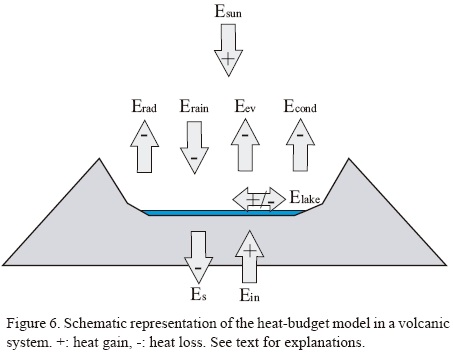
<body><![CDATA[<p align="justify"><font face="verdana" size="2"><b>ENERGY&#45;MASS BUDGET APPROACH</b></font></p>             <p align="justify"><font face="verdana" size="2">Several authors like Gorshkov <i>et al.</i> (1975), Brantley <i>et al.</i> (1987), Brown <i>et al.</i> (1989), Rowe <i>et al.</i> (1992), Hurst <i>et al.</i> (1991), Ohba <i>et al.</i> (1994) and Pasternack and Varekamp (1997) applied the energy budget method to estimate heat fluxes liberated through volcanic lakes. The energy budget can be calculated by the following equation:</font></p>              <p align="center"><font face="verdana" size="2"><img src="/img/revistas/rmcg/v30n3/a3s1.jpg"></font></p>             <p align="justify"><font face="verdana" size="2">The variation in energy content of the lake <i>(E</i><i><sub>lake</sub>)</i> depends on the balance between the energy input into the lake by the sublacustrine fumaroles and springs <i>(E</i><i><sub>in</sub>),</i> the energy lost by the lake to heat up the incoming rain water to the lake temperature <i>(E</i><i><sub>rain</sub>),</i> the energy lost by seepage of lake water through the lake floor <i>(E<sub>s</sub>),</i> the energy lost by evaporation <i>E<sub>ev</sub>,</i> the energy lost by heat conduction and advection to the air <i>(E<sub>cond</sub>),</i> the heat lost by radiation of the lake <i>(E<sub>rad</sub>),</i> and the energy gained from solar radiation <i>(E<sub>sun</sub>)</i> (<a href="#f6">Figure 6</a>). The parameter <i>E<sub>in</sub></i> is the parameter of interest to monitor the heat flux liberated by the volcano into the lake (Brown <i>et al.,</i> 1989; Ohba <i>et al.,</i> 1994). Each parameter is calculated from the meteorological station data (air temperature, precipitation, solar radiation, wind intensity) and the dataloggers CTD (depth and temperature of the lake) and Baro (atmospheric pressure) as described as follow. Since energy parameters <i>E</i> (J) are calculated for a time interval of one day, they were converted into heat fluxes (W). The error propagation theory was used to estimate the equation uncertainties.</font></p>             <p align="center"><font face="verdana" size="2"><a name="f6"></a></font></p>             <p align="center"><font face="verdana" size="2"><img src="/img/revistas/rmcg/v30n3/a3f6.jpg"></font></p>             <p align="justify"><font face="verdana" size="2">The variation in energetic content of the lake <i>E<sub>lake</sub></i> between two observations corresponds to the lake variation in volume and temperature (Ohba <i>et al.,</i> 1994):</font></p>             <p align="center"><font face="verdana" size="2"><img src="/img/revistas/rmcg/v30n3/a3s2.jpg"></font></p>             <p align="justify"><font face="verdana" size="2">where <i>C<sub>p</sub></i> is the specific heat capacity of the water (4.19 kJ&middot;kg<sup>&#45;1</sup>&middot;K<sup>&#45;1</sup>), <i>V</i> the lake volume (m<sup>3</sup>), <i>T<sub>lake</sub></i> the water temperature (&deg;C), p the water density (kg/m<sup>3</sup>). For the p parameter, we assume a value of 1000 kg/m<sup>3</sup> since the density variation with temperature is too low to cause any significant error. Salinity effect was not considered because of the lack of available continuous salinity data during the studied period.</font></p>             <p align="justify"><font face="verdana" size="2">The <i>E<sub>rain</sub></i> parameter is calculated similarly (Ohba <i>et al.,</i> 1994):</font></p>             ]]></body>
<body><![CDATA[<p align="center"><font face="verdana" size="2"><img src="/img/revistas/rmcg/v30n3/a3s3.jpg"></font></p>             <p align="justify"><font face="verdana" size="2">Where <i>V<sub>p</sub></i> stands for precipitation volume (m<sup>3</sup>), T<sub>air</sub> and <i>T<sub>ake</sub></i> for the ambient air and lake temperature (&deg;C), respectively. <i>C<sub>p</sub></i> and p are the same as in Equation 2.</font></p>             <p align="justify"><font face="verdana" size="2">Various formulas are available for the energy lost by evaporation <i>E<sub>ev</sub></i>. In this study, we consider the equation proposed by Lee and Swancar (1997) in a study of a lake in Florida (USA) experiencing physical and climatic characteristics similar to El Chich&oacute;n lake:</font></p>             <p align="center"><font face="verdana" size="2"><img src="/img/revistas/rmcg/v30n3/a3s4.jpg"></font></p>             <p align="justify"><font face="verdana" size="2">where &Delta;&#952; is the difference in temperature between the lake water and the ambient temperature (&deg;C) and <i>u</i> refers to the wind speed (m/s). Parameters <i>e<sub>o</sub></i> and <i>e<sub>a</sub></i> (mbar) refer to the vapor saturation pressure at the lake temperature and the vapor saturation pressure at the air temperature, respectively. <i>e<sub>o</sub></i> and <i>e<sub>a</sub></i> are calculated by the following equation (Tetens, 1930):</font></p>             <p align="center"><font face="verdana" size="2"><img src="/img/revistas/rmcg/v30n3/a3s5.jpg"></font></p>             <p align="justify"><font face="verdana" size="2">where T (&deg;C) refers to the lake or air temperature.</font></p>             <p align="justify"><font face="verdana" size="2">The energy lost by conduction and advection <i>E</i><i><sub>cond</sub></i> is related to the energy lost by evaporation <i>E</i><i><sub>ev</sub></i> expressed by the Bowen (1926) equation:</font></p>              <p align="center"><font face="verdana" size="2"><img src="/img/revistas/rmcg/v30n3/a3s6.jpg"></font></p>             <p align="justify"><font face="verdana" size="2">where P is the barometric pressure (Pa).</font></p>             ]]></body>
<body><![CDATA[<p align="justify"><font face="verdana" size="2">The lake also loses some energy by emitting radiation in the infrared <i>(E<sub>rad</sub>),</i> which is estimated by the Stefan&#45;Boltzmann law:</font></p>              <p align="center"><font face="verdana" size="2"><img src="/img/revistas/rmcg/v30n3/a3s7.jpg"></font></p>             <p align="justify"><font face="verdana" size="2">where &#949; is the water emissivity whose value was estimated to 0.972 (Davies <i>et al.,</i> 1971), &#963; refers to the Stefan&#45;Boltzmann constant (5.67&middot;10<sup>&#45;8</sup> W&middot;m<sup>&#45;2</sup>&middot;K<sup>&#45;4</sup>), <i>T<sub>l</sub></i> is the lake temperature and <i>T<sub>a</sub></i> refers to the ambient temperature (K).</font></p>             <p align="justify"><font face="verdana" size="2">The solar energy term <i>E<sub>sun</sub></i> is directly obtained from the solar radiation sensor installed on the meteorological station. Nevertheless, to account for the albedo, an average correction of 10% was applied to the sensor data as recommended by Stevenson (1992).</font></p>              <p align="justify"><font face="verdana" size="2">The energy lost by seepage of lake water <i>E<sub>s</sub></i> is the most difficult parameter to estimate. Rouwet <i>et al.</i> (2004) give a seepage flux estimate of 20 kg&middot;m<sup>&#45;2</sup>&middot;day<sup>&#45;1</sup> using a chlorine budget approach. We use this value for the heat budget calculation and consider an enthalpy of 113 kJ/kg for the infiltrating lake water (average lake temperature of 27 &deg;C). Although this seepage rate can be erroneous, the heat flux lost by seepage is relatively low compared to other fluxes and does not affect the total balance.</font></p>              <p align="justify"><font face="verdana" size="2">A mass balance approach was also applied to the lake to calculate its water fluxes (Brown <i>et al.,</i> 1989; Ohba <i>et al.,</i> 1994):</font></p>              <p align="center"><font face="verdana" size="2"><img src="/img/revistas/rmcg/v30n3/a3s8.jpg"></font></p>             <p align="justify"><font face="verdana" size="2">where <i>M<sub>lake</sub></i> is the mass variation of the lake between two observations, <i>M<sub>in</sub></i> is the mass input brought by the fumaroles and springs into the lake, <i>M<sub>rain</sub></i> is the rain amount, <i>M<sub>inf</sub></i> the amount of water infiltrated, and <i>M<sub>ev</sub></i> the quantity of water lost by evaporation. Those parameters were also calculated for a one day time interval.</font></p>             <p align="justify"><font face="verdana" size="2">&nbsp;</font></p>             <p align="justify"><font face="verdana" size="2"><b>RESULTS AND DISCUSSION</b></font></p>             ]]></body>
<body><![CDATA[<p align="justify"><font face="verdana" size="2"><b>Intensive data</b></font></p>              <p align="justify"><font face="verdana" size="2">We present two set of continuous data collected between 20/11/2010 and 06/03/2011 (3.5 months, Period 1), and between 26/05/2011 and 12/08/2011 (2.5 months, period 2). The lack of data between the two periods is due to technical problems with the meteorological station (broken axis in <a href="/img/revistas/rmcg/v30n3/a3f7.jpg" target="_blank">Figures 7</a>, <a href="/img/revistas/rmcg/v30n3/a3f8.jpg" target="_blank">8</a>, <a href="/img/revistas/rmcg/v30n3/a3f10.jpg" target="_blank">10</a>).</font></p>              <p align="justify"><font face="verdana" size="2">The evolution of the lake level and the amount of precipitation (mm) are shown in <a href="/img/revistas/rmcg/v30n3/a3f7.jpg" target="_blank">Figure 7</a>. During the first period, the water level variations generally correspond to rain accumulation. On the contrary, during the second period the lake depth profile evolution is more complex and does not match clearly the rain accumulation profile. Instead, it decreases until the 25<sup>th</sup> of June 2011, and then shows some important oscillations related to changes in precipitation rate. After the 19<sup>th</sup> of July it starts to decrease again, and shows a last lake level increase on the 2<sup>nd</sup> of August.</font></p>              <p align="justify"><font face="verdana" size="2">In general, the lake temperature profile shows the same behavior than the air temperature profile of the crater (black and blue squares on <a href="/img/revistas/rmcg/v30n3/a3f8.jpg" target="_blank">Figure 8a</a>).The average difference in temperature between the lake and the air is ~7&#45;8&deg;C for both periods. However, after important rain events, the lake temperature drops suddenly and needs a couple of days to recover to its background value. During the 2<sup>nd</sup> period, the lake and air temperature, as well as the average solar radiation are higher compared with the first one (200 W/m<sup>2</sup> <i>vs.</i> 141 W/m<sup>2</sup>), which corresponds to expected higher radiation during summer (<a href="/img/revistas/rmcg/v30n3/a3f7.jpg" target="_blank">Figure 7b</a>). On the contrary, the wind speed average values are relatively similar for both periods (0.78 m/s <i>vs.</i> 0.91 m/s; <a href="/img/revistas/rmcg/v30n3/a3f7.jpg" target="_blank">Figure 7c</a>). The temperature profile measured by the meteorological station, also shown on <a href="/img/revistas/rmcg/v30n3/a3f8.jpg" target="_blank">Figure 8a</a> (empty squares), are relatively similar to the ones measured inside the crater by the Baro datalogger (average difference in temperature of 5%). This observation allows to state that the meteorological conditions inside the crater do not differ significantly from the meteorological station conditions.</font></p>              <p align="justify"><font face="verdana" size="2">&nbsp;</font></p>             <p align="justify"><font face="verdana" size="2"><b>Parameter estimations</b></font></p>             <p align="justify"><font face="verdana" size="2">The lake surface on the 20/11/2012 was measured directly by GPS tracking and also indirectly from a picture of the lake following the photographic method developed by Rouwet <i>et al.</i> (2004) (<a href="/img/revistas/rmcg/v30n3/a3f9.jpg" target="_blank">Figure 9</a>). This method consists in estimating the surface from pictures of the lake taken from the crater rim using a reference lake surface measured by GPS, and a triangle surface drawn on the picture between three known points to avoid perspective issue. The GPS data revealed a surface of 90,741 m<sup>2</sup> at the beginning of the study (20/11/2012), and the photographic estimation was within 10% of error of the GPS value. Initial depth of the lake recorded by the CTD datalogger was 4.39 m. The lake surface during the following field trips to the lake, on the 18/01/2011 and 26/05/2011, was estimated only by the photographic method resulting in areas of 12 <i>x</i> 10<sup>4</sup> m<sup>2</sup> and 16 &times; 10<sup>4</sup> m<sup>2</sup>. No picture of the lake was taken at the end of the second period.</font></p>              <p align="justify"><font face="verdana" size="2">We derived a new empirical relationship to relate the depth <i>d</i> (m) of the lake and the surface of the lake <i>S</i> (10<sup>4</sup> m<sup>2</sup>) estimated by GPS and the photographic method:</font></p>              <p align="center"><font face="verdana" size="2"><img src="/img/revistas/rmcg/v30n3/a3s9.jpg"></font></p>             <p align="justify"><font face="verdana" size="2">This equation was modified from the relationship presented in Rouwet <i>et al.</i> (2004) to obtain a better match between the lake depth and surface data. The lake depth was obtained by subtracting the pressure values measured by the Baro sensor (atmospheric pressure) from the pressure values measured by the CTD sensor (atmospheric pressure + water column pressure).</font></p>             ]]></body>
<body><![CDATA[<p align="justify"><font face="verdana" size="2">The volume <i>V</i> (10<sup>4</sup> m<sup>3</sup>) of the lake was then estimated using the following equation based on a bathymetric survey of the lake (<i>S</i> units = 10<sup>4</sup> m<sup>2</sup>, Rouwet <i>et al.,</i> 2004):</font></p>              <p align="center"><font face="verdana" size="2"><img src="/img/revistas/rmcg/v30n3/a3s10.jpg"></font></p>             <p align="justify"><font face="verdana" size="2">Knowing the lake surface at the beginning of the measurements (20/11/2010), the surface and volume of the lake can be estimated for any period by combining Equations 9 and 10.</font></p>             <p align="justify"><font face="verdana" size="2">The volume of precipitation received by the lake does not only correspond to the rain amount that falls above its surface, but also incorporates the runoff waters. However, the total catchment area (the full crater) cannot be considered since an unknown fraction of the runoff water may infiltrate or evaporate before reaching the lake. Therefore, a correction factor, also called catchment coefficient must be applied to the total volume falling directly on the lake surface. Lake depth and precipitation data from <a href="/img/revistas/rmcg/v30n3/a3f7.jpg" target="_blank">Figure 7</a> are considered to estimate this parameter. The events 'a' and 'b' were selected to be important rain events (72 and 189 mm, respectively; <a href="/img/revistas/rmcg/v30n3/a3f7.jpg" target="_blank">Figure 7</a>), because they occurred on a short time interval (less than a day) and the lake depth showed a simultaneous increase. Furthermore, these events occurred after a few days without rain, unlike other rain events from <a href="/img/revistas/rmcg/v30n3/a3f7.jpg" target="_blank">Figure 7</a>, allowing a clear relationship between the amount of rain and the water level increase. Therefore, it is reasonable to believe that the lake depth variation is mainly due to the rain event and that the impact of lake evaporation and infiltration is limited. Considering the lake depth and surface increase after those two events, a catchment coefficient of 1.2 was calculated. Taran and Rouwet (2008) estimated a higher factor of 1.9 by the heat&#45;isotopic&#45;mass balance method. However, their value is an average value calculated with data collected over a period of more than 10 years, and this correction factor probably varies with the lake surface, being less important when the lake surface is higher than when the surface is smaller. Furthemore, the Taran and Rouwet (2008) estimation corresponds to a lake with an average surface that is smaller than the average surface area of the lake during this study.</font></p>              <p align="justify"><font face="verdana" size="2">&nbsp;</font></p>             <p align="justify"><font face="verdana" size="2"><b>Heat fluxes</b></font></p>             <p align="justify"><font face="verdana" size="2">The evolution of the fluxes <i>E<sub>in</sub></i>, <i>E<sub>rain</sub>, E</i><i><sub>ev</sub>,</i> <i>E</i><i><sub>lake</sub>,</i> <i>E</i><i>sun</i> and <i>E<sub>rad</sub></i> is presented in <a href="/img/revistas/rmcg/v30n3/a3f10.jpg" target="_blank">Figure 10</a>. <i>E<sub>in</sub></i> values were calculated by solving all the parameters from the Equation 1. The average values for the two periods are listed in <a href="#t1">Table 1</a>, together with the range of error affecting each estimate. The error ranges were estimated by the root mean square method, taking into the account the precision of each sensor and/or the error associated to each formula used in the model.</font></p>              <p align="center"><font face="verdana" size="2"><a name="t1"></a></font></p>             <p align="center"><font face="verdana" size="2"><img src="/img/revistas/rmcg/v30n3/a3t1.jpg"></font></p>             <p align="justify"><font face="verdana" size="2">The <i>E<sub>in</sub></i> curve was softened using the moving average method:</font></p>             ]]></body>
<body><![CDATA[<p align="center"><font face="verdana" size="2"><img src="/img/revistas/rmcg/v30n3/a3s11.jpg"></font></p>             <p align="justify"><font face="verdana" size="2">This method consists in calculating the average of <i>N</i> values over a variable point and extrapolating the surrounding values taking into account the following values. This technique has the advantage to soften the accidental variations that can appear in the time series, like the sudden variation of lake temperature caused by important rain events. For example, during the whole 1<sup>st</sup> period it rained 1315 mm, which corresponds to an energy loss of 0.7 MW. However, there were some exceptional rain events during which it rained more than 200 mm during only two days, corresponding to an energy loss of 7 MW. Therefore, averaging the <i>E<sub>in</sub></i> data over a 3 days period allows smoothing those transient effects.</font></p>             <p align="justify"><font face="verdana" size="2">During the 1<sup>st</sup> period, the average hydrothermal heat flux entering the lake <i>(E<sub>in</sub>)</i> was estimated to 22 MW (154 W/m<sup>2</sup>). However, the <i>E<sub>in</sub></i> curve shows dramatic variations between 0 and 54 MW, with periods between 7 and 27 days. The most pronounced oscillations are almost always related to the oscillations in E<sub>ev</sub>, the energy lost by evaporation. The evaporation constitutes the major loss of energy with an average value of 20 MW during the 1 st period, which almost balances the <i>E<sub>in</sub></i> flux. This observation suggests that all the heat released by the hydrothermal system into the lake is lost by evaporation of the lake. The other heat parameters <i>E<sub>lake</sub>, E</i><i><sub>rain</sub>,</i> <i>E<sub>cond</sub>, E<sub>rad</sub></i> and <i>E<sub>s</sub></i> (average total 17 MW) are balanced by the solar energy input <i>E<sub>sun</sub></i> (15 MW).</font></p>              <p align="justify"><font face="verdana" size="2">However, the reason why the <i>E<sub>in</sub></i> curve is characterized by such oscillations is unclear. None of the heat parameters in the budget equation, except for the evaporation term E<sub>ev</sub>, is characterized by such oscillations (<a href="/img/revistas/rmcg/v30n3/a3f10.jpg" target="_blank">Figure 10</a>). The <i>E<sub>ev</sub></i> term appears to oscillate in response to the variation of the heat injected by the volcano&#45;hydrothermal activity into the lake. Therefore, it seems that the <i>E<sub>in</sub></i> heat input is directly lost by evaporation. One of the reasons to explain the oscillation in the <i>E<sub>in</sub></i> curve could be the variations of the fumaroles&#45;springs discharge into the lake, alternating high discharge and low discharge periods. The Soap Pool springs show this kind of behavior alternating periods of vapor and water discharge. Those cycles of activity are not regular: sometimes lasting for years, sometimes for a few months (Rouwet <i>et al.</i>, 2004, 2008). Another hypothesis to explain the oscillations in <i>E<sub>in</sub></i> would be that the <i>E<sub>sun</sub></i> parameter, estimated directly by the solar radiation sensor installed on the meteorological station, would not reflect the real solar radiation conditions at the lake (5 km west of the station). However, comparing the temperature profile registered by the Baro datalogger with the temperatures registered at the station (<a href="/img/revistas/rmcg/v30n3/a3f8.jpg" target="_blank">Figure 8a</a>), it seems that meteorological conditions inside the crater do not differ significantly and therefore this hypothesis can be excluded.</font></p>              <p align="justify"><font face="verdana" size="2">Despite the large oscillations in the <i>E<sub>in</sub></i> curve, a general increase trend can be observed during the 1 <sup>st</sup> period and is related to the increase in surface of the lake (<a href="/img/revistas/rmcg/v30n3/a3f10.jpg" target="_blank">Figure 10d</a>). A possible explanation for this trend is that when the lake surface becomes higher, the ground fumaroles surrounding the lake are flooded and thus discharge their heat content into the lake. On the opposite, when the lake surface is smaller, the fumaroles liberate their energy directly into the atmosphere.</font></p>              <p align="justify"><font face="verdana" size="2">For the 2<sup>nd</sup> period, the <i>E<sub>in</sub></i> average value of 17 MW (105 W/m<sup>2</sup>) is slightly smaller than the value for the 1 <sup>st</sup> period, while the heat flux loss by evaporation is a bit higher (24 MW). All the others heat fluxes are similar to the 1<sup>st</sup> period ones, with the exception of <i>E<sub>sun</sub></i> which is higher (25 MW). The <i>E<sub>n</sub></i> parameter fluctuations are still correlated to <i>E<sub>ev</sub></i> term, but not anymore to the lake surface variations.</font></p>              <p align="justify"><font face="verdana" size="2">Our estimation of the energy released by the volcano corresponds relatively well to the previous estimations by Mazot and Taran (2009) and Mazot <i>et al.</i> (2011) based on CO<sub>2</sub> fluxes measurements, which were of 15&#45;43 MW. The estimation by Taran and Rouwet (2008) of 11&#45;16 MW using the energy&#45;budget, chemical and isotope balance approaches is also similar.</font></p>              <p align="justify"><font face="verdana" size="2">El Chich&oacute;n lake has a similar heat output than Copahue crater lake (7&#45;45 MW; Varekamp <i>et al.,</i> 2001), Yugama (3&#45;22 MW; Ohba <i>et al.</i> 1994), Keli Mutu (54 MW; Varekamp <i>et al.,</i> 2001), but much lower than the majority of other crater lakes (e.g., Kawah Ijen: 271&#45;378 MW, Ruapehu: 385 MW; <a href="#t2">Table 2</a>). There is no clear correlation between the volume of the lakes and the heat fluxes, nor with the type of lake. For example, the lake Poas has a much higher heat output (100&#45;400 MW) than the lake Copahue although they both have similar volume and ultra&#45;acidic water (pH &lt;1; Rowe <i>etal.,</i> 1995; Varekamp <i>et al.,</i> 2009).</font></p>              <p align="center"><font face="verdana" size="2"><a name="t2"></a></font></p>             <p align="center"><font face="verdana" size="2"><img src="/img/revistas/rmcg/v30n3/a3t2.jpg"></font></p>             ]]></body>
<body><![CDATA[<p align="justify"><font face="verdana" size="2">&nbsp;</font></p>             <p align="justify"><font face="verdana" size="2"><b>Mass fluxes</b></font></p>             <p align="justify"><font face="verdana" size="2">The average results for both periods of each parameter in Equation 8 are now compared (<a href="#t1">Table 1</a>). For the 1<sup>st</sup> period, the average lake mass variation <i>M<sub>lake</sub></i> was 10 kg/s. The parameter <i>M<sub>rain</sub></i> was calculated to be 18 kg/s considering a catchment coefficient of 1.2. The flux of evaporated water <i>M<sub>ev</sub></i> was 8 kg/s considering the average <i>E<sub>ev</sub></i> value and a vapor enthalpy of ~2550 kJ/kg (average lake temperature of 27 &deg;C). This approximation is valid because the vapor enthalpy does not vary much with the temperature. Taran <i>et al.</i> (2008) found a similar value of 5 kg/s.</font></p>              <p align="justify"><font face="verdana" size="2">The mass flux released by the hydrothermal system into the lake can be estimated by the following method. First, we assume that the Cl<sup>&#45;</sup> concentration in the lake is entirely controlled by the discharge of the Soap Pool springs (Taran <i>et al.,</i> 1998; Rouwet <i>et al.,</i> 2004, 2008). During the 1<sup>st</sup> period, the lake Cl<sup>&#45;</sup> concentration increased from 175 mg/L to 499 mg/L, while the Soap Pool waters showed similar concentration of Cl<sup>&#45;</sup> between 2500 and 2668 mg/L (Peiffer, 2011). Knowing the volume variation of the lake during the first period, we estimate a discharge of the Soap Pool springs of 4.7 L/s. The water discharged by these springs cools down to a temperature of 70&deg;C (field observation) before reaching the lake. Taking into account a corresponding enthalpy of 293 kJ/kg, the heat input by the Soap Pool springs to the lake is 1.4 MW. If the Soap Pool springs are the only group of springs to feed the lake with water, the fumarolic heat flux is then estimated to 20 MW, and the mass flux to 7.5 kg/s (assuming a vapor enthalpy at 100&deg;C of 2675 kJ/kg). Although some of the fluid supplied by the subaqueous fumaroles might include a liquid phase, it is not possible to quantify the percentage of liquid and steam phase discharged; for this reason all the liquid phase discharged into the lake was assumed to come from the Soap Pool springs.</font></p>              <p align="justify"><font face="verdana" size="2">Therefore, the average total <i>M<sub>in</sub></i> value is 12 kg/s. This value is almost counterbalanced by the evaporation rate (8 kg/s), like the <i>E<sub>in</sub></i> is counterbalanced by the <i>E<sub>ev</sub></i>. This suggests that all the heat and mass injected to the lake by the underlying hydrothermal system is lost by evaporation. In case of volcanic activity renewal, one of the precursor sign could be the complete evaporation of lake. This situation was observed at the Kelut volcano (Indonesia), where the extrusion of a new lava dome evaporated the 2&middot;10<sup>6</sup> m<sup>3</sup> crater lake within a four months time interval (Caudron <i>et al.</i> 2012). Since the El Chich&oacute;n lake volume is smaller, a faster evaporation of the entire lake can be expected.</font></p>              <p align="justify"><font face="verdana" size="2">Resolving Equation 8, a value of 12 kg/s or 9 kg/day. m<sup>2</sup> was obtained for the seepage rate <i>M<sub>s</sub></i> during the 1<sup>st</sup> period. This value is twice as low as the 20 kg&middot;day<sup>&#45;1</sup>&middot;m<sup>&#45;2</sup> estimation by Taran and Rouwet (2008).</font></p>              <p align="justify"><font face="verdana" size="2">Applying the same method to the second period, the <i>M <sub>in</sub></i> parameter was estimated to be 10 kg/s, which is close to the <i>M<sub>in</sub></i> estimation of the first period. Evaporation rate was similar to the 1<sup>st</sup> period (10 kg/s <i>vs.</i> 8 kg/s), but the precipitation rate was much higher (32 kg/s <i>vs.</i> 18 kg/s). The mass flux associated to the lake mass variation was &#45;10 kg/s. Deducing the seepage rate from the equation gives a much higher flux of 42 kg/s or 32 kgday<sup>&#45;1</sup> m<sup>&#45;2</sup>. This change in seepage rate between the first and second period probably reflect the fact that the floor permeability is not homogenous. As stated by Rouwet <i>et al.</i> (2009), the sediments located beneath a 'normal&#45;sized' lake consist of low permeability clays. When the lake surface becomes higher, it covers more permeable pumiceous sands and therefore the seepage rate becomes higher. After the 25<sup>th</sup> of June 2011, the lake level and surface returned to a similar level than at the end of the 1<sup>st</sup> period one (<a href="/img/revistas/rmcg/v30n3/a3f7.jpg" target="_blank">Figure 7</a>). This lake surface probably represents a maximum limit (~140,000 m<sup>2</sup>) which cannot be exceeded over a long period of time because of the high permeability of the pumiceous sands. In fact, no higher lake levels have been reported in previous work (Taran and Rouwet, 2008; Rouwet <i>et al.,</i> 2008).</font></p>              <p align="justify"><font face="verdana" size="2">&nbsp;</font></p>             <p align="justify"><font face="verdana" size="2"><b>CONCLUSIONS</b></font></p>             <p align="justify"><font face="verdana" size="2">The presence of a lake in an active volcanic crater offers the opportunity to study the dynamics of the underlying volcano&#45;hydrothermal system because the lake integrates the heat and mass released by the underlying system. In this study, we present for the first time continuous data (temperature, depth) of the El Chich&oacute;n lake together with meteorological data for two distinct periods. The first period is characterized by a lake depth increase correlated with the precipitation amount, while the second period show a global decreasing depth trend with a few oscillations related to some rain events. As to the lake temperature, its evolution matches relatively well the ambient air temperature profile. In order to better understand the lake dynamics, we applied an energy&#45;mass budget model that takes into account meteorological conditions.</font></p>              ]]></body>
<body><![CDATA[<p align="justify"><font face="verdana" size="2">The energy flux liberated by the sub&#45;lacustrine fumaroles and springs into the lake (E<sub>in</sub>) was estimated to be 17 MW for the 1<sup>st</sup> period and 22 MW for the 2<sup>nd</sup> period, and the correspondent mass fluxes to be 10 to 12 kg/s. These heat and mass fluxes are counterbalanced by the energy and mass flux lost by evaporation in both periods (20&#45;24 MW, 8&#45;10 kg/s). This means that all the energy and mass liberated into the lake by the volcano is directly released into the atmosphere by evaporation. The other energy losses are smaller (<i>E<sub>rain</sub></i>: 0.7&#45;1.3 MW, <i>E<sub>cond</sub>:</i> 6&#45;7 MW, <i>E<sub>rad</sub></i>: 6 MW, <i>E<sub>s</sub></i>: 3.1&#45;3.6 MW) and are almost counterbalanced by the solar radiation (15&#45;25 MW). Important oscillations of the <i>E<sub>in</sub></i> flux have been observed and could be interpreted as 'pulses' of the hydrothermal discharge. However, analysis and interpretation of data on larger time interval is needed to verify this hypothesis.</font></p>              <p align="justify"><font face="verdana" size="2">The difference in the mass balance between the first and second period is controlled by the seepage rate. The seepage rate for the second period was much higher than during the first period (42 <i>vs.</i> 12 kg/s) and, although the precipitation rate for the second period was significantly higher than for the first period (32 <i>vs.</i> 18 kg/s), it causes the lake depth to decrease significantly. This reflects the heterogeneities in permeability of the crater floor. The area covered by the lake with a 'normal' size is constituted of impermeable clays, while the area occasionally flooded by a high surface lake is more permeable (pumiceous sands).</font></p>              <p align="justify"><font face="verdana" size="2">This set of data constitutes a baseline to monitor the future activity of El Chich&oacute;n volcano. In case of volcanic activity renewal, one of the first visible sign would probably be the full evaporation of the lake.</font></p>              <p align="justify"><font face="verdana" size="2">&nbsp;</font></p>            <p align="justify"><font face="verdana" size="2"><b>ACKNOWLEDGEMENTS</b></font></p>            <p align="justify"><font face="verdana" size="2">This work was supported by the Federal Mexican Commission of Electricity (CFE) as part of a project on geothermal exploration of El Chich&oacute;n volcano (contract no. 9400047770), and by the DGAPA&#45;UNAM grant # 101913. We thank Felix S&aacute;nchez S&aacute;nchez and his family, as well as Matthias Fickel for the field support. We express our sincere thanks to the reviewers A. Mazot, S. Inguaggiatto and A. Terada for the valuable comments which helped improving an earlier version of the manuscript.</font></p>              <p align="justify"><font face="verdana" size="2">&nbsp;</font></p>            <p align="justify"><font face="verdana" size="2"><b>REFERENCES</b></font></p>            <!-- ref --><p align="justify"><font face="verdana" size="2">Bowen, I.S., 1926, The ratio of heat losses by conduction and by evaporation from any water surface: Physical Review, 27, 779&#45;787.    &nbsp;&nbsp;&nbsp;&nbsp;&nbsp;&nbsp;&nbsp;&nbsp;[&#160;<a href="javascript:void(0);" onclick="javascript: window.open('/scielo.php?script=sci_nlinks&ref=8092083&pid=S1026-8774201300030000300001&lng=','','width=640,height=500,resizable=yes,scrollbars=1,menubar=yes,');">Links</a>&#160;]<!-- end-ref --></font></p>              ]]></body>
<body><![CDATA[<!-- ref --><p align="justify"><font face="verdana" size="2">Brantley, S.L., Borgia, A., Rowe, G., Fernandez, J.F., Reynolds, J.R., 1987, Po&aacute;s volcano crater lake acts as a condenser for acid metal&#45;rich brine: Nature, 330, 470&#45;472.    &nbsp;&nbsp;&nbsp;&nbsp;&nbsp;&nbsp;&nbsp;&nbsp;[&#160;<a href="javascript:void(0);" onclick="javascript: window.open('/scielo.php?script=sci_nlinks&ref=8092085&pid=S1026-8774201300030000300002&lng=','','width=640,height=500,resizable=yes,scrollbars=1,menubar=yes,');">Links</a>&#160;]<!-- end-ref --></font></p>              <!-- ref --><p align="justify"><font face="verdana" size="2">Brown, G., Rymer, H., Dowden, J., Kapadia, P., Stevenson, D., Barquero, J., Morales, L.D., 1989, Energy budget analysis for Po&aacute;s crater lake: implications for predicting volcanic activity: Nature, 339, 370&#45;373.    &nbsp;&nbsp;&nbsp;&nbsp;&nbsp;&nbsp;&nbsp;&nbsp;[&#160;<a href="javascript:void(0);" onclick="javascript: window.open('/scielo.php?script=sci_nlinks&ref=8092087&pid=S1026-8774201300030000300003&lng=','','width=640,height=500,resizable=yes,scrollbars=1,menubar=yes,');">Links</a>&#160;]<!-- end-ref --></font></p>              <!-- ref --><p align="justify"><font face="verdana" size="2">Caudron, C., Mazot, A., Bernard, B., 2012, Carbon dioxide dynamics in Kelud volcanic lake: Journal of Geophysical Research, 117, B05102, doi:10.1029/2011JB008806.    &nbsp;&nbsp;&nbsp;&nbsp;&nbsp;&nbsp;&nbsp;&nbsp;[&#160;<a href="javascript:void(0);" onclick="javascript: window.open('/scielo.php?script=sci_nlinks&ref=8092089&pid=S1026-8774201300030000300004&lng=','','width=640,height=500,resizable=yes,scrollbars=1,menubar=yes,');">Links</a>&#160;]<!-- end-ref --></font></p>              <!-- ref --><p align="justify"><font face="verdana" size="2">Davies, J. A., Robinson, P. J., Nunez, M., 1971, Field determinations of surface emissivity and temperature for Lake Ontario: Journal of Applied Meteorology, 10, 811&#45;819.    &nbsp;&nbsp;&nbsp;&nbsp;&nbsp;&nbsp;&nbsp;&nbsp;[&#160;<a href="javascript:void(0);" onclick="javascript: window.open('/scielo.php?script=sci_nlinks&ref=8092091&pid=S1026-8774201300030000300005&lng=','','width=640,height=500,resizable=yes,scrollbars=1,menubar=yes,');">Links</a>&#160;]<!-- end-ref --></font></p>              <!-- ref --><p align="justify"><font face="verdana" size="2">Delmelle, P., 1995, Geochemical, isotopic and heat budget study of two volcano hosted hydrothermal systems: the acid crater lakes of Kawah Ijen, Indonesia, and Taal, Philippines, volcanoes: Brussels, Universit&eacute; Libre de Bruxelles, Ph. D. Thesis, 247 pp.    &nbsp;&nbsp;&nbsp;&nbsp;&nbsp;&nbsp;&nbsp;&nbsp;[&#160;<a href="javascript:void(0);" onclick="javascript: window.open('/scielo.php?script=sci_nlinks&ref=8092093&pid=S1026-8774201300030000300006&lng=','','width=640,height=500,resizable=yes,scrollbars=1,menubar=yes,');">Links</a>&#160;]<!-- end-ref --></font></p>              ]]></body>
<body><![CDATA[<!-- ref --><p align="justify"><font face="verdana" size="2">Garc&iacute;a&#45;Palomo, A., Macias, J.L., Espindola, J.M., 2004, Strike&#45;slip faults and K&#45;alkaline volcanism at El Chich&oacute;n volcano, southeastern Mexico: Journal of Volcanology and Geothermal Research, 136, 247&#45;268.    &nbsp;&nbsp;&nbsp;&nbsp;&nbsp;&nbsp;&nbsp;&nbsp;[&#160;<a href="javascript:void(0);" onclick="javascript: window.open('/scielo.php?script=sci_nlinks&ref=8092095&pid=S1026-8774201300030000300007&lng=','','width=640,height=500,resizable=yes,scrollbars=1,menubar=yes,');">Links</a>&#160;]<!-- end-ref --></font></p>              <!-- ref --><p align="justify"><font face="verdana" size="2">Gorshkov, A.P., Grebzdy, E.I., Samoilenko, B.I., Slezin, Y.B., 1975, Calculations of the heat&#45;mass balance for the Malyi Semyachik crater lake: Bulletin Vulkanologicheskikh Stantsii, 51, 50&#45;60.    &nbsp;&nbsp;&nbsp;&nbsp;&nbsp;&nbsp;&nbsp;&nbsp;[&#160;<a href="javascript:void(0);" onclick="javascript: window.open('/scielo.php?script=sci_nlinks&ref=8092097&pid=S1026-8774201300030000300008&lng=','','width=640,height=500,resizable=yes,scrollbars=1,menubar=yes,');">Links</a>&#160;]<!-- end-ref --></font></p>              <!-- ref --><p align="justify"><font face="verdana" size="2">Hurst, A.W., Bibby, H.M., Scott, B.J., McGuinness, M.J., 1991, The heat source of Ruapehu Crater Lake; deductions from the energy and mass balances: Journal of Volcanology and Geothermal Research, 46, 1&#45;20.    &nbsp;&nbsp;&nbsp;&nbsp;&nbsp;&nbsp;&nbsp;&nbsp;[&#160;<a href="javascript:void(0);" onclick="javascript: window.open('/scielo.php?script=sci_nlinks&ref=8092099&pid=S1026-8774201300030000300009&lng=','','width=640,height=500,resizable=yes,scrollbars=1,menubar=yes,');">Links</a>&#160;]<!-- end-ref --></font></p>              <!-- ref --><p align="justify"><font face="verdana" size="2">Lee, T.M., Swancar, A., 1997, Influence of evaporation, ground water, and uncertainty in the hydrologic budget of lake Lucerne, a seepage lake in Polk County, Florida: United States Geological Survey, Water&#45;Supply Paper 2439, 61 pp.    &nbsp;&nbsp;&nbsp;&nbsp;&nbsp;&nbsp;&nbsp;&nbsp;[&#160;<a href="javascript:void(0);" onclick="javascript: window.open('/scielo.php?script=sci_nlinks&ref=8092101&pid=S1026-8774201300030000300010&lng=','','width=640,height=500,resizable=yes,scrollbars=1,menubar=yes,');">Links</a>&#160;]<!-- end-ref --></font></p>              <!-- ref --><p align="justify"><font face="verdana" size="2">Mazot, A., 2005, CO<sub>2</sub> degassing and fluid geochemistry at Papandayan and Kelud volcanoes, Java Island, Indonesia: Brussels, Universit&eacute; Libre de Bruxelles, Ph. D. Thesis, 294 pp.    &nbsp;&nbsp;&nbsp;&nbsp;&nbsp;&nbsp;&nbsp;&nbsp;[&#160;<a href="javascript:void(0);" onclick="javascript: window.open('/scielo.php?script=sci_nlinks&ref=8092103&pid=S1026-8774201300030000300011&lng=','','width=640,height=500,resizable=yes,scrollbars=1,menubar=yes,');">Links</a>&#160;]<!-- end-ref --></font></p>              ]]></body>
<body><![CDATA[<!-- ref --><p align="justify"><font face="verdana" size="2">Mazot, A., Taran, Y.A., 2009, CO<sub>2</sub> flux from the crater lake of El Chich&oacute;n volcano (M&eacute;xico): Geof&iacute;sica Internacional, 48, 73&#45;83.    &nbsp;&nbsp;&nbsp;&nbsp;&nbsp;&nbsp;&nbsp;&nbsp;[&#160;<a href="javascript:void(0);" onclick="javascript: window.open('/scielo.php?script=sci_nlinks&ref=8092105&pid=S1026-8774201300030000300012&lng=','','width=640,height=500,resizable=yes,scrollbars=1,menubar=yes,');">Links</a>&#160;]<!-- end-ref --></font></p>              <!-- ref --><p align="justify"><font face="verdana" size="2">Mazot, A., Rouwet, D. Taran, Y., Inguaggiato, S., Varley, N., 2011, CO<sub>2</sub> and He degassing at El Chich&oacute;n volcano, Chiapas, Mexico: gas flux, origin and relationship with local and regional tectonics, <i>in</i> Inguaggiato S, Shinohara H, and Fischer T (eds.), Geochemistry of Volcanic Fluids: a special issue in honor of Yuri A. Taran: Bulletin of Volcanology, 73, 423&#45;442.    &nbsp;&nbsp;&nbsp;&nbsp;&nbsp;&nbsp;&nbsp;&nbsp;[&#160;<a href="javascript:void(0);" onclick="javascript: window.open('/scielo.php?script=sci_nlinks&ref=8092107&pid=S1026-8774201300030000300013&lng=','','width=640,height=500,resizable=yes,scrollbars=1,menubar=yes,');">Links</a>&#160;]<!-- end-ref --></font></p>              <!-- ref --><p align="justify"><font face="verdana" size="2">Ohba, T., Hirabayashi, J.&#45;I., Nogami, K., 1994, Water, heat and chloride budgets of the crater lake, Yugama at Kusatsu&#45;Shirane volcano, Japan: Geochemical Journal, 28, 217&#45;231.    &nbsp;&nbsp;&nbsp;&nbsp;&nbsp;&nbsp;&nbsp;&nbsp;[&#160;<a href="javascript:void(0);" onclick="javascript: window.open('/scielo.php?script=sci_nlinks&ref=8092109&pid=S1026-8774201300030000300014&lng=','','width=640,height=500,resizable=yes,scrollbars=1,menubar=yes,');">Links</a>&#160;]<!-- end-ref --></font></p>              <!-- ref --><p align="justify"><font face="verdana" size="2">Pasternack, G. B., Varekamp, J.L., 1997, Volcanic lake systematics, I., Physical constraints: Bulletin of Volcanology, 58, 528&#45;538.    &nbsp;&nbsp;&nbsp;&nbsp;&nbsp;&nbsp;&nbsp;&nbsp;[&#160;<a href="javascript:void(0);" onclick="javascript: window.open('/scielo.php?script=sci_nlinks&ref=8092111&pid=S1026-8774201300030000300015&lng=','','width=640,height=500,resizable=yes,scrollbars=1,menubar=yes,');">Links</a>&#160;]<!-- end-ref --></font></p>              <!-- ref --><p align="justify"><font face="verdana" size="2">Peiffer, L., 2011, Caracterizaci&oacute;n geoqu&iacute;mica y potencial geot&eacute;rmico de los acu&iacute;feros del volc&aacute;n El Chich&oacute;n, Chiapas, M&eacute;xico: Universidad Nacional Aut&oacute;noma de M&eacute;xico, PhD Thesis, 182 pp.    &nbsp;&nbsp;&nbsp;&nbsp;&nbsp;&nbsp;&nbsp;&nbsp;[&#160;<a href="javascript:void(0);" onclick="javascript: window.open('/scielo.php?script=sci_nlinks&ref=8092113&pid=S1026-8774201300030000300016&lng=','','width=640,height=500,resizable=yes,scrollbars=1,menubar=yes,');">Links</a>&#160;]<!-- end-ref --></font></p>              ]]></body>
<body><![CDATA[<!-- ref --><p align="justify"><font face="verdana" size="2">Peiffer, L., Taran, Y., Lounejeva, E., Sol&iacute;s&#45;Pichardo, G., Rouwet, D., Bernard&#45;Romero, R., 2011.Tracing thermal aquifers of El Chich&oacute;n volcano&#45;hydrothermal system (M&eacute;xico) with <sup>87</sup>Sr/<sup>86</sup>Sr, Ca/Sr and REE: Journal of Volcanology and Geothermal Research, 205, 55&#45;66.    &nbsp;&nbsp;&nbsp;&nbsp;&nbsp;&nbsp;&nbsp;&nbsp;[&#160;<a href="javascript:void(0);" onclick="javascript: window.open('/scielo.php?script=sci_nlinks&ref=8092115&pid=S1026-8774201300030000300017&lng=','','width=640,height=500,resizable=yes,scrollbars=1,menubar=yes,');">Links</a>&#160;]<!-- end-ref --></font></p>              <!-- ref --><p align="justify"><font face="verdana" size="2">Peiffer, L., Rouwet, D., Taran, Y., in press, Hydrothermal manifestations of El Chich&oacute;n volcano, <i>in</i> Scolamacchia, T., Mac&iacute;as, J.L., (eds.), Volcanoes of the World, Active volcanoes of Chiapas (Mexico): El Chich&oacute;n and Tacan&aacute;: Berlin Heidelberg, Springer&#45;Verlag.    &nbsp;&nbsp;&nbsp;&nbsp;&nbsp;&nbsp;&nbsp;&nbsp;[&#160;<a href="javascript:void(0);" onclick="javascript: window.open('/scielo.php?script=sci_nlinks&ref=8092117&pid=S1026-8774201300030000300018&lng=','','width=640,height=500,resizable=yes,scrollbars=1,menubar=yes,');">Links</a>&#160;]<!-- end-ref --></font></p>              <!-- ref --><p align="justify"><font face="verdana" size="2">Poussielgue, N., 1998, Signal acoustique et activit&eacute; thermique dans les lacs de crat&egrave;re de volcans actifs. R&eacute;alisation d'une station de mesure hydroacoustique au Taal (Philippines): France, Universit&eacute; de Savoie, PhD Thesis, 246 pp.    &nbsp;&nbsp;&nbsp;&nbsp;&nbsp;&nbsp;&nbsp;&nbsp;[&#160;<a href="javascript:void(0);" onclick="javascript: window.open('/scielo.php?script=sci_nlinks&ref=8092119&pid=S1026-8774201300030000300019&lng=','','width=640,height=500,resizable=yes,scrollbars=1,menubar=yes,');">Links</a>&#160;]<!-- end-ref --></font></p>              <!-- ref --><p align="justify"><font face="verdana" size="2">Rose, W. I., Bornhorst, T. J., Halsor, S. P., Capaul, W. A., Plumley, P. S., De La Cruz, S. R., Mena, M., Mota, R. 1984, Volc&aacute;n El Chich&oacute;n, Mexico: Pre&#45;1982 S&#45;rich eruptive activity: Journal of Volcanology and Geothermal Research, 23, 147&#45;167.    &nbsp;&nbsp;&nbsp;&nbsp;&nbsp;&nbsp;&nbsp;&nbsp;[&#160;<a href="javascript:void(0);" onclick="javascript: window.open('/scielo.php?script=sci_nlinks&ref=8092121&pid=S1026-8774201300030000300020&lng=','','width=640,height=500,resizable=yes,scrollbars=1,menubar=yes,');">Links</a>&#160;]<!-- end-ref --></font></p>              <!-- ref --><p align="justify"><font face="verdana" size="2">Rouwet, D., Taran, Y., Varley, N.R., 2004, Dynamics and mass balance of El Chich&oacute;n crater lake, Mexico: Geofisica Internacional, 43, 427&#45;434.    &nbsp;&nbsp;&nbsp;&nbsp;&nbsp;&nbsp;&nbsp;&nbsp;[&#160;<a href="javascript:void(0);" onclick="javascript: window.open('/scielo.php?script=sci_nlinks&ref=8092123&pid=S1026-8774201300030000300021&lng=','','width=640,height=500,resizable=yes,scrollbars=1,menubar=yes,');">Links</a>&#160;]<!-- end-ref --></font></p>              ]]></body>
<body><![CDATA[<!-- ref --><p align="justify"><font face="verdana" size="2">Rouwet, D., Taran, Y., Inguaggiato, S., Varley, N., Santiago Santiago, J.A., 2008, Hydrochemical dynamics of the "lake&#45;spring" system in the crater of El Chich&oacute;n volcano (Chiapas, Mexico): Journal of Volcanology and Geothermal Research, 178, 237&#45;248.    &nbsp;&nbsp;&nbsp;&nbsp;&nbsp;&nbsp;&nbsp;&nbsp;[&#160;<a href="javascript:void(0);" onclick="javascript: window.open('/scielo.php?script=sci_nlinks&ref=8092125&pid=S1026-8774201300030000300022&lng=','','width=640,height=500,resizable=yes,scrollbars=1,menubar=yes,');">Links</a>&#160;]<!-- end-ref --></font></p>              <!-- ref --><p align="justify"><font face="verdana" size="2">Rouwet, D., Bellomo, S., Brusca, L., Inguaggiato, S., Jutzeler, M., Mora, R., Mazot A., Bernard R., Cassidy M., Taran Y., 2009, Major and trace element geochemistry of El Chich&oacute;n volcano&#45;hydrothermal system (Chiapas, Mexico) in 2006&#45;2007: implications for future geochemical monitoring: Geofisica Internacional, 48, 55&#45;72.    &nbsp;&nbsp;&nbsp;&nbsp;&nbsp;&nbsp;&nbsp;&nbsp;[&#160;<a href="javascript:void(0);" onclick="javascript: window.open('/scielo.php?script=sci_nlinks&ref=8092127&pid=S1026-8774201300030000300023&lng=','','width=640,height=500,resizable=yes,scrollbars=1,menubar=yes,');">Links</a>&#160;]<!-- end-ref --></font></p>              <!-- ref --><p align="justify"><font face="verdana" size="2">Rowe, G.L., Brantley, S.L., Fern&aacute;ndez, M., Fern&aacute;ndez, J.F., Barquero, J., Borgia, A., 1992, Fluid&#45;volcano interaction in an active stratovolcano: the crater lake system of Po&aacute;s volcano, Costa Rica: Journal of Volcanology and Geothermal Research, 49, 23&#45;51.    &nbsp;&nbsp;&nbsp;&nbsp;&nbsp;&nbsp;&nbsp;&nbsp;[&#160;<a href="javascript:void(0);" onclick="javascript: window.open('/scielo.php?script=sci_nlinks&ref=8092129&pid=S1026-8774201300030000300024&lng=','','width=640,height=500,resizable=yes,scrollbars=1,menubar=yes,');">Links</a>&#160;]<!-- end-ref --></font></p>              <!-- ref --><p align="justify"><font face="verdana" size="2">Rowe, G.L., Brantley, S.L., Fern&aacute;ndez, J.F., Borgia, A., 1995, The chemical and hydrologic structure of Po&aacute;s volcano, Costa Rica: Journal of Volcanology and Geothermal Research, 64, 233&#45;267.    &nbsp;&nbsp;&nbsp;&nbsp;&nbsp;&nbsp;&nbsp;&nbsp;[&#160;<a href="javascript:void(0);" onclick="javascript: window.open('/scielo.php?script=sci_nlinks&ref=8092131&pid=S1026-8774201300030000300025&lng=','','width=640,height=500,resizable=yes,scrollbars=1,menubar=yes,');">Links</a>&#160;]<!-- end-ref --></font></p>              <!-- ref --><p align="justify"><font face="verdana" size="2">Stevenson, D.S., 1992, Heat transfer in active volcanoes: models of crater lake systems: United Kingdom, The Open University, PhD Thesis, 235pp.    &nbsp;&nbsp;&nbsp;&nbsp;&nbsp;&nbsp;&nbsp;&nbsp;[&#160;<a href="javascript:void(0);" onclick="javascript: window.open('/scielo.php?script=sci_nlinks&ref=8092133&pid=S1026-8774201300030000300026&lng=','','width=640,height=500,resizable=yes,scrollbars=1,menubar=yes,');">Links</a>&#160;]<!-- end-ref --></font></p>              ]]></body>
<body><![CDATA[<!-- ref --><p align="justify"><font face="verdana" size="2">Taran, Y., Fischer, T.P., Pokrovsky, B., Sano, Y., Annienta, M.A., Mac&iacute;as, J.L., 1998, Geochemistry of the volcano&#45;hydrothermal system of El Chich&oacute;n Volcano, Chiapas, Mexico: Bulletin of Volcanology, 59, 436&#45;449.    &nbsp;&nbsp;&nbsp;&nbsp;&nbsp;&nbsp;&nbsp;&nbsp;[&#160;<a href="javascript:void(0);" onclick="javascript: window.open('/scielo.php?script=sci_nlinks&ref=8092135&pid=S1026-8774201300030000300027&lng=','','width=640,height=500,resizable=yes,scrollbars=1,menubar=yes,');">Links</a>&#160;]<!-- end-ref --></font></p>              <!-- ref --><p align="justify"><font face="verdana" size="2">Taran, Y., Rouwet, D., 2008, Estimating thermal inflow to El Chich&oacute;n crater lake using the energy&#45;budget, chemical and isotope balance approaches: Journal of Volcanology and Geothermal Research, 175 , 472&#45;481.    &nbsp;&nbsp;&nbsp;&nbsp;&nbsp;&nbsp;&nbsp;&nbsp;[&#160;<a href="javascript:void(0);" onclick="javascript: window.open('/scielo.php?script=sci_nlinks&ref=8092137&pid=S1026-8774201300030000300028&lng=','','width=640,height=500,resizable=yes,scrollbars=1,menubar=yes,');">Links</a>&#160;]<!-- end-ref --></font></p>              <!-- ref --><p align="justify"><font face="verdana" size="2">Taran, Y., Rouwet, D., Inguaggiato, S., Aiuppa, A., 2008, Major and trace element geochemistry of neutral and acidic thermal springs at El Chich&oacute;n volcano, Mexico. Implications for monitoring of the volcanic activity: Journal of Volcanology and Geothermal Research, 178, 224&#45;236.    &nbsp;&nbsp;&nbsp;&nbsp;&nbsp;&nbsp;&nbsp;&nbsp;[&#160;<a href="javascript:void(0);" onclick="javascript: window.open('/scielo.php?script=sci_nlinks&ref=8092139&pid=S1026-8774201300030000300029&lng=','','width=640,height=500,resizable=yes,scrollbars=1,menubar=yes,');">Links</a>&#160;]<!-- end-ref --></font></p>              <!-- ref --><p align="justify"><font face="verdana" size="2">Taran, Y.A., Peiffer, L., 2009, Hydrology, hydrochemistry and geothermal potential of El Chich&oacute;n volcano&#45;hydrothermal system, Mexico: Geothermics, 38, 370&#45;378.    &nbsp;&nbsp;&nbsp;&nbsp;&nbsp;&nbsp;&nbsp;&nbsp;[&#160;<a href="javascript:void(0);" onclick="javascript: window.open('/scielo.php?script=sci_nlinks&ref=8092141&pid=S1026-8774201300030000300030&lng=','','width=640,height=500,resizable=yes,scrollbars=1,menubar=yes,');">Links</a>&#160;]<!-- end-ref --></font></p>              <!-- ref --><p align="justify"><font face="verdana" size="2">Terada, A., Hashimoto, T., Kagiyama, T., 2012, A water flow model of the active crater lake at Aso volcano, Japan: fluctuations of magmatic gas and groundwater fluxes from the underlying hydrothermal system: Bulletin of Volcanology, 74, 641&#45;655.    &nbsp;&nbsp;&nbsp;&nbsp;&nbsp;&nbsp;&nbsp;&nbsp;[&#160;<a href="javascript:void(0);" onclick="javascript: window.open('/scielo.php?script=sci_nlinks&ref=8092143&pid=S1026-8774201300030000300031&lng=','','width=640,height=500,resizable=yes,scrollbars=1,menubar=yes,');">Links</a>&#160;]<!-- end-ref --></font></p>              ]]></body>
<body><![CDATA[<!-- ref --><p align="justify"><font face="verdana" size="2">Tetens, O., 1930, Uber Einige meteorologische Begriffe: Zeitschrift f&uuml;r Geophysik, 6, 297&#45;309.    &nbsp;&nbsp;&nbsp;&nbsp;&nbsp;&nbsp;&nbsp;&nbsp;[&#160;<a href="javascript:void(0);" onclick="javascript: window.open('/scielo.php?script=sci_nlinks&ref=8092145&pid=S1026-8774201300030000300032&lng=','','width=640,height=500,resizable=yes,scrollbars=1,menubar=yes,');">Links</a>&#160;]<!-- end-ref --></font></p>              <!-- ref --><p align="justify"><font face="verdana" size="2">Varekamp, J.C., Ouimette, A.P., Herman, S.W., Bermudez, A., Delpino, D., 2001, Hydrothermal element fluxes from Copahue, Argentina: a "beehive" volcano in turmoil: Geology, 29: 1059&#45;1062.    &nbsp;&nbsp;&nbsp;&nbsp;&nbsp;&nbsp;&nbsp;&nbsp;[&#160;<a href="javascript:void(0);" onclick="javascript: window.open('/scielo.php?script=sci_nlinks&ref=8092147&pid=S1026-8774201300030000300033&lng=','','width=640,height=500,resizable=yes,scrollbars=1,menubar=yes,');">Links</a>&#160;]<!-- end-ref --></font></p>              <!-- ref --><p align="justify"><font face="verdana" size="2">Varekamp, J.C., Ouimette, A.P., Herman, S.W., Flynn, K.S., Bermudez, A., Delpino, D., 2009, Naturally acid waters from Copahue volcano, Argentina: Applied Geochemistry, 24, 208&#45;220.    &nbsp;&nbsp;&nbsp;&nbsp;&nbsp;&nbsp;&nbsp;&nbsp;[&#160;<a href="javascript:void(0);" onclick="javascript: window.open('/scielo.php?script=sci_nlinks&ref=8092149&pid=S1026-8774201300030000300034&lng=','','width=640,height=500,resizable=yes,scrollbars=1,menubar=yes,');">Links</a>&#160;]<!-- end-ref --></font></p>       ]]></body><back>
<ref-list>
<ref id="B1">
<nlm-citation citation-type="journal">
<person-group person-group-type="author">
<name>
<surname><![CDATA[Bowen]]></surname>
<given-names><![CDATA[I.S.]]></given-names>
</name>
</person-group>
<article-title xml:lang="en"><![CDATA[The ratio of heat losses by conduction and by evaporation from any water surface]]></article-title>
<source><![CDATA[Physical Review]]></source>
<year>1926</year>
<volume>27</volume>
<page-range>779-787</page-range></nlm-citation>
</ref>
<ref id="B2">
<nlm-citation citation-type="journal">
<person-group person-group-type="author">
<name>
<surname><![CDATA[Brantley]]></surname>
<given-names><![CDATA[S.L.]]></given-names>
</name>
<name>
<surname><![CDATA[Borgia]]></surname>
<given-names><![CDATA[A.]]></given-names>
</name>
<name>
<surname><![CDATA[Rowe]]></surname>
<given-names><![CDATA[G.]]></given-names>
</name>
<name>
<surname><![CDATA[Fernandez]]></surname>
<given-names><![CDATA[J.F.]]></given-names>
</name>
<name>
<surname><![CDATA[Reynolds]]></surname>
<given-names><![CDATA[J.R.]]></given-names>
</name>
</person-group>
<article-title xml:lang="en"><![CDATA[Poás volcano crater lake acts as a condenser for acid metal-rich brine]]></article-title>
<source><![CDATA[Nature]]></source>
<year>1987</year>
<volume>330</volume>
<page-range>470-472</page-range></nlm-citation>
</ref>
<ref id="B3">
<nlm-citation citation-type="journal">
<person-group person-group-type="author">
<name>
<surname><![CDATA[Brown]]></surname>
<given-names><![CDATA[G.]]></given-names>
</name>
<name>
<surname><![CDATA[Rymer]]></surname>
<given-names><![CDATA[H.]]></given-names>
</name>
<name>
<surname><![CDATA[Dowden]]></surname>
<given-names><![CDATA[J.]]></given-names>
</name>
<name>
<surname><![CDATA[Kapadia]]></surname>
<given-names><![CDATA[P.]]></given-names>
</name>
<name>
<surname><![CDATA[Stevenson]]></surname>
<given-names><![CDATA[D.]]></given-names>
</name>
<name>
<surname><![CDATA[Barquero]]></surname>
<given-names><![CDATA[J.]]></given-names>
</name>
<name>
<surname><![CDATA[Morales]]></surname>
<given-names><![CDATA[L.D.]]></given-names>
</name>
</person-group>
<article-title xml:lang="en"><![CDATA[Energy budget analysis for Poás crater lake: implications for predicting volcanic activity]]></article-title>
<source><![CDATA[Nature]]></source>
<year>1989</year>
<volume>339</volume>
<page-range>370-373</page-range></nlm-citation>
</ref>
<ref id="B4">
<nlm-citation citation-type="journal">
<person-group person-group-type="author">
<name>
<surname><![CDATA[Caudron]]></surname>
<given-names><![CDATA[C.]]></given-names>
</name>
<name>
<surname><![CDATA[Mazot]]></surname>
<given-names><![CDATA[A.]]></given-names>
</name>
<name>
<surname><![CDATA[Bernard]]></surname>
<given-names><![CDATA[B.]]></given-names>
</name>
</person-group>
<article-title xml:lang="en"><![CDATA[Carbon dioxide dynamics in Kelud volcanic lake]]></article-title>
<source><![CDATA[Journal of Geophysical Research]]></source>
<year>2012</year>
<volume>117</volume>
<page-range>B05102</page-range></nlm-citation>
</ref>
<ref id="B5">
<nlm-citation citation-type="journal">
<person-group person-group-type="author">
<name>
<surname><![CDATA[Davies]]></surname>
<given-names><![CDATA[J. A.]]></given-names>
</name>
<name>
<surname><![CDATA[Robinson]]></surname>
<given-names><![CDATA[P. J.]]></given-names>
</name>
<name>
<surname><![CDATA[Nunez]]></surname>
<given-names><![CDATA[M.]]></given-names>
</name>
</person-group>
<article-title xml:lang="en"><![CDATA[Field determinations of surface emissivity and temperature for Lake Ontario]]></article-title>
<source><![CDATA[Journal of Applied Meteorology]]></source>
<year>1971</year>
<volume>10</volume>
<page-range>811-819</page-range></nlm-citation>
</ref>
<ref id="B6">
<nlm-citation citation-type="">
<person-group person-group-type="author">
<name>
<surname><![CDATA[Delmelle]]></surname>
<given-names><![CDATA[P.]]></given-names>
</name>
</person-group>
<source><![CDATA[Geochemical, isotopic and heat budget study of two volcano hosted hydrothermal systems: the acid crater lakes of Kawah Ijen, Indonesia, and Taal, Philippines, volcanoes]]></source>
<year>1995</year>
<page-range>247</page-range></nlm-citation>
</ref>
<ref id="B7">
<nlm-citation citation-type="journal">
<person-group person-group-type="author">
<name>
<surname><![CDATA[García-Palomo]]></surname>
<given-names><![CDATA[A.]]></given-names>
</name>
<name>
<surname><![CDATA[Macias]]></surname>
<given-names><![CDATA[J.L.]]></given-names>
</name>
<name>
<surname><![CDATA[Espindola]]></surname>
<given-names><![CDATA[J.M.]]></given-names>
</name>
</person-group>
<article-title xml:lang="en"><![CDATA[Strike-slip faults and K-alkaline volcanism at El Chichón volcano, southeastern Mexico]]></article-title>
<source><![CDATA[Journal of Volcanology and Geothermal Research]]></source>
<year>2004</year>
<volume>136</volume>
<page-range>247-268</page-range></nlm-citation>
</ref>
<ref id="B8">
<nlm-citation citation-type="journal">
<person-group person-group-type="author">
<name>
<surname><![CDATA[Gorshkov]]></surname>
<given-names><![CDATA[A.P.]]></given-names>
</name>
<name>
<surname><![CDATA[Grebzdy]]></surname>
<given-names><![CDATA[E.I.]]></given-names>
</name>
<name>
<surname><![CDATA[Samoilenko]]></surname>
<given-names><![CDATA[B.I.]]></given-names>
</name>
<name>
<surname><![CDATA[Slezin]]></surname>
<given-names><![CDATA[Y.B.]]></given-names>
</name>
</person-group>
<article-title xml:lang="en"><![CDATA[Calculations of the heat-mass balance for the Malyi Semyachik crater lake]]></article-title>
<source><![CDATA[Bulletin Vulkanologicheskikh Stantsii]]></source>
<year>1975</year>
<volume>51</volume>
<page-range>50-60</page-range></nlm-citation>
</ref>
<ref id="B9">
<nlm-citation citation-type="journal">
<person-group person-group-type="author">
<name>
<surname><![CDATA[Hurst]]></surname>
<given-names><![CDATA[A.W.]]></given-names>
</name>
<name>
<surname><![CDATA[Bibby]]></surname>
<given-names><![CDATA[H.M.]]></given-names>
</name>
<name>
<surname><![CDATA[Scott]]></surname>
<given-names><![CDATA[B.J.]]></given-names>
</name>
<name>
<surname><![CDATA[McGuinness]]></surname>
<given-names><![CDATA[M.J.]]></given-names>
</name>
</person-group>
<article-title xml:lang="en"><![CDATA[The heat source of Ruapehu Crater Lake; deductions from the energy and mass balances]]></article-title>
<source><![CDATA[Journal of Volcanology and Geothermal Research]]></source>
<year>1991</year>
<volume>46</volume>
<page-range>1-20</page-range></nlm-citation>
</ref>
<ref id="B10">
<nlm-citation citation-type="book">
<person-group person-group-type="author">
<name>
<surname><![CDATA[Lee]]></surname>
<given-names><![CDATA[T.M.]]></given-names>
</name>
<name>
<surname><![CDATA[Swancar]]></surname>
<given-names><![CDATA[A.]]></given-names>
</name>
</person-group>
<source><![CDATA[Influence of evaporation, ground water, and uncertainty in the hydrologic budget of lake Lucerne, a seepage lake in Polk County, Florida]]></source>
<year>1997</year>
<page-range>61</page-range><publisher-name><![CDATA[United States Geological Survey]]></publisher-name>
</nlm-citation>
</ref>
<ref id="B11">
<nlm-citation citation-type="">
<person-group person-group-type="author">
<name>
<surname><![CDATA[Mazot]]></surname>
<given-names><![CDATA[A.]]></given-names>
</name>
</person-group>
<source><![CDATA[CO2 degassing and fluid geochemistry at Papandayan and Kelud volcanoes, Java Island, Indonesia]]></source>
<year>2005</year>
<page-range>294</page-range></nlm-citation>
</ref>
<ref id="B12">
<nlm-citation citation-type="journal">
<person-group person-group-type="author">
<name>
<surname><![CDATA[Mazot]]></surname>
<given-names><![CDATA[A.]]></given-names>
</name>
<name>
<surname><![CDATA[Taran]]></surname>
<given-names><![CDATA[Y.A.]]></given-names>
</name>
</person-group>
<article-title xml:lang="en"><![CDATA[CO2 flux from the crater lake of El Chichón volcano (México)]]></article-title>
<source><![CDATA[Geofísica Internacional]]></source>
<year>2009</year>
<volume>48</volume>
<page-range>73-83</page-range></nlm-citation>
</ref>
<ref id="B13">
<nlm-citation citation-type="">
<person-group person-group-type="author">
<name>
<surname><![CDATA[Mazot]]></surname>
<given-names><![CDATA[A.]]></given-names>
</name>
<name>
<surname><![CDATA[Rouwet]]></surname>
<given-names><![CDATA[D. Taran, Y.]]></given-names>
</name>
<name>
<surname><![CDATA[Inguaggiato]]></surname>
<given-names><![CDATA[S.]]></given-names>
</name>
<name>
<surname><![CDATA[Varley]]></surname>
<given-names><![CDATA[N.]]></given-names>
</name>
</person-group>
<article-title xml:lang="en"><![CDATA[CO2 and He degassing at El Chichón volcano, Chiapas, Mexico: gas flux, origin and relationship with local and regional tectonics]]></article-title>
<person-group person-group-type="editor">
<name>
<surname><![CDATA[Inguaggiato]]></surname>
<given-names><![CDATA[S]]></given-names>
</name>
<name>
<surname><![CDATA[Shinohara]]></surname>
<given-names><![CDATA[H]]></given-names>
</name>
<name>
<surname><![CDATA[Fischer]]></surname>
<given-names><![CDATA[T]]></given-names>
</name>
</person-group>
<source><![CDATA[Geochemistry of Volcanic Fluids: a special issue in honor of Yuri A. Taran]]></source>
<year>2011</year>
<volume>73</volume>
<page-range>423-442</page-range></nlm-citation>
</ref>
<ref id="B14">
<nlm-citation citation-type="journal">
<person-group person-group-type="author">
<name>
<surname><![CDATA[Ohba]]></surname>
<given-names><![CDATA[T.]]></given-names>
</name>
<name>
<surname><![CDATA[Hirabayashi]]></surname>
<given-names><![CDATA[J.-I.]]></given-names>
</name>
<name>
<surname><![CDATA[Nogami]]></surname>
<given-names><![CDATA[K.]]></given-names>
</name>
</person-group>
<article-title xml:lang="en"><![CDATA[Water, heat and chloride budgets of the crater lake, Yugama at Kusatsu-Shirane volcano, Japan]]></article-title>
<source><![CDATA[Geochemical Journal]]></source>
<year>1994</year>
<volume>28</volume>
<page-range>217-231</page-range></nlm-citation>
</ref>
<ref id="B15">
<nlm-citation citation-type="journal">
<person-group person-group-type="author">
<name>
<surname><![CDATA[Pasternack]]></surname>
<given-names><![CDATA[G. B.]]></given-names>
</name>
<name>
<surname><![CDATA[Varekamp]]></surname>
<given-names><![CDATA[J.L.]]></given-names>
</name>
</person-group>
<article-title xml:lang="en"><![CDATA[Volcanic lake systematics, I., Physical constraints]]></article-title>
<source><![CDATA[Bulletin of Volcanology]]></source>
<year>1997</year>
<volume>58</volume>
<page-range>528-538</page-range></nlm-citation>
</ref>
<ref id="B16">
<nlm-citation citation-type="">
<person-group person-group-type="author">
<name>
<surname><![CDATA[Peiffer]]></surname>
<given-names><![CDATA[L.]]></given-names>
</name>
</person-group>
<source><![CDATA[Caracterización geoquímica y potencial geotérmico de los acuíferos del volcán El Chichón, Chiapas, México]]></source>
<year>2011</year>
<page-range>182</page-range></nlm-citation>
</ref>
<ref id="B17">
<nlm-citation citation-type="journal">
<person-group person-group-type="author">
<name>
<surname><![CDATA[Peiffer]]></surname>
<given-names><![CDATA[L.]]></given-names>
</name>
<name>
<surname><![CDATA[Taran]]></surname>
<given-names><![CDATA[Y.]]></given-names>
</name>
<name>
<surname><![CDATA[Lounejeva]]></surname>
<given-names><![CDATA[E.]]></given-names>
</name>
<name>
<surname><![CDATA[Solís-Pichardo]]></surname>
<given-names><![CDATA[G.]]></given-names>
</name>
<name>
<surname><![CDATA[Rouwet]]></surname>
<given-names><![CDATA[D.]]></given-names>
</name>
<name>
<surname><![CDATA[Bernard-Romero]]></surname>
<given-names><![CDATA[R.]]></given-names>
</name>
</person-group>
<article-title xml:lang="en"><![CDATA[Tracing thermal aquifers of El Chichón volcano-hydrothermal system (México) with 87Sr/86Sr, Ca/Sr and REE]]></article-title>
<source><![CDATA[Journal of Volcanology and Geothermal Research]]></source>
<year>2011</year>
<volume>205</volume>
<page-range>55-66</page-range></nlm-citation>
</ref>
<ref id="B18">
<nlm-citation citation-type="book">
<person-group person-group-type="author">
<name>
<surname><![CDATA[Peiffer]]></surname>
<given-names><![CDATA[L.]]></given-names>
</name>
<name>
<surname><![CDATA[Rouwet]]></surname>
<given-names><![CDATA[D.]]></given-names>
</name>
<name>
<surname><![CDATA[Taran]]></surname>
<given-names><![CDATA[Y.]]></given-names>
</name>
</person-group>
<article-title xml:lang="en"><![CDATA[Hydrothermal manifestations of El Chichón volcano]]></article-title>
<person-group person-group-type="editor">
<name>
<surname><![CDATA[Scolamacchia]]></surname>
<given-names><![CDATA[T.]]></given-names>
</name>
<name>
<surname><![CDATA[Macías]]></surname>
<given-names><![CDATA[J.L.]]></given-names>
</name>
</person-group>
<source><![CDATA[Volcanoes of the World, Active volcanoes of Chiapas (Mexico): El Chichón and Tacaná]]></source>
<year></year>
<publisher-loc><![CDATA[BerlinHeidelberg ]]></publisher-loc>
<publisher-name><![CDATA[Springer-Verlag]]></publisher-name>
</nlm-citation>
</ref>
<ref id="B19">
<nlm-citation citation-type="">
<person-group person-group-type="author">
<name>
<surname><![CDATA[Poussielgue]]></surname>
<given-names><![CDATA[N.]]></given-names>
</name>
</person-group>
<source><![CDATA[Signal acoustique et activité thermique dans les lacs de cratère de volcans actifs. Réalisation d'une station de mesure hydroacoustique au Taal (Philippines)]]></source>
<year>1998</year>
<page-range>246</page-range></nlm-citation>
</ref>
<ref id="B20">
<nlm-citation citation-type="journal">
<person-group person-group-type="author">
<name>
<surname><![CDATA[Rose]]></surname>
<given-names><![CDATA[W. I.]]></given-names>
</name>
<name>
<surname><![CDATA[Bornhorst]]></surname>
<given-names><![CDATA[T. J.]]></given-names>
</name>
<name>
<surname><![CDATA[Halsor]]></surname>
<given-names><![CDATA[S. P.]]></given-names>
</name>
<name>
<surname><![CDATA[Capaul]]></surname>
<given-names><![CDATA[W. A.]]></given-names>
</name>
<name>
<surname><![CDATA[Plumley]]></surname>
<given-names><![CDATA[P. S.]]></given-names>
</name>
<name>
<surname><![CDATA[De La Cruz]]></surname>
<given-names><![CDATA[S. R.]]></given-names>
</name>
<name>
<surname><![CDATA[Mena]]></surname>
<given-names><![CDATA[M.]]></given-names>
</name>
<name>
<surname><![CDATA[Mota]]></surname>
<given-names><![CDATA[R.]]></given-names>
</name>
</person-group>
<article-title xml:lang="es"><![CDATA[Volcán El Chichón, Mexico: Pre-1982 S-rich eruptive activity]]></article-title>
<source><![CDATA[Journal of Volcanology and Geothermal Research]]></source>
<year>1984</year>
<volume>23</volume>
<page-range>147-167</page-range></nlm-citation>
</ref>
<ref id="B21">
<nlm-citation citation-type="journal">
<person-group person-group-type="author">
<name>
<surname><![CDATA[Rouwet]]></surname>
<given-names><![CDATA[D.]]></given-names>
</name>
<name>
<surname><![CDATA[Taran]]></surname>
<given-names><![CDATA[Y.]]></given-names>
</name>
<name>
<surname><![CDATA[Varley]]></surname>
<given-names><![CDATA[N.R.]]></given-names>
</name>
</person-group>
<article-title xml:lang="en"><![CDATA[Dynamics and mass balance of El Chichón crater lake, Mexico]]></article-title>
<source><![CDATA[Geofisica Internacional]]></source>
<year>2004</year>
<volume>43</volume>
<page-range>427-434</page-range></nlm-citation>
</ref>
<ref id="B22">
<nlm-citation citation-type="journal">
<person-group person-group-type="author">
<name>
<surname><![CDATA[Rouwet]]></surname>
<given-names><![CDATA[D.]]></given-names>
</name>
<name>
<surname><![CDATA[Taran]]></surname>
<given-names><![CDATA[Y.]]></given-names>
</name>
<name>
<surname><![CDATA[Inguaggiato]]></surname>
<given-names><![CDATA[S.]]></given-names>
</name>
<name>
<surname><![CDATA[Varley]]></surname>
<given-names><![CDATA[N.]]></given-names>
</name>
<name>
<surname><![CDATA[Santiago Santiago]]></surname>
<given-names><![CDATA[J.A.]]></given-names>
</name>
</person-group>
<article-title xml:lang="en"><![CDATA[Hydrochemical dynamics of the "lake-spring" system in the crater of El Chichón volcano (Chiapas, Mexico)]]></article-title>
<source><![CDATA[Journal of Volcanology and Geothermal Research]]></source>
<year>2008</year>
<volume>178</volume>
<page-range>237-248</page-range></nlm-citation>
</ref>
<ref id="B23">
<nlm-citation citation-type="journal">
<person-group person-group-type="author">
<name>
<surname><![CDATA[Rouwet]]></surname>
<given-names><![CDATA[D.]]></given-names>
</name>
<name>
<surname><![CDATA[Bellomo]]></surname>
<given-names><![CDATA[S.]]></given-names>
</name>
<name>
<surname><![CDATA[Brusca]]></surname>
<given-names><![CDATA[L.]]></given-names>
</name>
<name>
<surname><![CDATA[Inguaggiato]]></surname>
<given-names><![CDATA[S.]]></given-names>
</name>
<name>
<surname><![CDATA[Jutzeler]]></surname>
<given-names><![CDATA[M.]]></given-names>
</name>
<name>
<surname><![CDATA[Mora]]></surname>
<given-names><![CDATA[R.]]></given-names>
</name>
<name>
<surname><![CDATA[Mazot]]></surname>
<given-names><![CDATA[A.]]></given-names>
</name>
<name>
<surname><![CDATA[Bernard]]></surname>
<given-names><![CDATA[R.]]></given-names>
</name>
<name>
<surname><![CDATA[Cassidy]]></surname>
<given-names><![CDATA[M.]]></given-names>
</name>
<name>
<surname><![CDATA[Taran]]></surname>
<given-names><![CDATA[Y.]]></given-names>
</name>
</person-group>
<article-title xml:lang="en"><![CDATA[Major and trace element geochemistry of El Chichón volcano-hydrothermal system (Chiapas, Mexico) in 2006-2007: implications for future geochemical monitoring]]></article-title>
<source><![CDATA[Geofisica Internacional]]></source>
<year>2009</year>
<volume>48</volume>
<page-range>55-72</page-range></nlm-citation>
</ref>
<ref id="B24">
<nlm-citation citation-type="journal">
<person-group person-group-type="author">
<name>
<surname><![CDATA[Rowe]]></surname>
<given-names><![CDATA[G.L.]]></given-names>
</name>
<name>
<surname><![CDATA[Brantley]]></surname>
<given-names><![CDATA[S.L.]]></given-names>
</name>
<name>
<surname><![CDATA[Fernández]]></surname>
<given-names><![CDATA[M.]]></given-names>
</name>
<name>
<surname><![CDATA[Fernández]]></surname>
<given-names><![CDATA[J.F.]]></given-names>
</name>
<name>
<surname><![CDATA[Barquero]]></surname>
<given-names><![CDATA[J.]]></given-names>
</name>
<name>
<surname><![CDATA[Borgia]]></surname>
<given-names><![CDATA[A.]]></given-names>
</name>
</person-group>
<article-title xml:lang="en"><![CDATA[Fluid-volcano interaction in an active stratovolcano: the crater lake system of Poás volcano, Costa Rica]]></article-title>
<source><![CDATA[Journal of Volcanology and Geothermal Research]]></source>
<year>1992</year>
<volume>49</volume>
<page-range>23-51</page-range></nlm-citation>
</ref>
<ref id="B25">
<nlm-citation citation-type="journal">
<person-group person-group-type="author">
<name>
<surname><![CDATA[Rowe]]></surname>
<given-names><![CDATA[G.L.]]></given-names>
</name>
<name>
<surname><![CDATA[Brantley]]></surname>
<given-names><![CDATA[S.L.]]></given-names>
</name>
<name>
<surname><![CDATA[Fernández]]></surname>
<given-names><![CDATA[J.F.]]></given-names>
</name>
<name>
<surname><![CDATA[Borgia]]></surname>
<given-names><![CDATA[A.]]></given-names>
</name>
</person-group>
<article-title xml:lang="en"><![CDATA[The chemical and hydrologic structure of Poás volcano, Costa Rica]]></article-title>
<source><![CDATA[Journal of Volcanology and Geothermal Research]]></source>
<year>1995</year>
<volume>64</volume>
<page-range>233-267</page-range></nlm-citation>
</ref>
<ref id="B26">
<nlm-citation citation-type="">
<person-group person-group-type="author">
<name>
<surname><![CDATA[Stevenson]]></surname>
<given-names><![CDATA[D.S.]]></given-names>
</name>
</person-group>
<source><![CDATA[Heat transfer in active volcanoes: models of crater lake systems]]></source>
<year>1992</year>
<page-range>235</page-range></nlm-citation>
</ref>
<ref id="B27">
<nlm-citation citation-type="journal">
<person-group person-group-type="author">
<name>
<surname><![CDATA[Taran]]></surname>
<given-names><![CDATA[Y.]]></given-names>
</name>
<name>
<surname><![CDATA[Fischer]]></surname>
<given-names><![CDATA[T.P.]]></given-names>
</name>
<name>
<surname><![CDATA[Pokrovsky]]></surname>
<given-names><![CDATA[B.]]></given-names>
</name>
<name>
<surname><![CDATA[Sano]]></surname>
<given-names><![CDATA[Y.]]></given-names>
</name>
<name>
<surname><![CDATA[Annienta]]></surname>
<given-names><![CDATA[M.A.]]></given-names>
</name>
<name>
<surname><![CDATA[Macías]]></surname>
<given-names><![CDATA[J.L.]]></given-names>
</name>
</person-group>
<article-title xml:lang="en"><![CDATA[Geochemistry of the volcano-hydrothermal system of El Chichón Volcano, Chiapas, Mexico]]></article-title>
<source><![CDATA[Bulletin of Volcanology]]></source>
<year>1998</year>
<volume>59</volume>
<page-range>436-449</page-range></nlm-citation>
</ref>
<ref id="B28">
<nlm-citation citation-type="journal">
<person-group person-group-type="author">
<name>
<surname><![CDATA[Taran]]></surname>
<given-names><![CDATA[Y.]]></given-names>
</name>
<name>
<surname><![CDATA[Rouwet]]></surname>
<given-names><![CDATA[D.]]></given-names>
</name>
</person-group>
<article-title xml:lang="en"><![CDATA[Estimating thermal inflow to El Chichón crater lake using the energy-budget, chemical and isotope balance approaches]]></article-title>
<source><![CDATA[Journal of Volcanology and Geothermal Research]]></source>
<year>2008</year>
<volume>175</volume>
<page-range>472-481</page-range></nlm-citation>
</ref>
<ref id="B29">
<nlm-citation citation-type="journal">
<person-group person-group-type="author">
<name>
<surname><![CDATA[Taran]]></surname>
<given-names><![CDATA[Y.]]></given-names>
</name>
<name>
<surname><![CDATA[Rouwet]]></surname>
<given-names><![CDATA[D.]]></given-names>
</name>
<name>
<surname><![CDATA[Inguaggiato]]></surname>
<given-names><![CDATA[S.]]></given-names>
</name>
<name>
<surname><![CDATA[Aiuppa]]></surname>
<given-names><![CDATA[A.]]></given-names>
</name>
</person-group>
<article-title xml:lang="en"><![CDATA[Major and trace element geochemistry of neutral and acidic thermal springs at El Chichón volcano, Mexico. Implications for monitoring of the volcanic activity]]></article-title>
<source><![CDATA[Journal of Volcanology and Geothermal Research]]></source>
<year>2008</year>
<volume>178</volume>
<page-range>224-236</page-range></nlm-citation>
</ref>
<ref id="B30">
<nlm-citation citation-type="journal">
<person-group person-group-type="author">
<name>
<surname><![CDATA[Taran]]></surname>
<given-names><![CDATA[Y.A.]]></given-names>
</name>
<name>
<surname><![CDATA[Peiffer]]></surname>
<given-names><![CDATA[L.]]></given-names>
</name>
</person-group>
<article-title xml:lang="en"><![CDATA[Hydrology, hydrochemistry and geothermal potential of El Chichón volcano-hydrothermal system, Mexico]]></article-title>
<source><![CDATA[Geothermics]]></source>
<year>2009</year>
<volume>38</volume>
<page-range>370-378</page-range></nlm-citation>
</ref>
<ref id="B31">
<nlm-citation citation-type="journal">
<person-group person-group-type="author">
<name>
<surname><![CDATA[Terada]]></surname>
<given-names><![CDATA[A.]]></given-names>
</name>
<name>
<surname><![CDATA[Hashimoto]]></surname>
<given-names><![CDATA[T.]]></given-names>
</name>
<name>
<surname><![CDATA[Kagiyama]]></surname>
<given-names><![CDATA[T.]]></given-names>
</name>
</person-group>
<article-title xml:lang="en"><![CDATA[A water flow model of the active crater lake at Aso volcano, Japan: fluctuations of magmatic gas and groundwater fluxes from the underlying hydrothermal system]]></article-title>
<source><![CDATA[Bulletin of Volcanology]]></source>
<year>2012</year>
<volume>74</volume>
<page-range>641-655</page-range></nlm-citation>
</ref>
<ref id="B32">
<nlm-citation citation-type="journal">
<person-group person-group-type="author">
<name>
<surname><![CDATA[Tetens]]></surname>
<given-names><![CDATA[O.]]></given-names>
</name>
</person-group>
<article-title xml:lang="de"><![CDATA[Uber Einige meteorologische Begriffe]]></article-title>
<source><![CDATA[Zeitschrift für Geophysik]]></source>
<year>1930</year>
<volume>6</volume>
<page-range>297-309</page-range></nlm-citation>
</ref>
<ref id="B33">
<nlm-citation citation-type="journal">
<person-group person-group-type="author">
<name>
<surname><![CDATA[Varekamp]]></surname>
<given-names><![CDATA[J.C.]]></given-names>
</name>
<name>
<surname><![CDATA[Ouimette]]></surname>
<given-names><![CDATA[A.P.]]></given-names>
</name>
<name>
<surname><![CDATA[Herman]]></surname>
<given-names><![CDATA[S.W.]]></given-names>
</name>
<name>
<surname><![CDATA[Bermudez]]></surname>
<given-names><![CDATA[A.]]></given-names>
</name>
<name>
<surname><![CDATA[Delpino]]></surname>
<given-names><![CDATA[D.]]></given-names>
</name>
</person-group>
<article-title xml:lang="en"><![CDATA[Hydrothermal element fluxes from Copahue, Argentina: a "beehive" volcano in turmoil]]></article-title>
<source><![CDATA[Geology]]></source>
<year>2001</year>
<volume>29</volume>
<page-range>1059-1062</page-range></nlm-citation>
</ref>
<ref id="B34">
<nlm-citation citation-type="journal">
<person-group person-group-type="author">
<name>
<surname><![CDATA[Varekamp]]></surname>
<given-names><![CDATA[J.C.]]></given-names>
</name>
<name>
<surname><![CDATA[Ouimette]]></surname>
<given-names><![CDATA[A.P.]]></given-names>
</name>
<name>
<surname><![CDATA[Herman]]></surname>
<given-names><![CDATA[S.W.]]></given-names>
</name>
<name>
<surname><![CDATA[Flynn]]></surname>
<given-names><![CDATA[K.S.]]></given-names>
</name>
<name>
<surname><![CDATA[Bermudez]]></surname>
<given-names><![CDATA[A.]]></given-names>
</name>
<name>
<surname><![CDATA[Delpino]]></surname>
<given-names><![CDATA[D.]]></given-names>
</name>
</person-group>
<article-title xml:lang="en"><![CDATA[Naturally acid waters from Copahue volcano, Argentina]]></article-title>
<source><![CDATA[Applied Geochemistry]]></source>
<year>2009</year>
<volume>24</volume>
<page-range>208-220</page-range></nlm-citation>
</ref>
</ref-list>
</back>
</article>