<?xml version="1.0" encoding="ISO-8859-1"?><article xmlns:mml="http://www.w3.org/1998/Math/MathML" xmlns:xlink="http://www.w3.org/1999/xlink" xmlns:xsi="http://www.w3.org/2001/XMLSchema-instance">
<front>
<journal-meta>
<journal-id>1026-8774</journal-id>
<journal-title><![CDATA[Revista mexicana de ciencias geológicas]]></journal-title>
<abbrev-journal-title><![CDATA[Rev. mex. cienc. geol]]></abbrev-journal-title>
<issn>1026-8774</issn>
<publisher>
<publisher-name><![CDATA[Universidad Nacional Autónoma de México, Instituto de Geología]]></publisher-name>
</publisher>
</journal-meta>
<article-meta>
<article-id>S1026-87742013000200010</article-id>
<title-group>
<article-title xml:lang="en"><![CDATA[Corals from the Early Cretaceous (Barremian - Early Albian) of Puebla (Mexico) - Introduction and Family Stylinidae]]></article-title>
<article-title xml:lang="es"><![CDATA[Corales del Cretácico Temprano (Barremiano - Albiano Temprano) de Puebla (México) - Introducción y familia Stylinidae]]></article-title>
</title-group>
<contrib-group>
<contrib contrib-type="author">
<name>
<surname><![CDATA[Löser]]></surname>
<given-names><![CDATA[Hannes]]></given-names>
</name>
<xref ref-type="aff" rid="A01"/>
</contrib>
<contrib contrib-type="author">
<name>
<surname><![CDATA[García-Barrera]]></surname>
<given-names><![CDATA[Pedro]]></given-names>
</name>
<xref ref-type="aff" rid="A02"/>
</contrib>
<contrib contrib-type="author">
<name>
<surname><![CDATA[Mendoza-Rosales]]></surname>
<given-names><![CDATA[Claudia C.]]></given-names>
</name>
<xref ref-type="aff" rid="A03"/>
</contrib>
<contrib contrib-type="author">
<name>
<surname><![CDATA[Ortega-Hernández]]></surname>
<given-names><![CDATA[Javier]]></given-names>
</name>
<xref ref-type="aff" rid="A04"/>
</contrib>
</contrib-group>
<aff id="A01">
<institution><![CDATA[,Universidad Nacional Autónoma de México. Instituto de Geología. ]]></institution>
<addr-line><![CDATA[Hermosillo Sonora]]></addr-line>
<country>México</country>
</aff>
<aff id="A02">
<institution><![CDATA[,Universidad Nacional Autónoma de México. Facultad de Ciencias. Museo de Paleontología.]]></institution>
<addr-line><![CDATA[México D.F.]]></addr-line>
<country>México</country>
</aff>
<aff id="A03">
<institution><![CDATA[,Universidad Nacional Autónoma de México. Facultad de Ingeniería. Departamento de Ingeniería Geológica.]]></institution>
<addr-line><![CDATA[México D.F.]]></addr-line>
<country>México</country>
</aff>
<aff id="A04">
<institution><![CDATA[,University of Cambridge. Department of Earth Sciences. ]]></institution>
<addr-line><![CDATA[Cambridge ]]></addr-line>
<country>UK</country>
</aff>
<pub-date pub-type="pub">
<day>00</day>
<month>08</month>
<year>2013</year>
</pub-date>
<pub-date pub-type="epub">
<day>00</day>
<month>08</month>
<year>2013</year>
</pub-date>
<volume>30</volume>
<numero>2</numero>
<fpage>385</fpage>
<lpage>403</lpage>
<copyright-statement/>
<copyright-year/>
<self-uri xlink:href="http://www.scielo.org.mx/scielo.php?script=sci_arttext&amp;pid=S1026-87742013000200010&amp;lng=en&amp;nrm=iso"></self-uri><self-uri xlink:href="http://www.scielo.org.mx/scielo.php?script=sci_abstract&amp;pid=S1026-87742013000200010&amp;lng=en&amp;nrm=iso"></self-uri><self-uri xlink:href="http://www.scielo.org.mx/scielo.php?script=sci_pdf&amp;pid=S1026-87742013000200010&amp;lng=en&amp;nrm=iso"></self-uri><abstract abstract-type="short" xml:lang="en"><p><![CDATA[The present contribution is the first instalment of a systematic revision of the Early Cretaceous (Barremian to Early Albian) corals of Puebla, Mexico. The coral fauna preserved in the Tehuacan region represents one of the most species rich associations of its kind from the Early Cretaceous of the New World. This article provides a brief overview of the research history, geology, lithostratigraphy and biostratigraphy, and reports the presence of corals of the family Stylinidae (suborder Stylinina). The family is represented by the genera Acanthocoenia (one species), Enallhelia (two species), Stylangia (one species) and Stylina (six species).]]></p></abstract>
<abstract abstract-type="short" xml:lang="es"><p><![CDATA[El presente estudio es el primero en una serie de revisiones sistemáticas de los corales del Cretácico Inferior (Barremiano - Albiano Temprano) de Puebla, México. La fauna coralina preservada en la región de Tehuacán representa una de las asociaciones más diversas de su tipo para el Cretácico Temprano del Nuevo Mundo. Este artículo proporciona una breve revisión histórica de las investigaciones, geología, litoestratigrafa y estratigrafía local, y reporta la presencia de corales de la familia Stylinidae (suborden Stylina). La familia se encuentra representada por los géneros Acanthocoenia (una especie), Enallhelia (dos especies), Stylangia (una especie) y Stylina (seis especies).]]></p></abstract>
<kwd-group>
<kwd lng="en"><![CDATA[corals]]></kwd>
<kwd lng="en"><![CDATA[taxonomy]]></kwd>
<kwd lng="en"><![CDATA[Cretaceous]]></kwd>
<kwd lng="en"><![CDATA[Puebla]]></kwd>
<kwd lng="en"><![CDATA[Mexico]]></kwd>
<kwd lng="es"><![CDATA[corales]]></kwd>
<kwd lng="es"><![CDATA[taxonomía]]></kwd>
<kwd lng="es"><![CDATA[Cretácico]]></kwd>
<kwd lng="es"><![CDATA[Puebla]]></kwd>
<kwd lng="es"><![CDATA[México]]></kwd>
</kwd-group>
</article-meta>
</front><body><![CDATA[  	    <p align="center"><font face="verdana" size="4"><b>Corals from the Early Cretaceous (Barremian &#45; Early Albian) of Puebla (Mexico) &#45; Introduction and Family Stylinidae</b></font></p>     <p align="center"><font face="verdana" size="2">&nbsp;</font></p> 	    <p align="center"><b><font face="verdana" size="3">Corales del Cret&aacute;cico Temprano (Barremiano - Albiano Temprano) de Puebla (M&eacute;xico) - Introducci&oacute;n y familia Stylinidae</font></b></p>     <p align="center"><font face="verdana" size="2">&nbsp;</font></p>     <p align="center"><font face="verdana" size="2"><b>Hannes L&ouml;ser<sup>1</sup>*, Pedro Garc&iacute;a&#45;Barrera<sup>2</sup>, Claudia C. Mendoza&#45;Rosales<sup>3</sup> and Javier Ortega&#45;Hern&aacute;ndez<sup>4</sup></b></font></p>      <p align="justify"><font face="verdana" size="2">&nbsp;</font></p>     <p align="justify"><font face="verdana" size="2"><i><sup>1</sup> Estaci&oacute;n Regional del Noroeste, Instituto de Geolog&iacute;a, Universidad Nacional Aut&oacute;noma de M&eacute;xico, Blvd. Luis Donaldo Col. Los Arcos, Colosio S/N y Madrid, 83250 Hermosillo, Sonora, M&eacute;xico.</i>* <a href="mailto:loeser@paleotax.de">loeser@paleotax.de</a></font></p>     <p align="justify"><font face="verdana" size="2"><i><sup>2</sup> Museo de Paleontolog&iacute;a, Facultad de Ciencias, Universidad Nacional Aut&oacute;noma de M&eacute;xico, Av. Universidad 3000, Ciudad Universitaria, Coyoac&aacute;n, 04510, M&eacute;xico, D.F., M&eacute;xico.</i></font></p>     <p align="justify"><font face="verdana" size="2"><i><sup>3</sup> Departamento de Ingenier&iacute;a Geol&oacute;gica, Facultad de Ingenier&iacute;a, Universidad Nacional Aut&oacute;noma de M&eacute;xico, Av. Universidad 3000, Circuito Interior, Ciudad Universitaria, Coyoac&aacute;n, 04510, M&eacute;xico, D.F., M&eacute;xico.</i></font></p>     ]]></body>
<body><![CDATA[<p align="justify"><font face="verdana" size="2"><i><sup>4</sup> Department of Earth Sciences, University of Cambridge, Downing Street, Cambridge CB2 3EQ, UK. </i></font></p>     <p align="justify"><font face="verdana" size="2">&nbsp;</font></p>     <p align="justify"><font face="verdana" size="2">Manuscript received: April 27, 2012    <br> Corrected manuscript received: January 23, 2013    <br> Manuscript accepted: January 31, 2013.</font></p>     <p align="justify"><font face="verdana" size="2">&nbsp;</font></p>     <p align="justify"><font face="verdana" size="2"><b>ABSTRACT</b></font></p>  	    <p align="justify"><font face="verdana" size="2">The present contribution is the first instalment of a systematic revision of the Early Cretaceous (Barremian to Early Albian) corals of Puebla, Mexico. The coral fauna preserved in the Tehuacan region represents one of the most species rich associations of its kind from the Early Cretaceous of the New World. This article provides a brief overview of the research history, geology, lithostratigraphy and biostratigraphy, and reports the presence of corals of the family Stylinidae (suborder Stylinina). The family is represented by the genera Acanthocoenia (one species), Enallhelia (two species), Stylangia (one species) and Stylina (six species).</font></p>      <p align="justify"><font face="verdana" size="2"><b>Key words:</b> corals, taxonomy, Cretaceous, Puebla, Mexico.</font></p>  	    <p align="justify"><font face="verdana" size="2">&nbsp;</font></p> 	    ]]></body>
<body><![CDATA[<p align="justify"><font face="verdana" size="2"><b>RESUMEN</b></font></p>      <p align="justify"><font face="verdana" size="2">El presente estudio es el primero en una serie de revisiones sistem&aacute;ticas de los corales del Cret&aacute;cico Inferior (Barremiano &#45; Albiano Temprano) de Puebla, M&eacute;xico. La fauna coralina preservada en la regi&oacute;n de Tehuac&aacute;n representa una de las asociaciones m&aacute;s diversas de su tipo para el Cret&aacute;cico Temprano del Nuevo Mundo. Este art&iacute;culo proporciona una breve revisi&oacute;n hist&oacute;rica de las investigaciones, geolog&iacute;a, litoestratigrafa y estratigraf&iacute;a local, y reporta la presencia de corales de la familia Stylinidae (suborden Stylina). La familia se encuentra representada por los g&eacute;neros Acanthocoenia (una especie), Enallhelia (dos especies), Stylangia (una especie) y Stylina (seis especies).</font></p>      <p align="justify"><font face="verdana" size="2"><b>Palabras clave:</b> corales, taxonom&iacute;a, Cret&aacute;cico, Puebla, M&eacute;xico.</font></p>  	    <p align="justify"><font face="verdana" size="2">&nbsp;</font></p> 	    <p align="justify"><font face="verdana" size="2"><b>INTRODUCTION</b></font></p>     <p align="justify"><font face="verdana" size="2">The outcrop area in the south&#45;eastern part of the Mexican state Puebla (southwest of the Tehuac&aacute;n Valley) has been known for a long time as an extremely fossiliferous area, containing abundant shallow marine invertebrate fossil remains <i>(e.g.</i>, Feldmann <i>et al.</i>, 1995; G&oacute;mez&#45;Espinoza <i>et al.,</i> 2010). Corals represent some of the most abundant body fossils, second only to molluscs (bivalves, gastropods).</font></p>  	    <p align="justify"><font face="verdana" size="2">Research on the diverse coral association began more than a century ago. Felix (1891) published a coral fauna from San Antonio Salinas (now San Antonio Texcala); Aguilera (1906) published, based on his collections around San Juan Raya, a fossil list with numerous coral taxa, but unfortunately did not include descriptions and illustrations of the material. A small part of the Aguilera collection was systematically revised by Reyeros&#45;Navarro (1963). The corals described by Felix (1891) were revised by L&ouml;ser (2006). Some samples from the Aguilera collection were mentioned or figured (L&ouml;ser, 2008a, 2009; L&ouml;ser <i>et al., </i>2009) .</font></p>     <p align="justify"><font face="verdana" size="2">Despite previous efforts, much of the coral fauna from the San Juan Raya area remains rather poorly understood. In this study, the corals from the Aguilera collection are combined with recently collected material in order to provide a much better account of one of the largest coral faunas in the New World. Due to the large amounts of material and numerous species that compose this new collection, in addition to the time&#45;consuming process necessary to produce thin sections, the detailed taxonomic revision will be published in subsequent instalments.</font></p>  	    <p align="justify"><font face="verdana" size="2">&nbsp;</font></p>     <p align="justify"><font face="verdana" size="2"><b>STUDY AREA</b></font></p>      ]]></body>
<body><![CDATA[<p align="justify"><font face="verdana" size="2">The study area is located in the Zapotitl&aacute;n Basin (Mart&iacute;nez&#45;Amador <i>et al.,</i> 2001). The area is limited on the east by Cenozoic deposits of the Tehuac&aacute;n Valley, by the Pozo Hondo fault on the west (Mendoza&#45;Rosales <i>et al.,</i>2010) , by the basement high consisting of the Cozahuico granite and Acatl&aacute;n and Oaxaca metamorphic complexes on the South (El&iacute;as&#45;Herrera and Ortega&#45;Guti&eacute;rrez, 2002); and by the Albian and Cenomanian platform deposits on the north (Calder&oacute;n&#45;Garc&iacute;a, 1956). The depositional environment of the Zapotitl&aacute;n Basin consists of a mixed marine sedimentary system, with synsedimentary faults in an extensive regime (Mendoza&#45;Rosales, 2010).</font></p>     <p align="justify"><font face="verdana" size="2"><b>Lithostratigraphy</b></font></p>  	    <p align="justify"><font face="verdana" size="2">Most of the Tehuac&aacute;n Valley has been interpreted as a low energy environment with shallow platform waters (Barcel&oacute;&#45;Duarte, 1978). The Early Cretaceous of the Zapotitl&aacute;n Basin (South&#45;eastern Puebla and partly Northern Oaxaca) encompasses a succession reaching from the Barremian to the Early Albian, consisting of the following formations: Zapotitl&aacute;n Fm. (Barremian), San Juan Raya Fm. (Aptian) and Cipiapa Fm. (Albian; <i>cf.</i> Aguilera, 1906).</font></p>     <p align="justify"><font face="verdana" size="2">The oldest rocks belong to the Zapotitl&aacute;n Fm. This formation represents the basal unit deposited at the beginning of the Early Cretaceous transgression. The deposits are composed of carbonaceous mudstones, shales and wackes with intercalations of calcareous breccias. These are arranged in coarsening&#45;up successions of one to two meters thickness, showing upward a gradual increase in the percentage of arenites and a simultaneous decrease in carbonaceous material; its sedimentary facies represents at the top a deposit in a shallow marine environment (Barcel&oacute;&#45;Duarte, 1978).</font></p>     <p align="justify"><font face="verdana" size="2">Sandstone layers occur in thin to medium tabular beds, with flute cast, tool mark and channel fillings; they also include cross and parallel stratification as well as convolute lamination, with slumps and some growth faults. The calcareous shale layers are finely laminated, with some occasional sandstone lenses; the former are interspersed with lenticular medium to thick layers of conglomerates and breccias of limestone and sandstone, containing corals, gastropods, bivalves, ammonites and sponges. The limestones occur in thin to medium beds ranging from laminated mudstone to wackestone. The Zapotitl&aacute;n Fm. accumulated on a slope as turbidite deposits associated with a fault. The total thickness of the Zapotitl&aacute;n Fm. has been estimated at up to 1300 m (Calder&oacute;n&#45;Garc&iacute;a, 1956; Barcel&oacute;&#45;Duarte, 1978). Laterally, the formation shows variation in its sedimentology (Barcel&oacute;&#45;Duarte, 1978). Calder&oacute;n&#45;Garc&iacute;a (1956) initially divided the Zapotiltan Fm. into the lower Agua del Cordero Member and upper Agua del Burro Member. Barcel&oacute;&#45;Duarte (1978), however, reinterpreted this view and proposed a new stratigraphic model that subdivided the Zapotitl&aacute;n Fm. in three smaller ones: the fine&#45;clastic Zapotitl&aacute;n Fm, the coarse&#45;clastic Agua del Cordero Fm. and the carbonate&#45;rich Agua del Burro Fm. These formations, however, remain informal because the work by Barcel&oacute;&#45;Duarte (1978) has not been officially published. The contact between the Zapotitl&aacute;n Fm. and the San Juan Raya Fm. is marked by a massive limestone bed that belongs to the Agua del Burro Member <i>(sensu</i> Calder&oacute;n&#45;Garc&iacute;a, 1956).</font></p>  	    <p align="justify"><font face="verdana" size="2">To the west, the Zapotitl&aacute;n Fm. transitions into a shallower facies, represented by the limestone of the Agua del Burro Fm. <i>(sensu</i> Barcel&oacute;&#45;Duarte, 1978); the latter is overlain conformably by the clastic San Juan Raya Fm. of Aptian age (Calder&oacute;n&#45;Garc&iacute;a, 1956; Barcel&oacute;&#45;Duarte, 1978; Mendoza&#45;Rosales, 2010).</font></p>  	    <p align="justify"><font face="verdana" size="2">The San Juan Raya formation is generally interpreted as a shallow marine deposit; the unit consists of a siliciclastic&#45;carbonate succession that includes alternating thick lenticular beds of sandstone and siltstone, the latter frequently bioturbated. The deposits consist mainly of multidirectional trough cross&#45;bed sets, wavy and lenticular beds, and show flaser structures. The lithology is mainly medium to coarse grained sandstone, but contains intercalated layers of shale and siltstone. Sedimentary structures include small&#45;scale cross&#45;stratification, planar, nearly horizontal laminated bedding and hummocky cross&#45;stratification (owing to storm events). The formation also contains abundant <i>Thalassinoides</i> burrows and reworked fossils.</font></p>     <p align="justify"><font face="verdana" size="2">The shale beds may reach a thickness of various tenths of meters. The intercalated, more consolidated, sediment layers generally measure 3&#45;30 cm, but can reach a thickness up to three meters. The limestone beds contain a diverse association of animal and plant fossils. The upper portion of the San Juan Raya Fm. is characterised by an increased shale bed thickness, and a coral fauna almost exclusively represented by solitary forms of the genus <i>Plesiosmilia.</i> In highest levels, also beds with colonial, shallow marine corals can be found. The total thickness of the San Juan Raya Fm. is estimated at up to 800 meters (Barcel&oacute;&#45;Duarte, 1978). The contact between San Juan Raya Fm. and Cipiapa Fm. is sharp and disconformable. The limestone of the Cipiapa Fm. contains a fauna of corals and molluscs (mainly rudist bivalves).</font></p>  	    <p align="justify"><font face="verdana" size="2"><b>Stratigraphy</b></font></p>  	    <p align="justify"><font face="verdana" size="2">Felix and Lenk (1891) assigned a Barremian age to the Zapotitl&aacute;n Fm. based on the ammonite fauna. Aguilera (1906) proposed a more limited stratigraphic range to the Late Barremian, but this was later changed again to the Barremian by Calder&oacute;n&#45;Garc&iacute;a (1956). Aguilera (1906) interpreted the San Juan Raya Fm. as a succession within the Zapotitl&aacute;n Fm. and assigned an Aptian age to the former. Aguilera (1906) assigned the Cipiapa Fm. to the Cenomanian, but this was later changed to the Early Albian or Late Albian to Cenomanian by Calder&oacute;n&#45;Garc&iacute;a (1956). Although ammonite remains are not particularly rare, at least in the Zapotitl&aacute;n Fm. and San Juan Raya Fm, their biostratigraphic information has never been well&#45;established in relation to their relative position in the measured columns; furthermore, there are no published measured stratigraphic columns of this formation. The ammonite species identified by Barcel&oacute;&#45;Duarte (1978, based on M&uuml;llerried 1933abc, 1934) indicate a Barremian age for the Zapotitl&aacute;n Fm; rudist data (Felix, 1891; Burckhardt, 1930; M&uuml;llerried, 1933abc; see below), however, suggest a Hauterivian to Barremian age for this formation. Ammonite data (Barcel&oacute;&#45;Duarte, 1978; based on M&uuml;llerried, 1933abc, 1934; see also Gonz&aacute;lez&#45;Arreola, 1974) indicates an Aptian age for the San Juan Raya Fm. Nerineid gastropods indicate an Aptian age with species having a tendency to the Early Aptian <i>(e.g.</i>, <i>Nerinea galatea)</i> or Late Aptian <i>(e.g.</i>, <i>Nerinea hicoriensis;</i> Alenc&aacute;ster de Cserna, 1956). Recent data from the nerineid gastropods from the region of San Juan Raya (Buitr&oacute;n&#45;S&aacute;nchez and Barcel&oacute;&#45;Duarte, 1980) do not provide conclusive information on the age: according to Kollmann and Peza (1997), <i>Cossmannea (Eunerinea) luttickei </i>(Blankenhorn, 1890) actually belongs to <i>Diptyxis</i> sp.; this genus has many species that range from the Late Jurassic through the early Late Cretaceous. <i>Neoptyxis galatea</i> (Coquand, 1865) has a wide geographic and stratigraphic distribution, generally ranging from the Hauterivian to the Albian, but being most abundant in the Early Aptian. <i>Nerinea (Nerinea) sanjuanensis</i> Buitr&oacute;n&#45;S&aacute;nchez and Barcel&oacute;&#45;Duarte, 1980 is a species endemic to the outcrop area. The Cipiapa Fm. was originally assigned to the Albian and/or Cenomanian (Aguilera, 1906; Calder&oacute;n&#45;Garc&iacute;a, 1956). Barcel&oacute;&#45;Duarte (1978) excluded the earliest Albian without providing appropriate biostratigraphic data. It is possible that the highest parts of the San Juan Raya Fm. belongs to the earliest Albian since the remarkable facies change at the top of this formation can be correlated with the transgressive cycle in the Albian Mammillatum zone (see Gonz&aacute;lez&#45;Leon <i>et al.,</i> 2008).</font></p>     ]]></body>
<body><![CDATA[<p align="justify"><font face="verdana" size="2">All the formations contain abundant populations of rudist bivalves. These are represented by extensive bio&#45;stromes with a remarkably low biodiversity, consisting exclusively of the caprinids <i>Retha tulae</i> (Felix, 1891) and <i>Amphistricoelusprimaevus</i> Pantoja&#45;Alor <i>et al.,</i> 2004. The lowermost Zapotitl&aacute;n Fm. (Zapotitl&aacute;n Fm. <i>sensu</i> Barcel&oacute;&#45;Duarte, 1978) represents a notable exception, as the rudists are mainly found as solitary individuals or very small bouquets. In addition to the former caprinid taxa, the Zapotitl&aacute;n Fm. <i>(sensu</i> Barcel&oacute;&#45;Duarte, 1978) also includes some representatives of the requieniid genus <i>Toucasia. Retha tulae</i> is by far the most abundant rudist in all the localities, constructing massive biostromes composed of hundreds of individuals in both the Agua del Burro Member of the Zapotitl&aacute;n Fm. <i>(sensu</i> Calder&oacute;n&#45;Garc&iacute;a, 1956) and the San Juan Raya Fm. The material referable to <i>Retha tulae</i> found in these formations is identical to that reported by Skelton and Masse (1998), which belongs to the W. S. Adkins Collection housed in the Mesozoic Stratigraphy and Paleontology collections of the University of Texas, Austin, USA.</font></p>  	    <p align="justify"><font face="verdana" size="2">The Cipiapa Fm. contains individuals that are comparable to the genus <i>Caprinuloidea,</i> which has a stratigraphic range from the Late Aptian to the Early Cenomanian, although most species are found from the middle to Late Albian (Steuber, 2002). Rudist data alone do not allow a precise age assignment of the various lithostratigraphical units.</font></p>  	    <p align="justify"><font face="verdana" size="2"><b>Outcrop areas and localities</b></font></p>  	    <p align="justify"><font face="verdana" size="2">The coral samples come from four outcrop areas close to the road from Tehuac&aacute;n to Santiago Chazumba (<a href="#f1">Figure 1</a>).</font></p> 	    <p align="center"><font face="verdana" size="2"><a name="f1"></a></font></p> 	    <p align="center"><font face="verdana" size="2"><img src="/img/revistas/rmcg/v30n2/a10f1.jpg"></font></p>     <p align="justify"><font face="verdana" size="2"><b><i>(1) San Antonio Texcala</i></b></font></p>  	    <p align="justify"><font face="verdana" size="2">The river bed north of San Antonio Texcala sediments of the Zapotitl&aacute;n Fm. (Barremian) are exposed. Supposedly the material described by Felix (1891) is from here (see L&ouml;ser 2006 for more explanations). There is some material recently collected (sample point SA1), which is not identical with the Felix locality.</font></p>     <p align="justify"><font face="verdana" size="2"><b><i>(2) San Lucas Teteletitl&aacute;n</i></b></font></p>  	    <p align="justify"><font face="verdana" size="2">Outcrop area located to the north of San Lucas Teteletitl&aacute;n, containing sediments of the San Juan Raya Fm. (here probably latest Aptian to basal Albian) and the Cipiapa Fm. (early Albian). The material was recently collected.</font></p>  	    ]]></body>
<body><![CDATA[<p align="justify"><font face="verdana" size="2"><b><i>(3) San Juan Raya</i></b></font></p>  	    <p align="justify"><font face="verdana" size="2">A large area with several riverbeds with well exposed sections and rich fossil material. All belong to the San Juan Raya Fm. (Aptian). The sample material comes mainly from the historic Aguilera collection (see below) without exact sample location, but there are also more recent collections.</font></p>  	    <p align="justify"><font face="verdana" size="2"><b><i>(4) Atecoxco</i></b></font></p>  	    <p align="justify"><font face="verdana" size="2">East of Atecoxco the La Compa&ntilde;&iacute;a section (Mendoza&#45;Rosales, 2010) yielded rich coral material in several beds. The section is preliminarily assigned to the Zapotitl&aacute;n Fm. and ranges from the Late Barremian (sample point CIA 26) to the Early Aptian (sample points AC 89, CIA45, CIA 48, CIA 56, CIA 58).</font></p>  	    <p align="justify"><font face="verdana" size="2"><b>Coral occurrence</b></font></p>  	    <p align="justify"><font face="verdana" size="2">Corals occur in all formations. In the Zapotitl&aacute;n Fm, they occur mainly in small bioherms or in solid limestone beds. Corals weather out rarely. The corals reported by Felix (1891) are exceptionally weathered out, but because the exact sample locality is unknown, even its assignation to the Zapotitl&aacute;n Fm. cannot be confirmed. Corals are very abundant in the limestone beds within the San Juan Raya Fm. They have small (less than 10 cm in diameter) to large (up to 30 cm in its largest dimension) colony sizes. The composition of the coral associations differs from bed to bed.</font></p>     <p align="justify"><font face="verdana" size="2">Typical associations are the following:</font></p>     <p align="justify"><font face="verdana" size="2"><i>Actinastreopsis/Cryptocoenia</i> (with small gastropods).</font></p>     <p align="justify"><font face="verdana" size="2"><i>Cryptocoenia/Ellipsocoenia/Eugyra</i> (with oysters, pectinids and small gastropods).</font></p>      <p align="justify"><font face="verdana" size="2"><i>Cryptocoenia/Eugyra</i> (with oysters; <a href="/img/revistas/rmcg/v30n2/a10f2.jpg" target="_blank">Figure 2a</a>).</font></p>     ]]></body>
<body><![CDATA[<p align="justify"><font face="verdana" size="2"><i>Cryptocoenia/Plesiosmilia</i> (with oysters; <a href="/img/revistas/rmcg/v30n2/a10f2.jpg" target="_blank">Figure 2b</a>).</font></p>     <p align="justify"><font face="verdana" size="2"><i>Ellipsocoenia</i> only (with oysters; <a href="/img/revistas/rmcg/v30n2/a10f2.jpg" target="_blank">Figure 2c</a>).</font></p>     <p align="justify"><font face="verdana" size="2"><i>Ellipsocoenia/Hexasmilia/Polyphylloseris.</i></font></p>     <p align="justify"><font face="verdana" size="2"><i>Ellipsocoenia/Plesiosmilia</i> (with nerineids; <a href="/img/revistas/rmcg/v30n2/a10f2.jpg" target="_blank">Figure 2d</a>).</font></p>     <p align="justify"><font face="verdana" size="2"><i>Eugyra</i> (with dominating oysters; <a href="/img/revistas/rmcg/v30n2/a10f2.jpg" target="_blank">Figure 2e</a>).</font></p>     <p align="justify"><font face="verdana" size="2">Some beds contain only small isolated patches with corals (<a href="/img/revistas/rmcg/v30n2/a10f2.jpg" target="_blank">Figure 2f</a>).</font></p>      <p align="justify"><font face="verdana" size="2">The coral associations are generally poor in species diversity; however, considering the several limestone beds with differing coral associations, the total number of species reaches a considerable value. The corals weather out easily from the limestone banks and therefore can be found amassed in river beds cutting the San Juan Raya Fm. Reviewing the whole San Juan Raya Fm, the total generic and specific diversity is very high. The state of preservation varies, but in general, corals are not well preserved. Corals from the Cipiapa Fm. weather not out from the compact limestone but limestone boulders containing corals can be easily collected from the talus debris. The coral fauna of the Cipiapa Fm. is diverse and well preserved.</font></p>  	    <p align="justify"><font face="verdana" size="2">The three formations form the most species rich Barremian to Early Albian coral fauna of the whole American continent, and represent one of the oldest New World Cretaceous coral faunas. Coral faunas from the Early Cretaceous of the Western Atlantic are poor in species with a few exceptions: the Hauterivian of Jamaica (Benbow Inlier; L&ouml;ser <i>et al.,</i> 2009; 18 species), the Barremian to Early Aptian of Venezuela (Wells, 1944; 23 species), and the Late Barremian to Early Albian of Northern Mexico (Sonora; Baron&#45;Szabo and Gonz&aacute;lez&#45;Leon, 1999, 2003; L&ouml;ser and Minor, 2007; L&ouml;ser, 2011; ca. 150 species). There exist numerous outcrops with small coral faunas in Texas (USA), but most are younger than Aptian (L&ouml;ser and Minor, 2007; 33 species).</font></p>     <p align="justify"><font face="verdana" size="2">&nbsp;</font></p>     <p align="justify"><font face="verdana" size="2"><b>MATERIAL</b></font></p>      ]]></body>
<body><![CDATA[<p align="justify"><font face="verdana" size="2"><b>Coll. Aguilera</b></font></p>  	    <p align="justify"><font face="verdana" size="2">The material from the Aguilera coral collection, collected about 100 years ago, was obtained from several sample points within the large outcrop area. Sample locations of material from the Aguilera collection are entirely unknown. The lithology and state of preservation of the fossils vary greatly between specimens. The reasons for that are explained above. It is assumed that all corals from the collection are derived from the San Juan Raya Fm. The Aguilera collection forms part of the National Mexican Palaeontological Collection, housed at the Instituto de Geolog&iacute;a, Universidad Nacional Aut&oacute;noma de M&eacute;xico (UNAM), Mexico City.</font></p>     <p align="justify"><font face="verdana" size="2"><b>Coll. Felix</b></font></p>  	    <p align="justify"><font face="verdana" size="2">Although the corals from the Felix collection were recently revised (L&ouml;ser, 2006), new information on the geological and stratigraphic context shed a new light on the relationships between the faunas. The Felix material was collected from a ravine located to the north of San Antonio Texcala. The exact location is currently unknown (L&ouml;ser, 2006). The Felix collection is housed at the Leipzig University (Germany).</font></p>  	    <p align="justify"><font face="verdana" size="2"><b>Coll. Mendoza&#45;Rosales</b></font></p>  	    <p align="justify"><font face="verdana" size="2">Part of the newly collected material comes from a measured section close to Atecoxco (Mendoza&#45;Rosales, 2010). Published material forms part of the National Mexican Palaeontological Collection, housed at the Instituto de Geolog&iacute;a, Universidad Nacional Aut&oacute;noma de M&eacute;xico (UNAM), Mexico City.</font></p>     <p align="justify"><font face="verdana" size="2"><b>Coll. L&ouml;ser</b></font></p>  	    <p align="justify"><font face="verdana" size="2">Most of the new material comes from measured sections within the San Juan Raya Fm. This material forms now part of the palaeontological collection of the Estaci&oacute;n Regional del Noroeste, Instituto de Geolog&iacute;a, UNAM, in the city of Hermosillo, Sonora state, Mexico.</font></p>  	    <p align="justify"><font face="verdana" size="2">&nbsp;</font></p> 	    <p align="justify"><font face="verdana" size="2"><b>METHODS</b></font></p>      ]]></body>
<body><![CDATA[<p align="justify"><font face="verdana" size="2">From the 31 samples 29 oriented thin sections in transverse and longitudinal directions were obtained. Thin sections were examined using a Zeiss STEMI 2000&#45;C stereo microscope. Microphotographs for illustration purposes were obtained using a transparency scanner Epson Perfection V750&#45;M Pro with an optical resolution of 6,400 dots per inch. Scanned images were transferred to grey scale bit maps. Their quality was amended by histogram contrast manipulation (contrast stretching) where possible.</font></p>  	    <p align="justify"><font face="verdana" size="2">To gain more insight into the intraspecific variation of fossil corals and to obtain a better strategy for comparing species, calicular dimensions in thin sections obtained from one to three different samples of each species were systematically measured. To achieve statistical significance, the largest number of possible measurements was taken. This number was mainly determined by the size and quality of the thin section and the size of the single calices in relation to the size of the thin sections. Thin sections were measured and values were calculated using the program PaleoTax/ Measure (<a href="http://www.paleotax.de/measure" target="_blank">http://www.paleotax.de/measure</a>).</font></p>     <p align="justify"><font face="verdana" size="2">For each type of measurement (calicular diameter and distance, width and distance of calicular rows) in one thin section the following values were obtained and presented for each species in this study:</font></p>     <p align="center"><font face="verdana" size="2"><img src="/img/revistas/rmcg/v30n2/a10c1.jpg"></font></p>      <p align="justify"><font face="verdana" size="2">Details on the mathematical background is presented in L&ouml;ser (2012). The numerical characters obtained from the fossils were compared against those on specimens in worldwide fossil coral collections. Data storage and processing were carried out using a Hdb2Win/PaleoTax database (L&ouml;ser, 2004) on post&#45;Paleozoic corals and an associated sample and image database (18,700 specimens, 13,500 images), located in the Estacion Regional de Noroeste (ERNO), Sonora, Mexico. Range charts of species and correlation dendrograms were calculated using programs of the Hdb2Win/Interpreter. Graphic images of the results were obtained using PaleoTax/Graph.</font></p>     <p align="justify"><font face="verdana" size="2">Collection abbreviations are as follows:</font></p>  	    <p align="center"><font face="verdana" size="2"><img src="/img/revistas/rmcg/v30n2/a10c2.jpg"></font></p> 	    <p align="justify"><font face="verdana" size="2"> The following abbreviations are used to describe the dimensions of the corals:</font></p>     <p align="center"><font face="verdana" size="2"><img src="/img/revistas/rmcg/v30n2/a10c3.jpg"></font></p>     <p align="justify"><font face="verdana" size="2">The abbreviations used in the synonymy lists follow Matthews (1973):</font></p>     ]]></body>
<body><![CDATA[<p align="center"><font face="verdana" size="2"><img src="/img/revistas/rmcg/v30n2/a10c4.jpg"></font></p>     <p align="justify"><font face="verdana" size="2">&nbsp;</font></p>     <p align="justify"><font face="verdana" size="2"><b>SYSTEMATIC PALAEONTOLOGY</b></font></p>      <p align="center"><font face="verdana" size="2">Order Scleractinia Bourne, 1900</font></p>     <p align="center"><font face="verdana" size="2">Suborder Stylinina Alloiteau, 1952</font></p>     <p align="justify"><font face="verdana" size="2"><b>Discussion.</b> The suborder originally encompassed four families: Stylinidae, Cyathophoridae Duncan, 1884, Heterocaeniidae Oppenheim, 1930 and Euheliidae de Fromentel, 1861. Later the Cladophylliidae Morycowa and Roniewicz, 1990 was added (Morycowa and Roniewicz, 1990). For the Heterocaeniidae a new suborder has been erected by Beauvais (1974). <i>Euhelia</i> Milne Edwards and Haime, 1850 as type genus of the Euheliidae shows the same structural characteristics as <i>Stylina</i> (according to topotypical material of <i>Oculina gemmata</i> Michelin, 1846, type species of <i>Euhelia,</i> Milne Edwards and Haime, 1850 shown to the author by B. Lathuili&egrave;re, Nancy) and is therefore included into the Stylinidae (together with <i>Enallhelia</i> Milne Edwards and Haime, 1849 and <i>Stylangia</i> de Fromentel, 1857; <i>Tiaradendron</i> Quenstedt, 1852 has been earlier transferred to the Rhipidogyridae Koby, 1904&#45;05; Roniewicz, 1976). The Cyathophoridae Duncan, 1884, differs in several features from the Stylinidae (absence of columella, absence of auriculae, first septal cycle not being unproportionally thicker than the other cycles), which make its assignation to this suborder questionable. The Cyathophoridae resembles the Eugyridae Duncan, 1884 (absence of auriculae, first septal cycle not being unproportionally thicker than the other cycles, endotheca). The Eugyridae are preliminarily assigned to the suborder Faviina, based on the examinations carried out by Morycowa (1997). The position of the Cladophylliidae Morycowa and Roniewicz, 1990 within the suborder Stylinina is uncertain. The stylinids sensu stricto shows a strong relationship to the Rhipidogyrids: They share the existence of a strong columella, auriculae, unproportionally thicker septa of the first cycle and very small trabeculae with this group.</font></p>         <p align="center"><font face="verdana" size="2">Family Stylinidae d'Orbigny, 1851</font></p>     <p align="justify"><font face="verdana" size="2"><b>Discussion.</b> According to the literature, the family counts with about 50 genera. Many of them belong to other families, are unknown because the type of their type species is not available, or are synonyms.</font></p>  	    <p align="center"><font face="verdana" size="2"><i>Acanthocoenia</i> d'Orbigny, 1850</font></p>  	    <p align="justify"><font face="verdana" size="2"><b>Type species.</b> <i>Acanthocoenia rathieri</i> d'Orbigny, 1850 by monotypy.</font></p>  	    ]]></body>
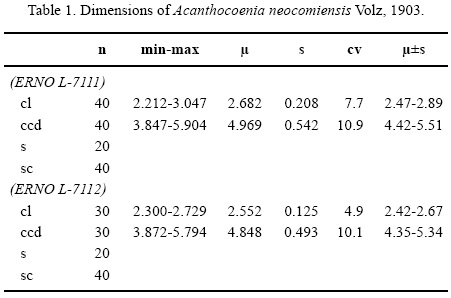
<body><![CDATA[<p align="justify"><font face="verdana" size="2"><b>Discussion.</b> The genus <i>Acanthocoenia</i> was briefly and clearly defined by d'Orbigny (1850) as being a <i>Stylina</i> with a pentameral septal symmetry. No such material was found during fieldwork in the Paris Basin or among collection material. Nevertheless, <i>Acanthocoenia</i> is not a phantom taxon. Material was described and illustrated by Volz (1903) and is here reported in detail.</font></p>  	    <p align="center"><font face="verdana" size="2"><b><i>Acanthocoenia neocomiensis</i> Volz, 1903</b></font></p>     <p align="center"><font face="verdana" size="2"><a href="/img/revistas/rmcg/v30n2/a10f3.jpg" target="_blank">Figures 3a&#45;e (3b, 3c, 3d)</a></font></p>      <p align="justify"><font face="verdana" size="2"><b>*</b> <i>Acanthocoenia neocomiensis</i> Volz, 1903, p. 21, pl. 3, fig. 21&#45;23.</font></p>  	    <p align="justify"><font face="verdana" size="2">v <i>Stylina Tehuac&aacute;nensis</i> (Felix, 1891). Reyeros de Castillo, 1983, p. 17, pl. 4, fig. 2, pl. 5, fig. 1.</font></p> 	    <p align="justify"><font face="verdana" size="2"><b>Dimensions.</b> See <a href="#t1">table 1</a>.</font></p>     	    <p align="center"><font face="verdana" size="2"><a name="t1"></a></font></p> 	    <p align="center"><font face="verdana" size="2"><img src="/img/revistas/rmcg/v30n2/a10t1.jpg"></font></p>     <p align="justify"><font face="verdana" size="2"><b>Description.</b> Plocoid colony. Calicular outline circular. Septa compact. Microstructure of medium size trabeculae. Septa in cross section externally thick, then equal in thickness, first cycle unproportionally thicker than other cycles. Symmetry of septa radial and regularly pentameral. Cycles of septa subregular. Septal cycles differ in length and thickness. First septal cycle reaches 40% of the calicular diameter, further cycles are shorter. Septa free, but often connected to the columella. Septal upper border unknown, lateral face occasionally with granules, inner margin with auriculae, which have more a rhopaloid form. Pali or paliform lobes absent. Costae present, non&#45;confluent, surface granulated. Synapticulae absent. Columella styliform, large. Endotheca consists of thin tabulae. Wall present, compact, probably parathecal. Coenosteum broad, consisting of costae and exothecal dissepiments. Budding extracalicinal.</font></p>  	    <p align="justify"><font face="verdana" size="2"><b>Material.</b> ERNO L&#45;7104, L&#45;7105, L&#45;7106, L&#45;7107, L&#45;7109, L&#45;7111, L&#45;7112, L&#45;7242, 6 thin sections.</font></p>     ]]></body>
<body><![CDATA[<p align="justify"><font face="verdana" size="2"><b>Occurrence.</b> Early Aptian of Atecoxco, La Compa&ntilde;&iacute;a. Aptian of San Juan Raya.</font></p>      <p align="justify"><font face="verdana" size="2"><b>Other Occurrence.</b> Barremian to Early Aptian of Romania (Suceava) Pojor&icirc;ta area, C&icirc;mpulung&#45;Moldovenesc, Valea Seaca, Valea Mesteacan. Early Albian of Mexico (Oaxaca) Tepelmeme, El Rodeo Ranch.</font></p>     <p align="justify"><font face="verdana" size="2"><b>Discussion.</b> The type material of this species presumably was lost during World War II. Comparison is based on the data in the primary literature.</font></p>  	    <p align="center"><font face="verdana" size="2"><i>Enallhelia</i> Milne Edwards and Haime, 1849</font></p>  	    <p align="justify"><font face="verdana" size="2"><b>Type species.</b> <i>Lithodendron compressum</i> Goldfuss, 1829 by subsequent designation in Milne Edwards and Haime (1851).</font></p>     <p align="center"><font face="verdana" size="2"><b><i>Enallhelia anomalos</i> (Felix, 1891)</b></font></p>  	    <p align="center"><font face="verdana" size="2"><a href="/img/revistas/rmcg/v30n2/a10f3.jpg" target="_blank">Figures 3f&#45;g</a></font></p>  	    <p align="justify"><font face="verdana" size="2">*v <i>Prohelia anomalos</i> Felix, 1891, p. 162, pl. 23, figs. 4, 4 a&#45;c.</font></p>     <p align="justify"><font face="verdana" size="2"><i>Enallhelia multiradiata</i> Zlatarski, 1966, p. 145, pl. 1, figs. 1&#45;9.</font></p>     <p align="justify"><font face="verdana" size="2">v <i>Prohelia anomalos</i> Felix. Carreno <i>et al.</i> , 1989, p. 99, fig. 34b.</font></p>  	    ]]></body>
<body><![CDATA[<p align="justify"><font face="verdana" size="2">v <i>Enallhelia anomalos</i> (Felix, 1891). L&ouml;ser, 2006, p. 21, fig. 2G, H.</font></p> 	    <p align="justify"><font face="verdana" size="2"><b>Dimensions.</b> See <a href="#t2">table 2</a>.</font></p>     	    <p align="center"><font face="verdana" size="2"><a name="t2"></a></font></p> 	    <p align="center"><font face="verdana" size="2"><img src="/img/revistas/rmcg/v30n2/a10t2.jpg"></font></p>     <p align="justify"><font face="verdana" size="2"><b>Material.</b> ERNO L&#45;4867, GPS FLX 4668, IGM 9264; 2 thin sections.</font></p>  	    <p align="justify"><font face="verdana" size="2"><b>Occurrence.</b> Barremian of San Antonio Texcala. Aptian of San Juan Raya.</font></p>  	    <p align="justify"><font face="verdana" size="2"><b>Other Occurrence.</b> Late Barremian to Early Aptian of Bulgaria (Vrachanska oblast) Batultsi.</font></p>     <p align="justify"><font face="verdana" size="2"><b>Discussion.</b> A detailed description was given in L&ouml;ser (2006).</font></p>     <p align="center"><font face="verdana" size="2"><b><i>Enallhelia somaensis</i> Eguchi, 1942</b></font></p>     <p align="center"><font face="verdana" size="2"><a href="/img/revistas/rmcg/v30n2/a10f4.jpg" target="_blank">Figures 4a&#45;c (4b)</a></font></p>      ]]></body>
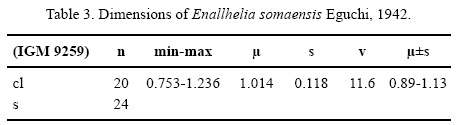
<body><![CDATA[<p align="justify"><font face="verdana" size="2">*v <i>Enallhelia nipponica somaensis</i> Eguchi, 1942, p. 139, pl. 6, fig. 8&#45;11.</font></p>     <p align="justify"><font face="verdana" size="2">v <i>Enallhelia nipponica somaensis</i> Eguchi. Mori, 1963, p. 56, pl. 23, fig. 3; L&ouml;ser and Mori, 2002, p. 81, fig. 1.4 , 1.5.</font></p>     <p align="justify"><font face="verdana" size="2"><b>Dimensions.</b> See <a href="#t3">Table 3</a>.</font></p>     	    <p align="center"><font face="verdana" size="2"><a name="t3"></a></font></p> 	    <p align="center"><font face="verdana" size="2"><img src="/img/revistas/rmcg/v30n2/a10t3.jpg"></font></p>     <p align="justify"><font face="verdana" size="2"><b>Description.</b> Plocoid colony growing in the form of branches which show calices only on one face. Calicular outline circular. Septa compact. Microstructure of septa unknown. Septa in cross section externally thick, then equal in thickness, first cycle unproportionally thicker than other cycles. Symmetry of septa radial and regularly hexameral. Cycles of septa regular. Septal cycles differ in length, less in thickness. First septal cycle reaches 40% of the calicular diameter, further cycles are shorter. Septa free. Septal upper border unknown, lateral face occasionally with large thorns, inner margin with auriculae. Pali or paliform lobes absent. Costae present, non&#45;confluent. Synapticulae absent. Columella styliform. Endotheca consists of thin tabulae. Wall present, compact, probably parathecal. Coenosteum broad, constitution unknown. Budding extracalicinal.</font></p>     <p align="justify"><font face="verdana" size="2"><b>Material.</b> ERNO L&#45;7120, IGM 9259; 4 thin sections.</font></p>     <p align="justify"><font face="verdana" size="2"><b>Occurrence.</b> Early Aptian of Atecoxco, La Compa&ntilde;&iacute;a. Late Aptian of San Lucas Teteletitl&aacute;n.</font></p>     <p align="justify"><font face="verdana" size="2"><b>Other Occurrence.</b> Tithonian of Japan (various localities).</font></p>      <p align="center"><font face="verdana" size="2"><i>Stylangia</i> de Fromentel, 1857</font></p>  	    ]]></body>
<body><![CDATA[<p align="justify"><font face="verdana" size="2"><b>Type species.</b> <i>Stylangia neocomiensis</i> de Fromentel, 1857 by monotypy.</font></p>  	    <p align="justify"><font face="verdana" size="2"><b>Diagnosis.</b> Plocoid colony. Calicular outline circular. Calices very small, very slightly elevated over the colony surface. Septa compact. Microstructure of small trabeculae, septa marked with a median dark line. Septa in cross section close to the wall thick, thinner towards the calicular centre, first cycle disproportionately thicker than other cycles. Symmetry of septa radial and regularly hexameral. Cycles of septa regular. Three cycles. Septal cycles differ in length and thickness. First septal cycle reaches 40% of the calicular diameter, further cycles are shorter. Septa free. Septal upper margin unknown, lateral face with occasional granules, inner margin with auriculae. Pali or paliform lobes absent. Most septa of the first cycle are attached to the columella. Costae present, non&#45;confluent, surface unknown. Synapticulae absent. Columella styliform. Endotheca unknown. Wall present, compact, septothecal. Coenosteum broad <i>(ca.</i> 100% of the calicular diameter), consisting of costae and small isolated trabecules, granulated at its surface. Budding extracalicinal.</font></p>  	    <p align="justify"><font face="verdana" size="2"><b>Discussion.</b> De Fromentel (1861: 178) later changed the name <i>Stylangia</i> to <i>Prohelia</i> because it does not belong to the Astrangiidae and the suffix <i>&#45;angia</i> should not confuse. Both genera have different type species and are not objectively synonymous. The type of the type species of <i>Prohelia</i> is not available. <i>Stylangia</i> is very closely related to <i>Stylohelia</i> and differs only by its encrusting, partly thick branching growth mode.</font></p>     <p align="justify"><font face="verdana" size="2"><b>Species.</b> The genus is monospecific. <i>Stylangia laddi</i> Wells, 1944 belongs to <i>Stylosmilia.</i></font></p>  	    <p align="justify"><font face="verdana" size="2"><b>Range and distribution.</b> Early Cretaceous, Central Tethys and Western Atlantic.</font></p>  	    <p align="center"><font face="verdana" size="2"><b><i>Stylangia neocomiensis</i> de Fromentel, 1857</b></font></p> 	    <p align="center"><font face="verdana" size="2"><a href="/img/revistas/rmcg/v30n2/a10f4.jpg" target="_blank">Figures 4d&#45;f</a></font></p>      <p align="justify"><font face="verdana" size="2">*v <i>Stylangia neocomiensis</i> de Fromentel, 1857, p. 38, pl. 5, fig. 3&#45;5.</font></p>  	    <p align="justify"><font face="verdana" size="2"><i>Prohelia neocomiensis.</i> de Fromentel, 1861, p. 178; de Fromentel, 1879, p. 491, pl. 121, fig. 1; Koby, 1896, p. 11, pl. 2, fig. 8.</font></p>  	    <p align="justify"><font face="verdana" size="2"><i>Stylangia</i> cf. <i>neocomiensis</i> de From. Alloiteau and Dercourt, 1966, p. 318, pl. 3, fig. 5.</font></p>     ]]></body>
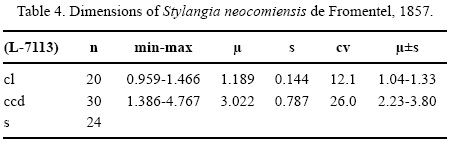
<body><![CDATA[<p align="justify"><font face="verdana" size="2"><b>Dimensions.</b> See <a href="#t4">Table 4</a>.</font></p>     	    <p align="center"><font face="verdana" size="2"><a name="t4"></a></font></p> 	    <p align="center"><font face="verdana" size="2"><img src="/img/revistas/rmcg/v30n2/a10t4.jpg"></font></p>     <p align="justify"><font face="verdana" size="2"><b>Description.</b> As for the genus.</font></p>  	    <p align="justify"><font face="verdana" size="2"><b>Material.</b> ERNO L&#45;7113; 2 thin sections.</font></p>  	    <p align="justify"><font face="verdana" size="2"><b>Occurrence.</b> Late Aptian of San Lucas Teteletitl&aacute;n.</font></p>  	    <p align="justify"><font face="verdana" size="2"><b>Other Occurrence.</b> Early Cretaceous of Switzerland(Neuch&acirc;tel) Travers, Les Grands&#45;Champs; Greece (Argol&iacute;da) Nafplion, Pronia. Early Hauterivian (Radiatuszone) of France (Aube and Yonne), various localities (MNHN M03532, BSPG 2003 XX 6545).</font></p>     <p align="center"><font face="verdana" size="2"><i>Stylina</i> de Lamarck, 1816</font></p>  	    <p align="justify"><font face="verdana" size="2"><b>Type species.</b> <i>Stylina echinulata</i> de Lamarck, 1816 by monotypy. &#45; <i>Stylina echinulata</i> was originally described as an extant coral species. Milne Edwards and Haime (1848: 289) realised that the type material is from the Late Jurassic of France. The designation of <i>Stylina granulosa</i> de Fromentel, 1863 as type species by Dacque (1933) is not valid, because this species was not one of the originally included species. Also the designation of <i>Stylina echinulata </i>Milne Edwards and Haime (non Lamarck) by Alloiteau (1947: 191) is invalid.</font></p>     <p align="justify"><font face="verdana" size="2"><b>Type of the type species.</b> The type material is supposedly lost. The samples examined by Milne Edwards and Haime (MNHN nn), from which Alloiteau obtained thin sections, still exist. They have no type status. The diagnosis given here is based on these thin sections.</font></p>     ]]></body>
<body><![CDATA[<p align="justify"><font face="verdana" size="2"><b>Diagnosis.</b> Plocoid colony. Calicular outline circular. Septa compact. Microstructure of septa unknown. Septa in cross section close to the wall slightly thicker, towards the corallite axis equal in thickness, first cycle disproportionately thicker than other cycles. Symmetry of septa radial. <i>Stylina</i> may show a differing number of septal systems (6, 8, 10) and septal cycles (2, 3, 4). Cycles of septa subregular. Septal cycles differ in length and thickness. First septal cycle reaches close to the columella, subsequent cycles are shorter. Septa not connected to each other. Septal upper margin unknown, lateral face with occasional granules, inner margin with auriculae. Pali or paliform lobes absent. Costae present, non&#45;confluent, surface unknown. Synapticulae absent. Columella styliform. Endotheca consists of thin tabulae. Wall present, compact, probably parathecal. Coenosteum broad <i>(ca.</i> 100% of the calicular diameter), consisting of costae and exothecal dissepiments. Budding extracalicinal.</font></p>     <p align="justify"><font face="verdana" size="2"><b>Synonyms.</b> The following genera are subjective synonyms and have been synonymized after having studied the type specimens of their respective type species (type species and their types are given in parentheses): <i>Cellulastraea</i> Blanckenhorn, 1890 <i>(Cellulastraea crenata</i> Blanckenhorn, 1890; SMNS 60381); <i>Conocoenia</i> d'Orbigny, 1849 <i>(Astrea tumularis</i> Michelin, 1844; MNHN M00252); <i>Decaphyllum</i> Frech, 1885 <i>(Decaphyllum koeneni</i> Frech, 1885; MB K 6048 &#91;thin sections&#93;, GZG 772&#45;21 &#91;sample&#93;); <i>Gemmastrea</i> Blainville, 1834 <i>(Astrea tubulosa</i> Goldfuss, 1829; IPB GF299); <i>Heliostylina</i> Lafuste, 1957 <i>(Adelocoenia corallina</i> d'Orbigny, 1850; MNHN R09321); <i>Hexaheliocoenia</i> Roniewicz, 1966 <i>(Heliocoenia stellata</i> Roniewicz, 1966; ZPAL H III 664); <i>Kobycoenia</i> Beauvais, 1964 <i>(Alloiteaucoenia claudiopolisensis,</i> Beauvais, 1964; NMB); <i>Octoheliocoenia</i> Roniewicz, 1966 <i>(Heliocoenia corallina</i> Koby, 1881; MNHN A32667, NMB D4310&#45;12, NMBE 5015279); <i>Plesiostylina</i> Alloiteau, 1958 <i>(Plesiostylina hourcqi</i> Alloiteau, 1958; MNHN M05152); <i>Stylopora</i> McCoy, 1848 <i>(Stylopora solida</i> McCoy, 1848; CAMSM J34968&#45;70); <i>Tremocoenia</i> d'Orbigny, 1849 <i>(Tremocoenia subornata</i> d'Orbigny, 1849; MNHN R09323).</font></p>     <p align="justify"><font face="verdana" size="2"><b>Range and distribution.</b> (?) Early Jurassic to late Early Cretaceous (Early Albian). &#45; The genus does not reach the Turonian. The both Late Turonian species <i>Sarcinula quincuncialis</i> Michelin, 1841 (later assigned to <i>Stylina)</i> and <i>Stylina arambourgi</i> Alloiteau, 1941 are doubtful: the types of both species are derived from Uchaux (France, Vaucluse) and poorly preserved. The material from the Cenomanian of the Czech Republic described by Pocta (1887) probably belongs to <i>Stelidioseris.</i> The material from the Late Cretaceous of Mexico (Oaxaca, San Pedro Yucunama) described by Reyeros de Castillo (1983) as <i>Stylina sucrensis</i> Wells, 1944 belongs to <i>Actinastrea.</i> The Late Cretaceous material from Italy (Veneto, Belluno, Lago di Santa Croce, Calloneghe) described by Zuffardi&#45;Comerci (1927), as well as the Late Cretaceous samples from Spain (Cataluna, Lerida, Com. Pallars Jussa, Mun. Pallars Jussa, Toralla) listed by Bataller (1937) and those from Italy (Lazio, Roma, Prenestini Mts, Rocca di Cave) by Carbone <i>et al.</i> (1980) are all unavailable and doubtful. The genus is most abundant in the Late Jurassic, less abundant from the Berriasian to Early Aptian and generally rare from the Late Aptian to Albian. <i>Stylina</i> occurs worldwide, but is rare in the Western Hemisphere.</font></p>     <p align="justify"><font face="verdana" size="2"><b>Relationship.</b> <i>Heliocoenia</i> Etallon, 1859 and<i> Alloiteaucoenia</i> Beauvais, 1964 differ from <i>Stylina</i> by having a bilateral symmetry. <i>Acanthocoenia</i> differ by a pentameral septal symmetry. <i>Stylangia</i> (? and <i>Prohelia)</i> are encrusting forms and generally have the same structure as <i>Stylina,</i> but <i>Stylangia</i> differs in the formation of its coenosteum. <i>Enallhelia</i> is thick&#45;branching. <i>Stylohelia</i> de Fromentel, 1861 has a different coenosteum and is comparable to <i>Stylangia.</i></font></p>     <p align="justify"><font face="verdana" size="2"><b>Species.</b> A total of 201 species of <i>Stylina</i> have been described: 146 from the Jurassic and 55 from the Cretaceous (Lathuili&egrave;re, 1989; L&ouml;ser 2000). At least for the Cretaceous, half of them are synonyms. The species are distinguished on the basis of their calicular dimensions and septal symmetry and number.</font></p>      <p align="center"><font face="verdana" size="2"><b><i>Stylina bullosa</i> Blanckenhorn, 1890</b></font></p>  	    <p align="center"><font face="verdana" size="2"><a href="/img/revistas/rmcg/v30n2/a10f3.jpg" target="_blank">Figures 3h&#45;i</a></font></p>  	    <p align="justify"><font face="verdana" size="2">vp <i>Cryptocoenia ramosa,</i> Toula, 1889, p. 83, pl. 5, fig. 10, 11.</font></p>     <p align="justify"><font face="verdana" size="2">*v <i>Stylina bullosa</i> Blanckenhorn, 1890, p. 11, pl. 2, fig. 1.</font></p>     <p align="justify"><font face="verdana" size="2">? <i>Stylina bullosa</i> Blauckenhorn. Felix, 1903, p. 177, pl. 17, fig. 4.</font></p>      ]]></body>
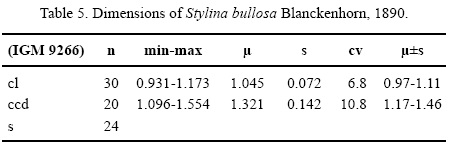
<body><![CDATA[<p align="justify"><font face="verdana" size="2">v <i>Diplocoenia inwaldensis</i> Ogilvie. Geyer, 1955, p. 195.</font></p>     <p align="justify"><font face="verdana" size="2">vp <i>Stylina regularis</i> de Fromentel 1862. Morycowa, 1964, p. 34, pl. 10, fig. 7, pl. 15, fig. 3, pl. 19, fig. 1, 2.</font></p>     <p align="justify"><font face="verdana" size="2">v <i>Stylina qiebulaensis</i> Liao, 1982, p. 157, pl. 4, fig. 2, 3, pl. 5, fig. 1.</font></p>     <p align="justify"><font face="verdana" size="2">v <i>Cryptocoenia viaderi</i> Reig Oriol, 1991, p. 16, pl. 4, fig. 5, 6.</font></p>     <p align="justify"><font face="verdana" size="2"><i>Stylina sugiyamai</i> Eguchi. Kashiwagi <i>et al.,</i> 2002, p. 10 fig. 5.4.</font></p>     <p align="justify"><font face="verdana" size="2"><b>Dimensions.</b> See <a href="#t5">Table 5</a>.</font></p>     	    <p align="center"><font face="verdana" size="2"><a name="t5"></a></font></p> 	    <p align="center"><font face="verdana" size="2"><img src="/img/revistas/rmcg/v30n2/a10t5.jpg"></font></p>     <p align="justify"><font face="verdana" size="2"><b>Material.</b> IGM 9266; 1 thin section.</font></p>     <p align="justify"><font face="verdana" size="2"><b>Occurrence.</b> Aptian of San Juan Raya.</font></p>     ]]></body>
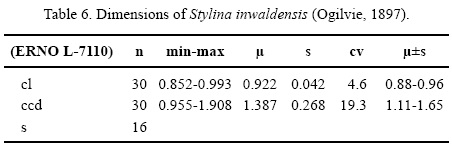
<body><![CDATA[<p align="justify"><font face="verdana" size="2"><b>Other Occurrence.</b> Tithonian of Czech Republic, Stramberk. Cretaceous of Syria, Ain Ham&acirc;de. Hauterivian to Early Aptian of China (Xizang &#91;= Tibet&#93; Autonomous Region) Xainza county, Xungmai district, Serling vill., Qiebula near Siling co. Barremian to Aptian of Bulgaria (Veliko Tarnovska oblast) Veliko Tarnovo, Arbanasi, Lyaskovets Monastir Sv.Peter. Late Barremian of Poland (Malopolskie, Tarn&oacute;w) Tarn&oacute;w, Trzemesna. Late Barremian to Early Aptian of France (Vaucluse) Colline St. Jaques, Cavaillon (UP 4128). Early Aptian of Poland (Malopolskie, Wadowice) Lanckorona, Jastrzebia. Early Albian (Tardefurcata zone) of Spain (Cataluna, Barcel&oacute;na) Com. Alt Penedes, Mun. Castellvi de la Marca, Can Pascual.</font></p>      <p align="center"><font face="verdana" size="2"><b><i>Stylina inwaldensis</i> (Ogilvie, 1897)</b></font></p>  	    <p align="center"><font face="verdana" size="2"><a href="/img/revistas/rmcg/v30n2/a10f4.jpg" target="_blank">Figures 4g&#45;i (4h)</a></font></p>  	    <p align="justify"><font face="verdana" size="2">*v <i>Diplocoenia inwaldensis</i> Ogilvie, 1897, p. 165, pl. 18, fig. 7&#45;8.</font></p>  	    <p align="justify"><font face="verdana" size="2">v <i>Stylina foliosa</i> Ogilvie, 1897, p. 170, pl. 16, fig. 15.</font></p> 	    <p align="justify"><font face="verdana" size="2">v <i>Stylina milleporacea</i> Ogilvie, 1897, p. 173, pl. 17, fig. 8.</font></p> 	    <p align="justify"><font face="verdana" size="2">v <i>Stylina sucrensis</i> Wells, 1944, p. 435, pl. 70, fig. 1.</font></p> 	    <p align="justify"><font face="verdana" size="2"><i>Stylina solomkoi</i> Karakash. Bendukidze, 1961, p. 8, pl. 1,fig. 1, pl. 4, fig. 3&#45;5.</font></p> 	    <p align="justify"><font face="verdana" size="2">v <i>Stylina parvistella</i> Volz, 1903. Morycowa, 1971, p. 45, pl. 7, fig. 1; Turn&#353;ek and Mihajlovic, 1981, p. 14, pl. 8, fig. 1&#45;3; Liao and Xia, 1985, p. 134, pl. 3, fig. 5; Liao and Xia, 1994, p. 147, pl. 39, fig. 6; Csaszar and Turn&#353;ek, 1996, p. 434, fig. 15; G&ouml;tz <i>et al.,</i> 2005, p. 874, fig. 8A <i>Stylina elegans</i> Eichwald, 1865. Kuzmicheva, 2002, p. 173,pl. 25, fig. 5 </font></p> 	    <p align="justify"><font face="verdana" size="2"><b>Dimensions.</b> See <a href="#t6">Table 6</a>.</font></p>         	    ]]></body>
<body><![CDATA[<p align="center"><font face="verdana" size="2"><a name="t6"></a></font></p>     <p align="center"><font face="verdana" size="2"><img src="/img/revistas/rmcg/v30n2/a10t6.jpg"></font></p> 	    <p align="justify"><font face="verdana" size="2"><b>Material.</b> ERNO L&#45;7110; 2 thin sections.</font></p> 	    <p align="justify"><font face="verdana" size="2"><b>Occurrence.</b> Early Aptian of Atecoxco, La Compa&ntilde;&iacute;a.</font></p> 	    <p align="justify"><font face="verdana" size="2"><b>Other Occurrence.</b> Tithonian of Czech Republic, Stramberg. Cretaceous of Serbia (East Serbia) Skuvija. Berriasian to Valanginian of China (Xizang &#91;= Tibet&#93; Autonomous Region) Baingoin county. Hauterivian of Spain (Valencia, Castell&oacute;n) La Avell&agrave;, Cat&iacute;. Early Hauterivian (Radiatus zone) of France (Yonne) various localities (BSPG 2003 XX 5010). Early Hauterivian of Ukraine (Krymskaya) Bakhchisarajskij district; Fotisala; Mangusch; Alma river, Partizany &#91;= Sably&#93;. Late Barremian to Early Aptian of Hungary (Baranya Megye) Mecsek Mts, J&aacute;nosipuszta. Early Aptian of Serbia (East Serbia) Rajcinica; Zljebine; Venezuela (Sucre) Cuman&aacute;, Las Cinco Ceibas. Early Aptian (Lenticularis zone) of Romania (Suceava) Pojor&icirc;ta area, C&icirc;mpulung&#45;Moldovenesc, Valea Seaca.</font></p>     <p align="justify"><font face="verdana" size="2"><b>Discussion.</b> Comparable material is generally assigned to <i>Stylina parvistella,</i> but this species has smaller dimensions (calicular diameter 0.7&#45;0.9 mm according to its author; the type material is lost). <i>Stylina inwaldensis</i> is applied instead of <i>Stylina foliosa</i> because it is better preserved and the type material more clearly shows the characteristics of the species. <i>Stylina inwaldensis</i> is generally a common Early Cretaceous <i>Stylina</i> species.</font></p>     <p align="center"><font face="verdana" size="2"><b><i>Stylina pachystylina</i> Koby, 1896</b></font></p>     <p align="center"><font face="verdana" size="2"><a href="/img/revistas/rmcg/v30n2/a10f5.jpg" target="_blank">Figure 5d</a></font></p>      <p align="justify"><font face="verdana" size="2">*v <i>Stylina pachystylina</i> Koby, 1896 p. 26, pl. 5, fig. 6. non <i>Stylina pachystylina</i> Koby, 1895. Kuzmicheva, 2002, p. 169, pl. 25, fig. 2.</font></p>  	    <p align="justify"><font face="verdana" size="2"><b>Dimensions.</b> See <a href="#t7">Table 7</a>.</font></p>     	    ]]></body>
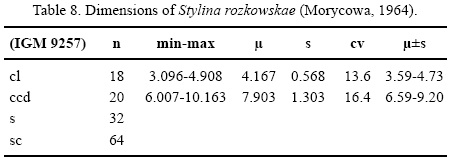
<body><![CDATA[<p align="center"><font face="verdana" size="2"><a name="t7"></a></font></p> 	    <p align="center"><font face="verdana" size="2"><img src="/img/revistas/rmcg/v30n2/a10t7.jpg"></font></p>     <p align="justify"><font face="verdana" size="2"><b>Material.</b> IGM 9223; 1 thin section.</font></p>  	    <p align="justify"><font face="verdana" size="2"><b>Occurrence.</b> Aptian of San Juan Raya.</font></p>  	    <p align="justify"><font face="verdana" size="2"><b>Other Occurrence.</b> Barremian of France (Doubs) Morteau.</font></p>  	    <p align="center"><font face="verdana" size="2"><b><i>Stylina rozkowskae</i> (Morycowa, 1964)</b></font></p>     <p align="center"><font face="verdana" size="2"><a href="/img/revistas/rmcg/v30n2/a10f5.jpg" target="_blank">Figures 5a&#45;c (5b)</a></font></p>     <p align="justify"><font face="verdana" size="2">*v <i>Heliocoenia rozkowskae</i> Morycowa, 1964, p. 40, text&#45;fig. 4, pl. 7, fig. 6, pl. 8, figs. 3, 4.</font></p>     <p align="justify"><font face="verdana" size="2"><i>Heliocoenia rozkowskae</i> Morycowa 1964. Turn&#353;ek and Mihajlovic, 1981, p. 12, pl. 4, fig. 4&#45;7; Morycowa, 1989, p. 62, pl. 21, fig. 1, 2; Morycowa and Masse, 1998, p. 742, fig. 13.3.</font></p>     <p align="justify"><font face="verdana" size="2"> non <i>Heliocoenia rozkowskae</i> Morycowa, 1964. Kuzmicheva, 2002, p. 175, pl. 26, fig. 3.</font></p>     ]]></body>
<body><![CDATA[<p align="justify"><font face="verdana" size="2"><b>Dimensions.</b> See <a href="#t8">Table 8</a>.</font></p>     	    <p align="center"><font face="verdana" size="2"><a name="t8"></a></font></p> 	    <p align="center"><font face="verdana" size="2"><img src="/img/revistas/rmcg/v30n2/a10t8.jpg"></font></p>     <p align="justify"><font face="verdana" size="2"><b>Material.</b> IGM 9257; 4 thin sections.</font></p>     <p align="justify"><font face="verdana" size="2"><b>Occurrence.</b> Early Aptian of Atecoxco, La Compa&ntilde;&iacute;a.</font></p>     <p align="justify"><font face="verdana" size="2"><b>Other Occurrence.</b> Cretaceous of Serbia (East Serbia) Skuvija. Early Late Barremian of France (Bouches&#45;du&#45;Rh&ocirc;ne) Chainon la Fare, Saint Chamas, canal EDF. Late Barremian of Poland (Malopolskie, Tarn&oacute;w) Tarn&oacute;w, Trzemesna. Early Aptian of France (Vaucluse) Rissas Mts; Poland (Malopolskie, Wadowice) Lanckorona, Jastrzebia.</font></p>     <p align="center"><font face="verdana" size="2"><b><i>Stylina sugiyamai</i> Eguchi, 1951</b></font></p>  	    <p align="center"><font face="verdana" size="2"><a href="/img/revistas/rmcg/v30n2/a10f5.jpg" target="_blank">Figures 5e&#45;f</a></font></p>  	    <p align="justify"><font face="verdana" size="2">vp <i>Stylina micropora</i> Koby, 1896, p. 25, pl. 6, fig. 1 &#91;non pl. 5, fig. 3, 4&#93;.</font></p> 	    <p align="justify"><font face="verdana" size="2">*v <i>Stylina sugiyamai</i> Eguchi, 1951, p. 60, pl. 22, fig. 7.</font></p> 	    ]]></body>
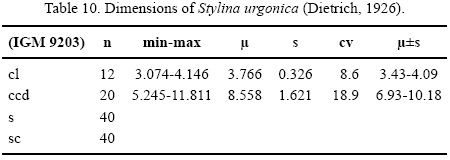
<body><![CDATA[<p align="justify"><font face="verdana" size="2">vp <i>Stylina regularis</i> de Fromentel 1862. Morycowa, 1964, p. 34, pl. 10, fig. 7, pl. 15, fig. 3, pl. 19, fig. 1, 2; Morycowa, 1971, p. 47, text&#45;fig. 6 d, pl. 5, fig. 2; L&ouml;ser, 2010, p. 601, fig. 4.4.</font></p> 	    <p align="justify"><font face="verdana" size="2">v <i>Heliocoenia rarauensis</i> Morycowa, 1971, p. 48, pl. 8, fig. 1.</font></p>     <p align="justify"><font face="verdana" size="2">v <i>Stylina sugiyamai</i> Eguchi. L&ouml;ser and Mori, p. 85 fig. 2.4</font></p>     <p align="justify"><font face="verdana" size="2"><b>Dimensions.</b> See <a href="#t9">Table 9</a>.</font></p>     	    <p align="center"><font face="verdana" size="2"><a name="t9"></a></font></p> 	    <p align="center"><font face="verdana" size="2"><img src="/img/revistas/rmcg/v30n2/a10t9.jpg"></font></p>     <p align="justify"><font face="verdana" size="2"><b>Material.</b> IGM 9245, 9261, 9265; 4 thin sections.</font></p>  	    <p align="justify"><font face="verdana" size="2"><b>Occurrence.</b> Aptian of San Juan Raya.</font></p>  	    <p align="justify"><font face="verdana" size="2"><b>Other Occurrence.</b> Tithonian of Japan (Fukushima&#45;ken) Soma&#45;gun area. Tithonian to Berriasian of Japan (Kochi&#45;ken) Takaoka&#45;gun, Sakawa&#45;cho, Nishiyamagumi. Barremian to Early Aptian of Romania (Suceava) Pojor&icirc;ta area, C&icirc;mpulung&#45;Moldovenesc, Rarau Mt. Barremian (Moutoniceras &#45; Giraudi zone) of France (Dr&ocirc;me) Serre de Bleyton. Late Barremian of France (Bouches&#45;du&#45;Rh&ocirc;ne) Orgon (UP 32); Poland (Malopolskie, Tarn&oacute;w) Tarn&oacute;w, Trzemesna. Late Barremian to Early Aptian (Sartousi &#45; Weissi zone) of Switzerland (Schwyz) Drusberg, K&auml;sernalp. Early Aptian of Greece (Viotia) Arachova (BSPG 2003 XX 5536); Poland (Malopolskie, Wadowice) Lanckorona, Jastrzebia (ERNO L&#45;5429); Slovenia (West Slovenia) Banskja Planota, Osojnica (SAZU P&#45;505). Early Aptian (Lenticularis zone) of Greece (Viotia) Levadia, roadcut near Perachorion NW Levadia (BSPG 2003 XX 5735); Romania (Suceava) Pojor&icirc;ta area, C&icirc;mpulung&#45;Moldovenesc, Valea Izvorul Alb.</font></p>     <p align="center"><font face="verdana" size="2"><b><i>Stylina urgonica</i> (Dietrich, 1926)</b></font></p>  	    ]]></body>
<body><![CDATA[<p align="center"><font face="verdana" size="2"><a href="/img/revistas/rmcg/v30n2/a10f5.jpg" target="_blank">Figures 5g&#45;i</a></font></p>  	    <p align="justify"><font face="verdana" size="2">*v <i>Agathelia urgonica</i> Dietrich, 1926, p. 75, pl. 5, fig. 1, pl. 8, fig. 2.</font></p>  	    <p align="justify"><font face="verdana" size="2">v <i>Stylina urgonica</i> (Dietrich, 1926). L&ouml;ser, 2008b, p. 44, pl. 2, fig. 3.</font></p> 	    <p align="justify"><font face="verdana" size="2"><b>Dimensions.</b> See <a href="#t10">Table 10</a>.</font></p>         	    <p align="center"><font face="verdana" size="2"><a name="t10"></a></font></p> 	    <p align="center"><font face="verdana" size="2"><img src="/img/revistas/rmcg/v30n2/a10t10.jpg"></font></p> 	    <p align="justify"><font face="verdana" size="2"><b>Material.</b> IGM 9203; 3 thin sections.</font></p> 	    <p align="justify"><font face="verdana" size="2"><b>Occurrence.</b> Aptian of San Juan Raya.</font></p>     <p align="justify"><font face="verdana" size="2"><b>Other Occurrence.</b> Early Aptian (Weissi &#45; Furcata zone) of Tanzania (Tanganyika, Mtwara) Kiturika Mts, Naiwanga, Ndalakasha Mt.</font></p>     <p align="justify"><font face="verdana" size="2">&nbsp;</font></p>     ]]></body>
<body><![CDATA[<p align="justify"><font face="verdana" size="2"><b>DISCUSSION</b></font></p>      <p align="justify"><font face="verdana" size="2"><b>Taxonomic composition</b></font></p>  	    <p align="justify"><font face="verdana" size="2">The family Stylinidae in the Tehuac&aacute;n region is represented by a high diversity assemblage, particularly in the Aptian, which contains ten distinct species; the diversity in Barremian strata is somewhat more modest, with two species. However, with a total of four genera, the area presents a great supra&#45;specific diversity. An interesting aspect is the relative abundance of the genus <i>Acanthocoenia</i> in the study area. The genus is very rare in the Aptian of the Central Tethys, and the present material is the first that has allowed the identification of this genus in thin sections. Further occurrences are doubtful because of the unavailability of the material (d'Orbigny, 1850; Volz, 1903) or the poor state of preservation (L&ouml;ser and Raeder, 1995). The occurrence of <i>Stylangia</i> in the Early Albian represents the first well&#45;constrained occurrence of this genus for the Early Cretaceous outside from its type area in the Paris Basin.</font></p>     <p align="justify"><font face="verdana" size="2"><b>Distribution</b></font></p>  	    <p align="justify"><font face="verdana" size="2">The corals of the Family Stylinidae in the Tehuac&aacute;n Valley show a stratigraphic or facies zonation (<a href="#f6">Figure 6</a>). Except for <i>Enallhelia anomalos,</i> all species of the family are restricted to the Aptian. The stratigraphic range of the stylinids found in the Early Cretaceous of Puebla lies clearly in the Latest Jurassic to the Early Aptian (<a href="/img/revistas/rmcg/v30n2/a10f7.jpg" target="_blank">Figure 7</a>). Stylinid species have long stratigraphic ranges, and thus the gaps in the Berriasian and Valanginian record are likely due to the regression of the sea level during these time periods. In all likelihood, stylinids are not preserved in these strata due to erosion of the shallow marine sediments during emersion or transgression of the Late Valanginian to Early Hauterivian. Decreasing carbonate sedimentation in the Tethys due to OAE1 and the Western Pacific due to changed ocean currents (Iba and Sano, 2007) has limited the diversity of coral communities in a large scale, resulting also in the extinction of the family during the Albian (L&ouml;ser, 2013).</font></p>     	    <p align="center"><font face="verdana" size="2"><a name="f6"></a></font></p> 	    <p align="center"><font face="verdana" size="2"><img src="/img/revistas/rmcg/v30n2/a10f6.jpg"></font></p>     <p align="justify"><font face="verdana" size="2"><b>Palaeobiogeography</b></font></p>  	    <p align="justify"><font face="verdana" size="2">Members of the Family Stylinidae are either common or poorly documented in the Western Atlantic. Apart from some reports from Venezuela (Wells, 1944) and Jamaica (L&ouml;ser <i>et al.</i>, 2009), the genus occurs only in Puebla in the New World. Stylinids are completely unknown from the Aptian to Cenomanian of the Texas platform, as well as from the Late Barremian to Albian of the Bisbee Basin. Former reports on putative stylinids from these areas <i>(e.g.</i>, L&ouml;ser and Minor, 2007) turned out to belong the genus <i>Stelidioseris,</i> or other genera of the family Columastraeidae. The absence of stylinids in these areas cannot be explained by lower water temperatures because the high latitude epicontinental sediments of the Hauterivian of the Paris Basin are relatively rich in stylinids. The fauna from Puebla is the most species&#45;rich association in the Western Hemisphere known to date. The stylinid populations from Puebla allow considerable insight into the palaeobiogeographic relationships with Tethyan and Western Pacific faunas (<a href="/img/revistas/rmcg/v30n2/a10f8.jpg" target="_blank">Figure 8</a>). It must be emphasized that the number of species in the Puebla fauna, as well as those in the correlating faunas, are too low to draw clear conclusions on the precise palaeobiogeographical distribution of the corals, as the three different stratigraphic levels do not correlate much with each other. The Barremian stylinids show cL&ouml;ser relationships to the Latest Jurassic to Early Cretaceous faunas, whereas the Aptian stylinids correlate only with Barremian to Aptian faunas. The Late Aptian stylinids are isolated.</font></p>     <p align="justify"><font face="verdana" size="2">&nbsp;</font></p>     ]]></body>
<body><![CDATA[<p align="justify"><font face="verdana" size="2"><b>ACKNOWLEDGEMENTS</b></font></p>      <p align="justify"><font face="verdana" size="2">Sample preparation was financed by CONACyT project 52442&#45;Q and UNAM DGAPA PAPIIT project IN101111. Much of the measuring of the calicular dimensions of the corals was done by L. Puebla Clark (Hermosillo). We thank Itzia Nieto L&oacute;pez for her assistance during field work. JOH is grateful with Peter Skelton (Open University, UK) for valuable discussion on the taxonomy of caprinid rudists. An insightful review by Harry Filkorn (Woodland Hills, Cal.) helped to improve the article.</font></p>  	    <p align="justify"><font face="verdana" size="2">&nbsp;</font></p>     <p align="justify"><font face="verdana" size="2"><b>REFERENCES</b></font></p>      <!-- ref --><p align="justify"><font face="verdana" size="2">Aguilera, J.G., 1906, Excursion de Tehuac&aacute;n &aacute; Zapotitl&aacute;n et San Juan Raya, Dixi&eacute;me Congr&eacute;s G&eacute;ologique International, Guide des Excursions, 7, 1&#45;27.    &nbsp;&nbsp;&nbsp;&nbsp;&nbsp;&nbsp;&nbsp;&nbsp;[&#160;<a href="javascript:void(0);" onclick="javascript: window.open('/scielo.php?script=sci_nlinks&ref=8087262&pid=S1026-8774201300020001000001&lng=','','width=640,height=500,resizable=yes,scrollbars=1,menubar=yes,');">Links</a>&#160;]<!-- end-ref --></font></p>     <!-- ref --><p align="justify"><font face="verdana" size="2">Alenc&aacute;ster de Cserna, G., 1956, Pelec&iacute;podos y gaster&oacute;podos del Cret&aacute;cico inferior de la regi&oacute;n de San Juan Raya&#45;Zapotitlan, Estado de Puebla: Paleontolog&iacute;a Mexicana, 2, 1&#45;47.    &nbsp;&nbsp;&nbsp;&nbsp;&nbsp;&nbsp;&nbsp;&nbsp;[&#160;<a href="javascript:void(0);" onclick="javascript: window.open('/scielo.php?script=sci_nlinks&ref=8087264&pid=S1026-8774201300020001000002&lng=','','width=640,height=500,resizable=yes,scrollbars=1,menubar=yes,');">Links</a>&#160;]<!-- end-ref --></font></p>     <!-- ref --><p align="justify"><font face="verdana" size="2">Alloiteau, J., 1941, R&eacute;vision de collection H.Michelin. Polypiers d'anthozoaires (1:) Cr&eacute;tac&eacute;: M&eacute;moires du Mus&eacute;um National d'Histoire Naturelle, 16 (1), 1&#45;100.    &nbsp;&nbsp;&nbsp;&nbsp;&nbsp;&nbsp;&nbsp;&nbsp;[&#160;<a href="javascript:void(0);" onclick="javascript: window.open('/scielo.php?script=sci_nlinks&ref=8087266&pid=S1026-8774201300020001000003&lng=','','width=640,height=500,resizable=yes,scrollbars=1,menubar=yes,');">Links</a>&#160;]<!-- end-ref --></font></p>     ]]></body>
<body><![CDATA[<!-- ref --><p align="justify"><font face="verdana" size="2">Alloiteau, J., 1946&#45;47, Polypiers du Gargasien aragonais: Anales de la Escuela de Peritos Agr&iacute;colas y de Especialidades Agropecuarias y de los Servicios T&eacute;cnicos de Agricultura, 6, 187&#45;243.    &nbsp;&nbsp;&nbsp;&nbsp;&nbsp;&nbsp;&nbsp;&nbsp;[&#160;<a href="javascript:void(0);" onclick="javascript: window.open('/scielo.php?script=sci_nlinks&ref=8087268&pid=S1026-8774201300020001000004&lng=','','width=640,height=500,resizable=yes,scrollbars=1,menubar=yes,');">Links</a>&#160;]<!-- end-ref --></font></p>     <!-- ref --><p align="justify"><font face="verdana" size="2">Alloiteau, J., 1952, Embranchement des coelent&eacute;r&eacute;s, <i>in</i> Piveteau, J. (ed.), Trait&eacute; de Pal&eacute;ontologie (1): Paris, Masson, 376&#45;684.    &nbsp;&nbsp;&nbsp;&nbsp;&nbsp;&nbsp;&nbsp;&nbsp;[&#160;<a href="javascript:void(0);" onclick="javascript: window.open('/scielo.php?script=sci_nlinks&ref=8087270&pid=S1026-8774201300020001000005&lng=','','width=640,height=500,resizable=yes,scrollbars=1,menubar=yes,');">Links</a>&#160;]<!-- end-ref --></font></p>     <!-- ref --><p align="justify"><font face="verdana" size="2">Alloiteau, J., 1958, Monographie des Madr&eacute;poraires fossiles de Madagascar: Annales g&eacute;ologiques de Madagascar, 25, 1&#45;218.    &nbsp;&nbsp;&nbsp;&nbsp;&nbsp;&nbsp;&nbsp;&nbsp;[&#160;<a href="javascript:void(0);" onclick="javascript: window.open('/scielo.php?script=sci_nlinks&ref=8087272&pid=S1026-8774201300020001000006&lng=','','width=640,height=500,resizable=yes,scrollbars=1,menubar=yes,');">Links</a>&#160;]<!-- end-ref --></font></p>     <!-- ref --><p align="justify"><font face="verdana" size="2">Alloiteau, J., Dercourt, J., 1966, Donn&eacute;es nouvelles sur les polypiers de l'Argolide septentrionale (Gr&eacute;ce): Annales g&eacute;ologiques des pays hell&eacute;niques, 17, 298&#45;342.    &nbsp;&nbsp;&nbsp;&nbsp;&nbsp;&nbsp;&nbsp;&nbsp;[&#160;<a href="javascript:void(0);" onclick="javascript: window.open('/scielo.php?script=sci_nlinks&ref=8087274&pid=S1026-8774201300020001000007&lng=','','width=640,height=500,resizable=yes,scrollbars=1,menubar=yes,');">Links</a>&#160;]<!-- end-ref --></font></p>     <!-- ref --><p align="justify"><font face="verdana" size="2">Barcel&oacute;&#45;Duarte, J., 1978, Estratigraf&iacute;a y petrogr&aacute;f&iacute;a detallada del &aacute;rea de Tehuac&aacute;n &#45; San Juan Raya, Estado de Puebla, M&eacute;xico: Mexico City, Facultad de Ingenier&iacute;a, Universidad Nacional Aut&oacute;noma de M&eacute;xico, Tesis Profesional, 143 pp.    &nbsp;&nbsp;&nbsp;&nbsp;&nbsp;&nbsp;&nbsp;&nbsp;[&#160;<a href="javascript:void(0);" onclick="javascript: window.open('/scielo.php?script=sci_nlinks&ref=8087276&pid=S1026-8774201300020001000008&lng=','','width=640,height=500,resizable=yes,scrollbars=1,menubar=yes,');">Links</a>&#160;]<!-- end-ref --></font></p>      ]]></body>
<body><![CDATA[<!-- ref --><p align="justify"><font face="verdana" size="2">Baron&#45;Szabo, R.C., Gonz&aacute;lez&#45;Le&oacute;n, C. M., 1999, Lower Cretaceous corals and stratigraphy of the Bisbee Group (Cerro de Oro and Lampazos &aacute;rea), Sonora, M&eacute;xico: Cretaceous Research, 20, 465&#45;497.    &nbsp;&nbsp;&nbsp;&nbsp;&nbsp;&nbsp;&nbsp;&nbsp;[&#160;<a href="javascript:void(0);" onclick="javascript: window.open('/scielo.php?script=sci_nlinks&ref=8087278&pid=S1026-8774201300020001000009&lng=','','width=640,height=500,resizable=yes,scrollbars=1,menubar=yes,');">Links</a>&#160;]<!-- end-ref --></font></p>  	    <!-- ref --><p align="justify"><font face="verdana" size="2">Baron&#45;Szabo, R.C., Gonz&aacute;lez&#45;Le&oacute;n, C. M., 2003, Late Aptian&#45;Early Albian corals from the Mural Limestone of the Bisbee Group (Tuape and Cerro de Oro areas), Sonora, M&eacute;xico, <i>in</i> Scott, R.W. (ed.), Bob F. Perkins Memorial Volume: Special Publications in Geology, 187&#45;225.    &nbsp;&nbsp;&nbsp;&nbsp;&nbsp;&nbsp;&nbsp;&nbsp;[&#160;<a href="javascript:void(0);" onclick="javascript: window.open('/scielo.php?script=sci_nlinks&ref=8087280&pid=S1026-8774201300020001000010&lng=','','width=640,height=500,resizable=yes,scrollbars=1,menubar=yes,');">Links</a>&#160;]<!-- end-ref --></font></p>     <!-- ref --><p align="justify"><font face="verdana" size="2">Bataller, J., 1937, La fauna corallina del Cret&aacute;cic de Catalunya i regions lim&iacute;trofes: Arxius de l'escola superior d'agricultura, 3(1), 1&#45;299.    &nbsp;&nbsp;&nbsp;&nbsp;&nbsp;&nbsp;&nbsp;&nbsp;[&#160;<a href="javascript:void(0);" onclick="javascript: window.open('/scielo.php?script=sci_nlinks&ref=8087282&pid=S1026-8774201300020001000011&lng=','','width=640,height=500,resizable=yes,scrollbars=1,menubar=yes,');">Links</a>&#160;]<!-- end-ref --></font></p>     <!-- ref --><p align="justify"><font face="verdana" size="2">Beauvais, L., 1964, &Eacute;tude stratigraphique et pal&eacute;ontologique des formations &aacute; madr&eacute;poraires du Jurassique sup&eacute;rieur du Jura et de l'Est du Bassin de Paris: M&eacute;moires de la Soci&eacute;t&eacute; g&eacute;ologique de France, 43, 1&#45;287.    &nbsp;&nbsp;&nbsp;&nbsp;&nbsp;&nbsp;&nbsp;&nbsp;[&#160;<a href="javascript:void(0);" onclick="javascript: window.open('/scielo.php?script=sci_nlinks&ref=8087284&pid=S1026-8774201300020001000012&lng=','','width=640,height=500,resizable=yes,scrollbars=1,menubar=yes,');">Links</a>&#160;]<!-- end-ref --></font></p>  	    <!-- ref --><p align="justify"><font face="verdana" size="2">Beauvais, M., 1974, Le nouveau sous&#45;ordre des Heterocoeniida: Cnidaires fossiles (= Fossil Cnidaria), 3(2), 22&#45;23.    &nbsp;&nbsp;&nbsp;&nbsp;&nbsp;&nbsp;&nbsp;&nbsp;[&#160;<a href="javascript:void(0);" onclick="javascript: window.open('/scielo.php?script=sci_nlinks&ref=8087286&pid=S1026-8774201300020001000013&lng=','','width=640,height=500,resizable=yes,scrollbars=1,menubar=yes,');">Links</a>&#160;]<!-- end-ref --></font></p>     ]]></body>
<body><![CDATA[<!-- ref --><p align="justify"><font face="verdana" size="2">Bendukidze, N.S., 1961, To the study of the Lower Cretaceous corals from the Crimea: Trudy Geologicheskogo instituta AN Gruzinskoj SSR, (Seriya Geologiya), 12, 5&#45;40.    &nbsp;&nbsp;&nbsp;&nbsp;&nbsp;&nbsp;&nbsp;&nbsp;[&#160;<a href="javascript:void(0);" onclick="javascript: window.open('/scielo.php?script=sci_nlinks&ref=8087288&pid=S1026-8774201300020001000014&lng=','','width=640,height=500,resizable=yes,scrollbars=1,menubar=yes,');">Links</a>&#160;]<!-- end-ref --></font></p>  	    <!-- ref --><p align="justify"><font face="verdana" size="2">Blainville, H.M., 1834, Manuel d'Actinologie ou de Zoophytologie: Paris, Levrault, 694 pp.    &nbsp;&nbsp;&nbsp;&nbsp;&nbsp;&nbsp;&nbsp;&nbsp;[&#160;<a href="javascript:void(0);" onclick="javascript: window.open('/scielo.php?script=sci_nlinks&ref=8087290&pid=S1026-8774201300020001000015&lng=','','width=640,height=500,resizable=yes,scrollbars=1,menubar=yes,');">Links</a>&#160;]<!-- end-ref --></font></p>      <!-- ref --><p align="justify"><font face="verdana" size="2">Blanckenhorn, M., 1890, Beitr&auml;ge zur Geologie Syriens, Die Entwicklung des Kreidesystems in Mittel&#45; und Nord&#45;Syrien: Kassel, 135 pp.    &nbsp;&nbsp;&nbsp;&nbsp;&nbsp;&nbsp;&nbsp;&nbsp;[&#160;<a href="javascript:void(0);" onclick="javascript: window.open('/scielo.php?script=sci_nlinks&ref=8087292&pid=S1026-8774201300020001000016&lng=','','width=640,height=500,resizable=yes,scrollbars=1,menubar=yes,');">Links</a>&#160;]<!-- end-ref --></font></p>  	    <!-- ref --><p align="justify"><font face="verdana" size="2">Bourne, G.C., 1900, The Anthozoa, <i>in</i> Lankester, R. (ed.), Treatise on Zoology, Part 2, Porifera and Coelenterata: London, A. and C. Black, 59&#45;79.    &nbsp;&nbsp;&nbsp;&nbsp;&nbsp;&nbsp;&nbsp;&nbsp;[&#160;<a href="javascript:void(0);" onclick="javascript: window.open('/scielo.php?script=sci_nlinks&ref=8087294&pid=S1026-8774201300020001000017&lng=','','width=640,height=500,resizable=yes,scrollbars=1,menubar=yes,');">Links</a>&#160;]<!-- end-ref --></font></p>     <!-- ref --><p align="justify"><font face="verdana" size="2">Buitr&oacute;n&#45;S&aacute;nchez, B.E., Barcel&oacute;&#45;Duarte, J., 1980, Nerineidos (Mollusca&#45;Gastropoda) del Cret&aacute;cico Temprano de la Regi&oacute;n de San Juan Raya, Puebla: Revista del Instituto de Geolog&iacute;a, UNAM, 4(1), 46&#45;56.    &nbsp;&nbsp;&nbsp;&nbsp;&nbsp;&nbsp;&nbsp;&nbsp;[&#160;<a href="javascript:void(0);" onclick="javascript: window.open('/scielo.php?script=sci_nlinks&ref=8087296&pid=S1026-8774201300020001000018&lng=','','width=640,height=500,resizable=yes,scrollbars=1,menubar=yes,');">Links</a>&#160;]<!-- end-ref --></font></p>     ]]></body>
<body><![CDATA[<!-- ref --><p align="justify"><font face="verdana" size="2">Burckhardt, C., 1930, &Eacute;tude synth&eacute;tique sur le M&eacute;sozoique Mexicain. Seconde partie: Abhandlungen der Schweizerischen Palaontologischen Gesellschaft, 50, 1&#45;280.    &nbsp;&nbsp;&nbsp;&nbsp;&nbsp;&nbsp;&nbsp;&nbsp;[&#160;<a href="javascript:void(0);" onclick="javascript: window.open('/scielo.php?script=sci_nlinks&ref=8087298&pid=S1026-8774201300020001000019&lng=','','width=640,height=500,resizable=yes,scrollbars=1,menubar=yes,');">Links</a>&#160;]<!-- end-ref --></font></p>     <!-- ref --><p align="justify"><font face="verdana" size="2">Calder&oacute;n&#45;Garc&iacute;a, A., 1956, Bosquejo geol&oacute;gico de la regi&oacute;n de San Juan Raya, Gu&iacute;a de campo, <i>in</i> Maldonado&#45;Koerdell, M. <i>et al.</i> (eds.) Estratigraf&iacute;a del Mesozoico y Tect&oacute;nica del sur del Estado de Puebla; Presa de Valsequillo, Sif&oacute;n de Huexotitlanapa y problemas hidrol&oacute;gicos de Puebla: Congreso Geol&oacute;gico International, Excursi&oacute;n, A&#45;11, 7&#45;91.    &nbsp;&nbsp;&nbsp;&nbsp;&nbsp;&nbsp;&nbsp;&nbsp;[&#160;<a href="javascript:void(0);" onclick="javascript: window.open('/scielo.php?script=sci_nlinks&ref=8087300&pid=S1026-8774201300020001000020&lng=','','width=640,height=500,resizable=yes,scrollbars=1,menubar=yes,');">Links</a>&#160;]<!-- end-ref --></font></p>     <!-- ref --><p align="justify"><font face="verdana" size="2">Carbone, F., Russo, A., Sirna, G., 1980, Comunit&aacute; a coralli e rudiste del Cretacico superiore di Rocca di Cave (monti Prenestini, Lazio): Annali dell'Universit&aacute; di Ferrara, Scienze Geologiche e Paleontologiche, supplemento, 6, 199&#45;217.    &nbsp;&nbsp;&nbsp;&nbsp;&nbsp;&nbsp;&nbsp;&nbsp;[&#160;<a href="javascript:void(0);" onclick="javascript: window.open('/scielo.php?script=sci_nlinks&ref=8087302&pid=S1026-8774201300020001000021&lng=','','width=640,height=500,resizable=yes,scrollbars=1,menubar=yes,');">Links</a>&#160;]<!-- end-ref --> </font></p>     <!-- ref --><p align="justify"><font face="verdana" size="2">Carre&ntilde;o, A.L., Perrilliat, M.C., Gonz&aacute;lez&#45;Arreola, C., Applegate, S.P., Carranza&#45;Casta&ntilde;eda, O., Mart&iacute;nez Hern&aacute;ndez, E., 1989, F&oacute;siles Tipo Mexicanos: M&eacute;xico City, Universidad Nacional Aut&oacute;noma de M&eacute;xico, 531 p.    &nbsp;&nbsp;&nbsp;&nbsp;&nbsp;&nbsp;&nbsp;&nbsp;[&#160;<a href="javascript:void(0);" onclick="javascript: window.open('/scielo.php?script=sci_nlinks&ref=8087304&pid=S1026-8774201300020001000022&lng=','','width=640,height=500,resizable=yes,scrollbars=1,menubar=yes,');">Links</a>&#160;]<!-- end-ref --></font></p>     <!-- ref --><p align="justify"><font face="verdana" size="2">Coquand, H., 1865, Monographie de l'&eacute;tage Aptien de l'Espagne: M&eacute;moires de la Soci&eacute;t&eacute; d'&eacute;mulation de Provence, 5, 191&#45;413.    &nbsp;&nbsp;&nbsp;&nbsp;&nbsp;&nbsp;&nbsp;&nbsp;[&#160;<a href="javascript:void(0);" onclick="javascript: window.open('/scielo.php?script=sci_nlinks&ref=8087306&pid=S1026-8774201300020001000023&lng=','','width=640,height=500,resizable=yes,scrollbars=1,menubar=yes,');">Links</a>&#160;]<!-- end-ref --></font></p>  	    ]]></body>
<body><![CDATA[<!-- ref --><p align="justify"><font face="verdana" size="2">Cs&aacute;sz&aacute;r, G., Turns&ecirc;k, D., 1996, Vestiges of atoll&#45;like formations in the Lower Cretaceous of the Mecsek Mountains, Hungary: Cretaceous Research, 17, 419&#45;442.    &nbsp;&nbsp;&nbsp;&nbsp;&nbsp;&nbsp;&nbsp;&nbsp;[&#160;<a href="javascript:void(0);" onclick="javascript: window.open('/scielo.php?script=sci_nlinks&ref=8087308&pid=S1026-8774201300020001000024&lng=','','width=640,height=500,resizable=yes,scrollbars=1,menubar=yes,');">Links</a>&#160;]<!-- end-ref --></font></p>     <!-- ref --><p align="justify"><font face="verdana" size="2">Dacqu&eacute;, E., 1933, Wirbellose des Jura, <i>in</i> G&uuml;rich G., (ed.) Leitfossilien: Berlin,    &nbsp;&nbsp;&nbsp;&nbsp;&nbsp;&nbsp;&nbsp;&nbsp;[&#160;<a href="javascript:void(0);" onclick="javascript: window.open('/scielo.php?script=sci_nlinks&ref=8087310&pid=S1026-8774201300020001000025&lng=','','width=640,height=500,resizable=yes,scrollbars=1,menubar=yes,');">Links</a>&#160;]<!-- end-ref --><!-- ref --> Borntraeger, 7(1), 1&#45;582.    &nbsp;&nbsp;&nbsp;&nbsp;&nbsp;&nbsp;&nbsp;&nbsp;[&#160;<a href="javascript:void(0);" onclick="javascript: window.open('/scielo.php?script=sci_nlinks&ref=8087311&pid=S1026-8774201300020001000026&lng=','','width=640,height=500,resizable=yes,scrollbars=1,menubar=yes,');">Links</a>&#160;]<!-- end-ref --></font></p>     <!-- ref --><p align="justify"><font face="verdana" size="2">de Fromentel, E., 1857, Description des polypiers fossiles de l'&eacute;tage N&eacute;ocomien: Bulletin de la soci&eacute;t&eacute; des sciences historiques et naturelles de l'Yonne, 1&#45;78.    &nbsp;&nbsp;&nbsp;&nbsp;&nbsp;&nbsp;&nbsp;&nbsp;[&#160;<a href="javascript:void(0);" onclick="javascript: window.open('/scielo.php?script=sci_nlinks&ref=8087313&pid=S1026-8774201300020001000027&lng=','','width=640,height=500,resizable=yes,scrollbars=1,menubar=yes,');">Links</a>&#160;]<!-- end-ref --></font></p>     <!-- ref --><p align="justify"><font face="verdana" size="2">de Fromentel, E., 1861, Introduction &aacute; l'&eacute;tude des polypiers fossiles: M&eacute;moires de la Soci&eacute;t&eacute; d'&eacute;mulation du Doubs, 3, 5, 1&#45;357.    &nbsp;&nbsp;&nbsp;&nbsp;&nbsp;&nbsp;&nbsp;&nbsp;[&#160;<a href="javascript:void(0);" onclick="javascript: window.open('/scielo.php?script=sci_nlinks&ref=8087315&pid=S1026-8774201300020001000028&lng=','','width=640,height=500,resizable=yes,scrollbars=1,menubar=yes,');">Links</a>&#160;]<!-- end-ref --></font></p>     <!-- ref --><p align="justify"><font face="verdana" size="2">de Fromentel, E., 1863, Monographie des polypiers jurassiques sup&eacute;rieurs (1) &Eacute;tage portlandien: M&eacute;moires de la Soci&eacute;t&eacute; linn&eacute;enne de Normandie, 12, 1&#45;56.    &nbsp;&nbsp;&nbsp;&nbsp;&nbsp;&nbsp;&nbsp;&nbsp;[&#160;<a href="javascript:void(0);" onclick="javascript: window.open('/scielo.php?script=sci_nlinks&ref=8087317&pid=S1026-8774201300020001000029&lng=','','width=640,height=500,resizable=yes,scrollbars=1,menubar=yes,');">Links</a>&#160;]<!-- end-ref --></font></p>     <!-- ref --><p align="justify"><font face="verdana" size="2">de Fromentel, E., 1879, Zoophytes, terrain cr&eacute;tac&eacute; (11), <i>in</i> d'Orbigny A. (ed.) Pal&eacute;ontologie francaise, de tous les animaux mollusques &amp; rayonn&eacute;s fossiles de France: Paris, 8, 481&#45;512.    &nbsp;&nbsp;&nbsp;&nbsp;&nbsp;&nbsp;&nbsp;&nbsp;[&#160;<a href="javascript:void(0);" onclick="javascript: window.open('/scielo.php?script=sci_nlinks&ref=8087319&pid=S1026-8774201300020001000030&lng=','','width=640,height=500,resizable=yes,scrollbars=1,menubar=yes,');">Links</a>&#160;]<!-- end-ref --></font></p>  	    <!-- ref --><p align="justify"><font face="verdana" size="2">de Lamarck, J.B.P., 1816, Histoire naturelle des animaux sans vert&eacute;bres (2) : Paris, Verdi&eacute;re, 568 p.    &nbsp;&nbsp;&nbsp;&nbsp;&nbsp;&nbsp;&nbsp;&nbsp;[&#160;<a href="javascript:void(0);" onclick="javascript: window.open('/scielo.php?script=sci_nlinks&ref=8087321&pid=S1026-8774201300020001000031&lng=','','width=640,height=500,resizable=yes,scrollbars=1,menubar=yes,');">Links</a>&#160;]<!-- end-ref --></font></p>     <!-- ref --><p align="justify"><font face="verdana" size="2">Dietrich, W.O., 1926, Steinkorallen des Malms und der Unterkreide im s&uuml;dlichen Deutsch&#45;Ostafrika: Palaeontographica, (suppl.7), 1, 43&#45;62.    &nbsp;&nbsp;&nbsp;&nbsp;&nbsp;&nbsp;&nbsp;&nbsp;[&#160;<a href="javascript:void(0);" onclick="javascript: window.open('/scielo.php?script=sci_nlinks&ref=8087323&pid=S1026-8774201300020001000032&lng=','','width=640,height=500,resizable=yes,scrollbars=1,menubar=yes,');">Links</a>&#160;]<!-- end-ref --></font></p>     <!-- ref --><p align="justify"><font face="verdana" size="2">d'Orbigny, A., 1849, Note sur les polypiers fossiles: Paris, Masson, 12 p.    &nbsp;&nbsp;&nbsp;&nbsp;&nbsp;&nbsp;&nbsp;&nbsp;[&#160;<a href="javascript:void(0);" onclick="javascript: window.open('/scielo.php?script=sci_nlinks&ref=8087325&pid=S1026-8774201300020001000033&lng=','','width=640,height=500,resizable=yes,scrollbars=1,menubar=yes,');">Links</a>&#160;]<!-- end-ref --></font></p>     <!-- ref --><p align="justify"><font face="verdana" size="2">d'Orbigny, A., 1850, Prodr&oacute;me de Pal&eacute;ontologie stratigraphique universelle des animaux mollusques et rayonn&eacute;s (1&#45;2): Paris, Masson, 394 p., 428 p.    &nbsp;&nbsp;&nbsp;&nbsp;&nbsp;&nbsp;&nbsp;&nbsp;[&#160;<a href="javascript:void(0);" onclick="javascript: window.open('/scielo.php?script=sci_nlinks&ref=8087327&pid=S1026-8774201300020001000034&lng=','','width=640,height=500,resizable=yes,scrollbars=1,menubar=yes,');">Links</a>&#160;]<!-- end-ref --></font></p>     <!-- ref --><p align="justify"><font face="verdana" size="2">d'Orbigny, A., 1851, Cours &eacute;l&eacute;mentaire de Pal&eacute;ontologie, Polypiers ou Zoophytes: Paris, Masson, 151&#45;189.    &nbsp;&nbsp;&nbsp;&nbsp;&nbsp;&nbsp;&nbsp;&nbsp;[&#160;<a href="javascript:void(0);" onclick="javascript: window.open('/scielo.php?script=sci_nlinks&ref=8087329&pid=S1026-8774201300020001000035&lng=','','width=640,height=500,resizable=yes,scrollbars=1,menubar=yes,');">Links</a>&#160;]<!-- end-ref --></font></p>     <!-- ref --><p align="justify"><font face="verdana" size="2">Duncan, P.M., 1884, A revision of the families and genera of the sclerodermic <i>Zoantharia</i> Edwards et Haime, or <i>Madreporaria </i>(M. Rugosa excepted) (1&#45;4): Journal of the Linnean Society of London, Zoology, 18(104&#45;105), 1&#45;204.    &nbsp;&nbsp;&nbsp;&nbsp;&nbsp;&nbsp;&nbsp;&nbsp;[&#160;<a href="javascript:void(0);" onclick="javascript: window.open('/scielo.php?script=sci_nlinks&ref=8087331&pid=S1026-8774201300020001000036&lng=','','width=640,height=500,resizable=yes,scrollbars=1,menubar=yes,');">Links</a>&#160;]<!-- end-ref --> </font></p>     <!-- ref --><p align="justify"><font face="verdana" size="2">Eguchi, M., 1942, Recent and fossil corals of the family Oculinidae from Japan: Journal of the Geological Society of Japan (= Nihon&#45;Chishitsu&#45;Gakkai), 49, 135&#45;142.    &nbsp;&nbsp;&nbsp;&nbsp;&nbsp;&nbsp;&nbsp;&nbsp;[&#160;<a href="javascript:void(0);" onclick="javascript: window.open('/scielo.php?script=sci_nlinks&ref=8087333&pid=S1026-8774201300020001000037&lng=','','width=640,height=500,resizable=yes,scrollbars=1,menubar=yes,');">Links</a>&#160;]<!-- end-ref --></font></p>     <!-- ref --><p align="justify"><font face="verdana" size="2">Eguchi, M., 1951, Mesozoic hexacorals from Japan: Science Reports of the Tohoku Imperial University, (2, Geology), 24, 1&#45;96.    &nbsp;&nbsp;&nbsp;&nbsp;&nbsp;&nbsp;&nbsp;&nbsp;[&#160;<a href="javascript:void(0);" onclick="javascript: window.open('/scielo.php?script=sci_nlinks&ref=8087335&pid=S1026-8774201300020001000038&lng=','','width=640,height=500,resizable=yes,scrollbars=1,menubar=yes,');">Links</a>&#160;]<!-- end-ref --></font></p>     <!-- ref --><p align="justify"><font face="verdana" size="2">El&iacute;as&#45;Herrera, M., Ortega&#45;Guti&eacute;rrez, F., 2002, The Caltepec fault zone: an Early Permian dextral transpressional boundary between the Proterozoic Oaxacan and Paleozoic Acatl&aacute;n complexes, southern Mexico and regional tectonic implications: Tectonics, 21(3), 4&#45;19.    &nbsp;&nbsp;&nbsp;&nbsp;&nbsp;&nbsp;&nbsp;&nbsp;[&#160;<a href="javascript:void(0);" onclick="javascript: window.open('/scielo.php?script=sci_nlinks&ref=8087337&pid=S1026-8774201300020001000039&lng=','','width=640,height=500,resizable=yes,scrollbars=1,menubar=yes,');">Links</a>&#160;]<!-- end-ref --></font></p>     <!-- ref --><p align="justify"><font face="verdana" size="2">Etallon, A., 1859, &Eacute;tudes pal&eacute;ontologiques sur le Haut&#45;Jura, Rayonn&eacute;s du Corallien: M&eacute;moires de la Soci&eacute;t&eacute; d'&eacute;mulation du d&eacute;partement du Doubs, 3, 401&#45;553.    &nbsp;&nbsp;&nbsp;&nbsp;&nbsp;&nbsp;&nbsp;&nbsp;[&#160;<a href="javascript:void(0);" onclick="javascript: window.open('/scielo.php?script=sci_nlinks&ref=8087339&pid=S1026-8774201300020001000040&lng=','','width=640,height=500,resizable=yes,scrollbars=1,menubar=yes,');">Links</a>&#160;]<!-- end-ref --></font></p>     <!-- ref --><p align="justify"><font face="verdana" size="2">Feldmann, R.M., Vega&#45;Vera, F.J., Garc&iacute;a&#45;Barrera, P., Rico&#45;Montiel, R., Mart&iacute;nez&#45;L&oacute;pez, L., 1995, A new species of Meyeria (Decapoda, Mecochiridae) from the San Juan Raya Formation (Aptian, Cretaceous), Puebla State, Mexico: Journal of Paleontology, 69(2), 402&#45;406.    &nbsp;&nbsp;&nbsp;&nbsp;&nbsp;&nbsp;&nbsp;&nbsp;[&#160;<a href="javascript:void(0);" onclick="javascript: window.open('/scielo.php?script=sci_nlinks&ref=8087341&pid=S1026-8774201300020001000041&lng=','','width=640,height=500,resizable=yes,scrollbars=1,menubar=yes,');">Links</a>&#160;]<!-- end-ref --></font></p>     <!-- ref --><p align="justify"><font face="verdana" size="2">Felix, J., 1891, Versteinerungen aus der mexicanischen Jura und Kreideformation, <i>in</i> Felix, J., Lenk, H. (eds.), Beitr&auml;ge zur Geologie und PÃ¤laontologie der Republik Mexico (3): Palaeontographica, 37, 140&#45;194.    &nbsp;&nbsp;&nbsp;&nbsp;&nbsp;&nbsp;&nbsp;&nbsp;[&#160;<a href="javascript:void(0);" onclick="javascript: window.open('/scielo.php?script=sci_nlinks&ref=8087343&pid=S1026-8774201300020001000042&lng=','','width=640,height=500,resizable=yes,scrollbars=1,menubar=yes,');">Links</a>&#160;]<!-- end-ref --></font></p>  	    <!-- ref --><p align="justify"><font face="verdana" size="2">Felix, J., 1903, Die fossile Fauna des libanesischen Jurakalkes (1,) Die Anthozoenfauna des Glandarienkalkes: Beitr&auml;ge zur Palaontologie und Geologie &Ouml;sterreich&#45;Ungarns und des Orients, 15, 165&#45;183.    &nbsp;&nbsp;&nbsp;&nbsp;&nbsp;&nbsp;&nbsp;&nbsp;[&#160;<a href="javascript:void(0);" onclick="javascript: window.open('/scielo.php?script=sci_nlinks&ref=8087345&pid=S1026-8774201300020001000043&lng=','','width=640,height=500,resizable=yes,scrollbars=1,menubar=yes,');">Links</a>&#160;]<!-- end-ref --></font></p>  	    <!-- ref --><p align="justify"><font face="verdana" size="2">Felix, J., Lenk, H., 1891, Uebersicht &uuml;ber die geologischen Verhaltnisse des mexicanischen Staates Puebla, <i>in</i> Felix, J., Lenk, H. (eds.), Beitr&auml;ge zur Geologie und Palaontologie der Republik Mexico (3): Palaeontographica, 37, 117&#45;139.    &nbsp;&nbsp;&nbsp;&nbsp;&nbsp;&nbsp;&nbsp;&nbsp;[&#160;<a href="javascript:void(0);" onclick="javascript: window.open('/scielo.php?script=sci_nlinks&ref=8087347&pid=S1026-8774201300020001000044&lng=','','width=640,height=500,resizable=yes,scrollbars=1,menubar=yes,');">Links</a>&#160;]<!-- end-ref --></font></p>  	    <!-- ref --><p align="justify"><font face="verdana" size="2">Frech, F., 1885, Die Korallenfauna des Oberdevon in Deutschland: Zeitschrift der Deutschen Geologischen Gesellschaft, 37(1), 21&#45;130.    &nbsp;&nbsp;&nbsp;&nbsp;&nbsp;&nbsp;&nbsp;&nbsp;[&#160;<a href="javascript:void(0);" onclick="javascript: window.open('/scielo.php?script=sci_nlinks&ref=8087349&pid=S1026-8774201300020001000045&lng=','','width=640,height=500,resizable=yes,scrollbars=1,menubar=yes,');">Links</a>&#160;]<!-- end-ref --></font></p>  	    <!-- ref --><p align="justify"><font face="verdana" size="2">Geyer, O.F., 1955, Beitr&auml;ge zur Korallenfauna des Stramberger Tithon: Palaontologische Zeitschrift, 29(3&#45;4), 177&#45;216.    &nbsp;&nbsp;&nbsp;&nbsp;&nbsp;&nbsp;&nbsp;&nbsp;[&#160;<a href="javascript:void(0);" onclick="javascript: window.open('/scielo.php?script=sci_nlinks&ref=8087351&pid=S1026-8774201300020001000046&lng=','','width=640,height=500,resizable=yes,scrollbars=1,menubar=yes,');">Links</a>&#160;]<!-- end-ref --></font></p>      <!-- ref --><p align="justify"><font face="verdana" size="2">Goldfuss, A., 1829, Petrefacta Germaniae (1,2): D&uuml;sseldorf, Arnz, 77&#45;164.    &nbsp;&nbsp;&nbsp;&nbsp;&nbsp;&nbsp;&nbsp;&nbsp;[&#160;<a href="javascript:void(0);" onclick="javascript: window.open('/scielo.php?script=sci_nlinks&ref=8087353&pid=S1026-8774201300020001000047&lng=','','width=640,height=500,resizable=yes,scrollbars=1,menubar=yes,');">Links</a>&#160;]<!-- end-ref --></font></p>  	    <!-- ref --><p align="justify"><font face="verdana" size="2">G&oacute;mez&#45;Espinoza, M.C., G&iacute;o&#45;Arga&eacute;z, R., Buitr&oacute;n&#45;S&aacute;nchez, B.E., 2010, Reconstrucci&oacute;n paleobatim&eacute;trica basada en la presencia de moluscos en un dep&oacute;sito cret&aacute;cico, San Juan Raya, Puebla, <i>in</i> Rangel&#45;Ruiz, L.J., Gamboa&#45;Aguilar, J., Arriaga Weiss, S.L., Contreras&#45;S&aacute;nchez, W.M. (eds.), Perspectivas en Malacolog&iacute;a Mexicana: Villahermosa, Universidad Ju&aacute;rez Aut&oacute;noma de Tabasco, 169&#45;184.    &nbsp;&nbsp;&nbsp;&nbsp;&nbsp;&nbsp;&nbsp;&nbsp;[&#160;<a href="javascript:void(0);" onclick="javascript: window.open('/scielo.php?script=sci_nlinks&ref=8087355&pid=S1026-8774201300020001000048&lng=','','width=640,height=500,resizable=yes,scrollbars=1,menubar=yes,');">Links</a>&#160;]<!-- end-ref --></font></p>     <!-- ref --><p align="justify"><font face="verdana" size="2">Gonz&aacute;lez&#45;Arreola, C., 1974, Phylloceras del Cret&aacute;cico inferior de San Juan Raya&#45;Zapotitl&aacute;n, Estado de Puebla, M&eacute;x.: Bolet&iacute;n de la Sociedad Geol&oacute;gica Mexicana, 35, 29&#45;37.    &nbsp;&nbsp;&nbsp;&nbsp;&nbsp;&nbsp;&nbsp;&nbsp;[&#160;<a href="javascript:void(0);" onclick="javascript: window.open('/scielo.php?script=sci_nlinks&ref=8087357&pid=S1026-8774201300020001000049&lng=','','width=640,height=500,resizable=yes,scrollbars=1,menubar=yes,');">Links</a>&#160;]<!-- end-ref --></font></p>  	    <!-- ref --><p align="justify"><font face="verdana" size="2">Gonz&aacute;lez&#45;Le&oacute;n, C. M., Scott, R.W., L&ouml;ser, H., Lawton, T.F., Robert, E., Valencia, V.A., 2008, Upper Aptian&#45;Lower Albian Mural Formation, stratigraphy, biostratigraphy and depositional cycles on the Sonoran shelf, northern Mexico: Cretaceous Research, 29, 249&#45;266.    &nbsp;&nbsp;&nbsp;&nbsp;&nbsp;&nbsp;&nbsp;&nbsp;[&#160;<a href="javascript:void(0);" onclick="javascript: window.open('/scielo.php?script=sci_nlinks&ref=8087359&pid=S1026-8774201300020001000050&lng=','','width=640,height=500,resizable=yes,scrollbars=1,menubar=yes,');">Links</a>&#160;]<!-- end-ref --></font></p>     <!-- ref --><p align="justify"><font face="verdana" size="2">G&ouml;tz, S., L&ouml;ser, H., Schmid, D.U., 2005, Reef development on a deepening platform, two Early Cretaceous coralgal patch reefs (Cat&iacute;, Ll&aacute;cova Formation, eastern Spain) compared: Cretaceous Research, 26,864&#45;881.    &nbsp;&nbsp;&nbsp;&nbsp;&nbsp;&nbsp;&nbsp;&nbsp;[&#160;<a href="javascript:void(0);" onclick="javascript: window.open('/scielo.php?script=sci_nlinks&ref=8087361&pid=S1026-8774201300020001000051&lng=','','width=640,height=500,resizable=yes,scrollbars=1,menubar=yes,');">Links</a>&#160;]<!-- end-ref --></font></p>     <!-- ref --><p align="justify"><font face="verdana" size="2">Iba, Y., Sano, Shin&#45;Ichi, 2007, Mid&#45;Cretaceous step&#45;wise demise of the carbonate platform biota in the Northwest Pacific and establishment of the North Pacific biotic province: Palaeogeography, Palaeoclimatology, Palaeoecology, 245, 462&#45;482.    &nbsp;&nbsp;&nbsp;&nbsp;&nbsp;&nbsp;&nbsp;&nbsp;[&#160;<a href="javascript:void(0);" onclick="javascript: window.open('/scielo.php?script=sci_nlinks&ref=8087363&pid=S1026-8774201300020001000052&lng=','','width=640,height=500,resizable=yes,scrollbars=1,menubar=yes,');">Links</a>&#160;]<!-- end-ref --></font></p>  	    <!-- ref --><p align="justify"><font face="verdana" size="2">Kashiwagi, K., Yamagiwa, N., Ezaki, Y., Yao, A., Sakaori, Y., Shoji, Y., 2002, Late Jurassic cnidarian and poriferan fossils from the Torinosu&#45;type limestones in the Kurosegawa Terrane, western Kii Pen&iacute;nsula, Southwest Japan and their geological significance: Fossils, 72, 5&#45;16.    &nbsp;&nbsp;&nbsp;&nbsp;&nbsp;&nbsp;&nbsp;&nbsp;[&#160;<a href="javascript:void(0);" onclick="javascript: window.open('/scielo.php?script=sci_nlinks&ref=8087365&pid=S1026-8774201300020001000053&lng=','','width=640,height=500,resizable=yes,scrollbars=1,menubar=yes,');">Links</a>&#160;]<!-- end-ref --></font></p>      <!-- ref --><p align="justify"><font face="verdana" size="2">Koby, F., 1881, Monographie des polypiers jurassiques de la Suisse (2): Abhandlungen der Schweizerischen Palaontologischen Gesellschaft, 8, 61&#45;108.    &nbsp;&nbsp;&nbsp;&nbsp;&nbsp;&nbsp;&nbsp;&nbsp;[&#160;<a href="javascript:void(0);" onclick="javascript: window.open('/scielo.php?script=sci_nlinks&ref=8087367&pid=S1026-8774201300020001000054&lng=','','width=640,height=500,resizable=yes,scrollbars=1,menubar=yes,');">Links</a>&#160;]<!-- end-ref --></font></p>  	    <!-- ref --><p align="justify"><font face="verdana" size="2">Koby, F., 1896, Monographie des polypiers cr&eacute;tac&eacute;s de la Suisse (1): Abhandlungen der Schweizerischen Palaontologischen Gesellschaft, 22, 1&#45;28.    &nbsp;&nbsp;&nbsp;&nbsp;&nbsp;&nbsp;&nbsp;&nbsp;[&#160;<a href="javascript:void(0);" onclick="javascript: window.open('/scielo.php?script=sci_nlinks&ref=8087369&pid=S1026-8774201300020001000055&lng=','','width=640,height=500,resizable=yes,scrollbars=1,menubar=yes,');">Links</a>&#160;]<!-- end-ref --></font></p>     <!-- ref --><p align="justify"><font face="verdana" size="2">Koby, F., 1904&#45;05, Description de la faune jurassique du Portugal, polypiers du Jurassique sup&eacute;rieur: Communicacoes da Commissao do Servico Geol&oacute;gico de Portugal, 1&#45;167.    &nbsp;&nbsp;&nbsp;&nbsp;&nbsp;&nbsp;&nbsp;&nbsp;[&#160;<a href="javascript:void(0);" onclick="javascript: window.open('/scielo.php?script=sci_nlinks&ref=8087371&pid=S1026-8774201300020001000056&lng=','','width=640,height=500,resizable=yes,scrollbars=1,menubar=yes,');">Links</a>&#160;]<!-- end-ref --></font></p>     <!-- ref --><p align="justify"><font face="verdana" size="2">Kollmann, H.A., Peza, L.H., 1997, <i>Diptyxis</i> Oppenheim (Nerineacea, Gastropoda) from the Lower Cretaceous of Albania. On the distribution of the genus <i>Diptyxis:</i> Annalen des Naturhistorischen Museums in Wien, 98A, 17&#45;33.    &nbsp;&nbsp;&nbsp;&nbsp;&nbsp;&nbsp;&nbsp;&nbsp;[&#160;<a href="javascript:void(0);" onclick="javascript: window.open('/scielo.php?script=sci_nlinks&ref=8087373&pid=S1026-8774201300020001000057&lng=','','width=640,height=500,resizable=yes,scrollbars=1,menubar=yes,');">Links</a>&#160;]<!-- end-ref --></font></p>  	    <!-- ref --><p align="justify"><font face="verdana" size="2">Kuzmicheva, E.I., 2002, Skeletal morphology, systematics and evolution of the Scleractinia: Trudy Paleontologicheskogo instituta, 286, 1&#45;211.    &nbsp;&nbsp;&nbsp;&nbsp;&nbsp;&nbsp;&nbsp;&nbsp;[&#160;<a href="javascript:void(0);" onclick="javascript: window.open('/scielo.php?script=sci_nlinks&ref=8087375&pid=S1026-8774201300020001000058&lng=','','width=640,height=500,resizable=yes,scrollbars=1,menubar=yes,');">Links</a>&#160;]<!-- end-ref --></font></p>     <!-- ref --><p align="justify"><font face="verdana" size="2">Lafuste, J., 1957, La sym&eacute;trie et le d&eacute;veloppement de l'appareil septal chez quelques polypiers anthozoaires de la famille Stylinidae: Bulletin de la Soci&eacute;t&eacute; g&eacute;ologique de France, 6, 149&#45;157.    &nbsp;&nbsp;&nbsp;&nbsp;&nbsp;&nbsp;&nbsp;&nbsp;[&#160;<a href="javascript:void(0);" onclick="javascript: window.open('/scielo.php?script=sci_nlinks&ref=8087377&pid=S1026-8774201300020001000059&lng=','','width=640,height=500,resizable=yes,scrollbars=1,menubar=yes,');">Links</a>&#160;]<!-- end-ref --></font></p>  	    <!-- ref --><p align="justify"><font face="verdana" size="2">Lathuili&egrave;re, B., 1989, R&eacute;pertoire objectif des coraux jurassiques: Nancy, Presses universitaires, 76 p.    &nbsp;&nbsp;&nbsp;&nbsp;&nbsp;&nbsp;&nbsp;&nbsp;[&#160;<a href="javascript:void(0);" onclick="javascript: window.open('/scielo.php?script=sci_nlinks&ref=8087379&pid=S1026-8774201300020001000060&lng=','','width=640,height=500,resizable=yes,scrollbars=1,menubar=yes,');">Links</a>&#160;]<!-- end-ref --></font></p>  	    <!-- ref --><p align="justify"><font face="verdana" size="2">Liao, Wei&#45;hua, 1982, Mesozoic scleractinian corals from Xizang (Tibet), <i>in</i> The series of the scientific expedition to the Qinghai&#45;Xizang (Tibet) Plateau, Paleontology of Xizang (Tibet): Beijing, Science Press, 151&#45;183.    &nbsp;&nbsp;&nbsp;&nbsp;&nbsp;&nbsp;&nbsp;&nbsp;[&#160;<a href="javascript:void(0);" onclick="javascript: window.open('/scielo.php?script=sci_nlinks&ref=8087381&pid=S1026-8774201300020001000061&lng=','','width=640,height=500,resizable=yes,scrollbars=1,menubar=yes,');">Links</a>&#160;]<!-- end-ref --></font></p>  	    <!-- ref --><p align="justify"><font face="verdana" size="2">Liao, Wei&#45;hua, Xia, Jin&#45;bao, 1985, Upper Jurassic and Lower Cretaceous Scleractinia from Bangoin district of northern Xizang (Tibet): Memoirs of the Nanjing Institute of Geology and Palaeontology, 21, 119&#45;174.    &nbsp;&nbsp;&nbsp;&nbsp;&nbsp;&nbsp;&nbsp;&nbsp;[&#160;<a href="javascript:void(0);" onclick="javascript: window.open('/scielo.php?script=sci_nlinks&ref=8087383&pid=S1026-8774201300020001000062&lng=','','width=640,height=500,resizable=yes,scrollbars=1,menubar=yes,');">Links</a>&#160;]<!-- end-ref --></font></p>  	    <!-- ref --><p align="justify"><font face="verdana" size="2">Liao, Wei&#45;hua, Xia, Jin&#45;bao, 1994, Mesozoic and Cenozoic scleractinian corals from Tibet: Palaeontologia Sinica (Zhongguo&#45;gushengwu&#45;zhi), 184, 1&#45;252.    &nbsp;&nbsp;&nbsp;&nbsp;&nbsp;&nbsp;&nbsp;&nbsp;[&#160;<a href="javascript:void(0);" onclick="javascript: window.open('/scielo.php?script=sci_nlinks&ref=8087385&pid=S1026-8774201300020001000063&lng=','','width=640,height=500,resizable=yes,scrollbars=1,menubar=yes,');">Links</a>&#160;]<!-- end-ref --></font></p>      <!-- ref --><p align="justify"><font face="verdana" size="2">L&ouml;ser, H., 2000, Repertoire of Species: Catalogue of Cretaceous Corals, 1, 1&#45;137.    &nbsp;&nbsp;&nbsp;&nbsp;&nbsp;&nbsp;&nbsp;&nbsp;[&#160;<a href="javascript:void(0);" onclick="javascript: window.open('/scielo.php?script=sci_nlinks&ref=8087387&pid=S1026-8774201300020001000064&lng=','','width=640,height=500,resizable=yes,scrollbars=1,menubar=yes,');">Links</a>&#160;]<!-- end-ref --></font></p>  	    <!-- ref --><p align="justify"><font face="verdana" size="2">L&ouml;ser, H., 2004, PaleoTax &#45; a database program for palaeontological data: Computer and Geosciences, 30, 513&#45;521.    &nbsp;&nbsp;&nbsp;&nbsp;&nbsp;&nbsp;&nbsp;&nbsp;[&#160;<a href="javascript:void(0);" onclick="javascript: window.open('/scielo.php?script=sci_nlinks&ref=8087389&pid=S1026-8774201300020001000065&lng=','','width=640,height=500,resizable=yes,scrollbars=1,menubar=yes,');">Links</a>&#160;]<!-- end-ref --> </font></p> 	    <!-- ref --><p align="justify"><font face="verdana" size="2">L&ouml;ser, H., 2006, Barremian corals from San Antonio Texcala, Puebla, Mexico &#45; A review of the type material of Felix 1891: Bolet&iacute;n del Instituto Geol&oacute;gico de M&eacute;xico, 114, 1&#45;68 (CD&#45;ROM).    &nbsp;&nbsp;&nbsp;&nbsp;&nbsp;&nbsp;&nbsp;&nbsp;[&#160;<a href="javascript:void(0);" onclick="javascript: window.open('/scielo.php?script=sci_nlinks&ref=8087391&pid=S1026-8774201300020001000066&lng=','','width=640,height=500,resizable=yes,scrollbars=1,menubar=yes,');">Links</a>&#160;]<!-- end-ref --></font></p> 	    <!-- ref --><p align="justify"><font face="verdana" size="2">L&ouml;ser, H., 2008a, Morphology, taxonomy and distribution of the Cretaceous coral genus <i>Aulastraeopora</i> (Late Barremian&#45;Early Cenomanian; Scleractinia): Rivista Italiana di Paleontologia e Stratigrafia, 114(1), 19&#45;27.    &nbsp;&nbsp;&nbsp;&nbsp;&nbsp;&nbsp;&nbsp;&nbsp;[&#160;<a href="javascript:void(0);" onclick="javascript: window.open('/scielo.php?script=sci_nlinks&ref=8087393&pid=S1026-8774201300020001000067&lng=','','width=640,height=500,resizable=yes,scrollbars=1,menubar=yes,');">Links</a>&#160;]<!-- end-ref --></font></p>     <!-- ref --><p align="justify"><font face="verdana" size="2">L&ouml;ser, H., 2008b, Early Cretaceous coral faunas from East Africa (Tanzania, Kenya; Late Valanginian&#45;Aptian) and revision of the Dietrich collection (Berlin, Germany): Palaeontographica, 285(1&#45;3), 23&#45;75.    &nbsp;&nbsp;&nbsp;&nbsp;&nbsp;&nbsp;&nbsp;&nbsp;[&#160;<a href="javascript:void(0);" onclick="javascript: window.open('/scielo.php?script=sci_nlinks&ref=8087395&pid=S1026-8774201300020001000068&lng=','','width=640,height=500,resizable=yes,scrollbars=1,menubar=yes,');">Links</a>&#160;]<!-- end-ref --></font></p>  	    <!-- ref --><p align="justify"><font face="verdana" size="2">L&ouml;ser, H., 2009, Morphology, taxonomy and distribution of the Early Cretaceous coral genus <i>Holocoenia</i> (Scleractinia) and its first record in the Caribbean: Revista Mexicana de Ciencias Geol&oacute;gicas, 26(1), 93&#45;103.    &nbsp;&nbsp;&nbsp;&nbsp;&nbsp;&nbsp;&nbsp;&nbsp;[&#160;<a href="javascript:void(0);" onclick="javascript: window.open('/scielo.php?script=sci_nlinks&ref=8087397&pid=S1026-8774201300020001000069&lng=','','width=640,height=500,resizable=yes,scrollbars=1,menubar=yes,');">Links</a>&#160;]<!-- end-ref --></font></p>      <!-- ref --><p align="justify"><font face="verdana" size="2">L&ouml;ser, H., 2010, The Barremian coral fauna of the Serre de Bleyton mountain range (Dr&oacute;me, France): Annalen des Naturhistorischen Museums in Wien, 112, 575&#45;612.    &nbsp;&nbsp;&nbsp;&nbsp;&nbsp;&nbsp;&nbsp;&nbsp;[&#160;<a href="javascript:void(0);" onclick="javascript: window.open('/scielo.php?script=sci_nlinks&ref=8087399&pid=S1026-8774201300020001000070&lng=','','width=640,height=500,resizable=yes,scrollbars=1,menubar=yes,');">Links</a>&#160;]<!-- end-ref --></font></p>  	    <!-- ref --><p align="justify"><font face="verdana" size="2">L&ouml;ser, H., 2011, The Cretaceous corals from the Bisbee Group (Sonora; Late Barremian &#45; Early Albian) , introduction and family Aulastraeoporidae: Revista Mexicana de Ciencias Geol&oacute;gicas, 28(2), 254&#45;261.    &nbsp;&nbsp;&nbsp;&nbsp;&nbsp;&nbsp;&nbsp;&nbsp;[&#160;<a href="javascript:void(0);" onclick="javascript: window.open('/scielo.php?script=sci_nlinks&ref=8087401&pid=S1026-8774201300020001000071&lng=','','width=640,height=500,resizable=yes,scrollbars=1,menubar=yes,');">Links</a>&#160;]<!-- end-ref --></font></p>     <!-- ref --><p align="justify"><font face="verdana" size="2">L&ouml;ser, H., 2012, Intraspecific variation in the genus <i>Stelidioseris</i> (family Actinastraeidae, suborder Archeocaeniina, order Scleractinia; Jurassic&#45;Cretaceous): Geologica Belgica, 15(4), 382&#45;387.    &nbsp;&nbsp;&nbsp;&nbsp;&nbsp;&nbsp;&nbsp;&nbsp;[&#160;<a href="javascript:void(0);" onclick="javascript: window.open('/scielo.php?script=sci_nlinks&ref=8087403&pid=S1026-8774201300020001000072&lng=','','width=640,height=500,resizable=yes,scrollbars=1,menubar=yes,');">Links</a>&#160;]<!-- end-ref --></font></p>  	    <!-- ref --><p align="justify"><font face="verdana" size="2">L&ouml;ser, H., 2013, An Early Albian shallow marine coral fauna from Southern France &#45; insight into evolution and palaeobiogeography of Cretaceous corals: Palaeobiodiversity and Palaeoenvironments, 93(1), 1&#45;43.    &nbsp;&nbsp;&nbsp;&nbsp;&nbsp;&nbsp;&nbsp;&nbsp;[&#160;<a href="javascript:void(0);" onclick="javascript: window.open('/scielo.php?script=sci_nlinks&ref=8087405&pid=S1026-8774201300020001000073&lng=','','width=640,height=500,resizable=yes,scrollbars=1,menubar=yes,');">Links</a>&#160;]<!-- end-ref --></font></p>      <!-- ref --><p align="justify"><font face="verdana" size="2">L&ouml;ser, H., Minor, K., 2007, Palaeobiogeographic aspects of Late Barremian to Late Albian coral faunas from Northern Mexico (Sonora) and the southern USA (Arizona, Texas): Neues Jahrbuch f&uuml;r Geologie und Palaontologie, Abhandlungen, 245(2), 193&#45;218.    &nbsp;&nbsp;&nbsp;&nbsp;&nbsp;&nbsp;&nbsp;&nbsp;[&#160;<a href="javascript:void(0);" onclick="javascript: window.open('/scielo.php?script=sci_nlinks&ref=8087407&pid=S1026-8774201300020001000074&lng=','','width=640,height=500,resizable=yes,scrollbars=1,menubar=yes,');">Links</a>&#160;]<!-- end-ref --></font></p>  	    <!-- ref --><p align="justify"><font face="verdana" size="2">L&ouml;ser, H., Mori, K., 2002, The Jurassic corals from Japan in the Tohoku University Museum collection: Bulletin of the Tohoku University Museum, 2, 77&#45;110.    &nbsp;&nbsp;&nbsp;&nbsp;&nbsp;&nbsp;&nbsp;&nbsp;[&#160;<a href="javascript:void(0);" onclick="javascript: window.open('/scielo.php?script=sci_nlinks&ref=8087409&pid=S1026-8774201300020001000075&lng=','','width=640,height=500,resizable=yes,scrollbars=1,menubar=yes,');">Links</a>&#160;]<!-- end-ref --></font></p>     <!-- ref --><p align="justify"><font face="verdana" size="2">L&ouml;ser, H., Raeder, M., 1995, Aptian/Albian coral assemblages of the Helicon Mountains (Boeotia, Greece), palaeontological, palaeoecological and palaeogeographical aspects: Coral Research Bulletin, 4, 37&#45;63.    &nbsp;&nbsp;&nbsp;&nbsp;&nbsp;&nbsp;&nbsp;&nbsp;[&#160;<a href="javascript:void(0);" onclick="javascript: window.open('/scielo.php?script=sci_nlinks&ref=8087411&pid=S1026-8774201300020001000076&lng=','','width=640,height=500,resizable=yes,scrollbars=1,menubar=yes,');">Links</a>&#160;]<!-- end-ref --></font></p>     <!-- ref --><p align="justify"><font face="verdana" size="2">L&ouml;ser, H., Stemann, Th.A., Mitchell, S.F., 2009, Oldest Scleractinian fauna from Jamaica (Hauterivian, Benbow Inlier): Journal of Paleontology, 83(3), 333&#45;349.    &nbsp;&nbsp;&nbsp;&nbsp;&nbsp;&nbsp;&nbsp;&nbsp;[&#160;<a href="javascript:void(0);" onclick="javascript: window.open('/scielo.php?script=sci_nlinks&ref=8087413&pid=S1026-8774201300020001000077&lng=','','width=640,height=500,resizable=yes,scrollbars=1,menubar=yes,');">Links</a>&#160;]<!-- end-ref --></font></p>     <!-- ref --><p align="justify"><font face="verdana" size="2">Mart&iacute;nez&#45;Amador, H., Z&aacute;rate&#45;Barradas, R., Loaeza&#45;Garc&iacute;a, J.P., Saenz&#45;Pita, R., Cardoso&#45;V&aacute;zquez, E.A., 2001, Carta geol&oacute;gica minera Orizaba E14&#45;6 escala 1:250,000: Ciudad de M&eacute;xico, Servicio Geol&oacute;gico Mexicano, 1 mapa.    &nbsp;&nbsp;&nbsp;&nbsp;&nbsp;&nbsp;&nbsp;&nbsp;[&#160;<a href="javascript:void(0);" onclick="javascript: window.open('/scielo.php?script=sci_nlinks&ref=8087415&pid=S1026-8774201300020001000078&lng=','','width=640,height=500,resizable=yes,scrollbars=1,menubar=yes,');">Links</a>&#160;]<!-- end-ref --></font></p>  	    <!-- ref --><p align="justify"><font face="verdana" size="2">Matthews, S.C., 1973, Notes on open nomenclature and on synonymy lists: Palaeontology, 16(4), 713&#45;719.    &nbsp;&nbsp;&nbsp;&nbsp;&nbsp;&nbsp;&nbsp;&nbsp;[&#160;<a href="javascript:void(0);" onclick="javascript: window.open('/scielo.php?script=sci_nlinks&ref=8087417&pid=S1026-8774201300020001000079&lng=','','width=640,height=500,resizable=yes,scrollbars=1,menubar=yes,');">Links</a>&#160;]<!-- end-ref --></font></p>      <!-- ref --><p align="justify"><font face="verdana" size="2">McCoy, F., 1848, On some new Mesozoic radiata: Annals and Magazine of Natural History, 1, 397&#45;420.    &nbsp;&nbsp;&nbsp;&nbsp;&nbsp;&nbsp;&nbsp;&nbsp;[&#160;<a href="javascript:void(0);" onclick="javascript: window.open('/scielo.php?script=sci_nlinks&ref=8087419&pid=S1026-8774201300020001000080&lng=','','width=640,height=500,resizable=yes,scrollbars=1,menubar=yes,');">Links</a>&#160;]<!-- end-ref --></font></p>  	    <!-- ref --><p align="justify"><font face="verdana" size="2">Mendoza&#45;Rosales, C., 2010, Estratigraf&iacute;a y facies de las cuencas cret&aacute;cicas del sur de Puebla y su significado tect&oacute;nico: Mexico City, Universidad Nacional Aut&oacute;noma de M&eacute;xico, Tesis Doctoral, 190 p.    &nbsp;&nbsp;&nbsp;&nbsp;&nbsp;&nbsp;&nbsp;&nbsp;[&#160;<a href="javascript:void(0);" onclick="javascript: window.open('/scielo.php?script=sci_nlinks&ref=8087421&pid=S1026-8774201300020001000081&lng=','','width=640,height=500,resizable=yes,scrollbars=1,menubar=yes,');">Links</a>&#160;]<!-- end-ref --></font></p>     <!-- ref --><p align="justify"><font face="verdana" size="2">Mendoza&#45;Rosales, C.C., Centeno&#45;Garc&iacute;a, E., Silva&#45;Romo, G., Campos&#45;Madrigal, E., Bernal, J.P., 2010, Barremian rift&#45;related turbidites and alkaline volcanism in southern Mexico and their role in the opening of the Gulf of Mexico: Earth and Planetary Science Letters, 295, 419&#45;434.    &nbsp;&nbsp;&nbsp;&nbsp;&nbsp;&nbsp;&nbsp;&nbsp;[&#160;<a href="javascript:void(0);" onclick="javascript: window.open('/scielo.php?script=sci_nlinks&ref=8087423&pid=S1026-8774201300020001000082&lng=','','width=640,height=500,resizable=yes,scrollbars=1,menubar=yes,');">Links</a>&#160;]<!-- end-ref --></font></p>     <!-- ref --><p align="justify"><font face="verdana" size="2">Michelin, H., 1841, Iconographie zoophytologique. Description par localit&eacute;s et terrains des polypiers fossiles de France (1): Paris, Bertrand, 1&#45;40.    &nbsp;&nbsp;&nbsp;&nbsp;&nbsp;&nbsp;&nbsp;&nbsp;[&#160;<a href="javascript:void(0);" onclick="javascript: window.open('/scielo.php?script=sci_nlinks&ref=8087425&pid=S1026-8774201300020001000083&lng=','','width=640,height=500,resizable=yes,scrollbars=1,menubar=yes,');">Links</a>&#160;]<!-- end-ref --></font></p>      <!-- ref --><p align="justify"><font face="verdana" size="2">Michelin, H., 1844, Iconographie zoophytologique. Description par localit&eacute;s et terrains des polypiers fossiles de France (4): Paris, Bertrand, 105&#45;144.    &nbsp;&nbsp;&nbsp;&nbsp;&nbsp;&nbsp;&nbsp;&nbsp;[&#160;<a href="javascript:void(0);" onclick="javascript: window.open('/scielo.php?script=sci_nlinks&ref=8087427&pid=S1026-8774201300020001000084&lng=','','width=640,height=500,resizable=yes,scrollbars=1,menubar=yes,');">Links</a>&#160;]<!-- end-ref --></font></p>  	    <!-- ref --><p align="justify"><font face="verdana" size="2">Michelin, H., 1846, Iconographie zoophytologique. Description par localit&eacute;s et terrains des polypiers fossiles de France (6): Paris, Bertrand, 185&#45;248.    &nbsp;&nbsp;&nbsp;&nbsp;&nbsp;&nbsp;&nbsp;&nbsp;[&#160;<a href="javascript:void(0);" onclick="javascript: window.open('/scielo.php?script=sci_nlinks&ref=8087429&pid=S1026-8774201300020001000085&lng=','','width=640,height=500,resizable=yes,scrollbars=1,menubar=yes,');">Links</a>&#160;]<!-- end-ref --></font></p>     <!-- ref --><p align="justify"><font face="verdana" size="2">Milne Edwards, H., Haime, J., 1848, Recherches sur les polypiers (4:) Monographie des Astr&eacute;ides (1:) Eusmiliens: Annales de Sciences naturelles, 10, 209&#45;320.    &nbsp;&nbsp;&nbsp;&nbsp;&nbsp;&nbsp;&nbsp;&nbsp;[&#160;<a href="javascript:void(0);" onclick="javascript: window.open('/scielo.php?script=sci_nlinks&ref=8087431&pid=S1026-8774201300020001000086&lng=','','width=640,height=500,resizable=yes,scrollbars=1,menubar=yes,');">Links</a>&#160;]<!-- end-ref --></font></p>     <!-- ref --><p align="justify"><font face="verdana" size="2">Milne Edwards, H., Haime, J., 1849, M&eacute;moire sur les polypiers appartenant &aacute; la famille des oculinides, au groupe interm&eacute;diaire des Pseudoastr&eacute;ides et &aacute; la famille des Fongides: Comptes rendus hebdomadaires des s&eacute;ances de l'Acad&eacute;mie des Sciences, 29(4), 67&#45;73.    &nbsp;&nbsp;&nbsp;&nbsp;&nbsp;&nbsp;&nbsp;&nbsp;[&#160;<a href="javascript:void(0);" onclick="javascript: window.open('/scielo.php?script=sci_nlinks&ref=8087433&pid=S1026-8774201300020001000087&lng=','','width=640,height=500,resizable=yes,scrollbars=1,menubar=yes,');">Links</a>&#160;]<!-- end-ref --></font></p>     <!-- ref --><p align="justify"><font face="verdana" size="2">Milne Edwards, H., Haime, J., 1850, Recherches sur les polypiers (5:) Monographie des Oculinides: Annales de Sciences naturelles, 13, 63&#45;110.    &nbsp;&nbsp;&nbsp;&nbsp;&nbsp;&nbsp;&nbsp;&nbsp;[&#160;<a href="javascript:void(0);" onclick="javascript: window.open('/scielo.php?script=sci_nlinks&ref=8087435&pid=S1026-8774201300020001000088&lng=','','width=640,height=500,resizable=yes,scrollbars=1,menubar=yes,');">Links</a>&#160;]<!-- end-ref --></font></p>  	    <!-- ref --><p align="justify"><font face="verdana" size="2">Milne Edwards, H., Haime, J., 1851, A monograph of the British fossil corals, First part, Introduction; Corals from the Tertiary and Cretaceous formations: Palaeontographical Society Monographs, 3, i&#45;lxxxv, 1&#45;71.    &nbsp;&nbsp;&nbsp;&nbsp;&nbsp;&nbsp;&nbsp;&nbsp;[&#160;<a href="javascript:void(0);" onclick="javascript: window.open('/scielo.php?script=sci_nlinks&ref=8087437&pid=S1026-8774201300020001000089&lng=','','width=640,height=500,resizable=yes,scrollbars=1,menubar=yes,');">Links</a>&#160;]<!-- end-ref --></font></p>  	    <!-- ref --><p align="justify"><font face="verdana" size="2">Mori, K., 1963, Geology and Palaeontology of the jurassic Somanakamura Group Fukushima Prefecture, Japan: Science Reports of the Tohoku Imperial University, (2, Geology), 35(1), 33&#45;65.    &nbsp;&nbsp;&nbsp;&nbsp;&nbsp;&nbsp;&nbsp;&nbsp;[&#160;<a href="javascript:void(0);" onclick="javascript: window.open('/scielo.php?script=sci_nlinks&ref=8087439&pid=S1026-8774201300020001000090&lng=','','width=640,height=500,resizable=yes,scrollbars=1,menubar=yes,');">Links</a>&#160;]<!-- end-ref --></font></p>  	    <!-- ref --><p align="justify"><font face="verdana" size="2">Morycowa, E., 1964, Hexacoralla des couches de Grodziszcze (N&eacute;ocomien Carpathes): Acta Palaeontologica Polonica, 9(1), 1&#45;114.    &nbsp;&nbsp;&nbsp;&nbsp;&nbsp;&nbsp;&nbsp;&nbsp;[&#160;<a href="javascript:void(0);" onclick="javascript: window.open('/scielo.php?script=sci_nlinks&ref=8087441&pid=S1026-8774201300020001000091&lng=','','width=640,height=500,resizable=yes,scrollbars=1,menubar=yes,');">Links</a>&#160;]<!-- end-ref --></font></p>  	    <!-- ref --><p align="justify"><font face="verdana" size="2">Morycowa, E., 1971, Hexacorallia et Octocorallia du Cr&eacute;tac&eacute; inf&eacute;rieur de Rarau (Carpathes orientales roumaines): Acta Palaeontologica Polonica, 16(1&#45;2), 1&#45;149.    &nbsp;&nbsp;&nbsp;&nbsp;&nbsp;&nbsp;&nbsp;&nbsp;[&#160;<a href="javascript:void(0);" onclick="javascript: window.open('/scielo.php?script=sci_nlinks&ref=8087443&pid=S1026-8774201300020001000092&lng=','','width=640,height=500,resizable=yes,scrollbars=1,menubar=yes,');">Links</a>&#160;]<!-- end-ref --></font></p>      <!-- ref --><p align="justify"><font face="verdana" size="2">Morycowa, E., 1989, Class Anthozoa Ehrenberg, 1834, <i>in</i> Malinowski, L. (ed.), Geology of Poland (3,) Atlas of guide and characteristic fossils (2c,) Mesozoic, Cretaceous: Warszawa, Wydawnictwa Geologiczne, 58&#45;67.    &nbsp;&nbsp;&nbsp;&nbsp;&nbsp;&nbsp;&nbsp;&nbsp;[&#160;<a href="javascript:void(0);" onclick="javascript: window.open('/scielo.php?script=sci_nlinks&ref=8087445&pid=S1026-8774201300020001000093&lng=','','width=640,height=500,resizable=yes,scrollbars=1,menubar=yes,');">Links</a>&#160;]<!-- end-ref --></font></p>  	    <!-- ref --><p align="justify"><font face="verdana" size="2">Morycowa, E., 1997, Some remarks on Eugyra de Fromentel, 1857 (Scleractinia, Cretaceous): Bolet&iacute;n de la Real Sociedad Espa&ntilde;ola de Historia Natural, 91(1&#45;4), 287&#45;295.    &nbsp;&nbsp;&nbsp;&nbsp;&nbsp;&nbsp;&nbsp;&nbsp;[&#160;<a href="javascript:void(0);" onclick="javascript: window.open('/scielo.php?script=sci_nlinks&ref=8087447&pid=S1026-8774201300020001000094&lng=','','width=640,height=500,resizable=yes,scrollbars=1,menubar=yes,');">Links</a>&#160;]<!-- end-ref --></font></p>     <!-- ref --><p align="justify"><font face="verdana" size="2">Morycowa, E., Masse, J.P., 1998, Les Scl&eacute;ractiniaires du Barr&eacute;mien&#45;Aptien inf&eacute;rieur de Provence (SE de la France): Geobios, 31(6) 725&#45;766.    &nbsp;&nbsp;&nbsp;&nbsp;&nbsp;&nbsp;&nbsp;&nbsp;[&#160;<a href="javascript:void(0);" onclick="javascript: window.open('/scielo.php?script=sci_nlinks&ref=8087449&pid=S1026-8774201300020001000095&lng=','','width=640,height=500,resizable=yes,scrollbars=1,menubar=yes,');">Links</a>&#160;]<!-- end-ref --></font></p>     <!-- ref --><p align="justify"><font face="verdana" size="2">Morycowa, E., Roniewicz, E., 1990, Revision of the genus <i>Cladophyllia </i>and description of <i>Apocladophyllia</i> gen. n. (Cladophylliidae fam. n.; Scleractinia): Acta Palaeontologica Polonica, 35(3/4), 165&#45;190.    &nbsp;&nbsp;&nbsp;&nbsp;&nbsp;&nbsp;&nbsp;&nbsp;[&#160;<a href="javascript:void(0);" onclick="javascript: window.open('/scielo.php?script=sci_nlinks&ref=8087451&pid=S1026-8774201300020001000096&lng=','','width=640,height=500,resizable=yes,scrollbars=1,menubar=yes,');">Links</a>&#160;]<!-- end-ref --></font></p>     <!-- ref --><p align="justify"><font face="verdana" size="2">M&uuml;llerried, F.K.G., 1933a, Estudios paleontol&oacute;gicos y estratigr&aacute;ficos en la regi&oacute;n de Tehuac&aacute;n, Pue., primera parte: Anales del Instituto de Biolog&iacute;a, 4, 33&#45;46.    &nbsp;&nbsp;&nbsp;&nbsp;&nbsp;&nbsp;&nbsp;&nbsp;[&#160;<a href="javascript:void(0);" onclick="javascript: window.open('/scielo.php?script=sci_nlinks&ref=8087453&pid=S1026-8774201300020001000097&lng=','','width=640,height=500,resizable=yes,scrollbars=1,menubar=yes,');">Links</a>&#160;]<!-- end-ref --></font></p>     <!-- ref --><p align="justify"><font face="verdana" size="2">M&uuml;llerried, F.K.G., 1933b, Estudios paleontol&oacute;gicos y estratigr&aacute;ficos en la regi&oacute;n de Tehuac&aacute;n, Pue., segunda parte, IV Cret&aacute;cico: Anales del Instituto de Biolog&iacute;a, 4, 79&#45;93.    &nbsp;&nbsp;&nbsp;&nbsp;&nbsp;&nbsp;&nbsp;&nbsp;[&#160;<a href="javascript:void(0);" onclick="javascript: window.open('/scielo.php?script=sci_nlinks&ref=8087455&pid=S1026-8774201300020001000098&lng=','','width=640,height=500,resizable=yes,scrollbars=1,menubar=yes,');">Links</a>&#160;]<!-- end-ref --></font></p>     <!-- ref --><p align="justify"><font face="verdana" size="2">M&uuml;llerried, F.K.G., 1933c, Estudios paleontol&oacute;gicos y estratigr&aacute;ficos en la regi&oacute;n de Tehuac&aacute;n, Pue., tercera parte: Anales del Instituto de Biolog&iacute;a, 4, 309&#45;330.    &nbsp;&nbsp;&nbsp;&nbsp;&nbsp;&nbsp;&nbsp;&nbsp;[&#160;<a href="javascript:void(0);" onclick="javascript: window.open('/scielo.php?script=sci_nlinks&ref=8087457&pid=S1026-8774201300020001000099&lng=','','width=640,height=500,resizable=yes,scrollbars=1,menubar=yes,');">Links</a>&#160;]<!-- end-ref --></font></p>     <!-- ref --><p align="justify"><font face="verdana" size="2">M&uuml;llerried, F.K.G., 1934, Estudios paleontol&oacute;gicos y estratigr&aacute;ficos en la regi&oacute;n de Tehuac&aacute;n, Puebla (Conclusi&oacute;n): Anales del Instituto de Biolog&iacute;a, 5, 55&#45;80.    &nbsp;&nbsp;&nbsp;&nbsp;&nbsp;&nbsp;&nbsp;&nbsp;[&#160;<a href="javascript:void(0);" onclick="javascript: window.open('/scielo.php?script=sci_nlinks&ref=8087459&pid=S1026-8774201300020001000100&lng=','','width=640,height=500,resizable=yes,scrollbars=1,menubar=yes,');">Links</a>&#160;]<!-- end-ref --></font></p>     <!-- ref --><p align="justify"><font face="verdana" size="2">Ogilvie, M.M., 1897, Die Korallen der Stramberger Schichten: Palaeontographica, (suppl.2), 7, 74&#45;282.    &nbsp;&nbsp;&nbsp;&nbsp;&nbsp;&nbsp;&nbsp;&nbsp;[&#160;<a href="javascript:void(0);" onclick="javascript: window.open('/scielo.php?script=sci_nlinks&ref=8087461&pid=S1026-8774201300020001000101&lng=','','width=640,height=500,resizable=yes,scrollbars=1,menubar=yes,');">Links</a>&#160;]<!-- end-ref --></font></p>     <!-- ref --><p align="justify"><font face="verdana" size="2">Oppenheim, L.P., 1930, Die Anthozoen der Gosauschichten in den Ostalpen: Berlin, privately published, 604 pp.    &nbsp;&nbsp;&nbsp;&nbsp;&nbsp;&nbsp;&nbsp;&nbsp;[&#160;<a href="javascript:void(0);" onclick="javascript: window.open('/scielo.php?script=sci_nlinks&ref=8087463&pid=S1026-8774201300020001000102&lng=','','width=640,height=500,resizable=yes,scrollbars=1,menubar=yes,');">Links</a>&#160;]<!-- end-ref --> </font></p>     <!-- ref --><p align="justify"><font face="verdana" size="2">Pantoja&#45;Alor, J., Skelton, P.W., Masse, J.P., 2004, Barremian rudists of the San Lucas Formation around San Lucas, Michoac&aacute;n, SW M&eacute;xico: Courier Forschungsinstitut Senckenberg, 247, 1&#45;17.    &nbsp;&nbsp;&nbsp;&nbsp;&nbsp;&nbsp;&nbsp;&nbsp;[&#160;<a href="javascript:void(0);" onclick="javascript: window.open('/scielo.php?script=sci_nlinks&ref=8087465&pid=S1026-8774201300020001000103&lng=','','width=640,height=500,resizable=yes,scrollbars=1,menubar=yes,');">Links</a>&#160;]<!-- end-ref --></font></p>     <!-- ref --><p align="justify"><font face="verdana" size="2">Pocta, F., 1887, Die Anthozoen der boehmischen Kreideformation: Abhandlungen der Koniglichen Boehmischen Gesellschaft der Wissenschaften, 2, 1&#45;60.    &nbsp;&nbsp;&nbsp;&nbsp;&nbsp;&nbsp;&nbsp;&nbsp;[&#160;<a href="javascript:void(0);" onclick="javascript: window.open('/scielo.php?script=sci_nlinks&ref=8087467&pid=S1026-8774201300020001000104&lng=','','width=640,height=500,resizable=yes,scrollbars=1,menubar=yes,');">Links</a>&#160;]<!-- end-ref --></font></p>     <!-- ref --><p align="justify"><font face="verdana" size="2">Quenstedt, F.A., 1852, Handbuch der Petrefactenkunde: T&uuml;bingen, Laup and Sieber, 1. ed., (2), 529&#45;792.    &nbsp;&nbsp;&nbsp;&nbsp;&nbsp;&nbsp;&nbsp;&nbsp;[&#160;<a href="javascript:void(0);" onclick="javascript: window.open('/scielo.php?script=sci_nlinks&ref=8087469&pid=S1026-8774201300020001000105&lng=','','width=640,height=500,resizable=yes,scrollbars=1,menubar=yes,');">Links</a>&#160;]<!-- end-ref --></font></p>     <!-- ref --><p align="justify"><font face="verdana" size="2">Reig&#45;Oriol, J., 1991, Fauna coralina cret&aacute;cica del nordeste de Espa&ntilde;a: Barcelona, privately published, 53 p.    &nbsp;&nbsp;&nbsp;&nbsp;&nbsp;&nbsp;&nbsp;&nbsp;[&#160;<a href="javascript:void(0);" onclick="javascript: window.open('/scielo.php?script=sci_nlinks&ref=8087471&pid=S1026-8774201300020001000106&lng=','','width=640,height=500,resizable=yes,scrollbars=1,menubar=yes,');">Links</a>&#160;]<!-- end-ref --></font></p>     <!-- ref --><p align="justify"><font face="verdana" size="2">Reyeros de Castillo, M.M., 1983, Corales de algunas formaciones cret&aacute;cicas del estado de Oaxaca: Paleontolog&iacute;a Mexicana, 47, 1&#45;67.    &nbsp;&nbsp;&nbsp;&nbsp;&nbsp;&nbsp;&nbsp;&nbsp;[&#160;<a href="javascript:void(0);" onclick="javascript: window.open('/scielo.php?script=sci_nlinks&ref=8087473&pid=S1026-8774201300020001000107&lng=','','width=640,height=500,resizable=yes,scrollbars=1,menubar=yes,');">Links</a>&#160;]<!-- end-ref --></font></p>     <!-- ref --><p align="justify"><font face="verdana" size="2">Reyeros&#45;Navarro, M.M., 1963, Corales del Cret&aacute;cico inferior de San Juan Raya, Estado de Puebla: Paleontolog&iacute;a Mexicana, 17, 1&#45;21.    &nbsp;&nbsp;&nbsp;&nbsp;&nbsp;&nbsp;&nbsp;&nbsp;[&#160;<a href="javascript:void(0);" onclick="javascript: window.open('/scielo.php?script=sci_nlinks&ref=8087475&pid=S1026-8774201300020001000108&lng=','','width=640,height=500,resizable=yes,scrollbars=1,menubar=yes,');">Links</a>&#160;]<!-- end-ref --></font></p>     <!-- ref --><p align="justify"><font face="verdana" size="2">Roniewicz, E., 1966, Les madr&eacute;poraires du Jurassique sup&eacute;rieur de la bordure des monts de Sainte&#45;croix, Pologne: Acta Palaeontologica Polonica, 11(2), 157&#45;264.    &nbsp;&nbsp;&nbsp;&nbsp;&nbsp;&nbsp;&nbsp;&nbsp;[&#160;<a href="javascript:void(0);" onclick="javascript: window.open('/scielo.php?script=sci_nlinks&ref=8087477&pid=S1026-8774201300020001000109&lng=','','width=640,height=500,resizable=yes,scrollbars=1,menubar=yes,');">Links</a>&#160;]<!-- end-ref --></font></p>     <!-- ref --><p align="justify"><font face="verdana" size="2">Roniewicz, E., 1976, Les scl&eacute;ractiniaires du Jurassique sup&eacute;rieur de la Dobrogea centrale Roumanie: Palaeontologia Polonica, 34, 17&#45;121.    &nbsp;&nbsp;&nbsp;&nbsp;&nbsp;&nbsp;&nbsp;&nbsp;[&#160;<a href="javascript:void(0);" onclick="javascript: window.open('/scielo.php?script=sci_nlinks&ref=8087479&pid=S1026-8774201300020001000110&lng=','','width=640,height=500,resizable=yes,scrollbars=1,menubar=yes,');">Links</a>&#160;]<!-- end-ref --></font></p>     <!-- ref --><p align="justify"><font face="verdana" size="2">Skelton, P.W., Masse, J.P., 1998, Revision of the Lower Cretaceous rudist genera <i>Pachytraga Paquier</i> and <i>Retha</i> Cox (Bivalvia, Hippuritacea) and the origins of the Caprinidae: Geobios, 22, 331&#45;370.    &nbsp;&nbsp;&nbsp;&nbsp;&nbsp;&nbsp;&nbsp;&nbsp;[&#160;<a href="javascript:void(0);" onclick="javascript: window.open('/scielo.php?script=sci_nlinks&ref=8087481&pid=S1026-8774201300020001000111&lng=','','width=640,height=500,resizable=yes,scrollbars=1,menubar=yes,');">Links</a>&#160;]<!-- end-ref --></font></p>  	    <!-- ref --><p align="justify"><font face="verdana" size="2">Steuber, T. 2002, A palaeontological database of rudist bivalves (Mollusca: Hippuritoidea, Gray 1848). <a href="http://www.paleotax.de/rudists/" target="_blank">http://www.paleotax.de/rudists/</a>.    &nbsp;&nbsp;&nbsp;&nbsp;&nbsp;&nbsp;&nbsp;&nbsp;[&#160;<a href="javascript:void(0);" onclick="javascript: window.open('/scielo.php?script=sci_nlinks&ref=8087483&pid=S1026-8774201300020001000112&lng=','','width=640,height=500,resizable=yes,scrollbars=1,menubar=yes,');">Links</a>&#160;]<!-- end-ref --></font></p>  	    <!-- ref --><p align="justify"><font face="verdana" size="2">Toula, F., 1889, Geologische Untersuchungen im centralen Balkan: Denkschriften der Kaiserlichen Akademie der Wissenschaften, Mathematisch&#45;Physikalische Klasse, 55, 1&#45;108.    &nbsp;&nbsp;&nbsp;&nbsp;&nbsp;&nbsp;&nbsp;&nbsp;[&#160;<a href="javascript:void(0);" onclick="javascript: window.open('/scielo.php?script=sci_nlinks&ref=8087485&pid=S1026-8774201300020001000113&lng=','','width=640,height=500,resizable=yes,scrollbars=1,menubar=yes,');">Links</a>&#160;]<!-- end-ref --></font></p>  	    <!-- ref --><p align="justify"><font face="verdana" size="2">Turns&ecirc;k, D., Mihajlovic, M., 1981, Lower Cretaceous Cnidarians from eastern Serbia: Razprave Slovenska Akademija Znanosti in Umetnosti, IV Razred za Prirodoslovne Vede, 23(1), 1&#45;54.    &nbsp;&nbsp;&nbsp;&nbsp;&nbsp;&nbsp;&nbsp;&nbsp;[&#160;<a href="javascript:void(0);" onclick="javascript: window.open('/scielo.php?script=sci_nlinks&ref=8087487&pid=S1026-8774201300020001000114&lng=','','width=640,height=500,resizable=yes,scrollbars=1,menubar=yes,');">Links</a>&#160;]<!-- end-ref --></font></p>      <!-- ref --><p align="justify"><font face="verdana" size="2">Volz, W., 1903, &Uuml;ber eine Korallenfauna aus dem Neokom der Bukowina: Beitr&auml;ge zur Palaontologie und Geologie &Ouml;sterreich&#45;Ungarns und des Orients, 15(1), 9&#45;30.    &nbsp;&nbsp;&nbsp;&nbsp;&nbsp;&nbsp;&nbsp;&nbsp;[&#160;<a href="javascript:void(0);" onclick="javascript: window.open('/scielo.php?script=sci_nlinks&ref=8087489&pid=S1026-8774201300020001000115&lng=','','width=640,height=500,resizable=yes,scrollbars=1,menubar=yes,');">Links</a>&#160;]<!-- end-ref --></font></p>  	    <!-- ref --><p align="justify"><font face="verdana" size="2">Weber, E., 1986, Grundriss der biologischen Statistik: Jena, G.Fischer, 652 p.    &nbsp;&nbsp;&nbsp;&nbsp;&nbsp;&nbsp;&nbsp;&nbsp;[&#160;<a href="javascript:void(0);" onclick="javascript: window.open('/scielo.php?script=sci_nlinks&ref=8087491&pid=S1026-8774201300020001000116&lng=','','width=640,height=500,resizable=yes,scrollbars=1,menubar=yes,');">Links</a>&#160;]<!-- end-ref --></font></p>     <!-- ref --><p align="justify"><font face="verdana" size="2">Wells, J.W., 1944, Cretaceous, Tertiary and Recent corals, a sponge and a alga from Venezuela: Journal of Paleontology, 18, 429&#45;447.    &nbsp;&nbsp;&nbsp;&nbsp;&nbsp;&nbsp;&nbsp;&nbsp;[&#160;<a href="javascript:void(0);" onclick="javascript: window.open('/scielo.php?script=sci_nlinks&ref=8087493&pid=S1026-8774201300020001000117&lng=','','width=640,height=500,resizable=yes,scrollbars=1,menubar=yes,');">Links</a>&#160;]<!-- end-ref --></font></p>     <!-- ref --><p align="justify"><font face="verdana" size="2">Zlatarski, V.N., 1966, Enallhelia multiradiata sp.n., Madr&eacute;poraire du Cr&eacute;tac&eacute; inf&eacute;rieur de la Bulgarie: Doklady Bolgarskoj Akademiy Nauk, 19(2), 145&#45;146.    &nbsp;&nbsp;&nbsp;&nbsp;&nbsp;&nbsp;&nbsp;&nbsp;[&#160;<a href="javascript:void(0);" onclick="javascript: window.open('/scielo.php?script=sci_nlinks&ref=8087495&pid=S1026-8774201300020001000118&lng=','','width=640,height=500,resizable=yes,scrollbars=1,menubar=yes,');">Links</a>&#160;]<!-- end-ref --></font></p>     <!-- ref --><p align="justify"><font face="verdana" size="2">Zuffardi&#45;Comerci, R., 1927, Contributo alla fauna turoniana di Calloneghe nel Cansiglio: Giornale di Geologia, 2, 75&#45;79.    &nbsp;&nbsp;&nbsp;&nbsp;&nbsp;&nbsp;&nbsp;&nbsp;[&#160;<a href="javascript:void(0);" onclick="javascript: window.open('/scielo.php?script=sci_nlinks&ref=8087497&pid=S1026-8774201300020001000119&lng=','','width=640,height=500,resizable=yes,scrollbars=1,menubar=yes,');">Links</a>&#160;]<!-- end-ref --></font></p>      ]]></body><back>
<ref-list>
<ref id="B1">
<nlm-citation citation-type="">
<person-group person-group-type="author">
<name>
<surname><![CDATA[Aguilera]]></surname>
<given-names><![CDATA[J.G.]]></given-names>
</name>
</person-group>
<source><![CDATA[Excursion de Tehuacán á Zapotitlán et San Juan Raya, Dixiéme Congrés Géologique International]]></source>
<year>1906</year>
<page-range>1-27</page-range></nlm-citation>
</ref>
<ref id="B2">
<nlm-citation citation-type="journal">
<person-group person-group-type="author">
<name>
<surname><![CDATA[Alencáster de Cserna]]></surname>
<given-names><![CDATA[G.]]></given-names>
</name>
</person-group>
<article-title xml:lang="es"><![CDATA[Pelecípodos y gasterópodos del Cretácico inferior de la región de San Juan Raya-Zapotitlan, Estado de Puebla]]></article-title>
<source><![CDATA[Paleontología Mexicana]]></source>
<year>1956</year>
<volume>2</volume>
<page-range>1-47</page-range></nlm-citation>
</ref>
<ref id="B3">
<nlm-citation citation-type="journal">
<person-group person-group-type="author">
<name>
<surname><![CDATA[Alloiteau]]></surname>
<given-names><![CDATA[J.]]></given-names>
</name>
</person-group>
<article-title xml:lang="fr"><![CDATA[Révision de collection H.Michelin. Polypiers d'anthozoaires (1:) Crétacé]]></article-title>
<source><![CDATA[Mémoires du Muséum National d'Histoire Naturelle]]></source>
<year>1941</year>
<volume>16</volume>
<numero>1</numero>
<issue>1</issue>
<page-range>1-100</page-range></nlm-citation>
</ref>
<ref id="B4">
<nlm-citation citation-type="journal">
<person-group person-group-type="author">
<name>
<surname><![CDATA[Alloiteau]]></surname>
<given-names><![CDATA[J.]]></given-names>
</name>
</person-group>
<article-title xml:lang="eu"><![CDATA[Polypiers du Gargasien aragonais]]></article-title>
<source><![CDATA[Anales de la Escuela de Peritos Agrícolas y de Especialidades Agropecuarias y de los Servicios Técnicos de Agricultura]]></source>
<year>1946</year>
<month>-4</month>
<day>7</day>
<volume>6</volume>
<page-range>187-243</page-range></nlm-citation>
</ref>
<ref id="B5">
<nlm-citation citation-type="book">
<person-group person-group-type="author">
<name>
<surname><![CDATA[Alloiteau]]></surname>
<given-names><![CDATA[J.]]></given-names>
</name>
</person-group>
<article-title xml:lang="fr"><![CDATA[Embranchement des coelentérés]]></article-title>
<person-group person-group-type="editor">
<name>
<surname><![CDATA[Piveteau]]></surname>
<given-names><![CDATA[J.]]></given-names>
</name>
</person-group>
<source><![CDATA[Traité de Paléontologie]]></source>
<year>1952</year>
<volume>1</volume>
<page-range>376-684</page-range><publisher-loc><![CDATA[Paris ]]></publisher-loc>
<publisher-name><![CDATA[Masson]]></publisher-name>
</nlm-citation>
</ref>
<ref id="B6">
<nlm-citation citation-type="journal">
<person-group person-group-type="author">
<name>
<surname><![CDATA[Alloiteau]]></surname>
<given-names><![CDATA[J.]]></given-names>
</name>
</person-group>
<article-title xml:lang="fr"><![CDATA[Monographie des Madréporaires fossiles de Madagascar]]></article-title>
<source><![CDATA[Annales géologiques de Madagascar]]></source>
<year>1958</year>
<volume>25</volume>
<page-range>1-218</page-range></nlm-citation>
</ref>
<ref id="B7">
<nlm-citation citation-type="journal">
<person-group person-group-type="author">
<name>
<surname><![CDATA[Alloiteau]]></surname>
<given-names><![CDATA[J.]]></given-names>
</name>
<name>
<surname><![CDATA[Dercourt]]></surname>
<given-names><![CDATA[J.]]></given-names>
</name>
</person-group>
<article-title xml:lang="fr"><![CDATA[Données nouvelles sur les polypiers de l'Argolide septentrionale (Gréce)]]></article-title>
<source><![CDATA[Annales géologiques des pays helléniques]]></source>
<year>1966</year>
<volume>17</volume>
<page-range>298-342</page-range></nlm-citation>
</ref>
<ref id="B8">
<nlm-citation citation-type="">
<person-group person-group-type="author">
<name>
<surname><![CDATA[Barceló-Duarte]]></surname>
<given-names><![CDATA[J.]]></given-names>
</name>
</person-group>
<source><![CDATA[Estratigrafía y petrográfía detallada del área de Tehuacán - San Juan Raya, Estado de Puebla, México]]></source>
<year>1978</year>
<page-range>143</page-range></nlm-citation>
</ref>
<ref id="B9">
<nlm-citation citation-type="journal">
<person-group person-group-type="author">
<name>
<surname><![CDATA[Baron-Szabo]]></surname>
<given-names><![CDATA[R.C.]]></given-names>
</name>
<name>
<surname><![CDATA[González-León]]></surname>
<given-names><![CDATA[C. M.]]></given-names>
</name>
</person-group>
<article-title xml:lang="en"><![CDATA[Lower Cretaceous corals and stratigraphy of the Bisbee Group (Cerro de Oro and Lampazos área), Sonora, México]]></article-title>
<source><![CDATA[Cretaceous Research]]></source>
<year>1999</year>
<volume>20</volume>
<page-range>465-497</page-range></nlm-citation>
</ref>
<ref id="B10">
<nlm-citation citation-type="book">
<person-group person-group-type="author">
<name>
<surname><![CDATA[Baron-Szabo]]></surname>
<given-names><![CDATA[R.C.]]></given-names>
</name>
<name>
<surname><![CDATA[González-León]]></surname>
<given-names><![CDATA[C. M.]]></given-names>
</name>
</person-group>
<article-title xml:lang="en"><![CDATA[Late Aptian-Early Albian corals from the Mural Limestone of the Bisbee Group (Tuape and Cerro de Oro areas), Sonora, México]]></article-title>
<person-group person-group-type="editor">
<name>
<surname><![CDATA[Scott]]></surname>
<given-names><![CDATA[R.W.]]></given-names>
</name>
<name>
<surname><![CDATA[Perkins]]></surname>
<given-names><![CDATA[Bob F.]]></given-names>
</name>
</person-group>
<source><![CDATA[]]></source>
<year>2003</year>
<page-range>187-225</page-range><publisher-name><![CDATA[Special Publications in Geology]]></publisher-name>
</nlm-citation>
</ref>
<ref id="B11">
<nlm-citation citation-type="journal">
<person-group person-group-type="author">
<name>
<surname><![CDATA[Bataller]]></surname>
<given-names><![CDATA[J.]]></given-names>
</name>
</person-group>
<article-title xml:lang="ca"><![CDATA[La fauna corallina del Cretácic de Catalunya i regions limítrofes]]></article-title>
<source><![CDATA[Arxius de l'escola superior d'agricultura]]></source>
<year>1937</year>
<volume>3</volume>
<numero>1</numero>
<issue>1</issue>
<page-range>1-299</page-range></nlm-citation>
</ref>
<ref id="B12">
<nlm-citation citation-type="journal">
<person-group person-group-type="author">
<name>
<surname><![CDATA[Beauvais]]></surname>
<given-names><![CDATA[L.]]></given-names>
</name>
</person-group>
<article-title xml:lang="fr"><![CDATA[Étude stratigraphique et paléontologique des formations á madréporaires du Jurassique supérieur du Jura et de l'Est du Bassin de Paris]]></article-title>
<source><![CDATA[Mémoires de la Société géologique de France]]></source>
<year>1964</year>
<volume>43</volume>
<page-range>1-287</page-range></nlm-citation>
</ref>
<ref id="B13">
<nlm-citation citation-type="journal">
<person-group person-group-type="author">
<name>
<surname><![CDATA[Beauvais]]></surname>
<given-names><![CDATA[M.]]></given-names>
</name>
</person-group>
<article-title xml:lang="fr"><![CDATA[Le nouveau sous-ordre des Heterocoeniida]]></article-title>
<source><![CDATA[Cnidaires fossiles (= Fossil Cnidaria)]]></source>
<year>1974</year>
<volume>3</volume>
<numero>2</numero>
<issue>2</issue>
<page-range>22-23</page-range></nlm-citation>
</ref>
<ref id="B14">
<nlm-citation citation-type="journal">
<person-group person-group-type="author">
<name>
<surname><![CDATA[Bendukidze]]></surname>
<given-names><![CDATA[N.S.]]></given-names>
</name>
</person-group>
<article-title xml:lang="en"><![CDATA[To the study of the Lower Cretaceous corals from the Crimea]]></article-title>
<source><![CDATA[Trudy Geologicheskogo instituta AN Gruzinskoj SSR]]></source>
<year>1961</year>
<volume>12</volume>
<page-range>5-40</page-range></nlm-citation>
</ref>
<ref id="B15">
<nlm-citation citation-type="book">
<person-group person-group-type="author">
<name>
<surname><![CDATA[Blainville]]></surname>
<given-names><![CDATA[H.M.]]></given-names>
</name>
</person-group>
<source><![CDATA[Manuel d'Actinologie ou de Zoophytologie]]></source>
<year>1834</year>
<page-range>694</page-range><publisher-loc><![CDATA[Paris ]]></publisher-loc>
<publisher-name><![CDATA[Levrault]]></publisher-name>
</nlm-citation>
</ref>
<ref id="B16">
<nlm-citation citation-type="">
<person-group person-group-type="author">
<name>
<surname><![CDATA[Blanckenhorn]]></surname>
<given-names><![CDATA[M.]]></given-names>
</name>
</person-group>
<source><![CDATA[Beiträge zur Geologie Syriens, Die Entwicklung des Kreidesystems in Mittel- und Nord-Syrien]]></source>
<year>1890</year>
<page-range>135</page-range><publisher-loc><![CDATA[Kassel ]]></publisher-loc>
</nlm-citation>
</ref>
<ref id="B17">
<nlm-citation citation-type="book">
<person-group person-group-type="author">
<name>
<surname><![CDATA[Bourne]]></surname>
<given-names><![CDATA[G.C.]]></given-names>
</name>
</person-group>
<article-title xml:lang="en"><![CDATA[The Anthozoa]]></article-title>
<person-group person-group-type="editor">
<name>
<surname><![CDATA[Lankester]]></surname>
<given-names><![CDATA[R.]]></given-names>
</name>
</person-group>
<source><![CDATA[Treatise on Zoology, Part 2, Porifera and Coelenterata]]></source>
<year>1900</year>
<page-range>59-79</page-range><publisher-loc><![CDATA[London ]]></publisher-loc>
<publisher-name><![CDATA[A. and C. Black]]></publisher-name>
</nlm-citation>
</ref>
<ref id="B18">
<nlm-citation citation-type="journal">
<person-group person-group-type="author">
<name>
<surname><![CDATA[Buitrón-Sánchez]]></surname>
<given-names><![CDATA[B.E.]]></given-names>
</name>
<name>
<surname><![CDATA[Barceló-Duarte]]></surname>
<given-names><![CDATA[J.]]></given-names>
</name>
</person-group>
<article-title xml:lang="es"><![CDATA[Nerineidos (Mollusca-Gastropoda) del Cretácico Temprano de la Región de San Juan Raya, Puebla]]></article-title>
<source><![CDATA[Revista del Instituto de Geología, UNAM]]></source>
<year>1980</year>
<volume>4</volume>
<numero>1</numero>
<issue>1</issue>
<page-range>46-56</page-range></nlm-citation>
</ref>
<ref id="B19">
<nlm-citation citation-type="journal">
<person-group person-group-type="author">
<name>
<surname><![CDATA[Burckhardt]]></surname>
<given-names><![CDATA[C.]]></given-names>
</name>
</person-group>
<article-title xml:lang="fr"><![CDATA[Étude synthétique sur le Mésozoique Mexicain. Seconde partie]]></article-title>
<source><![CDATA[Abhandlungen der Schweizerischen Palaontologischen Gesellschaft]]></source>
<year>1930</year>
<volume>50</volume>
<page-range>1-280</page-range></nlm-citation>
</ref>
<ref id="B20">
<nlm-citation citation-type="">
<person-group person-group-type="author">
<name>
<surname><![CDATA[Calderón-García]]></surname>
<given-names><![CDATA[A.]]></given-names>
</name>
</person-group>
<article-title xml:lang="es"><![CDATA[Bosquejo geológico de la región de San Juan Raya, Guía de campo]]></article-title>
<person-group person-group-type="editor">
<name>
<surname><![CDATA[Maldonado-Koerdell]]></surname>
<given-names><![CDATA[M.]]></given-names>
</name>
</person-group>
<source><![CDATA[Estratigrafía del Mesozoico y Tectónica del sur del Estado de Puebla; Presa de Valsequillo, Sifón de Huexotitlanapa y problemas hidrológicos de Puebla: Congreso Geológico International, Excursión, A-11]]></source>
<year>1956</year>
<page-range>7-91</page-range></nlm-citation>
</ref>
<ref id="B21">
<nlm-citation citation-type="journal">
<person-group person-group-type="author">
<name>
<surname><![CDATA[Carbone]]></surname>
<given-names><![CDATA[F.]]></given-names>
</name>
<name>
<surname><![CDATA[Russo]]></surname>
<given-names><![CDATA[A.]]></given-names>
</name>
<name>
<surname><![CDATA[Sirna]]></surname>
<given-names><![CDATA[G.]]></given-names>
</name>
</person-group>
<article-title xml:lang="it"><![CDATA[Comunitá a coralli e rudiste del Cretacico superiore di Rocca di Cave (monti Prenestini, Lazio)]]></article-title>
<source><![CDATA[Annali dell'Universitá di Ferrara, Scienze Geologiche e Paleontologiche, supplemento]]></source>
<year>1980</year>
<volume>6</volume>
<page-range>199-217</page-range></nlm-citation>
</ref>
<ref id="B22">
<nlm-citation citation-type="book">
<person-group person-group-type="author">
<name>
<surname><![CDATA[Carreño]]></surname>
<given-names><![CDATA[A.L.]]></given-names>
</name>
<name>
<surname><![CDATA[Perrilliat]]></surname>
<given-names><![CDATA[M.C.]]></given-names>
</name>
<name>
<surname><![CDATA[González-Arreola]]></surname>
<given-names><![CDATA[C.]]></given-names>
</name>
<name>
<surname><![CDATA[Applegate]]></surname>
<given-names><![CDATA[S.P.]]></given-names>
</name>
<name>
<surname><![CDATA[Carranza-Castañeda]]></surname>
<given-names><![CDATA[O.]]></given-names>
</name>
<name>
<surname><![CDATA[Martínez Hernández]]></surname>
<given-names><![CDATA[E.]]></given-names>
</name>
</person-group>
<source><![CDATA[Fósiles Tipo Mexicanos]]></source>
<year>1989</year>
<page-range>531</page-range><publisher-loc><![CDATA[México City ]]></publisher-loc>
<publisher-name><![CDATA[Universidad Nacional Autónoma de México]]></publisher-name>
</nlm-citation>
</ref>
<ref id="B23">
<nlm-citation citation-type="journal">
<person-group person-group-type="author">
<name>
<surname><![CDATA[Coquand]]></surname>
<given-names><![CDATA[H.]]></given-names>
</name>
</person-group>
<article-title xml:lang="fr"><![CDATA[Monographie de l'étage Aptien de l'Espagne]]></article-title>
<source><![CDATA[Mémoires de la Société d'émulation de Provence]]></source>
<year>1865</year>
<volume>5</volume>
<page-range>191-413</page-range></nlm-citation>
</ref>
<ref id="B24">
<nlm-citation citation-type="journal">
<person-group person-group-type="author">
<name>
<surname><![CDATA[Császár]]></surname>
<given-names><![CDATA[G.]]></given-names>
</name>
<name>
<surname><![CDATA[Turnsêk]]></surname>
<given-names><![CDATA[D.]]></given-names>
</name>
</person-group>
<article-title xml:lang="en"><![CDATA[Vestiges of atoll-like formations in the Lower Cretaceous of the Mecsek Mountains, Hungary]]></article-title>
<source><![CDATA[Cretaceous Research]]></source>
<year>1996</year>
<volume>17</volume>
<page-range>419-442</page-range></nlm-citation>
</ref>
<ref id="B25">
<nlm-citation citation-type="">
<person-group person-group-type="author">
<name>
<surname><![CDATA[Dacqué]]></surname>
<given-names><![CDATA[E.]]></given-names>
</name>
</person-group>
<article-title xml:lang="de"><![CDATA[Wirbellose des Jura]]></article-title>
<person-group person-group-type="editor">
<name>
<surname><![CDATA[Gürich]]></surname>
<given-names><![CDATA[G.]]></given-names>
</name>
</person-group>
<source><![CDATA[Leitfossilien]]></source>
<year>1933</year>
<publisher-loc><![CDATA[Berlin ]]></publisher-loc>
</nlm-citation>
</ref>
<ref id="B26">
<nlm-citation citation-type="journal">
<source><![CDATA[Borntraeger]]></source>
<year></year>
<volume>7</volume>
<numero>1</numero>
<issue>1</issue>
<page-range>1-582</page-range></nlm-citation>
</ref>
<ref id="B27">
<nlm-citation citation-type="journal">
<person-group person-group-type="author">
<name>
<surname><![CDATA[de Fromentel]]></surname>
<given-names><![CDATA[E.]]></given-names>
</name>
</person-group>
<article-title xml:lang="fr"><![CDATA[Description des polypiers fossiles de l'étage Néocomien]]></article-title>
<source><![CDATA[Bulletin de la société des sciences historiques et naturelles de l'Yonne]]></source>
<year>1857</year>
<page-range>1-78</page-range></nlm-citation>
</ref>
<ref id="B28">
<nlm-citation citation-type="journal">
<person-group person-group-type="author">
<name>
<surname><![CDATA[de Fromentel]]></surname>
<given-names><![CDATA[E.]]></given-names>
</name>
</person-group>
<article-title xml:lang="fr"><![CDATA[Introduction á l'étude des polypiers fossiles]]></article-title>
<source><![CDATA[Mémoires de la Société d'émulation du Doubs]]></source>
<year>1861</year>
<volume>3</volume>
<page-range>5, 1-357</page-range></nlm-citation>
</ref>
<ref id="B29">
<nlm-citation citation-type="journal">
<person-group person-group-type="author">
<name>
<surname><![CDATA[de Fromentel]]></surname>
<given-names><![CDATA[E.]]></given-names>
</name>
</person-group>
<article-title xml:lang="fr"><![CDATA[Monographie des polypiers jurassiques supérieurs (1) Étage portlandien]]></article-title>
<source><![CDATA[Mémoires de la Société linnéenne de Normandie]]></source>
<year>1863</year>
<volume>12</volume>
<page-range>1-56</page-range></nlm-citation>
</ref>
<ref id="B30">
<nlm-citation citation-type="">
<person-group person-group-type="author">
<name>
<surname><![CDATA[de Fromentel]]></surname>
<given-names><![CDATA[E.]]></given-names>
</name>
</person-group>
<article-title xml:lang="fr"><![CDATA[Zoophytes, terrain crétacé (11)]]></article-title>
<person-group person-group-type="editor">
<name>
<surname><![CDATA[d'Orbigny]]></surname>
<given-names><![CDATA[A.]]></given-names>
</name>
</person-group>
<source><![CDATA[Paléontologie francaise, de tous les animaux mollusques & rayonnés fossiles de France]]></source>
<year>1879</year>
<volume>8</volume>
<page-range>481-512</page-range><publisher-loc><![CDATA[Paris ]]></publisher-loc>
</nlm-citation>
</ref>
<ref id="B31">
<nlm-citation citation-type="book">
<person-group person-group-type="author">
<name>
<surname><![CDATA[de Lamarck]]></surname>
<given-names><![CDATA[J.B.P.]]></given-names>
</name>
</person-group>
<source><![CDATA[Histoire naturelle des animaux sans vertébres (2)]]></source>
<year>1816</year>
<page-range>568</page-range><publisher-loc><![CDATA[Paris ]]></publisher-loc>
<publisher-name><![CDATA[Verdiére]]></publisher-name>
</nlm-citation>
</ref>
<ref id="B32">
<nlm-citation citation-type="journal">
<person-group person-group-type="author">
<name>
<surname><![CDATA[Dietrich]]></surname>
<given-names><![CDATA[W.O.]]></given-names>
</name>
</person-group>
<article-title xml:lang="de"><![CDATA[Steinkorallen des Malms und der Unterkreide im südlichen Deutsch-Ostafrika]]></article-title>
<source><![CDATA[Palaeontographica]]></source>
<year>1926</year>
<volume>1</volume>
<numero>^s7</numero>
<issue>^s7</issue>
<supplement>7</supplement>
<page-range>43-62</page-range></nlm-citation>
</ref>
<ref id="B33">
<nlm-citation citation-type="book">
<person-group person-group-type="author">
<name>
<surname><![CDATA[d'Orbigny]]></surname>
<given-names><![CDATA[A.]]></given-names>
</name>
</person-group>
<source><![CDATA[Note sur les polypiers fossiles]]></source>
<year>1849</year>
<page-range>12</page-range><publisher-loc><![CDATA[Paris ]]></publisher-loc>
<publisher-name><![CDATA[Masson]]></publisher-name>
</nlm-citation>
</ref>
<ref id="B34">
<nlm-citation citation-type="book">
<person-group person-group-type="author">
<name>
<surname><![CDATA[d'Orbigny]]></surname>
<given-names><![CDATA[A.]]></given-names>
</name>
</person-group>
<source><![CDATA[Prodróme de Paléontologie stratigraphique universelle des animaux mollusques et rayonnés (1-2)]]></source>
<year>1850</year>
<page-range>394 p., 428</page-range><publisher-loc><![CDATA[Paris ]]></publisher-loc>
<publisher-name><![CDATA[Masson]]></publisher-name>
</nlm-citation>
</ref>
<ref id="B35">
<nlm-citation citation-type="book">
<person-group person-group-type="author">
<name>
<surname><![CDATA[d'Orbigny]]></surname>
<given-names><![CDATA[A.]]></given-names>
</name>
</person-group>
<source><![CDATA[Cours élémentaire de Paléontologie, Polypiers ou Zoophytes]]></source>
<year>1851</year>
<page-range>151-189</page-range><publisher-loc><![CDATA[Paris ]]></publisher-loc>
<publisher-name><![CDATA[Masson]]></publisher-name>
</nlm-citation>
</ref>
<ref id="B36">
<nlm-citation citation-type="journal">
<person-group person-group-type="author">
<name>
<surname><![CDATA[Duncan]]></surname>
<given-names><![CDATA[P.M.]]></given-names>
</name>
</person-group>
<article-title xml:lang="en"><![CDATA[A revision of the families and genera of the sclerodermic Zoantharia Edwards et Haime, or Madreporaria (M. Rugosa excepted) (1-4)]]></article-title>
<source><![CDATA[Journal of the Linnean Society of London, Zoology]]></source>
<year>1884</year>
<volume>18</volume>
<numero>104-105</numero>
<issue>104-105</issue>
<page-range>1-204</page-range></nlm-citation>
</ref>
<ref id="B37">
<nlm-citation citation-type="journal">
<person-group person-group-type="author">
<name>
<surname><![CDATA[Eguchi]]></surname>
<given-names><![CDATA[M.]]></given-names>
</name>
</person-group>
<article-title xml:lang="en"><![CDATA[Recent and fossil corals of the family Oculinidae from Japan]]></article-title>
<source><![CDATA[Journal of the Geological Society of Japan (= Nihon-Chishitsu-Gakkai)]]></source>
<year>1942</year>
<volume>49</volume>
<page-range>135-142</page-range></nlm-citation>
</ref>
<ref id="B38">
<nlm-citation citation-type="journal">
<person-group person-group-type="author">
<name>
<surname><![CDATA[Eguchi]]></surname>
<given-names><![CDATA[M.]]></given-names>
</name>
</person-group>
<article-title xml:lang="en"><![CDATA[Mesozoic hexacorals from Japan]]></article-title>
<source><![CDATA[Science Reports of the Tohoku Imperial University, (2, Geology)]]></source>
<year>1951</year>
<volume>24</volume>
<page-range>1-96</page-range></nlm-citation>
</ref>
<ref id="B39">
<nlm-citation citation-type="journal">
<person-group person-group-type="author">
<name>
<surname><![CDATA[Elías-Herrera]]></surname>
<given-names><![CDATA[M.]]></given-names>
</name>
<name>
<surname><![CDATA[Ortega-Gutiérrez]]></surname>
<given-names><![CDATA[F.]]></given-names>
</name>
</person-group>
<article-title xml:lang="en"><![CDATA[The Caltepec fault zone: an Early Permian dextral transpressional boundary between the Proterozoic Oaxacan and Paleozoic Acatlán complexes, southern Mexico and regional tectonic implications]]></article-title>
<source><![CDATA[Tectonics]]></source>
<year>2002</year>
<volume>21</volume>
<numero>3</numero>
<issue>3</issue>
<page-range>4-19</page-range></nlm-citation>
</ref>
<ref id="B40">
<nlm-citation citation-type="journal">
<person-group person-group-type="author">
<name>
<surname><![CDATA[Etallon]]></surname>
<given-names><![CDATA[A.]]></given-names>
</name>
</person-group>
<article-title xml:lang="fr"><![CDATA[Études paléontologiques sur le Haut-Jura, Rayonnés du Corallien]]></article-title>
<source><![CDATA[Mémoires de la Société d'émulation du département du Doubs]]></source>
<year>1859</year>
<volume>3</volume>
<page-range>401-553</page-range></nlm-citation>
</ref>
<ref id="B41">
<nlm-citation citation-type="journal">
<person-group person-group-type="author">
<name>
<surname><![CDATA[Feldmann]]></surname>
<given-names><![CDATA[R.M.]]></given-names>
</name>
<name>
<surname><![CDATA[Vega-Vera]]></surname>
<given-names><![CDATA[F.J.]]></given-names>
</name>
<name>
<surname><![CDATA[García-Barrera]]></surname>
<given-names><![CDATA[P.]]></given-names>
</name>
<name>
<surname><![CDATA[Rico-Montiel]]></surname>
<given-names><![CDATA[R.]]></given-names>
</name>
<name>
<surname><![CDATA[Martínez-López]]></surname>
<given-names><![CDATA[L.]]></given-names>
</name>
</person-group>
<article-title xml:lang="en"><![CDATA[A new species of Meyeria (Decapoda, Mecochiridae) from the San Juan Raya Formation (Aptian, Cretaceous), Puebla State, Mexico]]></article-title>
<source><![CDATA[Journal of Paleontology]]></source>
<year>1995</year>
<volume>69</volume>
<numero>2</numero>
<issue>2</issue>
<page-range>402-406</page-range></nlm-citation>
</ref>
<ref id="B42">
<nlm-citation citation-type="book">
<person-group person-group-type="author">
<name>
<surname><![CDATA[Felix]]></surname>
<given-names><![CDATA[J.]]></given-names>
</name>
</person-group>
<article-title xml:lang="en"><![CDATA[Versteinerungen aus der mexicanischen Jura und Kreideformation]]></article-title>
<person-group person-group-type="editor">
<name>
<surname><![CDATA[Felix]]></surname>
<given-names><![CDATA[J.]]></given-names>
</name>
<name>
<surname><![CDATA[Lenk]]></surname>
<given-names><![CDATA[H.]]></given-names>
</name>
</person-group>
<source><![CDATA[Beiträge zur Geologie und PÃ¤laontologie der Republik Mexico (3)]]></source>
<year>1891</year>
<page-range>37, 140-194</page-range><publisher-name><![CDATA[Palaeontographica]]></publisher-name>
</nlm-citation>
</ref>
<ref id="B43">
<nlm-citation citation-type="journal">
<person-group person-group-type="author">
<name>
<surname><![CDATA[Felix]]></surname>
<given-names><![CDATA[J.]]></given-names>
</name>
</person-group>
<article-title xml:lang="de"><![CDATA[Die fossile Fauna des libanesischen Jurakalkes (1,) Die Anthozoenfauna des Glandarienkalkes]]></article-title>
<source><![CDATA[Beiträge zur Palaontologie und Geologie Österreich-Ungarns und des Orients]]></source>
<year>1903</year>
<volume>15</volume>
<page-range>165-183</page-range></nlm-citation>
</ref>
<ref id="B44">
<nlm-citation citation-type="book">
<person-group person-group-type="author">
<name>
<surname><![CDATA[Felix]]></surname>
<given-names><![CDATA[J.]]></given-names>
</name>
<name>
<surname><![CDATA[Lenk]]></surname>
<given-names><![CDATA[H.]]></given-names>
</name>
</person-group>
<article-title xml:lang="de"><![CDATA[Uebersicht über die geologischen Verhaltnisse des mexicanischen Staates Puebla]]></article-title>
<person-group person-group-type="editor">
<name>
<surname><![CDATA[Felix]]></surname>
<given-names><![CDATA[J.]]></given-names>
</name>
<name>
<surname><![CDATA[Lenk]]></surname>
<given-names><![CDATA[H.]]></given-names>
</name>
</person-group>
<source><![CDATA[Beiträge zur Geologie und Palaontologie der Republik Mexico (3)]]></source>
<year>1891</year>
<volume>37</volume>
<page-range>117-139</page-range><publisher-name><![CDATA[Palaeontographica]]></publisher-name>
</nlm-citation>
</ref>
<ref id="B45">
<nlm-citation citation-type="journal">
<person-group person-group-type="author">
<name>
<surname><![CDATA[Frech]]></surname>
<given-names><![CDATA[F.]]></given-names>
</name>
</person-group>
<article-title xml:lang="de"><![CDATA[Die Korallenfauna des Oberdevon in Deutschland]]></article-title>
<source><![CDATA[Zeitschrift der Deutschen Geologischen Gesellschaft]]></source>
<year>1885</year>
<volume>37</volume>
<numero>1</numero>
<issue>1</issue>
<page-range>21-130</page-range></nlm-citation>
</ref>
<ref id="B46">
<nlm-citation citation-type="journal">
<person-group person-group-type="author">
<name>
<surname><![CDATA[Geyer]]></surname>
<given-names><![CDATA[O.F.]]></given-names>
</name>
</person-group>
<article-title xml:lang="de"><![CDATA[Beiträge zur Korallenfauna des Stramberger Tithon]]></article-title>
<source><![CDATA[Palaontologische Zeitschrift]]></source>
<year>1955</year>
<volume>29</volume>
<numero>3-4</numero>
<issue>3-4</issue>
<page-range>177-216</page-range></nlm-citation>
</ref>
<ref id="B47">
<nlm-citation citation-type="">
<person-group person-group-type="author">
<name>
<surname><![CDATA[Goldfuss]]></surname>
<given-names><![CDATA[A.]]></given-names>
</name>
</person-group>
<source><![CDATA[Petrefacta Germaniae (1,2)]]></source>
<year>1829</year>
<page-range>77-164</page-range></nlm-citation>
</ref>
<ref id="B48">
<nlm-citation citation-type="book">
<person-group person-group-type="author">
<name>
<surname><![CDATA[Gómez-Espinoza]]></surname>
<given-names><![CDATA[M.C.]]></given-names>
</name>
<name>
<surname><![CDATA[Gío-Argaéz]]></surname>
<given-names><![CDATA[R.]]></given-names>
</name>
<name>
<surname><![CDATA[Buitrón-Sánchez]]></surname>
<given-names><![CDATA[B.E.]]></given-names>
</name>
</person-group>
<article-title xml:lang="es"><![CDATA[Reconstrucción paleobatimétrica basada en la presencia de moluscos en un depósito cretácico, San Juan Raya, Puebla]]></article-title>
<person-group person-group-type="editor">
<name>
<surname><![CDATA[Rangel-Ruiz]]></surname>
<given-names><![CDATA[L.J.]]></given-names>
</name>
<name>
<surname><![CDATA[Gamboa-Aguilar]]></surname>
<given-names><![CDATA[J.]]></given-names>
</name>
<name>
<surname><![CDATA[Arriaga Weiss]]></surname>
<given-names><![CDATA[S.L.]]></given-names>
</name>
<name>
<surname><![CDATA[Contreras-Sánchez]]></surname>
<given-names><![CDATA[W.M.]]></given-names>
</name>
</person-group>
<source><![CDATA[Perspectivas en Malacología Mexicana]]></source>
<year>2010</year>
<page-range>169-184</page-range><publisher-loc><![CDATA[Villahermosa ]]></publisher-loc>
<publisher-name><![CDATA[Universidad Juárez Autónoma de Tabasco]]></publisher-name>
</nlm-citation>
</ref>
<ref id="B49">
<nlm-citation citation-type="journal">
<person-group person-group-type="author">
<name>
<surname><![CDATA[González-Arreola]]></surname>
<given-names><![CDATA[C.]]></given-names>
</name>
</person-group>
<article-title xml:lang="es"><![CDATA[Phylloceras del Cretácico inferior de San Juan Raya-Zapotitlán, Estado de Puebla, Méx.]]></article-title>
<source><![CDATA[Boletín de la Sociedad Geológica Mexicana]]></source>
<year>1974</year>
<volume>35</volume>
<page-range>29-37</page-range></nlm-citation>
</ref>
<ref id="B50">
<nlm-citation citation-type="journal">
<person-group person-group-type="author">
<name>
<surname><![CDATA[González-León]]></surname>
<given-names><![CDATA[C. M.]]></given-names>
</name>
<name>
<surname><![CDATA[Scott]]></surname>
<given-names><![CDATA[R.W.]]></given-names>
</name>
<name>
<surname><![CDATA[Löser]]></surname>
<given-names><![CDATA[H.]]></given-names>
</name>
<name>
<surname><![CDATA[Lawton]]></surname>
<given-names><![CDATA[T.F.]]></given-names>
</name>
<name>
<surname><![CDATA[Robert]]></surname>
<given-names><![CDATA[E.]]></given-names>
</name>
<name>
<surname><![CDATA[Valencia]]></surname>
<given-names><![CDATA[V.A.]]></given-names>
</name>
</person-group>
<article-title xml:lang="en"><![CDATA[Upper Aptian-Lower Albian Mural Formation, stratigraphy, biostratigraphy and depositional cycles on the Sonoran shelf, northern Mexico]]></article-title>
<source><![CDATA[Cretaceous Research]]></source>
<year>2008</year>
<volume>29</volume>
<page-range>249-266</page-range></nlm-citation>
</ref>
<ref id="B51">
<nlm-citation citation-type="journal">
<person-group person-group-type="author">
<name>
<surname><![CDATA[Götz]]></surname>
<given-names><![CDATA[S.]]></given-names>
</name>
<name>
<surname><![CDATA[Löser]]></surname>
<given-names><![CDATA[H.]]></given-names>
</name>
<name>
<surname><![CDATA[Schmid]]></surname>
<given-names><![CDATA[D.U.]]></given-names>
</name>
</person-group>
<article-title xml:lang="en"><![CDATA[Reef development on a deepening platform, two Early Cretaceous coralgal patch reefs (Catí, Llácova Formation, eastern Spain) compared]]></article-title>
<source><![CDATA[Cretaceous Research]]></source>
<year>2005</year>
<volume>26</volume>
<page-range>864-881</page-range></nlm-citation>
</ref>
<ref id="B52">
<nlm-citation citation-type="journal">
<person-group person-group-type="author">
<name>
<surname><![CDATA[Iba]]></surname>
<given-names><![CDATA[Y.]]></given-names>
</name>
<name>
<surname><![CDATA[Shin-Ichi]]></surname>
<given-names><![CDATA[Sano]]></given-names>
</name>
</person-group>
<article-title xml:lang="en"><![CDATA[Mid-Cretaceous step-wise demise of the carbonate platform biota in the Northwest Pacific and establishment of the North Pacific biotic province]]></article-title>
<source><![CDATA[Palaeogeography, Palaeoclimatology, Palaeoecology]]></source>
<year>2007</year>
<volume>245</volume>
<page-range>462-482</page-range></nlm-citation>
</ref>
<ref id="B53">
<nlm-citation citation-type="journal">
<person-group person-group-type="author">
<name>
<surname><![CDATA[Kashiwagi]]></surname>
<given-names><![CDATA[K.]]></given-names>
</name>
<name>
<surname><![CDATA[Yamagiwa]]></surname>
<given-names><![CDATA[N.]]></given-names>
</name>
<name>
<surname><![CDATA[Ezaki]]></surname>
<given-names><![CDATA[Y.]]></given-names>
</name>
<name>
<surname><![CDATA[Yao]]></surname>
<given-names><![CDATA[A.]]></given-names>
</name>
<name>
<surname><![CDATA[Sakaori]]></surname>
<given-names><![CDATA[Y.]]></given-names>
</name>
<name>
<surname><![CDATA[Shoji]]></surname>
<given-names><![CDATA[Y.]]></given-names>
</name>
</person-group>
<article-title xml:lang="en"><![CDATA[Late Jurassic cnidarian and poriferan fossils from the Torinosu-type limestones in the Kurosegawa Terrane, western Kii Península, Southwest Japan and their geological significance]]></article-title>
<source><![CDATA[Fossils]]></source>
<year>2002</year>
<volume>72</volume>
<page-range>5-16</page-range></nlm-citation>
</ref>
<ref id="B54">
<nlm-citation citation-type="journal">
<person-group person-group-type="author">
<name>
<surname><![CDATA[Koby]]></surname>
<given-names><![CDATA[F.]]></given-names>
</name>
</person-group>
<article-title xml:lang="fr"><![CDATA[Monographie des polypiers jurassiques de la Suisse (2)]]></article-title>
<source><![CDATA[Abhandlungen der Schweizerischen Palaontologischen Gesellschaft]]></source>
<year>1881</year>
<volume>8</volume>
<page-range>61-108</page-range></nlm-citation>
</ref>
<ref id="B55">
<nlm-citation citation-type="journal">
<person-group person-group-type="author">
<name>
<surname><![CDATA[Koby]]></surname>
<given-names><![CDATA[F.]]></given-names>
</name>
</person-group>
<article-title xml:lang="fr"><![CDATA[Monographie des polypiers crétacés de la Suisse (1)]]></article-title>
<source><![CDATA[Abhandlungen der Schweizerischen Palaontologischen Gesellschaft]]></source>
<year>1896</year>
<volume>22</volume>
<page-range>1-28</page-range></nlm-citation>
</ref>
<ref id="B56">
<nlm-citation citation-type="book">
<person-group person-group-type="author">
<name>
<surname><![CDATA[Koby]]></surname>
<given-names><![CDATA[F.]]></given-names>
</name>
</person-group>
<source><![CDATA[Description de la faune jurassique du Portugal, polypiers du Jurassique supérieur]]></source>
<year>1904</year>
<month>-0</month>
<day>5</day>
<page-range>1-167</page-range><publisher-name><![CDATA[Communicacoes da Commissao do Servico Geológico de Portugal]]></publisher-name>
</nlm-citation>
</ref>
<ref id="B57">
<nlm-citation citation-type="journal">
<person-group person-group-type="author">
<name>
<surname><![CDATA[Kollmann]]></surname>
<given-names><![CDATA[H.A.]]></given-names>
</name>
<name>
<surname><![CDATA[Peza]]></surname>
<given-names><![CDATA[L.H.]]></given-names>
</name>
</person-group>
<article-title xml:lang="en"><![CDATA[Diptyxis Oppenheim (Nerineacea, Gastropoda) from the Lower Cretaceous of Albania. On the distribution of the genus Diptyxis]]></article-title>
<source><![CDATA[Annalen des Naturhistorischen Museums in Wien]]></source>
<year>1997</year>
<volume>98A</volume>
<page-range>17-33</page-range></nlm-citation>
</ref>
<ref id="B58">
<nlm-citation citation-type="journal">
<person-group person-group-type="author">
<name>
<surname><![CDATA[Kuzmicheva]]></surname>
<given-names><![CDATA[E.I.]]></given-names>
</name>
</person-group>
<article-title xml:lang="en"><![CDATA[Skeletal morphology, systematics and evolution of the Scleractinia]]></article-title>
<source><![CDATA[Trudy Paleontologicheskogo instituta]]></source>
<year>2002</year>
<volume>286</volume>
<page-range>1-211</page-range></nlm-citation>
</ref>
<ref id="B59">
<nlm-citation citation-type="journal">
<person-group person-group-type="author">
<name>
<surname><![CDATA[Lafuste]]></surname>
<given-names><![CDATA[J.]]></given-names>
</name>
</person-group>
<article-title xml:lang="fr"><![CDATA[La symétrie et le développement de l'appareil septal chez quelques polypiers anthozoaires de la famille Stylinidae]]></article-title>
<source><![CDATA[Bulletin de la Société géologique de France]]></source>
<year>1957</year>
<volume>6</volume>
<page-range>149-157</page-range></nlm-citation>
</ref>
<ref id="B60">
<nlm-citation citation-type="book">
<person-group person-group-type="author">
<name>
<surname><![CDATA[Lathuilière]]></surname>
<given-names><![CDATA[B.]]></given-names>
</name>
</person-group>
<source><![CDATA[Répertoire objectif des coraux jurassiques]]></source>
<year>1989</year>
<page-range>76</page-range><publisher-loc><![CDATA[Nancy ]]></publisher-loc>
<publisher-name><![CDATA[Presses universitaires]]></publisher-name>
</nlm-citation>
</ref>
<ref id="B61">
<nlm-citation citation-type="book">
<person-group person-group-type="author">
<name>
<surname><![CDATA[Liao]]></surname>
<given-names><![CDATA[Wei-hua]]></given-names>
</name>
</person-group>
<source><![CDATA[Mesozoic scleractinian corals from Xizang (Tibet)]]></source>
<year>1982</year>
<page-range>151-183</page-range><publisher-loc><![CDATA[Beijing ]]></publisher-loc>
<publisher-name><![CDATA[Science Press]]></publisher-name>
</nlm-citation>
</ref>
<ref id="B62">
<nlm-citation citation-type="">
<person-group person-group-type="author">
<name>
<surname><![CDATA[Liao]]></surname>
<given-names><![CDATA[Wei-hua]]></given-names>
</name>
<name>
<surname><![CDATA[Xia]]></surname>
<given-names><![CDATA[Jin-bao]]></given-names>
</name>
</person-group>
<source><![CDATA[Upper Jurassic and Lower Cretaceous Scleractinia from Bangoin district of northern Xizang (Tibet): Memoirs of the Nanjing Institute of Geology and Palaeontology]]></source>
<year>1985</year>
<volume>21</volume>
<page-range>119-174</page-range></nlm-citation>
</ref>
<ref id="B63">
<nlm-citation citation-type="journal">
<person-group person-group-type="author">
<name>
<surname><![CDATA[Liao]]></surname>
<given-names><![CDATA[Wei-hua]]></given-names>
</name>
<name>
<surname><![CDATA[Xia]]></surname>
<given-names><![CDATA[Jin-bao]]></given-names>
</name>
</person-group>
<article-title xml:lang="en"><![CDATA[Mesozoic and Cenozoic scleractinian corals from Tibet]]></article-title>
<source><![CDATA[Palaeontologia Sinica (Zhongguo-gushengwu-zhi)]]></source>
<year>1994</year>
<volume>184</volume>
<page-range>1-252</page-range></nlm-citation>
</ref>
<ref id="B64">
<nlm-citation citation-type="journal">
<person-group person-group-type="author">
<name>
<surname><![CDATA[Löser]]></surname>
<given-names><![CDATA[H.]]></given-names>
</name>
</person-group>
<article-title xml:lang="en"><![CDATA[Repertoire of Species]]></article-title>
<source><![CDATA[Catalogue of Cretaceous Corals]]></source>
<year>2000</year>
<volume>1</volume>
<page-range>1-137</page-range></nlm-citation>
</ref>
<ref id="B65">
<nlm-citation citation-type="journal">
<person-group person-group-type="author">
<name>
<surname><![CDATA[Löser]]></surname>
<given-names><![CDATA[H.]]></given-names>
</name>
</person-group>
<article-title xml:lang="en"><![CDATA[PaleoTax - a database program for palaeontological data]]></article-title>
<source><![CDATA[Computer and Geosciences]]></source>
<year>2004</year>
<volume>30</volume>
<page-range>513-521</page-range></nlm-citation>
</ref>
<ref id="B66">
<nlm-citation citation-type="journal">
<person-group person-group-type="author">
<name>
<surname><![CDATA[Löser]]></surname>
<given-names><![CDATA[H.]]></given-names>
</name>
</person-group>
<article-title xml:lang="en"><![CDATA[Barremian corals from San Antonio Texcala, Puebla, Mexico - A review of the type material of Felix 1891]]></article-title>
<source><![CDATA[Boletín del Instituto Geológico de México]]></source>
<year>2006</year>
<volume>114</volume>
<page-range>1-68</page-range></nlm-citation>
</ref>
<ref id="B67">
<nlm-citation citation-type="journal">
<person-group person-group-type="author">
<name>
<surname><![CDATA[Löser]]></surname>
<given-names><![CDATA[H.]]></given-names>
</name>
</person-group>
<article-title xml:lang="en"><![CDATA[Morphology, taxonomy and distribution of the Cretaceous coral genus Aulastraeopora (Late Barremian-Early Cenomanian; Scleractinia)]]></article-title>
<source><![CDATA[Rivista Italiana di Paleontologia e Stratigrafia]]></source>
<year>2008</year>
<volume>114</volume>
<numero>1</numero>
<issue>1</issue>
<page-range>19-27</page-range></nlm-citation>
</ref>
<ref id="B68">
<nlm-citation citation-type="journal">
<person-group person-group-type="author">
<name>
<surname><![CDATA[Löser]]></surname>
<given-names><![CDATA[H.]]></given-names>
</name>
</person-group>
<article-title xml:lang="en"><![CDATA[Early Cretaceous coral faunas from East Africa (Tanzania, Kenya; Late Valanginian-Aptian) and revision of the Dietrich collection (Berlin, Germany)]]></article-title>
<source><![CDATA[Palaeontographica]]></source>
<year>2008</year>
<volume>285</volume>
<numero>1-3</numero>
<issue>1-3</issue>
<page-range>23-75</page-range></nlm-citation>
</ref>
<ref id="B69">
<nlm-citation citation-type="journal">
<person-group person-group-type="author">
<name>
<surname><![CDATA[Löser]]></surname>
<given-names><![CDATA[H.]]></given-names>
</name>
</person-group>
<article-title xml:lang="en"><![CDATA[Morphology, taxonomy and distribution of the Early Cretaceous coral genus Holocoenia (Scleractinia) and its first record in the Caribbean]]></article-title>
<source><![CDATA[Revista Mexicana de Ciencias Geológicas]]></source>
<year>2009</year>
<volume>26</volume>
<numero>1</numero>
<issue>1</issue>
<page-range>93-103</page-range></nlm-citation>
</ref>
<ref id="B70">
<nlm-citation citation-type="journal">
<person-group person-group-type="author">
<name>
<surname><![CDATA[Löser]]></surname>
<given-names><![CDATA[H.]]></given-names>
</name>
</person-group>
<article-title xml:lang="en"><![CDATA[The Barremian coral fauna of the Serre de Bleyton mountain range (Dróme, France)]]></article-title>
<source><![CDATA[Annalen des Naturhistorischen Museums in Wien]]></source>
<year>2010</year>
<volume>112</volume>
<page-range>575-612</page-range></nlm-citation>
</ref>
<ref id="B71">
<nlm-citation citation-type="journal">
<person-group person-group-type="author">
<name>
<surname><![CDATA[Löser]]></surname>
<given-names><![CDATA[H.]]></given-names>
</name>
</person-group>
<article-title xml:lang="en"><![CDATA[The Cretaceous corals from the Bisbee Group (Sonora; Late Barremian - Early Albian) , introduction and family Aulastraeoporidae]]></article-title>
<source><![CDATA[Revista Mexicana de Ciencias Geológicas]]></source>
<year>2011</year>
<volume>28</volume>
<numero>2</numero>
<issue>2</issue>
<page-range>254-261</page-range></nlm-citation>
</ref>
<ref id="B72">
<nlm-citation citation-type="journal">
<person-group person-group-type="author">
<name>
<surname><![CDATA[Löser]]></surname>
<given-names><![CDATA[H.]]></given-names>
</name>
</person-group>
<article-title xml:lang="en"><![CDATA[Intraspecific variation in the genus Stelidioseris (family Actinastraeidae, suborder Archeocaeniina, order Scleractinia; Jurassic-Cretaceous)]]></article-title>
<source><![CDATA[Geologica Belgica]]></source>
<year>2012</year>
<volume>15</volume>
<numero>4</numero>
<issue>4</issue>
<page-range>382-387</page-range></nlm-citation>
</ref>
<ref id="B73">
<nlm-citation citation-type="journal">
<person-group person-group-type="author">
<name>
<surname><![CDATA[Löser]]></surname>
<given-names><![CDATA[H.]]></given-names>
</name>
</person-group>
<article-title xml:lang="en"><![CDATA[An Early Albian shallow marine coral fauna from Southern France - insight into evolution and palaeobiogeography of Cretaceous corals]]></article-title>
<source><![CDATA[Palaeobiodiversity and Palaeoenvironments]]></source>
<year>2013</year>
<volume>93</volume>
<numero>1</numero>
<issue>1</issue>
<page-range>1-43</page-range></nlm-citation>
</ref>
<ref id="B74">
<nlm-citation citation-type="journal">
<person-group person-group-type="author">
<name>
<surname><![CDATA[Löser]]></surname>
<given-names><![CDATA[H.]]></given-names>
</name>
<name>
<surname><![CDATA[Minor]]></surname>
<given-names><![CDATA[K.]]></given-names>
</name>
</person-group>
<article-title xml:lang="en"><![CDATA[Palaeobiogeographic aspects of Late Barremian to Late Albian coral faunas from Northern Mexico (Sonora) and the southern USA (Arizona, Texas)]]></article-title>
<source><![CDATA[Neues Jahrbuch für Geologie und Palaontologie, Abhandlungen]]></source>
<year>2007</year>
<volume>245</volume>
<numero>2</numero>
<issue>2</issue>
<page-range>193-218</page-range></nlm-citation>
</ref>
<ref id="B75">
<nlm-citation citation-type="journal">
<person-group person-group-type="author">
<name>
<surname><![CDATA[Löser]]></surname>
<given-names><![CDATA[H.]]></given-names>
</name>
<name>
<surname><![CDATA[Mori]]></surname>
<given-names><![CDATA[K.]]></given-names>
</name>
</person-group>
<article-title xml:lang="en"><![CDATA[The Jurassic corals from Japan in the Tohoku University Museum collection]]></article-title>
<source><![CDATA[Bulletin of the Tohoku University Museum]]></source>
<year>2002</year>
<volume>2</volume>
<page-range>77-110</page-range></nlm-citation>
</ref>
<ref id="B76">
<nlm-citation citation-type="journal">
<person-group person-group-type="author">
<name>
<surname><![CDATA[Löser]]></surname>
<given-names><![CDATA[H.]]></given-names>
</name>
<name>
<surname><![CDATA[Raeder]]></surname>
<given-names><![CDATA[M.]]></given-names>
</name>
</person-group>
<article-title xml:lang="en"><![CDATA[Aptian/Albian coral assemblages of the Helicon Mountains (Boeotia, Greece), palaeontological, palaeoecological and palaeogeographical aspects]]></article-title>
<source><![CDATA[Coral Research Bulletin]]></source>
<year>1995</year>
<volume>4</volume>
<page-range>37-63</page-range></nlm-citation>
</ref>
<ref id="B77">
<nlm-citation citation-type="journal">
<person-group person-group-type="author">
<name>
<surname><![CDATA[Löser]]></surname>
<given-names><![CDATA[H.]]></given-names>
</name>
<name>
<surname><![CDATA[Stemann]]></surname>
<given-names><![CDATA[Th.A.]]></given-names>
</name>
<name>
<surname><![CDATA[Mitchell]]></surname>
<given-names><![CDATA[S.F.]]></given-names>
</name>
</person-group>
<article-title xml:lang="en"><![CDATA[Oldest Scleractinian fauna from Jamaica (Hauterivian, Benbow Inlier)]]></article-title>
<source><![CDATA[Journal of Paleontology]]></source>
<year>2009</year>
<volume>83</volume>
<numero>3</numero>
<issue>3</issue>
<page-range>333-349</page-range></nlm-citation>
</ref>
<ref id="B78">
<nlm-citation citation-type="book">
<person-group person-group-type="author">
<name>
<surname><![CDATA[Martínez-Amador]]></surname>
<given-names><![CDATA[H.]]></given-names>
</name>
<name>
<surname><![CDATA[Zárate-Barradas]]></surname>
<given-names><![CDATA[R.]]></given-names>
</name>
<name>
<surname><![CDATA[Loaeza-García]]></surname>
<given-names><![CDATA[J.P.]]></given-names>
</name>
<name>
<surname><![CDATA[Saenz-Pita]]></surname>
<given-names><![CDATA[R.]]></given-names>
</name>
<name>
<surname><![CDATA[Cardoso-Vázquez]]></surname>
<given-names><![CDATA[E.A.]]></given-names>
</name>
</person-group>
<source><![CDATA[Carta geológica minera Orizaba E14-6 escala 1:250,000]]></source>
<year>2001</year>
<publisher-loc><![CDATA[México ]]></publisher-loc>
<publisher-name><![CDATA[Servicio Geológico Mexicano]]></publisher-name>
</nlm-citation>
</ref>
<ref id="B79">
<nlm-citation citation-type="journal">
<person-group person-group-type="author">
<name>
<surname><![CDATA[Matthews]]></surname>
<given-names><![CDATA[S.C.]]></given-names>
</name>
</person-group>
<article-title xml:lang="en"><![CDATA[Notes on open nomenclature and on synonymy lists]]></article-title>
<source><![CDATA[Palaeontology]]></source>
<year>1973</year>
<volume>16</volume>
<numero>4</numero>
<issue>4</issue>
<page-range>713-719</page-range></nlm-citation>
</ref>
<ref id="B80">
<nlm-citation citation-type="journal">
<person-group person-group-type="author">
<name>
<surname><![CDATA[McCoy]]></surname>
<given-names><![CDATA[F.]]></given-names>
</name>
</person-group>
<article-title xml:lang="en"><![CDATA[On some new Mesozoic radiata]]></article-title>
<source><![CDATA[Annals and Magazine of Natural History]]></source>
<year>1848</year>
<volume>1</volume>
<page-range>397-420</page-range></nlm-citation>
</ref>
<ref id="B81">
<nlm-citation citation-type="">
<person-group person-group-type="author">
<name>
<surname><![CDATA[Mendoza-Rosales]]></surname>
<given-names><![CDATA[C.]]></given-names>
</name>
</person-group>
<source><![CDATA[Estratigrafía y facies de las cuencas cretácicas del sur de Puebla y su significado tectónico]]></source>
<year>2010</year>
<page-range>190</page-range></nlm-citation>
</ref>
<ref id="B82">
<nlm-citation citation-type="journal">
<person-group person-group-type="author">
<name>
<surname><![CDATA[Mendoza-Rosales]]></surname>
<given-names><![CDATA[C.C.]]></given-names>
</name>
<name>
<surname><![CDATA[Centeno-García]]></surname>
<given-names><![CDATA[E.]]></given-names>
</name>
<name>
<surname><![CDATA[Silva-Romo]]></surname>
<given-names><![CDATA[G.]]></given-names>
</name>
<name>
<surname><![CDATA[Campos-Madrigal]]></surname>
<given-names><![CDATA[E.]]></given-names>
</name>
<name>
<surname><![CDATA[Bernal]]></surname>
<given-names><![CDATA[J.P.]]></given-names>
</name>
</person-group>
<article-title xml:lang="en"><![CDATA[Barremian rift-related turbidites and alkaline volcanism in southern Mexico and their role in the opening of the Gulf of Mexico]]></article-title>
<source><![CDATA[Earth and Planetary Science Letters]]></source>
<year>2010</year>
<volume>295</volume>
<page-range>419-434</page-range></nlm-citation>
</ref>
<ref id="B83">
<nlm-citation citation-type="book">
<person-group person-group-type="author">
<name>
<surname><![CDATA[Michelin]]></surname>
<given-names><![CDATA[H.]]></given-names>
</name>
</person-group>
<source><![CDATA[Iconographie zoophytologique. Description par localités et terrains des polypiers fossiles de France (1)]]></source>
<year>1841</year>
<page-range>1-40</page-range><publisher-loc><![CDATA[Paris ]]></publisher-loc>
<publisher-name><![CDATA[Bertrand]]></publisher-name>
</nlm-citation>
</ref>
<ref id="B84">
<nlm-citation citation-type="book">
<person-group person-group-type="author">
<name>
<surname><![CDATA[Michelin]]></surname>
<given-names><![CDATA[H.]]></given-names>
</name>
</person-group>
<source><![CDATA[Iconographie zoophytologique. Description par localités et terrains des polypiers fossiles de France (4)]]></source>
<year>1844</year>
<page-range>105-144</page-range><publisher-loc><![CDATA[Paris ]]></publisher-loc>
<publisher-name><![CDATA[Bertrand]]></publisher-name>
</nlm-citation>
</ref>
<ref id="B85">
<nlm-citation citation-type="book">
<person-group person-group-type="author">
<name>
<surname><![CDATA[Michelin]]></surname>
<given-names><![CDATA[H.]]></given-names>
</name>
</person-group>
<source><![CDATA[Iconographie zoophytologique. Description par localités et terrains des polypiers fossiles de France (6)]]></source>
<year>1846</year>
<page-range>185-248</page-range><publisher-loc><![CDATA[Paris ]]></publisher-loc>
<publisher-name><![CDATA[Bertrand]]></publisher-name>
</nlm-citation>
</ref>
<ref id="B86">
<nlm-citation citation-type="journal">
<person-group person-group-type="author">
<name>
<surname><![CDATA[Milne Edwards]]></surname>
<given-names><![CDATA[H.]]></given-names>
</name>
<name>
<surname><![CDATA[Haime]]></surname>
<given-names><![CDATA[J.]]></given-names>
</name>
</person-group>
<article-title xml:lang="fr"><![CDATA[Recherches sur les polypiers (4:) Monographie des Astréides (1:) Eusmiliens]]></article-title>
<source><![CDATA[Annales de Sciences naturelles]]></source>
<year>1848</year>
<volume>10</volume>
<page-range>209-320</page-range></nlm-citation>
</ref>
<ref id="B87">
<nlm-citation citation-type="journal">
<person-group person-group-type="author">
<name>
<surname><![CDATA[Milne Edwards]]></surname>
<given-names><![CDATA[H.]]></given-names>
</name>
<name>
<surname><![CDATA[Haime]]></surname>
<given-names><![CDATA[J.]]></given-names>
</name>
</person-group>
<article-title xml:lang="fr"><![CDATA[Mémoire sur les polypiers appartenant á la famille des oculinides, au groupe intermédiaire des Pseudoastréides et á la famille des Fongides]]></article-title>
<source><![CDATA[Comptes rendus hebdomadaires des séances de l'Académie des Sciences]]></source>
<year>1849</year>
<volume>29</volume>
<numero>4</numero>
<issue>4</issue>
<page-range>67-73</page-range></nlm-citation>
</ref>
<ref id="B88">
<nlm-citation citation-type="journal">
<person-group person-group-type="author">
<name>
<surname><![CDATA[Milne Edwards]]></surname>
<given-names><![CDATA[H.]]></given-names>
</name>
<name>
<surname><![CDATA[Haime]]></surname>
<given-names><![CDATA[J.]]></given-names>
</name>
</person-group>
<article-title xml:lang="fr"><![CDATA[Recherches sur les polypiers (5:) Monographie des Oculinides]]></article-title>
<source><![CDATA[Annales de Sciences naturelles]]></source>
<year>1850</year>
<volume>13</volume>
<page-range>63-110</page-range></nlm-citation>
</ref>
<ref id="B89">
<nlm-citation citation-type="journal">
<person-group person-group-type="author">
<name>
<surname><![CDATA[Milne Edwards]]></surname>
<given-names><![CDATA[H.]]></given-names>
</name>
<name>
<surname><![CDATA[Haime]]></surname>
<given-names><![CDATA[J.]]></given-names>
</name>
</person-group>
<article-title xml:lang="en"><![CDATA[A monograph of the British fossil corals, First part, Introduction; Corals from the Tertiary and Cretaceous formations]]></article-title>
<source><![CDATA[Palaeontographical Society Monographs]]></source>
<year>1851</year>
<volume>3</volume>
<page-range>1-71</page-range></nlm-citation>
</ref>
<ref id="B90">
<nlm-citation citation-type="journal">
<person-group person-group-type="author">
<name>
<surname><![CDATA[Mori]]></surname>
<given-names><![CDATA[K.]]></given-names>
</name>
</person-group>
<article-title xml:lang="en"><![CDATA[Geology and Palaeontology of the jurassic Somanakamura Group Fukushima Prefecture, Japan]]></article-title>
<source><![CDATA[Science Reports of the Tohoku Imperial University, (2, Geology)]]></source>
<year>1963</year>
<volume>35</volume>
<numero>1</numero>
<issue>1</issue>
<page-range>33-65</page-range></nlm-citation>
</ref>
<ref id="B91">
<nlm-citation citation-type="journal">
<person-group person-group-type="author">
<name>
<surname><![CDATA[Morycowa]]></surname>
<given-names><![CDATA[E.]]></given-names>
</name>
</person-group>
<article-title xml:lang="gl"><![CDATA[Hexacoralla des couches de Grodziszcze (Néocomien Carpathes)]]></article-title>
<source><![CDATA[Acta Palaeontologica Polonica]]></source>
<year>1964</year>
<volume>9</volume>
<numero>1</numero>
<issue>1</issue>
<page-range>1-114</page-range></nlm-citation>
</ref>
<ref id="B92">
<nlm-citation citation-type="journal">
<person-group person-group-type="author">
<name>
<surname><![CDATA[Morycowa]]></surname>
<given-names><![CDATA[E.]]></given-names>
</name>
</person-group>
<article-title xml:lang="fr"><![CDATA[Hexacorallia et Octocorallia du Crétacé inférieur de Rarau (Carpathes orientales roumaines)]]></article-title>
<source><![CDATA[Acta Palaeontologica Polonica]]></source>
<year>1971</year>
<volume>16</volume>
<numero>1-2</numero>
<issue>1-2</issue>
<page-range>1-149</page-range></nlm-citation>
</ref>
<ref id="B93">
<nlm-citation citation-type="">
<person-group person-group-type="author">
<name>
<surname><![CDATA[Morycowa]]></surname>
<given-names><![CDATA[E.]]></given-names>
</name>
</person-group>
<article-title xml:lang="en"><![CDATA[Class Anthozoa Ehrenberg, 1834]]></article-title>
<person-group person-group-type="editor">
<name>
<surname><![CDATA[Malinowski]]></surname>
<given-names><![CDATA[L.]]></given-names>
</name>
</person-group>
<source><![CDATA[Geology of Poland (3,) Atlas of guide and characteristic fossils (2c,) Mesozoic, Cretaceous: Warszawa, Wydawnictwa Geologiczne]]></source>
<year>1989</year>
<page-range>58-67</page-range></nlm-citation>
</ref>
<ref id="B94">
<nlm-citation citation-type="journal">
<person-group person-group-type="author">
<name>
<surname><![CDATA[Morycowa]]></surname>
<given-names><![CDATA[E.]]></given-names>
</name>
</person-group>
<article-title xml:lang="en"><![CDATA[Some remarks on Eugyra de Fromentel, 1857 (Scleractinia, Cretaceous)]]></article-title>
<source><![CDATA[Boletín de la Real Sociedad Española de Historia Natural]]></source>
<year>1997</year>
<volume>91</volume>
<numero>1-4</numero>
<issue>1-4</issue>
<page-range>287-295</page-range></nlm-citation>
</ref>
<ref id="B95">
<nlm-citation citation-type="journal">
<person-group person-group-type="author">
<name>
<surname><![CDATA[Morycowa]]></surname>
<given-names><![CDATA[E.]]></given-names>
</name>
<name>
<surname><![CDATA[Masse]]></surname>
<given-names><![CDATA[J.P.]]></given-names>
</name>
</person-group>
<article-title xml:lang="fr"><![CDATA[Les Scléractiniaires du Barrémien-Aptien inférieur de Provence (SE de la France)]]></article-title>
<source><![CDATA[Geobios]]></source>
<year>1998</year>
<volume>31</volume>
<numero>6</numero>
<issue>6</issue>
<page-range>725-766</page-range></nlm-citation>
</ref>
<ref id="B96">
<nlm-citation citation-type="journal">
<person-group person-group-type="author">
<name>
<surname><![CDATA[Morycowa]]></surname>
<given-names><![CDATA[E.]]></given-names>
</name>
<name>
<surname><![CDATA[Roniewicz]]></surname>
<given-names><![CDATA[E.]]></given-names>
</name>
</person-group>
<article-title xml:lang="en"><![CDATA[Revision of the genus Cladophyllia and description of Apocladophyllia gen. n. (Cladophylliidae fam. n.; Scleractinia)]]></article-title>
<source><![CDATA[Acta Palaeontologica Polonica]]></source>
<year>1990</year>
<volume>35</volume>
<numero>3/4</numero>
<issue>3/4</issue>
<page-range>165-190</page-range></nlm-citation>
</ref>
<ref id="B97">
<nlm-citation citation-type="journal">
<person-group person-group-type="author">
<name>
<surname><![CDATA[Müllerried]]></surname>
<given-names><![CDATA[F.K.G.]]></given-names>
</name>
</person-group>
<article-title xml:lang="es"><![CDATA[Estudios paleontológicos y estratigráficos en la región de Tehuacán, Pue., primera parte]]></article-title>
<source><![CDATA[Anales del Instituto de Biología]]></source>
<year>1933</year>
<volume>4</volume>
<page-range>33-46</page-range></nlm-citation>
</ref>
<ref id="B98">
<nlm-citation citation-type="journal">
<person-group person-group-type="author">
<name>
<surname><![CDATA[Müllerried]]></surname>
<given-names><![CDATA[F.K.G.]]></given-names>
</name>
</person-group>
<article-title xml:lang="es"><![CDATA[Estudios paleontológicos y estratigráficos en la región de Tehuacán, Pue., segunda parte, IV Cretácico]]></article-title>
<source><![CDATA[Anales del Instituto de Biología]]></source>
<year>1933</year>
<volume>4</volume>
<page-range>79-93</page-range></nlm-citation>
</ref>
<ref id="B99">
<nlm-citation citation-type="journal">
<person-group person-group-type="author">
<name>
<surname><![CDATA[Müllerried]]></surname>
<given-names><![CDATA[F.K.G.]]></given-names>
</name>
</person-group>
<article-title xml:lang="es"><![CDATA[Estudios paleontológicos y estratigráficos en la región de Tehuacán, Pue., tercera parte]]></article-title>
<source><![CDATA[Anales del Instituto de Biología]]></source>
<year>1933</year>
<volume>4</volume>
<page-range>309-330</page-range></nlm-citation>
</ref>
<ref id="B100">
<nlm-citation citation-type="journal">
<person-group person-group-type="author">
<name>
<surname><![CDATA[Müllerried]]></surname>
<given-names><![CDATA[F.K.G.]]></given-names>
</name>
</person-group>
<article-title xml:lang="es"><![CDATA[Estudios paleontológicos y estratigráficos en la región de Tehuacán, Puebla (Conclusión)]]></article-title>
<source><![CDATA[Anales del Instituto de Biología]]></source>
<year>1934</year>
<volume>5</volume>
<page-range>55-80</page-range></nlm-citation>
</ref>
<ref id="B101">
<nlm-citation citation-type="journal">
<person-group person-group-type="author">
<name>
<surname><![CDATA[Ogilvie]]></surname>
<given-names><![CDATA[M.M.]]></given-names>
</name>
</person-group>
<article-title xml:lang="de"><![CDATA[Die Korallen der Stramberger Schichten]]></article-title>
<source><![CDATA[Palaeontographica]]></source>
<year>1897</year>
<volume>7</volume>
<numero>^s2</numero>
<issue>^s2</issue>
<supplement>2</supplement>
<page-range>74-282</page-range></nlm-citation>
</ref>
<ref id="B102">
<nlm-citation citation-type="book">
<person-group person-group-type="author">
<name>
<surname><![CDATA[Oppenheim]]></surname>
<given-names><![CDATA[L.P.]]></given-names>
</name>
</person-group>
<source><![CDATA[Die Anthozoen der Gosauschichten in den Ostalpen]]></source>
<year>1930</year>
<page-range>604</page-range><publisher-loc><![CDATA[Berlin ]]></publisher-loc>
<publisher-name><![CDATA[privately published]]></publisher-name>
</nlm-citation>
</ref>
<ref id="B103">
<nlm-citation citation-type="journal">
<person-group person-group-type="author">
<name>
<surname><![CDATA[Pantoja-Alor]]></surname>
<given-names><![CDATA[J.]]></given-names>
</name>
<name>
<surname><![CDATA[Skelton]]></surname>
<given-names><![CDATA[P.W.]]></given-names>
</name>
<name>
<surname><![CDATA[Masse]]></surname>
<given-names><![CDATA[J.P.]]></given-names>
</name>
</person-group>
<article-title xml:lang="en"><![CDATA[Barremian rudists of the San Lucas Formation around San Lucas, Michoacán, SW México]]></article-title>
<source><![CDATA[Courier Forschungsinstitut Senckenberg]]></source>
<year>2004</year>
<volume>247</volume>
<page-range>1-17</page-range></nlm-citation>
</ref>
<ref id="B104">
<nlm-citation citation-type="journal">
<person-group person-group-type="author">
<name>
<surname><![CDATA[Pocta]]></surname>
<given-names><![CDATA[F.]]></given-names>
</name>
</person-group>
<article-title xml:lang="de"><![CDATA[Die Anthozoen der boehmischen Kreideformation]]></article-title>
<source><![CDATA[Abhandlungen der Koniglichen Boehmischen Gesellschaft der Wissenschaften]]></source>
<year>1887</year>
<volume>2</volume>
<page-range>1-60</page-range></nlm-citation>
</ref>
<ref id="B105">
<nlm-citation citation-type="book">
<person-group person-group-type="author">
<name>
<surname><![CDATA[Quenstedt]]></surname>
<given-names><![CDATA[F.A.]]></given-names>
</name>
</person-group>
<source><![CDATA[Handbuch der Petrefactenkunde]]></source>
<year>1852</year>
<volume>2</volume>
<edition>1</edition>
<page-range>529-792</page-range><publisher-loc><![CDATA[Tübingen ]]></publisher-loc>
<publisher-name><![CDATA[Laup and Sieber]]></publisher-name>
</nlm-citation>
</ref>
<ref id="B106">
<nlm-citation citation-type="book">
<person-group person-group-type="author">
<name>
<surname><![CDATA[Reig-Oriol]]></surname>
<given-names><![CDATA[J.]]></given-names>
</name>
</person-group>
<source><![CDATA[Fauna coralina cretácica del nordeste de España]]></source>
<year>1991</year>
<page-range>53</page-range><publisher-loc><![CDATA[Barcelona ]]></publisher-loc>
<publisher-name><![CDATA[privately published]]></publisher-name>
</nlm-citation>
</ref>
<ref id="B107">
<nlm-citation citation-type="journal">
<person-group person-group-type="author">
<name>
<surname><![CDATA[Reyeros de Castillo]]></surname>
<given-names><![CDATA[M.M.]]></given-names>
</name>
</person-group>
<article-title xml:lang="es"><![CDATA[Corales de algunas formaciones cretácicas del estado de Oaxaca]]></article-title>
<source><![CDATA[Paleontología Mexicana]]></source>
<year>1983</year>
<volume>47</volume>
<page-range>1-67</page-range></nlm-citation>
</ref>
<ref id="B108">
<nlm-citation citation-type="journal">
<person-group person-group-type="author">
<name>
<surname><![CDATA[Reyeros-Navarro]]></surname>
<given-names><![CDATA[M.M.]]></given-names>
</name>
</person-group>
<article-title xml:lang="es"><![CDATA[Corales del Cretácico inferior de San Juan Raya, Estado de Puebla]]></article-title>
<source><![CDATA[Paleontología Mexicana]]></source>
<year>1963</year>
<volume>17</volume>
<page-range>1-21</page-range></nlm-citation>
</ref>
<ref id="B109">
<nlm-citation citation-type="journal">
<person-group person-group-type="author">
<name>
<surname><![CDATA[Roniewicz]]></surname>
<given-names><![CDATA[E.]]></given-names>
</name>
</person-group>
<article-title xml:lang="fr"><![CDATA[Les madréporaires du Jurassique supérieur de la bordure des monts de Sainte-croix, Pologne]]></article-title>
<source><![CDATA[Acta Palaeontologica Polonica]]></source>
<year>1966</year>
<volume>11</volume>
<numero>2</numero>
<issue>2</issue>
<page-range>157-264</page-range></nlm-citation>
</ref>
<ref id="B110">
<nlm-citation citation-type="journal">
<person-group person-group-type="author">
<name>
<surname><![CDATA[Roniewicz]]></surname>
<given-names><![CDATA[E.]]></given-names>
</name>
</person-group>
<article-title xml:lang="fr"><![CDATA[Les scléractiniaires du Jurassique supérieur de la Dobrogea centrale Roumanie]]></article-title>
<source><![CDATA[Palaeontologia Polonica]]></source>
<year>1976</year>
<volume>34</volume>
<page-range>17-121</page-range></nlm-citation>
</ref>
<ref id="B111">
<nlm-citation citation-type="journal">
<person-group person-group-type="author">
<name>
<surname><![CDATA[Skelton]]></surname>
<given-names><![CDATA[P.W.]]></given-names>
</name>
<name>
<surname><![CDATA[Masse]]></surname>
<given-names><![CDATA[J.P.]]></given-names>
</name>
</person-group>
<article-title xml:lang="en"><![CDATA[Revision of the Lower Cretaceous rudist genera Pachytraga Paquier and Retha Cox (Bivalvia, Hippuritacea) and the origins of the Caprinidae]]></article-title>
<source><![CDATA[Geobios]]></source>
<year>1998</year>
<volume>22</volume>
<page-range>331-370</page-range></nlm-citation>
</ref>
<ref id="B112">
<nlm-citation citation-type="">
<person-group person-group-type="author">
<name>
<surname><![CDATA[Steuber]]></surname>
<given-names><![CDATA[T.]]></given-names>
</name>
</person-group>
<source><![CDATA[A palaeontological database of rudist bivalves (Mollusca: Hippuritoidea, Gray 1848)]]></source>
<year>2002</year>
</nlm-citation>
</ref>
<ref id="B113">
<nlm-citation citation-type="">
<person-group person-group-type="author">
<name>
<surname><![CDATA[Toula]]></surname>
<given-names><![CDATA[F.]]></given-names>
</name>
</person-group>
<source><![CDATA[Geologische Untersuchungen im centralen Balkan: Denkschriften der Kaiserlichen Akademie der Wissenschaften, Mathematisch-Physikalische Klasse]]></source>
<year>1889</year>
<page-range>1-108</page-range></nlm-citation>
</ref>
<ref id="B114">
<nlm-citation citation-type="">
<person-group person-group-type="author">
<name>
<surname><![CDATA[Turnsêk]]></surname>
<given-names><![CDATA[D.]]></given-names>
</name>
<name>
<surname><![CDATA[Mihajlovic]]></surname>
<given-names><![CDATA[M.]]></given-names>
</name>
</person-group>
<source><![CDATA[Lower Cretaceous Cnidarians from eastern Serbia: Razprave Slovenska Akademija Znanosti in Umetnosti, IV Razred za Prirodoslovne Vede]]></source>
<year>1981</year>
<page-range>1-54</page-range></nlm-citation>
</ref>
<ref id="B115">
<nlm-citation citation-type="journal">
<person-group person-group-type="author">
<name>
<surname><![CDATA[Volz]]></surname>
<given-names><![CDATA[W.]]></given-names>
</name>
</person-group>
<article-title xml:lang="de"><![CDATA[Über eine Korallenfauna aus dem Neokom der Bukowina]]></article-title>
<source><![CDATA[Beiträge zur Palaontologie und Geologie Österreich-Ungarns und des Orients]]></source>
<year>1903</year>
<volume>15</volume>
<numero>1</numero>
<issue>1</issue>
<page-range>9-30</page-range></nlm-citation>
</ref>
<ref id="B116">
<nlm-citation citation-type="book">
<person-group person-group-type="author">
<name>
<surname><![CDATA[Weber]]></surname>
<given-names><![CDATA[E.]]></given-names>
</name>
</person-group>
<source><![CDATA[Grundriss der biologischen Statistik]]></source>
<year>1986</year>
<page-range>652</page-range><publisher-loc><![CDATA[Jena ]]></publisher-loc>
<publisher-name><![CDATA[G.Fischer]]></publisher-name>
</nlm-citation>
</ref>
<ref id="B117">
<nlm-citation citation-type="journal">
<person-group person-group-type="author">
<name>
<surname><![CDATA[Wells]]></surname>
<given-names><![CDATA[J.W.]]></given-names>
</name>
</person-group>
<article-title xml:lang="en"><![CDATA[Cretaceous, Tertiary and Recent corals, a sponge and a alga from Venezuela]]></article-title>
<source><![CDATA[Journal of Paleontology]]></source>
<year>1944</year>
<volume>18</volume>
<page-range>429-447</page-range></nlm-citation>
</ref>
<ref id="B118">
<nlm-citation citation-type="journal">
<person-group person-group-type="author">
<name>
<surname><![CDATA[Zlatarski]]></surname>
<given-names><![CDATA[V.N.]]></given-names>
</name>
</person-group>
<article-title xml:lang="fr"><![CDATA[Enallhelia multiradiata sp.n., Madréporaire du Crétacé inférieur de la Bulgarie]]></article-title>
<source><![CDATA[Doklady Bolgarskoj Akademiy Nauk]]></source>
<year>1966</year>
<volume>19</volume>
<numero>2</numero>
<issue>2</issue>
<page-range>145-146</page-range></nlm-citation>
</ref>
<ref id="B119">
<nlm-citation citation-type="journal">
<person-group person-group-type="author">
<name>
<surname><![CDATA[Zuffardi-Comerci]]></surname>
<given-names><![CDATA[R.]]></given-names>
</name>
</person-group>
<article-title xml:lang="it"><![CDATA[Contributo alla fauna turoniana di Calloneghe nel Cansiglio]]></article-title>
<source><![CDATA[Giornale di Geologia]]></source>
<year>1927</year>
<volume>2</volume>
<page-range>75-79</page-range></nlm-citation>
</ref>
</ref-list>
</back>
</article>