<?xml version="1.0" encoding="ISO-8859-1"?><article xmlns:mml="http://www.w3.org/1998/Math/MathML" xmlns:xlink="http://www.w3.org/1999/xlink" xmlns:xsi="http://www.w3.org/2001/XMLSchema-instance">
<front>
<journal-meta>
<journal-id>1026-8774</journal-id>
<journal-title><![CDATA[Revista mexicana de ciencias geológicas]]></journal-title>
<abbrev-journal-title><![CDATA[Rev. mex. cienc. geol]]></abbrev-journal-title>
<issn>1026-8774</issn>
<publisher>
<publisher-name><![CDATA[Universidad Nacional Autónoma de México, Instituto de Geología]]></publisher-name>
</publisher>
</journal-meta>
<article-meta>
<article-id>S1026-87742011000200005</article-id>
<title-group>
<article-title xml:lang="en"><![CDATA[Oligocene pteropods (Gastropoda: Thecosomata) from the Kishima Formation, Saga Prefecture, southwest Japan]]></article-title>
<article-title xml:lang="es"><![CDATA[Pterópodos (Gastropoda: Thecosomata) del Oligoceno de la Formación Kishima, Prefectura Saga, suroeste de Japón]]></article-title>
</title-group>
<contrib-group>
<contrib contrib-type="author">
<name>
<surname><![CDATA[Ando]]></surname>
<given-names><![CDATA[Yusuke]]></given-names>
</name>
<xref ref-type="aff" rid="A01"/>
</contrib>
</contrib-group>
<aff id="A01">
<institution><![CDATA[,Nagoya University Graduate School of Environmental Studies ]]></institution>
<addr-line><![CDATA[ ]]></addr-line>
<country>Japan</country>
</aff>
<pub-date pub-type="pub">
<day>00</day>
<month>08</month>
<year>2011</year>
</pub-date>
<pub-date pub-type="epub">
<day>00</day>
<month>08</month>
<year>2011</year>
</pub-date>
<volume>28</volume>
<numero>2</numero>
<fpage>245</fpage>
<lpage>253</lpage>
<copyright-statement/>
<copyright-year/>
<self-uri xlink:href="http://www.scielo.org.mx/scielo.php?script=sci_arttext&amp;pid=S1026-87742011000200005&amp;lng=en&amp;nrm=iso"></self-uri><self-uri xlink:href="http://www.scielo.org.mx/scielo.php?script=sci_abstract&amp;pid=S1026-87742011000200005&amp;lng=en&amp;nrm=iso"></self-uri><self-uri xlink:href="http://www.scielo.org.mx/scielo.php?script=sci_pdf&amp;pid=S1026-87742011000200005&amp;lng=en&amp;nrm=iso"></self-uri><abstract abstract-type="short" xml:lang="en"><p><![CDATA[Five species in two genera of pteropods, Limacina conica (Koenen, 1892), L. hospes Rolle, 1861, L. karasawai new species, Limacina sp. and Creseis kishimaensis new species, are described from the Oligocene Kishima Formation of Saga Prefecture, northwestern Kyushu, southwest Japan. These species constitute the first Oligocene pteropod record from Japan. The pteropod fauna of the Kishima Formation is characterized by the predominate occurrence of the genus Limacina. The Oligocene pteropod fauna from Japan is briefly discussed.]]></p></abstract>
<abstract abstract-type="short" xml:lang="es"><p><![CDATA[Se describen cinco especies de dos géneros de pterópodos, Limacina conica (Koenen, 1892), L. hospes Rolle, 1861, L. karasawai nueva especie, Limacina sp. y Creseis kishimaensis nueva especie, correspondientes a la Formación Kishima del Oligoceno en la Prefectura de Saga, al noroeste de Kyushu, suroeste de Japón. Estas especies representan el primer registro de pterópodos del Oligoceno de Japón. La fauna de pterópodos de la Formación Kishima se caracteriza por la presencia predominante del género Limacina. La fauna de pterópodos del Oligoceno de Japón es discutida brevemente.]]></p></abstract>
<kwd-group>
<kwd lng="en"><![CDATA[Pteropoda]]></kwd>
<kwd lng="en"><![CDATA[new species]]></kwd>
<kwd lng="en"><![CDATA[biostratigraphy]]></kwd>
<kwd lng="en"><![CDATA[Oligocene]]></kwd>
<kwd lng="en"><![CDATA[Japan]]></kwd>
<kwd lng="es"><![CDATA[Pteropoda]]></kwd>
<kwd lng="es"><![CDATA[nuevas especies]]></kwd>
<kwd lng="es"><![CDATA[bioestratigrafía]]></kwd>
<kwd lng="es"><![CDATA[Oligoceno]]></kwd>
<kwd lng="es"><![CDATA[Japón]]></kwd>
</kwd-group>
</article-meta>
</front><body><![CDATA[  	    <p align="center"><font face="verdana" size="4"><b>Oligocene pteropods (Gastropoda: Thecosomata) from the Kishima Formation, Saga Prefecture, southwest Japan</b></font></p>  	    <p align="center"><font face="verdana" size="2">&nbsp;</font></p>  	    <p align="center"><font face="verdana" size="3"><b>Pter&oacute;podos (Gastropoda: Thecosomata) del Oligoceno de la Formaci&oacute;n Kishima, Prefectura Saga, suroeste de Jap&oacute;n</b></font></p>  	    <p align="center"><font face="verdana" size="2">&nbsp;</font></p>  	    <p align="center"><font face="verdana" size="2"><b>Yusuke Ando</b></font></p>  	    <p align="justify"><font face="verdana" size="2">&nbsp;</font></p>  	    <p align="justify"><font face="verdana" size="2"><i>Graduate School of Environmental Studies, Nagoya University, Furo&#150;cho, Chikusa&#150;ku, Nagoya 464&#150;8601, Japan. Mizunami Fossil Museum, Yamanouchi, Akiyo, Mizunami,Gifu 509&#150;6132, Japan. E&#150;mail:</i> <a href="mailto:tyyu-destiny53@hotmail.co.jp">tyyu&#150;destiny53@hotmail.co.jp</a></font></p>  	    <p align="justify"><font face="verdana" size="2">&nbsp;</font></p>  	    <p align="justify"><font face="verdana" size="2">Manuscript received: December 1, 2010.    ]]></body>
<body><![CDATA[<br> 	Corrected manuscript received: January 15, 2011.    <br> 	Manuscript accepted: January 28, 2011.</font></p>  	    <p align="justify"><font face="verdana" size="2">&nbsp;</font></p>  	    <p align="justify"><font face="verdana" size="2"><b>ABSTRACT</b></font></p>  	    <p align="justify"><font face="verdana" size="2"><i>Five species in two genera of pteropods, Limacina conica (Koenen, 1892), L. hospes Rolle, 1861, L. karasawai new species, Limacina sp. and Creseis kishimaensis new species, are described from the Oligocene Kishima Formation of Saga Prefecture, northwestern Kyushu, southwest Japan. These species constitute the first Oligocene pteropod record from Japan. The pteropod fauna of the Kishima Formation is characterized by the predominate occurrence of the genus Limacina. The Oligocene pteropod fauna from Japan is briefly discussed.</i></font></p>  	    <p align="justify"><font face="verdana" size="2"><b>Key words:</b> Pteropoda, new species, biostratigraphy, Oligocene, Japan.</font></p>  	    <p align="justify"><font face="verdana" size="2">&nbsp;</font></p>  	    <p align="justify"><font face="verdana" size="2"><b>RESUMEN</b></font></p>  	    <p align="justify"><font face="verdana" size="2"><i>Se describen cinco especies de dos g&eacute;neros de pter&oacute;podos, Limacina conica (Koenen, 1892), L. hospes Rolle, 1861, L. karasawai nueva especie, Limacina sp. y Creseis kishimaensis nueva especie, correspondientes a la Formaci&oacute;n Kishima del Oligoceno en la Prefectura de Saga, al noroeste de Kyushu, suroeste de Jap&oacute;n. Estas especies representan el primer registro de pter&oacute;podos del Oligoceno de Jap&oacute;n. La fauna de pter&oacute;podos de la Formaci&oacute;n Kishima se caracteriza por la presencia predominante del g&eacute;nero Limacina. La fauna de pter&oacute;podos del Oligoceno de Jap&oacute;n es discutida brevemente.</i></font></p>  	    <p align="justify"><font face="verdana" size="2"><b>Palabras clave:</b> Pteropoda, nuevas especies, bioestratigraf&iacute;a, Oligoceno, Jap&oacute;n.</font></p>  	    ]]></body>
<body><![CDATA[<p align="justify"><font face="verdana" size="2">&nbsp;</font></p>  	    <p align="justify"><font face="verdana" size="2"><b>INTRODUCTION</b></font></p>  	    <p align="justify"><font face="verdana" size="2">Paleogene Pteropoda have been well reported from the Gulf and eastern coasts of North America, England, France, the Netherlands, Germany, Austria, Hungary and others through the north Atlantic to the Mediterranean Sea regions (<i>e.g.</i>, Cahuzac and Janssen, 2010; Curry, 1965, 1982; Hodgkinson <i>et al.</i>, 1992; Janssen, 1989a; Zorn, 1991). However, there have been only two fossil records of Paleogene pteropods from the Northwest Pacific region (Ando <i>et al.</i>, 2009; Chen and Huang, 1990). Ando <i>et al.</i> (2009) reported nine species from the Middle to Upper Eocene rocks in the Amakusa&#150;Shimoshima, northwestern Kyushu, Japan, and Chen and Huang (1990) described two species from the Oligocene in Taiwan.</font></p>  	    <p align="justify"><font face="verdana" size="2">During field work performed between 2008 and 2010, I collected more than 100 pteropod specimens from the Oligocene Kishima Formation, northwestern Kyushu, southwest Japan. These fossils constitute the first Oligocene pteropod record from Japan. The purpose of this paper is to describe pteropods including two new species and to discuss its faunal composition.</font></p>  	    <p align="justify"><font face="verdana" size="2">The specimens described in this paper are deposited in the Mizunami Fossil Museum (MFM200001&#150;200021). The images of specimens were taken by a scanning electron microscope (Miniscope TM&#150;1000: Hitachi High&#150;Technologies Co.) at the Nagoya University Museum.</font></p>  	    <p align="justify"><font face="verdana" size="2">&nbsp;</font></p>  	    <p align="justify"><font face="verdana" size="2"><b>LOCALITY AND GEOLOGICAL SETTING</b></font></p>  	    <p align="justify"><font face="verdana" size="2">The specimens described here were collected from the Kishima Formation (Nagao, 1927) in Kitahata&#150;Shimohirano, Karatsu City, Saga Prefecture, Japan (<a href="/img/revistas/rmcg/v28n2/a5f1.jpg" target="_blank">Figure 1</a>). Details of localities are as follows:</font></p>  	    <p align="justify"><font face="verdana" size="2">Loc. 1. Riverbank of the Tanaka river, Kitahata&#150;Shimohirano, Karatsu City, Saga Prefecture (Lat 33&deg;22'54"N, Long 129&deg;56'3"E). Uppermost part of the Kishima Formation.</font></p>  	    <p align="justify"><font face="verdana" size="2">Loc. 2. Riverbed of a branch of the Tanaka river, Kitahata&#150;Shimohirano, Karatsu City, Saga Prefecture (Lat 33&deg;22'50"N, Long 129&deg;55'45"E). Uppermost part of the Kishima Formation.</font></p>  	    ]]></body>
<body><![CDATA[<p align="justify"><font face="verdana" size="2">The formation consists of sandy mudstone, mudstone and sandstone, and contain shallow&#150;marine mollusks such as <i>Turritella karatsuensis, Nucula hizenensis, Pitar matsuraensis</i> (Inoue, 1972), decapods (Karasawa, 1993; Karasawa and Fudouji, 2000), ostracods (Yamaguchi <i>et al.</i>, 2006), and calcareous nannoplanktons (Okada, 1992). The fossil&#150;bearing horizons are in the uppermost part of the Kishima Formation. The specimens were collected in the sandy mudstone of this formation. All of them were included within calcareous nodules. All specimens lack shells and are represented by their internal molds. Okada (1992) showed that the geologic age of the uppermost part of the Kishima Formation is the earliest early Oligocene (CP16a: Okada and Bukry, 1980).</font></p>  	    <p align="justify"><font face="verdana" size="2">&nbsp;</font></p>  	    <p align="justify"><font face="verdana" size="2"><b>SYSTEMATIC PALEONTOLOGY</b></font></p>  	    <p align="center"><font face="verdana" size="2">Order Thecosomata Blainville, 1824</font></p>  	    <p align="center"><font face="verdana" size="2">Suborder Euthecosomata Meisenheimer, 1905</font></p>  	    <p align="center"><font face="verdana" size="2">Family Limacinidae Gray, 1847</font></p>  	    <p align="center"><font face="verdana" size="2">Genus <i>Limacina</i> Bosc, 1817</font></p>  	    <p align="center"><font face="verdana" size="2"><b><i>Limacina conica</i> (Koenen, 1892)</b></font></p>  	    <p align="center"><font face="verdana" size="2"><a href="/img/revistas/rmcg/v28n2/a5f2.jpg" target="_blank">Figures 2.1</a> &#150; <a href="/img/revistas/rmcg/v28n2/a5f2.jpg" target="_blank">2.3</a></font></p>  	    <p align="justify"><font face="verdana" size="2"><i>Spirialis conica</i> Koenen, 1892, p. 994, pl. 62, figs. 5, 6.</font></p>  	    ]]></body>
<body><![CDATA[<p align="justify"><font face="verdana" size="2"><i>Spiratella</i> (<i>Altaspiratella</i>) <i>conica</i> (Koenen), Korobkov, 1966, p. 80.</font></p>  	    <p align="justify"><font face="verdana" size="2"><i>Limacina conica</i> (Koenen), G&uuml;rs and Janssen, 2004, p. 201.</font></p>  	    <p align="justify"><font face="verdana" size="2"><b>Description of the specimens.</b> Shell moderate in size for genus <i>Limacina</i> (average: height 1.6 mm, width 1.0 mm), sinistral, highly conical, with 4 to 4.5 whorls. Shell height about 1.5 times as high as width. Whorls increasing slowly and gradually in diameter to toward aperture. Spire high, average apical angle 60&deg;. Suture deep. Apex small, rounded. Umbilicus very narrow. Aperture slightly oblique, rounded, higher than wide.</font></p>  	    <p align="justify"><font face="verdana" size="2"><b>Measurements.</b> MFM200001, height 1.6 mm, width 1.1 mm, H/W ratio 1.5, number of whorls 4.5, apical angle 64&deg;. MFM200002, height 1.7 mm, width 1.1 mm, H/W ratio 1.5, number of whorls 4.5, apical angle 60&deg;. MFM200003, height 1.6 mm, width 1.0 mm, H/W ratio 1.6 number of whorls 4, apical angle 66&deg;. MFM200004, height 1.7 mm, width 1.0 mm, H/W ratio 1.7, number of whorls 4.5, apical angle 56&deg;. MFM200005, height 1.5 mm, width 1.0 mm, H/W ratio 1.5, number of whorls 4, apical angle 58&deg;.</font></p>  	    <p align="justify"><font face="verdana" size="2"><b>Material examined.</b> MFM200001&#150;MFM200005, and other referred 30 specimens.</font></p>  	    <p align="justify"><font face="verdana" size="2"><b>Occurrence.</b> Loc. 1 and Loc. 2. Uppermost part of the Kishima Formation (earliest early Oligocene).</font></p>  	    <p align="justify"><font face="verdana" size="2"><b>Remarks.</b> The specimens of the Kishima Formation are identified with <i>Limacina conica</i> described from the Lower Oligocene in Germany (Koenen, 1892), because they have a high spire and gently increasing whorls. This species is most similar to <i>Limacina amudariensis</i> (Korobkov, 1966), an another Oligocene species from southwest Russia, but differs in having a more slender shell (H/W ratio of holotype is 1.3; Korobkov, 1966).</font></p>  	    <p align="justify"><font face="verdana" size="2"><b>Geographic distribution.</b> Germany (Koenen, 1892), Tajikistan (Korobkov, 1966).</font></p>  	    <p align="center"><font face="verdana" size="2"><b><i>Limacina hospes</i> Rolle, 1861</b></font></p>  	    <p align="center"><font face="verdana" size="2"><a href="/img/revistas/rmcg/v28n2/a5f2.jpg" target="_blank">Figures 2.4</a> &#150; <a href="/img/revistas/rmcg/v28n2/a5f2.jpg" target="_blank">2.5</a></font></p>  	    ]]></body>
<body><![CDATA[<p align="justify"><font face="verdana" size="2"><i>Limacina hospes</i> Rolle, 1861, p. 205, pl. 1, fig. 1.</font></p>  	    <p align="justify"><font face="verdana" size="2"><i>Spirialis hospes</i> (Rolle), Kittl, 1886, p. 69, pl. 2, fig. 39; Gheorghian <i>et al.</i>, 1967, p. 8, pl. 1, fig. 1a&#150;c.</font></p>  	    <p align="justify"><font face="verdana" size="2"><i>Limacina hospes</i> Rolle, Janssen, 1984, p. 69, pl. 2, fig. 1; Janssen, 1990, p. 84, text&#150;figs. 1&#150;6; Zorn, 1991, p. 99, pl. 2, figs. 1&#150;7, pl. 10, fig. 5, pl. 11, fig. 1.</font></p>  	    <p align="justify"><font face="verdana" size="2"><i>Heliconoides hospes</i> (Rolle), G&uuml;rs and Janssen, 2004, p. 201; Cahuzac and Janssen, 2010, p. 31, pl. 7, figs. 1&#150;9.</font></p>  	    <p align="justify"><font face="verdana" size="2"><b>Description of the specimens.</b> Shell moderate in size for genus <i>Limacina</i> (average: height 1.0 mm, width 1.2 mm), sinistral, low conical, with about 3.5 whorls. Shell height about 0.8 its width. Shell width increasing in size slowly at the first two whorls, then more rapidly later whorls. Margin of whorls rounded. Suture deep. Spire relatively low, apical angle about 130&deg;. Apex small, rounded. Umbilicus narrow, 5% its width. Aperture large, oval, about as high as wide.</font></p>  	    <p align="justify"><font face="verdana" size="2"><b>Measurements.</b> MFM200006, height 1.1 mm, width 1.4 mm, H/W ratio 0.8, number of whorls 4, apical angle 130&deg;. MFM200007, height 1.1 mm, width 1.2 mm, H/W ratio 0.9, number of whorls 3.5, apical angle 132&deg;. MFM200008, height 0.9 mm, width 1.1 mm, H/W ratio 0.8 number of whorls 4, apical angle 135&deg;. MFM200009, height 1.0 mm, width 1.3 mm, H/W ratio 0.8, number of whorls 3, apical angle 132&deg;. MFM200010, height 0.8 mm, width 1.0 mm, H/W ratio 0.8, number of whorls 3, apical angle 132&deg;.</font></p>  	    <p align="justify"><font face="verdana" size="2"><b>Material examined.</b> MFM200006&#150;MFM200010, and other referred 83 specimens.</font></p>  	    <p align="justify"><font face="verdana" size="2"><b>Occurrence.</b> Loc. 1 and Loc. 2. Uppermost part of the Kishima Formation (earliest early Oligocene).</font></p>  	    <p align="justify"><font face="verdana" size="2"><b>Remarks.</b> The specimens of the Kishima Formation are identified with <i>Limacina hospes</i>, firstly described from the Lower Oligocene in Germany (Rolle, 1861), by its outline of shell and having a low spire and a narrow umbilicus. This species has been known from early to late Oligocene sediments in Denmark, Germany, other localities around the North Sea Basin, Hungary and southwest France (<i>e.g.</i>, G&uuml;rs and Janssen, 2004; Cahuzac and Janssen, 2010). The Kishima specimens are similar to <i>Limacina curryi</i> Janssen, 1989, from the Upper Oligocene in Australia by low spire and the H/W ratio of the shell. However, <i>L. curryi</i> has a wider umbilicus (about 15% of width; Janssen, 1989b). They are also similar to <i>Limacina dilatata</i> (Koenen, 1892) from the Oligocene in Germany, but differ in having a lower spire.</font></p>  	    <p align="justify"><font face="verdana" size="2"><b>Geographic distribution.</b> Austria (Zorn, 1991), Southwest France (Cahuzac and Janssen, 2010), Belgium (Janssen, 1989a), Denmark (Janssen, 1990), Germany (<i>e.g.</i>, Rolle, 1861), Hungary (Bohn&#150;Havas <i>et al.</i> 2004).</font></p>  	    ]]></body>
<body><![CDATA[<p align="center"><font face="verdana" size="2"><b><i>Limacina karasawai</i> new species</b></font></p>  	    <p align="center"><font face="verdana" size="2"><a href="/img/revistas/rmcg/v28n2/a5f3.jpg" target="_blank">Figures 3.1</a> &#150; <a href="/img/revistas/rmcg/v28n2/a5f3.jpg" target="_blank">3.2</a></font></p>  	    <p align="justify"><font face="verdana" size="2"><b>Diagnosis.</b> Shell moderate, sinistral, semicercular. Shell height 0.6 to 0.8 times as high as width. Spire weakly elevated, whorl increasing gradually. Aperture rounded, higher than wide. Umbilicus wide.</font></p>  	    <p align="justify"><font face="verdana" size="2"><b>Etymology.</b> In honor of Dr. Hiroaki Karasawa.</font></p>  	    <p align="justify"><font face="verdana" size="2"><b>Description.</b> Shell moderate in <i>Limacina</i> (holotype: height 0.9 mm, width 1.3 mm), sinistrally coiled in a nearly horizontal plane, with about 4 whorls. Shell height 0.7 to 0.8 times as high as width. Shell width gently increasing in size slowly at the first 2.5 whorls, later whorls then more gently increasing in width. Body whorl large, slightly shouldered. Suture strongly impressed. Spire weakly elevated with an apical angle 160&deg; (holotype). Apex small, slightly rounded. Umbilicus deep, wide, 20% as wide as width. Aperture roughly rounded, semispherical, higher than wide.</font></p>  	    <p align="justify"><font face="verdana" size="2"><b>Measurements.</b> MFM200011, height 0.9 mm, width 1.3 mm, H/W ratio 0.7, number of whorls 4.5, apical angle 160&deg;. MFM200012, height 1.0 mm, width 1.2 mm, H/W ratio 0.8, number of whorls 4, apical angle 158&deg;. MFM200013, height 0.8 mm, width 1.2 mm, H/W ratio 0.7 number of whorls 4, apical angle 155&deg;.</font></p>  	    <p align="justify"><font face="verdana" size="2"><b>Material examined.</b> MFM200011 (holotype), MFM200012 (paratype), MFM200013 and other referred 1 specimen.</font></p>  	    <p align="justify"><font face="verdana" size="2"><b>Occurrence.</b> Loc. 2. Uppermost part of the Kishima Formation (earliest early Oligocene).</font></p>  	    <p align="justify"><font face="verdana" size="2"><b>Remarks.</b> <i>Limacina karasawai</i> new species is most similar to <i>Limacina augustana</i> (Gardner, 1951) from the Lower Eocene in USA by its outline and by having a wide umbilicus. However, the new species is smaller than <i>Limacina augustana</i> (maximum width is 3 mm; Gardner, 1951), even though it is not as high in relation to its width. The new species is also similar to <i>Limacina plana</i> (Tembrock, 1964) from the Oligocene in Germany by having a wide umbilicus, but differs in having a smaller H/W ratio (H/W ratio of holotype is 0.5; Tembrock, 1964). This new species resembles <i>Limacina atypica</i> (Laws, 1944) from the Upper Oligocene in Australia. However, <i>Limacina atypica</i> has a distinct constriction just behind the apertural margin which <i>L. karasawai</i> new species lacks. The new species also resembles <i>Limacina pseudoumbilicata</i> (Korobkov, 1966) from the Oligocene in Germany, but differs in having a smaller shell (about 1/3 of <i>L. pseudoumbilicata</i>) and a more rounded shoulder.</font></p>  	    <p align="center"><font face="verdana" size="2"><b><i>Limacina</i> sp.</b></font></p>  	    ]]></body>
<body><![CDATA[<p align="center"><font face="verdana" size="2"><a href="/img/revistas/rmcg/v28n2/a5f3.jpg" target="_blank">Figures 3.3</a> &#150; <a href="/img/revistas/rmcg/v28n2/a5f3.jpg" target="_blank">3.4</a></font></p>  	    <p align="justify"><font face="verdana" size="2"><b>Description.</b> Shell small in genus <i>Limacina</i> (average: height 0.7 mm, width 0.9 mm), sinistral coiled, with about 3 whorls. Shell height 0.8 maximum width. Whorls increasing regularly. Spire relatively low, apical angle 145&deg; to 150&deg;. Suture impressed. Apex small, moderately inflated. Umbilicus width 5 to 10% maximum width. Aperture narrow&#150;oval, higher than wide.</font></p>  	    <p align="justify"><font face="verdana" size="2"><b>Measurements.</b> MFM200014, height 0.7 mm, width 0.9 mm, H/W ratio 0.8, number of whorls 3, apical angle 150&deg;. MFM200015, height 0.6 mm, width 0.8 mm, H/W ratio 0.8, number of whorls 3, apical angle 145&deg;. MFM200016, height 0.6 mm, width 0.8 mm, H/W ratio 0.8 number of whorls 3, apical angle 148&deg;.</font></p>  	    <p align="justify"><font face="verdana" size="2"><b>Material examined.</b> MFM200014&#150;MFM200016 and other referred 8 specimens.</font></p>  	    <p align="justify"><font face="verdana" size="2"><b>Occurrence.</b> Loc. 1 and Loc. 2. Uppermost part of the Kishima Formation (earliest early Oligocene).</font></p>  	    <p align="justify"><font face="verdana" size="2"><b>Remarks.</b> <i>Limacina</i> sp. appears to be closely related to <i>Limacina lini</i> Chen and Huang, 1990, from the Oligocene in Taiwan. In <i>Limacina</i> sp. the shell width of MFM200014 is 0.9 mm and this species has a low spire, while in <i>L. lini</i> the maximum shell width is less than 0.4 mm and the spire cannot be elevated. This species resembles <i>Limacina umbilicata</i> (Bornemann, 1855), from the Oligocene in Germany. However, Limacina umbilicata differs from this species in having a well developed shoulder with body whorl in side view. <i>Limacina</i> sp. is also closely related to <i>L. karasawai</i> by its outline and some characters. Therefore, this species is possibly the juvenile specimens of <i>Limacina karasawai</i>.</font></p>  	    <p align="center"><font face="verdana" size="2">Family Cavoliniidae Fisher, 1883</font></p>  	    <p align="center"><font face="verdana" size="2">Genus <i>Creseis</i> Rang, 1828</font></p>  	    <p align="center"><font face="verdana" size="2"><b><i>Creseis kishimaensis</i> new species</b></font></p>  	    <p align="center"><font face="verdana" size="2"><a href="/img/revistas/rmcg/v28n2/a5f3.jpg" target="_blank">Figures 3.5</a> &#150; <a href="/img/revistas/rmcg/v28n2/a5f3.jpg" target="_blank">3.7</a></font></p>  	    ]]></body>
<body><![CDATA[<p align="justify"><font face="verdana" size="2"><b>Diagnosis.</b> Shell conical, slender, slightly curved. Surface of internal mold smooth without ornamentation. Apical angle 10&deg; to 14&deg;. Protoconch clearly separated from teleoconch with a constriction. Embryonic shell conical slightly rounded.</font></p>  	    <p align="justify"><font face="verdana" size="2"><b>Etymology.</b> The specific name refers to the Kishima Formation from which this species was collected.</font></p>  	    <p align="justify"><font face="verdana" size="2"><b>Description.</b> Shell conical, slender, elongately in cross section, slightly curved posteriorly. Surface of internal mold smooth, with no ornamentation and growth lines. Length reaching 5 mm. Maximum shell width 0.8 mm (holotype). Shell width increasing gently just after embryonic shell, then more gently toward aperture. Apical angle 10&deg; to 14&deg; (see <a href="#f4">Figure 4</a>). Protoconch clearly separated from teleoconch by a well&#150;defined constriction situated at 0.4 mm from the posterior end (holotype). Embryonic shell elongate, bearing slightly rounded tip. Aperture not reconstructed.</font></p>  	    <p align="center"><font face="verdana" size="2"><a name="f4"></a></font></p>  	    <p align="center"><font face="verdana" size="2"><img src="/img/revistas/rmcg/v28n2/a5f4.jpg"></font></p>  	    <p align="justify"><font face="verdana" size="2"><b>Measurements.</b> MFM200017, length 4.2 mm, maximum width 0.8 mm, apical angle 12&deg;. MFM200018, length 5.2 mm, maximum width 0.9 mm, apical angle 10&deg;. MFM200019, length 3.6 mm, maximum width 0.8 mm, apical angle 14&deg;. MFM200020, length 2.9 mm, width 0.6 mm, apical angle 12&deg;. MFM200021, length 5.1 mm, maximum width 0.7 mm, apical angle 10&deg;.</font></p>  	    <p align="justify"><font face="verdana" size="2"><b>Material examined.</b> MFM200017 (holotype), MFM200018 (paratype), MFM200019 (paratype) , MFM200020, MFM200021 and other referred 20 specimens.</font></p>  	    <p align="justify"><font face="verdana" size="2"><b>Occurrence.</b> Loc. 2. Uppermost part of the Kishima Formation (earliest early Oligocene).</font></p>  	    <p align="justify"><font face="verdana" size="2"><b>Remarks.</b> <i>Creseis kishimaensis</i> new species is most similar to <i>C. antoni</i> Cahuzac and Janssen, 2010, from the Lower Oligocene in France. However, the new species differs from <i>C. antoni</i> in having a slightly curved shell and a clear constriction situated at 0.4 mm from the posterior end. <i>Creseis kishimaensis</i> new species is similar to <i>C. inaequiconica</i> Bielokrys, 1997, from the Upper Eocene in Ukraine, but <i>C. inaequiconica</i> has a wider apical angle (15&deg; to 19&deg;) and slightly larger shell. Additionally, shell width of <i>C. inaequiconica</i> increases more rapidly toward the aperture. The new species resembles <i>Creseis simplex</i> (Meyer, 1886) from the Middle to Upper Eocene of USA. However, this new species differs from <i>C. simplex</i> by having a wider shell width and a more rounded embryonic shell. This new species also resembles <i>Creseis cincta</i> Koenen, 1892. However <i>Creseis cincta</i> has annulations on the shell surface.</font></p>  	    <p align="justify"><font face="verdana" size="2">&nbsp;</font></p>  	    ]]></body>
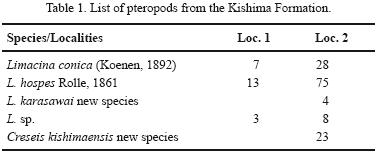
<body><![CDATA[<p align="justify"><font face="verdana" size="2"><b>REMARKS OF THE EARLY OLIGOCENE PTEROPOD FAUNA OF NORTHWESTERN KYUSHU</b></font></p>  	    <p align="justify"><font face="verdana" size="2">The pteropods from the uppermost part of the Kishima Formation constitute five species, including <i>Limacina conica</i> (Koenen), <i>L. hospes</i> Rolle, <i>L. karasawai</i> new species, <i>L</i>. sp., <i>Creseis kishimaensis</i> new species (<a href="#t1">Table 1</a>). This fauna is characterized by the predominance of <i>Limacina</i>. <i>Limacina hospes</i> is predominant for the pteropod faunas from the Oligocene of Europe (<i>e.g.</i>, G&uuml;rs and Janssen, 2004; Cahuzac and Janssen, 2010). This species represents the first record from the Pacific region and the oldest fossil record of the world. Therefore, <i>Limacina hospes</i> appears to characterize the pteropod faunas from the Oligocene through the world.</font></p>  	    <p align="center"><font face="verdana" size="2"><a name="t1"></a></font></p>  	    <p align="center"><font face="verdana" size="2"><img src="/img/revistas/rmcg/v28n2/a5t1.jpg"></font></p>  	    <p align="justify"><font face="verdana" size="2">The pteropod fauna from the Kishima Formation differs from that of the Middle to Upper Eocene Oniike Formation by the specific composition (<a href="/img/revistas/rmcg/v28n2/a5f5.jpg" target="_blank">Figure 5</a>). The pteropod fauna from the Oniike Formation is consituted by six species, do not contains the pteropod species of the Kishima Formation, and is characterized by the predominance of <i>Limacina canadaensis</i> (Ando <i>et al.</i>, 2009). However, that of the Kishima Formation does not contain <i>Limacina canadaensis</i> and other species reported from the Oniike Formation. This suggests that pteropod faunas in northwestern Kyushu had greatly changed between the late Eocene (CP15a) and the earliest early Oligocene (CP16a). The pteropod faunal change of the late Eocene to early Oligocene has been known from the North Sea Basin (Janssen and King, 1988), France (Cahuzac and Janssen, 2010) and the Gulf of Mexico coasts (Hodgkinson <i>et al.</i>, 1992). The faunal change between Oniike and Kishima formations is correlated with these changes. Funakawa <i>et al.</i> (2005) showed that radiolarians changed at the Eocene/Oligocene boundary in the central equatorial Pacific and suggested that the faunal change was caused by climatic cooling and correlated with global climatic changes (<i>e.g.</i>, Zachos <i>et al.</i>, 1996). Therefore, the climatic cooling event at the Eocene/Oligocene boundary (<i>e.g.</i>, Zachos <i>et al.</i>, 1996) appears to be one of the factors that led to the pteropod faunal change between the Oniike and Kishima formations.</font></p>  	    <p align="justify"><font face="verdana" size="2">&nbsp;</font></p>  	    <p align="justify"><font face="verdana" size="2"><b>ACKNOWLEDGMENTS</b></font></p>  	    <p align="justify"><font face="verdana" size="2">I thank A. Ujihara (Nagoya University) for providing critical comments to this study and reading the manuscript. H. Karasawa (Mizunami Fossil Museum) and Y. Fudouji (Karatsu, Saga) are thanked for assisting during field work. I also thank K. Hirunagi and M. Nozaki (Nagoya University Museum) for permitting me to use the SEM. I would also like to thank Y. Iryu, S. Hayashi, I. Suto, T. Ichihara, K. Inoue (Nagoya University), T. Yamaguchi (Scripps Institution of Oceanography, University of California San Diego) and Y. Nishioka (Kyoto University) for providing valuable comments for this study. I am grateful to K. Amano (Joetsu University of Education) and an anonymous reviewer for reviewing the manuscript and providing valuable comments, and F.J. Vega (UNAM) for translating the abstract into Spanish.</font></p>  	    <p align="justify"><font face="verdana" size="2">I deeply appreciate the late Dr. H. Shibata who gave me valuable suggestions and useful comments.</font></p>  	    <p align="justify"><font face="verdana" size="2">This work was partly supported by the Grant&#150;in&#150;Aid of FGI from the Fukada Geological Institute for T. Yamaguchi.</font></p>  	    ]]></body>
<body><![CDATA[<p align="justify"><font face="verdana" size="2">&nbsp;</font></p>  	    <p align="justify"><font face="verdana" size="2"><b>REFERENCES</b></font></p>  	    <!-- ref --><p align="justify"><font face="verdana" size="2">Ando, Y., Ujihara, A., Ichihara, T., 2009, First occurrence of Paleogene pteropods (Gastropoda; Thecosomata) from Japan: The Journal of the Geological Society of Japan, 115(4), 187&#150;190.    &nbsp;&nbsp;&nbsp;&nbsp;&nbsp;&nbsp;&nbsp;&nbsp;[&#160;<a href="javascript:void(0);" onclick="javascript: window.open('/scielo.php?script=sci_nlinks&ref=8060465&pid=S1026-8774201100020000500001&lng=','','width=640,height=500,resizable=yes,scrollbars=1,menubar=yes,');">Links</a>&#160;]<!-- end-ref --></font></p>  	    <!-- ref --><p align="justify"><font face="verdana" size="2">Bielokrys, L.S., 1997, Pteropod gastropods from the Eocene of the Ukraine: Paleontologichskii Zhurnal, 31(4), 14&#150;21.    &nbsp;&nbsp;&nbsp;&nbsp;&nbsp;&nbsp;&nbsp;&nbsp;[&#160;<a href="javascript:void(0);" onclick="javascript: window.open('/scielo.php?script=sci_nlinks&ref=8060467&pid=S1026-8774201100020000500002&lng=','','width=640,height=500,resizable=yes,scrollbars=1,menubar=yes,');">Links</a>&#160;]<!-- end-ref --></font></p>  	    <!-- ref --><p align="justify"><font face="verdana" size="2">Blainville, M.H.de, 1824, Mollusques, Mollusca (Malacoz.), <i>In</i> Dictionnaire des Sciences Naturelles. 32. Le Normant: Paris, F. G. Levrault, Strasbourg, 269&#150;285.    &nbsp;&nbsp;&nbsp;&nbsp;&nbsp;&nbsp;&nbsp;&nbsp;[&#160;<a href="javascript:void(0);" onclick="javascript: window.open('/scielo.php?script=sci_nlinks&ref=8060469&pid=S1026-8774201100020000500003&lng=','','width=640,height=500,resizable=yes,scrollbars=1,menubar=yes,');">Links</a>&#160;]<!-- end-ref --></font></p>  	    <!-- ref --><p align="justify"><font face="verdana" size="2">Bohn&#150;Havas, M., Lantos, M., Selmeczi, I., 2004, Biostratigraphic studies and correlation of Tertiary planktonic gastropods (pteropods) from Hungary: Acta Palaeontologica Romaniae, 4, 37&#150;43.    &nbsp;&nbsp;&nbsp;&nbsp;&nbsp;&nbsp;&nbsp;&nbsp;[&#160;<a href="javascript:void(0);" onclick="javascript: window.open('/scielo.php?script=sci_nlinks&ref=8060471&pid=S1026-8774201100020000500004&lng=','','width=640,height=500,resizable=yes,scrollbars=1,menubar=yes,');">Links</a>&#160;]<!-- end-ref --></font></p>  	    ]]></body>
<body><![CDATA[<!-- ref --><p align="justify"><font face="verdana" size="2">Bornemann, A., 1855, Die mikroskopische Fauna des Septarienthones von Hermsdorf bei Berlin: Zeitschrift der Deutschen Geologischen Gesellschaft, 7, 307&#150;371.    &nbsp;&nbsp;&nbsp;&nbsp;&nbsp;&nbsp;&nbsp;&nbsp;[&#160;<a href="javascript:void(0);" onclick="javascript: window.open('/scielo.php?script=sci_nlinks&ref=8060473&pid=S1026-8774201100020000500005&lng=','','width=640,height=500,resizable=yes,scrollbars=1,menubar=yes,');">Links</a>&#160;]<!-- end-ref --></font></p>  	    <!-- ref --><p align="justify"><font face="verdana" size="2">Bosc, L.A.G., 1817, Limacine. <i>in</i> Nouveau Dictionnaire d'Histoire Naturella: Paris, Deterville, 18, pp. 42.    &nbsp;&nbsp;&nbsp;&nbsp;&nbsp;&nbsp;&nbsp;&nbsp;[&#160;<a href="javascript:void(0);" onclick="javascript: window.open('/scielo.php?script=sci_nlinks&ref=8060475&pid=S1026-8774201100020000500006&lng=','','width=640,height=500,resizable=yes,scrollbars=1,menubar=yes,');">Links</a>&#160;]<!-- end-ref --></font></p>  	    <!-- ref --><p align="justify"><font face="verdana" size="2">Cahuzac, B., Janssen, A.W., 2010, Eocene to Miocene holoplanktonic Mollusca (Gastropoda) of the Aquitaine Basin, southwest France: Scripta Geologica, 141, 1&#150;193.    &nbsp;&nbsp;&nbsp;&nbsp;&nbsp;&nbsp;&nbsp;&nbsp;[&#160;<a href="javascript:void(0);" onclick="javascript: window.open('/scielo.php?script=sci_nlinks&ref=8060477&pid=S1026-8774201100020000500007&lng=','','width=640,height=500,resizable=yes,scrollbars=1,menubar=yes,');">Links</a>&#160;]<!-- end-ref --></font></p>  	    <!-- ref --><p align="justify"><font face="verdana" size="2">Chen, C., Huang, C.Y., 1990, Two new Oligocene pteropods with paleoenvironmental implications: Proceedings of the Geological Society of China, 33(3), 223&#150;235.    &nbsp;&nbsp;&nbsp;&nbsp;&nbsp;&nbsp;&nbsp;&nbsp;[&#160;<a href="javascript:void(0);" onclick="javascript: window.open('/scielo.php?script=sci_nlinks&ref=8060479&pid=S1026-8774201100020000500008&lng=','','width=640,height=500,resizable=yes,scrollbars=1,menubar=yes,');">Links</a>&#160;]<!-- end-ref --></font></p>  	    <!-- ref --><p align="justify"><font face="verdana" size="2">Curry, D., 1965, The English Palaeogene Pteropods: Proceedings of the Malacological Society of London, 36, 357&#150;371.    &nbsp;&nbsp;&nbsp;&nbsp;&nbsp;&nbsp;&nbsp;&nbsp;[&#160;<a href="javascript:void(0);" onclick="javascript: window.open('/scielo.php?script=sci_nlinks&ref=8060481&pid=S1026-8774201100020000500009&lng=','','width=640,height=500,resizable=yes,scrollbars=1,menubar=yes,');">Links</a>&#160;]<!-- end-ref --></font></p>  	    ]]></body>
<body><![CDATA[<!-- ref --><p align="justify"><font face="verdana" size="2">Curry, D., 1982, Pt&eacute;ropodes &eacute;oc&egrave;nes de la tuilerie de Gan (Pyr&eacute;n&eacute;es&#150;Atlantiques) et de quelques autres localit&eacute;s de SW de la France: Cahiers de Micropal&eacute;ontologie, 4(for 1981), 35&#150;44.    &nbsp;&nbsp;&nbsp;&nbsp;&nbsp;&nbsp;&nbsp;&nbsp;[&#160;<a href="javascript:void(0);" onclick="javascript: window.open('/scielo.php?script=sci_nlinks&ref=8060483&pid=S1026-8774201100020000500010&lng=','','width=640,height=500,resizable=yes,scrollbars=1,menubar=yes,');">Links</a>&#160;]<!-- end-ref --></font></p>  	    <!-- ref --><p align="justify"><font face="verdana" size="2">Fisher, P., 1883, Manuel de Conchyliologie et de Pal&eacute;ontologie conchyliologique: Paris, F. Savy, 1&#150;22, 1369 pp.    &nbsp;&nbsp;&nbsp;&nbsp;&nbsp;&nbsp;&nbsp;&nbsp;[&#160;<a href="javascript:void(0);" onclick="javascript: window.open('/scielo.php?script=sci_nlinks&ref=8060485&pid=S1026-8774201100020000500011&lng=','','width=640,height=500,resizable=yes,scrollbars=1,menubar=yes,');">Links</a>&#160;]<!-- end-ref --></font></p>  	    <!-- ref --><p align="justify"><font face="verdana" size="2">Funakawa, S., Nishi, H., Moore, Y.C., Nigrini, C.A., 2005, Radiolarian faunal turnover and paleoceanographic change around Eocene/Oligocene boundary in the central equatorial Pacific, ODP Leg 199, Holes 1218A, 1219A, and 1220A: Palaeogeography, Palaeoclimatology, Palaeoecology, 230, 183&#150;203.    &nbsp;&nbsp;&nbsp;&nbsp;&nbsp;&nbsp;&nbsp;&nbsp;[&#160;<a href="javascript:void(0);" onclick="javascript: window.open('/scielo.php?script=sci_nlinks&ref=8060487&pid=S1026-8774201100020000500012&lng=','','width=640,height=500,resizable=yes,scrollbars=1,menubar=yes,');">Links</a>&#160;]<!-- end-ref --></font></p>  	    <!-- ref --><p align="justify"><font face="verdana" size="2">Gardner, J., 1951, Two new guide fossils from the Tallahatta formation of the Southeastern States: Journal of the Washington Academy of Science, 41(1), 8&#150;12.    &nbsp;&nbsp;&nbsp;&nbsp;&nbsp;&nbsp;&nbsp;&nbsp;[&#160;<a href="javascript:void(0);" onclick="javascript: window.open('/scielo.php?script=sci_nlinks&ref=8060489&pid=S1026-8774201100020000500013&lng=','','width=640,height=500,resizable=yes,scrollbars=1,menubar=yes,');">Links</a>&#160;]<!-- end-ref --></font></p>  	    <!-- ref --><p align="justify"><font face="verdana" size="2">Gheorghian, M., Iva, M., Gheorghian. M., 1967, Consideratii asupra genului Spirialis: Dari de Seama ale Sedintelor, 53(2), 5&#150;16.    &nbsp;&nbsp;&nbsp;&nbsp;&nbsp;&nbsp;&nbsp;&nbsp;[&#160;<a href="javascript:void(0);" onclick="javascript: window.open('/scielo.php?script=sci_nlinks&ref=8060491&pid=S1026-8774201100020000500014&lng=','','width=640,height=500,resizable=yes,scrollbars=1,menubar=yes,');">Links</a>&#160;]<!-- end-ref --></font></p>  	    ]]></body>
<body><![CDATA[<!-- ref --><p align="justify"><font face="verdana" size="2">Gray, J.E., 1847, A list of the genera of recent Mollusca, their synonyma and types: Proceedings of the Zoological Society of London, 15, 129&#150;219.    &nbsp;&nbsp;&nbsp;&nbsp;&nbsp;&nbsp;&nbsp;&nbsp;[&#160;<a href="javascript:void(0);" onclick="javascript: window.open('/scielo.php?script=sci_nlinks&ref=8060493&pid=S1026-8774201100020000500015&lng=','','width=640,height=500,resizable=yes,scrollbars=1,menubar=yes,');">Links</a>&#160;]<!-- end-ref --></font></p>  	    <!-- ref --><p align="justify"><font face="verdana" size="2">G&uuml;rs, K., Janssen A.W., 2004, Sea&#150;level related molluscan plankton events (Gastropoda, Euthcosomata) during Rupelian (Early Oligocene) of the North Sea Basin: Netherlands Journal of Geoscience, 83(3), 199&#150;208.    &nbsp;&nbsp;&nbsp;&nbsp;&nbsp;&nbsp;&nbsp;&nbsp;[&#160;<a href="javascript:void(0);" onclick="javascript: window.open('/scielo.php?script=sci_nlinks&ref=8060495&pid=S1026-8774201100020000500016&lng=','','width=640,height=500,resizable=yes,scrollbars=1,menubar=yes,');">Links</a>&#160;]<!-- end-ref --></font></p>  	    <!-- ref --><p align="justify"><font face="verdana" size="2">Hodgkinson, K.A., Garvie, C.L., B&eacute;, A.W.H., 1992, Eocene Euthecosomatous Pteropoda (Gastropoda) of the Gulf and Eastern Coasts of North America: Bulletin of American Paleontology, 103(341), 5&#150;62.    &nbsp;&nbsp;&nbsp;&nbsp;&nbsp;&nbsp;&nbsp;&nbsp;[&#160;<a href="javascript:void(0);" onclick="javascript: window.open('/scielo.php?script=sci_nlinks&ref=8060497&pid=S1026-8774201100020000500017&lng=','','width=640,height=500,resizable=yes,scrollbars=1,menubar=yes,');">Links</a>&#160;]<!-- end-ref --></font></p>  	    <!-- ref --><p align="justify"><font face="verdana" size="2">Inoue, E., 1972, Lithofacies, fossil assembladge and sedimentary environment of Oligocene Kishima Formation in Karatsu Coalfield, Northwest Kyushu, Southwest Japan: Report of Geological Survey of Japan, (245), 1&#150;72.    &nbsp;&nbsp;&nbsp;&nbsp;&nbsp;&nbsp;&nbsp;&nbsp;[&#160;<a href="javascript:void(0);" onclick="javascript: window.open('/scielo.php?script=sci_nlinks&ref=8060499&pid=S1026-8774201100020000500018&lng=','','width=640,height=500,resizable=yes,scrollbars=1,menubar=yes,');">Links</a>&#160;]<!-- end-ref --></font></p>  	    <!-- ref --><p align="justify"><font face="verdana" size="2">Janssen, A.W., 1984, Type specimens of pteropod species (Mollusca, Gastropoda) described by Rolle (1861), Reuss (1867) and Kittl (1886), kept in the collection of the Naturhistorisches Museum at Vienna: Mededelingen van de Werkgroep voor Tertiaire en Kwartaire Geologie, 21(2), 61&#150;91.    &nbsp;&nbsp;&nbsp;&nbsp;&nbsp;&nbsp;&nbsp;&nbsp;[&#160;<a href="javascript:void(0);" onclick="javascript: window.open('/scielo.php?script=sci_nlinks&ref=8060501&pid=S1026-8774201100020000500019&lng=','','width=640,height=500,resizable=yes,scrollbars=1,menubar=yes,');">Links</a>&#160;]<!-- end-ref --></font></p>  	    ]]></body>
<body><![CDATA[<!-- ref --><p align="justify"><font face="verdana" size="2">Janssen, A.W., 1989a, Some new pteropod species from the North Sea Basin Cainozoic (Mollusca: Gastropoda, Euthecosomata): Mededelingen van de Werkgroep voor Tertiaire en Kwartaire Geologie, 26(3), 91&#150;133.    &nbsp;&nbsp;&nbsp;&nbsp;&nbsp;&nbsp;&nbsp;&nbsp;[&#160;<a href="javascript:void(0);" onclick="javascript: window.open('/scielo.php?script=sci_nlinks&ref=8060503&pid=S1026-8774201100020000500020&lng=','','width=640,height=500,resizable=yes,scrollbars=1,menubar=yes,');">Links</a>&#160;]<!-- end-ref --></font></p>  	    <!-- ref --><p align="justify"><font face="verdana" size="2">Janssen, A.W., 1989b, Pteropoda (Gastropoda, Euthecosomata) from Australian Cainozoic: Scripta Geologica, 91, 1&#150;76.    &nbsp;&nbsp;&nbsp;&nbsp;&nbsp;&nbsp;&nbsp;&nbsp;[&#160;<a href="javascript:void(0);" onclick="javascript: window.open('/scielo.php?script=sci_nlinks&ref=8060505&pid=S1026-8774201100020000500021&lng=','','width=640,height=500,resizable=yes,scrollbars=1,menubar=yes,');">Links</a>&#160;]<!-- end-ref --></font></p>  	    <!-- ref --><p align="justify"><font face="verdana" size="2">Janssen, A.W., 1990, Pteropod species (Mollusca, Gastropoda, Euthecosomata) from the Late Oligocene of Mogenstrup, Jylland, Denmark: Contributions to Tertiary and Quaternary Geology, 27(2&#150;3), 83&#150;91.    &nbsp;&nbsp;&nbsp;&nbsp;&nbsp;&nbsp;&nbsp;&nbsp;[&#160;<a href="javascript:void(0);" onclick="javascript: window.open('/scielo.php?script=sci_nlinks&ref=8060507&pid=S1026-8774201100020000500022&lng=','','width=640,height=500,resizable=yes,scrollbars=1,menubar=yes,');">Links</a>&#160;]<!-- end-ref --></font></p>  	    <!-- ref --><p align="justify"><font face="verdana" size="2">Janssen, A.W., King, C., 1988, Planktonic mollusks (Pteropods), <i>in</i> Vinken R., (ed.), The Northwest European Tertiary Basin, Results of the International Geological Correlation Programme Project no. 124: Hannover, Geologisches Jahrbuch, 100, 356&#150;368.    &nbsp;&nbsp;&nbsp;&nbsp;&nbsp;&nbsp;&nbsp;&nbsp;[&#160;<a href="javascript:void(0);" onclick="javascript: window.open('/scielo.php?script=sci_nlinks&ref=8060509&pid=S1026-8774201100020000500023&lng=','','width=640,height=500,resizable=yes,scrollbars=1,menubar=yes,');">Links</a>&#160;]<!-- end-ref --></font></p>  	    <!-- ref --><p align="justify"><font face="verdana" size="2">Karasawa, H., 1993, Cenozoic decapods Crustacea from Southwest Japan: Bulletin of the Mizunami Fossil Museum, (20), 1&#150;92.    &nbsp;&nbsp;&nbsp;&nbsp;&nbsp;&nbsp;&nbsp;&nbsp;[&#160;<a href="javascript:void(0);" onclick="javascript: window.open('/scielo.php?script=sci_nlinks&ref=8060511&pid=S1026-8774201100020000500024&lng=','','width=640,height=500,resizable=yes,scrollbars=1,menubar=yes,');">Links</a>&#160;]<!-- end-ref --></font></p>  	    ]]></body>
<body><![CDATA[<!-- ref --><p align="justify"><font face="verdana" size="2">Karasawa, H., Fudouji, Y., 2000, Paleogene decapod Crustacea from the Kishima and Okinoshima Groups, Kyushu, Japan: Paleontological Research, 4(4), 239&#150;253.    &nbsp;&nbsp;&nbsp;&nbsp;&nbsp;&nbsp;&nbsp;&nbsp;[&#160;<a href="javascript:void(0);" onclick="javascript: window.open('/scielo.php?script=sci_nlinks&ref=8060513&pid=S1026-8774201100020000500025&lng=','','width=640,height=500,resizable=yes,scrollbars=1,menubar=yes,');">Links</a>&#160;]<!-- end-ref --></font></p>  	    <!-- ref --><p align="justify"><font face="verdana" size="2">Koenen, A.von., 1892, Das Norddeutsche Unter&#150;Oligoc&auml;n und seine Mollusken&#150;Fauna: Abhandlungen zur geologischen Special&#150;Karte von Preussen und der Th&uuml;ringishen Staaten, 10(4), 819&#150;1004.    &nbsp;&nbsp;&nbsp;&nbsp;&nbsp;&nbsp;&nbsp;&nbsp;[&#160;<a href="javascript:void(0);" onclick="javascript: window.open('/scielo.php?script=sci_nlinks&ref=8060515&pid=S1026-8774201100020000500026&lng=','','width=640,height=500,resizable=yes,scrollbars=1,menubar=yes,');">Links</a>&#160;]<!-- end-ref --></font></p>  	    <!-- ref --><p align="justify"><font face="verdana" size="2">Korobkov, I.A., 1966, Krylonogie (Mollusca Pteropoda) Paleogenovykh otlozhenij juga S.S.S.R: Voprosy Paleontologii, 5, 71&#150;92.    &nbsp;&nbsp;&nbsp;&nbsp;&nbsp;&nbsp;&nbsp;&nbsp;[&#160;<a href="javascript:void(0);" onclick="javascript: window.open('/scielo.php?script=sci_nlinks&ref=8060517&pid=S1026-8774201100020000500027&lng=','','width=640,height=500,resizable=yes,scrollbars=1,menubar=yes,');">Links</a>&#160;]<!-- end-ref --></font></p>  	    <!-- ref --><p align="justify"><font face="verdana" size="2">Kittl, E., 1886, Ueber die miocenen Pteropoden von Oesterreich&#150;Ungarn, mit Ber&uuml;cksichtigung verwandter Vorkommnisse der Nachbarl&auml;nder: Annalen des Naturhistorischen Hofmuseums, 1(2), 47&#150;74.    &nbsp;&nbsp;&nbsp;&nbsp;&nbsp;&nbsp;&nbsp;&nbsp;[&#160;<a href="javascript:void(0);" onclick="javascript: window.open('/scielo.php?script=sci_nlinks&ref=8060519&pid=S1026-8774201100020000500028&lng=','','width=640,height=500,resizable=yes,scrollbars=1,menubar=yes,');">Links</a>&#160;]<!-- end-ref --></font></p>  	    <!-- ref --><p align="justify"><font face="verdana" size="2">Laws, C.R., 1944, The molluscan faunule at Pakaurangi Point, Kaipara, No. 3: Transactions and Proceedings of the Royal Society of New Zealand, 73(4), 297&#150;312.    &nbsp;&nbsp;&nbsp;&nbsp;&nbsp;&nbsp;&nbsp;&nbsp;[&#160;<a href="javascript:void(0);" onclick="javascript: window.open('/scielo.php?script=sci_nlinks&ref=8060521&pid=S1026-8774201100020000500029&lng=','','width=640,height=500,resizable=yes,scrollbars=1,menubar=yes,');">Links</a>&#160;]<!-- end-ref --></font></p>  	    ]]></body>
<body><![CDATA[<!-- ref --><p align="justify"><font face="verdana" size="2">Meisenheimer, J., 1905, Pteropoda, Wissenschaft Ergebnis: Tiefsee Expedition "Valdivia", 9, 1&#150;314.    &nbsp;&nbsp;&nbsp;&nbsp;&nbsp;&nbsp;&nbsp;&nbsp;[&#160;<a href="javascript:void(0);" onclick="javascript: window.open('/scielo.php?script=sci_nlinks&ref=8060523&pid=S1026-8774201100020000500030&lng=','','width=640,height=500,resizable=yes,scrollbars=1,menubar=yes,');">Links</a>&#160;]<!-- end-ref --></font></p>  	    <!-- ref --><p align="justify"><font face="verdana" size="2">Meyer, O., 1886, Contributions to the Eocene Paleontology of Alabama and Mississippi. Part 2, <i>in</i> Smith, E. A. (ed.), Geology of Alabama: Geological Survey of Alabama Bulletin, 1, 61&#150;85.    &nbsp;&nbsp;&nbsp;&nbsp;&nbsp;&nbsp;&nbsp;&nbsp;[&#160;<a href="javascript:void(0);" onclick="javascript: window.open('/scielo.php?script=sci_nlinks&ref=8060525&pid=S1026-8774201100020000500031&lng=','','width=640,height=500,resizable=yes,scrollbars=1,menubar=yes,');">Links</a>&#160;]<!-- end-ref --></font></p>  	    <!-- ref --><p align="justify"><font face="verdana" size="2">Nagao, T., 1927, The Paleogene stratigraphy of Kyushu: Journal of Geography, 39(9), 501&#150;512.    &nbsp;&nbsp;&nbsp;&nbsp;&nbsp;&nbsp;&nbsp;&nbsp;[&#160;<a href="javascript:void(0);" onclick="javascript: window.open('/scielo.php?script=sci_nlinks&ref=8060527&pid=S1026-8774201100020000500032&lng=','','width=640,height=500,resizable=yes,scrollbars=1,menubar=yes,');">Links</a>&#160;]<!-- end-ref --></font></p>  	    <!-- ref --><p align="justify"><font face="verdana" size="2">Okada, H., 1992, Calcareous nannofossils and biostratigraphy of the Paleogene sequences of northern Kyushu, Japan: The Journal of the Geological Society of Japan, 98(6), 505&#150;528.    &nbsp;&nbsp;&nbsp;&nbsp;&nbsp;&nbsp;&nbsp;&nbsp;[&#160;<a href="javascript:void(0);" onclick="javascript: window.open('/scielo.php?script=sci_nlinks&ref=8060529&pid=S1026-8774201100020000500033&lng=','','width=640,height=500,resizable=yes,scrollbars=1,menubar=yes,');">Links</a>&#160;]<!-- end-ref --></font></p>  	    <!-- ref --><p align="justify"><font face="verdana" size="2">Okada, H., Bukry, D., 1980, Supplementary modification and introduction of code numbers to the low&#150;latitude coccolith biostratigraphic Zonation (Bukry, 1973; 1975): Marine Micropaleontology, 5, 321&#150;325.    &nbsp;&nbsp;&nbsp;&nbsp;&nbsp;&nbsp;&nbsp;&nbsp;[&#160;<a href="javascript:void(0);" onclick="javascript: window.open('/scielo.php?script=sci_nlinks&ref=8060531&pid=S1026-8774201100020000500034&lng=','','width=640,height=500,resizable=yes,scrollbars=1,menubar=yes,');">Links</a>&#160;]<!-- end-ref --></font></p>  	    ]]></body>
<body><![CDATA[<!-- ref --><p align="justify"><font face="verdana" size="2">Rang, P.C.A.L., 1828, Notice sur quelques Mollusques nouveaux appartenant au genre Cl&eacute;odore, et &eacute;tablissement et monographie du sous&#150;genre Cr&eacute;seis: Annales des Sciences Naturelles, 13, 302&#150;319.    &nbsp;&nbsp;&nbsp;&nbsp;&nbsp;&nbsp;&nbsp;&nbsp;[&#160;<a href="javascript:void(0);" onclick="javascript: window.open('/scielo.php?script=sci_nlinks&ref=8060533&pid=S1026-8774201100020000500035&lng=','','width=640,height=500,resizable=yes,scrollbars=1,menubar=yes,');">Links</a>&#160;]<!-- end-ref --></font></p>  	    <!-- ref --><p align="justify"><font face="verdana" size="2">Rolle, F., 1861, &Uuml;ber einige neue oder wenig gekannte Mollusken&#150;Arten aus Terti&auml;r&#150;Ablagerungen: Sitzungsberichte der Akademie der Wissenschaften in Wien, 44, 205&#150;224.    &nbsp;&nbsp;&nbsp;&nbsp;&nbsp;&nbsp;&nbsp;&nbsp;[&#160;<a href="javascript:void(0);" onclick="javascript: window.open('/scielo.php?script=sci_nlinks&ref=8060535&pid=S1026-8774201100020000500036&lng=','','width=640,height=500,resizable=yes,scrollbars=1,menubar=yes,');">Links</a>&#160;]<!-- end-ref --></font></p>  	    <!-- ref --><p align="justify"><font face="verdana" size="2">Tembrock, M.L., 1964, Einige Beispiele von Faziesabh&auml;ngigkeit bei terti&auml;ren Gastropoden: Berichte der geologischen Gesellschaft in der Deutschen Demokratischen Republik, 9(3), 311&#150;337.    &nbsp;&nbsp;&nbsp;&nbsp;&nbsp;&nbsp;&nbsp;&nbsp;[&#160;<a href="javascript:void(0);" onclick="javascript: window.open('/scielo.php?script=sci_nlinks&ref=8060537&pid=S1026-8774201100020000500037&lng=','','width=640,height=500,resizable=yes,scrollbars=1,menubar=yes,');">Links</a>&#160;]<!-- end-ref --></font></p>  	    <!-- ref --><p align="justify"><font face="verdana" size="2">Yamaguchi, T., Nagao, R., Kamiya, T., 2006, Paleogene ostracodes from the Kishima Formation, Kishima Group, Saga Prefecture, southwest Japan: Bulletin of the Mizunami Fossil Museum, (33), 87&#150;101.    &nbsp;&nbsp;&nbsp;&nbsp;&nbsp;&nbsp;&nbsp;&nbsp;[&#160;<a href="javascript:void(0);" onclick="javascript: window.open('/scielo.php?script=sci_nlinks&ref=8060539&pid=S1026-8774201100020000500038&lng=','','width=640,height=500,resizable=yes,scrollbars=1,menubar=yes,');">Links</a>&#160;]<!-- end-ref --></font></p>  	    <!-- ref --><p align="justify"><font face="verdana" size="2">Zachos, J.C., Quinn, T.M., Salamy, K.A., 1996, High&#150;resolution (104 years) deep&#150;sea foraminiferal stable isotope records of the Eocene&#150;Oligocene climate transition: Paleoceanography, 11, 251&#150;266.    &nbsp;&nbsp;&nbsp;&nbsp;&nbsp;&nbsp;&nbsp;&nbsp;[&#160;<a href="javascript:void(0);" onclick="javascript: window.open('/scielo.php?script=sci_nlinks&ref=8060541&pid=S1026-8774201100020000500039&lng=','','width=640,height=500,resizable=yes,scrollbars=1,menubar=yes,');">Links</a>&#160;]<!-- end-ref --></font></p>  	    ]]></body>
<body><![CDATA[<!-- ref --><p align="justify"><font face="verdana" size="2">Zorn, I., 1991, A systematic account of Tertiary Pteropoda (Gastropoda, Euthecosomata) from Austria: Contributions to Tertiary and Quaternary Geology, 28(4), 95&#150;139.    &nbsp;&nbsp;&nbsp;&nbsp;&nbsp;&nbsp;&nbsp;&nbsp;[&#160;<a href="javascript:void(0);" onclick="javascript: window.open('/scielo.php?script=sci_nlinks&ref=8060543&pid=S1026-8774201100020000500040&lng=','','width=640,height=500,resizable=yes,scrollbars=1,menubar=yes,');">Links</a>&#160;]<!-- end-ref --></font></p>      ]]></body><back>
<ref-list>
<ref id="B1">
<nlm-citation citation-type="journal">
<person-group person-group-type="author">
<name>
<surname><![CDATA[Ando]]></surname>
<given-names><![CDATA[Y.]]></given-names>
</name>
<name>
<surname><![CDATA[Ujihara]]></surname>
<given-names><![CDATA[A.]]></given-names>
</name>
<name>
<surname><![CDATA[Ichihara]]></surname>
<given-names><![CDATA[T.]]></given-names>
</name>
</person-group>
<article-title xml:lang="en"><![CDATA[First occurrence of Paleogene pteropods (Gastropoda; Thecosomata) from Japan]]></article-title>
<source><![CDATA[The Journal of the Geological Society of Japan]]></source>
<year>2009</year>
<volume>115</volume>
<numero>4</numero>
<issue>4</issue>
<page-range>187-190</page-range></nlm-citation>
</ref>
<ref id="B2">
<nlm-citation citation-type="journal">
<person-group person-group-type="author">
<name>
<surname><![CDATA[Bielokrys]]></surname>
<given-names><![CDATA[L.S.]]></given-names>
</name>
</person-group>
<article-title xml:lang="en"><![CDATA[Pteropod gastropods from the Eocene of the Ukraine]]></article-title>
<source><![CDATA[Paleontologichskii Zhurnal]]></source>
<year>1997</year>
<volume>31</volume>
<numero>4</numero>
<issue>4</issue>
<page-range>14-21</page-range></nlm-citation>
</ref>
<ref id="B3">
<nlm-citation citation-type="book">
<article-title xml:lang="en"><![CDATA[Mollusques, Mollusca (Malacoz.)]]></article-title>
<source><![CDATA[Dictionnaire des Sciences Naturelles]]></source>
<year>1824</year>
<volume>32</volume>
<page-range>269-285</page-range><publisher-loc><![CDATA[Paris ]]></publisher-loc>
<publisher-name><![CDATA[Le Normant]]></publisher-name>
</nlm-citation>
</ref>
<ref id="B4">
<nlm-citation citation-type="journal">
<person-group person-group-type="author">
<name>
<surname><![CDATA[Bohn-Havas]]></surname>
<given-names><![CDATA[M.]]></given-names>
</name>
<name>
<surname><![CDATA[Lantos]]></surname>
<given-names><![CDATA[M.]]></given-names>
</name>
<name>
<surname><![CDATA[Selmeczi]]></surname>
<given-names><![CDATA[I.]]></given-names>
</name>
</person-group>
<article-title xml:lang="en"><![CDATA[Biostratigraphic studies and correlation of Tertiary planktonic gastropods (pteropods) from Hungary]]></article-title>
<source><![CDATA[Acta Palaeontologica Romaniae]]></source>
<year>2004</year>
<volume>4</volume>
<page-range>37-43</page-range></nlm-citation>
</ref>
<ref id="B5">
<nlm-citation citation-type="journal">
<person-group person-group-type="author">
<name>
<surname><![CDATA[Bornemann]]></surname>
<given-names><![CDATA[A.]]></given-names>
</name>
</person-group>
<article-title xml:lang="de"><![CDATA[Die mikroskopische Fauna des Septarienthones von Hermsdorf bei Berlin]]></article-title>
<source><![CDATA[Zeitschrift der Deutschen Geologischen Gesellschaft]]></source>
<year>1855</year>
<volume>7</volume>
<page-range>307-371</page-range></nlm-citation>
</ref>
<ref id="B6">
<nlm-citation citation-type="book">
<person-group person-group-type="author">
<name>
<surname><![CDATA[Bosc]]></surname>
<given-names><![CDATA[L.A.G.]]></given-names>
</name>
</person-group>
<article-title xml:lang="fr"><![CDATA[Limacine]]></article-title>
<source><![CDATA[Nouveau Dictionnaire d'Histoire Naturella]]></source>
<year>1817</year>
<volume>18</volume>
<page-range>42</page-range><publisher-loc><![CDATA[Paris ]]></publisher-loc>
<publisher-name><![CDATA[Deterville]]></publisher-name>
</nlm-citation>
</ref>
<ref id="B7">
<nlm-citation citation-type="journal">
<person-group person-group-type="author">
<name>
<surname><![CDATA[Cahuzac]]></surname>
<given-names><![CDATA[B.]]></given-names>
</name>
<name>
<surname><![CDATA[Janssen]]></surname>
<given-names><![CDATA[A.W.]]></given-names>
</name>
</person-group>
<article-title xml:lang="en"><![CDATA[Eocene to Miocene holoplanktonic Mollusca (Gastropoda) of the Aquitaine Basin, southwest France]]></article-title>
<source><![CDATA[Scripta Geologica]]></source>
<year>2010</year>
<volume>141</volume>
<page-range>1-193</page-range></nlm-citation>
</ref>
<ref id="B8">
<nlm-citation citation-type="journal">
<person-group person-group-type="author">
<name>
<surname><![CDATA[Chen]]></surname>
<given-names><![CDATA[C.]]></given-names>
</name>
<name>
<surname><![CDATA[Huang]]></surname>
<given-names><![CDATA[C.Y.]]></given-names>
</name>
</person-group>
<article-title xml:lang="en"><![CDATA[Two new Oligocene pteropods with paleoenvironmental implications]]></article-title>
<source><![CDATA[Proceedings of the Geological Society of China]]></source>
<year>1990</year>
<volume>33</volume>
<numero>3</numero>
<issue>3</issue>
<page-range>223-235</page-range></nlm-citation>
</ref>
<ref id="B9">
<nlm-citation citation-type="journal">
<person-group person-group-type="author">
<name>
<surname><![CDATA[Curry]]></surname>
<given-names><![CDATA[D.]]></given-names>
</name>
</person-group>
<article-title xml:lang="en"><![CDATA[The English Palaeogene Pteropods]]></article-title>
<source><![CDATA[Proceedings of the Malacological Society of London]]></source>
<year>1965</year>
<volume>36</volume>
<page-range>357-371</page-range></nlm-citation>
</ref>
<ref id="B10">
<nlm-citation citation-type="journal">
<person-group person-group-type="author">
<name>
<surname><![CDATA[Curry]]></surname>
<given-names><![CDATA[D.]]></given-names>
</name>
</person-group>
<article-title xml:lang="fr"><![CDATA[Ptéropodes éocènes de la tuilerie de Gan (Pyrénées-Atlantiques) et de quelques autres localités de SW de la France]]></article-title>
<source><![CDATA[Cahiers de Micropaléontologie]]></source>
<year>1982</year>
<volume>4</volume>
<page-range>35-44</page-range></nlm-citation>
</ref>
<ref id="B11">
<nlm-citation citation-type="book">
<person-group person-group-type="author">
<name>
<surname><![CDATA[Fisher]]></surname>
<given-names><![CDATA[P.]]></given-names>
</name>
</person-group>
<source><![CDATA[Manuel de Conchyliologie et de Paléontologie conchyliologique]]></source>
<year>1883</year>
<page-range>1369</page-range><publisher-loc><![CDATA[Paris ]]></publisher-loc>
<publisher-name><![CDATA[F. Savy]]></publisher-name>
</nlm-citation>
</ref>
<ref id="B12">
<nlm-citation citation-type="journal">
<person-group person-group-type="author">
<name>
<surname><![CDATA[Funakawa]]></surname>
<given-names><![CDATA[S.]]></given-names>
</name>
<name>
<surname><![CDATA[Nishi]]></surname>
<given-names><![CDATA[H.]]></given-names>
</name>
<name>
<surname><![CDATA[Moore]]></surname>
<given-names><![CDATA[Y.C.]]></given-names>
</name>
<name>
<surname><![CDATA[Nigrini]]></surname>
<given-names><![CDATA[C.A.]]></given-names>
</name>
</person-group>
<article-title xml:lang="en"><![CDATA[Radiolarian faunal turnover and paleoceanographic change around Eocene/Oligocene boundary in the central equatorial Pacific, ODP Leg 199, Holes 1218A, 1219A, and 1220A]]></article-title>
<source><![CDATA[Palaeogeography, Palaeoclimatology, Palaeoecology]]></source>
<year>2005</year>
<volume>230</volume>
<page-range>183-203</page-range></nlm-citation>
</ref>
<ref id="B13">
<nlm-citation citation-type="journal">
<person-group person-group-type="author">
<name>
<surname><![CDATA[Gardner]]></surname>
<given-names><![CDATA[J.]]></given-names>
</name>
</person-group>
<article-title xml:lang="en"><![CDATA[Two new guide fossils from the Tallahatta formation of the Southeastern States]]></article-title>
<source><![CDATA[Journal of the Washington Academy of Science]]></source>
<year>1951</year>
<volume>41</volume>
<numero>1</numero>
<issue>1</issue>
<page-range>8-12</page-range></nlm-citation>
</ref>
<ref id="B14">
<nlm-citation citation-type="journal">
<person-group person-group-type="author">
<name>
<surname><![CDATA[Gheorghian]]></surname>
<given-names><![CDATA[M.]]></given-names>
</name>
<name>
<surname><![CDATA[Iva]]></surname>
<given-names><![CDATA[M.]]></given-names>
</name>
<name>
<surname><![CDATA[Gheorghian.]]></surname>
<given-names><![CDATA[M.]]></given-names>
</name>
</person-group>
<article-title xml:lang="en"><![CDATA[Consideratii asupra genului Spirialis]]></article-title>
<source><![CDATA[Dari de Seama ale Sedintelor]]></source>
<year>1967</year>
<volume>53</volume>
<numero>2</numero>
<issue>2</issue>
<page-range>5-16</page-range></nlm-citation>
</ref>
<ref id="B15">
<nlm-citation citation-type="journal">
<person-group person-group-type="author">
<name>
<surname><![CDATA[Gray]]></surname>
<given-names><![CDATA[J.E.]]></given-names>
</name>
</person-group>
<article-title xml:lang="en"><![CDATA[A list of the genera of recent Mollusca, their synonyma and types]]></article-title>
<source><![CDATA[Proceedings of the Zoological Society of London]]></source>
<year>1847</year>
<volume>15</volume>
<page-range>129-219</page-range></nlm-citation>
</ref>
<ref id="B16">
<nlm-citation citation-type="journal">
<person-group person-group-type="author">
<name>
<surname><![CDATA[Gürs]]></surname>
<given-names><![CDATA[K.]]></given-names>
</name>
<name>
<surname><![CDATA[Janssen]]></surname>
<given-names><![CDATA[A.W.]]></given-names>
</name>
</person-group>
<article-title xml:lang="en"><![CDATA[Sea-level related molluscan plankton events (Gastropoda, Euthcosomata) during Rupelian (Early Oligocene) of the North Sea Basin]]></article-title>
<source><![CDATA[Netherlands Journal of Geoscience]]></source>
<year>2004</year>
<volume>83</volume>
<numero>3</numero>
<issue>3</issue>
<page-range>199-208</page-range></nlm-citation>
</ref>
<ref id="B17">
<nlm-citation citation-type="journal">
<person-group person-group-type="author">
<name>
<surname><![CDATA[Hodgkinson]]></surname>
<given-names><![CDATA[K.A.]]></given-names>
</name>
<name>
<surname><![CDATA[Garvie]]></surname>
<given-names><![CDATA[C.L.]]></given-names>
</name>
<name>
<surname><![CDATA[Bé]]></surname>
<given-names><![CDATA[A.W.H.]]></given-names>
</name>
</person-group>
<article-title xml:lang="en"><![CDATA[Eocene Euthecosomatous Pteropoda (Gastropoda) of the Gulf and Eastern Coasts of North America]]></article-title>
<source><![CDATA[Bulletin of American Paleontology]]></source>
<year>1992</year>
<volume>103</volume>
<numero>341</numero>
<issue>341</issue>
<page-range>5-62</page-range></nlm-citation>
</ref>
<ref id="B18">
<nlm-citation citation-type="">
<person-group person-group-type="author">
<name>
<surname><![CDATA[Inoue]]></surname>
<given-names><![CDATA[E.]]></given-names>
</name>
</person-group>
<article-title xml:lang="en"><![CDATA[Lithofacies, fossil assembladge and sedimentary environment of Oligocene Kishima Formation in Karatsu Coalfield, Northwest Kyushu, Southwest Japan]]></article-title>
<source><![CDATA[]]></source>
<year>1972</year>
<volume>245</volume>
<page-range>1-72</page-range></nlm-citation>
</ref>
<ref id="B19">
<nlm-citation citation-type="journal">
<person-group person-group-type="author">
<name>
<surname><![CDATA[Janssen]]></surname>
<given-names><![CDATA[A.W.]]></given-names>
</name>
</person-group>
<article-title xml:lang="en"><![CDATA[Type specimens of pteropod species (Mollusca, Gastropoda) described by Rolle (1861), Reuss (1867) and Kittl (1886), kept in the collection of the Naturhistorisches Museum at Vienna]]></article-title>
<source><![CDATA[Mededelingen van de Werkgroep voor Tertiaire en Kwartaire Geologie]]></source>
<year>1984</year>
<volume>21</volume>
<numero>2</numero>
<issue>2</issue>
<page-range>61-91</page-range></nlm-citation>
</ref>
<ref id="B20">
<nlm-citation citation-type="journal">
<person-group person-group-type="author">
<name>
<surname><![CDATA[Janssen]]></surname>
<given-names><![CDATA[A.W.]]></given-names>
</name>
</person-group>
<article-title xml:lang="en"><![CDATA[Some new pteropod species from the North Sea Basin Cainozoic (Mollusca: Gastropoda, Euthecosomata)]]></article-title>
<source><![CDATA[Mededelingen van de Werkgroep voor Tertiaire en Kwartaire Geologie]]></source>
<year>1989</year>
<volume>26</volume>
<numero>3</numero>
<issue>3</issue>
<page-range>91-133</page-range></nlm-citation>
</ref>
<ref id="B21">
<nlm-citation citation-type="journal">
<person-group person-group-type="author">
<name>
<surname><![CDATA[Janssen]]></surname>
<given-names><![CDATA[A.W.]]></given-names>
</name>
</person-group>
<article-title xml:lang="en"><![CDATA[Pteropoda (Gastropoda, Euthecosomata) from Australian Cainozoic]]></article-title>
<source><![CDATA[Scripta Geologica]]></source>
<year>1989</year>
<volume>91</volume>
<page-range>1-76</page-range></nlm-citation>
</ref>
<ref id="B22">
<nlm-citation citation-type="journal">
<person-group person-group-type="author">
<name>
<surname><![CDATA[Janssen]]></surname>
<given-names><![CDATA[A.W.]]></given-names>
</name>
</person-group>
<article-title xml:lang="en"><![CDATA[Pteropod species (Mollusca, Gastropoda, Euthecosomata) from the Late Oligocene of Mogenstrup, Jylland, Denmark]]></article-title>
<source><![CDATA[Contributions to Tertiary and Quaternary Geology]]></source>
<year>1990</year>
<volume>27</volume>
<numero>2-3</numero>
<issue>2-3</issue>
<page-range>83-91</page-range></nlm-citation>
</ref>
<ref id="B23">
<nlm-citation citation-type="book">
<person-group person-group-type="author">
<name>
<surname><![CDATA[Janssen]]></surname>
<given-names><![CDATA[A.W.]]></given-names>
</name>
<name>
<surname><![CDATA[King]]></surname>
<given-names><![CDATA[C.]]></given-names>
</name>
</person-group>
<article-title xml:lang="en"><![CDATA[Planktonic mollusks (Pteropods)]]></article-title>
<person-group person-group-type="editor">
<name>
<surname><![CDATA[Vinken]]></surname>
<given-names><![CDATA[R.]]></given-names>
</name>
</person-group>
<source><![CDATA[The Northwest European Tertiary Basin, Results of the International Geological Correlation Programme Project no. 124]]></source>
<year>1988</year>
<volume>100</volume>
<page-range>356-368</page-range><publisher-loc><![CDATA[Hannover ]]></publisher-loc>
<publisher-name><![CDATA[Geologisches Jahrbuch]]></publisher-name>
</nlm-citation>
</ref>
<ref id="B24">
<nlm-citation citation-type="journal">
<person-group person-group-type="author">
<name>
<surname><![CDATA[Karasawa]]></surname>
<given-names><![CDATA[H.]]></given-names>
</name>
</person-group>
<article-title xml:lang="en"><![CDATA[Cenozoic decapods Crustacea from Southwest Japan]]></article-title>
<source><![CDATA[Bulletin of the Mizunami Fossil Museum]]></source>
<year>1993</year>
<volume>20</volume>
<page-range>1-92</page-range></nlm-citation>
</ref>
<ref id="B25">
<nlm-citation citation-type="journal">
<person-group person-group-type="author">
<name>
<surname><![CDATA[Karasawa]]></surname>
<given-names><![CDATA[H.]]></given-names>
</name>
<name>
<surname><![CDATA[Fudouji]]></surname>
<given-names><![CDATA[Y.]]></given-names>
</name>
</person-group>
<article-title xml:lang="en"><![CDATA[Paleogene decapod Crustacea from the Kishima and Okinoshima Groups, Kyushu, Japan]]></article-title>
<source><![CDATA[Paleontological Research]]></source>
<year>2000</year>
<volume>4</volume>
<numero>4</numero>
<issue>4</issue>
<page-range>239-253</page-range></nlm-citation>
</ref>
<ref id="B26">
<nlm-citation citation-type="journal">
<person-group person-group-type="author">
<name>
<surname><![CDATA[Koenen]]></surname>
<given-names><![CDATA[A.von.]]></given-names>
</name>
</person-group>
<article-title xml:lang="de"><![CDATA[Das Norddeutsche Unter-Oligocän und seine Mollusken-Fauna]]></article-title>
<source><![CDATA[Abhandlungen zur geologischen Special-Karte von Preussen und der Thüringishen Staaten]]></source>
<year>1892</year>
<volume>10</volume>
<numero>4</numero>
<issue>4</issue>
<page-range>819-1004</page-range></nlm-citation>
</ref>
<ref id="B27">
<nlm-citation citation-type="journal">
<person-group person-group-type="author">
<name>
<surname><![CDATA[Korobkov]]></surname>
<given-names><![CDATA[I.A.]]></given-names>
</name>
</person-group>
<article-title xml:lang="ru"><![CDATA[Krylonogie (Mollusca Pteropoda) Paleogenovykh otlozhenij juga S.S.S.R]]></article-title>
<source><![CDATA[Voprosy Paleontologii]]></source>
<year>1966</year>
<volume>5</volume>
<page-range>71-92</page-range></nlm-citation>
</ref>
<ref id="B28">
<nlm-citation citation-type="journal">
<person-group person-group-type="author">
<name>
<surname><![CDATA[Kittl]]></surname>
<given-names><![CDATA[E.]]></given-names>
</name>
</person-group>
<article-title xml:lang="de"><![CDATA[Ueber die miocenen Pteropoden von Oesterreich-Ungarn, mit Berücksichtigung verwandter Vorkommnisse der Nachbarländer]]></article-title>
<source><![CDATA[Annalen des Naturhistorischen Hofmuseums]]></source>
<year>1886</year>
<volume>1</volume>
<numero>2</numero>
<issue>2</issue>
<page-range>47-74</page-range></nlm-citation>
</ref>
<ref id="B29">
<nlm-citation citation-type="journal">
<person-group person-group-type="author">
<name>
<surname><![CDATA[Laws]]></surname>
<given-names><![CDATA[C.R.]]></given-names>
</name>
</person-group>
<article-title xml:lang="en"><![CDATA[The molluscan faunule at Pakaurangi Point, Kaipara, No. 3]]></article-title>
<source><![CDATA[Transactions and Proceedings of the Royal Society of New Zealand]]></source>
<year>1944</year>
<volume>73</volume>
<numero>4</numero>
<issue>4</issue>
<page-range>297-312</page-range></nlm-citation>
</ref>
<ref id="B30">
<nlm-citation citation-type="">
<person-group person-group-type="author">
<name>
<surname><![CDATA[Meisenheimer]]></surname>
<given-names><![CDATA[J.]]></given-names>
</name>
</person-group>
<source><![CDATA[Pteropoda, Wissenschaft Ergebnis: Tiefsee Expedition "Valdivia"]]></source>
<year>1905</year>
<volume>9</volume>
<page-range>1-314</page-range></nlm-citation>
</ref>
<ref id="B31">
<nlm-citation citation-type="journal">
<person-group person-group-type="author">
<name>
<surname><![CDATA[Meyer]]></surname>
<given-names><![CDATA[O.]]></given-names>
</name>
</person-group>
<article-title xml:lang="en"><![CDATA[Contributions to the Eocene Paleontology of Alabama and Mississippi. Part 2]]></article-title>
<source><![CDATA[Geological Survey of Alabama Bulletin]]></source>
<year>1886</year>
<volume>1</volume>
<page-range>61-85</page-range></nlm-citation>
</ref>
<ref id="B32">
<nlm-citation citation-type="journal">
<person-group person-group-type="author">
<name>
<surname><![CDATA[Nagao]]></surname>
<given-names><![CDATA[T.]]></given-names>
</name>
</person-group>
<article-title xml:lang="en"><![CDATA[The Paleogene stratigraphy of Kyushu]]></article-title>
<source><![CDATA[Journal of Geography]]></source>
<year>1927</year>
<volume>39</volume>
<numero>9</numero>
<issue>9</issue>
<page-range>501-512</page-range></nlm-citation>
</ref>
<ref id="B33">
<nlm-citation citation-type="journal">
<person-group person-group-type="author">
<name>
<surname><![CDATA[Okada]]></surname>
<given-names><![CDATA[H.]]></given-names>
</name>
</person-group>
<article-title xml:lang="en"><![CDATA[Calcareous nannofossils and biostratigraphy of the Paleogene sequences of northern Kyushu, Japan]]></article-title>
<source><![CDATA[The Journal of the Geological Society of Japan]]></source>
<year>1992</year>
<volume>98</volume>
<numero>6</numero>
<issue>6</issue>
<page-range>505-528</page-range></nlm-citation>
</ref>
<ref id="B34">
<nlm-citation citation-type="journal">
<person-group person-group-type="author">
<name>
<surname><![CDATA[Okada]]></surname>
<given-names><![CDATA[H.]]></given-names>
</name>
<name>
<surname><![CDATA[Bukry]]></surname>
<given-names><![CDATA[D.]]></given-names>
</name>
</person-group>
<article-title xml:lang="en"><![CDATA[Supplementary modification and introduction of code numbers to the low-latitude coccolith biostratigraphic Zonation (Bukry, 1973; 1975)]]></article-title>
<source><![CDATA[Marine Micropaleontology]]></source>
<year>1980</year>
<volume>5</volume>
<page-range>321-325</page-range></nlm-citation>
</ref>
<ref id="B35">
<nlm-citation citation-type="journal">
<person-group person-group-type="author">
<name>
<surname><![CDATA[Rang]]></surname>
<given-names><![CDATA[P.C.A.L.]]></given-names>
</name>
</person-group>
<article-title xml:lang="fr"><![CDATA[Notice sur quelques Mollusques nouveaux appartenant au genre Cléodore, et établissement et monographie du sous-genre Créseis]]></article-title>
<source><![CDATA[Annales des Sciences Naturelles]]></source>
<year>1828</year>
<volume>13</volume>
<page-range>302-319</page-range></nlm-citation>
</ref>
<ref id="B36">
<nlm-citation citation-type="">
<person-group person-group-type="author">
<name>
<surname><![CDATA[Rolle]]></surname>
<given-names><![CDATA[F.]]></given-names>
</name>
</person-group>
<article-title xml:lang="en"><![CDATA[Über einige neue oder wenig gekannte Mollusken-Arten aus Tertiär-Ablagerungen]]></article-title>
<source><![CDATA[Sitzungsberichte der Akademie der Wissenschaften in Wien]]></source>
<year>1861</year>
<volume>44</volume>
<page-range>205-224</page-range></nlm-citation>
</ref>
<ref id="B37">
<nlm-citation citation-type="journal">
<person-group person-group-type="author">
<name>
<surname><![CDATA[Tembrock]]></surname>
<given-names><![CDATA[M.L.]]></given-names>
</name>
</person-group>
<article-title xml:lang="de"><![CDATA[Einige Beispiele von Faziesabhängigkeit bei tertiären Gastropoden]]></article-title>
<source><![CDATA[Berichte der geologischen Gesellschaft in der Deutschen Demokratischen Republik]]></source>
<year>1964</year>
<volume>9</volume>
<numero>3</numero>
<issue>3</issue>
<page-range>311-337</page-range></nlm-citation>
</ref>
<ref id="B38">
<nlm-citation citation-type="journal">
<person-group person-group-type="author">
<name>
<surname><![CDATA[Yamaguchi]]></surname>
<given-names><![CDATA[T.]]></given-names>
</name>
<name>
<surname><![CDATA[Nagao]]></surname>
<given-names><![CDATA[R.]]></given-names>
</name>
<name>
<surname><![CDATA[Kamiya]]></surname>
<given-names><![CDATA[T.]]></given-names>
</name>
</person-group>
<article-title xml:lang="en"><![CDATA[Paleogene ostracodes from the Kishima Formation, Kishima Group, Saga Prefecture, southwest Japan]]></article-title>
<source><![CDATA[Bulletin of the Mizunami Fossil Museum]]></source>
<year>2006</year>
<numero>33</numero>
<issue>33</issue>
<page-range>87-101</page-range></nlm-citation>
</ref>
<ref id="B39">
<nlm-citation citation-type="journal">
<person-group person-group-type="author">
<name>
<surname><![CDATA[Zachos]]></surname>
<given-names><![CDATA[J.C.]]></given-names>
</name>
<name>
<surname><![CDATA[Quinn]]></surname>
<given-names><![CDATA[T.M.]]></given-names>
</name>
<name>
<surname><![CDATA[Salamy]]></surname>
<given-names><![CDATA[K.A.]]></given-names>
</name>
</person-group>
<article-title xml:lang="en"><![CDATA[High-resolution (104 years) deep-sea foraminiferal stable isotope records of the Eocene-Oligocene climate transition]]></article-title>
<source><![CDATA[Paleoceanography]]></source>
<year>1996</year>
<volume>11</volume>
<page-range>251-266</page-range></nlm-citation>
</ref>
<ref id="B40">
<nlm-citation citation-type="journal">
<person-group person-group-type="author">
<name>
<surname><![CDATA[Zorn]]></surname>
<given-names><![CDATA[I.]]></given-names>
</name>
</person-group>
<article-title xml:lang="en"><![CDATA[A systematic account of Tertiary Pteropoda (Gastropoda, Euthecosomata) from Austria]]></article-title>
<source><![CDATA[Contributions to Tertiary and Quaternary Geology]]></source>
<year>1991</year>
<volume>28</volume>
<numero>4</numero>
<issue>4</issue>
<page-range>95-139</page-range></nlm-citation>
</ref>
</ref-list>
</back>
</article>