<?xml version="1.0" encoding="ISO-8859-1"?><article xmlns:mml="http://www.w3.org/1998/Math/MathML" xmlns:xlink="http://www.w3.org/1999/xlink" xmlns:xsi="http://www.w3.org/2001/XMLSchema-instance">
<front>
<journal-meta>
<journal-id>1026-8774</journal-id>
<journal-title><![CDATA[Revista mexicana de ciencias geológicas]]></journal-title>
<abbrev-journal-title><![CDATA[Rev. mex. cienc. geol]]></abbrev-journal-title>
<issn>1026-8774</issn>
<publisher>
<publisher-name><![CDATA[Universidad Nacional Autónoma de México, Instituto de Geología]]></publisher-name>
</publisher>
</journal-meta>
<article-meta>
<article-id>S1026-87742011000200003</article-id>
<title-group>
<article-title xml:lang="en"><![CDATA[Funginella? isfahanensis n. sp. from the upper Albian of Iran]]></article-title>
<article-title xml:lang="es"><![CDATA[Funginella? isfahanensis n. sp. del Albiano superior de Irán]]></article-title>
</title-group>
<contrib-group>
<contrib contrib-type="author">
<name>
<surname><![CDATA[Yazdi]]></surname>
<given-names><![CDATA[Mehdi]]></given-names>
</name>
<xref ref-type="aff" rid="A02"/>
</contrib>
<contrib contrib-type="author">
<name>
<surname><![CDATA[Bahrami]]></surname>
<given-names><![CDATA[Ali]]></given-names>
</name>
<xref ref-type="aff" rid="A01"/>
</contrib>
<contrib contrib-type="author">
<name>
<surname><![CDATA[Leloux]]></surname>
<given-names><![CDATA[Jacob]]></given-names>
</name>
<xref ref-type="aff" rid="A02"/>
</contrib>
</contrib-group>
<aff id="A01">
<institution><![CDATA[,University of Isfahan Faculty of Science Department of Geology]]></institution>
<addr-line><![CDATA[ ]]></addr-line>
<country>Iran</country>
</aff>
<aff id="A02">
<institution><![CDATA[,Nederlands Centrum voor Biodiversiteit Naturalis  ]]></institution>
<addr-line><![CDATA[ ]]></addr-line>
<country>The Netherlands</country>
</aff>
<pub-date pub-type="pub">
<day>00</day>
<month>08</month>
<year>2011</year>
</pub-date>
<pub-date pub-type="epub">
<day>00</day>
<month>08</month>
<year>2011</year>
</pub-date>
<volume>28</volume>
<numero>2</numero>
<fpage>226</fpage>
<lpage>234</lpage>
<copyright-statement/>
<copyright-year/>
<self-uri xlink:href="http://www.scielo.org.mx/scielo.php?script=sci_arttext&amp;pid=S1026-87742011000200003&amp;lng=en&amp;nrm=iso"></self-uri><self-uri xlink:href="http://www.scielo.org.mx/scielo.php?script=sci_abstract&amp;pid=S1026-87742011000200003&amp;lng=en&amp;nrm=iso"></self-uri><self-uri xlink:href="http://www.scielo.org.mx/scielo.php?script=sci_pdf&amp;pid=S1026-87742011000200003&amp;lng=en&amp;nrm=iso"></self-uri><abstract abstract-type="short" xml:lang="en"><p><![CDATA[Funginella? isfahanensis n. sp. is a new nominal solitary scleractiniid coral from the upper Albian of Iran. Its dimensions, associated sedimentary facies and descriptions, all conform to those of the four specimens described as "Funginella sp. 2" in Abdel-Gawad and Gameil (1995, Cretaceous and Palaeocene Coral Faunas in Egypt and Greece: Coral Research Bulletin 4, 1-36) from North Sinai, Egypt. A preliminary discussion on small solitary cupolate coral species is presented.]]></p></abstract>
<abstract abstract-type="short" xml:lang="es"><p><![CDATA[Funginella? isfahanensis n. sp. es un nuevo coral escleractinio solitario del Albiano superior de Irán. Sus dimensiones, facies sedimentarias asociadas y descripción, concuerdan con las de cuatro especímenes descritos como "Funginella sp. 2" por Abdel-Gawad y Gameil (1995, Cretaceous and Palaeocene Coral Faunas in Egypt and Greece: Coral Research Bulletin 4, 1-36) para el Sinaí norte, Egipto. Se presenta una descripción preliminar de especies pequeñas de coral solitario en cúpula.]]></p></abstract>
<kwd-group>
<kwd lng="en"><![CDATA[coral]]></kwd>
<kwd lng="en"><![CDATA[cupolate-discoid growth]]></kwd>
<kwd lng="en"><![CDATA[taxonomy]]></kwd>
<kwd lng="en"><![CDATA[Kolah-Qazi section]]></kwd>
<kwd lng="en"><![CDATA[Iran]]></kwd>
<kwd lng="es"><![CDATA[corales]]></kwd>
<kwd lng="es"><![CDATA[crecimiento en cúpula-discoidal]]></kwd>
<kwd lng="es"><![CDATA[taxonomía]]></kwd>
<kwd lng="es"><![CDATA[sección Kolah-Qazi]]></kwd>
<kwd lng="es"><![CDATA[Irán]]></kwd>
</kwd-group>
</article-meta>
</front><body><![CDATA[  	    <p align="center"><font face="verdana" size="4"><b><i>Funginella</i>? <i>isfahanensis</i> n. sp. from the upper Albian of Iran</b></font></p>  	    <p align="center"><font face="verdana" size="2">&nbsp;</font></p>  	    <p align="center"><font face="verdana" size="3"><b><i>Funginella</i>? <i>isfahanensis</i> n. sp. del Albiano superior de Ir&aacute;n</b></font></p>  	    <p align="center"><font face="verdana" size="2">&nbsp;</font></p>  	    <p align="center"><font face="verdana" size="2"><b>Mehdi Yazdi<sup>1</sup>, Ali Bahrami<sup>1</sup>, and Jacob Leloux<sup>2</sup>*</b></font></p>  	    <p align="justify"><font face="verdana" size="2">&nbsp;</font></p>  	    <p align="justify"><font face="verdana" size="2"><i><sup>1</sup> Department of Geology, Faculty of Science, University of Isfahan, 81746, Iran.</i></font></p>  	    <p align="justify"><font face="verdana" size="2"><i><sup>2</sup> NCB Naturalis, Leiden, The Netherlands, private address: 3e Gortestraat 82, 2311 NM Leiden, The Netherlands. E&#150;mail:</i> * <a href="mailto:lelouxj@xs4all.nl">lelouxj@xs4all.nl</a></font></p>  	    <p align="justify"><font face="verdana" size="2">&nbsp;</font></p>  	    ]]></body>
<body><![CDATA[<p align="justify"><font face="verdana" size="2">Manuscript received: June 2, 2010.    <br> 	Corrected manuscript received: October 26, 2010.    <br> 	Manuscript accepted: January 1, 2011.</font></p>  	    <p align="justify"><font face="verdana" size="2">&nbsp;</font></p>  	    <p align="justify"><font face="verdana" size="2"><b>ABSTRACT</b></font></p>  	    <p align="justify"><font face="verdana" size="2"><i>Funginella? isfahanensis n. sp. is a new nominal solitary scleractiniid coral from the upper Albian of Iran. Its dimensions, associated sedimentary facies and descriptions, all conform to those of the four specimens described as "Funginella sp. 2" in Abdel&#150;Gawad and Gameil (1995, Cretaceous and Palaeocene Coral Faunas in Egypt and Greece: Coral Research Bulletin 4, 1&#150;36) from North Sinai, Egypt. A preliminary discussion on small solitary cupolate coral species is presented.</i></font></p>  	    <p align="justify"><font face="verdana" size="2"><b>Key words:</b> coral, cupolate&#150;discoid growth, taxonomy, Kolah&#150;Qazi section, Iran.</font></p>  	    <p align="justify"><font face="verdana" size="2">&nbsp;</font></p>  	    <p align="justify"><font face="verdana" size="2"><b>RESUMEN</b></font></p>  	    <p align="justify"><font face="verdana" size="2"><i>Funginella? isfahanensis n. sp. es un nuevo coral escleractinio solitario del Albiano superior de Ir&aacute;n. Sus dimensiones, facies sedimentarias asociadas y descripci&oacute;n, concuerdan con las de cuatro espec&iacute;menes descritos como "Funginella sp. 2" por Abdel&#150;Gawad y Gameil (1995, Cretaceous and Palaeocene Coral Faunas in Egypt and Greece: Coral Research Bulletin 4, 1&#150;36) para el Sina&iacute; norte, Egipto. Se presenta una descripci&oacute;n preliminar de especies peque&ntilde;as de coral solitario en c&uacute;pula.</i></font></p>  	    ]]></body>
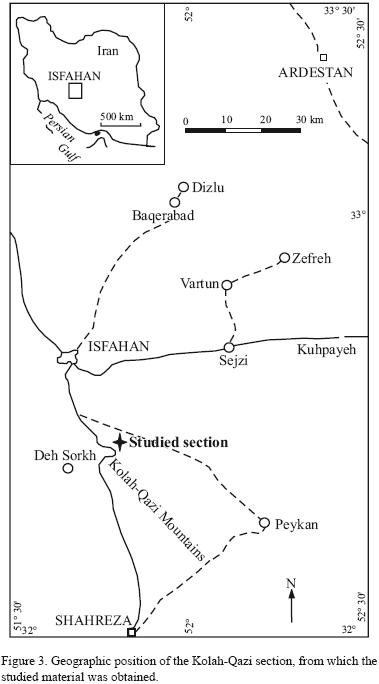
<body><![CDATA[<p align="justify"><font face="verdana" size="2"><b>Palabras clave:</b> corales, crecimiento en c&uacute;pula&#150;discoidal, taxonom&iacute;a, secci&oacute;n Kolah&#150;Qazi, Ir&aacute;n.</font></p>  	    <p align="justify"><font face="verdana" size="2">&nbsp;</font></p>  	    <p align="justify"><font face="verdana" size="2"><b>INTRODUCTION</b></font></p>  	    <p align="justify"><font face="verdana" size="2">Little has been published about the solitary corals from the Albian of the Middle Eastern and southwestern Asian countries. Baron&#150;Szabo <i>et al.</i> (2003) dealt with colonial corals from the neighborhood of Isfahan. Only a few publications from the Albian of Egypt were available for comparison. Aboul Ela <i>et al.</i> (1991) recorded "<i>Micrabacia</i> sp." as a common element in shales of the lower Albian of Gabal Manzour section (North Sinai, Egypt). No description was given, but two hemispherical solitary corals of less than 10 mm in diameter were illustrated. They have four complete cycles and a fifth incomplete septal cycle. Abdel&#150;Gawad and Gameil (1995) described solitary corals from lower Albian from the same area: "<i>Funginella</i>" sp. 1 (b in <a href="/img/revistas/rmcg/v28n2/a3f1.jpg" target="_blank">Figure 1.6</a>, 96&#150;100 septa) and "<i>Funginella</i>" sp. 2 (a in <a href="/img/revistas/rmcg/v28n2/a3f1.jpg" target="_blank">Figure 1.6</a>, 48&#150;50 septa), "<i>Paracycloseris</i>" sp. 1 (c in <a href="/img/revistas/rmcg/v28n2/a3f1.jpg" target="_blank">Figure 1.6</a>, 70&#150;80 septa) and sp. 2 (d in <a href="/img/revistas/rmcg/v28n2/a3f1.jpg" target="_blank">Figure 1.6</a>, 60&#150;70 septa). They are found in "highly fossiliferous argillaceous limestones alternating with ferruginous sandstones and claystones" (Abdel&#150;Gawad and Gameil , 1995, p. 3). Their original aragonitic composition is altered into calcite, which makes exact identification difficult.</font></p>  	    <p align="justify"><font face="verdana" size="2">However, the genus <i>Paracycloseris</i> Wells, 1934 was originally described by one species from sediments of Jamaica that were regarded as Campanian, but are now considered to be upper Maastrichtian (L&ouml;ser, 2005, p. 188). Its holotype looks quite different: for instance, it has a broad papillose columella and has a patellate instead of a cupolate form (see the picture and description of the holotype of <i>P. elizabethae</i> Wells, 1934 in Baron&#150;Szabo, 2002: 145, pl. 105, figs 1, 3, 4).</font></p>  	    <p align="justify"><font face="verdana" size="2">&nbsp;</font></p>  	    <p align="justify"><font face="verdana" size="2"><b>MATERIAL AND METHODS</b></font></p>  	    <p align="justify"><font face="verdana" size="2">The studied material was collected from the middle part of the Albian <i>Beudanticeras</i> Shale (<a href="/img/revistas/rmcg/v28n2/a3f1.jpg" target="_blank">Figure 1.4</a> and <a href="#f2">Figure 2</a>, see also Yazdi <i>et al.</i>, 2009) at the Kolah&#150;Qazi section (central Iran, 25 km southeast of Isfahan, near Baharestan new town, and 2 km south of Isfahan &#150; Shiraz road, at the entrance of Kolah&#150;Qazi valley, lat. N 51&deg;46'32", long. E 32&deg;26'50" GPS&#150;WGS84 coordinates; <a href="#f3">Figure 3</a>). One hundred and thirty two specimens were collected, from this material 122 are stored at Isfahan University as EUIM.3764&#150;EUIM.3885 and ten specimens in the paleontological collection of NCB Naturalis in Leiden, The Netherlands, labeled RGM.532517 &#150; RGM.532526.</font></p>         <p align="center"><font face="verdana" size="2"><a name="f2"></a></font></p>  	    <p align="center"><font face="verdana" size="2"><img src="/img/revistas/rmcg/v28n2/a3f2.jpg"></font></p>     ]]></body>
<body><![CDATA[<p align="center"><font face="verdana" size="2"><a name="f3"></a></font></p>  	    <p align="center"><font face="verdana" size="2"><img src="/img/revistas/rmcg/v28n2/a3f3.jpg"></font></p>  	    <p align="justify"><font face="verdana" size="2">The <i>Beudanticeras</i> Shale is a 120 m thick olive&#150;green to grayish shale, with concretions, cone&#150;in&#150;cone structures, and intercalations of thin&#150;bedded, lens&#150;forming, dark gray limestone (5&#150;30 cm), filled with small turritellid gastropods (<a href="/img/revistas/rmcg/v28n2/a3f1.jpg" target="_blank">Figure 1.5</a>) and nuculid bivalves. Trigoniids and ammonites can be found throughout the unit (Tetragonites sp., <i>Beudanticeras</i> sp., <i>Beudanticeras</i> <i>beudanti</i>, <i>Douvilleiceras</i> sp., <i>Puzosia</i> sp. (Yazdi <i>et al.</i>, 2009), which indicate the upper Albian stage.</font></p>  	    <p align="justify"><font face="verdana" size="2">The specimens were photographed in top, bottom and side views wherever possible, and the diameter (&oslash;), height (<i>h</i>) and number of septa per 10 mm (ns/10mm) were measured. Petrographic thin sections were prepared for three specimens to establish details of the preservation and the top for one specimen was polished for analysis of the columella. Another thin section was prepared from a fragment of the limestone filled with turritellid gastropods.</font></p>  	    <p align="justify"><font face="verdana" size="2">Abbreviations used: EUIM: acronym for the collection at Isfahan University; MNHN: Musee National d'Histoire Naturelle, Paris, France; NCB: Netherlands Centre for Biodiversity, Leiden ,The Netherlands; RGM: acronym for the former "Rijks Geologisch en Mineralogisch Museum", now part of NCB Naturalis in Leiden, still in use as institution and collection codes for the geological collections. RMNH.COEL: acronym for the cnidarian collection of NCB Naturalis.</font></p>  	    <p align="justify"><font face="verdana" size="2">&nbsp;</font></p>  	    <p align="justify"><font face="verdana" size="2"><b>RESULTS</b></font></p>  	    <p align="justify"><font face="verdana" size="2">A thin section of RGM.532524 (<a href="/img/revistas/rmcg/v28n2/a3f4.jpg" target="_blank">Figure 4.1e</a>) revealed that the original aragonite is altered into calcite. Crystals seem to cross the original boundaries of the septa and the filling between the septa. The thin sections of specimens RGM.532517 and RGM.532523 revealed the same structure. The recrystalization also explains why breaking a specimen did not result in a precise lateral view of the septa. The thin section of the consolidated packstone with the turritellid gastropods shows a very fine&#150;grained limestone with dark elements, probably organic.</font></p>  	    <p align="justify"><font face="verdana" size="2">The scatter plot of height vs. diameter (<a href="/img/revistas/rmcg/v28n2/a3f4.jpg" target="_blank">Figure 4.4</a>) of these specimens shows one cluster of points. Vaguely visible in the scatter plot are narrowings at diameters of about 4.0, 6.0 and 7.5 mm. Further statistics are presented in <a href="/img/revistas/rmcg/v28n2/a3t1.jpg" target="_blank">Table 1</a>. The number of septa was calculated from the number of septa/10 mm counts multiplied by the diameter and &#960; to get a comparable variable with the taxa in the literature. The range of height and diameter values for the present sample is also plotted as ellipse "<i>L</i>" in <a href="/img/revistas/rmcg/v28n2/a3f1.jpg" target="_blank">Figure 1.6</a>. The dimensions of the present sample overlap those of the four specimens of "<i>Funginella</i>" sp. 2 in Abdel&#150;Gawad and Gameil (1995, p. 22).</font></p>  	    <p align="justify"><font face="verdana" size="2">&nbsp;</font></p>  	    ]]></body>
<body><![CDATA[<p align="justify"><font face="verdana" size="2"><b>DISCUSSION</b></font></p>  	    <p align="justify"><font face="verdana" size="2">Because the dimensions of "<i>Funginella</i> sp. 2" in Abdel&#150;Gawad and Gameil (1995, p. 22) are overlapped by the height and diameter of the present specimens and their description also fits the present material, it is only logical to assume that both populations belong to the same species. It is fully understandable that Abdel&#150;Gawad and Gameil (1995) did not described their "<i>Funginella</i> sp. 2" as a new species, because they had only four specimens whose shell had been recrystalized. Since the sample used in the present study is large enough to have a clear picture of a population it is preferable to name the species. The maximum of the calculated septa (see <a href="/img/revistas/rmcg/v28n2/a3t1.jpg" target="_blank">Table 1</a>) is 60. This is the case with, for instance, EUIM.3866. However, when counting the real number of septa instead of using the calculation, the number of septa turned out to be 48, but the shape of the coral was ellipsoid and not circular. EUIM.3817 has only 50 septa. So, the calculation of the number of septa by counting the number from only a part of the coral is not accurate. However, more than 48 septa mean that the fifth septal cycle has begun to develop.</font></p>  	    <p align="justify"><font face="verdana" size="2">Both Iranian and Egyptian materials seem to be found in comparable sedimentary rocks. Samples of the fossiliferous limestones of the <i>Beudanticeras</i> Shale that were collected with the corals show an association of gastropods dominated by only one form and are comparable with monospecific turritellid associations in Tertiary deposits, which would point to fully marine fine&#150;grained muddy bottom about 10 to 40 m depth below sea grass environments (pers. comm. Frank Wesselingh). The low energy conditions as well as the organic part in the limestones confirm this "deeper" environment. It is well possible that sea level changes during deposition of the <i>Beudanticeras</i> Shale varied from about 30&#150;50 m depth where the consolidated limestone lenses are probably the shallowest parts of the depositional environment.</font></p>  	    <p align="justify"><font face="verdana" size="2">&nbsp;</font></p>  	    <p align="justify"><font face="verdana" size="2"><b>SYSTEMATIC PALEONTOLOGY</b></font></p>  	    <p align="center"><font face="verdana" size="2">Order Scleractinia Bourne, 1900</font></p>  	    <p align="center"><font face="verdana" size="2">Suborder Fungiina Verrill, 1865</font></p>  	    <p align="center"><font face="verdana" size="2">Family Funginellidae Alloiteau, 1952</font></p>  	    <p align="center"><font face="verdana" size="2">Genus <i>Funginella</i> d'Orbigny, 1850</font></p>  	    <p align="center"><font face="verdana" size="2"><b><i>Funginella</i>? <i>isfahanensis</i> n. sp.</b></font></p>  	    ]]></body>
<body><![CDATA[<p align="center"><font face="verdana" size="2"><a href="/img/revistas/rmcg/v28n2/a3f1.jpg" target="_blank">Figures 1.1</a>&#150;<a href="/img/revistas/rmcg/v28n2/a3f1.jpg" target="_blank">1.3</a>, <a href="/img/revistas/rmcg/v28n2/a3f4.jpg" target="_blank">4.1a</a>&#150;<a href="/img/revistas/rmcg/v28n2/a3f4.jpg" target="_blank">4.1e</a>, <a href="/img/revistas/rmcg/v28n2/a3f4.jpg" target="_blank">4.2</a>, <a href="/img/revistas/rmcg/v28n2/a3f4.jpg" target="_blank">4.3</a></font></p>  	    <p align="justify"><font face="verdana" size="2">?1995 <i>Funginella</i> sp. 2. Abdel&#150;Gawad and Gameil, 1995, p. 22, pl. 9, fig. 5.</font></p>  	    <p align="justify"><font face="verdana" size="2"><b>Derivation of the name.</b> After the city of Isfahan, close to the type locality.</font></p>  	    <p align="justify"><font face="verdana" size="2"><b>Holotype.</b> RGM.532526 (<a href="/img/revistas/rmcg/v28n2/a3f1.jpg" target="_blank">Figures 1.1</a>, <a href="/img/revistas/rmcg/v28n2/a3f1.jpg" target="_blank">1.2</a>).</font></p>  	    <p align="justify"><font face="verdana" size="2"><b>Paratypes.</b> RGM.532517&#150;RGM.532525; EUIM.3764&#150;EUIM.3885 (<a href="/img/revistas/rmcg/v28n2/a3f4.jpg" target="_blank">Figures 4.1</a>&#150;<a href="/img/revistas/rmcg/v28n2/a3f4.jpg" target="_blank">4.3</a>, <a href="/img/revistas/rmcg/v28n2/a3f1.jpg" target="_blank">1.3</a>).</font></p>  	    <p align="justify"><font face="verdana" size="2"><b>Type locality.</b> The Kolah&#150;Qazi section, central Iran, 25 km southeast of Isfahan, near Baharestan new town, and 2 km south of Isfahan&#150;Shiraz road, at the entrance of Kolah&#150;Qazi valley (GPS&#150;WGS84 coordinates lat. N 51&deg;46'32", long. E 32&deg;26'50").</font></p>  	    <p align="justify"><font face="verdana" size="2"><b>Stratigraphic horizon.</b> <i>Beudanticeras</i> Shale, upper Albian, Lower Cretaceous.</font></p>  	    <p align="justify"><font face="verdana" size="2"><b>Diagnosis.</b> Cupolate to discoid solitary corallum of about 6 mm in diameter and circa 1.5 mm in height having four cycles of costosepta, sometimes an incomplete fifth cycle all arranged in six systems and irregularly forking away from the center of the corallite, when looked from above. Costosepta equal in thickness, compact, synapticulae seldom present, septal margins dentate and septal sides granulate. Columella weakly developed.</font></p>  	    <p align="justify"><font face="verdana" size="2"><b>Description.</b> Small cupolate solitary coral without concentric rings on base. Shallow circular calicular fossa. Four complete septal cycles, commonly with an incomplete fifth cycle and arranged in six systems are present. Costosepta more or less regularly dentate and granulate on their sides. The first cycle continues to the centre of the corallite, the second has some large dentate structures which, together with the proximal dents on the first septa, can form a structure looking like a spongy columella. The third cycle seems to branch away from the second, while the fourth seems to branch away from the second in some specimens and sometimes away from the third septa in others. Costosepta are compact. In the thin section (<a href="/img/revistas/rmcg/v28n2/a3f4.jpg" target="_blank">Figure 4.1d</a>) some intervals in the costosepta near the centre are visible. They are probably due to dentations of the costosepta. In some broken fragments (RGM 532520) a few wavy structures are visible, which could be interpreted as possible fulturae. However, since the breaking of the specimens goes through the septa, it is not completely sure if this observation is trustworthy. Thickness of costosepta is more or less the same for all the cycles. Calicular fossa is circular and small. Columella is not clearly visible, synapticulae are seldom present. (For dimensions see <a href="/img/revistas/rmcg/v28n2/a3t1.jpg" target="_blank">Table 1</a>).</font></p>  	    <p align="justify"><font face="verdana" size="2"><b>Remarks.</b> The assignment of this species to a particular genus is not an easy task. There are several genera known to have small cupolate to discoid solitary corals. Wells (1956) cited <i>Cyclastraea</i> Alloiteau, 1952; <i>Cycloseris</i> Milne Edwards and Haime, 1849; <i>Cyclolites</i> Lamarck, 1801; <i>Micrabacia</i> Milne Edwards and Haime, 1849, and <i>Discocyathus</i> Milne Edwards and Haime, 1848. Since the specimens described from the Sinai were published as <i>Funginella</i> we take that genus also into account. Russo <i>et al.</i> (1996) listed <i>Funginellastraea</i> Alloiteau, 1952, <i>Cyclolitopsis</i> and <i>Cyclophyllopsis</i> having similar growth forms. L&ouml;ser (pers. comm.) suggested regarding <i>Microseris</i>, <i>Actinoseris</i> and <i>Asteroseris</i> as possibilities.</font></p>  	    ]]></body>
<body><![CDATA[<p align="justify"><font face="verdana" size="2">Below, all these genera will be treated in alphabetical order having first a selected historical overview of the development of the concepts of these taxa combined with some remarks and comparisons with <i>F.</i>? <i>isfahanensis.</i></font></p>  	    <p align="center"><font face="verdana" size="2"><b>Genus <i>Actinoseris</i> d'Orbigny, 1849</b></font></p>  	    <p align="justify"><font face="verdana" size="2"><b>Type species.</b> <i>Actinoseris cenomaniensis</i> d'Orbigny, 1850.</font></p>  	    <p align="justify"><font face="verdana" size="2"><i>Actinoseris</i> was established as "une <i>Cycloseris</i> dont la columelle est central, ronde et non en fente allong&eacute;e" (d'Orbigny, 1849a: p. 12 &#91;a <i>Cycloseris</i> where the columella is central, round and the calicinal fossa is not elongated&#93;). Fromentel (1861) synonymised <i>Actinoseris</i> with <i>Cycloseris</i>. <i>Actinoseris</i> was considered a foraminifer by Vaughan and Wells (1943, p. 345), was kept as a separate species in Alloiteau (1957) and it was a junior synonym of <i>Cycloseris</i> according to Wells (1956, F388). Baron&#150;Szabo (2002, p. 130) questionably regarded it as a junior synonym of <i>Micrabacia</i>. L&ouml;ser (pers. comm.) regards it as a separate genus in the family Asteroseriidae, closely related to <i>Microseris</i> and related to the Fungiidae. <i>Funginella</i>? <i>isfahanensis</i> does fit into the original description of <i>Actinoseris</i>. The type species of <i>Actinoseris</i> differs from <i>F</i>.? <i>isfahanensis</i> in having medium common simple synapticulae, a columella of isolated granules and nine cycles of septa and being larger. Other <i>Actinoseris</i> species are <i>Actinoseris</i> <i>alloiteaui</i> Beauvais and Zlatarski, 1966 from upper Barremian to Lower Aptian of Bulgary and <i>Actinoseris</i> <i>provincialis</i> d'Orbigny, 1850 from the Cenomanian to Maastrichtian of France and Spain. <i>A. provincialis</i> is bigger. The holotype of <i>A.</i> <i>alloiteaui</i> is slightly larger than the largest specimens of <i>F.</i>? <i>isfahanensis</i> and its density of septa is smaller, but not out of the range of the current sample of <i>F.</i>? <i>isfahanensis.</i> The anastomization of the septa is similar.</font></p>  	    <p align="center"><font face="verdana" size="2"><b>Genus <i>Asteroseris</i> de Fromentel, 1867</b></font></p>  	    <p align="justify"><font face="verdana" size="2"><b>Type species.</b> <i>Stephanoseris coronula</i> de Fromentel, 1863.</font></p>  	    <p align="justify"><font face="verdana" size="2"><i>Asteroseris</i> de Fromentel was considered a junior synonym of <i>Micrabacia</i> by Vaughan and Wells (1943, p. 145). <i>Asteroseris</i> was characterized by "septes anastomos&eacute;s sans ordre, endoth&egrave;que absente, columelle essentielle, fasciculaire" (Alloiteau, 1952, p. 664). Wells (1956, p. F388) regarded <i>Asteroseris</i> as a junior synonym of <i>Cycloseris</i>. This opinion was shared by Baron&#150;Szabo (2002, p. 97). Alloiteau (1957) and L&ouml;ser (pers. comm.) retains <i>Asteroseris</i> as a separate genus. This is supported by the difference in shape of the calicular fossa (circular for <i>Asteroseris</i> versus elliptical for <i>Cycloseris</i>). <i>F.</i>? <i>isfahanensis</i> is not placed in <i>Asteroseris</i> due to the lack of a clear columella.</font></p>  	    <p align="justify"><font face="verdana" size="2">Asteroseris curonula differs from <i>F.</i>? <i>isfahanensis</i> in having a fair amount of simple synapticulae and a columella that is formed by fusion of the septa in the center and being relatively higher.</font></p>  	    <p align="center"><font face="verdana" size="2"><b>Genus <i>Cyclastraea</i> Alloiteau, 1952</b></font></p>  	    <p align="justify"><font face="verdana" size="2"><b>Type species.</b> <i>Cyclolites spinosa</i> de Fromentel, 1863.</font></p>  	    ]]></body>
<body><![CDATA[<p align="justify"><font face="verdana" size="2"><i>Cyclastraea</i> was defined as "discoid; muraille fortement pliss&eacute;e; septes enti&egrave;rement compacts &agrave; bord distal arm&eacute; de fortes dents aigu&euml;s; faces laterals avec careens verticals; columelle fasciculo&#150;papilleuse" (Alloiteau, 1952, p. 655). Wells (1956) described <i>Cyclastraea</i> as "solitary, cupolate with basal epitheca. Septa imperforate with strong dentations and vertical carinae" (F379). Baron&#150;Szabo (2002) regarded <i>Cyclastraea</i> as a questionable junior synonym of <i>Cycloseris</i>. L&ouml;ser (pers. comm.) regards it to be a junior synonym of Microseris. <i>F.</i>? <i>isfahanensis</i> lacks the strong carinae.</font></p>  	    <p align="center"><font face="verdana" size="2"><b>Genus <i>Cyclophyllopsis</i> Alloiteau, 1952</b></font></p>  	    <p align="justify"><font face="verdana" size="2"><b>Type species.</b> <i>Cyclolites aptiensis</i> de Fromentel, 1863 (Type series: 3 paralectotypes MNHN: A25825, Lectotype M03597 selected by Alloiteau (1957, p. 341) should be the specimen figured by Fromentel in his pl. 66, fig. 3, 3a&#150;b.).</font></p>  	    <p align="justify"><font face="verdana" size="2">Original diagnosis of the genus: "simple et discoid; muraille s'&eacute;tendant sur la base et la moiti&eacute; de la hauteur; synapticules assez nombreuses, par endroits coalescentes; pseudo&#150;columelle fasciculo&#150;papileuse" (Alloiteau, 1952, p. 655).</font></p>  	    <p align="justify"><font face="verdana" size="2">Baron&#150;Szabo (2002) regarded Cyclophyllopsis as a questionable synonym of <i>Cycloseris</i>. Lectotype and paralectotypes do not belong to the same species and no thin section was found, the genus should be forgotten (L&ouml;ser, pers. comm.).</font></p>  	    <p align="justify"><font face="verdana" size="2">Based on the original description <i>Cyclophyllopsis aptiensis</i> differs from <i>Funginella</i>? <i>isfahanensis</i> in being higher in juvenile stages, and having numerous synapticulae.</font></p>  	    <p align="center"><font face="verdana" size="2"><b>Genus <i>Cycloseris</i> Milne Edwards and Haime, 1849</b></font></p>  	    <p align="justify"><font face="verdana" size="2"><b>Type species.</b> <i>Fungia cyclolites</i> Lamarck, 1816 (syntypes: MNHN 73&#150;74)</font></p>  	    <p align="justify"><font face="verdana" size="2"><i>Cycloseris</i> was originally described as "Polypier simple, libre. Cloisons tr&egrave;s&#150;nombreuses, s'unissant par leur bord interne" (Milne Edwards and Haime, 1849, p. 72).</font></p>  	    <p align="justify"><font face="verdana" size="2">The available material of recent <i>C. cyclolites</i> (RMNH.COEL.34559, '63&#150;'64, '66, '69&#150;'70) from New Caledonia shows a small ellipsoidal calice and a small ellipsoid spongy columella. The costae of <i>C. cyclolites</i> are dentate; the septa are arranged in four to six cycles in six systems. Lower cycles are stronger, thicker and higher than higher cycles. Young specimens vary from discoid to patellate, older specimens are increasingly cupolate in shape with concave bottom. Young specimens do not have a closed wall at the bottom, it closes when growing up. Adult specimens show clear rows of ornaments on the sides of the septa, more or less identical on each side of the septum and at the bottom of the septa bigger structures (fulturae) are developed, which grew on the septa in a later growth phase. <i>F.</i>? <i>isfahanensis</i> shows a closed wall at the bottom from the smallest to the largest specimens.</font></p>  	    ]]></body>
<body><![CDATA[<p align="justify"><font face="verdana" size="2">Russo <i>et al.</i> (1996) treated <i>Cycloseris</i>? <i>escosurae</i> Mallada, 1887 from the Lower Alpian of Spain, which has a similar behavior as <i>Funginella</i>? <i>isfahanensis</i> in that it often has small particles on which it has been growing. <i>Cycloseris</i>? <i>escosurae</i> is mostly attached on foraminiferal tests, while the present species prefers the more readily available turritellid shells. It has more septa and gets bigger and shows regular simple synapticulae, while <i>F.</i>? <i>isfahanensis</i> has hardly to no synapticulae.</font></p>  	    <p align="center"><font face="verdana" size="2"><b>Genus <i>Cyclolites</i> Lamarck, 1801</b></font></p>  	    <p align="justify"><font face="verdana" size="2"><b>Type species.</b> <i>Cyclolites elliptica</i> Lamarck, 1801 (="porpite elliptique&hellip; Guettard, 1770, mem. Vol. 2, p. 342, pl. 21, fig. 17, 18.").</font></p>  	    <p align="justify"><font face="verdana" size="2"><i>Cyclolites</i> was originally described as "Polypier libre, orbiculaire ou elliptique, convexe et lamelleux en&#150;dessus, applati en desous avec des lignes circulaires concentriques. Il constitue une seule &eacute;toile lamelleuse" (Lamarck, 1801, p. 369), presenting four species according to the next order: <i>C. numismalis, C. hemisphaerica, C. elliptica</i> and <i>C. cristata.</i> Milne Edwards and Haime (1849) named <i>C. elleptica</i> &#91;sic&#93; Lamarck as only example of <i>Cyclolites</i>, which we regard as the first secondary designation of <i>C. elliptica</i> as type species for this genus. Alloiteau (1957, p. 331&#150;332) presented a strong reasoning for this selection: <i>Cyclolites</i> as defined by Lamarck is a very polyphyletic group and only appropriate to be used as describing the overall shape of these corals: cyclolitoid, meaning hemispheroid corallite with a flat base, considered to be discoid to cupolate shaped. <i>Cyclolites</i> numismalis, as the first in the list of Lamarck's species, could be regarded as the type species of Cyclolites, but is a junior synonym of the Silurian rugose coral <i>Madrepora porpita</i> Linnaeus, 1767. This would make <i>Palaeocyclus</i> Milne Edwards and Haime, 1849, having the same type species, a junior synonym of <i>Cyclolites</i>. The second species of Lamarck, <i>C. hemisphaerica</i>, was suspected by Alloiteau to be a badly drawn <i>C. elliptica</i>, which was the third species of Lamarck. The last one, <i>C. cristata</i>, became the type species of <i>Aspidiscus</i> K&#339;nig, 1825. The type specimen(s) of <i>C. elliptica</i> are considered to be lost. To avoid confusion Alloiteau suggested that the main part of the Cretaceous "Cyclolites" were to be reassigned to <i>Cunnolites</i>. Alloiteau (1957) created <i>Cunnolites barrerei</i> as a replacement for <i>C. elliptica</i> and selected a specimen from coll. Dep&eacute;ret (lab. Geol. de Sorbonne) as "Neoholotype", supposedly from Coustouges, France, which is near Perpignan. <i>Cyclolites</i> as a genus name was reestablished by L&ouml;ser (2009, p. 133) with Faujas de Saint&#150;Fond, 1799 as author of the genus, since in Faujas (1799) referred directly to Lamarck (1801, p. 369) and this would mean that, if the date of publication of Faujas would have been correct, the name would indeed be first published, completely with description in Faujas and the author would have become "Lamarck in Faujas (1799)". However, Pasteur (1802), who translated Faujas (1799) into the Dutch language, stated that the first part of the Dutch translation was published only after the first five parts of Faujas had been published. The reference to <i>Cyclolites</i> and to Lamarck occurred in the second part of the Dutch translation (Pasteur, 1804), meaning that those references occurred in the parts of the French original that were published after 1802, so that Lamarck (1801) remains the correct author and year of publication of the generic name <i>Cyclolites</i>.</font></p>  	    <p align="justify"><font face="verdana" size="2"><i>Cyclolites</i> differs with <i>Funginella</i> in having perforations in their septa. <i>Funginella</i>? <i>isfahanensis</i> differs also from <i>Cyclolites/Cunnolites</i> species in being a lot smaller in its adult stage.</font></p>  	    <p align="center"><font face="verdana" size="2"><b>Genus <i>Cyclolitopsis</i> Reuss, 1874</b></font></p>  	    <p align="justify"><font face="verdana" size="2"><b>Type species.</b> <i>Cyclolites patera</i> d'Achiardi, 1867. Alloiteau (1952, p. 667) described this genus as patellate and fixed with a short peduncle when young. Alloiteau (1957) presented a more or less turbinate form. We know Cyclolitopsis only from Alloiteau (1952, 1957). <i>Funginella</i>? <i>isfahanensis</i> differs in being cupolate.</font></p>  	    <p align="center"><font face="verdana" size="2"><b>Genus <i>Discocyathus</i> Milne Edwards and Haime, 1848</b></font></p>  	    <p align="justify"><font face="verdana" size="2"><i>Discocyathus</i> Milne Edwards and Haime, 1848, differs in having clear pali and a clear columella and in not having a clear cupolate shape.</font></p>  	    <p align="center"><font face="verdana" size="2"><b>Genus <i>Funginella</i> d'Orbigny, 1849 sensu Alloiteau, 1957</b></font></p>  	    ]]></body>
<body><![CDATA[<p align="justify"><font face="verdana" size="2"><b>Type species.</b> <i>Funginella</i> <i>neocomiensis</i> d'Orbigny, 1850.</font></p>  	    <p align="justify"><font face="verdana" size="2"><i>Funginella</i> was originally described as "<i>Cyclolites</i> &agrave; calice circulaire, d&eacute;prim&eacute;, don't la columelle est ronde et non pas transverse; les cloisons grosses, saillantes" (d'Orbigny, 1849a, p. 11). It was synonymised with <i>Cyclolites</i> in Fromentel (1867) and Wells (1936, p. 113). The latter selected <i>Cyclolites</i> <i>haueriana</i> Michelin, 1846 as "genolectotype". Alloiteau (1952, p. 662, 1957, p. 335) and also M. Beauvais (1982, tome II, 116&#150;117) retained it as a separate species, while considering <i>F. neocomiensis</i> d'Orbigny, 1850, from the Hauterivian of France as the type. We assume that Alloiteau was not aware of Wells (1936) at that time and, at least, his citations of page numbers of the publications of d'Orbigny are erroneous. F. neocomiensis as described in Alloiteau (1957, p. 335) has compact septa, which separates it from <i>Cyclolites</i>. <i>Funginella</i> was regarded as a junior synonym of <i>Cycloseris</i> by Baron&#150;Szabo (2002). We retain <i>Funginella</i> as a separate genus, regarding the shape of the calicular fossa as distinctive between the two genera, although further research is needed. <i>Funginella</i> was the generic assignment of the Sinai material in Abdel&#150;Gawad and Gameil (1995), which is regarded to be the same species as the Iranian coral.</font></p>  	    <p align="justify"><font face="verdana" size="2"><i>F.</i>? <i>isfahanensis</i> differs from <i>F. neocomiensis</i> in having six systems of septa instead of eight and in having slightly less septa/10mm. <i>F. neocomiensis</i> has about 30 septa/10 mm. It differs from <i>F. martini</i> d'Orbigny, 1850 (23&#150;26 septa/10mm) in having more septa/10mm.</font></p>  	    <p align="center"><font face="verdana" size="2"><b>Genus <i>Funginella</i>straea Alloiteau, 1952</b></font></p>  	    <p align="justify"><font face="verdana" size="2"><b>Type species.</b> <i>Funginella</i> <i>alpina</i> d'Orbigny, 1850</font></p>  	    <p align="justify"><font face="verdana" size="2">First description: "Disco&iuml;de, libre; partie central du disque basal portant une <i>Orthophragmina</i> commensale; septes enti&egrave;rement compacts, &agrave; faces laterals orn&eacute;e de files nombreuses, serr&eacute;es, de granules subcoalescents" (Alloiteau, 1952, p. 663). Russo <i>et al.</i> (1996) cited two other species with different foraminifera as substrate. Baron&#150;Szabo (2002, p. 97) regarded <i>Funginellastraea</i> as a questionable synonym of <i>Cycloseris</i>.</font></p>  	    <p align="center"><font face="verdana" size="2"><b>Genus <i>Micrabacia</i> Milne Edwards and Haime, 1849</b></font></p>  	    <p align="justify"><font face="verdana" size="2"><i>Funginella</i>? <i>isfahanensis</i> does not belong to Micrabacia, since the costae and the septa are confluent, while <i>Micrabacia</i> is defined by the alternation of the septa and costae. However, the Campanian to Maastrichtian <i>Micrabacia</i> <i>senoniensis</i> from Western Europe is often preserved with only a small part of the basal wall, with the costae not preserved. The stratigraphic position of the present species is the same as the oldest reported <i>Micrabacia</i> specimens. However, their reports are vague (<i>Micrabacia</i> sp. in the Albian of North Sinai in Aboul Ela <i>et al.</i> (1991) and <i>Micrabacia</i>? sp. in the "Neocoomsandstein" in T&ouml;nsberg near Oerlinghausen, Germany in Weerth (1884). Further study of those specimens is necessary for better comparison and to check if those specimens are really <i>Micrabacia</i>.</font></p>  	    <p align="center"><font face="verdana" size="2"><b>Genus <i>Microseris</i> de Fromentel, 1867</b></font></p>  	    <p align="justify"><font face="verdana" size="2"><b>Type species:</b> <i>Microseris</i> <i>hemisphaerica</i> de Fromentel, 1867.</font></p>  	    ]]></body>
<body><![CDATA[<p align="justify"><font face="verdana" size="2">The genus <i>Microseris</i> was defined as "h&eacute;misph&eacute;rique; la muraille, horizontalle, nue et couverte de granulations &eacute;parses qui ne simulent pas des c&ocirc;tes. Les cloisons sont larges, arqu&eacute;es et se r&eacute;unissent en se soudant au centre o&ugrave; on remarque une petite fossette columellaire arrondie. Les synapticules sont rares, mais bien d&eacute;velopp&eacute;es. Ce genre, voisin des <i>Cycloseris</i>, s'en distingue par son aspect general et l'absence de c&ocirc;tes sur le plateau. Celles&#150;ci sont remplec&eacute;es par des granulations &eacute;parses" (Fromentel, 1870 vol. 23, p. 367&#150;368).</font></p>  	    <p align="justify"><font face="verdana" size="2"><i>Microseris</i> was considered to be a junior synonym of <i>Micrabacia</i> by Vaughan and Wells (1943, p. 145). Alloiteau (1952, p. 664) retained it as a separate genus. He diagnosed <i>Microseris</i> as "septes anastomos&eacute;s suivant une loi precise, endoth&egrave;que pr&eacute;sente, columelle pari&eacute;tale rudimentaire" (p. 664). Wells (1956, p. F388) regarded <i>Microseris</i> as a junior synonym of <i>Cycloseris</i>. Baron&#150;Szabo (2002, p. 231) agreed with Wells. L&ouml;ser (pers. comm.) retains <i>Microseris</i> as a separate genus within the Asteroseriidae. <i>Funginella</i> <i>isfahanensis</i> is not placed in <i>Microseris</i>, for its septa do not bifurcate according to a precise rule.</font></p>  	    <p align="justify"><font face="verdana" size="2"><i>Microseris hemisphaerica</i> differs from <i>F.</i>? <i>isfahanensis</i> in having nine cycles of septa and having simple synapticulae.</font></p>  	    <p align="justify"><font face="verdana" size="2">&nbsp;</font></p>  	    <p align="justify"><font face="verdana" size="2"><b>CONCLUSIONS</b></font></p>  	    <p align="justify"><font face="verdana" size="2"><i>Actinoseris</i> is a serious candidate as genus for this species. However, awaiting further research, we have assigned this species tentatively to <i>Funginella</i> sensu Alloiteau (1957) and Beauvais (1982) as is done with the material from the Sinai described by Abdel&#150;Gawad and Gameil (1995). Both taxa and indeed most other small discoid to cupolate genera are in need of further revision.</font></p>  	    <p align="justify"><font face="verdana" size="2">&nbsp;</font></p>  	    <p align="justify"><font face="verdana" size="2"><b>ACKNOWLEDGEMENTS</b></font></p>  	    <p align="justify"><font face="verdana" size="2">We are grateful to Hannes L&ouml;ser, Mohammed Gameil, Steve Donovan and two anonymous reviewers for their remarks, both in content and language. Bert Hoeksema is thanked for allowing us to study some recent <i>Cycloseris</i> <i>Cyclolites</i> specimens for comparisons.</font></p>  	    <p align="justify"><font face="verdana" size="2">&nbsp;</font></p>  	    ]]></body>
<body><![CDATA[<p align="justify"><font face="verdana" size="2"><b>REFERENCES</b></font></p>  	    <!-- ref --><p align="justify"><font face="verdana" size="2">Abdel&#150;Gawad, G. I., Gameil, M., 1995, Cretaceous and Palaeocene Coral Faunas in Egypt and Greece: Coral Research Bulletin 4, 1&#150;36, pls 1&#150;21.    &nbsp;&nbsp;&nbsp;&nbsp;&nbsp;&nbsp;&nbsp;&nbsp;[&#160;<a href="javascript:void(0);" onclick="javascript: window.open('/scielo.php?script=sci_nlinks&ref=8059878&pid=S1026-8774201100020000300001&lng=','','width=640,height=500,resizable=yes,scrollbars=1,menubar=yes,');">Links</a>&#160;]<!-- end-ref --></font></p>  	    <!-- ref --><p align="justify"><font face="verdana" size="2">Abou Ela, N.M., Abdel&#150;Gawad, G.L., Aly, M.F., 1991, Albian fauna of Gabal Manzour, Maghara Area north Sinai, Egypt: Journal of African Earth Sciences 13, 201&#150;220.    &nbsp;&nbsp;&nbsp;&nbsp;&nbsp;&nbsp;&nbsp;&nbsp;[&#160;<a href="javascript:void(0);" onclick="javascript: window.open('/scielo.php?script=sci_nlinks&ref=8059880&pid=S1026-8774201100020000300002&lng=','','width=640,height=500,resizable=yes,scrollbars=1,menubar=yes,');">Links</a>&#160;]<!-- end-ref --></font></p>  	    <!-- ref --><p align="justify"><font face="verdana" size="2">Alloiteau, J., 1952, Madr&eacute;poraires post&#150;pal&eacute;ozo&iuml;ques <i>in</i> Piveteau, J. (ed.), Trait&eacute; de paleontology: Paris, Masson et Cie, &eacute;diteurs 1, 539&#150;684.    &nbsp;&nbsp;&nbsp;&nbsp;&nbsp;&nbsp;&nbsp;&nbsp;[&#160;<a href="javascript:void(0);" onclick="javascript: window.open('/scielo.php?script=sci_nlinks&ref=8059882&pid=S1026-8774201100020000300003&lng=','','width=640,height=500,resizable=yes,scrollbars=1,menubar=yes,');">Links</a>&#160;]<!-- end-ref --></font></p>  	    <!-- ref --><p align="justify"><font face="verdana" size="2">Alloiteau, J., 1957, Contribution &agrave; la syst&eacute;matique des Madr&eacute;poraires fossils: Paris, C. N. R. S., 462 p.    &nbsp;&nbsp;&nbsp;&nbsp;&nbsp;&nbsp;&nbsp;&nbsp;[&#160;<a href="javascript:void(0);" onclick="javascript: window.open('/scielo.php?script=sci_nlinks&ref=8059884&pid=S1026-8774201100020000300004&lng=','','width=640,height=500,resizable=yes,scrollbars=1,menubar=yes,');">Links</a>&#160;]<!-- end-ref --></font></p>  	    <!-- ref --><p align="justify"><font face="verdana" size="2">Baron&#150;Szabo, R.C., 2002, Scleractinian Corals of the Cretaceous: Knoxville, Tennessee, R.C. Baron&#150;Szabo: 539 pp.    &nbsp;&nbsp;&nbsp;&nbsp;&nbsp;&nbsp;&nbsp;&nbsp;[&#160;<a href="javascript:void(0);" onclick="javascript: window.open('/scielo.php?script=sci_nlinks&ref=8059886&pid=S1026-8774201100020000300005&lng=','','width=640,height=500,resizable=yes,scrollbars=1,menubar=yes,');">Links</a>&#160;]<!-- end-ref --></font></p>  	    <!-- ref --><p align="justify"><font face="verdana" size="2">Baron&#150;Szabo, R.C., Hamedani, A., Senowbari&#150;Daryan, B., 2003, Scleractinian Corals from the Lower Cretaceous Deposits North of Esfahan (Central Iran): Facies 48, 199&#150;216, pls 36&#150;39.    &nbsp;&nbsp;&nbsp;&nbsp;&nbsp;&nbsp;&nbsp;&nbsp;[&#160;<a href="javascript:void(0);" onclick="javascript: window.open('/scielo.php?script=sci_nlinks&ref=8059888&pid=S1026-8774201100020000300006&lng=','','width=640,height=500,resizable=yes,scrollbars=1,menubar=yes,');">Links</a>&#160;]<!-- end-ref --></font></p>  	    <!-- ref --><p align="justify"><font face="verdana" size="2">Beauvais, M., 1982, R&eacute;vision syst&eacute;matique des Madr&eacute;poraires des couches de Gosau (Cr&eacute;tac&eacute; sup&eacute;rieur, Autriche): Paris, Travaux de laboratoire de pal&eacute;ontologie des invertebres, Universite Pierre et Marie Curie: 5 parts.    &nbsp;&nbsp;&nbsp;&nbsp;&nbsp;&nbsp;&nbsp;&nbsp;[&#160;<a href="javascript:void(0);" onclick="javascript: window.open('/scielo.php?script=sci_nlinks&ref=8059890&pid=S1026-8774201100020000300007&lng=','','width=640,height=500,resizable=yes,scrollbars=1,menubar=yes,');">Links</a>&#160;]<!-- end-ref --></font></p>  	    <!-- ref --><p align="justify"><font face="verdana" size="2">Beauvais, L., Zlatarski, V.N., 1966, <i>Actinoseris</i>? <i>alloiteaui</i> sp. n. &#150; Madr&eacute;poraire Cr&eacute;tac&eacute; inf&eacute;rieur de la Bulgarie: Comptes rendus de l'Academie bulgare des Sciences 19(12), 1171&#150;1173, pl. 1.    &nbsp;&nbsp;&nbsp;&nbsp;&nbsp;&nbsp;&nbsp;&nbsp;[&#160;<a href="javascript:void(0);" onclick="javascript: window.open('/scielo.php?script=sci_nlinks&ref=8059892&pid=S1026-8774201100020000300008&lng=','','width=640,height=500,resizable=yes,scrollbars=1,menubar=yes,');">Links</a>&#160;]<!-- end-ref --></font></p>  	    <!-- ref --><p align="justify"><font face="verdana" size="2">Bourne, G.C., 1900, The Anthozoa <i>in</i> Lancester, E.R. (ed.), A treatise on zoology. Part II. The Porifera and Coelenterata: London, Adam &amp; Charles Black, 80 p.    &nbsp;&nbsp;&nbsp;&nbsp;&nbsp;&nbsp;&nbsp;&nbsp;[&#160;<a href="javascript:void(0);" onclick="javascript: window.open('/scielo.php?script=sci_nlinks&ref=8059894&pid=S1026-8774201100020000300009&lng=','','width=640,height=500,resizable=yes,scrollbars=1,menubar=yes,');">Links</a>&#160;]<!-- end-ref --></font></p>  	    <!-- ref --><p align="justify"><font face="verdana" size="2">Faujas de Saint Fond, B., 1799&#150;1803?, Histoire naturelle de la montagne St. Pierre de Maestricht: Paris, 263 p., 54 pls.    &nbsp;&nbsp;&nbsp;&nbsp;&nbsp;&nbsp;&nbsp;&nbsp;[&#160;<a href="javascript:void(0);" onclick="javascript: window.open('/scielo.php?script=sci_nlinks&ref=8059896&pid=S1026-8774201100020000300010&lng=','','width=640,height=500,resizable=yes,scrollbars=1,menubar=yes,');">Links</a>&#160;]<!-- end-ref --></font></p>  	    <!-- ref --><p align="justify"><font face="verdana" size="2">Fromentel, E. de, 1861, Introduction a l'&eacute;tude des polypiers fossils: M&eacute;moires de la Soci&eacute;t&eacute; d'&eacute;mulation du D&eacute;partement du Doubs, Troisi&egrave;me s&eacute;rie 5(1859&#150;1860), 1&#150;359.    &nbsp;&nbsp;&nbsp;&nbsp;&nbsp;&nbsp;&nbsp;&nbsp;[&#160;<a href="javascript:void(0);" onclick="javascript: window.open('/scielo.php?script=sci_nlinks&ref=8059898&pid=S1026-8774201100020000300011&lng=','','width=640,height=500,resizable=yes,scrollbars=1,menubar=yes,');">Links</a>&#160;]<!-- end-ref --></font></p>  	    <!-- ref --><p align="justify"><font face="verdana" size="2">Fromentel, M. de, 1862&#150;1887, VIII. Zoophytes in Orbigny, A.D. d', 1840&#150;1887, Pal&eacute;ontologie fran&ccedil;aise, 1re S&eacute;rie, Terrain cr&eacute;tac&eacute;: Paris, chez l'auteur: 512 p., 131 pls &#91;<i>fide</i> L&ouml;ser (2002: 758&#150;759) for dating of the pages and plates&#93;    &nbsp;&nbsp;&nbsp;&nbsp;&nbsp;&nbsp;&nbsp;&nbsp;[&#160;<a href="javascript:void(0);" onclick="javascript: window.open('/scielo.php?script=sci_nlinks&ref=8059900&pid=S1026-8774201100020000300012&lng=','','width=640,height=500,resizable=yes,scrollbars=1,menubar=yes,');">Links</a>&#160;]<!-- end-ref -->.</font></p>  	    <!-- ref --><p align="justify"><font face="verdana" size="2">Guettard, J.&#150;E., 1770, M&eacute;moires sur diff&eacute;rentes Parties des Sciences et Arts. Tome second: Paris, Laurent Prault, 530 p., 71 pls.    &nbsp;&nbsp;&nbsp;&nbsp;&nbsp;&nbsp;&nbsp;&nbsp;[&#160;<a href="javascript:void(0);" onclick="javascript: window.open('/scielo.php?script=sci_nlinks&ref=8059902&pid=S1026-8774201100020000300013&lng=','','width=640,height=500,resizable=yes,scrollbars=1,menubar=yes,');">Links</a>&#160;]<!-- end-ref --></font></p>  	    <!-- ref --><p align="justify"><font face="verdana" size="2">K&#339;nig, C.D.E., 1825, Icones fossilium sectiles. Centuria Prima: London, G.B. Sowerby: 4 p., 8 pls. &#91;<i>fide</i> Weisbord, 1971&#93;    &nbsp;&nbsp;&nbsp;&nbsp;&nbsp;&nbsp;&nbsp;&nbsp;[&#160;<a href="javascript:void(0);" onclick="javascript: window.open('/scielo.php?script=sci_nlinks&ref=8059904&pid=S1026-8774201100020000300014&lng=','','width=640,height=500,resizable=yes,scrollbars=1,menubar=yes,');">Links</a>&#160;]<!-- end-ref -->.</font></p>  	    <!-- ref --><p align="justify"><font face="verdana" size="2">Lamarck, J.B. de, 1801, Syst&ecirc;me des animaux sans vert&egrave;bres: Paris, Musee d'Histoire Naturelle, 432 p.    &nbsp;&nbsp;&nbsp;&nbsp;&nbsp;&nbsp;&nbsp;&nbsp;[&#160;<a href="javascript:void(0);" onclick="javascript: window.open('/scielo.php?script=sci_nlinks&ref=8059906&pid=S1026-8774201100020000300015&lng=','','width=640,height=500,resizable=yes,scrollbars=1,menubar=yes,');">Links</a>&#160;]<!-- end-ref --></font></p>  	    <!-- ref --><p align="justify"><font face="verdana" size="2">Lamarck, J.B. de, 1816, Histoire Naturelle des Animaux sans Vert&egrave;bres: Paris, Verdi&egrave;re 2, 568 p.    &nbsp;&nbsp;&nbsp;&nbsp;&nbsp;&nbsp;&nbsp;&nbsp;[&#160;<a href="javascript:void(0);" onclick="javascript: window.open('/scielo.php?script=sci_nlinks&ref=8059908&pid=S1026-8774201100020000300016&lng=','','width=640,height=500,resizable=yes,scrollbars=1,menubar=yes,');">Links</a>&#160;]<!-- end-ref --></font></p>  	    <!-- ref --><p align="justify"><font face="verdana" size="2">Linn&eacute;, C. a, 1767, Systema Natur&#230;, per Regna Tria Naturae, secundum Classes, Ordines, Genera, species cum Characteribus, Differentiis, Synonymis, Locis. Tomus I. Editio decimal tertia: Stockholm, Ioannis Thomae, 1361 p.    &nbsp;&nbsp;&nbsp;&nbsp;&nbsp;&nbsp;&nbsp;&nbsp;[&#160;<a href="javascript:void(0);" onclick="javascript: window.open('/scielo.php?script=sci_nlinks&ref=8059910&pid=S1026-8774201100020000300017&lng=','','width=640,height=500,resizable=yes,scrollbars=1,menubar=yes,');">Links</a>&#160;]<!-- end-ref --></font></p>  	    <!-- ref --><p align="justify"><font face="verdana" size="2">L&ouml;ser, H., 2002, Catalogue of Cretaceous Corals. Volume 2. List of Citations: Dresden, Cpress Verlag, 784 p.    &nbsp;&nbsp;&nbsp;&nbsp;&nbsp;&nbsp;&nbsp;&nbsp;[&#160;<a href="javascript:void(0);" onclick="javascript: window.open('/scielo.php?script=sci_nlinks&ref=8059912&pid=S1026-8774201100020000300018&lng=','','width=640,height=500,resizable=yes,scrollbars=1,menubar=yes,');">Links</a>&#160;]<!-- end-ref --></font></p>  	    <!-- ref --><p align="justify"><font face="verdana" size="2">L&ouml;ser, H., 2005, Catalogue of Cretaceous Corals. Volume 3. List of Localities: Dresden, CPress Verlag 3, 366 p.    &nbsp;&nbsp;&nbsp;&nbsp;&nbsp;&nbsp;&nbsp;&nbsp;[&#160;<a href="javascript:void(0);" onclick="javascript: window.open('/scielo.php?script=sci_nlinks&ref=8059914&pid=S1026-8774201100020000300019&lng=','','width=640,height=500,resizable=yes,scrollbars=1,menubar=yes,');">Links</a>&#160;]<!-- end-ref --></font></p>  	    <!-- ref --><p align="justify"><font face="verdana" size="2">L&ouml;ser, H., 2009, Fossile Korallen aus Jura und Kreide. Aufbau, Klassification, Bestimmung und Fundm&ouml;gligkeiten: Dresden, CPress Verlag, 206 p.    &nbsp;&nbsp;&nbsp;&nbsp;&nbsp;&nbsp;&nbsp;&nbsp;[&#160;<a href="javascript:void(0);" onclick="javascript: window.open('/scielo.php?script=sci_nlinks&ref=8059916&pid=S1026-8774201100020000300020&lng=','','width=640,height=500,resizable=yes,scrollbars=1,menubar=yes,');">Links</a>&#160;]<!-- end-ref --></font></p>  	    <!-- ref --><p align="justify"><font face="verdana" size="2">Mallada, L., 1887, Sin&oacute;psis de las especies f&oacute;siles que se han encontrado en Espa&ntilde;a: Tomo III, Terreno mesoz&oacute;ico, Cret&aacute;ceo inferior: Bolet&iacute;n de la Comisi&oacute;n del Mapa geol&oacute;gico de Espa&ntilde;a, 14, 1&#150;167</font>&nbsp;&nbsp;&nbsp;&nbsp;&nbsp;&nbsp;&nbsp;&nbsp;[&#160;<a href="javascript:void(0);" onclick="javascript: window.open('/scielo.php?script=sci_nlinks&ref=8059918&pid=S1026-8774201100020000300021&lng=','','width=640,height=500,resizable=yes,scrollbars=1,menubar=yes,');">Links</a>&#160;]<!-- end-ref --><!-- ref --><p align="justify"><font face="verdana" size="2">Milne Edwards, H., Haime, J., 1848, Recherches sur les polypiers; deuxi&egrave;me m&eacute;moire, Monographie des Turbinolides: Annales des Sciences Naturelles. Zo&ouml;logie, III&#150;9, 211&#150;344, pls 7&#150;10.    &nbsp;&nbsp;&nbsp;&nbsp;&nbsp;&nbsp;&nbsp;&nbsp;[&#160;<a href="javascript:void(0);" onclick="javascript: window.open('/scielo.php?script=sci_nlinks&ref=8059919&pid=S1026-8774201100020000300022&lng=','','width=640,height=500,resizable=yes,scrollbars=1,menubar=yes,');">Links</a>&#160;]<!-- end-ref --></font></p>  	    <!-- ref --><p align="justify"><font face="verdana" size="2">Milne Edwards, H., Haime, J., 1849, M&eacute;moire sur les polypiers appartenant &agrave; la famille des oculinides, au groupe interm&eacute;diaire des Pseudoastr&eacute;ides et &agrave; la famille des Fongides: Comptes rendus hebdomadaires des s&eacute;ances de l'Acad&eacute;mie des Sciences, 29, 67&#150;73.    &nbsp;&nbsp;&nbsp;&nbsp;&nbsp;&nbsp;&nbsp;&nbsp;[&#160;<a href="javascript:void(0);" onclick="javascript: window.open('/scielo.php?script=sci_nlinks&ref=8059921&pid=S1026-8774201100020000300023&lng=','','width=640,height=500,resizable=yes,scrollbars=1,menubar=yes,');">Links</a>&#160;]<!-- end-ref --></font></p>  	    <!-- ref --><p align="justify"><font face="verdana" size="2">Mutterlose, J., 1995, Die Unterkreide&#150;Aufschl&uuml;sse des Osning&#150;Sandsteins (NW&#150;Deutschland) &#150; ihre Fauna und Lithofacies: Geologie und Pal&auml;ontologie in Westfalen, 36, 1&#150;85, 10 pls.    &nbsp;&nbsp;&nbsp;&nbsp;&nbsp;&nbsp;&nbsp;&nbsp;[&#160;<a href="javascript:void(0);" onclick="javascript: window.open('/scielo.php?script=sci_nlinks&ref=8059923&pid=S1026-8774201100020000300024&lng=','','width=640,height=500,resizable=yes,scrollbars=1,menubar=yes,');">Links</a>&#160;]<!-- end-ref --></font></p>  	    <!-- ref --><p align="justify"><font face="verdana" size="2">Orbigny, A. d', 1849a, Note sur des Polypier fossils: Paris, Victor Masson, 12 p.    &nbsp;&nbsp;&nbsp;&nbsp;&nbsp;&nbsp;&nbsp;&nbsp;[&#160;<a href="javascript:void(0);" onclick="javascript: window.open('/scielo.php?script=sci_nlinks&ref=8059925&pid=S1026-8774201100020000300025&lng=','','width=640,height=500,resizable=yes,scrollbars=1,menubar=yes,');">Links</a>&#160;]<!-- end-ref --></font></p>  	    ]]></body>
<body><![CDATA[<!-- ref --><p align="justify"><font face="verdana" size="2">Orbigny, A. d', 1849b, Note sur les Polypiers fossils: Revue et Magasin de Zoologie pure et applic&eacute;e, S&eacute;rie 2, 1, 526&#150;528.    &nbsp;&nbsp;&nbsp;&nbsp;&nbsp;&nbsp;&nbsp;&nbsp;[&#160;<a href="javascript:void(0);" onclick="javascript: window.open('/scielo.php?script=sci_nlinks&ref=8059927&pid=S1026-8774201100020000300026&lng=','','width=640,height=500,resizable=yes,scrollbars=1,menubar=yes,');">Links</a>&#160;]<!-- end-ref --></font></p>  	    <!-- ref --><p align="justify"><font face="verdana" size="2">Orbigny, A. d', 1850, Catalogue des esp&egrave;ces fossils de Mollusques Bryozoaires, de Polypiers et d'Amorphozoaires de l'&eacute;tage n&eacute;ocomien: Revue et Magasin de Zoologie pure et appliqu&eacute;, Serie 2, 2, 170&#150;181.    &nbsp;&nbsp;&nbsp;&nbsp;&nbsp;&nbsp;&nbsp;&nbsp;[&#160;<a href="javascript:void(0);" onclick="javascript: window.open('/scielo.php?script=sci_nlinks&ref=8059929&pid=S1026-8774201100020000300027&lng=','','width=640,height=500,resizable=yes,scrollbars=1,menubar=yes,');">Links</a>&#160;]<!-- end-ref --></font></p>  	    <!-- ref --><p align="justify"><font face="verdana" size="2">Pasteur, J.D., 1802, Natuurlijke historie van den St. Pieters Berg bij Maastricht. Eerste stuk: Amsterdam, Johannes Allart: 186 p., 19 pls.    &nbsp;&nbsp;&nbsp;&nbsp;&nbsp;&nbsp;&nbsp;&nbsp;[&#160;<a href="javascript:void(0);" onclick="javascript: window.open('/scielo.php?script=sci_nlinks&ref=8059931&pid=S1026-8774201100020000300028&lng=','','width=640,height=500,resizable=yes,scrollbars=1,menubar=yes,');">Links</a>&#160;]<!-- end-ref --></font></p>  	    <!-- ref --><p align="justify"><font face="verdana" size="2">Pasteur, J.D., 1804, Natuurlijke historie van den Sint Pieters&#150;berg. Tweede stuk: Amsterdam, Johannes Allart, 187&#150;340, pls 20&#150;52.    &nbsp;&nbsp;&nbsp;&nbsp;&nbsp;&nbsp;&nbsp;&nbsp;[&#160;<a href="javascript:void(0);" onclick="javascript: window.open('/scielo.php?script=sci_nlinks&ref=8059933&pid=S1026-8774201100020000300029&lng=','','width=640,height=500,resizable=yes,scrollbars=1,menubar=yes,');">Links</a>&#160;]<!-- end-ref --></font></p>  	    <!-- ref --><p align="justify"><font face="verdana" size="2">Russo, A. , Cherchi, A., Schroeder, R., 1996, An example of auto&#150;mobility and host substrate relation ship in "<i>Cycloseris</i>" <i>escosurae</i> Mallada, 1887, scleractinian coral from Lower Aptian of Spain: Bollettino della Societ&agrave; Paleontologica Italiana Special Vol. 3, 191&#150;203.    &nbsp;&nbsp;&nbsp;&nbsp;&nbsp;&nbsp;&nbsp;&nbsp;[&#160;<a href="javascript:void(0);" onclick="javascript: window.open('/scielo.php?script=sci_nlinks&ref=8059935&pid=S1026-8774201100020000300030&lng=','','width=640,height=500,resizable=yes,scrollbars=1,menubar=yes,');">Links</a>&#160;]<!-- end-ref --></font></p>  	    ]]></body>
<body><![CDATA[<!-- ref --><p align="justify"><font face="verdana" size="2">Stolarski, J., Roniewicz, E., 2001, Towards a new synthesis of evolutionary relationships and classification of Scleractinia: Journal of Paleontology, 75(6), 1090&#150;1108.    &nbsp;&nbsp;&nbsp;&nbsp;&nbsp;&nbsp;&nbsp;&nbsp;[&#160;<a href="javascript:void(0);" onclick="javascript: window.open('/scielo.php?script=sci_nlinks&ref=8059937&pid=S1026-8774201100020000300031&lng=','','width=640,height=500,resizable=yes,scrollbars=1,menubar=yes,');">Links</a>&#160;]<!-- end-ref --></font></p>  	    <!-- ref --><p align="justify"><font face="verdana" size="2">Vaughan, T.W., Wells, J.W., 1943, Revisions of the suborders, families, and genera of the Scleractinia: Geological Society of America, special papers, 44, 363 p.    &nbsp;&nbsp;&nbsp;&nbsp;&nbsp;&nbsp;&nbsp;&nbsp;[&#160;<a href="javascript:void(0);" onclick="javascript: window.open('/scielo.php?script=sci_nlinks&ref=8059939&pid=S1026-8774201100020000300032&lng=','','width=640,height=500,resizable=yes,scrollbars=1,menubar=yes,');">Links</a>&#160;]<!-- end-ref --></font></p>  	    <!-- ref --><p align="justify"><font face="verdana" size="2">Verrill, A.E., 1865, List of Polyps and corals sent by the Museum of Comparative Zoology to other institutions in exchange, with annotations: Bulletin of the Museum of Comparative Zoology, 1, 29&#150;60.    &nbsp;&nbsp;&nbsp;&nbsp;&nbsp;&nbsp;&nbsp;&nbsp;[&#160;<a href="javascript:void(0);" onclick="javascript: window.open('/scielo.php?script=sci_nlinks&ref=8059941&pid=S1026-8774201100020000300033&lng=','','width=640,height=500,resizable=yes,scrollbars=1,menubar=yes,');">Links</a>&#160;]<!-- end-ref --></font></p>  	    <!-- ref --><p align="justify"><font face="verdana" size="2">Weerth, O., 1884, Die Fauna des Neocoomsandsteins im Teutoburger Walde: Palaeontologische Abhandlungen, 2(1), 77 p., 11 pls.    &nbsp;&nbsp;&nbsp;&nbsp;&nbsp;&nbsp;&nbsp;&nbsp;[&#160;<a href="javascript:void(0);" onclick="javascript: window.open('/scielo.php?script=sci_nlinks&ref=8059943&pid=S1026-8774201100020000300034&lng=','','width=640,height=500,resizable=yes,scrollbars=1,menubar=yes,');">Links</a>&#160;]<!-- end-ref --></font></p>  	    <!-- ref --><p align="justify"><font face="verdana" size="2">Weisbord, N.E., 1971, Bibliography of Cenozoic Echinoidea including some Mesozoic and Paleozoic Titles: Bulletins of American Paleontology, 59, 314 p.    &nbsp;&nbsp;&nbsp;&nbsp;&nbsp;&nbsp;&nbsp;&nbsp;[&#160;<a href="javascript:void(0);" onclick="javascript: window.open('/scielo.php?script=sci_nlinks&ref=8059945&pid=S1026-8774201100020000300035&lng=','','width=640,height=500,resizable=yes,scrollbars=1,menubar=yes,');">Links</a>&#160;]<!-- end-ref --></font></p>  	    ]]></body>
<body><![CDATA[<!-- ref --><p align="justify"><font face="verdana" size="2">Wells, J.W., 1934, Some fossil corals from the West Indies: Proceedings of the United States National Museum, 83, 71&#150;110.    &nbsp;&nbsp;&nbsp;&nbsp;&nbsp;&nbsp;&nbsp;&nbsp;[&#160;<a href="javascript:void(0);" onclick="javascript: window.open('/scielo.php?script=sci_nlinks&ref=8059947&pid=S1026-8774201100020000300036&lng=','','width=640,height=500,resizable=yes,scrollbars=1,menubar=yes,');">Links</a>&#160;]<!-- end-ref --></font></p>  	    <!-- ref --><p align="justify"><font face="verdana" size="2">Wells, J.W., 1936, The nomenclature and type species of some genera of recent and fossil corals: American Journal of Science, Fifth series, 31(182), 97&#150;134.    &nbsp;&nbsp;&nbsp;&nbsp;&nbsp;&nbsp;&nbsp;&nbsp;[&#160;<a href="javascript:void(0);" onclick="javascript: window.open('/scielo.php?script=sci_nlinks&ref=8059949&pid=S1026-8774201100020000300037&lng=','','width=640,height=500,resizable=yes,scrollbars=1,menubar=yes,');">Links</a>&#160;]<!-- end-ref --></font></p>  	    <!-- ref --><p align="justify"><font face="verdana" size="2">Wells, J.W., 1956, Scleractinia <i>in</i> Bayer, F.M., Boschma, H., Harrington, H.J., Hill, D. , Hyman, L.H. , Lecompte, M. , Montanaro&#150;Gallitelli, E. , Moore, R.C. , Stumm, E.C., Wells, J.W., Part F, Coelenterata in Moore, R.C. (ed.), 1953&#150;1969, Treatise on Invertebrate Paleontology: Lawrence, Kansas, The University of Kansas Press and The Geological Society of America, F328&#150;F444.    &nbsp;&nbsp;&nbsp;&nbsp;&nbsp;&nbsp;&nbsp;&nbsp;[&#160;<a href="javascript:void(0);" onclick="javascript: window.open('/scielo.php?script=sci_nlinks&ref=8059951&pid=S1026-8774201100020000300038&lng=','','width=640,height=500,resizable=yes,scrollbars=1,menubar=yes,');">Links</a>&#160;]<!-- end-ref --></font></p>  	    <!-- ref --><p align="justify"><font face="verdana" size="2">Yazdi, M., Bahrami, A., Vega, F.J., 2009, Albian decapod Crustacea from Southeast Isfahan, Central Iran&#150;Kolah&#150;Qazi area: Bulletin of the Mizunami Fossil Museum, 35, 71&#150;77.    &nbsp;&nbsp;&nbsp;&nbsp;&nbsp;&nbsp;&nbsp;&nbsp;[&#160;<a href="javascript:void(0);" onclick="javascript: window.open('/scielo.php?script=sci_nlinks&ref=8059953&pid=S1026-8774201100020000300039&lng=','','width=640,height=500,resizable=yes,scrollbars=1,menubar=yes,');">Links</a>&#160;]<!-- end-ref --></font></p>      ]]></body><back>
<ref-list>
<ref id="B1">
<nlm-citation citation-type="journal">
<person-group person-group-type="author">
<name>
<surname><![CDATA[Abdel-Gawad]]></surname>
<given-names><![CDATA[G. I.]]></given-names>
</name>
<name>
<surname><![CDATA[Gameil]]></surname>
<given-names><![CDATA[M.]]></given-names>
</name>
</person-group>
<article-title xml:lang="en"><![CDATA[Cretaceous and Palaeocene Coral Faunas in Egypt and Greece]]></article-title>
<source><![CDATA[Coral Research Bulletin]]></source>
<year>1995</year>
<volume>4</volume>
<page-range>1-21</page-range></nlm-citation>
</ref>
<ref id="B2">
<nlm-citation citation-type="journal">
<person-group person-group-type="author">
<name>
<surname><![CDATA[Abou Ela]]></surname>
<given-names><![CDATA[N.M.]]></given-names>
</name>
<name>
<surname><![CDATA[Abdel-Gawad]]></surname>
<given-names><![CDATA[G.L.]]></given-names>
</name>
<name>
<surname><![CDATA[Aly]]></surname>
<given-names><![CDATA[M.F.]]></given-names>
</name>
</person-group>
<article-title xml:lang="en"><![CDATA[Albian fauna of Gabal Manzour, Maghara Area north Sinai, Egypt]]></article-title>
<source><![CDATA[Journal of African Earth Sciences]]></source>
<year>1991</year>
<volume>13</volume>
<page-range>201-220</page-range></nlm-citation>
</ref>
<ref id="B3">
<nlm-citation citation-type="book">
<person-group person-group-type="author">
<name>
<surname><![CDATA[Alloiteau]]></surname>
<given-names><![CDATA[J.]]></given-names>
</name>
</person-group>
<article-title xml:lang="fr"><![CDATA[Madréporaires post-paléozoïques]]></article-title>
<person-group person-group-type="editor">
<name>
<surname><![CDATA[Piveteau]]></surname>
<given-names><![CDATA[J.]]></given-names>
</name>
</person-group>
<source><![CDATA[Traité de paleontology]]></source>
<year>1952</year>
<volume>1</volume>
<page-range>539-684</page-range><publisher-loc><![CDATA[Paris ]]></publisher-loc>
<publisher-name><![CDATA[Masson et Cie, éditeurs]]></publisher-name>
</nlm-citation>
</ref>
<ref id="B4">
<nlm-citation citation-type="book">
<person-group person-group-type="author">
<name>
<surname><![CDATA[Alloiteau]]></surname>
<given-names><![CDATA[J.]]></given-names>
</name>
</person-group>
<source><![CDATA[Contribution à la systématique des Madréporaires fossils]]></source>
<year>1957</year>
<page-range>462</page-range><publisher-loc><![CDATA[Paris ]]></publisher-loc>
<publisher-name><![CDATA[C. N. R. S.]]></publisher-name>
</nlm-citation>
</ref>
<ref id="B5">
<nlm-citation citation-type="book">
<person-group person-group-type="author">
<name>
<surname><![CDATA[Baron-Szabo]]></surname>
<given-names><![CDATA[R.C.]]></given-names>
</name>
</person-group>
<source><![CDATA[Scleractinian Corals of the Cretaceous]]></source>
<year>2002</year>
<page-range>R.C. Baron-Szabo: 539</page-range><publisher-loc><![CDATA[Knoxville ]]></publisher-loc>
<publisher-name><![CDATA[Tennessee]]></publisher-name>
</nlm-citation>
</ref>
<ref id="B6">
<nlm-citation citation-type="journal">
<person-group person-group-type="author">
<name>
<surname><![CDATA[Baron-Szabo]]></surname>
<given-names><![CDATA[R.C.]]></given-names>
</name>
<name>
<surname><![CDATA[Hamedani]]></surname>
<given-names><![CDATA[A.]]></given-names>
</name>
<name>
<surname><![CDATA[Senowbari-Daryan]]></surname>
<given-names><![CDATA[B.]]></given-names>
</name>
</person-group>
<article-title xml:lang="en"><![CDATA[Scleractinian Corals from the Lower Cretaceous Deposits North of Esfahan (Central Iran)]]></article-title>
<source><![CDATA[Facies]]></source>
<year>2003</year>
<volume>48</volume>
<page-range>199-216</page-range></nlm-citation>
</ref>
<ref id="B7">
<nlm-citation citation-type="book">
<person-group person-group-type="author">
<name>
<surname><![CDATA[Beauvais]]></surname>
<given-names><![CDATA[M.]]></given-names>
</name>
</person-group>
<source><![CDATA[Révision systématique des Madréporaires des couches de Gosau (Crétacé supérieur, Autriche)]]></source>
<year>1982</year>
<publisher-loc><![CDATA[Paris ]]></publisher-loc>
<publisher-name><![CDATA[Travaux de laboratoire de paléontologie des invertebres, Universite Pierre et Marie Curie]]></publisher-name>
</nlm-citation>
</ref>
<ref id="B8">
<nlm-citation citation-type="journal">
<person-group person-group-type="author">
<name>
<surname><![CDATA[Beauvais]]></surname>
<given-names><![CDATA[L.]]></given-names>
</name>
<name>
<surname><![CDATA[Zlatarski]]></surname>
<given-names><![CDATA[V.N.]]></given-names>
</name>
</person-group>
<article-title xml:lang="fr"><![CDATA[Actinoseris? alloiteaui sp. n. - Madréporaire Crétacé inférieur de la Bulgarie]]></article-title>
<source><![CDATA[Comptes rendus de l'Academie bulgare des Sciences]]></source>
<year>1966</year>
<volume>19</volume>
<numero>12</numero>
<issue>12</issue>
<page-range>1171-1173</page-range></nlm-citation>
</ref>
<ref id="B9">
<nlm-citation citation-type="book">
<person-group person-group-type="author">
<name>
<surname><![CDATA[Bourne]]></surname>
<given-names><![CDATA[G.C.]]></given-names>
</name>
</person-group>
<article-title xml:lang="en"><![CDATA[The Anthozoa]]></article-title>
<person-group person-group-type="editor">
<name>
<surname><![CDATA[Lancester]]></surname>
<given-names><![CDATA[E.R.]]></given-names>
</name>
</person-group>
<source><![CDATA[A treatise on zoology. Part II. The Porifera and Coelenterata]]></source>
<year>1900</year>
<page-range>80</page-range><publisher-loc><![CDATA[London ]]></publisher-loc>
<publisher-name><![CDATA[Adam & Charles Black]]></publisher-name>
</nlm-citation>
</ref>
<ref id="B10">
<nlm-citation citation-type="">
<person-group person-group-type="author">
<name>
<surname><![CDATA[Faujas de Saint Fond]]></surname>
<given-names><![CDATA[B.]]></given-names>
</name>
</person-group>
<source><![CDATA[Histoire naturelle de la montagne St. Pierre de Maestricht]]></source>
<year>1799</year>
<month>-1</month>
<day>80</day>
<page-range>263</page-range><publisher-loc><![CDATA[Paris ]]></publisher-loc>
</nlm-citation>
</ref>
<ref id="B11">
<nlm-citation citation-type="confpro">
<person-group person-group-type="author">
<name>
<surname><![CDATA[Fromentel]]></surname>
<given-names><![CDATA[E. de]]></given-names>
</name>
</person-group>
<article-title xml:lang="fr"><![CDATA[Introduction a l'étude des polypiers fossils]]></article-title>
<source><![CDATA[]]></source>
<year>1861</year>
<conf-name><![CDATA[5 Mémoires de la Société d'émulation du Département du Doubs]]></conf-name>
<conf-date>1860</conf-date>
<conf-loc> </conf-loc>
<page-range>1-359</page-range></nlm-citation>
</ref>
<ref id="B12">
<nlm-citation citation-type="book">
<person-group person-group-type="author">
<name>
<surname><![CDATA[Fromentel]]></surname>
<given-names><![CDATA[M. de]]></given-names>
</name>
</person-group>
<source><![CDATA[VIII. Zoophytes in Orbigny, A.D. d', 1840-1887, Paléontologie française, 1re Série, Terrain crétacé]]></source>
<year>1887</year>
<page-range>512</page-range><publisher-loc><![CDATA[Paris ]]></publisher-loc>
<publisher-name><![CDATA[chez l'auteur]]></publisher-name>
</nlm-citation>
</ref>
<ref id="B13">
<nlm-citation citation-type="book">
<person-group person-group-type="author">
<name>
<surname><![CDATA[Guettard]]></surname>
<given-names><![CDATA[J.-E.]]></given-names>
</name>
</person-group>
<source><![CDATA[Mémoires sur différentes Parties des Sciences et Arts]]></source>
<year>1770</year>
<page-range>530</page-range><publisher-loc><![CDATA[Paris ]]></publisher-loc>
<publisher-name><![CDATA[Laurent Prault]]></publisher-name>
</nlm-citation>
</ref>
<ref id="B14">
<nlm-citation citation-type="book">
<person-group person-group-type="author">
<name>
<surname><![CDATA[K&#339;nig]]></surname>
<given-names><![CDATA[C.D.E.]]></given-names>
</name>
</person-group>
<source><![CDATA[Icones fossilium sectiles. Centuria Prima]]></source>
<year>1825</year>
<page-range>4</page-range><publisher-loc><![CDATA[London ]]></publisher-loc>
<publisher-name><![CDATA[G.B. Sowerby]]></publisher-name>
</nlm-citation>
</ref>
<ref id="B15">
<nlm-citation citation-type="book">
<source><![CDATA[Systême des animaux sans vertèbres]]></source>
<year>1801</year>
<page-range>432</page-range><publisher-loc><![CDATA[Paris ]]></publisher-loc>
<publisher-name><![CDATA[Musee d'Histoire Naturelle]]></publisher-name>
</nlm-citation>
</ref>
<ref id="B16">
<nlm-citation citation-type="book">
<source><![CDATA[Histoire Naturelle des Animaux sans Vertèbres]]></source>
<year>1816</year>
<volume>2</volume>
<page-range>568</page-range><publisher-loc><![CDATA[Paris ]]></publisher-loc>
<publisher-name><![CDATA[Verdière]]></publisher-name>
</nlm-citation>
</ref>
<ref id="B17">
<nlm-citation citation-type="book">
<person-group person-group-type="author">
<name>
<surname><![CDATA[Linné]]></surname>
<given-names><![CDATA[C. a]]></given-names>
</name>
</person-group>
<source><![CDATA[Systema Naturæ, per Regna Tria Naturae, secundum Classes, Ordines, Genera, species cum Characteribus, Differentiis, Synonymis, Locis]]></source>
<year>1767</year>
<volume>I</volume>
<page-range>1361</page-range><publisher-loc><![CDATA[Stockholm ]]></publisher-loc>
<publisher-name><![CDATA[Ioannis Thomae]]></publisher-name>
</nlm-citation>
</ref>
<ref id="B18">
<nlm-citation citation-type="book">
<person-group person-group-type="author">
<name>
<surname><![CDATA[Löser]]></surname>
<given-names><![CDATA[H.]]></given-names>
</name>
</person-group>
<source><![CDATA[Catalogue of Cretaceous Corals]]></source>
<year>2002</year>
<volume>2</volume>
<page-range>784</page-range><publisher-loc><![CDATA[Dresden ]]></publisher-loc>
<publisher-name><![CDATA[Cpress Verlag]]></publisher-name>
</nlm-citation>
</ref>
<ref id="B19">
<nlm-citation citation-type="book">
<person-group person-group-type="author">
<name>
<surname><![CDATA[Löser]]></surname>
<given-names><![CDATA[H.]]></given-names>
</name>
</person-group>
<source><![CDATA[Catalogue of Cretaceous Corals]]></source>
<year>2005</year>
<volume>3</volume>
<page-range>366</page-range><publisher-loc><![CDATA[Dresden ]]></publisher-loc>
<publisher-name><![CDATA[CPress Verlag]]></publisher-name>
</nlm-citation>
</ref>
<ref id="B20">
<nlm-citation citation-type="book">
<person-group person-group-type="author">
<name>
<surname><![CDATA[Löser]]></surname>
<given-names><![CDATA[H.]]></given-names>
</name>
</person-group>
<source><![CDATA[Fossile Korallen aus Jura und Kreide. Aufbau, Klassification, Bestimmung und Fundmögligkeiten]]></source>
<year>2009</year>
<page-range>206</page-range><publisher-loc><![CDATA[Dresden ]]></publisher-loc>
<publisher-name><![CDATA[CPress Verlag]]></publisher-name>
</nlm-citation>
</ref>
<ref id="B21">
<nlm-citation citation-type="journal">
<person-group person-group-type="author">
<name>
<surname><![CDATA[Mallada]]></surname>
<given-names><![CDATA[L.]]></given-names>
</name>
</person-group>
<article-title xml:lang="es"><![CDATA[Sinópsis de las especies fósiles que se han encontrado en España]]></article-title>
<source><![CDATA[Boletín de la Comisión del Mapa geológico de España]]></source>
<year>1887</year>
<volume>14</volume>
<page-range>1-167</page-range></nlm-citation>
</ref>
<ref id="B22">
<nlm-citation citation-type="journal">
<person-group person-group-type="author">
<name>
<surname><![CDATA[Milne Edwards]]></surname>
<given-names><![CDATA[H.]]></given-names>
</name>
<name>
<surname><![CDATA[Haime]]></surname>
<given-names><![CDATA[J.]]></given-names>
</name>
</person-group>
<article-title xml:lang="fr"><![CDATA[Recherches sur les polypiers; deuxième mémoire, Monographie des Turbinolides]]></article-title>
<source><![CDATA[Annales des Sciences Naturelles]]></source>
<year>1848</year>
<volume>III</volume>
<numero>9</numero>
<issue>9</issue>
<page-range>211-344</page-range></nlm-citation>
</ref>
<ref id="B23">
<nlm-citation citation-type="journal">
<person-group person-group-type="author">
<name>
<surname><![CDATA[Milne Edwards]]></surname>
<given-names><![CDATA[H.]]></given-names>
</name>
<name>
<surname><![CDATA[Haime]]></surname>
<given-names><![CDATA[J.]]></given-names>
</name>
</person-group>
<article-title xml:lang="fr"><![CDATA[Mémoire sur les polypiers appartenant à la famille des oculinides, au groupe intermédiaire des Pseudoastréides et à la famille des Fongides]]></article-title>
<source><![CDATA[Comptes rendus hebdomadaires des séances de l'Académie des Sciences]]></source>
<year>1849</year>
<volume>29</volume>
<page-range>67-73</page-range></nlm-citation>
</ref>
<ref id="B24">
<nlm-citation citation-type="journal">
<person-group person-group-type="author">
<name>
<surname><![CDATA[Mutterlose]]></surname>
<given-names><![CDATA[J.]]></given-names>
</name>
</person-group>
<article-title xml:lang="en"><![CDATA[Die Unterkreide-Aufschlüsse des Osning-Sandsteins (NW-Deutschland) - ihre Fauna und Lithofacies]]></article-title>
<source><![CDATA[Geologie und Paläontologie in Westfalen]]></source>
<year>1995</year>
<volume>36</volume>
<page-range>1-85</page-range></nlm-citation>
</ref>
<ref id="B25">
<nlm-citation citation-type="book">
<person-group person-group-type="author">
<name>
<surname><![CDATA[Orbigny]]></surname>
<given-names><![CDATA[A. d']]></given-names>
</name>
</person-group>
<source><![CDATA[Note sur des Polypier fossils]]></source>
<year>1849</year>
<page-range>12</page-range><publisher-loc><![CDATA[Paris ]]></publisher-loc>
<publisher-name><![CDATA[Victor Masson]]></publisher-name>
</nlm-citation>
</ref>
<ref id="B26">
<nlm-citation citation-type="journal">
<article-title xml:lang="fr"><![CDATA[Note sur les Polypiers fossils]]></article-title>
<source><![CDATA[Revue et Magasin de Zoologie pure et applicée, Série 2]]></source>
<year>1849</year>
<volume>1</volume>
<page-range>526-528</page-range></nlm-citation>
</ref>
<ref id="B27">
<nlm-citation citation-type="journal">
<person-group person-group-type="author">
<name>
<surname><![CDATA[Orbigny]]></surname>
<given-names><![CDATA[A. d']]></given-names>
</name>
</person-group>
<article-title xml:lang="en"><![CDATA[Catalogue des espèces fossils de Mollusques Bryozoaires, de Polypiers et d'Amorphozoaires de l'étage néocomien]]></article-title>
<source><![CDATA[Revue et Magasin de Zoologie pure et appliqué, Serie 2]]></source>
<year>1850</year>
<volume>2</volume>
<page-range>170-181</page-range></nlm-citation>
</ref>
<ref id="B28">
<nlm-citation citation-type="book">
<person-group person-group-type="author">
<name>
<surname><![CDATA[Pasteur]]></surname>
<given-names><![CDATA[J.D.]]></given-names>
</name>
</person-group>
<source><![CDATA[Natuurlijke historie van den St. Pieters Berg bij Maastricht. Eerste stuk]]></source>
<year>1802</year>
<page-range>186</page-range><publisher-loc><![CDATA[Amsterdam ]]></publisher-loc>
<publisher-name><![CDATA[Johannes Allart]]></publisher-name>
</nlm-citation>
</ref>
<ref id="B29">
<nlm-citation citation-type="book">
<person-group person-group-type="author">
<name>
<surname><![CDATA[Pasteur]]></surname>
<given-names><![CDATA[J.D.]]></given-names>
</name>
</person-group>
<source><![CDATA[Natuurlijke historie van den Sint Pieters-berg. Tweede stuk]]></source>
<year>1804</year>
<page-range>187-340</page-range><publisher-loc><![CDATA[Amsterdam ]]></publisher-loc>
<publisher-name><![CDATA[Johannes Allart]]></publisher-name>
</nlm-citation>
</ref>
<ref id="B30">
<nlm-citation citation-type="journal">
<person-group person-group-type="author">
<name>
<surname><![CDATA[Russo]]></surname>
<given-names><![CDATA[A. , Cherchi, A.]]></given-names>
</name>
<name>
<surname><![CDATA[Schroeder]]></surname>
<given-names><![CDATA[R.]]></given-names>
</name>
</person-group>
<article-title xml:lang="en"><![CDATA[An example of auto-mobility and host substrate relationship in "Cycloseris" escosurae Mallada, 1887, scleractinian coral from Lower Aptian of Spain]]></article-title>
<source><![CDATA[Bollettino della Società Paleontologica Italiana]]></source>
<year>1996</year>
<volume>3</volume>
<page-range>191-203</page-range></nlm-citation>
</ref>
<ref id="B31">
<nlm-citation citation-type="journal">
<person-group person-group-type="author">
<name>
<surname><![CDATA[Stolarski]]></surname>
<given-names><![CDATA[J.]]></given-names>
</name>
<name>
<surname><![CDATA[Roniewicz]]></surname>
<given-names><![CDATA[E.]]></given-names>
</name>
</person-group>
<article-title xml:lang="en"><![CDATA[Towards a new synthesis of evolutionary relationships and classification of Scleractinia]]></article-title>
<source><![CDATA[Journal of Paleontology]]></source>
<year>2001</year>
<volume>75</volume>
<numero>6</numero>
<issue>6</issue>
<page-range>1090-1108</page-range></nlm-citation>
</ref>
<ref id="B32">
<nlm-citation citation-type="journal">
<person-group person-group-type="author">
<name>
<surname><![CDATA[Vaughan]]></surname>
<given-names><![CDATA[T.W.]]></given-names>
</name>
<name>
<surname><![CDATA[Wells]]></surname>
<given-names><![CDATA[J.W.]]></given-names>
</name>
</person-group>
<article-title xml:lang="en"><![CDATA[Revisions of the suborders, families, and genera of the Scleractinia]]></article-title>
<source><![CDATA[Geological Society of America,]]></source>
<year>1943</year>
<volume>44</volume>
<page-range>363</page-range></nlm-citation>
</ref>
<ref id="B33">
<nlm-citation citation-type="journal">
<person-group person-group-type="author">
<name>
<surname><![CDATA[Verrill]]></surname>
<given-names><![CDATA[A.E.]]></given-names>
</name>
</person-group>
<article-title xml:lang="en"><![CDATA[List of Polyps and corals sent by the Museum of Comparative Zoology to other institutions in exchange, with annotations]]></article-title>
<source><![CDATA[Bulletin of the Museum of Comparative Zoology]]></source>
<year>1865</year>
<volume>1</volume>
<page-range>29-60</page-range></nlm-citation>
</ref>
<ref id="B34">
<nlm-citation citation-type="">
<person-group person-group-type="author">
<name>
<surname><![CDATA[Weerth]]></surname>
<given-names><![CDATA[O.]]></given-names>
</name>
</person-group>
<article-title xml:lang="de"><![CDATA[Die Fauna des Neocoomsandsteins im Teutoburger Walde]]></article-title>
<source><![CDATA[Palaeontologische Abhandlungen]]></source>
<year>1884</year>
<volume>2</volume>
<page-range>77</page-range></nlm-citation>
</ref>
<ref id="B35">
<nlm-citation citation-type="journal">
<person-group person-group-type="author">
<name>
<surname><![CDATA[Weisbord]]></surname>
<given-names><![CDATA[N.E.]]></given-names>
</name>
</person-group>
<article-title xml:lang="en"><![CDATA[Bibliography of Cenozoic Echinoidea including some Mesozoic and Paleozoic Titles]]></article-title>
<source><![CDATA[Bulletins of American Paleontology]]></source>
<year>1971</year>
<volume>59</volume>
<page-range>314</page-range></nlm-citation>
</ref>
<ref id="B36">
<nlm-citation citation-type="">
<person-group person-group-type="author">
<name>
<surname><![CDATA[Wells]]></surname>
<given-names><![CDATA[J.W.]]></given-names>
</name>
</person-group>
<article-title xml:lang="en"><![CDATA[Some fossil corals from the West Indies]]></article-title>
<source><![CDATA[Proceedings of the United States National Museum]]></source>
<year>1934</year>
<volume>83</volume>
<page-range>71-110</page-range></nlm-citation>
</ref>
<ref id="B37">
<nlm-citation citation-type="journal">
<person-group person-group-type="author">
<name>
<surname><![CDATA[Wells]]></surname>
<given-names><![CDATA[J.W.]]></given-names>
</name>
</person-group>
<article-title xml:lang="en"><![CDATA[The nomenclature and type species of some genera of recent and fossil corals]]></article-title>
<source><![CDATA[American Journal of Science, Fifth series]]></source>
<year>1936</year>
<volume>31</volume>
<numero>182</numero>
<issue>182</issue>
<page-range>97-134</page-range></nlm-citation>
</ref>
<ref id="B38">
<nlm-citation citation-type="book">
<person-group person-group-type="author">
<name>
<surname><![CDATA[Wells]]></surname>
<given-names><![CDATA[J.W.]]></given-names>
</name>
</person-group>
<article-title xml:lang="en"><![CDATA[Scleractinia]]></article-title>
<person-group person-group-type="editor">
<name>
<surname><![CDATA[Bayer]]></surname>
<given-names><![CDATA[F.M.]]></given-names>
</name>
<name>
<surname><![CDATA[Boschma]]></surname>
<given-names><![CDATA[H.]]></given-names>
</name>
<name>
<surname><![CDATA[Harrington]]></surname>
<given-names><![CDATA[H.J.]]></given-names>
</name>
<name>
<surname><![CDATA[Hill]]></surname>
<given-names><![CDATA[D.]]></given-names>
</name>
<name>
<surname><![CDATA[Hyman]]></surname>
<given-names><![CDATA[L.H.]]></given-names>
</name>
<name>
<surname><![CDATA[Lecompte]]></surname>
<given-names><![CDATA[M.]]></given-names>
</name>
<name>
<surname><![CDATA[Montanaro-Gallitelli]]></surname>
<given-names><![CDATA[E.]]></given-names>
</name>
<name>
<surname><![CDATA[Moore]]></surname>
<given-names><![CDATA[R.C.]]></given-names>
</name>
<name>
<surname><![CDATA[Stumm]]></surname>
<given-names><![CDATA[E.C.]]></given-names>
</name>
<name>
<surname><![CDATA[Wells]]></surname>
<given-names><![CDATA[J.W.]]></given-names>
</name>
</person-group>
<source><![CDATA[Treatise on Invertebrate Paleontology]]></source>
<year>1956</year>
<page-range>F328-F444</page-range><publisher-loc><![CDATA[Lawrence^eKansas Kansas]]></publisher-loc>
<publisher-name><![CDATA[The University of Kansas Press and The Geological Society of America]]></publisher-name>
</nlm-citation>
</ref>
<ref id="B39">
<nlm-citation citation-type="journal">
<person-group person-group-type="author">
<name>
<surname><![CDATA[Yazdi]]></surname>
<given-names><![CDATA[M.]]></given-names>
</name>
<name>
<surname><![CDATA[Bahrami]]></surname>
<given-names><![CDATA[A.]]></given-names>
</name>
<name>
<surname><![CDATA[Vega]]></surname>
<given-names><![CDATA[F.J.]]></given-names>
</name>
</person-group>
<article-title xml:lang="en"><![CDATA[Albian decapod Crustacea from Southeast Isfahan, Central Iran-Kolah-Qazi area]]></article-title>
<source><![CDATA[Bulletin of the Mizunami Fossil Museum]]></source>
<year>2009</year>
<volume>35</volume>
<page-range>71-77</page-range></nlm-citation>
</ref>
</ref-list>
</back>
</article>