<?xml version="1.0" encoding="ISO-8859-1"?><article xmlns:mml="http://www.w3.org/1998/Math/MathML" xmlns:xlink="http://www.w3.org/1999/xlink" xmlns:xsi="http://www.w3.org/2001/XMLSchema-instance">
<front>
<journal-meta>
<journal-id>1026-8774</journal-id>
<journal-title><![CDATA[Revista mexicana de ciencias geológicas]]></journal-title>
<abbrev-journal-title><![CDATA[Rev. mex. cienc. geol]]></abbrev-journal-title>
<issn>1026-8774</issn>
<publisher>
<publisher-name><![CDATA[Universidad Nacional Autónoma de México, Instituto de Geología]]></publisher-name>
</publisher>
</journal-meta>
<article-meta>
<article-id>S1026-87742008000200009</article-id>
<title-group>
<article-title xml:lang="en"><![CDATA[U-Pb and 40Ar/39Ar geochronology of the coastal Sonora batholith: New insights on Laramide continental arc magmatism]]></article-title>
<article-title xml:lang="es"><![CDATA[Geocronología U-Pb y 40Ar/39 del batolito costero de Sonora: nuevas aportaciones al magmatismo laramídico de arco continental]]></article-title>
</title-group>
<contrib-group>
<contrib contrib-type="author">
<name>
<surname><![CDATA[Ramos-Velázquez]]></surname>
<given-names><![CDATA[Ernesto]]></given-names>
</name>
<xref ref-type="aff" rid="A02"/>
</contrib>
<contrib contrib-type="author">
<name>
<surname><![CDATA[Calmus]]></surname>
<given-names><![CDATA[Thierry]]></given-names>
</name>
<xref ref-type="aff" rid="A01"/>
</contrib>
<contrib contrib-type="author">
<name>
<surname><![CDATA[Valencia]]></surname>
<given-names><![CDATA[Victor]]></given-names>
</name>
<xref ref-type="aff" rid="A03"/>
</contrib>
<contrib contrib-type="author">
<name>
<surname><![CDATA[Iriondo]]></surname>
<given-names><![CDATA[Alexander]]></given-names>
</name>
<xref ref-type="aff" rid="A04"/>
</contrib>
<contrib contrib-type="author">
<name>
<surname><![CDATA[Valencia-Moreno]]></surname>
<given-names><![CDATA[Martín]]></given-names>
</name>
<xref ref-type="aff" rid="A01"/>
</contrib>
<contrib contrib-type="author">
<name>
<surname><![CDATA[Bellon]]></surname>
<given-names><![CDATA[Hervé]]></given-names>
</name>
<xref ref-type="aff" rid="A06"/>
</contrib>
</contrib-group>
<aff id="A01">
<institution><![CDATA[,Universidad Nacional Autónoma de México Instituto de Geología Estación Regional del Noroeste]]></institution>
<addr-line><![CDATA[Hermosillo Sonora]]></addr-line>
<country>México</country>
</aff>
<aff id="A02">
<institution><![CDATA[,Universidad Autónoma de Baja California Sur Departamento de Geología ]]></institution>
<addr-line><![CDATA[La Paz B.C.S.]]></addr-line>
<country>México</country>
</aff>
<aff id="A03">
<institution><![CDATA[,University of Arizona Department of Geosciences ]]></institution>
<addr-line><![CDATA[Tucson Arizona]]></addr-line>
<country>USA</country>
</aff>
<aff id="A04">
<institution><![CDATA[,Universidad Nacional Autónoma de México (UNAM) Centro de Geociencias Campus Juriquilla]]></institution>
<addr-line><![CDATA[Juriquilla Querétaro]]></addr-line>
<country>México</country>
</aff>
<aff id="A05">
<institution><![CDATA[,University of Colorado at Boulder Department of Geological Sciences ]]></institution>
<addr-line><![CDATA[Boulder Colorado]]></addr-line>
<country>USA</country>
</aff>
<aff id="A06">
<institution><![CDATA[,Université de Bretagne Occidentale  ]]></institution>
<addr-line><![CDATA[Brest Cedex ]]></addr-line>
<country>France</country>
</aff>
<pub-date pub-type="pub">
<day>00</day>
<month>08</month>
<year>2008</year>
</pub-date>
<pub-date pub-type="epub">
<day>00</day>
<month>08</month>
<year>2008</year>
</pub-date>
<volume>25</volume>
<numero>2</numero>
<fpage>314</fpage>
<lpage>333</lpage>
<copyright-statement/>
<copyright-year/>
<self-uri xlink:href="http://www.scielo.org.mx/scielo.php?script=sci_arttext&amp;pid=S1026-87742008000200009&amp;lng=en&amp;nrm=iso"></self-uri><self-uri xlink:href="http://www.scielo.org.mx/scielo.php?script=sci_abstract&amp;pid=S1026-87742008000200009&amp;lng=en&amp;nrm=iso"></self-uri><self-uri xlink:href="http://www.scielo.org.mx/scielo.php?script=sci_pdf&amp;pid=S1026-87742008000200009&amp;lng=en&amp;nrm=iso"></self-uri><abstract abstract-type="short" xml:lang="en"><p><![CDATA[The coastal Sonora batholith comprises a series of Cretaceous granitoids that intruded a metasedimentary basement of possible Mesozoic age. They are partially covered by Tertiary volcanic flows and pyroclastic rocks. In order to elucidate the crystallization and cooling history of the granitoids, nine rock samples -were collected from Bahía Kino to Punta Tepopa. Eight samples dated by U-Pb zircon geochronology show that the Coastal Sonora batholith was emplaced during the Late Cretaceous, between 90.1 ± 1.1 and 69.4 ± 1.2 Ma. The interval of <img border=0 src="../../../../../img/revistas/rmcg/v25n2/a9s1.jpg">20 Ma between the different stages of crystallization indicate that magmatism was relatively static within coastal Sonora, although the magmatic arc recorded an eastward migration as a whole during Cretaceous and Paleogene. In addition, three of these samples were also dated by 40Ar/39Ar in biotite and K-feldspar separates. Ages vary from <img border=0 src="../../../../../img/revistas/rmcg/v25n2/a9s1.jpg">74 to 67 Ma in biotite and from -68 to 42 Ma in K-feldspar. We interpret these ages as the cooling progression of the batholith, associated with exhumation of the region before the Basin and Range extension. Furthermore, these results show a local trend towards younger ages to the north of the batholith, and they are in good agreement with the model of a general eastward migration of the Cretaceous-Tertiary magmatic arc in northwestern Mexico. In general, the available ages suggest that the arc moved slowly across Baja California between 140 and 105 Ma, and continued its eastward migration across the eastern portion of Baja California and Sonora between 105 and <img border=0 src="../../../../../img/revistas/rmcg/v25n2/a9s1.jpg">60 Ma. According to the isotopic ages, the Coastal Sonora batholith would be the westernmost part of the Laramide magmatic event (<img border=0 src="../../../../../img/revistas/rmcg/v25n2/a9s1.jpg">90 - 40 Ma). Thus, on the basis of new and available geochronologic, petrographic, and geochemical data, we propose that the Coastal Sonora batholith and the eastern portion of the Peninsular Ranges batholith belong to a single magmatic arc, which was separated during the continental breakup and rifting of the Gulf of California in the Tertiary.]]></p></abstract>
<abstract abstract-type="short" xml:lang="es"><p><![CDATA[El batolito Costero de Sonora comprende una serie de granitoides cretácicos que intrusionan un basamento metasedimentario de posible edad Mesozoica. Están cubiertos parcialmente por rocas piroclásticas y flujos volcánicos terciarios. Para conocer la historia de cristalización y enfriamiento de los granitoides se colectaron nueve muestras de granitoides desde Bahía Kino hasta Punta Tepopa. Ocho de ellas fueron fechadas usando geocronología U-Pb en circones y muestran que el batolito Costero de Sonora fue emplazado durante en Cretácico Tardío, entre 90.1 ±1.1 y 69.4 ± 1.2 Ma. Este rango de edades de cristalización (<img border=0 src="../../../../../img/revistas/rmcg/v25n2/a9s1.jpg">20 Ma) sugiere que el magmatismo fue relativamente inmóvil en la región costera actual de Sonora, aunque el arco magmático registró en conjunto una migración hacia el este durante el Cretácico y Paleógeno. Además, tres de estas muestras fueron también fechadas por 40Ar/39Ar en separados de biotitayfeldespato potásico para evaluar el enfriamiento de los cuerpos graníticos. Las edades 40Ar/39Ar varían de <img border=0 src="../../../../../img/revistas/rmcg/v25n2/a9s1.jpg">74 a 67 Ma en biotita, y de <img border=0 src="../../../../../img/revistas/rmcg/v25n2/a9s1.jpg">68 a 42 Ma en feldespato potásico. Interpretamos estas edades como el resultado del enfriamiento del batolito, asociado con una importante exhumación de la región costera de Sonora. A nivel del batolito Costero de Sonora, las intrusiones muestran edades más jóvenes en la parte norte del batolito, sin contradecir el modelo general de una migración hacia el este del arco magmático Cretácico-Terciario en el noroeste de México. En general, las edades disponibles sugieren que el arco migró lentamente a través de Baja California entre 140 y 105 Ma, y continuó a través de la porción oriental de Baja California y Sonora entre <img border=0 src="../../../../../img/revistas/rmcg/v25n2/a9s1.jpg">105 y 60 Ma. De acuerdo con las edades isotópicas obtenidas en la región costera de Sonora, el batolito Costero de Sonora puede representar la parte más occidental del evento magmático Laramide (<img border=0 src="../../../../../img/revistas/rmcg/v25n2/a9s1.jpg">90 - 40 Ma). Así, con base en los nuevos datos obtenidos y en los datos geocronológicos, petrográficos y geoquímicos disponibles, proponemos que el batolito Costero de Sonora y la porción este del batolito de las Sierras Peninsulares pertenecen a un mismo arco magmático, el cual fue separado durante la ruptura continental y el rifting del Golfo de California en el Terciario.]]></p></abstract>
<kwd-group>
<kwd lng="en"><![CDATA[geochronology]]></kwd>
<kwd lng="en"><![CDATA[U-Pb]]></kwd>
<kwd lng="en"><![CDATA[40Ar/39Ar]]></kwd>
<kwd lng="en"><![CDATA[Cretaceous-Tertiary magmatic arc]]></kwd>
<kwd lng="en"><![CDATA[Laramide]]></kwd>
<kwd lng="en"><![CDATA[Coastal Sonora batholith]]></kwd>
<kwd lng="en"><![CDATA[Mexico]]></kwd>
<kwd lng="es"><![CDATA[geocronología]]></kwd>
<kwd lng="es"><![CDATA[U-Pb]]></kwd>
<kwd lng="es"><![CDATA[40Ar/39Ar]]></kwd>
<kwd lng="es"><![CDATA[arco magmático Cretácico-Terciario]]></kwd>
<kwd lng="es"><![CDATA[Laramide]]></kwd>
<kwd lng="es"><![CDATA[batolito Costero de Sonora]]></kwd>
<kwd lng="es"><![CDATA[México]]></kwd>
</kwd-group>
</article-meta>
</front><body><![CDATA[ <p align="center"><font face="verdana" size="4"><b>U&#150;Pb and <sup>40</sup>Ar/<sup>39</sup>Ar geochronology of the coastal Sonora batholith: New insights on Laramide continental arc magmatism</b></font></p>     <p align="justify"><font face="verdana" size="2">&nbsp;</font></p>     <p align="center"><font face="verdana" size="3"><b>Geocronolog&iacute;a U&#150;Pb y <sup>40</sup>Ar/<sup>39</sup> del batolito costero de Sonora: nuevas aportaciones al magmatismo laram&iacute;dico de arco continental</b></font></p>     <p align="justify"><font face="verdana" size="2">&nbsp;</font></p>     <p align="center"><font face="verdana" size="2"><b>Ernesto Ramos&#150;Vel&aacute;zquez<sup>1,2,</sup>*, Thierry Calmus<sup>1</sup>, Victor Valencia<sup>3</sup>, Alexander Iriondo<sup>4,5</sup>, Mart&iacute;n Valencia&#150;Moreno<sup>1</sup>, and Herv&eacute; Bellon<sup>6</sup></b></font></p>     <p align="justify"><font face="verdana" size="2">&nbsp;</font></p>     <p align="justify"><font face="verdana" size="2"><i><sup>1</sup> Estaci&oacute;n Regional del Noroeste, Instituto de Geolog&iacute;a, Universidad Nacional Aut&oacute;noma de M&eacute;xico, </i><i>Apartado Postal 1039, Hermosillo, Sonora, 83000, M&eacute;xico.</i></font></p>     <p align="justify"><font face="verdana" size="2"><i><sup>2</sup> Universidad Aut&oacute;noma de Baja California Sur, Departamento de Geolog&iacute;a, </i><i>Apartado Postal 19&#150;B, La Paz, B.C.S., 23080, M&eacute;xico. * <i><a href="mailto:eramos@uabcs.mx">eramos@uabcs.mx</a></i></i></font></p>     <p align="justify"><font face="verdana" size="2"><i><sup>3</sup> University of Arizona, Department of Geosciences, Tucson, Arizona 85721, USA.</i></font></p>     <p align="justify"><font face="verdana" size="2"><i><sup>4</sup> Centro de Geociencias, </i><i>Universidad Nacional Aut&oacute;noma de M&eacute;xico (UNAM), </i><i>Campus Juriquilla 76230, Juriquilla, Quer&eacute;taro, M&eacute;xico.</i></font></p>     ]]></body>
<body><![CDATA[<p align="justify"><font face="verdana" size="2"><i><sup>5</sup> Department of Geological Sciences, University of Colorado at Boulder, </i><i>Boulder, Colorado 80309, USA.</i></font></p>     <p align="justify"><font face="verdana" size="2"><i><sup>6</sup> UMR 6538, Domaines Oc&eacute;aniques, IUEM, Universit&eacute; de Bretagne Occidentale, </i><i>6, Av. Le Gorgeu, BP 809, F&#150;29285, Brest Cedex, France. </i></font></p>     <p align="justify"><font face="verdana" size="2">&nbsp;</font></p>     <p align="justify"><font face="verdana" size="2">Manuscript received: April 10, 2007    <br>   Corrected manuscript received: February 26, 2008    <br>   Manuscript accepted: March 11, 2008</font></p>     <p align="justify"><font face="verdana" size="2">&nbsp;</font></p>     <p align="justify"><font face="verdana" size="2"><b>ABSTRACT</b></font></p>     <p align="justify"><font face="verdana" size="2">The coastal Sonora batholith comprises a series of Cretaceous granitoids that intruded a metasedimentary basement of possible Mesozoic age. They are partially covered by Tertiary volcanic flows and pyroclastic rocks. In order to elucidate the crystallization and cooling history of the granitoids, nine rock samples &#150;were collected from Bah&iacute;a Kino to Punta Tepopa. Eight samples dated by U&#150;Pb zircon geochronology show that the Coastal Sonora batholith was emplaced during the Late Cretaceous, between 90.1 &plusmn; 1.1 and 69.4 &plusmn; 1.2 Ma. The interval of <img src="/img/revistas/rmcg/v25n2/a9s1.jpg">20 Ma between the different stages of crystallization indicate that magmatism was relatively static within coastal Sonora, although the magmatic arc recorded an eastward migration as a whole during Cretaceous and Paleogene. In addition, three of these samples were also dated by <sup>40</sup>Ar/<sup>39</sup>Ar in biotite and K&#150;feldspar separates. Ages vary from <img src="/img/revistas/rmcg/v25n2/a9s1.jpg">74 to 67 Ma in biotite and from &#150;68 to 42 Ma in K&#150;feldspar. We interpret these ages as the cooling progression of the batholith, associated with exhumation of the region before the Basin and Range extension. Furthermore, these results show a local trend towards younger ages to the north of the batholith, and they are in good agreement with the model of a general eastward migration of the Cretaceous&#150;Tertiary magmatic arc in northwestern Mexico. In general, the available ages suggest that the arc moved slowly across Baja California between 140 and 105 Ma, and continued its eastward migration across the eastern portion of Baja California and Sonora between 105 and <img src="/img/revistas/rmcg/v25n2/a9s1.jpg">60 Ma. According to the isotopic ages, the Coastal Sonora batholith would be the westernmost part of the Laramide magmatic event (<img src="/img/revistas/rmcg/v25n2/a9s1.jpg">90 &#150; 40 Ma). Thus, on the basis of new and available geochronologic, petrographic, and geochemical data, we propose that the Coastal Sonora batholith and the eastern portion of the Peninsular Ranges batholith belong to a single magmatic arc, which was separated during the continental breakup and rifting of the Gulf of California in the Tertiary.</font></p>     <p align="justify"><font face="verdana" size="2"><b>Keywords: </b>geochronology, U&#150;Pb, <sup>40</sup>Ar/<sup>39</sup>Ar, Cretaceous&#150;Tertiary magmatic arc, Laramide, Coastal Sonora batholith, Mexico. </font></p>     ]]></body>
<body><![CDATA[<p align="justify"><font face="verdana" size="2">&nbsp;</font></p>     <p align="justify"><font face="verdana" size="2"><b>RESUMEN</b></font></p>     <p align="justify"><font face="verdana" size="2">El batolito Costero de Sonora comprende una serie de granitoides cret&aacute;cicos que intrusionan un basamento metasedimentario de posible edad Mesozoica. Est&aacute;n cubiertos parcialmente por rocas pirocl&aacute;sticas y flujos volc&aacute;nicos terciarios. Para conocer la historia de cristalizaci&oacute;n y enfriamiento de los granitoides se colectaron nueve muestras de granitoides desde Bah&iacute;a Kino hasta Punta Tepopa. Ocho de ellas fueron fechadas usando geocronolog&iacute;a U&#150;Pb en circones y muestran que el batolito Costero de Sonora fue emplazado durante en Cret&aacute;cico Tard&iacute;o, entre 90.1 &plusmn;1.1 y 69.4 &plusmn; 1.2 Ma. Este rango de edades de cristalizaci&oacute;n (<img src="/img/revistas/rmcg/v25n2/a9s1.jpg">20 Ma) sugiere que el magmatismo fue relativamente inm&oacute;vil en la regi&oacute;n costera actual de Sonora, aunque el arco magm&aacute;tico registr&oacute; en conjunto una migraci&oacute;n hacia el este durante el Cret&aacute;cico y Pale&oacute;geno. Adem&aacute;s, tres de estas muestras fueron tambi&eacute;n fechadas por <sup>40</sup>Ar/<sup>39</sup>Ar en separados de biotitayfeldespato pot&aacute;sico para evaluar el enfriamiento de los cuerpos gran&iacute;ticos. Las edades <sup>40</sup>Ar/<sup>39</sup>Ar var&iacute;an de <img src="/img/revistas/rmcg/v25n2/a9s1.jpg">74 a 67 Ma en biotita, y de <img src="/img/revistas/rmcg/v25n2/a9s1.jpg">68 a 42 Ma en feldespato pot&aacute;sico. Interpretamos estas edades como el resultado del enfriamiento del batolito, asociado con una importante exhumaci&oacute;n de la regi&oacute;n costera de Sonora. A nivel del batolito Costero de Sonora, las intrusiones muestran edades m&aacute;s j&oacute;venes en la parte norte del batolito, sin contradecir el modelo general de una migraci&oacute;n hacia el este del arco magm&aacute;tico Cret&aacute;cico&#150;Terciario en el noroeste de M&eacute;xico. En general, las edades disponibles sugieren que el arco migr&oacute; lentamente a trav&eacute;s de Baja California entre 140 y 105 Ma, y continu&oacute; a trav&eacute;s de la porci&oacute;n oriental de Baja California y Sonora entre <img src="/img/revistas/rmcg/v25n2/a9s1.jpg">105 y 60 Ma. De acuerdo con las edades isot&oacute;picas obtenidas en la regi&oacute;n costera de Sonora, el batolito Costero de Sonora puede representar la parte m&aacute;s occidental del evento magm&aacute;tico Laramide (<img src="/img/revistas/rmcg/v25n2/a9s1.jpg">90 &#150; 40 Ma). As&iacute;, con base en los nuevos datos obtenidos y en los datos geocronol&oacute;gicos, petrogr&aacute;ficos y geoqu&iacute;micos disponibles, proponemos que el batolito Costero de Sonora y la porci&oacute;n este del batolito de las Sierras Peninsulares pertenecen a un mismo arco magm&aacute;tico, el cual fue separado durante la ruptura continental y el rifting del Golfo de California en el Terciario.</font></p>     <p align="justify"><font face="verdana" size="2"><b>Palabras clave: </b>geocronolog&iacute;a, U&#150;Pb, <sup>40</sup>Ar/<sup>39</sup>Ar, arco magm&aacute;tico Cret&aacute;cico&#150;Terciario, Laramide, batolito Costero de Sonora, M&eacute;xico.</font></p>     <p align="justify"><font face="verdana" size="2">&nbsp;</font></p>     <p align="justify"><font face="verdana" size="2"><b>INTRODUCTION</b></font></p>     <p align="justify"><font face="verdana" size="2">The geologic evolution of northwestern Mexico since the Jurassic has been associated with the interaction between the North American and oceanic plates of the Pacific realm (Dickinson and Lawton, 2001). One of the main consequences of this interaction has been the magmatism along the continental margin that originated a series of batholiths, currently exposed in southwestern USA (California and Arizona) and northwestern Mexico (Baja California peninsula and in the states of Sonora and Sinaloa). As a whole, these batholiths are oriented NW&#150;SE, subparallel to the paleotrench. In detail, Cretaceous plutons in Sonora display a widespread geographic distribution, due to the great extent of magmatism during Laramide time and to the disruption related to the Basin and Range extension. Nevertheless, it is possible to recognize a NNW&#150;SSE distribution with distinctive petrographic and geochemical characteristics, as well as cooling ages.</font></p>     <p align="justify"><font face="verdana" size="2">In California and Baja California peninsula, the Peninsular Ranges batholith (PRB) is composed by two magmatic belts, known as the western Peninsular Ranges batholih (WPRB) and the eastern Peninsular Ranges batholith (EPRB). Both belts are subparallel to the long axis of the peninsula (NW&#150;SE), and such division is based on geochemical, petrographic, geophysical and geochronological data (Gastil, 1975; Langenheim and Jachens, 2003). The WPRB was probably developed on oceanic lithosphere, and is composed mainly of gabbroic to monzogranitic plutonic rocks, with U&#150;Pb zirconages ranging between 140 and 105 Ma (Silver <i>et al, </i>1979; Silver and Chapell, 1988). The EPRB was developed on continental lithosphere, and is dominated by tonalite, trondjhemite, and K&#150;poor granodiorite, with U&#150;Pb zircon ages from 105 to 90 Ma (Silver <i>et al, </i>1979; Silver and Chapell, 1988; Walawender <i>et al, </i>1990). The potassium enrichment in the EPRB rocks, as well as the Ti enrichment, higher <sup>87/86</sup>Sr and higher eNd towards the east (Ortega&#150;Rivera, 2003) suggest an interaction of magmas with preexisting crust.</font></p>     <p align="justify"><font face="verdana" size="2">The lithospheric differences of the substratum in which the granitoids from the WPRB and the EPRB were emplaced have been used to propose several tectonic models for the region. These models have been summarized by Wetmore <i>et al. </i>(2002) and are: 1) a single eastward migrating arc developed across a pre&#150;Triassic suture between oceanic and continental lithospheres (Walawender <i>et al., </i>1991; Thomson and Girty, 1994); 2) an exotic island arc accreted to the North American margin across a non&#150;terminal suture (Johnson <i>et al., </i>1999; Dickinson and Lawton, 2001); 3) the reaccretion of a rifted and fringing arc to the North American margin (Gastil <i>et al., </i>1981; Busby <i>et al, </i>1998). Wetmore (2003) showed that these models are inconsistent with the geologic evidence, because they do not consider the variations of the WPRB to the north and south of the Agua Blanca fault. Wetmore <i>et al. </i>(2002) proposed that the WPRB evolved during the Early Cretaceous within two different tectonic blocks: a continental magmatic arc to the north (Santiago Peak arc segment), and an island arc to the south (Alisitos arc segment). Later, these two arc segments were joined due to the accretion of the island arc at the end of the Early Cretaceous.</font></p>     <p align="justify"><font face="verdana" size="2">Within continental Mexico, mainly in Sonora and Sinaloa, numerous batholiths were formed between 90 and 40 Ma during the Laramide orogeny. These batholiths form a NW&#150;SE belt, which is known as the Laramide plutonic belt (Valencia&#150;Moreno <i>et al., </i>1999). This belt consists mainly of granodioritic to tonalitic plutons and subordinated bodies of diorite and granite, with U&#150;Pb zircon ages of 90 to 40 Ma, younging eastward (Damon <i>et al.</i>, 1983b; Rold&aacute;n&#150;Quintana, 1991; Valencia&#150;Moreno <i>et al., </i>1999; Valencia&#150;Moreno <i>et al., </i>2001; Henry <i>et al., </i>2003; Valencia&#150;Moreno <i>et al, </i>2006). The coastal Sonora batholith (CSB) and batholiths further east in Sonora and Sinaloa are interpreted to be a continuation of the EPRB, whichis presently separated fromBaja California by the Gulf of California. The EPRB and the CSB are related to the subduction of the Farall&oacute;n plate beneath North America during the Late Cretaceous and early Tertiary. The eastward migration of the magmatic arc has been interpreted as a result of the increase in the convergence rate between both plates and of the gradual flattening of the slab <i>(i.e., </i>Coney and Reynolds, 1977; Gastil, 1983; Dickinson, 1989). In Sonora, Sinaloa, Durango and Chihuahua, the Laramide plutons form a well defined belt, with an overall NW&#150;SE orientation (Barton <i>et al., </i>1995; Valencia&#150;Moreno <i>et al., </i>2001; Henry <i>et al, </i>2003), subparallel to the Pacific margin (<a href="/img/revistas/rmcg/v25n2/a9f1.jpg" target="_blank">Figure 1</a>), which suggests that: 1) Laramide magmatism was associated to the subduction of Farall&oacute;n plate, and 2) the trench geometry has been steady since Late Cretaceous.</font></p>     ]]></body>
<body><![CDATA[<p align="justify"><font face="verdana" size="2">Previous studies of the Mexican Laramide batholiths have focused mainly on their geochemical characteristics (Rold&aacute;n&#150;Quintana, 1991; Valencia&#150;Moreno <i>et al, </i>1999, 2001,2003; Vargas&#150;Navarro, 2002), geochronology (Henry <i>et al, </i>2003) and their relation to mineralization (Staude and Barton, 2001; Barton <i>et al, </i>1995; Wodziki, 1995; Valencia&#150;Moreno, 1998).</font></p>     <p align="justify"><font face="verdana" size="2">This study presents new geochronological data on three intrusive units from the CSB, between Bah&iacute;a Kino and Punta Tepopa (<a href="/img/revistas/rmcg/v25n2/a9f1.jpg" target="_blank">Figure 1</a>). Six samples were dated by U&#150;Pb zircon analysis. Three of these samples were analyzed by <sup>40</sup>Ar/<sup>39</sup>Ar geocronology on biotite and K&#150;feldspar to constrain the thermal history from crystallization to cooling below the Ar&#150;Ar closure temperature of K&#150;feldspar. In addition a K&#150;Ar analysis was conducted on one andesite whole rock sample.</font></p>     <p align="justify"><font face="verdana" size="2">&nbsp;</font></p>     <p align="justify"><font face="verdana" size="2"><b>PREVIOUS STUDIES</b></font></p>     <p align="justify"><font face="verdana" size="2">Several studies have been published on the magmatic and tectonic evolution of the coastal Sonora batholith (CSB) and its relationship with the geological framework of the North America Cordillera. Anderson and Silver (1969) reported in an abstract U&#150;Pb isotopic ages from 100 &plusmn; 3 to 82 &plusmn; 3 Ma in zircons from several granitoids of the coast of Sonora. In coastal Sonora, metasedimentary basement rocks of possible Carboniferous or Jurassic age were intruded by Cretaceous to early Tertiary granitic rocks, and later covered by Tertiary volcanic rocks (Gastil andKrummenacher, 1977). These authors report nine biotite and hornblende K&#150;Ar ages on plutonic rocks that range between 91.0 &plusmn;1.8 to 59.9 &plusmn; 1.2 Ma, including an age of 85.1 &plusmn; 1.7 Ma for an andesitic dike. A K&#150;Ar age of 83 &plusmn; 2 Ma was reported by Mora&#150;Alvarez (1992) for a granodiorite of the Bah&iacute;a Kino region.</font></p>     <p align="justify"><font face="verdana" size="2">The geochemical compositions of the CSB have been presented elsewhere (Valencia&#150;Moreno <i>et al, </i>2001, 2003; Vargas&#150;Navarro, 2002). Vargas&#150;Navarro (2002) summarizes petrographic and isotopic variations of batholiths on both sides of the Gulf of California. The major&#150;element contents of the CSB rocks are similar to those of the EPRB, but show a tendency to be more alkaline. Variations in the <sup>87</sup>Sr/<sup>86</sup>Sr and <sup>143</sup>Nd/<sup>144</sup>Nd isotopic ratios were interpreted as reflecting compositional changes in the Proterozoic and Paleozoic basement (Valencia&#150;Moreno <i>et al, </i>2001). Towards the west, the CSB shows less crustal contamination <sup>87</sup>Sr/<sup>86</sup>Sr 0.706 and &epsilon;Nd &gt;3.5) whereas, eastwards, the crustal contamination increases (<sup>87</sup>Sr/<sup>86</sup>Sr &gt;0.706 and &epsilon;Nd &lt;3.5). The <sup>87</sup>Sr/<sup>86</sup>Sr = 0.706 ratio isopleth may reflect the southwestern limit of the Precambrian basement of North America (Valencia&#150;Moreno <i>et al, </i>2001). The contour of the 0.706 initial <sup>87</sup>Sr/<sup>86</sup>Sr line is not well constrained north of the CSB, but is better defined in northern Baja California, where it follows a NNW direction from San Felipe, Baja California (Gromet and Silver, 1987), to the northeasternmost part of the Peninsular Range batholith. There, the 0.706 initial <sup>87</sup>Sr/<sup>86</sup>Sr line coincides mostly with the Agua Caliente fault in the Perris block, and with the San Jacinto fault zone, bording the San Jacinto Mountains to the west (Kistler <i>et al, </i>2003).</font></p>     <p align="justify"><font face="verdana" size="2">Isotopic ages of the Laramide intrusives in northwestern Mexico are numerous, and document its magmatic evolution. Near the coast of the Gulf of California, intrusive rocks yielded U&#150;Pb ages on zircons ranging between 100 and 82 Ma (Anderson and Silver, 1969), and the oldest K&#150;Ar hornblende ages, from 90 to 60 Ma (Gastil and Krummenacher, 1977; Mora&#150;Alvarez and McDowell, 2000; Henry <i>et al, </i>2003). Eastward, the ages range from 63 to 49 Ma as indicated by K&#150;Ar ages on hornblende and biotite in eastern Sonora (Damon <i>et al, </i>1983a; Shafiqullah <i>et al, </i>1983; McDowell and Roldan&#150;Quintana, 1993; McDowell andMauger, 1994). The U&#150;Pb zirconages of central Sonora intrusive rocks range from 63 to 56 Ma, being younger than these from the CSB (McDowell and Roldan&#150;Quintana, 1993; McDowell and Mauger, 1994).</font></p>     <p align="justify"><font face="verdana" size="2">Numerous ages for volcanic rocks of the Cretaceous&#150;Tertiary interval have been obtained by the K&#150;Ar method, an to a lesser extent by ""AiZ&#094;Ar and U&#150;Pb; they also show younging ages from west to east, supporting the interpretation of an eastward migration of the magmatic arc (Damon <i>et al, </i>1983a; McDowell and Mauger, 1994; Gans, 1997; McDowell <i>et al, </i>2001; Henry <i>et al, </i>2003; Valencia&#150;Moreno <i>et al, </i>2006).</font></p>     <p align="justify"><font face="verdana" size="2">&nbsp;</font></p>     <p align="justify"><font face="verdana" size="2"><b>GEOLOGICAL FRAMEWORK</b></font></p>     ]]></body>
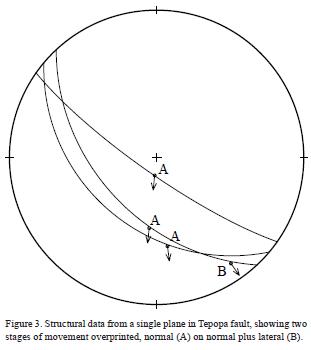
<body><![CDATA[<p align="justify"><font face="verdana" size="2">Rocks of the Sonora coastal region and Isla Tibur&oacute;n consist of Mesozoic(?) metasedimentary rocks intruded by granitoid rocks and an unconformable cover of mid&#150;Tertiary volcanic rocks. The regional structural trend and the strike of metamorphic units have a general orientation subparallel to the coast, forming horsts separated by basins filled with Pliocene to Quaternary sediments.</font></p>     <p align="justify"><font face="verdana" size="2">In the Kino Nuevo&#150;Punta Tepopa area (<a href="/img/revistas/rmcg/v25n2/a9f2.jpg" target="_blank">Figure 2</a>), the oldest unit corresponds to roof pendants of greenschistfacies metasandstone, marble and metaconglomerate. In the Cerro El Tordillo area (<a href="/img/revistas/rmcg/v25n2/a9f2.jpg" target="_blank">Figure 2</a>), the thickness of this unit reaches 350 m. Metamorphic rocks display a strong metamorphic foliation parallel to bedding, but the strike of foliation is very heterogeneous. Locally, the metamorphic unit is affected by ductile shear zones, parallel to foliation. Close to the plutons of the CSB, metamorphic rocks exhibit contact metasomatism with formation of wollastonite and garnet in calcareous rocks, and hornblende, kyanite and muscovite in sandstone. Gastil and Krummenacher (1977) suggests a Mesozoic age for this metamorphic unit on the basis of lithological correlations with a similar unit located to the north of Desemboque, which contains <i>Trigonia inexpectata, </i>of probable Early Jurassic age.</font></p>     <p align="justify"><font face="verdana" size="2">The CSB can be divided in two belts: 1) an eastern NNW&#150;SSE striking belt, from Punta San Nicol&aacute;s to Puerto Libertad (<a href="/img/revistas/rmcg/v25n2/a9f1.jpg" target="_blank">Figure 1</a>), that is 160 km long and 10 km wide and corresponds to a westward tilted block, almost perpendicular to the main direction of Tertiary extension; 2) a 70&#150;km&#150;long western belt composed of several plutons that crop out in Isla Tibur&oacute;n and Punta Tepopa (<a href="/img/revistas/rmcg/v25n2/a9f2.jpg" target="_blank">Figure 2</a>). To the east, the CSB is limited by the <img src="/img/revistas/rmcg/v25n2/a9s1.jpg">100 km wide Hermosillo coastal alluvial plain, which separates the CSB from the plutonic rocks of the Hermosillo area.</font></p>     <p align="justify"><font face="verdana" size="2">The CSB consists mainly of granodioritic andtonalitic plutons, with subordinated bodies of diorite and granite, besides of granitic dikes with aplitic and pegmatitic textures, and andesitic hipabysal intrusions. The oldest intrusive unit is the Puerto Rico diorite (<a href="/img/revistas/rmcg/v25n2/a9f2.jpg" target="_blank">Figure 2</a>), which crops out in the CSB as small isolated bodies. In the northern part of the CSB, the Puerto Rico diorite is dark gray, fine&#150; to coarse&#150;grained and consists mainly of plagioclase, biotite, hornblende, scarce quartz, with apatite and zircon as accessory minerals. A magmatic foliated texture is defined by a preferential orientation of biotite, hornblende and plagioclase.</font></p>     <p align="justify"><font face="verdana" size="2">The Kino granodiorite and Tepopa tonalite (<a href="/img/revistas/rmcg/v25n2/a9f2.jpg" target="_blank">Figure 2</a>) intrude the diorite; in <a href="/img/revistas/rmcg/v25n2/a9f2.jpg" target="_blank">Figure 2</a> they are not differentiated because contacts are transitional and irregular. The Kino granodiorite crops out mainly in the southern part of the area, between Kino Nuevo and Punta Chueca. It is light gray and coarse grained, composed of plagioclase, quartz, K&#150;feldspar, biotite and hornblende. In some samples, the granodiorite presents a slight ductile deformation, underlined by irregular mineral contacts and undulating extinction of quartz crystals, as well as deformed biotite altered to chlorite, and hornblende altered to epidote and subrounded K&#150;feldspar. The Tepopa tonalite crops out mainly in the northern part of the area, between Punta Tepopa and the NE of Pico Johnson (<a href="/img/revistas/rmcg/v25n2/a9f2.jpg" target="_blank">Figure 2</a>). The tonalite is light gray to almost white in color, and is composed of plagioclase, quartz, biotite and hornblende, with zircon, sphene and apatite as accessory minerals. The texture is fine grained and equigranular, with a higher content of plagioclase and biotite than the Kino granodiorite. Intrusive contacts of the Kino granodiorite and Tepopa tonalite within the diorite are very straight and sharp, and crosscut by dikes. A 5&#150;10 cm wide alteration zone is observed within the granodiorite, along the contact, characterized by a parallel recrystalliza&#150;tion of quartz and biotite. All these data suggest that the plutons were emplaced at relatively cold conditions, with low thermal contrast between the host rock and intrusive, as is showed in several localities.</font></p>     <p align="justify"><font face="verdana" size="2">The Rancho Nuevo granite is the youngest unit of the CSB. It crops out extensively in the southeastern area of the CSB, and, towards the north, only around the Rancho Doble I locality (<a href="/img/revistas/rmcg/v25n2/a9f2.jpg" target="_blank">Figure 2</a>). The Rancho Nuevo granite is reddish in color and coarse &#150; to very coarse&#150;grained, and its mineralogy of consists mainly of K&#150;feldspar phenocrysts as long as 5 cm, quartz, plagioclase, biotite and hornblende, with apatite and zircon as accessory phase. K&#150;feldspar is commonly altered to sericite along intracrystalline fractures. The characteristic reddish color is due to the oxidation of biotite. Intrusive contacts are sharp and characterized by textural changes and by the presence of local foliation. For instance, in the KI&#150;12&#150;35 locality, near Rancho Doble I (<a href="/img/revistas/rmcg/v25n2/a9f2.jpg" target="_blank">Figure 2</a>), the contact between Rancho Nuevo granite and Kino granodiorite consists of two 50&#150;cm&#150;wide zones with distinct textures, developed in the granite. The closest zone to the granodiorite displays a strong foliation along the contact. The second one, with porphyritic texture, is characterized by phenocrysts of K&#150;feldspar, plagioclase, biotite and quartz, in a fine&#150;grained matrix of quartz and plagioclase. The texture and foliation changes are restricted to a very thin zone along the contact, suggesting a subsolidus flow (<i>i. e.,</i> Vernon, 2000) during the intrusion of the Rancho Nuevo granite into the Kino granodiorite. An aplitic and pegmatitic dike system, genetically related to the Rancho Nuevo granite, has a wide distribution in the area and cuts across all the granitic and metamorphic units. The width of dikes varies from 2&#150;3 cm to about 1 m.</font></p>     <p align="justify"><font face="verdana" size="2">The Tordillo hypabisal andesite unit is spatially associated with the Kino granodiorite in the southern part of the area. The Tordillo andesite is gray and has a porphyritic texture characterized by phenocrysts of plagioclase in an aphanitic matrix, with sparce biotite crystals.</font></p>     <p align="justify"><font face="verdana" size="2">The CSB and metasedimentary are unconformably overlain by volcanic rocks that include rhyolite, andesite, tuff and basalt, associated with the activity of the Tertiary magmatic arc (Damon <i>et al., </i>1983b), with a total composite thickness of around 400 m. The coastal zone of Sonora is partially covered by Pliocene&#150;Quaternary sediments, which belong to deltaic deposits of the R&iacute;o Sonora, dunes and marine terraces.</font></p>     <p align="justify"><font face="verdana" size="2">The CSB is affected by two sets of extensional faults. The less conspicuous set has a nearly E&#150;W orientation, and includes the north dipping Tordillo normal fault (<a href="/img/revistas/rmcg/v25n2/a9f2.jpg" target="_blank">Figure 2</a>). The more developed set is oriented NNW&#150;SSE and controls the morphology of the coastal region; the west dipping Rancho Nuevo fault and the east dipping Tepopa fault belong to this last set. The Rancho Nuevo fault has a single normal slip, whereas the Tepopa fault presents two generations of superimposed kinematic indicators; the oldest one indicates a normal slip and the youngest one indicates a lateral slip, with a minor normal component (<a href="#f3">Figure 3</a>). This structural information reflects the post&#150;12 Ma opening of the Gulf of California in this part of its eastern margin. After the subduction stopped at 12.5 Ma, continental breakup occurred along a SW&#150;NE to W&#150;E strike of extension, and was followed, since 6 Ma, by a right&#150;lateral motion along NW&#150;SE to NNW&#150;SSE striking faults along which the Pacific plate is moving northwestward with respect to the North America plate (Stock and Hodges, 1989).</font></p>     <p align="center"><font face="verdana" size="2"><a name="f3"></a></font></p>     ]]></body>
<body><![CDATA[<p align="center"><font face="verdana" size="2"><img src="/img/revistas/rmcg/v25n2/a9f3.jpg"></font></p>     <p align="justify"><font face="verdana" size="2">The igneous and metamorphic Mesozoic rocks, as well as Tertiary volcanic rocks as young as 12 Ma (San Felipe tuff; Oskin, 2002), and the Hermosillo ignimbrite (Vidal&#150;Solano <i>et al., </i>2005) are faulted and tilted locally up to 70&deg; to the east <i>(i.e., </i>west of Sierra Kunkaak, north of Bah&iacute;a Kino). The relation between tilting and continental breakup is clearly evidenced by the deformation of Miocene volcanic rocks, but the structural pattern of the Gulf Extensional Province partially obliterates the previous Basin and Range extensional faulting pattern.</font></p>     <p align="justify"><font face="verdana" size="2">&nbsp;</font></p>     <p align="justify"><font face="verdana" size="2"><b>SAMPLING AND ANALYTICAL METHODS</b></font></p>     <p align="justify"><font face="verdana" size="2">To shed ligth on the crystallization and cooling history of granitoids from the CSB, six samples were collected in the southern area between the northern area of Punta Chueca and Kino Nuevo, and three samples in the northern area, from Punta Tepopa to Rancho Doble I (<a href="/img/revistas/rmcg/v25n2/a9f2.jpg" target="_blank">Figure 2</a>). Three samples of the southern area are aligned along a NE&#150;SW section, perpendicular to the direction of tilting. Eight of these samples were dated by U&#150;Pb zircon geochronology, and three samples of the southern area were also dated by the <sup>40</sup>Ar/<sup>39</sup>Ar method in biotite and K&#150;feldspar separates. A whole rock sample of the Tordillo andesite (sample KI&#150;04&#150;08) was dated by the K&#150;Ar method.</font></p>     <p align="justify"><font face="verdana" size="2">For each sample, 1&#150;2 kg of fresh rock chips were collected. Samples were prepared using standard separation techniques, including magnetic separation and heavy liquids. For the U&#150;Pb analysis, zircon crystals were separated by hand&#150;picking under a binocular microscope, for subsequent epoxy mounting and polishing.</font></p>     <p align="justify"><font face="verdana" size="2">Single zircon crystals were analyzed in polished grain mounts with a VG Isoprobe multi&#150;collector ICP&#150;MS equipped with nine Faraday collectors, an axial Daly detector, and four ion&#150;counting channels (Gehrels <i>et al., </i>2006). The Isoprobe is equipped with an ArF Excimer laser, which has an emission wavelength of 193 nm. The analyses were conducted on 50&#150;35 micron spots with an output energy of <img src="/img/revistas/rmcg/v25n2/a9s1.jpg">32 mJ and a repetition rate of 10 Hz. Each analysis consisted of a background measurement (one 20&#150;seconds integration on peaks with no laser firing) and twenty 1&#150;second integrations on peaks with the laser firing. Any Hg contribution to the <sup>204</sup>Pb mass was accordingly removed by subtracting the background values. The depth of each ablation pit was <img src="/img/revistas/rmcg/v25n2/a9s1.jpg">20 microns. Total measurement time was <img src="/img/revistas/rmcg/v25n2/a9s1.jpg">90 s per analysis.</font></p>     <p align="justify"><font face="verdana" size="2">The collectors were configured for simultaneous measurement of <sup>204</sup>Pb in an ion&#150;counting channel and <sup>206</sup>Pb, <sup>207</sup>Pb, <sup>208</sup>Pb, <sup>232</sup>Th, and <sup>238</sup>U in Faraday detectors. Inter&#150;element fractionation was monitored by analyzing fragments of SL&#150;1, a large concordant zircon crystal from Sri Lanka (SL&#150;1) with a known (ID&#150;TIMS) age of 564 &plusmn; 4 Ma (2 sigma) obtained by George Gehrels (unpublished data). The reported U&#150;Pb ages are based entirely on <sup>206</sup>Pb/<sup>238</sup>U ratios because the errors of the <sup>207</sup>Pb/<sup>235</sup>U and <sup>207</sup>Pb/<sup>206</sup>Pb ratios were too large. This is due primarily to the low intensity (commonly &lt;0.5 mV) of the <sup>207</sup>Pb signal from these young, low&#150;U grains. The <sup>206</sup>Pb/<sup>238</sup>U ratios were corrected for common Pb by using the measured <sup>206</sup>Pb/<sup>204</sup>Pb, a common Pb composition from Stacey and Kramers (1975), and an uncertainty of &plusmn;1.0 on the common <sup>206</sup>Pb/<sup>204</sup>Pb.</font></p>     <p align="justify"><font face="verdana" size="2">For each sample, the weighted mean of &#150;20&#150;25 individual analyses was calculated according to Ludwig (2003). The measurement error was added quadratically to the systematic errors, which include contributions from the calibration correction, decay constant, age of the calibration standard, and composition of common Pb. The systematic errors are 1&#150;2% for these samples. All the U&#150;Pb zircon ages are reported at the 2&#150;sigma level.</font></p>     <p align="justify"><font face="verdana" size="2">Biotite and K&#150;feldspar mineral separates were dated by <sup>40</sup>Ar/<sup>39</sup>Ar furnace step&#150;heating and total fusion methods. The mineral concentrates ranged in size between 250 and 180 um and were obtained to a purity of &gt;99% using heavy liquids and hand&#150;picking techniques. Samples were washed in acetone, alcohol, and deionised water in an ultrasonic cleaner to remove dust and then re&#150;sieved to &lt; 180 um.</font></p>     ]]></body>
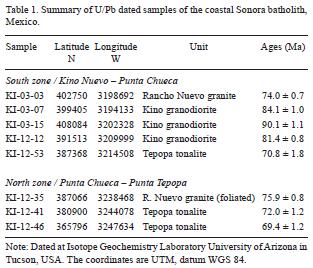
<body><![CDATA[<p align="justify"><font face="verdana" size="2">Aliquots of biotite and K&#150;feldspar for the different granitic samples were packaged in copper and sealed under vacuum in quartz tubes. The samples were then irradiated in package number KD3 8 for 5 hours in the central thimble facility at the TRIGA nuclear reactor (GSTR) at the U.S. Geological Survey in Denver, Colorado. The monitor mineral used in the package was Fish Canyon Tuff sanidine (FCT&#150;3) with a K&#150;Ar age of 27.79 Ma (Kunk <i>et al., </i>1985; Cebula <i>et al.</i>, 1986) relative to MMhb&#150;1 with a K&#150;Ar age of 519.4 &plusmn; 2.5 Ma (Alexander <i>et al., </i>1978; Dalrymple <i>et al., </i>1981). The type of container and the geometry of sample and standards are similar to those described by Snee <i>et al. </i>(1988).</font></p>     <p align="justify"><font face="verdana" size="2">The samples were analyzed at the U.S. Geological Survey Thermochronology Laboratory in Denver, Colorado, by the<sup>40</sup> Ar/<sup>39</sup> Ar furnace step&#150;heating and total fusion dating methods with a MAP 216 mass spectrometer fitted with an election multiplier. Biotite aliquots were fused in the furnace in a single heating step at <img src="/img/revistas/rmcg/v25n2/a9s1.jpg">l,450&deg;C to produce a total fusion age. For additional information on the analytical procedure, see Mondo <i>et al. </i>(2003, 2004).</font></p>     <p align="justify"><font face="verdana" size="2">The argon isotopic data, reported at the la level of analytical precision, were reduced using the computer program Mass Spec (Deino, 2001). We used the decay constants recommended by Steiger and Jager (1977). <a href="/img/revistas/rmcg/v25n2/a9t4.jpg" target="_blank">Table 4</a> shows <sup>40</sup>Ar/<sup>39</sup>Ar furnace step&#150;heating and total fusion data and includes the identification of individual temperature steps, plateau, average, and total gas ages. An individual step age represents the apparent age obtained for a single temperature step analysis. A plateau age (not present for these samples) is identified when three or more contiguous steps in the age spectrum agree in age, within the limits of analytical precision, and contain more than 50% of the <sup>39</sup>Ar<sub>K</sub> released from the sample (Fleck <i>et al.</i>, 1977). Total gas ages represent the age calculated from the integration of all the <sup>40</sup>Ar/<sup>39</sup>Ar step&#150;heating age results for the sample into one single age value; the total gas ages are thus roughly equivalent to conventional K&#150;Ar ages. No analytical precision is calculated for the total gas age because this analytical uncertainty in many cases does not represent the total geological uncertainty in the age of the mineral and/or rock.</font></p>     <p align="justify"><font face="verdana" size="2">&nbsp;</font></p>     <p align="justify"><font face="verdana" size="2"><b>GEOCHRONOLOGY RESULTS</b></font></p>     <p align="justify"><font face="verdana" size="2">Most of the dated samples are granodiorite&#150;tonalite to granite (<a href="#t1">Table 1</a>), generally with coarse to very coarsegrained textures, and large phenocrysts of K&#150;feldspar. Zircons separated from all the samples have the well defined crystallographic forms, with well&#150;developed and preserved faces, that characterize igneous zircons (Pupin, 1983). The absence of inherited zircon is indicated by the low dispersion in the distribution of the calculated ages of the samples (<a href="/img/revistas/rmcg/v25n2/a9f4.jpg" target="_blank">Figure 4</a>), which yielded only Cretaceous ages (from 90.1 &plusmn; 1.1 to 69.4 &plusmn;1.1 Ma). This result is supported by the <sup>40</sup>Ar/<sup>39</sup>Ar ages obtained in biotite, which are also Late Cretaceous (from 66.95 &plusmn; 0.28 to 73.61 &plusmn; 0.12 Ma), suggesting a regional cooling below the biotite closure temperature at this time (rough closure temperature estimate for biotite: <img src="/img/revistas/rmcg/v25n2/a9s1.jpg">300&plusmn;40 &deg;C; <i>e.g., </i>McDougall and Harrison, 1999). The description of the geochronological results was separated in two zones (north and south), based on their geographic location. Geochronological data are presented on <a href="#t1">Tables 1</a>&#150;<a href="/img/revistas/rmcg/v25n2/a9t4.jpg" target="_blank">4</a>. (<a href="#t1">Tables 1</a>, <a href="/img/revistas/rmcg/v25n2/a9t2.jpg" target="_blank">2</a>, <a href="/img/revistas/rmcg/v25n2/a9t3.jpg" target="_blank">3</a> and <a href="/img/revistas/rmcg/v25n2/a9t4.jpg" target="_blank">4</a>). </font></p>     <p align="center"><font face="verdana" size="2"><a name="t1"></a></font></p>     <p align="center"><font face="verdana" size="2"><img src="/img/revistas/rmcg/v25n2/a9t1.jpg"></font></p>     <p align="justify"><font face="verdana" size="2">&nbsp;</font></p>     <p align="justify"><font face="verdana" size="2"><b>Southern area</b></font></p>     ]]></body>
<body><![CDATA[<p align="justify"><font face="verdana" size="2">Three samples were collected along a 9 km long NE&#150;SW transect between Kino Nuevo and the northern Punta Chueca (<a href="/img/revistas/rmcg/v25n2/a9f2.jpg" target="_blank">Figure 2</a>). The units sampled are the Kino granodiorite close to the shoreline (KI&#150;03&#150;07), the Rancho Nuevo granite (KI&#150;03&#150;03) in the middle and, to the east, the Kino granodiorite (KI&#150;03&#150;15). The samples collected to the east and north of Punta Chueca are: Kino granodiorite (KI&#150;12&#150;12) and Tepopa tonalite (KI&#150;12&#150;53). A sample of the Tordillo andesite was collected north of Kino Nuevo (KI&#150;04&#150;08). The five intrusive samples were dated by U&#150;Pb, three of them were also dated by <sup>40</sup>Ar/<sup>39</sup>Ar, while the andesite sample was dated by the K&#150;Ar method.</font></p>     <p align="justify"><font face="verdana" size="2">The three <sup>206</sup>Pb&#150;<sup>238</sup>U zircon ages obtained for the Kino granodiorite are consistent with each other, indicating that crystallization occurred in Late Cretaceous time, between 90.1 &plusmn; 1.1 and 81.4 &plusmn; 0.8 Ma (<a href="/img/revistas/rmcg/v25n2/a9f4.jpg" target="_blank">Figure 4</a>; <a href="#t1">Table 1</a>). Younger crystallization ages of the Rancho Nuevo granite (74.0 &plusmn;0.7 Ma) and the Tepopa tonalite (70.8 &plusmn;1.8 Ma) are consistent with field relations showing that the Rancho Nuevo granite and Tepopa tonalite intruded the Kino granodiorite. The older sample of the Kino granodiorite (KI&#150;03&#150;15) shows ductile deformation whereas the younger samples (KI&#150;03&#150;07 and KI&#150;12&#150;12) are unaffected by this deformation, perhaps indicating that the intrusion began under syntectonic conditions. The youngest sample (KI&#150;12&#150;53) could represent the beginning of a tendency to younger ages to the north of the CSB.</font></p>     <p align="justify"><font face="verdana" size="2">The three samples of the NE&#150;SW section (KI&#150;03&#150;03, KI&#150;03&#150;07 and KI&#150;03&#150;15) were also dated by <sup>40</sup>Ar&#150;<sup>39</sup>Ar geochronology to determine their thermal history between <img src="/img/revistas/rmcg/v25n2/a9s1.jpg">300&deg;C (&plusmn;40) and <img src="/img/revistas/rmcg/v25n2/a9s1.jpg">150&deg;C (&plusmn;40), the rough estimate for closure temperatures of biotite and low&#150;temperature K&#150;feldspar domains, respectively.</font></p>     <p align="justify"><font face="verdana" size="2">Biotite from the Rancho Nuevo granite (KI&#150;03&#150;03) yielded a total fusion age of 66.95 &plusmn; 0.28 Ma (<a href="/img/revistas/rmcg/v25n2/a9f5.jpg" target="_blank">Figure 5a</a> and <a href="/img/revistas/rmcg/v25n2/a9t4.jpg" target="_blank">Table 4</a>) that we interpret as the best approximation for the timing of cooling of the granite below <img src="/img/revistas/rmcg/v25n2/a9s1.jpg">300&deg;C (&plusmn;40). However, the reliability of this age is poor because of the low percentage of radiogenic <sup>40</sup>Ar* (31%), which may be explained by the alteration of biotite to chlorite. The K&#150;feldspar analysis yielded an age range of cooling between 62.8 and <img src="/img/revistas/rmcg/v25n2/a9s1.jpg">60 Ma. We interpret that the upper age represents the K&#150;feldspar domains with higher argon retention &#91;rough estimate of high temperature K&#150;feldspar closure temperature: <img src="/img/revistas/rmcg/v25n2/a9s1.jpg">250&deg;C (&plusmn;40)&#93;, whereas the lower end represents the feldspar domains with lower retention properties (rough estimate of low temperature K&#150;feldspar closure temperature: <img src="/img/revistas/rmcg/v25n2/a9s1.jpg">150&deg;C (&plusmn; 40). These cooling ages combined with the zircon crystallization age of 74.0 &plusmn; 0.7 Ma indicate a relatively slow initial cooling through biotite and a slower cooling between biotite and low&#150;T K&#150;feldspar (<a href="/img/revistas/rmcg/v25n2/a9f6.jpg" target="_blank">Figure 6</a>).</font></p>     <p align="justify"><font face="verdana" size="2">Kino granodiorite biotite sample KI&#150;03&#150;07 yielded a single step age of 72.41 &plusmn; 0.22 Ma (Table 4) that represents the time of cooling below biotite closure. The age spectrum for K&#150;feldspar (<a href="/img/revistas/rmcg/v25n2/a9f5.jpg" target="_blank">Figure 5b</a>) shows a large age gradient between 63 and 41.5 Ma implying a significantly slower cooling rate than that of Rancho Nuevo granite, although cooling in the early stages, between zircon (84.1 &plusmn;1.0 Ma) and biotite, is slightly slower than for Rancho Nuevo granite sample (Figure 6). A second Kino granodiorite sample (KI&#150;03&#150;15) was dated on a biotite separate that yielded a single&#150;step age of 73.61 &plusmn; 0.12 Ma (<a href="/img/revistas/rmcg/v25n2/a9t4.jpg" target="_blank">Table 4</a>). The age spectrum for the K&#150;feldspar of this sample (<a href="/img/revistas/rmcg/v25n2/a9f5.jpg" target="_blank">Figure 5c</a> and <a href="/img/revistas/rmcg/v25n2/a9t4.jpg" target="_blank">Table 4</a>) displays a gradient between 68.4 and 59.5 Ma. The cooling curve for this last granodiorite sample indicate an intermediate cooling rate with respect to the previously described samples. Appartently, the older Kino granodiorite samples KI&#150;03&#150;15 and KI&#150;03&#150;07 needed more time to cool below K&#150;feldspar closure, perhaps because the younger pulse of magmatism (Rancho Nuevo granite) created a regional thermal gradient that maintained the preexisting rocks above their closure temperatures for the Ar&#150;Argeochronometers. The Rancho Nuevo granite sample (KI&#150;03&#150;03) cooled relatively rapidly and was not affected by any significant thermal pulse since cooling below K&#150;feldspar closure &#91;low retention domains at <img src="/img/revistas/rmcg/v25n2/a9s1.jpg">150&deg;C (&plusmn;40) around 60 Ma (<a href="/img/revistas/rmcg/v25n2/a9f6.jpg" target="_blank">Figure 6</a>)&#93;.</font></p>     <p align="justify"><font face="verdana" size="2">The Tordillo andesite (KI&#150;04&#150;08) yielded a K&#150;Ar whole rock age of 62.5 &plusmn; 1.5 Ma (<a href="/img/revistas/rmcg/v25n2/a9t2.jpg" target="_blank">Table 2</a>). The emplacement of this unit occurred at the time the Kino granodiorite and Rancho Nuevo granite cooled through <img src="/img/revistas/rmcg/v25n2/a9s1.jpg">250&deg;C (&plusmn;40), the rough estimate for closure temperature of the high&#150;retention domains of K&#150;feldspar. The age of the Tordillo andesite is similar to other ages obtained further to the east, in andesites of the Tarahumara Formation (McDowell <i>et al., </i>2001; Roldan&#150;Quintana, 2002), suggesting that the Cretaceous&#150;Paleogene volcanic activity related to the Laramide magmatic arc was not restricted to central Sonora but was also present along the western margin of the North America craton. We interpret the scarcity of outcrops of the Tarahumara Formation in western Sonora as a result of the intense uplift and subsequent erosion during Basin and Range faulting and pre&#150;Gulf rifting.</font></p>     <p align="justify"><font face="verdana" size="2">&nbsp;</font></p>     <p align="justify"><font face="verdana" size="2"><b>Northern area</b></font></p>     <p align="justify"><font face="verdana" size="2">In the area between Rancho Doble I and Punta Tepopa, three samples were collected and dated by U&#150;Pb zircon geochronology (<a href="/img/revistas/rmcg/v25n2/a9f2.jpg" target="_blank">Figure 2</a>). <sup>206</sup>Pb&#150;<sup>238</sup>U zircon ages of the three samples correspond to Late Cretaceous crystallization, varying between 75.9 &plusmn; 0.8 and 69.4 &plusmn; 1.2 Ma (<a href="#t1">Table 1</a>). They are distinctly younger than the Kino granodiorite in the southern area.</font></p>     <p align="justify"><font face="verdana" size="2">Sample KI&#150;12&#150;46 belongs to the Isla Tibur&oacute;n&#150;Punta Tepopa range, whereas the other two samples belong to the Kunkaak range (<a href="/img/revistas/rmcg/v25n2/a9f2.jpg" target="_blank">Figure 2</a>). Sample KI&#150;12&#150;35 is part of the Rancho Nuevo granite and corresponds to a porphyric monzogranite, which presents a clear magmatic foliation. Samples KI&#150;12&#150;46 and KI&#150;12&#150;41 belong to the Tepopa tonalite, which is older than the granite, based on intrusion relationships from several localities.</font></p>     ]]></body>
<body><![CDATA[<p align="justify"><font face="verdana" size="2">The KI&#150;12&#150;35 sample is the oldest one, with a zircon <sup>206</sup>Pb&#150;<sup>238</sup>U age of 75.9 &plusmn; 0.8 Ma, and corresponds to the zone of magmatic foliation of the Rancho Nuevo granite near the intrusive contact with the Kino granodiorite. This age is in agreement with the age obtained in the southern area (KI&#150;03&#150;03), also intruding the Kino granodiorite.</font></p>     <p align="justify"><font face="verdana" size="2">Samples of the Tepopa tonalite (KI&#150;12&#150;41 and KI&#150;12&#150;46) yield similar <sup>206</sup>Pb&#150;<sup>238</sup>U ages that are in close agreement with that obtained for the Tepopa tonalite (70.8 &plusmn; 1.8 Ma) from the southern zone. With these results we can conclude that the Tepopa tonalite was emplaced in an time interval of about 3 Ma, and is the last intrusive unit of the CSB.</font></p>     <p align="justify"><font face="verdana" size="2">&nbsp;</font></p>     <p align="justify"><font face="verdana" size="2"><b>DISCUSSION</b></font></p>     <p align="justify"><font face="verdana" size="2"><b>Crystallization and cooling of the Sonora coastal batholith</b></font></p>     <p align="justify"><font face="verdana" size="2">Petrological characteristics and <sup>206</sup>Pb&#150;<sup>238</sup>U zircon ages indicate that the CSB consists of several granitoid complexes that crystallized during Late Cretaceous, between <img src="/img/revistas/rmcg/v25n2/a9s1.jpg">90 and 70 Ma (<a href="/img/revistas/rmcg/v25n2/a9f6.jpg" target="_blank">Figure 6</a>). The CSB was emplaced in the continental active margin of North America, in a region characterized by the transition between two previously juxtaposed basements; a northern one related to the margin of the North America craton, and a southern one with oceanic basin affinities since the Paleozoic time (Valencia&#150;Moreno <i>et al., </i>2001). Nevertheless, the lack of inherited zircon in the analyzed samples does not provide any complementary information about the nature of the basement in which the CSB intruded in the studied area (<a href="/img/revistas/rmcg/v25n2/a9f4.jpg" target="_blank">Figure 4</a>). Although the selection of individual zircon crystals was made by hand&#150;picking, it is unlikely that this procedure has induced a lack of inherited zircons in all samples.</font></p>     <p align="justify"><font face="verdana" size="2">The crystallization of the CSB began with the Puerto Rico diorite (not dated), emplaced as small bodies around <img src="/img/revistas/rmcg/v25n2/a9s1.jpg">90 Ma. Later, between <img src="/img/revistas/rmcg/v25n2/a9s1.jpg">90 and <img src="/img/revistas/rmcg/v25n2/a9s1.jpg">80 Ma, the Kino granodiorite was emplaced within a relatively cold Puerto Rico diorite; this is interpreted by the sharp and regular contacts that could be related to a relatively shallow level of emplacement. The weak ductile deformation observed in the locality of sample KI&#150;03&#150;15 (<a href="/img/revistas/rmcg/v25n2/a9f2.jpg" target="_blank">Figure 2</a>) is correlated to local processes during the cooling of the pluton, because such deformation was not observed in other samples. The Rancho Nuevo granite and granitic dikes were emplaced at around <img src="/img/revistas/rmcg/v25n2/a9s1.jpg">76&#150;74 Ma. The youngest units on the studied area corresponds to the Tepopa tonalite, emplaced between 72 and 69 Ma, and the Tordillo andesite emplaced at <img src="/img/revistas/rmcg/v25n2/a9s1.jpg">62.5 Ma (<a href="#t1">Table 1</a>). While the volcanics are spatially related to the Kino granodiorite, our geochronologic results demonstrate that the bodies are not coeval.</font></p>     <p align="justify"><font face="verdana" size="2">The U&#150;Pb isotopic zircon ages obtained for the Kino granodiorite, Tepopa tonalite and Rancho Nuevo granite display a clear difference in crystallization age (<a href="/img/revistas/rmcg/v25n2/a9f2.jpg" target="_blank">Figure 2</a>). The U&#150;Pb ages reported in this study are older than U&#150;Pb zircon ages obtained by Anderson <i>et al. </i>(1980) in the Sierra Mazat&aacute;n and Puerto del Sol (57 &plusmn; 3 and 58 &plusmn; 3 Ma), and by Poole <i>et al. </i>(1991) in Barita de Sonora mining district (62.0 &plusmn; 1 Ma). Furthermore, these U&#150;Pb ages are older and younger than ages obtained by Anderson <i>et al. </i>(1980) to the north in the Sierra Guacomea and Rancho Los Alamos (74 &plusmn; 2 and 78 &plusmn; 3 Ma, respectively). The correlation between the U&#150;Pb ages from this and previous studies shows a tendency for the crystallization ages to be younger to the east, toward the interior of Sonora. This tendency supports the idea of an eastward magmatic migration during the Laramide orogeny (Damon <i>et al., </i>1983b).</font></p>     <p align="justify"><font face="verdana" size="2"><sup>40</sup>Ar/<sup>39</sup>Ar and K&#150;Ar ages obtained in this study agree with previous K&#150;Ar and <sup>40</sup>Ar/<sup>39</sup>Ar results (Gastil and Krummenacher, 1977; Mora&#150;Alvarez, 1992, and Valencia&#150;Moreno <i>et al., </i>2006) for the central part of the CSB and Isla Tibur&oacute;n. North of the study area, near Puerto Libertad, Gastil and Krummenacher (1977) reported K&#150;Ar ages in biotite and hornblende for intrusive granitoids of the CSB ranging from 70 to 60 Ma. In the region of Guaymas and San Carlos, further to the south, Mora&#150;Alvarez (1992) and Rold&aacute;n&#150;Quintana (2002) reported K&#150;Ar ages in hornblende between 83.0 &plusmn; 2.1 and 82.7 &plusmn; 1.7 Ma and in biotite between 81.1 &plusmn; 2.8 and 76.9 &plusmn; 2.8 Ma, which provides further indication that the CSB exposes older rocks to the south. </font></p>     <p align="justify"><font face="verdana" size="2">The spatial distribution of isotopic ages of plutons in Central Sonora between 30&deg; and 32&deg; N latitude (<a href="/img/revistas/rmcg/v25n2/a9f7.jpg" target="_blank">Figure 7</a>) has been interpreted as evidence of progressive eastward migration of the Cretaceous&#150;Tertiaty magmatic arc (Damon <i>et al., </i>1983a). The ages obtained in the present study support this hypothesis for the arc migration. In addition, the sotopic age gradient from south to north within the CSB suggests that the orientation of the arc axis was oblique with respect to the present coastline of Sinaloa and Sonora, which is a morphotectonic feature controlled by the Tertiary history dominated by the Basin and Range extension and the opening of the Gulf of California.</font></p>     ]]></body>
<body><![CDATA[<p align="justify"><font face="verdana" size="2">We suggest that some zones exist, as the CSB, with a local magmatic evolution that does not follow the general chronological evolution and migration pattern of the entire magmatic arc. In the case of CSB, the magmatism remained static for about of 10 to 20 Ma, which is suggested by the geochemical magmatic differentiation from diorite to granite emplaced at the same place.</font></p>     <p align="justify"><font face="verdana" size="2">&nbsp;</font></p>     <p align="justify"><font face="verdana" size="2"><b>Correlation of the CSB with the Peninsular Ranges Batholith</b></font></p>     <p align="justify"><font face="verdana" size="2">The correlation of the batholiths located on both sides of the Gulf of California has been addressed by several authors (<i>e.g.</i>, Gastil and Krummenacher, 1977), and is supported by similar chemical, petrographic and geochronological characteristics (e.g., Schaaf <i>et al., </i>2000). Ages of granitoid rocks dated in the eastern margin of the Baja California peninsula support this interpretation: for example 78.4 &plusmn;2.9 Ma K&#150;Ar (McFall, 1968) and 99 &plusmn; 2 Ma (Ledesma&#150;Vazquez, 2000) ages in the Bah&iacute;a Concepci&oacute;n area, and 91.2 &plusmn; 2.1 Ma in the Santa Rosalia area (Schmidt, 1975). Alternatively, the coherent belt of high&#150;amplitude magnetic anomalies present along the Baja California peninsula does not exist in mainland Mexico, suggesting a geological limit located in the Gulf of California (Langenheim and Jachens, 2003).</font></p>     <p align="justify"><font face="verdana" size="2">The crystallization and cooling ages obtained in this study further support this correlation between granitoids of Baja California and the coastal region of Sonora. Batholiths in both areas are the product of continental arc magmatism active during Cretaceous to Tertiary time. This magmatic arc began its activity at around 105 Ma, forming first the eastern Peninsular Ranges batholith (EPRB), and migrating later further to the east where the CSB and younger plutons in central and eastern Sonora were generated (Roldan&#150;Quintana, 1991; Valencia&#150;Moreno <i>et al., </i>2001; Valencia&#150;Moreno <i>et al., </i>2006). The arc migration has been associated with a change in the subduction angle, which was responsible for the synchronous Laramide orogeny in the region. The eastward migration is underlined by changes in the geochemical characteristics (Damon <i>et al., </i>1983a). The westernmost plutons are slightly more mafic, and consist mainly of low&#150;K granodiorite and tonalite, which are common in the CSB and EPRB, whereas eastern plutons are more alkaline (Valencia&#150;Moreno <i>et al., </i>2003). The similarity in the geochemical characteristics and isotopic ages of the CSB and EPRB, suggest a genetic relationship between them. The ages of crystallization in the EPRB are older than 95 Ma (Ortega&#150;Rivera, 1997; Kimbrough <i>et al., </i>2001), whereas the ages of the CSB are constrained between 90.1 and 69.4 Ma. In central and eastern Sonora, ages vary between <img src="/img/revistas/rmcg/v25n2/a9s1.jpg">78 and 57 Ma (Anderson <i>et al., </i>1980; Poole <i>et al., </i>1991). If we restore the peninsula of Baja California to its paleogeographic position before the opening of the Gulf of California (Gastil and Krummenacher, 1977; Oskin, 2002; Ortega&#150;Rivera, 2003), the isotopic age distribution define continuous isochrones from the Baja California peninsula to the interior of Mexico (Damon <i>et al., </i>1983b; Ortega&#150;Rivera, 2003).</font></p>     <p align="justify"><font face="verdana" size="2">Furthermore, the offset of the contour of the 0.706 initial <sup>87</sup>Sr/<sup>86</sup>Sr isopleth on both sides of the Gulf of California confirms the magnitude of dextral shearing across the Gulf obtained from a comparison between Miocene volcanic rocks from San Felipe area and Bah&iacute;a Kino areas (Oskin and Scott, 2002).</font></p>     <p align="justify"><font face="verdana" size="2">&nbsp;</font></p>     <p align="justify"><font face="verdana" size="2"><b>CONCLUSIONS</b></font></p>     <p align="justify"><font face="verdana" size="2">The new U&#150;Pb zircon and <sup>40</sup>Ar/<sup>39</sup>Ar biotite and K&#150;feldspar geochronology allow us to constrain ages of crystallization and decipher the thermal evolution after emplacement of the successive intrusions of the CSB, and to propose a regional correlation with other plutons of the Laramide magmatic arc. From older to younger magmatic units, the CSB consist of the Puerto Rico diorite, the Kino granodiorite, the Puerto Nuevo granite, and the Tepopa tonalite, as well as the Tordillo andesite as an associated subvolcanic unit. <sup>206</sup>Pb&#150;<sup>238</sup>U zircon ages show that the interval between granodiorite and tonalite crystallization is <img src="/img/revistas/rmcg/v25n2/a9s1.jpg">21 Ma (between 90.1 &plusmn; I.land69.4&plusmn; 1.2 Ma), which suggests that during this time interval there was no migration of the magmatic arc along the present coast of Sonora. <sup>40</sup>Ar/<sup>39</sup>Ar and K&#150;Ar ages are in agreement with <sup>206</sup>Pb &#150;<sup>238</sup>U zircon ages, and corroborate previous results obtained in that region (Anderson and Silver, 1969; Gastil and Krummenacher, 1977; Mora&#150;Alvarez, 1992; Roldan&#150;Quintana, 2002); they indicate a relatively slow cooling rate of the CSB, between zircon crystallization and closure temperature of K&#150;feld&#150;spar. The spatial distribution of ages, older to the south and younger to the north, suggests that the CSB coincide with the transition of the 70&#150;60 Ma isochrons in the model proposed by Ortega&#150;Rivera (2003). The ages determined for the CSB are younger, and consecutive, to those of the EPRB, which is interpreted to belong to the same magmatic arc that migrated eastwards along the continental margin of North America.</font></p>     <p align="justify"><font face="verdana" size="2">&nbsp;</font></p>     ]]></body>
<body><![CDATA[<p align="justify"><font face="verdana" size="2"><b>ACKNOWLEDGMENTS</b></font></p>     <p align="justify"><font face="verdana" size="2">This research was supported by the Conacyt research grant 36225 T. We want to thank George Gehrels for access and facilities of Isotope Geochemistry Laboratory of University of Arizona, in Tucson. Also we thank Michael Kunk for access and close supervision of <sup>40</sup>Ar/<sup>39</sup>Ar geochronology at the U.S. Geological Survey Thermochronology Laboratory in Denver, Colorado. We also thank Alice Kaminski, a former University of Colorado at Boulder student for careful mineral separations for the Ar/Ar geochronology studies. We thank Pablo Pe&ntilde;aflor&#150;Esc&aacute;rcega for his help in sample preparation at ERNO geochemical laboratory in Hermosillo, Sonora, and Ren&eacute; Delgado&#150;Gonz&aacute;lez for his field assistance in Baja California. Finally we are grateful to Margarita L&oacute;pez Mart&iacute;nez, Luis A. Delgado Argote and Marty Grove for their helpful review of the manuscript.</font></p>     <p align="justify"><font face="verdana" size="2">&nbsp;</font></p>     <p align="justify"><font face="verdana" size="2"><b>REFERENCES</b></font></p>     <!-- ref --><p align="justify"><font face="verdana" size="2">Alexander, E.C., Jr., Mickelson, G.M., Lanphere, M.A., 1978, Mmhb&#150;1: a new <sup>40</sup>Ar/<sup>39</sup>Ar dating standard, <i>in </i>Zartman, R.E. (ed.), Short Papers of the Fourth International Conference, Geochronology, Cosmochronology, and Isotope Geology: U.S. Geological Survey, Open&#150;File Report 78&#150;701, 6&#150;8.</font>&nbsp;&nbsp;&nbsp;&nbsp;&nbsp;&nbsp;&nbsp;&nbsp;[&#160;<a href="javascript:void(0);" onclick="javascript: window.open('/scielo.php?script=sci_nlinks&ref=8027875&pid=S1026-8774200800020000900001&lng=','','width=640,height=500,resizable=yes,scrollbars=1,menubar=yes,');">Links</a>&#160;]<!-- end-ref --><!-- ref --><p align="justify"><font face="verdana" size="2">Anderson, T.H., Silver, L.T., 1969, Mesozoic magmatic events of the northern Sonora coastal region, Mexico (abstract): Geological Society of America Abstracts with Programs, 3&#150;4.</font>&nbsp;&nbsp;&nbsp;&nbsp;&nbsp;&nbsp;&nbsp;&nbsp;[&#160;<a href="javascript:void(0);" onclick="javascript: window.open('/scielo.php?script=sci_nlinks&ref=8027876&pid=S1026-8774200800020000900002&lng=','','width=640,height=500,resizable=yes,scrollbars=1,menubar=yes,');">Links</a>&#160;]<!-- end-ref --><!-- ref --><p align="justify"><font face="verdana" size="2">Anderson, T.H., Silver, L.T., Salas, G.A., 1980, Distribution and U&#150;Pb isotope ages of some lineated plutons, northwestern Mexico: Geological Society of America, Memoir 153, 269&#150;283.</font>&nbsp;&nbsp;&nbsp;&nbsp;&nbsp;&nbsp;&nbsp;&nbsp;[&#160;<a href="javascript:void(0);" onclick="javascript: window.open('/scielo.php?script=sci_nlinks&ref=8027877&pid=S1026-8774200800020000900003&lng=','','width=640,height=500,resizable=yes,scrollbars=1,menubar=yes,');">Links</a>&#160;]<!-- end-ref --><!-- ref --><p align="justify"><font face="verdana" size="2">Barton, M.D., Staude, J.M., Zurcher, L., Megaw, P.K.M., 1995, Porphyry cooper and other intrusion&#150;related mineralization in Mexico, <i>in </i>Pierce, E.W., Bolm, J.G. (eds.), Porphyry Cooper Deposits of the American Cordillera: Arizona Geological Society Digest, 99, 674&#150;685.</font>&nbsp;&nbsp;&nbsp;&nbsp;&nbsp;&nbsp;&nbsp;&nbsp;[&#160;<a href="javascript:void(0);" onclick="javascript: window.open('/scielo.php?script=sci_nlinks&ref=8027878&pid=S1026-8774200800020000900004&lng=','','width=640,height=500,resizable=yes,scrollbars=1,menubar=yes,');">Links</a>&#160;]<!-- end-ref --><!-- ref --><p align="justify"><font face="verdana" size="2">Busby, C.J., Smith, D.P., Morris, W.R., Adams, B., 1998, Evolutionary model for convergent margins facing large ocean basins: Mesozoic Baja California (Mexico): Geology, 26(3), 227&#150;230.</font>&nbsp;&nbsp;&nbsp;&nbsp;&nbsp;&nbsp;&nbsp;&nbsp;[&#160;<a href="javascript:void(0);" onclick="javascript: window.open('/scielo.php?script=sci_nlinks&ref=8027879&pid=S1026-8774200800020000900005&lng=','','width=640,height=500,resizable=yes,scrollbars=1,menubar=yes,');">Links</a>&#160;]<!-- end-ref --><!-- ref --><p align="justify"><font face="verdana" size="2">Cebula, G.T., Kunk, M.J., Mehnert, H.H., Naeser, C.W., Obradovich, J.D., Sutter, J.F., 1986, The Fish Canyon Tuff: A potential standard for the <sup>40</sup>Ar/<sup>39</sup>Ar and fission track dating methods: Terra Cognita, 6(2), 140.</font>&nbsp;&nbsp;&nbsp;&nbsp;&nbsp;&nbsp;&nbsp;&nbsp;[&#160;<a href="javascript:void(0);" onclick="javascript: window.open('/scielo.php?script=sci_nlinks&ref=8027880&pid=S1026-8774200800020000900006&lng=','','width=640,height=500,resizable=yes,scrollbars=1,menubar=yes,');">Links</a>&#160;]<!-- end-ref --><!-- ref --><p align="justify"><font face="verdana" size="2">Coney, P.J., Reynolds, S.J., 1977, Cordilleran Benioff zones: Nature, 270, 403&#150;406.</font>&nbsp;&nbsp;&nbsp;&nbsp;&nbsp;&nbsp;&nbsp;&nbsp;[&#160;<a href="javascript:void(0);" onclick="javascript: window.open('/scielo.php?script=sci_nlinks&ref=8027881&pid=S1026-8774200800020000900007&lng=','','width=640,height=500,resizable=yes,scrollbars=1,menubar=yes,');">Links</a>&#160;]<!-- end-ref --><!-- ref --><p align="justify"><font face="verdana" size="2">Dalrymple, G.B., Alexander, E.C., Lanphere, M.A., Kraker, G.P., 1981, Irradiation of samples for <sup>40</sup>Ar/<sup>39</sup>Ar dating using the Geological Survey TRIGA reactor: U.S. Geological Survey, Professional Paper 1176, 55 p.</font>&nbsp;&nbsp;&nbsp;&nbsp;&nbsp;&nbsp;&nbsp;&nbsp;[&#160;<a href="javascript:void(0);" onclick="javascript: window.open('/scielo.php?script=sci_nlinks&ref=8027882&pid=S1026-8774200800020000900008&lng=','','width=640,height=500,resizable=yes,scrollbars=1,menubar=yes,');">Links</a>&#160;]<!-- end-ref --><!-- ref --><p align="justify"><font face="verdana" size="2">Damon, P.E., Shafiquillah, M., Clark, K.F., 1983a, Geochronology of the porphyry copper deposits and related mineralization of Mexico: Canadian Journal of Earth Sciences, 20, 1052&#150;1071.</font>&nbsp;&nbsp;&nbsp;&nbsp;&nbsp;&nbsp;&nbsp;&nbsp;[&#160;<a href="javascript:void(0);" onclick="javascript: window.open('/scielo.php?script=sci_nlinks&ref=8027883&pid=S1026-8774200800020000900009&lng=','','width=640,height=500,resizable=yes,scrollbars=1,menubar=yes,');">Links</a>&#160;]<!-- end-ref --><!-- ref --><p align="justify"><font face="verdana" size="2">Damon, PE., Shafiqullah, M., Rold&aacute;n&#150;Quintana, J. And Cochem&eacute;, J.J., 1983b, El batolito Laramide (90&#150;40 Ma) de Sonora: Guadalajara, Asociaci&oacute;n de Ingenieros de Minas, Metalurgistas y Ge&oacute;logos de M&eacute;xico (AIMMGM), Memoria t&eacute;cnica XV, 63&#150;95.</font>&nbsp;&nbsp;&nbsp;&nbsp;&nbsp;&nbsp;&nbsp;&nbsp;[&#160;<a href="javascript:void(0);" onclick="javascript: window.open('/scielo.php?script=sci_nlinks&ref=8027884&pid=S1026-8774200800020000900010&lng=','','width=640,height=500,resizable=yes,scrollbars=1,menubar=yes,');">Links</a>&#160;]<!-- end-ref --><!-- ref --><p align="justify"><font face="verdana" size="2">Deino, A.L., 2001, Users manual for Mass Spec v. 5.02: Berkeley Geochronology Center, Special Publication 1a, 119 p.</font>&nbsp;&nbsp;&nbsp;&nbsp;&nbsp;&nbsp;&nbsp;&nbsp;[&#160;<a href="javascript:void(0);" onclick="javascript: window.open('/scielo.php?script=sci_nlinks&ref=8027885&pid=S1026-8774200800020000900011&lng=','','width=640,height=500,resizable=yes,scrollbars=1,menubar=yes,');">Links</a>&#160;]<!-- end-ref --><!-- ref --><p align="justify"><font face="verdana" size="2">Dickinson, W.R., 1989, Tectonic setting of Arizona through geologic time, <i>in </i>Jenney, J.P., Reynolds, S.J. (eds.), Geological Evolution of Arizona: Tucson, Arizona Geological Society Digest, 17, 1&#150;16.</font>&nbsp;&nbsp;&nbsp;&nbsp;&nbsp;&nbsp;&nbsp;&nbsp;[&#160;<a href="javascript:void(0);" onclick="javascript: window.open('/scielo.php?script=sci_nlinks&ref=8027886&pid=S1026-8774200800020000900012&lng=','','width=640,height=500,resizable=yes,scrollbars=1,menubar=yes,');">Links</a>&#160;]<!-- end-ref --><!-- ref --><p align="justify"><font face="verdana" size="2">Dickinson, W.R., Gehrels, G.E., 2003, U&#150;Pb ages of detrital zircons from Permian and Jurassic eolian sandstones of the Colorado Plateau, USA: Paleogeographic implications: Sedimentary Geology, 163, 29&#150;66.</font>&nbsp;&nbsp;&nbsp;&nbsp;&nbsp;&nbsp;&nbsp;&nbsp;[&#160;<a href="javascript:void(0);" onclick="javascript: window.open('/scielo.php?script=sci_nlinks&ref=8027887&pid=S1026-8774200800020000900013&lng=','','width=640,height=500,resizable=yes,scrollbars=1,menubar=yes,');">Links</a>&#160;]<!-- end-ref --><!-- ref --><p align="justify"><font face="verdana" size="2">Dickinson, W.R., Lawton, T.F., 2001, Carboniferous to Cretaceous assembly and fragmentation of Mexico: Geological Society of America Bulletin, 113, 1142&#150;1160.</font>&nbsp;&nbsp;&nbsp;&nbsp;&nbsp;&nbsp;&nbsp;&nbsp;[&#160;<a href="javascript:void(0);" onclick="javascript: window.open('/scielo.php?script=sci_nlinks&ref=8027888&pid=S1026-8774200800020000900014&lng=','','width=640,height=500,resizable=yes,scrollbars=1,menubar=yes,');">Links</a>&#160;]<!-- end-ref --><!-- ref --><p align="justify"><font face="verdana" size="2">Fleck, R.J., Sutter, J.F., Elliot, D.H., 1977, Interpretation of discordant <sup>40</sup>Ar/<sup>39</sup>Ar age spectra of Mesozoic tholeiites from Antarctica: Geochimica et Cosmochimica Acta, 41, 15&#150;32.</font>&nbsp;&nbsp;&nbsp;&nbsp;&nbsp;&nbsp;&nbsp;&nbsp;[&#160;<a href="javascript:void(0);" onclick="javascript: window.open('/scielo.php?script=sci_nlinks&ref=8027889&pid=S1026-8774200800020000900015&lng=','','width=640,height=500,resizable=yes,scrollbars=1,menubar=yes,');">Links</a>&#160;]<!-- end-ref --><!-- ref --><p align="justify"><font face="verdana" size="2">Gans, P.B., 1997, Large&#150;magnitude Oligo&#150;Miocene extension in southern Sonora: Implications for the tectonic evolution of northwest Mexico: Tectonics, 16, 388&#150;408.</font>&nbsp;&nbsp;&nbsp;&nbsp;&nbsp;&nbsp;&nbsp;&nbsp;[&#160;<a href="javascript:void(0);" onclick="javascript: window.open('/scielo.php?script=sci_nlinks&ref=8027890&pid=S1026-8774200800020000900016&lng=','','width=640,height=500,resizable=yes,scrollbars=1,menubar=yes,');">Links</a>&#160;]<!-- end-ref --><!-- ref --><p align="justify"><font face="verdana" size="2">Gastil, R. G., 1975, Plutonic zones in the Peninsular Ranges of southern California and northern Baja California: Geology, 3, 361&#150;363.</font>&nbsp;&nbsp;&nbsp;&nbsp;&nbsp;&nbsp;&nbsp;&nbsp;[&#160;<a href="javascript:void(0);" onclick="javascript: window.open('/scielo.php?script=sci_nlinks&ref=8027891&pid=S1026-8774200800020000900017&lng=','','width=640,height=500,resizable=yes,scrollbars=1,menubar=yes,');">Links</a>&#160;]<!-- end-ref --><!-- ref --><p align="justify"><font face="verdana" size="2">Gastil, R.G., 1983, Mesozoic and Cenozoic granitic rocks of southern California and western Mexico, <i>in </i>Roddick, J.A. (ed.), Circum&#150;Pacific Plutonic Terranes: Boulder, Colorado, Geological Society of America, Memoir 159, 265&#150;275.</font>&nbsp;&nbsp;&nbsp;&nbsp;&nbsp;&nbsp;&nbsp;&nbsp;[&#160;<a href="javascript:void(0);" onclick="javascript: window.open('/scielo.php?script=sci_nlinks&ref=8027892&pid=S1026-8774200800020000900018&lng=','','width=640,height=500,resizable=yes,scrollbars=1,menubar=yes,');">Links</a>&#160;]<!-- end-ref --><!-- ref --><p align="justify"><font face="verdana" size="2">Gastil, G., Krummenacher, D., 1977, Reconnaissance geology of coastal Sonora between Puerto Lobos and Bahia Kino: Geological Society of America Bulletin, 88, 189&#150;198.</font>&nbsp;&nbsp;&nbsp;&nbsp;&nbsp;&nbsp;&nbsp;&nbsp;[&#160;<a href="javascript:void(0);" onclick="javascript: window.open('/scielo.php?script=sci_nlinks&ref=8027893&pid=S1026-8774200800020000900019&lng=','','width=640,height=500,resizable=yes,scrollbars=1,menubar=yes,');">Links</a>&#160;]<!-- end-ref --><!-- ref --><p align="justify"><font face="verdana" size="2">Gastil, R.G., Morgan, G. J., Krummenacher, D., 1981, The tectonic history of peninsular California and adjacent Mexico, <i>in </i>Ernst, W.G., (ed.), The Geotectonic Development of California: Englewood Cliffs, New Jersey, Prentice&#150;Hall, 284&#150;306.</font>&nbsp;&nbsp;&nbsp;&nbsp;&nbsp;&nbsp;&nbsp;&nbsp;[&#160;<a href="javascript:void(0);" onclick="javascript: window.open('/scielo.php?script=sci_nlinks&ref=8027894&pid=S1026-8774200800020000900020&lng=','','width=640,height=500,resizable=yes,scrollbars=1,menubar=yes,');">Links</a>&#160;]<!-- end-ref --><!-- ref --><p align="justify"><font face="verdana" size="2">Gehrels G., Valencia V., Pullen A., 2006, Detrital zircon geochronology by Laser&#150;Ablation Multicollector ICPMS at the Arizona LaserChron Center, <i>in </i>Olszewski, T.D. (ed), Geochronology Emerging Opportunities: Paleontological Society Papers, 12, 67&#150;76.</font>&nbsp;&nbsp;&nbsp;&nbsp;&nbsp;&nbsp;&nbsp;&nbsp;[&#160;<a href="javascript:void(0);" onclick="javascript: window.open('/scielo.php?script=sci_nlinks&ref=8027895&pid=S1026-8774200800020000900021&lng=','','width=640,height=500,resizable=yes,scrollbars=1,menubar=yes,');">Links</a>&#160;]<!-- end-ref --><!-- ref --><p align="justify"><font face="verdana" size="2">Gonz&aacute;lez&#150;Le&oacute;n, CM., Mclntosh, W.C., Lozano&#150;Santacruz, R., Valencia&#150;Moreno, M.A., Amaya&#150;Mart&iacute;nez, R., Rodr&iacute;guez&#150;Casta&ntilde;eda, J.L., 2000, Cretaceous and Tertiary sedimentary, magmatic, and tectonic evolution of north&#150;central Sonora, NW Mexico: Geological Society of America Bulletin, 112, 600&#150;610.</font>&nbsp;&nbsp;&nbsp;&nbsp;&nbsp;&nbsp;&nbsp;&nbsp;[&#160;<a href="javascript:void(0);" onclick="javascript: window.open('/scielo.php?script=sci_nlinks&ref=8027896&pid=S1026-8774200800020000900022&lng=','','width=640,height=500,resizable=yes,scrollbars=1,menubar=yes,');">Links</a>&#160;]<!-- end-ref --><!-- ref --><p align="justify"><font face="verdana" size="2">Gromet, L.P., Silver, L.T., 1987, REE variations across the Peninsular Ranges batholith: Implications for batholith petrogenesis and crustal growth in magmatic arcs: Journal of Petrology, 28, 75&#150;125.</font>&nbsp;&nbsp;&nbsp;&nbsp;&nbsp;&nbsp;&nbsp;&nbsp;[&#160;<a href="javascript:void(0);" onclick="javascript: window.open('/scielo.php?script=sci_nlinks&ref=8027897&pid=S1026-8774200800020000900023&lng=','','width=640,height=500,resizable=yes,scrollbars=1,menubar=yes,');">Links</a>&#160;]<!-- end-ref --><!-- ref --><p align="justify"><font face="verdana" size="2">Henry, CD., McDowell, F.D., Silver, L.T., 2003, Geology and geochronology of the granitic batholithic complex, Sinaloa, M&eacute;xico: Implications for Cordilleran magmatism and tectonics, <i>in </i>Johnson, S.E., Paterson, S.R., Fletcher, J.M., Girty, G.H., Kimbrough, D.L., Martin&#150;Barajas, A. (eds.), Tectonic evolution of western Mexico and the Southwestern USA: Boulder, Colorado, Geological Society of America, Special Paper 374, 237&#150;274.</font>&nbsp;&nbsp;&nbsp;&nbsp;&nbsp;&nbsp;&nbsp;&nbsp;[&#160;<a href="javascript:void(0);" onclick="javascript: window.open('/scielo.php?script=sci_nlinks&ref=8027898&pid=S1026-8774200800020000900024&lng=','','width=640,height=500,resizable=yes,scrollbars=1,menubar=yes,');">Links</a>&#160;]<!-- end-ref --><!-- ref --><p align="justify"><font face="verdana" size="2">Iriondo, A., Kunk, M.J., Winick, J.A., Consejo de Recursos Minerales, 2003,&nbsp; <sup>40</sup>Ar/<sup>39</sup>Ar dating studies of minerals and rocks in various areas in Mexico; USGS/CRM Scientific Collaboration (Part I): U.S. Geological Survey Open File Report, OF&#150;03&#150;020, 79 p.</font>&nbsp;&nbsp;&nbsp;&nbsp;&nbsp;&nbsp;&nbsp;&nbsp;[&#160;<a href="javascript:void(0);" onclick="javascript: window.open('/scielo.php?script=sci_nlinks&ref=8027899&pid=S1026-8774200800020000900025&lng=','','width=640,height=500,resizable=yes,scrollbars=1,menubar=yes,');">Links</a>&#160;]<!-- end-ref --><!-- ref --><p align="justify"><font face="verdana" size="2">Iriondo, A., Kunk, M.J., Winick, J.A., Consejo de Recursos Minerales, 2004,&nbsp; <sup>40</sup>Ar/<sup>39</sup>Ar dating studies of minerals and rocks in various areas in Mexico; USGS/CRM Scientific Collaboration (Part II): U.S. Geological Survey Open File Report, OF&#150;04&#150;1444, 46 p.</font>&nbsp;&nbsp;&nbsp;&nbsp;&nbsp;&nbsp;&nbsp;&nbsp;[&#160;<a href="javascript:void(0);" onclick="javascript: window.open('/scielo.php?script=sci_nlinks&ref=8027900&pid=S1026-8774200800020000900026&lng=','','width=640,height=500,resizable=yes,scrollbars=1,menubar=yes,');">Links</a>&#160;]<!-- end-ref --><!-- ref --><p align="justify"><font face="verdana" size="2">Johnson, S.E., Tate, M.C., Fanning, CM., 1999, New geologic mapping and SHRIMP U&#150;Pb zircon data in the Peninsular Ranges Batholith, Baja California, Mexico: Evidence for a suture?: Geology, 27, 643&#150;746.</font>&nbsp;&nbsp;&nbsp;&nbsp;&nbsp;&nbsp;&nbsp;&nbsp;[&#160;<a href="javascript:void(0);" onclick="javascript: window.open('/scielo.php?script=sci_nlinks&ref=8027901&pid=S1026-8774200800020000900027&lng=','','width=640,height=500,resizable=yes,scrollbars=1,menubar=yes,');">Links</a>&#160;]<!-- end-ref --><!-- ref --><p align="justify"><font face="verdana" size="2">Kimbrough, D.L., Smith, D.P., Mahoney, J.B., Moore, T.E., Grove, M., Gastil, R.G., Ortega&#150;Rivera, A., Fanning, CM., 2001, Forearc&#150;basin sedimentary response to a rapid late Cretaceous batholith emplacement in the Peninsular ranges of southern and Baja California: Geology, 29, 491&#150;493.</font>&nbsp;&nbsp;&nbsp;&nbsp;&nbsp;&nbsp;&nbsp;&nbsp;[&#160;<a href="javascript:void(0);" onclick="javascript: window.open('/scielo.php?script=sci_nlinks&ref=8027902&pid=S1026-8774200800020000900028&lng=','','width=640,height=500,resizable=yes,scrollbars=1,menubar=yes,');">Links</a>&#160;]<!-- end-ref --><!-- ref --><p align="justify"><font face="verdana" size="2">Kistler, B.W., Wooden, J.L., Morton, D.M., 2003, Isotopes and ages in the northern Peninsular ranges batholith, southern California: U.S. Geological Survey, Open File Report 2003&#150;489, 45 p.</font>&nbsp;&nbsp;&nbsp;&nbsp;&nbsp;&nbsp;&nbsp;&nbsp;[&#160;<a href="javascript:void(0);" onclick="javascript: window.open('/scielo.php?script=sci_nlinks&ref=8027903&pid=S1026-8774200800020000900029&lng=','','width=640,height=500,resizable=yes,scrollbars=1,menubar=yes,');">Links</a>&#160;]<!-- end-ref --><!-- ref --><p align="justify"><font face="verdana" size="2">Kunk, M.J., Sutter, J.F., Naeser, C.W., 1985, High&#150;precision <sup>40</sup>Ar/<sup>39</sup>Ar ages of sanidine, biotite, hornblende, and plagioclase from the Fish Canyon Tuff, San Juan Volcanic Field, south&#150;central Colorado: Geological Society of America Abstracts with Programs, 17, 636.</font>&nbsp;&nbsp;&nbsp;&nbsp;&nbsp;&nbsp;&nbsp;&nbsp;[&#160;<a href="javascript:void(0);" onclick="javascript: window.open('/scielo.php?script=sci_nlinks&ref=8027904&pid=S1026-8774200800020000900030&lng=','','width=640,height=500,resizable=yes,scrollbars=1,menubar=yes,');">Links</a>&#160;]<!-- end-ref --><!-- ref --><p align="justify"><font face="verdana" size="2">Langenheim, V.E., Jachens, R.C, 2003, Crustal structure of the Peninsular Ranges batholith from magnetic data: Implications for Gulf of California rifting: Geophysical Research Letters, 30(11), 1597, doi:10.1029/2003GL017159.</font>&nbsp;&nbsp;&nbsp;&nbsp;&nbsp;&nbsp;&nbsp;&nbsp;[&#160;<a href="javascript:void(0);" onclick="javascript: window.open('/scielo.php?script=sci_nlinks&ref=8027905&pid=S1026-8774200800020000900031&lng=','','width=640,height=500,resizable=yes,scrollbars=1,menubar=yes,');">Links</a>&#160;]<!-- end-ref --><!-- ref --><p align="justify"><font face="verdana" size="2">Ledesma&#150;V&aacute;zquez, J., 2000, Cuencas sedimentarias del Plioceno en el Golfo de California; Cuenca San Nicol&aacute;s, B.C.S.: Ensenada, M&eacute;xico, Facultad de Ciencias Marinas, Ph. D. Thesis, 171 p.</font>&nbsp;&nbsp;&nbsp;&nbsp;&nbsp;&nbsp;&nbsp;&nbsp;[&#160;<a href="javascript:void(0);" onclick="javascript: window.open('/scielo.php?script=sci_nlinks&ref=8027906&pid=S1026-8774200800020000900032&lng=','','width=640,height=500,resizable=yes,scrollbars=1,menubar=yes,');">Links</a>&#160;]<!-- end-ref --><!-- ref --><p align="justify"><font face="verdana" size="2">Ludwig, K.R., 2003, User's manual for Isoplot 3.00: A geochronological toolkit for Microsoft Excel, Berkeley Geochronology Center, Special Publication 4, 1&#150;70.</font>&nbsp;&nbsp;&nbsp;&nbsp;&nbsp;&nbsp;&nbsp;&nbsp;[&#160;<a href="javascript:void(0);" onclick="javascript: window.open('/scielo.php?script=sci_nlinks&ref=8027907&pid=S1026-8774200800020000900033&lng=','','width=640,height=500,resizable=yes,scrollbars=1,menubar=yes,');">Links</a>&#160;]<!-- end-ref --><!-- ref --><p align="justify"><font face="verdana" size="2">McDougall, I., Harrison, T.M., 1999, Geochronology and Thermochronology by the <sup>40</sup>Ar/"Ar Method: Oxford University Press, 269 pp.</font>&nbsp;&nbsp;&nbsp;&nbsp;&nbsp;&nbsp;&nbsp;&nbsp;[&#160;<a href="javascript:void(0);" onclick="javascript: window.open('/scielo.php?script=sci_nlinks&ref=8027908&pid=S1026-8774200800020000900034&lng=','','width=640,height=500,resizable=yes,scrollbars=1,menubar=yes,');">Links</a>&#160;]<!-- end-ref --><!-- ref --><p align="justify"><font face="verdana" size="2">McDowell, F.W., Mauger, R.L., 1994, K&#150;Ar and U&#150;Pb zircon geochronology of Late Cretaceous and Tertiary magmatism in central Chihuahua State, Mexico: Geological Society of America Bulletin, 106, 118&#150;132.</font>&nbsp;&nbsp;&nbsp;&nbsp;&nbsp;&nbsp;&nbsp;&nbsp;[&#160;<a href="javascript:void(0);" onclick="javascript: window.open('/scielo.php?script=sci_nlinks&ref=8027909&pid=S1026-8774200800020000900035&lng=','','width=640,height=500,resizable=yes,scrollbars=1,menubar=yes,');">Links</a>&#160;]<!-- end-ref --><!-- ref --><p align="justify"><font face="verdana" size="2">McDowell, F.W., Roldan&#150;Quintana, J., 1993, Geochronology of Mesozoic&#150;Cenozoic magmatism in south&#150;central Sonora: A progress report, <i>in </i>Gonz&aacute;lez&#150;Le&oacute;n, C, Vega&#150;Granillo, L. (eds.), III Simposio de la Geolog&iacute;a de Sonora y &aacute;reas adyacentes, libro de res&uacute;menes: Hermosillo, Sonora, Instituto de Geolog&iacute;a (UNAM) and Departamento de Geolog&iacute;a (UNISON), 77&#150;80.</font>&nbsp;&nbsp;&nbsp;&nbsp;&nbsp;&nbsp;&nbsp;&nbsp;[&#160;<a href="javascript:void(0);" onclick="javascript: window.open('/scielo.php?script=sci_nlinks&ref=8027910&pid=S1026-8774200800020000900036&lng=','','width=640,height=500,resizable=yes,scrollbars=1,menubar=yes,');">Links</a>&#160;]<!-- end-ref --><!-- ref --><p align="justify"><font face="verdana" size="2">McDowell, F.W., Roldan&#150;Quintana, J., Connelly, J.N., 2001, Duration of Late Cretaceous&#150;early Tertiary magmatism in central Sonora, Mexico: Geological Society of America Bulletin, 113, 521&#150;531.</font>&nbsp;&nbsp;&nbsp;&nbsp;&nbsp;&nbsp;&nbsp;&nbsp;[&#160;<a href="javascript:void(0);" onclick="javascript: window.open('/scielo.php?script=sci_nlinks&ref=8027911&pid=S1026-8774200800020000900037&lng=','','width=640,height=500,resizable=yes,scrollbars=1,menubar=yes,');">Links</a>&#160;]<!-- end-ref --><!-- ref --><p align="justify"><font face="verdana" size="2">McFall, C.C., 1968, Reconnaissance geology of the Concepci&oacute;n Bay area, Baja California, Mexico: Stanford University, Publications of Geological Sciences, 10 (2).</font>&nbsp;&nbsp;&nbsp;&nbsp;&nbsp;&nbsp;&nbsp;&nbsp;[&#160;<a href="javascript:void(0);" onclick="javascript: window.open('/scielo.php?script=sci_nlinks&ref=8027912&pid=S1026-8774200800020000900038&lng=','','width=640,height=500,resizable=yes,scrollbars=1,menubar=yes,');">Links</a>&#160;]<!-- end-ref --><!-- ref --><p align="justify"><font face="verdana" size="2">Mora&#150;Alvarez, G., 1992, History of the Cenozoic magmatism in the Sierra Santa Ursula, Sonora, Mexico: Austin, TX, University of Austin, M.S. Thesis, 153 p.</font>&nbsp;&nbsp;&nbsp;&nbsp;&nbsp;&nbsp;&nbsp;&nbsp;[&#160;<a href="javascript:void(0);" onclick="javascript: window.open('/scielo.php?script=sci_nlinks&ref=8027913&pid=S1026-8774200800020000900039&lng=','','width=640,height=500,resizable=yes,scrollbars=1,menubar=yes,');">Links</a>&#160;]<!-- end-ref --><!-- ref --><p align="justify"><font face="verdana" size="2">Mora&#150;Alvarez, G., McDowell, F.W., 2000, Miocene volcanism during late subduction and early rifting in the Sierra Santa Ursula of western Sonora, Mexico, <i>in </i>Delgado&#150;Granados, H., Aguirre&#150;D&iacute;az, G., Stock J.M. (eds.), Cenozoic Tectonics and Volcanism of Mexico: Geological Society of America, Special Paper 334, 123&#150;141.</font>&nbsp;&nbsp;&nbsp;&nbsp;&nbsp;&nbsp;&nbsp;&nbsp;[&#160;<a href="javascript:void(0);" onclick="javascript: window.open('/scielo.php?script=sci_nlinks&ref=8027914&pid=S1026-8774200800020000900040&lng=','','width=640,height=500,resizable=yes,scrollbars=1,menubar=yes,');">Links</a>&#160;]<!-- end-ref --><!-- ref --><p align="justify"><font face="verdana" size="2">Ortega&#150;Rivera, A., 1997, Geochronological constraints on the thermal and tilting history of the Peninsular Ranges batholith of Alta California and Baja California: Tectonic implications for southwestern North America (Mexico): Kingston, Ontario, Canada, Queen's University, Department of Geological Sciences, Ph.D. Thesis, 582 p.</font>&nbsp;&nbsp;&nbsp;&nbsp;&nbsp;&nbsp;&nbsp;&nbsp;[&#160;<a href="javascript:void(0);" onclick="javascript: window.open('/scielo.php?script=sci_nlinks&ref=8027915&pid=S1026-8774200800020000900041&lng=','','width=640,height=500,resizable=yes,scrollbars=1,menubar=yes,');">Links</a>&#160;]<!-- end-ref --><!-- ref --><p align="justify"><font face="verdana" size="2">Ortega&#150;Rivera, A., 2003, Geochronological constraints on the tectonic history of the Peninsular Ranges batholith of Alta and Baja California: Tectonic implications for western Mexico, <i>in </i>Johnson, S.E., Paterson, S.R., Fletcher, J.M., Girty, G.H., Kimbrough, D.L., Martin Barajas, A. (eds.), Tectonic Evolution of Western Mexico and the Southwestern USA: Boulder, Colorado, Geological Society of America, Special Paper 374, 297&#150;335.</font>&nbsp;&nbsp;&nbsp;&nbsp;&nbsp;&nbsp;&nbsp;&nbsp;[&#160;<a href="javascript:void(0);" onclick="javascript: window.open('/scielo.php?script=sci_nlinks&ref=8027916&pid=S1026-8774200800020000900042&lng=','','width=640,height=500,resizable=yes,scrollbars=1,menubar=yes,');">Links</a>&#160;]<!-- end-ref --><!-- ref --><p align="justify"><font face="verdana" size="2">Oskin, M., 2002, Tectonic evolution of the northern Gulf of California, Mexico, deduced from conjugate rifted margind of the Upper Delf&iacute;n Basin (Part I): Pasadena, California, California Institute of Technology, Ph.D. Thesis, 481 p.</font>&nbsp;&nbsp;&nbsp;&nbsp;&nbsp;&nbsp;&nbsp;&nbsp;[&#160;<a href="javascript:void(0);" onclick="javascript: window.open('/scielo.php?script=sci_nlinks&ref=8027917&pid=S1026-8774200800020000900043&lng=','','width=640,height=500,resizable=yes,scrollbars=1,menubar=yes,');">Links</a>&#160;]<!-- end-ref --><!-- ref --><p align="justify"><font face="verdana" size="2">Oskin, M., Scott, J., 2003, Pacific&#150;Northe America plate motion and opening of the Upper Delf&iacute;n basin, northern Gulf of California, Mexico: Geological Society of America Bulletin, 115, 1173&#150;1190.</font>&nbsp;&nbsp;&nbsp;&nbsp;&nbsp;&nbsp;&nbsp;&nbsp;[&#160;<a href="javascript:void(0);" onclick="javascript: window.open('/scielo.php?script=sci_nlinks&ref=8027918&pid=S1026-8774200800020000900044&lng=','','width=640,height=500,resizable=yes,scrollbars=1,menubar=yes,');">Links</a>&#160;]<!-- end-ref --><!-- ref --><p align="justify"><font face="verdana" size="2">Poole, F.G.., Madrid, R.J., Oliva&#150;Becerril, E, 1991, Geological setting and origin of the stratiform barite in central Sonora, Mexico, <i>in </i>Raines, G.L., Lisle, R.E., Scafer, R.W., Wilkinson, W.H. (eds.), Geology and Ore Deposits of the Great Basin: Reno, Nevada, Geological Society of Nevada, 1, 517&#150;522.</font>&nbsp;&nbsp;&nbsp;&nbsp;&nbsp;&nbsp;&nbsp;&nbsp;[&#160;<a href="javascript:void(0);" onclick="javascript: window.open('/scielo.php?script=sci_nlinks&ref=8027919&pid=S1026-8774200800020000900045&lng=','','width=640,height=500,resizable=yes,scrollbars=1,menubar=yes,');">Links</a>&#160;]<!-- end-ref --><!-- ref --><p align="justify"><font face="verdana" size="2">Pupin, J. P., 1983, Zircon and granite petrology: Contributions to Mineral Petrology, 73, 207&#150;220.</font>&nbsp;&nbsp;&nbsp;&nbsp;&nbsp;&nbsp;&nbsp;&nbsp;[&#160;<a href="javascript:void(0);" onclick="javascript: window.open('/scielo.php?script=sci_nlinks&ref=8027920&pid=S1026-8774200800020000900046&lng=','','width=640,height=500,resizable=yes,scrollbars=1,menubar=yes,');">Links</a>&#160;]<!-- end-ref --><!-- ref --><p align="justify"><font face="verdana" size="2">Rold&aacute;n&#150;Quintana, J., 1991, Geology and chemical composition of the Jaralito and Aconchi batholiths in east&#150;central Sonora, M&eacute;xico, <i>in </i>P&eacute;rez&#150;Segura, E., Jaques&#150;Ayala, C. (eds.), Studies of Sonoran Geology: Boulder, Colorado, Geological Society of America, Special Paper 254, 69&#150;80.</font>&nbsp;&nbsp;&nbsp;&nbsp;&nbsp;&nbsp;&nbsp;&nbsp;[&#160;<a href="javascript:void(0);" onclick="javascript: window.open('/scielo.php?script=sci_nlinks&ref=8027921&pid=S1026-8774200800020000900047&lng=','','width=640,height=500,resizable=yes,scrollbars=1,menubar=yes,');">Links</a>&#160;]<!-- end-ref --><!-- ref --><p align="justify"><font face="verdana" size="2">Rold&aacute;n&#150;Quintana, J., 2002, Caracterizaci&oacute;n geol&oacute;gico&#150;geoqu&iacute;mica y evoluci&oacute;n del arco magm&aacute;tico mesozoico&#150;terciario entre San Carlos y Maycoba, sur de Sonora: M&eacute;xico, D.F., Universidad Nacional Aut&oacute;noma de M&eacute;xico, Instituto de Geolog&iacute;a, Ph.D. Thesis, 185 p.</font>&nbsp;&nbsp;&nbsp;&nbsp;&nbsp;&nbsp;&nbsp;&nbsp;[&#160;<a href="javascript:void(0);" onclick="javascript: window.open('/scielo.php?script=sci_nlinks&ref=8027922&pid=S1026-8774200800020000900048&lng=','','width=640,height=500,resizable=yes,scrollbars=1,menubar=yes,');">Links</a>&#160;]<!-- end-ref --><!-- ref --><p align="justify"><font face="verdana" size="2">Schaaf, P., Bohnel, H., P&eacute;rez&#150;Venzor, J.A., 2000, Pre&#150;Miocene palaeogeography of the Los Cabos Block, Baja California Sur: geochronological and palaeomagnetic constraints: Tectonophysics, 318, 53&#150;69.</font>&nbsp;&nbsp;&nbsp;&nbsp;&nbsp;&nbsp;&nbsp;&nbsp;[&#160;<a href="javascript:void(0);" onclick="javascript: window.open('/scielo.php?script=sci_nlinks&ref=8027923&pid=S1026-8774200800020000900049&lng=','','width=640,height=500,resizable=yes,scrollbars=1,menubar=yes,');">Links</a>&#160;]<!-- end-ref --><!-- ref --><p align="justify"><font face="verdana" size="2">Shafiqullah, M., Damon, P., Clark, K.E., 1983, K&#150;Ar chronology of Mesozoic&#150;Cenozoic continental magmatic arcs and related mineralization in Chihuahua, <i>in </i>Clark, K.F., Goodel, PC (eds.), Geology and Mineral Resources of North&#150;Central Chihuahua: El Paso, Texas, El Paso Geological Society, Guidebook, 303&#150;315.</font>&nbsp;&nbsp;&nbsp;&nbsp;&nbsp;&nbsp;&nbsp;&nbsp;[&#160;<a href="javascript:void(0);" onclick="javascript: window.open('/scielo.php?script=sci_nlinks&ref=8027924&pid=S1026-8774200800020000900050&lng=','','width=640,height=500,resizable=yes,scrollbars=1,menubar=yes,');">Links</a>&#160;]<!-- end-ref --><!-- ref --><p align="justify"><font face="verdana" size="2">Schmidt, E.K., 1975, Plate tectonics, volcanic petrology, and ore formation in the Santa Rosal&iacute;a area, Baja California, Mexico, in Frizell, V.F. (ed.), Society of Economic Paleontologists and Mineralogists, Special Publication, 237&#150;251.</font>&nbsp;&nbsp;&nbsp;&nbsp;&nbsp;&nbsp;&nbsp;&nbsp;[&#160;<a href="javascript:void(0);" onclick="javascript: window.open('/scielo.php?script=sci_nlinks&ref=8027925&pid=S1026-8774200800020000900051&lng=','','width=640,height=500,resizable=yes,scrollbars=1,menubar=yes,');">Links</a>&#160;]<!-- end-ref --><!-- ref --><p align="justify"><font face="verdana" size="2">Silver, LT., Chapell, B., 1988, The Peninsular Ranges batholith: An insight into the Cordilleran batholiths of southwestern North America: Transactions of Royal Society of Edimburgh, Earth Sciences, 79, 105&#150;121.</font>&nbsp;&nbsp;&nbsp;&nbsp;&nbsp;&nbsp;&nbsp;&nbsp;[&#160;<a href="javascript:void(0);" onclick="javascript: window.open('/scielo.php?script=sci_nlinks&ref=8027926&pid=S1026-8774200800020000900052&lng=','','width=640,height=500,resizable=yes,scrollbars=1,menubar=yes,');">Links</a>&#160;]<!-- end-ref --><!-- ref --><p align="justify"><font face="verdana" size="2">Silver, L.T., Taylor, H.P., Chapell, B., 1979, Some petrological, geochemical, and geochronological observations of the Peninsular Ranges batholith near the international border of the U.S.A. and Mexico, <i>in </i>Abott, PL., Todd, V.R., (eds.), Mesozoic Crystalline Rocks: Geological Society of America, Annual Meeting, Guidebook, 83&#150;110.</font>&nbsp;&nbsp;&nbsp;&nbsp;&nbsp;&nbsp;&nbsp;&nbsp;[&#160;<a href="javascript:void(0);" onclick="javascript: window.open('/scielo.php?script=sci_nlinks&ref=8027927&pid=S1026-8774200800020000900053&lng=','','width=640,height=500,resizable=yes,scrollbars=1,menubar=yes,');">Links</a>&#160;]<!-- end-ref --><!-- ref --><p align="justify"><font face="verdana" size="2">Snee, L.W., Slitter, J.F., Kelly, W.C., 1988, Thermochronology of economic mineral deposits: Dating the stages of mineralization at Panasqueira, Portugal, by high precision <sup>40</sup>Ar/<sup>39</sup>Ar age spectrum techniques on muscovite: Economic Geology, 83, 335&#150;354.</font>&nbsp;&nbsp;&nbsp;&nbsp;&nbsp;&nbsp;&nbsp;&nbsp;[&#160;<a href="javascript:void(0);" onclick="javascript: window.open('/scielo.php?script=sci_nlinks&ref=8027928&pid=S1026-8774200800020000900054&lng=','','width=640,height=500,resizable=yes,scrollbars=1,menubar=yes,');">Links</a>&#160;]<!-- end-ref --><!-- ref --><p align="justify"><font face="verdana" size="2">Stacey, J.S., Kramers, J.D., 1975, Approximation of terrestrial lead isotope evolution by two&#150;stage model: Earth and Planetary Sciences Letters, 26, 207&#150;221.</font>&nbsp;&nbsp;&nbsp;&nbsp;&nbsp;&nbsp;&nbsp;&nbsp;[&#160;<a href="javascript:void(0);" onclick="javascript: window.open('/scielo.php?script=sci_nlinks&ref=8027929&pid=S1026-8774200800020000900055&lng=','','width=640,height=500,resizable=yes,scrollbars=1,menubar=yes,');">Links</a>&#160;]<!-- end-ref --><!-- ref --><p align="justify"><font face="verdana" size="2">Staude, J.M.G., Barton, M.D., 2001, Jurassic to Holocene tectonics, magmatism, and metallogeny of northwestern Mexico: Geological Society of America Bulletin, 113 (10), 1357&#150;1374.</font>&nbsp;&nbsp;&nbsp;&nbsp;&nbsp;&nbsp;&nbsp;&nbsp;[&#160;<a href="javascript:void(0);" onclick="javascript: window.open('/scielo.php?script=sci_nlinks&ref=8027930&pid=S1026-8774200800020000900056&lng=','','width=640,height=500,resizable=yes,scrollbars=1,menubar=yes,');">Links</a>&#160;]<!-- end-ref --><!-- ref --><p align="justify"><font face="verdana" size="2">Steiger, R.H., Jager, E., 1977, Subcommission on geochronology: Convention on the use of decay constants in geo&#150; and cosmo&#150;chronology: Earth and Planetary Science Letters, 36, 359&#150;363.</font>&nbsp;&nbsp;&nbsp;&nbsp;&nbsp;&nbsp;&nbsp;&nbsp;[&#160;<a href="javascript:void(0);" onclick="javascript: window.open('/scielo.php?script=sci_nlinks&ref=8027931&pid=S1026-8774200800020000900057&lng=','','width=640,height=500,resizable=yes,scrollbars=1,menubar=yes,');">Links</a>&#160;]<!-- end-ref --><!-- ref --><p align="justify"><font face="verdana" size="2">Stock, J.M., Hodges, K.V., 1989, Pre&#150;Pliocene extension around the Gulf of California and the transfer of Baja California to the Pacific plate: Tectonics, 8 (1), 99&#150;115.</font>&nbsp;&nbsp;&nbsp;&nbsp;&nbsp;&nbsp;&nbsp;&nbsp;[&#160;<a href="javascript:void(0);" onclick="javascript: window.open('/scielo.php?script=sci_nlinks&ref=8027932&pid=S1026-8774200800020000900058&lng=','','width=640,height=500,resizable=yes,scrollbars=1,menubar=yes,');">Links</a>&#160;]<!-- end-ref --><!-- ref --><p align="justify"><font face="verdana" size="2">Thomson, C.N., Girty, G.H., 1994, Early Cretaceous intro&#150;arc ductile strain in Triassic&#150;Jurassic and Cretaceous continental margin arc rocks, Peninsular Ranges, California: Tectonics, 13, 1108&#150;1119.</font>&nbsp;&nbsp;&nbsp;&nbsp;&nbsp;&nbsp;&nbsp;&nbsp;[&#160;<a href="javascript:void(0);" onclick="javascript: window.open('/scielo.php?script=sci_nlinks&ref=8027933&pid=S1026-8774200800020000900059&lng=','','width=640,height=500,resizable=yes,scrollbars=1,menubar=yes,');">Links</a>&#160;]<!-- end-ref --><!-- ref --><p align="justify"><font face="verdana" size="2">Valencia&#150;Moreno, M.A., 1998, Geochemistry of Laramide granitoids and associated porphyry copper mineralization in NW Mexico: Tucson, Arizona, University of Arizona, Ph.D. Thesis.</font>&nbsp;&nbsp;&nbsp;&nbsp;&nbsp;&nbsp;&nbsp;&nbsp;[&#160;<a href="javascript:void(0);" onclick="javascript: window.open('/scielo.php?script=sci_nlinks&ref=8027934&pid=S1026-8774200800020000900060&lng=','','width=640,height=500,resizable=yes,scrollbars=1,menubar=yes,');">Links</a>&#160;]<!-- end-ref --><!-- ref --><p align="justify"><font face="verdana" size="2">Valencia&#150;Moreno, M., Ruiz, J., Rold&aacute;n&#150;Quintana, J., 1999, Geochemistry of Laramide granitic rocks across the southern margin of the Paleozoic North American Continent, central Sonora, M&eacute;xico: International Geology Review, 41, 845&#150;857.</font>&nbsp;&nbsp;&nbsp;&nbsp;&nbsp;&nbsp;&nbsp;&nbsp;[&#160;<a href="javascript:void(0);" onclick="javascript: window.open('/scielo.php?script=sci_nlinks&ref=8027935&pid=S1026-8774200800020000900061&lng=','','width=640,height=500,resizable=yes,scrollbars=1,menubar=yes,');">Links</a>&#160;]<!-- end-ref --><!-- ref --><p align="justify"><font face="verdana" size="2">Valencia&#150;Moreno, M., Ruiz, J., Barton, M.D., Patchett, P.J., Zurcher, L., Hodkinson, D.G., Rold&aacute;n&#150;Quintana, J., 2001, A chemical and isotopic study of the Laramidic granitic belt of northwestern M&eacute;xico: Identification of the southern edge of the North American Precambrian basement: Geological Society of America Bulletin, 113(11), 1409&#150;1422.</font>&nbsp;&nbsp;&nbsp;&nbsp;&nbsp;&nbsp;&nbsp;&nbsp;[&#160;<a href="javascript:void(0);" onclick="javascript: window.open('/scielo.php?script=sci_nlinks&ref=8027936&pid=S1026-8774200800020000900062&lng=','','width=640,height=500,resizable=yes,scrollbars=1,menubar=yes,');">Links</a>&#160;]<!-- end-ref --><!-- ref --><p align="justify"><font face="verdana" size="2">Valencia&#150;Moreno, M., Ruiz, J., Ochoa&#150;Land&iacute;n, L., Mart&iacute;nez&#150;Serrano, R., Vargas&#150;Navarro, P., 2003, Geochemistry of the Coastal Sonora Batholith, Northwestern M&eacute;xico: Canadian Journal of Earth Sciences, 40(6), 819&#150;831.</font>&nbsp;&nbsp;&nbsp;&nbsp;&nbsp;&nbsp;&nbsp;&nbsp;[&#160;<a href="javascript:void(0);" onclick="javascript: window.open('/scielo.php?script=sci_nlinks&ref=8027937&pid=S1026-8774200800020000900063&lng=','','width=640,height=500,resizable=yes,scrollbars=1,menubar=yes,');">Links</a>&#160;]<!-- end-ref --><!-- ref --><p align="justify"><font face="verdana" size="2">Valencia&#150;Moreno, M., Iriondo, A., Gonz&aacute;lez&#150;Le&oacute;n, C., 2006, Temporal constraints on the eastward migration of the Late Cretaceous&#150;Early Tertiary magmatic arc of NW Mexico based on new <sup>40</sup>Ar/<sup>39</sup>Ar hornblende geochronology of granitic rocks: Journal of South American Earth Sciences, 22(1&#150;2), 22&#150;38.</font>&nbsp;&nbsp;&nbsp;&nbsp;&nbsp;&nbsp;&nbsp;&nbsp;[&#160;<a href="javascript:void(0);" onclick="javascript: window.open('/scielo.php?script=sci_nlinks&ref=8027938&pid=S1026-8774200800020000900064&lng=','','width=640,height=500,resizable=yes,scrollbars=1,menubar=yes,');">Links</a>&#160;]<!-- end-ref --><!-- ref --><p align="justify"><font face="verdana" size="2">Vargas&#150;Navarro, P.P., 2002, Geolog&iacute;a y geoqu&iacute;mica del Batolito Costero de Sonora entre Bah&iacute;a Kino y Punta Chueca: Hermosillo, Sonora, Universidad de Sonora, Departamento de Geolog&iacute;a, B.S. Thesis, 83 p.</font>&nbsp;&nbsp;&nbsp;&nbsp;&nbsp;&nbsp;&nbsp;&nbsp;[&#160;<a href="javascript:void(0);" onclick="javascript: window.open('/scielo.php?script=sci_nlinks&ref=8027939&pid=S1026-8774200800020000900065&lng=','','width=640,height=500,resizable=yes,scrollbars=1,menubar=yes,');">Links</a>&#160;]<!-- end-ref --><!-- ref --><p align="justify"><font face="verdana" size="2">Vernon, R.H., 2000, Review of microstructural evidence of magmatic solid&#150;state flow: Electronic Geosciences, 5(2), 23 p.</font>&nbsp;&nbsp;&nbsp;&nbsp;&nbsp;&nbsp;&nbsp;&nbsp;[&#160;<a href="javascript:void(0);" onclick="javascript: window.open('/scielo.php?script=sci_nlinks&ref=8027940&pid=S1026-8774200800020000900066&lng=','','width=640,height=500,resizable=yes,scrollbars=1,menubar=yes,');">Links</a>&#160;]<!-- end-ref --><!-- ref --><p align="justify"><font face="verdana" size="2">Vidal&#150;Solano, J.,R., Paz&#150;Moreno, F.A., Iriondo, A., Demant, A., Cochem&eacute;, J.J., 2005, Middle Miocene peralkaline ignimbrites in the Hermosillo region (Sonora, M&eacute;xico). Geodynamic implications: Comptes&#150;Rendus Geoscience, 337, 1421&#150;1430.</font>&nbsp;&nbsp;&nbsp;&nbsp;&nbsp;&nbsp;&nbsp;&nbsp;[&#160;<a href="javascript:void(0);" onclick="javascript: window.open('/scielo.php?script=sci_nlinks&ref=8027941&pid=S1026-8774200800020000900067&lng=','','width=640,height=500,resizable=yes,scrollbars=1,menubar=yes,');">Links</a>&#160;]<!-- end-ref --><!-- ref --><p align="justify"><font face="verdana" size="2">Walawender, M.J., Gastil, R.G., Clinkenbeard, J.P., McCormick, W.V, Eastman, B.G., Wardlaw, R.S., Gunn, S.H., Smith B.M., 1990, Origin and evolution of the zoned La Posta&#150;type plutons, eastern peninsular Ranges Batholith, southern and Baja California, <i>in </i>Anderson, J.L. (ed.), The Nature and Origin of Cordilleran Magmatism: Geological Society of America, Memoir 174, 1&#150;18.</font>&nbsp;&nbsp;&nbsp;&nbsp;&nbsp;&nbsp;&nbsp;&nbsp;[&#160;<a href="javascript:void(0);" onclick="javascript: window.open('/scielo.php?script=sci_nlinks&ref=8027942&pid=S1026-8774200800020000900068&lng=','','width=640,height=500,resizable=yes,scrollbars=1,menubar=yes,');">Links</a>&#160;]<!-- end-ref --><!-- ref --><p align="justify"><font face="verdana" size="2">Walawender, M.J., Girty, G.H., Lombardi, M.R., Kimbrough, D., Girty, M.S., Anderson, C, 1991, A synthesis of recent work in the Peninsular Ranges batholith, <i>in </i>Walawender, M.J., Hanan, B.B., (eds.), Geological Excursions in Southern California and Mexico: San Diego, U.S.A., San Diego State University, Department of Geological Sciences, 297&#150;312.</font>&nbsp;&nbsp;&nbsp;&nbsp;&nbsp;&nbsp;&nbsp;&nbsp;[&#160;<a href="javascript:void(0);" onclick="javascript: window.open('/scielo.php?script=sci_nlinks&ref=8027943&pid=S1026-8774200800020000900069&lng=','','width=640,height=500,resizable=yes,scrollbars=1,menubar=yes,');">Links</a>&#160;]<!-- end-ref --><!-- ref --><p align="justify"><font face="verdana" size="2">Wetmore, P.H., 2003, Investigation into the tectonic significance of the along strike variations of the Peninsular Ranges Batholith, southern and Baja California: Los Angeles, U.S.A., University of Southern California, Ph.D. Thesis, 186 p.</font>&nbsp;&nbsp;&nbsp;&nbsp;&nbsp;&nbsp;&nbsp;&nbsp;[&#160;<a href="javascript:void(0);" onclick="javascript: window.open('/scielo.php?script=sci_nlinks&ref=8027944&pid=S1026-8774200800020000900070&lng=','','width=640,height=500,resizable=yes,scrollbars=1,menubar=yes,');">Links</a>&#160;]<!-- end-ref --><!-- ref --><p align="justify"><font face="verdana" size="2">Wetmore, PH., Schmidt, K.L., Paterson, S.R., Herzig, C., 2002, Tectonic implications for the along&#150;strike variations of the Peninsular Ranges batholith, southern and Baja California: Geology, 30, 247&#150;250.</font>&nbsp;&nbsp;&nbsp;&nbsp;&nbsp;&nbsp;&nbsp;&nbsp;[&#160;<a href="javascript:void(0);" onclick="javascript: window.open('/scielo.php?script=sci_nlinks&ref=8027945&pid=S1026-8774200800020000900071&lng=','','width=640,height=500,resizable=yes,scrollbars=1,menubar=yes,');">Links</a>&#160;]<!-- end-ref --><!-- ref --><p align="justify"><font face="verdana" size="2">Wodziki, W.A., 1995, The evolution of Laramide igneous rocks and porphyry copper mineralization in the Cananea district, Sonora, Mexico: Tucson, Arizona, University of Arizona, Ph.D. Thesis, 183 p.</font>&nbsp;&nbsp;&nbsp;&nbsp;&nbsp;&nbsp;&nbsp;&nbsp;[&#160;<a href="javascript:void(0);" onclick="javascript: window.open('/scielo.php?script=sci_nlinks&ref=8027946&pid=S1026-8774200800020000900072&lng=','','width=640,height=500,resizable=yes,scrollbars=1,menubar=yes,');">Links</a>&#160;]<!-- end-ref --> ]]></body><back>
<ref-list>
<ref id="B1">
<nlm-citation citation-type="confpro">
<person-group person-group-type="author">
<name>
<surname><![CDATA[Alexander]]></surname>
<given-names><![CDATA[E.C., Jr.]]></given-names>
</name>
<name>
<surname><![CDATA[Mickelson]]></surname>
<given-names><![CDATA[G.M.]]></given-names>
</name>
<name>
<surname><![CDATA[Lanphere]]></surname>
<given-names><![CDATA[M.A.]]></given-names>
</name>
</person-group>
<article-title xml:lang="en"><![CDATA[Mmhb-1: a new 40Ar/39Ar dating standard]]></article-title>
<person-group person-group-type="editor">
<name>
<surname><![CDATA[Zartman]]></surname>
<given-names><![CDATA[R.E.]]></given-names>
</name>
</person-group>
<source><![CDATA[]]></source>
<year>1978</year>
<conf-name><![CDATA[ Short Papers of the Fourth International Conference, Geochronology, Cosmochronology, and Isotope Geology]]></conf-name>
<conf-loc> </conf-loc>
<page-range>6-8</page-range><publisher-name><![CDATA[U.S. Geological Survey]]></publisher-name>
</nlm-citation>
</ref>
<ref id="B2">
<nlm-citation citation-type="book">
<person-group person-group-type="author">
<name>
<surname><![CDATA[Anderson]]></surname>
<given-names><![CDATA[T.H.]]></given-names>
</name>
<name>
<surname><![CDATA[Silver]]></surname>
<given-names><![CDATA[L.T.]]></given-names>
</name>
</person-group>
<source><![CDATA[Mesozoic magmatic events of the northern Sonora coastal region, Mexico (abstract)]]></source>
<year>1969</year>
<page-range>3-</page-range><publisher-name><![CDATA[Geological Society of America]]></publisher-name>
</nlm-citation>
</ref>
<ref id="B3">
<nlm-citation citation-type="book">
<person-group person-group-type="author">
<name>
<surname><![CDATA[Anderson]]></surname>
<given-names><![CDATA[T.H.]]></given-names>
</name>
<name>
<surname><![CDATA[Silver]]></surname>
<given-names><![CDATA[L.T.]]></given-names>
</name>
<name>
<surname><![CDATA[Salas]]></surname>
<given-names><![CDATA[G.A.]]></given-names>
</name>
</person-group>
<source><![CDATA[Distribution and U-Pb isotope ages of some lineated plutons, northwestern Mexico]]></source>
<year>1980</year>
<volume>153</volume>
<page-range>269-283</page-range><publisher-name><![CDATA[Geological Society of America]]></publisher-name>
</nlm-citation>
</ref>
<ref id="B4">
<nlm-citation citation-type="book">
<person-group person-group-type="author">
<name>
<surname><![CDATA[Barton]]></surname>
<given-names><![CDATA[M.D.]]></given-names>
</name>
<name>
<surname><![CDATA[Staude]]></surname>
<given-names><![CDATA[J.M.]]></given-names>
</name>
<name>
<surname><![CDATA[Zurcher]]></surname>
<given-names><![CDATA[L]]></given-names>
</name>
<name>
<surname><![CDATA[Megaw]]></surname>
<given-names><![CDATA[P.K.M.]]></given-names>
</name>
</person-group>
<article-title xml:lang="en"><![CDATA[Porphyry cooper and other intrusion-related mineralization in Mexico]]></article-title>
<person-group person-group-type="editor">
<name>
<surname><![CDATA[Pierce]]></surname>
<given-names><![CDATA[E.W.]]></given-names>
</name>
<name>
<surname><![CDATA[Bolm]]></surname>
<given-names><![CDATA[J.G.]]></given-names>
</name>
</person-group>
<source><![CDATA[Porphyry Cooper Deposits of the American Cordillera]]></source>
<year>1995</year>
<volume>99</volume>
<page-range>674-685</page-range><publisher-name><![CDATA[Arizona Geological Society Digest]]></publisher-name>
</nlm-citation>
</ref>
<ref id="B5">
<nlm-citation citation-type="journal">
<person-group person-group-type="author">
<name>
<surname><![CDATA[Busby]]></surname>
<given-names><![CDATA[C.J]]></given-names>
</name>
<name>
<surname><![CDATA[Smith]]></surname>
<given-names><![CDATA[D.P]]></given-names>
</name>
<name>
<surname><![CDATA[Morris]]></surname>
<given-names><![CDATA[W.R]]></given-names>
</name>
<name>
<surname><![CDATA[Adams]]></surname>
<given-names><![CDATA[B]]></given-names>
</name>
</person-group>
<article-title xml:lang="en"><![CDATA[Evolutionary model for convergent margins facing large ocean basins]]></article-title>
<source><![CDATA[Mesozoic Baja California (Mexico): Geology]]></source>
<year>1998</year>
<volume>26</volume>
<numero>3</numero>
<issue>3</issue>
<page-range>227-230</page-range></nlm-citation>
</ref>
<ref id="B6">
<nlm-citation citation-type="journal">
<person-group person-group-type="author">
<name>
<surname><![CDATA[Cebula]]></surname>
<given-names><![CDATA[G.T]]></given-names>
</name>
<name>
<surname><![CDATA[Kunk]]></surname>
<given-names><![CDATA[M.J]]></given-names>
</name>
<name>
<surname><![CDATA[Mehnert]]></surname>
<given-names><![CDATA[H.H]]></given-names>
</name>
<name>
<surname><![CDATA[Naeser]]></surname>
<given-names><![CDATA[C.W]]></given-names>
</name>
<name>
<surname><![CDATA[Obradovich]]></surname>
<given-names><![CDATA[J.D]]></given-names>
</name>
<name>
<surname><![CDATA[Sutter]]></surname>
<given-names><![CDATA[J.F]]></given-names>
</name>
</person-group>
<article-title xml:lang="en"><![CDATA[The Fish Canyon Tuff: A potential standard for the 40Ar/39Ar and fission track dating methods]]></article-title>
<source><![CDATA[Terra Cognita]]></source>
<year>1986</year>
<volume>6</volume>
<numero>2</numero>
<issue>2</issue>
<page-range>140</page-range></nlm-citation>
</ref>
<ref id="B7">
<nlm-citation citation-type="journal">
<person-group person-group-type="author">
<name>
<surname><![CDATA[Coney]]></surname>
<given-names><![CDATA[P.J]]></given-names>
</name>
<name>
<surname><![CDATA[Reynolds]]></surname>
<given-names><![CDATA[S.J]]></given-names>
</name>
</person-group>
<article-title xml:lang="en"><![CDATA[Cordilleran Benioff zones]]></article-title>
<source><![CDATA[Nature]]></source>
<year>1977</year>
<volume>270</volume>
<page-range>403-406</page-range></nlm-citation>
</ref>
<ref id="B8">
<nlm-citation citation-type="">
<person-group person-group-type="author">
<name>
<surname><![CDATA[Dalrymple]]></surname>
<given-names><![CDATA[G.B.]]></given-names>
</name>
<name>
<surname><![CDATA[Alexander]]></surname>
<given-names><![CDATA[E.C.]]></given-names>
</name>
<name>
<surname><![CDATA[Lanphere]]></surname>
<given-names><![CDATA[M.A.]]></given-names>
</name>
<name>
<surname><![CDATA[Kraker]]></surname>
<given-names><![CDATA[G.P.]]></given-names>
</name>
</person-group>
<source><![CDATA[Irradiation of samples for 40Ar/39Ar dating using the Geological Survey TRIGA reactor]]></source>
<year>1981</year>
<volume>1176</volume>
<page-range>55</page-range></nlm-citation>
</ref>
<ref id="B9">
<nlm-citation citation-type="journal">
<person-group person-group-type="author">
<name>
<surname><![CDATA[Damon]]></surname>
<given-names><![CDATA[P.E]]></given-names>
</name>
<name>
<surname><![CDATA[Shafiquillah]]></surname>
<given-names><![CDATA[M]]></given-names>
</name>
<name>
<surname><![CDATA[Clark]]></surname>
<given-names><![CDATA[K.F]]></given-names>
</name>
</person-group>
<article-title xml:lang="en"><![CDATA[Geochronology of the porphyry copper deposits and related mineralization of Mexico]]></article-title>
<source><![CDATA[Canadian Journal of Earth Sciences]]></source>
<year>1983</year>
<month>a</month>
<volume>20</volume>
<page-range>1052-1071</page-range></nlm-citation>
</ref>
<ref id="B10">
<nlm-citation citation-type="book">
<person-group person-group-type="author">
<name>
<surname><![CDATA[Damon]]></surname>
<given-names><![CDATA[PE]]></given-names>
</name>
<name>
<surname><![CDATA[Shafiqullah]]></surname>
<given-names><![CDATA[M]]></given-names>
</name>
<name>
<surname><![CDATA[Roldán-Quintana]]></surname>
<given-names><![CDATA[J]]></given-names>
</name>
<name>
<surname><![CDATA[Cochemé]]></surname>
<given-names><![CDATA[J.J.]]></given-names>
</name>
</person-group>
<source><![CDATA[El batolito Laramide (90-40 Ma) de Sonora]]></source>
<year>1983</year>
<month>b</month>
<volume>XV</volume>
<page-range>63-95</page-range><publisher-loc><![CDATA[Guadalajara ]]></publisher-loc>
<publisher-name><![CDATA[Asociación de Ingenieros de Minas, Metalurgistas y Geólogos de México (AIMMGM)]]></publisher-name>
</nlm-citation>
</ref>
<ref id="B11">
<nlm-citation citation-type="book">
<person-group person-group-type="author">
<name>
<surname><![CDATA[Deino]]></surname>
<given-names><![CDATA[A.L.]]></given-names>
</name>
</person-group>
<source><![CDATA[Users manual for Mass Spec v. 5.02]]></source>
<year>2001</year>
<volume>1</volume>
<page-range>119</page-range><publisher-name><![CDATA[Berkeley Geochronology Center]]></publisher-name>
</nlm-citation>
</ref>
<ref id="B12">
<nlm-citation citation-type="book">
<person-group person-group-type="author">
<name>
<surname><![CDATA[Dickinson]]></surname>
<given-names><![CDATA[W.R.]]></given-names>
</name>
</person-group>
<article-title xml:lang="en"><![CDATA[Tectonic setting of Arizona through geologic time]]></article-title>
<person-group person-group-type="editor">
<name>
<surname><![CDATA[Jenney]]></surname>
<given-names><![CDATA[J.P.]]></given-names>
</name>
<name>
<surname><![CDATA[Reynolds]]></surname>
<given-names><![CDATA[S.J.]]></given-names>
</name>
</person-group>
<source><![CDATA[Geological Evolution of Arizona]]></source>
<year>1989</year>
<volume>17</volume>
<page-range>1-16</page-range><publisher-loc><![CDATA[Tucson ]]></publisher-loc>
<publisher-name><![CDATA[Arizona Geological Society Digest]]></publisher-name>
</nlm-citation>
</ref>
<ref id="B13">
<nlm-citation citation-type="journal">
<person-group person-group-type="author">
<name>
<surname><![CDATA[Dickinson]]></surname>
<given-names><![CDATA[W.R]]></given-names>
</name>
<name>
<surname><![CDATA[Gehrels]]></surname>
<given-names><![CDATA[G.E]]></given-names>
</name>
</person-group>
<article-title xml:lang="en"><![CDATA[U-Pb ages of detrital zircons from Permian and Jurassic eolian sandstones of the Colorado Plateau, USA: Paleogeographic implications]]></article-title>
<source><![CDATA[Sedimentary Geology]]></source>
<year>2003</year>
<volume>163</volume>
<page-range>29-66</page-range></nlm-citation>
</ref>
<ref id="B14">
<nlm-citation citation-type="journal">
<person-group person-group-type="author">
<name>
<surname><![CDATA[Dickinson]]></surname>
<given-names><![CDATA[W.R]]></given-names>
</name>
<name>
<surname><![CDATA[Lawton]]></surname>
<given-names><![CDATA[T.F]]></given-names>
</name>
</person-group>
<article-title xml:lang="en"><![CDATA[Carboniferous to Cretaceous assembly and fragmentation of Mexico]]></article-title>
<source><![CDATA[Geological Society of America Bulletin]]></source>
<year>2001</year>
<volume>113</volume>
<page-range>1142-1160</page-range></nlm-citation>
</ref>
<ref id="B15">
<nlm-citation citation-type="journal">
<person-group person-group-type="author">
<name>
<surname><![CDATA[Fleck]]></surname>
<given-names><![CDATA[R.J]]></given-names>
</name>
<name>
<surname><![CDATA[Sutter]]></surname>
<given-names><![CDATA[J.F]]></given-names>
</name>
<name>
<surname><![CDATA[Elliot]]></surname>
<given-names><![CDATA[D.H]]></given-names>
</name>
</person-group>
<article-title xml:lang="en"><![CDATA[Interpretation of discordant 40Ar/39Ar age spectra of Mesozoic tholeiites from Antarctica]]></article-title>
<source><![CDATA[Geochimica et Cosmochimica Acta]]></source>
<year>1977</year>
<volume>41</volume>
<page-range>15-32</page-range></nlm-citation>
</ref>
<ref id="B16">
<nlm-citation citation-type="journal">
<person-group person-group-type="author">
<name>
<surname><![CDATA[Gans]]></surname>
<given-names><![CDATA[P.B]]></given-names>
</name>
</person-group>
<article-title xml:lang="en"><![CDATA[Large-magnitude Oligo-Miocene extension in southern Sonora: Implications for the tectonic evolution of northwest Mexico]]></article-title>
<source><![CDATA[Tectonics]]></source>
<year>1997</year>
<volume>16</volume>
<page-range>388-408</page-range></nlm-citation>
</ref>
<ref id="B17">
<nlm-citation citation-type="journal">
<person-group person-group-type="author">
<name>
<surname><![CDATA[Gastil]]></surname>
<given-names><![CDATA[R. G]]></given-names>
</name>
</person-group>
<article-title xml:lang="en"><![CDATA[Plutonic zones in the Peninsular Ranges of southern California and northern Baja California]]></article-title>
<source><![CDATA[Geology]]></source>
<year>1975</year>
<volume>3</volume>
<page-range>361-363</page-range></nlm-citation>
</ref>
<ref id="B18">
<nlm-citation citation-type="book">
<person-group person-group-type="author">
<name>
<surname><![CDATA[Gastil]]></surname>
<given-names><![CDATA[R.G]]></given-names>
</name>
</person-group>
<article-title xml:lang="en"><![CDATA[Mesozoic and Cenozoic granitic rocks of southern California and western Mexico]]></article-title>
<person-group person-group-type="editor">
<name>
<surname><![CDATA[Roddick]]></surname>
<given-names><![CDATA[J.A]]></given-names>
</name>
</person-group>
<source><![CDATA[Circum-Pacific Plutonic Terranes]]></source>
<year>1983</year>
<volume>159</volume>
<page-range>265-275</page-range><publisher-loc><![CDATA[Boulder^eColorado Colorado]]></publisher-loc>
<publisher-name><![CDATA[Geological Society of America]]></publisher-name>
</nlm-citation>
</ref>
<ref id="B19">
<nlm-citation citation-type="journal">
<person-group person-group-type="author">
<name>
<surname><![CDATA[Gastil]]></surname>
<given-names><![CDATA[G]]></given-names>
</name>
<name>
<surname><![CDATA[Krummenacher]]></surname>
<given-names><![CDATA[D]]></given-names>
</name>
</person-group>
<article-title xml:lang="en"><![CDATA[Reconnaissance geology of coastal Sonora between Puerto Lobos and Bahia Kino]]></article-title>
<source><![CDATA[Geological Society of America Bulletin]]></source>
<year>1977</year>
<volume>88</volume>
<page-range>189-198</page-range></nlm-citation>
</ref>
<ref id="B20">
<nlm-citation citation-type="book">
<person-group person-group-type="author">
<name>
<surname><![CDATA[Gastil]]></surname>
<given-names><![CDATA[R.G.]]></given-names>
</name>
<name>
<surname><![CDATA[Morgan]]></surname>
<given-names><![CDATA[G. J.]]></given-names>
</name>
<name>
<surname><![CDATA[Krummenacher]]></surname>
<given-names><![CDATA[D]]></given-names>
</name>
</person-group>
<article-title xml:lang="en"><![CDATA[The tectonic history of peninsular California and adjacent Mexico]]></article-title>
<person-group person-group-type="editor">
<name>
<surname><![CDATA[Ernst]]></surname>
<given-names><![CDATA[W.G.]]></given-names>
</name>
</person-group>
<source><![CDATA[The Geotectonic Development of California]]></source>
<year>1981</year>
<page-range>284-306</page-range><publisher-loc><![CDATA[Englewood Cliffs^eNew Jersey New Jersey]]></publisher-loc>
<publisher-name><![CDATA[Prentice-Hall]]></publisher-name>
</nlm-citation>
</ref>
<ref id="B21">
<nlm-citation citation-type="">
<person-group person-group-type="author">
<name>
<surname><![CDATA[Gehrels]]></surname>
<given-names><![CDATA[G]]></given-names>
</name>
<name>
<surname><![CDATA[Valencia]]></surname>
<given-names><![CDATA[V]]></given-names>
</name>
<name>
<surname><![CDATA[Pullen]]></surname>
<given-names><![CDATA[A]]></given-names>
</name>
</person-group>
<person-group person-group-type="editor">
<name>
<surname><![CDATA[Olszewski]]></surname>
<given-names><![CDATA[T.D.]]></given-names>
</name>
</person-group>
<source><![CDATA[Geochronology Emerging Opportunities]]></source>
<year>2006</year>
<volume>12</volume>
<page-range>67-76</page-range></nlm-citation>
</ref>
<ref id="B22">
<nlm-citation citation-type="journal">
<person-group person-group-type="author">
<name>
<surname><![CDATA[González-León]]></surname>
<given-names><![CDATA[CM]]></given-names>
</name>
<name>
<surname><![CDATA[Mclntosh]]></surname>
<given-names><![CDATA[W.C]]></given-names>
</name>
<name>
<surname><![CDATA[Lozano-Santacruz]]></surname>
<given-names><![CDATA[R]]></given-names>
</name>
<name>
<surname><![CDATA[Valencia-Moreno]]></surname>
<given-names><![CDATA[M.A]]></given-names>
</name>
<name>
<surname><![CDATA[Amaya-Martínez]]></surname>
<given-names><![CDATA[R]]></given-names>
</name>
<name>
<surname><![CDATA[Rodríguez-Castañeda]]></surname>
<given-names><![CDATA[J.L]]></given-names>
</name>
</person-group>
<article-title xml:lang="en"><![CDATA[Cretaceous and Tertiary sedimentary, magmatic, and tectonic evolution of north-central Sonora, NW Mexico]]></article-title>
<source><![CDATA[Geological Society of America Bulletin]]></source>
<year>2000</year>
<volume>112</volume>
<page-range>600-610</page-range></nlm-citation>
</ref>
<ref id="B23">
<nlm-citation citation-type="journal">
<person-group person-group-type="author">
<name>
<surname><![CDATA[Gromet]]></surname>
<given-names><![CDATA[L.P]]></given-names>
</name>
<name>
<surname><![CDATA[Silver]]></surname>
<given-names><![CDATA[L.T]]></given-names>
</name>
</person-group>
<article-title xml:lang="en"><![CDATA[REE variations across the Peninsular Ranges batholith: Implications for batholith petrogenesis and crustal growth in magmatic arcs]]></article-title>
<source><![CDATA[Journal of Petrology]]></source>
<year>1987</year>
<volume>28</volume>
<page-range>75-125</page-range></nlm-citation>
</ref>
<ref id="B24">
<nlm-citation citation-type="book">
<person-group person-group-type="author">
<name>
<surname><![CDATA[Henry]]></surname>
<given-names><![CDATA[CD]]></given-names>
</name>
<name>
<surname><![CDATA[McDowell]]></surname>
<given-names><![CDATA[F.D.]]></given-names>
</name>
<name>
<surname><![CDATA[Silver]]></surname>
<given-names><![CDATA[L.T.]]></given-names>
</name>
</person-group>
<article-title xml:lang="en"><![CDATA[Geology and geochronology of the granitic batholithic complex, Sinaloa, México: Implications for Cordilleran magmatism and tectonics]]></article-title>
<person-group person-group-type="editor">
<name>
<surname><![CDATA[Johnson]]></surname>
<given-names><![CDATA[S.E.]]></given-names>
</name>
<name>
<surname><![CDATA[Paterson]]></surname>
<given-names><![CDATA[S.R.]]></given-names>
</name>
<name>
<surname><![CDATA[Fletcher]]></surname>
<given-names><![CDATA[J.M.]]></given-names>
</name>
<name>
<surname><![CDATA[Girty]]></surname>
<given-names><![CDATA[G.H.]]></given-names>
</name>
<name>
<surname><![CDATA[Kimbrough]]></surname>
<given-names><![CDATA[D.L.]]></given-names>
</name>
<name>
<surname><![CDATA[Martin-Barajas]]></surname>
<given-names><![CDATA[A]]></given-names>
</name>
</person-group>
<source><![CDATA[Tectonic evolution of western Mexico and the Southwestern USA]]></source>
<year>2003</year>
<volume>374</volume>
<page-range>237-274</page-range><publisher-loc><![CDATA[Boulder^eColorado Colorado]]></publisher-loc>
<publisher-name><![CDATA[Geological Society of America]]></publisher-name>
</nlm-citation>
</ref>
<ref id="B25">
<nlm-citation citation-type="">
<person-group person-group-type="author">
<name>
<surname><![CDATA[Iriondo]]></surname>
<given-names><![CDATA[A]]></given-names>
</name>
<name>
<surname><![CDATA[Kunk]]></surname>
<given-names><![CDATA[M.J.]]></given-names>
</name>
<name>
<surname><![CDATA[Winick]]></surname>
<given-names><![CDATA[J.A.]]></given-names>
</name>
</person-group>
<collab>Consejo de Recursos Minerales</collab>
<source><![CDATA[40Ar/39Ar dating studies of minerals and rocks in various areas in Mexico: USGS/CRM Scientific Collaboration (Part I)]]></source>
<year>2003</year>
<page-range>79</page-range></nlm-citation>
</ref>
<ref id="B26">
<nlm-citation citation-type="">
<person-group person-group-type="author">
<name>
<surname><![CDATA[Iriondo]]></surname>
<given-names><![CDATA[A]]></given-names>
</name>
<name>
<surname><![CDATA[Kunk]]></surname>
<given-names><![CDATA[M.J.]]></given-names>
</name>
<name>
<surname><![CDATA[Winick]]></surname>
<given-names><![CDATA[J.A.]]></given-names>
</name>
</person-group>
<collab>Consejo de Recursos Minerales</collab>
<source><![CDATA[0Ar/39Ar dating studies of minerals and rocks in various areas in Mexico: USGS/CRM Scientific Collaboration (Part II)]]></source>
<year>2004</year>
<page-range>46</page-range></nlm-citation>
</ref>
<ref id="B27">
<nlm-citation citation-type="journal">
<person-group person-group-type="author">
<name>
<surname><![CDATA[Johnson]]></surname>
<given-names><![CDATA[S.E]]></given-names>
</name>
<name>
<surname><![CDATA[Tate]]></surname>
<given-names><![CDATA[M.C]]></given-names>
</name>
<name>
<surname><![CDATA[Fanning]]></surname>
<given-names><![CDATA[CM]]></given-names>
</name>
</person-group>
<article-title xml:lang="en"><![CDATA[New geologic mapping and SHRIMP U-Pb zircon data in the Peninsular Ranges Batholith, Baja California, Mexico: Evidence for a suture?]]></article-title>
<source><![CDATA[Geology]]></source>
<year>1999</year>
<volume>27</volume>
<page-range>643-746</page-range></nlm-citation>
</ref>
<ref id="B28">
<nlm-citation citation-type="journal">
<person-group person-group-type="author">
<name>
<surname><![CDATA[Kimbrough]]></surname>
<given-names><![CDATA[D.L]]></given-names>
</name>
<name>
<surname><![CDATA[Smith]]></surname>
<given-names><![CDATA[D.P]]></given-names>
</name>
<name>
<surname><![CDATA[Mahoney]]></surname>
<given-names><![CDATA[J.B]]></given-names>
</name>
<name>
<surname><![CDATA[Moore]]></surname>
<given-names><![CDATA[T.E]]></given-names>
</name>
<name>
<surname><![CDATA[Grove]]></surname>
<given-names><![CDATA[M]]></given-names>
</name>
<name>
<surname><![CDATA[Gastil]]></surname>
<given-names><![CDATA[R.G]]></given-names>
</name>
<name>
<surname><![CDATA[Ortega-Rivera]]></surname>
<given-names><![CDATA[A]]></given-names>
</name>
<name>
<surname><![CDATA[Fanning]]></surname>
<given-names><![CDATA[CM]]></given-names>
</name>
</person-group>
<article-title xml:lang="en"><![CDATA[Forearc-basin sedimentary response to a rapid late Cretaceous batholith emplacement in the Peninsular ranges of southern and Baja California]]></article-title>
<source><![CDATA[Geology]]></source>
<year>2001</year>
<volume>29</volume>
<page-range>491-493</page-range></nlm-citation>
</ref>
<ref id="B29">
<nlm-citation citation-type="">
<person-group person-group-type="author">
<name>
<surname><![CDATA[Kistler]]></surname>
<given-names><![CDATA[B.W.]]></given-names>
</name>
<name>
<surname><![CDATA[Wooden]]></surname>
<given-names><![CDATA[J.L.]]></given-names>
</name>
<name>
<surname><![CDATA[Morton]]></surname>
<given-names><![CDATA[D.M.]]></given-names>
</name>
</person-group>
<source><![CDATA[Isotopes and ages in the northern Peninsular ranges batholith, southern California]]></source>
<year>2003</year>
<page-range>45</page-range></nlm-citation>
</ref>
<ref id="B30">
<nlm-citation citation-type="book">
<person-group person-group-type="author">
<name>
<surname><![CDATA[Kunk]]></surname>
<given-names><![CDATA[M.J.]]></given-names>
</name>
<name>
<surname><![CDATA[Sutter]]></surname>
<given-names><![CDATA[J.F.]]></given-names>
</name>
<name>
<surname><![CDATA[Naeser]]></surname>
<given-names><![CDATA[C.W.]]></given-names>
</name>
</person-group>
<source><![CDATA[High-precision 40Ar/39Ar ages of sanidine, biotite, hornblende, and plagioclase from the Fish Canyon Tuff, San Juan Volcanic Field, south-central Colorado]]></source>
<year>1985</year>
<volume>17</volume>
<page-range>636</page-range><publisher-name><![CDATA[Geological Society of America]]></publisher-name>
</nlm-citation>
</ref>
<ref id="B31">
<nlm-citation citation-type="journal">
<person-group person-group-type="author">
<name>
<surname><![CDATA[Langenheim]]></surname>
<given-names><![CDATA[V.E.]]></given-names>
</name>
<name>
<surname><![CDATA[Jachens]]></surname>
<given-names><![CDATA[R.C]]></given-names>
</name>
</person-group>
<article-title xml:lang="en"><![CDATA[Crustal structure of the Peninsular Ranges batholith from magnetic data: Implications for Gulf of California rifting]]></article-title>
<source><![CDATA[Geophysical Research Letters]]></source>
<year>2003</year>
<volume>30</volume>
<numero>11</numero>
<issue>11</issue>
<page-range>1597</page-range></nlm-citation>
</ref>
<ref id="B32">
<nlm-citation citation-type="">
<person-group person-group-type="author">
<name>
<surname><![CDATA[Ledesma-Vázquez]]></surname>
<given-names><![CDATA[J]]></given-names>
</name>
</person-group>
<source><![CDATA[Cuencas sedimentarias del Plioceno en el Golfo de California; Cuenca San Nicolás, B.C.S.]]></source>
<year>2000</year>
<page-range>171</page-range></nlm-citation>
</ref>
<ref id="B33">
<nlm-citation citation-type="book">
<person-group person-group-type="author">
<name>
<surname><![CDATA[Ludwig]]></surname>
<given-names><![CDATA[K.R.]]></given-names>
</name>
</person-group>
<source><![CDATA[User's manual for Isoplot 3.00: A geochronological toolkit for Microsoft Excel]]></source>
<year>2003</year>
<volume>4</volume>
<page-range>1-70</page-range><publisher-name><![CDATA[Berkeley Geochronology Center]]></publisher-name>
</nlm-citation>
</ref>
<ref id="B34">
<nlm-citation citation-type="book">
<person-group person-group-type="author">
<name>
<surname><![CDATA[McDougall]]></surname>
<given-names><![CDATA[I]]></given-names>
</name>
<name>
<surname><![CDATA[Harrison]]></surname>
<given-names><![CDATA[T.M.]]></given-names>
</name>
</person-group>
<source><![CDATA[Geochronology and Thermochronology by the 40Ar/"Ar Method]]></source>
<year>1999</year>
<page-range>269</page-range><publisher-name><![CDATA[Oxford University Press]]></publisher-name>
</nlm-citation>
</ref>
<ref id="B35">
<nlm-citation citation-type="journal">
<person-group person-group-type="author">
<name>
<surname><![CDATA[McDowell]]></surname>
<given-names><![CDATA[F.W]]></given-names>
</name>
<name>
<surname><![CDATA[Mauger]]></surname>
<given-names><![CDATA[R.L]]></given-names>
</name>
</person-group>
<article-title xml:lang="en"><![CDATA[K-Ar and U-Pb zircon geochronology of Late Cretaceous and Tertiary magmatism in central Chihuahua State, Mexico]]></article-title>
<source><![CDATA[Geological Society of America Bulletin]]></source>
<year>1994</year>
<volume>106</volume>
<page-range>118-132</page-range></nlm-citation>
</ref>
<ref id="B36">
<nlm-citation citation-type="confpro">
<person-group person-group-type="author">
<name>
<surname><![CDATA[McDowell]]></surname>
<given-names><![CDATA[F.W.]]></given-names>
</name>
<name>
<surname><![CDATA[Roldan-Quintana]]></surname>
<given-names><![CDATA[J]]></given-names>
</name>
</person-group>
<article-title xml:lang="en"><![CDATA[Geochronology of Mesozoic-Cenozoic magmatism in south-central Sonora: A progress report]]></article-title>
<person-group person-group-type="editor">
<name>
<surname><![CDATA[González-León]]></surname>
<given-names><![CDATA[C]]></given-names>
</name>
<name>
<surname><![CDATA[Vega-Granillo]]></surname>
<given-names><![CDATA[L]]></given-names>
</name>
</person-group>
<source><![CDATA[]]></source>
<year>1993</year>
<conf-name><![CDATA[ III Simposio de la Geología de Sonora y áreas adyacentes, libro de resúmenes]]></conf-name>
<conf-loc>Hermosillo Sonora</conf-loc>
<page-range>77-80</page-range></nlm-citation>
</ref>
<ref id="B37">
<nlm-citation citation-type="journal">
<person-group person-group-type="author">
<name>
<surname><![CDATA[McDowell]]></surname>
<given-names><![CDATA[F.W]]></given-names>
</name>
<name>
<surname><![CDATA[Roldan-Quintana]]></surname>
<given-names><![CDATA[J]]></given-names>
</name>
<name>
<surname><![CDATA[Connelly]]></surname>
<given-names><![CDATA[J.N]]></given-names>
</name>
</person-group>
<article-title xml:lang="en"><![CDATA[Duration of Late Cretaceous-early Tertiary magmatism in central Sonora, Mexico]]></article-title>
<source><![CDATA[Geological Society of America Bulletin]]></source>
<year>2001</year>
<volume>113</volume>
<page-range>521-531</page-range></nlm-citation>
</ref>
<ref id="B38">
<nlm-citation citation-type="book">
<person-group person-group-type="author">
<name>
<surname><![CDATA[McFall]]></surname>
<given-names><![CDATA[C.C.]]></given-names>
</name>
</person-group>
<source><![CDATA[Reconnaissance geology of the Concepción Bay area, Baja California, Mexico]]></source>
<year>1968</year>
<volume>10</volume>
<page-range>2</page-range><publisher-name><![CDATA[Stanford University]]></publisher-name>
</nlm-citation>
</ref>
<ref id="B39">
<nlm-citation citation-type="">
<person-group person-group-type="author">
<name>
<surname><![CDATA[Mora-Alvarez]]></surname>
<given-names><![CDATA[G]]></given-names>
</name>
</person-group>
<source><![CDATA[History of the Cenozoic magmatism in the Sierra Santa Ursula, Sonora, Mexico]]></source>
<year>1992</year>
<page-range>153</page-range></nlm-citation>
</ref>
<ref id="B40">
<nlm-citation citation-type="book">
<person-group person-group-type="author">
<name>
<surname><![CDATA[Mora-Alvarez]]></surname>
<given-names><![CDATA[G]]></given-names>
</name>
<name>
<surname><![CDATA[McDowell]]></surname>
<given-names><![CDATA[F.W.]]></given-names>
</name>
</person-group>
<article-title xml:lang="en"><![CDATA[Miocene volcanism during late subduction and early rifting in the Sierra Santa Ursula of western Sonora, Mexico]]></article-title>
<person-group person-group-type="editor">
<name>
<surname><![CDATA[Delgado-Granados]]></surname>
<given-names><![CDATA[H]]></given-names>
</name>
<name>
<surname><![CDATA[Aguirre-Díaz]]></surname>
<given-names><![CDATA[G]]></given-names>
</name>
<name>
<surname><![CDATA[Stock]]></surname>
<given-names><![CDATA[J.M.]]></given-names>
</name>
</person-group>
<source><![CDATA[Cenozoic Tectonics and Volcanism of Mexico]]></source>
<year>2000</year>
<volume>334</volume>
<page-range>123-141</page-range><publisher-name><![CDATA[Geological Society of America]]></publisher-name>
</nlm-citation>
</ref>
<ref id="B41">
<nlm-citation citation-type="">
<person-group person-group-type="author">
<name>
<surname><![CDATA[Ortega-Rivera]]></surname>
<given-names><![CDATA[A]]></given-names>
</name>
</person-group>
<source><![CDATA[Geochronological constraints on the thermal and tilting history of the Peninsular Ranges batholith of Alta California and Baja California: Tectonic implications for southwestern North America (Mexico)]]></source>
<year>1997</year>
<page-range>582</page-range></nlm-citation>
</ref>
<ref id="B42">
<nlm-citation citation-type="book">
<person-group person-group-type="author">
<name>
<surname><![CDATA[Ortega-Rivera]]></surname>
<given-names><![CDATA[A]]></given-names>
</name>
</person-group>
<article-title xml:lang="en"><![CDATA[Geochronological constraints on the tectonic history of the Peninsular Ranges batholith of Alta and Baja California: Tectonic implications for western Mexico]]></article-title>
<person-group person-group-type="editor">
<name>
<surname><![CDATA[Johnson]]></surname>
<given-names><![CDATA[S.E.]]></given-names>
</name>
<name>
<surname><![CDATA[Paterson]]></surname>
<given-names><![CDATA[S.R.]]></given-names>
</name>
<name>
<surname><![CDATA[Fletcher]]></surname>
<given-names><![CDATA[J.M.]]></given-names>
</name>
<name>
<surname><![CDATA[Girty]]></surname>
<given-names><![CDATA[G.H.]]></given-names>
</name>
<name>
<surname><![CDATA[Kimbrough]]></surname>
<given-names><![CDATA[D.L.]]></given-names>
</name>
<name>
<surname><![CDATA[Martin Barajas]]></surname>
<given-names><![CDATA[A]]></given-names>
</name>
</person-group>
<source><![CDATA[Tectonic Evolution of Western Mexico and the Southwestern USA]]></source>
<year>2003</year>
<volume>374</volume>
<page-range>297-335</page-range><publisher-loc><![CDATA[Boulder^eColorado Colorado]]></publisher-loc>
<publisher-name><![CDATA[Geological Society of America]]></publisher-name>
</nlm-citation>
</ref>
<ref id="B43">
<nlm-citation citation-type="">
<person-group person-group-type="author">
<name>
<surname><![CDATA[Oskin]]></surname>
<given-names><![CDATA[M]]></given-names>
</name>
</person-group>
<source><![CDATA[Tectonic evolution of the northern Gulf of California, Mexico, deduced from conjugate rifted margind of the Upper Delfín Basin (Part I)]]></source>
<year>2002</year>
<page-range>481</page-range></nlm-citation>
</ref>
<ref id="B44">
<nlm-citation citation-type="journal">
<person-group person-group-type="author">
<name>
<surname><![CDATA[Oskin]]></surname>
<given-names><![CDATA[M]]></given-names>
</name>
<name>
<surname><![CDATA[Scott]]></surname>
<given-names><![CDATA[J]]></given-names>
</name>
</person-group>
<article-title xml:lang="en"><![CDATA[Pacific-Northe America plate motion and opening of the Upper Delfín basin, northern Gulf of California, Mexico]]></article-title>
<source><![CDATA[Geological Society of America Bulletin]]></source>
<year>2003</year>
<volume>115</volume>
<page-range>1173-1190</page-range></nlm-citation>
</ref>
<ref id="B45">
<nlm-citation citation-type="book">
<person-group person-group-type="author">
<name>
<surname><![CDATA[Poole]]></surname>
<given-names><![CDATA[F.G.]]></given-names>
</name>
<name>
<surname><![CDATA[Madrid]]></surname>
<given-names><![CDATA[R.J.]]></given-names>
</name>
<name>
<surname><![CDATA[Oliva-Becerril]]></surname>
<given-names><![CDATA[E]]></given-names>
</name>
</person-group>
<article-title xml:lang="en"><![CDATA[Geological setting and origin of the stratiform barite in central Sonora, Mexico]]></article-title>
<person-group person-group-type="editor">
<name>
<surname><![CDATA[Raines]]></surname>
<given-names><![CDATA[G.L.]]></given-names>
</name>
<name>
<surname><![CDATA[Lisle]]></surname>
<given-names><![CDATA[R.E.]]></given-names>
</name>
<name>
<surname><![CDATA[Scafer]]></surname>
<given-names><![CDATA[R.W.]]></given-names>
</name>
<name>
<surname><![CDATA[Wilkinson]]></surname>
<given-names><![CDATA[W.H.]]></given-names>
</name>
</person-group>
<source><![CDATA[Geology and Ore Deposits of the Great Basin]]></source>
<year>1991</year>
<volume>1</volume>
<page-range>517-522</page-range><publisher-loc><![CDATA[Reno^eNevada Nevada]]></publisher-loc>
<publisher-name><![CDATA[Geological Society of Nevada]]></publisher-name>
</nlm-citation>
</ref>
<ref id="B46">
<nlm-citation citation-type="journal">
<person-group person-group-type="author">
<name>
<surname><![CDATA[Pupin]]></surname>
<given-names><![CDATA[J. P]]></given-names>
</name>
</person-group>
<article-title xml:lang="en"><![CDATA[Zircon and granite petrology]]></article-title>
<source><![CDATA[Contributions to Mineral Petrology]]></source>
<year>1983</year>
<volume>73</volume>
<page-range>207-220</page-range></nlm-citation>
</ref>
<ref id="B47">
<nlm-citation citation-type="book">
<person-group person-group-type="author">
<name>
<surname><![CDATA[Roldán-Quintana]]></surname>
<given-names><![CDATA[J]]></given-names>
</name>
</person-group>
<article-title xml:lang="en"><![CDATA[Geology and chemical composition of the Jaralito and Aconchi batholiths in east-central Sonora, México]]></article-title>
<person-group person-group-type="editor">
<name>
<surname><![CDATA[Pérez-Segura]]></surname>
<given-names><![CDATA[E]]></given-names>
</name>
<name>
<surname><![CDATA[Jaques-Ayala]]></surname>
<given-names><![CDATA[C]]></given-names>
</name>
</person-group>
<source><![CDATA[Studies of Sonoran Geology]]></source>
<year>1991</year>
<volume>254</volume>
<page-range>69-80</page-range><publisher-loc><![CDATA[Boulder^eColorado Colorado]]></publisher-loc>
<publisher-name><![CDATA[Geological Society of America]]></publisher-name>
</nlm-citation>
</ref>
<ref id="B48">
<nlm-citation citation-type="">
<person-group person-group-type="author">
<name>
<surname><![CDATA[Roldán-Quintana]]></surname>
<given-names><![CDATA[J]]></given-names>
</name>
</person-group>
<source><![CDATA[Caracterización geológico-geoquímica y evolución del arco magmático mesozoico-terciario entre San Carlos y Maycoba, sur de Sonora]]></source>
<year>2002</year>
<page-range>185</page-range></nlm-citation>
</ref>
<ref id="B49">
<nlm-citation citation-type="journal">
<person-group person-group-type="author">
<name>
<surname><![CDATA[Schaaf]]></surname>
<given-names><![CDATA[P]]></given-names>
</name>
<name>
<surname><![CDATA[Bohnel]]></surname>
<given-names><![CDATA[H]]></given-names>
</name>
<name>
<surname><![CDATA[Pérez-Venzor]]></surname>
<given-names><![CDATA[J.A]]></given-names>
</name>
</person-group>
<article-title xml:lang="en"><![CDATA[Pre-Miocene palaeogeography of the Los Cabos Block, Baja California Sur: geochronological and palaeomagnetic constraints]]></article-title>
<source><![CDATA[Tectonophysics]]></source>
<year>2000</year>
<volume>318</volume>
<page-range>53-69</page-range></nlm-citation>
</ref>
<ref id="B50">
<nlm-citation citation-type="book">
<person-group person-group-type="author">
<name>
<surname><![CDATA[Shafiqullah]]></surname>
<given-names><![CDATA[M]]></given-names>
</name>
<name>
<surname><![CDATA[Damon]]></surname>
<given-names><![CDATA[P]]></given-names>
</name>
<name>
<surname><![CDATA[Clark]]></surname>
<given-names><![CDATA[K.E.]]></given-names>
</name>
</person-group>
<article-title xml:lang="en"><![CDATA[K-Ar chronology of Mesozoic-Cenozoic continental magmatic arcs and related mineralization in Chihuahua]]></article-title>
<person-group person-group-type="editor">
<name>
<surname><![CDATA[Clark]]></surname>
<given-names><![CDATA[K.F.]]></given-names>
</name>
<name>
<surname><![CDATA[Goodel]]></surname>
<given-names><![CDATA[PC]]></given-names>
</name>
</person-group>
<source><![CDATA[Geology and Mineral Resources of North-Central Chihuahua]]></source>
<year>1983</year>
<page-range>303-315</page-range><publisher-loc><![CDATA[El Paso^eTexas Texas]]></publisher-loc>
<publisher-name><![CDATA[El Paso Geological Society]]></publisher-name>
</nlm-citation>
</ref>
<ref id="B51">
<nlm-citation citation-type="book">
<person-group person-group-type="author">
<name>
<surname><![CDATA[Schmidt]]></surname>
<given-names><![CDATA[E.K.]]></given-names>
</name>
</person-group>
<article-title xml:lang="en"><![CDATA[Plate tectonics, volcanic petrology, and ore formation in the Santa Rosalía area, Baja California, Mexico]]></article-title>
<person-group person-group-type="editor">
<name>
<surname><![CDATA[Frizell]]></surname>
<given-names><![CDATA[V.F.]]></given-names>
</name>
</person-group>
<source><![CDATA[]]></source>
<year>1975</year>
<page-range>237-251</page-range><publisher-name><![CDATA[Society of Economic Paleontologists and Mineralogists]]></publisher-name>
</nlm-citation>
</ref>
<ref id="B52">
<nlm-citation citation-type="journal">
<person-group person-group-type="author">
<name>
<surname><![CDATA[Silver]]></surname>
<given-names><![CDATA[LT]]></given-names>
</name>
<name>
<surname><![CDATA[Chapell]]></surname>
<given-names><![CDATA[B]]></given-names>
</name>
</person-group>
<article-title xml:lang="en"><![CDATA[The Peninsular Ranges batholith: An insight into the Cordilleran batholiths of southwestern North America]]></article-title>
<source><![CDATA[Transactions of Royal Society of Edimburgh, Earth Sciences]]></source>
<year>1988</year>
<volume>79</volume>
<page-range>105-121</page-range></nlm-citation>
</ref>
<ref id="B53">
<nlm-citation citation-type="book">
<person-group person-group-type="author">
<name>
<surname><![CDATA[Silver]]></surname>
<given-names><![CDATA[L.T.]]></given-names>
</name>
<name>
<surname><![CDATA[Taylor]]></surname>
<given-names><![CDATA[H.P.]]></given-names>
</name>
<name>
<surname><![CDATA[Chapell]]></surname>
<given-names><![CDATA[B]]></given-names>
</name>
</person-group>
<article-title xml:lang="en"><![CDATA[Some petrological, geochemical, and geochronological observations of the Peninsular Ranges batholith near the international border of the U.S.A. and Mexico]]></article-title>
<person-group person-group-type="editor">
<name>
<surname><![CDATA[Abott]]></surname>
<given-names><![CDATA[PL]]></given-names>
</name>
<name>
<surname><![CDATA[Todd]]></surname>
<given-names><![CDATA[V.R.]]></given-names>
</name>
</person-group>
<source><![CDATA[Mesozoic Crystalline Rocks]]></source>
<year>1979</year>
<page-range>83-110</page-range><publisher-name><![CDATA[Geological Society of America]]></publisher-name>
</nlm-citation>
</ref>
<ref id="B54">
<nlm-citation citation-type="journal">
<person-group person-group-type="author">
<name>
<surname><![CDATA[Snee]]></surname>
<given-names><![CDATA[L.W]]></given-names>
</name>
<name>
<surname><![CDATA[Slitter]]></surname>
<given-names><![CDATA[J.F]]></given-names>
</name>
<name>
<surname><![CDATA[Kelly]]></surname>
<given-names><![CDATA[W.C]]></given-names>
</name>
</person-group>
<article-title xml:lang="en"><![CDATA[Thermochronology of economic mineral deposits: Dating the stages of mineralization at Panasqueira, Portugal, by high precision 40Ar/39Ar age spectrum techniques on muscovite]]></article-title>
<source><![CDATA[Economic Geology]]></source>
<year>1988</year>
<volume>83</volume>
<page-range>335-354</page-range></nlm-citation>
</ref>
<ref id="B55">
<nlm-citation citation-type="journal">
<person-group person-group-type="author">
<name>
<surname><![CDATA[Stacey]]></surname>
<given-names><![CDATA[J.S]]></given-names>
</name>
<name>
<surname><![CDATA[Kramers]]></surname>
<given-names><![CDATA[J.D]]></given-names>
</name>
</person-group>
<article-title xml:lang="en"><![CDATA[Approximation of terrestrial lead isotope evolution by two-stage model]]></article-title>
<source><![CDATA[Earth and Planetary Sciences Letters]]></source>
<year>1975</year>
<volume>26</volume>
<page-range>207-221</page-range></nlm-citation>
</ref>
<ref id="B56">
<nlm-citation citation-type="journal">
<person-group person-group-type="author">
<name>
<surname><![CDATA[Staude]]></surname>
<given-names><![CDATA[J.M.G]]></given-names>
</name>
<name>
<surname><![CDATA[Barton]]></surname>
<given-names><![CDATA[M.D]]></given-names>
</name>
</person-group>
<article-title xml:lang="en"><![CDATA[Jurassic to Holocene tectonics, magmatism, and metallogeny of northwestern Mexico]]></article-title>
<source><![CDATA[Geological Society of America Bulletin]]></source>
<year>2001</year>
<volume>113</volume>
<numero>10</numero>
<issue>10</issue>
<page-range>1357-1374</page-range></nlm-citation>
</ref>
<ref id="B57">
<nlm-citation citation-type="journal">
<person-group person-group-type="author">
<name>
<surname><![CDATA[Steiger]]></surname>
<given-names><![CDATA[R.H]]></given-names>
</name>
<name>
<surname><![CDATA[Jager]]></surname>
<given-names><![CDATA[E]]></given-names>
</name>
</person-group>
<article-title xml:lang="en"><![CDATA[Subcommission on geochronology: Convention on the use of decay constants in geo- and cosmo-chronology]]></article-title>
<source><![CDATA[Earth and Planetary Science Letters]]></source>
<year>1977</year>
<volume>36</volume>
<page-range>359-363</page-range></nlm-citation>
</ref>
<ref id="B58">
<nlm-citation citation-type="journal">
<person-group person-group-type="author">
<name>
<surname><![CDATA[Stock]]></surname>
<given-names><![CDATA[J.M]]></given-names>
</name>
<name>
<surname><![CDATA[Hodges]]></surname>
<given-names><![CDATA[K.V]]></given-names>
</name>
</person-group>
<article-title xml:lang="en"><![CDATA[Pre-Pliocene extension around the Gulf of California and the transfer of Baja California to the Pacific plate]]></article-title>
<source><![CDATA[Tectonics]]></source>
<year>1989</year>
<volume>8</volume>
<numero>1</numero>
<issue>1</issue>
<page-range>99-115</page-range></nlm-citation>
</ref>
<ref id="B59">
<nlm-citation citation-type="journal">
<person-group person-group-type="author">
<name>
<surname><![CDATA[Thomson]]></surname>
<given-names><![CDATA[C.N]]></given-names>
</name>
<name>
<surname><![CDATA[Girty]]></surname>
<given-names><![CDATA[G.H]]></given-names>
</name>
</person-group>
<article-title xml:lang="en"><![CDATA[Early Cretaceous intro-arc ductile strain in Triassic-Jurassic and Cretaceous continental margin arc rocks, Peninsular Ranges, California]]></article-title>
<source><![CDATA[Tectonics]]></source>
<year>1994</year>
<volume>13</volume>
<page-range>1108-1119</page-range></nlm-citation>
</ref>
<ref id="B60">
<nlm-citation citation-type="">
<person-group person-group-type="author">
<name>
<surname><![CDATA[Valencia-Moreno]]></surname>
<given-names><![CDATA[M.A.]]></given-names>
</name>
</person-group>
<source><![CDATA[Geochemistry of Laramide granitoids and associated porphyry copper mineralization in NW Mexico]]></source>
<year>1998</year>
</nlm-citation>
</ref>
<ref id="B61">
<nlm-citation citation-type="journal">
<person-group person-group-type="author">
<name>
<surname><![CDATA[Valencia-Moreno]]></surname>
<given-names><![CDATA[M]]></given-names>
</name>
<name>
<surname><![CDATA[Ruiz]]></surname>
<given-names><![CDATA[J]]></given-names>
</name>
<name>
<surname><![CDATA[Roldán-Quintana]]></surname>
<given-names><![CDATA[J]]></given-names>
</name>
</person-group>
<article-title xml:lang="en"><![CDATA[Geochemistry of Laramide granitic rocks across the southern margin of the Paleozoic North American Continent, central Sonora, México]]></article-title>
<source><![CDATA[International Geology Review]]></source>
<year>1999</year>
<volume>41</volume>
<page-range>845-857</page-range></nlm-citation>
</ref>
<ref id="B62">
<nlm-citation citation-type="journal">
<person-group person-group-type="author">
<name>
<surname><![CDATA[Valencia-Moreno]]></surname>
<given-names><![CDATA[M]]></given-names>
</name>
<name>
<surname><![CDATA[Ruiz]]></surname>
<given-names><![CDATA[J]]></given-names>
</name>
<name>
<surname><![CDATA[Barton]]></surname>
<given-names><![CDATA[M.D]]></given-names>
</name>
<name>
<surname><![CDATA[Patchett]]></surname>
<given-names><![CDATA[P.J]]></given-names>
</name>
<name>
<surname><![CDATA[Zurcher]]></surname>
<given-names><![CDATA[L]]></given-names>
</name>
<name>
<surname><![CDATA[Hodkinson]]></surname>
<given-names><![CDATA[D.G]]></given-names>
</name>
<name>
<surname><![CDATA[Roldán-Quintana]]></surname>
<given-names><![CDATA[J]]></given-names>
</name>
</person-group>
<article-title xml:lang="en"><![CDATA[A chemical and isotopic study of the Laramidic granitic belt of northwestern México: Identification of the southern edge of the North American Precambrian basement]]></article-title>
<source><![CDATA[Geological Society of America Bulletin]]></source>
<year>2001</year>
<volume>113</volume>
<numero>11</numero>
<issue>11</issue>
<page-range>1409-1422</page-range></nlm-citation>
</ref>
<ref id="B63">
<nlm-citation citation-type="journal">
<person-group person-group-type="author">
<name>
<surname><![CDATA[Valencia-Moreno]]></surname>
<given-names><![CDATA[M]]></given-names>
</name>
<name>
<surname><![CDATA[Ruiz]]></surname>
<given-names><![CDATA[J]]></given-names>
</name>
<name>
<surname><![CDATA[Ochoa-Landín]]></surname>
<given-names><![CDATA[L]]></given-names>
</name>
<name>
<surname><![CDATA[Martínez-Serrano]]></surname>
<given-names><![CDATA[R]]></given-names>
</name>
<name>
<surname><![CDATA[Vargas-Navarro]]></surname>
<given-names><![CDATA[P]]></given-names>
</name>
</person-group>
<article-title xml:lang="en"><![CDATA[Geochemistry of the Coastal Sonora Batholith, Northwestern México]]></article-title>
<source><![CDATA[Canadian Journal of Earth Sciences]]></source>
<year>2003</year>
<volume>40</volume>
<numero>6</numero>
<issue>6</issue>
<page-range>819-831</page-range></nlm-citation>
</ref>
<ref id="B64">
<nlm-citation citation-type="journal">
<person-group person-group-type="author">
<name>
<surname><![CDATA[Valencia-Moreno]]></surname>
<given-names><![CDATA[M]]></given-names>
</name>
<name>
<surname><![CDATA[Iriondo]]></surname>
<given-names><![CDATA[A]]></given-names>
</name>
<name>
<surname><![CDATA[González-León]]></surname>
<given-names><![CDATA[C]]></given-names>
</name>
</person-group>
<article-title xml:lang="en"><![CDATA[Temporal constraints on the eastward migration of the Late Cretaceous-Early Tertiary magmatic arc of NW Mexico based on new 40Ar/39Ar hornblende geochronology of granitic rocks]]></article-title>
<source><![CDATA[Journal of South American Earth Sciences]]></source>
<year>2006</year>
<volume>22</volume>
<numero>1-2</numero>
<issue>1-2</issue>
<page-range>22-38</page-range></nlm-citation>
</ref>
<ref id="B65">
<nlm-citation citation-type="">
<person-group person-group-type="author">
<name>
<surname><![CDATA[Vargas-Navarro]]></surname>
<given-names><![CDATA[P.P.]]></given-names>
</name>
</person-group>
<source><![CDATA[Geología y geoquímica del Batolito Costero de Sonora entre Bahía Kino y Punta Chueca]]></source>
<year>2002</year>
<page-range>83</page-range></nlm-citation>
</ref>
<ref id="B66">
<nlm-citation citation-type="journal">
<person-group person-group-type="author">
<name>
<surname><![CDATA[Vernon]]></surname>
<given-names><![CDATA[R.H]]></given-names>
</name>
</person-group>
<article-title xml:lang="en"><![CDATA[Review of microstructural evidence of magmatic solid-state flow]]></article-title>
<source><![CDATA[Electronic Geosciences]]></source>
<year>2000</year>
<volume>5</volume>
<numero>2</numero>
<issue>2</issue>
<page-range>23 p</page-range></nlm-citation>
</ref>
<ref id="B67">
<nlm-citation citation-type="journal">
<person-group person-group-type="author">
<name>
<surname><![CDATA[Vidal-Solano]]></surname>
<given-names><![CDATA[J.,R]]></given-names>
</name>
<name>
<surname><![CDATA[Paz-Moreno]]></surname>
<given-names><![CDATA[F.A]]></given-names>
</name>
<name>
<surname><![CDATA[Iriondo]]></surname>
<given-names><![CDATA[A]]></given-names>
</name>
<name>
<surname><![CDATA[Demant]]></surname>
<given-names><![CDATA[A]]></given-names>
</name>
<name>
<surname><![CDATA[Cochemé]]></surname>
<given-names><![CDATA[J.J]]></given-names>
</name>
</person-group>
<article-title xml:lang="en"><![CDATA[Middle Miocene peralkaline ignimbrites in the Hermosillo region (Sonora, México): Geodynamic implications]]></article-title>
<source><![CDATA[Comptes-Rendus Geoscience]]></source>
<year>2005</year>
<volume>337</volume>
<page-range>1421-1430</page-range></nlm-citation>
</ref>
<ref id="B68">
<nlm-citation citation-type="book">
<person-group person-group-type="author">
<name>
<surname><![CDATA[Walawender]]></surname>
<given-names><![CDATA[M.J.]]></given-names>
</name>
<name>
<surname><![CDATA[Gastil]]></surname>
<given-names><![CDATA[R.G.]]></given-names>
</name>
<name>
<surname><![CDATA[Clinkenbeard]]></surname>
<given-names><![CDATA[J.P.]]></given-names>
</name>
<name>
<surname><![CDATA[McCormick]]></surname>
<given-names><![CDATA[W.V]]></given-names>
</name>
<name>
<surname><![CDATA[Eastman]]></surname>
<given-names><![CDATA[B.G.]]></given-names>
</name>
<name>
<surname><![CDATA[Wardlaw]]></surname>
<given-names><![CDATA[R.S.]]></given-names>
</name>
<name>
<surname><![CDATA[Gunn]]></surname>
<given-names><![CDATA[S.H.]]></given-names>
</name>
<name>
<surname><![CDATA[Smith]]></surname>
<given-names><![CDATA[B.M.]]></given-names>
</name>
</person-group>
<article-title xml:lang="en"><![CDATA[Origin and evolution of the zoned La Posta-type plutons, eastern peninsular Ranges Batholith, southern and Baja California]]></article-title>
<person-group person-group-type="editor">
<name>
<surname><![CDATA[Anderson]]></surname>
<given-names><![CDATA[J.L.]]></given-names>
</name>
</person-group>
<source><![CDATA[The Nature and Origin of Cordilleran Magmatism]]></source>
<year>1990</year>
<volume>174</volume>
<page-range>1-18</page-range><publisher-name><![CDATA[Geological Society of America]]></publisher-name>
</nlm-citation>
</ref>
<ref id="B69">
<nlm-citation citation-type="book">
<person-group person-group-type="author">
<name>
<surname><![CDATA[Walawender]]></surname>
<given-names><![CDATA[M.J.]]></given-names>
</name>
<name>
<surname><![CDATA[Girty]]></surname>
<given-names><![CDATA[G.H.]]></given-names>
</name>
<name>
<surname><![CDATA[Lombardi]]></surname>
<given-names><![CDATA[M.R.]]></given-names>
</name>
<name>
<surname><![CDATA[Kimbrough]]></surname>
<given-names><![CDATA[D]]></given-names>
</name>
<name>
<surname><![CDATA[Girty]]></surname>
<given-names><![CDATA[M.S.]]></given-names>
</name>
<name>
<surname><![CDATA[Anderson]]></surname>
<given-names><![CDATA[C]]></given-names>
</name>
</person-group>
<article-title xml:lang="en"><![CDATA[A synthesis of recent work in the Peninsular Ranges batholith]]></article-title>
<person-group person-group-type="editor">
<name>
<surname><![CDATA[Walawender]]></surname>
<given-names><![CDATA[M.J.]]></given-names>
</name>
<name>
<surname><![CDATA[Hanan]]></surname>
<given-names><![CDATA[B.B.]]></given-names>
</name>
</person-group>
<source><![CDATA[Geological Excursions in Southern California and Mexico]]></source>
<year>1991</year>
<page-range>297-312</page-range><publisher-loc><![CDATA[^eSan Diego San Diego]]></publisher-loc>
<publisher-name><![CDATA[San Diego State University, Department of Geological Sciences]]></publisher-name>
</nlm-citation>
</ref>
<ref id="B70">
<nlm-citation citation-type="">
<person-group person-group-type="author">
<name>
<surname><![CDATA[Wetmore]]></surname>
<given-names><![CDATA[P.H.]]></given-names>
</name>
</person-group>
<source><![CDATA[Investigation into the tectonic significance of the along strike variations of the Peninsular Ranges Batholith, southern and Baja California]]></source>
<year>2003</year>
<page-range>186</page-range></nlm-citation>
</ref>
<ref id="B71">
<nlm-citation citation-type="journal">
<person-group person-group-type="author">
<name>
<surname><![CDATA[Wetmore]]></surname>
<given-names><![CDATA[PH]]></given-names>
</name>
<name>
<surname><![CDATA[Schmidt]]></surname>
<given-names><![CDATA[K.L]]></given-names>
</name>
<name>
<surname><![CDATA[Paterson]]></surname>
<given-names><![CDATA[S.R]]></given-names>
</name>
<name>
<surname><![CDATA[Herzig]]></surname>
<given-names><![CDATA[C]]></given-names>
</name>
</person-group>
<article-title xml:lang="en"><![CDATA[Tectonic implications for the along-strike variations of the Peninsular Ranges batholith, southern and Baja California]]></article-title>
<source><![CDATA[Geology]]></source>
<year>2002</year>
<volume>30</volume>
<page-range>247-250</page-range></nlm-citation>
</ref>
<ref id="B72">
<nlm-citation citation-type="">
<person-group person-group-type="author">
<name>
<surname><![CDATA[Wodziki]]></surname>
<given-names><![CDATA[W.A.]]></given-names>
</name>
</person-group>
<source><![CDATA[The evolution of Laramide igneous rocks and porphyry copper mineralization in the Cananea district, Sonora, Mexico]]></source>
<year>1995</year>
<page-range>183</page-range></nlm-citation>
</ref>
</ref-list>
</back>
</article>