<?xml version="1.0" encoding="ISO-8859-1"?><article xmlns:mml="http://www.w3.org/1998/Math/MathML" xmlns:xlink="http://www.w3.org/1999/xlink" xmlns:xsi="http://www.w3.org/2001/XMLSchema-instance">
<front>
<journal-meta>
<journal-id>0366-2128</journal-id>
<journal-title><![CDATA[Boletín de la Sociedad Botánica de México]]></journal-title>
<abbrev-journal-title><![CDATA[Bol. Soc. Bot. Méx]]></abbrev-journal-title>
<issn>0366-2128</issn>
<publisher>
<publisher-name><![CDATA[Sociedad Botánica de México A.C.]]></publisher-name>
</publisher>
</journal-meta>
<article-meta>
<article-id>S0366-21282010000100002</article-id>
<title-group>
<article-title xml:lang="en"><![CDATA[Post-fire seed bank in a xerophytic shrubland]]></article-title>
<article-title xml:lang="es"><![CDATA[Banco de semillas después de un incendio en un matorral xerófilo]]></article-title>
</title-group>
<contrib-group>
<contrib contrib-type="author">
<name>
<surname><![CDATA[Martínez-Orea]]></surname>
<given-names><![CDATA[Yuriana]]></given-names>
</name>
<xref ref-type="aff" rid="A01"/>
</contrib>
<contrib contrib-type="author">
<name>
<surname><![CDATA[Castillo-Argüero]]></surname>
<given-names><![CDATA[Silvia]]></given-names>
</name>
<xref ref-type="aff" rid="A01"/>
</contrib>
<contrib contrib-type="author">
<name>
<surname><![CDATA[Guadarrama-Chávez]]></surname>
<given-names><![CDATA[M. Patricia]]></given-names>
</name>
<xref ref-type="aff" rid="A02"/>
</contrib>
<contrib contrib-type="author">
<name>
<surname><![CDATA[Sánchez]]></surname>
<given-names><![CDATA[Irene]]></given-names>
</name>
<xref ref-type="aff" rid="A01"/>
</contrib>
</contrib-group>
<aff id="A01">
<institution><![CDATA[,Universidad Nacional Autónoma de México Facultad de Ciencias Departamento de Ecología y Recursos Naturales]]></institution>
<addr-line><![CDATA[ ]]></addr-line>
</aff>
<aff id="A02">
<institution><![CDATA[,Universidad Nacional Autónoma de México Facultad de Ciencias Unidad Multidisciplinaria SISAL Mérida]]></institution>
<addr-line><![CDATA[ ]]></addr-line>
</aff>
<pub-date pub-type="pub">
<day>00</day>
<month>06</month>
<year>2010</year>
</pub-date>
<pub-date pub-type="epub">
<day>00</day>
<month>06</month>
<year>2010</year>
</pub-date>
<numero>86</numero>
<fpage>11</fpage>
<lpage>21</lpage>
<copyright-statement/>
<copyright-year/>
<self-uri xlink:href="http://www.scielo.org.mx/scielo.php?script=sci_arttext&amp;pid=S0366-21282010000100002&amp;lng=en&amp;nrm=iso"></self-uri><self-uri xlink:href="http://www.scielo.org.mx/scielo.php?script=sci_abstract&amp;pid=S0366-21282010000100002&amp;lng=en&amp;nrm=iso"></self-uri><self-uri xlink:href="http://www.scielo.org.mx/scielo.php?script=sci_pdf&amp;pid=S0366-21282010000100002&amp;lng=en&amp;nrm=iso"></self-uri><abstract abstract-type="short" xml:lang="en"><p><![CDATA[Through the seedling emergence method we studied the effects of fire on the soil seed bank of a xerophytic shrubland in two consecutive years. We compared its composition and abundance in two sites, one burned and one unburned. An important proportion of seeds died due to the high temperatures reached by fire. In addition, species richness and, diversity were also negatively affected. These variables showed statistical differences between sites and years. After one year, seed bank abundance and diversity reached higher values. Dominant species were perennial herbs in terms of species number, and in terms of seedling abundance the dominant life form was a tree. However, fire was not a determinant factor in terms of species composition. These results are important to explain the changes in vegetation after a fire, specially if we consider that this site is a natural preserve immersed in an urban area.]]></p></abstract>
<abstract abstract-type="short" xml:lang="es"><p><![CDATA[A través de la emergencia de plántulas estudiamos los efectos del fuego en el banco de semillas del suelo de un matorral xerófilo en dos años consecutivos. Comparamos su composición y abundancia en dos sitios, uno quemado y uno no quemado. Una proporción importante de semillas murió debido a las altas temperaturas alcanzadas por el fuego. La riqueza y diversidad de especies fueron negativamente afectadas. Estas variables mostraron diferencias significativas entre sitios y años. Después de un año, la abundancia y diversidad del banco de semillas alcanzaron mayores valores. En términos de riqueza dominaron las hierbas perennes y en términos de abundancia, dominó una especie arbórea. El fuego no fue un factor determinante en la composición de especies. Estos resultados son importantes para explicar los cambios en la vegetación después del fuego, especialmente si consideramos que este sitio es una reserva natural inmersa en un área urbana.]]></p></abstract>
<kwd-group>
<kwd lng="en"><![CDATA[fire]]></kwd>
<kwd lng="en"><![CDATA[seed bank]]></kwd>
<kwd lng="en"><![CDATA[xerophytic shrubland]]></kwd>
<kwd lng="es"><![CDATA[fuego]]></kwd>
<kwd lng="es"><![CDATA[banco de semillas]]></kwd>
<kwd lng="es"><![CDATA[matorral xerófilo]]></kwd>
</kwd-group>
</article-meta>
</front><body><![CDATA[ <p align="justify"><font face="verdana" size="4">Ecolog&iacute;a</font></p>     <p align="justify"><font face="verdana" size="4">&nbsp;</font></p>     <p align="center"><font face="verdana" size="4"><b>Post&#150;fire seed bank in a xerophytic shrubland</b></font></p>     <p align="center"><font face="verdana" size="2">&nbsp;</font></p>     <p align="center"><font face="verdana" size="3"><b>Banco de semillas despu&eacute;s de un incendio en un matorral xer&oacute;filo</b></font></p>     <p align="center"><font face="verdana" size="2">&nbsp;</font></p>     <p align="center"><font face="verdana" size="2"><b>Yuriana Mart&iacute;nez&#150;Orea<sup>1,</sup> <sup>3</sup>, Silvia Castillo&#150;Arg&uuml;ero<sup>1</sup>, M. Patricia Guadarrama&#150;Ch&aacute;vez<sup>2 </sup>and Irene S&aacute;nchez<sup>1</sup></b></font></p>     <p align="justify"><font face="verdana" size="2">&nbsp;</font></p>     <p align="justify"><font face="verdana" size="2"><i><sup>1</sup> Departamento de Ecolog&iacute;a y Recursos Naturales, Facultad de Ciencias, Universidad Nacional Aut&oacute;noma de M&eacute;xico.</i> <i><sup>3</sup> Autor para la correspondencia:</i> <a href="mailto:yurimar29@yahoo.com.mx">yurimar29@yahoo.com.mx</a></font></p>     <p align="justify"><font face="verdana" size="2"><i><sup>2</sup> Unidad Multidisciplinaria SISAL M&eacute;rida. Facultad de Ciencias Universidad Nacional Aut&oacute;noma de M&eacute;xico.</i> </font></p>     ]]></body>
<body><![CDATA[<p align="justify"><font face="verdana" size="2">&nbsp;</font></p>     <p align="justify"><font face="verdana" size="2">Received: March 21, 2009.    <br> Accepted: March 15, 2010.</font></p>     <p align="justify"><font face="verdana" size="2">&nbsp;</font></p>     <p align="justify"><font face="verdana" size="2"><b>Abstract</b></font></p>     <p align="justify"><font face="verdana" size="2">Through the seedling emergence method we studied the effects of fire on the soil seed bank of a xerophytic shrubland in two consecutive years. We compared its composition and abundance in two sites, one burned and one unburned. An important proportion of seeds died due to the high temperatures reached by fire. In addition, species richness and, diversity were also negatively affected. These variables showed statistical differences between sites and years. After one year, seed bank abundance and diversity reached higher values. Dominant species were perennial herbs in terms of species number, and in terms of seedling abundance the dominant life form was a tree. However, fire was not a determinant factor in terms of species composition. These results are important to explain the changes in vegetation after a fire, specially if we consider that this site is a natural preserve immersed in an urban area. </font></p>     <p align="justify"><font face="verdana" size="2"><b>Key words: </b>fire, seed bank, xerophytic shrubland.</font></p>     <p align="justify"><font face="verdana" size="2">&nbsp;</font></p>     <p align="justify"><font face="verdana" size="2"><b>Resumen</b></font></p>     <p align="justify"><font face="verdana" size="2">A trav&eacute;s de la emergencia de pl&aacute;ntulas estudiamos los efectos del fuego en el banco de semillas del suelo de un matorral xer&oacute;filo en dos a&ntilde;os consecutivos. Comparamos su composici&oacute;n y abundancia en dos sitios, uno quemado y uno no quemado. Una proporci&oacute;n importante de semillas muri&oacute; debido a las altas temperaturas alcanzadas por el fuego. La riqueza y diversidad de especies fueron negativamente afectadas. Estas variables mostraron diferencias significativas entre sitios y a&ntilde;os. Despu&eacute;s de un a&ntilde;o, la abundancia y diversidad del banco de semillas alcanzaron mayores valores. En t&eacute;rminos de riqueza dominaron las hierbas perennes y en t&eacute;rminos de abundancia, domin&oacute; una especie arb&oacute;rea. El fuego no fue un factor determinante en la composici&oacute;n de especies. Estos resultados son importantes para explicar los cambios en la vegetaci&oacute;n despu&eacute;s del fuego, especialmente si consideramos que este sitio es una reserva natural inmersa en un &aacute;rea urbana. </font></p>     ]]></body>
<body><![CDATA[<p align="justify"><font face="verdana" size="2"><b>Palabras clave: </b>fuego, banco de semillas, matorral xer&oacute;filo.</font></p>     <p align="justify"><font face="verdana" size="2">&nbsp;</font></p>     <p align="justify"><font face="verdana" size="2">Seed banks have been documented as highly dynamic and heterogeneous elements in a community (Harper, 1977) representing the space&#150;time changes in composition and abundance of species in a system (Thompson, 1978; Fenner, 1983). These banks influence for example the genetic and species diversity maintenance (Thompson and Grime, 1979). They have also been recognized to be a favorable strategy in habitats under unpredictable environmental conditions (Caballero <i>et al., </i>2003). Particularly, in shrublands, soil seed banks have been reported as the main source for seedling regeneration (Jim&eacute;nez and Armesto, 1992), and, in xerophytic shrublands they are known to be abundant for some species (Price and Joyner, 1997; Pazos and Bertiller, 2008), nevertheless, there are several aspects related to seed bank dynamics that still remain little studied.</font></p>     <p align="justify"><font face="verdana" size="2">Composition and abundance of seeds in a soil bank can be affected by intrinsic factors such as dormancy and the specific requirements for germination, as well as by external factors, such as the structure of vegetation, soil characteristics, environmental conditions and the disturbance regime (Baskin and Baskin, 1998).</font></p>     <p align="justify"><font face="verdana" size="2">Particularly, the disturbance regime is a very important factor because, depending on its origin, magnitude, and frequency, it may determine the existence or extinction of seed banks (Middleton, 2003). In xerophytic shrublands, fire is an important disturbance that is part of their natural dynamics (Rodr&iacute;guez&#150;Trejo, 2008). However, there are also fires caused by human activities that can affect ecological processes related to soil seed banks and vegetation structure. Indeed, in some regions of Mexico there are frequent fires associated to extended drought periods in diverse types of vegetation with a dry season, such as the Pedregal de San &Aacute;ngel (Ju&aacute;rez&#150;Orozco and Cano&#150;Santana, 2007).Thus, studies that contribute to understand the effect of fire on seed persistence and on seedling emergence are very necessary (Vivar&#150;Evans <i>et al., </i>2006).</font></p>     <p align="justify"><font face="verdana" size="2">The study site is a natural area immersed in a big city, it represents a unique habitat that harbors 377 plant species (Castillo&#150;Arg&uuml;ero <i>et al., </i>2009), some are considered as threatened (Flores&#150;Villanueva, 2006), some as endemic (Tellez&#150;Velazco, 2002 in Salazar, 2009; Ju&aacute;rez&#150;Orozco and Cano&#150;Santana, 2007), and others have reduced populations in other parts of the valley of Mexico (Rzedowsky and Calder&oacute;n, 2001). it offers many environmental services to the city as well (Lot&#150;Helgueras, 2008). But, the dramatic reduction of its original area by urbanization (Cano&#150;Santana <i>et al., </i>2008), the occurrence of fires (Ju&aacute;rez&#150;Orozco and Cano&#150;Santana, 2007), the collection of several species for ornamental use (Salazar, 2009), garbage deposition (Cano, pers. obs. 2009) and the presence of invasive and or weed species diaspores in the seed rain constantly threat this system (Castillo&#150;Arg&uuml;ero <i>et al., </i>2009). Therefore studies that reveal the reliance of species on the soil seed bank for the maintenance of their populations are important. Thus, this research evaluated experimentally the changes in composition and abundance of the soil seed bank in a xerophytic shrubland in the Pedregal de San &Aacute;ngel, Mexico City, immediately after an anthropic fire and one year after, comparing burned sites with unburned sites as control. We expect smaller values of abundance and species richness in the burned site, and larger values of these variables in the unburned site; and specially in both sites one year after the fire due to a recovery of the soil seed bank.</font></p>     <p align="justify"><font face="verdana" size="2">&nbsp;</font></p>     <p align="justify"><font face="verdana" size="2"><b>Materials and Methods</b></font></p>     <p align="justify"><font face="verdana" size="2"><i>Study site. </i>The ecological reserve "El Pedregal de San &Aacute;ngel" is a xerophytic shrubland that comprises an area of 237.3 ha (De la Fuente, 2005). it is located at the southwest of Mexico City (19&deg;18'31"&#150;19&deg;19'17" N, 99&deg;10'20"&#150;99&deg;11'52" W), at an altitude of 2200&#150;2277 m asl. The substrate consists of a thick lava layer that was originated by the eruption of the Xitle volcano 2000 years ago (Martin del Pozzo, 1995). The soil layer is usually very thin, it's origin is organic and eolic and retains little humidity. A peculiar feature of the Pedregal de San &Aacute;ngel is that it shows a high environmental heterogeneity provided by a contrasting topography, and by very marked seasonal changes (Cano&#150;Santana, 1994). The climate is temperate humid, with a mean annual temperature ranging from 14 to 17&deg;C, and a mean annual precipitation of 870 mm (Garc&iacute;a, 1988), the driest months are December, January and February (Carrillo&#150;Trueba, 1995). The most diverse plant families, are: Asteraceae, Poaceae, and Fabaceae (Castillo&#150;Arg&uuml;ero <i>et al., </i>2004). The vegetation was frequently affected by fires that occurred mainly during the dry season (February&#150;April), mainly of anthropic origin. Recently, between 1992 and 1997, there were 455 fires in this area and nearby sites (Ju&aacute;rez&#150;Orozco and Cano&#150;Santana, 2007). </font></p>     <p align="justify"><font face="verdana" size="2"><i>Sampling design. </i>The seed bank species composition was analyzed through the seedling emergence method. Two sites were located, one in a conserved area, and one more in an area that was affected by a surface fire that occurred in March 1998. Six days after this disturbance, a 100 &times; 100 m plot was established in each site. Within each plot, we randomly set a sample of 100 points where we collected 300 g of soil in quadrats of 20 &times; 20 cm. Collected soil was dried at room temperature for three days. Each soil unit was placed in a pot (20 cm &times; 20 cm and 8 cm depth). All pots were placed in a greenhouse located nearby the study site following a design of 100 soil pots &times; 2 sites. A vinylon cloth (mesh size = 2mm) was used to isolate the soil pots from other seeds in the greenhouse. Once seedlings started to emerge, they were harvested every two weeks along one year. All seedlings were transplanted to bigger pots for further determination when possible. This experimental procedure was repeated one year after in the same month (March 1999). <i>Data analyses. </i>We calculated the Chao&#150;S&oslash;rensen similarity index through the Estimates program (Colwell, 2005), in order to compare seed bank composition between sites and years. We also calculated Shannon's Diversity and Equitability indexes with the same program. We carried out a bifactorial ANOVA to test the effects of site (burned, unburned) and time (between years) on the seed bank richness, abundance, diversity and equitability. We finally compared differences among soil samples by a Tukey test. All data were logarithmic transformed (Zar, 1990). Seedling density per soil unit area (cm<sup>2</sup>) was calculated for each site and year.</font></p>     ]]></body>
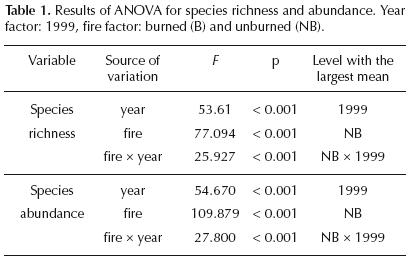
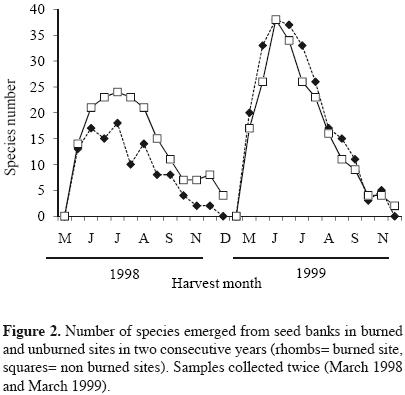
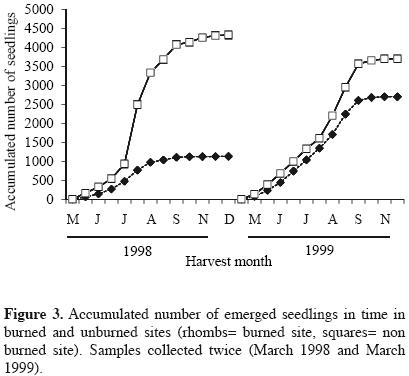
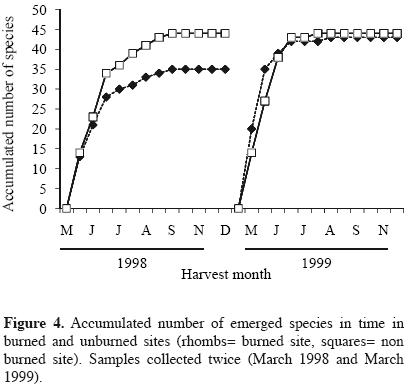
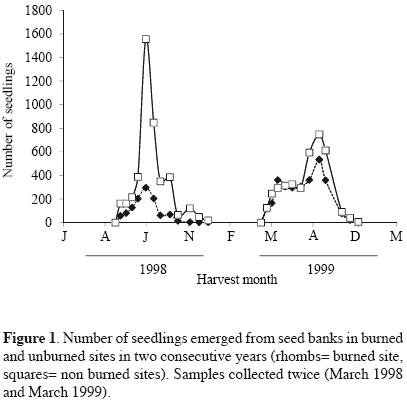
<body><![CDATA[<p align="justify"><font face="verdana" size="2">&nbsp;</font></p>     <p align="justify"><font face="verdana" size="2"><b>Results</b></font></p>     <p align="justify"><font face="verdana" size="2"><i>Seed bank size and species features. </i>We obtained a total of 1130 seedlings in the burned site in 1998, which correspond to thirty seven species; from these, twenty seven were herbs, nine shrubs and one tree species. in the 1998 unburned site, we registered 4325 seedlings, distributed in forty three species, thirty five herbs, seven shrubs and one tree species. in 1999, we found in the burned site 2719 seedlings belonging to forty four species, thirty two herbs, ten shrubs and two tree species, whereas in the unburned site, we had a total of 3686 seedlings, corresponding to forty five species, thirty two herbs, eleven shrubs and two tree species.</font></p>     <p align="justify"><font face="verdana" size="2">Based on seedling density values, the highest corresponded to the unburned site in 1998 with 14 seedlings/m<sup>2</sup>. in contrast, the smallest value of seedling density for the same year was 3.6 seedlings/m<sup>2</sup> for the burned site. One year after the fire, in 1999, seedling density slightly decreased in the unburned site (12 seedlings/m<sup>2</sup>), and increased in the burned site (9 seedlings/m<sup>2</sup>). In terms of the number of species, the most represented family was the Asteraceae, for both sites and years; however, based on the number of seedlings, the family with the highest number of seedlings was the Loganiaceae <i>(Buddleia cordata).</i></font></p>     <p align="justify"><font face="verdana" size="2">According to the life histories of species, we found a 75% of perennials and a 25% of annuals in the unburned site, for the two consecutive years. In the burned site we found similar values: 80% of perennials and 20% of annuals, for both years.</font></p>     <p align="justify"><font face="verdana" size="2">Approximately 180 days after the experiment started, the highest seedling emergence occurred in both sites for the harvests corresponding to the months from August to october, in 1998 and 1999. In these months, most of the seedlings corresponded to <i>Buddleia cordata, Muhlenbergia robusta, Gamochaeta americana </i>and <i>Montanoa tomentosa, </i>the latter was particularly more abundant in the burned site with respect to the unburned site. The highest seedling abundance always occurred in the unburned site for both years. In 1999, curves of seedlings abundances of burned and unburned sites appeared closer (<a href="#f1">Figure 1</a>, <a href="#t1">Table 1</a>). Species number per harvest date was also higher for the unburned site in the first year. One year after the fire, the number of species increased in the two sites (<a href="#f2">Figure 2</a>). Seedling emergence slowly increased in a constant rate after September, and the curves got to a steady state by November for both cases (<a href="#f3">Figure 3</a>). The number of accumulated species reached a plateau by September in both sites in 1998. For the second year this occurred by August. Both sites appeared closer in their richness values one year after the fire, with a recovery in the burned site (<a href="#f4">Figure 4</a>).</font></p>     <p align="center"><font face="verdana" size="2"><a name="f1"></a></font></p>     <p align="center"><font face="verdana" size="2"><img src="/img/revistas/bsbm/n86/a2f1.jpg"></font></p>     <p align="center"><font face="verdana" size="2"><a name="t1"></a></font></p>     <p align="center"><font face="verdana" size="2"><img src="/img/revistas/bsbm/n86/a2t1.jpg"></font></p>     ]]></body>
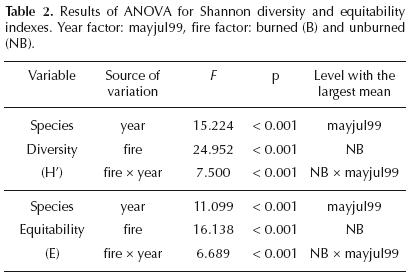
<body><![CDATA[<p align="center"><font face="verdana" size="2"><a name="f2"></a></font></p>     <p align="center"><font face="verdana" size="2"><img src="/img/revistas/bsbm/n86/a2f2.jpg"></font></p>     <p align="center"><font face="verdana" size="2"><a name="f3"></a></font></p>     <p align="center"><font face="verdana" size="2"><img src="/img/revistas/bsbm/n86/a2f3.jpg"></font></p>     <p align="center"><font face="verdana" size="2"><a name="f4"></a></font></p>     <p align="center"><font face="verdana" size="2"><img src="/img/revistas/bsbm/n86/a2f4.jpg"></font></p>     <p align="justify"><font face="verdana" size="2"><i>Abundance, richness, diversity and equitability. </i>Species richness and seedling abundance in the burned site in the year of the fire were significantly smaller than in the unburned site (<a href="#t1">Table 1</a>). The ANOVA test showed significant differences in seedling abundance due to the fire (F = 109.87, df = 396, p&lt;0.001) and time (F = 54.66, df = 396, p&lt;0.001) factors, levels with the highest mean values were the unburned site and the 1999 year, respectively. Also, the interaction of both factors was significant (F = 27.80, df = 396, p&lt;0.001), the groups with the highest mean values were as well, the unburned site and the year after the fire (1999). Seedling richness showed statistical differences between sites (F = 77.09, df = 396, p&lt;0.001) and years (F =<b> </b>53.16, df = 396, p&lt;0.001) as well; the interaction of these factors affected significantly the seed bank species richness (F = 77.09, df = 396, p&lt;0.001). Between years, there were also global significant differences among these variables, having higher values in the year after the fire (<a href="#t1">Table 1</a>).</font></p>     <p align="justify"><font face="verdana" size="2">Diversity and equitability indexes (<a href="#t2">Table 2</a>) showed the same trend for the fire factor (sites) and the year factor (1998 and 1999). The unburned site showed significantly higher values of these variables (H'= 2.49, E = 0.7) than the burned site (H'= 2, E = 0.5) in the year of the fire, whereas species diversity and equitability increased their values one year after the fire in the burned site (H' = 2.5, E = 0.7). The ANOVA test showed significant differences in the seed bank diversity due to the fire (F = 24.95, df = 396, p&lt;0.001) and time (F = 15.224, df = 396, p &lt;0.001) factors, as well as by the interaction of both (F = 7.5, df = 396, p&lt;0.001). Seed bank equitability showed differences between sites (F = 16.13, df = 396, p&lt;0.001) and years (F = 11.09, df = 396, p&lt;0.001), differences were also evident due to the interaction between fire and time factors (F = 6.68, df = 296, p&lt;0.001). in both cases, levels with the highest mean values were the unburned site, and the year after the fire (1999). <i>Similarity Index. </i>Most of the similarity index values were relatively high (above 50%) in both sites and years, which reflects a similar composition in the seed banks. The highest similarity index value (0.70) occurred between sites in the year of the fire, whereas, the lowest similarity index value (0.58) was obtained when comparing the 1998 burned site and the 1999 unburned site.</font></p>     <p align="center"><font face="verdana" size="2"><a name="t2"></a></font></p>     <p align="center"><font face="verdana" size="2"><img src="/img/revistas/bsbm/n86/a2t2.jpg"></font></p>     ]]></body>
<body><![CDATA[<p align="justify"><font face="verdana" size="2">&nbsp;</font></p>     <p align="justify"><font face="verdana" size="2"><b>Discussion</b></font></p>     <p align="justify"><font face="verdana" size="2">Seedling abundance between burned and unburned studied sites in the Pedregal de San &Aacute;ngel showed clear differences. There was a lower seedling emergence in the burned site than in the unburned one immediately after the fire (<a href="#t1">Table 1</a>); similar results have been obtained in other studies carried out in shrublands, where there was a substantial decrease of seeds in seed banks after a fire (Pierce and Cowling, 1991; Ferrandis <i>et al., </i>1999). Basically the significant smaller seed bank values in the burned site can be explained by the high temperatures reached by fire, as it has been reported by Turna and Bilgili (2006), who mentioned that exposure to temperatures between 110&deg;C and 150&deg;C had negative effects on germination percentages in some species in temperate sites. Tesfaye <i>et al. </i>(2004) reported as well a strong reduction in the size of seed banks, where many seeds that were not deeply buried in the soil died. Keeley and Keeley (1987) have as well suggested that a heat treatment reduces germination in some chaparral species and Legg <i>et al. </i>(1992) explained this result in terms of a complete seed combustion and/or embryo death, which cause a serious depletion of the seed bank specially in the upper 2&#150;3 cm of soil in some shrubland species. in addition, ashes have been reported to produce high pH soil values that may inhibit seed germination of some species (Ne'eman <i>et al., </i>2009). In a temperate forest Luzuriaga <i>et al. </i>(2005) found out that some anthropic disturbances, which include fire, can lead to an important decrease of about 75% of seed abundance in seed banks. Esposito <i>et al. </i>(2006) and Crosti <i>et al. </i>(2006) found as well a strong decrease in seedling emergence caused by high intensity fires in mediterranean environments. Therefore we suggest that fire is a disturbance that can cause an important negative effect in terms of seed mortality in the seed bank of a xerophytic shrubland, although for some species fire might have a positive effect (Valbuena and Trabaud, 2001; P&eacute;rez&#150;Fern&aacute;ndez and Rodr&iacute;guez&#150;Echeverr&iacute;a, 2003; Ne'eman <i>et al., </i>2009).</font></p>     <p align="justify"><font face="verdana" size="2">The presence of a thick testa in the seed has been proved to protect the embryo from high temperatures which can be lethal for seeds stored in the soil (Herranz <i>et al., </i>1998). Soil seed bank species richness, diversity and equitability were significantly smaller in the burned site in the year of the fire, where seed mortality probably experienced the largest values due to the lack of a thick testa (Baskin and Baskin, 1998; Castillo&#150;Arg&uuml;ero <i>et al., </i>2001). This was evident in some species of the Asteraceae, orchidaceae and Poaceae families, which showed smaller abundances in the burned site. In addition, fire could have affected positively other species that require elevated temperatures for dormancy breaking (Herranz <i>et al., </i>1998), such as <i>Dodonaea viscosa </i>(Baskin and Baskin, 1998) since this species showed higher seedling abundances in the burned site. The higher abundances in the burned site &#150;right after the fire&#150; of some species that lack a thick testa, such as <i>Montanoa tomentosa, </i>could be explained differently. Some substances released from burned vegetation, such as ethylene and some nitrogen compounds are implicated in fire&#150;triggered germination for some Asteraceae (Macchia <i>et al., </i>2001). Furthermore other studies suggest that oxidizing gases and acids generated in smoked and charred wood are responsible for triggering germination (Keeley and Fotheringham, 1998) in some chaparral and woodland species (P&eacute;rez&#150;Fern&aacute;ndez and Rodr&iacute;guez&#150;Echeverr&iacute;a, 2003).</font></p>     <p align="justify"><font face="verdana" size="2">Seedling abundance increased in the burned site in 1999. After a fire, there is an important release of nutrients, which may have improved species establishment (Rai and Tripathi, 1987; Pausas <i>et al., </i>2003); also, an induction of flowering might be caused by fire in some species (Brewer, 1995). In this sense we may expect a post fire seed bank recovery in this site, specially because values of diversity, equitability, and species richness increased one year after the fire. Ferrandis <i>et al. </i>(1999) reported a dramatic seed bank depletion by fire (more than 90% for some species). Nevertheless there was a significant increase in seedling abundance confined to the first post&#150;fire year in a Mediterranean shrubland, like in this case.</font></p>     <p align="justify"><font face="verdana" size="2">In general, temporal and spatial changes in seed bank species composition and abundance are probably due to the natural year to year variation in seed production and dispersal in all communities. Particularly in the Pedregal de San &Aacute;ngel, Cano&#150;Santana (1994) found different patterns of vegetative and reproductive allocation among species. These differences may directly influence the composition and abundance of the seed rain, which represents the potential contribution to the seed bank. More recently, Camacho (2007) studied the dynamics of the seed rain in this community and reported a high heterogeneity in the abundance and richness among seasons and between burned and unburned sites. Specifically, in sites that had been burned, this author reported higher seed rain densities compared to his control sites, and also a great abundance of some particular species, such as <i>Buddleia cordata.</i></font></p>     <p align="justify"><font face="verdana" size="2">Species similarity was relatively high in all comparisons, despite the statistical differences in richness and abundance. Seed bank composition was similar in both sites and years, probably as a result of the annual seed production and of the dispersal ability of all species in the area, most of them anemochorous (C&eacute;sar&#150;Garc&iacute;a, 2002). This points out the existence of a constant supply of diaspores to the seed bank, which explains the presence of most of the species in both sites and years. It also suggests that this seed bank probably includes three types of species: those that do not survive fire, those that are fire resistant and those that are stimulated to germinate by fire, as it has been seen in some Mediterranean ecosystems (Paula and Pausas, 2008). In addition, similarity value between burned and unburned sites increased one year after the fire, suggesting again that some species recovered and probably increased their seed production. This recovery may be explained in part by the resprout&#150;ing of the vegetation and by the increase in flowering and fruiting after a fire showed by some shrubland species (Kalamees and Zobel, 2002) which could have contributed to a greater abundance of the soil seed bank one year after the fire. It has been recognized that vegetation recovery relies greatly on buried seeds (Kalamees and Zobel, 2002), nevertheless it is important to find out the long term effects of fire in this community, where most of species are perennials. With regards to the soil seed bank species in the burned site one year after the fire and their biological traits, most were herbs, with a dominance of perennials over annuals, with an important proportion of species that disperse through ane&#150;mochory. Valbuena and Trabaud (2001) reported the same pattern when studying the contribution of the soil seed bank to post&#150;fire recovery in a Mediterranean shurbland.</font></p>     <p align="justify"><font face="verdana" size="2">With respect to annual species it is important to consider that some of them are more affected by fire since their permanence relies in their annual seed production, and still if some surviving species are not therophytes, their below ground perennating organs can show as well severe damage by fire (Mallik <i>et al., </i>1984). These processes lead to the need for more studies that reveal the long term responses of these species to disturbances such as fire, which becomes a priority specially if we consider that endemic or exclusive to shrubland vegetation species were present in low abundances or were absent in the seed bank of the burned site. </font></p>     <p align="justify"><font face="verdana" size="2">In shrublands, there is a mixture of sprouters and obligate seeders (Valbuena and Trabaud, 2001). Therefore, after a fire, regeneration potential of vegetation in the Pedregal de San &Aacute;ngel will rely on a mixture of this kind of species. Those species that arrive as propagules through dispersal, as well as growth and seed production of those which survive in the site, are in charge of the maintaining of species within their community. Soil seed bank recovery will be affected by these processes as well. Species which are stimulated by fire to germinate, to resprout, or to produce higher amounts of seeds will contribute greater to the seed bank of this site along time. Those species that do not survive fire will be less abundant in the following regeneration stages.</font></p>     <p align="justify"><font face="verdana" size="2">The rate of soil seed bank turnover depends on the balance between several factors such as seed production, dispersal, dormancy and germination (Pake and Venable, 1996) as well as on the disturbance regime (Milberg, 1995). These factors vary in spatial and temporal scales (Harper, 1977). Temporally, seeds are added to the soil in periods between fire events (Delgado <i>et al., </i>2008; Keeley and Keeley, 1987), this is why some studies address the seed bank dynamics in relation to stand age since the last fire (Clemente <i>et al., </i>2007). The present research offers useful information in terms of the seed bank composition and abundance ten years ago, when fires used to be frequent in this reserve (Mart&iacute;nez&#150;Mateos, 2001; Mart&iacute;nez&#150;Orea, 2001; Ju&aacute;rez&#150;Orozco and Cano&#150;Santana, 2007). The availability of previous data is in consequence essential for an evaluation of the entrance, permanence or absence of species in the soil seed bank of this natural reserve in time.</font></p>     ]]></body>
<body><![CDATA[<p align="justify"><font face="verdana" size="2">&nbsp;</font></p>     <p align="justify"><font face="verdana" size="2"><b>Acknowledgements</b></font></p>     <p align="justify"><font face="verdana" size="2">We thank two anonymous reviewers of previous versions of this paper for their suggestions and comments. Specially, we thank Silvia Iriarte&#150;Vivar for the manuscript revision and language edition. We are grateful to Marco Antonio Romero&#150;Romero, Eduardo P&eacute;rez&#150;Garc&iacute;a, Oswaldo N&uacute;&ntilde;ez and Edith Mart&iacute;nez for their valuable field and green house assistance. This study was partly supported by a grant from Fundaci&oacute;n UNAM and PAPIME Project No. 182033.</font></p>     <p align="justify"><font face="verdana" size="2">&nbsp;</font></p>     <p align="justify"><font face="verdana" size="2"><b>Literature Cited</b></font></p>     <!-- ref --><p align="justify"><font face="verdana" size="2">Baskin Ce. and Baskin J.M. 1998. <i>Seeds, Ecology, Biogeography, and Evolution of Dormancy and Germination. </i>Academic Press. U.S.A.    &nbsp;&nbsp;&nbsp;&nbsp;&nbsp;&nbsp;&nbsp;&nbsp;[&#160;<a href="javascript:void(0);" onclick="javascript: window.open('/scielo.php?script=sci_nlinks&ref=1359448&pid=S0366-2128201000010000200001&lng=','','width=640,height=500,resizable=yes,scrollbars=1,menubar=yes,');">Links</a>&#160;]<!-- end-ref --></font></p>     <!-- ref --><p align="justify"><font face="verdana" size="2">Brewer S.J. 1995. The relationship between soil fertility and fire&#150;stimulated floral induction in two populations of grass&#150;leaved golden aster, <i>Pityopsis graminifolia. Oikos </i><b>74</b>:45&#150;54.    &nbsp;&nbsp;&nbsp;&nbsp;&nbsp;&nbsp;&nbsp;&nbsp;[&#160;<a href="javascript:void(0);" onclick="javascript: window.open('/scielo.php?script=sci_nlinks&ref=1359450&pid=S0366-2128201000010000200002&lng=','','width=640,height=500,resizable=yes,scrollbars=1,menubar=yes,');">Links</a>&#160;]<!-- end-ref --></font></p>     <!-- ref --><p align="justify"><font face="verdana" size="2">Caballero I.J., Olano J.M., Loidi J. and Escudero A. 2003. Seed bank structure along a semi&#150;arid gypsum gradient in Central Spain. <i>Journal of Arid Environments </i><b>55</b>:287&#150;299.    &nbsp;&nbsp;&nbsp;&nbsp;&nbsp;&nbsp;&nbsp;&nbsp;[&#160;<a href="javascript:void(0);" onclick="javascript: window.open('/scielo.php?script=sci_nlinks&ref=1359452&pid=S0366-2128201000010000200003&lng=','','width=640,height=500,resizable=yes,scrollbars=1,menubar=yes,');">Links</a>&#160;]<!-- end-ref --></font></p>     <!-- ref --><p align="justify"><font face="verdana" size="2">Camacho A.J.M. 2007. Efecto del fuego sobre la lluvia de semillas en la Reserva del Pedregal de San &Aacute;ngel, M&eacute;xico D.F. Bachelor Thesis, Facultad de Ciencias, Universidad Nacional Aut&oacute;noma de M&eacute;xico. Mexico. 53 pp.    &nbsp;&nbsp;&nbsp;&nbsp;&nbsp;&nbsp;&nbsp;&nbsp;[&#160;<a href="javascript:void(0);" onclick="javascript: window.open('/scielo.php?script=sci_nlinks&ref=1359454&pid=S0366-2128201000010000200004&lng=','','width=640,height=500,resizable=yes,scrollbars=1,menubar=yes,');">Links</a>&#160;]<!-- end-ref --></font></p>     <!-- ref --><p align="justify"><font face="verdana" size="2">Cano&#150;Santana Z. 1994. Flujo de energ&iacute;a a trav&eacute;s de <i>Sphenarium purpurascens </i>(Orthoptera: Acrididae) y productividad primaria neta a&eacute;rea en una comunidad xer&oacute;fita. Ph.D. Dissertation , Instituto de Ecolog&iacute;a, Universidad Nacional Aut&oacute;noma de M&eacute;xico, Mexico, D.F. 198 pp.    &nbsp;&nbsp;&nbsp;&nbsp;&nbsp;&nbsp;&nbsp;&nbsp;[&#160;<a href="javascript:void(0);" onclick="javascript: window.open('/scielo.php?script=sci_nlinks&ref=1359456&pid=S0366-2128201000010000200005&lng=','','width=640,height=500,resizable=yes,scrollbars=1,menubar=yes,');">Links</a>&#160;]<!-- end-ref --></font></p>     <!-- ref --><p align="justify"><font face="verdana" size="2">Cano&#150;Santana Z., Castillo&#150;Arg&uuml;ero S., Mart&iacute;nez&#150;Orea Y., Ju&aacute;rez&#150;Orozco S. 2008. An&aacute;lisis de la riqueza vegetal y el valor de conservaci&oacute;n de tres &aacute;reas incorporadas a la Reserva Ecol&oacute;gica del Pedregal de San &Aacute;ngel, Distrito Federal (M&eacute;xico). <i>Bolet&iacute;n de la Sociedad Bot&aacute;nica de M&eacute;xico </i><b>82</b>:1&#150;14.    &nbsp;&nbsp;&nbsp;&nbsp;&nbsp;&nbsp;&nbsp;&nbsp;[&#160;<a href="javascript:void(0);" onclick="javascript: window.open('/scielo.php?script=sci_nlinks&ref=1359458&pid=S0366-2128201000010000200006&lng=','','width=640,height=500,resizable=yes,scrollbars=1,menubar=yes,');">Links</a>&#160;]<!-- end-ref --></font></p>     <!-- ref --><p align="justify"><font face="verdana" size="2">Carrillo&#150;Trueba C. 1995. <i>El Pedregal de San &Aacute;ngel. </i>Universidad Nacional Aut&oacute;noma de M&eacute;xico. Mexico, D.F.    &nbsp;&nbsp;&nbsp;&nbsp;&nbsp;&nbsp;&nbsp;&nbsp;[&#160;<a href="javascript:void(0);" onclick="javascript: window.open('/scielo.php?script=sci_nlinks&ref=1359460&pid=S0366-2128201000010000200007&lng=','','width=640,height=500,resizable=yes,scrollbars=1,menubar=yes,');">Links</a>&#160;]<!-- end-ref --></font></p>     <!-- ref --><p align="justify"><font face="verdana" size="2">Castillo&#150;Arg&uuml;ero S., Guadarrama&#150;Ch&aacute;vez M.P., Mart&iacute;nez Y., Mendoza&#150;Hern&aacute;ndez PE., N&uacute;&ntilde;ez&#150;Castillo O., Romero&#150;Romero M.A., and S&aacute;nchez&#150;Gall&eacute;n I. 2002. <i>Di&aacute;sporas del Pedregal de San &Aacute;ngel. </i>Facultad de Ciencias. UNAM. Mexico, D.F.    &nbsp;&nbsp;&nbsp;&nbsp;&nbsp;&nbsp;&nbsp;&nbsp;[&#160;<a href="javascript:void(0);" onclick="javascript: window.open('/scielo.php?script=sci_nlinks&ref=1359462&pid=S0366-2128201000010000200008&lng=','','width=640,height=500,resizable=yes,scrollbars=1,menubar=yes,');">Links</a>&#160;]<!-- end-ref --></font></p>     <!-- ref --><p align="justify"><font face="verdana" size="2">Castillo&#150;Arg&uuml;ero S., Montes&#150;Cartas G., Romero&#150;Romero M.A., Mart&iacute;nez&#150;Orea Y., Guadarrama&#150;Chavez M.P, S&aacute;nchez&#150;Gall&eacute;n I. and N&uacute;&ntilde;ez&#150;Castillo O. 2004. Din&aacute;mica y Conservaci&oacute;n de la Flora del Matorral Xer&oacute;filo de la Reserva Ecol&oacute;gica del Pedregal de San &Aacute;ngel (D.F., M&eacute;xico). <i>Bolet&iacute;n de la Sociedad Bot&aacute;nica de M&eacute;xico </i><b>74</b>:51&#150;75.    &nbsp;&nbsp;&nbsp;&nbsp;&nbsp;&nbsp;&nbsp;&nbsp;[&#160;<a href="javascript:void(0);" onclick="javascript: window.open('/scielo.php?script=sci_nlinks&ref=1359464&pid=S0366-2128201000010000200009&lng=','','width=640,height=500,resizable=yes,scrollbars=1,menubar=yes,');">Links</a>&#160;]<!-- end-ref --></font></p>     <!-- ref --><p align="justify"><font face="verdana" size="2">Castillo&#150;Arg&uuml;ero S., Mart&iacute;nez&#150;Orea Y., Meave J.A., Hern&aacute;ndez&#150;Apolinar M., N&uacute;&ntilde;ez&#150;Castillo O., Santib&aacute;&ntilde;ez&#150;Andrade G. and Guadarrama&#150;Chavez M.P. 2009. Flora: susceptibilidad de la comunidad a la invasi&oacute;n de malezas nativas y ex&oacute;ticas. In: Lot A. and Cano&#150;Santana Z. eds. <i>Biodiversidad del ecosistema del Pedregal de San &Aacute;ngel. </i>p.107&#150;117. Universidad Nacional Aut&oacute;noma de M&eacute;xico, Mexico, D.F.    &nbsp;&nbsp;&nbsp;&nbsp;&nbsp;&nbsp;&nbsp;&nbsp;[&#160;<a href="javascript:void(0);" onclick="javascript: window.open('/scielo.php?script=sci_nlinks&ref=1359466&pid=S0366-2128201000010000200010&lng=','','width=640,height=500,resizable=yes,scrollbars=1,menubar=yes,');">Links</a>&#160;]<!-- end-ref --></font></p>     <!-- ref --><p align="justify"><font face="verdana" size="2">C&eacute;sar&#150;Garc&iacute;a S.F. 2002. An&aacute;lisis de algunos factores que afectan la fenolog&iacute;a reproductiva de la comunidad vegetal de la Reserva del Pedregal de San &Aacute;ngel, D.F. (M&eacute;xico). Bachelor Thesis, Facultad de Ciencias, Universidad Nacional Aut&oacute;noma de M&eacute;xico, Mexico, D.F. 112 pp.    &nbsp;&nbsp;&nbsp;&nbsp;&nbsp;&nbsp;&nbsp;&nbsp;[&#160;<a href="javascript:void(0);" onclick="javascript: window.open('/scielo.php?script=sci_nlinks&ref=1359468&pid=S0366-2128201000010000200011&lng=','','width=640,height=500,resizable=yes,scrollbars=1,menubar=yes,');">Links</a>&#160;]<!-- end-ref --></font></p>     <!-- ref --><p align="justify"><font face="verdana" size="2">Clemente A.S., Rego F.C. and Correia O.A. 2007. Seed bank dynamics of two obligate seeders, <i>Cistus monspeliensis </i>and <i>Rosmarinus officinalis, </i>in relation to time since fire. <i>Plant Ecology </i><b>190</b>:175&#150;188.    &nbsp;&nbsp;&nbsp;&nbsp;&nbsp;&nbsp;&nbsp;&nbsp;[&#160;<a href="javascript:void(0);" onclick="javascript: window.open('/scielo.php?script=sci_nlinks&ref=1359470&pid=S0366-2128201000010000200012&lng=','','width=640,height=500,resizable=yes,scrollbars=1,menubar=yes,');">Links</a>&#160;]<!-- end-ref --></font></p>     <!-- ref --><p align="justify"><font face="verdana" size="2">Colwell R.K. 2005. Estimates v7.5.: statistical estimation of species richness and shared species from samples. &lt;<a href="http://viceroy.eeb.uconn.edu/EstimateS" target="_blank">viceroy.eeb.uconn.edu/EstimateS</a>&gt;    &nbsp;&nbsp;&nbsp;&nbsp;&nbsp;&nbsp;&nbsp;&nbsp;[&#160;<a href="javascript:void(0);" onclick="javascript: window.open('/scielo.php?script=sci_nlinks&ref=1359472&pid=S0366-2128201000010000200013&lng=','','width=640,height=500,resizable=yes,scrollbars=1,menubar=yes,');">Links</a>&#160;]<!-- end-ref --></font></p>     <!-- ref --><p align="justify"><font face="verdana" size="2">Crosti R., Ladd P.G., Dixon K.W. and Piotto B. 2006. Post&#150;fire germination: The effect of smoke on seeds of selected species from the central Mediterranean basin. <i>Forest Ecology and Management </i><b>221</b>:306&#150;312.    &nbsp;&nbsp;&nbsp;&nbsp;&nbsp;&nbsp;&nbsp;&nbsp;[&#160;<a href="javascript:void(0);" onclick="javascript: window.open('/scielo.php?script=sci_nlinks&ref=1359474&pid=S0366-2128201000010000200014&lng=','','width=640,height=500,resizable=yes,scrollbars=1,menubar=yes,');">Links</a>&#160;]<!-- end-ref --></font></p>     <!-- ref --><p align="justify"><font face="verdana" size="2">Dansereau P, and Lems, K. 1957. The grading of dispersal types in plant communities and their ecological significance. <i>Conti&#150;butions de L'Institute Botanique de L'Universit&eacute; de Montreal </i><b>71</b>:5&#150;52.    &nbsp;&nbsp;&nbsp;&nbsp;&nbsp;&nbsp;&nbsp;&nbsp;[&#160;<a href="javascript:void(0);" onclick="javascript: window.open('/scielo.php?script=sci_nlinks&ref=1359476&pid=S0366-2128201000010000200015&lng=','','width=640,height=500,resizable=yes,scrollbars=1,menubar=yes,');">Links</a>&#160;]<!-- end-ref --></font></p>     <!-- ref --><p align="justify"><font face="verdana" size="2">De la Fuente R. 2005. Acuerdo por el que se rezonif&iacute;ca, delimita e incrementa la zona de la Reserva Ecol&oacute;gica del Pedregal de San &Aacute;ngel de Ciudad Universitaria. <i>Gaceta UNAM, </i>Universidad Nacional Aut&oacute;noma de M&eacute;xico <b>3813</b>:14&#150;15, 20&#150;21 p.    &nbsp;&nbsp;&nbsp;&nbsp;&nbsp;&nbsp;&nbsp;&nbsp;[&#160;<a href="javascript:void(0);" onclick="javascript: window.open('/scielo.php?script=sci_nlinks&ref=1359478&pid=S0366-2128201000010000200016&lng=','','width=640,height=500,resizable=yes,scrollbars=1,menubar=yes,');">Links</a>&#160;]<!-- end-ref --></font></p>     <!-- ref --><p align="justify"><font face="verdana" size="2">Delgado J.A., Serrano J. M., L&oacute;pez F. and Acosta F.J. 2008. Seed size and seed germination in the Mediterranean fire&#150;prone shrub <i>Cistus ladanifer. Plant Ecology </i><b>197</b>:269&#150;276.    &nbsp;&nbsp;&nbsp;&nbsp;&nbsp;&nbsp;&nbsp;&nbsp;[&#160;<a href="javascript:void(0);" onclick="javascript: window.open('/scielo.php?script=sci_nlinks&ref=1359480&pid=S0366-2128201000010000200017&lng=','','width=640,height=500,resizable=yes,scrollbars=1,menubar=yes,');">Links</a>&#160;]<!-- end-ref --></font></p>     <!-- ref --><p align="justify"><font face="verdana" size="2">Esposito A., Strumia S., Caporaso S. and Mazzoleni S. 2006. The effect of fire intensity on soil seed bank in Mediterranean macchia. <i>Forest Ecology and Management </i><b>234S</b>:S207.    &nbsp;&nbsp;&nbsp;&nbsp;&nbsp;&nbsp;&nbsp;&nbsp;[&#160;<a href="javascript:void(0);" onclick="javascript: window.open('/scielo.php?script=sci_nlinks&ref=1359482&pid=S0366-2128201000010000200018&lng=','','width=640,height=500,resizable=yes,scrollbars=1,menubar=yes,');">Links</a>&#160;]<!-- end-ref --></font></p>     <!-- ref --><p align="justify"><font face="verdana" size="2">Fenner M. 1983. Relationships between seed weight, ash content and seedling growth in twenty&#150;four species of Compositae. <i>New Phytologist </i><b>95</b>:697&#150;706.    &nbsp;&nbsp;&nbsp;&nbsp;&nbsp;&nbsp;&nbsp;&nbsp;[&#160;<a href="javascript:void(0);" onclick="javascript: window.open('/scielo.php?script=sci_nlinks&ref=1359484&pid=S0366-2128201000010000200019&lng=','','width=640,height=500,resizable=yes,scrollbars=1,menubar=yes,');">Links</a>&#160;]<!-- end-ref --></font></p>     <!-- ref --><p align="justify"><font face="verdana" size="2">Ferrandis P., Herranz J.M. and Mart&iacute;nez&#150;S&aacute;nchez J.J. 1999. Effect of fire on hard&#150;coated Cistaceae seed banks and its influence on techniques for quantifying seed banks. <i>Plant Ecology </i><b>144</b>:103114.    &nbsp;&nbsp;&nbsp;&nbsp;&nbsp;&nbsp;&nbsp;&nbsp;[&#160;<a href="javascript:void(0);" onclick="javascript: window.open('/scielo.php?script=sci_nlinks&ref=1359486&pid=S0366-2128201000010000200020&lng=','','width=640,height=500,resizable=yes,scrollbars=1,menubar=yes,');">Links</a>&#160;]<!-- end-ref --></font></p>     <!-- ref --><p align="justify"><font face="verdana" size="2">Flores&#150;Villanueva L. 2006. Contribuci&oacute;n al estudio de la Familia Orchidaceae en la Reserva del Pedregal de San &Aacute;ngel y en algunas zonas perturbadas por la urbanizaci&oacute;n de la Ciudad Universitaria UNAM, M&eacute;xico, D.F. Bachelor Thesis, Facultad de Ciencias, Universidad Nacional Aut&oacute;noma de M&eacute;xico, Mexico, D.F., 120 pp.    &nbsp;&nbsp;&nbsp;&nbsp;&nbsp;&nbsp;&nbsp;&nbsp;[&#160;<a href="javascript:void(0);" onclick="javascript: window.open('/scielo.php?script=sci_nlinks&ref=1359488&pid=S0366-2128201000010000200021&lng=','','width=640,height=500,resizable=yes,scrollbars=1,menubar=yes,');">Links</a>&#160;]<!-- end-ref --></font></p>     <!-- ref --><p align="justify"><font face="verdana" size="2">Garc&iacute;a E. 1988. <i>Modificaciones al Sistema de Clasificaci&oacute;n Clim&aacute;tico de K&ouml;ppen para adaptarlo a las condiciones de la Republica Mexicana, M&eacute;xico. </i>Instituto de Geograf&iacute;a, UNAM, Mexico, D.F.    &nbsp;&nbsp;&nbsp;&nbsp;&nbsp;&nbsp;&nbsp;&nbsp;[&#160;<a href="javascript:void(0);" onclick="javascript: window.open('/scielo.php?script=sci_nlinks&ref=1359490&pid=S0366-2128201000010000200022&lng=','','width=640,height=500,resizable=yes,scrollbars=1,menubar=yes,');">Links</a>&#160;]<!-- end-ref --></font></p>     <!-- ref --><p align="justify"><font face="verdana" size="2">Harper J.L. 1977. <i>The population Biology of plants. </i>Academic Press. London.    &nbsp;&nbsp;&nbsp;&nbsp;&nbsp;&nbsp;&nbsp;&nbsp;[&#160;<a href="javascript:void(0);" onclick="javascript: window.open('/scielo.php?script=sci_nlinks&ref=1359492&pid=S0366-2128201000010000200023&lng=','','width=640,height=500,resizable=yes,scrollbars=1,menubar=yes,');">Links</a>&#160;]<!-- end-ref --></font></p>     <!-- ref --><p align="justify"><font face="verdana" size="2">Herranz J.M., Ferrandiz P. and Mart&iacute;nez&#150;S&aacute;nchez J.J. 1998. Influence of heat on seed germination of seven Mediterranean Leguminosae species. <i>Plant Ecology </i><b>136</b>:95&#150;103.    &nbsp;&nbsp;&nbsp;&nbsp;&nbsp;&nbsp;&nbsp;&nbsp;[&#160;<a href="javascript:void(0);" onclick="javascript: window.open('/scielo.php?script=sci_nlinks&ref=1359494&pid=S0366-2128201000010000200024&lng=','','width=640,height=500,resizable=yes,scrollbars=1,menubar=yes,');">Links</a>&#160;]<!-- end-ref --></font></p>     <!-- ref --><p align="justify"><font face="verdana" size="2">Jim&eacute;nez H. E. and Armesto J.J. 1992. Importance of the soil seed bank of disturbed sites in Chilean matorral in early secondary succession. <i>Journal of Vegetation Science </i><b>3</b>:579&#150;586.    &nbsp;&nbsp;&nbsp;&nbsp;&nbsp;&nbsp;&nbsp;&nbsp;[&#160;<a href="javascript:void(0);" onclick="javascript: window.open('/scielo.php?script=sci_nlinks&ref=1359496&pid=S0366-2128201000010000200025&lng=','','width=640,height=500,resizable=yes,scrollbars=1,menubar=yes,');">Links</a>&#160;]<!-- end-ref --></font></p>     <!-- ref --><p align="justify"><font face="verdana" size="2">Ju&aacute;rez&#150;Orozco S. and Cano&#150;Santana Z. 2007. El cuarto elemento y los seres vivos: ecolog&iacute;a del fuego. <i>Ciencias </i><b>85</b>:4&#150;12.    &nbsp;&nbsp;&nbsp;&nbsp;&nbsp;&nbsp;&nbsp;&nbsp;[&#160;<a href="javascript:void(0);" onclick="javascript: window.open('/scielo.php?script=sci_nlinks&ref=1359498&pid=S0366-2128201000010000200026&lng=','','width=640,height=500,resizable=yes,scrollbars=1,menubar=yes,');">Links</a>&#160;]<!-- end-ref --></font></p>     <!-- ref --><p align="justify"><font face="verdana" size="2">Kalamees R. and Zobel M. 2002. The role of the seed bank in gap regeneration in a calcareous grassland community. <i>Ecology </i><b>83</b>:1017&#150;1025.    &nbsp;&nbsp;&nbsp;&nbsp;&nbsp;&nbsp;&nbsp;&nbsp;[&#160;<a href="javascript:void(0);" onclick="javascript: window.open('/scielo.php?script=sci_nlinks&ref=1359500&pid=S0366-2128201000010000200027&lng=','','width=640,height=500,resizable=yes,scrollbars=1,menubar=yes,');">Links</a>&#160;]<!-- end-ref --></font></p>     <!-- ref --><p align="justify"><font face="verdana" size="2">Keeley J.E. and Keeley S.C. 1987. Role of fire in the germination of chaparral herbs and suffrutescents. <i>Madro&ntilde;o </i><b>34</b>:240&#150;249.    &nbsp;&nbsp;&nbsp;&nbsp;&nbsp;&nbsp;&nbsp;&nbsp;[&#160;<a href="javascript:void(0);" onclick="javascript: window.open('/scielo.php?script=sci_nlinks&ref=1359502&pid=S0366-2128201000010000200028&lng=','','width=640,height=500,resizable=yes,scrollbars=1,menubar=yes,');">Links</a>&#160;]<!-- end-ref --></font></p>     <!-- ref --><p align="justify"><font face="verdana" size="2">Keeley J.E. and Fotheringham C.J. 1998. Smoke&#150;induced seed germination in California chaparral. <i>Ecology </i><b>79</b>:2320&#150;2336.    &nbsp;&nbsp;&nbsp;&nbsp;&nbsp;&nbsp;&nbsp;&nbsp;[&#160;<a href="javascript:void(0);" onclick="javascript: window.open('/scielo.php?script=sci_nlinks&ref=1359504&pid=S0366-2128201000010000200029&lng=','','width=640,height=500,resizable=yes,scrollbars=1,menubar=yes,');">Links</a>&#160;]<!-- end-ref --></font></p>     <!-- ref --><p align="justify"><font face="verdana" size="2">Legg C.J., Maltby E. and Proctor M.C.F. 1992. The ecology of severe moorland fire on the North York Moors: Seed distribution and seedling establishment of <i>Calluna vulgaris. Journal of Ecology </i><b>80</b>:737&#150;752.    &nbsp;&nbsp;&nbsp;&nbsp;&nbsp;&nbsp;&nbsp;&nbsp;[&#160;<a href="javascript:void(0);" onclick="javascript: window.open('/scielo.php?script=sci_nlinks&ref=1359506&pid=S0366-2128201000010000200030&lng=','','width=640,height=500,resizable=yes,scrollbars=1,menubar=yes,');">Links</a>&#160;]<!-- end-ref --></font></p>     <!-- ref --><p align="justify"><font face="verdana" size="2">Lot&#150;Helgueras A. 2008. 25 a&ntilde;os de la reserva del Pedregal de San &Aacute;ngel. <i>Ciencias </i><b>91</b>:30&#150;32.    &nbsp;&nbsp;&nbsp;&nbsp;&nbsp;&nbsp;&nbsp;&nbsp;[&#160;<a href="javascript:void(0);" onclick="javascript: window.open('/scielo.php?script=sci_nlinks&ref=1359508&pid=S0366-2128201000010000200031&lng=','','width=640,height=500,resizable=yes,scrollbars=1,menubar=yes,');">Links</a>&#160;]<!-- end-ref --></font></p>     <!-- ref --><p align="justify"><font face="verdana" size="2">Luzuriaga A.L., Escudero A., Olano J.M. and Loidi J. 2005. Regenerative role of seed banks following an intense soil disturbance. <i>Acta Oecologica </i><b>27</b>:57&#150;66.    &nbsp;&nbsp;&nbsp;&nbsp;&nbsp;&nbsp;&nbsp;&nbsp;[&#160;<a href="javascript:void(0);" onclick="javascript: window.open('/scielo.php?script=sci_nlinks&ref=1359510&pid=S0366-2128201000010000200032&lng=','','width=640,height=500,resizable=yes,scrollbars=1,menubar=yes,');">Links</a>&#160;]<!-- end-ref --></font></p>     <!-- ref --><p align="justify"><font face="verdana" size="2">Macchia M., Angelini L. and Ceccarini L. 2001. Methods to overcome seed dormancy in <i>Echinacea angustifolia </i>DC. <i>Scientia Horticulturae </i><b>89</b>:317&#150;324.    &nbsp;&nbsp;&nbsp;&nbsp;&nbsp;&nbsp;&nbsp;&nbsp;[&#160;<a href="javascript:void(0);" onclick="javascript: window.open('/scielo.php?script=sci_nlinks&ref=1359512&pid=S0366-2128201000010000200033&lng=','','width=640,height=500,resizable=yes,scrollbars=1,menubar=yes,');">Links</a>&#160;]<!-- end-ref --></font></p>     <!-- ref --><p align="justify"><font face="verdana" size="2">Mallik A.U., Hobbs R.J. and Legg C.J. 1984. Seed dynamics in <i>Calluna&#150;Arctostaphylos </i>heath in north&#150;eastern Scotland. <i>Journal of Ecology </i><b>72</b>:855&#150;871.    &nbsp;&nbsp;&nbsp;&nbsp;&nbsp;&nbsp;&nbsp;&nbsp;[&#160;<a href="javascript:void(0);" onclick="javascript: window.open('/scielo.php?script=sci_nlinks&ref=1359514&pid=S0366-2128201000010000200034&lng=','','width=640,height=500,resizable=yes,scrollbars=1,menubar=yes,');">Links</a>&#160;]<!-- end-ref --></font></p>     <!-- ref --><p align="justify"><font face="verdana" size="2">Martin&#150;del&#150;Pozzo. 1995. La edad del Xitle. In: Carrillo&#150;Trueba C. 1995. <i>El Pedregal de San Angel </i>p. 48 Universidad Nacional Aut&oacute;noma de M&eacute;xico, M&eacute;xico, D.F.    &nbsp;&nbsp;&nbsp;&nbsp;&nbsp;&nbsp;&nbsp;&nbsp;[&#160;<a href="javascript:void(0);" onclick="javascript: window.open('/scielo.php?script=sci_nlinks&ref=1359516&pid=S0366-2128201000010000200035&lng=','','width=640,height=500,resizable=yes,scrollbars=1,menubar=yes,');">Links</a>&#160;]<!-- end-ref --></font></p>     <!-- ref --><p align="justify"><font face="verdana" size="2">Mart&iacute;nez&#150;Mateos A.E. 2001. Regeneraci&oacute;n natural despu&eacute;s de un disturbio por fuego en dos microambientes contrastantes de la Reserva Ecol&oacute;gica "El Pedregal de San &Aacute;ngel". Bachelor Thesis, Facultad de Ciencias, Universidad Nacional Aut&oacute;noma de M&eacute;xico, Mexico, D.F., 66 pp.    &nbsp;&nbsp;&nbsp;&nbsp;&nbsp;&nbsp;&nbsp;&nbsp;[&#160;<a href="javascript:void(0);" onclick="javascript: window.open('/scielo.php?script=sci_nlinks&ref=1359518&pid=S0366-2128201000010000200036&lng=','','width=640,height=500,resizable=yes,scrollbars=1,menubar=yes,');">Links</a>&#160;]<!-- end-ref --></font></p>     <!-- ref --><p align="justify"><font face="verdana" size="2">Mart&iacute;nez&#150;Orea Y. 2001. Efecto del fuego sobre el banco de semillas de la Reserva Ecol&oacute;gica del Pedregal de San &Aacute;ngel. Bachelor Thesis, Facultad de Ciencias, Universidad Nacional Aut&oacute;noma de M&eacute;xico, Mexico D.F., 62 pp.    &nbsp;&nbsp;&nbsp;&nbsp;&nbsp;&nbsp;&nbsp;&nbsp;[&#160;<a href="javascript:void(0);" onclick="javascript: window.open('/scielo.php?script=sci_nlinks&ref=1359520&pid=S0366-2128201000010000200037&lng=','','width=640,height=500,resizable=yes,scrollbars=1,menubar=yes,');">Links</a>&#160;]<!-- end-ref --></font></p>     <!-- ref --><p align="justify"><font face="verdana" size="2">Middleton B.A. 2003. Soil seed banks and the potential restoration of forested wetlands after farming. <i>Journal of Applied Ecology </i><b>40</b>:1025&#150;1034.    &nbsp;&nbsp;&nbsp;&nbsp;&nbsp;&nbsp;&nbsp;&nbsp;[&#160;<a href="javascript:void(0);" onclick="javascript: window.open('/scielo.php?script=sci_nlinks&ref=1359522&pid=S0366-2128201000010000200038&lng=','','width=640,height=500,resizable=yes,scrollbars=1,menubar=yes,');">Links</a>&#160;]<!-- end-ref --></font></p>     <!-- ref --><p align="justify"><font face="verdana" size="2">Milberg P. 1995. Soil seed bank after eighteen years of succession from grassland to forest. <i>Oikos </i><b>72</b>:3&#150;13.    &nbsp;&nbsp;&nbsp;&nbsp;&nbsp;&nbsp;&nbsp;&nbsp;[&#160;<a href="javascript:void(0);" onclick="javascript: window.open('/scielo.php?script=sci_nlinks&ref=1359524&pid=S0366-2128201000010000200039&lng=','','width=640,height=500,resizable=yes,scrollbars=1,menubar=yes,');">Links</a>&#160;]<!-- end-ref --></font></p>     <!-- ref --><p align="justify"><font face="verdana" size="2">Ne'eman G., Ne'eman R., Keith D.A. and Whelan R.J. 2009. Does post&#150;fire plant regeneration mode affect the germination response to fire&#150;related cues? <i>Oecologia </i><b>159</b>:483&#150;492.    &nbsp;&nbsp;&nbsp;&nbsp;&nbsp;&nbsp;&nbsp;&nbsp;[&#160;<a href="javascript:void(0);" onclick="javascript: window.open('/scielo.php?script=sci_nlinks&ref=1359526&pid=S0366-2128201000010000200040&lng=','','width=640,height=500,resizable=yes,scrollbars=1,menubar=yes,');">Links</a>&#160;]<!-- end-ref --></font></p>     <!-- ref --><p align="justify"><font face="verdana" size="2">Pake C.E. and Venable D.L. 1996. Seed banks in desert annuals: Implications for persistence and coexistence in variable environments. <i>Ecology </i><b>77</b>:1427&#150;1435.    &nbsp;&nbsp;&nbsp;&nbsp;&nbsp;&nbsp;&nbsp;&nbsp;[&#160;<a href="javascript:void(0);" onclick="javascript: window.open('/scielo.php?script=sci_nlinks&ref=1359528&pid=S0366-2128201000010000200041&lng=','','width=640,height=500,resizable=yes,scrollbars=1,menubar=yes,');">Links</a>&#160;]<!-- end-ref --></font></p>     <!-- ref --><p align="justify"><font face="verdana" size="2">Paula S. and Pausas J.G. 2008. Burning seeds: germinative response to heat treatments in relation to resprouting ability. <i>Journal of Ecology </i><b>96</b>:543&#150;552.    &nbsp;&nbsp;&nbsp;&nbsp;&nbsp;&nbsp;&nbsp;&nbsp;[&#160;<a href="javascript:void(0);" onclick="javascript: window.open('/scielo.php?script=sci_nlinks&ref=1359530&pid=S0366-2128201000010000200042&lng=','','width=640,height=500,resizable=yes,scrollbars=1,menubar=yes,');">Links</a>&#160;]<!-- end-ref --></font></p>     <!-- ref --><p align="justify"><font face="verdana" size="2">Pausas J.G., Ouadah N., Ferran A., Gimeno T. and Vallejo R. 2003. Fire severity and seedling establishment in <i>Pinus halepensis </i>woodlands, eastern Iberian Peninsula. <i>Plant Ecology </i><b>169</b>:205213.    &nbsp;&nbsp;&nbsp;&nbsp;&nbsp;&nbsp;&nbsp;&nbsp;[&#160;<a href="javascript:void(0);" onclick="javascript: window.open('/scielo.php?script=sci_nlinks&ref=1359532&pid=S0366-2128201000010000200043&lng=','','width=640,height=500,resizable=yes,scrollbars=1,menubar=yes,');">Links</a>&#160;]<!-- end-ref --></font></p>     <!-- ref --><p align="justify"><font face="verdana" size="2">Pazos G.E. and Bertiller M.B. 2008. Spatial patterns of the germinable soil seed bank of coexisting perennial&#150;grass species in grazed shrublands of the Patagonian Monte. <i>Plant Ecology </i><b>198</b>:111&#150;120.    &nbsp;&nbsp;&nbsp;&nbsp;&nbsp;&nbsp;&nbsp;&nbsp;[&#160;<a href="javascript:void(0);" onclick="javascript: window.open('/scielo.php?script=sci_nlinks&ref=1359534&pid=S0366-2128201000010000200044&lng=','','width=640,height=500,resizable=yes,scrollbars=1,menubar=yes,');">Links</a>&#160;]<!-- end-ref --></font></p>     <!-- ref --><p align="justify"><font face="verdana" size="2">P&eacute;rez&#150;Fern&aacute;ndez M.A. and Rodr&iacute;guez&#150;Echeverr&iacute;a S. 2003. Effect of smoke, charred wood and nitrogenous compounds on seed germination of ten species from woodland in central&#150;western Spain. <i>Journal of Chemical Ecology </i><b>29</b>:237&#150;251.    &nbsp;&nbsp;&nbsp;&nbsp;&nbsp;&nbsp;&nbsp;&nbsp;[&#160;<a href="javascript:void(0);" onclick="javascript: window.open('/scielo.php?script=sci_nlinks&ref=1359536&pid=S0366-2128201000010000200045&lng=','','width=640,height=500,resizable=yes,scrollbars=1,menubar=yes,');">Links</a>&#160;]<!-- end-ref --></font></p>     <!-- ref --><p align="justify"><font face="verdana" size="2">Pierce M.S. and Cowling M.R. 1991. Dynamics of soil&#150;stored seed banks of six shrubs in fire&#150;prone dune fynbos. <i>Journal of Ecology </i><b>79</b>:731&#150;747.    &nbsp;&nbsp;&nbsp;&nbsp;&nbsp;&nbsp;&nbsp;&nbsp;[&#160;<a href="javascript:void(0);" onclick="javascript: window.open('/scielo.php?script=sci_nlinks&ref=1359538&pid=S0366-2128201000010000200046&lng=','','width=640,height=500,resizable=yes,scrollbars=1,menubar=yes,');">Links</a>&#160;]<!-- end-ref --></font></p>     <!-- ref --><p align="justify"><font face="verdana" size="2">Price M.V. and Joyner J.W. 1997. What resources are available to desert granivores: seed rain or soil seed bank? <i>Ecology </i><b>78</b>:764773.    &nbsp;&nbsp;&nbsp;&nbsp;&nbsp;&nbsp;&nbsp;&nbsp;[&#160;<a href="javascript:void(0);" onclick="javascript: window.open('/scielo.php?script=sci_nlinks&ref=1359540&pid=S0366-2128201000010000200047&lng=','','width=640,height=500,resizable=yes,scrollbars=1,menubar=yes,');">Links</a>&#160;]<!-- end-ref --></font></p>     <!-- ref --><p align="justify"><font face="verdana" size="2">Rai J.P.N. and Tripathi R.S. 1987. Germination and plant survival and growth of <i>Galinsoga parviflora </i>Cav. as related to food and energy content of its ray&#150; and discachenes. <i>Acta Oecologica/ Oecologia Plantarum </i><b>8</b>:155&#150;165.    &nbsp;&nbsp;&nbsp;&nbsp;&nbsp;&nbsp;&nbsp;&nbsp;[&#160;<a href="javascript:void(0);" onclick="javascript: window.open('/scielo.php?script=sci_nlinks&ref=1359542&pid=S0366-2128201000010000200048&lng=','','width=640,height=500,resizable=yes,scrollbars=1,menubar=yes,');">Links</a>&#160;]<!-- end-ref --></font></p>     <!-- ref --><p align="justify"><font face="verdana" size="2">Raunki&#230;r, C. 1978. <i>The Life Forms of Plants. </i>Oxford University Press, Oxford.    &nbsp;&nbsp;&nbsp;&nbsp;&nbsp;&nbsp;&nbsp;&nbsp;[&#160;<a href="javascript:void(0);" onclick="javascript: window.open('/scielo.php?script=sci_nlinks&ref=1359544&pid=S0366-2128201000010000200049&lng=','','width=640,height=500,resizable=yes,scrollbars=1,menubar=yes,');">Links</a>&#160;]<!-- end-ref --></font></p>     <!-- ref --><p align="justify"><font face="verdana" size="2">Rodr&iacute;guez&#150;Trejo D.A. 2008. Fire regimes, fire ecology, and fire management in Mexico. <i>Ambio </i><b>37</b>:548&#150;556.    &nbsp;&nbsp;&nbsp;&nbsp;&nbsp;&nbsp;&nbsp;&nbsp;[&#160;<a href="javascript:void(0);" onclick="javascript: window.open('/scielo.php?script=sci_nlinks&ref=1359546&pid=S0366-2128201000010000200050&lng=','','width=640,height=500,resizable=yes,scrollbars=1,menubar=yes,');">Links</a>&#160;]<!-- end-ref --> </font></p>     <!-- ref --><p align="justify"><font face="verdana" size="2">Rzedowsky J. 2001. Extinci&oacute;n de especies vegetales. In Rzedowsky J. and Rzedowsky G.C. eds. Flora Fanerog&aacute;mica del Valle de M&eacute;xico. 30&#150;32 pp. CONABIO, Instituto de Ecolog&iacute;a, A.C., P&aacute;tzcuaro, Michoac&aacute;n, Mexico.    &nbsp;&nbsp;&nbsp;&nbsp;&nbsp;&nbsp;&nbsp;&nbsp;[&#160;<a href="javascript:void(0);" onclick="javascript: window.open('/scielo.php?script=sci_nlinks&ref=1359548&pid=S0366-2128201000010000200051&lng=','','width=640,height=500,resizable=yes,scrollbars=1,menubar=yes,');">Links</a>&#160;]<!-- end-ref --> </font></p>     <!-- ref --><p align="justify"><font face="verdana" size="2">Salazar G.A. 2009. Orqu&iacute;deas. In: Lot A. y Cano&#150;Santana Z. eds <i>Biodiversidad del ecosistema del Pedregal de San Angel </i>p.153&#150;169. Universidad Nacional Aut&oacute;noma de M&eacute;xico, Mexico, D.F.    &nbsp;&nbsp;&nbsp;&nbsp;&nbsp;&nbsp;&nbsp;&nbsp;[&#160;<a href="javascript:void(0);" onclick="javascript: window.open('/scielo.php?script=sci_nlinks&ref=1359550&pid=S0366-2128201000010000200052&lng=','','width=640,height=500,resizable=yes,scrollbars=1,menubar=yes,');">Links</a>&#160;]<!-- end-ref --></font></p>     <!-- ref --><p align="justify"><font face="verdana" size="2">Tesfaye G., Teketay D., Assefa Y. and Fetene M. 2004. The Impact of Fire on the Soil Seed Bank and Regeneration of Harenna Forest, Southeastern Ethiopia. <i>Mountain Research and Development </i><b>24</b>:354&#150;361.    &nbsp;&nbsp;&nbsp;&nbsp;&nbsp;&nbsp;&nbsp;&nbsp;[&#160;<a href="javascript:void(0);" onclick="javascript: window.open('/scielo.php?script=sci_nlinks&ref=1359552&pid=S0366-2128201000010000200053&lng=','','width=640,height=500,resizable=yes,scrollbars=1,menubar=yes,');">Links</a>&#160;]<!-- end-ref --></font></p>     <!-- ref --><p align="justify"><font face="verdana" size="2">Thompson K. 1978. The occurrence of buried viable seeds in relation to environmental gradients. <i>Journal ofBiogeography </i><b>5</b>:425&#150;430.    &nbsp;&nbsp;&nbsp;&nbsp;&nbsp;&nbsp;&nbsp;&nbsp;[&#160;<a href="javascript:void(0);" onclick="javascript: window.open('/scielo.php?script=sci_nlinks&ref=1359554&pid=S0366-2128201000010000200054&lng=','','width=640,height=500,resizable=yes,scrollbars=1,menubar=yes,');">Links</a>&#160;]<!-- end-ref --></font></p>     <!-- ref --><p align="justify"><font face="verdana" size="2">Thompson K. and Grime J. P. 1979. Seasonal variation in the seed banks of herbaceous species in ten contrasting habitats. <i>Journal of Ecology </i><b>67</b>:893&#150;921.    &nbsp;&nbsp;&nbsp;&nbsp;&nbsp;&nbsp;&nbsp;&nbsp;[&#160;<a href="javascript:void(0);" onclick="javascript: window.open('/scielo.php?script=sci_nlinks&ref=1359556&pid=S0366-2128201000010000200055&lng=','','width=640,height=500,resizable=yes,scrollbars=1,menubar=yes,');">Links</a>&#160;]<!-- end-ref --> </font></p>     <!-- ref --><p align="justify"><font face="verdana" size="2">Turna I. and Bilgili E. 2006. Effect of heat on seed germination of <i>Pinus sylvestris </i>and <i>Pinus nigra ssp. pallasiana. International Journal of Wildland Fire </i><b>15</b>:283&#150;286.    &nbsp;&nbsp;&nbsp;&nbsp;&nbsp;&nbsp;&nbsp;&nbsp;[&#160;<a href="javascript:void(0);" onclick="javascript: window.open('/scielo.php?script=sci_nlinks&ref=1359558&pid=S0366-2128201000010000200056&lng=','','width=640,height=500,resizable=yes,scrollbars=1,menubar=yes,');">Links</a>&#160;]<!-- end-ref --> </font></p>     <!-- ref --><p align="justify"><font face="verdana" size="2">Valbuena L. and Trabaud L. 2001. Contribution of the soil seed bank to post&#150;fire recovery of a heathland. <i>Plant Ecology </i><b>152</b>:175&#150;183.    &nbsp;&nbsp;&nbsp;&nbsp;&nbsp;&nbsp;&nbsp;&nbsp;[&#160;<a href="javascript:void(0);" onclick="javascript: window.open('/scielo.php?script=sci_nlinks&ref=1359560&pid=S0366-2128201000010000200057&lng=','','width=640,height=500,resizable=yes,scrollbars=1,menubar=yes,');">Links</a>&#160;]<!-- end-ref --></font></p>     <!-- ref --><p align="justify"><font face="verdana" size="2">Vivar&#150;Evans S., Barradas V.L., S&aacute;chez&#150;Coronado M.E., Gamboa de Buen A. and Orozco&#150;Segovia A. 2006. Ecophysiology of seed germination of wild <i>Dahlia coccinea </i>(Asteraceae) in a spatially heterogeneous fire&#150;prone habitat. <i>Acta Oecologica </i><b>29: </b>187&#150;195.    &nbsp;&nbsp;&nbsp;&nbsp;&nbsp;&nbsp;&nbsp;&nbsp;[&#160;<a href="javascript:void(0);" onclick="javascript: window.open('/scielo.php?script=sci_nlinks&ref=1359562&pid=S0366-2128201000010000200058&lng=','','width=640,height=500,resizable=yes,scrollbars=1,menubar=yes,');">Links</a>&#160;]<!-- end-ref --></font></p>     <!-- ref --><p align="justify"><font face="verdana" size="2">Zar J. 1990. <i>Biostastical Analysis. </i>Prentice Hall. Englewood Cliffs. New Jersey.    &nbsp;&nbsp;&nbsp;&nbsp;&nbsp;&nbsp;&nbsp;&nbsp;[&#160;<a href="javascript:void(0);" onclick="javascript: window.open('/scielo.php?script=sci_nlinks&ref=1359564&pid=S0366-2128201000010000200059&lng=','','width=640,height=500,resizable=yes,scrollbars=1,menubar=yes,');">Links</a>&#160;]<!-- end-ref --></font></p>     <p align="justify"><font face="verdana" size="2">&nbsp;</font></p>     <p align="justify"><font face="verdana" size="2"><b><a href="/img/revistas/bsbm/n86/html/a2apendice1.htm" target="_blank">Appendix</a></b></font></p>      ]]></body><back>
<ref-list>
<ref id="B1">
<nlm-citation citation-type="book">
<person-group person-group-type="author">
<name>
<surname><![CDATA[Baskin]]></surname>
<given-names><![CDATA[Ce.]]></given-names>
</name>
<name>
<surname><![CDATA[Baskin]]></surname>
<given-names><![CDATA[J.M.]]></given-names>
</name>
</person-group>
<source><![CDATA[Seeds, Ecology, Biogeography, and Evolution of Dormancy and Germination]]></source>
<year>1998</year>
<publisher-name><![CDATA[Academic Press]]></publisher-name>
</nlm-citation>
</ref>
<ref id="B2">
<nlm-citation citation-type="journal">
<person-group person-group-type="author">
<name>
<surname><![CDATA[Brewer]]></surname>
<given-names><![CDATA[S.J.]]></given-names>
</name>
</person-group>
<article-title xml:lang="en"><![CDATA[The relationship between soil fertility and fire-stimulated floral induction in two populations of grass-leaved golden aster, Pityopsis graminifolia]]></article-title>
<source><![CDATA[Oikos]]></source>
<year>1995</year>
<volume>:</volume>
<page-range>.</page-range></nlm-citation>
</ref>
<ref id="B3">
<nlm-citation citation-type="journal">
<person-group person-group-type="author">
<name>
<surname><![CDATA[Caballero]]></surname>
<given-names><![CDATA[I.J.]]></given-names>
</name>
<name>
<surname><![CDATA[Olano]]></surname>
<given-names><![CDATA[J.M.]]></given-names>
</name>
<name>
<surname><![CDATA[A.]]></surname>
<given-names><![CDATA[Loidi J. and Escudero]]></given-names>
</name>
</person-group>
<article-title xml:lang="en"><![CDATA[Seed bank structure along a semi-arid gypsum gradient in Central Spain]]></article-title>
<source><![CDATA[Journal of Arid Environments]]></source>
<year>2003</year>
<volume>:</volume>
<page-range>.</page-range></nlm-citation>
</ref>
<ref id="B4">
<nlm-citation citation-type="">
<person-group person-group-type="author">
<name>
<surname><![CDATA[Camacho]]></surname>
<given-names><![CDATA[A.J.M.]]></given-names>
</name>
</person-group>
<source><![CDATA[Efecto del fuego sobre la lluvia de semillas en la Reserva del Pedregal de San Ángel]]></source>
<year>2007</year>
<page-range>53</page-range><publisher-loc><![CDATA[México^eD.F. D.F.]]></publisher-loc>
</nlm-citation>
</ref>
<ref id="B5">
<nlm-citation citation-type="">
<person-group person-group-type="author">
<name>
<surname><![CDATA[Cano-Santana]]></surname>
<given-names><![CDATA[Z.]]></given-names>
</name>
</person-group>
<source><![CDATA[Flujo de energía a través de Sphenarium purpurascens (Orthoptera: Acrididae) y productividad primaria neta aérea en una comunidad xerófita]]></source>
<year>1994</year>
<page-range>198</page-range></nlm-citation>
</ref>
<ref id="B6">
<nlm-citation citation-type="journal">
<person-group person-group-type="author">
<name>
<surname><![CDATA[Cano-Santana]]></surname>
<given-names><![CDATA[Z.]]></given-names>
</name>
<name>
<surname><![CDATA[Castillo-Argüero]]></surname>
<given-names><![CDATA[S.]]></given-names>
</name>
<name>
<surname><![CDATA[Martínez-Orea]]></surname>
<given-names><![CDATA[Y.]]></given-names>
</name>
<name>
<surname><![CDATA[Juárez-Orozco]]></surname>
<given-names><![CDATA[S.]]></given-names>
</name>
</person-group>
<article-title xml:lang="es"><![CDATA[Análisis de la riqueza vegetal y el valor de conservación de tres áreas incorporadas a la Reserva Ecológica del Pedregal de San Ángel, Distrito Federal (México)]]></article-title>
<source><![CDATA[Boletín de la Sociedad Botánica de México]]></source>
<year>2008</year>
<volume>:</volume>
<page-range>.</page-range></nlm-citation>
</ref>
<ref id="B7">
<nlm-citation citation-type="book">
<person-group person-group-type="author">
<name>
<surname><![CDATA[Carrillo-Trueba]]></surname>
<given-names><![CDATA[C.]]></given-names>
</name>
</person-group>
<source><![CDATA[El Pedregal de San Ángel]]></source>
<year>1995</year>
<publisher-loc><![CDATA[Mexico^eD.F. D.F.]]></publisher-loc>
<publisher-name><![CDATA[Universidad Nacional Autónoma de México]]></publisher-name>
</nlm-citation>
</ref>
<ref id="B8">
<nlm-citation citation-type="book">
<person-group person-group-type="author">
<name>
<surname><![CDATA[Castillo-Argüero]]></surname>
<given-names><![CDATA[S.]]></given-names>
</name>
<name>
<surname><![CDATA[Guadarrama-Chávez]]></surname>
<given-names><![CDATA[M.P.]]></given-names>
</name>
<name>
<surname><![CDATA[Martínez]]></surname>
<given-names><![CDATA[Y.]]></given-names>
</name>
<name>
<surname><![CDATA[Mendoza-Hernández]]></surname>
<given-names><![CDATA[PE.]]></given-names>
</name>
<name>
<surname><![CDATA[Núñez-Castillo]]></surname>
<given-names><![CDATA[O.]]></given-names>
</name>
<name>
<surname><![CDATA[Romero-Romero]]></surname>
<given-names><![CDATA[M.A.]]></given-names>
</name>
<name>
<surname><![CDATA[Sánchez-Gallén]]></surname>
<given-names><![CDATA[I.]]></given-names>
</name>
</person-group>
<source><![CDATA[Diásporas del Pedregal de San Ángel]]></source>
<year>2002</year>
<publisher-loc><![CDATA[Mexico^eD.F. D.F.]]></publisher-loc>
<publisher-name><![CDATA[Facultad de Ciencias. UNAM]]></publisher-name>
</nlm-citation>
</ref>
<ref id="B9">
<nlm-citation citation-type="journal">
<person-group person-group-type="author">
<name>
<surname><![CDATA[Castillo-Argüero]]></surname>
<given-names><![CDATA[S.]]></given-names>
</name>
<name>
<surname><![CDATA[Montes-Cartas]]></surname>
<given-names><![CDATA[G.]]></given-names>
</name>
<name>
<surname><![CDATA[Romero-Romero]]></surname>
<given-names><![CDATA[M.A.]]></given-names>
</name>
<name>
<surname><![CDATA[Martínez-Orea]]></surname>
<given-names><![CDATA[Y.]]></given-names>
</name>
<name>
<surname><![CDATA[Guadarrama-Chavez M.P, Sánchez-Gallén I. and Núñez-Castillo]]></surname>
<given-names><![CDATA[O.]]></given-names>
</name>
</person-group>
<article-title xml:lang="es"><![CDATA[Dinámica y Conservación de la Flora del Matorral Xerófilo de la Reserva Ecológica del Pedregal de San Ángel (D]]></article-title>
<source><![CDATA[F., México). Boletín de la Sociedad Botánica de México]]></source>
<year>2004</year>
<volume>74</volume>
<page-range>51-75</page-range></nlm-citation>
</ref>
<ref id="B10">
<nlm-citation citation-type="book">
<person-group person-group-type="author">
<name>
<surname><![CDATA[Castillo-Argüero]]></surname>
<given-names><![CDATA[S.]]></given-names>
</name>
<name>
<surname><![CDATA[Martínez-Orea]]></surname>
<given-names><![CDATA[Y.]]></given-names>
</name>
<name>
<surname><![CDATA[Meave]]></surname>
<given-names><![CDATA[J.A.]]></given-names>
</name>
<name>
<surname><![CDATA[Hernández-Apolinar]]></surname>
<given-names><![CDATA[M.]]></given-names>
</name>
<name>
<surname><![CDATA[Núñez-Castillo]]></surname>
<given-names><![CDATA[O.]]></given-names>
</name>
<name>
<surname><![CDATA[Santibáñez-Andrade]]></surname>
<given-names><![CDATA[G.]]></given-names>
</name>
<name>
<surname><![CDATA[Guadarrama-Chavez]]></surname>
<given-names><![CDATA[M.P.]]></given-names>
</name>
</person-group>
<article-title xml:lang="es"><![CDATA[Flora: susceptibilidad de la comunidad a la invasión de malezas nativas y exóticas]]></article-title>
<person-group person-group-type="editor">
<name>
<surname><![CDATA[Lot]]></surname>
<given-names><![CDATA[A.]]></given-names>
</name>
<name>
<surname><![CDATA[Cano-Santana]]></surname>
<given-names><![CDATA[Z.]]></given-names>
</name>
</person-group>
<source><![CDATA[Biodiversidad del ecosistema del Pedregal de San Ángel]]></source>
<year>2009</year>
<page-range>107-117</page-range><publisher-loc><![CDATA[Mexico^eD.F. D.F.]]></publisher-loc>
<publisher-name><![CDATA[Universidad Nacional Autónoma de México]]></publisher-name>
</nlm-citation>
</ref>
<ref id="B11">
<nlm-citation citation-type="">
<person-group person-group-type="author">
<name>
<surname><![CDATA[César-García]]></surname>
<given-names><![CDATA[S.F.]]></given-names>
</name>
</person-group>
<source><![CDATA[Análisis de algunos factores que afectan la fenología reproductiva de la comunidad vegetal de la Reserva del Pedregal de San Ángel, D.F. (México)]]></source>
<year>2002</year>
<page-range>112</page-range></nlm-citation>
</ref>
<ref id="B12">
<nlm-citation citation-type="journal">
<person-group person-group-type="author">
<name>
<surname><![CDATA[Clemente]]></surname>
<given-names><![CDATA[A.S.]]></given-names>
</name>
<name>
<surname><![CDATA[Rego]]></surname>
<given-names><![CDATA[F.C.]]></given-names>
</name>
<name>
<surname><![CDATA[Correia]]></surname>
<given-names><![CDATA[O.A.]]></given-names>
</name>
</person-group>
<article-title xml:lang="en"><![CDATA[Seed bank dynamics of two obligate seeders, Cistus monspeliensis and Rosmarinus officinalis, in relation to time since fire]]></article-title>
<source><![CDATA[Plant Ecology]]></source>
<year>2007</year>
<volume>190</volume>
<page-range>175-188</page-range></nlm-citation>
</ref>
<ref id="B13">
<nlm-citation citation-type="">
<person-group person-group-type="author">
<name>
<surname><![CDATA[Colwell]]></surname>
<given-names><![CDATA[R.K.]]></given-names>
</name>
</person-group>
<source><![CDATA[Estimates v7.5.: statistical estimation of species richness and shared species from samples]]></source>
<year>2005</year>
</nlm-citation>
</ref>
<ref id="B14">
<nlm-citation citation-type="journal">
<person-group person-group-type="author">
<name>
<surname><![CDATA[Crosti]]></surname>
<given-names><![CDATA[R.]]></given-names>
</name>
<name>
<surname><![CDATA[Ladd]]></surname>
<given-names><![CDATA[P.G.]]></given-names>
</name>
<name>
<surname><![CDATA[Dixon]]></surname>
<given-names><![CDATA[K.W.]]></given-names>
</name>
<name>
<surname><![CDATA[Piotto]]></surname>
<given-names><![CDATA[B.]]></given-names>
</name>
</person-group>
<article-title xml:lang="en"><![CDATA[Post-fire germination: The effect of smoke on seeds of selected species from the central Mediterranean basin]]></article-title>
<source><![CDATA[Forest Ecology and Management]]></source>
<year>2006</year>
<volume>221</volume>
<page-range>306-312</page-range></nlm-citation>
</ref>
<ref id="B15">
<nlm-citation citation-type="journal">
<person-group person-group-type="author">
<name>
<surname><![CDATA[Dansereau]]></surname>
<given-names><![CDATA[P]]></given-names>
</name>
<name>
<surname><![CDATA[Lems]]></surname>
<given-names><![CDATA[K.]]></given-names>
</name>
</person-group>
<article-title xml:lang="en"><![CDATA[The grading of dispersal types in plant communities and their ecological significance]]></article-title>
<source><![CDATA[Conti-butions de L'Institute Botanique de L'Université de Montreal]]></source>
<year>1957</year>
<volume>71</volume>
<page-range>5-52</page-range></nlm-citation>
</ref>
<ref id="B16">
<nlm-citation citation-type="journal">
<person-group person-group-type="author">
<name>
<surname><![CDATA[De la Fuente]]></surname>
<given-names><![CDATA[R.]]></given-names>
</name>
</person-group>
<article-title xml:lang="es"><![CDATA[Acuerdo por el que se rezonifíca, delimita e incrementa la zona de la Reserva Ecológica del Pedregal de San Ángel de Ciudad Universitaria]]></article-title>
<source><![CDATA[Gaceta UNAM]]></source>
<year>2005</year>
<volume>3813</volume>
<page-range>14-15, 20-21</page-range><publisher-name><![CDATA[Universidad Nacional Autónoma de México]]></publisher-name>
</nlm-citation>
</ref>
<ref id="B17">
<nlm-citation citation-type="journal">
<person-group person-group-type="author">
<name>
<surname><![CDATA[Delgado]]></surname>
<given-names><![CDATA[J.A.]]></given-names>
</name>
<name>
<surname><![CDATA[Serrano]]></surname>
<given-names><![CDATA[J. M.]]></given-names>
</name>
<name>
<surname><![CDATA[López]]></surname>
<given-names><![CDATA[F.]]></given-names>
</name>
<name>
<surname><![CDATA[Acosta]]></surname>
<given-names><![CDATA[F.J.]]></given-names>
</name>
</person-group>
<article-title xml:lang="en"><![CDATA[Seed size and seed germination in the Mediterranean fire-prone shrub Cistus ladanifer]]></article-title>
<source><![CDATA[Plant Ecology]]></source>
<year>2008</year>
<volume>197</volume>
<page-range>269-276</page-range></nlm-citation>
</ref>
<ref id="B18">
<nlm-citation citation-type="journal">
<person-group person-group-type="author">
<name>
<surname><![CDATA[Esposito]]></surname>
<given-names><![CDATA[A.]]></given-names>
</name>
<name>
<surname><![CDATA[Strumia]]></surname>
<given-names><![CDATA[S.]]></given-names>
</name>
<name>
<surname><![CDATA[Caporaso]]></surname>
<given-names><![CDATA[S.]]></given-names>
</name>
<name>
<surname><![CDATA[Mazzoleni]]></surname>
<given-names><![CDATA[S.]]></given-names>
</name>
</person-group>
<article-title xml:lang="en"><![CDATA[The effect of fire intensity on soil seed bank in Mediterranean macchia]]></article-title>
<source><![CDATA[Forest Ecology and Management]]></source>
<year>2006</year>
<volume>234S</volume>
<page-range>S207</page-range></nlm-citation>
</ref>
<ref id="B19">
<nlm-citation citation-type="journal">
<person-group person-group-type="author">
<name>
<surname><![CDATA[Fenner]]></surname>
<given-names><![CDATA[M.]]></given-names>
</name>
</person-group>
<article-title xml:lang="en"><![CDATA[Relationships between seed weight, ash content and seedling growth in twenty-four species of Compositae]]></article-title>
<source><![CDATA[New Phytologist]]></source>
<year>1983</year>
<volume>95</volume>
<page-range>697-706</page-range></nlm-citation>
</ref>
<ref id="B20">
<nlm-citation citation-type="journal">
<person-group person-group-type="author">
<name>
<surname><![CDATA[Ferrandis]]></surname>
<given-names><![CDATA[P.]]></given-names>
</name>
<name>
<surname><![CDATA[Herranz]]></surname>
<given-names><![CDATA[J.M.]]></given-names>
</name>
<name>
<surname><![CDATA[Martínez-Sánchez]]></surname>
<given-names><![CDATA[J.J.]]></given-names>
</name>
</person-group>
<article-title xml:lang="en"><![CDATA[Effect of fire on hard-coated Cistaceae seed banks and its influence on techniques for quantifying seed banks]]></article-title>
<source><![CDATA[Plant Ecology]]></source>
<year>1999</year>
<volume>144</volume>
<page-range>103114</page-range></nlm-citation>
</ref>
<ref id="B21">
<nlm-citation citation-type="">
<person-group person-group-type="author">
<name>
<surname><![CDATA[Flores-Villanueva]]></surname>
<given-names><![CDATA[L.]]></given-names>
</name>
</person-group>
<source><![CDATA[Contribución al estudio de la Familia Orchidaceae en la Reserva del Pedregal de San Ángel y en algunas zonas perturbadas por la urbanización de la Ciudad Universitaria UNAM, México, D.F]]></source>
<year>2006</year>
<page-range>120</page-range></nlm-citation>
</ref>
<ref id="B22">
<nlm-citation citation-type="book">
<person-group person-group-type="author">
<name>
<surname><![CDATA[García]]></surname>
<given-names><![CDATA[E.]]></given-names>
</name>
</person-group>
<source><![CDATA[Modificaciones al Sistema de Clasificación Climático de Köppen para adaptarlo a las condiciones de la Republica Mexicana, México]]></source>
<year>1988</year>
<publisher-loc><![CDATA[Mexico^eD.F D.F]]></publisher-loc>
<publisher-name><![CDATA[Instituto de Geografía, UNAM]]></publisher-name>
</nlm-citation>
</ref>
<ref id="B23">
<nlm-citation citation-type="book">
<person-group person-group-type="author">
<name>
<surname><![CDATA[Harper]]></surname>
<given-names><![CDATA[J.L.]]></given-names>
</name>
</person-group>
<source><![CDATA[The population Biology of plants]]></source>
<year>1977</year>
<publisher-loc><![CDATA[London ]]></publisher-loc>
<publisher-name><![CDATA[Academic Press]]></publisher-name>
</nlm-citation>
</ref>
<ref id="B24">
<nlm-citation citation-type="journal">
<person-group person-group-type="author">
<name>
<surname><![CDATA[Herranz]]></surname>
<given-names><![CDATA[J.M.]]></given-names>
</name>
<name>
<surname><![CDATA[Ferrandiz]]></surname>
<given-names><![CDATA[P.]]></given-names>
</name>
<name>
<surname><![CDATA[Martínez-Sánchez]]></surname>
<given-names><![CDATA[J.J.]]></given-names>
</name>
</person-group>
<article-title xml:lang="en"><![CDATA[Influence of heat on seed germination of seven Mediterranean Leguminosae species]]></article-title>
<source><![CDATA[Plant Ecology]]></source>
<year>1998</year>
<volume>136</volume>
<page-range>95-103</page-range></nlm-citation>
</ref>
<ref id="B25">
<nlm-citation citation-type="journal">
<person-group person-group-type="author">
<name>
<surname><![CDATA[Jiménez]]></surname>
<given-names><![CDATA[H. E.]]></given-names>
</name>
<name>
<surname><![CDATA[Armesto]]></surname>
<given-names><![CDATA[J.J.]]></given-names>
</name>
</person-group>
<article-title xml:lang="en"><![CDATA[Importance of the soil seed bank of disturbed sites in Chilean matorral in early secondary succession]]></article-title>
<source><![CDATA[Journal of Vegetation Science]]></source>
<year>1992</year>
<volume>3</volume>
<page-range>579-586</page-range></nlm-citation>
</ref>
<ref id="B26">
<nlm-citation citation-type="journal">
<person-group person-group-type="author">
<name>
<surname><![CDATA[Juárez-Orozco]]></surname>
<given-names><![CDATA[S.]]></given-names>
</name>
<name>
<surname><![CDATA[Cano-Santana]]></surname>
<given-names><![CDATA[Z.]]></given-names>
</name>
</person-group>
<article-title xml:lang="es"><![CDATA[El cuarto elemento y los seres vivos: ecología del fuego]]></article-title>
<source><![CDATA[Ciencias]]></source>
<year>2007</year>
<volume>85</volume>
<page-range>4-12</page-range></nlm-citation>
</ref>
<ref id="B27">
<nlm-citation citation-type="journal">
<person-group person-group-type="author">
<name>
<surname><![CDATA[Kalamees]]></surname>
<given-names><![CDATA[R.]]></given-names>
</name>
<name>
<surname><![CDATA[Zobel]]></surname>
<given-names><![CDATA[M.]]></given-names>
</name>
</person-group>
<article-title xml:lang="en"><![CDATA[The role of the seed bank in gap regeneration in a calcareous grassland community]]></article-title>
<source><![CDATA[Ecology]]></source>
<year>2002</year>
<volume>83</volume>
<page-range>1017-1025</page-range></nlm-citation>
</ref>
<ref id="B28">
<nlm-citation citation-type="journal">
<person-group person-group-type="author">
<name>
<surname><![CDATA[Keeley]]></surname>
<given-names><![CDATA[J.E.]]></given-names>
</name>
<name>
<surname><![CDATA[Keeley]]></surname>
<given-names><![CDATA[S.C.]]></given-names>
</name>
</person-group>
<article-title xml:lang="en"><![CDATA[Role of fire in the germination of chaparral herbs and suffrutescents]]></article-title>
<source><![CDATA[Madroño]]></source>
<year>1987</year>
<volume>34</volume>
<page-range>240-249</page-range></nlm-citation>
</ref>
<ref id="B29">
<nlm-citation citation-type="journal">
<person-group person-group-type="author">
<name>
<surname><![CDATA[Keeley]]></surname>
<given-names><![CDATA[J.E.]]></given-names>
</name>
<name>
<surname><![CDATA[Fotheringham]]></surname>
<given-names><![CDATA[C.J.]]></given-names>
</name>
</person-group>
<article-title xml:lang="en"><![CDATA[Smoke-induced seed germination in California chaparral]]></article-title>
<source><![CDATA[Ecology]]></source>
<year>1998</year>
<volume>79</volume>
<page-range>2320-2336</page-range></nlm-citation>
</ref>
<ref id="B30">
<nlm-citation citation-type="journal">
<person-group person-group-type="author">
<name>
<surname><![CDATA[Legg]]></surname>
<given-names><![CDATA[C.J.]]></given-names>
</name>
<name>
<surname><![CDATA[Maltby]]></surname>
<given-names><![CDATA[E.]]></given-names>
</name>
<name>
<surname><![CDATA[Proctor]]></surname>
<given-names><![CDATA[M.C.F.]]></given-names>
</name>
</person-group>
<article-title xml:lang="en"><![CDATA[The ecology of severe moorland fire on the North York Moors: Seed distribution and seedling establishment of Calluna vulgaris]]></article-title>
<source><![CDATA[Journal of Ecology]]></source>
<year>1992</year>
<volume>80</volume>
<page-range>737-752</page-range></nlm-citation>
</ref>
<ref id="B31">
<nlm-citation citation-type="journal">
<person-group person-group-type="author">
<name>
<surname><![CDATA[Lot-Helgueras]]></surname>
<given-names><![CDATA[A.]]></given-names>
</name>
</person-group>
<article-title xml:lang="es"><![CDATA[25 años de la reserva del Pedregal de San Ángel]]></article-title>
<source><![CDATA[Ciencias]]></source>
<year>2008</year>
<volume>91</volume>
<page-range>30-32</page-range></nlm-citation>
</ref>
<ref id="B32">
<nlm-citation citation-type="journal">
<person-group person-group-type="author">
<name>
<surname><![CDATA[Luzuriaga]]></surname>
<given-names><![CDATA[A.L.]]></given-names>
</name>
<name>
<surname><![CDATA[Escudero]]></surname>
<given-names><![CDATA[A.]]></given-names>
</name>
<name>
<surname><![CDATA[Olano]]></surname>
<given-names><![CDATA[J.M.]]></given-names>
</name>
<name>
<surname><![CDATA[Loidi]]></surname>
<given-names><![CDATA[J.]]></given-names>
</name>
</person-group>
<article-title xml:lang="en"><![CDATA[Regenerative role of seed banks following an intense soil disturbance]]></article-title>
<source><![CDATA[Acta Oecologica]]></source>
<year>2005</year>
<volume>27</volume>
<page-range>57-66</page-range></nlm-citation>
</ref>
<ref id="B33">
<nlm-citation citation-type="journal">
<person-group person-group-type="author">
<name>
<surname><![CDATA[Macchia]]></surname>
<given-names><![CDATA[M.]]></given-names>
</name>
<name>
<surname><![CDATA[Angelini]]></surname>
<given-names><![CDATA[L.]]></given-names>
</name>
<name>
<surname><![CDATA[Ceccarini]]></surname>
<given-names><![CDATA[L.]]></given-names>
</name>
</person-group>
<article-title xml:lang="en"><![CDATA[Methods to overcome seed dormancy in Echinacea angustifolia DC]]></article-title>
<source><![CDATA[Scientia Horticulturae]]></source>
<year>2001</year>
<volume>89</volume>
<page-range>317-324</page-range></nlm-citation>
</ref>
<ref id="B34">
<nlm-citation citation-type="journal">
<person-group person-group-type="author">
<name>
<surname><![CDATA[Mallik]]></surname>
<given-names><![CDATA[A.U.]]></given-names>
</name>
<name>
<surname><![CDATA[Hobbs]]></surname>
<given-names><![CDATA[R.J.]]></given-names>
</name>
<name>
<surname><![CDATA[Legg]]></surname>
<given-names><![CDATA[C.J.]]></given-names>
</name>
</person-group>
<article-title xml:lang="en"><![CDATA[Seed dynamics in Calluna-Arctostaphylos heath in north-eastern Scotland]]></article-title>
<source><![CDATA[Journal of Ecology]]></source>
<year>1984</year>
<volume>72</volume>
<page-range>855-871</page-range></nlm-citation>
</ref>
<ref id="B35">
<nlm-citation citation-type="book">
<person-group person-group-type="author">
<name>
<surname><![CDATA[del-Pozzo]]></surname>
<given-names><![CDATA[Martin]]></given-names>
</name>
</person-group>
<article-title xml:lang="es"><![CDATA[La edad del Xitle]]></article-title>
<person-group person-group-type="editor">
<name>
<surname><![CDATA[Carrillo-Trueba]]></surname>
<given-names><![CDATA[C.]]></given-names>
</name>
</person-group>
<source><![CDATA[El Pedregal de San Angel]]></source>
<year>1995</year>
<month>19</month>
<day>95</day>
<page-range>48</page-range><publisher-loc><![CDATA[México^eD.F D.F]]></publisher-loc>
<publisher-name><![CDATA[Universidad Nacional Autónoma de México]]></publisher-name>
</nlm-citation>
</ref>
<ref id="B36">
<nlm-citation citation-type="">
<person-group person-group-type="author">
<name>
<surname><![CDATA[Martínez-Mateos]]></surname>
<given-names><![CDATA[A.E.]]></given-names>
</name>
</person-group>
<source><![CDATA[Regeneración natural después de un disturbio por fuego en dos microambientes contrastantes de la Reserva Ecológica "El Pedregal de San Ángel"]]></source>
<year>2001</year>
<page-range>66</page-range></nlm-citation>
</ref>
<ref id="B37">
<nlm-citation citation-type="">
<person-group person-group-type="author">
<name>
<surname><![CDATA[Martínez-Orea]]></surname>
<given-names><![CDATA[Y.]]></given-names>
</name>
</person-group>
<source><![CDATA[Efecto del fuego sobre el banco de semillas de la Reserva Ecológica del Pedregal de San Ángel]]></source>
<year>2001</year>
</nlm-citation>
</ref>
<ref id="B38">
<nlm-citation citation-type="journal">
<person-group person-group-type="author">
<name>
<surname><![CDATA[Middleton]]></surname>
<given-names><![CDATA[B.A.]]></given-names>
</name>
</person-group>
<article-title xml:lang="en"><![CDATA[Soil seed banks and the potential restoration of forested wetlands after farming]]></article-title>
<source><![CDATA[Journal of Applied Ecology]]></source>
<year>2003</year>
<volume>40</volume>
<page-range>1025-1034</page-range></nlm-citation>
</ref>
<ref id="B39">
<nlm-citation citation-type="journal">
<person-group person-group-type="author">
<name>
<surname><![CDATA[Milberg]]></surname>
<given-names><![CDATA[P.]]></given-names>
</name>
</person-group>
<article-title xml:lang="en"><![CDATA[Soil seed bank after eighteen years of succession from grassland to forest]]></article-title>
<source><![CDATA[Oikos]]></source>
<year>1995</year>
<volume>72</volume>
<page-range>3-13</page-range></nlm-citation>
</ref>
<ref id="B40">
<nlm-citation citation-type="journal">
<person-group person-group-type="author">
<name>
<surname><![CDATA[Ne'eman]]></surname>
<given-names><![CDATA[G.]]></given-names>
</name>
<name>
<surname><![CDATA[Ne'eman]]></surname>
<given-names><![CDATA[R.]]></given-names>
</name>
<name>
<surname><![CDATA[Keith]]></surname>
<given-names><![CDATA[D.A.]]></given-names>
</name>
<name>
<surname><![CDATA[Whelan]]></surname>
<given-names><![CDATA[R.J.]]></given-names>
</name>
</person-group>
<article-title xml:lang="en"><![CDATA[Does post-fire plant regeneration mode affect the germination response to fire-related cues?]]></article-title>
<source><![CDATA[Oecologia]]></source>
<year>2009</year>
<volume>159</volume>
<page-range>483-492</page-range></nlm-citation>
</ref>
<ref id="B41">
<nlm-citation citation-type="journal">
<person-group person-group-type="author">
<name>
<surname><![CDATA[Pake]]></surname>
<given-names><![CDATA[C.E.]]></given-names>
</name>
<name>
<surname><![CDATA[Venable]]></surname>
<given-names><![CDATA[D.L.]]></given-names>
</name>
</person-group>
<article-title xml:lang="en"><![CDATA[Seed banks in desert annuals: Implications for persistence and coexistence in variable environments]]></article-title>
<source><![CDATA[Ecology]]></source>
<year>1996</year>
<volume>77</volume>
<page-range>1427-1435</page-range></nlm-citation>
</ref>
<ref id="B42">
<nlm-citation citation-type="journal">
<person-group person-group-type="author">
<name>
<surname><![CDATA[Paula]]></surname>
<given-names><![CDATA[S.]]></given-names>
</name>
<name>
<surname><![CDATA[Pausas]]></surname>
<given-names><![CDATA[J.G.]]></given-names>
</name>
</person-group>
<article-title xml:lang="en"><![CDATA[Burning seeds: germinative response to heat treatments in relation to resprouting ability]]></article-title>
<source><![CDATA[Journal of Ecology]]></source>
<year>2008</year>
<volume>96</volume>
<page-range>543-552</page-range></nlm-citation>
</ref>
<ref id="B43">
<nlm-citation citation-type="journal">
<person-group person-group-type="author">
<name>
<surname><![CDATA[Pausas]]></surname>
<given-names><![CDATA[J.G.]]></given-names>
</name>
<name>
<surname><![CDATA[Ouadah]]></surname>
<given-names><![CDATA[N.]]></given-names>
</name>
<name>
<surname><![CDATA[Ferran]]></surname>
<given-names><![CDATA[A.]]></given-names>
</name>
<name>
<surname><![CDATA[Gimeno]]></surname>
<given-names><![CDATA[T.]]></given-names>
</name>
<name>
<surname><![CDATA[Vallejo]]></surname>
<given-names><![CDATA[R.]]></given-names>
</name>
</person-group>
<article-title xml:lang="en"><![CDATA[Fire severity and seedling establishment in Pinus halepensis woodlands, eastern Iberian Peninsula]]></article-title>
<source><![CDATA[Plant Ecology]]></source>
<year>2003</year>
<volume>169</volume>
<page-range>205213</page-range></nlm-citation>
</ref>
<ref id="B44">
<nlm-citation citation-type="journal">
<person-group person-group-type="author">
<name>
<surname><![CDATA[Pazos]]></surname>
<given-names><![CDATA[G.E.]]></given-names>
</name>
<name>
<surname><![CDATA[Bertiller]]></surname>
<given-names><![CDATA[M.B.]]></given-names>
</name>
</person-group>
<article-title xml:lang="en"><![CDATA[Spatial patterns of the germinable soil seed bank of coexisting perennial-grass species in grazed shrublands of the Patagonian Monte]]></article-title>
<source><![CDATA[Plant Ecology]]></source>
<year>2008</year>
<volume>198</volume>
<page-range>111-120</page-range></nlm-citation>
</ref>
<ref id="B45">
<nlm-citation citation-type="journal">
<person-group person-group-type="author">
<name>
<surname><![CDATA[Pérez-Fernández]]></surname>
<given-names><![CDATA[M.A.]]></given-names>
</name>
<name>
<surname><![CDATA[Rodríguez-Echeverría]]></surname>
<given-names><![CDATA[S.]]></given-names>
</name>
</person-group>
<article-title xml:lang="en"><![CDATA[Effect of smoke, charred wood and nitrogenous compounds on seed germination of ten species from woodland in central-western Spain]]></article-title>
<source><![CDATA[Journal of Chemical Ecology]]></source>
<year>2003</year>
<volume>29</volume>
<page-range>237-251</page-range></nlm-citation>
</ref>
<ref id="B46">
<nlm-citation citation-type="journal">
<person-group person-group-type="author">
<name>
<surname><![CDATA[Pierce]]></surname>
<given-names><![CDATA[M.S.]]></given-names>
</name>
<name>
<surname><![CDATA[Cowling]]></surname>
<given-names><![CDATA[M.R.]]></given-names>
</name>
</person-group>
<article-title xml:lang="en"><![CDATA[Dynamics of soil-stored seed banks of six shrubs in fire-prone dune fynbos]]></article-title>
<source><![CDATA[Journal of Ecology]]></source>
<year>1991</year>
<volume>79</volume>
<page-range>731-747</page-range></nlm-citation>
</ref>
<ref id="B47">
<nlm-citation citation-type="journal">
<person-group person-group-type="author">
<name>
<surname><![CDATA[Price]]></surname>
<given-names><![CDATA[M.V.]]></given-names>
</name>
<name>
<surname><![CDATA[Joyner]]></surname>
<given-names><![CDATA[J.W.]]></given-names>
</name>
</person-group>
<article-title xml:lang="en"><![CDATA[What resources are available to desert granivores: seed rain or soil seed bank?]]></article-title>
<source><![CDATA[Ecology]]></source>
<year>1997</year>
<volume>78</volume>
<page-range>764773</page-range></nlm-citation>
</ref>
<ref id="B48">
<nlm-citation citation-type="journal">
<person-group person-group-type="author">
<name>
<surname><![CDATA[Rai]]></surname>
<given-names><![CDATA[J.P.N.]]></given-names>
</name>
<name>
<surname><![CDATA[Tripathi]]></surname>
<given-names><![CDATA[R.S.]]></given-names>
</name>
</person-group>
<article-title xml:lang="en"><![CDATA[Germination and plant survival and growth of Galinsoga parviflora Cav. as related to food and energy content of its ray- and discachenes]]></article-title>
<source><![CDATA[Acta Oecologica/ Oecologia Plantarum]]></source>
<year>1987</year>
<volume>8</volume>
<page-range>155-165</page-range></nlm-citation>
</ref>
<ref id="B49">
<nlm-citation citation-type="book">
<person-group person-group-type="author">
<name>
<surname><![CDATA[Raunkiær,]]></surname>
<given-names><![CDATA[C.]]></given-names>
</name>
</person-group>
<source><![CDATA[The Life Forms of Plants]]></source>
<year>1978</year>
<publisher-loc><![CDATA[Oxford ]]></publisher-loc>
<publisher-name><![CDATA[Oxford University Press]]></publisher-name>
</nlm-citation>
</ref>
<ref id="B50">
<nlm-citation citation-type="journal">
<person-group person-group-type="author">
<name>
<surname><![CDATA[Rodríguez-Trejo]]></surname>
<given-names><![CDATA[D.A.]]></given-names>
</name>
</person-group>
<article-title xml:lang="en"><![CDATA[Fire regimes, fire ecology, and fire management in Mexico]]></article-title>
<source><![CDATA[Ambio]]></source>
<year>2008</year>
<volume>37</volume>
<page-range>548-556</page-range></nlm-citation>
</ref>
<ref id="B51">
<nlm-citation citation-type="book">
<person-group person-group-type="author">
<name>
<surname><![CDATA[Rzedowsky]]></surname>
<given-names><![CDATA[J.]]></given-names>
</name>
</person-group>
<article-title xml:lang="es"><![CDATA[Extinción de especies vegetales]]></article-title>
<person-group person-group-type="editor">
<name>
<surname><![CDATA[Rzedowsky]]></surname>
<given-names><![CDATA[J.]]></given-names>
</name>
<name>
<surname><![CDATA[Rzedowsky]]></surname>
<given-names><![CDATA[G.C.]]></given-names>
</name>
</person-group>
<source><![CDATA[Flora Fanerogámica del Valle de México]]></source>
<year>2001</year>
<page-range>30-32</page-range><publisher-loc><![CDATA[Pátzcuaro^eMichoacán Michoacán]]></publisher-loc>
<publisher-name><![CDATA[CONABIOInstituto de Ecología, A.C.]]></publisher-name>
</nlm-citation>
</ref>
<ref id="B52">
<nlm-citation citation-type="book">
<person-group person-group-type="author">
<name>
<surname><![CDATA[Salazar]]></surname>
<given-names><![CDATA[G.A.]]></given-names>
</name>
</person-group>
<article-title xml:lang="es"><![CDATA[Orquídeas]]></article-title>
<person-group person-group-type="editor">
<name>
<surname><![CDATA[Lot]]></surname>
<given-names><![CDATA[A.]]></given-names>
</name>
<name>
<surname><![CDATA[Cano-Santana]]></surname>
<given-names><![CDATA[Z.]]></given-names>
</name>
</person-group>
<source><![CDATA[Biodiversidad del ecosistema del Pedregal de San Angel]]></source>
<year>2009</year>
<page-range>153-169</page-range><publisher-loc><![CDATA[Mexico^eD.F D.F]]></publisher-loc>
<publisher-name><![CDATA[Universidad Nacional Autónoma de México]]></publisher-name>
</nlm-citation>
</ref>
<ref id="B53">
<nlm-citation citation-type="journal">
<person-group person-group-type="author">
<name>
<surname><![CDATA[Tesfaye]]></surname>
<given-names><![CDATA[G.]]></given-names>
</name>
<name>
<surname><![CDATA[Teketay]]></surname>
<given-names><![CDATA[D.]]></given-names>
</name>
<name>
<surname><![CDATA[Assefa]]></surname>
<given-names><![CDATA[Y.]]></given-names>
</name>
<name>
<surname><![CDATA[Fetene]]></surname>
<given-names><![CDATA[M.]]></given-names>
</name>
</person-group>
<article-title xml:lang="en"><![CDATA[The Impact of Fire on the Soil Seed Bank and Regeneration of Harenna Forest, Southeastern Ethiopia]]></article-title>
<source><![CDATA[Mountain Research and Development]]></source>
<year>2004</year>
<volume>24</volume>
<page-range>354-361</page-range></nlm-citation>
</ref>
<ref id="B54">
<nlm-citation citation-type="journal">
<person-group person-group-type="author">
<name>
<surname><![CDATA[Thompson]]></surname>
<given-names><![CDATA[K.]]></given-names>
</name>
</person-group>
<article-title xml:lang="en"><![CDATA[The occurrence of buried viable seeds in relation to environmental gradients]]></article-title>
<source><![CDATA[Journal ofBiogeography]]></source>
<year>1978</year>
<volume>5</volume>
<page-range>425-430</page-range></nlm-citation>
</ref>
<ref id="B55">
<nlm-citation citation-type="journal">
<person-group person-group-type="author">
<name>
<surname><![CDATA[Thompson]]></surname>
<given-names><![CDATA[K.]]></given-names>
</name>
<name>
<surname><![CDATA[Grime]]></surname>
<given-names><![CDATA[J. P.]]></given-names>
</name>
</person-group>
<article-title xml:lang="en"><![CDATA[Seasonal variation in the seed banks of herbaceous species in ten contrasting habitats]]></article-title>
<source><![CDATA[Journal of Ecology]]></source>
<year>1979</year>
<volume>67</volume>
<page-range>893-921</page-range></nlm-citation>
</ref>
<ref id="B56">
<nlm-citation citation-type="journal">
<person-group person-group-type="author">
<name>
<surname><![CDATA[Turna]]></surname>
<given-names><![CDATA[I.]]></given-names>
</name>
<name>
<surname><![CDATA[Bilgili]]></surname>
<given-names><![CDATA[E.]]></given-names>
</name>
</person-group>
<article-title xml:lang="en"><![CDATA[Effect of heat on seed germination of Pinus sylvestris and Pinus nigra ssp. pallasiana]]></article-title>
<source><![CDATA[International Journal of Wildland Fire]]></source>
<year>2006</year>
<volume>15</volume>
<page-range>283-286</page-range></nlm-citation>
</ref>
<ref id="B57">
<nlm-citation citation-type="journal">
<person-group person-group-type="author">
<name>
<surname><![CDATA[Valbuena]]></surname>
<given-names><![CDATA[L.]]></given-names>
</name>
<name>
<surname><![CDATA[Trabaud]]></surname>
<given-names><![CDATA[L.]]></given-names>
</name>
</person-group>
<article-title xml:lang="en"><![CDATA[Contribution of the soil seed bank to post-fire recovery of a heathland]]></article-title>
<source><![CDATA[Plant Ecology]]></source>
<year>2001</year>
<volume>152</volume>
<page-range>175-183</page-range></nlm-citation>
</ref>
<ref id="B58">
<nlm-citation citation-type="journal">
<person-group person-group-type="author">
<name>
<surname><![CDATA[Vivar-Evans]]></surname>
<given-names><![CDATA[S.]]></given-names>
</name>
<name>
<surname><![CDATA[Barradas]]></surname>
<given-names><![CDATA[V.L.]]></given-names>
</name>
<name>
<surname><![CDATA[Sáchez-Coronado]]></surname>
<given-names><![CDATA[M.E.]]></given-names>
</name>
<name>
<surname><![CDATA[Gamboa de Buen]]></surname>
<given-names><![CDATA[A.]]></given-names>
</name>
<name>
<surname><![CDATA[Orozco-Segovia]]></surname>
<given-names><![CDATA[A.]]></given-names>
</name>
</person-group>
<article-title xml:lang="en"><![CDATA[Ecophysiology of seed germination of wild Dahlia coccinea (Asteraceae) in a spatially heterogeneous fire-prone habitat]]></article-title>
<source><![CDATA[Acta Oecologica]]></source>
<year>2006</year>
<volume>29</volume>
<page-range>187-195</page-range></nlm-citation>
</ref>
<ref id="B59">
<nlm-citation citation-type="book">
<person-group person-group-type="author">
<name>
<surname><![CDATA[Zar]]></surname>
<given-names><![CDATA[J.]]></given-names>
</name>
</person-group>
<source><![CDATA[Biostastical Analysis]]></source>
<year>1990</year>
<publisher-loc><![CDATA[Englewood Cliffs^eNew Jersey New Jersey]]></publisher-loc>
<publisher-name><![CDATA[Prentice Hall]]></publisher-name>
</nlm-citation>
</ref>
</ref-list>
</back>
</article>