<?xml version="1.0" encoding="ISO-8859-1"?><article xmlns:mml="http://www.w3.org/1998/Math/MathML" xmlns:xlink="http://www.w3.org/1999/xlink" xmlns:xsi="http://www.w3.org/2001/XMLSchema-instance">
<front>
<journal-meta>
<journal-id>0188-8897</journal-id>
<journal-title><![CDATA[Hidrobiológica]]></journal-title>
<abbrev-journal-title><![CDATA[Hidrobiológica]]></abbrev-journal-title>
<issn>0188-8897</issn>
<publisher>
<publisher-name><![CDATA[Universidad Autónoma Metropolitana, División de Ciencias Biológicas y de la Salud]]></publisher-name>
</publisher>
</journal-meta>
<article-meta>
<article-id>S0188-88972010000300006</article-id>
<title-group>
<article-title xml:lang="en"><![CDATA[Pathogenic vibrios in the oyster Crassostrea virginica in the lagoon system of Mandinga, Veracruz, Mexico]]></article-title>
<article-title xml:lang="es"><![CDATA[Vibrios patogénicos en el ostión Crassostrea virginica en el sistema lagunar de Mandinga, Veracruz, México]]></article-title>
</title-group>
<contrib-group>
<contrib contrib-type="author">
<name>
<surname><![CDATA[Reyes-Velázquez]]></surname>
<given-names><![CDATA[Christian]]></given-names>
</name>
<xref ref-type="aff" rid="A01"/>
</contrib>
<contrib contrib-type="author">
<name>
<surname><![CDATA[Castañeda-Chávez]]></surname>
<given-names><![CDATA[María del Refugio]]></given-names>
</name>
<xref ref-type="aff" rid="A01"/>
</contrib>
<contrib contrib-type="author">
<name>
<surname><![CDATA[Landeros-Sánchez]]></surname>
<given-names><![CDATA[Cesáreo]]></given-names>
</name>
<xref ref-type="aff" rid="A02"/>
</contrib>
<contrib contrib-type="author">
<name>
<surname><![CDATA[Galaviz-Villa]]></surname>
<given-names><![CDATA[Itzel]]></given-names>
</name>
<xref ref-type="aff" rid="A01"/>
</contrib>
<contrib contrib-type="author">
<name>
<surname><![CDATA[Lango-Reynoso]]></surname>
<given-names><![CDATA[Fabiola]]></given-names>
</name>
<xref ref-type="aff" rid="A03"/>
</contrib>
<contrib contrib-type="author">
<name>
<surname><![CDATA[Minguez-Rodríguez]]></surname>
<given-names><![CDATA[Martha M.]]></given-names>
</name>
<xref ref-type="aff" rid="A01"/>
</contrib>
<contrib contrib-type="author">
<name>
<surname><![CDATA[Nikolskii-Gavrilov]]></surname>
<given-names><![CDATA[Iourii]]></given-names>
</name>
<xref ref-type="aff" rid="A04"/>
</contrib>
</contrib-group>
<aff id="A01">
<institution><![CDATA[,Instituto Tecnológico de Boca del Río  ]]></institution>
<addr-line><![CDATA[Boca del Río Veracruz]]></addr-line>
<country>México</country>
</aff>
<aff id="A02">
<institution><![CDATA[,Colegio de Postgraduados, Campus Veracruz (COLPOS)  ]]></institution>
<addr-line><![CDATA[Tepetates Veracruz]]></addr-line>
</aff>
<aff id="A03">
<institution><![CDATA[,CONACYT Estancia Sabática Vinculada al Fortalecimiento de la Calidad del Posgrado Nacional ]]></institution>
<addr-line><![CDATA[ ]]></addr-line>
</aff>
<aff id="A04">
<institution><![CDATA[,Colegio de Postgraduados, Campus Montecillo (COLPOS)  ]]></institution>
<addr-line><![CDATA[Mpio. de Texcoco Edo. de México]]></addr-line>
<country>México</country>
</aff>
<pub-date pub-type="pub">
<day>00</day>
<month>00</month>
<year>2010</year>
</pub-date>
<pub-date pub-type="epub">
<day>00</day>
<month>00</month>
<year>2010</year>
</pub-date>
<volume>20</volume>
<numero>3</numero>
<fpage>238</fpage>
<lpage>245</lpage>
<copyright-statement/>
<copyright-year/>
<self-uri xlink:href="http://www.scielo.org.mx/scielo.php?script=sci_arttext&amp;pid=S0188-88972010000300006&amp;lng=en&amp;nrm=iso"></self-uri><self-uri xlink:href="http://www.scielo.org.mx/scielo.php?script=sci_abstract&amp;pid=S0188-88972010000300006&amp;lng=en&amp;nrm=iso"></self-uri><self-uri xlink:href="http://www.scielo.org.mx/scielo.php?script=sci_pdf&amp;pid=S0188-88972010000300006&amp;lng=en&amp;nrm=iso"></self-uri><abstract abstract-type="short" xml:lang="en"><p><![CDATA[Oyster consumption has been associated to the transmission of pathogenic bacteria, including those from the genus Vibrio. The objective of this investigation was to determine the concentrations of Vibrio parahaemolyticus and V. alginolyticus in Crassostrea virginica from the lagoon system of Mandinga, Veracruz, and their relationships with salinity and water temperature. Only the periods of greater production and consumption of oysters were examined: the dry and rainy seasons during 2008. Four sampling sites were selected, from which three samples were collected per site per season, resulting in a total of 24 samples. Each sample consisted of 30 oysters of commercial size that were subsequently analyzed using serial dilution. Biochemical analysis of the resulting bacterial colonies revealed concentrations of V. parahaemolyticus and V. alginolyticus ranged from < 3 to 150 MPN/g. A positive correlation was observed between temperature and the concentration of V. parahaemolyticus (r = 0.69, p < 0.05), while the correlation with salinity was negative (r = -0.68, p < 0.05). No significant correlations between the concentration of V. alginolyticus and water temperature and salinity were observed for the rainy season. The main contribution of this paper is to establish safe areas and periods for oyster extraction.]]></p></abstract>
<abstract abstract-type="short" xml:lang="es"><p><![CDATA[El consumo de ostión ha sido asociado con la transmisión de bacterias patógenas, entre las que se encuentran las bacterias del género Vibrio. El objetivo de esta investigación fue determinar las concentraciones de Vibrio parahaemolyticus y V. alginolyticus en Crassostrea virginica del sistema lagunar de Mandinga, Veracruz, y su relación con la salinidad y temperatura del agua. Se consideraron las épocas de mayor producción y consumo de ostión, esto es, secas y lluvias de 2008. Se seleccionaron cuatro sitios de muestreo y se tomaron 3 muestras por sitio por época, resultando un total de 24 muestras. Cada muestra consistió de 30 organismos de talla comercial que se analizaron mediante la técnica de diluciones seriadas. Se hizo una caracterización bioquímica de las colonias encontradas para determinar las concentraciones de V. parahaemolyticus y V. alginolyticus en NMP/g, cuyos valores fueron de < 3 a 150 NMP/g. Se observó una correlación positiva entre la temperatura y la concentración de V. parahaemolyticus (r = 0.69, p < 0.05), mientras que la correlación de ésta ultima y la salinidad fue negativa (r = -0.68, p < 0.05). No se pudo encontrar una correlación entre la concentración de V. alginolyticus y la temperatura y salinidad del agua en la época de lluvias. El principal aporte de este trabajo fue el establecer zonas y períodos seguros de extracción de ostión.]]></p></abstract>
<kwd-group>
<kwd lng="en"><![CDATA[Vibrio parahaemolyticus]]></kwd>
<kwd lng="en"><![CDATA[Vibrio alginolyticus]]></kwd>
<kwd lng="en"><![CDATA[Crassostrea virginica]]></kwd>
<kwd lng="en"><![CDATA[Mandinga Lagoon]]></kwd>
<kwd lng="en"><![CDATA[Mexico]]></kwd>
<kwd lng="es"><![CDATA[Vibrio parahaemolyticus]]></kwd>
<kwd lng="es"><![CDATA[Vibrio alginolyticus]]></kwd>
<kwd lng="es"><![CDATA[Crassostrea virginica]]></kwd>
<kwd lng="es"><![CDATA[Laguna Mandinga]]></kwd>
<kwd lng="es"><![CDATA[México]]></kwd>
</kwd-group>
</article-meta>
</front><body><![CDATA[  	    <p align="justify"><font face="verdana" size="4">Art&iacute;culos</font></p> 	    <p align="center"><font face="verdana" size="2">&nbsp;</font></p> 	    <p align="center"><font face="verdana" size="4"><b>Pathogenic vibrios in the oyster <i>Crassostrea virginica</i> in the lagoon system of Mandinga, Veracruz, Mexico</b></font></p> 	    <p align="center"><font face="verdana" size="2">&nbsp;</font></p> 	    <p align="center"><font face="verdana" size="3"><b>Vibrios patog&eacute;nicos en el osti&oacute;n <i>Crassostrea virginica</i> en el sistema lagunar de Mandinga, Veracruz, M&eacute;xico</b></font></p> 	    <p align="center"><font face="verdana" size="2">&nbsp;</font></p> 	    <p align="center"><font face="verdana" size="2"><b>Christian Reyes&#150;Vel&aacute;zquez,<sup>1</sup> Mar&iacute;a del Refugio Casta&ntilde;eda&#150;Ch&aacute;vez,<sup>1</sup> Ces&aacute;reo Landeros&#150;S&aacute;nchez,<sup>2</sup> Itzel Galaviz&#150;Villa,<sup>1</sup> Fabiola Lango&#150;Reynoso,<sup>1,3</sup> Martha M. Minguez&#150;Rodr&iacute;guez<sup>1</sup> and Iourii Nikolskii&#150;Gavrilov<sup>4</sup></b></font></p> 	    <p align="justify"><font face="verdana" size="2">&nbsp;</font></p> 	    <p align="justify"><font face="verdana" size="2"><sup><i>1</i></sup><i> Instituto Tecnol&oacute;gico de Boca del R&iacute;o, km 12 Carretera Veracruz&#150;C&oacute;rdoba, Boca del R&iacute;o, Veracruz, C.P. 94290, M&eacute;xico.</i></font></p> 	    ]]></body>
<body><![CDATA[<p align="justify"><font face="verdana" size="2"><i><sup>2</sup> Colegio de Postgraduados, Campus Veracruz (COLPOS), Km 88.5 Carretera Federal Xalapa&#150;Veracruz, v&iacute;a Paso de Ovejas entre Paso San Juan y Puente Jula, Tepetates, Veracruz, C.P. 91700.</i></font></p> 	    <p align="justify"><font face="verdana" size="2"><i><sup>3</sup> Estancia Sab&aacute;tica Vinculada al Fortalecimiento de la Calidad del Posgrado Nacional CONACYT 2008.</i></font></p> 	    <p align="justify"><font face="verdana" size="2"><i><sup>4</sup> Colegio de Postgraduados, Campus Montecillo (COLPOS), Km 36.5 Carretera M&eacute;xico&#150;Texcoco, Montecillo, Mpio. de Texcoco, Edo. de M&eacute;xico, C.P. 56230 M&eacute;xico. E&#150;mail:</i> <a href="mailto:clandero@colpos.mx">clandero@colpos.mx</a>.</font></p> 	    <p align="justify"><font face="verdana" size="2">&nbsp;</font></p> 	    <p align="justify"><font face="verdana" size="2">Recibido: 20 de diciembre de 2009    <br>     Aceptado: 30 de noviembre de 2010</font></p> 	    <p align="justify"><font face="verdana" size="2">&nbsp;</font></p> 	    <p align="justify"><font face="verdana" size="2"><b>ABSTRACT</b></font></p> 	    <p align="justify"><font face="verdana" size="2">Oyster consumption has been associated to the transmission of pathogenic bacteria, including those from the genus <i>Vibrio</i>. The objective of this investigation was to determine the concentrations of <i>Vibrio parahaemolyticus</i> and <i>V. alginolyticus</i> in <i>Crassostrea virginica</i> from the lagoon system of Mandinga, Veracruz, and their relationships with salinity and water temperature. Only the periods of greater production and consumption of oysters were examined: the dry and rainy seasons during 2008. Four sampling sites were selected, from which three samples were collected per site per season, resulting in a total of 24 samples. Each sample consisted of 30 oysters of commercial size that were subsequently analyzed using serial dilution. Biochemical analysis of the resulting bacterial colonies revealed concentrations of <i>V. parahaemolyticus</i> and <i>V. alginolyticus</i> ranged from &lt; 3 to 150 MPN/g. A positive correlation was observed between temperature and the concentration of <i>V. parahaemolyticus</i> (r = 0.69, p &lt; 0.05), while the correlation with salinity was negative (r = &#150;0.68, p &lt; 0.05). No significant correlations between the concentration of <i>V. alginolyticus</i> and water temperature and salinity were observed for the rainy season. The main contribution of this paper is to establish safe areas and periods for oyster extraction.</font></p> 	    <p align="justify"><font face="verdana" size="2"><b>Key words:</b> <i>Vibrio parahaemolyticus</i>, <i>Vibrio alginolyticus</i>, <i>Crassostrea virginica</i>, Mandinga Lagoon, Mexico.</font></p> 	    ]]></body>
<body><![CDATA[<p align="justify"><font face="verdana" size="2">&nbsp;</font></p> 	    <p align="justify"><font face="verdana" size="2"><b>RESUMEN</b></font></p> 	    <p align="justify"><font face="verdana" size="2">El consumo de osti&oacute;n ha sido asociado con la transmisi&oacute;n de bacterias pat&oacute;genas, entre las que se encuentran las bacterias del g&eacute;nero Vibrio. El objetivo de esta investigaci&oacute;n fue determinar las concentraciones de <i>Vibrio parahaemolyticus</i> y <i>V. alginolyticus</i> en <i>Crassostrea virginica</i> del sistema lagunar de Mandinga, Veracruz, y su relaci&oacute;n con la salinidad y temperatura del agua. Se consideraron las &eacute;pocas de mayor producci&oacute;n y consumo de osti&oacute;n, esto es, secas y lluvias de 2008. Se seleccionaron cuatro sitios de muestreo y se tomaron 3 muestras por sitio por &eacute;poca, resultando un total de 24 muestras. Cada muestra consisti&oacute; de 30 organismos de talla comercial que se analizaron mediante la t&eacute;cnica de diluciones seriadas. Se hizo una caracterizaci&oacute;n bioqu&iacute;mica de las colonias encontradas para determinar las concentraciones de <i>V. parahaemolyticus</i> y <i>V. alginolyticus</i> en NMP/g, cuyos valores fueron de &lt; 3 a 150 NMP/g. Se observ&oacute; una correlaci&oacute;n positiva entre la temperatura y la concentraci&oacute;n de <i>V. parahaemolyticus</i> (r = 0.69, p &lt; 0.05), mientras que la correlaci&oacute;n de &eacute;sta ultima y la salinidad fue negativa (r = &#150;0.68, p &lt; 0.05). No se pudo encontrar una correlaci&oacute;n entre la concentraci&oacute;n de <i>V. alginolyticus</i> y la temperatura y salinidad del agua en la &eacute;poca de lluvias. El principal aporte de este trabajo fue el establecer zonas y per&iacute;odos seguros de extracci&oacute;n de osti&oacute;n.</font></p> 	    <p align="justify"><font face="verdana" size="2"><b>Palabras clave:</b> <i>Vibrio parahaemolyticus</i>, <i>Vibrio alginolyticus</i>, <i>Crassostrea virginica</i>, Laguna Mandinga, M&eacute;xico.</font></p> 	    <p align="justify"><font face="verdana" size="2">&nbsp;</font></p> 	    <p align="justify"><font face="verdana" size="2"><b>INTRODUCTION</b></font></p> 	    <p align="justify"><font face="verdana" size="2">The Gulf of Mexico is considered one of the most important coastal zones in the world, and encompasses major fishing activities including that for the American oyster, <i>Crassostrea virginica</i> (Gmelin, 1791) (Baqueiro&#150;C&aacute;rdenas <i>et al.</i>, 2007). Given that the soft body of the oyster is consumed whole, and either raw or lightly cooked, it is generally classified as a high&#150;risk food (Daniels <i>et al.</i>, 1998; Fukushima &amp; Seki, 2004). Oyster consumption is associated with the transmission of pathogenic bacteria such as those in the genus Vibrio. This genus contains more than 70 species, of which 11 are known to be human pathogens such as <i>V. parahaemolyticus</i> Fujino and <i>V. alginolyticus</i> Miyamoto (Chakraborty <i>et al.</i>, 1997; Thompson <i>et al.</i>, 2004). <i>V. alginolyticus</i> (Fujino <i>et al.</i> 1951), like other species of Vibrio, can produce infections in the ears and open wounds through contact with water containing this species (Parveen <i>et al.</i>, 2008). <i>V. parahaemolyticus</i> (Miyamoto <i>et al.</i> 1961) is one of the more pathogenic species and can be found in a proportion of up to 100 times more in cupped oysters than in the aquatic environment, and is associated with gastroenteritis, wound infection, and septicemia (Croci <i>et al.</i>, 2002; Cabrera&#150;Garc&iacute;a <i>et al.</i>, 2004).</font></p> 	    <p align="justify"><font face="verdana" size="2">The genus <i>Vibrio</i> is a group of Gram&#150;negative, halophilic bacteria occurring naturally in estuarine environments. The species are distributed worldwide in sea water and are associated with the resident aquatic organisms. Their presence is independent of anthropogenic pollution, but is dependent on salinity, temperature and organic matter (Hervio&#150;Heath <i>et al.</i>, 2002). Their concentration in the aquatic environment and in foods of marine origin is a function of the geographic and hydrographic conditions in the area, and varies according to the time of year and location within the lagoon systems (Sousa <i>et al.</i>, 2004). Vibrio are the principal bacteria causing sickness and death as a consequence of consuming contaminated shellfish.</font></p> 	    <p align="justify"><font face="verdana" size="2">Based on this information and considering that Mexico is the sixth largest producer of oysters globally (FAO, 2006), the objective of the present study was to determine the concentrations of <i>V. parahaemolyticus</i> and <i>V. alginolyticus</i> in C. virginica from the lagoon system of Mandinga, Veracruz, and their relationships with water temperature and salinity during times of greater oyster production and consumption.</font></p> 	    <p align="justify"><font face="verdana" size="2">&nbsp;</font></p> 	    ]]></body>
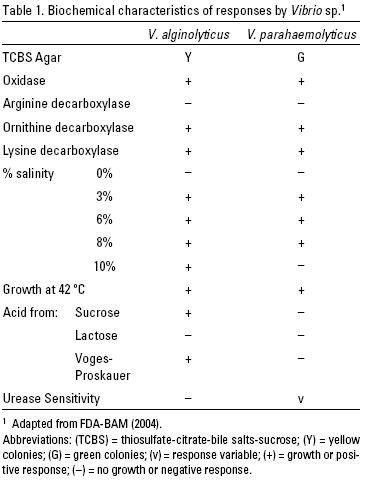
<body><![CDATA[<p align="justify"><font face="verdana" size="2"><b>MATERIALS AND METHODS</b></font></p> 	    <p align="justify"><font face="verdana" size="2"><b>Study Area</b>. The Mandinga lagoon system is located on the coast of the Gulf of Mexico in the central part of the state of Veracruz (19&deg; 00&rsquo; to 19&deg; 06&rsquo; N, and 96&deg; 02&rsquo; to 96&deg; 06&rsquo; W), and covers an area of 3,250 ha (<a href="#f1">Fig. 1</a>).</font></p> 	    <p align="center"><font face="verdana" size="2"><a name="f1"></a></font></p> 	    <p align="center"><font face="verdana" size="2"><img src="/img/revistas/hbio/v20n3/a6f1.jpg"></font></p> 	    <p align="justify"><font face="verdana" size="2"><b>Sample collection and recording of water temperature and salinity</b>. Samples and recorded data were collected during May (the dry season), and July (the rainy season) of 2008. These seasons are considered to be the highest for the production and consumption of oysters in the region. The sampling sites were located in permanent oyster harvesting areas of the Mandinga lagoon system in Veracruz, Mexico (SEFIPLAN, 1999). Four sampling sites were selected and three samples were taken per season, for a total of 24 samples. Each sample consisted of 30 oysters of commercial size (7 &plusmn; 3 cm) that were cleaned, and packaged for transportation according to specifications provided in the Norma Oficial Mexicana NOM&#150;109&#150;SSA1&#150;1994 (DOF, 1994). In each sampling site, water temperature and salinity were measured using a combined probe (Model YSI&#150;6600 V2, YSI Inc., Yellow Springs, Ohio, USA) (DOF, 1994; Casta&ntilde;eda <i>et al.</i>, 2005).</font></p> 	    <p align="justify"><font face="verdana" size="2"><b>Determination of <i>Vibrio parahaemolyticus</i> and <i>V. alginolyticus</i></b>. In a sterile laboratory area, oysters were opened to obtain the entire visceral mass and the intervalvar liquid which were blended and stored in sterile glass measuring cups (Norma Oficial Mexicana NOM&#150;031&#150;SSA1&#150;1993; DOF, (1993)) and the mixtures were processed in a time no longer than 1 hour, at laboratory conditions, as established by Dileep <i>et al.</i>, 2003.</font></p> 	    <p align="justify"><font face="verdana" size="2">The technique used for the determination of Vibrio spp. was based on the methodology developed by the USDA Food and Drug Administration (FDA&#150;BAM, 2004). A 25 g subsample was removed from each mixture of visceral mass and intervalvar water, and the subsample homogenized for 2 minutes in a sterile food processor (Waring, Hartford, Connecticut, USA) with the addition of 225 ml of alkaline peptone water (APW) enriched with 3 % sodium chloride. Subsequently, a series of three hexadecimal dilutions was performed on each one of the homogenized mixtures (1:100, 1:1000 y 1:10000), which were then incubated at 35 &deg;C for 6&#150;8 hours. An aliquot for inoculation was extracted from each dilution and was applied, using cross&#150;streaking, to the selective Thiosulfate&#150;Citrate&#150;Bile Salts&#150;Sucrose (TCBS) agar (Merck&reg;, Alemania) in Petri dishes and incubated at 35 &ordm;C for 24&#150;48 hours (Olafsen <i>et al.</i>, 1993).</font></p> 	    <p align="justify"><font face="verdana" size="2">Yellow (sucrose positive) (typical of <i>V. alginolyticus</i>) and green (sucrose negative) (typical of <i>V. parahaemolyticus</i>) colonies were selected from the TCBS plates. Petri dishes containing a nonselective medium (trytone casein and salt, T1N3, Merck&reg;, Germany) were then inoculated with samples of these colonies in order to promote growth of the selected bacteria. These plates were incubated for a period of 18 to 24 hours at 35 &ordm;C. Samples were taken from the colonies produced and placed on indicator strips of Bactident oxidase (Merck&reg;, Germany) to test for oxidase. If a violet color appeared, the reaction to the oxidase was considered positive, or when there was no observed color change, the reaction was considered negative.</font></p> 	    <p align="justify"><font face="verdana" size="2">A small sample was taken from the colonies considered positive for oxidase, and inoculated into media for the biochemical testing of mobility, decarboxylation of ornithine, lysine and arginine, acidity or fermentation of lactose and sucrose, salinity tolerance, the Voges&#150;Proskauer reaction, urea metabolism, and growth at 42 &ordm;C. The results were obtained using the biochemical profile described in <a href="#t1">Table 1</a>, and were expressed as the Most Probable Number per gram of sample (MPN/g). The latter was determined from dilutions.</font></p> 	    <p align="center"><font face="verdana" size="2"><a name="t1"></a></font></p> 	    ]]></body>
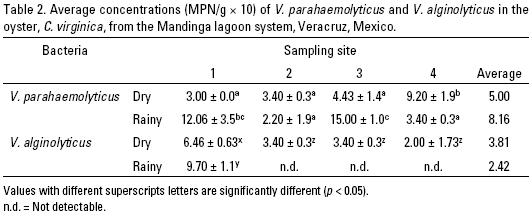
<body><![CDATA[<p align="center"><font face="verdana" size="2"><img src="/img/revistas/hbio/v20n3/a6t1.jpg"></font></p> 	    <p align="justify"><font face="verdana" size="2"><b>Statistical analysis</b>. Data were analyzed using the software Statistica v7.0 (Statsoft, Inc., Tulsa, Oklahoma, USA). A nonparametric Kruskal&#150;Wallis test was used to look for significant differences (P &lt; 0.05) between seasons and sampling sites. Concentrations of Vibrio sp. were correlated with water temperature and salinity.</font></p> 	    <p align="justify"><font face="verdana" size="2">&nbsp;</font></p> 	    <p align="justify"><font face="verdana" size="2"><b>RESULTS</b></font></p> 	    <p align="justify"><font face="verdana" size="2">Average concentrations of <i>V. parahaemolyticus</i> and <i>V. alginolyticus</i> in C. virginica by season of production and consumption and by sampling site in the Mandinga lagoon system are presented in <a href="#t2">Table 2</a>. Results from the Kruskal&#150;Wallis test between seasons and sampling sites are shown in <a href="/img/revistas/hbio/v20n3/a6f2.jpg" target="_blank">Figures 2</a> and <a href="/img/revistas/hbio/v20n3/a6f3.jpg" target="_blank">3</a>. A possible trend of a correlation between average concentrations of <i>V. parahaemolyticus</i> and water temperature and salinity is shown in <a href="/img/revistas/hbio/v20n3/a6f4.jpg" target="_blank">Figures 4</a> and <a href="/img/revistas/hbio/v20n3/a6f5.jpg" target="_blank">5</a>.</font></p> 	    <p align="center"><font face="verdana" size="2"><a name="t2"></a></font></p> 	    <p align="center"><font face="verdana" size="2"><img src="/img/revistas/hbio/v20n3/a6t2.jpg"></font></p> 	    <p align="justify"><font face="verdana" size="2">&nbsp;</font></p> 	    <p align="justify"><font face="verdana" size="2"><b>DISCUSSION</b></font></p> 	    <p align="justify"><font face="verdana" size="2">Various studies exist on the capacity for oysters to filter and accumulate bacteria directly from the water, especially marine bacteria such as <i>V. parahaemolyticus</i> and <i>V. alginolyticus</i> which are pathogenic to humans and the latter which also is known to affect larval fish and crustaceans (Barbieri <i>et al.</i>, 1999; Parveen <i>et al.</i>, 2008). The results from the present study in the Mandinga lagoon system indicate that the American oyster, C. virginica, is a natural reservoir of bacteria such as <i>V. parahaemolyticus</i> and <i>V. alginolyticus</i> (<a href="#t2">Table 2</a>), which is also confirmed by Di pinto <i>et al.</i> (2006).</font></p> 	    ]]></body>
<body><![CDATA[<p align="justify"><font face="verdana" size="2"><b><i>Vibrio parahaemolyticus</i></b>. This bacteria species has been little studied in bivalve molluscs from Mexico and in the world in general. However, when this bacterium is detected and determined to be the causative agent of gastrointestinal illness in humans by the consumption of raw fish and shellfish, the studies of this organism begin to escalate. The presence and concentration of this bacterial species are not regulated by the mexican regulations. The presence of <i>V. parahaemolyticus</i> has been reported in <i>C. virginica </i>and other shellfish (Cabrera&#150;Garc&iacute;a <i>et al.</i>, 2004; Cabanillas&#150;Beltr&aacute;n <i>et al.</i>, 2006), but no studies have been reported in Mexico that evaluate the concentration by unit weight in bivalve molluscs. Countries such as China, Japan, Taiwan, Malaysia, Italy, and the United States of America have reported concentrations of <i>V. parahaemolyticus</i> in bivalve molluscs greater than 1100 MPN/g (Alam <i>et al.</i>, 2003; Bilung <i>et al.</i>, 2005; Di Pinto <i>et al.</i>, 2006; Yi&#150;Chen &amp; Chengchu, 2007; Parveen <i>et al.</i>, 2008).</font></p> 	    <p align="justify"><font face="verdana" size="2">In this study, <i>V. parahaemolyticus</i> was detected among seasons and sampling sites with concentrations that varied between 3 and 150 MPN/g (<a href="#t2">Table 2</a>). Significant differences were detected between sampling seasons (p &lt; 0.05), with the highest concentration of <i>V. parahaemolyticus</i> during the rainy season (<a href="/img/revistas/hbio/v20n3/a6f2.jpg" target="_blank">Figure 2</a>). The highest concentrations were found in sites 1 and 3, which coincided with the high temperatures and lower salinities (<a href="#t3">Table 3</a>). The observed concentrations may also be produced by seasonal variation of the <i>V. parahaemolyticus</i> population by "hibernating" in the sediment or in partnership with the marine fauna, followed by population growth from runoff into the lagoon having high concentrations of organic matter and nutrients. This latter process not only promotes the growth of these bacteria, it eutrophies the Mandinga lagoon system (Aguilar&#150;Ibarra <i>et al.</i>, 2006).</font></p> 	    <p align="center"><font face="verdana" size="2"><a name="t3"></a></font></p> 	    <p align="center"><font face="verdana" size="2"><img src="/img/revistas/hbio/v20n3/a6t3.jpg"></font></p> 	    <p align="justify"><font face="verdana" size="2">The distribution, dynamics and occurrence of populations of <i>V. parahaemolyticus</i> also are influenced by gradients of environmental factors such as temperature, salinity, nutrients, and by biological factors such as the abundance and predation by dinoflagellates and other hosts (Alam <i>et al.</i>, 2003; Thompson &amp; Polz, 2006).</font></p> 	    <p align="justify"><font face="verdana" size="2">In spite of the few available data, the correlation between water temperature and concentrations of <i>V. parahaemolyticus</i> was significant and positive (r = 0.69, P &lt; 0.05), while the correlation between bacterial concentration and salinity was significant and negative (r = &#150;0.68, P &lt; 0.05) (<a href="/img/revistas/hbio/v20n3/a6f4.jpg" target="_blank">Figures 4</a>, <a href="/img/revistas/hbio/v20n3/a6f5.jpg" target="_blank">5</a>). Similar results have been reported by DePaola <i>et al.</i> (1990) and Parveen <i>et al.</i> (2008) who studied the incidence of <i>V. parahaemolyticus</i> in C. virginica along the Atlantic coast of the United States of America.</font></p> 	    <p align="justify"><font face="verdana" size="2">Thus, we confirmed that temperature is the factor that primarily determines the distribution and abundance of <i>V. parahaemolyticus</i> in lagoon systems of the Gulf of Mexico where the oyster <i>C. virginica</i> is abundant, and the minimum water temperature is 11.6 &ordm;C (Cabrera&#150;Garc&iacute;a <i>et al.</i>, 2004). Also, we have further confirmed that increased salinity results in a reduced concentration of <i>V. parahaemolyticus</i> in <i>C. virginica </i>(<a href="#t3">Table 3</a>) (Cook <i>et al.</i>, 2002; DePaola <i>et al.</i>, 2003).</font></p> 	    <p align="justify"><font face="verdana" size="2"><b><i>Vibrio alginolyticus</i></b>. <i>V. alginolyticus</i> was present during the dry season in all four sampling sites, but was only present in site 1 during the rainy season. During the dry season, the salinity in site 1 was 35 o/oo, with a concentration of <i>V. alginolyticus</i> of 6.46 MPN/g. During the rainy season, the salinity decreased to 20 o/oo and the bacterial concentration increased to 9.70 MPN/g (<a href="#t2">Table 2</a>). This trend in salinity and bacterial concentration is similar to that for <i>V. parahaemolyticus</i> where the bacterial concentration declined with increasing salinity.</font></p> 	    <p align="justify"><font face="verdana" size="2">The lack of detection of <i>V. alginolyticus</i> in sampling sites 2, 3, and 4 (<a href="/img/revistas/hbio/v20n3/a6f3.jpg" target="_blank">Figure 3</a>) can be explained by the low primary productivity in Redonda Lagoon in the Mandinga lagoon system during the rainy season where sampling sites 2 and 3 were located. It is likely that a similar condition may have occurred in the mouth of Mandinga Grande Lagoon where site 4 was located in this lagoon system (Arreguin, 1978). The low productivity may be the result of a short time of residence of nutrients in the lagoon systems during the rainy season (Guti&eacute;rrez&#150;Mendieta <i>et al.</i>, 2006).</font></p> 	    <p align="justify"><font face="verdana" size="2">Similar conditions can cause <i>V. alginolyticus</i> to emerge from stasis, but it cannot be cultivated at this time of year. This is due to unfavorable conditions such as competition between bacteria for nutrients, space, and light (Avenda&ntilde;o&#150;Herrera <i>et al.</i>, 2005; Albertini <i>et al.</i>, 2006).</font></p> 	    ]]></body>
<body><![CDATA[<p align="justify"><font face="verdana" size="2">This species was not correlated with temperature, and due to the seasonal fluctuations its occurrence, does not appear to be dependent on temperature in tropical areas (Molitoris <i>et al.</i>, 1985). However, to corroborate this assumption, it would be necessary to have field data that span a minimum period of three years. Such efforts would better define trends in bacterial concentrations relative to the environmental conditions and co&#150;occurring environmental management actions.</font></p> 	    <p align="justify"><font face="verdana" size="2">&nbsp;</font></p> 	    <p align="justify"><font face="verdana" size="2"><b>ACKNOWLEDGEMENTS</b></font></p> 	    <p align="justify"><font face="verdana" size="2">We thank Consejo Nacional de Ciencia y Tecnolog&iacute;a (CONACYT) for assistance through the program Estancia Sab&aacute;tica Vinculada al Fortalecimiento de la Calidad del Postgrado Nacional 2008 to Dr. Fabiola Lango Reynoso in the Colegio de Postgraduados, Campus Veracruz. We also thank the Instituto Tecnol&oacute;gico de Boca del Rio and the Colegio de Postgraduados, Campus Veracruz, for support during the preparation of this article and in the framework of the Acuerdo General de Colaboracion Academica held between the two institutions since October 2006.</font></p> 	    <p align="justify"><font face="verdana" size="2">&nbsp;</font></p> 	    <p align="justify"><font face="verdana" size="2"><b>REFERENCES</b></font></p> 	    <!-- ref --><p align="justify"><font face="verdana" size="2">Aguilar&#150;Ibarra, A., S. Villanueva&#150;Fragoso, P. Guzm&aacute;n&#150;Ama &amp; A. V&aacute;zquez&#150;Botello. 2006. La contaminaci&oacute;n del agua como una externalidad para la producci&oacute;n pesquera y acu&iacute;cola. <i>In:</i> Guzm&aacute;n, P. &amp; C. D. Fuentes (Eds.). <i>Pesca, acuacultura e investigaci&oacute;n en M&eacute;xico.</i> CEDRSSA, M&eacute;xico, pp. 109&#150;116.    &nbsp;&nbsp;&nbsp;&nbsp;&nbsp;&nbsp;&nbsp;&nbsp;[&#160;<a href="javascript:void(0);" onclick="javascript: window.open('/scielo.php?script=sci_nlinks&ref=4084949&pid=S0188-8897201000030000600001&lng=','','width=640,height=500,resizable=yes,scrollbars=1,menubar=yes,');">Links</a>&#160;]<!-- end-ref --></font></p> 	    <!-- ref --><p align="justify"><font face="verdana" size="2">Albertini, M. C., A. Accorsi, L. Teodori, L. Pierfelici, F. Uguccioni, M. B. Rocchi, S. Burattini &amp; B. Citterio. 2006. Use of multiparameter analysis for <i><i>Vibrio alginolyticus</i></i> viable but nonculturable state determination. <i>Cytometry A</i> 69: 260&#150;265.    &nbsp;&nbsp;&nbsp;&nbsp;&nbsp;&nbsp;&nbsp;&nbsp;[&#160;<a href="javascript:void(0);" onclick="javascript: window.open('/scielo.php?script=sci_nlinks&ref=4084951&pid=S0188-8897201000030000600002&lng=','','width=640,height=500,resizable=yes,scrollbars=1,menubar=yes,');">Links</a>&#160;]<!-- end-ref --></font></p> 	    ]]></body>
<body><![CDATA[<!-- ref --><p align="justify"><font face="verdana" size="2">Alam, M. J., S. Miyoshi &amp; S. Shinoda. 2003. Studies on pathogenic <i><i>Vibrio parahaemolyticus</i></i> during a warm weather season in the Seto Inland Sea, Japan. <i>Environmental Microbiology</i> 5: 706&#150;710.    &nbsp;&nbsp;&nbsp;&nbsp;&nbsp;&nbsp;&nbsp;&nbsp;[&#160;<a href="javascript:void(0);" onclick="javascript: window.open('/scielo.php?script=sci_nlinks&ref=4084953&pid=S0188-8897201000030000600003&lng=','','width=640,height=500,resizable=yes,scrollbars=1,menubar=yes,');">Links</a>&#160;]<!-- end-ref --></font></p> 	    <!-- ref --><p align="justify"><font face="verdana" size="2">Arreguin, S. F. 1978. Contribuci&oacute;n al conocimiento del la hidrobiolog&iacute;a de las lagunas de Mandinga, Ver., M&eacute;xico. In: <i>Res&uacute;menes VI Congreso </i><i>Nacional de Oceanograf&iacute;a. M&eacute;xico.    &nbsp;&nbsp;&nbsp;&nbsp;&nbsp;&nbsp;&nbsp;&nbsp;[&#160;<a href="javascript:void(0);" onclick="javascript: window.open('/scielo.php?script=sci_nlinks&ref=4084955&pid=S0188-8897201000030000600004&lng=','','width=640,height=500,resizable=yes,scrollbars=1,menubar=yes,');">Links</a>&#160;]<!-- end-ref --></i></font></p> 	    <!-- ref --><p align="justify"><font face="verdana" size="2">Avenda&ntilde;o&#150;Herrera, R., M. Lody &amp; C. E. Riquelme. 2005. Producci&oacute;n de substancias inhibitorias entre bacterias de biopel&iacute;culas en substratos marinos. <i>Revista de Biolog&iacute;a Marina y Oceanograf&iacute;a</i> 40: 117&#150;125.    &nbsp;&nbsp;&nbsp;&nbsp;&nbsp;&nbsp;&nbsp;&nbsp;[&#160;<a href="javascript:void(0);" onclick="javascript: window.open('/scielo.php?script=sci_nlinks&ref=4084957&pid=S0188-8897201000030000600005&lng=','','width=640,height=500,resizable=yes,scrollbars=1,menubar=yes,');">Links</a>&#160;]<!-- end-ref --></font></p> 	    <!-- ref --><p align="justify"><font face="verdana" size="2">Baqueiro&#150;C&aacute;rdenas, E. R., A. D. Aldana, M. L. Sevilla &amp; E. P. F. Rodr&iacute;guez. 2007. Variations in the reproductive cycle of the Oyster <i><i>Crassostrea virginica</i></i> (Gmelin, 1791), Pueblo Viejo Lagoon, Veracruz, M&eacute;xico. <i>Transitional Water Bulletin</i> 2: 37&#150;46.    &nbsp;&nbsp;&nbsp;&nbsp;&nbsp;&nbsp;&nbsp;&nbsp;[&#160;<a href="javascript:void(0);" onclick="javascript: window.open('/scielo.php?script=sci_nlinks&ref=4084959&pid=S0188-8897201000030000600006&lng=','','width=640,height=500,resizable=yes,scrollbars=1,menubar=yes,');">Links</a>&#160;]<!-- end-ref --></font></p> 	    <!-- ref --><p align="justify"><font face="verdana" size="2">Barbieri, E., L. Falzano &amp; C. Fiorentini. 1999. Occurrence, diversity and pathogenicity of halophilic <i>Vibrio</i> spp. and non&#150;01 <i>Vibrio cholerae</i> from estuarine waters along the Italian Adriatic Coast. <i>Applied Environmental Microbiology</i> 65: 2748&#150;53.    &nbsp;&nbsp;&nbsp;&nbsp;&nbsp;&nbsp;&nbsp;&nbsp;[&#160;<a href="javascript:void(0);" onclick="javascript: window.open('/scielo.php?script=sci_nlinks&ref=4084961&pid=S0188-8897201000030000600007&lng=','','width=640,height=500,resizable=yes,scrollbars=1,menubar=yes,');">Links</a>&#160;]<!-- end-ref --></font></p> 	    ]]></body>
<body><![CDATA[<!-- ref --><p align="justify"><font face="verdana" size="2">Bilung, L. M., R. Son, A. R. Bahaman, R. A. Rahim, S. Napis, M. W. Clemente, G. B. Tanil &amp; M. Nishibuchi. 2005. Detection of <i><i>Vibrio parahaemolyticus</i></i> in cockle <i>(Anadara granosa)</i> by PCR. <i>FEMS Microbiology Letters </i>252: 85&#150;88.    &nbsp;&nbsp;&nbsp;&nbsp;&nbsp;&nbsp;&nbsp;&nbsp;[&#160;<a href="javascript:void(0);" onclick="javascript: window.open('/scielo.php?script=sci_nlinks&ref=4084963&pid=S0188-8897201000030000600008&lng=','','width=640,height=500,resizable=yes,scrollbars=1,menubar=yes,');">Links</a>&#160;]<!-- end-ref --></font></p> 	    <!-- ref --><p align="justify"><font face="verdana" size="2">Cabanillas&#150;Beltr&aacute;n, H., E. LLaus&aacute;s&#150;Maga&ntilde;a, R. Romero, A. Espinoza, A. Garc&iacute;a&#150;Gasca, M. Nishibuchi, M. Ishibashi &amp; B. G&oacute;mez&#150;Gil. 2006. Out&#150;breakof gastroenteritis caused by the pandemic <i>Vibrio parahaemolyticus</i> O3:K6 in Mexico. <i>FEMS Microbiology Letters</i> 265: 76&#150;80.    &nbsp;&nbsp;&nbsp;&nbsp;&nbsp;&nbsp;&nbsp;&nbsp;[&#160;<a href="javascript:void(0);" onclick="javascript: window.open('/scielo.php?script=sci_nlinks&ref=4084965&pid=S0188-8897201000030000600009&lng=','','width=640,height=500,resizable=yes,scrollbars=1,menubar=yes,');">Links</a>&#160;]<!-- end-ref --></font></p> 	    <!-- ref --><p align="justify"><font face="verdana" size="2">Cabrera&#150;Garc&iacute;a, M. A., C. V&aacute;squez&#150;Salinas &amp; E. Qui&ntilde;onez&#150;Ramirez. 2004. Serologic and molecular characterization of <i>Vibrio parahaemolyticus</i> strains isolated from seawater and fish products of the Gulf of Mexico. <i>Applied and Environmental Microbiology</i> 70: 6401&#150;6406.    &nbsp;&nbsp;&nbsp;&nbsp;&nbsp;&nbsp;&nbsp;&nbsp;[&#160;<a href="javascript:void(0);" onclick="javascript: window.open('/scielo.php?script=sci_nlinks&ref=4084967&pid=S0188-8897201000030000600010&lng=','','width=640,height=500,resizable=yes,scrollbars=1,menubar=yes,');">Links</a>&#160;]<!-- end-ref --></font></p> 	    <!-- ref --><p align="justify"><font face="verdana" size="2">Casta&ntilde;eda, M., S. Pardio, B. Orrantia &amp; F. Lango. 2005. Influence of water temperature and salinity on seasonal occurrences of <i>Vibrio cholerae</i> and enteric bacteria in oyster&#150;producing areas of Veracruz, M&eacute;xico. <i>Marine Pollution Bulletin</i> 50: 1641&#150;1648.    &nbsp;&nbsp;&nbsp;&nbsp;&nbsp;&nbsp;&nbsp;&nbsp;[&#160;<a href="javascript:void(0);" onclick="javascript: window.open('/scielo.php?script=sci_nlinks&ref=4084969&pid=S0188-8897201000030000600011&lng=','','width=640,height=500,resizable=yes,scrollbars=1,menubar=yes,');">Links</a>&#160;]<!-- end-ref --></font></p> 	    <!-- ref --><p align="justify"><font face="verdana" size="2">Chakraborty, S., G. B. Nair &amp; S. Shinoda. 1997. Pathogenic vibrios in the natural aquatic environment. <i>Reviews of Environmental Health</i> 12: 63&#150;80.    &nbsp;&nbsp;&nbsp;&nbsp;&nbsp;&nbsp;&nbsp;&nbsp;[&#160;<a href="javascript:void(0);" onclick="javascript: window.open('/scielo.php?script=sci_nlinks&ref=4084971&pid=S0188-8897201000030000600012&lng=','','width=640,height=500,resizable=yes,scrollbars=1,menubar=yes,');">Links</a>&#160;]<!-- end-ref --></font></p> 	    ]]></body>
<body><![CDATA[<!-- ref --><p align="justify"><font face="verdana" size="2">Cook, D. W., J. C. Bowers &amp; A. De Paola. 2002. Density of total and pathogenic (tdh+) <i><i>Vibrio parahaemolyticus</i></i> in Atlantic and Gulf coast molluscan shellfish at harvest. <i>Journal of Food Protection</i> 65: 1873&#150;1880.    &nbsp;&nbsp;&nbsp;&nbsp;&nbsp;&nbsp;&nbsp;&nbsp;[&#160;<a href="javascript:void(0);" onclick="javascript: window.open('/scielo.php?script=sci_nlinks&ref=4084973&pid=S0188-8897201000030000600013&lng=','','width=640,height=500,resizable=yes,scrollbars=1,menubar=yes,');">Links</a>&#160;]<!-- end-ref --></font></p> 	    <!-- ref --><p align="justify"><font face="verdana" size="2">Croci, L., E. Suffredini, L. Cozzi &amp; L. Toti. 2002. Effects of depuration of molluscs experimentally contaminated with <i>Escherichia coli, Vibrio cholerae</i> O1 and <i><i>Vibrio parahaemolyticus</i>. Journal of Applied Microbiology</i> 92: 460&#150;465.    &nbsp;&nbsp;&nbsp;&nbsp;&nbsp;&nbsp;&nbsp;&nbsp;[&#160;<a href="javascript:void(0);" onclick="javascript: window.open('/scielo.php?script=sci_nlinks&ref=4084975&pid=S0188-8897201000030000600014&lng=','','width=640,height=500,resizable=yes,scrollbars=1,menubar=yes,');">Links</a>&#160;]<!-- end-ref --></font></p> 	    <!-- ref --><p align="justify"><font face="verdana" size="2">Daniels, C., C. Vindurampulle &amp; R. Morona. 1998. Overexpression and topology of the <i>Shigella flexneri</i> O&#150;antigen polymerase (Rfc/Wzy). <i>Molecular Microbiology</i> 28: 1211&#150;1222.    &nbsp;&nbsp;&nbsp;&nbsp;&nbsp;&nbsp;&nbsp;&nbsp;[&#160;<a href="javascript:void(0);" onclick="javascript: window.open('/scielo.php?script=sci_nlinks&ref=4084977&pid=S0188-8897201000030000600015&lng=','','width=640,height=500,resizable=yes,scrollbars=1,menubar=yes,');">Links</a>&#160;]<!-- end-ref --></font></p> 	    <!-- ref --><p align="justify"><font face="verdana" size="2">DePaola, A., J. Bowers, J. Wells &amp; D. Cook. 2003. Seasonal abundance of total and pathogenic <i><i>Vibrio parahaemolyticus</i></i> in Alabama oysters. <i>Applied Environmental Microbiology</i> 69: 1521&#150;1526.    &nbsp;&nbsp;&nbsp;&nbsp;&nbsp;&nbsp;&nbsp;&nbsp;[&#160;<a href="javascript:void(0);" onclick="javascript: window.open('/scielo.php?script=sci_nlinks&ref=4084979&pid=S0188-8897201000030000600016&lng=','','width=640,height=500,resizable=yes,scrollbars=1,menubar=yes,');">Links</a>&#160;]<!-- end-ref --></font></p> 	    <!-- ref --><p align="justify"><font face="verdana" size="2">DePaola, A., L. H. Hopkins, J. T. Peeler, B. Wentz &amp; R. M. McPhearson. 1990. Incidence of <i><i>Vibrio parahaemolyticus</i></i> in U.S. coastal waters and oysters. <i>Applied Environmental Microbiology</i> 56: 2299&#150;2302.    &nbsp;&nbsp;&nbsp;&nbsp;&nbsp;&nbsp;&nbsp;&nbsp;[&#160;<a href="javascript:void(0);" onclick="javascript: window.open('/scielo.php?script=sci_nlinks&ref=4084981&pid=S0188-8897201000030000600017&lng=','','width=640,height=500,resizable=yes,scrollbars=1,menubar=yes,');">Links</a>&#160;]<!-- end-ref --></font></p> 	    ]]></body>
<body><![CDATA[<!-- ref --><p align="justify"><font face="verdana" size="2">Dileep, V., H. S. Kumar, Y. Kumar, M. Nishibuchi &amp; I. Karunasaga. 2003. Application of polymerase chain reaction for detection of <i>Vibrio parahaemolyticus</i> associated with tropical seafoods and coastal environment. <i>Letter of Applied Microbiology</i> 36: 423&#150;427.    &nbsp;&nbsp;&nbsp;&nbsp;&nbsp;&nbsp;&nbsp;&nbsp;[&#160;<a href="javascript:void(0);" onclick="javascript: window.open('/scielo.php?script=sci_nlinks&ref=4084983&pid=S0188-8897201000030000600018&lng=','','width=640,height=500,resizable=yes,scrollbars=1,menubar=yes,');">Links</a>&#160;]<!-- end-ref --></font></p> 	    <!-- ref --><p align="justify"><font face="verdana" size="2">Di Pinto, A., G. Ciccarese, M. Fontanarosa, V. Terio &amp; G. M. Tantillo. 2006. Detection of <i><i>Vibrio alginolyticus</i></i> and V<i>ibrio parahaemolyticus</i> in shellfish samples using collagenase&#150;targeted multiplex&#150;PCR. <i>Journal of food safety</i> 26: 150&#150;159.    &nbsp;&nbsp;&nbsp;&nbsp;&nbsp;&nbsp;&nbsp;&nbsp;[&#160;<a href="javascript:void(0);" onclick="javascript: window.open('/scielo.php?script=sci_nlinks&ref=4084985&pid=S0188-8897201000030000600019&lng=','','width=640,height=500,resizable=yes,scrollbars=1,menubar=yes,');">Links</a>&#160;]<!-- end-ref --></font></p> 	    <!-- ref --><p align="justify"><font face="verdana" size="2">DOF. (Diario Oficial de la Federaci&oacute;n). 1993. NOM&#150;031&#150;SSA1&#150;1993. Bienes y servicios. Productos de la pesca. Moluscos bivalvos frescos&#150;refrigerados y congelados. Especificaciones sanitarias. M&eacute;xico.    &nbsp;&nbsp;&nbsp;&nbsp;&nbsp;&nbsp;&nbsp;&nbsp;[&#160;<a href="javascript:void(0);" onclick="javascript: window.open('/scielo.php?script=sci_nlinks&ref=4084987&pid=S0188-8897201000030000600020&lng=','','width=640,height=500,resizable=yes,scrollbars=1,menubar=yes,');">Links</a>&#160;]<!-- end-ref --></font></p> 	    <!-- ref --><p align="justify"><font face="verdana" size="2">DOF. (Diario Oficial de la Federaci&oacute;n). 1994. NOM&#150;109&#150;SSA1&#150;1994. Bienes y servicios. Procedimientos para la toma, manejo y transporte de muestras de alimentos para su an&aacute;lisis microbiol&oacute;gico. M&eacute;xico.    &nbsp;&nbsp;&nbsp;&nbsp;&nbsp;&nbsp;&nbsp;&nbsp;[&#160;<a href="javascript:void(0);" onclick="javascript: window.open('/scielo.php?script=sci_nlinks&ref=4084989&pid=S0188-8897201000030000600021&lng=','','width=640,height=500,resizable=yes,scrollbars=1,menubar=yes,');">Links</a>&#160;]<!-- end-ref --></font></p> 	    <!-- ref --><p align="justify"><font face="verdana" size="2">FAO (Food and Agriculture Organization). 2006. Fisheries Topics: Statistics. Estad&iacute;sticas e informaci&oacute;n. FAO Fisheries and Aquaculture Department. <i>On line:</i> <a href="http://www.fao.org/fishery/topic/2017/es">http://www.fao.org/fishery/topic/2017/es</a></font>&nbsp;&nbsp;&nbsp;&nbsp;&nbsp;&nbsp;&nbsp;&nbsp;[&#160;<a href="javascript:void(0);" onclick="javascript: window.open('/scielo.php?script=sci_nlinks&ref=4084991&pid=S0188-8897201000030000600022&lng=','','width=640,height=500,resizable=yes,scrollbars=1,menubar=yes,');">Links</a>&#160;]<!-- end-ref --><!-- ref --><p align="justify"><font face="verdana" size="2">FDA&#150;BAM (Food and Drug Administration&#150;Bacteriological Analytical Manual). 2004. Vibrio. Bacteriological Analytical Manual. <i>On Line:</i> <a href="http://www.fda.gov/Food/ScienceResearch/LaboratoryMethods/BacteriologicalAnalyticalManualBAM/ucm070830.htm">http://www.fda.gov/Food/ScienceResearch/LaboratoryMethods/BacteriologicalAnalyticalManualBAM/ucm070830.htm</a>.    &nbsp;&nbsp;&nbsp;&nbsp;&nbsp;&nbsp;&nbsp;&nbsp;[&#160;<a href="javascript:void(0);" onclick="javascript: window.open('/scielo.php?script=sci_nlinks&ref=4084992&pid=S0188-8897201000030000600023&lng=','','width=640,height=500,resizable=yes,scrollbars=1,menubar=yes,');">Links</a>&#160;]<!-- end-ref --></font></p> 	    <!-- ref --><p align="justify"><font face="verdana" size="2">Fukushima, H. &amp; R. Seki. 2004. Ecology of <i>V. vulnificus</i> and <i><i>Vibrio parahaemolyticus</i></i> in brackish environments of the Sada River in Shimane Prefecture, Japan. <i>FEMS Microbiology Ecology</i> 48: 221&#150;229.    &nbsp;&nbsp;&nbsp;&nbsp;&nbsp;&nbsp;&nbsp;&nbsp;[&#160;<a href="javascript:void(0);" onclick="javascript: window.open('/scielo.php?script=sci_nlinks&ref=4084994&pid=S0188-8897201000030000600024&lng=','','width=640,height=500,resizable=yes,scrollbars=1,menubar=yes,');">Links</a>&#160;]<!-- end-ref --></font></p> 	    <!-- ref --><p align="justify"><font face="verdana" size="2">Guti&eacute;rrez&#150;Mendieta, F. J., F. Varona&#150;Cordero &amp; F. Contreras. 2006. Caracterizaci&oacute;n estacional de las condiciones f&iacute;sico&#150;qu&iacute;micas y de productividad primaria fitoplanct&oacute;nica de dos lagunas costeras tropicales del estado de Chiapas, M&eacute;xico. <i>Hidrobiol&oacute;gica</i> 16: 137&#150;146.    &nbsp;&nbsp;&nbsp;&nbsp;&nbsp;&nbsp;&nbsp;&nbsp;[&#160;<a href="javascript:void(0);" onclick="javascript: window.open('/scielo.php?script=sci_nlinks&ref=4084996&pid=S0188-8897201000030000600025&lng=','','width=640,height=500,resizable=yes,scrollbars=1,menubar=yes,');">Links</a>&#160;]<!-- end-ref --></font></p> 	    <!-- ref --><p align="justify"><font face="verdana" size="2">Hervio&#150;Heath, D., R. R. Colwell, A. Derrien, A. Robert&#150;Pillot,J. M. Fournier &amp; M. Pommepuy. 2002. Occurrence of pathogenic vibrios in coastal areas of France. <i>Journal of applied microbiology</i> 92: 1123&#150;1135.    &nbsp;&nbsp;&nbsp;&nbsp;&nbsp;&nbsp;&nbsp;&nbsp;[&#160;<a href="javascript:void(0);" onclick="javascript: window.open('/scielo.php?script=sci_nlinks&ref=4084998&pid=S0188-8897201000030000600026&lng=','','width=640,height=500,resizable=yes,scrollbars=1,menubar=yes,');">Links</a>&#160;]<!-- end-ref --></font></p> 	    <!-- ref --><p align="justify"><font face="verdana" size="2">Molitoris, E., S. W. Joseph, M. I. Krichevsky, W. Sindhuhardja &amp; R. R. Colwell. 1985. Characterization and distribution of <i><i>Vibrio alginolyticus</i></i> and <i><i>Vibrio parahaemolyticus</i></i> isolated in Indonesia. <i>Applied and Environmental Microbiology</i> 50: 1388&#150;1394.    &nbsp;&nbsp;&nbsp;&nbsp;&nbsp;&nbsp;&nbsp;&nbsp;[&#160;<a href="javascript:void(0);" onclick="javascript: window.open('/scielo.php?script=sci_nlinks&ref=4085000&pid=S0188-8897201000030000600027&lng=','','width=640,height=500,resizable=yes,scrollbars=1,menubar=yes,');">Links</a>&#160;]<!-- end-ref --></font></p> 	    <!-- ref --><p align="justify"><font face="verdana" size="2">Olafsen, J. A., H.V Mikkelsen, H. M. Giaever &amp; G. H. Hansen. 1993. Indigenous bacteria in hemolymph and tissues of marine bivalves at low temperatures. <i>Applied and Environmental Microbiology</i> 59: 1848&#150;1854.    &nbsp;&nbsp;&nbsp;&nbsp;&nbsp;&nbsp;&nbsp;&nbsp;[&#160;<a href="javascript:void(0);" onclick="javascript: window.open('/scielo.php?script=sci_nlinks&ref=4085002&pid=S0188-8897201000030000600028&lng=','','width=640,height=500,resizable=yes,scrollbars=1,menubar=yes,');">Links</a>&#160;]<!-- end-ref --></font></p> 	    <!-- ref --><p align="justify"><font face="verdana" size="2">Parveen, S., K. A. Hettiarachchi, J. C. Bowers, J. L. Jones, M. L. Tamplin, R. McKay, W. Beatty, K. Brohawn, L. V. Dasilva &amp; A. Depaola. 2008. Seasonal distribution of total and pathogenic <i><i>Vibrio parahaemolyticus</i></i> in Chesapeake Bay oysters and waters. <i>International journal of food microbiology</i> 128: 354&#150;61.    &nbsp;&nbsp;&nbsp;&nbsp;&nbsp;&nbsp;&nbsp;&nbsp;[&#160;<a href="javascript:void(0);" onclick="javascript: window.open('/scielo.php?script=sci_nlinks&ref=4085004&pid=S0188-8897201000030000600029&lng=','','width=640,height=500,resizable=yes,scrollbars=1,menubar=yes,');">Links</a>&#160;]<!-- end-ref --></font></p> 	    <!-- ref --><p align="justify"><font face="verdana" size="2">SEFIPLAN. 1999. Programa Veracruzano de Finanzas P&uacute;blicas 1999&#150;2004. <i>On line:</i> <a href="http://www.sefiplan.gov.mx/menuframes/provefipu/pvfpu-prin.htm">http://www.sefiplan.gov.mx/menuframes/provefipu/pvfpu&#150;prin.htm</a></font>&nbsp;&nbsp;&nbsp;&nbsp;&nbsp;&nbsp;&nbsp;&nbsp;[&#160;<a href="javascript:void(0);" onclick="javascript: window.open('/scielo.php?script=sci_nlinks&ref=4085006&pid=S0188-8897201000030000600030&lng=','','width=640,height=500,resizable=yes,scrollbars=1,menubar=yes,');">Links</a>&#160;]<!-- end-ref --><!-- ref --><p align="justify"><font face="verdana" size="2">Sousa, 0. V., R. H. Vieira, F. G. DeMenezes, C. M. DosReis, &amp; E. Hofer. 2004. Detection of <i><i>Vibrio parahaemolyticus</i></i> and <i>Vibrio cholerae</i> in oyster, <i>Crassostrea rhizophorae,</i> collected from a natural nursery in the Coco river estuary, Ortaleza, Ceara, Brazil. <i>Revista do Instituto de Medicina Tropical de S&atilde;o Paulo</i> 46: 59&#150;62.    &nbsp;&nbsp;&nbsp;&nbsp;&nbsp;&nbsp;&nbsp;&nbsp;[&#160;<a href="javascript:void(0);" onclick="javascript: window.open('/scielo.php?script=sci_nlinks&ref=4085007&pid=S0188-8897201000030000600031&lng=','','width=640,height=500,resizable=yes,scrollbars=1,menubar=yes,');">Links</a>&#160;]<!-- end-ref --></font></p> 	    <!-- ref --><p align="justify"><font face="verdana" size="2">Thompson, F., T. Lida &amp; J. Swings. 2004. Biodiversity of vibrios. <i>Microbiology and Molecular Biology Reviews</i> 68: 403&#150;31.    &nbsp;&nbsp;&nbsp;&nbsp;&nbsp;&nbsp;&nbsp;&nbsp;[&#160;<a href="javascript:void(0);" onclick="javascript: window.open('/scielo.php?script=sci_nlinks&ref=4085009&pid=S0188-8897201000030000600032&lng=','','width=640,height=500,resizable=yes,scrollbars=1,menubar=yes,');">Links</a>&#160;]<!-- end-ref --></font></p> 	    <!-- ref --><p align="justify"><font face="verdana" size="2">Thompson, J. R. &amp; M. Polz. 2006. Dynamics of Vibrio populations and their role in environmental nutrient cycling. <i>In</i>: Thompson, F. L., B. Austin &amp; J. Swing (Eds.). The <i>Biology of Vibrios.</i> ASM Press, Washington, D.C, pp. 190&#150;203.    &nbsp;&nbsp;&nbsp;&nbsp;&nbsp;&nbsp;&nbsp;&nbsp;[&#160;<a href="javascript:void(0);" onclick="javascript: window.open('/scielo.php?script=sci_nlinks&ref=4085011&pid=S0188-8897201000030000600033&lng=','','width=640,height=500,resizable=yes,scrollbars=1,menubar=yes,');">Links</a>&#160;]<!-- end-ref --></font></p> 	    ]]></body>
<body><![CDATA[<!-- ref --><p align="justify"><font face="verdana" size="2">Yi&#150;Cheng, S. &amp; L. Chengchu. 2007. <i><i>Vibrio parahaemolyticus</i>:</i> A concern of seafood safety. <i>Food Microbiology</i> 24: 549&#150;558.    &nbsp;&nbsp;&nbsp;&nbsp;&nbsp;&nbsp;&nbsp;&nbsp;[&#160;<a href="javascript:void(0);" onclick="javascript: window.open('/scielo.php?script=sci_nlinks&ref=4085013&pid=S0188-8897201000030000600034&lng=','','width=640,height=500,resizable=yes,scrollbars=1,menubar=yes,');">Links</a>&#160;]<!-- end-ref --></font></p>      ]]></body><back>
<ref-list>
<ref id="B1">
<nlm-citation citation-type="book">
<person-group person-group-type="author">
<name>
<surname><![CDATA[Aguilar-Ibarra]]></surname>
<given-names><![CDATA[A]]></given-names>
</name>
<name>
<surname><![CDATA[Villanueva-Fragoso]]></surname>
<given-names><![CDATA[S]]></given-names>
</name>
<name>
<surname><![CDATA[Guzmán-Ama]]></surname>
<given-names><![CDATA[P]]></given-names>
</name>
<name>
<surname><![CDATA[Vázquez-Botello]]></surname>
<given-names><![CDATA[A]]></given-names>
</name>
</person-group>
<article-title xml:lang="es"><![CDATA[La contaminación del agua como una externalidad para la producción pesquera y acuícola]]></article-title>
<person-group person-group-type="editor">
<name>
<surname><![CDATA[Guzmán]]></surname>
<given-names><![CDATA[P]]></given-names>
</name>
<name>
<surname><![CDATA[Fuentes]]></surname>
<given-names><![CDATA[C. D.]]></given-names>
</name>
</person-group>
<source><![CDATA[Pesca, acuacultura e investigación en México]]></source>
<year>2006</year>
<page-range>109-116</page-range><publisher-name><![CDATA[CEDRSSA]]></publisher-name>
</nlm-citation>
</ref>
<ref id="B2">
<nlm-citation citation-type="journal">
<person-group person-group-type="author">
<name>
<surname><![CDATA[Albertini]]></surname>
<given-names><![CDATA[M. C.]]></given-names>
</name>
<name>
<surname><![CDATA[Accorsi]]></surname>
<given-names><![CDATA[A]]></given-names>
</name>
<name>
<surname><![CDATA[Teodori]]></surname>
<given-names><![CDATA[L]]></given-names>
</name>
<name>
<surname><![CDATA[Pierfelici]]></surname>
<given-names><![CDATA[L]]></given-names>
</name>
<name>
<surname><![CDATA[Uguccioni]]></surname>
<given-names><![CDATA[F]]></given-names>
</name>
<name>
<surname><![CDATA[Rocchi]]></surname>
<given-names><![CDATA[M. B.]]></given-names>
</name>
<name>
<surname><![CDATA[Burattini]]></surname>
<given-names><![CDATA[S]]></given-names>
</name>
<name>
<surname><![CDATA[Citterio]]></surname>
<given-names><![CDATA[B]]></given-names>
</name>
</person-group>
<article-title xml:lang="en"><![CDATA[Use of multiparameter analysis for Vibrio alginolyticus viable but nonculturable state determination]]></article-title>
<source><![CDATA[Cytometry]]></source>
<year>2006</year>
<volume>A 69</volume>
<page-range>260-265</page-range></nlm-citation>
</ref>
<ref id="B3">
<nlm-citation citation-type="journal">
<person-group person-group-type="author">
<name>
<surname><![CDATA[Alam]]></surname>
<given-names><![CDATA[M. J.]]></given-names>
</name>
<name>
<surname><![CDATA[Miyoshi]]></surname>
<given-names><![CDATA[S]]></given-names>
</name>
<name>
<surname><![CDATA[Shinoda]]></surname>
<given-names><![CDATA[S]]></given-names>
</name>
</person-group>
<article-title xml:lang="en"><![CDATA[Studies on pathogenic Vibrio parahaemolyticus during a warm weather season in the Seto Inland Sea, Japan]]></article-title>
<source><![CDATA[Environmental Microbiology]]></source>
<year>2003</year>
<volume>5</volume>
<page-range>706-710</page-range></nlm-citation>
</ref>
<ref id="B4">
<nlm-citation citation-type="confpro">
<person-group person-group-type="author">
<name>
<surname><![CDATA[Arreguin]]></surname>
<given-names><![CDATA[S. F.]]></given-names>
</name>
</person-group>
<article-title xml:lang="es"><![CDATA[Contribución al conocimiento del la hidrobiología de las lagunas de Mandinga, Ver., México]]></article-title>
<source><![CDATA[]]></source>
<year>1978</year>
<conf-name><![CDATA[VI Congreso Nacional de Oceanografía]]></conf-name>
<conf-loc> </conf-loc>
</nlm-citation>
</ref>
<ref id="B5">
<nlm-citation citation-type="journal">
<person-group person-group-type="author">
<name>
<surname><![CDATA[Avendaño-Herrera]]></surname>
<given-names><![CDATA[R.]]></given-names>
</name>
<name>
<surname><![CDATA[Lody]]></surname>
<given-names><![CDATA[M.]]></given-names>
</name>
<name>
<surname><![CDATA[Riquelme]]></surname>
<given-names><![CDATA[C. E.]]></given-names>
</name>
</person-group>
<article-title xml:lang="es"><![CDATA[Producción de substancias inhibitorias entre bacterias de biopelículas en substratos marinos]]></article-title>
<source><![CDATA[Revista de Biología Marina y Oceanografía]]></source>
<year>2005</year>
<volume>40</volume>
<page-range>117-125</page-range></nlm-citation>
</ref>
<ref id="B6">
<nlm-citation citation-type="journal">
<person-group person-group-type="author">
<name>
<surname><![CDATA[Baqueiro-Cárdenas]]></surname>
<given-names><![CDATA[E. R.]]></given-names>
</name>
<name>
<surname><![CDATA[Aldana]]></surname>
<given-names><![CDATA[A. D.]]></given-names>
</name>
<name>
<surname><![CDATA[Sevilla]]></surname>
<given-names><![CDATA[M. L.]]></given-names>
</name>
<name>
<surname><![CDATA[Rodríguez]]></surname>
<given-names><![CDATA[E. P. F.]]></given-names>
</name>
</person-group>
<article-title xml:lang="en"><![CDATA[Variations in the reproductive cycle of the Oyster Crassostrea virginica (Gmelin, 1791), Pueblo Viejo Lagoon, Veracruz, México]]></article-title>
<source><![CDATA[Transitional Water Bulletin]]></source>
<year>2007</year>
<volume>2</volume>
<page-range>37-46</page-range></nlm-citation>
</ref>
<ref id="B7">
<nlm-citation citation-type="journal">
<person-group person-group-type="author">
<name>
<surname><![CDATA[Barbieri]]></surname>
<given-names><![CDATA[E]]></given-names>
</name>
<name>
<surname><![CDATA[Falzano]]></surname>
<given-names><![CDATA[L]]></given-names>
</name>
<name>
<surname><![CDATA[Fiorentini]]></surname>
<given-names><![CDATA[C]]></given-names>
</name>
</person-group>
<article-title xml:lang="en"><![CDATA[Occurrence, diversity and pathogenicity of halophilic Vibrio spp. and non-01 Vibrio cholerae from estuarine waters along the Italian Adriatic Coast]]></article-title>
<source><![CDATA[Applied Environmental Microbiology]]></source>
<year>1999</year>
<volume>65</volume>
<page-range>2748-53</page-range></nlm-citation>
</ref>
<ref id="B8">
<nlm-citation citation-type="journal">
<person-group person-group-type="author">
<name>
<surname><![CDATA[Bilung]]></surname>
<given-names><![CDATA[L. M.]]></given-names>
</name>
<name>
<surname><![CDATA[Son]]></surname>
<given-names><![CDATA[R]]></given-names>
</name>
<name>
<surname><![CDATA[Bahaman]]></surname>
<given-names><![CDATA[A. R.]]></given-names>
</name>
<name>
<surname><![CDATA[Rahim]]></surname>
<given-names><![CDATA[R. A.]]></given-names>
</name>
<name>
<surname><![CDATA[Napis]]></surname>
<given-names><![CDATA[S]]></given-names>
</name>
<name>
<surname><![CDATA[Clemente]]></surname>
<given-names><![CDATA[M. W.]]></given-names>
</name>
<name>
<surname><![CDATA[Tanil]]></surname>
<given-names><![CDATA[G. B.]]></given-names>
</name>
<name>
<surname><![CDATA[Nishibuchi]]></surname>
<given-names><![CDATA[M]]></given-names>
</name>
</person-group>
<article-title xml:lang="en"><![CDATA[Detection of Vibrio parahaemolyticus in cockle (Anadara granosa) by PCR]]></article-title>
<source><![CDATA[FEMS Microbiology Letters]]></source>
<year>2005</year>
<volume>252</volume>
<page-range>85-88</page-range></nlm-citation>
</ref>
<ref id="B9">
<nlm-citation citation-type="journal">
<person-group person-group-type="author">
<name>
<surname><![CDATA[Cabanillas-Beltrán]]></surname>
<given-names><![CDATA[H]]></given-names>
</name>
<name>
<surname><![CDATA[LLausás-Magaña]]></surname>
<given-names><![CDATA[E]]></given-names>
</name>
<name>
<surname><![CDATA[Romero]]></surname>
<given-names><![CDATA[R]]></given-names>
</name>
<name>
<surname><![CDATA[Espinoza]]></surname>
<given-names><![CDATA[A]]></given-names>
</name>
<name>
<surname><![CDATA[García-Gasca]]></surname>
<given-names><![CDATA[A]]></given-names>
</name>
<name>
<surname><![CDATA[Nishibuchi]]></surname>
<given-names><![CDATA[M]]></given-names>
</name>
<name>
<surname><![CDATA[Ishibashi]]></surname>
<given-names><![CDATA[M]]></given-names>
</name>
<name>
<surname><![CDATA[Gómez-Gil]]></surname>
<given-names><![CDATA[B]]></given-names>
</name>
</person-group>
<article-title xml:lang="en"><![CDATA[Out-breakof gastroenteritis caused by the pandemic Vibrio parahaemolyticus O3:K6 in Mexico]]></article-title>
<source><![CDATA[FEMS Microbiology Letters]]></source>
<year>2006</year>
<volume>265</volume>
<page-range>76-80</page-range></nlm-citation>
</ref>
<ref id="B10">
<nlm-citation citation-type="journal">
<person-group person-group-type="author">
<name>
<surname><![CDATA[Cabrera-García]]></surname>
<given-names><![CDATA[M. A.]]></given-names>
</name>
<name>
<surname><![CDATA[Vásquez-Salinas]]></surname>
<given-names><![CDATA[C]]></given-names>
</name>
<name>
<surname><![CDATA[Quiñonez-Ramirez]]></surname>
<given-names><![CDATA[E]]></given-names>
</name>
</person-group>
<article-title xml:lang="en"><![CDATA[Serologic and molecular characterization of Vibrio parahaemolyticus strains isolated from seawater and fish products of the Gulf of Mexico]]></article-title>
<source><![CDATA[Applied and Environmental Microbiology]]></source>
<year>2004</year>
<volume>70</volume>
<page-range>6401-6406</page-range></nlm-citation>
</ref>
<ref id="B11">
<nlm-citation citation-type="journal">
<person-group person-group-type="author">
<name>
<surname><![CDATA[Castañeda]]></surname>
<given-names><![CDATA[M]]></given-names>
</name>
<name>
<surname><![CDATA[Pardio]]></surname>
<given-names><![CDATA[S]]></given-names>
</name>
<name>
<surname><![CDATA[Orrantia]]></surname>
<given-names><![CDATA[B]]></given-names>
</name>
<name>
<surname><![CDATA[Lango]]></surname>
<given-names><![CDATA[F]]></given-names>
</name>
</person-group>
<article-title xml:lang="es"><![CDATA[Influence of water temperature and salinity on seasonal occurrences of Vibrio cholerae and enteric bacteria in oyster-producing areas of Veracruz, México]]></article-title>
<source><![CDATA[Marine Pollution Bulletin]]></source>
<year>2005</year>
<volume>50</volume>
<page-range>1641-1648</page-range></nlm-citation>
</ref>
<ref id="B12">
<nlm-citation citation-type="journal">
<person-group person-group-type="author">
<name>
<surname><![CDATA[Chakraborty]]></surname>
<given-names><![CDATA[S]]></given-names>
</name>
<name>
<surname><![CDATA[Nair]]></surname>
<given-names><![CDATA[G. B]]></given-names>
</name>
<name>
<surname><![CDATA[Shinoda]]></surname>
<given-names><![CDATA[S]]></given-names>
</name>
</person-group>
<article-title xml:lang="en"><![CDATA[Pathogenic vibrios in the natural aquatic environment]]></article-title>
<source><![CDATA[Reviews of Environmental Health]]></source>
<year>1997</year>
<volume>12</volume>
<page-range>63-80</page-range></nlm-citation>
</ref>
<ref id="B13">
<nlm-citation citation-type="journal">
<person-group person-group-type="author">
<name>
<surname><![CDATA[Cook]]></surname>
<given-names><![CDATA[D. W.]]></given-names>
</name>
<name>
<surname><![CDATA[Bowers]]></surname>
<given-names><![CDATA[J. C.]]></given-names>
</name>
<name>
<surname><![CDATA[De Paola]]></surname>
<given-names><![CDATA[A]]></given-names>
</name>
</person-group>
<article-title xml:lang="en"><![CDATA[Density of total and pathogenic (tdh+) Vibrio parahaemolyticus in Atlantic and Gulf coast molluscan shellfish at harvest]]></article-title>
<source><![CDATA[Journal of Food Protection]]></source>
<year>2002</year>
<volume>65</volume>
<page-range>1873-1880</page-range></nlm-citation>
</ref>
<ref id="B14">
<nlm-citation citation-type="journal">
<person-group person-group-type="author">
<name>
<surname><![CDATA[Croci]]></surname>
<given-names><![CDATA[L]]></given-names>
</name>
<name>
<surname><![CDATA[Suffredini]]></surname>
<given-names><![CDATA[E]]></given-names>
</name>
<name>
<surname><![CDATA[Cozzi]]></surname>
<given-names><![CDATA[L]]></given-names>
</name>
<name>
<surname><![CDATA[Toti]]></surname>
<given-names><![CDATA[L]]></given-names>
</name>
</person-group>
<article-title xml:lang="en"><![CDATA[Effects of depuration of molluscs experimentally contaminated with Escherichia coli, Vibrio cholerae O1 and Vibrio parahaemolyticus]]></article-title>
<source><![CDATA[Journal of Applied Microbiology]]></source>
<year>2002</year>
<volume>92</volume>
<page-range>460-465</page-range></nlm-citation>
</ref>
<ref id="B15">
<nlm-citation citation-type="journal">
<person-group person-group-type="author">
<name>
<surname><![CDATA[Daniels]]></surname>
<given-names><![CDATA[C]]></given-names>
</name>
<name>
<surname><![CDATA[Vindurampulle]]></surname>
<given-names><![CDATA[C]]></given-names>
</name>
<name>
<surname><![CDATA[Morona]]></surname>
<given-names><![CDATA[R]]></given-names>
</name>
</person-group>
<article-title xml:lang="en"><![CDATA[Overexpression and topology of the Shigella flexneri O-antigen polymerase (Rfc/Wzy)]]></article-title>
<source><![CDATA[Molecular Microbiology]]></source>
<year>1998</year>
<volume>28</volume>
<page-range>1211-1222</page-range></nlm-citation>
</ref>
<ref id="B16">
<nlm-citation citation-type="journal">
<person-group person-group-type="author">
<name>
<surname><![CDATA[DePaola]]></surname>
<given-names><![CDATA[A]]></given-names>
</name>
<name>
<surname><![CDATA[Bowers]]></surname>
<given-names><![CDATA[J]]></given-names>
</name>
<name>
<surname><![CDATA[Wells]]></surname>
<given-names><![CDATA[J]]></given-names>
</name>
<name>
<surname><![CDATA[Cook]]></surname>
<given-names><![CDATA[D]]></given-names>
</name>
</person-group>
<article-title xml:lang="en"><![CDATA[Seasonal abundance of total and pathogenic Vibrio parahaemolyticus in Alabama oysters]]></article-title>
<source><![CDATA[Applied Environmental Microbiology]]></source>
<year>2003</year>
<volume>69</volume>
<page-range>1521-1526</page-range></nlm-citation>
</ref>
<ref id="B17">
<nlm-citation citation-type="journal">
<person-group person-group-type="author">
<name>
<surname><![CDATA[DePaola]]></surname>
<given-names><![CDATA[A]]></given-names>
</name>
<name>
<surname><![CDATA[Hopkins]]></surname>
<given-names><![CDATA[L. H.]]></given-names>
</name>
<name>
<surname><![CDATA[Peeler]]></surname>
<given-names><![CDATA[J. T.]]></given-names>
</name>
<name>
<surname><![CDATA[Wentz]]></surname>
<given-names><![CDATA[B]]></given-names>
</name>
<name>
<surname><![CDATA[McPhearson]]></surname>
<given-names><![CDATA[R. M.]]></given-names>
</name>
</person-group>
<article-title xml:lang="en"><![CDATA[Incidence of Vibrio parahaemolyticus in U.S. coastal waters and oysters]]></article-title>
<source><![CDATA[Applied Environmental Microbiology]]></source>
<year>1990</year>
<volume>56</volume>
<page-range>2299-2302</page-range></nlm-citation>
</ref>
<ref id="B18">
<nlm-citation citation-type="journal">
<person-group person-group-type="author">
<name>
<surname><![CDATA[Dileep]]></surname>
<given-names><![CDATA[V]]></given-names>
</name>
<name>
<surname><![CDATA[Kumar]]></surname>
<given-names><![CDATA[H. S.]]></given-names>
</name>
<name>
<surname><![CDATA[Kumar]]></surname>
<given-names><![CDATA[Y]]></given-names>
</name>
<name>
<surname><![CDATA[Nishibuchi]]></surname>
<given-names><![CDATA[M]]></given-names>
</name>
<name>
<surname><![CDATA[Karunasaga]]></surname>
<given-names><![CDATA[I]]></given-names>
</name>
</person-group>
<article-title xml:lang="en"><![CDATA[Application of polymerase chain reaction for detection of Vibrio parahaemolyticus associated with tropical seafoods and coastal environment]]></article-title>
<source><![CDATA[Letter of Applied Microbiology]]></source>
<year>2003</year>
<volume>36</volume>
<page-range>423-427</page-range></nlm-citation>
</ref>
<ref id="B19">
<nlm-citation citation-type="journal">
<person-group person-group-type="author">
<name>
<surname><![CDATA[Di Pinto]]></surname>
<given-names><![CDATA[A]]></given-names>
</name>
<name>
<surname><![CDATA[Ciccarese]]></surname>
<given-names><![CDATA[G]]></given-names>
</name>
<name>
<surname><![CDATA[Fontanarosa]]></surname>
<given-names><![CDATA[M]]></given-names>
</name>
<name>
<surname><![CDATA[Terio]]></surname>
<given-names><![CDATA[V]]></given-names>
</name>
<name>
<surname><![CDATA[Tantillo]]></surname>
<given-names><![CDATA[G. M.]]></given-names>
</name>
</person-group>
<article-title xml:lang="en"><![CDATA[Detection of Vibrio alginolyticus and Vibrio parahaemolyticus in shellfish samples using collagenase-targeted multiplex-PCR]]></article-title>
<source><![CDATA[Journal of food safety]]></source>
<year>2006</year>
<volume>26</volume>
<page-range>150-159</page-range></nlm-citation>
</ref>
<ref id="B20">
<nlm-citation citation-type="journal">
<source><![CDATA[DOF. (Diario Oficial de la Federación)]]></source>
<year>1993</year>
</nlm-citation>
</ref>
<ref id="B21">
<nlm-citation citation-type="journal">
<source><![CDATA[DOF. (Diario Oficial de la Federación)]]></source>
<year>1994</year>
</nlm-citation>
</ref>
<ref id="B22">
<nlm-citation citation-type="">
<collab>FAO (Food and Agriculture Organization)</collab>
<source><![CDATA[Fisheries Topics: Statistics. Estadísticas e información. FAO Fisheries and Aquaculture Department]]></source>
<year>2006</year>
</nlm-citation>
</ref>
<ref id="B23">
<nlm-citation citation-type="">
<collab>FDA-BAM (Food and Drug Administration-Bacteriological Analytical Manual)</collab>
<source><![CDATA[Vibrio. Bacteriological Analytical Manual]]></source>
<year>2004</year>
</nlm-citation>
</ref>
<ref id="B24">
<nlm-citation citation-type="journal">
<person-group person-group-type="author">
<name>
<surname><![CDATA[Fukushima]]></surname>
<given-names><![CDATA[H]]></given-names>
</name>
<name>
<surname><![CDATA[Seki]]></surname>
<given-names><![CDATA[R]]></given-names>
</name>
</person-group>
<article-title xml:lang="en"><![CDATA[Ecology of V. vulnificus and Vibrio parahaemolyticus in brackish environments of the Sada River in Shimane Prefecture, Japan]]></article-title>
<source><![CDATA[FEMS Microbiology Ecology]]></source>
<year>2004</year>
<volume>48</volume>
<page-range>221-229</page-range></nlm-citation>
</ref>
<ref id="B25">
<nlm-citation citation-type="journal">
<person-group person-group-type="author">
<name>
<surname><![CDATA[Gutiérrez-Mendieta]]></surname>
<given-names><![CDATA[F. J.]]></given-names>
</name>
<name>
<surname><![CDATA[Varona-Cordero]]></surname>
<given-names><![CDATA[F]]></given-names>
</name>
<name>
<surname><![CDATA[Contreras]]></surname>
<given-names><![CDATA[F]]></given-names>
</name>
</person-group>
<article-title xml:lang="es"><![CDATA[Caracterización estacional de las condiciones físico-químicas y de productividad primaria fitoplanctónica de dos lagunas costeras tropicales del estado de Chiapas, México]]></article-title>
<source><![CDATA[Hidrobiológica]]></source>
<year>2006</year>
<volume>16</volume>
<page-range>137-146</page-range></nlm-citation>
</ref>
<ref id="B26">
<nlm-citation citation-type="journal">
<person-group person-group-type="author">
<name>
<surname><![CDATA[Hervio-Heath]]></surname>
<given-names><![CDATA[D]]></given-names>
</name>
<name>
<surname><![CDATA[Colwell]]></surname>
<given-names><![CDATA[R. R.]]></given-names>
</name>
<name>
<surname><![CDATA[Derrien]]></surname>
<given-names><![CDATA[A]]></given-names>
</name>
<name>
<surname><![CDATA[Robert-Pillot]]></surname>
<given-names><![CDATA[A]]></given-names>
</name>
<name>
<surname><![CDATA[Fournier]]></surname>
<given-names><![CDATA[J. M]]></given-names>
</name>
<name>
<surname><![CDATA[Pommepuy]]></surname>
<given-names><![CDATA[M]]></given-names>
</name>
</person-group>
<article-title xml:lang="en"><![CDATA[Occurrence of pathogenic vibrios in coastal areas of France]]></article-title>
<source><![CDATA[Journal of applied microbiology]]></source>
<year>2002</year>
<volume>92</volume>
<page-range>1123-1135</page-range></nlm-citation>
</ref>
<ref id="B27">
<nlm-citation citation-type="journal">
<person-group person-group-type="author">
<name>
<surname><![CDATA[Molitoris]]></surname>
<given-names><![CDATA[E]]></given-names>
</name>
<name>
<surname><![CDATA[Joseph]]></surname>
<given-names><![CDATA[S. W.]]></given-names>
</name>
<name>
<surname><![CDATA[Krichevsky]]></surname>
<given-names><![CDATA[M. I.]]></given-names>
</name>
<name>
<surname><![CDATA[Sindhuhardja]]></surname>
<given-names><![CDATA[W]]></given-names>
</name>
<name>
<surname><![CDATA[Colwell]]></surname>
<given-names><![CDATA[R. R.]]></given-names>
</name>
</person-group>
<article-title xml:lang="en"><![CDATA[Characterization and distribution of Vibrio alginolyticus and Vibrio parahaemolyticus isolated in Indonesia]]></article-title>
<source><![CDATA[Applied and Environmental Microbiology]]></source>
<year>1985</year>
<volume>50</volume>
<page-range>1388-1394</page-range></nlm-citation>
</ref>
<ref id="B28">
<nlm-citation citation-type="journal">
<person-group person-group-type="author">
<name>
<surname><![CDATA[Olafsen]]></surname>
<given-names><![CDATA[J. A.]]></given-names>
</name>
<name>
<surname><![CDATA[Mikkelsen]]></surname>
<given-names><![CDATA[H.V]]></given-names>
</name>
<name>
<surname><![CDATA[Giaever]]></surname>
<given-names><![CDATA[H. M.]]></given-names>
</name>
<name>
<surname><![CDATA[Hansen]]></surname>
<given-names><![CDATA[G. H.]]></given-names>
</name>
</person-group>
<article-title xml:lang="en"><![CDATA[Indigenous bacteria in hemolymph and tissues of marine bivalves at low temperatures]]></article-title>
<source><![CDATA[Applied and Environmental Microbiology]]></source>
<year>1993</year>
<volume>59</volume>
<page-range>1848-1854</page-range></nlm-citation>
</ref>
<ref id="B29">
<nlm-citation citation-type="journal">
<person-group person-group-type="author">
<name>
<surname><![CDATA[Parveen]]></surname>
<given-names><![CDATA[S]]></given-names>
</name>
<name>
<surname><![CDATA[Hettiarachchi]]></surname>
<given-names><![CDATA[K. A.]]></given-names>
</name>
<name>
<surname><![CDATA[Bowers]]></surname>
<given-names><![CDATA[J. C.]]></given-names>
</name>
<name>
<surname><![CDATA[Jones]]></surname>
<given-names><![CDATA[J. L.]]></given-names>
</name>
<name>
<surname><![CDATA[Tamplin]]></surname>
<given-names><![CDATA[M. L.]]></given-names>
</name>
<name>
<surname><![CDATA[McKay]]></surname>
<given-names><![CDATA[R]]></given-names>
</name>
<name>
<surname><![CDATA[Beatty]]></surname>
<given-names><![CDATA[W]]></given-names>
</name>
<name>
<surname><![CDATA[Brohawn]]></surname>
<given-names><![CDATA[K]]></given-names>
</name>
<name>
<surname><![CDATA[Dasilva]]></surname>
<given-names><![CDATA[L. V.]]></given-names>
</name>
<name>
<surname><![CDATA[Depaola]]></surname>
<given-names><![CDATA[A]]></given-names>
</name>
</person-group>
<article-title xml:lang="en"><![CDATA[Seasonal distribution of total and pathogenic Vibrio parahaemolyticus in Chesapeake Bay oysters and waters]]></article-title>
<source><![CDATA[International journal of food microbiology]]></source>
<year>2008</year>
<volume>128</volume>
<page-range>354-61</page-range></nlm-citation>
</ref>
<ref id="B30">
<nlm-citation citation-type="">
<collab>SEFIPLAN</collab>
<source><![CDATA[Programa Veracruzano de Finanzas Públicas 1999-2004]]></source>
<year>1999</year>
</nlm-citation>
</ref>
<ref id="B31">
<nlm-citation citation-type="journal">
<person-group person-group-type="author">
<name>
<surname><![CDATA[Sousa]]></surname>
<given-names><![CDATA[0. V.]]></given-names>
</name>
<name>
<surname><![CDATA[Vieira]]></surname>
<given-names><![CDATA[R. H.]]></given-names>
</name>
<name>
<surname><![CDATA[DeMenezes]]></surname>
<given-names><![CDATA[F. G.]]></given-names>
</name>
<name>
<surname><![CDATA[DosReis]]></surname>
<given-names><![CDATA[C. M.]]></given-names>
</name>
<name>
<surname><![CDATA[Hofer]]></surname>
<given-names><![CDATA[E]]></given-names>
</name>
</person-group>
<article-title xml:lang="en"><![CDATA[Detection of Vibrio parahaemolyticus and Vibrio cholerae in oyster, Crassostrea rhizophorae, collected from a natural nursery in the Coco river estuary, Ortaleza, Ceara, Brazil]]></article-title>
<source><![CDATA[Revista do Instituto de Medicina Tropical de São Paulo]]></source>
<year>2004</year>
<volume>46</volume>
<page-range>59-62</page-range></nlm-citation>
</ref>
<ref id="B32">
<nlm-citation citation-type="journal">
<person-group person-group-type="author">
<name>
<surname><![CDATA[Thompson]]></surname>
<given-names><![CDATA[F]]></given-names>
</name>
<name>
<surname><![CDATA[Lida]]></surname>
<given-names><![CDATA[T]]></given-names>
</name>
<name>
<surname><![CDATA[Swings]]></surname>
<given-names><![CDATA[J]]></given-names>
</name>
</person-group>
<source><![CDATA[Microbiology and Molecular Biology Reviews]]></source>
<year>2004</year>
<volume>68</volume>
<page-range>403-31</page-range></nlm-citation>
</ref>
<ref id="B33">
<nlm-citation citation-type="book">
<person-group person-group-type="author">
<name>
<surname><![CDATA[Thompson]]></surname>
<given-names><![CDATA[J. R.]]></given-names>
</name>
<name>
<surname><![CDATA[Polz]]></surname>
<given-names><![CDATA[M]]></given-names>
</name>
</person-group>
<article-title xml:lang="en"><![CDATA[Dynamics of Vibrio populations and their role in environmental nutrient cycling]]></article-title>
<person-group person-group-type="editor">
<name>
<surname><![CDATA[Thompson]]></surname>
<given-names><![CDATA[F. L.]]></given-names>
</name>
<name>
<surname><![CDATA[Austin]]></surname>
<given-names><![CDATA[B]]></given-names>
</name>
<name>
<surname><![CDATA[Swing]]></surname>
<given-names><![CDATA[J]]></given-names>
</name>
</person-group>
<source><![CDATA[The Biology of Vibrios]]></source>
<year>2006</year>
<page-range>190-203</page-range><publisher-loc><![CDATA[Washington^eD.C D.C]]></publisher-loc>
<publisher-name><![CDATA[ASM Press]]></publisher-name>
</nlm-citation>
</ref>
<ref id="B34">
<nlm-citation citation-type="journal">
<person-group person-group-type="author">
<name>
<surname><![CDATA[Yi-Cheng]]></surname>
<given-names><![CDATA[S]]></given-names>
</name>
<name>
<surname><![CDATA[Chengchu]]></surname>
<given-names><![CDATA[L]]></given-names>
</name>
</person-group>
<article-title xml:lang="en"><![CDATA[Vibrio parahaemolyticus: A concern of seafood safety]]></article-title>
<source><![CDATA[Food Microbiology]]></source>
<year>2007</year>
<volume>24</volume>
<page-range>549-558</page-range></nlm-citation>
</ref>
</ref-list>
</back>
</article>