<?xml version="1.0" encoding="ISO-8859-1"?><article xmlns:mml="http://www.w3.org/1998/Math/MathML" xmlns:xlink="http://www.w3.org/1999/xlink" xmlns:xsi="http://www.w3.org/2001/XMLSchema-instance">
<front>
<journal-meta>
<journal-id>0188-8897</journal-id>
<journal-title><![CDATA[Hidrobiológica]]></journal-title>
<abbrev-journal-title><![CDATA[Hidrobiológica]]></abbrev-journal-title>
<issn>0188-8897</issn>
<publisher>
<publisher-name><![CDATA[Universidad Autónoma Metropolitana, División de Ciencias Biológicas y de la Salud]]></publisher-name>
</publisher>
</journal-meta>
<article-meta>
<article-id>S0188-88972001000100009</article-id>
<title-group>
<article-title xml:lang="en"><![CDATA[Diatoms in the fish rearing center in Temascal, Oaxaca, Mexico]]></article-title>
</title-group>
<contrib-group>
<contrib contrib-type="author">
<name>
<surname><![CDATA[Figueroa-Torres]]></surname>
<given-names><![CDATA[Ma. Guadalupe]]></given-names>
</name>
</contrib>
</contrib-group>
<aff id="A01">
<institution><![CDATA[,Universidad Autónoma Metropolitana  ]]></institution>
<addr-line><![CDATA[Xochimilco Distrito Federal]]></addr-line>
<country>México</country>
</aff>
<pub-date pub-type="pub">
<day>00</day>
<month>00</month>
<year>2001</year>
</pub-date>
<pub-date pub-type="epub">
<day>00</day>
<month>00</month>
<year>2001</year>
</pub-date>
<volume>11</volume>
<numero>1</numero>
<fpage>85</fpage>
<lpage>96</lpage>
<copyright-statement/>
<copyright-year/>
<self-uri xlink:href="http://www.scielo.org.mx/scielo.php?script=sci_arttext&amp;pid=S0188-88972001000100009&amp;lng=en&amp;nrm=iso"></self-uri><self-uri xlink:href="http://www.scielo.org.mx/scielo.php?script=sci_abstract&amp;pid=S0188-88972001000100009&amp;lng=en&amp;nrm=iso"></self-uri><self-uri xlink:href="http://www.scielo.org.mx/scielo.php?script=sci_pdf&amp;pid=S0188-88972001000100009&amp;lng=en&amp;nrm=iso"></self-uri><abstract abstract-type="short" xml:lang="en"><p><![CDATA[Considering the importance and lack of studies of freshwater diatoms in Mexico, this research is a contribution to the knowledge of this group, particularly with respect to its taxonomic composition, distribution and abundance in the fish rearing ponds in Temascal, Oaxaca, Mexico. Samples from 14 ponds and two channels (one is a supply channel and the other is for draining) were taken in March, 1991. On the whole, 41 samples were obtained which included plankton collected with a 54 µm mesh standard net and a van Dorn bottle, and benthic forms collected with a spatula or a siphon. The diatoms were cleaned and mounted in Naphrax resin. Relative abundance and frequency were computed counting all the organisms present in one ml of the original sample, three times. A total of 31 species and varieties of seven families were identified, of which 98% belong to the Pennales Order and 2% to the Centrales Order. The most frequent and abundant species were: fueron Synedra acus var. acus , S. ulna var. ulna, Cymbella microcephala var. microcephala, C. tumida var. tumida, Diplonesis puella var. puella, Gomphonema affine var. affine, G . angustatum var. angustatum, G. clavatum, Navicula notha var. notha y Pinnularia acrosphaeria var. acrosphaeria.]]></p></abstract>
<abstract abstract-type="short" xml:lang="es"><p><![CDATA[Considerando la importancia y la falta de estudios sobre diatomeas de agua dulce en México, este trabajo constituye una contribución al conocimiento de este grupo, particularmente en cuanto a su composición taxonómica, distribución y abundancia en los estanques del Centro Piscícola de Temascal, Oaxaca, México. Para la realización de este estudio se muestrearon 14 estanques y dos canales (uno surtidor y otro de desagüe) en marzo de 1991. Se obtuvieron 41 muestras que incluyen plancton recolectado con una red estandar de 54 µm de malla y con una botella van Dorn, así como formas bénticas recolectadas con espatulas o con sifones. Las diatomeas fueron limpiadas y montadas en resina Naphrax. La abundancia relativa y la frecuencia se obtuvieron evaluando todos los organismos presentes en un ml de muestra original por triplicado. Se determinaron 31 especies y variedades de diatomeas pertenecientes a siete familias. El 98% correspondió al Orden Pennales y el 2% al Orden Centrales. Las especies más frecuentes y abundantes fueron: Synedra acus var. acus , S. ulna var. ulna, Cymbella microcephala var. microcephala, C. tumida var. tumida, Diplonesis puella var. puella, Gomphonema affine var affine, G . angustatum var. angustatum, G. clavatum, Navicula notha var. notha y Pinnularia acrosphaeria var. acrosphaeria.]]></p></abstract>
<kwd-group>
<kwd lng="en"><![CDATA[Diatomas]]></kwd>
<kwd lng="en"><![CDATA[fish rearing center]]></kwd>
<kwd lng="en"><![CDATA[Papaloapan]]></kwd>
<kwd lng="en"><![CDATA[Temascal]]></kwd>
<kwd lng="en"><![CDATA[Oaxaca]]></kwd>
<kwd lng="en"><![CDATA[Mexico]]></kwd>
<kwd lng="es"><![CDATA[Diatomeas]]></kwd>
<kwd lng="es"><![CDATA[centro piscícola]]></kwd>
<kwd lng="es"><![CDATA[Papaloapan]]></kwd>
<kwd lng="es"><![CDATA[Temascal]]></kwd>
<kwd lng="es"><![CDATA[Oaxaca]]></kwd>
<kwd lng="es"><![CDATA[México]]></kwd>
</kwd-group>
</article-meta>
</front><body><![CDATA[  	    <p align="center"><font face="verdana" size="4"><b>Diatoms in the fish rearing center in Temascal, Oaxaca, Mexico</b></font></p>  	    <p>&nbsp;</p>  	    <p align="center"><font face="verdana" size="2"><b>Ma. Guadalupe Figueroa&#45;Torres</b></font></p>  	    <p>&nbsp;</p>  	    <p align="justify"><font face="verdana" size="2"><i>Universidad Aut&oacute;noma Metropolitana unidad Xochimilco, Calzada del Hueso 1100. M&eacute;xico 04960, D. F.</i> E&#45;mail: <a href="mailto:figueroa@cueyatl.uam.mx">figueroa@cueyatl.uam.mx</a></font></p>  	    <p>&nbsp;</p>  	    <p align="justify"><font face="verdana" size="2">Recibido: 30 de octubre de 200    <br> 	Aceptado: 2 de febrero de 2001</font></p>  	    <p>&nbsp;</p>  	    ]]></body>
<body><![CDATA[<p align="justify"><font face="verdana" size="2"><b>Resumen</b></font></p>  	    <p align="justify"><font face="verdana" size="2">Considerando la importancia y la falta de estudios sobre diatomeas de agua dulce en M&eacute;xico, este trabajo constituye una contribuci&oacute;n al conocimiento de este grupo, particularmente en cuanto a su composici&oacute;n taxon&oacute;mica, distribuci&oacute;n y abundancia en los estanques del Centro Pisc&iacute;cola de Temascal, Oaxaca, M&eacute;xico. Para la realizaci&oacute;n de este estudio se muestrearon 14 estanques y dos canales (uno surtidor y otro de desag&uuml;e) en marzo de 1991. Se obtuvieron 41 muestras que incluyen plancton recolectado con una red estandar de 54 <i>&micro;</i>m de malla y con una botella van Dorn, as&iacute; como formas b&eacute;nticas recolectadas con espatulas o con sifones. Las diatomeas fueron limpiadas y montadas en resina Naphrax. La abundancia relativa y la frecuencia se obtuvieron evaluando todos los organismos presentes en un ml de muestra original por triplicado. Se determinaron 31 especies y variedades de diatomeas pertenecientes a siete familias. El 98% correspondi&oacute; al Orden Pennales y el 2% al Orden Centrales. Las especies m&aacute;s frecuentes y abundantes fueron: <i>Synedra acus</i> var. <i>acus</i> , <i>S. ulna</i> var. <i>ulna</i>, <i>Cymbella microcephala</i> var. <i>microcephala</i>, <i>C. tumida</i> var. <i>tumida</i>, <i>Diplonesis puella</i> var. <i>puella</i>, <i>Gomphonema affine</i> var <i>affine</i>, <i>G . angustatum</i> var. <i>angustatum</i>, <i>G. clavatum</i>, <i>Navicula notha</i> var. <i>notha</i> y <i>Pinnularia acrosphaeria</i> var. <i>acrosphaeria</i>.</font></p>  	    <p align="justify"><font face="verdana" size="2"><b>Palabras clave:</b> Diatomeas, centro pisc&iacute;cola, Papaloapan, Temascal, Oaxaca, M&eacute;xico.</font></p>  	    <p>&nbsp;</p>  	    <p align="justify"><font face="verdana" size="2"><b>Abstract</b></font></p>  	    <p align="justify"><font face="verdana" size="2">Considering the importance and lack of studies of freshwater diatoms in Mexico, this research is a contribution to the knowledge of this group, particularly with respect to its taxonomic composition, distribution and abundance in the fish rearing ponds in Temascal, Oaxaca, Mexico. Samples from 14 ponds and two channels (one is a supply channel and the other is for draining) were taken in March, 1991. On the whole, 41 samples were obtained which included plankton collected with a 54 <i>&micro;</i>m mesh standard net and a van Dorn bottle, and benthic forms collected with a spatula or a siphon. The diatoms were cleaned and mounted in Naphrax resin. Relative abundance and frequency were computed counting all the organisms present in one ml of the original sample, three times. A total of 31 species and varieties of seven families were identified, of which 98% belong to the Pennales Order and 2% to the Centrales Order. The most frequent and abundant species were: fueron <i>Synedra acus</i> var. <i>acus</i> , <i>S. ulna</i> var. <i>ulna</i>, <i>Cymbella microcephala</i> var. <i>microcephala</i>, <i>C. tumida</i> var. <i>tumida</i>, <i>Diplonesis puella</i> var. <i>puella</i>, <i>Gomphonema affine</i> var. <i>affine</i>, <i>G . angustatum</i> var. <i>angustatum</i>, <i>G. clavatum</i>, <i>Navicula notha</i> var. <i>notha</i> y <i>Pinnularia acrosphaeria</i> var. <i>acrosphaeria</i>.</font></p>  	    <p align="justify"><font face="verdana" size="2"><b>Key words:</b> Diatomas, fish rearing center, Papaloapan, Temascal, Oaxaca, Mexico.</font></p>  	    <p>&nbsp;</p>  	    <p align="justify"><font face="verdana" size="2"><b>Introduction</b></font></p>  	    <p align="justify"><font face="verdana" size="2">The diatom group consists of a large number of trully planktonic and benthic species, which are widely distributed in all aquatic systems. In Mexico, studies have been carried out on their taxonomy (Ehrenberg, 1838, 1841, 1854, 1869; Wolle, 1890; Mart&iacute;nez&#45;Gracida, 1891; Cleve, 1894), paleontology (D&iacute;az&#45;Lozano, 1917, 1937; Bradbury, 1971), floristic (Mart&iacute;nez&#45;Guerrero, 1970; Mendoza&#45;Gonz&aacute;lez, 1973; Hern&aacute;ndez and Alvarez, 1983), and ecology (Osorio&#45;Tafall, 1941a to b, 1944; Pel&aacute;ez, 1947; Rioja and Herrera, 1951; Deevey, 1957; Murgu&iacute;a&#45;Vaca, 1965).</font></p>  	    ]]></body>
<body><![CDATA[<p align="justify"><font face="verdana" size="2">Diatoms form an important part of the algal community in the Temascal region, as has been revealed by previous studies (Delgadillo, 1980; Figueroa, 1985; Moreno, 1985). There are no records for the fish rearing center so, this research is a contribution to the knowledge of their taxonomic composition, distribution and abundance in the ponds of the fish rearing center of Temascal, Oaxaca.</font></p>  	    <p>&nbsp;</p>  	    <p align="justify"><font face="verdana" size="2"><b>Study area</b></font></p>  	    <p align="justify"><font face="verdana" size="2">The fish rearing center of Temascal is located in the Papaloapan River basin, between 18&deg;29' N and 96&deg;23' W (<a href="#f1">Fig. 1</a>).</font></p>  	    <p align="center"><font face="verdana" size="2"><a name="f1"></a></font></p>  	    <p align="center"><font face="verdana" size="2"><img src="/img/revistas/hbio/v11n1/a9f1.jpg"></font></p>  	    <p align="justify"><font face="verdana" size="2">The climate in this region is subhumid. Annual precipitation in the whole region is 1, 300 to 3, 000 mm. The mean annual temperature fluctuates from 18 to 40 &deg;C (Mosi&ntilde;o, 1977).</font></p>  	    <p align="justify"><font face="verdana" size="2">The study area comprises 14 ponds and two channels, a supply channel and a draining channel (<a href="#f2">Fig. 2</a>).</font></p>  	    <p align="center"><font face="verdana" size="2"><a name="f2"></a></font></p>  	    <p align="center"><font face="verdana" size="2"><img src="/img/revistas/hbio/v11n1/a9f2.jpg"></font></p>  	    ]]></body>
<body><![CDATA[<p>&nbsp;</p>  	    <p align="justify"><font face="verdana" size="2"><b>Material and methods</b></font></p>  	    <p align="justify"><font face="verdana" size="2">A total of 41 samples from 14 ponds and two channels were collecte in March 1991 (<a href="#f2">Fig. 2</a>). On the whole, samples included plankton collected with a 54 <i>&micro;</i>m mesh standard net and a van Dorn bottle, and benthos collected with a spatula or a siphon.</font></p>  	    <p align="justify"><font face="verdana" size="2">The net and benthos samples were preserved in 4% formalin and the bottle samples in 1:100 acetate&#45;lugol.</font></p>  	    <p align="justify"><font face="verdana" size="2">All samples were rinsed and observations of diatoms were made with a Zeiss phase contrast bright field light microscope.</font></p>  	    <p align="justify"><font face="verdana" size="2">One millilitre of each sample was cleaned using Simonson (1974) technique and mounted in Naphrax resin (i.r. 1.7).</font></p>  	    <p align="justify"><font face="verdana" size="2">Relative abundance was computed counting all organisms present in one ml of the original sample, by triplicate in accordance with Franco&#45;L&oacute;pez <i>et al.</i> (1985) (<a href="#c1">Tab. 1</a>).</font></p>  	    <p align="center"><font face="verdana" size="2"><a name="c1"></a></font></p>  	    <p align="center"><font face="verdana" size="2"><img src="/img/revistas/hbio/v11n1/a9c1.jpg"></font></p>  	    <p align="justify"><font face="verdana" size="2">Drawings were made for each group, and photomicrographs were taken in some cases. The material has been deposited in the collection of the Universidad Autonoma Metropolitana Unidad Xochimilco under the registration of FMAD (Ficoflora Mexicana de Agua Dulce) including field data.</font></p>  	    ]]></body>
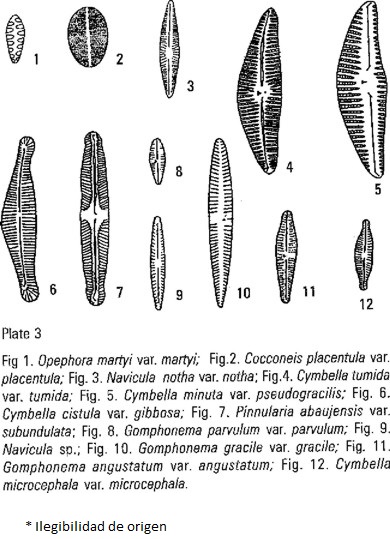
<body><![CDATA[<p>&nbsp;</p>  	    <p align="justify"><font face="verdana" size="2"><b>Results</b></font></p>  	    <p align="justify"><font face="verdana" size="2">Thirty&#45;one species and varieties were found in the samples. Systematic arrangement follows Simonson (1979). The literature used for identification is included for each species and synonymies are given. Measurements are given in <i>&micro;</i>m. Information on geographical and ecological distribution of species was gathered from Foged (1959), Patrick and Reimer (1966, 1975), Ortega (1984), Maidana (1985) , Ibarra (1992), Tavera <i>et al.</i>, (1994), Novelo (1998) and this study (<a href="#c1">Tab.1</a>). Frequency and abundance are expresed as percentages (<a href="/img/revistas/hbio/v11n1/a9c2.jpg" target="_blank">Tab. 2</a>).</font></p>  	    <p align="justify"><font face="verdana" size="2">Order Centrales</font></p>  	    <p align="justify"><font face="verdana" size="2">Family Thalassiosiraceae</font></p>  	    <p align="justify"><font face="verdana" size="2"><b><i>Cyclotella stelligera</i></b> (Cleve <i>et</i> Grunow) van Heurck <a href="#f3">Pl 1, fig. 1</a>.</font></p>  	    <p align="center"><font face="verdana" size="2"><a name="f3"></a></font></p>  	    <p align="center"><font face="verdana" size="2"><img src="/img/revistas/hbio/v11n1/a9f3.jpg"></font></p>  	    <p align="justify"><font face="verdana" size="2">Maidana, 1985, p. 44, p. 1, fig. 11; Moreno, 1985, <a href="#f4">pl. 2, fig. 5</a>.</font></p> 	    <p align="center"><a name="f4"></a></p> 	    ]]></body>
<body><![CDATA[<p align="center"><img src="/img/revistas/hbio/v11n1/a9f4.jpg"></p>      <p align="justify"><font face="verdana" size="2">Measurements: length 10 to 14 <i>&micro;</i>m, alveoles 12 in 10<i>&micro;</i>m.</font></p>  	    <p align="justify"><font face="verdana" size="2">Distribution: Geographical.&#45; cosmopolitan. Ecological.&#45; circumneutral pH waters and temperature between 26 and 32&deg; C; planktic and benthic organisms.</font></p>      	    <p align="justify"><font face="verdana" size="2">Ponds: 1a. 3a, 20a. cd, 7b. 10b.</font></p>     <p align="justify"><font face="verdana" size="2">Order Pennales</font></p>  	    <p align="justify"><font face="verdana" size="2">Family Diatomaceae</font></p>  	    <p align="justify"><font face="verdana" size="2"><b><i>Opephnra rnartyi</i></b> H&eacute;ribaud var. <b><i>martyi</i></b> in Patrick and Reimer, 1966 <a href="#f5">Pl. 3, fig. 1</a>.</font></p>  	    <p align="center"><font face="verdana" size="2"><a name="f5"></a></font></p>  	    <p align="center"><font face="verdana" size="2"><img src="/img/revistas/hbio/v11n1/a9f5.jpg"></font></p>  	    <p align="justify"><font face="verdana" size="2">Bourrelly et Manguin, 1952, p. 40; Hustedt, 1959, p. 135, fig. 654; Patrick and Reimer, 1966, p. 115. <a href="#f5">pl. 3, fig. 3</a>; Moreno, 1985, <a href="#f5">pl. 3, fig. 12</a>.</font></p>  	    ]]></body>
<body><![CDATA[<p align="justify"><font face="verdana" size="2">Measurements: length 9 to 12<i>&micro;</i>m, width 4.5 to 6<i>&micro;</i>m. striae 7 to 10 in 10 <i>&micro;</i>m</font></p>  	    <p align="justify"><font face="verdana" size="2">Distribution: Geographical.&#45; cosmopolitan. Ecological.&#45; shallow fresh and brackish waters, circummneutral pH and temperature from 28 to 32&deg; C, mesotrophic to eutrophic water; planktic in lakes, dams, ponds and rivers. Ponds: 13a. 1b, 10b.</font></p>  	    <p align="justify"><font face="verdana" size="2"><b><i>Synedra acus</i></b> K&uuml;tzing var. <b><i>acus</i></b> in Patrick and Reimer, 1966 <a href="#f3">Pl. 1, fig. 2</a>.</font></p>  	    <p align="justify"><font face="verdana" size="2">Patrick and Reimer, 1966, p. 135, l&aacute;m 5, fig. 1; Cuesta, 1993. p. 64, pl.3, fig. 18; Novelo. 1998, p. 296, fig. 193.</font></p>  	    <p align="justify"><font face="verdana" size="2">= <i>&iquest;Synedra delicatissima</i> W. Smith 185; <i>Fragilaria ulna</i> var. <i>acus</i> (K&uuml;tzing) Lange&#45;Bertalot, 1980 in Lange&#45;Bertalot, 1980.</font></p>  	    <p align="justify"><font face="verdana" size="2">Measurements: length 101 to 116 <i>&micro;</i>m, width 4 to 7 <i>&micro;</i>m, striae 10 to 11 in 10 <i>&micro;</i>m.</font></p>  	    <p align="justify"><font face="verdana" size="2">The valve is slightly constricted in the middle portion, with tapering apex.</font></p>  	    <p align="justify"><font face="verdana" size="2">Distribution: Geographical.&#45; USA, Mexico, central Europe, France, Spain, Poland. Ecological.&#45; a widely distributed species, seems to prefer circumneutral water and water which does not have a very low conductivity; more often found in water of medium hardness, in temperature from 26 to 32&deg;C. Planktic in lakes, springs, ponds, channels, and pools.</font></p>  	    <p align="justify"><font face="verdana" size="2">Ponds: 1a, 3a. 5a. 7a. 11a, 13a, 19a, 20a, cs, cd, 1b, 2b. 7b. 10b, 12b. 19b.</font></p>  	    <p align="justify"><font face="verdana" size="2"><b><i>Synedra ulna</i></b> (Nitzch) Ehrenberg Lange&#45;Bertalot var. <b><i>ulna</i></b> in Patrick and Reimer, 1966. <a href="#f3">Pl 1, fig. 3</a>.</font></p>  	    ]]></body>
<body><![CDATA[<p align="justify"><font face="verdana" size="2">Van Heurck, 1896, p. 310, pl. 10, fig. 409; Patrick and Reimer, 1966, p. 148, pl. 7, figs. 1&#45;2; Lange&#45;Bertalot, 1980, p. 745, pl. 8, figs. 185 to 196; Maidana, 1985, p. 57. <a href="#f4">pl. 2, fig. 5</a> and pl. 24, figs 1 to 3 (<i>Fragilaria ulna</i> var. <i>ulna</i>); Moreno, 1985, pl. 4, fig. 2; Tavera <i>et al.</i>, 1994, p. 43, pl. 1, fig. 7d; Novelo. 1998, p. 298, fig. 196.</font></p>  	    <p align="justify"><font face="verdana" size="2">= <i>Bacillaria ulna</i> Nitzsch 1817; <i>Frustulia splendens</i> K&uuml;tzing. 1844; <i>Synedra bicurvata</i> Beine ex Rabenhorst 1862; <i>Synedra lanceolata</i> K&uuml;tzing 1844; <i>Synedra splendens</i> K&uuml;tz. 1844; <i>Synedra ulna</i> (Nitz.) Ehr.; <i>Synedra ulna</i> var.<i>lanceolata</i> Grunow 1892; <i>Synedra ulna</i> var. <i>splendens</i> (K&uuml;tz.) v. Heurck 1885; <i>Fragilaria ulna</i> (Ehrenberg) Lange&#45;Bertalot 1980 in Lange&#45;Bertalot, 1980.</font></p>     <p align="justify"><font face="verdana" size="2">Measurements: length 110 to 245 <i>&micro;</i>m, width 6.5 to 10 <i>&micro;</i>m, striae 9 to 11 in 10 <i>&micro;</i>m.</font></p>  	    <p align="justify"><font face="verdana" size="2">Distribution: Geographical.&#45; cosmopolitan. Ecological.&#45; widely distributed in freshwater, circumneutral pH, most frequently in eutrophic water and temperature from 26 to 32 &deg;C. In waterfalls, streams, ponds and drip walls; planktic and benthic organisms.</font></p>  	    <p align="justify"><font face="verdana" size="2">Ponds: 1a, 3a. 5a. 7a. 11a, 13a, 19a, 20a, cs, cd, 1b, 2b, 7b, 10b, 12b, 19b.</font></p>  	    <p align="justify"><font face="verdana" size="2">Family Eunotiaceae</font></p>  	    <p align="justify"><font face="verdana" size="2"><b><i>Eunotia maior</i></b> (W. Smith) Rabenhort var. <b><i>major</i></b> in Patrick and Reirner, 1966. <a href="#f3">Pl 1, fig. 4</a>.</font></p>  	    <p align="justify"><font face="verdana" size="2">Van Heurck, 1896, p.300, pl. 9, fig. 366; Patrick and Reimer, 1966, p. 196, pl. 11, fig. 5; Moreno, 1985, pl. 4, fig. 8 (non <i>E. arcus</i> var. <i>falax</i>).</font></p>  	    <p align="justify"><font face="verdana" size="2">Measurements: length 90 to 146 <i>&micro;</i>m, width 7 to 10 <i>&micro;</i>m, striae 7 to 12 in 10 <i>&micro;</i>m around the center.</font></p>  	    <p align="justify"><font face="verdana" size="2">Distribution: Geographical.&#45; USA, Mexico, Belgium, England, Scotland, Ireland. Ecological.&#45; seems to prefer circumneutral pH water, with low mineral content, temperature from 26 to 30.5 &deg;C. Planktic and benthic, found in swamps, lakes, ponds and flowing waters.</font></p>  	    ]]></body>
<body><![CDATA[<p align="justify"><font face="verdana" size="2">Ponds: 1a, 3a, 7a, 11a, 19a, 20a, cs, 2b, 7b, 10b, 19b.</font></p>  	    <p align="justify"><font face="verdana" size="2">Family Achnanthaceae</font></p>  	    <p align="justify"><font face="verdana" size="2"><b><i>Achnanthes exigua</i></b> Grunow var. <b><i>exigua</i></b> in Patrick and Reimer, 1966. <a href="#f3">Pl. 1, fig. 5</a>.</font></p>  	    <p align="justify"><font face="verdana" size="2">Patrick and Reimer, 1966, p. 257, pl. 16, figs. 21 to 22; Maidana, 1985, p. 82, pl. 5, fig. 6; Cuesta, 1993, p. 67, pl. 4, fig. 22a to 22b; Tavera <i>et al.</i>, 1994, p. 46, pl. 2, fig. 12; Novelo, 1998, p. 305, fig. 199.</font></p>  	    <p align="justify"><font face="verdana" size="2">Measurements: length 10 to 13 <i>&micro;</i>m, width 5 to 6 <i>&micro;</i>m, striae 20 to 22 in 10 <i>&micro;</i>m in rapheless valves.</font></p>  	    <p align="justify"><font face="verdana" size="2">Distribution: Geographical.&#45; cosmopolitan. Ecological.&#45; neutral to alkaline waters; eurytherma (mainly in hot waters), in this study from 26 to 28 &deg;C, and euryphotic. Planktic and benthic in waterfalls, lakes, rivers, springs, channels, streams, driping rocks and aquarium tanks.</font></p>  	    <p align="justify"><font face="verdana" size="2">Ponds: 1a, 3a, cs.</font></p>  	    <p align="justify"><font face="verdana" size="2"><b><i>Cocconeis placentula</i></b> var. <b><i>euglypta</i></b> (Ehrenberg) Cleve <a href="#f3">Pl. 1, fig. 6</a>.</font></p>  	    <p align="justify"><font face="verdana" size="2">Osorio&#45;Tafall, 1941a, p. 353. Pl. 30, fig. 26; Patrick and Reimer, 1966, p. 241, pl. 15, fig. 8; Maidana, 1985, p. 96, pl. 5, fig. 25, pl. 28, figs. 1 to 2; Moreno, 1985, pl. 4, fig. 14; Tavera <i>et al.</i>, 1994, p. 47, pl. 2, figs. 16 a to c; Novelo, 1998, p. 315, fig. 210.</font></p>  	    <p align="justify"><font face="verdana" size="2">= <i>Cocconeis euglypta</i> Ehrenberg 1854 in Patrick and Reimer, 1966.</font></p>  	    ]]></body>
<body><![CDATA[<p align="justify"><font face="verdana" size="2">Measurements: length 14 to 25 <i>&micro;</i>m, width 8 to 15 <i>&micro;</i>m, striae 15 to 21 in 10 <i>&micro;</i>m in raphe valves and 17&#45;22 in 10 <i>&micro;</i>m in rapheless valves.</font></p>  	    <p align="justify"><font face="verdana" size="2">Distribution: Geographical.&#45; cosmopolitan. Ecological: halobionte indifferent, alkalibionte, in temperature from 26 to 32&deg; C. Common in lakes, dams, rivers, waterfalls, streams, ponds, channels, pools, flowing and stagnant waters; specially as planktic, epiphyte on filamentous and benthic algae.</font></p>  	    <p align="justify"><font face="verdana" size="2">Ponds: 1a, 3a, 7a, 11a, cs, 7b.</font></p>  	    <p align="justify"><font face="verdana" size="2"><b><i>Cocconeis placentula</i></b> Ehrenberg var. <b><i>placentula</i></b> in Patrick and Reimer, 1966 . <a href="#f5">Pl. 3, fig. 2</a>.</font></p>  	    <p align="justify"><font face="verdana" size="2">Van Heurck, 1896, p. 288, pl. 8, fig. 341; Patrick and Reimer, 1966, p. 240, pl. 15, fig. 7; Maidana, 1985, p. 94, pl. 5, figs. 24 and 26; pl. 28, fig. 3; Moreno, 1985, pl. 4, fig. 13; Novelo, 1998, p. 314, fig. 209.</font></p>  	    <p align="justify"><font face="verdana" size="2">Measurements: length 21.5 to 34 <i>&micro;</i>m, width 14.5 to 20 <i>&micro;</i>m, striae 20 to 24 in raphe valve, striae 19 to 26 in 10 <i>&micro;</i>m in rapheless valves, pores 16 to 18 in 10<i>&micro;</i>m.</font></p>  	    <p align="justify"><font face="verdana" size="2">Distribution: Geographical.&#45; cosmopolitan. Ecological.&#45; common everywhere, fresh and slightly brackish waters, circumneutral pH waters and temperature from 26 to 32&deg;C. Planktic and epiphytic, in rivers, ponds and springs.</font></p>  	    <p align="justify"><font face="verdana" size="2">Ponds: 5a. 11a, 13a, 19a, 20a, cd, 2b, 7b, 10b, 19b.</font></p>  	    <p align="justify"><font face="verdana" size="2">Family Naviculaceae</font></p>  	    <p align="justify"><font face="verdana" size="2"><b><i>Capartogramma crucicula</i></b> (Grunow ex Cleve) Ross var. <b><i>crucicula</i></b> in Patrick and Reimer, 1966. <a href="#f4">Pl. 2, fig. 1</a>.</font></p>  	    ]]></body>
<body><![CDATA[<p align="justify"><font face="verdana" size="2">Patrick and Reimer, 1966, p. 372, pl. 30, fig. 16; Maidana. 1985, p. 105, pl. 6. fig. 11; Moreno, 1985, pl. 6, fig. 9 (non <i>Stauronies crucicula</i>).</font></p>  	    <p align="justify"><font face="verdana" size="2">= <i>Stauroneis crucicula</i> (Grun.) Cleve in Moreno, 1985.</font></p>  	    <p align="justify"><font face="verdana" size="2">Measurements: length 20 to 30 <i>&micro;</i>m; width 7 to 8.5 <i>&micro;</i>m, striae 22 to 25 in 10 <i>&micro;</i>m.</font></p>  	    <p align="justify"><font face="verdana" size="2">Distribution: Geographical.&#45; USA, Mexico, Brazil, Uruguay, Argentina, Africa. Ecological.&#45; fresh and brackish waters, circumneutral pH waters, temperature from 26 to 32&deg;C. Planktic and benthic in dams and ponds.</font></p>  	    <p align="justify"><font face="verdana" size="2">Ponds: 3a. 11a, cs, 2b,cd.</font></p>  	    <p align="justify"><font face="verdana" size="2"><b><i>Cymbella cisiula</i></b> var. <b><i>gibbosa</i></b> Brun. <a href="#f5">Pl. 3, fig. 6</a>.</font></p>  	    <p align="justify"><font face="verdana" size="2">Patrick and Reimer, 1975. p. 63, pl. 11, figs. 5 to 7.</font></p>  	    <p align="justify"><font face="verdana" size="2">Measurements: length 58 to 63 <i>&micro;</i>m, width 20 to 27 <i>&micro;</i>m, striae 8 to 10 in 10 <i>&micro;</i>m around the center.</font></p>  	    <p align="justify"><font face="verdana" size="2">Distribution: Geographical.&#45; Michigan, Genoa. Ecological.&#45; circumneutral pH waters and temperature from 28 to 32&deg;C. Planktic in ponds and lakes.</font></p>  	    <p align="justify"><font face="verdana" size="2">Ponds: 12b. 19b. cd.</font></p>  	    ]]></body>
<body><![CDATA[<p align="justify"><font face="verdana" size="2"><b><i>Cymbella microcephala</i></b> Grunow var. <b><i>microcephala</i></b> in Patrick and Reimer, 1975. <a href="#f5">Pl. 3, fig. 12</a>.</font></p>  	    <p align="justify"><font face="verdana" size="2">Patrick and Reimer, 1975, p.33, pl. 4, figs. 12a to 12b; Tavera <i>et al.</i>, 1994, p. 54, pl.2, fig. 39; Novelo, 1998, p. 400, fig. 300.</font></p>  	    <p align="justify"><font face="verdana" size="2">Measurements: length 15 to 16 <i>&micro;</i>m, width 3 to 4 pm, striae 16 to 20 in 10 <i>&micro;</i>m around the center, becoming 18 to 22 in 10 <i>&micro;</i>m near the apex.</font></p>  	    <p align="justify"><font face="verdana" size="2">Distribution: Geographical.&#45; cosmopolitan. Ecological.&#45; pH indifferent, water low to medium conductivity, it seems to be sensitive to eutrophication, in hot waters from 26 to 32 &deg; C. Planktics in lakes, rivers, streams, channels, ponds; benthic in lakes and lacustrine sediments, epilithic and in well aerated habitats.</font></p>  	    <p align="justify"><font face="verdana" size="2">Ponds: 1a, 3a, 5a, 7a, 11a, 13a, 19a, 20a, cs, cd, 1b, 2b, 7b, 10b, 12b, 19b.</font></p>  	    <p align="justify"><font face="verdana" size="2"><b><i>Cymbella minuta</i></b> var. <b><i>pseudogracilis</i></b> (Choln) Reimer comb. nov. in Patrick and Reimer, 1975. <a href="#f5">Pl. 3, fig. 5</a>.</font></p>  	    <p align="justify"><font face="verdana" size="2">Patrick and Reimer, 1975, p. 50, pl. 9, figs. 1a to 2b; Maidana, 1985, p. 110. pl. 7, fig. 4; Moreno, 1985, pl. 8, fig. 4.</font></p>  	    <p align="justify"><font face="verdana" size="2">= <i>Cymbella turgida</i> var. <i>pseudogracilis</i> Choi. in Maidana, 1985.</font></p>  	    <p align="justify"><font face="verdana" size="2">Measurements: length 47 to 55 <i>&micro;</i>m, width 9 to 11 <i>&micro;</i>m, striae 8 to 9 in 10 <i>&micro;</i>m.</font></p>  	    <p align="justify"><font face="verdana" size="2">Distribution: Geographical.&#45; cosmopolitan. Ecological.&#45; acid to moderately alkaline waters, pH from 7 to 8.5, temperature from 26 to 32&deg;C. Planktic in dams and ponds.</font></p>  	    ]]></body>
<body><![CDATA[<p align="justify"><font face="verdana" size="2">Ponds: 1a, 3a, 5a, 7a, 11a, 13a, 19<sup>a</sup>, cs, cd, 1b, 7b, 10b, 12b, 19b.</font></p>  	    <p align="justify"><font face="verdana" size="2"><b><i>Cymbella minuta</i></b> var. <b><i>silesiaca</i></b> (Bleisch ex Rabenhort) Reimer comb. nov. in Patrick y Reimer, 1975. <a href="#f3">Pl. 1, fig. 7</a>.</font></p>  	    <p align="justify"><font face="verdana" size="2">Patrick and Reimer 1975, p. 49. pl. 8, figs. 7a to 10 b; Moreno, 1985, pl. 8, fig. 2 (<i>non C. turgida</i>); Tavera <i>et al.</i>, 1994, p. 55, pl. 3, fig. 41.</font></p>  	    <p align="justify"><font face="verdana" size="2">= <i>C. silesiaca</i> Bleisch ex Rabh. 1864; <i>C. ventricosa</i> var. <i>silesiaca</i> (Bleisch ex Rabh) Cleve Euler ; <i>C. turgida</i> are included either in var. <i>silesiaca</i> or in var. <i>pseudogracilis</i> Gregory 1856 in Patrick and Reimer, 1975.</font></p>  	    <p align="justify"><font face="verdana" size="2">Measurements: length 24 to 35 <i>&micro;</i>m, width 7 to 9.5 <i>&micro;</i>m.</font></p>  	    <p align="justify"><font face="verdana" size="2">Distribution: Geographical.&#45; cosmopolitan. Ecological.&#45; euryphotic, pH indifferent, oligohalobe, in oligotrophic to eutrophic waters, temperature from 28 to 32&deg;C. Planktic and benthic in lakes, drip walls, streams, ponds, springs and pools.</font></p>  	    <p align="justify"><font face="verdana" size="2">Ponds: 7a, 7b, 10b, 19b.</font></p>  	    <p align="justify"><font face="verdana" size="2"><b><i>Cymbella tumida</i></b> (Br&eacute;bison ex Kutzing) van Heurck var. <b><i>tumida</i></b> in Patrick and Reimer, 1975. <a href="#f5">Pl. 3, fig. 4</a>.</font></p>  	    <p align="justify"><font face="verdana" size="2">Van Heurck, 1896, p. 148, pl. 1, fig. 42; Patrick and Reimer, 1975, p. 58. pl .10, fig. 8; Moreno, 1985, pl. 8, fig. 8; Maidana,1985. p. 114, pl. 7, fig. 2 and 10.</font></p>  	    <p align="justify"><font face="verdana" size="2">= <i>Cocconema tumidum</i> Breb. ex K&uuml;tz. 1849; <i>Cymbella stomatophora</i> Grun.; <i>Cymbella tumida</i> (Breb. ex K&uuml;tz.) van Heurck 1880 in Patrick and Reimer, 1975.</font></p>  	    ]]></body>
<body><![CDATA[<p align="justify"><font face="verdana" size="2">Measurements: length 36 to 70 <i>&micro;</i>m, width 9 to 16.5 <i>&micro;</i>m, striae 9 to 10 in 10 <i>&micro;</i>m around the center of the valve, 13 in 10 <i>&micro;</i>m near the apex .</font></p>  	    <p align="justify"><font face="verdana" size="2">Smaller than reported by Moreno (1985) for adjacent areas (length 80 <i>&micro;</i>m, width 20.5 <i>&micro;</i>m).</font></p>  	    <p align="justify"><font face="verdana" size="2">Distribution: Geographical.&#45; cosmopolitan. Ecologica.&#45; oligohalobe, alcaliphil occasionally, growing on decaying vegetation, present in organically polluted waters, water temperature from 26 to 32 &deg;C. Planktic and benthic in ponds.</font></p>  	    <p align="justify"><font face="verdana" size="2">Ponds: 1a, 3a, 5a, 7a, 11a, 13a, 19a, 20a, cs, cd, 1b, 2b, 7b, 10b, 12b, 19b.</font></p>  	    <p align="justify"><font face="verdana" size="2"><b><i>Diploneis puerla</i></b> (Schumacer) Cleve var. <b><i>puella</i></b> Patrick and Reimer, 1966. <a href="#f3">Pl. 1, fig. 8</a>.</font></p>  	    <p align="justify"><font face="verdana" size="2">Hustedt, 1930, p. 250. Fig. 394; Patrick and Reimer, 1966, p. 414, pl. 38, fig. 9; Maidana. 1985, p. 119, pl. 6, fig. 4; Moreno, 1985, pl. 6, figs. 10a to 10b (non <i>D. elliptica</i>).</font></p>  	    <p align="justify"><font face="verdana" size="2">= <i>Navicula puella</i> Schum 1867; <i>Navicula elliptica</i> var. <i>minutissima</i> Grun 1880; <i>Diploneis puella</i> (Schum.) Cleve in Patrick and Reimer 1966.</font></p>  	    <p align="justify"><font face="verdana" size="2">Measurements: length 22 to 23 <i>&micro;</i>m, width 8.5 to 9 <i>&micro;</i>m, costes 10 to 15 in 10<i>&micro;</i>m.</font></p>  	    <p align="justify"><font face="verdana" size="2">Distribution: Geographical.&#45; Europe, USA, Argentina, Mexico. Ecological.&#45; fresh to slightly salted water, usually hard water, circumneutral pH waters, temperature from 28 to 30&deg;C. planktic and benthic in dams and ponds.</font></p>  	    <p align="justify"><font face="verdana" size="2">Ponds: 3a, 7a, 11a, cs, 2b.</font></p>  	    ]]></body>
<body><![CDATA[<p align="justify"><font face="verdana" size="2"><b><i>Gomphonema acuminatum</i></b> Ehrenberg var. <b><i>acuminatum</i></b> in Patrick and Reimer 1975. <a href="#f3">Pl. 1, fig. 9</a>.</font></p>  	    <p align="justify"><font face="verdana" size="2">Van Heurck. 1896, p. 270, pl. 7, fig. 299; Patrick and Reimer, 1975, p. 112, pl. 15, figs. 2, 4 y 7; Maidana. 1985, p. 125, pl. 8, fig.1; Novelo, 1998, p. 405, fig. 305.</font></p>  	    <p align="justify"><font face="verdana" size="2">= <i>Gomphonema americanum</i> Ehr. (<i>in</i> part) in Boyer, 1927; <i>Gomphonema acuminatum</i> Ehr.1832; <i>Gomphonema coronatum</i> Ehr. 1840; <i>Gomphonema acuminatum</i> var. <i>coronatum</i> (Ehr.) Rabenhorst 1864; <i>Gomphonema acuminatum</i> var. <i>laticeps</i> (Ehr.) Grunow1880 in Patrick and Reimer, 1975.</font></p>  	    <p align="justify"><font face="verdana" size="2">Measurements: length 55 to 59 <i>&micro;</i>m, width 10 to 12 <i>&micro;</i>m, striae 10 to 11 in 10 <i>&micro;</i>m at the center.</font></p>  	    <p align="justify"><font face="verdana" size="2">Distribution: Geographical.&#45; cosmopolitan. Ecological.&#45; circumneutral pH water, medium to low hardness water, oligohalobe, oligotrophic to slightly mesotrophic, temperature from 26 to 32 &deg;C.</font></p>  	    <p align="justify"><font face="verdana" size="2">Planktic in lakes, river, cenotes, ponds and pools.</font></p>  	    <p align="justify"><font face="verdana" size="2">Ponds: 1a, 5a, 7a, 11a.</font></p>  	    <p align="justify"><font face="verdana" size="2"><b><i>Gomphonema affine</i></b> K&uuml;tzing var. <b><i>affine</i></b> <i>in</i> Patrick and Reimer, 1975. <a href="#f3">Pl. 1, fig. 10</a>.</font></p>  	    <p align="justify"><font face="verdana" size="2">Patrick and Reimer, 1975, p. 133, pl. 17, figs. 5; Moreno, 1985, pl. 7, fig. 10; Novelo, 1998, p. 406, fig. 306.</font></p>  	    <p align="justify"><font face="verdana" size="2">Measurements: length 25 to 54 <i>&micro;</i>m, width 8 to 10 <i>&micro;</i>m, striae 6 to 10 in 10 <i>&micro;</i>m at the center of valve.</font></p>  	    ]]></body>
<body><![CDATA[<p align="justify"><font face="verdana" size="2">Distribution: Geographical: cosmopolitan. Ecological.&#45; tolerant to a wide range of conductivity in freshwater, circumneutral pH water, temperature from 26 to 32&deg;C. Planktic and periphytic in lakes, channels and ponds.</font></p>  	    <p align="justify"><font face="verdana" size="2">Ponds: 1a, 3a, 5a, 7a, 11a, 13a, 19a, 20a, cs, cd, 1b, 2b, 7b, 10b, 12b, 19b.</font></p>  	    <p align="justify"><font face="verdana" size="2"><b><i>Gomphonema angustatum</i></b> (K&uuml;tzing) Rabenhort var. <b><i>angustatum</i></b> in Patrick and Reimer, 1975. <a href="#f5">Pl. 3, fig. 11</a>.</font></p>  	    <p align="justify"><font face="verdana" size="2">Van Heurck, 1896, p. 273, pl. 7, fig. 314; Patrick and Reimer, 1975, p. 111, pl. 17, fig. 17 to 19; Maidana, 1985, p.128, pl. 8, fig. 17; Novelo, 1998, p. 407, fig. 307.</font></p>  	    <p align="justify"><font face="verdana" size="2">Measurements: length 26 to 37 <i>&micro;</i>m, width 7 to 9 <i>&micro;</i>m, striae 9 to 10 in 10 <i>&micro;</i>m aroun the center.</font></p>  	    <p align="justify"><font face="verdana" size="2">Distribution: Geographical.&#45;cosmopolitan. Ecological.&#45; widely distributed in circumneutral pH water, prefers oligotrophic to mesotrophic waters, in hot waters from 26 to 32 &deg;C. Planktic and benthic in ponds and springs.</font></p>  	    <p align="justify"><font face="verdana" size="2">Ponds: 1a, 3a, 5a, 7a, 11a, 13a, 19a, 20a, cs, cd, 1b, 2b, 7b, 10b, 12b, 19b.</font></p>  	    <p align="justify"><font face="verdana" size="2"><b><i>Gomphonema clavatum</i></b> Ehrenberg 1832. <a href="#f3">Pl. 1, fig. 11</a>.</font></p>  	    <p align="justify"><font face="verdana" size="2">Krammer and Lange&#45;Bertalot, 1986, p. 367&#45;368, fig. 163(1&#45;12); Patrick and Reimer, 1975, p. 129, pl 16, fig. 11 (<i>Gomphonema subclavatum</i> var. <i>commutatum</i>).</font></p>  	    <p align="justify"><font face="verdana" size="2">=<i>Gomphonema commutatum</i> Grun.; <i>G. montanum</i> var. <i>commutatum</i> (Grun.) van Heurck; <i>G. subclavatum</i> var. <i>commutatum</i> (Grun) Mayer in Patrick and Reimer, 1975.</font></p>  	    ]]></body>
<body><![CDATA[<p align="justify"><font face="verdana" size="2">Measurements: length 60 to 103 <i>&micro;</i>m, width 8 to 12 <i>&micro;</i>m, striae 8 to 11 in 10 <i>&micro;</i>m at the center, 11 near apex.</font></p>  	    <p align="justify"><font face="verdana" size="2">Distribution: Geographical.&#45; USA, probably Belgium . Ecological.&#45; medium hard water, circumneutral pH water, temperature from 26 to 30&deg;C. Planktic and benthic in pond.</font></p>  	    <p align="justify"><font face="verdana" size="2">Ponds: 1a, 3a, 5a, 7a, 11a, 13a, 19a, 20a, cs, cd, 1b, 2b, 7b, 10b, 12b, 19b.</font></p>  	    <p align="justify"><font face="verdana" size="2"><b><i>Gomphonema gracile</i></b> Ehrenberg emend van Heurck var. <b><i>gracile</i></b> in Patrick and Reimer, 1975. <a href="#f5">Pl. 3, fig. 10</a>.</font></p>  	    <p align="justify"><font face="verdana" size="2">Hustedt, 1930, p. 376, fig. 702; van Heurck, 1896, p. 272, pl. 7, fig. 309; Patrick and Reimer, 1975, p. 131, pl. 17, figs. 1 to 3; Maidana, 1985, p. 134, pl. 8, fig. 15; Tavera <i>et al.</i>, 1994, p. 56, pl. 3, fig. 47; Novelo, 1998, p. 409, fig. 309.</font></p>  	    <p align="justify"><font face="verdana" size="2">Measurements: length 59 to 64 <i>&micro;</i>m, width 8 to 9 <i>&micro;</i>m, striae 10 to 12 in 10 <i>&micro;</i>m at the center of valve, 11 to 13 near apex.</font></p>  	    <p align="justify"><font face="verdana" size="2">Distribution.&#45; Geographical: cosmopolitan. Ecological: widelly distributed in fresh and brackish waters with circumneutral pH and low conductivity, temperature from 26 to 32&deg;C. Prefers oligotrophic waters. Planktic and benthic species, in rivers, lakes, streams, channels, ponds, dams, drop walls, streams and waterfalls.</font></p>  	    <p align="justify"><font face="verdana" size="2">Ponds: 1a, 5a, 7a, 11a, 13a, 19a, 20a, 2cs, cd, 1b, 2b, 7b, 10b, 19b.</font></p>  	    <p align="justify"><font face="verdana" size="2"><b><i>Gomphonema parvulum</i></b> (K&uuml;tzing) K&uuml;tzing var. <b><i>parvulum</i></b> in Patrick and Reimer, 1975. <a href="#f5">Pl. 3, fig. 8</a>.</font></p>  	    <p align="justify"><font face="verdana" size="2">Van Heurck, 1896, p. 272, pl. 7, fig. 306; Patrick and Reimer, 1975, p. 122, pl. 17. figs. 7 to 12; Maidana. 1985, p. 137, pl. 8, figs. 10&#45;12; Cuesta, 1993, p.87, pl. 7, figs. 50a to 50 c; Tavera <i>et al.</i>, 1994, p. 57, pl. 3, figs. 48a to 48b; Novelo, 1998, p. 411. fig. 312a to 312b.</font></p>  	    ]]></body>
<body><![CDATA[<p align="justify"><font face="verdana" size="2">The more frequent synonymous according to Patrick and Reimer, 1975 are:</font></p>  	    <p align="justify"><font face="verdana" size="2">=<i>Sphenella parvula</i> K&uuml;tz.; <i>Gomphonema micropus</i> K&uuml;tz.; <i>Gomphonema lagunula</i> K&uuml;tz.; <i>Gomphonema parvulum</i> K&uuml;tz.; <i>Gomphonella parvula</i> Rabh.; <i>Gomphonema parvulum</i> var. <i>exilis</i> Grun.; <i>Gomphonema micropus</i> f. <i>major</i> Grun.; <i>Gomphonema micropus</i> var. <i>minor</i> Grun.; <i>Gomphonema micropus</i> var. <i>exilis</i> Grun.; <i>Gomphonema parvulum</i> var. <i>lanceolata</i> Grun.; <i>Gomphonema parvulum</i> var. <i>subcapitata</i> Grun.; <i>Gomphonema parvulum</i> var. <i>exilisima</i> Grun.; <i>Gomphonema parvulum</i> var. <i>micropus</i> Cl; <i>Gomphonema parvulum</i> var. <i>curta</i> Roch.; <i>Gomphonema parvulum</i> var. <i>lagemula</i> Freng.; <i>Gomphonema parvulum</i> var. <i>genuinum</i> f. <i>semiaptera</i> Mayer.</font></p>  	    <p align="justify"><font face="verdana" size="2">Measurements: length 13 to 21 <i>&micro;</i>m, width 6 to 7.5 <i>&micro;</i>m, striae 11 to 14 in 10 <i>&micro;</i>m around the center. This specie is highly variable in the shape of the valve.</font></p>  	    <p align="justify"><font face="verdana" size="2">Distribution: Geographical.&#45; cosmopolitan. Ecological.&#45; widelly distributed in freshwater, circumneutral pH, temperature from 26 to 32 &deg;C, eutrophic in sanitary and farm wastes. Planktic in lakes, rivers, ponds, drip walls, springs and streams; epiphytic on filamentous algae in river edges, in channels and dripping rock faces. Ponds: 3a, 5a, 19a, 20a, cs, cd, 1b, 10b, 19b.</font></p>  	    <p align="justify"><font face="verdana" size="2"><b><i>Navicula exigua</i></b> (Gregor) Grunow. <a href="#f4">Pl. 2, fig. 3</a>.</font></p>  	    <p align="justify"><font face="verdana" size="2">Patrick and Reimer, 1966, p. 522, pl. 49, fig. 24; Maidana, 1985, p. 164, pl. 12, fig. 10 (non 2 and 11); Moreno, 1985, pl. 19a to 19b (<i>non N. exiguiformis</i>).</font></p>  	    <p align="justify"><font face="verdana" size="2">=<i>Navicula exigua</i> var. <i>capitata</i> Patrick 1945 in Patrick and Reimer, 1966; <i>Navicula exigua</i> var. exigua van Landingham 1975 in Maidana 1985;</font></p>  	    <p align="justify"><font face="verdana" size="2">Measurements: length 28 to 31 <i>&micro;</i>m, width 8 to 12 <i>&micro;</i>m, striae 13 to 16 <i>&micro;</i>m at the center of valve, 15 to 20 in 10 <i>&micro;</i>m at the apex.</font></p>  	    <p align="justify"><font face="verdana" size="2">Distribution: Geographical.&#45;USA, Mexico, Argentina, Pennsylvania. Ecological.&#45; freshwater, seems to prefer water of less than 100 ppm hardness with CaCO<sub>3</sub>, and circumneutral pH, temperature from 27 to 30&deg;C. Planktic and benthic in ponds.</font></p>  	    <p align="justify"><font face="verdana" size="2">Ponds: 1a, cs.</font></p>  	    ]]></body>
<body><![CDATA[<p align="justify"><font face="verdana" size="2"><b><i>Navicula notha</i></b> Wallace var. <b><i>notha</i></b> in Patrick and Reimer, 1966. <a href="#f5">Pl. 3, fig 3</a>.</font></p>  	    <p align="justify"><font face="verdana" size="2">Patrick and Reimer, 1966, p. 528, pl. 50, figs. 10 to 11.</font></p>  	    <p align="justify"><font face="verdana" size="2">Measurements: length 26 to 29 <i>&micro;</i>m, width 4 to 5 <i>&micro;</i>m, striae 15 to 17 in 10 <i>&micro;</i>m.</font></p>  	    <p align="justify"><font face="verdana" size="2">Distribution: Geographical.&#45; USA. Ecological.&#45; freshwater and circumneutral pH, seems to prefer water with low mineral contents, temperature from 26 to 32&deg;C. Planktic and benthic algae in ponds.</font></p>  	    <p align="justify"><font face="verdana" size="2">Ponds: 1a, 3a, 5a, 7a, 11a, 13a, 19a, 20a, cs, cd, 1b, 2b, 7b, 10b, 12b, 19b.</font></p>  	    <p align="justify"><font face="verdana" size="2"><b><i>Navicula pupula</i></b> K&uuml;tzing var. <b><i>pupula</i></b> in Patrick and Reimer, 1966. <a href="#f3">Pl. 1, fig. 12</a>.</font></p>  	    <p align="justify"><font face="verdana" size="2">Patrick and Reimer, 1966, p. 495, pl. 47, fig. 7: Maidana, 1985, p. 149, pl. 10, fig. 5; Moreno, 1985, pl. 5, fig. 13 (non <i>N. cryptocephala</i> var. <i>veneta</i>); Tavera <i>et al.</i>, 1994.p. 50, pl. 2, fig. 28; Novelo, 1998, p. 366, fig. 196.</font></p>  	    <p align="justify"><font face="verdana" size="2">Measurements: length 20 to 32 <i>&micro;</i>m, width 6 to 8.5 <i>&micro;</i>m, striae 12 to 15 in 10 <i>&micro;</i>m at the center of the valve.</font></p>  	    <p align="justify"><font face="verdana" size="2">Extremely variable in cell shape.</font></p>  	    <p align="justify"><font face="verdana" size="2">Distribution: Geographical.&#45; cosmopolitan. Ecological.&#45; freshwater, seems to prefer neutral pH water with fairly high mineral contents, temperature from 28 to 30 <b>&deg;C,</b> eutrophic waters, oligohalobe. Planktic, epipelic and epilithic in rivers, pools, ponds, shallow streams, dams, flowing water and waterfalls.</font></p>  	    ]]></body>
<body><![CDATA[<p align="justify"><font face="verdana" size="2">Ponds: 1a, 3a, cs, 1b, 10b, 19b.</font></p>  	    <p align="justify"><font face="verdana" size="2"><b><i>Navicula rhynchocephala</i></b> var. <b><i>amphiceros</i></b> (K&uuml;tzing) Grunow. <a href="#f4">Pl. 2, fig. 2</a>.</font></p>  	    <p align="justify"><font face="verdana" size="2">Patrick and Reimer, 1966, p. 505, pl. 48, fig. 15; Moreno, 1985, pl. 5, fig. 14 (non <i>N. radiosa</i>): Tavera <i>et al.</i>, 1994, p. 48, pl. 2, fig. 18 a to b (<i>Navicula arnphiceros</i>).</font></p>  	    <p align="justify"><font face="verdana" size="2">Measurements: length 40 to 56 <i>&micro;</i>m, width 10 to 12.5 <i>&micro;</i>m, striae 8 to 13 in 10 <i>&micro;</i>m in the center valve.</font></p>  	    <p align="justify"><font face="verdana" size="2">Distribution: Geographical.&#45; USA, Mexico, Europe, Germany. Ecological.&#45; widely distributed in freshwater, circumneutral pH and temperature from 26 to 32&deg; C, seems to prefer water with high mineral contents in mesosaprobic conditions. Shallow streams and drip walls, planktic, benthic and epipelic species.</font></p>  	    <p align="justify"><font face="verdana" size="2">Ponds: 1a, 5a, 7a, 11a, 13a, 19a, 20a, 22a, cs, 1b, 2b, 7b, 10b.</font></p>  	    <p align="justify"><font face="verdana" size="2"><b><i>Navicula</i></b> sp. <a href="#f5">Pl. 3, fig. 9</a>.</font></p>  	    <p align="justify"><font face="verdana" size="2">Measurements: length 10 to 16 <i>&micro;</i>m, width 2.5 to 3 <i>&micro;</i>m, striae 9 in 10 <i>&micro;</i>m.</font></p>  	    <p align="justify"><font face="verdana" size="2">Distribution: Ecological.&#45; slightly alkaline, temperature from 26 to 32&deg; C, and eutrophic water. Planktic and benthic in ponds.</font></p>  	    <p align="justify"><font face="verdana" size="2">Ponds: 1a, 5a, 7a, 11a, 13a, 19a, 20a, cs, cd, 1b, 2b, 7b. 10b, 12b, 19b.</font></p>  	    ]]></body>
<body><![CDATA[<p align="justify"><font face="verdana" size="2"><b><i>Pinnularia abaujensis</i></b> var. <b><i>rostrata</i></b> (Patrick) Patrick <i>nov. com.</i> in Patrick and Reimer, 1966. <a href="#f4">Pl. 2, fig. 4</a>.</font></p>  	    <p align="justify"><font face="verdana" size="2">Patrick and Reimer, 1966, p. 614, pl. 58, fig. 4; Moreno, 1985, pl. 6, fig. 14 (non <i>P interrupta</i>).</font></p>  	    <p align="justify"><font face="verdana" size="2">= <i>Pinnularia gibba</i> var. <i>rostrata</i> Patrick in Patrick and Reimer, 1966.</font></p>  	    <p align="justify"><font face="verdana" size="2">Measurements: length 50 to 85 <i>&micro;</i>m, width 10.5 to 11.5 <i>&micro;</i>m, striae 10 to 13 in 10 <i>&micro;</i>m at the center valve.</font></p>  	    <p align="justify"><font face="verdana" size="2">Distribution: Geographical.&#45; Pennsylvania, Mexico. Ecological.&#45; found in water with low mineral contents , circummneutral to slightly acid pH water, temperature from 26 to 32&deg; C. Planktic and benthic in ponds.</font></p>  	    <p align="justify"><font face="verdana" size="2">Ponds: 1a, 3a, 5a, 7a, 11a, 19a, 20a, cs, cd, 1b, 10b, 19b.</font></p>  	    <p align="justify"><font face="verdana" size="2"><b><i>Pinnularia abaujensis</i></b> var. <b><i>subundulata</i></b> (A. Mayer ex Hustedt) Patrick. <a href="#f5">Pl. 3, fig. 7</a>.</font></p>  	    <p align="justify"><font face="verdana" size="2">Patrick and Reimer, 1966, p. 614, pl. 58, fig. 5; Moreno, 1985, pl. 6, fig. 17 ( <i>P gibba</i> f. <i>subundulata</i>); Tavera, 1994, p. 57, pl. 3, fig. 49 (non <i>P. graciloides</i>).</font></p>  	    <p align="justify"><font face="verdana" size="2">= <i>Pinnularia gibba</i> f. <i>subundulata</i> A. Mayer ex Hust. in Patrick and Reimer, 1966.</font></p>  	    <p align="justify"><font face="verdana" size="2">Measurements: length 60 to 61 <i>&micro;</i>m, width 8.5 to 10.5 <i>&micro;</i>m striae 10 to 11 in 10 <i>&micro;</i>m around the center.</font></p>  	    ]]></body>
<body><![CDATA[<p align="justify"><font face="verdana" size="2">Distribution: Geographical.&#45; USA, Cuba, Mexico. Ecological.&#45;circumneutral pH, low conductivity water, temperature from 26 to 31&deg; C, sensitive to organic pollution. Planktic and benthic in lakes, ponds, drip walls, rivers, lagoons and streams.</font></p>  	    <p align="justify"><font face="verdana" size="2">Ponds: 1a, 3a, 5a, 13a, 19a, cs,1b, 2b, 7b, 12b.</font></p>  	    <p align="justify"><font face="verdana" size="2"><b><i>Pinnularia acmsphaleria</i></b> W. Smith var. <b><i>acrosphaeria</i></b> in Patrick and Reimer, 1966. <a href="#f4">Pl. 2, fig. 5</a>.</font></p>  	    <p align="justify"><font face="verdana" size="2">Patrick and Reimer, 1966, p. 623, pl. 60, figs. 2 to 3; Maidana, 1985, p. 186. Pl. 15, fig. 3; Moreno, 1985, pl. 6, fig. 17 (non <i>P. gibba</i> f. <i>subundulata</i>).</font></p>  	    <p align="justify"><font face="verdana" size="2">= <i>P. acrosphaeria</i> W Sm., 1853; <i>Navicula acrosphaeria</i> var. <i>minor</i> Perag. and Herib.; <i>P. acrosphaeria</i> f. <i>minor</i> CI in Patrick and Reimer, 1966.</font></p>  	    <p align="justify"><font face="verdana" size="2">Measurements: length 64 to 67.5 <i>&micro;</i>m, width 16 to 23 <i>&micro;</i>m, striae 12 in 10 <i>&micro;</i>m in central area and near apex.</font></p>  	    <p align="justify"><font face="verdana" size="2">Distribution: Geographical.&#45; cosmopolitan. Ecological.&#45; neutral waters of low mineral content, temperature from 26 to 32&deg; C. Planktic and benthic in ponds.</font></p>  	    <p align="justify"><font face="verdana" size="2">Ponds: 1a, 3a, 5a, 7a, 11a, 13a, 19a, 20a, cs, cd, 1b, 2b, 7b, 10b, 12b, 19b.</font></p>  	    <p align="justify"><font face="verdana" size="2">Family Epithemiaceae</font></p>  	    <p align="justify"><font face="verdana" size="2"><b><i>Rhopalodia</i></b> sp. <a href="#f4">Pl. 2, fig. 7</a>.</font></p>  	    ]]></body>
<body><![CDATA[<p align="justify"><font face="verdana" size="2">Moreno, 1985, pl. 9, fig. 3.</font></p>  	    <p align="justify"><font face="verdana" size="2">Measurements: length 15 to 19 <i>&micro;</i>m, width 6 to 7.5 <i>&micro;</i>m.</font></p>  	    <p align="justify"><font face="verdana" size="2">It is very similar to <i>Rhopalodia gibberula</i> var. <i>succincta</i> (B&eacute;b.) Fricke in Bourrelly and Manguin (1952), but <i>R. gibberula</i> is slightly larger, it has more fibulae and the central area is more expanded. Distribution: Geographical.&#45; Mexico. Ecological.&#45; slightly alkaline water, circumneutral pH water, temperature from 28 to 32&deg; C. Planktic and benthic in ponds.</font></p>  	    <p align="justify"><font face="verdana" size="2">Ponds: cs, cd, 7b, 19b.</font></p>  	    <p align="justify"><font face="verdana" size="2">Family Nitzschiaceae</font></p>  	    <p align="justify"><font face="verdana" size="2"><b><i>Nitzschia</i></b> sp. <a href="#f4">Pl. 2, fig. 6</a>.</font></p>  	    <p align="justify"><font face="verdana" size="2">Moreno, 1985, pl. 9, fig. 5 8 (como <i>N. denticula</i> Grun).</font></p>  	    <p align="justify"><font face="verdana" size="2">Measurements: length 60 to 65 <i>&micro;</i>m, width 4 to 5.5<i>&micro;</i>m, striae 8 in 10 <i>&micro;</i>m aroun the center.</font></p>  	    <p align="justify"><font face="verdana" size="2">It is very similar to <i>N. frustulum</i> var. <i>perminuta</i> Grun. but <i>N. frustulum</i> is smaller and slightly rostrated in Bourrelly <i>et</i> Manguin (1952).</font></p>  	    <p align="justify"><font face="verdana" size="2">Distribution: Geographical.&#45; Mexico. Ecological.&#45; freshwater and circumneutral pH, temperature from 27 to 32&deg; C. Planktic and benthic in ponds.</font></p>  	    ]]></body>
<body><![CDATA[<p align="justify"><font face="verdana" size="2">Ponds: 1a, 7a, 11a, 13a, 19a, 20a.</font></p>  	    <p>&nbsp;</p>  	    <p align="justify"><font face="verdana" size="2"><b>Discussion</b></font></p>  	    <p align="justify"><font face="verdana" size="2">Thirty one species and varieties of seven families (according to Simonsen, 1979) were identified in 41 samples; of these, 98% belong to the Pennales Order and 2% to the Centrales Order.</font></p>  	    <p align="justify"><font face="verdana" size="2">The large number of varieties (21) is an example of the complex variations that are found in the diatom group. The morphological variability in the length, width and stries numbers, arises from ecological and genetic processes over short scales of time (hours, days, months). In this work, more varieties correpond to species type.</font></p>  	    <p align="justify"><font face="verdana" size="2">It was observed that 18 of the 31 registered species were found in more of the 50% ponds probably due to the fact that most are in contact, close the extreme anthropic eutrophication in all of them (non limitative nutrients), their shallowness and the homogeneity in the pH and temperature, and the cosmopolitan species. There isn't one specific distribution pattern.</font></p>  	    <p align="justify"><font face="verdana" size="2">The most frequent and abundant species in the fish rearing Center are: <i>Synedra acus</i> var. <i>acus</i> , <i>S. ulna</i> var. <i>ulna</i>, <i>Cymbella microcephala</i> var. <i>microcephala</i>, <i>C. tumida</i> var. <i>tumida</i>, <i>Diploneis puella</i> var. <i>puella</i>, <i>Gomphonema affine</i> var <i>affine</i>, <i>G . angustatum</i> var. <i>angustatum</i>, <i>G. clavatum</i>, <i>Navicula notha</i> var. <i>notha</i>, and <i>Pinnularia acrosphaeria</i> var. <i>acrosphaeria</i>.</font></p>  	    <p align="justify"><font face="verdana" size="2">This diatom survey is the first in the fish rearing center. In the region of Temascal, diatom species have been recorded, of which 20 were found in Miguel Aleman dam (Moreno, 1985). The new records in Temascal region are: <i>Synedra acus</i> var. <i>acus</i> , <i>Achnantes exigua</i> var. <i>exigua</i>, <i>Cymbella cistula</i> var. <i>gibbosa</i>, <i>Cymbella microcephala</i> var. <i>microcephala</i>, <i>Gomphonema affine</i> var. <i>affine</i>, <i>G . angustatum</i> var. <i>angustatum</i>,<i>G.gracile</i> var. <i>gracile</i>, <i>G. parvulum</i> var. <i>parvulum</i>, <i>G. clavatum</i>, <i>Navicula notha</i> var. <i>notha</i>, <i>Navicula</i> sp1.</font></p>  	    <p align="justify"><font face="verdana" size="2">Tavera <i>et al.</i>, (1994) reported ten species (32.25%) in sud Papaloapan basin (17&deg; 08'to 17&deg; 35' N and 96&deg; 23'to 96&deg; 57'W) and Novelo (1998), Avila (1985) and Cuesta (1993) reported thirteen species (41.93 %) in common in the west Papaloapan basin (18&deg; 20'to 18&deg; 40'and 97&deg; to 97&deg; 40' W). These data confirm the above mentioned.</font></p>  	    <p>&nbsp;</p>  	    ]]></body>
<body><![CDATA[<p align="justify"><font face="verdana" size="2"><b>Acknowledgements</b></font></p>  	    <p align="justify"><font face="verdana" size="2">I thank Dr. Samuel G&oacute;mez Aguirre who reviewed the manuscript, to Guillermo Gonz&aacute;lez and Luis Moreno who provided some of the graphic material, to Secretaria de Educaci&oacute;n P&uacute;blica (FOMES) and Universidad Aut&oacute;noma Metropolitana&#45;Xochimilco for the infraestructure given to make this work.</font></p>  	    <p>&nbsp;</p>  	    <p align="justify"><font face="verdana" size="2"><b>References</b></font></p>  	    <!-- ref --><p align="justify"><font face="verdana" size="2">AVILA J., 1985. Ficoflora manifiesta del valle de Tehuac&aacute;n Puebla, Tesis, Facultad de Ciencias, Universidad Nacional Aut&oacute;noma de M&eacute;xico, 147 p.    &nbsp;&nbsp;&nbsp;&nbsp;&nbsp;&nbsp;&nbsp;&nbsp;[&#160;<a href="javascript:void(0);" onclick="javascript: window.open('/scielo.php?script=sci_nlinks&ref=4033085&pid=S0188-8897200100010000900001&lng=','','width=640,height=500,resizable=yes,scrollbars=1,menubar=yes,');">Links</a>&#160;]<!-- end-ref --></font></p>  	    <!-- ref --><p align="justify"><font face="verdana" size="2">BOURRELY, P. et A. MIANGUIN, 1952. <i>Algues d'eau douce de la Guadeloupe et dependance</i>, Societe d'Edition d'Enseignement Superieur, Paris. 229.    &nbsp;&nbsp;&nbsp;&nbsp;&nbsp;&nbsp;&nbsp;&nbsp;[&#160;<a href="javascript:void(0);" onclick="javascript: window.open('/scielo.php?script=sci_nlinks&ref=4033087&pid=S0188-8897200100010000900002&lng=','','width=640,height=500,resizable=yes,scrollbars=1,menubar=yes,');">Links</a>&#160;]<!-- end-ref --></font></p>  	    <!-- ref --><p align="justify"><font face="verdana" size="2">BRADBURY, J. P., 1971. Paleolimnology of lake of Texcoco, M&eacute;xico: Evidence from diatoms. <i>Limnology and Oceanography</i>. <i>16</i>(2): 180&#45;200.    &nbsp;&nbsp;&nbsp;&nbsp;&nbsp;&nbsp;&nbsp;&nbsp;[&#160;<a href="javascript:void(0);" onclick="javascript: window.open('/scielo.php?script=sci_nlinks&ref=4033089&pid=S0188-8897200100010000900003&lng=','','width=640,height=500,resizable=yes,scrollbars=1,menubar=yes,');">Links</a>&#160;]<!-- end-ref --></font></p>  	    ]]></body>
<body><![CDATA[<!-- ref --><p align="justify"><font face="verdana" size="2">CLEVE, P. T., 1894. Synopsis of the Naviculoid diatoms <i>Konglila Svenska Vetenskaps Akadademiens Handlingar (4)</i>26: 3&#45;104.    &nbsp;&nbsp;&nbsp;&nbsp;&nbsp;&nbsp;&nbsp;&nbsp;[&#160;<a href="javascript:void(0);" onclick="javascript: window.open('/scielo.php?script=sci_nlinks&ref=4033091&pid=S0188-8897200100010000900004&lng=','','width=640,height=500,resizable=yes,scrollbars=1,menubar=yes,');">Links</a>&#160;]<!-- end-ref --></font></p>  	    <!-- ref --><p align="justify"><font face="verdana" size="2">CUESTA Z., 1993. Ecolog&iacute;a de la ficoflora de los manantiales de San Lorenzo, Tehuac&aacute;n, Puebla, M&eacute;xico. Tesis. Facultad de Ciencias, Universidad Nacional Aut&oacute;noma de M&eacute;xico, 119 p.    &nbsp;&nbsp;&nbsp;&nbsp;&nbsp;&nbsp;&nbsp;&nbsp;[&#160;<a href="javascript:void(0);" onclick="javascript: window.open('/scielo.php?script=sci_nlinks&ref=4033093&pid=S0188-8897200100010000900005&lng=','','width=640,height=500,resizable=yes,scrollbars=1,menubar=yes,');">Links</a>&#160;]<!-- end-ref --></font></p>  	    <!-- ref --><p align="justify"><font face="verdana" size="2">DEEVEY, E. S. JR.,1957. Limnologic studies in Middle America, with a chapter on Aztec limnology. <i>Transaction of the Connecticut Academy Arts Sciences 39:</i> 213&#45;328.    &nbsp;&nbsp;&nbsp;&nbsp;&nbsp;&nbsp;&nbsp;&nbsp;[&#160;<a href="javascript:void(0);" onclick="javascript: window.open('/scielo.php?script=sci_nlinks&ref=4033095&pid=S0188-8897200100010000900006&lng=','','width=640,height=500,resizable=yes,scrollbars=1,menubar=yes,');">Links</a>&#160;]<!-- end-ref --></font></p>  	    <!-- ref --><p align="justify"><font face="verdana" size="2">DELGADILLO, T., 1980. Contribuci&oacute;n al conocimiento ficoflor&iacute;stico de la presa Pte. Alem&aacute;n. Programa Limnol&oacute;gico. III. Simposio Latinoamericano de Acuacultura. Departamento de Pesca, Temascal, Oaxaca.    &nbsp;&nbsp;&nbsp;&nbsp;&nbsp;&nbsp;&nbsp;&nbsp;[&#160;<a href="javascript:void(0);" onclick="javascript: window.open('/scielo.php?script=sci_nlinks&ref=4033097&pid=S0188-8897200100010000900007&lng=','','width=640,height=500,resizable=yes,scrollbars=1,menubar=yes,');">Links</a>&#160;]<!-- end-ref --></font></p>  	    <!-- ref --><p align="justify"><font face="verdana" size="2">D&Iacute;AZ&#45;LOZANO, E., 1917. Diatomeas f&oacute;siles mexicanas (Fossil Diatoms of Mexico). <i>Anales del Instituto de Geolog&iacute;a</i>, Universidad Nacional Aut&oacute;noma de M&eacute;xico, <i>1</i>: 1&#45;27.    &nbsp;&nbsp;&nbsp;&nbsp;&nbsp;&nbsp;&nbsp;&nbsp;[&#160;<a href="javascript:void(0);" onclick="javascript: window.open('/scielo.php?script=sci_nlinks&ref=4033099&pid=S0188-8897200100010000900008&lng=','','width=640,height=500,resizable=yes,scrollbars=1,menubar=yes,');">Links</a>&#160;]<!-- end-ref --></font></p>  	    ]]></body>
<body><![CDATA[<!-- ref --><p align="justify"><font face="verdana" size="2">D&Iacute;AZ&#45;LOZANO, E.,1937. Dep&oacute;sitos diatom&iacute;feros en el valle de Ixtlahuaca, Edo. de M&eacute;xico. <i>Anales del Instituto de Geolog&iacute;a</i>, Universidad Nacional Aut&oacute;noma de M&eacute;xico, <i>9</i>: 1&#45;19.    &nbsp;&nbsp;&nbsp;&nbsp;&nbsp;&nbsp;&nbsp;&nbsp;[&#160;<a href="javascript:void(0);" onclick="javascript: window.open('/scielo.php?script=sci_nlinks&ref=4033101&pid=S0188-8897200100010000900009&lng=','','width=640,height=500,resizable=yes,scrollbars=1,menubar=yes,');">Links</a>&#160;]<!-- end-ref --></font></p>  	    <!-- ref --><p align="justify"><font face="verdana" size="2">EHRENBERG, C. G., 1838. <i>Die Infusionsthierchen als vollkommene Organismes</i>. Ein Blick in das tiefere organische Lebender Nature Leopold Voss, Leipzig. 547 p, 64 pl.    &nbsp;&nbsp;&nbsp;&nbsp;&nbsp;&nbsp;&nbsp;&nbsp;[&#160;<a href="javascript:void(0);" onclick="javascript: window.open('/scielo.php?script=sci_nlinks&ref=4033103&pid=S0188-8897200100010000900010&lng=','','width=640,height=500,resizable=yes,scrollbars=1,menubar=yes,');">Links</a>&#160;]<!-- end-ref --></font></p>  	    <!-- ref --><p align="justify"><font face="verdana" size="2">EHRENBERG, C. G., 1841. Verbreitung und Einflufs des mikroskopischen Lebens in Sud&#45;und Nord&#45;Amerika, <i>Abhandlungen der K&ouml;nglichen Akademie der Wissenchaften Berlin</i>. pp. 1&#45;688.    &nbsp;&nbsp;&nbsp;&nbsp;&nbsp;&nbsp;&nbsp;&nbsp;[&#160;<a href="javascript:void(0);" onclick="javascript: window.open('/scielo.php?script=sci_nlinks&ref=4033105&pid=S0188-8897200100010000900011&lng=','','width=640,height=500,resizable=yes,scrollbars=1,menubar=yes,');">Links</a>&#160;]<!-- end-ref --></font></p>  	    <!-- ref --><p align="justify"><font face="verdana" size="2">EHRENBERG, C. G., 1854. <i>Mikrogeologie</i>. Das Erden und Felsen schsffende Wieken des unischtbar Kleinen selbstsandigen Lebens auf der Erde. Leopold Voss, Leipzig. 374 p.    &nbsp;&nbsp;&nbsp;&nbsp;&nbsp;&nbsp;&nbsp;&nbsp;[&#160;<a href="javascript:void(0);" onclick="javascript: window.open('/scielo.php?script=sci_nlinks&ref=4033107&pid=S0188-8897200100010000900012&lng=','','width=640,height=500,resizable=yes,scrollbars=1,menubar=yes,');">Links</a>&#160;]<!-- end-ref --></font></p>  	    <!-- ref --><p align="justify"><font face="verdana" size="2">EHRENBERG, C. G.,1869. <i>Uber machtige Gebirg&#45;Schicten vorherrschen aus mikrpskopischen Bacillarien unter und bei der Stadt Mexico</i>. Abh. K&ouml;nigl. Akad. Wiss. Berlin. 1&#45;68.    &nbsp;&nbsp;&nbsp;&nbsp;&nbsp;&nbsp;&nbsp;&nbsp;[&#160;<a href="javascript:void(0);" onclick="javascript: window.open('/scielo.php?script=sci_nlinks&ref=4033109&pid=S0188-8897200100010000900013&lng=','','width=640,height=500,resizable=yes,scrollbars=1,menubar=yes,');">Links</a>&#160;]<!-- end-ref --></font></p>  	    ]]></body>
<body><![CDATA[<!-- ref --><p align="justify"><font face="verdana" size="2">FIGUEROA, T. M. G., 1985. Estudio Ecol&oacute;gico de la Ficoflora de la presa Pte. Alem&aacute;n. Tesis, Facultad de Ciencias. Universidad Nacional Aut&oacute;noma de M&eacute;xico, 201 p.    &nbsp;&nbsp;&nbsp;&nbsp;&nbsp;&nbsp;&nbsp;&nbsp;[&#160;<a href="javascript:void(0);" onclick="javascript: window.open('/scielo.php?script=sci_nlinks&ref=4033111&pid=S0188-8897200100010000900014&lng=','','width=640,height=500,resizable=yes,scrollbars=1,menubar=yes,');">Links</a>&#160;]<!-- end-ref --></font></p>  	    <!-- ref --><p align="justify"><font face="verdana" size="2">FOGED, N., 1959. Diatoms of Afganistan. <i>Biologiske Skrifter ud gived af det Kongeline Danske Videns Kabernes Selskab Koberhavn</i>, <i>11</i>(1): 1&#45;95 p, 13 Pl.    &nbsp;&nbsp;&nbsp;&nbsp;&nbsp;&nbsp;&nbsp;&nbsp;[&#160;<a href="javascript:void(0);" onclick="javascript: window.open('/scielo.php?script=sci_nlinks&ref=4033113&pid=S0188-8897200100010000900015&lng=','','width=640,height=500,resizable=yes,scrollbars=1,menubar=yes,');">Links</a>&#160;]<!-- end-ref --></font></p>  	    <!-- ref --><p align="justify"><font face="verdana" size="2">FRANCO&#45;L&Oacute;PEZ, S. NAVARRETE, J., A. DE LA CRUZ, G. CRUZ, R. ROCHA, S. NAVARRETE, M. FLORES. M. KATO, C. S&Aacute;NCHEZ, A. ABARCA y S. BEDIA, 1985. <i>Manual de Ecolog&iacute;a</i>. Trillas, M&eacute;xico, 266 p.    &nbsp;&nbsp;&nbsp;&nbsp;&nbsp;&nbsp;&nbsp;&nbsp;[&#160;<a href="javascript:void(0);" onclick="javascript: window.open('/scielo.php?script=sci_nlinks&ref=4033115&pid=S0188-8897200100010000900016&lng=','','width=640,height=500,resizable=yes,scrollbars=1,menubar=yes,');">Links</a>&#160;]<!-- end-ref --></font></p>  	    <!-- ref --><p align="justify"><font face="verdana" size="2">HERN&Aacute;NDEZ, B. D. y B. J. ALVAREZ, 1983. Diatomeas bent&oacute;nicas de la Bah&iacute;a de San Quint&iacute;n. <i>Ciencias Marinas</i> <i>9</i> (2): 121&#45;131.    &nbsp;&nbsp;&nbsp;&nbsp;&nbsp;&nbsp;&nbsp;&nbsp;[&#160;<a href="javascript:void(0);" onclick="javascript: window.open('/scielo.php?script=sci_nlinks&ref=4033117&pid=S0188-8897200100010000900017&lng=','','width=640,height=500,resizable=yes,scrollbars=1,menubar=yes,');">Links</a>&#160;]<!-- end-ref --></font></p>  	    <!-- ref --><p align="justify"><font face="verdana" size="2">HUSTEDT, F., 1930, Bacillariophyta. pp. 1&#45;466. En: PASCHER, A. (Comp.). <i>S&uuml;bwasseflora won Mitteleuropa</i>, Jena, 10.    &nbsp;&nbsp;&nbsp;&nbsp;&nbsp;&nbsp;&nbsp;&nbsp;[&#160;<a href="javascript:void(0);" onclick="javascript: window.open('/scielo.php?script=sci_nlinks&ref=4033119&pid=S0188-8897200100010000900018&lng=','','width=640,height=500,resizable=yes,scrollbars=1,menubar=yes,');">Links</a>&#160;]<!-- end-ref --></font></p>  	    ]]></body>
<body><![CDATA[<!-- ref --><p align="justify"><font face="verdana" size="2">HUSTEDT, F., 1959. Die Kieselalgen: Deutschlands, &ouml;sterreichs und der shweiz mit Berucksichtigung der &uuml;brigen l&auml;nder Europas sowie der angrenzenden Meeresgebiete.pp. 1&#45;845.    &nbsp;&nbsp;&nbsp;&nbsp;&nbsp;&nbsp;&nbsp;&nbsp;[&#160;<a href="javascript:void(0);" onclick="javascript: window.open('/scielo.php?script=sci_nlinks&ref=4033121&pid=S0188-8897200100010000900019&lng=','','width=640,height=500,resizable=yes,scrollbars=1,menubar=yes,');">Links</a>&#160;]<!-- end-ref --><!-- ref --> En: RABENHORST, L. (Comp.). <i>Kriptogamen&#45;Flora</i>. Leipzig <i>7(2</i>).    &nbsp;&nbsp;&nbsp;&nbsp;&nbsp;&nbsp;&nbsp;&nbsp;[&#160;<a href="javascript:void(0);" onclick="javascript: window.open('/scielo.php?script=sci_nlinks&ref=4033122&pid=S0188-8897200100010000900020&lng=','','width=640,height=500,resizable=yes,scrollbars=1,menubar=yes,');">Links</a>&#160;]<!-- end-ref --></font></p>  	    <!-- ref --><p align="justify"><font face="verdana" size="2">IBARRA V. C., 1992. Flora diatomol&oacute;gica de la localidad de Texcala, Tehuac&aacute;n, Puebla. M&eacute;xico. Tesis de Licenciatura. Facultad de Ciencias, Universidad Nacional Aut&oacute;noma de M&eacute;xico, 150 p.    &nbsp;&nbsp;&nbsp;&nbsp;&nbsp;&nbsp;&nbsp;&nbsp;[&#160;<a href="javascript:void(0);" onclick="javascript: window.open('/scielo.php?script=sci_nlinks&ref=4033124&pid=S0188-8897200100010000900021&lng=','','width=640,height=500,resizable=yes,scrollbars=1,menubar=yes,');">Links</a>&#160;]<!-- end-ref --></font></p>  	    <p align="justify"><font face="verdana" size="2">KRAMMER K. and H. LANGE&#45;BERTALOT. 1986. <i>Bacillariophyceae. 1. Naviculaceae</i>. Band 2/1. Die S&uuml;sswasserflora von Mitteleuropa. A. PASCHER, H. ETTL, J. GERLOFF, H. HEYNIG and D. MOLLENHAVER, (Comps.) Stuttgart, Gustav Fischer Verlag. 876 p.</font></p>  	    <!-- ref --><p align="justify"><font face="verdana" size="2">LANGE&#45;BERTALOT, H., 1980. Zur systematischen Bewertung der band f&ouml;rmigen kolonien bei Navicula un Fragilaria. <i>Nova Hedwigia</i>, <i>33</i>: 723&#45;787.    &nbsp;&nbsp;&nbsp;&nbsp;&nbsp;&nbsp;&nbsp;&nbsp;[&#160;<a href="javascript:void(0);" onclick="javascript: window.open('/scielo.php?script=sci_nlinks&ref=4033127&pid=S0188-8897200100010000900022&lng=','','width=640,height=500,resizable=yes,scrollbars=1,menubar=yes,');">Links</a>&#160;]<!-- end-ref --></font></p>  	    <!-- ref --><p align="justify"><font face="verdana" size="2">MAIDANA, N. I., 1985. Contribuci&oacute;n al estudio taxon&oacute;mico de las diatomeas (Bacillariophyceae) de la provincia de Misiones, Rep&uacute;blica de Argentina. Tesis doctoral. Universidad de Buenos Aires Argentina, Facultad de Ciencias Exactas y Naturales. 276 p.    &nbsp;&nbsp;&nbsp;&nbsp;&nbsp;&nbsp;&nbsp;&nbsp;[&#160;<a href="javascript:void(0);" onclick="javascript: window.open('/scielo.php?script=sci_nlinks&ref=4033129&pid=S0188-8897200100010000900023&lng=','','width=640,height=500,resizable=yes,scrollbars=1,menubar=yes,');">Links</a>&#160;]<!-- end-ref --></font></p>  	    ]]></body>
<body><![CDATA[<!-- ref --><p align="justify"><font face="verdana" size="2">MART&Iacute;NEZ&#45;GRACIDA, M., 1891. <i>Flora y Fauna del Estado libre y soberano de Oaxaca</i>, Impresos del Estado de Oaxaca, M&eacute;xico, 128 p.    &nbsp;&nbsp;&nbsp;&nbsp;&nbsp;&nbsp;&nbsp;&nbsp;[&#160;<a href="javascript:void(0);" onclick="javascript: window.open('/scielo.php?script=sci_nlinks&ref=4033131&pid=S0188-8897200100010000900024&lng=','','width=640,height=500,resizable=yes,scrollbars=1,menubar=yes,');">Links</a>&#160;]<!-- end-ref --></font></p>  	    <!-- ref --><p align="justify"><font face="verdana" size="2">MART&Iacute;NEZ&#45;GUERRERO, A., 1970. Estudios hidrobiol&oacute;gicos de un sistema de salinas deY&aacute;varos, Son., M&eacute;xico. Tesis. Facultad de Ciencias, Universidad Nacional Aut&oacute;noma de M&eacute;xico. 48 p.    &nbsp;&nbsp;&nbsp;&nbsp;&nbsp;&nbsp;&nbsp;&nbsp;[&#160;<a href="javascript:void(0);" onclick="javascript: window.open('/scielo.php?script=sci_nlinks&ref=4033133&pid=S0188-8897200100010000900025&lng=','','width=640,height=500,resizable=yes,scrollbars=1,menubar=yes,');">Links</a>&#160;]<!-- end-ref --></font></p>  	    <!-- ref --><p align="justify"><font face="verdana" size="2">MENDOZA&#45;GONZ&Aacute;LEZ, A. C., 1973. Estudio flor&iacute;stico ficol&oacute;gico estacional de la laguna de Victoria o de Santiago Tilapa. Estada de M&eacute;xico. Tesis. Escuela Nacional de Ciencias Biol&oacute;gicas. Instituto Polit&eacute;cnico Nacional, M&eacute;xico, 153 p.    &nbsp;&nbsp;&nbsp;&nbsp;&nbsp;&nbsp;&nbsp;&nbsp;[&#160;<a href="javascript:void(0);" onclick="javascript: window.open('/scielo.php?script=sci_nlinks&ref=4033135&pid=S0188-8897200100010000900026&lng=','','width=640,height=500,resizable=yes,scrollbars=1,menubar=yes,');">Links</a>&#160;]<!-- end-ref --></font></p>  	    <!-- ref --><p align="justify"><font face="verdana" size="2">MORENO, J. L., 1985. Contribuci&oacute;n al estudio b&aacute;sico (an&aacute;lisis inicial de la diversidad alimenticia) de <i>Ictiobus meridionalis</i> G&uuml;nther (Cypriniforme: Catostomidae), en algunas localidades de la cuenca baja del r&iacute;o Papaloapan.Tesis de Licenciatura, Facultad de Ciencias, Universidad Nacional Aut&oacute;noma de M&eacute;xico, 27 p.    &nbsp;&nbsp;&nbsp;&nbsp;&nbsp;&nbsp;&nbsp;&nbsp;[&#160;<a href="javascript:void(0);" onclick="javascript: window.open('/scielo.php?script=sci_nlinks&ref=4033137&pid=S0188-8897200100010000900027&lng=','','width=640,height=500,resizable=yes,scrollbars=1,menubar=yes,');">Links</a>&#160;]<!-- end-ref --></font></p>  	    <!-- ref --><p align="justify"><font face="verdana" size="2">MOSI&Ntilde;O, P. A., 1977. Meteorolog&iacute;a y Climatolog&iacute;a (Meteorology and Climatology) <i>In</i>: I.M.R.N.R. (Ed.). Recursos Naturales de la Cuenca del Papaloapan. M&eacute;xico. (1):63&#45;91.    &nbsp;&nbsp;&nbsp;&nbsp;&nbsp;&nbsp;&nbsp;&nbsp;[&#160;<a href="javascript:void(0);" onclick="javascript: window.open('/scielo.php?script=sci_nlinks&ref=4033139&pid=S0188-8897200100010000900028&lng=','','width=640,height=500,resizable=yes,scrollbars=1,menubar=yes,');">Links</a>&#160;]<!-- end-ref --></font></p>  	    ]]></body>
<body><![CDATA[<!-- ref --><p align="justify"><font face="verdana" size="2">MURGU&Iacute;A&#45;VACA, E., 1965. Introducci&oacute;n a un estudio limnol&oacute;gico en el lago de Xochimilco y en la Presa Guadalupe. Tesis de grado de Maestr&iacute;a. Facultad de Ingenier&iacute;a. Universidad Nacional Aut&oacute;noma de M&eacute;xico, 51 p.    &nbsp;&nbsp;&nbsp;&nbsp;&nbsp;&nbsp;&nbsp;&nbsp;[&#160;<a href="javascript:void(0);" onclick="javascript: window.open('/scielo.php?script=sci_nlinks&ref=4033141&pid=S0188-8897200100010000900029&lng=','','width=640,height=500,resizable=yes,scrollbars=1,menubar=yes,');">Links</a>&#160;]<!-- end-ref --></font></p>  	    <!-- ref --><p align="justify"><font face="verdana" size="2">NOVELO E., 1998. Floras ficol&oacute;gicas del Valle de Tehuac&aacute;n Puebla. Tesis de Doctorado en Ciencias (Biolog&iacute;a), Facultad de Ciencias. Universidad Nacional Aut&oacute;noma de M&eacute;xico, 599 p.    &nbsp;&nbsp;&nbsp;&nbsp;&nbsp;&nbsp;&nbsp;&nbsp;[&#160;<a href="javascript:void(0);" onclick="javascript: window.open('/scielo.php?script=sci_nlinks&ref=4033143&pid=S0188-8897200100010000900030&lng=','','width=640,height=500,resizable=yes,scrollbars=1,menubar=yes,');">Links</a>&#160;]<!-- end-ref --></font></p>  	    <!-- ref --><p align="justify"><font face="verdana" size="2">OSORIO&#45;TAFALL, B. F., 1941a. Polimorfismo y epifitismo en diatomeas planct&oacute;nicas de P&aacute;tzcuaro . <i>Revista Sociedad Meicana Historia Natural 2</i>: 137&#45;147.    &nbsp;&nbsp;&nbsp;&nbsp;&nbsp;&nbsp;&nbsp;&nbsp;[&#160;<a href="javascript:void(0);" onclick="javascript: window.open('/scielo.php?script=sci_nlinks&ref=4033145&pid=S0188-8897200100010000900031&lng=','','width=640,height=500,resizable=yes,scrollbars=1,menubar=yes,');">Links</a>&#160;]<!-- end-ref --></font></p>  	    <!-- ref --><p align="justify"><font face="verdana" size="2">OSORIO&#45;TAFALL, B. F., 1941b. Materiales para el estudio del fitoplancton del lago de P&aacute;tzcuaro (M&eacute;xico) I. Generalidades y Fitoplancton. <i>Anales Escuela Nacional de Ciencias Biol&oacute;gicas 2</i>: 331&#45;383.    &nbsp;&nbsp;&nbsp;&nbsp;&nbsp;&nbsp;&nbsp;&nbsp;[&#160;<a href="javascript:void(0);" onclick="javascript: window.open('/scielo.php?script=sci_nlinks&ref=4033147&pid=S0188-8897200100010000900032&lng=','','width=640,height=500,resizable=yes,scrollbars=1,menubar=yes,');">Links</a>&#160;]<!-- end-ref --></font></p>  	    <!-- ref --><p align="justify"><font face="verdana" size="2">OSORIO&#45;TAFALL, B. F., 1944. Biodin&aacute;mica del lago de P&aacute;tzcuaro. I. Ensayo de interpretaci&oacute;n de sus relacianes tr&oacute;ficas. <i>Revista Sociedad Mexicana Historia Natural 5</i>: 197&#45;227.    &nbsp;&nbsp;&nbsp;&nbsp;&nbsp;&nbsp;&nbsp;&nbsp;[&#160;<a href="javascript:void(0);" onclick="javascript: window.open('/scielo.php?script=sci_nlinks&ref=4033149&pid=S0188-8897200100010000900033&lng=','','width=640,height=500,resizable=yes,scrollbars=1,menubar=yes,');">Links</a>&#160;]<!-- end-ref --></font></p>  	    ]]></body>
<body><![CDATA[<!-- ref --><p align="justify"><font face="verdana" size="2">ORTEGA, M., 1984. <i>Cat&aacute;logo de algas Continentales de M&eacute;xico</i>. Universidad Nacional Aut&oacute;noma M&eacute;xico. 307 p.    &nbsp;&nbsp;&nbsp;&nbsp;&nbsp;&nbsp;&nbsp;&nbsp;[&#160;<a href="javascript:void(0);" onclick="javascript: window.open('/scielo.php?script=sci_nlinks&ref=4033151&pid=S0188-8897200100010000900034&lng=','','width=640,height=500,resizable=yes,scrollbars=1,menubar=yes,');">Links</a>&#160;]<!-- end-ref --></font></p>  	    <!-- ref --><p align="justify"><font face="verdana" size="2">PATRICK, R. and C. W. REIMER, 1966. <i>The diatoms of the United States</i>. The Academy of Naturae Sciences of Philadelphia, 1(13):1&#45; 688.    &nbsp;&nbsp;&nbsp;&nbsp;&nbsp;&nbsp;&nbsp;&nbsp;[&#160;<a href="javascript:void(0);" onclick="javascript: window.open('/scielo.php?script=sci_nlinks&ref=4033153&pid=S0188-8897200100010000900035&lng=','','width=640,height=500,resizable=yes,scrollbars=1,menubar=yes,');">Links</a>&#160;]<!-- end-ref --></font></p>  	    <!-- ref --><p align="justify"><font face="verdana" size="2">PATRICK, R. and C. W. REIMER, 1975. <i>The diatoms of the United States. Exclusive of Alaska and Hawaii</i>. The Academy of Naturae Sciences of Philadelphia, <i>2</i>(1): 1&#45;213.    &nbsp;&nbsp;&nbsp;&nbsp;&nbsp;&nbsp;&nbsp;&nbsp;[&#160;<a href="javascript:void(0);" onclick="javascript: window.open('/scielo.php?script=sci_nlinks&ref=4033155&pid=S0188-8897200100010000900036&lng=','','width=640,height=500,resizable=yes,scrollbars=1,menubar=yes,');">Links</a>&#160;]<!-- end-ref --></font></p>  	    <!-- ref --><p align="justify"><font face="verdana" size="2">PEL&Aacute;EZ, D., 1947. Estudio de la vegetaci&oacute;n en relaci&oacute;n con el paludismo. <i>Bolet&iacute;n Epidemiol&oacute;gico de M&eacute;xico 11</i>: 71&#45;88.    &nbsp;&nbsp;&nbsp;&nbsp;&nbsp;&nbsp;&nbsp;&nbsp;[&#160;<a href="javascript:void(0);" onclick="javascript: window.open('/scielo.php?script=sci_nlinks&ref=4033157&pid=S0188-8897200100010000900037&lng=','','width=640,height=500,resizable=yes,scrollbars=1,menubar=yes,');">Links</a>&#160;]<!-- end-ref --></font></p>  	    <!-- ref --><p align="justify"><font face="verdana" size="2">RIOJA, E. y T. HERRERA, 1951. Ensayo ecol&oacute;gico sobre el limnobio de Lerma y sus alrededores. <i>Anales del Instituto de Biolog&iacute;a</i>. Universidad Nacional Aut&oacute;noma de M&eacute;xico <i>22</i>: 565&#45;591.    &nbsp;&nbsp;&nbsp;&nbsp;&nbsp;&nbsp;&nbsp;&nbsp;[&#160;<a href="javascript:void(0);" onclick="javascript: window.open('/scielo.php?script=sci_nlinks&ref=4033159&pid=S0188-8897200100010000900038&lng=','','width=640,height=500,resizable=yes,scrollbars=1,menubar=yes,');">Links</a>&#160;]<!-- end-ref --></font></p>  	    ]]></body>
<body><![CDATA[<!-- ref --><p align="justify"><font face="verdana" size="2">SIMONSEN,R., 1974. The diatom plankton of the Indian Ocean Expedirion of RA/ Meteor 1964.1965. Meteor Forsh Ergebnisse, Reiche&#45;D (19): 1&#45;157.    &nbsp;&nbsp;&nbsp;&nbsp;&nbsp;&nbsp;&nbsp;&nbsp;[&#160;<a href="javascript:void(0);" onclick="javascript: window.open('/scielo.php?script=sci_nlinks&ref=4033161&pid=S0188-8897200100010000900039&lng=','','width=640,height=500,resizable=yes,scrollbars=1,menubar=yes,');">Links</a>&#160;]<!-- end-ref --></font></p>  	    <!-- ref --><p align="justify"><font face="verdana" size="2">SIMONSEN, R., 1979. The diatom system: ideas on phylogeny. <i>Bacillaria 2</i>: 9&#45;71.    &nbsp;&nbsp;&nbsp;&nbsp;&nbsp;&nbsp;&nbsp;&nbsp;[&#160;<a href="javascript:void(0);" onclick="javascript: window.open('/scielo.php?script=sci_nlinks&ref=4033163&pid=S0188-8897200100010000900040&lng=','','width=640,height=500,resizable=yes,scrollbars=1,menubar=yes,');">Links</a>&#160;]<!-- end-ref --></font></p>  	    <!-- ref --><p align="justify"><font face="verdana" size="2">TAVERA, R., J. ELSTER and P. MARVAN, 1994. Diatoms from Papaloapan basin communities. Mexico. <i>Algological studies 74</i>: 35&#45;65.    &nbsp;&nbsp;&nbsp;&nbsp;&nbsp;&nbsp;&nbsp;&nbsp;[&#160;<a href="javascript:void(0);" onclick="javascript: window.open('/scielo.php?script=sci_nlinks&ref=4033165&pid=S0188-8897200100010000900041&lng=','','width=640,height=500,resizable=yes,scrollbars=1,menubar=yes,');">Links</a>&#160;]<!-- end-ref --></font></p>  	    <!-- ref --><p align="justify"><font face="verdana" size="2">VAN HEURCK H., 1896. <i>A treatise on the Diatomaceae</i>. William Wesley and Son. London. 555 p .    &nbsp;&nbsp;&nbsp;&nbsp;&nbsp;&nbsp;&nbsp;&nbsp;[&#160;<a href="javascript:void(0);" onclick="javascript: window.open('/scielo.php?script=sci_nlinks&ref=4033167&pid=S0188-8897200100010000900042&lng=','','width=640,height=500,resizable=yes,scrollbars=1,menubar=yes,');">Links</a>&#160;]<!-- end-ref --></font></p>  	    <!-- ref --><p align="justify"><font face="verdana" size="2">WOLLE, F., 1890. <i>Diatomaceae of North America, illustrated with twenty&#45;three hundred figures from the author's drawings on one hundred and twelve plates</i> Somenius Press, Pennsylvania 112 p.    &nbsp;&nbsp;&nbsp;&nbsp;&nbsp;&nbsp;&nbsp;&nbsp;[&#160;<a href="javascript:void(0);" onclick="javascript: window.open('/scielo.php?script=sci_nlinks&ref=4033169&pid=S0188-8897200100010000900043&lng=','','width=640,height=500,resizable=yes,scrollbars=1,menubar=yes,');">Links</a>&#160;]<!-- end-ref --></font></p>     ]]></body>
<body><![CDATA[ ]]></body><back>
<ref-list>
<ref id="B1">
<nlm-citation citation-type="book">
<person-group person-group-type="author">
<name>
<surname><![CDATA[AVILA]]></surname>
<given-names><![CDATA[J.]]></given-names>
</name>
</person-group>
<source><![CDATA[Ficoflora manifiesta del valle de Tehuacán Puebla]]></source>
<year>1985</year>
<page-range>147</page-range><publisher-name><![CDATA[Facultad de Ciencias, Universidad Nacional Autónoma de México]]></publisher-name>
</nlm-citation>
</ref>
<ref id="B2">
<nlm-citation citation-type="book">
<person-group person-group-type="author">
<name>
<surname><![CDATA[BOURRELY]]></surname>
<given-names><![CDATA[P.]]></given-names>
</name>
<name>
<surname><![CDATA[MIANGUIN]]></surname>
<given-names><![CDATA[A.]]></given-names>
</name>
</person-group>
<source><![CDATA[Algues d'eau douce de la Guadeloupe et dependance]]></source>
<year>1952</year>
<page-range>229</page-range><publisher-loc><![CDATA[Paris ]]></publisher-loc>
<publisher-name><![CDATA[Societe d'Edition d'Enseignement Superieur]]></publisher-name>
</nlm-citation>
</ref>
<ref id="B3">
<nlm-citation citation-type="journal">
<person-group person-group-type="author">
<name>
<surname><![CDATA[BRADBURY]]></surname>
<given-names><![CDATA[J. P.]]></given-names>
</name>
</person-group>
<article-title xml:lang="en"><![CDATA[Paleolimnology of lake of Texcoco, México: Evidence from diatoms]]></article-title>
<source><![CDATA[Limnology and Oceanography]]></source>
<year>1971</year>
<volume>16</volume>
<numero>2</numero>
<issue>2</issue>
<page-range>180-200</page-range></nlm-citation>
</ref>
<ref id="B4">
<nlm-citation citation-type="journal">
<person-group person-group-type="author">
<name>
<surname><![CDATA[CLEVE]]></surname>
<given-names><![CDATA[P. T.]]></given-names>
</name>
</person-group>
<article-title xml:lang="en"><![CDATA[Synopsis of the Naviculoid diatoms]]></article-title>
<source><![CDATA[Konglila Svenska Vetenskaps Akadademiens Handlingar]]></source>
<year>1894</year>
<volume>26</volume>
<numero>4</numero>
<issue>4</issue>
<page-range>3-104</page-range></nlm-citation>
</ref>
<ref id="B5">
<nlm-citation citation-type="book">
<person-group person-group-type="author">
<name>
<surname><![CDATA[CUESTA]]></surname>
<given-names><![CDATA[Z.]]></given-names>
</name>
</person-group>
<source><![CDATA[Ecología de la ficoflora de los manantiales de San Lorenzo, Tehuacán, Puebla, México]]></source>
<year>1993</year>
<page-range>119</page-range><publisher-name><![CDATA[Facultad de Ciencias, Universidad Nacional Autónoma de México]]></publisher-name>
</nlm-citation>
</ref>
<ref id="B6">
<nlm-citation citation-type="journal">
<person-group person-group-type="author">
<name>
<surname><![CDATA[DEEVEY]]></surname>
<given-names><![CDATA[E. S. JR.]]></given-names>
</name>
</person-group>
<article-title xml:lang="en"><![CDATA[Limnologic studies in Middle America, with a chapter on Aztec limnology]]></article-title>
<source><![CDATA[Transaction of the Connecticut Academy Arts Sciences]]></source>
<year>1957</year>
<volume>39</volume>
<page-range>213-328</page-range></nlm-citation>
</ref>
<ref id="B7">
<nlm-citation citation-type="book">
<person-group person-group-type="author">
<name>
<surname><![CDATA[DELGADILLO]]></surname>
<given-names><![CDATA[T.]]></given-names>
</name>
</person-group>
<article-title xml:lang="es"><![CDATA[Contribución al conocimiento ficoflorístico de la presa Pte. Alemán. Programa Limnológico]]></article-title>
<source><![CDATA[III. Simposio Latinoamericano de Acuacultura]]></source>
<year>1980</year>
<publisher-loc><![CDATA[Temascal^eOaxaca Oaxaca]]></publisher-loc>
<publisher-name><![CDATA[Departamento de Pesca]]></publisher-name>
</nlm-citation>
</ref>
<ref id="B8">
<nlm-citation citation-type="journal">
<person-group person-group-type="author">
<name>
<surname><![CDATA[DÍAZ-LOZANO]]></surname>
<given-names><![CDATA[E.]]></given-names>
</name>
</person-group>
<article-title xml:lang="es"><![CDATA[Diatomeas fósiles mexicanas (Fossil Diatoms of Mexico)]]></article-title>
<source><![CDATA[Anales del Instituto de Geología]]></source>
<year>1917</year>
<volume>1</volume>
<page-range>1-27</page-range><publisher-name><![CDATA[Universidad Nacional Autónoma de México]]></publisher-name>
</nlm-citation>
</ref>
<ref id="B9">
<nlm-citation citation-type="journal">
<person-group person-group-type="author">
<name>
<surname><![CDATA[DÍAZ-LOZANO]]></surname>
<given-names><![CDATA[E.]]></given-names>
</name>
</person-group>
<article-title xml:lang="es"><![CDATA[Depósitos diatomíferos en el valle de Ixtlahuaca, Edo. de México]]></article-title>
<source><![CDATA[Anales del Instituto de Geología]]></source>
<year>1937</year>
<volume>9</volume>
<page-range>1-19</page-range><publisher-name><![CDATA[Universidad Nacional Autónoma de México]]></publisher-name>
</nlm-citation>
</ref>
<ref id="B10">
<nlm-citation citation-type="book">
<person-group person-group-type="author">
<name>
<surname><![CDATA[EHRENBERG]]></surname>
<given-names><![CDATA[C. G.]]></given-names>
</name>
</person-group>
<source><![CDATA[Die Infusionsthierchen als vollkommene Organismes]]></source>
<year>1838</year>
<page-range>547</page-range><publisher-loc><![CDATA[Leipzig ]]></publisher-loc>
<publisher-name><![CDATA[Lebender Nature Leopold Voss]]></publisher-name>
</nlm-citation>
</ref>
<ref id="B11">
<nlm-citation citation-type="">
<person-group person-group-type="author">
<name>
<surname><![CDATA[EHRENBERG]]></surname>
<given-names><![CDATA[C. G.]]></given-names>
</name>
</person-group>
<article-title xml:lang="de"><![CDATA[Verbreitung und Einflufs des mikroskopischen Lebens in Sud-und Nord-Amerika]]></article-title>
<source><![CDATA[Abhandlungen der Könglichen Akademie der Wissenchaften Berlin]]></source>
<year>1841</year>
<page-range>1-688</page-range></nlm-citation>
</ref>
<ref id="B12">
<nlm-citation citation-type="book">
<person-group person-group-type="author">
<name>
<surname><![CDATA[EHRENBERG]]></surname>
<given-names><![CDATA[C. G.]]></given-names>
</name>
</person-group>
<source><![CDATA[Mikrogeologie. Das Erden und Felsen schsffende Wieken des unischtbar Kleinen selbstsandigen Lebens auf der Erde]]></source>
<year>1854</year>
<page-range>374</page-range><publisher-loc><![CDATA[Leipzig ]]></publisher-loc>
<publisher-name><![CDATA[Leopold Voss]]></publisher-name>
</nlm-citation>
</ref>
<ref id="B13">
<nlm-citation citation-type="book">
<person-group person-group-type="author">
<name>
<surname><![CDATA[EHRENBERG]]></surname>
<given-names><![CDATA[C. G.]]></given-names>
</name>
</person-group>
<source><![CDATA[Uber machtige Gebirg-Schicten vorherrschen aus mikrpskopischen Bacillarien unter und bei der Stadt Mexico]]></source>
<year>1869</year>
<page-range>1-68</page-range><publisher-loc><![CDATA[Berlin ]]></publisher-loc>
<publisher-name><![CDATA[Abh. Königl. Akad. Wiss]]></publisher-name>
</nlm-citation>
</ref>
<ref id="B14">
<nlm-citation citation-type="book">
<person-group person-group-type="author">
<name>
<surname><![CDATA[FIGUEROA]]></surname>
<given-names><![CDATA[T. M. G.]]></given-names>
</name>
</person-group>
<source><![CDATA[Estudio Ecológico de la Ficoflora de la presa Pte. Alemán]]></source>
<year>1985</year>
<page-range>201</page-range><publisher-name><![CDATA[Facultad de Ciencias. Universidad Nacional Autónoma de México]]></publisher-name>
</nlm-citation>
</ref>
<ref id="B15">
<nlm-citation citation-type="journal">
<person-group person-group-type="author">
<name>
<surname><![CDATA[FOGED]]></surname>
<given-names><![CDATA[N.]]></given-names>
</name>
</person-group>
<article-title xml:lang="en"><![CDATA[Diatoms of Afganistan]]></article-title>
<source><![CDATA[Biologiske Skrifter ud gived af det Kongeline Danske Videns Kabernes Selskab Koberhavn]]></source>
<year>1959</year>
<volume>11</volume>
<numero>1</numero>
<issue>1</issue>
<page-range>1-95</page-range></nlm-citation>
</ref>
<ref id="B16">
<nlm-citation citation-type="book">
<person-group person-group-type="author">
<name>
<surname><![CDATA[FRANCO-LÓPEZ]]></surname>
<given-names><![CDATA[S.]]></given-names>
</name>
<name>
<surname><![CDATA[NAVARRETE]]></surname>
<given-names><![CDATA[J.]]></given-names>
</name>
<name>
<surname><![CDATA[DE LA CRUZ]]></surname>
<given-names><![CDATA[A.]]></given-names>
</name>
<name>
<surname><![CDATA[CRUZ]]></surname>
<given-names><![CDATA[G.]]></given-names>
</name>
<name>
<surname><![CDATA[ROCHA]]></surname>
<given-names><![CDATA[R.]]></given-names>
</name>
<name>
<surname><![CDATA[NAVARRETE]]></surname>
<given-names><![CDATA[S.]]></given-names>
</name>
<name>
<surname><![CDATA[FLORES]]></surname>
<given-names><![CDATA[M.]]></given-names>
</name>
<name>
<surname><![CDATA[KATO]]></surname>
<given-names><![CDATA[M.]]></given-names>
</name>
<name>
<surname><![CDATA[SÁNCHEZ]]></surname>
<given-names><![CDATA[C.]]></given-names>
</name>
<name>
<surname><![CDATA[ABARCA]]></surname>
<given-names><![CDATA[A.]]></given-names>
</name>
<name>
<surname><![CDATA[BEDIA]]></surname>
<given-names><![CDATA[S.]]></given-names>
</name>
</person-group>
<source><![CDATA[Manual de Ecología]]></source>
<year>1985</year>
<page-range>266</page-range><publisher-loc><![CDATA[México ]]></publisher-loc>
<publisher-name><![CDATA[Trillas]]></publisher-name>
</nlm-citation>
</ref>
<ref id="B17">
<nlm-citation citation-type="journal">
<person-group person-group-type="author">
<name>
<surname><![CDATA[HERNÁNDEZ]]></surname>
<given-names><![CDATA[B. D.]]></given-names>
</name>
<name>
<surname><![CDATA[ALVAREZ]]></surname>
<given-names><![CDATA[B. J.]]></given-names>
</name>
</person-group>
<article-title xml:lang="es"><![CDATA[Diatomeas bentónicas de la Bahía de San Quintín]]></article-title>
<source><![CDATA[Ciencias Marinas]]></source>
<year>1983</year>
<volume>9</volume>
<numero>2</numero>
<issue>2</issue>
<page-range>121-131</page-range></nlm-citation>
</ref>
<ref id="B18">
<nlm-citation citation-type="">
<person-group person-group-type="author">
<name>
<surname><![CDATA[HUSTEDT]]></surname>
<given-names><![CDATA[F.]]></given-names>
</name>
</person-group>
<article-title xml:lang="es"><![CDATA[Bacillariophyta]]></article-title>
<person-group person-group-type="editor">
<name>
<surname><![CDATA[PASCHER]]></surname>
<given-names><![CDATA[A.]]></given-names>
</name>
</person-group>
<source><![CDATA[Sübwasseflora won Mitteleuropa]]></source>
<year>1930</year>
<page-range>1-466</page-range><page-range>10</page-range><publisher-loc><![CDATA[Jena ]]></publisher-loc>
</nlm-citation>
</ref>
<ref id="B19">
<nlm-citation citation-type="">
<person-group person-group-type="author">
<name>
<surname><![CDATA[HUSTEDT]]></surname>
<given-names><![CDATA[F.]]></given-names>
</name>
</person-group>
<source><![CDATA[Die Kieselalgen: Deutschlands, österreichs und der shweiz mit Berucksichtigung der übrigen länder Europas sowie der angrenzenden Meeresgebiete]]></source>
<year>1959</year>
<page-range>1-845</page-range></nlm-citation>
</ref>
<ref id="B20">
<nlm-citation citation-type="journal">
<source><![CDATA[Kriptogamen-Flora]]></source>
<year></year>
<volume>7</volume>
<numero>2</numero>
<issue>2</issue>
<publisher-loc><![CDATA[Leipzig ]]></publisher-loc>
</nlm-citation>
</ref>
<ref id="B21">
<nlm-citation citation-type="book">
<person-group person-group-type="author">
<name>
<surname><![CDATA[IBARRA]]></surname>
<given-names><![CDATA[V. C.]]></given-names>
</name>
</person-group>
<source><![CDATA[Flora diatomológica de la localidad de Texcala, Tehuacán, Puebla. México]]></source>
<year>1992</year>
<page-range>150</page-range><publisher-name><![CDATA[Facultad de Ciencias, Universidad Nacional Autónoma de México]]></publisher-name>
</nlm-citation>
</ref>
<ref id="B22">
<nlm-citation citation-type="journal">
<person-group person-group-type="author">
<name>
<surname><![CDATA[LANGE-BERTALOT]]></surname>
<given-names><![CDATA[H.]]></given-names>
</name>
</person-group>
<article-title xml:lang="de"><![CDATA[Zur systematischen Bewertung der band förmigen kolonien bei Navicula un Fragilaria]]></article-title>
<source><![CDATA[Nova Hedwigia]]></source>
<year>1980</year>
<volume>33</volume>
<page-range>723-787</page-range></nlm-citation>
</ref>
<ref id="B23">
<nlm-citation citation-type="">
<person-group person-group-type="author">
<name>
<surname><![CDATA[MAIDANA]]></surname>
<given-names><![CDATA[N. I.]]></given-names>
</name>
</person-group>
<source><![CDATA[Contribución al estudio taxonómico de las diatomeas (Bacillariophyceae) de la provincia de Misiones, República de Argentina]]></source>
<year>1985</year>
<page-range>276</page-range></nlm-citation>
</ref>
<ref id="B24">
<nlm-citation citation-type="book">
<person-group person-group-type="author">
<name>
<surname><![CDATA[MARTÍNEZ-GRACIDA]]></surname>
<given-names><![CDATA[M.]]></given-names>
</name>
</person-group>
<source><![CDATA[Flora y Fauna del Estado libre y soberano de Oaxaca]]></source>
<year>1891</year>
<page-range>128</page-range><publisher-name><![CDATA[mpresos del Estado de Oaxaca]]></publisher-name>
</nlm-citation>
</ref>
<ref id="B25">
<nlm-citation citation-type="book">
<person-group person-group-type="author">
<name>
<surname><![CDATA[MARTÍNEZ-GUERRERO]]></surname>
<given-names><![CDATA[A.]]></given-names>
</name>
</person-group>
<source><![CDATA[Estudios hidrobiológicos de un sistema de salinas deYávaros, Son., México]]></source>
<year>1970</year>
<page-range>48</page-range><publisher-name><![CDATA[Facultad de Ciencias, Universidad Nacional Autónoma de México]]></publisher-name>
</nlm-citation>
</ref>
<ref id="B26">
<nlm-citation citation-type="book">
<person-group person-group-type="author">
<name>
<surname><![CDATA[MENDOZA-GONZÁLEZ]]></surname>
<given-names><![CDATA[A. C.]]></given-names>
</name>
</person-group>
<source><![CDATA[Estudio florístico ficológico estacional de la laguna de Victoria o de Santiago Tilapa. Estada de México]]></source>
<year>1973</year>
<page-range>153</page-range><publisher-loc><![CDATA[México ]]></publisher-loc>
<publisher-name><![CDATA[Escuela Nacional de Ciencias Biológicas. Instituto Politécnico Nacional]]></publisher-name>
</nlm-citation>
</ref>
<ref id="B27">
<nlm-citation citation-type="">
<person-group person-group-type="author">
<name>
<surname><![CDATA[MORENO]]></surname>
<given-names><![CDATA[J. L.]]></given-names>
</name>
</person-group>
<source><![CDATA[Contribución al estudio básico (análisis inicial de la diversidad alimenticia) de Ictiobus meridionalis Günther (Cypriniforme: Catostomidae), en algunas localidades de la cuenca baja del río Papaloapan]]></source>
<year>1985</year>
<page-range>27</page-range></nlm-citation>
</ref>
<ref id="B28">
<nlm-citation citation-type="">
<person-group person-group-type="author">
<name>
<surname><![CDATA[MOSIÑO]]></surname>
<given-names><![CDATA[P. A.]]></given-names>
</name>
</person-group>
<article-title xml:lang="es"><![CDATA[Meteorología y Climatología (Meteorology and Climatology)]]></article-title>
<source><![CDATA[Recursos Naturales de la Cuenca del Papaloapan]]></source>
<year>1977</year>
<volume>1</volume>
<page-range>63-91</page-range><publisher-loc><![CDATA[México ]]></publisher-loc>
</nlm-citation>
</ref>
<ref id="B29">
<nlm-citation citation-type="">
<person-group person-group-type="author">
<name>
<surname><![CDATA[MURGUÍA-VACA]]></surname>
<given-names><![CDATA[E.]]></given-names>
</name>
</person-group>
<source><![CDATA[Introducción a un estudio limnológico en el lago de Xochimilco y en la Presa Guadalupe]]></source>
<year>1965</year>
<page-range>51</page-range></nlm-citation>
</ref>
<ref id="B30">
<nlm-citation citation-type="">
<person-group person-group-type="author">
<name>
<surname><![CDATA[NOVELO]]></surname>
<given-names><![CDATA[E.]]></given-names>
</name>
</person-group>
<source><![CDATA[Floras ficológicas del Valle de Tehuacán Puebla]]></source>
<year>1998</year>
<page-range>599</page-range></nlm-citation>
</ref>
<ref id="B31">
<nlm-citation citation-type="journal">
<person-group person-group-type="author">
<name>
<surname><![CDATA[OSORIO-TAFALL]]></surname>
<given-names><![CDATA[B. F.]]></given-names>
</name>
</person-group>
<article-title xml:lang="es"><![CDATA[Polimorfismo y epifitismo en diatomeas planctónicas de Pátzcuaro]]></article-title>
<source><![CDATA[Revista Sociedad Meicana Historia Natural]]></source>
<year>1941</year>
<volume>2</volume>
<page-range>137-147</page-range></nlm-citation>
</ref>
<ref id="B32">
<nlm-citation citation-type="journal">
<person-group person-group-type="author">
<name>
<surname><![CDATA[OSORIO-TAFALL]]></surname>
<given-names><![CDATA[B. F.]]></given-names>
</name>
</person-group>
<article-title xml:lang="es"><![CDATA[Materiales para el estudio del fitoplancton del lago de Pátzcuaro (México) I. Generalidades y Fitoplancton]]></article-title>
<source><![CDATA[Anales Escuela Nacional de Ciencias Biológicas]]></source>
<year>1941</year>
<volume>2</volume>
<page-range>331-383</page-range></nlm-citation>
</ref>
<ref id="B33">
<nlm-citation citation-type="journal">
<person-group person-group-type="author">
<name>
<surname><![CDATA[OSORIO-TAFALL]]></surname>
<given-names><![CDATA[B. F.]]></given-names>
</name>
</person-group>
<article-title xml:lang="es"><![CDATA[Biodinámica del lago de Pátzcuaro. I. Ensayo de interpretación de sus relacianes tróficas]]></article-title>
<source><![CDATA[Revista Sociedad Mexicana Historia Natural]]></source>
<year>1944</year>
<volume>5</volume>
<page-range>197-227</page-range></nlm-citation>
</ref>
<ref id="B34">
<nlm-citation citation-type="book">
<person-group person-group-type="author">
<name>
<surname><![CDATA[ORTEGA]]></surname>
<given-names><![CDATA[M.]]></given-names>
</name>
</person-group>
<source><![CDATA[Catálogo de algas Continentales de México]]></source>
<year>1984</year>
<page-range>307</page-range><publisher-name><![CDATA[Universidad Nacional Autónoma México]]></publisher-name>
</nlm-citation>
</ref>
<ref id="B35">
<nlm-citation citation-type="journal">
<person-group person-group-type="author">
<name>
<surname><![CDATA[PATRICK]]></surname>
<given-names><![CDATA[R.]]></given-names>
</name>
<name>
<surname><![CDATA[REIMER]]></surname>
<given-names><![CDATA[C. W.]]></given-names>
</name>
</person-group>
<article-title xml:lang="en"><![CDATA[The diatoms of the United States]]></article-title>
<source><![CDATA[The Academy of Naturae Sciences of Philadelphia]]></source>
<year>1966</year>
<volume>1</volume>
<numero>13</numero>
<issue>13</issue>
<page-range>1- 688</page-range></nlm-citation>
</ref>
<ref id="B36">
<nlm-citation citation-type="journal">
<person-group person-group-type="author">
<name>
<surname><![CDATA[PATRICK]]></surname>
<given-names><![CDATA[R.]]></given-names>
</name>
<name>
<surname><![CDATA[REIMER]]></surname>
<given-names><![CDATA[C. W.]]></given-names>
</name>
</person-group>
<article-title xml:lang="en"><![CDATA[The diatoms of the United States. Exclusive of Alaska and Hawaii]]></article-title>
<source><![CDATA[The Academy of Naturae Sciences of Philadelphia]]></source>
<year>1975</year>
<volume>2</volume>
<numero>1</numero>
<issue>1</issue>
<page-range>1-213</page-range></nlm-citation>
</ref>
<ref id="B37">
<nlm-citation citation-type="journal">
<person-group person-group-type="author">
<name>
<surname><![CDATA[PELÁEZ]]></surname>
<given-names><![CDATA[D.]]></given-names>
</name>
</person-group>
<article-title xml:lang="es"><![CDATA[Estudio de la vegetación en relación con el paludismo]]></article-title>
<source><![CDATA[Boletín Epidemiológico de México]]></source>
<year>1947</year>
<volume>11</volume>
<page-range>71-88</page-range></nlm-citation>
</ref>
<ref id="B38">
<nlm-citation citation-type="journal">
<person-group person-group-type="author">
<name>
<surname><![CDATA[RIOJA]]></surname>
<given-names><![CDATA[E.]]></given-names>
</name>
<name>
<surname><![CDATA[HERRERA]]></surname>
<given-names><![CDATA[T.]]></given-names>
</name>
</person-group>
<article-title xml:lang="es"><![CDATA[Ensayo ecológico sobre el limnobio de Lerma y sus alrededores]]></article-title>
<source><![CDATA[Anales del Instituto de Biología]]></source>
<year>1951</year>
<volume>22</volume>
<page-range>565-591</page-range><publisher-name><![CDATA[Universidad Nacional Autónoma de México]]></publisher-name>
</nlm-citation>
</ref>
<ref id="B39">
<nlm-citation citation-type="journal">
<person-group person-group-type="author">
<name>
<surname><![CDATA[SIMONSEN]]></surname>
<given-names><![CDATA[R.]]></given-names>
</name>
</person-group>
<article-title xml:lang="en"><![CDATA[The diatom plankton of the Indian Ocean Expedirion of RA/ Meteor 1964.1965]]></article-title>
<source><![CDATA[Meteor Forsh Ergebnisse, Reiche-D]]></source>
<year>1974</year>
<numero>19</numero>
<issue>19</issue>
<page-range>1-157</page-range></nlm-citation>
</ref>
<ref id="B40">
<nlm-citation citation-type="journal">
<person-group person-group-type="author">
<name>
<surname><![CDATA[SIMONSEN]]></surname>
<given-names><![CDATA[R.]]></given-names>
</name>
</person-group>
<article-title xml:lang="en"><![CDATA[The diatom system: ideas on phylogeny]]></article-title>
<source><![CDATA[Bacillaria]]></source>
<year>1979</year>
<volume>2</volume>
<page-range>9-71</page-range></nlm-citation>
</ref>
<ref id="B41">
<nlm-citation citation-type="journal">
<person-group person-group-type="author">
<name>
<surname><![CDATA[TAVERA]]></surname>
<given-names><![CDATA[R.]]></given-names>
</name>
<name>
<surname><![CDATA[ELSTER]]></surname>
<given-names><![CDATA[J.]]></given-names>
</name>
<name>
<surname><![CDATA[MARVAN]]></surname>
<given-names><![CDATA[P.]]></given-names>
</name>
</person-group>
<article-title xml:lang="en"><![CDATA[Diatoms from Papaloapan basin communities. Mexico]]></article-title>
<source><![CDATA[Algological studies]]></source>
<year>1994</year>
<volume>74</volume>
<page-range>35-65</page-range></nlm-citation>
</ref>
<ref id="B42">
<nlm-citation citation-type="book">
<person-group person-group-type="author">
<name>
<surname><![CDATA[VAN HEURCK]]></surname>
<given-names><![CDATA[H.]]></given-names>
</name>
</person-group>
<source><![CDATA[A treatise on the Diatomaceae]]></source>
<year>1896</year>
<page-range>555</page-range><publisher-loc><![CDATA[London ]]></publisher-loc>
<publisher-name><![CDATA[William Wesley and Son]]></publisher-name>
</nlm-citation>
</ref>
<ref id="B43">
<nlm-citation citation-type="book">
<person-group person-group-type="author">
<name>
<surname><![CDATA[WOLLE]]></surname>
<given-names><![CDATA[F.]]></given-names>
</name>
</person-group>
<source><![CDATA[Diatomaceae of North America, illustrated with twenty-three hundred figures from the author's drawings on one hundred and twelve plates]]></source>
<year>1890</year>
<page-range>112</page-range><publisher-loc><![CDATA[^ePennsylvania Pennsylvania]]></publisher-loc>
<publisher-name><![CDATA[Somenius Press]]></publisher-name>
</nlm-citation>
</ref>
</ref-list>
</back>
</article>