<?xml version="1.0" encoding="ISO-8859-1"?><article xmlns:mml="http://www.w3.org/1998/Math/MathML" xmlns:xlink="http://www.w3.org/1999/xlink" xmlns:xsi="http://www.w3.org/2001/XMLSchema-instance">
<front>
<journal-meta>
<journal-id>0187-7151</journal-id>
<journal-title><![CDATA[Acta botánica mexicana]]></journal-title>
<abbrev-journal-title><![CDATA[Act. Bot. Mex]]></abbrev-journal-title>
<issn>0187-7151</issn>
<publisher>
<publisher-name><![CDATA[Instituto de Ecología A.C., Centro Regional del Bajío]]></publisher-name>
</publisher>
</journal-meta>
<article-meta>
<article-id>S0187-71512012000400006</article-id>
<title-group>
<article-title xml:lang="en"><![CDATA[A synopsis of Digitaria (Paniceae, Panicoideae, Poaceae) in Mexico, including the new species Digitaria michoacanensis]]></article-title>
<article-title xml:lang="es"><![CDATA[Sinopsis de Digitaria (Paniceae, Panicoideae, Poaceae) en México, incluyendo la especie Digitaria michoacanensis]]></article-title>
</title-group>
<contrib-group>
<contrib contrib-type="author">
<name>
<surname><![CDATA[Sánchez-Ken]]></surname>
<given-names><![CDATA[J. Gabriel]]></given-names>
</name>
<xref ref-type="aff" rid="A01"/>
</contrib>
</contrib-group>
<aff id="A01">
<institution><![CDATA[,Universidad Nacional Autónoma de México Instituto de Biología Departamento de Botánica]]></institution>
<addr-line><![CDATA[México D.F.]]></addr-line>
<country>México</country>
</aff>
<pub-date pub-type="pub">
<day>00</day>
<month>10</month>
<year>2012</year>
</pub-date>
<pub-date pub-type="epub">
<day>00</day>
<month>10</month>
<year>2012</year>
</pub-date>
<numero>101</numero>
<fpage>127</fpage>
<lpage>149</lpage>
<copyright-statement/>
<copyright-year/>
<self-uri xlink:href="http://www.scielo.org.mx/scielo.php?script=sci_arttext&amp;pid=S0187-71512012000400006&amp;lng=en&amp;nrm=iso"></self-uri><self-uri xlink:href="http://www.scielo.org.mx/scielo.php?script=sci_abstract&amp;pid=S0187-71512012000400006&amp;lng=en&amp;nrm=iso"></self-uri><self-uri xlink:href="http://www.scielo.org.mx/scielo.php?script=sci_pdf&amp;pid=S0187-71512012000400006&amp;lng=en&amp;nrm=iso"></self-uri><abstract abstract-type="short" xml:lang="en"><p><![CDATA[A new species, Digitaria michoacanensis from northern Michoacán and the adjacent part of the state of México in the central-west region of México, is described. Pending an updated phylogenetic infrageneric classification of the genus; the new species is placed in the group Ternata with spikelets in groups of three or more. A synopsis with a key to the Mexican species of the genus Digitaria is also provided.]]></p></abstract>
<abstract abstract-type="short" xml:lang="es"><p><![CDATA[Se describe Digitaria michoacanensis una nueva especie del norte de Michoacán y áreas adyacentes del estado de México, en la región centro-oeste de México. En espera de una clasificación filogenética infragenérica actualizada, la nueva especie puede ser clasificada en el grupo Ternata con espiguillas en grupos de tres o más. Se provee una sinopsis y una clave para las especies mexicanas del género Digitaria.]]></p></abstract>
<kwd-group>
<kwd lng="en"><![CDATA[Digitaria badia]]></kwd>
<kwd lng="en"><![CDATA[Digitaria michoacanensis]]></kwd>
<kwd lng="en"><![CDATA[México]]></kwd>
<kwd lng="en"><![CDATA[Paniceae]]></kwd>
<kwd lng="en"><![CDATA[Ternata group]]></kwd>
<kwd lng="es"><![CDATA[Digitaria badia]]></kwd>
<kwd lng="es"><![CDATA[Digitaria michoacanensis]]></kwd>
<kwd lng="es"><![CDATA[grupo Ternata]]></kwd>
<kwd lng="es"><![CDATA[México]]></kwd>
<kwd lng="es"><![CDATA[Paniceae]]></kwd>
</kwd-group>
</article-meta>
</front><body><![CDATA[  	 	    <p align="center"><font face="verdana" size="4"><b>A synopsis of Digitaria (Paniceae, Panicoideae, Poaceae) in Mexico, including the new species Digitaria michoacanensis</b></font></p>         <p align="center"><font face="verdana" size="2">&nbsp;</font></p>  	    <p align="center"><font face="verdana" size="3"><b>Sinopsis de <i>Digitaria</i> (Paniceae, Panicoideae, Poaceae) en M&eacute;xico, incluyendo la especie <i>Digitaria michoacanensis</i></b></font></p>          <p align="justify"><font face="verdana" size="2">&nbsp;</font></p>  	    <p align="center"><font face="verdana" size="2"><b>J. Gabriel S&aacute;nchez&#45;Ken</b></font></p>  	    <p align="center"><font face="verdana" size="2">&nbsp;</font></p>  	    <p align="justify"><font face="verdana" size="2"><i>Universidad Nacional Aut&oacute;noma de M&eacute;xico, Instituto de Biolog&iacute;a, Departamento de Bot&aacute;nica, 04510 M&eacute;xico, D.F., M&eacute;xico. </i><a href="mailto:sanchezken@ibiologia.unam.mx">sanchezken@ibiologia.unam.mx</a></font></p>  	    <p align="justify"><font face="verdana" size="2">&nbsp;</font></p>  	    <p align="justify"><font face="verdana" size="2">Recibido en septiembre de 2011.    ]]></body>
<body><![CDATA[<br> 	Aceptado en julio de 2012.</font></p>  	    <p align="justify"><font face="verdana" size="2">&nbsp;</font></p>  	    <p align="justify"><font face="verdana" size="2"><b>ABSTRACT</b></font></p>  	    <p align="justify"><font face="verdana" size="2">A new species, <i>Digitaria michoacanensis</i> from northern Michoac&aacute;n and the adjacent part of the state of M&eacute;xico in the central&#45;west region of M&eacute;xico, is described. Pending an updated phylogenetic infrageneric classification of the genus; the new species is placed in the group <i>Ternata</i> with spikelets in groups of three or more. A synopsis with a key to the Mexican species of the genus <i>Digitaria</i> is also provided.</font></p>  	    <p align="justify"><font face="verdana" size="2"><b>Key words:</b> <i>Digitaria badia, Digitaria michoacanensis,</i> M&eacute;xico, Paniceae, <i>Ternata</i> group.</font></p>  	    <p align="justify"><font face="verdana" size="2">&nbsp;</font></p>  	    <p align="justify"><font face="verdana" size="2"><b>RESUMEN</b></font></p>  	    <p align="justify"><font face="verdana" size="2">Se describe <i>Digitaria michoacanensis</i> una nueva especie del norte de Michoac&aacute;n y &aacute;reas adyacentes del estado de M&eacute;xico, en la regi&oacute;n centro&#45;oeste de M&eacute;xico. En espera de una clasificaci&oacute;n filogen&eacute;tica infragen&eacute;rica actualizada, la nueva especie puede ser clasificada en el grupo <i>Ternata</i> con espiguillas en grupos de tres o m&aacute;s. Se provee una sinopsis y una clave para las especies mexicanas del g&eacute;nero <i>Digitaria.</i></font></p>  	    <p align="justify"><font face="verdana" size="2"><b>Palabras clave:</b> <i>Digitaria badia, Digitaria michoacanensis,</i> grupo <i>Ternata,</i> M&eacute;xico, Paniceae.</font></p>  	    <p align="justify"><font face="verdana" size="2">&nbsp;</font></p>  	    ]]></body>
<body><![CDATA[<p align="justify"><font face="verdana" size="2">The genus <i>Digitaria</i> Heller (subfamily Panicoideae Link, tribe Paniceae R. Br., subtribe Anthephorinae Benth.) is a worldwide and morphologically diverse assemblage primarily found in tropical to warm temperate regions (Clayton and Renvoize, 1986; Vega et al., 2009). It is economically important because some species are used as forage and several others are noxious weeds (Henrard, 1950; Veldkamp, 1973). The genus is characterized by having cartilaginous, glabrous fertile lemmas with membranous margins, and due to the great morphological variation among the species, some authors have divided it into several subgenera and sections (e.g., Henrard, 1950; Veldkamp, 1973; R&uacute;golo de Agrasar 1974; Clayton and Renvoize, 1986). One of the most comprehensive and complete studies <i>of Digitaria</i> was done by Henrard (1950), who studied all known species and classified them into four sub&#45;genera, one of them, <i>Digitaria</i> subgen. <i>Digitaria</i> (as <i>Eudigitaria</i> (Stapf) Hernrard, nom. inval)), with 32 sections. Other authors have rearranged this classification by merging several sections (e.g., Veldkamp, 1973; R&uacute;golo de Agrasar, 1974; Clayton and Renvoize, 1986). In the most recent study, Vega et al. (2009) tested Henrard s classification with a cladistic analysis using morphological traits. Their results did not support the infrageneric classification and only a few of Henrard s sections received some support as monophyletic groups.</font></p>  	    <p align="justify"><font face="verdana" size="2">With 230 species worlwide, <i>Digitaria</i> is the second largest genus in the tribe Paniceae, after <i>Paspalum</i> L. (Clayton et al., 2006 onwards; Vega et al., 2009; S&aacute;nchez&#45;Ken, 2010). Beetle et al. (1987) reported 21 species for M&eacute;xico, D&aacute;vila et al. (2006) cited 26, whereas Zuloaga et al. (2003) reported 27. The database of the Global Biodiversity Information Facility (<a href="http://data.gbif.org/" target="_blank">http://data.gbif.org/</a>) contains more than 58 species names for M&eacute;xico, many of them probably erroneously identified. According to Henrard's (1950) classification, the subgenera <i>Leptoloma</i> (Chase) Henrard and 11 sections of subg. <i>Digitaria</i> are present in M&eacute;xico. When using other classifications, the number of sections in the country decreases to eight, seven and three following Veldkamp (1973), R&uacute;golo de Agrasar (1974), and Clayton and Renvoize (1986), respectively.</font></p>  	    <p align="justify"><font face="verdana" size="2">As a result of the revision of the genus <i>Digitaria</i> for Flora del Baj&iacute;o y Regiones Adyacentes (S&aacute;nchez&#45;Ken, in prep.), I propose a new species that is described and illustrated here. I also provide a synopsis, including a key, of the genus in M&eacute;xico.</font></p>  	    <p align="justify"><font face="verdana" size="2">&nbsp;</font></p>  	    <p align="justify"><font face="verdana" size="2"><b>MATERIALS AND METHODS</b></font></p>  	    <p align="justify"><font face="verdana" size="2">Several important Mexican grass collections were studied (ENCB, IEB, and MEXU). A preliminary list of names was taken from The Global Biodiversity Information Facility (GBIF, <a href="http://www.gbif.org/" target="_blank">www.gbif.org</a>), which includes the UNIBIO database (Unidad de Inform&aacute;tica para la Biodiversidad of the Instituto de Biolog&iacute;a, UNAM, <a href="http://unibio.ibiologia.unam.mx" target="_blank">http://unibio.ibiologia.unam.mx</a>); and the Catalogue of the New World Grasses (<a href="http://mobot.mobot.org/W3T/Search/nwgc.html" target="_blank">http://mobot.mobot.org/W3T/Search/nwgc.html</a>). To verify the identity of the species, online databases from NY, MO, P, and US were also consulted, including images of types and representative specimens as available (acronyms according to Index Herbariorum, <a href="http://sciweb.nybg.org/science2/IndexHerbariorum.asp" target="_blank">http://sciweb.nybg.org/science2/IndexHerbariorum.asp</a>). Fertile florets of the newly proposed species were coated with gold and photographed using a (JEOL&#45;JSM&#45;5310LV) scanning electron microscope.</font></p>  	    <p align="justify"><font face="verdana" size="2">&nbsp;</font></p>  	    <p align="justify"><font face="verdana" size="2"><b>RESULTS</b></font></p>  	    <p align="justify"><font face="verdana" size="2"><b>Digitaria michoacanensis</b> S&aacute;nchez&#45;Ken <b>sp. nov.</b> <a href="#a6f1">Figs. 1</a>, <a href="#a6f2">2</a>.</font></p>  	    <p align="justify"><font face="verdana" size="2">Plants perennial, tufted, caespitose, with a knotty rhizomatous base, the rhizomes short and thin; culms 15&#45;30(&#45;55) cm tall; nodes 2&#45;3, branching below, puberulent to scabrellous; internodes short covered by the sheaths, glabrous, puberulent to shortly hirtellous near the nodes; leaves basal, sheaths 3&#45;4(7) cm long, longer than the internodes, the upper with a reduced blade below the synflorescence, the lowermost purple and short&#45;hirsute, the next green and glabrous, margins short&#45;pilose; ligules 0.3&#45;0.6 mm long, membranous, hyaline to brown, glabrous, erose; auricles formed at the apex of the sheath, short and usually fused to the ligule; blades 3.2&#45;5.7(&#45;10) cm long, 3&#45;6 mm wide, lanceolate, flat, thick slightly sclero&#45;phyllous, base slightly rounded to subcordate, adaxially sparsely long&#45;pilose, the hairs up to 4 mm long, more abundant toward the ligular area, abaxially glabrous, margins scabrellous, apex acute; synflorescence with 2(&#45;3) racemes, digitately inserted or on a short axis about 1 cm long; racemes 2&#45;6.5 cm long, equal or unequal, appressed; peduncle glabrous, sparsely puberulent below the base of the synflorescence; pulvinus puberulent to hirtellous; rachis 0.4&#45;0.5 mm wide, triquetrous, the sides narrower than the midvein, scabrous to scabrellous; pedicels 1&#45;4.5 mm long, hirtellous, mostly toward the apex, apex discoid; spikelets 2.6&#45;2.7 mm long, 1.3&#45;1.4 mm wide, elliptic, usually in groups of threes up to the middle of the raceme, paired and solitary toward the apex, apex acute&#45;apiculate, densely brown pilose, the hairs up to 0.4 mm long, clavate, with bulbous, truncate to rounded tips, ascending and appressed; first glume 0.3&#45;0.5 mm long including the hairs, hyaline, truncate, lobed or somewhat acute, veinless, pilose, the hairs clavate, brown, with bulbous apices that are truncate or slightly rounded, the hairs exceeding the glume apex and longer than the hairs of the sterile lemma; second glume 2&#45;2.7 mm long including the hairs, 0.9&#45;1 mm wide, 3&#45;5&#45;veined, densely pilose in the spaces between the veins, veins glabrous, the hairs clavate, brown, with bulbous apices that are truncate or slightly rounded; sterile lemma slightly shorter than the spikelet, leaving free the apex of the fertile floret, 5&#45;veined, the veins unequally spaced, sometimes the outer ones reduced, densely pilose in the spaces between the veins, the hairs clavate, brown, with bulbous apices that are truncate or slightly rounded; sterile palea minute; lodicules fused; fertile lemma, 2.6&#45;2.7 mm long, 1&#45;1.1 mm wide, slightly ovate, slightly acuminate&#45;acute, light to dark brown, finely papillose &#45;striate, margins hyaline over the palea, apex pale to white; fertile palea similar in texture to the fertile lemma; stamens 3, anthers 1.3&#45;1.4 mm long; caryopsis not seen.</font></p>  	    ]]></body>
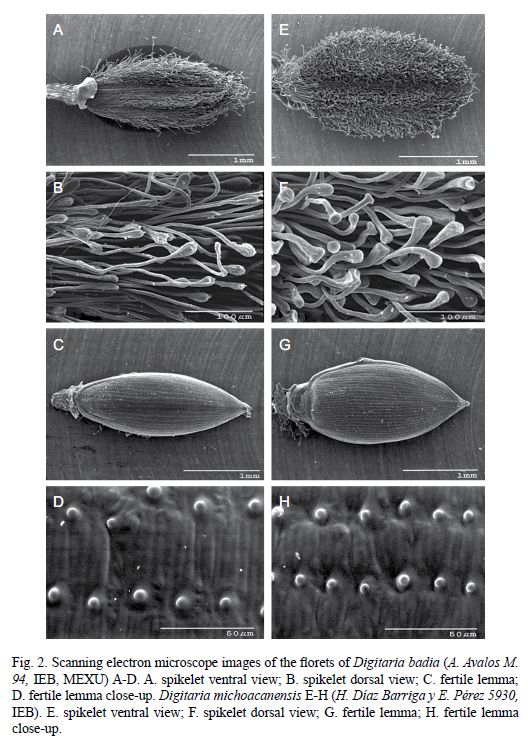
<body><![CDATA[<p align="center"><font face="verdana" size="2"><a name="a6f1"></a></font></p>  	    <p align="center"><font face="verdana" size="2"><img src="/img/revistas/abm/n101/a6f1.jpg"></font></p>  	    <p align="center"><font face="verdana" size="2"><a name="a6f2"></a></font></p>  	    <p align="center"><font face="verdana" size="2"><img src="/img/revistas/abm/n101/a6f2.jpg"></font></p>  	    <p align="justify"><font face="verdana" size="2">Micromorphology. SEM images clearly show that the glumes and sterile lemma are densely pilose with long clavate macrohairs which have a bulbous truncate or slightly rounded tip (<a href="#a6f2">Fig. 2 E&#45;H</a>). Some hairs appear flattened and this might be due to dehydration. The hairs of the first glume are longer than the hairs on the fertile or sterile florets. The fertile lemma epidermis has long cells that are much wider than long, with strongly sinuous walls, and there is a single papilla with a smooth surface.</font></p>  	    <p align="justify"><font face="verdana" size="2">Type: M&eacute;xico. Michoac&aacute;n, municipio de Tingambato, Llano de Cananguio, al NE de Pich&aacute;taro, pastizal secundario, 2600 m, 31.VIII.1989, <i>H. D&iacute;az Barriga y E. P&eacute;rez 5930</i> (holotype: IEB).</font></p>  	    <p align="justify"><font face="verdana" size="2">Paratypes. M&eacute;xico. Estado de M&eacute;xico. Por la carretera de Villa Victoria a El Oro, zacatonal de <i>Muhlenbergia</i> y <i>Festuca,</i> 2570 m, 9.VIII.1981, <i>R. Guzm&aacute;n &amp; P. Guerrero 4251</i> (MEXU). Michoac&aacute;n, municipio de Quiroga, Cerro Azul, al N de Quiroga, vegetaci&oacute;n secundaria derivada de bosque de pino&#45;encino, 2420 m, 23.VII.1980, <i>J. Caballero y C. Mapes 1190</i> (MEXU); 14 km S of the junction of hwys 15 and 37 at Carapan, 2070 m, 20.VIII.1975, oak&#45;pine forest, <i>G. Davidse &amp; J. Davidse 9904</i> (MO).</font></p>  	    <p align="justify"><font face="verdana" size="2">Distribution, habitat and phenology. This new species is restricted to M&eacute;xico in the states of Michoac&aacute;n and M&eacute;xico, the type from El Baj&iacute;o region. The habitat is grassland or transition to pine&#45;oak forest, at elevations between 2,070 to 2,600 m. Flowering and fruiting occur in July and August.</font></p>      <p align="justify"><font face="verdana" size="2">&nbsp;</font></p>      <p align="center"><font face="verdana" size="2"><b>Key to the Mexican species of <i>Digitaria</i></b></font></p>     ]]></body>
<body><![CDATA[<p align="center"><font face="verdana" size="2"><img src="/img/revistas/abm/n101/a6k1.jpg"></font></p>  	    <p align="justify">&nbsp;</p> 	     <p align="justify"><font face="verdana" size="2"><b>DISCUSSION</b></font></p>  	    <p align="justify"><font face="verdana" size="2">The new species belongs to the 'group <i>Ternatd</i> of <i>Digitaria</i> sections <i>Calvulae</i> (Stapf) Henrard or <i>Leianthae</i> Henrard (Henrard, 1950), These sections were merged into the section <i>Phaeotrichae</i> R&uacute;golo (R&uacute;golo de Agrasar, 1974), section <i>Filiformis</i> (Honda) Veldkamp (Veldkamp, 1973) or section <i>Ischaemum</i> Ohwi (Clayton and Renvoize, 1986). However, the monophyly of these taxa has not been tested. The inclusion of the new species into the <i>Ternata</i> is based on the morphological similarity shared with <i>D. badia.</i></font></p>  	    <p align="justify"><font face="verdana" size="2">The new species is allied to <i>D. badia,</i> with which it is morphologically similar. Both species possess the same type of pubescence on the spikelet bracts, which consists of brown, capitate or clavate hairs. Also, both species share brown fertile florets, a perennial habit with knotty rhizomes, and synflorescences with 2 or 3(&#45;5) racemes. However, there are vegetative and reproductive characters that separate these species (<a href="#a6t1">Table 1</a>). Vegetatively, the plants of <i>D. badia</i> are taller, with long in&#45;ternodes, and have leaves that are normally caulinar with blades up to 20 cm long, whereas plants of <i>D. michoacanensis</i> are smaller with short, reduced internodes, and have basal leaves up to 10 cm long. In <i>D. badia</i> there are usually (2&#45;)3&#45;4(&#45;5) racemes and the spikelets are smaller and narrower; in contrast in the new species there are only 2(&#45;3) racemes, and the spikelets are larger. The first glume of <i>D. badia</i> is clearly glabrous (<a href="#a6f2">Fig. 2A</a>), but it is pilose in <i>D. michoacanensis</i> (<a href="#a6f2">Fig. 2E</a>). The hairs of <i>D. badia</i> (<a href="#a6f2">Fig. 2B</a>) are slender and longer than in the new species, and the tip is apiculate or pointed. In <i>D. michoacanensis</i> the hairs (<a href="#a6f2">Fig. 2F</a>) are thick and stout with the tip truncate or rounded, or clavate and calvous according to the terminology of Veldkamp (1973). The fertile lemma of <i>D. michoacanensis</i> (<a href="#a6f2">Fig. 2G</a>) is slightly ovate, contrary to the narrowly elliptic fertile lemmas of <i>D. badia</i> (<a href="#a6f2">Fig. 2C</a>).</font></p> 	    <p align="center"><font face="verdana" size="2"><a name="a6t1"></a></font></p>         <p align="center"><font face="verdana" size="2"><img src="/img/revistas/abm/n101/a6t1.jpg"></font></p>         <p align="justify">&nbsp;</p>      <p align="justify"><font face="verdana" size="2">Other species from <i>Digitaria</i> section <i>Clavipilae</i> (Stapf) Henrard from South America that might be related to the new species are <i>D. atra</i> Luces and <i>D. killenii</i> A.S. Vega &amp; R&uacute;golo (Vega and R&uacute;golo de Agrasar, 2001, 2002), but these have shorter hairs.</font></p>  	    <p align="justify"><font face="verdana" size="2">Thirty&#45;one species and two varieties of <i>Digitaria</i> are now documented as occurring in M&eacute;xico. A similar number is present in North America, north of M&eacute;xico (Wipff, 2003) and Central America (Vega and R&uacute;golo de Agrasar, 2007) with 31 and 30 species respectively. Of the 31 species in M&eacute;xico, four are endemic, and when compared to other regions,22 are shared between Canada/U. S. A. and M&eacute;xico (endemic, cultivated, and weeds), from which five are restricted to the United States and M&eacute;xico. Seventeen species are shared with Central America and six species are widely distributed from M&eacute;xico to Central and South America. Of the 31 species, eight are introduced weeds and are distributed worldwide. Regarding the diversity of the genus by state in M&eacute;xico, the five richest states are Jalisco with 18 spp., Oaxaca and Veracruz with 17 spp., Chiapas with 16 spp., and Michoac&aacute;n with 13 spp. A similar pattern of diversity distribution occurs with the <i>genera Paspalum</i> and <i>Urochloa</i> P. Beauv. (S&aacute;nchez&#45;Ken, 2010, 2011).</font></p>      ]]></body>
<body><![CDATA[<p align="justify"><font face="verdana" size="2">The Global Biodiversity Information Facility website contains as many as 58 names within the genus for M&eacute;xico, which includes valid names, synonyms and invalid names. Some of these names belong to cultivated species that do not have Mexican collections represented in herbaria examined (e.g., <i>D. ischaemum</i> (Schreb.) Muhl., <i>D. natalensis</i> Stent, and <i>D. smutsii</i> Stent).</font>	</p>     <p align="justify"><font face="verdana" size="2">There are several morphologically similar and not well understood species of annuals that form a complex related to <i>D. filiformis.</i> One of them, <i>Digitaria curvinervis,</i> is cited for Durango and Sonora in the GBIF database; however, the same specimen is cited as <i>D. panicea</i> (Sw.) Urb. by Herrera (2001). According to McVaugh (1983), <i>D. panicea</i> is a Caribbean species and may represent a form of <i>D. filiformis; D. curvinervis</i> could also represent a form of <i>D. filiformis.</i> Wipff (1996) made two combinations <i>D. filiformis</i> var. <i>dolichophylla</i> (Henrard) Wipff and <i>D. filiformis</i> var. <i>laeviglumis</i> (Fernald) Wipff that he applied to taxa restricted to North America (Wipff, 2003) north of M&eacute;xico. In M&eacute;xico, after reviewing the scarce material of <i>D. filiformis,</i> I found a herbarium sheet from Oaxaca, with two specimens, one with glabrous spikelets and the other with pilose spikelets. The specimen with glabrous spikelets belongs to <i>D. filiformis</i> var. <i>laeviglumis</i> and the second to the typical variety. According to Wipff (2003), the typical variety was the only one that extended into M&eacute;xico, but based on my observations <i>D. filiformis</i> var. <i>laeviglumis</i> can no longer be considered endemic to the United States. Furthermore, there are other specimens that appear morphologically similar to <i>D. filiformis</i> var. <i>dolichophylla</i> by having glabrous basal sheaths. However, the Mexican specimens have much wider blades, and I retain these specimens under the typical variety until further investigation. <i>Digitaria ischaemum,</i> a European weed, is cited from Coahuila, Durango, Sonora, and Tamaulipas from two specimens deposited in ANSM, ARIZ, and US that I was not able to verify.</font></p>  	    <p align="justify"><font face="verdana" size="2">The citation of <i>D. longiflora</i> for M&eacute;xico was an error listed in TROPICOS (<a href="http://www.tropicos.org" target="_blank">www.tropicos.org</a>) since the specimen was collected in Costa Rica; this has since been corrected. Two other species <i>D. natalensis</i> and <i>D. smutsii</i> were cited from specimens of the Banco Nacional de Germoplasma of the Universidad Aut&oacute;noma de Chapingo, and it is possible that these species were grown from seed and tested for forage.</font></p>      <p align="justify"><font face="verdana" size="2"><i>Digitaria eriantha</i> Steud., or under the names of <i>D. pentzii</i> Stent, <i>D. eriantha</i> subsp. <i>pentzii</i> (Stent) Kok or <i>D. decumbens</i> Stent., has been cited as a cultivar for several states; however, after reviewing all available material only one specimen in the herbarium collection fits the description of the species. The rest of the specimens belonged mostly to <i>D. bicornis</i> (Lam.) Roem. &amp; Schult. andD. <i>ciliaris</i> (Retz.) Koeler. It seems possible that most of the specimens identified as <i>D. pentzii</i> var. <i>minor</i> were used to include the species in Las Gram&iacute;neas de M&eacute;xico (Beetle et al., 1987).</font></p>  	    <p align="justify"><font face="verdana" size="2"><i>Digitaria leucocoma</i> (Nash) Urb. has been treated as a synonym of <i>D. villosa</i> (Walter) Pers. by several authors (Zuloaga et al., 2003; Soreng et al., 2003 and onwards); however, I agree with Hernard (1950) that these two species are distinct.</font></p>  	    <p align="justify"><font face="verdana" size="2">The former is a tall perennial plant with long leaf blades and the second glume is shorter than the spikelet. In contrast <i>D. villosa</i> is a short perennial plant with short leaf blades and the second glume is nearly as long as the spikelet. The latter species once was treated as a variety of <i>D. filiformis,</i> a delicate annual (Soreng et al., 2003 and onwards). Henrard (1950) suggested that <i>D. pilosa</i> Michx. is a synonym of <i>D. villosa</i> because the small habit of the species; however, it is more similar to some forms <i>of D. filiformis.</i></font></p>  	    <p align="justify"><font face="verdana" size="2">In a similar situation, I agree with Swallen (1953) that <i>D. obtusa</i> Swallen is a distinct species, although morphologically similar to <i>D. leucocoma.</i> In addition to the characters mentioned in the key, <i>D. obtusa</i> is shorter with short leaf blades and short racemes whereas <i>D. leucocoma</i> is taller with longer basal and caulinar leaf blades, and longer racemes. Therefore, it is possible that <i>D. villosa</i> does not occur in M&eacute;xico, and it is here excluded.</font></p>  	    <p align="justify"><font face="verdana" size="2">Finally, the separation of <i>D. filiformis</i> and <i>D. cayoensis</i> Swallen is often difficult. In the original description of <i>D. cayoensis</i> Swallen (1938) indicates that the sterile lemmas have 3 veins, and this feature was also mentioned in the Grasses of Guatemala (Swallen, 1955). Henrard (1950), Pohl and Davidse (1998), and R&uacute;golo de Agrasar (Pers. comm.) indicate that the sterile lemmas have 5&#45;7 veins which would match the description of<i>D. filiformis.</i> Therefore, I considerD. <i>cayoensis</i> a synonym of <i>D. filiformis,</i> although more study of these entities is needed.</font></p>  	    <p align="justify"><font face="verdana" size="2">&nbsp;</font></p>  	    <p align="justify"><font face="verdana" size="2"><b>SYNOPSIS OF THE SPECIES OF <i>DIGITARIA</i> OCCURRING IN M&eacute;xico</b></font></p>  	    ]]></body>
<body><![CDATA[<p align="justify"><font face="verdana" size="2">Herbarium acronyms in parenthesis, according to Index Herbariorum (Thiers, B.&nbsp;(continuously updated). Index Herbariorum: A global directory of public herbaria and associated staff. New York Botanical Garden's Virtual Herbarium, <a href="http://sweetgum.nybg.org/ih/" target="_blank">http://sweetgum.nybg.org/ih/</a>). (U.S.A. = United States of America, Ags. = Aguascalientes, B.C. = Baja California, B.C.S. = Baja California Sur, Camp. = Campeche, Coah. = Coa&#45;huila, Col. = Colima, Chih. = Chihuahua, Chis. = Chiapas, D.F. = Distrito Federal, Dgo. = Durango, Gro. = Guerrero, Gto. = Guanajuato, Hgo. = Hidalgo, Jal. = Jalisco, Mex. = Estado de M&eacute;xico, Mich. = Michoac&aacute;n, Mor. = Morelos, N.L. = Nuevo Le&oacute;n, Nay. = Nayarit, Oax. = Oaxaca, Pue. = Puebla, Q.R. = Quintana Roo, Qro. = Quer&eacute;&#45;taro, S.L.P. = San Luis Potos&iacute;, Sin. = Sinaloa, Son. = Sonora, Tab. = Tabasco, Tamps. = Tamaulipas, Talx. = Tlaxcala, Ver. = Veracruz, Yuc. = Yucat&aacute;n, Zac. = Zacatecas, C.&nbsp; Amer. = Central America, S. Amer. = South America, Car. = Caribbean, O. W. = Old World).</font></p>  	    <p align="justify"><font face="verdana" size="2">&nbsp;</font></p>  	    <p align="justify"><font face="verdana" size="2">1.&nbsp;<i><b>Digitaria abyssinica</b></i> (Hochst. ex A. Rich.) Stapf, Bull. Misc. Inform. Kew 1907: 213. 1907. <i>Panicum abyssinicum</i> Hochst. ex A. Rich., Tent. Fl. Abyss. 2: 360&#45;361. 1851. Type: Ethiopia, 22.IX.1837, <i>W. Schimper 82</i> (holotype: P; isotypes: BR, K, L, US).</font></p>  	    <blockquote> 		    <p align="justify"><font face="verdana" size="2">Distribution: U.S.A., M&eacute;xico (Ver.), C. Amer., S. Amer., O. W. Introduced, weed.</font></p>  		    <p align="justify"><font face="verdana" size="2">Reference: Veracruz: Mpio. Tlaquilpan, camino de terracer&iacute;a entre Tequila y Tehuapan, 18.VI.1997, M. <i>J. Lizama 878</i> (MEXU).</font></p>  		    <p align="justify"><font face="verdana" size="2">&nbsp;</font></p> 	</blockquote>  	    <p align="justify"><font face="verdana" size="2">2.&nbsp; <i><b>Digitaria arenicola</b></i> (Swallen) Beetle, Leafl. W. Bot. 6(8): 162. 1951. <i>Leptoloma arenicola</i> Swallen, Tex. Res. Found. Contrib. 1: 1. 1950. <i>Leptoloma cognatum</i> (Shult.) Chase var. <i>arenicola</i> (Swallen) Gould, Southw. Naturalist 15: 391. 1971. <i>Digitaria cognata</i> (Schult.) Pil. var. <i>arenicola</i> (Swallen) R. Webster, Syst. Bot. 13(4): 594. 1988. Type: United Stated of America, Texas, Kennedy Co., 8 mi S of Sarita, 24.IV 1949, <i>Swallen 10122</i> (holotype: US; isotypes: MO, US).</font></p>  	    <blockquote> 		    <p align="justify"><font face="verdana" size="2">Distribution: United States of America, M&eacute;xico (Tamps.). Native.</font></p>  		    ]]></body>
<body><![CDATA[<p align="justify"><font face="verdana" size="2">Reference: Tamaulipas: Mpio. San Fernando, Barra de Cat&aacute;n, 18.III. 1989, <i>M. H. Cervera 518</i> (MEXU).</font></p>  		    <p align="justify"><font face="verdana" size="2">&nbsp;</font></p> 	</blockquote>  	    <p align="justify"><font face="verdana" size="2"><b>3.&nbsp; <i>Digitaria argillacea</i></b> (Hitchc. &amp; Chase) Fernald, Rhodora 22(258): 104. 1920. <i>Syntherisma argillaceum</i> Hitchc. &amp; Chase, Contr. U.S. Natl. Herb. 18(7): 296. 1917. Type: Puerto Rico, Monte Alegrillo, near Maricao, 20.X.1913, A. <i>Chase 6221</i> (holotype: US; isotypes: L, NY).</font></p>  	    <blockquote> 		    <p align="justify"><font face="verdana" size="2">Distribution: M&eacute;xico (Chis., Col., Dgo., Gto., Jal., Mex., Mich., Mor., Nay., Oax., Son.), C. Amer., S. Amer., Car. Native.</font></p>  		    <p align="justify"><font face="verdana" size="2">Reference: Oaxaca: San Isidro Monjas del Centro, 20.XI. 1991, <i>L. Garc&iacute;a P. s.n.</i> (MEXU).</font></p>  		    <p align="justify"><font face="verdana" size="2">&nbsp;</font></p> 	</blockquote>  	    <p align="justify"><font face="verdana" size="2">4.&nbsp;<i><b>Digitaria badia</b></i> (Scribn. &amp; Merr.) Fernald, Rhodora 22: 104: 1920. <i>Panicum ba&#45;dium</i> Scribn. &amp; Merr., Bull. Div. Agrostol., U.S.D.A. 24: 12. 1901. Type: M&eacute;xico, Oaxaca, Sierra de San Felipe, 6.X.1894, <i>C. L. Smith 915</i> (holotype: US; isotypes: MO, US).</font></p>  	    <blockquote> 		    <p align="justify"><font face="verdana" size="2">Ditribution: M&eacute;xico (Chis., D. F., Gto., Hgo., Jal., Mex., Mich., Oax., Qro., Tlax., Zac.). Endemic.</font></p>  		    ]]></body>
<body><![CDATA[<p align="justify"><font face="verdana" size="2">Reference: Quer&eacute;taro: Mpio. Amealco, El Asser&iacute;n, 19.IX.1994, <i>A. &Aacute;valos M. 94</i> (MEXU)</font></p>  		    <p align="justify"><font face="verdana" size="2">&nbsp;</font></p> 	</blockquote>  	    <p align="justify"><font face="verdana" size="2">5.&nbsp;<i><b>Digitaria bakeri</b></i> (Nash) Fernald, Rhodora 22(258): 102. 1920. <i>Syntherisma bakeri</i> Nash, Bull. Torrey Bot. Club 25(6): 296. 1898. Type: United States of America, Florida, Grasmere, no date, <i>C. H. Baker 47</i> (holotype: NY; isotype: US).</font></p>  	    <blockquote> 		    <p align="justify"><font face="verdana" size="2">Distribution: U.S.A., M&eacute;xico (Chis., Ver.), C. Amer., S. Amer. Native.</font></p>  		    <p align="justify"><font face="verdana" size="2">Reference: Veracruz: La Barranca, carretera a Coscomatepec, 22.VII.1982, <i>R. Guzm&aacute;n M., A. A. Beetle &amp; E. Manrique 3855</i> (MEXU).</font></p>  		    <p align="justify"><font face="verdana" size="2">&nbsp;</font></p> 	</blockquote>  	    <p align="justify"><font face="verdana" size="2">6.&nbsp; <i><b>Digitaria bicornis</b></i> (Lam.) Roem. &amp; Schult., Syst. Veg. 2: 470. 1817. <i>Panicum bicorne</i> Lam., Tabl. Encycl. 1: 176. 1791. Type: Mauritius?, no date, <i>T.F.W. Sieber 42</i> (holotype: P&#45;LAM; isotype: US fragm. ex P&#45;LAM).</font></p>  	    <blockquote> 		    <p align="justify"><font face="verdana" size="2">Distribution: U.S.A., M&eacute;xico (B.C.S., Camp., Chis., Chih., Col., D. F., Gro., Hgo., Jal., Mex., Mich., Mor., Nay., N. L., Oax., Pue., Q. R., Qro., Sin., Son., Tab., Tamps., Ver., Yuc.), C. Amer., S. Amer., Car. Weed.</font></p>  		    ]]></body>
<body><![CDATA[<p align="justify"><font face="verdana" size="2">Reference: Michoac&aacute;n: Mpio. Arteaga, N end of town, 8.V.2002, <i>V. W. Stein&#45;mann, G. Puime &amp; B. Vrskovy 2424</i> (MEXU).</font></p>  		    <p align="justify"><font face="verdana" size="2">&nbsp;</font></p> 	</blockquote>  	    <p align="justify"><font face="verdana" size="2">7.<b>&nbsp;<i>Digitaria breedlovei</i></b> R.W. Pohl &amp; Davidse, Novon 2(2): 106. 1992. Type: M&eacute;xico, Chiapas, Mpio. de Villa Corzo, 65 km S of Mexican highway 190, on road from Tuxtla Gutierrez to Nueva Concordia, 12.IX. 1974, <i>D. E. Breedlove 37709</i> (holotype: MO; isotypes: CAS, MEXU).</font></p>  	    <blockquote> 		    <p align="justify"><font face="verdana" size="2">Distribution: M&eacute;xico (Chis., Dgo.). Endemic.</font></p>  		    <p align="justify"><font face="verdana" size="2">Reference: Chiapas: Mpio. Tuxtla Guti&eacute;rrez, Mexican highway 190, Nueva Concordia, 12.IX.1974, <i>D. E. Breedlove 37709</i> (CAS, MEXU).</font></p>  		    <p align="justify"><font face="verdana" size="2">&nbsp;</font></p> 	</blockquote>  	    <p align="justify"><font face="verdana" size="2">8.&nbsp;<i><b>Digitaria californica</b></i> (Benth.) Henrard, Blumea 1(1): 99. 1934. <i>Panicum californicum</i> Benth., Bot. Voy. Sulphur. 55&#45;56. 1844. Type: M&eacute;xico: Baja California, Bay of Magdalena, in 1841, <i>Hinds s.n.,</i> (holotype: K, isotype: US fragm. ex K).</font></p>  	    <blockquote> 		    <p align="justify"><font face="verdana" size="2">Distribution: U. S. A., M&eacute;xico (Ags., B.C., B.C. Sur., Chih., Coah., Dgo., Gto., Hgo., Jal., N.L., Pue., Qro., S. L. P., Sin., Son., Tamps., Zac.), C. Amer., S. Amer. Native.</font></p>  		    ]]></body>
<body><![CDATA[<p align="justify"><font face="verdana" size="2">Reference: San Luis Potosi: Mpio. Matehuala, Ejido Calabacillas, 7.VIII.1986, <i>H. Bravo M. 207</i> (MEXU).</font></p>  		    <p align="justify"><font face="verdana" size="2">&nbsp;</font></p> 	</blockquote>  	    <p align="justify"><font face="verdana" size="2">9.&nbsp;<i><b>Digitaria ciliaris</b></i> (Retz.) Koeler, Descr. Gram. 27. 1802. <i>Panicum ciliare</i> Retz., Observ. Bot. 4: 16. 1786. Type: China: Guangzhou, no date, <i>Wennerberg s.n.</i> (lecto&#45;type: LD, designated by Blake, Roy. Soc, Queensland 81: 11. 1969).</font></p>  	    <blockquote> 		    <p align="justify"><font face="verdana" size="2">Distribution: U. S. A., M&eacute;xico (Ags., B.C., B.C. Sur., Camp., Chih., Chis., Coah., Col., D.F., Dur., Gro., Gto., Hgo., Jal., Mex., Mich., Mor., Nay., N.L., Oax., Pue., Qro., Q.R., S.L.P., Sin., Son., Tab., Tamps., Ver., Yuc.), C. Amer., S. Amer, Car., O. W. Introduced, weed.</font></p>  		    <p align="justify"><font face="verdana" size="2">Reference: Quer&eacute;taro: Mpio. Landa, alrededores de Puerto de Guadalupe, 10.XII.1996, L. <i>G. Rinc&oacute;n N. 433</i> (MEXU).</font></p>  		    <p align="justify"><font face="verdana" size="2">&nbsp;</font></p> 	</blockquote>  	    <p align="justify"><font face="verdana" size="2">10.&nbsp;<i><b>Digitaria curtigluma</b></i> Hitchc., Proc. Biol. Soc. Wash. 40: 84. 1927. Type: Panama: Chiriqui, El Boquete, 28.IX.1911, A.S. <i>Hitchcock 8176</i> (holotype: US; isotypes: K, L, SI).</font></p>  	    <blockquote> 		    <p align="justify"><font face="verdana" size="2">Distribution: M&eacute;xico (Chis., D.F., Gto., Jal., Mex., Mich., Oax., Pue.), C. Amer. Native.</font></p>  		    ]]></body>
<body><![CDATA[<p align="justify"><font face="verdana" size="2">Reference: Michoac&aacute;n: Mpio. P&aacute;tzcuaro, Estaci&oacute;n de Ajuno, 8.XI. 1985, <i>J. M. Escobedo 602</i> (IEB).</font></p>  		    <p align="justify"><font face="verdana" size="2">&nbsp;</font></p> 	</blockquote>  	    <p align="justify"><font face="verdana" size="2">11.&nbsp;<i><b>Digitaria eriantha</b></i> Steud., Flora 12(2): 468&#45;469. 1829. Type: South Africa; Cape of Good Hope, no date, <i>von Ludwig s.n.</i> (holotype: probably P).</font></p>  	    <blockquote> 		    <p align="justify"><font face="verdana" size="2">Distribution: U.S.A., M&eacute;xico (Oax., Tamps., Ver., Zac.), C. Amer., S. Amer., O. W. Introduced, pasture.</font></p>  		    <p align="justify"><font face="verdana" size="2">Reference: Zacatecas: Mpio. Calera, Campo agr&iacute;cola experimental INIFAP, 20.X. 1989, <i>J. J. Balleza C. 2600</i> (MEXU).</font></p>  		    <p align="justify"><font face="verdana" size="2">&nbsp;</font></p> 	</blockquote>  	    <p align="justify"><font face="verdana" size="2">12a. <i><b>Digitaria filiformis</b></i> (L.) Koeler <i>var. filiformis</i> Descr. Gram. 26: 1802. <i>Panicum filiforme</i> L., Sp. Pl. 1: 57. 1753. Type: United States of North America, no date, <i>Kalm s.n.</i> (lectotype: LINN&#45;90.38, designated by Hitchcock, Contr. U. S. Natl. Herb. 12(3): 117. 1908).</font></p>  	    <blockquote> 		    <p align="justify"><font face="verdana" size="2">Distribution: U.S.A., M&eacute;xico (Chih., Chis., Coah., D.F., Dgo., Gto., Jal., Mex., Mich., Nay., Oax., Son., Ver., Zac.), C. Amer., S. Amer, Car., O. W. Native.</font></p>  		    ]]></body>
<body><![CDATA[<p align="justify"><font face="verdana" size="2">Reference: Guanajuato: Mpio. Comonfort, Rancho Rinconcillo de los Remedios, 27.VII.1994, <i>J. C. Casta&ntilde;eda L. 194</i> (MEXU).</font></p>  		    <p align="justify"><font face="verdana" size="2">&nbsp;</font></p> 	</blockquote>  	    <p align="justify"><font face="verdana" size="2">12b. <i><b>Digitaria filiformis</b></i> (L.) Koeler var. <i>laeviglumis</i> (Fernald) Wipff, Phytolo&#45;gia 80(5): 348. 1996. <i>Digitaria laeviglumis</i> Fernald, Rhodora 22(258): 102. 1920. Type: United States of America: New Hampshire; Hillsborough Co., Manchester, <i>11.IX.1901, F.W. Batchelder s.n.</i> (holotype: GH).</font></p>  	    <blockquote> 		    <p align="justify"><font face="verdana" size="2">Distribution: U.S.A., M&eacute;xico (Oax.). Native.</font></p>  		    <p align="justify"><font face="verdana" size="2">Reference: Oaxaca: about 66 mi NW of Tehuantepec, 29.VIII.1953, <i>J. R. Reeder &amp; C. G. Reeder 2171</i> (MEXU).</font></p>  		    <p align="justify"><font face="verdana" size="2">&nbsp;</font></p> 	</blockquote>  	    <p align="justify"><font face="verdana" size="2">13.&nbsp;<i><b>Digitaria hitchcockii</b></i> (Chase) Stuck., Annuaire Conserv. Jard. Bot. Gen&egrave;ve 17: 287. 1914. <i>Valota hitchcockii</i> Chase, Proc. Biol. Soc. Wash. 24: 110. 1911. Type: United States of America: Texas, San Antonio, 24.VI.1910, <i>A.S. Hitchcock 5329</i> (holotype: US).</font></p>  	    <blockquote> 		    <p align="justify"><font face="verdana" size="2">Distribution: U.S.A., M&eacute;xico (Coah., N.L., Oax., Qro., S.L.P., Tamps.). Native.</font></p>  		    ]]></body>
<body><![CDATA[<p align="justify"><font face="verdana" size="2">Reference: San Luis Potos&iacute;: in the valley of the Rio Verde and in the Sierra de Cuates, along the route Rio Verde&#45;San Francisco&#45;Patros&#45;Cardunes Rayon, 14.IX.1954, <i>E. R. Sohns 1299</i> (MEXU).</font></p>  		    <p align="justify"><font face="verdana" size="2">&nbsp;</font></p> 	</blockquote>  	    <p align="justify"><font face="verdana" size="2">14.&nbsp;<i><b>Digitaria horizontalis</b></i> Willd., Enum. Pl. 1: 92. 1809. Type: Dominican Republic; Santo Domingo, no <i>date, Anon. s.n.</i> (holotype: B&#45;W; isotypes; MVFA, US).</font></p>  	    <blockquote> 		    <p align="justify"><font face="verdana" size="2">Distribution: U.S.A., M&eacute;xico (Chis., Coah., Col., Gro., Jal., Mex., Mich., Mor., Nay., N.L., Oax., Pue., Q.R., S.L.P., Sin., Son., Tab., Tamps., Ver., Yuc.), C. Amer., S. Amer, Car. Weed.</font></p>  		    <p align="justify"><font face="verdana" size="2">Reference: Chiapas: Mpio. Ocosingo, 1.5 km al SW de la Colonia Benito Ju&aacute;rez Miramar, sobre el camino a Tierra y Libertad, 25 VIII. 1993, <i>A. Reyes &amp; M. Sousa S. 2289</i> (MO).</font></p>  		    <p align="justify"><font face="verdana" size="2">&nbsp;</font></p> 	</blockquote>  	    <p align="justify"><font face="verdana" size="2">15.&nbsp;<i><b>Digitaria insularis</b></i> (L.) Mez ex Ekman, Just's Bot. Jahresber. 31(1,5): 778. 1904. <i>Andropogon insularis</i> L., Syst. Nat. (ed. 10) 2: 1304. 1759. Type: Jamaica, no date, <i>R Browne s.n.</i> (lectotype: LINN&#45;1211.20, designated by Hitchcock, Contr. U. S. Natl. Herb. 12: 126. 1908).</font></p>  	    <blockquote> 		    <p align="justify"><font face="verdana" size="2">Distribution: U.S.A., M&eacute;xico (Ags., Camp., Chih., Chis., Coah., Col., Dgo., Gro., Gto., Hgo., Jal., Mor., Nay., N.L., Oax., Pue., Qro., Q.R., S.L.P., Son., Tab., Tamps., Ver., Yuc.), C. Amer., S. Amer, Car. Native weed.</font></p>  		    ]]></body>
<body><![CDATA[<p align="justify"><font face="verdana" size="2">Reference: Quer&eacute;taro: Mpio. Jalpan, al ENE de carretera a Tancama, 14.VIII.1985, <i>E. Carranza 1970</i> (MEXU).</font></p>  		    <p align="justify"><font face="verdana" size="2">&nbsp;</font></p> 	</blockquote>  	    <p align="justify"><font face="verdana" size="2">16.&nbsp;<i><b>Digitaria leucites</b></i> (Trin.) Henrard, Meded. Rijks&#45;Herb. 61: 6. 1930. <i>Panicum leucites</i> Trin., Gram. Panic. 85. 1826. Based on <i>Milium velutinum</i> DC., Cat. Pl. Horti Monsp. 126. 1813. Type: M&eacute;xico, cultivated in Hort. Monsp. from seeds sent in 1804 by Sess&eacute; from M&eacute;xico, (holotype: MPU&#45;DC; isotypes: US fragm. ex MPU&#45;DC).</font></p>  	    <blockquote> 		    <p align="justify"><font face="verdana" size="2">Distribution: M&eacute;xico (Chis., D.F., Dgo., Hgo., Jal., Mex., Mich., Mor., Oax., Pue., Tab., Tlax., Ver.), C. Amer., S. Amer. Native.</font></p>  		    <p align="justify"><font face="verdana" size="2">Reference: Michoac&aacute;n: Mpio. Villa Escalante, Ejido Cuitzitan, potrero Huaniqueo, 8 km SE de Villa Escalante, 24.X.1941, <i>J. Garc&iacute;a P. 1555</i> (MEXU).</font></p>  		    <p align="justify"><font face="verdana" size="2">&nbsp;</font></p> 	</blockquote>  	    <p align="justify"><font face="verdana" size="2">17.&nbsp;<i><b>Digitaria leucocoma</b></i> (Nash) Urb., Symb. Antill. 8: 24. 1920. <i>Syntherisma leucocomum</i> Nash, Bull. Torrey Bot. Club 25(6): 295. 1898. Type: United States of America: Florida, Lake Co., Lake Ella, 3.VII.1894, <i>N. Nash 1155</i> (holotype: NY; isotype; US).</font></p>  	    <blockquote> 		    <p align="justify"><font face="verdana" size="2">Distribution: U.S.A., M&eacute;xico (Chis.), C. Amer., Car. Native.</font></p>  		    ]]></body>
<body><![CDATA[<p align="justify"><font face="verdana" size="2">Reference: Chiapas: Mpio. Ocosingo, 5 km NE of Ocosingo on road to Palenque, 9.XI.1981, <i>D. E. Breedlove &amp; G. Davidse 55194</i> (MEXU).</font></p>  		    <p align="justify"><font face="verdana" size="2">&nbsp;</font></p> 	</blockquote>  	    <p align="justify"><font face="verdana" size="2">18.&nbsp; <i><b>Digitaria michoacanensis</b></i> S&aacute;nchez&#45;Ken, sp. nov. Type: M&eacute;xico. Michoac&aacute;n, municipio de Tingambato, Llano de Canaguio, al NE de Pich&aacute;taro, pastizal secundario, 2600 m, 31.VIII. 1989, <i>H. D&iacute;az Barriga &amp; E. P&eacute;rez 5930</i> (holotype: IEB).</font></p>  	    <blockquote> 		    <p align="justify"><font face="verdana" size="2">Distribution: M&eacute;xico (Mex., Mich.). Endemic.</font></p>  		    <p align="justify"><font face="verdana" size="2">Reference: Michoac&aacute;n: Mpio. Quiroga, Cerro Azul, al N de Quiroga, 23.VII.1980, <i>J. Caballero &amp; C. Mapes 1190</i> (MEXU).</font></p>  		    <p align="justify"><font face="verdana" size="2">&nbsp;</font></p> 	</blockquote>  	    <p align="justify"><font face="verdana" size="2">19.&nbsp;<i><b>Digitaria milanjiana</b></i> (Rendle) Stapf, Fl. Trop. Afr. 9: 430. 1919. <i>Panicum milan&#45;jianum</i> Rendle, Trans. Linn. Soc. London, Bot. 4: 56. 1894. Type: Malawi: Mount Milanje, October, <i>A. Whyte s.n.</i> (holotype: BM).</font></p>  	    <blockquote> 		    <p align="justify"><font face="verdana" size="2">Distribution. U.S.A., M&eacute;xico (Col., Hgo., Jal., Mor., Pue., Qro., Tab., Tamps., Ver.), O. W. Introduced, pasture.</font></p>  		    ]]></body>
<body><![CDATA[<p align="justify"><font face="verdana" size="2">Reference: Quer&eacute;taro: Mpio. Jalpan de Serra, Rancho Panelilla, 18.VII.1994, <i>R. Ram&iacute;rez L. s.n.</i> (MEXU).</font></p>  		    <p align="justify"><font face="verdana" size="2">&nbsp;</font></p> 	</blockquote>  	    <p align="justify"><font face="verdana" size="2">20.&nbsp;<i><b>Digitaria nuda</b></i> Schumach., Beskr. Guin. Pl. 45. 1827. Type: Ghana, no date, <i>R Thonning 367</i> (holotype: C; isotype: L).</font></p>  	    <blockquote> 		    <p align="justify"><font face="verdana" size="2">Distribution: U.S.A., M&eacute;xico (Chis., Col., Gro., Gto., Jal., Mex., Mich., Mor., Nay., Oax., Pue., Q.R., S.L.P., Sin., Ver., Yuc.), C. Amer., S. Amer., Car., O. W. Introduced, pasture.</font></p>  		    <p align="justify"><font face="verdana" size="2">Reference: Guanajuato: S del poblado de Ac&aacute;mbaro, km 15 carretera Ac&aacute;mbaro&#45;Zinap&eacute;cuaro, 3.XI.1992, <i>J. C. Casta&ntilde;eda L. 82</i> (MEXU).</font></p>  		    <p align="justify"><font face="verdana" size="2">&nbsp;</font></p> 	</blockquote>  	    <p align="justify"><font face="verdana" size="2">21.&nbsp; <i><b>Digitaria obtusa</b></i> Swallen, Phytologia 4(7): 425. 1953. Type: Guatemala; Alta Verapaz, VIII. 1912, <i>H. von Tuerckheim 3793</i> (holotype: US; isotype: MO).</font></p>  	    <blockquote> 		    <p align="justify"><font face="verdana" size="2">Distribution: M&eacute;xico (Chis., Ver), Guat. Native.</font></p>  		    ]]></body>
<body><![CDATA[<p align="justify"><font face="verdana" size="2">Reference: Chiapas: Mpio. Teopisca, Belem, 8 km NW of Teopisca, along hwy to San Crist&oacute;bal de las Casas, 15.XI.1984, <i>G. Davidse et al. 29778</i> (MEXU).</font></p>  		    <p align="justify"><font face="verdana" size="2">&nbsp;</font></p> 	</blockquote>  	    <p align="justify"><font face="verdana" size="2">22.&nbsp; <i><b>Digitaria paniculata</b></i> Soderstr. ex McVaugh, Fl. Novo&#45;Galiciana, 14: 143&#45;144. 1983. Type: M&eacute;xico: Jalisco; 13 mi SSWofAutlan, 12.VIII. 1969, R. <i>L. Wilbur &amp; C. R. Wilbur 2267</i> (holotype: MICH).</font></p>  	    <blockquote> 		    <p align="justify"><font face="verdana" size="2">Distribution: M&eacute;xico (Jal.). Endemic.</font></p>  		    <p align="justify"><font face="verdana" size="2">Reference: Jalisco: Entre el crucero La Rosa y Las Mar&iacute;as, 27.VIII.1991, <i>B. R. Benz, F. J. SantanaM. &amp; J. Cevallos 1230</i> (MEXU).</font></p>  		    <p align="justify"><font face="verdana" size="2">&nbsp;</font></p> 	</blockquote>  	    <p align="justify"><font face="verdana" size="2">23.<b>&nbsp;<i>Digitaria patens</i></b> (Swallen) Henrard, Blumea 1(1): 99. 1934. <i>Trichachne patens</i> Swallen, Amer. J. Bot. 19(5): 442. 1932. Type: United States of America: Texas, near Lake Mitchell, San Antonio, 24.VII.1910, A. <i>S. Hitchcock 5328</i> (holotype: US; isotypes: LL, MO).</font></p>  	    <blockquote> 		    <p align="justify"><font face="verdana" size="2">Distribution: U.S.A., M&eacute;xico (Coah., N.L., Son.). Native.</font></p>  		    ]]></body>
<body><![CDATA[<p align="justify"><font face="verdana" size="2">Reference: Coahuila: 12 mi W of San Buenaventura, 1.X.1966, <i>J. R. Reeder &amp; C. G. Reeder 4573</i> (US).</font></p>  		    <p align="justify"><font face="verdana" size="2">&nbsp;</font></p> 	</blockquote>  	    <p align="justify"><font face="verdana" size="2">24.&nbsp;<i><b>Digitaria pubiflora</b></i> (Vasey) Wipff, Sida 19(4): 923. 2001. <i>Panicum autumnale</i> Bosc ex Spreng. var. <i>pubiflorum</i> Vasey, Dept. Agric. Bot. Div. Bull. 8: 35. 1889. Type: United States of America: Texas, El Paso Co., Mts. Near Paso del Norte, 1881, <i>G. R. Vasey s.n.</i> (lectotype: US; isolectotype: US, designated by Wipff &amp; Hatch, Syst. Bot. 19(4): 625. 1994).</font></p>  	    <blockquote> 		    <p align="justify"><font face="verdana" size="2">Distribution: U.S.A., M&eacute;xico (Chih., Coah., Dgo., Gto., Jal., N.L., S.L.P., Son., Tamps., Ver., Zac.). Native.</font></p>  		    <p align="justify"><font face="verdana" size="2">Reference: Guanajuato: Mpio. Xich&uacute;, restos de la mina Zarco, 19.IX.1981, <i>J. S&aacute;nchez C. 201</i> (MEXU).</font></p>  		    <p align="justify"><font face="verdana" size="2">&nbsp;</font></p> 	</blockquote>  	    <p align="justify"><font face="verdana" size="2">25.&nbsp;<i><b>Digitaria sanguinalis</b></i> (L.) Scoop., Fl. Carniol. (ed. 2) 1: 52. 1771. <i>Panicum san&#45;guinale</i> L., Sp. Pl. 1: 57. 1753. Type: cultivated (LINN&#45;80.31).</font></p>  	    <blockquote> 		    <p align="justify"><font face="verdana" size="2">Distribution: U.S.A., M&eacute;xico (Ags., B.C. Sur., Chih., Jal., Mich., N.L., Qro., S.L.P., Son., Tamps., Zac.), C. Amer., S. Amer., Car., O. W. Introduced, weed.</font></p>  		    ]]></body>
<body><![CDATA[<p align="justify"><font face="verdana" size="2">Reference: Michoac&aacute;n: Tuxpan de Michoac&aacute;n, 1.IX.1981, <i>A. D&iacute;az, A. Vargas &amp; A. M&eacute;ndez 273</i> (MEXU).</font></p>  		    <p align="justify"><font face="verdana" size="2">&nbsp;</font></p> 	</blockquote>  	    <p align="justify"><font face="verdana" size="2">26.&nbsp;<i><b>Digitaria sellowii</b></i> (M&uuml;ll. Hal.) Henrard, Blumea 1: 99. 1934. <i>Trichachne sellowii</i> M&uuml;ll. Hal., Bot. Zeitung (Berlin) 19(43: 315. 1861. Type: Brazil: Brasilia, no date, <i>Sellow s.n.</i> (holotype: B).</font></p>  	    <blockquote> 		    <p align="justify"><font face="verdana" size="2">Distribution: M&eacute;xico (Chis., Hgo., N.L., Oax., Pue., Qro., S.L.P., Tamps., Ver., Yuc.), C. Amer., S. Amer., Car. Native.</font></p>  		    <p align="justify"><font face="verdana" size="2">Reference: Veracruz: about 1 mi N of Omealco, 15.XII.1972, <i>J. R. Reeder &amp; C. G. Reeder 6020</i> (MO).</font></p>  		    <p align="justify"><font face="verdana" size="2">&nbsp;</font></p> 	</blockquote>  	    <p align="justify"><font face="verdana" size="2">27.&nbsp;<i><b>Digitaria setigera</b></i> Roth, in Roem. &amp; Schult. Syst. Veg. 2: 474. 1817. Type: India, no date, <i>B. Heyne s.n.</i> (holotype: B; isotypes; B, K).</font></p>  	    <blockquote> 		    <p align="justify"><font face="verdana" size="2">Distribution: U.S.A., M&eacute;xico (Camp., Chis., Oax., Ver.), C. Amer., S. Amer., Car., O. W. Introduced, pasture.</font></p>  		    ]]></body>
<body><![CDATA[<p align="justify"><font face="verdana" size="2">Reference: Chiapas: ejido Las Golondrinas lower slopes of Cerro Ovando, along road between Golondrinas and Los Cacaos, 22.VIII.1996, <i>T. B. Croat 78528</i> (MO).</font></p>  		    <p align="justify"><font face="verdana" size="2">&nbsp;</font></p> 	</blockquote>  	    <p align="justify"><font face="verdana" size="2">28.&nbsp;<i><b>Digitaria ternata</b></i> (A. Rich.) Stapf, Fl. Cap. 7: 376&#45;377. 1898. <i>Cynodon ternatus</i> A. Rich., Tent. Fl. Abyss. 2: 405. 1851. Type: Ethiopia: Tigray, prope Adoua, no date, no collector (lectotype: P; isolectotypes: B, K, L, US, WAG, designated by Hernard, Monogr. <i>Digitaria</i> 738, 1950).</font></p>  	    <blockquote> 		    <p align="justify"><font face="verdana" size="2">Distribution: M&eacute;xico (Ags., D. F., Dgo., Gto., Hgo., Jal., Mex., Mich., Mor., Oax., Pue., Qro., Zac.), S. Amer., O. W., Introduced, weed.</font></p>  		    <p align="justify"><font face="verdana" size="2">Reference: Michoac&aacute;n: 5 km al S of La Piedad, 6.XII.1980, <i>A. A. Beetle, G. Hardin &amp; R. Guzm&aacute;n M. 6321</i> (MEXU).</font></p>  		    <p align="justify"><font face="verdana" size="2">&nbsp;</font></p> 	</blockquote>  	    <p align="justify"><font face="verdana" size="2">29.&nbsp; <i><b>Digitaria texana</b></i> Hitchc., Proc. Biol. Soc. Wash. 41: 162. 1928. Type: United States of America: Texas, Sarita, 27.VI.1910, <i>A.S. Hitchcock 5479</i> (holotype: US).</font></p>  	    <blockquote> 		    <p align="justify"><font face="verdana" size="2">Distribution: U.S.A., M&eacute;xico (Ver.). Native.</font></p>  		    ]]></body>
<body><![CDATA[<p align="justify"><font face="verdana" size="2">Reference: Veracruz: Veracruz, 31.VIII.1910, A. <i>S. Hitchcock 6554</i> (US).</font></p>  		    <p align="justify"><font face="verdana" size="2">&nbsp;</font></p> 	</blockquote>  	    <p align="justify"><font face="verdana" size="2">30.&nbsp; <i><b>Digitaria velutina</b></i> (Forssk.) P. Beauv., Ess. Agrostogr. 51, 173. 1812. <i>Phalaris velutina</i> Forssk., Fl. Aegypt.&#45;Arab. 17. 1775. Type: Yemen, no date, <i>Forsskal 115</i> (holotype: C).</font></p>  	    <blockquote> 		    <p align="justify"><font face="verdana" size="2">Distribution: M&eacute;xico (D.F., Mor., Oax., Pue.), C. Amer. O. W. Introduced, weed.</font></p>  		    <p align="justify"><font face="verdana" size="2">Reference: Distrito Federal: Campus of Universidad Nacional Aut&oacute;noma de M&eacute;xico, 1.XII.2011, <i>J. G. S&aacute;nchez&#45;Ken s.n.</i> (MEXU).</font></p>  		    <p align="justify"><font face="verdana" size="2">&nbsp;</font></p> 	</blockquote>  	    <p align="justify"><font face="verdana" size="2">31.&nbsp;<i><b>Digitaria violascens</b></i> Link, Hort. Berol. 1: 229. 1827. Type: Brazil; Brasilia, no date, <i>Anon. s.n.</i> (holotype: B; isotype; BAAfragm. ex B).</font></p>  	    <blockquote> 		    <p align="justify"><font face="verdana" size="2">Distribution: U.S.A., M&eacute;xico (Chis., Ver.), C. Amer., S. Amer., Car. Native.</font></p>  		    ]]></body>
<body><![CDATA[<p align="justify"><font face="verdana" size="2">Reference: Veracruz: carretera Xalapa&#45;Coatepec por Briones, vivero anexo a Asuntos Ecol&oacute;gicos, frente al Jard&iacute;n Bot&aacute;nico, 24.VI.1997, <i>M. J. Lizama 697</i> (MEXU).</font></p>  		    <p align="justify"><font face="verdana" size="2">&nbsp;</font></p> 	</blockquote>  	    <p align="justify"><font face="verdana" size="2"><b>ACKNOWLEDGMENTS</b></font></p>  	    <p align="justify"><font face="verdana" size="2">Many thanks to M. B. Mendoza G. for the scanning electron microscope (SEM) images.</font></p>  	    <p align="justify"><font face="verdana" size="2">&nbsp;</font></p>  	    <p align="justify"><font face="verdana" size="2"><b>LITERATURE CITED</b></font></p>  	    <!-- ref --><p align="justify"><font face="verdana" size="2">Beetle, A. A., E. Manrique F., V. Jaramillo L., P. Guerrero S., J. A. Miranda S., I. N&uacute;&ntilde;ez T. and A. Chimal H. 1987. Las gram&iacute;neas de M&eacute;xico, Tomo II. Secretar&iacute;a de Agricultura, Ganader&iacute;a y Desarrollo Rural. M&eacute;xico, D.F., M&eacute;xico. 335 pp.    &nbsp;&nbsp;&nbsp;&nbsp;&nbsp;&nbsp;&nbsp;&nbsp;[&#160;<a href="javascript:void(0);" onclick="javascript: window.open('/scielo.php?script=sci_nlinks&ref=044640&pid=S0187-7151201200040000600001&lng=','','width=640,height=500,resizable=yes,scrollbars=1,menubar=yes,');">Links</a>&#160;]<!-- end-ref --></font></p>  	    <!-- ref --><p align="justify"><font face="verdana" size="2">Clayton, W. D. and S. Renvoize. 1986. Genera graminum. Her Majesty's Stationary Office. London, UK. 389 pp.    &nbsp;&nbsp;&nbsp;&nbsp;&nbsp;&nbsp;&nbsp;&nbsp;[&#160;<a href="javascript:void(0);" onclick="javascript: window.open('/scielo.php?script=sci_nlinks&ref=044642&pid=S0187-7151201200040000600002&lng=','','width=640,height=500,resizable=yes,scrollbars=1,menubar=yes,');">Links</a>&#160;]<!-- end-ref --></font></p>  	    ]]></body>
<body><![CDATA[<!-- ref --><p align="justify"><font face="verdana" size="2">Clayton, W. D., M. S. Vorontsova, K. T. Harman and H. Williamson. 2006 and onwards. GrassBase &#45; The Online World Grass Flora. <a href="http://www.kew.org/data/grasses&#45;db.html" target="_blank">www.kew.org/data/grasses&#45;db.html</a>. &#91;accessed 10 Nov. 2011&#93;    &nbsp;&nbsp;&nbsp;&nbsp;&nbsp;&nbsp;&nbsp;&nbsp;[&#160;<a href="javascript:void(0);" onclick="javascript: window.open('/scielo.php?script=sci_nlinks&ref=044644&pid=S0187-7151201200040000600003&lng=','','width=640,height=500,resizable=yes,scrollbars=1,menubar=yes,');">Links</a>&#160;]<!-- end-ref -->.</font></p>  	    <!-- ref --><p align="justify"><font face="verdana" size="2">D&aacute;vila, P., M. T. Mej&iacute;a&#45;Saul&eacute;s, M. G&oacute;mez&#45;S&aacute;nchez, J. Vald&eacute;s&#45;Reyna, J. J. Ort&iacute;z, C. Mor&iacute;n, J. Castrej&oacute;n and A. Ocampo. 2006. Cat&aacute;logo de las gram&iacute;neas de M&eacute;xico. Universidad Nacional Aut&oacute;noma de M&eacute;xico&#45;Comisi&oacute;n Nacional para el Conocimiento y Uso de la Biodiversidad. M&eacute;xico, D.F., M&eacute;xico. 671 pp.    &nbsp;&nbsp;&nbsp;&nbsp;&nbsp;&nbsp;&nbsp;&nbsp;[&#160;<a href="javascript:void(0);" onclick="javascript: window.open('/scielo.php?script=sci_nlinks&ref=044646&pid=S0187-7151201200040000600004&lng=','','width=640,height=500,resizable=yes,scrollbars=1,menubar=yes,');">Links</a>&#160;]<!-- end-ref --></font></p>  	    <!-- ref --><p align="justify"><font face="verdana" size="2">Henrard, J. 1950. Monograph of the genus <i>Digitaria.</i> Universitaire Pers Leiden. Leiden, The Netherlands. 999 pp.    &nbsp;&nbsp;&nbsp;&nbsp;&nbsp;&nbsp;&nbsp;&nbsp;[&#160;<a href="javascript:void(0);" onclick="javascript: window.open('/scielo.php?script=sci_nlinks&ref=044648&pid=S0187-7151201200040000600005&lng=','','width=640,height=500,resizable=yes,scrollbars=1,menubar=yes,');">Links</a>&#160;]<!-- end-ref --></font></p>  	    <!-- ref --><p align="justify"><font face="verdana" size="2">Herrera A., Y. 2001. Las gram&iacute;neas de Durango. Comisi&oacute;n Nacional para el Conocimiento y Uso de la Biodiversidad &#45; Instituto Polit&eacute;cnico Nacional. Durango, M&eacute;xico. 478 pp.    &nbsp;&nbsp;&nbsp;&nbsp;&nbsp;&nbsp;&nbsp;&nbsp;[&#160;<a href="javascript:void(0);" onclick="javascript: window.open('/scielo.php?script=sci_nlinks&ref=044650&pid=S0187-7151201200040000600006&lng=','','width=640,height=500,resizable=yes,scrollbars=1,menubar=yes,');">Links</a>&#160;]<!-- end-ref --></font></p>  	    <!-- ref --><p align="justify"><font face="verdana" size="2">McVaugh, R. 1983. Gramineae. A descriptive account of the vascular plants of western M&eacute;xico. Flora Novo&#45;Galiciana 14: 1&#45;436.    &nbsp;&nbsp;&nbsp;&nbsp;&nbsp;&nbsp;&nbsp;&nbsp;[&#160;<a href="javascript:void(0);" onclick="javascript: window.open('/scielo.php?script=sci_nlinks&ref=044652&pid=S0187-7151201200040000600007&lng=','','width=640,height=500,resizable=yes,scrollbars=1,menubar=yes,');">Links</a>&#160;]<!-- end-ref --></font></p>  	    ]]></body>
<body><![CDATA[<!-- ref --><p align="justify"><font face="verdana" size="2">Pohl., R. W. and G. Davidse. 1998. <i>Digitaria.</i> Haller, Nom. Cons. In: Davidse, G., M. Sousa S. and A. O. Chater (eds.). Flora Mesoamericana, Vol. 6. Alismataceae a Cyperaceae. Universidad Nacional Aut&oacute;noma de M&eacute;xico. M&eacute;xico, D.F., M&eacute;xico. pp. 365&#45;371.    &nbsp;&nbsp;&nbsp;&nbsp;&nbsp;&nbsp;&nbsp;&nbsp;[&#160;<a href="javascript:void(0);" onclick="javascript: window.open('/scielo.php?script=sci_nlinks&ref=044654&pid=S0187-7151201200040000600008&lng=','','width=640,height=500,resizable=yes,scrollbars=1,menubar=yes,');">Links</a>&#160;]<!-- end-ref --></font></p>  	    <!-- ref --><p align="justify"><font face="verdana" size="2">R&uacute;golo de Agrasar, Z. E. 1974. Las especies del g&eacute;nero <i>Digitaria</i> (Gramineae) de la Argentina. Darwiniana 19(1): 65&#45;166.    &nbsp;&nbsp;&nbsp;&nbsp;&nbsp;&nbsp;&nbsp;&nbsp;[&#160;<a href="javascript:void(0);" onclick="javascript: window.open('/scielo.php?script=sci_nlinks&ref=044656&pid=S0187-7151201200040000600009&lng=','','width=640,height=500,resizable=yes,scrollbars=1,menubar=yes,');">Links</a>&#160;]<!-- end-ref --></font></p>  	    <!-- ref --><p align="justify"><font face="verdana" size="2">S&aacute;nchez&#45;Ken, J. G. 2010. Two new species of <i>Paspalum</i> (Paniceae: Panicoideae: Poaceae), a preliminary checklist of the genus in M&eacute;xico, and the identity of P. <i>crinitum.</i> Rev. Mex. Biodiv. 81: 629&#45;647.    &nbsp;&nbsp;&nbsp;&nbsp;&nbsp;&nbsp;&nbsp;&nbsp;[&#160;<a href="javascript:void(0);" onclick="javascript: window.open('/scielo.php?script=sci_nlinks&ref=044658&pid=S0187-7151201200040000600010&lng=','','width=640,height=500,resizable=yes,scrollbars=1,menubar=yes,');">Links</a>&#160;]<!-- end-ref --></font></p>  	    <!-- ref --><p align="justify"><font face="verdana" size="2">S&aacute;nchez&#45;Ken, J. G. 2011. Two new species of <i>Urochloa</i> (Paniceae; Panicoideae; Poaceae) from Western M&eacute;xico and the updated checklist with a key to species of the genus in M&eacute;xico. Syst. Bot. 36(3): 621&#45;630.    &nbsp;&nbsp;&nbsp;&nbsp;&nbsp;&nbsp;&nbsp;&nbsp;[&#160;<a href="javascript:void(0);" onclick="javascript: window.open('/scielo.php?script=sci_nlinks&ref=044660&pid=S0187-7151201200040000600011&lng=','','width=640,height=500,resizable=yes,scrollbars=1,menubar=yes,');">Links</a>&#160;]<!-- end-ref --></font></p>  	    <!-- ref --><p align="justify"><font face="verdana" size="2">Soreng, R. J., G. Davidse, P. M. Peterson, F. O. Zuloaga, E. J. Judziewicz, T. S. Filgueiras and O. Morrone. 2003 and onwards. Catalogue of New World grasses. Available from: <a href="http://www.tropicos.org/Project/CNWG" target="_blank">www.tropicos.org/Project/CNWG</a> (accessed November 2011).    &nbsp;&nbsp;&nbsp;&nbsp;&nbsp;&nbsp;&nbsp;&nbsp;[&#160;<a href="javascript:void(0);" onclick="javascript: window.open('/scielo.php?script=sci_nlinks&ref=044662&pid=S0187-7151201200040000600012&lng=','','width=640,height=500,resizable=yes,scrollbars=1,menubar=yes,');">Links</a>&#160;]<!-- end-ref --></font></p>  	    ]]></body>
<body><![CDATA[<!-- ref --><p align="justify"><font face="verdana" size="2">Swallen, J. R. 1938. Additions to the grass flora of British Honduras. J. Wash. Acad. Sci. 28: 6&#45;11.    &nbsp;&nbsp;&nbsp;&nbsp;&nbsp;&nbsp;&nbsp;&nbsp;[&#160;<a href="javascript:void(0);" onclick="javascript: window.open('/scielo.php?script=sci_nlinks&ref=044664&pid=S0187-7151201200040000600013&lng=','','width=640,height=500,resizable=yes,scrollbars=1,menubar=yes,');">Links</a>&#160;]<!-- end-ref --></font></p>  	    <!-- ref --><p align="justify"><font face="verdana" size="2">Swallen, J. R. 1953. New grasses from Guatemala. Phytologia 4(7): 423&#45;427.    &nbsp;&nbsp;&nbsp;&nbsp;&nbsp;&nbsp;&nbsp;&nbsp;[&#160;<a href="javascript:void(0);" onclick="javascript: window.open('/scielo.php?script=sci_nlinks&ref=044666&pid=S0187-7151201200040000600014&lng=','','width=640,height=500,resizable=yes,scrollbars=1,menubar=yes,');">Links</a>&#160;]<!-- end-ref --></font></p>  	    <!-- ref --><p align="justify"><font face="verdana" size="2">Swallen, J. R. 1955. Grasses of Guatemala. Flora of Guatemala, Field. Bot. 240 (II): 1&#45;390.    &nbsp;&nbsp;&nbsp;&nbsp;&nbsp;&nbsp;&nbsp;&nbsp;[&#160;<a href="javascript:void(0);" onclick="javascript: window.open('/scielo.php?script=sci_nlinks&ref=044668&pid=S0187-7151201200040000600015&lng=','','width=640,height=500,resizable=yes,scrollbars=1,menubar=yes,');">Links</a>&#160;]<!-- end-ref --></font></p>  	    <!-- ref --><p align="justify"><font face="verdana" size="2">Vega, A. S. and Z. E. R&uacute;golo de Agrasar. 2001. Morphological interpretation of the spikelet in <i>Digitaria atra</i> (Poaceae: Panicoideae: Paniceae) and emended generic description. Amer. J. Bot. 88(9): 1670&#45;1674.    &nbsp;&nbsp;&nbsp;&nbsp;&nbsp;&nbsp;&nbsp;&nbsp;[&#160;<a href="javascript:void(0);" onclick="javascript: window.open('/scielo.php?script=sci_nlinks&ref=044670&pid=S0187-7151201200040000600016&lng=','','width=640,height=500,resizable=yes,scrollbars=1,menubar=yes,');">Links</a>&#160;]<!-- end-ref --></font></p>  	    <!-- ref --><p align="justify"><font face="verdana" size="2">Vega, A. S. and Z. E. R&uacute;golo de Agrasar. 2002. <i>Digitaria killenii</i> (Poaceae: Panicoideae: Paniceae), a new species from Bolivia. Syst. Bot. 27(2): 252&#45;256.    &nbsp;&nbsp;&nbsp;&nbsp;&nbsp;&nbsp;&nbsp;&nbsp;[&#160;<a href="javascript:void(0);" onclick="javascript: window.open('/scielo.php?script=sci_nlinks&ref=044672&pid=S0187-7151201200040000600017&lng=','','width=640,height=500,resizable=yes,scrollbars=1,menubar=yes,');">Links</a>&#160;]<!-- end-ref --></font></p>  	    ]]></body>
<body><![CDATA[<!-- ref --><p align="justify"><font face="verdana" size="2">Vega, A. S. and Z. E. R&uacute;golo de Agrasar. 2007. Novedades taxon&oacute;micas y sinopsis del g&eacute;nero <i>Digitaria</i> (Poaceae, Panicoideae, Paniceae) en Am&eacute;rica Central. Darwiniana 45(1): 92&#45;119.    &nbsp;&nbsp;&nbsp;&nbsp;&nbsp;&nbsp;&nbsp;&nbsp;[&#160;<a href="javascript:void(0);" onclick="javascript: window.open('/scielo.php?script=sci_nlinks&ref=044674&pid=S0187-7151201200040000600018&lng=','','width=640,height=500,resizable=yes,scrollbars=1,menubar=yes,');">Links</a>&#160;]<!-- end-ref --></font></p>  	    <!-- ref --><p align="justify"><font face="verdana" size="2">Vega, A. S., G. H. Rua, L. T. Fabbri and Z. E. R&uacute;golo de Agrasar. 2009. A morphology&#45;based cladistic analysis of <i>Digitaria</i> (Poaceae, Panicoideae, Paniceae). Syst. Bot. 34(2): 312&#45;323.    &nbsp;&nbsp;&nbsp;&nbsp;&nbsp;&nbsp;&nbsp;&nbsp;[&#160;<a href="javascript:void(0);" onclick="javascript: window.open('/scielo.php?script=sci_nlinks&ref=044676&pid=S0187-7151201200040000600019&lng=','','width=640,height=500,resizable=yes,scrollbars=1,menubar=yes,');">Links</a>&#160;]<!-- end-ref --></font></p>  	    <!-- ref --><p align="justify"><font face="verdana" size="2">Veldkamp, J. F. 1973. A revision <i>of Digitaria</i> Haller (Gramineae) in Malesia. Blumea 21(1): 1&#45;80.    &nbsp;&nbsp;&nbsp;&nbsp;&nbsp;&nbsp;&nbsp;&nbsp;[&#160;<a href="javascript:void(0);" onclick="javascript: window.open('/scielo.php?script=sci_nlinks&ref=044678&pid=S0187-7151201200040000600020&lng=','','width=640,height=500,resizable=yes,scrollbars=1,menubar=yes,');">Links</a>&#160;]<!-- end-ref --></font></p>  	    <!-- ref --><p align="justify"><font face="verdana" size="2">Wipff, J. K. 1996. Nomenclatural combinations <i>in Digitaria</i> (Poaceae: Paniceae). Phytologia 80(5): 348&#45;349.    &nbsp;&nbsp;&nbsp;&nbsp;&nbsp;&nbsp;&nbsp;&nbsp;[&#160;<a href="javascript:void(0);" onclick="javascript: window.open('/scielo.php?script=sci_nlinks&ref=044680&pid=S0187-7151201200040000600021&lng=','','width=640,height=500,resizable=yes,scrollbars=1,menubar=yes,');">Links</a>&#160;]<!-- end-ref --></font></p>  	    <!-- ref --><p align="justify"><font face="verdana" size="2">Wipff, J. K. 2003. <i>Digitaria.</i> In: Barkwoth, M. E., K. M. Capels, S. Long and M. B. Piep (eds.). Flora of North America. Oxford University Press. New York, U.S.A. pp. 358&#45;383.    &nbsp;&nbsp;&nbsp;&nbsp;&nbsp;&nbsp;&nbsp;&nbsp;[&#160;<a href="javascript:void(0);" onclick="javascript: window.open('/scielo.php?script=sci_nlinks&ref=044682&pid=S0187-7151201200040000600022&lng=','','width=640,height=500,resizable=yes,scrollbars=1,menubar=yes,');">Links</a>&#160;]<!-- end-ref --></font></p>  	    ]]></body>
<body><![CDATA[<!-- ref --><p align="justify"><font face="verdana" size="2">Zuloaga, F. O., O. Morrone, G. Davidse, T. S. Filgueiras, P. M. Peterson, R. S. Soreng and J. E. Judziewicz. 2003. Catalogue of New World grasses (Poaceae): III. Subfamilies Panicoideae, Aristidoideae, Arundinoideae, and Danthonioideae. Contr. U.S. Natl. Herb. 46: 1&#45;662.    &nbsp;&nbsp;&nbsp;&nbsp;&nbsp;&nbsp;&nbsp;&nbsp;[&#160;<a href="javascript:void(0);" onclick="javascript: window.open('/scielo.php?script=sci_nlinks&ref=044684&pid=S0187-7151201200040000600023&lng=','','width=640,height=500,resizable=yes,scrollbars=1,menubar=yes,');">Links</a>&#160;]<!-- end-ref --></font></p>      ]]></body><back>
<ref-list>
<ref id="B1">
<nlm-citation citation-type="book">
<person-group person-group-type="author">
<name>
<surname><![CDATA[Beetle]]></surname>
<given-names><![CDATA[A. A.]]></given-names>
</name>
<name>
<surname><![CDATA[Manrique F.]]></surname>
<given-names><![CDATA[E.]]></given-names>
</name>
<name>
<surname><![CDATA[Jaramillo L.]]></surname>
<given-names><![CDATA[V.]]></given-names>
</name>
<name>
<surname><![CDATA[Guerrero S.]]></surname>
<given-names><![CDATA[P.]]></given-names>
</name>
<name>
<surname><![CDATA[Miranda S.]]></surname>
<given-names><![CDATA[J. A.]]></given-names>
</name>
<name>
<surname><![CDATA[Núñez T.]]></surname>
<given-names><![CDATA[I.]]></given-names>
</name>
<name>
<surname><![CDATA[Chimal H.]]></surname>
<given-names><![CDATA[A.]]></given-names>
</name>
</person-group>
<source><![CDATA[Las gramíneas de México]]></source>
<year>1987</year>
<volume>II</volume>
<page-range>335</page-range><publisher-loc><![CDATA[México^eD.F. D.F.]]></publisher-loc>
<publisher-name><![CDATA[Secretaría de Agricultura, Ganadería y Desarrollo Rural]]></publisher-name>
</nlm-citation>
</ref>
<ref id="B2">
<nlm-citation citation-type="book">
<person-group person-group-type="author">
<name>
<surname><![CDATA[Clayton]]></surname>
<given-names><![CDATA[W. D.]]></given-names>
</name>
<name>
<surname><![CDATA[Renvoize]]></surname>
<given-names><![CDATA[S.]]></given-names>
</name>
</person-group>
<source><![CDATA[Genera graminum]]></source>
<year>1986</year>
<page-range>389</page-range><publisher-loc><![CDATA[London ]]></publisher-loc>
<publisher-name><![CDATA[Her Majesty's Stationary Office]]></publisher-name>
</nlm-citation>
</ref>
<ref id="B3">
<nlm-citation citation-type="book">
<person-group person-group-type="author">
<name>
<surname><![CDATA[Clayton]]></surname>
<given-names><![CDATA[W. D.]]></given-names>
</name>
<name>
<surname><![CDATA[Vorontsova]]></surname>
<given-names><![CDATA[M. S.]]></given-names>
</name>
<name>
<surname><![CDATA[Harman]]></surname>
<given-names><![CDATA[K. T.]]></given-names>
</name>
<name>
<surname><![CDATA[Williamson]]></surname>
<given-names><![CDATA[H.]]></given-names>
</name>
</person-group>
<source><![CDATA[GrassBase]]></source>
<year>2006</year>
<publisher-name><![CDATA[The Online World Grass Flora]]></publisher-name>
</nlm-citation>
</ref>
<ref id="B4">
<nlm-citation citation-type="book">
<person-group person-group-type="author">
<name>
<surname><![CDATA[Dávila]]></surname>
<given-names><![CDATA[P.]]></given-names>
</name>
<name>
<surname><![CDATA[Mejía-Saulés]]></surname>
<given-names><![CDATA[M. T.]]></given-names>
</name>
<name>
<surname><![CDATA[Gómez-Sánchez]]></surname>
<given-names><![CDATA[M.]]></given-names>
</name>
<name>
<surname><![CDATA[Valdés-Reyna]]></surname>
<given-names><![CDATA[J.]]></given-names>
</name>
<name>
<surname><![CDATA[Ortíz]]></surname>
<given-names><![CDATA[J. J.]]></given-names>
</name>
<name>
<surname><![CDATA[Morín]]></surname>
<given-names><![CDATA[C.]]></given-names>
</name>
<name>
<surname><![CDATA[Castrejón]]></surname>
<given-names><![CDATA[J.]]></given-names>
</name>
<name>
<surname><![CDATA[Ocampo]]></surname>
<given-names><![CDATA[A.]]></given-names>
</name>
</person-group>
<source><![CDATA[Catálogo de las gramíneas de México]]></source>
<year>2006</year>
<page-range>671</page-range><publisher-loc><![CDATA[México^eD.F. D.F.]]></publisher-loc>
<publisher-name><![CDATA[Universidad Nacional Autónoma de MéxicoComisión Nacional para el Conocimiento y Uso de la Biodiversidad]]></publisher-name>
</nlm-citation>
</ref>
<ref id="B5">
<nlm-citation citation-type="book">
<person-group person-group-type="author">
<name>
<surname><![CDATA[Henrard]]></surname>
<given-names><![CDATA[J.]]></given-names>
</name>
</person-group>
<source><![CDATA[Monograph of the genus Digitaria]]></source>
<year>1950</year>
<page-range>999</page-range><publisher-loc><![CDATA[Leiden ]]></publisher-loc>
<publisher-name><![CDATA[Universitaire Pers Leiden]]></publisher-name>
</nlm-citation>
</ref>
<ref id="B6">
<nlm-citation citation-type="book">
<person-group person-group-type="author">
<name>
<surname><![CDATA[Herrera A.]]></surname>
<given-names><![CDATA[Y.]]></given-names>
</name>
</person-group>
<source><![CDATA[Las gramíneas de Durango]]></source>
<year>2001</year>
<page-range>478</page-range><publisher-loc><![CDATA[^eDurango Durango]]></publisher-loc>
<publisher-name><![CDATA[Comisión Nacional para el Conocimiento y Uso de la BiodiversidadInstituto Politécnico Nacional]]></publisher-name>
</nlm-citation>
</ref>
<ref id="B7">
<nlm-citation citation-type="journal">
<person-group person-group-type="author">
<name>
<surname><![CDATA[McVaugh]]></surname>
<given-names><![CDATA[R.]]></given-names>
</name>
</person-group>
<article-title xml:lang="en"><![CDATA[Gramineae. A descriptive account of the vascular plants of western México]]></article-title>
<source><![CDATA[Flora Novo-Galiciana]]></source>
<year>1983</year>
<volume>14</volume>
<page-range>1-436</page-range></nlm-citation>
</ref>
<ref id="B8">
<nlm-citation citation-type="book">
<person-group person-group-type="author">
<name>
<surname><![CDATA[Pohl.]]></surname>
<given-names><![CDATA[R. W.]]></given-names>
</name>
<name>
<surname><![CDATA[Davidse]]></surname>
<given-names><![CDATA[G.]]></given-names>
</name>
</person-group>
<article-title xml:lang="en"><![CDATA[Digitaria. Haller, Nom. Cons]]></article-title>
<person-group person-group-type="editor">
<name>
<surname><![CDATA[Davidse]]></surname>
<given-names><![CDATA[G.]]></given-names>
</name>
<name>
<surname><![CDATA[Sousa S.]]></surname>
<given-names><![CDATA[M.]]></given-names>
</name>
<name>
<surname><![CDATA[Chater]]></surname>
<given-names><![CDATA[A. O.]]></given-names>
</name>
</person-group>
<source><![CDATA[Flora Mesoamericana]]></source>
<year>1998</year>
<volume>6</volume>
<page-range>365-371</page-range><publisher-loc><![CDATA[México^eD.F. D.F.]]></publisher-loc>
<publisher-name><![CDATA[Universidad Nacional Autónoma de México]]></publisher-name>
</nlm-citation>
</ref>
<ref id="B9">
<nlm-citation citation-type="journal">
<person-group person-group-type="author">
<name>
<surname><![CDATA[Rúgolo de Agrasar]]></surname>
<given-names><![CDATA[Z. E.]]></given-names>
</name>
</person-group>
<article-title xml:lang="es"><![CDATA[Las especies del género Digitaria (Gramineae) de la Argentina]]></article-title>
<source><![CDATA[Darwiniana]]></source>
<year>1974</year>
<volume>19</volume>
<numero>1</numero>
<issue>1</issue>
<page-range>65-166</page-range></nlm-citation>
</ref>
<ref id="B10">
<nlm-citation citation-type="journal">
<person-group person-group-type="author">
<name>
<surname><![CDATA[Sánchez-Ken]]></surname>
<given-names><![CDATA[J. G.]]></given-names>
</name>
</person-group>
<article-title xml:lang="en"><![CDATA[Two new species of Paspalum (Paniceae: Panicoideae: Poaceae), a preliminary checklist of the genus in México, and the identity of P. crinitum]]></article-title>
<source><![CDATA[Rev. Mex. Biodiv.]]></source>
<year>2010</year>
<volume>81</volume>
<page-range>629-647</page-range></nlm-citation>
</ref>
<ref id="B11">
<nlm-citation citation-type="journal">
<person-group person-group-type="author">
<name>
<surname><![CDATA[Sánchez-Ken]]></surname>
<given-names><![CDATA[J. G.]]></given-names>
</name>
</person-group>
<article-title xml:lang="en"><![CDATA[Two new species of Urochloa (Paniceae; Panicoideae; Poaceae) from Western México and the updated checklist with a key to species of the genus in México]]></article-title>
<source><![CDATA[Syst. Bot.]]></source>
<year>2011</year>
<volume>36</volume>
<numero>3</numero>
<issue>3</issue>
<page-range>621-630</page-range></nlm-citation>
</ref>
<ref id="B12">
<nlm-citation citation-type="">
<person-group person-group-type="author">
<name>
<surname><![CDATA[Soreng]]></surname>
<given-names><![CDATA[R. J.]]></given-names>
</name>
<name>
<surname><![CDATA[Davidse]]></surname>
<given-names><![CDATA[G.]]></given-names>
</name>
<name>
<surname><![CDATA[Peterson]]></surname>
<given-names><![CDATA[P. M.]]></given-names>
</name>
<name>
<surname><![CDATA[Zuloaga]]></surname>
<given-names><![CDATA[F. O.]]></given-names>
</name>
<name>
<surname><![CDATA[Judziewicz]]></surname>
<given-names><![CDATA[E. J.]]></given-names>
</name>
<name>
<surname><![CDATA[Filgueiras]]></surname>
<given-names><![CDATA[T. S.]]></given-names>
</name>
<name>
<surname><![CDATA[Morrone]]></surname>
<given-names><![CDATA[O.]]></given-names>
</name>
</person-group>
<source><![CDATA[Catalogue of New World grasses]]></source>
<year>2003</year>
</nlm-citation>
</ref>
<ref id="B13">
<nlm-citation citation-type="journal">
<person-group person-group-type="author">
<name>
<surname><![CDATA[Swallen]]></surname>
<given-names><![CDATA[J. R.]]></given-names>
</name>
</person-group>
<article-title xml:lang="en"><![CDATA[Additions to the grass flora of British Honduras]]></article-title>
<source><![CDATA[J. Wash. Acad. Sci.]]></source>
<year>1938</year>
<volume>28</volume>
<page-range>6-11</page-range></nlm-citation>
</ref>
<ref id="B14">
<nlm-citation citation-type="journal">
<person-group person-group-type="author">
<name>
<surname><![CDATA[Swallen]]></surname>
<given-names><![CDATA[J. R.]]></given-names>
</name>
</person-group>
<article-title xml:lang="en"><![CDATA[New grasses from Guatemala]]></article-title>
<source><![CDATA[Phytologia]]></source>
<year>1953</year>
<volume>4</volume>
<numero>7</numero>
<issue>7</issue>
<page-range>423-427</page-range></nlm-citation>
</ref>
<ref id="B15">
<nlm-citation citation-type="">
<person-group person-group-type="author">
<name>
<surname><![CDATA[Swallen]]></surname>
<given-names><![CDATA[J. R.]]></given-names>
</name>
</person-group>
<source><![CDATA[Grasses of Guatemala. Flora of Guatemala]]></source>
<year>1955</year>
<page-range>1-390</page-range></nlm-citation>
</ref>
<ref id="B16">
<nlm-citation citation-type="journal">
<person-group person-group-type="author">
<name>
<surname><![CDATA[Vega]]></surname>
<given-names><![CDATA[A. S.]]></given-names>
</name>
<name>
<surname><![CDATA[Rúgolo de Agrasar]]></surname>
<given-names><![CDATA[Z. E.]]></given-names>
</name>
</person-group>
<article-title xml:lang="en"><![CDATA[Morphological interpretation of the spikelet in Digitaria atra (Poaceae: Panicoideae: Paniceae) and emended generic description]]></article-title>
<source><![CDATA[Amer. J. Bot.]]></source>
<year>2001</year>
<volume>88</volume>
<numero>9</numero>
<issue>9</issue>
<page-range>1670-1674</page-range></nlm-citation>
</ref>
<ref id="B17">
<nlm-citation citation-type="journal">
<person-group person-group-type="author">
<name>
<surname><![CDATA[Vega]]></surname>
<given-names><![CDATA[A. S.]]></given-names>
</name>
<name>
<surname><![CDATA[Rúgolo de Agrasar]]></surname>
<given-names><![CDATA[Z. E.]]></given-names>
</name>
</person-group>
<article-title xml:lang="en"><![CDATA[Digitaria killenii (Poaceae: Panicoideae: Paniceae), a new species from Bolivia]]></article-title>
<source><![CDATA[Syst. Bot.]]></source>
<year>2002</year>
<volume>27</volume>
<numero>2</numero>
<issue>2</issue>
<page-range>252-256</page-range></nlm-citation>
</ref>
<ref id="B18">
<nlm-citation citation-type="journal">
<person-group person-group-type="author">
<name>
<surname><![CDATA[Vega]]></surname>
<given-names><![CDATA[A. S.]]></given-names>
</name>
<name>
<surname><![CDATA[Rúgolo de Agrasar]]></surname>
<given-names><![CDATA[Z. E.]]></given-names>
</name>
</person-group>
<article-title xml:lang="es"><![CDATA[Novedades taxonómicas y sinopsis del género Digitaria (Poaceae, Panicoideae, Paniceae) en América Central]]></article-title>
<source><![CDATA[Darwiniana]]></source>
<year>2007</year>
<volume>45</volume>
<numero>1</numero>
<issue>1</issue>
<page-range>92-119</page-range></nlm-citation>
</ref>
<ref id="B19">
<nlm-citation citation-type="journal">
<person-group person-group-type="author">
<name>
<surname><![CDATA[Vega]]></surname>
<given-names><![CDATA[A. S.]]></given-names>
</name>
<name>
<surname><![CDATA[Rua]]></surname>
<given-names><![CDATA[G. H.]]></given-names>
</name>
<name>
<surname><![CDATA[Fabbri]]></surname>
<given-names><![CDATA[L. T.]]></given-names>
</name>
<name>
<surname><![CDATA[Rúgolo de Agrasar]]></surname>
<given-names><![CDATA[Z. E.]]></given-names>
</name>
</person-group>
<article-title xml:lang="en"><![CDATA[A morphology-based cladistic analysis of Digitaria (Poaceae, Panicoideae, Paniceae)]]></article-title>
<source><![CDATA[Syst. Bot.]]></source>
<year>2009</year>
<volume>34</volume>
<numero>2</numero>
<issue>2</issue>
<page-range>312-323</page-range></nlm-citation>
</ref>
<ref id="B20">
<nlm-citation citation-type="journal">
<person-group person-group-type="author">
<name>
<surname><![CDATA[Veldkamp]]></surname>
<given-names><![CDATA[J. F.]]></given-names>
</name>
</person-group>
<article-title xml:lang="en"><![CDATA[A revision of Digitaria Haller (Gramineae) in Malesia]]></article-title>
<source><![CDATA[Blumea]]></source>
<year>1973</year>
<volume>21</volume>
<numero>1</numero>
<issue>1</issue>
<page-range>1-80</page-range></nlm-citation>
</ref>
<ref id="B21">
<nlm-citation citation-type="journal">
<person-group person-group-type="author">
<name>
<surname><![CDATA[Wipff]]></surname>
<given-names><![CDATA[J. K.]]></given-names>
</name>
</person-group>
<article-title xml:lang="en"><![CDATA[Nomenclatural combinations in Digitaria (Poaceae: Paniceae)]]></article-title>
<source><![CDATA[Phytologia]]></source>
<year>1996</year>
<volume>80</volume>
<numero>5</numero>
<issue>5</issue>
<page-range>348-349</page-range></nlm-citation>
</ref>
<ref id="B22">
<nlm-citation citation-type="book">
<person-group person-group-type="author">
<name>
<surname><![CDATA[Wipff]]></surname>
<given-names><![CDATA[J. K.]]></given-names>
</name>
</person-group>
<article-title xml:lang="es"><![CDATA[Digitaria]]></article-title>
<person-group person-group-type="editor">
<name>
<surname><![CDATA[Barkwoth]]></surname>
<given-names><![CDATA[M. E.]]></given-names>
</name>
<name>
<surname><![CDATA[Capels]]></surname>
<given-names><![CDATA[K. M.]]></given-names>
</name>
<name>
<surname><![CDATA[Long]]></surname>
<given-names><![CDATA[S.]]></given-names>
</name>
<name>
<surname><![CDATA[Piep]]></surname>
<given-names><![CDATA[M. B.]]></given-names>
</name>
</person-group>
<source><![CDATA[Flora of North America]]></source>
<year>2003</year>
<page-range>358-383</page-range><publisher-loc><![CDATA[New York ]]></publisher-loc>
<publisher-name><![CDATA[Oxford University Press.]]></publisher-name>
</nlm-citation>
</ref>
<ref id="B23">
<nlm-citation citation-type="journal">
<person-group person-group-type="author">
<name>
<surname><![CDATA[Zuloaga]]></surname>
<given-names><![CDATA[F. O.]]></given-names>
</name>
<name>
<surname><![CDATA[Morrone]]></surname>
<given-names><![CDATA[O.]]></given-names>
</name>
<name>
<surname><![CDATA[Davidse]]></surname>
<given-names><![CDATA[G.]]></given-names>
</name>
<name>
<surname><![CDATA[Filgueiras]]></surname>
<given-names><![CDATA[T. S.]]></given-names>
</name>
<name>
<surname><![CDATA[Peterson]]></surname>
<given-names><![CDATA[P. M.]]></given-names>
</name>
<name>
<surname><![CDATA[Soreng]]></surname>
<given-names><![CDATA[R. S.]]></given-names>
</name>
<name>
<surname><![CDATA[Judziewicz]]></surname>
<given-names><![CDATA[J. E.]]></given-names>
</name>
</person-group>
<article-title xml:lang="en"><![CDATA[Catalogue of New World grasses (Poaceae): III. Subfamilies Panicoideae, Aristidoideae, Arundinoideae, and Danthonioideae]]></article-title>
<source><![CDATA[Contr. U.S. Natl. Herb.]]></source>
<year>2003</year>
<volume>46</volume>
<page-range>1-662</page-range></nlm-citation>
</ref>
</ref-list>
</back>
</article>